EP1706372B1 - Alpha-hydroxy amides utilises comme antagonistes ou agonistes inverses de la bradykinine - Google Patents
Alpha-hydroxy amides utilises comme antagonistes ou agonistes inverses de la bradykinine Download PDFInfo
- Publication number
- EP1706372B1 EP1706372B1 EP04814829A EP04814829A EP1706372B1 EP 1706372 B1 EP1706372 B1 EP 1706372B1 EP 04814829 A EP04814829 A EP 04814829A EP 04814829 A EP04814829 A EP 04814829A EP 1706372 B1 EP1706372 B1 EP 1706372B1
- Authority
- EP
- European Patent Office
- Prior art keywords
- alkyl
- ring
- halogen
- optionally substituted
- hydrogen
- Prior art date
- Legal status (The legal status is an assumption and is not a legal conclusion. Google has not performed a legal analysis and makes no representation as to the accuracy of the status listed.)
- Expired - Lifetime
Links
- 0 *C(*)(C(NC1(*)*2c1c(*)cc(-c1c(*)c(*)cc(*)c1)c2)=O)O Chemical compound *C(*)(C(NC1(*)*2c1c(*)cc(-c1c(*)c(*)cc(*)c1)c2)=O)O 0.000 description 10
- VAVXVALCCWRWIE-UHFFFAOYSA-N C=CCN(c1c(C2F)cccc1)S2(=O)=O Chemical compound C=CCN(c1c(C2F)cccc1)S2(=O)=O VAVXVALCCWRWIE-UHFFFAOYSA-N 0.000 description 1
- KMDTZXMQRVVOCF-UHFFFAOYSA-N C=CCN(c1ccccc1C1(F)F)S1(=O)=O Chemical compound C=CCN(c1ccccc1C1(F)F)S1(=O)=O KMDTZXMQRVVOCF-UHFFFAOYSA-N 0.000 description 1
- JYVJXLYSDIUZFH-UHFFFAOYSA-N C=CCN(c1ccccc1C1)S1(=O)=O Chemical compound C=CCN(c1ccccc1C1)S1(=O)=O JYVJXLYSDIUZFH-UHFFFAOYSA-N 0.000 description 1
- LOGLVGABKVIWBC-UHFFFAOYSA-N NS(Cc(cccc1)c1Cl)(=O)=O Chemical compound NS(Cc(cccc1)c1Cl)(=O)=O LOGLVGABKVIWBC-UHFFFAOYSA-N 0.000 description 1
- FHKMRQQTOYLOGN-UHFFFAOYSA-N O=S1(Nc2ccccc2C1(F)F)=O Chemical compound O=S1(Nc2ccccc2C1(F)F)=O FHKMRQQTOYLOGN-UHFFFAOYSA-N 0.000 description 1
Classifications
-
- C—CHEMISTRY; METALLURGY
- C07—ORGANIC CHEMISTRY
- C07D—HETEROCYCLIC COMPOUNDS
- C07D239/00—Heterocyclic compounds containing 1,3-diazine or hydrogenated 1,3-diazine rings
- C07D239/02—Heterocyclic compounds containing 1,3-diazine or hydrogenated 1,3-diazine rings not condensed with other rings
- C07D239/24—Heterocyclic compounds containing 1,3-diazine or hydrogenated 1,3-diazine rings not condensed with other rings having three or more double bonds between ring members or between ring members and non-ring members
- C07D239/26—Heterocyclic compounds containing 1,3-diazine or hydrogenated 1,3-diazine rings not condensed with other rings having three or more double bonds between ring members or between ring members and non-ring members with only hydrogen atoms, hydrocarbon or substituted hydrocarbon radicals, directly attached to ring carbon atoms
-
- A—HUMAN NECESSITIES
- A61—MEDICAL OR VETERINARY SCIENCE; HYGIENE
- A61P—SPECIFIC THERAPEUTIC ACTIVITY OF CHEMICAL COMPOUNDS OR MEDICINAL PREPARATIONS
- A61P25/00—Drugs for disorders of the nervous system
-
- A—HUMAN NECESSITIES
- A61—MEDICAL OR VETERINARY SCIENCE; HYGIENE
- A61P—SPECIFIC THERAPEUTIC ACTIVITY OF CHEMICAL COMPOUNDS OR MEDICINAL PREPARATIONS
- A61P25/00—Drugs for disorders of the nervous system
- A61P25/04—Centrally acting analgesics, e.g. opioids
-
- A—HUMAN NECESSITIES
- A61—MEDICAL OR VETERINARY SCIENCE; HYGIENE
- A61P—SPECIFIC THERAPEUTIC ACTIVITY OF CHEMICAL COMPOUNDS OR MEDICINAL PREPARATIONS
- A61P29/00—Non-central analgesic, antipyretic or antiinflammatory agents, e.g. antirheumatic agents; Non-steroidal antiinflammatory drugs [NSAID]
-
- A—HUMAN NECESSITIES
- A61—MEDICAL OR VETERINARY SCIENCE; HYGIENE
- A61P—SPECIFIC THERAPEUTIC ACTIVITY OF CHEMICAL COMPOUNDS OR MEDICINAL PREPARATIONS
- A61P43/00—Drugs for specific purposes, not provided for in groups A61P1/00-A61P41/00
-
- C—CHEMISTRY; METALLURGY
- C07—ORGANIC CHEMISTRY
- C07C—ACYCLIC OR CARBOCYCLIC COMPOUNDS
- C07C235/00—Carboxylic acid amides, the carbon skeleton of the acid part being further substituted by oxygen atoms
- C07C235/02—Carboxylic acid amides, the carbon skeleton of the acid part being further substituted by oxygen atoms having carbon atoms of carboxamide groups bound to acyclic carbon atoms and singly-bound oxygen atoms bound to the same carbon skeleton
- C07C235/04—Carboxylic acid amides, the carbon skeleton of the acid part being further substituted by oxygen atoms having carbon atoms of carboxamide groups bound to acyclic carbon atoms and singly-bound oxygen atoms bound to the same carbon skeleton the carbon skeleton being acyclic and saturated
- C07C235/06—Carboxylic acid amides, the carbon skeleton of the acid part being further substituted by oxygen atoms having carbon atoms of carboxamide groups bound to acyclic carbon atoms and singly-bound oxygen atoms bound to the same carbon skeleton the carbon skeleton being acyclic and saturated having the nitrogen atoms of the carboxamide groups bound to hydrogen atoms or to acyclic carbon atoms
-
- C—CHEMISTRY; METALLURGY
- C07—ORGANIC CHEMISTRY
- C07C—ACYCLIC OR CARBOCYCLIC COMPOUNDS
- C07C235/00—Carboxylic acid amides, the carbon skeleton of the acid part being further substituted by oxygen atoms
- C07C235/02—Carboxylic acid amides, the carbon skeleton of the acid part being further substituted by oxygen atoms having carbon atoms of carboxamide groups bound to acyclic carbon atoms and singly-bound oxygen atoms bound to the same carbon skeleton
- C07C235/04—Carboxylic acid amides, the carbon skeleton of the acid part being further substituted by oxygen atoms having carbon atoms of carboxamide groups bound to acyclic carbon atoms and singly-bound oxygen atoms bound to the same carbon skeleton the carbon skeleton being acyclic and saturated
- C07C235/08—Carboxylic acid amides, the carbon skeleton of the acid part being further substituted by oxygen atoms having carbon atoms of carboxamide groups bound to acyclic carbon atoms and singly-bound oxygen atoms bound to the same carbon skeleton the carbon skeleton being acyclic and saturated having the nitrogen atom of at least one of the carboxamide groups bound to an acyclic carbon atom of a hydrocarbon radical substituted by singly-bound oxygen atoms
-
- C—CHEMISTRY; METALLURGY
- C07—ORGANIC CHEMISTRY
- C07C—ACYCLIC OR CARBOCYCLIC COMPOUNDS
- C07C235/00—Carboxylic acid amides, the carbon skeleton of the acid part being further substituted by oxygen atoms
- C07C235/02—Carboxylic acid amides, the carbon skeleton of the acid part being further substituted by oxygen atoms having carbon atoms of carboxamide groups bound to acyclic carbon atoms and singly-bound oxygen atoms bound to the same carbon skeleton
- C07C235/04—Carboxylic acid amides, the carbon skeleton of the acid part being further substituted by oxygen atoms having carbon atoms of carboxamide groups bound to acyclic carbon atoms and singly-bound oxygen atoms bound to the same carbon skeleton the carbon skeleton being acyclic and saturated
- C07C235/12—Carboxylic acid amides, the carbon skeleton of the acid part being further substituted by oxygen atoms having carbon atoms of carboxamide groups bound to acyclic carbon atoms and singly-bound oxygen atoms bound to the same carbon skeleton the carbon skeleton being acyclic and saturated having the nitrogen atom of at least one of the carboxamide groups bound to an acyclic carbon atom of a hydrocarbon radical substituted by carboxyl groups
-
- C—CHEMISTRY; METALLURGY
- C07—ORGANIC CHEMISTRY
- C07C—ACYCLIC OR CARBOCYCLIC COMPOUNDS
- C07C235/00—Carboxylic acid amides, the carbon skeleton of the acid part being further substituted by oxygen atoms
- C07C235/02—Carboxylic acid amides, the carbon skeleton of the acid part being further substituted by oxygen atoms having carbon atoms of carboxamide groups bound to acyclic carbon atoms and singly-bound oxygen atoms bound to the same carbon skeleton
- C07C235/26—Carboxylic acid amides, the carbon skeleton of the acid part being further substituted by oxygen atoms having carbon atoms of carboxamide groups bound to acyclic carbon atoms and singly-bound oxygen atoms bound to the same carbon skeleton the carbon skeleton being saturated and containing rings
-
- C—CHEMISTRY; METALLURGY
- C07—ORGANIC CHEMISTRY
- C07C—ACYCLIC OR CARBOCYCLIC COMPOUNDS
- C07C235/00—Carboxylic acid amides, the carbon skeleton of the acid part being further substituted by oxygen atoms
- C07C235/02—Carboxylic acid amides, the carbon skeleton of the acid part being further substituted by oxygen atoms having carbon atoms of carboxamide groups bound to acyclic carbon atoms and singly-bound oxygen atoms bound to the same carbon skeleton
- C07C235/32—Carboxylic acid amides, the carbon skeleton of the acid part being further substituted by oxygen atoms having carbon atoms of carboxamide groups bound to acyclic carbon atoms and singly-bound oxygen atoms bound to the same carbon skeleton the carbon skeleton containing six-membered aromatic rings
- C07C235/34—Carboxylic acid amides, the carbon skeleton of the acid part being further substituted by oxygen atoms having carbon atoms of carboxamide groups bound to acyclic carbon atoms and singly-bound oxygen atoms bound to the same carbon skeleton the carbon skeleton containing six-membered aromatic rings having the nitrogen atoms of the carboxamide groups bound to hydrogen atoms or to acyclic carbon atoms
-
- C—CHEMISTRY; METALLURGY
- C07—ORGANIC CHEMISTRY
- C07C—ACYCLIC OR CARBOCYCLIC COMPOUNDS
- C07C235/00—Carboxylic acid amides, the carbon skeleton of the acid part being further substituted by oxygen atoms
- C07C235/40—Carboxylic acid amides, the carbon skeleton of the acid part being further substituted by oxygen atoms having carbon atoms of carboxamide groups bound to carbon atoms of rings other than six-membered aromatic rings and singly-bound oxygen atoms bound to the same carbon skeleton
-
- C—CHEMISTRY; METALLURGY
- C07—ORGANIC CHEMISTRY
- C07D—HETEROCYCLIC COMPOUNDS
- C07D209/00—Heterocyclic compounds containing five-membered rings, condensed with other rings, with one nitrogen atom as the only ring hetero atom
- C07D209/02—Heterocyclic compounds containing five-membered rings, condensed with other rings, with one nitrogen atom as the only ring hetero atom condensed with one carbocyclic ring
- C07D209/04—Indoles; Hydrogenated indoles
- C07D209/10—Indoles; Hydrogenated indoles with substituted hydrocarbon radicals attached to carbon atoms of the hetero ring
- C07D209/12—Radicals substituted by oxygen atoms
-
- C—CHEMISTRY; METALLURGY
- C07—ORGANIC CHEMISTRY
- C07D—HETEROCYCLIC COMPOUNDS
- C07D213/00—Heterocyclic compounds containing six-membered rings, not condensed with other rings, with one nitrogen atom as the only ring hetero atom and three or more double bonds between ring members or between ring members and non-ring members
- C07D213/02—Heterocyclic compounds containing six-membered rings, not condensed with other rings, with one nitrogen atom as the only ring hetero atom and three or more double bonds between ring members or between ring members and non-ring members having three double bonds between ring members or between ring members and non-ring members
- C07D213/04—Heterocyclic compounds containing six-membered rings, not condensed with other rings, with one nitrogen atom as the only ring hetero atom and three or more double bonds between ring members or between ring members and non-ring members having three double bonds between ring members or between ring members and non-ring members having no bond between the ring nitrogen atom and a non-ring member or having only hydrogen or carbon atoms directly attached to the ring nitrogen atom
- C07D213/24—Heterocyclic compounds containing six-membered rings, not condensed with other rings, with one nitrogen atom as the only ring hetero atom and three or more double bonds between ring members or between ring members and non-ring members having three double bonds between ring members or between ring members and non-ring members having no bond between the ring nitrogen atom and a non-ring member or having only hydrogen or carbon atoms directly attached to the ring nitrogen atom with substituted hydrocarbon radicals attached to ring carbon atoms
- C07D213/54—Radicals substituted by carbon atoms having three bonds to hetero atoms with at the most one bond to halogen, e.g. ester or nitrile radicals
- C07D213/56—Amides
-
- C—CHEMISTRY; METALLURGY
- C07—ORGANIC CHEMISTRY
- C07D—HETEROCYCLIC COMPOUNDS
- C07D213/00—Heterocyclic compounds containing six-membered rings, not condensed with other rings, with one nitrogen atom as the only ring hetero atom and three or more double bonds between ring members or between ring members and non-ring members
- C07D213/02—Heterocyclic compounds containing six-membered rings, not condensed with other rings, with one nitrogen atom as the only ring hetero atom and three or more double bonds between ring members or between ring members and non-ring members having three double bonds between ring members or between ring members and non-ring members
- C07D213/04—Heterocyclic compounds containing six-membered rings, not condensed with other rings, with one nitrogen atom as the only ring hetero atom and three or more double bonds between ring members or between ring members and non-ring members having three double bonds between ring members or between ring members and non-ring members having no bond between the ring nitrogen atom and a non-ring member or having only hydrogen or carbon atoms directly attached to the ring nitrogen atom
- C07D213/60—Heterocyclic compounds containing six-membered rings, not condensed with other rings, with one nitrogen atom as the only ring hetero atom and three or more double bonds between ring members or between ring members and non-ring members having three double bonds between ring members or between ring members and non-ring members having no bond between the ring nitrogen atom and a non-ring member or having only hydrogen or carbon atoms directly attached to the ring nitrogen atom with hetero atoms or with carbon atoms having three bonds to hetero atoms with at the most one bond to halogen, e.g. ester or nitrile radicals, directly attached to ring carbon atoms
- C07D213/61—Halogen atoms or nitro radicals
-
- C—CHEMISTRY; METALLURGY
- C07—ORGANIC CHEMISTRY
- C07D—HETEROCYCLIC COMPOUNDS
- C07D257/00—Heterocyclic compounds containing rings having four nitrogen atoms as the only ring hetero atoms
- C07D257/02—Heterocyclic compounds containing rings having four nitrogen atoms as the only ring hetero atoms not condensed with other rings
- C07D257/04—Five-membered rings
-
- C—CHEMISTRY; METALLURGY
- C07—ORGANIC CHEMISTRY
- C07D—HETEROCYCLIC COMPOUNDS
- C07D271/00—Heterocyclic compounds containing five-membered rings having two nitrogen atoms and one oxygen atom as the only ring hetero atoms
- C07D271/02—Heterocyclic compounds containing five-membered rings having two nitrogen atoms and one oxygen atom as the only ring hetero atoms not condensed with other rings
- C07D271/06—1,2,4-Oxadiazoles; Hydrogenated 1,2,4-oxadiazoles
-
- C—CHEMISTRY; METALLURGY
- C07—ORGANIC CHEMISTRY
- C07D—HETEROCYCLIC COMPOUNDS
- C07D275/00—Heterocyclic compounds containing 1,2-thiazole or hydrogenated 1,2-thiazole rings
- C07D275/04—Heterocyclic compounds containing 1,2-thiazole or hydrogenated 1,2-thiazole rings condensed with carbocyclic rings or ring systems
- C07D275/06—Heterocyclic compounds containing 1,2-thiazole or hydrogenated 1,2-thiazole rings condensed with carbocyclic rings or ring systems with hetero atoms directly attached to the ring sulfur atom
-
- C—CHEMISTRY; METALLURGY
- C07—ORGANIC CHEMISTRY
- C07D—HETEROCYCLIC COMPOUNDS
- C07D401/00—Heterocyclic compounds containing two or more hetero rings, having nitrogen atoms as the only ring hetero atoms, at least one ring being a six-membered ring with only one nitrogen atom
- C07D401/02—Heterocyclic compounds containing two or more hetero rings, having nitrogen atoms as the only ring hetero atoms, at least one ring being a six-membered ring with only one nitrogen atom containing two hetero rings
- C07D401/10—Heterocyclic compounds containing two or more hetero rings, having nitrogen atoms as the only ring hetero atoms, at least one ring being a six-membered ring with only one nitrogen atom containing two hetero rings linked by a carbon chain containing aromatic rings
-
- C—CHEMISTRY; METALLURGY
- C07—ORGANIC CHEMISTRY
- C07D—HETEROCYCLIC COMPOUNDS
- C07D413/00—Heterocyclic compounds containing two or more hetero rings, at least one ring having nitrogen and oxygen atoms as the only ring hetero atoms
- C07D413/02—Heterocyclic compounds containing two or more hetero rings, at least one ring having nitrogen and oxygen atoms as the only ring hetero atoms containing two hetero rings
- C07D413/10—Heterocyclic compounds containing two or more hetero rings, at least one ring having nitrogen and oxygen atoms as the only ring hetero atoms containing two hetero rings linked by a carbon chain containing aromatic rings
-
- C—CHEMISTRY; METALLURGY
- C07—ORGANIC CHEMISTRY
- C07C—ACYCLIC OR CARBOCYCLIC COMPOUNDS
- C07C2601/00—Systems containing only non-condensed rings
- C07C2601/02—Systems containing only non-condensed rings with a three-membered ring
-
- C—CHEMISTRY; METALLURGY
- C07—ORGANIC CHEMISTRY
- C07C—ACYCLIC OR CARBOCYCLIC COMPOUNDS
- C07C2601/00—Systems containing only non-condensed rings
- C07C2601/04—Systems containing only non-condensed rings with a four-membered ring
-
- C—CHEMISTRY; METALLURGY
- C07—ORGANIC CHEMISTRY
- C07C—ACYCLIC OR CARBOCYCLIC COMPOUNDS
- C07C2601/00—Systems containing only non-condensed rings
- C07C2601/18—Systems containing only non-condensed rings with a ring being at least seven-membered
Definitions
- This invention is directed to ⁇ -hydroxyamide compounds.
- this invention is directed to ⁇ -hydroxyamide compounds that are bradykinin antagonists or inverse agonists.
- Bradykinin is a kinin which plays an important role in the pathophysiological processes accompanying acute and chronic pain and inflammation.
- Bradykinin (BK) is an autacoid peptide produced by the catalytic action of kallikrein enzymes on plasma and tissue precursors termed kininogens.
- the biological actions of BK are mediated by at least two major G-protein-coupled BK receptors termed B1 and B2. It is generally believed that B2 receptors, but not B 1 receptors, are expressed in normal tissues and that inflammation, tissue damage or bacterial infection can rapidly induce B1 receptor expression. This makes the B1 receptor a particularly attractive drug target.
- WO 03/066577 discloses certain amides as B1 antagonists.
- the present invention provides ⁇ -hydroxy amide derivatives which are bradykinin antagonists or inverse agonists, pharmaceutical compositions containing such compounds, and methods of using them as therapeutic agents.
- the present invention provides compounds of formula (I) and pharmaceutically acceptable salts thereof wherein Y is CH or N;
- R 1 is R2a is selected from (1) a group selected from R a , (2) (CH 2 ) n NR b C(O)R a , (3) (CH 2 ) n NR b SO 2 R d , (4) (CH 2 ) n NR b CO 2 R a , (5) (CH 2 ) k -heterocycle optionally substituted with 1 to 3 groups independently selected from halogen, nitro, cyano, OR a , SR a , C 1-4 alkyl and C 1-3 haloalkyl wherein said heterocycle is (a) a 5-membered heteroaromatic ring having a ring heteroatom selected from N, O and S, and optionally having up to 3 additional ring nitrogen atoms wherein said ring is optionally benzo-fused; or (b) a 6-membered heteroaromatic ring
- R 2a and R 2b include, without limitation, hydrogen, methyl, ethyl, n-propyl, isopropyl, n-butyl, sec-butyl, isobutyl, t-butyl, n-pentyl, neo-pentyl, n-hexyl, n-heptyl, trifluoromethyl, 2,2,2-trifluoroethyl, 1,1-difluoroethyl, cyclopropyl, cyclobutyl, cyclopentyl, cyclohexyl, cycloheptyl, phenyl, benzyl, o-, m - or p -tolyl, xylyl, (trifluoromethyl)phenyl, cyanophenyl, bromophenyl, chlorophenyl, dichlorophenyl, fluorophenyl, difluorophenyl, hydroxyphen
- R 2a , R 2b and the carbon to which they are attached together may form cyclopropyl, cyclobutyl, cyclopentyl, cyclohexyl or cycloheptyl, each of which may be optionally substituted with 1 to 4 groups selected from, for example, methyl, ethyl, n-propyl, isopropyl, n-butyl, sec-butyl, isobutyl, t-butyl, chlorine, fluorine, bromine, chloromethyl, trifluoromethyl, 1-chloroethyl, hydroxy, methoxy, and ethoxy.
- R 3a and R 3b include, without limitation, hydrogen, methyl, ethyl, n-propyl, isopropyl, n-butyl, sec-butyl, isobutyl, t-butyl, chloromethyl, fluoromethyl, difluoromethyl, trifluoromethyl, 2,2,2-trifluoroethyl, 2,2-difluoroethyl, or 1,1,2,2,2-pentafluoroethyl.
- R 6 examples include methyl, ethyl, 1-methylethyl, 1-hydroxyethyl, carboxy, methoxycarbonyl, ethoxycarbonyl, 2-fluoroethoxycarbonyl, isopropoxycarbonyl, phenoxycarbonyl, cyclopentoxycarbonyl, cyclobutoxycarbonyl, cyclopropoxycarbonyl, 2,2,2-trifluoroethoxycarbonyl, 4-trifluoromethylphenoxycarbonyl, methoxyaminocarbonyl, methoxycarbonylmethyl, formyl, hydroxy, 5-methyl-1,2,4-oxadiazol-3-yl, 3-methyl-1,2,4-oxadiazol-5-yl, 1-methyl-5-tetrazolyl, 2-methyl-5-tetrazolyl, cyano, methoxy, ethoxy, difluoromethoxy, trifluoromethoxy, 2,2-difluoroethoxy, 1,3-difluoropropoxy, 2,2,
- R 2a , R 2b and the carbon atom to which they are attached form a 3- to 7-membered carbocyclic ring, said ring being optionally substituted with 1 to 4 groups independently selected from halogen, OR a , C 1-4 alkyl and C 1-4 haloalkyl.
- the carbocyclic ring is substituted by methyl or halogen.
- R 6 is selected from (I) -CO 2 -C 1-4 alkyl, (2) C 1-4 alkoxy, and (3) a 5-membered heteroaromatic ring having a ring heteroatom selected from N, O and S, and optionally having up to 3 additional ring nitrogen atoms, said ring being optionally substituted with a C 1-4 alkyl group.
- R 6 is selected from methoxycarbonyl, ethoxy, 1,2,4-oxadiazolyl optionally substituted with a methyl group, and tetrazolyl optionally substituted with a methyl group.
- R 8 is hydrogen or 3-halogen.
- R 9 is hydrogen or 5-halogen.
- a fourth subset of formula I are compounds of formula (Ia) and pharmaceutically acceptable salts thereof: wherein m is 1 to 5; Y is N or CH; one of R 3a and R 3b is hydrogen and the other is hydrogen or methyl; R 7 is hydrogen or fluorine; R 6 is selected from (1) -CO 2 -C 1-4 alkyl, (2) C 1-4 alkoxy optionally substituted with 1 to 5 halogen atoms, and (3) a 5-membered heteroaromatic ring having a ring heteroatom selected from N, O and S, and optionally having up to 3 additional ring nitrogen atoms, said ring being optionally substituted with a C 1-4 alkyl group; and R 8 and R 9 are independently hydrogen or halogen.
- R a is H.
- R 4a and R 4b are each a halogen exemplified by fluorine.
- R 3a , R 3b , R 6 , R 7 , R 8 and R 9 are as defined under formula I.
- R 2a ' and R 2b ' are independently selected from (1) hydrogen, (2) C 1-7 alkyl optionally substituted with 1 to 5 halogen atoms, SH, OH, S-C 1-4 alkyl or OC 1-4 alkyl, (3) (CH 2 ) k -phenyl optionally substituted with 1 to 3 groups independently selected from halogen, cyano, nitro, OH, C 1-4 alkyloxy, C 3-6 cycloalkyl, C 1-4 alkyl and C 1-4 haloalkyl, (4) C 3-6 cycloalkyl, (5) (CH 2 ) k -pyridyl, and (6) (CH 2 ) k -indolyl.
- R 2a' and R 2b' are independently C 1-7 alkyl optionally substituted with 1 to 5 halogen atoms.
- R 7 is hydrogen, chlorine or fluorine;
- R 6 is selected from (1) -CO 2 -C 1-4 alkyl, (2) C 1-4 alkoxy optionally substituted with 1 to 5 halogen atoms, and (3) a 5-membered heteroaromatic ring having a ring heteroatom selected from N, O and S, and optionally having up to 3 additional ring nitrogen atoms, said ring being optionally substituted with a C 1-4 alkyl group; and
- R 8 and R 9 are indepnendently hydrogen or halogen.
- Y is N or CH;
- R 7 is H, chlorine or fluroine;
- R 3a is H or methyl;
- R 6 is selected from (1) -CO 2 -C 1-4 alkyl, (2) C 1-4 alkoxy, (3) C 1-4 haloalkyloxy, and (4) a 5-membered heteroaromatic ring having a ring heteroatom selected from N, O and S, and optionally having up to 3 additional ring nitrogen atoms, said ring being optionally substituted with a C 1-4 alkyl group; and
- R 8 and R 9 are independently hydrogen or halogen.
- R 8 is fluorine or chlorine.
- R 8 and R 9 are each independently fluorine or chlorine.
- R 6 is optionally methyl substituted tetrazolyl or optionally methyl substituted 1,2,4-oxadiazolyl.
- R 7 is chlorine or fluroine
- R 6 is optionally methyl substituted tetrazolyl or optionally methyl substituted 1,2.4-oxadiazolyl
- R 8 is fluorine or chlorine
- R 9 is H, chlorine or fluorine.
- a second aspect of the present invention provides a pharmaceutical composition
- a pharmaceutical composition comprising a therapeutically effective amount of a compound of formula (I) or a pharmaceutically acceptable salt thereof, and a pharmaceutically acceptable carrier.
- a third aspect of the present invention provides the use of a compound of formula I or a pharmaceutically acceptable salt thereof for the manufacture of a medicament for the treatment of conditions meditated by bradykinin B1 receptor.
- said condition is pain including acute, inflammatory and neuropathic pain.
- a fourth aspect of the present invention provides a method for the treatment of a condition mediated by bradykinin B1 receptor in a mammal comprising administering to said mammal a therapeutically effective amount of a compound of formula (I) or a pharmaceutically acceptable salt thereof.
- Compounds described herein may contain an asymmetric center and may thus exist as enantiomers. Where the compounds according to the invention possess two or more asymmetric centers, they may additionally exist as diastereomers.
- the present invention includes all such possible stereoisomers as substantially pure resolved enantiomers, racemic mixtures thereof, as well as mixtures of diastereomers.
- the above Formula I is shown without a definitive stereochemistry at certain positions.
- the present invention includes all stereoisomers of Formula I and pharmaceutically acceptable salts thereof.
- Diastereoisomeric pairs of enantiomers may be separated by, for example, fractional crystallization from a suitable solvent, and the pair of enantiomers thus obtained may be separated into individual stereoisomers by conventional means, for example by the use of an optically active acid or base as a resolving agent or on a chiral HPLC column. Further, any enantiomer or diastereomer of a compound of the general Formula I may be obtained by stereospecific synthesis using optically pure starting materials or reagents of known configuration.
- tautomers Some of the compounds described herein may exist with different points of attachment of hydrogen, referred to as tautomers. Such an example may be a ketone and its enol form known as ketoenol tautomers. The individual tautomers as well as mixture thereof are encompassed with compounds of Formula I.
- salts refers to salts prepared from pharmaceutically acceptable non-toxic bases or acids.
- pharmaceutically acceptable non-toxic bases including inorganic bases and organic bases.
- Salts derived from such inorganic bases include aluminum, ammonium, calcium, copper (ic and ous), ferric, ferrous, lithium, magnesium, manganese (ic and ous), potassium sodium, zinc and the like salts. Preferred are the ammonium, calcium, magnesium, potassium and sodium salts.
- Salts prepared from pharmaceutically acceptable organic non-toxic bases include salts of primary, secondary, and tertiary amines derived from both naturally occurring and synthetic sources.
- organic non-toxic bases from which salts can be formed include, for example, arginine, betaine, caffeine, choline, N,N'-dibenzylethylenediamine, diethylamine, 2-diethylaminoethanol, 2-dimethylaminoethanol, ethanolamine, ethylenediamine, N-ethylmorpholine, N-ethylpiperidine, glucamine, glucosamine, histidine, hydrabamine, isopropylamine, dicyclohexylamine, lysine, methylglucamine, morpholine, piperazine, piperidine, polyamine resins, procaine, purines, theobromine, triethylamine, trimethylamine, tripropylamine, or tromethamine .
- the compound of the present invention When the compound of the present invention is basic, its corresponding salt can be conveniently prepared from pharmaceutically acceptable non-toxic inorganic and organic acids.
- Such acids include, for example, acetic, benzenesulfonic, benzoic, camphorsulfonic, citric, ethanesulfonic, fumaric, gluconic, glutamic, hydrobromic, hydrochloric, isethionic, lactic, maleic, malic, mandelic, methanesulfonic, mucic, nitric, pamoic, pantothenic, phosphoric, succinic, sulfuric, tartaric, or p-toluenesulfonic acid.
- Preferred are citric, hydrobromic, hydrochloric, maleic, phosphoric, sulfuric, and tartaric acids.
- compositions which comprises a compound of Formula I, or a pharmaceutically acceptable salt thereof, and a pharmaceutically acceptable carrier.
- composition as in pharmaceutical composition, is intended to encompass a product comprising the active ingredient(s), and the inert ingredient(s) (pharmaceutically acceptable excipients) that make up the carrier, as well as any product which results, directly or indirectly, from combination, complexation or aggregation of any two or more of the ingredients, or from dissociation of one or more of the ingredients, or from other types of reactions or interactions of one or more of the ingredients.
- the pharmaceutical compositions of the present invention encompass any composition made by admixing a compound of Formula I, additional active ingredient(s), and pharmaceutically acceptable excipients.
- compositions of the present invention comprise a compound represented by Formula I (or pharmaceutically acceptable salts thereof) as an active ingredient, a pharmaceutically acceptable carrier and optionally other therapeutic ingredients or adjuvants.
- the compositions include compositions suitable for oral, rectal, topical, and parenteral (including subcutaneous, intramuscular, and intravenous) administration, although the most suitable route in any given case will depend on the particular host, and nature and severity of the conditions for which the active ingredient is being administered.
- the pharmaceutical compositions may be conveniently presented in unit dosage form and prepared by any of the methods well known in the art of pharmacy.
- the compounds represented by Formula I, or pharmaceutically acceptable salts thereof, of this invention can be combined as the active ingredient in intimate admixture with a pharmaceutical carrier according to conventional pharmaceutical compounding techniques.
- the carrier may take a wide variety of forms depending on the form of preparation desired for administration, e.g., oral or parenteral (including intravenous).
- the pharmaceutical compositions of the present invention can be presented as discrete units suitable for oral administration such as capsules, cachets or tablets each containing a predetermined amount of the active ingredient.
- compositions can be presented as a powder, as granules, as a solution, as a suspension in an aqueous liquid, as a nonaqueous liquid, as an oil-in-water emulsion or as a water-in-oil liquid emulsion.
- the compound represented by Formula I, or pharmaceutically acceptable salts thereof may also be administered by controlled release means and/or delivery devices.
- the compositions may be prepared by any of the methods of pharmacy. In general, such methods include a step of bringing into association the active ingredient with the carrier that constitutes one or more necessary ingredients.
- the compositions are prepared by uniformly and intimately admixing the active ingredient with liquid carriers or finely divided solid carriers or both. The product can then be conveniently shaped into the desired presentation.
- compositions of this invention may include a pharmaceutically acceptable carrier and a compound or a pharmaceutically acceptable salt of Formula I.
- the compounds of Formula I, or pharmaceutically acceptable salts thereof, can also be included in pharmaceutical compositions in combination with one or more other therapeutically active compounds.
- the pharmaceutical carrier employed can be, for example, a solid, liquid, or gas.
- solid carriers include lactose, terra alba, sucrose, talc, gelatin, agar, pectin, acacia, magnesium stearate, and stearic acid.
- liquid carriers are sugar syrup, peanut oil, olive oil, and water.
- gaseous carriers include carbon dioxide and nitrogen.
- any convenient pharmaceutical media may be employed.
- water, glycols, oils, alcohols, flavoring agents, preservatives, or coloring agents may be used to form oral liquid preparations such as suspensions, elixirs and solutions; while carriers such as starches, sugars, microcrystalline cellulose, diluents, granulating agents, lubricants, binders or; disintegrating agents, may be used to form oral solid preparations such as powders, capsules and tablets. Because of their ease of administration, tablets and capsules are the preferred oral dosage units whereby solid pharmaceutical carriers are employed.
- tablets may be coated by standard aqueous or nonaqueous techniques
- a tablet containing the composition of this invention may be prepared by compression or molding, optionally with one or more accessory ingredients or adjuvants.
- Compressed tablets may be prepared by compressing, in a suitable machine, the active ingredient in a free-flowing form such as powder or granules, optionally mixed with a binder, lubricant, inert diluent, surface active or dispersing agent. Molded tablets may be made by molding in a suitable machine, a mixture of the powdered compound moistened with an inert liquid diluent.
- Each tablet preferably contains from about 0.1mg to about 500mg of the active ingredient and each cachet or capsule preferably containing from about 0.1mg to about 500mg of the active ingredient.
- compositions of the present invention suitable for parenteral administration may be prepared as solutions or suspensions of the active compounds in water.
- a suitable surfactant can be included such as, for example, hydroxypropylcellulose.
- Dispersions can also be prepared in glycerol, liquid polyethylene glycols, and mixtures thereof in oils. Further, a preservative can be included to prevent the detrimental growth of microorganisms.
- compositions of the present invention suitable for injectable use include sterile aqueous solutions or dispersions.
- the compositions can be in the form of sterile powders for the extemporaneous preparation of such sterile injectable solutions or dispersions.
- the final injectable form must be sterile and must be effectively fluid for easy syringability.
- the pharmaceutical compositions must be stable under the conditions of manufacture and storage; thus, preferably should be preserved against the contaminating action of microorganisms such as bacteria and fungi.
- the carrier can be a solvent or dispersion medium containing, for example, water, ethanol, polyol (e.g. glycerol, propylene glycol and liquid polyethylene glycol), vegetable oils, and suitable mixtures thereof.
- compositions of the present invention can be in a form suitable for topical use such as, for example, an aerosol, cream, ointment, lotion, or dusting powder. Further, the compositions can be in a form suitable for use in transdermal devices. These formulations may be prepared, utilizing a compound represented by Formula I of this invention, or pharmaceutically acceptable salts thereof, via conventional processing methods. As an example, a cream or ointment is prepared by mixing hydrophilic material and water, together with about 5 wt% to about 10 wt% of the compound, to produce a cream or ointment having a desired consistency.
- compositions of this invention can be in a form suitable for rectal administration wherein the carrier is a solid. It is preferable that the mixture forms unit dose suppositories. Suitable carriers include cocoa butter and other materials commonly used in the art. The suppositories may be conveniently formed by first admixing the composition with the softened or melted carrier(s) followed by chilling and shaping in moulds.
- the pharmaceutical formulations described above may include, as appropriate, one or more additional carrier ingredients such as diluents, buffers, flavoring agents, binders, surface-active agents, thickeners, lubricants or preservatives (including anti-oxidants).
- additional carrier ingredients such as diluents, buffers, flavoring agents, binders, surface-active agents, thickeners, lubricants or preservatives (including anti-oxidants).
- additional carrier ingredients such as diluents, buffers, flavoring agents, binders, surface-active agents, thickeners, lubricants or preservatives (including anti-oxidants).
- additional carrier ingredients such as diluents, buffers, flavoring agents, binders, surface-active agents, thickeners, lubricants or preservatives (including anti-oxidants).
- other adjuvants can be included to render the formulation isotonic with the blood of the intended recipient.
- Compounds of this invention are antagonists or inverse agonists of bradykinin receptor, in particular the bradykinin B1 receptor, and as such are useful in the treatment and prevention of diseases and conditions mediated through the bradykinin receptor pathway such as pain and inflammation.
- the compounds would be effective in the treatment or prevention of pain including, for example, visceral pain (such as pancreatitis, interstitial cystitis, renal colic, prostatitis, chronic pelvic pain), neuropathic pain (such as postherpetic neuralgia, acute zoster pain, nerve injury, the "dynias", e.g., vulvodynia, phantom limb pain, root avulsions, radiculopathy, painful traumatic mononeuropathy, painful entrapment neuropathy, carpal tunnel syndrome, ulnar neuropathy, tarsal tunnel syndrome, painful diabetic neuropathy, painful polyneuropathy, trigeminal neuralgia), central pain syndromes (potentially caused by virtually any lesion at any level of the nervous system including but not limited to stroke, multiple sclerosis, spinal cord injury), and postsurgical pain syndromes (eg, postmastectomy syndrome, postthoracotomy syndrome, stump pain)), bone and joint pain (osteoarthritis),
- the compounds of this invention can also be used to treat hyperreactive airways and to treat inflammatory events associated with airways disease e.g. asthma including allergic asthma (atopic or non-atopic) as well as exercise-induced bronchoconstriction, occupational asthma, viral- or bacterial exacerbation of asthma, other non-allergic asthmas and "whez-infant syndrome".
- Compounds of the present invention may also be used to treat chronic obstructive pulmonary disease including emphysema, adult respiratory distress syndrome, bronchitis, pneumonia, allergic rhinitis (seasonal and perennial), and vasomotor rhinitis.
- pneumoconiosis including aluminosis, anthracosis, asbestosis, chalicosis, ptilosis, siderosis, silicosis, tabacosis and byssinosis.
- Compounds of the present invention may also be used for the treatment of inflammatory bowel disease including Crohn's disease and ulcerative colitis, irritable bowel syndrome, pancreatitis, nephritis, cystitis (interstitial cystitis), uveitis, inflammatory skin disorders such as psoriasis and eczema, rheumatoid arthritis and edema resulting from trauma associated with burns, sprains or fracture, cerebral edema and angioedema (including hereditary angioedema and drug-induced angioedema such as that caused by angiotensin converting enzyme (ACE) or ACE/neutral endopeptidase inhibitors, e.g.
- ACE angiotensin converting enzyme
- ACE ACE/neutral endopeptidase inhibitors
- omepatrilat may be used to treat diabetic vasculopathy, diabetic neuropathy, diabetic retinopathy, post capillary resistance or diabetic symptoms associated with insulitis (e.g. hyperglycemia, diuresis, proteinuria and increased nitrite and kallikrein urinary excretion). They may be used as smooth muscle relaxants for the treatment of spasm of the gastrointestinal tract or uterus. Additionally, they may be effective against liver disease, multiple sclerosis, cardiovascular disease, e.g. atherosclerosis, congestive heart failure, myocardial infarct; neurodegenerative diseases, eg. Parkinson's and Alzheimers disease, epilepsy, septic shock e.g.
- insulitis e.g. hyperglycemia, diuresis, proteinuria and increased nitrite and kallikrein urinary excretion.
- insulitis e.g. hyperglycemia, diuresis, proteinuria and increased nitrite and
- migraine including prophylactic and acute use
- stroke closed head trauma
- cancer sepsis, gingivitis, osteoporosis
- benign prostatic hyperplasia hyperactive bladder.
- Animal models of these diseases and conditions are generally well known in the art, and may be suitable for evaluating compounds of the present invention for their potential utilities.
- compounds of the present invention are also useful as research tools ( in vivo and in vitro ).
- the compounds of this invention are useful in the treatment of pain and inflammation by the administration of a tablet, cachet, or capsule each containing, for example, 0.1mg, 0.5mg, 1mg, 3mg, 5mg, 10mg, 25mg, 50mg, 100mg, 125mg, 250mg, or 500mg of a compound of this invention once every three to four hours, once, twice or three times a day, or (in an extended release formulation) once, twice or three times a week.
- the compounds would be effective in the treatment or prevention of pain including, for example, bone and joint pain (osteoarthritis), repetitive motion pain, dental pain, cancer pain, myofascial pain (muscular injury, fibromyalgia), perioperative pain (general surgery, oral surgery, gynecological), neuropathic pain (post-herpetic neuralgia), and chronic pain by the administration of a tablet, cachet, or capsule each containing, for example, 0.1mg, 0.5mg, 1mg, 3mg, 5mg, 10mg, 25mg, 50mg, 100mg, 125mg, 250mg, or 500mg of a compound of this invention once every three to four hours, once, twice or three times a day, or (in an extended release formulation) once, twice or three times a week.
- pain including, for example, bone and joint pain (osteoarthritis), repetitive motion pain, dental pain, cancer pain, myofascial pain (muscular injury, fibromyal
- inflammatory pain such as, for example, inflammatory airways disease (chronic obstructive pulmonary disease) would be effectively treated by the compounds of this invention by the administration of a tablet, cachet, or capsule each containing, for example, 0.1mg, 0.5mg, 1mg, 3mg, 5mg, 10mg, 25mg, 50mg, 100mg, 125mg, 250mg, or 500mg of a compound of this invention once every three to four hours, once, twice or three times a day, or (in an extended release formulation) once, twice or three times a week.
- a tablet, cachet, or capsule each containing, for example, 0.1mg, 0.5mg, 1mg, 3mg, 5mg, 10mg, 25mg, 50mg, 100mg, 125mg, 250mg, or 500mg of a compound of this invention once every three to four hours, once, twice or three times a day, or (in an extended release formulation) once, twice or
- the compounds of this invention can additionally be used to treat asthma, inflammatory bowel disease, rhinitis, pancreatitis, cystitis (interstitial cystitis), uveitis, inflammatory skin disorders, rheumatoid arthritis and edema resulting from trauma associated with bums, sprains or fracture by the administration of a tablet, cachet, or capsule each containing, for example, 0.1mg, 0.5mg, 1mg, 3mg, 5mg, 10mg, 25mg, 50mg, 100mg, 125mg, 250mg, or 500mg of a compound of this invention once every three to four hours, once, twice or three times a day, or (in an extended release formulation) once, twice or three times a week.
- a tablet, cachet, or capsule each containing, for example, 0.1mg, 0.5mg, 1mg, 3mg, 5mg, 10mg, 25mg, 50mg, 100mg, 125mg, 250mg, or 500mg of a compound of this invention once every three to four hours, once, twice or three times a day, or (in an extended release formulation) once, twice or three times a week.
- diabetic vasculopathy post capillary resistance or diabetic symptoms associated with insulitis (e.g. hyperglycemia, diuresis, proteinuria and increased nitrite and kallikrein urinary excretion) by the administration of a tablet, cachet, or capsule each containing, for example, 0.1mg, 0.5mg, 1mg, 3mg, 5mg, 10mg, 25mg, 50mg, 100mg, 125mg, 250mg, or 500mg of a compound of this invention once every three to four hours, once, twice or three times a day, or (in an extended release formulation) once, twice or three times a week.
- insulitis e.g. hyperglycemia, diuresis, proteinuria and increased nitrite and kallikrein urinary excretion
- a tablet, cachet, or capsule each containing, for example, 0.1mg, 0.5mg, 1mg, 3mg, 5mg, 10mg
- a tablet, cachet, or capsule each containing, for example, 0.1mg, 0.5mg, 1mg, 3mg, 5mg, 10mg, 25mg, 50mg, 100mg, 125mg, 250mg, or 500mg of a compound of this invention once every three to four hours, once, twice or three times a day, or (in an extended release formulation) once, twice or three times a week.
- They may be used as smooth muscle relaxants for the treatment of spasm of the gastrointestinal tract or uterus or in the therapy of Crohn's disease, ulcerative colitis or pancreatitis by the administration of a tablet, cachet, or capsule each containing, for example, 0.1mg, 0.5mg, 1mg, 3mg, 5mg, 10mg, 25mg, 50mg, 100mg, 125mg, 250mg, or 500mg of a compound of this invention once every three to four hours, once, twice or three times a day, or (in an extended release formulation) once, twice or three times a week.
- Such compounds may be used therapeutically to treat hyperreactive airways and to treat inflammatory events associated with airways disease e.g. asthma, and to control, restrict or reverse airways hyperreactivity in asthma by the administration of a tablet, cachet, or capsule each containing, for example, 0.1mg, 0.5mg, 1mg, 3mg, 5mg, 10mg, 25mg, 50mg, 100mg, 125mg, 250mg, or 500mg of a compound of this invention once every three to four hours, once, twice or three times a day, or (in an extended release formulation) once, twice or three times a week.
- a tablet, cachet, or capsule each containing, for example, 0.1mg, 0.5mg, 1mg, 3mg, 5mg, 10mg, 25mg, 50mg, 100mg, 125mg, 250mg, or 500mg of a compound of this invention once every three to four hours, once, twice or three times a day, or (
- a tablet, cachet, or capsule each containing, for example, 0.1mg, 0.5mg, 1mg, 3mg, 5mg, 10mg, 25mg, 50mg, 100mg, 125mg, 250mg, or 500mg of a compound of this invention once every three to four hours, once, twice or three times a day, or (in an extended release formulation) once, twice or three times a week.
- pneumoconiosis including aluminosis, anthracosis, asbestosis, chalicosis, ptilosis, siderosis, silicosis, tabacosis and byssinosis was well as adult respiratory distress syndrome, chronic obstructive pulmonary or airways disease, bronchitis, allergic rhinitis, and vasomotor rhinitis by the administration of a tablet, cachet, or capsule each containing, for example, 0.1mg, 0.5mg, 1mg, 3mg, 5mg, 10mg, 25mg, 50mg, 100mg, 125mg, 250mg, or 500mg of a compound of this invention once every three to four hours, once, twice or three times a day, or (in an extended release formulation) once, twice or three times a week.
- pneumoconiosis including aluminosis, anthracosis, asbestosis, chalicosis, p
- liver disease multiple sclerosis, atherosclerosis, Alzheimer's disease, septic shock e.g. as anti-hypovolemic and/or anti-hypotensive agents, cerebral edema, headache including cluster headache, migraine including prophylactic and acute use, closed head trauma, irritable bowel syndrome and nephritis by the administration of a tablet, cachet, or capsule each containing, for example, 0.1mg, 0.5mg, 1mg, 3mg, 5mg, 10mg, 25mg, 50mg, 100mg, 125mg, 250mg, or 500mag of a compound of this invention once every three to four hours, once, twice or three times a day, or (in an extended release formulation) once, twice or three times a week.
- Compounds of Formula I may be used in combination with other drugs that are used in the treatment/prevention/suppression or amelioration of the diseases or conditions for which compounds of Formula I are useful. Such other drugs may be administered, by a route and in an amount commonly used therefor, contemporaneously or sequentially with a compound of Formula I.
- a pharmaceutical composition containing such other drugs in addition to the compound of Formula I is preferred.
- the pharmaceutical compositions of the present invention include those that also contain one or more other active ingredients, in addition to a compound of Formula I.
- Examples of other active ingredients that may be combined with a compound of Formula I, either administered separately or in the same pharmaceutical compositions, include, but are not limited to: (1) morphine and other opiate receptor agonists including codeine, oxycodone, propoxyphene (Darvon) and tramadol; (2) non-steroidal antiinflammatory drugs (NSAIDs) including COX-2 inhibitors such as propionic acid derivatives (alminoprofen, benoxaprofen, bucloxic acid, carprofen, fenbufen, fenoprofen, fluprofen, flurbiprofen, ibuprofen, indoprofen, ketoprofen, miroprofen, naproxen, oxaprozin, pirprofen, pranoprofen, suprofen, tiaprofenic acid, and tioxaprofen), acetic acid derivatives (indomethacin, acemetacin, alclofe
- antidepressants e.g., tricyclic antidepressants (such as doxepin, clomipramine, imipramine, amitriptyline, maprotiline, nortriptyline), serotoninselective/serotonin and norepinephrine reuptake inhibitors (such as paroxetine, fluoxetine, duloxetine, vanlafexine), beta-adrenergic blockers; (20) VR1 antagonsits; (21) anticonvulsants (e.g., gabapentin, pregabalin, lamotrigine, topiramate, carbamazepine, oxcarbazepine, phenytoin); (22) glutamate antagonists (e.g., ketamine and other NMDA antagonists, NR2B antagonists); (23) acetaminophen; (24) C
- antidepressants e.g., tricyclic antidepressants (such as doxepin, clomipramine
- Radioligand binding assays are performed using membranes from CHO cells that stably express the human, rabbit, rat, or dog B1 receptors or CHO cells that express the human B2 receptor.
- cells are harvested from culture flasks in PBS/1mM EDTA and centrifuged at 1000xg for 10 minutes. The cell pellets are homogenized with a polytron in ice cold 20mM HEPES, 1mM EDTA, pH 7.4 (lysis buffer) and centrifuged at 20,000xg for 20 minutes.
- the membrane pellets are rehomogenized in lysis buffer, centrifuged again at 20,000xg and the final pellets are resuspended at 5mg protein/ml in assay buffer (120mM NaCl, 5mM KCl, 20mM HEPES, pH 7.4) supplemented with 1% BSA and frozen at -80°C.
- membranes are centrifuged at 14,000xg for 5 minutes and resuspended to the desired protein concentration in assay buffer containing 100nM enaliprilat, 140 ⁇ g/mL, bacitracin and 0.1% BSA.
- 3H-des-arg10, leu9 kallidin is the radioligand used for the human and rabbit B1 receptors
- 3H-des-arg10 kallidin is used for the rat and dog B1 receptors
- 3H-bradykinin is used to label the human B2 receptor.
- compounds are diluted from DMSO stock solutions with 4 ⁇ L added to assay tubes for a final DMSO concentration of 2%. This is followed by the addition of 100 ⁇ L radioligand and 100 ⁇ L of the membrane suspension.
- Nonspecific binding for the B1 receptor binding assays is determined using 1 ⁇ M des-arg10 kallidin and nonspecific binding for the B2 receptor is determined with 1 ⁇ M bradykinin. Tubes are incubated at room temperature (22°C) for 60 minutes followed by filtration using a Tomtec 96-well harvesting system. Radioactivity retained by the filter is counted using a Wallac Beta-plate scintillation counter.
- the compounds of this invention have affinity for the B1 receptor in the above assay as demonstrated by results of less than 5 ⁇ M. It is advantageous that the assay results be less than 1 ⁇ M, even more advantageous for the results be less than 0.5 ⁇ M. It is further advantageous that compounds of this invention have affinity for the bradykinin B1 receptor over the bradykinin B2 receptor; more advantageously, the affinity for the B1 receptor is at least 10 fold, and preferably over 100 fold, over that for the B2 receptor.
- B1 agonist-induced calcium mobilization was monitored using a Fluorescence Imaging Plate Reader (FLIPR).
- FLIPR Fluorescence Imaging Plate Reader
- CHO cells expressing the B1 receptor were plated in 96 or 384 well plates and allowed to incubate in Iscove's modified DMEM overnight. Wells were washed two times with a physiological buffered salt solution and then incubated with 4uM Fluo-3 for one hour at 37°C. The plates were then washed two times with buffered salt solution and 100uL of buffer was added to each well. Plates were placed in the FLIPR unit and allowed to equilibrate for two minutes. The test compound was then added in 50ul volumes followed five minutes later by 50ul of agonist (des-arg 10 kallidin).
- Relative fluorescence peak heights in the absence and presence of antagonist were used to calculate the degree of inhibition of the B 1 receptor agonist response by the test compound. Eight to ten concentrations of test compound were typically evaluated to construct an inhibition curve and determine IC50 values using a four-parameter nonlinear regression curve fitting routine.
- Inverse agonist activity at the human B 1 receptor was evaluated using transiently transfected HEK293 cells.
- One day following transfection cell flasks were labeled overnight with 6uCi/ml [ 3 H]myoinositol.
- the media was removed and the attached cells were gently rinsed with 2x20ml of phosphate-buffered saline.
- Assay buffer HPES buffered physiological salts, pH 7.4
- the cells were detached by tapping of the flask. The cells were centrifuged at 800xg for five minutes and resuspended at 1x10 6 cells/ml in assay buffer supplemented with 10mM lithium chloride.
- the carboxylic acids (1) are commercially available or may be prepared from commercially available reagents using conventional chemical reactions well known in the art.
- the amines (2) may be prepared as outlined in Schemes 2 to 6.
- the biaryl derivative (5) is assembled using a Suzuki reaction between an aromatic boronic acid derivative (3), or an appropriate boronic ester derivative, and an aromatic halide (4) in the presence of a triarylphosphine, like triphenylphosphine, and a metal catalyst, like palladium acetate.
- the resultant cyano biphenyl intermediate (5) is then catalytically reduced to the biaryl amine derivative (2a) using hydrogen and a metal, like Raney Ni, in an appropriate solvent.
- the amine derivative (6) after primary amine protection with an appropriate protecting group, like Boc, is elaborated to the pinacol boron ester (8) using a palladium catalyst in an appropriate solvent, like dimethyl sulfoxide.
- This boron ester (8) is coupled to an aryl halide derivative (4) employing Suzuki reaction conditions to yield (2a) following deprotection.
- biarylmethanamine derivatives A third method for the preparation of biarylmethanamine derivatives is depicted in Scheme 4.
- the biaryl moiety (11) is first assembled using a palladium catalyzed coupling of (9) with an aryl zinc compound (10) as shown.
- the methyl group of biaryl (11) is then elaborated according to the three step sequence of halogenation, nucleophilic displacement of the halogen with azide, and reduction to provide the corresponding amine intermediate (2a).
- the biarylmethanamine (2a) can also be prepared starting from the arylcarbonitrile (13) and aryl zinc compound (10) as previously discussed.
- the resulting biarylcarbonitrile (5) is then reduced using hydrogen to provide (2a).
- reaction mixture was cooled to room temperature, and methyl 2,4-dichloro-6- ⁇ [(trifluoromethyl)sulfonyl]oxy ⁇ benzoate (0.546 g, 1.55 mmol), sodium carbonate (2M, 2.32 mL, 4.64 mmol), and [1,1'-bis(diphenylphosphino)ferrocene]palladium(II) dichloride (0.003 g, 0.041 mmol) were added.
- the reaction mixture was heated to 90 °C 1.5 hours, then cooled to room temperature and partitioned between ethyl acetate and water. The organic extract was washed with water and brine, dried over Na 2 SO 4 , filtered and concentrated under vacuum.
- Step 1 The compound of Step 1 (1 eq) was suspended in propionitrile (3 vol). Copper cyanide (1.1 eq) was added and the mixture was heated to 90 °C and aged for about 17 h. The reaction mixture was cooled to room temperature and isopropyl acetate (12 vol) and saturated brine (8 vol) were added. The mixture was stirred for 15 min and the layers were cut. The top organic layer was washed with brine (4 x 6 vol). The batch concentrated under reduced pressure to yield the desired product.
- Step 4 N -[1-(5-Bromo-3-fluoropyridin-2-yl)vinyl]acetamide.
- the autoclave was placed under partial vacuum and the catalyst solution was drawn into the autoclave followed by the MeOH rinse.
- the solution was degassed with H 2 (100 psig) 3X and the final pressure adjusted to 20 psig.
- the reaction temperature was set to 25 °C and agitation initiated.
- the reaction pressure was increased to 98 psig after 20 minutes.
- the mixture was hydrogenated for an additional 4h. Enantiomeric excess was 99.5%.
- the batch was removed from the autoclave and concentrated under vacuum and solvent switched to isopropyl acetate (IPAc) to a final concentration of 10 mL/g.
- IPAc isopropyl acetate
- the IPAc solution was filtered through silica gel (300 wt%), and washed with 1 volume of IPAc. Darko KB-B (50 wt%) was added and the mixture aged for 16 h at 20-25 °C.
- the batch was filtered through Solka Floc and the cake washed with IPAc (1.1 volumes). The batch was concentrated under vacuum to give the title compound.
- Methyl 4'-(aminomethyl)biphenyl-2-carboxylate (0.325 g, 1.35 mmol), 1-hydroxycyclopropanecarboxylic acid (0.151 g, 1.48 mmol) and 1-hydroxybenzotriazole hydrate (0.248 g, 1.62 mmol) were suspended in a mixture of THF/DCM (13 mL of THF/6.5 mL of DCM), followed by the addition of 1-(3-dimethylaminopropyl)-3-ethylcarbodiimide hydrochloride (0.336 g, 1.75 mmol). Rapidly the solution turned homogenous, but returned to a heterogeneous mixture after 5 minutes.
- the heterogeneous mixture was then evacuated and purged with nitrogen twice before the septum was replaced with a teflon screw-top cap. This sealed vessel then heated to 90 °C for 1.5 hours. After cooling to ambient temperature potassium carbonate (3.22 g, 23.3 mmol), water (3 mL), compound of Reference Example V (3.74 g, 12.8 mmol) and additional palladium catalyst (0.426 g, 0.583 mmol) were added and the reaction was sealed again. After heating to 80 °C for 3 hours the reaction was cooled and then quenched with water and EtOAc. This aqueous layer was extracted once with EtOAc. The combined organic layers were washed with additional water and then brine prior to drying over sodium sulfate.
- reaction mixture (without work-up or solvent removal) was subjected to silica gel chromatography eluting with 20-60% EtOAc in hexanes. Collection of product containing fractions and removal of solvent yielded 3.61 grams of the title compound as a foaming solid.
- the following compounds were prepared by following the general procedures provided in Examples 1 and 2.
- the ⁇ -hydroxycarboxylic acid starting materials are either commercially available of may be prepared from commercially available reagents using conventional reactions well known in the art.
- the biarylmethylamine starting materials may be prepared by the procedures provided in the Reference Examples section and in the general reaction schemes, using reagents that are either commercially available or that may be prepared from commercially available reagents using conventional reactions well known in the art. TABLE 1 Ex.
Landscapes
- Chemical & Material Sciences (AREA)
- Organic Chemistry (AREA)
- Health & Medical Sciences (AREA)
- Veterinary Medicine (AREA)
- Life Sciences & Earth Sciences (AREA)
- General Chemical & Material Sciences (AREA)
- Medicinal Chemistry (AREA)
- Nuclear Medicine, Radiotherapy & Molecular Imaging (AREA)
- Chemical Kinetics & Catalysis (AREA)
- Pharmacology & Pharmacy (AREA)
- Public Health (AREA)
- Animal Behavior & Ethology (AREA)
- General Health & Medical Sciences (AREA)
- Engineering & Computer Science (AREA)
- Bioinformatics & Cheminformatics (AREA)
- Neurosurgery (AREA)
- Pain & Pain Management (AREA)
- Biomedical Technology (AREA)
- Neurology (AREA)
- Rheumatology (AREA)
- Pharmaceuticals Containing Other Organic And Inorganic Compounds (AREA)
- Peptides Or Proteins (AREA)
- Heterocyclic Carbon Compounds Containing A Hetero Ring Having Nitrogen And Oxygen As The Only Ring Hetero Atoms (AREA)
- Plural Heterocyclic Compounds (AREA)
- Indole Compounds (AREA)
- Acyclic And Carbocyclic Compounds In Medicinal Compositions (AREA)
- Organic Low-Molecular-Weight Compounds And Preparation Thereof (AREA)
- Pyridine Compounds (AREA)
- Medicines That Contain Protein Lipid Enzymes And Other Medicines (AREA)
Claims (17)
- Composé de la formule (1) et sels pharmaceutiquement acceptables de celui-ci:
 Y est CH ou N;R1 est:
 R2a est choisi parmi (1) un groupe choisi parmi Ra, (2) (CH2)nNRbC(O)Ra, (3) (CH2)nNRbSO2Rd, (4) (CH2)nNRbCO2Ra, (5) un (CH2)k-hétérocycle éventuellement substitué avec de 1 à 3 groupes indépendamment choisis parmi un halogène, un nitro, un cyano, ORa, SRa, un alkyle C1-4 et un haloalkyle C1-3, dans lequel ledit hétérocycle est (a) un cycle hétéroaromatique de 5 membres possédant un hétéroatome de cycle choisi parmi N, O et S et possédant éventuellement jusqu'à 3 atomes d'azote de cycle supplémentaires dans lequel ledit cycle est éventuellement benzo-condensé; ou (b) un cycle hétéroaromatique de 6 membres contenant de 1 à 3 atomes d'azote de cycle et des N-oxydes de celui-ci, dans lequel ledit cycle est éventuellement benzo-condensé, (6) (CH2)kCO2Ra et (7) (CH2)kC(O)NRbRc;R2b est OH ou un groupe choisi parmi R2a; ouR2a et R2b accompagnés de l'atome de carbone auquel ils sont attachés forment un cycle carbocyclique de 3 à 7 membres éventuellement substitué avec de 1 à 4 groupes indépendamment choisis parmi un halogène, ORa, un alkyle C1-4 et un haloalkyle C1-4;R3a et R3b sont indépendamment choisis parmi un hydrogène, un alkyle C1-4 et un haloalkyle C1-4;R4a et R4b sont indépendamment choisis parmi un hydrogène et un halogène;R6 est choisi parmi (1) un alkyle C1-8 éventuellement substitué avec 1-5 groupes indépendamment choisis parmi un halogène, un nitro, un cyano, CORa, CO2Ra, C(O)NRbRc, ORa, OC(O)Ra, SRa, SO2Rd, S(O)Rd, NRbRc, NRbC(O)Ra, NRbSO2Rd et NRbCO2Ra, (2) un cycloalkyle C3-8, (3) un alcényle C2-8 éventuellement substitué avec CO2Ra, (4) un halogène, (5) un cyano, (6) un nitro, (7) NRbRc, (8) NRbC(O)Ra, (9) NRbCO2Ra, (10) NRbC(O)NRbRc, (11) NRbC(O)NRbCO2Ra, (12) NRbSO2Rd, (13) CO2Ra, (14) CORa, (15) C(O)NRbRc, (16) C(O)NHORa, (17) C(=NORa)Ra, (18) C(=NORa)NRbRc, (19) ORa, (20) OC(O)Ra, (21) S(O)vRd, (22) SO2NRbRc, (23) un hétérocycle éventuellement substitué dans lequel l'hétérocycle est (a) un cycle hétéroaromatique de 5 membres possédant un hétéroatome de cycle choisi parmi N, O et S et possédant éventuellement jusqu'à 3 atomes d'azote de cycle supplémentaires, (b) un cycle hétéroaromatique de 6 membres possédant de 1 à 3 atomes N de cycle, (c) un 4,5-dihydro-oxazolyle ou (d) un 4,5-dihydro-1,2,4-oxadiazolyle et dans lequel ledit substituant est de 1 à 3 groupes indépendamment choisis parmi un alkyle C1-4 éventuellement substitué avec de 1 à 5 atomes d'halogène, ORa ou OC(O)Ra, (24) un phényle éventuellement substitué avec de 1 à 3 groupes indépendamment choisis parmi un halogène, un nitro, un cyano, ORa, SRa, un alkyle C1-4 et un haloalkyle C1-4 et (25) OSO2Rd;R7 est choisi parmi un hydrogène et un halogène;R8 et R9 sont indépendamment choisis parmi un hydrogène et un groupe parmi R6; sous réserve que pas plus d'un de R6, R8 et R9 soit un hétérocycle;Ra est choisi parmi (1) un hydrogène, (2) un alkyle C1-7 éventuellement substitué avec de 1 à 5 atomes d'halogène, OH, SH, un O-alkyle C1-4 ou un S-alkyle C1-4, (3) un (CH2)k-phényle éventuellement substitué avec de 1 à 3 groupes indépendamment choisis parmi un halogène, un cyano, un nitro, OH, un alkyloxy C1-4, un cycloalkyle C3-6, un alkyle C1-4 et un haloalkyle C1-4 et (4) un cycloalkyle C3-6;Rb et Rc sont indépendamment choisis parmi (1) un hydrogène, (2) un alkyle C1-4 éventuellement substitué avec de 1 à 5 groupes indépendamment choisis parmi un halogène, un amino, CO2Ra, ORa, un mono-alkylamino C1-4 et un di-alkylamino C1-4, (3) un (CH2)k-phényle éventuellement substitué avec de 1 à 3 groupes choisis parmi un halogène, un cyano, un nitro, ORa, CO2Ra, un cycloalkyle C3-6, un alkyle C1-4 et un haloalkyle C1-4 et (4) un cycloalkyle C3-6, ouRb et Rc accompagnés de l'atome d'azote auquel ils sont attachés forment un cycle de 4, 5 ou 6 membres contenant éventuellement un hétéroatome supplémentaire choisi parmi NRe, O, S, S(O) et S(O)2;Rd est choisi parmi (1) un alkyle C1-4, (2) un haloalkyle C1-4, (3) un alkyloxy C1-4, (4) un (CH2)k-phényle éventuellement substitué avec de 1 à 3 groupes choisis parmi un halogène, un cyano, un nitro, ORa, CO2Ra, un cycloalkyle C3-6, un alkyle C1-4 et un haloalkyle C1-4, (5) un pyridyle et (6) un N-oxyde de pyridyle;Re est choisi parmi un hydrogène, un alkyle C1-4, un haloalkyle C1-4, C(O)H et un C(O)alkyle C1-4;n est 1, 2 ou 3;k est 0, 1, 2, 3 ou 4; etv est 0, 1 ou 2.
 - Composé selon la revendication 1, dans lequel R2a, R2b et l'atome de carbone auquel ils sont attachés forment un cycle carbocyclique de 3 à 7 membres éventuellement substitué avec de 1 à 4 groupes indépendamment choisis parmi un halogène, ORa, un alkyle C1-4 et un haloalkyle C1-4.
- Composé selon la revendication 1, dans lequel R1 est:

- Composé selon la revendication 3, dans lequel R6 est choisi parmi (1) un -CO2-alkyle C1-4, (2) un alcoxy C1-4 et (3) un cycle hétéroaromatique de 5 membres possédant un hétéroatome de cycle choisi parmi N, O et S et possédant éventuellement jusqu'à 3 atomes d'azote de cycle supplémentaires, ledit cycle étant éventuellement substitué avec un groupe alkyle C1-4.
- Composé selon la revendication 4, dans lequel R8 est un hydrogène ou un 3-halo, et R9 est un hydrogène ou un 5-halo.
- Composé selon la revendication 1, dans lequel R1 est:

- Composé selon la revendication 6, dans lequel R4a et R4b sont chacun un fluoro.
- Composé selon la revendication 1, présentant la formule (Ia) et sels pharmaceutiquement acceptables de celui-ci:
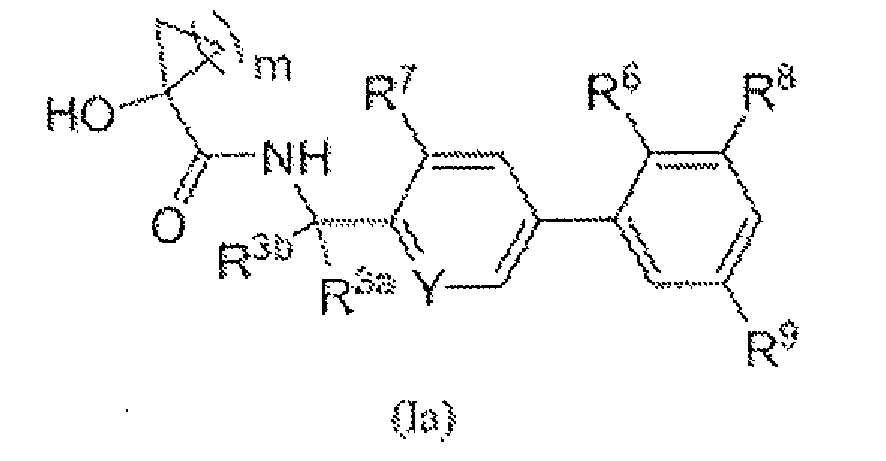
- Composé selon la revendication 1, présentant la formule Ib et sels pharmaceutiquement acceptables de celui-ci:

- Composé selon la revendication 9, dans lequel R2a' et R2b' sont indépendamment un alkyle C1-7 éventuellement substitué avec de 1 à 5 atomes d'halogène.
- Composé selon la revendication 10, dans lequel un de R3a et de R3b est un hydrogène et l'autre est un hydrogène ou un méthyle; R7 est un hydrogène, un chlore ou un fluor; R6 est choisi parmi (1) un -CO2-alkyle C1-4, (2) un alcoxy C1-4 éventuellement substitué avec de 1 à 5 atomes d'halogène et (3) un cycle hétéroaromatique de 5 membres possédant un hétéroatome de cycle choisi parmi N, O et S et possédant éventuellement jusqu'à 3 atomes d'azote de cycle supplémentaires, ledit cycle étant éventuellement substitué avec un groupe alkyle C1-4; et R8 et R9 sont indépendamment un hydrogène ou un halogène.
- Composé selon la revendication 1, présentant la formule Ic et sels pharmaceutiquement acceptables de celui-ci:

- Composé selon la revendication 12 qui est le (2R)-N-((1-R)-1-{5-[5-chloro-3-fluoro-2-(5-méthyl-1,2,4-oxadiazol-3-yl)phényle]-3-fluoropyridin-2-yl}éthyl)-3,3,3-trifluoro-2-hydroxy-2-méthylpropanamide ou un sel pharmaceutiquement acceptable de celui-ci.
- Composition pharmaceutique comprenant une quantité thérapeutiquement efficace d'un composé selon l'une quelconque des revendications 1-13 et un support pharmaceutiquement acceptable.
- Composition pharmaceutique selon la revendication 14 comprenant le (2R)-N-((1-R)-1-{5-[5-chloro-3-fluoro-2-(5-méthyl-1,2,4-oxadiazol-3-yl)phényle]-3-fluoropyridin-2-yl}éthyl)-3,3,3-trifluoro-2-hydroxy-2-méthylpropanamide ou un sel pharmaceutiquement acceptable de celui-ci.
- Utilisation d'un composé selon l'une quelconque des revendications 1-13 ou d'un sel pharmaceutiquement acceptable de celui-ci pour la fabrication d'un médicament pour le traitement ou la prévention de maladies ou d'états induits par le récepteur B1 de la bradykinine.
- Utilisation selon la revendication 16, dans laquelle lesdits maladies ou états sont une douleur aiguë, une douleur inflammatoire et une douleur neuropathique.
Applications Claiming Priority (4)
| Application Number | Priority Date | Filing Date | Title |
|---|---|---|---|
| US53164303P | 2003-12-22 | 2003-12-22 | |
| US53963704P | 2004-01-28 | 2004-01-28 | |
| US62495804P | 2004-11-04 | 2004-11-04 | |
| PCT/US2004/042691 WO2005063690A1 (fr) | 2003-12-22 | 2004-12-17 | Alpha-hydroxy amides utilises comme antagonistes ou agonistes inverses de la bradykinine |
Publications (2)
| Publication Number | Publication Date |
|---|---|
| EP1706372A1 EP1706372A1 (fr) | 2006-10-04 |
| EP1706372B1 true EP1706372B1 (fr) | 2010-05-19 |
Family
ID=34743689
Family Applications (1)
| Application Number | Title | Priority Date | Filing Date |
|---|---|---|---|
| EP04814829A Expired - Lifetime EP1706372B1 (fr) | 2003-12-22 | 2004-12-17 | Alpha-hydroxy amides utilises comme antagonistes ou agonistes inverses de la bradykinine |
Country Status (16)
| Country | Link |
|---|---|
| US (1) | US7790754B2 (fr) |
| EP (1) | EP1706372B1 (fr) |
| JP (1) | JP4585522B2 (fr) |
| KR (1) | KR20060115753A (fr) |
| AT (1) | ATE468322T1 (fr) |
| AU (1) | AU2004309357B2 (fr) |
| BR (1) | BRPI0417928A (fr) |
| CA (1) | CA2550372C (fr) |
| DE (1) | DE602004027301D1 (fr) |
| EC (1) | ECSP066658A (fr) |
| IL (1) | IL176381A0 (fr) |
| IS (1) | IS8510A (fr) |
| MA (1) | MA28288A1 (fr) |
| MX (1) | MXPA06007203A (fr) |
| NO (1) | NO20063394L (fr) |
| WO (1) | WO2005063690A1 (fr) |
Families Citing this family (14)
| Publication number | Priority date | Publication date | Assignee | Title |
|---|---|---|---|---|
| UA87854C2 (en) | 2004-06-07 | 2009-08-25 | Мерк Энд Ко., Инк. | N-(2-benzyl)-2-phenylbutanamides as androgen receptor modulators |
| US7429604B2 (en) * | 2004-06-15 | 2008-09-30 | Bristol Myers Squibb Company | Six-membered heterocycles useful as serine protease inhibitors |
| JP2008518968A (ja) * | 2004-10-29 | 2008-06-05 | メルク エンド カムパニー インコーポレーテッド | アンドロゲン受容体モジュレーターとしてのn−(ピリジン−3−イル)−2−フェニルブタンアミド |
| WO2006052514A1 (fr) * | 2004-11-04 | 2006-05-18 | Merck & Co., Inc. | Hydrogenation asymetrique d'enamides |
| ES2422197T3 (es) | 2005-06-03 | 2013-09-09 | Merck Sharp & Dohme | Derivados 1-hidroxicicloalcanocarboxamida como antagonistas de la bradiquinina |
| US20090088458A1 (en) * | 2005-08-02 | 2009-04-02 | Meissner Robert S | N-(Pyridin-4-Yl)-2-Phenylbutanamides as Androgen Receptor Modulators |
| EP2010493B1 (fr) * | 2006-04-12 | 2016-01-27 | Merck Sharp & Dohme Corp. | Composés de pyridylamide antagonistes des canaux calciques de type t |
| CN101583593A (zh) | 2006-11-13 | 2009-11-18 | 辉瑞产品公司 | 二芳基、二吡啶基和芳基-吡啶基衍生物及其用途 |
| US8124605B2 (en) * | 2007-07-06 | 2012-02-28 | Kinex Pharmaceuticals, Llc | Compositions and methods for modulating a kinase cascade |
| AU2008317353B2 (en) * | 2007-10-24 | 2014-08-07 | Merck Sharp & Dohme Llc | Heterocycle phenyl amide T-type calcium channel antagonists |
| CA2752190A1 (fr) | 2009-02-13 | 2010-08-19 | Jerini Ag | Petites molecules antagonistes du recepteur b1 de la bradykinine |
| WO2011012283A1 (fr) | 2009-07-30 | 2011-02-03 | University Of Zurich | Formulation injectable de traitement et de protection de patients souffrant de réaction inflammatoire ou dun événement d'ischémie-reperfusion |
| CA2883144C (fr) | 2012-08-30 | 2023-01-17 | Kinex Pharmaceuticals, Llc | N-(3-fluorobenzyl)-2-(5-(4-morpholinophenyl)pyridin-2-yl) acetamide utilise en tant que modulateurs de la proteine tyrosine kinase |
| CN113200841B (zh) * | 2021-04-21 | 2022-05-20 | 嘉兴学院 | 一种基于Heck偶联合成消旋萘普生的新工艺 |
Family Cites Families (8)
| Publication number | Priority date | Publication date | Assignee | Title |
|---|---|---|---|---|
| JPH075579B2 (ja) * | 1986-09-01 | 1995-01-25 | 吉富製薬株式会社 | アミノチアゾ−ル化合物 |
| GB8726179D0 (en) * | 1987-11-09 | 1987-12-16 | Fujisawa Pharmaceutical Co | Heterocyclic derivatives |
| ATE257827T1 (de) * | 1999-07-21 | 2004-01-15 | Hoffmann La Roche | Triazolderivate |
| DE10008329A1 (de) * | 2000-02-23 | 2001-08-30 | Merck Patent Gmbh | Aminosulfonylbiphenylderivate |
| DE10014645A1 (de) * | 2000-03-24 | 2001-09-27 | Merck Patent Gmbh | Substituierte Biphenylderivate |
| FR2822827B1 (fr) * | 2001-03-28 | 2003-05-16 | Sanofi Synthelabo | Nouveaux derives de n-(arylsulfonyl) beta-aminoacides comportant un groupe aminomethyle substitue, leur procede de preparation et les compositions pharmaceutiques en contenant |
| TWI259079B (en) * | 2002-02-08 | 2006-08-01 | Merck & Co Inc | N-biphenyl(substituted methyl)aminocycloalkanecarboxamide derivatives |
| JP2007500707A (ja) * | 2003-07-29 | 2007-01-18 | リブ−エックス ファーマシューティカルズ,インコーポレイテッド | ビアリールヘテロ環状のアミン、アミドおよび硫黄−含有化合物、並びに該化合物の製造方法および使用方法 |
-
2004
- 2004-12-17 AU AU2004309357A patent/AU2004309357B2/en not_active Ceased
- 2004-12-17 BR BRPI0417928-5A patent/BRPI0417928A/pt not_active Application Discontinuation
- 2004-12-17 WO PCT/US2004/042691 patent/WO2005063690A1/fr not_active Ceased
- 2004-12-17 KR KR1020067012382A patent/KR20060115753A/ko not_active Withdrawn
- 2004-12-17 JP JP2006547200A patent/JP4585522B2/ja not_active Expired - Fee Related
- 2004-12-17 MX MXPA06007203A patent/MXPA06007203A/es not_active Application Discontinuation
- 2004-12-17 CA CA002550372A patent/CA2550372C/fr not_active Expired - Fee Related
- 2004-12-17 US US10/583,675 patent/US7790754B2/en not_active Expired - Fee Related
- 2004-12-17 DE DE602004027301T patent/DE602004027301D1/de not_active Expired - Lifetime
- 2004-12-17 EP EP04814829A patent/EP1706372B1/fr not_active Expired - Lifetime
- 2004-12-17 AT AT04814829T patent/ATE468322T1/de not_active IP Right Cessation
-
2006
- 2006-06-15 IS IS8510A patent/IS8510A/xx unknown
- 2006-06-18 IL IL176381A patent/IL176381A0/en unknown
- 2006-06-20 EC EC2006006658A patent/ECSP066658A/es unknown
- 2006-07-10 MA MA29175A patent/MA28288A1/fr unknown
- 2006-07-21 NO NO20063394A patent/NO20063394L/no unknown
Also Published As
| Publication number | Publication date |
|---|---|
| NO20063394L (no) | 2006-09-12 |
| MXPA06007203A (es) | 2006-08-18 |
| AU2004309357B2 (en) | 2010-10-07 |
| US20080318976A1 (en) | 2008-12-25 |
| CA2550372A1 (fr) | 2005-07-14 |
| ATE468322T1 (de) | 2010-06-15 |
| KR20060115753A (ko) | 2006-11-09 |
| WO2005063690A1 (fr) | 2005-07-14 |
| EP1706372A1 (fr) | 2006-10-04 |
| DE602004027301D1 (de) | 2010-07-01 |
| AU2004309357A1 (en) | 2005-07-14 |
| JP4585522B2 (ja) | 2010-11-24 |
| US7790754B2 (en) | 2010-09-07 |
| ECSP066658A (es) | 2006-10-25 |
| MA28288A1 (fr) | 2006-11-01 |
| IL176381A0 (en) | 2006-10-05 |
| JP2007520472A (ja) | 2007-07-26 |
| CA2550372C (fr) | 2009-09-29 |
| BRPI0417928A (pt) | 2007-04-17 |
| IS8510A (is) | 2006-06-15 |
Similar Documents
| Publication | Publication Date | Title |
|---|---|---|
| US6919343B2 (en) | N-biphenyl(substituted methyl) aminocycloalkane-carboxamide derivatives | |
| AU2003265674B2 (en) | N-biarylmethyl aminocycloalkanecarboxamide derivatives | |
| EP1476419B1 (fr) | Derives de n-biphenylmethyl aminocycloalcanecarboxamide | |
| EP1706372B1 (fr) | Alpha-hydroxy amides utilises comme antagonistes ou agonistes inverses de la bradykinine | |
| EP1723143B1 (fr) | Derives d amino cyclopropane carboxamide utilises comme antagonistes de la bradykinine | |
| US20040044041A1 (en) | 2-(Biarylalkyl)amino-3-(cyanoalkanoylamino)pyridine derivatives | |
| JP2007501790A (ja) | スルホニル置換n−(ビアリールメチル)アミノシクロプロパンカルボキサミド | |
| US20040063761A1 (en) | 2-(biarylalkyl)amino-3-(fluoroalkanoylamino)pyridine derivatives | |
| US20040029920A1 (en) | 2-(biarylalkyl)amino-3-(heterocyclylcarbonylamino)-pyridine derivatives | |
| US20040034064A1 (en) | 2-(biarylalkyl)amino-3-(alkanoylamino)pyridine derivatives | |
| US20060106011A1 (en) | 2-(Bicyclo)alkylamino-derivatives as mediators of chronic pain and inflammation | |
| EP1893579B1 (fr) | Dérivés de 1-hydroxycycloalcanecarboxamide servant d'antagonistes à la bradykinine | |
| US20060173023A1 (en) | 2-(Bicyclo)alkylamino-derivatives as mediators of chronic pain and inflammation |
Legal Events
| Date | Code | Title | Description |
|---|---|---|---|
| PUAI | Public reference made under article 153(3) epc to a published international application that has entered the european phase |
Free format text: ORIGINAL CODE: 0009012 |
|
| 17P | Request for examination filed |
Effective date: 20060724 |
|
| AK | Designated contracting states |
Kind code of ref document: A1 Designated state(s): AT BE BG CH CY CZ DE DK EE ES FI FR GB GR HU IE IS IT LI LT LU MC NL PL PT RO SE SI SK TR |
|
| AX | Request for extension of the european patent |
Extension state: HR LV |
|
| RAX | Requested extension states of the european patent have changed |
Extension state: LV Payment date: 20060724 Extension state: HR Payment date: 20060724 |
|
| 17Q | First examination report despatched |
Effective date: 20071219 |
|
| GRAP | Despatch of communication of intention to grant a patent |
Free format text: ORIGINAL CODE: EPIDOSNIGR1 |
|
| RAP1 | Party data changed (applicant data changed or rights of an application transferred) |
Owner name: MERCK SHARP & DOHME CORP. |
|
| GRAS | Grant fee paid |
Free format text: ORIGINAL CODE: EPIDOSNIGR3 |
|
| GRAA | (expected) grant |
Free format text: ORIGINAL CODE: 0009210 |
|
| AK | Designated contracting states |
Kind code of ref document: B1 Designated state(s): AT BE BG CH CY CZ DE DK EE ES FI FR GB GR HU IE IS IT LI LT LU MC NL PL PT RO SE SI SK TR |
|
| AX | Request for extension of the european patent |
Extension state: HR LV |
|
| REG | Reference to a national code |
Ref country code: GB Ref legal event code: FG4D |
|
| REG | Reference to a national code |
Ref country code: CH Ref legal event code: NV Representative=s name: SERVOPATENT GMBH Ref country code: CH Ref legal event code: EP |
|
| REG | Reference to a national code |
Ref country code: IE Ref legal event code: FG4D |
|
| REF | Corresponds to: |
Ref document number: 602004027301 Country of ref document: DE Date of ref document: 20100701 Kind code of ref document: P |
|
| REG | Reference to a national code |
Ref country code: NL Ref legal event code: VDEP Effective date: 20100519 |
|
| LTIE | Lt: invalidation of european patent or patent extension |
Effective date: 20100519 |
|
| PG25 | Lapsed in a contracting state [announced via postgrant information from national office to epo] |
Ref country code: SE Free format text: LAPSE BECAUSE OF FAILURE TO SUBMIT A TRANSLATION OF THE DESCRIPTION OR TO PAY THE FEE WITHIN THE PRESCRIBED TIME-LIMIT Effective date: 20100519 Ref country code: LT Free format text: LAPSE BECAUSE OF FAILURE TO SUBMIT A TRANSLATION OF THE DESCRIPTION OR TO PAY THE FEE WITHIN THE PRESCRIBED TIME-LIMIT Effective date: 20100519 Ref country code: ES Free format text: LAPSE BECAUSE OF FAILURE TO SUBMIT A TRANSLATION OF THE DESCRIPTION OR TO PAY THE FEE WITHIN THE PRESCRIBED TIME-LIMIT Effective date: 20100830 |
|
| PG25 | Lapsed in a contracting state [announced via postgrant information from national office to epo] |
Ref country code: SI Free format text: LAPSE BECAUSE OF FAILURE TO SUBMIT A TRANSLATION OF THE DESCRIPTION OR TO PAY THE FEE WITHIN THE PRESCRIBED TIME-LIMIT Effective date: 20100519 Ref country code: IS Free format text: LAPSE BECAUSE OF FAILURE TO SUBMIT A TRANSLATION OF THE DESCRIPTION OR TO PAY THE FEE WITHIN THE PRESCRIBED TIME-LIMIT Effective date: 20100919 Ref country code: AT Free format text: LAPSE BECAUSE OF FAILURE TO SUBMIT A TRANSLATION OF THE DESCRIPTION OR TO PAY THE FEE WITHIN THE PRESCRIBED TIME-LIMIT Effective date: 20100519 Ref country code: FI Free format text: LAPSE BECAUSE OF FAILURE TO SUBMIT A TRANSLATION OF THE DESCRIPTION OR TO PAY THE FEE WITHIN THE PRESCRIBED TIME-LIMIT Effective date: 20100519 |
|
| PG25 | Lapsed in a contracting state [announced via postgrant information from national office to epo] |
Ref country code: PL Free format text: LAPSE BECAUSE OF FAILURE TO SUBMIT A TRANSLATION OF THE DESCRIPTION OR TO PAY THE FEE WITHIN THE PRESCRIBED TIME-LIMIT Effective date: 20100519 Ref country code: GR Free format text: LAPSE BECAUSE OF FAILURE TO SUBMIT A TRANSLATION OF THE DESCRIPTION OR TO PAY THE FEE WITHIN THE PRESCRIBED TIME-LIMIT Effective date: 20100820 Ref country code: CY Free format text: LAPSE BECAUSE OF FAILURE TO SUBMIT A TRANSLATION OF THE DESCRIPTION OR TO PAY THE FEE WITHIN THE PRESCRIBED TIME-LIMIT Effective date: 20100519 |
|
| PG25 | Lapsed in a contracting state [announced via postgrant information from national office to epo] |
Ref country code: PT Free format text: LAPSE BECAUSE OF FAILURE TO SUBMIT A TRANSLATION OF THE DESCRIPTION OR TO PAY THE FEE WITHIN THE PRESCRIBED TIME-LIMIT Effective date: 20100920 Ref country code: EE Free format text: LAPSE BECAUSE OF FAILURE TO SUBMIT A TRANSLATION OF THE DESCRIPTION OR TO PAY THE FEE WITHIN THE PRESCRIBED TIME-LIMIT Effective date: 20100519 Ref country code: DK Free format text: LAPSE BECAUSE OF FAILURE TO SUBMIT A TRANSLATION OF THE DESCRIPTION OR TO PAY THE FEE WITHIN THE PRESCRIBED TIME-LIMIT Effective date: 20100519 Ref country code: NL Free format text: LAPSE BECAUSE OF FAILURE TO SUBMIT A TRANSLATION OF THE DESCRIPTION OR TO PAY THE FEE WITHIN THE PRESCRIBED TIME-LIMIT Effective date: 20100519 |
|
| PG25 | Lapsed in a contracting state [announced via postgrant information from national office to epo] |
Ref country code: BE Free format text: LAPSE BECAUSE OF FAILURE TO SUBMIT A TRANSLATION OF THE DESCRIPTION OR TO PAY THE FEE WITHIN THE PRESCRIBED TIME-LIMIT Effective date: 20100519 Ref country code: SK Free format text: LAPSE BECAUSE OF FAILURE TO SUBMIT A TRANSLATION OF THE DESCRIPTION OR TO PAY THE FEE WITHIN THE PRESCRIBED TIME-LIMIT Effective date: 20100519 Ref country code: RO Free format text: LAPSE BECAUSE OF FAILURE TO SUBMIT A TRANSLATION OF THE DESCRIPTION OR TO PAY THE FEE WITHIN THE PRESCRIBED TIME-LIMIT Effective date: 20100519 Ref country code: CZ Free format text: LAPSE BECAUSE OF FAILURE TO SUBMIT A TRANSLATION OF THE DESCRIPTION OR TO PAY THE FEE WITHIN THE PRESCRIBED TIME-LIMIT Effective date: 20100519 |
|
| PLBE | No opposition filed within time limit |
Free format text: ORIGINAL CODE: 0009261 |
|
| STAA | Information on the status of an ep patent application or granted ep patent |
Free format text: STATUS: NO OPPOSITION FILED WITHIN TIME LIMIT |
|
| PG25 | Lapsed in a contracting state [announced via postgrant information from national office to epo] |
Ref country code: IT Free format text: LAPSE BECAUSE OF FAILURE TO SUBMIT A TRANSLATION OF THE DESCRIPTION OR TO PAY THE FEE WITHIN THE PRESCRIBED TIME-LIMIT Effective date: 20100519 |
|
| 26N | No opposition filed |
Effective date: 20110222 |
|
| REG | Reference to a national code |
Ref country code: DE Ref legal event code: R097 Ref document number: 602004027301 Country of ref document: DE Effective date: 20110221 |
|
| PG25 | Lapsed in a contracting state [announced via postgrant information from national office to epo] |
Ref country code: MC Free format text: LAPSE BECAUSE OF NON-PAYMENT OF DUE FEES Effective date: 20101231 |
|
| PG25 | Lapsed in a contracting state [announced via postgrant information from national office to epo] |
Ref country code: IE Free format text: LAPSE BECAUSE OF NON-PAYMENT OF DUE FEES Effective date: 20101217 |
|
| REG | Reference to a national code |
Ref country code: CH Ref legal event code: PFUS Owner name: SCHERING CORPORATION, US Free format text: FORMER OWNER: MERCK SHARP + DOHME CORP., US Ref country code: CH Ref legal event code: PFA Owner name: MERCK SHARP & DOHME CORP. Free format text: SCHERING CORPORATION#2000 GALLOPING HILL ROAD#KENILWORTH, NJ 07033 (US) -TRANSFER TO- MERCK SHARP & DOHME CORP.#126 EAST LINCOLN AVENUE#RAHWAY, NEW JERSEY 07065 (US) |
|
| REG | Reference to a national code |
Ref country code: GB Ref legal event code: 732E Free format text: REGISTERED BETWEEN 20120726 AND 20120801 |
|
| PG25 | Lapsed in a contracting state [announced via postgrant information from national office to epo] |
Ref country code: LU Free format text: LAPSE BECAUSE OF NON-PAYMENT OF DUE FEES Effective date: 20101217 Ref country code: BG Free format text: LAPSE BECAUSE OF FAILURE TO SUBMIT A TRANSLATION OF THE DESCRIPTION OR TO PAY THE FEE WITHIN THE PRESCRIBED TIME-LIMIT Effective date: 20100519 Ref country code: HU Free format text: LAPSE BECAUSE OF FAILURE TO SUBMIT A TRANSLATION OF THE DESCRIPTION OR TO PAY THE FEE WITHIN THE PRESCRIBED TIME-LIMIT Effective date: 20101120 |
|
| PG25 | Lapsed in a contracting state [announced via postgrant information from national office to epo] |
Ref country code: TR Free format text: LAPSE BECAUSE OF FAILURE TO SUBMIT A TRANSLATION OF THE DESCRIPTION OR TO PAY THE FEE WITHIN THE PRESCRIBED TIME-LIMIT Effective date: 20100519 |
|
| REG | Reference to a national code |
Ref country code: DE Ref legal event code: R082 Ref document number: 602004027301 Country of ref document: DE Representative=s name: ABITZ & PARTNER, DE Effective date: 20121213 Ref country code: DE Ref legal event code: R081 Ref document number: 602004027301 Country of ref document: DE Owner name: MERCK SHARP & DOHME CORP., US Free format text: FORMER OWNER: MERCK SHARP & DOHME CORP., RAHWAY, US Effective date: 20121213 Ref country code: DE Ref legal event code: R081 Ref document number: 602004027301 Country of ref document: DE Owner name: SCHERING CORPORATION, US Free format text: FORMER OWNER: MERCK SHARP & DOHME CORP., RAHWAY, US Effective date: 20121213 Ref country code: DE Ref legal event code: R081 Ref document number: 602004027301 Country of ref document: DE Owner name: MERCK SHARP & DOHME CORP., RAHWAY, US Free format text: FORMER OWNER: MERCK SHARP & DOHME CORP., RAHWAY, N.J., US Effective date: 20121213 Ref country code: DE Ref legal event code: R082 Ref document number: 602004027301 Country of ref document: DE Representative=s name: ABITZ & PARTNER PATENTANWAELTE MBB, DE Effective date: 20121213 |
|
| REG | Reference to a national code |
Ref country code: FR Ref legal event code: TP Owner name: SCHERING CORPORATION, US Effective date: 20130318 Ref country code: FR Ref legal event code: CD Owner name: SCHERING CORPORATION, US Effective date: 20130319 |
|
| REG | Reference to a national code |
Ref country code: DE Ref legal event code: R082 Ref document number: 602004027301 Country of ref document: DE Representative=s name: ABITZ & PARTNER, DE |
|
| REG | Reference to a national code |
Ref country code: DE Ref legal event code: R082 Ref document number: 602004027301 Country of ref document: DE Representative=s name: ABITZ & PARTNER, DE Effective date: 20130514 Ref country code: DE Ref legal event code: R081 Ref document number: 602004027301 Country of ref document: DE Owner name: MERCK SHARP & DOHME CORP., US Free format text: FORMER OWNER: SCHERING CORPORATION, RAHWAY, US Effective date: 20130514 Ref country code: DE Ref legal event code: R081 Ref document number: 602004027301 Country of ref document: DE Owner name: MERCK SHARP & DOHME CORP., RAHWAY, US Free format text: FORMER OWNER: SCHERING CORPORATION, RAHWAY, US Effective date: 20130514 Ref country code: DE Ref legal event code: R082 Ref document number: 602004027301 Country of ref document: DE Representative=s name: ABITZ & PARTNER PATENTANWAELTE MBB, DE Effective date: 20130514 |
|
| PG25 | Lapsed in a contracting state [announced via postgrant information from national office to epo] |
Ref country code: BG Free format text: LAPSE BECAUSE OF FAILURE TO SUBMIT A TRANSLATION OF THE DESCRIPTION OR TO PAY THE FEE WITHIN THE PRESCRIBED TIME-LIMIT Effective date: 20100819 |
|
| PGFP | Annual fee paid to national office [announced via postgrant information from national office to epo] |
Ref country code: CH Payment date: 20131029 Year of fee payment: 10 |
|
| REG | Reference to a national code |
Ref country code: CH Ref legal event code: PL |
|
| PG25 | Lapsed in a contracting state [announced via postgrant information from national office to epo] |
Ref country code: LI Free format text: LAPSE BECAUSE OF NON-PAYMENT OF DUE FEES Effective date: 20141231 Ref country code: CH Free format text: LAPSE BECAUSE OF NON-PAYMENT OF DUE FEES Effective date: 20141231 |
|
| REG | Reference to a national code |
Ref country code: FR Ref legal event code: PLFP Year of fee payment: 12 |
|
| REG | Reference to a national code |
Ref country code: FR Ref legal event code: PLFP Year of fee payment: 13 |
|
| REG | Reference to a national code |
Ref country code: FR Ref legal event code: PLFP Year of fee payment: 14 |
|
| PGFP | Annual fee paid to national office [announced via postgrant information from national office to epo] |
Ref country code: DE Payment date: 20191114 Year of fee payment: 16 |
|
| PGFP | Annual fee paid to national office [announced via postgrant information from national office to epo] |
Ref country code: FR Payment date: 20191122 Year of fee payment: 16 |
|
| PGFP | Annual fee paid to national office [announced via postgrant information from national office to epo] |
Ref country code: GB Payment date: 20191126 Year of fee payment: 16 |
|
| REG | Reference to a national code |
Ref country code: DE Ref legal event code: R119 Ref document number: 602004027301 Country of ref document: DE |
|
| GBPC | Gb: european patent ceased through non-payment of renewal fee |
Effective date: 20201217 |
|
| PG25 | Lapsed in a contracting state [announced via postgrant information from national office to epo] |
Ref country code: FR Free format text: LAPSE BECAUSE OF NON-PAYMENT OF DUE FEES Effective date: 20201231 |
|
| PG25 | Lapsed in a contracting state [announced via postgrant information from national office to epo] |
Ref country code: DE Free format text: LAPSE BECAUSE OF NON-PAYMENT OF DUE FEES Effective date: 20210701 Ref country code: GB Free format text: LAPSE BECAUSE OF NON-PAYMENT OF DUE FEES Effective date: 20201217 |