EP1709062B9 - Exemestane et ses produits intermediaires et ses procedes de fabrication - Google Patents
Exemestane et ses produits intermediaires et ses procedes de fabrication Download PDFInfo
- Publication number
- EP1709062B9 EP1709062B9 EP05711473A EP05711473A EP1709062B9 EP 1709062 B9 EP1709062 B9 EP 1709062B9 EP 05711473 A EP05711473 A EP 05711473A EP 05711473 A EP05711473 A EP 05711473A EP 1709062 B9 EP1709062 B9 EP 1709062B9
- Authority
- EP
- European Patent Office
- Prior art keywords
- exemestane
- purity
- formula
- yield
- compound
- Prior art date
- Legal status (The legal status is an assumption and is not a legal conclusion. Google has not performed a legal analysis and makes no representation as to the accuracy of the status listed.)
- Expired - Lifetime
Links
- 238000000034 method Methods 0.000 title claims abstract description 80
- BFYIZQONLCFLEV-DAELLWKTSA-N Aromasine Chemical compound O=C1C=C[C@]2(C)[C@H]3CC[C@](C)(C(CC4)=O)[C@@H]4[C@@H]3CC(=C)C2=C1 BFYIZQONLCFLEV-DAELLWKTSA-N 0.000 title abstract description 93
- 229960000255 exemestane Drugs 0.000 title abstract description 91
- 239000000543 intermediate Substances 0.000 title description 25
- 150000001875 compounds Chemical class 0.000 claims abstract description 39
- 229910052736 halogen Inorganic materials 0.000 claims abstract description 14
- 150000002367 halogens Chemical class 0.000 claims abstract description 14
- 229910052739 hydrogen Inorganic materials 0.000 claims abstract description 14
- 239000001257 hydrogen Substances 0.000 claims abstract description 14
- 239000003795 chemical substances by application Substances 0.000 claims abstract description 13
- 125000006527 (C1-C5) alkyl group Chemical group 0.000 claims abstract description 9
- 150000002431 hydrogen Chemical class 0.000 claims abstract description 8
- 125000004169 (C1-C6) alkyl group Chemical group 0.000 claims abstract description 7
- 125000004435 hydrogen atom Chemical group [H]* 0.000 claims abstract description 6
- 239000002904 solvent Substances 0.000 claims description 24
- KWYUFKZDYYNOTN-UHFFFAOYSA-M Potassium hydroxide Chemical group [OH-].[K+] KWYUFKZDYYNOTN-UHFFFAOYSA-M 0.000 claims description 22
- 239000002585 base Substances 0.000 claims description 17
- 125000002496 methyl group Chemical group [H]C([H])([H])* 0.000 claims description 8
- 229910006080 SO2X Inorganic materials 0.000 claims description 7
- 150000008044 alkali metal hydroxides Chemical class 0.000 claims description 4
- 239000000460 chlorine Substances 0.000 claims description 4
- 229910052801 chlorine Inorganic materials 0.000 claims description 4
- 125000001309 chloro group Chemical group Cl* 0.000 claims description 4
- 125000000325 methylidene group Chemical group [H]C([H])=* 0.000 claims description 3
- 125000005270 trialkylamine group Chemical group 0.000 claims description 3
- 125000003277 amino group Chemical group 0.000 claims 1
- 125000001302 tertiary amino group Chemical group 0.000 claims 1
- 239000003886 aromatase inhibitor Substances 0.000 abstract description 17
- 229940122815 Aromatase inhibitor Drugs 0.000 abstract description 10
- 125000002947 alkylene group Chemical group 0.000 abstract 1
- OKKJLVBELUTLKV-UHFFFAOYSA-N Methanol Chemical compound OC OKKJLVBELUTLKV-UHFFFAOYSA-N 0.000 description 78
- 238000004128 high performance liquid chromatography Methods 0.000 description 66
- LFQSCWFLJHTTHZ-UHFFFAOYSA-N Ethanol Chemical compound CCO LFQSCWFLJHTTHZ-UHFFFAOYSA-N 0.000 description 62
- YMWUJEATGCHHMB-UHFFFAOYSA-N Dichloromethane Chemical compound ClCCl YMWUJEATGCHHMB-UHFFFAOYSA-N 0.000 description 48
- 238000006243 chemical reaction Methods 0.000 description 45
- 230000008569 process Effects 0.000 description 42
- 239000000047 product Substances 0.000 description 42
- YXFVVABEGXRONW-UHFFFAOYSA-N Toluene Chemical compound CC1=CC=CC=C1 YXFVVABEGXRONW-UHFFFAOYSA-N 0.000 description 41
- RWRDLPDLKQPQOW-UHFFFAOYSA-N Pyrrolidine Chemical compound C1CCNC1 RWRDLPDLKQPQOW-UHFFFAOYSA-N 0.000 description 39
- XLYOFNOQVPJJNP-UHFFFAOYSA-N water Substances O XLYOFNOQVPJJNP-UHFFFAOYSA-N 0.000 description 35
- WSFSSNUMVMOOMR-UHFFFAOYSA-N Formaldehyde Chemical compound O=C WSFSSNUMVMOOMR-UHFFFAOYSA-N 0.000 description 31
- ZMANZCXQSJIPKH-UHFFFAOYSA-N Triethylamine Chemical group CCN(CC)CC ZMANZCXQSJIPKH-UHFFFAOYSA-N 0.000 description 26
- WEVYAHXRMPXWCK-UHFFFAOYSA-N Acetonitrile Chemical compound CC#N WEVYAHXRMPXWCK-UHFFFAOYSA-N 0.000 description 24
- 238000001035 drying Methods 0.000 description 21
- 238000002360 preparation method Methods 0.000 description 21
- AJHWCTQQEBEEFJ-XNBTXCQYSA-N (8r,9s,10r,13s,14s)-10,13-dimethyl-1,3-dipyrrolidin-1-yl-1,2,7,8,9,11,12,14,15,16-decahydrocyclopenta[a]phenanthren-17-one Chemical compound C([C@@H]1[C@@H]([C@@]23C)CC[C@]4([C@H]1CCC4=O)C)C=C3C=C(N1CCCC1)CC2N1CCCC1 AJHWCTQQEBEEFJ-XNBTXCQYSA-N 0.000 description 20
- 239000011541 reaction mixture Substances 0.000 description 19
- 238000002955 isolation Methods 0.000 description 18
- 238000001953 recrystallisation Methods 0.000 description 18
- QTBSBXVTEAMEQO-UHFFFAOYSA-N Acetic acid Chemical compound CC(O)=O QTBSBXVTEAMEQO-UHFFFAOYSA-N 0.000 description 15
- WYURNTSHIVDZCO-UHFFFAOYSA-N Tetrahydrofuran Chemical compound C1CCOC1 WYURNTSHIVDZCO-UHFFFAOYSA-N 0.000 description 14
- 230000005484 gravity Effects 0.000 description 14
- 239000000463 material Substances 0.000 description 14
- 239000000243 solution Substances 0.000 description 14
- 239000012359 Methanesulfonyl chloride Substances 0.000 description 13
- LUJVUUWNAPIQQI-QAGGRKNESA-N androsta-1,4-diene-3,17-dione Chemical compound O=C1C=C[C@]2(C)[C@H]3CC[C@](C)(C(CC4)=O)[C@@H]4[C@@H]3CCC2=C1 LUJVUUWNAPIQQI-QAGGRKNESA-N 0.000 description 13
- QARBMVPHQWIHKH-UHFFFAOYSA-N methanesulfonyl chloride Chemical compound CS(Cl)(=O)=O QARBMVPHQWIHKH-UHFFFAOYSA-N 0.000 description 13
- 239000012535 impurity Substances 0.000 description 10
- DAXJNUBSBFUTRP-RTQNCGMRSA-N (8r,9s,10r,13s,14s)-6-(hydroxymethyl)-10,13-dimethyl-7,8,9,11,12,14,15,16-octahydro-6h-cyclopenta[a]phenanthrene-3,17-dione Chemical compound O=C1C=C[C@]2(C)[C@H]3CC[C@](C)(C(CC4)=O)[C@@H]4[C@@H]3CC(CO)C2=C1 DAXJNUBSBFUTRP-RTQNCGMRSA-N 0.000 description 9
- 238000004458 analytical method Methods 0.000 description 9
- 239000002002 slurry Substances 0.000 description 9
- KFZMGEQAYNKOFK-UHFFFAOYSA-N Isopropanol Chemical compound CC(C)O KFZMGEQAYNKOFK-UHFFFAOYSA-N 0.000 description 8
- 230000015572 biosynthetic process Effects 0.000 description 8
- 238000002425 crystallisation Methods 0.000 description 8
- 230000008025 crystallization Effects 0.000 description 8
- 238000002474 experimental method Methods 0.000 description 8
- 238000011068 loading method Methods 0.000 description 8
- 239000000203 mixture Substances 0.000 description 8
- LUJVUUWNAPIQQI-UHFFFAOYSA-N (+)-androsta-1,4-diene-3,17-dione Natural products O=C1C=CC2(C)C3CCC(C)(C(CC4)=O)C4C3CCC2=C1 LUJVUUWNAPIQQI-UHFFFAOYSA-N 0.000 description 7
- 229940046844 aromatase inhibitors Drugs 0.000 description 7
- 238000003786 synthesis reaction Methods 0.000 description 7
- 238000012795 verification Methods 0.000 description 7
- 102000014654 Aromatase Human genes 0.000 description 6
- 108010078554 Aromatase Proteins 0.000 description 6
- HEMHJVSKTPXQMS-UHFFFAOYSA-M Sodium hydroxide Chemical compound [OH-].[Na+] HEMHJVSKTPXQMS-UHFFFAOYSA-M 0.000 description 6
- QAOWNCQODCNURD-UHFFFAOYSA-N Sulfuric acid Chemical compound OS(O)(=O)=O QAOWNCQODCNURD-UHFFFAOYSA-N 0.000 description 6
- 238000003379 elimination reaction Methods 0.000 description 6
- 229940011871 estrogen Drugs 0.000 description 6
- 239000000262 estrogen Substances 0.000 description 6
- 230000020477 pH reduction Effects 0.000 description 6
- 238000001556 precipitation Methods 0.000 description 6
- 238000010992 reflux Methods 0.000 description 6
- 238000010626 work up procedure Methods 0.000 description 6
- 230000007423 decrease Effects 0.000 description 5
- 238000004821 distillation Methods 0.000 description 5
- 239000000706 filtrate Substances 0.000 description 5
- 230000007062 hydrolysis Effects 0.000 description 5
- 238000006460 hydrolysis reaction Methods 0.000 description 5
- 239000007787 solid Substances 0.000 description 5
- 238000012546 transfer Methods 0.000 description 5
- 206010006187 Breast cancer Diseases 0.000 description 4
- DKVSUQWCZQBWCP-QAGGRKNESA-N androsta-1,4,6-triene-3,17-dione Chemical compound O=C1C=C[C@]2(C)[C@H]3CC[C@](C)(C(CC4)=O)[C@@H]4[C@@H]3C=CC2=C1 DKVSUQWCZQBWCP-QAGGRKNESA-N 0.000 description 4
- 230000008901 benefit Effects 0.000 description 4
- 229940075894 denatured ethanol Drugs 0.000 description 4
- 230000008030 elimination Effects 0.000 description 4
- 238000004519 manufacturing process Methods 0.000 description 4
- NINLAYUXSUKKHW-QAGGRKNESA-N (8r,9s,10r,13s,14s)-10,13-dimethyl-1,2,7,8,9,11,12,14,15,16-decahydrocyclopenta[a]phenanthren-17-one Chemical compound C1=CCC[C@]2(C)[C@H]3CC[C@](C)(C(CC4)=O)[C@@H]4[C@@H]3CC=C21 NINLAYUXSUKKHW-QAGGRKNESA-N 0.000 description 3
- 208000026310 Breast neoplasm Diseases 0.000 description 3
- AFVFQIVMOAPDHO-UHFFFAOYSA-N Methanesulfonic acid Chemical compound CS(O)(=O)=O AFVFQIVMOAPDHO-UHFFFAOYSA-N 0.000 description 3
- 150000001412 amines Chemical class 0.000 description 3
- 230000001419 dependent effect Effects 0.000 description 3
- 238000011161 development Methods 0.000 description 3
- 230000000694 effects Effects 0.000 description 3
- 230000006872 improvement Effects 0.000 description 3
- 238000010899 nucleation Methods 0.000 description 3
- 230000035484 reaction time Effects 0.000 description 3
- 238000011084 recovery Methods 0.000 description 3
- 238000003756 stirring Methods 0.000 description 3
- YLQBMQCUIZJEEH-UHFFFAOYSA-N tetrahydrofuran Natural products C=1C=COC=1 YLQBMQCUIZJEEH-UHFFFAOYSA-N 0.000 description 3
- WRMNZCZEMHIOCP-UHFFFAOYSA-N 2-phenylethanol Chemical compound OCCC1=CC=CC=C1 WRMNZCZEMHIOCP-UHFFFAOYSA-N 0.000 description 2
- 102000004190 Enzymes Human genes 0.000 description 2
- 108090000790 Enzymes Proteins 0.000 description 2
- NKANXQFJJICGDU-QPLCGJKRSA-N Tamoxifen Chemical compound C=1C=CC=CC=1C(/CC)=C(C=1C=CC(OCCN(C)C)=CC=1)/C1=CC=CC=C1 NKANXQFJJICGDU-QPLCGJKRSA-N 0.000 description 2
- MUMGGOZAMZWBJJ-DYKIIFRCSA-N Testostosterone Chemical compound O=C1CC[C@]2(C)[C@H]3CC[C@](C)([C@H](CC4)O)[C@@H]4[C@@H]3CCC2=C1 MUMGGOZAMZWBJJ-DYKIIFRCSA-N 0.000 description 2
- 230000002411 adverse Effects 0.000 description 2
- 239000003098 androgen Substances 0.000 description 2
- 229940030486 androgens Drugs 0.000 description 2
- 230000003466 anti-cipated effect Effects 0.000 description 2
- 239000007810 chemical reaction solvent Substances 0.000 description 2
- 230000003247 decreasing effect Effects 0.000 description 2
- 238000004090 dissolution Methods 0.000 description 2
- -1 exemestane Chemical class 0.000 description 2
- OSVMTWJCGUFAOD-KZQROQTASA-N formestane Chemical class O=C1CC[C@]2(C)[C@H]3CC[C@](C)(C(CC4)=O)[C@@H]4[C@@H]3CCC2=C1O OSVMTWJCGUFAOD-KZQROQTASA-N 0.000 description 2
- 238000010438 heat treatment Methods 0.000 description 2
- 229940088597 hormone Drugs 0.000 description 2
- 239000005556 hormone Substances 0.000 description 2
- 230000000937 inactivator Effects 0.000 description 2
- 230000002427 irreversible effect Effects 0.000 description 2
- 239000003550 marker Substances 0.000 description 2
- 230000002829 reductive effect Effects 0.000 description 2
- 230000003637 steroidlike Effects 0.000 description 2
- 150000005671 trienes Chemical class 0.000 description 2
- 238000005406 washing Methods 0.000 description 2
- DNXHEGUUPJUMQT-UHFFFAOYSA-N (+)-estrone Natural products OC1=CC=C2C3CCC(C)(C(CC4)=O)C4C3CCC2=C1 DNXHEGUUPJUMQT-UHFFFAOYSA-N 0.000 description 1
- VOXZDWNPVJITMN-ZBRFXRBCSA-N 17β-estradiol Chemical compound OC1=CC=C2[C@H]3CC[C@](C)([C@H](CC4)O)[C@@H]4[C@@H]3CCC2=C1 VOXZDWNPVJITMN-ZBRFXRBCSA-N 0.000 description 1
- ALXXXLCCUWYNNB-KMHRHBDFSA-N C[C@](CC1)(C(CC2)C(CC3C=O)C1[C@@](C)(C=C1)C3=CC1=O)C2=O Chemical compound C[C@](CC1)(C(CC2)C(CC3C=O)C1[C@@](C)(C=C1)C3=CC1=O)C2=O ALXXXLCCUWYNNB-KMHRHBDFSA-N 0.000 description 1
- XZYIVDOQPFRRAO-IRLXMOOESA-N C[C@](CC1)(C(CC2)C(CC3CO)C1[C@@](C)(C=C1)C3=CC1=O)C2[O]=C Chemical compound C[C@](CC1)(C(CC2)C(CC3CO)C1[C@@](C)(C=C1)C3=CC1=O)C2[O]=C XZYIVDOQPFRRAO-IRLXMOOESA-N 0.000 description 1
- 0 C[C@](CC1)([C@@](CC2*)[C@](C(*)C3*)[C@]1[C@@](C)(C(*)=C1)C3=C(*)C1O)C2=O Chemical compound C[C@](CC1)([C@@](CC2*)[C@](C(*)C3*)[C@]1[C@@](C)(C(*)=C1)C3=C(*)C1O)C2=O 0.000 description 1
- 208000005156 Dehydration Diseases 0.000 description 1
- DNXHEGUUPJUMQT-CBZIJGRNSA-N Estrone Chemical compound OC1=CC=C2[C@H]3CC[C@](C)(C(CC4)=O)[C@@H]4[C@@H]3CCC2=C1 DNXHEGUUPJUMQT-CBZIJGRNSA-N 0.000 description 1
- SZUMHAMCYKLSJK-ZZQKQPHMSA-N [(8r,9s,10r,13s,14s)-10,13-dimethyl-3,17-dioxo-7,8,9,11,12,14,15,16-octahydro-6h-cyclopenta[a]phenanthren-6-yl]methyl methanesulfonate Chemical compound O=C1C=C[C@]2(C)[C@H]3CC[C@](C)(C(CC4)=O)[C@@H]4[C@@H]3CC(COS(C)(=O)=O)C2=C1 SZUMHAMCYKLSJK-ZZQKQPHMSA-N 0.000 description 1
- 239000002253 acid Substances 0.000 description 1
- 230000002378 acidificating effect Effects 0.000 description 1
- 230000001919 adrenal effect Effects 0.000 description 1
- AEMFNILZOJDQLW-QAGGRKNESA-N androst-4-ene-3,17-dione Chemical compound O=C1CC[C@]2(C)[C@H]3CC[C@](C)(C(CC4)=O)[C@@H]4[C@@H]3CCC2=C1 AEMFNILZOJDQLW-QAGGRKNESA-N 0.000 description 1
- NINLAYUXSUKKHW-UHFFFAOYSA-N androsta-3,5(6)-dien-17-one Natural products C1=CCCC2(C)C3CCC(C)(C(CC4)=O)C4C3CC=C21 NINLAYUXSUKKHW-UHFFFAOYSA-N 0.000 description 1
- 229960005471 androstenedione Drugs 0.000 description 1
- AEMFNILZOJDQLW-UHFFFAOYSA-N androstenedione Natural products O=C1CCC2(C)C3CCC(C)(C(CC4)=O)C4C3CCC2=C1 AEMFNILZOJDQLW-UHFFFAOYSA-N 0.000 description 1
- 238000013459 approach Methods 0.000 description 1
- 229940087620 aromasin Drugs 0.000 description 1
- 238000003556 assay Methods 0.000 description 1
- 239000012267 brine Substances 0.000 description 1
- 239000003054 catalyst Substances 0.000 description 1
- 230000003197 catalytic effect Effects 0.000 description 1
- 230000010261 cell growth Effects 0.000 description 1
- 230000008859 change Effects 0.000 description 1
- 239000003153 chemical reaction reagent Substances 0.000 description 1
- 238000001816 cooling Methods 0.000 description 1
- 239000012043 crude product Substances 0.000 description 1
- 239000012045 crude solution Substances 0.000 description 1
- 238000010790 dilution Methods 0.000 description 1
- 239000012895 dilution Substances 0.000 description 1
- 230000003292 diminished effect Effects 0.000 description 1
- 238000002845 discoloration Methods 0.000 description 1
- 201000010099 disease Diseases 0.000 description 1
- 208000037265 diseases, disorders, signs and symptoms Diseases 0.000 description 1
- 229940079593 drug Drugs 0.000 description 1
- 239000003814 drug Substances 0.000 description 1
- 150000002081 enamines Chemical class 0.000 description 1
- 229960005309 estradiol Drugs 0.000 description 1
- 229930182833 estradiol Natural products 0.000 description 1
- 229960003399 estrone Drugs 0.000 description 1
- 239000012467 final product Substances 0.000 description 1
- 239000008241 heterogeneous mixture Substances 0.000 description 1
- 230000003116 impacting effect Effects 0.000 description 1
- 230000002779 inactivation Effects 0.000 description 1
- 230000005764 inhibitory process Effects 0.000 description 1
- 238000011835 investigation Methods 0.000 description 1
- 238000004895 liquid chromatography mass spectrometry Methods 0.000 description 1
- 230000010534 mechanism of action Effects 0.000 description 1
- 238000012986 modification Methods 0.000 description 1
- 230000004048 modification Effects 0.000 description 1
- 238000012544 monitoring process Methods 0.000 description 1
- 238000005457 optimization Methods 0.000 description 1
- 239000012044 organic layer Substances 0.000 description 1
- 230000002611 ovarian Effects 0.000 description 1
- 238000007254 oxidation reaction Methods 0.000 description 1
- 230000001590 oxidative effect Effects 0.000 description 1
- 230000036961 partial effect Effects 0.000 description 1
- 239000002798 polar solvent Substances 0.000 description 1
- 239000002243 precursor Substances 0.000 description 1
- 238000011165 process development Methods 0.000 description 1
- 238000000746 purification Methods 0.000 description 1
- 238000007712 rapid solidification Methods 0.000 description 1
- 238000011160 research Methods 0.000 description 1
- 238000012216 screening Methods 0.000 description 1
- HPALAKNZSZLMCH-UHFFFAOYSA-M sodium;chloride;hydrate Chemical compound O.[Na+].[Cl-] HPALAKNZSZLMCH-UHFFFAOYSA-M 0.000 description 1
- 239000012265 solid product Substances 0.000 description 1
- 238000007711 solidification Methods 0.000 description 1
- 230000008023 solidification Effects 0.000 description 1
- 239000011877 solvent mixture Substances 0.000 description 1
- 239000007858 starting material Substances 0.000 description 1
- 230000003068 static effect Effects 0.000 description 1
- 150000003431 steroids Chemical class 0.000 description 1
- 239000000758 substrate Substances 0.000 description 1
- 230000000153 supplemental effect Effects 0.000 description 1
- 229960001603 tamoxifen Drugs 0.000 description 1
- 230000029305 taxis Effects 0.000 description 1
- 150000003512 tertiary amines Chemical class 0.000 description 1
- 229960003604 testosterone Drugs 0.000 description 1
- 238000002560 therapeutic procedure Methods 0.000 description 1
- 125000003944 tolyl group Chemical group 0.000 description 1
- 238000010200 validation analysis Methods 0.000 description 1
Images

Classifications
-
- C—CHEMISTRY; METALLURGY
- C07—ORGANIC CHEMISTRY
- C07J—STEROIDS
- C07J1/00—Normal steroids containing carbon, hydrogen, halogen or oxygen, not substituted in position 17 beta by a carbon atom, e.g. estrane, androstane
- C07J1/0003—Androstane derivatives
- C07J1/0011—Androstane derivatives substituted in position 17 by a keto group
-
- C—CHEMISTRY; METALLURGY
- C07—ORGANIC CHEMISTRY
- C07J—STEROIDS
- C07J1/00—Normal steroids containing carbon, hydrogen, halogen or oxygen, not substituted in position 17 beta by a carbon atom, e.g. estrane, androstane
-
- C—CHEMISTRY; METALLURGY
- C07—ORGANIC CHEMISTRY
- C07J—STEROIDS
- C07J31/00—Normal steroids containing one or more sulfur atoms not belonging to a hetero ring
- C07J31/006—Normal steroids containing one or more sulfur atoms not belonging to a hetero ring not covered by C07J31/003
Definitions
- the invention relates to methods of making aromatase inhibitors such as exemestane and its intermediates.
- Exemestane as an irreversible, steroidal aromatase inactivator that acts as a false substrate for the aromatase enzyme, and is processed to an intermediate that binds irreversibly to the active site of the enzyme causing its inactivation.
- Exemestane lowers circulating estrogen concentrations in postmenopausal women thereby providing a treatment for some postmenopausal patients with hormone-dependent breast cancer.
- the aromatase inhibitor is exemestane wherein each of R 1 , R 2 , R 3 , R 4 is hydrogen.
- a compound of formula (II) wherein R 1 , R 2 , R 3 , R 4 are as defined above and R is methylene is reacted with a deprotonating agent and a compound of the formula R 5 SO 2 X wherein R 5 is C 1 -C 5 alkyl and X is halogen so as to obtain a compound of formula (III) wherein R 1 , R 2 , R 3 , R 4 , R 5 are as defined above.
- the compound of Formula (III) is then reacted with a base to form an aromatase inhibitor of formula (I).
- the compound of formula (III) is reacted with the base in a solvent.
- FIG. 1 shows a reaction scheme for the preparation of 1,3-dipyrrolidinoandrosta-3,5-diene-17-one (EX-1) from (+)-androsta-1, 4-diene-3, 17-dione (ADD).
- FIG. 2 shows the structure of androsta-1, 4, 6-trien-3, 17-dione (ATD).
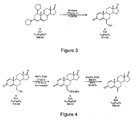
- FIG 3 shows a reaction scheme for the preparation of 6-hydroxymethyl-androsta-1,4-diene-3,17-dione (EX-2) from 1,3-dipyrrolidinoandrosta-3,5-diene-17-one (EX-1).
- Figure 4 shows a reaction scheme according to the invention for the preparation of exemestane (EX-4) from 6-hydroxymethyl-androsta-1,4-diene-3,17-dione (EX-2).
- This invention provides a method for preparing an aromatase inhibitor of formula (I). wherein each of R 1 , R 2 , R 3 , R 4 , independently, is hydrogen, halogen or C 1 -C 6 alkyl.
- the aromatase inhibitor is exemestane wherein each of R 1 , R 2 , R 3 , R 4 is hydrogen.
- a compound of formula (V) is reacted with a deprotonating agent and a compound of the formula R 5 SO 2 X wherein R 5 is C 1 -C 5 alkyl and X is halogen so as to obtain a compound of formula (VI)
- the compound of formula (VI) is then reacted with a base in a solvent to produce exemestane.
- FIG. 4 One version of this method of the invention is shown in Figure 4 .
- the compound of formula (V) is labeled as 4 (EX-2) in Figure 4 .
- the compound of formula (V) is treated with a deprotonating agent and a compound of the formula R 5 SO 2 X, wherein R 5 is C 1 -C 5 alkyl and X is halogen, in a solvent such as dichloromethane. Temperatures in the range of 0-35°C work well.
- an example deprotonating agent is triethylamine (Et 3 N). It is contemplated that other amines are suitable deprotonating agents including other tertiary amines and other trialkylamines.
- the reaction mixture is washed with water, diluted with a solvent (methanol (MeOH) is the example in Figure 4 ) and treated with a base (aqueous potassium hydroxide (KOH) or sodium hydroxide (NaOH) are the examples in Figure 4 ).
- a solvent methanol (MeOH) is the example in Figure 4
- a base aqueous potassium hydroxide (KOH) or sodium hydroxide (NaOH) are the examples in Figure 4
- Suitable solvents include, without limitation, alkanols
- suitable bases include, without limitation, alkali metal hydroxides.
- the methylene chloride is removed via distillation and the elimination progresses concurrently.
- water is added to complete product precipitation and the solution cooled.
- the product is isolated, washed with methanol/water, water, dried and then recrystallized from ACN/water.
- the exemestane (labeled 6 and Ex4 in Figure 4 ) yields after drying are typically 80 - 90% with purities of 99.5+% by HPLC area analysis.
- the reaction scheme of Figure 4 shows a method and an intermediate 5 useful in forming exemestane in high yields with high purity.
- the reaction scheme of Figure 4 can also be modified to form other aromatase inhibitors of formula (I). wherein each of R 1 , R 2 , R 3 , R 4 , independently, is hydrogen, halogen or C 1 -C 6 alkyl with suitable protection of substituting groups R 1 , R 2 , R 3 , R 4 in the reaction scheme.
- the (+)-androsta-1, 4-diene-3, 17-dione (ADD) supplied for the process contained an impurity that was identified as androsta-1, 4, 6-trien-3, 17-dione (ATD) via LC-MS and comparison to authentic ATD (see Figure 2 ). This impurity is presumably formed via over-oxidation of the desired ADD during the production process.
- One set of conditions utilizes (+)-androsta-1,4-diene-3,17-dione (ADD), 12.2 equivalents pyrrolidine, catalytic acetic acid, denatured ethanol (95/5 ethanol/methanol) and 6-7% tetrahydrofuran (volume basis of total volume of ethanol and pyrrolidine) with heating to 30-40°C for a minimum of 16 hours.
- ADD (+)-androsta-1,4-diene-3,17-dione
- pyrrolidine 12.2 equivalents pyrrolidine
- catalytic acetic acid denatured ethanol (95/5 ethanol/methanol)
- 6-7% tetrahydrofuran volume basis of total volume of ethanol and pyrrolidine
- EX-1 1,3-dipyrrolidinoandrosta-3,5-diene-17-one
- H Solvent for the preparation of EX-1 and subsequent washing(s); and I. Drying temperature for isolated EX-1.
- Reaction temperature for the process ranges from 30° to 40°C, and the reaction can be run at a lower temperature of 20°C but requires a longer time for completion.
- the preparation of EX-1 from ADD typically takes approximately 16 - 20 hours.
- the preparation of EX-1 at 20°C took 30 hours until ADD consumption leveled off and the reaction was considered complete.
- the yield was 74% with a purity of 95% by HPLC area percent.
- Synthesis of EX-1 at 50-60°C provided the product in 84% isolated yield with a purity of 86% area by HPLC, which meets the specified purity level of > 80%.
- Tetrahydrofuran is employed in the EX-1 preparation process to provide a stirrable slurry of EX-1 on crystallization of the desired product after seeding and sufficient reaction progress.
- the working range for the process is 6.6 to 7.2% of the combined volume of ethanol and pyrrolidine.
- EX-2 and 10% THF provided stirrable mixtures on seeding and subsequent reaction advancement, which is one criterion for an acceptable range in this case. Both percentages of THF afforded the desired product in 72% isolated yield and purities of 94% area and 96% by HPLC area percent respectively.
- Acetic acid is used as a catalyst in the formation of EX-1 with typically 0.10 to 0.11 equivalents (relative to ADD) of acid being used.
- EX-1 used thus far employed ethanol as the solvent, which has provided suitable material for use in the exemestane process.
- Two of the more frequently used, commercially available denatured ethanol mixtures were examined in an effort to reduce costs (associated with taxes for 100% ethanol).
- Use of 95/5 ethanol/ isopropanol afforded EX-1 in 64% isolated yield with a purity of 94% by HPLC area.
- With 95/5 ethanol/methanol as the reaction solvent EX-1 was obtained in 73% isolated yield with a purity of 95% by HPLC area percent. In both cases, the reaction mixture was a stirrable slurry with no problems observed during isolation of the solid product.
- EX-1 Drying of EX-1 at ambient temperature was not investigated as the expectation was that it would provide adequate drying, only at much longer times, which would be inefficient.
- the operating range for the process is 27 to 43°C, so an upper temperature for verification of 55°C was selected.
- the wet cake of EX-1 was placed into a vacuum oven pre-heated to 55°C.
- Dried EX-1 was obtained in 70% isolated yield with a purity of 93% area by HPLC analysis.
- the ADD content was at 1.5% area, indicating that partial hydrolysis had likely occurred on drying as the wet cake had an ADD content of 0.15% by HPLC analysis.
- Hold times for crystallization of EX-1 on reaction workup have been established for a minimum of three hours up to 16 hours. Three hours is the time used for hold at 5 ⁇ 5°C. Holding at this temperature for 16 hours provided the desired product in 74% isolated yield with a purity of 95% area by HPLC.
- EX-1 1,3-dipyrrolidinoandrosta-3,5-diene-17-one
- ATD is converted to product(s) that are removed in the filtrates.
- ATD itself is not found to significant extent (> 0.50% by HPLC area) in the filtrates prior to hydrolysis.
- the presence of ATD in the hydrolyzed filtrates and lack of significant amount (>1%) in the hydrolyzed EX-1 demonstrates that there are very little ATD and related products carried forward in the process.
- Varying the ratio of pyrrolidine produced the expected results of impacting the yield of isolated bis-enamine EX-1 but not the quality. Using a lower amount of pyrrolidine resulted in a slight increase in yield (approximately 5%) with purity comparable to that obtained with the standard conditions. Increasing the amount of pyrrolidine to 15 equivalents lead to a decreased isolated yield (about 8% decrease) but comparable and acceptable purity of 93% area by HPLC.
- EX-1 at 55°C provides material with less than ⁇ 2% area (by HPLC) ADD, but the higher ADD content than is typically observed on lab scale is due to drying in a hot oven with solvent and pyrrolidine remaining. Subsequent experiments indicated that by ramping the drying and holding the wet cake in an amber container better preserves the quality of EX-1 obtained.
- EX-1 1,3-dipyrrolidinoandrosta-3,5-diene-17-one
- formalin formalin
- Workup consists of acidification of the reaction mixture to a pH of about 2, dilution with 2% sulfuric acid (aqueous, volume/volume basis) and removal of the organic layer which is then washed with 2% sulfuric acid (vol/vol) and 1:1 water/brine.
- Solvent exchange into toluene (approximately 10 mL/g theory EX-2) is then carried out and the product crystallizes as toluene exchange transpires.
- reaction times short i.e. one hour or less, is important to ensure that EX-2 is obtained in excellent purity.
- the reaction is typically complete within 15 minutes of formalin addition, so as a short a reaction time as is possible is preferred. Longer duration for the reaction eventually starts to degrade the purity of the isolated product, as evidenced by the three hour reaction to synthesize EX-2 which afforded material that was 98.3% purity by HPLC area.
- Exemestane is prepared from EX-2 via a two step process by proceeding through the mesylate intermediate 5 (EX-3) of Figure 4 (as a solution in dichloromethane), which is then converted to the final product exemestane.
- the mesylate 5 is not isolated but is used as provided after aqueous workup to afford exemestane in excellent yield and purity.
- intermediate 5 can be isolated if desired.
- Parameters examined for the final step of the process were: A. Stoichiometry of triethylamine; B. Stoichiometry of methanesulfonyl chloride; C. Starting temperature of methanesulfonyl chloride addition; D. EX-2 remaining level by HPLC area percent; E. The methanol loading for the preparation of exemestane; F. Stoichiometry of potassium hydroxide; G. Temperature of the elimination reaction; H. EX-3 remaining level by HPLC area percent; I. Specific gravity of collected distillate at end of methylene chloride removal; J. Amount of water added for crystallization of exemestane; K. Hold time after water addition; L.
- Percent LOD of wet cake of exemestane prior to recrystallization M. Amount of acetonitrile used for recrystallization; N. Amount of water used for recrystallization; O. Drying temperature for exemestane.
- Potassium hydroxide ratios of 1.05 and 1.3 equivalents were chosen as the verification for the preparation of exemestane from intermediate 5 as the operating parameters are currently 1.1 to 1.2 equivalents of KOH for each mole of EX-2 used at the start of the process.
- Using 1.05 equivalents of base provided exemestane in 94% isolated yield and a purity of 99.6% by HPLC area analysis.
- 1.3 equivalents base was used to produce exemestane with a purity of 99.1% by HPLC of the reaction mixture.
- Hold times of one and sixteen hours were investigated for the cooled exemestane slurry to determine the impact of on yield and/or purity. Holding for one hour at 5 ⁇ 5°C afforded material in 92% isolated yield with a an HPLC area percent of 99.3%. An extended hold of sixteen hours provided 89% exemestane that has a purity of 99.5% by HPLC area.
- the current method for recrystallization for exemestane performs very well. It calls for the use of 10 mL acetonitrile for each gram of crude exemestane, so a range of 9 mL/g up to 15 mL/g was investigated. The experiment with 9 mL acetonitrile gave exemestane with a purity of 99.9% by HPLC analysis and a yield of 94%. Use of 15 mL/g for recrystallization gave a moderately reduced yield 87% and purity of 99.9% for the recovered exemestane.
- the recrystallization method also calls for addition of 10 mL water per gram of crude exemestane once a refluxing solution is obtained. There was little difference between the lower and upper ranges for water amounts that were examined. When 9 mL/g water was used, exemestane was obtained in 93% isolated yield with an excellent purity of 99.9% according to HPLC area analysis. With 15 mL/g water, the product was obtained in 95% yield with an HPLC area percent of 99.8.
- Drying of exemestane with the current process is done at 80°C, which is required for adequate removal of acetronitrile. Up to 100°C can be tolerated for 18 hours, as evidenced by holding exemestane in a vacuum oven set to this temperature. This material had a purity of 99.8 % HPLC area and recovery of 92%.
- EX-2 to EX-3 is an efficient process that usually proceeds quickly using the standard conditions of 1.15 equivalents of methanesulfonyl chloride and 1.3 equivalents of triethylamine.
- This process requires dry solvents and reagents to ensure good conversion, as methanesulfonyl chloride is moisture sensitive. If conversion is incomplete (more than 1% EX-2 remaining by area), additional methanesulfonyl chloride and/or triethylamine can be added as needed. If the pH of the reaction mixture is acidic, then more triethylamine is required. If the solution is basic (pH > 7) and the area percent of EX-2 remains relatively constant, then addition of supplemental methanesulfonyl chloride is required.
- the temperature at the start of the addition of methanesulfonyl chloride the EX-2 solution can range from 0 to 35°C.
- EX-2 Even though there is typically excellent conversion of EX-2 to EX-3, up to 3 weight percent EX-2 can be present as the exemestane isolation and recrystallization process can remove it.
- Methanol loadings for the preparation of exemestane can range from 7.5 mL/g up to 9.5 mL/g of EX-2 used in the process. This range adequately covers the current operating range of 8.4 mL/g to 8.7 mL/g of EX-2, providing good quality crude product prior to isolation.
- Base stoichiometry from 1.05 to 1.30 equivalents has negligible impact on the quality of exemestane isolated, but higher base loadings are expected to produce more of the methanol adduct of Formula VII more quickly as would higher temperatures. Refluxing the elimination reaction mixture was acceptable in the lab, but close monitoring of reaction progress is critical under these more forcing conditions since the methanol adduct impurity forms during the latter portion of the 5 to 6 conversion process. Over time, conducting the elimination at 28°C would be expected to convert EX-3 to exemestane, but very slowly.
- Specific gravity of collected distillate is also an excellent marker here for determining the endpoint of the removal of dichloromethane and transfer into methanol.
- a range of 0.791 g/mL to 1.20 g/mL is well-tolerated according to lab experiments.
- Recrystallization solvent ratio ranges from nine to fifteen milliliters of acetonitrile and water for each gram of crude exemestane did not impact the yield or purity significantly. There was perhaps a slight drop in yield of isolated exemestane with a higher ratio of acetronitrile used and a small increase with a higher loading of water.
- EX-2 6-hydroxymethyl-androsta-1,4-diene-3,17-dione
- the current process delivers high quality exemestane that after isolation requires only one recrystallization to meet established material specifications.
- Development of the 1:1 acetonitrile/water system for recrystallization was a significant improvement over previous recrystallization solvent systems. It removes the common, significant impurities such as EX-2, EX-3, ADD and the methanol adduct impurity very effectively.
Landscapes
- Chemical & Material Sciences (AREA)
- Organic Chemistry (AREA)
- Health & Medical Sciences (AREA)
- General Health & Medical Sciences (AREA)
- Steroid Compounds (AREA)
- Pharmaceuticals Containing Other Organic And Inorganic Compounds (AREA)
- Catalysts (AREA)
- Organic Low-Molecular-Weight Compounds And Preparation Thereof (AREA)
Claims (18)
- Procédé de préparation d'un composé de
formule (I) - faire réagir un composé de formule (II)
 - faire réagir le composé de formule (III) avec une base.
 - Procédé selon la revendication 1, dans lequel :chacun de R1, R2, R3, R4 est un atome d'hydrogène.
- Procédé selon la revendication 1, dans lequel :l'agent de déprotonation est une amine.
- Procédé selon la revendication 1, dans lequel :l'agent de déprotonation est une amine tertiaire.
- Procédé selon la revendication 1, dans lequel :l'agent de déprotonation est une trialkylamine.
- Procédé selon la revendication 1, dans lequel :R5 est un groupe méthyle.
- Procédé selon la revendication 1, dans lequel :R5 est un groupe méthyle et X est un atome de chlore.
- Procédé selon la revendication 1, dans lequel :chacun de R1, R2, R3, R4 est un atome d'hydrogène,R est un groupe méthylène,l'agent de déprotonation est une trialkylamine,R5 est un groupe méthyle, etX est un atome de chlore.
- Procédé selon la revendication 1, dans lequel :la base est un hydroxyde de métal alcalin.
- Procédé selon la revendication 1, dans lequel :la base est l'hydroxyde de potassium.
- Procédé selon la revendication 1, dans lequel :le composé de formule (III) réagit avec la base dans un solvant.
- Procédé selon la revendication 1, dans lequel :le solvant est un alcanol.
- Procédé selon la revendication 1, permettant de préparer un composé de formule
 faire réagir un composé de formule (V)
 puis faire réagir le composé de formule (VI) avec une base dans un solvant.
 - Procédé selon la revendication 13, dans lequel :R5 est un groupe méthyle et X est un atome de chlore.
- Procédé selon la revendication 14, dans lequel :la base est un hydroxyde de métal alcalin, etle solvant est un alcanol.
- Composé de formule (III) :

- Composé selon la revendication 16, dans lequel chacun de R1, R2, R3, R4 est un atome d'hydrogène.
- Composé selon la revendication 16, dans lequel R5 est un groupe méthyle.
Applications Claiming Priority (2)
| Application Number | Priority Date | Filing Date | Title |
|---|---|---|---|
| US53694404P | 2004-01-16 | 2004-01-16 | |
| PCT/US2005/001248 WO2005070951A1 (fr) | 2004-01-16 | 2005-01-14 | Exemestane et ses produits intermediaires et ses procedes de fabrication |
Publications (4)
| Publication Number | Publication Date |
|---|---|
| EP1709062A1 EP1709062A1 (fr) | 2006-10-11 |
| EP1709062A4 EP1709062A4 (fr) | 2010-05-26 |
| EP1709062B1 EP1709062B1 (fr) | 2012-03-07 |
| EP1709062B9 true EP1709062B9 (fr) | 2013-02-13 |
Family
ID=34807064
Family Applications (1)
| Application Number | Title | Priority Date | Filing Date |
|---|---|---|---|
| EP05711473A Expired - Lifetime EP1709062B9 (fr) | 2004-01-16 | 2005-01-14 | Exemestane et ses produits intermediaires et ses procedes de fabrication |
Country Status (5)
| Country | Link |
|---|---|
| US (2) | US8183401B2 (fr) |
| EP (1) | EP1709062B9 (fr) |
| AT (1) | ATE548375T1 (fr) |
| ES (1) | ES2382609T3 (fr) |
| WO (1) | WO2005070951A1 (fr) |
Cited By (3)
| Publication number | Priority date | Publication date | Assignee | Title |
|---|---|---|---|---|
| CN106243179A (zh) * | 2016-07-31 | 2016-12-21 | 合肥远志医药科技开发有限公司 | 一种依西美坦工业化生产方法 |
| US11261151B2 (en) | 2017-09-11 | 2022-03-01 | Atossa Therapeutics, Inc. | Methods for making and using endoxifen |
| US12201591B2 (en) | 2019-07-03 | 2025-01-21 | Atossa Therapeutics, Inc. | Sustained release compositions of endoxifen |
Families Citing this family (10)
| Publication number | Priority date | Publication date | Assignee | Title |
|---|---|---|---|---|
| EP1709062B9 (fr) | 2004-01-16 | 2013-02-13 | Cedarburg Pharmaceuticals, Inc. | Exemestane et ses produits intermediaires et ses procedes de fabrication |
| US8168621B2 (en) | 2005-09-30 | 2012-05-01 | Endece, Llc | 6-substituted estradiol derivatives and methods of use |
| US10174070B2 (en) | 2005-09-30 | 2019-01-08 | Endece Llc | 6-substituted estradiol derivatives and methods of use |
| WO2007041564A2 (fr) | 2005-09-30 | 2007-04-12 | Endece, Llc | Composes de (s)-6-methyloxaalkyl exemestane et leurs procedes d'utilisation |
| CN101594874B (zh) * | 2006-11-30 | 2017-02-08 | 安德斯有限责任公司 | 6‑烷氧基烷基雌二醇衍生物及用途 |
| US20080275259A1 (en) | 2007-05-04 | 2008-11-06 | Scinopharm Taiwan, Ltd | Process for preparing aromatase inhibitors |
| WO2009002489A2 (fr) | 2007-06-25 | 2008-12-31 | Scinopharm Taiwan Ltd. | Polymorphe cristallin de 7-ethyl-10-hydroxycamptothecine |
| EP2170328A2 (fr) * | 2007-06-25 | 2010-04-07 | ScinoPharm Taiwan, Ltd. | Polymorphe cristallin d'exemestane |
| CN103097396A (zh) | 2010-09-14 | 2013-05-08 | 安德斯有限责任公司 | 作为ER-β 激动剂的6-取代的脱甲基-雌二醇衍生物 |
| CN105085599A (zh) * | 2014-05-16 | 2015-11-25 | 绍兴文理学院 | 一种依西美坦中间体17,17-乙二氧基-6-亚甲基雄甾-1,4-二烯-3-酮及其制备方法和应用 |
Family Cites Families (19)
| Publication number | Priority date | Publication date | Assignee | Title |
|---|---|---|---|---|
| US2805231A (en) * | 1956-06-06 | 1957-09-03 | Searle & Co | 1-hydroxy-4-androstene-3, 17-dione and esters thereof |
| US3850911A (en) * | 1960-09-22 | 1974-11-26 | G Hughes | Steroid synthesis |
| NL122154C (fr) * | 1963-10-18 | |||
| US3404150A (en) * | 1966-05-25 | 1968-10-01 | Syntex Corp | Process for the esterification of hydroxy steroids |
| US3634469A (en) * | 1968-10-16 | 1972-01-11 | Searle & Co | Methylenated steroids and process |
| US4474701A (en) * | 1983-03-10 | 1984-10-02 | Veb Jenapharm Jena | Process for the separation of 4-androsten-3,17-dione and 1,4-androstadien-3,17-dione |
| SE8303031D0 (sv) * | 1983-05-30 | 1983-05-30 | Leo Ab | Improved steroid esters preparation |
| GB8517360D0 (en) * | 1985-07-09 | 1985-08-14 | Erba Farmitalia | Substituted androsta-1,4-diene-3,17-diones |
| DD258820A1 (de) | 1986-06-13 | 1988-08-03 | Adw Ddr | Verfahren zur herstellung von 6beta-hydroxy-methyl-androsta-1,4-dien-3,17-dion |
| GB8617107D0 (en) * | 1986-07-14 | 1986-08-20 | Erba Farmitalia | 6-/7-methylenandrosta-1 4-diene-3 17-dione derivatives |
| GB8622330D0 (en) * | 1986-09-17 | 1986-10-22 | Erba Farmitalia | 4-substituted 6-alkylidenandrostene-3,17-dione derivatives |
| DE3714965A1 (de) * | 1987-04-30 | 1988-11-10 | Schering Ag | 3-methylen-4-androsten-17-one, verfahren zu deren herstellung und diese enthaltende pharmazeutische praeparate |
| GB8721383D0 (en) * | 1987-09-11 | 1987-10-21 | Erba Farmitalia | Preparation of methylene derivatives |
| DD264220A1 (de) * | 1987-09-23 | 1989-01-25 | Adw Ddr | Verfahren zur herstellung von 6-methylen-androsta-1,4-dien-3,17-dion |
| GB8801697D0 (en) * | 1988-01-26 | 1988-02-24 | Erba Farmitalia | Improvements in synthesis of 6-methylene derivatives of androsta-1 4-diene-3 17-dione |
| US5227375A (en) * | 1990-02-08 | 1993-07-13 | Endorecherche, Inc. | Aromatase inhibitors |
| EP1709062B9 (fr) | 2004-01-16 | 2013-02-13 | Cedarburg Pharmaceuticals, Inc. | Exemestane et ses produits intermediaires et ses procedes de fabrication |
| WO2007041564A2 (fr) * | 2005-09-30 | 2007-04-12 | Endece, Llc | Composes de (s)-6-methyloxaalkyl exemestane et leurs procedes d'utilisation |
| US20080275259A1 (en) * | 2007-05-04 | 2008-11-06 | Scinopharm Taiwan, Ltd | Process for preparing aromatase inhibitors |
-
2005
- 2005-01-14 EP EP05711473A patent/EP1709062B9/fr not_active Expired - Lifetime
- 2005-01-14 WO PCT/US2005/001248 patent/WO2005070951A1/fr not_active Ceased
- 2005-01-14 US US10/586,237 patent/US8183401B2/en active Active
- 2005-01-14 ES ES05711473T patent/ES2382609T3/es not_active Expired - Lifetime
- 2005-01-14 AT AT05711473T patent/ATE548375T1/de active
-
2012
- 2012-04-19 US US13/451,034 patent/US8541609B2/en not_active Expired - Lifetime
Cited By (9)
| Publication number | Priority date | Publication date | Assignee | Title |
|---|---|---|---|---|
| CN106243179A (zh) * | 2016-07-31 | 2016-12-21 | 合肥远志医药科技开发有限公司 | 一种依西美坦工业化生产方法 |
| US11261151B2 (en) | 2017-09-11 | 2022-03-01 | Atossa Therapeutics, Inc. | Methods for making and using endoxifen |
| US11572334B2 (en) | 2017-09-11 | 2023-02-07 | Atossa Therapeutics, Inc. | Methods for making and using endoxifen |
| US11680036B1 (en) | 2017-09-11 | 2023-06-20 | Atossa Therapeutics, Inc. | Methods for making and using endoxifen |
| US12071391B2 (en) | 2017-09-11 | 2024-08-27 | Atossa Therapeutics, Inc. | Methods for making and using endoxifen |
| US12275684B2 (en) | 2017-09-11 | 2025-04-15 | Atossa Therapeutics, Inc. | Methods for making and using endoxifen |
| US12281056B2 (en) | 2017-09-11 | 2025-04-22 | Atossa Therapeutics, Inc. | Methods for making and using endoxifen |
| US12479790B2 (en) | 2017-09-11 | 2025-11-25 | Atossa Therapeutics, Inc. | Methods for making and using endoxifen |
| US12201591B2 (en) | 2019-07-03 | 2025-01-21 | Atossa Therapeutics, Inc. | Sustained release compositions of endoxifen |
Also Published As
| Publication number | Publication date |
|---|---|
| US20080234505A1 (en) | 2008-09-25 |
| WO2005070951A1 (fr) | 2005-08-04 |
| US8541609B2 (en) | 2013-09-24 |
| ES2382609T3 (es) | 2012-06-11 |
| US8183401B2 (en) | 2012-05-22 |
| ATE548375T1 (de) | 2012-03-15 |
| EP1709062A4 (fr) | 2010-05-26 |
| EP1709062A1 (fr) | 2006-10-11 |
| HK1096973A1 (en) | 2007-06-15 |
| US20120209016A1 (en) | 2012-08-16 |
| EP1709062B1 (fr) | 2012-03-07 |
Similar Documents
| Publication | Publication Date | Title |
|---|---|---|
| US8541609B2 (en) | Exemestane and its intermediates and methods of making the same | |
| US10000524B2 (en) | Synthesis of estetrol via estrone derived steroids | |
| CA1319362C (fr) | Derives androstenedione substitues en 4, et procede pour leur preparation | |
| EP0305242B1 (fr) | Nouveaux 17-aryle stéroides, leur procédé et intermédiaires de préparation, leur application comme médicaments et les compositions pharmaceutiques les renfermant | |
| JPS6117477B2 (fr) | ||
| EP3877395B1 (fr) | Procédé industriel pour la préparation d'estétrol de pureté élevée | |
| CZ413591A3 (en) | Substituted androstane-1,4-diene-3,17-diones and process for preparing thereof | |
| CA1305699C (fr) | Derives androsta-1,4-dien-3-one substitues en 17 | |
| BG65968B1 (bg) | Твърди форми на мезопрогестин 11 бета-4е-(хидроксииминометил)-фенил-17алфа- метоксиметил-17бета-метокси-естра-4,9-диен-3-он | |
| EP0291290B1 (fr) | Procédé de préparation de dérivés de 4-amino-androstènediones | |
| US6768014B2 (en) | PROCESS FOR PREPARING 17α-ACETOXY-11β-[4-N,N(DIMETHYLAMINO)PHENYL]-21-METHOXY-19-NORPREGNA-4,9-DIENE-3,20-DIONE, INTERMEDIATES USEFUL IN THE PROCESS , AND PROCESSES FOR PREPARING SUCH INTERMEDIATES | |
| KR101446825B1 (ko) | 아로마타제 억제제의 제조 방법 | |
| HK1096973B (en) | Exemestane and its intermediates and methods of making the same | |
| EP1945618A2 (fr) | Procede de preparation de letrozole | |
| NO177595B (no) | Analogifremgangsmåte for fremstilling av terapeutisk virksomme estere av organiske syrer og alkoholer avledet fra 19-nor-steroider | |
| US4771043A (en) | Steroidic aromatase inhibitors | |
| CZ334694A3 (en) | 17-alkyl ketone steroids usable as inhibitors of 5-alpha-reductase | |
| RU2639147C1 (ru) | Способ получения 17,17-этилендиоксиандроста-1,4-диен-3-она | |
| HUT75517A (en) | New synthesis of 17beta-cyano-3-ethoxy-17alfa-hydroxy-6-methylandrosta-3,5,9(11)-triene and its -17-one intermediate | |
| HU210544B (en) | 4-aza-androstene derivatives substituted with halogenatom in 17-position and process for their production |
Legal Events
| Date | Code | Title | Description |
|---|---|---|---|
| PUAI | Public reference made under article 153(3) epc to a published international application that has entered the european phase |
Free format text: ORIGINAL CODE: 0009012 |
|
| 17P | Request for examination filed |
Effective date: 20060811 |
|
| AK | Designated contracting states |
Kind code of ref document: A1 Designated state(s): AT BE BG CH CY CZ DE DK EE ES FI FR GB GR HU IE IS IT LI LT LU MC NL PL PT RO SE SI SK TR |
|
| DAX | Request for extension of the european patent (deleted) | ||
| REG | Reference to a national code |
Ref country code: HK Ref legal event code: DE Ref document number: 1096973 Country of ref document: HK |
|
| A4 | Supplementary search report drawn up and despatched |
Effective date: 20100427 |
|
| RIC1 | Information provided on ipc code assigned before grant |
Ipc: C07J 1/00 20060101AFI20050811BHEP Ipc: C07J 31/00 20060101ALI20100419BHEP |
|
| GRAP | Despatch of communication of intention to grant a patent |
Free format text: ORIGINAL CODE: EPIDOSNIGR1 |
|
| RIC1 | Information provided on ipc code assigned before grant |
Ipc: C07J 31/00 20060101ALI20110722BHEP Ipc: C07J 1/00 20060101AFI20110722BHEP |
|
| GRAS | Grant fee paid |
Free format text: ORIGINAL CODE: EPIDOSNIGR3 |
|
| GRAA | (expected) grant |
Free format text: ORIGINAL CODE: 0009210 |
|
| AK | Designated contracting states |
Kind code of ref document: B1 Designated state(s): AT BE BG CH CY CZ DE DK EE ES FI FR GB GR HU IE IS IT LI LT LU MC NL PL PT RO SE SI SK TR |
|
| REG | Reference to a national code |
Ref country code: GB Ref legal event code: FG4D |
|
| REG | Reference to a national code |
Ref country code: CH Ref legal event code: EP Ref country code: AT Ref legal event code: REF Ref document number: 548375 Country of ref document: AT Kind code of ref document: T Effective date: 20120315 |
|
| REG | Reference to a national code |
Ref country code: IE Ref legal event code: FG4D |
|
| REG | Reference to a national code |
Ref country code: DE Ref legal event code: R096 Ref document number: 602005033028 Country of ref document: DE Effective date: 20120426 |
|
| REG | Reference to a national code |
Ref country code: ES Ref legal event code: FG2A Ref document number: 2382609 Country of ref document: ES Kind code of ref document: T3 Effective date: 20120611 |
|
| REG | Reference to a national code |
Ref country code: NL Ref legal event code: VDEP Effective date: 20120307 |
|
| PG25 | Lapsed in a contracting state [announced via postgrant information from national office to epo] |
Ref country code: LT Free format text: LAPSE BECAUSE OF FAILURE TO SUBMIT A TRANSLATION OF THE DESCRIPTION OR TO PAY THE FEE WITHIN THE PRESCRIBED TIME-LIMIT Effective date: 20120307 Ref country code: NL Free format text: LAPSE BECAUSE OF FAILURE TO SUBMIT A TRANSLATION OF THE DESCRIPTION OR TO PAY THE FEE WITHIN THE PRESCRIBED TIME-LIMIT Effective date: 20120307 |
|
| LTIE | Lt: invalidation of european patent or patent extension |
Effective date: 20120307 |
|
| PG25 | Lapsed in a contracting state [announced via postgrant information from national office to epo] |
Ref country code: GR Free format text: LAPSE BECAUSE OF FAILURE TO SUBMIT A TRANSLATION OF THE DESCRIPTION OR TO PAY THE FEE WITHIN THE PRESCRIBED TIME-LIMIT Effective date: 20120608 Ref country code: FI Free format text: LAPSE BECAUSE OF FAILURE TO SUBMIT A TRANSLATION OF THE DESCRIPTION OR TO PAY THE FEE WITHIN THE PRESCRIBED TIME-LIMIT Effective date: 20120307 |
|
| REG | Reference to a national code |
Ref country code: HK Ref legal event code: GR Ref document number: 1096973 Country of ref document: HK |
|
| REG | Reference to a national code |
Ref country code: AT Ref legal event code: MK05 Ref document number: 548375 Country of ref document: AT Kind code of ref document: T Effective date: 20120307 |
|
| PG25 | Lapsed in a contracting state [announced via postgrant information from national office to epo] |
Ref country code: CY Free format text: LAPSE BECAUSE OF FAILURE TO SUBMIT A TRANSLATION OF THE DESCRIPTION OR TO PAY THE FEE WITHIN THE PRESCRIBED TIME-LIMIT Effective date: 20120307 |
|
| PG25 | Lapsed in a contracting state [announced via postgrant information from national office to epo] |
Ref country code: SE Free format text: LAPSE BECAUSE OF FAILURE TO SUBMIT A TRANSLATION OF THE DESCRIPTION OR TO PAY THE FEE WITHIN THE PRESCRIBED TIME-LIMIT Effective date: 20120307 Ref country code: IS Free format text: LAPSE BECAUSE OF FAILURE TO SUBMIT A TRANSLATION OF THE DESCRIPTION OR TO PAY THE FEE WITHIN THE PRESCRIBED TIME-LIMIT Effective date: 20120707 Ref country code: SI Free format text: LAPSE BECAUSE OF FAILURE TO SUBMIT A TRANSLATION OF THE DESCRIPTION OR TO PAY THE FEE WITHIN THE PRESCRIBED TIME-LIMIT Effective date: 20120307 Ref country code: RO Free format text: LAPSE BECAUSE OF FAILURE TO SUBMIT A TRANSLATION OF THE DESCRIPTION OR TO PAY THE FEE WITHIN THE PRESCRIBED TIME-LIMIT Effective date: 20120307 Ref country code: BE Free format text: LAPSE BECAUSE OF FAILURE TO SUBMIT A TRANSLATION OF THE DESCRIPTION OR TO PAY THE FEE WITHIN THE PRESCRIBED TIME-LIMIT Effective date: 20120307 Ref country code: PL Free format text: LAPSE BECAUSE OF FAILURE TO SUBMIT A TRANSLATION OF THE DESCRIPTION OR TO PAY THE FEE WITHIN THE PRESCRIBED TIME-LIMIT Effective date: 20120307 Ref country code: EE Free format text: LAPSE BECAUSE OF FAILURE TO SUBMIT A TRANSLATION OF THE DESCRIPTION OR TO PAY THE FEE WITHIN THE PRESCRIBED TIME-LIMIT Effective date: 20120307 Ref country code: CZ Free format text: LAPSE BECAUSE OF FAILURE TO SUBMIT A TRANSLATION OF THE DESCRIPTION OR TO PAY THE FEE WITHIN THE PRESCRIBED TIME-LIMIT Effective date: 20120307 |
|
| PG25 | Lapsed in a contracting state [announced via postgrant information from national office to epo] |
Ref country code: PT Free format text: LAPSE BECAUSE OF FAILURE TO SUBMIT A TRANSLATION OF THE DESCRIPTION OR TO PAY THE FEE WITHIN THE PRESCRIBED TIME-LIMIT Effective date: 20120709 Ref country code: SK Free format text: LAPSE BECAUSE OF FAILURE TO SUBMIT A TRANSLATION OF THE DESCRIPTION OR TO PAY THE FEE WITHIN THE PRESCRIBED TIME-LIMIT Effective date: 20120307 |
|
| PLBE | No opposition filed within time limit |
Free format text: ORIGINAL CODE: 0009261 |
|
| STAA | Information on the status of an ep patent application or granted ep patent |
Free format text: STATUS: NO OPPOSITION FILED WITHIN TIME LIMIT |
|
| PG25 | Lapsed in a contracting state [announced via postgrant information from national office to epo] |
Ref country code: AT Free format text: LAPSE BECAUSE OF FAILURE TO SUBMIT A TRANSLATION OF THE DESCRIPTION OR TO PAY THE FEE WITHIN THE PRESCRIBED TIME-LIMIT Effective date: 20120307 Ref country code: DK Free format text: LAPSE BECAUSE OF FAILURE TO SUBMIT A TRANSLATION OF THE DESCRIPTION OR TO PAY THE FEE WITHIN THE PRESCRIBED TIME-LIMIT Effective date: 20120307 |
|
| 26N | No opposition filed |
Effective date: 20121210 |
|
| REG | Reference to a national code |
Ref country code: DE Ref legal event code: R097 Ref document number: 602005033028 Country of ref document: DE Effective date: 20121210 |
|
| PG25 | Lapsed in a contracting state [announced via postgrant information from national office to epo] |
Ref country code: BG Free format text: LAPSE BECAUSE OF FAILURE TO SUBMIT A TRANSLATION OF THE DESCRIPTION OR TO PAY THE FEE WITHIN THE PRESCRIBED TIME-LIMIT Effective date: 20120607 |
|
| PG25 | Lapsed in a contracting state [announced via postgrant information from national office to epo] |
Ref country code: MC Free format text: LAPSE BECAUSE OF NON-PAYMENT OF DUE FEES Effective date: 20130131 |
|
| REG | Reference to a national code |
Ref country code: CH Ref legal event code: PL |
|
| REG | Reference to a national code |
Ref country code: IE Ref legal event code: MM4A |
|
| PG25 | Lapsed in a contracting state [announced via postgrant information from national office to epo] |
Ref country code: LI Free format text: LAPSE BECAUSE OF NON-PAYMENT OF DUE FEES Effective date: 20130131 Ref country code: CH Free format text: LAPSE BECAUSE OF NON-PAYMENT OF DUE FEES Effective date: 20130131 |
|
| PG25 | Lapsed in a contracting state [announced via postgrant information from national office to epo] |
Ref country code: IE Free format text: LAPSE BECAUSE OF NON-PAYMENT OF DUE FEES Effective date: 20130114 |
|
| PG25 | Lapsed in a contracting state [announced via postgrant information from national office to epo] |
Ref country code: TR Free format text: LAPSE BECAUSE OF FAILURE TO SUBMIT A TRANSLATION OF THE DESCRIPTION OR TO PAY THE FEE WITHIN THE PRESCRIBED TIME-LIMIT Effective date: 20120307 |
|
| PG25 | Lapsed in a contracting state [announced via postgrant information from national office to epo] |
Ref country code: LU Free format text: LAPSE BECAUSE OF NON-PAYMENT OF DUE FEES Effective date: 20130114 Ref country code: HU Free format text: LAPSE BECAUSE OF FAILURE TO SUBMIT A TRANSLATION OF THE DESCRIPTION OR TO PAY THE FEE WITHIN THE PRESCRIBED TIME-LIMIT; INVALID AB INITIO Effective date: 20050114 |
|
| REG | Reference to a national code |
Ref country code: FR Ref legal event code: PLFP Year of fee payment: 12 |
|
| REG | Reference to a national code |
Ref country code: FR Ref legal event code: PLFP Year of fee payment: 13 |
|
| REG | Reference to a national code |
Ref country code: FR Ref legal event code: PLFP Year of fee payment: 14 |
|
| REG | Reference to a national code |
Ref country code: DE Ref legal event code: R082 Ref document number: 602005033028 Country of ref document: DE Representative=s name: KANDLBINDER, MARKUS, DIPL.-PHYS., DE |
|
| PGFP | Annual fee paid to national office [announced via postgrant information from national office to epo] |
Ref country code: ES Payment date: 20240213 Year of fee payment: 20 |
|
| PGFP | Annual fee paid to national office [announced via postgrant information from national office to epo] |
Ref country code: DE Payment date: 20240129 Year of fee payment: 20 Ref country code: GB Payment date: 20240123 Year of fee payment: 20 |
|
| PGFP | Annual fee paid to national office [announced via postgrant information from national office to epo] |
Ref country code: IT Payment date: 20240123 Year of fee payment: 20 Ref country code: FR Payment date: 20240125 Year of fee payment: 20 |
|
| REG | Reference to a national code |
Ref country code: DE Ref legal event code: R071 Ref document number: 602005033028 Country of ref document: DE |
|
| REG | Reference to a national code |
Ref country code: ES Ref legal event code: FD2A Effective date: 20250131 |
|
| REG | Reference to a national code |
Ref country code: GB Ref legal event code: PE20 Expiry date: 20250113 |
|
| PG25 | Lapsed in a contracting state [announced via postgrant information from national office to epo] |
Ref country code: ES Free format text: LAPSE BECAUSE OF EXPIRATION OF PROTECTION Effective date: 20250115 |
|
| PG25 | Lapsed in a contracting state [announced via postgrant information from national office to epo] |
Ref country code: GB Free format text: LAPSE BECAUSE OF EXPIRATION OF PROTECTION Effective date: 20250113 |