EP1714927A2 - Changement automatique de rouleau sur un repère imprimé - Google Patents
Changement automatique de rouleau sur un repère imprimé Download PDFInfo
- Publication number
- EP1714927A2 EP1714927A2 EP06007000A EP06007000A EP1714927A2 EP 1714927 A2 EP1714927 A2 EP 1714927A2 EP 06007000 A EP06007000 A EP 06007000A EP 06007000 A EP06007000 A EP 06007000A EP 1714927 A2 EP1714927 A2 EP 1714927A2
- Authority
- EP
- European Patent Office
- Prior art keywords
- web
- register
- mark
- running direction
- distance
- Prior art date
- Legal status (The legal status is an assumption and is not a legal conclusion. Google has not performed a legal analysis and makes no representation as to the accuracy of the status listed.)
- Withdrawn
Links
Images
Classifications
-
- B—PERFORMING OPERATIONS; TRANSPORTING
- B65—CONVEYING; PACKING; STORING; HANDLING THIN OR FILAMENTARY MATERIAL
- B65H—HANDLING THIN OR FILAMENTARY MATERIAL, e.g. SHEETS, WEBS, CABLES
- B65H19/00—Changing the web roll
- B65H19/10—Changing the web roll in unwinding mechanisms or in connection with unwinding operations
- B65H19/14—Accumulating surplus web for advancing to machine while changing the web roll
-
- B—PERFORMING OPERATIONS; TRANSPORTING
- B65—CONVEYING; PACKING; STORING; HANDLING THIN OR FILAMENTARY MATERIAL
- B65H—HANDLING THIN OR FILAMENTARY MATERIAL, e.g. SHEETS, WEBS, CABLES
- B65H19/00—Changing the web roll
- B65H19/10—Changing the web roll in unwinding mechanisms or in connection with unwinding operations
- B65H19/18—Attaching, e.g. pasting, the replacement web to the expiring web
- B65H19/1842—Attaching, e.g. pasting, the replacement web to the expiring web standing splicing, i.e. the expiring web being stationary during splicing contact
- B65H19/1852—Attaching, e.g. pasting, the replacement web to the expiring web standing splicing, i.e. the expiring web being stationary during splicing contact taking place at a distance from the replacement roll
-
- B—PERFORMING OPERATIONS; TRANSPORTING
- B65—CONVEYING; PACKING; STORING; HANDLING THIN OR FILAMENTARY MATERIAL
- B65H—HANDLING THIN OR FILAMENTARY MATERIAL, e.g. SHEETS, WEBS, CABLES
- B65H23/00—Registering, tensioning, smoothing or guiding webs
- B65H23/04—Registering, tensioning, smoothing or guiding webs longitudinally
- B65H23/046—Sensing longitudinal register of web
-
- B—PERFORMING OPERATIONS; TRANSPORTING
- B65—CONVEYING; PACKING; STORING; HANDLING THIN OR FILAMENTARY MATERIAL
- B65H—HANDLING THIN OR FILAMENTARY MATERIAL, e.g. SHEETS, WEBS, CABLES
- B65H23/00—Registering, tensioning, smoothing or guiding webs
- B65H23/04—Registering, tensioning, smoothing or guiding webs longitudinally
- B65H23/18—Registering, tensioning, smoothing or guiding webs longitudinally by controlling or regulating the web-advancing mechanism, e.g. mechanism acting on the running web
- B65H23/188—Registering, tensioning, smoothing or guiding webs longitudinally by controlling or regulating the web-advancing mechanism, e.g. mechanism acting on the running web in connection with running-web
- B65H23/1882—Registering, tensioning, smoothing or guiding webs longitudinally by controlling or regulating the web-advancing mechanism, e.g. mechanism acting on the running web in connection with running-web and controlling longitudinal register of web
- B65H23/1886—Synchronising two or more webs
-
- B—PERFORMING OPERATIONS; TRANSPORTING
- B65—CONVEYING; PACKING; STORING; HANDLING THIN OR FILAMENTARY MATERIAL
- B65H—HANDLING THIN OR FILAMENTARY MATERIAL, e.g. SHEETS, WEBS, CABLES
- B65H2511/00—Dimensions; Position; Numbers; Identification; Occurrences
- B65H2511/50—Occurence
- B65H2511/51—Presence
- B65H2511/512—Marks, e.g. invisible to the human eye; Patterns
Definitions
- the invention relates to a method for the successive processing of material webs according to the preamble of claim 1.
- Material webs are finite and must be fed to processing machines one after the other. In many of these machines, this is done by connecting successive webs of material. Often there is a need to connect the webs at a certain point with each other. In this way, material can be saved or begin the subsequent processing process trouble-free.
- the object of the present invention is to propose an efficient method for the successive processing of material webs.
- the inventive method is accurate and offers the approach to a stronger automation.
- register-dependent processing These processing methods include, for example, printing and bagging.
- a printing length usually forms a register portion.
- bagging or bagging it is a bag or bag length.
- the register sections are often assigned register marks. On the basis of these register marks, the position of the register sections can be determined more accurately. Often considered as Register marks markedly shaped characters imprinted and recognized with all sorts of - often optically working - sensors.
- the relevant material webs are stored on a roll and are processed for further processing.
- the new material web often has to be connected to the old material web in such a way that a certain point of the new material web has a nominal distance to a specific point of the old material web. If these locations are, for example, the later connecting seams, then this nominal distance is zero.
- the bonding takes place by the end of the old material web is glued to the beginning of the new material web.
- FFS machines which are particularly suitable for the slumping of free-flowing goods, and among others in the DE 199 40 478 A1
- the role change takes place by stopping the old train.
- the new web is stored on a roll that is located next to the roll of the old web.
- the standing old train is cut shortly before the end of the track, held and connected to the front end of the new train.
- this connection is usually not accurate.
- the present invention remedies this disadvantage.
- the old web is not stopped at any point. Rather, the web is initially moved forward until a mark has passed a fixed in relation to the transport direction measuring point.
- the brand has a defined distance to the predetermined location. However, this distance is usually dependent on the format of the register section.
- the web is transported further, determining the distance traveled from the time the measuring point passes. The further transport of the web may be necessary, for example, in order to complete a work step that has just begun.
- the new lane to be connected to the old lane can now be positioned.
- the new lane is already prepositioned and the old lane for a connection after passing the measuring point must be further advanced until the predetermined locations occupy the desired distance.
- the determination of the predetermined location of the first material web means the positioning of this material web, for example relative to a processing tool, such as a joining tool.
- the method according to the invention comprises webs which have register characters. These register characters break the webs into register sections that are in a fixed relationship to, for example, the bag or bag length.
- the mark detected at the measuring point is such a register mark.
- two register marks may be provided for each later sack, which are arranged in the web transport direction with a short but well-defined distance one behind the other. One of these two register marks is detected by the measuring point. In other applications, the register marks are equidistant.
- the information required for register-accurate positioning of the new web is determined from the distance that the material web has traveled after the mark has passed the measuring point.
- Various methods of measurement can be used to determine the distance traveled by the first web after a mark has passed a measuring point.
- the number of revolutions can be measured with a rotary encoder.
- Such a roller may be a web-guiding roller.
- such a roller may also be a roller which rolls on the web-guiding roller in contact.
- other mechanical connections can be used.
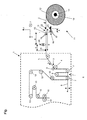
- FIGURE shows: A schematic side view of a device according to the invention for carrying out the method according to the invention.
- the figure shows a schematic representation of a Bruverbeitende machine 1.
- a Bruverbeitende machine 1 can basically be a continuously operating machine, such as a printing or laminating machine, or a clock-bound machine, such as an FFS machine mentioned above. Both the continuous and the clock-bound machines working trains are supplied continuously.
- the Bahnverbeitende machine 1 is equipped with a preference 2. This advantage consists of a first roller 3 and a second roller 4, of which at least one is driven continuously. Both rollers 3, 4 form a nip through which the web 5 is conveyed in the web running direction z.
- the machine 1 is shown in the figure as a clock-working machine.
- the machine For converting the continuous transport of the web 5 into a cyclic feed, the machine is known per se Track memory 6 equipped in the rollers 7 are mounted in a machine frame not shown pivot arm 8, while the roller 9 is rotatably connected to the machine frame and therefore stationary, but is rotatable. At least one of the following rollers 10 is driven intermittently and thus provides for the cyclical advantage of the web. 5
- the web 5 is provided to a Bähnverbeitenden machine 1 usually in Foriri a web roll 12 available.
- a Bähnverbeitenden machine 1 usually in Foriri a web roll 12 available.
- For unwinding of the web 5 of the web winding 12 this is rotatably connected in a winding device 11 with an axis 13 which passes through the winding tube 14 of the web winding 12 and which is rotatably mounted in the winding device.
- the unwinding 11 may have at least one further web winding, not shown.
- the Anwickelvoriques 11 further comprises a connection station 15.
- This connection station 15 comprises a cross-cutter 16, with which an unnecessary track remnant of the tail can be separated if or just before the web 5 has been completely unwound from the web roll.
- the connecting station 15 also includes holding means 17 with which the web start of a wound onto another web-wound web is held in a waiting position. If a hose is used as a web, then this hose can be provided in the region of its side edges with cuts, so that at the web beginning 18 two separate walls arise. These walls can, as shown in the figure, be folded into vertical positions.
- the web start 18 is connected to the end of the web 5 within the connection station 15.
- a control device not shown, obtains or determines the point in time at which the web end is reached on the web winding 12.
- control device via control lines, also not shown, control signals to the connection station 15 and optionally to the machine 1 from. Initiated by these signals, first the web 5 in the web transport direction (7) is further advanced until a predetermined position is reached. Subsequently, if necessary by the cross-cutting blade 16, a web residue from the end of the web 5, which is held by clamping means 19, separated. The holding means 17 now transport the web start 18 to a position in which the longitudinal axes of the web 5 and the new web are in alignment. Subsequently, the web start 18 is connected to the end of the web 5, for example by gluing or welding.
- the webs have register marks, of which the register marks 21, 22 of the web 5 and the register mark 23 of the new web with the web start 18 are shown by way of example.
- the web start 18 is now determined by means of the holding means 17 in space, that the register mark 23 seen in the web transport direction z has a predetermined distance X to the cross-cutting blade 16.
- the control device has issued control signals for reel change, a workpiece is completed in a clock-bound machine to empty the web memory 6.
- the web is then advanced further, possibly at reduced speed, until the sensor 20, which represents a measuring point, detects a register mark 21.
- the control device From the distance X, which is fixed or made accessible to the control device, the distance A of the sensor to the cross-cutting blade 16 and the distance between two register marks S, which for example depends on the format of the bags or sacks, but which is the control device known , the control device now calculates the distance Y by which the web 5 must be further advanced, so that a register-accurate joining of the webs can take place. In order to determine the time T 1 at which the web has traveled the distance Y, the time T 0 at which the register mark 21 has passed the sensor 20 and the web speed are determined.
- a rotary encoder is preferably provided which determines the peripheral speed from the angular speed of a roller and the associated circumference.
- this roller is the roller 4 of the preferred 2.
- other methods for determining the web speed can be used.
- this can also be determined by a direct measurement method.
- the path is not advanced by the distance Y but by the distance S + Y, so that the register mark 21 is not the register mark 21 but the distance Y. is brought to the sensor. As a result, measurement errors in the speed measurement have less effect on the positioning accuracy.
- a predetermined threshold value for example 10 mm
- the web start 18 is transversely (x, y) moved to the web transport direction z and connected to the end of the web 5.
- the distances A and X can also be related to other points instead of the position of the cross-cutting blade. Another point would be, for example, the welding tool, not shown. Another arrangement of the sensor 20, for example in the web transport direction z in front of the cross-cutting blade 20 is conceivable. The calculation of the preferred route Y would then also change according to the changed parameters.
Landscapes
- Controlling Rewinding, Feeding, Winding, Or Abnormalities Of Webs (AREA)
- Replacement Of Web Rolls (AREA)
Applications Claiming Priority (1)
| Application Number | Priority Date | Filing Date | Title |
|---|---|---|---|
| DE200510018547 DE102005018547A1 (de) | 2005-04-20 | 2005-04-20 | Automatischer Rollenwechsel auf Druckmarke |
Publications (2)
| Publication Number | Publication Date |
|---|---|
| EP1714927A2 true EP1714927A2 (fr) | 2006-10-25 |
| EP1714927A3 EP1714927A3 (fr) | 2007-06-27 |
Family
ID=36687970
Family Applications (1)
| Application Number | Title | Priority Date | Filing Date |
|---|---|---|---|
| EP06007000A Withdrawn EP1714927A3 (fr) | 2005-04-20 | 2006-03-31 | Changement automatique de rouleau sur un repère imprimé |
Country Status (2)
| Country | Link |
|---|---|
| EP (1) | EP1714927A3 (fr) |
| DE (1) | DE102005018547A1 (fr) |
Cited By (2)
| Publication number | Priority date | Publication date | Assignee | Title |
|---|---|---|---|---|
| CN103803336A (zh) * | 2014-02-18 | 2014-05-21 | 绍兴仁昌纸品有限公司 | 原纸分切复卷机 |
| WO2015185887A1 (fr) * | 2014-06-05 | 2015-12-10 | British American Tobacco (Investments) Ltd | Ensemble de fourniture de papier de manchette pour l'utilisation dans la fabrication d'articles à fumer |
Families Citing this family (1)
| Publication number | Priority date | Publication date | Assignee | Title |
|---|---|---|---|---|
| DE102019114136A1 (de) | 2019-05-27 | 2020-12-03 | Paul Hartmann Ag | Verfahren zum Herstellen von Inkontinenzartikeln |
Family Cites Families (8)
| Publication number | Priority date | Publication date | Assignee | Title |
|---|---|---|---|---|
| DE2617877A1 (de) * | 1976-04-23 | 1977-11-03 | Edelmann Maschf | Sichtumroller mit einer schneid- und klemmvorrichtung |
| DE2623805A1 (de) * | 1976-05-28 | 1977-12-01 | Jagenberg Werke Ag | Steuerungseinrichtung fuer ein betaetigungsorgan zum befestigen, insbesondere ankleben des anfangs einer auf einer rotierenden rolle befindlichen warenbahn an eine synchronlaufende warenbahn |
| EP0365470B1 (fr) * | 1988-10-17 | 1996-01-03 | SIG Schweizerische Industrie-Gesellschaft | Dispositif de raccordement de l'extrémité terminale d'une bande avec le début d'une autre bande |
| DE3923163A1 (de) * | 1989-07-13 | 1991-01-17 | Kronseder Maschf Krones | Verfahren und vorrichtung zum anspleissen von bedruckten etikettenbaendern |
| DE4107254C2 (de) * | 1991-03-07 | 2000-02-10 | Focke & Co | Vorrichtung zum Verbinden von Materialbahnen |
| US5967445A (en) * | 1996-09-20 | 1999-10-19 | Kabushiki Kaisha Yuyama Seisakusho | Method of adjusting tension applied to sheet, and device for the same |
| DE19838545A1 (de) * | 1998-08-25 | 2000-03-02 | Focke & Co | Verfahren und Vorrichtung zum Erkennen von Druckmarken |
| DE19936660C2 (de) * | 1999-05-04 | 2002-10-24 | Windmoeller & Hoelscher | Vorrichtung zum Herstellen, Befüllen und Verschließen von Säcken |
-
2005
- 2005-04-20 DE DE200510018547 patent/DE102005018547A1/de not_active Ceased
-
2006
- 2006-03-31 EP EP06007000A patent/EP1714927A3/fr not_active Withdrawn
Cited By (5)
| Publication number | Priority date | Publication date | Assignee | Title |
|---|---|---|---|---|
| CN103803336A (zh) * | 2014-02-18 | 2014-05-21 | 绍兴仁昌纸品有限公司 | 原纸分切复卷机 |
| WO2015185887A1 (fr) * | 2014-06-05 | 2015-12-10 | British American Tobacco (Investments) Ltd | Ensemble de fourniture de papier de manchette pour l'utilisation dans la fabrication d'articles à fumer |
| KR20160147977A (ko) * | 2014-06-05 | 2016-12-23 | 브리티시 아메리칸 토바코 (인베스트먼츠) 리미티드 | 끽연류 제작에서의 사용을 위한 티핑 페이퍼 피드 조립체 |
| RU2649591C1 (ru) * | 2014-06-05 | 2018-04-04 | Бритиш Америкэн Тобэкко (Инвестментс) Лтд | Узел подачи ободковой бумаги для использования в изготовлении курительных изделий |
| US10589952B2 (en) | 2014-06-05 | 2020-03-17 | British American Tobacco (Investments) Limited | Tipping paper feed assenbly for use in smoking article manufacture |
Also Published As
| Publication number | Publication date |
|---|---|
| EP1714927A3 (fr) | 2007-06-27 |
| DE102005018547A1 (de) | 2007-02-08 |
Similar Documents
| Publication | Publication Date | Title |
|---|---|---|
| DE69610756T2 (de) | Vorrichtung zum Ausrichten von Bahnen | |
| EP0962309B1 (fr) | Machine de fabrication de sacs et procédé pour la fabrication de sacs | |
| DE102004032528B3 (de) | Verfahren zum Durchführen eines Rollenwechsels bei einer Versorgungseinheit zum Zuführen eines bahnartigen Flachmaterials an eine Verpackungsmaschine oder dergleichen Verarbeitungsmaschine sowie Versorgungseinheit zum Durchführen dieses Verfahrens | |
| EP1820899A1 (fr) | Procédé destiné à la pose d'étiquettes RFID dans du carton ondulé | |
| EP0299181B1 (fr) | Dispositif de déroulage pour bobines de bande de papier, de carton ou similaire | |
| DE60303079T2 (de) | Maschine zur Herstellung schlauchförmiger Verpackungen, insbesonders geeignet für den Rollenwechsel | |
| DE4325944A1 (de) | Verfahren und Vorrichtung zum Verbinden von Materialbahnen, insbesondere aus Verpackungsmaterial | |
| EP0982252B1 (fr) | Procédé de raccordement automatique de deux bandes de matériau d'emballage | |
| EP2504160B1 (fr) | Système et procédé de fabrication de sacs ou de sachets | |
| EP0299180B1 (fr) | Dispositif de déroulage pour bande de papier ou de carton | |
| DE4113772A1 (de) | Verfahren zum ersetzen von streifenmaterial an einer fertigungsmaschine | |
| EP1714926B1 (fr) | Méthode pour la commande et/ou le contrôle d'une machine de traitement de bandes | |
| EP2481564B1 (fr) | Procédé de fabrication de sacs où une pile de sacs ou de produits semi-finis de sacs sont transportés d'une première machine vers une seconde machine, ainsi que système, lequel comprend une première machine et un dispositif de transport et de stockage | |
| EP2481566B1 (fr) | Procédé et système de traitement d'applications pour la fabrication de sacs | |
| EP1714927A2 (fr) | Changement automatique de rouleau sur un repère imprimé | |
| DE69607326T2 (de) | Vorrichtung und verfahren in einer verpackungsmachine | |
| DE69211980T2 (de) | Maschine zur Herstellung von Kunststoffbeuteln mit Mittel zum Ausrichten der Endkante eines ablaufenden Bandes mit der Anfangskante eines neuen Bandes | |
| DE3639972A1 (de) | Verfahren und einrichtung zum aussondern von durch fehlerstellen unbrauchbaren materialbahnabschnitten aus einer materialbahn | |
| DE102010042520B4 (de) | Verfahren zum Verbinden einer ersten Materialbahn mit einer zweiten Materialbahn | |
| EP1888439B1 (fr) | Dispositif et procede pour relier les extremites de deux bandes de tuyau planes | |
| EP3077306B1 (fr) | Dispositif et procédé de découpage d'un matériau en bande en bandes partielles et d'écartement des bandes partielles | |
| DE3938415C1 (en) | Method of handling film roller - has film cut laterally when fault marks detected by sensor | |
| EP3423363A1 (fr) | Traitement d'étiquettes enveloppantes profilées par le rouleau | |
| DE10307678A1 (de) | Schlauch sowie Vorrichtung und Verfahren zur Herstellung desselben | |
| DE102011003380B4 (de) | Verfahren und ein System zum Abarbeiten zumindest zweier aufeinander folgender Aufträge zur Herstellung von Säcken |
Legal Events
| Date | Code | Title | Description |
|---|---|---|---|
| PUAI | Public reference made under article 153(3) epc to a published international application that has entered the european phase |
Free format text: ORIGINAL CODE: 0009012 |
|
| AK | Designated contracting states |
Kind code of ref document: A2 Designated state(s): AT BE BG CH CY CZ DE DK EE ES FI FR GB GR HU IE IS IT LI LT LU LV MC NL PL PT RO SE SI SK TR |
|
| AX | Request for extension of the european patent |
Extension state: AL BA HR MK YU |
|
| PUAL | Search report despatched |
Free format text: ORIGINAL CODE: 0009013 |
|
| AK | Designated contracting states |
Kind code of ref document: A3 Designated state(s): AT BE BG CH CY CZ DE DK EE ES FI FR GB GR HU IE IS IT LI LT LU LV MC NL PL PT RO SE SI SK TR |
|
| AX | Request for extension of the european patent |
Extension state: AL BA HR MK YU |
|
| RIC1 | Information provided on ipc code assigned before grant |
Ipc: B65H 19/14 20060101ALI20070524BHEP Ipc: B65H 19/18 20060101AFI20060728BHEP |
|
| AKX | Designation fees paid | ||
| STAA | Information on the status of an ep patent application or granted ep patent |
Free format text: STATUS: THE APPLICATION IS DEEMED TO BE WITHDRAWN |
|
| 18D | Application deemed to be withdrawn |
Effective date: 20071228 |
|
| REG | Reference to a national code |
Ref country code: DE Ref legal event code: 8566 |