EP1716208B2 - Pigments de perylene noirs - Google Patents
Pigments de perylene noirs Download PDFInfo
- Publication number
- EP1716208B2 EP1716208B2 EP05701347.6A EP05701347A EP1716208B2 EP 1716208 B2 EP1716208 B2 EP 1716208B2 EP 05701347 A EP05701347 A EP 05701347A EP 1716208 B2 EP1716208 B2 EP 1716208B2
- Authority
- EP
- European Patent Office
- Prior art keywords
- pigments
- pigment
- perylene
- black
- halogen
- Prior art date
- Legal status (The legal status is an assumption and is not a legal conclusion. Google has not performed a legal analysis and makes no representation as to the accuracy of the status listed.)
- Expired - Lifetime
Links
Classifications
-
- C—CHEMISTRY; METALLURGY
- C09—DYES; PAINTS; POLISHES; NATURAL RESINS; ADHESIVES; COMPOSITIONS NOT OTHERWISE PROVIDED FOR; APPLICATIONS OF MATERIALS NOT OTHERWISE PROVIDED FOR
- C09B—ORGANIC DYES OR CLOSELY-RELATED COMPOUNDS FOR PRODUCING DYES, e.g. PIGMENTS; MORDANTS; LAKES
- C09B5/00—Dyes with an anthracene nucleus condensed with one or more heterocyclic rings with or without carbocyclic rings
-
- C—CHEMISTRY; METALLURGY
- C09—DYES; PAINTS; POLISHES; NATURAL RESINS; ADHESIVES; COMPOSITIONS NOT OTHERWISE PROVIDED FOR; APPLICATIONS OF MATERIALS NOT OTHERWISE PROVIDED FOR
- C09B—ORGANIC DYES OR CLOSELY-RELATED COMPOUNDS FOR PRODUCING DYES, e.g. PIGMENTS; MORDANTS; LAKES
- C09B5/00—Dyes with an anthracene nucleus condensed with one or more heterocyclic rings with or without carbocyclic rings
- C09B5/62—Cyclic imides or amidines of peri-dicarboxylic acids of the anthracene, benzanthrene, or perylene series
-
- C—CHEMISTRY; METALLURGY
- C09—DYES; PAINTS; POLISHES; NATURAL RESINS; ADHESIVES; COMPOSITIONS NOT OTHERWISE PROVIDED FOR; APPLICATIONS OF MATERIALS NOT OTHERWISE PROVIDED FOR
- C09B—ORGANIC DYES OR CLOSELY-RELATED COMPOUNDS FOR PRODUCING DYES, e.g. PIGMENTS; MORDANTS; LAKES
- C09B67/00—Influencing the physical, e.g. the dyeing or printing properties of dyestuffs without chemical reactions, e.g. by treating with solvents grinding or grinding assistants, coating of pigments or dyes; Process features in the making of dyestuff preparations; Dyestuff preparations of a special physical nature, e.g. tablets, films
-
- C—CHEMISTRY; METALLURGY
- C09—DYES; PAINTS; POLISHES; NATURAL RESINS; ADHESIVES; COMPOSITIONS NOT OTHERWISE PROVIDED FOR; APPLICATIONS OF MATERIALS NOT OTHERWISE PROVIDED FOR
- C09B—ORGANIC DYES OR CLOSELY-RELATED COMPOUNDS FOR PRODUCING DYES, e.g. PIGMENTS; MORDANTS; LAKES
- C09B67/00—Influencing the physical, e.g. the dyeing or printing properties of dyestuffs without chemical reactions, e.g. by treating with solvents grinding or grinding assistants, coating of pigments or dyes; Process features in the making of dyestuff preparations; Dyestuff preparations of a special physical nature, e.g. tablets, films
- C09B67/0033—Blends of pigments; Mixtured crystals; Solid solutions
-
- C—CHEMISTRY; METALLURGY
- C09—DYES; PAINTS; POLISHES; NATURAL RESINS; ADHESIVES; COMPOSITIONS NOT OTHERWISE PROVIDED FOR; APPLICATIONS OF MATERIALS NOT OTHERWISE PROVIDED FOR
- C09B—ORGANIC DYES OR CLOSELY-RELATED COMPOUNDS FOR PRODUCING DYES, e.g. PIGMENTS; MORDANTS; LAKES
- C09B67/00—Influencing the physical, e.g. the dyeing or printing properties of dyestuffs without chemical reactions, e.g. by treating with solvents grinding or grinding assistants, coating of pigments or dyes; Process features in the making of dyestuff preparations; Dyestuff preparations of a special physical nature, e.g. tablets, films
- C09B67/0033—Blends of pigments; Mixtured crystals; Solid solutions
- C09B67/0034—Mixtures of two or more pigments or dyes of the same type
Definitions
- the black pigments carbon black, aniline black, iron oxide black and chromium oxide black or trichrome dye mixtures are usually used.
- the aforementioned pigmentary colorants absorb light with wavelengths from the ultraviolet to the far infrared range, including solar infrared and thermal radiation. Materials that are colored with these black pigments therefore heat up very strongly when exposed to direct sunlight. If these conventional black pigments are used as colorants in coatings for electronic components, such as in the black matrix in LC displays, this coating also acquires a certain inherent electrical conductivity, which negatively affects the functionality of the electronic components.
- the trichromic dye mixtures have neither the unfavorable absorption in the infrared nor high electrical conductivity, as low-molecular compounds they tend to migrate in the application medium and show poor compatibility with many matrix materials (e.g. common polyolefins or water-based paints), so that their possible uses are severely limited .
- Examples include black coatings with high electrical resistance for electronic components, black paintwork and coatings for the automotive and construction sectors that do not or only slightly heat up under solar radiation, mulch and protective films with low self-heating for agriculture, optical filters and IR transparent active components for security printing and copy protection systems.
- Plastic parts that are colored with the conventional black pigments cannot be used for this, because the irradiated laser light, whose wavelength is normally in the NIR range (e.g. at 808, 940 or 1064 nm), is already completely absorbed by these pigments on the surface of the workpiece to be irradiated, so the deeper connection area to the workpiece below is not even reached and consequently can no longer induce the melting process required to create a mechanically stable connection in this zone.
- the irradiated laser light whose wavelength is normally in the NIR range (e.g. at 808, 940 or 1064 nm)
- the deeper connection area to the workpiece below is not even reached and consequently can no longer induce the melting process required to create a mechanically stable connection in this zone.
- Black pigments based on perylene (CI Pigment Black 31 and 32 (N, N'-Diphenylethylene-3,4: 9,10-tetracarboxylic acid diimide and N, N'-Di (p-methoxytolyl) perylene-3,4: 9, 10-tetracarboxylic acid diimide), which are NIR transparent, but whose absorption band is around 650 to 700 nm, so that they do not absorb in the entire visible spectral range. These pigments therefore do not appear neutral black, but have an undesirable green tinge, especially when they are brightened white In addition, they show increased solubility and inadequate temperature stability in many application media, which severely limits their usability, especially for coloring plastics.
- the pigments produced by dry calcination show only an inadequate degree of blackness (ie, black numbers 200), which is why the pure black colorations obtained with them have a distinct green or brown cast.
- these pigments are very hard to disperse, ie they can only be distributed in the application medium with a high input of energy and only incompletely, which has a negative effect on the transparency and homogeneity of the colorations obtained.
- the invention was therefore based on the object of remedying the disadvantages mentioned and of providing NIR-transparent black pigments with a high degree of blackness with advantageous application properties.
- mixture is intended to encompass physical mixtures and also preferably solid solutions (mixed crystals) of the compounds Ia and Ib.
- the phenylene, naphthylene and pyridylene radicals R 1 and R 2 in the formulas Ia and Ib can be substituted one or more times by C 1 -C 12 -alkyl, in particular C 1 -C 4 -alkyl, C 1 -C 6 -alkoxy, especially C 1 -C 4 alkoxy, hydroxy, nitro and / or halogen, in particular chlorine or bromine, may be substituted.
- the phenylene, naphthylene and pyridylene radicals are preferably unsubstituted, the phenylene and naphthylene radicals being preferred and the naphthylene radicals being particularly preferred.
- the perylene pigments produced according to the invention absorb in the entire visible spectral range and are thus distinguished by their high degree of blackness, ie in an alkyd / melamine stoving lacquer by a black number 210, preferably 230. Accordingly, they result in deep black, neutral pure tone colors.
- the colorations can be nuanced in the usual way with small amounts of inorganic or organic pigments, which can be added during the pigment formation, during the pigment synthesis or only to the formed perylene pigment.
- the perylene pigments produced according to the invention are transparent in the NIR range; the transmission is accordingly generally> 80%.
- they have a primary particle size of 800 800 nm, preferably 500 nm, particularly preferably, 200 nm, and are easy to disperse, i.e. they have a dispersion hardness of DH ⁇ 5 in accordance with DIN 53775, sheet 7, for plastic coloring, for example.
- the production of the crude pigments used in the production of the perylene pigments can be carried out in a generally known manner by condensation of perylene-3,4: 9,10-tetracarboxylic acid (dianhydride) with the corresponding aromatic diamine at an elevated temperature (e.g. 150 to 250 ° C) in a high-boiling organic solvent such as nitrobenzene, tri- and dichlorobenzene, ⁇ -chloronaphthalene, quinoline, tetralin, N-methylpyrrolidone, N, N-dimethylformamide, ethylene glycol, Glacial acetic acid and cyclic urea derivatives, or take place in water (cf. eg CH 373 844 , GB 972 485 , JP-A-07-157 681 ).
- a high-boiling organic solvent such as nitrobenzene, tri- and dichlorobenzene, ⁇ -chloronaphthalene, quinoline, te
- the reaction takes place in two steps.
- the ring closure in the second reaction step takes place after prolonged heating and can be achieved by adding a catalyst such as zinc chloride, zinc acetate, zinc oxide, acetic acid, hydrochloric acid, p-toluenesulfonic acid or an amine, e.g. piperazine, be accelerated.
- a catalyst such as zinc chloride, zinc acetate, zinc oxide, acetic acid, hydrochloric acid, p-toluenesulfonic acid or an amine, e.g. piperazine
- the crude pigments obtained by the process by condensation of perylene-3,4: 9,10-tetracarboxylic dianhydride with an aromatic ortho- or peri-diamine containing the arylene radical R 1 or R 2 and, if desired Has radicals X (for example 1,2-phenylene, 1,2-, 2,3- and 1,8-naphthylene), and subsequent cyclization can be obtained, which is characterized in that condensation and cyclization in phenol or a nitrogen-containing , carries out non-fused heteroaromatic as the reaction medium.
- nitrogen-containing, non-fused heteroaromatics are those which contain only nitrogen atoms as heteroatoms, but it is also possible to use heteroaromatics which contain oxygen or sulfur atoms in addition to nitrogen atoms, such as oxazole, isoxazole, thiazole and isothiazole.
- heteroaromatics examples include pyridine, pyrrole, pyrazole, imidazole, 1,2,4- and 1,2,3-triazole and tetrazole.
- the hydrogen atom on the NH function can be replaced, for example, by a saturated or unsaturated aliphatic or cycloaliphatic radical, especially a C 1 -C 6 -alkyl radical.
- the carbon atoms contained in the rings can also be substituted by these radicals, halogen atoms or nitro groups. Examples of particularly suitable compounds are 1-methyl- and 1-ethylimidazole.
- heteroaromatics are imidazole and 1-methylimidazole.
- reaction temperatures in the range from 130 to 195.degree. C., in particular 150 to 190.degree. C. can be chosen without prolonged reaction times to have to take.
- the usual reaction times for the process according to the invention are about 3 to 8 hours.
- 1.5 to 10 g, preferably 2 to 5 g, of phenol or nitrogen-containing, non-fused heteroaromatic are used per g of perylene pigment.
- the molar ratio of the starting materials aromatic diamine and perylene-3,4: 9,10-tetracarboxylic acid dianhydride is generally from 2: 1 to 3: 1, preferably from 2.1: 1 to 2.4: 1.
- one of the abovementioned catalysts can be added to the reaction mixture for the synthesis in phenol, piperazine being preferred.
- the usual amounts used are then 0.1 to 1.35 mol of catalyst per mol of product.
- the addition of a catalyst can advantageously be omitted.
- a stirred phenol melt of about 50 to 70 ° C. is introduced, perylene-3,4: 9,10-tetracarboxylic dianhydride, catalyst and aromatic diamine are added and the mixture is kept at the desired reaction temperature in the preferred range of 140 to 8 hours 190 ° C.
- the resulting water of reaction distills off as an azeotrope with phenol.
- a lower aliphatic alcohol e.g. methanol
- perylene-3,4: 9,10-tetracarboxylic dianhydride and aromatic diamine in the heteroaromatic are initially charged, heated to the desired reaction temperature of 130 to 195 ° C and the resulting water of reaction, for example removed from the reaction mixture by circulating.
- the crude perylene pigment can then be isolated in both cases as usual by filtering off, washing and drying.
- the crude pigments obtained in the synthesis and also in the known production processes are obtained in different forms, depending on the radicals R 1 and R 2 contained and the solvent used.
- a particularly suitable embodiment for variant a) of the above-mentioned process according to the invention for producing the perylene pigments produced according to the invention is that the crude pigments are first dry-milled in the presence or absence of a salt as a milling aid and then recrystallized in an organic solvent, if desired in Mixture with water, subjecting to heat.
- Ball mills, oscillating mills, planetary mills and attritors are suitable for dry grinding.
- Suitable grinding media are, for example, steel balls, silicon / aluminum / zirconium oxide beads, glass beads and agate balls, which usually have a diameter in the range from 0.1 to 5 cm.
- Dry grinding can also be carried out in the form of salt grinding.
- Water-soluble inorganic salts which have a solubility of at least 10 g / 100 ml of water are used as grinding aids.
- Preferred salts are, for example, aluminum sulfate, sodium sulfate, sodium carbonate, calcium chloride, potassium chloride and sodium chloride, with or without crystal water, sodium sulfate, potassium chloride and sodium chloride being particularly preferred.
- the millbase is stirred in water, filtered off and washed.
- the millbase obtained from grinding with steel balls can be subjected to an aftertreatment with hydrochloric acid to remove any iron debris that may be present.
- Milling is preferably carried out until the millbase has an average primary particle size of ⁇ 30 nm.
- a large number of organic solvents can be used as the liquid medium for the subsequent recrystallization.
- Suitable solvents are, for example, alcohols, ether alcohols, ethers, ketones, aliphatic carboxylic acids, carboxylic acid amides, carboxylic acid esters, hydrocarbons and the nitrogen-containing, non-fused heteroaromatic compounds used in the process according to the invention for the production of the crude pigments. Mixtures of these solvents can of course also be used.
- solvents which can be easily removed during work-up, e.g. by washing out with water, optionally with the addition of acid, azeotropic distillation with water, steam distillation or by drying the entire batch (for example by distilling off the solvent).
- solvents which have a boiling point of 150 150 ° C. and which can be evaporated without decomposition and without residue, for example C 1 -C 5 alkanols, ketones such as methyl ethyl ketone, ethers such as tetrahydrofuran and dioxane, and hydrocarbons such as cyclohexane , Benzene, toluene, xylene and chlorobenzene, and mixtures thereof, with xylene and toluene being very particularly preferred.
- recrystallization solvents are the nitrogen-containing, non-fused heteroaromatics used for the pigment synthesis.
- the amount of solvent is generally not critical and can be varied within wide limits. As a rule, 3 to 20 g, preferably 4 to 15 g, of solvent are used per g of millbase.
- the recrystallization is usually carried out at a temperature of 25 to 260.degree. C., in particular 60 to 180.degree.
- the recrystallization can be carried out by dispersing the millbase in the solvent or simply by letting the millbase stay in the solvent.
- the mixture of millbase and solvent is preferably stirred.
- the duration of the recrystallization depends on the temperature and the solvent. It is usually completed in 1 to 24 hours.
- a particularly suitable embodiment for variant b) of the above-mentioned production process according to the invention consists in subjecting the crude pigments to hot kneading in the presence of a recrystallizing organic solvent and an inorganic salt.
- the kneading is preferably carried out in common twin-screw kneaders, but single-screw kneaders, mixers or extruders can also be used. Rolling down is also possible.
- water-soluble salts mentioned above for dry salt grinding in particular e.g. sodium chloride and sodium sulfate, are suitable as the inorganic salt.
- the salts preferably have an average particle size of 5 to 200 ⁇ m, particularly preferably 10 to 50 ⁇ m.
- the organic solvent used in the kneading also preferably has a solubility in water of at least 10 g / 100 ml and can be neutral, but also acidic or basic.
- a solubility in water of at least 10 g / 100 ml and can be neutral, but also acidic or basic.
- sulfones and sulfoxides are also suitable as solvents for kneading.
- the use of solvent mixtures is of course also possible here.
- the kneaded mass contains 0.5 to 2 g, preferably 0.6 to 1 g, of organic solvent and 1 to 10 g, in particular 3 to 8 g, of inorganic salt per g of crude pigment.
- the kneading temperature is generally from 20 to 180.degree. C., preferably from 80 to 150.degree.
- the speed of rotation is expediently chosen so that the kneading mass is moved homogeneously and with uniform shear.
- the kneading time is usually 0.5 to 24 hours, especially 1 to 8 hours.
- the inorganic salt and the organic solvent can be washed out with water after kneading.
- a further embodiment of variant b) of the above-mentioned production process according to the invention consists in subjecting the crude pigments to wet milling in the presence of an organic solvent with a recrystallizing action, if desired mixed with water.
- the wet grinding can advantageously be carried out in an agitator ball mill.
- the solvents mentioned for variant a) are suitable as organic solvents, water-soluble solvents being preferred.
- the wet milling is preferably carried out in an aqueous medium.
- the amount of water and solvent are advantageously chosen so that the pigment content in the grinding paste is 20 to 50% by weight.
- the proportion of solvent is usually 1 to 50% by weight, based on the crude pigment.
- the grinding temperature is generally from 5 to 100.degree. C., preferably from 10 to 85.degree.
- the perylene pigments can also be prepared by the further process according to the invention, which is characterized in that the crude pigments obtained in the synthesis are subjected to swelling in a concentrated acid, if desired after comminution.
- the crude pigment is usually stirred for a certain time in the concentrated acid at a certain temperature.
- the batch is then poured into water, then the precipitated pigment is filtered off, washed, dried and pulverized.
- suitable acids are, in addition to organic acids, such as trifluoroacetic acid, in particular concentrated inorganic acids, such as polyphosphoric acid and, above all, sulfuric acid.
- the acid used generally has a concentration of 50 to 90% by weight, preferably 70 to 85% by weight.
- the pigment concentration is 5 to 20% by weight, in particular 7 to 15% by weight.
- the swelling is generally carried out at 20 to 100 ° C., preferably at 30 to 60 ° C., and is generally completed in 1 to 24 hours, especially in 4 to 12 hours.
- the pigment formation i.e. the conversion of the crude pigments into the perylene pigments produced according to the invention, in the presence of pigment synergists, usually about 0.01 to 0.1 g of synergist per g of pigment being used.
- the pigment synergists can already be added in the pre-comminution step, but also only in the recrystallization step.
- the pigment synergists can also be added during the pigment synthesis, so that the particle shape is already influenced here.
- the perylene pigments can also only be mixed with the pigment synergists for use.
- Pigment synergists are compounds which contain all or part of the pigment chromophore in their molecular structure and preferably have acidic or basic groups.
- the structure of the pigment synergist does not have to correspond to the structure of the pigment whose crystallization is to be influenced.
- not only pigment synergists based on the perylene structure, but also, for example, those based on the copper phthalocyanine structure can be used.
- pigment synergists are compounds of the formula Ia 'and / or Ib' which are substituted on the R 1 'and R 2 ' radicals by sulfonic acid groups which can be present as a salt.
- compounds of the formula Ia 'and / or Ib' which are substituted on the R 1 'and R 2 ' radicals by sulfonic acid groups which can be present as a salt.
- US-A-2004/0215015 describes the use of these compounds for liquid-crystalline systems.
- pigment synergists often also has a positive effect on the dispersibility and flocculation stability of the perylene pigments produced according to the invention in the application medium and thus also on the rheology of the application medium, e.g. a paint system.
- the dispersibility of the perylene pigments produced according to the invention can also often be improved by bringing the pigments into contact with conventional additives which can be used at the points in the overall production process mentioned for the pigment synergists or only when the perylene pigment is used.
- additives based on natural and synthetic waxes are also particularly suitable for coloring plastics. Examples are waxes based on polyethylene and polypropylene, which can also be oxidized, of polyethylene oxide, of ethoxylated fatty alcohols, of polyethylene oxide / polypropylene oxide / block copolymers, of fatty acid esters (e.g. montan waxes), of fatty acid amides and of ethylene / vinyl acetate copolymers.
- the perylene pigments produced according to the invention are outstandingly suitable for coloring high molecular weight organic and inorganic materials of natural and synthetic origin.
- Polyolefins such as polyethylene, polypropylene, polybutylene, polyisobutylene, and Poly-4-methyl-1-pentene
- polyolefin copolymers such as Luflexen ® (Basell), Nordel ® (Dow) and Engage ® (DuPont)
- cycloolefin copolymers such as Topas ® (Celanese), polytetrafluoroethylene (PTFE), ethylene / tetrafluoroethylene copolymers (ETFE), polyvinylidene difluoride (PVDF), polyvinyl chloride (PVC), polyvinylidene chloride, polyvinyl alcohols, polyvinyl esters such as polyvinyl acetate, vinyl ester copolymers such as ethylene / vinyl acetate copolymers (EVA), polyvinyl alkanals such as polyvinyl acetal and polyvinyl butyral, (PVB), polyvinyl such
- Colorable high molecular weight organic materials are not only the polymers per se ("plastics"), which can be in the form of powders, plastic masses, melts or in the form of spinning solutions, but also the varnishes, printing inks and paints that make up these materials contained in dissolved or dispersed form.
- plastics polymers per se
- varnishes, printing inks and paints that make up these materials contained in dissolved or dispersed form.
- the perylene pigments prepared according to the invention can be incorporated into the plastics by all known methods, for example by joint extrusion (preferably with a single or twin-screw extruder), rolling, kneading, pressing or grinding, the plastics to form plastic moldings, continuous profiles, plates, foils, Fibers. Films and coatings can be processed.
- high molecular weight synthetic inorganic materials are: low-melting borosilicate glass frit, optionally organically modified silicate sols and gels, optionally doped silicate, aluminate, zirconate and aluminosilicate coatings and sheet silicates produced via a sol-gel process.
- An example of natural materials which can be colored with the perylene pigments produced according to the invention is leather, for example shoe leather, clothing leather and upholstery leather. Of course, leather-like materials of synthetic origin can also be dyed.
- An interesting area is the use of security printing inks, e.g. production and printing of banknotes, stocks, check forms, credit cards, postage stamps, lottery tickets and counterfeit-proof packaging, e.g. for pharmaceutical products and high-quality branded items.
- the perylene pigments of the formula Ia and / or Ib, in which R 1 and R 2 are naphthylene and n 0, which also absorb strongly in the visible range and become transparent in the NIR range (band edge approx. 950 nm ).
- the black prints made with these pigments become transparent when viewed in NIR light, i.e. they become invisible.
- a motif printed with a conventional carbon black pigment can be overprinted with the IR-transparent printing ink. When viewed in NIR light, the original motif becomes visible again.
- incorporation of the perylene pigments produced according to the invention into the binder systems of these security printing inks, as well as any printing inks, can be carried out using conventional dispersing units, e.g. agitator ball mills or roller mills. It is also possible to use all known printing processes, for example offset printing, gravure printing, letterpress printing, intaglio printing, screen printing and pad printing.
- the perylene pigments produced according to the invention can also be used advantageously in paints and laminates in order to achieve better thermal protection for black and gray paintwork or film coatings and for paintwork or film coatings that contain black pigments as a color mixture component. It must be ensured that the IR radiation is reflected either by the lacquer layer or the laminated film itself or by its substrate, which can be achieved by adding foreign particles that scatter strongly in the IR range, such as titanium dioxide pigments and inorganic mixed-phase pigments (e.g. Sicotan ® pigments, BASF). or foreign particles that are highly reflective in the IR range, such as aluminum flakes and luster pigments, for example those based on coated aluminum flakes, for the paint or for the lamination film or the use of metallic or diffusely scattering white substrates.
- foreign particles that scatter strongly in the IR range such as titanium dioxide pigments and inorganic mixed-phase pigments (e.g. Sicotan ® pigments, BASF).
- foreign particles that are highly reflective in the IR range such
- the perylene pigments produced according to the invention in particular the preferred perylene pigments (R 1 , R 2 : phenylene or naphthylene), can advantageously be used as part of the black matrix in LC displays due to their very low electrical conductivity.
- the red, green and blue color fields are separated by a black grid, the so-called Black Matrix, separated.
- resist inks are produced with the perylene pigments according to the invention which, after application and curing with UV light, result in a black matrix grid with the desired high resistance value of> 10 13 ⁇ and high optical density with a small layer thickness.
- the perylene pigments produced according to the invention can also be used advantageously in the field of electrophotography, e.g. as black pigments for toners or as charge-generating materials.
- the perylene pigments produced according to the invention can also be used excellently for blackening plastics which are to be welded by the laser transmission method. They are distinguished in particular by their temperature stability and migration fastness compared to the trichromic dye mixtures usually used.
- the perylene pigments of the formula Ia and / or Ib, in which R 1 and R 2 are phenylene, can advantageously be used in combination with all common lasers (diode lasers: emission at 808 or 940 nm and solid-state lasers: emission at 1064 nm) come, while the perylene pigments of the formula Ia and / or Ib, in which R 1 and R 2 are naphthylene, can be used in particular in combination with solid-state lasers due to their NIR transparency, which has been shifted into the longer wave.
- liquid water-based preparations of the perylene pigments which contain water or mixtures of water and organic solvents as the liquid phase.
- pigment preparations based on a polymer or a polymer blend, one or more polyolefin waxes or mixtures thereof in order to achieve homogeneous, strong coloration in low-melting polymers (e.g. most common polyolefins) or those with a low melt viscosity (e.g. plasticized PVC and PVB as well as blow-moldable PET).
- low-melting polymers e.g. most common polyolefins
- low melt viscosity e.g. plasticized PVC and PVB as well as blow-moldable PET.
- carrier polymer (blend) used in the polymer-based pigment preparations (“masterbatch”, “compound”) is generally identical to the high molecular weight synthetic organic material to be colored, homopolymeric and copolymeric PE and PP waxes are used as carrier material for the production of polyolefin wax-based pigment preparations as Luwax ® A (ethylene homopolymer; BASF), Luwax EVA (ethylene-vinyl acetate copolymer; BASF) or ® Licowax PP 230 (propylene homopolymer; Clariant) use.
- Luwax ® A ethylene homopolymer; BASF
- Luwax EVA ethylene-vinyl acetate copolymer
- Clariant ® Licowax PP 230
- the millbase was then stirred in a mixture of 250 g of toluene and 250 g of water in an autoclave at 150 ° C. for 5 hours. After the toluene had been distilled off azeotropically, the product was filtered off, washed with water and dried in a circulating air drying cabinet at 100 ° C. and then pulverized.
- the resulting crystalline black perylene pigment II had a primary particle size in the range from 40 to 300 nm.
- the millbase was then stirred in 700 g of xylene in an autoclave at 180 ° C. for 5 hours. After the xylene had been distilled off in vacuo, the product was dried in a circulating air drying cabinet at 100 ° C. and then pulverized.
- the resulting crystalline black perylene pigment III had a primary particle size in the range from 30 to 150 nm.
- the millbase was then stirred in 200 g of phenol for 8 hours at 180.degree. After cooling to 120 ° C., adding dropwise 450 ml of methanol and stirring for two hours at 60 ° C., the product was filtered off, washed with 300 ml of methanol, dried in a circulating air drying cabinet at 100 ° C. and then pulverized.
- the millbase was then separated in portions into a mixture of 1000 g of water and 200 g of conc. Added hydrochloric acid and stirred for 1 h at room temperature. The black powder was then filtered off and washed free of salt with water.
- the resulting crystalline black perylene pigment II had a primary particle size in the range from 40 to 300 nm.
- the suspension was then adjusted to a pH of 9.8 with 5.9 g of 10% strength by weight sodium hydroxide solution. After stirring for 15 minutes, addition of 40 wt .-% of a 10 g solution of a polymerised rosin (Dertopol ®, Willers, Engel & Co.) at 1.5 wt .-% sodium hydroxide solution and a further 15 minutes stirring was by weight with 10 % hydrochloric acid adjusted to a pH of 2.9. The product was then filtered off, washed salt-free with water, dried in a circulating air drying cabinet at 55 ° C. and then pulverized.
- a polymerised rosin Disperet ®, Willers, Engel & Co.
- 35 g of the black powder obtained in step a) were kneaded with 210 g of sodium chloride and 40 g of dipropylene glycol in a twin-screw kneader (Duplex, from IKA) with a kneading volume of 0.3 l for 4 hours at 100.degree.
- the kneaded mass was added to 10 liters of water and stirred for 30 minutes.
- the product was then filtered off, washed salt-free with water, dried in a circulating air drying cabinet at 100 ° C. and then pulverized.
- 35 g of the black powder obtained in step a) were kneaded with 210 g of sodium chloride and 40 g of dipropylene glycol in a twin-screw kneader (Duplex, from IKA) with a kneading volume of 0.3 l for 4 hours at 100.degree.
- the kneaded mass was added to 10 liters of water and stirred for 30 minutes.
- the suspension was then adjusted to a pH of 11.2 with 10% strength by weight sodium hydroxide solution with 35 g of a 10% strength by weight solution of a polymerized resin based on rosin (Dertopol, Willers, Engel & Co.) in 1 , 5% strength by weight sodium hydroxide solution are added and, after a further stirring time of 15 minutes, the pH is adjusted to 2.5 with 10% strength by weight hydrochloric acid.
- the product was filtered off, washed salt-free with water, dried in a circulating air drying cabinet at 100 ° C. and then pulverized.
- the suspension was then adjusted to a pH of 9.8 with 10 wt .-% sodium hydroxide solution with 40 g of a 10 wt .-% solution of a polymerized resin based on rosin (Dertopol, Willers, Engel & Co) in 1, 5% strength by weight sodium hydroxide solution is added and, after a further stirring time of 15 minutes, the pH is adjusted to 2.5 with 10% strength by weight hydrochloric acid. After stirring for a further 20 minutes, the product was filtered off, washed salt-free with water, dried in a circulating air drying cabinet at 100 ° C. and then pulverized.
- the resulting crystalline black perylene pigment III had a primary particle size in the range from 50 to 200 nm.
- the suspension was then adjusted to a pH of 10.1 with 0.5 g of 10% strength by weight sodium hydroxide solution. After stirring for 5 minutes, adding 40 g of a 10% by weight solution of a polymerized rosin resin (Dertopol, Willers, Engel & Co.) in 1.5% by weight sodium hydroxide solution and stirring for a further 15 minutes, 10% by weight iger hydrochloric acid set a pH of 3.2. The product was then filtered off, washed salt-free with water, dried in a circulating air drying cabinet at 55 ° C. and then pulverized.
- a polymerized rosin resin Density polymerized rosin resin
- the resulting crystalline black perylene pigment III had a primary particle size in the range from 50 to 200 nm.
- the crude perylene pigment was ground on a laboratory jet mill with a throughput of 8 kg / h and a grinding pressure of 8 bar at an injection pressure of 9 bar.
- a mixture of 41.7 g of the black powder obtained in step a) and 8.3 g of C.I. Pigment Yellow 185 was ground for 20 hours in a 1.3 l vibratory mill filled with 2.6 kg of steel balls (diameter 25 mm).
- reaction product was filtered off, first with 800 g of methanol, then with 500 ml of 5% strength by weight acetic acid and finally with 1.5 l Washed with water, dried in a circulating air dryer at 100 ° C. and then pulverized.
- the resulting crystalline black perylene pigment II had a primary particle size in the range from 50 to 200 nm.
- Example 13a The procedure was analogous to Example 13a), except that 300 g of imidazole were used instead of N-methylimidazole.
- the painted metal sheets were pigmented only 5%; Layer thickness only 30 ⁇ m) as a lid with the lacquered side up on a Styrofoam box and after that in the EP-A-1 219 684 method described with a halogen lamp at a distance of 40 cm with a power of 750 W irradiated.
- the internal temperature in the box was then measured after 10, 20, 30 and 35 minutes of irradiation.
- the respective pigment and PE-LD powder (pigment concentration 0.2% by weight) were mixed and rolled on a mixing roller mill at a roller temperature of 160 ° C and 200 roller revolutions to form a 0, 4 mm processed.
- the rolled sheet was then pressed in a press with a spacer frame (1 mm) at 180 ° C. to form panels.
- the black-colored plates obtained in each case were evaluated colorimetrically with a Spectraflash SF 600 plus spectrophotometer (Datacolor).
- the black-colored spray platelets obtained in each case were evaluated colorimetrically using a spectrophotometer (Spectraflash SF 600 X; Datacolor).
Landscapes
- Chemical & Material Sciences (AREA)
- Organic Chemistry (AREA)
- Chemical Kinetics & Catalysis (AREA)
- Paints Or Removers (AREA)
- Compositions Of Macromolecular Compounds (AREA)
- Inks, Pencil-Leads, Or Crayons (AREA)
- Photoreceptors In Electrophotography (AREA)
- Pigments, Carbon Blacks, Or Wood Stains (AREA)
Claims (9)
- Procédé de fabrication de pigments de pérylène noirs, qui contiennent un des isomères de formule la ou Ib
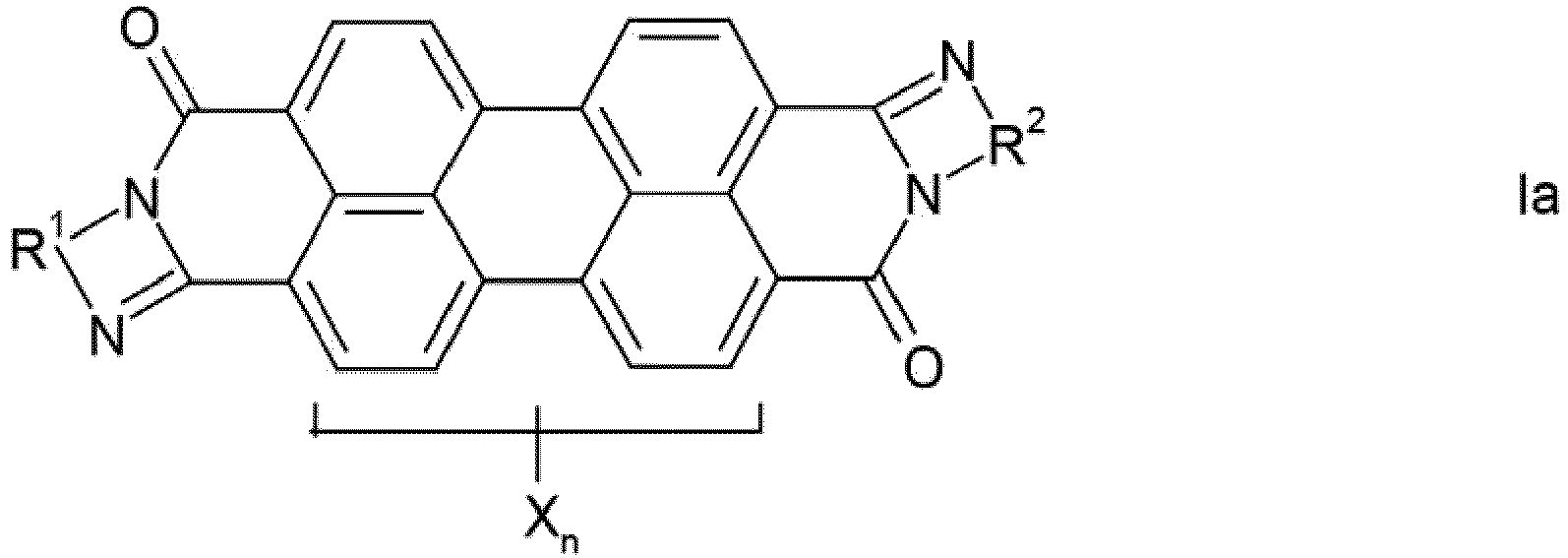
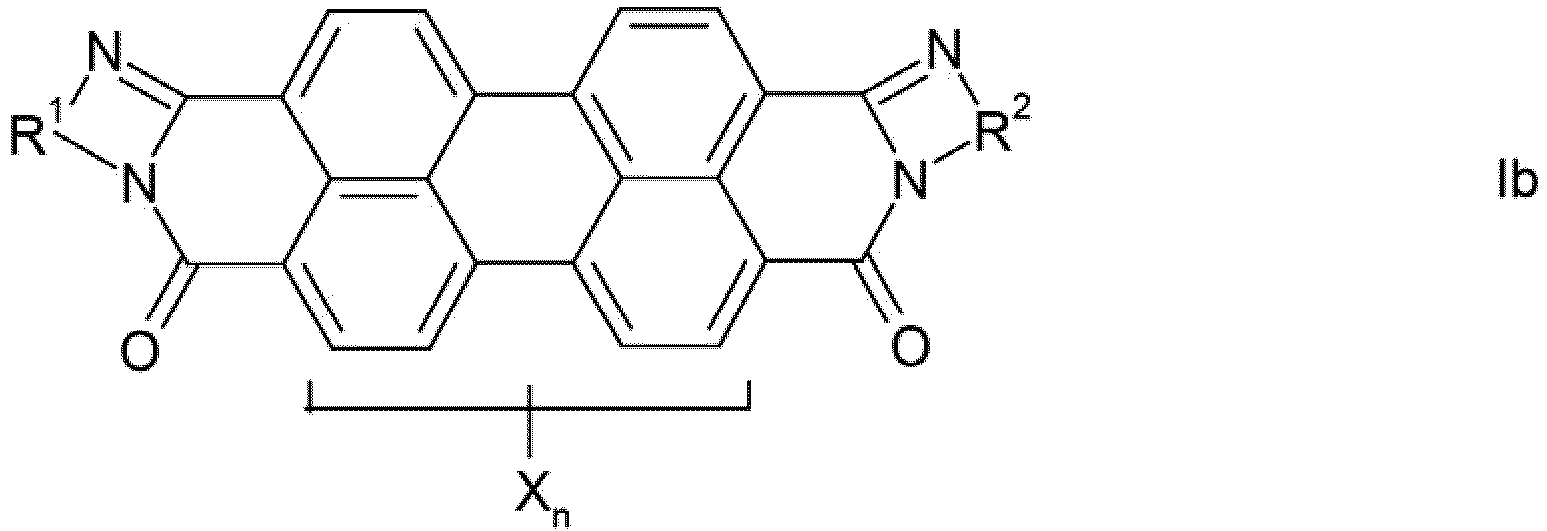 R1, R2 indépendamment l'un de l'autre phénylène, naphtylène ou pyridylène, qui peut à chaque fois être substitué une ou plusieurs fois par alkyle en C1-C12, alcoxy en C1-C6, hydroxy, nitro et/ou halogène ;X halogène ;n 0 à 4,ou un mélange des deux isomères, et qui présentent un indice de noir ≥ 210 dans un vernis au four alkyde/mélamine, caractérisé en ce que les pigments bruts obtenus lors de la synthèse sont soumisa) à un broyage et à une recristallisation dans un milieu liquide oub) à un broyage avec recristallisation simultanée,au moins un solvant organique choisi parmi les alcools, les éther-alcools, les éthers, les cétones, les acides carboxyliques aliphatiques, les amides d'acides carboxyliques, les esters d'acides carboxyliques, les hydrocarbures ou les composés hétéroaromatiques non annelés contenant de l'azote étant utilisé en tant que milieu liquide lors de la recristallisation.
 - Procédé selon la revendication 1, dans lequel les radicaux R1 et R2 sont identiques et signifient phénylène ou naphtylène non substitué.
- Procédé selon la revendication 1 ou 2, caractérisé en ce que les pigments bruts sont soumis à un broyage en poudre de haute énergie.
- Procédé selon la revendication 1 ou 2, caractérisé en ce que les pigments bruts sont tout d'abord soumis à un broyage à sec en la présence ou en l'absence d'un sel en tant qu'adjuvant de broyage, puis à une recristallisation dans un solvant organique, si on le souhaite en mélange avec de l'eau, à chaud.
- Procédé selon la revendication 1 ou 2, caractérisé en ce que les pigments bruts sont soumis à un malaxage à chaud en présence d'un solvant organique à action de recristallisation et d'un sel inorganique.
- Procédé selon la revendication 1 ou 2, caractérisé en ce que les pigments bruts sont soumis à un broyage humide aqueux en présence d'un solvant organique à action de recristallisation.
- Procédé de fabrication de pigments de pérylène noirs, qui contiennent un des isomères de formule la ou Ib
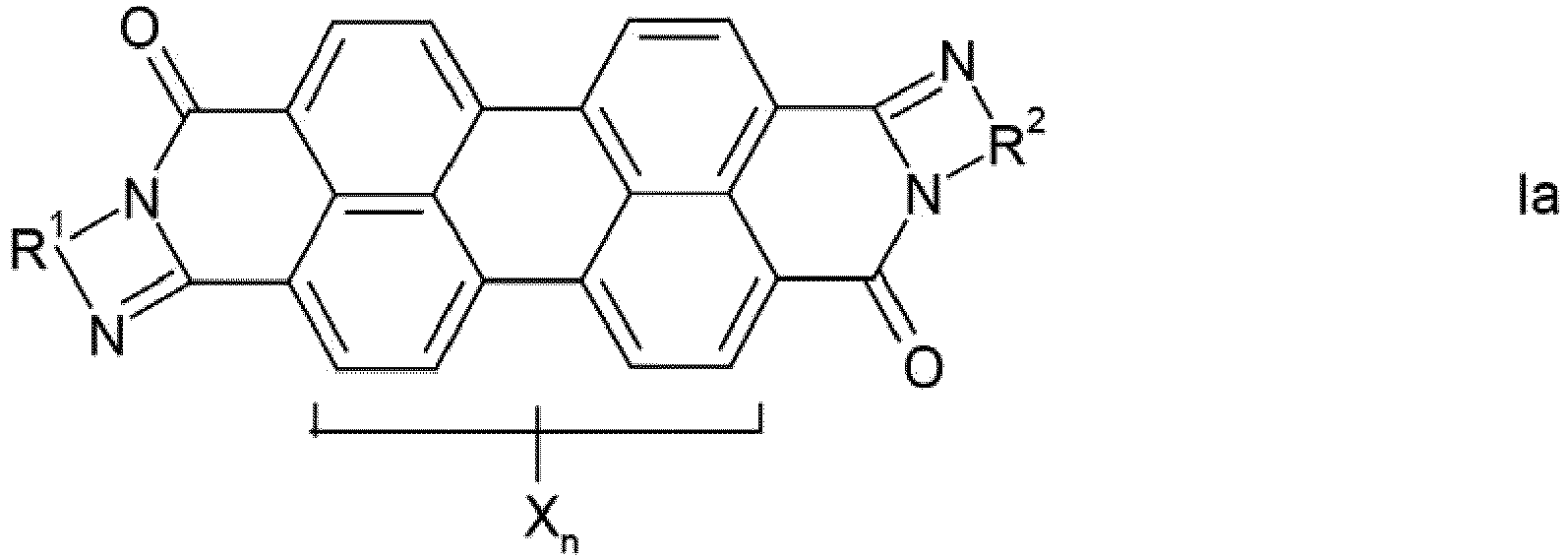
 R1, R2 indépendamment l'un de l'autre phénylène, naphtylène ou pyridylène, qui peut à chaque fois être substitué une ou plusieurs fois par alkyle en C1-C12, alcoxy en C1-C6, hydroxy, nitro et/ou halogène ;X halogène ;n 0 à 4,ou un mélange des deux isomères, et qui présentent un indice de noir ≥ 230 dans un vernis au four alkyde/mélamine,
caractérisé en ce que les pigments bruts obtenus lors de la synthèse sont soumis, après un broyage, à un gonflement dans un acide concentré ayant une concentration de 70 à 85 % en poids. - Procédé selon la revendication 1 ou 7, caractérisé en ce que les pigments bruts sont fabriqués par condensation de dianhydride de l'acide pérylène-3,4:9,10-tétracarboxylique avec une ortho- ou péridiamine aromatique, qui comporte le radical arylène R1 ou R2 et si on le souhaite des radicaux X, puis cyclisation en présence de phénol ou d'un composé hétéroaromatique non annelé contenant de l'azote.
- Procédé selon les revendications 1 à 8, caractérisé en ce qu'il est réalisé en présence d'un synergiste de pigment et/ou d'un additif de pigment.
Applications Claiming Priority (3)
| Application Number | Priority Date | Filing Date | Title |
|---|---|---|---|
| DE200410007382 DE102004007382A1 (de) | 2004-02-11 | 2004-02-11 | Schwarze Perylenpigmente |
| DE200410057876 DE102004057876A1 (de) | 2004-11-30 | 2004-11-30 | Schwarze Perylenpigmente |
| PCT/EP2005/001139 WO2005078023A2 (fr) | 2004-02-11 | 2005-02-04 | Pigments de perylene noirs |
Publications (3)
| Publication Number | Publication Date |
|---|---|
| EP1716208A2 EP1716208A2 (fr) | 2006-11-02 |
| EP1716208B1 EP1716208B1 (fr) | 2011-01-12 |
| EP1716208B2 true EP1716208B2 (fr) | 2021-06-30 |
Family
ID=34862909
Family Applications (1)
| Application Number | Title | Priority Date | Filing Date |
|---|---|---|---|
| EP05701347.6A Expired - Lifetime EP1716208B2 (fr) | 2004-02-11 | 2005-02-04 | Pigments de perylene noirs |
Country Status (10)
| Country | Link |
|---|---|
| US (1) | US7416601B2 (fr) |
| EP (1) | EP1716208B2 (fr) |
| JP (1) | JP4980727B2 (fr) |
| KR (1) | KR101153135B1 (fr) |
| CN (2) | CN102020871B (fr) |
| AT (1) | ATE495222T1 (fr) |
| DE (1) | DE502005010835D1 (fr) |
| ES (1) | ES2359831T5 (fr) |
| TW (1) | TWI386462B (fr) |
| WO (1) | WO2005078023A2 (fr) |
Families Citing this family (53)
| Publication number | Priority date | Publication date | Assignee | Title |
|---|---|---|---|---|
| JP4921982B2 (ja) | 2004-01-26 | 2012-04-25 | ノースウエスタン ユニバーシティ | ペリレンn型半導体及び関連装置 |
| WO2007146250A2 (fr) | 2006-06-12 | 2007-12-21 | Northwestern University | Matériaux semi-conducteurs à base de naphtalène et procédés de préparation et utilisation de ceux-ci |
| EP2089398A2 (fr) | 2006-10-25 | 2009-08-19 | Polyera Corporation | Matériaux semiconducteurs organiques et leurs procédés de préparation et d'utilisation |
| WO2008063609A2 (fr) | 2006-11-17 | 2008-05-29 | Polyera Corporation | Matériaux semi-conducteurs à base de diimide et procédés de préparation et d'utilisation de ceux-ci |
| US7795433B2 (en) | 2006-12-08 | 2010-09-14 | Sun Chemical Corporation | Methods for preparing perylene/perinone pigments |
| CN101622253B (zh) | 2007-01-08 | 2015-04-29 | 破立纪元有限公司 | 用于制备基于芳烃-双(二羧酰亚胺)的半导体材料的方法和用于制备它们的相关中间体 |
| WO2008091670A2 (fr) | 2007-01-24 | 2008-07-31 | Polyera Corporation | Matériaux semi-conducteurs organiques et leurs précurseurs |
| CN101688024B (zh) * | 2007-06-28 | 2013-01-09 | 巴斯夫欧洲公司 | 含有有机黑色颜料的热塑性模塑材料 |
| JP5447865B2 (ja) * | 2007-07-03 | 2014-03-19 | ビーエーエスエフ ソシエタス・ヨーロピア | ペリレン顔料の水系合成 |
| PL2058360T3 (pl) | 2007-11-06 | 2012-02-29 | Basf Se | Elementy kształtowe o ciemnej powierzchni i niskiej przewodności cieplnej |
| ATE541003T1 (de) | 2007-11-26 | 2012-01-15 | Basf Se | Formteile mit dunkler oberfläche und geringer wärmeleitfähigkeit |
| US8551237B2 (en) | 2007-12-10 | 2013-10-08 | Basf Se | Synthesis of colorants in mixing apparatus |
| EP2288742B1 (fr) | 2008-06-04 | 2014-12-03 | Basf Se | Coloration noire des fibres dans la masse |
| CN102112561A (zh) * | 2008-07-29 | 2011-06-29 | 巴斯夫欧洲公司 | 水性通用颜料糊 |
| DE102009001121A1 (de) | 2009-02-24 | 2010-08-26 | Basf Se | Mehrschichtige Verbundmaterialien, ihre Herstellung und Verwendung |
| US9174239B2 (en) * | 2009-10-27 | 2015-11-03 | Axalta Coating Systems Ip Co., Llc | Process for the production of a dark-color multi-layer coating |
| WO2011056646A1 (fr) * | 2009-10-27 | 2011-05-12 | E. I. Du Pont De Nemours And Company | Procédé de production d'un revêtement multicouche de couleur foncée |
| JP5603655B2 (ja) * | 2010-05-18 | 2014-10-08 | 富士重工業株式会社 | 車両用内装材 |
| JP4709326B1 (ja) | 2010-05-31 | 2011-06-22 | 株式会社有沢製作所 | ポリイミド樹脂用組成物、及び該ポリイミド樹脂用組成物からなるポリイミド樹脂 |
| US9238736B2 (en) * | 2010-10-15 | 2016-01-19 | Cabot Corporation | Surface modified organic black pigments, surface modified carbon blacks, pigment mixtures using them, and low dielectric black dispersions, coatings, films, black matrices, and devices containing same |
| MX362711B (es) | 2010-12-03 | 2019-02-05 | 3G Mermet Corp | Composición reflejante de infrarrojo cercano y recubrimientos para aberturas arquitectónicas que incorporan la misma. |
| JP5796628B2 (ja) * | 2011-03-30 | 2015-10-21 | 宇部興産株式会社 | ポリイミドフィルム |
| US9057835B2 (en) * | 2011-06-06 | 2015-06-16 | Ppg Industries Ohio, Inc. | Coating compositions that transmit infrared radiation and exhibit color stability and related coating systems |
| MX341195B (es) | 2011-09-16 | 2016-08-11 | Basf Se | Sistema de revestimiento. |
| JP6157602B2 (ja) * | 2012-06-01 | 2017-07-05 | ビーエーエスエフ ソシエタス・ヨーロピアBasf Se | 黒色着色剤混合物 |
| WO2014191232A2 (fr) | 2013-05-31 | 2014-12-04 | Vlyte Innovations Limited | Dispositif de commande solaire, milieu et encre |
| MX376488B (es) | 2013-06-03 | 2025-03-07 | Basf Se | Pigmento inorgánico rojo. |
| JP6534679B2 (ja) | 2013-12-03 | 2019-06-26 | クレイン アンド カンパニー、 インコーポレイテッド | 1つ又は複数の向上した透かしを有するセキュリティシート又はセキュリティ文書 |
| CN107075269B (zh) | 2014-09-23 | 2019-08-02 | 巴斯夫欧洲公司 | C.i.颜料黄139的稳定化 |
| WO2016045874A1 (fr) | 2014-09-23 | 2016-03-31 | Basf Se | Composition de pigment |
| JP6985715B2 (ja) * | 2016-06-15 | 2021-12-22 | 山陽色素株式会社 | 黒色顔料組成物及びこれを含む黒色塗膜形成組成物 |
| EP3505573B1 (fr) | 2016-08-24 | 2025-10-22 | Toray Industries, Inc. | Pigment noir, procédé de production associé, liquide de dispersion pigmentaire, composition photosensible et produit durci en ladite composition photosensible |
| CA3039666C (fr) | 2016-10-28 | 2022-08-23 | Ppg Industries Ohio, Inc. | Revetements d'augmentation des distances de detection proche infrarouge |
| AU2017393056B2 (en) | 2017-01-13 | 2020-12-17 | Dainichiseika Color & Chemicals Mfg. Co., Ltd. | Black isoindolinone pigment and coloring agent |
| CN107652653B (zh) * | 2017-10-25 | 2020-05-08 | 延锋彼欧汽车外饰系统有限公司 | 一种可激光焊接用的改性塑料及其制备方法 |
| KR102452003B1 (ko) * | 2017-12-26 | 2022-10-06 | 현대자동차주식회사 | 레이저 융착용 폴리프로필렌 수지 조성물 및 이를 포함하는 운송 수단용 성형품 |
| JP7079706B2 (ja) * | 2018-09-28 | 2022-06-02 | ポリプラスチックス株式会社 | レーザー溶着及びレーザーマーキングが可能な樹脂組成物 |
| EP4600047A3 (fr) | 2018-11-13 | 2025-10-22 | PPG Industries Ohio, Inc. | Procédé de détection d'un motif dissimulé |
| US11561329B2 (en) | 2019-01-07 | 2023-01-24 | Ppg Industries Ohio, Inc. | Near infrared control coating, articles formed therefrom, and methods of making the same |
| JP7205757B2 (ja) * | 2019-01-11 | 2023-01-17 | 株式会社リコー | 記録液、および印刷物 |
| JP7295583B2 (ja) * | 2019-05-15 | 2023-06-21 | エム・テクニック株式会社 | ペリレン系黒色顔料微粒子、その製造方法、それを含む黒色顔料組成物、並びに色相及び/又は彩度が制御されたペリレン系黒色顔料微粒子の製造方法 |
| CN110591445B (zh) * | 2019-10-30 | 2021-12-03 | 辽宁鸿港化工有限公司 | 适合于水性涂料(或油墨)着色的苝系黑色颜料 |
| CN110724104B (zh) * | 2019-10-30 | 2022-07-05 | 辽宁鸿港化工有限公司 | 3,4-苝二酰亚胺衍生物及其制备方法和用途 |
| CN110684215B (zh) * | 2019-10-30 | 2021-03-02 | 东莞理工学院 | 稠环芳香类色素和高分子材料的混合物、其制备方法及其下游产品 |
| CN111057310A (zh) * | 2019-12-30 | 2020-04-24 | 江苏金发科技新材料有限公司 | 一种用于激光焊接中黑色透光层的长玻纤增强聚丙烯复合物及其应用 |
| MX2023007426A (es) | 2020-12-21 | 2023-08-30 | Sun Chemical Bv | Pigmento de solucion solida negro neutro transparente casi infrarrojo (nir). |
| MX2023007425A (es) * | 2020-12-21 | 2023-08-30 | Sun Chemical Bv | Soluciones solidas de perileno negro neutro transparente casi infrarrojo (nir). |
| JP7658565B2 (ja) | 2021-06-23 | 2025-04-08 | 山陽色素株式会社 | 黒色顔料分散体 |
| WO2023025694A1 (fr) | 2021-08-24 | 2023-03-02 | Basf Se | Nouveaux émetteurs nir à base de pérylène |
| KR102684643B1 (ko) * | 2021-11-17 | 2024-07-15 | 한국과학기술연구원 | 신규한 암색 도료 조성물 및 이를 이용한 근적외선 반사 이중코팅층 |
| US20260028470A1 (en) | 2022-07-21 | 2026-01-29 | Basf Se | Molding composition comprising black colorant |
| CN121712850A (zh) * | 2023-08-04 | 2026-03-20 | 太阳化学有限公司 | 具有增强近红外透明性能的苝系黑色颜料 |
| WO2025237878A1 (fr) * | 2024-05-13 | 2025-11-20 | Sun Chemical B.V. | Pigments noirs de pérylène à faible saignement et leur procédé de production |
Citations (37)
| Publication number | Priority date | Publication date | Assignee | Title |
|---|---|---|---|---|
| US1878986A (en) † | 1922-12-27 | 1932-09-20 | Gen Aniline Works Inc | Vat dyestuffs of the polynuclear aromatic imidazole series and the process of preparing them |
| US2473015A (en) † | 1944-03-13 | 1949-06-14 | American Cyanamid Co | Acid treatment of heterocyclic imide and imidazole vat dyestuffs |
| US2857400A (en) † | 1955-09-19 | 1958-10-21 | Du Pont | Pigment production |
| GB859288A (en) † | 1957-10-29 | 1961-01-18 | Sandoz Ltd | Improvements in or relating to a process for dyeing and coloring lacquers, printing inks and plastics and for spin-dyeing artificial fibres |
| US2998402A (en) † | 1957-10-29 | 1961-08-29 | Sandoz Ag | Process for dyeing and coloring in the mass with perlyene derivatives |
| US3112289A (en) † | 1958-12-19 | 1963-11-26 | Geigy Ag J R | Perylene-3, 4, 9, 10-tetracarboxylic acid dianhydride pigment for polymeric materials |
| CH373844A (de) † | 1958-08-15 | 1963-12-15 | Sandoz Ag | Verfahren zur Herstellung von Perylentetracarboxyl-bis-benzimidazolen |
| US3730750A (en) † | 1970-03-23 | 1973-05-01 | Basf Ag | Isolation of finely divided dyes from liquid dispersions |
| US3872103A (en) † | 1972-10-26 | 1975-03-18 | Basf Ag | Manufacture of deep-shade 3,4,9,10-perylenetetracarboxylic acid dianhydride pigments |
| GB1438921A (en) † | 1973-07-20 | 1976-06-09 | Bayer Ag | Process for forming crude organic pigments |
| US3976649A (en) † | 1973-04-03 | 1976-08-24 | Basf Aktiengesellschaft | Production of easily dispersible, high tinctorial strength perylene-3,4,9,10-tetracarboxylic acid diimides |
| US4077972A (en) † | 1974-07-06 | 1978-03-07 | Bayer Aktiengesellschaft | Process for the preparation and conditioning of copper phthalocyanine |
| US4115386A (en) † | 1975-10-11 | 1978-09-19 | Basf Aktiengesellschaft | Perylene-3,4,9,10-tetracarboxylic acid diimide pigment, its manufacture and its use |
| US4431806A (en) † | 1980-05-10 | 1984-02-14 | Hoechst A.G. | Process for the preparation of pigments of the perylene-3,4,9,10-tetracarboxylic acid diimide series, and their use |
| US5019473A (en) † | 1990-02-23 | 1991-05-28 | Eastman Kodak Company | Electrophotographic recording elements containing photoconductive perylene pigments |
| EP0443566A1 (fr) † | 1990-02-23 | 1991-08-28 | Eastman Kodak Company | Procédé de préparation de compositions contenant des pigments de pérylène photoconducteurs |
| US5110931A (en) † | 1987-11-27 | 1992-05-05 | Hoechst Aktiengesellschaft | Process for the preparation of n,n'-dimethylperylene-3,4,9,10-tetracarboxylic diimide in high-hiding pigment form |
| EP0524904A2 (fr) † | 1991-07-08 | 1993-01-27 | Ciba-Geigy Ag | Procédé de conditionnement de pigments organiques |
| US5225307A (en) † | 1992-01-31 | 1993-07-06 | Xerox Corporation | Processes for the preparation of photogenerating compositions |
| JPH05249719A (ja) † | 1992-03-09 | 1993-09-28 | Fuji Xerox Co Ltd | 電子写真感光体 |
| US5296531A (en) † | 1991-12-20 | 1994-03-22 | Basf Aktiengesellschaft | Pigment preparations |
| US5395722A (en) † | 1992-04-02 | 1995-03-07 | Fuji Xerox Co., Ltd. | Electrophotographic photoreceptor and production process thereof |
| EP0678559A1 (fr) † | 1994-04-21 | 1995-10-25 | Hoechst Aktiengesellschaft | Procédé de broyage pour la fabrication de pigments organiques |
| US5484674A (en) † | 1994-10-31 | 1996-01-16 | Xerox Corporation | Benzimidazole perylene imaging members and processes thereof |
| US5508137A (en) † | 1993-08-13 | 1996-04-16 | Ciba-Geigy Corporation | Perylene amidine imide dyes, a process for preparing them, and their use |
| EP0780446A2 (fr) † | 1995-12-23 | 1997-06-25 | Ciba-Geigy Ag | Procédé de production de pigments |
| US5650513A (en) † | 1993-11-12 | 1997-07-22 | Ciba-Geigy Corporation | Process for preparing perylene-3,4-dicarboxylic acid derivatives, the derivatives thus prepared and their use |
| US5693808A (en) † | 1994-11-10 | 1997-12-02 | Ciba Specialty Chemicals Corporation | Process for the preparation of peryleneimides, novel di-, tri- and tetrachromophoric perylene dyes and their use |
| US5891594A (en) † | 1997-01-13 | 1999-04-06 | Xerox Corporation | Process for preparing electrophotographic imaging member with perylene-containing charge-generating material and n-butylacetate |
| US5929239A (en) † | 1997-01-27 | 1999-07-27 | Ciba Specialty Chemicals Corporation | Bifluorophoric perylene colourants |
| US6159275A (en) † | 1997-12-18 | 2000-12-12 | Degussa-Huls Aktiengesellschaft | Paints and printing inks containing modified carbon blacks |
| US6166210A (en) † | 1997-12-15 | 2000-12-26 | Ciba Specialty Chemicals Corporation | Perylene imide monocarboxylic acids |
| US6220673B1 (en) † | 1999-07-12 | 2001-04-24 | Colgate-Palmolive Company | Laser joining toothbrush heads to handles |
| WO2002048267A2 (fr) † | 2000-11-10 | 2002-06-20 | Ciba Specialty Chemicals Holding Inc. | Gonflement de pigments de perylene au moyen de l'acide sulfonique de toluene |
| EP1413605A1 (fr) † | 2001-07-27 | 2004-04-28 | Toda Kogyo Corporation | Pigment de noir de perylene et son procede d'obtention |
| EP1413606A1 (fr) † | 2001-07-27 | 2004-04-28 | Toda Kogyo Corporation | Pigment de noir de perylene et son procede d'obtention |
| US20040215015A1 (en) † | 2003-04-25 | 2004-10-28 | Nazarov Victor V. | Lyotropic liquid crystal systems based on perylenetetracarboxylic acid dibenzimidazole sulfoderivatives, related anisotropic films, and methods for making |
Family Cites Families (18)
| Publication number | Priority date | Publication date | Assignee | Title |
|---|---|---|---|---|
| GB972485A (en) | 1961-10-31 | 1964-10-14 | British Nylon Spinners Ltd | Dyes of the perylene tetracarboxylic acid bis-benzimidazole series |
| JPS56118462A (en) * | 1980-02-25 | 1981-09-17 | Toyo Ink Mfg Co Ltd | Pigment composition |
| DE3209424A1 (de) | 1981-03-20 | 1983-01-05 | Basf Ag, 6700 Ludwigshafen | Perylen-3,4,9,10-tetracarbonsaeurebisbenzimidazolverbindungen und deren verwendung |
| DE3110960A1 (de) * | 1981-03-20 | 1982-09-30 | Basf Ag, 6700 Ludwigshafen | Elektrophotographisches aufzeichnungsmaterial |
| DE3309060A1 (de) * | 1983-03-14 | 1984-09-20 | Hoechst Ag, 6230 Frankfurt | Perylen-3,4,9,10-tetracarbonsaeure-monoanhydrid-monoimid- und -monoimidazolid-verbindungen, verfahren zu ihrer herstellung und ihre verwendung |
| DE3339540A1 (de) * | 1983-11-02 | 1985-05-09 | Basf Ag, 6700 Ludwigshafen | Elektrofotografisches aufzeichnungsmaterial |
| CH665649A5 (de) * | 1985-06-26 | 1988-05-31 | Basf Ag | Perylen-3,4,9,10-tetracarbonsaeurediimid und seine verwendung als schwarzfarbstoff ausserhalb der textilindustrie. |
| JPS62129380A (ja) | 1985-11-29 | 1987-06-11 | Alps Electric Co Ltd | カラ−液晶用二色性色素 |
| CA1271110A (fr) * | 1985-12-19 | 1990-07-03 | Barrday, Inc. | Revetement protecteur |
| JPH0216165A (ja) * | 1988-07-04 | 1990-01-19 | Mitsui Toatsu Chem Inc | ペリレン色素の製造方法 |
| JP3180230B2 (ja) * | 1992-05-14 | 2001-06-25 | セーレン株式会社 | 着色スエード調合成皮革の製造方法 |
| JPH07157681A (ja) | 1993-12-08 | 1995-06-20 | Konica Corp | 有機顔料の製造方法及び有機顔料を含有する電子写真感光体 |
| JPH086277A (ja) * | 1994-06-22 | 1996-01-12 | Konica Corp | 画像形成方法 |
| JP3635375B2 (ja) * | 1994-06-29 | 2005-04-06 | コニカミノルタホールディングス株式会社 | 画像形成方法 |
| EP0698649A1 (fr) | 1994-08-26 | 1996-02-28 | Basf Aktiengesellschaft | Utilisation de matériaux électroluminescents d'une stabilité de longue durée, façonnables à chaud |
| JPH11256061A (ja) | 1998-03-10 | 1999-09-21 | Mitsubishi Paper Mills Ltd | フタロシアニンの新規な混晶体、並びにそれを用いた電子写真感光体の製造方法 |
| US6268097B1 (en) * | 1998-12-21 | 2001-07-31 | Konica Corporation | Electrophotographic photoreceptor |
| JP2002038047A (ja) * | 2000-07-21 | 2002-02-06 | Konica Corp | 混成顔料、混成顔料の製造方法、及び該混成顔料を用いた電子写真感光体、画像形成装置、プロセスカートリッジ |
-
2005
- 2005-02-04 US US10/587,361 patent/US7416601B2/en not_active Expired - Lifetime
- 2005-02-04 EP EP05701347.6A patent/EP1716208B2/fr not_active Expired - Lifetime
- 2005-02-04 TW TW094103753A patent/TWI386462B/zh not_active IP Right Cessation
- 2005-02-04 JP JP2006552513A patent/JP4980727B2/ja not_active Expired - Lifetime
- 2005-02-04 CN CN201010003324.2A patent/CN102020871B/zh not_active Expired - Lifetime
- 2005-02-04 AT AT05701347T patent/ATE495222T1/de active
- 2005-02-04 CN CN2005800045228A patent/CN1918239B/zh not_active Expired - Lifetime
- 2005-02-04 ES ES05701347T patent/ES2359831T5/es not_active Expired - Lifetime
- 2005-02-04 WO PCT/EP2005/001139 patent/WO2005078023A2/fr not_active Ceased
- 2005-02-04 DE DE502005010835T patent/DE502005010835D1/de not_active Expired - Lifetime
- 2005-02-04 KR KR1020067018230A patent/KR101153135B1/ko not_active Expired - Lifetime
Patent Citations (37)
| Publication number | Priority date | Publication date | Assignee | Title |
|---|---|---|---|---|
| US1878986A (en) † | 1922-12-27 | 1932-09-20 | Gen Aniline Works Inc | Vat dyestuffs of the polynuclear aromatic imidazole series and the process of preparing them |
| US2473015A (en) † | 1944-03-13 | 1949-06-14 | American Cyanamid Co | Acid treatment of heterocyclic imide and imidazole vat dyestuffs |
| US2857400A (en) † | 1955-09-19 | 1958-10-21 | Du Pont | Pigment production |
| GB859288A (en) † | 1957-10-29 | 1961-01-18 | Sandoz Ltd | Improvements in or relating to a process for dyeing and coloring lacquers, printing inks and plastics and for spin-dyeing artificial fibres |
| US2998402A (en) † | 1957-10-29 | 1961-08-29 | Sandoz Ag | Process for dyeing and coloring in the mass with perlyene derivatives |
| CH373844A (de) † | 1958-08-15 | 1963-12-15 | Sandoz Ag | Verfahren zur Herstellung von Perylentetracarboxyl-bis-benzimidazolen |
| US3112289A (en) † | 1958-12-19 | 1963-11-26 | Geigy Ag J R | Perylene-3, 4, 9, 10-tetracarboxylic acid dianhydride pigment for polymeric materials |
| US3730750A (en) † | 1970-03-23 | 1973-05-01 | Basf Ag | Isolation of finely divided dyes from liquid dispersions |
| US3872103A (en) † | 1972-10-26 | 1975-03-18 | Basf Ag | Manufacture of deep-shade 3,4,9,10-perylenetetracarboxylic acid dianhydride pigments |
| US3976649A (en) † | 1973-04-03 | 1976-08-24 | Basf Aktiengesellschaft | Production of easily dispersible, high tinctorial strength perylene-3,4,9,10-tetracarboxylic acid diimides |
| GB1438921A (en) † | 1973-07-20 | 1976-06-09 | Bayer Ag | Process for forming crude organic pigments |
| US4077972A (en) † | 1974-07-06 | 1978-03-07 | Bayer Aktiengesellschaft | Process for the preparation and conditioning of copper phthalocyanine |
| US4115386A (en) † | 1975-10-11 | 1978-09-19 | Basf Aktiengesellschaft | Perylene-3,4,9,10-tetracarboxylic acid diimide pigment, its manufacture and its use |
| US4431806A (en) † | 1980-05-10 | 1984-02-14 | Hoechst A.G. | Process for the preparation of pigments of the perylene-3,4,9,10-tetracarboxylic acid diimide series, and their use |
| US5110931A (en) † | 1987-11-27 | 1992-05-05 | Hoechst Aktiengesellschaft | Process for the preparation of n,n'-dimethylperylene-3,4,9,10-tetracarboxylic diimide in high-hiding pigment form |
| US5019473A (en) † | 1990-02-23 | 1991-05-28 | Eastman Kodak Company | Electrophotographic recording elements containing photoconductive perylene pigments |
| EP0443566A1 (fr) † | 1990-02-23 | 1991-08-28 | Eastman Kodak Company | Procédé de préparation de compositions contenant des pigments de pérylène photoconducteurs |
| EP0524904A2 (fr) † | 1991-07-08 | 1993-01-27 | Ciba-Geigy Ag | Procédé de conditionnement de pigments organiques |
| US5296531A (en) † | 1991-12-20 | 1994-03-22 | Basf Aktiengesellschaft | Pigment preparations |
| US5225307A (en) † | 1992-01-31 | 1993-07-06 | Xerox Corporation | Processes for the preparation of photogenerating compositions |
| JPH05249719A (ja) † | 1992-03-09 | 1993-09-28 | Fuji Xerox Co Ltd | 電子写真感光体 |
| US5395722A (en) † | 1992-04-02 | 1995-03-07 | Fuji Xerox Co., Ltd. | Electrophotographic photoreceptor and production process thereof |
| US5508137A (en) † | 1993-08-13 | 1996-04-16 | Ciba-Geigy Corporation | Perylene amidine imide dyes, a process for preparing them, and their use |
| US5650513A (en) † | 1993-11-12 | 1997-07-22 | Ciba-Geigy Corporation | Process for preparing perylene-3,4-dicarboxylic acid derivatives, the derivatives thus prepared and their use |
| EP0678559A1 (fr) † | 1994-04-21 | 1995-10-25 | Hoechst Aktiengesellschaft | Procédé de broyage pour la fabrication de pigments organiques |
| US5484674A (en) † | 1994-10-31 | 1996-01-16 | Xerox Corporation | Benzimidazole perylene imaging members and processes thereof |
| US5693808A (en) † | 1994-11-10 | 1997-12-02 | Ciba Specialty Chemicals Corporation | Process for the preparation of peryleneimides, novel di-, tri- and tetrachromophoric perylene dyes and their use |
| EP0780446A2 (fr) † | 1995-12-23 | 1997-06-25 | Ciba-Geigy Ag | Procédé de production de pigments |
| US5891594A (en) † | 1997-01-13 | 1999-04-06 | Xerox Corporation | Process for preparing electrophotographic imaging member with perylene-containing charge-generating material and n-butylacetate |
| US5929239A (en) † | 1997-01-27 | 1999-07-27 | Ciba Specialty Chemicals Corporation | Bifluorophoric perylene colourants |
| US6166210A (en) † | 1997-12-15 | 2000-12-26 | Ciba Specialty Chemicals Corporation | Perylene imide monocarboxylic acids |
| US6159275A (en) † | 1997-12-18 | 2000-12-12 | Degussa-Huls Aktiengesellschaft | Paints and printing inks containing modified carbon blacks |
| US6220673B1 (en) † | 1999-07-12 | 2001-04-24 | Colgate-Palmolive Company | Laser joining toothbrush heads to handles |
| WO2002048267A2 (fr) † | 2000-11-10 | 2002-06-20 | Ciba Specialty Chemicals Holding Inc. | Gonflement de pigments de perylene au moyen de l'acide sulfonique de toluene |
| EP1413605A1 (fr) † | 2001-07-27 | 2004-04-28 | Toda Kogyo Corporation | Pigment de noir de perylene et son procede d'obtention |
| EP1413606A1 (fr) † | 2001-07-27 | 2004-04-28 | Toda Kogyo Corporation | Pigment de noir de perylene et son procede d'obtention |
| US20040215015A1 (en) † | 2003-04-25 | 2004-10-28 | Nazarov Victor V. | Lyotropic liquid crystal systems based on perylenetetracarboxylic acid dibenzimidazole sulfoderivatives, related anisotropic films, and methods for making |
Non-Patent Citations (2)
| Title |
|---|
| ROMPP CHEMIELEXIKON, 9. AUFLAGE, 1992, pages 3348,3349,3695 - 3696 † |
| W HERBST, K HUNGER: "Industrielle Organische Pigmente", 1995, VCH VERLAG, 2. ED., pages: 89 † |
Also Published As
| Publication number | Publication date |
|---|---|
| CN102020871A (zh) | 2011-04-20 |
| WO2005078023A3 (fr) | 2005-11-24 |
| CN102020871B (zh) | 2014-01-22 |
| ES2359831T3 (es) | 2011-05-27 |
| KR20070017131A (ko) | 2007-02-08 |
| CN1918239A (zh) | 2007-02-21 |
| TWI386462B (zh) | 2013-02-21 |
| US20070151478A1 (en) | 2007-07-05 |
| EP1716208B1 (fr) | 2011-01-12 |
| WO2005078023A2 (fr) | 2005-08-25 |
| JP2007522297A (ja) | 2007-08-09 |
| CN1918239B (zh) | 2010-05-05 |
| TW200604294A (en) | 2006-02-01 |
| JP4980727B2 (ja) | 2012-07-18 |
| ES2359831T5 (es) | 2021-12-14 |
| KR101153135B1 (ko) | 2012-06-11 |
| EP1716208A2 (fr) | 2006-11-02 |
| US7416601B2 (en) | 2008-08-26 |
| ATE495222T1 (de) | 2011-01-15 |
| DE502005010835D1 (de) | 2011-02-24 |
Similar Documents
| Publication | Publication Date | Title |
|---|---|---|
| EP1716208B2 (fr) | Pigments de perylene noirs | |
| EP0256983B1 (fr) | Solutions solides de pyrrolo-[3,4-c]-pyrroles | |
| EP0485441B1 (fr) | Nouvelles preparations pigmentaires a base de composes de perylene | |
| DE60010262T2 (de) | Neue Pigmentform von Pigment Violet 23 | |
| EP0321919B1 (fr) | Pigments et leur utilisation | |
| DE60102244T2 (de) | Feste lösung von kupferphthalocyanin in pigmentform und transparente dispersion die diese enthält | |
| EP0864613B1 (fr) | Composition pigmentaire et son procédé de fabrication | |
| EP2044157B1 (fr) | Pigments d'isoindoline | |
| EP0504923A1 (fr) | Procédé pour la préparation des préparations de pigment à base de C.I. pigment violet 23 | |
| DE19613186A1 (de) | Verfahren zur Herstellung von Chinacridonpigmenten | |
| EP0764696B1 (fr) | Fabrication de cristaux mixtes et solutions solides de 1,4-dicétopyrrolopyrroles | |
| EP0056870B1 (fr) | Diimide de l'acide pérylène-3,4,9,10-tétracarboxylique et son utilisation | |
| CN116669866A (zh) | 近红外(nir)透明中性黑苝固溶体 | |
| DE69222262T2 (de) | Neue feste Lösungen von Kupferphthalocyaninverbindungen | |
| EP0221853B1 (fr) | Procédé de préparation et de conditionnement de pigments organiques | |
| EP1882019B1 (fr) | Pigment azoique a fines particules et procede de realisation associe | |
| WO2002010288A1 (fr) | Compositions dispersantes ameliorant la stabilite a la chaleur de pigments transparents | |
| EP0690059B1 (fr) | Deux modifications cristallines d'un pigment de dicétopyrrolopyrrole | |
| EP0366062B1 (fr) | Cristaux mixtes de pigments à base de diimides halogenées de l'acide pérylènetétracarbonique | |
| DE69521596T2 (de) | INDANTHRONBLAU PIGMENT DER FORM delta UND SEIN HERSTELLUNGSVERFAHREN | |
| DE102004007382A1 (de) | Schwarze Perylenpigmente | |
| DE102004057876A1 (de) | Schwarze Perylenpigmente | |
| EP0337435A2 (fr) | Procédé de fabrication de pigments de dicétopyrrolopyrrole couvrants | |
| EP2370523B1 (fr) | Préparations de pigments de dicétopyrrolopyrrole stables à la floculation | |
| EP0358148A2 (fr) | Solutions solides de pigments azométhiniques |
Legal Events
| Date | Code | Title | Description |
|---|---|---|---|
| PUAI | Public reference made under article 153(3) epc to a published international application that has entered the european phase |
Free format text: ORIGINAL CODE: 0009012 |
|
| 17P | Request for examination filed |
Effective date: 20060911 |
|
| AK | Designated contracting states |
Kind code of ref document: A2 Designated state(s): AT BE BG CH CY CZ DE DK EE ES FI FR GB GR HU IE IS IT LI LT LU MC NL PL PT RO SE SI SK TR |
|
| DAX | Request for extension of the european patent (deleted) | ||
| RAP1 | Party data changed (applicant data changed or rights of an application transferred) |
Owner name: BASF SE |
|
| GRAP | Despatch of communication of intention to grant a patent |
Free format text: ORIGINAL CODE: EPIDOSNIGR1 |
|
| GRAS | Grant fee paid |
Free format text: ORIGINAL CODE: EPIDOSNIGR3 |
|
| GRAA | (expected) grant |
Free format text: ORIGINAL CODE: 0009210 |
|
| AK | Designated contracting states |
Kind code of ref document: B1 Designated state(s): AT BE BG CH CY CZ DE DK EE ES FI FR GB GR HU IE IS IT LI LT LU MC NL PL PT RO SE SI SK TR |
|
| REG | Reference to a national code |
Ref country code: GB Ref legal event code: FG4D Free format text: NOT ENGLISH |
|
| REG | Reference to a national code |
Ref country code: CH Ref legal event code: EP |
|
| REG | Reference to a national code |
Ref country code: IE Ref legal event code: FG4D Free format text: LANGUAGE OF EP DOCUMENT: GERMAN |
|
| REF | Corresponds to: |
Ref document number: 502005010835 Country of ref document: DE Date of ref document: 20110224 Kind code of ref document: P |
|
| REG | Reference to a national code |
Ref country code: DE Ref legal event code: R096 Ref document number: 502005010835 Country of ref document: DE Effective date: 20110224 |
|
| REG | Reference to a national code |
Ref country code: NL Ref legal event code: T3 |
|
| REG | Reference to a national code |
Ref country code: ES Ref legal event code: FG2A Ref document number: 2359831 Country of ref document: ES Kind code of ref document: T3 Effective date: 20110527 |
|
| LTIE | Lt: invalidation of european patent or patent extension |
Effective date: 20110112 |
|
| PG25 | Lapsed in a contracting state [announced via postgrant information from national office to epo] |
Ref country code: LT Free format text: LAPSE BECAUSE OF FAILURE TO SUBMIT A TRANSLATION OF THE DESCRIPTION OR TO PAY THE FEE WITHIN THE PRESCRIBED TIME-LIMIT Effective date: 20110112 Ref country code: SE Free format text: LAPSE BECAUSE OF FAILURE TO SUBMIT A TRANSLATION OF THE DESCRIPTION OR TO PAY THE FEE WITHIN THE PRESCRIBED TIME-LIMIT Effective date: 20110112 Ref country code: PT Free format text: LAPSE BECAUSE OF FAILURE TO SUBMIT A TRANSLATION OF THE DESCRIPTION OR TO PAY THE FEE WITHIN THE PRESCRIBED TIME-LIMIT Effective date: 20110512 Ref country code: IS Free format text: LAPSE BECAUSE OF FAILURE TO SUBMIT A TRANSLATION OF THE DESCRIPTION OR TO PAY THE FEE WITHIN THE PRESCRIBED TIME-LIMIT Effective date: 20110512 Ref country code: GR Free format text: LAPSE BECAUSE OF FAILURE TO SUBMIT A TRANSLATION OF THE DESCRIPTION OR TO PAY THE FEE WITHIN THE PRESCRIBED TIME-LIMIT Effective date: 20110413 |
|
| REG | Reference to a national code |
Ref country code: IE Ref legal event code: FD4D |
|
| PG25 | Lapsed in a contracting state [announced via postgrant information from national office to epo] |
Ref country code: SI Free format text: LAPSE BECAUSE OF FAILURE TO SUBMIT A TRANSLATION OF THE DESCRIPTION OR TO PAY THE FEE WITHIN THE PRESCRIBED TIME-LIMIT Effective date: 20110112 Ref country code: FI Free format text: LAPSE BECAUSE OF FAILURE TO SUBMIT A TRANSLATION OF THE DESCRIPTION OR TO PAY THE FEE WITHIN THE PRESCRIBED TIME-LIMIT Effective date: 20110112 Ref country code: PL Free format text: LAPSE BECAUSE OF FAILURE TO SUBMIT A TRANSLATION OF THE DESCRIPTION OR TO PAY THE FEE WITHIN THE PRESCRIBED TIME-LIMIT Effective date: 20110112 Ref country code: BG Free format text: LAPSE BECAUSE OF FAILURE TO SUBMIT A TRANSLATION OF THE DESCRIPTION OR TO PAY THE FEE WITHIN THE PRESCRIBED TIME-LIMIT Effective date: 20110412 Ref country code: CY Free format text: LAPSE BECAUSE OF FAILURE TO SUBMIT A TRANSLATION OF THE DESCRIPTION OR TO PAY THE FEE WITHIN THE PRESCRIBED TIME-LIMIT Effective date: 20110112 |
|
| PG25 | Lapsed in a contracting state [announced via postgrant information from national office to epo] |
Ref country code: MC Free format text: LAPSE BECAUSE OF NON-PAYMENT OF DUE FEES Effective date: 20110228 |
|
| REG | Reference to a national code |
Ref country code: CH Ref legal event code: PL |
|
| PLBI | Opposition filed |
Free format text: ORIGINAL CODE: 0009260 |
|
| PG25 | Lapsed in a contracting state [announced via postgrant information from national office to epo] |
Ref country code: DK Free format text: LAPSE BECAUSE OF FAILURE TO SUBMIT A TRANSLATION OF THE DESCRIPTION OR TO PAY THE FEE WITHIN THE PRESCRIBED TIME-LIMIT Effective date: 20110112 Ref country code: EE Free format text: LAPSE BECAUSE OF FAILURE TO SUBMIT A TRANSLATION OF THE DESCRIPTION OR TO PAY THE FEE WITHIN THE PRESCRIBED TIME-LIMIT Effective date: 20110112 Ref country code: IE Free format text: LAPSE BECAUSE OF FAILURE TO SUBMIT A TRANSLATION OF THE DESCRIPTION OR TO PAY THE FEE WITHIN THE PRESCRIBED TIME-LIMIT Effective date: 20110112 Ref country code: LI Free format text: LAPSE BECAUSE OF NON-PAYMENT OF DUE FEES Effective date: 20110228 Ref country code: CH Free format text: LAPSE BECAUSE OF NON-PAYMENT OF DUE FEES Effective date: 20110228 |
|
| 26 | Opposition filed |
Opponent name: SUN CHEMICAL CORPORATION Effective date: 20111010 |
|
| PLAX | Notice of opposition and request to file observation + time limit sent |
Free format text: ORIGINAL CODE: EPIDOSNOBS2 |
|
| PG25 | Lapsed in a contracting state [announced via postgrant information from national office to epo] |
Ref country code: SK Free format text: LAPSE BECAUSE OF FAILURE TO SUBMIT A TRANSLATION OF THE DESCRIPTION OR TO PAY THE FEE WITHIN THE PRESCRIBED TIME-LIMIT Effective date: 20110112 Ref country code: CZ Free format text: LAPSE BECAUSE OF FAILURE TO SUBMIT A TRANSLATION OF THE DESCRIPTION OR TO PAY THE FEE WITHIN THE PRESCRIBED TIME-LIMIT Effective date: 20110112 Ref country code: RO Free format text: LAPSE BECAUSE OF FAILURE TO SUBMIT A TRANSLATION OF THE DESCRIPTION OR TO PAY THE FEE WITHIN THE PRESCRIBED TIME-LIMIT Effective date: 20110112 |
|
| REG | Reference to a national code |
Ref country code: DE Ref legal event code: R026 Ref document number: 502005010835 Country of ref document: DE Effective date: 20111010 |
|
| PLAF | Information modified related to communication of a notice of opposition and request to file observations + time limit |
Free format text: ORIGINAL CODE: EPIDOSCOBS2 |
|
| PLAF | Information modified related to communication of a notice of opposition and request to file observations + time limit |
Free format text: ORIGINAL CODE: EPIDOSCOBS2 |
|
| PLAF | Information modified related to communication of a notice of opposition and request to file observations + time limit |
Free format text: ORIGINAL CODE: EPIDOSCOBS2 |
|
| PLBB | Reply of patent proprietor to notice(s) of opposition received |
Free format text: ORIGINAL CODE: EPIDOSNOBS3 |
|
| REG | Reference to a national code |
Ref country code: AT Ref legal event code: MM01 Ref document number: 495222 Country of ref document: AT Kind code of ref document: T Effective date: 20110204 |
|
| PG25 | Lapsed in a contracting state [announced via postgrant information from national office to epo] |
Ref country code: AT Free format text: LAPSE BECAUSE OF NON-PAYMENT OF DUE FEES Effective date: 20110204 |
|
| PG25 | Lapsed in a contracting state [announced via postgrant information from national office to epo] |
Ref country code: LU Free format text: LAPSE BECAUSE OF NON-PAYMENT OF DUE FEES Effective date: 20110204 |
|
| PG25 | Lapsed in a contracting state [announced via postgrant information from national office to epo] |
Ref country code: TR Free format text: LAPSE BECAUSE OF FAILURE TO SUBMIT A TRANSLATION OF THE DESCRIPTION OR TO PAY THE FEE WITHIN THE PRESCRIBED TIME-LIMIT Effective date: 20110112 |
|
| PG25 | Lapsed in a contracting state [announced via postgrant information from national office to epo] |
Ref country code: HU Free format text: LAPSE BECAUSE OF FAILURE TO SUBMIT A TRANSLATION OF THE DESCRIPTION OR TO PAY THE FEE WITHIN THE PRESCRIBED TIME-LIMIT Effective date: 20110112 |
|
| PLBP | Opposition withdrawn |
Free format text: ORIGINAL CODE: 0009264 |
|
| APBM | Appeal reference recorded |
Free format text: ORIGINAL CODE: EPIDOSNREFNO |
|
| APBP | Date of receipt of notice of appeal recorded |
Free format text: ORIGINAL CODE: EPIDOSNNOA2O |
|
| APAH | Appeal reference modified |
Free format text: ORIGINAL CODE: EPIDOSCREFNO |
|
| APBQ | Date of receipt of statement of grounds of appeal recorded |
Free format text: ORIGINAL CODE: EPIDOSNNOA3O |
|
| REG | Reference to a national code |
Ref country code: FR Ref legal event code: PLFP Year of fee payment: 12 |
|
| PLAB | Opposition data, opponent's data or that of the opponent's representative modified |
Free format text: ORIGINAL CODE: 0009299OPPO |
|
| REG | Reference to a national code |
Ref country code: FR Ref legal event code: PLFP Year of fee payment: 13 |
|
| REG | Reference to a national code |
Ref country code: FR Ref legal event code: PLFP Year of fee payment: 14 |
|
| APAH | Appeal reference modified |
Free format text: ORIGINAL CODE: EPIDOSCREFNO |
|
| APBU | Appeal procedure closed |
Free format text: ORIGINAL CODE: EPIDOSNNOA9O |
|
| PGFP | Annual fee paid to national office [announced via postgrant information from national office to epo] |
Ref country code: NL Payment date: 20210218 Year of fee payment: 17 |
|
| PUAH | Patent maintained in amended form |
Free format text: ORIGINAL CODE: 0009272 |
|
| STAA | Information on the status of an ep patent application or granted ep patent |
Free format text: STATUS: PATENT MAINTAINED AS AMENDED |
|
| PGFP | Annual fee paid to national office [announced via postgrant information from national office to epo] |
Ref country code: BE Payment date: 20210218 Year of fee payment: 17 |
|
| 27A | Patent maintained in amended form |
Effective date: 20210630 |
|
| AK | Designated contracting states |
Kind code of ref document: B2 Designated state(s): AT BE BG CH CY CZ DE DK EE ES FI FR GB GR HU IE IS IT LI LT LU MC NL PL PT RO SE SI SK TR |
|
| REG | Reference to a national code |
Ref country code: DE Ref legal event code: R102 Ref document number: 502005010835 Country of ref document: DE |
|
| REG | Reference to a national code |
Ref country code: NL Ref legal event code: FP |
|
| REG | Reference to a national code |
Ref country code: ES Ref legal event code: DC2A Ref document number: 2359831 Country of ref document: ES Kind code of ref document: T5 Effective date: 20211214 |
|
| REG | Reference to a national code |
Ref country code: NL Ref legal event code: MM Effective date: 20220301 |
|
| REG | Reference to a national code |
Ref country code: BE Ref legal event code: MM Effective date: 20220228 |
|
| REG | Reference to a national code |
Ref country code: GB Ref legal event code: 732E Free format text: REGISTERED BETWEEN 20221020 AND 20221026 |
|
| PG25 | Lapsed in a contracting state [announced via postgrant information from national office to epo] |
Ref country code: NL Free format text: LAPSE BECAUSE OF NON-PAYMENT OF DUE FEES Effective date: 20220301 |
|
| REG | Reference to a national code |
Ref country code: DE Ref legal event code: R081 Ref document number: 502005010835 Country of ref document: DE Owner name: SUN CHEMICAL B.V., NL Free format text: FORMER OWNER: BASF SE, 67063 LUDWIGSHAFEN, DE |
|
| PG25 | Lapsed in a contracting state [announced via postgrant information from national office to epo] |
Ref country code: BE Free format text: LAPSE BECAUSE OF NON-PAYMENT OF DUE FEES Effective date: 20220228 |
|
| P01 | Opt-out of the competence of the unified patent court (upc) registered |
Effective date: 20230520 |
|
| PGFP | Annual fee paid to national office [announced via postgrant information from national office to epo] |
Ref country code: ES Payment date: 20240301 Year of fee payment: 20 |
|
| PGFP | Annual fee paid to national office [announced via postgrant information from national office to epo] |
Ref country code: DE Payment date: 20240123 Year of fee payment: 20 Ref country code: GB Payment date: 20240123 Year of fee payment: 20 |
|
| PGFP | Annual fee paid to national office [announced via postgrant information from national office to epo] |
Ref country code: IT Payment date: 20240123 Year of fee payment: 20 Ref country code: FR Payment date: 20240123 Year of fee payment: 20 |
|
| REG | Reference to a national code |
Ref country code: DE Ref legal event code: R071 Ref document number: 502005010835 Country of ref document: DE |
|
| REG | Reference to a national code |
Ref country code: GB Ref legal event code: PE20 Expiry date: 20250203 Ref country code: ES Ref legal event code: FD2A Effective date: 20250226 |
|
| PG25 | Lapsed in a contracting state [announced via postgrant information from national office to epo] |
Ref country code: ES Free format text: LAPSE BECAUSE OF EXPIRATION OF PROTECTION Effective date: 20250205 |
|
| PG25 | Lapsed in a contracting state [announced via postgrant information from national office to epo] |
Ref country code: GB Free format text: LAPSE BECAUSE OF EXPIRATION OF PROTECTION Effective date: 20250203 |