EP1726628A1 - Procédé de revêtement d'un membre de rouleau de fixage par fusion utilisant une composition de revêtement comprenant un fluoroélastomère et un mélange de deux surfactants copolymères fluorés differents - Google Patents
Procédé de revêtement d'un membre de rouleau de fixage par fusion utilisant une composition de revêtement comprenant un fluoroélastomère et un mélange de deux surfactants copolymères fluorés differents Download PDFInfo
- Publication number
- EP1726628A1 EP1726628A1 EP20060113944 EP06113944A EP1726628A1 EP 1726628 A1 EP1726628 A1 EP 1726628A1 EP 20060113944 EP20060113944 EP 20060113944 EP 06113944 A EP06113944 A EP 06113944A EP 1726628 A1 EP1726628 A1 EP 1726628A1
- Authority
- EP
- European Patent Office
- Prior art keywords
- coating
- fuser member
- fluorinated
- blend
- fluoroelastomer
- Prior art date
- Legal status (The legal status is an assumption and is not a legal conclusion. Google has not performed a legal analysis and makes no representation as to the accuracy of the status listed.)
- Granted
Links
- 238000000576 coating method Methods 0.000 title claims abstract description 121
- 239000011248 coating agent Substances 0.000 title claims abstract description 97
- 239000004094 surface-active agent Substances 0.000 title claims abstract description 64
- 229920001577 copolymer Polymers 0.000 title claims abstract description 55
- 238000000034 method Methods 0.000 title claims abstract description 55
- 229920001973 fluoroelastomer Polymers 0.000 title claims abstract description 51
- 239000000203 mixture Substances 0.000 title claims abstract description 50
- 230000008569 process Effects 0.000 title claims abstract description 50
- 239000008199 coating composition Substances 0.000 title description 8
- 239000003431 cross linking reagent Substances 0.000 claims abstract description 14
- 239000004721 Polyphenylene oxide Substances 0.000 claims abstract description 13
- 229920000570 polyether Polymers 0.000 claims abstract description 13
- 239000002798 polar solvent Substances 0.000 claims abstract description 10
- -1 perfluoroalkyl sulfonate Chemical group 0.000 claims description 38
- 125000000217 alkyl group Chemical group 0.000 claims description 14
- LYCAIKOWRPUZTN-UHFFFAOYSA-N Ethylene glycol Chemical group OCCO LYCAIKOWRPUZTN-UHFFFAOYSA-N 0.000 claims description 10
- 229910052739 hydrogen Inorganic materials 0.000 claims description 6
- 239000001257 hydrogen Substances 0.000 claims description 6
- 125000004435 hydrogen atom Chemical group [H]* 0.000 claims description 6
- 125000003652 trifluoroethoxy group Chemical group FC(CO*)(F)F 0.000 claims description 6
- WGCNASOHLSPBMP-UHFFFAOYSA-N hydroxyacetaldehyde Chemical group OCC=O WGCNASOHLSPBMP-UHFFFAOYSA-N 0.000 claims description 5
- 125000005010 perfluoroalkyl group Chemical group 0.000 claims description 3
- 125000001273 sulfonato group Chemical group [O-]S(*)(=O)=O 0.000 claims description 3
- 125000003827 glycol group Chemical group 0.000 claims description 2
- 239000010410 layer Substances 0.000 description 50
- YCKRFDGAMUMZLT-UHFFFAOYSA-N Fluorine atom Chemical compound [F] YCKRFDGAMUMZLT-UHFFFAOYSA-N 0.000 description 34
- 229910052731 fluorine Inorganic materials 0.000 description 34
- 239000011737 fluorine Substances 0.000 description 34
- 239000000463 material Substances 0.000 description 34
- 229920001296 polysiloxane Polymers 0.000 description 30
- 239000000758 substrate Substances 0.000 description 26
- 230000007547 defect Effects 0.000 description 25
- 229920002449 FKM Polymers 0.000 description 19
- 239000002245 particle Substances 0.000 description 16
- 241000533950 Leucojum Species 0.000 description 14
- 239000000945 filler Substances 0.000 description 14
- BQCIDUSAKPWEOX-UHFFFAOYSA-N 1,1-Difluoroethene Chemical compound FC(F)=C BQCIDUSAKPWEOX-UHFFFAOYSA-N 0.000 description 13
- 239000000654 additive Substances 0.000 description 13
- 239000003795 chemical substances by application Substances 0.000 description 13
- 239000002904 solvent Substances 0.000 description 12
- 239000003921 oil Substances 0.000 description 10
- 229920002545 silicone oil Polymers 0.000 description 10
- 238000012546 transfer Methods 0.000 description 10
- HCDGVLDPFQMKDK-UHFFFAOYSA-N hexafluoropropylene Chemical group FC(F)=C(F)C(F)(F)F HCDGVLDPFQMKDK-UHFFFAOYSA-N 0.000 description 9
- BFKJFAAPBSQJPD-UHFFFAOYSA-N tetrafluoroethene Chemical group FC(F)=C(F)F BFKJFAAPBSQJPD-UHFFFAOYSA-N 0.000 description 9
- 230000000996 additive effect Effects 0.000 description 8
- 229920001971 elastomer Polymers 0.000 description 8
- 238000004519 manufacturing process Methods 0.000 description 8
- 239000000178 monomer Substances 0.000 description 8
- 229920002379 silicone rubber Polymers 0.000 description 8
- 229920003249 vinylidene fluoride hexafluoropropylene elastomer Polymers 0.000 description 8
- 230000015572 biosynthetic process Effects 0.000 description 7
- 238000009472 formulation Methods 0.000 description 7
- 229910052751 metal Inorganic materials 0.000 description 7
- 239000002184 metal Substances 0.000 description 7
- 229920000260 silastic Polymers 0.000 description 7
- 239000012790 adhesive layer Substances 0.000 description 6
- 229920000642 polymer Polymers 0.000 description 6
- 239000005060 rubber Substances 0.000 description 6
- 235000013870 dimethyl polysiloxane Nutrition 0.000 description 5
- 108091008695 photoreceptors Proteins 0.000 description 5
- 229920000435 poly(dimethylsiloxane) Polymers 0.000 description 5
- 150000001875 compounds Chemical class 0.000 description 4
- 239000004205 dimethyl polysiloxane Substances 0.000 description 4
- 238000010438 heat treatment Methods 0.000 description 4
- 239000007788 liquid Substances 0.000 description 4
- 239000004945 silicone rubber Substances 0.000 description 4
- 239000007787 solid Substances 0.000 description 4
- 229920006029 tetra-polymer Polymers 0.000 description 4
- ZWEHNKRNPOVVGH-UHFFFAOYSA-N 2-Butanone Chemical compound CCC(C)=O ZWEHNKRNPOVVGH-UHFFFAOYSA-N 0.000 description 3
- 230000006866 deterioration Effects 0.000 description 3
- NBVXSUQYWXRMNV-UHFFFAOYSA-N fluoromethane Chemical compound FC NBVXSUQYWXRMNV-UHFFFAOYSA-N 0.000 description 3
- 229920002313 fluoropolymer Polymers 0.000 description 3
- 239000004811 fluoropolymer Substances 0.000 description 3
- 239000011133 lead Substances 0.000 description 3
- 238000001556 precipitation Methods 0.000 description 3
- 229920002631 room-temperature vulcanizate silicone Polymers 0.000 description 3
- FZHAPNGMFPVSLP-UHFFFAOYSA-N silanamine Chemical compound [SiH3]N FZHAPNGMFPVSLP-UHFFFAOYSA-N 0.000 description 3
- 238000005507 spraying Methods 0.000 description 3
- 229920001897 terpolymer Polymers 0.000 description 3
- 229920005992 thermoplastic resin Polymers 0.000 description 3
- 238000004073 vulcanization Methods 0.000 description 3
- NIXOWILDQLNWCW-UHFFFAOYSA-M Acrylate Chemical compound [O-]C(=O)C=C NIXOWILDQLNWCW-UHFFFAOYSA-M 0.000 description 2
- QPLDLSVMHZLSFG-UHFFFAOYSA-N Copper oxide Chemical compound [Cu]=O QPLDLSVMHZLSFG-UHFFFAOYSA-N 0.000 description 2
- XEEYBQQBJWHFJM-UHFFFAOYSA-N Iron Chemical compound [Fe] XEEYBQQBJWHFJM-UHFFFAOYSA-N 0.000 description 2
- PXHVJJICTQNCMI-UHFFFAOYSA-N Nickel Chemical compound [Ni] PXHVJJICTQNCMI-UHFFFAOYSA-N 0.000 description 2
- HCHKCACWOHOZIP-UHFFFAOYSA-N Zinc Chemical compound [Zn] HCHKCACWOHOZIP-UHFFFAOYSA-N 0.000 description 2
- 229910052782 aluminium Inorganic materials 0.000 description 2
- XAGFODPZIPBFFR-UHFFFAOYSA-N aluminium Chemical compound [Al] XAGFODPZIPBFFR-UHFFFAOYSA-N 0.000 description 2
- PNEYBMLMFCGWSK-UHFFFAOYSA-N aluminium oxide Inorganic materials [O-2].[O-2].[O-2].[Al+3].[Al+3] PNEYBMLMFCGWSK-UHFFFAOYSA-N 0.000 description 2
- 125000003710 aryl alkyl group Chemical group 0.000 description 2
- TZCXTZWJZNENPQ-UHFFFAOYSA-L barium sulfate Chemical compound [Ba+2].[O-]S([O-])(=O)=O TZCXTZWJZNENPQ-UHFFFAOYSA-L 0.000 description 2
- 238000004140 cleaning Methods 0.000 description 2
- 238000011161 development Methods 0.000 description 2
- 238000003618 dip coating Methods 0.000 description 2
- 239000006185 dispersion Substances 0.000 description 2
- 239000000806 elastomer Substances 0.000 description 2
- 239000010408 film Substances 0.000 description 2
- 239000008187 granular material Substances 0.000 description 2
- 230000006872 improvement Effects 0.000 description 2
- CPLXHLVBOLITMK-UHFFFAOYSA-N magnesium oxide Inorganic materials [Mg]=O CPLXHLVBOLITMK-UHFFFAOYSA-N 0.000 description 2
- 229910044991 metal oxide Inorganic materials 0.000 description 2
- 150000004706 metal oxides Chemical class 0.000 description 2
- 150000002739 metals Chemical class 0.000 description 2
- 125000002496 methyl group Chemical group [H]C([H])([H])* 0.000 description 2
- 238000012986 modification Methods 0.000 description 2
- 230000004048 modification Effects 0.000 description 2
- BASFCYQUMIYNBI-UHFFFAOYSA-N platinum Chemical compound [Pt] BASFCYQUMIYNBI-UHFFFAOYSA-N 0.000 description 2
- 150000003077 polyols Chemical group 0.000 description 2
- 239000000843 powder Substances 0.000 description 2
- 230000003014 reinforcing effect Effects 0.000 description 2
- 229910052725 zinc Inorganic materials 0.000 description 2
- 239000011701 zinc Substances 0.000 description 2
- JGTNAGYHADQMCM-UHFFFAOYSA-M 1,1,2,2,3,3,4,4,4-nonafluorobutane-1-sulfonate Chemical compound [O-]S(=O)(=O)C(F)(F)C(F)(F)C(F)(F)C(F)(F)F JGTNAGYHADQMCM-UHFFFAOYSA-M 0.000 description 1
- YFSUTJLHUFNCNZ-UHFFFAOYSA-M 1,1,2,2,3,3,4,4,5,5,6,6,7,7,8,8,8-heptadecafluorooctane-1-sulfonate Chemical compound [O-]S(=O)(=O)C(F)(F)C(F)(F)C(F)(F)C(F)(F)C(F)(F)C(F)(F)C(F)(F)C(F)(F)F YFSUTJLHUFNCNZ-UHFFFAOYSA-M 0.000 description 1
- QILGVWIMFQATRQ-UHFFFAOYSA-N 1,1,2,2,3,3,4,4,5,5,6,6,7,7,8,8,9,9,10,10,10-henicosafluorodecyl 2-methylprop-2-enoate Chemical compound CC(=C)C(=O)OC(F)(F)C(F)(F)C(F)(F)C(F)(F)C(F)(F)C(F)(F)C(F)(F)C(F)(F)C(F)(F)C(F)(F)F QILGVWIMFQATRQ-UHFFFAOYSA-N 0.000 description 1
- RMSGQZDGSZOJMU-UHFFFAOYSA-N 1-butyl-2-phenylbenzene Chemical group CCCCC1=CC=CC=C1C1=CC=CC=C1 RMSGQZDGSZOJMU-UHFFFAOYSA-N 0.000 description 1
- VYZAMTAEIAYCRO-UHFFFAOYSA-N Chromium Chemical compound [Cr] VYZAMTAEIAYCRO-UHFFFAOYSA-N 0.000 description 1
- RYGMFSIKBFXOCR-UHFFFAOYSA-N Copper Chemical compound [Cu] RYGMFSIKBFXOCR-UHFFFAOYSA-N 0.000 description 1
- FYYHWMGAXLPEAU-UHFFFAOYSA-N Magnesium Chemical compound [Mg] FYYHWMGAXLPEAU-UHFFFAOYSA-N 0.000 description 1
- NTIZESTWPVYFNL-UHFFFAOYSA-N Methyl isobutyl ketone Chemical compound CC(C)CC(C)=O NTIZESTWPVYFNL-UHFFFAOYSA-N 0.000 description 1
- UIHCLUNTQKBZGK-UHFFFAOYSA-N Methyl isobutyl ketone Natural products CCC(C)C(C)=O UIHCLUNTQKBZGK-UHFFFAOYSA-N 0.000 description 1
- 239000001825 Polyoxyethene (8) stearate Substances 0.000 description 1
- KJTLSVCANCCWHF-UHFFFAOYSA-N Ruthenium Chemical compound [Ru] KJTLSVCANCCWHF-UHFFFAOYSA-N 0.000 description 1
- BQCADISMDOOEFD-UHFFFAOYSA-N Silver Chemical compound [Ag] BQCADISMDOOEFD-UHFFFAOYSA-N 0.000 description 1
- 241000519995 Stachys sylvatica Species 0.000 description 1
- 229910000831 Steel Inorganic materials 0.000 description 1
- ATJFFYVFTNAWJD-UHFFFAOYSA-N Tin Chemical compound [Sn] ATJFFYVFTNAWJD-UHFFFAOYSA-N 0.000 description 1
- 229920004482 WACKER® Polymers 0.000 description 1
- 239000000853 adhesive Substances 0.000 description 1
- 230000001070 adhesive effect Effects 0.000 description 1
- 239000002671 adjuvant Substances 0.000 description 1
- 238000005054 agglomeration Methods 0.000 description 1
- 230000002776 aggregation Effects 0.000 description 1
- 125000003282 alkyl amino group Chemical group 0.000 description 1
- 229910045601 alloy Inorganic materials 0.000 description 1
- 239000000956 alloy Substances 0.000 description 1
- 125000003277 amino group Chemical group 0.000 description 1
- 238000004873 anchoring Methods 0.000 description 1
- 229910052787 antimony Inorganic materials 0.000 description 1
- WATWJIUSRGPENY-UHFFFAOYSA-N antimony atom Chemical compound [Sb] WATWJIUSRGPENY-UHFFFAOYSA-N 0.000 description 1
- 238000013459 approach Methods 0.000 description 1
- 229910052797 bismuth Inorganic materials 0.000 description 1
- JCXGWMGPZLAOME-UHFFFAOYSA-N bismuth atom Chemical compound [Bi] JCXGWMGPZLAOME-UHFFFAOYSA-N 0.000 description 1
- 125000000484 butyl group Chemical group [H]C([*])([H])C([H])([H])C([H])([H])C([H])([H])[H] 0.000 description 1
- 229910052793 cadmium Inorganic materials 0.000 description 1
- BDOSMKKIYDKNTQ-UHFFFAOYSA-N cadmium atom Chemical compound [Cd] BDOSMKKIYDKNTQ-UHFFFAOYSA-N 0.000 description 1
- AXCZMVOFGPJBDE-UHFFFAOYSA-L calcium dihydroxide Chemical compound [OH-].[OH-].[Ca+2] AXCZMVOFGPJBDE-UHFFFAOYSA-L 0.000 description 1
- 239000000920 calcium hydroxide Substances 0.000 description 1
- 229910001861 calcium hydroxide Inorganic materials 0.000 description 1
- 125000004432 carbon atom Chemical group C* 0.000 description 1
- 239000006229 carbon black Substances 0.000 description 1
- 230000015556 catabolic process Effects 0.000 description 1
- 230000008859 change Effects 0.000 description 1
- 229910052804 chromium Inorganic materials 0.000 description 1
- 239000011651 chromium Substances 0.000 description 1
- 239000011247 coating layer Substances 0.000 description 1
- 239000013065 commercial product Substances 0.000 description 1
- 230000000052 comparative effect Effects 0.000 description 1
- 239000011231 conductive filler Substances 0.000 description 1
- 239000000470 constituent Substances 0.000 description 1
- 229910052802 copper Inorganic materials 0.000 description 1
- 239000010949 copper Substances 0.000 description 1
- 239000002537 cosmetic Substances 0.000 description 1
- 238000004132 cross linking Methods 0.000 description 1
- 239000011243 crosslinked material Substances 0.000 description 1
- 229960004643 cupric oxide Drugs 0.000 description 1
- 230000007812 deficiency Effects 0.000 description 1
- 238000006731 degradation reaction Methods 0.000 description 1
- 230000008021 deposition Effects 0.000 description 1
- 238000007598 dipping method Methods 0.000 description 1
- GMSCBRSQMRDRCD-UHFFFAOYSA-N dodecyl 2-methylprop-2-enoate Chemical compound CCCCCCCCCCCCOC(=O)C(C)=C GMSCBRSQMRDRCD-UHFFFAOYSA-N 0.000 description 1
- 238000001035 drying Methods 0.000 description 1
- 230000007613 environmental effect Effects 0.000 description 1
- 239000003822 epoxy resin Substances 0.000 description 1
- 125000001495 ethyl group Chemical group [H]C([H])([H])C([H])([H])* 0.000 description 1
- 239000004744 fabric Substances 0.000 description 1
- 239000000835 fiber Substances 0.000 description 1
- 125000000524 functional group Chemical group 0.000 description 1
- PCHJSUWPFVWCPO-UHFFFAOYSA-N gold Chemical compound [Au] PCHJSUWPFVWCPO-UHFFFAOYSA-N 0.000 description 1
- 229910052737 gold Inorganic materials 0.000 description 1
- 239000010931 gold Substances 0.000 description 1
- LNEPOXFFQSENCJ-UHFFFAOYSA-N haloperidol Chemical compound C1CC(O)(C=2C=CC(Cl)=CC=2)CCN1CCCC(=O)C1=CC=C(F)C=C1 LNEPOXFFQSENCJ-UHFFFAOYSA-N 0.000 description 1
- 238000010348 incorporation Methods 0.000 description 1
- 230000000977 initiatory effect Effects 0.000 description 1
- 230000002452 interceptive effect Effects 0.000 description 1
- 229910052741 iridium Inorganic materials 0.000 description 1
- GKOZUEZYRPOHIO-UHFFFAOYSA-N iridium atom Chemical compound [Ir] GKOZUEZYRPOHIO-UHFFFAOYSA-N 0.000 description 1
- 229910052742 iron Inorganic materials 0.000 description 1
- 229910052749 magnesium Inorganic materials 0.000 description 1
- 239000011777 magnesium Substances 0.000 description 1
- 239000000395 magnesium oxide Substances 0.000 description 1
- AXZKOIWUVFPNLO-UHFFFAOYSA-N magnesium;oxygen(2-) Chemical compound [O-2].[Mg+2] AXZKOIWUVFPNLO-UHFFFAOYSA-N 0.000 description 1
- WPBNNNQJVZRUHP-UHFFFAOYSA-L manganese(2+);methyl n-[[2-(methoxycarbonylcarbamothioylamino)phenyl]carbamothioyl]carbamate;n-[2-(sulfidocarbothioylamino)ethyl]carbamodithioate Chemical compound [Mn+2].[S-]C(=S)NCCNC([S-])=S.COC(=O)NC(=S)NC1=CC=CC=C1NC(=S)NC(=O)OC WPBNNNQJVZRUHP-UHFFFAOYSA-L 0.000 description 1
- 230000007246 mechanism Effects 0.000 description 1
- QSHDDOUJBYECFT-UHFFFAOYSA-N mercury Chemical compound [Hg] QSHDDOUJBYECFT-UHFFFAOYSA-N 0.000 description 1
- 229910052753 mercury Inorganic materials 0.000 description 1
- 150000002736 metal compounds Chemical class 0.000 description 1
- 229910001092 metal group alloy Inorganic materials 0.000 description 1
- 229940043265 methyl isobutyl ketone Drugs 0.000 description 1
- 229910052759 nickel Inorganic materials 0.000 description 1
- 230000003287 optical effect Effects 0.000 description 1
- TWNQGVIAIRXVLR-UHFFFAOYSA-N oxo(oxoalumanyloxy)alumane Chemical compound O=[Al]O[Al]=O TWNQGVIAIRXVLR-UHFFFAOYSA-N 0.000 description 1
- 239000008188 pellet Substances 0.000 description 1
- YFSUTJLHUFNCNZ-UHFFFAOYSA-N perfluorooctane-1-sulfonic acid Chemical group OS(=O)(=O)C(F)(F)C(F)(F)C(F)(F)C(F)(F)C(F)(F)C(F)(F)C(F)(F)C(F)(F)F YFSUTJLHUFNCNZ-UHFFFAOYSA-N 0.000 description 1
- 229920005548 perfluoropolymer Polymers 0.000 description 1
- 230000000737 periodic effect Effects 0.000 description 1
- 230000002688 persistence Effects 0.000 description 1
- 239000000049 pigment Substances 0.000 description 1
- 229910052697 platinum Inorganic materials 0.000 description 1
- 229920000058 polyacrylate Polymers 0.000 description 1
- 229920000515 polycarbonate Polymers 0.000 description 1
- 239000004417 polycarbonate Substances 0.000 description 1
- 229920000647 polyepoxide Polymers 0.000 description 1
- 229920000728 polyester Polymers 0.000 description 1
- 239000011148 porous material Substances 0.000 description 1
- 239000002244 precipitate Substances 0.000 description 1
- 238000002360 preparation method Methods 0.000 description 1
- 238000007639 printing Methods 0.000 description 1
- 239000000047 product Substances 0.000 description 1
- 125000001436 propyl group Chemical group [H]C([*])([H])C([H])([H])C([H])([H])[H] 0.000 description 1
- 229910052761 rare earth metal Inorganic materials 0.000 description 1
- 230000009467 reduction Effects 0.000 description 1
- 229920005989 resin Polymers 0.000 description 1
- 239000011347 resin Substances 0.000 description 1
- 229910052707 ruthenium Inorganic materials 0.000 description 1
- 150000003839 salts Chemical class 0.000 description 1
- SCPYDCQAZCOKTP-UHFFFAOYSA-N silanol Chemical compound [SiH3]O SCPYDCQAZCOKTP-UHFFFAOYSA-N 0.000 description 1
- HBMJWWWQQXIZIP-UHFFFAOYSA-N silicon carbide Chemical compound [Si+]#[C-] HBMJWWWQQXIZIP-UHFFFAOYSA-N 0.000 description 1
- 229910010271 silicon carbide Inorganic materials 0.000 description 1
- 229910052709 silver Inorganic materials 0.000 description 1
- 239000004332 silver Substances 0.000 description 1
- 238000007711 solidification Methods 0.000 description 1
- 230000008023 solidification Effects 0.000 description 1
- 239000010935 stainless steel Substances 0.000 description 1
- 229910001220 stainless steel Inorganic materials 0.000 description 1
- 239000010959 steel Substances 0.000 description 1
- 239000000126 substance Substances 0.000 description 1
- 238000006467 substitution reaction Methods 0.000 description 1
- 238000012360 testing method Methods 0.000 description 1
- 229920001169 thermoplastic Polymers 0.000 description 1
- 239000004416 thermosoftening plastic Substances 0.000 description 1
- 239000010409 thin film Substances 0.000 description 1
- 239000011135 tin Substances 0.000 description 1
- 229910052718 tin Inorganic materials 0.000 description 1
- 125000003944 tolyl group Chemical group 0.000 description 1
- WFKWXMTUELFFGS-UHFFFAOYSA-N tungsten Chemical compound [W] WFKWXMTUELFFGS-UHFFFAOYSA-N 0.000 description 1
- 229910052721 tungsten Inorganic materials 0.000 description 1
- 239000010937 tungsten Substances 0.000 description 1
- 229910052720 vanadium Inorganic materials 0.000 description 1
- GPPXJZIENCGNKB-UHFFFAOYSA-N vanadium Chemical compound [V]#[V] GPPXJZIENCGNKB-UHFFFAOYSA-N 0.000 description 1
- 125000000391 vinyl group Chemical group [H]C([*])=C([H])[H] 0.000 description 1
- 229920002554 vinyl polymer Polymers 0.000 description 1
- 239000002023 wood Substances 0.000 description 1
Images
Classifications
-
- G—PHYSICS
- G03—PHOTOGRAPHY; CINEMATOGRAPHY; ANALOGOUS TECHNIQUES USING WAVES OTHER THAN OPTICAL WAVES; ELECTROGRAPHY; HOLOGRAPHY
- G03G—ELECTROGRAPHY; ELECTROPHOTOGRAPHY; MAGNETOGRAPHY
- G03G15/00—Apparatus for electrographic processes using a charge pattern
- G03G15/20—Apparatus for electrographic processes using a charge pattern for fixing, e.g. by using heat
- G03G15/2003—Apparatus for electrographic processes using a charge pattern for fixing, e.g. by using heat using heat
- G03G15/2014—Apparatus for electrographic processes using a charge pattern for fixing, e.g. by using heat using heat using contact heat
- G03G15/2053—Structural details of heat elements, e.g. structure of roller or belt, eddy current, induction heating
- G03G15/2057—Structural details of heat elements, e.g. structure of roller or belt, eddy current, induction heating relating to the chemical composition of the heat element and layers thereof
-
- C—CHEMISTRY; METALLURGY
- C09—DYES; PAINTS; POLISHES; NATURAL RESINS; ADHESIVES; COMPOSITIONS NOT OTHERWISE PROVIDED FOR; APPLICATIONS OF MATERIALS NOT OTHERWISE PROVIDED FOR
- C09D—COATING COMPOSITIONS, e.g. PAINTS, VARNISHES OR LACQUERS; FILLING PASTES; CHEMICAL PAINT OR INK REMOVERS; INKS; CORRECTING FLUIDS; WOODSTAINS; PASTES OR SOLIDS FOR COLOURING OR PRINTING; USE OF MATERIALS THEREFOR
- C09D127/00—Coating compositions based on homopolymers or copolymers of compounds having one or more unsaturated aliphatic radicals, each having only one carbon-to-carbon double bond, and at least one being terminated by a halogen; Coating compositions based on derivatives of such polymers
- C09D127/02—Coating compositions based on homopolymers or copolymers of compounds having one or more unsaturated aliphatic radicals, each having only one carbon-to-carbon double bond, and at least one being terminated by a halogen; Coating compositions based on derivatives of such polymers not modified by chemical after-treatment
- C09D127/12—Coating compositions based on homopolymers or copolymers of compounds having one or more unsaturated aliphatic radicals, each having only one carbon-to-carbon double bond, and at least one being terminated by a halogen; Coating compositions based on derivatives of such polymers not modified by chemical after-treatment containing fluorine atoms
-
- C—CHEMISTRY; METALLURGY
- C08—ORGANIC MACROMOLECULAR COMPOUNDS; THEIR PREPARATION OR CHEMICAL WORKING-UP; COMPOSITIONS BASED THEREON
- C08L—COMPOSITIONS OF MACROMOLECULAR COMPOUNDS
- C08L33/00—Compositions of homopolymers or copolymers of compounds having one or more unsaturated aliphatic radicals, each having only one carbon-to-carbon double bond, and only one being terminated by only one carboxyl radical, or of salts, anhydrides, esters, amides, imides or nitriles thereof; Compositions of derivatives of such polymers
- C08L33/04—Homopolymers or copolymers of esters
- C08L33/14—Homopolymers or copolymers of esters of esters containing halogen, nitrogen, sulfur, or oxygen atoms in addition to the carboxy oxygen
- C08L33/16—Homopolymers or copolymers of esters containing halogen atoms
-
- C—CHEMISTRY; METALLURGY
- C08—ORGANIC MACROMOLECULAR COMPOUNDS; THEIR PREPARATION OR CHEMICAL WORKING-UP; COMPOSITIONS BASED THEREON
- C08L—COMPOSITIONS OF MACROMOLECULAR COMPOUNDS
- C08L71/00—Compositions of polyethers obtained by reactions forming an ether link in the main chain; Compositions of derivatives of such polymers
- C08L71/02—Polyalkylene oxides
-
- Y—GENERAL TAGGING OF NEW TECHNOLOGICAL DEVELOPMENTS; GENERAL TAGGING OF CROSS-SECTIONAL TECHNOLOGIES SPANNING OVER SEVERAL SECTIONS OF THE IPC; TECHNICAL SUBJECTS COVERED BY FORMER USPC CROSS-REFERENCE ART COLLECTIONS [XRACs] AND DIGESTS
- Y10—TECHNICAL SUBJECTS COVERED BY FORMER USPC
- Y10T—TECHNICAL SUBJECTS COVERED BY FORMER US CLASSIFICATION
- Y10T428/00—Stock material or miscellaneous articles
- Y10T428/31504—Composite [nonstructural laminate]
- Y10T428/3154—Of fluorinated addition polymer from unsaturated monomers
-
- Y—GENERAL TAGGING OF NEW TECHNOLOGICAL DEVELOPMENTS; GENERAL TAGGING OF CROSS-SECTIONAL TECHNOLOGIES SPANNING OVER SEVERAL SECTIONS OF THE IPC; TECHNICAL SUBJECTS COVERED BY FORMER USPC CROSS-REFERENCE ART COLLECTIONS [XRACs] AND DIGESTS
- Y10—TECHNICAL SUBJECTS COVERED BY FORMER USPC
- Y10T—TECHNICAL SUBJECTS COVERED BY FORMER US CLASSIFICATION
- Y10T428/00—Stock material or miscellaneous articles
- Y10T428/31504—Composite [nonstructural laminate]
- Y10T428/31855—Of addition polymer from unsaturated monomers
- Y10T428/31935—Ester, halide or nitrile of addition polymer
Definitions
- fuser members useful in electrostatographic reproducing apparatuses, including digital, image on image, and contact electrostatic printing apparatuses.
- the present fuser members can be used as fuser members, pressure members, transfuse or transfix members, and the like.
- the fuser members comprise an outer layer comprising a fluoroelastomer.
- the outer layer of the fuser member is prepared by addition of a blend of two different fluorinated copolymer surfactants in a process for coating a fuser member.
- a light image of an original to be copied is recorded in the form of an electrostatic latent image upon a photosensitive member, and the latent image is subsequently rendered visible by the application of electroscopic thermoplastic resin particles and pigment particles, or toner.
- the visible toner image is then in a loose powdered form and can be easily disturbed or destroyed.
- the toner image is usually fixed or fused upon a support, which may be the photosensitive member itself, or other support sheet such as plain paper.
- thermal energy for fixing toner images onto a support member is well known.
- the thermoplastic resin particles are fused to the substrate by heating to a temperature of between about 90 to about 200°C or higher depending upon the softening range of the particular resin used in the toner. It may be undesirable; however, to increase the temperature of the substrate substantially higher than about 250°C because of the tendency of the substrate to discolor or convert into fire at such elevated temperatures, particularly when the substrate is paper.
- thermal fusing of electroscopic toner images include providing the application of heat and pressure substantially concurrently by various means, a roll pair maintained in pressure contact, a belt member in pressure contact with a roll, a belt member in pressure contact with a heater, and the like.
- Heat may be applied by heating one or both of the rolls, plate members, or belt members.
- the fusing of the toner particles takes place when the proper combinations of heat, pressure and contact time are provided.
- the balancing of these parameters to bring about the fusing of the toner particles is well known in the art, and can be adjusted to suit particular machines or process conditions.
- both the toner image and the support are passed through a nip formed between the roll pair, or plate or belt members.
- the concurrent transfer of heat and the application of pressure in the nip affect the fusing of the toner image onto the support. It is important in the fusing process that no offset of the toner particles from the support to the fuser member takes place during normal operations. Toner particles offset onto the fuser member may subsequently transfer to other parts of the machine or onto the support in subsequent copying cycles, thus increasing the background or interfering with the material being copied there.
- the referred to "hot offset” occurs when the temperature of the toner is increased to a point where the toner particles liquefy and a splitting of the molten toner takes place during the fusing operation with a portion remaining on the fuser member.
- the hot offset temperature or degradation of the hot offset temperature is a measure of the release property of the fuser roll, and accordingly it is desired to provide a fusing surface, which has a low surface energy to provide the necessary release.
- release agents to the fuser roll during the fusing operation.
- these materials are applied as thin films of, for example, non-functional silicone oils or mercapto- or amino-functional silicone oils, to prevent toner offset.
- U.S. Patent 4,515,884 to Field et al. discloses a fuser member having a silicone elastomer-fusing surface, which is coated with a toner release agent, which includes an unblended polydimethyl siloxane.
- U.S. Patent 6,197,989 B1 to Furukawa et al. discloses a fluorine-containing organic silicone compound represented by a formula.
- U.S. Patent 5,736,250 teaches a crosslinked polysiloxane and fluoroelastomer layer.
- U.S. Patent 5,716,747 to Uneme et al. discloses a fluororesin coated fixing device with a coating of a fluorine containing silicone oil.
- U.S. Patent 5,698,320 to Ebisu et al. discloses a fixing device coated with a fluororesin, and having a fluorosilicone polymer release agent.
- U.S. Patent 5,641,603 to Yamazaki et al. discloses a fixing method using a silicone oil coated on the surface of a heat member.
- U.S. Patent 5,636,012 to Uneme et al. discloses a fixing device having a fluororesin layer surface, and using a fluorine-containing silicone oil as a repellant oil.
- U.S. Patent 5,627,000 to Yamazaki et al. discloses a fixing method having a silicone oil coated on the surface of the heat member, wherein the silicone oil is a fluorine-containing silicone oil and has a specific formula.
- U.S. Patent 5,624,780 to Nishimori et al. discloses a fixing member having a fluorine-containing silicone oil coated thereon, wherein the silicone oil has a specific formula.
- U.S. Patent 5,568,239 to Furukawa et al. discloses a stainproofing oil for heat fixing, wherein the fluorine-containing oil has a specific formula.
- U.S. Patent 5,463,009 to Okada et al. discloses a fluorine-modified silicone compound having a specific formula, wherein the compound can be used for oil-repellency in cosmetics.
- Known processes for providing surfaces of fuser members include dipping the substrate into a bath of coating solution or spraying the periphery of the substrate with the coating material.
- Another process for providing surfaces of fuser members involves dripping material spirally over a horizontally rotating cylinder.
- the coating is applied to the substrate by rotating the substrate in a horizontal position about a longitudinal axis and applying the coating from an applicator to the substrate in a spiral pattern in a controlled amount so that substantially all the coating that exits the applicator adheres to the substrate.
- not all coatings are compatible with the flow coating method. Specifically, only materials that can be completely dissolved in a solvent can be flow coated. Further, it is desirable that the material have the ability to stay dissolved during the entire flow coating process which may take up to approximately 8 hours or longer, and must stay dissolved during the manufacturing period which may be up to several days. Good results are not obtained with materials which tend to coagulate or crystallize within the time period required for flow coating, which may be on the order of about 8 hours and for production manufacturing, may be on the order of a few days, for example, from about 1 to about 4 days. It is desirable to use a material capable of being flow coated for an increased amount of time to enable flow coating in a manufacturing and production environment.
- the coating be slow drying to avoid trapping solvent in the under layers which tends to cause bubbles and solvent "pops." Bubbles result from trapped air in the coating which results in non-uniformity of coating and or surface defects. Solvent "pops” are defined as trapped air or solvent voids that rupture resulting in crater-like structures causing non-uniform coated areas or surface defects. In either case, these defects can act as initiation sites for adhesion failures.
- useful materials for the flow coating process must possess the ability to flow in a manner that allows for the entire roll to be coated. Therefore, it is desirable that the material possess a desired viscosity which allows it to flow over the entire surface of the member being coated. Along with these properties, it is desirable that the material to be coated possess a balance between viscosity and percent solids. Similarly, it is desirable that the coating material have the ability to completely dissolve in a solvent in order to prevent precipitation of the material that can lead to non-uniform flow coating, and imperfections in the final flow coated surface.
- the balance between viscosity and percent solids is desired to enable sufficient build rates, which impact throughput and work in process.
- Build rates are defined as the thickness of a material that can be coated per unit time. The thickness of the material should allow for a balance between maintaining thickness uniformity and avoiding solvent "pops" and air bubbles.
- Throughput in the process is the number of units that are processed per unit time. Work in process is the number of units currently in any one of the process stages from beginning to end. The objective is to maximize the build rate and reduce the throughput time and work in process.
- Fuser member layers produced by the flow coating process sometimes exhibit additional defects that may occur particularly when the coatings are very thin, for example less than 50 micrometers in thickness. These defects include "snowflake agglomerates,” due to agglomeration of particles such as barium sulfate added to certain fluoroelastomers to prevent the fluoroelastomer pellets from sticking together, and "fisheyes,” which are typically 1 to 5 millimeter regions either devoid of a fluoroelastomer layer, or with a very thin fluoroelastomer layer.
- Such defects in the fuser member layer can cause undesirable image defects on the printed copy, such as toner spots, toner picking (i.e., removal of toner leaving white spots), non-uniform gloss, hot offset, and poor image permanence.
- toner spots i.e., toner spots
- toner picking i.e., removal of toner leaving white spots
- non-uniform gloss i.e., hot offset, and poor image permanence.
- a flow coating solution that forms a fuser member layer surface that is smooth and free or substantially free of such defects.
- U.S. Patent 4,571,371 discloses silicone used as a leveling agent in photoreceptor transport layers.
- U.S. Patent 5,595,823 to Chen, et al. , U.S. Patents 5,729,813 and 6,159,588 to Eddy, et al., and U.S. Patent 6,395,444 to Riehle, et al. disclose fluoroelastomer fuser outer layer compositions for high thermal conductivity.
- U.S. Patent 5,547,759 to Chen, et al. discloses formulations for fluoroelastomer coatings for fuser members.
- U.S. Patent 6,696,158 to Chen, et al. discloses a fluorocarbon thermoplastic coating for fuser members.
- U.S. Patent 6,218,014 to Pickering, et al. discloses fluorocarbon fuser members with silicon carbide filler.
- U.S. Patent 6,721,529 to Chen, et al. discloses a fluoroelastomer coating composition for release agent donor members.
- fluoroelastomer fuser member layer that reduces or eliminates surface defects, including fisheyes and snowflake agglomerates, and that performs well as a fuser member, and does not degrade other properties or desired features of the fuser member layer.
- Embodiments include a process for producing a fuser member coating comprising a) adding and reacting a fluoroelastomer, a crosslinking agent, a polar solvent, and a blend of two different fluorinated copolymer surfactants to form a coating solution, and b) providing the coating solution on the fuser member to form a fuser member coating, wherein the blend of two different fluorinated copolymer surfactants comprises copolymers selected from the group consisting of fluorinated acrylate copolymers and fluorinated polyether copolymers.
- Embodiments also include a process for producing a fuser member coating comprising a) adding and reacting a fluoroelastomer, a crosslinking agent, a polar solvent, and a fluorinated copolymer surfactant blend comprising different fluorinated copolymer surfactants, wherein the blend comprises at least one fluorinated acrylate copolymer surfactant having pendant groups selected from the group consisting of perfluoroalkyl sulfonate, glycol, and fluorinated alkyl groups, to form a coating solution, and b) providing the coating solution on the fuser member to form a fuser member coating.
- embodiments include a process for producing a fuser member coating comprising a) adding and reacting a fluoroelastomer, a crosslinking agent, a polar solvent, and a fluorinated copolymer surfactant blend comprising different fluorinated copolymer surfactants, wherein the blend comprises at least one fluorinated polyether copolymer surfactant having pendant trifluoroethoxy groups to form a coating solution, and b) providing the coating solution on the fuser member to form a fuser member coating.
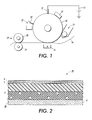
- Figure 1 is a schematic illustration of an image apparatus in accordance with an embodiment.
- Figure 2 is an enlarged, side view of an embodiment of a fuser member, showing a fuser member with a substrate, intermediate layer, outer layer, and release agent coating layer.
- fuser member outer layers comprising a fluoroelastomer, and prepared by addition of a fluorinated copolymer as a surfactant during coating of the fluoroelastomer outer layer.
- the process provides a fuser member outer layer that performs well as a fuser member, and reduces or eliminates the problems of fisheyes and snowflake agglomerates.
- the fuser member layers are smooth, in embodiments, and have improved mechanical and chemical properties.
- the occurrence of hot offset and stripping failures are reduced or eliminated.
- image quality is enhanced.
- a light image of an original to be copied is recorded in the form of an electrostatic latent image upon a photosensitive member and the latent image is subsequently rendered visible by the application of electroscopic thermoplastic resin particles, which are commonly referred to as toner.
- photoreceptor 10 is charged on its surface by means of a charger 12 to which a voltage has been supplied from power supply 11.
- the photoreceptor is then imagewise exposed to light from an optical system or an image input apparatus 13, such as a laser and light emitting diode, to form an electrostatic latent image thereon.
- the electrostatic latent image is developed by bringing a developer mixture from developer station 14 into contact therewith.
- a dry developer mixture usually comprises carrier granules having toner particles adhering triboelectrically thereto. Toner particles are attracted from the carrier granules to the latent image forming a toner powder image thereon.
- a liquid developer material may be employed, which includes a liquid carrier having toner particles dispersed therein. The liquid developer material is advanced into contact with the electrostatic latent image and the toner particles are deposited thereon in image configuration.
- toner particles After the toner particles have been deposited on the photoconductive surface, in image configuration, they are transferred to a copy sheet 16 by transfer means 15, which can be pressure transfer or electrostatic transfer. Alternatively, the developed image can be transferred to an intermediate transfer member, or bias transfer member, and subsequently transferred to a copy sheet.
- transfer means 15 can be pressure transfer or electrostatic transfer.
- the developed image can be transferred to an intermediate transfer member, or bias transfer member, and subsequently transferred to a copy sheet.
- copy substrates include paper, transparency material such as polyester, polycarbonate, or the like, cloth, wood, or any other desired material upon which the finished image will be situated.
- copy sheet 16 advances to fusing station 19, depicted in Figure 1 as fuser roll 20 and pressure roll 21 (although any other fusing components such as fuser belt in contact with a pressure roll, fuser roll in contact with pressure belt, and the like, are suitable for use with the present apparatus), wherein the developed image is fused to copy sheet 16 by passing copy sheet 16 between the fusing and pressure members, thereby forming a permanent image.
- fusing station 19 depicted in Figure 1 as fuser roll 20 and pressure roll 21 (although any other fusing components such as fuser belt in contact with a pressure roll, fuser roll in contact with pressure belt, and the like, are suitable for use with the present apparatus), wherein the developed image is fused to copy sheet 16 by passing copy sheet 16 between the fusing and pressure members, thereby forming a permanent image.
- transfer and fusing can be effected by a transfix application.
- Photoreceptor 10 subsequent to transfer, advances to cleaning station 17, wherein any toner left on photoreceptor 10 is cleaned therefrom by use of a blade (as shown in Figure 1), brush, or other cleaning apparatus.
- a blade as shown in Figure 1
- brush or other cleaning apparatus.
- FIG. 2 is an enlarged schematic view of an embodiment of a fuser member, demonstrating the various possible layers.
- substrate 4 has intermediate layer 7 thereon.
- Intermediate layer 7 can be, for example, a rubber such as silicone rubber or other suitable rubber material.
- intermediate layer 7 can have fillers 30 dispersed or contained therein.
- the substrate and/or outer layer can also have fillers dispersed or contained therein (fillers not shown).
- the optional fillers for the three layers can be the same or different.
- outer layer 5 comprising a fluoroelastomer as described below.
- outer fluoroelastomer layer 5 Positioned on outer fluoroelastomer layer 5 is outermost liquid release layer 9.
- the fuser member can be in the form of a roller, sheet, belt, film, drelt (hybrid between a drum and a belt), or the like.
- the fuser member is in the form of a cylindrical roller, wherein the roller substrate has a metal core, such as aluminum, steel, stainless steel, or the like metal substrate.
- fluoroelastomers examples include fluoroelastomers.
- suitable fluoroelastomers are those described in detail in U.S. Patents 5,166,031 , 5,281,506 , 5,366,772 and 5,370,931 , together with U.S. Patents 4,257,699 , 5,017,432 and 5,061,965 , the disclosures each of which are incorporated by reference herein in their entirety.
- these elastomers are from the class of 1) copolymers of two of vinylidenefluoride, hexafluoropropylene, and tetrafluoroethylene; 2) terpolymers of vinylidenefluoride, hexafluoropropylene, and tetrafluoroethylene; and 3) tetrapolymers of vinylidenefluoride, hexafluoropropylene, tetrafluoroethylene, and cure site monomer.
- the cure site monomer can be 4-bromoperfluorobutene-1, 1,1-dihydro-4-bromoperfluorobutene-1, 3-bromoperfluoropropene-1, 1,1-dihydro-3-bromoperfluoropropene-1, or any other suitable, known cure site monomer, such as those commercially available from DuPont.
- Other commercially available fluoropolymers include FLUOREL 2170 ® , FLUOREL 2174 ® , FLUOREL 2176 ® , FLUOREL 2177 ® and FLUOREL LVS 76 ® , FLUOREL ® being a Trademark of 3M Company.
- Additional commercially available materials include AFLAS tm a poly(propylene-tetrafluoroethylene) and FLUOREL II ® (LII900) a poly(propylene-tetrafluoroethylenevinylidenefluoride) both also available from 3M Company, as well as the Tecnoflons identified as FOR-60KIR ® , FOR-LHF ® , NM ® FOR-THF ® , FOR-TFS ® , TH ® , NH ® , P757 ® , TNS ® , T439 ® , PL958 ® , BR9151 ® and TN505 ® , available from Ausimont.
- Examples of three known fluoroelastomers are (1) a class of copolymers of two of vinylidenefluoride, hexafluoropropylene, and tetrafluoroethylene, such as those known commercially as VITON A ® ; (2) a class of terpolymers of vinylidenefluoride, hexafluoropropylene, and tetrafluoroethylene known commercially as VITON B ® ; and (3) a class of tetrapolymers of vinylidenefluoride, hexafluoropropylene, tetrafluoroethylene, and cure site monomer known commercially as VITON GH ® or VITON GF ® .
- the fluoroelastomers VITON GH ® and VITON GF ® have relatively low amounts of vinylidenefluoride.
- the VITON GF ® and VITON GH ® have about 35 weight percent of vinylidenefluoride, about 34 weight percent of hexafluoropropylene, and about 29 weight percent of tetrafluoroethylene with about 2 weight percent cure site monomer.
- the thickness of the outer layer of the fuser member is from about 10 to about 500 micrometers, or from about 10 to about 40 micrometers.
- the amount of fluoroelastomer compound in solution in the outer layer solution is from about 5 to about 40 percent, or from about 16 to about 22 percent by weight of total solids.
- Total solids as used herein include the amount of fluoroelastomer, crosslinking agent, solvent, surfactant, dehydrofluorinating agent, surfactant, and optional adjuvants and fillers, including optional metal oxide fillers.
- An inorganic particulate filler may be used in connection with the fluoroelastomer outer layer, in order to provide anchoring sites for the functional groups of the silicone fuser agent.
- suitable fillers include a metal-containing filler, such as a metal, metal alloy, metal oxide, metal salt or other metal compound.
- the general classes of metals, which are applicable herein, include those metals of Groups 1b, 2a, 2b, 3a, 3b, 4a, 4b, 5a, 5b, 6b, 7b, 8 and the rare earth elements of the Periodic Table.
- the filler can be an oxide of aluminum, copper, tin, zinc, lead, iron, platinum, gold, silver, antimony, bismuth, zinc, iridium, ruthenium, tungsten, manganese, cadmium, mercury, vanadium, chromium, magnesium, nickel and alloys thereof.
- Other specific examples include inorganic particulate fillers are aluminum oxide and cupric oxide.
- Other examples include reinforcing and non-reinforcing calcined alumina and tabular alumina respectively.
- the filler may be included in the substrate, and/or intermediate layer, and/or outer layer. The optional filler in the various layers may be the same or different.
- Optional intermediate adhesive layers and/or intermediate polymer or elastomer layers may be applied to achieve desired properties and performance objectives of the present invention.
- the intermediate layer may be present between the substrate and the outer fluoroelastomer surface.
- An adhesive intermediate layer may be selected from, for example, epoxy resins and polysiloxanes.
- suitable intermediate layers include silicone rubbers such as room temperature vulcanization (RTV) silicone rubbers; high temperature vulcanization (HTV) silicone rubbers and low temperature vulcanization (LTV) silicone rubbers.
- silicone materials include the siloxanes (such as polydimethylsiloxanes); fluorosilicones such as Silicone Rubber 552, available from Sampson Coatings, Richmond, Virginia; liquid silicone rubbers such as vinyl crosslinked heat curable rubbers or silanol room temperature crosslinked materials; and the like.
- siloxanes such as polydimethylsiloxanes
- fluorosilicones such as Silicone Rubber 552, available from Sampson Coatings, Richmond, Virginia
- liquid silicone rubbers such as vinyl crosslinked heat curable rubbers or silanol room temperature crosslinked materials; and the like.
- Dow Corning Sylgard 182 Another specific example is Dow Corning Sylgard 182.
- LSR rubbers include Dow Corning Q3-6395, Q3-6396, SILASTIC ® 590 LSR, SILASTIC ® 591 LSR, SILASTIC ® 595 LSR, SILASTIC ® 596 LSR, and SILASTIC ® 598 LSR from Dow Corning.
- an adhesive layer between the substrate and the intermediate layer There may be provided an adhesive layer between the substrate and the intermediate layer. There may also be an adhesive layer between the intermediate layer and the outer layer. In the absence of an intermediate layer, the fluoroelastomer layer may be bonded to the substrate via an adhesive layer.
- the thickness of the intermediate layer is from about 0.5 to about 20 mm, or from about 1 to about 10 mm.
- Suitable release agents or fusing oils can be provided onto the outer layer of the fuser member via a delivery mechanism such as a delivery roll.
- the delivery roll is partially immersed in a sump, which houses the fuser oil or release agent.
- the oil is renewable in that the release oil is housed in a holding sump and provided to the fuser roll when needed, optionally by way of a release agent donor roll in an amount of from about 0.1 to about 20 mg/copy, or from about 1 to about 12 mg/copy.
- the system by which fuser oil is provided to the fuser roll via a holding sump and optional donor roll is well known.
- the release oil may be present on the fuser member in a continuous or semi-continuous phase.
- the fuser oil in the form of a film is in a continuous phase and continuously covers the fuser member.
- the fluoroelastomer fuser coating can be prepared by adding a surfactant and/or additive to the fluoroelastomer coating solution, prior to coating of the fluoroelastomer in solution on the fuser member.
- the details of the process are as follows.
- coating solutions comprise a polymer and a fluorine-containing material. More specifically, the coating can comprise a polymer such as a fluoropolymer, a curative system appropriate for the particular polymer, and additional additives to assist with curing and to improve mechanical and thermal properties of the coated layer.
- a polymer such as a fluoropolymer
- a curative system appropriate for the particular polymer
- additional additives to assist with curing and to improve mechanical and thermal properties of the coated layer.
- the coating solution can also comprise a fluorine-containing material such as a fluorine-containing polysiloxane, or a fluorine-containing surfactant that is not a polysiloxane, or a blend of a fluorine-containing polysiloxane and a fluorine-containing surfactant, or a blend of at least two distinguishing fluorine-containing surfactants to provide coatings that are free of or have a reduced numbers of defects.
- additives may be used to increase pot-life to an acceptable time. All of these components are added to a solvent in order to form a solution/dispersion, which is applied to the fuser roll by the flow coating or other coating method.
- suitable fluorine-containing polysiloxane additives include polysiloxanes with pendant fluorinated groups, such as CF 3 (CF 2 ) n (CH 2 ) m -.
- the polysiloxanes having pendant fluorinated groups include those having the following Formula I: wherein m and n represent the number of repeating units and are the same or different, and m is from about 0 to about 25 or from about 1 to about 10, or from about 1 to about 5, or about 2; and n is from about 1 to about 25, or from about 2 to about 12, or from about 3 to about 7, or about 5.
- the extent of incorporation of the pendant fluorocarbon chains, defined as x/(x+y) is from about 1 percent to about 100 percent, from about 4 percent to about 20 percent, from about 5 to about 10 percent, or about 5.7 percent.
- the groups, R 1 and R 2 can be the same or different and are selected from the group consisting of alkyl having from about 1 to about 18 carbon atoms, such as methyl, ethyl, propyl, butyl and the like; arylalkyl groups having from about 1 to about 18 carbons, such as methylphenyl, ethylphenyl, propylphenyl, butylphenyl and the like; amino groups; and alkylamino groups having from about 1 to about 18 carbons, such as methylamino, ethylamino, propylamino, butylamino and the like.
- the group R 3 is selected from the group consisting of alkyl and arylalkyl groups such as those just listed, a polyorganosiloxane chain having from about 1 to about 300 repeat units, and a fluoro-chain of the formula - (CH 2 ) o -(CF 2 ) p -CF 3 where o and p have the same ranges as m and n, respectively, but may be the same or different than m and n.
- a specific example of a fluorine-containing polysiloxane additive is one having the following Formula II: wherein in Formula II, x/(x + y) is about 5.7%.
- the viscosity of the polydimethylsiloxane additive is from about 50 to about 2000 cS, or from about 100 to about 500 cS, or about 220 cS.
- fluorinated surfactants include acrylate copolymers with pendant glycol and/or perfluoroalkyl sulfonate groups.
- An example of a fluorinated acrylate copolymer surfactant includes one having the following Formula III: wherein m/(m+n) is from 0 to about 1, or from about 0.2 to about 0.8, or from about 0.5 to about 0.6; R 1 is hydrogen, or an alkyl group having from about 1 to about 18 carbons, or from about 1 to about 10 carbons; and R 2 is hydrogen, an alkyl group having from about 1 to about 18 carbons, or from about 1 to about 10 carbons or R 2 is a connection point to an acrylate polymer backbone, thus creating an inter- or intra-molecular bridge; x is a number of from about 1 to about 10, or from about 1 to about 5, or about 3; a is a number of from about 1 to about 50, or from about 1 to about 30, or from about 5 to about 20; b is a number
- fluorine-containing surfactants falling within the above Formula III include Fluorad ® FC-4430 and Fluorad ® FC-4432, commercial products sold by 3M.
- FluoradTM FC-4430 m/(m+n) is about 0.5
- FluoradTM FC-4432 m/(m+n) is about 0.6.
- fluorinated surfactants include acrylate copolymers with pendant alkyl and/or fluorinated alkyl groups.
- An example of a suitable fluorinated acrylate copolymer is one having the following Formula IV: wherein m/(m+n) is from 0 to about 1, or from about 0.1 to about 0.4, or about 0.25; x is a number of from about 1 to about 20, or from about 5 to about 10; y is a number of from about 1 to about 25, or from about 5 to about 15.
- a commercially available example of a fluorine-containing surfactant falling within the above Formula IV is Zonyl ® FSG, a commercial product sold by E.I. DuPont de Nemours and Company. For this surfactant, x is about 7 and y is about 11 and m/(m+n) is about 0.25.
- Suitable surfactants are polyether copolymers with pendant trifluoroethoxy groups.
- An example of a suitable fluorinated polyether copolymer is one having the following Formula V: wherein x/(x+y+z) is from about 0% to about 100%, or about 50% to about 100%; y/(x+y+z) is from about 0% to about 50% or about 1% to about 20%; and z/(x+y+z) is from about 0% to about 30% or from 1% to about 10%.
- a commercially available example is Polyfox ® surfactant available from Omnova.
- the fuser member coating formulation solution comprises a blend of a fluorine-containing polysiloxane of Formula I or II, in combination with a fluorine-containing surfactant of Formula III, Formula IV and/or Formula V.
- the fuser member coating comprises a blend of two different fluorinated copolymer surfactants, such as two or more of a fluorine-containing surfactant of Formula III, Formula IV, and/or Formula V.
- the fluorine-containing polysiloxane or fluorine-containing surfactant or the blend of fluorine-containing polysiloxane and fluorine-containing surfactant or the blend of at least two fluorine-containing surfactants is added to the fluoroelastomer coating solution in an amount of from about 0.5 to about 20 pph, or from about 3 to about 10 pph, wherein pph is expressed with respect to the amount of fluoroelastomer in the coating solution.
- the blend of fluorine-containing polysiloxane and fluorine-containing surfactant contains about 0 to about 100, or from about 1 to about 40, or from about 5 percent to about 30 percent polysiloxane.
- Addition of a fluorine-containing polysiloxane, a fluorine-containing surfactant, a blend of a fluorine-containing polysiloxane and a fluorine-containing surfactant, or a blend of at least two fluorine-containing surfactants to the fluoroelastomer coating solution results in formation of an outer fluoroelastomer fuser member layer which, in embodiments, functions well in fusing toner to a copy substrate.
- the fuser member coating in embodiments, is smooth, and has few, if any, defects. In embodiments, the number of fisheyes and snowflake agglomerates are reduced or eliminated. Also, there is no deterioration in hot offset or stripping performance and no deterioration in image quality in embodiments.
- the fluoroelastomer coating is applied to the fuser member substrate using the flow coating process, although other processes such as dip coating and spray coating may be employed.
- flow coating involves the deposition of a coating solution onto the substrate by rotating the substrate about its longitudinal axis and applying the coating from an applicator to the substrate in a spiral pattern in a controlled amount so that substantially all the coating that exits the applicator adheres to said substrate.
- the details of the flow coating procedure can be found in U.S. Patent 5,945,223 , 6,408,753 , 6,521,330 and in US 6,479,158 , the disclosures of which are hereby incorporated by reference in their entirety.
- the viscosity of the polydimethylsiloxane surfactant is from about 75 to about 1,500 cS, or from about 200 to about 1,000 cS, or about 220 cS.
- a fuser member coating formulation was prepared from a solvent solution/dispersion containing 100 parts by weight of a hydrofluoroelastomer, DuPont Viton ® GF, a tetrapolymer of 35 weight percent vinylidenefluoride, 34 weight percent hexafluoropropylene, 29 weight percent tetrafluoroethylene, and 2 weight percent of a cure site monomer.
- the Viton ® GF was mixed with 7 parts by weight of DuPont Viton ® Curative 50, 1.5 parts by weight magnesium oxide (Maglite D available from C. P. Hall, Chicago, IL), 0.75 parts by weight calcium hydroxide, 0.75 parts by weight carbon black (N990 available from R. T.
- a fuser roll topcoat formulation was prepared identically to Example l except that in place of the NovecTM FC-430, 5.6 parts by weight of NovecTM FC-4430 or NovecTM FC-4432, described by Formula III above, was used.
- a fuser member coating formulation was prepared identically to Example I except that in place of the NovecTM FC-430, 5.6 parts by weight of the fluorinated silicone described above in Formula II was used.
- a fuser member coating formulation was prepared identically to Example I except that in place of the NovecTM FC-430, a blend of 4.75 parts by weight of NovecTM FC-4430 or NovecTM FC-4432 and 1.0 parts by weight of the fluorinated silicone described by Formula II, were used.
- a fuser member coating formulation can be prepared identically to Example I except that in place of the NovecTM FC-430, 2.8 parts by weight of NovecTM FC-4430 and 2.8 parts by weight of Omnova Polyfox can be used. Since the FC-4430 reduces snowflake agglomerate defects and Polyfox reduces fisheye defects, we would expect that the blend would reduce both types of defects.
- Example III Even though the coatings have a snowflake agglomerates (Example III), the formula is improved. Addition of a blend of a fluorine-containing polysiloxane and a fluorine-containing surfactant to the outer fuser member coating solution significantly reduces both snowflake agglomerates and fisheye defects to very low levels (Example IV). Furthermore, fuser roll outer coatings prepared by the formulation in Example IV show no deterioration in fuser offset performance or image quality when compared to rolls with outer coatings produced by the other formulations. Also shown in Table l are the results from two other surfactants, Polyfox and Zonyl FSG, available from Omnova and DuPont, respectively. Polyfox additive shows significant improvement of fisheye defects with limited improvement in snowflake agglomerate defects, while the Zonyl FSG shows a limited reduction in both defects.
- Polyfox additive shows significant improvement of fisheye defects with limited improvement in snowflake agglomerate defects
- the Zonyl FSG shows a
Landscapes
- Chemical & Material Sciences (AREA)
- Life Sciences & Earth Sciences (AREA)
- Engineering & Computer Science (AREA)
- Materials Engineering (AREA)
- Wood Science & Technology (AREA)
- Organic Chemistry (AREA)
- Physics & Mathematics (AREA)
- General Physics & Mathematics (AREA)
- Paints Or Removers (AREA)
- Fixing For Electrophotography (AREA)
- Application Of Or Painting With Fluid Materials (AREA)
Applications Claiming Priority (1)
| Application Number | Priority Date | Filing Date | Title |
|---|---|---|---|
| US11/136,166 US7485344B2 (en) | 2005-05-23 | 2005-05-23 | Process for coating fluoroelastomer fuser member layer using blend of two different fluorinated surfactants |
Publications (2)
| Publication Number | Publication Date |
|---|---|
| EP1726628A1 true EP1726628A1 (fr) | 2006-11-29 |
| EP1726628B1 EP1726628B1 (fr) | 2013-07-17 |
Family
ID=36763502
Family Applications (1)
| Application Number | Title | Priority Date | Filing Date |
|---|---|---|---|
| EP20060113944 Not-in-force EP1726628B1 (fr) | 2005-05-23 | 2006-05-15 | Procédé de revêtement d'un membre de rouleau de fixage par fusion utilisant une composition de revêtement comprenant un fluoroélastomère et un mélange de deux surfactants copolymères fluorés differents |
Country Status (3)
| Country | Link |
|---|---|
| US (1) | US7485344B2 (fr) |
| EP (1) | EP1726628B1 (fr) |
| JP (1) | JP4584867B2 (fr) |
Cited By (3)
| Publication number | Priority date | Publication date | Assignee | Title |
|---|---|---|---|---|
| EP3296817A1 (fr) * | 2016-09-16 | 2018-03-21 | Xerox Corporation | Éléments d'assistance de transfert |
| CN108026406A (zh) * | 2015-09-23 | 2018-05-11 | 3M创新有限公司 | 包含硅烷的组合物和制造经处理的制品的方法 |
| EP3321742A1 (fr) * | 2016-11-11 | 2018-05-16 | Xerox Corporation | Élément de charge électrostatique |
Families Citing this family (7)
| Publication number | Priority date | Publication date | Assignee | Title |
|---|---|---|---|---|
| US8010032B2 (en) | 2005-05-23 | 2011-08-30 | Xerox Corporation | Fuser member comprising deflocculated material |
| US7704560B2 (en) * | 2005-05-23 | 2010-04-27 | Xerox Corporation | Process for coating fluoroelastomer fuser member using blend of deflocculant material and fluorine-containing polysiloxane additive |
| US8260184B2 (en) * | 2009-11-02 | 2012-09-04 | Xerox Corporation | Hyper nanocomposites (HNC) for fuser materials |
| JP4950361B2 (ja) * | 2010-04-08 | 2012-06-13 | オリンパスメディカルシステムズ株式会社 | 内視鏡および内視鏡用エラストマー成形体 |
| US8824945B2 (en) * | 2011-02-09 | 2014-09-02 | Xerox Corporation | Metallic nanoparticle reinforced polyimide for fuser belt with high thermal conductivity |
| US8518476B2 (en) * | 2011-11-03 | 2013-08-27 | Xerox Corporation | Methods for forming fluoroplastic powder coatings |
| US10125218B2 (en) * | 2016-07-26 | 2018-11-13 | Xerox Corporation | Intermediate transfer members |
Citations (2)
| Publication number | Priority date | Publication date | Assignee | Title |
|---|---|---|---|---|
| WO1999055746A1 (fr) * | 1998-04-27 | 1999-11-04 | Dupont Dow Elastomers L.L.C. | Latex fluoroelastomere |
| EP1167442A1 (fr) * | 1999-03-10 | 2002-01-02 | Daikin Industries, Ltd. | Composition d'elastomere fluore vulcanisable a base d'eau et article revetu d'elastomere fluore |
Family Cites Families (42)
| Publication number | Priority date | Publication date | Assignee | Title |
|---|---|---|---|---|
| US4515884A (en) | 1982-09-21 | 1985-05-07 | Xerox Corporation | Fusing system with unblended silicone oil |
| JPS59208556A (ja) | 1983-05-11 | 1984-11-26 | Canon Inc | 電子写真感光体 |
| HUT50704A (en) * | 1987-01-19 | 1990-03-28 | Budapesti Mueszaki Egyetem | Apparatus for heating motor vehicles provided with internal combustion engine particularly buses |
| JPH01281480A (ja) * | 1988-05-09 | 1989-11-13 | Canon Inc | 定着用回転体及び定着装置 |
| JPH01300281A (ja) * | 1988-05-30 | 1989-12-04 | Canon Inc | 定着装置 |
| US4968766A (en) | 1989-01-12 | 1990-11-06 | Dow Corning Corporation | Fluorosilicone compounds and compositions for adhesive release liners |
| US5332641A (en) | 1992-04-27 | 1994-07-26 | Xerox Corporation | Fuser member with an amino silane adhesive layer |
| JPH07331226A (ja) | 1993-08-27 | 1995-12-19 | Asahi Glass Co Ltd | 加熱定着ロール防汚用オイル |
| US5412034A (en) * | 1993-10-26 | 1995-05-02 | E. I. Du Pont De Nemours And Company | Curable elastomeric blends |
| US5547759A (en) | 1993-12-09 | 1996-08-20 | Eastman Kodak Company | Coated fuser members and methods of making coated fuser members |
| EP0657486B1 (fr) | 1993-12-09 | 1998-08-26 | Kao Corporation | Silicone modifié par le fluor, son procédé de préparation et compositions cosmétiques le contenant |
| US5595823A (en) | 1994-06-29 | 1997-01-21 | Eastman Kodak Company | Fuser members overcoated with fluorocarbon elastomer containing aluminum oxide |
| JPH0850424A (ja) | 1994-08-08 | 1996-02-20 | Fujitsu Ltd | 画像形成装置 |
| JP3369008B2 (ja) | 1994-09-29 | 2003-01-20 | コニカ株式会社 | 定着装置 |
| JP3496168B2 (ja) | 1994-10-05 | 2004-02-09 | コニカミノルタホールディングス株式会社 | 熱定着方法 |
| US5627000A (en) | 1994-10-07 | 1997-05-06 | Konica Corporation | Heat fixing method |
| US5636012A (en) | 1994-12-13 | 1997-06-03 | Konica Corporation | Toner image fixing device |
| US5729813A (en) | 1995-03-27 | 1998-03-17 | Xerox Corporation | Thin, thermally conductive fluoroelastomer coated fuser member |
| US5624780A (en) | 1995-04-03 | 1997-04-29 | Konica Corporation | Toner image fixing method using fluorine containing silicone oil |
| US5880204A (en) * | 1995-09-27 | 1999-03-09 | Alliedsignal Inc. | Room temperature coalescable aqueous fluoropolymer dispersions and method for their manufacture |
| US5700568A (en) | 1996-03-28 | 1997-12-23 | Xerox Corporation | Fluoroelastomer members |
| US5750204A (en) | 1996-03-28 | 1998-05-12 | Xerox Corporation | Fluoroelastomer surfaces and methods thereof |
| US5753307A (en) | 1996-03-28 | 1998-05-19 | Xerox Corporation | Fluoroelastomer surfaces and methods thereof |
| US5695878A (en) | 1996-03-28 | 1997-12-09 | Xerox Corporation | Fluoroelastomer members |
| US6408753B1 (en) | 1996-06-26 | 2002-06-25 | Xerox Corporation | Flow coating process for manufacture of polymeric printer and belt components |
| WO1998003574A1 (fr) | 1996-07-18 | 1998-01-29 | Asahi Glass Company Ltd. | Composes organosilicies fluores et leur procede de preparation |
| US5736250A (en) | 1996-08-08 | 1998-04-07 | Xerox Corporation | Crosslinked latex polymer surfaces and methods thereof |
| JPH10186923A (ja) * | 1996-10-28 | 1998-07-14 | Sumitomo Electric Ind Ltd | 定着用回転体 |
| JPH10142990A (ja) * | 1996-11-07 | 1998-05-29 | Sumitomo Electric Ind Ltd | 定着ローラ |
| US5945223A (en) | 1997-03-24 | 1999-08-31 | Xerox Corporation | Flow coating solution and fuser member layers prepared therewith |
| US6479158B1 (en) | 1997-03-26 | 2002-11-12 | Xerox Corporation | Fuser member with an amino silane adhesive layer and preparation thereof |
| US6114041A (en) | 1997-10-31 | 2000-09-05 | Eastman Kodak Company | Fuser member with surface treated Al2 O3 and functionalized release fluids |
| US5935712A (en) | 1997-10-31 | 1999-08-10 | Eastman Kodak Company | Fuser member with surface treated SnO2, CuO, or mixture filler |
| US6207243B1 (en) | 1998-02-27 | 2001-03-27 | Eastman Kodak Company | Fuser member with mercapto-treated Al2O3 filler |
| US6159588A (en) | 1998-09-25 | 2000-12-12 | Xerox Corporation | Fuser member with fluoropolymer, silicone and alumina composite layer |
| JP2000137401A (ja) * | 1998-11-02 | 2000-05-16 | Fujitsu Isotec Ltd | 定着装置及び画像形成装置 |
| US6218014B1 (en) | 1998-12-30 | 2001-04-17 | Nexpress Solutions | Fluorocarbon fuser member with silicon carbide filler |
| US6514650B1 (en) | 1999-09-02 | 2003-02-04 | Xerox Corporation | Thin perfluoropolymer component coatings |
| US6696158B1 (en) | 2000-06-30 | 2004-02-24 | Nexpress Solutions Llc | Fuser member with fluorocarbon thermoplastics coating |
| US6395444B1 (en) | 2000-11-28 | 2002-05-28 | Xerox Corporation | Fuser members having increased thermal conductivity and methods of making fuser members |
| JP4872172B2 (ja) * | 2001-08-08 | 2012-02-08 | ダイキン工業株式会社 | フッ素樹脂被覆物製造方法及びフッ素樹脂被覆物 |
| US6721529B2 (en) | 2001-09-21 | 2004-04-13 | Nexpress Solutions Llc | Release agent donor member having fluorocarbon thermoplastic random copolymer overcoat |
-
2005
- 2005-05-23 US US11/136,166 patent/US7485344B2/en not_active Expired - Fee Related
-
2006
- 2006-05-15 EP EP20060113944 patent/EP1726628B1/fr not_active Not-in-force
- 2006-05-19 JP JP2006139967A patent/JP4584867B2/ja not_active Expired - Fee Related
Patent Citations (2)
| Publication number | Priority date | Publication date | Assignee | Title |
|---|---|---|---|---|
| WO1999055746A1 (fr) * | 1998-04-27 | 1999-11-04 | Dupont Dow Elastomers L.L.C. | Latex fluoroelastomere |
| EP1167442A1 (fr) * | 1999-03-10 | 2002-01-02 | Daikin Industries, Ltd. | Composition d'elastomere fluore vulcanisable a base d'eau et article revetu d'elastomere fluore |
Non-Patent Citations (2)
| Title |
|---|
| 3M PERFORMANCE MATERIALS DIVISION: "NovecTM Fluorosurfactants for Paints and Coatings", 3M APPLICATION INFORMATION, November 2003 (2003-11-01), St. Paul, MN, USA, XP002394533 * |
| M. TERRAZAS AND R. DAMS: "A new generation of fluorosurfactants", SPECIALTY CHEMICALS MAGAZINE, vol. 24, no. 3, March 2004 (2004-03-01), www.specchemonline.com, pages 19 - 22, XP002394534 * |
Cited By (6)
| Publication number | Priority date | Publication date | Assignee | Title |
|---|---|---|---|---|
| CN108026406A (zh) * | 2015-09-23 | 2018-05-11 | 3M创新有限公司 | 包含硅烷的组合物和制造经处理的制品的方法 |
| CN108026406B (zh) * | 2015-09-23 | 2021-03-09 | 3M创新有限公司 | 包含硅烷的组合物和制造经处理的制品的方法 |
| EP3296817A1 (fr) * | 2016-09-16 | 2018-03-21 | Xerox Corporation | Éléments d'assistance de transfert |
| US10248053B2 (en) | 2016-09-16 | 2019-04-02 | Xerox Corporation | Transfer assist members |
| EP3321742A1 (fr) * | 2016-11-11 | 2018-05-16 | Xerox Corporation | Élément de charge électrostatique |
| US10191405B2 (en) | 2016-11-11 | 2019-01-29 | Xerox Corporation | Electrostatic charging member |
Also Published As
| Publication number | Publication date |
|---|---|
| JP4584867B2 (ja) | 2010-11-24 |
| EP1726628B1 (fr) | 2013-07-17 |
| US20060263533A1 (en) | 2006-11-23 |
| JP2006330727A (ja) | 2006-12-07 |
| US7485344B2 (en) | 2009-02-03 |
Similar Documents
| Publication | Publication Date | Title |
|---|---|---|
| US8057859B2 (en) | Process for coating fluoroelastomer fuser member using fluorinated surfactant | |
| US20040185271A1 (en) | Fluorosilicone release agent for fluoroelastomer fuser members | |
| US7208258B2 (en) | Blended amino functional siloxane release agents for fuser members | |
| US7485344B2 (en) | Process for coating fluoroelastomer fuser member layer using blend of two different fluorinated surfactants | |
| US6808814B2 (en) | Blended fluorosilicone release agent for polymeric fuser members | |
| US7198875B2 (en) | Amino-functional siloxane copolymer release agents for fuser members | |
| US7651740B2 (en) | Process for coating fluoroelastomer fuser member using fluorinated surfactant and fluroinated polysiloxane additive blend | |
| EP1727002B1 (fr) | Procédé de revêtement d'un membre de fixation avec une additif polydimethylsiloxane fluoriné | |
| US7704560B2 (en) | Process for coating fluoroelastomer fuser member using blend of deflocculant material and fluorine-containing polysiloxane additive | |
| US7462395B2 (en) | Fuser member | |
| EP1688803B1 (fr) | Dispositif de fusion et appareil de formation d'images electrophotographique en l'utilisant | |
| US7214462B2 (en) | Blended amino functional siloxane release agents for fuser members | |
| US20050287375A1 (en) | T-type amino functional release agent for fuser members |
Legal Events
| Date | Code | Title | Description |
|---|---|---|---|
| PUAI | Public reference made under article 153(3) epc to a published international application that has entered the european phase |
Free format text: ORIGINAL CODE: 0009012 |
|
| AK | Designated contracting states |
Kind code of ref document: A1 Designated state(s): AT BE BG CH CY CZ DE DK EE ES FI FR GB GR HU IE IS IT LI LT LU LV MC NL PL PT RO SE SI SK TR |
|
| AX | Request for extension of the european patent |
Extension state: AL BA HR MK YU |
|
| 17P | Request for examination filed |
Effective date: 20070207 |
|
| AKX | Designation fees paid |
Designated state(s): DE FR GB |
|
| 17Q | First examination report despatched |
Effective date: 20071122 |
|
| GRAP | Despatch of communication of intention to grant a patent |
Free format text: ORIGINAL CODE: EPIDOSNIGR1 |
|
| GRAS | Grant fee paid |
Free format text: ORIGINAL CODE: EPIDOSNIGR3 |
|
| GRAA | (expected) grant |
Free format text: ORIGINAL CODE: 0009210 |
|
| AK | Designated contracting states |
Kind code of ref document: B1 Designated state(s): DE FR GB |
|
| REG | Reference to a national code |
Ref country code: GB Ref legal event code: FG4D |
|
| REG | Reference to a national code |
Ref country code: DE Ref legal event code: R096 Ref document number: 602006037330 Country of ref document: DE Effective date: 20130912 |
|
| PLBE | No opposition filed within time limit |
Free format text: ORIGINAL CODE: 0009261 |
|
| STAA | Information on the status of an ep patent application or granted ep patent |
Free format text: STATUS: NO OPPOSITION FILED WITHIN TIME LIMIT |
|
| 26N | No opposition filed |
Effective date: 20140422 |
|
| REG | Reference to a national code |
Ref country code: DE Ref legal event code: R097 Ref document number: 602006037330 Country of ref document: DE Effective date: 20140422 |
|
| REG | Reference to a national code |
Ref country code: FR Ref legal event code: PLFP Year of fee payment: 11 |
|
| PGFP | Annual fee paid to national office [announced via postgrant information from national office to epo] |
Ref country code: DE Payment date: 20160421 Year of fee payment: 11 Ref country code: GB Payment date: 20160426 Year of fee payment: 11 |
|
| PGFP | Annual fee paid to national office [announced via postgrant information from national office to epo] |
Ref country code: FR Payment date: 20160422 Year of fee payment: 11 |
|
| REG | Reference to a national code |
Ref country code: DE Ref legal event code: R119 Ref document number: 602006037330 Country of ref document: DE |
|
| GBPC | Gb: european patent ceased through non-payment of renewal fee |
Effective date: 20170515 |
|
| REG | Reference to a national code |
Ref country code: FR Ref legal event code: ST Effective date: 20180131 |
|
| PG25 | Lapsed in a contracting state [announced via postgrant information from national office to epo] |
Ref country code: DE Free format text: LAPSE BECAUSE OF NON-PAYMENT OF DUE FEES Effective date: 20171201 Ref country code: GB Free format text: LAPSE BECAUSE OF NON-PAYMENT OF DUE FEES Effective date: 20170515 |
|
| PG25 | Lapsed in a contracting state [announced via postgrant information from national office to epo] |
Ref country code: FR Free format text: LAPSE BECAUSE OF NON-PAYMENT OF DUE FEES Effective date: 20170531 |