EP1776103B1 - Rutheniumkomplexe zur krebsbehandlung - Google Patents
Rutheniumkomplexe zur krebsbehandlung Download PDFInfo
- Publication number
- EP1776103B1 EP1776103B1 EP05790998A EP05790998A EP1776103B1 EP 1776103 B1 EP1776103 B1 EP 1776103B1 EP 05790998 A EP05790998 A EP 05790998A EP 05790998 A EP05790998 A EP 05790998A EP 1776103 B1 EP1776103 B1 EP 1776103B1
- Authority
- EP
- European Patent Office
- Prior art keywords
- composition according
- ligands
- alkyl
- compounds
- cells
- Prior art date
- Legal status (The legal status is an assumption and is not a legal conclusion. Google has not performed a legal analysis and makes no representation as to the accuracy of the status listed.)
- Expired - Lifetime
Links
- 0 C*C(C)C1C2C(*)=CC=CC2CCC1 Chemical compound C*C(C)C1C2C(*)=CC=CC2CCC1 0.000 description 9
Images




Classifications
-
- C—CHEMISTRY; METALLURGY
- C07—ORGANIC CHEMISTRY
- C07F—ACYCLIC, CARBOCYCLIC OR HETEROCYCLIC COMPOUNDS CONTAINING ELEMENTS OTHER THAN CARBON, HYDROGEN, HALOGEN, OXYGEN, NITROGEN, SULFUR, SELENIUM OR TELLURIUM
- C07F17/00—Metallocenes
- C07F17/02—Metallocenes of metals of Groups 8, 9 or 10 of the Periodic Table
-
- A—HUMAN NECESSITIES
- A61—MEDICAL OR VETERINARY SCIENCE; HYGIENE
- A61K—PREPARATIONS FOR MEDICAL, DENTAL OR TOILETRY PURPOSES
- A61K31/00—Medicinal preparations containing organic active ingredients
- A61K31/28—Compounds containing heavy metals
- A61K31/295—Iron group metal compounds
-
- A—HUMAN NECESSITIES
- A61—MEDICAL OR VETERINARY SCIENCE; HYGIENE
- A61P—SPECIFIC THERAPEUTIC ACTIVITY OF CHEMICAL COMPOUNDS OR MEDICINAL PREPARATIONS
- A61P35/00—Antineoplastic agents
Definitions
- the present invention relates to pharmaceutical compositions comprising ruthenium compounds and their uses in methods for the treatment of proliferative pathologies, in particular cancers.
- platinum-metal compounds exhibit significant antitumor activity.
- the best known of these is cisplatin, which is commonly used for the clinical treatment of many cancers.
- the resistance of certain cancer cells and the intrinsic toxicity of platinum are some of the problems encountered when using this compound.
- ruthenium-containing compounds have emerged as an interesting alternative to those containing platinum.
- Some ruthenium complexes have already been described as being an alternative for cancer treatments ( WO 9736595 , WO 0056743 ).
- the present invention thus provides ruthenium compounds which have particularly advantageous anti-tumor properties.
- These compounds are organometallic compounds, i.e. they contain at least one covalent carbon-Ruthenium (C-Ru) bond.
- C-Ru covalent carbon-Ruthenium
- N-Ru intramolecular nitrogen-ruthenium
- ruthenium is therefore part of a cyclic entity and this class of compounds is commonly called by the chemists of the discipline, the class of cyclometallic compounds.
- the cyclic entity containing ruthenium is called a metallocycle.
- the metal is therefore bonded to both an organic ligand by a carbon-metal covalent bond and a donor-acceptor (acid-Lewis base, or coordination link) nitrogen-metal bond.
- a metallocycle in an organometallic molecule gives it particular properties in terms of reactivity and thermodynamic stability.
- Various types of carbons aromatic, benzylic or aliphatic
- the nature of the bond between the donor atom (nitrogen) and carbon can be varied in many ways.
- the compounds of the invention may be in the form of pharmaceutically acceptable salts, solvates and / or prodrugs.
- the pro-drugs are variants of the compounds of the invention which can be converted in vivo into compounds of formula (I) or (II) according to the invention.
- alkyl denotes a linear or branched hydrocarbon radical advantageously having 1 to 6 carbon atoms, such as methyl, ethyl, propyl, isopropyl, butyl, isobutyl, tert- butyl, pentyl, neopentyl, n hexyl, etc.
- C 1 -C 4 groups are preferred.
- the alkyl groups may be substituted with an aryl group as defined below, in which case it is referred to as an arylalkyl group. Examples of arylalkyl groups include benzyl and phenethyl.
- the "aryl" groups are mono-, bi- or tri-cyclic aromatic hydrocarbon systems, optionally interrupted by at least one heteroatom (in particular O, S or N).
- the aryl groups include the systems monocyclic or bicyclic aromatic hydrocarbonaceous having 6 to 18 carbon atoms, more preferably 6 carbon atoms. Mention may be made, for example, of phenyl, naphthyl and biphenyl groups. When interrupted by hetero atoms, the aryl groups include pyridyl, imidazoyl, pyrrolyl and furanyl rings.
- the aryl groups may optionally have one or more substituents, chosen in particular from a halogen atom, an alkyl group as defined above, an alkoxy (-O-alkyl), thiol, thioether (-S-alkyl) radical, hydroxyl, nitro, cyano and ester (-CO 2 -alkyl).
- substituents chosen in particular from a halogen atom, an alkyl group as defined above, an alkoxy (-O-alkyl), thiol, thioether (-S-alkyl) radical, hydroxyl, nitro, cyano and ester (-CO 2 -alkyl).
- halogen is meant a fluorine, chlorine, bromine or iodine atom.
- the halogen atom is chlorine.
- ligands include in particular nitrile ligands, for example ligands of formula (C 1-6 ) alkylCN (in particular CH 3 CN) and pyridine ligands, optionally substituted, on one or more carbon atoms of the pyridine rings, by a (C 1-6 ) alkyl radical or a halogen atom, as defined above.
- nitrile ligands for example ligands of formula (C 1-6 ) alkylCN (in particular CH 3 CN) and pyridine ligands, optionally substituted, on one or more carbon atoms of the pyridine rings, by a (C 1-6 ) alkyl radical or a halogen atom, as defined above.
- primary amines C 1-6 alkyl, such as methylamine or ethylamine.
- Binding ligands of two electrons by a phosphorus atom include phosphine ligands.
- they are of formula P (Ph) 3-x (alkyl) x , with x representing 0, 1 or 2 (preferably x represents 2) (Ph representing the phenyl group).
- phosphine ligands are of formula P (Ph) 3-x (alkyl) x , with x representing 0, 1 or 2 (preferably x represents 2) (Ph representing the phenyl group).
- x represents 0, 1 or 2
- Ph representing the phenyl group
- At least two of the groups L 1 , L 2 , L 3 and L 4 , taken in pairs, may be connected by at least one covalent bond.
- the bidentate ligand 1,2-bisdiphenylphosphinoethane may be mentioned the bidentate ligand 1,2-bisdiphenylphosphinoethane.
- the compounds of the invention have at least one group L 1 , L 2 , L 3 and L 4 , representing a donor ligand of two electrons by a nitrogen or phosphorus atom, in particular a group pyridine, phophine (eg, of formula P (Ph) 3-x (alkyl) x , as defined above), bipyridine or phenanthroline, said groups being optionally substituted.
- group L 1 , L 2 , L 3 and L 4 representing a donor ligand of two electrons by a nitrogen or phosphorus atom, in particular a group pyridine, phophine (eg, of formula P (Ph) 3-x (alkyl) x , as defined above), bipyridine or phenanthroline, said groups being optionally substituted.
- At least two of the groups L 1 , L 2 , L 3 and L 4 represent nitrile ligands, for example ligands of formula ( C 1-6 ) alkylCN (in particular CH 3 CN).
- two of the groups L 1 , L 2 , L 3 and L 4 represent nitrile ligands, for example ligands of formula (C 1 -6 ) alkylCN (in particular CH 3 CN), and the other two ligands are linked by at least one covalent bond, advantageously such as those described above.
- Y - in the compounds according to the invention is a counter ion and is only present in the compound when the ruthenium complex bears a positive charge.
- Y - is preferably a weakly nucleophilic anion, such as for example BF 4 - , PF 6 - , CF 3 SO 3 - , CF 3 CO 2 - , CH 3 CO 2 - and NO 3 - , in particular PF 6 - .
- m is equal to 1.
- the curved line represents, with the carbon, nitrogen and ruthenium atoms represented in formulas (I) and (II), the metallocycle.
- This metallocycle generally consists of 5 to 8 atoms (including the carbon, nitrogen and ruthenium atoms represented in formulas (I) and (II)).
- the atoms of the metallocycle (other than those represented in formulas (I) and (II)) are chosen from carbon, nitrogen, oxygen or sulfur atoms.
- Each of these atoms can independently of the metallocycle form linear or cyclic structures, saturated or not, for which there are no particular limitations.
- R identical or different, representing H or an alkyl radical, preferably methyl
- R 2 and R 3 identical or different, representing a hydrogen atom, a halogen atom, an alkyl group as defined above; above, an alkoxy (-O-alkyl), thiol, thioether (-S-alkyl), hydroxyl, nitro, cyano and ester (-CO 2 -alkyl) radical.
- R 2 and R 3 are both CO 2 Me and / or both R represent a methyl radical.
- R 2 represents H and R 3 a methyl radical (Me) and / or both R represent a methyl radical.
- the present invention also relates to optical and geometric isomers, taken individually or as a mixture (in particular racemates), complex compounds of ruthenium (II).
- the nitrogen atom of the metallocycle and represented in formulas (I) and (II) is not a nitrogen atom included in a benzodiazepine type structure, in particular the compounds described in Organometallics, vol. 21, 2002, pp 5437-5438 .
- the compounds according to the invention are not the following compounds (described in Organometallics, vol. 21, 2002, pp 1184-1189 ).
- the subject of the invention is also compounds 9, 11, 12 and 14-29.
- the compounds 9, 11, 12 and 28 are also compounds 9, 11, 12 and 28. These compounds can be used as medicaments and in particular to treat diseases related to cellular hyperproliferation, in particular cancers, as described in the present invention.
- the compounds of the present invention can be obtained from the families of compounds A and B described below.
- the "metallocyclic" unit represents in particular and schematically the units (1) to (6) described above.
- the compounds from families A and B with the various cyclometallic organic ligands can be modified by substituting one or two acetonitrile ligands with respectively a monodentate ligand such as a phosphine P (Ph) 3-x (alkyl) x , as defined above. which led to the compounds of type C and D, or by a bidentate ligand such as a bipyridine or phenanthroline or the ligand phosphorus-containing bidentate, such as 1,2-bis-diphenylphosphinoethane, which led to the E-type compounds.
- a monodentate ligand such as a phosphine P (Ph) 3-x (alkyl) x
- a bidentate ligand such as a bipyridine or phenanthroline or the ligand phosphorus-containing bidentate, such as 1,2-bis-diphenylphosphinoethane, which led to the E-type compounds.
- the modified compounds include the following:
- compositions according to the invention are particularly advantageous for treating diseases related to cellular hyperproliferation, in particular cancers.
- Cancers include those with solid or liquid tumors.
- the cancers correspond in particular to glioblastomas, leukemias (promyelocytic), cancers of the prostate, ovaries, lungs, breasts, digestive tract, in particular of the liver, pancreas, head and neck, colon , bladder, non-Hodgkin lymphoma and melanoma.
- the subject of the present invention is also the use of at least one compound of formula (I) or (II), as defined above, in the context of the preparation of a pharmaceutical composition intended to treat related diseases cell hyperproliferation, in particular cancers.
- the compounds according to the invention exhibit an antiproliferative effect vis-à-vis the tumor cells. They are particularly useful for treating cancers by accumulation of tumor cells in the G0 / G1 phase and possibly by induction of apoptosis in tumor cells.
- the compounds according to the invention appear in particular capable of accumulating tumor cells in the G0 / G1 phase, and thus by blocking their cell cycle, but also seem capable of to generate their apoptosis rapidly, especially when their concentration is increased, indicating a dose-dependent toxicity.
- the compounds according to the invention are particularly advantageous for treating tumors resistant to cisplatin or other anticancer drugs.
- the compounds or compositions according to the invention can be administered in different ways and in different forms.
- they can be administered systemically, orally, by inhalation or by injection, for example intravenously, intramuscularly, subcutaneously, trans-dermally, intra-arterially, etc., the intravenous routes, intramuscular, subcutaneous, oral and inhalation being preferred.
- the compounds are generally packaged as liquid suspensions, which can be injected by means of syringes or infusions, for example.
- the compounds are generally dissolved in saline, physiological, isotonic, buffered, etc. solutions compatible with pharmaceutical use and known to those skilled in the art.
- compositions may contain one or more agents or vehicles chosen from dispersants, solubilizers, stabilizers, preservatives, etc.
- Agents or vehicles that can be used in liquid and / or injectable formulations include methylcellulose, hydroxymethylcellulose, carboxymethylcellulose, polysorbate 80, mannitol, gelatin, lactose, vegetable oils, acacia, etc.
- the compounds can also be administered in the form of gels, oils, tablets, suppositories, powders, capsules, aerosols, etc., possibly by means of dosage forms or devices providing sustained and / or delayed release.
- an agent such as cellulose, carbonates or starches is advantageously used.
- the flow rate and / or the injected dose may be adapted by those skilled in the art depending on the patient, the pathology concerned, the mode of administration, etc.
- the compounds are administered at doses ranging between 0.1 micrograms and 100 mg / kg of body weight, more generally from 0.01 to 10 mg / kg, typically between 0.1 and 10 mg / kg.
- repeated injections can be performed, if necessary.
- delayed or extended systems may be advantageous.
- the invention also relates to a method for treating a pathology related to cellular hyperproliferation, in particular cancer, by administering to a subject suffering from such a pathology an effective amount of one of the compounds according to the invention. 'invention.
- treatment refers to the preventive, curative and palliative treatment, as well as the management of the patients (reduction of the suffering, improvement of the lifespan, slowing of the progression of the disease , reduction of tumor growth, etc.).
- the treatment may also be carried out in combination with other chemical or physical agents or treatments (chemotherapy, radiotherapy, gene therapy, etc.).
- the treatments and medicaments of the invention are particularly intended for humans.
- the compounds according to the invention can be advantageously used in combination with an anti-cancer treatment using radiation, such as radiotherapy and brachytherapy.
- radiation such as radiotherapy and brachytherapy.
- the radiation used is in particular X-rays, gamma rays, ionizing particles such as electrons, neutrons or carbon ions.
- the compounds according to the invention can be used with other chemical agents or therapeutic anti-cancer treatments, such as the following therapeutic chemical agents: cisplatin, carboplatin, NCS (Neocarzinostatin) , taxotere or taxol, advantageously NCS or taxol.
- therapeutic chemical agents such as the following therapeutic chemical agents: cisplatin, carboplatin, NCS (Neocarzinostatin) , taxotere or taxol, advantageously NCS or taxol.
- NCS Neocarzinostatin
- taxotere or taxol advantageously NCS or taxol.
- tumor cells also relates to a method for inhibiting in vivo , in vitro or ex vivo the proliferation of tumor cells comprising contacting said tumor cells with one of the products according to the invention.
- the tumor cells may especially originate from the pathologies specified above.
- the cyclometallic compounds of ruthenium (II) are sensitive to oxygen in the air and acids. All solvents should therefore be thoroughly dried and deoxygenated before use. The manipulations are done in a controlled atmosphere (nitrogen or argon) using the schlenks tube technique.
- N, N dimethylaminomethylbenzene (0.120 mL, 0.8 mmol), NaOH (0.031 g, 0.8 mmol) and KPF6 (0.292 g, 1.6 mmol) are added to a suspension of [( ⁇ 6 -C 6 H 6 ) RuCl 2 ] 2 (0.2 g, 0.4 mmol) in acetonitrile (5 mL) at 20 ° C for 3 days.
- the yellow solution thus obtained is then filtered (chromatographed) on standardized alumina (12 ⁇ 3 cm) with acetonitrile as eluent. The yellow fraction is collected which is dried under vacuum.
- the residue obtained is redissolved in a minimum of acetonitrile (2 ml).
- the addition of ethyl ether to this solution causes the crystallization of a bright yellow product which is the expected compound (yield 0.32 g, 80%).
- PF 6 11 phenanthroline (0.032 g, 0.178 mmol) is added to compound 8 (0.1 g, 0.178 mmol) dissolved in CH 2 Cl 2 (13 mL). The solution is stirred at room temperature. during 2 days, the evolution of the reaction being monitored by proton NMR. The solvent is then evaporated under vacuum and the residue is dissolved in the minimum of acetonitrile / CH 2 Cl 2 (1: 1) and n-hexane (20 mL) and this solution is left standing for 3 days. The product 11 is obtained in the form of dark brown crystals (yield: 0.099 g, 84%).
- the product 11 is obtained in the form of dark brown crystals Anal. Calcd. for C 27 H 26 N 5 F 6 PRu C, 48.65, H, 3.93, N, 10.51. found: C, 48.83, H, 4.32, N, 10.30.
- 2,2'-Bipyridine (0.030 g, 0.19 mmol) is then added to a solution of [( ⁇ 6 -C 6 H 6 ) Ru (C 6 H 4 -2-CHCH 3 NMe 2 ) (NCMe)] PF 6 in 15 mL of acetonitrile.
- the resulting purple solution is stirred for 12 hours.
- the solvent is then evaporated under vacuum and the compound 26 is purified by means of chromatography on alumina, the eluent being dichoromethane.
- the purple band is collected and evaporated under vacuum.
- 1,2-bis, diphenylphosphinoethane ((P (C 6 H 5 ) 2 CH 2 CH 2 P (C 6 H 5 ) 2 ) (0.141 g, 0.35 mmol) is added to a solution of compound 8 (0.2 g, 0.35 mmol) in methanol (30 mL) This yellow solution is stirred and heated under reflux of methanol for 19 h The methanol is then evaporated in vacuo and the compound 28 is purified by chromatography on alumina, the eluent being CH 2 Cl 2 .
- Triphenylphosphine (0.186 g, 0.71 mmol) is added to a solution of compound 8 (0.2 g, 0.35 mmol) in methanol (30 mL). This yellow solution is stirred and heated at reflux of methanol for 72 h. The methanol is then evaporated under vacuum and the compound 29 is purified by chromatography on alumina, the eluent being CH 2 Cl 2 . The yellow fraction is collected and dried under vacuum. The resulting solid is dissolved in a mixture of CH 2 Cl 2 : MeCN (1: 1) to which the addition of diethyl ether causes the crystallization of 29 (yield 37%, 0.131 g).
- the products are tested on different cell lines.
- the cells used are RDM4 from murine T-cell lymphoma and a MOLT-4 line from acute lymphoblastic leukemia. These cancerous lines both express the p53 protein, unlike HL-60 cells from human promyelocytic leukemia where, following a deletion of its gene, p53 is absent.
- TK6 human lymphoblastoid line
- NH32 variant thereof including p 53 gene was totally inactivated by double homologous recombination (Chuang et al , 1999).
- TK6 cells are from the American Tissue Culture Collection (ATGC, Manassas, VA, USA).
- NH32 cells were provided by HL Liber (Chuang et al , 1999).
- All of these cells are cultured in RPMI 1640-Glutamax, supplemented with 10% heat-inactivated calf fetal serum at 56 ° C for 30 minutes, 1mM sodium pyruvate, 1mM non-essential amino acids and 50 ⁇ g / mL. of gentamycin (Life Technologies, Cergy Pontoise, France). The cultures are maintained in an incubator at 37 ° C with an atmosphere saturated with moisture at 5% CO 2 .
- the concentration and viability of the cells are determined by Trypan blue exclusion assay (Sigma-Aldrich, France) and the cell density is maintained at a concentration of less than 10 6 cells / ml.
- This test uses the UptiBlue reagent (Interchim, Montluzzo, France), metabolized by living cells.
- the cells are incubated in 96 well plates at 10 4 cells / well (200 ⁇ L) with the product and cultured for 72 hours. Then 20 ⁇ L of UptiBlue are added to each well. After incubation for 3 hours, the fluorescence of the samples contained in the plates is measured at 590 nm (excitation at 560 nm), using a Fluorolite 1000 microplate reader (Dynex Technologies, Issy-Les-Moulineaux, France). ).
- Compound 9 on other cell lines gives the following IC50's: 9 (NH32): 3; 9 (Molt-4): 3.8; 9 (WTK1): 3; 9 (U-937): 3.
- RDM4 lymphoma
- AKR mice TK6 human lymphoblastoid line
- NH32 variant of TK6, not expressing p53 ("p53 knockout")
- WTK1 another variant of TK6, expressing a mutated p53 gene
- MOLT-4 human T lymphoblastic leukemia
- U-937 human promonocytic leukemia
- the selection of potential anti-cancer drugs is made, initially, on the RDM4 line.
- the effect of various organo-ruthenic compounds on cell viability is first determined by a proliferation test as a function of product concentration.
- the activity of compounds derived from Ru is compared to that of cisplatin.
- the exposure of RDM4 cells to these derivatives results in a dose-dependent decrease in their proliferation. The effect therefore depends on the organic complex that surrounds the Ru nucleus.
- the growth inhibition concentration of 50% of the cells (IC50) is determined for each of the products.
- compounds 9 and 11 appear to be the most active with an IC 50 of between 10 and 15 ⁇ M.
- the ruthenium derivatives showing a too high IC50 (> 50 ⁇ M) were eliminated from the biological study
- the measurement of cell death is made by a first specific labeling of apoptosis.
- the externalization of anionic phospholipids, normally located on the inner sheet of the plasma membrane, is one of the early markers of apoptosis (Martin et al , 1996).
- Annexin-V is a protein that binds specifically to phosphatidyl serines in the presence of calcium. When annexin-V is coupled to a fluorochrome, it makes it possible to quantify apoptotic cells by flow cytometry.
- the cells are labeled after 24h, 48h and 72h of treatment with the products 9 and 11 at two different concentrations: the IC50 (15 ⁇ M) and a higher concentration which guarantees a significant inhibition of proliferation (45 ⁇ M).
- the control cells are treated with the volume equivalent of solvent (ethanol).
- the treatment with 15 ⁇ M of product shows no effect.
- After 72h the rate of apoptosis is still as low as that of the control cells.
- this level already reaches 70% at 24 h and exceeds 99% after 48 h, sign of a significant induction of apoptosis.
- a second specific labeling of apoptosis is the fragmentation of DNA between nucleosomes.
- the fragmented DNA is found in apoptotic bodies in the terminal phase of apoptosis.
- This DNA is hypodiploid and therefore less than that present in normal cells. It can be quantified by flow cytometry after permeabilization of the cell membrane and labeling with IP.
- the amount of DNA in a normal cell is 2n in G0 / G1 phase and 4n in G2 phase. Sub-G0 DNA of less than 2n therefore has a lower fluorescence intensity.
- the two organo-ruthenic complexes exhibiting an antiproliferative effect are able to accumulate RDM4 cells in the G0 / G1 phase, but also to generate their apoptosis rapidly at a higher concentration sign of a dose-dependent toxicity.
- the role of the p53 protein is central in the management of apoptosis and the induction of cell blockade. In the event of cellular DNA damage, this protein is a transcription factor that regulates the expression of other proteins involved in cycle blockade, DNA repair and induction of apoptosis (Alarcon -Vargas & Ronai, 2002).
- MOLT-4 cells possess the p53 gene which is deleted by deletion in HL-60.
- the results of the proliferation tests compared show that the product 11 and cisplatin have different effects on the proliferative activity of these lines.
- TK6 human lymphoblastoid cells wild-type p53
- NH32 variants p 53 - / -
- the proliferation curves of the two cell types can be superimposed. Variation in the status of the p53 protein does not seem to have any effect on the action anti-proliferative complex of Ru.
- cisplatin causes a greater effect on p53 + / + cells than on p53 deficient cells. p53 therefore plays a role in the inhibitory power of cisplatin.
- the antiproliferative action of cisplatin is less important than that of complex 11.
- the toxicity of the organo-ruthenic complex on lymphoblastoid cells TK6 and NH32 is measured with Annexin-V, a marker specific for early apoptosis.
- Annexin-V a marker specific for early apoptosis. This labeling is performed on cells treated with derivative 11 at 1.5 ⁇ M after 0h, 24h, 48h, 72h and 96h.
- the results show that externalization of phosphatidyl serines exceeds 50% at 48h and reaches 90% after 72h of continuous treatment. After 72h, apoptosis reaches the maximum limit of 90% and forms a plateau. In control cells, the rate of apoptosis remains below 10% throughout the experiment.
- the increase over time in the externalization of the anionic phospholipids is similar in both cell lines, but the TK6 cells enter apoptosis with a delay of about twelve hours on their deficient p53 variants.
- the NH32 line reaches the plateau limit of 90% earlier than TK6 cells.
- the p53 protein appears to delay activation of the early signs of apoptosis induced by Ru complexes.
- the RDM4 cells are adjusted to 50,000 cells / ml, in RPMI 1640 culture medium supplemented with 10% fetal calf serum. 4 bottles of culture of 25 cm2 are filled with cell suspension, at the rate of 10 ml / vial, ie 500,000 cells / vial.
- the RDC-11 prepared from an ethanolic solution, is added to the cells (vial 2 and 4) 6 hours before the irradiation.
- An identical volume of ethanol (Et, 66 ⁇ l) is added to vials 1 and 3.
- the final concentration of RDC-11 is 10 ⁇ M, and the medium is not replaced during the 9 days of the experiment.
- Vials 3 and 4 are irradiated at 4 Gy at room temperature and then cultured at 37 ° C.
- the days following the irradiation aliquots of cell suspensions are regularly taken. The number of cells is determined using a Coulter Counter. Other cells are fixed in ethanol and then labeled with propidium iodide to determine the percentage of apoptosis.
- the flow cytometric analysis of propidium iodide-labeled cells indicates, moreover, that co-treatment induces more apoptosis than irradiation alone, or that DRC-11 alone, and that the percentage of cells in apoptosis is greater than the sum of treatments taken separately ( figure 10 ).
- the first step in characterizing the anticancer effects of ruthenium-derived compounds is to test their activity on tumor lines maintained in culture and to compare these effects on lines that have different characteristics of resistance to anticancer treatments.
- Two human glioblastoma lines (A172, HS683) and two neuroblastoma lines (N2A and SH5Y) were used to test the cytostatic effects of the compounds according to the invention.
- Cisplatin was chosen as a cytotoxic comparator.
- an MTT test was used to measure the activity of a mitochondrial enzyme, which gives an estimate of the number of cells.
- the cytotoxic effects of the compounds according to the invention were characterized more finely by an analysis of the morphology of the nucleus and the activation of caspase 3, two markers of cellular apoptosis.
- ruthenium compounds (6, 9 and 12) exert cytostatic and cytotoxic effects on neuroblastoma, glioblastoma and other cell types. Characterization of the cytotoxic effects shows that these CDRs induce apoptosis in these various cell types, as is observed with cisplatin.
- the arrest of cell proliferation or the induction of apoptosis are cellular processes induced by various anticancer drugs.
- Two of the important proteins in triggering these processes are the proteins encoded by the p53 and p73 homologous genes (Marin and Kaelin 2000).
- the p53 and p73 proteins encoded by these two genes are transcription factors whose protein levels are induced in response to DNA damage or other cellular stresses.
- the induction of p53 protein levels involves an increase in the stability of the protein that is no longer degraded by the proteasome pathway (Vargas, Takahashi et al., 2003, Yang, Li et al., 2004). Cisplatin is an inducer of p53 and p73 (Siddik 2003).
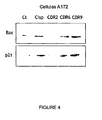
- these proteins induce the expression of particular genes directly involved in stopping cell growth, such as p21 an inhibitor of cyclin-dependent kinases, or in apoptosis, such as bax which is localized in the mitochondria and participates in the release of cytochrome C (Prives and Hall 1999).
- CDRs induce molecular mechanisms that are in part identical to those mediated by cisplatin (p53, p73, Bax, p21). However, there are also differences that indicate that CDRs would trigger mechanisms different from those of cisplatin or other anticancer compounds.
- cisplatin drugs such as cisplatin are unfortunately greatly diminished by the triggering by the cell of resistance processes that block apoptotic mechanisms (mutation of p53 ...) or increases the expression of proteins that detoxify the cell.
- cisplatin several mechanisms have been described and they are also effective against carboplatin, a derivative of cisplatin (Safaei, Katano et al., 2004). It is therefore It is particularly important to test the sensitivity of CDRs to these resistance mechanisms in order to determine the exact contribution that these compounds can have for the treatment of tumors resistant to existing chemotherapeutic treatments.
- One of these mechanisms is the overexpression of the copper export pump (ATP7B) which expels cisplatin out of the cell. It has been shown that this molecule is overexpressed in human tumors and that cell lines that over-express this molecule are more resistant to cisplatin and carboplatin than control lines.
- ATP7B copper export pump
- NCS Neocarzinostatin
- Taxol disrupts mitotic spindles (Oberlies and Kroll 2004).
- NCS or Taxol are drugs with an IC50 of the order of nM.
- Co-treatment with ruthenium derivatives (CDR 6) is significantly more effective compared to co-treatment with cisplatin ( figure 6 ). Equivalent results are obtained with taxol and NCS.
- the experiments are carried out under a vertical laminar flow hood.
- MTT 4,5-dimethylthiazol-2-diphenyltetrazolium bromide
- Aldrich brand a yellow solid produced by Aldrich brand.
- HCT-116 Human colon cancer
- A-172 liver cells were purchased from European Type Culture Collection, and placed in a 37 ° C, 5% CO 2 incubator in round petri dishes ( diameter 10 cm.) with 10 mL of medium. When they are quite numerous (70% confluence), they are washed with PBS at room temperature and then mixed with 1.5 mL of Trypsin-EDTA to unhook them from the petri dish. They are placed in the incubator for a few minutes to accelerate this detachment.
- This cell suspension is placed in culture medium heated to 37 ° C., then this solution is spread in 96-well cell culture plates (100 ⁇ L / well) which is incubated for 48 hours until it reaches a confluence 50% cell.
- the medium is renewed by cell medium containing different concentrations of RDCs and cisplatin at 37 ° C, which is incubated.
- the medium is replaced by a solution at 37 ° C. of MTT in medium, which is placed in the incubator for at least one hour or until violet crystals resulting from the complexation of the MTT are formed quantitatively at the bottom of each well.
- this medium was replaced with 100 uL / well of a solution HCl / i PrOH 0.04M at room temperature to dissolve the crystals.
- a reading of the optical density of the solutions obtained is made.
- the optical densities of the RDC or cisplatin treated wells are compared to those of untreated wells (controls)
- One manipulation consists of treating 4 plates (3 X RDC and cisplatin). Each plate contains a single product at different concentrations. 9 columns are processed at 50, 20, 15, 10, 7.5, 5, 2.5, 1 and 0.2 ⁇ M and 3 columns are left as controls. Only the control columns noted (i) m (1 ⁇ i ⁇ 4) ( Fig. 11 ) are taken into account for the calculations.
- RDC-11 has been tested in vivo to confirm its in vitro anti-cancer properties highlighted above.
- a preliminary experiment on a small number of healthy SWISS mice showed the absence of apparent toxicity of RDC-11.
- mice The animals are handled under a laminar flow hood. Ten eleven-week old nu / nu (nude) SWISS mice were grafted with U-87 cells (a human glioblastoma) subcutaneously in the left thigh. After 7 days, the tumors become apparent and treatment begins. The animals are separated into two groups of five, 5 mice are thus treated with D-PBS (control mice) and the other 5 with RDC-11 (treated mice).
- mice For treated mice, 2 mg of RDC-11 dissolved in 4 mL of hot D-PBS for each injection. 0.5 ml of this solution cooled at room temperature by intraperitoneal route is administered to each mouse. For the control mice, 0.5 ml of D-PBS at room temperature is administered in the same way.
- the dose of RDC-11 injected is 18.5 mg / kg of mouse.
- the cumulative dose is therefore 185 mg / kg.
- V 4 / 3 * ⁇ * The / 2 * I / 2 2 where L is the measured length and I width.
- the figures 12 and 13 show the evolution of apparent tumor volumes and mouse weights as a function of time.
- DRC-11 inflicts tumor growth, in the absence of any toxicity.
Landscapes
- Health & Medical Sciences (AREA)
- Chemical & Material Sciences (AREA)
- Organic Chemistry (AREA)
- Life Sciences & Earth Sciences (AREA)
- General Health & Medical Sciences (AREA)
- Veterinary Medicine (AREA)
- Public Health (AREA)
- Pharmacology & Pharmacy (AREA)
- Medicinal Chemistry (AREA)
- Animal Behavior & Ethology (AREA)
- Epidemiology (AREA)
- Chemical Kinetics & Catalysis (AREA)
- General Chemical & Material Sciences (AREA)
- Nuclear Medicine, Radiotherapy & Molecular Imaging (AREA)
- Pharmaceuticals Containing Other Organic And Inorganic Compounds (AREA)
- Medicines Containing Material From Animals Or Micro-Organisms (AREA)
- Steroid Compounds (AREA)
Claims (25)
- Pharmazeutische Zusammensetzung, umfassend in einem pharmazeutisch verträglichen Träger wenigstens eine Ruthenium(II)-Komplexverbindung mit der folgenden allgemeinen Formel (I) oder (II):
 L1, L2, L3 und L4 identisch oder verschieden sind und entweder für einen Donor-Liganden mit 2 Elektronen von einem Stickstoff-, Sauerstoff-, Phosphor- oder Schwefelatom oder für ein Halogenatom stehen,R1 für ein Wasserstoffatom oder eine oder mehrere Substitutionen an der Phenylgruppe steht, die aus einem (C1-6)Alkyl- und (C6-18)Aryl-Rest ausgewählt sind,Y ein Gegenion ist (wenn m = 1),m 0 oder 1 ist,zwischen C und N, mit einer gekrümmten Linie dargestellt, eine Reihe an Atomen vorhanden sind, die mit den in den Formeln (I) und (II) dargestellten Kohlenstoff-, Stickstoff- und Rutheniumatomen den Metallocyclus bilden, der aus 5 bis 8 Atomen besteht (einschließlich der in Formel (I) und (II) dargestellten Kohlenstoff-, Stickstoff- und Rutheniumatome).
 - Zusammensetzung gemäß dem vorhergehenden Anspruch, dadurch gekennzeichnet, dass die Donor-Liganden mit zwei Elektronen von einem Stickstoff-, Sauerstoff-, Phosphor- oder Schwefelatom aus H2O, Di((C1-6)alkyl)O, Di((C1-6)alkyl)S, Di((C1-6)alkyl)S(O), (C1-6)Alkyl-SO3 -, Di((C1-6)alkyl)C=O und (C1-6)Alkyl-CO2 - ausgewählt sind.
- Zusammensetzung gemäß Anspruch 1, dadurch gekennzeichnet, dass die Donor-Liganden mit zwei Elektronen von einem Stickstoffatom aus den Liganden der Formel (C1-6)Alkyl-CN (insbesondere CH3CN) und Pyridin-Liganden ausgewählt sind, die gegebenenfalls an einem oder mehreren Kohlenstoffatomen der Pyridinringe mit einem (C1-6)Alkyl-Rest oder einem Halogenatom substituiert sind.
- Zusammensetzung gemäß Anspruch 1, dadurch gekennzeichnet, dass die Donor-Liganden mit zwei Elektronen von einem Stickstoffatom aus den primären (C1-6)Alkylaminen, wie Methylamin oder Ethylamin, ausgewählt sind.
- Zusammensetzung gemäß Anspruch 1, dadurch gekennzeichnet, dass die Donor-Liganden mit zwei Elektronen von einem Phosphoratom Liganden des Phosphin-Typs sind.
- Zusammensetzung gemäß Anspruch 1, dadurch gekennzeichnet, dass die Donor-Liganden mit zwei Elektronen von einem Phosphoratom die Formel P(Ph)3-x(Alkyl)x besitzen, wobei x für 0, 1 oder 2 steht.
- Zusammensetzung gemäß einem der vorhergehenden Ansprüche, dadurch gekennzeichnet, dass im Fall der Formel (II) wenigstens zwei der L1, L2, L3 und L4 Gruppen paarweise vorliegen und mit wenigstens einer kovalenten Bindung verbunden sind.
- Zusammensetzung gemäß einem der vorhergehenden Ansprüche, dadurch gekennzeichnet, dass im Fall der Formel (II) wenigstens zwei der L1, L2, L3 und L4 Gruppen paarweise vorliegen und für Bipyridin- oder Phenanthrolin-Einheiten, die gegebenenfalls insbesondere mit wenigstens einem Alkyl-Rest substituiert sind, oder auch für 1,2-Bis(diphenylphosphino)ethan stehen.
- Zusammensetzung gemäß einem der vorhergehenden Ansprüche, dadurch gekennzeichnet, dass im Fall der Formel (II) wenigstens eine L1, L2, L3 und L4 Gruppe, die für einen Donor-Liganden mit zwei Elektronen von einem Stickstoff- oder Phosphoratom steht, eine Pyridin-, Phosphin-, Bipyridin- oder Phenanthrolin-Gruppe ist.
- Zusammensetzung gemäß einem der vorhergehenden Ansprüche, dadurch gekennzeichnet, dass im Fall der Formel (II) wenigstens zwei der L1, L2, L3 und L4 Gruppen für Nitril-Liganden stehen, wie zum Beispiel Liganden der Formel (C1-6)Alkyl-CN (insbesondere CH3CN).
- Zusammensetzung gemäß einem der vorhergehenden Ansprüche, dadurch gekennzeichnet, dass im Fall der Formel (II) wenigstens zwei der L1, L2, L3 und L4 Gruppen für Nitril-Liganden stehen, wie zum Beispiel Liganden der Formel (C1-6)Alkyl-CN (insbesondere CH3CN), und die beiden anderen Liganden mit wenigstens einer kovalenten Bindung verbunden sind.
- Zusammensetzung gemäß einem der vorhergehenden Ansprüche, dadurch gekennzeichnet, dass Y- PF6 -, BF4 -, CF3CO2 -, CH3CO2 -, CF3SO3 - oder NO3 - ist.
- Zusammensetzung gemäß einem der vorhergehenden Ansprüche, dadurch gekennzeichnet, dass m gleich 1 ist.
- Zusammensetzung gemäß einem der vorhergehenden Ansprüche, dadurch gekennzeichnet, dass die gekrümmte Linie ein Metallocyclus mit 5 Atomen ist, der aus einem gemäß einer der folgenden Formeln definierten Metallocyclus ausgewählt ist:

- Zusammensetzung gemäß einem der vorhergehenden Ansprüche, dadurch gekennzeichnet, dass die gekrümmte Linie ein Metallocyclus mit 6 oder 7 Atomen ist, der aus einem gemäß einer der folgenden Formeln definierten Metallocyclus ausgewählt ist:

- Zusammensetzung gemäß Anspruch 1, dadurch gekennzeichnet, dass die Verbindung aus den Verbindungen 3 bis 6 und 8 bis 29 ausgewählt ist.
- Rutheniumverbindung, die aus den folgenden Verbindungen ausgewählt ist:


- Zusammensetzung gemäß einem der Ansprüche 1 bis 16 für die Verwendung zur Behandlung von Krankheiten, die mit einer Zellhyperproliferation verbunden sind.
- Zusammensetzung gemäß einem der Ansprüche 1 bis 16 für die Verwendung zur Behandlung von Krebserkrankungen.
- Zusammensetzung gemäß einem der Ansprüche 1 bis 16 für die Verwendung zur Behandlung von Glioblastomen, (promyelozytären) Leukämien, Krebserkrankungen der Prostata, der Ovarien, der Lunge, der Brust, der Verdauungswege, insbesondere der Leber, des Pankreas, des Kopfes oder des Halses, des Darms, der Blase, Non-Hodgkin-Lymphomen oder Melanomen.
- Zusammensetzung gemäß einem der Ansprüche 1 bis 16 für die Verwendung zur Behandlung von Krebserkrankungen durch Akkumulation von Tumorzellen in der G0/G1-Phase und gegebenenfalls durch Apoptose-Induktion.
- Zusammensetzung gemäß einem der Ansprüche 1 bis 16 für die Verwendung zur Behandlung von Tumoren, die gegen Cisplatin oder andere Krebsmedikamente resistent sind.
- Zusammensetzung gemäß einem der Ansprüche 1 bis 16 für die Verwendung zur Behandlung von Krebserkrankungen in Kombination mit einer Krebsbehandlung mit Hilfe von Bestrahlungen, wie Radiotherapie und Curie-Therapie.
- Zusammensetzung gemäß einem der Ansprüche 1 bis 16 für die Verwendung zur Behandlung von Krebserkrankungen in Kombination mit wenigstens einem weiteren Krebschemotherapeutikum, das kombiniert, separat oder nacheinander konditioniert und verabreicht wird.
- Verbindungen gemäß Anspruch 17 als Medikamente.
Priority Applications (1)
| Application Number | Priority Date | Filing Date | Title |
|---|---|---|---|
| PL05790998T PL1776103T3 (pl) | 2004-07-13 | 2005-07-13 | Kompleksy rutenu do leczenia raków |
Applications Claiming Priority (2)
| Application Number | Priority Date | Filing Date | Title |
|---|---|---|---|
| FR0407819A FR2873037B1 (fr) | 2004-07-13 | 2004-07-13 | Methodes et compositions pour le traitement de cancers |
| PCT/FR2005/001814 WO2006016069A1 (fr) | 2004-07-13 | 2005-07-13 | Methodes et compositions pour le traitement de cancers |
Publications (2)
| Publication Number | Publication Date |
|---|---|
| EP1776103A1 EP1776103A1 (de) | 2007-04-25 |
| EP1776103B1 true EP1776103B1 (de) | 2009-07-08 |
Family
ID=34946740
Family Applications (1)
| Application Number | Title | Priority Date | Filing Date |
|---|---|---|---|
| EP05790998A Expired - Lifetime EP1776103B1 (de) | 2004-07-13 | 2005-07-13 | Rutheniumkomplexe zur krebsbehandlung |
Country Status (8)
| Country | Link |
|---|---|
| US (1) | US8193175B2 (de) |
| EP (1) | EP1776103B1 (de) |
| AT (1) | ATE435647T1 (de) |
| DE (1) | DE602005015329D1 (de) |
| ES (1) | ES2329697T3 (de) |
| FR (1) | FR2873037B1 (de) |
| PL (1) | PL1776103T3 (de) |
| WO (1) | WO2006016069A1 (de) |
Families Citing this family (6)
| Publication number | Priority date | Publication date | Assignee | Title |
|---|---|---|---|---|
| FR2947180A1 (fr) * | 2009-06-29 | 2010-12-31 | Univ Strasbourg | Methodes et compositions pour le traitement de cancers |
| CA2818163A1 (en) * | 2010-11-17 | 2012-05-24 | Niiki Pharma Inc. | Method of treating hematological cancers |
| GB201116057D0 (en) | 2011-09-16 | 2011-11-02 | Univ York | Synthesis and anticancer activity of ruthenium (II) cis-cis-1,3,5-triaminocyclohexane complexes |
| ES2452719B1 (es) * | 2012-10-01 | 2015-01-26 | Universitat De Barcelona | Compuestos antitumorales de rutenio (II) |
| KR102412203B1 (ko) | 2014-06-11 | 2022-06-23 | 더 보드 오브 리젠츠 오브 더 유니버시티 오브 텍사스 시스템 | 백금 내성을 극복하는데 이용하기 위한 텍사피린-pt(iv) 접합체 및 조성물 |
| WO2020138570A1 (ko) * | 2018-12-28 | 2020-07-02 | 서울대학교 산학협력단 | 신규 루테늄 착화합물, 이의 제조방법 및 이를 유효성분으로 함유하는 암의 예방 또는 치료용 약학적 조성물 |
Family Cites Families (2)
| Publication number | Priority date | Publication date | Assignee | Title |
|---|---|---|---|---|
| DE19612291A1 (de) * | 1996-03-28 | 1997-10-02 | Bernhard K Prof Dr Dr Keppler | Arzneimittelzubereitungen enthaltend tumorhemmend wirkende Ruthenium(III)-Komplexe |
| AU3268500A (en) * | 1999-03-19 | 2000-10-09 | Anormed Inc. | Pharmaceutical compositions comprising metal complexes |
-
2004
- 2004-07-13 FR FR0407819A patent/FR2873037B1/fr not_active Expired - Fee Related
-
2005
- 2005-07-13 US US11/631,979 patent/US8193175B2/en not_active Expired - Fee Related
- 2005-07-13 DE DE602005015329T patent/DE602005015329D1/de not_active Expired - Lifetime
- 2005-07-13 WO PCT/FR2005/001814 patent/WO2006016069A1/fr not_active Ceased
- 2005-07-13 AT AT05790998T patent/ATE435647T1/de not_active IP Right Cessation
- 2005-07-13 PL PL05790998T patent/PL1776103T3/pl unknown
- 2005-07-13 EP EP05790998A patent/EP1776103B1/de not_active Expired - Lifetime
- 2005-07-13 ES ES05790998T patent/ES2329697T3/es not_active Expired - Lifetime
Also Published As
| Publication number | Publication date |
|---|---|
| FR2873037A1 (fr) | 2006-01-20 |
| FR2873037B1 (fr) | 2008-04-11 |
| US8193175B2 (en) | 2012-06-05 |
| PL1776103T3 (pl) | 2009-12-31 |
| US20080051370A1 (en) | 2008-02-28 |
| ES2329697T3 (es) | 2009-11-30 |
| DE602005015329D1 (de) | 2009-08-20 |
| ATE435647T1 (de) | 2009-07-15 |
| EP1776103A1 (de) | 2007-04-25 |
| WO2006016069A1 (fr) | 2006-02-16 |
Similar Documents
| Publication | Publication Date | Title |
|---|---|---|
| Hearn et al. | Organometallic iridium (III) anticancer complexes with new mechanisms of action: NCI-60 screening, mitochondrial targeting, and apoptosis | |
| Gandin et al. | In vitro and in vivo anticancer activity of copper (I) complexes with homoscorpionate tridentate tris (pyrazolyl) borate and auxiliary monodentate phosphine ligands | |
| Wang et al. | Balance between the toxicity and anticancer activity of arsenic trioxide in treatment of acute promyelocytic leukemia | |
| Kurzwernhart et al. | Structure–activity relationships of targeted RuII (η6-p-Cymene) anticancer complexes with flavonol-derived ligands | |
| Jin et al. | Targeting energy metabolism by a platinum (IV) prodrug as an alternative pathway for cancer suppression | |
| Panchangam et al. | Antitumor effects of Ir (III)-2 H-indazole complexes for triple negative breast cancer | |
| Aliwaini et al. | A novel binuclear palladacycle complex inhibits melanoma growth in vitro and in vivo through apoptosis and autophagy | |
| JPH10511685A (ja) | 子宮、卵巣及び乳房における抗増殖活性を有する薬剤の製造のためのフラバノリグナンの利用 | |
| Sidorova et al. | Effects of isoprenoid analogues of SDB-ethylenediamine on multidrug resistant tumor cells alone and in combination with chemotherapeutic drugs | |
| Benabdelouahab et al. | Hydrogen Bonding and Anticancer Properties of Water‐Soluble Chiral p‐Cymene RuII Compounds with Amino‐Oxime Ligands | |
| EP1776103B1 (de) | Rutheniumkomplexe zur krebsbehandlung | |
| Klemt et al. | 3D-shaped binders of unfolded proteins inducing cancer cell-specific endoplasmic reticulum stress in vitro and in vivo | |
| EP2448588A1 (de) | Verfahren und zusammensetzungen zur behandlung von krebs | |
| Das et al. | Synthesis of Ru (II) cyclometallated complexes via C (aryl)–S bond activation: X-ray structure, DNA/BSA protein binding and antiproliferative activity | |
| EP3978473B1 (de) | Zusammensetzung mit einer indolessigsäurekernstruktur und verwendung davon | |
| Yang et al. | Isoquinoline-derived half-sandwich Ru (II) Arene complex potentiates antitumor chemoimmunotherapeutic response | |
| Jaouen et al. | The ferrocifen family as potent and selective antitumor compounds: mechanisms of action | |
| Mijatović et al. | Study of the anticancer properties of methyl-and phenyl-substituted carbon-and silicon-bridged ansa-titanocene complexes | |
| Azmanova et al. | Anticancer Water‐Soluble Organoruthenium Complexes: Synthesis and Preclinical Evaluation | |
| Plaza et al. | Inhibitory effect of nordihydroguaiaretic acid and its tetra-acetylated derivative on respiration and growth of adenocarcinoma TA3 and its multiresistant variant TA3MTX-R | |
| FR2986796A1 (fr) | Methodes et compositions pour le traitement du cancer | |
| Rehman et al. | Semisynthesis of Novel Alicyclic Triterpene-Triazole Derivatives from Boswellia sacra Gum Resin: Potential Anti-breast Cancer and Immunomodulatory Effects on T-Cell Activation | |
| FR2733985A1 (fr) | Complexes organometalliques du fer antipaludiques | |
| Xu | Aminoferrocene-or ferrocenylaniline-based ROS amplifiers with anticancer activity | |
| Pitto-Barry et al. | Anticancer water-soluble organoruthenium complexes: synthesis and preclinical evaluation |
Legal Events
| Date | Code | Title | Description |
|---|---|---|---|
| PUAI | Public reference made under article 153(3) epc to a published international application that has entered the european phase |
Free format text: ORIGINAL CODE: 0009012 |
|
| 17P | Request for examination filed |
Effective date: 20070118 |
|
| AK | Designated contracting states |
Kind code of ref document: A1 Designated state(s): AT BE BG CH CY CZ DE DK EE ES FI FR GB GR HU IE IS IT LI LT LU LV MC NL PL PT RO SE SI SK TR |
|
| DAX | Request for extension of the european patent (deleted) | ||
| GRAP | Despatch of communication of intention to grant a patent |
Free format text: ORIGINAL CODE: EPIDOSNIGR1 |
|
| GRAS | Grant fee paid |
Free format text: ORIGINAL CODE: EPIDOSNIGR3 |
|
| GRAA | (expected) grant |
Free format text: ORIGINAL CODE: 0009210 |
|
| RAP1 | Party data changed (applicant data changed or rights of an application transferred) |
Owner name: UNIVERSITE DE STRASBOURG |
|
| AK | Designated contracting states |
Kind code of ref document: B1 Designated state(s): AT BE BG CH CY CZ DE DK EE ES FI FR GB GR HU IE IS IT LI LT LU LV MC NL PL PT RO SE SI SK TR |
|
| REG | Reference to a national code |
Ref country code: GB Ref legal event code: FG4D Free format text: NOT ENGLISH |
|
| REG | Reference to a national code |
Ref country code: CH Ref legal event code: EP |
|
| REG | Reference to a national code |
Ref country code: IE Ref legal event code: FG4D |
|
| REF | Corresponds to: |
Ref document number: 602005015329 Country of ref document: DE Date of ref document: 20090820 Kind code of ref document: P |
|
| PG25 | Lapsed in a contracting state [announced via postgrant information from national office to epo] |
Ref country code: SI Free format text: LAPSE BECAUSE OF FAILURE TO SUBMIT A TRANSLATION OF THE DESCRIPTION OR TO PAY THE FEE WITHIN THE PRESCRIBED TIME-LIMIT Effective date: 20090708 |
|
| REG | Reference to a national code |
Ref country code: ES Ref legal event code: FG2A Ref document number: 2329697 Country of ref document: ES Kind code of ref document: T3 |
|
| REG | Reference to a national code |
Ref country code: PL Ref legal event code: T3 |
|
| PG25 | Lapsed in a contracting state [announced via postgrant information from national office to epo] |
Ref country code: LT Free format text: LAPSE BECAUSE OF FAILURE TO SUBMIT A TRANSLATION OF THE DESCRIPTION OR TO PAY THE FEE WITHIN THE PRESCRIBED TIME-LIMIT Effective date: 20090708 Ref country code: FI Free format text: LAPSE BECAUSE OF FAILURE TO SUBMIT A TRANSLATION OF THE DESCRIPTION OR TO PAY THE FEE WITHIN THE PRESCRIBED TIME-LIMIT Effective date: 20090708 Ref country code: IS Free format text: LAPSE BECAUSE OF FAILURE TO SUBMIT A TRANSLATION OF THE DESCRIPTION OR TO PAY THE FEE WITHIN THE PRESCRIBED TIME-LIMIT Effective date: 20091108 Ref country code: AT Free format text: LAPSE BECAUSE OF FAILURE TO SUBMIT A TRANSLATION OF THE DESCRIPTION OR TO PAY THE FEE WITHIN THE PRESCRIBED TIME-LIMIT Effective date: 20090708 |
|
| REG | Reference to a national code |
Ref country code: IE Ref legal event code: FD4D |
|
| PG25 | Lapsed in a contracting state [announced via postgrant information from national office to epo] |
Ref country code: MC Free format text: LAPSE BECAUSE OF NON-PAYMENT OF DUE FEES Effective date: 20090731 Ref country code: LV Free format text: LAPSE BECAUSE OF FAILURE TO SUBMIT A TRANSLATION OF THE DESCRIPTION OR TO PAY THE FEE WITHIN THE PRESCRIBED TIME-LIMIT Effective date: 20090708 |
|
| REG | Reference to a national code |
Ref country code: CH Ref legal event code: PL |
|
| PG25 | Lapsed in a contracting state [announced via postgrant information from national office to epo] |
Ref country code: PT Free format text: LAPSE BECAUSE OF FAILURE TO SUBMIT A TRANSLATION OF THE DESCRIPTION OR TO PAY THE FEE WITHIN THE PRESCRIBED TIME-LIMIT Effective date: 20091109 Ref country code: BG Free format text: LAPSE BECAUSE OF FAILURE TO SUBMIT A TRANSLATION OF THE DESCRIPTION OR TO PAY THE FEE WITHIN THE PRESCRIBED TIME-LIMIT Effective date: 20091008 |
|
| PG25 | Lapsed in a contracting state [announced via postgrant information from national office to epo] |
Ref country code: CH Free format text: LAPSE BECAUSE OF NON-PAYMENT OF DUE FEES Effective date: 20090731 Ref country code: CZ Free format text: LAPSE BECAUSE OF FAILURE TO SUBMIT A TRANSLATION OF THE DESCRIPTION OR TO PAY THE FEE WITHIN THE PRESCRIBED TIME-LIMIT Effective date: 20090708 Ref country code: DK Free format text: LAPSE BECAUSE OF FAILURE TO SUBMIT A TRANSLATION OF THE DESCRIPTION OR TO PAY THE FEE WITHIN THE PRESCRIBED TIME-LIMIT Effective date: 20090708 Ref country code: RO Free format text: LAPSE BECAUSE OF FAILURE TO SUBMIT A TRANSLATION OF THE DESCRIPTION OR TO PAY THE FEE WITHIN THE PRESCRIBED TIME-LIMIT Effective date: 20090708 Ref country code: LI Free format text: LAPSE BECAUSE OF NON-PAYMENT OF DUE FEES Effective date: 20090731 Ref country code: EE Free format text: LAPSE BECAUSE OF FAILURE TO SUBMIT A TRANSLATION OF THE DESCRIPTION OR TO PAY THE FEE WITHIN THE PRESCRIBED TIME-LIMIT Effective date: 20090708 Ref country code: IE Free format text: LAPSE BECAUSE OF FAILURE TO SUBMIT A TRANSLATION OF THE DESCRIPTION OR TO PAY THE FEE WITHIN THE PRESCRIBED TIME-LIMIT Effective date: 20090708 |
|
| PLBE | No opposition filed within time limit |
Free format text: ORIGINAL CODE: 0009261 |
|
| STAA | Information on the status of an ep patent application or granted ep patent |
Free format text: STATUS: NO OPPOSITION FILED WITHIN TIME LIMIT |
|
| PG25 | Lapsed in a contracting state [announced via postgrant information from national office to epo] |
Ref country code: SK Free format text: LAPSE BECAUSE OF FAILURE TO SUBMIT A TRANSLATION OF THE DESCRIPTION OR TO PAY THE FEE WITHIN THE PRESCRIBED TIME-LIMIT Effective date: 20090708 |
|
| 26N | No opposition filed |
Effective date: 20100409 |
|
| PG25 | Lapsed in a contracting state [announced via postgrant information from national office to epo] |
Ref country code: GR Free format text: LAPSE BECAUSE OF FAILURE TO SUBMIT A TRANSLATION OF THE DESCRIPTION OR TO PAY THE FEE WITHIN THE PRESCRIBED TIME-LIMIT Effective date: 20091009 |
|
| PGFP | Annual fee paid to national office [announced via postgrant information from national office to epo] |
Ref country code: DE Payment date: 20100930 Year of fee payment: 6 |
|
| PG25 | Lapsed in a contracting state [announced via postgrant information from national office to epo] |
Ref country code: LU Free format text: LAPSE BECAUSE OF NON-PAYMENT OF DUE FEES Effective date: 20090713 |
|
| PG25 | Lapsed in a contracting state [announced via postgrant information from national office to epo] |
Ref country code: HU Free format text: LAPSE BECAUSE OF FAILURE TO SUBMIT A TRANSLATION OF THE DESCRIPTION OR TO PAY THE FEE WITHIN THE PRESCRIBED TIME-LIMIT Effective date: 20100109 |
|
| PG25 | Lapsed in a contracting state [announced via postgrant information from national office to epo] |
Ref country code: TR Free format text: LAPSE BECAUSE OF FAILURE TO SUBMIT A TRANSLATION OF THE DESCRIPTION OR TO PAY THE FEE WITHIN THE PRESCRIBED TIME-LIMIT Effective date: 20090708 |
|
| PG25 | Lapsed in a contracting state [announced via postgrant information from national office to epo] |
Ref country code: CY Free format text: LAPSE BECAUSE OF FAILURE TO SUBMIT A TRANSLATION OF THE DESCRIPTION OR TO PAY THE FEE WITHIN THE PRESCRIBED TIME-LIMIT Effective date: 20090708 |
|
| PGFP | Annual fee paid to national office [announced via postgrant information from national office to epo] |
Ref country code: ES Payment date: 20110825 Year of fee payment: 7 Ref country code: GB Payment date: 20110729 Year of fee payment: 7 Ref country code: FR Payment date: 20110810 Year of fee payment: 7 Ref country code: PL Payment date: 20110713 Year of fee payment: 7 |
|
| PGFP | Annual fee paid to national office [announced via postgrant information from national office to epo] |
Ref country code: BE Payment date: 20110826 Year of fee payment: 7 Ref country code: IT Payment date: 20110729 Year of fee payment: 7 Ref country code: NL Payment date: 20110829 Year of fee payment: 7 |
|
| PG25 | Lapsed in a contracting state [announced via postgrant information from national office to epo] |
Ref country code: SE Free format text: LAPSE BECAUSE OF FAILURE TO SUBMIT A TRANSLATION OF THE DESCRIPTION OR TO PAY THE FEE WITHIN THE PRESCRIBED TIME-LIMIT Effective date: 20090708 |
|
| BERE | Be: lapsed |
Owner name: UNIVERSITE DE STRASBOURG Effective date: 20120731 |
|
| REG | Reference to a national code |
Ref country code: NL Ref legal event code: V1 Effective date: 20130201 |
|
| GBPC | Gb: european patent ceased through non-payment of renewal fee |
Effective date: 20120713 |
|
| REG | Reference to a national code |
Ref country code: FR Ref legal event code: ST Effective date: 20130329 |
|
| PG25 | Lapsed in a contracting state [announced via postgrant information from national office to epo] |
Ref country code: DE Free format text: LAPSE BECAUSE OF NON-PAYMENT OF DUE FEES Effective date: 20130201 Ref country code: FR Free format text: LAPSE BECAUSE OF NON-PAYMENT OF DUE FEES Effective date: 20120731 Ref country code: GB Free format text: LAPSE BECAUSE OF NON-PAYMENT OF DUE FEES Effective date: 20120713 Ref country code: NL Free format text: LAPSE BECAUSE OF NON-PAYMENT OF DUE FEES Effective date: 20130201 |
|
| REG | Reference to a national code |
Ref country code: DE Ref legal event code: R119 Ref document number: 602005015329 Country of ref document: DE Effective date: 20130201 |
|
| PG25 | Lapsed in a contracting state [announced via postgrant information from national office to epo] |
Ref country code: BE Free format text: LAPSE BECAUSE OF NON-PAYMENT OF DUE FEES Effective date: 20120731 Ref country code: IT Free format text: LAPSE BECAUSE OF NON-PAYMENT OF DUE FEES Effective date: 20120713 |
|
| REG | Reference to a national code |
Ref country code: ES Ref legal event code: FD2A Effective date: 20131023 |
|
| REG | Reference to a national code |
Ref country code: PL Ref legal event code: LAPE |
|
| PG25 | Lapsed in a contracting state [announced via postgrant information from national office to epo] |
Ref country code: PL Free format text: LAPSE BECAUSE OF NON-PAYMENT OF DUE FEES Effective date: 20120713 |
|
| PG25 | Lapsed in a contracting state [announced via postgrant information from national office to epo] |
Ref country code: ES Free format text: LAPSE BECAUSE OF NON-PAYMENT OF DUE FEES Effective date: 20120714 |