EP1791792B2 - Verwendung von teilweise vor-hydratiertem kalziumoxid zum trennen einer mischung aus festen/flüssigen stoffen, verfahren zur behandlung des durch besagtes verfahren entstandenen schlamms - Google Patents
Verwendung von teilweise vor-hydratiertem kalziumoxid zum trennen einer mischung aus festen/flüssigen stoffen, verfahren zur behandlung des durch besagtes verfahren entstandenen schlamms Download PDFInfo
- Publication number
- EP1791792B2 EP1791792B2 EP05805575.7A EP05805575A EP1791792B2 EP 1791792 B2 EP1791792 B2 EP 1791792B2 EP 05805575 A EP05805575 A EP 05805575A EP 1791792 B2 EP1791792 B2 EP 1791792B2
- Authority
- EP
- European Patent Office
- Prior art keywords
- weight
- sludge
- cvrr
- drql
- cao
- Prior art date
- Legal status (The legal status is an assumption and is not a legal conclusion. Google has not performed a legal analysis and makes no representation as to the accuracy of the status listed.)
- Expired - Lifetime
Links
Images
Classifications
-
- C—CHEMISTRY; METALLURGY
- C02—TREATMENT OF WATER, WASTE WATER, SEWAGE, OR SLUDGE
- C02F—TREATMENT OF WATER, WASTE WATER, SEWAGE, OR SLUDGE
- C02F1/00—Treatment of water, waste water, or sewage
- C02F1/52—Treatment of water, waste water, or sewage by flocculation or precipitation of suspended impurities
- C02F1/529—Processes or devices for preparing lime water
-
- A—HUMAN NECESSITIES
- A61—MEDICAL OR VETERINARY SCIENCE; HYGIENE
- A61L—METHODS OR APPARATUS FOR STERILISING MATERIALS OR OBJECTS IN GENERAL; DISINFECTION, STERILISATION OR DEODORISATION OF AIR; CHEMICAL ASPECTS OF BANDAGES, DRESSINGS, ABSORBENT PADS OR SURGICAL ARTICLES; MATERIALS FOR BANDAGES, DRESSINGS, ABSORBENT PADS OR SURGICAL ARTICLES
- A61L11/00—Methods specially adapted for refuse
-
- C—CHEMISTRY; METALLURGY
- C02—TREATMENT OF WATER, WASTE WATER, SEWAGE, OR SLUDGE
- C02F—TREATMENT OF WATER, WASTE WATER, SEWAGE, OR SLUDGE
- C02F1/00—Treatment of water, waste water, or sewage
- C02F1/52—Treatment of water, waste water, or sewage by flocculation or precipitation of suspended impurities
- C02F1/5236—Treatment of water, waste water, or sewage by flocculation or precipitation of suspended impurities using inorganic agents
- C02F1/5245—Treatment of water, waste water, or sewage by flocculation or precipitation of suspended impurities using inorganic agents using basic salts, e.g. of aluminium and iron
-
- Y—GENERAL TAGGING OF NEW TECHNOLOGICAL DEVELOPMENTS; GENERAL TAGGING OF CROSS-SECTIONAL TECHNOLOGIES SPANNING OVER SEVERAL SECTIONS OF THE IPC; TECHNICAL SUBJECTS COVERED BY FORMER USPC CROSS-REFERENCE ART COLLECTIONS [XRACs] AND DIGESTS
- Y02—TECHNOLOGIES OR APPLICATIONS FOR MITIGATION OR ADAPTATION AGAINST CLIMATE CHANGE
- Y02W—CLIMATE CHANGE MITIGATION TECHNOLOGIES RELATED TO WASTEWATER TREATMENT OR WASTE MANAGEMENT
- Y02W10/00—Technologies for wastewater treatment
- Y02W10/30—Wastewater or sewage treatment systems using renewable energies
- Y02W10/37—Wastewater or sewage treatment systems using renewable energies using solar energy
Definitions
- the present invention relates to a use of partially pre-hydrated lime, which contains CaO reacting with H 2 O after a certain latency time, that is to say quicklime with delayed reactivity (abbreviated: "CVRR "), in the field of the separation of solids from a mixture comprising said solids and a liquid (ie liquid/solid separation, hereinafter for convenience “solids/liquid separation” or “solids/liquid separation” ), and in particular in the field of the separation of solid matter from a suspension in a liquid. It mainly relates to a process for treating a sludge, in which the solid matter is concentrated, decontaminated, dried and collected by means of said partially pre-hydrated lime with delayed reactivity.
- CVRR quicklime with delayed reactivity
- Said concentrated mixtures thus obtained, in particular concentrated suspensions, must often undergo subsequent treatments before they can be handled, stored or reused.
- These treatments use reagents whose role is, for example, to modify the chemical properties, to decontaminate (i.e. to sanitize or clean up) or to modify the physical properties of the solid matter/concentrated liquid mixture or of the concentrated suspension, such as than rheology or plasticity.
- lime can be used to improve the performance of solid/liquid separation methods. It is then added to the suspension before the solids/liquid separation (the person skilled in the art speaks in this case of "pre-liming”, i.e. liming operation before filtration, centrifugation or decantation) or after said separation (the person skilled in the art then speaks of "post-liming”, i.e. liming operation after filtration, centrifugation or decantation).
- quicklime is not suitable when the solid/liquid mixture or suspension contains a liquid reacting with it, such as water. Indeed, the violent reaction between the quicklime and the water (i) leads to non-homogeneous mixtures, and (ii) disturbs the solid/liquid separation. It is therefore preferred to introduce, into said mixture or said suspension to be concentrated, slaked lime Ca(OH) 2 , either in the form of a powder or in the form of an aqueous suspension.
- the Ca(OH) 2 particles thus added or formed by reaction of the lime with the water of the solid matter/liquid mixture or of the suspension, typically have a size of less than 10 ⁇ m; these particles are too small to be able to increase the porosity of the residue or separation cake and thus promote desiccation and decontamination of the solids/liquid separation cake.
- EP 1154958 B further indicates the possibility of using a CVRR for the pre-liming operation (see for this purpose the last sentence of ⁇ [0026] of this patent) in order to slow down the slaking reaction.
- this patent does not describe or suggest the characteristic of the present invention, namely that said CVRR intervenes in the agglomeration of solid matter during the pre-liming operation; then in the post-liming operation for desiccation and decontamination of the solid matter contained in the sludge.
- post-liming requires an additional step, namely the mixing of said solids/concentrated liquid mixture, or of said concentrated suspension, with the quicklime.
- This mixing step has the disadvantage of increasing the cost and the complexity of the operating methods, on the one hand, and of destructuring said solid matter/concentrated liquid mixture or said concentrated suspension, which constitutes the separation cake, by the constraints mechanics that it generates, on the other hand.
- Partially pre-hydrated quicklime with delayed reactivity is also known. These products consist of CaO and Ca(OH) 2 . They are in the form of a mixture of particles of quicklime CaO and particles of slaked lime Ca(OH) 2 , arranged in such a way that, in the presence of water, the aforementioned reaction (1) is delayed.
- CVRR is in the form of particles of quicklime CaO, constituting a core, and particles of slaked lime Ca(OH) 2 , constituting a layer or film. temporarily protective coating the CaO core.
- said CVRR intervenes, in the manufacture of said shaped articles, in the form of a powder or, thanks to the addition of a plasticizer (designated "superplasticizer” by the person skilled in the art), in the form of an aqueous suspension fluid and, if necessary, concentrated.
- a plasticizer designated "superplasticizer” by the person skilled in the art
- Compaction should not be confused (especially according to JP 60/054799 A Where FR 2841895 A cited above) of a waste, such as sludge, with the pre-liming operation or that of post-liming.
- the compacting of a waste containing water consists, by adding CaO, in coating said waste in a dry matrix of Ca(OH) 2 .
- the compacting of a waste not containing water comprises mixing said waste with CaO and then adding H 2 O to obtain the same dry matrix.
- Compaction carried out in particular in a mold with walls rendered non-stick, leads to the production of shaped products.
- the ideal would be to have the advantages of the so-called pre-liming and post-liming operations without their aforementioned drawbacks, on the one hand, and to have a homogeneous lime/solids mixture to be collected (i) in the said solids/liquid mixture or the suspension to be treated then (ii) in the separation residue without additional restrictive handling and without violent reaction of CaO with H 2 O or said organic liquid of said mixture or of said suspension, said violent reaction having the disadvantage to be liable to generate dust and to produce lime agglomerates preventing the achievement of the desired homogeneity, on the other hand.
- the term "suspension” encompasses, for convenience, any suspension proper (ie presence of solid particles dispersed in the liquid) and any solid matter/liquid mixture in which at least a portion of the liquid matter (however minute it may be) is capable of being dispersed (in particular by agitation) in the liquid. Indeed, even if in said solid matter/liquid mixture the solid particles are substantially gathered, it suffices to stir it to obtain the dispersion of the solid particles which it contains; alternatively, one can withdraw a portion of the supernatant (or in certain cases of the subnatant) and put under agitation the solid/liquid composition remaining to have said dispersion. If necessary, said supernatant (or subnatant) thus withdrawn, which may be cloudy, may in turn be reprocessed and concentrated.
- quicklime in the concentration, separation and drying of solid matter capable of being dispersed (in particular under stirring, the dispersion possibly being at least partial) in a liquid, said use making use of a partly pre-prepared quicklime.
- CVRR delayed reactivity
- the reaction (1), between the quicklime CaO and the water (1) CaO + H 2 O ⁇ Ca(OH) 2 either temporarily delayed by the slaked lime Ca(OH) 2 , the slaked lime of the CVRR used for the flocculation or concentration of the solids before separation, and the quicklime of the said CVRR used for the desiccation of the said solids during or (better) after separation.
- a new process is recommended for the concentration, separation, desiccation and decontamination of the solids of a sludge by means of lime in order to separate its solids, said process being carried out according to claim 1.
- the process according to the invention makes it possible to obtain, as an industrial product, a solid material originating from a sludge, said material having been purified by means of a CVRR consisting of 40 to 98% by weight of CaO and from 60 to 2 % by weight of Ca(OH) 2 , preferably consisting of 80 to 92% by weight of CaO and 20 to 8% by weight of Ca(OH) 2 , and more preferably consisting of 85 to 90% by weight of CaO and from 15 to 10% by weight of Ca(OH) 2 , having an average particle size such as 20 ⁇ m ⁇ d 50 ⁇ 200 ⁇ m and being used (i) in the form of a powder or (ii) in the form of an aqueous suspension at a concentration greater than or equal to 10% by weight.
- a CVRR consisting of 40 to 98% by weight of CaO and from 60 to 2 % by weight of Ca(OH) 2 , preferably consisting of 80 to 92% by weight of CaO and 20 to 8% by weight of Ca(
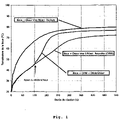
- the single figure makes it possible to compare the reactivities of several limes in the system temperature of the sludge (in °C) on the ordinate as a function of the reaction time (in seconds) on the abscissa.
- the CaO contained in the CVRR has, in contact with water, a delayed reactivity of the order of a few minutes to 2 hours or even more depending on FR 2841895 A , compared to that of non-pre-hydrated quicklime.
- the reactivity delay increases with the Ca(OH) 2 content of the CVRR. In addition, it depends on the concentration and the nature of the constituent materials of the suspension which it is desired to treat.
- the liquid of the suspension which is suitable according to the invention, consists of or contains water, on the one hand, or consists of one or more solvents which can react with the CaO of the CVRR, on the other hand.
- the suspensions referred to below, in particular in the examples, are aqueous suspensions.
- d x ⁇ there in ⁇ m is meant the fact that x% by weight of the particles concerned have a size less than or equal to y ⁇ m.
- a CVRR is added upstream of the step of separating the solids from the liquid, in particular as described in the prior document FR 2841895 A aforementioned.
- each quicklime core does not react with the water contained in the suspension, with regard to the reaction latency time (1) due to its protective layer of Ca(OH) 2 .
- This circumstance makes it possible to easily obtain a homogeneous mixture between the lime and the suspension and to avoid disturbing the solid/liquid separation process.
- the contact between the Ca(OH) 2 layer and the suspension generates a sufficiently high pH to promote solid/liquid separation, where appropriate in association with metal salts.
- the grain size of this lime also makes it possible to increase the porosity of cakes and promotes the performance of mechanical separation systems such as centrifuges, filter presses and band filters.
- the Ca(OH) 2 layer is resorbed and releases the quicklime core which it coats.
- This CaO core will then react with the residual water present in the cake or separation residue.
- This reaction will produce heat, generate a high pH and thus ensure sanitization.
- this reaction will further increase the dryness content of the cake or separation residue.
- the treatment is then more efficient and more economical than that described in the previously known technical solutions, because at the time of the reaction, the lime is already well dispersed in a homogeneous manner in the said cake or separation residue, and a costly and time-consuming mixing step.
- the invention finally has the advantage of using only one specific lime, CVRR, to implement the pre-liming and then post-liming operations in a combined and successive manner.
- the CVRR consists of 40 to 98% by weight of CaO and 60 to 2% by weight of Ca(OH) 2 .
- the CVRR will consist of 80 to 92% by weight of CaO and 20 to 8% by weight of Ca(OH) 2 , and better still of 85 to 90% by weight of CaO and of 15 to 10% by weight of Ca(OH) 2 .
- Said CVRR is according to the invention used (i) in the form of a powder or (ii) in the form of an aqueous suspension at a concentration greater than or equal to 10% by weight.
- said CVRR will advantageously be at a concentration which may be greater than or equal to 50% by weight, and better still at a concentration of 60 to 90% by weight.
- said CVRR will be at a concentration of 5 to 90% by weight, the high concentrations (for example of the order of 75 to 90% by weight) being able to be obtained by adding a superplasticizer known in the art.
- the CVRR is first mixed with the suspension to be concentrated and to be treated, to which the solution of metal salts, ideally ferric chloride, aluminum sulphate and/or basic aluminum chloride, has possibly already been added [remember that basic aluminum chloride, also called “aluminum oxychloride", is a product having the formula: Al 2 (OH) 3 Cl.2H 2 O according to the MERCK INDEX 13th edition, 2001 ].
- the mixing can be carried out by any technique, but preferably in a mixer.
- the particle size of the CVRR changes little or not at all. It will therefore be adjusted to optimize the operation of the tool and the performance of the drying process. With regard to the particle size of the CVRR, it was a matter of finding an optimized compromise between the need to have small particles to ensure good distribution of the lime and the need to have particles of sufficient size to increase the porosity of the cake or residue and promote solid/liquid separation.
- CVRR used has a particle size of less than 5 mm. It is recommended, in order to have good porosity at the level of the cake or separation residue, a CVRR preferably having an average particle size of between 20 ⁇ m and 1 mm. In practice, particles having a size greater than 1 mm will be eliminated to avoid settling phenomena, in particular for suspensions having low viscosities. Except in special cases, the d 50 will not be chosen below 20 ⁇ m in order to prevent the reduction in the porosity of the cakes or separation residues.
- the average particle size of the CVRR which is particularly recommended according to the invention, is such that 20 ⁇ m ⁇ d 50 ⁇ 700 ⁇ m. If this is desirable, it is even possible to sieve the CVRR to separate the particles having a size greater than or equal to 700 ⁇ m, then those having a size less than or equal to 20 ⁇ m.
- the lime will be dosed according to the dry matter content of the emulsion to be treated, the rheological characteristics expected for the final concentrated product, the pH or temperature constraints imposed in particular by the sanitization of said final product. In practice, at least 1 part by weight of CVRR will be used per 100 parts by dry weight of solid matter contained in the emulsion to be treated.
- step ( ⁇ ) of the process of the invention is brought into contact and with stirring, for 0.4 to 30 minutes, in particular for a time less than or equal to 10 minutes, and in particular for 2 to 3 minutes, the CVRR with the sludge to be treated, the Ca(OH) 2 of the particles of said CVRR serving for the concentration or flocculation of said solid matter.
- a duration less than or equal to 10 minutes is especially recommended in order to ensure the integrity of the quicklime cores of the CVRR during stage ( ⁇ ). Thanks to its particle size, said CVRR acts as a mineral on the porosity of the cake or separation residue and favors obtaining dryness gains.
- step ( ⁇ ) of this process the moist material obtained, which comprises the solids of the initial suspension, the particles of the CVRR and water, is separated by filtration, centrifugation or decantation.
- This operation can be carried out by means of an appropriate device, for example a centrifuge, a filter press or a belt filter, or even a settling tank.
- Triggering can be done by thermal or sonic activation or by adding a chemical trigger. The purpose of this triggering is to destroy the calcium hydroxide layer and release the quicklime kernels.
- Chemical triggers are substances that react with calcium hydroxide or that can change its solubility. They will preferably be chosen from the group comprising inorganic acids (in particular HCl or HNO 3 ), organic acids, alkaline salts (in particular NaCl), alkaline-earth salts (in particular CaCl 2 ), polyols (in particular sorbitol, glycerol , pentaerythrol and polyalkylene glycols) and mixtures thereof. They will be added in solid or liquid form or in the form of a suspension. Conveniently, the chemical trigger can be added in solution (in particular at 1% by weight) in the washing water of the wet separation cake. The nature and dose of the chemical trigger will be adjusted according to the desired effect.
- step ( ⁇ ) The triggering of the reaction of step ( ⁇ ) can be initiated, if necessary, during the separation of step ( ⁇ ) or, better, after said step ( ⁇ ).
- step ( ⁇ ) the dryness gradually increases to reach a plateau.
- the hydration of quicklime releases heat (1160 kJ per kg of CaO at 20°C).
- the temperature rises associated with this release are all the more significant as the heat losses are minimized. It is possible, for example, to control the process of the invention so as to initiate the reaction of step ( ⁇ ), when the suspension which is treated is stored in a thermally insulated place.
- the temperatures required for thermal hygienization i.e. a temperature above 55°C for 75 minutes) can be reached without additional treatment.
- step ( ⁇ ) A homogeneous suspension or a solid product which is moist is then obtained (see Ex. 8 and Ex. 9 below).
- the elimination of said step ( ⁇ ) is perfectly suitable for the treatment of suspensions of stercoral matter.
- a biological sludge of industrial origin having a solids concentration of 2.2% by dry weight, is mixed with stirring in the 1 m 3 tank of a centrifuge (operating at 20 m 3 /h) with a CVRR having a CaO/Ca(OH) 2 weight ratio of 90/10 and a particle size such that 20 ⁇ m ⁇ d 50 ⁇ 200 ⁇ m, at the rate of 1 part by dry weight of CVRR for 1 part by dry weight of solid matter, or here 22 kg of CVRR for 1 m 3 of sludge to be treated.
- An aqueous solution containing 500 g/L of ferric chloride is added simultaneously to the tank at the rate of 0.8 L of this solution for 1 m 3 of sludge to be treated.
- the biological sludge of Example 1 is treated conventionally, in the tank of the same centrifuge, with an organic polymer flocculant (here an acrylic acid/acrylamide copolymer), at a rate of 15 g by dry weight of flocculant for 1 kg of materials dry weight solids of said sludge.
- an organic polymer flocculant here an acrylic acid/acrylamide copolymer
- a first wet separation cake is obtained, which is collected, has a TC of 18%.
- This first cake is then mixed with quicklime at the rate of 1 part by dry weight of CaO for 1 part by dry weight of solid matter of said initial sludge.
- the final cake which is obtained is destructured by the action of quicklime and has a TC of 34% which, measured after 72 h, remains constant.
- One operates according to the method of example 1 above, but with the difference that one uses (a) 0.55 part by dry weight of CVRR (ie 0.5 part by weight of CaO) for 1 part in dry weight of solids of the initial sludge, and (b) 0.4 L (instead of 0.8 L) of aqueous FeCl 3 solution per 1 m 3 of sludge to be treated.
- the second cake that is collected has a TC of 31%. After 72 h, it is noted that the TC has increased and is 34% and remains constant beyond 72 h.
- the biological sludge of Example 1 is treated in a filter press with an addition of 1 kg of CVRR [having a CaO/Ca(OH) 2 weight ratio of 85/15 and a particle size such that 20 ⁇ m ⁇ d 50 ⁇ 200 ⁇ m] at the rate of 1 part by dry weight of CVRR for 1 part by dry weight of solids, ie here 22 kg of CVRR for 1 m 3 of sludge to be treated.
- a 500 g/L aqueous solution of FeCl 3 is added simultaneously at the rate of 0.8 L per 1 m 3 of sludge to be treated.
- the TC of the final cake obtained is 42%. After 72 h, it is noted that TC has increased and is 48%.
- the biological sludge of Example 1 is treated conventionally in a filter press by adding 1 kg of Ca(OH) 2 to it per 1 kg of dry matter contained in this sludge.
- the first filtration cake has a TC of 41% and a structure that does not allow the post-liming operation.
- a biological sludge of urban origin having a dry matter content of 2.4% by weight is mixed, with stirring, in a 1 m 3 tank with the CVRR of Example 1 added at a rate of 0.5 part by weight to 1 part by weight of dry matter, i.e. 12 kg for 1 m 3 of sludge to be treated.
- a 500 g/L aqueous solution of FeCl 3 is added simultaneously at the rate of 0.5 L per 1 m 3 of sludge to be treated.
- the TC of the final cake obtained by separation on a belt filter (operating with a flow rate of 6 m 3 /h) is 34%. After 72 h, it is noted that TC has increased and is 37%.
- the sludge of example 4 is conventionally treated by means of the same band filter by adding 5 g of polymer (polyacrylamide) to it per 1 kg of dry matter.
- the first filtration cake, thus obtained, is mixed with quicklime at the rate of 0.5 kg of CaO per 1 kg of dry matter of the initial sludge. After mixing, the cake destructured by the operation has a TC of 32% which remains constant after 72 h.
- the sludge of Example 5 is treated conventionally with ferric chloride and lime introduced in the form of slaked lime milk (the use of powdered quicklime would not make it possible to obtain a homogeneous mixture compatible with the filtration on filter press).
- the mixture is pumped to the filter press after a delay of 30 to 40 minutes in order to obtain an immediate clarification.
- the filtration time is 100 minutes and the final dryness is 33%.
- a homogeneous pig manure having a dry matter concentration of 5.5% by weight is mixed, with stirring, in a 1 m 3 tank of a centrifuge, operating at a flow rate of 4 m 3 /h, with the CVRR of Example 3 added at a rate of 10 kg of CVRR for 1 m 3 of sludge to be treated. Centrifuged slurry immediately appears as a slightly moist divided powder. After 24 hours, this powder is perfectly dry and easy to handle; its TC is 39%.
- the measurement of the reactivities of the limes is carried out according to the standardized method EN459-2.
- the essential modification, implemented here, relates to the replacement of demineralized water by a biological sludge having a solid dry matter content of 2.7%.
- 150 g of lime (quicklime CaO or CVRR according to example 1) are suddenly immersed in 600 g of this sludge at 20°C. From the introduction, the temperature of the resulting mixture under stirring is measured continuously. The temperature rise curves are presented on the figure 1 .
- the trigger additive (HCl) is added, at time A, at a rate of 1% by weight relative to the mass of CaO used.
- curve 1 relates to the sludge with the addition of normal quicklime
- curve 3 relates to the sludge with the addition of the CVRR
- curve 2 shows the effect of the trigger additive after its incorporation at time A into the sludge mixture + CVRR.
- the raw material is an aqueous suspension of stercoral matter. It comes mainly from industrial rabbit slaughterhouses and has been centrifuged beforehand to remove the solid parts.
- This aqueous suspension is mixed continuously and with stirring with the CVRR of Example 3 at the rate of 5 to 8 parts by weight of CVRR per 100 parts by weight of stercoral matter which it contains.
- the CVRR is introduced directly into the mixer in the form of a powder. Delaying reaction (1) makes it possible to obtain a homogeneous mixture with constant viscosity and the deodorizing effect is immediate.
- the homogeneous mixture thus obtained is transferred to a storage unit where reaction (1) is triggered and makes it possible to bring said mixture to a temperature of between 40 and 70° C. depending on the quantity of CVRR added.
- the increase in viscosity after reaction (1) is also a function of the amount of CVRR added: with up to 8 parts of CVRR per 100 parts of stercoral material, the resulting mixture remains liquid and is treated as such in the chosen disposal route.
- Example 8 The process of Example 8 is repeated, with the difference that 15 parts (instead of 5 to 8 parts) of CVRR are added per 100 parts of stercoral matter.
- the increase in the amount of CVRR used has the consequence of raising, by triggering reaction (1) during storage, the temperature of the resulting mixture to more than 95° C. and of obtaining a solid structure making it possible to store the mixture on the ground with an angle of slope of the order of 45°C.
- This type of treatment can advantageously be used depending on the disposal route chosen.
Landscapes
- Chemical & Material Sciences (AREA)
- Life Sciences & Earth Sciences (AREA)
- Organic Chemistry (AREA)
- Environmental & Geological Engineering (AREA)
- Water Supply & Treatment (AREA)
- Engineering & Computer Science (AREA)
- Hydrology & Water Resources (AREA)
- Health & Medical Sciences (AREA)
- Epidemiology (AREA)
- Animal Behavior & Ethology (AREA)
- General Health & Medical Sciences (AREA)
- Public Health (AREA)
- Veterinary Medicine (AREA)
- Inorganic Chemistry (AREA)
- Treatment Of Sludge (AREA)
Claims (5)
- Verfahren zur Behandlung eines Schlamms mit Kalk zur Konzentration, Austrocknung und Sammlung der darin enthaltenen Feststoffe, umfassend die nachfolgenden Schritte :(α) in Verbindung bringen des zu behandelnden Schlamms unter Rühren über 2 - 10 min mit teilweise vorhydratisiertem Branntkalk (CVRR) in einem Verhältnis (bezogen auf das Trockengewicht) von mindestens 1 Teil CVRR pro 100 Gew.-Teile der im Schlamm enthaltenen Feststoffe, wobei der CVRR aus 85 - 90 Gew. % CaO und 15 - 10 Gew. % Ca(OH)2 mit einer derartigen mittleren Körnung von 20 µm ≤ d50 ≤ 200 µm und in Form eines Pulvers (i) oder in Form einer wässrigen Suspension (ii) in einer Konzentration von größer oder gleich 10 Gew. % verwendet wird, wobei das Ca(OH)2 der Partikel des CVRR zur Flockung der Feststoffe dient;(β) Separieren - insbesondere durch Filtration, Zentrifugation oder Dekantieren - der resultierenden Suspension, um einen Festkörper in Form eines ersten feuchten Kuchens zu erhalten, bei dem es sich um eine homogene Mischung aus den konzentrierten Feststoffen, CVRR und Wasser handelt; gefolgt durch(y) Umsetzen des CaO des im derart separierten Festkörper enthaltenen CVRR mit dem Wasser des Festkörpers .
- Verfahren nach Anspruch 1, dadurch gekennzeichnet, dass das Kontaktieren unter Rühren im Schritt (α) über 2 - 3 min erfolgt.
- Verfahren nach Anspruch 1 oder 2, dadurch gekennzeichnet, dass der Schritt (α) mit einer in CaO-Äquivalenten ausgedrückter Menge an CVRR von 3- 100 Gew.-Teilen pro 100 Gew.-Teile Feststoffe im Schlamm erfolgt, wobei der CVRR vorliegt(i) in Form des Pulvers oder(ii) in Form der wässrigen Suspension in einer Konzentration von mindestens 10 Gew. %, vorzugsweise mindestens 50 Gew. % und besonders bevorzugt (in diesem Fall in Verbindung mit einem Betonverflüssiger) in einer Konzentration von 75 - 90 Gew. %;dass die Separation im Schritt (β) mittels einer Zentrifuge, Filterpresse oder eines Bandfilters erfolgt, und dass die Reaktion im Schritt (γ) während oder nach dem Schritt (β) thermisch, durch Beschallung oder chemisch ausgelöst wird.
- Verfahren nach einem der vorstehenden Ansprüche, dadurch gekennzeichnet, dass die Reaktion im Schritt (γ) ausgelöst wird• mit thermischen Mitteln, insbesondere durch Zugabe von Trockendampf;• durch Beschallung, insbesondere mit einem Ultraschallfeld; oder• mit chemischen Mitteln, insbesondere mit einer aus der nachfolgenden Gruppe gewählten Substanz: Mineralsäuren, organische Säuren, alkalische Salze, Erdalkalisalze, Polyole und Mischungen davon.
- Verfahren nach einem der vorstehenden Ansprüche, dadurch gekennzeichnet, dass der Schritt (α) durch eine Assoziation von CVRR mit mindestens einem Metallsalz, insbesondere einem Fe3+- und/oder einem Al3+-Salz, vorzugsweise FeCl3, Al2(SO4)3 und/oder Chlorid, ausgeführt wird.
Applications Claiming Priority (2)
| Application Number | Priority Date | Filing Date | Title |
|---|---|---|---|
| FR0409767A FR2875228B1 (fr) | 2004-09-15 | 2004-09-15 | Utilisation de chaux partiellement pre-hydratee dans la separation d'une suspension matieres solide/liquide, procede de traitement des boues et boues purifiees obtenues selon ce procede |
| PCT/FR2005/002215 WO2006030102A2 (fr) | 2004-09-15 | 2005-09-06 | Utilisation de chaux partiellement pre-hydratee dans la separation d'un melange matieres solides/liquide, procede de traitement des boues et boues purifiees obtenues selon ce procede |
Related Child Applications (1)
| Application Number | Title | Priority Date | Filing Date |
|---|---|---|---|
| EP16150530.0 Division-Into | 2016-01-08 |
Publications (3)
| Publication Number | Publication Date |
|---|---|
| EP1791792A2 EP1791792A2 (de) | 2007-06-06 |
| EP1791792B1 EP1791792B1 (de) | 2017-05-31 |
| EP1791792B2 true EP1791792B2 (de) | 2023-01-25 |
Family
ID=34950709
Family Applications (1)
| Application Number | Title | Priority Date | Filing Date |
|---|---|---|---|
| EP05805575.7A Expired - Lifetime EP1791792B2 (de) | 2004-09-15 | 2005-09-06 | Verwendung von teilweise vor-hydratiertem kalziumoxid zum trennen einer mischung aus festen/flüssigen stoffen, verfahren zur behandlung des durch besagtes verfahren entstandenen schlamms |
Country Status (5)
| Country | Link |
|---|---|
| US (1) | US8013204B2 (de) |
| EP (1) | EP1791792B2 (de) |
| CA (1) | CA2579862C (de) |
| FR (1) | FR2875228B1 (de) |
| WO (1) | WO2006030102A2 (de) |
Families Citing this family (5)
| Publication number | Priority date | Publication date | Assignee | Title |
|---|---|---|---|---|
| FR2875228B1 (fr) | 2004-09-15 | 2006-12-15 | Marc Gombart | Utilisation de chaux partiellement pre-hydratee dans la separation d'une suspension matieres solide/liquide, procede de traitement des boues et boues purifiees obtenues selon ce procede |
| BE1019037A3 (fr) * | 2009-03-17 | 2012-02-07 | Lhoist Rech & Dev Sa | Compositions a base de chaux, leur procede de fabrication et leur utilisation en traitement des eaux et boues. |
| PT3166397T (pt) | 2014-07-10 | 2020-11-25 | Lhoist Rech Et Developpement Sa | Cal viva com reatividade retardada, processo de fabrico e a sua utilização |
| DE102015110560A1 (de) * | 2015-07-01 | 2017-01-05 | Form Orange Produktentwicklung | Schublade mit einer Bodenplatte, zwei Seitenwänden, einer Rückwand und einer Blende |
| FR3066925B1 (fr) * | 2017-05-30 | 2021-09-17 | Ste De Fabrication Et Ateliers Lucien Choquenet | Installation et procede de filtration d'un melange liquide/solide |
Citations (1)
| Publication number | Priority date | Publication date | Assignee | Title |
|---|---|---|---|---|
| WO1998002391A1 (en) † | 1996-07-17 | 1998-01-22 | Chemical Lime Company | Controlled reactivity quicklime and method for producing aerated autoclaved concrete |
Family Cites Families (12)
| Publication number | Priority date | Publication date | Assignee | Title |
|---|---|---|---|---|
| JPS6054799A (ja) * | 1983-09-05 | 1985-03-29 | Ootosetsuto:Kk | 含水物の処理剤 |
| FR2657344B1 (fr) | 1990-01-19 | 1993-07-30 | Charbonnages De France | Procede d'extinction de la chaux vive contenue dans les cendres. |
| JPH04144988A (ja) * | 1990-10-05 | 1992-05-19 | Kimura Mitsuyo | 土壌改良材とその製造方法 |
| US5573348A (en) * | 1991-09-11 | 1996-11-12 | Morgan; J. P. Pat | Structural members |
| BE1010771A3 (fr) * | 1996-11-26 | 1999-01-05 | Lhoist Rech & Dev Sa | Compositions de traitement de sols, leur procede de preparation et leur utilisation. |
| JPH10167775A (ja) | 1996-12-11 | 1998-06-23 | Aruai Sekkai Kogyo Kk | 消石灰の製造方法 |
| US6007601A (en) | 1997-08-21 | 1999-12-28 | Bethlehem Steel Corporation | Lime enhanced pressure filtration of iron and steel making sludge |
| BE1012467A3 (fr) | 1999-02-08 | 2000-11-07 | Lhoist Rech & Dev Sa | Procede de conditionnement de boues. |
| FR2800060B1 (fr) | 1999-10-20 | 2001-12-14 | Briere Philippe | Procede de traitement des boues de stations d'epuration et dispositif pour sa mise en oeuvre |
| JP2004511346A (ja) | 2000-10-18 | 2004-04-15 | アールスリー マネジメント リミテッド | 下水または下水汚泥の処理方法および装置 |
| FR2841895B1 (fr) * | 2002-07-03 | 2005-04-08 | Marc Gombart | Materiau a base de chaux constitue de cao partiellement hydrate, procede de preparation et utilisation en tant que liant, capteur d'eau et/ou source d'energie |
| FR2875228B1 (fr) * | 2004-09-15 | 2006-12-15 | Marc Gombart | Utilisation de chaux partiellement pre-hydratee dans la separation d'une suspension matieres solide/liquide, procede de traitement des boues et boues purifiees obtenues selon ce procede |
-
2004
- 2004-09-15 FR FR0409767A patent/FR2875228B1/fr not_active Expired - Fee Related
-
2005
- 2005-09-06 CA CA2579862A patent/CA2579862C/fr not_active Expired - Lifetime
- 2005-09-06 EP EP05805575.7A patent/EP1791792B2/de not_active Expired - Lifetime
- 2005-09-06 US US11/575,295 patent/US8013204B2/en active Active
- 2005-09-06 WO PCT/FR2005/002215 patent/WO2006030102A2/fr not_active Ceased
Patent Citations (1)
| Publication number | Priority date | Publication date | Assignee | Title |
|---|---|---|---|---|
| WO1998002391A1 (en) † | 1996-07-17 | 1998-01-22 | Chemical Lime Company | Controlled reactivity quicklime and method for producing aerated autoclaved concrete |
Non-Patent Citations (1)
| Title |
|---|
| DEGRÉMONT: "Memento technique de I'eau, Neuvième édition", 1989, article "19- Traitement des Boues", pages: 949 - 957 † |
Also Published As
| Publication number | Publication date |
|---|---|
| EP1791792A2 (de) | 2007-06-06 |
| US20080028811A1 (en) | 2008-02-07 |
| US8013204B2 (en) | 2011-09-06 |
| EP1791792B1 (de) | 2017-05-31 |
| FR2875228B1 (fr) | 2006-12-15 |
| FR2875228A1 (fr) | 2006-03-17 |
| CA2579862A1 (fr) | 2006-03-23 |
| WO2006030102A3 (fr) | 2006-05-04 |
| WO2006030102A2 (fr) | 2006-03-23 |
| CA2579862C (fr) | 2014-02-25 |
Similar Documents
| Publication | Publication Date | Title |
|---|---|---|
| EP2526073B1 (de) | Verfahren zur herstellung eines verbundstoffes aus abfall und gewonnener stoff | |
| EP2408719B1 (de) | Zusammensetzung zur konditionierung von schlamm | |
| WO2008058973A1 (fr) | Procédé de traitement de boues | |
| EP0827421B1 (de) | Kohlenasche zur behandlung von verschiedenen medien und einrichtung zur ausführung | |
| EP1791792B2 (de) | Verwendung von teilweise vor-hydratiertem kalziumoxid zum trennen einer mischung aus festen/flüssigen stoffen, verfahren zur behandlung des durch besagtes verfahren entstandenen schlamms | |
| EP3094394B1 (de) | Verfahren und vorrichtung zur behandlung von organischem schlamm | |
| FR3029195A1 (fr) | Nouvelle composition pour faciliter le transport des boues | |
| EP1651577B1 (de) | Verfahren zum entwässern von klärschlämmen und daraus entwässerte klärschlämme | |
| EP1154958A1 (de) | Verfahren zum konditionieren von schlämmen | |
| FR3037580B1 (fr) | Procede de stabilisation de mercure metallique | |
| WO2008017764A1 (fr) | Methode de stabilisation du radium dans les effluents solides ou comportant des matieres en suspension | |
| FR2846319A1 (fr) | Procede d'attaque de la bauxite ameliorant la filtrabilite des boues en sortie d'attaque | |
| FR2904622A1 (fr) | Procede de traitement de lixiviat. | |
| FR2715589A1 (fr) | Procédé de conditionnement de boues. | |
| CA3060335C (fr) | Procede de traitement biologique par voie seche de dechets organiques | |
| WO2000048710A1 (fr) | Agent de traitement de gaz, procede de preparation de cet agent, et procede de traitement de gaz au moyen de cet agent | |
| LU82089A1 (fr) | Procede de preparation d'un echangeur de cations et procede d'utilisation de cet echangeur pour l'extraction de metaux de liquides | |
| WO1999037388A9 (fr) | Agent de traitement de gaz, procede de preparation de cet agent, et procede de traitement de gaz au moyen de cet agent | |
| FR2981061A1 (fr) | Procede de traitement des boues et boues purifiees obtenues selon ce procede | |
| CH171383A (fr) | Procédé de purification des eaux d'égouts et autres liquides résiduels. | |
| FR3075653A1 (fr) | Procede de traitement par passivation en phase liquide de residus siloxaniques issus de la production de silicones | |
| FR2912737A1 (fr) | Procede de preparation d'un hydroxycarbonate d'aluminium | |
| FR2799664A1 (fr) | Procede de depollution de divers milieux a l'aide de residus de fumee d'incineration d'ordures menageres | |
| OA17773A (fr) | Procédé et dispositif de traitement d'un effluent organique. | |
| BE570310A (de) |
Legal Events
| Date | Code | Title | Description |
|---|---|---|---|
| PUAI | Public reference made under article 153(3) epc to a published international application that has entered the european phase |
Free format text: ORIGINAL CODE: 0009012 |
|
| 17P | Request for examination filed |
Effective date: 20070416 |
|
| AK | Designated contracting states |
Kind code of ref document: A2 Designated state(s): AT BE BG CH CY CZ DE DK EE ES FI FR GB GR HU IE IS IT LI LT LU LV MC NL PL PT RO SE SI SK TR |
|
| DAX | Request for extension of the european patent (deleted) | ||
| 17Q | First examination report despatched |
Effective date: 20080811 |
|
| TPAC | Observations filed by third parties |
Free format text: ORIGINAL CODE: EPIDOSNTIPA |
|
| TPAC | Observations filed by third parties |
Free format text: ORIGINAL CODE: EPIDOSNTIPA |
|
| APBK | Appeal reference recorded |
Free format text: ORIGINAL CODE: EPIDOSNREFNE |
|
| APBN | Date of receipt of notice of appeal recorded |
Free format text: ORIGINAL CODE: EPIDOSNNOA2E |
|
| APBR | Date of receipt of statement of grounds of appeal recorded |
Free format text: ORIGINAL CODE: EPIDOSNNOA3E |
|
| APAF | Appeal reference modified |
Free format text: ORIGINAL CODE: EPIDOSCREFNE |
|
| RAP1 | Party data changed (applicant data changed or rights of an application transferred) |
Owner name: CARMEUSE CHAUX Owner name: GOMBART, MARC |
|
| APBT | Appeal procedure closed |
Free format text: ORIGINAL CODE: EPIDOSNNOA9E |
|
| RIC1 | Information provided on ipc code assigned before grant |
Ipc: A61L 11/00 20060101ALI20161010BHEP Ipc: C02F 1/52 20060101AFI20161010BHEP |
|
| GRAP | Despatch of communication of intention to grant a patent |
Free format text: ORIGINAL CODE: EPIDOSNIGR1 |
|
| STAA | Information on the status of an ep patent application or granted ep patent |
Free format text: STATUS: GRANT OF PATENT IS INTENDED |
|
| INTG | Intention to grant announced |
Effective date: 20161221 |
|
| GRAS | Grant fee paid |
Free format text: ORIGINAL CODE: EPIDOSNIGR3 |
|
| GRAA | (expected) grant |
Free format text: ORIGINAL CODE: 0009210 |
|
| STAA | Information on the status of an ep patent application or granted ep patent |
Free format text: STATUS: THE PATENT HAS BEEN GRANTED |
|
| AK | Designated contracting states |
Kind code of ref document: B1 Designated state(s): AT BE BG CH CY CZ DE DK EE ES FI FR GB GR HU IE IS IT LI LT LU LV MC NL PL PT RO SE SI SK TR |
|
| REG | Reference to a national code |
Ref country code: GB Ref legal event code: FG4D Free format text: NOT ENGLISH Ref country code: CH Ref legal event code: EP |
|
| REG | Reference to a national code |
Ref country code: AT Ref legal event code: REF Ref document number: 897284 Country of ref document: AT Kind code of ref document: T Effective date: 20170615 |
|
| REG | Reference to a national code |
Ref country code: IE Ref legal event code: FG4D Free format text: LANGUAGE OF EP DOCUMENT: FRENCH |
|
| REG | Reference to a national code |
Ref country code: DE Ref legal event code: R096 Ref document number: 602005052051 Country of ref document: DE |
|
| REG | Reference to a national code |
Ref country code: RO Ref legal event code: EPE |
|
| REG | Reference to a national code |
Ref country code: FR Ref legal event code: PLFP Year of fee payment: 13 |
|
| REG | Reference to a national code |
Ref country code: NL Ref legal event code: FP |
|
| REG | Reference to a national code |
Ref country code: LT Ref legal event code: MG4D |
|
| REG | Reference to a national code |
Ref country code: AT Ref legal event code: MK05 Ref document number: 897284 Country of ref document: AT Kind code of ref document: T Effective date: 20170531 |
|
| PG25 | Lapsed in a contracting state [announced via postgrant information from national office to epo] |
Ref country code: AT Free format text: LAPSE BECAUSE OF FAILURE TO SUBMIT A TRANSLATION OF THE DESCRIPTION OR TO PAY THE FEE WITHIN THE PRESCRIBED TIME-LIMIT Effective date: 20170531 Ref country code: FI Free format text: LAPSE BECAUSE OF FAILURE TO SUBMIT A TRANSLATION OF THE DESCRIPTION OR TO PAY THE FEE WITHIN THE PRESCRIBED TIME-LIMIT Effective date: 20170531 Ref country code: ES Free format text: LAPSE BECAUSE OF FAILURE TO SUBMIT A TRANSLATION OF THE DESCRIPTION OR TO PAY THE FEE WITHIN THE PRESCRIBED TIME-LIMIT Effective date: 20170531 Ref country code: GR Free format text: LAPSE BECAUSE OF FAILURE TO SUBMIT A TRANSLATION OF THE DESCRIPTION OR TO PAY THE FEE WITHIN THE PRESCRIBED TIME-LIMIT Effective date: 20170901 Ref country code: LT Free format text: LAPSE BECAUSE OF FAILURE TO SUBMIT A TRANSLATION OF THE DESCRIPTION OR TO PAY THE FEE WITHIN THE PRESCRIBED TIME-LIMIT Effective date: 20170531 |
|
| PG25 | Lapsed in a contracting state [announced via postgrant information from national office to epo] |
Ref country code: BG Free format text: LAPSE BECAUSE OF FAILURE TO SUBMIT A TRANSLATION OF THE DESCRIPTION OR TO PAY THE FEE WITHIN THE PRESCRIBED TIME-LIMIT Effective date: 20170831 Ref country code: LV Free format text: LAPSE BECAUSE OF FAILURE TO SUBMIT A TRANSLATION OF THE DESCRIPTION OR TO PAY THE FEE WITHIN THE PRESCRIBED TIME-LIMIT Effective date: 20170531 Ref country code: IS Free format text: LAPSE BECAUSE OF FAILURE TO SUBMIT A TRANSLATION OF THE DESCRIPTION OR TO PAY THE FEE WITHIN THE PRESCRIBED TIME-LIMIT Effective date: 20170930 Ref country code: SE Free format text: LAPSE BECAUSE OF FAILURE TO SUBMIT A TRANSLATION OF THE DESCRIPTION OR TO PAY THE FEE WITHIN THE PRESCRIBED TIME-LIMIT Effective date: 20170531 |
|
| REG | Reference to a national code |
Ref country code: DE Ref legal event code: R026 Ref document number: 602005052051 Country of ref document: DE |
|
| PG25 | Lapsed in a contracting state [announced via postgrant information from national office to epo] |
Ref country code: DK Free format text: LAPSE BECAUSE OF FAILURE TO SUBMIT A TRANSLATION OF THE DESCRIPTION OR TO PAY THE FEE WITHIN THE PRESCRIBED TIME-LIMIT Effective date: 20170531 Ref country code: CZ Free format text: LAPSE BECAUSE OF FAILURE TO SUBMIT A TRANSLATION OF THE DESCRIPTION OR TO PAY THE FEE WITHIN THE PRESCRIBED TIME-LIMIT Effective date: 20170531 Ref country code: EE Free format text: LAPSE BECAUSE OF FAILURE TO SUBMIT A TRANSLATION OF THE DESCRIPTION OR TO PAY THE FEE WITHIN THE PRESCRIBED TIME-LIMIT Effective date: 20170531 Ref country code: SK Free format text: LAPSE BECAUSE OF FAILURE TO SUBMIT A TRANSLATION OF THE DESCRIPTION OR TO PAY THE FEE WITHIN THE PRESCRIBED TIME-LIMIT Effective date: 20170531 |
|
| PG25 | Lapsed in a contracting state [announced via postgrant information from national office to epo] |
Ref country code: IT Free format text: LAPSE BECAUSE OF FAILURE TO SUBMIT A TRANSLATION OF THE DESCRIPTION OR TO PAY THE FEE WITHIN THE PRESCRIBED TIME-LIMIT Effective date: 20170531 Ref country code: PL Free format text: LAPSE BECAUSE OF FAILURE TO SUBMIT A TRANSLATION OF THE DESCRIPTION OR TO PAY THE FEE WITHIN THE PRESCRIBED TIME-LIMIT Effective date: 20170531 |
|
| PLBI | Opposition filed |
Free format text: ORIGINAL CODE: 0009260 |
|
| PLAX | Notice of opposition and request to file observation + time limit sent |
Free format text: ORIGINAL CODE: EPIDOSNOBS2 |
|
| 26 | Opposition filed |
Opponent name: S.A. LHOIST RECHERCHE ET DEVELOPPEMENT Effective date: 20180123 |
|
| REG | Reference to a national code |
Ref country code: CH Ref legal event code: PL |
|
| PG25 | Lapsed in a contracting state [announced via postgrant information from national office to epo] |
Ref country code: SI Free format text: LAPSE BECAUSE OF FAILURE TO SUBMIT A TRANSLATION OF THE DESCRIPTION OR TO PAY THE FEE WITHIN THE PRESCRIBED TIME-LIMIT Effective date: 20170531 Ref country code: MC Free format text: LAPSE BECAUSE OF FAILURE TO SUBMIT A TRANSLATION OF THE DESCRIPTION OR TO PAY THE FEE WITHIN THE PRESCRIBED TIME-LIMIT Effective date: 20170531 |
|
| REG | Reference to a national code |
Ref country code: IE Ref legal event code: MM4A |
|
| PG25 | Lapsed in a contracting state [announced via postgrant information from national office to epo] |
Ref country code: LU Free format text: LAPSE BECAUSE OF NON-PAYMENT OF DUE FEES Effective date: 20170906 |
|
| PLBB | Reply of patent proprietor to notice(s) of opposition received |
Free format text: ORIGINAL CODE: EPIDOSNOBS3 |
|
| PG25 | Lapsed in a contracting state [announced via postgrant information from national office to epo] |
Ref country code: CH Free format text: LAPSE BECAUSE OF NON-PAYMENT OF DUE FEES Effective date: 20170930 Ref country code: IE Free format text: LAPSE BECAUSE OF NON-PAYMENT OF DUE FEES Effective date: 20170906 Ref country code: LI Free format text: LAPSE BECAUSE OF NON-PAYMENT OF DUE FEES Effective date: 20170930 |
|
| REG | Reference to a national code |
Ref country code: FR Ref legal event code: PLFP Year of fee payment: 14 |
|
| TPAC | Observations filed by third parties |
Free format text: ORIGINAL CODE: EPIDOSNTIPA |
|
| TPAC | Observations filed by third parties |
Free format text: ORIGINAL CODE: EPIDOSNTIPA |
|
| PG25 | Lapsed in a contracting state [announced via postgrant information from national office to epo] |
Ref country code: HU Free format text: LAPSE BECAUSE OF FAILURE TO SUBMIT A TRANSLATION OF THE DESCRIPTION OR TO PAY THE FEE WITHIN THE PRESCRIBED TIME-LIMIT; INVALID AB INITIO Effective date: 20050906 |
|
| APAH | Appeal reference modified |
Free format text: ORIGINAL CODE: EPIDOSCREFNO |
|
| APBM | Appeal reference recorded |
Free format text: ORIGINAL CODE: EPIDOSNREFNO |
|
| APBP | Date of receipt of notice of appeal recorded |
Free format text: ORIGINAL CODE: EPIDOSNNOA2O |
|
| PG25 | Lapsed in a contracting state [announced via postgrant information from national office to epo] |
Ref country code: CY Free format text: LAPSE BECAUSE OF NON-PAYMENT OF DUE FEES Effective date: 20170531 |
|
| PGFP | Annual fee paid to national office [announced via postgrant information from national office to epo] |
Ref country code: DE Payment date: 20190820 Year of fee payment: 15 |
|
| APBQ | Date of receipt of statement of grounds of appeal recorded |
Free format text: ORIGINAL CODE: EPIDOSNNOA3O |
|
| PGFP | Annual fee paid to national office [announced via postgrant information from national office to epo] |
Ref country code: GB Payment date: 20190820 Year of fee payment: 15 |
|
| PG25 | Lapsed in a contracting state [announced via postgrant information from national office to epo] |
Ref country code: TR Free format text: LAPSE BECAUSE OF FAILURE TO SUBMIT A TRANSLATION OF THE DESCRIPTION OR TO PAY THE FEE WITHIN THE PRESCRIBED TIME-LIMIT Effective date: 20170531 |
|
| APAJ | Date of receipt of notice of appeal modified |
Free format text: ORIGINAL CODE: EPIDOSCNOA2O |
|
| PG25 | Lapsed in a contracting state [announced via postgrant information from national office to epo] |
Ref country code: PT Free format text: LAPSE BECAUSE OF FAILURE TO SUBMIT A TRANSLATION OF THE DESCRIPTION OR TO PAY THE FEE WITHIN THE PRESCRIBED TIME-LIMIT Effective date: 20170531 |
|
| REG | Reference to a national code |
Ref country code: DE Ref legal event code: R119 Ref document number: 602005052051 Country of ref document: DE |
|
| GBPC | Gb: european patent ceased through non-payment of renewal fee |
Effective date: 20200906 |
|
| PG25 | Lapsed in a contracting state [announced via postgrant information from national office to epo] |
Ref country code: DE Free format text: LAPSE BECAUSE OF NON-PAYMENT OF DUE FEES Effective date: 20210401 |
|
| PG25 | Lapsed in a contracting state [announced via postgrant information from national office to epo] |
Ref country code: GB Free format text: LAPSE BECAUSE OF NON-PAYMENT OF DUE FEES Effective date: 20200906 |
|
| APBU | Appeal procedure closed |
Free format text: ORIGINAL CODE: EPIDOSNNOA9O |
|
| PUAH | Patent maintained in amended form |
Free format text: ORIGINAL CODE: 0009272 |
|
| STAA | Information on the status of an ep patent application or granted ep patent |
Free format text: STATUS: PATENT MAINTAINED AS AMENDED |
|
| 27A | Patent maintained in amended form |
Effective date: 20230125 |
|
| AK | Designated contracting states |
Kind code of ref document: B2 Designated state(s): AT BE BG CH CY CZ DE DK EE ES FI FR GB GR HU IE IS IT LI LT LU LV MC NL PL PT RO SE SI SK TR |
|
| REG | Reference to a national code |
Ref country code: DE Ref legal event code: R102 Ref document number: 602005052051 Country of ref document: DE |
|
| REG | Reference to a national code |
Ref country code: NL Ref legal event code: FP |
|
| P01 | Opt-out of the competence of the unified patent court (upc) registered |
Effective date: 20230517 |
|
| PGFP | Annual fee paid to national office [announced via postgrant information from national office to epo] |
Ref country code: NL Payment date: 20240820 Year of fee payment: 20 |
|
| PGFP | Annual fee paid to national office [announced via postgrant information from national office to epo] |
Ref country code: BE Payment date: 20240820 Year of fee payment: 20 |
|
| PGFP | Annual fee paid to national office [announced via postgrant information from national office to epo] |
Ref country code: FR Payment date: 20240820 Year of fee payment: 20 |
|
| PGFP | Annual fee paid to national office [announced via postgrant information from national office to epo] |
Ref country code: RO Payment date: 20240905 Year of fee payment: 20 |
|
| REG | Reference to a national code |
Ref country code: NL Ref legal event code: MK Effective date: 20250905 |
|
| REG | Reference to a national code |
Ref country code: BE Ref legal event code: MK Effective date: 20250906 |