EP1813700A1 - Appareil pour la production de cristaux - Google Patents
Appareil pour la production de cristaux Download PDFInfo
- Publication number
- EP1813700A1 EP1813700A1 EP05806692A EP05806692A EP1813700A1 EP 1813700 A1 EP1813700 A1 EP 1813700A1 EP 05806692 A EP05806692 A EP 05806692A EP 05806692 A EP05806692 A EP 05806692A EP 1813700 A1 EP1813700 A1 EP 1813700A1
- Authority
- EP
- European Patent Office
- Prior art keywords
- seed crystal
- crucible
- producing
- temperature
- crystals
- Prior art date
- Legal status (The legal status is an assumption and is not a legal conclusion. Google has not performed a legal analysis and makes no representation as to the accuracy of the status listed.)
- Granted
Links
Images




Classifications
-
- C—CHEMISTRY; METALLURGY
- C30—CRYSTAL GROWTH
- C30B—SINGLE-CRYSTAL GROWTH; UNIDIRECTIONAL SOLIDIFICATION OF EUTECTIC MATERIAL OR UNIDIRECTIONAL DEMIXING OF EUTECTOID MATERIAL; REFINING BY ZONE-MELTING OF MATERIAL; PRODUCTION OF A HOMOGENEOUS POLYCRYSTALLINE MATERIAL WITH DEFINED STRUCTURE; SINGLE CRYSTALS OR HOMOGENEOUS POLYCRYSTALLINE MATERIAL WITH DEFINED STRUCTURE; AFTER-TREATMENT OF SINGLE CRYSTALS OR A HOMOGENEOUS POLYCRYSTALLINE MATERIAL WITH DEFINED STRUCTURE; APPARATUS THEREFOR
- C30B11/00—Single-crystal growth by normal freezing or freezing under temperature gradient, e.g. Bridgman-Stockbarger method
-
- C—CHEMISTRY; METALLURGY
- C30—CRYSTAL GROWTH
- C30B—SINGLE-CRYSTAL GROWTH; UNIDIRECTIONAL SOLIDIFICATION OF EUTECTIC MATERIAL OR UNIDIRECTIONAL DEMIXING OF EUTECTOID MATERIAL; REFINING BY ZONE-MELTING OF MATERIAL; PRODUCTION OF A HOMOGENEOUS POLYCRYSTALLINE MATERIAL WITH DEFINED STRUCTURE; SINGLE CRYSTALS OR HOMOGENEOUS POLYCRYSTALLINE MATERIAL WITH DEFINED STRUCTURE; AFTER-TREATMENT OF SINGLE CRYSTALS OR A HOMOGENEOUS POLYCRYSTALLINE MATERIAL WITH DEFINED STRUCTURE; APPARATUS THEREFOR
- C30B29/00—Single crystals or homogeneous polycrystalline material with defined structure characterised by the material or by their shape
- C30B29/10—Inorganic compounds or compositions
- C30B29/16—Oxides
- C30B29/22—Complex oxides
- C30B29/30—Niobates; Vanadates; Tantalates
-
- C—CHEMISTRY; METALLURGY
- C30—CRYSTAL GROWTH
- C30B—SINGLE-CRYSTAL GROWTH; UNIDIRECTIONAL SOLIDIFICATION OF EUTECTIC MATERIAL OR UNIDIRECTIONAL DEMIXING OF EUTECTOID MATERIAL; REFINING BY ZONE-MELTING OF MATERIAL; PRODUCTION OF A HOMOGENEOUS POLYCRYSTALLINE MATERIAL WITH DEFINED STRUCTURE; SINGLE CRYSTALS OR HOMOGENEOUS POLYCRYSTALLINE MATERIAL WITH DEFINED STRUCTURE; AFTER-TREATMENT OF SINGLE CRYSTALS OR A HOMOGENEOUS POLYCRYSTALLINE MATERIAL WITH DEFINED STRUCTURE; APPARATUS THEREFOR
- C30B11/00—Single-crystal growth by normal freezing or freezing under temperature gradient, e.g. Bridgman-Stockbarger method
- C30B11/002—Crucibles or containers for supporting the melt
-
- C—CHEMISTRY; METALLURGY
- C30—CRYSTAL GROWTH
- C30B—SINGLE-CRYSTAL GROWTH; UNIDIRECTIONAL SOLIDIFICATION OF EUTECTIC MATERIAL OR UNIDIRECTIONAL DEMIXING OF EUTECTOID MATERIAL; REFINING BY ZONE-MELTING OF MATERIAL; PRODUCTION OF A HOMOGENEOUS POLYCRYSTALLINE MATERIAL WITH DEFINED STRUCTURE; SINGLE CRYSTALS OR HOMOGENEOUS POLYCRYSTALLINE MATERIAL WITH DEFINED STRUCTURE; AFTER-TREATMENT OF SINGLE CRYSTALS OR A HOMOGENEOUS POLYCRYSTALLINE MATERIAL WITH DEFINED STRUCTURE; APPARATUS THEREFOR
- C30B11/00—Single-crystal growth by normal freezing or freezing under temperature gradient, e.g. Bridgman-Stockbarger method
- C30B11/003—Heating or cooling of the melt or the crystallised material
-
- C—CHEMISTRY; METALLURGY
- C30—CRYSTAL GROWTH
- C30B—SINGLE-CRYSTAL GROWTH; UNIDIRECTIONAL SOLIDIFICATION OF EUTECTIC MATERIAL OR UNIDIRECTIONAL DEMIXING OF EUTECTOID MATERIAL; REFINING BY ZONE-MELTING OF MATERIAL; PRODUCTION OF A HOMOGENEOUS POLYCRYSTALLINE MATERIAL WITH DEFINED STRUCTURE; SINGLE CRYSTALS OR HOMOGENEOUS POLYCRYSTALLINE MATERIAL WITH DEFINED STRUCTURE; AFTER-TREATMENT OF SINGLE CRYSTALS OR A HOMOGENEOUS POLYCRYSTALLINE MATERIAL WITH DEFINED STRUCTURE; APPARATUS THEREFOR
- C30B29/00—Single crystals or homogeneous polycrystalline material with defined structure characterised by the material or by their shape
- C30B29/10—Inorganic compounds or compositions
- C30B29/16—Oxides
- C30B29/22—Complex oxides
- C30B29/32—Titanates; Germanates; Molybdates; Tungstates
-
- Y—GENERAL TAGGING OF NEW TECHNOLOGICAL DEVELOPMENTS; GENERAL TAGGING OF CROSS-SECTIONAL TECHNOLOGIES SPANNING OVER SEVERAL SECTIONS OF THE IPC; TECHNICAL SUBJECTS COVERED BY FORMER USPC CROSS-REFERENCE ART COLLECTIONS [XRACs] AND DIGESTS
- Y10—TECHNICAL SUBJECTS COVERED BY FORMER USPC
- Y10T—TECHNICAL SUBJECTS COVERED BY FORMER US CLASSIFICATION
- Y10T117/00—Single-crystal, oriented-crystal, and epitaxy growth processes; non-coating apparatus therefor
- Y10T117/10—Apparatus
-
- Y—GENERAL TAGGING OF NEW TECHNOLOGICAL DEVELOPMENTS; GENERAL TAGGING OF CROSS-SECTIONAL TECHNOLOGIES SPANNING OVER SEVERAL SECTIONS OF THE IPC; TECHNICAL SUBJECTS COVERED BY FORMER USPC CROSS-REFERENCE ART COLLECTIONS [XRACs] AND DIGESTS
- Y10—TECHNICAL SUBJECTS COVERED BY FORMER USPC
- Y10T—TECHNICAL SUBJECTS COVERED BY FORMER US CLASSIFICATION
- Y10T117/00—Single-crystal, oriented-crystal, and epitaxy growth processes; non-coating apparatus therefor
- Y10T117/10—Apparatus
- Y10T117/1016—Apparatus with means for treating single-crystal [e.g., heat treating]
-
- Y—GENERAL TAGGING OF NEW TECHNOLOGICAL DEVELOPMENTS; GENERAL TAGGING OF CROSS-SECTIONAL TECHNOLOGIES SPANNING OVER SEVERAL SECTIONS OF THE IPC; TECHNICAL SUBJECTS COVERED BY FORMER USPC CROSS-REFERENCE ART COLLECTIONS [XRACs] AND DIGESTS
- Y10—TECHNICAL SUBJECTS COVERED BY FORMER USPC
- Y10T—TECHNICAL SUBJECTS COVERED BY FORMER US CLASSIFICATION
- Y10T117/00—Single-crystal, oriented-crystal, and epitaxy growth processes; non-coating apparatus therefor
- Y10T117/10—Apparatus
- Y10T117/1024—Apparatus for crystallization from liquid or supercritical state
- Y10T117/1032—Seed pulling
- Y10T117/1068—Seed pulling including heating or cooling details [e.g., shield configuration]
-
- Y—GENERAL TAGGING OF NEW TECHNOLOGICAL DEVELOPMENTS; GENERAL TAGGING OF CROSS-SECTIONAL TECHNOLOGIES SPANNING OVER SEVERAL SECTIONS OF THE IPC; TECHNICAL SUBJECTS COVERED BY FORMER USPC CROSS-REFERENCE ART COLLECTIONS [XRACs] AND DIGESTS
- Y10—TECHNICAL SUBJECTS COVERED BY FORMER USPC
- Y10T—TECHNICAL SUBJECTS COVERED BY FORMER US CLASSIFICATION
- Y10T117/00—Single-crystal, oriented-crystal, and epitaxy growth processes; non-coating apparatus therefor
- Y10T117/10—Apparatus
- Y10T117/1024—Apparatus for crystallization from liquid or supercritical state
- Y10T117/1076—Apparatus for crystallization from liquid or supercritical state having means for producing a moving solid-liquid-solid zone
- Y10T117/1088—Apparatus for crystallization from liquid or supercritical state having means for producing a moving solid-liquid-solid zone including heating or cooling details
Definitions
- the present invention relates to an apparatus for producing crystals, and more particularly relates to an apparatus for growing highly-qualified crystals with good yield by a Vertical Bridgman Method and a Vertical Gradient Freeze Method.
- a Horizontal Bridgman Method in which a temperature gradient is given horizontally to a growth chamber and liquefied materials in the growth chamber is solidified from a low-temperature seed crystal
- a Vertical Bridgman Method in which a temperature gradient is given vertically to a growth chamber, and liquefied materials in the growth chamber is solidified from a low-temperature seed crystal by moving the growth chamber
- a Vertical Gradient Freeze Method in which a temperature gradient is changed by fixing a growth chamber vertically and liquefied materials in the growth chamber solidified crystals from a low-temperature seed crystal (e.g., See Patent Document 1), have been known.
- a seed crystal 4 and a raw material 2 are placed in a crucible 1.
- a raw material 2 is made into a liquefied raw material 2 by heating and liquefying with a heating element 6. Heating amount of the heating element 6 is regulated to retain crystal-producing furnace in an axial temperature distribution 5.
- the liquefied raw material 2 is cooled by moving the crucible 1 placed on a crucible support member 7 to a low temperature side. Then, the liquefied raw material 2 which have reached the crystallization temperature is grown to a crystal having the same crystal orientation as the seed crystal 4 and becomes a grown crystal 3.
- the grown crystal 3 is then grown using the seed crystal 4 as nuclei, so that it can be grown as the grown crystal 3 having the same crystal orientation as the seed crystal 4.
- crystals grown in process of seeding is necessary to be maintained in high quality.
- the crystallinity depends on the state of an interface (solid-liquid interface) of the seed crystal 4 and the liquefied raw material 2 in the seeding process. Therefore, if temperature gradient in the vicinity of the crystallization temperature has a steep slope, the crystal rapidly grows. Then crystal structure and orientation cannot be inherited smoothly, and single-crystalline growth becomes difficult. Thermal stress due to a temperature variation is applied to the grown crystal 3 and a crystal lattice on solid-liquid interface distorts. Anew crystal which reduces the distortion is grown at the solid-liquid interface and defects are increased in the crystal.
- the temperature gradient in the vicinity of the solid-liquid interface is necessary so as to control the position of the solid-liquid interface.
- crystal is produced by setting the temperature gradient necessary at the solid-liquid interface between the maximum temperature gradient that can maintain experimentally desired crystallinity and the minimum temperature gradient that can control the position of solid-liquid interface. This temperature gradient is reported as 8°C/cm at a constant diameter portion in the case of InP crystal (e.g., See Patent Document 2).
- the temperature gradient in the vicinity of the solid-liquid interface is determined by the predetermined temperature of the heating element 4 for liquefying raw materials and the position of the crucible 1, while an accurate temperature regulation such as a local change in axial temperature distribution cannot be performed.
- the solid-liquid interface in contact with a crucible wall generates stray crystals at the crucible wall. These stray crystals induce polycrystallization and cause degradation in crystallinity.
- temperature of solid-liquid interface of the crucible center can be lowered than temperature of the solid-liquid interface of the crucible wall, and the crystal growth at the solid-liquid interface can be progressed from center to wall of the crucible.
- the solid-liquid interface matched to an isothermal surface may be convexly formed toward the upper portion of the crucible. The convexly-formed solid-liquid interface can be achieved by removing heat selectively from the seed crystal 4.
- the vicinity of the seed crystal 4 in the crucible 1 has a smaller capacity than the constant diameter portion and is affected by heat environment to increase in temperature variation. There is a concern that exceedingly high temperature may liquefy the seed crystal. Meanwhile, low temperature or precipitous temperature gradient may cause polycrystallization and crystal defect due to thermal stress.
- the main object of the heat element used in the conventional method is to liquefy the raw material and to control the temperature gradient in the growing process at the constant diameter portion.
- an accurate temperature gradient in the vicinity of the seed crystal in the seeding process cannot be controlled.
- the temperature gradient in the vicinity of the seed crystal is reported as 60°C/cm in the case of InP crystal.
- This temperature gradient in the vicinity of the seed crystal controls the temperature gradient with the position of crucible and heat element for liquefying the raw material.
- the temperature gradient is used to avoid liquefying of the seed crystal in the case of temperature misalignment due to accuracy of placing crucible and temperature control of the heat element.
- the growth of the seed crystal portion is also desired at the temperature gradient of 8°C/cm as used in the constant diameter portion.
- a raw material composition and a crystal composition differ each other and a crystal is grown from solution, such as K(Ta,Nb)O 3 crystal.
- a crystal is grown after a raw material liquefied at sufficiently high temperature as 100 °C higher than the crystallization temperature in order to thoroughly decompose the raw material by giving soaking treatment.
- crystal is grown without giving soaking treatment, deterioration of crystallinity and polycrystallization may occur. Therefore, in order to improve a process yield, it is necessary to give soaking treatment of the liquefied raw material before the growth.
- the temperature gradient realizable in the vicinity of the seed crystal is 70°C/cm at a maximum and there has been a problem that realizing soaking temperature directly above the seed crystal exceeds the crystallization temperature of the seed crystal so that the seed crystal is dissolved.
- a method to use a heat sink is known as a method to make precipitous temperature gradient in the vicinity of the seed crystal (e.g., See Patent Document 3).
- Primary object of the heat sink is to form the solid-liquid interface convexly toward the upper portion of the crucible in order to prevent polycrystallization due to a generation of stray crystals at the crucible wall.
- a carbon with high thermal conductivity is used in the heat sink to produce a crucible support member with larger diameter than a crucible diameter.
- the seed crystal is cooled by running a cooling pipe through the crucible support member.
- a method of using the heat sink provides a thermal insulation between the heat sink and the crucible so as to avoid excessive heat removal from the crucible to the heat sink in contact with the crucible.
- the precipitous temperature gradient in the vicinity of the seed crystal may be provided by cooling the seed crystal by means of the heat sink.
- An object of the present invention is to provide an apparatus for growing crystals or highly-qualified crystals with good yield under an optimal temperature condition by controlling the axial temperature distribution in the vicinity of the seed crystal locally.
- a temperature controlling means for cooling or heating in the vicinity of the seed crystal locally in an apparatus for producing crystals, wherein the seed crystal is placed in the crucible retained in a furnace, raw materials filled in the crucible are heated and liquefied, and a crystal grown by slow cooling of raw materials in the crucible from below upward.
- the temperature controlling means may include a hollow constructed cap mounted outside the crucible where the seed crystal is placed and means for regulating refrigerant flow running through the hollow portion.
- the temperature controlling means may also include a helical pipe mounted outside the crucible where the seed crystal is placed and means for regulating refrigerant flow running through the pipe.
- the present embodiments performs a temperature control for locally cooling or heating the seed crystal in the crucible in addition to the temperature control performed by heating elements. These temperature controls achieve an optimal temperature distribution on the solid-liquid interface of the seed crystal and a raw material solution to grow highly-qualified crystal easily.
- FIG. 2A and 2B a cooling method of the seed crystal according to Example 1 of the present invention is shown.
- a cap type cooling apparatus is shown.
- a hollow double layered cap 17 is mounted outside the portion of the crucible 11 where the seed crystal 14 is placed.
- a pipe type cooling apparatus is shown.
- a hollow pipe 27 is coiled around outside the portion of crucible 11 where the seed crystal 14 is placed.
- a local temperature distribution in the vicinity of the seed crystal 14 is controlled at an appropriate distribution for growing crystals by running refrigerant through the cap 17 and the pipe 27.
- the cap 17 and the pipe 27 are mounted directly outside the portion of crucible 11 where the seed crystal 14 is placed in order to obtain a rapid response to the temperature control as well as to regulate the local temperature distribution of the seed crystal 14. Temperature control is performed by refrigerant flow control such as water and gas. The refrigerant may be performed by temperature control through a radiator. The refrigerant running through the cap 17 or the pipe 27 is introduced from lower portion of the seed crystal and discharged to the upper portion depending on the temperature gradient. Consequently, the lower portion of the seed crystal may be cooled more than the upper portion, and vice versa.
- the material of the cap 17 or the pipe 27 is a metal having conductive property, heat-resistant and corrosion-resistant of Pt or the equivalent, or an oxide having conductive property, heat-resistant and corrosion-resistant.
- the cap 17 or the pipe 27 ensures the equivalent durability with the crucible in the crystal growth environment.
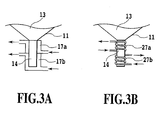
- FIG. 3A and 3B the cooling method of the seed crystal according to Example 2 of the present invention are shown.
- the cap 17 or the pipe 27 is divided vertically into two stages and the refrigerant is flowed through each of the divided cap 17a, 17borpipe27a, 27b independently.
- Local temperature distribution in the vicinity of the seed crystal 14 can be controlled at an appropriate distribution for growing crystals in detail by dividing the cap 17 or the pipe 27 in multiple.
- FIG. 4A and 4B the cooling method of the seed crystal according to Example 3 of the present invention are shown.
- Cross section of the cap 17 or the pipe 27 varies in size along path direction of refrigerant flow.
- the refrigerant flow which contributes to heat removal is changed depending on the local portion in the vicinity of the seed crystal 14.
- Local temperature distribution in the vicinity of the seed crystal 14 can be controlled at an appropriate distribution for growing crystals in detail by regulating the refrigerant flow rate.
- FIG. 5A and 5B the cooling method of the seed crystal according to Example 4 of the present invention are shown.
- resistance heating or high-frequency micro heater 18 is placed outside the portion of crucible 11 where the seed crystal 14 is placed. Cooling by the cap 17 or the pipe 27 and heating by the micro heater 18 enables the local temperature distribution in the vicinity of the seed crystal 14 to be controlled in detail.
- the pipe 27 is metal
- the pipe may be used as a heater which allows conduction directly and the temperature control may be performed by both cooling and heating.
- a temperature-measuring element is placed outside the portion of crucible 11 where the seed crystal 14 is placed, and the temperature of the seed crystal 14 is constantly measured during growing crystals. In this case, the seed crystal temperature maybe controlled by refrigerant flow rate and heating amount of the micro heater 18.
- the major components produced in the present embodiments are composed of oxide or carbonate of Ia and Vb groups in a periodic table
- the element of Ia group may be lithium and potassium
- the element of Vb group maybe at least one of niobium and tantalum.
- the major components are composed of oxide or carbonate of Ia and Vb groups in a periodic table
- the element of Ia group may be lithium and potassium
- the element of Vb group may be at least one of niobium and tantalum
- FIG. 6 a configuration of an apparatus for growing crystals by the Vertical Bridgman Method according to Example 1 of the present invention is shown.
- K(Ta, Nb)O 3 seed crystal 14 in direction of ⁇ 100 ⁇ is placed in a crucible 11 with a diameter of 2 inches.
- x' is larger than x of growing KTa x Nb 1-x O 3 and composition with high liquefying temperature is selected.
- the raw material of KTa x Nb 1-x O 3 is weighed to have natural raw material of K 2 CO 3 , Ta 2 O 5 , and Nb 2 O 5 in a desired relative proportion and the total of 1kg is filled in the crucible 11.
- the temperature of the crucible 11 filled with K (Ta, Nb) O 3 seed crystal 14 and a raw material 12 are raised by the heating element 16 and made into a K(Ta, Nb)O 3 raw material solution 12 by heating and dissolving the raw material 12.
- the cap 17 which is the cooling apparatus as shown in FIG. 2A is mounted directly outside the portion of crucible 11 where the seed crystal 14 is placed, and placed on a crucible support member 19. Water as a refrigerant is flowed through the hollow portion of the cap 17 and the flow is regulated to control axial temperature distribution in the vicinity of the seed crystal 14 locally.
- Soaking treatment is given for ten hours at a temperature of 100°C higher than the crystallization temperature of KTa x Nb 1-x O 3 .
- Water as a refrigerant is flowed through the cap 17 at this time.
- the flow rate is previously obtained experimentally and made to achieve a temperature gradient of 400°C /cm in the vicinity of the seed crystal 14.
- the heat rate of the heating element 16 is lowered and an axial temperature distribution 15 as shown in FIG. 6 is realized.
- amount of the water as a refrigerant flowing through the cap 17 is reduced to the amount that temperature gradient 5°C/cm previously obtained experimentally to grow crystals is realizable on the solid-liquid interface in the vicinity of the seed crystal 14.
- FIG. 7 an example of axial temperature distribution in the vicinity of the seed crystal is shown.
- Conventionally achieved axial temperature distribution is the axial temperature distribution 15.
- the portion where the seed crystal 14 is placed is locally cooled to make only the temperature gradient in the vicinity of the seed crystal 14 to 50°C/cm and the other furnace a temperature gradient is made to 5°C/cm.
- seeding process is performed under an optimal temperature condition for crystal growth on the solid-liquid interface by retaining only the temperature gradient of the seed crystal 14 same as that of the conventional temperature distribution 15.
- K(Ta, Nb)O 3 raw material solution 12 is crystallized from lower portion of the crucible 11 by using K (Ta, Nb)O 3 seed crystal 14 as a nuclei and crystal 13 is grown. After the crystal growth, power of the heating element 16 is regulated to slowly cool down to room temperature.
- KTa x Nb 1-x O 3 (0 ⁇ x ⁇ 1) crystal is produced by using the heat sink according to the Patent Document 3 for comparison.
- a cooling efficiency is not sufficient because the distance between the refrigerant flowing pipe and the seed crystal is about the same as the seed crystal diameter.
- a temperature gradient in the vicinity of the seed crystal of only up to 200°C/cm may be achieved.
- the refrigerant flow rate necessary to attain a temperature gradient in the vicinity of the seed crystal of 400°C/cm require for five times the case of Example 1 and not practical.
- the refrigerant rate to flow through the cooling pipe is increased to provide precipitous temperature gradient in the vicinity of the seed crystal, then, the entire heat sink is cooled and the liquefied raw material is cooled down.
- growth rate on the solid-liquid interface is unable to control accurately and a compositional striation due to the variation of growth rate occurs.
- the cap 17 which is the cooling apparatus is mounted directly to achieve a temperature gradient of 400°C/cm or more in the soaking treatment.
- independence of the crucible support member and the cooling apparatus enable to control the misalignment in temperature without cooling the liquefied materials.
- only the temperature gradient in the vicinity of the seed crystal 14 is made to 50°C/cm and the other furnace temperature gradient is made to 5°C/cm while local temperature distribution may be controlled to an appropriate distribution for growing crystals in detail.
- KTa x Nb 1-x O 3 (0 ⁇ x ⁇ 1) crystal is produced by using an apparatus for producing crystals with the Vertical Bridgman Method according to Example 1.
- K(Ta, Nb)O 3 seed crystal 14 in direction of ⁇ 100 ⁇ is placed in a crucible 11 with a diameter of 2 inches .
- x' is larger than x of growing KTa x Nb 1-x O 3 and composition with high liquefying temperature is selected.
- the raw material of KTa x Nb 1-x O 3 is weighed to have natural raw material of K 2 CO 3 , Ta 2 O 5 , and Nb 2 O 5 in a desired relative proportion and the total of 1kg is filled in the crucible 11.
- the temperature of K(Ta,Nb)O 3 seed crystal 14 and the crucible 11 filled with a raw material 12 are raised by the heating element 16 and made into a K(Ta, Nb) O 3 raw material solution 12 by heating and dissolving the raw material 12.
- the cap 17a and 17b which is the cooling apparatus as shown in FIG. 3A is mounted directly outside the portion of crucible 11 where the seed crystal 14 is placed, and placed on the crucible support member 19. Water as a refrigerant is flowed through the hollow portion of the cap 17a and 17b and regulate the flow to control axial temperature distribution in the vicinity of the seed crystal 14 locally.
- Soaking treatment is given for ten hours at a temperature of 100°C higher than the crystallization temperature of KTa x Nb 1-x O 3 .
- Water as a refrigerant is flowed through the cap 17 at this time.
- the flow rate is previously obtained experimentally and made to achieve a temperature gradient of 400°C/cm in the vicinity of the seed crystal 14 . Since the cap 17 is divided vertically into two stages, the maximum temperature gradient achieved during soaking treatment may be raised from 400°C/cm to 600°C/cm.
- the heat rate of the heating element 16 is lowered and an axial temperature distribution 15 as shown in FIG. 6 is realized.
- amount of the water as a refrigerant flowing through the cap 17 is reduced to the amount that a temperature gradient 5°C/cm previously obtained experimentally to grow crystals is realizable on the solid-liquid interface in the vicinity of the seed crystal 14.
- FIG. 8 an example of axial temperature distribution in the vicinity of the seed crystal is shown.
- Conventionally achieved axial temperature distribution is the axial temperature distribution 15.
- the portion where the seed crystal 14 is placed is locally cooled to make the temperature gradient in the vicinity of the seed crystal 14 to 50°C/cm at the lower portion, 25°C/cm at the upper portion, and the other furnace temperature gradient is made to 5°C/cm.
- seeding process is performed under an optimal temperature condition for crystal growth on the solid-liquid interface by retaining only the temperature gradient of the lower portion of the seed crystal 14 same as that of the conventional temperature distribution 15.
- K(Ta, Nb)O 3 raw material solution 12 is crystallized from lower portion of the crucible 11 by using K (Ta, Nb)O 3 seed crystal 14 as a nuclei and crystal 13 is grown. After the crystal growth, power of the heating element 16 is regulated to slowly cool down to room temperature.
- a temperature gradient in the vicinity of the seed crystal is conventionally about 200°C/cm while a temperature gradient of up to about 600°C /cmmay be achieved by Example 2.
- refrigerant flow necessary to achieve the same temperature gradient of 400°C/cm is seven times that of the present invention.
- the refrigerant flow necessary to achieve temperature gradient in the vicinity of the seed crystal of 600°C/cm is about seven times that of Example 2 and not practical.
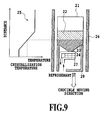
- FIG. 9 a configuration of an apparatus for growing crystals by the Vertical Bridgman Method according to Example 3 of the present invention is shown.
- K(Ta, Nb)O 3 seed crystal 24 in direction of ⁇ 100 ⁇ is placed in a crucible 21 with a diameter of 2 inches.
- x' is larger than x of growing KTa x Nb 1-x O 3 and composition with high liquefying temperature is selected.
- the raw material of KTa x Nb 1-x O 3 is weighed to have natural raw material of K 2 CO 3 , Ta 2 O 5 , and Nb 2 O 5 in a desired relative proportion and the total of 1kg is filled in the crucible 21.
- the temperature of the crucible 21 filled with K(Ta, Nb)O 3 seed crystal 24 and a raw material 22 are raised by the heating element 26 and made into a K(Ta, Nb)O 3 raw material solution 22 by heating and dissolving the raw material 22.
- the pipe 27 which is the cooling apparatus as shown in FIG. 2B is coiled directly outside the crucible where the seed crystal 14 is placed, and placed on the crucible support member 29. Water as a refrigerant is flowed through the pipe 27 and the flow and conducting heating amount are regulated to control axial temperature distribution in the vicinity of the seed crystal 24 locally.
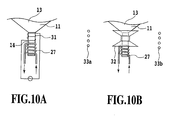
- FIG. 10 an example of a micro heater according to Example 3 is shown.
- the micro heater is necessary to be equipped with the following requirement.
- Requirement 1 The length of the heating area of the micro heater to be shorter than that of a seed crystal.
- Requirement 2 Preferably, the micro heater is placed near the top of the seed crystal and enabled to control a temperature gradient on the solid-liquid interface.
- Requirement 3 Reduce the volume of the micro heater and the heat capacity to obtain a rapid response to temperature control.
- Example 3 KTa x Nb 1-x O 3 (0 ⁇ x ⁇ 1) crystal is produced by using the micro heater with the following method.
- Method A As shown in FIG. 3B, Pt pipe 27 is divided vertically into two stages and a mechanism to apply a voltage is provided, i.e., the upper pipe 27a operate as a resistance heating method Pt heater.
- Method B Inner diameter is adjacent to the seed crystal and a coiled resistance heating method SiC heater 31 is provided as in the case of the pipe 27. (See FIG. 10A)
- Method C Inner diameter is adjacent to the seed crystal and a Pt resistance heating plate 32 having a sectional shape that can apply high-frequency efficiently, and a high-frequency heating method Pt heater having high-frequency generation coil 33a, 33b are provided. (See FIG.10B) .
- Soaking treatment is given for twenty hours at a temperature of 50°C higher than the crystallization temperature of KTa x Nb 1-x O 3 .
- Water as a refrigerant is flowed through the pipe 27 at this time and not conducted to themicroheater. The amount of flow is previously obtained experimentally and made to achieve a temperature gradient of 250°C/cm in the vicinity of the seed crystal.
- the heating rate of the heating element 26 is regulated to achieve the axial temperature distribution 25 as shown in FIG. 9.
- amount of the water as a refrigerant flowing through the pipe 27 is reduced to the amount that temperature gradient 3°C/cm previously obtained experimentally to grow crystals is realizable on the solid-liquid interface in the vicinity of the seed crystal 14.
- One of the micro heaters of Method A to C starts conducting heat concurrently at this time.
- Refrigerant flow rate of the pipe 27 and conducting rate of the micro heater are regulated to achieve the axial temperature distribution shown in FIG. 8.
- Conventionally achieved axial temperature distribution is the axial temperature distribution 15.
- the portion where the seed crystal 14 is placed is locally cooled to make a temperature gradient in the vicinity of the seed crystal 14 to 40°C/cm at the lower portion, 20°C/cm at the upper portion, and the other furnace temperature gradient is made to 3°C/cm.
- seeding process is performed under an optimal temperature condition on the solid-liquid interface by retaining only the temperature gradient of the lower portion of the seed crystal 14 same as that of conventional temperature distribution 15.
- K(Ta, Nb)O 3 raw material solution 22 is crystallized from lower portion of the crucible 21 by using K(Ta, Nb)O 3 seed crystal 24 as a nuclei and crystal 23 is grown. After the crystal growth, power of the heating element 26 is regulated to slowly cool down to the room temperature.
- the present embodiments have been shown for the cases applied to the Vertical Bridgman Method, but they can also be applied to the Vertical Gradient Freeze Method which is of basically same growing process, and to the Horizontal Bridgman Method as well as the horizontal gradient freeze method. Thus, the equivalent effects may be obtained by these methods.
Landscapes
- Chemical & Material Sciences (AREA)
- Engineering & Computer Science (AREA)
- Crystallography & Structural Chemistry (AREA)
- Materials Engineering (AREA)
- Metallurgy (AREA)
- Organic Chemistry (AREA)
- Inorganic Chemistry (AREA)
- Crystals, And After-Treatments Of Crystals (AREA)
Applications Claiming Priority (2)
| Application Number | Priority Date | Filing Date | Title |
|---|---|---|---|
| JP2004332067 | 2004-11-16 | ||
| PCT/JP2005/021055 WO2006054610A1 (fr) | 2004-11-16 | 2005-11-16 | Appareil pour la production de cristaux |
Publications (3)
| Publication Number | Publication Date |
|---|---|
| EP1813700A1 true EP1813700A1 (fr) | 2007-08-01 |
| EP1813700A4 EP1813700A4 (fr) | 2009-04-22 |
| EP1813700B1 EP1813700B1 (fr) | 2011-04-20 |
Family
ID=36407149
Family Applications (1)
| Application Number | Title | Priority Date | Filing Date |
|---|---|---|---|
| EP20050806692 Expired - Lifetime EP1813700B1 (fr) | 2004-11-16 | 2005-11-16 | Appareil pour la production de cristaux |
Country Status (7)
| Country | Link |
|---|---|
| US (1) | US8992683B2 (fr) |
| EP (1) | EP1813700B1 (fr) |
| JP (3) | JP4351249B2 (fr) |
| KR (1) | KR100850786B1 (fr) |
| CN (1) | CN100510199C (fr) |
| DE (1) | DE602005027597D1 (fr) |
| WO (1) | WO2006054610A1 (fr) |
Families Citing this family (18)
| Publication number | Priority date | Publication date | Assignee | Title |
|---|---|---|---|---|
| EP1813700B1 (fr) * | 2004-11-16 | 2011-04-20 | Nippon Telegraph And Telephone Corporation | Appareil pour la production de cristaux |
| JP4579122B2 (ja) * | 2005-10-06 | 2010-11-10 | 日本電信電話株式会社 | 酸化物単結晶の製造方法およびその製造装置 |
| US20100101387A1 (en) * | 2008-10-24 | 2010-04-29 | Kedar Prasad Gupta | Crystal growing system and method thereof |
| JP4888548B2 (ja) * | 2009-12-24 | 2012-02-29 | 株式会社デンソー | 炭化珪素単結晶の製造装置および製造方法 |
| KR101292703B1 (ko) * | 2011-08-30 | 2013-08-02 | 주식회사 엔티에스 | 단결정 성장장치 |
| US9206525B2 (en) * | 2011-11-30 | 2015-12-08 | General Electric Company | Method for configuring a system to grow a crystal by coupling a heat transfer device comprising at least one elongate member beneath a crucible |
| CN103374746A (zh) * | 2012-04-27 | 2013-10-30 | 比亚迪股份有限公司 | 一种用于制作准单晶硅的装置及一种准单晶硅的制作方法 |
| JP5968198B2 (ja) * | 2012-11-08 | 2016-08-10 | 国立大学法人東北大学 | 単結晶の製造方法 |
| CN104109901A (zh) * | 2013-04-17 | 2014-10-22 | 北京滨松光子技术股份有限公司 | 水冷杆及使用该水冷杆的晶体生长炉 |
| JP6053018B2 (ja) * | 2013-04-30 | 2016-12-27 | 日本電信電話株式会社 | 結晶成長方法 |
| KR102138121B1 (ko) * | 2013-11-07 | 2020-07-27 | 에스케이실트론 주식회사 | 실리콘 단결정 잉곳 제조 장치 및 제조 방법 |
| JP2018048043A (ja) * | 2016-09-21 | 2018-03-29 | 国立大学法人信州大学 | タンタル酸リチウム結晶の製造装置およびタンタル酸リチウム結晶の製造方法 |
| JP2018080097A (ja) * | 2016-11-18 | 2018-05-24 | 住友金属鉱山株式会社 | 単結晶製造装置及び単結晶製造方法 |
| JP2018080098A (ja) * | 2016-11-18 | 2018-05-24 | 住友金属鉱山株式会社 | 単結晶製造装置及び単結晶製造方法 |
| US10991617B2 (en) * | 2018-05-15 | 2021-04-27 | Applied Materials, Inc. | Methods and apparatus for cleaving of semiconductor substrates |
| CN108893776B (zh) * | 2018-07-24 | 2024-10-25 | 南京同溧晶体材料研究院有限公司 | 温度梯度法生长稀土倍半氧化物晶体的热场装置及生长稀土倍半氧化物晶体的温度梯度方法 |
| JP6737406B2 (ja) * | 2018-08-07 | 2020-08-05 | 住友電気工業株式会社 | リン化インジウム単結晶体およびリン化インジウム単結晶基板 |
| CN115216831B (zh) * | 2022-07-15 | 2024-11-15 | 中国电子科技集团公司第十三研究所 | 一种可控温度梯度的晶体生长装置及方法 |
Family Cites Families (19)
| Publication number | Priority date | Publication date | Assignee | Title |
|---|---|---|---|---|
| US3857436A (en) * | 1973-02-13 | 1974-12-31 | D Petrov | Method and apparatus for manufacturing monocrystalline articles |
| US3898051A (en) * | 1973-12-28 | 1975-08-05 | Crystal Syst | Crystal growing |
| US4049384A (en) * | 1975-04-14 | 1977-09-20 | Arthur D. Little, Inc. | Cold crucible system |
| US4015657A (en) * | 1975-09-03 | 1977-04-05 | Dmitry Andreevich Petrov | Device for making single-crystal products |
| JPS5815472B2 (ja) * | 1980-12-09 | 1983-03-25 | 科学技術庁無機材質研究所長 | 結晶育成装置 |
| US4521272A (en) * | 1981-01-05 | 1985-06-04 | At&T Technologies, Inc. | Method for forming and growing a single crystal of a semiconductor compound |
| US4404172A (en) * | 1981-01-05 | 1983-09-13 | Western Electric Company, Inc. | Method and apparatus for forming and growing a single crystal of a semiconductor compound |
| JPS6046078B2 (ja) * | 1982-12-06 | 1985-10-14 | 科学技術庁無機材質研究所長 | 無機複合酸化物の固溶体組成物の単結晶育成法 |
| JPH05194073A (ja) * | 1991-06-07 | 1993-08-03 | Furukawa Electric Co Ltd:The | 化合物半導体の単結晶成長方法 |
| US5342475A (en) * | 1991-06-07 | 1994-08-30 | The Furukawa Electric Co., Ltd. | Method of growing single crystal of compound semiconductor |
| JP2850581B2 (ja) * | 1991-07-18 | 1999-01-27 | 日立電線株式会社 | 半導体結晶の製造方法およびその装置 |
| JPH06247787A (ja) * | 1993-02-25 | 1994-09-06 | Furukawa Electric Co Ltd:The | 縦型容器による単結晶の製造方法及びその製造装置 |
| DE19503357A1 (de) * | 1995-02-02 | 1996-08-08 | Wacker Siltronic Halbleitermat | Vorrichtung zur Herstellung eines Einkristalls |
| JP4195738B2 (ja) * | 1998-04-08 | 2008-12-10 | Sumco Techxiv株式会社 | 単結晶製造装置 |
| JP3685026B2 (ja) * | 2000-09-26 | 2005-08-17 | 三菱住友シリコン株式会社 | 結晶成長装置 |
| UA81614C2 (ru) * | 2001-11-07 | 2008-01-25 | Карнеги Инститьюшн Ов Вашингтон | Устройство для изготовления алмазов, узел удержания образца (варианты) и способ изготовления алмазов (варианты) |
| US6942733B2 (en) * | 2003-06-19 | 2005-09-13 | Memc Electronics Materials, Inc. | Fluid sealing system for a crystal puller |
| JP2005015264A (ja) * | 2003-06-25 | 2005-01-20 | Canon Inc | 結晶製造装置及び方法 |
| EP1813700B1 (fr) * | 2004-11-16 | 2011-04-20 | Nippon Telegraph And Telephone Corporation | Appareil pour la production de cristaux |
-
2005
- 2005-11-16 EP EP20050806692 patent/EP1813700B1/fr not_active Expired - Lifetime
- 2005-11-16 US US10/589,719 patent/US8992683B2/en active Active
- 2005-11-16 DE DE200560027597 patent/DE602005027597D1/de not_active Expired - Lifetime
- 2005-11-16 WO PCT/JP2005/021055 patent/WO2006054610A1/fr not_active Ceased
- 2005-11-16 JP JP2006515495A patent/JP4351249B2/ja not_active Expired - Lifetime
- 2005-11-16 KR KR20067016742A patent/KR100850786B1/ko not_active Expired - Lifetime
- 2005-11-16 CN CNB2005800055291A patent/CN100510199C/zh not_active Expired - Lifetime
-
2009
- 2009-05-25 JP JP2009125875A patent/JP5117441B2/ja not_active Expired - Fee Related
- 2009-05-25 JP JP2009125874A patent/JP5075873B2/ja not_active Expired - Fee Related
Also Published As
| Publication number | Publication date |
|---|---|
| JP5117441B2 (ja) | 2013-01-16 |
| EP1813700B1 (fr) | 2011-04-20 |
| JPWO2006054610A1 (ja) | 2008-05-29 |
| KR20070044389A (ko) | 2007-04-27 |
| US20070209579A1 (en) | 2007-09-13 |
| KR100850786B1 (ko) | 2008-08-06 |
| CN1930328A (zh) | 2007-03-14 |
| JP5075873B2 (ja) | 2012-11-21 |
| US8992683B2 (en) | 2015-03-31 |
| WO2006054610A1 (fr) | 2006-05-26 |
| JP2009221100A (ja) | 2009-10-01 |
| EP1813700A4 (fr) | 2009-04-22 |
| JP2009221101A (ja) | 2009-10-01 |
| CN100510199C (zh) | 2009-07-08 |
| DE602005027597D1 (de) | 2011-06-01 |
| JP4351249B2 (ja) | 2009-10-28 |
Similar Documents
| Publication | Publication Date | Title |
|---|---|---|
| EP1813700B1 (fr) | Appareil pour la production de cristaux | |
| US20170183792A1 (en) | Apparatus for forming single crystal sapphire | |
| CN101962798B (zh) | 用于生产蓝宝石单晶的方法和设备 | |
| RU2543882C2 (ru) | Устройство для выращивания монокристалла сапфира | |
| JP5434801B2 (ja) | SiC単結晶の製造方法 | |
| KR20180120076A (ko) | SiC 단결정의 제조 방법 및 제조 장치 | |
| JP4453348B2 (ja) | 炭化珪素単結晶の製造方法 | |
| KR20120070080A (ko) | 단결정 사파이어 잉곳 성장장치 | |
| JP4810346B2 (ja) | サファイア単結晶の製造方法 | |
| US7591895B2 (en) | Method and apparatus for producing crystals | |
| JP2008508187A (ja) | 溶融物から単結晶を成長させる方法 | |
| KR101934189B1 (ko) | SiC 단결정 및 그 제조 방법 | |
| JP4579122B2 (ja) | 酸化物単結晶の製造方法およびその製造装置 | |
| JP4146835B2 (ja) | 結晶成長方法 | |
| JP2004315292A (ja) | 単結晶製造用黒鉛ヒーター及び単結晶製造装置ならびに単結晶製造方法 | |
| JP2014156373A (ja) | サファイア単結晶の製造装置 | |
| JP2007131469A (ja) | ニオブ酸カリウム単結晶の製造方法および製造装置 | |
| JP2006143516A (ja) | 結晶製造装置 | |
| JP2006143489A (ja) | 結晶成長装置およびその方法 |
Legal Events
| Date | Code | Title | Description |
|---|---|---|---|
| PUAI | Public reference made under article 153(3) epc to a published international application that has entered the european phase |
Free format text: ORIGINAL CODE: 0009012 |
|
| 17P | Request for examination filed |
Effective date: 20060821 |
|
| AK | Designated contracting states |
Kind code of ref document: A1 Designated state(s): DE FR GB IT |
|
| RBV | Designated contracting states (corrected) |
Designated state(s): DE FR GB IT |
|
| DAX | Request for extension of the european patent (deleted) | ||
| RBV | Designated contracting states (corrected) |
Designated state(s): DE FR GB IT |
|
| A4 | Supplementary search report drawn up and despatched |
Effective date: 20090324 |
|
| GRAP | Despatch of communication of intention to grant a patent |
Free format text: ORIGINAL CODE: EPIDOSNIGR1 |
|
| GRAS | Grant fee paid |
Free format text: ORIGINAL CODE: EPIDOSNIGR3 |
|
| GRAA | (expected) grant |
Free format text: ORIGINAL CODE: 0009210 |
|
| AK | Designated contracting states |
Kind code of ref document: B1 Designated state(s): DE FR GB IT |
|
| REG | Reference to a national code |
Ref country code: GB Ref legal event code: FG4D |
|
| REF | Corresponds to: |
Ref document number: 602005027597 Country of ref document: DE Date of ref document: 20110601 Kind code of ref document: P |
|
| REG | Reference to a national code |
Ref country code: DE Ref legal event code: R096 Ref document number: 602005027597 Country of ref document: DE Effective date: 20110601 |
|
| PLBE | No opposition filed within time limit |
Free format text: ORIGINAL CODE: 0009261 |
|
| STAA | Information on the status of an ep patent application or granted ep patent |
Free format text: STATUS: NO OPPOSITION FILED WITHIN TIME LIMIT |
|
| 26N | No opposition filed |
Effective date: 20120123 |
|
| REG | Reference to a national code |
Ref country code: DE Ref legal event code: R097 Ref document number: 602005027597 Country of ref document: DE Effective date: 20120123 |
|
| REG | Reference to a national code |
Ref country code: FR Ref legal event code: PLFP Year of fee payment: 11 |
|
| REG | Reference to a national code |
Ref country code: FR Ref legal event code: PLFP Year of fee payment: 12 |
|
| REG | Reference to a national code |
Ref country code: FR Ref legal event code: PLFP Year of fee payment: 13 |
|
| PGFP | Annual fee paid to national office [announced via postgrant information from national office to epo] |
Ref country code: DE Payment date: 20241121 Year of fee payment: 20 |
|
| PGFP | Annual fee paid to national office [announced via postgrant information from national office to epo] |
Ref country code: GB Payment date: 20241120 Year of fee payment: 20 |
|
| PGFP | Annual fee paid to national office [announced via postgrant information from national office to epo] |
Ref country code: FR Payment date: 20241128 Year of fee payment: 20 |
|
| PGFP | Annual fee paid to national office [announced via postgrant information from national office to epo] |
Ref country code: IT Payment date: 20241126 Year of fee payment: 20 |
|
| REG | Reference to a national code |
Ref country code: DE Ref legal event code: R071 Ref document number: 602005027597 Country of ref document: DE |
|
| REG | Reference to a national code |
Ref country code: GB Ref legal event code: PE20 Expiry date: 20251115 |