EP1815274B1 - Copolymerisierbare methin- und anthrachinon-verbindungen und artikel damit - Google Patents
Copolymerisierbare methin- und anthrachinon-verbindungen und artikel damit Download PDFInfo
- Publication number
- EP1815274B1 EP1815274B1 EP05825349A EP05825349A EP1815274B1 EP 1815274 B1 EP1815274 B1 EP 1815274B1 EP 05825349 A EP05825349 A EP 05825349A EP 05825349 A EP05825349 A EP 05825349A EP 1815274 B1 EP1815274 B1 EP 1815274B1
- Authority
- EP
- European Patent Office
- Prior art keywords
- alkyl
- hydrogen
- chr
- aryl
- formula
- Prior art date
- Legal status (The legal status is an assumption and is not a legal conclusion. Google has not performed a legal analysis and makes no representation as to the accuracy of the status listed.)
- Expired - Lifetime
Links
- 0 CC(*)(C=C(C=C(C)C)C=C1)C=C1N(C)C Chemical compound CC(*)(C=C(C=C(C)C)C=C1)C=C1N(C)C 0.000 description 6
- ANGDWNBGPBMQHW-UHFFFAOYSA-N COC(CC#N)=O Chemical compound COC(CC#N)=O ANGDWNBGPBMQHW-UHFFFAOYSA-N 0.000 description 2
- OGAAUSSMBNPGIJ-UHFFFAOYSA-N CC(C(OCC1CCC(CNC(C)=O)CC1)=O)=C Chemical compound CC(C(OCC1CCC(CNC(C)=O)CC1)=O)=C OGAAUSSMBNPGIJ-UHFFFAOYSA-N 0.000 description 1
- ARJXBWSYUWDRCK-UHFFFAOYSA-N CC(CNC(C)=[O]=C)OC(NC(C)(C)C)=O Chemical compound CC(CNC(C)=[O]=C)OC(NC(C)(C)C)=O ARJXBWSYUWDRCK-UHFFFAOYSA-N 0.000 description 1
- HURUMLZSCDJWQK-UHFFFAOYSA-N CC(CNC(CC#N)=O)O Chemical compound CC(CNC(CC#N)=O)O HURUMLZSCDJWQK-UHFFFAOYSA-N 0.000 description 1
- SBJNELORYXIGSI-UHFFFAOYSA-N CC(CNC(c1ccc(C)cc1)=O)OC(C(C)=C)=O Chemical compound CC(CNC(c1ccc(C)cc1)=O)OC(C(C)=C)=O SBJNELORYXIGSI-UHFFFAOYSA-N 0.000 description 1
- FSCAEMWIILOKLC-UHFFFAOYSA-N CCCC(C(CC1)=O)C1=O Chemical compound CCCC(C(CC1)=O)C1=O FSCAEMWIILOKLC-UHFFFAOYSA-N 0.000 description 1
- PEUAYWBFWSCPHA-UHFFFAOYSA-N COc(cccc1C(c(c2ccc3)c3OC)=O)c1C2=O Chemical compound COc(cccc1C(c(c2ccc3)c3OC)=O)c1C2=O PEUAYWBFWSCPHA-UHFFFAOYSA-N 0.000 description 1
- JBFRGXRQXZOZTA-UHFFFAOYSA-N N#CCC(NCCO)=O Chemical compound N#CCC(NCCO)=O JBFRGXRQXZOZTA-UHFFFAOYSA-N 0.000 description 1
- QBPFLULOKWLNNW-UHFFFAOYSA-N Oc(cccc1C(c2c3c(O)ccc2)=O)c1C3=O Chemical compound Oc(cccc1C(c2c3c(O)ccc2)=O)c1C3=O QBPFLULOKWLNNW-UHFFFAOYSA-N 0.000 description 1
Classifications
-
- C—CHEMISTRY; METALLURGY
- C07—ORGANIC CHEMISTRY
- C07C—ACYCLIC OR CARBOCYCLIC COMPOUNDS
- C07C255/00—Carboxylic acid nitriles
- C07C255/01—Carboxylic acid nitriles having cyano groups bound to acyclic carbon atoms
- C07C255/32—Carboxylic acid nitriles having cyano groups bound to acyclic carbon atoms having cyano groups bound to acyclic carbon atoms of a carbon skeleton containing at least one six-membered aromatic ring
- C07C255/42—Carboxylic acid nitriles having cyano groups bound to acyclic carbon atoms having cyano groups bound to acyclic carbon atoms of a carbon skeleton containing at least one six-membered aromatic ring the carbon skeleton being further substituted by singly-bound nitrogen atoms, not being further bound to other hetero atoms
- C07C255/44—Carboxylic acid nitriles having cyano groups bound to acyclic carbon atoms having cyano groups bound to acyclic carbon atoms of a carbon skeleton containing at least one six-membered aromatic ring the carbon skeleton being further substituted by singly-bound nitrogen atoms, not being further bound to other hetero atoms at least one of the singly-bound nitrogen atoms being acylated
-
- A—HUMAN NECESSITIES
- A61—MEDICAL OR VETERINARY SCIENCE; HYGIENE
- A61L—METHODS OR APPARATUS FOR STERILISING MATERIALS OR OBJECTS IN GENERAL; DISINFECTION, STERILISATION OR DEODORISATION OF AIR; CHEMICAL ASPECTS OF BANDAGES, DRESSINGS, ABSORBENT PADS OR SURGICAL ARTICLES; MATERIALS FOR BANDAGES, DRESSINGS, ABSORBENT PADS OR SURGICAL ARTICLES
- A61L27/00—Materials for grafts or prostheses or for coating grafts or prostheses
- A61L27/14—Macromolecular materials
-
- C—CHEMISTRY; METALLURGY
- C07—ORGANIC CHEMISTRY
- C07C—ACYCLIC OR CARBOCYCLIC COMPOUNDS
- C07C233/00—Carboxylic acid amides
- C07C233/01—Carboxylic acid amides having carbon atoms of carboxamide groups bound to hydrogen atoms or to acyclic carbon atoms
- C07C233/45—Carboxylic acid amides having carbon atoms of carboxamide groups bound to hydrogen atoms or to acyclic carbon atoms having the nitrogen atom of at least one of the carboxamide groups bound to a carbon atom of a hydrocarbon radical substituted by carboxyl groups
- C07C233/53—Carboxylic acid amides having carbon atoms of carboxamide groups bound to hydrogen atoms or to acyclic carbon atoms having the nitrogen atom of at least one of the carboxamide groups bound to a carbon atom of a hydrocarbon radical substituted by carboxyl groups with the substituted hydrocarbon radical bound to the nitrogen atom of the carboxamide group by a carbon atom of a six-membered aromatic ring
- C07C233/55—Carboxylic acid amides having carbon atoms of carboxamide groups bound to hydrogen atoms or to acyclic carbon atoms having the nitrogen atom of at least one of the carboxamide groups bound to a carbon atom of a hydrocarbon radical substituted by carboxyl groups with the substituted hydrocarbon radical bound to the nitrogen atom of the carboxamide group by a carbon atom of a six-membered aromatic ring having the carbon atom of the carboxamide group bound to a carbon atom of an unsaturated carbon skeleton
-
- C—CHEMISTRY; METALLURGY
- C07—ORGANIC CHEMISTRY
- C07C—ACYCLIC OR CARBOCYCLIC COMPOUNDS
- C07C235/00—Carboxylic acid amides, the carbon skeleton of the acid part being further substituted by oxygen atoms
- C07C235/02—Carboxylic acid amides, the carbon skeleton of the acid part being further substituted by oxygen atoms having carbon atoms of carboxamide groups bound to acyclic carbon atoms and singly-bound oxygen atoms bound to the same carbon skeleton
- C07C235/32—Carboxylic acid amides, the carbon skeleton of the acid part being further substituted by oxygen atoms having carbon atoms of carboxamide groups bound to acyclic carbon atoms and singly-bound oxygen atoms bound to the same carbon skeleton the carbon skeleton containing six-membered aromatic rings
- C07C235/34—Carboxylic acid amides, the carbon skeleton of the acid part being further substituted by oxygen atoms having carbon atoms of carboxamide groups bound to acyclic carbon atoms and singly-bound oxygen atoms bound to the same carbon skeleton the carbon skeleton containing six-membered aromatic rings having the nitrogen atoms of the carboxamide groups bound to hydrogen atoms or to acyclic carbon atoms
-
- C—CHEMISTRY; METALLURGY
- C07—ORGANIC CHEMISTRY
- C07C—ACYCLIC OR CARBOCYCLIC COMPOUNDS
- C07C237/00—Carboxylic acid amides, the carbon skeleton of the acid part being further substituted by amino groups
- C07C237/02—Carboxylic acid amides, the carbon skeleton of the acid part being further substituted by amino groups having the carbon atoms of the carboxamide groups bound to acyclic carbon atoms of the carbon skeleton
- C07C237/04—Carboxylic acid amides, the carbon skeleton of the acid part being further substituted by amino groups having the carbon atoms of the carboxamide groups bound to acyclic carbon atoms of the carbon skeleton the carbon skeleton being acyclic and saturated
- C07C237/06—Carboxylic acid amides, the carbon skeleton of the acid part being further substituted by amino groups having the carbon atoms of the carboxamide groups bound to acyclic carbon atoms of the carbon skeleton the carbon skeleton being acyclic and saturated having the nitrogen atoms of the carboxamide groups bound to hydrogen atoms or to acyclic carbon atoms
-
- C—CHEMISTRY; METALLURGY
- C07—ORGANIC CHEMISTRY
- C07C—ACYCLIC OR CARBOCYCLIC COMPOUNDS
- C07C237/00—Carboxylic acid amides, the carbon skeleton of the acid part being further substituted by amino groups
- C07C237/02—Carboxylic acid amides, the carbon skeleton of the acid part being further substituted by amino groups having the carbon atoms of the carboxamide groups bound to acyclic carbon atoms of the carbon skeleton
- C07C237/20—Carboxylic acid amides, the carbon skeleton of the acid part being further substituted by amino groups having the carbon atoms of the carboxamide groups bound to acyclic carbon atoms of the carbon skeleton the carbon skeleton containing six-membered aromatic rings
-
- C—CHEMISTRY; METALLURGY
- C07—ORGANIC CHEMISTRY
- C07C—ACYCLIC OR CARBOCYCLIC COMPOUNDS
- C07C255/00—Carboxylic acid nitriles
- C07C255/01—Carboxylic acid nitriles having cyano groups bound to acyclic carbon atoms
- C07C255/32—Carboxylic acid nitriles having cyano groups bound to acyclic carbon atoms having cyano groups bound to acyclic carbon atoms of a carbon skeleton containing at least one six-membered aromatic ring
- C07C255/41—Carboxylic acid nitriles having cyano groups bound to acyclic carbon atoms having cyano groups bound to acyclic carbon atoms of a carbon skeleton containing at least one six-membered aromatic ring the carbon skeleton being further substituted by carboxyl groups, other than cyano groups
-
- C—CHEMISTRY; METALLURGY
- C07—ORGANIC CHEMISTRY
- C07C—ACYCLIC OR CARBOCYCLIC COMPOUNDS
- C07C255/00—Carboxylic acid nitriles
- C07C255/01—Carboxylic acid nitriles having cyano groups bound to acyclic carbon atoms
- C07C255/32—Carboxylic acid nitriles having cyano groups bound to acyclic carbon atoms having cyano groups bound to acyclic carbon atoms of a carbon skeleton containing at least one six-membered aromatic ring
- C07C255/42—Carboxylic acid nitriles having cyano groups bound to acyclic carbon atoms having cyano groups bound to acyclic carbon atoms of a carbon skeleton containing at least one six-membered aromatic ring the carbon skeleton being further substituted by singly-bound nitrogen atoms, not being further bound to other hetero atoms
-
- C—CHEMISTRY; METALLURGY
- C07—ORGANIC CHEMISTRY
- C07C—ACYCLIC OR CARBOCYCLIC COMPOUNDS
- C07C271/00—Derivatives of carbamic acids, i.e. compounds containing any of the groups, the nitrogen atom not being part of nitro or nitroso groups
- C07C271/06—Esters of carbamic acids
- C07C271/08—Esters of carbamic acids having oxygen atoms of carbamate groups bound to acyclic carbon atoms
- C07C271/10—Esters of carbamic acids having oxygen atoms of carbamate groups bound to acyclic carbon atoms with the nitrogen atoms of the carbamate groups bound to hydrogen atoms or to acyclic carbon atoms
- C07C271/12—Esters of carbamic acids having oxygen atoms of carbamate groups bound to acyclic carbon atoms with the nitrogen atoms of the carbamate groups bound to hydrogen atoms or to acyclic carbon atoms to hydrogen atoms or to carbon atoms of unsubstituted hydrocarbon radicals
-
- C—CHEMISTRY; METALLURGY
- C07—ORGANIC CHEMISTRY
- C07D—HETEROCYCLIC COMPOUNDS
- C07D207/00—Heterocyclic compounds containing five-membered rings not condensed with other rings, with one nitrogen atom as the only ring hetero atom
- C07D207/02—Heterocyclic compounds containing five-membered rings not condensed with other rings, with one nitrogen atom as the only ring hetero atom with only hydrogen or carbon atoms directly attached to the ring nitrogen atom
- C07D207/30—Heterocyclic compounds containing five-membered rings not condensed with other rings, with one nitrogen atom as the only ring hetero atom with only hydrogen or carbon atoms directly attached to the ring nitrogen atom having two double bonds between ring members or between ring members and non-ring members
- C07D207/34—Heterocyclic compounds containing five-membered rings not condensed with other rings, with one nitrogen atom as the only ring hetero atom with only hydrogen or carbon atoms directly attached to the ring nitrogen atom having two double bonds between ring members or between ring members and non-ring members with hetero atoms or with carbon atoms having three bonds to hetero atoms with at the most one bond to halogen, e.g. ester or nitrile radicals, directly attached to ring carbon atoms
- C07D207/36—Oxygen or sulfur atoms
- C07D207/40—2,5-Pyrrolidine-diones
- C07D207/404—2,5-Pyrrolidine-diones with only hydrogen atoms or radicals containing only hydrogen and carbon atoms directly attached to other ring carbon atoms, e.g. succinimide
- C07D207/408—Radicals containing only hydrogen and carbon atoms attached to ring carbon atoms
-
- C—CHEMISTRY; METALLURGY
- C07—ORGANIC CHEMISTRY
- C07D—HETEROCYCLIC COMPOUNDS
- C07D209/00—Heterocyclic compounds containing five-membered rings, condensed with other rings, with one nitrogen atom as the only ring hetero atom
- C07D209/02—Heterocyclic compounds containing five-membered rings, condensed with other rings, with one nitrogen atom as the only ring hetero atom condensed with one carbocyclic ring
- C07D209/44—Iso-indoles; Hydrogenated iso-indoles
- C07D209/48—Iso-indoles; Hydrogenated iso-indoles with oxygen atoms in positions 1 and 3, e.g. phthalimide
-
- C—CHEMISTRY; METALLURGY
- C07—ORGANIC CHEMISTRY
- C07D—HETEROCYCLIC COMPOUNDS
- C07D263/00—Heterocyclic compounds containing 1,3-oxazole or hydrogenated 1,3-oxazole rings
- C07D263/52—Heterocyclic compounds containing 1,3-oxazole or hydrogenated 1,3-oxazole rings condensed with carbocyclic rings or ring systems
- C07D263/54—Benzoxazoles; Hydrogenated benzoxazoles
- C07D263/56—Benzoxazoles; Hydrogenated benzoxazoles with only hydrogen atoms, hydrocarbon or substituted hydrocarbon radicals, directly attached in position 2
-
- C—CHEMISTRY; METALLURGY
- C07—ORGANIC CHEMISTRY
- C07D—HETEROCYCLIC COMPOUNDS
- C07D295/00—Heterocyclic compounds containing polymethylene-imine rings with at least five ring members, 3-azabicyclo [3.2.2] nonane, piperazine, morpholine or thiomorpholine rings, having only hydrogen atoms directly attached to the ring carbon atoms
- C07D295/04—Heterocyclic compounds containing polymethylene-imine rings with at least five ring members, 3-azabicyclo [3.2.2] nonane, piperazine, morpholine or thiomorpholine rings, having only hydrogen atoms directly attached to the ring carbon atoms with substituted hydrocarbon radicals attached to ring nitrogen atoms
- C07D295/14—Heterocyclic compounds containing polymethylene-imine rings with at least five ring members, 3-azabicyclo [3.2.2] nonane, piperazine, morpholine or thiomorpholine rings, having only hydrogen atoms directly attached to the ring carbon atoms with substituted hydrocarbon radicals attached to ring nitrogen atoms substituted by carbon atoms having three bonds to hetero atoms with at the most one bond to halogen, e.g. ester or nitrile radicals
- C07D295/155—Heterocyclic compounds containing polymethylene-imine rings with at least five ring members, 3-azabicyclo [3.2.2] nonane, piperazine, morpholine or thiomorpholine rings, having only hydrogen atoms directly attached to the ring carbon atoms with substituted hydrocarbon radicals attached to ring nitrogen atoms substituted by carbon atoms having three bonds to hetero atoms with at the most one bond to halogen, e.g. ester or nitrile radicals with the ring nitrogen atoms and the carbon atoms with three bonds to hetero atoms separated by carbocyclic rings or by carbon chains interrupted by carbocyclic rings
-
- C—CHEMISTRY; METALLURGY
- C07—ORGANIC CHEMISTRY
- C07D—HETEROCYCLIC COMPOUNDS
- C07D307/00—Heterocyclic compounds containing five-membered rings having one oxygen atom as the only ring hetero atom
- C07D307/02—Heterocyclic compounds containing five-membered rings having one oxygen atom as the only ring hetero atom not condensed with other rings
- C07D307/04—Heterocyclic compounds containing five-membered rings having one oxygen atom as the only ring hetero atom not condensed with other rings having no double bonds between ring members or between ring members and non-ring members
- C07D307/10—Heterocyclic compounds containing five-membered rings having one oxygen atom as the only ring hetero atom not condensed with other rings having no double bonds between ring members or between ring members and non-ring members with substituted hydrocarbon radicals attached to ring carbon atoms
- C07D307/16—Radicals substituted by carbon atoms having three bonds to hetero atoms with at the most one bond to halogen, e.g. ester or nitrile radicals
-
- G—PHYSICS
- G02—OPTICS
- G02B—OPTICAL ELEMENTS, SYSTEMS OR APPARATUS
- G02B1/00—Optical elements characterised by the material of which they are made; Optical coatings for optical elements
- G02B1/04—Optical elements characterised by the material of which they are made; Optical coatings for optical elements made of organic materials, e.g. plastics
- G02B1/041—Lenses
-
- A—HUMAN NECESSITIES
- A61—MEDICAL OR VETERINARY SCIENCE; HYGIENE
- A61L—METHODS OR APPARATUS FOR STERILISING MATERIALS OR OBJECTS IN GENERAL; DISINFECTION, STERILISATION OR DEODORISATION OF AIR; CHEMICAL ASPECTS OF BANDAGES, DRESSINGS, ABSORBENT PADS OR SURGICAL ARTICLES; MATERIALS FOR BANDAGES, DRESSINGS, ABSORBENT PADS OR SURGICAL ARTICLES
- A61L2430/00—Materials or treatment for tissue regeneration
- A61L2430/16—Materials or treatment for tissue regeneration for reconstruction of eye parts, e.g. intraocular lens, cornea
Definitions
- This invention relates to polymerizable ultraviolet light absorbers, yellow colorants and their use in ophthalmic lenses.
- this invention relates to polymerizable ultraviolet light absorbing methine compounds and polymerizable yellow compounds of the methine and anthraquinone classes that block ultraviolet light and/or violet-blue light transmission through ophthalmic lenses.
- UV ultraviolet
- IR infrared
- Solar radiation that is transmitted through the atmosphere and reaches the earth's surface includes UV-A radiation (320-400 nm), UV-B radiation (290-320 nm), visible light (400-700 nm) and near IR radiation (700-1400 nm).
- UV-A radiation 320-400 nm
- UV-B radiation 290-320 nm
- visible light 400-700 nm
- near IR radiation 700-1400 nm.
- the ocular lens of humans in its normal, healthy state freely transmits near IR and most of the visible spectrum to the retina, but the lens acts to absorb UV radiation to avoid damage to the retina.
- the ability to absorb near UV and the violet-blue portion of the visible spectrum changes throughout life.
- the human lens will freely transmit near UV and visible light above 300 nm, but with further aging the action of UV radiation from the environment causes the production of yellow colorants, fluorogens, within the lens.
- Some studies indicate that by age 54 the lens will not transmit light below 400 nm and the transmission of light between 400 and 450 nm is greatly diminished. As the lens ages it continuously develops a yellow color, increasing its capacity to filter out near UV and violet-blue light. Therefore, after cataract removal the natural protection provided by the aged human lens is also removed. Cataracts are typically replaced by an intraocular lens (IOL). If the brain is stimulated by signals caused by the visible light that has not been transmitted for many years, discomfort can result. Development of IOL materials with an absorption similar to aged human lens material would be a welcome improvement to the art.
- IOL intraocular lens
- JP-07-258166 discloses a compound capable of providing a polymer having a strong absorption in the UV-B region, excellent in persistence of antisuntan effects, having high safety and useful as a chemically stable polymeric UV rays absorber.
- the compound is obtained by reacting a (substituted) p-hydroxybenzaldehyde with a monohalogen-substituted compound, reacting the resultant ether compound with a malonic acid diester, obtaining a benzylidenemalonic acid ester and then esterifying the prepared compound with an acid chloride.
- the invention solves the problems in the prior art by providing molecules that contain methine chromophores and/or anthraquinone chromophores and ethylenically-unsaturated polymerizable groups.
- These chromophores are present as structures that include at least one of the following moieties: wherein X is selected from hydrogen or one or two groups selected from hydroxy, C 1 -C 6 alkyl, C 1 -C 6 alkoxy and halogen.
- the molecules of the present invention contain these moieties as well as at least one ethylenically-unsaturated polymerizable group that is capable of undergoing free radical polymerization without destroying the moiety.
- the resulting molecule contains at least one polymerizable ethylenically unsaturated group in addition to the ethylenically unsaturated group(s) depicted. It is to be understood that these moieties are only portions of the molecules and that the molecules contain additional moieties.
- the molecule of the present invention is one of the compounds represented by Formulae II and III below : wherein:
- Formula II depicts a molecule containing moiety 1c.
- Formula III depicts a molecule containing moiety 1b.
- the compounds of the present invention are polymerized with other molecules capable of polymerizing to form a polymer in which the compounds are part of the backbone.
- the compounds are polymerized with organic monomers to form a material that is transparent to visible light, or that has a degree of absorption or transparency to various light wavelengths that mimics that of a desired material, such as the lens of a mammalian eye of a given age.
- the invention includes all types of polymers irrespective of the degree of transparency, translucency, or opacity to any type of radiation.
- these compounds are used in transparent materials to decrease the intensity of violet-blue light transmitted through them.
- These transparent materials with one or more of the bondable yellow compounds and/or bondable UVAs incorporated in them may be extracted with organic solvents to remove unreacted monomers, low molecular weight oligomers and low molecular weight polymers, as well as other impurities, and then used to make ocular lenses such as intraocular lenses (IOLs), contact lenses, eyeglasses and other windows.
- IOLs intraocular lenses
- contact lenses eyeglasses and other windows.
- These transparent materials containing yellow compounds may also be used to make lens coating materials.
- the methine chromophores of the present invention do not lose their absorbance properties upon free radical polymerization. This is surprising since the chromophoric unit is an ethylenically unsaturated moiety so that the polymerization reaction involving the chromophoric unit would be expected to result in loss of the absorption properties.
- the invention includes the compounds disclosed herein.
- the invention further includes compositions comprising the compounds of the present invention.
- the compositions are polymerizable compositions.
- the invention further includes methods of making a polymer comprising polymerizing a group of monomers, prepolymers, chain extenders, or combinations of thereof, one or more of which contains a compound of the present invention or a residue of such a compound.
- the invention further includes polymers that contain the residue of the polymerization of the compounds of the present invention.
- the invention further includes articles that contain the polymers of the present invention.
- the articles are transparent.
- the articles are optical objects.
- the articles are IOLs.
- the invention further includes compositions comprising the compounds of the present invention. In some embodiments, the compositions are polymerizable compositions.
- the invention further includes methods of making a polymer comprising polymerizing a group of monomers, prepolymers, chain extenders, or combinations of thereof, one or more of which contains a compound of the present invention or a residue of such a compound.
- the invention further includes polymers that contain the residue of the polymerization of the compounds of the present invention.
- the invention further includes articles that contain the polymers of the present invention. In some embodiments, the articles are transparent. In some embodiments, the articles are optical objects. In some embodiments, the articles are IOLs.
- chromophoric unit means the portion of a molecule primarily responsible for causing the absorption of radiation at the wavelength of maximum absorption.
- C 1 -C 6 -alkyl and “C 1 -C 6 alkoxy” refer to straight or branched chain hydrocarbon radicals containing one to six carbon atoms optionally substituted with hydroxy, cyano, aryl, -OC 1 -C 4 -alkyl, -OCOC 1 -C 4 -alkyl and - CO 2 C 1 -C 4 -alkyl, wherein the C 1 -C 4 -alkyl portion of the groups represents a saturated straight or branched chain hydrocarbon radical that contains one to four carbon atoms.
- C 1 -C 12 -alkyl refer to straight or branched chain hydrocarbon radicals containing one to twelve carbon atoms.
- C 1 -C 12 -acyl and “substituted-C 1 -C 12 -acyl” are used to represent - CO-(C 1 -C 12 -alkyl) and -CO-(substituted C 1 -C 12 -alkyl), respectively.
- C 3 -C 8 -cycloalkyl refers to a cyclic hydrocarbon radical containing three to eight carbon atoms.
- aryl includes phenyl and naphthyl and these radicals substituted with one to three C 1 -C 6 -alkyl, C 1 -C 6 -alkoxy, -CN, -NO 2 , C 1 -C 6 -alkoxycarbonyl, C 1 -C 6 -alkanoyloxy, C 1 -C 6 -alkylsulfonyl, hydroxyl, carboxy or halogen groups.
- heteroaryl includes 5 or 6-membered heterocyclic aryl rings containing one oxygen atom, and/or one sulfur atom, and up to three nitrogen atoms, said heterocyclic aryl ring optionally fused to one or two phenyl rings.
- Examples of such systems include thienyl, furyl, pyrrolyl, imidazolyl, pyrazolyl, thiazolyl, isothiazolyl, oxazolyl, isoxazolyl, triazolyl, thiadiazolyl, oxadiazolyl, tetrazolyl, thiatriazolyl, oxatriazolyl, pyridyl, pyrimidyl, pyrazinyl, pyridazinyl, thiazinyl, oxazinyl, triazinyl, thiadiazinyl, oxadiazinyl, dithiazinyl, dioxazinyl, oxathiazinyl, tetrazinyl, thiatriazinyl, oxatriazinyl, dithiadiazinyl, imidazolinyl, dihydropyrimidyl, tetrahydropyrimi
- substituted-C 1 -C 12 -alkyl is used herein to denote a straight or branched chain, saturated aliphatic hydrocarbon radical containing one to twelve carbon atoms and these radicals optionally substituted with one to three groups selected from hydroxy; halogen; cyano; succinimido; glutarimido; phthalimido; 2-pyrrolidono; aryl; heteroaryl; heteroarylthio; aryloxy; arylthio; C 1 -C 6 -alkoxy, C 1 -C 6 -alkylthio; C 1 -C 6 -alkylsulfonyl; arylsulfonyl; sulfamyl; benzoylsulfonicimido; C 1 -C 6 -alkylsulfonamido; arylsulfonamido; C 3 -C 8 -alkenylcarbonylamino; -NR'-
- C 1 -C 6 -alkylene refers to a straight or branched chain, divalent hydrocarbon radical containing one to six carbon atoms and optionally substituted with hydroxy, halogen, aryl, C 1 -C 6 -alkanoyloxy, or-OQ.
- halogen means any of the following atoms: fluorine, chlorine, bromine and iodine.
- C 1 -C 6 -alkoxycarbonyl and "C 1 -C 6 -alkanoyloxy” denote the radicals -CO 2 C 1 -C 6 -alkyl and -O-COC 1 -C 6 -alkyl, respectively.
- C 3 -C 8 alkenyl denotes a straight or branched chain hydrocarbon radical that contains at least one carbon-carbon double bond.
- arylsulfonyl and “aroyl” the aryl groups or aryl portions of the groups are selected from phenyl and naphthyl, and these may optionally be substituted with hydroxy, halogen, carboxy, C 1 -C 6 -alkyl, C 1 -C 6 -alkoxy and C 1 -C 6 -alkoxycarbonyl.
- carbamoyl is used to represent the group having the formula: - CON(R 15 )R 16 , wherein R 15 and R 16 are selected from hydrogen, C 1 -C 6 -alkyl, C 3 -C 8 -cycloalkyl, C 3 -C 8 -alkenyl, and aryl.
- C 1 -C 6 -alkylsulfonyl is used to represent -SO 2 -C 1 -C 6 -alkyl wherein the term “C 1 -C 6 -alkyl” is as previously defined.
- references herein to groups or moieties having a stated range of carbon atoms shall mean not only the C 1 group (methyl) and C 6 group (hexyl) end points, but also each of the corresponding individual C 2 , C 3 , C 4 and C 5 groups.
- each of the individual points within a stated range of carbon atoms may be further combined to describe subranges that are inherently within the stated overall range.
- the term "C 3 -C 8 -cycloalkyl” includes not only the individual cyclic moieties C 3 through C 8 , but also contemplates subranges such as "C 4 -C 6 -cycloalkyl.”
- the reactive double bond is activated by one of the double-bonded carbons being attached to an aryl group or an electron withdrawing group such as a carbonyl.
- aromatic and heteroaromatic rings are often drawn in this application and elsewhere in a way that depicts the aromatic pi cloud of electrons in such rings as alternating double bonds (for example, benzene is often drawn as a six membered ring containing three alternating double and single bonds) the skilled artisan will understand that such rings do not actually contain double bonds but instead contain an aromatic pi cloud of completely delocalized electrons and, as such, are unreactive to free radical polymerization.
- the compounds are molecules that include at least one of the following moieties: wherein X is selected from hydrogen or one or two groups selected from hydroxy, C 1 -C 6 alkyl, C 1 -C 6 alkoxy and halogen.
- the molecules of the present invention contain these moieties as well as at least one ethylenically-unsaturated polymerizable group that is capable of undergoing free radical polymerization without destroying the moiety.
- the ethylenically-unsaturated polymerizable group exists in addition to any such group that appears in the above figures.
- the resulting molecule contains at least one polymerizable ethylenically unsaturated group in addition to the ethylenically unsaturated group(s) depicted. It is to be understood that these moieties are only portions of the molecules and that the molecules contain additional moieties.
- the molecule of the present invention is one of the compounds represented by Formulae II and III below: wherein:
- Formula II depicts examples of a molecule containing moiety 1c.
- Formula III depicts examples of a molecule containing moiety 1b.
- the alkoxylated moiety of R, R 1 , R 3 and L include either ethylene oxide or propylene oxide, or mixtures of both, thereon having a chain length denoted by the formula wherein n is from 1 to about 100. In some embodiments, the chain length is denoted by the formula wherein n is less than 50. In some embodiments, the chain length is denoted by the formula wherein n is less than about 8.
- Q groups include but are not limited to the following organic radicals 1-9:
- a compound of Formulae II and III is used in which Q is wherein R 6 is hydrogen or methyl and R 8 and R 9 are methyl.
- compound has a structural formula consistent with Formula II in which:R and R 1 are independently selected from C 1 -C 12 -alkyl, substituted C 1 -C 12 -alkyl, aryl, heteroaryl, C 3 -C 8 -cycloalkyl, C 3 -C 8 -alkenyl, -(CHR'CHR"O-) n -R 4 , C 1 -C 6 -alkylsulfonyl, arylsulfonyl, C 1 -C 12 -acyl, substituted-C 1 -C 12 -acyl, -L-Q and -Q; R and R 1 can be combined to make cyclic structures such as phthalimido, succinimido, morpholino, thiomorpholino, pyrrolidino, piperidino, piperazino, thiomorpholino-S,S-dioxide and the like; n is an integer selected from 1 to about 1000;
- the compound is a compound of Formula II wherein R and R 1 are independently selected from -CH 2 CH 2 CN, - CH 2 CH 2 Cl, - CH 2 CH 2 -OCO-C 1 -C 4 -alkyl, - CH 2 CH 2 OCO-aryl, - CH 2 CH 2 -OC(O)NH-aryl, -C 1 -C 4 -alkyl, -CH 2 C 6 H 4 CO 2 -C 1 -C 4 -alkyl, or combined to make the cyclic structure thiomorpholino-S,S-dioxide;
- Y is -NH-L-Q;
- L is -CH 2 CH 2 O-, -CH 2 CH(CH 3 )O-, -(CH 2 ) 3 O-, -(CH 2 ) 4 O-, -(CH 2 ) 6 O-, - CH 2 C(CH 3 ) 2 CH 2 O-, -CH 2 -C 6 H 10 -CH 2 O
- the compound is a compound of Formula II wherein R and R 1 are independently selected from -CH 2 CH 2 CN, - CH 2 CH 2 Cl, - CH 2 CH 2 -OCO-C 1 -C 4 -alkyl, - CH 2 CH 2 OCO-aryl, - CH 2 CH 2 -OC(O)NH-aryl, -C 1 -C 4 -alkyl, -CH 2 C 6 H 4 CO 2 -C 1 -C 4 -alkyl, or combined to make the cyclic structure thiomorpholino-S,S-dioxide;
- Y is -NH-L-Q;
- L is - CH 2 CH 2 O-, -CH 2 CH(CH 3 )O, -(CH 2 ) 3 O-, -(CH 2 ) 4 O-, -(CH 2 ) 6 O-, -CH 2 C(CH 3 ) 2 CH 2 O-, -CH 2 -C 6 H 10 -CH 2 O-
- the compound is a compound of Formula II wherein R is selected from -CH 2 CH 2 CN; wherein R 1 is selected from -CH 2 CH 2 CN, -CH 2 CH 2 Cl, -CH 2 CH 2 OCO-C 1 -C 4 -alkyl, Y is -NH-L-Q; L is -CH 2 CH 2 O-, -CH 2 CH(CH 3 )O-, and Q is wherein R 6 is methyl; R 8 and R 9 are methyl.
- the compounds of the present invention have an maximum absorption less than 420 nm and have little if any absorption at wavelengths greater than about 450 nm at concentrations that are suitable in the present invention.
- the wavelength at which maximum absorption occurs is between about 300 nm and about 420 nm. In some embodiments, there is minimal absorption at 450 nm. In some embodiments, the wavelength of maximum absorption is between about 350 nm and about 390 nm. In some embodiments, the wavelength of maximum absorption is between about 370 nm and about 380 nm. In some embodiments, the wavelength of maximum absorption of the ultraviolet light absorber is between about 310 nm and about 375 nm. In some embodiments, the wavelength of maximum absorption the absorption of the chromophoric unit at wavelength greater than 400 nm is no more than 20 percent of total absorption between about 330 nm and 450 nm.
- compositions Comprising the Compounds
- compositions comprising the compounds of the present invention are also provided.
- the compound may be incorporated in a number of materials in a variety of applications where it is desirable to achieve certain desired colors or desired wavelength absorbances.
- the composition is a polymerizable composition containing the compounds of the present invention.
- the polymerizable composition contains an ultraviolet light absorbing methine polymerizable compound in combination with a yellow methine polymerizable compound and/or an anthraquinone polymerizable compound to obtain the correct shade of yellow while absorbing ultraviolet light in the wavelength range of 300 nm to 400 nm.
- the amount of yellow compound will be determined by the application and the spectral properties of the compound.
- the amount of yellow polymerizable compound may be determined by the thickness of the films (or lens) and by the practitioner. In some embodiments, the amount of yellow polymerizable compound is less than about 4 weight percent based upon the total weight of the resulting polymer.
- the amount of yellow polymerizable compound is less than about 4 weight percent based upon the total weight of the resulting polymer. In some embodiments, the amount of yellow polymerizable compound is less than about 2 weight percent based upon the total weight of the resulting polymer. In some embodiments, the amount of yellow polymerizable compound is less than about 1.5 weight percent resulting polymer resulting polymer based upon the total weight of the resulting polymer. In some embodiments, the amount of yellow polymerizable compound is less than about 1 weight percent based upon the total weight of the resulting polymer.
- the ultraviolet light absorbing methine polymerizable compound will be added in sufficient amount to block the desired amount of ultraviolet light that penetrates the polymer, which is determined by the thickness of the film and the practitioner.
- the amount of ultraviolet light absorbing polymerizable methine compound is less than about 4 weight percent based upon the total weight of the resulting polymer. In some embodiments, the amount of ultraviolet light absorbing polyermizable methine compound is less than about 2 weight percent based upon the total weight of the resulting polymer. In some embodiments, the amount of ultraviolet light absorbing polyermizable methine compound is less than about 1.5 weight percent based upon the total weight of the resulting polymer. In some embodiments, the amount of ultraviolet light absorbing polyermizable methine compound is less than about 1 weight percent based upon the total weight of the resulting polymer. The weight percentages in this paragraph are determined by dividing the weight of compound used in the polymerization by the total weight of the resulting polymer (multiplied by 100 percent).
- the polymerizable composition contains other ultra-violet absorbing compounds in addition to the compounds of the present invention.
- the ultraviolet absorbing material can be any compound which absorbs light having a wavelength shorter than about 400 nm but does not absorb any substantial amount of visible light.
- the ultraviolet absorbing compound is incorporated into the monomer mixture and is entrapped in the polymer matrix when the monomer mixture is polymerized. Suitable ultraviolet absorbing compounds include substituted benzophenones, such as 2-hydroxybenzophenone, and 2-(2-hydroxyphenyl)benzotriazoles.
- an ultraviolet absorbing compound which is copolymerizable with the monomers and is thereby covalently bound to the polymer matrix is used.
- Suitable copolymerizable ultraviolet absorbing compounds are the substituted 2-hydroxybenzophenones disclosed in U.S. Pat. No. 4,304,895 and the 2-hydroxy-5-acryloxyphenyl-2H-benzotriazoles disclosed in U.S. Pat. No. 4,528,311 .
- the ultraviolet absorbing compound 2-(3'-methallyl-2'-hydroxy-5'methyl phenyl) benzotriazole, also known as ortho-methallyl Tinuvin P ("oMTP”) is included in the polymerizable composition. Any and all combinations of the other components in the polymerizable composition may be used.
- ultraviolet absorbing compounds have phenolic substituents or residues within their structure that are known to inhibit polymerization, it is sometimes advantageous to minimize the amount of ultraviolet absorbing compound in the polymerizable composition. Reducing the concentration of such ultraviolet absorbing compounds can be beneficial to the lens forming process.
- concentration of such ultraviolet absorbing compounds can be beneficial to the lens forming process.
- that compound is present in a concentration of approximately 1.8 wt. %.
- 1.8 wt. % may be used.
- the ultraviolet light absorbing polymerizable compounds are represented by Formula III wherein R 3 is selected from substituted C 1 -C 12 -alkyl and -LQ; R 2 is selected from hydrogen, C 1 -C 6 -alkyl, and C 1 -C 6 -alkyoxy; X 1 is cyano; X 2 is selected from -CO 2 -C 1 -C 6 -alkyl, -CONH-C 1 -C 6 -alkyl,-CN, -CONH-L-Q; L is -CH 2 CH 2 O-, -CH 2 CH(CH 3 )O-, -(CH 2 ) 3 -, -(CH 2 ) 4 -, -(CH 2 ) 6 -, - CH 2 C(CH 3 ) 2 CH 2 -, -CH 2- C 6 H 10 -CH 2 -, -C 6 H 4 -CH 2 CH 2 -, -C 6 H 4 -OCH 2 CH 2
- the polymerizable composition includes a single component polymerizable methine or polymerizable anthraquinone compound that absorbs UV light having a wavelength from 350 nm to 400 nm and also absorbs the blue-violet light with wavelengths less than about 425 nm or by mixing a co-polymerizable methine UV absorber having a wavelength of maximum absorption of less than about 380 nm and a co-polymerizable yellow compound having a wavelength of maximum absorption of between 380 nm and 425 nm to achieve the desired absorption.
- the polymerizable composition contains other monomers that contain ethylenically-unsaturated polymerizable group.
- Any monomers that will polymerize with the compounds of the present invention can be used, including but not limited to hydrogel-forming polymers as well as vinyl-containing monomers such as acrylic, acrylate and/or methacrylate-based monomers.
- Examples of monomers used in some embodiments include but are not limited to: acrylic acid, methacrylic acid and their anhydrides; crotonic acid; crotonate esters; itaconic acid as well as its anhydride; cyanoacrylic acid as well as its esters; esters of acrylic and methacrylic acids such as allyl, methyl, ethyl, n-propyl, isopropyl, butyl, tetrahydrofurfuryl, cyclohexyl, isobornyl, n-hexyl, n-octyl, isooctyl, 2-ethylhexyl, lauryl, stearyl, and benzyl acrylate and methacrylate; hydroxyethyl acrylate and methacrylate; diacrylate and dimethacrylate esters of ethylene and propylene glycols, 1,3-butylene glycol, 1,4-butanediol, diethylene
- One or more additional dye compound monomers are also included in the reaction in some embodiments.
- “combinations” it is meant that combinations of two, three, four, or any other number of monomers are within the scope of the present invention.
- the compounds are combined with a prepolymer formed from one or more monomers and combined in a chain extension reaction.
- the dye compound is formed into a prepolymer, either alone or with one or more other monomers, then chain extended.
- all monomers are combined together for a single reaction. All combinations of reactants and polymerization and chain extension steps are within the present invention.
- other monomers include: methyl methacrylate, 2-hydroxyethyl acrylate, 2-hydroxyethyl methacrylate, 3-hydroxypropyl acrylate, 3-hydroxypropyl methacrylate, n-vinyl pyrrolidone, styrene, eugenol (4-hydroxyvinyl benzene), .alpha.-methyl styrene.
- suitable monomers include, but am not limited to: 2-ethylphenoxy methacrylate, 2-ethylphenoxy acrylate, 2-ethylthiophenyl methacrylate, 2-ethylthiophenyl acrylate, 2-ethylaminophenyl methacrylate, phenyl methacrylate, benzyl methacrylate, 2-phenylethyl methacrylate, 3-phenylpropyl methacrylate, 4-phenylbutyl methacrylate, 4-methylphenyl methacrylate, 4-methylbenzyl methacrylate, 2-2-methylphenylethyl methacrylate, 2-3-methylphenylethyl methacrylate, 2-4-methylphenylethyl methacrylate, 2-(4-propylphenyl)ethyl methacrylate; 2-(4-(1-methylethyl)phenyl ethyl methacrylate; 2-(4-(1-methylethyl
- N-vinyl pyrrolidone, styrene, eugenol and G-methyl styrene are also used for high-refractive index foldable lens applications.
- the monomers are a combination of 2-phenylethyl methacrylate (PEMA) and 2-phenylethyl acrylate (PEA).
- the polymerizable composition includes copolymerizable cross-linking agent, such as a terminally ethylenically unsaturated compound having more than one ethylenically-unsaturated polymerizable group.
- Suitable cross-linking agents include but are not limited to: ethylene glycol dimethacrylate, diethylene glycol dimethacrylate, allyl methacrylate, 1,3-propanediol dimethacrylate, allyl methacrylate, 1,6-hexanediol dimethacrylate, 1,4-butanediol dimethacrylate, and 1,4-butanediol diacrylate (BDDA).
- Suitable crosslinkers also include polymeric crosslinkers, such as, for example, Polyethylene glycol 1000 Diacrylate, Polyethylene glycol 1000 Dimethacrylate, Polyethylene glycol 600 Dimthacrylate, Polybutanediol 2000 Dimethacrylate, Polypropylene glycol 1000 Diacrylate, Polypropylene glycol 1000 Dimethacrylate, Polytetramethylene glycol 2000 Dimethacrylate, and Polytetramethylene glycol 2000 Diacrylate.
- polymeric crosslinkers such as, for example, Polyethylene glycol 1000 Diacrylate, Polyethylene glycol 1000 Dimethacrylate, Polyethylene glycol 600 Dimthacrylate, Polybutanediol 2000 Dimethacrylate, Polypropylene glycol 1000 Diacrylate, Polypropylene glycol 1000 Dimethacrylate, Polytetramethylene glycol 2000 Dimethacrylate, and Polytetramethylene glycol 2000 Diacrylate.
- the polymerizable composition includes one or more thermal free radical initiators.
- thermal free radical initiators include, but are not limited to peroxides, such as benzoyl peroxide, peroxycarbonates, such as bis-(4-tert butylcyclohexyl) peroxydicarbonate (PERK), azonitriles, such as azo-bis-(isobutyronitrile) (AIBN), and the like.
- the methine chromophores and/or anthraquinone chromophores having ethylenically-unsaturated polymerizable groups may undergo addition reaction to silicone having hydrosilyl groups, the addition reaction using a catalyst such as platinum can provide a silicone compounds having a very little fear of elution of the dye directly bound to the silicone.
- silicone compounds having hydrosilyl groups are dimethylsiloxane-methylhydrosiloxane copolymer, diphenylsiloxane-phenylhydrosiloxane copolymer, polyethylhydrosiloxane, methylhydrosiloxane-phenylmethylsiloxane copolymer, methylhydrosiloxane-octylmethylsiloxane copolymer, methyl silicone resin containing hydrosilyl groups, polyphenyl (dimethylhydrosiloxy) siloxane and the like, but these are not limited.
- Catalysts using in the addition reaction of the methine chromophores and/or anthraquinone chromophores having ethylenically-unsaturated polymerizable groups to silicone compounds are desirably platinum compounds such as hydrogen chloroplatinate, platinum-divinyltetramethyldisiloxane, and platinum-tetramethyltetravinylcyclosiloxane.
- a silicone bound to the methine chromophores and/or anthraquinone chromophores having ethylenically-unsaturated polymerizable groups obtained by the above method provides a silicone elastomer chemically bound to the methine chromophores and/or anthraquinone chromophores by crosslinking with a silicone having vinyl groups.
- a silicone bound to the above methine chromophores and/or anthraquinone chromophores provides a silicone elastomer chemically bound to the methine chromophores and/or anthraquinone chromophores by crosslinking with a mixture of silicone having vinyl groups and silica.
- catalysts such as platinum compounds such as hydrogen chloroplatinate, a platinum-divinyltetramethyldisiloxane complex, a platinum-tetramethyltetravinylcyclotetrasiloxane complex and a platinum-alumina supporting catalyst can be used, and such catalysts provide a smooth crosslinking reaction.
- platinum compounds such as hydrogen chloroplatinate, a platinum-divinyltetramethyldisiloxane complex, a platinum-tetramethyltetravinylcyclotetrasiloxane complex and a platinum-alumina supporting catalyst
- platinum-alumina supporting catalyst platinum-alumina supporting catalyst
- the other method is that the methine chromophores and/or anthraquinone chromophores having ethylenically-unsaturated polymerizable groups of the present invention is mixed with silicone having hydrosilyl groups or silicone having vinyl groups, and the mixture is mixed with silicone having hydrosilyl groups and silicone having vinyl groups, and then the mixture is cross-linked at the same time the methine chromophores and/or anthraquinone chromophores having ethylenically-unsaturated polymerizable groups is reacted to the hydrosilyl groups.
- the methine chromophores and/or anthraquinone chromophores having ethylenically-unsaturated polymerizable groups by using an appropriate solvent.
- solvents acetone, ethanol, methanol, tetrahydrofuran, dichloromethane can be exemplified.
- the methine chromophores and/or anthraquinone chromophores having ethylenically-unsaturated polymerizable groups is dissolved and mixed with silicone.
- the solvent is distilled away with an evaporator, and the methine chromophores and/or anthraquinone chromophores having ethylenically-unsaturated polymerizable groups can be uniformly dispersed in silicone.
- compositions comprising the polymers of the present invention.
- Such compositions may contain any other suitable component.
- the composition includes both one or more polymer(s) of the present invention and one or more light absorbing compound(s) of the present invention.
- the compounds are polymerized essentially alone to form polymers formed form monomeric compounds. In some embodiments, the compounds are polymerized along with other monomers.
- the polymers contain the residues of free radical polymerization reaction of compounds and other monomers. Any method of free radical polymerization reaction is within the present invention.
- the product resulting from polymerization of any of the polymerizable compositions of the present invention, including each combination disclosed above, are also included. Any polymer containing a residue of the free radical polymerization of a compound of the present invention is within the present invention.
- the polymerization methods of this invention include all effective polymerization methods including but not limited to free radical, anionic, cationic and living polymerization.
- Mixtures are prepared of lens-forming monomers, ultraviolet light absorbing methine compounds and/or violet-blue light blocking (yellow) methine and/or violet-blue light blocking (yellow) anthraquinone monomers in the desired proportions together with a conventional thermal free-radical initiator.
- the mixture can then be introduced into a mold of suitable shape to form the lens, and the polymerization carded out by gentle heating to activate the initiator.
- thermal free radical initiators include, but are not limited to peroxides, such as benzoyl peroxide, peroxycarbonates, such as bis-(4-tert-butylcyclohexyl) peroxydicarbonate (PERK), azonitriles, such as azo-bis-(isobutyronitrile) (AIBN), and the like.
- peroxides such as benzoyl peroxide
- peroxycarbonates such as bis-(4-tert-butylcyclohexyl) peroxydicarbonate (PERK)
- PERK bis-(4-tert-butylcyclohexyl) peroxydicarbonate
- AIBN azo-bis-(isobutyronitrile)
- the monomers are photopolymerized by using a mold which is transparent to actinic radiation of a wavelength capable of initiating polymerization of these acrylic monomers by itself.
- Conventional photoinitiator compounds e.g., a benzophenone-type photoinitiator, are optionally introduced to facilitate the polymerization.
- Photosensitizers can be introduced as well to permit the use of longer wavelengths.
- the number of ingredients in the polymer is minimized to decrease the risk of having materials leach from the lens into the interior of the eye.
- these monomers are cured directly in a polypropylene mold so that a finished optic is produced.
- the time and temperature for curing vary with the particular lens-forming material chosen.
- the optic may be combined in a number of known ways with a variety of known optics to produce an IOL.
- the invention also provides articles that contain the compounds of the present invention, the polymers of the present invention, the compositions of the present invention, or a combination thereof of the present invention.
- an entire article is made of one or more compounds, polymers, or compositions of the present invention.
- an entire article is made of a mixture, solution, or other combination that includes one or more compound, polymer, or compositions of the present invention.
- a component of the article is made is made of one or more compounds, polymers, or compositions of the present invention.
- a component of the article is made is made of a mixture, solution, or other combination that includes one or more compound, polymer, or compositions of the present invention.
- Articles that include more than one compound, polymer, composition, or combination thereof of are also within the present invention.
- the article is or includes a component that is transparent or otherwise permeable to certain wavelengths of visible light.
- the article is an optic lens such as lenses useful in windows, contact lenses, telescopes, eyeglasses or sunglasses.
- the article is an ocular lens used as an IOL.
- the articles include coatings that contain compounds of the present invention.
- coatings are produced by any means, including but not limited to casting, spin casting, dipping, immersion, or spraying.
- the compounds or polymers are applied in a liquid carrier such as a solvent. After coating, the carrier is removed (for example, by evaporation of the solvent) leaving the compound or polymer on the coated substrate.
- the coating is present as a yellow film and/or a UV absorbing film onto a substrate.
- one or more of the polymerizable compounds of this invention are dissolved into a suitable monomer formula, cast onto a substrate (e.g. a transparent material) and cured by a suitable free-radical initiation procedure, such as exposure to heat or UV radiation.
- the compounds of this invention are dissolved into a suitable solvent or monomer formula, followed by immersion of an article or material into the solution containing the compound.
- the solution enters the polymer (for example, by absorption) then the polymer is dried.
- the result is incorporation into the matrix of the polymer.
- the polymerizable compounds are then cured, for example by heat, radiation or other means suitable to bond the compound into the polymer.
- Examples 1 through 78 are prophetic examples of some of the compounds that are within or usable within the present invention. These examples use Formulas II and III to describe compound by identifying the various groups in Formulas II and III. Examples 1 through 78 each identify one compound, Examples 1 through 52 identify compounds using Formula II. Examples 53 through 78 identify compounds using Formula III. For Examples 1 through 78, in cases where numbers are provided along with the identity of the R 2 groups in the tables, those numbers indicate the position on the ring in the diagram of Formula II or Formula III, as applicable.
- reference examples 79 through 94 identify compounds using Formula IV. Reference examples 95 through 103 each identify two compounds because each identify groups (L and Q) that appear (in different locations) on the molecule described in both Formula V and Formula VI.
- Examples 104 through 132 describe actual procedures that were performed in preparing some of the compounds illustrated above and their precursors. Each of Examples 104 through 132 includes a drawing to show the reaction and its product. Stereochemistry of the products of these reactions was not determined, so the diagrams in Examples 104 through 132 should not be interpreted as distinguishing the cis or trans stereoisomer.
- Examples 133 through 136 describe examples of some of the procedures for preparing a polymer and polymerizing compounds.
- the reaction solution was allowed to cool to about 85°C and 125 mL of cyclohexane was added at a rapid, dropwise rate.
- the cyclohexane was decanted.
- a fresh 75 mL of cyclohexane were added and the warm mixture was transferred to a 600 mL beaker.
- the product began to solidify to give a waxy solid.
- the solid was broken upon as much as possible using a spatula and the cyclohexane was decanted.
- the solid was transferred to a Coors dish and place in the chemical hood to dry overnight. Upon drying the solid had a mass of 120.8 g.
- the identity of the product was determined to be the target compound by HPLC-MS and the purity was estimated to be about 98%.
- the compound exhibited a wavelength of maximum absorption ( ⁇ max ) at 374.19 nm and a molar absorptivity ( ⁇ ) of 25,900, as determined by Ultraviolet-Visible light spectroscopy (UV-Vis) in N,N- dimethylformamide (DMF) solvent.
- the compound exhibited a wavelength of maximum absorption ( ⁇ max ) at 370.88 nm and a molar absorptivity ( ⁇ ) of 24,600 as determined by Ultraviolet-Visible light spectroscopy (UV-Vis) in DMF solvent.
- the product compound was precipitated by drowning the reaction mixture, with stirring, into 60 mL of a 50 volume percent solution of methanol and aqueous sodium chloride (10 weight percent). The solid was collected by suction filtration and washed with a 50 volume percent solution of methanol and aqueous sodium chloride (10 weight percent). After drying on the filter overnight, the precipitate had a mass of 0.66 g.
- the product was determined to be a component of the solid material by HPLC-MS and the purity was estimated to be about 40%.
- the compound exhibited a wavelength of maximum absorption ( ⁇ max ) at 388 nm as determined by Ultraviolet-Visible light spectroscopy (UV-Vis) in DMF solvent.
- the reaction mixture was allowed to cool to room temperature and product from Example 112 was precipitated by adding 12 mL of a 5:1 solution of water in methanol at a dropwise rate while stirring.
- the solid precipitate was collected by suction filtration and washed with 6.0 mL of a 5:1 solution of water in methanol.
- the cake was allowed to dry on the filter overnight to give 1.26 g of free flowing yellow powder.
- the identity of the product was determined to be the target compound by HPLC-MS and the purity was estimated to be about 93%.
- the compound exhibited a wavelength of maximum absorption ( ⁇ max ) at 392.08 nm and a molar absorptivity ( ⁇ ) of 28,800 as determined by Ultraviolet-Visible light spectroscopy (UV-Vis) in DMF solvent.
- the compound exhibited a wavelength of maximum absorption ( ⁇ max ) at 381.8 nm and a molar absorptivity ( ⁇ ) of 28,300 as determined by Ultraviolet-Visible light spectroscopy (UV-Vis) in DMF solvent.
- thermocouple and heating mantle were added 24 g of 1,8-dihydroxyanthraquinone (0.1 mole), 88 g of ethylene carbonate (1.0 mole), 0.5 g of tetramethylammonium chloride and 75 mL of ethylene glycol.
- the reaction mixture was heated to 150°C for 20 h. TLC analysis revealed that the starting material had been consumed.
- the reaction mixture was allowed to cool to about 80°C and the product was precipitated by adding 500 mL of warm water with stirring. The solid was collected by suction filtration, washed with hot water and allowed to dry on the filter overnight to give 21.0 g of a tacky solid.
- the solid material was broken up and added to a 2 L beaker containing toluene.
- the mixture was heated to boiling while constantly stirring.
- the mixture was allowed to cool to about 80°C and filtered.
- the solid was collected and washed with toluene and allowed to dry on the filter overnight to give 16.8 g of product.
- the identity of the product was determined to be the target compound by HPLC-MS and the purity was estimated to be about 85 %.
- An ethylenically-unsaturated polymerizable group can be readily attached to the hydroxyethyl groups on the product by any effective means, for example by reaction with an appropriate anhydride such as methacrylic anhydride as in Example 114.
- the product was precipitated by drowning the reaction mixture into 50 mL of water. The solid precipitate was collected by suction filtration and washed with water. The cake was allowed to dry on the filter overnight to give 10.60 g of off white powder.
- the identity of the product was determined to be the target compound by HPLC-MS and the purity was estimated to be about 96%.
- the compound exhibited a wavelength of maximum absorption ( ⁇ max ) at 312 nm as determined by Ultraviolet-Visible light spectroscopy (UV-Vis) in DMF solvent.
- the mixture was stirred and made basic by adding about 5 mL of concentrated ammonium hydroxide to give a solution.
- the solution was poured onto about 400 g of ice that caused the desired product to precipitate.
- the precipitate was collected by suction filtration, washed with cold water and allowed to dry on the filter overnight to give 70.6 g of product.
- the solid product had a melting point range of 94-96°C. HPLC-MS analysis was used to confirm the identity of the product and the purity was estimated to be 94%.
- the identity of the product was determined to be the target compound by HPLC-MS and the purity was estimated to be about 97%.
- the compound exhibited a wavelength of maximum absorption ( ⁇ max ) at 366.8 nm and a molar absorptivity ( ⁇ ) of 22,400 as determined by Ultraviolet-Visible light spectroscopy (UV-Vis) in DMF solvent.
- the product was precipitated by drowning the reaction mixture, with stirring, into 200 mL of heptane.
- the yellow solid was collected by suction filtration and washed with heptane and allowed to dry on the filter overnight to give 1.5 g of product.
- the identity of the product was determined to be the target compound by HPLC-MS and the purity was estimated to be about 94%.
- the compound exhibited a wavelength of maximum absorption ( ⁇ max ) at 362.0 nm as determined by Ultraviolet-Visible light spectroscopy (UV-Vis) in DMF solvent.
- the compound exhibited a wavelength of maximum absorption ( ⁇ max ) at 362.8 nm and a molar absorptivity ( ⁇ ) of 21,800 as determined by Ultraviolet-Visible light spectroscopy (UV-Vis) in DMF solvent.
- the cake was allowed to dry on the filter overnight to give 13.9 g of product.
- the identity of the product was determined to be the target compound by HPLC-MS and the purity was estimated to be about 97%.
- the compound exhibited a wavelength of maximum absorption ( ⁇ max ) at 369.91 nm and a molar absorptivity ( ⁇ ) of 28,400 as determined by Ultraviolet-Visible light spectroscopy (UV-Vis) in DMF solvent.
- the reaction mixture was stirred for an additional 20 minutes then allowed to cool to room temperature and the product was precipitated by adding about 50 mL of cold water at a moderate rate while stirring.
- the solid precipitate was collected by suction filtration, washed with water and washed with a small amount of a 4:1 solution of water and methanol, respectively.
- the cake was allowed to dry on the filter overnight to give 3.77 g of light yellow powder.
- the identity of the product was determined to be the target compound by HPLC-MS and the purity was estimated to be about 94%.
- the compound exhibited a wavelength of maximum absorption ( ⁇ max ) at 370.9 nm and a molar absorptivity ( ⁇ ) of 30,100 as determined by Ultraviolet-Visible light spectroscopy (UV-Vis) in DMF solvent.
- reaction mixture was allowed to cool to about 65°C and added slowly to a moderately stirred beaker containing 50 mL of heptane to precipitate the product.
- the resulting slurry was further cooled to 15-20°C using an ice-water bath.
- the light yellow solid was collected by suction filtration, washed with heptane and allowed to dry on the filter overnight to give 4.27 g of product.
- the identity of the product was determined to be the target compound by HPLC-MS and the purity was estimated to be about 79%.
- the compound exhibited a wavelength of maximum absorption ( ⁇ max ) at 371.26 nm and a molar absorptivity ( ⁇ ) of 24,600 as determined by Ultraviolet-Visible light spectroscopy (UV-Vis) in DMF solvent.
- the cake was allowed to dry on the filter overnight to give 17.5 g of product.
- the identity of the product was determined to be the target compound by HPLC-MS and the purity was estimated to be about 84%.
- the compound exhibited a wavelength of maximum absorption ( ⁇ max ) at 371.25 nm and a molar absorptivity ( ⁇ ) of 30,700 as determined by Ultraviolet-Visible light spectroscopy (UV-Vis) in DMF solvent.
- Example 124 To a clean, dry 100 mL round bottomed flask equipped with a magnetic stirrer and reflux condenser were added 40 mL of acetone, 3.15 g of product from Example 124 (9.0 mmols), 1.8 mL of methacrylic anhydride (12.6 mmols), 1.5 mL of triethylamine (10.8 mmols), 0.05 g of 4-dimethylaminopyridine (DMAP, 0.4 mmol) and 30 mg of hydroquinone. The reaction mixture was heated to 50°C with stirring for about 1 h. A small amount of Example 124 remained according to TLC analysis (TLC; 75:25 tetrahydrofuran/cyclohexane).
- the compound exhibited a wavelength of maximum absorption ( ⁇ max ) at 371.71 nm and a molar absorptivity ( ⁇ ) of 30,500 as determined by Ultraviolet-Visible light spectroscopy (UV-Vis) in DMF solvent.
- Example 124 To a 100 mL round bottomed flask equipped with a magnetic stirrer and heating mantle were added 50 mL of toluene, 2.5 g of 3-isopropenyl- ⁇ , ⁇ '-dimethylbenzylisocyanate (12.4 mmols), 3.15 g of the product from example 124 (9 mmols) and 3 drops of dibutyltin dilaurate. The reaction mixture was heated to 90-95°C. After about 5 h, TLC analysis revealed that some of Example 124 remained (72:25 THF/Cyclohexane).
- the compound exhibited a wavelength of maximum absorption ( ⁇ max ) at 372.72 nm and a molar absorptivity ( ⁇ ) of 23,900 as determined by Ultraviolet-Visible light spectroscopy (UV-Vis) in DMF solvent.
- the compound exhibited a wavelength of maximum absorption ( ⁇ max ) at 375.5 nm and a molar absorptivity ( ⁇ ) of 22,300 as determined by Ultraviolet-Visible light spectroscopy (UV-Vis) in DMF solvent.
- the reaction mixture was allowed to cool to room temperature then transferred to a 300 mL flask equipped with a mechanical stirrer. A 3:1 (by volume) solution of methanol and water (90 mL), respectively, was added with stirring at a dropwise rate followed by the dropwise addition of 60 mL of ice cold water. The product precipitated to give a sticky, but filterable, material. The precipitate was collected by suction filtration and washed with a small amount of cold methanol. The cake was allowed to dry on the filter overnight to give 2.56 g of a yellow solid.
- the compound exhibited a wavelength of maximum absorption ( ⁇ max ) at 372.7 nm and a molar absorptivity ( ⁇ ) of 14,400 as determined by Ultraviolet-Visible light spectroscopy (UV-Vis) in DMF solvent.
- Example 129 A small amount of ammonium hydroxide was added then filtered. The resulting cake was washed with methanol, water and again with methanol. The cake was allowed to dry on the filter overnight to give 266.3 g of Example 129. The product was recrystallized from 800 mL of isopropyl alcohol to give 243.8 g of Example 129 as an off white solid. Field desorption mass spectrometry was used to confirm the identity of the product.
- Example 131 To a clean, dry 500 mL round bottomed flask equipped with a magnetic stirrer and reflux condenser were added 85 mL of methanol, 4.26 g of product from Example 104 (30.0 mmols), 7.53 g of the product from Example 130 (25.0 mmols) and a few crystals of piperidine acetate. The reaction mixture was heated to reflux for 3 h and allowed to cool to room temperature. The product did not precipitate upon cooling. The reaction solution was transferred to a Coors dish and the solvent was allowed to evaporate. The remaining residue solidified upon standing to give 10.7 g of Example 131. The identity of the product was determined to be the target compound by HPLC-MS and the purity was estimated to be about 91%.
- the compound exhibited a wavelength of maximum absorption ( ⁇ max ) at 380.7 nm and a molar absorptivity ( ⁇ ) of 24,600 as determined by Ultraviolet-Visible light spectroscopy (UV-Vis) in DMF solvent.
- Example 131 To a 100 mL round bottomed flask equipped with a magnetic stirrer and heating mantle were added 30 mL of toluene, 1.2 g of 3-isopropenyl- ⁇ , ⁇ '-dimethylbenzylisocyanate (6.0 mmols), 2.06 g of the product from example 131 (5 mmols) and 3 drops of dibutyltin dilaurate. The reaction mixture was heated to 90-95°C. After about 1 h, TLC analysis revealed that some of Example 131 remained (1:1 THF/Cyclohexane) and some insoluble material remained that was believed to be starting material.
- the identity of the product was determined to be the target compound by HPLC-MS and the purity was estimated to be about 87%.
- the compound exhibited a wavelength of maximum absorption ( ⁇ max ) at 382.07 nm and a molar absorptivity ( ⁇ ) of 29,300 as determined by Ultraviolet-Visible light spectroscopy (UV-Vis) in DMF solvent.
- a stock mixture (50 g) of monomers suitable for preparing intraocular lens material was prepared by thoroughly mixing 2-phenylethyl acrylate (66 weight percent, PEA, CAS# 3530-36-7), 2-phenylethyl methacrylate (30.5 weight percent, PEMA, CAS# 3683-12-3) and 1,4-butanediol diacrylate (3.5 weight percent, BDDA, CAS# 1070-70-8).
- the polymer pieces were placed into a Soxhlet extractor and extracted with refluxing acetone for 4 to 5 h.
- the polymer was removed, allowed to dry on a watch glass overnight then dried at 50°C in a vacuum over at a pressure of about 15 mm of Hg for 1 h.
- Example 107 To a 20 mL vial were added 10.7 mg of the yellow polymerizable product of Example 107 and 10 g of the stock mixture to give a final concentration of about 0.1 weight percent. The mixture was stirred with gentle heating (about 50°C) until a solution was obtain and allowed to cool to room temperature. A thermal polymerization initiator, 2,2'-azobisisobutyronitrile (52.3 mg, CAS#78-67-1), was added and mixed until a solution was obtained. About 2 g of the resulting solution was added to an 18 mm x 150mm test tube using a syringe. Polymerization was initiated by heating the test tube to 65°C in a vacuum oven under nitrogen for 17 h then heating to 100°C for an additional 3 h.
- 2,2'-azobisisobutyronitrile 2,2'-azobisisobutyronitrile
- the tubes were removed from the oven and allowed to cool to room temperature.
- the resulting polymer was removed using a spatula.
- the polymer was placed in a vial containing about 25 mL of acetone and crushed into small pieces using a spatula.
- the polymer pieces were placed into a Soxhlet extractor and extracted with refluxing acetone for 4 to 5 h. No color was observed in the Soxhlet vessel indicating that the yellow compound had polymerized with the monomers during polymerization.
- the polymer was removed, allowed to dry on a watch glass overnight then dried at 50°C in a vacuum over at a pressure of about 15 mm of Hg for 1 h.
- the tubes were removed from the oven and allowed to cool to room temperature.
- the resulting polymer was removed using a spatula.
- the polymer was placed in a vial containing about 25 mL of acetone and crushed into small pieces using a spatula.
- the polymer pieces were placed into a Soxhlet extractor and extracted with refluxing acetone for 4 to 5 h. No color was observed in the Soxhlet vessel, indicating that the compound had polymerized with the monomers during polymerization.
- the polymer was removed, allowed to dry on a watch glass overnight then dried at 50°C in a vacuum over at a pressure of about 15 mm of Hg for 1 h.
Landscapes
- Chemical & Material Sciences (AREA)
- Organic Chemistry (AREA)
- Health & Medical Sciences (AREA)
- Physics & Mathematics (AREA)
- Epidemiology (AREA)
- Dermatology (AREA)
- Oral & Maxillofacial Surgery (AREA)
- Life Sciences & Earth Sciences (AREA)
- Animal Behavior & Ethology (AREA)
- General Health & Medical Sciences (AREA)
- Public Health (AREA)
- Veterinary Medicine (AREA)
- Medicinal Chemistry (AREA)
- Transplantation (AREA)
- General Physics & Mathematics (AREA)
- Optics & Photonics (AREA)
- Plural Heterocyclic Compounds (AREA)
- Materials For Medical Uses (AREA)
- Addition Polymer Or Copolymer, Post-Treatments, Or Chemical Modifications (AREA)
- Eyeglasses (AREA)
- Pharmaceuticals Containing Other Organic And Inorganic Compounds (AREA)
- Organic Low-Molecular-Weight Compounds And Preparation Thereof (AREA)
- Prostheses (AREA)
- Compositions Of Macromolecular Compounds (AREA)
Claims (34)
- Intraokularlinse, umfassend ein Polymer, worin das Polymer zumindest einen Rest eines Moleküls umfasst, umfassend eine Molekularstruktur mit der Formel 1b oder 1c:

X eine oder zwei Gruppen ist, ausgewählt aus Wasserstoff, C1-C6-Alkyl, C1-C6-Alkoxy und Halogen;
das Molekül daran zumindest eine ethylenisch ungesättigte polymerisierbare Gruppe angebunden aufweist, die nicht durch die Formel 1b oder Formel 1c gezeigt ist,
der Rest ein Reaktionsprodukt aus der ethylenisch ungesättigten polymerisierbaren Gruppe umfasst; und
das Molekül wahlweise ein oder mehrere zusätzliche Atome oder Anteile umfasst, die nicht durch die Formel 1b oder 1c gezeigt sind. - Intraokularlinse nach Anspruch 1, worin das Molekül durch die Formel 1b gezeigt ist.
- Intraokularlinse nach Anspruch 1, worin das Molekül durch die Formel 1c gezeigt ist.
- Intraokularlinse nach Anspruch 1, worin das Polymer zumindest einen Rest aus einem Molekül umfasst, umfassend eine Molekularstruktur mit der Formel II oder der Formel III:
 R und R1 unabhängig ausgewählt sind aus C1-C12-Alkyl, substituiertem C1-C12-Alkyl, Aryl, Heteroaryl, C3-C8-Cycloalkyl; C3-C8-Alkenyl, - (CHR'CHR"O-)n-R4, C1-C6-Alkylsulfonyl, Arylsulfonyl, C1-C12-Acyl, substituiertem C1-C12-Acyl, -L-Q und -Q; oder R und R1 kombiniert sind unter Erzeugung von Phthalimid, Succinimid, Morpholin, Thiomorpholin, Pyrrolidin, Piperidin, Piperazin oder Thiomorpholin-S,S-dioxid;n eine ganze Zahl von 1 bis etwa 1000 ist;R2 ausgewählt ist aus Wasserstoff oder einer oder zwei Gruppen, ausgewählt aus C1-C6-Alkyl, C1-C6-Alkoxy und Halogen;R3 ausgewählt ist aus C1-C12-Alkyl, substituiertem C1-C12-Alkyl, Aryl, C3-C8-Cycloalkyl, C3-C8-Alkenyl und -(CHR'CHR"O-)n-R4, C1-C12-Acyl, substituiertem C1-C12-Acyl, -L-Q und -Q;R4 ausgewählt ist aus Wasserstoff, C1-C12-Alkyl, C1-C6-Alkanoyl und Aryl;R' und R" unabhängig ausgewählt sind aus Wasserstoff und C1-C12-Alkyl;L ein bivalentes organisches Radikal ist, ausgewählt aus C1-C8-Alkylen-O-, C1-C8-Alkylen-NR'-; Arylen-C1-C8-alkylen-O-, Arylen-C1-C8-alkylen-NR'-, Arylen-O-(CHR'CHR"O-)n-, -C1-C6-Alkylen-Y1-(CHR'CHR"O-)n- und -(CHR'CHR"O-)n-;Y ausgewählt ist aus -O-L-Q, -NR'-L-Q, -N-(L-Q)2 und -R5;Y1 ausgewählt ist aus -O-, -S-, -SO2-, -N(SO2R5)- und -N(COR5)-;R5 C1-C12-Alkyl, substituiertes C1-C12-Alkyl, C3-C8-Cycloalkyl oder Aryl ist;X1 und X2 unabhängig ausgewählt sind aus Cyano, -CO2-C1-C6-Alkyl, C1-C8-Alkylsulfonyl, Arylsulfonyl, Carbamoyl, C1-C6-Alkanoyl, Aroyl, Aryl, Heteroaryl und -COY;Q eine Gruppe ist, die eine ethylenisch ungesättigte polymerisierbare Gruppe umfasst;worin das Molekül zumindest eine Q-Gruppe umfasst.
 - Intraokularlinse nach Anspruch 4, worin die Molekularstruktur durch die Formel II dargestellt ist, worin
R und R1 unabhängig ausgewählt sind aus C1-C12-Alkyl, substituiertem C1-C12-Alkyl, Aryl, Heteroaryl, C3-C8-Cycloalkyl; C3-C8-Alkenyl, -(CHR'CHR"O-)n-R4, C1-C6-Alkylsulfonyl, Arylsulfonyl, C1-C12-Acyl, substituiertem C1-C12-Acyl, -L-Q und -Q; oder R und R1 kombiniert sind, unter Erzeugung von Phthalimid, Succinimid, Morpholin, Thiomorpholin, Pyrrolidin, Piperidin, Piperazin oder Thiomorpholin-S,S-dioxid;
n eine ganze Zahl von 1 bis etwa 1000 ist;
R2 ausgewählt ist aus Wasserstoff oder einer oder zwei Gruppen, ausgewählt aus Hydroxy, C1-C6-Alkyl, C1-C6-Alkoxy und Halogen;
R' und R" unabhängig ausgewählt sind aus Wasserstoff und C1-C12-Alkyl;
L ein bivalentes organisches Radikal ist, ausgewählt aus C1-C8-Alkylen-O-, C1-C8-Alkylen-NR'-; Arylen-C1-C8-alkylen-O-, Arylen-C1-C8-alkylen-NR'-, Arylen-O-(CHR'CHR"O-)n-, -C1-C6-Alkylen-Y1-(CHR'CHR"O-)n- und -(CHR'CHR''O-)n-;
Y ausgewählt ist aus -O-L-Q, -NR'-L-Q, -N-(L-Q)2 und -R5;
Y1 ausgewählt ist aus -O-, -S-, -SO2-, -N(SO2R5)- und -N(COR5)-;
R4 ausgewählt ist aus Wasserstoff, C1-C12-Alkyl, C1-C6-Alkanoyl und Aryl;
R5 C1-C12-Alkyl, substituiertes C1-C12-Alkyl, C3-C8-Cycloalkyl oder Aryl ist;
X1 und X2 unabhängig ausgewählt sind aus Cyano, -CO2-C1-C6-Alkyl, C1-C8-Alkylsulfonyl, Arylsulfonyl, Carbamoyl, C1-C6-Alkanoyl, Aroyl, Aryl, Heteroaryl und -COY; und
Q eine Gruppe ist, die eine ethylenisch ungesättigte polymerisierbare Gruppe umfasst, die keine Kohlenstoffe umfasst, die tatsächlich in Formel II angegeben sind. - Intraokularlinse nach Anspruch 4, worin die Molekularstruktur durch die Formel II dargestellt ist, worin
R und R1 unabhängig ausgewählt sind aus C1-C12-Alkyl, substituiertem C1-C12-Alkyl und Aryl; oder R und R1 kombiniert sind, unter Erzeugung von Phthalimid, Succinimid, Morpholin, Thiomorpholin, Pyrrolidin, Piperidin, Piperazin oder Thiomorpholin-S,S-dioxid;
R2 ausgewählt ist aus Wasserstoff, C1-C6-Alkyl, C1-C6-Alkoxy und Halogen;
R' ausgewählt ist aus Wasserstoff und C1-C12-Alkyl;
L C1-C8-Alkylen-O- ist;
Y ausgewählt ist aus -O-L-Q, -NR'-L-Q and -N-(L-Q)2;
X1 ausgewählt ist aus Cyano, -CO2-C1-C6-Alkyl, C1-C6-Alkylsulfonyl, Arylsulfonyl, Carbamoyl, C1-C6-Alkanoyl, Aroyl, Aryl und Heteroaryl;
X2 -COY ist;
Q bedeutet:(a) -COC(R6) =CH-R7,(b) -CONHCOC(R6) =CH-R7,(c) -CONH-C1-C6-Alkylen-OCOC(R6) =CH-R7,(d) (e) -COCH=CH-CO2R10,(f)
 (g)
(g) (h)
(h) (i)worin
R6 Wasserstoff oder C1-C6-Alkyl ist,
R7 bedeutet: Wasserstoff, C1-C6-Alkyl, Phenyl, Phenyl, substituiert mit einer oder mehreren Gruppen, ausgewählt aus C1-C6-Alkyl, C1-C6-Alkoxy, -N(C1-C6-Alkyl)2, Nitro, Cyano, C1-C6-Alkoxycarbonyl, C1-C6-Alkanoyloxy und Halogen; 1- oder 2-Naphthyl; 1- oder 2-Naphthyl, substituiert mit C1-C6-Alkyl oder C1-C6-Alkoxy; 2- oder 3-Thienyl; 2- oder 3-Thienyl, substituiert mit C1-C6-Alkyl oder Halogen; 2- oder 3-Furyl; oder 2- oder 3-Furyl, substituiert mit C1-C6-Alkyl;
R8 und R9 unabhängig Wasserstoff, C1-C6-Alkyl oder Aryl sind oder R8 und R9 kombiniert sind, unter Bildung eines
R10 Wasserstoff, C1-C6-Alkyl, C1-C6-Alkenyl, C3-C8-Cycloalkyl oder Aryl;
R11 Wasserstoff, C1-C6-Alkyl oder Aryl ist. - Intraokularlinse nach Anspruch 4, worin die Molekularstruktur durch die Formel II dargestellt ist, worin:R und R1 unabhängig ausgewählt sind aus Methyl, Ethyl, -CH2CH2CN, -CH2CH2OCOCH3 und -CH2CH(CH3)OCOCH3; oder R und R1 kombiniert sind, unter Erzeugung von Thiomorpholin-S,S-dioxid;R2 Wasserstoff ist;R' Wasserstoff ist;L ausgewählt ist aus -CH2CH2-O- und -CH2CH(CH3)-O-;Y ausgewählt ist aus -O-L-Q, -NR'-L-Q and -N-(L-Q)2;X1 Cyano, ist;X2 -COY ist; undQ -C(O)C(R6) =CHR7 ist.
- Intraokularlinse nach Anspruch 4, worin die Molekularstruktur durch die Formel II dargestellt ist:
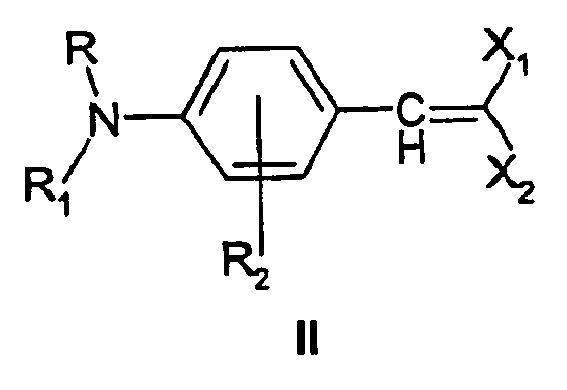 R und R1 kombiniert sind unter Erzeugung von Thiomorpholin-S,S-dioxid;R2 Wasserstoff ist;R' Wasserstoff ist;L ausgewählt ist aus -CH2CH2-O- und -CH2CH(CH3)-O-;Y ausgewählt ist aus -O-L-Q, -NR'-L-Q and -N-(L-Q)2;X1 Cyano ist;X2 -COY ist; undQ -C(O)C(R6)=CHR7 ist, worin R6 Methyl und R7 Wasserstoff ist.
 - Intraokularlinse nach Anspruch 4, worin die Molekularstruktur durch die Formel II dargestellt ist:
 R und R1 jeweils -CH2CH2-CN sind;R2 Wasserstoff ist;R' Wasserstoff ist;L ausgewählt ist aus -CH2CH2-O- und -CH2CH(CH3)-O-;Y ausgewählt ist aus -O-L-Q, -NR'-L-Q and -N-(L-Q)2;X1 Cyano, ist;X2 -COY ist; undQ -C(O)C(R6)=CHR7 ist, worin R6 Methyl und R7 Wasserstoff ist.
 - Intraokularlinse nach Anspruch 4, worin das Polymer zumindest einen Rest eines Moleküls umfasst, umfassend eine Molekularstruktur, dargestellt durch die Formel VII:

- Intraokularlinse nach Anspruch 4, worin die Molekularstruktur durch die Formel III dargestellt ist, worin:X1 und X2 unabhängig ausgewählt sind aus Cyano, -CO2-C1-C6-Alkyl, C1-C6-Alkylsulfonyl, Arylsulfonyl, Carbamoyl, C1-C6-Alkanoyl, Aroyl, Aryl, Heteroaryl und -COY;R2 Wasserstoff oder C1-C6-Alkoxy ist; undR3 Wasserstoff, C1-C12-Alkyl, substituiertes C1-C12-Alkyl oder LQ ist.
- Intraokularlinse nach Anspruch 4, worin Q
-C(O)C(R6)= CHR7 ist; worin R6 Methyl und R7 Wasserstoff sind. - Intraokularlinse nach Anspruch 4, worin die Molekularstruktur durch die Formel II dargestellt ist, worin R und R1 unabhängig ausgewählt sind aus -CH2CH2CN, -CH2CH2Cl, -CH2CH2-OCO-C1-C4-Alkyl, -CH2CH2OCO-Aryl, -CH2CH2-OC(O)NH-Aryl,

Y -NH-L-Q ist;
L -CH2CH2O-, -CH2CH(CH3)O-, -(CH2)3O-, -(CH2)4O-, -(CH2)6O-, -CH2C(CH3)2CH2O-, -CH2-C6H10-CH2O-, -C6H4-CH2CH2O-, -C6H4-OCH2CH2O- oder -CH2CH2(OCH2CH2)1-3O-ist; und
- Intraokularlinse nach Anspruch 4, worin die Molekularstruktur durch die Formel II dargestellt ist, worin
R und R1 unabhängig ausgewählt sind aus -CH2CH2CN, -CH2CH2Cl, -CH2CH2-OCO-C1-C4-Alkyl, -CH2CH2OCO-Aryl, -CH2CH2-OC(O)NH-Aryl,
Y -NH-L-Q ist;
L -CH2CH2O-, -CH2CH(CH3)O-, -(CH2)3O-, -(CH2)4O-, -(CH2)6O-, -CH2C(CH3)2CH2O-, -CH2-C6H10-CH2O-, -C6H4-CH2CH2O-, -C6H4-OCH2CH2O- oder -CH2CH2(OCH2CH2)1-3O-ist; und
Q -C(O)C(R6) =CHR7 ist,
worin R6 Methyl und R7 Wasserstoff sind. - Intraokularlinse nach Anspruch 4, worin die Molekularstruktur durch die Formel II dargestellt ist, worin:R -CH2CH2CN ist;R1 -CH2CH2CN, -CH2CH2Cl, -CH2CH2-OCO-C1-C4-Alkyl,
 Y -NH-L-Q ist;L -CH2CH2O- oder -CH2CH(CH3)O- ist; und
 worin R6, R8 und R9 Methyl sind.
 - Intraokularlinse nach Anspruch 4, worin die Molekularstruktur durch die Formel II dargestellt ist, worin:R -CH2CH2CN ist;R1 -CH2CH2CN, -CH2CH2Cl, -CH2CH2-OCO-C1-C4-Alkyl,
 Y -NH-L-Q ist;L -CH2CH2O- oder -CH2CH(CH3)O- ist; undQ -C(O)C(R6) =CHR7 ist;R6 Methyl ist; undR7 Wasserstoff ist.
 - Verbindung mit (i) einer Molekularstruktur der Formel III:
 worin:R2 ausgewählt ist aus Wasserstoff oder einer oder zwei Gruppen, ausgewählt aus Hydroxy, C1-C6-Alkyl, C1-C6-Alkoxy und Halogen;R3 ausgewählt ist aus Wasserstoff, C1-C12-Alkyl, substituiertem C1-C12-Alkyl, Aryl, C3-C8-Cycloalkyl, C3-C8-Alkenyl, -(CHR'CHR"O-)n-R4, C1-C12-Acyl, substituiertem C1-C12-Acyl und -L-Q;n eine ganze Zahl ist, ausgewählt aus 1 bis etwa 1000;R4 ausgewählt ist aus Wasserstoff, C1-C12-Alkyl, C1-C6-Alkanoyl und Aryl;R' und R" unabhängig ausgewählt sind aus Wasserstoff und C1-C12-Alkyl;L ein bivalentes organisches Radikal ist, ausgewählt aus C1-C8-Alkylen-O-, C1-C8-Alkylen-NR'-; Arylen-C1-C8-alkylen-O-, Arylen-C1-C8-alkylen-NR'-, Arylen-O-(CHR'CHR"O-)n-, -C1-C6-Alkylen-Y1-(CHR'CHR''O-)n- und -(CHR'CHR''O-)n-;Y ausgewählt ist aus -NR'-L-Q, -N-(L-Q)2 und -R5;Y1 ausgewählt ist aus -O-, -S-, -SO2-, -N(SO2R5)- und -N(COR5)-;R5 C1-C12-Alkyl, substituiertes C1-C12-Alkyl, C3-C8-Cycloalkyl oder Aryl ist;X1 und X2 unabhängig ausgewählt sind aus Cyano, C1-C8-Alkylsulfonyl, Arylsulfonyl, Carbamoyl, C1-C6-Alkanoyl, Aroyl, Aryl, Heteroaryl und -COY;Q eine Gruppe ist, die eine ethylenisch ungesättigte polymerisierbare Gruppe umfasst;die Verbindung zumindest eine Q-Gruppe enthält; oder(ii) die Molekularstruktur der Formel II:
 R und R1 unabhängig ausgewählt sind aus C1-C12-Alkyl, substituiertem C1-C12-Alkyl, Aryl, Heteroaryl, C3-C8-Cycloalkyl; C3-C8-Alkenyl, - (CHR' CHR" O-)n-R4, C1-C6-Alkylsulfonyl, Arylsulfonyl, C1-C12-Acyl, substituiertem C1-C12-Acyl, -L-Q und -Q; oder R und R1 kombiniert sind unter Erzeugung von Phthalimid, Succinimid, Morpholin, Thiomorpholin, Pyrrolidin, Piperidin, Piperazin oder Thiomorpholin-S,S-dioxid;R2 ausgewählt ist aus Wasserstoff oder einer oder zwei Gruppen, ausgewählt aus C1-C6-Alkyl, C1-C6-Alkoxy und Halogen;R' und R" unabhängig ausgewählt sind aus Wasserstoff und C1-C12-Alkyl;L ein bivalentes organisches Radikal ist, ausgewählt aus C1-C8-Alkylen-O-, C1-C8-Alkylen-NR'-;Arylen-C1-C8-alkylen-O-, Arylen-C1-C8-alkylen-NR'-, Arylen-O-(CHR'CHR"O-)n-, -C1-C6-Alkylen-Y1-(CHR'CHR"O-)n- und - (CHR'CHR"O-)n-;Y ausgewählt ist aus -NR'-L-Q und -N-(L-Q)2;Y1 ausgewählt ist aus -O-, -S-, -SO2-, -N(SO2R5)- und -N(COR5)-;R4 ausgewählt ist aus Wasserstoff, C1-C12-Alkyl, C1-C6-Alkanoyl und Aryl;R5 C1-C12-Alkyl, substituiertes C1-C12-Alkyl, C3-C8-Cycloalkyl oder Aryl ist;n eine ganze Zahl von 1 bis 100 ist;X1 ausgewählt ist aus Cyano, -CO2-C1-C6-Alkyl, C1-C6-Alkylsulfonyl, Arylsulfonyl, Carbamoyl, C1-C6-Alkanoyl, Aroyl, Aryl, Heteroaryl und -COY;X2 -COY oder Carbamoyl ist;Q bedeutet:(a) -COC(R6)=CH-R7,(b) -CONHCOC(R6)=CH-R7,(c) -CONH-C1-C6-Alkylen-OCOC(R6)=CH-R7,(d)
 (e) -COCH=CH-CO2R10,(f)
 (g)
(g) (h)
(h)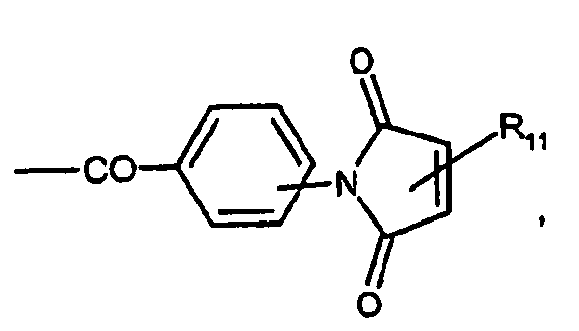 (i)worin:
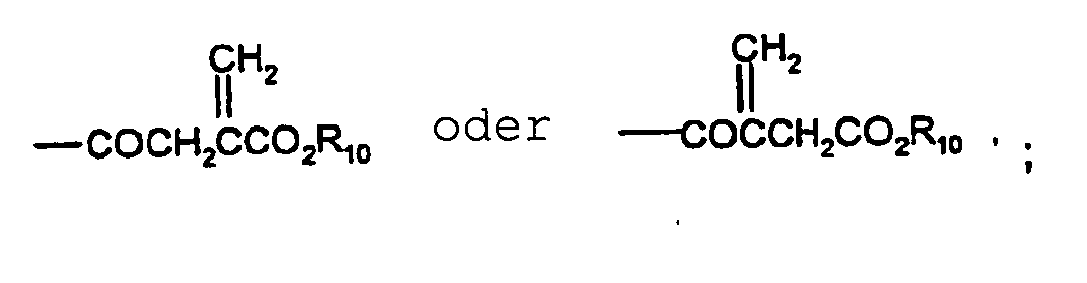 R6 Wasserstoff oder C1-C6-Alkyl ist,R7 bedeutet: Wasserstoff, C1-C6-Alkyl, Phenyl, Phenyl, substituiert mit einer oder mehreren Gruppen, ausgewählt aus C1-C6-Alkyl, C1-C6-Alkoxy, -N(C1-C6-Alkyl)2, Nitro, Cyano, C1-C6-Alkoxycarbonyl, C1-C6-Alkanoyloxy und Halogen; 1- oder 2-Naphthyl; 1- oder 2-Naphthyl, substituiert mit C1-C6-Alkyl oder C1-C6-Alkoxy; 2- oder 3-Thienyl; 2- oder 3-Thienyl, substituiert mit C1-C6-Alkyl oder Halogen; 2- oder 3-Furyl; oder 2- oder 3-Furyl, substituiert mit C1-C6-Alkyl;R8 und R9 unabhängig Wasserstoff, C1-C6-Alkyl oder Aryl sind oder R8 und R9 kombiniert sind, unter Erzeugung eines
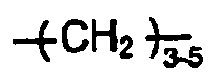 R10 Wasserstoff, C1-C6-Alkyl, C1-C6-Alkenyl, C3-C8-Cycloalkyl oder Aryl ist; undR11 Wasserstoff, C1-C6-Alkyl oder Aryl ist; unddie Verbindung zumindest eine Q-Gruppe umfasst.
 - Verbindung nach Anspruch 17, worin die Verbindung eine Molekularstruktur der Formel III hat und worin Q bedeutet:(a) -COC(R6)=CH-R7,(b) -CONHCOC(R6)=CH-R7,(c) -CONH-C1-C6-Alkylen-OCOC(R6)=CH-R7,(d)
 (e) -COCH=CH-CO2R10,(f)
 (g)
(g) (h)
(h) (i)
(i) R6 Wasserstoff oder C1-C6-Alkyl ist,R7 bedeutet: Wasserstoff, C1-C6-Alkyl, Phenyl, Phenyl, substituiert mit einer oder mehreren Gruppen, ausgewählt aus C1-C6-Alkyl, C1-C6-Alkoxy, -N(C1-C6-Alkyl)2, Nitro, Cyano, C1-C6-Alkoxycarbonyl, C1-C6-Alkanoyloxy und Halogen; 1- oder 2-Naphthyl; 1- oder 2-Naphthyl, substituiert mit C1-C6-Alkyl oder C1-C6-Alkoxy; 2- oder 3-Thienyl; 2- oder 3-Thienyl, substituiert mit C1-C6-Alkyl oder Halogen; 2- oder 3-Furyl; oder 2- oder 3-Furyl, substituiert mit C1-C6-Alkyl;R8 und R9 unabhängig Wasserstoff, C1-C6-Alkyl oder Aryl sind; oder R8 und R9 kombiniert sind, unter Erzeugung eines
 R10 Wasserstoff, C1-C6-Alkyl, C1-C6-Alkenyl, C3-C8-Cycloalkyl oder Aryl ist; undR11 Wasserstoff, C1-C6-Alkyl oder Aryl ist;worin die Verbindung zumindest eine Q-Gruppe umfasst.
 - Verbindung nach Anspruch 17, worin die Verbindung eine Molekularstruktur der Formel II hat, worin:R und R1 unabhängig ausgewählt sind aus C1-C12-Alkyl, substituiertem C1-C12-Alkyl, und Aryl; oder R und R1 kombiniert sind unter Erzeugung von cyclischen Strukturen wie Phthalimid, Succinimid, Morpholin, Thiomorpholin, Pyrrolidin, Piperidin, Piperazin oder Thiomorpholin-S,S-dioxid;R2 ausgewählt ist aus Wasserstoff, C1-C6-Alkyl und Halogen;R' ausgewählt ist aus Wasserstoff und C1-C12-Alkyl;L C1-C8-Alkylen-O- ist;Y ausgewählt ist aus -NR'-L-Q und -N-(L-Q)2;X1 Cyano ist;X2 -COY ist;Q bedeutet:

- Verbindung nach Anspruch 17, worin die Verbindung eine Molekularstruktur der Formel II hat, worin:R und R1 unabhängig ausgewählt sind aus C1-C12-Alkyl, substituiertem C1-C12-Alkyl, Aryl, Heteroaryl, C3-C8-Cycloalkyl; C3-C8-Alkenyl, -(CHR'CHR"O-)n-R4, C1-C6-Alkylsulfonyl, Arylsulfonyl, C1-C12-Acyl, substituiertem C1-C12-Acyl, -L-Q und -Q; oder R und R1 kombiniert sind, unter Erzeugung von Phthalimid, Succinimid, Morpholin, Thiomorpholin, Pyrrolidin, Piperidin, Piperazin oder Thiomorpholin-S,S-dioxid;R2 Wasserstoff ist;R' Wasserstoff ist;L ausgewählt ist aus -CH2CH2-O-, -CH2CH(CH3)-O-;Y ausgewählt ist aus -NR'-L-Q und -N-(L-Q)2;X1 Cyano ist;X2 -COY ist;n eine ganze Zahl von 1 bis 3 ist;Q -C(O)C(R6)=CHR7 ist, worin R6 Methyl und R7 Wasserstoff ist.
- Verbindung nach Anspruch 17, worin die Verbindung die Molekularstruktur der Formel II hat, worin:R und R1 unabhängig ausgewählt sind aus Methyl, Ethyl, -CH2CH2CN, -CH2CH2OCOCH3, -CH2CH(CH3)OCOCH3; oder R und R1 kombiniert sind, unter Erzeugung von Thiomorpholin-S,S-dioxid;R2 Wasserstoff ist;R' Wasserstoff ist;L ausgewählt ist aus -CH2CH2-O-, -CH2CH(CH3)-O-;Y ausgewählt ist aus -NR'-L-Q und -N-(L-Q)2;X1 Cyano ist;X2 -COY ist;Q -C(O)C(R6)=CHR7 ist, worin R6 Methyl und R7 Wasserstoff ist.
- Verbindung nach Anspruch 17, worin die Verbindung eine Molekularstruktur der Formel II hat, worin:R und R1 kombiniert sind, unter Erzeugung von Thiomorpholin-S,S-dioxid;R2 Wasserstoff ist;R' Wasserstoff ist;L -CH2CH(CH3)-O- ist;Y -NR'-L-Q ist;X1 Cyano ist;X2 -COY ist;Q -C(O)C(R6)=CHR7 ist, worin R6 Methyl und R7 Wasserstoff ist.
- Verbindung nach Anspruch 17, worin die Verbindung eine Molekularstruktur mit der Formel VII hat:

- Verbindung nach Anspruch 17, worin die Molekularstruktur durch die Formel III angegeben ist, worin:X1 und X2 unabhängig ausgewählt sind aus Cyano, -CO2C1-C6-Alkyl, C1-C6-Alkylsulfonyl, Arylsulfonyl, Carbamoyl, C1-C6-Alkanoyl, Aroyl, Aryl, Heteroaryl und -COY;R2 Wasserstoff oder C1-C6-Alkoxy ist; undR3 Wasserstoff, C1-C12-Alkyl, substituiertes C1-C12-Alkyl oder LQ ist.
- Verbindung nach Anspruch 19, worin Q -C(O)C(R6)=CHR7 ist, worin R6 Methyl und R7 Wasserstoff sind.
- Verbindung nach Anspruch 17, worin die Verbindung die Molekularstruktur der Formel II hat, worin:R und R1 unabhängig ausgewählt sind aus -CH2CH2CN, -CH2CH2Cl, -CH2CH2-OCO-C1-C4-Alkyl, -CH2CH2OCO-Aryl, -CH2CH2-OC(O)NH-Aryl,
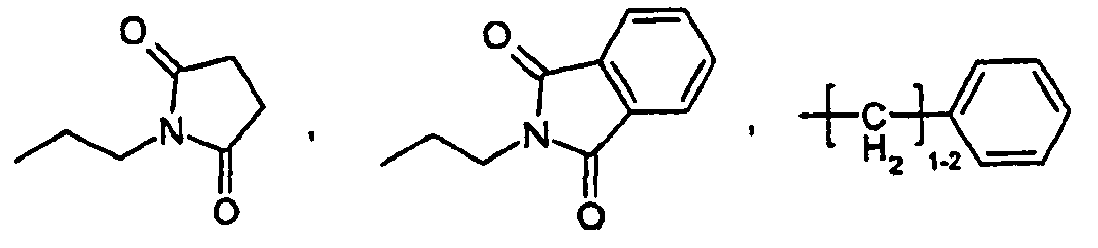 Y -NH-L-Q ist;L -CH2CH2O-, -CH2CH(CH3)O-, -(CH2)3O-, -(CH2)4O-, -(CH2)6O-, -CH2C(CH3)2CH2O-, -CH2-C6H10-CH2O-, -C6H4-CH2CH2O-, -C6H4-OCH2CH2O- oder -CH2CH2(OCH2CH2)1-3O-ist; und
- Verbindung nach Anspruch 17, worin die Verbindung die Struktur der Formel II hat, worin
R und R1 unabhängig ausgewählt sind aus -CH2CH2CN, -CH2CH2Cl, -CH2CH2-OCO-C1-C4-Alkyl, -CH2CH2OCO-Aryl, -CH2CH2-OC(O)NH-Aryl,
Y -NH-L-Q ist;
L -CH2CH2O-, -CH2CH(CH3)O-, -(CH2)3O-, -(CH2)4O-, -(CH2)6O-, -CH2C(CH3)2CH2O-, -CH2-C6H10-CH2O-, -C6H4-CH2CH2O-, -C6H4-OCH2CH2O- oder -CH2CH2(OCH2CH2)1-3O-ist; und
Q -C(O)C(R6)=CHR7 ist,
worin R6 Methyl und R7 Wasserstoff ist. - Verbindung nach Anspruch 17, worin die Verbindung eine Struktur der Formel II hat, worin:R -CH2CH2CN ist;R1 -CH2CH2CN, -CH2CH2Cl, -CH2CH2-OCO-C1-C4-Alkyl,
 Y -NH-L-Q ist;L -CH2CH2O- oder -CH2CH(CH3)O- ist; und
 worin R6, R8 und R9 Methyl sind.
 - Verbindung nach Anspruch 17, worin die Verbindung eine Struktur der Formel II hat, worin:R -CH2CH2CN ist;R1 -CH2CH2CN, -CH2CH2Cl, -CH2CH2-OCO-C1-C4-Alkyl,
 Y -NH-L-Q ist;L -CH2CH2O- oder -CH2CH(CH3)O- ist; undQ -C(O)C(R6)=CHR7 ist;R6 Methyl ist; undR7 Wasserstoff ist.
 - Zusammensetzung, umfassend die Verbindung nach einem der Ansprüche 17 bis 29.
- Polymer, umfassend zumindest einen Rest eines Moleküls, umfassend eine molekulare Struktur mit der Formel II oder Formel III:
 R und R1 unabhängig ausgewählt sind aus C1-C12-Alkyl, substituiertem C1-C12-Alkyl, Aryl, Heteroaryl, C3-C8-Cycloalkyl; C3-C8-Alkenyl, - (CHR' CHR" O-)n-R4, C1-C6-Alkylsulfonyl, Arylsulfonyl, C1-C12-Acyl, substituiertem C1-C12-Acyl, -L-Q und -Q; oder R und R1 kombiniert sind, unter Erzeugung von Phthalimid, Succinimid, Morpholin, Thiomorpholin, Pyrrolidin, Piperidin, Piperazin oder Thiomorpholin-S,S-dioxid;n eine ganze Zahl von 1 bis etwa 1000 ist;R2 ausgewählt ist aus Wasserstoff oder einer oder zwei Gruppen, ausgewählt aus C1-C6-Alkyl, C1-C6-Alkoxy und Halogen;R3 ausgewählt ist aus Wasserstoff, C1-C12-Alkyl, substituiertem C1-C12-Alkyl, Aryl, C3-C8-Cycloalkyl, C3-C8-Alkenyl und -(CHR'CHR"O-)n-R4, C1-C12-Acyl, substituiertem C1-C12-Acyl, -L-Q und -Q;R4 ausgewählt ist aus Wasserstoff, C1-C12-Alkyl, C1-C6-Alkanoyl und Aryl;R' und R" unabhängig ausgewählt sind aus Wasserstoff und C1-C12-Alkyl;L ein bivalentes organisches Radikal ist, ausgewählt aus C1-C8-Alkylen-O-, C1-C8-Alkylen-NR'-; Arylen-C1-C8-alkylen-O-, Arylen-C1-C8-alkylen-NR'-, Arylen-O-(CHR'CHR"O-)n-, -C1-C6-Alkylen-Y1-(CHR'CHR"O-)n- und -(CHR'CHR"O-)n-;Y ausgewählt ist aus -O-L-Q, -NR'-L-Q, -N-(L-Q)2 und -R5;Y1 ausgewählt ist aus -O-, -S-, -SO2-, -N(SO2R5)- und -N(COR5)-;R4 ausgewählt ist aus Wasserstoff, C1-C12-Alkyl, C1-C6-Alkanoyl und Aryl;R5 C1-C12-Alkyl, substituiertes C1-C12-Alkyl, C3-C8-Cycloalkyl oder Aryl ist;X1 und X2 unabhängig ausgewählt sind aus Cyano, C1-C8-Alkylsulfonyl, Arylsulfonyl, Carbamoyl, C1-C6-Alkanoyl, Aroyl, Aryl, Heteroaryl und -COY;Q eine Gruppe ist, die eine ethylenisch ungesättigte polymerisierbare Gruppe umfasst;worin das Molekül vor der Copolymerisation zumindest eine Q-Gruppe umfasst, der Rest ein Reaktionsprodukt der Sättigung der Q-Gruppe umfasst; und das Molekül wahlweise ein oder mehrere zusätzliche Atome oder Anteile enthält, die nicht durch die Formel II, Formel III, Formel IV, Formel V oder Formel VI dargestellt sind.
 - Zusammensetzung, umfassend das Polymer nach Anspruch 31.
- Gegenstand, umfassend das Polymer nach Anspruch 31.
- Verfahren zur Erzeugung eines Polymers, umfassend die Copolymerisation von Monomeren, worin die Monomeren die Verbindung(en) nach einem der Ansprüche 17 bis 29 umfassen.
Applications Claiming Priority (2)
| Application Number | Priority Date | Filing Date | Title |
|---|---|---|---|
| US62955604P | 2004-11-22 | 2004-11-22 | |
| PCT/US2005/040897 WO2006057824A2 (en) | 2004-11-22 | 2005-11-10 | Copolymerizable methine and anthraquinone compounds and articles containing them |
Publications (2)
| Publication Number | Publication Date |
|---|---|
| EP1815274A2 EP1815274A2 (de) | 2007-08-08 |
| EP1815274B1 true EP1815274B1 (de) | 2011-09-21 |
Family
ID=36088084
Family Applications (1)
| Application Number | Title | Priority Date | Filing Date |
|---|---|---|---|
| EP05825349A Expired - Lifetime EP1815274B1 (de) | 2004-11-22 | 2005-11-10 | Copolymerisierbare methin- und anthrachinon-verbindungen und artikel damit |
Country Status (8)
| Country | Link |
|---|---|
| US (4) | US20060115516A1 (de) |
| EP (1) | EP1815274B1 (de) |
| JP (1) | JP5264177B2 (de) |
| AT (1) | ATE525664T1 (de) |
| AU (1) | AU2005309912B2 (de) |
| BR (1) | BRPI0518030A (de) |
| CA (1) | CA2588528C (de) |
| WO (1) | WO2006057824A2 (de) |
Families Citing this family (36)
| Publication number | Priority date | Publication date | Assignee | Title |
|---|---|---|---|---|
| JP4896737B2 (ja) | 2003-12-29 | 2012-03-14 | アボット・メディカル・オプティクス・インコーポレイテッド | 可視光選択的透過領域を有する眼内レンズ |
| US7278737B2 (en) | 2004-04-30 | 2007-10-09 | Advanced Medical Optics, Inc. | Ophthalmic devices having a highly selective violet light transmissive filter and related methods |
| EP2261696B1 (de) * | 2004-11-22 | 2012-03-14 | Abbott Medical Optics Inc. | Copolymerisierbare Azoverbindungen und sie enthaltende Gegenstände |
| US20060115516A1 (en) | 2004-11-22 | 2006-06-01 | Pearson Jason C | Copolymerizable methine and anthraquinone compounds and articles containing them |
| EP1764405A1 (de) * | 2005-09-20 | 2007-03-21 | Rolic AG | Funktionalisierte photoreaktive Verbindungen |
| BRPI0719199A2 (pt) | 2006-10-13 | 2014-09-09 | Alcon Inc | Lentes intraoculares com exclusivo valor de corte azul-violeta e características de transmissão de luz azul |
| TW200916531A (en) | 2007-08-09 | 2009-04-16 | Alcon Inc | Ophthalmic lens materials containing chromophores that absorb both UV and short wavelength visible light |
| TWI435915B (zh) | 2007-08-09 | 2014-05-01 | Alcon Inc | 含有吸收紫外光(uv)及短波長可見光二者的發色團之眼科鏡體材料(一) |
| DE102007059470B3 (de) * | 2007-12-11 | 2009-05-20 | *Acri.Tec Gmbh | Ophthalmologische Zusammensetzung und deren Verwendung |
| US7989572B2 (en) * | 2008-01-17 | 2011-08-02 | Eastman Chemical Company | Polyvinyl ultraviolet light absorbers for personal care |
| EP2268230B1 (de) * | 2008-04-04 | 2016-03-30 | Battelle Memorial Institute | Verstellbare intraokular-linse |
| US10018853B2 (en) | 2008-04-04 | 2018-07-10 | Battelle Memorial Institute | Methods of altering the refractive index of materials |
| US10254562B2 (en) | 2008-04-04 | 2019-04-09 | Battelle Memorial Institute | Methods for tailoring the refractive index of lenses |
| US7884228B1 (en) | 2008-05-06 | 2011-02-08 | Alcon, Inc. | UV-absorbers for ophthalmic lens materials |
| NZ590372A (en) | 2008-07-08 | 2012-09-28 | Univ Texas | Novel inhibitors of proliferation and activation of signal transducer and activator of transcription (stats) |
| US8450337B2 (en) | 2008-09-30 | 2013-05-28 | Moleculin, Llc | Methods of treating skin disorders with caffeic acid analogs |
| US8236053B1 (en) | 2008-10-08 | 2012-08-07 | Novartis Ag | 2-amino benzophenone UV-absorbers for ophthalmic lens materials |
| TWI453199B (zh) | 2008-11-04 | 2014-09-21 | Alcon Inc | 用於眼用鏡片材料之紫外光/可見光吸收劑 |
| JP5897906B2 (ja) * | 2009-12-17 | 2016-04-06 | 株式会社メニコン | 高分子アントラキノン系色素、これを用いた眼用レンズ材料及び眼用レンズ |
| JP5605029B2 (ja) * | 2010-07-06 | 2014-10-15 | 住友化学株式会社 | 化合物、樹脂及びレジスト組成物 |
| CN103124924A (zh) * | 2010-08-05 | 2013-05-29 | 日东电工株式会社 | 对整个可见光谱的多重激光波长响应的光折变组合物 |
| EP2447256A1 (de) | 2010-10-21 | 2012-05-02 | Laboratorios Lesvi, S.L. | Verfahren zur Gewinnung von Dronedaron |
| PL2875091T3 (pl) * | 2012-07-23 | 2017-04-28 | Bausch & Lomb Incorporated | Związki absorbujące światło do polimerów optycznych |
| JP2015532667A (ja) * | 2012-08-31 | 2015-11-12 | エルジー・ケム・リミテッド | スチリル系化合物、前記スチリル系化合物を含む色材、これを含む感光性樹脂組成物、前記感光性樹脂組成物で製造された感光材、これを含むカラーフィルタおよび前記カラーフィルタを含むディスプレイ装置 |
| CN103319909B (zh) * | 2013-06-19 | 2014-12-31 | 大连福思达专用化学有限公司 | 带有可聚合基团的染料及含有该染料微球的制备 |
| US9827088B2 (en) | 2013-09-12 | 2017-11-28 | Battelle Memorial Institute | Methods of altering the refractive index of materials |
| KR101745062B1 (ko) * | 2013-11-29 | 2017-06-09 | 주식회사 엘지화학 | 수지 조성물, 감광재, 컬러필터 및 디스플레이 장치 |
| AU2015231239B2 (en) | 2014-03-19 | 2018-11-29 | Amydis, Inc. | Amyloid targeting agents and methods of using the same |
| CA2960723A1 (en) * | 2014-09-12 | 2016-03-17 | Amydis Diagnostics, Inc. | In vitro compositions comprising human sample and amyloid targeting agent |
| CN110320676A (zh) * | 2015-09-15 | 2019-10-11 | 星欧光学股份有限公司 | 隐形眼镜产品 |
| WO2019232422A1 (en) | 2018-05-31 | 2019-12-05 | Amydis, Inc. | Compositions and methods for detection of traumatic brain injury |
| JP6784720B2 (ja) | 2018-06-01 | 2020-11-11 | 上海富吉医療器械有限公司Shanghai Chartwell Medical Instrument Co., Ltd. | ポリマー材料および眼内レンズ |
| FR3123565B1 (fr) * | 2021-06-04 | 2025-07-18 | Inst Des Sciences Et Industries Du Vivant Et De Lenvironnement Agroparistech | Nouvelles molecules derivees de furanacrylates et 5-hydroxymethyl furanacrylates presentant des proprietes filtre uv-b et/ou antimicrobiennes |
| CN113278102A (zh) * | 2021-06-09 | 2021-08-20 | 浙江材华科技有限公司 | 一种功能性彩色ps微球的制备方法 |
| CN121079617A (zh) * | 2023-04-28 | 2025-12-05 | 依视路国际公司 | 包含丙烯腈化合物的眼科镜片 |
| CN121159417A (zh) * | 2024-06-18 | 2025-12-19 | 视阳光学股份有限公司 | 抗蓝光化合物、抗蓝光组成物、抗蓝光化合物的用途、抗蓝光组成物的用途及抗蓝光化合物的制造方法 |
Family Cites Families (88)
| Publication number | Priority date | Publication date | Assignee | Title |
|---|---|---|---|---|
| BE788688A (nl) * | 1971-09-17 | 1973-03-12 | Agfa Gevaert Nv | Ontwikkeling van fotografisch materiaal bij verhoogde temperatuur |
| US3890307A (en) * | 1973-04-02 | 1975-06-17 | Eastman Kodak Co | Process for the production of methine dyes |
| US4304895A (en) | 1973-06-20 | 1981-12-08 | Wesley-Jessen, Inc. | Ultraviolet absorbing corneal contact lenses |
| US4390676A (en) | 1976-11-15 | 1983-06-28 | Schering Corporation | Ultraviolet absorbing lenses |
| US4636212A (en) | 1982-05-10 | 1987-01-13 | Optical Radiation Corporation | Ultraviolet radiation absorbing intraocular lens |
| US4528311A (en) | 1983-07-11 | 1985-07-09 | Iolab Corporation | Ultraviolet absorbing polymers comprising 2-hydroxy-5-acrylyloxyphenyl-2H-benzotriazoles |
| EP0161765B1 (de) | 1984-04-11 | 1988-10-05 | Pharmacia Ab | Ultraviolettes Licht absorbierende intraokulare Implantate |
| US5047447A (en) | 1984-06-08 | 1991-09-10 | Photoprotecive Technologies Incorporated | Medium incorporating melanin as an absorbing pigment for protection against electromagnetic radiation |
| WO1987005712A1 (en) | 1986-03-17 | 1987-09-24 | Richard Borowsky | Light-occluding contact lens |
| DE3428895C2 (de) | 1984-08-04 | 1986-07-10 | Dr. K. Schmidt-Apparatebau, 5205 St Augustin | Künstliche Intraokularlinse |
| US4681412A (en) | 1984-10-01 | 1987-07-21 | Lemelson Jerome H | Contact lens containing light sensitive material |
| US4617374A (en) | 1985-02-15 | 1986-10-14 | Eastman Kodak Company | UV-absorbing condensation polymeric compositions and products therefrom |
| US4753654A (en) | 1985-03-18 | 1988-06-28 | Optical Radiation Corporation | Ultraviolet radiation absorbing intraocular lens |
| CA1318529C (en) | 1985-05-08 | 1993-06-01 | Harry I. Zeltzer | Contact lens for correction of color blindness |
| US4737322A (en) | 1985-09-27 | 1988-04-12 | Staar Surgical Company | Intraocular lens structure with polyimide haptic portion and methods for fabrication |
| US5008102A (en) | 1986-02-26 | 1991-04-16 | York Kenneth K | Biocompatible intraocular light-screening compositions and methods of intraocular light screening |
| DE3610833A1 (de) | 1986-04-01 | 1987-10-08 | Inprohold Ets | Intraokulare implantationslinse |
| AU602662B2 (en) | 1986-10-16 | 1990-10-25 | Suntiger, Incorporated | Ultraviolet radiation and blue light blocking polarizing lens |
| US4716234A (en) | 1986-12-01 | 1987-12-29 | Iolab Corporation | Ultraviolet absorbing polymers comprising 2-(2'-hydroxy-5'-acryloyloxyalkoxyphenyl)-2H-benzotriazole |
| FR2622984A1 (fr) | 1987-11-09 | 1989-05-12 | Charles Ayache | Lentille de contact formant filtre solaire |
| US5172256A (en) | 1988-01-19 | 1992-12-15 | Sethofer Nicholas L | Liquid crystal variable color density lens and eye protective devices incorporating the same |
| JPH0824694B2 (ja) | 1988-02-09 | 1996-03-13 | ホーヤ株式会社 | 青視症補正用コンタクトレンズ |
| US5374663A (en) | 1988-03-03 | 1994-12-20 | Hoya Corporation | Process for producing cyanopsia-correctable intraocular lens |
| WO1989007952A1 (fr) | 1988-03-03 | 1989-09-08 | Hoya Corporation | Procede de production de lentilles intraoculaires pour la correction de la cyanopsie |
| DE3837884A1 (de) | 1988-11-08 | 1990-05-10 | Mutzhas Maximilian F | Lichtfilter zur verbesserung des sehens |
| US5298033A (en) | 1989-03-14 | 1994-03-29 | Ciba-Geigy Corporation | Ultraviolet absorbing lenses and methods of manufacturing thereof |
| US4929250A (en) | 1989-03-14 | 1990-05-29 | Ciba-Geigy Corporation | Ultraviolet absorbing lenses and method of making the same |
| US4963160A (en) | 1989-03-14 | 1990-10-16 | Ciba-Geigy Corporation | Reactive uv absorbing compositions and method of preparing lenses therefrom |
| AU631190B2 (en) | 1989-03-14 | 1992-11-19 | Novartis Ag | Ultraviolet absorbing lenses and methods of making the same |
| US4955904A (en) | 1989-08-21 | 1990-09-11 | The Beth Israel Hospital Association | Masked intraocular lens and method for treating a patient with cataracts |
| US5269813A (en) | 1990-06-12 | 1993-12-14 | Menicon Co., Ltd. | Material for one-piece intraocular lenses |
| US5120120A (en) | 1990-07-27 | 1992-06-09 | Cohen Allen L | Multifocal optical device with spurious order suppression and method for manufacture of same |
| ATE143677T1 (de) | 1990-11-07 | 1996-10-15 | Nestle Sa | Polymere und ihre verwendung für opthalmische linsen |
| JP2685980B2 (ja) | 1990-11-26 | 1997-12-08 | 株式会社メニコン | 紫外線吸収性眼内レンズ |
| IT1244501B (it) | 1991-03-22 | 1994-07-15 | Sigma Tau Ind Farmaceuti | Derivati amminoacilici e oligopeptidici dell'allopurinolo dotati di attivita' immunostimolante e composizioni farmaceutiche che li contengono |
| EP0588962B1 (de) * | 1991-06-10 | 1998-04-01 | Eastman Chemical Company | Licht absorbierende polymere |
| UA35578C2 (uk) | 1991-08-16 | 2001-04-16 | Майлс Е. Гелін | Передньокамерний очний імплантат, спосіб його одержання та спосіб лікування короткозорості |
| EP0555457A1 (de) * | 1991-08-29 | 1993-08-18 | Eastman Kodak Company | Radiographisches element |
| US5215876A (en) * | 1991-08-29 | 1993-06-01 | Eastman Kodak Company | Radiographic element with uv absorbation compound in polyester support |
| JPH0672151A (ja) | 1992-08-27 | 1994-03-15 | Tokyo Megane Seizo Kk | 運転操作用およびスポーツ動作用の視界確認方法およびその明視装置 |
| JP3217873B2 (ja) * | 1992-10-23 | 2001-10-15 | 興和株式会社 | ベンゾフェノン誘導体及びこれを含有する紫外線吸収剤 |
| JPH06258604A (ja) | 1993-03-03 | 1994-09-16 | Nissha Printing Co Ltd | 絵付コンタクトレンズとその製造方法 |
| JPH06262861A (ja) | 1993-03-12 | 1994-09-20 | Konica Corp | 画像形成材料及び画像形成方法 |
| AU681658B2 (en) | 1993-04-22 | 1997-09-04 | Novartis Ag | UV-absorbing benzotriazoles having a styrene group |
| JP3188050B2 (ja) | 1993-05-17 | 2001-07-16 | ダイセル網干産業株式会社 | メガネレンズ |
| JPH0724052A (ja) | 1993-07-07 | 1995-01-27 | Hoya Corp | 青視症補正用軟性眼内レンズ |
| US5470932A (en) | 1993-10-18 | 1995-11-28 | Alcon Laboratories, Inc. | Polymerizable yellow dyes and their use in opthalmic lenses |
| JP3505214B2 (ja) * | 1994-03-28 | 2004-03-08 | 花王株式会社 | ベンジリデンマロン酸エステル誘導体およびその重合体 |
| US5846457A (en) | 1994-10-28 | 1998-12-08 | Hoffman; William C. | Light filtering contact lens method |
| US5534041A (en) | 1994-11-07 | 1996-07-09 | Corning Incorporated | Method of making laser eyewear protection |
| US5922246A (en) | 1995-07-28 | 1999-07-13 | Kyowa Hakko Kogyo Co., Ltd | Eyeglass lens and molded material of synthetic resin having transmittance minimum no greater than 25% at 550-585 nm |
| FR2743154B1 (fr) | 1995-12-29 | 1998-03-06 | Essilor Int | Lentille oculaire artificielle multifocale a transparence variable avec l'eclairement |
| US5657726A (en) | 1996-01-16 | 1997-08-19 | Ford Global Technologies, Inc. | Rocker arm assembly for an internal combustion engine |
| JP2868480B2 (ja) | 1996-10-08 | 1999-03-10 | ナショナル住宅産業株式会社 | 老化視界体験装置 |
| GB9625147D0 (en) | 1996-12-04 | 1997-01-22 | Harris David A | Improving colour discrimination |
| US5965330A (en) | 1996-12-06 | 1999-10-12 | Pbh, Inc. | Methods for fabricating annular mask lens having diffraction-reducing edges |
| JPH10195324A (ja) | 1997-01-16 | 1998-07-28 | Hoya Corp | 反応性黄色染料およびそれを含む眼用レンズ |
| JP3805853B2 (ja) | 1997-03-13 | 2006-08-09 | 株式会社メニコン | 重合性色素及びそれを用いた着色眼用レンズ材料 |
| US6277940B1 (en) | 1997-08-20 | 2001-08-21 | Menicon Co. Ltd | Material for a soft intraocular lens |
| JP4144920B2 (ja) | 1997-08-20 | 2008-09-03 | 興和株式会社 | 軟質眼内レンズ材料 |
| US6326448B1 (en) | 1997-08-20 | 2001-12-04 | Menicon Co., Ltd. | Soft intraocular lens material |
| JP3722986B2 (ja) * | 1997-08-29 | 2005-11-30 | 株式会社ニデック | 紫外線吸収性基材 |
| DE19738345C1 (de) | 1997-09-02 | 1999-05-06 | Mdp Medical Device Polymers Gm | Intraokularlinse |
| US6158862A (en) | 1997-12-04 | 2000-12-12 | Alcon Laboratories, Inc. | Method of reducing glare associated with multifocal ophthalmic lenses |
| US6604824B2 (en) | 1998-02-23 | 2003-08-12 | Charles P. Larson | Polarized lens with oxide additive |
| JPH11253480A (ja) | 1998-03-16 | 1999-09-21 | Haruo Nomura | 白内障用カラーコンタクトレンズ |
| EP1071482B1 (de) | 1998-04-15 | 2001-10-04 | Alcon Laboratories, Inc. | Beschichtungszusammensetzung für intraocularen linsen |
| US6036891A (en) * | 1998-05-11 | 2000-03-14 | Pharmacia & Upjohn | Polymerizable hydrophilic ultraviolet light absorbing monomers |
| US6359024B2 (en) * | 1998-05-15 | 2002-03-19 | Bausch & Lomb Incorporated | Method for polymerizing contact lenses |
| US6884262B2 (en) | 1998-05-29 | 2005-04-26 | Advanced Medical Optics, Inc. | Enhanced intraocular lens for reducing glare |
| US6244707B1 (en) | 1998-07-21 | 2001-06-12 | Wesley Jessen Corporation | UV blocking lenses and material containing benzotriazoles and benzophenones |
| JP3449406B2 (ja) | 1999-04-07 | 2003-09-22 | Hoyaヘルスケア株式会社 | 新規ピラゾロン化合物およびそれを用いた眼用プラスチックレンズ |
| US6432137B1 (en) | 1999-09-08 | 2002-08-13 | Medennium, Inc. | High refractive index silicone for use in intraocular lenses |
| US6280471B1 (en) | 1999-09-16 | 2001-08-28 | Gholam A. Peyman | Glare-free intraocular lens and method for using the same |
| US20020042653A1 (en) | 1999-11-23 | 2002-04-11 | Copeland Victor L. | Blue blocking intraocular lens implant |
| US6305801B1 (en) | 1999-12-02 | 2001-10-23 | Peakvision, Llc | Contact lens with filtering for outdoor sporting and recreational activities |
| GB2360283B (en) | 2000-02-08 | 2002-08-21 | Ciba Sc Holding Ag | Monoacylarylphosphines and acylphosphine oxides and sulphides |
| JP2002006268A (ja) * | 2000-06-22 | 2002-01-09 | Seed Co Ltd | 紫外線吸収性軟質眼用レンズ |
| JP4210719B2 (ja) | 2001-09-14 | 2009-01-21 | スター・ジャパン株式会社 | 眼用レンズ |
| JP2003144638A (ja) | 2002-11-13 | 2003-05-20 | Sanyo Product Co Ltd | 遊技板の製造方法 |
| JP2003144538A (ja) | 2002-11-22 | 2003-05-20 | Menicon Co Ltd | 軟質眼内レンズ用材料 |
| US7098283B2 (en) | 2003-09-08 | 2006-08-29 | Bausch & Lomb Incorporated | Reactive yellow dyes useful for ocular devices |
| US20050055091A1 (en) | 2003-09-08 | 2005-03-10 | Yu-Chin Lai | Process for making silicone intraocular lens with blue light absorption properties |
| JP4896737B2 (ja) * | 2003-12-29 | 2012-03-14 | アボット・メディカル・オプティクス・インコーポレイテッド | 可視光選択的透過領域を有する眼内レンズ |
| AU2005230194B2 (en) * | 2004-04-05 | 2010-12-16 | Amo Groningen B.V. | Ophthalmic lenses capable of reducing chromatic aberration |
| US7278737B2 (en) * | 2004-04-30 | 2007-10-09 | Advanced Medical Optics, Inc. | Ophthalmic devices having a highly selective violet light transmissive filter and related methods |
| JP4532243B2 (ja) | 2004-11-10 | 2010-08-25 | 株式会社ニデック | 眼用レンズ用着色剤、及び該着色剤を用いた着色眼用レンズ材料 |
| US20060115516A1 (en) | 2004-11-22 | 2006-06-01 | Pearson Jason C | Copolymerizable methine and anthraquinone compounds and articles containing them |
-
2005
- 2005-11-10 US US11/271,382 patent/US20060115516A1/en not_active Abandoned
- 2005-11-10 JP JP2007543134A patent/JP5264177B2/ja not_active Expired - Lifetime
- 2005-11-10 BR BRPI0518030-9A patent/BRPI0518030A/pt not_active Application Discontinuation
- 2005-11-10 AT AT05825349T patent/ATE525664T1/de not_active IP Right Cessation
- 2005-11-10 AU AU2005309912A patent/AU2005309912B2/en not_active Expired
- 2005-11-10 WO PCT/US2005/040897 patent/WO2006057824A2/en not_active Ceased
- 2005-11-10 EP EP05825349A patent/EP1815274B1/de not_active Expired - Lifetime
- 2005-11-10 CA CA2588528A patent/CA2588528C/en not_active Expired - Lifetime
-
2008
- 2008-10-23 US US12/257,277 patent/US8360576B2/en active Active
-
2012
- 2012-09-18 US US13/622,160 patent/US8501890B2/en not_active Expired - Lifetime
-
2013
- 2013-08-05 US US13/959,404 patent/US8785627B2/en not_active Expired - Lifetime
Also Published As
| Publication number | Publication date |
|---|---|
| AU2005309912A1 (en) | 2006-06-01 |
| ATE525664T1 (de) | 2011-10-15 |
| US20130324717A1 (en) | 2013-12-05 |
| CA2588528A1 (en) | 2006-06-01 |
| US20060115516A1 (en) | 2006-06-01 |
| BRPI0518030A (pt) | 2008-10-28 |
| AU2005309912B2 (en) | 2011-10-06 |
| US20090076235A1 (en) | 2009-03-19 |
| WO2006057824A2 (en) | 2006-06-01 |
| US8501890B2 (en) | 2013-08-06 |
| US8785627B2 (en) | 2014-07-22 |
| US20130018159A1 (en) | 2013-01-17 |
| CA2588528C (en) | 2013-08-06 |
| WO2006057824A3 (en) | 2006-10-05 |
| EP1815274A2 (de) | 2007-08-08 |
| US8360576B2 (en) | 2013-01-29 |
| JP2008520352A (ja) | 2008-06-19 |
| JP5264177B2 (ja) | 2013-08-14 |
Similar Documents
| Publication | Publication Date | Title |
|---|---|---|
| EP1815274B1 (de) | Copolymerisierbare methin- und anthrachinon-verbindungen und artikel damit | |
| EP1815275B1 (de) | Copolymerisierbare azoverbindungen und artikel damit | |
| US5662707A (en) | Polymerizable yellow dyes and their use in ophthalmic lenses | |
| ES2446592T3 (es) | Absorbentes de luz UV/visible para materiales de lentes oftálmicas | |
| JP2013517296A (ja) | 眼科用レンズの材料のための可視光吸収剤 | |
| JP2011507987A (ja) | 共重合体及び眼科用組成物 | |
| AU2011253638A1 (en) | Copolymerizable azo compounds and articles containing them | |
| HK1013092B (en) | Polymerisable yellow dyes and their use in ophthalmic lenses |
Legal Events
| Date | Code | Title | Description |
|---|---|---|---|
| PUAI | Public reference made under article 153(3) epc to a published international application that has entered the european phase |
Free format text: ORIGINAL CODE: 0009012 |
|
| 17P | Request for examination filed |
Effective date: 20070419 |
|
| AK | Designated contracting states |
Kind code of ref document: A2 Designated state(s): AT BE BG CH CY CZ DE DK EE ES FI FR GB GR HU IE IS IT LI LT LU LV MC NL PL PT RO SE SI SK TR |
|
| DAX | Request for extension of the european patent (deleted) | ||
| 17Q | First examination report despatched |
Effective date: 20080606 |
|
| RAP1 | Party data changed (applicant data changed or rights of an application transferred) |
Owner name: ABBOTT MEDICAL OPTICS INC. |
|
| RAP1 | Party data changed (applicant data changed or rights of an application transferred) |
Owner name: ABBOTT MEDICAL OPTICS INC. |
|
| GRAP | Despatch of communication of intention to grant a patent |
Free format text: ORIGINAL CODE: EPIDOSNIGR1 |
|
| GRAS | Grant fee paid |
Free format text: ORIGINAL CODE: EPIDOSNIGR3 |
|
| GRAA | (expected) grant |
Free format text: ORIGINAL CODE: 0009210 |
|
| AK | Designated contracting states |
Kind code of ref document: B1 Designated state(s): AT BE BG CH CY CZ DE DK EE ES FI FR GB GR HU IE IS IT LI LT LU LV MC NL PL PT RO SE SI SK TR |
|
| REG | Reference to a national code |
Ref country code: GB Ref legal event code: FG4D |
|
| REG | Reference to a national code |
Ref country code: CH Ref legal event code: EP Ref country code: CH Ref legal event code: NV Representative=s name: NOVAGRAAF INTERNATIONAL SA |
|
| REG | Reference to a national code |
Ref country code: IE Ref legal event code: FG4D |
|
| REG | Reference to a national code |
Ref country code: NL Ref legal event code: T3 |
|
| REG | Reference to a national code |
Ref country code: DE Ref legal event code: R096 Ref document number: 602005030175 Country of ref document: DE Effective date: 20111117 |
|
| PG25 | Lapsed in a contracting state [announced via postgrant information from national office to epo] |
Ref country code: FI Free format text: LAPSE BECAUSE OF FAILURE TO SUBMIT A TRANSLATION OF THE DESCRIPTION OR TO PAY THE FEE WITHIN THE PRESCRIBED TIME-LIMIT Effective date: 20110921 Ref country code: SE Free format text: LAPSE BECAUSE OF FAILURE TO SUBMIT A TRANSLATION OF THE DESCRIPTION OR TO PAY THE FEE WITHIN THE PRESCRIBED TIME-LIMIT Effective date: 20110921 Ref country code: LT Free format text: LAPSE BECAUSE OF FAILURE TO SUBMIT A TRANSLATION OF THE DESCRIPTION OR TO PAY THE FEE WITHIN THE PRESCRIBED TIME-LIMIT Effective date: 20110921 |
|
| LTIE | Lt: invalidation of european patent or patent extension |
Effective date: 20110921 |
|
| PG25 | Lapsed in a contracting state [announced via postgrant information from national office to epo] |
Ref country code: CY Free format text: LAPSE BECAUSE OF FAILURE TO SUBMIT A TRANSLATION OF THE DESCRIPTION OR TO PAY THE FEE WITHIN THE PRESCRIBED TIME-LIMIT Effective date: 20110921 Ref country code: AT Free format text: LAPSE BECAUSE OF FAILURE TO SUBMIT A TRANSLATION OF THE DESCRIPTION OR TO PAY THE FEE WITHIN THE PRESCRIBED TIME-LIMIT Effective date: 20110921 Ref country code: GR Free format text: LAPSE BECAUSE OF FAILURE TO SUBMIT A TRANSLATION OF THE DESCRIPTION OR TO PAY THE FEE WITHIN THE PRESCRIBED TIME-LIMIT Effective date: 20111222 Ref country code: SI Free format text: LAPSE BECAUSE OF FAILURE TO SUBMIT A TRANSLATION OF THE DESCRIPTION OR TO PAY THE FEE WITHIN THE PRESCRIBED TIME-LIMIT Effective date: 20110921 Ref country code: LV Free format text: LAPSE BECAUSE OF FAILURE TO SUBMIT A TRANSLATION OF THE DESCRIPTION OR TO PAY THE FEE WITHIN THE PRESCRIBED TIME-LIMIT Effective date: 20110921 |
|
| REG | Reference to a national code |
Ref country code: AT Ref legal event code: MK05 Ref document number: 525664 Country of ref document: AT Kind code of ref document: T Effective date: 20110921 |
|
| PG25 | Lapsed in a contracting state [announced via postgrant information from national office to epo] |
Ref country code: BE Free format text: LAPSE BECAUSE OF FAILURE TO SUBMIT A TRANSLATION OF THE DESCRIPTION OR TO PAY THE FEE WITHIN THE PRESCRIBED TIME-LIMIT Effective date: 20110921 |
|
| PG25 | Lapsed in a contracting state [announced via postgrant information from national office to epo] |
Ref country code: SK Free format text: LAPSE BECAUSE OF FAILURE TO SUBMIT A TRANSLATION OF THE DESCRIPTION OR TO PAY THE FEE WITHIN THE PRESCRIBED TIME-LIMIT Effective date: 20110921 Ref country code: CZ Free format text: LAPSE BECAUSE OF FAILURE TO SUBMIT A TRANSLATION OF THE DESCRIPTION OR TO PAY THE FEE WITHIN THE PRESCRIBED TIME-LIMIT Effective date: 20110921 Ref country code: IS Free format text: LAPSE BECAUSE OF FAILURE TO SUBMIT A TRANSLATION OF THE DESCRIPTION OR TO PAY THE FEE WITHIN THE PRESCRIBED TIME-LIMIT Effective date: 20120121 |
|
| PG25 | Lapsed in a contracting state [announced via postgrant information from national office to epo] |
Ref country code: EE Free format text: LAPSE BECAUSE OF FAILURE TO SUBMIT A TRANSLATION OF THE DESCRIPTION OR TO PAY THE FEE WITHIN THE PRESCRIBED TIME-LIMIT Effective date: 20110921 Ref country code: PT Free format text: LAPSE BECAUSE OF FAILURE TO SUBMIT A TRANSLATION OF THE DESCRIPTION OR TO PAY THE FEE WITHIN THE PRESCRIBED TIME-LIMIT Effective date: 20120123 Ref country code: RO Free format text: LAPSE BECAUSE OF FAILURE TO SUBMIT A TRANSLATION OF THE DESCRIPTION OR TO PAY THE FEE WITHIN THE PRESCRIBED TIME-LIMIT Effective date: 20110921 Ref country code: IT Free format text: LAPSE BECAUSE OF FAILURE TO SUBMIT A TRANSLATION OF THE DESCRIPTION OR TO PAY THE FEE WITHIN THE PRESCRIBED TIME-LIMIT Effective date: 20110921 Ref country code: PL Free format text: LAPSE BECAUSE OF FAILURE TO SUBMIT A TRANSLATION OF THE DESCRIPTION OR TO PAY THE FEE WITHIN THE PRESCRIBED TIME-LIMIT Effective date: 20110921 |
|
| PG25 | Lapsed in a contracting state [announced via postgrant information from national office to epo] |
Ref country code: MC Free format text: LAPSE BECAUSE OF NON-PAYMENT OF DUE FEES Effective date: 20111130 |
|
| PLBE | No opposition filed within time limit |
Free format text: ORIGINAL CODE: 0009261 |
|
| STAA | Information on the status of an ep patent application or granted ep patent |
Free format text: STATUS: NO OPPOSITION FILED WITHIN TIME LIMIT |
|
| PG25 | Lapsed in a contracting state [announced via postgrant information from national office to epo] |
Ref country code: DK Free format text: LAPSE BECAUSE OF FAILURE TO SUBMIT A TRANSLATION OF THE DESCRIPTION OR TO PAY THE FEE WITHIN THE PRESCRIBED TIME-LIMIT Effective date: 20110921 |
|
| 26N | No opposition filed |
Effective date: 20120622 |
|
| REG | Reference to a national code |
Ref country code: IE Ref legal event code: MM4A |
|
| REG | Reference to a national code |
Ref country code: DE Ref legal event code: R097 Ref document number: 602005030175 Country of ref document: DE Effective date: 20120622 |
|
| PG25 | Lapsed in a contracting state [announced via postgrant information from national office to epo] |
Ref country code: IE Free format text: LAPSE BECAUSE OF NON-PAYMENT OF DUE FEES Effective date: 20111110 |
|
| PG25 | Lapsed in a contracting state [announced via postgrant information from national office to epo] |
Ref country code: ES Free format text: LAPSE BECAUSE OF FAILURE TO SUBMIT A TRANSLATION OF THE DESCRIPTION OR TO PAY THE FEE WITHIN THE PRESCRIBED TIME-LIMIT Effective date: 20120101 |
|
| PG25 | Lapsed in a contracting state [announced via postgrant information from national office to epo] |
Ref country code: LU Free format text: LAPSE BECAUSE OF NON-PAYMENT OF DUE FEES Effective date: 20111110 |
|
| PG25 | Lapsed in a contracting state [announced via postgrant information from national office to epo] |
Ref country code: BG Free format text: LAPSE BECAUSE OF FAILURE TO SUBMIT A TRANSLATION OF THE DESCRIPTION OR TO PAY THE FEE WITHIN THE PRESCRIBED TIME-LIMIT Effective date: 20111221 |
|
| PG25 | Lapsed in a contracting state [announced via postgrant information from national office to epo] |
Ref country code: TR Free format text: LAPSE BECAUSE OF FAILURE TO SUBMIT A TRANSLATION OF THE DESCRIPTION OR TO PAY THE FEE WITHIN THE PRESCRIBED TIME-LIMIT Effective date: 20110921 |
|
| PG25 | Lapsed in a contracting state [announced via postgrant information from national office to epo] |
Ref country code: HU Free format text: LAPSE BECAUSE OF FAILURE TO SUBMIT A TRANSLATION OF THE DESCRIPTION OR TO PAY THE FEE WITHIN THE PRESCRIBED TIME-LIMIT Effective date: 20110921 |
|
| REG | Reference to a national code |
Ref country code: FR Ref legal event code: PLFP Year of fee payment: 11 |
|
| REG | Reference to a national code |
Ref country code: FR Ref legal event code: PLFP Year of fee payment: 12 |
|
| REG | Reference to a national code |
Ref country code: FR Ref legal event code: PLFP Year of fee payment: 13 |
|
| REG | Reference to a national code |
Ref country code: FR Ref legal event code: PLFP Year of fee payment: 14 |
|
| REG | Reference to a national code |
Ref country code: CH Ref legal event code: PFA Owner name: JOHNSON AND JOHNSON SURGICAL VISION, INC., US Free format text: FORMER OWNER: ABBOTT MEDICAL OPTICS INC., US |
|
| REG | Reference to a national code |
Ref country code: DE Ref legal event code: R081 Ref document number: 602005030175 Country of ref document: DE Owner name: JOHNSON & JOHNSON SURGICAL VISION, INC. (N. D., US Free format text: FORMER OWNER: ABBOTT MEDICAL OPTICS INC., SANTA ANA, CALIF., US Ref country code: DE Ref legal event code: R082 Ref document number: 602005030175 Country of ref document: DE |
|
| REG | Reference to a national code |
Ref country code: NL Ref legal event code: HC Owner name: JOHNSON & JOHNSON SURGICAL VISION, INC.; US Free format text: DETAILS ASSIGNMENT: CHANGE OF OWNER(S), CHANGE OF OWNER(S) NAME; FORMER OWNER NAME: ABBOTT MEDICAL OPTICS INC. Effective date: 20181204 |
|
| PGFP | Annual fee paid to national office [announced via postgrant information from national office to epo] |
Ref country code: NL Payment date: 20241004 Year of fee payment: 20 |
|
| PGFP | Annual fee paid to national office [announced via postgrant information from national office to epo] |
Ref country code: DE Payment date: 20241001 Year of fee payment: 20 |
|
| PGFP | Annual fee paid to national office [announced via postgrant information from national office to epo] |
Ref country code: GB Payment date: 20241001 Year of fee payment: 20 |
|
| PGFP | Annual fee paid to national office [announced via postgrant information from national office to epo] |
Ref country code: FR Payment date: 20241001 Year of fee payment: 20 |
|
| PGFP | Annual fee paid to national office [announced via postgrant information from national office to epo] |
Ref country code: CH Payment date: 20241201 Year of fee payment: 20 |
|
| REG | Reference to a national code |
Ref country code: CH Ref legal event code: H14 Free format text: ST27 STATUS EVENT CODE: U-0-0-H10-H14 (AS PROVIDED BY THE NATIONAL OFFICE) Effective date: 20251110 Ref country code: DE Ref legal event code: R071 Ref document number: 602005030175 Country of ref document: DE |
|
| REG | Reference to a national code |
Ref country code: NL Ref legal event code: MK Effective date: 20251109 |
|
| REG | Reference to a national code |
Ref country code: GB Ref legal event code: PE20 Expiry date: 20251109 |