EP1818949A2 - Aimant permanent hautement coercitif basé sur du lanthanide mélangé - Google Patents
Aimant permanent hautement coercitif basé sur du lanthanide mélangé Download PDFInfo
- Publication number
- EP1818949A2 EP1818949A2 EP06126605A EP06126605A EP1818949A2 EP 1818949 A2 EP1818949 A2 EP 1818949A2 EP 06126605 A EP06126605 A EP 06126605A EP 06126605 A EP06126605 A EP 06126605A EP 1818949 A2 EP1818949 A2 EP 1818949A2
- Authority
- EP
- European Patent Office
- Prior art keywords
- permanent magnet
- rare
- magnet
- weight percent
- earth
- Prior art date
- Legal status (The legal status is an assumption and is not a legal conclusion. Google has not performed a legal analysis and makes no representation as to the accuracy of the status listed.)
- Withdrawn
Links
Images
Classifications
-
- H—ELECTRICITY
- H01—ELECTRIC ELEMENTS
- H01F—MAGNETS; INDUCTANCES; TRANSFORMERS; SELECTION OF MATERIALS FOR THEIR MAGNETIC PROPERTIES
- H01F1/00—Magnets or magnetic bodies characterised by the magnetic materials therefor; Selection of materials for their magnetic properties
- H01F1/01—Magnets or magnetic bodies characterised by the magnetic materials therefor; Selection of materials for their magnetic properties of inorganic materials
- H01F1/03—Magnets or magnetic bodies characterised by the magnetic materials therefor; Selection of materials for their magnetic properties of inorganic materials characterised by their coercivity
- H01F1/032—Magnets or magnetic bodies characterised by the magnetic materials therefor; Selection of materials for their magnetic properties of inorganic materials characterised by their coercivity of hard-magnetic materials
- H01F1/04—Magnets or magnetic bodies characterised by the magnetic materials therefor; Selection of materials for their magnetic properties of inorganic materials characterised by their coercivity of hard-magnetic materials metals or alloys
- H01F1/047—Alloys characterised by their composition
- H01F1/053—Alloys characterised by their composition containing rare earth metals
- H01F1/055—Alloys characterised by their composition containing rare earth metals and magnetic transition metals, e.g. SmCo5
- H01F1/057—Alloys characterised by their composition containing rare earth metals and magnetic transition metals, e.g. SmCo5 and IIIa elements, e.g. Nd2Fe14B
- H01F1/0571—Alloys characterised by their composition containing rare earth metals and magnetic transition metals, e.g. SmCo5 and IIIa elements, e.g. Nd2Fe14B in the form of particles, e.g. rapid quenched powders or ribbon flakes
- H01F1/0575—Alloys characterised by their composition containing rare earth metals and magnetic transition metals, e.g. SmCo5 and IIIa elements, e.g. Nd2Fe14B in the form of particles, e.g. rapid quenched powders or ribbon flakes pressed, sintered or bonded together
- H01F1/0577—Alloys characterised by their composition containing rare earth metals and magnetic transition metals, e.g. SmCo5 and IIIa elements, e.g. Nd2Fe14B in the form of particles, e.g. rapid quenched powders or ribbon flakes pressed, sintered or bonded together sintered
-
- H—ELECTRICITY
- H01—ELECTRIC ELEMENTS
- H01F—MAGNETS; INDUCTANCES; TRANSFORMERS; SELECTION OF MATERIALS FOR THEIR MAGNETIC PROPERTIES
- H01F41/00—Apparatus or processes specially adapted for manufacturing or assembling magnets, inductances or transformers; Apparatus or processes specially adapted for manufacturing materials characterised by their magnetic properties
- H01F41/02—Apparatus or processes specially adapted for manufacturing or assembling magnets, inductances or transformers; Apparatus or processes specially adapted for manufacturing materials characterised by their magnetic properties for manufacturing cores, coils, or magnets
- H01F41/0253—Apparatus or processes specially adapted for manufacturing or assembling magnets, inductances or transformers; Apparatus or processes specially adapted for manufacturing materials characterised by their magnetic properties for manufacturing cores, coils, or magnets for manufacturing permanent magnets
- H01F41/0273—Imparting anisotropy
Definitions
- the invention relates generally to permanent magnets and more particularly to high-temperature permanent magnets (HTPM) having high coercivity and where at least half of the rare-earth content is praseodymium.
- HTPM high-temperature permanent magnets
- Permanent magnets containing rare-earth metals are employed in computers, motors, generators, automobiles, wind turbines or windmills, laboratory equipment, medical systems, and other equipment and devices. Certain devices employing permanent magnets may be exposed to a working environment having high temperatures (e.g., greater than 80 °C).
- the permanent magnet (PM) material component of these devices should be able to provide an adequate magnetic field (e.g., at the working area/gap) within the expected working temperature range. In meeting this need, the PM material should retain its particular magnetic properties, such as remanence and coercivity, at sufficient levels when exposed to the expected higher temperatures. Such retention of magnetic properties may be beneficial when these devices are operating normally or in allowable failure conditions.
- PM material capable of working at high temperature may be called high-temperature permanent magnets (HTPMs).
- HTPMs high-temperature permanent magnets
- An example of HTPMs commercially available is high-coercivity neodymium-iron-boron (NdFeB) magnets which are typically a more economical alternative to the other HTPMs, such as aluminum nickel cobalt (AlNiCo) magnets and samarium cobalt (SmCo) magnets.
- AlNiCo aluminum nickel cobalt
- SmCo samarium cobalt
- NdFeB magnets generally possess a higher energy product than AlNiCo and SmCo magnets.
- cobalt (Co) or other elements may replace a portion of the iron (Fe) in the NdFeB magnet, for example, to increase the Curie temperature and to further improve the thermal stability of the NdFeB magnet.
- the Curie temperature (Tc) is generally the temperature at which the parallel alignment of elementary magnet moments dissipates, and the material does not hold its magnetization.
- NdFeB magnets especially those having high coercivity, e.g., greater than 14 kilo Oersteds (kOe), 15 kOe, 16 kOe, 17 kOe, etc., are used in high-temperature applications, such as in motors and generators, for example.
- Coercivity is a property of the HTPM that represents the amount of demagnetizing force needed to reduce the induction of the HTPM to zero after the magnet has previously been brought to saturation.
- Hc coercivity or coercive force
- the intrinsic coercivity or intrinsic coercive force (Hcj) of the magnet is the magnetic material's inherent ability to resist demagnetization corresponding to zero value of intrinsic induction (J). Again, practical consequences of high intrinsic coercivity Hcj values are greater temperature stability for a given class of material, and greater stability in dynamic operating conditions.
- NdFeB magnets are typically mixed rare-earth materials, commonly consisting of the rare-earth metals terbium (Tb) and dysprosium (Dy) as auxiliary components, replacing a portion of the rare-earth metal neodymium (Nd) in the magnet to further enhance the intrinsic coercivity Hcj of NdFeB magnets for high-temperature applications.
- Tb rare-earth metal
- Dy dysprosium
- the annual output of terbium is only hundreds of tons while the annual output of neodymium is thousands of tons (e.g., 10,000 tons). Consequently, the price of terbium is much higher (e.g., 50 times) than neodymium.
- This price difference increases with the growing demand for high-coercivity NdFeB magnets in high-temperature applications.
- a high-coercivity magnet has been traditionally obtained with a NdFeB-based magnet having terbium and dysprosium as a substitute of part of the neodymium. With the mounting use of these types of magnets, the terbium and dysprosium are expected to be in short supply.
- NdFeB-based magnets There is a general need for more economical NdFeB-based magnets and available supply of raw materials for the NdFeB-based magnets. There is a particular need to address the availability and cost of terbium and dysprosium for high-coercivity NdFeB-based magnets employed in high-temperature environments.
- a permanent magnet includes boron, iron, and a rare-earth material.
- the rare-earth material comprises neodymium, at least 50 weight percent praseodymium, 0-20 weight percent terbium, and 0-25 weight percent dysprosium, wherein the permanent magnet comprises an intrinsic coercivity of at least 14 kOe in one embodiment and 17 kOe in another embodiment.
- cobalt or M, or a combination thereof may be substitue for a portion of the iron, where M includes aluminum, copper, chromium, vanadium, niobium, or gallium, or zirconium, or any combination thereof.
- a machine has a permanent magnet, the permanent magnet including: boron; iron, cobalt, or M, or a combination thereof, wherein M comprises aluminum, vanadium, niobium, copper, niobium, or gallium, or zirconium, or any combination thereof; and a rare-earth material comprising neodymium, at least 50 weight percent praseodymium, 0-20 weight percent terbium, and 0-25 weight percent dysprosium.
- the permanent magnet is adapted to operate in a temperature environment of at least 80 °C within the machine.
- Another embodiment relates to a method of operating a motor or generator having a permanent magnet, the method including operating the motor or generator at an internal operating temperature of at least 80 °C and exposing the permanent magnet to the internal operating temperature.
- the permanent magnet includes boron, iron, and rare-earth material, wherein the rare-earth material comprises neodymium, at least 50 weight percent praseodymium, 0-20 weight percent terbium, and 0-25 weight percent dysprosium.
- Yet another embodiment relates to a method of manufacturing a permanent magnet, the method including: forming an alloy or ingot or strips comprising boron, iron, and rare-earth material, wherein the rare-earth material comprises neodymium, at least 50 weight percent praseodymium, 0-20 weight percent terbium, and 0-25 weight percent dysprosium; converting the alloy or ingot or strips to particulates; compacting and sintering the particulates; and aging the compacted and sintered particulates.
- Various aspects of the present invention address the risk of short supply of terbium and dysprosium by reducing the requirement of terbium and dysprosium in the mix rare-earth magnet.
- One technique provides for mixed rare-earth (RE) permanent magnets of the (RE)FeB type having high coercivity (e.g., greater than 14 kilo Oersteds or 1,114 kilo amps/meter, greater than 17 kOe, etc.) to accommodate, for example, high-temperature applications, yet having reduced amounts of terbium and dysprosium relative to traditional (RE)FeB HTPMs.
- Such reduction in the use of terbium and dysprosium generally reduces the cost of the REFeB HTPM.
- the metal praseodymium (Pr) is employed in the magnet at concentrations of greater than 50 weight % of the total rare-earth material. Further, the concentrations of terbium and dysprosium are balanced at 0-20 weight % and 0-25 weight % of the total rare earth (RE), respectively. In certain embodiments, dysprosium is at 5-25 weight % of the rare earth. Moreover, as discussed below, the sintering and aging temperatures may be adjusted to retain coercivity while accommodating the reduction in terbium and dysprosium.
- These mixed rare-earth magnets having high coercivity may be labeled as a PrFeB-based magnet because the praseodymium content is more than 50% of the total rare earth. Again the presence of 50% or greater praseodymium, in part, permits the reduction in the concentration the auxiliary rare-earth components terbium and dysprosium as compared with the traditional NdFeB magnet having comparable energy product and coercivity.
- the permanent magnets according to embodiments of the present technique are PrFeB-based magnets having the composition (Pr, Nd, Tb, Dy)-(Fe, Co, M)-B, in which praseodymium comprises at least 50 weight % of the total rare-earth content and in which at least neodymium, terbium, and/or dysprosium comprise the balance (50 weight % or less) of the total rare earth.
- cobalt (Co) and other metals M such as aluminum (A1), copper (Cu), neobium (Nb), gallium (Ga), and/or zirconium (Zr), and the like, may be substitutes for a portion of the iron (Fe).
- magnets may function in operating environments (or have design conditions) of greater than 80 °C, 90 °C, 100 °C, 110 °C, 120 °C, 130 °C, 140 °C, 150 °C, 160 °C, 170 °C, 180 °C, and so on.
- Exemplary operating or design ranges of the present permanent magnet include 80-180 °C, 100-180 °C, 110-170 °C, 110-160 °C, 120-150 °C, 130-140 °C, and so forth
- the main phase of the present magnet material or alloy is Pr 2 Fe 14 B.
- This Pr 2 Fe 14 B phase material is compared to other possible phases of the magnet in Table 1 below.
- Nd 2 Fe 14 B presents the highest moment ⁇ m but the lowest anisotropy H A . Therefore, as indicated, to manufacture a high-coercivity magnet, traditionally, terbium and dysprosium are added to NdFeB-based material or alloy to enhance the average crystalline anisotropy, and thus, to increase the intrinsic coercivity. However, the addition of terbium and dysprosium will usually reduce the saturation magnetization (remanence) of the NdFeB magnet since the molecular moments ⁇ m of Tb 2 Fe 14 B and Dy 2 Fe 14 B are typically smaller than that of Nd 2 Fe 14 B. Consequently, it is sometimes a tradeoff to obtain either high coercivity or high magnetization (remanence). In certain embodiments, remanence is at least 10 kilo Gauss (1 Tesla).
- the Pr 2 Fe 14 B phase material as listed in the example of Table 1, possesses a 12% higher anisotropy H A (indicative of coercivity) than Nd 2 Fe 14 B material, though the molecular moment ⁇ m (indicative of remanence) of Pr 2 Fe 14 B is somewhat lower, about 3.7% lower in this example.
- the present PrFeB-based magnet as indicated by these embodiments, generally provides for high-coercivity magnets suitable for functioning in high-temperature environments as a HTPM.
- a prophetic comparison of particular compositions of a PrFeB-based HTPM and a conventional NdFeB-based HTPM assumes that the total rare-earth (RE) occupies 31.5 weight % of the total magnet material or alloy for high-temperature applications.
- the conventional NdFeB-based high-coercivity magnet has a terbium content of about 1.5 weight % (of the magnet) to provide for the high coercivity (as used herein, coercivity generally refers to intrinsic coercivity).
- the anisotropy of a PrFeB-based magnet is increased by only utilizing about 0.5 weight % Tb content of the magnet, as calculated, to provide for similar anisotropy field and high coercivity.
- the average molecular moments of these two different-based magnets, Nd 30 Tb 1.5 (Fe-B) 68.5 and Pr 16 Nd 15 Tb 0.5 (Fe-B) 68.5 are comparable, indicating that their magnetization (remanence) and energy product (BH)max will be likely be comparable.
- the principle of incorporating less terbium by adding praseodymium while maintaining coercivity without substantial loss of remanence and energy product are also applicable to the dysprosium addition cases.
- Table 2 is an exemplary cost model of conventional NdFeB magnet versus mixed rare-earth (Pr,Nd)-Fe-B magnet. It is evident that if the terbium concentration can be reduced from about 1.5 weight % to about 0.5 weight %, the total cost may decrease although the unit price of the added praseodymium may be higher than that of the removed neodymium. A reason is that the terbium (and dysprosium if used) is very expensive relative to Pr. Indeed, the amount of the very rare terbium (and dysprosium) employed may have a great effect on the price of the magnet.
- the process of the magnet is generally less expensive even though the somewhat expensive praseodymium is added in place of the relatively inexpensive neodymium amount of the very rare terbium in the magnet may significantly affect the raw-material price of the magnet.
- the present technique provides for new composition magnets having relatively lower amounts or no terbium.
- the exemplary cost is $10.8 per kilogram
- an exemplary cost of an embodiment of the present HTPM having the significant content of Praseodymium but only 0.5 % Tb has an exemplary cost of $6.7 per kilogram, $3.2 per kilogram less than the conventional HTPM.
- the unit cost of the magnet material is reduced, and therefore, the price of the application or the end product may be reduced.
- the application is a wind turbine or windmill having a generator employing a high-coercivity HTPM (e.g., 3 tons of HTPM material in the generator).
- the total amount of rare-earth is about 31.5 weight percent of the total magnet material in both the conventional NdFeB HTPM and in the present mixed rare-earth PrFeB. HTPM.
- the PrFeB. HTPM has praseodymium of at least 50 weight % of the 31.5 % of rare-earth material. It should be emphasized that the rare-earth weight concentration of the magnet may vary, e.g., 25%, 26%, 27%, 28%, 29%, 30, %, 31%, 32%, 33%, 34%, 35%, and so on. Table 2.
- Example I the effect of praseodymium substitution for neodymium on the magnetic properties of a NdFeB material or alloy is presented.
- Manufacturing process parameters in this Example I sintering of the HTPM at 1090 °C for two hours and aging at 900 °C for one hour and then at 600 °C for two hours.
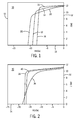
- FIG. 1 is the demagnetization plot 10 of the HTPM of Example 1.
- the intrinsic induction (J) 12 in kilo Gauss is plotted versus the magnetic field(H) 14 in kilo Oersteds.
- Example I praseodymium substitution for neodymium can increase coercivity of the NdFeB magnet by about 12% (i.e., from 9.10 to 10.22 kOe).
- the remanence Br and energy product (BH)max will decrease to some extent with the increase of praseodymium.
- the properties of the HTPM may be affected by the manufacturing system and process parameters, such as sintering and aging temperatures/times.
- Example II considers the effect of praseodymium content on the magnetic properties of the NdFeB alloy having high coercivity (e.g., greater than 14, kOe, 17 kOe, etc.).
- the magnet samples in Example II were sintered at 1090 °C for two hours and aged at 900 °C for one hour and then aged at 600 °C for two hours.
- the substantially horizontal slope of the demagnetization curves in plot 30 for the magnet samples of Example II further confirms that the process conditions (e.g., sintering and aging temperatures/times) of the HTPM manufacture should be altered for this particular composition having dysprosium as 6 weight % of the rare-earth content of the magnet.
- beneficial process parameter ranges may be different for dissimilar compositions.
- fixed parameter values such as the temperature values for sintering and aging, can mislead understanding of the expected trend of the positive impact the addition of terbium and/or dysprosium to enhance intrinsic coercivity.
- Example III The effect of terbium concentration on magnetic properties is examined in Example III.
- composition formula for this statistical example is (Pr 1-x Nd x ) 32-y Tb y Fe balance Co1 Cu0 1 Nb 1 B 1.1 .
- the factor values of the analysis are presented in table 6. Table 6.
- the concentration of the rare-earth content of praseodymium has a varying effect on intrinsic coercivity Hcj for different concentrations of the rare-earth content of terbium.
- the less the concentration of terbium in the rare-earth portion of the magnet the greater the impact on intrinsic coercivity Hcj with increasing concentration of praseodymium of the rare-earth content.
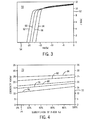
- a plot 70 of the transfer function correlating coercivity Hcj 72 in kilo Oersteds versus the amount of substitution 74 of Praseodymium for Neodymium in percent is given for various concentrations of terbium of the rare-earth, of 0, 1, 2, ,3, and 4 weight %, as represented by lines 76, 78, 80, 82, and 84, respectively.
- Example A Two particular cases, namely Example A and Example B, were examined, a first magnet having 3 weight % terbium and no praseodymium in the rare-earth content (Example A) and a second magnet having 2 weight % terbium and 75 weight % praseodymium of in the rare-earth content (Example B).
- the predicted intrinsic coercivity for the two hypothetical magnets were similar, 20.8 and 20.3 kilo Oersteds, respectively.
- Empirical results for actual first and second magnets samples having the stipulated compositions of Examples A and B were consistent with the hypothetical analyses in showing actual intrinsic coercivity Hcj of 19.95 and 19.31 kilo Oersteds, respectively.
- Exemplary Ranges Tb Wt % of Magnet 3 2 For weight % of rare-earth: 0-20%, 1-20%, 5-20%, 5-15% Pr Wt % of Rare Earth 0 73 50+%, 50-90%, 51-85%, 55-80%, 70+%, 71+%, 72+%, 73+%, 75+% Dy Wt % of Magnet 0 0
- the terbium weight % of the magnet may be lowered from about 1.5 % to about 0.5 % without significant loss of intrinsic coercivity. With only 0.5 wight % (of the magnet), an approximate 20 kOe or greater intrinsic coercivity is expected. Table 9.
- the magnetic flux density inside a magnetized body is denoted by the symbol B.
- the magnetizing force (or magnetic field producing it) is denoted by the symbol H.
- Units of B include teslas (T), webers per square meter (Wb/m 2 ), and Gauss (Gs).
- Units for H include amperes per meter (A/m) and Oersted (Oe), for example.
- Exemplary units of ⁇ are henrys per meter.
- Permanent-magnet materials are often characterized by quoting the maximum value of the product of B and H, (BH) max which the material can achieve. This product (BH) max may be considered a measure of the minimum volume of permanent-magnet material required to produce a required flux density in a given gap and is sometimes referred to as the energy product.
- the saturation intrinsic induction JS is a measure of how strongly the material can be magnetized.
- Remanence or the remanent flux density B r is the residual magnetization left after the magnetizing field is removed, measured in, e.g., teslas.
- the magnitude of a reverse magnetizing field necessary to reduce the intrinsic induction to zero is the intrinsic coercivity or coercive force H cj , measured in, e.g., amperes per meter.
- material of the REFeB type is an aspect of the present technique.
- This material is sometimes referred to as alloy or alloy material.
- the iron, boron, and rare-earth metal may each be used in amounts substantially corresponding to those desired in the final sintered product.
- the alloy can be formed by a number of methods.
- the alloy can be prepared by arc-melting or induction melting the iron, boron and rare-earth metal together in the appropriate amounts under a substantially inert atmosphere such as argon and allowing the melt to solidify.
- the melt may be cast into an ingot or into strips.
- the material can be converted to particulate form in a conventional manner known by those skilled in the art.
- the ingot or strips may undergo a crushing or pulverizing step in order to form the particulate material.
- Such conversion can be carried out in air at room temperature.
- the material can be crushed by mortar and pestle and then pulverized to a finer form by jet milling.
- Such powder may also be produced by known ball milling procedures, jet milling, or known hydrogen treatment, for example..
- the particle size of the iron-boron-rare earth alloy of the present invention may vary. It can be as finely divided as desired.
- the alloy particulate can have a mean particle size up to 60 microns.
- average particle size will range from about 1 to about 10 microns, or about 1 to about 7 microns, or about 3 to about 5 microns. It may be unusual, but the particulate material can even be up to 100 microns. While larger sized particles can be used, it is pointed out that as the particle size is increased, the coercive force obtainable may be lower because the coercive force generally varies inversely with particle size. In addition, as known in the art, the smaller the particle size, the lower the sintering temperature that may be employed due to adverse effects on the relatively small particles.
- the material exists prior to the application of a magnetic field. Once a magnetic field is applied, then particulate grains align themselves magnetically so that the principal magnetic phase is (RE) 2 Fe 14 B and the grains magnetically align along their easy axis. If the particulate (alloy) is exposed to an aligning magnetic field, it generally occurs before pressing and compacting the particulate into a green body, which is subsequently sintered.
- the aligning magnetic field may also be applied during the pressing and compacting of the particulate.
- the magnetic field that is applied is at least 17 kOe. The greater the magnetic alignment of the particulate grains (also referred to herein as particles), the better the resulting magnetic properties.
- the particulate material can be compressed or compacted into a green body of the desired size and density by any number of techniques known to those skilled in the art. Some of these techniques include hydrostatic pressing or methods employing steel dies. Compression may be carried out to produce a green body with as high a density as possible, since the higher its density, the greater the sintering rate. Green bodies having a density of about fifty percent or higher of theoretical are typically employed.
- the green body may be sintered to produce a sintered intermetallic product of desired density.
- the green body may be sintered to produce a sintered intermetallic product wherein the pores are substantially non-interconnecting.
- Such non-interconnectivity generally stabilizes the permanent magnet properties of the product because the interior of the sintered intermetallic product or magnet is protected against exposure to the ambient atmosphere.
- the sintering temperature may depend largely on the selected composition of the alloy and the particle size.
- the sintering temperature generally should be sufficient for sintering to occur in the selected alloy composition and to coalesce the particles.
- Sintering may carried out so that the pores in the sintered intermetallic product are substantially non-interconnecting.
- a sintered intermetallic product having a density of at least about 87 percent of theoretical is generally one wherein the pores are substantially non-interconnecting.
- Non-interconnectivity can be determined by standard metallographic techniques, such as optical electron micrographs of a cross-section of the sintered product.
- the maximum sintering temperature is usually one at which significant growth of the particles or grains does not occur, since too large an increase in grain size deteriorates magnetic properties such as coercive force.
- the green body may be sintered in a substantially inert atmosphere such as argon, and upon completion of sintering, the body can be cooled to room temperature in a substantially inert atmosphere.
- a particular sintering range for a selected composition can be determined empirically, for example, by carrying out a series of runs at successively higher sintering temperatures and then determining the magnetic properties of the sintered intermetallic products.
- the sintering temperature may be in the range of about 950 to about 1200 °C. for most compositions of this invention.
- the sintering time varies but may lie between one and five hours, or more.
- the density of the sintered intermetallic product may vary, depending, for example, on the particular permanent magnet properties desired.
- the density of the sintered intermetallic product is generally such that the pores are substantially non-interconnecting, which occurs usually at a density of about 87 percent or greater. However, for some applications, the density may be below 87 percent, such as the range from about 80 percent up to 100 percent. For example, at low temperature applications, a sintered intermetallic product having a density ranging down to about 80 percent may be satisfactory.
- the preferred density of the sintered intermetallic product is one which is the highest obtainable without producing a growth in grain size which would deteriorate magnetic properties significantly, since the higher the density the better are the magnetic properties.
- a density of at least about 87 percent of theoretical, i.e. of full density, and as high as about 96 percent of theoretical is preferred to produce permanent magnets with suitable magnetic properties which are substantially stable.
- the final sintered intermetallic product contains a major amount of the (RE) 2 Fe 14 B solid intermetallic phase.
- a major amount is greater than 50 percent by weight of the intermetallic product.
- Sintered intermetallic products having the highest energy products are those having the smallest content of other iron-boron-rare earth intermetallic phases.
- the final sintered intermetallic product is comprised predominately of the (RE) 2 Fe 14 B solid intermetallic phase, i.e. about 95 percent by weight or higher but less than 100 percent.
- Sintering of the green body produces a sintered product which weighs about the same as the green body indicating no loss, or no significant loss of iron, boron, and rare-earth components. Standard chemical analysis of a sintered product should show that the rare earth and iron and boron content is substantially unaffected by the sintering process.
- the magnetic properties of the present sintered intermetallic products can be improved by subjecting them to a heat-aging process.
- the sintered intermetallic product may be heat-aged at an exemplary temperature within 400 °C below its sintering temperature, for example. In other embodiments, the aging temperature is within 300 to 100 °C below its sintering temperature. Heat-aging is carried out in an atmosphere such as argon in which the material is substantially inert. The particular temperature at which the material is heat-aged is determinable empirically.
- the sintered product may be initially magnetized and its magnetic properties determined.
- the sintered product can be heat-aged immediately after sintering, if desired, simply by lowering the furnace temperature, i.e. furnace cooling, to the desired heat-aging temperature.
- the aging process may be conducted in two or more steps. For example, aging at 900 °C for 2 hours and then at 600 °C for 4 hours.
- Heat-aging by furnace cooling to the desired aging temperature is preferred. It requires a shorter period of time and generally produces a product with an intrinsic and/or normal coercive force significantly higher than that produced by the technique of initially cooling the sintered product to room temperature and then heating it up to the proper heat-aging temperature.
- the rate of furnace cooling should be slow with the particular furnace cooling rate being determinable empirically.
- the furnace cooling rate may range from about 0.1 to about 20 °C per minute depending largely on the particular iron-boron-rare earth alloy used.
- the rate of furnace cooling may be carried out in a continuous manner or, if desired, by step cooling.
- the heat-aged sintered intermetallic product of the present technique is useful as a permanent magnet.
- the resulting permanent magnet is substantially stable in air and has a wide variety of uses.
- the permanent magnets of the present invention are useful in moderate temperature applications, such as computers, magnetic resonance imaging devices, and so on, and in high-temperature applications, such as motors, generators, and so forth.
- the sintered bulk intermetallic product of the present invention can be crushed to a desired particle size preferably a powder, which is particularly suitable for alignment and matrix bonding to give a stable permanent magnet.
- permanent magnet materials of the (RE)FeB type of the present technique may then be obtained having intrinsic coercive force (Hcj) values of at least 17 kOe.
- the corresponding maximum energy product values (BH)max are at least 31 MGOein certain embodiments.
Landscapes
- Chemical & Material Sciences (AREA)
- Crystallography & Structural Chemistry (AREA)
- Inorganic Chemistry (AREA)
- Engineering & Computer Science (AREA)
- Power Engineering (AREA)
- Hard Magnetic Materials (AREA)
Applications Claiming Priority (1)
| Application Number | Priority Date | Filing Date | Title |
|---|---|---|---|
| US11/314,289 US20070137733A1 (en) | 2005-12-21 | 2005-12-21 | Mixed rare-earth based high-coercivity permanent magnet |
Publications (2)
| Publication Number | Publication Date |
|---|---|
| EP1818949A2 true EP1818949A2 (fr) | 2007-08-15 |
| EP1818949A3 EP1818949A3 (fr) | 2009-11-25 |
Family
ID=37907590
Family Applications (1)
| Application Number | Title | Priority Date | Filing Date |
|---|---|---|---|
| EP06126605A Withdrawn EP1818949A3 (fr) | 2005-12-21 | 2006-12-20 | Aimant permanent hautement coercitif basé sur du lanthanide mélangé |
Country Status (3)
| Country | Link |
|---|---|
| US (1) | US20070137733A1 (fr) |
| EP (1) | EP1818949A3 (fr) |
| CN (1) | CN101042955A (fr) |
Cited By (1)
| Publication number | Priority date | Publication date | Assignee | Title |
|---|---|---|---|---|
| EP2306471A1 (fr) * | 2009-09-30 | 2011-04-06 | General Electric Company | Aimant permanent à mélange de terres rares et procédé de fabrication |
Families Citing this family (10)
| Publication number | Priority date | Publication date | Assignee | Title |
|---|---|---|---|---|
| US7483761B2 (en) * | 2003-08-14 | 2009-01-27 | Taiwan Semiconductor Manufacturing Co., Ltd. | System and method of demand and capacity management |
| US9870547B2 (en) * | 2003-08-14 | 2018-01-16 | Chung-Wen Wang | System and method of demand and capacity management |
| KR101480471B1 (ko) * | 2011-04-27 | 2015-01-12 | 엘지전자 주식회사 | 전동기 및 이를 구비한 전기차량 |
| AU2016390095B9 (en) * | 2016-01-27 | 2018-12-13 | Mitsubishi Electric Corporation | Magnetizing method, rotor, electric motor, and scroll compressor |
| DE102016014464A1 (de) * | 2016-12-06 | 2018-06-07 | Minebea Co., Ltd. | Permanterregte elektrische Maschine |
| CN106673148B (zh) * | 2017-01-19 | 2019-03-29 | 万明蓉 | 一种高效磁化器 |
| CN111193334A (zh) * | 2018-11-15 | 2020-05-22 | 爱知Elec株式会社 | 一种永磁电机及压缩机 |
| CN110828089B (zh) * | 2019-11-21 | 2021-03-26 | 厦门钨业股份有限公司 | 钕铁硼磁体材料、原料组合物及制备方法和应用 |
| CN110797157B (zh) * | 2019-11-21 | 2021-06-04 | 厦门钨业股份有限公司 | 钕铁硼磁体材料、原料组合物及制备方法和应用 |
| CN111081443B (zh) * | 2020-01-07 | 2023-05-09 | 福建省长汀金龙稀土有限公司 | 一种r-t-b系永磁材料及其制备方法和应用 |
Family Cites Families (14)
| Publication number | Priority date | Publication date | Assignee | Title |
|---|---|---|---|---|
| US5466308A (en) * | 1982-08-21 | 1995-11-14 | Sumitomo Special Metals Co. Ltd. | Magnetic precursor materials for making permanent magnets |
| US6136099A (en) * | 1985-08-13 | 2000-10-24 | Seiko Epson Corporation | Rare earth-iron series permanent magnets and method of preparation |
| DE69202515T2 (de) * | 1991-06-04 | 1995-09-21 | Shinetsu Chemical Co | Verfahren zur Herstellung von zweiphasigen Dauermagneten auf der Basis von Seltenen Erden. |
| US5405455A (en) * | 1991-06-04 | 1995-04-11 | Shin-Etsu Chemical Co. Ltd. | Rare earth-based permanent magnet |
| US6120620A (en) * | 1999-02-12 | 2000-09-19 | General Electric Company | Praseodymium-rich iron-boron-rare earth composition, permanent magnet produced therefrom, and method of making |
| US6377049B1 (en) * | 1999-02-12 | 2002-04-23 | General Electric Company | Residuum rare earth magnet |
| US6589367B2 (en) * | 1999-06-14 | 2003-07-08 | Shin-Etsu Chemical Co., Ltd. | Anisotropic rare earth-based permanent magnet material |
| US6662434B2 (en) * | 2001-04-03 | 2003-12-16 | General Electric Company | Method and apparatus for magnetizing a permanent magnet |
| US7258751B2 (en) * | 2001-06-22 | 2007-08-21 | Neomax Co., Ltd. | Rare earth magnet and method for production thereof |
| US6596096B2 (en) * | 2001-08-14 | 2003-07-22 | General Electric Company | Permanent magnet for electromagnetic device and method of making |
| US6825666B2 (en) * | 2002-12-23 | 2004-11-30 | General Electric Company | Pole face for permanent magnet MRI with laminated structure |
| JP4470884B2 (ja) * | 2003-03-12 | 2010-06-02 | 日立金属株式会社 | R−t−b系焼結磁石およびその製造方法 |
| US20050062572A1 (en) * | 2003-09-22 | 2005-03-24 | General Electric Company | Permanent magnet alloy for medical imaging system and method of making |
| US20070089806A1 (en) * | 2005-10-21 | 2007-04-26 | Rolf Blank | Powders for rare earth magnets, rare earth magnets and methods for manufacturing the same |
-
2005
- 2005-12-21 US US11/314,289 patent/US20070137733A1/en not_active Abandoned
-
2006
- 2006-12-20 EP EP06126605A patent/EP1818949A3/fr not_active Withdrawn
- 2006-12-21 CN CNA2006100647962A patent/CN101042955A/zh active Pending
Cited By (1)
| Publication number | Priority date | Publication date | Assignee | Title |
|---|---|---|---|---|
| EP2306471A1 (fr) * | 2009-09-30 | 2011-04-06 | General Electric Company | Aimant permanent à mélange de terres rares et procédé de fabrication |
Also Published As
| Publication number | Publication date |
|---|---|
| CN101042955A (zh) | 2007-09-26 |
| EP1818949A3 (fr) | 2009-11-25 |
| US20070137733A1 (en) | 2007-06-21 |
Similar Documents
| Publication | Publication Date | Title |
|---|---|---|
| US4975129A (en) | Permanent magnet | |
| EP0134304B2 (fr) | Aimants permanents | |
| JP2751109B2 (ja) | 熱安定性の良好な焼結型永久磁石 | |
| US4767474A (en) | Isotropic magnets and process for producing same | |
| US6120620A (en) | Praseodymium-rich iron-boron-rare earth composition, permanent magnet produced therefrom, and method of making | |
| EP1662516B1 (fr) | Aimant fritté r-t-b, et alliage de terres rares | |
| US20110074530A1 (en) | Mixed rare-earth permanent magnet and method of fabrication | |
| EP0430278B1 (fr) | Aimant permanent de terre rare-fer-bore | |
| EP0680054B2 (fr) | Aimants de TR-Fe-B et leurs procédé de fabrication | |
| EP0626703A2 (fr) | Poudre sphérique magnétiquement anisotropique | |
| EP1818949A2 (fr) | Aimant permanent hautement coercitif basé sur du lanthanide mélangé | |
| US5230751A (en) | Permanent magnet with good thermal stability | |
| US5230749A (en) | Permanent magnets | |
| US5223047A (en) | Permanent magnet with good thermal stability | |
| JP3121824B2 (ja) | 焼結永久磁石 | |
| JP3540438B2 (ja) | 磁石およびその製造方法 | |
| JP2787580B2 (ja) | 熱処理性がすぐれたNd−Fe−B系焼結磁石 | |
| CN1133182C (zh) | 富含镨的铁-硼-稀土组分和其制的永磁铁及其制造方法 | |
| Rodewald et al. | Topology of Nd-Fe-B magnets with a high energy density | |
| JPH08181009A (ja) | 永久磁石とその製造方法 | |
| JPH0547533A (ja) | 焼結永久磁石およびその製造方法 | |
| EP0820070B1 (fr) | Matières premières en poudre pour aimants permanents et leurs procédé de fabrication | |
| JPH0536494B2 (fr) | ||
| Velicescu et al. | Improvement of the density of metal-bonded Sm/sub 2/Fe/sub 17/N/sub x/(x approximately= 3) magnets | |
| JPH02119105A (ja) | Nd−Fe−B系焼結磁石 |
Legal Events
| Date | Code | Title | Description |
|---|---|---|---|
| PUAI | Public reference made under article 153(3) epc to a published international application that has entered the european phase |
Free format text: ORIGINAL CODE: 0009012 |
|
| AK | Designated contracting states |
Kind code of ref document: A2 Designated state(s): AT BE BG CH CY CZ DE DK EE ES FI FR GB GR HU IE IS IT LI LT LU LV MC NL PL PT RO SE SI SK TR |
|
| AX | Request for extension of the european patent |
Extension state: AL BA HR MK YU |
|
| PUAL | Search report despatched |
Free format text: ORIGINAL CODE: 0009013 |
|
| AK | Designated contracting states |
Kind code of ref document: A3 Designated state(s): AT BE BG CH CY CZ DE DK EE ES FI FR GB GR HU IE IS IT LI LT LU LV MC NL PL PT RO SE SI SK TR |
|
| AX | Request for extension of the european patent |
Extension state: AL BA HR MK RS |
|
| 17P | Request for examination filed |
Effective date: 20100525 |
|
| AKX | Designation fees paid |
Designated state(s): DE DK ES |
|
| 17Q | First examination report despatched |
Effective date: 20100923 |
|
| STAA | Information on the status of an ep patent application or granted ep patent |
Free format text: STATUS: THE APPLICATION IS DEEMED TO BE WITHDRAWN |
|
| 18D | Application deemed to be withdrawn |
Effective date: 20110408 |