EP1832298A1 - Preparation a liberation controlee de type a matrice comprenant une substance basique ou un sel de celle-ci et procede pour la production de celle-ci - Google Patents
Preparation a liberation controlee de type a matrice comprenant une substance basique ou un sel de celle-ci et procede pour la production de celle-ci Download PDFInfo
- Publication number
- EP1832298A1 EP1832298A1 EP05822550A EP05822550A EP1832298A1 EP 1832298 A1 EP1832298 A1 EP 1832298A1 EP 05822550 A EP05822550 A EP 05822550A EP 05822550 A EP05822550 A EP 05822550A EP 1832298 A1 EP1832298 A1 EP 1832298A1
- Authority
- EP
- European Patent Office
- Prior art keywords
- solubility
- salt
- phosphate buffer
- matrix type
- dissolution
- Prior art date
- Legal status (The legal status is an assumption and is not a legal conclusion. Google has not performed a legal analysis and makes no representation as to the accuracy of the status listed.)
- Withdrawn
Links
Images



Classifications
-
- A—HUMAN NECESSITIES
- A61—MEDICAL OR VETERINARY SCIENCE; HYGIENE
- A61K—PREPARATIONS FOR MEDICAL, DENTAL OR TOILETRY PURPOSES
- A61K9/00—Medicinal preparations characterised by special physical form
- A61K9/20—Pills, tablets, discs, rods
-
- A—HUMAN NECESSITIES
- A61—MEDICAL OR VETERINARY SCIENCE; HYGIENE
- A61K—PREPARATIONS FOR MEDICAL, DENTAL OR TOILETRY PURPOSES
- A61K31/00—Medicinal preparations containing organic active ingredients
- A61K31/33—Heterocyclic compounds
- A61K31/395—Heterocyclic compounds having nitrogen as a ring hetero atom, e.g. guanethidine or rifamycins
- A61K31/435—Heterocyclic compounds having nitrogen as a ring hetero atom, e.g. guanethidine or rifamycins having six-membered rings with one nitrogen as the only ring hetero atom
- A61K31/44—Non condensed pyridines; Hydrogenated derivatives thereof
- A61K31/445—Non condensed piperidines, e.g. piperocaine
-
- A—HUMAN NECESSITIES
- A61—MEDICAL OR VETERINARY SCIENCE; HYGIENE
- A61K—PREPARATIONS FOR MEDICAL, DENTAL OR TOILETRY PURPOSES
- A61K31/00—Medicinal preparations containing organic active ingredients
- A61K31/13—Amines
-
- A—HUMAN NECESSITIES
- A61—MEDICAL OR VETERINARY SCIENCE; HYGIENE
- A61K—PREPARATIONS FOR MEDICAL, DENTAL OR TOILETRY PURPOSES
- A61K47/00—Medicinal preparations characterised by the non-active ingredients used, e.g. carriers or inert additives; Targeting or modifying agents chemically bound to the active ingredient
- A61K47/30—Macromolecular organic or inorganic compounds, e.g. inorganic polyphosphates
- A61K47/32—Macromolecular compounds obtained by reactions only involving carbon-to-carbon unsaturated bonds, e.g. carbomers, poly(meth)acrylates, or polyvinyl pyrrolidone
-
- A—HUMAN NECESSITIES
- A61—MEDICAL OR VETERINARY SCIENCE; HYGIENE
- A61K—PREPARATIONS FOR MEDICAL, DENTAL OR TOILETRY PURPOSES
- A61K9/00—Medicinal preparations characterised by special physical form
- A61K9/20—Pills, tablets, discs, rods
- A61K9/2004—Excipients; Inactive ingredients
- A61K9/2013—Organic compounds, e.g. phospholipids, fats
- A61K9/2018—Sugars, or sugar alcohols, e.g. lactose, mannitol; Derivatives thereof, e.g. polysorbates
-
- A—HUMAN NECESSITIES
- A61—MEDICAL OR VETERINARY SCIENCE; HYGIENE
- A61K—PREPARATIONS FOR MEDICAL, DENTAL OR TOILETRY PURPOSES
- A61K9/00—Medicinal preparations characterised by special physical form
- A61K9/20—Pills, tablets, discs, rods
- A61K9/2004—Excipients; Inactive ingredients
- A61K9/2022—Organic macromolecular compounds
- A61K9/2027—Organic macromolecular compounds obtained by reactions only involving carbon-to-carbon unsaturated bonds, e.g. polyvinyl pyrrolidone, poly(meth)acrylates
-
- A—HUMAN NECESSITIES
- A61—MEDICAL OR VETERINARY SCIENCE; HYGIENE
- A61K—PREPARATIONS FOR MEDICAL, DENTAL OR TOILETRY PURPOSES
- A61K9/00—Medicinal preparations characterised by special physical form
- A61K9/20—Pills, tablets, discs, rods
- A61K9/2004—Excipients; Inactive ingredients
- A61K9/2022—Organic macromolecular compounds
- A61K9/205—Polysaccharides, e.g. alginate, gums; Cyclodextrin
- A61K9/2054—Cellulose; Cellulose derivatives, e.g. hydroxypropyl methylcellulose
-
- A—HUMAN NECESSITIES
- A61—MEDICAL OR VETERINARY SCIENCE; HYGIENE
- A61K—PREPARATIONS FOR MEDICAL, DENTAL OR TOILETRY PURPOSES
- A61K9/00—Medicinal preparations characterised by special physical form
- A61K9/20—Pills, tablets, discs, rods
- A61K9/2095—Tabletting processes
-
- A—HUMAN NECESSITIES
- A61—MEDICAL OR VETERINARY SCIENCE; HYGIENE
- A61K—PREPARATIONS FOR MEDICAL, DENTAL OR TOILETRY PURPOSES
- A61K9/00—Medicinal preparations characterised by special physical form
- A61K9/48—Preparations in capsules, e.g. of gelatin, of chocolate
-
- A—HUMAN NECESSITIES
- A61—MEDICAL OR VETERINARY SCIENCE; HYGIENE
- A61P—SPECIFIC THERAPEUTIC ACTIVITY OF CHEMICAL COMPOUNDS OR MEDICINAL PREPARATIONS
- A61P25/00—Drugs for disorders of the nervous system
- A61P25/14—Drugs for disorders of the nervous system for treating abnormal movements, e.g. chorea, dyskinesia
- A61P25/16—Anti-Parkinson drugs
-
- A—HUMAN NECESSITIES
- A61—MEDICAL OR VETERINARY SCIENCE; HYGIENE
- A61P—SPECIFIC THERAPEUTIC ACTIVITY OF CHEMICAL COMPOUNDS OR MEDICINAL PREPARATIONS
- A61P25/00—Drugs for disorders of the nervous system
- A61P25/28—Drugs for disorders of the nervous system for treating neurodegenerative disorders of the central nervous system, e.g. nootropic agents, cognition enhancers, drugs for treating Alzheimer's disease or other forms of dementia
Definitions
- the present invention relates to a matrix type sustained-release preparation containing a basic drug or a salt thereof, more specifically, relates to the preparation which not only inhibits the initial drug burst (rapid drug release immediately after dissolution) in a dissolution test, but also ensures dissolution with low pH dependence of the basic drug or the salt thereof at the early stage of dissolution, in the dissolution test.
- the present invention also relates to a matrix type sustained-release preparation containing a basic drug or a salt thereof in which a ratio of a dissolution rate of the basic drug or the salt thereof in an acidic test solution to a dissolution rate of the basic drug or the salt thereof in a neutral test solution (dissolution rate in the acidic test solution / dissolution rate in the neutral test solution) decreases with dissolution time at the late stage of dissolution, as compared to the early stage of dissolution.
- a sustained-release preparation containing a physiologically active drug allows blood concentrations of the drug to be maintained for a long time at or above the effective therapeutic concentration. Accordingly, by achieving the sustained-release characteristics of a drug it is possible to reduce the number of administrations while providing the same or better therapeutic effects, potentially improving compliance. With the sustained-release characteristics of the drug, it is also possible to avoid a rapid increase in blood concentration of the drug immediately after administration, thus potentially reducing adverse effects, toxicity and the like due to the drug.
- the sustained-release preparation containing the drug which is physiologically active can be classified into two type preparations; (1) a sustained-release coated type preparation, in which release of the drug is controlled by coating a surface of a core particle or a core tablet containing a physiologically active drug with a sustained-release coating: (2) a matrix type preparation, in which the drug and a sustained-release base are distributed uniformly in the preparation.
- the coating conditions of the sustained-release coating have to be strictly controlled, and productivity is often low because of long coating times.
- the sustained-release coating is generally applied after the drug has been stacked on a core particle generally containing crystalline cellulose or sucrose. Consequently, a size of the preparation tends to be large when multiple layers of the sustained-release coating are applied or when a preparation contains a large amount of the drug, making it harder to administer orally.
- the matrix type sustained-release preparations have a structure in which the drug and the sustained-release base are present uniformly in the preparation and do not require the same strict production conditions as the sustained-release coated preparations, and can be produced by manufacturing operations similar to those for the ordinary rapid-release preparations. Accordingly, high productivity can be expected for the matrix type sustained-release preparations. In addition, it is easy to prepare the matrix type sustained-release preparation even when it contains a large quantity of the drug, and a size of the preparation does not need to be large. Thus, the matrix type sustained-release preparations are more useful than the sustained-release coated preparations from the standpoint of productivity and smaller size of the preparations.
- the physiologically active drug is a basic drug or a salt thereof
- the following problems generally occur when preparing a matrix type sustained-release preparation using a water-insoluble base:
- the first problem is that in a dissolution test of a matrix type sustained-release preparation containing a basic drug or a salt thereof, the dissolution rate of the basic drug or the salt thereof with dissolution time is generally much lower in a basic test solution than in an acidic test solution. This is because solubility of the basic drug or the salt thereof in an aqueous solvent is lower in a neutral and an alkaline pH range than in an acidic pH range. Because the sustained-release preparations generally comprises a larger amount of the drug than that of the rapid-release preparations, if a retention time of the sustained-release preparation in stomach is prolonged, there are risks of an unexpected increase in blood concentration of the basic drug or the salt thereof and onset of the adverse effects involved. This risk of the onset of the adverse effects is particularly serious in the case of the basic drug or the salt thereof with strong adverse effects and the basic drug and the salt thereof with a narrow safety range of blood concentration.
- the second problem is that the release rate of the basic drug or the salt thereof from the matrix type sustained-release preparation is lower at the late stage of dissolution than at the early stage of dissolution in the dissolution test. If the dissolution speed of the basic drug or the salt thereof from the sustained-release preparation in the acidic test solution is controlled with the aim of avoiding the first problem described above (that is, the rapid increase in blood concentration due to prolonged retention time of the drug or the salt thereof in stomach), in the case of the sustained-release preparation with a short gastric emptying time, this preparation is excreted with most of the drug remaining in the preparation, thus decreasing bioavailability and posing a different risk that pharmacologically effective concentrations will not be achieved.
- the first problem described above that is, the rapid increase in blood concentration due to prolonged retention time of the drug or the salt thereof in stomach
- the water-insoluble matrix does not dissolve in the dissolution test solution, and consequently, the diffusion distance in the matrix that the drug must pass through in order to be released becomes longer with dissolution time.
- the release speed of the basic drug or the salt thereof is inhibited too much at the early stage of dissolution, there may be a higher risk that the matrix type sustained-release preparation is excreted with most of the drug remaining in the preparation outside the body.
- the drug release speed decreases as a pH surrounding the preparation becomes neutral or weakly alkaline, thus increasing the risk that this preparation is excreted with most of the drug remaining in the preparation outside the body. This is undesirable because it reduces the bioavailability of the drug and gives the uncertainty of the pharmacological effects.
- U.S. Patent No. 4,792,452 discloses, for example, a matrix preparation which contains a basic drug or a salt thereof, alginic acid or a salt thereof, a pH-independent water-soluble gelatinizing agent and a binder.
- U.S. Patent No. 4,968,508 discloses, for example, a matrix preparation which contains Cefaclor, an acrylic acid polymer which dissolves at pH 5.0 to 7.4 and a hydrophilic polymer.
- H6-199657 discloses, for example, that a pH-dependent dissolution of a drug with higher solubility in an acetic acid buffer, pH 4.0 than in 1 st fluid and 2nd fluid of the Japanese Pharmacopoeia can be improved by preparing matrix tablets containing a water-soluble polymer, "a carboxyvinyl polymer or methylvinyl ether-maleic anhydride copolymer" and an enteric base.
- a water-soluble polymer "a carboxyvinyl polymer or methylvinyl ether-maleic anhydride copolymer” and an enteric base.
- 6,287,599 discloses, for example, a matrix preparation which contains a basic drug or a salt thereof with pH-dependent solubility, a pH-independent sustained-release base and a pH-dependent additive such as an enteric base, an organic acid and the like (which increases the dissolution rate of the drug from a tablet at a pH in excess of 5.5).
- a preparation which not only inhibits the dissolution of the basic drug or the salt thereof in accordance with the environment in the body so that the initial drug burst (rapid release of the drug immediately after dissolution) is suppressed, but also reliably provides dissolution with low pH-dependence at the early stage of the dissolution test, and wherein a ratio of the dissolution rate of the basic drug or the salt thereof in an acidic test solution to the dissolution rate of the basic drug or the salt thereof in a neutral test solution (dissolution rate in the acidic test solution / dissolution rate in the neutral test solution) decreases with dissolution time at the late stage of dissolution, as compared to the early stage of dissolution.
- sustained-release preparations containing a basic drug which inhibit unexpected increases in blood concentrations associated with the rapid dissolution of the basic drug from the preparations and which offer a decreased risk of reduced bioavailability associated with the sustained-release characteristics. That is, there is a demand for a matrix type sustained-release preparation containing a basic drug or a salt thereof, which not only inhibits the initial drug burst (rapid drug release immediately after dissolution) in a dissolution test, but also ensures dissolution with low pH dependence of the basic drug or the salt thereof at the early stage of dissolution, and wherein as the dissolution test proceeds, a dissolution speed in a neutral test solution is high at the late stage of dissolution.
- a matrix type sustained-release preparation which is capable of controlling the dissolution of the basic drug or the salt thereof, so that the solubility of the basic drug or the salt thereof decreases greatly with increased pH from a near-neutral to a weakly alkaline.
- a matrix type sustained-release preparation comprising (1) a basic drug or a salt thereof which has higher solubility in a 0.1 N hydrochloric acid solution and a neutral aqueous solution, pH 6.0 than in a basic aqueous solution, pH 8.0; and (2) at least one enteric polymer.
- the neutral aqueous solution is 50 mM phosphate buffer
- the basic aqueous solution is 50 mM phosphate buffer.
- the present invention also provides (II) the matrix type sustained-release preparation according to item (I), wherein in a dissolution test according to the Japanese Pharmacopoeia paddle method for dissolution tests, a ratio of a dissolution rate of the basic drug or the salt thereof in the 0.1 N hydrochloric acid solution to a dissolution rate of the basic drug or the salt thereof in the 50 mM phosphate buffer, pH 6.8 decreases with dissolution time until a dissolution time at which the dissolution rate of the basic drug or the salt thereof in the 50 mM phosphate buffer, pH 6.8 is 90%.
- the matrix type sustained-release preparation according to item (I) or (II), wherein in the dissolution test according to the Japanese Pharmacopoeia paddle method for the dissolution tests, the dissolution rate of the basic drug or the salt thereof in the 0.1 N hydrochloric acid solution is not more than 60% at a dissolution time of 1 hour.
- the dissolution rate of the basic drug or the salt thereof in the 0.1 N hydrochloric acid solution is more preferably not more than 50% at a dissolution time of 1 hour, still more preferably not more than 40%.
- the matrix type sustained-release preparation according to any one of items (I) to (III), wherein in the dissolution test according to the Japanese Pharmacopoeia paddle method for the dissolution test, the ratio of the dissolution rate of the basic drug or the salt thereof in the 0.1 N hydrochloric acid solution to the dissolution rate of the basic drug or the salt thereof in the 50 mM phosphate buffer, pH 6.8 is from 0.3 to 1.5 at a dissolution time of 3 hours. More preferably, the ratio of the dissolution rate is from 0.3 to 1.4, still more preferably from 0.3 to 1.3, most preferably from 0.3 to 1.2.
- the matrix type sustained-release preparation according to any one of items (I) to (IV), wherein in the dissolution test according to the Japanese Pharmacopoeia paddle method for the dissolution test, the dissolution rate of the basic drug or the salt thereof in the 0.1 N hydrochloric acid solution is not more than 60% at a dissolution time of 1 hour, and the ratio of the dissolution rate of the basic drug or the salt thereof in the 0.1 N hydrochloric acid solution to the dissolution rate of the basic drug or the salt thereof in the 50 mM phosphate buffer, pH 6.8 is from 0.3 to 1.5 at a dissolution time of 3 hours. More preferably, the dissolution rate of the basic drug or the salt thereof in the 0.1.
- N hydrochloric acid solution is not more than 50% at a dissolution time of 1 hour and the ratio of the dissolution rates is from 0.3 to 1.4, still more preferably the dissolution rate of the basic drug or the salt thereof in the 0.1 N hydrochloric acid solution being not more than 40% and the ratio of the dissolution rates being from 0.3 to 1.2.
- the matrix type sustained-release preparation according to the present invention may also comprise at least one water-insoluble polymer.
- the present invention provides a matrix type sustained-release preparation comprising: (1) a basic drug or a salt thereof which has higher solubility in a 0.1 N hydrochloric acid solution and a 50 mM phosphate buffer, pH 6.0 than in a 50 mM phosphate buffer, pH 8.0; (2) at least one enteric polymer; and (3) at least one water-insoluble polymer.
- the matrix type sustained-release preparation comprising (1) the basic drug or the salt thereof in which solubility of the basic drug or the salt thereof in the neutral aqueous solution, pH 6.8 is at least twice its solubility in the basic aqueous solution, pH 8.0 and is not more than half its solubility in the neutral aqueous solution, pH 6.0; and (2) at least one enteric polymer.
- the matrix type sustained-release preparation also comprises (3) at least one water-insoluble polymer.
- the matrix type sustained-release preparation comprising (1) the basic drug or the salt thereof in which solubility of the basic drug or the salt thereof in the 50 mM phosphate buffer, pH 6.8 is at least twice its solubility in the 50 mM phosphate buffer, pH 8.0 and is not more than half its solubility in the 50 mM phosphate buffer, pH 6.0; and (2) at least one enteric polymer.
- the matrix type sustained-release preparation also comprises (3) at least one water-insoluble polymer.
- the matrix type sustained-release preparation comprising (1) the basic drug or the salt thereof in which solubility of the basic drug or the salt thereof in the 0.1 N hydrochloric acid solution and the 50 mM phosphate buffer, pH 6.0 is 1 mg/mL or more and the solubility of the basic drug or the salt thereof in the 50 mM phosphate buffer, pH 8.0 is 0.2 mg/mL or less; (2) at least one enteric polymer.
- the matrix type sustained-release preparation also comprises (3) at least one water-insoluble polymer.
- the matrix type sustained-release preparation comprising (1) the basic drug or the salt thereof in which the solubility of the basic drug or the salt thereof in the 0.1 N hydrochloric acid solution and the 50 mM phosphate buffer, pH 6.0 is 1 mg/mL or more, the solubility of the basic drug or the salt thereof in the 50 mM phosphate buffer, pH 8.0 is 0.2 mg/mL or less, and the solubility of the basic drug or the salt thereof in the 50 mM phosphate buffer, pH 6.8 is at least twice its solubility in the 50 mM phosphate buffer, pH 8.0 and is not more than half its solubility in the 50 mM phosphate buffer, pH 6.0; (2) at least one enteric polymer.
- the matrix type sustained-release preparation also comprises (3) at least one water-insoluble polymer.
- the matrix type sustained-release preparation comprising: (1) the basic drug or the salt thereof in which solubility of the basic drug or the salt thereof is 1 mg/mL or more in the 0.1 N hydrochloric acid solution and the 50 mM phosphate buffer, pH 6.0 and is 0.2 mg/mL or less in the 50 mM phosphate buffer, pH 8.0, and the solubility of the basic drug or the salt thereof in the 50 mM phosphate buffer, pH 6.8 is at least twice its solubility in the 50 mM phosphate buffer, pH 8.0 and is not more than half its solubility in the 50 mM phosphate buffer, pH 6.0; and (2) at least one enteric polymer.
- the matrix type sustained-release preparation also comprises (3) at least one water-insoluble polymer.
- a matrix type sustained-release preparation containing a basic drug or a salt thereof which has higher solubility in the 0.1 N hydrochloric acid solution and the neutral aqueous solution, pH 6.0 than in the basic aqueous solution, pH 8.0
- the pH dependence of dissolution of the drug or the salt thereof at the early stage of dissolution is reduced, and the ratio of the dissolution rate of the drug or the salt thereof in the acidic test solution to the dissolution rate of the drug or the salt thereof in the neutral test solution (dissolution rate in the acidic test solution / dissolution rate in the neutral test solution) decreases with dissolution time as the dissolution test proceeds (the ratio being lower at the late stage than at the early stage of the dissolution test).
- the salt of the basic drug used in the present invention may be either an organic or inorganic acid salt.
- the salt include, but are not limited to, hydrochlorides, sulfates, acetates, phosphates, carbonates, mesylates, tartrates, citrates, tosylates and the like.
- Examples of the basic drug or the salt thereof used in the present invention include, but are not limited to, anti-dementia drugs such as donepezil hydrochloride, galantamine hydrobromide, rivastigmine tartrate, memantine hydrochloride, tacrine and the like; anti-anxiety drugs such as flurazepam hydrochloride, alprazolam, tandospirone citrate, rilmazafone hydrochloride and the like; antihistamines such as diphenylpyraline hydrochloride, chlorpheniramine maleate, cimetidine, isothipendyl hydrochloride and the like; circulatory drugs such as phenylephrine hydrochloride, procainamide hydrochloride, quinidine sulfate, isosorbide dinitrate, nicorandil and the like; antihypertensive drugs such as amlodipine besylate, nifedipine, nicardipine hydrochlor
- the anti-dementia drugs are preferred, and donepezil hydrochloride and / or memantine hydrochloride are particularly preferred.
- the matrix type sustained-release preparation according to the present invention may be also suitable for the basic drugs or the salts thereof which have a narrow drug safety range or which produce adverse effects dependent on maximum blood concentration of the drug.
- the anti-dementia drug contained in the matrix type sustained-release preparation according to the present invention there are no particular limitations on the anti-dementia drug contained in the matrix type sustained-release preparation according to the present invention, but from the standpoint of controlling release it is effective for the basic drugs or the salts thereof which are less soluble in an alkaline aqueous solution than in an acidic aqueous solutions and the solubility of the basic drugs or the salts thereof for a pH of an aqueous solution changes near the neutral pH.
- Examples include the basic drugs or the salts thereof with a pKa of 7.0 to 12, preferably 7.5 to 11, more preferably 8.0 to 10.5, still more preferably 8.5 to 10.5.
- donepezil hydrochloride is a basic drug with a pKa of 8.90
- memantine hydrochloride is a basic drug with a pKa of 10.27.
- solubility of the basic drug or the salt thereof used in the present invention with respect to acidic aqueous solutions, neutral aqueous solutions or basic aqueous solutions, but the solubility of the basic drug or the salt thereof in the acidic aqueous solution and the neutral aqueous solution is higher than its solubility in the basic aqueous solution.
- examples for this use includes, but are not limited to, a phosphate buffer (for instance, buffers prepared with 50 mM sodium phosphate solution and hydrochloric acid), buffers such as G. L.
- solubility used in the present invention refers to solubility wherein a solution temperature is 25 °C.
- solubility in an acidic aqueous solution means that a solubility of the basic drug or the salt thereof in a solution exhibiting an acidic property when dissolving the basic drug or the salt thereof in a buffer or the like.
- solubility in a neutral (basic) aqueous solution used in the present invention means that a solubility of the basic drug or the salt thereof in a solution exhibiting a neutral (basic) property when dissolving the basic drug or the salt thereof in a buffer or the like.
- the basic drug or the salt thereof used in the present invention has a higher solubility in the acidic aqueous solution, pH 3.0 and the neutral aqueous solution, pH 6.0 than in the basic aqueous solution, pH 8.0.
- solubility in the acidic aqueous solution, pH 3.0 used herein means that a solubility of the basic drug or the salt thereof in the acidic solution having a pH 3.0 when dissolving the basic drug or the salt thereof in a buffer or the like.
- solubility in the neutral aqueous solution, pH 6.0 used herein means that a solubility of the basic drug or the salt thereof in a solution having a pH 6.0 when dissolving the basic drug or the salt thereof in a buffer or the like.
- solubility in the basic aqueous solution, pH 8.0 used herein means that a solubility of the basic drug or the salt thereof in a solution having a pH 8.0 when dissolving the basic drug or the salt thereof in a buffer or the like.
- the basic drug or the salt thereof used in the present invention has a higher solubility in a 0.1 N hydrochloric acid solution and the neutral aqueous solution, pH 6.0 than in the basic aqueous solution, pH 8.0.
- the term "solubility in the 0.1 N hydrochloric acid solution” used herein means a solubility of the basic drug or the salt thereof when dissolving the basic drug or the salt thereof in the 0.1 N hydrochloric acid solution.
- the solutions of donepezil hydrochloride and memantine hydrochloride which are dissolved in the 0.1 N hydrochloric acid solution show a pH range of from about 1 to about 2.
- the basic drug or the salt thereof used in the present invention has a solubility in the 0.1 N hydrochloric acid solution and the neutral aqueous solution, pH 6.0 being higher than in the basic aqueous solution, pH 8.0 and a solubility in the neutral aqueous solution, pH 6.8 being at least twice its solubility in the basic aqueous solution, pH 8.0, and being not more than half its solubility in the neutral aqueous solution, pH 6.0.
- the term "solubility in the neutral aqueous solution, pH 6.8" used herein means that a solubility of the basic drug or the salt thereof in a solution having a pH 6.8 when dissolving the basic drug or the salt thereof in a buffer or the like.
- solubility of the basic drug or the salt thereof in the 0.1 N hydrochloric acid solution and the neutral aqueous solution pH 6.0 is 1 mg/mL or more
- solubility of the basic drug or the salt thereof in the basic aqueous solution pH 8.0 is 0.2 mg/mL or less
- solubility of the basic drug or the salt thereof in the neutral aqueous solution pH 6.8 is two or more times its solubility in the basic aqueous solution, pH 8.0 and is not more than half its solubility in the neutral aqueous solution, pH 6.0.
- the solubility of the basic drug or the salt thereof in the 0.1 N hydrochloric acid solution and the neutral aqueous solution, pH 6.0 is not particularly limited as long as the above solubility is 1 mg/mL or more.
- the above solubility is generally 1 to 1000 mg/mL, preferably 5 to 200 mg/mL, more preferably 5 to 100 mg/mL, still more preferably 10 to 80 mg/mL.
- the solubility of the basic drug or the salt thereof in the basic aqueous solution, pH 8.0 is not particularly limited as long as the above solubility is 0.2 mg/mL or less.
- the above solubility is generally 0.0001 to 0.2 mg/mL, preferably 0.0005 to 0.1 mg/mL, more preferably 0.001 to 0.05 mg/mL, still more preferably 0.002 to 0.03 mg/mL.
- the solubility of the basic drug or the salt thereof in the neutral aqueous solution, pH 6.8 is not particularly limited as long as the above solubility is at least twice its solubility in the basic aqueous solution, pH 8.0 and is not more than 1/2 solubility in the neutral aqueous solution, pH 6.0.
- the above solubility is preferably at least 3 times solubility in the basic aqueous solution, pH 8.0 and is not more than 1/3 solubility in the neutral aqueous solution, pH 6.0, more preferably at least 5 times solubility in the basic aqueous solution, pH 8.0 and not more than 1/5 solubility in the neutral aqueous solution, pH 6.0, still more preferably at least 10 times solubility in the basic aqueous solution, pH 8.0 and not more than 1/10 solubility in the neutral aqueous solution, pH 6.0.
- solubility of the basic drug or the salt thereof used in the present invention in the 0.1 N hydrochloric acid solution and the 50 mM phosphate buffer, pH 6.0 is higher than its solubility in the 50 mM phosphate buffer, pH 8.0.
- solubility in the 50 mM phosphate buffer, pH 6.0 used herein means a solubility of the basic drug or the salt thereof in the 50 mM phosphate buffer having pH 6.0 when dissolving the basic drug or the salt thereof in the 50 mM phosphate buffer.
- solubility in the 50 mM phosphate buffer, pH 8.0 means a solubility of the basic drug or the salt thereof in the 50 mM phosphate buffer having pH 8.0 when dissolving the basic drug or the salt thereof in the 50 mM phosphate buffer.
- the solubility of the basic drug or the salt thereof in the 0.1 N hydrochloric acid solution and the 50 mM phosphate buffer, pH 6.0 is higher than its solubility in the 50 mM phosphate buffer, pH 8.0, and the solubility in the 50 mM phosphate buffer, pH 6.8 is two or more times its solubility in the 50 mM phosphate buffer, pH 8.0 and is not more than half its solubility in the 50 mM phosphate buffer, pH 6.0.
- solubility of the basic drug or the salt thereof in the 0.1 N hydrochloric acid solution and the 50 mM phosphate buffer pH 6.0 is 1 mg/mL or more
- the solubility of the basic drug or the salt thereof in the 50 mM phosphate buffer, pH 8.0 is 0.2 mg/mL or less
- the solubility of the basic drug or the salt thereof in the 50 mM phosphate buffer, pH 6.8 is two or more times its solubility in the 50 mM phosphate buffer, pH 8.0 and is not more than half its solubility in the 50 mM phosphate buffer, pH 6.0.
- the solubility of the basic drug or the salt thereof in the 0.1 N hydrochloric acid solution and the 50 mM phosphate buffer, pH 6.0 is not particularly limited as long as the above solubility is 1 mg/mL or more.
- the above solubility is generally 1 to 1000 mg/mL, preferably 5 to 200 mg/mL, more preferably 5 to 100 mg/mL, still more preferably 10 to 80 mg/mL.
- the solubility of the basic drug or the salt thereof in the 50 mM phosphate buffer, pH 8.0 is not particularly limited as long as the above solubility is 0.2 mg/mL or less.
- the above solubility is generally 0.0001 to 0.2 mg/mL, preferably 0.0005 to 0.1 mg/mL, more preferably 0.001 to 0.05 mg/mL, still more preferably 0.002 to 0.03 mg/mL.
- the solubility of the basic drug or the salt thereof in the 50 mM phosphate buffer, pH 6.8 is not particularly limited as long as the above solubility is at least twice its solubility in the 50 mM phosphate buffer, pH 8.0 and is not more than 1/2 solubility in the 50 mM phosphate buffer, pH 6.0.
- the above solubility is preferably at least 3 times solubility in the 50 mM phosphate buffer, pH 8.0 and is not more than 1/3 solubility in the 50 mM phosphate buffer, pH 6.0, more preferably at least 5 times solubility in the 50 mM phosphate buffer, pH 8.0 and not more than 1/5 solubility in the 50 mM phosphate buffer, pH 6.0, still more preferably at least 10 times solubility in the 50 mM phosphate buffer, pH 8.0 and not more than 1/10 solubility in the 50 mM phosphate buffer, pH 6.0.
- donepezil hydrochloride is characterized by its solubility of 11 to 16 mg/mL in an acidic aqueous solution, pH 3.0 and a neutral aqueous solution, pH 6.0 and 0.1 mg/mL or less in a basic aqueous solution, pH 8.0.
- donepezil hydrochloride is a weakly basic drug or a salt thereof having one tertiary amino group, which has been widely used for Alzheimer's disease dementia, and is characterized by its solubility in the neutral aqueous solution, pH 6.8 being at least twice solubility in the basic aqueous solution, pH 8.0 and being not more than 1/2 solubility in the neutral aqueous solution, pH 6.0.
- donepezil hydrochloride is a weakly basic drug or a salt thereof having one tertiary amino group, which has been widely used for Alzheimer's disease dementia.
- Donepezil hydrochloride is characterized by its solubility of 11 to 16 mg/mL in the 0.1 N hydrochloric acid solution and the 50 mM phosphate buffer, pH 6.0 and 0.1 mg/mL or less in the 50 mM phosphate buffer, pH 8.0, with the solubility in the 50 mM phosphate buffer, pH 6.8 being at least twice solubility in the 50 mM phosphate buffer, pH 8.0 and being not more than 1/2 solubility in the 50 mM phosphate buffer, pH 6.0.
- the dose of the weak basic drug or the salt thereof used in the present invention is from 0.01 to 50 mg/day. More specifically, the dose of donepezil or a pharmacologically acceptable salt thereof is from 0.01 to 50 mg/day, preferably from 0.1 to 40 mg/day, more preferably from 1 to 30 mg/day, still more preferably from 5 to 25 mg/day.
- the dose of rivastigmine or a pharmacologically acceptable salt thereof is from 0.01 to 50 mg/day, preferably from 0.1 to 30 mg/day, more preferably from 1 to 20 mg/day, still more preferably from 1 to 15 mg/day.
- the dose of galantamine or a pharmacologically acceptable salt thereof is from 0.01 to 50 mg/day, preferably from 0.1 to 40 mg/day, more preferably from 1 to 30 mg/day, still more preferably from 2 to 25 mg/day.
- the dose is from 0.5 to 100 mg/day, preferably from 1 to 100 mg/day, more preferably from 1 to 40 mg/day, still more preferably from 5 to 25 mg/day.
- enteric polymer used in the present invention preferably it should dissolve in some aqueous buffer solutions at a pH somewhere in the range of 5.0 to 8.0, although the enteric polymer does not dissolve in the 0.1 N hydrochloric acid solution.
- At least one enteric polymer can be used, and two or more enteric polymers may be mixed.
- the enteric polymers include, but are not limited to, methacrylic acid-methyl methacrylate copolymer (Eudragit L100, Eudragit S100 etc.: Röhm GmbH & Co.
- methacrylic acid-ethyl acrylate copolymer (Eudragit L100-55, Eudragit L30D-55 etc.: Röhm GmbH & Co. KG, Darmstadt, Germany), hydroxypropyl methylcellulose phthalate (HP-55, HP-50 etc.: Shin-Etsu Chemical, Japan), hydroxypropyl methylcellulose acetate succinate (AQOAT etc.: Shin-Etsu Chemical, Japan), carboxymethyl ethylcellulose (CMEC: Freund Corporation, Japan), cellulose acetate phthalate and the like, with methacrylic acid-ethyl acrylate copolymer, methacrylic acid-methyl methacrylate copolymer, hydroxypropyl methylcellulose phthalate and hydroxypropyl methylcellulose acetate succinate being preferred.
- the enteric polymer which can dissolve in a buffer solution at a pH in the range of from 5.0 to 6.8 is more preferable.
- enteric polymers include, but are not limited to, methacrylic acid-ethyl acrylate copolymer and hydroxypropyl methylcellulose acetate succinate.
- methacrylic acid-ethyl acrylate be Eudragit L100-55 (Röhm GmbH & Co. KG, Darmstadt, Germany), which is a powder and which can dissolve in a buffer solution at a pH in a range of not less than 5.5.
- hydroxypropyl methylcellulose acetate succinate be AQOAT LF (which can dissolve at a pH in a range of not less than 5.5; Shin-Etsu Chemical, Japan) or AQOAT MF (which can dissolve at a pH in a range of not less than 6.0; Shin-Etsu Chemical, Japan), which are fine powders and which have a mean particle size being about 5 ⁇ m.
- AQOAT LF which can dissolve at a pH in a range of not less than 5.5; Shin-Etsu Chemical, Japan
- AQOAT MF which can dissolve at a pH in a range of not less than 6.0; Shin-Etsu Chemical, Japan
- the mean particle size is preferably 0.05 to 100 ⁇ m, more preferably 0.05 to 70 ⁇ m, still more preferably 0.05 to 50 ⁇ m.
- the water-insoluble polymer used in the present invention refers to a sustained-release base which does not dissolve in an aqueous buffer solution at a pH anywhere in the range of 1.0 to 8.0, and is not particularly limited.
- the matrix type sustained-release preparation according to the present invention preferably comprises at least one water-insoluble polymer, and two or more water-insoluble polymers may be contained in the matrix type sustained-release preparation.
- water-insoluble polymers examples include, but are not limited to, cellulose ethers (cellulose alkyl ethers such as ethylcellulose, ethyl methylcellulose, ethyl propylcellulose, isopropylcellulose, butylcellulose and the like; cellulose aralkyl ethers such as benzyl cellulose and the like; cellulose cyanoalkyl ethers such as cyanoethyl cellulose and the like), cellulose esters (cellulose organic acid esters such as cellulose acetate butyrate, cellulose acetate, cellulose propionate, cellulose butyrate, cellulose acetate propionate and the like), methacrylic acid-acrylic acid copolymers (trade names: Eudragit RS, Eudragit RL, Eudragit NE, Röhm GmbH & Co.
- cellulose ethers cellulose alkyl ethers such as ethylcellulose, ethyl methylcellulose, ethyl propyl
- ethylcellulose ethylcellulose, aminoalkyl methacrylate copolymer RS (Eudragit RL, Eudragit RS) and ethyl acrylate-methyl methacrylate copolymer (Eudragit NE) are preferred and ethylcellulose (ETHOCEL, The Dow Chemical Company, U.S. and the like) is most preferred.
- the mean particle size of the water-insoluble polymer used in the present invention is preferably 0.1 to 100 ⁇ m, more preferably 1 to 50 ⁇ m, still more preferably 3 to 15 ⁇ m, most preferably 5 to 15 ⁇ m.
- An amount of the enteric polymer in the matrix type sustained-release preparation is not particularly limited, but is generally 5 to 90% by weight, preferably 8 to 70% by weight, more preferably 10 to 60% by weight, most preferably 15 to 50% by weight, based on 100% by weight of the matrix type sustained-release preparation.
- a total amount of the water-insoluble polymer and the enteric polymer in the matrix type sustained-release preparation is not particularly limited, but is generally 25 to 95% by weight, preferably 35 to 95% by weight, more preferably 35 to 90% by weight, most preferably 35 to 75% by weight, based on 100% by weight of the matrix type sustained-release preparation.
- the water-insoluble polymer be ethylcellulose and that the enteric polymer be at least one selected from the group consisting of methacrylic acid-ethyl acrylate copolymer, methacrylic acid-methyl methacrylate copolymer and hydroxypropyl methylcellulose acetate succinate. It is more preferable that the water-insoluble polymer be ethylcellulose and that the enteric polymer be methacrylic acid-ethyl acrylate copolymer and / or hydroxypropyl methylcellulose acetate succinate.
- An amount of the water-insoluble polymer in the matrix type sustained-release preparation is not particularly limited, but is generally 1 to 90% by weight, preferably 3 to 70% by weight, more preferably 5 to 50% by weight, still more preferably 5 to 35% by weight, based on 100% by weight of the matrix type sustained-release preparation.
- the matrix type sustained-release preparation according to the present invention provides remarkable features that dissolution with low pH dependence of the basic drug or the salt thereof at the early stage of dissolution can be ensured in the dissolution test and that as the dissolution test proceeds, a ratio of a dissolution rate of the basic drug or the salt thereof in an acidic dissolution test solution (hereinafter referred to as an acidic test solution) to a dissolution rate of the basic drug or the salt thereof in a neutral dissolution test solution (hereinafter referred to as a neutral test solution) (dissolution rate in the acidic test solution / dissolution rate in the neutral test solution) decreases with dissolution time at the late stage of dissolution, as compared to the early stage of dissolution.
- an acidic test solution an acidic dissolution test solution
- a neutral test solution dissolution rate in the basic drug or the salt thereof in a neutral dissolution test solution
- the enteric polymer by mixing the enteric polymer with the basic drug or the salt thereof having higher solubility in the acidic aqueous solution and the neutral aqueous solution than in the basic aqueous solution described above, dissolution of the basic drug or the salt thereof can be inhibited in the acidic and neutral dissolution test solutions.
- characteristic features of the matrix type sustained-release preparation according to the present invention can be specifically demonstrated by dissolution profile in a 50 mM phosphate buffer, pH 6.8 as the neutral dissolution test solution and in 0.1 N hydrochloric acid solution as the acidic dissolution test in the dissolution test.
- the ratio of the dissolution rate of the basic drug or the salt thereof in the 0.1 N hydrochloric acid solution to the dissolution rate of the basic drug or the salt thereof in the 50 mM phosphate buffer, pH 6.8 decreases with dissolution time until a dissolution time at which the dissolution rate of the basic drug or the salt thereof in the 50 mM phosphate buffer, pH 6.8 is 90%.
- the present invention provides the matrix type sustained-release preparation wherein in the dissolution test according to the Japanese Pharmacopoeia paddle method for the dissolution tests, the dissolution rate of the basic drug or the salt thereof in the 0.1 N hydrochloric acid solution at a dissolution time of 1 hour is not more than 60%, preferably not more than 50%, more preferably not more than 40%.
- the ratio of the dissolution rate of the basic drug or the salt thereof in the 0.1 N hydrochloric acid solution to the dissolution rate of the basic drug or the salt thereof in the 50 mM phosphate buffer, pH 6.8 is from 0.3 to 1.5, preferably from 0.3 to 1.4, more preferably from 0.3 to 1.3, still more preferably from 0.3 to 1.2 at a dissolution time of 3 hours.
- the Japanese Pharmacopoeia paddle method for dissolution tests is described in the Japanese Pharmacopoeia, 14 th edition, and for example, the test can be performed at a paddle rate of 50 rpm.
- the matrix type sustained-release preparation according to the present invention preferably also comprises a water-soluble sugar and / or a water-soluble sugar alcohol.
- a water-soluble sugar and / or a water-soluble sugar alcohol There are no particular limitations on the water-soluble sugar and / or the water-soluble sugar alcohol.
- the water-soluble sugars include, but are not limited to, lactose, sucrose, glucose, dextrin, pullulan and the like.
- Examples of the water-soluble sugar alcohols include, but are not limited to, mannitol, erythritol, xylitol, sorbitol and the like, with lactose and mannitol being preferred.
- the amount of the water-soluble sugar or water-soluble sugar alcohol in the matrix type sustained-release preparation is generally 3 to 70% by weight, preferably 5 to 60% by weight, more preferably 10 to 60% by weight, still more preferably 12 to 60% by weight, based on 100% by weight of the matrix type sustained-release preparation.
- the matrix type sustained-release preparation according to the present invention further comprises a variety of pharmacologically acceptable carriers, such as diluents, lubricants, binders, disintegrators and the like as well as other preparation additives such as preservatives, anti-oxidants, colorants, sweeteners, plasticizers and the like, if necessary.
- diluents include, but are not limited to, starch, pregelatinized starch, crystalline cellulose, light anhydrous silicic acid, synthetic aluminum silicate, magnesium aluminate metasilicate and the like.
- lubricants include, but are not limited to, magnesium stearate (Mallinckrodt Baker, Inc. USA), calcium stearate, talc, sodium stearyl fumarate and the like.
- binders include hydroxypropylcellulose, methylcellulose, carboxymethylcellulose sodium, hydroxypropyl methylcellulose, polyvinylpyrrolidone and the like.
- disintegrators include, but are not limited to, carboxymethyl cellulose, carboxymethyl cellulose calcium, croscarmellose sodium, carboxymethyl starch sodium, low-substituted hydroxypropylcellulose and the like.
- preservatives include, but are not limited to, paraoxybenzoic acid esters, chlorobutanol, benzyl alcohol, phenethyl alcohol, dehydroacetic acid, sorbic acid and the like.
- anti-oxidants include, but are not limited to, sulfites, ascorbates and the like.
- colorants include, but are not limited to, non-water-soluble lake pigments, natural pigments (such as ⁇ -carotene, chlorophyll and red ferric oxide), yellow ferric oxide, red ferric oxide, black iron oxide and the like.
- sweeteners include, but are not limited to, sodium saccharin, dipotassium glycyrrhizate, aspartame, stevia and the like.
- plasticizers include, but are not limited to, glycerin fatty acid esters (trade name Myvacet), triethyl citrate (trade name Citroflex 2), propylene glycol, polyethylene glycol and the like.
- film coating bases include, but are not limited to, hydroxypropyl methylcellulose, hydroxypropyl cellulose and the like.
- an amount of the carrier contained in the matrix type sustained-release preparation according to the present invention is not particularly limited, but for example, an amount of the lubricant is generally from 0 to 5% by weight, preferably from 0.01 to 4% by weight, more preferably from 0.1 to 3% by weight, still more preferably from 0.3 to 1 % by weight, based on 100 % by weight of the matrix type sustained-release preparation.
- an amount of the binder is generally from 0 to 10% by weight, preferably from 0.1 to 8% by weight, more preferably from 0.5 to 6% by weight, still more preferably from 1 to 3% by weight, based on 100 % by weight of the matrix type sustained-release preparation.
- the matrix type sustained-release preparation according to the present invention comprises, for example, (a) a basic drug or a salt thereof, (b) 5 to 90% by weight of an enteric polymer and (c) 3 to 70% by weight of a water-soluble sugar alcohol, based on 100% by weight of the matrix type sustained-release preparation.
- the matrix type sustained-release preparation according to the present invention comprises (a) a basic drug or a salt thereof, (b) 8 to 70% by weight of an enteric polymer and (c) 5 to 60% by weight of a water-soluble sugar alcohol, based on 100% by weight of the matrix type sustained-release preparation.
- the matrix type sustained-release preparation according to the present invention comprises (a) a basic drug or a salt thereof, (b) 10 to 60% by weight of an enteric polymer and (c) 10 to 60% by weight of a water-soluble sugar alcohol, based on 100% by weight of the matrix type sustained-release preparation. Still more preferably, the matrix type sustained-release preparation according to the present invention comprises (a) a basic drug or a salt thereof, (b) 15 to 50% by weight of an enteric polymer and (c) 12 to 60% by weight of a water-soluble sugar alcohol, based on 100% by weight of the matrix type sustained-release preparation.
- the matrix type sustained-release preparation according to the present invention comprises, for example, (a) a basic drug or a salt thereof, (b) 5 to 90% by weight of an enteric polymer: (c) 3 to 70% by weight of a water-soluble sugar alcohol and (d) 1 to 90% by weight of a water-insoluble polymer, based on 100% by weight of the matrix type sustained-release preparation.
- the matrix type sustained-release preparation according to the present invention comprises, for example, (a) a basic drug or a salt thereof, (b) 8 to 70% by weight of an enteric polymer, (c) 5 to 60% by weight of a water-soluble sugar alcohol and (d) 3 to 70% by weight of a water-insoluble polymer, based on 100% by weight of the matrix type sustained-release preparation.
- the matrix type sustained-release preparation according to the present invention comprises, for example, (a) a basic drug or a salt thereof, (b) 10 to 60% by weight of an enteric polymer, (c) 10 to 60% by weight of a water-soluble sugar alcohol and (d) 5 to 50% by weight of a water-insoluble polymer, based on 100% by weight of the matrix type sustained-release preparation.
- the matrix type sustained-release preparation according to the present invention comprises, for example, (a) a basic drug or a salt thereof, (b) 15 to 50% by weight of an enteric polymer, (c) 12 to 60% by weight of a water-soluble sugar alcohol and (d) 5 to 35% by weight of a water-insoluble polymer, based on 100% by weight of the matrix type sustained-release preparation.
- a method for manufacturing a matrix type sustained-release preparation comprising the steps of: mixing a basic drug or a salt thereof which has higher solubility in a 0.1 N hydrochloric acid solution and a 50 mM phosphate buffer, pH 6.0 than in a neutral aqueous solution, pH 8.0, with at least one enteric polymer; and compression-molding the mixture obtained in the mixing step.
- the present invention also provides another method for manufacturing a matrix type sustained-release preparation, comprising the steps of: mixing (1) a basic drug or a salt thereof which has solubility in the 0.1 N hydrochloric acid solution and the neutral aqueous solution, pH 6.0 being 1 mg/mL or more, solubility in the basic aqueous solution, pH 8.0 being 0.2 mg/mL or less, and which has solubility in the neutral aqueous solution, pH 6.8 being at least twice its solubility in the basic aqueous solution, pH 8.0 and being not more than half its solubility in the neutral aqueous solution, pH 6.0, with (2) at least one enteric polymer; and compression-molding the mixture obtained in the mixing step.
- a water-insoluble polymer is also mixed in the mixing step.
- a method for manufacturing a matrix type sustained-release preparation comprising the steps of: mixing a basic drug or a salt thereof which has higher solubility in a 0.1 N hydrochloric acid solution and a 50 mM phosphate buffer, pH 6.0 than in a 50 mM phosphate buffer, pH 8.0, with at least one enteric polymer; and compression-molding the mixture obtained in the mixing step.
- the present invention also provides another method for manufacturing a matrix type sustained-release preparation, comprising the steps of: mixing (1) a basic drug or a salt thereof which has solubility in the 0.1 N hydrochloric acid solution and the 50 mM phosphate buffer, pH 6.0 being 1 mg/mL or more, solubility in the 50 mM phosphate buffer, pH 8.0 being 0.2 mg/mL or less, and which has solubility in the 50 mM phosphate buffer, pH 6.8 being at least twice its solubility in the 50 mM phosphate buffer, pH 8.0 and being not more than half its solubility in the 50 mM phosphate buffer, pH 6.0, with (2) at least one enteric polymer; and compression-molding the mixture obtained in the mixing step.
- a water-insoluble polymer is also mixed in the mixing step.
- the present invention provides a method for manufacturing a matrix type sustained-release preparation, comprising the steps of: mixing (A) a basic drug or a salt thereof which has higher solubility in a 0.1 N hydrochloric acid solution and a 50 mM phosphate buffer, pH 6.0 than in a 50 mM phosphate buffer, pH 8.0, the solubility of the basic drug or the salt thereof in the 50 mM phosphate buffer, pH 6.8 being at least twice its solubility in the 50 mM phosphate buffer, pH 8.0 and being not more than half its solubility in the 50 mM phosphate buffer, pH 6.0, with (B) at least one enteric polymer and (C) at least one water-insoluble polymer; and compression-molding the mixture obtained in the mixing step, Furthermore, the present invention provides a method for manufacturing a matrix type sustained-release preparation, comprising the steps of: mixing (1) a basic drug or a salt thereof which has solubility in the 0.1 N hydrochloric acid solution and
- the above method for manufacturing the matrix type sustained-release preparation further comprises granulating the mixture obtained in the mixing step prior to the compression-molding step.
- the basic drug or the salt thereof, the enteric polymer and the water-insoluble polymer can be mixed in the mixing step.
- other pharmaceutically acceptable additives can also be mixed in the mixing step.
- granulating step is a wet granulating step, more preferably the wet granulating step involves use of a water-soluble binder.
- a water-soluble sugar and / or a water-soluble sugar alcohol can be mixed in the matrix type sustained-release preparation as necessary, and other pharmacologically acceptable additives can also mixed.
- Mixing and compression-molding are accomplished by the ordinary methods commonly used in the field of the preparation, without particular limitations.
- the matrix type sustained-release preparation can be manufactured by the direct method of compression-molding using a tabletting machine after the mixing step.
- the matrix type sustained-release preparation can also be manufactured by the manufacturing method which comprises the steps of: granulating the mixture after mixing and before compression-molding. For example, any granulating method can be used including wet granulation method, dry granulation method, fluidized bed granulation method, wet extrusion method, spray-drying method and the like.
- the matrix type sustained-release preparation is not particularly limited as long as it is an oral preparation.
- tablets, granules, fine granules, capsules and the like can be manufactured in the present invention.
- Capsules can be packed with one or more tablets, granules or fine granules based on the matrix type sustained-release preparation according to the present invention.
- hard capsules can be packed with multiple small-diameter mini-tablets based on the matrix type sustained-release preparation, or with the aforementioned granules or fine granules based on the matrix type sustained-release preparation, or with both tablets based on the matrix sustained-release preparation and granules or fine granules based on the matrix type sustained-release preparation.
- the matrix type sustained-release preparation can also be given a film coating as necessary. It should be noted that the presence or absence of a water-soluble film coating on the matrix sustained-release preparation according to the present invention has very little effect on the dissolution profile of the basic drug or the salt thereof from the matrix type sustained-release preparation.
- the present invention also provides a method of reducing pH dependence of dissolution of a basic drug or a salt thereof at a dissolution time of 2 to 3 hours corresponding to gastric emptying time (at the early stage of the dissolution test) by mixing the basic drug or the salt thereof, the solubility of which is higher in the 0.1 N hydrochloric solution and the neutral aqueous solution, pH 6.0 than in the basic aqueous solution, pH 8.0 with at least one enteric polymer, and then compression-molding the mixture.
- the method for manufacturing the matrix type sustained-release preparation according to the present invention may also comprise adding at least one water-insoluble polymer.
- the present invention provides a method of reducing pH dependence of dissolution of the basic drug or the salt thereof at a dissolution time of 2 to 3 hours corresponding to gastric emptying time (at the early stage of the dissolution test) by mixing the basic drug or the salt thereof, the solubility of which is higher in the 0.1 N hydrochloric solution and the neutral aqueous solution, pH 6.0 than in the basic aqueous solution, pH 8.0 with at least one enteric polymer and at least one water insoluble polymer, and then compression-molding the mixture.
- the present invention provides a method of reducing pH dependence of dissolution of a basic drug or a salt thereof at a dissolution time of 2 to 3 hours corresponding to gastric emptying time (at the early stage of the dissolution test) by mixing the basic drug or the salt thereof, the solubility of which is higher in the 0.1 N hydrochloric solution and the 50 mM phosphate buffer, pH 6.0 than in the 50 mM phosphate buffer, pH 8.0 with at least one enteric polymer, and then compression-molding the mixture.
- the method for manufacturing the matrix type sustained-release preparation according to the present invention may also comprise adding at least one water-insoluble polymer.
- the present invention provides a method of reducing pH dependence of dissolution of the basic drug or the salt thereof at a dissolution time of 2 to 3 hours corresponding to gastric emptying time (at the early stage of the dissolution test) by mixing the basic drug or the salt thereof, the solubility of which is higher in the 0.1 N hydrochloric solution and the 50 mM phosphate buffer, pH 6.0 than in the 50 mM phosphate buffer, pH 8.0 with at least one enteric polymer and at least one water insoluble polymer, and then compression-molding the mixture.
- a method for controlling release of a basic drug or a salt thereof with low pH dependence comprising the steps of:mixing (1) a basic drug or a salt thereof which has solubility in the 0.1 N hydrochloric acid solution and the 50 mM phosphate buffer, pH 6.0 being 1 mg/mL or more, solubility in the 50 mM phosphate buffer, pH 8.0 being 0.2 mg/mL or less, and which has solubility in the 50 mM phosphate buffer, pH 6.8 being at least twice its solubility in the 50 mM phosphate buffer, pH 8.0 and being not more than half its solubility in the 50 mM phosphate buffer, pH 6.0, with (2) at least one enteric polymer and (3) at least one water-insoluble polymer; and compression-molding the mixture obtained in the mixing step.
- the matrix type sustained-release preparation according to the present invention can be manufactured by, for example, the following methods. 130 g of donepezil hydrochloride (Eisai Co. Ltd.), 624 g of Ethocel 10FP (ethylcellulose, Dow Chemical Company), 780 g of Eudragit L100-55 (Röhm GmbH & Co. KG) and 988 g of lactose are mixed in a granulator. Wet granulation is accomplished by adding an aqueous solution of 52 g of hydroxypropyl cellulose dissolved in a suitable amount of purified water, and the resulting grains are heat-dried using a tray dryer, and sieved to obtain the desired granule size.
- magnesium stearate (Mallinckrodt Baker, Inc.) based on 99 g of the granule is added and mixed, and a rotary tabletting machine can then be used to obtain tablets with 8 mm in diameter containing 10 mg of donepezil hydrochloride in 200 mg of the tablet.
- a coating machine can also be used to coat these tablets with a water-soluble film containing hydroxypropyl methylcellulose or the like as its main component.
- the matrix type sustained release preparation according to the present invention can also be manufactured by, for example, the following methods. 20 g of memantine hydrochloride (Lachema s.r.o. Czech Republic), 48 g of Ethocel 10FP (ethylcellulose, Dow Chemical Company), 60 g of Eudragit L100-55 (Röhm GmbH & Co. KG) and 66 g of lactose are mixed in a granulator. Wet granulation is accomplished by adding an aqueous solution of 4 g of hydroxypropyl cellulose dissolved in a suitable amount of purified water, and the resulting grains are heat-dried using a tray dryer, and sieved to the desired granule size.
- magnesium stearate (Mallinckrodt Baker, Inc.) based on 99 g of granule is added and mixed, and a rotary tabletting machine can then be used to obtain tablets with 8 mm in diameter containing 20 mg of memantine hydrochloride based on 200 mg of the granule.
- a coating machine can also be used to coat these tablets with a water-soluble film containing hydroxypropyl methylcellulose or the like as its main component.
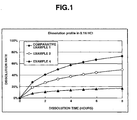
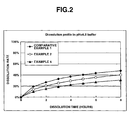
- Matrix type sustained-release preparations were prepared using donepezil hydrochloride according to Comparative Example 1, and Examples 2 and 4 which are given below, and dissolution tests were performed thereon.
- the matrix type sustained-release preparations were prepared using ethylcellulose as a water-insoluble polymer and Eudragit L100-55 as an enteric polymer.
- the ratios of ethylcellulose to Eudragit L100-55 in Comparative Example 1, and Examples 2 and 4 were 25% : 0% by weight, 25% : 25% by weight and 25% : 50% by weight, respectively.
- the dissolution tests were performed in the following two types of test solutions at a paddle frequency of 50 rpm in accordance with the dissolution test methods of the Japanese Pharmacopoeia, Ed. 14. The dissolution tests were carried out by use of a test solution A as an acidic test solution and a rest solution B as a neutral test solution as set forth below.
- dissolution rate was calculated from concentrations of donepezil hydrochloride in sample solutions collected with dissolution time and analyzed by a spectrophotometric method or HPLC analysis method.
- the spectrophotometric method was performed under measurement conditions of measurement wavelength at 315 nm, reference wavelength at 650 nm.
- Eudragit L100-55 was used as the enteric polymer and ethylcellulose was used as the water-insoluble polymer in the matrix sustained-release preparation.
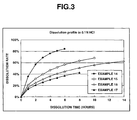
- Matrix type sustained release preparations were prepared using donepezil hydrochloride according to Comparative Example 1, and Examples 1 through 11 and 14 through 17 below, and dissolution tests were performed thereon.
- the dissolution tests were performed to evaluate preparations in which the amounts of donepezil hydrochloride, the enteric polymer and the water-insoluble polymer varied (in Examples 1 to 6), in which the type of diluents varied (in Examples 5 and 7), in which wet granulation was performed using a binder (in Examples 8, 11 and 14 to 17, and 20), in which the type of ethylcellulose varied (in Examples 5, 9 and 10) and in which the scale-up production was carried out (in Examples 11, 14 to 17).
- Comparative Example 1 a preparation containing donepezil hydrochloride and the water-insoluble polymer as its main components without any enteric polymer was used as Comparative Example 1.
- the results for Comparative Example 1 and Examples 1, 2 to 6, 7 to 11 and 14 to 17 and 20 are shown in Tables 1, 2, 3 and 4, respectively.
- Comparative dissolution test results for Examples 14 to 17 are shown in Figures 3 and 4.
- the ratio of dissolution rate in the acidic test solution to dissolution rate in the neutral test solution (dissolution rate in the acidic test solution / dissolution rate in the neutral test solution) increased slightly from a dissolution time of 1 hour to a dissolution time of 2 to 3 hours at the early stage, and the ratio subsequently remained at about 1.5 with little change thereof at the late stage of dissolution.
- the ratio of the dissolution rate decreased from a dissolution time of 1 hour to a dissolution time of 2 to 3 hours, and continued to decrease gradually as the dissolution test proceeded, until completion of the dissolution test or until a dissolution time at which the dissolution rate in the neutral test solution was 90% or more.
- the ratio of dissolution rates was from 0.6 to 1.3 at a dissolution time of 3 hours in these cases.
- the preparation according to the present invention can provide a preparation in which the dissolution rate in the acidic test solution is inhibited at the early stage of dissolution (corresponding to the gastric retention period), while reducing pH dependence of the basic drug or the salt thereof, and with which a higher dissolution rate in the neutral test solution relative to the dissolution rate in the acidic test solution can be achieved at the late stage of dissolution (which is thought to correspond to the small intestinal retention stage).
- types of the enteric and the water-insoluble polymers were evaluated for the matrix type sustained-release preparation.
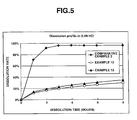
- the matrix type sustained-release preparations were prepared using donepezil hydrochloride according to Comparative Example 2, and Examples 12 and 13 which are given below, and dissolution tests were performed thereon.
- Hydroxypropyl methylcellulose acetate succinate (AQOAT LF or AQOAT MF; Shin-Etsu Chemical) was used as the enteric polymer and ethylcellulose was used as the water insoluble polymer in the matrix type sustained-release preparations. Note that the amount of hydroxypropyl methylcellulose acetate succinate as the enteric polymer in the preparations was 50% based on the total weight of the preparation.
- the mixture of the enteric polymer had the effect of retarding the dissolution rate of the drug in the acidic and neutral test solutions at the early stage of dissolution and in particular of dramatically retarding the dissolution rate of the drug in the acidic test solution, thus bringing the dissolution rates in the two solutions closer to each other and reducing pH dependence.
- the late stage of dissolution it also had the effect of retarding dissolution in the acidic test solution while increasing dissolution in the neutral test solution. This suggests that the risk of adverse events due to the sustained release characteristics at the early stage of dissolution can be reduced, and the risk of reduced bioavailability can be inhibited in these preparations.
- Table 6 shows that effects of a combination of ethylcellulose and Eudragit L100 on dissolution behavior of the preparation.
- Example 21 which contains 25 % of ethylcellulose and 50 % of Eudragit L100 that a ratio of dissolution rate of the drug or the salt thereof in the acidic test solution to dissolution rate of the drug or the salt thereof in the neutral test solution (dissolution rate in the acidic test solution / dissolution rate in the neutral test solution) decreased with dissolution time.
- Example 22 a ratio of dissolution rate of the drug or the salt thereof in the acidic test solution to dissolution rate of the drug or the salt thereof in the neutral test solution (dissolution rate in the acidic test solution / dissolution rate in the neutral test solution) exhibited 0.34 and 0.7 at the dissolution time of 3 hour, respectively, and it was confirmed that the above ratio of the dissolution rate of the drug or the salt thereof in the acidic solution to dissolution rate of the drug or the salt thereof in the neutral solution decreased with dissolution time after dissolution time of 3 hour.
- Example 23 showed that 90% or more of the drug was released in the 50 mM phosphate buffer, pH 6.8 within 8 hours which is the estimated as the upper limit of large intestinal arrival time in humans and it is believed that the preparation according to Example 23 is extremely useful.
- the matrix type sustained-release preparation has the properties of ensuring dissolution with low pH dependence of the basic drug or the salt thereof at the early stage of dissolution and of allowing the ratio of dissolution rate of the basic drug or the salt thereof in the acidic test solution to the dissolution rate of the basic drug or the salt thereof in the neutral test solution (dissolution rate in the acidic test solution / dissolution rate in the neutral test solution) to be decreased at the late stage of dissolution, as the dissolution test proceeds.
- the these preparations exhibited that 90% or more of the drug was released in the 50 mM phosphate buffer, pH 6.8 within 8 hours which is the estimated as the upper limit of large intestinal arrival time in humans and it is believed that these preparations are extremely useful.
- dissolution tests were carried out using the preparations obtained in the following Examples and Comparative Examples.
- the dissolution tests were performed in the following two types of test solutions at a paddle frequency of 50 rpm in accordance with the dissolution test methods of the Japanese Pharmacopoeia, Ed. 14.
- the dissolution tests were carried out by use of a test solution A as an acidic test solution and a test solution B as a neutral test solution as set forth below.
- dissolution rate was calculated from concentrations of memantine hydrochloride in sample solutions collected with dissolution time and analyzed by a HPLC analysis method after memantine hydrochloride was fluorescent labeled by Fluorescamine.
- the conditions for fluorescence labeling and HPLC analysis are typically as follows: After sample solutions (1 mL) collected with dissolution time was mixed with borate buffer, pH 9.0 (USP, 9mL), an acetone solution (5 mL) containing Fluorescamine (1.2 mg/mL) was added and stirred enough. Water (10 mL) was also added into the above solution and mixed to obtain a test sample. The test sample was analyzed by HPLC.
- the dissolution tests were performed using tablets obtained in Examples 40 to 42 and Comparative Example 4, in order to evaluate effects of an enteric polymer on the preparations containing memantine hydrochloride and ethylcellulose as the water-insoluble polymer.
- Comparative Example 4 which does not contain the enteric polymer but contain ethylcellulose showed that a dissolution rate of memantine hydrochloride was inhibited to be from 30 to 40% at the dissolution time of 1 hour, but a ratio of dissolution rate of the drug or the salt thereof in the acidic test solution to dissolution rate of the drug or the salt thereof in the neutral test solution (dissolution rate in the acidic test solution / dissolution rate in the neutral test solution) was constant without change in the dissolution time.
- Examples 40 to 42 which contain the enteric polymer showed that dissolution rate of memantine hydrochloride at the early stage of the dissolution was much lower than that in Comparative Example 4, and it was confirmed that dissolution rate of memantine hydrochloride could be inhibited at the early stage of dissolution. Moreover, it was also confirmed in these Examples that the ratio of dissolution rate of the drug or the salt thereof in the acidic test solution to dissolution rate of the drug or the salt thereof in the neutral test solution (dissolution rate in the acidic test solution / dissolution rate in the neutral test solution) decreased with the dissolution time.
- Example 43 dissolution tests were performed using tablets obtained in Example 43 and Comparative Example 5, in order to evaluate effects of an enteric polymer on dissolution behavior of the preparations containing memantine hydrochloride and Eudragit RSPO as the water-insoluble polymer.
- Comparative Example 5 which does not contain the enteric polymer but contain Eudragit RSPO showed that a dissolution rate of memantine hydrochloride in the acidic and the neutral test solutions was not less than 90% at 2 hours, a ratio of dissolution rate of the drug or the salt thereof in the acidic test solution to dissolution rate of the drug or the salt thereof in the neutral test solution (dissolution rate in the acidic test solution / dissolution rate in the neutral test solution) was constant without change in the dissolution time.
- Example 43 which contains the enteric polymer showed that dissolution rate of memantine hydrochloride at the early stage of the dissolution was much lower than that in Comparative Example 5, and it was confirmed that dissolution rate of memantine hydrochloride could be inhibited at the early stage of dissolution. Moreover, it was also confirmed in Example 43 that the ratio of dissolution rate of the drug or the salt thereof in the acidic test solution to dissolution rate of the drug or the salt thereof in the neutral test solution (dissolution rate in the acidic test solution / dissolution rate in the neutral test solution) decreased with the dissolution time.
- magnesium stearate (Mallinckrodt Baker, Inc.) based on 99 g of granules was added and mixed.
- a rotary tabletting machine was used to make the granules into a tablet with 8 mm in diameter containing 10 mg of donepezil hydrochloride in 200 mg of the tablet.
- the results of dissolution test are shown in Table 3.
- magnesium stearate (Mallinckrodt Baker, Inc.) based on 99 g of granules was added and mixed, and a rotary tabletting machine was used to make a tablet with 8 mm in diameter containing 10 mg of donepezil hydrochloride in 200 mg of the tablet.
- Opadry yellow (Colorcon Japan Limited) was used to give the resulting tablet a water-soluble film coating containing hydroxypropyl methylcellulose as its main component (coating amount: 8 mg/tablet), resulting in film-coated tablet.
- the results of dissolution test are shown in Table 4.
- magnesium stearate (Mallinckrodt Baker, Inc.) based on 99 g of granules was added and mixed, and a rotary tabletting machine was used to make a tablet with 8 mm in diameter containing 10 mg of donepezil hydrochloride in 200 mg of the tablet.
- Opadry yellow (Colorcon Japan Limited) was used to give the resulting tablet a water-soluble film coating containing hydroxypropyl methylcellulose as its main component (coating amount: 8 mg/tablet), resulting in film-coated tablet.
- the results of dissolution test are shown in Table 4.
- magnesium stearate (Mallinckrodt Baker, Inc.) based on 99 g of granules was added and mixed, and a rotary tabletting machine was used to make a tablet with 8 mm in diameter containing 10 mg of donepezil hydrochloride in 200 mg of the tablet.
- Opadry yellow (Colorcon Japan Limited) was used to give the resulting tablet a water-soluble film coating containing hydroxypropyl methylcellulose as its main component (coating amount: 8 mg/tablet), resulting in film-coated tablet.
- the results of dissolution test are shown in Table 4.
- magnesium stearate (Mallinckrodt Baker, Inc.) based on 99 g of granules was added and mixed, and a rotary tabletting machine was used to form a tablet with 8 mm in diameter containing 10 mg of donepezil hydrochloride in 200 mg of the tablet.
- Opadry yellow (Colorcon Japan Limited) was used to give the resulting tablet a water-soluble film coating containing hydroxypropyl methylcellulose as its main component (coating amount: 8 mg/tablet), resulting in film-coated tablet.
- the results of dissolution test are shown in Table 4.
- magnesium stearate (Mallinckrodt Baker, Inc.) based on 99 g of granules was added and mixed, and a rotary tabletting machine was used to form a tablet with 8 mm in diameter containing 20 mg of memantine hydrochloride in 200 mg of the tablet.
- wet granulation was carried out by adding an aqueous solution of 2.4 g of hydroxypropyl cellulose (HPC-L; Nippon Soda Co., Ltd) dissolved in a suitable amount of purified water to the mixture, and the resulting granules were heat-dried in a tray drier, and sieved to obtain the desired granule size.
- HPC-L hydroxypropyl cellulose
- magnesium stearate (Mallinckrodt Baker, Inc.) based on 109 g of granules was added and mixed, and a rotary tabletting machine was used for tabletting, resulting in a compression-molded product with 8 mm in diameter containing 10 mg of donepezil hydrochloride and 20 mg of memantine hydrochloride in 220 mg of the product.
- Opadry yellow (Colorcon Japan Limited) was used to give this compression molded product a water-soluble film coating containing hydroxypropyl methylcellulose as its main component (coating amount: 8 mg/tablet), resulting in film-coated tablet.
- magnesium stearate (Mallinckrodt Baker, Inc.) based on 99.7 g of granules was added and mixed, and a single-punch tabletting machine was used to form a tablet with 8 mm in diameter containing 10 mg of donepezil hydrochloride in 200 mg of the tablet.
- the results of dissolution test are shown in Table 4.
- each component was mixed in a mortar. 200 mg of this mixture was taken and made into tablet using an Autograph AG5000A (Shimazu Corporation) to obtain a tablet (tablet weight: 200 mg) with 8 mm in diameter containing 20 mg of donepezil hydrochloride.
- the results of dissolution test are shown in Tables 6 and 7.
- wet granulation was carried out by adding an aqueous solution of 2.8 g of hydroxypropyl cellulose (HPC-L; Nippon Soda Co., Ltd) dissolved in a suitable amount of purified water to the mixture, and the resulting granules were heat-dried in a tray drier, and sieved to obtain the desired granule size by a power mill.
- HPC-L hydroxypropyl cellulose
- magnesium stearate (Mallinckrodt Baker, Inc.) based on 99.7 g of granules was added and mixed, and a rotary tabletting machine was used to form a tablet with 8 mm in diameter containing 14 mg of donepezil hydrochloride in 200 mg of the tablet.
- Opadry purple (Colorcon Japan Limited) was used to give the resulting tablet a water-soluble film coating containing hydroxypropyl methylcellulose as its main component (coating amount: 8 mg/tablet), resulting in film-coated tablet.
- magnesium stearate (Mallinckrodt Baker, Inc.) based on 99.7 g of granules was added and mixed, and a rotary tabletting machine was used to form a tablet with 8 mm in diameter containing 14 mg of donepezil hydrochloride in 200 mg of the tablet.
- Opadry purple (Colorcon Japan Limited) was used to give the resulting tablet a water-soluble film coating containing hydroxypropyl methylcellulose as its main component (coating amount: 8 mg/tablet), resulting in film-coated tablet.
- magnesium stearate (Mallinckrodt Baker, Inc.) based on 99.7 g of granules was added and mixed, and a rotary tabletting machine was used to form a tablet with 8 mm in diameter containing 14 mg of donepezil hydrochloride in 200 mg of the tablet.
- Opadry purple (Colorcon Japan Limited) was used to give the resulting tablet a water-soluble film coating containing hydroxypropyl methylcellulose as its main component (coating amount: 8 mg/tablet), resulting in film-coated tablet.
- the results of dissolution test are shown in Table 8 and Figure 7.
- magnesium stearate (Mallinckrodt Baker, Inc.) based on 99.7 g of granules was added and mixed, and a rotary tabletting machine was used to form a tablet with 8 mm in diameter containing 15 mg of donepezil hydrochloride in 200 mg of the tablet.
- Opadry purple (Colorcon Japan Limited) was used to give the resulting tablet a water-soluble film coating containing hydroxypropyl methylcellulose as its main component (coating amount: 8 mg/tablet), resulting in film-coated tablet.
- the results of dissolution test are shown in Table 8 and Figure 8.
- magnesium stearate (Mallinckrodt Baker, Inc.) based on 99.7 g of granules was added and mixed, and a rotary tabletting machine was used to form a tablet with 8 mm in diameter containing 20 mg of donepezil hydrochloride in 200 mg of the tablet.
- Opadry red (Colorcon Japan Limited) was used to give the resulting tablet a water-soluble film coating containing hydroxypropyl methylcellulose as its main component (coating amount: 8 mg/tablet), resulting in film-coated tablet.
- the results of dissolution test are shown in Table 8 and Figure 8.
- magnesium stearate (Mallinckrodt Baker, Inc.) based on 99.7 g of granules was added and mixed, and a rotary tabletting machine was used to form a tablet with 8 mm in diameter containing 23 mg of donepezil hydrochloride in 200 mg of the tablet.
- Opadry red (Colorcon Japan Limited) was used to give the resulting tablet a water-soluble film coating containing hydroxypropyl methylcellulose as its main component (coating amount: 8 mg/tablet), resulting in film-coated tablet.
- the results of dissolution test are shown in Table 8 and Figure 9.
- magnesium stearate (Mallinckrodt Baker, Inc.) based on 99.7 g of granules was added and mixed, and a rotary tabletting machine was used to form a tablet with 8 mm in diameter containing 23 mg of donepezil hydrochloride in 200 mg of the tablet.
- Opadry red (Colorcon Japan Limited) was used to give the resulting tablet a water-soluble film coating containing hydroxypropyl methylcellulose as its main component (coating amount: 8 mg/tablet), resulting in film-coated tablet.
- the results of dissolution test are shown in Table 8 and Figure 9.
- the film-coated tablets shown in Table 12 can be prepared according to the methods described above.
- Table 12 shows amounts (mg) of each component in one film-coated tablet.
- each component was mixed in a mortar. 200 mg of this mixture was taken and made into tablet using an Autograph AG5000A (Shimazu Corporation) to obtain a tablet (tablet weight: 200 mg) with 8 mm in diameter containing 20 mg of memantine hydrochloride.
- a matrix type sustained-release preparation containing a basic drug or a salt thereof which has higher solubility in the 0.1 N hydrochloric acid solution and the neutral aqueous solution, pH 6.0 than in the basic aqueous solution, pH 8.0
- the pH dependence of dissolution of the drug or the salt thereof at the early stage of dissolution is reduced, and the ratio of the dissolution rate of the drug or the salt thereof in the acidic test solution to the dissolution rate of the drug or the salt thereof in the neutral test solution (dissolution rate in the acidic test solution / dissolution rate in the neutral test solution) decreases with dissolution time as the dissolution test proceeds (the ratio being lower at the late stage than at the early stage of the dissolution test).
Landscapes
- Health & Medical Sciences (AREA)
- Life Sciences & Earth Sciences (AREA)
- Chemical & Material Sciences (AREA)
- Medicinal Chemistry (AREA)
- Pharmacology & Pharmacy (AREA)
- Animal Behavior & Ethology (AREA)
- General Health & Medical Sciences (AREA)
- Public Health (AREA)
- Veterinary Medicine (AREA)
- Epidemiology (AREA)
- Neurosurgery (AREA)
- Biomedical Technology (AREA)
- Neurology (AREA)
- Engineering & Computer Science (AREA)
- Bioinformatics & Cheminformatics (AREA)
- Organic Chemistry (AREA)
- Molecular Biology (AREA)
- Chemical Kinetics & Catalysis (AREA)
- General Chemical & Material Sciences (AREA)
- Nuclear Medicine, Radiotherapy & Molecular Imaging (AREA)
- Biophysics (AREA)
- Hospice & Palliative Care (AREA)
- Inorganic Chemistry (AREA)
- Psychiatry (AREA)
- Psychology (AREA)
- Medicinal Preparation (AREA)
- Pharmaceuticals Containing Other Organic And Inorganic Compounds (AREA)
Applications Claiming Priority (5)
| Application Number | Priority Date | Filing Date | Title |
|---|---|---|---|
| JP2004376770 | 2004-12-27 | ||
| JP2005110404 | 2005-04-06 | ||
| US67548205P | 2005-04-28 | 2005-04-28 | |
| JP2005132338 | 2005-04-28 | ||
| PCT/JP2005/023853 WO2006070781A1 (fr) | 2004-12-27 | 2005-12-27 | Preparation a liberation controlee de type a matrice comprenant une substance basique ou un sel de celle-ci et procede pour la production de celle-ci |
Publications (2)
| Publication Number | Publication Date |
|---|---|
| EP1832298A1 true EP1832298A1 (fr) | 2007-09-12 |
| EP1832298A4 EP1832298A4 (fr) | 2012-12-12 |
Family
ID=36614895
Family Applications (1)
| Application Number | Title | Priority Date | Filing Date |
|---|---|---|---|
| EP05822550A Withdrawn EP1832298A4 (fr) | 2004-12-27 | 2005-12-27 | Preparation a liberation controlee de type a matrice comprenant une substance basique ou un sel de celle-ci et procede pour la production de celle-ci |
Country Status (13)
| Country | Link |
|---|---|
| US (2) | US20090208579A1 (fr) |
| EP (1) | EP1832298A4 (fr) |
| JP (1) | JP4999466B2 (fr) |
| KR (1) | KR100904602B1 (fr) |
| CN (1) | CN103550190A (fr) |
| AU (1) | AU2005320609B9 (fr) |
| BR (1) | BRPI0519407A2 (fr) |
| CA (1) | CA2592102C (fr) |
| IL (1) | IL183871A0 (fr) |
| MX (1) | MX2007007835A (fr) |
| NO (1) | NO20073461L (fr) |
| NZ (1) | NZ555901A (fr) |
| WO (1) | WO2006070781A1 (fr) |
Cited By (9)
| Publication number | Priority date | Publication date | Assignee | Title |
|---|---|---|---|---|
| EP1886670A1 (fr) * | 2006-07-05 | 2008-02-13 | Teva Pharmaceutical Industries Ltd | Compositions pharmaceutiques de memantine |
| EP2243475A1 (fr) * | 2005-04-06 | 2010-10-27 | Adamas Pharmaceuticals, Inc. | Combinaison de mémantine et donépézil pour le traitement de conditions relatives au SNC |
| WO2011093535A1 (fr) * | 2010-01-26 | 2011-08-04 | 현대약품 주식회사 | Composition pharmaceutique matricielle contenant de la galantamine |
| WO2011127235A1 (fr) * | 2010-04-07 | 2011-10-13 | Eisai Inc. | Polythérapie pour le traitement de la démence |
| US8168209B2 (en) | 2004-11-23 | 2012-05-01 | Adamas Pharmaceuticals, Inc. | Method and composition for administering an NMDA receptor antagonist to a subject |
| US8481565B2 (en) | 2004-12-27 | 2013-07-09 | Eisai R&D Management Co., Ltd. | Method for stabilizing anti-dementia drug |
| US8741343B2 (en) | 2009-12-02 | 2014-06-03 | Adamas Pharmaceuticals, Inc. | Method of administering amantadine prior to a sleep period |
| EP1878444B1 (fr) * | 2005-04-28 | 2015-09-09 | Eisai R&D Management Co., Ltd. | Composition contenant un médicament anti-démence |
| US10154971B2 (en) | 2013-06-17 | 2018-12-18 | Adamas Pharma, Llc | Methods of administering amantadine |
Families Citing this family (33)
| Publication number | Priority date | Publication date | Assignee | Title |
|---|---|---|---|---|
| CA2673111A1 (fr) * | 2006-12-07 | 2008-06-19 | Schering Corporation | Formulation de matrice sensible au ph |
| TWI433674B (zh) | 2006-12-28 | 2014-04-11 | Infinity Discovery Inc | 環杷明(cyclopamine)類似物類 |
| DE102007009242A1 (de) * | 2007-02-22 | 2008-09-18 | Evonik Röhm Gmbh | Pellets mit magensaftresistenter Wirkstoff-Matix |
| JP2010520295A (ja) | 2007-03-07 | 2010-06-10 | インフィニティ・ディスカバリー・インコーポレイテッド | へテロ環状シクロパミン類似体及びその使用方法 |
| RU2009137012A (ru) | 2007-03-07 | 2011-04-20 | Инфинити Дискавери, Инк. (Us) | Аналоги циклопаминлактама и способы их применения |
| CA2710858A1 (fr) | 2007-12-27 | 2009-07-09 | Infinity Pharmaceuticals, Inc. | Procedes de reduction stereoselective |
| MX2011006463A (es) | 2008-12-19 | 2011-07-20 | Supernus Pharmaceuticals Inc | Metodo de tratamiento de agresion. |
| CN102438617A (zh) | 2009-03-27 | 2012-05-02 | 杏林制药株式会社 | 含有碱性添加剂的基质型缓释制剂 |
| AU2010279325B2 (en) | 2009-08-05 | 2016-10-20 | Infinity Pharmaceuticals, Inc. | Enzymatic transamination of cyclopamine analogs |
| JP2011037787A (ja) * | 2009-08-13 | 2011-02-24 | Kyorin Pharmaceutical Co Ltd | 塩基性薬物のpHに依存しない安定放出組成物 |
| US20110135739A1 (en) * | 2009-11-06 | 2011-06-09 | Bennett Carter | Oral Formulations of a Hedgehog Pathway Inhibitor |
| US20110218216A1 (en) * | 2010-01-29 | 2011-09-08 | Kumaravel Vivek | Extended release pharmaceutical composition of donepezil |
| JP5563841B2 (ja) * | 2010-02-05 | 2014-07-30 | 沢井製薬株式会社 | 薬物の不快な味をマスキングした経口医薬組成物 |
| ES2706880T3 (es) * | 2010-02-22 | 2019-04-01 | Daiichi Sankyo Co Ltd | Preparación sólida de liberación sostenida para uso oral |
| WO2011102505A1 (fr) * | 2010-02-22 | 2011-08-25 | 第一三共株式会社 | Préparation solide à libération prolongée pour usage oral |
| EP2366378A1 (fr) | 2010-03-01 | 2011-09-21 | Dexcel Pharma Technologies Ltd. | Formulations de donépézil à libération prolongée |
| WO2011123497A1 (fr) * | 2010-03-31 | 2011-10-06 | Supernus Pharmaceuticals Inc. | Formulations stabilisées de composés du système nerveux central |
| US20120040008A1 (en) * | 2010-08-11 | 2012-02-16 | Ashish Chatterji | Pharmaceutical compositions of metabotropic glutamate 5 receptor (mglu5) antagonists |
| US9394313B2 (en) | 2010-09-14 | 2016-07-19 | Infinity Pharmaceuticals, Inc. | Transfer hydrogenation of cyclopamine analogs |
| EP2627323A4 (fr) | 2010-10-12 | 2014-03-12 | Univ Johns Hopkins | Compositions antitussives comprenant de la mémantine |
| US20130267560A1 (en) | 2010-10-22 | 2013-10-10 | Cadila Healthcare Limited | Sustained release pharmaceutical compositions of donepezil |
| WO2013033432A1 (fr) * | 2011-09-03 | 2013-03-07 | Adipocyte Therapeutics Inc | Méthodes et compositions pour traiter le diabète de type 2 et des états associés |
| CA2883077C (fr) | 2012-09-03 | 2017-03-07 | Daiichi Sankyo Company, Limited | Composition pharmaceutique a liberation prolongee administree par voie orale contenant du chlorhydrate d'hydromorphone |
| MX378413B (es) | 2013-02-28 | 2025-03-10 | Lupin Ltd | Composiciones farmaceuticas de donepezilo que tienen un perfil de disolución in vitro o parámetros farmacocinéticos específicos. |
| KR102241112B1 (ko) * | 2013-02-28 | 2021-04-15 | 루핀 리미티드 | 특정한 체외 용해 프로파일 또는 약리역학 파라미터를 갖는 도네페질의 약제학적 조성물 |
| PL3302428T3 (pl) | 2015-06-04 | 2026-04-13 | Sol-Gel Technologies Ltd. | Preparaty do zastosowania miejscowego do dostarczania związków inhibitora hedgehog i ich zastosowanie |
| US20170056342A1 (en) * | 2015-08-31 | 2017-03-02 | Apotex Technologies Inc. | Extended Release Dosage Form Comprising Cyclobenzaprine Hydrochloride |
| KR101938872B1 (ko) * | 2016-09-30 | 2019-01-16 | 주식회사 바이오파마티스 | 도네페질 또는 그의 약학적으로 허용 가능한 염 및 메만틴 또는 그의 약학적으로 허용 가능한 염을 함유하는 치매 및 인지기능 장애 예방 또는 치료용 약학 조성물 및 이의 제조방법 |
| JP7023186B2 (ja) * | 2017-05-29 | 2022-02-21 | 第一三共株式会社 | 認知症治療薬を含有する口腔内崩壊性錠剤 |
| JP6578459B1 (ja) * | 2019-02-28 | 2019-09-18 | アピ株式会社 | ハードカプセル及びその製造方法 |
| KR20210072569A (ko) * | 2019-12-09 | 2021-06-17 | 주식회사 종근당 | 도네페질 및 메만틴을 포함하는 복합 제제 |
| CN115876900A (zh) * | 2021-09-28 | 2023-03-31 | 江苏正大清江制药有限公司 | 一种测定克洛己新干混悬剂中盐酸溴己新溶出量的方法 |
| WO2023095183A1 (fr) * | 2021-11-24 | 2023-06-01 | Jordan University Of Science And Technology | Composition pharmaceutique et forme posologique solide de celle-ci |
Family Cites Families (121)
| Publication number | Priority date | Publication date | Assignee | Title |
|---|---|---|---|---|
| HU187215B (en) * | 1983-01-26 | 1985-11-28 | Egyt Gyogyszervegyeszeti Gyar | Method for producing pharmaceutical product of high actor content and prolonged effect |
| IL72381A (en) * | 1983-07-20 | 1988-03-31 | Sanofi Sa | Pharmaceutical composition based on valproic acid |
| US4772475A (en) * | 1985-03-08 | 1988-09-20 | Yamanouchi Pharmaceutical Co., Ltd. | Controlled-release multiple units pharmaceutical formulation |
| US4892742A (en) * | 1985-11-18 | 1990-01-09 | Hoffmann-La Roche Inc. | Controlled release compositions with zero order release |
| IL81419A0 (en) * | 1986-01-30 | 1987-08-31 | Syntex Inc | Long acting sustained release pharmaceutical compositions containing dihydropyridines and their preparation |
| US4940556A (en) * | 1986-01-30 | 1990-07-10 | Syntex (U.S.A.) Inc. | Method of preparing long acting formulation |
| US4832957A (en) * | 1987-12-11 | 1989-05-23 | Merck & Co., Inc. | Controlled release combination of carbidopa/levodopa |
| NL8701335A (nl) * | 1986-06-21 | 1988-01-18 | Sandoz Ag | Orale farmaceutische preparaten. |
| CA1308357C (fr) * | 1987-01-28 | 1992-10-06 | Tohru Chiba | Methode pour la preparation d'un medicament solide enrobe |
| US4851232A (en) * | 1987-02-13 | 1989-07-25 | Alza Corporation | Drug delivery system with means for obtaining desirable in vivo release rate pattern |
| US4968508A (en) * | 1987-02-27 | 1990-11-06 | Eli Lilly And Company | Sustained release matrix |
| US4894239A (en) * | 1987-06-02 | 1990-01-16 | Takeda Chemical Industries, Ltd. | Sustained-release preparation and production thereof |
| US4891223A (en) * | 1987-09-03 | 1990-01-02 | Air Products And Chemicals, Inc. | Controlled release delivery coating formulation for bioactive substances |
| JP2643222B2 (ja) * | 1988-02-03 | 1997-08-20 | エーザイ株式会社 | 多重層顆粒 |
| DE3827214A1 (de) * | 1988-08-11 | 1990-02-15 | Roehm Gmbh | Retardierte arzneiform und verfahren zu ihrer herstellung |
| JP2514078B2 (ja) * | 1988-08-22 | 1996-07-10 | エスエス製薬株式会社 | 圧縮成型製剤 |
| JP2893191B2 (ja) * | 1988-11-08 | 1999-05-17 | 武田薬品工業株式会社 | 放出制御性マトリックス剤 |
| US5202128A (en) * | 1989-01-06 | 1993-04-13 | F. H. Faulding & Co. Limited | Sustained release pharmaceutical composition |
| ATE124864T1 (de) * | 1989-03-10 | 1995-07-15 | Yamanouchi Pharma Co Ltd | Die wirkstoffabgabe steuerndes überzugsmaterial für lang wirksame formulierungen. |
| NZ233403A (en) * | 1989-04-28 | 1992-09-25 | Mcneil Ppc Inc | Simulated capsule-like medicament |
| US5102668A (en) * | 1990-10-05 | 1992-04-07 | Kingaform Technology, Inc. | Sustained release pharmaceutical preparation using diffusion barriers whose permeabilities change in response to changing pH |
| US5266331A (en) * | 1991-11-27 | 1993-11-30 | Euroceltique, S.A. | Controlled release oxycodone compositions |
| US5681585A (en) * | 1991-12-24 | 1997-10-28 | Euro-Celtique, S.A. | Stabilized controlled release substrate having a coating derived from an aqueous dispersion of hydrophobic polymer |
| DE4225730C2 (de) * | 1992-08-04 | 2003-04-30 | Merz Pharma Gmbh & Co Kgaa | Verfahren zur Herstellung von festen Arzneiformkörpern mit protrahierter 2-Stufen-Freisetzung |
| JPH06199657A (ja) * | 1992-12-10 | 1994-07-19 | Sumitomo Pharmaceut Co Ltd | 徐放性製剤 |
| KR950007873A (ko) * | 1993-09-20 | 1995-04-15 | 후꾸하라 요시하루 | 생리 활성 물질 지속 방출형의 의약 제제 |
| US5500227A (en) * | 1993-11-23 | 1996-03-19 | Euro-Celtique, S.A. | Immediate release tablet cores of insoluble drugs having sustained-release coating |
| US5698224A (en) * | 1994-06-27 | 1997-12-16 | Alza Corporation | Tacrine therapy |
| US20020006438A1 (en) * | 1998-09-25 | 2002-01-17 | Benjamin Oshlack | Sustained release hydromorphone formulations exhibiting bimodal characteristics |
| US5871776A (en) * | 1995-01-31 | 1999-02-16 | Mehta; Atul M. | Controlled-release nifedipine |
| US6083532A (en) * | 1995-03-01 | 2000-07-04 | Duramed Pharmaceuticals, Inc. | Sustained release formulation containing three different types of polymers and tablet formed therefrom |
| JPH0920663A (ja) * | 1995-07-07 | 1997-01-21 | Teikoku Seiyaku Co Ltd | イブジラストを含有する徐放性細粒剤およびその製法 |
| AUPN605795A0 (en) * | 1995-10-19 | 1995-11-09 | F.H. Faulding & Co. Limited | Analgesic pharmaceutical composition |
| IT1282650B1 (it) * | 1996-02-19 | 1998-03-31 | Jagotec Ag | Compressa farmaceutica,caratterizzata da elevato aumento di volume a contatto con liquidi biologici |
| US5773031A (en) * | 1996-02-27 | 1998-06-30 | L. Perrigo Company | Acetaminophen sustained-release formulation |
| US6245351B1 (en) * | 1996-03-07 | 2001-06-12 | Takeda Chemical Industries, Ltd. | Controlled-release composition |
| DE69734060T2 (de) * | 1996-05-24 | 2006-06-29 | Angiotech Pharmaceuticals, Inc., Vancouver | Zubereitungen und verfahren zur behandlung oder prävention von krankheiten der körperpassagewege |
| IT1289160B1 (it) * | 1997-01-08 | 1998-09-29 | Jagotec Ag | Compressa farmaceutica completamente rivestita per il rilascio controllato di principi attivi che presentano problemi di |
| DE19707655A1 (de) * | 1997-02-26 | 1998-08-27 | Hoechst Ag | Kombinationspräparat zur Anwendung bei Demenz |
| CA2216215A1 (fr) * | 1997-04-05 | 1998-10-05 | Isa Odidi | Formulations a liberation prolongee, utilisant des polymeres intelligents, avec caracteristiques de mouillabilite opposees, correspondant a une hydrophobie et a une hydrophilie |
| US6210710B1 (en) * | 1997-04-28 | 2001-04-03 | Hercules Incorporated | Sustained release polymer blend for pharmaceutical applications |
| EP0988289A2 (fr) * | 1997-06-05 | 2000-03-29 | Takeda Pharmaceutical Company Limited | Composes heterocycliques, leur preparation et leur utilisation |
| FR2766708B1 (fr) * | 1997-07-30 | 2000-05-05 | Galenix Dev | Composition contenant de l'hydroxypropylcellulose, de l'hydroxypropylmethylcellulose et/ou de l'ethylcellullose a titre d'agents desintegrants, et procede d'obtention |
| JP3797764B2 (ja) * | 1997-10-01 | 2006-07-19 | エーザイ株式会社 | 光安定化組成物 |
| US20030092737A1 (en) * | 1997-11-14 | 2003-05-15 | Pierre Maffrand Jean | Combination of active ingredients for the treatment of senile dementia of the Alzheimer type |
| US20040028735A1 (en) * | 1997-11-14 | 2004-02-12 | Unchalee Kositprapa | Pharmaceutical formulation |
| FR2772615B1 (fr) * | 1997-12-23 | 2002-06-14 | Lipha | Comprime multicouche pour la liberation instantanee puis prolongee de substances actives |
| US6251430B1 (en) * | 1998-02-04 | 2001-06-26 | Guohua Zhang | Water insoluble polymer based sustained release formulation |
| US6372254B1 (en) * | 1998-04-02 | 2002-04-16 | Impax Pharmaceuticals Inc. | Press coated, pulsatile drug delivery system suitable for oral administration |
| JP4533531B2 (ja) * | 1998-04-03 | 2010-09-01 | ビーエム リサーチ エイ/エス | 制御放出組成物 |
| US6262081B1 (en) * | 1998-07-10 | 2001-07-17 | Dupont Pharmaceuticals Company | Composition for and method of treating neurological disorders |
| UA73092C2 (uk) * | 1998-07-17 | 2005-06-15 | Брістол-Майерс Сквібб Компані | Таблетка з ентеросолюбільним покриттям і спосіб її приготування |
| EP1025858A4 (fr) * | 1998-08-28 | 2009-03-11 | Eisai R&D Man Co Ltd | Compositions medicales presentant une amertume, etc., reduite |
| US6531152B1 (en) * | 1998-09-30 | 2003-03-11 | Dexcel Pharma Technologies Ltd. | Immediate release gastrointestinal drug delivery system |
| WO2000024423A1 (fr) * | 1998-10-26 | 2000-05-04 | Tanabe Seiyaku Co., Ltd. | Particules a liberation prolongee |
| US6797283B1 (en) * | 1998-12-23 | 2004-09-28 | Alza Corporation | Gastric retention dosage form having multiple layers |
| AU775914B2 (en) * | 1998-12-24 | 2004-08-19 | Janssen Pharmaceutica N.V. | Controlled release galantamine composition |
| ATE404178T1 (de) * | 1999-02-10 | 2008-08-15 | Pfizer Prod Inc | Vorrichtung mit matrixgesteuerter wirkstofffreisetzung |
| US6706283B1 (en) * | 1999-02-10 | 2004-03-16 | Pfizer Inc | Controlled release by extrusion of solid amorphous dispersions of drugs |
| US6248363B1 (en) * | 1999-11-23 | 2001-06-19 | Lipocine, Inc. | Solid carriers for improved delivery of active ingredients in pharmaceutical compositions |
| EP1169024B1 (fr) * | 1999-03-31 | 2005-12-21 | Janssen Pharmaceutica N.V. | Amidon pregelatinise dans une formulation a liberation regulee |
| ATE254928T1 (de) * | 1999-03-31 | 2003-12-15 | Eisai Co Ltd | Stabilisierte zusammensetzung mit nootropen wirkstoffen |
| US7919119B2 (en) * | 1999-05-27 | 2011-04-05 | Acusphere, Inc. | Porous drug matrices and methods of manufacture thereof |
| US20030124176A1 (en) * | 1999-12-16 | 2003-07-03 | Tsung-Min Hsu | Transdermal and topical administration of drugs using basic permeation enhancers |
| BR0007360A (pt) * | 1999-12-23 | 2001-08-14 | Johnson & Johnson | Composição de liberação controlada |
| US6627223B2 (en) * | 2000-02-11 | 2003-09-30 | Eurand Pharmaceuticals Ltd. | Timed pulsatile drug delivery systems |
| WO2001066096A2 (fr) * | 2000-03-06 | 2001-09-13 | Immune Network Ltd. | Compositions destinees a la prevention et au traitement de la demence |
| DE10029201A1 (de) * | 2000-06-19 | 2001-12-20 | Basf Ag | Verfahren zur Herstellung fester oraler Darreichungsformen mit retardierender Wirkstoffreisetzung |
| GB0025208D0 (en) * | 2000-10-13 | 2000-11-29 | Euro Celtique Sa | Delayed release pharmaceutical formulations |
| CA2359812C (fr) * | 2000-11-20 | 2004-02-10 | The Procter & Gamble Company | Formes posologiques pharmaceutiques a couches multiples permettant de reduire l'impact des revetement fractures |
| SE0004671D0 (sv) * | 2000-12-15 | 2000-12-15 | Amarin Dev Ab | Pharmaceutical formulation |
| CA2350195C (fr) * | 2000-12-20 | 2003-06-10 | Duchesnay Inc. | Preparation a delai d'action rapide de chlorhydrate de pyridoxine et de doxylamine succinate |
| US6287599B1 (en) * | 2000-12-20 | 2001-09-11 | Shire Laboratories, Inc. | Sustained release pharmaceutical dosage forms with minimized pH dependent dissolution profiles |
| US6667070B1 (en) * | 2001-02-02 | 2003-12-23 | Advanced Micro Devices, Inc. | Method of in situ monitoring of thickness and composition of deposited films using raman spectroscopy |
| WO2002066004A1 (fr) * | 2001-02-23 | 2002-08-29 | Mitsubishi Pharma Corporation | Compositions a liberation controlee de medicament |
| US20040022853A1 (en) * | 2001-04-26 | 2004-02-05 | Control Delivery Systems, Inc. | Polymer-based, sustained release drug delivery system |
| JP2004534812A (ja) * | 2001-06-22 | 2004-11-18 | ファイザー・プロダクツ・インク | 薬物および中性ポリマーの分散物の医薬組成物 |
| EA200400343A1 (ru) * | 2001-08-29 | 2004-08-26 | Рэнбакси Лабораториз Лимитед | Композиция с контролируемым высвобождением кларитромицина или тинидазола |
| WO2003017981A1 (fr) * | 2001-08-29 | 2003-03-06 | Ranbaxy Laboratories Limited | Formulation a liberation controlee de clarithromycine ou de tinidazol |
| US20030118649A1 (en) * | 2001-10-04 | 2003-06-26 | Jinming Gao | Drug delivery devices and methods |
| US6592901B2 (en) * | 2001-10-15 | 2003-07-15 | Hercules Incorporated | Highly compressible ethylcellulose for tableting |
| AUPR839001A0 (en) * | 2001-10-19 | 2001-11-15 | Eli Lilly And Company | Dosage form, device and methods of treatment |
| JP2005512997A (ja) * | 2001-11-07 | 2005-05-12 | シントン・ベスローテン・フェンノートシャップ | タムスロシン錠 |
| CA2470636A1 (fr) * | 2001-12-20 | 2003-07-03 | Pharmacia Corporation | Formes dosifiees a liberation soutenue d'ordre zero et procede de production associe |
| KR20040075371A (ko) * | 2002-02-07 | 2004-08-27 | 에-자이가부시기가이샤 | 발모 촉진제, 경피 적용 제제 및 발모 촉진 방법 |
| HRP20020124A2 (en) * | 2002-02-11 | 2003-10-31 | Pliva D D | Sustained/controlled release solid formulation as a novel drug delivery system with reduced risk of dose dumping |
| CN1301104C (zh) * | 2002-02-21 | 2007-02-21 | 大塚制药株式会社 | 缓释制剂及其制造方法 |
| GB0204772D0 (en) * | 2002-02-28 | 2002-04-17 | Phoqus Ltd | Pharmaceutical dosage forms |
| US20040005358A1 (en) * | 2002-04-23 | 2004-01-08 | Slugg Peter H. | Modified-release vasopeptidase inhibitor formulation, combinations and method |
| FR2838647B1 (fr) * | 2002-04-23 | 2006-02-17 | Particules enrobees a liberation prolongee, leur procede de preparation et comprimes les contenant | |
| US20050158380A1 (en) * | 2002-06-07 | 2005-07-21 | Manish Chawla | Sustained release oral dosage forms of gabapentin |
| IL150509A (en) * | 2002-07-01 | 2007-07-04 | Joseph Kaspi | Pharmaceutical preparations containing donafazil hydrochloride |
| US20050048119A1 (en) * | 2002-09-20 | 2005-03-03 | Avinash Nangia | Controlled release composition with semi-permeable membrane and poloxamer flux enhancer |
| TW200418446A (en) * | 2002-10-24 | 2004-10-01 | Merz Pharma Gmbh & Co Kgaa | Combination therapy using 1-aminocyclohexane derivatives and acetylcholinesterase inhibitors |
| WO2004050068A1 (fr) * | 2002-11-29 | 2004-06-17 | Janssen Pharmaceutica N.V. | Compositions pharmaceutiques comprenant un compose medicamenteux respectivement basique, tensioactif et base respectivement acide hydrosoluble et tolerable physiologiquement |
| IL154370A0 (en) * | 2003-02-10 | 2003-09-17 | Chemagis Ltd | Solid amorphous mixtures, processes for the preparation thereof and pharmaceutical compositions containing the same |
| US7439365B2 (en) * | 2003-11-17 | 2008-10-21 | Usv, Ltd. | Pharmaceutical salt of (1-benzyl-4-[(5,6-dimethoxy-1-indanone)-2-yl] methyl piperidine (Donepezil) |
| AR043467A1 (es) * | 2003-03-05 | 2005-07-27 | Osmotica Argentina S A | Combinacion de drogas para la disfuncion motora en la enfermedad de parkinson |
| CA2519208A1 (fr) * | 2003-03-17 | 2004-09-30 | Takeda Pharmaceutical Company Limited | Composition a liberation controlee |
| US20060210633A1 (en) * | 2003-04-03 | 2006-09-21 | Sun Pharmaceutical Industries Limited | Programmed drug delivery system |
| EP1638529B1 (fr) * | 2003-06-16 | 2016-08-10 | ANDRX Pharmaceuticals, LLC. | Composition orale a liberation prolongee |
| US20050042277A1 (en) * | 2003-07-17 | 2005-02-24 | Irukulla Srinivas | Pharmaceutical compositions having a swellable coating |
| US20050013863A1 (en) * | 2003-07-18 | 2005-01-20 | Depomed, Inc., A Corporation Of The State Of California | Dual drug dosage forms with improved separation of drugs |
| US20050025829A1 (en) * | 2003-07-29 | 2005-02-03 | Kim Cherng-Ju | Controlled drug release tablets |
| US20050058707A1 (en) * | 2003-08-06 | 2005-03-17 | Iran Reyes | Uniform delivery of topiramate over prolonged period of time with enhanced dispersion formulation |
| MXPA06002067A (es) * | 2003-08-22 | 2006-08-11 | Johnson & Johnson | Suministro gradual de topiramato durante periodo prolongado. |
| US8389008B2 (en) * | 2003-09-19 | 2013-03-05 | Penwest Pharmaceuticals Co. | Delayed release dosage forms |
| MXPA06003453A (es) * | 2003-09-26 | 2006-08-31 | Johnson & Johnson | Barra de empuje oros para el suministro controlado de agentes activos. |
| EP1523979A1 (fr) * | 2003-10-13 | 2005-04-20 | Wyeth | Forme d'administration de libération prolongée |
| US20050084531A1 (en) * | 2003-10-16 | 2005-04-21 | Jatin Desai | Tablet with aqueous-based sustained release coating |
| US20050129751A1 (en) * | 2003-12-16 | 2005-06-16 | Rothenberg Barry E. | Drug delivery compositions and methods |
| US20050129759A1 (en) * | 2003-12-16 | 2005-06-16 | Milan Sojka | Sustained release compositions and controlled delivery method |
| US20050163843A1 (en) * | 2003-12-31 | 2005-07-28 | Garth Boehm | Alprazolam formulations |
| NZ549838A (en) * | 2004-03-26 | 2010-04-30 | Eisai R&D Man Co Ltd | Coated controlled-release preparation containing a gastric acid secretion inhibitor |
| CN1608623A (zh) * | 2004-11-05 | 2005-04-27 | 贵州圣济堂制药有限公司 | 盐酸多奈哌齐肠溶片及其制备方法 |
| US7619007B2 (en) * | 2004-11-23 | 2009-11-17 | Adamas Pharmaceuticals, Inc. | Method and composition for administering an NMDA receptor antagonist to a subject |
| US20060159753A1 (en) * | 2004-12-27 | 2006-07-20 | Eisai Co. Ltd. | Matrix type sustained-release preparation containing basic drug or salt thereof |
| US20060280789A1 (en) * | 2004-12-27 | 2006-12-14 | Eisai Research Institute | Sustained release formulations |
| MX2007007836A (es) * | 2004-12-27 | 2007-08-20 | Eisai R&D Man Co Ltd | Metodo para estabilizar un farmaco anti-demencia. |
| CN101166543B (zh) * | 2005-04-28 | 2014-07-16 | 卫材R&D管理有限公司 | 含抗痴呆药物的组合物 |
| CN1709229A (zh) * | 2005-06-10 | 2005-12-21 | 北京阜康仁生物制药科技有限公司 | 盐酸美金刚口腔崩解片及其制备方法 |
-
2005
- 2005-12-12 US US11/794,212 patent/US20090208579A1/en not_active Abandoned
- 2005-12-27 AU AU2005320609A patent/AU2005320609B9/en not_active Ceased
- 2005-12-27 CN CN201310421659.XA patent/CN103550190A/zh active Pending
- 2005-12-27 MX MX2007007835A patent/MX2007007835A/es active IP Right Grant
- 2005-12-27 KR KR1020077014510A patent/KR100904602B1/ko not_active Expired - Lifetime
- 2005-12-27 JP JP2006550780A patent/JP4999466B2/ja not_active Expired - Fee Related
- 2005-12-27 WO PCT/JP2005/023853 patent/WO2006070781A1/fr not_active Ceased
- 2005-12-27 NZ NZ555901A patent/NZ555901A/en not_active IP Right Cessation
- 2005-12-27 CA CA2592102A patent/CA2592102C/fr not_active Expired - Fee Related
- 2005-12-27 EP EP05822550A patent/EP1832298A4/fr not_active Withdrawn
- 2005-12-27 BR BRPI0519407-5A patent/BRPI0519407A2/pt not_active Application Discontinuation
-
2007
- 2007-06-12 IL IL183871A patent/IL183871A0/en unknown
- 2007-07-04 NO NO20073461A patent/NO20073461L/no not_active Application Discontinuation
-
2010
- 2010-10-22 US US12/910,313 patent/US20110045074A1/en not_active Abandoned
Cited By (21)
| Publication number | Priority date | Publication date | Assignee | Title |
|---|---|---|---|---|
| US8168209B2 (en) | 2004-11-23 | 2012-05-01 | Adamas Pharmaceuticals, Inc. | Method and composition for administering an NMDA receptor antagonist to a subject |
| US8426472B2 (en) | 2004-11-23 | 2013-04-23 | Adamas Pharmaceuticals, Inc. | Method and composition for administering an NMDA receptor antagonist to a subject |
| US8173708B2 (en) | 2004-11-23 | 2012-05-08 | Adamas Pharmaceuticals, Inc. | Method and composition for administering an NMDA receptor antagonist to a subject |
| US8507527B2 (en) | 2004-12-27 | 2013-08-13 | Eisai R & D Management Co., Ltd. | Method for stabilizing anti-dementia drug |
| US8481565B2 (en) | 2004-12-27 | 2013-07-09 | Eisai R&D Management Co., Ltd. | Method for stabilizing anti-dementia drug |
| EP2243475A1 (fr) * | 2005-04-06 | 2010-10-27 | Adamas Pharmaceuticals, Inc. | Combinaison de mémantine et donépézil pour le traitement de conditions relatives au SNC |
| US8283379B2 (en) | 2005-04-06 | 2012-10-09 | Adamas Pharmaceuticals, Inc. | Methods and compositions for the treatment of CNS-related conditions |
| US8293794B2 (en) | 2005-04-06 | 2012-10-23 | Adamas Pharmaceuticals, Inc. | Methods and compositions for the treatment of CNS-related conditions |
| EP1878444B1 (fr) * | 2005-04-28 | 2015-09-09 | Eisai R&D Management Co., Ltd. | Composition contenant un médicament anti-démence |
| EP1886670A1 (fr) * | 2006-07-05 | 2008-02-13 | Teva Pharmaceutical Industries Ltd | Compositions pharmaceutiques de memantine |
| US8741343B2 (en) | 2009-12-02 | 2014-06-03 | Adamas Pharmaceuticals, Inc. | Method of administering amantadine prior to a sleep period |
| US9867793B2 (en) | 2009-12-02 | 2018-01-16 | Adamas Pharma, Llc | Method of administering amantadine prior to a sleep period |
| US9867791B2 (en) | 2009-12-02 | 2018-01-16 | Adamas Pharma, Llc | Method of administering amantadine prior to a sleep period |
| US9867792B2 (en) | 2009-12-02 | 2018-01-16 | Adamas Pharma, Llc | Method of administering amantadine prior to a sleep period |
| US9877933B2 (en) | 2009-12-02 | 2018-01-30 | Adamas Pharma, Llc | Method of administering amantadine prior to a sleep period |
| US11197835B2 (en) | 2009-12-02 | 2021-12-14 | Adamas Pharma, Llc | Method of administering amantadine prior to a sleep period |
| WO2011093535A1 (fr) * | 2010-01-26 | 2011-08-04 | 현대약품 주식회사 | Composition pharmaceutique matricielle contenant de la galantamine |
| WO2011127235A1 (fr) * | 2010-04-07 | 2011-10-13 | Eisai Inc. | Polythérapie pour le traitement de la démence |
| US10154971B2 (en) | 2013-06-17 | 2018-12-18 | Adamas Pharma, Llc | Methods of administering amantadine |
| US10646456B2 (en) | 2013-06-17 | 2020-05-12 | Adamas Pharma, Llc | Methods of administering amantadine |
| US11903908B2 (en) | 2013-06-17 | 2024-02-20 | Adamas Pharma, Llc | Methods of administering amantadine |
Also Published As
| Publication number | Publication date |
|---|---|
| NO20073461L (no) | 2007-09-27 |
| US20110045074A1 (en) | 2011-02-24 |
| IL183871A0 (en) | 2007-10-31 |
| CA2592102C (fr) | 2012-01-24 |
| AU2005320609B2 (en) | 2009-07-02 |
| AU2005320609A1 (en) | 2006-07-06 |
| EP1832298A4 (fr) | 2012-12-12 |
| CA2592102A1 (fr) | 2006-07-06 |
| KR20070089207A (ko) | 2007-08-30 |
| BRPI0519407A2 (pt) | 2009-01-20 |
| CN103550190A (zh) | 2014-02-05 |
| JPWO2006070781A1 (ja) | 2008-06-12 |
| JP4999466B2 (ja) | 2012-08-15 |
| US20090208579A1 (en) | 2009-08-20 |
| KR100904602B1 (ko) | 2009-06-25 |
| MX2007007835A (es) | 2007-08-20 |
| NZ555901A (en) | 2010-10-29 |
| AU2005320609B9 (en) | 2010-03-18 |
| WO2006070781A1 (fr) | 2006-07-06 |
Similar Documents
| Publication | Publication Date | Title |
|---|---|---|
| EP1832298A1 (fr) | Preparation a liberation controlee de type a matrice comprenant une substance basique ou un sel de celle-ci et procede pour la production de celle-ci | |
| EP2961383B1 (fr) | Suspension pour administration par voie orale comprenant du tolvaptan amorphe | |
| JPH11505542A (ja) | 毎日一回投与するための、非晶質活性成分の一定のかつ制御された放出を行う三相型医薬製剤 | |
| US20060280789A1 (en) | Sustained release formulations | |
| WO2001035958A1 (fr) | Methane-sulfonate de carvedilol | |
| EP2068835A2 (fr) | Compositions d'imatinib | |
| JP7046978B2 (ja) | 水溶解度及びバイオアベイラビリティが改善された組成物 | |
| US20060159753A1 (en) | Matrix type sustained-release preparation containing basic drug or salt thereof | |
| KR20150028367A (ko) | 히드로모르폰 및 날록손을 포함하는 제약 조성물 | |
| CN101090738A (zh) | 含有碱性药物或其盐的基质型缓释制剂及其制备方法 | |
| WO2019142207A1 (fr) | Compositions pharmaceutiques comprenant de l'ibrutinib | |
| EP3796908B1 (fr) | Formulations de propivérine à libération contrôlée | |
| AU2020233614B2 (en) | Dosage form providing prolonged release of tapentadol phosphoric acid salt | |
| AU2020100441A4 (en) | Dosage form providing prolonged release of tapentadol phosphoric acid salt | |
| WO2005065662A1 (fr) | Formulations solides d'administration de galantamine | |
| RU2390354C2 (ru) | Препарат матричного типа с замедленным высвобождением, содержащий основное лекарственное средство или его соль, и способ его получения | |
| HK1112400A (en) | Matrix-type controlled release preparation comprising basic substance or salt thereof, and process for production of the same | |
| EP3079672B1 (fr) | Composition pharmaceutique comprenant un sel pharmaceutiquement acceptable de rasagiline | |
| EP4282415A1 (fr) | Composition de comprimé stable d'axitinib | |
| EP4091604B1 (fr) | Granules contenant du posaconazole | |
| WO2026019402A1 (fr) | Composition pharmaceutique comprenant une nanosuspension de canagliflozine | |
| EP4491175A1 (fr) | Composition orale solide de ruxolitinib | |
| EP4548913A1 (fr) | Comprimé monocouche de linagliptine et metformine | |
| HK1216620B (en) | Suspension for oral administration comprising amorphous tolvaptan |
Legal Events
| Date | Code | Title | Description |
|---|---|---|---|
| PUAI | Public reference made under article 153(3) epc to a published international application that has entered the european phase |
Free format text: ORIGINAL CODE: 0009012 |
|
| 17P | Request for examination filed |
Effective date: 20070625 |
|
| AK | Designated contracting states |
Kind code of ref document: A1 Designated state(s): AT BE BG CH CY CZ DE DK EE ES FI FR GB GR HU IE IS IT LI LT LU LV MC NL PL PT RO SE SI SK TR |
|
| AX | Request for extension of the european patent |
Extension state: AL BA HR MK YU |
|
| REG | Reference to a national code |
Ref country code: HK Ref legal event code: DE Ref document number: 1112400 Country of ref document: HK |
|
| A4 | Supplementary search report drawn up and despatched |
Effective date: 20121113 |
|
| RIC1 | Information provided on ipc code assigned before grant |
Ipc: A61K 9/20 20060101AFI20121105BHEP Ipc: A61P 25/28 20060101ALI20121105BHEP Ipc: A61K 31/445 20060101ALI20121105BHEP Ipc: A61K 31/13 20060101ALI20121105BHEP |
|
| 17Q | First examination report despatched |
Effective date: 20151203 |
|
| STAA | Information on the status of an ep patent application or granted ep patent |
Free format text: STATUS: THE APPLICATION IS DEEMED TO BE WITHDRAWN |
|
| 18D | Application deemed to be withdrawn |
Effective date: 20160414 |
|
| REG | Reference to a national code |
Ref country code: HK Ref legal event code: WD Ref document number: 1112400 Country of ref document: HK |