EP1839976A2 - Pédale de frein à rapport de levier variable - Google Patents
Pédale de frein à rapport de levier variable Download PDFInfo
- Publication number
- EP1839976A2 EP1839976A2 EP06124052A EP06124052A EP1839976A2 EP 1839976 A2 EP1839976 A2 EP 1839976A2 EP 06124052 A EP06124052 A EP 06124052A EP 06124052 A EP06124052 A EP 06124052A EP 1839976 A2 EP1839976 A2 EP 1839976A2
- Authority
- EP
- European Patent Office
- Prior art keywords
- lever
- working
- axis
- pivoted
- pivot member
- Prior art date
- Legal status (The legal status is an assumption and is not a legal conclusion. Google has not performed a legal analysis and makes no representation as to the accuracy of the status listed.)
- Granted
Links
Images



Classifications
-
- B—PERFORMING OPERATIONS; TRANSPORTING
- B60—VEHICLES IN GENERAL
- B60T—VEHICLE BRAKE CONTROL SYSTEMS OR PARTS THEREOF; BRAKE CONTROL SYSTEMS OR PARTS THEREOF, IN GENERAL; ARRANGEMENT OF BRAKING ELEMENTS ON VEHICLES IN GENERAL; PORTABLE DEVICES FOR PREVENTING UNWANTED MOVEMENT OF VEHICLES; VEHICLE MODIFICATIONS TO FACILITATE COOLING OF BRAKES
- B60T7/00—Brake-action initiating means
- B60T7/02—Brake-action initiating means for personal initiation
- B60T7/04—Brake-action initiating means for personal initiation foot actuated
- B60T7/06—Disposition of pedal
-
- G—PHYSICS
- G05—CONTROLLING; REGULATING
- G05G—CONTROL DEVICES OR SYSTEMS INSOFAR AS CHARACTERISED BY MECHANICAL FEATURES ONLY
- G05G1/00—Controlling members, e.g. knobs or handles; Assemblies or arrangements thereof; Indicating position of controlling members
- G05G1/30—Controlling members actuated by foot
- G05G1/46—Means, e.g. links, for connecting the pedal to the controlled unit
-
- G—PHYSICS
- G05—CONTROLLING; REGULATING
- G05G—CONTROL DEVICES OR SYSTEMS INSOFAR AS CHARACTERISED BY MECHANICAL FEATURES ONLY
- G05G7/00—Manually-actuated control mechanisms provided with one single controlling member co-operating with one single controlled member; Details thereof
- G05G7/02—Manually-actuated control mechanisms provided with one single controlling member co-operating with one single controlled member; Details thereof characterised by special provisions for conveying or converting motion, or for acting at a distance
- G05G7/04—Manually-actuated control mechanisms provided with one single controlling member co-operating with one single controlled member; Details thereof characterised by special provisions for conveying or converting motion, or for acting at a distance altering the ratio of motion or force between controlling member and controlled member as a function of the position of the controlling member
-
- Y—GENERAL TAGGING OF NEW TECHNOLOGICAL DEVELOPMENTS; GENERAL TAGGING OF CROSS-SECTIONAL TECHNOLOGIES SPANNING OVER SEVERAL SECTIONS OF THE IPC; TECHNICAL SUBJECTS COVERED BY FORMER USPC CROSS-REFERENCE ART COLLECTIONS [XRACs] AND DIGESTS
- Y10—TECHNICAL SUBJECTS COVERED BY FORMER USPC
- Y10T—TECHNICAL SUBJECTS COVERED BY FORMER US CLASSIFICATION
- Y10T74/00—Machine element or mechanism
- Y10T74/20—Control lever and linkage systems
- Y10T74/20528—Foot operated
-
- Y—GENERAL TAGGING OF NEW TECHNOLOGICAL DEVELOPMENTS; GENERAL TAGGING OF CROSS-SECTIONAL TECHNOLOGIES SPANNING OVER SEVERAL SECTIONS OF THE IPC; TECHNICAL SUBJECTS COVERED BY FORMER USPC CROSS-REFERENCE ART COLLECTIONS [XRACs] AND DIGESTS
- Y10—TECHNICAL SUBJECTS COVERED BY FORMER USPC
- Y10T—TECHNICAL SUBJECTS COVERED BY FORMER US CLASSIFICATION
- Y10T74/00—Machine element or mechanism
- Y10T74/20—Control lever and linkage systems
- Y10T74/20558—Variable output force
Definitions
- the present invention relates in general to a brake pedal apparatus, and more particularly to an improvement of a lever-ratio switching type brake pedal apparatus in which a characteristic of a lever ratio is changed depending upon a depressing force.
- a brake pedal apparatus having: (a) an operating pedal which is disposed on a support member pivotably about a first axis, and which is to be operatively depressed by an operator; (b) a pivot member which is disposed on the support member pivotably about a second axis parallel to the first axis, and which is mechanically connected to the operating pedal so as to be pivoted about the second axis in response to a depressing operation effected on the operating pedal; and (c) an output member which is to be mechanically pressed or pulled as a result of pivot motion of the pivot member.
- Patent Document 1 discloses an apparatus in which the operating pedal and the pivot member are connected to each other through a cam, which provides a high degree of freedom in setting a lever-ratio characteristic.
- the lever-ratio characteristic is a characteristic of change in a moment-length ratio (lever ratio) in relation with a pedal stroke (depressing amount) of the operating pedal, namely, is a characteristic of change in a lever ratio (corresponding to a ratio of output amplification to a depressing force applied to the operating pedal) in relation with the pedal stroke.
- a brake pedal apparatus having: (a) an operating pedal which is to be operatively depressed by an operator; (b) a switching lever which is disposed on a support member pivotably about a first axis, and which supports the operating pedal such that the operating pedal is pivotable relative to the switching lever about a second axis parallel to the first axis; (c) a positioning device which mechanically positions the switching lever in a predetermined reference position about the first axis, and which allows the switching lever to be pivoted away from the reference position about the first axis when a reaction force acting on the second axis during the depressing operation effected on the operating pedal exceeds a predetermined switching load; and (d) an engaging member which causes the operating pedal (pivoted about the second axis) to be brought into engagement with the switching lever in a predetermined relative position when the switching lever is pivoted, and which causes the operating pedal to be pivoted integrally with the switching lever about the first axis.
- Patent Document 2 discloses an apparatus in which, when the operating pedal is strongly depressed, for example, in the event of failure of a boosting device such as a brake booster, a center of pivot motion of the operating pedal is shifted from the second axis to the first axis, whereby the lever-ratio characteristic is switched to another lever-ratio characteristic.
- the present invention was made in the light of the background art discussed above. It is therefore an object of the invention to make it possible, in a brake pedal apparatus in which a lever-ratio characteristic is switched to another depending on a depressing force applied to the operating pedal, to restrain variation of a home position of the operating pedal and play of the operating pedal even in presence of errors in dimensions and position of each component of the apparatus, and to increase the degree of freedom in setting each of the lever-ratio characteristics that are selectively available, for providing a lever ratio that is further suitably variable according to the depressing force.
- the first invention provides a lever-ratio switching type brake pedal apparatus having: (a) an operating pedal which is disposed on a support member pivotably about a first axis, and which is to be operatively depressed by an operator; (b) a pivot member which is disposed on the support member pivotably about a second axis parallel to the first axis, and which is mechanically connected to the operating pedal so as to be pivoted about the second axis in response to a depressing operation effected on the operating pedal; and (c) an output member which is to be mechanically pressed or pulled as a result of pivot motion of the pivot member, the brake pedal apparatus being characterized by having: (d) first and second working levers which are disposed on the pivot member pivotably about the second axis relative to the support member; (e) first and second connecting device which mechanically connect the respective first and second working levers to the operating pedal, and which cause the respective first and second working levers to be pivoted about the second axis according to respective different lever
- the second invention is, in the lever-ratio switching type brake pedal apparatus of the first invention, characterized in that: (a) the first and second working levers are disposed on respective opposite sides of the pivot member in a direction of the second axis, the first working lever having a multiplicity of first meshing teeth arranged along a circular arc whose center is at the second axis, the second working lever having a multiplicity of second meshing teeth arranged along a circular arc whose center is at the second axis; (b) the clutch member has a first engaging tooth that is to be engaged with the first meshing teeth, and a second engaging tooth that is to be engaged with the second meshing teeth, the clutch member being pivotably disposed on the pivot member; and (c) the clutch switching mechanism has a second biaser that is disposed to bridge between the clutch member and the load reaction lever or the pivot member, the clutch switching mechanism causing the clutch member to be positioned in the first connecting position by a biasing force of the second biaser and causing the first engaging tooth to be engaged with the
- the third invention is, in the lever-ratio brake pedal apparatus of the first or second invention, characterized in that: (a) the first connecting device is a first connecting link which is relatively pivotably connected to both of the first working lever and the operating pedal, and (b) the second connecting device is a second connecting link which is relatively pivotably connected to both of the second working lever and the operating pedal.
- the fourth invention is, in the lever-ratio brake pedal apparatus of any one of the first through third inventions, characterized in that: the first biaser is a spring member which is disposed to bridge between the pivot member and the load reaction lever, and which directly biases the load reaction lever such that the load reaction lever is pivoted about the third axis toward the reference position relative to the pivot member.
- the first biaser is a spring member which is disposed to bridge between the pivot member and the load reaction lever, and which directly biases the load reaction lever such that the load reaction lever is pivoted about the third axis toward the reference position relative to the pivot member.
- the term "directly biasing the load reaction lever such that the load reaction lever is pivoted about the third axis toward the reference position relative to the pivot member” may be interpreted to mean that, when the load reaction lever is relatively pivoted toward the reference position, a biasing force of the spring member exerted on an engaged portion of the load reaction lever (with which the spring member is engaged) contains a component acting in a direction of movement of the engaged portion, and the load reaction lever is relatively pivoted toward the reference position by that biasing force.
- the direction of the movement of the engaged portion and the direction of the biasing force do not have to accurately coincide with each other, it is preferable that the directions substantially coincide with each other.
- the first and second working levers in response to the depressing operation effected on the operating pedal, can be pivoted about the second axis according to respective different lever-ratio characteristics, and can be connected integrally to the pivot member through the clutch member.
- One of the lever-ratio characteristics is selected depending on which one of the first and second working levers is connected to the pivot member.
- the load reaction lever is pivoted to the switching position against the biasing force of the first biaser, so that the clutch member is placed in the second connecting position whereby the second working lever is connected to the pivot member. That is, depending upon whether the operating pedal is depressed strongly or moderately, namely, whether the reaction force exceeds the switching load or not, a path of transmission of the depressing force is changed by the clutch switching mechanism, whereby the selected lever-ratio characteristic is changed.
- the lever ratio is set to be higher during the connection of the pivot member with the second working lever than during the connection of the pivot member with the first working lever, the ratio of the output to the depressing force is increased whereby a large braking force can be generated while the operating pedal is strongly depressed.
- the operating pedal is supported by the support member such that the operating pedal is pivotable about a predetermined fixed axis, i.e., the first axis, it is possible to restrain variation of a home position of the operating pedal and play of the operating pedal which could be caused by errors in dimensions and position of each component of the apparatus, as compared with the arrangement disclosed in the above-described Patent Document 2 in which the center of pivot motion of the operating pedal is changed.
- This feature alleviates the required degrees of dimensional accuracy and assembling accuracy of the components, thereby making it possible to easily and cheaply manufacture the brake pedal apparatus having a predetermined pedal quality.
- the first and second working levers are connected to the operating pedal through the respective first and second connecting devices, the degree of freedom in setting the lever-ratio characteristics of the respective first and second working levers is high.
- the lever-ratio characteristic is changed by merely changing the center of the pivot motion of the operating pedal, it is possible to provide a lever ratio that is further suitably variable according to the depressing force applied to the operating pedal.
- the first and second working levers are disposed to be pivotable about the second axis that is common to the two working levers, the apparatus can be made compact in size, so that there is an advantage that the apparatus can be easily installed on a vehicle.
- the first working lever has the multiplicity of first meshing teeth arranged along the circular arc whose center is at the second axis
- the second working lever has the multiplicity of second meshing teeth arranged along the circular arc whose center is at the second axis.
- the clutch member is pivotably disposed on the pivot member, and is positioned in the first connecting position by the biasing force of the second biaser.
- the clutch member is pivoted to the second connecting position against the biasing force of the second biaser, whereby the selected lever-ratio characteristic is switched to another lever-ratio characteristic. Therefore, as compared with an arrangement in which the clutch member is arranged to be movable linearly along a straight line parallel to the second axis so as to be positionable in the first and second connecting positions, the apparatus can be simply constructed, and the motion of the clutch member is stabilized, so that the lever-ratio characteristic is reliably switched to another, upon application of a predetermined depressing force to the operating pedal.
- the first connecting device is constituted by the first connecting link that is relatively pivotably connected to both of the first working lever and the operating pedal
- the second connecting device is constituted by the second connecting link that is relatively pivotably connected to both of the second working lever and the operating pedal. Therefore, by suitably designing connection positions of the connecting links, each of the lever-ratio characteristics of the respective first and second working levers, i.e., each of the lever-ratio characteristics for the moderate depression and strong depression can be freely set within a wide range.
- the spring member which directly biases the load reaction lever such that the load reaction lever is pivoted about the third axis toward the reference position relative to the pivot member.
- the load reaction lever is moved to the switching position appropriately based on the switching load that is determined univocally depending on the biasing force of the spring member, so that the selected lever-ratio characteristic can be changed reliably with high accuracy.
- Patent Document 2 in which the positioning device is provided to position the switching lever in the reference position by engagement of a ball with a V-shaped groove, the switching lever is held in the reference position owing to friction force acting between the ball and a wall of the V-shaped groove.
- the switching load (allowing pivot movement of the switching lever by removal of the ball from the V-shaped groove) is easily changed, for example, by wear of the wall of the V-shaped groove, so that the switching load is difficult to be set reliably with high accuracy.
- the first and second connecting devices are constructed such that a lever-ratio characteristic 2 provides a higher lever ratio than a lever-ratio characteristic 1, wherein the lever-ratio characteristic 1 is the lever-ratio characteristic for the moderate depression, i.e., the lever-ratio characteristic provided by the connection of the pivot member with the first working lever, while the lever-ratio characteristic 2 is the lever-ratio characteristic for the strong depression, i.e., the lever-ratio characteristic provided by the connection of the pivot member with the second working lever.
- the first and second connecting devices may be constructed such that the lever-ratio characteristic 2 provides a smaller lever ratio than the lever-ratio characteristic 1, for preventing damage or other undesirable things caused by an excessively large input.
- the switching load which causes the load reaction lever to be pivoted from the reference position to the switching position, is determined such that the load reaction lever is pivoted to the switching position, for example, during a depressing operation effected on the operating pedal whereby the lever-ratio characteristic 1 is switched to the lever-ratio characteristic 2 in process of an ordinary braking performed by the depressing operation.
- the switching load may be determined to be relative high such that the load reaction lever is held in the reference position during the depressing operation for the ordinary brake whereby the connection of the pivot member with the first working lever is kept so as to maintain the lever-ratio characteristic 1 for the moderate depression throughout the ordinary brake, and such that the load reaction lever is pivoted to the switching position whereby the lever-ratio characteristic 1 is switched to the lever-ratio characteristic 2 when the depressing operation is effected by the operator with a depressing force that is larger than in the ordinary brake, for example, in case of urgent brake (panic brake) or failure of a brake booster rendering a boosting effect unavailable.
- first and second connecting devices are preferably provided by the first and second connecting links, for example, as in the third invention, they may be provided by a cam mechanism as disclosed in the above-described Patent Document 1.
- the connecting devices may be constituted by any one of various arrangements such as an arrangement in which a plurality of levers or connecting links are provided to mechanically connect the operating pedal to the first and second working levers and an arrangement with provision of connecting pins and elongated holes for directly connecting the operating pedal to the first and second working levers while permitting the operating pedal to be pivotable relative to the first and second working levers.
- the first biaser for holding the load reaction lever in the reference position is preferably provided by a spring member that is engaged directly with the pivot member and the load reaction lever, for example, as in the fourth invention, wherein a tensile coil spring, a compressive coil spring or a torsion coil spring may be used as the spring member.
- a tensile coil spring, a compressive coil spring or a torsion coil spring may be used as the spring member.
- each of the other inventions may be carried out with any one of various arrangements such as an arrangement in which the first biaser is provided by an air spring, a rubber or other elastic body and an arrangement in which an engaged member (ball or the like) biased by the biaser is engaged with a groove to be positioned, as disclosed in the above-described Patent Document 2.
- the load reaction lever is also returned automatically to the reference position by the biasing force of the first biaser. It is also possible to additionally employ a returning device arranged to return the load reaction lever to the reference position by an electric motor.
- the clutch member is pivotably disposed on the pivot member, for example, as in the second invention such that the clutch member is positioned in the first connecting position by the biasing force of the second biaser and such that the clutch member is pivoted to the second connecting position against the biasing force of the second biaser when the load reaction lever is pivoted to the switching position.
- each of the other inventions may be carried out, for example, with an arrangement in which a cylindrical-shaped or semi-cylindrical-shaped clutch member having an inner circumferential surface provided with a multiplicity of engaging teeth or a clutch member having axially opposite end surfaces each provided with engaging teeth arranged along a circular arc whose center is at the second axis is disposed linearly movably along a straight line parallel to the second axis between the first and second connecting positions.
- the clutch member is caused by the clutch switching mechanism such as a link mechanism, a cam mechanism and a wedge mechanism, to be linearly moved from one of the first and second connecting positions to the other in response to pivot motion of the load reaction lever.
- first and second meshing teeth of the second invention may be arranged in a complete circle around the second axis
- the meshing teeth may be arranged only in a part of the circle around the second axis as long as the meshing teeth are connectable with the clutch member.
- the multiplicity of first and second meshing teeth are arranged around the second axis, namely, are arranged in a radial or cylindrical manner.
- the multiplicity of first and second meshing teeth may be replaced with a single first meshing tooth and a single second meshing tooth.
- the clutch member of the second invention is, for example, provided by a T-shaped member such that the T-shaped clutch member is pivotably disposed at its vertical bar portion on the pivot member and such that the first and second engaging teeth provided in respective opposite distal ends of a horizontal bar portion of the T-shaped clutch member are engageable with the first and second meshing teeth.
- the second biaser of the second invention is preferably provided by a spring member such as a tensile coil spring, a compression coil spring or a torsion coil spring.
- the spring member as the second biaser may be arranged to bridge the clutch member and the load reaction member or bridge the clutch member and the pivot member.
- the output member is provided by, for example, by an operating rod of a brake booster that is to be pressed in response to a depressing operation effected on the operating pedal.
- the output member may be provided by a brake cable that is to be pulled in response to the depressing operation.
- the present invention is applicable also to an electric brake system in which a braking force is controlled by electrically detecting load applied to the output member and displacement of the output member.
- the brake pedal apparatus of the present invention is advantageously applied to a service brake system, it is applicable also to a parking braking system.
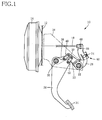
- Fig. 1 is a side view showing a lever-ratio switching type brake pedal apparatus according to an embodiment of the present invention.
- Fig. 1 is a view for explaining an embodiment of the present invention in the form of a lever-ratio switching type brake pedal apparatus 10 (hereinafter simply referred to as "brake pedal apparatus 10") that is to be used for a service braking system of a vehicle.
- the view of Fig. 1 is a side view as viewed from a left side of the apparatus 10.
- This brake pedal apparatus 10 is adapted to be integrally disposed on a dash panel 12 that separates a passenger compartment and an engine room of the vehicle from each other.
- a brake booster 14 and a pedal bracket 16 are located on respective opposite sides of the dash panel 12, and are fixed integrally to each other.
- the pedal bracket 16 corresponds to a support member that is fixed integrally to a body of the vehicle.
- a pedal arm 26 is disposed on the pedal bracket 16 so as to be pivotable about an axis O 1 of a first shaft 20 (see Figs. 2 and 3) that substantially horizontally extends in a width direction of the vehicle.
- a pivot member 28 is disposed on the pedal bracket 16 so as to be pivotable about an axis O 2 of a second shaft 22 (see Figs. 2 and 3) that is parallel to the first shaft 20.
- a pedal pad 34 is provided in a lower end portion of the pedal arm 26, so as to be depressed by an operator of the vehicle in a forward direction, i.e., in a leftward direction as seen in Fig. 1. It is noted that each of the first and second shafts 20, 22 per se do not necessarily have to be pivoted about a corresponding one of the axes O 1 , O 2 , but may be fixed integrally to the pedal bracket 16.
- Fig. 2 is a perspective view of an upper end portion of the pedal arm 26 and the pivot member 28, as viewed from a right upper side of the apparatus 10 in a front side of drawing sheet of Fig. 1.
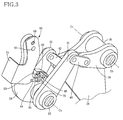
- Fig. 3 is a perspective view as viewed from the right upper side of the apparatus 10 in a rear side of drawing sheet of Fig. 1.
- first and second working levers 30, 32 are mounted on the second shaft 22 so as to be pivotable about the axis O 2 of the second shaft 22 relative to the pivot member 28.
- the first and second working levers 30, 32 are disposed on respective opposite sides of the pivot member 28 in a direction of the second axis O 2 .
- the pedal arm 26 is mounted on the first shaft 20 via a sleeve 36, and is pivotable relative to the first shaft 20.
- a sub arm 38 is integrally fixed to the sleeve 36, so as to be pivotable integrally with the pedal arm 26 about the first axis O 1 .
- an operating pedal is constituted by the pedal arm 26 as its main body, the sleeve 36 and the sub arm 38.
- a pair of first connecting links 40 is provided to bridge the sub arm 38 and the first working lever 30, and is connected to the sub arm 38 and the first working lever 30 so as to be pivotable about axes parallel to the first and second axes O1, O2 relative to the sub arm 38 and the first working lever 30, so that the first connecting links 40 cause the first working lever 30 to be mechanically pivoted about the second axis O 2 according to a predetermined lever-ratio characteristic in response to a depressing operation effected on the pedal arm 26.
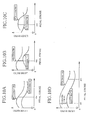
- a lever-ratio characteristic 1 of Fig. 10 is that established where the pivot member 28 is pivoted integrally with the first working lever 30 and presses the operating rod 18 of the brake booster 14.
- the lever-ratio characteristic 1 is suitably set, as shown in views (a)-(d) of Fig. 10, based on projection directions and lengths of the sub arm 38 and first working lever 30 and connected positions of the first connecting links 40.
- the first connecting links 40 correspond to a first connecting device.
- the first connecting links 40 are disposed on respective opposite sides of each of the first working lever 30 and sub arm 38.
- a pair of second connecting links 42 is provided to bridge the pedal arm 26 and the second working lever 32, and is connected to the pedal arm 26 and the second working lever 32 so as to be pivotable about axes parallel to the first and second axes O1, 02 relative to the pedal arm 26 and the second working lever 32, so that the second connecting links 42 cause the second working lever 32 to be mechanically pivoted about the second axis O 2 according to a predetermined lever-ratio characteristic in response to the depressing operation effected on the pedal arm 26.
- a lever-ratio characteristic 2 of Fig. 10 is that established where the pivot member 28 is pivoted integrally with the second working lever 32 and presses the operating rod 18 of the brake booster 14.
- the lever-ratio characteristic 2 is suitably set, as shown in views (a)-(d) of Fig. 10, based on a projection direction and a length of the second working lever 32 and connected positions of the second connecting links 42, so as to be different from the above-described lever-ratio characteristic 1.
- the second connecting links 42 correspond to a second connecting device.
- the second connecting links 42 are disposed on respective opposite sides of each of the second working lever 32 and pedal arm 26.
- each of the lever-ratio characteristics 1 and 2 shown in views (a)-(d) of Fig. 10 is a characteristic of change in a lever ratio (corresponding to a ratio of output to a depressing force applied to the pedal arm 26) in relation with a pedal stroke (depressing amount) of the pedal arm 26, and that each of the lever-ratio characteristics 1 and 2 is merely an example of such a lever-ratio characteristic and does not necessarily correspond to that of the brake pedal apparatus 10 shown in Figs. 1-3.
- first and second working levers 30, 32 In mutually opposed side surfaces of the respective first and second working levers 30, 32, namely, in inside surfaces of the respective working levers 30, 32 located on respective opposite sides of the pivot member 28, a multiplicity of first meshing teeth 44 and a multiplicity of second meshing teeth 46 are provided to be arranged in a radial manner along a circular arc whose center is at the second axis O 2 .
- the first and second meshing teeth 44, 46 are integrally connectable to the pivot member 28 via a clutch member 48 that is disposed on the pivot member 28.
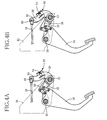
- the first and second working levers 30, 32 are pivoted relative to each other, as shown in views (a) and (b) of Fig.
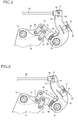
- Figs. 5 and 6 are views showing a main portion of view (a) of Fig. 4 and a main portion of view (b) of Fig.
- first and second working levers 30, 32 are arranged in substantially parallel with each other and extend substantially in the same direction.
- Fig. 7 is a plan view principally showing the clutch member 48 and the first and second meshing teeth 44, 46.
- the clutch member 48 has a substantially letter T-shape, and is disposed at its vertical bar portion on the pivot member 28, pivotably about a support pin 50.
- the clutch member 48 has a first engaging tooth 52 and a second engaging tooth 54 that are provided in respective opposite distal ends of a horizontal bar portion of the clutch member 48.
- the support pin 50 is provided in the clutch member 48, with its attitude causing its axis to be substantially perpendicular to the axis O 2 of the second shaft 22.
- the clutch member 48 is disposed with its attitude causing the clutch member 48 to take the substantially letter T-shape as seen in a plane perpendicular to the axis of the support pin 50.
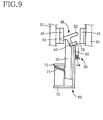
- the clutch member 48 is arranged to be mechanically pivotable by a clutch switching mechanism 56, between a first connecting position as indicated by solid line in Fig. 7 and in Fig. 8 and a second connecting position as indicated by two-dot chain line in Fig. 7 and in Fig. 9.
- the clutch switching mechanism 56 is constituted principally by a tensile coil spring 64 provided to bridge the clutch member 48 and a load reaction lever 60 that is disposed on the pivot member 28, with a tension given to the coil spring 64.
- the load reaction lever 60 is disposed on the pivot member 28, pivotably about an axis (third axis) of a third shaft 66 that is parallel to the axis O 2 of the second shaft 22.
- the operating rod 18 of the brake booster 14 is connected to the pivot member 28, pivotably relative to the load reaction lever 60 about an axis of a connecting pin (clevis pin) 68 that is adjacent to and parallel to the third shaft 66.
- the third shaft 66 may be fixed integrally to either one of the load reaction lever 60 and pivot member 28. However, the third shaft 66 may be arranged to connect the load reaction lever 60 and pivot member 28, while being pivotable relative to both of the load reaction lever 60 and pivot member 28.
- the load reaction lever 60 has a spring receiver portion 70 provided by its portion that is bent by substantially a right angle.
- a load adjuster spring 74 is disposed between the spring receiver portion 70 of the load reaction lever 60 and a spring receiver portion 72 that is integrally fixed to the pivot member 28.
- This load adjuster spring 74 is a spring member corresponding to a first biaser.
- the load adjuster spring 74 is provided by a compression spring, and is disposed with its attitude substantially parallel to a line tangential to a circular arc whose center is at the third shaft 66 so that a biasing force of the load adjuster spring 74 acts in a direction substantially parallel to the tangential line.
- the load reaction lever 60 is biased to be pivoted relative to the pivot member 28 about the third shaft 66 counterclockwise as seen in Fig. 1.
- the connecting pin 68 passes though an elongated hole 76 that is formed through the pivot member 28. That is, the pivot member 28 and the load reaction lever 60 are pivotable about the third shaft 66 relative to each other within a range that is defined by engagement of the elongated hole 76 and the connecting pin 68.
- the elongated hole 76 is elongated in a direction in which the circular arc (whose center corresponds to the axis of the third shaft 66) extends.
- the load reaction lever 60 is held by the biasing force of the load adjuster spring 74, in its reference position that corresponds to an end of a counterclockwise pivot motion of the lever 60 about the axis of the third shaft 66, as shown in view (a) of Fig. 4 and Fig. 5.
- the clutch member 48 is held by the biasing force of the tensile coil spring 64, in the fist connecting position, as shown in solid line of Fig. 7 and in Fig. 8, whereby the first working lever 30 and the pivot member 28 are integrally connected to each other through the clutch member 48.
- the clutch member 48 has an engaged portion 78 that is provided in an end portion of the vertical bar portion of the letter T shape.
- the tensile coil spring 64 is engaged with the engaged portion 78 so that the clutch member 48 is biased in clockwise direction about the support pin 50. Meanwhile, a positioning protrusion 80 provided in the load reaction lever 60 is held in contact with the engaged portion 78 of the clutch member 48. Owing to the tensile coil spring 64 and the positioning protrusion 80, the attitude of the clutch member 48 is kept constant whereby the engagement of the first engaging tooth 52 with the first meshing teeth 44 is maintained.
- the tensile coil spring 64 is a spring member corresponding to a second biaser.
- the brake booster 14 functions as a boosting device that is arranged to boost a small depressing force, for example, by a vacuum pressure, so as to generate a large braking force.
- the operating rod 18 is biased to project outwardly from the brake booster 14.
- the upper end portion of the load reaction lever 60 i.e., the connecting pin 68 (serving as a connected portion at which the load reaction lever 60 is connected to the operating rod 18) is relatively moved within the elongated hole 76 by the reaction force of the operating rod 18, so that the load reaction lever 60 is pivoted relative to the pivot member 28 to its switching position, as shown in view (b) of Fig. 4 and Fig. 6, in which the connecting pin 68 is brought into contact with another end portion of the elongated hole 76.
- the switching load causing the load reaction lever 60 to be relatively pivoted to the switching position is determined univocally based on a preload (initial elastic deformation amount) of the load adjuster spring 74.
- the switching load can be adjusted by expanding and contracting the load adjuster spring 74.
- the expansion and contraction of the spring 74 can be made, for example, by advancing and reversing a spring receiver member (not shown) provided in the spring receiver portion 70 or 72, by means of a threaded screw or the like.
- the clutch member 48 When the load reaction lever 60 is pivoted to the switching position relative to the pivot member 28, the clutch member 48 is pivoted counterclockwise about the support pin 50 by engagement of the engaging portion 78 with the positioning protrusion 80 of the load reaction lever 60 against the biasing force of the tensile coil spring 64, whereby the clutch member 48 is positioned in the second connecting position as indicated by two-dot chain line in Fig. 7 and in Fig. 9.
- the clutch member 48 is held in the second connection position with its attitude being constant and determined based on the switching position of the load reaction lever 60, so that engagement of the second engaging tooth 54 with the second meshing teeth 46 is maintained whereby the second working lever 32 and the pivot member 28 are integrally connected to each other.
- the load reaction lever 60 When the depressing force applied to the pedal arm 26 is reduced, the load reaction lever 60 is pivoted to be returned to the reference position by the biasing force of the load adjuster spring 74, and the clutch member 48 is pivoted to be returned to the first connecting position by the returning pivot motion of the load reaction lever 60 and the biasing force of the tensile coil spring 64.
- the load reaction lever 60 and the pivot member 28 are integrally returned by the biasing force of the operating rod 18 to be pivoted clockwise about the second shaft 22, and the pedal arm 26 is returned to be pivoted counterclockwise about the first shaft 20 whereby the pedal arm 26 is held in its home position as shown in Fig. 1.
- the switching load i.e., the preload of the load adjuster spring 74 may be set such that the selected lever-ratio characteristic is switched at the predetermined amounts stx, st1, st2 of the pedal stroke.
- Each of views (a), (b), (c) of Fig. 10 shows an arrangement where the lever-ratio characteristic 1 is switched to the lever-ratio characteristic 2 upon excess of the pedal stroke over the amount stx during an ordinary braking operation.
- the lever ratio is smaller while the pedal stroke exceeds the amount stx, namely, while the pedal arm 26 is being strongly depressed.
- a ratio of amplification of the braking force to the depressing force is reduced whereby a change in the braking force becomes smaller, thereby facilitating a fine manipulation of the braking force.
- the lever ratio is larger while the pedal stroke exceeds the amount stx, namely, while the pedal arm 26 is being strongly depressed.
- the ratio of amplification of the braking force to the depressing force is increased thereby facilitating generation of a large braking force.
- view (d) of Fig. 10 shows an arrangement where the lever-ratio characteristic 1 is switched to the lever-ratio characteristic 2 with application of a large load (large depressing force) that is rarely applied in an ordinary braking operation.
- a large load large depressing force
- the reaction force is increased to the switching load, and the selected lever-ratio characteristic is switched to the lever-ratio characteristic 2, whereby the lever ratio is increased and the braking force is further increased.
- the amount st1 of the pedal stroke is an amount at which the selected lever-ratio characteristic is switched to the lever-ratio characteristic 2 as a result of increase of the reaction force to the switching load in a case where a large depressing force is required even in an initial stage, for example, in the event of failure of the brake booster 14.
- the rate of amplification is increased whereby generation of a large braking force is facilitated.
- the selected lever-ratio characteristic is switched to the lever-ratio characteristic 2 in a stage earlier than the amount stx, so that the rate of amplification is increased whereby a large braking force is generated.
- the first and second working levers 30, 32 in response to the depressing operation effected on the pedal arm 26, can be pivoted about the axis O 2 of the second shaft 22 according to the respective different lever-ratio characteristics, and can be connected integrally to the pivot member 28 through the clutch member 48.
- One of the lever-ratio characteristics 1, 2 is selected depending on which one of the first and second working levers 30, 32 is connected to the pivot member 28.
- a path of transmission of the depressing force is changed by the clutch switching mechanism 56 whereby the selected lever-ratio characteristic is changed.
- the lever ratio of the lever-ratio characteristic 2 for the strong depression is set to be higher than the lever ratio of the lever-ratio characteristic 1 for the moderate depression, as in the arrangements of views (c), (d) of Fig. 10, the ratio of amplification of the braking force to the depressing force during the strong depression is increased whereby a large braking force can be easily generated.
- the lever ratio of the lever-ratio characteristic 2 for the strong depression is set to be lower than the lever ratio of the lever-ratio characteristic 1 for the moderate depression, as in the arrangements of views (a), (b) of Fig. 10, the ratio of amplification of the braking force to the depressing force during the strong depression is reduced whereby a fine manipulation of the braking force is facilitated.
- first and second working levers 30, 32 are connected to the sub arm 38 and the pedal arm 26, respectively, through the respective first and second connecting links 40, 42, the degree of freedom in setting the lever-ratio characteristics of the respective first and second working levers 30, 32 is high.
- the lever-ratio characteristic is changed by merely changing the center of the pivot motion of the operating pedal, it is possible to provide a lever ratio that is further suitably variable according to the depressing force applied to the operating pedal.
- each of the lever-ratio characteristics of the respective first and second working levers 30, 32 i.e., each of the lever-ratio characteristics 1, 2 for the moderate depression and strong depression can be freely set within a wide range.
- the brake pedal apparatus 10 can be made compact in size, so that there is an advantage that the apparatus 10 can be easily installed on a vehicle.
- the first and second working levers 30, 32 are arranged in substantially parallel with each other and extend substantially in the same direction, the first and second meshing teeth 44, 46 can be provided in proximal end portions of the respective first and second working levers 30, 32, and each of the first and second working levers 30, 32 can be made compact in size.
- first working lever 30 has the multiplicity of first meshing teeth 44 arranged along the circular arc whose center is at the axis O 2 of the second shaft 22, while the second working lever 32 has the multiplicity of second meshing teeth 46 arranged along the circular arc whose center is at the axis O 2 of the second shaft 22.
- the apparatus can be simply constructed, and the motion of the clutch member 48 is stabilized, so that the lever-ratio characteristic is reliably switched to another laver-ratio characteristic, upon application of a predetermined depressing force to the operating pedal.
- the load adjuster spring 74 is used as the first biaser which positions the load reaction lever 60 in the reference position and which allows the load reaction lever 60 to be relatively pivoted to the switching position when the reaction force exceeds the predetermined switching load.
- the load adjuster spring 74 is arranged to directly bias the load reaction lever 60 such that the load reaction lever 60 is pivoted about the axis of the third shaft 66 toward the reference position relative to the pivot member 28. In this arrangement, the load reaction lever 60 is moved to the switching position appropriately based on the switching load that is determined univocally depending on the biasing force of the load adjuster spring 74, so that the selected lever-ratio characteristic can be reliably switched from the lever-ratio characteristic 1 to the lever-ratio characteristic 2 with high accuracy.
- Patent Document 2 in which the positioning device is provided to position the switching lever in the reference position by engagement of a ball with a V-shaped groove, the switching lever is held in the reference position owing to friction force acting between the ball and a wall of the V-shaped groove.
- the switching load (allowing pivot movement of the switching lever by removal of the ball from the V-shaped groove) is easily changed, for example, by wear of the wall of the V-shaped groove, so that the switching load is difficult to be set reliably with high accuracy.
- the load adjuster spring 74 is engaged directly with the pivot member 28 and the load reaction lever 60, with its attitude being substantially parallel to a line tangential to a circular arc whose center is at the third shaft 66 so that a biasing force of the load adjuster spring 74 acts directly in a direction causing the load reaction lever 60 to be pivoted to the reference position.
- the switching load causing the load reaction lever 60 to be moved from the reference position to the switching position can be set by the preload of the load adjuster spring 74 with high accuracy.
- the first and second working levers 30, 32 are pulled downward through the respective first and second connecting links 40, 42 in response to the depressing operation effected on the pedal arm 26, and are pivoted counterclockwise about the axis O 2 of the second shaft 22.
- this arrangement can be modified such that the first and second working levers 30, 32 are to be pressed so as to be pivoted.
- a brake pedal apparatus 90 of Fig. 11 is identical with the above-described brake pedal apparatus 10 with respect to arrangement for the connection of the second working lever 32 with the second connecting link 42.
- a first working lever 92 is disposed to be directed more forward than the above-descried first working lever 30, and is connected to the sub arm 38 via the first connecting links 40 in a position below the sub arm 38.
- the first working lever 92 in response to the depressing operation effected on the pedal arm 26, the first working lever 92 is pressed downward through the first connecting links 40, and is pivoted counterclockwise about the axis O 2 of the second shaft 22.
- the first meshing teeth 44 that are to be engaged with the first engaging tooth 52 of the clutch member 48 are provided in a portion of the first working lever 92 (ranging from an upper left side to an upper side of the second shaft 22 as seen in Fig. 11) that corresponds to a portion of the first working lever 30 in which the first meshing teeth 44 are provided.
- a brake pedal apparatus (10; 90) including: an operating pedal (26, 36, 38), and first and second working levers (30, 32; 92, 32) which is pivotable according to respective different lever-ratio characteristics in response to a depressing operation effected on the operating pedal and which is connectable to a pivot member (28) via a clutch member (48).
- a reaction force of an output member (18) does not exceed a switching load
- a load reaction lever (60) is held in a reference position whereby the first working lever is connected to the pivot member.
- the load reaction lever is pivoted to a switching position against a biasing force of a biaser (74) whereby the second working lever is connected to the pivot member.
Landscapes
- Engineering & Computer Science (AREA)
- Physics & Mathematics (AREA)
- General Physics & Mathematics (AREA)
- Automation & Control Theory (AREA)
- Transportation (AREA)
- Mechanical Engineering (AREA)
- Braking Elements And Transmission Devices (AREA)
- Mechanical Control Devices (AREA)
Applications Claiming Priority (1)
| Application Number | Priority Date | Filing Date | Title |
|---|---|---|---|
| JP2006081791A JP4486605B2 (ja) | 2006-03-23 | 2006-03-23 | レバー比切替型ブレーキペダル装置 |
Publications (3)
| Publication Number | Publication Date |
|---|---|
| EP1839976A2 true EP1839976A2 (fr) | 2007-10-03 |
| EP1839976A3 EP1839976A3 (fr) | 2009-05-13 |
| EP1839976B1 EP1839976B1 (fr) | 2011-01-12 |
Family
ID=38142877
Family Applications (1)
| Application Number | Title | Priority Date | Filing Date |
|---|---|---|---|
| EP06124052A Not-in-force EP1839976B1 (fr) | 2006-03-23 | 2006-11-14 | Pédale de frein à rapport de levier variable |
Country Status (4)
| Country | Link |
|---|---|
| US (1) | US7584683B2 (fr) |
| EP (1) | EP1839976B1 (fr) |
| JP (1) | JP4486605B2 (fr) |
| DE (1) | DE602006019547D1 (fr) |
Cited By (2)
| Publication number | Priority date | Publication date | Assignee | Title |
|---|---|---|---|---|
| ITTO20090440A1 (it) * | 2009-06-10 | 2010-12-11 | Pierino Garnero | Dispositivo motore idraulico a controllo elettronico con rapporto meccanico pedale freno variabile e sistema frenante per autoveicoli comprendente tale dispositivo |
| EP2891585A4 (fr) * | 2012-08-31 | 2016-01-13 | Yorozu Jidosha Kogyo Kk | Dispositif de pédale de frein et procédé de fixation associé |
Families Citing this family (7)
| Publication number | Priority date | Publication date | Assignee | Title |
|---|---|---|---|---|
| JP4486617B2 (ja) * | 2006-06-05 | 2010-06-23 | 豊田鉄工株式会社 | ブレーキペダル装置 |
| US20080223171A1 (en) | 2007-03-16 | 2008-09-18 | Noboru Fujiwara | Operating pedal device having load sensor for vehicle, and operating device having load sensor |
| US8607660B2 (en) * | 2009-12-02 | 2013-12-17 | Ford Global Technologies, Llc | Vehicle braking assembly |
| CN102815286B (zh) * | 2012-08-24 | 2015-05-06 | 浙江吉利汽车研究院有限公司杭州分公司 | 车用踏板机构 |
| US11212962B2 (en) | 2013-02-20 | 2022-01-04 | Deere & Company | Field condition determination |
| JP6060057B2 (ja) * | 2013-09-19 | 2017-01-11 | 日立オートモティブシステムズ株式会社 | ブレーキ装置 |
| CN104290665B (zh) * | 2014-09-26 | 2016-07-13 | 广东东箭汽车用品制造有限公司 | 车辆及其半自动脚踏装置 |
Family Cites Families (13)
| Publication number | Priority date | Publication date | Assignee | Title |
|---|---|---|---|---|
| US2755891A (en) * | 1953-07-23 | 1956-07-24 | Ford Motor Co | Power brake with variable ratio lever |
| US3733966A (en) * | 1971-03-24 | 1973-05-22 | Bendix Corp | Hydraulic power brake booster |
| JP2848078B2 (ja) | 1992-01-09 | 1999-01-20 | トヨタ自動車株式会社 | ブレーキ操作装置 |
| JPH05301565A (ja) | 1992-04-27 | 1993-11-16 | Toyota Motor Corp | ペダル比可変ブレーキペダル装置 |
| US5758547A (en) | 1996-04-02 | 1998-06-02 | Dura Automotive Systems | Self-adjust variable ratio parking brake actuator |
| JPH1029510A (ja) | 1996-07-12 | 1998-02-03 | Jidosha Kiki Co Ltd | ブレーキ装置 |
| JP2000079870A (ja) | 1998-09-07 | 2000-03-21 | Mitsubishi Motors Corp | 車両用ブレーキ装置 |
| US6298746B1 (en) | 1999-04-01 | 2001-10-09 | Delphi Technologies, Inc. | Brake pedal for motor vehicle |
| MXPA02008613A (es) * | 2001-01-10 | 2004-09-06 | Ksr International Inc | Ensmable de pedal para freno con proporcion variable. |
| JP4010485B2 (ja) | 2001-03-21 | 2007-11-21 | ボッシュ株式会社 | ブレーキペダル装置 |
| WO2005051736A1 (fr) * | 2003-11-25 | 2005-06-09 | Bosch Corporation | Dispositif pédale de frein |
| JP4394031B2 (ja) * | 2005-04-12 | 2010-01-06 | 豊田鉄工株式会社 | ブレーキペダル装置 |
| JP4384081B2 (ja) * | 2005-05-17 | 2009-12-16 | 豊田鉄工株式会社 | ブレーキペダル装置 |
-
2006
- 2006-03-23 JP JP2006081791A patent/JP4486605B2/ja not_active Expired - Fee Related
- 2006-04-21 US US11/407,947 patent/US7584683B2/en not_active Expired - Fee Related
- 2006-11-14 EP EP06124052A patent/EP1839976B1/fr not_active Not-in-force
- 2006-11-14 DE DE602006019547T patent/DE602006019547D1/de active Active
Cited By (2)
| Publication number | Priority date | Publication date | Assignee | Title |
|---|---|---|---|---|
| ITTO20090440A1 (it) * | 2009-06-10 | 2010-12-11 | Pierino Garnero | Dispositivo motore idraulico a controllo elettronico con rapporto meccanico pedale freno variabile e sistema frenante per autoveicoli comprendente tale dispositivo |
| EP2891585A4 (fr) * | 2012-08-31 | 2016-01-13 | Yorozu Jidosha Kogyo Kk | Dispositif de pédale de frein et procédé de fixation associé |
Also Published As
| Publication number | Publication date |
|---|---|
| JP2007253832A (ja) | 2007-10-04 |
| EP1839976A3 (fr) | 2009-05-13 |
| JP4486605B2 (ja) | 2010-06-23 |
| EP1839976B1 (fr) | 2011-01-12 |
| US20070221009A1 (en) | 2007-09-27 |
| DE602006019547D1 (de) | 2011-02-24 |
| US7584683B2 (en) | 2009-09-08 |
Similar Documents
| Publication | Publication Date | Title |
|---|---|---|
| EP1712440B1 (fr) | Assemblage d'une pédale de frein d'un véhicule | |
| EP1864877B1 (fr) | Appareil doté d'une pédale de frein | |
| EP1839976B1 (fr) | Pédale de frein à rapport de levier variable | |
| US6952980B2 (en) | Pedal device wherein non-operated position of operating portion is adjustable | |
| EP1609690B1 (fr) | Frein de stationnement | |
| US6808040B2 (en) | Vehicle-pedal-backward-displacement preventing device for preventing displacement of depressable portion of operating pedal toward operator's seat | |
| US7448296B2 (en) | Brake pedal apparatus | |
| US6666105B2 (en) | Brake pedal apparatus | |
| US7069810B2 (en) | Pedal device wherein non-operated position of operating portion is adjustable | |
| US6502671B2 (en) | Brake actuation using a toggle clamp | |
| JP2001180320A (ja) | 自動車の変速レバーロック装置 | |
| JP2004230986A (ja) | 補助ブレーキ装置 | |
| JP2000280874A (ja) | 自動車のブレーキペダル装置 | |
| JP2007196726A (ja) | ブレーキペダル装置 | |
| US20260079522A1 (en) | Pedal device for a vehicle, and a vehicle | |
| JP2004017918A (ja) | レバー比可変ペダル装置 | |
| JP2517260Y2 (ja) | ブレーキ操作構造 | |
| JP4269326B2 (ja) | 自動車の補助ブレーキ装置 | |
| JP2023143033A (ja) | ブレーキ操作機構 | |
| US20080202870A1 (en) | Holding Brake Device | |
| JPH0260843A (ja) | 作業車 | |
| JP2017182667A (ja) | 操作装置 | |
| JPH0439152A (ja) | 機械式倍力装置 |
Legal Events
| Date | Code | Title | Description |
|---|---|---|---|
| PUAI | Public reference made under article 153(3) epc to a published international application that has entered the european phase |
Free format text: ORIGINAL CODE: 0009012 |
|
| AK | Designated contracting states |
Kind code of ref document: A2 Designated state(s): AT BE BG CH CY CZ DE DK EE ES FI FR GB GR HU IE IS IT LI LT LU LV MC NL PL PT RO SE SI SK TR |
|
| AX | Request for extension of the european patent |
Extension state: AL BA HR MK YU |
|
| PUAL | Search report despatched |
Free format text: ORIGINAL CODE: 0009013 |
|
| AK | Designated contracting states |
Kind code of ref document: A3 Designated state(s): AT BE BG CH CY CZ DE DK EE ES FI FR GB GR HU IE IS IT LI LT LU LV MC NL PL PT RO SE SI SK TR |
|
| AX | Request for extension of the european patent |
Extension state: AL BA HR MK RS |
|
| RTI1 | Title (correction) |
Free format text: LEVER-RATIO SWITCHING TYPE BRAKE PEDAL APPARATUS |
|
| 17P | Request for examination filed |
Effective date: 20090826 |
|
| AKX | Designation fees paid |
Designated state(s): DE FR GB |
|
| RTI1 | Title (correction) |
Free format text: LEVER-RATIO SWITCHING TYPE BRAKE PEDAL APPARATUS |
|
| GRAP | Despatch of communication of intention to grant a patent |
Free format text: ORIGINAL CODE: EPIDOSNIGR1 |
|
| RIN1 | Information on inventor provided before grant (corrected) |
Inventor name: FUJIWARA, NOBORUTOYODA IRON WORKS CO.,LTD. |
|
| GRAS | Grant fee paid |
Free format text: ORIGINAL CODE: EPIDOSNIGR3 |
|
| GRAA | (expected) grant |
Free format text: ORIGINAL CODE: 0009210 |
|
| AK | Designated contracting states |
Kind code of ref document: B1 Designated state(s): DE FR GB |
|
| REG | Reference to a national code |
Ref country code: GB Ref legal event code: FG4D |
|
| REF | Corresponds to: |
Ref document number: 602006019547 Country of ref document: DE Date of ref document: 20110224 Kind code of ref document: P |
|
| REG | Reference to a national code |
Ref country code: DE Ref legal event code: R096 Ref document number: 602006019547 Country of ref document: DE Effective date: 20110224 |
|
| PLBE | No opposition filed within time limit |
Free format text: ORIGINAL CODE: 0009261 |
|
| STAA | Information on the status of an ep patent application or granted ep patent |
Free format text: STATUS: NO OPPOSITION FILED WITHIN TIME LIMIT |
|
| 26N | No opposition filed |
Effective date: 20111013 |
|
| REG | Reference to a national code |
Ref country code: DE Ref legal event code: R097 Ref document number: 602006019547 Country of ref document: DE Effective date: 20111013 |
|
| PGFP | Annual fee paid to national office [announced via postgrant information from national office to epo] |
Ref country code: GB Payment date: 20141120 Year of fee payment: 9 Ref country code: DE Payment date: 20141128 Year of fee payment: 9 |
|
| PGFP | Annual fee paid to national office [announced via postgrant information from national office to epo] |
Ref country code: FR Payment date: 20141118 Year of fee payment: 9 |
|
| REG | Reference to a national code |
Ref country code: DE Ref legal event code: R119 Ref document number: 602006019547 Country of ref document: DE |
|
| GBPC | Gb: european patent ceased through non-payment of renewal fee |
Effective date: 20151114 |
|
| REG | Reference to a national code |
Ref country code: FR Ref legal event code: ST Effective date: 20160729 |
|
| PG25 | Lapsed in a contracting state [announced via postgrant information from national office to epo] |
Ref country code: DE Free format text: LAPSE BECAUSE OF NON-PAYMENT OF DUE FEES Effective date: 20160601 Ref country code: GB Free format text: LAPSE BECAUSE OF NON-PAYMENT OF DUE FEES Effective date: 20151114 |
|
| PG25 | Lapsed in a contracting state [announced via postgrant information from national office to epo] |
Ref country code: FR Free format text: LAPSE BECAUSE OF NON-PAYMENT OF DUE FEES Effective date: 20151130 |