EP1842847B1 - Procede de la production de la 5-chloro-2,4-dihydroxypyridine - Google Patents
Procede de la production de la 5-chloro-2,4-dihydroxypyridine Download PDFInfo
- Publication number
- EP1842847B1 EP1842847B1 EP06712321A EP06712321A EP1842847B1 EP 1842847 B1 EP1842847 B1 EP 1842847B1 EP 06712321 A EP06712321 A EP 06712321A EP 06712321 A EP06712321 A EP 06712321A EP 1842847 B1 EP1842847 B1 EP 1842847B1
- Authority
- EP
- European Patent Office
- Prior art keywords
- chloro
- formula
- derivative
- represented
- chain
- Prior art date
- Legal status (The legal status is an assumption and is not a legal conclusion. Google has not performed a legal analysis and makes no representation as to the accuracy of the status listed.)
- Expired - Lifetime
Links
- 0 CC*[C@@](C)C[C@@]1*C*C1 Chemical compound CC*[C@@](C)C[C@@]1*C*C1 0.000 description 3
Classifications
-
- C—CHEMISTRY; METALLURGY
- C07—ORGANIC CHEMISTRY
- C07D—HETEROCYCLIC COMPOUNDS
- C07D213/00—Heterocyclic compounds containing six-membered rings, not condensed with other rings, with one nitrogen atom as the only ring hetero atom and three or more double bonds between ring members or between ring members and non-ring members
- C07D213/02—Heterocyclic compounds containing six-membered rings, not condensed with other rings, with one nitrogen atom as the only ring hetero atom and three or more double bonds between ring members or between ring members and non-ring members having three double bonds between ring members or between ring members and non-ring members
- C07D213/04—Heterocyclic compounds containing six-membered rings, not condensed with other rings, with one nitrogen atom as the only ring hetero atom and three or more double bonds between ring members or between ring members and non-ring members having three double bonds between ring members or between ring members and non-ring members having no bond between the ring nitrogen atom and a non-ring member or having only hydrogen or carbon atoms directly attached to the ring nitrogen atom
- C07D213/60—Heterocyclic compounds containing six-membered rings, not condensed with other rings, with one nitrogen atom as the only ring hetero atom and three or more double bonds between ring members or between ring members and non-ring members having three double bonds between ring members or between ring members and non-ring members having no bond between the ring nitrogen atom and a non-ring member or having only hydrogen or carbon atoms directly attached to the ring nitrogen atom with hetero atoms or with carbon atoms having three bonds to hetero atoms with at the most one bond to halogen, e.g. ester or nitrile radicals, directly attached to ring carbon atoms
- C07D213/62—Oxygen or sulfur atoms
- C07D213/69—Two or more oxygen atoms
-
- C—CHEMISTRY; METALLURGY
- C07—ORGANIC CHEMISTRY
- C07D—HETEROCYCLIC COMPOUNDS
- C07D213/00—Heterocyclic compounds containing six-membered rings, not condensed with other rings, with one nitrogen atom as the only ring hetero atom and three or more double bonds between ring members or between ring members and non-ring members
- C07D213/02—Heterocyclic compounds containing six-membered rings, not condensed with other rings, with one nitrogen atom as the only ring hetero atom and three or more double bonds between ring members or between ring members and non-ring members having three double bonds between ring members or between ring members and non-ring members
- C07D213/04—Heterocyclic compounds containing six-membered rings, not condensed with other rings, with one nitrogen atom as the only ring hetero atom and three or more double bonds between ring members or between ring members and non-ring members having three double bonds between ring members or between ring members and non-ring members having no bond between the ring nitrogen atom and a non-ring member or having only hydrogen or carbon atoms directly attached to the ring nitrogen atom
- C07D213/60—Heterocyclic compounds containing six-membered rings, not condensed with other rings, with one nitrogen atom as the only ring hetero atom and three or more double bonds between ring members or between ring members and non-ring members having three double bonds between ring members or between ring members and non-ring members having no bond between the ring nitrogen atom and a non-ring member or having only hydrogen or carbon atoms directly attached to the ring nitrogen atom with hetero atoms or with carbon atoms having three bonds to hetero atoms with at the most one bond to halogen, e.g. ester or nitrile radicals, directly attached to ring carbon atoms
- C07D213/62—Oxygen or sulfur atoms
-
- C—CHEMISTRY; METALLURGY
- C07—ORGANIC CHEMISTRY
- C07D—HETEROCYCLIC COMPOUNDS
- C07D309/00—Heterocyclic compounds containing six-membered rings having one oxygen atom as the only ring hetero atom, not condensed with other rings
- C07D309/32—Heterocyclic compounds containing six-membered rings having one oxygen atom as the only ring hetero atom, not condensed with other rings having two double bonds between ring members or between ring members and non-ring members
-
- C—CHEMISTRY; METALLURGY
- C07—ORGANIC CHEMISTRY
- C07F—ACYCLIC, CARBOCYCLIC OR HETEROCYCLIC COMPOUNDS CONTAINING ELEMENTS OTHER THAN CARBON, HYDROGEN, HALOGEN, OXYGEN, NITROGEN, SULFUR, SELENIUM OR TELLURIUM
- C07F7/00—Compounds containing elements of Groups 4 or 14 of the Periodic Table
- C07F7/02—Silicon compounds
- C07F7/08—Compounds having one or more C—Si linkages
- C07F7/18—Compounds having one or more C—Si linkages as well as one or more C—O—Si linkages
- C07F7/1804—Compounds having Si-O-C linkages
Definitions
- the present invention relates to a process for producing 5-chloro-2,4-dihydroxypyridine, which is useful as an inhibitor of a biodegradation enzyme that biodegrades an anti-malignant-tumor agent 5-fluorouracil exhibiting an excellent anti-tumor effect, and to a pyrone derivative, which is a production intermediate.
- 5-Chloro-2,4-dihydroxypyridine (non-proprietary name: Gimeracil) is known to potentiate the anti-tumor activity of 5-fluorouracil (an anti-malignant-tumor agent) by inhibiting dihydropyrimidine dehydrogenase, which is a biodegradation enzyme which acts on 5-fluorouracil (see Patent Document 1).
- a 5-fluorouracil-based anti-tumor agent which is a combination drug of Gimeracil, Tegafur, and Oteracil Potassium, is available on the market as TS-1 (trade name). Hitherto, the following 5-chloro-2,4-dihydroxypyridine production processes are known.
- Non-Patent Document 1 includes a step performed under very severe conditions (i.e., under acidic conditions, in an autoclave at 200°C), which makes the process industrially unsuitable.
- Non-Patent Document 2 includes a large number of steps, which make the process difficult to carry out on an industrial scale.
- Patent Document 2 discloses a process in which an ⁇ , ⁇ -unsaturated keto ester derivative is synthesized from malonyl dichloride, and ammonia is reacted with the ester derivative, to thereby produce 2,4-dihydroxy-5-halogenopyridine derivative.
- handling of starting materials for producing the ⁇ , ⁇ -unsaturated keto ester derivative serving as an intermediate is problematic, and there are some problems associated with reaction conditions. For the above reasons the process is difficult to be employed on an industrial scale.
- Patent Document 3 discloses a process in which the 5-position of 3-cyano-2-hydroxy-3-methoxypiridine is selectively halogenized, and the cyano group is removed through hydrolysis/decarbonation by use of strong acid with heating, to thereby produce 2,4-dihydroxy-5-halogenopyridine derivative.
- a large amount of strong acid is employed for hydrolysis, and a large amount of base is employed for neutralizing the strong acid.
- a large amount of salts are formed as industrial wastes, which are not preferred from the viewpoint of the environment.
- an object of the present invention is to provide an industrially advantageous process for producing 5-chloro-2,4-dihydroxypyridine, which is an inhibitor acting on a biodegradation enzyme that biodegrades an anti-malignant-tumor agent 5-fluorouracil, the process being able to be carried out under mild conditions with a small number of steps and producing less industrial waste.
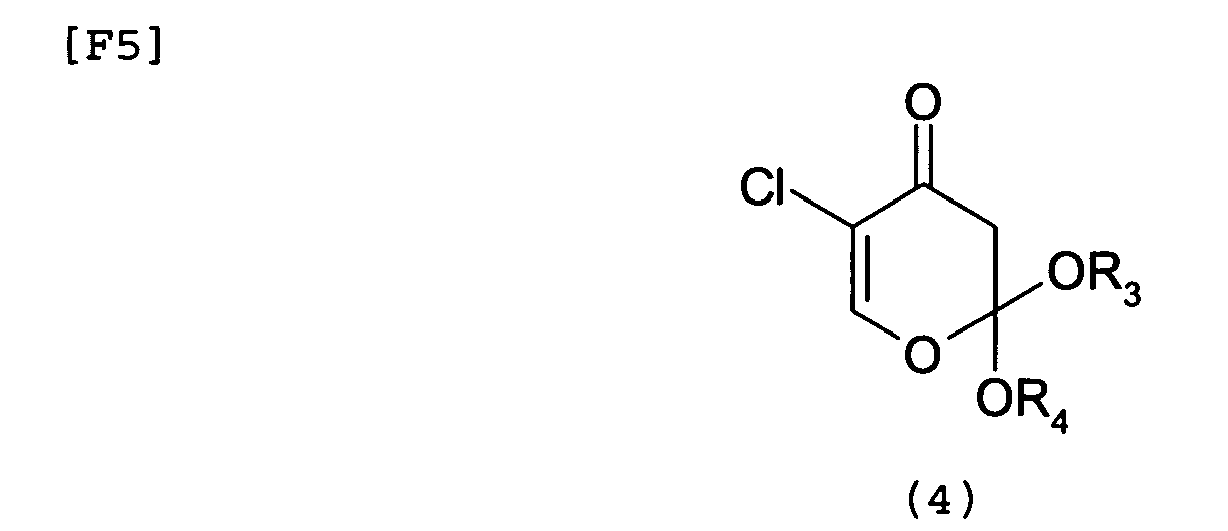
- the present invention is directed to a process for producing 5-chloro-2,4-dihydroxypyridine represented by formula (1): characterized in that the process comprises reacting a 5-chloro-1,3-dioxin-4-one derivative (2) represented by formula (2) : (wherein R 1 and R 2 , which are identical to or different from each other, each represent a C1 to C6 linear-chain or branched-chain alkyl group, or R 1 and R 2 may be linked to form a C3 to C6 cycloalkane with adjacent carbon atoms) with a ketene acetal derivative (3) represented by formula (3): (wherein R 3 and R 4 , which are identical to or different from each other, each represent a C1 to C6 linear-chain or branched-chain alkyl group, or a silyl group having a C1 to C6 linear-chain or branched-chain alkyl group), to thereby form a pyrone derivative (4) represented by formula (4): (wherein R 3 and R 4
- the present invention is also directed to a pyrone derivative represented by formula (4): (wherein R 3 and R 4 have the same meanings as defined above).
- 5-chloro-2,4-dihydroxypyridine can be produced under mild conditions, in a simple manner, and with less industrial waste.
- the process is suited for industrial production.
- the pyrone derivative, which is the compound according to the present invention, can be isolated and purified, and is remarkably useful as an intermediate for drug production.
- Examples of the C1 to C6 linear-chain or branched-chain alkyl group represented by R 1 or R 2 in the above formula include methyl, ethyl, propyl, isopropyl, butyl, t-butyl, pentyl, and hexyl.
- Examples of the C3 to C6 cycloalkane which R 1 and R 2 may form through linking via adjacent carbon atoms include cyclopropane, cyclobutane, cyclopentane, and cyclohexane. Of these, C3 to C6 cycloalkanes are preferred, with cyclohexane being particularly preferred.
- Examples of the C1 to C6 linear-chain or branched-chain alkyl group represented by R 3 or R 4 in the above formulas include methyl, ethyl, propyl, isopropyl, butyl, t-butyl, pentyl, and hexyl.
- silyl group having a C1 to C6 linear-chain or branched-chain alkyl group examples include silyl groups each having one to three C1 to C6 linear-chain or branched-chain alkyl groups, which may be identical to or different from one another, the alkyl groups being, for example, methyl, ethyl, propyl, isopropyl, butyl, t-butyl, pentyl, or hexyl. Of these, C1 to C6 alkyl groups are preferred, with ethyl being particularly preferred.
- the 5-chloro-1,3-dioxin-4-one derivative (2) serving as a starting substance of the present invention, may be produced through, for example, the following reaction scheme; i.e., treating 1,3-dioxin-4-one derivative (5) with N-chlorosuccinimide in the presence of acetic acid ( J. Chem. Soc. Chem. Commun., p. 699(1991 )).
- the derivative (2) may also be produced through treating 1,3-dioxin-4-one derivative (5) with sulfuryl chloride in the presence of pyridine:
- 1,3-dioxin-4-one derivative (5) is a known compound, and may be readily synthesized through, for example, a method disclosed in " Synthesis, 1985, p. 224-225 "; i.e., reaction between a formyl-Meldrum's acid derivative and a ketone or an aldehyde.
- the production process of the present invention includes the following two steps (a) and (b):
- step (a) the pyrone derivative (4) according to the present invention is synthesized.
- Reaction between a 5-chloro-1,3-dioxin-4-one derivative (2) and a ketene acetal derivative (3) is performed in a solvent.
- the solvent include aromatic hydrocarbons such as benzene, toluene, and xylene; ethers such as diethyl ether, tetrahydrofuran, and dioxane; and halohydrocarbons such as dichloromethane and chloroform.
- the ketene acetal derivative (3) is preferably employed 0.7 to 5 equivalent weight with respect to the 5-chloro-1,3-dioxin-4-one derivative (2).
- the reaction temperature is generally 50°C to 150°C, preferably 90°C to 140°C.
- No particular limitation is imposed on the reaction time.
- the reaction time is generally 5 to 120 minutes, preferably 20 to 60 minutes.
- the compounds represented by formula (4) can be readily isolated and purified through a generally employed isolation/purification method such as column chromatography, distillation, or extraction.:
- step (b) the 5-chloro-2,4-dihydroxypyridine (1), which is a final product of the reaction, is synthesized.
- the pyrone derivative represented by formula (4) is treated with acid, and then reacted with ammonia in an excessive amount, to hereby allow ring transformation reaction to proceed.
- No particular limitation is imposed on the reaction solvent so long as the solvent does not adversely affect the reaction.
- the solvent examples include alcohols such as methanol and ethanol; ethers such as diethyl ether, tetrahydrofuran, and dioxane; aromatic hydrocarbons such as benzene, toluene, and xylene; halohydrocarbons such as dichloromethane and chloroform; aprotic polar solvents such as acetonitrile, N,N-dimethylformamide, and dimethyl sulfoxide; and water.
- alcohols such as methanol and ethanol
- ethers such as diethyl ether, tetrahydrofuran, and dioxane
- aromatic hydrocarbons such as benzene, toluene, and xylene
- halohydrocarbons such as dichloromethane and chloroform
- aprotic polar solvents such as acetonitrile, N,N-dimethylformamide, and dimethyl sulfoxide
- known acids may be employed.
- Examples of the acid include inorganic acids such as hydrochloric acid, hydrobromic acid, sulfuric acid, and nitric acid; organic acids such as formic acid, acetic acid, p-toulenesulfonic acid, methanesulfonic acid, and trifluoroacetic acid; and acid halides such as acetyl chloride and acetyl bromide, which in situ generate acid in a protic solvent.
- the acid is employed in an amount of 0.01 to 10 equivalent weight, preferably 0.1 to 3 equivalent weight, with respect to the pyrone derivative (4).
- No particular limitation is imposed on the reaction temperature.
- the reaction temperature is generally 0°C to 100°C, preferably 15°C to 60°C.
- the reaction time is generally 5 to 120 minutes, preferably 30 to 90 minutes.
- ammonia species employed in ring transformation reaction include aqueous ammonia, liquid ammonia, ammonia gas, ammonia dissolved in a solvent to be fed to the reaction system, and ammonia in situ generated in the reaction system. No particular limitation is imposed on the solvent in which ammonia is dissolved, so long as the solvent does not adversely affect the reaction.
- the solvent examples include aromatic hydrocarbons such as benzene, toluene, and xylene; alcohols such as methanol and ethanol; ethers such as diethyl ether, tetrahydrofuran, and dioxane; halohydrocarbons such as dichloromethane and chloroform; aprotic polar solvents such as acetonitrile, N,N-dimethylformamide, and dimethyl sulfoxide; and water.
- In situ generation of ammonia may be carried out through a known method.
- an inorganic ammonium salt such as ammonium chloride or an organic ammonium such as ammonium acetate may be employed in order to generate ammonia in situ.
- a base such as sodium hydroxide or potassium hydroxide may be added.
- Ammonia is preferably used in an amount of 1 to 30 equivalent weight, with respect to the pyrone derivative (4).
- No particular limitation is imposed on the temperature of reaction with ammonia.
- the reaction temperature is generally 0°C to 100°C, preferably 15°C to 60°C.
- No particular limitation is imposed on the time of reaction with ammonia.
- the reaction time is generally 0.5 to 24 hours, preferably 2 to 16 hours.
- the thus-produced 5-chloro-2,4-dihydroxypyridine (1) can be isolated through concentration of the reaction mixture and addition of an acid to the residue.
- the precipitated 5-chloro-2,4-dihydroxypyridine (1) may be isolated as a salt through addition of a base after completion of reaction, and then the salt is treated with an acid, to thereby isolate 5-chloro-2,4-dihydroxypyridine (1).
- the salt include salts of an alkali metal such as sodium, potassium, or lithium; and salts of an alkaline earth metal such as magnesium or calcium.
- the product was dissolved in dry methanol (25 mL), and acetyl chloride (0.5 mL, 0.007 mol) was added to the solution at room temperature, followed by stirring for one hour.
- the reaction mixture was concentrated, and methanol (20 mL) was added to the residue.
- the formed solution was concentrated again, and the residue was dissolved in methanol (25 mL).
- Concentrated aqueous ammonia (28%) (5 mL) was added to the solution, and the mixture was stirred at 2.5 hours.
- the reaction mixture was concentrated, and water (5 mL) and acetic acid (0.5 mL) were added to the residue, followed by stirring at room temperature for one hour.
- the compound (0.23 g, 0.001 mol) was dissolved in ethanol (5 mL), and acetyl chloride (0.1 mL) was added to the solution at room temperature, followed by stirring for one hour.
- the reaction mixture was concentrated, and the residue was dissolved in ethanol (5 mL).
- Concentrated aqueous ammonia (28%) (1 mL) was added to the solution, and the mixture was stirred at room temperature for 15 hours.
- the reaction mixture was concentrated, and water (1.4 mL) and acetic acid (0.14 mL) were added to the residue, followed by stirring at room temperature for two hours.
- the reaction mixture was concentrated, and ethanol (10 mL) was added to the residue. The mixture was concentrated again, and the residue was dissolved in ethanol (1.4 mL). Concentrated aqueous ammonia (28%) (0.5 mL) was added to the solution, and the mixture was stirred at room temperature for 16 hours. The precipitated crystals were collected through filtration, washed with ethanol, and dissolved in water (5 mL). To the solution, acetic acid (0.5 mL) was added, followed by stirring at room temperature for two hours.
Landscapes
- Chemical & Material Sciences (AREA)
- Organic Chemistry (AREA)
- Pyridine Compounds (AREA)
- Plural Heterocyclic Compounds (AREA)
- Pharmaceuticals Containing Other Organic And Inorganic Compounds (AREA)
- Pyrane Compounds (AREA)
Abstract
Claims (2)
- Procédé pour produire une 5-chloro-2,4-dihydroxypyridine représentée par la formule (1) :


avec un dérivé de cétène-acétal (3) représenté par la formule (3) :

de façon à former ainsi un dérivé de pyrone (4) représenté par la formule (4) :
le traitement du dérivé de pyrone (4) avec un acide ; et ensuite la réaction du produit avec de l'ammoniac. - Dérivé de pyrone représenté par la formule (4) :
Applications Claiming Priority (2)
| Application Number | Priority Date | Filing Date | Title |
|---|---|---|---|
| JP2005018100 | 2005-01-26 | ||
| PCT/JP2006/301126 WO2006080339A1 (fr) | 2005-01-26 | 2006-01-25 | Procede de la production de la 5-chloro-2,4-dihydroxypyridine |
Publications (3)
| Publication Number | Publication Date |
|---|---|
| EP1842847A1 EP1842847A1 (fr) | 2007-10-10 |
| EP1842847A4 EP1842847A4 (fr) | 2011-01-19 |
| EP1842847B1 true EP1842847B1 (fr) | 2012-03-07 |
Family
ID=36740369
Family Applications (1)
| Application Number | Title | Priority Date | Filing Date |
|---|---|---|---|
| EP06712321A Expired - Lifetime EP1842847B1 (fr) | 2005-01-26 | 2006-01-25 | Procede de la production de la 5-chloro-2,4-dihydroxypyridine |
Country Status (11)
| Country | Link |
|---|---|
| US (1) | US7557216B2 (fr) |
| EP (1) | EP1842847B1 (fr) |
| JP (1) | JP4892472B2 (fr) |
| KR (1) | KR101253367B1 (fr) |
| CN (1) | CN101107230B (fr) |
| AU (1) | AU2006209556B2 (fr) |
| CA (1) | CA2594702C (fr) |
| DK (1) | DK1842847T3 (fr) |
| ES (1) | ES2381800T3 (fr) |
| TW (1) | TWI365184B (fr) |
| WO (1) | WO2006080339A1 (fr) |
Families Citing this family (4)
| Publication number | Priority date | Publication date | Assignee | Title |
|---|---|---|---|---|
| CN101830845A (zh) * | 2010-05-28 | 2010-09-15 | 南京大唐医药科技有限公司 | 5-氯-2,3-二羟基吡啶的合成方法 |
| CN103086962A (zh) * | 2013-01-25 | 2013-05-08 | 苏州昊帆生物科技有限公司 | 5-氯-2,4-二羟基吡啶的合成方法 |
| CN103408487B (zh) * | 2013-08-23 | 2015-07-08 | 北京众和民健医药科技有限公司 | 一种吉莫斯特的精制方法 |
| JP7070938B2 (ja) * | 2020-03-31 | 2022-05-18 | 白鳥製薬株式会社 | ハロヒドロキシ芳香族化合物の製造方法 |
Family Cites Families (5)
| Publication number | Priority date | Publication date | Assignee | Title |
|---|---|---|---|---|
| JPS5248670A (en) * | 1975-10-17 | 1977-04-18 | Nippon Shinyaku Co Ltd | Preparation of 2,5-disubstituted-pyridine derivatives |
| DK175432B1 (da) * | 1984-10-30 | 2004-10-18 | Otsuka Pharma Co Ltd | Middel til forögelse af anticancervirkningen af anticancerforbindelser |
| JPS62155215A (ja) * | 1984-11-30 | 1987-07-10 | Otsuka Pharmaceut Co Ltd | 抗腫瘍活性増強剤 |
| JP2805114B2 (ja) | 1991-08-05 | 1998-09-30 | 大鵬薬品工業株式会社 | α,β−不飽和ケトエステル誘導体 |
| JP2826646B2 (ja) * | 1991-09-19 | 1998-11-18 | 大鵬薬品工業株式会社 | 3−置換−5−ハロゲノピリジン誘導体 |
-
2006
- 2006-01-16 TW TW095101602A patent/TWI365184B/zh not_active IP Right Cessation
- 2006-01-25 ES ES06712321T patent/ES2381800T3/es not_active Expired - Lifetime
- 2006-01-25 AU AU2006209556A patent/AU2006209556B2/en not_active Ceased
- 2006-01-25 WO PCT/JP2006/301126 patent/WO2006080339A1/fr not_active Ceased
- 2006-01-25 JP JP2007500539A patent/JP4892472B2/ja not_active Expired - Fee Related
- 2006-01-25 EP EP06712321A patent/EP1842847B1/fr not_active Expired - Lifetime
- 2006-01-25 CA CA2594702A patent/CA2594702C/fr not_active Expired - Fee Related
- 2006-01-25 US US11/814,576 patent/US7557216B2/en not_active Expired - Fee Related
- 2006-01-25 CN CN200680003210XA patent/CN101107230B/zh not_active Expired - Fee Related
- 2006-01-25 KR KR1020077017028A patent/KR101253367B1/ko not_active Expired - Fee Related
- 2006-01-25 DK DK06712321.6T patent/DK1842847T3/da active
Also Published As
| Publication number | Publication date |
|---|---|
| EP1842847A4 (fr) | 2011-01-19 |
| CA2594702C (fr) | 2012-10-02 |
| TW200637825A (en) | 2006-11-01 |
| US20090043101A1 (en) | 2009-02-12 |
| ES2381800T3 (es) | 2012-05-31 |
| AU2006209556A1 (en) | 2006-08-03 |
| DK1842847T3 (da) | 2012-04-10 |
| WO2006080339A1 (fr) | 2006-08-03 |
| JPWO2006080339A1 (ja) | 2008-06-19 |
| KR101253367B1 (ko) | 2013-04-11 |
| AU2006209556B2 (en) | 2010-12-02 |
| TWI365184B (en) | 2012-06-01 |
| KR20070095973A (ko) | 2007-10-01 |
| CA2594702A1 (fr) | 2006-08-03 |
| CN101107230B (zh) | 2010-05-19 |
| CN101107230A (zh) | 2008-01-16 |
| EP1842847A1 (fr) | 2007-10-10 |
| JP4892472B2 (ja) | 2012-03-07 |
| HK1113930A1 (en) | 2008-10-17 |
| US7557216B2 (en) | 2009-07-07 |
Similar Documents
| Publication | Publication Date | Title |
|---|---|---|
| EP0744400B1 (fr) | Procédé pour la préparation de l'acide 4-trifluorométhylnicotinique | |
| JPWO2000034264A1 (ja) | シンバスタチンの製造方法 | |
| US8258299B2 (en) | Process for preparation of temsirolimus | |
| EP1842847B1 (fr) | Procede de la production de la 5-chloro-2,4-dihydroxypyridine | |
| JP5700910B2 (ja) | 置換アニシジンの調製方法 | |
| US5608086A (en) | Process for the preparation of intermediates for the synthesis of glucose-6-phosphatase inhibitors, and novel intermediates | |
| KR101130717B1 (ko) | HMG-CoA 환원 저해제의 제조를 위한 키랄 중간체의제조방법 | |
| JP3259191B2 (ja) | 2,2′−アンヒドロアラビノシルチミン誘導体の合成法 | |
| HU214086B (en) | Process for producing 3-isoxazolecarboxylic acid and intermediates thereof | |
| EP1375485B1 (fr) | Procede relatif a l'elaboration de 7-quinolinyl-3,5-dihydroxyhept-6-enoate | |
| KR100856133B1 (ko) | 아토르바스타틴의 개선된 제조방법 | |
| JP2001322950A (ja) | 2−アルキレンアダマンタンの製造方法 | |
| HK1113930B (en) | Process for production of 5-chloro-2,4-dihydroxypyridine | |
| JP2805114B2 (ja) | α,β−不飽和ケトエステル誘導体 | |
| CN116751198A (zh) | 含异硫脲片段的咪唑并六元氮杂化合物的制备方法 | |
| CN119241543A (zh) | 一类多环氮杂环化合物及其制备方法 | |
| KR100807523B1 (ko) | 광학 활성 디올 유도체의 신규 제조방법 | |
| JPH1160513A (ja) | シクロプロピルアセチレン誘導体の製造方法 | |
| JP2002322128A (ja) | ベンジル誘導体の製造方法 | |
| JPH10330341A (ja) | アミド誘導体の製造方法 | |
| JPH0931058A (ja) | 4−ヒドロキシ−2−ピロリドンの製法 | |
| JP2002105053A (ja) | ピリジン化合物の製造方法 | |
| JPH07179437A (ja) | 4,6−ジアルコキシ−2−ヒドロキシメチルピリミジン誘導体の製造法 |
Legal Events
| Date | Code | Title | Description |
|---|---|---|---|
| PUAI | Public reference made under article 153(3) epc to a published international application that has entered the european phase |
Free format text: ORIGINAL CODE: 0009012 |
|
| 17P | Request for examination filed |
Effective date: 20070628 |
|
| AK | Designated contracting states |
Kind code of ref document: A1 Designated state(s): AT BE BG CH CY CZ DE DK EE ES FI FR GB GR HU IE IS IT LI LT LU LV MC NL PL PT RO SE SI SK TR |
|
| DAX | Request for extension of the european patent (deleted) | ||
| A4 | Supplementary search report drawn up and despatched |
Effective date: 20101221 |
|
| RIC1 | Information provided on ipc code assigned before grant |
Ipc: C07F 7/18 20060101ALI20110718BHEP Ipc: C07D 309/32 20060101ALI20110718BHEP Ipc: C07D 213/69 20060101AFI20110718BHEP |
|
| GRAP | Despatch of communication of intention to grant a patent |
Free format text: ORIGINAL CODE: EPIDOSNIGR1 |
|
| GRAS | Grant fee paid |
Free format text: ORIGINAL CODE: EPIDOSNIGR3 |
|
| GRAA | (expected) grant |
Free format text: ORIGINAL CODE: 0009210 |
|
| AK | Designated contracting states |
Kind code of ref document: B1 Designated state(s): AT BE BG CH CY CZ DE DK EE ES FI FR GB GR HU IE IS IT LI LT LU LV MC NL PL PT RO SE SI SK TR |
|
| RAP1 | Party data changed (applicant data changed or rights of an application transferred) |
Owner name: TAIHO PHARMACEUTICAL CO., LTD. |
|
| REG | Reference to a national code |
Ref country code: GB Ref legal event code: FG4D |
|
| REG | Reference to a national code |
Ref country code: AT Ref legal event code: REF Ref document number: 548352 Country of ref document: AT Kind code of ref document: T Effective date: 20120315 Ref country code: CH Ref legal event code: EP Ref country code: CH Ref legal event code: NV Representative=s name: BOVARD AG |
|
| REG | Reference to a national code |
Ref country code: DK Ref legal event code: T3 |
|
| REG | Reference to a national code |
Ref country code: IE Ref legal event code: FG4D |
|
| REG | Reference to a national code |
Ref country code: DE Ref legal event code: R096 Ref document number: 602006028028 Country of ref document: DE Effective date: 20120503 |
|
| REG | Reference to a national code |
Ref country code: ES Ref legal event code: FG2A Ref document number: 2381800 Country of ref document: ES Kind code of ref document: T3 Effective date: 20120531 |
|
| REG | Reference to a national code |
Ref country code: NL Ref legal event code: T3 |
|
| REG | Reference to a national code |
Ref country code: SE Ref legal event code: TRGR |
|
| PG25 | Lapsed in a contracting state [announced via postgrant information from national office to epo] |
Ref country code: LT Free format text: LAPSE BECAUSE OF FAILURE TO SUBMIT A TRANSLATION OF THE DESCRIPTION OR TO PAY THE FEE WITHIN THE PRESCRIBED TIME-LIMIT Effective date: 20120307 |
|
| LTIE | Lt: invalidation of european patent or patent extension |
Effective date: 20120307 |
|
| PG25 | Lapsed in a contracting state [announced via postgrant information from national office to epo] |
Ref country code: GR Free format text: LAPSE BECAUSE OF FAILURE TO SUBMIT A TRANSLATION OF THE DESCRIPTION OR TO PAY THE FEE WITHIN THE PRESCRIBED TIME-LIMIT Effective date: 20120608 Ref country code: LV Free format text: LAPSE BECAUSE OF FAILURE TO SUBMIT A TRANSLATION OF THE DESCRIPTION OR TO PAY THE FEE WITHIN THE PRESCRIBED TIME-LIMIT Effective date: 20120307 |
|
| REG | Reference to a national code |
Ref country code: AT Ref legal event code: MK05 Ref document number: 548352 Country of ref document: AT Kind code of ref document: T Effective date: 20120307 |
|
| PG25 | Lapsed in a contracting state [announced via postgrant information from national office to epo] |
Ref country code: CY Free format text: LAPSE BECAUSE OF FAILURE TO SUBMIT A TRANSLATION OF THE DESCRIPTION OR TO PAY THE FEE WITHIN THE PRESCRIBED TIME-LIMIT Effective date: 20120307 |
|
| PG25 | Lapsed in a contracting state [announced via postgrant information from national office to epo] |
Ref country code: RO Free format text: LAPSE BECAUSE OF FAILURE TO SUBMIT A TRANSLATION OF THE DESCRIPTION OR TO PAY THE FEE WITHIN THE PRESCRIBED TIME-LIMIT Effective date: 20120307 Ref country code: SI Free format text: LAPSE BECAUSE OF FAILURE TO SUBMIT A TRANSLATION OF THE DESCRIPTION OR TO PAY THE FEE WITHIN THE PRESCRIBED TIME-LIMIT Effective date: 20120307 Ref country code: PL Free format text: LAPSE BECAUSE OF FAILURE TO SUBMIT A TRANSLATION OF THE DESCRIPTION OR TO PAY THE FEE WITHIN THE PRESCRIBED TIME-LIMIT Effective date: 20120307 Ref country code: IS Free format text: LAPSE BECAUSE OF FAILURE TO SUBMIT A TRANSLATION OF THE DESCRIPTION OR TO PAY THE FEE WITHIN THE PRESCRIBED TIME-LIMIT Effective date: 20120707 Ref country code: EE Free format text: LAPSE BECAUSE OF FAILURE TO SUBMIT A TRANSLATION OF THE DESCRIPTION OR TO PAY THE FEE WITHIN THE PRESCRIBED TIME-LIMIT Effective date: 20120307 |
|
| PG25 | Lapsed in a contracting state [announced via postgrant information from national office to epo] |
Ref country code: PT Free format text: LAPSE BECAUSE OF FAILURE TO SUBMIT A TRANSLATION OF THE DESCRIPTION OR TO PAY THE FEE WITHIN THE PRESCRIBED TIME-LIMIT Effective date: 20120709 Ref country code: SK Free format text: LAPSE BECAUSE OF FAILURE TO SUBMIT A TRANSLATION OF THE DESCRIPTION OR TO PAY THE FEE WITHIN THE PRESCRIBED TIME-LIMIT Effective date: 20120307 |
|
| PLBE | No opposition filed within time limit |
Free format text: ORIGINAL CODE: 0009261 |
|
| STAA | Information on the status of an ep patent application or granted ep patent |
Free format text: STATUS: NO OPPOSITION FILED WITHIN TIME LIMIT |
|
| PG25 | Lapsed in a contracting state [announced via postgrant information from national office to epo] |
Ref country code: AT Free format text: LAPSE BECAUSE OF FAILURE TO SUBMIT A TRANSLATION OF THE DESCRIPTION OR TO PAY THE FEE WITHIN THE PRESCRIBED TIME-LIMIT Effective date: 20120307 |
|
| 26N | No opposition filed |
Effective date: 20121210 |
|
| REG | Reference to a national code |
Ref country code: DE Ref legal event code: R097 Ref document number: 602006028028 Country of ref document: DE Effective date: 20121210 |
|
| PG25 | Lapsed in a contracting state [announced via postgrant information from national office to epo] |
Ref country code: BG Free format text: LAPSE BECAUSE OF FAILURE TO SUBMIT A TRANSLATION OF THE DESCRIPTION OR TO PAY THE FEE WITHIN THE PRESCRIBED TIME-LIMIT Effective date: 20120607 |
|
| PG25 | Lapsed in a contracting state [announced via postgrant information from national office to epo] |
Ref country code: MC Free format text: LAPSE BECAUSE OF NON-PAYMENT OF DUE FEES Effective date: 20130131 |
|
| REG | Reference to a national code |
Ref country code: IE Ref legal event code: MM4A |
|
| PG25 | Lapsed in a contracting state [announced via postgrant information from national office to epo] |
Ref country code: IE Free format text: LAPSE BECAUSE OF NON-PAYMENT OF DUE FEES Effective date: 20130125 |
|
| PGFP | Annual fee paid to national office [announced via postgrant information from national office to epo] |
Ref country code: CH Payment date: 20140124 Year of fee payment: 9 Ref country code: SE Payment date: 20140123 Year of fee payment: 9 Ref country code: FI Payment date: 20140122 Year of fee payment: 9 Ref country code: DK Payment date: 20140127 Year of fee payment: 9 Ref country code: DE Payment date: 20140130 Year of fee payment: 9 Ref country code: BE Payment date: 20140122 Year of fee payment: 9 |
|
| PGFP | Annual fee paid to national office [announced via postgrant information from national office to epo] |
Ref country code: IT Payment date: 20140130 Year of fee payment: 9 Ref country code: FR Payment date: 20140124 Year of fee payment: 9 |
|
| PGFP | Annual fee paid to national office [announced via postgrant information from national office to epo] |
Ref country code: GB Payment date: 20140123 Year of fee payment: 9 |
|
| PGFP | Annual fee paid to national office [announced via postgrant information from national office to epo] |
Ref country code: ES Payment date: 20141211 Year of fee payment: 10 |
|
| PGFP | Annual fee paid to national office [announced via postgrant information from national office to epo] |
Ref country code: NL Payment date: 20141210 Year of fee payment: 10 |
|
| PGFP | Annual fee paid to national office [announced via postgrant information from national office to epo] |
Ref country code: CZ Payment date: 20150105 Year of fee payment: 10 |
|
| PG25 | Lapsed in a contracting state [announced via postgrant information from national office to epo] |
Ref country code: TR Free format text: LAPSE BECAUSE OF FAILURE TO SUBMIT A TRANSLATION OF THE DESCRIPTION OR TO PAY THE FEE WITHIN THE PRESCRIBED TIME-LIMIT Effective date: 20120307 Ref country code: BE Free format text: LAPSE BECAUSE OF NON-PAYMENT OF DUE FEES Effective date: 20150131 |
|
| PG25 | Lapsed in a contracting state [announced via postgrant information from national office to epo] |
Ref country code: LU Free format text: LAPSE BECAUSE OF NON-PAYMENT OF DUE FEES Effective date: 20130125 Ref country code: HU Free format text: LAPSE BECAUSE OF FAILURE TO SUBMIT A TRANSLATION OF THE DESCRIPTION OR TO PAY THE FEE WITHIN THE PRESCRIBED TIME-LIMIT; INVALID AB INITIO Effective date: 20060125 |
|
| REG | Reference to a national code |
Ref country code: DE Ref legal event code: R119 Ref document number: 602006028028 Country of ref document: DE |
|
| REG | Reference to a national code |
Ref country code: CH Ref legal event code: PL |
|
| REG | Reference to a national code |
Ref country code: DK Ref legal event code: EBP Effective date: 20150131 |
|
| REG | Reference to a national code |
Ref country code: SE Ref legal event code: EUG |
|
| GBPC | Gb: european patent ceased through non-payment of renewal fee |
Effective date: 20150125 |
|
| PG25 | Lapsed in a contracting state [announced via postgrant information from national office to epo] |
Ref country code: CH Free format text: LAPSE BECAUSE OF NON-PAYMENT OF DUE FEES Effective date: 20150131 Ref country code: DE Free format text: LAPSE BECAUSE OF NON-PAYMENT OF DUE FEES Effective date: 20150801 Ref country code: GB Free format text: LAPSE BECAUSE OF NON-PAYMENT OF DUE FEES Effective date: 20150125 Ref country code: LI Free format text: LAPSE BECAUSE OF NON-PAYMENT OF DUE FEES Effective date: 20150131 Ref country code: FI Free format text: LAPSE BECAUSE OF NON-PAYMENT OF DUE FEES Effective date: 20150125 |
|
| REG | Reference to a national code |
Ref country code: FR Ref legal event code: ST Effective date: 20150930 |
|
| PG25 | Lapsed in a contracting state [announced via postgrant information from national office to epo] |
Ref country code: FR Free format text: LAPSE BECAUSE OF NON-PAYMENT OF DUE FEES Effective date: 20150202 Ref country code: SE Free format text: LAPSE BECAUSE OF NON-PAYMENT OF DUE FEES Effective date: 20150126 |
|
| PG25 | Lapsed in a contracting state [announced via postgrant information from national office to epo] |
Ref country code: IT Free format text: LAPSE BECAUSE OF NON-PAYMENT OF DUE FEES Effective date: 20150125 |
|
| PG25 | Lapsed in a contracting state [announced via postgrant information from national office to epo] |
Ref country code: DK Free format text: LAPSE BECAUSE OF NON-PAYMENT OF DUE FEES Effective date: 20150131 |
|
| REG | Reference to a national code |
Ref country code: NL Ref legal event code: MM Effective date: 20160201 |
|
| PG25 | Lapsed in a contracting state [announced via postgrant information from national office to epo] |
Ref country code: NL Free format text: LAPSE BECAUSE OF NON-PAYMENT OF DUE FEES Effective date: 20160201 Ref country code: CZ Free format text: LAPSE BECAUSE OF NON-PAYMENT OF DUE FEES Effective date: 20160125 |
|
| PG25 | Lapsed in a contracting state [announced via postgrant information from national office to epo] |
Ref country code: ES Free format text: LAPSE BECAUSE OF NON-PAYMENT OF DUE FEES Effective date: 20160126 |
|
| REG | Reference to a national code |
Ref country code: ES Ref legal event code: FD2A Effective date: 20181207 |