EP1843676B1 - Chaussure, en particulier chaussure de sport - Google Patents
Chaussure, en particulier chaussure de sport Download PDFInfo
- Publication number
- EP1843676B1 EP1843676B1 EP06700838A EP06700838A EP1843676B1 EP 1843676 B1 EP1843676 B1 EP 1843676B1 EP 06700838 A EP06700838 A EP 06700838A EP 06700838 A EP06700838 A EP 06700838A EP 1843676 B1 EP1843676 B1 EP 1843676B1
- Authority
- EP
- European Patent Office
- Prior art keywords
- shoe according
- shoe
- damping
- elements
- loading
- Prior art date
- Legal status (The legal status is an assumption and is not a legal conclusion. Google has not performed a legal analysis and makes no representation as to the accuracy of the status listed.)
- Expired - Lifetime
Links
Images



Classifications
-
- A—HUMAN NECESSITIES
- A43—FOOTWEAR
- A43B—CHARACTERISTIC FEATURES OF FOOTWEAR; PARTS OF FOOTWEAR
- A43B13/00—Soles; Sole-and-heel integral units
- A43B13/14—Soles; Sole-and-heel integral units characterised by the constructive form
- A43B13/18—Resilient soles
- A43B13/20—Pneumatic soles filled with a compressible fluid, e.g. air, gas
-
- A—HUMAN NECESSITIES
- A43—FOOTWEAR
- A43B—CHARACTERISTIC FEATURES OF FOOTWEAR; PARTS OF FOOTWEAR
- A43B13/00—Soles; Sole-and-heel integral units
- A43B13/14—Soles; Sole-and-heel integral units characterised by the constructive form
- A43B13/18—Resilient soles
- A43B13/181—Resiliency achieved by the structure of the sole
Definitions
- the invention relates to a shoe, in particular a sports shoe, with a shoe upper and a sole, wherein the sole has a wearer associated with the shoe upper or inner part, connected to the carrier or inner part midsole and an outsole connected to the outsole, wherein the Midsole contains a damping element at least over part of the ground-tread surface of the shoe or is formed as a damping element having a number of juxtaposed first elements which extend substantially in a loading direction in the unloaded state of the damping element over a predetermined height and, as a hollow body designed to define a receiving space, in which an associated second element, in the cross-section of smaller dimensions than the first element can at least partially penetrate, wherein the second element is substantially in the loading direction in the unloaded state of the damping element extends over a predetermined height and is arranged coaxially with the first element.
- a shoe of this kind is from the WO 03/092423 A1 known.
- the WO 03/092423 A1 describes for this purpose a damping element of the type mentioned, in particular for a sports shoe, which has a special structure.
- the damping element has a plurality of juxtaposed individual elements, each forming a spring and damping chamber in the manner of a piston-cylinder system. In the form corresponding first and second elements are connected to each other via a connecting portion, wherein upon loading of the sole, the smaller formed element enters the larger, which forms a receiving space for this purpose.
- Such a damping element is according to said solution primarily intended to be integrated into a midsole, for which there are other models in the prior art. This is on the EP 0 387 505 A1 which discloses a honeycomb-shaped damping element, which is inserted into a receiving space in the midsole of the shoe.
- the invention has for its object to provide a shoe, in particular a sports shoe, whose spring and damping properties influenced more and are thus adjusted according to predetermined wishes can. This should be done inexpensively and easily in terms of manufacturing technology.
- the massively formed region of the second element is advantageously arranged at least in the end region of the second element remote from the first element.
- the massively formed region of the second element has a concave surface. This may be part of a spherical surface or part of the surface of an ellipsoid.
- the midsole may be formed exclusively as a damping element over at least part of the bottom tread surface of the shoe, d. H.
- the outsole may be formed by a number of individual sole parts, wherein each sole part at the end facing away from the first element of the second element or at the end facing away from the second element of the first Elements is arranged. Furthermore, it can be provided that the shape of the individual parts of the outsole corresponds to that of the second element or that of the first element in a section perpendicular to the loading direction.
- each form a first element and a second element together with the connecting portion a gas-tight chamber.
- the first element and the second element may have a mutually corresponding shape in a section perpendicular to the loading direction.
- the first element and the second element have a polygonal, in particular hexagonal, shape in a section perpendicular to the direction of loading.
- the first elements may be interconnected in their lateral region or their lateral boundary walls may each be formed from a common section.
- the first and / or second elements preferably have different heights, at least partially in the unloaded state of the damping element.
- the connecting portion may be flat or curved in the unloaded state of the damping element in a plane perpendicular to the loading direction. With the latter embodiment, the entry of the "piston” is favored in the "cylinder" under load.
- first element, the connecting portion and the second element are integrally formed, it is advantageously provided that the first element, the connecting portion and the second element are produced by a common injection molding process.
- the midsole provided with the damping element or formed by these can absorb energy when loading the sole in the direction of loading and release it again on relief of the sole.
- the lower axial end region of the first element and the upper axial end region of the second element are connected to one another via the connecting section. It is at the connecting portion - as well as the first and second element - is a part of elastic plastic material, so that upon application of a loading force on the damping element in the loading direction takes place a deformation.
- the second element occurs like a piston in the receiving space of the first element.
- the second element facing away from the end of the first element can be connected to a sealing film, in particular welded thereto.
- a sealing film in particular welded thereto.
- the elements are preferably made of plastic, in particular of thermoplastic material.
- plastic in particular of thermoplastic material.
- preference is given to polyethylene, polypropylene, polybutane, polyamide, polyurethane or a mixture of at least two of these plastics.
- the plastic can be translucent or transparent.
- the outsole may be made of plastic, preferably polyethylene, polypropylene, polybutane, polyamide, polyurethane or a mixture of at least two of these plastics, or rubber, wherein the material is not translucent or not transparent.
- the material of the first element, the second element and the connecting portion and / or the geometric dimensions of these parts and / or the volume fraction of the solid part can be selected to determine the spring and / or damping properties of the damping element.
- the resulting spring stiffness of the damping element can be influenced by the choice of the volume fraction of the solid part; a higher volume of the solid part results in a higher spring rigidity.
- the first element is in the unloaded state of the midsole with its axial extent substantially outside the axial extent of the second element.
- the piston-like second element is arranged in the unloaded state of the midsole axially outside of the cylinder-like first element. Only when loading the damping element in the loading direction then enters the "piston" in the "cylinder".
- the spring properties can be significantly influenced.
- the generic type of damping element can thus over a wider range than is possible in the prior art, a desired spring characteristic can be imparted.
- Fig. 1 is a shoe, namely a sports shoe, shown only very schematically.
- the shoe has in a known manner a shoe upper 1, which is connected to a sole 2.
- the sole 2 is designed so that it expands in the front sole area 8 over a certain areal extent. In the rear sole region 9, it also expands over a defined areal extent.
- the structure of the sole 2 goes into more detail Fig. 2 out.
- the sole 2 consists of three (sole) parts, namely a carrier or inner part 2 ', a midsole 2 "and an outsole 2"'.
- the support or inner part 2 ' may be an insole, an insole, a strobe sole or directly around a shaft material that forms the connection between the shoe upper 1 and the midsole 2.
- a particularly preferred embodiment provides the carrier or inner part 2 'as a plastic injection molded part (preferably made of EVA) and is cup-shaped.
- the carrier or inner part 2 ' is connected to the shoe upper 1.
- the compound can be produced, for example, by an injection molding process by molding the plastic material forming the carrier or inner part 2 'onto the upper part 1, which consists, for example, of textile material. Similarly, a bonding of shoe upper 1 and carrier and inner part 2 'is possible.
- the midsole 2 " consists of a plurality of damping elements, which are constructed in the manner of a piston-cylinder system.At the end of the midsole 2" remote from the support or inner part 2 ', the outsole 2 "' is arranged, which consists of one of Number of damping elements corresponding number of sole segments 2 "'consists.
- the outsole 2 "" is formed segmented, wherein the damping element exclusively forms the midsole 2 ".
- the outsole 2 "' is mounted as a large-scale element at the axial end of the piston-cylinder systems mentioned EP 0 387 505 A1 the case is.
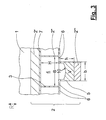
- Each damping element has a first element 3, which extends over a defined height H and forms a receiving space 4. Via a web-shaped connecting section 6, the end of the first element 3 facing away from the carrier or inner part 2 'is connected to a second element 5 which has a shape corresponding to the shape of the first element 3 - viewed in the direction R -, d. H. Also, the second elements 5 have a hexagonal shape in the embodiment. The second element 5 extends over a height h, which does not have to be equal to the height H.
- Fig. 3 It can be seen that the dimensions - width B of the first element 3 and width b of the second element 5 - are selected so that the second element 5 can enter the receiving space 4 defined by the first element 3 when the damping element is loaded in the loading direction R is.
- the first element 3 and the second element 5 thus operate in the manner of a telescopic damper, wherein the first element 3 acts as a "cylinder", in which the second element 5 can enter in the manner of a "piston".
- an outsole segment 2 "' is attached, eg adhesively bonded or also injected directly, which consists for example of abrasion-resistant plastic material. Also, in the direction R, the outsole segment 2 "'has a shape corresponding to that of the second element 5, but this need not necessarily be the case.
- connecting section 6 and second element 5 can be made gas-tight.
- gas-tightness to the carrier or inner part 2 ' can be produced by a film 7 which, if required, is glued or welded onto the end region of the first elements 3 facing the carrier or inner part 2'.
- Both the first element 3 and the second element 5 form a prism (in the case of a polygonal, eg hexagonal, formed element cross-section) or a cylinder (in the case of a circularly formed element cross-section), which or over the respective Heights H and h, respectively.
- Fig. 3 As an essential feature of the invention is provided that at least a portion of the resulting prism or cylinder volume (as a product of cross-sectional area and height h) of the second element 5 is solid. Is shown in Fig. 3 a proportion of the massive volume V that is approximately 60% of the total volume of the prism or cylinder (100% of the volume V is in Fig. 3 indicated by the dashed line).
- the solid (plastic) block with its volume V is placed in the end of the second element 5 remote from the first element 3.
- the surface 10 of the solid material is presently provided with a concave shape, which has an effect on the deformation of the damping element.
- Values for the bulk of the prism or cylinder are between 20% and 100% of the total volume of the prism or cylinder at volumes V, and more preferably between 30% and 70%.
- FIGS. 4a to 4c this is illustrated for three example cases.
- Fig. 4a is the massive volume fraction V at about 25% of the total volume of the prism or of the cylinder, which is formed by the second element 5 (the total volume results as the product of the base A and the height h).
- Fig. 4b has a massive proportion V of more than half of the total volume of the prism or the cylinder, namely about 60%; in Fig. 4c the massive portion is approx. 90%.
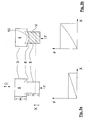
- Fig. 5a and Fig. 5b is the comparison of the embodiment of the invention (in Fig. 5b ) with that according to the prior art (in Fig. 5a ).
- the load-free form of the illustrated damping element can be seen with solid lines, while with dashed lines Lines the form is entered, resulting in the application of a force F in loading direction R.
- Fig. 5a Upper part of the image, can be seen by the force F next to the connecting portion 6, the walls of the second element 5 are strongly deformed, while the walls of the first element 3 are hardly deformed.
- the damping element is characterized relatively soft, which is due to the flat slope of the curve in the lower part of Fig. 5a it can be seen where in a Cartesian coordinate system the course of the force F (plotted on the ordinate) over the displacement x (plotted on the abscissa) can be seen.
- the volume V of the solid part of the second element 5 can be introduced in its injection molding in a simple manufacturing technology, so that occur virtually no additional costs in the realization of the inventive concept.
Landscapes
- Footwear And Its Accessory, Manufacturing Method And Apparatuses (AREA)
- Preparation Of Fruits And Vegetables (AREA)
Claims (22)
- Chaussure, en particulier chaussure de sport, comprenant une partie supérieure de chaussure (1) et une semelle (2), la semelle (2) présentant une partie de support ou partie interne (2'), connectée à la partie supérieure de chaussure (1), une semelle intermédiaire (2") connectée à la partie de support, ou partie interne (2'), et une semelle extérieure (2"') connectée à la semelle intermédiaire (2"), la semelle intermédiaire (2'') contenant au moins un élément d'amortissement sur une partie de la surface de la chaussure en contact avec le sol ou étant réalisée sous forme d'élément d'amortissement, qui présente une pluralité de premiers éléments (3) disposés les uns à côté des autres, qui s'étendent essentiellement dans une direction de charge (R) dans l'état non sollicité de l'élément d'amortissement sur une hauteur prédéfinie (H) et, étant réalisés sous forme de corps creux, définissent un espace de réception (4) dans lequel un deuxième élément associé (5), ayant des dimensions inférieures en section transversale à celles du premier élément (3), peut être au moins en partie introduit, le deuxième élément (5) s'étendant essentiellement dans la direction de charge (R) dans l'état non sollicité de l'élément d'amortissement sur une hauteur prédéfinie (h) et étant disposé coaxialement par rapport au premier élément (3),
au moins une partie du deuxième élément (5) présentant une forme prismatique ou cylindrique, le prisme ou le cylindre étant réalisé au moins en partie sous forme de pièce massive, les deux éléments (3, 5) associés l'un à l'autre étant connectés l'un à l'autre par le biais d'une portion de liaison élastique (6), qui s'étend seulement entre le premier élément (3) et le deuxième élément (5) et le premier élément (3), la portion de liaison (6) et le deuxième élément (5) étant réalisés d'une seule pièce, caractérisée en ce que entre 20% et 100% du volume prismatique ou cylindrique se composent du matériau du deuxième élément. - Chaussure selon la revendication 1, caractérisée en ce qu'entre 30% et 70% du volume prismatique ou cylindrique se composent du matériau du deuxième élément (5).
- Chaussure selon la revendication 1 ou 2, caractérisée en ce que la région du deuxième élément (5) réalisée sous forme massive est disposée au moins dans la région d'extrémité du deuxième élément (5) éloignée du premier élément (3).
- Chaussure selon l'une quelconque des revendications 1 à 3, caractérisée en ce que la région du deuxième élément réalisée sous forme massive présente une surface de forme concave (10).
- Chaussure selon l'une quelconque des revendications 1 à 4, caractérisée en ce que la semelle intermédiaire (2") est réalisée sur au moins une partie de la surface de la chaussure en contact avec le sol exclusivement sous forme d'élément d'amortissement.
- Chaussure selon la revendication 5, caractérisée en ce que la semelle extérieure (2"') est formée par une pluralité de parties de semelles individuelles, chaque partie de semelle étant disposée sur l'extrémité du deuxième élément (5) opposée au premier élément (3) ou sur l'extrémité du premier élément (3) opposée au deuxième élément (5).
- Chaussure selon la revendication 6, caractérisée en ce que la forme des parties individuelles de la semelle extérieure (2"') correspond à la forme du deuxième élément (5) ou à celle du premier élément (3) en coupe perpendiculairement à la direction de charge (R).
- Chaussure selon l'une quelconque des revendications 1 à 7, caractérisée en ce qu'à chaque fois un premier élément (3) et un deuxième élément (5) forment, conjointement avec la portion de liaison (6), une chambre étanche aux gaz.
- Chaussure selon l'une quelconque des revendications 1 à 8, caractérisée en ce que le premier élément (3) et le deuxième élément (5) présentent, en coupe perpendiculairement à la direction de charge (R), une forme mutuellement correspondante.
- Chaussure selon la revendication 9, caractérisée en ce que le premier élément (3) et le deuxième élément (5) présentent, en coupe perpendiculairement à la direction de charge (R), une forme polygonale, notamment hexagonale.
- Chaussure selon la revendication 9, caractérisée en ce que le premier élément (3) et le deuxième élément (5) présentent, en coupe perpendiculairement à la direction de charge (R), une forme circulaire.
- Chaussure selon l'une quelconque des revendications 1 à 11, caractérisée en ce que les premiers éléments (3) sont connectés les uns aux autres dans leur région latérale ou leurs parois de limitation latérales sont formées à chaque fois par une portion commune.
- Chaussure selon l'une quelconque des revendications 1 à 12, caractérisée en ce que les premiers éléments et/ou deuxièmes éléments (3, 5) présentent au moins en partie dans l'état non sollicité de l'élément d'amortissement, des hauteurs différentes (H, h).
- Chaussure selon l'une quelconque des revendications 1 à 13, caractérisée en ce que la portion de liaison (6), dans l'état non sollicité de l'élément d'amortissement, s'étend à plat dans un plan perpendiculairement à la direction de charge (R).
- Chaussure selon l'une quelconque des revendications 1 à 13, caractérisée en ce que la portion de liaison (6), dans l'état non sollicité de l'élément d'amortissement, s'étend suivant une forme courbe dans un plan perpendiculairement à la direction de charge (R).
- Chaussure selon l'une quelconque des revendications 1 à 15, caractérisée en ce que le premier élément (3), la portion de liaison (6) et le deuxième élément (5) sont fabriqués par un procédé de moulage par injection commun.
- Chaussure selon l'une quelconque des revendications 1 à 16, caractérisée en ce que l'extrémité du premier élément (3) opposée au deuxième élément (5) est connectée à un film d'étanchéité (7).
- Chaussure selon l'une quelconque des revendications 1 à 17, caractérisée en ce que les éléments (3, 5) se composent de plastique, en particulier de matériau thermoplastique.
- Chaussure selon la revendication 18, caractérisée en ce que l'on utilise comme plastique du polyéthylène, du polypropylène, du polybutane, du polyamide, du polyuréthane, ou un mélange d'au moins deux de ces plastiques.
- Chaussure selon la revendication 18 ou 19, caractérisée en ce que le plastique est translucide ou transparent.
- Chaussure selon l'une quelconque des revendications 1 à 20, caractérisée en ce que la semelle extérieure (2"') se compose de plastique, de préférence de polyéthylène, de polypropylène, de polybutane, de polyamide, de polyuréthane, ou d'un mélange d'au moins deux de ces plastiques, ou de caoutchouc, le matériau n'étant pas translucide ou n'étant pas transparent.
- Chaussure selon l'une quelconque des revendications 1 à 21, caractérisée en ce que le matériau du premier élément (3), du deuxième élément (5) et de la portion de liaison (6) et/ou les dimensions géométriques de ces pièces et/ou la proportion en volume de la partie réalisée sous forme massive sont sélectionnés afin de définir les propriétés élastiques et/ou d'amortissement de l'élément d'amortissement.
Applications Claiming Priority (2)
| Application Number | Priority Date | Filing Date | Title |
|---|---|---|---|
| DE202005001005U DE202005001005U1 (de) | 2005-01-22 | 2005-01-22 | Schuh, insbesondere Sportschuh |
| PCT/EP2006/000024 WO2006077009A1 (fr) | 2005-01-22 | 2006-01-04 | Chaussure, en particulier chaussure de sport |
Publications (2)
| Publication Number | Publication Date |
|---|---|
| EP1843676A1 EP1843676A1 (fr) | 2007-10-17 |
| EP1843676B1 true EP1843676B1 (fr) | 2010-12-29 |
Family
ID=36599736
Family Applications (1)
| Application Number | Title | Priority Date | Filing Date |
|---|---|---|---|
| EP06700838A Expired - Lifetime EP1843676B1 (fr) | 2005-01-22 | 2006-01-04 | Chaussure, en particulier chaussure de sport |
Country Status (8)
| Country | Link |
|---|---|
| US (1) | US8316559B2 (fr) |
| EP (1) | EP1843676B1 (fr) |
| JP (1) | JP4971189B2 (fr) |
| CN (1) | CN101119657A (fr) |
| AT (1) | ATE493041T1 (fr) |
| DE (2) | DE202005001005U1 (fr) |
| ES (1) | ES2358044T3 (fr) |
| WO (1) | WO2006077009A1 (fr) |
Families Citing this family (7)
| Publication number | Priority date | Publication date | Assignee | Title |
|---|---|---|---|---|
| KR101008344B1 (ko) * | 2010-06-15 | 2011-01-13 | 임옥순 | 신발 갑피의 저면에 전후방밑창이 이격되게 부착되어 있는 신발 |
| CN102349727B (zh) * | 2011-10-12 | 2013-06-05 | 茂泰(福建)鞋材有限公司 | 一种减震鞋底及采用该减震鞋底的鞋 |
| US20130255109A1 (en) * | 2012-03-29 | 2013-10-03 | William J. Hyslop | Footwear |
| US10806214B2 (en) | 2013-03-08 | 2020-10-20 | Nike, Inc. | Footwear fluid-filled chamber having central tensile feature |
| US10015625B2 (en) * | 2015-02-11 | 2018-07-03 | Flipboard, Inc. | Providing digital content for offline consumption |
| CN105708044B (zh) * | 2016-03-22 | 2024-09-03 | 景少尉 | 可以对透气与密封进行调节的鞋底和鞋 |
| US10973283B2 (en) * | 2017-06-06 | 2021-04-13 | Puma SE | Method for producing a shoe |
Family Cites Families (17)
| Publication number | Priority date | Publication date | Assignee | Title |
|---|---|---|---|---|
| US1764353A (en) * | 1928-10-23 | 1930-06-17 | Sansone Frank | Cushion heel |
| US4521979A (en) * | 1984-03-01 | 1985-06-11 | Blaser Anton J | Shock absorbing shoe sole |
| DE8901236U1 (de) * | 1989-02-03 | 1990-06-07 | Puma Ag Rudolf Dassler Sport, 91074 Herzogenaurach | Schuh, insbesondere Sportschuh oder Rehabilitationsschuh |
| GB8909021D0 (en) * | 1989-04-20 | 1989-06-07 | Trisport Ltd | Footwear |
| DE8905050U1 (de) * | 1989-04-21 | 1989-08-10 | Engelin, Veit, 2000 Hamburg | Torsionsgefederter Laufschuh |
| JPH0387404U (fr) * | 1989-12-27 | 1991-09-05 | ||
| US5233767A (en) * | 1990-02-09 | 1993-08-10 | Hy Kramer | Article of footwear having improved midsole |
| US5595003A (en) * | 1990-08-21 | 1997-01-21 | Snow; A. Ray | Athletic shoe with a force responsive sole |
| US5353523A (en) * | 1991-08-02 | 1994-10-11 | Nike, Inc. | Shoe with an improved midsole |
| IT1275516B (it) * | 1995-07-12 | 1997-08-07 | Vibram Spa | Suola sportiva a stabilita' maggiorata in un sol pezzo |
| IT1287224B1 (it) * | 1996-03-29 | 1998-08-04 | D B A S R L | Suola per calzature |
| US5915819A (en) * | 1996-11-26 | 1999-06-29 | Gooding; Elwyn | Adaptive, energy absorbing structure |
| AU2461899A (en) * | 1998-01-20 | 1999-08-02 | A. Ray Snow | Shoe with force responsive sole |
| US6546648B2 (en) * | 2001-06-18 | 2003-04-15 | Roy Dixon | Athletic shoe with stabilized discrete resilient elements in heel |
| DE20206927U1 (de) * | 2002-05-01 | 2003-09-04 | PUMA Aktiengesellschaft Rudolf Dassler Sport, 91074 Herzogenaurach | Dämpfungselement für einen Schuh |
| US6751890B1 (en) * | 2003-01-22 | 2004-06-22 | Mao-Cheng Tsai | Structure of ventilated shoe bottom |
| US7080467B2 (en) * | 2003-06-27 | 2006-07-25 | Reebok International Ltd. | Cushioning sole for an article of footwear |
-
2005
- 2005-01-22 DE DE202005001005U patent/DE202005001005U1/de not_active Expired - Lifetime
-
2006
- 2006-01-04 DE DE502006008603T patent/DE502006008603D1/de not_active Expired - Lifetime
- 2006-01-04 WO PCT/EP2006/000024 patent/WO2006077009A1/fr not_active Ceased
- 2006-01-04 JP JP2007551574A patent/JP4971189B2/ja not_active Expired - Lifetime
- 2006-01-04 ES ES06700838T patent/ES2358044T3/es not_active Expired - Lifetime
- 2006-01-04 US US11/814,398 patent/US8316559B2/en active Active
- 2006-01-04 AT AT06700838T patent/ATE493041T1/de not_active IP Right Cessation
- 2006-01-04 EP EP06700838A patent/EP1843676B1/fr not_active Expired - Lifetime
- 2006-01-04 CN CNA2006800028424A patent/CN101119657A/zh active Pending
Also Published As
| Publication number | Publication date |
|---|---|
| DE502006008603D1 (de) | 2011-02-10 |
| CN101119657A (zh) | 2008-02-06 |
| US8316559B2 (en) | 2012-11-27 |
| ES2358044T3 (es) | 2011-05-05 |
| DE202005001005U1 (de) | 2006-06-08 |
| US20080120870A1 (en) | 2008-05-29 |
| EP1843676A1 (fr) | 2007-10-17 |
| ATE493041T1 (de) | 2011-01-15 |
| JP4971189B2 (ja) | 2012-07-11 |
| JP2008528075A (ja) | 2008-07-31 |
| WO2006077009A1 (fr) | 2006-07-27 |
Similar Documents
| Publication | Publication Date | Title |
|---|---|---|
| EP1563751B1 (fr) | Elément amortisseur pour une chaussure | |
| EP3386334B1 (fr) | Chaussure, notamment chaussure de sport | |
| DE602004013342T2 (de) | Fussbekleidungssohlenstruktur mit einer polsterungskomponente | |
| DE69224050T2 (de) | Mehrschichtige Sportschuhsohle | |
| DE69912789T2 (de) | Topfförmiger stossdämpfer | |
| DE4114551C2 (de) | Schuhboden, insbesondere für Sportschuhe | |
| EP2906851B1 (fr) | Coussinet assurant un amortissement hydraulique | |
| DE10234927B4 (de) | Stoßdämpfer für ein Zweirad | |
| EP1945054A1 (fr) | Chaussure, en particulier une chaussure de sport | |
| DE2741969A1 (de) | Energieabsorbierender zusammengesetzter stossfaenger | |
| EP2906852B1 (fr) | Coussinet assurant un amortissement hydraulique | |
| DE2405232A1 (de) | Federanordnung | |
| DE202009016759U1 (de) | Energieabsorber | |
| EP1286732B1 (fr) | Element de renforcement et/ou d'amortissement pour dispositif de glissement, notamment pour ski ou planche a neige | |
| WO2021148543A1 (fr) | Semelle intercalaire ayant un espace libre libre | |
| WO2006077009A1 (fr) | Chaussure, en particulier chaussure de sport | |
| DE3901898A1 (de) | Flaechenlager und verfahren zu seiner herstellung | |
| EP1843675B1 (fr) | Chaussure, en particulier chaussure de sport | |
| DE102010012035A1 (de) | Federbein | |
| DE102010039621A1 (de) | Dämpfungselement mit wellenförmigem Stützring | |
| DE102012018883B4 (de) | Zusatzfeder | |
| EP2022997B1 (fr) | Cylindre récepteur | |
| DE102011052254A1 (de) | Element unter Verwendung einer dreidimensionalen Struktur aus Fasern, Garn oder Draht | |
| DE102006002853B4 (de) | Druckkraftsensor zur Erfassung einer äußeren Stoßbelastung an einem Kraftfahrzeug | |
| WO2007014712A1 (fr) | Chaussure, en particulier chaussure de sport |
Legal Events
| Date | Code | Title | Description |
|---|---|---|---|
| PUAI | Public reference made under article 153(3) epc to a published international application that has entered the european phase |
Free format text: ORIGINAL CODE: 0009012 |
|
| 17P | Request for examination filed |
Effective date: 20070822 |
|
| AK | Designated contracting states |
Kind code of ref document: A1 Designated state(s): AT BE BG CH CY CZ DE DK EE ES FI FR GB GR HU IE IS IT LI LT LU LV MC NL PL PT RO SE SI SK TR |
|
| DAX | Request for extension of the european patent (deleted) | ||
| GRAP | Despatch of communication of intention to grant a patent |
Free format text: ORIGINAL CODE: EPIDOSNIGR1 |
|
| GRAS | Grant fee paid |
Free format text: ORIGINAL CODE: EPIDOSNIGR3 |
|
| GRAA | (expected) grant |
Free format text: ORIGINAL CODE: 0009210 |
|
| AK | Designated contracting states |
Kind code of ref document: B1 Designated state(s): AT BE BG CH CY CZ DE DK EE ES FI FR GB GR HU IE IS IT LI LT LU LV MC NL PL PT RO SE SI SK TR |
|
| REG | Reference to a national code |
Ref country code: GB Ref legal event code: FG4D Free format text: NOT ENGLISH |
|
| REG | Reference to a national code |
Ref country code: CH Ref legal event code: EP |
|
| REG | Reference to a national code |
Ref country code: IE Ref legal event code: FG4D Free format text: LANGUAGE OF EP DOCUMENT: GERMAN |
|
| REF | Corresponds to: |
Ref document number: 502006008603 Country of ref document: DE Date of ref document: 20110210 Kind code of ref document: P |
|
| REG | Reference to a national code |
Ref country code: DE Ref legal event code: R096 Ref document number: 502006008603 Country of ref document: DE Effective date: 20110210 |
|
| REG | Reference to a national code |
Ref country code: SE Ref legal event code: TRGR |
|
| REG | Reference to a national code |
Ref country code: NL Ref legal event code: VDEP Effective date: 20101229 |
|
| PG25 | Lapsed in a contracting state [announced via postgrant information from national office to epo] |
Ref country code: LT Free format text: LAPSE BECAUSE OF FAILURE TO SUBMIT A TRANSLATION OF THE DESCRIPTION OR TO PAY THE FEE WITHIN THE PRESCRIBED TIME-LIMIT Effective date: 20101229 |
|
| REG | Reference to a national code |
Ref country code: ES Ref legal event code: FG2A Ref document number: 2358044 Country of ref document: ES Kind code of ref document: T3 Effective date: 20110420 |
|
| LTIE | Lt: invalidation of european patent or patent extension |
Effective date: 20101229 |
|
| PG25 | Lapsed in a contracting state [announced via postgrant information from national office to epo] |
Ref country code: SI Free format text: LAPSE BECAUSE OF FAILURE TO SUBMIT A TRANSLATION OF THE DESCRIPTION OR TO PAY THE FEE WITHIN THE PRESCRIBED TIME-LIMIT Effective date: 20101229 Ref country code: LV Free format text: LAPSE BECAUSE OF FAILURE TO SUBMIT A TRANSLATION OF THE DESCRIPTION OR TO PAY THE FEE WITHIN THE PRESCRIBED TIME-LIMIT Effective date: 20101229 Ref country code: FI Free format text: LAPSE BECAUSE OF FAILURE TO SUBMIT A TRANSLATION OF THE DESCRIPTION OR TO PAY THE FEE WITHIN THE PRESCRIBED TIME-LIMIT Effective date: 20101229 Ref country code: BG Free format text: LAPSE BECAUSE OF FAILURE TO SUBMIT A TRANSLATION OF THE DESCRIPTION OR TO PAY THE FEE WITHIN THE PRESCRIBED TIME-LIMIT Effective date: 20110329 Ref country code: CY Free format text: LAPSE BECAUSE OF FAILURE TO SUBMIT A TRANSLATION OF THE DESCRIPTION OR TO PAY THE FEE WITHIN THE PRESCRIBED TIME-LIMIT Effective date: 20101229 |
|
| REG | Reference to a national code |
Ref country code: IE Ref legal event code: FD4D |
|
| PG25 | Lapsed in a contracting state [announced via postgrant information from national office to epo] |
Ref country code: PT Free format text: LAPSE BECAUSE OF FAILURE TO SUBMIT A TRANSLATION OF THE DESCRIPTION OR TO PAY THE FEE WITHIN THE PRESCRIBED TIME-LIMIT Effective date: 20110429 Ref country code: EE Free format text: LAPSE BECAUSE OF FAILURE TO SUBMIT A TRANSLATION OF THE DESCRIPTION OR TO PAY THE FEE WITHIN THE PRESCRIBED TIME-LIMIT Effective date: 20101229 Ref country code: IS Free format text: LAPSE BECAUSE OF FAILURE TO SUBMIT A TRANSLATION OF THE DESCRIPTION OR TO PAY THE FEE WITHIN THE PRESCRIBED TIME-LIMIT Effective date: 20110429 Ref country code: GR Free format text: LAPSE BECAUSE OF FAILURE TO SUBMIT A TRANSLATION OF THE DESCRIPTION OR TO PAY THE FEE WITHIN THE PRESCRIBED TIME-LIMIT Effective date: 20110330 Ref country code: CZ Free format text: LAPSE BECAUSE OF FAILURE TO SUBMIT A TRANSLATION OF THE DESCRIPTION OR TO PAY THE FEE WITHIN THE PRESCRIBED TIME-LIMIT Effective date: 20101229 |
|
| PGFP | Annual fee paid to national office [announced via postgrant information from national office to epo] |
Ref country code: ES Payment date: 20110121 Year of fee payment: 6 |
|
| BERE | Be: lapsed |
Owner name: PUMA A.G. RUDOLF DASSLER SPORT Effective date: 20110131 |
|
| PG25 | Lapsed in a contracting state [announced via postgrant information from national office to epo] |
Ref country code: PL Free format text: LAPSE BECAUSE OF FAILURE TO SUBMIT A TRANSLATION OF THE DESCRIPTION OR TO PAY THE FEE WITHIN THE PRESCRIBED TIME-LIMIT Effective date: 20101229 Ref country code: SK Free format text: LAPSE BECAUSE OF FAILURE TO SUBMIT A TRANSLATION OF THE DESCRIPTION OR TO PAY THE FEE WITHIN THE PRESCRIBED TIME-LIMIT Effective date: 20101229 Ref country code: NL Free format text: LAPSE BECAUSE OF FAILURE TO SUBMIT A TRANSLATION OF THE DESCRIPTION OR TO PAY THE FEE WITHIN THE PRESCRIBED TIME-LIMIT Effective date: 20101229 Ref country code: RO Free format text: LAPSE BECAUSE OF FAILURE TO SUBMIT A TRANSLATION OF THE DESCRIPTION OR TO PAY THE FEE WITHIN THE PRESCRIBED TIME-LIMIT Effective date: 20101229 Ref country code: MC Free format text: LAPSE BECAUSE OF NON-PAYMENT OF DUE FEES Effective date: 20110131 |
|
| REG | Reference to a national code |
Ref country code: CH Ref legal event code: PL |
|
| PGFP | Annual fee paid to national office [announced via postgrant information from national office to epo] |
Ref country code: SE Payment date: 20110121 Year of fee payment: 6 |
|
| RAP2 | Party data changed (patent owner data changed or rights of a patent transferred) |
Owner name: PUMA SE |
|
| RAP2 | Party data changed (patent owner data changed or rights of a patent transferred) |
Owner name: PUMA SE |
|
| PG25 | Lapsed in a contracting state [announced via postgrant information from national office to epo] |
Ref country code: DK Free format text: LAPSE BECAUSE OF FAILURE TO SUBMIT A TRANSLATION OF THE DESCRIPTION OR TO PAY THE FEE WITHIN THE PRESCRIBED TIME-LIMIT Effective date: 20101229 Ref country code: LI Free format text: LAPSE BECAUSE OF NON-PAYMENT OF DUE FEES Effective date: 20110131 Ref country code: CH Free format text: LAPSE BECAUSE OF NON-PAYMENT OF DUE FEES Effective date: 20110131 Ref country code: IE Free format text: LAPSE BECAUSE OF FAILURE TO SUBMIT A TRANSLATION OF THE DESCRIPTION OR TO PAY THE FEE WITHIN THE PRESCRIBED TIME-LIMIT Effective date: 20101229 |
|
| PLBE | No opposition filed within time limit |
Free format text: ORIGINAL CODE: 0009261 |
|
| STAA | Information on the status of an ep patent application or granted ep patent |
Free format text: STATUS: NO OPPOSITION FILED WITHIN TIME LIMIT |
|
| PG25 | Lapsed in a contracting state [announced via postgrant information from national office to epo] |
Ref country code: BE Free format text: LAPSE BECAUSE OF NON-PAYMENT OF DUE FEES Effective date: 20110131 |
|
| 26N | No opposition filed |
Effective date: 20110930 |
|
| REG | Reference to a national code |
Ref country code: DE Ref legal event code: R097 Ref document number: 502006008603 Country of ref document: DE Effective date: 20110930 |
|
| REG | Reference to a national code |
Ref country code: AT Ref legal event code: MM01 Ref document number: 493041 Country of ref document: AT Kind code of ref document: T Effective date: 20110104 |
|
| REG | Reference to a national code |
Ref country code: SE Ref legal event code: EUG |
|
| PG25 | Lapsed in a contracting state [announced via postgrant information from national office to epo] |
Ref country code: SE Free format text: LAPSE BECAUSE OF NON-PAYMENT OF DUE FEES Effective date: 20120105 |
|
| PG25 | Lapsed in a contracting state [announced via postgrant information from national office to epo] |
Ref country code: AT Free format text: LAPSE BECAUSE OF NON-PAYMENT OF DUE FEES Effective date: 20110104 |
|
| PG25 | Lapsed in a contracting state [announced via postgrant information from national office to epo] |
Ref country code: LU Free format text: LAPSE BECAUSE OF NON-PAYMENT OF DUE FEES Effective date: 20110104 |
|
| PG25 | Lapsed in a contracting state [announced via postgrant information from national office to epo] |
Ref country code: TR Free format text: LAPSE BECAUSE OF FAILURE TO SUBMIT A TRANSLATION OF THE DESCRIPTION OR TO PAY THE FEE WITHIN THE PRESCRIBED TIME-LIMIT Effective date: 20101229 |
|
| PG25 | Lapsed in a contracting state [announced via postgrant information from national office to epo] |
Ref country code: HU Free format text: LAPSE BECAUSE OF FAILURE TO SUBMIT A TRANSLATION OF THE DESCRIPTION OR TO PAY THE FEE WITHIN THE PRESCRIBED TIME-LIMIT Effective date: 20101229 |
|
| REG | Reference to a national code |
Ref country code: DE Ref legal event code: R082 Ref document number: 502006008603 Country of ref document: DE Representative=s name: GOSDIN, MICHAEL, DIPL.-ING.UNIV. DR.-ING., DE Effective date: 20130912 Ref country code: DE Ref legal event code: R081 Ref document number: 502006008603 Country of ref document: DE Owner name: PUMA SE, DE Free format text: FORMER OWNER: PUMA AG RUDOLF DASSLER SPORT, 91074 HERZOGENAURACH, DE Effective date: 20130912 |
|
| REG | Reference to a national code |
Ref country code: ES Ref legal event code: FD2A Effective date: 20140109 |
|
| PG25 | Lapsed in a contracting state [announced via postgrant information from national office to epo] |
Ref country code: ES Free format text: LAPSE BECAUSE OF NON-PAYMENT OF DUE FEES Effective date: 20120105 |
|
| REG | Reference to a national code |
Ref country code: FR Ref legal event code: PLFP Year of fee payment: 11 |
|
| REG | Reference to a national code |
Ref country code: FR Ref legal event code: PLFP Year of fee payment: 12 |
|
| REG | Reference to a national code |
Ref country code: FR Ref legal event code: PLFP Year of fee payment: 13 |
|
| PGFP | Annual fee paid to national office [announced via postgrant information from national office to epo] |
Ref country code: DE Payment date: 20250120 Year of fee payment: 20 |
|
| PGFP | Annual fee paid to national office [announced via postgrant information from national office to epo] |
Ref country code: FR Payment date: 20250122 Year of fee payment: 20 |
|
| PGFP | Annual fee paid to national office [announced via postgrant information from national office to epo] |
Ref country code: IT Payment date: 20250131 Year of fee payment: 20 Ref country code: GB Payment date: 20250123 Year of fee payment: 20 |
|
| REG | Reference to a national code |
Ref country code: DE Ref legal event code: R071 Ref document number: 502006008603 Country of ref document: DE |
|
| REG | Reference to a national code |
Ref country code: GB Ref legal event code: PE20 Expiry date: 20260103 |