EP1850268A2 - Funkkommunikationsvorrichtung und Verfahren zur Ermöglichung der Funkkommunikation zwischen Funkkommunikationsgerät und Datenträger - Google Patents
Funkkommunikationsvorrichtung und Verfahren zur Ermöglichung der Funkkommunikation zwischen Funkkommunikationsgerät und Datenträger Download PDFInfo
- Publication number
- EP1850268A2 EP1850268A2 EP07007920A EP07007920A EP1850268A2 EP 1850268 A2 EP1850268 A2 EP 1850268A2 EP 07007920 A EP07007920 A EP 07007920A EP 07007920 A EP07007920 A EP 07007920A EP 1850268 A2 EP1850268 A2 EP 1850268A2
- Authority
- EP
- European Patent Office
- Prior art keywords
- radio
- antenna
- rfid
- dielectric element
- communication
- Prior art date
- Legal status (The legal status is an assumption and is not a legal conclusion. Google has not performed a legal analysis and makes no representation as to the accuracy of the status listed.)
- Withdrawn
Links
Images


Classifications
-
- G—PHYSICS
- G06—COMPUTING OR CALCULATING; COUNTING
- G06K—GRAPHICAL DATA READING; PRESENTATION OF DATA; RECORD CARRIERS; HANDLING RECORD CARRIERS
- G06K7/00—Methods or arrangements for sensing record carriers, e.g. for reading patterns
- G06K7/0008—General problems related to the reading of electronic memory record carriers, independent of its reading method, e.g. power transfer
-
- G—PHYSICS
- G06—COMPUTING OR CALCULATING; COUNTING
- G06K—GRAPHICAL DATA READING; PRESENTATION OF DATA; RECORD CARRIERS; HANDLING RECORD CARRIERS
- G06K17/00—Methods or arrangements for effecting co-operative working between equipments covered by two or more of main groups G06K1/00 - G06K15/00, e.g. automatic card files incorporating conveying and reading operations
- G06K17/0022—Methods or arrangements for effecting co-operative working between equipments covered by two or more of main groups G06K1/00 - G06K15/00, e.g. automatic card files incorporating conveying and reading operations arrangements or provisions for transferring data to distant stations, e.g. from a sensing device
- G06K17/0025—Methods or arrangements for effecting co-operative working between equipments covered by two or more of main groups G06K1/00 - G06K15/00, e.g. automatic card files incorporating conveying and reading operations arrangements or provisions for transferring data to distant stations, e.g. from a sensing device the arrangement consisting of a wireless interrogation device in combination with a device for optically marking the record carrier
Definitions
- This invention relates, in general, to a radio-communication apparatus.
- the invention relates to an apparatus that carries out radio-communication with data carriers, e.g., RFID (Radio Frequency Identification) tags, and reads and/or writes data from and/or into such data carriers.
- data carriers e.g., RFID (Radio Frequency Identification) tags
- the invention also relates to a method for enabling radio-communication between a radio-communication apparatus and data carriers.
- RFID label includes a label sheet and an RFID tag well known in the art, having an IC chip and an antenna and the RFID tag is attached to the label sheet.
- RFID label has advantages that a large number of data are stored in the IC chip, data is read and/or written from and/or to the IC chip with non-contact manner using an electromagnetic waves and thus influence of stain and/or dust can be prevented and data stored in each IC chip of a plurality of RFID labels can be read collectively within a short time.
- Such RFID labels are attached to respective articles to be sold and information regarding each article is stored in IC chip of respective RFID labels. In this case, it is required to print information such as an article name on the surface of each label to enable a visible inspection or recognition by an operator or a consumer.
- Japanese laid-open (kokai) patent No. 2005-332318 discloses a printing apparatus that uses a continuous rolled base sheet on which a plurality of RFID labels are peelably arranged in line. Using a radio-communication, data is stored in an IC chip of respective RFID labels which are sequentially conveyed along with the base sheet while the base sheet is wound up and, a required information is printed on respective RFID labels in sequence.
- a usable frequency band of electromagnetic waves of UHF band in RFID technology is different in every country or region.
- a usable frequency band is 950MHz to 956MHz in Japan, 902MHz to 928MHz in U.S.A. and 862MHz to 868MHz in Europe, respectively.
- a radio-communication apparatus commonly usable in such countries or regions needs a large external size of an antenna that covers all of the above-described frequency bands or to selectively use antennas each of which is designed exclusively for each country or region. It is difficult to employ, however, such a large antenna to an apparatus whose external size is required to be small in the former case and a cost is increased to prepare such plural kinds of antenna in the latter case.
- the above-described Japanese laid-open (kokai) patent also discloses a radio-communication apparatus that a dielectric element is located at a position through which electromagnetic waves radiated from the antenna pass and a distance from the dielectric element to the antenna is controlled depending on the country or region where the apparatus is used to adjust the frequency characteristic of the antenna to a specific frequency band of the country or region.
- This operation is based on a phenomenon that the frequency characteristic of an antenna varies with influence of a dielectric element against the antenna when the dielectric element is located near the antenna. Therefore, the above-described problems can be solved by the Japanese laid open (kokai) patent.
- a usable frequency band of electromagnetic waves of UHF band in RFID technology is respectively determined in each country or region.
- RFID labels are attached to various articles and thus it is well known that a specific frequency band of RFID tags may greatly vary with a dielectric factor of articles to which RFID labels are respectively attached.
- the optimum frequency of the RFID tag decreases about 50MHz from an original optimum frequency.
- RFID tag is exclusively designed such that the optimum frequency thereof is to be 1,000MHz, considering beforehand the fact that the optimum frequency decreases about 50MHz therefrom (1,000MHz) as described above when the RFID label on which the RFID tag is mounted is attached to a book.
- RFID tag is exclusively designed such that the optimum frequency is determined to 1,020MHz, considering that the optimum frequency practically decreases about 70MHz therefrom (1,020MHz) when the RFID label on which the RFID tag is mounted is attached to a plastic box.
- the optimum frequency of such RFID tags is determined to 950MHz. This is because that the optimum frequency thereof does not vary even if the RFID label is attached to such a thin material.
- optimum frequencies of RFID tags are different from one another depending on RFID labels exclusively manufactured for specific articles to which RFID labels are attached.
- the optimum frequency of RFID tags varies depending on articles to which RFID labels are attached even in the same country or region.
- a dielectric material is located near the antenna and a distance between the antenna and the dielectric material is controlled at a precise value to adjust the optimum frequency of the antenna to a usable frequency band in the country or region where RFID labels are used.
- a radio-communication apparatus of the present invention that carries out a data read/write operation to RFID labels peelably mounted on a base sheet, comprising:
- FIGURE 1 is a schematic view illustrating part of a continuous rolled label sheet on which a plurality of RFID labels are arranged in line;
- FIGURE 2 is an enlarged sectional view illustrating the label sheet with RFID label taken along lines A-A in FIGURE 1;
- FIGURE 3 is a block diagram illustrating construction of a printing apparatus according to one embodiment of the present invention.
- FIGURE 4 is a view illustrating a management table used in one embodiment of the present invention.
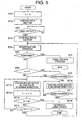
- FIGURE 5 is a flow chart illustrating main processes carried out by a control section of the printing apparatus shown in FIGURE 3.
- the invention is applied to an RFID label printer that produces RFID labels to be attached to articles as a label for managing inventory or sale of articles.
- an RFID label sheet 1 includes a belt-shaped base sheet 3, and a plurality of RFID labels 5 that are arranged in line in a sheet convey direction C and pasted on the surface of the base sheet 3 in a peelable fashion.
- Each RFID label 5 includes an RFID tag 7, including an IC chip 9 and an antenna 11 folded with a thin film, which is attached to the base sheet 3 with a paste 13 in a peelable fashion and a label sheet 15 attached to the RFID tag 7 with a paste 17, as shown in FIG. 2.
- a front surface of the label sheet 15 serves as a printing surface.
- the RFID tag 7 is a passive type data carrier and thus no power source, e.g., battery, is provided.
- the IC chip 9 of the RFID tag 7 includes a power generating section, a modulation section, a demodulation section, a memory section and a control section that controls operation of each section, as is well known in the art.
- the power generating section generates power by rectifying and stabilizing radio waves (electromagnetic waves) received by the antenna 11 to provide power to each section.
- the demodulation section demodulates the radio waves received by the antenna 6 to forward it to the control section.
- the modulation section modulates data sent from the control section to feed it to the antenna 11.
- the control section writes data demodulated by the demodulation section into the memory section and reads data from the memory section to send it to the modulation section.
- the memory section includes a non-rewritable area in which data is stored in a non-rewritable fashion and a rewritable area in which a requested data associated with an article to which the RFID label 5 is attached is stored, as a user area.
- an ID code is stored beforehand.
- the ID code is a specific code that uniquely identifies each RFID tag from others.
- RFID tags serve as a data carrier.
- FIG. 3 shows construction of an RFID label printer 21.
- the RFID label printer 21 carries out read/write operation in a non-contact manner to RFID tag 7 of respective RFID labels sequentially conveyed together with the base sheet 3, using a radio-communication. Simultaneously, necessary information is printed on the surface of the label sheet 15 of the RFID label 5 that read/write operation is carried out to the RFID tag 7 thereof. Such operations of the RFID label printer 21 will be described.
- the RFID label sheet 1 is housed in a label holder (not shown) of the RFID label printer 21 in a rolled state.
- a front end of the RFID label sheet 1 is taken out of the label holder in the direction C and led to a peeling roller 23 along a conveying path.
- the front end of the RFID label sheet 1 is bent more than 90 degrees along the surface of peeling roller 23 in a direction B shown in FIG. 3 and then the RFID label 5 is peeled from the label sheet 1 due to its stiffness when the RFID label 5 reaches the peeling roller 23.
- the RFID label 5 peeled is discharged from a label issuing port (not shown) and the RFID label sheet 1 is wound up by a take-up roller (not shown).
- a label issuing port not shown
- the RFID label sheet 1 is wound up by a take-up roller (not shown).
- a label sensor 25, an antenna 27 of an RFID reader/writer (interrogator) 29, and a print head 31, e.g., thermal head, are sequentially located in the order along the direction C of the sheet convey path from the label holder (Upper stream side in the conveying direction C) to the peeling roller (down stream side).
- the label sensor 25 detects the RFID label 5 arranged on the label sheet 1 taken out of the label holder.
- the sensor 25 detects the trailing edge of the RFID label 5 optically.
- the RFID tag 7 of the RFID label 5 locates within the radio-communication available area of the antenna 27 of the reader/writer 29.
- the antenna 27 radiates electromagnetic waves (interrogation command) modulated by the RFID reader/writer 29 to the RFID tag 7 and receives electromagnetic waves modulated by the RFID tag 7 by using a backscatter modulation while the RFID tag 7 receives electromagnetic waves from the RFID reader/writer 29 through its antenna 11.
- a prescribed communication handshake (communication protocol) is carried out between the RFID reader/writer 29 and the RFID tag 7 before data such as ID code is sent from the RFID tag 7 to the RFID reader/writer 29, as is well known in the art.
- the antenna 27 is a relatively small external size and has a frequency characteristic corresponding to a usable frequency band, i.e., 950MHz to 956MHz, in Japan, for example.
- the RFID reader/writer 29 well known as an interrogator in the art reads out data stored in the memory section of the RFID tag 7 which locates within a communication area of antenna 27 and also writes data into the memory section of the RFID tag 7.
- the RFID reader/writer 29 and the antenna 27 constitute a radio communication apparatus which performs a read/write operation to RFID tags 7 (data carriers) with the radio communication therebetween.
- the print head 31 is driven by a head drive section 33 to print various information on the label sheet 15 of the RFID label-5.
- the print head 31 and the head drive section 33 constitute a printing means.
- a dielectric element 35 having a desired relative dielectric constant is located at a location opposite to the antenna 27 through the sheet convey path of the RFID label sheet 1.
- the dielectric element 35 is moved upward or downward by an elevation mechanism 37 that is driven by a pulse-motor 39.
- the elevation mechanism 37 may be composed of, for example, a cam mechanism, a screw and gear construction, or a rack and pinion construction.
- the dielectric element 35 comes to the antenna 27 when the dielectric element 35 is moved upward and, goes away from the antenna 27 otherwise.
- a home position sensor 41 is provided near the dielectric element 35 to detect the dielectric element 35 which locates at the lower-most position (Home Position).
- the pulse-motor 39 and the elevation mechanism 37 constitute a moving means which varies a relative distance between the antenna 27 and the dielectric element 35.
- the .RFID label printer 21 further includes a communication interface 43, a memory section 45, a drive section 47 and a control section 49.
- the communication interface 43 is connected to a computer device that controls the RFID label printer 21 through the control section 49 to issue desired RFID labels.
- the drive section 47 controls a conveying mechanism that carries out a conveyance of the RFID label sheet 1 and a driving operation of the take-up roller rolling up the base sheet 3.
- the memory section 45 includes a memory area in which various data are stored.
- a dielectric element management table 51 and a pulse counter 53 are defined in the memory area.
- the dielectric element management table 51 is composed of a position column and a required pulse column corresponding to the position column.
- a distance between the lower-most position (HP) of the dielectric element 35 and the upper-most position (PN) thereof is divided at a regular interval into a plurality of positions (HP,P1,P2, ⁇ ⁇ ⁇ ,PN) at which the dielectric element 35 is sequentially positioned by the elevation mechanism 37.
- a plurality of number of pulses (k0, k1, k2, ⁇ ⁇ ⁇ , kn) required to move the dielectric element 35 from the lower-most position (HP) to respective positions by the pulse motor 39 are set to each area corresponding to each position column.
- a distance between the lower-most position (HP) and the upper-most position (PN) may not be divided at regular intervals. For example, a first distance from the lower-most position to the middle position and a second distance from the middle position to the upper-most position may be divided by different intervals and an interval in the first distance may be greater than that in the second distance. It may also be determined such that the distance from the lower-most position (HP) to the upper-most position (PN) is divided at gradually decreasing intervals.
- the control section 49 controls each section to carry out operation procedures shown in FIG. 5 when the computer device connected through the communication interface 43 commands issuance of RFID labels.
- the operation of issuance of RFID labels by the RFID label printer 21 will be described with reference to FIG. 5.
- a count value X of the pulse counter 53 shown in FIG. 4 is reset to zero (0) in step (ST1) and the drive section 47 is started in step (ST2). Then, conveyance of the RFID label sheet is started and the control section 49 waits until the RFID label 7 is detected by the label sensor 12 (the No pass in step (ST3)). When the RFID label 5 is detected, the YES pass is taken in step (ST3) and the control section 49 commands stop of the drive section 47 in step (ST4).
- the control section 47 sends an RFID interrogation command to the RFID reader/writer 29 in step (ST5).
- electromagnetic waves carrier waves
- the modulated electromagnetic waves are radiated from the antenna 27.
- the control section 47 enters into a waiting state until an ID code is sent from the RFID tag 7 to the RFID reader/writer 29.
- the modulated electromagnetic waves are received by the RFID tag 7 attached to the RFID label 5 and electric power is generated in the IC chip 9 as is well known in the art.
- An ID code stored in the memory section is read out to modu1ate electromagnetic waves based thereon and the modulated electromagnetic waves are radiated from the antenna 11 by a backscatter modulation.
- a prescribed handshake is carried out between the RFID tag 7 and the RFID reader/writer 29.
- the modulated electromagnetic waves from the antenna 11 is received by the antenna 27 of the RFID reader/writer 29 and are demodulated to obtain the ID code in the RFID reader/writer 29.
- the ID code is sent to the control section 49.
- step (ST6) When a prescribed handshake between the RFID reader/writer 29 and the RFID tag 7 is established and the control section 49 receives the ID code within a prescribed period, the YES pass is taken in step (ST6) and a label issuing process is carried out in step (ST7).
- the label issuing process in step (ST7) will be described below.
- the control section 49 issues a re-start command to the drive section 47 and writes data to the RFID tag 7 of a target RFID label 5 in a non-contact fashion through the RFID reader/writer 29.
- the target RFID label 5 is a RFID label that has taken a prescribed handshake and faces the antenna 27.
- the target RFID label 5 is then conveyed to the print head 31 and a required information is printed on the label sheet 15 (print area) of the target RFID label 5.
- This label issuing process is repeated until a requested number of RFID labels 5 are issued.
- data stored in respective RFID tags may be different from one another and information printed on respective RFID labels may also be different from one another.
- the control section 49 judges whether a count value X of the pulse counter 53 is reset to zero (0) in step (ST8). When a count value X is zero, the YES pass is taken and the control section 49 judges whether the dielectric element 35 locates at a Home Position (HP) in step (ST9). When the home position sensor 41 can not detect the dielectric element 35, the control section 49 drives the pulse motor 39 in a reverse direction in step (ST10) because the dielectric element 35 does not locate at the Home Position (HP).
- the dielectric element 35 is moved toward the Home Position (HP) by the elevation mechanism 37.
- the control section 49 monitors the output of the home position sensor 41 in step (ST11) and continues drive of the pulse motor 39 until the home position sensor 41 detects the dielectric element 35.
- step (ST11) When the dielectric element 35 is detected by the home position sensor 41, the YES pass is taken in step (ST11) and the control section 41 resends an RFID interrogation command to the RFID reader/writer 29 in step (ST5). As a result, if an ID code is received by the RFID reader/writer 29 within the predetermined time, the YES pass is taken in step (ST6) and step (ST7) is carried out to issue RFID labels 5.
- step (ST8) If the count value X of the pulse counter 53 is not zero in step (ST8) or the dielectric element 35 locates at a Home Position (HP) in step (ST9), the control section 41 drives the pulse motor 39 by one pulse in a normal direction in step (ST12).
- the dielectric element 35 is moved upwardly by the elevation mechanism 37 by an amount corresponding to one pulse.
- a relative distance between the dielectric element 35 and the antenna 27 is decreased by the amount corresponding to one pulse.
- the control section 49 increases the count value X of the pulse counter 53 by one in step (ST13) and judges whether the count value X exceeds a required number of pulses kn corresponding to the upper-most position (PN) set in the dielectric element management table 51 in step (ST14).
- step (ST14) In case that the count value X does not exceed the required number of pulses kn in step (ST14), the NO pass is taken and the control section further judges whether the count value X coincides with any one of the required number of pulses (k1 - kn) corresponding to respective positions of the dielectric element 35 in the dielectric element management table 51 in step (ST15).
- step (ST15) In case that the count value X does not coincide with any one of the required number of pulses (kl - kn) in step (ST15), the NO pass is taken and the steps (ST12, ST13, ST14 and ST 15) are repeatedly executed until the count value X coincides with any one of the required number of pulses (k1 - kn).
- step (ST5) is executed.
- the control section 41 sends again an RFID interrogation command to the RFID reader/writer 29 to transfer the modulated electromagnetic waves to the target -RFID tag 7.
- the control section 41 receives the ID code from the target RFID tag 7 through the reader/writer 29 within a predetermined time, the YES pass is taken in step (ST6) and thus the control section 41 executes a label issuing process in step (ST7).
- control section 41 functions as a distance control means to adjust a relative distance between the antenna 27 of the RFID reader/writer 29 and the dielectric element 35 to a target distance by an elevation means including the elevation mechanism 37 and the pulse motor 39.
- the target distance enables radio-communication between the RFID reader/writer 29 and the target RFID tag 7 through the antenna 27.
- step (ST14) when the count value X of the pulse counter 53 exceeds a required number of pulses kn which corresponds to the upper-most position (PN) of the dielectric element 35 set in the dielectric element management table 51, the YES pass is taken and step (ST16) is executed. Since the communication between the RFID reader/writer 29 and the target RFID tag 7 is not performed even though the dielectric element 35 is moved or elevated to the upper-most position (PN), the control section 41 informs an operator of an error of communication with the target RFID tag 7.
- the error informing operation may be, for example, to send an error signal through the communication interface 43 to a computer device which commands a label issuing operation or to display an error information on the display (not shown) of the RFID label printer 21.
- the dielectric element 35 locates at a position opposite to the antenna 27 of the RFID reader/writer 29.
- the dielectric element 35 is moved upward to approach the antenna 27 or moved downward to go away from the antenna 27 by the elevation mechanism 37 driven by the pulse motor 39.
- an RFID interrogation signal with radio waves is radiated from the antenna 27. If a response to the interrogation signal is sent within a predetermined period to the antenna 27 from the RFID tag 7 of the RFID label 5 on the RFID label sheet 1, then a label issuing process begins.
- the dielectric element 35 is elevated one step (pulse) by one step (pulse) after the dielectric element 35 is moved to the lower-most position (HP) by the elevation mechanism 37.
- An RFID interrogation command is issued from the antenna 27 every time the dielectric element 35 reaches each position (P1, P2, ⁇ ⁇ ⁇ , PN) set in the dielectric element management table 51.
- the dielectric element 35 is maintained at a location that the response from the RFID tag 7 is confirmed to keep the relative distance between the antenna 27 and the dielectric element 35 and then the label issuing process begins.
- influence to the antenna 27 from the dielectric element 35 is almost zero when the dielectric element 35 locates at the lower-most position (HP). Therefore, frequency characteristic of the electromagnetic waves radiated from the antenna 27 is not changed.
- influence to the antenna 27 from the dielectric element 35 is effected and increased as the dielectric element 35 is elevated from the lower-most position (HP). As a result, frequency characteristic of the electromagnetic waves radiated from the antenna 27 is changed toward a lower frequency.
- the antenna 27 has a frequency characteristic of 950MHz to 956MHz that is set as a frequency band of electromagnetic waves in UHF band for RFID usable in Japan. Therefore, when RFID labels 5 of which RFID tags 7 are designed such that its optimum frequency is 950MHz are used, the RFID labels issuing process is executed in a state that the dielectric element 35 locates at the lower-most position (HP).
- an optimum frequency of each RFID tag 7 of RFID labels 5 is set at 1,000MHz, considering beforehand that the optimum frequency thereof decreases about 50MHz when RFID labels 5 are attached to such articles.
- the RFID labels issuing process is performed in a state that the dielectric element 35 locates at a position elevated by a prescribed distance from the lower-most position (HP).
- the frequency of electromagnetic waves radiated from the antenna 27 shifts to a lower frequency from the optimum frequency by about 50MHz.
- Such an elevated position of the dielectric element 35 is determined based on a relative dielectric constant of the dielectric element 35.
- an optimum frequency of each RFID tag 7 of RFID labels 5 is set at 1,020 MHz, considering beforehand that the optimum frequency thereof decreases about 70 MHz when RFID labels 5 are attached to such articles.
- the dielectric element 35 is further elevated by the elevation mechanizm37 from the above-described position at which RFID labels 5 for books are issued.
- the RFID labels issuing process is performed in a state that the dielectric element 35 locates at the further elevated position at which the frequency of electromagnetic waves radiated from the antenna 27 shifts to a further lower frequency from the optimum frequency by about 70MHz.
- the dielectric element 35 is elevated relative to the antenna of the RFID reader/writer.
- the antenna of the RFID reader/writer may be moved, instead of the dielectric element, to regulate a distance between the dielectric element and the antenna.
- RFID labels issuing operation can be performed easily by an operator without discriminating RFID label sheets each of which has RFID tags thereon having an optimized frequency different from that on other RFID label sheets even if such RFID label sheets are mixedly used in a series of labels issuing operations.
Landscapes
- Engineering & Computer Science (AREA)
- Physics & Mathematics (AREA)
- General Physics & Mathematics (AREA)
- Theoretical Computer Science (AREA)
- Artificial Intelligence (AREA)
- Computer Vision & Pattern Recognition (AREA)
- Computer Networks & Wireless Communication (AREA)
- General Engineering & Computer Science (AREA)
- Near-Field Transmission Systems (AREA)
Applications Claiming Priority (1)
| Application Number | Priority Date | Filing Date | Title |
|---|---|---|---|
| JP2006122491A JP2007293714A (ja) | 2006-04-26 | 2006-04-26 | 無線通信装置及び印刷装置 |
Publications (2)
| Publication Number | Publication Date |
|---|---|
| EP1850268A2 true EP1850268A2 (de) | 2007-10-31 |
| EP1850268A3 EP1850268A3 (de) | 2008-07-23 |
Family
ID=38362770
Family Applications (1)
| Application Number | Title | Priority Date | Filing Date |
|---|---|---|---|
| EP07007920A Withdrawn EP1850268A3 (de) | 2006-04-26 | 2007-04-18 | Funkkommunikationsvorrichtung und Verfahren zur Ermöglichung der Funkkommunikation zwischen Funkkommunikationsgerät und Datenträger |
Country Status (4)
| Country | Link |
|---|---|
| US (1) | US7602295B2 (de) |
| EP (1) | EP1850268A3 (de) |
| JP (1) | JP2007293714A (de) |
| CN (1) | CN100541514C (de) |
Cited By (1)
| Publication number | Priority date | Publication date | Assignee | Title |
|---|---|---|---|---|
| EP2068267A1 (de) | 2007-12-06 | 2009-06-10 | Toshiba Tec Kabushiki Kaisha | Funkkommunikationsvorrichtung und Steuerverfahren |
Families Citing this family (11)
| Publication number | Priority date | Publication date | Assignee | Title |
|---|---|---|---|---|
| JP2009123056A (ja) * | 2007-11-16 | 2009-06-04 | Nec Tokin Corp | Icタグ対応型ラベルプリンタ用金属アタッチメント、昇降装置、及びそれらを備えたicタグ対応型ラベルプリンタ |
| JP5214507B2 (ja) * | 2008-12-19 | 2013-06-19 | 東芝テック株式会社 | Rfid保持媒体発行装置、rfid保持媒体発行方法およびプログラム |
| DE102009043671A1 (de) * | 2009-10-01 | 2011-04-07 | Krones Ag | Vorrichtung zum Behandeln von Behältnissen mit mobiler Anzeige |
| JP2012103942A (ja) * | 2010-11-11 | 2012-05-31 | Oki Data Corp | Icタグ通信装置 |
| JP2018041472A (ja) * | 2012-08-30 | 2018-03-15 | セイコーエプソン株式会社 | 媒体処理装置、及び媒体処理方法 |
| TWI506562B (zh) * | 2013-01-25 | 2015-11-01 | Ind Tech Res Inst | 票卡、資訊重複寫入裝置及其系統 |
| JP6242248B2 (ja) * | 2014-03-07 | 2017-12-06 | サトーホールディングス株式会社 | Rfidタグ書込み装置 |
| JP2015207118A (ja) * | 2014-04-18 | 2015-11-19 | 東芝テック株式会社 | セルフチェックアウト装置及びプログラム |
| CN108229617B (zh) * | 2018-01-15 | 2019-10-01 | 重庆品胜科技有限公司 | 标签打印机的rfid标签打印方法以及标签打印机 |
| JP7201379B2 (ja) * | 2018-10-02 | 2023-01-10 | 東芝テック株式会社 | 無線タグ読取装置 |
| JP7551479B2 (ja) * | 2020-12-03 | 2024-09-17 | 東芝テック株式会社 | タグ書込装置、ラベルプリンタ及び情報処理プログラム |
Family Cites Families (12)
| Publication number | Priority date | Publication date | Assignee | Title |
|---|---|---|---|---|
| US6104291A (en) * | 1998-01-09 | 2000-08-15 | Intermec Ip Corp. | Method and apparatus for testing RFID tags |
| DE19943118A1 (de) * | 1999-09-09 | 2001-04-05 | Siemens Ag | Mobile Funk-Sende-/Funk-Empfangseinrichtung mit abstimmbarer Antenne |
| DE19959983C2 (de) * | 1999-12-13 | 2002-05-02 | Siemens Ag | Funk-Sende-/Funk-Empfangseinrichtung mit abstimmbarer Antenne |
| JP4098511B2 (ja) | 2001-10-31 | 2008-06-11 | キヤノンファインテック株式会社 | Rf−id記録機能付き印刷装置 |
| EP1667336B1 (de) * | 2003-09-19 | 2013-05-01 | Brother Kogyo Kabushiki Kaisha | Funk-etiketten-leser/-schreiber |
| JP4504053B2 (ja) * | 2004-03-15 | 2010-07-14 | 株式会社三宅 | 非接触idタグ書き込み装置 |
| DE102004019071A1 (de) * | 2004-04-20 | 2005-11-17 | Avery Dennison Corp., Pasadena | Verfahren und Anordnung zum Aufzeichnen auf intelligente Etiketten (RFIDs) |
| JP3935162B2 (ja) * | 2004-04-28 | 2007-06-20 | 東芝テック株式会社 | Rfタグリーダ/ライタおよびプリンタ |
| JP2005332318A (ja) | 2004-05-21 | 2005-12-02 | Toshiba Tec Corp | 無線通信装置及びプリンタ |
| EP1854637B1 (de) * | 2005-03-03 | 2011-03-02 | Toshiba TEC Kabushiki Kaisha | Drucker und ic-chipkommunikationsvorrichtung |
| US20060222430A1 (en) * | 2005-04-01 | 2006-10-05 | Duckett Jeanne F | Linerless web feeding method and system |
| JP2006350806A (ja) * | 2005-06-17 | 2006-12-28 | Toshiba Tec Corp | 無線タグ認識装置及び商品販売データ処理装置 |
-
2006
- 2006-04-26 JP JP2006122491A patent/JP2007293714A/ja active Pending
-
2007
- 2007-04-05 US US11/696,958 patent/US7602295B2/en not_active Expired - Fee Related
- 2007-04-18 EP EP07007920A patent/EP1850268A3/de not_active Withdrawn
- 2007-04-25 CN CNB2007101018572A patent/CN100541514C/zh not_active Expired - Fee Related
Cited By (1)
| Publication number | Priority date | Publication date | Assignee | Title |
|---|---|---|---|---|
| EP2068267A1 (de) | 2007-12-06 | 2009-06-10 | Toshiba Tec Kabushiki Kaisha | Funkkommunikationsvorrichtung und Steuerverfahren |
Also Published As
| Publication number | Publication date |
|---|---|
| CN100541514C (zh) | 2009-09-16 |
| US20080036607A1 (en) | 2008-02-14 |
| US7602295B2 (en) | 2009-10-13 |
| EP1850268A3 (de) | 2008-07-23 |
| JP2007293714A (ja) | 2007-11-08 |
| CN101064002A (zh) | 2007-10-31 |
Similar Documents
| Publication | Publication Date | Title |
|---|---|---|
| EP1850268A2 (de) | Funkkommunikationsvorrichtung und Verfahren zur Ermöglichung der Funkkommunikation zwischen Funkkommunikationsgerät und Datenträger | |
| JP4600742B2 (ja) | 印字ヘッド及びタグラベル作成装置 | |
| CN101271532B (zh) | 标贴卷带、标贴卷带带盒和标贴生产设备 | |
| EP1902847A1 (de) | Vorrichtung zur Herstellung von RFID-Etiketten | |
| US7782213B2 (en) | Apparatus for producing RFID labels and RFID label | |
| EP2107510A1 (de) | Verfahren und Vorrichtung zur Ausgabe von drahtlosen IC-Etiketten | |
| WO2009054991A1 (en) | Two sided thermal rfid | |
| EP2065832A1 (de) | Funkkommunikationsvorrichtung | |
| US7961107B2 (en) | Cartridge for including at least RFID tag and apparatus for communicating with RFID tag | |
| EP1796022B1 (de) | Drahtlos-etikett-schaltungselement-container und etikett-label-erzeugungsvorrichtung | |
| US8120490B2 (en) | RFID tag information system | |
| JP2008234485A (ja) | 無線タグ回路素子カートリッジ及びタグラベル作成装置 | |
| US8436733B2 (en) | Apparatus for communicating with RFID tag | |
| JP4406923B2 (ja) | ラベル作成装置 | |
| US7866565B2 (en) | Apparatus for producing RFID labels, cartridge for including at least a RFID tag, and RFID label manufacturing system | |
| JP2006309557A (ja) | タグラベル作成装置及びタグテープ | |
| JP2009181299A (ja) | 無線タグ及び無線タグ作成装置 | |
| EP1894733B1 (de) | Vorrichtung zum Herstellen von Etiketten und System zum Herstellen von Etiketten | |
| JP4743653B2 (ja) | タグラベル作成装置及びタグラベル作成装置用カートリッジ | |
| JP4505793B2 (ja) | ラベル作成装置用カートリッジ体及びラベル作成装置 | |
| JP2007047955A (ja) | 無線タグ情報通信装置 | |
| JP4496466B2 (ja) | タグラベル作成装置 | |
| WO2006059523A1 (ja) | タグテープ、タグテープロール、無線タグ回路素子カートリッジ、無線タグラベル、及びタグラベル作成装置 | |
| JP4666156B2 (ja) | 無線タグ情報通信装置及び無線タグ回路素子カートリッジ | |
| JP2006171836A (ja) | タグラベル作成装置及び無線タグラベル |
Legal Events
| Date | Code | Title | Description |
|---|---|---|---|
| PUAI | Public reference made under article 153(3) epc to a published international application that has entered the european phase |
Free format text: ORIGINAL CODE: 0009012 |
|
| 17P | Request for examination filed |
Effective date: 20070418 |
|
| AK | Designated contracting states |
Kind code of ref document: A2 Designated state(s): AT BE BG CH CY CZ DE DK EE ES FI FR GB GR HU IE IS IT LI LT LU LV MC MT NL PL PT RO SE SI SK TR |
|
| AX | Request for extension of the european patent |
Extension state: AL BA HR MK YU |
|
| PUAL | Search report despatched |
Free format text: ORIGINAL CODE: 0009013 |
|
| AK | Designated contracting states |
Kind code of ref document: A3 Designated state(s): AT BE BG CH CY CZ DE DK EE ES FI FR GB GR HU IE IS IT LI LT LU LV MC MT NL PL PT RO SE SI SK TR |
|
| AX | Request for extension of the european patent |
Extension state: AL BA HR MK RS |
|
| AKX | Designation fees paid |
Designated state(s): DE FR GB |
|
| GRAP | Despatch of communication of intention to grant a patent |
Free format text: ORIGINAL CODE: EPIDOSNIGR1 |
|
| STAA | Information on the status of an ep patent application or granted ep patent |
Free format text: STATUS: THE APPLICATION IS DEEMED TO BE WITHDRAWN |
|
| 18D | Application deemed to be withdrawn |
Effective date: 20100623 |