EP1851317B1 - Alteration de la teneur en alcaloide de tabac par modification des genes cytochrome p450 specifiques - Google Patents
Alteration de la teneur en alcaloide de tabac par modification des genes cytochrome p450 specifiques Download PDFInfo
- Publication number
- EP1851317B1 EP1851317B1 EP05723518A EP05723518A EP1851317B1 EP 1851317 B1 EP1851317 B1 EP 1851317B1 EP 05723518 A EP05723518 A EP 05723518A EP 05723518 A EP05723518 A EP 05723518A EP 1851317 B1 EP1851317 B1 EP 1851317B1
- Authority
- EP
- European Patent Office
- Prior art keywords
- plant
- nicotiana
- sequence
- cytochrome
- seq
- Prior art date
- Legal status (The legal status is an assumption and is not a legal conclusion. Google has not performed a legal analysis and makes no representation as to the accuracy of the status listed.)
- Expired - Lifetime
Links
Images





Classifications
-
- C—CHEMISTRY; METALLURGY
- C12—BIOCHEMISTRY; BEER; SPIRITS; WINE; VINEGAR; MICROBIOLOGY; ENZYMOLOGY; MUTATION OR GENETIC ENGINEERING
- C12N—MICROORGANISMS OR ENZYMES; COMPOSITIONS THEREOF; PROPAGATING, PRESERVING, OR MAINTAINING MICROORGANISMS; MUTATION OR GENETIC ENGINEERING; CULTURE MEDIA
- C12N15/00—Mutation or genetic engineering; DNA or RNA concerning genetic engineering, vectors, e.g. plasmids, or their isolation, preparation or purification; Use of hosts therefor
- C12N15/09—Recombinant DNA-technology
- C12N15/63—Introduction of foreign genetic material using vectors; Vectors; Use of hosts therefor; Regulation of expression
- C12N15/79—Vectors or expression systems specially adapted for eukaryotic hosts
- C12N15/82—Vectors or expression systems specially adapted for eukaryotic hosts for plant cells, e.g. plant artificial chromosomes (PACs)
- C12N15/8241—Phenotypically and genetically modified plants via recombinant DNA technology
- C12N15/8242—Phenotypically and genetically modified plants via recombinant DNA technology with non-agronomic quality (output) traits, e.g. for industrial processing; Value added, non-agronomic traits
- C12N15/8243—Phenotypically and genetically modified plants via recombinant DNA technology with non-agronomic quality (output) traits, e.g. for industrial processing; Value added, non-agronomic traits involving biosynthetic or metabolic pathways, i.e. metabolic engineering, e.g. nicotine, caffeine
-
- A—HUMAN NECESSITIES
- A01—AGRICULTURE; FORESTRY; ANIMAL HUSBANDRY; HUNTING; TRAPPING; FISHING
- A01H—NEW PLANTS OR NON-TRANSGENIC PROCESSES FOR OBTAINING THEM; PLANT REPRODUCTION BY TISSUE CULTURE TECHNIQUES
- A01H5/00—Angiosperms, i.e. flowering plants, characterised by their plant parts; Angiosperms characterised otherwise than by their botanic taxonomy
- A01H5/12—Leaves
-
- A—HUMAN NECESSITIES
- A01—AGRICULTURE; FORESTRY; ANIMAL HUSBANDRY; HUNTING; TRAPPING; FISHING
- A01H—NEW PLANTS OR NON-TRANSGENIC PROCESSES FOR OBTAINING THEM; PLANT REPRODUCTION BY TISSUE CULTURE TECHNIQUES
- A01H6/00—Angiosperms, i.e. flowering plants, characterised by their botanic taxonomy
- A01H6/82—Solanaceae, e.g. pepper, tobacco, potato, tomato or eggplant
- A01H6/823—Nicotiana, e.g. tobacco
-
- A—HUMAN NECESSITIES
- A24—TOBACCO; CIGARS; CIGARETTES; SIMULATED SMOKING DEVICES; SMOKERS' REQUISITES
- A24B—MANUFACTURE OR PREPARATION OF TOBACCO FOR SMOKING OR CHEWING; TOBACCO; SNUFF
- A24B13/00—Tobacco for pipes, for cigars, e.g. cigar inserts, or for cigarettes; Chewing tobacco; Snuff
-
- A—HUMAN NECESSITIES
- A24—TOBACCO; CIGARS; CIGARETTES; SIMULATED SMOKING DEVICES; SMOKERS' REQUISITES
- A24B—MANUFACTURE OR PREPARATION OF TOBACCO FOR SMOKING OR CHEWING; TOBACCO; SNUFF
- A24B15/00—Chemical features or treatment of tobacco; Tobacco substitutes, e.g. in liquid form
- A24B15/10—Chemical features of tobacco products or tobacco substitutes
-
- C—CHEMISTRY; METALLURGY
- C12—BIOCHEMISTRY; BEER; SPIRITS; WINE; VINEGAR; MICROBIOLOGY; ENZYMOLOGY; MUTATION OR GENETIC ENGINEERING
- C12N—MICROORGANISMS OR ENZYMES; COMPOSITIONS THEREOF; PROPAGATING, PRESERVING, OR MAINTAINING MICROORGANISMS; MUTATION OR GENETIC ENGINEERING; CULTURE MEDIA
- C12N9/00—Enzymes; Proenzymes; Compositions thereof; Processes for preparing, activating, inhibiting, separating or purifying enzymes
- C12N9/0004—Oxidoreductases (1.)
- C12N9/0071—Oxidoreductases (1.) acting on paired donors with incorporation of molecular oxygen (1.14)
- C12N9/0073—Oxidoreductases (1.) acting on paired donors with incorporation of molecular oxygen (1.14) with NADH or NADPH as one donor, and incorporation of one atom of oxygen 1.14.13
-
- C—CHEMISTRY; METALLURGY
- C12—BIOCHEMISTRY; BEER; SPIRITS; WINE; VINEGAR; MICROBIOLOGY; ENZYMOLOGY; MUTATION OR GENETIC ENGINEERING
- C12N—MICROORGANISMS OR ENZYMES; COMPOSITIONS THEREOF; PROPAGATING, PRESERVING, OR MAINTAINING MICROORGANISMS; MUTATION OR GENETIC ENGINEERING; CULTURE MEDIA
- C12N9/00—Enzymes; Proenzymes; Compositions thereof; Processes for preparing, activating, inhibiting, separating or purifying enzymes
- C12N9/0004—Oxidoreductases (1.)
- C12N9/0071—Oxidoreductases (1.) acting on paired donors with incorporation of molecular oxygen (1.14)
- C12N9/0077—Oxidoreductases (1.) acting on paired donors with incorporation of molecular oxygen (1.14) with a reduced iron-sulfur protein as one donor (1.14.15)
-
- C—CHEMISTRY; METALLURGY
- C12—BIOCHEMISTRY; BEER; SPIRITS; WINE; VINEGAR; MICROBIOLOGY; ENZYMOLOGY; MUTATION OR GENETIC ENGINEERING
- C12Q—MEASURING OR TESTING PROCESSES INVOLVING ENZYMES, NUCLEIC ACIDS OR MICROORGANISMS; COMPOSITIONS OR TEST PAPERS THEREFOR; PROCESSES OF PREPARING SUCH COMPOSITIONS; CONDITION-RESPONSIVE CONTROL IN MICROBIOLOGICAL OR ENZYMOLOGICAL PROCESSES
- C12Q1/00—Measuring or testing processes involving enzymes, nucleic acids or microorganisms; Compositions therefor; Processes of preparing such compositions
- C12Q1/68—Measuring or testing processes involving enzymes, nucleic acids or microorganisms; Compositions therefor; Processes of preparing such compositions involving nucleic acids
- C12Q1/6876—Nucleic acid products used in the analysis of nucleic acids, e.g. primers or probes
- C12Q1/6888—Nucleic acid products used in the analysis of nucleic acids, e.g. primers or probes for detection or identification of organisms
- C12Q1/6895—Nucleic acid products used in the analysis of nucleic acids, e.g. primers or probes for detection or identification of organisms for plants, fungi or algae
-
- C—CHEMISTRY; METALLURGY
- C12—BIOCHEMISTRY; BEER; SPIRITS; WINE; VINEGAR; MICROBIOLOGY; ENZYMOLOGY; MUTATION OR GENETIC ENGINEERING
- C12Q—MEASURING OR TESTING PROCESSES INVOLVING ENZYMES, NUCLEIC ACIDS OR MICROORGANISMS; COMPOSITIONS OR TEST PAPERS THEREFOR; PROCESSES OF PREPARING SUCH COMPOSITIONS; CONDITION-RESPONSIVE CONTROL IN MICROBIOLOGICAL OR ENZYMOLOGICAL PROCESSES
- C12Q2600/00—Oligonucleotides characterized by their use
- C12Q2600/13—Plant traits
-
- C—CHEMISTRY; METALLURGY
- C12—BIOCHEMISTRY; BEER; SPIRITS; WINE; VINEGAR; MICROBIOLOGY; ENZYMOLOGY; MUTATION OR GENETIC ENGINEERING
- C12Q—MEASURING OR TESTING PROCESSES INVOLVING ENZYMES, NUCLEIC ACIDS OR MICROORGANISMS; COMPOSITIONS OR TEST PAPERS THEREFOR; PROCESSES OF PREPARING SUCH COMPOSITIONS; CONDITION-RESPONSIVE CONTROL IN MICROBIOLOGICAL OR ENZYMOLOGICAL PROCESSES
- C12Q2600/00—Oligonucleotides characterized by their use
- C12Q2600/156—Polymorphic or mutational markers
Definitions
- the invention relates to compositions and methods for reducing the level of nornicotine and its metabolite, N '-nitrosonornicotine, in a plant that is a member of the genus Nicotiana, particularly compositions and methods for inhibiting expression of a cytochrome P450 polypeptide involved in the metabolic conversion of nicotine to nornicotine.
- the predominant alkaloid found in commercial tobacco varieties is nicotine, typically accounting for 90 - 95% of the total alkaloid pool.
- the remaining alkaloid fraction is comprised primarily of three additional pyridine alkaloids: nornicotine, anabasine, and anatabine.
- Nornicotine is generated directly from nicotine through the activity of the enzyme nicotine N-demethylase ( Figure 1 ).
- Nornicotine usually represents less than 5% of the total pyridine alkaloid pool, but through a process termed "conversion," tobacco plants that initially produce very low amounts of nornicotine give rise to progeny that metabolically "convert" a large percentage of leaf nicotine to nornicotine.
- NNN N'-nitrosonornicotine
- TSNA tobacco-specific nitrosamine
- TSNAs were found to be predominantly formed through the reaction of alkaloids with the minute amounts of nitrogen oxides present in combustion gases formed by the direct-fired heating systems found in traditional curing barns ( Peele and Gentry (1999) "Formation of Tobacco-specific Nitrosamines in Flue-cured Tobacco,” CORESTA Meeting, Agro-Phyto Groups, Suzhou, China ). Retrofitting these curing barns with heat-exchangers virtually eliminated the mixing of combustion gases with the curing air and dramatically reduced the formation of TSNAs in tobaccos cured in this manner ( Boyette and Hamm (2001) Rec. Adv. Tob. Sci. 27:17-22 .).
- TSNA formation proceeds primarily through reaction of tobacco alkaloids with nitrite, a process catalyzed by leaf-borne microbes ( Bush et al. (2001) Rec. Adv. Tob. Sci. 27:23-46 ).
- TNSAs attempts to reduce TNSAs through modification of curing conditions while maintaining acceptable quality standards have not proven to be successful for the air-cured tobaccos.
- the conversion locus may represent a nonfunctional nicotine N- demethylase gene that regains its function in converter plants, possibly through the mobilization of a mutation-inducing transposable element.
- the converter locus may encode a protein that initiates a cascade of events that ultimately enables the plant to metabolize nicotine to nornicotine, which would mean that multiple genes may be involved.
- cytochrome P450s are ubiquitous, transmembrane proteins that participate in the metabolism of a wide range of compounds (reviewed by Schuler (1996) Crit. Rev. Plant Sci. 15:235-284 ; Schuler and Werck-Reichhart (2003) Annu. Rev. Plant Biol. 54:629-667 ). Examples of biochemical reactions mediated by cytochrome P450s include hydroxylations, demethylations, and epoxidations.
- the cytochrome P450 gene families are very large. For example, total genome sequence examination has revealed 272 predicted cytochrome P450 genes in Arabidopsis and at least 455 unique cytochrome P450 genes in rice (see, for example, Nelson et al. (2004) Plant Physiol. 135(2):756-772 ). Even though cytochrome P450 has been implicated as having a role in the metabolic conversion of nicotine to nornicotine, identification of key participating members of this protein family remains a challenge.
- compositions and methods for reducing the nornicotine content in plants that are members of the genus Nicotiana are provided.
- compositions include expression cassettes comprising an inhibitory sequence that is capable of inhibiting expression of a cytochrome P450 polypeptide, where the inhibitory sequence is operably linked to a promoter that is functional in a plant cell.
- the inhibitory sequence comprises a fragment of the sequence set forth in SEQ ID NO:1, or a complement thereof.
- Compositions also include transformed plants and plant parts that comprise an expression cassette of the present invention, optionally stably incorporated into the genome of the plant.
- tobacco products including chewing tobacco, snuff, cigarettes, pipe tobacco, and cigars, having a reduced level of nornicotine, and its related nitrosamine, N'-nitrosonornicotine.
- the methods of the invention comprise inhibiting the expression of a cytochrome P450 polypeptide of the present invention.
- An expression cassette comprising an inhibitory sequence that targets expression of a cytochrome P450 polypeptide of the present invention is introduced into the plant or plant part of interest, wherein expression of the inhibitory sequence produces a polynucleotide or polypeptide that inhibits expression of a cytochrome P450 polypeptide of the invention.
- the inhibitory sequence comprises a fragment of the sequence set forth in SEQ ID NO: 1, or a complement thereof.
- the methods of the invention find use in the production of Nicotiana plants that have decreased levels of nornicotine and its metabolite, the nitrosamine N'- nitrosonomicotine, within the leaf and stem tissues.
- the leaf and stem tissues of these plants can be utilized to produce tobacco products having reduced levels of nornicotine and this tobacco-specific nitrosamine, and thus reduced carcinogenic potential for individuals consuming these products or exposed to secondary smoke derived from these products.
- the present invention is drawn to compositions and methods for inhibiting the expression of cytochrome P450 polypeptides that are involved in the metabolic conversion of nicotine to nornicotine in a plant, particularly plants of the Nicotiana genus, including tobacco plants of the various commercial varieties.
- the terms “inhibit,” “inhibition,” and “inhibiting” are defined as any method known in the art or described herein that decreases the expression or function of a gene product of interest (i.e., the target gene product).
- “Inhibition” can be in the context of a comparison between two plants, for example, a genetically altered plant versus a wild-type plant.
- inhibition of expression or function of a target gene product can be in the context of a comparison between plant cells, organelles, organs, tissues, or plant parts within the same plant or between different plants, and includes comparisons between developmental or temporal stages within the same plant or plant part or between plants or plant parts.
- “Inhibition” includes any relative decrement of function or production of a gene product of interest, up to and including complete elimination of function or production of that gene product.
- the term “inhibition” encompasses any method or composition that down-regulates translation and/or transcription of the target gene product or functional activity of the target gene product.
- inhibitory sequence encompasses any polynucleotide or polypeptide sequence capable of inhibiting the expression or function of a cytochrome P450 polypeptide involved in the metabolic conversion of nicotine to nornicotine in a plant, such as full-length polynucleotide or polypeptide sequences, truncated polynucleotide or polypeptide sequences, fragments of polynucleotide or polypeptide sequences, variants of polynucleotide or polypeptide sequences, sense-oriented nucleotide sequences, antisense-oriented nucleotide sequences, the complement of a sense- or antisense-oriented nucleotide sequence, inverted regions of nucleotide sequences, hairpins of nucleotide sequences, double-stranded nucleotide sequences, single-stranded nucleotide sequences, combinations thereof, and the like.
- polynucleotide sequence includes sequences of RNA, DNA
- cytochrome P450 inhibitory sequence refers to an inhibitory sequence that is capable of inhibiting the expression of a cytochrome P450 polypeptide that is involved in the metabolic conversion of nicotine to nornicotine in a plant, for example, at the level of transcription and/or translation, or which is capable of inhibiting the function of such a cytochrome P450 polypeptide.
- the phrase "capable of inhibiting" is used in the context of a polynucleotide inhibitory sequence, it is intended to mean that the inhibitory sequence itself exerts the inhibitory effect; or, where the inhibitory sequence encodes an inhibitory nucleotide molecule (for example, hairpin RNA, miRNA, or double-stranded RNA polynucleotides), or encodes an inhibitory polypeptide (i.e., a polypeptide that inhibits expression or function of the target gene product), following its transcription (for example, in the case of an inhibitory sequence encoding a hairpin RNA, miRNA, or double-stranded RNA polynucleotide) or its transcription and translation (in the case of an inhibitory sequence encoding an inhibitory polypeptide), the transcribed or translated product, respectively, exerts the inhibitory effect on the target gene product (i.e., inhibits expression or function of the target gene product).
- an inhibitory nucleotide molecule for example, hairpin RNA, miRNA,
- host cell is meant a cell that comprises a heterologous nucleic acid sequence of the invention.
- nucleic acid sequences of the invention, and fragments and variants thereof can be introduced into any cell of interest, of particular interest are plant cells, more particularly cells of a Nicotiana plant species, for example, the tobacco plant species and varieties described herein below.
- polynucleotide is not intended to limit the present invention to polynucleotides comprising DNA.
- polynucleotides can comprise ribonucleotides and combinations of ribonucleotides and deoxyribonucleotides. Such deoxyribonucleotides and ribonucleotides include both naturally occurring molecules and synthetic analogues.
- the polynucleotides of the invention also encompass all forms of sequences including, but not limited to, single-stranded forms, double-stranded forms, hairpins, stem-and-loop structures, and the like.
- variant as used herein is intended to mean a substantially similar sequence
- non-nucleotide or polypeptide is intended to mean a naturally occurring nucleotide sequence or amino acid sequence, respectively.
- fragment is intended a portion of a polynucleotide or a portion of an amino acid sequence and hence protein encoded thereby.
- plant part includes plant cells, plant protoplasts, plant cell tissue cultures from which a whole plant can be regenerated, plant calli, plant clumps, and plant cells that are intact in plants or parts of plants such as embryos, pollen, anthers, ovules, seeds, leaves, flowers, stems, branches, fruit, roots, root tips, and the like. Progeny, variants, and mutants of regenerated plants are also included within the scope of the invention, provided that these comprise the introduced nucleic acid sequences of the invention.
- phenotypic change is intended a measurable change in one or more cell functions.
- plants having a genetic modification at the genomic locus encoding a cytochrome P450 polypeptide of the invention can show reduced or eliminated expression or activity of that cytochrome P450 polypeptide.
- introducing is intended to mean presenting to the plant the polynucleotide or polypeptide in such a manner that the sequence gains access to the interior of a cell of the plant.
- operably linked is intended to mean a functional linkage between two or more elements.
- an operable linkage between a polynucleotide of interest and a regulatory sequence is a functional link that allows for expression of the polynucleotide of interest.
- Operably linked elements may be contiguous or non-contiguous. When used to refer to the joining of two protein coding regions, by operably linked is intended that the coding regions are in the same reading frame.
- heterologous when used in reference to a sequence is intended to mean a sequence that originates from a foreign species, or, if from the same species, is substantially modified from its native form in composition and/or genomic locus by deliberate human intervention.
- a promoter operably linked to a heterologous polynucleotide is from a species different from the species from which the polynucleotide was derived, or, if from the same/analogous species, one or both are substantially modified from their original form and/or genomic locus, or the promoter is not the native promoter for the operably linked polynucleotide.
- a chimeric gene comprises a coding sequence operably linked to a transcription initiation region that is heterologous to the coding sequence.
- an expression cassette capable of expressing a polynucleotide that inhibits the expression of at least one cytochrome P450 polypeptide of the invention is an expression cassette capable of producing an RNA molecule that inhibits the transcription and/or translation of at least one cytochrome P450 polypeptide.
- the "expression” or “production” of a protein or polypeptide from a DNA molecule refers to the transcription and translation of the coding sequence to produce the protein or polypeptide
- the "expression” or “production” of a protein or polypeptide from an RNA molecule refers to the translation of the RNA coding sequence to produce the protein or polypeptide.
- the polynucleotides of the invention find use in inhibiting expression of cytochrome P450 polypeptides or variants thereof that are involved in the metabolic conversion of nicotine to nornicotine in plants, particularly tobacco plants.
- the invention further provides expression cassettes comprising a fragment of the polynucleotide sequence set forth in SEQ ID NO:1 , a complement thereof, or a sequence having substantial sequence identity to a fragment of SEQ ID NO: 1, or a complement thereof, operably linked to a promoter that is functional in a plant cell for use in expressing an inhibitory RNA transcript that interferes with expression (i.e., transcription and/or translation) of cytochrome P450 polypeptides described herein.
- the expression cassette comprises the nucleotide sequence as shown in SEQ ID NO:13, a complement thereof, or a sequence having substantial sequence identity to SEQ ID NO:13 , or a complement thereof.
- Nicotiana plant of interest particularly a tobacco plant of varieties commonly known as flue or bright varieties, Burley varieties, dark varieties, and oriental/Turkish varieties
- Leaf and stem material from these transgenic plants can be used to produce a variety of tobacco products having reduced levels of nornicotine, and a concomitant reduction in this carcinogenic nitrosamine metabolite.
- the inventors have identified a novel cytochrome P450 gene family, designated the 3D_C12 cytochrome 450 gene family, that is newly identified as having a role in the metabolic conversion of nicotine to nornicotine in tobacco plants. Suppression of the expression of their encoded gene products in transgenic tobacco plants results in a significant reduction in the accumulation of nornicotine in the leaves of these transgenic plants. While not being bound by theory, the metabolic role of these polypeptides may be a direct one, i.e., directly catalyzing the N -demethylation reaction, or an indirect one, i.e., in the form of production of a product that leads to the up-regulation of the nicotine demethylase activity of the leaf.
- any means by which expression and/or function of the polypeptides encoded by members of this cytochrome P450 gene family are targeted for inhibition within a Nicotiana plant will be effective in reducing nornicotine levels, and levels of its carcinogenic metabolite, NNN, within leaves and stems of these plants.
- the cytochrome P450 genes of the invention were isolated from tobacco lines of a Burley variety.
- the first of these cytochrome P450 genes, designated 3D_C12 encodes an mRNA transcript corresponding to nucleotides (nt) 1-1551 of the cDNA sequence set forth in SEQ ID NO:1, which codes for the full-length 517-residue polypeptide set forth in SEQ ID NO:2.
- the second member of this novel cytochrome P450 family, designated 3D_C12-10 encodes an mRNA transcript corresponding to nt 1-1551 of the cDNA sequence set forth in SEQ ID NO:3, which codes for the full-length 517-residue polypeptide set forth in SEQ ID NO:4.
- the third of these cytochrome P450 genes designated 3D_C12-7, encodes an mRNA transcript corresponding to nt 1-1551 of the cDNA sequence set forth in SEQ ID NO:5, which codes for the full-length 517 residue polypeptide set forth in SEQ ID NO:6.
- the fourth member of the novel cytochrome P450 family designated 7D_A06, encodes an mRNA transcript corresponding to nt 1-1554 of the cDNA sequence set forth in SEQ ID NO:7, which codes for the full-length 518-residue polypeptide set forth in SEQ ID NO:8.
- 3D_C12-15 encodes an mRNA transcript corresponding to the cDNA sequence set forth in SEQ ID NO:9, which encodes the partial-length polypeptide set forth in SEQ ID NO:10.
- the second partial-length P450 gene sequence designated 131A_A02, encodes an mRNA transcript corresponding to the cDNA sequence set forth in SEQ ID NO:11, which encodes the partial-length polypeptide set forth in SEQ ID NO:12.
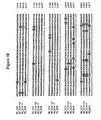
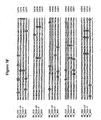
- FIG. 3A-3G An alignment of the members of the 3D_C12 cytochrome P450 gene family is shown in Figure 3A-3G .
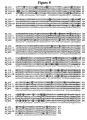
- the predicted amino acid sequences for the four full-length clones are aligned in Figure 4 . These sequences share high sequence identity with each other (at least 90% at both the nucleotide and amino acid level (see Tables 2 and 3, Example 4 herein below).
- Variants of a particular polynucleotide of the present invention can also be evaluated by comparison of the percent sequence identity between the polypeptide encoded by the reference polynucleotide and the polypeptide encoded by a variant polynucleotide. Where any given pair ofpolynucleotides of the invention is evaluated by comparison of the percent sequence identity shared by the two polypeptides they encode, the percent sequence identity between the two encoded polypeptides is at least about 90%, 91%, 92%, 93%, 94%, 95%, 96%, 97%, 98%, 99% or more sequence identity.
- reference sequence is a defined sequence used as a basis for sequence comparison.
- a reference sequence may be a subset or the entirety of a specified sequence; for example, as a segment of a full-length cDNA or gene sequence, or the complete cDNA or gene sequence.
- the term "comparison window" makes reference to a contiguous and specified segment of a polynucleotide sequence, wherein the polynucleotide sequence in the comparison window may comprise additions or deletions (i.e., gaps) compared to the reference sequence (which does not comprise additions or deletions) for optimal alignment of the two polynucleotides.
- the comparison window is at least 20 contiguous nucleotides in length, and optionally can be 30, 40, 50, 100, or longer.
- Gapped BLAST in BLAST 2.0 can be utilized as described in Altschul et al.
- PSI-BLAST in BLAST 2.0
- PSI-BLAST can be used to perform an iterated search that detects distant relationships between molecules. See Altschul et al. (1997) supra.
- the default parameters of the respective programs e.g., BLASTN for nucleotide sequences, BLASTX for proteins
- Alignment may also be performed manually by inspection.
- sequence identity/similarity values were calculated using the BLASTX (Altschul et al. (1997) supra ), Clustal W ( Higgins et al. (1994) Nucleic Acids Res. 22: 4673-4680 ), and GAP (University of Wisconsin Genetic Computing Group software package) algorithms using default parameters.
- the present invention also encompasses the use of any equivalent program thereof for the analysis and comparison of nucleic acid and protein sequences.
- equivalent program is intended any sequence comparison program that, for any two sequences in question, generates an alignment having identical nucleotide or amino acid residue matches and an identical percent sequence identity when compared to the corresponding alignment generated by BLASTX, Clustal W, or GAP.
- sequence identity or “identity” in the context of two polynucleotides or polypeptide sequences makes reference to the residues in the two sequences that are the same when aligned for maximum correspondence over a specified comparison window.
- sequence identity or “identity” in the context of two polynucleotides or polypeptide sequences makes reference to the residues in the two sequences that are the same when aligned for maximum correspondence over a specified comparison window.
- Sequences that differ by such conservative substitutions are said to have "sequence similarity" or "similarity.” Means for making this adjustment are well known to those of skill in the art. Typically this involves scoring a conservative substitution as a partial rather than a full mismatch, thereby increasing the percentage sequence identity. Thus, for example, where an identical amino acid is given a score of 1 and a non-conservative substitution is given a score of zero, a conservative substitution is given a score between zero and 1. The scoring of conservative substitutions is calculated, e.g., as implemented in the program PC/GENE (Intelligenetics, Mountain View, California).
- percentage of sequence identity means the value determined by comparing two optimally aligned sequences over a comparison window, wherein the portion of the polynucleotide sequence in the comparison window may comprise additions or deletions (i.e., gaps) as compared to the reference sequence (which does not comprise additions or deletions) for optimal alignment of the two sequences. The percentage is calculated by determining the number of positions at which the identical nucleic acid base or amino acid residue occurs in both sequences to yield the number of matched positions, dividing the number of matched positions by the total number of positions in the window of comparison, and multiplying the result by 100 to yield the percentage of sequence identity.
- compositions of the present invention include expression cassettes comprising inhibitory sequences capable of inhibiting expression of a cytochrome P450 polypeptide involved in the conversion of nicotine to nornicotine in a Nicotiana plant or plant part thereof, where the inhibitory sequences are operably linked to a promoter that is functional in a plant cell.
- expression cassettes comprising a fragment of the sequence set forth in SEQ ID NO:1 , a complement thereof, or sequences sharing substantial sequence identity to a fragment of SEQ ID NO:1, or a complement thereof, operably linked to a promoter that is functional in a plant cell are constructed for use in the gene-silencing methods of the present invention described herein below.
- inhibitory sequences are referred to herein as “inhibitory sequences” or " inhibitory polynucleotide sequences” as they are capable of being expressed as an RNA molecule that inhibits expression (i.e, transcription and/or translation) of the target cytochrome P450 polypeptide, for example, the polypeptide set forth in SEQ ID NO:2, and variants thereof , where the variant polypeptides have substantial sequence identity to these disclosed cytochrome P450 polypeptides and are involved in the metabolic conversion of nicotine to nornicotine in a plant.
- expression cassettes of the present invention encompass constructs in which a desired nucleic acid sequence is operably linked to a promoter that is functional in a plant cell, particularly in the cell of a Nicotiana plant.
- promoter is intended a regulatory region of DNA usually comprising a TATA box capable of directing RNA polymerase II to initiate RNA synthesis at the appropriate transcription initiation site for a particular polynucleotide sequence.
- a promoter may additionally comprise other recognition sequences generally positioned upstream or 5' to the TATA box, referred to as upstream promoter elements, which influence the transcription initiation rate.
- expression cassettes of the present invention encompass additional domains that modulate the level of expression, the developmental timing of expression, or tissue type that expression occurs in (e.g., Australian Patent No. AU-A-77751/94 and U.S. Patent Nos. 5,466,785 and 5,635,618 ).
- functional is intended the promoter, when operably linked to an inhibitory sequence encoding an inhibitory nucleotide molecule (for example, a hairpin RNA, double-stranded RNA, miRNA polynucleotide, and the like), the promoter is capable of initiating transcription of the operably linked inhibitory sequence such that the inhibitory nucleotide molecule is expressed.
- the promoters can be selected based on the desired outcome.
- the nucleic acids can be combined with constitutive, tissue-preferred, or other promoters for expression in plants.
- An expression cassette of the present invention may also contain at least one additional gene to be cotransformed into the plant.
- the additional gene(s) can be provided on multiple expression cassettes.
- Such an expression cassette is provided with a plurality of restriction sites and/or recombination sites for insertion of the cytochrome P450 inhibitory polynucleotide sequence to be under the transcriptional regulation of the regulatory regions.
- the expression cassette may additionally contain selectable marker genes.
- an expression cassette of the present invention includes a transcriptional and translational initiation region (i.e., a promoter) in the 5'-3' direction of transcription, an inhibitory sequence as described elsewhere herein, and a transcriptional and translational termination region (i.e., termination region) functional in a plant cell.
- the regulatory regions (i.e., promoters, transcriptional regulatory regions, and translational termination regions) and/or the inhibitory sequence of the invention may be native/analogous to the host cell or to each other.
- the regulatory regions and/or the inhibitory sequence of the invention may be heterologous to the host cell or to each other. While heterologous promoters can be used to express the inhibitory sequences of the invention, native promoter sequences may also be used.
- the termination region may be native with the transcriptional initiation region, may be native with the operably linked inhibitory sequence of the invention, may be native with the plant host, or may be derived from another source (i.e., foreign or heterologous to the promoter, the inhibitory sequence of interest, the plant host, or any combination thereof).
- Convenient termination regions are available from the Ti-plasmid of A. tumefaciens , such as the octopine synthase and nopaline synthase termination regions. See also Guerineau et al. (1991) Mol. Gen. Genet. 262:141-144 ; Proudfoot (1991) Cell 64:671-674 ; Sanfacon et al. (1991) Genes Dev.
- Expression cassettes of the present invention may additionally contain 5' leader sequences that can act to enhance translation.
- Translation leaders are known in the art and include: picornavirus leaders, for example, EMCV leader (Encephalomyocarditis 5' noncoding region) ( Elroy-Stein et al. (1989) Proc. Natl. Acad. Sci. USA 86:6126-6130 ); potyvirus leaders, for example, TEV leader (Tobacco Etch Virus) ( Gallie et al. (1995) Gene 165(2):233-238 ), MDMV leader (Maize Dwarf Mosaic Virus) ( Virology 154:9-20 ), and human immunoglobulin heavy-chain binding protein (BiP) ( Macejak et al.
- EMCV leader Engelphalomyocarditis 5' noncoding region
- potyvirus leaders for example, TEV leader (Tobacco Etch Virus) ( Gallie et al. (1995) Gene 165(2):233-238 ), MD
- DNA fragments of the invention may be manipulated so as to provide for the DNA sequences in the proper orientation and, as appropriate, in the proper reading frame.
- Adapters or linkers may be employed to join the DNA fragments or other manipulations may be involved to provide for convenient restriction sites, removal of superfluous DNA, removal of restriction sites, or the like.
- primer repair, restriction, annealing, resubstitutions e.g., transitions and transversions, may be involved.
- the expression cassettes of the present invention can also comprise a selectable marker gene for the selection of transformed cells.
- Selectable marker genes are utilized for the selection of transformed cells or tissues.
- Marker genes include genes encoding antibiotic resistance, such as those encoding neomycin phosphotransferase II (NEO) and hygromycin phosphotransferase (HPT), as well as genes conferring resistance to herbicidal compounds, such as glufosinate ammonium, bromoxynil, imidazolinones, and 2,4-dichlorophenoxyacetate (2,4-D).
- Additional selectable markers include phenotypic markers such as ⁇ -galactosidase and fluorescent proteins such as green fluorescent protein (GFP) ( Rouwendal et al. (1997) Plant Mo. Biol. 33:989-999 ; Su et al. (2004) Biotechnol Bioeng 85:610-9 and Fetter et al. (2004) Plant Cell 16:215-28 ), cyan florescent protein (CYP) ( Bolte et al. (2004) J. Cell Science 117:943-54 and Kato et al. (2002) Plant Physiol 129:913-42 ), and yellow florescent protein (PhiYFPTM from Evrogen, see, Bolte et al. (2004) J.
- GFP green fluorescent protein
- CYP cyan florescent protein
- promoters can be used in the practice of the invention. Of particular interest are constitutive promoters, inducible promoters, particularly chemical-inducible promoters, and tissue-preferred promoters, particularly leaf-preferred promoters.
- Chemical-inducible promoters can be used to inhibit the expression of a cytochrome P450 that is involved in the metabolic conversion of nicotine to nornicotine in a plant through the application of an exogenous chemical regulator.
- Chemical-inducible promoters are known in the art and include, but are not limited to, the tobacco PR-1a promoter, which is activated by salicylic acid.
- Other chemical-inducible promoters of interest include steroid-responsive promoters (see, for example, the glucocorticoid-inducible promoter in Schena et al. (1991) Proc. Natl. Acad. Sci. USA 88:10421-10425 and McNellis et al. (1998) Plant J.
- Constitutive promoters include, for example, the core promoter of the Rsyn7 promoter and other constitutive promoters disclosed in U.S. Patent No. 6,072,050 ; the core CaMV 35S promoter ( Odell et al. (1985) Nature 313:810-812 ); ubiquitin ( Christensen et al. (1989) Plant Mol. Biol. 12:619-632 and Christensen et al. (1992) Plant Mol. Biol. 18:675-689 ); pEMU ( Last et al. (1991) Theor. Appl. Genet. 81:581-588 ); MAS ( Velten et al. (1984) EMBO J.
- ALS promoter U.S. Patent No. 5,659,026
- Other constitutive promoters include, for example, U.S. Patent Nos. 5,608,149 ; 5,608,144 ; 5,604,121 ; 5,569,597 ; 5,466,785 ; 5,399,680 ; 5,268,463 ; 5,608,142 ; and 6,177,611 .
- Tissue-preferred promoters can be utilized to target expression of an inhibitory polynucleotide sequence of the present invention within a particular plant tissue.
- Tissue-preferred promoters include Yamamoto et al. (1997) Plant J. 12(2):255-265 ; Kawamata et al. (1997) Plant Cell Physiol. 38(7):792-803 ; Hansen et al. (1997) Mol. Gen Genet. 254(3):337-343 ; Russell et al. (1997) Transgenic Res. 6(2):157-168 ; Rinehart et al. (1996) Plant Physiol. 112(3):1331-1341 ; Van Camp et al. (1996) Plant Physiol.
- leaf-preferred promoters that provide for expression predominately in leaf tissues. See, for example, Yamamoto et al. (1997) Plant J. 12(2):255-265 ; Kwon et al. (1994) Plant Physiol. 105:357-67 ; Yamamoto et al. (1994) Plant Cell Physiol. 35(5):773-778 ; Gotor et al. (1993) Plant J. 3:509-18 ; Orozco et al. (1993) Plant Mol. Biol. 23(6):1129-1138 ; Baszczynski et al. (1988) Nucl. Acid Res. 16:4732 ; Mitra et al.
- Senecence-regulated promoters are also of use, such as SAM22 ( Crowell et al. (1992) Plant Mol. Biol. 18:459-466 ); SAG12 ( Lohman et al. (1994) Physiol. Plant. 92:322-328 ; Wingler et al. (1998) Plant Physiol.
- Methods of reducing the concentration, content, and/or activity of a cytochrome P450 polypeptide of the present invention in a Nicotiana plant or plant part, particularly the leaf tissue are provided. Many methods may be used, alone or in combination, to reduce or eliminate the activity of a cytochrome P450 polypeptide of the present invention. In addition, combinations of methods may be employed to reduce or eliminate the activity of two or more different cytochrome P450 polypeptides.
- the expression of a cytochrome P450 polypeptide of the present invention is inhibited if the protein level of the cytochrome P450 polypeptide is statistically lower than the protein level of the same cytochrome P450 polypeptide in a plant that has not been genetically modified or mutagenized to inhibit the expression of that cytochrome P450 polypeptide, and where these plants have been cultured and harvested using the same protocols.
- the protein level of the cytochrome P450 polypeptide in a modified plant according to the invention is less than 95%, less than 90%, less than 80%, less than 70%, less than 60%, less than 50%, less than 40%, less than 30%, less than 20%, less than 10%, or less than 5% of the protein level of the same cytochrome P450 polypeptide in a plant that is not a mutant or that has not been genetically modified to inhibit the expression of that cytochrome P450 polypeptide and which has been cultured and harvested using the same protocols.
- the expression level of the cytochrome P450 polypeptide may be measured directly, for example, by assaying for the level of the cytochrome P450 transcript or cytochrome P450 polypeptide expressed in the Nicotiana plant or plant part, or indirectly, for example, by measuring the conversion of nicotine to nornicotine in the Nicotiana plant or plant part.
- Methods for monitoring the expression level of a protein are known in the art, and include, but are not limited to, Northern blot analysis as discussed in the examples herein below.
- Methods for determining the activity of the targeted cytochrome P450 polypeptide in converting nicotine to nornicotine are described elsewhere herein below, and include, but are not limited to, alkaloid analysis using gas chromatography, for example the procedures described in the examples herein below.
- the activity of one or more cytochrome P450 polypeptides is reduced or eliminated by transforming a plant or plant part with an expression cassette comprising a polynucleotide encoding a polypeptide that inhibits the activity of one or more cytochrome P450 polypeptides of the present invention.
- the activity of a cytochrome P450 polypeptide in converting nicotine to nornicotine in a Nicotiana plant or plant part is inhibited according to the present invention if this conversion activity is statistically lower than conversion activity of the same cytochrome P450 polypeptide in a Nicotiana plant or plant part that has not been genetically modified to inhibit the conversion activity of that cytochrome P450 polypeptide and which has been cultured and harvested using the same protocols.
- activity of a cytochrome P450 polypeptide in converting nicotine to nornicotine in a modified Nicotiana plant or plant part according to the invention is inhibited if the activity is less than 95%, less than 90%, less than 80%, less than 70%, less than 60%, less than 50%, less than 40%, less than 30%, less than 20%, less than 10%, or less than 5% of the conversion activity of the same cytochrome P450 polypeptide in a Nicotiana plant that that has not been genetically modified to inhibit the expression of that cytochrome P450 polypeptide and wich has been cultured and harvested using the same protocols.
- cytochrome P450 polypeptide in converting nicotine to nornicotine in a Nicotiana plant or plant part is eliminated according to the invention when it is not detectable by the assay methods described elsewhere herein.
- Methods of determining the activity of a cytochrome P450 polypeptide in converting nicotine to nornicotine in a Nicotiana plant or plant part are described elsewhere herein, and include the alkaloid analyses using gas chromatography disclosed in the examples herein below.
- a cytochrome P450 inhibitory polynucleotide sequence described herein is introduced into a Nicotiana plant or plant part. Subsequently, a Nicotiana plant or plant part having the introduced inhibitory polynucleotide sequence of the invention is selected using methods known to those of skill in the art such as, but not limited to, Southern blot analysis, DNA sequencing, PCR analysis, or phenotypic analysis. A plant or plant part altered or modified by the foregoing embodiments is grown under plant forming conditions for a time sufficient to modulate the concentration and/or activity of polypeptides of the present invention in the plant. Plant forming conditions are well known in the art and discussed briefly elsewhere herein.
- reducing the level and/or activity of a cytochrome P450 sequence of the present invention can be performed to elicit the effects of the sequence only during certain developmental stages and to switch the effect off in other stages where expression is no longer desirable.
- Control of cytochrome P450 expression can be obtained via the use of inducible or tissue-preferred promoters.
- the gene could be inverted or deleted using site-specific recombinases, transposons or recombination systems, which would also turn on or off expression of the cytochrome P450 sequence.
- changes in levels, ratios, activity, or distribution of cytochrome P450 polypeptides of the present invention, or changes in Nicotiana plant or plant part phenotype, particularly reduced accumulation of nornicotine and its carcinogenic metabolite, NNN could be measured by comparing a subject plant or plant part to a control plant or plant part, where the subject plant or plant part and the control plant or plant part have been cultured and/or harvested using the same protocols.
- a subject plant or plant part is one in which genetic alteration, such as transformation, has been affected as to the cytochrome P450 polypeptide of interest, or is a Nicotiafaa plant or plant part that is descended from a Nicotiana plant or plant part so altered and which comprises the alteration.
- a control plant or plant part provides a reference point for measuring changes in phenotype of the subject plant or plant part.
- a control plant or plant part may comprise a wild-type Nicotiana plant or plant part, i.e., of the saine genotype as the starting material for the genetic alteration that resulted in the subject plant or plant part.
- a control plant or plant part may also comprise a Nicotiana plant or plant part of the same genotype as the starting material but that has been transformed with a null construct (i.e., with a construct that has no known effect on the trait of interest, such as a construct comprising a selectable marker gene).
- a control plant or plant part may comprise a Nicotiana plant or plant part that is a non-transformed segregant among progeny of a subject plant or plant part, or a Nicotiana plant or plant part genetically identical to the subject plant or plant part but that is not exposed to conditions or stimuli that would induce suppression of the cytochrome P450 gene of interest.
- a control plant or plant part may comprise the subject plant or plant part itself under conditions in which the cytochrome P450 inhibitory sequence is not expressed. In all such cases, the subject plant or plant part and the control plant or plant part are cultured and harvested using the same protocols.
- cytochrome P450 inhibitory polynucleotide sequence that is capable of inhibiting expression of a cytochrome P450 polypeptide that is involved in the metabolic conversion of nicotine to nornicotine.
- the inhibitory sequence is introduced by transformation of the plant or plant part, such as a plant cell, with an expression cassette that expresses a polynucleotide that inhibits the expression of the cytochrome P450 polypeptide.
- the polynucleotide may inhibit the expression of a cytochrome P450 polypeptide directly, by preventing translation of the cytochrome P450 polypeptide messenger RNA, or indirectly, by encoding a polypeptide that inhibits the transcription or translation of an cytochrome P450 polypeptide gene encoding a cytochrome P450 polypeptide.
- Methods for inhibiting or eliminating the expression of a gene product in a plant are well known in the art, and any such method may be used in the present invention to inhibit the expression of cytochrome P450 polypeptides.
- a Nicotiana plant or plant part is transformed with an expression cassette that is capable of expressing a polynucleotide that inhibits the expression of a cytochrome P450 sequence.
- Such methods may include the use of sense suppression/cosuppression, antisense suppression, double-stranded RNA (dsRNA) interference, hairpin RNA interference and intron-containing hairpin RNA interference, amplicon-mediated interference, ribozymes, and small interfering RNA or micro RNA.
- an expression cassette is designed to express an RNA molecule corresponding to all or part of a messenger RNA encoding a cytochrome P450 polypeptide of interest (for example, a cytochrome P450 polypeptide comprising the sequence set forth in SEQ ID NO:2 or a sequence having substantial sequence identity to SEQ ID NO:2) in the "sense" orientation.
- a cytochrome P450 polypeptide of interest for example, a cytochrome P450 polypeptide comprising the sequence set forth in SEQ ID NO:2 or a sequence having substantial sequence identity to SEQ ID NO:2
- Over expression of the RNA molecule can result in reduced expression of the native gene, Multiple plant lines transformed with the cosuppression expression cassette are then screened to identify those that show the greatest inhibition of cytochrome P450 polypeptide expression.
- the polynucleotide used for cosuppression may correspond to all or part of the sequence encoding a cytochrome P450 polypeptide or the present invention, all or part of the 5' and/or 3' untranslated region of a cytochrome P450 polypeptide transcript, or all or part of both the coding sequence and the untranslated regions of a transcript encoding a cytochrome P450 polypeptide.
- the expression cassette is designed to eliminate the start codon of the polynucleotide so that no protein product will be transcribed.
- Cosuppression maybe used to inhibit the expression of plant genes to produce plants having undetectable protein levels for the proteins encoded by these genes or may also be used to inhibit the expression of multiple proteins in the same plant (e.g., Broin et al. (2002) Plant Cell 14:1417-1432 ; U.S. Patent No. 5,942,657 ).
- Methods for using cosuppression to inhibit the expression of endogenous genes in plants are described in Flavell et al. (1994) Proc. Natl. Acad. Sci. USA 91:3490-3496 ; Jorgensen et al. (1996) Plant Mol. Biol. 31:957-973 ; Johansen and Carrington (2001) Plant Physiol.
- nucleotide sequence has substantial sequence identity to the sequence of the transcript of the endogenous gene, optimally greater than about 65% sequence identity, more optimally greater than about 85% sequence identity, most optimally greater than about 95% sequence identity (e.g., U.S. Patent Nos. 5,283,184 and 5,034,323 ).
- inhibition of the expression of the cytochrome P450 polypeptide of the present invention may be obtained by antisense suppression.
- the expression cassette is designed to express an RNA molecule complementary to all or part of a messenger RNA encoding the cytochrome P450 polypeptide. Over expression of the antisense RNA molecule can result in reduced expression of the native gene. Accordingly, multiple plant lines transformed with the antisense suppression expression cassette are screened to identify those that show the greatest inhibition of cytochrome P450 polypeptide expression.
- the polynucleotide for use in antisense suppression may correspond to all or part of the complement of the sequence encoding the cytochrome P450 polypeptide, all or part of the complement of the 5' and/or 3' untranslated region of the cytochrome P450 polypeptide transcript, or all or part of the complement of both the coding sequence and the untranslated regions of a transcript encoding the cytochrome P450 polypeptide.
- the antisense polynucleotide may be fully complementary (i.e., 100% identical to the complement of the target sequence) or partially complementary (i.e., less than 100% identical to the complement of the target sequence) to the target sequence.
- Antisense suppression may be used to inhibit the expression of multiple proteins in the same plant (e.g., U.S. Patent No. 5,942,657 ). Furthermore, portions of the antisense nucleotides may be used to disrupt the expression of the target gene. Generally, sequences of at least 50 nucleotides, 100 nucleotides, 200 nucleotides, 300, 400, 450, 500, 550, or greater may be used. Methods for using antisense suppression to inhibit the expression of endogenous genes in plants are described, for example, in Liu et al (2002) Plant Physiol. 129:1732-1743 and U.S. Patent Nos. 5,759,829 and 5,942,657 . Efficiency of antisense suppression may be increased by including a poly-dT region in the expression cassette at a position 3' to the antisense sequence and 5' of the polyadenylation signal. See, U.S. Patent Publication No. 20020048814 .
- RNA interference For dsRNA interference, a sense RNA molecule like that described above for cosuppression and an antisense RNA molecule that is fully or partially complementary to the sense RNA molecule are expressed in the same cell, resulting in inhibition of the expression of the corresponding endogenous messenger RNA.
- Expression of the sense and antisense molecules can be accomplished by designing the expression cassette to comprise both a sense sequence and an antisense sequence for the target cytochrome P450 sequence. Alternatively, separate expression cassettes may be used for the sense and antisense sequences. Multiple plant lines transformed with the dsRNA interference expression cassette or expression cassettes are then screened to identify plant lines that show the greatest inhibition of expression of the targeted cytochrome P450 polypeptide. Methods for using dsRNA interference to inhibit the expression of endogenous plant genes are described in Waterhouse et al. (1998) Proc. Natl. Acad. Sci. USA 95:13959-13964 , Liu et al. (2002) Plant Physiol. 129:1732-1743 , and WO 99/49029 , WO 99/53050 , WO 99/61631 , and WO 00/49035 .
- Amplicon expression cassettes comprise a plant virus-derived sequence that contains all or part of the target gene but generally not all of the genes of the native virus.
- the viral sequences present in the transcription product of the expression cassette allow the transcription product to direct its own replication.
- the transcripts produced by the amplicon may be either sense or antisense relative to the target sequence (i.e., the messenger RNA for a cytochrome P450 polypeptide that is involved in the metabolic conversion of nicotine to nornicotine).
- Methods of using amplicons to inhibit the expression of endogenous plant genes are described, for example, in Angell and Baulcombe (1997) EMBO J. 16:3675-3684 , Angell and Baulcombe (1999) Plant J. 20:357-362 , and U.S. Patent No. 6,646,805 .
- the polynucleotide expressed by the expression cassette of the invention is catalytic RNA or has ribozyme activity specific for the messenger RNA of a cytochrome P450 polypeptide described herein.
- the polynucleotide causes the degradation of the endogenous messenger RNA, resulting in reduced expression of the cytochrome P450 polypeptide. This method is described, for example, in U.S. Patent No. 4,987,071 .
- inhibition of the expression of one or more cytochrome P450 polypeptides may be obtained by RNA interference by expression of a gene encoding a micro RNA (miRNA).
- miRNAs are regulatory agents consisting of about 22 ribonucleotides. miRNA are highly efficient at inhibiting the expression of endogenous genes. See, for example Javier et al. (2003) Nature 425: 257-263 .
- the expression cassette is designed to express an RNA molecule that is modeled on an endogenous miRNA gene.
- the miRNA gene encodes an RNA that forms a hairpin structure containing a 22-nucleotide sequence that is complementary to another endogenous gene (target sequence).
- target sequence another endogenous gene
- the 22-nucleotide sequence is selected from a cytochrome P450 polypeptide transcript sequence and contains 22 nucleotides encoding this cytochrome P450 polypeptide sequence in sense orientation and 21 nucleotides of a corresponding antisense sequence that is complementary to the sense sequence.
- miRNA molecules are highly efficient at inhibiting the expression of endogenous genes, and the RNA interference they induce is inherited by subsequent generations of plants.
- inhibition of the expression of one or more cytochrome P450 polypeptides may be obtained by hairpin RNA (hpRNA) interference or intron-containing hairpin RNA (ihpRNA) interference.
- hpRNA hairpin RNA
- ihpRNA intron-containing hairpin RNA
- the expression cassette is designed to express an RNA molecule that hybridizes with itself to form a hairpin structure that comprises a single-stranded loop region and a base-paired stem.
- the base-paired stem region comprises a sense sequence corresponding to all or part of the endogenous messenger RNA encoding the gene product whose expression is to be inhibited, in this case, a cytochrome P450 polypeptide described herein, and an antisense sequence that is fully or partially complementary to the sense sequence.
- the base-paired stem region may correspond to a portion of a promoter sequence controlling expression of the gene encoding the cytochrome P450 polypeptide to be inhibited.
- the base-paired stem region of the molecule generally determines the specificity of the RNA interference.
- hpRNA molecules are highly efficient at inhibiting the expression of endogenous genes, and the RNA interference they induce is inherited by subsequent generations of plants. See, for example, Chuang and Meyerowitz (2000) Proc. Natl. Acad. Sci. USA 97:4985-4990 ; Stoutjesdijk et al. (2002) Plant Physiol. 129:1723-1731 ; and Waterhouse and Helliwell (2003) Nat. Rev. Genet. 4:29-38 . Methods for using hpRNA interference to inhibit or silence the expression of genes are described, for example, in Chuang and Meyerowitz (2000) Proc. Natl. Acad. Sci.
- the interfering molecules have the same general structure as for hpRNA, but the RNA molecule additionally comprises an intron that is capable of being spliced in the cell in which the ihpRNA is expressed.
- the use of an intron minimizes the size of the loop in the hairpin RNA molecule following splicing, and this increases the efficiency of interference.
- Smith et al. show 100% suppression of endogenous gene expression using ihpRNA-mediated interference.
- the expression cassette for hpRNA interference may also be designed such that the sense sequence and the antisense sequence do not correspond to an endogenous RNA.
- the sense and antisense sequence flank a loop sequence that comprises a nucleotide sequence corresponding to all or part of the endogenous messenger RNA of the target gene.
- it is the loop region that determines the specificity of the RNA interference. See, for example, WO 02/00904
- the protein encoded by the cDNA designated 3D_C12-10 differs from 3D_C12-7 (SEQ ID NO:6) at only two amino acid residues immediately following the start methionine.
- the codons corresponding to these amino acids were contained within the PCR primer used to generate the 3D_C12-7 cDNA.
- the original mRNA template from which 3D_C12-7 was amplified may be the same as that corresponding to the 3D_C12-10 gene, with the PCR primer sequences mediating the changes observed in the second and third amino acid sequence. Regardless, the encoded protein products would function identically.
- the location of the two amino acids that differ between the predicted proteins is in the N-terminal signal sequence that merely serves to anchor the protein to the endoplasmic reticulum membrane and therefore would not be expected to influence the catalytic properties of the enzyme.
- cytochrome P450 polynucleotides of the invention can be used in the methods of the present invention to inhibit expression or function of cytochrome P450s that are involved in the metabolic conversion of nicotine to nornicotine in a plant.
- inhibitory sequences that target expression or function of a cytochrome P450 polypeptide disclosed herein are introduced into a plant or plant cell of interest.
- the expression cassettes described herein are introduced into a Nicotiana plant as noted herein below, using any suitable transformation methods known in the art including those described herein.
- the methods of the invention do not depend on a particular method for introducing a sequence into a plant or plant part, only that the desired sequence gains access to the interior of at least one cell of the plant or plant part.
- Methods for introducing polynucleotide sequences into plants are known in the art and include, but are not limited to, stable transformation methods, transient transformation methods, and virus-mediated methods.
- Transformation protocols as well as protocols for introducing heterologous polynucleotide sequences into plants vary depending on the type of plant or plant cell targeted for transformation. Suitable methods of introducing polynucleotides into plant cells of the present invention include microinjection ( Crossway et al. (1986) Biotechniques 4:320-334 ), electroporation ( Shillito et al. (1987) Meth. Enzymol. 153:313-336 ; Riggs et al. (1986) Proc. Natl. Acad. Sci. USA 83:5602-5606 ), Agrobacterium -mediated transformation ( U.S. Patent Nos.
- any plant tissue that can be subsequently propagated using clonal methods, whether by organogenesis or embryogenesis, may be transformed with a recombinant construct comprising a cytochrome P450 inhibitory sequence, for example, an expression cassette of the present invention.
- organogenesis in intended the process by which shoots and roots are developed sequentially from meristematic centers.
- embryogenesis is intended the process by which shoots and roots develop together in a concerted fashion (not sequentially), whether from somatic cells or gametes.
- Exemplary tissues that are suitable for various transformation protocols described herein include, but are not limited to, callus tissue, existing meristematic tissue (e.g., apical meristems, axillary buds, and root meristems) and induced meristem tissue (e.g., cotyledon meristem and hypocotyl meristem), hypocotyls, cotyledons, leaf disks, pollen, embryos, and the like.
- existing meristematic tissue e.g., apical meristems, axillary buds, and root meristems
- induced meristem tissue e.g., cotyledon meristem and hypocotyl meristem
- hypocotyls cotyledons
- leaf disks e.g., pollen, embryos, and the like.
- stable transformation is intended to mean that the nucleotide construct of interest introduced into a plant integrates into the genome of the plant and is capable of being inherited by the progeny thereof.
- Transient transformation is intended to mean that a sequence is introduced into the plant and is only temporally expressed or is only transiently present in the plant.
- the inhibitory sequences of the invention can be provided to a plant using a variety of transient transformation methods.
- the inhibitory sequences of the invention can be transiently transformed into the plant using techniques known in the art. Such techniques include viral vector systems and the precipitation of the polynucleotide in a manner that precludes subsequent release of the DNA. Thus, the transcription from the particle-bound DNA can occur, but the frequency with which it is released to become integrated into the genome is greatly reduced.
- Such methods include the use of particles coated with polyethyenlimine (PEI; Sigma #P3143).
- the inhibitory sequence of the invention may be introduced into plants by contacting plants with a virus or viral nucleic acids.
- such methods involve incorporating an expression cassette of the invention within a viral DNA or RNA molecule.
- promoters for use in the expression cassettes of the invention also encompass promoters utilized for transcription by viral RNA polymerases.
- Methods for introducing polynucleotides into plants and expressing a protein encoded therein, involving viral DNA or RNA molecules are know in the art. See, for example, U.S. Patent Nos. 5,889,191 , 5,889,190 , 5,866,785 , 5,589,367 , 5,316,931 , and Porta et al. (1996) Molecular Biotechnology 5:209-221 .
- Transformed cells may be grown into Nicotiana plants in accordance with conventional methods. See, for example, methods disclosed in Vasil and Hildebrandt (1965) Science 150:889 ; Negaard and Hoffman (1989) Biotechniques 7(8):808-812 . These plants may then be grown, and either pollinated with the same transformed line or different lines, and the resulting progeny having expression of the desired phenotypic characteristic identified, i.e., reduced expression of one or more cytochrome P450s that are involved in the metabolic conversion of nicotine to nornicotine, and thus reduced content of nornicotine, and a concomitant reduced content of its nitrosamine metabolite, NNN, in the plant, particularly in the leaf tissues.
- the desired phenotypic characteristic identified, i.e., reduced expression of one or more cytochrome P450s that are involved in the metabolic conversion of nicotine to nornicotine, and thus reduced content of nornicotine, and a concomitant reduced content of its nitrosamine
- transformed seed also referred to as "transgenic seed” having a polynucleotide of the invention, for example, an expression cassette of the invention, stably incorporated into their genome.
- compositions and methods of the invention can be used to reduce the nornicotine content, particularly in the leaves and stems, of any plant of the genus Nicotiana including, but not limited to, the following species: acuminata, affinis, alata, attenuate, bigelovii, clevelandii, excelsior, forgetiana, glauca, glutinosa, langsdorffii, longiflora, obtusifolia, palmeri, paniculata, plumbaginifolia, qudrivalvis, repanda, rustica, suaveolens, sylvestris, tabacum, tomentosa, trigonophylla, and x sanderae.
- acuminata affinis, alata, attenuate, bigelovii, clevelandii, excelsior, forgetiana, glauca, glutinosa, langsdorffii, longiflora, obtus
- the present invention also encompasses the transformation of any varieties of a plant of the genus Nicotiana, including but not limited to Nicotiana acuminata multiflora, Nicotiana alata grandiflora, Nicotiana bigelovii quadrivalvis, Nicotiana bigelovii wallacei, Nicotiana obtusifolia obtusifolia, Nicotiana obtusifolia plameri, Nicotiana quadrivalvis bigelovii, Nicotiana quadrivalvis quadrivalvis, Nicotiana quadrivalvis wallacei, and Nicotiana trigonophylla palmeri, as well as varieties commonly known as flue or bright varieties, Burley varieties, dark varieties, and oriental/Turkish varieties.
- transgenic plants of the genus Nicotiana as described herein are suitable for conventional growing and harvesting techniques, such as cultivation in manure rich soil or without manure, bagging the flowers or no bagging, or topping or no topping.
- the harvested leaves and stems may be used in any traditional tobacco product including, but not limited to, pipe, cigar and cigarette tobacco, and chewing tobacco in any form including leaf tobacco, shredded tobacco, or cut tobacco.
- the present invention provides a Nicotiana plant, particularly leaf tissues of these plants, comprising an expression cassette of the invention and a reduced amount of nornicotine and N '-nitrosonornicotine.
- a reduced amount or “a reduced level” is intended to refer to an amount of nornicotine and/or N '-nitrosonornicotine in a treated or transgenic plant of the genus Nicotiana or a plant part or tobacco product thereof that is less than what would be found in a plant of the genus Nicotiana or a plant part or tobacco product from the same variety of tobacco, processed (i.e., cultured and harvested) in the same manner, that has not been treated or was not made transgenic for reduced nornicotine and/or N '-nitrosonornicotine.
- the amount of nornicotine may be reduced by about 10% to greater than about 90%, including greater than about 20%, about 30%, about 40%, about 50%, about 60%, about 70%, and about 80%.
- tobacco products include, but are not limited to, smoking materials (e.g., cigarettes, cigars, pipe tobacco), snuff, chewing tobacco, gum, and lozenges.
- smoking materials e.g., cigarettes, cigars, pipe tobacco
- snuff e.g., snuff
- chewing tobacco e.g., snuff
- chewing tobacco e.g., snuff
- gum e.g., snuff, chewing tobacco, gum, and lozenges.
- the present invention also encompasses a range of tobacco product blends that can be made by combining conventional tobacco with differing amounts of the low nornicotine and/or N'-nitrosonornicotine tobacco described herein.
- the plant or plant part of the genus Nicotiana as described above is cured tobacco.
- the tobacco product reduces the carcinogenic potential of tobacco smoke that is inhaled directly with consumption of a tobacco product such as cigars, cigarettes, or pipe tobacco, or inhaled as secondary smoke (i.e., by an individual that inhales the tobacco smoke generated by an individual consuming a tobacco product such as cigars, cigarettes, or pipe tobacco).
- the cured tobacco described herein can be used to prepare a tobacco product, particularly one that undergoes chemical changes due to heat, comprising a reduced amount of nornicotine and/or N'-nitrosonornicotine in the smoke stream that is inhaled directly or inhaled as secondary smoke.
- the tobacco products of the invention may be useful in the preparation of smokeless tobacco products such as chewing tobacco, snuff, and the like.
- the tobacco products obtained from the transgenic tobacco plants of the present invention thus find use in methods for reducing the carcinogenic potential of these tobacco products, and reducing the exposure of humans to the carcinogenic nitrosamine NNN, particularly for individuals that are users of these tobacco products.
- DH 91-1307-46(NC) and DH91-1307-46(Con) are near-isogenic doubled haploid Burley lines (nonconverter and converter, respectively) recovered from the same maternal haploid plant.
- Burley lines DH 98-326-3 (nonconverter) and DH 98-326-1 (converter), and DH 98-325-5 (nonconverter) and DH 98-325-6 (converter) represent two additional pairs of near-isogenic lines.
- SC58 is a flue-cured tobacco variety, nonconverter individuals of which are designated SC58(c T c T ).
- SC58(C T C T ) is a near-isogenic stable converter line that originated though the introgression of the single dominant converter locus (C T ) found in the tobacco progenitor species N . tomentosiformis into SC58 ( Mann et al. (1964) Crop Sci. 4:349-353 . After eight additional backcrosses to SC58, the near-isogenic SC58(C T C T ) line was created and subsequently maintained via self-fertilization.
- the plasmid clones were sequenced using the T3 primer (Qiagen) and BigDye ® Terminator system (Applied Biosystems) according to the BigDye ® cycle sequencing protocol. Performa ® DTR 96-well plates (Edge Biosystems) were used to remove the unincorporated dye from the sequencing reactions prior to loading the samples onto a Perkin Elmer Prism 3700 96-Capillary Automated DNA Sequencer.
- the M13 forward and reverse sequencing primers (Qiagen) were used as PCR primers to amplify cDNA inserts from the plasmids containing cDNAs represented in the EST databases.
- Plasmid clones were subjected to PCR in 96-well format using an Applied Biosystems Gene Amp 9700 model thermocycler.
- the resulting PCR products were processed through Millipore MultiscreenTM PCR or MontageTM PCR ⁇ 96 purification systems.
- the resulting products were transferred into 384-well plates containing equal volumes of DSMO.
- the final DNA concentrations were estimated to be equal to or greater than 0.1 mg/ml.
- DNAs were subsequently spotted onto amino silane-coated slides (Corning ® GAPS II) using an Affymetrix GMS 417 array printer. DNAs were immobilized to the slide surface by UV crosslinking ( ⁇ 120mJ/m 2 ), followed by baking at 75°C for two hours.
- Microarray slides were prehybridized in a solution of 5X SSC, 0.1% SDS, and 1% BSA at 42°C for 45 minutes, rinsed gently with dH 2 O and isopropanol, and dried by low speed centrifugation.
- the Cy3- and Cy5-labeled cDNAs were column purified (Qiagen), combined, and hybridized to the DNA slides in a solution containing 5X SSC, 0.5% SDS, 5X Denhardt's, 0.45 ⁇ g/ ⁇ l Poly A RNA, 0.45 ⁇ g/ ⁇ l calf thymus DNA, and 50% formamide.
- the slides were incubated with the hybridization solution for 14 to 16 hours at 42°C.
- Post-hybridization washes consisted of sequential 4-minute incubations with the following solutions: 1X SSC, 0.2% SDS; 0.1X SSC, 0.2% SDS; 0.1X SSC, and a final 10 second rinse with 0.01X SSC.
- the microarrays were subsequently scanned using ScanArray 2.1 (GSI Lumonics) or ScanArray Express (PerkinElmer). Sequential scanning for Cy5 and Cy3 fluorescence was performed at a maximal resolution of 10 gm/pixel, and laser power and PMT gain adjusted to provide reliable and equivalent signal strengths.
- the acquired array images were quantified for signal intensity with QuantArrayTM analysis software (PerkinElmer), using the histogram-based method. Total intensities were used as quantification output fields, and the acquired data sets were saved as Unicode, tab-delimited text files. Importation of the text files into Microsoft Excel enabled the subsequent calculation of Cy5/Cy3 and Cy3/Cy5 ratios, the statistic we employed for the identification of candidate genes.
- 3D_C12 and 7D_A06 a modified 5'-RACE strategy was employed using a pBluescript II vector-specific forward primer (BlueSK; 5'-CGCTCTAGAACTAGTGATC-3'; SEQ ID NO:17) and a set of gene-specific reverse primers.
- Two 3D_C12-specific reverse primers were designed, one of which is complementary to the downstream portion of the 3' untranslated region (5'-TTTTTGGGACAATCAGTCAA-3'; SEQ ID NO:18) and the other complementary to a sequence within the coding region (5'-GTTAGATTTATCGTACTCGAATT'-3 ; SEQ ID NO:19).
- PCR reactions contained 10 ng of converter tobacco leaf cDNA library (within the pBluescript vector) as template, 2 ⁇ M concentration of each primer, 350 ⁇ M of each dNTP, and 1.5 mM MgCl 2 in a final reaction volume of 50 ⁇ L. Amplification was initiated by the addition of 2.5 units of UniPol enzyme mix using conditions described by the manufacturer (Roche).
- the samples were subjected to 30 cycles of denaturation at 94°C for 15 seconds, annealing at 57°C for 30 seconds, and extension at 72°C for 90 seconds. A final extension step at 72°C for 10 minutes was included at the end of the 30 cycles.
- the amplicons were ligated into the pGEM Easy T/A vector (Promega), and 10 randomly selected clones from each amplification were subjected to DNA sequence analysis. Nucleic acid and predicted protein sequences of the various members of the 3D_C12 gene family were analyzed and compared using the BLASTX ( Altschul et al. (1997) Nucleic Acids Res. 25:3389-3402 ), ClustalW ( Higgins et al. (1994) Nucleic Acids Res. 22:4673-4680 ) and GAP (University of Wisconsin Genetic Computing Group software package) algorithms.
- RNAi-based gene silencing constructs were assembled in a version of the pKYL80 cloning vector ( Schardl et al. (1987) Gene 61:1-11 ) that was engineered to contain a 151-bp fragment of the soybean FAD3 gene intron between the Xhol and SacI restriction sites of the polylinker (pKYLX80I).
- Overexpression constructs were created by replacing the 3-glucuronidase ORF of the plant binary expression vector pBI121 (Clontech) with the full-length coding regions of the 3D_C12, 7D_A06, and 3D_C12-7 cDNAs. This placed the tobacco P450s under the transcriptional control of the 35S CaMV promoter.
- the pBI121- and pKYLX71-based constructs were transformed into Agrobacterium tumefaciens strain LBA 4404 and introduced into tobacco cultivars Petite Havana and DH98-325-6 (converter), respectively, using established protocols ( Horsch et al. (1985) Science 227:1229-1231 ).
- RNAs were isolated from tobacco leaves using the TRIZOL ® method as described by the manufacturer (Invitrogen). Five to ten micrograms of RNA were size fractionated on a 1.2% agarose gel prepared in TBE buffer. RNA immobilization, probe labeling, and signal detection were carried out using the DIG nucleic acid labeling and detection kits according to the manufacturer's instructions (Roche). Alternatively, probes were synthesized using 32 P-dCTP according to protocols accompanying the Random Primed DNA Labeling kit (Roche).
- Tobacco leaves were harvested and air dried in an oven at 65°C for 2 days.
- a 100 mg sample of crushed, dried leaf was added to 0.5 ml of 2 N NaOH in a 20 mL scintillation vial.
- the sample was mixed and allowed to incubate for 15 minutes at room temperature.
- Alkaloids were extracted by the addition of 5 mL of extraction solution [0.04 % quinoline (wt/vol) dissolved in methyl-t-butyl ether] and gently rotated on a linear shaker for 3 hours. Following phase separation, an aliquot of the organic phase was transferred to a sample vial.
- RNAs isolated from senescing leaves of the converter genotype DH 91-1307-46(Con) and its near-isogenic nonconverter counterpart DH 91-1307-46(NC) were used to generate cDNA libraries.
- High-throughput automated DNA sequencers were initially used to generate single-run sequence information (ESTs) for 11,136 randomly chosen cDNAs from the converter library.
- the local alignment search tool BLASTX Altschul et al. (1990) J. Mol. Biol. 215:403-410 ) was used to compare the predicted protein sequence of each tobacco cDNA with the nonredundant protein database curated by the National Center for Biotechnology Information of the National Library of Medicine and National Institutes of Health. Subsequently, a similar annotated EST database was generated by conducting sequencing runs on 11,904 cDNAs selected from the nonconverter library.
- the inserts from 4992 clones were amplified by PCR and spotted onto glass slides.
- the nicotine demethylase enzyme may be catalyzed by an enzyme of the P450 class of oxidative enzymes, special attention was given to library entries that were predicted by BLASTX analysis to encode P450s.
- RNAs isolated from the near-isogenic Burley genotypes DH 98-326-3 (nonconverter) and DH 98-326-1 (converter), and DH 98-325-5 (nonconverter) and DH 98-325-6 (converter) were used to generate Cy3- and Cy5-labeled cDNAs.
- detached leaves were treated with sodium bicarbonate or ethephon prior to curing, treatments that have been shown to accelerate nornicotine production in converter plants while having no effect in nonconverter individuals ( Fannin and Bush (1992) Med. Sci. Res. 20:867-868 ; Shi et al. (2003) J. Agric. Food Chem. 51:7679-7683 ).
- DH 98-325-5 RNA was labeled with Cy5 and DH 98-325-6 RNA was labeled with Cy3, and then in a reciprocal experiment DH 98-325-5 RNA was labeled with Cy3 and DH 98-325-6 RNA was labeled with Cy5 (collectively referred to as Exp. 2.1).
- DH 98-326-3 and DH 98-326-1 RNAs were labeled with Cy3 and Cy5, respectively, in one experiment, and then the same RNAs were labeled with Cy5 and Cy3, respectively, in a reciprocal experiment (collectively referred to as Exp. 2.2).
- cDNAs were identified that met the following criteria: for any set of reciprocal experiments (i.e., Exp. 2.1, or Exp. 2.2), the hybridization intensity of a given cDNA had to be at least 2-fold higher with the converter probe than nonconverter probe in at least one of the hybridizations, and not less than 1.5-fold higher in the reciprocal experiment.
- RNAs from the DH 98-325-5 nonconverter plant were labeled with the Cy3 fluorescent dye, and RNAs extracted from a DH 98-325-6 (converter) leaf were labeled with Cy5. The Cy3- and Cy5-labeled cDNAs were incubated together on the same DNA chip and allowed to hybridize overnight.
- Experiment 2.2 A microarray analysis similar to Exp. 2.1 was conducted using the DH 98-326-3 (nonconverter) and DH 98-326-1 (converter) near-isogenic lines. In these experiments, leaves from each genotype were treated with 1% sodium bicarbonate and cured for 3 days at 30°C. At the end of the treatment period, nicotine was the predominant alkaloid in the DH 98-326-3 leaf, while nearly all of the alkaloid in the DH 98-326-1 leaf was nornicotine. As described for Exp. 2.1, these experiments were reciprocally conducted.
- Clone 34D_F06 was found to contain a double cDNA insert, one insert showing homology to serine/threonine protein kinases, and the other showing high sequence identity to the same glycine-rich cell wall proteins as the 27C_C12 and 33A D06 cDNAs.
- clustering analysis was conducted to identify ESTs predicted to be represented multiple times in the database (contigs) versus those predicted to be represented only once (singletons) ( Huang and Madan (1999) Genome Res. 9:868-877 ). Due to the nature of the clustering algorithms, sequences showing high, but imperfect, sequence identities are clustered into the same contig. The total set of predicted unique genes, or unigenes, within a database is calculated as the sum of the contigs and singletons. Clustering analysis of the combined converter and nonconverter databases predicted 2246 contigs and 4717 singletons for a total of 6,963 unigenes. Inserts from all singletons and an individual from each contig were amplified by PCR and spotted onto glass slides, resulting in a gene chip containing the complete 6,963 unigene set.
- SC58 is a flue-cured tobacco variety, nonconverter individuals of which are designated SC58(c T c T ).
- SC58(C T C T ) is a near-isogenic stable converter line that originated though the introgression of the single dominant converter locus (C T ) found in the tobacco progenitor species N. tomentosiformis into SC58 ( Mann et al. (1964) Crop Sci. 4:349-353 ). After eight additional backcrosses to SC58, the near-isogenic SC58(C T C T ) line was created and subsequently maintained via self-fertilization.
- the conversion phenotype of SC58(C T C T ) plants is unique with respect to standard converter tobacco lines in that the metabolism of nicotine to nornicotine in the leaf does not require senescence or curing. Plants possessing the C T converter locus from N. tomentosiformis contain nornicotine as the predominant alkaloid even in green leaf tissue ( Wemsman and Matzinger (1968) Tob. Sci. 12:226-228 ).
- RNAs isolated from green leaf tissue of SC58(c T c T ) and SC58(C T C T ) were labeled with Cy3 and Cy5, respectively, and simultaneously hybridized to a DNA chip containing the entire 6,963 unigene set of cDNAs.
- the fluorescent dyes were reversed to produce the probes for a reciprocal experiment as described in Exps. 2.1 and 2.2 of Example 2.
- Results were evaluated using the same criteria as in Example 2, i.e., individual cDNAs were identified that showed at least 2-fold enhanced hybridization to the labeled SC58(C T C T ) versus SC58(c T c T ) cDNAs in one experiment and at least 1.5-fold enhancement in the reciprocal assay.
- Results were compared to those from Exp. 2.1 and Exp. 2.2 in Example 2 above.
- Enhanced hybridization of converter RNAs to cDNAs encoding members of the same closely related P450 family was the only result shared by all three microarray experiments using the defined criteria.
- 131 A_A02 is the name of the cDNA that was spotted onto the 6963-member unigene chip that is representative of the closely-related P450 gene family that includes 3D_C12 and 7D_A06 (3D_C12 and 7D_A06 themselves were not spotted on the unigene slide).
- Example 3 No other cDNAs on the array in Example 3, which included representatives of the contigs containing the glycine-rich protein-encoding 27C_C12 and 33A_D06 and 34D_F06 cDNAs, scored positive by the defined criteria and also scored positive in Exp. 2.1 or Exp. 2.2 of Example 2 above, regardless of whether the results were compared individually or collectively. Table 1.
- the hybridization results of the members of this P450 family in each of the three microarray experiments are shown in Table 1.
- the results of the microarrays were independently confirmed using Northern blotting assays. As shown in Figure 2 , an approximately 2-fold higher signal was observed in senescing, cured converter leaves compared to their nonconverter counterparts when RNA blots were incubated with a radiolabeled 7D_A06 hybridization probe.
- the CYP82E1 protein is 66.9% and 67.5% identical to the predicted amino acid sequences of 3D_C12 (SEQ ID NO:2) and 7D_A06 (SEQ ID NO:8), respectively, and the CYP82E1 DNA sequence is 72.1% and 73.5% identical to the respective coding sequences for 3D_C12 (nt 1-1551 of SEQ ID NO:1) and 7D_A06 (nt 1-1554 of SEQ ID NO:7).
- Table 2 Nucleotide sequence identities between members of the 3D_C12 gene family.
- 3D_C12-15 fragment represented an additional, distinct member of the 3D_C12 gene family
- a PCR primer specific to the first seven codons of the 3D_C12-15 reading frame was used in combination with a pBluescript II-specific primer in an amplification reaction using our converter cDNA library as template.
- Sequence analysis of several independent amplification products failed to reveal a full-length 3D_C12-15 gene. Instead, a new member of this family was recovered, designated 3D_C12-7 ( Figure 3A-3G ; coding sequence set forth as nt 1-1551 of SEQ ID NO:5).
- 3D_C12-7 shares 93.7% nucleotide sequence identity with 3D_C12 (across SEQ ID NO:1), 94.0% nucleotide sequence identity with 7D_A06 (across SEQ ID NO:7), and 93.1% identity over the corresponding region of fragment 3D_C12-15 (SEQ ID NO:9) (Table 2).
- the predicted amino acid sequence of 3D_C12-7 (SEQ ID NO:6) is 92.8% identical to the 3D_C12 protein (SEQ ID NO:2), and 94.8% identical to the 7D_A06 protein (SEQ ID NO:8) (Table 3).
- 3D_C12-10 Two additional members of the 3D_C12 family were also identified.
- a gene designated 3D_C12-10 ( Figure 3A-3G ; coding sequence set forth as nt 1-1551 of SEQ ID NO:3; predicted amino acid sequence set forth in SEQ ID NO:4) was recovered from an amplification reaction using a PCR primer complementary to a sequence in the 3' flanking region of 3D_C12 together with a Bluescript II-specific primer (and the converter library as template).
- 3D_C12-10 differs at only five nucleotide positions from the 3D_C12-7 nucleotide sequence (SEQ ID NO:5) ( Figure 3A-3G ), and at only two amino acids positions from the predicted 3D_C12-7 protein product (SEQ ID NO:6) ( Figure 4 ).
- 131A_A02 is a member of the 3D_C12 gene family that was represented on the comprehensive unigene chip used in microarray assays as described elsewhere herein.
- RNA interference RNA interference
- a 99-bp region of 3D_C12 located immediately upstream of the stop codon ( Figure 3A-3G ) was used to create a construct that would form a dsRNA hairpin within the plant cell.
- dsRNA structures are known to activate an RNAi silencing complex that leads to the degradation of both transgene RNAs and endogenous RNAs that are identical or highly homologous to the sequence found in the dsRNA ( Wesley et al. (2001) Plant J. 27: 581-590 ; Waterhouse & Helliwell (2002) Nat. Gen. Rev. 4: 29-38 ).
- RNAi construct synthesized against one member was expected to silence the entire gene family. Specifically, the RNAi construct generated against the 3D_C12 sequence shares sequence identities of 90/99 and 91/99 with the 7D_A06 and 3D_C12-7 cDNAs, respectively, over this region ( Figure 3A-3G ).
- the 3D_C12/RNAi construct was cloned downstream of the constitutive 35S promoter of cauliflower mosiac virus (CaMV) and introduced into the strong converter Burley tobacco line DH 98-325-6 using Agrobacterium -mediated transformation.
- RNAi-mediated silencing is the marked reduction in steady-state transcript accumulation of the gene whose activity has been down-regulated.
- a Northern blot analysis was conducted using RNAs isolated from three of the transgenic plants possessing 3D_C12/RNAi constructs and displaying low nornicotine phenotypes, two individuals transformed with the 3D_C12/RNAi construct yet still showing high levels of nornicotine, and one of the vector-only control plants.
- the cDNAs from the three members of the 3D_C12 gene family for which we first obtained full-length sequence information (3D_C12, 7D_A06, and 3D_C12-7) were cloned in their sense orientations downstream of the 35S CaMV promoter. These constructs were subsequently introduced into N. tabacum cultivar Petite Havana using Agrobacterium- mediated transformation.
- the Petite Havana line is commonly used by researchers because of its shorter stature and abbreviated generation time in relation to commercial tobacco cultivars.
- the converter/nonconverter status of the Petite Havana cultivar is unknown, but the alkaloid assays of the present application clearly showed that the plants in our possession were strong converters.
- 3D_C12-7 Overexpression of 3D_C12-7 using a strong constitutive promoter caused a dramatic increase in nornicotine production and accumulation in non-cured green leaves of transgenic tobacco plants, a tissue where nicotine is normally the predominant alkaloid in converter and nonconverter plants alike.
- the cytochrome P450 family member designated 3D_C12-10 differs from 3D_C12-7 at only two amino acid residues immediately following the start methionine and within the N-terminal signal sequence, it is predicted that these encoded products function identically.
- the 3D_C12-7 gene or the nearly identical family member 3D_C12-10 encodes the actual nicotine demethylase enzyme which catalyzes the oxidative N-demethylation of nicotine to nornicotine ( Figure 1 ).
- the 3D_C12-7 encoded enzyme or nearly identical 3D_C12-10 encoded enzyme may produce a product that leads to the up-regulation of the nicotine demethylase activity of the leaf, as opposed to directly catalyzing the N-demethylation reaction.
Landscapes
- Life Sciences & Earth Sciences (AREA)
- Health & Medical Sciences (AREA)
- Chemical & Material Sciences (AREA)
- Genetics & Genomics (AREA)
- Engineering & Computer Science (AREA)
- Organic Chemistry (AREA)
- Wood Science & Technology (AREA)
- Zoology (AREA)
- Bioinformatics & Cheminformatics (AREA)
- Biotechnology (AREA)
- Molecular Biology (AREA)
- General Engineering & Computer Science (AREA)
- Biomedical Technology (AREA)
- Microbiology (AREA)
- Biochemistry (AREA)
- General Health & Medical Sciences (AREA)
- Medicinal Chemistry (AREA)
- Proteomics, Peptides & Aminoacids (AREA)
- Analytical Chemistry (AREA)
- Botany (AREA)
- Biophysics (AREA)
- Physics & Mathematics (AREA)
- Physiology (AREA)
- Developmental Biology & Embryology (AREA)
- Environmental Sciences (AREA)
- Cell Biology (AREA)
- Plant Pathology (AREA)
- Chemical Kinetics & Catalysis (AREA)
- Nutrition Science (AREA)
- General Chemical & Material Sciences (AREA)
- Immunology (AREA)
- Mycology (AREA)
- Natural Medicines & Medicinal Plants (AREA)
- Breeding Of Plants And Reproduction By Means Of Culturing (AREA)
- Enzymes And Modification Thereof (AREA)
- Measuring Or Testing Involving Enzymes Or Micro-Organisms (AREA)
- Pyridine Compounds (AREA)
- Preparation Of Compounds By Using Micro-Organisms (AREA)
- Investigating Or Analysing Biological Materials (AREA)
Claims (20)
- Procédé permettant de réduire la teneur en nornicotine ou en N'-nitroso-nornicotine d'une plante du genre Nicotiana ou d'une partie d'une telle plante, lequel procédé comporte le fait d'inhiber l'expression d'un cytochrome P450 en introduisant dans ladite plante ou partie de plante une cassette d'expression comprenant une séquence inhibitrice pour cytochrome P450, opérationnellement raccordée à un promoteur fonctionnant dans une cellule végétale, laquelle séquence inhibitrice est choisie dans l'ensemble formé par les suivantes :i) un fragment de la Séquence N° 1, lequel fragment consiste en les nucléotides 1453 à 1551 de la Séquence N° 1, ou son complémentaire,ii) et une séquence de nucléotides qui est identique, pour au moins 90 %, audit fragment ou à son complémentaire,étant entendu que ledit cytochrome P450 est un polypeptide qui comprend une séquence d'acides aminés choisie dans l'ensemble formé par les suivantes :a) la séquence d'acides aminés donnée en tant que séquence N° 2,b) et une séquence d'acides aminés qui est identique, pour au moins 90 %, à la séquence d'acides aminés donnée en tant que séquence N°2,lequel polypeptide est impliqué dans la conversion métabolique de la nicotine en nornicotine chez une plante du genre Nicotiana ou dans une partie d'une telle plante.
- Procédé conforme à la revendication 1, dans lequel ladite séquence inhibitrice peut être transcrite sous forme d'un polynucléotide inhibiteur choisi dans l'ensemble formé par un polynucléotide ARN simple-brin, un polynucléotide ARN double-brin, et une combinaison de tels polynucléotides.
- Procédé conforme à la revendication 1, dans lequel ledit promoteur est choisi dans l'ensemble formé par un promoteur constitutif, un promoteur inductible et un promoteur à préférence tissulaire.
- Procédé conforme à la revendication 3, dans lequel ledit promoteur à préférence tissulaire est un promoteur à préférence foliaire.
- Procédé conforme à l'une des revendications 1 à 4 précédentes, dans lequel ladite cassette d'expression est incorporée dans un vecteur.
- Procédé conforme à l'une des revendications 1 à 5 précédentes, dans lequel ladite plante est choisie dans l'ensemble constitué par les suivantes : Nicotiana acuminata multiflora, Nicotiana alata grandiflora, Nicotiana bigelovii quadrivalvis, Nicotiana bigelovii wallacei, Nicotiana obtusifolia obtusifolia, Nicotiana obtusifolia palmeri, Nicotiana quadrivalvis bigelovii, Nicotiana quadrivalvis quadrivalvis, Nicotiana quadrivalvis wallacei, et Nicotiana trigonophylla palmeri.
- Procédé permettant de réduire la teneur en nornicotine ou en N'-nitroso-nornicotine d'un produit de type tabac, lequel procédé comporte le fait de préparer ledit produit de type tabac à partir d'un plant de tabac qu'on a génétiquement modifié de manière à y inhiber l'expression d'un cytochrome P450 en introduisant dans ledit plant ou l'une de ses parties une cassette d'expression comprenant une séquence inhibitrice pour cytochrome P450, opérationnellement raccordée à un promoteur fonctionnant dans une cellule végétale, laquelle séquence inhibitrice est choisie dans l'ensemble formé par les suivantes :i) un fragment de la Séquence N° 1, lequel fragment consiste en les nucléotides 1453 à 1551 de la Séquence N° 1, ou son complémentaire,ii) et une séquence de nucléotides qui est identique, pour au moins 90 %, audit fragment ou à son complémentaire,étant entendu que ledit cytochrome P450 est un polypeptide qui comprend une séquence d'acides aminés choisie dans l'ensemble formé par les suivantes :a ) la séquence d'acides aminés donnée en tant que séquence N° 2, b) et une séquence d'acides aminés qui est identique, pour au moins 90 %, à la séquence d'acides aminés donnée en tant que séquence N°2,lequel polypeptide est impliqué dans la conversion métabolique de la nicotine en nornicotine chez une plante du genre Nicotiana ou dans une partie d'une telle plante.
- Procédé conforme à la revendication 7, dans lequel ladite séquence inhibitrice peut être transcrite sous forme d'un polynucléotide inhibiteur choisi dans l'ensemble formé par un polynucléotide ARN simple-brin, un polynucléotide ARN double-brin, et une combinaison de tels polynucléotides.
- Procédé conforme à la revendication 7, dans lequel ledit promoteur est choisi dans l'ensemble formé par un promoteur constitutif, un promoteur inductible et un promoteur à préférence tissulaire.
- Procédé conforme à la revendication 9, dans lequel ledit promoteur à préférence tissulaire est un promoteur à préférence foliaire.
- Procédé conforme à l'une des revendications 7 à 10 précédentes, dans lequel ladite cassette d'expression est incorporée dans un vecteur.
- Procédé conforme à l'une des revendications 7 à 11 précédentes, dans lequel ledit produit de type tabac est choisi dans l'ensemble formé par du tabac à chiquer, du tabac à priser, des cigarettes, du tabac à pipe, et des cigares.
- Procédé conforme à l'une des revendications 7 à 12 précédentes, dans lequel ledit plant de tabac est un plant de la variété de tabac Burley.
- Procédé visant à réduire le potentiel cancérigène d'un produit de type tabac, lequel procédé comporte le fait de préparer ledit produit de type tabac selon un procédé conforme à l'une des revendications 7 à 14.
- Cassette d'expression comprenant une séquence inhibitrice pour cytochrome P450, choisie dans l'ensemble constitué par les suivantes :a) un fragment de la séquence codante donnée en tant que Séquence N° 1, lequel fragment consiste en les nucléotides 1453 à 1551 de la Séquence N° 1, ou son complémentaire,b) et une séquence de nucléotides qui est identique, pour au moins 90 %, audit fragment de la Séquence N° 1 ou à son complémentaire,laquelle séquence inhibitrice est opérationnellement raccordée à un promoteur fonctionnant dans une cellule végétale.
- Cassette d'expression conforme à la revendication 15, laquelle cassette est incorporée dans un vecteur.
- Cassette d'expression conforme à la revendication 15 ou 16, dans laquelle ledit promoteur est choisi dans l'ensemble formé par un promoteur constitutif, un promoteur inductible et un promoteur à préférence tissulaire.
- Plante du genre Nicotiana, ou partie d'une telle plante, comprenant une cassette d'expression conforme à la revendication 15.
- Plante conforme à la revendication 18, laquelle plante est choisie dans l'ensemble constitué par les suivantes Nicotiana acuminata multiflora, Nicotiana alata grandiflora, Nicotiana bigelovii quadrivalvis, Nicotiana bigelovii wallacei, Nicotiana obtusifolia obtusifolia, Nicotiana obtusifolia palmeri, Nicotiana quadrivalvis bigelovii, Nicotiana quadrivalvis quadrivalvis, Nicotiana quadrivalvis wallacei, et Nicotiana trigonophylla palmeri.
- Utilisation d'une plante conforme à la revendication 18 ou 19 dans la préparation d'un produit de type tabac.
Priority Applications (1)
| Application Number | Priority Date | Filing Date | Title |
|---|---|---|---|
| EP10012136.7A EP2338905B1 (fr) | 2005-02-23 | 2005-02-23 | Altération de contenu alcaloïde de tabac par la modification des gènes p450 cytochromes spécifiques |
Applications Claiming Priority (1)
| Application Number | Priority Date | Filing Date | Title |
|---|---|---|---|
| PCT/US2005/005665 WO2006091194A1 (fr) | 2005-02-23 | 2005-02-23 | Alteration de la teneur en alcaloide de tabac par modification des genes cytochrome p450 specifiques |
Related Child Applications (2)
| Application Number | Title | Priority Date | Filing Date |
|---|---|---|---|
| EP10012136.7A Division EP2338905B1 (fr) | 2005-02-23 | 2005-02-23 | Altération de contenu alcaloïde de tabac par la modification des gènes p450 cytochromes spécifiques |
| EP10012136.7 Division-Into | 2010-09-30 |
Publications (2)
| Publication Number | Publication Date |
|---|---|
| EP1851317A1 EP1851317A1 (fr) | 2007-11-07 |
| EP1851317B1 true EP1851317B1 (fr) | 2011-10-26 |
Family
ID=34960891
Family Applications (2)
| Application Number | Title | Priority Date | Filing Date |
|---|---|---|---|
| EP05723518A Expired - Lifetime EP1851317B1 (fr) | 2005-02-23 | 2005-02-23 | Alteration de la teneur en alcaloide de tabac par modification des genes cytochrome p450 specifiques |
| EP10012136.7A Expired - Lifetime EP2338905B1 (fr) | 2005-02-23 | 2005-02-23 | Altération de contenu alcaloïde de tabac par la modification des gènes p450 cytochromes spécifiques |
Family Applications After (1)
| Application Number | Title | Priority Date | Filing Date |
|---|---|---|---|
| EP10012136.7A Expired - Lifetime EP2338905B1 (fr) | 2005-02-23 | 2005-02-23 | Altération de contenu alcaloïde de tabac par la modification des gènes p450 cytochromes spécifiques |
Country Status (5)
| Country | Link |
|---|---|
| US (5) | US7884263B2 (fr) |
| EP (2) | EP1851317B1 (fr) |
| AT (1) | ATE530656T1 (fr) |
| BR (1) | BRPI0519985B1 (fr) |
| WO (1) | WO2006091194A1 (fr) |
Families Citing this family (87)
| Publication number | Priority date | Publication date | Assignee | Title |
|---|---|---|---|---|
| US7700834B2 (en) | 2001-11-13 | 2010-04-20 | U.S. Smokless Tobacco Company | Nicotiana nucleic acid molecules and uses thereof |
| US7812227B2 (en) | 2001-11-13 | 2010-10-12 | U.S. Smokeless Tobacco Company | Cloning of cytochrome p450 genes from nicotiana |
| US8592663B2 (en) | 2001-11-13 | 2013-11-26 | U.S. Smokeless Tobacco Company Llc | Tobacco nicotine demethylase genomic clone and uses thereof |
| US7855318B2 (en) | 2001-11-13 | 2010-12-21 | U.S. Smokeless Tobacco Company | Cloning of cytochrome P450 genes from Nicotiana |
| US7700851B2 (en) | 2001-11-13 | 2010-04-20 | U.S. Smokeless Tobacco Company | Tobacco nicotine demethylase genomic clone and uses thereof |
| US10266836B2 (en) | 2001-11-13 | 2019-04-23 | U.S. Smokeless Tobacco Company Llc | Tobacco nicotine demethylase genomic clone and uses thereof |
| US8637731B2 (en) * | 2003-10-16 | 2014-01-28 | U.S. Smokeless Tobacco Company | Nicotiana nucleic acid molecules and uses thereof |
| CN1926235B (zh) | 2003-10-16 | 2012-07-18 | 美国无烟烟草有限责任公司 | 从烟草克隆细胞色素p450基因 |
| US8586837B2 (en) * | 2004-04-29 | 2013-11-19 | U.S. Smokeless Tobacco Company Llc | Nicotiana nucleic acid molecules and uses thereof |
| US20070199097A1 (en) * | 2004-09-03 | 2007-08-23 | U.S. Smokeless Tobacco Company | Tobacco plants having a mutation in a nicotine demethylase gene |
| US11778965B2 (en) * | 2005-02-23 | 2023-10-10 | North Carolina State University | Alteration of tobacco alkaloid content through modification of specific cytochrome P450 genes |
| ATE530656T1 (de) | 2005-02-23 | 2011-11-15 | Univ North Carolina State | Veränderung des alkaloidgehaltes in tabak durch modifikation spezifischer cytochrome p450 gene. |
| KR101413122B1 (ko) | 2005-02-28 | 2014-07-18 | 22엔디 센츄리 리미티드, 엘엘씨 | 식물의 니코틴 알칼로이드 수준의 감소 |
| KR20080050584A (ko) * | 2005-08-19 | 2008-06-09 | 커먼웰쓰 사이언티픽 앤 인더스트리알 리서치 오거니제이션 | 아라크노캄파 루시페라아제 |
| WO2007105305A1 (fr) * | 2006-03-14 | 2007-09-20 | Japan Tobacco Inc. | NOUVELLE β-GALACTOSIDE-α2,6-SIALYLTRANSFERASE, GENE CODANT POUR CELLE-CI ET PROCEDE DE PRODUCTION DE CELLE-CI |
| US9551003B2 (en) | 2006-09-13 | 2017-01-24 | 22Nd Century Limited, Llc | Increasing levels of nicotinic alkaloids in plants |
| WO2007072224A2 (fr) | 2006-09-13 | 2007-06-28 | Nara Institute Of Science And Technology | Augmentation des niveaux d'alcaloides nicotiniques |
| BRPI0717355B1 (pt) * | 2006-10-13 | 2018-01-16 | North Carolina State University | Método para obtenção de uma planta transgênica de nicotina, método para obtenção de uma semente; construto de ácido nucléico recombinante; método de redução da conversão de nicotina em nornicotina em uma planta de nicotina |
| US9102948B2 (en) | 2006-11-17 | 2015-08-11 | 22Nd Century Limited, Llc | Regulating alkaloids |
| US8319011B2 (en) | 2006-12-15 | 2012-11-27 | U.S. Smokeless Tobacco Company Llc | Tobacco plants having reduced nicotine demethylase activity |
| US11332753B2 (en) | 2006-12-15 | 2022-05-17 | U.S. Smokeless Tobacco Company Llc | Tobacco plants having reduced nicotine demethylase activity |
| RU2009128896A (ru) * | 2006-12-29 | 2011-02-10 | Эвоник Дегусса ГмБх (DE) | Метионинсинтазы с пониженной способностью к ингибированию продуктом реакции |
| CN101686731B (zh) | 2007-02-23 | 2013-05-08 | 美国无烟烟草有限责任公司 | 新型烟草组合物及制备方法 |
| JP4927774B2 (ja) * | 2007-10-12 | 2012-05-09 | サントリーホールディングス株式会社 | Udp−グルクロン酸転移酵素およびそれをコードするポリヌクレオチド |
| WO2009055454A2 (fr) * | 2007-10-22 | 2009-04-30 | University Of Florida Research Foundation, Inc. | Régulon d'utilisation du xylane pour le traitement biologique efficace de l'hémicellulose et ses utilisations |
| WO2009064771A2 (fr) | 2007-11-12 | 2009-05-22 | North Carolina State University | Réduction de la teneur du tabac en alcaloïdes par modification de gènes spécifiques du cytochrome p450 |
| TW200948964A (en) * | 2008-04-17 | 2009-12-01 | Novozymes As | Laccase variants |
| BR112012012192A2 (pt) | 2009-11-25 | 2017-07-04 | Codexis Inc | b-glicosidades variantes recombinantes thermoascus aurantiacus para produção de açúcares fermentáveis a partir da biomassa celulósica |
| PH12012501393B1 (en) | 2010-01-15 | 2017-10-25 | Univ North Carolina State | Compositions and methods for minimizing nornicotine synthesis in tobacco |
| CN103228671B (zh) | 2010-09-03 | 2017-08-15 | 菲利普莫里斯产品有限公司 | 植物中的重金属减少 |
| US9096864B2 (en) | 2011-02-28 | 2015-08-04 | North Carolina State University | Tobacco inbred plants NCBEX1F, NCBEX1MS, and NC EX90 |
| EP2681321A1 (fr) | 2011-02-28 | 2014-01-08 | Altria Client Services Inc. | Plants de tabac croisés albex1f et albex1ms |
| EP2565271A1 (fr) | 2011-09-02 | 2013-03-06 | Philip Morris Products S.A. | Thréonine synthase de Nicotiana tabacum et procédés et utilisations correspondants |
| EP2565265A1 (fr) | 2011-09-02 | 2013-03-06 | Philip Morris Products S.A. | Isopropylmalate synthase de Nicotiana tabacum et procédés et utilisations correspondants |
| CN103930543B (zh) * | 2011-09-06 | 2020-11-27 | 诺维信公司 | 葡糖淀粉酶变体和编码它们的多核苷酸 |
| EP2586792A1 (fr) | 2011-10-31 | 2013-05-01 | Philip Morris Products S.A. | Modulation de la bêta-damascénone chez les plantes |
| AU2012331235B2 (en) | 2011-10-31 | 2017-06-15 | Philip Morris Products S.A. | Modulating beta-damascenone in plants |
| AP2015008563A0 (en) | 2012-12-21 | 2015-06-30 | Philip Morris Products Sa | Tobacco specific nitrosamine reduction in plants |
| US9603335B2 (en) | 2013-01-11 | 2017-03-28 | North Carolina State University | Tobacco inbred plants K326 SRC, CMS K326 SRC, K346 SRC, CMS K346 SRC, NC1562-1 SRC, NCTG-61 SRC, CMS NCTG-61 SRC and hybrid NC196 SRC |
| US9560830B2 (en) | 2013-03-05 | 2017-02-07 | North Carolina State University | Tobacco inbred and hybrid plants and uses thereof |
| US10375910B2 (en) * | 2013-03-15 | 2019-08-13 | Altria Client Services Llc | Development of tobacco varieties with no or significantly reduced anatabine content |
| EP3113603A1 (fr) | 2014-03-03 | 2017-01-11 | North Carolina State University | Plantes de tabac autogames et hybrides et produits de tabac fabriqués à partir de celles-ci |
| EP3113604A1 (fr) | 2014-03-03 | 2017-01-11 | North Carolina State University | Plantes hybrides et autogames de tabac et produits de tabac fabriqués à partir de celles-ci |
| EP3113602A1 (fr) | 2014-03-03 | 2017-01-11 | North Carolina State University | Plants de tabac autogames et hybrides et produits de tabac obtenus à partir de ceux-ci |
| EP3140404A1 (fr) * | 2014-05-08 | 2017-03-15 | Philip Morris Products S.A. | Réduction de la conversion de nicotine en nornicotine dans des plantes |
| US10113174B2 (en) | 2014-07-02 | 2018-10-30 | Altria Client Services Llc | Tobacco having altered leaf properties and methods of making and using |
| CN113652416A (zh) | 2014-10-06 | 2021-11-16 | 奥驰亚客户服务有限公司 | 烟草植物中腋芽生长的遗传控制 |
| US10405571B2 (en) | 2015-06-26 | 2019-09-10 | Altria Client Services Llc | Compositions and methods for producing tobacco plants and products having altered alkaloid levels |
| EP3407704B1 (fr) | 2016-01-29 | 2024-08-14 | Philip Morris Products S.A. | Réduction de l'accumulation de cadmium dans des plantes de tabac cultivées dans un champ |
| EP3426786A1 (fr) | 2016-03-11 | 2019-01-16 | Altria Client Services LLC | Compositions et procédés de production de plants de tabac et de produits présentant des gourmands réduits ou éliminés |
| US10647989B2 (en) | 2016-10-07 | 2020-05-12 | Altria Client Services Llc | Composition and methods for producing tobacco plants and products having reduced tobacco-specific nitrosamines (TSNAs) |
| KR102606956B1 (ko) | 2016-12-20 | 2023-11-29 | 필립모리스 프로덕츠 에스.에이. | 개화까지의 시간이 단축된 식물 |
| WO2018119124A1 (fr) | 2016-12-21 | 2018-06-28 | Altria Client Services Llc | Compositions et procédés de production de tabac et de produits à taux d'alcaloïdes modifiés |
| EP3580342A1 (fr) | 2017-02-07 | 2019-12-18 | University of Kentucky Research Foundation | Procédé |
| CN106636146B (zh) * | 2017-02-16 | 2019-09-13 | 云南省烟草农业科学研究院 | 一种降低尼古丁转化率的cyp82e5基因突变体及其应用 |
| CN111108205B (zh) | 2017-09-11 | 2024-05-28 | 奥驰亚客户服务有限公司 | 用于生产烟杈减少或消除的烟草植物和制品的组合物和方法 |
| EP3480314A1 (fr) | 2017-11-03 | 2019-05-08 | Philip Morris Products S.A. | Régulation de la teneur en alcaloïde |
| BR112020011386A2 (pt) | 2017-12-07 | 2020-12-01 | R.J. Reynolds Tobacco Company | fatores de transcrição bzip regulam a conversão de nicotina em nornicotina |
| JP7479286B2 (ja) | 2018-01-12 | 2024-05-08 | アルトリア クライアント サーヴィシーズ リミテッド ライアビリティ カンパニー | タバコ植物を産生するための組成物および方法、ならびに変化したアルカロイドレベルを有する産物 |
| KR20250109246A (ko) | 2018-03-05 | 2025-07-16 | 알트리아 클라이언트 서비시즈 엘엘씨 | 바람직한 잎 품질과 함께 변경된 알칼로이드 수준을 갖는 담배 식물 및 제품을 생성하기 위한 조성물 및 방법 |
| WO2019185699A1 (fr) | 2018-03-28 | 2019-10-03 | Philip Morris Products S.A. | Modulation de la teneur en sucre réducteur dans une plante |
| KR20200136921A (ko) | 2018-03-28 | 2020-12-08 | 필립모리스 프로덕츠 에스.에이. | 식물 내 아미노산 함량 조절 |
| US11377665B2 (en) | 2018-04-03 | 2022-07-05 | Altria Client Services Llc | Composition and methods for producing tobacco plants and products having increased phenylalanine and reduced tobacco-specific nitrosamines (TSNAs) |
| KR102851176B1 (ko) | 2018-07-26 | 2025-08-28 | 알트리아 클라이언트 서비시즈 엘엘씨 | 알칼로이드 수준이 변경된 담배 식물 및 제품을 생산하기 위한 pmt 공학에 기초한 조성물 및 방법 |
| WO2020141062A1 (fr) | 2018-12-30 | 2020-07-09 | Philip Morris Products S.A. | Modulation de niveaux de nitrate dans des plantes par mutation de nitrate réductase |
| US12077765B2 (en) | 2019-01-24 | 2024-09-03 | Altria Client Services Llc | Tobacco plants comprising reduced nicotine and reduced tobacco specific nitrosamines |
| JP7659547B2 (ja) | 2019-10-01 | 2025-04-09 | フィリップ・モーリス・プロダクツ・ソシエテ・アノニム | 植物における還元糖含有量の調節(inv) |
| CN114514321A (zh) | 2019-10-01 | 2022-05-17 | 菲利普莫里斯生产公司 | 调节植物中的糖和氨基酸含量(sultr3) |
| JP2022552261A (ja) | 2019-10-10 | 2022-12-15 | アルトリア クライアント サーヴィシーズ リミテッド ライアビリティ カンパニー | 変化したアルカロイドレベルを有するタバコ植物およびタバコ製品を作製するためのqpt操作に基づく組成物および方法 |
| US12270037B2 (en) | 2019-10-10 | 2025-04-08 | Altria Client Services Llc | Compositions and methods for producing tobacco plants and products having altered alkaloid levels with desirable leaf quality via manipulating leaf quality genes |
| EP4069854A1 (fr) | 2019-12-03 | 2022-10-12 | Altria Client Services LLC | Compositions et procédés de production de plants de tabac et de produits ayant des taux d'alcaloïdes modifiés |
| WO2021146585A1 (fr) | 2020-01-17 | 2021-07-22 | Altria Client Services Llc | Procédés et compositions associés à une efficacité d'utilisation accrue de l'azote |
| US20230105789A1 (en) | 2020-01-27 | 2023-04-06 | Altria Client Services Llc | Compositions and Methods Based on PMT Engineering for Producing Tobacco Plants and Products Having Altered Alkaloid Levels |
| WO2021221752A2 (fr) | 2020-02-06 | 2021-11-04 | Trustees Of Boston University | Dosage à haut débit pour identifier des enzymes redox microbiennes |
| US11331020B2 (en) | 2020-02-06 | 2022-05-17 | Trustees Of Boston University | Enzyme-based electrochemical nicotine biosensor |
| EP4152966A1 (fr) | 2020-05-20 | 2023-03-29 | Altria Client Services LLC | Procédé de combinaison de traitement hybride à l'air et au feu pour réduire les constituants nocifs et potentiellement nocifs du tabac traité |
| EP4161255A1 (fr) | 2020-06-03 | 2023-04-12 | Altria Client Services LLC | Compositions et procédés de production de plants de tabac et de produits aux niveaux d'alcaloïdes modifiés |
| US20250043298A1 (en) | 2021-12-20 | 2025-02-06 | Philip Morris Products S.A. | Increasing anatabine in tobacco leaf by regulating methyl putrescine oxidase |
| US20250084427A1 (en) | 2021-12-21 | 2025-03-13 | Philip Morris Products S.A. | Modulation of nicotine production by alteration of nicotinamidase expression or function in plants |
| JP2025518037A (ja) | 2022-05-23 | 2025-06-12 | アルトリア クライアント サーヴィシーズ リミテッド ライアビリティ カンパニー | タバコ中のアルカロイドを制御するための方法及び組成物 |
| EP4565601A1 (fr) | 2022-08-05 | 2025-06-11 | Altria Client Services LLC | Procédés et compositions pour la régulation des alcaloïdes dans le tabac |
| EP4602060A1 (fr) | 2022-10-13 | 2025-08-20 | Philip Morris Products S.A. | Augmentation de la biomasse de feuilles et de l'efficacité d'utilisation d'azote par régulation de ntp2 |
| CN116217685B (zh) * | 2023-01-03 | 2026-02-24 | 云南中烟工业有限责任公司 | 一种敲除烟草NtLNP1基因获得叶形改变且低烟碱含量烟草的方法及应用 |
| KR20250139370A (ko) | 2023-02-02 | 2025-09-23 | 필립모리스 프로덕츠 에스.에이. | 리신 케토글루타레이트 환원효소 코딩 유전자 조절 |
| CN120530195A (zh) | 2023-02-02 | 2025-08-22 | 菲利普莫里斯生产公司 | 糖转运蛋白的调节 |
| WO2025003105A1 (fr) | 2023-06-29 | 2025-01-02 | Philip Morris Products S.A. | Modulation de gènes codant pour la glutamate déshydrogénase |
| WO2025147663A2 (fr) | 2024-01-05 | 2025-07-10 | Altria Client Services Llc | Procédés et compositions pour moduler la densité de trichomes et la sécrétion de molécules d'arôme |
Family Cites Families (124)
| Publication number | Priority date | Publication date | Assignee | Title |
|---|---|---|---|---|
| US4762785A (en) | 1982-08-12 | 1988-08-09 | Calgene, Inc. | Novel method and compositions for introducting alien DNA in vivo |
| EP0320500B1 (fr) | 1983-01-13 | 2004-11-17 | Max-Planck-Gesellschaft zur Förderung der Wissenschaften e.V. | Système de vecteur plasmidique Ti non oncogène et molécules d'ADN recombinant pour l'introduction de gènes exprimables dans les gènomes de cellules végétales |
| US5352605A (en) | 1983-01-17 | 1994-10-04 | Monsanto Company | Chimeric genes for transforming plant cells using viral promoters |
| EP0131624B1 (fr) | 1983-01-17 | 1992-09-16 | Monsanto Company | Plasmides de transformation de cellules vegetales |
| NL8300699A (nl) | 1983-02-24 | 1984-09-17 | Univ Leiden | Werkwijze voor het inbouwen van vreemd dna in het genoom van tweezaadlobbige planten; werkwijze voor het produceren van agrobacterium tumefaciens bacterien; stabiele cointegraat plasmiden; planten en plantecellen met gewijzigde genetische eigenschappen; werkwijze voor het bereiden van chemische en/of farmaceutische produkten. |
| NL8300698A (nl) | 1983-02-24 | 1984-09-17 | Univ Leiden | Werkwijze voor het inbouwen van vreemd dna in het genoom van tweezaadlobbige planten; agrobacterium tumefaciens bacterien en werkwijze voor het produceren daarvan; planten en plantecellen met gewijzigde genetische eigenschappen; werkwijze voor het bereiden van chemische en/of farmaceutische produkten. |
| NL8401048A (nl) | 1984-04-03 | 1985-11-01 | Rijksuniversiteit Leiden En Pr | Werkwijze voor het inbouwen van vreemd dna in het genoom van eenzaadlobbige planten. |
| US4732856A (en) | 1984-04-03 | 1988-03-22 | Carnegie Institution Of Washington | Transposable elements and process for using same |
| US5231019A (en) | 1984-05-11 | 1993-07-27 | Ciba-Geigy Corporation | Transformation of hereditary material of plants |
| NL8401780A (nl) | 1984-06-04 | 1986-01-02 | Rijksuniversiteit Leiden En Pr | Werkwijze voor het inbouwen van vreemd dna in het genoom van planten. |
| US5149645A (en) | 1984-06-04 | 1992-09-22 | Rijksuniversiteit Leiden | Process for introducing foreign DNA into the genome of plants |
| US4945050A (en) | 1984-11-13 | 1990-07-31 | Cornell Research Foundation, Inc. | Method for transporting substances into living cells and tissues and apparatus therefor |
| US5569597A (en) | 1985-05-13 | 1996-10-29 | Ciba Geigy Corp. | Methods of inserting viral DNA into plant material |
| US5453566A (en) | 1986-03-28 | 1995-09-26 | Calgene, Inc. | Antisense regulation of gene expression in plant/cells |
| US5107065A (en) | 1986-03-28 | 1992-04-21 | Calgene, Inc. | Anti-sense regulation of gene expression in plant cells |
| AU7360087A (en) | 1986-04-30 | 1987-11-24 | Boyce Thompson Institute For Plant Research Inc. | Electric field mediated dna transformation of plant cells and organelles |
| US5188958A (en) | 1986-05-29 | 1993-02-23 | Calgene, Inc. | Transformation and foreign gene expression in brassica species |
| US5177010A (en) | 1986-06-30 | 1993-01-05 | University Of Toledo | Process for transforming corn and the products thereof |
| US4801540A (en) | 1986-10-17 | 1989-01-31 | Calgene, Inc. | PG gene and its use in plants |
| EP0267159A3 (fr) | 1986-11-07 | 1990-05-02 | Ciba-Geigy Ag | Procédé de modification génétique de monocotylédones |
| US5268463A (en) | 1986-11-11 | 1993-12-07 | Jefferson Richard A | Plant promoter α-glucuronidase gene construct |
| SE455438B (sv) | 1986-11-24 | 1988-07-11 | Aga Ab | Sett att senka en brennares flamtemperatur samt brennare med munstycken for oxygen resp brensle |
| US4987071A (en) | 1986-12-03 | 1991-01-22 | University Patents, Inc. | RNA ribozyme polymerases, dephosphorylases, restriction endoribonucleases and methods |
| US5004863B2 (en) | 1986-12-03 | 2000-10-17 | Agracetus | Genetic engineering of cotton plants and lines |
| US5608142A (en) | 1986-12-03 | 1997-03-04 | Agracetus, Inc. | Insecticidal cotton plants |
| ES2074999T3 (es) | 1987-05-20 | 1995-10-01 | Ciba Geigy Ag | Plantas de zea mays y plantas de zea mays transgenicas regeneradas de protoplastos o celulas derivadas de protoplastos. |
| US5350689A (en) | 1987-05-20 | 1994-09-27 | Ciba-Geigy Corporation | Zea mays plants and transgenic Zea mays plants regenerated from protoplasts or protoplast-derived cells |
| US5316931A (en) | 1988-02-26 | 1994-05-31 | Biosource Genetics Corp. | Plant viral vectors having heterologous subgenomic promoters for systemic expression of foreign genes |
| US5013658A (en) | 1988-05-13 | 1991-05-07 | Dna Plant Technology Corporation | Transposon tagging of genes in transformed plants |
| ATE112314T1 (de) | 1988-05-17 | 1994-10-15 | Lubrizol Genetics Inc | Pflanzliches ubiquitinpromotorsystem. |
| US5990387A (en) | 1988-06-10 | 1999-11-23 | Pioneer Hi-Bred International, Inc. | Stable transformation of plant cells |
| US5034323A (en) | 1989-03-30 | 1991-07-23 | Dna Plant Technology Corporation | Genetic engineering of novel plant phenotypes |
| US5231020A (en) | 1989-03-30 | 1993-07-27 | Dna Plant Technology Corporation | Genetic engineering of novel plant phenotypes |
| US5879918A (en) | 1989-05-12 | 1999-03-09 | Pioneer Hi-Bred International, Inc. | Pretreatment of microprojectiles prior to using in a particle gun |
| US5302523A (en) | 1989-06-21 | 1994-04-12 | Zeneca Limited | Transformation of plant cells |
| US5141131A (en) | 1989-06-30 | 1992-08-25 | Dowelanco | Method and apparatus for the acceleration of a propellable matter |
| ES2150900T3 (es) | 1989-10-31 | 2000-12-16 | Monsanto Co | Promotor para plantas transgenicas. |
| ATE225853T1 (de) | 1990-04-12 | 2002-10-15 | Syngenta Participations Ag | Gewebe-spezifische promotoren |
| US5498830A (en) | 1990-06-18 | 1996-03-12 | Monsanto Company | Decreased oil content in plant seeds |
| US5260205A (en) | 1990-11-14 | 1993-11-09 | Philip Morris Incorporated | Method of purifying putrescine N-methyltransferase from tobacco plant extract with a polyamine |
| US5932782A (en) | 1990-11-14 | 1999-08-03 | Pioneer Hi-Bred International, Inc. | Plant transformation method using agrobacterium species adhered to microprojectiles |
| US5668295A (en) | 1990-11-14 | 1997-09-16 | Philip Morris Incorporated | Protein involved in nicotine synthesis, DNA encoding, and use of sense and antisense DNAs corresponding thereto to affect nicotine content in transgenic tobacco cells and plants |
| ES2260886T3 (es) | 1990-11-23 | 2006-11-01 | Bayer Bioscience N.V. | Procedimiento para transformar plantas monocotiledoneas. |
| US5384253A (en) | 1990-12-28 | 1995-01-24 | Dekalb Genetics Corporation | Genetic transformation of maize cells by electroporation of cells pretreated with pectin degrading enzymes |
| US5399680A (en) | 1991-05-22 | 1995-03-21 | The Salk Institute For Biological Studies | Rice chitinase promoter |
| US5604121A (en) | 1991-08-27 | 1997-02-18 | Agricultural Genetics Company Limited | Proteins with insecticidal properties against homopteran insects and their use in plant protection |
| CA2130454C (fr) | 1992-02-19 | 2008-04-08 | William G. Dougherty | Production de plantes viro-resistantes par l'introduction d'arn viral sens non traduisible |
| JPH07505531A (ja) | 1992-04-15 | 1995-06-22 | プラント・ジェネティック・システムズ・エヌ・ブイ | 単子葉植物細胞の形質転換法 |
| GB9210273D0 (en) | 1992-05-13 | 1992-07-01 | Ici Plc | Dna |
| US5311143A (en) | 1992-07-02 | 1994-05-10 | Motorola, Inc. | RF amplifier bias control method and apparatus |
| JP2952041B2 (ja) | 1992-07-27 | 1999-09-20 | パイオニア ハイ−ブレッド インターナショナル,インコーポレイテッド | 培養ダイズ細胞のagrobacterium媒介形質転換の改良法 |
| IL108241A (en) | 1992-12-30 | 2000-08-13 | Biosource Genetics Corp | Plant expression system comprising a defective tobamovirus replicon integrated into the plant chromosome and a helper virus |
| US5469976A (en) | 1993-04-30 | 1995-11-28 | Burchell; James R. | Shelf allocation and management system |
| DE69404385T2 (de) | 1993-06-04 | 1998-02-19 | Cavis Srl | Trägheitsschalter zur Ausschaltung der Batterie eines Kraftfahrzeuges |
| US5814618A (en) | 1993-06-14 | 1998-09-29 | Basf Aktiengesellschaft | Methods for regulating gene expression |
| US5789156A (en) | 1993-06-14 | 1998-08-04 | Basf Ag | Tetracycline-regulated transcriptional inhibitors |
| FR2712302B1 (fr) | 1993-11-10 | 1996-01-05 | Rhone Poulenc Agrochimie | Eléments promoteurs de gènes chimères de tubuline alpha. |
| DE733059T1 (de) | 1993-12-09 | 1997-08-28 | Univ Jefferson | Verbindungen und verfahren zur ortsspezifischen mutation in eukaryotischen zellen |
| US5608144A (en) | 1994-08-12 | 1997-03-04 | Dna Plant Technology Corp. | Plant group 2 promoters and uses thereof |
| US5659026A (en) | 1995-03-24 | 1997-08-19 | Pioneer Hi-Bred International | ALS3 promoter |
| ES2326705T3 (es) | 1995-09-14 | 2009-10-16 | Virginia Tech Intellectual Properties, Inc. | Produccion de enzimas lisosomicas en sistemas de expresion basados en plantas. |
| US5760012A (en) | 1996-05-01 | 1998-06-02 | Thomas Jefferson University | Methods and compounds for curing diseases caused by mutations |
| US5731181A (en) | 1996-06-17 | 1998-03-24 | Thomas Jefferson University | Chimeric mutational vectors having non-natural nucleotides |
| US5713376A (en) | 1996-05-13 | 1998-02-03 | Berger; Carl | Non-addictive tobacco products |
| US6072050A (en) | 1996-06-11 | 2000-06-06 | Pioneer Hi-Bred International, Inc. | Synthetic promoters |
| US5981840A (en) | 1997-01-24 | 1999-11-09 | Pioneer Hi-Bred International, Inc. | Methods for agrobacterium-mediated transformation |
| EP0979311A1 (fr) | 1997-04-30 | 2000-02-16 | Of The University Of Minnesota Regents | UTILISATION $i(IN VIVO) D'OLIGONUCLEOBASES RECOMBINAGENES POUR CORRIGER LES LESIONS GENETIQUES DES HEPATOCYTES |
| GB9710475D0 (en) | 1997-05-21 | 1997-07-16 | Zeneca Ltd | Gene silencing |
| US7094606B2 (en) | 1997-08-05 | 2006-08-22 | Arntzen Charles J | Use of mixed duplex oligonucleotides to effect localized genetic changes in plants |
| WO1999025821A1 (fr) | 1997-11-18 | 1999-05-27 | Pioneer Hi-Bred International, Inc. | Compositions et procedes de modification genetique de plantes |
| AR014072A1 (es) | 1998-02-26 | 2001-01-31 | Pioneer Hi Bred Int | Molecula de acido nucleico aislada que tiene una secuencia nucleotidica para un promotor que es capaz de iniciar una transcripcion constitutiva en unacelula de planta, construccion adn, vector, celula huesped, metodo para expresar en forma constitutiva una secuencia nucleotidica heteroloca en una |
| CN101818145A (zh) | 1998-03-20 | 2010-09-01 | 联邦科学和工业研究组织 | 控制基因表达 |
| CN1202246C (zh) | 1998-04-08 | 2005-05-18 | 联邦科学和工业研究组织 | 获得修饰表型的方法和措施 |
| AR020078A1 (es) | 1998-05-26 | 2002-04-10 | Syngenta Participations Ag | Metodo para alterar la expresion de un gen objetivo en una celula de planta |
| US7238860B2 (en) | 2001-04-18 | 2007-07-03 | Mendel Biotechnology, Inc. | Yield-related polynucleotides and polypeptides in plants |
| US6453242B1 (en) | 1999-01-12 | 2002-09-17 | Sangamo Biosciences, Inc. | Selection of sites for targeting by zinc finger proteins and methods of designing zinc finger proteins to bind to preselected sites |
| WO2000049035A1 (fr) | 1999-02-19 | 2000-08-24 | The General Hospital Corporation | Inhibition d'un gene |
| EP1033405A3 (fr) | 1999-02-25 | 2001-08-01 | Ceres Incorporated | Fragments d'ADN avec des séquences déterminées et polypeptides encodées par lesdits fragments |
| AU4991500A (en) | 1999-05-06 | 2000-11-21 | Michael Timko | Regulation of gene expression in tobacco for manipulation of plant growth and secondary metabolism |
| US7151201B2 (en) | 2000-01-21 | 2006-12-19 | The Scripps Research Institute | Methods and compositions to modulate expression in plants |
| EP1276886B1 (fr) | 2000-04-26 | 2012-11-28 | Monsanto Technology LLC | Procede de transformation des plastes de cellules vegetales |
| JP2004512020A (ja) | 2000-06-23 | 2004-04-22 | イー・アイ・デュポン・ドウ・ヌムール・アンド・カンパニー | 組換え構築物ならびにこれを遺伝子発現を減少させる際に用いる方法 |
| US20020048814A1 (en) | 2000-08-15 | 2002-04-25 | Dna Plant Technology Corporation | Methods of gene silencing using poly-dT sequences |
| JP3883816B2 (ja) | 2001-03-02 | 2007-02-21 | 富士通株式会社 | 波長分散及び波長分散スロープを可変出来る装置 |
| US7405057B2 (en) | 2001-03-09 | 2008-07-29 | Board Of Trustees Of The University Of Kentucky | Cytochrome P450s and uses thereof |
| CA2449920A1 (fr) | 2001-06-08 | 2002-12-19 | Vector Tobacco Ltd. | Modification des taux de nicotine et de nitrosamine dans le tabac |
| US20060157072A1 (en) | 2001-06-08 | 2006-07-20 | Anthony Albino | Method of reducing the harmful effects of orally or transdermally delivered nicotine |
| US7032601B2 (en) | 2001-09-28 | 2006-04-25 | U.S. Smokeless Tobacco Company | Encapsulated materials |
| US6953040B2 (en) | 2001-09-28 | 2005-10-11 | U.S. Smokeless Tobacco Company | Tobacco mint plant material product |
| US20040117869A1 (en) | 2002-01-11 | 2004-06-17 | U.S. Smokeless Tobacco Company | Cloning of cytochrome P450 genes from Nicotiana |
| US7700834B2 (en) * | 2001-11-13 | 2010-04-20 | U.S. Smokless Tobacco Company | Nicotiana nucleic acid molecules and uses thereof |
| US8592663B2 (en) | 2001-11-13 | 2013-11-26 | U.S. Smokeless Tobacco Company Llc | Tobacco nicotine demethylase genomic clone and uses thereof |
| US20040103449A1 (en) * | 2001-11-13 | 2004-05-27 | U.S. Smokeless Tobacco Company | Identification and use of cytochrome P450 nucleic acid sequences from tobacco |
| US7812227B2 (en) | 2001-11-13 | 2010-10-12 | U.S. Smokeless Tobacco Company | Cloning of cytochrome p450 genes from nicotiana |
| US7700851B2 (en) | 2001-11-13 | 2010-04-20 | U.S. Smokeless Tobacco Company | Tobacco nicotine demethylase genomic clone and uses thereof |
| US7855318B2 (en) | 2001-11-13 | 2010-12-21 | U.S. Smokeless Tobacco Company | Cloning of cytochrome P450 genes from Nicotiana |
| US20040111759A1 (en) | 2001-11-13 | 2004-06-10 | U.S. Smokeless Tobacco Company | Identification and use of cytochrome P450 nucleic acid sequences from tobacco |
| US20040162420A1 (en) | 2002-10-16 | 2004-08-19 | U.S. Smokeless Tobacco Company | Cloning of cytochrome p450 genes from nicotiana |
| CA2477452A1 (fr) | 2002-03-12 | 2003-09-25 | U.S. Smokeless Tobacco Company | Clonage des genes du cytochrome p450 a partir de nicotiana |
| CA2478904A1 (fr) | 2002-03-14 | 2003-09-18 | Commonwealth Scientific And Industrial Research Organisation | Arn modifie de silencage genique et utilisations associees |
| EP2336305A3 (fr) * | 2002-10-16 | 2011-10-05 | U.S. Smokeless Tobacco Company LLC | Clonage de gènes de cytochrome P450 à partir de Nicotiana |
| US8637731B2 (en) | 2003-10-16 | 2014-01-28 | U.S. Smokeless Tobacco Company | Nicotiana nucleic acid molecules and uses thereof |
| PL1675957T3 (pl) | 2003-10-16 | 2012-06-29 | U S Smokeless Tobacco Company Llc | Klonowanie genów cytochromu p450 z Nicotiana |
| EP1694832B1 (fr) * | 2003-10-16 | 2012-04-18 | U.S. Smokeless Tobacco Company LLC | Utilisation d'un gene de cytochrome p450 de nicotiana |
| CN1926235B (zh) | 2003-10-16 | 2012-07-18 | 美国无烟烟草有限责任公司 | 从烟草克隆细胞色素p450基因 |
| US8627828B2 (en) | 2003-11-07 | 2014-01-14 | U.S. Smokeless Tobacco Company Llc | Tobacco compositions |
| CN104397869B (zh) | 2003-11-07 | 2016-06-08 | 美国无烟烟草有限责任公司 | 烟草组合物 |
| EP1729602A1 (fr) | 2003-12-22 | 2006-12-13 | U.S. Smokeless Tobacco Company | Procede de traitement pour compositions de tabac ou de tabac a priser |
| EP2295549B1 (fr) * | 2004-04-29 | 2015-02-25 | U.S. Smokeless Tobacco Company LLC | Molecules d'acide nucléique de nicotiana et leurs utilisations |
| US8586837B2 (en) | 2004-04-29 | 2013-11-19 | U.S. Smokeless Tobacco Company Llc | Nicotiana nucleic acid molecules and uses thereof |
| US7798153B2 (en) | 2004-08-23 | 2010-09-21 | Us Smokeless Tobacco Co. | Nicotiana Kawakamii smokeless tobacco |
| US20060185686A1 (en) | 2004-08-23 | 2006-08-24 | Lawrence Robert H Jr | Nicotiana diversity |
| US20070199097A1 (en) | 2004-09-03 | 2007-08-23 | U.S. Smokeless Tobacco Company | Tobacco plants having a mutation in a nicotine demethylase gene |
| ATE530656T1 (de) | 2005-02-23 | 2011-11-15 | Univ North Carolina State | Veränderung des alkaloidgehaltes in tabak durch modifikation spezifischer cytochrome p450 gene. |
| EA012674B1 (ru) | 2005-04-29 | 2009-12-30 | Филип Моррис Продактс С.А. | Табачный продукт в пакетиках |
| US7757697B2 (en) | 2005-12-22 | 2010-07-20 | Swisher International, Inc. | Method for reducing nitrosamines in tobacco |
| BRPI0717355B1 (pt) | 2006-10-13 | 2018-01-16 | North Carolina State University | Método para obtenção de uma planta transgênica de nicotina, método para obtenção de uma semente; construto de ácido nucléico recombinante; método de redução da conversão de nicotina em nornicotina em uma planta de nicotina |
| US8319011B2 (en) | 2006-12-15 | 2012-11-27 | U.S. Smokeless Tobacco Company Llc | Tobacco plants having reduced nicotine demethylase activity |
| US8186360B2 (en) | 2007-04-04 | 2012-05-29 | R.J. Reynolds Tobacco Company | Cigarette comprising dark air-cured tobacco |
| US7667104B2 (en) | 2007-11-06 | 2010-02-23 | Alliance One International, Inc. | Tobacco cultivar AOB 171 |
| WO2009064771A2 (fr) | 2007-11-12 | 2009-05-22 | North Carolina State University | Réduction de la teneur du tabac en alcaloïdes par modification de gènes spécifiques du cytochrome p450 |
| PH12012501393B1 (en) | 2010-01-15 | 2017-10-25 | Univ North Carolina State | Compositions and methods for minimizing nornicotine synthesis in tobacco |
| JP5550433B2 (ja) | 2010-04-22 | 2014-07-16 | 任天堂株式会社 | 操作装置および情報処理システム |
| US9096864B2 (en) | 2011-02-28 | 2015-08-04 | North Carolina State University | Tobacco inbred plants NCBEX1F, NCBEX1MS, and NC EX90 |
-
2005
- 2005-02-23 AT AT05723518T patent/ATE530656T1/de not_active IP Right Cessation
- 2005-02-23 EP EP05723518A patent/EP1851317B1/fr not_active Expired - Lifetime
- 2005-02-23 EP EP10012136.7A patent/EP2338905B1/fr not_active Expired - Lifetime
- 2005-02-23 BR BRPI0519985-9A patent/BRPI0519985B1/pt active IP Right Grant
- 2005-02-23 WO PCT/US2005/005665 patent/WO2006091194A1/fr not_active Ceased
-
2006
- 2006-10-13 US US11/580,765 patent/US7884263B2/en active Active
-
2010
- 2010-12-17 US US12/971,801 patent/US9187759B2/en active Active
-
2015
- 2015-10-08 US US14/878,083 patent/US9913451B2/en not_active Expired - Fee Related
-
2018
- 2018-01-30 US US15/883,931 patent/US10383299B2/en not_active Expired - Lifetime
-
2019
- 2019-07-15 US US16/511,596 patent/US11140843B2/en not_active Expired - Lifetime
Also Published As
| Publication number | Publication date |
|---|---|
| WO2006091194A1 (fr) | 2006-08-31 |
| BRPI0519985A2 (pt) | 2009-04-07 |
| BRPI0519985B1 (pt) | 2018-01-30 |
| EP2338905A3 (fr) | 2011-08-17 |
| US7884263B2 (en) | 2011-02-08 |
| US10383299B2 (en) | 2019-08-20 |
| EP2338905B1 (fr) | 2017-11-29 |
| EP2338905A2 (fr) | 2011-06-29 |
| US20110174322A1 (en) | 2011-07-21 |
| US11140843B2 (en) | 2021-10-12 |
| US20180160644A1 (en) | 2018-06-14 |
| US9913451B2 (en) | 2018-03-13 |
| ATE530656T1 (de) | 2011-11-15 |
| US20160057967A1 (en) | 2016-03-03 |
| US9187759B2 (en) | 2015-11-17 |
| EP1851317A1 (fr) | 2007-11-07 |
| US20080202541A1 (en) | 2008-08-28 |
| US20200022326A1 (en) | 2020-01-23 |
Similar Documents
| Publication | Publication Date | Title |
|---|---|---|
| US11140843B2 (en) | Alteration of tobacco alkaloid content through modification of specific cytochrome P450 genes | |
| EP2087123B1 (fr) | Modification de la teneur en alcaloïde du tabac par modification de gènes de cytochrome p450 spécifique | |
| US11807859B2 (en) | Alteration of tobacco alkaloid content through modification of specific cytochrome P450 genes | |
| WO2005111217A2 (fr) | Molecules d’acide nucleique de nicotiana et leurs utilisations | |
| CN101065481B (zh) | 烟草属核酸分子及其应用 | |
| US11778965B2 (en) | Alteration of tobacco alkaloid content through modification of specific cytochrome P450 genes | |
| JP5289491B2 (ja) | Nicotiana核酸分子およびその用途 | |
| HK1154017B (en) | Alteration of tobacco alkaloid content through modification of specific cytochrome p450 genes | |
| HK1154017A (en) | Alteration of tobacco alkaloid content through modification of specific cytochrome p450 genes | |
| HK1183895A (en) | Alteration of tobacco alkaloid content through modification of specific cytochrome p450 genes |
Legal Events
| Date | Code | Title | Description |
|---|---|---|---|
| PUAI | Public reference made under article 153(3) epc to a published international application that has entered the european phase |
Free format text: ORIGINAL CODE: 0009012 |
|
| 17P | Request for examination filed |
Effective date: 20070912 |
|
| AK | Designated contracting states |
Kind code of ref document: A1 Designated state(s): AT BE BG CH CY CZ DE DK EE ES FI FR GB GR HU IE IS IT LI LT LU MC NL PL PT RO SE SI SK TR |
|
| AX | Request for extension of the european patent |
Extension state: MK YU |
|
| RIN1 | Information on inventor provided before grant (corrected) |
Inventor name: BOWEN, STEVEN W. Inventor name: DEWEY, RALPH E. Inventor name: SIMINSZKY, BALAZS Inventor name: GAVILANO, LILY |
|
| RAX | Requested extension states of the european patent have changed |
Extension state: MK Payment date: 20070912 Extension state: YU Payment date: 20070912 |
|
| RIN1 | Information on inventor provided before grant (corrected) |
Inventor name: GAVILANO, LILY Inventor name: DEWEY, RALPH E. Inventor name: SIMINSZKY, BALAZS Inventor name: BOWEN, STEVEN W. |
|
| 17Q | First examination report despatched |
Effective date: 20080915 |
|
| GRAP | Despatch of communication of intention to grant a patent |
Free format text: ORIGINAL CODE: EPIDOSNIGR1 |
|
| GRAS | Grant fee paid |
Free format text: ORIGINAL CODE: EPIDOSNIGR3 |
|
| GRAA | (expected) grant |
Free format text: ORIGINAL CODE: 0009210 |
|
| AK | Designated contracting states |
Kind code of ref document: B1 Designated state(s): AT BE BG CH CY CZ DE DK EE ES FI FR GB GR HU IE IS IT LI LT LU MC NL PL PT RO SE SI SK TR |
|
| AX | Request for extension of the european patent |
Extension state: MK YU |
|
| REG | Reference to a national code |
Ref country code: GB Ref legal event code: FG4D |
|
| REG | Reference to a national code |
Ref country code: CH Ref legal event code: EP |
|
| REG | Reference to a national code |
Ref country code: IE Ref legal event code: FG4D |
|
| REG | Reference to a national code |
Ref country code: DE Ref legal event code: R096 Ref document number: 602005030819 Country of ref document: DE Effective date: 20111222 |
|
| REG | Reference to a national code |
Ref country code: NL Ref legal event code: T3 |
|
| LTIE | Lt: invalidation of european patent or patent extension |
Effective date: 20111026 |
|
| REG | Reference to a national code |
Ref country code: AT Ref legal event code: MK05 Ref document number: 530656 Country of ref document: AT Kind code of ref document: T Effective date: 20111026 |
|
| PG25 | Lapsed in a contracting state [announced via postgrant information from national office to epo] |
Ref country code: BE Free format text: LAPSE BECAUSE OF FAILURE TO SUBMIT A TRANSLATION OF THE DESCRIPTION OR TO PAY THE FEE WITHIN THE PRESCRIBED TIME-LIMIT Effective date: 20111026 Ref country code: IS Free format text: LAPSE BECAUSE OF FAILURE TO SUBMIT A TRANSLATION OF THE DESCRIPTION OR TO PAY THE FEE WITHIN THE PRESCRIBED TIME-LIMIT Effective date: 20120226 Ref country code: LT Free format text: LAPSE BECAUSE OF FAILURE TO SUBMIT A TRANSLATION OF THE DESCRIPTION OR TO PAY THE FEE WITHIN THE PRESCRIBED TIME-LIMIT Effective date: 20111026 |
|
| PG25 | Lapsed in a contracting state [announced via postgrant information from national office to epo] |
Ref country code: GR Free format text: LAPSE BECAUSE OF FAILURE TO SUBMIT A TRANSLATION OF THE DESCRIPTION OR TO PAY THE FEE WITHIN THE PRESCRIBED TIME-LIMIT Effective date: 20120127 Ref country code: SE Free format text: LAPSE BECAUSE OF FAILURE TO SUBMIT A TRANSLATION OF THE DESCRIPTION OR TO PAY THE FEE WITHIN THE PRESCRIBED TIME-LIMIT Effective date: 20111026 Ref country code: SI Free format text: LAPSE BECAUSE OF FAILURE TO SUBMIT A TRANSLATION OF THE DESCRIPTION OR TO PAY THE FEE WITHIN THE PRESCRIBED TIME-LIMIT Effective date: 20111026 Ref country code: PL Free format text: LAPSE BECAUSE OF FAILURE TO SUBMIT A TRANSLATION OF THE DESCRIPTION OR TO PAY THE FEE WITHIN THE PRESCRIBED TIME-LIMIT Effective date: 20111026 Ref country code: PT Free format text: LAPSE BECAUSE OF FAILURE TO SUBMIT A TRANSLATION OF THE DESCRIPTION OR TO PAY THE FEE WITHIN THE PRESCRIBED TIME-LIMIT Effective date: 20120227 |
|
| PG25 | Lapsed in a contracting state [announced via postgrant information from national office to epo] |
Ref country code: CY Free format text: LAPSE BECAUSE OF FAILURE TO SUBMIT A TRANSLATION OF THE DESCRIPTION OR TO PAY THE FEE WITHIN THE PRESCRIBED TIME-LIMIT Effective date: 20111026 |
|
| PG25 | Lapsed in a contracting state [announced via postgrant information from national office to epo] |
Ref country code: DK Free format text: LAPSE BECAUSE OF FAILURE TO SUBMIT A TRANSLATION OF THE DESCRIPTION OR TO PAY THE FEE WITHIN THE PRESCRIBED TIME-LIMIT Effective date: 20111026 Ref country code: SK Free format text: LAPSE BECAUSE OF FAILURE TO SUBMIT A TRANSLATION OF THE DESCRIPTION OR TO PAY THE FEE WITHIN THE PRESCRIBED TIME-LIMIT Effective date: 20111026 Ref country code: CZ Free format text: LAPSE BECAUSE OF FAILURE TO SUBMIT A TRANSLATION OF THE DESCRIPTION OR TO PAY THE FEE WITHIN THE PRESCRIBED TIME-LIMIT Effective date: 20111026 Ref country code: EE Free format text: LAPSE BECAUSE OF FAILURE TO SUBMIT A TRANSLATION OF THE DESCRIPTION OR TO PAY THE FEE WITHIN THE PRESCRIBED TIME-LIMIT Effective date: 20111026 Ref country code: BG Free format text: LAPSE BECAUSE OF FAILURE TO SUBMIT A TRANSLATION OF THE DESCRIPTION OR TO PAY THE FEE WITHIN THE PRESCRIBED TIME-LIMIT Effective date: 20120126 |
|
| PG25 | Lapsed in a contracting state [announced via postgrant information from national office to epo] |
Ref country code: RO Free format text: LAPSE BECAUSE OF FAILURE TO SUBMIT A TRANSLATION OF THE DESCRIPTION OR TO PAY THE FEE WITHIN THE PRESCRIBED TIME-LIMIT Effective date: 20111026 |
|
| PLBE | No opposition filed within time limit |
Free format text: ORIGINAL CODE: 0009261 |
|
| STAA | Information on the status of an ep patent application or granted ep patent |
Free format text: STATUS: NO OPPOSITION FILED WITHIN TIME LIMIT |
|
| PG25 | Lapsed in a contracting state [announced via postgrant information from national office to epo] |
Ref country code: MC Free format text: LAPSE BECAUSE OF NON-PAYMENT OF DUE FEES Effective date: 20120229 |
|
| REG | Reference to a national code |
Ref country code: CH Ref legal event code: PL |
|
| 26N | No opposition filed |
Effective date: 20120727 |
|
| PG25 | Lapsed in a contracting state [announced via postgrant information from national office to epo] |
Ref country code: CH Free format text: LAPSE BECAUSE OF NON-PAYMENT OF DUE FEES Effective date: 20120229 Ref country code: LI Free format text: LAPSE BECAUSE OF NON-PAYMENT OF DUE FEES Effective date: 20120229 |
|
| REG | Reference to a national code |
Ref country code: IE Ref legal event code: MM4A |
|
| REG | Reference to a national code |
Ref country code: DE Ref legal event code: R097 Ref document number: 602005030819 Country of ref document: DE Effective date: 20120727 |
|
| PG25 | Lapsed in a contracting state [announced via postgrant information from national office to epo] |
Ref country code: AT Free format text: LAPSE BECAUSE OF FAILURE TO SUBMIT A TRANSLATION OF THE DESCRIPTION OR TO PAY THE FEE WITHIN THE PRESCRIBED TIME-LIMIT Effective date: 20111026 Ref country code: IE Free format text: LAPSE BECAUSE OF NON-PAYMENT OF DUE FEES Effective date: 20120223 |
|
| PG25 | Lapsed in a contracting state [announced via postgrant information from national office to epo] |
Ref country code: ES Free format text: LAPSE BECAUSE OF FAILURE TO SUBMIT A TRANSLATION OF THE DESCRIPTION OR TO PAY THE FEE WITHIN THE PRESCRIBED TIME-LIMIT Effective date: 20120206 |
|
| PG25 | Lapsed in a contracting state [announced via postgrant information from national office to epo] |
Ref country code: FI Free format text: LAPSE BECAUSE OF FAILURE TO SUBMIT A TRANSLATION OF THE DESCRIPTION OR TO PAY THE FEE WITHIN THE PRESCRIBED TIME-LIMIT Effective date: 20111026 |
|
| PG25 | Lapsed in a contracting state [announced via postgrant information from national office to epo] |
Ref country code: TR Free format text: LAPSE BECAUSE OF FAILURE TO SUBMIT A TRANSLATION OF THE DESCRIPTION OR TO PAY THE FEE WITHIN THE PRESCRIBED TIME-LIMIT Effective date: 20111026 |
|
| PG25 | Lapsed in a contracting state [announced via postgrant information from national office to epo] |
Ref country code: LU Free format text: LAPSE BECAUSE OF NON-PAYMENT OF DUE FEES Effective date: 20120223 |
|
| PG25 | Lapsed in a contracting state [announced via postgrant information from national office to epo] |
Ref country code: HU Free format text: LAPSE BECAUSE OF FAILURE TO SUBMIT A TRANSLATION OF THE DESCRIPTION OR TO PAY THE FEE WITHIN THE PRESCRIBED TIME-LIMIT Effective date: 20050223 |
|
| REG | Reference to a national code |
Ref country code: FR Ref legal event code: PLFP Year of fee payment: 12 |
|
| REG | Reference to a national code |
Ref country code: FR Ref legal event code: PLFP Year of fee payment: 13 |
|
| REG | Reference to a national code |
Ref country code: FR Ref legal event code: PLFP Year of fee payment: 14 |
|
| P01 | Opt-out of the competence of the unified patent court (upc) registered |
Effective date: 20230502 |
|
| PGFP | Annual fee paid to national office [announced via postgrant information from national office to epo] |
Ref country code: NL Payment date: 20240108 Year of fee payment: 20 |
|
| PGFP | Annual fee paid to national office [announced via postgrant information from national office to epo] |
Ref country code: DE Payment date: 20231228 Year of fee payment: 20 Ref country code: GB Payment date: 20240108 Year of fee payment: 20 |
|
| PGFP | Annual fee paid to national office [announced via postgrant information from national office to epo] |
Ref country code: IT Payment date: 20240111 Year of fee payment: 20 Ref country code: FR Payment date: 20240103 Year of fee payment: 20 |
|
| REG | Reference to a national code |
Ref country code: DE Ref legal event code: R071 Ref document number: 602005030819 Country of ref document: DE |
|
| REG | Reference to a national code |
Ref country code: NL Ref legal event code: MK Effective date: 20250222 |
|
| REG | Reference to a national code |
Ref country code: GB Ref legal event code: PE20 Expiry date: 20250222 |
|
| PG25 | Lapsed in a contracting state [announced via postgrant information from national office to epo] |
Ref country code: GB Free format text: LAPSE BECAUSE OF EXPIRATION OF PROTECTION Effective date: 20250222 |