EP1859932B1 - Dekorfolie, hergestelltes Produkt und Transportvorrichtung - Google Patents
Dekorfolie, hergestelltes Produkt und Transportvorrichtung Download PDFInfo
- Publication number
- EP1859932B1 EP1859932B1 EP07010159A EP07010159A EP1859932B1 EP 1859932 B1 EP1859932 B1 EP 1859932B1 EP 07010159 A EP07010159 A EP 07010159A EP 07010159 A EP07010159 A EP 07010159A EP 1859932 B1 EP1859932 B1 EP 1859932B1
- Authority
- EP
- European Patent Office
- Prior art keywords
- decorative sheet
- protective layer
- formed product
- thickness
- layer
- Prior art date
- Legal status (The legal status is an assumption and is not a legal conclusion. Google has not performed a legal analysis and makes no representation as to the accuracy of the status listed.)
- Active
Links
Images




Classifications
-
- B—PERFORMING OPERATIONS; TRANSPORTING
- B32—LAYERED PRODUCTS
- B32B—LAYERED PRODUCTS, i.e. PRODUCTS BUILT-UP OF STRATA OF FLAT OR NON-FLAT, e.g. CELLULAR OR HONEYCOMB, FORM
- B32B27/00—Layered products comprising a layer of synthetic resin
- B32B27/18—Layered products comprising a layer of synthetic resin characterised by the use of special additives
-
- B—PERFORMING OPERATIONS; TRANSPORTING
- B32—LAYERED PRODUCTS
- B32B—LAYERED PRODUCTS, i.e. PRODUCTS BUILT-UP OF STRATA OF FLAT OR NON-FLAT, e.g. CELLULAR OR HONEYCOMB, FORM
- B32B27/00—Layered products comprising a layer of synthetic resin
- B32B27/06—Layered products comprising a layer of synthetic resin as the main or only constituent of a layer, which is next to another layer of the same or of a different material
- B32B27/08—Layered products comprising a layer of synthetic resin as the main or only constituent of a layer, which is next to another layer of the same or of a different material of synthetic resin
-
- B—PERFORMING OPERATIONS; TRANSPORTING
- B32—LAYERED PRODUCTS
- B32B—LAYERED PRODUCTS, i.e. PRODUCTS BUILT-UP OF STRATA OF FLAT OR NON-FLAT, e.g. CELLULAR OR HONEYCOMB, FORM
- B32B27/00—Layered products comprising a layer of synthetic resin
- B32B27/30—Layered products comprising a layer of synthetic resin comprising vinyl (co)polymers; comprising acrylic (co)polymers
- B32B27/304—Layered products comprising a layer of synthetic resin comprising vinyl (co)polymers; comprising acrylic (co)polymers comprising vinyl halide (co)polymers, e.g. PVC, PVDC, PVF, PVDF
-
- B—PERFORMING OPERATIONS; TRANSPORTING
- B32—LAYERED PRODUCTS
- B32B—LAYERED PRODUCTS, i.e. PRODUCTS BUILT-UP OF STRATA OF FLAT OR NON-FLAT, e.g. CELLULAR OR HONEYCOMB, FORM
- B32B27/00—Layered products comprising a layer of synthetic resin
- B32B27/30—Layered products comprising a layer of synthetic resin comprising vinyl (co)polymers; comprising acrylic (co)polymers
- B32B27/308—Layered products comprising a layer of synthetic resin comprising vinyl (co)polymers; comprising acrylic (co)polymers comprising acrylic (co)polymers
-
- B—PERFORMING OPERATIONS; TRANSPORTING
- B32—LAYERED PRODUCTS
- B32B—LAYERED PRODUCTS, i.e. PRODUCTS BUILT-UP OF STRATA OF FLAT OR NON-FLAT, e.g. CELLULAR OR HONEYCOMB, FORM
- B32B27/00—Layered products comprising a layer of synthetic resin
- B32B27/36—Layered products comprising a layer of synthetic resin comprising polyesters
- B32B27/365—Layered products comprising a layer of synthetic resin comprising polyesters comprising polycarbonates
-
- B—PERFORMING OPERATIONS; TRANSPORTING
- B60—VEHICLES IN GENERAL
- B60R—VEHICLES, VEHICLE FITTINGS, OR VEHICLE PARTS, NOT OTHERWISE PROVIDED FOR
- B60R13/00—Elements for body-finishing, identifying, or decorating; Arrangements or adaptations for advertising purposes
- B60R13/04—External Ornamental or guard strips; Ornamental inscriptive devices thereon
-
- B—PERFORMING OPERATIONS; TRANSPORTING
- B32—LAYERED PRODUCTS
- B32B—LAYERED PRODUCTS, i.e. PRODUCTS BUILT-UP OF STRATA OF FLAT OR NON-FLAT, e.g. CELLULAR OR HONEYCOMB, FORM
- B32B2307/00—Properties of the layers or laminate
- B32B2307/40—Properties of the layers or laminate having particular optical properties
- B32B2307/402—Coloured
- B32B2307/4023—Coloured on the layer surface, e.g. ink
-
- B—PERFORMING OPERATIONS; TRANSPORTING
- B32—LAYERED PRODUCTS
- B32B—LAYERED PRODUCTS, i.e. PRODUCTS BUILT-UP OF STRATA OF FLAT OR NON-FLAT, e.g. CELLULAR OR HONEYCOMB, FORM
- B32B2307/00—Properties of the layers or laminate
- B32B2307/40—Properties of the layers or laminate having particular optical properties
- B32B2307/402—Coloured
- B32B2307/4026—Coloured within the layer by addition of a colorant, e.g. pigments, dyes
-
- B—PERFORMING OPERATIONS; TRANSPORTING
- B32—LAYERED PRODUCTS
- B32B—LAYERED PRODUCTS, i.e. PRODUCTS BUILT-UP OF STRATA OF FLAT OR NON-FLAT, e.g. CELLULAR OR HONEYCOMB, FORM
- B32B2307/00—Properties of the layers or laminate
- B32B2307/70—Other properties
- B32B2307/71—Resistive to light or to UV
-
- B—PERFORMING OPERATIONS; TRANSPORTING
- B32—LAYERED PRODUCTS
- B32B—LAYERED PRODUCTS, i.e. PRODUCTS BUILT-UP OF STRATA OF FLAT OR NON-FLAT, e.g. CELLULAR OR HONEYCOMB, FORM
- B32B2307/00—Properties of the layers or laminate
- B32B2307/70—Other properties
- B32B2307/712—Weather resistant
-
- B—PERFORMING OPERATIONS; TRANSPORTING
- B32—LAYERED PRODUCTS
- B32B—LAYERED PRODUCTS, i.e. PRODUCTS BUILT-UP OF STRATA OF FLAT OR NON-FLAT, e.g. CELLULAR OR HONEYCOMB, FORM
- B32B2605/00—Vehicles
-
- Y—GENERAL TAGGING OF NEW TECHNOLOGICAL DEVELOPMENTS; GENERAL TAGGING OF CROSS-SECTIONAL TECHNOLOGIES SPANNING OVER SEVERAL SECTIONS OF THE IPC; TECHNICAL SUBJECTS COVERED BY FORMER USPC CROSS-REFERENCE ART COLLECTIONS [XRACs] AND DIGESTS
- Y10—TECHNICAL SUBJECTS COVERED BY FORMER USPC
- Y10T—TECHNICAL SUBJECTS COVERED BY FORMER US CLASSIFICATION
- Y10T428/00—Stock material or miscellaneous articles
- Y10T428/24—Structurally defined web or sheet [e.g., overall dimension, etc.]
- Y10T428/2419—Fold at edge
- Y10T428/24215—Acute or reverse fold of exterior component
- Y10T428/24231—At opposed marginal edges
-
- Y—GENERAL TAGGING OF NEW TECHNOLOGICAL DEVELOPMENTS; GENERAL TAGGING OF CROSS-SECTIONAL TECHNOLOGIES SPANNING OVER SEVERAL SECTIONS OF THE IPC; TECHNICAL SUBJECTS COVERED BY FORMER USPC CROSS-REFERENCE ART COLLECTIONS [XRACs] AND DIGESTS
- Y10—TECHNICAL SUBJECTS COVERED BY FORMER USPC
- Y10T—TECHNICAL SUBJECTS COVERED BY FORMER US CLASSIFICATION
- Y10T428/00—Stock material or miscellaneous articles
- Y10T428/24—Structurally defined web or sheet [e.g., overall dimension, etc.]
- Y10T428/24628—Nonplanar uniform thickness material
-
- Y—GENERAL TAGGING OF NEW TECHNOLOGICAL DEVELOPMENTS; GENERAL TAGGING OF CROSS-SECTIONAL TECHNOLOGIES SPANNING OVER SEVERAL SECTIONS OF THE IPC; TECHNICAL SUBJECTS COVERED BY FORMER USPC CROSS-REFERENCE ART COLLECTIONS [XRACs] AND DIGESTS
- Y10—TECHNICAL SUBJECTS COVERED BY FORMER USPC
- Y10T—TECHNICAL SUBJECTS COVERED BY FORMER US CLASSIFICATION
- Y10T428/00—Stock material or miscellaneous articles
- Y10T428/24—Structurally defined web or sheet [e.g., overall dimension, etc.]
- Y10T428/24802—Discontinuous or differential coating, impregnation or bond [e.g., artwork, printing, retouched photograph, etc.]
- Y10T428/24851—Intermediate layer is discontinuous or differential
- Y10T428/24868—Translucent outer layer
- Y10T428/24876—Intermediate layer contains particulate material [e.g., pigment, etc.]
-
- Y—GENERAL TAGGING OF NEW TECHNOLOGICAL DEVELOPMENTS; GENERAL TAGGING OF CROSS-SECTIONAL TECHNOLOGIES SPANNING OVER SEVERAL SECTIONS OF THE IPC; TECHNICAL SUBJECTS COVERED BY FORMER USPC CROSS-REFERENCE ART COLLECTIONS [XRACs] AND DIGESTS
- Y10—TECHNICAL SUBJECTS COVERED BY FORMER USPC
- Y10T—TECHNICAL SUBJECTS COVERED BY FORMER US CLASSIFICATION
- Y10T428/00—Stock material or miscellaneous articles
- Y10T428/24—Structurally defined web or sheet [e.g., overall dimension, etc.]
- Y10T428/24802—Discontinuous or differential coating, impregnation or bond [e.g., artwork, printing, retouched photograph, etc.]
- Y10T428/24893—Discontinuous or differential coating, impregnation or bond [e.g., artwork, printing, retouched photograph, etc.] including particulate material
- Y10T428/24901—Discontinuous or differential coating, impregnation or bond [e.g., artwork, printing, retouched photograph, etc.] including particulate material including coloring matter
-
- Y—GENERAL TAGGING OF NEW TECHNOLOGICAL DEVELOPMENTS; GENERAL TAGGING OF CROSS-SECTIONAL TECHNOLOGIES SPANNING OVER SEVERAL SECTIONS OF THE IPC; TECHNICAL SUBJECTS COVERED BY FORMER USPC CROSS-REFERENCE ART COLLECTIONS [XRACs] AND DIGESTS
- Y10—TECHNICAL SUBJECTS COVERED BY FORMER USPC
- Y10T—TECHNICAL SUBJECTS COVERED BY FORMER US CLASSIFICATION
- Y10T428/00—Stock material or miscellaneous articles
- Y10T428/24—Structurally defined web or sheet [e.g., overall dimension, etc.]
- Y10T428/24942—Structurally defined web or sheet [e.g., overall dimension, etc.] including components having same physical characteristic in differing degree
- Y10T428/2495—Thickness [relative or absolute]
- Y10T428/24967—Absolute thicknesses specified
Definitions
- the present invention relates to a decorative sheet according to the preamble part of claim 1.
- the present invention relates to a decorative sheet to be stretched and attached onto the surface of an object, and also relates to a formed product and a transportation apparatus decorated with such a decorative sheet.
- a painted exterior member should have weather resistance and damage resistance that are high enough for the product to withstand long-term usage outdoors.
- top coating To provide sufficient weather resistance and damage resistance to an exterior member, a "top coating” technique is often adopted in the field of car painting. According to the top coating technique, the uppermost surface of a painted exterior member is coated with an acrylic resin or a fluorine resin, for example, thereby increasing its weather resistance and damage resistance.
- FIG. 9 shows an example of the decorative sheet.
- the decorative sheet 110 shown in FIG. 9 includes a base member 1 of a resin material and a decoration layer 2 formed on the principal surface 1 of the base member 1 by printing a pattern on that surface 1a with ink, for example.
- a formed product 120 with a decorated surface can be obtained.
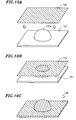
- the formed product 121 shown in FIG. 10A includes a hemispherical (cuplike) raised portion 121a and therefore has a rugged surface. For that reason, the decorative sheet 110 being attached is stretched so as to follow such ruggedness perfectly. To stretch the decorative sheet 110 just as intended, the decorative sheet 110 is typically heated and softened before being attached.
- a formed product with a decorative sheet can be recycled more easily than a formed product with a painted surface.
- a decorated product can have a different type of fine appearance from that of a painted product. That is why a decorative sheet contributes to improving the appearance of formed products noticeably. For these reasons, a method using a decorative sheet is very useful.
- Japanese Laid-Open Patent Publication No. 2004-250581 discloses a stack of resin layers with good weather resistance.
- FIG. 11 illustrates such a stack 210 of resin layers.
- the stack 210 of resin layers includes a base member 211 made of polycarbonate, an acrylic resin layer 212 with a UV absorbent material, and a cured layer 213 formed by curing a coating agent in which a number of ingredients are compounded so as to have a particular composition. These members and layers are stacked in this order one upon the other.
- This stack 210 of resin layers realizes high weather resistance because the UV absorbent material included in the acrylic resin layer 212 absorbs UV rays.
- the overall decorative sheet may be thickened in advance because the decorative sheet is supposed to be stretched and have a reduced thickness eventually.
- the decorative sheet being attached to a formed product is not stretched uniformly everywhere. That is to say, the decorative sheet is stretched to different degrees from one portion of the sheet to another. For that reason, if the entire sheet were thickened, then a portion that would be thick enough even without being thickened that way should be too thick to avoid a significant increase in cost.
- the acrylic resin layer 212 including the UV absorbent material could be thickened. Actually, however, the acrylic resin layer 212 cannot be stretched so easily as the base member 211 of polycarbonate. That is why the thickened acrylic resin layer 212 could crack when stretched.
- WO 94/03337 A2 discloses a paint film which is readable on the preamble part of claim 1.
- Said paint film comprises a liner layer, a clear coat layer, a color layer, a reinforcing layer and a bonding layer stacked over each other.
- the clear coat layer has a thickness of 13 to 76 ⁇ m, preferably of 25 to 51 ⁇ m.
- the color layer has a thickness of 13 to 102 ⁇ m.
- the clear coat layer as well as the color coat layer may include UV stabilizers, for example from the TINUVIN-family produced by Ciba-Geigy.
- said objective is solved by a decorative sheet having a combination of features of independent claim 1.
- Such a decorative sheet is supposed to be attached onto the surface of an object while being stretched and also prevents the sheet being attached from cracking.
- the base member preferably has a thickness of 300 ⁇ m to 800 ⁇ m.
- the pencil hardness of the protective layer at room temperature is higher than that of the base member.
- a formed product according to a preferred embodiment of the present invention includes a formed product body and a decorative sheet according to any of the preferred embodiments of the present invention described above that has been attached to a surface of the formed product body.
- the decorative sheet is bent over edges of the formed product body to reach the back surface of the formed product body.
- a portion of the decorative sheet is preferably 30% to 50% as thick as the thickest portion of the decorative sheet.
- a transportation apparatus includes a formed product according to any of the preferred embodiments described above.
- a UV absorbent material is included in both the protective layer and coloring layer thereof (i.e., not just in the protective layer but also in the coloring layer), thus realizing high weather resistance easily.
- the protective layer preferably has a thickness of 30 ⁇ m to 60 ⁇ m and includes 1.4 wt% to 4.0 wt% of UV absorbent material, while the coloring layer has a thickness of 15 ⁇ m to 80 ⁇ m and includes 1.0 wt% to 4.0 wt% of UV absorbent material.
- the thicknesses and the contents of the UV absorbent material of both the protective layer and the coloring layer are defined within predetermined ranges. That is why even if the decorative sheet is attached onto the surface of an object while being stretched, sufficiently high weather resistance is realized and cracking can be avoided.
- FIG. 1 schematically illustrates a decorative sheet 10 according to a preferred embodiment.
- the decorative sheet 10 includes a base member 1 with two opposed principal surfaces la and 1b, a protective layer 2 arranged over one principal surface 1a of the base member 1, and a coloring layer 3 arranged over the other principal surface 1b of the base member 1.
- the base member 1 is preferably made of a resin material and is typically made of a thermoplastic resin such as polycarbonate or vinyl chloride resin.
- the base member 1 should have some degree of rigidity that is high enough to serve as a sheet base member. That is why the material is preferably selected in view of this respect.
- the base member 1 preferably has a thickness of about 300 ⁇ m to about 800 ⁇ m. This is because if the base member 1 had a thickness of less than about 300 ⁇ m, the sheet would be difficult to handle or its mechanical strength could be too low to avoid tears when the sheet is being attached. On the other hand, if the thickness of the base member 1 exceeded about 800 ⁇ m, then the sheet could not fit closely the surface of the object to be decorated.
- the protective layer 2 is preferably made of a resin material.
- the pencil hardness of the protective layer 2 at room temperature is preferably higher than that of the base member 1.
- resin materials for the protective layer 2 include acrylic resins and vinyl chloride resins.
- acrylic resins including about 80 mol% or more of methyl methacrylate monomer derived repeating units and having a weight average molecular weight of approximately 70,000 to 150,000 can be used effectively.
- acrylic co-extruded polycarbonate DO-2 produced by Mitsubishi Gas Chemicals Co., Inc.
- DO-2 produced by Mitsubishi Gas Chemicals Co., Inc.
- the UV absorbent material included in the coloring layer 3 may be either solid at an ordinary temperature (as in TINUVIN 328 mentioned above) or liquid at an ordinary temperature (as in TINUVIN 571 mentioned above). If a liquid UV absorbent material is used, the coloring layer 3 will stretch more easily, and therefore is less likely to crack, than using a solid UV absorbent material. When a liquid UV absorbent material is used, however, that UV absorbent material might ooze out of the coloring layer 3 depending on its thickness.
- an adhesive 8 is applied onto the coloring layer 3 as indicated by the dotted line in FIG. 1 .
- the adhesive a urethane or acrylic adhesive is preferably used.
- the decorative sheet 10 with such a structure may be used in a forming process as disclosed in Japanese Laid-Open Patent Publication No. 2005-153351 and can be used effectively to decorate a formed product with an extremely rugged surface.
- the decorative sheet 10 of this preferred embodiment includes a UV absorbent material in both of the protective layer 2 and the coloring layer 3 (i.e., not just in the protective layer 2 but also in the coloring layer 3), thus realizing high weather resistance relatively easily.
- a UV absorbent material in both of the protective layer 2 and the coloring layer 3 (i.e., not just in the protective layer 2 but also in the coloring layer 3), thus realizing high weather resistance relatively easily.
- the UV absorbent material is included in both the protective layer 2 and the coloring layer 3 as in this preferred embodiment, however, then a UV ray that has been transmitted through the protective layer 2 can be absorbed into the UV absorbent material included in the coloring layer 3. That is why it is possible to minimize the deterioration of the coloring layer 3 due to the repetitive exposure to the UV ray. As a result, the weather resistance of the decorative sheet 10 increases significantly.
- the thickness of the decorative sheet 10 may vary and part of the protective layer 2 may become too thin. If the protective layer 2 may become thin in certain areas in this manner or if the amount of the UV absorbent material included in the protective layer 2 is small, then many UV rays may transmit through the protective layer 2. However, if the UV absorbent material is included not just in the protective layer 2 but also in the coloring layer 3 as in this preferred embodiment, sufficiently high weather resistance is still guaranteed even when quite a few UV rays may transmit through the protective layer 2.
- the results are shown in the following Table 1.
- the thicknesses of the base members 1, protective layers 2 and coloring layers 3 shown in Table 1 were measured before and after stretching. Most of those decorative sheets 10 were rated in the three grades of "Good”, “Fair” and "Bad”.
- the weather resistance was estimated with a sunshine weatherometer compliant with the JIS B7753 standard.
- a decorative sheet 10 could maintain a color difference ⁇ E of 3 or less and at least 50% of the initial gloss for 600 hours or more, then the decorative sheet 10 was rated "Good”. If a decorative sheet 10 could maintain a color difference ⁇ E of 3 or less and at least 50% of the initial gloss for equal to or longer than 400 hours but less than 600 hours, then the decorative sheet 10 was rated "Fair”. And if a decorative sheet 10 could maintain a color difference ⁇ E of 3 or less and at least 50% of the initial gloss for less than 400 hours, then the decorative sheet 10 was rated "Bad". Oozing of the UV absorbent material was rated by observing the appearance of a decorative sheet 10 that was heated to 80 °C after having been stretched.
- Sample #5 including a protective layer 2 with a thickness of about 80 ⁇ m if the thickness of the protective layer 2 exceeded about 60 ⁇ m, the protective layer 2 cracked.
- Sample #1 including a protective layer 2 with a thickness of about 20 ⁇ m had no problem with its weather resistance, cracking and oozing but its overall rating is "Fair", not "Good”. This is because if the protective layer 2 were too thin (more specifically, had a thickness of less than about 30 ⁇ m), then the thickness of the protective layer 2 would vary significantly while the decorative sheet 10 is being made, thus making it difficult to form the sheet uniformly. The variation in the thickness of the protective layer 2 would cause a variation in the weather resistance of the decorative sheet.
- Sample #9 including a coloring layer 3 with a thickness of about 90 ⁇ m and Sample #10 including a coloring layer 3 with a thickness of about 100 ⁇ m if the thickness of the coloring layer 3 exceeded about 80 ⁇ m, the coloring layer 3 cracked.
- Sample #6 including a coloring layer 3 with a thickness of about 10 ⁇ m had no problem with its weather resistance, cracking and oozing but its overall rating is "Fair", not "Good”. This is because if the coloring layer 3 were too thin (more specifically, had a thickness of less than about 15 ⁇ m), then the thickness of the coloring layer 3 would vary significantly while the decorative sheet 10 is being made, thus producing color unevenness.
- Samples #2, #3, #4, #7 and #8 of which the protective layer 2 has a thickness of about 30 ⁇ m to about 60 ⁇ m and the coloring layer 3 has a thickness of about 15 ⁇ m to about 80 ⁇ m had no problem with its weather resistance, cracking and oozing.
- the variations in the thicknesses of the protective layer 2 and the coloring layer 3 while the sheet was being made were also small.
- the protective layer 2 preferably has a thickness of about 30 ⁇ m to about 60 ⁇ m and the coloring layer 3 preferably has a thickness of about 15 ⁇ m to about 80 ⁇ m.
- Tables 2, 3 and 4 shows the results in three different situations where the thicknesses of the base member 1 were changed into about 300 ⁇ m, about 500 ⁇ m and about 800 ⁇ m, respectively, with the thicknesses and the UV absorbent material contents of the protective coating 2 and the coloring layer 3 varied.
- Base member Protective layer Coloring layer Results of evaluations Thickness ratio before and after stretch Thickness ( ⁇ m) Thickness ( ⁇ m) UV absorbent content Thickness ( ⁇ m) UV absorbent content Weather resistance Protective layer cracked? Oozing Coloring layer crackled? Total Bfo. Aft. Bfo. Aft. Bfo. Aft. 24 500 200 20 8 1.4 wt% 15 6 1 wt% Fair NO NO NO Bad 0.4 25 500 250 30 15 4 wt% 15 7.5 4 wt% Good NO NO NO Good 0.5 26 500 200 80 32 1.4 wt% 15 6 4 wt% Good YES.
- Base member Protective layer Coloring layer Results of evaluations Thickness ratio before and after stretch Thickness ( ⁇ m) Thickness ( ⁇ M) UV absorbent content Thickness ( ⁇ m) UV absorbent content Weather resistance Protective layer cracked? Oozing Coloring layer cracked? Total Bfo. Aft. Bfo. Aft. Bfo. Aft.
- the protective layer 2 and the coloring layer 3 had their preferred minimum thicknesses of about 30 ⁇ m and about 15 ⁇ m and UV absorbent material contents of about 1.4 wt% and about 1.0 wt%, respectively (i.e., in Sample #18 shown in Table 2), sufficiently high weather resistance was realized.
- the protective layer 2 and the coloring layer 3 had thicknesses of about 30 ⁇ m and about 15 ⁇ m, respectively, and a UV absorbent material content of about 1.0 wt% (not shown in any of these tables), the resultant weather resistance was not enough.
- the protective layer 2 or the coloring layer 3 included no UV absorbent material at all (as in Samples #14, #15, #16 and #17), the resultant weather resistance was not enough, either.
- the protective layer 2 and the coloring layer 3 had their preferred maximum thicknesses of about 60 ⁇ m and about 80 ⁇ m, respectively, and a UV absorbent material content of about 4.0 wt% (i.e., in Sample #19 shown in Table 2), neither the protective layer 2 nor the coloring layer 3 cracked and good formability was realized.
- the protective layer 2 had a thickness of about 60 ⁇ m and a UV absorbent material content of about 5.0 wt% (as in Sample #15), the protective layer 2 cracked.
- the coloring layer 3 had a thickness of about 80 ⁇ m and a UV absorbent material content of about 5.0 wt% (as in Sample #17), the coloring layer 3 cracked, too.
- the protective layer 2 preferably has a UV absorbent material content of about 1.4 wt% to about 4.0 wt%
- the coloring layer 3 preferably has a UV absorbent material content of about 1.0 wt% to about 4.0 wt%.
- the protective layer 2 and the coloring layer 3 had a thickness of about 30 ⁇ m to about 60 ⁇ m and a thickness of about 15 ⁇ m to about 80 ⁇ m, respectively, and also had UV absorbent material contents falling within the ranges defined above (as in Samples #12, #18, #19, #20 and #21), good results of evaluation were achieved.
- the thickness and UV, absorbent material content of the protective layer 2 within the range of about 30 ⁇ m to about 60 ⁇ m and within the range of about 1.4 wt% to about 4.0 wt% and by setting the thickness and UV absorbent material content of the coloring layer 3 within the range of about 15 ⁇ m to about 80 ⁇ m and within the range of about 1.0 wt% to about 4.0 wt%, it is possible to prevent the decorative sheet 10 from crackling and sufficiently high weather resistance is realized.
- FIG. 1 a structure in which the protective layer 2 is arranged on one side of the base member 1 and the coloring layer 3 on the other side of the base member 1 is illustrated.
- decorative sheets 10A and 10B are shown in FIG. 2A and 2B , said decorative sheets 10A and 10B not being covered by the present invention.
- the coloring layer 3 may also be located between the base member 1 and the protective layer 2.
- an adhesive layer 4, the coloring layer 3 and the protective layer 2 are stacked in this order on the principal surface la of the base member 1.
- the coloring layer 3, the adhesive layer 4, and the protective layer 2 are stacked in this order on the principal surface la of the base member
- the decorative sheet 10A shown in FIG. 2A may be preferably made in the following manner, for example.
- a protective layer 2 is formed by an extrusion molding process.
- a coloring layer 3 is formed by a printing process on this protective layer 2.
- an adhesive layer 4 is applied onto either the coloring layer 3 or a base member 1 that has been formed separately by an extrusion molding process. Thereafter, the stack of the protective layer 2 and the coloring layer 3 and the base member 1 are bonded together with the adhesive layer 4, thereby obtaining the decorative sheet 10A.
- the decorative sheet 10B shown in FIG. 2B may be preferably made in the following manner, for example.
- a base member 1 is formed by an extrusion molding process.
- a coloring layer 3 is formed by a printing process on this base member 1.
- an adhesive layer 4 is applied onto either the coloring layer 3 or a protective layer 2 that has been formed separately by an extrusion molding process. Thereafter, the stack of the base member 1 and the coloring layer 3 and the protective layer 2 are bonded together with the adhesive layer 4, thereby obtaining the decorative sheet 10B.
- the adhesive layer 4 may be made of a known adhesive and may be formed by any of various known methods.
- the adhesive layer 4 may have a thickness of about 10 ⁇ m to about 60 ⁇ m, for example.
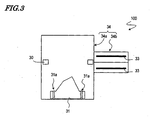
- FIG. 3 schematically illustrates a vacuum forming system 100 for use to decorate a formed product with the decorative sheet 10.
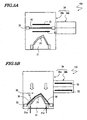
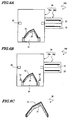
- FIGS. 4 through 6 are cross-sectional views schematically illustrating forming processing steps that use the vacuum forming system 100.
- the vacuum forming system 100 shown in FIG. 3 includes a gripping frame 30 to grip the decorative sheet 10 thereon, a supporting stage 31 for supporting a formed product thereon, a heater (such as a far-infrared heater) 33 for heating the decorative sheet 10, and a vacuum vessel 34 that stores all of these members.
- a gripping frame 30 to grip the decorative sheet 10 thereon
- a supporting stage 31 for supporting a formed product thereon
- a heater such as a far-infrared heater
- a vacuum vessel 34 that stores all of these members.
- the vacuum vessel 34 includes a main vessel 34a that stores the gripping frame 30 and the supporting stage 31, and a sub-vessel 34b that stores the heater 33. When the decorative sheet 10 is heated, the heater 33 is introduced into the main vessel 34a.
- the supporting stage 31 has a plurality of openings 31a, through which the air inside the main vessel 34a can be exhausted.
- a mechanism for introducing a gas from outside of this system into the main vessel 34a e.g., a hose connected to outside is also provided for the main vessel 34a.
- a formed product may be decorated with the decorative sheet 10 in the following manner, for example.
- a formed product body 21 is provided and mounted on the supporting stage 31.
- the formed product body 21 may be made of a resin material, a metallic material or any other suitable material by a known technique.
- the formed product body 21 may be made of a resin material by an injection molding process.
- the decorative sheet 10 includes a base member 1, and a protective layer 2 and a coloring layer 3, both of which include a UV absorbent material.
- the decorative sheet 10 is heated with the heater 33, thereby softening the decorative sheet 10.
- the decorative sheet 10 is preferably heated to a temperature that is approximately 20 °C to 30 °C higher than the lowest adhesion temperature of the adhesive 8 to ensure good adhesiveness for the adhesive 8.
- the decorative sheet 10 is brought down toward the formed product body 21 and then the pressure in the space 35 between the decorative sheet 10 and the formed product body 21 is reduced, thereby bonding the decorative sheet 10 onto the formed product body 21 as shown in FIG. 6A . If the pressure in the space 35 between the decorative sheet 10 and the formed product body 21 is reduced, then the decorative sheet 10 will be pressed against the formed product body 21 with uniform pressure. As a result, the sheet 10 can be bonded to the product 21 effectively.
- an excessive portion 10' of the decorative sheet 10 is trimmed with a rotating blade or any other cutter, and then the formed product body 21 is removed from the supporting stage 31, thereby completing a formed product 20 with a decorated surface as shown in FIG. 6C .
- the decorative sheet 10 of this preferred embodiment it is possible to prevent the protective layer 2 and the coloring layer 3 from cracking while ensuring sufficiently high weather resistance and abrasion resistance. As a result, a formed product that can be used outdoors for a long time while maintaining its fine appearance is realized.
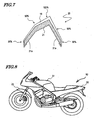
- FIG. 7 An example of a formed product 20 decorated with the decorative sheet 10 is shown in FIG. 7 .
- the decorative sheet 10 has been attached so as to cover the edges of the formed product body 21 and reach the back surface 21a of the formed product body 21. In this manner, the decorative sheet 10 may be partially bent over around the edges of the formed product body 21.
- the thicknesses of the decorative sheet 10 that has been stretched and attached are shown in percentages with the thickest portion thereof identified by 100%. As shown in FIG. 7 , the decorative sheet 10 decreases its thickness from the center of the formed product 20 toward the edges thereof, and gets thinnest at the bent portion.
- the weather resistance of the decorative sheet 10 becomes lowest at the thinnest portion. That is why sufficiently high weather resistance is preferably ensured even at the thinnest portion. For that reason, preferred embodiments are effective particularly when a portion of the decorative sheet 10 is bent over around the edges of the formed product body 21 as shown in FIG. 7 .
- preferred embodiments are effective especially when the decorative sheet 10 has been stretched to a certain degree or more as a result of the forming process during the attachment. More specifically, preferred embodiments are particularly applicable to a situation where the decorative sheet 10 attached includes a portion that is about 30% to about 50% as thick as the thickest portion thereof (e.g., the bent portion described above).
- a formed product decorated with the decorative sheet 10 of this preferred embodiment has such good weather resistance and such fine appearance that the product can be used effectively as an exterior member for various types of transportation apparatuses.
- the formed product can be used effectively as the tank housing 51, the front fender 52 or the tail cowl 53 of a motorcycle 50 as shown in FIG. 8 .
- the weather resistance of a decorative sheet which should be attached onto the surface of a formed product while being stretched, can be increased sufficiently.
- a formed product decorated with the decorative sheet according to preferred embodiments has such good weather resistance and such a fine appearance as to be used effectively as an exterior member for various types of transportation apparatuses including passenger cars, buses, trucks, motorcycles, tractors, airplanes, motorboats, and civil engineering vehicles.
Landscapes
- Engineering & Computer Science (AREA)
- Mechanical Engineering (AREA)
- Laminated Bodies (AREA)
- Decoration By Transfer Pictures (AREA)
Claims (7)
- Dekorfolie zur Verbindung einer Oberfläche eines Gegenstandes, wobei die Dekorfolie (10) aufweist:ein Basisteil (1), das erste und zweite gegenüberliegende Hauptoberflächen (1a, 1b) hat;eine Schutzschicht (2), die über der ersten Hauptoberfläche (1a) des Basisteils (1) angeordnet ist und die UV- absorbierendes Material enthält; undeine Farbschicht (3), die ein Pigment und UV- absorbierendes Material enthält,
dadurch gekennzeichnet, dassdie Farbschicht (3) über der zweiten Hauptoberfläche (1b) des Basisteils (1) angeordnet ist,wobei die Schutzschicht (2) eine Dicke von 30 µm bis 60 µm hat und 1,4 Gew.-% bis 4,0 Gew.-% von UV- absorbierendem Material enthält, unddie Farbschicht (3) eine Dicke von 15 µm bis 80 µm hat und 1,0 Gew.-% bis 4,0 Gew.-% von UV- absorbierenden Material enthält. - Dekorfolie nach Anspruch 1, wobei das Basisteil (1) eine Dicke von 300 µm bis 800 µm hat.
- Dekorfolie nach Anspruch 1 oder 2, wobei eine Bleistifthärte der Schutzschicht (2) bei Raumtemperatur höher als die des Basisteils (1) ist.
- Geformtes Produkt, aufweisend einen geformten Produktkörper (21) und die Dekorfolie (10) nach einem der Ansprüche 1 bis 3, die mit einer Oberfläche des geformten Produktkörpers (21) verbunden worden ist.
- Geformtes Produkt nach Anspruch 4, wobei die Dekorfolie (10) über Kanten des geformten Produktkörpers (21) gebogen ist, um eine Rückseite (21a) des geformten Produktkörpers (21) zu erreichen.
- Geformtes Produkt nach Anspruch 4 oder 5, wobei ein Abschnitt der Dekorfolie (10) 30% bis 50% so dick wie der dickste Abschnitt der Dekorfolie (10) ist.
- Transportvorrichtung, aufweisend das geformte Produkt nach einem der Ansprüche 4 bis 6.
Applications Claiming Priority (1)
| Application Number | Priority Date | Filing Date | Title |
|---|---|---|---|
| JP2006142072 | 2006-05-22 |
Publications (2)
| Publication Number | Publication Date |
|---|---|
| EP1859932A1 EP1859932A1 (de) | 2007-11-28 |
| EP1859932B1 true EP1859932B1 (de) | 2009-09-02 |
Family
ID=38440247
Family Applications (1)
| Application Number | Title | Priority Date | Filing Date |
|---|---|---|---|
| EP07010159A Active EP1859932B1 (de) | 2006-05-22 | 2007-05-22 | Dekorfolie, hergestelltes Produkt und Transportvorrichtung |
Country Status (6)
| Country | Link |
|---|---|
| US (1) | US7678469B2 (de) |
| EP (1) | EP1859932B1 (de) |
| AT (1) | ATE441521T1 (de) |
| DE (1) | DE602007002220D1 (de) |
| ES (1) | ES2330684T3 (de) |
| TW (1) | TW200821145A (de) |
Families Citing this family (5)
| Publication number | Priority date | Publication date | Assignee | Title |
|---|---|---|---|---|
| ES2367323T3 (es) * | 2006-05-18 | 2011-11-02 | Yamaha Hatsudoki Kabushiki Kaisha | Hoja decorativa, producto formado y aparato de transporte. |
| JP2012116167A (ja) * | 2010-12-03 | 2012-06-21 | Mimaki Engineering Co Ltd | 加飾フィルム及び射出成型品 |
| JP2012206262A (ja) * | 2011-03-29 | 2012-10-25 | Mimaki Engineering Co Ltd | 加飾フィルム、加飾フィルムの製造方法及び射出成型品 |
| CN208827232U (zh) * | 2018-05-09 | 2019-05-07 | 昇印光电(昆山)股份有限公司 | 装饰功能膜及电子设备后盖模组 |
| JP7697197B2 (ja) * | 2020-09-29 | 2025-06-24 | セイコーエプソン株式会社 | シート製造装置 |
Family Cites Families (11)
| Publication number | Priority date | Publication date | Assignee | Title |
|---|---|---|---|---|
| TW224443B (de) | 1992-07-31 | 1994-06-01 | Minnesota Mining & Mfg | |
| JPH08230127A (ja) | 1995-02-24 | 1996-09-10 | Tsutsunaka Plast Ind Co Ltd | ポリカーボネート樹脂積層体 |
| CA2266873C (en) | 1998-04-09 | 2002-05-28 | Rexam Industries Corp. | Film finishing system with design option |
| WO2000051798A1 (en) | 1999-03-01 | 2000-09-08 | Rexam Industries Corp. | Decorative sheet material including mask layer |
| WO2000051829A2 (en) | 1999-03-01 | 2000-09-08 | Rexam Industries Corp. | Decorative sheet material with chlorinated polyolefin adhesive layer |
| WO2000051799A1 (en) | 1999-03-01 | 2000-09-08 | Rexam Industries Corp. | Migratory additives for mask layer of decorative sheet material |
| WO2002000448A2 (en) | 2000-06-26 | 2002-01-03 | Rexam Image Products, Inc. | Paint film with protective extensible mask and parts made therefrom |
| US6824818B2 (en) * | 2001-12-27 | 2004-11-30 | Soliant Llc | Wet on wet process for producing films |
| JP4183243B2 (ja) | 2002-11-26 | 2008-11-19 | ヤマハ発動機株式会社 | 積層樹脂成形品の成形方法 |
| JP2004250581A (ja) | 2003-02-20 | 2004-09-09 | Mitsubishi Gas Chem Co Inc | コーティング組成物及び樹脂積層体 |
| JP4291676B2 (ja) * | 2003-11-26 | 2009-07-08 | ヤマハ発動機株式会社 | 装飾用シート、それを備えた成形品、自動車両、および成形品の製造方法 |
-
2007
- 2007-05-17 US US11/749,958 patent/US7678469B2/en active Active
- 2007-05-18 TW TW096117857A patent/TW200821145A/zh unknown
- 2007-05-22 AT AT07010159T patent/ATE441521T1/de not_active IP Right Cessation
- 2007-05-22 ES ES07010159T patent/ES2330684T3/es active Active
- 2007-05-22 DE DE602007002220T patent/DE602007002220D1/de active Active
- 2007-05-22 EP EP07010159A patent/EP1859932B1/de active Active
Also Published As
| Publication number | Publication date |
|---|---|
| ATE441521T1 (de) | 2009-09-15 |
| US7678469B2 (en) | 2010-03-16 |
| DE602007002220D1 (de) | 2009-10-15 |
| EP1859932A1 (de) | 2007-11-28 |
| ES2330684T3 (es) | 2009-12-14 |
| TW200821145A (en) | 2008-05-16 |
| US20070269635A1 (en) | 2007-11-22 |
Similar Documents
| Publication | Publication Date | Title |
|---|---|---|
| US5914178A (en) | Laminated pane comprising a visible motif | |
| US11203177B2 (en) | Decorative sheet | |
| EP1547764B1 (de) | Dekorschicht , Formkörper, Kraftfahrzeug und Verfahren zur Herstellung von Formkörpern | |
| EP2813361B1 (de) | In-mold-übertragungsfolie mit elastischer textur und herstellungsverfahren dafür | |
| WO2018181775A1 (ja) | 加飾シート、加飾樹脂成形品、及びこれらの製造方法 | |
| CN101588923A (zh) | 聚碳酸酯玻璃窗体系及其制备方法 | |
| US7678469B2 (en) | Decorative sheet, formed product and transportation apparatus | |
| HUT53309A (en) | Method for producing coloured products particularly for forming structural element applied in the body of motor vehicle, heat-formable laminate for forming the part of external body exposed to environmental effects, plastic element and structural element for producing external piece in the body of motor vehicle exposed to environmental effects | |
| EP3053738B1 (de) | Schmuckfolie und aus einem schmuckharz geformter artikel | |
| KR20180067575A (ko) | 접착제 배킹된 장식 물품, 제조 방법, 및 사용 방법 | |
| US8080124B2 (en) | Production method of a molded article | |
| JP4448538B2 (ja) | 装飾用シート、加飾成形品および自動車両 | |
| JP6331546B2 (ja) | 加飾シートの製造方法 | |
| EP1864794B1 (de) | Dekorfolie, hergestelltes Produkt und Transportvorrichtung | |
| EP2025728A1 (de) | Dekorfolie, hergestelltes Produkt und Fahrzeug | |
| JP7074436B2 (ja) | 装飾シート、装飾シートを含む構造体及び装飾シートの製造方法 | |
| US12528309B2 (en) | Decorative sheet and decorative molded-resin article | |
| KR102727192B1 (ko) | 열 프레스 성형용 데코레이션 필름 및 이를 이용하여 제조된 성형 제품 | |
| US20230133852A1 (en) | Decorative sheet and decorative resin molded article | |
| JP2018171883A (ja) | 加飾シート及び加飾樹脂成形品 | |
| JP7673467B2 (ja) | 加飾シート、加飾樹脂成形品、及び加飾樹脂成形品の製造方法 | |
| KR101364237B1 (ko) | 장식 필름 | |
| EP4265412A1 (de) | Dekorfolie und verfahren zur herstellung einer dekorfolie | |
| WO2006072177A1 (en) | In-mould coating of polycarbonate panels | |
| EP1911566A1 (de) | Verfahren zur herstellung von formteilen und kraftfahrzeugen |
Legal Events
| Date | Code | Title | Description |
|---|---|---|---|
| PUAI | Public reference made under article 153(3) epc to a published international application that has entered the european phase |
Free format text: ORIGINAL CODE: 0009012 |
|
| AK | Designated contracting states |
Kind code of ref document: A1 Designated state(s): AT BE BG CH CY CZ DE DK EE ES FI FR GB GR HU IE IS IT LI LT LU LV MC MT NL PL PT RO SE SI SK TR |
|
| AX | Request for extension of the european patent |
Extension state: AL BA HR MK YU |
|
| 17P | Request for examination filed |
Effective date: 20080311 |
|
| 17Q | First examination report despatched |
Effective date: 20080409 |
|
| AKX | Designation fees paid |
Designated state(s): AT BE BG CH CY CZ DE DK EE ES FI FR GB GR HU IE IS IT LI LT LU LV MC MT NL PL PT RO SE SI SK TR |
|
| GRAP | Despatch of communication of intention to grant a patent |
Free format text: ORIGINAL CODE: EPIDOSNIGR1 |
|
| GRAS | Grant fee paid |
Free format text: ORIGINAL CODE: EPIDOSNIGR3 |
|
| GRAA | (expected) grant |
Free format text: ORIGINAL CODE: 0009210 |
|
| AK | Designated contracting states |
Kind code of ref document: B1 Designated state(s): AT BE BG CH CY CZ DE DK EE ES FI FR GB GR HU IE IS IT LI LT LU LV MC MT NL PL PT RO SE SI SK TR |
|
| REG | Reference to a national code |
Ref country code: CH Ref legal event code: EP |
|
| REG | Reference to a national code |
Ref country code: IE Ref legal event code: FG4D |
|
| REF | Corresponds to: |
Ref document number: 602007002220 Country of ref document: DE Date of ref document: 20091015 Kind code of ref document: P |
|
| REG | Reference to a national code |
Ref country code: ES Ref legal event code: FG2A Ref document number: 2330684 Country of ref document: ES Kind code of ref document: T3 |
|
| PG25 | Lapsed in a contracting state [announced via postgrant information from national office to epo] |
Ref country code: LT Free format text: LAPSE BECAUSE OF FAILURE TO SUBMIT A TRANSLATION OF THE DESCRIPTION OR TO PAY THE FEE WITHIN THE PRESCRIBED TIME-LIMIT Effective date: 20090902 Ref country code: FI Free format text: LAPSE BECAUSE OF FAILURE TO SUBMIT A TRANSLATION OF THE DESCRIPTION OR TO PAY THE FEE WITHIN THE PRESCRIBED TIME-LIMIT Effective date: 20090902 Ref country code: SE Free format text: LAPSE BECAUSE OF FAILURE TO SUBMIT A TRANSLATION OF THE DESCRIPTION OR TO PAY THE FEE WITHIN THE PRESCRIBED TIME-LIMIT Effective date: 20090902 |
|
| NLV1 | Nl: lapsed or annulled due to failure to fulfill the requirements of art. 29p and 29m of the patents act | ||
| LTIE | Lt: invalidation of european patent or patent extension |
Effective date: 20090902 |
|
| PG25 | Lapsed in a contracting state [announced via postgrant information from national office to epo] |
Ref country code: PL Free format text: LAPSE BECAUSE OF FAILURE TO SUBMIT A TRANSLATION OF THE DESCRIPTION OR TO PAY THE FEE WITHIN THE PRESCRIBED TIME-LIMIT Effective date: 20090902 Ref country code: NL Free format text: LAPSE BECAUSE OF FAILURE TO SUBMIT A TRANSLATION OF THE DESCRIPTION OR TO PAY THE FEE WITHIN THE PRESCRIBED TIME-LIMIT Effective date: 20090902 Ref country code: LV Free format text: LAPSE BECAUSE OF FAILURE TO SUBMIT A TRANSLATION OF THE DESCRIPTION OR TO PAY THE FEE WITHIN THE PRESCRIBED TIME-LIMIT Effective date: 20090902 Ref country code: SI Free format text: LAPSE BECAUSE OF FAILURE TO SUBMIT A TRANSLATION OF THE DESCRIPTION OR TO PAY THE FEE WITHIN THE PRESCRIBED TIME-LIMIT Effective date: 20090902 |
|
| PG25 | Lapsed in a contracting state [announced via postgrant information from national office to epo] |
Ref country code: CY Free format text: LAPSE BECAUSE OF FAILURE TO SUBMIT A TRANSLATION OF THE DESCRIPTION OR TO PAY THE FEE WITHIN THE PRESCRIBED TIME-LIMIT Effective date: 20090902 |
|
| PG25 | Lapsed in a contracting state [announced via postgrant information from national office to epo] |
Ref country code: IS Free format text: LAPSE BECAUSE OF FAILURE TO SUBMIT A TRANSLATION OF THE DESCRIPTION OR TO PAY THE FEE WITHIN THE PRESCRIBED TIME-LIMIT Effective date: 20100102 Ref country code: RO Free format text: LAPSE BECAUSE OF FAILURE TO SUBMIT A TRANSLATION OF THE DESCRIPTION OR TO PAY THE FEE WITHIN THE PRESCRIBED TIME-LIMIT Effective date: 20090902 Ref country code: PT Free format text: LAPSE BECAUSE OF FAILURE TO SUBMIT A TRANSLATION OF THE DESCRIPTION OR TO PAY THE FEE WITHIN THE PRESCRIBED TIME-LIMIT Effective date: 20100104 Ref country code: CZ Free format text: LAPSE BECAUSE OF FAILURE TO SUBMIT A TRANSLATION OF THE DESCRIPTION OR TO PAY THE FEE WITHIN THE PRESCRIBED TIME-LIMIT Effective date: 20090902 Ref country code: EE Free format text: LAPSE BECAUSE OF FAILURE TO SUBMIT A TRANSLATION OF THE DESCRIPTION OR TO PAY THE FEE WITHIN THE PRESCRIBED TIME-LIMIT Effective date: 20090902 |
|
| PG25 | Lapsed in a contracting state [announced via postgrant information from national office to epo] |
Ref country code: SK Free format text: LAPSE BECAUSE OF FAILURE TO SUBMIT A TRANSLATION OF THE DESCRIPTION OR TO PAY THE FEE WITHIN THE PRESCRIBED TIME-LIMIT Effective date: 20090902 |
|
| PG25 | Lapsed in a contracting state [announced via postgrant information from national office to epo] |
Ref country code: AT Free format text: LAPSE BECAUSE OF FAILURE TO SUBMIT A TRANSLATION OF THE DESCRIPTION OR TO PAY THE FEE WITHIN THE PRESCRIBED TIME-LIMIT Effective date: 20090902 Ref country code: BE Free format text: LAPSE BECAUSE OF FAILURE TO SUBMIT A TRANSLATION OF THE DESCRIPTION OR TO PAY THE FEE WITHIN THE PRESCRIBED TIME-LIMIT Effective date: 20090902 |
|
| PLBE | No opposition filed within time limit |
Free format text: ORIGINAL CODE: 0009261 |
|
| STAA | Information on the status of an ep patent application or granted ep patent |
Free format text: STATUS: NO OPPOSITION FILED WITHIN TIME LIMIT |
|
| PG25 | Lapsed in a contracting state [announced via postgrant information from national office to epo] |
Ref country code: DK Free format text: LAPSE BECAUSE OF FAILURE TO SUBMIT A TRANSLATION OF THE DESCRIPTION OR TO PAY THE FEE WITHIN THE PRESCRIBED TIME-LIMIT Effective date: 20090902 |
|
| 26N | No opposition filed |
Effective date: 20100603 |
|
| PG25 | Lapsed in a contracting state [announced via postgrant information from national office to epo] |
Ref country code: GR Free format text: LAPSE BECAUSE OF FAILURE TO SUBMIT A TRANSLATION OF THE DESCRIPTION OR TO PAY THE FEE WITHIN THE PRESCRIBED TIME-LIMIT Effective date: 20091203 |
|
| PG25 | Lapsed in a contracting state [announced via postgrant information from national office to epo] |
Ref country code: MC Free format text: LAPSE BECAUSE OF NON-PAYMENT OF DUE FEES Effective date: 20100531 |
|
| PG25 | Lapsed in a contracting state [announced via postgrant information from national office to epo] |
Ref country code: IT Free format text: LAPSE BECAUSE OF NON-PAYMENT OF DUE FEES Effective date: 20100522 |
|
| PG25 | Lapsed in a contracting state [announced via postgrant information from national office to epo] |
Ref country code: IE Free format text: LAPSE BECAUSE OF NON-PAYMENT OF DUE FEES Effective date: 20100522 Ref country code: MT Free format text: LAPSE BECAUSE OF FAILURE TO SUBMIT A TRANSLATION OF THE DESCRIPTION OR TO PAY THE FEE WITHIN THE PRESCRIBED TIME-LIMIT Effective date: 20090902 |
|
| REG | Reference to a national code |
Ref country code: CH Ref legal event code: PL |
|
| PG25 | Lapsed in a contracting state [announced via postgrant information from national office to epo] |
Ref country code: CH Free format text: LAPSE BECAUSE OF NON-PAYMENT OF DUE FEES Effective date: 20110531 Ref country code: LI Free format text: LAPSE BECAUSE OF NON-PAYMENT OF DUE FEES Effective date: 20110531 |
|
| PG25 | Lapsed in a contracting state [announced via postgrant information from national office to epo] |
Ref country code: HU Free format text: LAPSE BECAUSE OF FAILURE TO SUBMIT A TRANSLATION OF THE DESCRIPTION OR TO PAY THE FEE WITHIN THE PRESCRIBED TIME-LIMIT Effective date: 20100303 Ref country code: LU Free format text: LAPSE BECAUSE OF NON-PAYMENT OF DUE FEES Effective date: 20100522 Ref country code: BG Free format text: LAPSE BECAUSE OF FAILURE TO SUBMIT A TRANSLATION OF THE DESCRIPTION OR TO PAY THE FEE WITHIN THE PRESCRIBED TIME-LIMIT Effective date: 20090902 |
|
| PG25 | Lapsed in a contracting state [announced via postgrant information from national office to epo] |
Ref country code: TR Free format text: LAPSE BECAUSE OF FAILURE TO SUBMIT A TRANSLATION OF THE DESCRIPTION OR TO PAY THE FEE WITHIN THE PRESCRIBED TIME-LIMIT Effective date: 20090902 |
|
| REG | Reference to a national code |
Ref country code: FR Ref legal event code: PLFP Year of fee payment: 10 |
|
| PGFP | Annual fee paid to national office [announced via postgrant information from national office to epo] |
Ref country code: ES Payment date: 20160512 Year of fee payment: 10 Ref country code: GB Payment date: 20160520 Year of fee payment: 10 |
|
| PGFP | Annual fee paid to national office [announced via postgrant information from national office to epo] |
Ref country code: IT Payment date: 20160524 Year of fee payment: 10 Ref country code: FR Payment date: 20160520 Year of fee payment: 10 |
|
| GBPC | Gb: european patent ceased through non-payment of renewal fee |
Effective date: 20170522 |
|
| REG | Reference to a national code |
Ref country code: FR Ref legal event code: ST Effective date: 20180131 |
|
| PG25 | Lapsed in a contracting state [announced via postgrant information from national office to epo] |
Ref country code: GB Free format text: LAPSE BECAUSE OF NON-PAYMENT OF DUE FEES Effective date: 20170522 |
|
| PG25 | Lapsed in a contracting state [announced via postgrant information from national office to epo] |
Ref country code: IT Free format text: LAPSE BECAUSE OF NON-PAYMENT OF DUE FEES Effective date: 20170522 Ref country code: FR Free format text: LAPSE BECAUSE OF NON-PAYMENT OF DUE FEES Effective date: 20170531 |
|
| REG | Reference to a national code |
Ref country code: ES Ref legal event code: FD2A Effective date: 20180705 |
|
| PG25 | Lapsed in a contracting state [announced via postgrant information from national office to epo] |
Ref country code: ES Free format text: LAPSE BECAUSE OF NON-PAYMENT OF DUE FEES Effective date: 20170523 |
|
| P01 | Opt-out of the competence of the unified patent court (upc) registered |
Effective date: 20230526 |
|
| PGFP | Annual fee paid to national office [announced via postgrant information from national office to epo] |
Ref country code: DE Payment date: 20250521 Year of fee payment: 19 |