EP1865016A1 - Cyclodextrinreste aufweisende Organosiliciumverbindungen - Google Patents
Cyclodextrinreste aufweisende Organosiliciumverbindungen Download PDFInfo
- Publication number
- EP1865016A1 EP1865016A1 EP20070114832 EP07114832A EP1865016A1 EP 1865016 A1 EP1865016 A1 EP 1865016A1 EP 20070114832 EP20070114832 EP 20070114832 EP 07114832 A EP07114832 A EP 07114832A EP 1865016 A1 EP1865016 A1 EP 1865016A1
- Authority
- EP
- European Patent Office
- Prior art keywords
- cyclodextrin
- radical
- groups
- organosilicon compounds
- radicals
- Prior art date
- Legal status (The legal status is an assumption and is not a legal conclusion. Google has not performed a legal analysis and makes no representation as to the accuracy of the status listed.)
- Granted
Links
- 229920000858 Cyclodextrin Polymers 0.000 title claims abstract description 163
- 150000003961 organosilicon compounds Chemical class 0.000 title claims abstract description 153
- -1 mercapto, amino, carbonyl Chemical group 0.000 claims abstract description 374
- HFHDHCJBZVLPGP-UHFFFAOYSA-N schardinger α-dextrin Chemical group O1C(C(C2O)O)C(CO)OC2OC(C(C2O)O)C(CO)OC2OC(C(C2O)O)C(CO)OC2OC(C(O)C2O)C(CO)OC2OC(C(C2O)O)C(CO)OC2OC2C(O)C(O)C1OC2CO HFHDHCJBZVLPGP-UHFFFAOYSA-N 0.000 claims abstract description 131
- 238000000034 method Methods 0.000 claims abstract description 94
- ISWSIDIOOBJBQZ-UHFFFAOYSA-N phenol group Chemical group C1(=CC=CC=C1)O ISWSIDIOOBJBQZ-UHFFFAOYSA-N 0.000 claims abstract description 41
- 239000004753 textile Substances 0.000 claims abstract description 23
- 150000008064 anhydrides Chemical class 0.000 claims abstract description 22
- 125000000394 phosphonato group Chemical group [O-]P([O-])(*)=O 0.000 claims abstract description 22
- 229920000151 polyglycol Polymers 0.000 claims abstract description 20
- 239000010695 polyglycol Substances 0.000 claims abstract description 20
- 238000004519 manufacturing process Methods 0.000 claims abstract description 6
- 229910052717 sulfur Inorganic materials 0.000 claims abstract description 6
- RTZKZFJDLAIYFH-UHFFFAOYSA-N ether Substances CCOCC RTZKZFJDLAIYFH-UHFFFAOYSA-N 0.000 claims abstract description 4
- 125000004433 nitrogen atom Chemical group N* 0.000 claims abstract description 4
- 125000004430 oxygen atom Chemical group O* 0.000 claims abstract description 4
- 125000004434 sulfur atom Chemical group 0.000 claims abstract description 3
- 230000008569 process Effects 0.000 claims description 65
- 239000004215 Carbon black (E152) Substances 0.000 claims description 36
- 229930195733 hydrocarbon Natural products 0.000 claims description 36
- 239000000835 fiber Substances 0.000 claims description 29
- 239000001257 hydrogen Substances 0.000 claims description 17
- 229910052739 hydrogen Inorganic materials 0.000 claims description 17
- 239000004744 fabric Substances 0.000 claims description 11
- 239000000126 substance Substances 0.000 claims description 10
- UFHFLCQGNIYNRP-UHFFFAOYSA-N Hydrogen Chemical compound [H][H] UFHFLCQGNIYNRP-UHFFFAOYSA-N 0.000 claims description 9
- 125000004306 triazinyl group Chemical group 0.000 claims 1
- 229920001296 polysiloxane Polymers 0.000 abstract description 46
- 239000003054 catalyst Substances 0.000 abstract description 29
- 125000002887 hydroxy group Chemical group [H]O* 0.000 abstract description 25
- 150000001875 compounds Chemical class 0.000 abstract description 18
- 125000003277 amino group Chemical group 0.000 abstract description 12
- 239000004971 Cross linker Substances 0.000 abstract description 11
- 239000000463 material Substances 0.000 abstract description 11
- 125000003178 carboxy group Chemical group [H]OC(*)=O 0.000 abstract description 10
- 229910052710 silicon Inorganic materials 0.000 abstract description 8
- 239000010703 silicon Substances 0.000 abstract description 8
- 238000004132 cross linking Methods 0.000 abstract description 6
- 125000003110 organyloxy group Chemical group 0.000 abstract description 6
- 238000009833 condensation Methods 0.000 abstract description 5
- 230000005494 condensation Effects 0.000 abstract description 5
- 150000002148 esters Chemical class 0.000 abstract description 5
- 229910052760 oxygen Inorganic materials 0.000 abstract description 5
- 125000000472 sulfonyl group Chemical group *S(*)(=O)=O 0.000 abstract description 5
- 150000003462 sulfoxides Chemical class 0.000 abstract description 4
- JOYRKODLDBILNP-UHFFFAOYSA-N Ethyl urethane Chemical compound CCOC(N)=O JOYRKODLDBILNP-UHFFFAOYSA-N 0.000 abstract description 3
- 125000003647 acryloyl group Chemical group O=C([*])C([H])=C([H])[H] 0.000 abstract description 3
- QVGXLLKOCUKJST-UHFFFAOYSA-N atomic oxygen Chemical compound [O] QVGXLLKOCUKJST-UHFFFAOYSA-N 0.000 abstract description 3
- 239000001301 oxygen Substances 0.000 abstract description 3
- 125000001931 aliphatic group Chemical group 0.000 abstract description 2
- 125000005558 triazinylene group Chemical group 0.000 abstract description 2
- 150000003672 ureas Chemical class 0.000 abstract description 2
- 125000001183 hydrocarbyl group Chemical group 0.000 abstract 3
- 125000005521 carbonamide group Chemical group 0.000 abstract 1
- 125000000743 hydrocarbylene group Chemical group 0.000 abstract 1
- 150000003254 radicals Chemical class 0.000 description 87
- 239000000203 mixture Substances 0.000 description 38
- 239000000839 emulsion Substances 0.000 description 33
- 238000006243 chemical reaction Methods 0.000 description 29
- 229920002545 silicone oil Polymers 0.000 description 29
- XLYOFNOQVPJJNP-UHFFFAOYSA-N water Substances O XLYOFNOQVPJJNP-UHFFFAOYSA-N 0.000 description 25
- 230000008901 benefit Effects 0.000 description 19
- QTBSBXVTEAMEQO-UHFFFAOYSA-N Acetic acid Chemical compound CC(O)=O QTBSBXVTEAMEQO-UHFFFAOYSA-N 0.000 description 18
- 239000003205 fragrance Substances 0.000 description 18
- 150000001412 amines Chemical group 0.000 description 17
- 239000000243 solution Substances 0.000 description 17
- 125000002496 methyl group Chemical group [H]C([H])([H])* 0.000 description 16
- 239000003921 oil Substances 0.000 description 16
- 235000019198 oils Nutrition 0.000 description 16
- 239000002304 perfume Substances 0.000 description 16
- KRKNYBCHXYNGOX-UHFFFAOYSA-N citric acid Chemical compound OC(=O)CC(O)(C(O)=O)CC(O)=O KRKNYBCHXYNGOX-UHFFFAOYSA-N 0.000 description 15
- IAZDPXIOMUYVGZ-UHFFFAOYSA-N Dimethylsulphoxide Chemical compound CS(C)=O IAZDPXIOMUYVGZ-UHFFFAOYSA-N 0.000 description 14
- 238000006555 catalytic reaction Methods 0.000 description 14
- 229940097362 cyclodextrins Drugs 0.000 description 14
- 239000000758 substrate Substances 0.000 description 14
- VEXZGXHMUGYJMC-UHFFFAOYSA-N Hydrochloric acid Chemical compound Cl VEXZGXHMUGYJMC-UHFFFAOYSA-N 0.000 description 12
- NIXOWILDQLNWCW-UHFFFAOYSA-N acrylic acid group Chemical group C(C=C)(=O)O NIXOWILDQLNWCW-UHFFFAOYSA-N 0.000 description 12
- 239000006185 dispersion Substances 0.000 description 12
- 239000002904 solvent Substances 0.000 description 12
- 125000004432 carbon atom Chemical group C* 0.000 description 11
- 238000002360 preparation method Methods 0.000 description 11
- NBIIXXVUZAFLBC-UHFFFAOYSA-N Phosphoric acid Chemical compound OP(O)(O)=O NBIIXXVUZAFLBC-UHFFFAOYSA-N 0.000 description 10
- QAOWNCQODCNURD-UHFFFAOYSA-N Sulfuric acid Chemical compound OS(O)(=O)=O QAOWNCQODCNURD-UHFFFAOYSA-N 0.000 description 10
- 229910052783 alkali metal Inorganic materials 0.000 description 10
- 239000003995 emulsifying agent Substances 0.000 description 10
- 125000001495 ethyl group Chemical group [H]C([H])([H])C([H])([H])* 0.000 description 10
- WGTYBPLFGIVFAS-UHFFFAOYSA-M tetramethylammonium hydroxide Chemical compound [OH-].C[N+](C)(C)C WGTYBPLFGIVFAS-UHFFFAOYSA-M 0.000 description 10
- 239000007864 aqueous solution Substances 0.000 description 9
- 239000012298 atmosphere Substances 0.000 description 9
- 238000011067 equilibration Methods 0.000 description 9
- 125000004435 hydrogen atom Chemical group [H]* 0.000 description 9
- 235000019645 odor Nutrition 0.000 description 9
- 229960000583 acetic acid Drugs 0.000 description 8
- 239000002253 acid Substances 0.000 description 8
- 150000002431 hydrogen Chemical class 0.000 description 8
- BDAGIHXWWSANSR-UHFFFAOYSA-N methanoic acid Natural products OC=O BDAGIHXWWSANSR-UHFFFAOYSA-N 0.000 description 8
- XUIMIQQOPSSXEZ-UHFFFAOYSA-N Silicon Chemical compound [Si] XUIMIQQOPSSXEZ-UHFFFAOYSA-N 0.000 description 7
- 230000000694 effects Effects 0.000 description 7
- 239000007787 solid Substances 0.000 description 7
- 241000894007 species Species 0.000 description 7
- ZMXDDKWLCZADIW-UHFFFAOYSA-N N,N-Dimethylformamide Chemical compound CN(C)C=O ZMXDDKWLCZADIW-UHFFFAOYSA-N 0.000 description 6
- YXFVVABEGXRONW-UHFFFAOYSA-N Toluene Chemical compound CC1=CC=CC=C1 YXFVVABEGXRONW-UHFFFAOYSA-N 0.000 description 6
- 150000008044 alkali metal hydroxides Chemical class 0.000 description 6
- 239000002585 base Substances 0.000 description 6
- 125000002915 carbonyl group Chemical group [*:2]C([*:1])=O 0.000 description 6
- 238000005189 flocculation Methods 0.000 description 6
- 230000016615 flocculation Effects 0.000 description 6
- 150000002924 oxiranes Chemical group 0.000 description 6
- 238000001556 precipitation Methods 0.000 description 6
- 239000000376 reactant Substances 0.000 description 6
- RSPCKAHMRANGJZ-UHFFFAOYSA-N thiohydroxylamine Chemical compound SN RSPCKAHMRANGJZ-UHFFFAOYSA-N 0.000 description 6
- 125000000026 trimethylsilyl group Chemical group [H]C([H])([H])[Si]([*])(C([H])([H])[H])C([H])([H])[H] 0.000 description 6
- 239000002841 Lewis acid Substances 0.000 description 5
- 239000004721 Polyphenylene oxide Substances 0.000 description 5
- 229910021627 Tin(IV) chloride Inorganic materials 0.000 description 5
- 239000013543 active substance Substances 0.000 description 5
- 239000003513 alkali Substances 0.000 description 5
- 229910001860 alkaline earth metal hydroxide Inorganic materials 0.000 description 5
- 229910000147 aluminium phosphate Inorganic materials 0.000 description 5
- NDKBVBUGCNGSJJ-UHFFFAOYSA-M benzyltrimethylammonium hydroxide Chemical compound [OH-].C[N+](C)(C)CC1=CC=CC=C1 NDKBVBUGCNGSJJ-UHFFFAOYSA-M 0.000 description 5
- 229920001577 copolymer Polymers 0.000 description 5
- 239000000945 filler Substances 0.000 description 5
- 238000011049 filling Methods 0.000 description 5
- 235000019253 formic acid Nutrition 0.000 description 5
- 239000012362 glacial acetic acid Substances 0.000 description 5
- NMCUIPGRVMDVDB-UHFFFAOYSA-L iron dichloride Chemical compound Cl[Fe]Cl NMCUIPGRVMDVDB-UHFFFAOYSA-L 0.000 description 5
- 150000007517 lewis acids Chemical class 0.000 description 5
- MHCFAGZWMAWTNR-UHFFFAOYSA-M lithium perchlorate Chemical compound [Li+].[O-]Cl(=O)(=O)=O MHCFAGZWMAWTNR-UHFFFAOYSA-M 0.000 description 5
- 229910001486 lithium perchlorate Inorganic materials 0.000 description 5
- 125000005395 methacrylic acid group Chemical group 0.000 description 5
- 239000004530 micro-emulsion Substances 0.000 description 5
- 230000004048 modification Effects 0.000 description 5
- 238000012986 modification Methods 0.000 description 5
- 125000000466 oxiranyl group Chemical group 0.000 description 5
- 229920000570 polyether Polymers 0.000 description 5
- 125000002924 primary amino group Chemical group [H]N([H])* 0.000 description 5
- 239000011541 reaction mixture Substances 0.000 description 5
- 150000004756 silanes Chemical class 0.000 description 5
- FAPWRFPIFSIZLT-UHFFFAOYSA-M sodium chloride Inorganic materials [Na+].[Cl-] FAPWRFPIFSIZLT-UHFFFAOYSA-M 0.000 description 5
- HPGGPRDJHPYFRM-UHFFFAOYSA-J tin(iv) chloride Chemical compound Cl[Sn](Cl)(Cl)Cl HPGGPRDJHPYFRM-UHFFFAOYSA-J 0.000 description 5
- OSWFIVFLDKOXQC-UHFFFAOYSA-N 4-(3-methoxyphenyl)aniline Chemical compound COC1=CC=CC(C=2C=CC(N)=CC=2)=C1 OSWFIVFLDKOXQC-UHFFFAOYSA-N 0.000 description 4
- NLXLAEXVIDQMFP-UHFFFAOYSA-N Ammonia chloride Chemical compound [NH4+].[Cl-] NLXLAEXVIDQMFP-UHFFFAOYSA-N 0.000 description 4
- FERIUCNNQQJTOY-UHFFFAOYSA-N Butyric acid Natural products CCCC(O)=O FERIUCNNQQJTOY-UHFFFAOYSA-N 0.000 description 4
- 0 CCOC(C1*)[C@]2C(C*3*C3)O[C@@]1OC(*)(*)CCCCC(C1)CC1[C@@](C(*)C1*)C(COCC*(CC(*)COCCCN=O)I)O[C@@]1OC=CCCCCC(*)(*)C2 Chemical compound CCOC(C1*)[C@]2C(C*3*C3)O[C@@]1OC(*)(*)CCCCC(C1)CC1[C@@](C(*)C1*)C(COCC*(CC(*)COCCCN=O)I)O[C@@]1OC=CCCCCC(*)(*)C2 0.000 description 4
- 239000001116 FEMA 4028 Substances 0.000 description 4
- WQDUMFSSJAZKTM-UHFFFAOYSA-N Sodium methoxide Chemical compound [Na+].[O-]C WQDUMFSSJAZKTM-UHFFFAOYSA-N 0.000 description 4
- 229920004935 Trevira® Polymers 0.000 description 4
- 150000008065 acid anhydrides Chemical class 0.000 description 4
- 238000007259 addition reaction Methods 0.000 description 4
- 239000000010 aprotic solvent Substances 0.000 description 4
- FFBHFFJDDLITSX-UHFFFAOYSA-N benzyl N-[2-hydroxy-4-(3-oxomorpholin-4-yl)phenyl]carbamate Chemical compound OC1=C(NC(=O)OCC2=CC=CC=C2)C=CC(=C1)N1CCOCC1=O FFBHFFJDDLITSX-UHFFFAOYSA-N 0.000 description 4
- WHGYBXFWUBPSRW-FOUAGVGXSA-N beta-cyclodextrin Chemical compound OC[C@H]([C@H]([C@@H]([C@H]1O)O)O[C@H]2O[C@@H]([C@@H](O[C@H]3O[C@H](CO)[C@H]([C@@H]([C@H]3O)O)O[C@H]3O[C@H](CO)[C@H]([C@@H]([C@H]3O)O)O[C@H]3O[C@H](CO)[C@H]([C@@H]([C@H]3O)O)O[C@H]3O[C@H](CO)[C@H]([C@@H]([C@H]3O)O)O3)[C@H](O)[C@H]2O)CO)O[C@@H]1O[C@H]1[C@H](O)[C@@H](O)[C@@H]3O[C@@H]1CO WHGYBXFWUBPSRW-FOUAGVGXSA-N 0.000 description 4
- 235000011175 beta-cyclodextrine Nutrition 0.000 description 4
- 229960004853 betadex Drugs 0.000 description 4
- 125000002843 carboxylic acid group Chemical group 0.000 description 4
- 239000003795 chemical substances by application Substances 0.000 description 4
- 239000000470 constituent Substances 0.000 description 4
- XBDQKXXYIPTUBI-UHFFFAOYSA-N dimethylselenoniopropionate Natural products CCC(O)=O XBDQKXXYIPTUBI-UHFFFAOYSA-N 0.000 description 4
- 238000001035 drying Methods 0.000 description 4
- 239000008151 electrolyte solution Substances 0.000 description 4
- 229940021013 electrolyte solution Drugs 0.000 description 4
- 150000002191 fatty alcohols Chemical class 0.000 description 4
- 229960002089 ferrous chloride Drugs 0.000 description 4
- WCYWZMWISLQXQU-UHFFFAOYSA-N methyl Chemical compound [CH3] WCYWZMWISLQXQU-UHFFFAOYSA-N 0.000 description 4
- 238000002156 mixing Methods 0.000 description 4
- 239000004745 nonwoven fabric Substances 0.000 description 4
- 229920000642 polymer Polymers 0.000 description 4
- 238000007142 ring opening reaction Methods 0.000 description 4
- 125000003396 thiol group Chemical group [H]S* 0.000 description 4
- FKTXDTWDCPTPHK-UHFFFAOYSA-N 1,1,1,2,3,3,3-heptafluoropropane Chemical compound FC(F)(F)[C](F)C(F)(F)F FKTXDTWDCPTPHK-UHFFFAOYSA-N 0.000 description 3
- 125000006017 1-propenyl group Chemical group 0.000 description 3
- FRPZMMHWLSIFAZ-UHFFFAOYSA-N 10-undecenoic acid Chemical group OC(=O)CCCCCCCCC=C FRPZMMHWLSIFAZ-UHFFFAOYSA-N 0.000 description 3
- SLRMQYXOBQWXCR-UHFFFAOYSA-N 2154-56-5 Chemical compound [CH2]C1=CC=CC=C1 SLRMQYXOBQWXCR-UHFFFAOYSA-N 0.000 description 3
- 125000004179 3-chlorophenyl group Chemical group [H]C1=C([H])C(*)=C([H])C(Cl)=C1[H] 0.000 description 3
- ORLGPUVJERIKLW-UHFFFAOYSA-N 5-chlorotriazine Chemical class ClC1=CN=NN=C1 ORLGPUVJERIKLW-UHFFFAOYSA-N 0.000 description 3
- CSCPPACGZOOCGX-UHFFFAOYSA-N Acetone Chemical compound CC(C)=O CSCPPACGZOOCGX-UHFFFAOYSA-N 0.000 description 3
- SNRUBQQJIBEYMU-UHFFFAOYSA-N Dodecane Natural products CCCCCCCCCCCC SNRUBQQJIBEYMU-UHFFFAOYSA-N 0.000 description 3
- HEMHJVSKTPXQMS-UHFFFAOYSA-M Sodium hydroxide Chemical compound [OH-].[Na+] HEMHJVSKTPXQMS-UHFFFAOYSA-M 0.000 description 3
- 229920002334 Spandex Polymers 0.000 description 3
- ZMANZCXQSJIPKH-UHFFFAOYSA-N Triethylamine Chemical compound CCN(CC)CC ZMANZCXQSJIPKH-UHFFFAOYSA-N 0.000 description 3
- 235000011054 acetic acid Nutrition 0.000 description 3
- 125000000218 acetic acid group Chemical group C(C)(=O)* 0.000 description 3
- TUCNEACPLKLKNU-UHFFFAOYSA-N acetyl Chemical compound C[C]=O TUCNEACPLKLKNU-UHFFFAOYSA-N 0.000 description 3
- 150000007513 acids Chemical class 0.000 description 3
- 229910001854 alkali hydroxide Inorganic materials 0.000 description 3
- 125000005428 anthryl group Chemical group [H]C1=C([H])C([H])=C2C([H])=C3C(*)=C([H])C([H])=C([H])C3=C([H])C2=C1[H] 0.000 description 3
- 239000012736 aqueous medium Substances 0.000 description 3
- 150000005840 aryl radicals Chemical class 0.000 description 3
- 229910052799 carbon Inorganic materials 0.000 description 3
- 125000001309 chloro group Chemical group Cl* 0.000 description 3
- 125000000113 cyclohexyl group Chemical group [H]C1([H])C([H])([H])C([H])([H])C([H])(*)C([H])([H])C1([H])[H] 0.000 description 3
- 125000001511 cyclopentyl group Chemical group [H]C1([H])C([H])([H])C([H])([H])C([H])(*)C1([H])[H] 0.000 description 3
- 235000013870 dimethyl polysiloxane Nutrition 0.000 description 3
- KPUWHANPEXNPJT-UHFFFAOYSA-N disiloxane Chemical class [SiH3]O[SiH3] KPUWHANPEXNPJT-UHFFFAOYSA-N 0.000 description 3
- 125000003700 epoxy group Chemical group 0.000 description 3
- 125000001301 ethoxy group Chemical group [H]C([H])([H])C([H])([H])O* 0.000 description 3
- 125000000524 functional group Chemical group 0.000 description 3
- 125000000959 isobutyl group Chemical group [H]C([H])([H])C([H])(C([H])([H])[H])C([H])([H])* 0.000 description 3
- 125000001972 isopentyl group Chemical group [H]C([H])([H])C([H])(C([H])([H])[H])C([H])([H])C([H])([H])* 0.000 description 3
- 125000001449 isopropyl group Chemical group [H]C([H])([H])C([H])(*)C([H])([H])[H] 0.000 description 3
- 239000010985 leather Substances 0.000 description 3
- 238000011068 loading method Methods 0.000 description 3
- 230000005923 long-lasting effect Effects 0.000 description 3
- 125000000956 methoxy group Chemical group [H]C([H])([H])O* 0.000 description 3
- PHQOGHDTIVQXHL-UHFFFAOYSA-N n'-(3-trimethoxysilylpropyl)ethane-1,2-diamine Chemical compound CO[Si](OC)(OC)CCCNCCN PHQOGHDTIVQXHL-UHFFFAOYSA-N 0.000 description 3
- VLKZOEOYAKHREP-UHFFFAOYSA-N n-Hexane Chemical compound CCCCCC VLKZOEOYAKHREP-UHFFFAOYSA-N 0.000 description 3
- 125000003136 n-heptyl group Chemical group [H]C([H])([H])C([H])([H])C([H])([H])C([H])([H])C([H])([H])C([H])([H])C([H])([H])* 0.000 description 3
- 125000001280 n-hexyl group Chemical group C(CCCCC)* 0.000 description 3
- 125000000740 n-pentyl group Chemical group [H]C([H])([H])C([H])([H])C([H])([H])C([H])([H])C([H])([H])* 0.000 description 3
- 125000004123 n-propyl group Chemical group [H]C([H])([H])C([H])([H])C([H])([H])* 0.000 description 3
- 125000001624 naphthyl group Chemical group 0.000 description 3
- 125000001971 neopentyl group Chemical group [H]C([*])([H])C(C([H])([H])[H])(C([H])([H])[H])C([H])([H])[H] 0.000 description 3
- 239000003960 organic solvent Substances 0.000 description 3
- 125000005375 organosiloxane group Chemical group 0.000 description 3
- 125000001997 phenyl group Chemical group [H]C1=C([H])C([H])=C(*)C([H])=C1[H] 0.000 description 3
- 229920000435 poly(dimethylsiloxane) Polymers 0.000 description 3
- 229920000728 polyester Polymers 0.000 description 3
- 235000019260 propionic acid Nutrition 0.000 description 3
- 230000035484 reaction time Effects 0.000 description 3
- 239000004447 silicone coating Substances 0.000 description 3
- 239000011780 sodium chloride Substances 0.000 description 3
- 210000002023 somite Anatomy 0.000 description 3
- 238000005507 spraying Methods 0.000 description 3
- 239000007858 starting material Substances 0.000 description 3
- 238000003756 stirring Methods 0.000 description 3
- 229940014800 succinic anhydride Drugs 0.000 description 3
- 125000000999 tert-butyl group Chemical group [H]C([H])([H])C(*)(C([H])([H])[H])C([H])([H])[H] 0.000 description 3
- 125000001973 tert-pentyl group Chemical group [H]C([H])([H])C([H])([H])C(*)(C([H])([H])[H])C([H])([H])[H] 0.000 description 3
- 125000000391 vinyl group Chemical group [H]C([*])=C([H])[H] 0.000 description 3
- 229920002554 vinyl polymer Polymers 0.000 description 3
- WYTZZXDRDKSJID-UHFFFAOYSA-N (3-aminopropyl)triethoxysilane Chemical compound CCO[Si](OCC)(OCC)CCCN WYTZZXDRDKSJID-UHFFFAOYSA-N 0.000 description 2
- FALRKNHUBBKYCC-UHFFFAOYSA-N 2-(chloromethyl)pyridine-3-carbonitrile Chemical compound ClCC1=NC=CC=C1C#N FALRKNHUBBKYCC-UHFFFAOYSA-N 0.000 description 2
- 125000001340 2-chloroethyl group Chemical group [H]C([H])(Cl)C([H])([H])* 0.000 description 2
- 125000004182 2-chlorophenyl group Chemical group [H]C1=C([H])C(Cl)=C(*)C([H])=C1[H] 0.000 description 2
- QGZKDVFQNNGYKY-UHFFFAOYSA-O Ammonium Chemical group [NH4+] QGZKDVFQNNGYKY-UHFFFAOYSA-O 0.000 description 2
- 239000007848 Bronsted acid Substances 0.000 description 2
- 229920000742 Cotton Polymers 0.000 description 2
- 239000004593 Epoxy Substances 0.000 description 2
- 239000004743 Polypropylene Substances 0.000 description 2
- GOOHAUXETOMSMM-UHFFFAOYSA-N Propylene oxide Chemical compound CC1CO1 GOOHAUXETOMSMM-UHFFFAOYSA-N 0.000 description 2
- KDYFGRWQOYBRFD-UHFFFAOYSA-N Succinic acid Natural products OC(=O)CCC(O)=O KDYFGRWQOYBRFD-UHFFFAOYSA-N 0.000 description 2
- OCBFFGCSTGGPSQ-UHFFFAOYSA-N [CH2]CC Chemical compound [CH2]CC OCBFFGCSTGGPSQ-UHFFFAOYSA-N 0.000 description 2
- 239000000654 additive Substances 0.000 description 2
- 230000000996 additive effect Effects 0.000 description 2
- 150000001340 alkali metals Chemical class 0.000 description 2
- 125000000217 alkyl group Chemical group 0.000 description 2
- 235000019270 ammonium chloride Nutrition 0.000 description 2
- 239000011260 aqueous acid Substances 0.000 description 2
- 229920001400 block copolymer Polymers 0.000 description 2
- 150000001732 carboxylic acid derivatives Chemical class 0.000 description 2
- 238000006482 condensation reaction Methods 0.000 description 2
- 125000004122 cyclic group Chemical group 0.000 description 2
- 125000000582 cycloheptyl group Chemical group [H]C1([H])C([H])([H])C([H])([H])C([H])([H])C([H])(*)C([H])([H])C1([H])[H] 0.000 description 2
- 239000008367 deionised water Substances 0.000 description 2
- 229910021641 deionized water Inorganic materials 0.000 description 2
- 230000005595 deprotonation Effects 0.000 description 2
- 238000010537 deprotonation reaction Methods 0.000 description 2
- 239000004205 dimethyl polysiloxane Substances 0.000 description 2
- 238000007598 dipping method Methods 0.000 description 2
- 239000012153 distilled water Substances 0.000 description 2
- 238000009826 distribution Methods 0.000 description 2
- 238000004043 dyeing Methods 0.000 description 2
- 230000008030 elimination Effects 0.000 description 2
- 238000003379 elimination reaction Methods 0.000 description 2
- 238000007720 emulsion polymerization reaction Methods 0.000 description 2
- RRAFCDWBNXTKKO-UHFFFAOYSA-N eugenol Chemical compound COC1=CC(CC=C)=CC=C1O RRAFCDWBNXTKKO-UHFFFAOYSA-N 0.000 description 2
- 125000005843 halogen group Chemical group 0.000 description 2
- 230000007062 hydrolysis Effects 0.000 description 2
- 238000006460 hydrolysis reaction Methods 0.000 description 2
- 230000002209 hydrophobic effect Effects 0.000 description 2
- 150000004694 iodide salts Chemical class 0.000 description 2
- 150000002500 ions Chemical class 0.000 description 2
- 239000007788 liquid Substances 0.000 description 2
- 238000010534 nucleophilic substitution reaction Methods 0.000 description 2
- 239000003973 paint Substances 0.000 description 2
- 239000004014 plasticizer Substances 0.000 description 2
- 229920001155 polypropylene Polymers 0.000 description 2
- IUVKMZGDUIUOCP-BTNSXGMBSA-N quinbolone Chemical compound O([C@H]1CC[C@H]2[C@H]3[C@@H]([C@]4(C=CC(=O)C=C4CC3)C)CC[C@@]21C)C1=CCCC1 IUVKMZGDUIUOCP-BTNSXGMBSA-N 0.000 description 2
- 239000000985 reactive dye Substances 0.000 description 2
- 239000011877 solvent mixture Substances 0.000 description 2
- 239000004759 spandex Substances 0.000 description 2
- 239000007921 spray Substances 0.000 description 2
- 238000003860 storage Methods 0.000 description 2
- 150000003458 sulfonic acid derivatives Chemical group 0.000 description 2
- 238000009988 textile finishing Methods 0.000 description 2
- ZDPHROOEEOARMN-UHFFFAOYSA-N undecanoic acid Chemical compound CCCCCCCCCCC(O)=O ZDPHROOEEOARMN-UHFFFAOYSA-N 0.000 description 2
- XLVOWGDFXAVSFE-UHFFFAOYSA-N (4-amino-2-methylsulfanylpyrimidin-5-yl)methanol Chemical compound CSC1=NC=C(CO)C(N)=N1 XLVOWGDFXAVSFE-UHFFFAOYSA-N 0.000 description 1
- HXLAEGYMDGUSBD-UHFFFAOYSA-N 3-[diethoxy(methyl)silyl]propan-1-amine Chemical compound CCO[Si](C)(OCC)CCCN HXLAEGYMDGUSBD-UHFFFAOYSA-N 0.000 description 1
- QOXOZONBQWIKDA-UHFFFAOYSA-N 3-hydroxypropyl Chemical group [CH2]CCO QOXOZONBQWIKDA-UHFFFAOYSA-N 0.000 description 1
- RTNUTCOTGVKVBR-UHFFFAOYSA-N 4-chlorotriazine Chemical group ClC1=CC=NN=N1 RTNUTCOTGVKVBR-UHFFFAOYSA-N 0.000 description 1
- SXIFAEWFOJETOA-UHFFFAOYSA-N 4-hydroxy-butyl Chemical group [CH2]CCCO SXIFAEWFOJETOA-UHFFFAOYSA-N 0.000 description 1
- HBAQYPYDRFILMT-UHFFFAOYSA-N 8-[3-(1-cyclopropylpyrazol-4-yl)-1H-pyrazolo[4,3-d]pyrimidin-5-yl]-3-methyl-3,8-diazabicyclo[3.2.1]octan-2-one Chemical class C1(CC1)N1N=CC(=C1)C1=NNC2=C1N=C(N=C2)N1C2C(N(CC1CC2)C)=O HBAQYPYDRFILMT-UHFFFAOYSA-N 0.000 description 1
- 229920001450 Alpha-Cyclodextrin Polymers 0.000 description 1
- 239000003341 Bronsted base Substances 0.000 description 1
- OKTJSMMVPCPJKN-UHFFFAOYSA-N Carbon Chemical compound [C] OKTJSMMVPCPJKN-UHFFFAOYSA-N 0.000 description 1
- 229920003043 Cellulose fiber Polymers 0.000 description 1
- NPBVQXIMTZKSBA-UHFFFAOYSA-N Chavibetol Natural products COC1=CC=C(CC=C)C=C1O NPBVQXIMTZKSBA-UHFFFAOYSA-N 0.000 description 1
- 239000005046 Chlorosilane Substances 0.000 description 1
- WTEVQBCEXWBHNA-UHFFFAOYSA-N Citral Natural products CC(C)=CCCC(C)=CC=O WTEVQBCEXWBHNA-UHFFFAOYSA-N 0.000 description 1
- XDTMQSROBMDMFD-UHFFFAOYSA-N Cyclohexane Chemical compound C1CCCCC1 XDTMQSROBMDMFD-UHFFFAOYSA-N 0.000 description 1
- 239000005770 Eugenol Substances 0.000 description 1
- PXGOKWXKJXAPGV-UHFFFAOYSA-N Fluorine Chemical compound FF PXGOKWXKJXAPGV-UHFFFAOYSA-N 0.000 description 1
- 230000005526 G1 to G0 transition Effects 0.000 description 1
- 241001295925 Gegenes Species 0.000 description 1
- 241000238631 Hexapoda Species 0.000 description 1
- 229910021577 Iron(II) chloride Inorganic materials 0.000 description 1
- 239000004907 Macro-emulsion Substances 0.000 description 1
- CERQOIWHTDAKMF-UHFFFAOYSA-M Methacrylate Chemical compound CC(=C)C([O-])=O CERQOIWHTDAKMF-UHFFFAOYSA-M 0.000 description 1
- CERQOIWHTDAKMF-UHFFFAOYSA-N Methacrylic acid Chemical compound CC(=C)C(O)=O CERQOIWHTDAKMF-UHFFFAOYSA-N 0.000 description 1
- YDRUKOTWTZHVSQ-UHFFFAOYSA-N O=NCCCOCC1OC1 Chemical compound O=NCCCOCC1OC1 YDRUKOTWTZHVSQ-UHFFFAOYSA-N 0.000 description 1
- WCUXLLCKKVVCTQ-UHFFFAOYSA-M Potassium chloride Chemical compound [Cl-].[K+] WCUXLLCKKVVCTQ-UHFFFAOYSA-M 0.000 description 1
- 108010009736 Protein Hydrolysates Proteins 0.000 description 1
- UVMRYBDEERADNV-UHFFFAOYSA-N Pseudoeugenol Natural products COC1=CC(C(C)=C)=CC=C1O UVMRYBDEERADNV-UHFFFAOYSA-N 0.000 description 1
- 229910004283 SiO 4 Inorganic materials 0.000 description 1
- BLRPTPMANUNPDV-UHFFFAOYSA-N Silane Chemical group [SiH4] BLRPTPMANUNPDV-UHFFFAOYSA-N 0.000 description 1
- VYPSYNLAJGMNEJ-UHFFFAOYSA-N Silicium dioxide Chemical compound O=[Si]=O VYPSYNLAJGMNEJ-UHFFFAOYSA-N 0.000 description 1
- 229920002472 Starch Polymers 0.000 description 1
- CQQXCSFSYHAZOO-UHFFFAOYSA-L [acetyloxy(dioctyl)stannyl] acetate Chemical compound CCCCCCCC[Sn](OC(C)=O)(OC(C)=O)CCCCCCCC CQQXCSFSYHAZOO-UHFFFAOYSA-L 0.000 description 1
- XQBCVRSTVUHIGH-UHFFFAOYSA-L [dodecanoyloxy(dioctyl)stannyl] dodecanoate Chemical compound CCCCCCCCCCCC(=O)O[Sn](CCCCCCCC)(CCCCCCCC)OC(=O)CCCCCCCCCCC XQBCVRSTVUHIGH-UHFFFAOYSA-L 0.000 description 1
- 239000002250 absorbent Substances 0.000 description 1
- 230000002745 absorbent Effects 0.000 description 1
- 125000002777 acetyl group Chemical group [H]C([H])([H])C(*)=O 0.000 description 1
- 238000007171 acid catalysis Methods 0.000 description 1
- 230000009471 action Effects 0.000 description 1
- 238000001994 activation Methods 0.000 description 1
- 230000004913 activation Effects 0.000 description 1
- 150000001298 alcohols Chemical class 0.000 description 1
- 125000002947 alkylene group Chemical group 0.000 description 1
- 125000000129 anionic group Chemical group 0.000 description 1
- 239000002518 antifoaming agent Substances 0.000 description 1
- 239000011230 binding agent Substances 0.000 description 1
- 230000015572 biosynthetic process Effects 0.000 description 1
- 125000000484 butyl group Chemical group [H]C([*])([H])C([H])([H])C([H])([H])C([H])([H])[H] 0.000 description 1
- ZTQSAGDEMFDKMZ-UHFFFAOYSA-N butyric aldehyde Natural products CCCC=O ZTQSAGDEMFDKMZ-UHFFFAOYSA-N 0.000 description 1
- CREMABGTGYGIQB-UHFFFAOYSA-N carbon carbon Chemical compound C.C CREMABGTGYGIQB-UHFFFAOYSA-N 0.000 description 1
- 239000011203 carbon fibre reinforced carbon Substances 0.000 description 1
- 150000004649 carbonic acid derivatives Chemical class 0.000 description 1
- 150000001733 carboxylic acid esters Chemical class 0.000 description 1
- 150000001735 carboxylic acids Chemical class 0.000 description 1
- 239000000969 carrier Substances 0.000 description 1
- 125000002091 cationic group Chemical group 0.000 description 1
- 229920002678 cellulose Polymers 0.000 description 1
- 239000001913 cellulose Substances 0.000 description 1
- 238000007385 chemical modification Methods 0.000 description 1
- 239000003153 chemical reaction reagent Substances 0.000 description 1
- KOPOQZFJUQMUML-UHFFFAOYSA-N chlorosilane Chemical class Cl[SiH3] KOPOQZFJUQMUML-UHFFFAOYSA-N 0.000 description 1
- 238000013375 chromatographic separation Methods 0.000 description 1
- 229940043350 citral Drugs 0.000 description 1
- 238000001816 cooling Methods 0.000 description 1
- 239000002537 cosmetic Substances 0.000 description 1
- 238000002788 crimping Methods 0.000 description 1
- 238000005520 cutting process Methods 0.000 description 1
- 125000004093 cyano group Chemical group *C#N 0.000 description 1
- 150000001923 cyclic compounds Chemical class 0.000 description 1
- HXCKCCRKGXHOBK-UHFFFAOYSA-N cycloheptane Chemical compound [CH]1CCCCCC1 HXCKCCRKGXHOBK-UHFFFAOYSA-N 0.000 description 1
- 235000014113 dietary fatty acids Nutrition 0.000 description 1
- 125000000118 dimethyl group Chemical group [H]C([H])([H])* 0.000 description 1
- 229920005645 diorganopolysiloxane polymer Polymers 0.000 description 1
- 238000004821 distillation Methods 0.000 description 1
- 229920001971 elastomer Polymers 0.000 description 1
- 239000000806 elastomer Substances 0.000 description 1
- 230000002255 enzymatic effect Effects 0.000 description 1
- 125000004185 ester group Chemical group 0.000 description 1
- 125000001033 ether group Chemical group 0.000 description 1
- QUPDWYMUPZLYJZ-UHFFFAOYSA-N ethyl Chemical compound C[CH2] QUPDWYMUPZLYJZ-UHFFFAOYSA-N 0.000 description 1
- LYCAIKOWRPUZTN-UHFFFAOYSA-N ethylene glycol Natural products OCCO LYCAIKOWRPUZTN-UHFFFAOYSA-N 0.000 description 1
- 229960002217 eugenol Drugs 0.000 description 1
- 239000002979 fabric softener Substances 0.000 description 1
- 229930195729 fatty acid Natural products 0.000 description 1
- 239000000194 fatty acid Substances 0.000 description 1
- 150000004665 fatty acids Chemical class 0.000 description 1
- 239000002657 fibrous material Substances 0.000 description 1
- 239000011737 fluorine Substances 0.000 description 1
- 229910052731 fluorine Inorganic materials 0.000 description 1
- 150000004674 formic acids Chemical class 0.000 description 1
- 239000000499 gel Substances 0.000 description 1
- WTEVQBCEXWBHNA-JXMROGBWSA-N geranial Chemical compound CC(C)=CCC\C(C)=C\C=O WTEVQBCEXWBHNA-JXMROGBWSA-N 0.000 description 1
- 229930182470 glycoside Natural products 0.000 description 1
- 229910052736 halogen Inorganic materials 0.000 description 1
- 150000002367 halogens Chemical class 0.000 description 1
- 238000010438 heat treatment Methods 0.000 description 1
- 230000002363 herbicidal effect Effects 0.000 description 1
- UQEAIHBTYFGYIE-UHFFFAOYSA-N hexamethyldisiloxane Chemical compound C[Si](C)(C)O[Si](C)(C)C UQEAIHBTYFGYIE-UHFFFAOYSA-N 0.000 description 1
- GNOIPBMMFNIUFM-UHFFFAOYSA-N hexamethylphosphoric triamide Chemical compound CN(C)P(=O)(N(C)C)N(C)C GNOIPBMMFNIUFM-UHFFFAOYSA-N 0.000 description 1
- 238000000265 homogenisation Methods 0.000 description 1
- 150000002430 hydrocarbons Chemical class 0.000 description 1
- 238000006459 hydrosilylation reaction Methods 0.000 description 1
- XLYOFNOQVPJJNP-UHFFFAOYSA-M hydroxide Chemical compound [OH-] XLYOFNOQVPJJNP-UHFFFAOYSA-M 0.000 description 1
- WGCNASOHLSPBMP-UHFFFAOYSA-N hydroxyacetaldehyde Natural products OCC=O WGCNASOHLSPBMP-UHFFFAOYSA-N 0.000 description 1
- 238000011065 in-situ storage Methods 0.000 description 1
- 238000010348 incorporation Methods 0.000 description 1
- 230000000749 insecticidal effect Effects 0.000 description 1
- 230000002045 lasting effect Effects 0.000 description 1
- 239000012528 membrane Substances 0.000 description 1
- 150000002736 metal compounds Chemical class 0.000 description 1
- 230000011987 methylation Effects 0.000 description 1
- 238000007069 methylation reaction Methods 0.000 description 1
- 125000001483 monosaccharide substituent group Chemical group 0.000 description 1
- 238000007040 multi-step synthesis reaction Methods 0.000 description 1
- 230000007935 neutral effect Effects 0.000 description 1
- 229910052757 nitrogen Inorganic materials 0.000 description 1
- HMMGMWAXVFQUOA-UHFFFAOYSA-N octamethylcyclotetrasiloxane Chemical compound C[Si]1(C)O[Si](C)(C)O[Si](C)(C)O[Si](C)(C)O1 HMMGMWAXVFQUOA-UHFFFAOYSA-N 0.000 description 1
- 229920001542 oligosaccharide Polymers 0.000 description 1
- 150000002894 organic compounds Chemical class 0.000 description 1
- 239000003791 organic solvent mixture Substances 0.000 description 1
- 150000001282 organosilanes Chemical class 0.000 description 1
- 125000006353 oxyethylene group Chemical group 0.000 description 1
- 125000003854 p-chlorophenyl group Chemical group [H]C1=C([H])C(*)=C([H])C([H])=C1Cl 0.000 description 1
- 230000002085 persistent effect Effects 0.000 description 1
- 125000000843 phenylene group Chemical group C1(=C(C=CC=C1)*)* 0.000 description 1
- 239000002798 polar solvent Substances 0.000 description 1
- 238000006068 polycondensation reaction Methods 0.000 description 1
- 229920000139 polyethylene terephthalate Polymers 0.000 description 1
- 239000005020 polyethylene terephthalate Substances 0.000 description 1
- CUQOHAYJWVTKDE-UHFFFAOYSA-N potassium;butan-1-olate Chemical compound [K+].CCCC[O-] CUQOHAYJWVTKDE-UHFFFAOYSA-N 0.000 description 1
- 239000002243 precursor Substances 0.000 description 1
- 150000003138 primary alcohols Chemical class 0.000 description 1
- 150000003141 primary amines Chemical group 0.000 description 1
- 150000004672 propanoic acids Chemical class 0.000 description 1
- NBBJYMSMWIIQGU-UHFFFAOYSA-N propionic aldehyde Natural products CCC=O NBBJYMSMWIIQGU-UHFFFAOYSA-N 0.000 description 1
- 125000001436 propyl group Chemical group [H]C([*])([H])C([H])([H])C([H])([H])[H] 0.000 description 1
- 125000005551 pyridylene group Chemical group 0.000 description 1
- 230000001846 repelling effect Effects 0.000 description 1
- 235000019719 rose oil Nutrition 0.000 description 1
- 239000010666 rose oil Substances 0.000 description 1
- 150000003839 salts Chemical class 0.000 description 1
- 239000000523 sample Substances 0.000 description 1
- 239000003566 sealing material Substances 0.000 description 1
- 238000000926 separation method Methods 0.000 description 1
- 239000002453 shampoo Substances 0.000 description 1
- FZHAPNGMFPVSLP-UHFFFAOYSA-N silanamine Chemical compound [SiH3]N FZHAPNGMFPVSLP-UHFFFAOYSA-N 0.000 description 1
- 239000000741 silica gel Substances 0.000 description 1
- 229910002027 silica gel Inorganic materials 0.000 description 1
- 239000002689 soil Substances 0.000 description 1
- 239000008107 starch Substances 0.000 description 1
- 235000019698 starch Nutrition 0.000 description 1
- RINCXYDBBGOEEQ-UHFFFAOYSA-N succinic anhydride Chemical group O=C1CCC(=O)O1 RINCXYDBBGOEEQ-UHFFFAOYSA-N 0.000 description 1
- PXQLVRUNWNTZOS-UHFFFAOYSA-N sulfanyl Chemical class [SH] PXQLVRUNWNTZOS-UHFFFAOYSA-N 0.000 description 1
- 239000004094 surface-active agent Substances 0.000 description 1
- 230000002889 sympathetic effect Effects 0.000 description 1
- 238000003786 synthesis reaction Methods 0.000 description 1
- 238000007725 thermal activation Methods 0.000 description 1
- 150000003606 tin compounds Chemical class 0.000 description 1
- 238000002604 ultrasonography Methods 0.000 description 1
- NLVXSWCKKBEXTG-UHFFFAOYSA-N vinylsulfonic acid Chemical compound OS(=O)(=O)C=C NLVXSWCKKBEXTG-UHFFFAOYSA-N 0.000 description 1
- 210000002268 wool Anatomy 0.000 description 1
- 238000010626 work up procedure Methods 0.000 description 1
Classifications
-
- C—CHEMISTRY; METALLURGY
- C08—ORGANIC MACROMOLECULAR COMPOUNDS; THEIR PREPARATION OR CHEMICAL WORKING-UP; COMPOSITIONS BASED THEREON
- C08G—MACROMOLECULAR COMPOUNDS OBTAINED OTHERWISE THAN BY REACTIONS ONLY INVOLVING UNSATURATED CARBON-TO-CARBON BONDS
- C08G77/00—Macromolecular compounds obtained by reactions forming a linkage containing silicon with or without sulfur, nitrogen, oxygen or carbon in the main chain of the macromolecule
- C08G77/04—Polysiloxanes
- C08G77/38—Polysiloxanes modified by chemical after-treatment
-
- C—CHEMISTRY; METALLURGY
- C08—ORGANIC MACROMOLECULAR COMPOUNDS; THEIR PREPARATION OR CHEMICAL WORKING-UP; COMPOSITIONS BASED THEREON
- C08B—POLYSACCHARIDES; DERIVATIVES THEREOF
- C08B37/00—Preparation of polysaccharides not provided for in groups C08B1/00 - C08B35/00; Derivatives thereof
- C08B37/0006—Homoglycans, i.e. polysaccharides having a main chain consisting of one single sugar, e.g. colominic acid
- C08B37/0009—Homoglycans, i.e. polysaccharides having a main chain consisting of one single sugar, e.g. colominic acid alpha-D-Glucans, e.g. polydextrose, alternan, glycogen; (alpha-1,4)(alpha-1,6)-D-Glucans; (alpha-1,3)(alpha-1,4)-D-Glucans, e.g. isolichenan or nigeran; (alpha-1,4)-D-Glucans; (alpha-1,3)-D-Glucans, e.g. pseudonigeran; Derivatives thereof
- C08B37/0012—Cyclodextrin [CD], e.g. cycle with 6 units (alpha), with 7 units (beta) and with 8 units (gamma), large-ring cyclodextrin or cycloamylose with 9 units or more; Derivatives thereof
-
- C—CHEMISTRY; METALLURGY
- C08—ORGANIC MACROMOLECULAR COMPOUNDS; THEIR PREPARATION OR CHEMICAL WORKING-UP; COMPOSITIONS BASED THEREON
- C08G—MACROMOLECULAR COMPOUNDS OBTAINED OTHERWISE THAN BY REACTIONS ONLY INVOLVING UNSATURATED CARBON-TO-CARBON BONDS
- C08G77/00—Macromolecular compounds obtained by reactions forming a linkage containing silicon with or without sulfur, nitrogen, oxygen or carbon in the main chain of the macromolecule
- C08G77/42—Block-or graft-polymers containing polysiloxane sequences
-
- Y—GENERAL TAGGING OF NEW TECHNOLOGICAL DEVELOPMENTS; GENERAL TAGGING OF CROSS-SECTIONAL TECHNOLOGIES SPANNING OVER SEVERAL SECTIONS OF THE IPC; TECHNICAL SUBJECTS COVERED BY FORMER USPC CROSS-REFERENCE ART COLLECTIONS [XRACs] AND DIGESTS
- Y10—TECHNICAL SUBJECTS COVERED BY FORMER USPC
- Y10T—TECHNICAL SUBJECTS COVERED BY FORMER US CLASSIFICATION
- Y10T428/00—Stock material or miscellaneous articles
- Y10T428/31504—Composite [nonstructural laminate]
- Y10T428/31652—Of asbestos
- Y10T428/31663—As siloxane, silicone or silane
Definitions
- the invention relates to cyclodextrin radicals containing organosilicon compounds, their preparation, their use, in particular in textile finishing, as well as crosslinkable compositions based on cyclodextrin radicals containing organosilicon compounds.
- Organosilicon compounds in particular organosilanes and organosiloxanes, have been known for a long time and are used, inter alia, as fabric softeners.
- Cylcodextrins are cyclic oligosaccharides which are composed of 6, 7 or 8 ⁇ (1-4) linked anhydroglycose units.
- the produced by enzymatic conversion of starch ⁇ -, ⁇ -, or ⁇ -cyclodextrins differ in the diameter of their hydrophobic cavity and are generally suitable for the inclusion of many lipophilic substances.
- Cyclodextrin derivatives are prepared by chemical modification of the OH groups of the cyclodextrin. Examples of these are the hydroxypropylation by means of propylene oxide and the methylation with the aid of methyl halides.
- the cyclodextrin derivatives thus obtained are much more water-soluble than native cyclodextrins and can solubilize such intrinsically water-insoluble substances in the aqueous medium by including hydrophobic substances and forming water-soluble complexes.
- DE-A 195 20 967 reactive cyclodextrin derivatives having at least one nitrogen-containing heterocycle described which can be used to finish textile materials or leather.
- the monochlorotriazine derivative in complete analogy to reactive dyes, is capable of forming a true covalent bond with the OH groups of the cellulosic textile substrate.
- “dyeing conditions” must be complied with, ie the cellulose is generally reactive only after activation by alkali and at elevated temperature enough to enter into this bond.
- the competition reaction is the hydrolysis of the chlorotriazine residue. From the dyeing is known that reactive dyes therefore usually raise only about 50% yield and the other half is lost by hydrolysis. With a similar ratio is expected in the implementation of the cellulosic textile substrate with a monochlorotriazine functional cyclodextrin.
- Organosilicon compounds with covalently bonded cyclodextrin radicals are known in the field of chromatographic separation analysis.
- the immobilized on a support material such as silica gel, cyclodextrin-containing polymers serve in particular as chiral stationary phases for the separation of enantiomers of organic compounds.
- special siloxane-cyclodextrin copolymers are used as contact lens material or in ion-sensitive electrodes. For example, be on DE-A-43 24 636 .
- US-A 5,268,442 US-A 5,403,898 and EP-A 586 322 directed. In all cases, these are multi-step, time-consuming syntheses based on hydrosilylation reactions, which provide the desired materials only in low yields.
- block copolymers with cyclodextrin in the polymer chain are known.
- the copolymer formation can be done in two ways. MB Ali et al., Mater. Sci. Closely. C 1998, C6, 53 set one or more hydroxy groups of the cyclodextrin molecule directly with hydromethylsiloxy units containing polyorganosiloxanes with elimination of hydrogen. The resulting materials are used as membrane gels in ion-sensitive electrodes. Maciejewski et al. PL-B-178362 By contrast, the polycondensation of OH-containing cyclodextrin derivatives with chlorosilanes taking place under HCl elimination is preferred.
- cyclodextrin-silicone block copolymers are formed in which the cyclodextrin molecule is an integral part of the polymer network and acts as a link between the siloxane blocks. Due to the SiOC linkage, the copolymers are not hydrolysis-stable under non-neutral conditions.
- Another disadvantage of the above-mentioned methods is, on the one hand, the release of hydrogen, which brings considerable problems on an industrial scale, and in the case of PL-B-178362 the non-uniform copolymer composition controlled solely by statistical effects.
- the invention relates to cyclodextrin radicals containing organosilicon compounds containing units of the formula A a R b X c H d SiO (4-abcd) / 2 (I), in which
- organopolysiloxanes is intended to encompass both polymeric, oligomeric and dimeric siloxanes.
- the organosilicon compounds according to the invention are preferably organopolysiloxanes, in particular those which consist of units of the formula (I).
- radical R examples include alkyl radicals, such as the methyl, ethyl, n-propyl, iso-propyl, 1-n-butyl, 2-n-butyl, isobutyl, tert-butyl, n-pentyl, iso-pentyl, neo-pentyl, tert-pentyl; Hexyl radicals, such as the n-hexyl radical; Heptyl radicals, such as the n-heptyl radical; Octyl radicals, such as the n-octyl radical and iso-octyl radicals, such as the 2,2,4-trimethylpentyl radical; Nonyl radicals, such as the n-nonyl radical; Decyl radicals, such as the n-decyl radical; Dodecyl radicals, such as the n-dodecyl radical; Octadecyl radicals, such as the n
- substituted radicals R are haloalkyl radicals, such as the 3,3,3-trifluoro-n-propyl radical, the 2,2,2,2 ', 2', 2'-hexafluoroisopropyl radical, the heptafluoroisopropyl radical and haloaryl radicals, such as the o-, m- and p-chlorophenyl radical, aminoalkyl radicals, such as the aminopropyl, aminoethylaminopropyl, cyclohexylaminopropyl, dimethylaminopropyl, diethylaminopropyl or acetylated aminopropyl radicals, hydroxy-functional radicals, such as those of prim., sec.
- haloalkyl radicals such as the 3,3,3-trifluoro-n-propyl radical, the 2,2,2,2 ', 2', 2'-hexafluoroisopropyl radical, the heptafluorois
- Alcohols such as the 3-hydroxypropyl and 4-hydroxybutyl, or as the aromatic alcohols, such as the phenol or eugenol, mercapto functional radicals, such as the 3-mercaptopropyl, carboxylic acid functional radicals and their derivatives or salts, such as acetic acid, 3-carboxypropyl, 4-carboxybutyl, 10-carboxy-decyl, 3- (2,5-dioxotet-rahydrofuranyl) -propyl, 3- (ethane-1,2-dicarboxylic acid) -propyl, 3 -Acryloxy-propyl, 3-methacryloxy-propyl or Undecensilylesterrest, epoxy-functional radicals of the group consisting of carbonyl-functional radicals such as the propionaldehyde radical, polyglycol-functional radicals such as, for example, alkylpolyglycol radicals such as the propylpolyglycol
- Radicals R are preferably hydrocarbon radicals having 1 to 18 carbon atoms which are optionally substituted by hydroxyl, mercapto, amine, carbonyl, carboxyl or oxiranyl groups, particularly preferably with hydroxyl, mercapto, amine or carbonyl radicals.
- organosilicon compounds according to the invention are organopolysiloxanes, at least 50%, particularly preferably at least 90%, of all radicals R have the meaning of methyl radical.
- radicals R 1 are the examples given for radical R.
- Radical R 1 is preferably hydrogen or an alkyl radical having 1 to 8 carbon atoms, more preferably hydrogen, methyl or ethyl.
- the radical X is preferably hydroxyl, methoxy or ethoxy.
- X is preferably hydroxyl, methoxy and ethoxy.
- the rest of the CD can be any and previously known cyclodextrins or cyclodextrin derivatives in which one or more oxygen-bonded hydrogen atoms are replaced by a chemical bond.
- the radicals CD are those of the general formula wherein R 3 may be the same or different and represents hydrogen atom, a monovalent radical having a meaning given for R or a bivalent radical having a meaning given for R 2 , and w is 5, 6 or 7.
- Radical R 3 is preferably hydrogen, a monovalent or polyvalent hydrocarbon radical optionally substituted by amine, carbonyl, carboxyl or oxiranyl groups, a polyether radical optionally substituted by hydroxyl, mercapto, amine, ammonium or carbonyl -, carboxyl, oxiranyl or reactive sulfonic acid derivative groups, or a halogentriazinfunktionellen radical.
- radical R 3 is hydrogen atom, monovalent alkyl radical, acetyl radical, amino, epoxy, vinylsulfonyl, 2-sulfooxyethyl-sulfonyl, 2-chloroethyl-sulfonyl and (meth) acryloyl-functional alkyl or polyether radical and halotriazine-functional Radical, in particular hydrogen, the methyl, ethyl or propyl radical, the acetyl radical, the ⁇ -aminoethyl, ⁇ - (N-methyl) aminoethyl, ⁇ -aminopropyl, ⁇ - (N-tert-butyl) amino 2-hydroxypropyl and ⁇ - (N-cyclohexyl) amino-2-hydroxypropyl, glycidoxypropyl, 3- (vinylsulfonyl) propyl, vinylsulfonyl, (2-sulfooxyethyl) s
- radical R 2 are -C 3 H 6 -O-CH 2 -CHOH-CH 2 -, -C 3 H 6 -O- (C 2 H 4 O) 10 -CH 2 -CHOH-CH 2 - C 3 H 6 -OC 6 H 10 O 4 -O-CH 2 -CHOH-CH 2 -, -C 3 H 6 -C 6 H 4 (OCH 3 ) -O-CH 2 -CHOH-CH 2 - C 3 H 6 -S-CH 2 -CHOH-CH 2 -, -C 3 H 6 -NH-CH 2 -CHOH-CH 2 -, -C 3 H 6 -NH-C 2 H 4 -NH-CH 2 -CHOH-CH 2 -, -C 10 H 20 -COO-CH 2 -CHOH-CH 2 -, -C 3 H 6 -NH-CH 2 -CHOH-CH 2 -OC 3 H 6 -, -C 3 H 6 -NH-C 2
- the organosilicon compounds according to the invention preferably have an average molecular weight M w of at least 1000 g / mol, more preferably from 2000 to 50 000 g / mol.
- organosilicon compounds according to the invention are preferably liquid, waxy or solid at room temperature, ie at 20 ° C.
- the organopolysiloxanes according to the invention have at room temperature, ie at 20 ° C, a viscosity of preferably 200 to 100,000 mm 2 / s, more preferably 500 to 20,000 mm 2 / s, on.
- organosilicon compounds containing cyclodextrin radicals according to the invention are organosiloxanes, these are of the formula A f R 3-f SiO (SiR 2 O) g (SiRAO) h SiR 3-f A f (III) preferably, wherein A and R have the meaning given above, f is 0 or 1, g and h are each independently 0 or an integer from 1 to 500, with the proviso that at least one radical A per molecule is contained and the g units (SiR 2 O) and the h units (SiRAO) can be distributed arbitrarily in the molecule.
- cyclodextrin radicals according to the invention containing organosilicon compounds where Me is methyl, R 3 may be the same or different and has the abovementioned meaning, x is an integer between 0 and 10, y is an integer from 1 to 500 and z is an integer between 0 and 10.
- the organosilicon compounds containing cyclodextrin radicals according to the invention can be prepared by any desired method, such as by a) condensation reaction, b) nucleophilic substitution, for example of monochlorotriazine-functional cyclodextrin (derivative) with organosilicon compound containing hydroxyl, mercapto, amino or carboxyl groups, by c) epoxide ring Opening reactions, such as of amino-functional cyclodextrin (derivative) with epoxy-functional organosilicon compound or epoxyfuntionellem cyclodextrin (derivative) with hydroxy, mercapto or amino functional organosilicon compound or d) Michael-like addition reactions, such as amino-functional cyclodextrin (derivative) with (meth) acrylic-functional organosilicon compound or of hydroxy, mercapto or amino functional organosilicon compound with (meth) acrylic acid and vinylsulfonic acid (derivative) functional cyclodext
- organosilicon compounds of the present invention may each be prepared in various ways depending on the functional groups of the reactants.
- Another object of the present invention is a process ( process 1 ) for the preparation of the organosilicon compounds according to the invention, characterized in that halotriazine functional cyclodextrin (derivative) with amino, mercapto, hydroxy, carboxy, anhydride, glycosido-, phenol, Polyglycol, phosphonato or silalactone groups containing organosilicon compound is reacted.
- organosilicon compounds used according to the invention may be any organosilicon compounds containing amino, mercapto, hydroxy, carboxy, anhydride, glycosido, phenol, polyglycol, phosphonato or silalactone groups.
- the organosilicon compounds used in process 1 according to the invention are preferably those of units of the formula A 1 a 1R b X c H d SiO (4-a 1 -bcd) / 2 (I 1 ), wherein R, X, b, c and d are as defined above, A 1 may be the same or different and is an amino, mercapto, hydroxy, carboxy, anhydride, glycosido-, phenol-, polyglycol-, Means phosphonato or silalactone and a 1 has a meaning given for a, with the proviso that the sum of a 1 + b + c + d ⁇ 3 and the organosilicon compound per molecule has at least one radical A 1 .
- Radical A 1 is preferably hydrocarbon radicals substituted by mercapto or hydroxy groups and derivatives thereof, such as mercaptopropyl and hydroxypropyl radicals, hydrocarbon radicals substituted by amino groups and derivatives thereof, such as aminopropyl, aminopropylaminoethyl and cyclohexylaminopropyl radicals, and also substituted by carboxylic acid groups or derivatives thereof Hydrocarbon radicals, such as with alkanoic acid radicals, such as the acetic acid radical, the butyric acid radical, the undecenoic acid radical, with acid anhydrides, such as the succinic anhydride radical, and esters, such as the Undecensilylesterrest, substituted with amino groups hydrocarbon radicals and derivatives thereof, such as aminopropyl, Aminopropylaminoethylrest and Cyclohexylaminopropylrest, especially are preferred.
- hydrocarbon radicals substituted by mercapto or hydroxy groups and derivatives thereof such
- organosilicon compounds of units of the formula (I 1 ) used according to the invention are, of course, analogous structures as already described above in connection with the organosilicon compounds according to the invention.
- organosilicon compounds containing amino, mercapto, hydroxy, carboxy, anhydride, glycosidol, phenol, polyglycol, phosphonato or silalactone groups are commercially available products or can be prepared by processes customary in silicon chemistry.
- halogentriazine-functional cyclodextrin (derivative) used according to the invention may be any cyclodextrin (derivative) known to date which has one or more identical or different reactive halotriazine groups.
- halotriazine functional cyclodextrin (derivative) e used according to the invention are those of the general formula wherein R 3 may be the same or different and has a meaning given above, Y and Z may be identical or different and are halogen, radicals -OR with R equal to the meaning given above, -OH or -ONa, with the proviso that at least one of Y or Z must have the meaning of halogen atom.
- halotriazine functional cyclodextrin used in accordance with the invention, preference is given to those which carry fluorine or chlorine substituents in the 4- and 6-positions of the halotriazine ring and at most one OH or ONa group. Particularly preferred is the (4-chloro-6-ONa-triazinyl) -cyclodextrin (derivative).
- halogentriazine-functional cyclodextrin (derivative) e used in accordance with the invention are commercially available products or can be prepared by processes customary in chemistry.
- halogentriazinfunktionelles in amounts of preferably 0.1 to 90 percent by weight, particularly preferably 0.1 to 50 percent by weight, in particular 1 to 30 percent by weight, based in each case on the total weight of the amino, mercapto, hydroxy, carboxy, anhydride, glycosido-, phenol-, polyglycol-, used according to the invention Phosphonato or silalactone containing organosilicon compound used, wherein the molar amount of cyclodxtrin may be at most 95 mol% of the above-described functional groups in the organosilicon compound used in the invention.
- the process 1 according to the invention can be carried out with or without catalysis, preference being given to basic catalysis.
- Suitable catalysts used are any known compounds which increase the nucleophilicity of group A 1 of the organosilicon compounds used according to the invention by deprotonation.
- Examples of such catalysts are benzyltrimethylammonium hydroxide, tetramethylammonium hydroxide, alkali metal hydroxide and alkaline earth metal hydroxide, alkali metal alkoxides and alkali metal amides, with alkali metal hydroxides being preferred.
- catalysts 1 are used in the process according to the invention, these are amounts of preferably 0.001 to 1 mol, based on one mol of reactive group A 1 of the organosilicon compound used according to the invention, of units of the formula (I 1 ).
- Another object of the present invention is a process ( process 2 ) for the preparation of the organosilicon compounds according to the invention, characterized in that epoxyfuntionelles cyclodextrin (derivative) with amino, mercapto, carboxy, anhydride, hydroxy, glycosido-, phenol, Polyglycol, phosphonato or silalactone groups containing organosilicon compound is reacted.
- organosilicon compounds used in accordance with the invention may be any organosilicon compounds containing amino, mercapto, carboxy, anhydride, hydroxy, glycosido, phenol, polyglycol, phosphonato or silalactone groups.
- the organosilicon compounds used in the process 2 of the invention are those of units of the formula A 2 a 2R b X c H d SiO (4-a 2 -bcd) / 2 (I 2 ) wherein R, X, b, c and d have the meaning given above, A 2 may be the same or different and an amino, mercapto, carboxy, anhydride, hydroxy, glycosido-, phenol, polyglycol, phosphonato - or silalactone groups and a 2 has a meaning given for a, with the proviso that the sum of a 2 + b + c + d ⁇ 4 and the organosilicon compound per molecule has at least one radical A 2 .
- Radical A 2 is preferably hydrocarbon radicals which are substituted by mercapto or hydroxy groups and derivatives thereof, such as mercaptopropyl and 3-hydroxy-3-methyl-butyl radical, amino-substituted hydrocarbon radicals and derivatives thereof, such as aminopropyl, aminopropylaminoethyl radical and cyclohexylaminopropyl radical, and with carboxylic acid groups or derivatives thereof substituted hydrocarbon radicals, such as with alkanoic acid residues, such as the acetic acid residue, the butyric acid residue, the undecenoic acid residue, with acid anhydrides, such as the succinic anhydride, and with esters, such as the Undecensilylesterrest, substituted with amino groups hydrocarbon radicals and derivatives thereof, such as aminopropyl , Aminopropylaminoethylrest and Cyclohexylaminopropylrest are particularly preferred.
- organosilicon compounds of units of the formula (I 2 ) used according to the invention are, of course, analogous structures as described above in connection with the organosilicon compounds according to the invention.
- organosilicon compounds containing amino, mercapto, carboxy, anhydride, hydroxyl, glycosidol, phenol, polyglycol, phosphonato or silalactone groups are commercially available products or can be prepared by processes customary in silicon chemistry.
- the epoxy-functional cyclodextrin (derivative) used in accordance with the invention can be any cyclodextrin (derivative) known hitherto which has one or more identical or different epoxy-functional groups.
- Examples of the epoxy-functional cyclodextrin (derivatives) e used according to the invention are glycidoxypropyl-cyclodextrin, 4,5-epoxypentyl-cyclodextrin, 6,7-epoxyheptyl-cyclodextrin and 8,10-epoxyundecyl-cyclodextrin, with the glycidoxypropyl-cyclodextrin being preferred.
- epoxy-functional cyclodextrin (derivative) e used according to the invention are commercially available products or can be prepared by processes customary in chemistry,
- epoxy-functional cyclodextrin (derivative) in amounts of preferably 0.1 to 90 weight percent, more preferably 1 to 50 weight percent, in particular 1 to 30 weight percent, each based on the total weight of the inventively used amino, mercapto, carboxy -, anhydride, hydroxyl, glycosidol, phenol, polyglycol, phosphonato or silalactone groups containing organosilicon compound, wherein the molar Cyclodxtrinmenge may be at most 95 mol% of the above-described functional groups in the organosilicon compound used in the invention.
- the process 2 of the invention can be carried out with or without catalysis, with catalysis being preferred.
- Any catalyst which catalyzes epoxide ring opening reactions such as e.g. Br ⁇ nsted acids such as phosphoric acid, sulfuric acid, hydrochloric acid, glacial acetic acid and formic acid, Lewis acids such as lithium perchlorate, zinc tetrafluoroborate, ferrous chloride and stannic chloride, Bronsted bases, e.g. Sodium methylate and alkali metal amides, as well as ammonium chloride, tetraalkylammonium bromides and alkali iodides.
- Br ⁇ nsted acids such as phosphoric acid, sulfuric acid, hydrochloric acid, glacial acetic acid and formic acid
- Lewis acids such as lithium perchlorate, zinc tetrafluoroborate, ferrous chloride and stannic chloride
- Bronsted bases e.g. Sodium methylate and alkali metal amides, as well as ammonium chloride, tetraalkylammonium
- the amounts used are preferably 0.0001 to 1 mol, in particular 0.001 to 0.5 mol, in each case based on one mol of epoxide group of the epoxy-functional cyclodextrin (derivative) used according to the invention.
- Another object of the present invention is a process ( process 3 ) for the preparation of the organosilicon compounds according to the invention, characterized in that aminofuntionelles cyclodextrin (derivative) is reacted with epoxy-functional polysiloxane.
- organosilicon compounds used according to the invention may be organosilicon compounds having any desired epoxy groups.
- the organosilicon compounds used in the process 3 of the invention are those of units of the formula A 3 a 3 R b X c H d SiO (4-a 3 -bcd) / 2 (I 3 ) wherein R, X, b, c and d have the meaning given above, A 3 is an epoxy-functional radical and a 3 has a meaning given for a, with the proviso that the sum a 3 + b + c + d ⁇ 4 and the organosilicon compound has at least one residue A 3 per molecule.
- radical A 3 is epoxy-functional radicals having 1 to 18 carbon atoms, the 3-glycidoxypropyl radical being particularly preferred.
- organosilicon compounds of units of the formula (I 3 ) used according to the invention are, of course, analogous structures as described above in connection with the organosilicon compounds according to the invention.
- epoxy-functional organosilicon compounds used according to the invention are commercially available products or can be prepared by processes customary in silicon chemistry.
- the amino-functional cyclodextrin (derivative) used according to the invention may be any cyclodextrin (derivative) which has hitherto been known and which has one or more identical or different hydrocarbon radicals which are substituted by amino groups and derivatives thereof, for example the .beta.-aminoethyl, .beta.
- the hydrocarbon radical which is substituted by amino groups and derivatives thereof and which has the cyclodextrin (derivative) used according to the invention is preferably the ⁇ -aminoethyl-, ⁇ - (N-methyl) aminoethyl-, ⁇ -aminopropyl-, ⁇ - (N tert-butyl) amino-2-hydroxypropyl and ⁇ - (N-cyclohexyl) amino-2-hydroxypropyl radical.
- amino-functional cyclodextrin (derivative) e used according to the invention are commercially available products or can be prepared by processes customary in chemistry.
- amino-functional cyclodextrin in amounts of preferably 0.1 to 90, particularly preferably 1 to 50, in particular 1 to 30 weight percent, each based on the total weight of the epoxy groups according to the invention used organosilicon compound used, wherein the molar Cyclodxtrinmenge a maximum of 95 mol% of the epoxy-functional groups may be in the organosilicon compound used in the invention.
- the process 3 of the invention can be carried out with or without catalysis, with catalysis being preferred.
- Suitable catalysts are any of the known compounds which catalyze epoxide ring opening reactions, e.g. Bronsted acids such as phosphoric acid, sulfuric acid, hydrochloric acid, glacial acetic acid and formic acid, Lewis acids such as lithium perchlorate, zinc tetrafluoroborate, ferrous chloride and stannic chloride, Br ⁇ nsted bases, e.g. Sodium methylate and alkali metal amides, as well as ammonium chloride, tetraalkylammonium bromides and alkali iodides.
- Bronsted acids such as phosphoric acid, sulfuric acid, hydrochloric acid, glacial acetic acid and formic acid
- Lewis acids such as lithium perchlorate, zinc tetrafluoroborate, ferrous chloride and stannic chloride
- Br ⁇ nsted bases e.g. Sodium methylate and alkali metal amides, as well as ammonium chloride, tetra
- catalysts are used in the process according to the invention, these are amounts of preferably 0.0001 to 1 mol, in particular 0.001 to 0.5 mol, in each case based on one mol of epoxide group of the organopolysiloxane used in the invention.
- Another object of the present invention is a process ( process 4 ) for the preparation of organosilicon compounds according to the invention, characterized in that a vinylsulfonylfunktionelle cyclodextrin (derivative) or a cyclodextrin (derivative), which vinylsulfonylderivat functions such as 2-sulfooxyethyl-sulfonyl and Has 2-chloroethyl-sulfonyl groups, with amino, mercapto, hydroxy, carboxy, anhydride, glycosidol, phenol, polyglycol, phosphonato or silalactone groups containing organosilicon compound is reacted.
- organosilicon compounds used according to the invention may be any organosilicon compounds containing amino, mercapto, hydroxy, carboxy, anhydride, glycosido, phenol, polyglycol, phosphonato or silalactone groups.
- the organosilicon compounds used in the process 4 of the invention are those of units of the formula A 4 a 4 R b X c H d SiO (4-a 4 -bcd) / 2 (I 4 ) wherein R, X, b, c and d have the meaning given above, A 4 may be the same or different and an amino, mercapto, hydroxy, carboxy, anhydride, glycosido-, phenol, polyglycol, phosphonato - or Silalactonrest means and a 4 has a meaning given for a, with the proviso that the sum of a 4 + b + c + d ⁇ 4 and the organosilicon compound per molecule has at least one radical A 4 .
- the radicals A 4 are preferably hydrocarbon radicals which are substituted by mercapto or hydroxy groups and derivatives thereof, such as mercaptopropyl and hydroxypropyl radical, hydrocarbon radicals which are substituted by amino groups and derivatives thereof, such as aminopropyl, Aminopropylaminoethylrest and Cyclohexylaminopropylrest, and with carboxylic acid groups or their derivatives substituted hydrocarbon radicals, such as with alkanoic acid residues, such as the acetic acid residue, the butyric acid residue, the undecenoic acid residue, with acid anhydrides, such as the succinic anhydride, and with esters, such as the Undecensilylesterrest, with Amino-substituted hydrocarbon radicals and derivatives thereof, such as aminopropyl, Aminopropylaminoethylrest and Cyclohexylaminopropylrest are particularly preferred.
- organosilicon compounds of units of the formula (I 4 ) used according to the invention are, of course, analogous structures as described above in connection with the organosilicon compounds according to the invention.
- organosilicon compounds containing amino, mercapto, hydroxy, carboxy, anhydride, glycosidol, phenol, polyglycol, phosphonato or silalactone groups are commercially available products or can be prepared by processes customary in silicon chemistry.
- the vinylsulfonyl-functional cyclodextrin (derivative) or cyclodextrin (derivative) used according to the invention which has vinylsulfonyl derivative functions, such as 2-sulfooxyethylsulfonyl and 2-chloroethylsulfonyl groups, may be any cyclodextrin (derivative) known hitherto. which has one or more identical or different reactive vinylsulfonyl groups or vinylsulfonyl group derivatives, such as 2-sulfooxyethyl-sulfonyl and 2-chloroethylsulfonyl groups.
- the vinylsulfonyl-functional or 2-sulfooxyethyl-sulfonyl or 2-chloroethyl-sulfonyl-functional cyclodextrin (derivatives) used according to the invention are preferably 3- (vinylsulfonyl) -propyloxy-cyclodextrin, vinylsulfonoyl-cyclodextrin, (2-sulfooxyethyl) sulfonoyl-cyclodextrin, (2-chloroethyl) sulfonoyl-cyclodextrin, p-vinylsulfonyl-phenoxy-cyclodextrin and p- (2-sulfooxyethyl) sulfonyl-phenoxy-cyclodextrin, as well as polypropoxylated cyclodextrins, which are in the ⁇ -position the polyether group carry a vinylsul
- inventively used vinylsulfonylfunktionellen or 2-sulfooxyethyl-sulfonyl or 2-chloroethyl-sulfonyl-functional cyclodextrin (derivative) e amino-functional cyclodextrin (derivative) e are commercially available products or by processes commonly used in chemistry produced.
- the process 4 according to the invention can be carried out with or without catalysis, it being possible to use as catalyst all known compounds which catalyze Michael-like addition reactions.
- the process 4 according to the invention is preferably carried out with catalysis, the basic catalysis being particularly preferred.
- Br ⁇ nsted acids such as phosphoric acid, sulfuric acid, hydrochloric acid, glacial acetic acid, propionic and formic acids, or their aqueous solutions and Lewis acids such as lithium perchlorate, zinc tetrafluoroborate, ferrous chloride and stannic chloride may be used ,
- Suitable basic catalysts are all known compounds which increase the nucleophilicity of group A 4 of the organosilicon compounds used according to the invention by deprotonation, for example benzyltrimethylammonium hydroxide, tetramethylammonium hydroxide, alkali metal hydroxide and alkaline earth metal hydroxide, alkali metal alkoxides and alkali metal amides, alkali metal hydroxides being preferred.
- a further subject of the present invention is a process ( process 5 ) for the preparation of the organosilicon compounds according to the invention, characterized in that acrylic or methacrylic-functional cyclodextrin (derivative) with amino, mercapto, hydroxy, carboxy, anhydride, glycosido-, Phenolic, polyglycol, phosphonato or silalactone groups having organopolysiloxane is reacted.
- organosilicon compounds used according to the invention may be any organosilicon compounds containing amino, mercapto, hydroxy, carboxy, anhydride, glycosido, phenol, polyglycol, phosphonato or silalactone groups.
- the organosilicon compounds used in the process 5 according to the invention are those of units of the formula A 5 a 5 R b X c H d SiO (4-a 5 -bcd) / 2 (I 5 ) wherein R, X, b, c and d are as defined above, A 5 may be the same or different and is an amino, mercapto, Hydroxy, carboxy, anhydride, glycosidol, phenol, polyglycol, phosphonato or silalactone radical and a 5 has a meaning given for a, with the proviso that the sum a 5 + b + c + d ⁇ 4 and the organosilicon compound has at least one residue A 5 per molecule.
- Radical A 5 is preferably hydrocarbon radicals substituted by mercapto or hydroxy groups and derivatives thereof, such as mercaptopropyl and hydroxypropyl radicals, amino-substituted hydrocarbon radicals and derivatives thereof, such as aminopropyl, aminopropylaminoethyl and cyclohexylaminopropyl radicals, as well as hydrocarbyl radicals substituted with carboxylic acid groups or derivatives thereof with alkanoic acid residues such as acetic acid residue, butyric acid residue, undecenoic acid residue, acid anhydrides such as succinic anhydride residue and esters such as undecensilylester residue, amino group-substituted hydrocarbon residues and their derivatives such as aminopropyl, aminopropylaminoethyl and cyclohexylaminopropyl are particularly preferred ,
- organosilicon compounds of units of the formula (I 5 ) used according to the invention are, of course, analogous structures as described above in connection with the organosilicon compounds according to the invention.
- organosilicon compounds containing amino, mercapto, hydroxy, carboxy, anhydride, glycosidol, phenol, polyglycol, phosphonato or silalactone groups are commercially available products or can be prepared by processes customary in silicon chemistry.
- the acrylate- or methacrylic-functional cyclodextrin (derivative) used according to the invention may be any cyclodextrin (derivative) known hitherto which has one or more identical or different reactive acrylic or methacrylic groups.
- acrylic or methacrylfuntionellen cyclodextrin (derivative) e used according to the invention are those of the general formulas wherein CD has the meaning given above, m and n may be the same or different and are an integer from 0 to 100, preferably an integer from 0 to 10, and o is an integer from 1 to 35, preferably an integer from 1 to 12.
- the acrylic or methacrylic functional cyclodextrin (derivative) used according to the invention is preferably acryloyl cyclodextrin, 2- (acrylamido) ethyloxy cyclodextrin and 3- (acrylamido) propyloxy cyclodextrin and also 2-hydroxy-3-methacryloyl-oxypropyl cyclodextrin.
- inventive method 5 is acrylic or methacrylfuntionelles cyclodextrin (derivative) in amounts of preferably 0.1 to 90 weight percent, more preferably 1 to 50 weight percent, in particular 1 to 30 weight percent, each based on the total weight of the inventively used amino, mercapto , Hydroxy, carboxy, anhydride, glycosidol, phenol, polyglycol, phosphonato or silalactone groups containing organosilicon compound used, wherein the molar amount of cyclodxtrin may be at most 95 mol% of the epoxy-functional groups in the organosilicon compound used in the invention.
- the acrylic or methacrylic functional cyclodextrin (derivative) e used according to the invention are commercially available products or can be prepared by processes customary in chemistry.
- the process 5 according to the invention can be carried out with or without catalysis, using as catalyst all known compounds which catalyze Michael-like addition reactions, e.g. Bronsted acids such as phosphoric acid, sulfuric acid, hydrochloric acid, glacial acetic acid, propionic and formic acid, or their aqueous solutions, Lewis acids such as lithium perchlorate, zinc tetrafluoroborate, ferrous chloride and stannic chloride, and Br ⁇ nsted bases such as Benzyltrimethylammoniumhydroxid, tetramethylammonium hydroxide, alkali and alkaline earth metal hydroxide, alkali metal and alkali metal amides can be used.
- Bronsted acids such as phosphoric acid, sulfuric acid, hydrochloric acid, glacial acetic acid, propionic and formic acid, or their aqueous solutions
- Lewis acids such as lithium perchlorate, zinc tetrafluoroborate, ferrous chloride and stannic chloride
- the process 5 according to the invention is preferably carried out with catalysis, in which case the catalyst is then used in amounts of preferably 0.001 to 1 mol, per mole of double bond of the acrylate- or methacrylic-functional cyclodextrin (derivative) used according to the invention.
- Another object of the present invention is a process ( process 6 ) for the preparation of the organosilicon compounds according to the invention, characterized in that amino-functional Cyclodextrin (derivative) is reacted with acrylic or methacrylic organosilicon compound.
- organosilicon compounds used according to the invention may be any organosilicon compounds containing acrylic or methacrylic groups.
- the organosilicon compounds used in the process 6 of the invention are those of units of the formula A 6 a 6 R b X c H d SiO (4-a 6 -bcd ) / 2 (I 6 ) wherein R, X, b, c and d have the meaning given above, A 6 is an acrylic or methacryl-functional radical and a 6 has a meaning given for a, with the proviso that the sum a 6 + b + c + d ⁇ 4, and the organosilicon compound has at least one residue A 6 per molecule.
- radical A 6 examples are the 3-acryloxy-propyl and 3-methacryloxypropyl.
- organosilicon compounds of units of the formula (I 6 ) used according to the invention are, of course, analogous structures as described above in connection with the organosilicon compounds according to the invention.
- the acrylic or methacrylic organosilicon compounds used according to the invention are commercially available products or can be prepared by processes customary in silicon chemistry.
- the aminofunctional cyclodextrin (derivative) used according to the invention may be any cyclodextrin (derivative) known hitherto, which has one or more identical or different amino groups and derivatives thereof substituted hydrocarbon radicals, such as the ⁇ -aminoethyl, ⁇ - (N-methyl) aminoethyl, ⁇ - (N-ethyl) aminoethyl, ⁇ -aminopropyl, ⁇ -amino-2-hydroxy-propyl, ⁇ - ( N-methyl) amino-2-hydroxypropyl, ⁇ - (N -ethyl) amino-2-hydroxypropyl, ⁇ - (N-tert-butyl) amino-2-hydroxypropyl, ⁇ - (N-cyclohexyl) amino-2-hydroxypropyl, 3- ( ⁇ -amino-2-hydroxypropyl) propyl and 3- ⁇ - (N-ethyl) amino-2-hydroxy-propyl ⁇ propyl radical, has,
- the hydrocarbon radical substituted by amino groups and derivatives thereof is preferably ⁇ -aminoethyl, ⁇ - (N-methyl) aminoethyl, ⁇ -aminopropyl, ⁇ - (N-tert-butyl) amino-2-hydroxy propyl and ⁇ - (N-cyclohexyl) amino-2-hydroxy-propyl.
- aminofuntionelles in amounts of preferably 0.1 to 90 weight percent, particularly preferably 1 to 50 weight percent, in particular 1 to 30 weight percent, each based on the total weight of the acrylic or methacrylfuntionellen used according to the invention organosilicon compound , wherein the molar amount of cyclodxtrin may be at most 95 mol% of the epoxy-functional groups in the organosilicon compound used in the invention.
- amino-functional cyclodextrin (derivative) e used according to the invention are commercially available products or can be prepared by processes customary in chemistry.
- the process 6 according to the invention can be carried out with or without catalysis, using as catalyst all known compounds which catalyze Michael-like addition reactions, for example Br ⁇ nsted acids, such as phosphoric acid, sulfuric acid, hydrochloric acid, glacial acetic acid, propionic acid and formic acid, or their aqueous solutions, Lewis acids, such as lithium perchlorate, zinc tetrafluoroborate, iron (II) chloride and tin (IV) chloride, and also Br ⁇ nsted bases, such as benzyltrimethylammonium hydroxide, tetramethylammonium hydroxide, Alkali and alkaline earth metal hydroxide, alkali metal and alkali metal amides used.
- Br ⁇ nsted acids such as phosphoric acid, sulfuric acid, hydrochloric acid, glacial acetic acid, propionic acid and formic acid, or their aqueous solutions
- Lewis acids such as lithium perchlorate, zinc tetrafluoroborate, iron
- the process 6 according to the invention is preferably carried out with catalysis, in which case the catalyst is then used in amounts of preferably 0.001 to 1 mol per mole of acrylic or methacrylic group of the organosilicon compound used according to the invention.
- the processes according to the invention have the advantage that the properties of the organosilicon compounds according to the invention, such as substantivity, hydrophilicity, hydrophobicity, self-emulsifiability, etc., are adjusted in a simple manner and in a very specific manner by modifying the cyclodextrin content and the polymer structures and chain lengths or the silane structures can.
- the processes 1 to 6 according to the invention can each be carried out independently of one another in each case batchwise, semicontinuously or fully continuously.
- reaction according to the invention of cyclodextrin (derivative) with organosilicon compound according to variant A is carried out using immiscible solvents for one or both reactants, so that 2 phases are formed, by means of suitable mixing methods, depending on the process, with or without catalyst.
- Suitable solvents for the cyclodextrin (derivative) used according to the invention are those which are inert to the reactive groups of the cyclodextrin (derivative), such as organic aprotic solvents, water, aqueous electrolyte solutions, aqueous alkalis, aqueous acids or organic aqueous mixtures of the abovementioned aprotic organic solvents with aqueous systems.
- organic aprotic solvents are dimethylformamide and dimethyl sulfoxide.
- Preferred aqueous systems are aqueous acids and aqueous alkalis.
- the solvent in which the cyclodextrin (derivative) used according to the invention is dissolved is preferably an aqueous system, aqueous solutions of from 1 to 50% by weight being particularly preferred.
- Suitable solvents for the organosilicon compound used according to the invention are those which are inert towards the reactive groups of the reactants, such as organic, aprotic solvents, such as toluene, hexane, cyclohexane or dimeric, oligomeric or polymeric siloxanes, such as hexamethyldisiloxane or octamethylcyclotetrasiloxane, which do not the solvent or solvent mixture of cyclodextrin (derivative) used according to the invention are miscible.
- organic, aprotic solvents such as toluene, hexane, cyclohexane or dimeric, oligomeric or polymeric siloxanes, such as hexamethyldisiloxane or octamethylcyclotetrasiloxane, which do not the solvent or solvent mixture of cyclodextrin (derivative) used according to the invention are miscible.
- miscibility of solvents is intended to mean a miscibility of up to max. 1 wt .-% at 25 ° C and a pressure of the surrounding atmosphere to be understood.
- the reaction of the invention according to variant A is carried out at a temperature of preferably 0 to 200 ° C, more preferably 50 to 150 ° C, in particular 70 to 130 ° C, and preferably at a pressure of the surrounding atmosphere, ie at 900 to 1100 hPa ,
- the reaction times are preferably between 5 minutes and 2 hours, more preferably between 5 and 45 minutes.
- the process according to variant A according to the invention have the advantage that the cyclodextrin-containing organosilicon compounds obtained according to the invention no longer have to be worked up. Furthermore, the processes according to variant A have the advantage that they can be carried out without solubilizers, such as primary alcohol, and without surface-active substances, such as surfactants.
- the inventive reaction of the starting compounds to the organosilicon compounds according to the invention can also dispersion such.
- micro or macro emulsion carried out wherein the organosilicon compound used in the invention is the dispersed phase in the aqueous liquor and is stabilized by known means, such as by suitable emulsifiers.
- the cyclodextrin (derivative) used according to the invention is dissolved in a suitable solvent, preferably in water or aqueous, dilute electrolyte solutions, and added to the dispersion or vice versa.
- a suitable solvent preferably in water or aqueous, dilute electrolyte solutions
- the reaction according to variant B also takes place optionally with or without catalyst.
- the inventive reaction according to variant B is carried out at a temperature of preferably 0 to 100 ° C, more preferably 10 to 50 ° C, in particular 20 to 35 ° C, and preferably at a pressure of the surrounding atmosphere, ie at 900 to 1100 hPa ,
- the reaction times are preferably between one and 200 hours, wherein the dispersion can be mixed in each case.
- the dispersion containing the organosilicon compound used according to the invention can be prepared by any desired and heretofore known manner.
- all emulsifiers can be used, which have also been used for the preparation of dispersions, such as nonionic, anionic, cationic or amphoteric emulsifiers.
- the dispersions used according to the invention have a proportion of organosilicon compounds of preferably 1 to 50 percent by weight.
- organosilicon compounds according to the invention containing Dispersion are then preferably dried.
- the reactions of the starting compounds according to the invention to the organosilicon compounds according to the invention can also be carried out homogeneously.
- the cyclodextrin (derivative) used according to the invention is dissolved in a common, aprotic organic solvent or aqueous-organic solvent mixtures inert towards the reactants, preferably in dimethylformamide, dimethylsulfoxide or hexamethylphosphoric triamide, particularly preferably dimethyl sulfoxide.
- the reaction according to variant C also proceeds optionally with or without a catalyst.
- the inventive reaction according to variant C is carried out at a temperature of preferably 0 to 100 ° C, more preferably 60 to 80 ° C, and preferably at a pressure of the surrounding atmosphere, ie at 900 to 1100 hPa.
- the reaction times are preferably between 15 minutes and 5 hours.
- organosilicon compounds of the invention may then be e.g. be isolated by simply distilling off the solvent or the solvent mixture.
- the inventive reaction according to variant C has the advantage that it can be carried out in a simple manner with simple Apperaturen and the organosilicon compounds of the invention are obtained in pure form.
- organosilicon compounds according to the invention are preferably carried out according to variant A or B, in each case optionally in combination with an equilibration step.
- the cyclodextrin-containing organosilicon compounds obtained by the processes of the present invention may be equilibrated with organopolysiloxanes, preferably selected from the group consisting of linear triorganosiloxy-terminated organopolysiloxanes, linear hydroxyl-terminated organopolysiloxanes, cyclic organopolysiloxanes, and diorganosiloxane and monoorganosiloxane copolymer interpolymers whereby, for example, the adjustment of the desired molecular weight and the targeted distribution of the cyclodextrin groups in the molecule and optionally the introduction of further functionalities is made possible.
- organopolysiloxanes preferably selected from the group consisting of linear triorganosiloxy-terminated organopolysiloxanes, linear hydroxyl-terminated organopolysiloxanes, cyclic organopolysiloxanes, and diorganosiloxane and monoorgan
- linear organopolysiloxanes having terminal triorganosiloxy groups are those of the formula R 5 3 SiO (SiR 5 2 O) p SiR 5 3 (IV), as linear, terminal hydroxyl-containing organopolysiloxanes those of the formula HO (SiR 5 O 2 ) q H (V), as cyclic organopolysiloxanes those of the formula (SiR 5 2 O) r H (VI), and as copolymers of units of the formula R 5 3 SiO 1/2 , R 5 2 SiO and R 5 SiO 3/2 used, where R 5 may be the same or different and has a meaning given for R, p is 0 or an integer from 1 to 1500, q is 0 or an integer from 1 to 1500 and r is an integer from 3 to 12.
- the proportions of the organopolysiloxanes used in the optionally performed equilibration and organosilicon compounds prepared according to the invention are determined only by the desired proportion of the cyclodextrin groups in the organosilicon compound produced during the optionally performed equilibration and by the desired mean chain length.
- Examples of such catalysts are benzyltrimethylammonium hydroxide, tetramethylammonium hydroxide, alkali hydroxide and alkaline earth hydroxide in methanolic solution, e.g. those containing between 5 and 20% by weight of NaOH or KOH) and silanolates.
- alkali hydroxides which in amounts of preferably 50 to 10,000 ppm by weight (parts per million), in particular 500 to 2000 ppm by weight, in each case based on the total weight of the organosilicon compounds used.
- the catalyst Before working up the mixture obtained in the equilibration according to the invention, the catalyst can be rendered ineffective.
- the optionally carried out equilibration is preferably carried out at a temperature of preferably 50 to 150 ° C, particularly preferably 70 to 120 ° C, and preferably at a pressure of the surrounding atmosphere, ie at 900 to 1100 hPa.
- the equilibration can also be carried out at higher or lower pressures.
- the equilibration may, if desired, be carried out in water-immiscible solvent, such as toluene, which is not preferred. However, if such organic solvents are used, amounts of from 5 to 20% by weight, based on the total weight of the organosilicon compounds used, are preferred.
- organosilicon compounds according to the invention or according to the invention have the further advantage that they are stable, i. are stable on storage at room temperature and under pressure of the surrounding atmosphere for at least 1 year.
- a further advantage of the present invention is that the organosilicon compounds according to the invention or prepared according to the invention can be used in bulk, in solution or in the form of emulsions and dispersions.
- the organosilicon compounds according to the invention or prepared according to the invention can be used for many purposes for which cyclodextrin (derivatives) or organosilicon compounds have hitherto also been used.
- the advantage is that the organosilicon compounds according to the invention or those prepared according to the invention combine the properties of the cyclodextrins with those of the organosilicon compounds, such as silicones.
- the organosilicon compounds of the invention can therefore be used wherever the properties of silicones, e.g. Hydrophobing, soil repellence, protection, softness, etc., combined with those of cyclodextrins, e.g. Hydrophilicity, so-called Host Guest effects, etc., are required.
- organosilicon compounds according to the invention or prepared according to the invention can be used as active substance carriers, as absorbents Odors or odorants, as textile auxiliaries, as phase mediators, as anti-foaming agents, as an additive to cosmetics or shampoos, in paint care, such as for automotive paints, for modifying hard surfaces and as a component or additive in self-curing filling and Sealing materials are used.
- organosilicon compounds according to the invention or inventively prepared for finishing organic fibers, preferably textile materials, and leather.
- Another object of the present invention is a process for the treatment of organic fibers, characterized in that invention or inventively prepared organosilicon compounds are applied to the fibers or textile fabrics to be treated.
- an emulsion of the organosilicon compound according to the invention or prepared according to the invention, having cyclodextrin radicals is applied to a textile fabric, such as woven, knitted or so-called nonwovens, or to a fiber cable.
- a spray head, spray bar or a plate sprayer e.g. the known in the textile industry Weko machine happen.
- the textile substrate is passed through a dip bath and then squeezed off by means of a pair of rollers to a defined liquor pickup. Due to the concentration of the treatment liquor and the liquor pickup, the loading of the textile substrate with the inventive Controlled cyclodextrin containing organosilicon compound.
- the loading of the cyclodextrin with the fragrance can be carried out in the course of the process according to the invention for producing the organosilicon compounds containing cyclodextrin groups, as explained in the following examples .
- the inventively equipped fabrics of cellulosic substrate advantageously show comfortable textile fabric handle and are able to store perfumes and fragrances for a long time and deliver them slowly and selectively only after exposure to body heat and moisture.
- uncharged cyclodextrins or after release of the fragrances such finished fabrics are able to absorb odors and thus cause a freshness effect.
- the process according to the invention for the treatment of organic fibers has the advantage that the organic fibers treated by the organosilicon compounds according to the invention or according to the invention have a pleasant softness.
- organosilicon compounds according to the invention or according to the invention also have the advantage that they can be applied directly in an aqueous medium, for example from emulsion.
- the process according to the invention for the treatment of organic fibers has the advantage that the organosilicon compounds containing cyclodextrin radicals can be carried out in the course of textile finishing according to process variant B according to the invention directly from the starting materials which react in situ with one another.
- the component (A) used in the compositions according to the invention may be any organopolysiloxanes which have hitherto been used in compositions crosslinkable by condensation reaction.
- the organopolysiloxanes (A) used according to the invention are preferably those of the general formula (R 3 ' O) 3-e , R 4' e , SiO- [R 4 ' 2 SiO] f' -SiR 4 ' e' (OR 3 ' ) 3-e' (I '), in which e 'is 0, 1 or 2, R 4 'are identical or different SiC-bonded hydrocarbon radicals which are optionally substituted by halogen atoms, amino groups, ether groups, ester groups, epoxy groups, cyano groups or (poly) glycol radicals, the latter being composed of oxyethylene and / or oxypropylene units, and R 3 'may be the same or different and may have hydrogen or a meaning given for R 4' , f 'is an integer from 10 to 100,000, preferably from 20 to 20,000, particularly preferably from 30 to 2,000, with the proviso that e' can only have the value 2 when R 3 ' is hydrogen.
- radical R 4 ' are alkyl radicals, such as methyl, ethyl, n-propyl, iso-propyl, 1-n-butyl, 2-n-butyl, iso-butyl, tert-butyl -, n-pentyl, iso-pentyl, neo-pentyl, tert-pentyl; Hexyl radicals, such as the n-hexyl radical; Heptyl radicals, such as the n-heptyl radical; Octyl radicals, such as the n-octyl radical and iso-octyl radicals, such as the 2,2,4-trimethylpentyl radical; Nonyl radicals, such as the n-nonyl radical; Decyl radicals, such as the n-decyl radical; Dodecyl radicals, such as the n-dodecyl radical; Octadecyl radicals, such
- substituted radicals R 4 are haloalkyl radicals, such as the 3,3,3-trifluoro-n-propyl radical, the 2,2,2,2,2 ', 2'-hexafluoroisopropyl radical, the heptafluoroisopropyl radical and haloaryl radicals, such as the o-, m- and p-chlorophenyl radical, Aminopropyl radical, aminoethylaminopropyl radical, cyclohexylaminopropyl radical, N-alkyl and N, N-dialkylaminopropyl radical.
- haloalkyl radicals such as the 3,3,3-trifluoro-n-propyl radical, the 2,2,2,2,2 ', 2'-hexafluoroisopropyl radical, the heptafluoroisopropyl radical and haloaryl radicals, such as the o-, m- and p-chlorophenyl radical,
- Radical R 4 is preferably hydrocarbon radicals having 1 to 18 carbon atoms which are optionally substituted by amino groups, more preferably unsubstituted hydrocarbon radicals having 1 to 4 carbon atoms, in particular the methyl or ethyl radical.
- radicals R 3 are the examples given for radical R 4 .
- the radical R 3 ' is preferably a hydrogen atom or an alkyl radical having 1 to 8 carbon atoms, more preferably hydrogen, methyl or ethyl.
- the average value for the number f 'in formula (I') is preferably chosen such that the organopolysiloxane of the formula (I ') has a viscosity of 100 to 100,000 mm 2 / s, more preferably from 2,000 to 50,000 mm 2 / s, each measured at a temperature of 25 ° C, has.
- diorganosiloxane units may be replaced by other siloxane units such as R 4' 3 SiO 1/2 , R 4 ' SiO 3/2 and SiO 4/2 units where R 4 'has the meaning given above.
- Examples of the diorganopolysiloxanes used in the compositions according to the invention having at least two organyloxy radicals or hydroxy radicals on each end group (A) are (MeO) Me 2 SiO [SiMe 2 O] 50-2000 SiMe 2 (OMe), (EtO) 2 MeSiO [SiMe 2 O] 50-2000 SiMe (OEt) 2 , (HO) Me 2 SiO [SiMe 2 O] 50-2000 SiMe 2 (OH), (MeO) 2 MeSiO [SiMe 2 O] 50-2000 [SiMeAmO] 1-20 SiMe (OMe) 2 , (EtO) Me 2 SiO [SiMe 2 O] 50-2000 [SiMeAmO] 1-20 SiMe 2 (OEt) and (HO) Me 2 SiO [SiMe 2 O] 50-2000 [SiMeAmO] 1-20 SiMe 2 (OH) where Me is methyl radical and Am is amino
- organopolysiloxanes (A) used in the compositions according to the invention are commercially available products or can be prepared by processes known in silicon chemistry, for example by reacting ⁇ , ⁇ -dihydroxypolyorganosiloxanes with the corresponding organyloxysilanes.
- Component (A) is preferably used in the form of an aqueous emulsion.
- aqueous emulsion may be conventional emulsions which can be prepared by known processes with the aid of suitable emulsifiers.
- suitable emulsifiers are, for example, alkylphenol ethoxylates or fatty alcohol ethoxylates. If component (A) is used in the form of an emulsion, its solids content can be almost arbitrary, usually the solids content of such emulsions is between 15 and 55 percent by weight.
- Component (A) may also be obtained by emulsion polymerization from oligomeric precursors e.g. be prepared directly in emulsion by catalysis by alkylbenzenesulfonic acid.
- the organosilicon compounds used in the invention are silanes. If component (B) is siloxane, it is in particular those which consist of units of the formula (II ').
- radical R ' are alkyl radicals, such as the methyl, ethyl, n-propyl, iso-propyl, 1-n-butyl, 2-n-butyl, isobutyl, tert-butyl , n-pentyl, iso-pentyl, neo-pentyl, tert-pentyl; Hexyl radicals, such as the n-hexyl radical; Heptyl radicals, such as the n-heptyl radical; Octyl radicals, such as the n-octyl radical and iso-octyl radicals, such as the 2,2,4-trimethylpentyl radical; Nonyl radicals, such as the n-nonyl radical; Decyl radicals, such as the n-decyl radical; Dodecyl radicals, such as the n-dodecyl radical; Octadecyl radicals, such as the
- substituted radicals R ' are haloalkyl radicals, such as the 3,3,3-trifluoro-n-propyl radical, the 2,2,2,2', 2 ', 2'-hexafluoroisopropyl radical, the heptafluoroisopropyl radical and haloaryl radicals, such as , m- and p-chlorophenyl, aminopropyl, aminoethylaminopropyl, cyclohexylaminopropyl, dimethylaminopropyl and diethylaminopropyl.
- haloalkyl radicals such as the 3,3,3-trifluoro-n-propyl radical, the 2,2,2,2', 2 ', 2'-hexafluoroisopropyl radical, the heptafluoroisopropyl radical and haloaryl radicals, such as , m- and p-chlorophenyl, aminopropyl, aminoethy
- Radical R ' is preferably hydrocarbon radicals having 1 to 18 carbon atoms which are optionally substituted by amine groups, more preferably hydrocarbon radicals optionally substituted by amine groups having 1 to 6 carbon atoms, in particular the methyl radical, the aminopropyl radical and the aminoethylaminopropyl radical.
- component (B) is siloxanes, preferably at least 50%, particularly preferably at least 90%, of all radicals R 'have the meaning of methyl radical.
- radicals R 1 are the examples given for radical R '.
- the radical R 1 ' is preferably a hydrogen atom or an alkyl radical having 1 to 8 carbon atoms, more preferably hydrogen, methyl or ethyl.
- X ' is preferably hydroxyl, methoxy and ethoxy.
- the residual CD can be any and previously known cyclodextrins or cyclodextrin derivatives in which an oxygen-bonded hydrogen atom is replaced by a chemical bond.
- the radicals CD are those of the general formula wherein R 3 "may be the same or different and represents hydrogen, a monovalent radical having an importance given for R 'or a bivalent radical having a meaning given for R 2' , and w 'is 5, 6 or 7.
- Radical R 3 is preferably hydrogen, a monovalent or polyvalent hydrocarbon radical optionally substituted by amine, carbonyl, carboxyl or oxiranyl groups, a polyether radical which is optionally substituted by hydroxyl, mercapto, amine, ammonium , Carbonyl, carboxyl, oxiranyl or reactive sulfonic acid derivative groups, or a halotriazine-functional radical.
- radical R 2 examples are the examples given above for radical R 2 above.
- the radical R 2 is preferably -C 3 H 6 -O-CH 2 -CHOH-CH 2 -, -C 3 H 6 -NH-CH 2 CHOH-CH 2 -OC 3 H 6 -, -C 3 H 6 NHC 2 H 4 NHCH 2 CHOHCH 2 OC 3 H 6 -, optionally substituted Triazinylenreste, such as with iminopropyl or Iminoethylaminopropylrest substituted triazinylene and 2-ONa-triazinyl-1,4-enrest, wherein Iminoethylaminopropylrest substituted Triazinylenreste are particularly preferred ,
- the organosilicon compounds (B) used according to the invention preferably have an average molecular weight M w of at least 1000 g / mol, more preferably from 2000 to 50 000 g / mol.
- the component (B) used according to the invention is preferably liquid at room temperature, ie at 20 ° C.
- the component (B) used according to the invention has a viscosity of preferably 100 to 10000 mm 2 / s at 20 ° C., more preferably 200 to 4000 mm 2 / s.
- component (B) used according to the invention is organosiloxanes, linear ones are preferred.
- Examples of the component (B) used according to the invention are the species described in the working examples, with the modification that they have such end groups in place of the trimethylsiloxy end groups, whereby the compound has at least two hydrolyzable or condensable groups.
- the component (B) used according to the invention can be prepared by any method, e.g. described above.
- component (B) is silanes, these are preferably used in the form of an aqueous solution.
- component (B) is siloxanes, they are preferably used in the form of an emulsion. These may be conventional emulsions which can be prepared by known processes with the aid of suitable emulsifiers. Suitable emulsifiers are, for example, alkylphenol ethoxylates or fatty alcohol ethoxylates. If component B is used in the form of an emulsion, its solids content can be almost arbitrary, usually the solids content of such emulsions is between 15 and 55 percent by weight.
- compositions according to the invention contain component (B) in amounts of preferably 2 to 60 parts by weight, more preferably 20 to 50 parts by weight, in each case based on 100 parts by weight of organopolysiloxane (A).
- the catalysts (D) optionally used in the compositions according to the invention may be any desired compounds act, which have also been used in condensation crosslinkable materials as catalysts.
- optionally used catalysts (D) are metal compounds such as butyl titanates and organic tin compounds such as e.g. Di-octyl-tin diacetate, as well as carboxylic acids.
- compositions according to the invention comprise condensation catalysts (D), these are amounts of preferably 0.01 to 10.0 parts by weight, more preferably 0.1 to 10.0 parts by weight, in particular 0.5 to 5.0 parts by weight, based in each case 100 parts by weight of organopolysiloxane (A).
- compositions according to the invention may now contain further substances, such as crosslinker (C), which is preferred.
- crosslinkers can serve in a known manner dialkoxyaminosilanes, Trialkoxyaminosilane and their partial hydrolysates, emulsions of organopolysiloxane with Si-bonded hydrogen or its equilibrates.
- compositions according to the invention contain crosslinkers (C), they are amounts of preferably 0.1 to 10 parts by weight, based on 100 parts by weight of organopolysiloxane (A).
- compositions according to the invention may each be one type of such constituent as well as a mixture of at least two different types of such constituents.
- compositions of the invention all constituents of the respective composition in substance or in emulsion form, preferably in emulsion form, can be mixed together in any order.
- This mixing can be carried out at room temperature and the pressure of the surrounding atmosphere, that is about 900 to 1100 hPa. If desired, however, this mixing may also be carried out at higher temperatures, e.g. at temperatures in the range of 35 to 90 ° C.
- crosslinkable compositions of the invention have the advantage that they can be prepared in a simple manner.
- crosslinkable compositions according to the invention have the advantage that they are easy to handle and are stable in storage, especially in emulsion form at room temperature.
- crosslinking of the compositions according to the invention can be carried out in a manner known per se by thermal activation.
- the crosslinking of the compositions according to the invention is preferably carried out at temperatures of from 100 to 200.degree. C., particularly preferably from 120 to 190.degree. C., in particular from 140 to 160.degree.
- the crosslinking is carried out at a pressure of 100 to 1100 hPa, in particular at the pressure of the surrounding atmosphere.
- the crosslinking process includes the drying process. As usual in industry, drying / condensation usually takes place online after application.
- compositions according to the invention can be used for all purposes for which organopolysiloxane compositions crosslinking to form elastomers can be used.
- compositions according to the invention are suitable in particular for finishing organic fibers, preferably textile materials, and leather, particularly preferably for finishing nonwovens and filling fibers made of materials such as e.g. Polyethylene terephthalate, polypropylene or cellulose fiber.
- Another object of the present invention is a process for the treatment of organic fibers, characterized in that compositions of the invention are applied to the fibers to be treated and allowed to crosslink.
- crosslinkable composition according to the invention in emulsion form or aqueous solution to the fibers to be treated applied and allowed to crosslink after removing the water.
- the organic fibers to be treated are preferably wetted in the form of the filaments by spraying or dipping with aqueous treatment liquors containing compositions according to the invention.
- concentration of the components in the treatment liquor as well as the liquor pickup control the silicone concentration on the fiber.
- the treatment may be before, during or after the so-called crimping, a mechanical device that ruffles or zigzags the filament.
- a downstream dryer is then dried and allowed to crosslink. Usually, these are time periods of 10 to 30 minutes at temperatures between 110 and 190 ° C.
- the filament is then converted into a staple fiber by cutting to produce the filler fiber.
- the introduction according to the invention of organosilicon compounds containing cyclodextrin groups onto the textile has the purpose of applying semipermanent fragrances
- the loading of the cyclodextrin with the fragrance in the course of the preparation of the compositions according to the invention can already be carried out in an aqueous medium.
- the inventively equipped nonwovens or filling fibers advantageously show pleasant soft feel and return and are able to store perfumes and fragrances for a long time and deliver them slowly and specifically only after exposure to body heat and moisture.
- uncharged cyclodextrins or after dispensing the fragrances such finished fiber materials, nonwovens or woven / knitted fabrics (fabrics) are able to absorb odors and thus cause a freshness effect.
- fragrances Of course, other active substances, such as, for example, nourishing or insect repelling agents, can be incorporated in a known manner as guest molecules in the cyclodextrins.
- compositions of the invention have the advantage that they only form specifically on the fiber substrates to be equipped.
- the substrates treated with the compositions according to the invention have the advantage that they have a sympathetic, skin-friendly soft feel.
- the substrates treated with the compositions according to the invention furthermore have the advantage that both the effects known to be obtainable with cyclodextrins as well as a softening and return-promoting silicone effect can be achieved.
- the process according to the invention for the treatment of organic fibers has the advantage that cyclodextrins can be fixed in a simple manner to wash-resistant even on non-reactive fibers, such as polyester or polypropylene.
- amine number is understood below to mean the number corresponding to the number of ml of 1N HCl required to neutralize 1 g of the substance.
- Examples 1a-d The cyclodextrin used in Examples 1a-d is which is commercially available under the trade name CAVASOL® W7 MCT from Wacker-Chemie GmbH, D-Munich.
- the siloxanes A and B are described below, wherein Me means methyl.
- a trimethylsilyl terminated silicone oil of the type specified below 100 g are presented in a beaker.
- an acentric dissolver system Molteni, Labmax, 6,000 rpm
- the amount of auxiliary base which is equivalent to the number of H-acidic groups of the silicone oil used is dispersed for 5 minutes.
- the amount of cyclodextrin indicated in Table 2 in each case dissolved in 1.2 times the amount of water, is added and the reaction is carried out for 90 to 120 minutes. After distilling off the remaining residual water cyclodextrin-containing silicone oils are obtained which show no flocculation or precipitation of the cyclodextrin over months.
- Example 1 The cyclodextrin used in Examples 2a-e is described in Example 1.
- the siloxanes C to G are described below, wherein Me means methyl.
- a silicone oil described in Example 1 (aminopropyl-functionalized, terminated with trimethylsilyl groups) are dissolved in 250 ml of dimethyl sulfoxide. To this is added a solution of 5.3 g of the cyclodextrin described in Example 1 in 25 ml of dimethyl sulfoxide. The reaction mixture is heated to 80 ° C for one hour. Then distilled off at 80 ° C and full vacuum, the solvent. There is obtained a cyclodextrin-containing silicone oil having a viscosity of 500-600 mm 2 / s, which shows no flocculation or precipitation of the cyclodextrin over months.
- Viscosity of the used amine oil [mm 2 / s] Amount used cyclodextrin [% by weight] ⁇ Viscosity of the cyclodextrin-containing silicone oil [mm 2 / s] 6a C 0.86 300 2 625 6b D 0.62 950 2 3530 ⁇ based on the total weight of the silicone oil used
- the cyclodextrin used in Examples 6a and 6b is which is available as "BETA W7 MAHP 0.1 / 0.4" from Wacker-Chemie GmbH, D-Munich and has an average content of 0.9 mol of methacrylate / cyclodextrin.
- the siloxanes C and D are described below, wherein Me is methyl.
- microemulsion containing 17 parts of a linear hydroxyethyl-terminated dimethyl / methyl, aminoethylaminopropyl-siloxane of amine number 0.6 and viscosity 1000 mm 2 / s and 6.6 parts of emulsifiers (iso-Cl 3 fatty alcohol x 5).
- 8 EO microemulsion is commercially available under the name "Finish 46016 VP" at Wacker-Chemie GmbH, D-Munich) and stirred for 10 minutes.
- the textile substrate treated in this way has a pleasant feel and can store the stored perfume oil for several months, but deliver it in a metered dose with the simultaneous action of body heat and moisture, ie under wearing conditions.
- Example 1 The procedure given in Example 1 is repeated with the modification that 8 parts of rose oil (commercially available under the name "Type 131650” from Kurt Kitzing, D-Wallerstein) was used as the perfume oil.
- the application was made on cotton knitwear, which should be processed into T-shirts.
- the textile substrate was characterized by a persistent odor lasting for months.
- the solution was treated with 30 parts of a 35% emulsion of an amine oil viscosity 4000 mm 2 / s and the amine number 0.15 (aminoethylaminopropyl-functional silicone) and 5 parts emulsifier (C13-fatty alcohol ethoxylate) 0.3 parts of polyalkoxyoligosiloxane as crosslinker and 0 , 5 parts of catalyst based on dialkyltin dilaurate (commercially available under the name "Finish CT 45 E” at Wacker-Chemie GmbH, D-Munich).
- the treatment liquor was padded onto a mixed fabric cotton / spandex 98: 2 twill with a liquor pick-up of 70% and dried for 3 minutes at 90 ° C. and for 3 minutes at 150 ° C.
- the result was a tissue with a pleasant handle and long-lasting fragrance.
- Example 9 The procedure described in Example 9 is repeated with the modification that 6 parts of Citral 54450 Fa. Drohm, Germany are used as the perfume oil. This resulted in a textile substrate with a pleasant fresh scent.
- an aminofunctional plasticizer consisting of an emulsion containing 35% of a reactive ie Si (CH 3 ) 2 OH-terminated amine oil of viscosity 1000 mm 2 / s and the amine number of 0.3 (commercially available under the name "Finish CT 78 E "at Wacker-Chemie GmbH, D-Munich) and 20 parts of component B2 were diluted to 500 ml with deionized water.2 g of trimethoxy-aminoethylaminopropyl-silane as crosslinker (commercially available under the name" Silane GF 91 ". at Wacker-Chemie GmbH, D-Munich) were added.
- This fleet was padded on polyester knitwear. This is understood to mean dipping the textile in a treatment bath, preferably at room temperature, and then passing through a squeezing device consisting of 2 rolls. This set a fleet intake of 65%. The treated textile was then dried at 160 ° C for 3 minutes. The result was a soft, elastic voluminous fabric with so-called. Freshness effect, ie odor-binding properties.
Landscapes
- Chemical & Material Sciences (AREA)
- Health & Medical Sciences (AREA)
- Chemical Kinetics & Catalysis (AREA)
- Medicinal Chemistry (AREA)
- Polymers & Plastics (AREA)
- Organic Chemistry (AREA)
- Life Sciences & Earth Sciences (AREA)
- General Health & Medical Sciences (AREA)
- General Chemical & Material Sciences (AREA)
- Molecular Biology (AREA)
- Engineering & Computer Science (AREA)
- Biochemistry (AREA)
- Materials Engineering (AREA)
- Silicon Polymers (AREA)
- Polysaccharides And Polysaccharide Derivatives (AREA)
- Compositions Of Macromolecular Compounds (AREA)
- Treatments For Attaching Organic Compounds To Fibrous Goods (AREA)
- Sowing (AREA)
Abstract
Description
- Die Erfindung betrifft Cyclodextrinreste aufweisende Organosiliciumverbindungen, deren Herstellung, deren Verwendung, insbesondere in der Textilausrüstung, sowie vernetzbare Massen auf der Basis von Cyclodextrinreste aufweisenden Organosiliciumverbindungen.
- Organosiliciumverbindungen, insbesondere Organosilane und Organosiloxane, sind bereits seit langem bekannt und finden unter anderem als Textilweichmacher Anwendung.
- Cylcodextrine sind cyclische Oligosaccharide die aus 6, 7 oder 8 α(1-4) verknüpften Anhydroglycoseeinheiten aufgebaut sind. Die durch enzymatische Stärkekonversion hergestellten α-, β-, oder γ-Cyclodextrine unterscheiden sich in dem Durchmesser ihrer hydrophoben Kavität und eignen sich generell zum Einschluss zahlreicher lipophiler Substanzen.
- Cyclodextrinderivate werden durch chemische Modifizierung an den OH-Gruppen des Cyclodextrins hergestellt. Beispiele hierfür sind die Hydroxypropylierung mittels Propylenoxid und die Methylierung mit Hilfe von Methylhalogeniden. Die so erhaltenen Cyclodextrinderivate sind wesentlich stärker wasserlöslich als native Cyclodextrine und können durch Einschluss hydrophober Substanzen und Bildung wasserlöslicher Komplexe solche an sich wasserunlöslichen Substanzen im wässrigen Medium solubilisieren. Des weiteren werden in
DE-A 195 20 967 reaktive Cyclodextrinderivate mit mindestens einem stickstoffhaltigen Heterozyclus beschrieben, welche zur Ausrüstung von textilen Materialien oder Leder eingesetzt werden können. Während unsubstituierte oder mit Methyl- bzw. Hydroxypropylgruppen substituierte Cyclodextrine nur mit Hilfe von Bindersystemen auf textilen Substraten fixiert werden können ist das Monochlortriazinderivat in völliger Analogie zu Reaktivfarbstoffen zur Bildung einer echten kovalenten Bindung mit den OH-Gruppen des cellulosischen Textilsubstrates fähig. Dazu müssen allerdings "Färbebedingungen" eingehalten werden, d.h. die Cellulose ist im allgemeinen nur nach Aktivierung durch Alkali und bei erhöhter Temperatur reaktionsfähig genug, um diese Bindung einzugehen. Als Konkurrenzreaktion tritt dabei die Hydrolyse des Chlortriazinrestes ein. Aus der Färberei ist bekannt, dass Reaktivfarbstoffe daher meist nur mit rund 50 %iger Ausbeute aufziehen und die andere Hälfte durch Hydrolyse verloren geht. Mit einem ähnlichen Verhältnis ist bei der Umsetzung des cellulosischen Textilsubstrates mit einem Monochlortriazin-funktionellen Cyclodextrin zu rechnen. - Organosiliciumverbindungen mit kovalent gebundenen Cyclodextrinresten sind im Bereich der chromatographischen Trennungs-Analytik bekannt. Die an einem Trägermaterial, wie etwa Silicagel, immobilisierten, cyclodextrinhaltigen Polymere dienen insbesondere als chirale stationäre Phasen zur Enantiomerentrennung von organischen Verbindungen. Daneben finden spezielle Siloxan-Cyclodextrin-Copolymere als Kontaktlinsenmaterial oder in ionensensitiven Elektroden Verwendung. Hierzu sei beispielsweise auf
DE-A-43 24 636 ,US-A 5,268,442 ,US-A 5,403,898 undEP-A 586 322 - Ferner sind Block-Copolymere mit Cyclodextrin in der Polymerkette bekannt. Die Copolymerenbildung kann auf zwei Arten erfolgen. M. B. Ali et al., Mater. Sci. Eng. C 1998, C6, 53 setzen eine oder mehrere Hydroxygruppen des Cyclodextrinmoleküls direkt mit Hydromethylsiloxy-Einheiten enthaltenden Polyorganosiloxanen unter Wasserstoffabspaltung um. Die erhaltenen Materialien finden als Membrangele in ionensensitiven Elektroden Anwendung. Maciejewski et al.
PL-B-178362 PL-B-178362 - Neben den bisher genannten Verfahren findet man in der Literatur auch vereinzelte Beispiele für Verknüpfungen über Carbon-oder Kohlensäure-Derivate. Auch die Säure-katalysierte Epoxid-Ringöffnung durch die Hydroxygruppen des Cyclodextrin-Moleküls wurde in der Vergangenheit bereits beschrieben. Beispiele hierzu sind S. K. Young et al. (Polym. Prepr. 2001, 42, 162), M. Tanaka et al. (Fresenius Z. Anal. Chem. 1983, 316, 54) sowie
DE-A-42 08 402 . Auch hier sind wiederum kostenintensive Reagenzien sowie die mehrstufigen Syntheseverfahren von Nachteil. - Gegenstand der Erfindung sind Cyclodextrinreste aufweisende Organosiliciumverbindungen enthaltend Einheiten der Formel
AaRbXcHdSiO (4-a-b-c-d) /2 (I),
wobei - A gleich oder verschieden sein kann und einen Rest der Formel
CD-R2- (II)
bedeutet, wobei
CD ein- oder mehrwertiger, gegebenenfalls derivatisierter Cyclodextrinrest bedeutet und R2 ein zweiwertiger, gegebenenfalls substituierter Kohlenwasserstoffrest bedeutet, der mit Sauerstoff, Mercapto-, Amin-, Carbonyl-, Carboxyl-, Sulfoxid- oder Sulfonylgruppen unterbrochen sein kann,
R gleich oder verschieden sein kann und einen gegebenenfalls substituierten Kohlenwasserstoffrest, der durch Sauerstoffatome, Schwefelatome und/oder Stickstoffatome unterbrochen sein kann, bedeutet,
X gleich oder verschieden sein kann und einen Rest der Formel -OR1 mit R1 gleich Wasserstoffatom oder gegebenenfalls substituierten Kohlenwasserstoffrest, der durch Ethersauerstoffatome substituiert sein kann, bedeutet, - a 0, 1 oder 2, bevorzugt 0 oder 1, ist
- b 0, 1, 2 oder 3 ist,
- c 0, 1, 2 oder 3, bevorzugt 0 oder 1, ist und
- d 0, 1, 2 oder 3, bevorzugt 0, ist,
- die Summe a+b+c+d ≤ 4 ist,
- die Organosiliciumverbindung pro Molekül mindestens einen Rest A aufweist,
- in maximal 90% der Einheiten der Formel (I), bevorzugt maximal 50%, besonders bevorzugt maximal 30%, insbesondere in keiner Einheit der Formel (I), die Summe aus a+b+c+d=0 ist,
- im Fall von Organosiliciumverbindungen der Formel (I) mit a+b+c+d=4 Rest R2 nicht Triazinylenrest bedeuten kann,
- im Fall von Organosiliciumverbindungen aus Einheiten der Formel (I) mit a+b+c+d ≤ 3 Rest R2 nicht ein rein aliphatisches, d.h. ausschließlich aus Kohlenstoff-Kohlenstoff-Einfachbindungen aufgebautes, und ω-SiC-artig mit der Organosiliciumverbindung verknüpftes α-Carbon- oder α-Kohlensäure-Derivat, wie Carbonsäureester, Thiolcarbonsäurester, Carbonsäureamid, Thioncarbonsäureamid, Urethan, S-Thiourethan oder Harnstoffderivat, sein kann,
- im Fall von Organosiliciumverbindungen aus Einheiten der Formel (I) mit a+b+c+d ≤ 3 Rest R2 nicht zweiwertiger Kohlenwasserstoffrest, ausgewählt aus der Gruppe -CH2-CHOH-CH2-O-(CH2)3-,
- (CH2)e, -Ar-(CH2)e-, -Ar-O-(CH2)e-, Ar-S-(CH2)e-, -Ar-NH-(CO)-(CH2)e-oder- -(CO)-Ar-O-(CH2)e-, worin e gleich 0-16 und Ar gleich Phenylen-, Pyridylen- oder Furanylenrest ist, bedeuten kann, wobei das zur chemischen Bindung von CD an R2 verwendete Cyclodextrin-Sauerstoffatom gegen S, NH oder NR0 mit R0 gleich einer für Rest R oben angegebener Bedeutung, ersetzt sein kann.
- Im Rahmen der vorliegenden Erfindung sollen von dem Begriff Organopolysiloxane sowohl polymere, oligomere wie auch dimere Siloxane mitumfaßt werden.
- Bei den erfindungsgemäßen Organosiliciumverbindungen kann es sich sowohl um Silane handeln, d.h. Verbindungen der Formel (I) mit a+b+c+d=4, als auch um Siloxane, d.h. Verbindungen enthaltend Einheiten der Formel (I) mit a+b+c+d≤3. Vorzugsweise handelt es sich bei den erfindungsgemäßen Organosiliciumverbindungen um Organopolysiloxane, insbesondere um solche, die aus Einheiten der Formel (I) bestehen.
- Beispiele für Rest R sind Alkylreste, wie der Methyl-, Ethyl-, n-Propyl-, iso-Propyl-, 1-n-Butyl-, 2-n-Butyl-, iso-Butyl-, tert.-Butyl-, n-Pentyl-, iso-Pentyl-, neo-Pentyl-, tert.-Pentylrest; Hexylreste, wie der n-Hexylrest; Heptylreste, wie der n-Heptylrest; Octylreste, wie der n-Octylrest und iso-Octylreste, wie der 2,2,4-Trimethylpentylrest; Nonylreste, wie der n-Nonylrest; Decylreste, wie der n-Decylrest; Dodecylreste, wie der n-Dodecylrest; Octadecylreste, wie der n-Octadecylrest; Cycloalkylreste, wie der Cyclopentyl-, Cyclohexyl-, Cycloheptylrest und Methylcyclohexylreste; Alkenylreste, wie der Vinyl-, 1-Propenyl- und der 2-Propenylrest; Arylreste, wie der Phenyl-, Naphthyl-, Anthryl- und Phenanthrylrest; Alkarylreste, wie o-, m-, p-Tolylreste; Xylylreste und Ethylphenylreste; und Aralkylreste, wie der Benzylrest, der der α- und der β-Phenylethylrest.
- Beispiele für substituierte Reste R sind Halogenalkylreste, wie der 3,3,3-Trifluor-n-propylrest, der 2,2,2,2',2',2'-Hexafluorisopropylrest, der Heptafluorisopropylrest und Halogenarylreste, wie der o-, m- und p-Chlorphenylrest, Aminoalkylreste, wie der Aminopropyl-, Aminoethylaminopropyl-, Cyclohexylaminopropyl-, Dimethylaminopropyl-, Diethylaminopropylrest oder acetylierte Aminopropylreste, Hydroxyfunktionelle Reste, wie die von prim., sek. oder tert. Alkoholen, wie z.B. der 3-Hydroxypropyl- und 4-Hydroxybutylrest, oder wie die aromatischer Alkohole, wie z.B. der Phenol- oder Eugenolrest, mercaptofunktionelle Reste, wie der 3-Mercaptopropylrest, carbonsäurefunktionelle Reste sowie deren Derivate oder Salze, wie der Essigsäure-, 3-Carboxypropyl-, 4-Carboxy-butyl-, 10-Carboxy-decyl-, 3-(2,5-Dioxotet-rahydrofuranyl)-propyl-, 3-(Ethan-1,2-dicarbonsäure)-propyl-, 3-Acryloxy-propyl-, 3-Methacryloxy-propyl- oder Undecensilylesterrest, epoxyfunktionelle Reste der Gruppe bestehend aus

EP-A-612 759 - Bevorzugt handelt es sich bei Rest R um gegebenenfalls mit Hydroxy-, Mercapto-, Amin-, Carbonyl-, Carboxyl- oder Oxiranylgruppen substituierte Kohlenwasserstoffreste mit 1 bis 18 Kohlenstoffatomen, besonders bevorzugt um gegebenenfalls mit Hydroxy-, Mercapto-, Amin-, Carbonyl-, Carboxyl- oder Oxiranylgruppen substituierte Kohlenwasserstoffreste mit 1 bis 11 Kohlenstoffatomen, insbesondere um den Methyl-, Hydroxypropyl-, Mercaptopropyl-, 3-Glycidoxy-propyl-, Aminopropyl- und Aminoethylaminopropyl-, 10-Carboxy-Decyl-, 3-Acryloxy-propyl- und den 3-Methacryloxy-propyl-rest.
- Falls es sich bei den erfindungsgemäßen Organosiliciumverbindungen um Organopolysiloxane handelt, haben mindestens 50%, besonders bevorzugt mindestens 90%, aller Reste R die Bedeutung von Methylrest.
- Beispiele für Reste R1 sind die für Rest R angegebenen Beispiele.
- Bevorzugt handelt es sich bei Rest R1 um Wasserstoffatom oder einen Alkylrest mit 1 bis 8 Kohlenstoffatomen, besonders bevorzugt um Wasserstoffatom, den Methyl- oder den Ethylrest.
- Bevorzugt handelt es sich bei Rest X um Hydroxylrest, Methoxy- oder Ethoxyrest.
- Bevorzugt handelt es sich bei X um Hydroxylrest, Methoxy- und Ethoxyrest.
- Bei den Resten CD kann es sich um beliebige und bisher bekannte Cyclodextrine bzw. Cyclodexrinderivate, bei denen ein oder mehrere an Sauerstoff gebundene Wasserstoffatome durch eine chemische Bindung ersetzt sind. Vorzugsweise handelt es sich bei den Resten CD um solche der allgemeinen Formel
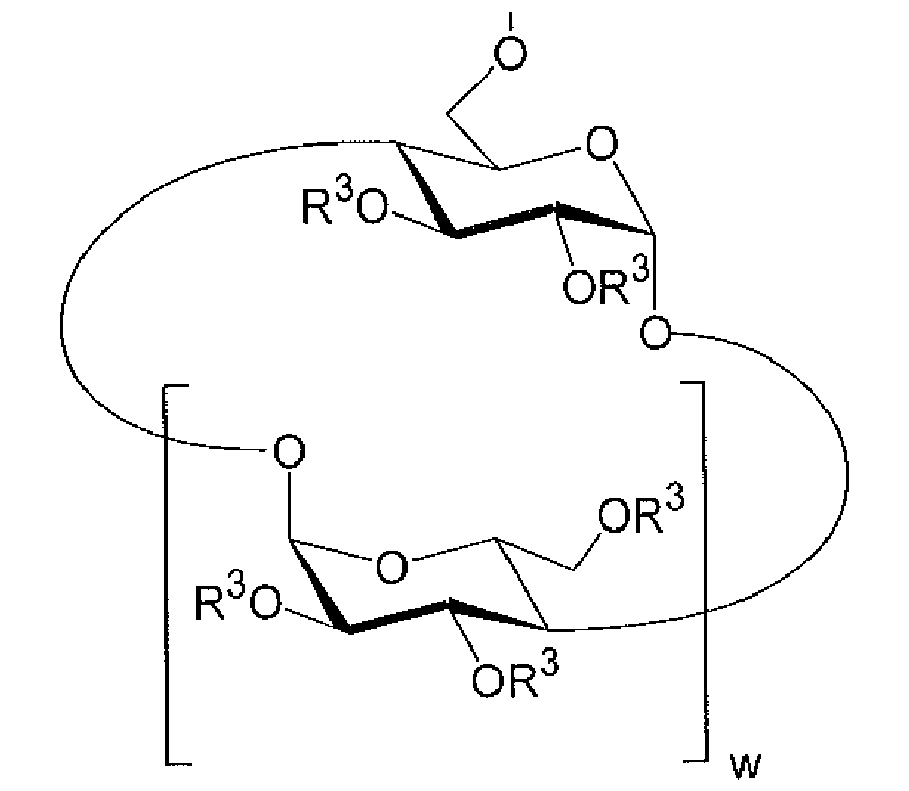
- Bevorzugt handelt es sich bei Rest R3 um Wasserstoffatom,einen gegebenenfalls mit Amin-, Carbonyl-, Carboxyl- oder Oxiranylgruppen substituierten ein- oder mehrwertigen Kohlenwasserstoffrest, einen Polyetherrest, der gegebenenfalls mit Hydroxy-, Mercapto-, Amin-, Ammonium-, Carbonyl-, Carboxyl-, Oxiranyl- oder reaktiven Sulfonsäurederivat-Gruppen substituiert sein kann, oder einen halogentriazinfunktionellen Rest.
- Besonders bevorzugt handelt es sich bei Rest R3 um Wasserstoffatom, einwertiger Alkylrest, Acetylrest, Amino-, Epoxy-, Vinylsulfonyl-, 2-Sulfooxyethyl-sulfonyl-, 2-Chlorethyl-sulfonyl- und (Meth)acryloylfunktioneller Alkyl- oder Polyetherrest sowie halogentriazinfunktioneller Rest, insbesondere um Wasserstoffatom, den Methyl-, Ethyl- oder Propylrest, den Acetylrest, den β-Aminoethyl-, β-(N-Methyl)aminoethyl-, γ-Aminopropyl-, γ-(N-tert.-Butyl)amino-2-hydroxy-propyl- und γ-(N-Cyclohexyl)amino-2-hydroxy-propyl-rest, den Glycidoxypropylrest, den 3-(Vinylsulfonyl)-propyl-, Vinylsulfonyl-, (2-Sulfooxyethyl)sulfonyl-, (2-Chloroethyl)sulfonyl-, p-Vinylsulfonyl-phenyl-, p-(2-Sulfooxyethyl)sulfonyl-phenyl- und ω-Vinyl-sulfonoyl-polyoxypropylrest, der Acryloyl-, 2-(N-Acrylamido)ethyl-, 3-(N-Acrylamido)-propyl- und 2-Hydroxy-3-methacryloyl-oxypropyl-rest sowie den 4-Chlor-6-ONa-Triazinylrest.
- Beispiele für Rest R2 sind -C3H6-O-CH2-CHOH-CH2-, -C3H6-O-(C2H4O)10-CH2-CHOH-CH2-, -C3H6-O-C6H10O4-O-CH2-CHOH-CH2-, -C3H6-C6H4 (OCH3) -O-CH2-CHOH-CH2-, -C3H6-S-CH2-CHOH-CH2-, -C3H6-NH-CH2-CHOH-CH2-, -C3H6-NH-C2H4-NH-CH2-CHOH-CH2-, -C10H20-COO-CH2-CHOH-CH2-, -C3H6-NH-CH2-CHOH-CH2-O-C3H6-, -C3H6-NH-C2H4-NH-CH2-CHOH-CH2-O-C3H6-,
-C3H6-O-CH2-CHOH-CH2-NH-C2H4-, -C3H6-O-CH2-CHOH-CH2-N (CH3) -C2H4-, -C3H6-O-CH2-CHOH-CH2-NH-C3H6-, -C3H6-O-CH2-CHOH-CH2-NH-CH2-CHOH-CH2-, -C3H6-O-CH2-CHOH-CH2-N(t-Bu)-CH2-CH2-CHOH-CH2-, -C3H6-O-CH2-CHOH-CH2-N(C6H11)-CH2-CHOH-CH2-, -C3H6-O-(CO)-CH2-CH2-NH-CH2-CHOH-CH2-, -C3H6-O-(CO)-CH(CH3)-CH2-NH-CH2-CHOH-CH2-, -C3H6-O-CH2-CH2-(CO)NH-C2H4-, -C3H6-S-CH2-CH2-(CO)NH-C2H4-, -C3H6-NH-CH2-CH2-(CO)NH-C2H4-, -C3H6-NH-C2H4-CH2-CH2-(CO)NH-C2H4-, -C10H20-COO-CH2CH2-(CO)NH-C2H4-, -C3H6-C6H4(OCH3)-O-CH2-CH2-(CO)NH-C2H4-, -C3H6-O-C6H10O4-O-CH2-CH2-(CO)NH-C2H4-, -C3H6-O-CH2CH2-(CO)NH-C3H6-, -C3H6-S-CH2-CH2-(CO)NH-C3H6-, -C3H6-NH-CH2-CH2-(CO)NH-C3H6-, -C3H6-NH-C2H4-CH2-CH2-(CO)NH-C3H6-, -C10H20-COO-CH2-CH2-(CO)NH-C3H6-, -C3H6-C6H4(OCH3)-O-CH2-CH2-(CO)NH-C3H6-, -C3H6-O-C6H10O4-O-CH2-CH2-(CO)NH-C3H6-, -C3H6-O-CH2-CH2-CH2-(CO)NH-CH2-CHOH-CH2-, -C3H6-S-CH2-CH2-(CO)NH-CH2-CHOH-CH2-, -C3H6-NH-CH2-CH2-(CO)NH-CH2-CHOH-CH2-, -C3H6-NH-C2H4-CH2-CH2-(CO)NH-CH2-CHOH-CH2-, -C10H20-COO-CH2-CH2-(CO)NH-CH2-CHOH-CH2-, -C2H4-C6H4(CH3)-O-CH2-CH2-(CO)NH-CH2-CHOH-CH2-, -C3H6-O-C6H10O4-O-CH2-CH2-(CO)NH-CH2-CHOH-CH2-, -C3H6-O-CH2-CH2-COO-C3H6-, -C3H6-S-CH2-CH2-COO-C3H6-, -C3H6-NH-CH2-CH2-COO-C3H6-, -C3H6-NH-C2H4-CH2-CH2-COO-C3H6-, -C10H20-COO-CH2-CH2-COO-C3H6-, -C3H6-C6H4(OCH3)-O-CH2-CH2-COO-C3H6-, -C3H6-O-C6H10O4-O-CH2CH2-COO-C3H6-, -C3H6-O-CH2-CH2-COO-CH2-CHOH-CH2-(OC3H6)0-10-, -C3H6-S-CH2-CH2-COO-CH2-CHOH-CH2-(OC3H6)0-10-, -C3H6-NH-CH2-CH2-COO-CH2-CHOH-CH2-(OC3H6)0-10-, -C3H6-NH-C2H4-CH2-CH2-COO-CH2-CHOH-CH2-(OC3H6)0-10-, -C10H20-COO-CH2-CH2-COO-CH2-CHOH-CH2-(OC3H6)0-10-, -C3H6-C6H4(OCH3)-O-CH2-CH2-COO-CH2-CHOH-CH2-(OC3H6)0-10-, -C3H6-O-C6H10O4-O-CH2-CH2-COO-CH2-CHOH-CH2-(OC3H6)0-10-, -C3H6-O-CH2-CH(CH3)-(CO)NH-C2H4-, -C3H6-S-CH2-CH(CH3)-(CO)NH-C2H4-, -C3H6-NH-CH2-CH(CH3)-(CO)NH-C2H4-, -C3H6-NH-C2H4-CH2-CH (CH3)-(CO)NH-C2H4-, -C10H20-COO-CH2-CH(CH3)-(CO)NH-C2H4-, -C3H6-C6H4(OCH3)-O-CH2-CH(CH3)-(CO)NH-C2H4-, -C3H6-O-C6H10O4-CH2-CH(CH3)-(CO)NH-C2H4-, -C3H6-O-CH2-CH(CH3)-(CO)NH-C3H6-, -C3H6-S-CH2-CH(CH3)-(CO)NH-C3H6-, -C3H6-NH-CH2-CH(CH3)-(CO)NH-C3H6-, -C3H6-NH-C2H4-CH2-CH(CH3)-(CO)NH-C3H6-, -C10H20-COO-CH2-CH(CH3)-(CO)NH-C3H6-, -C3H6-C6H4(OCH3)-O-CH2-CH(CH3)-(CO)NH-C3H6-, -C3H6-O-C6H10O4-O-CH2-CH(CH3)-(CO)NH-C3H6-, -C3H6-O-CH2-CH(CH3)-(CO)NH-CH2-CHOH-CH2-, -C3H6-S-CH2-CH(CH3)-(CO)NH-CH2-CHOH-CH2, -C3H6-NH-CH2-CH(CH3)-(CO)NH-CH2-CHOH-CH2-, -C3H6-NH-C2H4-CH2-CH(CH3)-(CO)NH-CH2-CHOH-CH2-, -C10H20-COO-CH2-CH(CH3)-(CO)NH-CH2-CHOH-CH2-, -C3H6-C6H4(OCH3)-O-CH2-CH(CH3)-(CO)NH-CH2-CHOH-CH2-, -C3H6-O-C6H10O4-O-CH2-CH(CH3)-(CO)NH-CH2-CHOH-CH2-, -C3H6-O-CH2-CH(CH3)-COO-C3H6-, -C3H6-S-CH2-CH(CH3)-COO-C3H6-, -C3H6-NH-CH2-CH(CH3)-COO-C3H6-, -C3H6-NH-C2H4-CH2-CH(CH3)-COO-C3H6-, -C10H20-COO-CH2-CH(CH3)-COO-C3H6-, -C2H4-C6H4(CH3)-O-CH2-CH(CH3)-COO-C3H6-, -C3H6-O-C6H10O4-O-CH2-CH(CH3)-COO-C3H6-, -C3H6-O-CH2-CH(CH3)-COO-CH2-CHOH-CH2-(OC3H6)0-10-, -C3H6-S-CH2-CH(CH3)-COO-CH2-CHOH-CH2-(OC3H6)0-10-, -C3H6-NH-CH2-CH(CH3)-COO-CH2-CHOH-CH2-(OC3H6)0-10-, -C3H6-NH-C2H4-CH2-CH(CH3)-COO-CH2-CHOH-CH2-(OC3H6)0-10-, -C10H20-COO-CH2-CH(CH3)-COO-CH2-CHOH-CH2-(OC3H6)0-10-, -C3H6-C6H4(OCH3)-O-CH2-CH(CH3)-COO-CH2-CHOH-CH2-(OC3H6)0-10-, -C3H6-O-C6H10O4-O-CH2-CH(CH3)-COO-CH2-CHOH-CH2-(OC3H6)0-10-,
-C3H6-O-CO-C2H4-NH-C2H4-, -C3H6-O-CO-C2H4-N(CH3)-C2H4-, -C3H6-O-CO-C2H4-NH-C3H6-, -C3H6-O-CO-C2H4-NH-CH2-CHOH-CH2-, -C3H6-O-CO-C2H4-N(t-Bu)-CH2-CHOH-CH2-, -C3H6-O-CO-C2H4-N(C6H11)-CH2-CHOH-CH2-, -C3H6-O-CO-C2H4-NH-CH2-CHOH-CH2-, -C3H6-O-CO-C2H4-NH-CH2-CHOH-CH2-, -C3H6-O-CO-CH(CH3)CH2-NH-C2H4-, -C3H6-O-CO-CH(CH3)CH2-N(CH3)-C2H4-, -C3H6-O-CO-CH(CH3)CH2-NH-C3H6-, -C3H6-O-CO-CH(CH3)CH2-NH-CH2-CHOH-CH2-, -C3H6-O-CO-CH(CH3)CH2-N(t-Bu)-CH2-CHOH-CH2-, -C3H6-O-CO-CH(CH3)CH2-N(C6H11)-CH2-CHOH-CH2-, -C3H6-O-CO-CH(CH3)CH2-NH-CH2-CHOH-CH2-, -C3H6-O-CO-CH(CH3)CH2-NH-CH2-CHOH-CH2-,
-C3H6-O-C2H4-SO2-C6H4-, -C3H6-O-(C2H4O)10-C2H4-SO2-C6H4-, -C3H6-O-C6H10O4-C2H4-SO4-C6H4-, -C3H6-C6H4(OCH3)-C2H4-SO2-C6H4-, -C3H6-S-C2H4-SO2-C6H4-, -C3H6-NH-C2H4-SO2-C6H4-, -C3H6-NH-C2H4-NH-C2H4-SO2-C6H4-, -C10H20-COO-C2H4-SO2-C6H4-, -C3H6-O-C2H4-SO2-C3H6-(OC2H4)0-10-, -C3H6-O-(C2H4O)10-C2H4-SO2-C3H6-(OC2H4)0-10-, -C3H6-O-C6H10O4-O-C2H4-SO2-C3H6-(OC2H4)0-10-, -C3H6-C6H4(OCH3)-C2H4-SO2-C3H6-(OC2H4)0-10-, -C3H6-S-C2H4-SO2-C3H6-(OC2H4)0-10-, -C3H6-NH-C2H4-SO2-C3H6-(OC2H4)0-10-, -C3H6-NH-C2H4-NH-C2H4-SO2-C3H6-(OC2H4)0-10-, -C10H20-COO-C2H4-SO2-C3H6-(OC2H4) 0-10-,
gegebenenfalls substituierte Triazinylenreste, wie z.B. mit Iminopropyl-, Iminoethylaminopropyl-, Oxypropyl-, Mercaptopropyl-, O-Carboxydecyl- und Glycosidoxy-propylrest substituierte Triazinylenreste und 6-ONa-Triazinyl-2,4-enrest, wobei Iminopropyl-, Iminoethylaminopropyl-, Oxypropyl-, Mercaptopropyl- und O-Carboxydecylrest substituierte Triazinylenreste bevorzugt sind. - Die erfindungsgemäßen Organosiliciumverbindungen besitzen vorzugsweise ein mittleres Molekulargewicht Mw von mindestens 1000 g/mol, besonders bevorzugt 2000 bis 50000 g/mol.
- Die erfindungsgemäßen Organosiliciumverbindungen sind bei Raumtemperatur, also bei 20°C, bevorzugt flüssig, wachsartig oder fest.
- Die erfindungsgemäß hergestellten Organopolysiloxane weisen bei Raumtemperatur, also bei 20°C, eine Viskosität von vorzugsweise 200 bis 100000 mm2/s, besonders bevorzugt 500 bis 20000 mm2/s, auf.
- Falls es sich bei den erfindungsgemäßen Cyclodextrinreste aufweisenden Organosiliciumverbindungen um Organosiloxane handelt, sind solche der Formel
AfR3-fSiO(SiR2O)g(SiRAO)hSiR3-fAf (III)
bevorzugt, wobei A und R die oben dafür angegebene Bedeutung haben, f 0 oder 1 ist, g und h jeweils unabhängig voneinander 0 oder eine ganze Zahl von 1 bis 500 sind, mit der Maßgabe, dass mindestens ein Rest A je Molekül enthalten ist und die g Einheiten (SiR2O) und die h Einheiten (SiRAO) beliebig im Molekül verteilt sein können. - Weitere Beispiele sind außer den Organopolysiloxanen der Formel (III) die entsprechenden cyclischen Verbindungen sowie Mischungen aus den Cyclen und den linearen Verbindungen.
- Beispiele für erfindungsgemäße Cyclodextrinreste aufweisende Organosiliciumverbindungen sind


- Die erfindungsgemäßen Cyclodextrinreste aufweisenden Organosiliciumverbindungen können nach beliebigen Verfahren hergestellt werden, wie etwa durch a) Kondensationsreaktion, b) nucleophile Substitution, z.B. von monochlortriazinfunktionellem Cyclodextrin(derivat) mit Hydroxy-, Mercapto-, Amino- oder Carboxylgruppen aufweisender Organosiliciumverbindung, durch c) Epoxidring-Öffnungsreaktionen, wie z.B. von aminofunktionellem Cyclodextrin(derivat) mit epoxyfunktioneller Organosiliciumverbindung bzw. epoxyfuntionellem Cyclodextrin(derivat) mit hydroxy-, mercapto- oder aminofunktioneller Organosiliciumverbindung oder d) durch Michael-ähnliche Additionsreaktionen, wie z.B. von aminofunktionellem Cyclodextrin(derivat) mit (meth)acrylfunktioneller Organosiliciumverbindung bzw. von hydroxy-, mercapto- oder aminofunktioneller Organosiliciumverbindung mit (meth)-acrylsäure- und vinylsulfonsäure(derivat)-funktionellem Cyclodextrin(derivat).
- Die erfindungsgemäßen Organosiliciumverbindungen können jeweils abhängig von den funktionellen Gruppen der Reaktanden auf verschiedene Art und Weise hergestellt werden.
- Ein weiterer Gegenstand der vorliegenden Erfindung ist ein Verfahren (Verfahren 1) zur Herstellung der erfindungsgemäßen Organosiliciumverbindungen, dadurch gekennzeichnet, dass halogentriazinfunktionelles Cyclodextrin(derivat) mit Amino-, Mercapto-, Hydroxy-, Carboxy-, Anhydrid-, Glycosido-, Phenol-, Polyglycol-, Phosphonato- oder Silalactongruppen aufweisender Organosiliciumverbindung umgesetzt wird.
- Bei den erfindungsgemäß eingesetzten Organosiliciumverbindungen kann es sich um beliebige Amino-, Mercapto-, Hydroxy-, Carboxy-, Anhydrid-, Glycosido-, Phenol-, Polyglycol-, Phosphonato- oder Silalactongruppen aufweisende Organosiliciumverbindungen handeln.
- Vorzugsweise handelt es sich bei den im erfindungsgemäßen Verfahren 1 eingesetzten Organosiliciumverbindungen um solche aus Einheiten der Formel
A1 a1RbXcHdSiO(4-a1-b-c-d)/2 (I1),
worin
R, X, b, c und d eine der oben dafür angegebenen Bedeutung haben, A1 gleich oder verschieden sein kann und einen Amino-, Mercapto-, Hydroxy-, Carboxy-, Anhydrid-, Glycosido-, Phenol-, Polyglycol-, Phosphonato- oder Silalactonrest bedeutet und a1 eine für a angegebene Bedeutung hat, mit der Maßgabe, dass die Summe a1+b+c+d ≤ 3 ist und die Organosiliciumverbindung pro Molekül mindestens einen Rest A1 aufweist. - Bevorzugt handelt es sich bei Rest A1 um mit Mercapto- oder Hydroxygruppen substituierte Kohlenwasserstoffreste und deren Derivate, wie Mercaptopropyl- und Hydroxypropylrest, mit Aminogruppen substituierte Kohlenwasserstoffreste und deren Derivate, wie Aminopropyl-, Aminopropylaminoethylrest und Cyclohexylaminopropylrest, sowie mit Carbonsäuregruppen bzw. deren Derivaten sustituierte Kohlenwasserstoffreste, wie z.B. mit Alkansäureresten, wie dem Essigsäurerest, dem Buttersäurerest, dem Undecensäurerest, mit Säureanhydriden, wie dem Bernsteinsäureanhydridrest, und mit Estern, wie dem Undecensilylesterrest, wobei mit Aminogruppen substituierte Kohlenwasserstoffreste und deren Derivate, wie Aminopropyl-, Aminopropylaminoethylrest und Cyclohexylaminopropylrest, besonders bevorzugt sind.
- Bei den bevorzugten und besonders bevorzugten Spezies der erfindungsgemäß eingesetzten Organosiliciumverbindungen aus Einheiten der Formel (I1) handelt es sich selbstverständlich um analoge Strukturen wie oben bereits im Zusammenhang mit den erfindungsgemäßen Organosiliciumverbindungen beschrieben.
- Die erfindungsgemäß eingesetzten Amino-, Mercapto-, Hydroxy-, Carboxy-, Anhydrid-, Glycosido-, Phenol-, Polyglycol-, Phosphonato- oder Silalactongruppen aufweisenden Organosiliciumverbindungen sind handelsübliche Produkte bzw. nach in der Siliciumchemie gängigen Verfahren herstellbar.
- Bei dem erfindungsgemäß eingesetzten halogentriazinfunktionellen Cyclodextrin(derivat) kann es sich um ein beliebiges auch bisher bekanntes Cyclodextrin(derivat), das über eine oder mehrere, gleiche oder verschiedene reaktive Halogentriazingruppen verfügt, handeln.
- Beispiele für die erfindungsgemäß eingesetzten halogentriazinfunktionellen Cyclodextrin(derivat)e sind solche der allgemeinen Formel

R3 gleich oder verschieden sein kann und eine oben dafür angegebene Bedeutung hat,
Y und Z gleich oder verschieden sein können und Halogenatom, Reste -OR mit R gleich der obengenannten Bedeutung, -OH oder -ONa bedeuten, mit der Maßgabe, dass mindestens einer der Reste Y oder Z die Bedeutung von Halogenatom haben muß. - Bei den erfindungsgemäß eingesetzten halogentriazinfunktionellen Cyclodextrin(derivat)en sind solche bevorzugt, welche in 4- und 6-Position des Halogentriazinringes Fluor- oder Chlorsubstituenten sowie höchstens eine OH- oder ONa-Gruppe tragen. Besonders bevorzugt ist das (4-Chlor-6-ONa-Triazinyl)-Cyclodextrin(derivat).
- Die erfindungsgemäß eingesetzten halogentriazinfunktionellen Cyclodextrin(derivat)e sind handelsübliche Produkte bzw. nach in der Chemie gängigen Verfahren herstellbar.
- Bei dem erfindungsgemäßen Verfahren 1 wird halogentriazinfunktionelles Cyclodextrin(derivat) in Mengen von bevorzugt 0,1 bis 90 Gewichtsprozent, besonders bevorzugt 0,1 bis 50 Gewichtsprozent, insbesondere 1 bis 30 Gewichtsprozent, jeweils bezogen auf das Gesamtgewicht der erfindungsgemäß eingesetzten Amino-, Mercapto-, Hydroxy-, Carboxy-, Anhydrid-, Glycosido-, Phenol-, Polyglycol-, Phosphonato- oder Silalactongruppen aufweisender Organosiliciumverbindung, eingesetzt, wobei die molare Cyclodxtrinmenge maximal 95 mol-% der oben beschriebenen funktionellen Gruppen in der erfindungsgemäß eingesetzten Organosiliciumverbindung betragen darf.
- Das erfindungsgemäße Verfahren 1 kann mit oder ohne Katalyse erfolgen, wobei die basische Katalyse bevorzugt ist.
- Als gegebenenfalls eingesetzter Katalysator eignen sich alle bekannten Verbindungen, welche die Nucleophilie der Gruppe A1 der erfindungsgemäß eingesetzten Organosiliciumverbindungen durch Deprotonierung erhöhen. Beispiele für solche Katalysatoren sind Benzyltrimethylammoniumhydroxid, Tetramethylammoniumhydroxid, Alkalihydroxid und Erdalkalihydroxid, Alkalialkoholate und Alkaliamide, wobei Alkalihydroxide bevorzugt sind.
- Falls bei dem erfindungsgemäßen Verfahren 1 Katalysatoren eingesetzt werden, handelt es sich um Mengen von bevorzugt 0,001 bis 1 Mol, bezogen auf ein Mol reaktiver Gruppe A1 der erfindungsgemäß eingesetzten Organosiliciumverbindung aus Einheiten der Formel (I1).
- Ein weiterer Gegenstand der vorliegenden Erfindung ist ein Verfahren (Verfahren 2) zur Herstellung der erfindungsgemäßen Organosiliciumverbindungen, dadurch gekennzeichnet, dass epoxyfuntionelles Cyclodextrin(derivat) mit Amino-, Mercapto-, Carboxy-, Anhydrid-, Hydroxy-, Glycosido-, Phenol-, Polyglycol-, Phosphonato- oder Silalactongruppen aufweisender Organosiliciumverbindung umgesetzt wird.
- Bei den erfindungsgemäß eingesetzten Organosiliciumverbindungen kann es sich um beliebige Amino-, Mercapto-, Carboxy-, Anhydrid-, Hydroxy-, Glycosido-, Phenol-, Polyglycol-, Phosphonato- oder Silalactongruppen aufweisende Organosiliciumverbindungen handeln.
- Vorzugsweise handelt es sich bei den im erfindungsgemäßen Verfahren 2 eingesetzten Organosiliciumverbindungen um solche aus Einheiten der Formel
A2 a2RbXcHdSiO(4-a2-b-c-d)/2 (I2),
worin
R, X, b, c und d die oben dafür angegebene Bedeutung haben, A2 gleich oder verschieden sein kann und einen Amino-, Mercapto-, Carboxy-, Anhydrid-, Hydroxy-, Glycosido-, Phenol-, Polyglycol-, Phosphonato- oder Silalactongruppen bedeutet und a2 eine für a angegebene Bedeutung hat, mit der Maßgabe, dass die Summe a2+b+c+d ≤ 4 ist und die Organosiliciumverbindung pro Molekül mindestens einen Rest A2 aufweist. - Bevorzugt handelt es sich bei Rest A2 um mit Mercapto- oder Hydroxygruppen substituierte Kohlenwasserstoffreste und deren Derivate, wie Mercaptopropyl- und 3-Hydroxy-3-methyl-butylrest, Aminogruppen substituierte Kohlenwasserstoffreste und deren Derivate, wie Aminopropyl-, Aminopropylaminoethylrest und Cyclohexylaminopropylrest, sowie mit Carbonsäuregruppen bzw. deren Derivaten sustituierte Kohlenwasserstoffreste, wie z.B. mit Alkansäureresten, wie dem Essigsäurerest, dem Buttersäurerest, dem Undecensäurerest, mit Säureanhydriden, wie dem Bernsteinsäureanhydridrest, und mit Estern, wie dem Undecensilylesterrest, wobei mit Aminogruppen substituierte Kohlenwasserstoffreste und deren Derivate, wie Aminopropyl-, Aminopropylaminoethylrest und Cyclohexylaminopropylrest besonders bevorzugt sind.
- Bei den bevorzugten und besonders bevorzugten Spezies der erfindungsgemäß eingesetzten Organosiliciumverbindungen aus Einheiten der Formel (I2) handelt es sich selbstverständlich um analoge Strukturen wie oben bereits im Zusammenhang mit den erfindungsgemäßen Organosiliciumverbindungen beschrieben.
- Die erfindungsgemäß eingesetzten Amino-, Mercapto-, Carboxy-, Anhydrid-, Hydroxy-, Glycosido-, Phenol-, Polyglycol-, Phosphonato- oder Silalactongruppen aufweisenden Organosiliciumverbindungen sind handelsübliche Produkte bzw. nach in der Siliciumchemie gängigen Verfahren herstellbar.
- Bei dem erfindungsgemäß eingesetzten epoxyfunktionellen Cyclodextrin(derivat) kann es sich um ein beliebiges auch bisher bekanntes Cyclodextrin(derivat), das über eine oder mehrere, gleiche oder verschiedene epoxyfunktionelle Gruppen verfügt, handeln.
- Beispiele für die erfindungsgemäß eingesetzten epoxyfunktionellen Cyclodextrin(derivat)e sind Glycidoxypropyl-Cyclodextrin, 4,5-Epoxypentyl-Cyclodextrin, 6,7-Epoxyheptyl-Cyclodextrin und 8,10-Epoxyundecyl-Cyclodextrin, wobei das Glycidoxypropyl-Cyclodextrin bevorzugt ist.
- Die erfindungsgemäß eingesetzten epoxyfunktionellen Cyclodextrin(derivat)e sind handelsübliche Produkte bzw. nach in der Chemie gängigen Verfahren herstellbar,
- Bei dem erfindungsgemäßen Verfahren 2 wird epoxyfunktionelles Cyclodextrin(derivat) in Mengen von bevorzugt 0,1 bis 90 Gewichtsprozent, besonders bevorzugt 1 bis 50 Gewichtsprozent, insbesondere 1 bis 30 Gewichtsprozent, jeweils bezogen auf das Gesamtgewicht der erfindungsgemäß eingesetzten Amino-, Mercapto-, Carboxy-, Anhydrid-, Hydroxy-, Glycosido-, Phenol-, Polyglycol-, Phosphonato- oder Silalactongruppen aufweisenden Organosiliciumverbindung, eingesetzt, wobei die molare Cyclodxtrinmenge maximal 95 mol-% der oben beschriebenen funktionellen Gruppen in der erfindungsgemäß eingesetzten Organosiliciumverbindung betragen darf.
- Das erfindungsgemäße Verfahren 2 kann mit oder ohne Katalyse erfolgen, wobei mit Katalyse bevorzugt ist.
- Als gegebenenfalls eingesetzter Katalysator eignen sich alle bekannten Verbindungen, die Epoxidring-Öffnungsreaktionen katalysieren, wie z.B. Brønsted-Säuren, wie Phosphorsäure, Schwefelsäure, Salzsäure, Eisessig und Ameisensäure, Lewis-Säuren, wie Litiumperchlorat, Zinktetrafluoroborat, Eisen(II)chlorid und Zinn(IV)chlorid, Bronsted-Basen, wie z.B. Natriummethylat und Alkaliamide, sowie Ammoniumchlorid, Tetraalkylammoniumbromide und Alkaliiodide.
- Falls bei dem erfindungsgemäßen Verfahren Katalysatoren eingesetzt werden, handelt es sich um Mengen um bevorzugt 0,0001 bis 1 Mol, insbesondere 0,001 bis 0,5 Mol, jeweils bezogen auf ein Mol Epoxidgruppe des erfindungsgemäß eingesetzten epoxyfunktionellen Cyclodextrin(derivat)s verwendet.
- Ein weiterer Gegenstand der vorliegenden Erfindung ist ein Verfahren (Verfahren 3) zur Herstellung der erfindungsgemäßen Organosiliciumverbindungen, dadurch gekennzeichnet, dass aminofuntionelles Cyclodextrin(derivat) mit epoxyfunktionellem Polysiloxan umgesetzt wird.
- Bei den erfindungsgemäß eingesetzten Organosiliciumverbindungen kann es sich um beliebige Epoxygruppen aufweisende organosiliciumverbindungen handeln.
- Vorzugsweise handelt es sich bei den im erfindungsgemäßen Verfahren 3 eingesetzten Organosiliciumverbindungen um solche aus Einheiten der Formel
A3 a 3RbXcHdSiO(4-a3-b-c-d)/2 (I3),
worin
R, X, b, c und d die oben dafür angegebene Bedeutung haben, A3 einen epoxyfunktionellen Rest bedeutet und a3 eine für a angegebene Bedeutung hat, mit der Maßgabe, dass die Summe a3+b+c+d ≤ 4 ist und die Organosiliciumverbindung pro Molekül mindestens einen Rest A3 aufweist. - Bevorzugt handelt es sich bei Rest A3 um epoxyfunktionelle Reste mit 1 bis 18 Kohlenstoffatomen, wobei der 3-Glycidoxypropylrest besonders bevozugt ist.
- Bei den bevorzugten und besonders bevorzugten Spezies der erfindungsgemäß eingesetzten Organosiliciumverbindungen aus Einheiten der Formel (I3) handelt es sich selbstverständlich um analoge Strukturen wie oben bereits im Zusammenhang mit den erfindungsgemäßen Organosiliciumverbindungen beschrieben.
- Die erfindungsgemäß eingesetzten epoxyfunktionellen Organosiliciumverbindungen sind handelsübliche Produkte bzw. nach in der Siliciumchemie gängigen Verfahren herstellbar.
- Bei dem erfindungsgemäß eingesetzten aminofunktionellen Cyclodextrin(derivat) kann es sich um ein beliebiges auch bisher bekanntes Cyclodextrin(derivat), das über eine oder mehrere, gleiche oder verschiedene mit Aminogruppen und deren Derivate substituierte Kohlenwasserstoffreste, wie z.B. den β-Aminoethyl-, β-(N-Methyl) aminoethyl-, β-(N-Ethyl) aminoethyl-, γ-Aminopropyl-, γ-Amino-2-hydroxy-propyl-, γ-(N-Methyl)amino-2-hydroxy-propyl-, γ-(N-Ethyl)amino-2-hydroxy-propyl-, γ-(N-tert.-Butyl)amino-2-hydroxy-propyl-, γ-(N-Cyclohexyl) amino-2-hydroxypropyl-, 3-(γ-Amino-2-hydroxy-propyloxy-)propyl- und 3-{γ-(N-Ethyl)amino-2-hydroxy-propyloxy-}propyl-rest, verfügt, handeln.
- Bevorzugt handelt es sich bei dem mit Aminogruppen und deren Derivate substituierten Kohlenwasserstoffrest, welche das erfingsgemäß eingesetzte Cyclodextrin(derivat) aufweist, um den β-Aminoethyl-, β-(N-Methyl)aminoethyl-, γ-Aminopropyl-, γ-(N-tert.-Butyl) amino-2-hydroxy-propyl- und γ-(N-Cyclohexyl)amino-2-hydroxy-propyl-rest.
- Die erfindungsgemäß eingesetzten aminofunktionellen Cyclodextrin(derivat)e sind handelsübliche Produkte bzw. nach in der Chemie gängigen Verfahren herstellbar.
- Bei dem erfindungsgemäßen Verfahren 3 wird aminofunktionelles Cyclodextrin(derivat) in Mengen von bevorzugt 0,1 bis 90, besonders bevorzugt 1 bis 50, insbesondere 1 bis 30 Gewichtsprozent, jeweils bezogen auf das Gesamtgewicht der erfindungsgemäß eingesetzten Epoxygruppen aufweisenden organosiliciumverbindung, eingesetzt, wobei die molare Cyclodxtrinmenge maximal 95 mol-% der epoxyfunktionellen Gruppen in der erfindungsgemäß eingesetzten Organosiliciumverbindung betragen darf.
- Das erfindungsgemäße Verfahren 3 kann mit oder ohne Katalyse erfolgen, wobei mit Katalyse bevorzugt ist.
- Als Katalysator eignen sich alle bekannten Verbindungen, die Epoxidring-Öffnungsreaktionen katalysieren, wie z.B. Bronsted-Säuren, wie Phosphorsäure, Schwefelsäure, Salzsäure, Eisessig und Ameisensäure, Lewis-Säuren, wie Litiumperchlorat, Zinktetrafluoroborat, Eisen (II) chlorid und Zinn (IV) chlorid, Brønsted-Basen, wie z.B. Natriummethylat und Alkaliamide, sowie Ammoniumchlorid, Tetraalkylammoniumbromide und Alkaliiodide.
- Falls bei dem erfindungsgemäßen Verfahren 3 Katalysatoren eingesetzt werden, handelt es sich um Mengen von bevorzugt 0,0001 bis 1 Mol, insbesondere 0,001 bis 0,5 Mol, jeweils bezogen auf ein Mol Epoxidgruppe des erfindungsgemäß eingesetzten Organopolysiloxans verwendet.
- Ein weiterer Gegenstand der vorliegenden Erfindung ist ein Verfahren (Verfahren 4) zur Herstellung der erfindungsgemäßen Organosiliciumverbindungen, dadurch gekennzeichnet, dass ein vinylsulfonylfunktionelles Cyclodextrin(derivat) oder ein Cyclodextrin(derivat), welches über vinylsulfonylderivat-Funktionen, wie 2-Sulfooxyethyl-sulfonyl- und 2-Chlorethyl-sulfonylgruppen verfügt, mit Amino-, Mercapto-, Hydroxy-, Carboxy-, Anhydrid-, Glycosido-, Phenol-, Polyglycol-, Phosphonato- oder Silalactongruppen aufweisender Organosiliciumverbindung umgesetzt wird.
- Bei den erfindungsgemäß eingesetzten Organosiliciumverbindungen kann es sich um beliebige Amino-, Mercapto-, Hydroxy-, Carboxy-, Anhydrid-, Glycosido-, Phenol-, Polyglycol-, Phosphonato- oder Silalactongruppen aufweisende Organosiliciumverbindungen handeln.
- Vorzugsweise handelt es sich bei den im erfindungsgemäßen Verfahren 4 eingesetzten Organosiliciumverbindungen um solche aus Einheiten der Formel
A4 a 4RbXcHdSiO(4-a4-b-c-d)/2 (I4),
worin
R, X, b, c und d die oben dafür angegebene Bedeutung haben, A4 gleich oder verschieden sein kann und einen Amino-, Mercapto-, Hydroxy -, Carboxy-, Anhydrid-, Glycosido-, Phenol-, Polyglycol-, Phosphonato- oder Silalactonrest bedeutet und a4 eine für a angegebene Bedeutung hat, mit der Maßgabe, dass die Summe a4+b+c+d ≤ 4 ist und die Organosiliciumverbindung pro Molekül mindestens einen Rest A4 aufweist. - Bevorzugt handelt es sich bei Rest A4 um mit Mercapto- oder Hydroxygruppen substituierte Kohlenwasserstoffreste und deren Derivate, wie Mercaptopropyl- und Hydroxypropylrest, Aminogruppen substituierte Kohlenwasserstoffreste und deren Derivate, wie Aminopropyl-, Aminopropylaminoethylrest und Cyclohexylaminopropylrest, sowie mit Carbonsäuregruppen bzw. deren Derivaten sustituierte Kohlenwasserstoffreste, wie z.B. mit Alkansäureresten, wie dem Essigsäurerest, dem Buttersäurerest, dem Undecensäurerest, mit Säureanhydriden, wie dem Bernsteinsäureanhydridrest, und mit Estern, wie dem Undecensilylesterrest, wobei mit Aminogruppen substituierte Kohlenwasserstoffreste und deren Derivate, wie Aminopropyl-, Aminopropylaminoethylrest und Cyclohexylaminopropylrest besonders bevorzugt sind.
- Bei den bevorzugten und besonders bevorzugten Spezies der erfindungsgemäß eingesetzten Organosiliciumverbindungen aus Einheiten der Formel (I4) handelt es sich selbstverständlich um analoge Strukturen wie oben bereits im Zusammenhang mit den erfindungsgemäßen Organosiliciumverbindungen beschrieben.
- Die erfindungsgemäß eingesetzten Amino-, Mercapto-, Hydroxy-, Carboxy-, Anhydrid-, Glycosido-, Phenol-, Polyglycol-, Phosphonato- oder Silalactongruppen aufweisenden Organosiliciumverbindungen sind handelsübliche Produkte bzw. nach in der Siliciumchemie gängigen Verfahren herstellbar.
- Bei dem erfindungsgemäß eingesetzten vinylsulfonylfunktionellen Cyclodextrin(derivat) bzw. Cyclodextrin (derivat), welches über vinylsulfonylderivat-Funktionen, wie 2-Sulfooxyethyl-sulfonyl- und 2-Chlorethyl-sulfonylgruppen verfügt, kann es sich um ein beliebiges auch bisher bekanntes Cyclodextrin(derivat), das über eine oder mehrere, gleiche oder verschiedene reaktive Vinylsulfonylgruppen oder Vinylsulfonylgruppen-Derivate, wie 2-Sulfooxyethyl-sulfonyl- und 2-Chlorethylsulfonylgruppen, verfügt, handeln.
- Beispiele für die erfindungsgemäß eingesetzten vinylsulfonylfunktionellen bzw. 2-Sulfooxyethyl-sulfonyl- oder 2-Chlorethyl-sulfonyl-funktionellen Cyclodextrin(derivat)e sind solche der allgemeinen Formel

R3 gleich oder verschieden sein kann und eine der oben dafür angegebenen Bedeutungen hat,
R4 gleich oder verschieden sein kann und Wasserstoffatom oder eine oben für R angegebene Bedeutung hat,
E -CH=CH2, -C2H4-OSO3H oder -C2H4-Cl ist,
i, j und k gleich oder verschieden sein können und 0 oder eine ganze Zahl von 1 bis 100, bevorzugt 0 oder eine ganze Zahl von 1 bis 20, bedeuten und
10 oder eine ganze Zahl von 1 bis 35, bevorzugt 0 oder eine ganze Zahl von 1 bis 12, ist. - Bevorzugt handelt es sich bei den erfindungsgemäß eingesetzten vinylsulfonylfunktionellen bzw. 2-Sulfooxyethyl-sulfonyl- oder 2-Chlorethyl-sulfonyl-funktionellen Cyclodextrin(derivat) en um 3-(Vinylsulfonyl)-propyloxy-Cyclodextrin, Vinylsulfonoyl-Cyclodextrin, (2-Sulfooxyethyl)sulfonoyl-Cyclodextrin, (2-Chloroethyl)sulfonoyl-Cyclodextrin, p-Vinylsulfonyl-phenoxy-Cyclodextrin und p-(2-Sulfooxyethyl)sulfonyl-phenoxy-Cyclodextrin, sowie um polypropoxylierte Cyclodextrine, welche in ω-Position der Polyethergruppe eine Vinyl-sulfonoyl-, (2-Sulfooxyethyl)-sulfonoyl- oder (2-Chloroethyl)sulfonoyl-Gruppe tragen.
- Die erfindungsgemäß eingesetzten vinylsulfonylfunktionellen bzw. 2-Sulfooxyethyl-sulfonyl- oder 2-Chlorethyl-sulfonyl-funktionellen Cyclodextrin(derivat)e aminofunktionellen Cyclodextrin(derivat)e sind handelsübliche Produkte bzw. nach in der Chemie gängigen Verfahren herstellbar.
- Bei dem erfindungsgemäßen Verfahren 4 wird erfindungsgemäß eingesetztes vinylsulfonylfunktionelles bzw. 2-Sulfooxyethyl-sulfonyl- oder 2-Chlorethyl-sulfonyl-funktionelles Cyclodextrin(derivat) in Mengen von bevorzugt 0,1 bis 90 Gewichtsprozent, besonders bevorzugt 1 bis 50 Gewichtsprozent, insbesondere 1 bis 30 Gewichtsprozent, jeweils bezogen auf das Gesamtgewicht der erfindungsgemäß eingesetzten Amino-, Mercapto-, Hydroxy-, Carboxy-, Anhydrid-, Glycosido-, Phenol-, Polyglycol-, Phosphonato- oder Silalactongruppen aufweisenden Organosiliciumverbindung, eingesetzt, wobei die molare Cyclodxtrinmenge maximal 95 mol-% der epoxyfunktionellen Gruppen in der erfindungsgemäß eingesetzten Organosiliciumverbindung betragen darf.
- Das erfindungsgemäße Verfahren 4 kann mit oder ohne Katalyse erfolgen, wobei als Katalysator alle bekannten Verbindungen, die Michael-ähnliche Additionsreaktionen katalysieren, eingesetzt werden können.
- Bevorzugt wird das erfindungsgemäße Verfahren 4 mit Katalyse durchgeführt, wobei die basische Katalyse besonders bevorzugt ist.
- Zur sauren Katalyse können Brønsted-Säuren, wie Phosphorsäure, Schwefelsäure, Salzsäure, Eisessig, Propion- und Ameisensäure, oder deren wässrigen Lösungen sowie Lewis-Säuren, wie Litiumperchlorat, Zinktetrafluoroborat, Eisen(II)chlorid und Zinn(IV)chlorid, verwendet werden.
- Als basische Katalysator eignen sich alle bekannten Verbindungen, welche die Nucleophilie der Gruppe A4 der erfindungsgemäß eingesetzten Organosiliciumverbindungen durch Deprotonierung erhöhen, wie z.B. Benzyltrimethylammoniumhydroxid, Tetramethylammoniumhydroxid, Alkalihydroxid und Erdalkalihydroxid, Alkalialkoholate und Alkaliamide, wobei Alkalihydroxide bevorzugt sind.
- Falls bei dem erfindungsgemäßen Verfahren 4 Katalysatoren eingesetzt werden, handelt es sich um Mengen von vorzugsweise 0,001 bis 1 Mol je Mol reaktiver Gruppe A4 der erfindungsgemäß eingesetzten Organosiliciumverbindung.
- Ein weiterer Gegenstand der vorliegenden Erfindung ist ein Verfahren (Verfahren 5) zur Herstellung der erfindungsgemäßen Organosiliciumverbindungen, dadurch gekennzeichnet, dass acryl- oder methacrylfuntionelles Cyclodextrin(derivat) mit Amino-, Mercapto-, Hydroxy-, Carboxy-, Anhydrid-, Glycosido-, Phenol-, Polyglycol-, Phosphonato- oder Silalactongruppen aufweisendem Organopolysiloxan umgesetzt wird.
- Bei den erfindungsgemäß eingesetzten Organosiliciumverbindungen kann es sich um beliebige Amino-, Mercapto-, Hydroxy-, Carboxy-, Anhydrid-, Glycosido-, Phenol-, Polyglycol-, Phosphonato- oder Silalactongruppen aufweisende Organosiliciumverbindungen handeln.
- Vorzugsweise handelt es sich bei den im erfindungsgemäßen Verfahren 5 eingesetzten Organosiliciumverbindungen um solche aus Einheiten der Formel
A5 a 5RbXcHdSiO(4-a5-b-c-d)/2 (I5),
worin
R, X, b, c und d die oben dafür angegebene Bedeutung haben, A5 gleich oder verschieden sein kann und einen Amino-, Mercapto-, Hydroxy-, Carboxy-, Anhydrid-, Glycosido-, Phenol-, Polyglycol-, Phosphonato- oder Silalactonrest bedeutet und a5 eine für a angegebene Bedeutung hat, mit der Maßgabe, dass die Summe a5+b+c+d ≤ 4 ist, und die Organosiliciumverbindung pro Molekül mindestens einen Rest A5 aufweist. - Bevorzugt handelt es sich bei Rest A5 um mit Mercapto- oder Hydroxygruppen substituierte Kohlenwasserstoffreste und deren Derivate, wie Mercaptopropyl- und Hydroxypropylrest, Aminogruppen substituierte Kohlenwasserstoffreste und deren Derivate, wie Aminopropyl-, Aminopropylaminoethylrest und Cyclohexylaminopropylrest, sowie mit Carbonsäuregruppen bzw. deren Derivaten sustituierte Kohlenwasserstoffreste, wie z.B. mit Alkansäureresten, wie dem Essigsäurerest, dem Buttersäurerest, dem Undecensäurerest, mit Säureanhydriden, wie dem Bernsteinsäureanhydridrest, und mit Estern, wie dem Undecensilylesterrest, wobei mit Aminogruppen substituierte Kohlenwasserstoffreste und deren Derivate, wie Aminopropyl-, Aminopropylaminoethylrest und Cyclohexylaminopropylrest besonders bevorzugt sind.
- Bei den bevorzugten und besonders bevorzugten Spezies der erfindungsgemäß eingesetzten Organosiliciumverbindungen aus Einheiten der Formel (I5) handelt es sich selbstverständlich um analoge Strukturen wie oben bereits im Zusammenhang mit den erfindungsgemäßen Organosiliciumverbindungen beschrieben.
- Die erfindungsgemäß eingesetzten Amino-, Mercapto-, Hydroxy-, Carboxy-, Anhydrid-, Glycosido-, Phenol-, Polyglycol-, Phosphonato- oder Silalactongruppen aufweisenden Organosiliciumverbindungen sind handelsübliche Produkte bzw. nach in der Siliciumchemie gängigen Verfahren herstellbar.
- Bei dem erfindungsgemäß eingesetzten acryl- oder methacrylfuntionellen Cyclodextrin(derivat) kann es sich um ein beliebiges auch bisher bekanntes Cyclodextrin(derivat), das über eine oder mehrere, gleiche oder verschiedene reaktive Acryl- oder Methacrylgruppen verfügt, handeln.
- Beispiele für die erfindungsgemäß eingesetzten acryl- oder methacrylfuntionellen Cyclodextrin(derivat)e sind solche der allgemeinen Formeln


CD die oben dafür angegebene Bedeutung hat,
m und n gleich oder verschieden sein können und eine ganze Zahl von 0 bis 100, bevorzugt eine ganze Zahl von 0 bis 10, bedeuten und
o eine ganze Zahl von 1 bis 35, bevorzugt eine ganze Zahl von 1 bis 12 ist. - Bei dem erfindungsgemäß eingesetzten acryl- oder methacrylfuntionellen Cyclodextrin(derivat) handelt es sich bevorzugt um Acryloyl-Cyclodextrin, 2-(Acrylamido)ethyloxy-Cyclodextrin und 3-(Acrylamido)propyloxy-Cyclodextrin sowie um 2-Hydroxy-3-methacryloyl-oxypropyl-Cyclodextrin.
- Bei dem erfindungsgemäßen Verfahren 5 wird acryl- oder methacrylfuntionelles Cyclodextrin(derivat) in Mengen von bevorzugt 0,1 bis 90 Gewichtsprozent, besonders bevorzugt 1 bis 50 Gewichtsprozent, insbesondere 1 bis 30 Gewichtsprozent, jeweils bezogen auf das Gesamtgeicht der erfindungsgemäß eingesetzten Amino-, Mercapto-, Hydroxy-, Carboxy-, Anhydrid-, Glycosido-, Phenol-, Polyglycol-, Phosphonato- oder Silalactongruppen aufweisenden Organosiliciumverbindung, eingesetzt , wobei die molare Cyclodxtrinmenge maximal 95 mol-% der epoxyfunktionellen Gruppen in der erfindungsgemäß eingesetzten Organosiliciumverbindung betragen darf.
- Die erfindungsgemäß eingesetzten acryl- oder methacrylfuntionellen Cyclodextrin(derivat)e sind handelsübliche Produkte bzw. nach in der Chemie gängigen Verfahren herstellbar.
- Das erfindungsgemäße Verfahren 5 kann mit oder ohne Katalyse erfolgen, wobei als Katalysator alle bekannten Verbindungen, die Michael-ähnliche Additionsreaktionen katalysieren, wie z.B. Bronsted-Säuren, wie Phosphorsäure, Schwefelsäure, Salzsäure, Eisessig, Propion- und Ameisensäure, oder deren wässrigen Lösungen, Lewis-Säuren, wie Litiumperchlorat, zinktetrafluoroborat, Eisen (II) chlorid und Zinn (IV) chlorid, sowie Brønsted-Basen, wie Benzyltrimethylammoniumhydroxid, Tetramethylammoniumhydroxid, Alkali- und Erdalkalihydroxid, Alkalialkoholate und Alkaliamide, eingesetzt werden können.
- Bevorzugt wird das erfindungsgemäße Verfahren 5 mit Katalyse durchgeführt, wobei dann der Katalysator in Mengen von vorzugsweise 0,001 bis 1 Mol, je Mol Doppelbindung des erfindungsgemäß eingesetzten acryl- oder methacrylfuntionellen Cyclodextrin(derivat)s verwendet wird.
- Ein weiterer Gegenstand der vorliegenden Erfindung ist ein Verfahren (Verfahren 6) zur Herstellung der erfindungsgemäßen Organosiliciumverbindungen, dadurch gekennzeichnet, dass aminofunktionelles Cyclodextrin(derivat) mit Acryl- oder Methacrylgruppen aufweisender Organosiliciumverbindung umgesetzt wird.
- Bei den erfindungsgemäß eingesetzten Organosiliciumverbindungen kann es sich um beliebige Acryl- oder Methacrylgruppen aufweisende Organosiliciumverbindungen handeln.
- Vorzugsweise handelt es sich bei den im erfindungsgemäßen Verfahren 6 eingesetzten Organosiliciumverbindungen um solche aus Einheiten der Formel
A6 a 6RbXcHdSiO(4-a6-b-c-d)/2 (I6),
worin
R, X, b, c und d die oben dafür angegebene Bedeutung haben, A6 einen acryl- oder methacrylfunktionellen Rest bedeutet und a6 eine für a angegebene Bedeutung hat, mit der Maßgabe, dass die Summe a6+b+c+d ≤ 4 ist, und die Organosiliciumverbindung pro Molekül mindestens einen Rest A6 aufweist. - Beispiele für Rest A6 sind der 3-Acryloxy-propyl- und 3-Methacryloxypropylrest.
- Bei den bevorzugten und besonders bevorzugten Spezies der erfindungsgemäß eingesetzten Organosiliciumverbindungen aus Einheiten der Formel (I6) handelt es sich selbstverständlich um analoge Strukturen wie oben bereits im Zusammenhang mit den erfindungsgemäßen Organosiliciumverbindungen beschrieben.
- Die erfindungsgemäß eingesetzten acryl- oder methacrylfunktionellen Organosiliciumverbindungen sind handelsübliche Produkte bzw. nach in der Siliciumchemie gängigen Verfahren herstellbar.
- Bei dem erfindungsgemäß eingesetzten aminofunktionellen Cyclodextrin(derivat) kann es sich um ein beliebiges auch bisher bekanntes Cyclodextrin(derivat), das über eine oder mehrere, gleiche oder verschiedene mit Aminogruppen und deren Derivaten substituierte Kohlenwasserstoffreste, wie z.B. den β-Aminoethyl-, β-(N-Methyl) aminoethyl-, β-(N-Ethyl)aminoethyl-, γ-Aminopropyl-, γ-Amino-2-hydroxy-propyl-, γ-(N-Methyl)amino-2-hydroxy-propyl-, γ-(N-Ethyl)amino-2-hydroxy-propyl-, γ-(N-tert.-Butyl)amino-2-hydroxy-propyl-, γ-(N-Cyclohexyl)amino-2-hydroxypropyl-, 3-(γ-Amino-2-hydroxy-propyl-)propyl- und 3-{γ-(N-Ethyl)amino-2-hydroxy-propyl-}propylrest, verfügt, handeln.
- Bevorzugt handelt es sich bei dem mit Aminogruppen und deren Derivate substituierten Kohlenwasserstoffrest um den β-Aminoethyl-, β-(N-Methyl)aminoethyl-, γ-Aminopropyl-, γ-(N-tert.-Butyl)amino-2-hydroxy-propyl- und γ-(N-Cyclohexyl)amino-2-hydroxy-propylrest.
- Bei dem erfindungsgemäßen Verfahren 6 wird aminofuntionelles Cyclodextrin(derivat) in Mengen von bevorzugt 0,1 bis 90 Gewichtsprozent, besonders bevorzugt 1 bis 50 Gewichtsprozent, insbesondere 1 bis 30 Gewichtsprozent, jeweils bezogen auf das Gesamtgewicht der erfindungsgemäß eingesetzten acryl- oder methacrylfuntionellen Organosiliciumverbindung, eingesetzt, wobei die molare Cyclodxtrinmenge maximal 95 mol-% der epoxyfunktionellen Gruppen in der erfindungsgemäß eingesetzten Organosiliciumverbindung betragen darf.
- Die erfindungsgemäß eingesetzten aminfuntionellen Cyclodextrin(derivat)e sind handelsübliche Produkte bzw. nach in der Chemie gängigen Verfahren herstellbar.
- Das erfindungsgemäße Verfahren 6 kann mit oder ohne Katalyse erfolgen, wobei als Katalysator alle bekannten Verbindungen, die Michael-ähnliche Additionsreaktionen katalysieren, wie z.B. Brønsted-Säuren, wie Phosphorsäure, Schwefelsäure, Salzsäure, Eisessig, Propion- und Ameisensäure, oder deren wässrigen Lösungen, Lewis-Säuren, wie Litiumperchlorat, Zinktetrafluoroborat, Eisen(II)chlorid und Zinn (IV) chlorid, sowie Brønsted-Basen, wie Benzyltrimethylammoniumhydroxid, Tetramethylammoniumhydroxid, Alkali- und Erdalkalihydroxid, Alkalialkoholate und Alkaliamide, eingesetzt werden.
- Bevorzugt wird das erfindungsgemäße Verfahren 6 mit Katalyse durchgeführt, wobei dann der Katalysator in Mengen von vorzugsweise 0,001 bis 1 Mol, je Mol Acryl- oder Methacrylgruppe der erfindungsgemäß eingesetzten Organosiliciumverbindung verwendet wird.
- Ein Vorteil von allen beschriebenen erfindungsgemäßen Verfahren besteht jeweils unabhängig voneinander darin, dass sie einfach in der Durchführung bei hoher Flexibilität sind und sowohl auf Silane, d.h. Verbindungen der Formel (I) mit a+b+c+d=4, als auch auf Polysiloxane, d.h. Verbindungen enthaltend Einheiten der Formel (I) mit a+b+c+d ≤ 3, anwendbar sind.
- Des weiteren haben die erfindungsgemäßen Verfahren den Vorteil, dass durch Modifikation des Cyclodextringehaltes sowie der Polymerstrukturen und -kettenlängen bzw. der Silanstrukturen die Eigenschaften der erfindungsgemäßen Organosiliciumverbindungen, wie Substantivität, Hydrophilie, Hydrophobie, Selbstemulgierbarkeit etc., jeweils auf einfache Art und ganz gezielt eingestellt werden können.
- Die erfindungsgemäßen Verfahren 1 bis 6 können jeweils unabhängig voneinander jeweils absatzweise, halbkontinuierlich oder vollkontinuierlich durchgeführt werden.
- Bei den erfindungsgemäßen Verfahren 1 bis 6 erfolgen die Umsetzungen bevorzugt jeweils als 1-Phasen- oder 2-Phasen-Reaktion. Im folgenden sollen drei mögliche Varianten beschrieben werden, die gleichermaßen auf alle erfindungsgemäßen Verfahren Anwendung finden können:
- als 2-Phasen-Reaktion mit mechanischem Eintrag der zur Umsetzung benötigten Energie unter gleichzeitiger Homogenisierung der Reaktionsmischung mittels einer hohe Scherkräfte erzeugenden Vorrichtung (Variante A),
- als 2-Phasen-Reaktion durch Umsetzung von Dispersionen (Variante B), oder
- als 1-Phasen-Reaktion unter Verwendung eines gegenüber den Reaktanden inerten, aprotischen Lösungsmittels (Variante C).
- Dabei erfolgt die erfindungsgemäße Umsetzung von Cyclodextrin-(derivat) mit Organosiliciumverbindung nach Variante A unter Verwendung von nicht mischbaren Lösungsmitteln für eine oder beide Reaktanden, so dass 2 Phasen entstehen, mittels geeigneter Durchmischungsmethoden je nach Verfahren mit oder ohne Katalysator.
- Geeignete Lösungsmittel für das erfindungsgemäß eingesetzte Cyclodextrin(derivat) sind solche, die gegenüber den reaktiven Gruppen des Cyclodextrin(derivat)s inert sind, wie organische aprotische Lösungsmittel, Wasser, wässrige Elektrolytlösungen, wässrige Laugen, wässrige Säuren oder organisch wässrige Mischungen aus den oben genannten aprotischen organischen Lösungsmitteln mit wässrigen Systemen. Bevorzugte organische aprotische Lösungsmittel sind Dimethylformamid und Dimethylsulfoxid. Bevorzugte wässrige Systeme sind wässrige Säuren und wässrige Laugen.
- Bei dem Lösungsmittel, in dem das erfindungsgemäß eingesetzte Cyclodextrin(derivat) gelöst wird, handelt es sich bevorzugt um wässrige Systeme, wobei wässrige Lösungen von 1 bis 50 Gew.-% besonders bevorzugt sind.
- Geeignete Lösungsmittel für die erfindungsgemäß eingesetzte Organosiliciumverbindung sind solche, die gegenüber den reaktiven Gruppen der Reaktanden inert sind, wie organische, aprotische Lösungsmittel, wie z.B. Toluol, Hexan, Cyclohexan oder dimere, oligomere oder polymere siloxane, wie z.B. Hexamethyldisiloxan oder Octamethylcyclotetrasiloxan, die nicht mit dem Lösungsmittel oder Lösungsmittelgemisch des erfindungsgemäß eingesetzten Cyclodextrin(derivat)s mischbar sind.
- Im Rahmen der vorliegenden Erfindung soll unter dem Begriff der Nicht-Mischbarkeit von Lösungsmitteln eine Mischbarkeit bis max. 1 Gew.-% bei 25°C und einem Druck der umgebenden Atmosphäre verstanden werden.
- Die erfindungsgemäße Umsetzung gemäß Variante A wird bei einer Temperatur von bevorzugt 0 bis 200°C, besonders bevorzugt 50 bis 150°C, insbesondere 70 bis 130°C, und bevorzugt bei einem Druck der umgebenden Atmosphäre, also bei 900 bis 1100 hPa, durchgeführt. Die Reaktionszeiten liegen bevorzugt zwischen 5 Minuten und 2 Stunden, besonders bevorzugt zwischen 5 und 45 Minuten.
- Nach der erfindungsgemäßen Umsetzung nach Variante A können alle bekannten, auch kontinuierliche, Durchmischungsmethoden angewandt werden, die die beiden, nicht mischbaren Phasen möglichst homogenisieren und somit eine große innere Reaktionsfläche schaffen. Geeignete Methoden zur Dispersion der Phasen sind dabei Rührwerke aller Art, bevorzugt Ultraschallsonden oder -bäder und Hochgeschwindigkeitsrührwerke, wobei Hochgeschwindigkeitsrührwerke, wie z.B. Ultra-Turrax (Janke & Kunnel, IKA Labortechnik Ultra-Turrax T 50, 1100W, 10,000 U/min) oder a-zentrische Dissolversysteme (Molteni, Labmax, 6 000 U/min), besonders bevorzugt sind.
- Die erfindungsgemäßen Verfahren nach Variante A haben den Vorteil, dass die erfindungsgemäß erhaltenen cyclodextrinhaltigen Organosiliciumverbindungen nicht mehr aufgearbeitet werden müssen. Des weiteren haben die Verfahren nach Variante A den Vorteil, dass sie ohne Lösungsvermittler, wie primärer Alkohol, und ohne oberflächenaktive Substanzen, wie Tenside, durchgeführt werden können.
- 2-Phasen-Reaktion durch Umsetzung von Dispersionen (Variante B) Die erfindungsgemäße Umsetzung der Ausgangsverbindungen zu den erfindungsgemäßen Organosiliciumverbindungen kann auch Dispersion, wie z. B. Micro- oder Macro-Emulsion, durchgeführt werden, wobei die erfindungsgemäß eingesetzte Organosiliciumverbindung die dispergierte Phase in der wässrigen Flotte ist und durch bekannte Art und Weise, wie etwa durch geeignete Emulgatoren, stabilisiert wird.
- Das erfindungsgemäß eingesetzte Cyclodextrin(derivat) wird in einem geeigneten Lösungsmittel gelöst, bevorzugt in Wasser oder wässrigen, verdünnte Elektrolytlösungen, und zu der Dispersion gegeben oder umgekehrt. Die Umsetzung nach Variante B verläuft ebenfalls je nach Verfahren wahlweise mit oder ohne Katalysator.
- Die erfindungsgemäße Umsetzung gemäß Variante B wird bei einer Temperatur von bevorzugt 0 bis 100°C, besonders bevorzugt 10 bis 50°C, insbesondere 20 bis 35°C, und bevorzugt bei einem Druck der umgebenden Atmosphäre, also bei 900 bis 1100 hPa, durchgeführt. Die Reaktionszeiten liegen bevorzugt zwischen einer und 200 Stunden, wobei die Dispersion jeweils durchmischt werden kann.
- Die die erfindungsgemäß eingesetzte Organosiliciumverbindung enthaltende Dispersion kann nach beliebiger und bisher bekannter Art und Weise hergestellt werden. Dabei können beispielsweise alle Emulgatoren verwendet werden, die auch bisher zur Herstellung von Dispersionen verwendet worden sind, wie etwa nichtionische, anionische, kationische oder amphotere Emulgatoren. Die erfindungsgemäß eingesetzten Dispersionen haben einen Anteil an Organosiliciumverbindungen von bevorzugt 1 bis 50 Gewichtsprozent.
- Die erfindungsgemäßen Verfahren nach Variante B haben den Vorteil, dass die erfindungsgemäß erhaltenen cyclodextrinhaltigen Organosiliciumverbindungen nach Beendigung der Umsetzung direkt in Form von Emulsionen anfallen und als solche direkt, je nach Verwendungszweck, appliziert werden können.
- Falls jedoch nach Beendigung der Umsetzung eine Aufarbeitung der die erfindungsgemäßen Organosiliciumverbindungen enthaltenden Dispersion gewünscht ist, kann dies nach an sich bekannten Methoden erfolgen, wie z.B. durch Brechen der Dispersion mit konzentrierten Elektrolytlösungen oder durch Zugabe von wasserlöslichen, polaren Lösungsmitteln, wie Aceton. Vorzugsweise wird dann die Ölphase abgetrennt und anschließend aufgereinigt durch mehrmaliges Ausschütteln mit konzentrierten Elektrolytlösungen, wie z.B. mit 20 Gew.%-iger Natriumchloridlösung. Die so erhaltenen erfindungsgemäßen Organosiliciumverbindungen werden dann bevorzugt getrocknet.
- Die erfindungsgemäßen Umsetzungen der Ausgangsverbindungen zu den erfindungsgemäßen Organosiliciumverbindungen können auch homogen geführt werden. Dabei wird das erfindungsgemäß eingesetzte Cyclodextrin(derivat) in einem gemeinsamen, gegenüber den Reaktanden inerten, aprotischen organischen Lösungsmittel oder wässrig-organischen Lösungsmittelgemischen, bevorzugt in Dimethylformamid, Dimethylsulfoxid oder Hexamethylphosphorsäuretriamid, besonders bevorzugt Dimethylsulfoxid, gelöst. Die Umsetzung nach Variante C verläuft ebenfalls je nach Verfahren wahlweise mit oder ohne Katalysator.
- Die erfindungsgemäße Umsetzung gemäß Variante C wird bei einer Temperatur von bevorzugt 0 bis 100°C, besonders bevorzugt 60 bis 80°C, und bevorzugt bei einem Druck der umgebenden Atmosphäre, also bei 900 bis 1100 hPa, durchgeführt. Die Reaktionszeiten liegen bevorzugt zwischen 15 Minuten und 5 Stunden.
- Die erfindungsgemäßen Organosiliciumverbindungen können dann z.B. durch einfaches Abdestillieren des Lösungsmittels oder des Lösungsmittelgemisches isoliert werden.
- Die erfindungsgemäße Umsetzung gemäß Variante C hat den Vorteil, dass sie auf einfache Art und Weise mit einfachen Apperaturen durchgeführt werden kann und die erfindungsgemäßen Organosiliciumverbindungen in Reinform erhalten werden.
- Alle der nach den Varianten A, B oder C durchgeführten, erfindungsgemäßen Verfahren haben den Vorteil, dass sie sehr einfach in der Durchführung sind, und und die erfindungsgemäßen Organosiliciumverbindungen reproduzierbar und mit sehr hoher Ausbeute, vorzugsweise 90 bis 99%, hergestellt werden können.
- Die erfindungsgemäßen Organosiliciumverbindungen werden bevorzugt nach Variante A oder B, jeweils gegebenenfalls in Kombination mit einem Equilibrierungsschritt, durchgeführt.
- Falls erwünscht, können die nach den erfindungsgemäßen Verfahren erhaltenen, cyclodextrinreste aufweisenden Organosiliciumverbindungen mit Organopolysiloxanen, bevorzugt ausgewählt aus der Gruppe bestehend aus linearen, endständige Triorganosiloxygruppen aufweisenden Organopolysiloxanen, linearen, endständige Hydroxylgruppen aufweisende Organopolysiloxanen, cyclischen Organopolysiloxanen und Mischpolymerisaten aus Diorganosiloxan- und Monoorganosiloxaneinheiten, equilibriert werden, wodurch beispielsweise die Einstellung des gewünschten Molekulargewichts sowie die gezielte Verteilung der Cyclodextringruppen im Molekül und gegebenenfalls die Einführung weiterer Funktionalitäten ermöglicht wird.
- Vorzugsweise werden als lineare, endständige Triorganosiloxygruppen aufweisenden Organopolysiloxane solche der Formel
R5 3SiO(SiR5 2O)pSiR5 3 (IV),
als lineare, endständige Hydroxylgruppen aufweisende Organopolysiloxane solche der Formel
HO(SiR5 2O)qH (V),
als cyclischen Organopolysiloxane solche der Formel
(SiR5 2O)rH (VI),
und als Mischpolymerisate solche aus Einheiten der Formel
R5 3SiO1/2, R5 2SiO und R5SiO3/2
eingesetzt, wobei
R5 jeweils gleich oder verschieden sein kann und eine für R angegebene Bedeutung hat,
p 0 oder eine ganze Zahl von 1 bis 1500 ist,
q 0 oder eine ganze Zahl von 1 bis 1500 ist und
r eine ganze Zahl von 3 bis 12 ist. - Die Mengenverhältnisse der bei der gegebenenfalls durchgeführten Equilibrierung eingesetzten Organopolysiloxane und erfindungsgemäß hergestellten Organosiliciumverbindungen werden lediglich durch den gewünschten Anteil der Cyclodextringruppen in den bei der gegebenenfalls durchgeführten Equilibrierung erzeugten Organosiliciumverbindung und durch die gewünschte mittlere Kettenlänge bestimmt.
- Bei der gegebenenfalls durchgeführten Equilibrierung werden vorzugsweise basische Katalysatoren, welche die Equilibrierung fördern, eingesetzt.
- Beispiel für solche Katalysatoren sind Benzyltrimethylammoniumhydroxid, Tetramethylammoniumhydroxid, Alkalihydroxid und Erdalkalihydroxid in methanolischer Lösung, z.B. solche mit einem Gehalt zwischen 5 und 20 Gew.% NaOH oder KOH), sowie Silanolate. Bevorzugt sind hierbei Alkalihydroxide, welche in Mengen von vorzugsweise 50 bis 10000 Gew.-ppm (Teile je Million), insbesondere 500 bis 2000 Gew.-ppm, jeweils bezogen auf das Gesamtgewicht der eingesetzten Organosiliciumverbindungen, verwendet wird. Vor dem Aufarbeiten des bei dem erfindungsgemäßen Equilibrieren erhaltenen Gemisches kann der Katalysator unwirksam gemacht werden.
- Die gegebenenfalls durchgeführte Equilibrierung wird vorzugsweise bei einer Temperatur von bevorzugt 50 bis 150°C, besonders bevorzugt 70 bis 120°C, und bevorzugt bei einem Druck der umgebenden Atmosphäre, also bei 900 bis 1100 hPa, durchgeführt.
- Die Equilibrierung kann aber auch bei höheren oder niedrigeren Drücken durchgeführt werden.
- Das Equilibrieren kann, falls erwünscht, in mit Wasser nicht mischbarem Lösungsmittel, wie Toluol, durchgeführt werden, was jdoch nicht bevorzugt ist. Falls solche organischen Lösungsmittel jedoch eingesetzt werden, sind Mengen von 5 bis 20 Gew.-%, bezogen auf das Gesamtgewicht der eingesetzten Organosiliciumverbindungen, bevorzugt.
- Die erfindungsgemäßen bzw. erfindungsgemäß hergestellten Organosiliciumverbindungen haben desweiteren den Vorteil, dass sie stabil sind, d.h. bei Raumtemperatur und unter Druck der umgebenden Atmosphäre für mindestens 1 Jahr lagerstabil sind.
- Ein weiterer Vorteil der vorliegenden Erfindung besteht darin, dass die erfindungsgemäßen bzw. erfindungsgemäß hergestellten Organosiliciumverbindungen in Substanz, in Lösung oder in Form von Emulsionen und Dispersionen verwendet werden können.
- Die erfindungsgemäßen bzw. erfindungsgemäß hergestellten Organosiliciumverbindungen können für viele Zwecke eingesetzt werden, für die auch bisher Cyclodextrin(derivate) bzw. Organosiliciumverbindungen eingesetzt worden sind. Der Vorteil besteht darin, dass die erfindungsgemäßen bzw. erfindungsgemäß hergestellten Organosiliciumverbindungen die Eigenschaften der Cyclodextrine mit denen der Organosiliciumverbindungen, wie Silicone, vereinen. Die erfindungsgemäßen Organosiliciumverbindungen können daher überall dort eingesetzt werden, wo zugleich die Eigenschaften von Siliconen, wie z.B. Hydrophobierung, Schmutzabweisung, Schutz, Weichgriff usw., kombiniert mit denen von Cyclodextrinen, wie z.B. Hydrophilie, sog. Host-Guest-Effekten usw., gefordert sind.
- Die erfindungsgemäßen bzw. erfindungsgemäß hergestellten Organosiliciumverbindungen können als Wirkstoffträger, als Absorbens von Gerüchen oder Geruchststoffen, als Textilhilfsmittel, als Phasenvermittler, als Anti-Schaummittel, als Zusatz zu Kosmetika oder Shampoos, in der Lackpflege, wie z B. für Autolacke, zur Modifizierung harter Oberflächen und als Bestandteil oder Additiv in selbst-härtenden Füll- und Dichtmaterialien verwendet werden.
- Besonders geeignet sind die erfindungsgemäßen bzw. erfindungsgemäß hergestellten Organosiliciumverbindungen zur Ausrüstung von organischen Fasern, bevorzugt textilen Materialien, und Leder.
- Ein weiterer Gegenstand der vorliegenden Erfindung ist ein verfahren zur Behandlung von organischen Fasern, dadurch gekennzeichnet, dass erfindungsgemäße bzw. erfindungsgemäß hergestellte Organosiliciumverbindungen auf die zu behandelnden Fasern bzw. textilen Flächengebilden aufgebracht werden.
- Dies kann z.B. durch Sprühen, vorzugsweise aber durch Foulardapplikation aus wässrigen Systemen erfolgen. Dazu wird eine Emulsion der erfindungsgemäßen bzw. erfindungsgemäß hergestellten, Cyclodextrinreste aufweisenden Organosiliciumverbindung auf ein textiles Flächengebilde, wie Gewebe, Gewirke oder sog. Nonwovens, oder auf ein Faserkabel aufgebracht. Im Sprühprozess kann dies mittels eines Sprühkopfes, Sprühbalkens oder einer Tellersprühvorrichtung, wie z.B. der in der Textilindustrie bekannten Weko-Maschine, geschehen.
- Bei der sog. Foulardapplikation wird das textile Substrat durch ein Tauchbad geführt und anschließend mittels eines Walzenpaares auf eine definierte Flottenaufnahme abgequetscht. Durch die Konzentration der Behandlungsflotte und die Flottenaufnahme kann die Beladung des textilen Substrates mit der erfindungsgemäßen Cyclodextrinreste aufweisenden Organosiliciumverbindung gesteuert werden.
- Sollte die erfindungsgemäße Einführung von Cyclodextringruppen aufweisenden Organosiliciumverbindungen an das Textil den Zweck haben, Duftstoffe permanent zu applizieren, so kann die Beladung des Cyclodextrins mit dem Duftstoff, wie in den nachfolgenden Ausführungsbeispielen erläutert, im Zuge des erfindungsgemäßen Verfahrens zur Herstellung der Cyclodextringruppen aufweisenden Organosiliciumverbindungen durchgeführt werden. Die erfindungsgemäß ausgerüsteten Stoffe aus cellulosischem Subtrat zeigen vorteilhafterweise angenehmen textilen Warengriff und sind in der Lage Parfüms und Duftstoffe über längere Zeit zu speichern und diese erst nach Einwirkung von Körperwärme und Feuchtigkeit langsam und gezielt abzugeben. Bei Applikation unbeladener Cyclodextrine bzw. nach Freisetzung der Duftstoffe sind derartig ausgerüstete Stoffe in der Lage, Gerüche zu absorbieren und somit einen Frischeeffekt zu bewirken. Statt Duftstoffen können natürlich auch andere Wirkstoffe, wie beispielsweise insektizide, herbizide, medizinisch oder biologisch wirksame Agenzien, in bekannter Weise als Gastmoleküle in die Cyclodextrine eingelagert werden.
- Das erfindungsgemäße Verfahren zur Behandlung von organischen Fasern hat den Vorteil, dass die durch die erfindungsgemäßen bzw. erfindungsgemäß hergestellten Organosiliciumverbindungen behandelten organischen Fasern einen angenehmen Weichgriff haben.
- Die erfindungsgemäßen bzw. erfindungsgemäß hergestellten Organosiliciumverbindungen haben des weiteren den Vorteil, dass sie direkt in wässrigem Medium, z.B. aus Emulsion, appliziert werden können.
- Das erfindungsgemäße Verfahren zur Behandlung von organischen Fasern hat den Vorteil, dass die Cyclodextrinreste aufweisende Organosiliciumverbindungen im Zuge der Textilausrüstung nach erfindungsgemäßer Verfahrensvariante B direkt aus den Edukten, die in situ miteinender reagieren, durchgeführt werden kann.
- Ein weiterer Gegenstand der vorliegenden Erfindung sind vernetzbare Massen auf der Basis von Organosiliciumverbindungen enthaltend
- (A) Organopolysiloxane mit mindestens zwei hydrolysierbaren bzw. kondensationsfähigen Resten, ausgewählt aus Organyloxygruppen sowie Hydroxyresten,
- (B) Cyclodextrinreste aufweisende Organosiliciumverbindung mit mindestens zwei hydrolysierbaren bzw. kondensationsfähigen Resten, ausgewählt aus Organyloxygruppen sowie Hydroxyresten, und/oder deren Teilhydrolysaten bzw. deren Teilkondensaten, gegebenenfalls
- (C) Vernetzer, ausgewählt aus mindestens zwei Si-gebundene Wasserstoffatome aufweisenden Organopolysiloxanen und Aminogruppen aufweisenden Organosiliciumverbindungen mit mindestens zwei hydrolysierbaren bzw. kondensationsfähigen Resten, ausgewählt aus Organyloxygruppen sowie Hydroxyresten, und
- Bei der in den erfindungsgemäßen Massen eingesetzten Komponente (A) kann es sich um beliebige Organopolysiloxane handeln, die auch bisher in durch Kondensationsreaktion vernetzbaren Massen eingesetzt wurden.
- Bei den erfindungsgemäß eingesetzten Organopolysiloxanen (A) handelt es sich vorzugsweise um solche der allgemeinen Formel
(R3'O)3-e,R4' e,SiO-[R4' 2SiO]f'-SiR4' e'(OR3')3-e' (I'),
wobei
e' 0, 1 oder 2 ist,
R4' gleiche oder verschiedene SiC-gebundene Kohlenwasserstoffreste, die gegebenenfalls mit Halogenatomen, Aminogruppen, Ethergruppen, Estergruppen, Epoxygruppen, Cyanogruppen oder (Poly)glykolresten substituiert sind, wobei letztere aus Oxyethylen- und/oder Oxypropyleneinheiten aufgebaut sind, bedeutet und
R3' gleich oder verschieden sein kann Wasserstoffatom oder eine für R4' angegebene Bedeutung hat,
f' eine ganze Zahl von 10 bis 100000, bevorzugt 20 bis 20000, besonders bevorzugt 30 bis 2000, ist, mit der Maßgabe, dass e' nur bei R3' gleich Wasserstoffatom den Wert 2 haben kann. - Beispiele für Rest R4' sind Alkylreste, wie der Methyl-, Ethyl-, n-Propyl-, iso-Propyl-, 1-n-Butyl-, 2-n-Butyl-, iso-Butyl-, tert.-Butyl-, n-Pentyl-, iso-Pentyl-, neo-Pentyl-, tert.-Pentylrest; Hexylreste, wie der n-Hexylrest; Heptylreste, wie der n-Heptylrest; Octylreste, wie der n-Octylrest und iso-Octylreste, wie der 2,2,4-Trimethylpentylrest; Nonylreste, wie der n-Nonylrest; Decylreste, wie der n-Decylrest; Dodecylreste, wie der n-Dodecylrest; Octadecylreste, wie der n-Octadecylrest; Cycloalkylreste, wie der Cyclopentyl-, Cyclohexyl-, Cycloheptylrest und Methylcyclohexylreste; Alkenylreste, wie der Vinyl-, 1-Propenyl- und der 2-Propenylrest; Arylreste, wie der Phenyl-, Naphthyl-, Anthryl- und Phenanthrylrest; Alkarylreste, wie o-, m-, p-Tolylreste; Xylylreste und Ethylphenylreste; und Aralkylreste, wie der Benzylrest, der der α- und der β-Phenylethylrest.
- Beispiele für substituierte Reste R4 sind Halogenalkylreste, wie der 3,3,3-Trifluor-n-propylrest, der 2,2,2,2,2',2'-Hexafluor-isopropylrest, der Heptafluorisopropylrest und Halogenarylreste, wie der o-, m- und p-Chlorphenylrest, Aminopropylrest, Aminoethylaminopropylrest, Cyclohexylaminopropylrest, N-Alkyl- und N,N-Dialkylaminopropylrest.
- Bevorzugt handelt es sich bei Rest R4 um gegebenenfalls mit Aminogruppen substituierte Kohlenwasserstoffreste mit 1 bis 18 Kohlenstoffatomen, besonders bevorzugt um unsubstituierte Kohlenwasserstoffreste mit 1 bis 4 Kohlenstoffatomen, insbesondere um den Methyl-, oder Ethylrest.
- Beispiele für Reste R3 sind die für Rest R4 angegebenen Beispiele.
- Bevorzugt ist der Rest R3' ein Wasserstoffatom oder ein Alkylrest mit 1 zu 8 Kohlenstoffatomen, besonders bevorzugt um Wasserstoffatom, Methyl- oder Ethylrest.
- Der durchschnittliche Wert für die Zahl f' in Formel (I') ist vorzugsweise so gewählt, dass das Organopolysiloxan der Formel (I') eine Viskosität von 100 bis 100000 mm2/s, besonders bevorzugt von 2000 bis 50000 mm2/s, jeweils gemessen bei einer Temperatur von 25°C, besitzt.
- Obwohl in Formel (I') nicht angegeben, können bis zu 10 Molprozent der Diorganosiloxaneinheiten durch andere Siloxaneinheiten, wie R4' 3SiO1/2-, R4'SiO3/2- und SiO4/2-Einheiten, ersetzt sein, wobei R4' die vorstehend dafür angegebene Bedeutung hat.
- Beispiele für die in den erfindungsgemäßen Massen eingesetzten Diorganopolysiloxane mit mindestens zwei Organyloxyresten bzw. Hydroxyresten an einer jeden Endgruppe (A) sind
(MeO)Me2SiO[SiMe2O]50-2000SiMe2 (OMe),
(EtO)2MeSiO[SiMe2O]50-2000SiMe (OEt)2,
(HO)Me2SiO[SiMe2O]50-2000SiMe2(OH),
(MeO)2MeSiO[SiMe2O]50-2000[SiMeAmO]1-20SiMe(OMe)2,
(EtO)Me2SiO[SiMe2O]50-2000[SiMeAmO]1-20SiMe2(OEt) und
(HO)Me2SiO[SiMe2O]50-2000[SiMeAmO]1-20SiMe2(OH),
wobei Me Methylrest und Am Aminopropy-, Aminoethylaminopropyl- oder Cyclohexylaminorest bedeutet. - Die in den erfindungsgemäßen Massen eingesetzten Organopolysiloxane (A) sind handelsübliche Produkte bzw. können nach in der Siliciumchemie bekannten Verfahren, beispielsweise durch Umsetzung von α,ω-Dihydroxypolyorganosiloxanen mit den entsprechenden Organyloxysilanen, hergestellt werden.
- Vorzugsweise wird Komponente (A) in Form einer wässrigen Emulsion eingesetzt. Dabei kann es sich um übliche Emulsionen handeln, die nach bekannten Verfahren unter Zuhilfenahme geeigneter Emulgatoren hergestellt werden können. Geeignete Emulgatoren sind beispielsweise Alkylphenolethoxylate oder Fettalkohowlethoxylate. Falls Komponente (A) in Form einer Emulsion eingesetzt wird kann deren Feststoffgehalt nahezu beliebig sein, üblicherweise liegt der Feststoffgehalt von solchen Emulsionen zwischen 15 und 55 Gewichtsprozent.
- Die Komponente (A) kann auch durch Emulsionspolymerisation aus oligomeren Vorstufen z.B. mittels Katalyse durch Alkylbenzolsulfonsäure direkt in Emulsion hergestellt werden.
- Bei den in den erfindungsgemäßen Massen eingesetzten Organosiliciumverbindungen (B) handelt es sich bevorzugt um solche enthaltend Einheiten der Formel
A'a'R'b'X'c'SiO(4-a'-b'-c')/2 (II'),
wobei
A' gleich oder verschieden sein kann und einen Rest der Formel
CD'-R2'- (III')
bedeutet, wobei
CD' einwertiger, gegebenenfalls derivatisierter Cyclodextrinrest bedeutet und R2 ein zweiwertiger, gegebenenfalls substituierter Kohlenwasserstoffrest bedeutet, der mit Sauerstoff, Mercapto-, Amin-, Carbonyl-, Carboxyl-, Sulfoxid- oder Sulfonylgruppen unterbrochen sein kann,
R' gleich oder verschieden sein kann und einen gegebenenfalls substituierten Kohlenwasserstoffrest, der durch Sauerstoffatome und/oder Stickstoffatome unterbrochen sein kann, bedeutet,
X gleich oder verschieden sein kann und einen Rest der Formel -OR1' mit R1' gleich Wasserstoffatom oder gegebenenfalls substituierten Kohlenwasserstoffrest, der durch Ethersauerstoffatome substituiert sein kann, bedeutet, - a' 0, 1 oder 2, bevorzugt 0 oder 1, ist
- b' 0, 1, 2 oder 3 ist und
- c' 0, 1, 2 oder 3 ist,
- Bei den Organosiliciumverbindungen (B) kann es sich sowohl um Silane handeln, d.h. Verbindungen der Formel (II') mit a'+b'+c'=4, als auch um Siloxane, d.h. Verbindungen enthaltend Einheiten der Formel (II') mit a'+b+c'≤3. Vorzugsweise handelt es sich bei den erfindungsgemäß eingesetzten Organosiliciumverbindungen um Silane. Falls es sich bei Komponente (B) um Siloxane handelt, sind es insbesondere solche, die aus Einheiten der Formel (II') bestehen.
- Beispiele für Rest R' sind Alkylreste, wie der Methyl-, Ethyl-, n-Propyl-, iso-Propyl-, 1-n-Butyl-, 2-n-Butyl-, iso-Butyl-, tert.-Butyl-, n-Pentyl-, iso-Pentyl-, neo-Pentyl-, tert.-Pentylrest; Hexylreste, wie der n-Hexylrest; Heptylreste, wie der n-Heptylrest; Octylreste, wie der n-Octylrest und iso-Octylreste, wie der 2,2,4-Trimethylpentylrest; Nonylreste, wie der n-Nonylrest; Decylreste, wie der n-Decylrest; Dodecylreste, wie der n-Dodecylrest; Octadecylreste, wie der n-Octadecylrest; Cycloalkylreste, wie der Cyclopentyl-, Cyclohexyl-, Cycloheptylrest und Methylcyclohexylreste; Alkenylreste, wie der Vinyl-, 1-Propenyl- und der 2-Propenylrest; Arylreste, wie der Phenyl-, Naphthyl-, Anthryl- und Phenanthrylrest; Alkarylreste, wie o-, m-, p-Tolylreste; Xylylreste und Ethylphenylreste; und Aralkylreste, wie der Benzylrest, der der α- und der β-Phenylethylrest.
- Beispiele für substituierte Reste R' sind Halogenalkylreste, wie der 3,3,3-Trifluor-n-propylrest, der 2,2,2,2',2',2'-Hexafluorisopropylrest, der Heptafluorisopropylrest und Halogenarylreste, wie der o-, m- und p-Chlorphenylrest, Aminopropyl-, Aminoethylaminopropyl-, Cyclohexylaminopropyl-, Dimethylaminopropyl- und Diethylaminopropylrest.
- Bevorzugt handelt es sich bei Rest R' um gegebenenfalls mit Amingruppen substituierte Kohlenwasserstoffreste mit 1 bis 18 Kohlenstoffatomen, besonders bevorzugt um gegebenenfalls mit Amingruppen substituierte Kohlenwasserstoffreste mit 1 bis 6 Kohlenstoffatomen, insbesondere um den Methylrest, den Aminopropyl- und den Aminoethylaminopropylrest.
- Falls es sich bei Komponente (B) um Siloxane handelt, haben bevorzugt mindestens 50%, besonders bevorzugt mindestens 90%, aller Reste R' die Bedeutung von Methylrest.
- Beispiele für Reste R1 sind die für Rest R' angegebenen Beispiele.
- Bevorzugt ist der Rest R1' ein Wasserstoffatom oder ein Alkylrest mit 1 bis 8 Kohlenstoffatomen, besonders bevorzugt um Wasserstoffatom, Methyl- oder Ethylrest.
- Bevorzugt handelt es sich bei X' um Hydroxylrest, Methoxy- und Ethoxyrest.
- Bei den Resten CD kann es sich um beliebige und bisher bekannte Cyclodextrine bzw. Cyclodexrinderivate handeln, bei denen ein an Sauerstoff gebundenes Wasserstoffatom durch eine chemische Bindung ersetzt ist. Vorzugeweise handelt es sich bei den Resten CD um solche der allgemeine Formel

- Bevorzugt handelt es sich bei Rest R3 um Wasserstoffatom, einen gegebenenfalls mit Amin-, Carbonyl-, Carboxyl- oder Oxiranyl-gruppen substituierten ein- oder mehrwertigen Kohlenwasserstoffrest, einen Polyetherrest, der gegebenenfalls mit Hydroxy-, Mercapto-, Amin-, Ammonium-, Carbonyl-, Carboxyl-, Oxiranyl- oder reaktiven Sulfonsäurederivat-Gruppen substituiert sein kann, oder einen halogentriazinfunktionellen Rest. Besonders bevorzugt sind Wasserstoffatom, einwertiger Alkylrest, Acetylrest, Amino-, Epoxy-, Vinylsulfonyl-, 2-Sulfooxyethyl-sulfonyl-, 2-Chlorethyl-sulfonyl- und (Meth)acryloyl-funktioneller Alkyl- oder Polyetherrest sowie halogentriazinfunktioneller Rest, wobei insbesondere Wasserstoffatom, der Methyl-, Ethyl- oder Propylrest, der Acetylrest, der β-Aminoethyl-, β-(N-Methyl)aminoethyl-, γ-Aminopropyl-, γ-(N-tert.-Butyl)amino-2-hydroxy-propyl- und γ-(N-Cyclohexyl)amino-2-hydroxy-propyl-rest, der Glycidoxypropylrest, der 3-(Vinylsulfonyl)-propyl-, Vinylsulfonyl-, (2-Sulfooxyethyl)sulfonyl-, (2-Chloroethyl)sulfonyl-, p-Vinylsulfonyl-phenyl-, p-(2-Sulfooxyethyl)sulfonyl-phenyl- und ω-Vinyl-sulfonoy-polyoxypropyl-rest, der Acryloyl-, 2-(N-Acrylamido)ethyl-, 3-(N-Acrylamido)propyl- und 2-Hydroxy-3-methacryloyl-oxypropyl-rest sowie der 4-Chlor-6-ONa-Triazinylrest bevorzugt ist.
- Beispiele für Rest R2 sind die oben für Rest R2 oben angegebenen Beispiele. Bevorzugt handelt es sich bei Rest R2 um -C3H6-O-CH2-CHOH-CH2-, -C3H6-NH-CH2CHOH-CH2-O-C3H6-, -C3H6NHC2H4NHCH2CHOHCH2OC3H6-, gegebenenfalls substituierte Triazinylenreste, wie z.B. mit Iminopropyl- bzw. Iminoethylaminopropylrest substituierte Triazinylenreste und 2-ONa-Triazinyl-1,4-enrest, wobei Iminoethylaminopropylrest substituierte Triazinylenreste besonders bevorzugt sind.
- Die erfindungsgemäß eingesetzten Organosiliciumverbindungen (B) besitzen vorzugsweise ein mittleres Molekulargewicht Mw von mindestens 1000 g/mol, besonders bevorzugt 2000 bis 50000 g/mol.
- Die erfindungsgemäß eingesetzte Komponente (B) ist bei Raumtemperatur, also bei 20°C, bevorzugt flüssig.
- Die erfindungsgemäß eingesetzte Komponente (B) weist im Fall von Siloxanen bei 20°C eine Viskosität von vorzugsweise 100 bis 10000 mm2/s, besonders bevorzugt 200 bis 4000 mm2/s, auf.
- Falls es sich bei der erfindungsgemäß eingesetzten Komponente (B) um Organosiloxane handelt, sind lineare bevorzugt.
- Beispiele für die erfindungsgemäß eingesetzte Komponente (B) sind die in den Ausführungsbeispielen beschriebenen Spezies, mit der Abänderung, dass diese anstelle der Trimethylsiloxyendgruppen solche Endgruppen aufweisen, wodurch die Verbindung jeweils mindestens zwei hydrolysierbare bzw. kondensationsfähige Gruppen besitzt.
- Die erfindungsgemäß eingesetzte Komponente (B) kann nach beliebigen Verfahren hergestellt werden, wie z.B. oben beschrieben.
- Falls es sich bei Komponente (B) um Silane handelt, so werden diese bevorzugt in Form einer wässrigen Lösung eingesetzt.
- Falls es sich bei Komponente (B) um Siloxane handelt, so werden diese bevorzugt in Form einer Emulsion eingesetzt. Dabei kann es sich um übliche Emulsionen handeln, die nach bekannten Verfahren unter Zuhilfenahme geeigneter Emulgatoren hergestellt werden können. Geeignete Emulgatoren sind beispielsweise Alkylphenolethoxylate oder Fettalkoholethoxylate. Falls Komponente B in Form einer Emulsion eingesetzt wird kann deren Feststoffgehalt nahezu beliebig sein, üblicherweise liegt der Feststoffgehalt von solchen Emulsionen zwischen 15 und 55 Gewichtsprozent.
- Die erfindungsgemäßen Massen enthalten Komponente (B) in Mengen von vorzugsweise 2 bis 60 Gewichtsteilen, besonders bevorzugt 20 bis 50 Gewichtsteilen, jeweils bezogen auf 100 Gewichtsteile Organopolysiloxan (A).
- Bei den in den erfindungsgemäßen Massen gegebenenfalls eingesetzten Katalysatoren (D) kann es sich um beliebige Verbindungen handeln, die auch bisher in durch Kondensation vernetzbaren Massen als Katalysatoren eingesetzt worden sind.
- Beispiele für gegebenenfalls eingesetzte Katalysatoren (D) sind Metallverbindungen, wie Butyltitanate und organische Zinnverbindungen, wie z.B. Di-octyl-zinndiacetat, sowie Carbonsäuren.
- Falls die erfindungsgemäßen Massen Kondensationskatalysatoren (D) enthalten, handelt es sich um Mengen von vorzugsweise 0,01 bis 10,0 Gewichtsteilen, besonders bevorzugt 0,1 bis 10,0 Gewichtsteilen, insbesondere 0,5 bis 5,0 Gewichtsteilen, jeweils bezogen auf 100 Gewichtsteile Organopolysiloxan (A).
- Zusätzlich zu den oben beschriebenen Komponenten (A), (B) und gegebenenfalls (D) können die erfindungsgemäßen Massen nun weitere Stoffe, wie Vernetzer (C) enthalten, was bevorzugt ist.
- Als solche Vernetzer können in bekannter Weise Dialkoxyaminosilane, Trialkoxyaminosilane und deren Teilhydrolysate, Emulsionen von Organopolysiloxan mit Si-gebundenem Wasserstoff bzw. dessen Equilibrate dienen.
- Falls die erfindungsgemäßen Massen Vernetzer (C) enthalten, handelt es sich um Mengen von vorzugsweise 0,1 bis 10 Gewichtsteilen, bezogen auf 100 Gewichtsteile Organopolysiloxan (A).
- Bevorzugt handelt es sich bei den erfindungsgemäßen Massen um solche, die
- (A) Organopolysiloxan der Formel (I'),
- (B) Cyclodextrinreste aufweisende Organosiliciumverbindung enthaltend Einheiten der Formel (II'),
- (C) Vernetzer sowie
- (D) Katalysator
- Besonders bevorzugt handelt es sich bei den erfindungsgemäßen Massen um solche, die aus
- (A) 100 Gewichtsteilen Organopolysiloxan der Formel (I'),
- (B) 20 bis 60 Gewichtsteilen Cyclodextrinreste aufweisende Organosiliciumverbindung enthaltend Einheiten der Formel (II') und
- (C) 1 bis 10 Teilen Vernetzer, ausgewählt aus Di- und Trialkoxyaminosilan bzw. dessen Teilhydrolysate,
- Bei den einzelnen Bestandteilen der erfindungsgemäßen Massen kann es sich jeweils um eine Art eines solchen Bestandteils wie auch um ein Gemisch aus mindestens zwei verschiedenen Arten derartiger Bestandteile handeln.
- Zur Bereitung der erfindungsgemäßen Massen können alle Bestandteile der jeweiligen Masse in Substanz bzw. in Emulsionsform, bevorzugt in Emulsionsform, in beliebiger Reihenfolge miteinander vermischt werden. Dieses Vermischen kann bei Raumtemperatur und dem Druck der umgebenden Atmosphäre, also etwa 900 bis 1100 hPa, erfolgen. Falls erwünscht, kann dieses Vermischen aber auch bei höheren Temperaturen erfolgen, z.B. bei Temperaturen im Bereich von 35 bis 90°C.
- Die erfindungsgemäßen vernetzbaren Massen haben den Vorteil, dass sie auf einfache Art und Weise herstellbar sind.
- Die erfindungsgemäßen vernetzbaren Massen haben den Vorteil, dass sie leicht handhabbar und insbesondere in Emulsionsform bei Raumtemperatur lagerstabil sind.
- Die Vernetzung der erfindungsgemäßen Massen kann auf an sich bekannte Weise durch thermische Aktivierung durchgeführt werden.
- Bevorzugt wird die Vernetzung der erfindungsgemäßen Massen bei Temparturen von 100 bis 200°C, besonders bevorzugt 120 bis 190°C, insbesondere von 140 bis 160°C, durchgeführt werden. Vorzugsweise wird die Vernetzung bei einem Druck von 100 bis 1100 hPa, insbesondere beim Druck der umgebenden Atmosphäre, durchgeführt.
- Handelt es sich bei den erfindungsgemäßen Massen um Emulsionen bzw. wässrige Lösungen, schließt der Vernetzumngsvorgang den Trocknungsvorgang mit ein. Wie in der Industrie üblich erfolgt die Trocknung/ Kondensation meist online nach der Applikation.
- Die erfindungsgemäßen Massen können für alle Verwendungszwecke eingesetzt werden, für die zu Elastomeren vernetzende Organopolysiloxanmassen eingesetzt werden können.
- Die erfindungsgemäßen Massen eignen sich insbesondere zur Ausrüstung von organischen Fasern, bevorzugt textilen Materialien, und Leder, besonders bevorzugt zur Ausrüstung von Vliesen und Füllfasern aus Materialien, wie z.B. Polyethylenterephtalat, Polypropylen oder Cellulosefaser.
- Ein weiterer Gegenstand der vorliegenden Erfindung ist ein Verfahren zur Behandlung von organischen Fasern, dadurch gekennzeichnet, dass erfindungsgemäße Massen auf die zu behandelnden Fasern aufgebracht und vernetzen gelassen werden.
- Bevorzugt wird dabei die erfindungsgemäße vernetzbare Masse in Emulsionsform bzw. wässriger Lösung auf die zu behandelnden Fasern aufgebracht und nach Entfernen des Wassers vernetzen gelassen.
- Bei dem erfindungsgemäßen Verfahren werden die zu behandelnden organischen Fasern, insbesondere Füllfasern, vorzugsweise noch in Form der Filamente durch Besprühen oder Tauchen mit wässrigen Behandlungsflotten, die erfindungsgemäße Massen enthalten, benetzt. Dabei lässt sich durch die Konzentration der Komponenten in der Behandlungsflotte sowie durch die Flottenaufnahme die Siliconkonzentration auf der Faser steuern. Die Behandlung kann vor, im oder nach dem sog. Crimper erfolgen, einer mechanischen Vorrichtung, die das Filament kräuselt oder ihm Zickzack Form verleiht. In einem nachgeschalteten Trockner wird dann getrocknet und vernetzen gelassen. Üblicherweise handelt es sich um Zeitspannen von 10 bis 30 Minuten bei Temperaturen zwischen 110 und 190°C. Vorzugsweise wird dann zur Herstellung der Füllfaser das Filament durch Schneiden in eine Stapelfaser verwandelt.
- Sollte die erfindungsgemäße Einführung von Cyclodextringruppen aufweisenden Organosiliciumverbindungen an das Textil den Zweck haben, Duftstoffe semipermanent zu applizieren, so kann die Beladung des Cyclodextrins mit dem Duftstoff im Zuge der Herstellung der erfindungsgemäßen Massen bereits im wässrigen Medium durchgeführt werden. Die erfindungsgemäß ausgerüsteten Vliese oder Füllfasern zeigen vorteilhafterweise angenehmen Weichgriff und Rücksprung und sind in der Lage Parfüms und Duftstoffe über längere Zeit zu speichern und diese erst nach Einwirkung von Körperwärme und Feuchtigkeit langsam und gezielt abzugeben. Bei Applikation unbeladener Cyclodextrine bzw. nach Abgabe der Duftstoffe sind derartig ausgerüstete Fasermaterialien, Vliese oder Gewebe/Gewirke (Stoffe) in der Lage, Gerüche zu absorbieren und somit einen Frischeeffekt zu bewirken. Statt Duftstoffen können natürlich auch andere Wirkstoffe, wie beispielweise pflegende oder insektenabweisende Agenzien, in bekannter Weise als Gastmoleküle in die Cyclodextrine eingelagert werden.
- Die erfindungsgemäßen Massen haben den Vorteil, dass sie sich erst gezielt auf den auszurüstenden Fasersubstraten bilden.
- Die mit den erfindungsgemäßen Massen behandelten Substrate haben den Vorteil, dass sie einen sympathischen, hautfreundlichen Weichgriff besitzen.
- Die mit den erfindungsgemäßen Massen behandelten Substrate haben des weiteren den Vorteil, dass sowohl die mit Cyclodextrinen bekannterweise erzielbaren Effekte wie auch eine weichmachender und rücksprungfördernder Siliconeffekt erzielt werden können.
- Das erfindungsgemäße Verfahren zur Behandlung von organischen Fasern hat den Vorteil, dass Cyclodextrine in einfacher Weise waschbeständig auch auf nichtreaktive Fasern, wie Polyester oder Polypropylen, fixiert werden können.
- In den nachfolgenden Beispielen beziehen sich alle Angaben von Teilen und Prozentsätzen, soweit nicht anders angegeben, auf das Gewicht. Sofern nicht anders angegeben, werden die folgenden Beispiele bei einem Druck der umgebenden Atmosphäre, also bei etwa 1000 hPa, und bei Raumtemperatur, also etwa 20°C bzw. einer Temperatur, die sich beim Zusammengeben der Reaktanden bei Raumtemperatur ohne zusätzliche Heizung oder Kühlung einstellt, durchgeführt. Alle in den Beispielen angeführten Viskositätsangaben sollen sich auf eine Temperatur von 25°C beziehen.
- Unter Aminzahl soll im folgenden die Zahl verstanden werden, die der Anzahl von ml 1N HCl entspricht, die zur Neutralisation von 1 g Substanz erforderlich ist.
- 100 g eines aminoalkylfunktionalisierten, mit Trimethylsilylgruppen terminierten Siliconöls der unten näher bezeichneten Art werden in einem Becherglas vorgelegt. Mit einem Ultra-Turrax (Janke & Kunnel, IKA Labortechnik Ultra-Turrax T 50, 1100W, 10 000 U/min) dispergiert man die in Tabelle 1 angegebene Menge Cyclodextrin, jeweils gelöst in der 1,2-fachen Menge Wasser, ein und arbeitet die Reaktionsmischung 90 bis 120 Minuten gut durch. Dabei steigt die Temperatur je nach Viskosität des eingesetzten Siliconöls auf etwa 50 bis 80°C. Nach dem Abdestillieren des verbliebenen Restwassers werden cyclodextrinhaltige Siliconöle erhalten, die keinerlei Ausflockung oder Ausfällung des Cyclodextrins über Monate hinweg zeigen.
Tabelle 1 Beispiel eingesetztes Siliconöl Aminzahl des eingesetzten Siliconöls [mequiv. N/g] Viskosität des eingesetzten Aminöls [mm2/s] eingesetzte Menge Cyclodextrin [Gew.-%]† Viskosität des cyclodextrinhaltigen Siliconöls [mm2/s] 1a A 0,09 300 3,4 400 1b A 0,09 300 5,9 550 1c B 0,60 1200 10,0 5680 1d B 0,60 1200 17,5 9750 † bezogen auf das Gesamtgewicht des eingesetzten Siliconöls - Bei dem in den Beispielen 1a - d eingesetzten Cyclodextrin handelt es sich um


- 100 g eines mit Trimethylsilylgruppen terminierten Siliconöls der unten näher bezeichneten Art werden in einem Becherglas vorgelegt. Mit einem azentrischen Dissolversystem (Molteni, Labmax, 6 000 U/min) dispergiert man in den Beispielen 2b-e 5 Minuten lang die Menge Hilfsbase ein, welche der Anzahl H-acider Gruppen des verwendeten Siliconöls equivalent ist. Danach gibt man die in Tabelle 2 angegebene Menge Cyclodextrin, jeweils gelöst in der 1,2-fachen Menge Wasser, zu und arbeitet dies 90 bis 120 Minuten ein. Nach dem Abdestillieren des verbliebenen Restwassers werden cyclodextrinhaltige Siliconöle erhalten, die keinerlei Ausflockung oder Ausfällung des Cyclodextrins über Monate hinweg zeigen.
Tabelle 2 Beispiel eingesetztes Siliconöl Viskosität des eingesetzten Siliconöls [mm2/s] eingesetzte Menge Cyclodextrin [Gew.-%]† Viskosität des cyclodextrinhaltigen Siliconöls [mm2/s] 2a C 5300 5 6350 2b Da) 50 10 1350 2c Ea) 13600 5 15000 2d Fa)b) 150 2,5 1280 2e Gc) 900 5 3050 † bezogen auf das Gesamtgewicht des eingesetzten Siliconöls
a) Hilfsbase: Triethylamin
b) 50%ige wässrige Lösung; CD als Feststoff zugeben
c) Hilfsbase: tBuOK - Das in den Beispielen 2a-e eingesetzte Cyclodextrin ist in Beispiel 1 beschrieben. Die Siloxane C bis G sind im folgenden beschrieben, wobei Me Methylrest bedeutet.

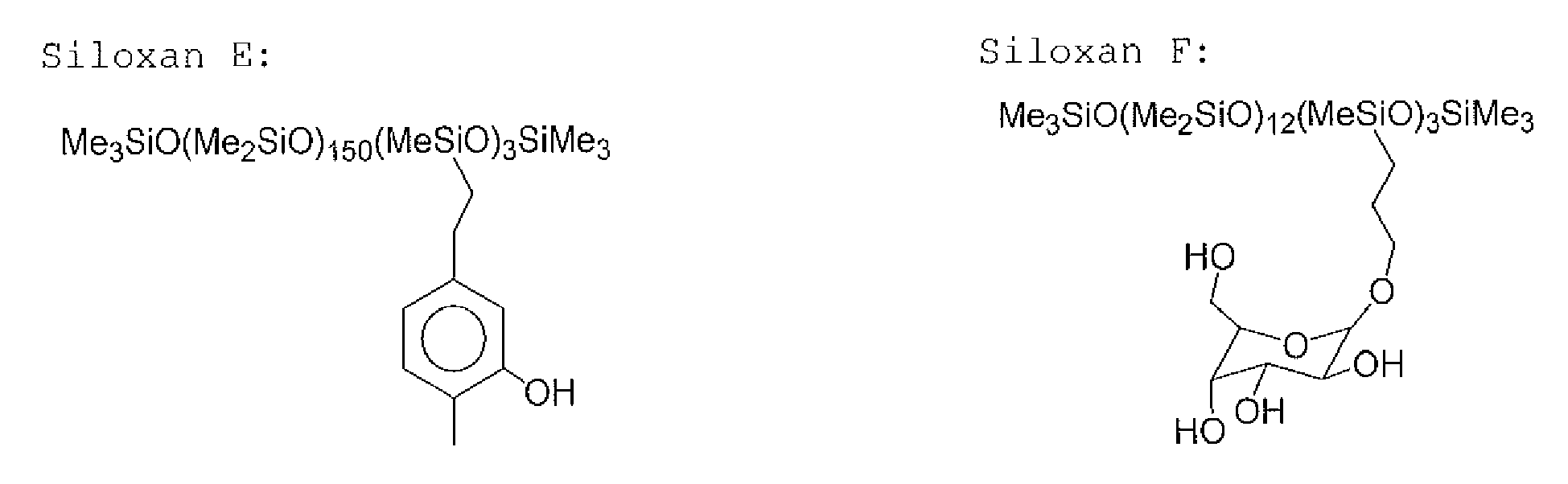

- Zu 100 g Emulsion bestehend aus
- 17,5 Gew.-% aminoethylaminopropylfunktionalisiertem Organopolysiloxan mit Trimethylsilylendgruppen und einer mittleren Kettenlänge von ca. 150 sowie der in Tabelle 3 angegebenen Aminzahl und ca.
- 10 Gew.-% ethoxylierte Fettsäure mit einer Kettenlängenverteilung zwischen 12 und 18 C-Atomen sowie
- 72,5 Gew.-% Wasser
- Das in den Beispielen 3a und 3b eingesetzten Cyclodextrin ist in Beispiel 1 beschrieben.
- 100 g eines in Beispiel 1 beschriebenen Siliconöls (aminopropylfunktionalisiert, mit Trimethylsilylgruppen terminiert) werden in 250 ml Dimethylsulfoxid gelöst. Dazu gibt man eine Lösung von 5,3 g des in Beispiel 1 beschriebenen Cyclodextrins in 25 ml Dimethylsulfoxid. Das Reaktionsgemisch wird für eine Stunde auf 80°C erwärmt. Anschließend destilliert man bei 80°C und Vollvakuum das Lösungsmittel ab. Es wird ein cyclodextrinhaltiges Siliconöl mit einer Viskosität von 500-600 mm2/s erhalten, das keinerlei Ausflockung oder Ausfällung des Cyclodextrins über Monate hinweg zeigt.
- 100 g des in Beispiel 2 als Siloxan G beschriebenen Siliconöls (Undecansäurefunktionalisiert, mit Trimethylsilylgruppen terminiert) werden in 250 ml Dimethylsulfoxid suspendiert, mit einer den Carboxylgruppen equivalenten Menge KOH versetzt und bei Raumtemperatur 30 Minuten gerührt. Dazu gibt man eine Lösung von 4,1 g des in Beispiel 1 beschriebenen Cyclodextrins in 20 ml Dimethylsulfoxid und erwärmt das Reaktionsgemisch wird für eine Stunde auf 80°C. Anschließend filtriert man vom gebildeten Feststoff (KCl) ab und entfernt bei 80°C im Vollvakuum das Lösungsmittel durch Destillation. Es wird ein cyclodextrinhaltiges Siliconöl mit einer Viskosität von 1030 mm2/s erhalten, das keinerlei Ausflockung oder Ausfällung des Cyclodextrins über Monate hinweg zeigt.
- 100 g eines aminoalkylfunktionalisierten, mit Trimethylsilylgruppen terminierten Siliconöls der unten näher bezeichneten Art werden in einem Becherglas vorgelegt. Mit dem in Beispiel 1 beschriebenen Ultra-Turrax dispergiert man die in Tabelle 4 angegebene Menge Cyclodextrinderivat, jeweils gelöst in der 1,2-fachen Menge Wasser, ein und arbeitet die Reaktionsmischung 90 bis 120 Minuten gut durch. Dabei steigt die Temperatur je nach Viskosität des eingesetzten Siliconöls auf etwa 50 bis 80°C. Nach dem Abdestillieren des verbliebenen Restwassers werden cyclodextrinhaltige Siliconöle erhalten, die keinerlei Ausflockung oder Ausfällung des Cyclodextrins über Monate hinweg zeigen.
Tabelle 4 Beispiel eingesetztes Siliconöl Aminzahl des eingesetzten Siliconöls [mequiv. N/g] Viskosität des eingesetzten Aminöls [mm2/s] eingesetzte Menge Cyclodextrin [Gew.-%]† Viskosität des cyclodextrinhaltigen Siliconöls [mm2/s] 6a C 0,86 300 2 625 6b D 0,62 950 2 3530 † bezogen auf das Gesamtgewicht des eingesetzten Siliconöls - Bei dem in den Beispielen 6a und 6b eingesetzten Cyclodextrin handelt es sich um


- 100 Teile eines monochlortriazinylfunktionellen β-Cyclodextrins (käuflich erhältlich unter der Bezeichnung CAVASOL® W 7 MCT bei der Wacker-Chemie GmbH, D-München) wurden in 700 Teilen destilliertem Wasser gelöst und die Lösung mit Zitronensäure auf pH 5 eingestellt. 7 Teile Parfümöl (käuflich erhältlich unter der Bezeichnung "Black Magic Y5" der Fa. Cosmaderm D-Ladenburg) wurden unter Rühren zugegeben. Durch Einlagerung in das Cyclodextrin verschwindet das wasserunlösliche Parfümöl in der wässrigen Lösung. Die Lösung wurde mit 80 Teilen einer Mikroemulsion enthaltend 17 Teile eines linearen mit Hydroxydimethylgruppen terminierten Dimethyl/Methyl, Aminoethylaminopropyl-Siloxanes der Aminzahl 0,6 und der Viskosität 1000 mm2/s sowie 6,6 Teilen Emulgatoren (iso-Cl3 Fettalkohol x 5-8 EO) (Mikroemulsion ist käuflich erhältlich unter der Bezeichnung "Finish 46016 VP" bei der Wacker-Chemie GmbH, D-München) versetzt und 10 Minuten gerührt.
- Es wird Cyclodextringruppen aufweisendes Organopolysiloxan mit einer Restaminzahl von 0,08 in Emulsionsform erhalten mit guten Gebrauchseigenschaften als Weichmacher und langanhaltender Duftnote erhalten.
- 0,65 kg der so erhaltenen Emulsion wurden am Foulard auf 1 kg eines Mischgewebes aus 98 % Wolle und 2 % Elasthanfaser (Spandex) aufgegeben, wobei eine Flottenaufnahme von 65 % resultierte. Die anschließende Trocknung erfolgte zunächst 3 Minuten bei 90°C und dann 3 Minuten bei 150°C.
- Das so behandelte Textilsubstrat weist einen angenehmen Griff auf und kann das eingelagerte Parfümöl über mehrere Monate speichern, jedoch bei gleichzeitiger Einwirkung von Körperwärme und Feuchtigkeit, also unter Tragebedingungen, dosiert abgeben.
- Die in Beispiel 1 angegebene Verfahrensweise wird wiederholt mit der Abänderung, dass als Parfümöl 8 Teile Rosenöl (käuflich erhältlich unter der Bezeichnung "Typ 131650" bei der Fa. Kurt Kitzing, D-Wallerstein) eingestzt wurde. Die Applikation erfolgte auf Baumwoll-Wirkware, die zu T-Shirts verarbeitet werden sollte. Das Textilsubstrat war durch eine monatelang anhaltende Duftnote gekennzeichnet.
- 100 Teile Monochlortriazin-funktionelles β-Cycledextrin (käuflich erhältlich unter dem Namen CAVASOL® W 7 MCT bei der Wacker-Chemie GmbH, D-München) wurden in 800 Teilen Wasser gelöst und mit Zitronensäure auf pH 5 gestellt. Die Lösung wurde mit 7 Teilen Parfümöl (käuflich erhältlich unter der Bezeichnung "Fragrance Patricia Y" bei der Fa. Cosmaderm, D-Ladenburg) versetzt und 5 Minuten gerührt. Nach dieser Zeit war das Parfümöl trotz Wasserunlöslichkeit in den Kavitäten des Cyclodextrines eingelagert und optisch aus dem wässrigen System verschwunden. Die Lösung wurde mit 30 Teilen einer 35 %igen Emulsion eines Aminöles der Viskosität 4000 mm2/s und der Aminzahl 0,15 (Aminoethylaminopropyl-funktonelles Silicon) sowie 5 Teilen Emulgator (C13-Fettalkoholethoxylat) 0,3 Teilen Polyalkoxyoligosiloxan als Vernetzer und 0,5 Teilen Katalysator auf der Basis von Dialkylzinndilaurat (käuflich erhältlich unter der Bezeichnung "Finish CT 45 E" bei der Wacker-Chemie GmbH, D-München) versetzt. Die Behandlungsflotte wurde auf ein Mischgewebe Baumwolle/Elasthan 98:2 Twill mit einer Flottenaufnahme von 70 % auffoulardiert und 3 Minuten bei 90°C sowie 3 Minuten bei 150°C getrocknet. Es resultierte ein Gewebe mit angenehmen Warengriff und langanhaltender Duftnote.
- Die in Beispiel 9 beschriebene Verfahrensweise wird wiederholt mit der Abänderung, dass als Parfümöl 6 Teile Citral 54450 der Fa. Drohm, Deutschland eingesetzt werden. Es resultierte ein Textilsubstrat mit angenehmem Frischeduft.
- Wird ein nach den Beispielen 7 bis 10 ausgerüstetes Kleidungsstück längere Zeit getragen, so wird langsam der gesamte Duft abgegeben. Das Kleidungsstück kann dann einer normalen Haushaltswäsche unterzogen werden. Während der Tumblertrocknung ist eine erneute Befüllung der Cylclodextrinkavitäten mit Parfümöl durch Zugabe des Parfüms in den Tumbler möglich. Dies beweist, dass der Substratkomplex Cyclodextrinaminosilicon waschbeständig auf dem Textilsubstrat fixiert wurde.
- 1560 Teile eines monochlortriazin-funktionellen β-Cyclodextrins (käuflich erhältlich unter der Marke CAVASOL® W7 MCT bei der Wacker-Chemie GmbH, D-München) wurden in 3000 Teilen Wasser gelöst und mit Citronensäure auf pH 5 eingestellt. Die Lösung wurde mit 222 Teilen Trimethoxyaminopropylaminoethylsilan (käuflich erhältlich unter der Bezeichnung "Silan GF 91" bei der Wacker-Chemie GmbH, D-München) versetzt und 10 Minuten bei Raumtemperatur gerührt. Dabei reagiert der Monochlortriazinrest mit der primären Amingruppe des Aminosilans durch nucleophile Substitution. Die so erhaltene Reaktionslösung kann direkt als wässrige Komponente B eingesetzt werden.
- 1560 Teile eines monochlortriazin-funktionellen β-Cyclodextrins (käuflich erhältlich unter der Marke CAVASOL® W7 MCT bei der Wacker-Chemie GmbH, D-München) wurden in 2000 Teilen Wasser gelöst und mit Citronensäure auf pH 5 eingestellt. Die Lösung wurde mit 159 Teilen Diethoxy(Methyl)Aminopropylsilan(käuflich erhältlich unter der Bezeichnung "Dynasilan 1505" bei der Degussa AG, Deutschland versetzt und 10 Minuten bei Raumtemperatur gerührt. Die so erhaltene Reaktionslösung kann direkt als wässrige Komponente B eingesetzt werden.
- 100 Teile eines monochlortriazin-funktionellen β-Cyclodextrins (käuflich erhältlich unter der Marke CAVASOL® W7 MCT bei der Wacker-Chemie GmbH, D-München) wurden in 700 Teilen Wasser gelöst und mit Citronensäure auf pH 5 eingestellt. Die Lösung wurde mit 180 Teilen einer Microemulsion (käuflich erhältlich unter der Bezeichnung "Finish 46016 VP" bei der Wacker-Chemie GmbH, D-München) versetzt und zur Umsetzung 15 Minuten gerührt. Die erwähnte Microemulsion besteht aus 17 Teilen eines aminoethylaminopropylfunktionellen Siliconöles der Aminzahl 0,6 und der Viskosität 1000 mm2/s mit Si(CH3)2OH-Endgruppen, 6,6 Teilen Emulgator (C13 Fettalkohol mit 8 EO) und Wasser, wobei die Emulsion mit Essigsäure auf pH 5,5 eingestellt ist.
- a) 20 g der oben hergestellten Komponente B1 und 20 g einer 50 % igen Emulsion eines SiOH-endständigen Dimethylpolysiloxanes der Ölviskosität 100000 mm2/s, entstanden durch Emulsdionspolymerisation, wurden in 1 l destilliertem Wasser gelöst und 2 g Aminopropyltriethoxysilan als Vernetzer zugegeben.
Mit dieser Flotte wurde 1 kg Polyester-Füllfaser (Trevira® Typ 292, 6,7 dtex, 60 mm Stapellänge der Trevira AG, Deutschland) getränkt und durch gezieltes Abquetschen eine Flottenaufnahme von 100 % erzeugt. Die Siliconauflage betrug somit ca. 0,19 % (Menge an vernetzbarer Masse).
Die Füllfasern wurden 5 Minuten bei 150°C und anschließend 5 Minuten bei 190°C getrocknet und kondensiert.
Es entstand eine weiche, sprungelastische Füllfaser, die z.B. mit Duftstoff beaufschlagt werden kann und geruchsbindende Eigenschaften aufweist. - b) Die unter a) beschriebene Verfahrensweise wird wiederhlot mit der Abänderung, dass anstelle von 20 g Komponente B1, 25 g Komponente B2 eingesetzt wurde. Die Siliconauflage betrug somit ca. 0,23 % (Menge an vernetzbarer Masse).
Es entstand eine weiche, sprungelastische Füllfaser, die z.B. mit Duftstoff beaufschlagt werden kann und geruchsbindende Eigenschaften aufweist. - c) Die unter a) beschriebene Verfahrensweise wird wiederhlot mit der Abänderung, dass anstelle von 20 g Komponente B1, 70 g Komponente B3 eingesetzt wurde. Die Siliconauflage betrug somit ca. 0,2 % (Menge an vernetzbarer Masse).
Es entstand eine weiche, sprungelastische Füllfaser, die z.B. mit Duftstoff beaufschlagt werden kann und geruchsbindende Eigenschaften aufweist. - 60 g eines aminofunktionellen Weichmachers, bestehend aus einer Emulsion, die 35 % eines reaktiven d.h. Si(CH3)2OH-endständigen Aminöles der Viscosität 1000 mm2/s und der Aminzahl von 0,3 enthielt (käuflich erhältlich unter der Bezeichnung "Finish CT 78 E" bei der Wacker-Chemie GmbH, D-München) sowie 20 Teile der Komponente B2 wurden mit deionisiertem Wasser auf 500 ml verdünnt.2 g Trimethoxy-aminoethylaminopropyl-silan als Vernetzer (käuflich erhältlich unter der Bezeichnung "Silan GF 91" bei der Wacker-Chemie GmbH, D-München) wurden zugegeben.
Zur wässrigen Mischung wurden 4 g Parfümöl (käuflich erhältlich unter der Bezeichnung "Fragrance Lavender-Y" der Fa. Cosnaderm; Deutschland) unter Rühren zugefügt. Das wasserunlösliche Parfümöl verschwindet dabei in der Flotte, da es in den Cyclodextrinrest eingelagert wird.
Die Flotte wurde auf ein Füllfaservlies aufgesprüht, wobei die Flottenaufnahme 10 % beträgt, entsprechend 0,A5 % Siliconauflaw ge. Das Vlies wurde anschließend 30 Minuten bei 130°C getrocknet. - Es entstand ein weiches, sprungelastisches Vlies mit ausgeprägter, lang anhaltender, angenehmer Duftnote. Als Einlagevlies zeigte es nach Abgabe der Duftstoffe geruchsbindende Eigenschaften.
- Eine Flotte enthaltend 20 g einer Emulsion eines aminofunktionellen, SiOH-endständigen Polydimethylsiloxanes (käuflich erhältlich unter der Bezeichnung "Finish CT 78 E" bei der Wacker-Chemie GmbH, D-München) und 200g Komponente B 3 wurden auf einen Liter verdünnt mit deionisiertem Wasser. Es wurden 0,2 g Polyalkoxyoligosiloxan als Vernetzer (käuflich erhältlich unter der Bezeichnung "V 42" bei der Wacker-Chemie GmbH, D-München) und 0,25 g einer 25 %igen Emulsion von Dioctylzinndilaurat als Katalysator (käuflich erhältlich unter der Bezeichnung "C 38" bei der Wacker-Chemie GmbH, D-München) zugegeben.
Diese Flotte wurde auf Polyester-Maschenware auffoulardiert. Hierunter versteht man Tauchen des Textils in ein Behandlungsbad, vorzugsweise bei Raumtemperatur und anschließendes Passieren einer aus 2 Walzen bestehenden Quetschvorrichtung. Damit wurde eine Flottenaufnahme von 65 % eingestellt. Das behandelte Textil wurde anschließend 3 Minuten bei 160°C getrocknet.
Es entstand ein weiches, elastisches voluminöses Flächengebilde mit sog. Frischeeffekt, d.h. geruchsbindenden Eigenschaften.
(D) Kondensationskatalysator.
| Beispiel | Aminzahl der Siliconöl-Emulsion | eingesetzte Menge Cyclodextrin | Cyclodextringehalt relativ zum Amingehalt |
| 3a | 0,6 | 390 mg | 5 % |
| 3b | 0,2 | 390 mg | 15 % |
Claims (3)
- Cyclodextrinreste aufweisende Organosiliciumverbindungen enthaltend Einheiten der Formel
AaRbXcHdSiO(4-a-b-c-d)/2 (I),
wobei
A gleich oder verschieden sein kann und einen Rest der Formel
CD-R2- (II)
bedeutet, wobei
CD ein- oder mehrwertiger, gegebenenfalls derivatisierter Cyclodextrinrest bedeutet und R2 ein gegebenenfalls substituierter Triazinylrest bedeutet,
R gleich oder verschieden sein kann und einen gegebenenfalls substituierten Kohlenwasserstoffrest, der durch Sauerstoffatome, Schwefelatome und/oder Stickstoffatome unterbrochen sein kann, bedeutet,
X gleich oder verschieden sein kann und einen Rest der Formel -OR1 mit R1 gleich Wasserstoffatom oder gegebenenfalls substituierten Kohlenwasserstoffrest, der durch Ethersauerstoffatome substituiert sein kann, bedeutet,a 0, 1 oder 2 istb 0, 1, 2 oder 3 ist,c 0, 1, 2 oder 3 ist undd 0, 1, 2 oder 3 ist,mit der Maßgabe, dass- die Summe a+b+c+d ≤ 3 ist,- die Organosiliciumverbindung pro Molekül mindestens einen Rest A aufweist und- in maximal 30% der Einheiten der Formel (I) die Summe aus a+b+c+d=0 ist,wobei das zur chemischen Bindung von CD an R2 verwendete Cyclodextrin-Sauerstoffatom gegen S, NH oder NR0 mit R0 gleich einer für Rest R oben angegebener Bedeutung, ersetzt sein kann. - Verfahren zur Herstellung der Organosiliciumverbindungen gemäß Anspruch 1, dadurch gekennzeichnet, dass halogentriazinfunktionelles Cyclodextrin(derivat) mit Amino-, Mercapto-, Hydroxy-, Carboxy-, Anhydrid-, Glycosido-, Phenol-, Polyglycol-, Phosphonato- oder Silalactongruppen aufweisender Organosiliciumverbindung umgesetzt wird.
- Verfahren zur Behandlung von organischen Fasern, dadurch gekennzeichnet, dass Organosiliciumverbindungen gemäß Anspruch 1 bzw. hergestellt nach dem Verfahren gemäß Anspruch 2 auf die zu behandelnden Fasern bzw. textilen Flächengebilden aufgebracht werden.
Applications Claiming Priority (2)
| Application Number | Priority Date | Filing Date | Title |
|---|---|---|---|
| DE10238818A DE10238818A1 (de) | 2002-08-23 | 2002-08-23 | Cyclodextrinreste aufweisende Organosiliciumverbindungen |
| EP03792323A EP1530607B1 (de) | 2002-08-23 | 2003-08-14 | Cyclodextrinreste aufweisende organosiliciumverbindungen |
Related Parent Applications (1)
| Application Number | Title | Priority Date | Filing Date |
|---|---|---|---|
| EP03792323A Division EP1530607B1 (de) | 2002-08-23 | 2003-08-14 | Cyclodextrinreste aufweisende organosiliciumverbindungen |
Publications (2)
| Publication Number | Publication Date |
|---|---|
| EP1865016A1 true EP1865016A1 (de) | 2007-12-12 |
| EP1865016B1 EP1865016B1 (de) | 2008-11-26 |
Family
ID=31197310
Family Applications (2)
| Application Number | Title | Priority Date | Filing Date |
|---|---|---|---|
| EP20070114832 Expired - Lifetime EP1865016B1 (de) | 2002-08-23 | 2003-08-14 | Cyclodextrinreste aufweisende Organosiliciumverbindungen |
| EP03792323A Expired - Lifetime EP1530607B1 (de) | 2002-08-23 | 2003-08-14 | Cyclodextrinreste aufweisende organosiliciumverbindungen |
Family Applications After (1)
| Application Number | Title | Priority Date | Filing Date |
|---|---|---|---|
| EP03792323A Expired - Lifetime EP1530607B1 (de) | 2002-08-23 | 2003-08-14 | Cyclodextrinreste aufweisende organosiliciumverbindungen |
Country Status (8)
| Country | Link |
|---|---|
| US (1) | US7235186B2 (de) |
| EP (2) | EP1865016B1 (de) |
| JP (1) | JP2005536653A (de) |
| CN (2) | CN1678665B (de) |
| AT (2) | ATE415439T1 (de) |
| AU (1) | AU2003255443A1 (de) |
| DE (3) | DE10238818A1 (de) |
| WO (1) | WO2004018547A1 (de) |
Families Citing this family (29)
| Publication number | Priority date | Publication date | Assignee | Title |
|---|---|---|---|---|
| DE102004008941A1 (de) * | 2004-02-24 | 2005-09-08 | Henkel Kgaa | Cyclodextrinderivate mit einem modifizierten Polysiloxan |
| EP1669480B1 (de) * | 2004-12-07 | 2007-05-02 | Snecma Propulsion Solide | Verfahren zur Herstellung von Garnen oder Faserblättern aus Kohlenstoff ausgehend von einem Cellulosematerial |
| US7862862B2 (en) * | 2006-01-18 | 2011-01-04 | Nalco Company | Water dispersible silanes as corrosion-protection coatings and paint primers for metal pretreatment |
| DE102007012909A1 (de) * | 2007-03-19 | 2008-09-25 | Momentive Performance Materials Gmbh | Mit Duftstoffen modifizierte, reaktive Polyorganosiloxane |
| TWM333909U (en) * | 2007-09-27 | 2008-06-11 | Ct Healthcare Technology Co Ltd | Gauze mask structure |
| JP5154305B2 (ja) * | 2008-05-22 | 2013-02-27 | 株式会社カネカ | 水性一液型耐汚染性付与塗料用樹脂組成物および該塗料用樹脂組成物から得られる塗膜 |
| US20110208145A1 (en) * | 2010-02-22 | 2011-08-25 | Le Zhang | Fluid Management System |
| CN102031692B (zh) * | 2010-11-16 | 2012-09-26 | 南通大学 | 多功能有机硅整理剂及其制备方法 |
| DE102013226252A1 (de) * | 2013-12-17 | 2015-06-18 | Wacker Chemie Ag | Glycosidreste aufweisende Organopolysiloxangele |
| CN105749889A (zh) * | 2014-12-15 | 2016-07-13 | 中国科学院兰州化学物理研究所 | 一种环糊精-硅基多功能手性固定相制备方法 |
| PL3286261T3 (pl) | 2015-04-20 | 2021-06-28 | Cornell University | Porowate materiały polimerowe na bazie cyklodekstryny i sposoby ich wytwarzania |
| CN107970137A (zh) * | 2017-11-14 | 2018-05-01 | 湖南博隽生物医药有限公司 | 一种环糊精改性有机硅Pickering乳液及其制备方法 |
| KR102875232B1 (ko) * | 2018-12-18 | 2025-10-24 | 신에쓰 가가꾸 고교 가부시끼가이샤 | 부가 경화성 실리콘 고무 조성물 및 그 제조 방법 |
| WO2020139404A1 (en) * | 2018-12-29 | 2020-07-02 | Wacker Chemie Ag | Cyclodextrin modified silicone composition |
| WO2020139403A1 (en) * | 2018-12-29 | 2020-07-02 | Wacker Chemie Ag | Hydrophilic cyclodextrin-containing silicone gels |
| CN110028323B (zh) * | 2019-03-08 | 2021-06-22 | 国装新材料技术(江苏)有限公司 | 基于环糊精包结物的超分子陶瓷前驱体及其制备方法 |
| CN110283321B (zh) * | 2019-06-20 | 2021-05-04 | 常州大学 | 一种可自成孔洞结构的聚合物的制备方法 |
| WO2021045203A1 (ja) * | 2019-09-05 | 2021-03-11 | 国立大学法人大阪大学 | 高分子材料及びその製造方法 |
| JPWO2021172463A1 (de) * | 2020-02-25 | 2021-09-02 | ||
| US20230100274A1 (en) * | 2020-02-25 | 2023-03-30 | Shiseido Company, Ltd. | Resin material including siloxane-bond-containing polymer having host group and/or guest group |
| CN115551934B (zh) * | 2020-05-14 | 2024-03-12 | 三星Sdi株式会社 | 硬化性树脂组合物、由其制备的硬化膜、以及包括硬化膜的电子装置 |
| US12077655B2 (en) | 2021-03-22 | 2024-09-03 | Dow Silicones Corporation | Terminal alkenyl functional silylated polysaccharides |
| JP7605038B2 (ja) * | 2021-06-18 | 2024-12-24 | 信越化学工業株式会社 | オルガノポリシロキサン変性シクロデキストリン化合物を含有する化粧料 |
| WO2023003043A1 (ja) * | 2021-07-21 | 2023-01-26 | 国立大学法人大阪大学 | シリコーン系高分子化合物及びシリコーン系高分子材料 |
| CN114573733B (zh) * | 2022-03-22 | 2023-05-23 | 安徽徽科生物工程技术有限公司 | 有机硅改性环糊精类有机物、制备方法、给药装置及应用 |
| CN119072531A (zh) | 2022-04-25 | 2024-12-03 | 瓦克化学股份公司 | 环糊精结合的硅酮材料及其作为活性物的载体的用途 |
| WO2024232321A1 (ja) * | 2023-05-09 | 2024-11-14 | 信越化学工業株式会社 | 環状オリゴ糖変性オルガノポリシロキサン及び皮膜形成剤 |
| CN118852878A (zh) * | 2024-07-11 | 2024-10-29 | 东莞市艮电新材料有限公司 | 一种环保阻燃硅橡胶材料及其制备方法 |
| CN121160095B (zh) * | 2025-11-19 | 2026-04-03 | 广州市瑞合新材料科技有限公司 | 一种用于花洒的硅橡胶材料及其制备方法 |
Citations (3)
| Publication number | Priority date | Publication date | Assignee | Title |
|---|---|---|---|---|
| US5403898A (en) * | 1992-05-04 | 1995-04-04 | Brigham Young University | Single arm attached cyclodextrin polysiloxanes and use thereof as chiral stationary phases in chromatographic separation of enantiomers |
| DE19520989A1 (de) * | 1995-06-08 | 1996-12-12 | Consortium Elektrochem Ind | Cyclodextrinmodifizierte Polymere |
| DE19831073A1 (de) * | 1998-07-10 | 2000-01-13 | Wacker Chemie Gmbh | Die Anlagerung von Si-gebundenen Wasserstoff an aliphatische Kohlenstoff-Kohlenstoff-Mehrfachbindung fördernde Katalysatoren |
Family Cites Families (13)
| Publication number | Priority date | Publication date | Assignee | Title |
|---|---|---|---|---|
| DE4006923A1 (de) * | 1990-03-06 | 1991-09-12 | Merck Patent Gmbh | Trennmaterialien fuer die chromatographie |
| US5268442A (en) * | 1990-11-13 | 1993-12-07 | Brigham Young University | Chiral copolymers with oligosiloxane spacers |
| DE4208402A1 (de) * | 1992-03-16 | 1993-09-23 | Hartmut Dr Frank | Polysiloxan-blockpolymere, verfahren zu deren herstellung und deren verwendung |
| FR2695286B1 (fr) * | 1992-08-31 | 1994-10-14 | Francis Guillot | Système de détection et de signalisation de lampes défaillantes dans un réseau d'éclairage. |
| DE4232173A1 (de) | 1992-09-25 | 1994-03-31 | Bayer Ag | 5-Oxo-dibenzo(a,d)cyclohepta-1,4-diene |
| DE4306041A1 (de) | 1993-02-26 | 1994-09-01 | Wacker Chemie Gmbh | Glycosidreste aufweisende Organosiliciumverbindungen und Verfahren zu deren Herstellung |
| JP3419830B2 (ja) | 1993-07-08 | 2003-06-23 | 株式会社ブリヂストン | 空気入りラジアルタイヤ |
| DE4324636A1 (de) * | 1993-07-22 | 1994-05-11 | Schurig Volker Prof Dr | Herstellung und Verwendung von Chirasil-Dex als auf Trägermaterial immobilisiertes, chirales und cyclodextrinhaltiges Polymer |
| JPH07252303A (ja) * | 1994-01-26 | 1995-10-03 | Toppan Printing Co Ltd | シクロデキストリン誘導体およびその製造方法 |
| DE19512428A1 (de) | 1995-04-03 | 1996-10-10 | Wacker Chemie Gmbh | Organopolysiloxan/Cyclodextrin-Komplexe, deren Herstellung sowie deren Verwendung als Additive in Beschichtungsmassen |
| DE19520967A1 (de) * | 1995-06-08 | 1996-12-12 | Consortium Elektrochem Ind | Textiles Material oder Leder, welches mit Cyclodextrinderivaten mit mindestens einem stickstoffhaltigen Heterozyklus ausgerüstet ist |
| PL178362B1 (pl) | 1995-06-22 | 2000-04-28 | Inst Chemii Przemyslowej Im Pr | Sposób otrzymywania odpornych na wodę nowych produktów połączenia cyklodekstryny z silikonami |
| FR2806929A1 (fr) * | 2000-04-04 | 2001-10-05 | Chiralsep Sarl | Nouveaux supports chromatographiques a base de cyclodextrines, leur procede de preparation et leurs applications |
-
2002
- 2002-08-23 DE DE10238818A patent/DE10238818A1/de not_active Withdrawn
-
2003
- 2003-08-14 AU AU2003255443A patent/AU2003255443A1/en not_active Abandoned
- 2003-08-14 AT AT07114832T patent/ATE415439T1/de not_active IP Right Cessation
- 2003-08-14 AT AT03792323T patent/ATE412690T1/de not_active IP Right Cessation
- 2003-08-14 EP EP20070114832 patent/EP1865016B1/de not_active Expired - Lifetime
- 2003-08-14 US US10/523,909 patent/US7235186B2/en not_active Expired - Fee Related
- 2003-08-14 EP EP03792323A patent/EP1530607B1/de not_active Expired - Lifetime
- 2003-08-14 DE DE50310710T patent/DE50310710D1/de not_active Expired - Lifetime
- 2003-08-14 CN CN038199831A patent/CN1678665B/zh not_active Expired - Fee Related
- 2003-08-14 DE DE50310845T patent/DE50310845D1/de not_active Expired - Lifetime
- 2003-08-14 WO PCT/EP2003/009053 patent/WO2004018547A1/de not_active Ceased
- 2003-08-14 CN CN2010105776716A patent/CN102070903A/zh active Pending
- 2003-08-14 JP JP2004530153A patent/JP2005536653A/ja active Pending
Patent Citations (3)
| Publication number | Priority date | Publication date | Assignee | Title |
|---|---|---|---|---|
| US5403898A (en) * | 1992-05-04 | 1995-04-04 | Brigham Young University | Single arm attached cyclodextrin polysiloxanes and use thereof as chiral stationary phases in chromatographic separation of enantiomers |
| DE19520989A1 (de) * | 1995-06-08 | 1996-12-12 | Consortium Elektrochem Ind | Cyclodextrinmodifizierte Polymere |
| DE19831073A1 (de) * | 1998-07-10 | 2000-01-13 | Wacker Chemie Gmbh | Die Anlagerung von Si-gebundenen Wasserstoff an aliphatische Kohlenstoff-Kohlenstoff-Mehrfachbindung fördernde Katalysatoren |
Also Published As
| Publication number | Publication date |
|---|---|
| ATE412690T1 (de) | 2008-11-15 |
| DE50310845D1 (de) | 2009-01-08 |
| DE50310710D1 (de) | 2008-12-11 |
| CN1678665A (zh) | 2005-10-05 |
| DE10238818A1 (de) | 2004-03-04 |
| CN1678665B (zh) | 2011-06-15 |
| EP1530607A1 (de) | 2005-05-18 |
| US7235186B2 (en) | 2007-06-26 |
| US20060009592A1 (en) | 2006-01-12 |
| JP2005536653A (ja) | 2005-12-02 |
| WO2004018547A1 (de) | 2004-03-04 |
| ATE415439T1 (de) | 2008-12-15 |
| CN102070903A (zh) | 2011-05-25 |
| EP1865016B1 (de) | 2008-11-26 |
| AU2003255443A1 (en) | 2004-03-11 |
| EP1530607B1 (de) | 2008-10-29 |
Similar Documents
| Publication | Publication Date | Title |
|---|---|---|
| EP1530607B1 (de) | Cyclodextrinreste aufweisende organosiliciumverbindungen | |
| EP1887023B1 (de) | Neuartige Polysiloxane mit quaternären Ammoniumgruppen, Verfahren zu deren Herstellung und deren Verwendung als Textilweichmacher | |
| DE69208582T2 (de) | Organosiloxane geeignet zur verwendung als sonnenschutzstoffe | |
| DE2844789C2 (de) | Pulverförmige oder granulatartige Waschmittelzusammensetzung | |
| DE69509549T3 (de) | Funktionalisierte polyorganosiloxane und verfahren zu deren herstellung | |
| EP1477513B1 (de) | Ammoniumfunktionelle Polysiloxancopolymere | |
| EP1397548B1 (de) | Amidofunktionelle aminopolydiorganosiloxane | |
| DE69102552T2 (de) | Verfahren zur Behandlung von Fasermaterialien. | |
| DE3905785C2 (de) | Verfahren zur Herstellung feiner Polyorganosilsesquioxan-Teilchen | |
| EP1004614B1 (de) | Grenzflächenaktive Organosiliciumverbindungen | |
| DE102007020568A1 (de) | Verfahren zur kontinuierlichen Herstellung von Aminoalkylgruppen aufweisenden Organopolysiloxanen | |
| EP2050777B1 (de) | Mehrstufiges Verfahren zur Herstellung von Aminoalkylgruppen aufweisenden Organopolysiloxanen | |
| DE1720496C3 (de) | Verfahren zur Herstellung von Organopolysiloxanen | |
| DE102005018629A1 (de) | Verfahren zur Herstellung von Triorganosiloxygruppen aufweisenden Organopolysiloxanen | |
| DE69211614T2 (de) | Silikongummi Mikrosuspension und Verfahren zur Herstellung | |
| EP1773920A1 (de) | Verfahren zur herstellung von emulsionen von hochviskosen organopolysiloxanen | |
| EP1015681A1 (de) | Aminosiloxan-polyether-polymere | |
| EP1852455A1 (de) | Verfahren zur Herstellung von Urethangruppen aufweisenden Organosiliciumverbindungen | |
| DE69005229T2 (de) | Organopolysiloxane und Verfahren zu deren Herstellung. | |
| DE69829144T2 (de) | Verfahren zur Herstellung kettenverlängerter Organopolysiloxane | |
| DE102006052730A1 (de) | Verfahren zur Behandlung von Füllfasern mit wässrigen Dispersionen von Organopolysiloxanen | |
| DE69419228T2 (de) | Wärme-härtbare Organopolysiloxanzusammensetzung | |
| EP0818494B1 (de) | Permanente Organosiliciumverbindungen, deren Herstellung und Verwendung | |
| EP1498457B1 (de) | Lagerstabile Siliconmassen | |
| EP0818495B1 (de) | Hydrophile, permanente Organosiliciumverbindungen |
Legal Events
| Date | Code | Title | Description |
|---|---|---|---|
| PUAI | Public reference made under article 153(3) epc to a published international application that has entered the european phase |
Free format text: ORIGINAL CODE: 0009012 |
|
| 17P | Request for examination filed |
Effective date: 20070823 |
|
| AC | Divisional application: reference to earlier application |
Ref document number: 1530607 Country of ref document: EP Kind code of ref document: P |
|
| AK | Designated contracting states |
Kind code of ref document: A1 Designated state(s): AT BE BG CH CY CZ DE DK EE ES FI FR GB GR HU IE IT LI LU MC NL PT RO SE SI SK TR |
|
| 17Q | First examination report despatched |
Effective date: 20080410 |
|
| GRAP | Despatch of communication of intention to grant a patent |
Free format text: ORIGINAL CODE: EPIDOSNIGR1 |
|
| AKX | Designation fees paid |
Designated state(s): AT BE BG CH CY CZ DE DK EE ES FI FR GB GR HU IE IT LI LU MC NL PT RO SE SI SK TR |
|
| GRAS | Grant fee paid |
Free format text: ORIGINAL CODE: EPIDOSNIGR3 |
|
| GRAA | (expected) grant |
Free format text: ORIGINAL CODE: 0009210 |
|
| AC | Divisional application: reference to earlier application |
Ref document number: 1530607 Country of ref document: EP Kind code of ref document: P |
|
| AK | Designated contracting states |
Kind code of ref document: B1 Designated state(s): AT BE BG CH CY CZ DE DK EE ES FI FR GB GR HU IE IT LI LU MC NL PT RO SE SI SK TR |
|
| REG | Reference to a national code |
Ref country code: GB Ref legal event code: FG4D Free format text: NOT ENGLISH |
|
| REG | Reference to a national code |
Ref country code: CH Ref legal event code: EP |
|
| REG | Reference to a national code |
Ref country code: IE Ref legal event code: FG4D Free format text: LANGUAGE OF EP DOCUMENT: GERMAN |
|
| REF | Corresponds to: |
Ref document number: 50310845 Country of ref document: DE Date of ref document: 20090108 Kind code of ref document: P |
|
| PG25 | Lapsed in a contracting state [announced via postgrant information from national office to epo] |
Ref country code: ES Free format text: LAPSE BECAUSE OF FAILURE TO SUBMIT A TRANSLATION OF THE DESCRIPTION OR TO PAY THE FEE WITHIN THE PRESCRIBED TIME-LIMIT Effective date: 20090308 |
|
| PG25 | Lapsed in a contracting state [announced via postgrant information from national office to epo] |
Ref country code: SI Free format text: LAPSE BECAUSE OF FAILURE TO SUBMIT A TRANSLATION OF THE DESCRIPTION OR TO PAY THE FEE WITHIN THE PRESCRIBED TIME-LIMIT Effective date: 20081126 Ref country code: FI Free format text: LAPSE BECAUSE OF FAILURE TO SUBMIT A TRANSLATION OF THE DESCRIPTION OR TO PAY THE FEE WITHIN THE PRESCRIBED TIME-LIMIT Effective date: 20081126 |
|
| REG | Reference to a national code |
Ref country code: IE Ref legal event code: FD4D |
|
| PG25 | Lapsed in a contracting state [announced via postgrant information from national office to epo] |
Ref country code: RO Free format text: LAPSE BECAUSE OF FAILURE TO SUBMIT A TRANSLATION OF THE DESCRIPTION OR TO PAY THE FEE WITHIN THE PRESCRIBED TIME-LIMIT Effective date: 20081126 Ref country code: IE Free format text: LAPSE BECAUSE OF FAILURE TO SUBMIT A TRANSLATION OF THE DESCRIPTION OR TO PAY THE FEE WITHIN THE PRESCRIBED TIME-LIMIT Effective date: 20081126 Ref country code: DK Free format text: LAPSE BECAUSE OF FAILURE TO SUBMIT A TRANSLATION OF THE DESCRIPTION OR TO PAY THE FEE WITHIN THE PRESCRIBED TIME-LIMIT Effective date: 20081126 Ref country code: EE Free format text: LAPSE BECAUSE OF FAILURE TO SUBMIT A TRANSLATION OF THE DESCRIPTION OR TO PAY THE FEE WITHIN THE PRESCRIBED TIME-LIMIT Effective date: 20081126 Ref country code: BG Free format text: LAPSE BECAUSE OF FAILURE TO SUBMIT A TRANSLATION OF THE DESCRIPTION OR TO PAY THE FEE WITHIN THE PRESCRIBED TIME-LIMIT Effective date: 20090226 |
|
| PG25 | Lapsed in a contracting state [announced via postgrant information from national office to epo] |
Ref country code: PT Free format text: LAPSE BECAUSE OF FAILURE TO SUBMIT A TRANSLATION OF THE DESCRIPTION OR TO PAY THE FEE WITHIN THE PRESCRIBED TIME-LIMIT Effective date: 20090427 Ref country code: SE Free format text: LAPSE BECAUSE OF FAILURE TO SUBMIT A TRANSLATION OF THE DESCRIPTION OR TO PAY THE FEE WITHIN THE PRESCRIBED TIME-LIMIT Effective date: 20090226 Ref country code: CZ Free format text: LAPSE BECAUSE OF FAILURE TO SUBMIT A TRANSLATION OF THE DESCRIPTION OR TO PAY THE FEE WITHIN THE PRESCRIBED TIME-LIMIT Effective date: 20081126 |
|
| PG25 | Lapsed in a contracting state [announced via postgrant information from national office to epo] |
Ref country code: SK Free format text: LAPSE BECAUSE OF FAILURE TO SUBMIT A TRANSLATION OF THE DESCRIPTION OR TO PAY THE FEE WITHIN THE PRESCRIBED TIME-LIMIT Effective date: 20081126 |
|
| PLBE | No opposition filed within time limit |
Free format text: ORIGINAL CODE: 0009261 |
|
| STAA | Information on the status of an ep patent application or granted ep patent |
Free format text: STATUS: NO OPPOSITION FILED WITHIN TIME LIMIT |
|
| 26N | No opposition filed |
Effective date: 20090827 |
|
| PG25 | Lapsed in a contracting state [announced via postgrant information from national office to epo] |
Ref country code: MC Free format text: LAPSE BECAUSE OF NON-PAYMENT OF DUE FEES Effective date: 20090831 |
|
| REG | Reference to a national code |
Ref country code: CH Ref legal event code: PL |
|
| PG25 | Lapsed in a contracting state [announced via postgrant information from national office to epo] |
Ref country code: LI Free format text: LAPSE BECAUSE OF NON-PAYMENT OF DUE FEES Effective date: 20090831 Ref country code: CH Free format text: LAPSE BECAUSE OF NON-PAYMENT OF DUE FEES Effective date: 20090831 |
|
| PG25 | Lapsed in a contracting state [announced via postgrant information from national office to epo] |
Ref country code: GR Free format text: LAPSE BECAUSE OF FAILURE TO SUBMIT A TRANSLATION OF THE DESCRIPTION OR TO PAY THE FEE WITHIN THE PRESCRIBED TIME-LIMIT Effective date: 20090227 |
|
| PG25 | Lapsed in a contracting state [announced via postgrant information from national office to epo] |
Ref country code: AT Free format text: LAPSE BECAUSE OF NON-PAYMENT OF DUE FEES Effective date: 20090814 |
|
| PG25 | Lapsed in a contracting state [announced via postgrant information from national office to epo] |
Ref country code: IT Free format text: LAPSE BECAUSE OF FAILURE TO SUBMIT A TRANSLATION OF THE DESCRIPTION OR TO PAY THE FEE WITHIN THE PRESCRIBED TIME-LIMIT Effective date: 20081126 |
|
| PG25 | Lapsed in a contracting state [announced via postgrant information from national office to epo] |
Ref country code: LU Free format text: LAPSE BECAUSE OF NON-PAYMENT OF DUE FEES Effective date: 20090814 |
|
| PG25 | Lapsed in a contracting state [announced via postgrant information from national office to epo] |
Ref country code: HU Free format text: LAPSE BECAUSE OF FAILURE TO SUBMIT A TRANSLATION OF THE DESCRIPTION OR TO PAY THE FEE WITHIN THE PRESCRIBED TIME-LIMIT Effective date: 20090527 |
|
| PG25 | Lapsed in a contracting state [announced via postgrant information from national office to epo] |
Ref country code: TR Free format text: LAPSE BECAUSE OF FAILURE TO SUBMIT A TRANSLATION OF THE DESCRIPTION OR TO PAY THE FEE WITHIN THE PRESCRIBED TIME-LIMIT Effective date: 20081126 |
|
| PG25 | Lapsed in a contracting state [announced via postgrant information from national office to epo] |
Ref country code: CY Free format text: LAPSE BECAUSE OF FAILURE TO SUBMIT A TRANSLATION OF THE DESCRIPTION OR TO PAY THE FEE WITHIN THE PRESCRIBED TIME-LIMIT Effective date: 20081126 |
|
| PGFP | Annual fee paid to national office [announced via postgrant information from national office to epo] |
Ref country code: DE Payment date: 20110823 Year of fee payment: 9 Ref country code: FR Payment date: 20110901 Year of fee payment: 9 Ref country code: GB Payment date: 20110819 Year of fee payment: 9 |
|
| PGFP | Annual fee paid to national office [announced via postgrant information from national office to epo] |
Ref country code: NL Payment date: 20110825 Year of fee payment: 9 Ref country code: BE Payment date: 20110811 Year of fee payment: 9 |
|
| BERE | Be: lapsed |
Owner name: WACKER CHEMIE A.G. Effective date: 20120831 |
|
| REG | Reference to a national code |
Ref country code: NL Ref legal event code: V1 Effective date: 20130301 |
|
| GBPC | Gb: european patent ceased through non-payment of renewal fee |
Effective date: 20120814 |
|
| PG25 | Lapsed in a contracting state [announced via postgrant information from national office to epo] |
Ref country code: NL Free format text: LAPSE BECAUSE OF NON-PAYMENT OF DUE FEES Effective date: 20130301 |
|
| REG | Reference to a national code |
Ref country code: FR Ref legal event code: ST Effective date: 20130430 |
|
| PG25 | Lapsed in a contracting state [announced via postgrant information from national office to epo] |
Ref country code: BE Free format text: LAPSE BECAUSE OF NON-PAYMENT OF DUE FEES Effective date: 20120831 |
|
| PG25 | Lapsed in a contracting state [announced via postgrant information from national office to epo] |
Ref country code: GB Free format text: LAPSE BECAUSE OF NON-PAYMENT OF DUE FEES Effective date: 20120814 Ref country code: DE Free format text: LAPSE BECAUSE OF NON-PAYMENT OF DUE FEES Effective date: 20130301 |
|
| PG25 | Lapsed in a contracting state [announced via postgrant information from national office to epo] |
Ref country code: FR Free format text: LAPSE BECAUSE OF NON-PAYMENT OF DUE FEES Effective date: 20120831 |
|
| REG | Reference to a national code |
Ref country code: DE Ref legal event code: R119 Ref document number: 50310845 Country of ref document: DE Effective date: 20130301 |