EP1886320B1 - Verfahren zum extrahieren der in einem halbleiterbauelement gespeicherten ladungsverteilung - Google Patents
Verfahren zum extrahieren der in einem halbleiterbauelement gespeicherten ladungsverteilung Download PDFInfo
- Publication number
- EP1886320B1 EP1886320B1 EP06763541A EP06763541A EP1886320B1 EP 1886320 B1 EP1886320 B1 EP 1886320B1 EP 06763541 A EP06763541 A EP 06763541A EP 06763541 A EP06763541 A EP 06763541A EP 1886320 B1 EP1886320 B1 EP 1886320B1
- Authority
- EP
- European Patent Office
- Prior art keywords
- charge
- trapping layer
- distribution
- bit
- pumping
- Prior art date
- Legal status (The legal status is an assumption and is not a legal conclusion. Google has not performed a legal analysis and makes no representation as to the accuracy of the status listed.)
- Not-in-force
Links
- 238000009826 distribution Methods 0.000 title claims abstract description 120
- 238000000034 method Methods 0.000 title claims abstract description 67
- 239000004065 semiconductor Substances 0.000 title claims abstract description 28
- 238000005086 pumping Methods 0.000 claims abstract description 125
- 238000003860 storage Methods 0.000 claims description 37
- 238000012216 screening Methods 0.000 claims description 23
- 239000000969 carrier Substances 0.000 claims description 14
- 238000002347 injection Methods 0.000 claims description 13
- 239000007924 injection Substances 0.000 claims description 13
- 230000002829 reductive effect Effects 0.000 claims description 12
- 238000005259 measurement Methods 0.000 abstract description 43
- 238000012360 testing method Methods 0.000 abstract description 7
- 230000015654 memory Effects 0.000 description 55
- 230000005527 interface trap Effects 0.000 description 29
- 238000000605 extraction Methods 0.000 description 27
- 230000006870 function Effects 0.000 description 15
- 150000004767 nitrides Chemical class 0.000 description 12
- 239000000758 substrate Substances 0.000 description 10
- 238000001208 nuclear magnetic resonance pulse sequence Methods 0.000 description 9
- 238000009825 accumulation Methods 0.000 description 7
- 230000008859 change Effects 0.000 description 7
- 238000005516 engineering process Methods 0.000 description 7
- VYPSYNLAJGMNEJ-UHFFFAOYSA-N Silicium dioxide Chemical compound O=[Si]=O VYPSYNLAJGMNEJ-UHFFFAOYSA-N 0.000 description 6
- 230000015556 catabolic process Effects 0.000 description 6
- 238000006731 degradation reaction Methods 0.000 description 6
- 230000001419 dependent effect Effects 0.000 description 6
- 229910052814 silicon oxide Inorganic materials 0.000 description 6
- 239000002019 doping agent Substances 0.000 description 5
- 239000000463 material Substances 0.000 description 5
- 229910021420 polycrystalline silicon Inorganic materials 0.000 description 5
- 230000002441 reversible effect Effects 0.000 description 4
- XUIMIQQOPSSXEZ-UHFFFAOYSA-N Silicon Chemical compound [Si] XUIMIQQOPSSXEZ-UHFFFAOYSA-N 0.000 description 3
- 238000012512 characterization method Methods 0.000 description 3
- 230000007423 decrease Effects 0.000 description 3
- 239000003989 dielectric material Substances 0.000 description 3
- 230000005684 electric field Effects 0.000 description 3
- 239000011159 matrix material Substances 0.000 description 3
- 229920005591 polysilicon Polymers 0.000 description 3
- 229910052710 silicon Inorganic materials 0.000 description 3
- 239000010703 silicon Substances 0.000 description 3
- 125000006850 spacer group Chemical group 0.000 description 3
- ILCYGSITMBHYNK-UHFFFAOYSA-N [Si]=O.[Hf] Chemical compound [Si]=O.[Hf] ILCYGSITMBHYNK-UHFFFAOYSA-N 0.000 description 2
- 230000008901 benefit Effects 0.000 description 2
- 239000003990 capacitor Substances 0.000 description 2
- 239000002800 charge carrier Substances 0.000 description 2
- -1 e.g. Al Substances 0.000 description 2
- 238000007667 floating Methods 0.000 description 2
- 229910000449 hafnium oxide Inorganic materials 0.000 description 2
- WIHZLLGSGQNAGK-UHFFFAOYSA-N hafnium(4+);oxygen(2-) Chemical compound [O-2].[O-2].[Hf+4] WIHZLLGSGQNAGK-UHFFFAOYSA-N 0.000 description 2
- 239000012212 insulator Substances 0.000 description 2
- 230000000670 limiting effect Effects 0.000 description 2
- 238000004519 manufacturing process Methods 0.000 description 2
- 238000000691 measurement method Methods 0.000 description 2
- 230000007246 mechanism Effects 0.000 description 2
- 239000002159 nanocrystal Substances 0.000 description 2
- 239000002245 particle Substances 0.000 description 2
- 230000008569 process Effects 0.000 description 2
- 101100165547 Caenorhabditis elegans bli-1 gene Proteins 0.000 description 1
- XOJVVFBFDXDTEG-UHFFFAOYSA-N Norphytane Natural products CC(C)CCCC(C)CCCC(C)CCCC(C)C XOJVVFBFDXDTEG-UHFFFAOYSA-N 0.000 description 1
- 229910052581 Si3N4 Inorganic materials 0.000 description 1
- ATJFFYVFTNAWJD-UHFFFAOYSA-N Tin Chemical compound [Sn] ATJFFYVFTNAWJD-UHFFFAOYSA-N 0.000 description 1
- 238000004458 analytical method Methods 0.000 description 1
- 230000003247 decreasing effect Effects 0.000 description 1
- 238000011161 development Methods 0.000 description 1
- 230000018109 developmental process Effects 0.000 description 1
- 238000009792 diffusion process Methods 0.000 description 1
- 239000003574 free electron Substances 0.000 description 1
- 230000010354 integration Effects 0.000 description 1
- 239000002184 metal Substances 0.000 description 1
- 229910052751 metal Inorganic materials 0.000 description 1
- 239000002082 metal nanoparticle Substances 0.000 description 1
- 150000002739 metals Chemical class 0.000 description 1
- 238000004377 microelectronic Methods 0.000 description 1
- 238000012986 modification Methods 0.000 description 1
- 230000004048 modification Effects 0.000 description 1
- 238000005457 optimization Methods 0.000 description 1
- 230000002093 peripheral effect Effects 0.000 description 1
- 238000012545 processing Methods 0.000 description 1
- 230000000750 progressive effect Effects 0.000 description 1
- 230000009467 reduction Effects 0.000 description 1
- 230000003252 repetitive effect Effects 0.000 description 1
- 230000000717 retained effect Effects 0.000 description 1
- 230000000630 rising effect Effects 0.000 description 1
- 230000035945 sensitivity Effects 0.000 description 1
- HBMJWWWQQXIZIP-UHFFFAOYSA-N silicon carbide Chemical compound [Si+]#[C-] HBMJWWWQQXIZIP-UHFFFAOYSA-N 0.000 description 1
- 229910010271 silicon carbide Inorganic materials 0.000 description 1
- HQVNEWCFYHHQES-UHFFFAOYSA-N silicon nitride Chemical compound N12[Si]34N5[Si]62N3[Si]51N64 HQVNEWCFYHHQES-UHFFFAOYSA-N 0.000 description 1
- 230000001629 suppression Effects 0.000 description 1
Images









Classifications
-
- G—PHYSICS
- G11—INFORMATION STORAGE
- G11C—STATIC STORES
- G11C16/00—Erasable programmable read-only memories
- G11C16/02—Erasable programmable read-only memories electrically programmable
- G11C16/04—Erasable programmable read-only memories electrically programmable using variable threshold transistors, e.g. FAMOS
- G11C16/0466—Erasable programmable read-only memories electrically programmable using variable threshold transistors, e.g. FAMOS comprising cells with charge storage in an insulating layer, e.g. metal-nitride-oxide-silicon [MNOS], silicon-oxide-nitride-oxide-silicon [SONOS]
- G11C16/0475—Erasable programmable read-only memories electrically programmable using variable threshold transistors, e.g. FAMOS comprising cells with charge storage in an insulating layer, e.g. metal-nitride-oxide-silicon [MNOS], silicon-oxide-nitride-oxide-silicon [SONOS] comprising two or more independent storage sites which store independent data
-
- G—PHYSICS
- G11—INFORMATION STORAGE
- G11C—STATIC STORES
- G11C16/00—Erasable programmable read-only memories
- G11C16/02—Erasable programmable read-only memories electrically programmable
- G11C16/06—Auxiliary circuits, e.g. for writing into memory
- G11C16/26—Sensing or reading circuits; Data output circuits
-
- G—PHYSICS
- G11—INFORMATION STORAGE
- G11C—STATIC STORES
- G11C16/00—Erasable programmable read-only memories
- G11C16/02—Erasable programmable read-only memories electrically programmable
- G11C16/06—Auxiliary circuits, e.g. for writing into memory
- G11C16/34—Determination of programming status, e.g. threshold voltage, overprogramming or underprogramming, retention
- G11C16/349—Arrangements for evaluating degradation, retention or wearout, e.g. by counting erase cycles
- G11C16/3495—Circuits or methods to detect or delay wearout of nonvolatile EPROM or EEPROM memory devices, e.g. by counting numbers of erase or reprogram cycles, by using multiple memory areas serially or cyclically
Definitions
- the present invention relates to a method for determining a set of programming conditions for a given type of a non-volatile memory device comprising a charge-trapping layer of multiple discrete charge storage sites isolated from each other.
- the invention further relates to methods for operating non-volatile memory devices.
- Non-volatile memories are characterized by the fact that once a bit is stored in a memory cell this bit will be retained even when the memory cell is no longer powered.
- the NVM devices are also known as EEPROM (Electrically-Erasable-and-Programmable-Read-Only-Memory) devices.
- EEPROM Electrically-Erasable-and-Programmable-Read-Only-Memory
- charge-trapping EEPROM devices charge is stored in a non-conductive layer being part of a single-capacitor structure. In such non-conductive charge-storage layer, e.g.
- charge-trapping memory devices are characterized by the presence of discrete charge traps as memory elements contrary to floating gate memory devices where a conductive layer is used as one continuous charge trap for storing charge. Developments in EEPROM devices are increasingly focused on localized charge trapping because it eases integration and reduces stress-induced-leakage.
- NROM TM devices using nitride as non-conductive charge-storage layer as disclosed for example by B.
- Eitan in US 6,768,165 are very attractive since they allow storage of two physical bits per memory cell, each bit at a different location in the nitride charge-storage layer.
- carriers e.g. electrons
- the NROM TM cell is programmed.
- opposite-type carriers are injected in the nitride layer as to compensate the charge stored during programming, e.g. holes are injected in the nitride layer to compensate the electrons already present.
- Charge-Pumping One method to determine the lateral distribution of charge in MOSFET-type devices is the technique known as Charge-Pumping (CP). This method was initially developed to study hot-carrier-induced degradation mechanisms in MOSFET-type devices. Charge-pumping measurements are a powerful technique for obtaining information on the charge trapped in a MOSFET-type device by scanning the threshold voltage along the channel of the device. M.
- Rosmeulen et al teaches in "Characterization of the spatial charge distribution in local charge-trapping memory devices using the charge-pumping technique", (Solid-State Electronics journal, volume 48 (2004) p1525-1530 ), the application of the charge-pumping technique to non-volatile memory devices which are based on localized trapping of charge, in particular to n-type NROM TM devices using nitride or silicon-rich-oxide as trapping medium and injection of electrons for programming the memory cell.
- section 3.3 of this disclosure hereby incorporated by reference in its entirety, teaches how the lateral distribution of the total charge trapped in the device can be directly calculated from the charge-pumping measurements using a deconvolution-based procedure.
- a suitable set of programming conditions in view of a desired spatial charge distribution is determined as follows. First, different sets of programming parameters are selected for application to the junction regions, the bulk and the gate region of a number of non-volatile memory devices of the type under consideration. A number of these non-volatile memory devices are programmed by means of the sets of programming parameters, and an actual spatial charge distribution of the charge trapping layer of each of these devices is determined. Next, the influence of at least one of the programming parameters on the spatial charge distribution is determined by comparison of the previously determined actual spatial charge distributions, while taking into account the programming parameters initially selected. From these comparisons and the deducted influence of one or more parameters, an optimised value for at least one of the programming parameters is determined in view of the desired spatial charge distribution. This optimised value is then entered in place of the initial value of the parameter in the set, and the process is repeated at least once.
- each of the programming parameters can be optimised towards the desired spatial charge distribution upon programming the charge-trapping device of the considered type.
- one can set a predetermined spatial charge distribution which is desired once the device is in use, and then obtain suitable programming conditions to ensure that the device in use is programmed according to this predetermined spatial charge distribution.
- problems resulting from the spatial charge distribution in use can be taken into account in advance or, in other words, unsuitable or undesirable spatial charge distributions in use can be avoided as one now has control over the way in which charge becomes stored in the charge-trapping layer.
- the programming conditions/parameters comprise voltages to be applied to the different regions of the device, but may also comprise other parameters such as for example temperature conditions, etc.
- the method of the invention comprises the initial step of determining said desired spatial charge distribution in function of a reduced maximal screening voltage to be applied to either of the junction regions for screening off the respective bit in the vicinity of the junction region where the screening voltage is applied.
- the spatial charge distribution can be controlled such that the screening voltage remains below values at which undesired programming of the bit which is read may occur. If other memory devices are connected to the junction at which the lowered screening voltage is applied, then undesired programming of these other memory devices is also avoided.
- the desired spatial charge distribution is preferably determined by selecting the maximal screening voltage below a value at which accidental storage of charge in the charge trapping layer can occur; subsequently determining the width (Wb) of an extension region of one of the junction regions upon applying the maximal screening voltage to said junction region; and finally defining the desired spatial charge distribution such that, under the programming conditions to be determined, at least 90% of the charge stored in the vicinity of said junction region is within a distance (X1) smaller than or equal to said width (Wb) from said junction region.
- the method of the invention comprises the initial step of determining said desired spatial charge distribution in function of a reduced channel length of said channel region.
- the spatial charge distribution can be optimised in view of the size of the device, so that downscaling becomes available.
- the desired spatial charge distribution is preferably determined by selecting the channel length and defining a bit area for each bit in said charge-trapping layer and a margin in between said bit areas; and subsequently defining the desired spatial charge distribution such that, under the programming conditions to be determined, at least 90% of the charge stored in the vicinity of either of said junction regions is within the respective bit area.
- the channel length can be selected below or equal to 90 nm and the margin can be set up to 20 %, preferably at 1 to 20% of the channel length.
- the actual spatial charge distributions of the various programmed devices of the considered type are determined by a charge pumping technique, comprising the following steps.
- Two charge pumping curves are determined, one by using a varying base-level voltage measurement and the other by using a varying top-level voltage measurement in the charge-pumping technique. More particularly, the first curve is determined by a first charge-pumping measurement on the semiconductor device whereby only the upper level of the charge-pump pulse is varied and the second curve is determined by a second charge-pumping measurement on the semiconductor device whereby only the lower level of the charge-pump pulse is varied.
- the data from the first and second charge-pumping measurements is combined to obtain the spatial distribution of the charge in the charge-trapping layer.
- a relation is established between a charge pumping current l cp and a calculated channel length L calc of the semiconductor device by reconstructing a spatial charge distribution estimate from the charge pumping curves for multiple values of the maximum charge pumping current l cp . These values are preferably chosen in the upper range of the charge pumping curves, more preferably as close as possible to where one assumes the maximum charge pumping current l cp _ max to be, but this is not essential. From the multiple values of l cp , that value is selected for which the corresponding calculated channel length L calc is substantially equal to the effective channel length L eff of the semiconductor device. Finally, the actual spatial charge distribution is reconstructed from the charge pumping curves using this value of l cp .
- the above described method for determining the actual spatial charge distributions has the advantage that not only the spatial charge distribution of charge stored the charge-trapping layer can be extracted, but also the spatial charge distribution of charge stored in interface traps. In this way, the spatial distribution of both electrons and holes in the dielectric layer can be obtained.
- the thus obtained hole and electron distribution profiles can be used for physical understanding and optimisation of the programming and erase conditions.
- the actual spatial charge distributions may also be determined in any other way known to the person skilled in the art.
- the combining of data from the charge pumping curves comprises the following steps. First, one value as charge pumping current l cp is selected on one of the charge pumping profiles. Next, the calculated channel length L calc corresponding to the selected charge pumping current l cp is determined by reconstructing a spatial charge distribution estimate for this charge pumping current l cp . Then, the calculated channel length L calc is compared with the effective length L eff . In case of a mismatch, a new value for the charge pumping current l cp is determined, using the mismatch as information to improve the choice. These steps are repeated until the mismatch substantially becomes zero. Further aspects and advantages from this method for determining the actual spatial charge distributions will appear from the detailed description given below.
- charge carriers of a first/second type can be electrons and the second type can be holes, or vice versa.
- the predetermined programming conditions are chosen such that secondary electron injection is suppressed. It has been found that this is a convenient way to obtain the requirement that the resulting spatial charge distribution is such that a reduced screening voltage can be used or that interference between the bits can be avoided.
- the suppression of secondary electron injection can for example be achieved by means of a predetermined voltage difference between one of the junction regions and the bulk of the non-volatile memory device.
- the invention in another aspect, relates to a memory circuit in which the above described technology is applied.
- a memory circuit comprises a matrix of charge-trapping memory devices, each device comprising a charge-trapping layer of multiple discrete charge storage sites isolated from each other, a channel region which extends underneath the charge-trapping layer in a bulk between two junction regions and a gate region which extends above the charge-trapping layer, the circuit further comprising peripheral circuitry for applying programming and erase conditions to each of the charge trapping memory devices, which in turn comprises means for forward biasing one junction region of each of the memory devices upon applying the programming conditions.
- top, bottom, over, under and the like in the description and the claims are used for descriptive purposes and not necessarily for describing relative positions.
- the terms so used are interchangeable under appropriate circumstances and the embodiments of the invention described herein can operate in other orientations than described or illustrated herein. For example “undemeath” and “above” an element indicates being located at opposite sides of this element.
- n-type memory cell wherein electrons are stored during programming.
- the invention is not limited thereto.
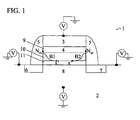
- Figure 1 shows a cross-section of a memory cell 1 according to an embodiment of the invention illustrating the possibility of storing two bits B1, B2 in the charge storage layer 10 of a memory cell.
- the memory cell comprises a gate electrode 3 separated from the channel 8 by a dielectric layer (9, 10, 11) stack 4.
- the gate electrode 3 is formed from a semiconductor material such as polycrystalline silicon doped to obtain the desired work function and/or conductivity. This semiconductor material can be partially or fully silicided as known in the art or even metals, e.g. Al, TiN, TaN, are used.
- the dielectric stack 4 comprises a charge storage layer 10 wherein charge can be stored at discrete storage sites.
- This dielectric charge storage layer 10 can be a layer of silicon-nitride, silicon-rich oxide, silicon-oxynitride, high-k dielectric such as alumina-oxide, hafnium-oxide, hafnium-silicon-oxide, an oxide layer comprising nanocrystals of a semiconductor material, e.g. polycrystalline silicon, or any other charge-trapping layer known to the person skilled in the art.
- this charge storage layer can be separated from the substrate 2 by another dielectric layer(s) 11 with low or no trapping capabilities, e.g. silicon-oxide.
- Another dielectric layer 9, preferably in a similar material as layer 11, can be used to separate the charge storage layer 10 from the gate electrode 3.
- the substrate 2 is a semiconductor substrate, e.g.
- source 6 and drain regions 7 are formed in the substrate 2. These junctions (source 6, drain 7) are formed at lateral opposite sides of the channel 8.
- the source 6 and drain regions 7 are of a conductivity type opposite to the conductivity type of the substrate 2.
- the source 6 and drain regions 7 typically extend under the spacers 5 such that the channel region 8 is contacted. This channel region 8 is under dielectric control of the gate electrode 3.
- the device of figure 1 can be manufactured using processing steps and materials known to any person skilled in the art of manufacturing semiconductor devices, in particular non-volatile memory devices.
- the device 1 is an nMOS device comprising a polysilicon gate electrode 3, which is n-type doped. Also source 6 and drain 7 regions are n-type doped while the substrate 2 is p-type doped. Sidewall spacers 5 formed in silicon-oxide are present.
- the gate dielectric 4 consists of a nitride layer used as charge-trapping layer 10 sandwiched between two layers (9, 11) of silicon-oxide.
- the device can be a pMOS device comprising device comprising a polysilicon gate electrode 3, which is p-type doped.
- source 6 and drain 7 regions are then p-type doped while the substrate 2 is n-type doped.
- the device can be a split gate device such as the HIMOS memory cell disclosed in US 5,583,811 . Accordingly, the description should not be deemed to be limiting in scope.
- B1 is programmed by applying a voltage difference between source 6 and drain 7, with the drain being at lowest voltage.
- B2 is programmed by applying a voltage difference between drain 7 and source 6, with the source being at the lowest voltage.
- Appropriate voltages are applied to gate electrode 3 and the bulk 2.
- the threshold voltage of the channel at the position of a bit, B1 or B2 depends on the status of the corresponding bit.
- Each programmed bit is characterized by its charge distribution profile; i.e. charge concentration N nt as function of the position X' along the channel length. This charge distribution profile is preferably determined using the extraction method which will be described below, but may also be determined by means of other extraction techniques.
- the threshold voltage of the left part of the channel 8 overlapped by the charge distribution of B1 will be determined by the amount of charge stored in the corresponding region of the storage layer 10. If B1 is programmed, i.e. by convention defined as charge being stored in the corresponding location of the charge storage layer 10, then a high threshold voltage is obtained. If B1 is not programmed a low threshold voltage is obtained. In case of a programmed bit a higher gate voltage is needed to generate the same number of free electrons in the overlapped channel region compared to the unprogrammed situation. For a given biasing of the memory cell 1 less current will flow between drain 7 and source 6 if the memory cell is programmed.
- bits B1 B2 can be stored at different locations in the same memory cell, it is desirable that these bits B1, B2 can be read out independent of each-other. If the status of B1 is checked by determining the corresponding current flow in the memory cell 1, the other bit B2 should be screened such that its status does not impact the current flow when reading out bit B1. This way of reading out a bit is known as reverse read.
- United States patent US 6,768,165 teaches reverse read out of a memory device wherein charge is stored in a charge storage layer.
- bit B1 is not programmed, i.e. essentially no charge is present in the charge storage layer 10 at the source 6 side thereof. If one wants to determine the status of the bit at the position near the source 6. a voltage difference is applied between drain 7 and the source 6, with the drain being at the highest voltage. The remote drain 7-channel 8 junction is thus reverse biased, i.e. positive drain voltage for an n-type junction 7 in a p-type bulk 2, and a space charge region 12 is created.
- This space charge region 12 will partly extend W j into the junction 7, but a major part of it will extend towards W b the channel 8 as the channel 8 is the lowest doped part of the junction 7-8.
- free carriers are expelled from the dopants such that only a fixed charge remains.
- the bit B2 does not control the current flow between the source 6 and drain 7 and this current flow will be primarily determined by the program status of bit B1. Screening of a bit by creating a space charge region is thus a way of allowing independent read-out of bits B1, B2 stored in the same charge storage layer 10, be it at different locations.
- the larger the lateral charge distribution X 1 of programmed bit B2, the more the space charge region should extend Wb into the channel 8, such that this charge distribution is screened off by the space charge region: X 1 ⁇ Wb.
- the extension W b is function inter alia of: dopant concentration of the junction as a technology-dependent parameters, dopant concentration channel as another technology-dependent parameters, voltage V d applied over the junction, i.e. voltage difference between the channel 8 - junction 7, of the memory cell 101 which is being read. These technology-dependent parameters can thus be selected in view of the extension W b to be achieved.
- the spread X 1 is function inter alia of the electrical field distribution in region from which charge is injected into the charge storage layer 10 during programming, e.g. channel 8 near drain junction 7, and the technology-dependent parameters: properties of the charge storage layer such as layer thickness, diffusion of the stored charge in and from this charge storage layer, and technology-dependent parameters which impact on compactness, density and distribution of charge storage sites.
- the electric field distribution in the memory device during operation is function of: the voltages applied to source 6, drain 7, bulk 2 and gate electrode 3 of the memory cell, dopant concentration in channel 8/bulk 2 such as profile junction. This junction profile can be gradual varying or being characterized by a steep variation in dopant concentration from channel towards bulk as appreciated by a person skilled in the art.
- Figure 7 shows read-out of a dual-bit programmed memory cell 1, with B1 being unprogrammed and B2 being programmed. This memory cell is illustrated by the cross-section of figure 2 .
- the memory cell is programmed using different voltages at the source 6 side: e.g. OV, -1V, -2V.
- the threshold voltage V th is defined as the gate voltage V g needed to reach a pre-determined current level in the memory cell. Typically 100 micro-amperes is used as pre-determined current level.
- the voltage V d of the drain 7 is increased while measuring the corresponding current between source 6 and drain 7.
- the charge of the programmed bit B2 near the drain is not or not completely screened by the space charge region extension W b of the drain junction.
- the current will be low and the threshold voltage V th will be high (e.g. above 3V). If the drain voltage increases more of the programmed bit B2 will be screened such that the impact of the corresponding charge on the current is reduced. More current will flow and a lower threshold voltage V th is measured. If the charge of bit B2 is completely screened, i.e. X1 ⁇ W b , the threshold voltage of an unprogrammed memory cell is measured (e.g.
- Figure 8 shows a memory matrix 100 in which memory cells 101, 102 are arranged in columns and rows. Memory cells in the same row share the word line WL J , while memory cells 101, 102 in the same column share the bit lines BLi and BLi-1. If a voltage is applied to bit line BLi, this voltage is also applied to the junctions 7 of the memory cells 101, 102 and to the junctions 6 of the memory cells 201, 202 sharing this bit line BLi. When reverse reading the memory cell 101 to determine the bit status of the bit B1 near the source junction 6 the drain voltage should be limited to prevent additional programming of bit B2 as charge could be injected at the position of the second bit B1 adjacent to the drain junction 7.
- This reading voltage at the drain junction 7 should also be limited to avoid programming of bits at drain junction of memory cells 102 in the same column and bits at the source junction of memory cells 201 and 202 sharing the same bit line.
- the voltage Vd can also be limited by the voltage allowable for the non-addressed memory cells 102, 201, 202 sharing the same bit lines BLi.
- Such non-addressed memory cells 102, 201 and 202 will be electrically connected to the memory device in read-out, in particular to the junction to which the read-out voltage is applied, and hence will be subject to the some voltage at the connected junction (102: 7, 201:6, 202:6).
- the maximal screening voltage can also be selected below a value at which accidental storage of charge in the charge trapping layer of memory device being read is reduced but also accidental storage of charge in the charge trapping layer of memory devices electrically connected to the memory device in read-out might occur.
- the spatial charge distribution in the charge-trapping layer of the memory cell is preferably determined, upon determining a suitable set of programming conditions.
- all methods for extracting the spatial distribution of charge N nt stored in the charge-trapping layer (10) of the semiconductor device (1) comprise the following steps: determining a varying base-level voltage V base charge pumping curve, determining a varying top-level voltage V top charge pumping curve, and combining data from the charge pumping curves to obtain the spatial distribution of the stored charge N nt .
- This combination of data is done by establishing a relation between a charge pumping current l cp and a calculated channel length L calc of the semiconductor device by reconstructing a spatial charge distribution from the charge pumping curves for multiple values of the charge pumping current l cp .
- this charge-trapping device is a non-volatile charge-trapping memory device.
- a charge-pumping measurement set-up which can be used in for determining the charge pumping curves, is schematically shown in figure 9a .
- Source (6), drain (7) and substrate (2) regions are biased to a fixed voltage, preferably 0V or ground.
- a voltage source e.g. a pulse generator, is connected to the gate electrode while current is measured at the substrate.
- This measurement set-up is also known as amplitude-sweep charge-pumping set-up as the amplitude of the voltage pulses applied to the gate electrode is increased during the measurement.
- the measurement sequence comprises two steps: first two charge-pumping measurements are performed on a device used as reference and secondly similar charge-pumping measurements are performed on the device-under-test (DUT).
- the reference device is usually the same as the studied device but in a reference state.
- the studied device needs to have a monotonic increase or decrease of the threshold voltage along the channel, or at least along the part of the channel, which is subjected to the measurement method, typically half of the channel.
- each threshold voltage value corresponds to one point of the charge-pumping curve.
- the reference state of this device more precisely the threshold voltage distribution thereof depends on the charge already trapped in the studied device. If the threshold voltage distribution in the studied device increases monotonically, it is better to have the reference state having a similar increase in threshold voltage distribution.
- the pristine device can be subjected to a light programming operation resulting in a monotonic increase of the charge in the charge-trapping layer which results in a threshold profile V th (x) that monotonic varies along the channel as shown in figure 10 by the dotted line V th_ref (x).
- V th (x) a threshold profile
- V th_ref (x) a threshold profile
- the threshold voltage of the device in the reference state slightly increase near the drain d.
- the number and distribution of the interface traps should remain essentially unaffected and essentially uniform over the channel. If the threshold voltage distribution monotonically decreases, it is better to have the reference state with also a decreasing threshold voltage distribution.
- the most natural reference state is in this case the virgin device, where the threshold voltage progressively decreases from the centre of the channel to the junction.
- a first charge-pumping measurement is performed on the device in the reference state that has not yet been electrically stressed, i.e. the interface trap distribution can be considered uniform along the channel.
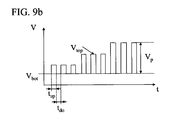
- a first pulse train is applied to the gate electrode (3), whereby each pulse in this pulse train has the same bottom-level V bot .
- the amplitude V p of the pulses increases monotonically with time by increasing the top-level V top of the pulses.
- the exemplary pulse train shown in figure 9b comprises 9 pulses grouped in sets of 3. The pulses in the first set have the lowest amplitude, the pulses in the second set have a higher amplitude, while the pulses in the last set have the highest amplitude.
- the amplitude of the pulse in the pulse sequence or the voltage swing of each pulse increases progressively.
- the number of pulses in the pulse train, their duty cycle, the amplitude of each pulse, the way the amplitude V p is increased over the pulse train, e.g. stepwise, gradually, and the upper level V top are parameters of choice and can be selected in view of the required accuracy and measurement resolution.
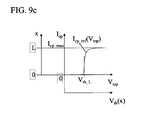
- the charge-pump current is proportional to the pulse frequency and the number of interface states N it in the inversion region formed in the channel. From this charge-pumping measurement the charge-pump curve l cp (Vp) of this device in the reference state is obtained as shown in figure 9c given the current l cp or charge per pulse as function of the top level V top of the pulse train.
- Vp charge-pump curve
- a second charge-pumping measurement is performed on the device in the reference state.
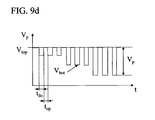
- a pulse train is applied to the gate electrode (3), whereby each pulse in this pulse train has the same top-level V top .
- the amplitude V p of the pulses increases monotonically with time by lowering the bottom-level V bot of the pulses.
- the exemplary pulse train shown in figure 9d comprises 9 pulses grouped in sets of 3. The pulses in the first set have the lowest amplitude or voltage swing, the pulses in the second set have a higher amplitude, while the pulses in the last set have the highest amplitude.
- stepwise, gradually, the upper level V top are parameters of choice and can be selected in view of the required accuracy and measurement resolution.
- This pulse train with fixed top-level V top and varying bottom-level V bot will fill the interface states with electrons during the uptime t up of the pulse and with holes during the downtime t do of the pulse when V bot is below the flatband voltage V fb_H .
- the channel will remain in inversion and the interface traps are always filled with electrons.
- the channel (8) will switch between inversion and accumulation depending on whether the lower level V bot of the progressively increased pulse amplitude is above or below this flatband voltage V fb_H and the interface traps will be alternatively filled with electrons and holes during the charge-pumping measurements.
- the charge-pump curve l cp (V p ) of this device in the reference state is obtained as shown in figure 9e given the current l cp or charge per pulse as function of the bottom level V bot of the pulse train.
- the maximum l cp_max current corresponds to one end of the channel, e.g.
- a device under test is electrically stressed resulting in charged carriers to be injected into the charge-trapping layer (10). These injected carriers can be positively or negatively charged.
- charge-pumping measurements according to the present invention are performed to determine the contribution to the threshold voltage of the charge Q nt stored in the charge-trapping layer (10) and the charge Q it generated by the interface traps N it .
- the charge Q nt stored in the charge-trapping layer (10) generates a constant offset of the threshold voltage ⁇ V th_Qnt , while the offset ⁇ V th_Qit generated by the charge stored in the interface traps depends on whether positive or negative charge is stored in these interface traps and on the number of interface traps N it .
- a threshold voltage distribution shown in figure 10 can result from negative charge e.g. present in the charge-trapping layer (10) of an nMOS device.
- a similar figure can be drawn for the flatband voltage distribution of this device. If the device of figure 1 is used as non-volatile memory cell, electrons can be injected into this layer (10) during the step of programming the memory cell, e.g.
- negative charge Q nt is stored in the charge-trapping layer (10) of an nMOS memory cell (1) resulting in positive shift of the threshold voltage and the flatband voltage, i.e. the threshold voltage and flatband voltage become more positive in these locations where the negative charge Q nt is stored.
- the threshold voltage distribution along the channel is not sharply define as suggested in figure 10 but will vary along the channel due to the presence of the junctions and of amongst other the interface traps N it which are distributed along the channel.
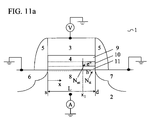
- FIG. 11 a illustrates such a device wherein a number N nt of negative charged particles (dotted area between position x 1 and drain d) is stored in the charge-trapping layer (10) resulting in an increase of the threshold voltage and flatband voltage in the portion x 1 to d compared to the portion s to x 1 .
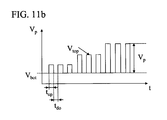
- a pulse train similar to the pulse train of the first measurement on the device in the reference state and illustrated by figure 11b is applied to this device also.
- this pulse train with fixed bottom-level V bot and varying top-level V top will fill the interface states with electrons during the uptime t up of the pulse and with holes during the downtime t do of the pulse in these locations where the pulse is swept over the corresponding threshold voltage. If the number of interface states or the threshold voltage were uniform over the channel (8), one would obtain the same charge-pump current at each pulse independently of the amplitude of the pulse as long as V top is higher than the threshold voltage V th . If however the threshold voltage is not constant over the channel, as shown in figure 10 , with increasing pulse amplitude V p an increasing portion of the channel will contribute to the charge pump current.
- the portion of the channel between x 1 and d will not contribute to the charge-pumping current.
- the portion of channel (8) having the higher threshold voltage V th_H will remain in accumulation and the corresponding interface traps will be always filled with holes as shown in figure 11a by the symbol h + .
- the portion of the channel (8) having the lower threshold voltage V th_L will switch between inversion and accumulation depending on whether the upper level V top is above or below this lower threshold voltage and the corresponding interface traps will be alternatively filled with electrons and holes during the charge-pumping measurement.
- the channel is scanned from source to drain if the threshold voltage V th (x) increases monotonically from the source to the drain. If only half of the channel is degraded, V th (x) needs to be monotonic only on half of the channel.
- the same procedure as applied to the charge-pumping signal in the first step for extracting the threshold voltage profile V th (x) from the charge-pumping current for the device under test is applied to this stressed device as illustrated by figure 11c .
- a relationship between the threshold voltage profile V th (x) and the location x in the channel can be established by the fact that the increase of the charge-pump current l cp from one location x 1 in the channel to another location x 2 can be attributed to the number of interface traps N it present in the channel area between these location.
- This relationship is expressed as follows: ⁇ X 1 X 2 qfN it x ⁇ dx ⁇ I cp V th x 2 - I cp V th x 1 with q the absolute value of the electron charge, f the frequency of the pulse.
- the dotted line indicates the reference charge-pump curve while the solid line indicates the charge-pumping curve obtained on the stressed device.
- the concentration of charge in the charge-storage layer N nt (x) (#/cm 2 ) is positive if electrons are trapped, while the local concentration of interface traps N it (x) is also in (#/cm 2 ).
- concentration of charge in the charge-storage layer N nt (x) (#/cm 2 ) is positive if electrons are trapped, while the local concentration of interface traps N it (x) is also in (#/cm 2 ).
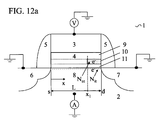
- FIG. 12a illustrates such a device wherein a number N nt of negative charged particles (dotted area between position x 1 and drain d) is stored in the charge-trapping layer (10). A number of interface states Nit are present (dots in the channel).
- a pulse train similar to the pulse train applied during the second measurement on the device in the reference state, is applied to the gate electrode (3), whereby each pulse in this pulse train has the same top-level V top .
- the amplitude V p of the pulses increases monotonically with time by lowering the bottom-level V bot of the pulses.
- the exemplary pulse train shown in figure 12b comprises 9 pulses grouped in sets of 3.
- the pulses in the first set have the lowest amplitude or voltage swing, the pulses in the second set have a higher amplitude, while the pulses in the last set have the highest amplitude.
- the number of pulses in the pulse train, their duty cycle, the amplitude of each pulse, the way the amplitude V p is increased over the pulse train, e.g. stepwise, gradually, the upper level V top are parameters of choice and can be selected in view of the required accuracy and measurement resolution.
- This pulse train with fixed top-level V top and varying bottom-level V bot will fill the interface states with electrons during the uptime t up of the pulse and with holes during the downtime t do of the pulse in these locations where the pulse is swept over the corresponding flatband voltage.
- the channel is scanned from drain to source if the flatband voltage V fb (x) increases monotonically from the source to the drain.
- the same procedure as applied to the charge-pumping signal in the first step for extracting the flatband voltage V fb (x) profile from the charge-pumping current for the device under test is applied to this stressed device as illustrated by figure 12c .
- a relationship between the flatband voltage profile V fb (x) and the location x in the channel can be established by the fact that the increase of the charge-pump current l cp from one location x 1 in the channel to another location x 2 can be attributed to the number of interface traps N it present in the channel area between these location.
- the concentration of charge in the charge-storage layer N nt (x) (#/cm 2 ) is positive if electrons are trapped, while the local concentration of interface traps N it (x) is also in (#/cm 2 ).
- the charge-pumping curves of figure 12c are obtained.
- the threshold voltage and flatband voltage at any given point is determined by the charge at that point: electrons stored in the charge-trapping layer (10) and the electrons trapped in the interface states.
- the charge-pumping curves obtained on the stressed device are compared with the charge-pumping curve of the reference device or unstressed device.
- the deviation between the reference curves on the one hand and the corresponding stressed curves is due to the overall threshold or flatband voltage variation caused by the charge in the charge-trapping layer (10) and in the interface states.
- the difference between the two deviations is due to the charge in the interface states only.
- the correlation between the two measurements on the stressed device depends on l cp_max , which makes the results of the extraction very sensitive to this value.
- the charge-pumping curves saturate completely if the top level of the pulse is high enough (or if the base level of the pulse is low enough, following the type of measurement).
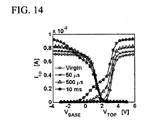
- the measurements in figure 14 show that the saturation is in reality not perfect, curves slightly continue to increase for high voltages. This causes incertitude on l cp_max .
- the best choice of l cp_max is explained later in this text.
- Equation [1] can be written as: ⁇ X i - 1 X i qfN it x ⁇ dx ⁇ ( N it x i - N it ⁇ x i - 1 ⁇ x i - x i - 1 2 ⁇ I cp V th_cyc x i - I cp ⁇ V th_cyc ⁇ x i - 1
- Equation [6] By solving successively equations [6] and [7] from a starting point x o to a final point x end one can find the position x i from equation [7] which corresponds to the interface states N it (x i ) from equation [6].
- the profile of charge in the charge-trapping layer can be found by either solving equation [2] or [4].
- equation [6] If the difference (V th_ref (x)-V fb_ref (x)) in equation [6] is constant, because the number of interface traps N it,ref of the device in the reference state is constant and equal to the ratio (l cp_max /L eff ), this difference is given by combining the threshold voltage profile and flatband voltage profile given by respectively figure 9c and 9e .
- equation [5] allows to determine for a selected threshold voltage V th_cyc the corresponding flatband voltage V fb_cyc , as the sum of the corresponding charge-pump currents must be equal to the maximum charge-pump current l cp_max .
- the two charge-pumping curves used in the extraction method of the previous embodiments are shown.
- the charge-pumping current l cp reaches a maximum charge-pumping current l cp_max corresponding to a voltage bias V top or V bot wherein the complete area of the channel (8) having a known channel length L eff contributes to the charge-pumping current.
- l cp_max corresponding to a voltage bias V top or V bot wherein the complete area of the channel (8) having a known channel length L eff contributes to the charge-pumping current.
- this well-defined maximum charge-pumping current l cp_max one can reconstruct the spatial distribution of charge N nt stored in the charge-trapping layer (10) of a semiconductor device (1).
- the current measured when applying a varying base-level or top-level voltage pulse sequence might not reach a maximum value and will continue to vary with varying pulse voltage.
- the charge pumping curves are combined as follows. As described before, a relation between the charge pumping current l cp and the calculated channel length L calc of the semiconductor device is established. In this embodiment, this is done by selecting on one of the charge pumping curves at least two charge pumping currents l cp and determining the calculated channel length L calc corresponding to each of the charge pumping currents l cp by reconstructing the spatial charge distribution for each of the charge pumping currents l cp . In this way, a set of at least two data points (L calc , l cp ) is obtained. From this set of data points, the charge pumping current l cp having a channel length substantially equal to the effective length L eff i.e. the maximum charge pumping current l cp_max can be obtained as follows.
- L calc L eff
- known numerical analytical techniques such as linear interpolation or binary search to determine this data point (L eff , l cp_max ).
- the first values of the charge pump current l cp are selected from the upper current range of the measured charge-pumping curve as such selection will speed up the extraction process.
- the first values of the charge pump current l cp are selected from the upper current range of the measured charge-pumping curve as such selection will speed up the extraction process.
- the selection of the value for the charge pumping current l cp is optimised. This sequence of steps is repeated until the mismatch between the calculated channel length L calc and the effective length L eff is substantially zero, in which case the determined charge pumping current l cp corresponds to the maximum charge pumping current l cp_max .
- the first values of the charge pump current l cp are selected from the upper current range of the measured charge-pumping curve as such selection will speed up the extraction process.
- the determined charge pumping current l cp is said to correspond to the maximum charge pumping current l cp_max , when the difference between the obtained calculated channel length L calc and the effective length L eff is less than 2%, preferably less than1 % of the effective channel length L eff .
- extraction methods according to the present application are particular useful for extracting the spatial distribution of charge N nt stored in the charge-trapping layer (10) of a memory device (1)
- these extraction methods can be applied to any kind of semiconductor device (1) wherein a dielectric stack (4) is sandwiched between an electrode (3) and a semiconductor region (2).
- the disclosed extraction methods can be used to the extract charge stored in this dielectric stack (4).
- charge might be unintentionally incorporated in the gate dielectric (4).
- this incorporated charge might result from the device operation, e.g. hot carriers, or result from the semiconductor manufacturing process introducing fixed or mobile charge in the gate dielectric.
- This gate dielectric can be of a single dielectric material such as silicon-oxide, silicon-oxy-nitride, a high-k dielectric such as alumina-oxide, hafnium-oxide, and hafnium-silicon-oxide as known in the art.
- this gate dielectric can be a stack of dielectric materials, e.g. a high-k dielectric formed upon a silicon-oxide.
- this charge N nt will also influence the threshold voltage profile V th (x) and flatband voltage profile V fb (x) of the logic transistor.
- the disclosed extraction methods can also be applied to such logic transistor to determine the spatial distribution of the incorporated charge N nt .
- the spatial charge distribution N nt is reconstructed from the charge pumping curves by combining data from these charge pumping curves to obtain the spatial distribution.
- This data from the charge pumping curves can be further combined to obtain a spatial distribution of charge (N it ) in traps present at the interface between the channel (8) and a dielectric stack (4).
- the present extraction methods also allow determining the spatial distribution of this interface charge N it , even when charge is present in the dielectric stack (4). The dependency of this interface charge on parameters of the semiconductor process or of device operation can thus more accurately be determined.
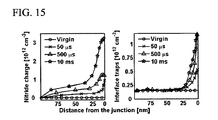
- FIGS 14 to 15 illustrate a preferred embodiment of the invention.
- Figure 14 shows two sets of charge-pumping curves obtained using respectively the varying top-level and varying-base level pulse sequence described above.
- the rising curves are obtained using the fixed-bottom/varying top-level pulse sequence.
- the falling curves are obtained using the fixed-bottom/varying base-level pulse sequence.
- Each set contains a curve for a reference device, i.e. an unstressed nMOS device with an ONO layer as gate dielectric, and curves for the same nMOS devices (1) that were subjected to respectively 50us, 500us and 10ms of hole injection.
- Nitride was used as charge-trapping layer. Holes where injected using typical state-of-the art voltage settings: grounding of source and bulk applying -5V to the gate and 5V to the drain. The longer the injection time the more positive charge is stored in the device and the larger the shift in the charge-pumping curve compared to the virgin device.
- Using the charge-pumping technique of the present invention allows extracting the distribution profile of the charge in the nitride layer whether electrons or holes are trapped in this nitride layer while, taking the degradation of the interface states into account.
- Prior art charge-pumping measurement techniques can only extract the electron distribution in a charge-trapping layer (10), e.g. injected therein during the programming operation of a memory cell, by assuming that the interface traps do not affect the threshold voltage.
- the additional interface traps created when injecting holes in the charge-trapping layer (10), e.g. when erasing a memory cell makes the extraction of the charge distribution in the charge-trapping layer impossible using these prior art charge-pump techniques due to the sensitivity of the charge-pumping measurement to this interface degradation.
- the present invention allows to extract the dielectric charge and interface traps such that the distribution profile of electrons or holes present in the dielectric layer can be obtained.
- the thus obtained distribution profiles are used for physical understanding and further optimization of charge-trapping devices.
- the extraction method allows extracting the distribution of the injected charge into the charge-trapping layer of the memory device and hence to determine voltage settings during injection for obtaining the desired charge profile to optimize the characteristics of the device. This extraction is more accurate as the degradation of the interface states is taken into account.
Landscapes
- Engineering & Computer Science (AREA)
- Microelectronics & Electronic Packaging (AREA)
- Semiconductor Memories (AREA)
- Non-Volatile Memory (AREA)
- Read Only Memory (AREA)
- Testing Of Individual Semiconductor Devices (AREA)
- Die Bonding (AREA)
- Semiconductor Integrated Circuits (AREA)
- Electronic Switches (AREA)
- Crystals, And After-Treatments Of Crystals (AREA)
Claims (15)
- Verfahren zum Festlegen eines Satzes von Programmierbedingungen für einen bestimmten Typ einer nicht-flüchtigen Speichervorrichtung, die eine ladungseinfangende Schicht aus mehreren diskreten, voneinander isolierten Ladungsspeicherstellen umfasst, in denen gemäß einer gewünschten räumlichen Ladungsverteilung Ladung gespeichert werden soll, wobei die Vorrichtung des Weiteren eine Kanalregion umfasst, die sich unterhalb der ladungseinfangenden Schicht in einem Volumen zwischen zwei Sperrschichtregionen und einer Gatterregion erstreckt, die sich oberhalb der ladungseinfangenden Schicht erstreckt, dadurch gekennzeichnet, dass das Verfahren die folgenden Schritte umfasst:a) Auswählen unterschiedlicher Sätze von Programmierparametern, die auf die Sperrschichtregionen, das Volumen und die Gatterregion einer entsprechenden Anzahl nicht-flüchtiger Speichervorrichtungen jenes Typs angewendet werden sollen,b) Programmieren der Anzahl nicht-flüchtiger Speichervorrichtungen mittels der Sätze von Programmierparametern,c) Bestimmen einer tatsächlichen räumlichen Ladungsverteilung der ladungseinfangenden Schicht einer jeden der in Schritt b) programmierten Vorrichtungen,d) Bestimmen des Einflusses mindestens eines der Programmierparameter auf die räumliche Ladungsverteilung durch Vergleichen der in Schritt c) bestimmten tatsächlichen räumlichen Ladungsverteilungen unter gleichzeitiger Berücksichtung der in Schritt a) ausgewählten Programmierparameter,e) Bestimmen eines optimierten Wertes für mindestens einen der Programmierparameter im Hinblick auf die gewünschte räumliche Ladungsverteilung auf der Grundlage seines in Schritt d) bestimmten Einflusses,f) Eingeben jedes in Schritt e) bestimmten optimierten Wertes in die Sätze von Programmierparametern und Wiederholen der Schritte b) bis e) mindestens einmal.
- Verfahren nach Anspruch 1, dadurch gekennzeichnet, dass die Vorrichtung eine nicht-flüchtige Dualbit-Speichervorrichtung ist, wobei ein Bit in der ladungseinfangenden Schicht in der Nähe einer jeden der Sperrschichtregionen speicherbar ist, wobei das Verfahren des Weiteren den anfänglichen Schritt umfasst, die gewünschte räumliche Ladungsverteilung als Funktion einer verringerten maximalen Maskierspannung zu bestimmen, die an jede der Sperrschichtregionen anzulegen ist, um das jeweilige Bit zu maskieren.
- Verfahren nach Anspruch 2, dadurch gekennzeichnet, dass die maximale Maskierspannung unterhalb eines Wertes gewählt wird, bei dem es zu einem versehentlichen Speichern von Ladung in der ladungseinfangenden Schicht von Speichervorrichtungen, die beim Auslesen elektrisch mit der Speichervorrichtung verbunden ist, kommen kann.
- Verfahren nach Anspruch 2 oder 3, dadurch gekennzeichnet, dass die gewünschte räumliche Ladungsverteilung mittels der folgenden Schritte bestimmt wird:g) Auswählen der maximalen Maskierspannung unterhalb eines Wertes, bei der es zu einem versehentlichen Speichern von Ladung in der ladungseinfangenden Schicht kommen kann,h) Bestimmen der Breite (Wb) einer Erweiterungsregion von einer der Sperrschichtregionen beim Anlegen der maximalen Maskierspannung an die Sperrschichtregion,i) Definieren der gewünschten räumlichen Ladungsverteilung dergestalt, dass unter den zu bestimmenden Programmierbedingungen mindestens 90% der in der Nähe der Sperrschichtregion gespeicherten Ladung innerhalb einer Distanz (X1) liegen, die maximal so groß ist wie die Breite (Wb) von der Sperrschichtregion.
- Verfahren nach Anspruch 1, dadurch gekennzeichnet, dass die Vorrichtung eine nicht-flüchtige Dualbit-Speichervorrichtung ist, bei ein Bit in der ladungseinfangenden Schicht in der Nähe einer jeden der Sperrschichtregionen speicherbar ist, wobei das Verfahren des Weiteren den anfänglichen Schritt umfasst, die gewünschte räumliche Ladungsverteilung als Funktion einer verringerten Kanallänge der Kanalregion zu bestimmen.
- Verfahren nach Anspruch 5, dadurch gekennzeichnet, dass die gewünschte räumliche Ladungsverteilung mittels der folgenden Schritte bestimmt wird:j) Auswählen der Kanallänge,k) Definieren eines Bitbereichs für jedes Bit in der ladungseinfangenden Schicht und einer Toleranz zwischen den Bitbereichen,l) Definieren der gewünschten räumlichen Ladungsverteilung dergestalt, dass unter den zu bestimmenden Programmierbedingungen mindestens 90% der in der Nähe einer jeden der Sperrschichtregionen gespeicherten Ladung innerhalb des jeweiligen Bitbereichs liegen.
- Verfahren nach Anspruch 6, dadurch gekennzeichnet, dass die Kanallänge mit maximal 90 nm gewählt wird und dass die Toleranz auf 1 bis 20 % der Kanallänge eingestellt wird.
- Verfahren nach einem der Ansprüche 1-7, dadurch gekennzeichnet, dass die tatsächlichen räumlichen Ladungsverteilungen in Schritt c) folgendermaßen bestimmt werden:m) Bestimmen eines veränderlichen Basisspannungsladungspumpkurve,n) Bestimmen einer veränderlichen Maximalspannungsladungspumpkurve,o) Herstellen einer Beziehung zwischen einem maximalen Ladungspumpstrom Icp und einer errechneten Kanallänge Lcalc des Halbleiterbauelements durch Umgestalten einer räumlichen Ladungsverteilungsschätzung anhand der Ladungspumpkurven für mehrere Werte des Ladungspumpstroms Icp,p) Auswählen, aus den mehreren Werten von lcp, des Wertes, für den die entsprechende errechnete Kanallänge im Wesentlichen gleich der effektiven Kanallänge Leff des Halbleiterbauelements ist,q) Umgestalten der räumlichen Ladungsverteilung anhand der Ladungspumpkurven unter Verwendung des in Schritt p) erhaltenen Wertes von lcp.
- Verfahren zum Betreiben einer nicht-flüchtigen Dualbit-Speichervorrichtung, die eine ladungseinfangende Schicht aus mehreren diskreten, voneinander isolierten Ladungsspeicherstellen und eine Kanalregion, die sich unterhalb der ladungseinfangenden Schicht in einem Volumen zwischen zwei Sperrschichtregionen und einer Gatterregion erstreckt, die sich oberhalb der ladungseinfangenden Schicht erstreckt, umfasst, wobei ein Bit in der ladungseinfangenden Schicht in der Nähe einer jeden der Sperrschichtregionen speicherbar ist, wobei das Verfahren den folgenden Schritt umfasst:r) Programmieren eines der Bits der nicht-flüchtigen Speichervorrichtung durch Anwenden zuvor festgelegter Programmierbedingungen, dergestalt, dass Träger eines ersten Ladungstyps in die ladungseinfangende Schicht injiziert werden,
dadurch gekennzeichnet, dass die zuvor festgelegten Programmierbedingungen so gewählt werden, dass die Träger in der ladungseinfangenden Schicht gemäß einer gewünschten räumlichen Ladungsverteilung gespeichert werden, die als Funktion einer verringerten maximalen Filterspannung bestimmt wird, die an jede der Sperrschichtregionen angelegt wird, um das eine Bit herauszufiltern, wobei die zuvor festgelegten Programmierbedingungen mittels des Verfahrens nach einem der Ansprüche 1-8 bestimmt werden. - Verfahren zum Betreiben einer nicht-flüchtigen Dualbit-Speichervorrichtung nach Anspruch 9, dadurch gekennzeichnet, dass die gewünschte räumliche Ladungsverteilung mittels des Verfahrens von Anspruch 4 bestimmt wird.
- Verfahren zum Betreiben einer nicht-flüchtigen Dualbit-Speichervorrichtung, die eine ladungseinfangende Schicht aus mehreren diskreten, voneinander isolierten Ladungsspeicherstellen und eine Kanalregion, die sich unterhalb der ladungseinfangenden Schicht in einem Volumen zwischen zwei Sperrschichtregionen und einer Gatterregion erstreckt, die sich oberhalb der ladungseinfangenden Schicht erstreckt, umfasst, wobei ein Bit in der ladungseinfangenden Schicht in der Nähe einer jeden der Sperrschichtregionen speicherbar ist, wobei das Verfahren den folgenden Schritt umfasst:s) Programmieren eines der Bits der nicht-flüchtigen Speichervorrichtung durch Anwenden zuvor festgelegter Programmierbedingungen, dergestalt, dass Träger eines ersten Ladungstyps in die ladungseinfangende Schicht injiziert werden,dadurch gekennzeichnet, dass die zuvor festgelegten Programmierbedingungen so gewählt werden, dass die Träger in der ladungseinfangenden Schicht gemäß einer gewünschten räumlichen Ladungsverteilung gespeichert werden, die als Funktion einer verringerten Kanallänge des Kanals bestimmt wird, wobei die zuvor festgelegten Programmierbedingungen mittels des Verfahrens nach einem der Ansprüche 1-8 bestimmt werden.
- Verfahren zum Betreiben einer nicht-flüchtigen Dualbit-Speichervorrichtung nach Anspruch 11, dadurch gekennzeichnet, dass die gewünschte räumliche Ladungsverteilung mittels des Verfahrens nach Anspruch 6 oder 7 bestimmt wird.
- Verfahren zum Betreiben einer nicht-flüchtigen Speichervorrichtung nach einem der Ansprüche 9-12, dadurch gekennzeichnet, dass die Träger des ersten Typs Elektronen sind und dass die zuvor festgelegten Programmierbedingungen so gewählt werden, dass eine sekundäre Elektroneninjizierung unterdrückt wird.
- Verfahren zum Betreiben einer nicht-flüchtigen Speichervorrichtung nach einem der Ansprüche 9-12, dadurch gekennzeichnet, dass die Träger des ersten Typs Löcher sind und dass die zuvor festgelegten Programmierbedingungen so gewählt werden, dass eine sekundäre Lochinjizierung unterdrückt wird.
- Verfahren zum Betreiben einer nicht-flüchtigen Speichervorrichtung nach Anspruch 13 oder 14, dadurch gekennzeichnet, dass die sekundäre Loch- oder Elektroneninjizierung mittels einer zuvor festgelegten Spannungsdifferenz zwischen einer der Sperrschichtregionen und dem Volumen unterdrückt wird.
Priority Applications (1)
| Application Number | Priority Date | Filing Date | Title |
|---|---|---|---|
| EP06763541A EP1886320B1 (de) | 2005-06-03 | 2006-06-06 | Verfahren zum extrahieren der in einem halbleiterbauelement gespeicherten ladungsverteilung |
Applications Claiming Priority (5)
| Application Number | Priority Date | Filing Date | Title |
|---|---|---|---|
| US68707605P | 2005-06-03 | 2005-06-03 | |
| US70485905P | 2005-08-01 | 2005-08-01 | |
| EP05109600A EP1732080B1 (de) | 2005-06-03 | 2005-10-14 | Extraktionsverfahren für die Lastverteilung in einem Halbleiterbauelement |
| EP06763541A EP1886320B1 (de) | 2005-06-03 | 2006-06-06 | Verfahren zum extrahieren der in einem halbleiterbauelement gespeicherten ladungsverteilung |
| PCT/EP2006/062944 WO2006128922A1 (en) | 2005-06-03 | 2006-06-06 | Method for extracting the distribution of charge stored in a semiconductor device |
Publications (2)
| Publication Number | Publication Date |
|---|---|
| EP1886320A1 EP1886320A1 (de) | 2008-02-13 |
| EP1886320B1 true EP1886320B1 (de) | 2009-10-14 |
Family
ID=36975251
Family Applications (2)
| Application Number | Title | Priority Date | Filing Date |
|---|---|---|---|
| EP05109600A Expired - Lifetime EP1732080B1 (de) | 2005-06-03 | 2005-10-14 | Extraktionsverfahren für die Lastverteilung in einem Halbleiterbauelement |
| EP06763541A Not-in-force EP1886320B1 (de) | 2005-06-03 | 2006-06-06 | Verfahren zum extrahieren der in einem halbleiterbauelement gespeicherten ladungsverteilung |
Family Applications Before (1)
| Application Number | Title | Priority Date | Filing Date |
|---|---|---|---|
| EP05109600A Expired - Lifetime EP1732080B1 (de) | 2005-06-03 | 2005-10-14 | Extraktionsverfahren für die Lastverteilung in einem Halbleiterbauelement |
Country Status (6)
| Country | Link |
|---|---|
| US (2) | US7388785B2 (de) |
| EP (2) | EP1732080B1 (de) |
| JP (2) | JP5148076B2 (de) |
| AT (2) | ATE409350T1 (de) |
| DE (2) | DE602005009937D1 (de) |
| WO (1) | WO2006128922A1 (de) |
Families Citing this family (11)
| Publication number | Priority date | Publication date | Assignee | Title |
|---|---|---|---|---|
| DE602005019864D1 (de) * | 2005-06-03 | 2010-04-22 | Imec | Verfahren zur Steuerung einen nichtflüchtigen Ladungshaftstellen-Speicheranordnungen und Verfahren zur Bestimmung der Programmier-/Löschparameter |
| JP2007073969A (ja) * | 2005-09-07 | 2007-03-22 | Samsung Electronics Co Ltd | 電荷トラップ型メモリ素子及びその製造方法 |
| US8394683B2 (en) | 2008-01-15 | 2013-03-12 | Micron Technology, Inc. | Methods of forming semiconductor constructions, and methods of forming NAND unit cells |
| US8841682B2 (en) * | 2009-08-27 | 2014-09-23 | Cree, Inc. | Transistors with a gate insulation layer having a channel depleting interfacial charge and related fabrication methods |
| US8941171B2 (en) * | 2010-07-02 | 2015-01-27 | Micron Technology, Inc. | Flatband voltage adjustment in a semiconductor device |
| JP5801049B2 (ja) * | 2010-12-28 | 2015-10-28 | ラピスセミコンダクタ株式会社 | 半導体記憶装置へのデータの書込み方法及び半導体記憶装置 |
| CN102163568B (zh) * | 2011-03-07 | 2012-10-10 | 北京大学 | 一种提取mos管沿沟道电荷分布的方法 |
| US8832619B2 (en) * | 2013-01-28 | 2014-09-09 | Taiwan Semiconductor Manufacturing Co., Ltd. | Analytical model for predicting current mismatch in metal oxide semiconductor arrays |
| KR102341157B1 (ko) * | 2017-02-10 | 2021-12-21 | 글로벌웨이퍼스 씨오., 엘티디. | 반도체 구조들을 평가하기 위한 방법들 |
| KR102783321B1 (ko) | 2020-08-25 | 2025-03-20 | 삼성디스플레이 주식회사 | 표시 장치 및 이의 구동 방법 |
| CN121389677B (zh) * | 2025-12-26 | 2026-03-24 | 兰州理工大学 | 基于隧穿效应与空穴抽出受限的空间电荷分布计算方法 |
Family Cites Families (16)
| Publication number | Priority date | Publication date | Assignee | Title |
|---|---|---|---|---|
| US5583810A (en) | 1991-01-31 | 1996-12-10 | Interuniversitair Micro-Elektronica Centrum Vzw | Method for programming a semiconductor memory device |
| JP3247396B2 (ja) * | 1991-03-29 | 2002-01-15 | 株式会社東芝 | 半導体装置の評価方法 |
| IL125604A (en) * | 1997-07-30 | 2004-03-28 | Saifun Semiconductors Ltd | Non-volatile electrically erasable and programmble semiconductor memory cell utilizing asymmetrical charge |
| US6768165B1 (en) | 1997-08-01 | 2004-07-27 | Saifun Semiconductors Ltd. | Two bit non-volatile electrically erasable and programmable semiconductor memory cell utilizing asymmetrical charge trapping |
| US6331953B1 (en) | 2000-02-16 | 2001-12-18 | Advanced Micro Devices | Intelligent ramped gate and ramped drain erasure for non-volatile memory cells |
| US6490204B2 (en) | 2000-05-04 | 2002-12-03 | Saifun Semiconductors Ltd. | Programming and erasing methods for a reference cell of an NROM array |
| US6396741B1 (en) | 2000-05-04 | 2002-05-28 | Saifun Semiconductors Ltd. | Programming of nonvolatile memory cells |
| US6928001B2 (en) | 2000-12-07 | 2005-08-09 | Saifun Semiconductors Ltd. | Programming and erasing methods for a non-volatile memory cell |
| US6801453B2 (en) * | 2002-04-02 | 2004-10-05 | Macronix International Co., Ltd. | Method and apparatus of a read scheme for non-volatile memory |
| KR100542701B1 (ko) | 2003-11-18 | 2006-01-11 | 주식회사 하이닉스반도체 | 낸드 플래시 메모리 소자의 문턱전압 측정 방법 |
| US7151692B2 (en) * | 2004-01-27 | 2006-12-19 | Macronix International Co., Ltd. | Operation scheme for programming charge trapping non-volatile memory |
| US7075828B2 (en) | 2004-04-26 | 2006-07-11 | Macronix International Co., Intl. | Operation scheme with charge balancing erase for charge trapping non-volatile memory |
| US7345920B2 (en) | 2004-09-09 | 2008-03-18 | Macronix International Co., Ltd. | Method and apparatus for sensing in charge trapping non-volatile memory |
| US20060113586A1 (en) * | 2004-11-29 | 2006-06-01 | Macronix International Co., Ltd. | Charge trapping dielectric structure for non-volatile memory |
| JP2006196650A (ja) * | 2005-01-13 | 2006-07-27 | Sharp Corp | 半導体不揮発性メモリ装置およびその消去方法 |
| DE602005019864D1 (de) | 2005-06-03 | 2010-04-22 | Imec | Verfahren zur Steuerung einen nichtflüchtigen Ladungshaftstellen-Speicheranordnungen und Verfahren zur Bestimmung der Programmier-/Löschparameter |
-
2005
- 2005-10-14 DE DE602005009937T patent/DE602005009937D1/de not_active Expired - Lifetime
- 2005-10-14 EP EP05109600A patent/EP1732080B1/de not_active Expired - Lifetime
- 2005-10-14 AT AT05109600T patent/ATE409350T1/de not_active IP Right Cessation
-
2006
- 2006-06-02 JP JP2006154455A patent/JP5148076B2/ja not_active Expired - Fee Related
- 2006-06-02 US US11/445,551 patent/US7388785B2/en active Active
- 2006-06-06 DE DE602006009797T patent/DE602006009797D1/de active Active
- 2006-06-06 AT AT06763541T patent/ATE445901T1/de not_active IP Right Cessation
- 2006-06-06 US US11/916,796 patent/US7933153B2/en not_active Expired - Fee Related
- 2006-06-06 JP JP2008514128A patent/JP5191382B2/ja not_active Expired - Fee Related
- 2006-06-06 EP EP06763541A patent/EP1886320B1/de not_active Not-in-force
- 2006-06-06 WO PCT/EP2006/062944 patent/WO2006128922A1/en not_active Ceased
Also Published As
| Publication number | Publication date |
|---|---|
| JP5191382B2 (ja) | 2013-05-08 |
| ATE409350T1 (de) | 2008-10-15 |
| US20060284082A1 (en) | 2006-12-21 |
| JP2006352111A (ja) | 2006-12-28 |
| WO2006128922A1 (en) | 2006-12-07 |
| JP2008546194A (ja) | 2008-12-18 |
| EP1886320A1 (de) | 2008-02-13 |
| ATE445901T1 (de) | 2009-10-15 |
| US7388785B2 (en) | 2008-06-17 |
| US7933153B2 (en) | 2011-04-26 |
| EP1732080A1 (de) | 2006-12-13 |
| DE602005009937D1 (de) | 2008-11-06 |
| EP1732080B1 (de) | 2008-09-24 |
| JP5148076B2 (ja) | 2013-02-20 |
| US20090135652A1 (en) | 2009-05-28 |
| DE602006009797D1 (de) | 2009-11-26 |
Similar Documents
| Publication | Publication Date | Title |
|---|---|---|
| US20090141563A1 (en) | Method for Operating a Non-Volatile Charge-Trapping Memory Device and Method for Determining Programming/Erase Conditions | |
| KR100953373B1 (ko) | 일시적 동요를 이용한 트랜지스터들 및 소형 디바이스들을위한 잡음 감소 기술 | |
| JP3863921B2 (ja) | フローティングゲートメモリのプログラミング方法 | |
| JP4800683B2 (ja) | 一列の電荷トラッピングメモリセルを作動させるための方法および装置 | |
| JP4674239B2 (ja) | 閾値幅調節のためのマルチレベルonoフラッシュプログラムアルゴリズム | |
| US6212100B1 (en) | Nonvolatile memory cell and method for programming and/or verifying the same | |
| US7483307B2 (en) | Method and apparatus for sensing in charge trapping non-volatile memory | |
| US8009482B2 (en) | High temperature methods for enhancing retention characteristics of memory devices | |
| US7301818B2 (en) | Hole annealing methods of non-volatile memory cells | |
| US7933153B2 (en) | Method for extracting the distribution of charge stored in a semiconductor device | |
| KR101430169B1 (ko) | 비휘발성 메모리 소자의 프로그램 방법 | |
| US20090103357A1 (en) | Fast single phase program algorithm for quadbit | |
| CN101833993A (zh) | 扩大记忆胞操作区间的方法及应用其的非挥发记忆体阵列 | |
| CN100411149C (zh) | 串接的电荷陷入记忆胞的操作装置与操作方法 |
Legal Events
| Date | Code | Title | Description |
|---|---|---|---|
| PUAI | Public reference made under article 153(3) epc to a published international application that has entered the european phase |
Free format text: ORIGINAL CODE: 0009012 |
|
| 17P | Request for examination filed |
Effective date: 20071206 |
|
| AK | Designated contracting states |
Kind code of ref document: A1 Designated state(s): AT BE BG CH CY CZ DE DK EE ES FI FR GB GR HU IE IS IT LI LT LU LV MC NL PL PT RO SE SI SK TR |
|
| RAP1 | Party data changed (applicant data changed or rights of an application transferred) |
Owner name: KATHOLIEKE UNIVERSITEIT LEUVEN, K.U. LEUVEN R&D Owner name: INTERUNIVERSITAIR MICROELEKTRONICA CENTRUM VZW |
|
| DAX | Request for extension of the european patent (deleted) | ||
| DAX | Request for extension of the european patent (deleted) | ||
| 17Q | First examination report despatched |
Effective date: 20080918 |
|
| GRAP | Despatch of communication of intention to grant a patent |
Free format text: ORIGINAL CODE: EPIDOSNIGR1 |
|
| GRAS | Grant fee paid |
Free format text: ORIGINAL CODE: EPIDOSNIGR3 |
|
| RAP1 | Party data changed (applicant data changed or rights of an application transferred) |
Owner name: KATHOLIEKE UNIVERSITEIT LEUVEN, K.U. LEUVEN R&D Owner name: IMEC |
|
| GRAA | (expected) grant |
Free format text: ORIGINAL CODE: 0009210 |
|
| AK | Designated contracting states |
Kind code of ref document: B1 Designated state(s): AT BE BG CH CY CZ DE DK EE ES FI FR GB GR HU IE IS IT LI LT LU LV MC NL PL PT RO SE SI SK TR |
|
| REG | Reference to a national code |
Ref country code: GB Ref legal event code: FG4D |
|
| REG | Reference to a national code |
Ref country code: CH Ref legal event code: EP |
|
| REG | Reference to a national code |
Ref country code: IE Ref legal event code: FG4D |
|
| REF | Corresponds to: |
Ref document number: 602006009797 Country of ref document: DE Date of ref document: 20091126 Kind code of ref document: P |
|
| LTIE | Lt: invalidation of european patent or patent extension |
Effective date: 20091014 |
|
| NLV1 | Nl: lapsed or annulled due to failure to fulfill the requirements of art. 29p and 29m of the patents act | ||
| PG25 | Lapsed in a contracting state [announced via postgrant information from national office to epo] |
Ref country code: FI Free format text: LAPSE BECAUSE OF FAILURE TO SUBMIT A TRANSLATION OF THE DESCRIPTION OR TO PAY THE FEE WITHIN THE PRESCRIBED TIME-LIMIT Effective date: 20091014 Ref country code: SE Free format text: LAPSE BECAUSE OF FAILURE TO SUBMIT A TRANSLATION OF THE DESCRIPTION OR TO PAY THE FEE WITHIN THE PRESCRIBED TIME-LIMIT Effective date: 20091014 Ref country code: PT Free format text: LAPSE BECAUSE OF FAILURE TO SUBMIT A TRANSLATION OF THE DESCRIPTION OR TO PAY THE FEE WITHIN THE PRESCRIBED TIME-LIMIT Effective date: 20100215 Ref country code: ES Free format text: LAPSE BECAUSE OF FAILURE TO SUBMIT A TRANSLATION OF THE DESCRIPTION OR TO PAY THE FEE WITHIN THE PRESCRIBED TIME-LIMIT Effective date: 20100125 Ref country code: IS Free format text: LAPSE BECAUSE OF FAILURE TO SUBMIT A TRANSLATION OF THE DESCRIPTION OR TO PAY THE FEE WITHIN THE PRESCRIBED TIME-LIMIT Effective date: 20100214 Ref country code: LT Free format text: LAPSE BECAUSE OF FAILURE TO SUBMIT A TRANSLATION OF THE DESCRIPTION OR TO PAY THE FEE WITHIN THE PRESCRIBED TIME-LIMIT Effective date: 20091014 |
|
| PG25 | Lapsed in a contracting state [announced via postgrant information from national office to epo] |
Ref country code: PL Free format text: LAPSE BECAUSE OF FAILURE TO SUBMIT A TRANSLATION OF THE DESCRIPTION OR TO PAY THE FEE WITHIN THE PRESCRIBED TIME-LIMIT Effective date: 20091014 Ref country code: LV Free format text: LAPSE BECAUSE OF FAILURE TO SUBMIT A TRANSLATION OF THE DESCRIPTION OR TO PAY THE FEE WITHIN THE PRESCRIBED TIME-LIMIT Effective date: 20091014 Ref country code: SI Free format text: LAPSE BECAUSE OF FAILURE TO SUBMIT A TRANSLATION OF THE DESCRIPTION OR TO PAY THE FEE WITHIN THE PRESCRIBED TIME-LIMIT Effective date: 20091014 |
|
| PG25 | Lapsed in a contracting state [announced via postgrant information from national office to epo] |
Ref country code: AT Free format text: LAPSE BECAUSE OF FAILURE TO SUBMIT A TRANSLATION OF THE DESCRIPTION OR TO PAY THE FEE WITHIN THE PRESCRIBED TIME-LIMIT Effective date: 20091014 Ref country code: BE Free format text: LAPSE BECAUSE OF FAILURE TO SUBMIT A TRANSLATION OF THE DESCRIPTION OR TO PAY THE FEE WITHIN THE PRESCRIBED TIME-LIMIT Effective date: 20091014 |
|
| PG25 | Lapsed in a contracting state [announced via postgrant information from national office to epo] |
Ref country code: DK Free format text: LAPSE BECAUSE OF FAILURE TO SUBMIT A TRANSLATION OF THE DESCRIPTION OR TO PAY THE FEE WITHIN THE PRESCRIBED TIME-LIMIT Effective date: 20091014 Ref country code: EE Free format text: LAPSE BECAUSE OF FAILURE TO SUBMIT A TRANSLATION OF THE DESCRIPTION OR TO PAY THE FEE WITHIN THE PRESCRIBED TIME-LIMIT Effective date: 20091014 Ref country code: RO Free format text: LAPSE BECAUSE OF FAILURE TO SUBMIT A TRANSLATION OF THE DESCRIPTION OR TO PAY THE FEE WITHIN THE PRESCRIBED TIME-LIMIT Effective date: 20091014 Ref country code: BG Free format text: LAPSE BECAUSE OF FAILURE TO SUBMIT A TRANSLATION OF THE DESCRIPTION OR TO PAY THE FEE WITHIN THE PRESCRIBED TIME-LIMIT Effective date: 20100114 |
|
| PLBE | No opposition filed within time limit |
Free format text: ORIGINAL CODE: 0009261 |
|
| STAA | Information on the status of an ep patent application or granted ep patent |
Free format text: STATUS: NO OPPOSITION FILED WITHIN TIME LIMIT |
|
| PG25 | Lapsed in a contracting state [announced via postgrant information from national office to epo] |
Ref country code: CZ Free format text: LAPSE BECAUSE OF FAILURE TO SUBMIT A TRANSLATION OF THE DESCRIPTION OR TO PAY THE FEE WITHIN THE PRESCRIBED TIME-LIMIT Effective date: 20091014 Ref country code: SK Free format text: LAPSE BECAUSE OF FAILURE TO SUBMIT A TRANSLATION OF THE DESCRIPTION OR TO PAY THE FEE WITHIN THE PRESCRIBED TIME-LIMIT Effective date: 20091014 |
|
| 26N | No opposition filed |
Effective date: 20100715 |
|
| PG25 | Lapsed in a contracting state [announced via postgrant information from national office to epo] |
Ref country code: GR Free format text: LAPSE BECAUSE OF FAILURE TO SUBMIT A TRANSLATION OF THE DESCRIPTION OR TO PAY THE FEE WITHIN THE PRESCRIBED TIME-LIMIT Effective date: 20100115 |
|
| PG25 | Lapsed in a contracting state [announced via postgrant information from national office to epo] |
Ref country code: MC Free format text: LAPSE BECAUSE OF NON-PAYMENT OF DUE FEES Effective date: 20100630 |
|
| REG | Reference to a national code |
Ref country code: CH Ref legal event code: PL |
|
| PG25 | Lapsed in a contracting state [announced via postgrant information from national office to epo] |
Ref country code: LI Free format text: LAPSE BECAUSE OF NON-PAYMENT OF DUE FEES Effective date: 20100630 Ref country code: IE Free format text: LAPSE BECAUSE OF NON-PAYMENT OF DUE FEES Effective date: 20100606 Ref country code: CH Free format text: LAPSE BECAUSE OF NON-PAYMENT OF DUE FEES Effective date: 20100630 |
|
| PG25 | Lapsed in a contracting state [announced via postgrant information from national office to epo] |
Ref country code: CY Free format text: LAPSE BECAUSE OF FAILURE TO SUBMIT A TRANSLATION OF THE DESCRIPTION OR TO PAY THE FEE WITHIN THE PRESCRIBED TIME-LIMIT Effective date: 20091014 |
|
| PG25 | Lapsed in a contracting state [announced via postgrant information from national office to epo] |
Ref country code: LU Free format text: LAPSE BECAUSE OF NON-PAYMENT OF DUE FEES Effective date: 20100606 Ref country code: HU Free format text: LAPSE BECAUSE OF FAILURE TO SUBMIT A TRANSLATION OF THE DESCRIPTION OR TO PAY THE FEE WITHIN THE PRESCRIBED TIME-LIMIT Effective date: 20100415 Ref country code: NL Free format text: LAPSE BECAUSE OF FAILURE TO SUBMIT A TRANSLATION OF THE DESCRIPTION OR TO PAY THE FEE WITHIN THE PRESCRIBED TIME-LIMIT Effective date: 20091014 |
|
| PG25 | Lapsed in a contracting state [announced via postgrant information from national office to epo] |
Ref country code: TR Free format text: LAPSE BECAUSE OF FAILURE TO SUBMIT A TRANSLATION OF THE DESCRIPTION OR TO PAY THE FEE WITHIN THE PRESCRIBED TIME-LIMIT Effective date: 20091014 |
|
| REG | Reference to a national code |
Ref country code: FR Ref legal event code: PLFP Year of fee payment: 11 |
|
| REG | Reference to a national code |
Ref country code: FR Ref legal event code: PLFP Year of fee payment: 12 |
|
| REG | Reference to a national code |
Ref country code: FR Ref legal event code: PLFP Year of fee payment: 13 |
|
| PGFP | Annual fee paid to national office [announced via postgrant information from national office to epo] |
Ref country code: DE Payment date: 20200519 Year of fee payment: 15 Ref country code: FR Payment date: 20200520 Year of fee payment: 15 |
|
| PGFP | Annual fee paid to national office [announced via postgrant information from national office to epo] |
Ref country code: GB Payment date: 20200525 Year of fee payment: 15 Ref country code: IT Payment date: 20200519 Year of fee payment: 15 |
|
| REG | Reference to a national code |
Ref country code: DE Ref legal event code: R119 Ref document number: 602006009797 Country of ref document: DE |
|
| GBPC | Gb: european patent ceased through non-payment of renewal fee |
Effective date: 20210606 |
|
| PG25 | Lapsed in a contracting state [announced via postgrant information from national office to epo] |
Ref country code: GB Free format text: LAPSE BECAUSE OF NON-PAYMENT OF DUE FEES Effective date: 20210606 Ref country code: DE Free format text: LAPSE BECAUSE OF NON-PAYMENT OF DUE FEES Effective date: 20220101 |
|
| PG25 | Lapsed in a contracting state [announced via postgrant information from national office to epo] |
Ref country code: FR Free format text: LAPSE BECAUSE OF NON-PAYMENT OF DUE FEES Effective date: 20210630 |
|
| PG25 | Lapsed in a contracting state [announced via postgrant information from national office to epo] |
Ref country code: IT Free format text: LAPSE BECAUSE OF NON-PAYMENT OF DUE FEES Effective date: 20210606 |