EP1891002B1 - Cyclohexansulfonyl-derivate als glyt1-hemmer zur behandlung von schizophrenie - Google Patents
Cyclohexansulfonyl-derivate als glyt1-hemmer zur behandlung von schizophrenie Download PDFInfo
- Publication number
- EP1891002B1 EP1891002B1 EP06744106A EP06744106A EP1891002B1 EP 1891002 B1 EP1891002 B1 EP 1891002B1 EP 06744106 A EP06744106 A EP 06744106A EP 06744106 A EP06744106 A EP 06744106A EP 1891002 B1 EP1891002 B1 EP 1891002B1
- Authority
- EP
- European Patent Office
- Prior art keywords
- substituted
- alkyl
- cyclopropylmethyl
- compound
- unsubstituted
- Prior art date
- Legal status (The legal status is an assumption and is not a legal conclusion. Google has not performed a legal analysis and makes no representation as to the accuracy of the status listed.)
- Active
Links
- 0 CC1*N**1 Chemical compound CC1*N**1 0.000 description 3
Classifications
-
- C—CHEMISTRY; METALLURGY
- C07—ORGANIC CHEMISTRY
- C07D—HETEROCYCLIC COMPOUNDS
- C07D213/00—Heterocyclic compounds containing six-membered rings, not condensed with other rings, with one nitrogen atom as the only ring hetero atom and three or more double bonds between ring members or between ring members and non-ring members
- C07D213/02—Heterocyclic compounds containing six-membered rings, not condensed with other rings, with one nitrogen atom as the only ring hetero atom and three or more double bonds between ring members or between ring members and non-ring members having three double bonds between ring members or between ring members and non-ring members
- C07D213/04—Heterocyclic compounds containing six-membered rings, not condensed with other rings, with one nitrogen atom as the only ring hetero atom and three or more double bonds between ring members or between ring members and non-ring members having three double bonds between ring members or between ring members and non-ring members having no bond between the ring nitrogen atom and a non-ring member or having only hydrogen or carbon atoms directly attached to the ring nitrogen atom
- C07D213/60—Heterocyclic compounds containing six-membered rings, not condensed with other rings, with one nitrogen atom as the only ring hetero atom and three or more double bonds between ring members or between ring members and non-ring members having three double bonds between ring members or between ring members and non-ring members having no bond between the ring nitrogen atom and a non-ring member or having only hydrogen or carbon atoms directly attached to the ring nitrogen atom with hetero atoms or with carbon atoms having three bonds to hetero atoms with at the most one bond to halogen, e.g. ester or nitrile radicals, directly attached to ring carbon atoms
- C07D213/78—Carbon atoms having three bonds to hetero atoms, with at the most one bond to halogen, e.g. ester or nitrile radicals
- C07D213/81—Amides; Imides
- C07D213/82—Amides; Imides in position 3
-
- A—HUMAN NECESSITIES
- A61—MEDICAL OR VETERINARY SCIENCE; HYGIENE
- A61P—SPECIFIC THERAPEUTIC ACTIVITY OF CHEMICAL COMPOUNDS OR MEDICINAL PREPARATIONS
- A61P25/00—Drugs for disorders of the nervous system
- A61P25/18—Antipsychotics, i.e. neuroleptics; Drugs for mania or schizophrenia
-
- A—HUMAN NECESSITIES
- A61—MEDICAL OR VETERINARY SCIENCE; HYGIENE
- A61P—SPECIFIC THERAPEUTIC ACTIVITY OF CHEMICAL COMPOUNDS OR MEDICINAL PREPARATIONS
- A61P43/00—Drugs for specific purposes, not provided for in groups A61P1/00-A61P41/00
-
- C—CHEMISTRY; METALLURGY
- C07—ORGANIC CHEMISTRY
- C07C—ACYCLIC OR CARBOCYCLIC COMPOUNDS
- C07C233/00—Carboxylic acid amides
- C07C233/64—Carboxylic acid amides having carbon atoms of carboxamide groups bound to carbon atoms of six-membered aromatic rings
- C07C233/67—Carboxylic acid amides having carbon atoms of carboxamide groups bound to carbon atoms of six-membered aromatic rings having the nitrogen atom of at least one of the carboxamide groups bound to a carbon atom of a hydrocarbon radical substituted by singly-bound oxygen atoms
- C07C233/68—Carboxylic acid amides having carbon atoms of carboxamide groups bound to carbon atoms of six-membered aromatic rings having the nitrogen atom of at least one of the carboxamide groups bound to a carbon atom of a hydrocarbon radical substituted by singly-bound oxygen atoms with the substituted hydrocarbon radical bound to the nitrogen atom of the carboxamide group by an acyclic carbon atom
- C07C233/70—Carboxylic acid amides having carbon atoms of carboxamide groups bound to carbon atoms of six-membered aromatic rings having the nitrogen atom of at least one of the carboxamide groups bound to a carbon atom of a hydrocarbon radical substituted by singly-bound oxygen atoms with the substituted hydrocarbon radical bound to the nitrogen atom of the carboxamide group by an acyclic carbon atom of a saturated carbon skeleton containing rings
-
- C—CHEMISTRY; METALLURGY
- C07—ORGANIC CHEMISTRY
- C07C—ACYCLIC OR CARBOCYCLIC COMPOUNDS
- C07C233/00—Carboxylic acid amides
- C07C233/64—Carboxylic acid amides having carbon atoms of carboxamide groups bound to carbon atoms of six-membered aromatic rings
- C07C233/76—Carboxylic acid amides having carbon atoms of carboxamide groups bound to carbon atoms of six-membered aromatic rings having the nitrogen atom of at least one of the carboxamide groups bound to a carbon atom of a hydrocarbon radical substituted by doubly-bound oxygen atoms
-
- C—CHEMISTRY; METALLURGY
- C07—ORGANIC CHEMISTRY
- C07C—ACYCLIC OR CARBOCYCLIC COMPOUNDS
- C07C317/00—Sulfones; Sulfoxides
- C07C317/26—Sulfones; Sulfoxides having sulfone or sulfoxide groups and nitrogen atoms, not being part of nitro or nitroso groups, bound to the same carbon skeleton
- C07C317/30—Sulfones; Sulfoxides having sulfone or sulfoxide groups and nitrogen atoms, not being part of nitro or nitroso groups, bound to the same carbon skeleton with sulfone or sulfoxide groups bound to carbon atoms of rings other than six-membered aromatic rings of the carbon skeleton
-
- C—CHEMISTRY; METALLURGY
- C07—ORGANIC CHEMISTRY
- C07D—HETEROCYCLIC COMPOUNDS
- C07D231/00—Heterocyclic compounds containing 1,2-diazole or hydrogenated 1,2-diazole rings
- C07D231/02—Heterocyclic compounds containing 1,2-diazole or hydrogenated 1,2-diazole rings not condensed with other rings
- C07D231/10—Heterocyclic compounds containing 1,2-diazole or hydrogenated 1,2-diazole rings not condensed with other rings having two or three double bonds between ring members or between ring members and non-ring members
- C07D231/12—Heterocyclic compounds containing 1,2-diazole or hydrogenated 1,2-diazole rings not condensed with other rings having two or three double bonds between ring members or between ring members and non-ring members with only hydrogen atoms, hydrocarbon or substituted hydrocarbon radicals, directly attached to ring carbon atoms
-
- C—CHEMISTRY; METALLURGY
- C07—ORGANIC CHEMISTRY
- C07D—HETEROCYCLIC COMPOUNDS
- C07D231/00—Heterocyclic compounds containing 1,2-diazole or hydrogenated 1,2-diazole rings
- C07D231/02—Heterocyclic compounds containing 1,2-diazole or hydrogenated 1,2-diazole rings not condensed with other rings
- C07D231/10—Heterocyclic compounds containing 1,2-diazole or hydrogenated 1,2-diazole rings not condensed with other rings having two or three double bonds between ring members or between ring members and non-ring members
- C07D231/14—Heterocyclic compounds containing 1,2-diazole or hydrogenated 1,2-diazole rings not condensed with other rings having two or three double bonds between ring members or between ring members and non-ring members with hetero atoms or with carbon atoms having three bonds to hetero atoms with at the most one bond to halogen, e.g. ester or nitrile radicals, directly attached to ring carbon atoms
- C07D231/18—One oxygen or sulfur atom
-
- C—CHEMISTRY; METALLURGY
- C07—ORGANIC CHEMISTRY
- C07D—HETEROCYCLIC COMPOUNDS
- C07D239/00—Heterocyclic compounds containing 1,3-diazine or hydrogenated 1,3-diazine rings
- C07D239/02—Heterocyclic compounds containing 1,3-diazine or hydrogenated 1,3-diazine rings not condensed with other rings
- C07D239/24—Heterocyclic compounds containing 1,3-diazine or hydrogenated 1,3-diazine rings not condensed with other rings having three or more double bonds between ring members or between ring members and non-ring members
- C07D239/28—Heterocyclic compounds containing 1,3-diazine or hydrogenated 1,3-diazine rings not condensed with other rings having three or more double bonds between ring members or between ring members and non-ring members with hetero atoms or with carbon atoms having three bonds to hetero atoms with at the most one bond to halogen, directly attached to ring carbon atoms
-
- C—CHEMISTRY; METALLURGY
- C07—ORGANIC CHEMISTRY
- C07D—HETEROCYCLIC COMPOUNDS
- C07D249/00—Heterocyclic compounds containing five-membered rings having three nitrogen atoms as the only ring hetero atoms
- C07D249/02—Heterocyclic compounds containing five-membered rings having three nitrogen atoms as the only ring hetero atoms not condensed with other rings
- C07D249/04—1,2,3-Triazoles; Hydrogenated 1,2,3-triazoles
-
- C—CHEMISTRY; METALLURGY
- C07—ORGANIC CHEMISTRY
- C07D—HETEROCYCLIC COMPOUNDS
- C07D285/00—Heterocyclic compounds containing rings having nitrogen and sulfur atoms as the only ring hetero atoms, not provided for by groups C07D275/00 - C07D283/00
- C07D285/01—Five-membered rings
- C07D285/02—Thiadiazoles; Hydrogenated thiadiazoles
- C07D285/04—Thiadiazoles; Hydrogenated thiadiazoles not condensed with other rings
- C07D285/12—1,3,4-Thiadiazoles; Hydrogenated 1,3,4-thiadiazoles
- C07D285/125—1,3,4-Thiadiazoles; Hydrogenated 1,3,4-thiadiazoles with oxygen, sulfur or nitrogen atoms, directly attached to ring carbon atoms, the nitrogen atoms not forming part of a nitro radical
-
- C—CHEMISTRY; METALLURGY
- C07—ORGANIC CHEMISTRY
- C07D—HETEROCYCLIC COMPOUNDS
- C07D295/00—Heterocyclic compounds containing polymethylene-imine rings with at least five ring members, 3-azabicyclo [3.2.2] nonane, piperazine, morpholine or thiomorpholine rings, having only hydrogen atoms directly attached to the ring carbon atoms
- C07D295/04—Heterocyclic compounds containing polymethylene-imine rings with at least five ring members, 3-azabicyclo [3.2.2] nonane, piperazine, morpholine or thiomorpholine rings, having only hydrogen atoms directly attached to the ring carbon atoms with substituted hydrocarbon radicals attached to ring nitrogen atoms
- C07D295/10—Heterocyclic compounds containing polymethylene-imine rings with at least five ring members, 3-azabicyclo [3.2.2] nonane, piperazine, morpholine or thiomorpholine rings, having only hydrogen atoms directly attached to the ring carbon atoms with substituted hydrocarbon radicals attached to ring nitrogen atoms substituted by doubly bound oxygen or sulphur atoms
- C07D295/104—Heterocyclic compounds containing polymethylene-imine rings with at least five ring members, 3-azabicyclo [3.2.2] nonane, piperazine, morpholine or thiomorpholine rings, having only hydrogen atoms directly attached to the ring carbon atoms with substituted hydrocarbon radicals attached to ring nitrogen atoms substituted by doubly bound oxygen or sulphur atoms with the ring nitrogen atoms and the doubly bound oxygen or sulfur atoms attached to the same carbon chain, which is not interrupted by carbocyclic rings
- C07D295/108—Heterocyclic compounds containing polymethylene-imine rings with at least five ring members, 3-azabicyclo [3.2.2] nonane, piperazine, morpholine or thiomorpholine rings, having only hydrogen atoms directly attached to the ring carbon atoms with substituted hydrocarbon radicals attached to ring nitrogen atoms substituted by doubly bound oxygen or sulphur atoms with the ring nitrogen atoms and the doubly bound oxygen or sulfur atoms attached to the same carbon chain, which is not interrupted by carbocyclic rings to an acyclic saturated chain
-
- C—CHEMISTRY; METALLURGY
- C07—ORGANIC CHEMISTRY
- C07D—HETEROCYCLIC COMPOUNDS
- C07D295/00—Heterocyclic compounds containing polymethylene-imine rings with at least five ring members, 3-azabicyclo [3.2.2] nonane, piperazine, morpholine or thiomorpholine rings, having only hydrogen atoms directly attached to the ring carbon atoms
- C07D295/04—Heterocyclic compounds containing polymethylene-imine rings with at least five ring members, 3-azabicyclo [3.2.2] nonane, piperazine, morpholine or thiomorpholine rings, having only hydrogen atoms directly attached to the ring carbon atoms with substituted hydrocarbon radicals attached to ring nitrogen atoms
- C07D295/12—Heterocyclic compounds containing polymethylene-imine rings with at least five ring members, 3-azabicyclo [3.2.2] nonane, piperazine, morpholine or thiomorpholine rings, having only hydrogen atoms directly attached to the ring carbon atoms with substituted hydrocarbon radicals attached to ring nitrogen atoms substituted by singly or doubly bound nitrogen atoms
- C07D295/135—Heterocyclic compounds containing polymethylene-imine rings with at least five ring members, 3-azabicyclo [3.2.2] nonane, piperazine, morpholine or thiomorpholine rings, having only hydrogen atoms directly attached to the ring carbon atoms with substituted hydrocarbon radicals attached to ring nitrogen atoms substituted by singly or doubly bound nitrogen atoms with the ring nitrogen atoms and the substituent nitrogen atoms separated by carbocyclic rings or by carbon chains interrupted by carbocyclic rings
-
- C—CHEMISTRY; METALLURGY
- C07—ORGANIC CHEMISTRY
- C07D—HETEROCYCLIC COMPOUNDS
- C07D307/00—Heterocyclic compounds containing five-membered rings having one oxygen atom as the only ring hetero atom
- C07D307/02—Heterocyclic compounds containing five-membered rings having one oxygen atom as the only ring hetero atom not condensed with other rings
- C07D307/34—Heterocyclic compounds containing five-membered rings having one oxygen atom as the only ring hetero atom not condensed with other rings having two or three double bonds between ring members or between ring members and non-ring members
- C07D307/56—Heterocyclic compounds containing five-membered rings having one oxygen atom as the only ring hetero atom not condensed with other rings having two or three double bonds between ring members or between ring members and non-ring members with hetero atoms or with carbon atoms having three bonds to hetero atoms with at the most one bond to halogen, e.g. ester or nitrile radicals, directly attached to ring carbon atoms
- C07D307/68—Carbon atoms having three bonds to hetero atoms with at the most one bond to halogen
-
- C—CHEMISTRY; METALLURGY
- C07—ORGANIC CHEMISTRY
- C07D—HETEROCYCLIC COMPOUNDS
- C07D333/00—Heterocyclic compounds containing five-membered rings having one sulfur atom as the only ring hetero atom
- C07D333/02—Heterocyclic compounds containing five-membered rings having one sulfur atom as the only ring hetero atom not condensed with other rings
- C07D333/04—Heterocyclic compounds containing five-membered rings having one sulfur atom as the only ring hetero atom not condensed with other rings not substituted on the ring sulphur atom
- C07D333/26—Heterocyclic compounds containing five-membered rings having one sulfur atom as the only ring hetero atom not condensed with other rings not substituted on the ring sulphur atom with hetero atoms or with carbon atoms having three bonds to hetero atoms with at the most one bond to halogen, e.g. ester or nitrile radicals, directly attached to ring carbon atoms
- C07D333/38—Carbon atoms having three bonds to hetero atoms with at the most one bond to halogen, e.g. ester or nitrile radicals
-
- C—CHEMISTRY; METALLURGY
- C07—ORGANIC CHEMISTRY
- C07D—HETEROCYCLIC COMPOUNDS
- C07D471/00—Heterocyclic compounds containing nitrogen atoms as the only ring hetero atoms in the condensed system, at least one ring being a six-membered ring with one nitrogen atom, not provided for by groups C07D451/00 - C07D463/00
- C07D471/02—Heterocyclic compounds containing nitrogen atoms as the only ring hetero atoms in the condensed system, at least one ring being a six-membered ring with one nitrogen atom, not provided for by groups C07D451/00 - C07D463/00 in which the condensed system contains two hetero rings
- C07D471/04—Ortho-condensed systems
-
- C—CHEMISTRY; METALLURGY
- C07—ORGANIC CHEMISTRY
- C07D—HETEROCYCLIC COMPOUNDS
- C07D495/00—Heterocyclic compounds containing in the condensed system at least one hetero ring having sulfur atoms as the only ring hetero atoms
- C07D495/02—Heterocyclic compounds containing in the condensed system at least one hetero ring having sulfur atoms as the only ring hetero atoms in which the condensed system contains two hetero rings
- C07D495/04—Ortho-condensed systems
-
- C—CHEMISTRY; METALLURGY
- C07—ORGANIC CHEMISTRY
- C07C—ACYCLIC OR CARBOCYCLIC COMPOUNDS
- C07C2601/00—Systems containing only non-condensed rings
- C07C2601/02—Systems containing only non-condensed rings with a three-membered ring
-
- C—CHEMISTRY; METALLURGY
- C07—ORGANIC CHEMISTRY
- C07C—ACYCLIC OR CARBOCYCLIC COMPOUNDS
- C07C2601/00—Systems containing only non-condensed rings
- C07C2601/12—Systems containing only non-condensed rings with a six-membered ring
- C07C2601/14—The ring being saturated
Definitions
- the present invention is directed to compounds that inhibit the glycine transporter GlyT1 and which are useful in the treatment of neurological and psychiatric disorders associated with glutamatergic neurotransmission dysfunction and diseases in which the glycine transporter GlyT1 is involved.
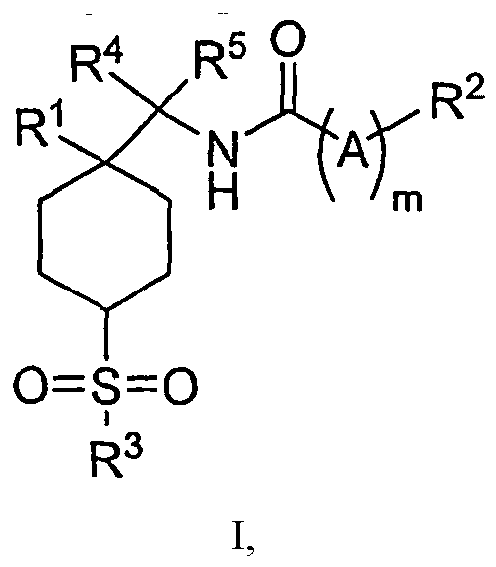
- the present invention is directed to compounds of the formula I: wherein:
- R 2 is selected from the group consisting of:
- R 2a , R 2b and R 2c are independently selected from the group consisting of:
- A is selected from the group consisting of:
- a and b are each 1 or 2, and preferably a and b are each 2.
- the present invention includes compounds wherein R 1 is selected from the group consisting of (CH 2 ) n R 1a wherein R 1a is C 3-6 cycloalkyl, which is unsubstituted or substituted with R 2a , R 2b and R 2c .
- R 1 is 1 and R 1a is unsubstituted C 3-6 cycloalkyl, preferably cyclopropyl.
- suitably n is 0 and R 1a is unsubstituted C 3-6 cycloalkyl, preferably cyclohexyl.
- An embodiment of the present invention includes compounds of the formula Ia: wherein R 1b is a C 3-6 cycloalkyl, which is unsubstituted or substituted with R 2a , R 2b and R 2c and R 2 , R 2a , R 2b , R 2c , R 3 , R 4 , R 5 , A, n and m are defined herein or a pharmaceutically acceptable salt thereof or individual enantiomer or diastereoisomer therefore.
- n is 1 and R 1b is unsubtituted C 3-6 cycloalkyl, preferably cyclopropyl.
- R 1 is heterocycle substituted with with R 2a , R 2b and R 2c .
- the heterocycle is preferably an unsaturated heterocyclic moiety, for example a nitrogen containing unsaturated heterocycle such as pyridyl and R 2a and R 2b are hydrogen and R 2c is hydrogen or fluorine or a saturated heterocyclic moiety, for example a nitrogen containing saturated heterocycle such as piperidyl, optionally substituted by C 1-6 alkyl.
- An embodiment of the present invention includes compounds of the formula Ib: wherein R 4 is C 1-6 alkyl, and R 1 , R 2 , R 3 , A and m are defined herein; or a pharmaceutically acceptable salt thereof or an individual enantiomer or diastereomer thereof.
- An embodiment of the present invention includes compounds wherein R 4 is C 1-3 alkyl and R 5 is hydrogen or C 1-3 alkyl.
- the present invention includes compounds wherein R 4 is C 1-3 alkyl in the (S) configuration and R 5 is hydrogen.
- the present invention includes compounds wherein R 4 is methyl and R 5 is hydrogen.
- the present invention includes compounds wherein R 4 is methyl and R 5 is methyl.
- the present invention includes compounds wherein R 4 is hydrogen and R 5 is hydrogen.
- An embodiment of the present invention includes compounds wherein m is zero.
- the present invention includes compounds of the formula Ic: wherein R 1 , R 2 , R 3 , R 4 and R 5 are defined herein; or a pharmaceutically acceptable salt thereof or an individual enantiomer or diastereomer thereof.
- R 2 is selected from the group consisting of:
- R2a, R 2b and R 2c are independently selected from the group consisting of:
- the present invention includes compounds wherein R 2 is phenyl, pyridyl, pyrimidinyl or thienyl substituted by R 2a , R 2b and R 2c as hereinbefore defined.
- the present invention includes compounds of the formula Id: wherein R 1 , R 3 , R 4 and R 5 are defined herein and R 2a , R 2b and R 2c are selected from hydrogen, fluoro, chloro, bromo, OCH 3 , CF 3 , OCF 3 and NH 2 , and preferably selected from hydrogen, fluoro, chloro, bromo and CF 3 ; and pharmaceutically acceptable salts thereof and individual enantiomers and diastereomers thereof.
- the present invention includes compounds of the formula Id' wherein R 1 , R 2a , R 2b , R 2c and R 3 are defined herein; and pharmaceutically acceptable salts thereof and individual enantiomers and diastereomers thereof.
- the present invention includes compounds of the formula Id": wherein R 1 , R 2a , R 2b , R 2c , R 3 and R 4 are defined herein; and pharmaceutically acceptable salts thereof and individual enantiomers and diastereomers thereof.
- An embodiment of the present invention includes compounds wherein R 3 is a group R 3a and R 3a is a heterocycle as defined herein which is substituted with R 2a , R 2b and R 2c .
- Preferred heterocyclic groups R 3a include unsaturated heterocycles.
- the unsaturated heterocyle will be a six-membered ring containing one or more nitrogen atoms, for example pyridine, or a five-membered ring containing a sulphur or oxygen atom or one to three nitrogen atoms.
- R 3a is a five-membered unsaturated heterocycle having one, two or three hetero atoms selected from one, two or three nitrogen atoms and additionally optionally an oxygen or sulphur atom that is linked to the sulphonyl group through one of the heterocycle's carbon atoms.
- R 3a is a group wherein at least one of X, Y and Z is nitrogen and one of the other groups is nitrogen, the third position being carbon; and R 3b is hydrogen or C 1-6 alkyl, preferably methyl or R 3a is pyridine.
- R 3a is a group: and R 3b is hydrogen or methyl.
- the unsaturated heterocycle may be unsubstituted or substituted by one or two halogen atoms or C 1-6 alkyl or C 1-6 haloalkyl groups.
- the unsaturated heterocycle is unsubstituted or substituted with one or two methyl or ethyl groups.
- R 3 is a C 1-4 alkyl group optionally substituted by a cyclopropyl group or a group NR 14 R 15 wherein R 14 is hydrogen or a C 1-6 alkyl group and R 15 is a C 1-6 alkyl group or R 14 and R 15 together with the nitrogen atom to which they are attached form a four to six membered heterocyclic ring.
- a preferred group of compounds of the formula (I) is that of the formula Ie: Wherein n, R 1b and R 2a , R 2b and R 2c are as hereinbefore defined, D and E are each independently CH or N and R 3a is an unsaturated heterocyle optionally substituted by a halogen or a C 1-6 alkyl or C 1-6 haloalkyl group.
- n is preferably 0 or 1.
- R 1b Preferred values of R 1b are as hereinbefore defined.
- R 2a , R 2b , R 2c are preferably hydrogen, CF 3 or halogen, suitably chlorine or fluorine. Preferably only one of R 2a , R 2b , R 2c is hydrogen.
- D and E are both CH.
- one of Dand E is CH and the other is N.
- R 3a is preferably a six-membered heterocyle containing one or more nitrogen atoms for example pyridine, or a five-membered heterocycle containing a sulphur atom and/or one to three nitrogen atoms and preferably two to three nitrogen atoms, wherein the hetercyclic ring is optionally substituted by one or two halogen atoms or C 1-6 alkyl or C 1-6 haloalkyl groups, such as methyl or ethyl.
- the heterocycle will preferably be connected to the sulphonyl group through a ring carbon atom.
- Preferred heterocycles include five-membered unsaturated heterocycles such as triazolyl, pyrazolyl and imidazolyl.
- a further preferred group of compounds of the formula (I) is that of the formula If: Wherein n, R 1b and R 2a , R 2b and R 2c are as hereinbefore defined, D and E are each independently CH or N, and R 3a is a group CH 2 R 3b wherein R 3b is methyl, ethyl or cyclopropyl:
- R 1b Preferred values of R 1b are as hereinbefore defined.
- R 2a , R 2b , R 2c are preferably hydrogen, C 1-6 alkyl, such as methyl, ethyl and isopropyl and preferably methyl, cyclopropyl, O-C 1-6 alkyl, preferably methoxy, di- C 1-6 alkylamino, preferably dimethylamino, CF 3 , OCF 2 or halogen, suitably chlorine or fluorine.
- C 1-6 alkyl such as methyl, ethyl and isopropyl and preferably methyl, cyclopropyl, O-C 1-6 alkyl, preferably methoxy, di- C 1-6 alkylamino, preferably dimethylamino, CF 3 , OCF 2 or halogen, suitably chlorine or fluorine.
- R 2a , R 2b , R 2c is hydrogen.
- D and E are both CH. In a further preferred embodiment, one of D and E is CH and the other is N.
- Specific embodiments of the present invention include a compound which is selected from the group consisting of the subject compounds of the Examples herein and pharmaceutically acceptable salts thereof and individual enantiomers and diastereomers thereof.
- the compounds of the present invention may contain one or more chiral centers and can thus occur as racemates and racemic mixtures, single enantiomers, diastereomeric mixtures and individual diastereomers.
- R 3 is an alkyl or substituted alkyl group
- the R 1 group is preferably transeqatorial in relation to the group -SO 2 R 3 .
- Additional asymmetric centers may be present depending upon the nature of the various substituents on the molecule. Each such asymmetric center will independently produce two optical isomers and it is intended that all of the possible optical isomers and diastereomers in mixtures and as pure or partially purified compounds are included within the ambit of this invention.
- the present invention is meant to comprehend all such isomeric forms of these compounds.
- Formula I shows the structure of the class of compounds without preferred stereochemistry.
- racemic mixtures of the compounds may be separated so that the individual enantiomers are isolated.
- the separation can be carried out by methods well known in the art, such as the coupling of a racemic mixture of compounds to an enantiomerically pure compound to form a diastereomeric mixture, followed by separation of the individual diastereomers by standard methods, such as fractional crystallization or chromatography.
- the coupling reaction is often the formation of salts using an enantiomerically pure acid or base.
- the diasteromeric derivatives may then be converted to the pure enantiomers by cleavage of the added chiral residue.
- the racemic mixture of the compounds can also be separated directly by chromatographic methods utilizing chiral stationary phases, which methods are well known in the art.
- any enantiomer of a compound may be obtained by stereoselective synthesis using optically pure starting materials or reagents of known configuration by methods well known in the art.
- halo or halogen as used herein are intended to include fluoro, chloro, bromo and iodo.
- C 1-6 as in C 1-6 alkyl is defined to identify the group as having 1, 2, 3, 4, 5 or 6 carbons in a linear or branched arrangement, such that C 1-8 alkyl specifically includes methyl, ethyl, n-propyl, iso-propyl, n-butyl, iso-butyl, tert-butyl, pentyl, hexyl, heptyl and octyl.
- a group which is designated as being independently substituted with substituents may be independently substituted with multiple numbers of such substituents.
- heterocycle includes both unsaturated and saturated heterocyclic moieties, wherein the unsaturated heterocyclic moieties (i.e. "heteroaryl”) include benzoimidazolyl, benzimidazolonyl, benzofuranyl, benzofurazanyl, benzopyrazolyl, benzotriazolyl, benzothiophenyl, benzoxazolyl, carbazolyl, carbolinyl, cinnolinyl, furanyl, imidazolyl, indolinyl, indolyl, indolazinyl, indazolyl, isobenzofuranyl, isoindolyl, isoquinolyl, isothiazolyl, isoxazolyl, naphthpyridinyl, oxadiazolyl, oxazolyl, oxazoline, isoxazoline, oxetanyl, pyrazinyl, pyr
- salts refers to salts prepared from pharmaceutically acceptable non-toxic bases or acids including inorganic or organic bases and inorganic or organic acids.
- Salts derived from inorganic bases include aluminum, ammonium, calcium, copper, ferric, ferrous, lithium, magnesium, manganic salts, manganous, potassium, sodium, zinc, and the like. Particularly preferred are the ammonium, calcium, magnesium, potassium, and sodium salts. Salts in the solid form may exist in more than one crystal structure, and may also be in the form of hydrates.
- Salts derived from pharmaceutically acceptable organic non-toxic bases include salts of primary, secondary, and tertiary amines, substituted amines including naturally occurring substituted amines, cyclic amines, and basic ion exchange resins, such as arginine, betaine, caffeine, choline, N,N'-dibenzylethylenediamine, diethylamine, 2-diethylaminoethanol, 2-dimethylamino-ethanol, ethanolamine, ethylenediamine, N-ethyl-morpholine, N-ethylpiperidine, glucamine, glucosamine, histidine, hydrabamine, isopropylamine, lysine, methylglucamine, morpholine, piperazine, piperidine, polyamine resins, procaine, purines, theobromine, triethylamine, trimethylamine, tripropylamine, tromethamine, and the like.
- basic ion exchange resins such
- salts may be prepared from pharmaceutically acceptable non-toxic acids, including inorganic and organic acids.
- acids include acetic, benzenesulfonic, benzoic, camphorsulfonic, citric, ethanesulfonic, fumaric, gluconic, glutamic, hydrobromic, hydrochloric, isethionic, lactic, maleic, malic, mandelic, methanesulfonic, mucic, nitric, pamoic, pantothenic, phosphoric, succinic, sulfuric, tartaric, p-toluenesulfonic acid, and the like.
- Exemplifying the invention is the use of the compounds disclosed in the Examples and herein.
- Specific compounds within the present invention include a compound which selected from the group consisting of the compounds disclosed in the following Examples and pharmaceutically acceptable salts thereof and individual diastereomers thereof.
- the subject compounds are useful in a method of inhibiting the glycine transporter GlyT1 activity in a patient such as a mammal in need of such inhibition comprising the administration of an effective amount of the compound.
- the present invention is directed to the use of the compounds disclosed herein as inhibitors of the glycine transporter GlyTl activity.
- a variety of other mammals can be treated according to the method of the present invention.
- the present invention is further directed to a method for the manufacture of a medicament for inhibiting glycine transporter GlyT1 activity in humans and animals comprising combining a compound of the present invention with a pharmaceutical carrier or diluent.
- the subject treated in the present methods is generally a mammal, preferably a human being, male or female, in whom inhibition of glycine transporter GlyT1 activity is desired.
- the term "therapeutically effective amount” means the amount of the subject compound that will elicit the biological or medical response of a tissue, system, animal or human that is being sought by the researcher, veterinarian, medical doctor or other clinician. It is recognized that one skilled in the art may affect the neurological and psychiatric disorders by treating a patient presently afflicted with the disorders or by prophylactically treating a patient afflicted with such disorders with an effective amount of the compound of the present invention.
- treatment refers to all processes wherein there may be a slowing, interrupting, arresting, controlling, or stopping of the progression of the neurological and psychiatric disorders described herein, but does not necessarily indicate a total elimination of all disorder symptoms, as well as the prophylactic therapy to retard the progression or reduce the risk of the noted conditions, particularly in a patient who is predisposed to such disease or disorder.
- composition as used herein is intended to encompass a product comprising the specified ingredients in the specified amounts, as well as any product which results, directly or indirectly, from combination of the specified ingredients in the specified amounts.
- Such term in relation to pharmaceutical composition is intended to encompass a product comprising the active ingredient(s), and the inert ingredient(s) that make up the carrier, as well as any product which results, directly or indirectly, from combination, complexation or aggregation of any two or more of the ingredients, or from dissociation of one or more of the ingredients, or from other types of reactions or interactions of one or more of the ingredients.
- the pharmaceutical compositions of the present invention encompass any composition made by admixing a compound of the present invention and a pharmaceutically acceptable carrier.
- pharmaceutically acceptable it is meant the carrier, diluent or excipient must be compatible with the other ingredients of the formulation and not deleterious to the recipient thereof.
- administering should be understood to mean providing a compound of the invention or a prodrug of a compound of the invention to the individual in need of treatment.
- JAR cells Human placental choriocarcinoma cells (JAR cells (ATCC No. HTB-144)) endogenously expressing GlyT1 were cultured in 96-well Cytostar scintillating microplates (Amersham Biosciences) in RPMI 1640 medium containing 10% fetal calf serum in the presence of penicillin (100 micrograms/milliliter) and streptomycin (100 micrograms/ milliliter). Cells were grown at 37°C in a humidified atmosphere of 5% CO2 for 40-48 hours before the assay.
- Non-specific uptake of [ 14 C]-glycine was determined in the presence of 10 mM unlabeled glycine.
- [ 14 C]taurine uptake experiments were performed according to the same protocol except that 10 mM unlabeled taurine was used to determine non-specific uptake.
- a range of concentrations of the compounds of the present invention was added to the cells, followed by the fixed concentration of [ 14 C]glycine.
- the concentration of the present compound that inhibited half of the specific uptake of [ 14 C]glycine was determined from the assay data by non-linear curve fitting.
- the compounds of the following examples had activity in inhibiting specific uptake of [ 14 C]glycine in the aforementioned assay, generally with an IC 50 value of less than about 10 micromolar.
- Preferred compounds within the present invention had activity in inhibiting specific uptake of [ 14 C]glycine in the aforementioned assay with an IC 50 value of less than about 1 micromolar.
- These compounds were selective for [ 14 C]glycine uptake (by GlyT1 in the JAR cells) compared to [ 14 C]taurine uptake (by the taurine transporter TauT in the JAR cells). Such a result is indicative of the intrinsic activity of the compounds in use as inhibitors of GlyT1 transporter activity.
- the NMDA receptor is central to a wide range of CNS processes, and plays a role in a variety of disease states in humans or other species.
- the action of GlyT1 transporters affects the local concentration of glycine around NMDA receptors.
- Selective GlyT1 inhibitors slow the removal of glycine from the synapse, causing the level of synaptic glycine to rise. This in turn increases the occupancy of the glycine binding site on the NMDA receptor, which increases activation of the NMDA receptor following glutamate release from the presynaptic terminal.
- any change to that local concentration can affect NMDA-mediated neurotransmission. Changes in NMDA-mediated neurotransmission have been implicated in certain neuropsychiatric disorders such as dementia, depression and psychoses, for example schizophrenia, and learning and memory disorders, for example attention deficit disorders and autism.
- the compounds of the present invention have utility in treating a variety of neurological and psychiatric disorders associated with glutamatergic neurotransmission dysfunction, including one or more of the following conditions or diseases: schizophrenia or psychosis including schizophrenia (paranoid, disorganized, catatonic or undifferentiated), schizophreniform disorder, schizoaffective disorder, delusional disorder, brief psychotic disorder, shared psychotic disorder, psychotic disorder due to a general medical condition and substance-induced or drug-induced (phencyclidine, ketamine and other dissociative anaesthetics, amphetamine and other psychostimulants and cocaine) psychosispsychotic disorder, psychosis associated with affective disorders, brief reactive psychosis, schizoaffective psychosis, "schizophrenia-spectrum” disorders such as schizoid or schizotypal personality disorders, or illness associated with psychosis (such as major depression, manic depressive (bipolar) disorder, Alzheimer's disease and post-traumatic stress syndrome), including both the positive and the negative symptoms of
- Also disclosed is a method for treating schizophrenia or psychosis comprising: administering to a patient in need thereof an effective amount of a compound of the present invention.
- Particular schizophrenia or psychosis pathologies are paranoid, disorganized, catatonic or undifferentiated schizophrenia and substance-induced psychotic disorder.
- DSM-IV-TR Diagnostic and Statistical Manual of Mental Disorders
- the term "schizophrenia or psychosis” includes treatment of those mental disorders as described in DSM-IV-TR.
- schizophrenia or psychosis is intended to include like disorders that are described in other diagnostic sources.
- the subject compounds are further useful in a method for the prevention, treatment, control, amelioration, or reducation of risk of the diseases, disorders and conditions noted herein.
- the subject compounds are further useful in a method for the prevention, treatment, control, amelioration, or reduction of risk of the aforementioned diseases, disorders and conditions in combination with other agents, including an inhibitor of glycine transporter GlyT1 activity.
- the compounds of the present invention may be used in combination with one or more other drugs in the treatment, prevention, control, amelioration, or reduction of risk of diseases or conditions for which compounds of the present invention or the other drugs may have utility, where the combination of the drugs together are safer or more effective than either drug alone.
- Such other drug(s) may be administered, by a route and in an amount commonly used therefor, contemporaneously or sequentially with a compound of the present invention.
- a pharmaceutical composition in unit dosage form containing such other drugs and the compound of the present invention is preferred.
- the combination therapy may also includes therapies in which the compound of the present invention and one or more other drugs are administered on different overlapping schedules.
- the compounds of the present invention and the other active ingredients may be used in lower doses than when each is used singly. Accordingly, the pharmaceutical compositions of the present invention include those that contain one or more other active ingredients, in addition to a compound of the present invention.
- the above combinations include combinations of a compound of the present invention not only with one other active compound, but also with two or more other active compounds.
- compounds of the present invention may be used in combination with other drugs that are used in the prevention, treatment, control, amelioration, or reduction of risk of the diseases or conditions for which compounds of the present invention are useful.
- Such other drugs may be administered, by a route and in an amount commonly used therefor, contemporaneously or sequentially with a compound of the present invention.
- a pharmaceutical composition containing such other drugs in addition to the compound of the present invention is preferred.
- the pharmaceutical compositions of the present invention include those that also contain one or more other active ingredients, in addition to a compound of the present invention.
- the weight ratio of the compound of the present invention to the second active ingredient may be varied and will depend upon the effective dose of each ingredient. Generally, an effective dose of each will be used. Thus, for example, when a compound of the present invention is combined with another agent, the weight ratio of the compound of the present invention to the other agent will generally range from about 1000:1 to about 1:1000, preferably about 200:1 to about 1:200. Combinations of a compound of the present invention and other active ingredients will generally also be within the aforementioned range, but in each case, an effective dose of each active ingredient should be used.
- the compound of the present invention and other active agents may be administered separately or in conjunction.
- the administration of one element may be prior to, concurrent to, or subsequent to the administration of other agent(s).
- the subject compounds may be used alone or in combination with other agents which are known to be beneficial in the subject indications or other drugs that affect receptors or enzymes that either increase the efficacy, safety, convenience, or reduce unwanted side effects or toxicity of the compounds of the present invention.
- the subject compound and the other agent may be co-administered, either in concomitant therapy or in a fixed combination.
- compositions intended for oral use may be prepared according to any method known to the art for the manufacture of pharmaceutical compositions and such compositions may contain one or more agents selected from the group consisting of sweetening agents, flavoring agents, coloring agents and preserving agents in order to provide pharmaceutically elegant and palatable preparations.
- Tablets contain the active ingredient in admixture with non-toxic pharmaceutically acceptable excipients that are suitable for the manufacture of tablets.
- the tablets may be uncoated or they may be coated by known techniques to delay disintegration and absorption in the gastrointestinal tract and thereby provide a sustained action over a longer period.
- compositions for oral use may also be presented as hard gelatin capsules wherein the active ingredients are mixed with an inert solid diluent, for example, calcium carbonate, calcium phosphate or kaolin, or as soft gelatin capsules wherein the active ingredient is mixed with water or an oil medium, for example peanut oil, liquid paraffin, or olive oil.
- an inert solid diluent for example, calcium carbonate, calcium phosphate or kaolin
- water or an oil medium for example peanut oil, liquid paraffin, or olive oil.
- Aqueous suspensions, oily suspensions, dispersible powders or granules, oil-in-water emulsions, and sterile injectable aqueous or oleagenous suspension may be prepared by standard methods known in the art.
- an appropriate dosage level will generally be about 0.01 to 500 mg per kg patient body weight per day which can be administered in single or multiple doses.
- the dosage level will be about 0.1 to about 250 mg/kg per day; more preferably about 0.5 to about 100 mg/kg per day.
- a suitable dosage level may be about 0.01 to 250 mg/kg per day, about 0.05 to 100 mg/kg per day, or about 0.1 to 50 mg/kg per day. Within this range the dosage may be 0.05 to 0.5, 0.5 to 5 or 5 to 50 mg/kg per day.
- compositions are preferably provided in the form of tablets containing 1.0 to 1000 milligrams of the active ingredient, particularly 1.0, 5.0, 10, 15. 20, 25, 50, 75, 100, 150, 200, 250, 300, 400, 500, 600, 750, 800, 900, and 1000 milligrams of the active ingredient for the symptomatic adjustment of the dosage to the patient to be treated.
- the compounds may be administered on a regimen of 1 to 4 times per day, preferably once or twice per day. This dosage regimen may be adjusted to provide the optimal therapeutic response.
- the compounds of this invention may be prepared by employing methods well known to those skilled in the art for preparing analogous compounds, for example using the reactions as shown in the following schemes, in addition to other standard manipulations that are known in the literature or exemplified in the experimental procedures. Substituent numbering as shown in the schemes does not necessarily correlate to that used in the claims and often, for clarity, a single substituent is shown attached to the compound where multiple substituents are allowed under the definitions hereinabove. Reactions used to generate the compounds of this invention are prepared by employing reactions as shown in the schemes and examples herein, in addition to other standard manipulations such as ester hydrolysis, cleavage of protecting groups, etc., as may be known in the literature or exemplified in the experimental procedures.
- the final product may be further modified, for example, by manipulation of substituents.
- substituents may include, but are not limited to, reduction, oxidation, alkylation, acylation, and hydrolysis reactions which are commonly known to those skilled in the art.
- the order of carrying out the foregoing reaction schemes may be varied to facilitate the reaction or to avoid unwanted reaction products.
- the following examples are provided so that the invention might be more fully understood. These examples are illustrative only and should not be construed as limiting the invention in any way.
- the compounds of the formula (I) may be prepared by oxidation of the corresponding sulphanyl compound. This oxidation may be carried out with oxone, which is conveniently used as an aqueous solution, in a water miscible inert solvent, for example a ketone such as acetone, at a non-extreme temperature, for example 0 to 150°C and preferably 50 to 100 °C.
- oxone which is conveniently used as an aqueous solution
- a water miscible inert solvent for example a ketone such as acetone
- the sulphanyl compounds may be prepared by the method of Scheme I:
- dioxaspiro[4.5]decane-8-carbonitrile is reacted with R 1 L, where L is a leaving group such as halogen, for example bromine, in the presence of KHDMS, followed by reduction of the nitrile, for example with LAH, to give ⁇ [1,4-dioxaspiro[4.4]dec-8-yl]methyl ⁇ amine suitably substituted by R 1 at the 8-position.
- This compound is then acylated by reaction with R 2 substituted with a reactive carboxylic acid derivative, e.g. an acid chloride, followed by ring opening of dioxa-ring by dilute acid and reduction of the resulting ketone, for example with sodium borohydride.
- a reactive carboxylic acid derivative e.g. an acid chloride
- the resulting hydroxyl group is then displaced by a sulhur containing group to give the desired sulphanyl compound, either by reaction with thioacetic acid in the presence of triphenylphosphine and diisopropylazocarboxylate followed by reaction with R 3 I in the presence of lithium hydroxide or by reaction with NaSR 3 in the presence of mesyl chloride and pyridine.
- the compounds of the formula (I) may also be prepared by the reaction of a compound of the formula (II): with the appropriate acid halide of the formula R 2 COhal, and preferably the appropriate acid chloride.
- the reaction is suitably carried out in the presence of a weak base such as a trialkylamine, for example ethyldiisopropylamine, in a non polar solvent, for example a halogenated hydrocarbon such as dichloromethane, at a non-extreme temperature, for example -20 to 100 °C and conveniently 0 to 50 °C.
- a weak base such as a trialkylamine, for example ethyldiisopropylamine
- a non polar solvent for example a halogenated hydrocarbon such as dichloromethane
- the compounds of the formula (II) may be prepared by the method of reaction Scheme II:
- a suitably substituted dioxaspiro[4,5]decane-8-carbonitrile is acidified to convert the dioxialane ring to an oxo group followed by reduction of the oxo group with sodium borohydride to give the corresponding hydroxy compound.
- the hydroxy group is converted to a thioacetate group by reaction with triphenylphosphine/thioacetic acid and the thioacetate group in turn alkylated by a compound R 3 I in the presence of lithium hydroxide.
- Oxygenation by oxone gives the corresponding sulfanoylcyclohexanecarbonitrile.
- R 4 and R 5 are hydrogen
- the nitrile group is reduced, for example by hydrogenation in the presence of a suitable catalyst such as Raney nickel.
- Potassium thioacetate (21.39 g, 187 mmol) was added to a stirred mixture of 1,4-dioxaspiro[4,5]dec-8-yl methanesulfonate (29.5 g, 125 mmol) in DMSO (31.2 ml) and the mixture was heated at 40° C for 24 h. The mixture was cooled, brine was added and the mixture was extracted with ethyl acetate. The combined organic fractions were washed with brine, dried, and evaporated.
- 1,4-Dioxaspiro[4.5]dec-8-yl ethanethioate (16.3 g, 75 mmol) was added to a stirred mixture of cyclopropylmethyl bromide (20.35 g, 151 mmol) and lithium hydroxide (7.22 g, 301 mmol) in water (15 ml) and 2-Propanol (75 ml) and stirred at room temperature overnight. Brine was added and the mixture was extracted with ethyl acetate.
- reaction was carefully quenched with 1 M hydrochloric acid (24mL) and then extracted into ethyl acetate and purified using a 40M Biotage cartridge using 5% (2M ammonia in methanol)/ DCM to yield (1- ⁇ 1-(cyclopropylmethyl)-4-[(cyclopropylmethyl)thio]cyclohexyl ⁇ ethyl)amine.
Landscapes
- Organic Chemistry (AREA)
- Chemical & Material Sciences (AREA)
- Health & Medical Sciences (AREA)
- Bioinformatics & Cheminformatics (AREA)
- Engineering & Computer Science (AREA)
- General Health & Medical Sciences (AREA)
- Medicinal Chemistry (AREA)
- Nuclear Medicine, Radiotherapy & Molecular Imaging (AREA)
- General Chemical & Material Sciences (AREA)
- Pharmacology & Pharmacy (AREA)
- Life Sciences & Earth Sciences (AREA)
- Animal Behavior & Ethology (AREA)
- Chemical Kinetics & Catalysis (AREA)
- Public Health (AREA)
- Veterinary Medicine (AREA)
- Biomedical Technology (AREA)
- Psychiatry (AREA)
- Neurology (AREA)
- Neurosurgery (AREA)
- Pharmaceuticals Containing Other Organic And Inorganic Compounds (AREA)
- Pyridine Compounds (AREA)
- Acyclic And Carbocyclic Compounds In Medicinal Compositions (AREA)
- Organic Low-Molecular-Weight Compounds And Preparation Thereof (AREA)
- Heterocyclic Compounds Containing Sulfur Atoms (AREA)
- Nitrogen- Or Sulfur-Containing Heterocyclic Ring Compounds With Rings Of Six Or More Members (AREA)
- Heterocyclic Carbon Compounds Containing A Hetero Ring Having Oxygen Or Sulfur (AREA)
- Heterocyclic Carbon Compounds Containing A Hetero Ring Having Nitrogen And Oxygen As The Only Ring Hetero Atoms (AREA)
Claims (14)
- Eine Verbindung der Formel I:
 R1-(CH2)nR1a ist, wobei n unabhängig 0-6 ist und R1a ausgewählt ist aus der Gruppe, bestehend aus:(1) C1-6-Alkyl, das unsubstituiert oder substituiert ist mit 1-6 Halogenen, Hydroxy,(2) Phenyl, substituiert mit R2a, R2b und R2c,(3) Heterocyclus, substituiert mit R2a, R2b und R2c,(4) C3-6-Cycloalkyl, das unsubstituiert oder substituiert ist mit C1-6-Alkyl, 1-6 Halogenen, Hydroxy oder -NR10R11,(5) -O-C1-6-Alkyl, das unsubstituiert oder substituiert ist mit 1-6 Halogenen, Hydroxy oder -NR10R11,(6) -CO2R9,
wobei R9 unabhängig ausgewählt ist aus:(a) Wasserstoff,(b) -C1-6-Alkyl, das unsubstituiert oder substituiert ist mit 1-6 Fluor,(c) Benzyl und(d) Phenyl,(7) -NR10R11,
wobei R10 und R11 unabhängig ausgewählt sind aus:(a) Wasserstoff,(b) -C1-6-Alkyl, das unsubstituiert oder substituiert ist mit Hydroxy, 1-6 Fluor oder -NR12R13, wobei R12 und R13 unabhängig ausgewählt sind aus Wasserstoff und -C1-6-Alkyl,(c) -C3-6-Cycloalkyl, das unsubstituiert oder substituiert ist mit Hydroxy, 1-6 Fluor oder -NR12R13,(d) Benzyl,(e) Phenyl und(8) -CONR10R11,R2 ausgewählt ist aus der Gruppe, bestehend aus:(1) Phenyl, das substituiert ist mit R2a, R2b und R2c,(2) Heterocyclus, der substituiert ist mit R2a, R2b und R2c,(3) C1-8-Alkyl, das unsubstituiert oder substituiert ist mit 1-6 Halogenen, Hydroxy, -NR10R11, Phenyl oder Heterocyclus, wobei das Phenyl oder der Heterocyclus substituiert ist mit R2a, R2b und R2c,(4) C3-6-Cycloalkyl, das unsubstituiert oder substituiert ist mit 1-6 Halogenen, Hydroxy oder -NR10R11, und(5) -C1-6-Alkyl-(C3-6-cycloalkyl), das unsubstituiert oder substituiert ist mit 1-6 Halogenen, Hydroxy oder -NR10R11,R2a, R2b und R2c unabhängig ausgewählt sind aus der Gruppe, bestehend aus:(1) Wasserstoff,(2) Halogen,(3) -C1-6-Alkyl, das unsubstituiert oder substituiert ist mit:(a) 1-6 Halogenen,(b) Phenyl,(c) C3-6-Cycloalkyl oder(d) -NR10R11,(4) -O-C1-6-Alkyl, das unsubstituiert oder substituiert ist mit 1-6 Halogenen,(5) Hydroxy,(6) -SCF3,(7) -SCHF2,(8) -SCH3,(9) -CO2R9,(10) -CN,(11) -SO2R9,(12) -SO2NR10R11,(13) -NR10R11,(14) -CONR10R11 und(15) -NO2,wobei r 1 bis 3 ist,
oder zwei von R2a, R2b und R2c verknüpft sind unter Bildung einer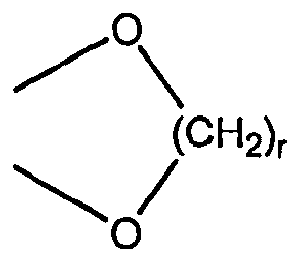 R3 ausgewählt ist aus der Gruppe, bestehend aus:(1) C1-6-Alkyl, das unsubstituiert oder substituiert ist mit 1-6 Halogenen, Hydroxyl, -NR10R11 oder Heterocyclus, der mit R2a, R2b und R2c substituiert ist,(2) C3-6-Cycloalkyl, das unsubstituiert oder substituiert ist mit 1-6 Halogenen, Hydroxyl oder -NR10R11,(3) -C1-6-Alkyl-(C3-6-cycloalkyl), das unsubstituiert oder substituiert ist mit 1-6 Halogenen, Hydroxy oder -NR10R11, und(4) -NR10R11 und(5) Heterocyclus, der substituiert ist mit R2a, R2b und R2c,R4 und R5 unabhängig ausgewählt sind aus der Gruppe, bestehend aus:(1) Wasserstoff und(2) C1-6-Alkyl, das unsubstituiert oder substituiert ist mit Halogen oder Hydroxyl,oder R4 und R5 zusammengenommen einen C3-6-Cycloalkylring bilden,
A ausgewählt ist aus der Gruppe, bestehend aus:(1) -O- und(2) -NR10-,m null oder eins ist, wobei, wenn m null ist, R2 direkt an das Carbonyl gebunden ist,
und pharmazeutisch annehmbare Salze davon und einzelne Enantiomere und Diastereomere davon. - Eine Verbindung nach Anspruch 1, wobei R3 -C1-6-Alkyl-(C3-6-cycloalkyl) ist.
- Eine Verbindung nach Anspruch 1 oder 2, wobei R1 C3-6-Cycloalkyl ist.
- Eine Verbindung nach Anspruch 1, 2 oder 3, wobei R2 Phenyl ist, substituiert durch R2a, R2b und R2c, welche unabhängig ausgewählt sind aus Wasserstoff, Fluor, Chlor, Brom, OCH3, CF3, OCF3 und NH2.
- Eine Verbindung nach einem vorhergehenden Anspruch, wobei R4 und R5 Wasserstoff sind.
- Eine Verbindung nach einem vorhergehenden Anspruch, wobei n null oder eins ist.
- Eine Verbindung nach Anspruch 1 der Formel Id:

- Eine Verbindung nach Anspruch 1 der Formel Ie:
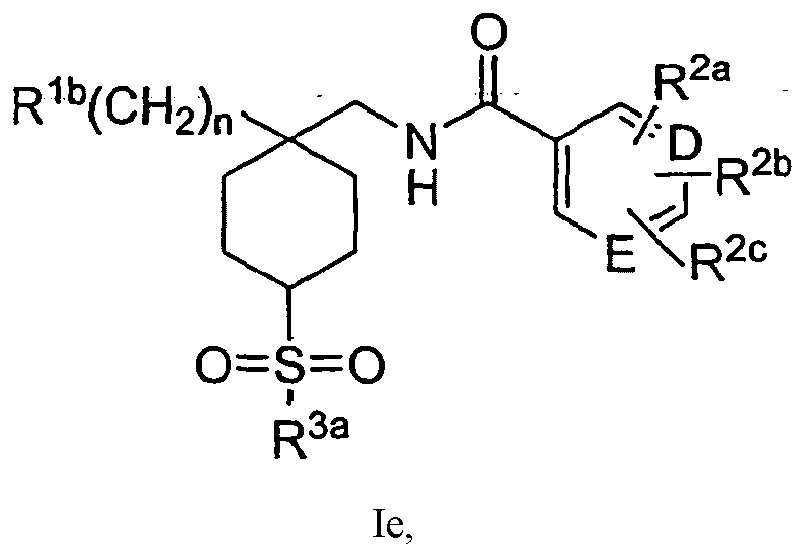
R1b ein C3-6-Cycloalkyl ist, das unsubstituiert oder substituiert ist mit R2a, R2b und R2c,
D und E jeweils unabhängig CH oder N sind und
R3a ein ungesättigter Heterocyclus ist, der gegebenenfalls substituiert ist durch ein Halogen oder eine C1-6-Alkyl- oder C1-6-Halogenalkylgruppe. - Eine Verbindung nach Anspruch 1 der Formel If:

- Eine Verbindung gemäß Anspruch 1, die ist:2,4-Dichlor-N-({1-cyclopropylmethyl-4-[(1-methyl-1H-1,2,3-triazol-4-yl)sulfonyl]cyclohexyl}methyl)benzamid,2,4-Dichlor-N-(4-cyclopropylmethansulfonyl-1-cyclopropylmethylcyclohexylmethyl)benzamid (Verbindung 2),2,4-Dichlor-N-(1-{1-cyclopropylmethyl)-4-[(cyclopropylmethyl)sulfonyl]cyclohexyl]ethyl)benzamid, 2-Chlor-N-(1-{1-(cyclopropylmethyl)-4-[(cyclopropylmethyl)sulfonyl]cyclohexyl}ethyl)-4-(trifluormethyl)benzamid,2,4-Dichlor-N-[1-(cyclopropylhydroxylmethyl)-4-cyclopropylmethansulfonylcyclohexylmethyl]benzamid, oder ein pharmazeutisch annehmbares Salz davon oder ein Enantiomer oder Diastereomer davon.
- Eine pharmazeutische Zusammensetzung, die eine Verbindung nach einem vorhergehenden Anspruch oder ein pharmazeutisch annehmbares Salz davon oder ein Enantiomer oder Diastereomer davon und einen pharmazeutisch annehmbaren Träger enthält.
- Eine Verbindung nach einem der Ansprüche 1 bis 10 oder ein pharmazeutisch annehmbares Salz davon oder ein Enantiomer oder Diastereomer davon zur Verwendung bei einem Verfahren zur Behandlung des menschlichen Körpers durch Therapie.
- Verwendung einer Verbindung nach einem der Ansprüche 1 bis 10 oder eines pharmazeutisch annehmbaren Salzes davon oder eines Enantiomers oder Diastereomers davon zur Herstellung eines Medikaments zur Behandlung von Schizophrenie.
- Eine Kombination aus einer Verbindung nach einem der Ansprüche 1 bis 10 oder einem pharmazeutisch annehmbaren Salz davon oder einem Enantiomer oder Diastereomer davon und einem weiteren Wirkstoff zur gleichzeitigen, sequentiellen oder separaten Verabreichung.
Applications Claiming Priority (4)
| Application Number | Priority Date | Filing Date | Title |
|---|---|---|---|
| GB0511452A GB0511452D0 (en) | 2005-06-06 | 2005-06-06 | Therapeutic agents |
| GB0516787A GB0516787D0 (en) | 2005-08-17 | 2005-08-17 | Therapeutic agents |
| GB0524968A GB0524968D0 (en) | 2005-12-08 | 2005-12-08 | Therapeutic agents |
| PCT/GB2006/002052 WO2006131713A1 (en) | 2005-06-06 | 2006-06-05 | Cyclohexanesulfonyl derivatives as glyt1 inhibitors to treat schizophrenia |
Publications (2)
| Publication Number | Publication Date |
|---|---|
| EP1891002A1 EP1891002A1 (de) | 2008-02-27 |
| EP1891002B1 true EP1891002B1 (de) | 2012-05-30 |
Family
ID=36636407
Family Applications (2)
| Application Number | Title | Priority Date | Filing Date |
|---|---|---|---|
| EP06744089A Active EP1893566B1 (de) | 2005-06-06 | 2006-06-05 | Cyclohexansulfonylderivate als glyt1-hemmer zur behandlung von schizophrenie |
| EP06744106A Active EP1891002B1 (de) | 2005-06-06 | 2006-06-05 | Cyclohexansulfonyl-derivate als glyt1-hemmer zur behandlung von schizophrenie |
Family Applications Before (1)
| Application Number | Title | Priority Date | Filing Date |
|---|---|---|---|
| EP06744089A Active EP1893566B1 (de) | 2005-06-06 | 2006-06-05 | Cyclohexansulfonylderivate als glyt1-hemmer zur behandlung von schizophrenie |
Country Status (10)
| Country | Link |
|---|---|
| US (2) | US7626056B2 (de) |
| EP (2) | EP1893566B1 (de) |
| JP (1) | JP5281395B2 (de) |
| AR (1) | AR057350A1 (de) |
| AU (1) | AU2006256583B2 (de) |
| CA (1) | CA2609969C (de) |
| DO (1) | DOP2006000125A (de) |
| PE (1) | PE20061490A1 (de) |
| TW (1) | TW200716531A (de) |
| WO (2) | WO2006131711A1 (de) |
Families Citing this family (23)
| Publication number | Priority date | Publication date | Assignee | Title |
|---|---|---|---|---|
| US20070105902A1 (en) * | 2003-11-12 | 2007-05-10 | Lindsley Craig W | 4-Phenyl piperdine sulfonyl glycine transporter inhibitors |
| US7825135B2 (en) * | 2004-03-24 | 2010-11-02 | Merck Sharp & Dohme Limited | Heteroaryl piperidine glycine transporter inhibitors |
| AU2005243192A1 (en) * | 2004-04-29 | 2005-11-24 | Merck & Co., Inc. | Azetidine glycine transporter inhibitors |
| US7576083B2 (en) * | 2004-05-05 | 2009-08-18 | Merck & Co., Inc. | Morpholinyl piperidine glycine transporter inhibitors |
| BRPI0515954A (pt) * | 2004-09-30 | 2008-08-12 | Merck & Co Inc | composto e sais farmaceuticamente aceitáveis do mesmo e enanciÈmeros e diaestereÈmeros individuais do mesmo, composição farmacêutica, e, métodos para inibição do transportador de glicina glyt1 em um mamìfero, para a fabricação de um medicamento para inibir o transportador de glicina glyt1 em um mamìfero, para tratar um distúbios neurológicos e psiquiátricos associados com disfunçao de neurotransmissão glicinérgica ou glutamatérgica em um paciente mamìfero e para tratar esquizofrenia em um paciente mamìfero |
| EP1831201B1 (de) * | 2004-12-21 | 2010-08-04 | Merck Sharp & Dohme Ltd. | Piperidin- und azetidinderivate als glyt1-inhibitoren |
| WO2006131711A1 (en) | 2005-06-06 | 2006-12-14 | Merck Sharp & Dohme Limited | Cyclohexanesulfonyl derivatives as glyt1 inhibitors to treat schizophrenia |
| CA2611376C (en) | 2005-06-13 | 2013-09-10 | Merck Sharp & Dohme Limited | Therapeutic agents |
| GB0523998D0 (en) * | 2005-11-25 | 2006-01-04 | Merck Sharp & Dohme | Therapeutic agents |
| CA2707447C (en) * | 2007-12-26 | 2016-03-08 | Banyu Pharmaceutical Co., Ltd. | Sulfonyl-substituted 6-membered ring derivative |
| EP2477963A4 (de) * | 2009-09-18 | 2013-02-27 | Zalicus Pharmaceuticals Ltd | Arylsulfonderivate als calciumkanalblocker |
| DK2595484T3 (en) * | 2010-07-20 | 2018-01-22 | Minerva Neurosciences Inc | USE OF CYCLIC AMIDE DERIVATIVES FOR TREATMENT OF SLEEP DISORDERS |
| US8937900B2 (en) | 2010-07-20 | 2015-01-20 | Qualcomm Incorporated | Enhancing pilot channel transmission in TD-SCDMA multicarrier systems using secondary carrier frequencies |
| US20160130278A1 (en) * | 2013-06-10 | 2016-05-12 | Taisho Pharmaceutical Co., Ltd | Glycine transporter inhibitor |
| EP3134406A1 (de) | 2014-04-24 | 2017-03-01 | Dart Neuroscience (Cayman) Ltd | Substituierte 2,4,5,6-tetrahydropyrrolo [ 3,4-c ] pyrazol-und 4,5,6,7-tetrahydro-2 h-pyrazolo [ 4,3-c ] pyridinverbindungen als glyt1-inhibitoren |
| US10040759B2 (en) | 2014-11-05 | 2018-08-07 | Dart Neuroscience (Cayman) Ltd. | Substituted azetidinyl compounds as GlyT1 inhibitors |
| JP2018501217A (ja) | 2014-12-02 | 2018-01-18 | 田辺三菱製薬株式会社 | 統合失調症を治療するための2−((1−(2(4−フルオロフェニル)−2−オキソエチル)ピペリジン−4−イル)メチル)イソインドリン−1−オン |
| CN106467477A (zh) * | 2016-08-26 | 2017-03-01 | 天津雅奥科技发展有限公司 | 一种合成化合物(1‑环丙基‑1‑氰基‑4‑环己酮)的新方法 |
| CN106916089B (zh) * | 2017-03-14 | 2018-10-19 | 大连九信精细化工有限公司 | 一种选择性合成顺式4-正戊基环己硫醇的制备方法 |
| CA3067031A1 (en) | 2017-06-21 | 2018-12-27 | Minerva Neurosciences, Inc. | Gastro-resistant controlled release oral dosage forms |
| MA53437A (fr) | 2018-08-21 | 2021-06-30 | Minerva Neurosciences Inc | Utilisation de rolupéridone pour traiter des symptômes et des troubles négatifs, augmenter la neuroplasticité et favoriser la neuroprotection |
| JP2023512000A (ja) | 2020-01-31 | 2023-03-23 | ソルヴェイ(ソシエテ アノニム) | ハロアルキル置換ピリジン化合物の製造のプロセス |
| CN114426494B (zh) * | 2022-01-13 | 2023-09-15 | 江苏海洋大学 | 一种具有作用于taar激动剂的取代甲胺类衍生物 |
Family Cites Families (12)
| Publication number | Priority date | Publication date | Assignee | Title |
|---|---|---|---|---|
| AU7624298A (en) * | 1996-12-03 | 1998-06-29 | Graybill, Todd L. | Aminobenzenedicarboxylic acid-based combinatorial libraries |
| SE9704544D0 (sv) * | 1997-12-05 | 1997-12-05 | Astra Pharma Prod | Novel compounds |
| EP1456171B1 (de) | 2001-12-12 | 2006-12-20 | F. Hoffmann-La Roche Ag | Substituierte cyclohexanderivate |
| GB0223039D0 (en) * | 2002-10-04 | 2002-11-13 | Merck Sharp & Dohme | Therapeutic compounds |
| FR2861073B1 (fr) | 2003-10-17 | 2006-01-06 | Sanofi Synthelabo | Derives de n-[heteroaryl(piperidin-2-yl)methyl]benzamide, leur preparation et leur application en therapeutique |
| US20070105902A1 (en) | 2003-11-12 | 2007-05-10 | Lindsley Craig W | 4-Phenyl piperdine sulfonyl glycine transporter inhibitors |
| US7825135B2 (en) | 2004-03-24 | 2010-11-02 | Merck Sharp & Dohme Limited | Heteroaryl piperidine glycine transporter inhibitors |
| AU2005243192A1 (en) | 2004-04-29 | 2005-11-24 | Merck & Co., Inc. | Azetidine glycine transporter inhibitors |
| US7576083B2 (en) | 2004-05-05 | 2009-08-18 | Merck & Co., Inc. | Morpholinyl piperidine glycine transporter inhibitors |
| BRPI0515954A (pt) | 2004-09-30 | 2008-08-12 | Merck & Co Inc | composto e sais farmaceuticamente aceitáveis do mesmo e enanciÈmeros e diaestereÈmeros individuais do mesmo, composição farmacêutica, e, métodos para inibição do transportador de glicina glyt1 em um mamìfero, para a fabricação de um medicamento para inibir o transportador de glicina glyt1 em um mamìfero, para tratar um distúbios neurológicos e psiquiátricos associados com disfunçao de neurotransmissão glicinérgica ou glutamatérgica em um paciente mamìfero e para tratar esquizofrenia em um paciente mamìfero |
| EP1831201B1 (de) | 2004-12-21 | 2010-08-04 | Merck Sharp & Dohme Ltd. | Piperidin- und azetidinderivate als glyt1-inhibitoren |
| WO2006131711A1 (en) * | 2005-06-06 | 2006-12-14 | Merck Sharp & Dohme Limited | Cyclohexanesulfonyl derivatives as glyt1 inhibitors to treat schizophrenia |
-
2006
- 2006-06-05 WO PCT/GB2006/002035 patent/WO2006131711A1/en not_active Ceased
- 2006-06-05 AR ARP060102342A patent/AR057350A1/es unknown
- 2006-06-05 EP EP06744089A patent/EP1893566B1/de active Active
- 2006-06-05 US US11/446,735 patent/US7626056B2/en active Active
- 2006-06-05 WO PCT/GB2006/002052 patent/WO2006131713A1/en not_active Ceased
- 2006-06-05 TW TW095119888A patent/TW200716531A/zh unknown
- 2006-06-05 PE PE2006000608A patent/PE20061490A1/es not_active Application Discontinuation
- 2006-06-05 CA CA2609969A patent/CA2609969C/en not_active Expired - Fee Related
- 2006-06-05 AU AU2006256583A patent/AU2006256583B2/en not_active Ceased
- 2006-06-05 JP JP2008514201A patent/JP5281395B2/ja not_active Expired - Fee Related
- 2006-06-05 DO DO2006000125A patent/DOP2006000125A/es unknown
- 2006-06-05 EP EP06744106A patent/EP1891002B1/de active Active
-
2009
- 2009-10-01 US US12/571,904 patent/US7851638B2/en active Active
Also Published As
| Publication number | Publication date |
|---|---|
| JP2008542348A (ja) | 2008-11-27 |
| EP1891002A1 (de) | 2008-02-27 |
| US7626056B2 (en) | 2009-12-01 |
| CA2609969C (en) | 2015-10-27 |
| US20060276655A1 (en) | 2006-12-07 |
| US20100029726A1 (en) | 2010-02-04 |
| EP1893566B1 (de) | 2013-02-13 |
| JP5281395B2 (ja) | 2013-09-04 |
| AU2006256583A1 (en) | 2006-12-14 |
| TW200716531A (en) | 2007-05-01 |
| WO2006131713A1 (en) | 2006-12-14 |
| US7851638B2 (en) | 2010-12-14 |
| WO2006131711A1 (en) | 2006-12-14 |
| AR057350A1 (es) | 2007-11-28 |
| DOP2006000125A (es) | 2006-12-31 |
| PE20061490A1 (es) | 2007-02-09 |
| EP1893566A1 (de) | 2008-03-05 |
| CA2609969A1 (en) | 2006-12-14 |
| AU2006256583B2 (en) | 2012-01-12 |
Similar Documents
| Publication | Publication Date | Title |
|---|---|---|
| EP1891002A1 (de) | Cyclohexansulfonyl-derivate als glyt1-hemmer zur behandlung von schizophrenie | |
| EP2991994B1 (de) | Thiazolopyrrolidininhibitoren von ror-gamma | |
| RU2684635C1 (ru) | Производные тетрагидроимидазопиридина в качестве модуляторов активновти tnf | |
| JP2022508657A (ja) | アミノ酸化合物およびその使用方法 | |
| ES2627772T3 (es) | Compuestos de tetraciclina | |
| RS54485B1 (sr) | C7-fluoro supstituisana tetraciklinska jedinjenja | |
| JP2022519301A (ja) | N-(ピリジン-2-イル)ピリジン-スルホンアミド誘導体及び疾患の処置におけるそれらの使用 | |
| JP7592069B2 (ja) | 抗マラリア性ヘキサヒドロピリミジン類似体 | |
| WO2020249064A1 (en) | Compounds for modulating fxr | |
| CN116615425B (zh) | 作为Sppl2a抑制剂的化合物和组合物 | |
| JP2008544978A (ja) | Nk−3受容体拮抗剤としての置換シクロヘキシル誘導体 | |
| US20100035873A1 (en) | Diaryl Compounds and Uses Thereof | |
| AU2019229188B2 (en) | Substituted cyclohexyl compounds as NOP inhibitors | |
| AU2019271419B2 (en) | Pain treating compounds and uses thereof | |
| JP7863571B2 (ja) | Clostridium difficileの治療において有用なジアゼピン誘導体 | |
| AU2006318832A1 (en) | Azetidine derivatives as GlyT1 inhibitors | |
| WO2024220487A1 (en) | Carbocyclic phenylpyrrolidinone urea fpr2 agonists | |
| JP2026502501A (ja) | M4アクチベーター/モジュレーターとしてのスピロ誘導体及びその使用 | |
| JP2025505665A (ja) | 抗マラリア性ヘキサヒドロピリミジン類似体 | |
| JP2025532632A (ja) | M4アクチベーター/モジュレーター及びその使用 | |
| JP2025539698A (ja) | 新規シアノピリジンkhk阻害剤化合物 | |
| EA047646B1 (ru) | Замещенные макроциклические соединения и связанные с ними способы лечения | |
| NZ717223A (en) | Aminoheteroaryl benzamides as kinase inhibitors | |
| NZ626306B2 (en) | Substituted pyrazolo[1,5-a] pyridine as tropomyosin receptor kinase (trk) inhibitors |
Legal Events
| Date | Code | Title | Description |
|---|---|---|---|
| PUAI | Public reference made under article 153(3) epc to a published international application that has entered the european phase |
Free format text: ORIGINAL CODE: 0009012 |
|
| 17P | Request for examination filed |
Effective date: 20080107 |
|
| AK | Designated contracting states |
Kind code of ref document: A1 Designated state(s): AT BE BG CH CY CZ DE DK EE ES FI FR GB GR HU IE IS IT LI LT LU LV MC NL PL PT RO SE SI SK TR |
|
| AX | Request for extension of the european patent |
Extension state: HR |
|
| RAX | Requested extension states of the european patent have changed |
Extension state: HR Payment date: 20080107 |
|
| 17Q | First examination report despatched |
Effective date: 20080806 |
|
| RAX | Requested extension states of the european patent have changed |
Extension state: HR Payment date: 20080107 |
|
| GRAP | Despatch of communication of intention to grant a patent |
Free format text: ORIGINAL CODE: EPIDOSNIGR1 |
|
| GRAS | Grant fee paid |
Free format text: ORIGINAL CODE: EPIDOSNIGR3 |
|
| GRAA | (expected) grant |
Free format text: ORIGINAL CODE: 0009210 |
|
| AK | Designated contracting states |
Kind code of ref document: B1 Designated state(s): AT BE BG CH CY CZ DE DK EE ES FI FR GB GR HU IE IS IT LI LT LU LV MC NL PL PT RO SE SI SK TR |
|
| AX | Request for extension of the european patent |
Extension state: HR |
|
| REG | Reference to a national code |
Ref country code: GB Ref legal event code: FG4D |
|
| REG | Reference to a national code |
Ref country code: CH Ref legal event code: EP |
|
| REG | Reference to a national code |
Ref country code: AT Ref legal event code: REF Ref document number: 560016 Country of ref document: AT Kind code of ref document: T Effective date: 20120615 |
|
| REG | Reference to a national code |
Ref country code: IE Ref legal event code: FG4D |
|
| REG | Reference to a national code |
Ref country code: CH Ref legal event code: NV Representative=s name: MARKS & CLERK (LUXEMBOURG) LLP |
|
| REG | Reference to a national code |
Ref country code: DE Ref legal event code: R096 Ref document number: 602006029819 Country of ref document: DE Effective date: 20120726 |
|
| REG | Reference to a national code |
Ref country code: NL Ref legal event code: T3 |
|
| REG | Reference to a national code |
Ref country code: LT Ref legal event code: MG4D Effective date: 20120530 |
|
| PG25 | Lapsed in a contracting state [announced via postgrant information from national office to epo] |
Ref country code: FI Free format text: LAPSE BECAUSE OF FAILURE TO SUBMIT A TRANSLATION OF THE DESCRIPTION OR TO PAY THE FEE WITHIN THE PRESCRIBED TIME-LIMIT Effective date: 20120530 Ref country code: SE Free format text: LAPSE BECAUSE OF FAILURE TO SUBMIT A TRANSLATION OF THE DESCRIPTION OR TO PAY THE FEE WITHIN THE PRESCRIBED TIME-LIMIT Effective date: 20120530 Ref country code: LT Free format text: LAPSE BECAUSE OF FAILURE TO SUBMIT A TRANSLATION OF THE DESCRIPTION OR TO PAY THE FEE WITHIN THE PRESCRIBED TIME-LIMIT Effective date: 20120530 Ref country code: CY Free format text: LAPSE BECAUSE OF FAILURE TO SUBMIT A TRANSLATION OF THE DESCRIPTION OR TO PAY THE FEE WITHIN THE PRESCRIBED TIME-LIMIT Effective date: 20120530 Ref country code: IS Free format text: LAPSE BECAUSE OF FAILURE TO SUBMIT A TRANSLATION OF THE DESCRIPTION OR TO PAY THE FEE WITHIN THE PRESCRIBED TIME-LIMIT Effective date: 20120930 |
|
| REG | Reference to a national code |
Ref country code: AT Ref legal event code: MK05 Ref document number: 560016 Country of ref document: AT Kind code of ref document: T Effective date: 20120530 |
|
| PG25 | Lapsed in a contracting state [announced via postgrant information from national office to epo] |
Ref country code: SI Free format text: LAPSE BECAUSE OF FAILURE TO SUBMIT A TRANSLATION OF THE DESCRIPTION OR TO PAY THE FEE WITHIN THE PRESCRIBED TIME-LIMIT Effective date: 20120530 Ref country code: LV Free format text: LAPSE BECAUSE OF FAILURE TO SUBMIT A TRANSLATION OF THE DESCRIPTION OR TO PAY THE FEE WITHIN THE PRESCRIBED TIME-LIMIT Effective date: 20120530 Ref country code: GR Free format text: LAPSE BECAUSE OF FAILURE TO SUBMIT A TRANSLATION OF THE DESCRIPTION OR TO PAY THE FEE WITHIN THE PRESCRIBED TIME-LIMIT Effective date: 20120831 |
|
| PG25 | Lapsed in a contracting state [announced via postgrant information from national office to epo] |
Ref country code: BE Free format text: LAPSE BECAUSE OF FAILURE TO SUBMIT A TRANSLATION OF THE DESCRIPTION OR TO PAY THE FEE WITHIN THE PRESCRIBED TIME-LIMIT Effective date: 20120530 |
|
| PG25 | Lapsed in a contracting state [announced via postgrant information from national office to epo] |
Ref country code: DK Free format text: LAPSE BECAUSE OF FAILURE TO SUBMIT A TRANSLATION OF THE DESCRIPTION OR TO PAY THE FEE WITHIN THE PRESCRIBED TIME-LIMIT Effective date: 20120530 Ref country code: CZ Free format text: LAPSE BECAUSE OF FAILURE TO SUBMIT A TRANSLATION OF THE DESCRIPTION OR TO PAY THE FEE WITHIN THE PRESCRIBED TIME-LIMIT Effective date: 20120530 Ref country code: EE Free format text: LAPSE BECAUSE OF FAILURE TO SUBMIT A TRANSLATION OF THE DESCRIPTION OR TO PAY THE FEE WITHIN THE PRESCRIBED TIME-LIMIT Effective date: 20120530 Ref country code: MC Free format text: LAPSE BECAUSE OF NON-PAYMENT OF DUE FEES Effective date: 20120630 Ref country code: AT Free format text: LAPSE BECAUSE OF FAILURE TO SUBMIT A TRANSLATION OF THE DESCRIPTION OR TO PAY THE FEE WITHIN THE PRESCRIBED TIME-LIMIT Effective date: 20120530 Ref country code: SK Free format text: LAPSE BECAUSE OF FAILURE TO SUBMIT A TRANSLATION OF THE DESCRIPTION OR TO PAY THE FEE WITHIN THE PRESCRIBED TIME-LIMIT Effective date: 20120530 Ref country code: RO Free format text: LAPSE BECAUSE OF FAILURE TO SUBMIT A TRANSLATION OF THE DESCRIPTION OR TO PAY THE FEE WITHIN THE PRESCRIBED TIME-LIMIT Effective date: 20120530 |
|
| PG25 | Lapsed in a contracting state [announced via postgrant information from national office to epo] |
Ref country code: PL Free format text: LAPSE BECAUSE OF FAILURE TO SUBMIT A TRANSLATION OF THE DESCRIPTION OR TO PAY THE FEE WITHIN THE PRESCRIBED TIME-LIMIT Effective date: 20120530 Ref country code: IT Free format text: LAPSE BECAUSE OF FAILURE TO SUBMIT A TRANSLATION OF THE DESCRIPTION OR TO PAY THE FEE WITHIN THE PRESCRIBED TIME-LIMIT Effective date: 20120530 Ref country code: PT Free format text: LAPSE BECAUSE OF FAILURE TO SUBMIT A TRANSLATION OF THE DESCRIPTION OR TO PAY THE FEE WITHIN THE PRESCRIBED TIME-LIMIT Effective date: 20121001 |
|
| REG | Reference to a national code |
Ref country code: IE Ref legal event code: MM4A |
|
| PLBE | No opposition filed within time limit |
Free format text: ORIGINAL CODE: 0009261 |
|
| STAA | Information on the status of an ep patent application or granted ep patent |
Free format text: STATUS: NO OPPOSITION FILED WITHIN TIME LIMIT |
|
| PG25 | Lapsed in a contracting state [announced via postgrant information from national office to epo] |
Ref country code: IE Free format text: LAPSE BECAUSE OF NON-PAYMENT OF DUE FEES Effective date: 20120605 Ref country code: ES Free format text: LAPSE BECAUSE OF FAILURE TO SUBMIT A TRANSLATION OF THE DESCRIPTION OR TO PAY THE FEE WITHIN THE PRESCRIBED TIME-LIMIT Effective date: 20120910 |
|
| 26N | No opposition filed |
Effective date: 20130301 |
|
| REG | Reference to a national code |
Ref country code: DE Ref legal event code: R097 Ref document number: 602006029819 Country of ref document: DE Effective date: 20130301 |
|
| PG25 | Lapsed in a contracting state [announced via postgrant information from national office to epo] |
Ref country code: BG Free format text: LAPSE BECAUSE OF FAILURE TO SUBMIT A TRANSLATION OF THE DESCRIPTION OR TO PAY THE FEE WITHIN THE PRESCRIBED TIME-LIMIT Effective date: 20120830 |
|
| PG25 | Lapsed in a contracting state [announced via postgrant information from national office to epo] |
Ref country code: TR Free format text: LAPSE BECAUSE OF FAILURE TO SUBMIT A TRANSLATION OF THE DESCRIPTION OR TO PAY THE FEE WITHIN THE PRESCRIBED TIME-LIMIT Effective date: 20120530 |
|
| PG25 | Lapsed in a contracting state [announced via postgrant information from national office to epo] |
Ref country code: LU Free format text: LAPSE BECAUSE OF NON-PAYMENT OF DUE FEES Effective date: 20120605 |
|
| PG25 | Lapsed in a contracting state [announced via postgrant information from national office to epo] |
Ref country code: HU Free format text: LAPSE BECAUSE OF FAILURE TO SUBMIT A TRANSLATION OF THE DESCRIPTION OR TO PAY THE FEE WITHIN THE PRESCRIBED TIME-LIMIT Effective date: 20060605 |
|
| REG | Reference to a national code |
Ref country code: FR Ref legal event code: PLFP Year of fee payment: 11 |
|
| REG | Reference to a national code |
Ref country code: FR Ref legal event code: PLFP Year of fee payment: 12 |
|
| REG | Reference to a national code |
Ref country code: FR Ref legal event code: PLFP Year of fee payment: 13 |
|
| PGFP | Annual fee paid to national office [announced via postgrant information from national office to epo] |
Ref country code: CH Payment date: 20180425 Year of fee payment: 13 |
|
| PGFP | Annual fee paid to national office [announced via postgrant information from national office to epo] |
Ref country code: NL Payment date: 20180531 Year of fee payment: 13 |
|
| REG | Reference to a national code |
Ref country code: CH Ref legal event code: PL |
|
| REG | Reference to a national code |
Ref country code: NL Ref legal event code: MM Effective date: 20190701 |
|
| PG25 | Lapsed in a contracting state [announced via postgrant information from national office to epo] |
Ref country code: NL Free format text: LAPSE BECAUSE OF NON-PAYMENT OF DUE FEES Effective date: 20190701 |
|
| PG25 | Lapsed in a contracting state [announced via postgrant information from national office to epo] |
Ref country code: CH Free format text: LAPSE BECAUSE OF NON-PAYMENT OF DUE FEES Effective date: 20190630 Ref country code: LI Free format text: LAPSE BECAUSE OF NON-PAYMENT OF DUE FEES Effective date: 20190630 |
|
| REG | Reference to a national code |
Ref country code: DE Ref legal event code: R081 Ref document number: 602006029819 Country of ref document: DE Owner name: MERCK SHARP & DOHME ( UK) LTD., GB Free format text: FORMER OWNER: MERCK SHARP & DOHME LTD., HODDESDON, HERTFORDSHIRE, GB Ref country code: DE Ref legal event code: R081 Ref document number: 602006029819 Country of ref document: DE Owner name: MERCK SHARP & DOHME ( UK) LTD., HODDESDON, GB Free format text: FORMER OWNER: MERCK SHARP & DOHME LTD., HODDESDON, HERTFORDSHIRE, GB |
|
| REG | Reference to a national code |
Ref country code: GB Ref legal event code: 732E Free format text: REGISTERED BETWEEN 20210923 AND 20210929 |
|
| REG | Reference to a national code |
Ref country code: DE Ref legal event code: R081 Ref document number: 602006029819 Country of ref document: DE Owner name: MERCK SHARP & DOHME ( UK) LTD., GB Free format text: FORMER OWNER: MERCK SHARP & DOHME ( UK) LTD., HODDESDON, HERTFORDSHIRE, GB |
|
| PGFP | Annual fee paid to national office [announced via postgrant information from national office to epo] |
Ref country code: GB Payment date: 20240509 Year of fee payment: 19 |
|
| PGFP | Annual fee paid to national office [announced via postgrant information from national office to epo] |
Ref country code: DE Payment date: 20240509 Year of fee payment: 19 |
|
| PGFP | Annual fee paid to national office [announced via postgrant information from national office to epo] |
Ref country code: FR Payment date: 20240509 Year of fee payment: 19 |
|
| REG | Reference to a national code |
Ref country code: DE Ref legal event code: R119 Ref document number: 602006029819 Country of ref document: DE |
|
| GBPC | Gb: european patent ceased through non-payment of renewal fee |
Effective date: 20250605 |
|
| PG25 | Lapsed in a contracting state [announced via postgrant information from national office to epo] |
Ref country code: GB Free format text: LAPSE BECAUSE OF NON-PAYMENT OF DUE FEES Effective date: 20250605 |
|
| PG25 | Lapsed in a contracting state [announced via postgrant information from national office to epo] |
Ref country code: DE Free format text: LAPSE BECAUSE OF NON-PAYMENT OF DUE FEES Effective date: 20260101 |
|
| PG25 | Lapsed in a contracting state [announced via postgrant information from national office to epo] |
Ref country code: FR Free format text: LAPSE BECAUSE OF NON-PAYMENT OF DUE FEES Effective date: 20250630 |