EP1892280A1 - Fluid catalytic cracking of oxygenated compounds - Google Patents
Fluid catalytic cracking of oxygenated compounds Download PDFInfo
- Publication number
- EP1892280A1 EP1892280A1 EP06118982A EP06118982A EP1892280A1 EP 1892280 A1 EP1892280 A1 EP 1892280A1 EP 06118982 A EP06118982 A EP 06118982A EP 06118982 A EP06118982 A EP 06118982A EP 1892280 A1 EP1892280 A1 EP 1892280A1
- Authority
- EP
- European Patent Office
- Prior art keywords
- glycerol
- catalyst
- catalytic cracking
- oxygenated hydrocarbon
- injection point
- Prior art date
- Legal status (The legal status is an assumption and is not a legal conclusion. Google has not performed a legal analysis and makes no representation as to the accuracy of the status listed.)
- Withdrawn
Links
- 238000004231 fluid catalytic cracking Methods 0.000 title claims abstract description 41
- 150000001875 compounds Chemical class 0.000 title description 21
- PEDCQBHIVMGVHV-UHFFFAOYSA-N Glycerine Chemical compound OCC(O)CO PEDCQBHIVMGVHV-UHFFFAOYSA-N 0.000 claims abstract description 262
- 239000003054 catalyst Substances 0.000 claims abstract description 115
- 238000000034 method Methods 0.000 claims abstract description 75
- 230000008569 process Effects 0.000 claims abstract description 71
- 150000002430 hydrocarbons Chemical class 0.000 claims abstract description 47
- 239000000463 material Substances 0.000 claims abstract description 36
- 238000005336 cracking Methods 0.000 claims abstract description 23
- 239000010779 crude oil Substances 0.000 claims abstract description 8
- 239000012530 fluid Substances 0.000 claims abstract description 5
- 238000006243 chemical reaction Methods 0.000 claims description 79
- 239000000203 mixture Substances 0.000 claims description 41
- 239000002028 Biomass Substances 0.000 claims description 40
- 239000003921 oil Substances 0.000 claims description 17
- XLYOFNOQVPJJNP-UHFFFAOYSA-N water Substances O XLYOFNOQVPJJNP-UHFFFAOYSA-N 0.000 claims description 15
- 238000002347 injection Methods 0.000 claims description 14
- 239000007924 injection Substances 0.000 claims description 14
- 238000000197 pyrolysis Methods 0.000 claims description 13
- 150000001298 alcohols Chemical class 0.000 claims description 8
- 230000003197 catalytic effect Effects 0.000 claims description 6
- 239000007787 solid Substances 0.000 claims description 6
- 229910010272 inorganic material Inorganic materials 0.000 claims description 5
- 239000011147 inorganic material Substances 0.000 claims description 5
- 125000000129 anionic group Chemical group 0.000 claims description 4
- 239000003225 biodiesel Substances 0.000 claims description 4
- 150000005846 sugar alcohols Polymers 0.000 claims description 4
- 239000004927 clay Substances 0.000 claims description 3
- 150000004676 glycans Chemical class 0.000 claims description 3
- 229920001282 polysaccharide Polymers 0.000 claims description 3
- 239000005017 polysaccharide Substances 0.000 claims description 3
- 238000005809 transesterification reaction Methods 0.000 claims description 3
- 229910003023 Mg-Al Inorganic materials 0.000 claims description 2
- 239000011149 active material Substances 0.000 claims description 2
- 150000001735 carboxylic acids Chemical class 0.000 claims description 2
- 125000002887 hydroxy group Chemical group [H]O* 0.000 claims description 2
- 238000001027 hydrothermal synthesis Methods 0.000 claims 1
- 229920001542 oligosaccharide Polymers 0.000 claims 1
- 150000002482 oligosaccharides Chemical class 0.000 claims 1
- 235000000346 sugar Nutrition 0.000 claims 1
- 150000008163 sugars Chemical class 0.000 claims 1
- 238000011144 upstream manufacturing Methods 0.000 claims 1
- 239000012075 bio-oil Substances 0.000 abstract description 13
- 239000000571 coke Substances 0.000 description 60
- 239000007789 gas Substances 0.000 description 49
- 239000010457 zeolite Substances 0.000 description 35
- 229910021536 Zeolite Inorganic materials 0.000 description 34
- 229910052739 hydrogen Inorganic materials 0.000 description 29
- 239000001257 hydrogen Substances 0.000 description 28
- 229910052799 carbon Inorganic materials 0.000 description 25
- OKTJSMMVPCPJKN-UHFFFAOYSA-N Carbon Chemical compound [C] OKTJSMMVPCPJKN-UHFFFAOYSA-N 0.000 description 22
- 238000004523 catalytic cracking Methods 0.000 description 22
- 239000000047 product Substances 0.000 description 22
- 150000001336 alkenes Chemical class 0.000 description 21
- 239000000600 sorbitol Substances 0.000 description 20
- PNEYBMLMFCGWSK-UHFFFAOYSA-N aluminium oxide Inorganic materials [O-2].[O-2].[O-2].[Al+3].[Al+3] PNEYBMLMFCGWSK-UHFFFAOYSA-N 0.000 description 19
- 230000000694 effects Effects 0.000 description 19
- HNPSIPDUKPIQMN-UHFFFAOYSA-N dioxosilane;oxo(oxoalumanyloxy)alumane Chemical compound O=[Si]=O.O=[Al]O[Al]=O HNPSIPDUKPIQMN-UHFFFAOYSA-N 0.000 description 18
- 229930195733 hydrocarbon Natural products 0.000 description 18
- FBPFZTCFMRRESA-FSIIMWSLSA-N D-Glucitol Natural products OC[C@H](O)[C@H](O)[C@@H](O)[C@H](O)CO FBPFZTCFMRRESA-FSIIMWSLSA-N 0.000 description 17
- FBPFZTCFMRRESA-JGWLITMVSA-N D-glucitol Chemical compound OC[C@H](O)[C@@H](O)[C@H](O)[C@H](O)CO FBPFZTCFMRRESA-JGWLITMVSA-N 0.000 description 17
- 229910052593 corundum Inorganic materials 0.000 description 17
- 229910001845 yogo sapphire Inorganic materials 0.000 description 17
- UFHFLCQGNIYNRP-UHFFFAOYSA-N Hydrogen Chemical compound [H][H] UFHFLCQGNIYNRP-UHFFFAOYSA-N 0.000 description 16
- 239000000243 solution Substances 0.000 description 16
- CMDGQTVYVAKDNA-UHFFFAOYSA-N propane-1,2,3-triol;hydrate Chemical compound O.OCC(O)CO CMDGQTVYVAKDNA-UHFFFAOYSA-N 0.000 description 15
- 239000012188 paraffin wax Substances 0.000 description 13
- 239000003208 petroleum Substances 0.000 description 13
- 150000002431 hydrogen Chemical class 0.000 description 12
- 229910010271 silicon carbide Inorganic materials 0.000 description 12
- 239000000446 fuel Substances 0.000 description 11
- HBMJWWWQQXIZIP-UHFFFAOYSA-N silicon carbide Chemical compound [Si+]#[C-] HBMJWWWQQXIZIP-UHFFFAOYSA-N 0.000 description 11
- VGGSQFUCUMXWEO-UHFFFAOYSA-N Ethene Chemical compound C=C VGGSQFUCUMXWEO-UHFFFAOYSA-N 0.000 description 10
- 239000005977 Ethylene Substances 0.000 description 10
- 125000003118 aryl group Chemical group 0.000 description 10
- 230000003247 decreasing effect Effects 0.000 description 10
- VNWKTOKETHGBQD-UHFFFAOYSA-N methane Chemical compound C VNWKTOKETHGBQD-UHFFFAOYSA-N 0.000 description 10
- IJDNQMDRQITEOD-UHFFFAOYSA-N n-butane Chemical class CCCC IJDNQMDRQITEOD-UHFFFAOYSA-N 0.000 description 10
- CSCPPACGZOOCGX-UHFFFAOYSA-N Acetone Chemical compound CC(C)=O CSCPPACGZOOCGX-UHFFFAOYSA-N 0.000 description 9
- 230000000996 additive effect Effects 0.000 description 9
- 239000003502 gasoline Substances 0.000 description 9
- 235000019198 oils Nutrition 0.000 description 9
- 239000004215 Carbon black (E152) Substances 0.000 description 8
- ATUOYWHBWRKTHZ-UHFFFAOYSA-N Propane Chemical compound CCC ATUOYWHBWRKTHZ-UHFFFAOYSA-N 0.000 description 8
- 150000001335 aliphatic alkanes Chemical class 0.000 description 8
- QQONPFPTGQHPMA-UHFFFAOYSA-N propylene Natural products CC=C QQONPFPTGQHPMA-UHFFFAOYSA-N 0.000 description 8
- 125000004805 propylene group Chemical group [H]C([H])([H])C([H])([*:1])C([H])([H])[*:2] 0.000 description 8
- 150000001720 carbohydrates Chemical class 0.000 description 7
- 239000007788 liquid Substances 0.000 description 7
- QTBSBXVTEAMEQO-UHFFFAOYSA-N Acetic acid Chemical compound CC(O)=O QTBSBXVTEAMEQO-UHFFFAOYSA-N 0.000 description 6
- 235000014633 carbohydrates Nutrition 0.000 description 6
- 238000004519 manufacturing process Methods 0.000 description 6
- 229910052751 metal Inorganic materials 0.000 description 6
- 239000002184 metal Substances 0.000 description 6
- JRZJOMJEPLMPRA-UHFFFAOYSA-N olefin Natural products CCCCCCCC=C JRZJOMJEPLMPRA-UHFFFAOYSA-N 0.000 description 6
- OTMSDBZUPAUEDD-UHFFFAOYSA-N Ethane Chemical compound CC OTMSDBZUPAUEDD-UHFFFAOYSA-N 0.000 description 5
- 229920002472 Starch Polymers 0.000 description 5
- 239000000654 additive Substances 0.000 description 5
- 235000013844 butane Nutrition 0.000 description 5
- 229910002091 carbon monoxide Inorganic materials 0.000 description 5
- 229910052760 oxygen Inorganic materials 0.000 description 5
- -1 process heat Substances 0.000 description 5
- 235000019698 starch Nutrition 0.000 description 5
- 230000009466 transformation Effects 0.000 description 5
- SRBFZHDQGSBBOR-IOVATXLUSA-N D-xylopyranose Chemical compound O[C@@H]1COC(O)[C@H](O)[C@H]1O SRBFZHDQGSBBOR-IOVATXLUSA-N 0.000 description 4
- 229920002488 Hemicellulose Polymers 0.000 description 4
- 239000007864 aqueous solution Substances 0.000 description 4
- QVGXLLKOCUKJST-UHFFFAOYSA-N atomic oxygen Chemical compound [O] QVGXLLKOCUKJST-UHFFFAOYSA-N 0.000 description 4
- 239000001913 cellulose Substances 0.000 description 4
- 229920002678 cellulose Polymers 0.000 description 4
- 238000006297 dehydration reaction Methods 0.000 description 4
- 238000004821 distillation Methods 0.000 description 4
- HYBBIBNJHNGZAN-UHFFFAOYSA-N furfural Chemical compound O=CC1=CC=CO1 HYBBIBNJHNGZAN-UHFFFAOYSA-N 0.000 description 4
- 229910052759 nickel Inorganic materials 0.000 description 4
- 239000001301 oxygen Substances 0.000 description 4
- 239000011148 porous material Substances 0.000 description 4
- 239000001294 propane Substances 0.000 description 4
- 230000009257 reactivity Effects 0.000 description 4
- 239000000126 substance Substances 0.000 description 4
- 238000012360 testing method Methods 0.000 description 4
- 238000006276 transfer reaction Methods 0.000 description 4
- 229910052720 vanadium Inorganic materials 0.000 description 4
- 235000015112 vegetable and seed oil Nutrition 0.000 description 4
- 239000008158 vegetable oil Substances 0.000 description 4
- LBNXAWYDQUGHGX-UHFFFAOYSA-N 1-Phenylheptane Chemical compound CCCCCCCC1=CC=CC=C1 LBNXAWYDQUGHGX-UHFFFAOYSA-N 0.000 description 3
- UHOVQNZJYSORNB-UHFFFAOYSA-N Benzene Chemical compound C1=CC=CC=C1 UHOVQNZJYSORNB-UHFFFAOYSA-N 0.000 description 3
- UGFAIRIUMAVXCW-UHFFFAOYSA-N Carbon monoxide Chemical compound [O+]#[C-] UGFAIRIUMAVXCW-UHFFFAOYSA-N 0.000 description 3
- OKKJLVBELUTLKV-UHFFFAOYSA-N Methanol Chemical compound OC OKKJLVBELUTLKV-UHFFFAOYSA-N 0.000 description 3
- 239000002253 acid Substances 0.000 description 3
- 150000001299 aldehydes Chemical class 0.000 description 3
- 230000015572 biosynthetic process Effects 0.000 description 3
- 239000001273 butane Substances 0.000 description 3
- 230000018044 dehydration Effects 0.000 description 3
- 238000006356 dehydrogenation reaction Methods 0.000 description 3
- 238000010790 dilution Methods 0.000 description 3
- 239000012895 dilution Substances 0.000 description 3
- 238000009826 distribution Methods 0.000 description 3
- 239000010954 inorganic particle Substances 0.000 description 3
- 150000002576 ketones Chemical class 0.000 description 3
- 229920005610 lignin Polymers 0.000 description 3
- 239000012263 liquid product Substances 0.000 description 3
- 239000011159 matrix material Substances 0.000 description 3
- OFBQJSOFQDEBGM-UHFFFAOYSA-N n-pentane Natural products CCCCC OFBQJSOFQDEBGM-UHFFFAOYSA-N 0.000 description 3
- 239000002245 particle Substances 0.000 description 3
- VXNZUUAINFGPBY-UHFFFAOYSA-N 1-Butene Chemical compound CCC=C VXNZUUAINFGPBY-UHFFFAOYSA-N 0.000 description 2
- IKHGUXGNUITLKF-UHFFFAOYSA-N Acetaldehyde Chemical compound CC=O IKHGUXGNUITLKF-UHFFFAOYSA-N 0.000 description 2
- IJGRMHOSHXDMSA-UHFFFAOYSA-N Atomic nitrogen Chemical compound N#N IJGRMHOSHXDMSA-UHFFFAOYSA-N 0.000 description 2
- WQZGKKKJIJFFOK-GASJEMHNSA-N Glucose Natural products OC[C@H]1OC(O)[C@H](O)[C@@H](O)[C@@H]1O WQZGKKKJIJFFOK-GASJEMHNSA-N 0.000 description 2
- 235000019482 Palm oil Nutrition 0.000 description 2
- ISWSIDIOOBJBQZ-UHFFFAOYSA-N Phenol Chemical compound OC1=CC=CC=C1 ISWSIDIOOBJBQZ-UHFFFAOYSA-N 0.000 description 2
- NINIDFKCEFEMDL-UHFFFAOYSA-N Sulfur Chemical compound [S] NINIDFKCEFEMDL-UHFFFAOYSA-N 0.000 description 2
- 150000007513 acids Chemical class 0.000 description 2
- 125000001931 aliphatic group Chemical group 0.000 description 2
- PYMYPHUHKUWMLA-UHFFFAOYSA-N arabinose Natural products OCC(O)C(O)C(O)C=O PYMYPHUHKUWMLA-UHFFFAOYSA-N 0.000 description 2
- SRBFZHDQGSBBOR-UHFFFAOYSA-N beta-D-Pyranose-Lyxose Natural products OC1COC(O)C(O)C1O SRBFZHDQGSBBOR-UHFFFAOYSA-N 0.000 description 2
- WQZGKKKJIJFFOK-VFUOTHLCSA-N beta-D-glucose Chemical compound OC[C@H]1O[C@@H](O)[C@H](O)[C@@H](O)[C@@H]1O WQZGKKKJIJFFOK-VFUOTHLCSA-N 0.000 description 2
- 239000002551 biofuel Substances 0.000 description 2
- IAQRGUVFOMOMEM-UHFFFAOYSA-N butene Natural products CC=CC IAQRGUVFOMOMEM-UHFFFAOYSA-N 0.000 description 2
- 239000006227 byproduct Substances 0.000 description 2
- 238000009833 condensation Methods 0.000 description 2
- 230000005494 condensation Effects 0.000 description 2
- 230000006324 decarbonylation Effects 0.000 description 2
- 238000006606 decarbonylation reaction Methods 0.000 description 2
- 238000010586 diagram Methods 0.000 description 2
- 239000002283 diesel fuel Substances 0.000 description 2
- 238000005516 engineering process Methods 0.000 description 2
- 238000002474 experimental method Methods 0.000 description 2
- 239000012634 fragment Substances 0.000 description 2
- 239000008103 glucose Substances 0.000 description 2
- LHGVFZTZFXWLCP-UHFFFAOYSA-N guaiacol Chemical compound COC1=CC=CC=C1O LHGVFZTZFXWLCP-UHFFFAOYSA-N 0.000 description 2
- 238000005984 hydrogenation reaction Methods 0.000 description 2
- 239000012535 impurity Substances 0.000 description 2
- NNPPMTNAJDCUHE-UHFFFAOYSA-N isobutane Chemical compound CC(C)C NNPPMTNAJDCUHE-UHFFFAOYSA-N 0.000 description 2
- 238000002156 mixing Methods 0.000 description 2
- 229910052757 nitrogen Inorganic materials 0.000 description 2
- 239000002540 palm oil Substances 0.000 description 2
- 150000002989 phenols Chemical class 0.000 description 2
- 230000009467 reduction Effects 0.000 description 2
- 230000008929 regeneration Effects 0.000 description 2
- 238000011069 regeneration method Methods 0.000 description 2
- 241000894007 species Species 0.000 description 2
- 229910052717 sulfur Inorganic materials 0.000 description 2
- 238000004227 thermal cracking Methods 0.000 description 2
- QJZYHAIUNVAGQP-UHFFFAOYSA-N 3-nitrobicyclo[2.2.1]hept-5-ene-2,3-dicarboxylic acid Chemical compound C1C2C=CC1C(C(=O)O)C2(C(O)=O)[N+]([O-])=O QJZYHAIUNVAGQP-UHFFFAOYSA-N 0.000 description 1
- 239000005995 Aluminium silicate Substances 0.000 description 1
- 238000005698 Diels-Alder reaction Methods 0.000 description 1
- 241000196324 Embryophyta Species 0.000 description 1
- LFQSCWFLJHTTHZ-UHFFFAOYSA-N Ethanol Chemical compound CCO LFQSCWFLJHTTHZ-UHFFFAOYSA-N 0.000 description 1
- 244000256297 Euphorbia tirucalli Species 0.000 description 1
- 244000068988 Glycine max Species 0.000 description 1
- 239000002841 Lewis acid Substances 0.000 description 1
- 229930006000 Sucrose Natural products 0.000 description 1
- CZMRCDWAGMRECN-UGDNZRGBSA-N Sucrose Chemical compound O[C@H]1[C@H](O)[C@@H](CO)O[C@@]1(CO)O[C@@H]1[C@H](O)[C@@H](O)[C@H](O)[C@@H](CO)O1 CZMRCDWAGMRECN-UGDNZRGBSA-N 0.000 description 1
- 238000005903 acid hydrolysis reaction Methods 0.000 description 1
- 235000012211 aluminium silicate Nutrition 0.000 description 1
- 238000004458 analytical method Methods 0.000 description 1
- 150000001491 aromatic compounds Chemical class 0.000 description 1
- 238000005899 aromatization reaction Methods 0.000 description 1
- 230000008901 benefit Effects 0.000 description 1
- 239000011230 binding agent Substances 0.000 description 1
- 238000006555 catalytic reaction Methods 0.000 description 1
- 230000008859 change Effects 0.000 description 1
- 238000004939 coking Methods 0.000 description 1
- 239000000356 contaminant Substances 0.000 description 1
- 238000011109 contamination Methods 0.000 description 1
- 125000004122 cyclic group Chemical group 0.000 description 1
- 230000002950 deficient Effects 0.000 description 1
- 238000006392 deoxygenation reaction Methods 0.000 description 1
- 238000006073 displacement reaction Methods 0.000 description 1
- 239000012153 distilled water Substances 0.000 description 1
- 125000004494 ethyl ester group Chemical group 0.000 description 1
- 239000012013 faujasite Substances 0.000 description 1
- 239000012467 final product Substances 0.000 description 1
- 239000011521 glass Substances 0.000 description 1
- 239000005431 greenhouse gas Substances 0.000 description 1
- 229960001867 guaiacol Drugs 0.000 description 1
- 239000004021 humic acid Substances 0.000 description 1
- 229910052742 iron Inorganic materials 0.000 description 1
- 239000001282 iso-butane Substances 0.000 description 1
- 235000013847 iso-butane Nutrition 0.000 description 1
- NLYAJNPCOHFWQQ-UHFFFAOYSA-N kaolin Chemical compound O.O.O=[Al]O[Si](=O)O[Si](=O)O[Al]=O NLYAJNPCOHFWQQ-UHFFFAOYSA-N 0.000 description 1
- 239000003350 kerosene Substances 0.000 description 1
- 150000007517 lewis acids Chemical class 0.000 description 1
- 150000002739 metals Chemical class 0.000 description 1
- 125000002496 methyl group Chemical group [H]C([H])([H])* 0.000 description 1
- 239000002808 molecular sieve Substances 0.000 description 1
- 150000002772 monosaccharides Chemical class 0.000 description 1
- 238000006384 oligomerization reaction Methods 0.000 description 1
- 238000006116 polymerization reaction Methods 0.000 description 1
- 230000003334 potential effect Effects 0.000 description 1
- 239000002243 precursor Substances 0.000 description 1
- 238000011027 product recovery Methods 0.000 description 1
- URGAHOPLAPQHLN-UHFFFAOYSA-N sodium aluminosilicate Chemical compound [Na+].[Al+3].[O-][Si]([O-])=O.[O-][Si]([O-])=O URGAHOPLAPQHLN-UHFFFAOYSA-N 0.000 description 1
- 239000011343 solid material Substances 0.000 description 1
- 235000012424 soybean oil Nutrition 0.000 description 1
- 239000003549 soybean oil Substances 0.000 description 1
- 239000008107 starch Substances 0.000 description 1
- 238000000629 steam reforming Methods 0.000 description 1
- 239000005720 sucrose Substances 0.000 description 1
- 239000011593 sulfur Substances 0.000 description 1
- 230000002195 synergetic effect Effects 0.000 description 1
- 230000002277 temperature effect Effects 0.000 description 1
- 125000000383 tetramethylene group Chemical group [H]C([H])([*:1])C([H])([H])C([H])([H])C([H])([H])[*:2] 0.000 description 1
- 238000005979 thermal decomposition reaction Methods 0.000 description 1
- 238000012546 transfer Methods 0.000 description 1
- 150000003626 triacylglycerols Chemical class 0.000 description 1
- 239000002023 wood Substances 0.000 description 1
- 229910003158 γ-Al2O3 Inorganic materials 0.000 description 1
Images



Classifications
-
- C—CHEMISTRY; METALLURGY
- C10—PETROLEUM, GAS OR COKE INDUSTRIES; TECHNICAL GASES CONTAINING CARBON MONOXIDE; FUELS; LUBRICANTS; PEAT
- C10G—CRACKING HYDROCARBON OILS; PRODUCTION OF LIQUID HYDROCARBON MIXTURES, e.g. BY DESTRUCTIVE HYDROGENATION, OLIGOMERISATION, POLYMERISATION; RECOVERY OF HYDROCARBON OILS FROM OIL-SHALE, OIL-SAND, OR GASES; REFINING MIXTURES MAINLY CONSISTING OF HYDROCARBONS; REFORMING OF NAPHTHA; MINERAL WAXES
- C10G3/00—Production of liquid hydrocarbon mixtures from oxygen-containing organic materials, e.g. fatty oils, fatty acids
- C10G3/54—Production of liquid hydrocarbon mixtures from oxygen-containing organic materials, e.g. fatty oils, fatty acids characterised by the catalytic bed
- C10G3/55—Production of liquid hydrocarbon mixtures from oxygen-containing organic materials, e.g. fatty oils, fatty acids characterised by the catalytic bed with moving solid particles, e.g. moving beds
- C10G3/57—Production of liquid hydrocarbon mixtures from oxygen-containing organic materials, e.g. fatty oils, fatty acids characterised by the catalytic bed with moving solid particles, e.g. moving beds according to the fluidised bed technique
-
- C—CHEMISTRY; METALLURGY
- C10—PETROLEUM, GAS OR COKE INDUSTRIES; TECHNICAL GASES CONTAINING CARBON MONOXIDE; FUELS; LUBRICANTS; PEAT
- C10G—CRACKING HYDROCARBON OILS; PRODUCTION OF LIQUID HYDROCARBON MIXTURES, e.g. BY DESTRUCTIVE HYDROGENATION, OLIGOMERISATION, POLYMERISATION; RECOVERY OF HYDROCARBON OILS FROM OIL-SHALE, OIL-SAND, OR GASES; REFINING MIXTURES MAINLY CONSISTING OF HYDROCARBONS; REFORMING OF NAPHTHA; MINERAL WAXES
- C10G11/00—Catalytic cracking, in the absence of hydrogen, of hydrocarbon oils
- C10G11/14—Catalytic cracking, in the absence of hydrogen, of hydrocarbon oils with preheated moving solid catalysts
- C10G11/18—Catalytic cracking, in the absence of hydrogen, of hydrocarbon oils with preheated moving solid catalysts according to the "fluidised-bed" technique
-
- C—CHEMISTRY; METALLURGY
- C10—PETROLEUM, GAS OR COKE INDUSTRIES; TECHNICAL GASES CONTAINING CARBON MONOXIDE; FUELS; LUBRICANTS; PEAT
- C10G—CRACKING HYDROCARBON OILS; PRODUCTION OF LIQUID HYDROCARBON MIXTURES, e.g. BY DESTRUCTIVE HYDROGENATION, OLIGOMERISATION, POLYMERISATION; RECOVERY OF HYDROCARBON OILS FROM OIL-SHALE, OIL-SAND, OR GASES; REFINING MIXTURES MAINLY CONSISTING OF HYDROCARBONS; REFORMING OF NAPHTHA; MINERAL WAXES
- C10G3/00—Production of liquid hydrocarbon mixtures from oxygen-containing organic materials, e.g. fatty oils, fatty acids
-
- C—CHEMISTRY; METALLURGY
- C10—PETROLEUM, GAS OR COKE INDUSTRIES; TECHNICAL GASES CONTAINING CARBON MONOXIDE; FUELS; LUBRICANTS; PEAT
- C10G—CRACKING HYDROCARBON OILS; PRODUCTION OF LIQUID HYDROCARBON MIXTURES, e.g. BY DESTRUCTIVE HYDROGENATION, OLIGOMERISATION, POLYMERISATION; RECOVERY OF HYDROCARBON OILS FROM OIL-SHALE, OIL-SAND, OR GASES; REFINING MIXTURES MAINLY CONSISTING OF HYDROCARBONS; REFORMING OF NAPHTHA; MINERAL WAXES
- C10G3/00—Production of liquid hydrocarbon mixtures from oxygen-containing organic materials, e.g. fatty oils, fatty acids
- C10G3/42—Catalytic treatment
- C10G3/44—Catalytic treatment characterised by the catalyst used
- C10G3/45—Catalytic treatment characterised by the catalyst used containing iron group metals or compounds thereof
- C10G3/46—Catalytic treatment characterised by the catalyst used containing iron group metals or compounds thereof in combination with chromium, molybdenum, tungsten metals or compounds thereof
-
- C—CHEMISTRY; METALLURGY
- C10—PETROLEUM, GAS OR COKE INDUSTRIES; TECHNICAL GASES CONTAINING CARBON MONOXIDE; FUELS; LUBRICANTS; PEAT
- C10G—CRACKING HYDROCARBON OILS; PRODUCTION OF LIQUID HYDROCARBON MIXTURES, e.g. BY DESTRUCTIVE HYDROGENATION, OLIGOMERISATION, POLYMERISATION; RECOVERY OF HYDROCARBON OILS FROM OIL-SHALE, OIL-SAND, OR GASES; REFINING MIXTURES MAINLY CONSISTING OF HYDROCARBONS; REFORMING OF NAPHTHA; MINERAL WAXES
- C10G3/00—Production of liquid hydrocarbon mixtures from oxygen-containing organic materials, e.g. fatty oils, fatty acids
- C10G3/42—Catalytic treatment
- C10G3/44—Catalytic treatment characterised by the catalyst used
- C10G3/47—Catalytic treatment characterised by the catalyst used containing platinum group metals or compounds thereof
-
- C—CHEMISTRY; METALLURGY
- C10—PETROLEUM, GAS OR COKE INDUSTRIES; TECHNICAL GASES CONTAINING CARBON MONOXIDE; FUELS; LUBRICANTS; PEAT
- C10G—CRACKING HYDROCARBON OILS; PRODUCTION OF LIQUID HYDROCARBON MIXTURES, e.g. BY DESTRUCTIVE HYDROGENATION, OLIGOMERISATION, POLYMERISATION; RECOVERY OF HYDROCARBON OILS FROM OIL-SHALE, OIL-SAND, OR GASES; REFINING MIXTURES MAINLY CONSISTING OF HYDROCARBONS; REFORMING OF NAPHTHA; MINERAL WAXES
- C10G3/00—Production of liquid hydrocarbon mixtures from oxygen-containing organic materials, e.g. fatty oils, fatty acids
- C10G3/42—Catalytic treatment
- C10G3/44—Catalytic treatment characterised by the catalyst used
- C10G3/48—Catalytic treatment characterised by the catalyst used further characterised by the catalyst support
- C10G3/49—Catalytic treatment characterised by the catalyst used further characterised by the catalyst support containing crystalline aluminosilicates, e.g. molecular sieves
-
- C—CHEMISTRY; METALLURGY
- C10—PETROLEUM, GAS OR COKE INDUSTRIES; TECHNICAL GASES CONTAINING CARBON MONOXIDE; FUELS; LUBRICANTS; PEAT
- C10G—CRACKING HYDROCARBON OILS; PRODUCTION OF LIQUID HYDROCARBON MIXTURES, e.g. BY DESTRUCTIVE HYDROGENATION, OLIGOMERISATION, POLYMERISATION; RECOVERY OF HYDROCARBON OILS FROM OIL-SHALE, OIL-SAND, OR GASES; REFINING MIXTURES MAINLY CONSISTING OF HYDROCARBONS; REFORMING OF NAPHTHA; MINERAL WAXES
- C10G51/00—Treatment of hydrocarbon oils, in the absence of hydrogen, by two or more cracking processes only
- C10G51/02—Treatment of hydrocarbon oils, in the absence of hydrogen, by two or more cracking processes only plural serial stages only
-
- C—CHEMISTRY; METALLURGY
- C10—PETROLEUM, GAS OR COKE INDUSTRIES; TECHNICAL GASES CONTAINING CARBON MONOXIDE; FUELS; LUBRICANTS; PEAT
- C10G—CRACKING HYDROCARBON OILS; PRODUCTION OF LIQUID HYDROCARBON MIXTURES, e.g. BY DESTRUCTIVE HYDROGENATION, OLIGOMERISATION, POLYMERISATION; RECOVERY OF HYDROCARBON OILS FROM OIL-SHALE, OIL-SAND, OR GASES; REFINING MIXTURES MAINLY CONSISTING OF HYDROCARBONS; REFORMING OF NAPHTHA; MINERAL WAXES
- C10G51/00—Treatment of hydrocarbon oils, in the absence of hydrogen, by two or more cracking processes only
- C10G51/02—Treatment of hydrocarbon oils, in the absence of hydrogen, by two or more cracking processes only plural serial stages only
- C10G51/026—Treatment of hydrocarbon oils, in the absence of hydrogen, by two or more cracking processes only plural serial stages only only catalytic cracking steps
-
- C—CHEMISTRY; METALLURGY
- C10—PETROLEUM, GAS OR COKE INDUSTRIES; TECHNICAL GASES CONTAINING CARBON MONOXIDE; FUELS; LUBRICANTS; PEAT
- C10G—CRACKING HYDROCARBON OILS; PRODUCTION OF LIQUID HYDROCARBON MIXTURES, e.g. BY DESTRUCTIVE HYDROGENATION, OLIGOMERISATION, POLYMERISATION; RECOVERY OF HYDROCARBON OILS FROM OIL-SHALE, OIL-SAND, OR GASES; REFINING MIXTURES MAINLY CONSISTING OF HYDROCARBONS; REFORMING OF NAPHTHA; MINERAL WAXES
- C10G2300/00—Aspects relating to hydrocarbon processing covered by groups C10G1/00 - C10G99/00
- C10G2300/10—Feedstock materials
- C10G2300/1011—Biomass
-
- C—CHEMISTRY; METALLURGY
- C10—PETROLEUM, GAS OR COKE INDUSTRIES; TECHNICAL GASES CONTAINING CARBON MONOXIDE; FUELS; LUBRICANTS; PEAT
- C10G—CRACKING HYDROCARBON OILS; PRODUCTION OF LIQUID HYDROCARBON MIXTURES, e.g. BY DESTRUCTIVE HYDROGENATION, OLIGOMERISATION, POLYMERISATION; RECOVERY OF HYDROCARBON OILS FROM OIL-SHALE, OIL-SAND, OR GASES; REFINING MIXTURES MAINLY CONSISTING OF HYDROCARBONS; REFORMING OF NAPHTHA; MINERAL WAXES
- C10G2300/00—Aspects relating to hydrocarbon processing covered by groups C10G1/00 - C10G99/00
- C10G2300/10—Feedstock materials
- C10G2300/1074—Vacuum distillates
-
- C—CHEMISTRY; METALLURGY
- C10—PETROLEUM, GAS OR COKE INDUSTRIES; TECHNICAL GASES CONTAINING CARBON MONOXIDE; FUELS; LUBRICANTS; PEAT
- C10G—CRACKING HYDROCARBON OILS; PRODUCTION OF LIQUID HYDROCARBON MIXTURES, e.g. BY DESTRUCTIVE HYDROGENATION, OLIGOMERISATION, POLYMERISATION; RECOVERY OF HYDROCARBON OILS FROM OIL-SHALE, OIL-SAND, OR GASES; REFINING MIXTURES MAINLY CONSISTING OF HYDROCARBONS; REFORMING OF NAPHTHA; MINERAL WAXES
- C10G2300/00—Aspects relating to hydrocarbon processing covered by groups C10G1/00 - C10G99/00
- C10G2300/40—Characteristics of the process deviating from typical ways of processing
- C10G2300/4006—Temperature
-
- C—CHEMISTRY; METALLURGY
- C10—PETROLEUM, GAS OR COKE INDUSTRIES; TECHNICAL GASES CONTAINING CARBON MONOXIDE; FUELS; LUBRICANTS; PEAT
- C10G—CRACKING HYDROCARBON OILS; PRODUCTION OF LIQUID HYDROCARBON MIXTURES, e.g. BY DESTRUCTIVE HYDROGENATION, OLIGOMERISATION, POLYMERISATION; RECOVERY OF HYDROCARBON OILS FROM OIL-SHALE, OIL-SAND, OR GASES; REFINING MIXTURES MAINLY CONSISTING OF HYDROCARBONS; REFORMING OF NAPHTHA; MINERAL WAXES
- C10G2300/00—Aspects relating to hydrocarbon processing covered by groups C10G1/00 - C10G99/00
- C10G2300/80—Additives
- C10G2300/805—Water
-
- Y—GENERAL TAGGING OF NEW TECHNOLOGICAL DEVELOPMENTS; GENERAL TAGGING OF CROSS-SECTIONAL TECHNOLOGIES SPANNING OVER SEVERAL SECTIONS OF THE IPC; TECHNICAL SUBJECTS COVERED BY FORMER USPC CROSS-REFERENCE ART COLLECTIONS [XRACs] AND DIGESTS
- Y02—TECHNOLOGIES OR APPLICATIONS FOR MITIGATION OR ADAPTATION AGAINST CLIMATE CHANGE
- Y02E—REDUCTION OF GREENHOUSE GAS [GHG] EMISSIONS, RELATED TO ENERGY GENERATION, TRANSMISSION OR DISTRIBUTION
- Y02E50/00—Technologies for the production of fuel of non-fossil origin
- Y02E50/10—Biofuels, e.g. bio-diesel
-
- Y—GENERAL TAGGING OF NEW TECHNOLOGICAL DEVELOPMENTS; GENERAL TAGGING OF CROSS-SECTIONAL TECHNOLOGIES SPANNING OVER SEVERAL SECTIONS OF THE IPC; TECHNICAL SUBJECTS COVERED BY FORMER USPC CROSS-REFERENCE ART COLLECTIONS [XRACs] AND DIGESTS
- Y02—TECHNOLOGIES OR APPLICATIONS FOR MITIGATION OR ADAPTATION AGAINST CLIMATE CHANGE
- Y02E—REDUCTION OF GREENHOUSE GAS [GHG] EMISSIONS, RELATED TO ENERGY GENERATION, TRANSMISSION OR DISTRIBUTION
- Y02E50/00—Technologies for the production of fuel of non-fossil origin
- Y02E50/30—Fuel from waste, e.g. synthetic alcohol or diesel
-
- Y—GENERAL TAGGING OF NEW TECHNOLOGICAL DEVELOPMENTS; GENERAL TAGGING OF CROSS-SECTIONAL TECHNOLOGIES SPANNING OVER SEVERAL SECTIONS OF THE IPC; TECHNICAL SUBJECTS COVERED BY FORMER USPC CROSS-REFERENCE ART COLLECTIONS [XRACs] AND DIGESTS
- Y02—TECHNOLOGIES OR APPLICATIONS FOR MITIGATION OR ADAPTATION AGAINST CLIMATE CHANGE
- Y02P—CLIMATE CHANGE MITIGATION TECHNOLOGIES IN THE PRODUCTION OR PROCESSING OF GOODS
- Y02P30/00—Technologies relating to oil refining and petrochemical industry
- Y02P30/20—Technologies relating to oil refining and petrochemical industry using bio-feedstock
Definitions
- This invention relates to a process for production of olefins, aromatic, syn-gas (hydrogen, carbon monoxide), process heat, and coke by co-feeding oxygenated compounds, such as glycerol, carbohydrates, sugar alcohols or other oxygenated biomass-derived molecules such as starches, cellulose, and hemicellulose-derived compounds) with petroleum derived feedstocks in a modified fluid catalytic cracking process.
- oxygenated compounds such as glycerol, carbohydrates, sugar alcohols or other oxygenated biomass-derived molecules such as starches, cellulose, and hemicellulose-derived compounds
- Fluid catalytic cracking is the most widely used process for the conversion of crude oil into gasoline, olefins and other hydrocarbons.
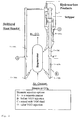
- the FCC process consists of two vessels coupled together as shown in Fig. 1. ln the first reactor a hot particulate catalyst is contacted with hydrocarbon feedstocks, thereby producing cracked products and spent coked catalyst. After the cracking reaction takes place the catalyst is largely deactivated by coke.
- the coked catalyst is separated from the cracked products, stripped of residual oil by steam stripping and then regenerated by burning the coke from the deactivated catalyst in a regenerator.
- the hot catalyst is then recycled to the riser reactor for additional cracking.
- a variety of process configurations and catalysts have been developed for the FCC process.
- the heart of the FCC catalyst is a faujasite zeolite. New medium, large and extra-large pore zeolites are actively searched to achieve a higher flexibility in product distribution.
- H/C eff effective hydrogen to carbon ratio
- the H/C e ff ratio of biomass derived-oxygenated hydrocarbon compounds is lower than petroleum-derived feedstocks due to the high oxygen content of biomass-derived molecules.
- the H/C eff ratio of carbohydrates, sorbitol and glycerol (all biomass-derived compounds) are 0, 1/3 and 2/3 respectively.
- the H/ Ceff ratio of petroleum-derived feeds ranges from 2 (for liquid alkanes) to 1 (for benzene).
- biomass can be viewed as a hydrogen deficient molecule when compared to petroleum-based feedstocks.
- H / C eff H - 2 ⁇ O - 3 ⁇ N - 2 ⁇ S C
- H, C, O, N and S are the moles of hydrogen, carbon, oxygen, nitrogen and sulfur respectively.
- Glycerol is currently a valuable by-product of biodiesel production, which involves the transesterification of triglycerides to the corresponding methyl or ethyl esters.
- biodiesel production increases, the price of glycerol is projected to drop significantly. In fact, the price of glycerol has already dropped by almost half over the last few years. [McCoy, 2005 #6] Therefore it is desirable to develop inexpensive processes for the conversion of glycerol into chemicals and fuels.
- Solid materials including lignin, humic acid, and coke are byproducts of the above reaction.
- a wide range of products are produced from the above reactions including: cellulose, hemicellulose, lignin, polysaccharides, monosaccharides (e.g. glucose, xylose, galatose), furfural, polysaccharides, and lignin derived alcohols (coumaryl, coniferyl and sinapyl alcohols).
- Bio-oils produced by fast pyrolysis or liquefaction of biomass, are a mixture of more than 300 compounds. Bio-oils are thermally unstable, and need to be upgraded if they are to be used as fuels. Bio-oils, and bio-oil components, can be converted to more stable fuels using zeolite catalysts. [Bridgwater, 1994 #14] Reaction conditions used for the above process are temperatures from 350-500 °C, atmospheric pressure, and gas hourly space velocities of around 2. The products from this reaction include hydrocarbons (aromatic, aliphatic), water-soluble organics, water, oil-soluble organics, gases (CO 2 CO, light alkanes), and coke.
- hydrocarbons aromatic, aliphatic
- Bakhshi and co-workers studied zeolite upgrading of wood derived fast-pyrolysis bio-oils and observed that between 30-40 wt% of the bio-oil formed coke or char. (Sharma and Bakhshi 1993; Katikaneni, Adjaye et al. 1995; Adjaye, Katikaneni et al. 1996)
- the ZSM-5 catalyst produced the highest amount (34 wt% of feed) of liquid organic products of any catalyst tested.
- the products in the organic carbon were mostly aromatics for ZSM-5, and aliphatics for SiO 2 -Al 2 O 3 .
- Gaseous products include CO 2 , CO, light alkanes, and light olefins.
- Bio-oils are thermally unstable and thermal cracking reactions occur during zeolite upgrading. Bakhshi and co-workers also developed a two-reactor process, where only thermal reactions occur in the first empty reactor, and catalytic reactions occur in the second reactor that contains the catalyst. (Srinivas, Dalai et al. 2000) The reported advantage of the two-reactor system is that it improved catalyst life by reducing the amount of coke deposited on the catalyst.
- model bio-oil compounds including alcohols, phenols, aldehydes, ketones, acids, and mixtures.
- Alcohols were converted into olefins at temperatures around 200 °C, then to higher olefins at 250 °C, followed by paraffins and a small proportion of aromatics at 350 °C.
- Phenol has a low reactivity on HZSM-5 and only produces small amounts of propylene and butanes.
- 2-Methoxyphenol also has a low reactivity to hydrocarbons and thermally decomposes, generating coke.
- Acetaldehyde had a low reactivity on ZSM-5 catalysts, and it also underwent thermal decomposition leading to coking problems.
- Acetone which is less reactive than alcohols, converts into C 5+ olefins at temperatures above 350°C. These olefins are then converted into C 5+ paraffins, aromatics and light alkenes.
- Acetic acid is first converted to acetone, and that then reacts as above.
- Products from zeolite upgrading of acetic acid and acetone give considerably more coke than products from alcohol feedstocks.
- different molecules in the bio-oils have a significant difference in reactivity and coke formation rates.
- Catalytic cracking of vegetable oil can be used to produce a liquid fuel that contains linear and cyclic paraffins, olefins, aldehydes, ketones, and carboxylic acids.
- the cracking of vegetable oils has been studied since 1921, and pyrolysis products of vegetable oils were used as a fuel during the 1 st and 2 nd World Wars. Both homogeneous and heterogeneous reactions are occurring during catalytic cracking of vegetable oils.
- the pyrolysis reaction can be done with or without a catalyst, and a number of catalysts have been tested including HZSM-5, ⁇ -zeolite, and USY. 60,61 Twaiq et al.
- This invention generally relates to a process for fluid catalytic cracking of oxygenated hydrocarbon compounds, comprising the step of contacting a reaction feed comprising an oxygenated hydrocarbon compound with a fluid cracking catalyst material for a period of less than 3 seconds, at a temperature in the range of 300 to 700 °C.
- This invention more specifically relates to a process for production of olefins, aromatic, syn-gas (hydrogen, carbon monoxide), process heat, alkanes, and coke by co-feeding of glycerol, carbohydrates, sugar alcohols or other biomass derived molecules with high concentrations of oxygen (including starches, cellulose-derived compounds, and hemicellulose-derived compounds) with petroleum derived feedstocks in a modified fluid catalytic cracking process. Mixtures of these compounds, such as those found in bio-oils derived from pyrolysis or liquefaction, are also included in the biomass-derived oxygenate definition.
- Fig. 1 is a flow diagram of a typical FCC process.
- Fig. 2 is a flow diagram of a modified FCC process for co-feeding biomass-derived oxygenated hydrocarbon compounds with petroleum feedstocks.
- Fig. 3 shows hydrogen producing reactions for catalytic cracking of biomass.
- Fig. 4 shows hydrogen consuming reactions for catalytic cracking of biomass.
- Fig. 5 shows the effect of catalyst composition on the catalytic cracking of a 50 wt% glycerol-water solution in MAT reactor.
- Key Filled Diamonds-FCC1, Filled Squares- ZSM5, Triangies-ECat, Circles-Al 2 O 3 , Open Squares-silicon-carbide, Open Diamonds-Y-zeolite.
- Fig. 6 shows the effect of catalyst composition on gas phase yields for the catalytic cracking of a 50 wt% glycerol-water solution in MAT reactor.
- Key Filled Diamonds-FCC1, Filled Squares- ZSM5, Triangles-ECat, Circles-Al 2 O 3 , Open Squares-silicon-carbide, Open Diamonds-Y-zeolite.
- Fig. 7 shows the effect of catalyst composition on the olefin-to-paraffin ratio and C 4 isomer-to-paraffin ratio for the catalytic cracking of a 50 wt% glycerol-water solution in MAT reactor.
- Key Filled Diamands-FCC1, Filled Squares- ZSM5, Triangies-ECat, Circles-Al 2 O 3 , Open Squares-silicon-carbide, Open Diamonds-Y-zeolite. Glycerol fed into reactor as a 50 wt% glycerol-water mixture. Yields are based on carbon molar selectivity. Conversion includes coke plus gases plus aromatics.
- Fig. 8 shows the effect of temperature on the catalytic cracking of a 50 wt% glycerol-water solution with ZSM-5 catalyst in MAT reactor.
- Key Squares - 500 °C, Triangles-600 °C, Circles-700 °C.
- Fig. 9 shows the effect of temperature on gas-phase yields for the catalytic cracking of a 50 wt% glycerol-water solution with ZSM-5 catalyst in MAT reactor.
- Key Squares - 500 °C, Triangles-600 °C, Circles-700 °C.
- Fig. 10 shows the effect of temperature on olefin-to-paraffin ratio for the catalytic cracking of a 50 wt% glycerol-water solution with ZSM-5 catalyst in MAT reactor.
- Key Squares - 500 °C, Triangles-600 °C, Circles-700 °C.
- Fig. 11 shows the catalytic cracking of 50 wt% glycerol and 50 wt% sorbitol aqueous solutions using ZSM-5 and silicon-carbide catalysts in MAT reactor at 500 °C.
- Key Filled Squares-Glycerol with ZSM-5, Filled Triangles-Sorbitol with ZSM-5, Open Squares-Glycerol with SiC, Open Triangles-Sorbitol with SiC. Conversion includes coke plus gases plus aromatics.
- Fig. 12 shows the gas phase-yields of 50 wt% glycerol and 50 wt% sorbitol aqueous solutions for catalytic cracking using ZSM-5 catalyst in MAT reactor at 500 °C. (Key: Squares-Glycerol, Triangles-Sorbifiol. Conversion includes coke plus gases plus aromatics.)
- Fig. 13 shows the Olefin-to-Paraffin Ratio for 50 wt% glycerol and 50 wt% sorbitol aqueous solutions for catalytic cracking using a ZSM-5 catalyst in MAT reactor at 500 °C. (Key: Squares-Glycerol, Triangles-Sorbitol. Conversion includes coke plus gases plus aromatics.)
- Fig. 14 shows the catalytic cracking of mixtures of vacuum gas oil (VGO) with 50 wt% glycerol, using FCC1 catalyst in MAT reactor at 500 °C.
- Key Open Squares: Glycerol, Filled Squares: Glycerol-VGO 1-2 Volume Mixtures, Filled Circle: Glycerol-VGO 1-9 Volume Mixtures, and Filled Triangle: VGO.
- Dotted line represents yields if an additive effect of glycerol and VGO were observed.
- Conversion for VGO and glycerol-VGO mixtures includes gases plus coke plus gasoline fraction from simulated distillation. Conversion for pure glycerol feed includes coke plus gases plus aromatics.
- Fig. 15 shows the gas phase yields and micromoles H 2 produced in catalytic cracking of mixtures of vacuum gas oil (VGO) with 50 wt% glycerol using FCC1 catalyst in MAT reactor at 500 °C.
- VGO vacuum gas oil
- Filled Squares Glycerol-VGO 1-2 Volume Mixtures
- Filled Circle Glycerol-VGO 1-9 Volume Mixtures
- Filled Triangle VGO.
- VGO and glycerol-VGO mixtures include gases plus coke plus gasoline fraction from simulated distillation.
- Conversion for pure glycerol feed includes coke plus gases plus aromatics.
- Fig. 16 shows olefin-to-paraffin ratios for catalytic cracking of mixtures of vacuum gas oil (VGO) with 50 wt% glycerol using FCC1 catalyst in MAT reactor at 500 °C.
- Key Open Squares: Glycerol, Filled Squares: Glycerol-VGO 1-2 Volume Mixtures, Filled Circle: Glycerol-VGO 1-9 Volume Mixtures, and Filled Triangle: VGO.
- Conversion for VGO and glycerol-VGO mixtures includes gases plus coke plus gasoline fraction from simulated distillation. Conversion for pure glycerol feed includes coke plus gases plus aromatics.
- This invention generally relates to a process for fluid catalytic cracking of oxygenated hydrocarbon compounds, comprising the step of contacting a reaction feed comprising an oxygenated hydrocarbon compound with a fluid cracking catalyst material for a period of less than 3 seconds, at a temperature in the range of 300 to 700°C. In a preferred embodiment the contact time is less than 1 second.
- the contact time is defined as 1/GHSV, wherein GHSV stands for Gas Hourly Space Velocity. It will be understood that the contact time referred herein is the mean contact time of the oxygenated hydrocarbon compounds with the fluid cracking catalyst material. Individual oxygenated hydrocarbon molecules may have contact times that are longer or shorter than the mean. The skilled person will further appreciate that the mean residence time of the catalyst particles in the reactor may be different from the mean contact time as defined herein, in the sense that the mean residence time of the catalyst particles in the reactor may be longer than the mean contact time, but not shorter.
- This invention more specifically relates to a process for production of olefins, aromatics, syn-gas (hydrogen, carbon monoxide), process heat, alkanes, and coke by co-feeding of glycerol, carbohydrates, sugar alcohols or other biomass derived oxygenated compounds such as starches, cellulose-derived compounds, and hemicellulose-derived compounds with petroleum derived feedstocks in a standard or modified fluid catalytic cracking process.
- Mixtures of oxygenated compounds such as those found in bio-oils derived from pyrolysis or liquefaction, are also included in the definition of biomass-derived oxygenated compound.
- oxygenated hydrocarbon compounds that have been produced via the liquefaction of a solid biomass material are particularly preferred.
- oxygenated hydrocarbon compounds are produced via a mild hydrothermal conversion process, such as described in co-pending application EP 061135646, filed on May 5, 2006 , the disclosures of which are incorporated herein by reference.
- oxygenated hydrocarbon compounds are produced via a mild pyrolysis process, such as described in co-pending application EP 061135679, filed on May 5, 2006 , the disclosures of which are incorporated herein by reference.
- the oxygenated hydrocarbon compounds may be mixed with an inorganic material, for example as a result of the process by which they were obtained.
- solid biomass may have been treated with a particulate inorganic material in a process such as described in co-pending application EP 061135810, filed May 5, 2006 , the disclosures of which are incorporated herein by reference. These materials may subsequently be liquefied in the process of EP 061135646 or that of EP 061135679 , cited herein above.
- the resulting liquid products contain the inorganic particles. It is not necessary to remove the inorganic particles from the oxygenated hydrocarbon compounds prior to the use of these compounds in the process of the present invention. To the contrary, it may be advantageous to leave the inorganic particles in the oxygenated hydrocarbon feed, in particular if the inorganic material is a catalytically active material.
- reaction feed may comprise significant amounts of water. This is particularly advantageous, because feedstocks such as bio-oil and glycerol derived from biomass conversion processes tend to be mixed with water. For example, a biodiesel transesterification process produces glycerol and water in a 1:3 molar ratio.
- the process of the present invention does not require water to be removed from the oxygenated material prior to their being fed into the catalytic cracking reactor.
- reaction feed further comprises a crude oil-derived material, for example vacuum gas-oil.
- the biomass-derived oxygenated compounds can be fed in different locations in the FCC process, as shown in Figure 2, including: (1) in a separate riser reactor, (2) before introduction of vacuum gas-oil, (3) with vacuum gas-oil, or (4) after vacuum gas-oil on a partially deactivated catalyst.
- best results are obtained when the oxygenated compounds are fed into a separate riser reactor (option (1)), or in the main riser reactor after the vacuum gas-oil (option (4)), because it allows for short contact times of the oxygenated compounds with the fluid catalytic cracking catalyst material. It is also possible to feed the oxygenated compound into the stripper.
- VGO vacuum gas-oil
- the cracking catalyst material for use in the present invention may be a conventional FCC catalyst material.
- FCC catalysts generally comprise a zeolite, such as zeolite USY, a matrix material, such as alumina, and a kaolin clay.
- the catalyst may further comprise additives for trapping metal contaminants, for converting sulphur compounds, and the like, as will be readily understood by a person skilled in the FCC art.
- the cracking catalyst material comprises a basic material.
- suitable basic materials include layered materials, and materials obtained by heat-treating layered materials.
- the layered materials are selected from the group consisting of smectites, anionic clays, layered hydroxy salts, and mixtures thereof.
- Hydrotalcite-like materials, in particular Mg-Al and Ca-Al anionic clays, are particularly preferred. It has surprisingly been found that basic materials are suitable for the cracking of a crude-oil derived material, such as VGO, as may be used as a first feedstock in certain embodiments of the process of the present invention.
- the basic catalytic materials may be used as such, or may be used in admixture with a conventional FCC cracking catalyst.
- the conversion of biomass-derived oxygenated hydrocarbon compounds in the FCC process occurs mainly through a series of dehydration, hydrogen producing, hydrogen consuming, and aromatic forming reactions.
- Figures 3 and 4 we use glycerol to represent biomass-derived oxygenated hydrocarbon compounds.
- H 2 may be produced through steam-reforming or direct dehydrogenation of the carbohydrates and hydrocarbons, water-gas shift, and decarbonylation of partially dehydrated species as shown in Figure 3. These reactions may produce CO, CO 2 , and coke as well as hydrogen.
- the hydrogen produced in these reactions may be consumed in reactions that increase the H/C eff ratio of the products as shown in Figure 4, leading to olefins and alkanes.
- Hydrogen may be exchanged directly through hydrogen transfer reactions between two hydrocarbon/ carbohydrates chains, or through consecutive dehydrogenation /hydrogenation processes. Hydrogen transfer reactions occur on acid sites, while dehydrogenation/ hydrogenation reactions are greatly accelerated by the presence of a metal. Aromatics are produced during this process probably by a diels-alder reaction and condensation of olefins and partially dehydrated/hydrogenated species. To selectively produce olefins and aromatics, the dehydration, hydrogen producing and hydrogen transfer reactions must be properly balanced by choosing the proper catalysts and reaction conditions.
- the process of the present invention provides (1) fuels that are obtained from sustainable biomass resources, (2) a reduction in CO 2 emissions from petroleum plants, (3) a reduction of the amount of petroleum feedstocks in a petroleum refinery and (4) utilization of FCC technology that is already developed and in use in petroleum refineries therefore co-feeding of biomass into an FCC unit would not require a significant capital investment.
- MAT Microactivity test
- the catalyst was regenerated at a temperature of 813 K for 3 hours, in a 100 ml/min stream of air.
- the gases were analyzed using a Varian 3800-GC equipped with three detectors, a Thermal Conductivity Detector (TCD) for analysis of H 2 and N 2 , which were separated in a 15 m molecular sieve column, and a Flame Ionization Detector (FID), and for C 1 to C 6 hydrocarbons separated in a 30 m Plot l Al 2 O 3 column.
- Simulated distillation of the liquids was carried out with a Varian 3800-GC following the ASTM-2887-D procedure. Cuts were made at 423.8 K for light gasoline, 489.3 K for heavy gasoline and 617.1 K for LCO.
- the CO 2 formed during the regeneration step was monitored and quantified by means of an IR cell.
- Carbon yields are defined below as the moles of carbon in the produced divided by the moles of carbon in the feed. All conversions below are reported on a per carbon basis.
- Hydrogen selectivity defined below as the moles of hydrogen divided by the potential moles of hydrogen produced. The potential moles of hydrogen produced are the moles of produced carbon times the hydrogen to carbon ratio in the feed plus the moles of CO 2 produced.
- the Y-zeolite was CBU 500, steamed for 4 h at 816°C.
- the ZSM-5 zeolite was mixed with a clay binder, to around 15% weight.
- a glycerol solution was prepared with 99.5 weight percent glycerol (Aldrich Chemicals) diluted at a 1:1 weight ratio (about a 1:5 molar ratio glycerol:water) with distilled water.
- a sorbitol solution was prepared with 99% sorbitol and the same water 1:1 weight ratio water dilution.
- Petroleum-derived feeds typically contain metal impurities (V, Ni and Fe), which deposit themselves onto the catalyst during the FCC reaction.
- V, Ni and Fe metal impurities
- FCC equilibrium catalyst(ECAT) containing 4400ppm V and 1600ppm Ni. This catalyst gave a lower activity than the fresh FCC1 catalyst, as could be expected from the higher content of zeolite and surface area of the latter.
- the product selectivity for the FCC1 and ECAT catalyst was very similar, indicating that V and Ni have little or no catalytic effect.
- Thermal cracking of glycerol was studied by using an "inert" SiC material. The low activity of the "inert” SiC shows that glycerol has a high thermal stability, and thermal reactions are negligible in comparison to the catalytic transformation.
- FCC catalysts contain Al 2 O 3 SiO 2 -Al 2 O 3 and Y-zeolite in the catalyst matrix.
- the Al 2 O 3 catalyst had similar gas and coke yields as the FCC1 and ECat catalysts.
- the gas-phase yields for Al 2 O 3 where also similar to those of FCC1 and ECat, with the exception that Al 2 O 3 has higher H 2 and ethane yields, and lower propylene, n-butane, butane, and aromatic yields, than FCC1 and ECat.
- the Y-zeolite had a catalytic activity similar to the FCC1 catalyst.
- the coke yield was slightly higher for Y-zeolite than FCC1.
- the aromatic yield was lower for the Y-zeolite than for FCC1.
- the other differences between Y-zeolite and FCC1 are that the Y-zeolite gave a lower CO 2 yield and higher C 1 -C 4 alkane and H 2 yields than the FCC1 catalyst.
- the olefin yields for the Y-zeolite and FCC1 catalyst were similar, therefore the olefin to paraffin ratios for the Y-zeoiite were lower than the FCC1 1 catalyst.
- ZSM-5 is a well known catalyst additive for FCC catalysts, so we also tested the activity of the ZSM-5 catalyst for catalytic cracking of glycerol.
- the major difference with ZSM-5 and the other catalysts tested is that ZSM-5 had a lower coke yield (less than 20 %) and gave a higher yield of gases and aromatics. This is probably due to the smaller pore size of ZSM-5 zeolite, which makes it difficult for larger aromatic coke precursors to form inside the small ZSM-5 pores.
- the activity of the catalysts decreased as Y ⁇ FCC1 > Al 2 O 3 > ZSM5 > ECat >> SiC.
- the aromatics yield increased linearly with conversion for the ZSM5 catalyst, but first increased and then decreased with further increasing conversion for the FCC1, Y, ECat and Al 2 O 3 catalysts. It has been extensively shown with hydrocarbon cracking that the small ZSM-5 zeolite pore channels make it difficult for aromatics to condensate. Higher yields of coke were seen on the Y, ECat and FCC1 catalysts, due to the larger cage diameter of the Y-zeolite catalyst as well as an extensive mesopore volume which allows higher aromatics condensation, leading to coke formation.
- the gas phase-carbon yields for ZSM5 decreased in the order CO > ethylene > propylene > CO 2 > butene > methane > ethane > propane > n-butane.
- the ZSM5 catalyst gave a much higher ethylene yield and lower methane yield than the other catalysts, which may indicate that, on ZSM5, ethylene may be formed through decarbonylation of an oxygenated intermediate rather than via the cracking of longer chain hydrocarbons.
- the olefin-to-paraffin ratio for these catalysts was greater than 10 in most cases, as shown in Figure 7.
- the olefin-to-paraffin ratio for C 2 compounds was extremely high (e.g. greater than 60) for the ZSM5 catalyst.
- the C 3 and C 4 olefin to paraffin ratio decreased as the conversion increased, which goes in parallel with the increases in coke.
- the olefin-to-paraffin ratio for iso-C 4 compounds decreased in the order Al 2 O 3 > FCC1 > ECat > ZSM5 > Y.
- Figures 8-10 show the effect of temperature on the catalytic cracking of glycerol with ZSM5.
- the activity for cracking of glycerol increased with temperature, as shown in Figure 8.
- the coke yield significantly decreased ( Figure 8)
- the CO, H 2 , and ethylene yields increased ( Figure 9).
- Similar temperature effects were observed for catalytic cracking of glycerol with FCC1.
- 500 °C the coke yield increased linearly with conversion, whereas at 600 and 700 °C the coke yield did not increase with conversion.
- the gas phase yields for glycerol and sorbitol are shown in Figure 12. The main differences between the two feeds are that sorbitol had a higher CO yield than glycerol feeds with the ZSM-5 catalyst. The CO and CO 2 yield is also higher for the thermal sorbitol reaction with SiC as the "catalyst" ('1-2 % CO yield at conversions 4-18) than for glycerol (0.3-0.5 % CO yield at conversions 2-8 %).
- the glycerol solution gave a higher yield to gas, aromatics and coke than VGO.
- An increase in the amount of glycerol in the VGO-glycerol mixtures slightly increased the conversion. Selectivity effects were barely seen with the 9:1 VGO-glycerol mixture. Apparently the amount of biomass was too small to produce significant changes in the different yields.
- the 2:1 VGO-glycerol mixture introduced an important dilution of the VGO feedstock (at least 3/1 molar ratio between VGO feed molecules and glycerol/water mixture), and significant effects on gas and coke yields were observed.
- VGO VGO
- glycerol produces more coke, ethylene and propylene than VGO.
- Adding glycerol to VGO significantly increased the amount of coke, but in a proportion similar to what would be observed as an additive effect.
- Addition of glycerol to VGO did not change the gasoline yield, but did decrease the light cycle oil (LCO) yield because of a dilution effect with the glycerol feed, as glycerol cracking does not produce LCO fragment but some gasoline-range fragments, including some oxygenated hydrocarbon compounds.
- LCO light cycle oil
- a surprising effect from this example is that the ethylene and propylene yields for the VGO:glycerol mixtures was higher than what would be expected from an additive effect, as shown in Figure 14.
- glycerol cracking produced significant amounts of CO and CO 2 , a similar yield of hydrogen, more methane and ethylene but less ethane, more propylene but less propane, and much less butanes and butane.
Landscapes
- Chemical & Material Sciences (AREA)
- Oil, Petroleum & Natural Gas (AREA)
- Engineering & Computer Science (AREA)
- Chemical Kinetics & Catalysis (AREA)
- General Chemical & Material Sciences (AREA)
- Organic Chemistry (AREA)
- Crystallography & Structural Chemistry (AREA)
- Production Of Liquid Hydrocarbon Mixture For Refining Petroleum (AREA)
- Catalysts (AREA)
- Organic Low-Molecular-Weight Compounds And Preparation Thereof (AREA)
Priority Applications (12)
| Application Number | Priority Date | Filing Date | Title |
|---|---|---|---|
| EP06118982A EP1892280A1 (en) | 2006-08-16 | 2006-08-16 | Fluid catalytic cracking of oxygenated compounds |
| EP07802626A EP2059576A2 (en) | 2006-08-16 | 2007-08-15 | Fluid catalytic cracking of oxygenated compounds |
| CA2660755A CA2660755C (en) | 2006-08-16 | 2007-08-15 | Fluid catalytic cracking of oxygenated compounds |
| PCT/EP2007/058467 WO2008020047A2 (en) | 2006-08-16 | 2007-08-15 | Fluid catalytic cracking of oxygenated compounds |
| BRPI0715873-4A2A BRPI0715873A2 (pt) | 2006-08-16 | 2007-08-15 | processo para o craqueamento catalÍtico de fluido de compostos de hidrocarbonetos oxigenados |
| US12/377,388 US8207385B2 (en) | 2006-08-16 | 2007-08-15 | Fluid catalytic cracking of oxygenated compounds |
| CNA200780038305XA CN101558135A (zh) | 2006-08-16 | 2007-08-15 | 含氧化合物的流化催化裂化 |
| JP2009524192A JP2010500464A (ja) | 2006-08-16 | 2007-08-15 | 含酸素化合物の流動接触分解法 |
| KR1020097005405A KR20090052363A (ko) | 2006-08-16 | 2007-08-15 | 산소화 화합물의 유동상 촉매 분해 방법 |
| MX2009001721A MX2009001721A (es) | 2006-08-16 | 2007-08-15 | Craqueo catalitico fluido de compuestos oxigenados. |
| CO09027098A CO6190561A2 (es) | 2006-08-16 | 2009-03-16 | Craqueo catalitico fluido de compuestos oxigenados |
| US13/196,489 US8524960B2 (en) | 2006-08-16 | 2011-08-02 | Fluid catalytic cracking of oxygenated compounds |
Applications Claiming Priority (1)
| Application Number | Priority Date | Filing Date | Title |
|---|---|---|---|
| EP06118982A EP1892280A1 (en) | 2006-08-16 | 2006-08-16 | Fluid catalytic cracking of oxygenated compounds |
Publications (1)
| Publication Number | Publication Date |
|---|---|
| EP1892280A1 true EP1892280A1 (en) | 2008-02-27 |
Family
ID=37685085
Family Applications (2)
| Application Number | Title | Priority Date | Filing Date |
|---|---|---|---|
| EP06118982A Withdrawn EP1892280A1 (en) | 2006-08-16 | 2006-08-16 | Fluid catalytic cracking of oxygenated compounds |
| EP07802626A Withdrawn EP2059576A2 (en) | 2006-08-16 | 2007-08-15 | Fluid catalytic cracking of oxygenated compounds |
Family Applications After (1)
| Application Number | Title | Priority Date | Filing Date |
|---|---|---|---|
| EP07802626A Withdrawn EP2059576A2 (en) | 2006-08-16 | 2007-08-15 | Fluid catalytic cracking of oxygenated compounds |
Country Status (10)
| Country | Link |
|---|---|
| US (2) | US8207385B2 (pt) |
| EP (2) | EP1892280A1 (pt) |
| JP (1) | JP2010500464A (pt) |
| KR (1) | KR20090052363A (pt) |
| CN (1) | CN101558135A (pt) |
| BR (1) | BRPI0715873A2 (pt) |
| CA (1) | CA2660755C (pt) |
| CO (1) | CO6190561A2 (pt) |
| MX (1) | MX2009001721A (pt) |
| WO (1) | WO2008020047A2 (pt) |
Cited By (27)
| Publication number | Priority date | Publication date | Assignee | Title |
|---|---|---|---|---|
| US20090318742A1 (en) * | 2006-07-13 | 2009-12-24 | China Petroleum & Chemical Corporation | Process for combining the catalytic conversion of organic oxygenates and the catalytic conversion of hydrocarbons |
| WO2010002886A1 (en) * | 2008-06-30 | 2010-01-07 | Kior, Inc. | Producing fuel and speciality chemicals from biomass containing triglycerides and cellulose |
| WO2009111026A3 (en) * | 2008-03-04 | 2010-01-28 | University Of Massachusetts | Catalytic pyrolysis of solid biomass and related biofuels, aromatic, and olefin compounds |
| WO2010002792A3 (en) * | 2008-06-30 | 2010-05-06 | Kior, Inc. | Co-processing solid biomass in a conventional petroleum refining process unit |
| WO2011103313A3 (en) * | 2010-02-17 | 2011-12-29 | Virginia Tech Intellectual Properties, Inc. | Production of pyrolysis oil |
| WO2012083999A1 (en) * | 2010-12-20 | 2012-06-28 | Shell Internationale Research Maatschappij B.V. | Process for catalytic cracking of a lipid - containing feedstock derived from microalgae to produce hydrocarbons |
| WO2012083998A1 (en) * | 2010-12-20 | 2012-06-28 | Shell Internationale Research Maatschappij B.V. | Process for catalytic cracking of a lipid-containing feedstock derived from microalgae to produce hydrocarbons |
| WO2012091815A1 (en) | 2010-12-27 | 2012-07-05 | Conocophillips Company | Integrated fcc biomass pyrolysis/upgrading |
| WO2012136955A1 (en) * | 2011-04-08 | 2012-10-11 | Aston University | Methods and apparatus for the production of fuel |
| US8288600B2 (en) | 2009-05-22 | 2012-10-16 | Kior Inc. | Methods for co-processing of biomass and petroleum feed |
| WO2012143564A1 (en) * | 2011-04-21 | 2012-10-26 | Shell Internationale Research Maatschappij B.V. | Process for converting a solid biomass material |
| WO2012143573A1 (en) * | 2011-04-21 | 2012-10-26 | Shell Internationale Research Maatschappij B.V. | Process for converting a solid biomass material |
| WO2012143567A1 (en) * | 2011-04-21 | 2012-10-26 | Shell Internationale Research Maatschappij B.V. | Process for converting a solid biomass material |
| WO2012143551A1 (en) * | 2011-04-21 | 2012-10-26 | Shell Internationale Research Maatschappij B.V. | Process for converting a solid biomass material |
| WO2012143549A1 (en) * | 2011-04-21 | 2012-10-26 | Shell Internationale Research Maatschappij B.V. | Improvements to separation of product streams |
| WO2012143550A1 (en) * | 2011-04-21 | 2012-10-26 | Shell Internationale Research Maatschappij B.V. | Process for converting a solid biomass material |
| WO2013102070A3 (en) * | 2011-12-30 | 2013-08-29 | Shell Oil Company | Process for converting a solid biomass material |
| WO2014092896A1 (en) * | 2012-12-10 | 2014-06-19 | Exxonmobil Research And Engineering Company | Catalytic cracking process for biofeeds |
| EP2595941A4 (en) * | 2010-07-23 | 2014-07-30 | Kior Inc | MULTI-STAGE CONVERSION OF A BIOMASS |
| US9169444B2 (en) | 2011-04-21 | 2015-10-27 | Shell Oil Company | Liquid fuel composition |
| US9169442B2 (en) | 2009-09-09 | 2015-10-27 | University Of Massachusetts | Systems and processes for catalytic pyrolysis of biomass and hydrocarbonaceous materials for production of aromatics with optional olefin recycle, and catalysts having selected particle size for catalytic pyrolysis |
| EP2297279A4 (en) * | 2008-05-29 | 2015-12-23 | Kellogg Brown & Root Llc | FCC FOR LIGHTWEIGHT HYDROCARBON INGREDIENTS WITH BALANCED HEAT BALANCE |
| WO2019097199A1 (en) * | 2017-11-15 | 2019-05-23 | Petróleo Brasileiro S.A. - Petrobras | Process for obtaining a renewable hydrocarbon stream suitable as a component of gasoline formulations, renewable hydrocarbon stream, and gasoline formulation |
| WO2019165350A1 (en) * | 2018-02-26 | 2019-08-29 | Bischof Steven M | Normal alpha olefin synthesis using dehydroformylation or dehydroxymethylation |
| US10435334B2 (en) | 2016-11-10 | 2019-10-08 | Chevron Phillips Chemical Company Lp | Normal alpha olefin synthesis using metathesis and dehydroformylation |
| US11123723B2 (en) | 2018-02-26 | 2021-09-21 | The Regents Of The University Of California | Oxidative dehydroxymethylation of alcohols to produce olefins |
| US12151993B2 (en) | 2021-09-10 | 2024-11-26 | Chevron Phillips Chemical Company Lp | Selective 1-hexene/1-octene production with 1-decene |
Families Citing this family (67)
| Publication number | Priority date | Publication date | Assignee | Title |
|---|---|---|---|---|
| WO2007112570A1 (en) | 2006-04-03 | 2007-10-11 | Pharmatherm Chemicals Inc. | Thermal extraction method and product |
| JP5013396B2 (ja) * | 2006-09-01 | 2012-08-29 | 独立行政法人産業技術総合研究所 | 炭素数3の多価アルコールの脱水/水素化用触媒及びそれを用いた炭化水素の製造方法 |
| EP2053114A1 (en) * | 2007-10-18 | 2009-04-29 | BIOeCON International Holding N.V. | Process for reducing the oxygen content of high-oxygen feedstocks |
| US7905990B2 (en) | 2007-11-20 | 2011-03-15 | Ensyn Renewables, Inc. | Rapid thermal conversion of biomass |
| US8673262B2 (en) * | 2008-04-23 | 2014-03-18 | Her Majesty The Queen In Right Of Canada, As Represented By The Minister Of Natural Resources | Production of hydrogen from oxygenated hydrocarbons |
| BRPI0804120A2 (pt) * | 2008-09-09 | 2010-07-06 | Petróleo Brasileiro S/A - Petrobras | método para produção de eteno e gás de sìntese em leito fluidizado circulante |
| DE102008042498A1 (de) * | 2008-09-30 | 2010-04-01 | Evonik Degussa Gmbh | Verfahren zur Pyrolyse von Kohlehydraten |
| US8900416B2 (en) | 2009-02-24 | 2014-12-02 | University Of Georgia Research Foundation, Inc. | Production of higher quality bio-oils by in-line esterification of pyrolysis vapor |
| DK2430124T3 (en) * | 2009-05-05 | 2019-03-11 | Kior Inc | IMPROVED CATALYST / BIOMASS MIXTURE IN TRANSPORT REACTOR |
| CN102040438A (zh) * | 2009-10-13 | 2011-05-04 | 中国石油化工股份有限公司 | 同轴式内嵌提升管循环反应-再生装置 |
| US20130184505A1 (en) * | 2009-10-27 | 2013-07-18 | Ignite Energy Resources Limited | Methods for Producing Hydrocarbon Products from Bio-Oils and/or Coal-Oils |
| US8519203B2 (en) * | 2010-02-17 | 2013-08-27 | Uop Llc | Low oxygen biomass-derived pyrolysis oils and methods for producing the same |
| US8604260B2 (en) | 2010-05-18 | 2013-12-10 | Kior, Inc. | Biomass pyrolysis conversion process with high olefin production and upgrade |
| US20110284359A1 (en) | 2010-05-20 | 2011-11-24 | Uop Llc | Processes for controlling afterburn in a reheater and for controlling loss of entrained solid particles in combustion product flue gas |
| US8499702B2 (en) | 2010-07-15 | 2013-08-06 | Ensyn Renewables, Inc. | Char-handling processes in a pyrolysis system |
| US8057641B2 (en) * | 2010-07-19 | 2011-11-15 | Kior Inc. | Method and apparatus for pyrolysis of a biomass |
| CN103201357A (zh) * | 2010-11-12 | 2013-07-10 | 国际壳牌研究有限公司 | 制备生物燃料和/或生物化学品的方法 |
| CN102463081A (zh) * | 2010-11-17 | 2012-05-23 | 中国石油化工股份有限公司 | 制备低碳烯烃的反应装置 |
| WO2012092468A1 (en) * | 2010-12-30 | 2012-07-05 | Kior Inc. | Production of renewable biofuels |
| US9441887B2 (en) | 2011-02-22 | 2016-09-13 | Ensyn Renewables, Inc. | Heat removal and recovery in biomass pyrolysis |
| EP2699646A1 (en) * | 2011-04-21 | 2014-02-26 | Shell Internationale Research Maatschappij B.V. | Process for regenerating a coked catalytic cracking catalyst |
| CN102220167B (zh) * | 2011-05-11 | 2013-12-25 | 华北电力大学 | 一种生物质油改质和c4烃催化裂解的组合工艺及装置 |
| WO2013032672A1 (en) * | 2011-09-01 | 2013-03-07 | University Of Massachusetts | Method for producing fluid hydrocarbons |
| US9347005B2 (en) | 2011-09-13 | 2016-05-24 | Ensyn Renewables, Inc. | Methods and apparatuses for rapid thermal processing of carbonaceous material |
| US10041667B2 (en) | 2011-09-22 | 2018-08-07 | Ensyn Renewables, Inc. | Apparatuses for controlling heat for rapid thermal processing of carbonaceous material and methods for the same |
| US9044727B2 (en) | 2011-09-22 | 2015-06-02 | Ensyn Renewables, Inc. | Apparatuses and methods for controlling heat for rapid thermal processing of carbonaceous material |
| US10400175B2 (en) | 2011-09-22 | 2019-09-03 | Ensyn Renewables, Inc. | Apparatuses and methods for controlling heat for rapid thermal processing of carbonaceous material |
| SG188753A1 (en) * | 2011-09-30 | 2013-04-30 | Bharat Petroleum Corp Ltd | Sulphur reduction catalyst additive composition in fluid catalytic cracking and method of preparation thereof |
| CN106085469B (zh) * | 2011-11-04 | 2020-01-17 | 国际热化学恢复股份有限公司 | 用于原料向油和气的弹性转化的系统和方法 |
| US9109177B2 (en) * | 2011-12-12 | 2015-08-18 | Ensyn Renewables, Inc. | Systems and methods for renewable fuel |
| GB2497543B (en) * | 2011-12-13 | 2015-09-02 | Future Blends Ltd | Catalytic cracking of pyrolysis derived organic molecules |
| US20130178672A1 (en) * | 2012-01-06 | 2013-07-11 | Shell Oil Company | Process for making a distillate product and/or c2-c4 olefins |
| US20150337207A1 (en) * | 2012-01-06 | 2015-11-26 | Shell Oil Company | Process for making a distillate product and/or c2-c4 olefins |
| EP2841536A1 (en) | 2012-04-23 | 2015-03-04 | Shell Internationale Research Maatschappij B.V. | Process for converting a solid biomass material |
| US9222032B2 (en) | 2012-05-01 | 2015-12-29 | Mississippi State University | Composition and methods for improved fuel production |
| US20140004610A1 (en) * | 2012-06-28 | 2014-01-02 | Uop Llc | Processes and apparatuses for converting a feedstock |
| US9670413B2 (en) | 2012-06-28 | 2017-06-06 | Ensyn Renewables, Inc. | Methods and apparatuses for thermally converting biomass |
| US9556391B2 (en) | 2012-07-13 | 2017-01-31 | Phillips 66 Company | Method for producing renewable hydrogen from biomass derivatives using steam reforming technology |
| US9523042B2 (en) | 2012-07-31 | 2016-12-20 | Uop Llc | Methods and fuel processing apparatuses for upgrading a pyrolysis oil stream and a hydrocarbon stream |
| US10166519B2 (en) | 2012-07-31 | 2019-01-01 | Uop Llc | Methods and fuel processing apparatuses for upgrading a pyrolysis oil stream and a hydrocarbon stream |
| US9663729B2 (en) | 2012-07-31 | 2017-05-30 | Uop Llc | Methods and fuel processing apparatuses for upgrading a pyrolysis oil stream and a hydrocarbon stream |
| BR112015009011A8 (pt) * | 2012-10-31 | 2019-07-16 | Shell Int Research | método para produzir e processar um produto de reação de glicol obtido junto com digestão hidrotérmica de sólidos de biomassa celulósica |
| CN104884580A (zh) * | 2012-10-31 | 2015-09-02 | 国际壳牌研究有限公司 | 用于将由纤维素生物质固体的水热消解获得的二醇反应产物转化为经干燥的一元醇进料的方法 |
| US20140296594A1 (en) * | 2013-03-28 | 2014-10-02 | Shell Oil Company | Process for the fluid catalytic cracking of oxygenated hydrocarbon compounds from biological origin |
| CN104073292B (zh) * | 2013-03-28 | 2019-07-23 | 中国石油大学(华东) | 使来自生物来源的氧化烃化合物流化催化裂化的方法 |
| CN104073280B (zh) * | 2013-03-28 | 2019-07-26 | 中国石油大学(华东) | 流化催化裂化生物来源含氧烃化合物的方法 |
| CN103215068B (zh) * | 2013-05-07 | 2015-06-03 | 武汉凯迪工程技术研究总院有限公司 | 一种生物质热解油的改性方法 |
| AR097135A1 (es) | 2013-06-26 | 2016-02-24 | Ensyn Renewables Inc | Sistemas y métodos para combustible renovable |
| KR101790987B1 (ko) * | 2014-05-21 | 2017-10-27 | 한양대학교 산학협력단 | 글리세롤을 이용한 바이오 방향족 화합물의 제조방법 |
| WO2016053780A1 (en) | 2014-09-29 | 2016-04-07 | Uop Llc | Methods for reducing flue gas emissions from fluid catalytic cracking unit regenerators |
| DK3337966T3 (da) | 2015-08-21 | 2022-02-28 | Ensyn Renewables Inc | Opvarmningssystem med flydende biomasse |
| JP6654384B2 (ja) * | 2015-09-15 | 2020-02-26 | 株式会社日本触媒 | オレフィン化合物の製造方法 |
| CN105218289B (zh) * | 2015-10-15 | 2017-08-01 | 浙江大学 | 一种不饱和脂肪酸原位加氢脱羧制备长链烷烃的方法 |
| FI127519B (en) | 2015-12-31 | 2018-08-15 | Neste Oyj | Process for producing high octane fuel component from renewable raw material |
| CN110072973A (zh) * | 2016-12-14 | 2019-07-30 | 埃克森美孚研究工程公司 | 在流化催化裂化器中转化含氧化合物的方法 |
| CA3048681A1 (en) | 2016-12-29 | 2018-07-05 | Ensyn Renewables, Inc. | Demetallization of liquid biomass |
| WO2018147281A1 (ja) * | 2017-02-07 | 2018-08-16 | 国立大学法人信州大学 | 炭化水素の製造方法、その製造装置、その製造システム、及び、バイオクルードの製造方法 |
| JP2020019912A (ja) * | 2018-08-03 | 2020-02-06 | 国立大学法人信州大学 | 炭化水素の製造方法およびバイオクルードの製造方法 |
| US10479943B1 (en) * | 2018-08-17 | 2019-11-19 | Chevron U.S.A. Inc. | Fluid catalytic cracking process employing a lipid-containing feedstock |
| CA3112833A1 (en) * | 2018-09-25 | 2020-04-02 | Exxonmobil Research And Engineering Company | Co-processing hydrothermal liquefaction oil and co-feed to produce biofuels |
| CA3147048A1 (en) * | 2019-07-11 | 2021-01-14 | Spraying Systems Co. | Catalytic cracking system with bio-oil processing |
| WO2021081089A1 (en) * | 2019-10-23 | 2021-04-29 | Phillips 66 Company | Dual stage light alkane conversion to fuels |
| US10947458B1 (en) | 2020-03-18 | 2021-03-16 | Chevron U.S.A. Inc. | Upgrading of renewable feedstocks with spent equilibrium catalyst |
| FI129351B (en) * | 2020-11-06 | 2021-12-31 | Neste Oyj | Process for the production of bio - based hydrocarbons |
| US11680210B2 (en) * | 2021-11-04 | 2023-06-20 | Chevron U.S.A. Inc. | Catalytic cracking of glyceride oils with deactivated phosphorus-containing ZSM-5 light olefins additives |
| CN115521186A (zh) * | 2022-10-06 | 2022-12-27 | 新疆大学 | 一种生物质经两步转化过程制备低碳烯烃的方法 |
| EP4667551A1 (en) * | 2024-06-18 | 2025-12-24 | Neste Oyj | A method for producing propylene |
Citations (3)
| Publication number | Priority date | Publication date | Assignee | Title |
|---|---|---|---|---|
| JPS562389A (en) * | 1979-06-21 | 1981-01-12 | Nippon Kaihatsu Kogyo Kk | Catalytic cracking of heavy oil |
| CA1123774A (en) * | 1980-02-25 | 1982-05-18 | Marten Ternan | Catalytic conversion of heavy hydrocarbon materials |
| US20030127358A1 (en) * | 2002-01-10 | 2003-07-10 | Letzsch Warren S. | Deep catalytic cracking process |
Family Cites Families (10)
| Publication number | Priority date | Publication date | Assignee | Title |
|---|---|---|---|---|
| US4503278A (en) * | 1982-09-30 | 1985-03-05 | Mobil Oil Corporation | Process for converting carbohydrates to hydrocarbons |
| BR8304794A (pt) * | 1983-09-02 | 1985-04-09 | Petroleo Brasileiro Sa | Processo para a producao de gasolina de lata octanagem |
| US4880473A (en) * | 1988-04-01 | 1989-11-14 | Canadian Patents & Development Ltd. | Process for the production of fermentable sugars from biomass |
| US5196633A (en) * | 1990-01-25 | 1993-03-23 | Mobil Oil Corp. | Catalytic conversion |
| US5298155A (en) * | 1990-02-27 | 1994-03-29 | Exxon Research & Engineering Co. | Controlling yields and selectivity in a fluid catalytic cracker unit |
| JPH0562389A (ja) | 1991-09-06 | 1993-03-12 | Nec Software Ltd | コンピユータ用フレキシブルデイスク制御装置 |
| US6187982B1 (en) * | 1999-10-15 | 2001-02-13 | Mobil Oil Corporation | Process for converting dienes and oxygenates to para-xylene and light olefins |
| EP1517747A1 (en) * | 2002-06-28 | 2005-03-30 | Albemarle Netherlands B.V. | Fcc catalyst for reducing the sulfur content in gasoline and diesel |
| BRPI0502577B1 (pt) * | 2005-07-07 | 2015-11-03 | Petroleo Brasileiro Sa | processo de craqueamento catalítico para produção de diesel a partir de óleos vegetais |
| US20090026112A1 (en) * | 2006-02-09 | 2009-01-29 | Jan Lodewijk Maria Dierickx | Fluid catalytic cracking process |
-
2006
- 2006-08-16 EP EP06118982A patent/EP1892280A1/en not_active Withdrawn
-
2007
- 2007-08-15 CA CA2660755A patent/CA2660755C/en not_active Expired - Fee Related
- 2007-08-15 WO PCT/EP2007/058467 patent/WO2008020047A2/en not_active Ceased
- 2007-08-15 EP EP07802626A patent/EP2059576A2/en not_active Withdrawn
- 2007-08-15 US US12/377,388 patent/US8207385B2/en not_active Expired - Fee Related
- 2007-08-15 MX MX2009001721A patent/MX2009001721A/es unknown
- 2007-08-15 KR KR1020097005405A patent/KR20090052363A/ko not_active Withdrawn
- 2007-08-15 JP JP2009524192A patent/JP2010500464A/ja active Pending
- 2007-08-15 BR BRPI0715873-4A2A patent/BRPI0715873A2/pt not_active IP Right Cessation
- 2007-08-15 CN CNA200780038305XA patent/CN101558135A/zh active Pending
-
2009
- 2009-03-16 CO CO09027098A patent/CO6190561A2/es not_active Application Discontinuation
-
2011
- 2011-08-02 US US13/196,489 patent/US8524960B2/en not_active Expired - Fee Related
Patent Citations (3)
| Publication number | Priority date | Publication date | Assignee | Title |
|---|---|---|---|---|
| JPS562389A (en) * | 1979-06-21 | 1981-01-12 | Nippon Kaihatsu Kogyo Kk | Catalytic cracking of heavy oil |
| CA1123774A (en) * | 1980-02-25 | 1982-05-18 | Marten Ternan | Catalytic conversion of heavy hydrocarbon materials |
| US20030127358A1 (en) * | 2002-01-10 | 2003-07-10 | Letzsch Warren S. | Deep catalytic cracking process |
Non-Patent Citations (2)
| Title |
|---|
| CRAIG HULET ET AL: "A Review of Short Residence Time Cracking Processes", INTERNATIONAL JOURNAL OF CHEMICAL REACTOR ENGINEERING, BERKELEY ELECTRONIC PRESS, BERKELEY, CA, US, vol. 3, 2005, pages 1 - 76, XP008080585, ISSN: 1542-6580 * |
| LIN ET AL: "Catalytic conversion of commingled polymer waste into chemicals and fuels over spent FCC commercial catalyst in a fluidised-bed reactor", APPLIED CATALYSIS B: ENVIRONMENTAL, ELSEVIER, vol. 69, no. 3-4, 14 August 2006 (2006-08-14), pages 145 - 153, XP005812415, ISSN: 0926-3373 * |
Cited By (39)
| Publication number | Priority date | Publication date | Assignee | Title |
|---|---|---|---|---|
| US8373013B2 (en) * | 2006-07-13 | 2013-02-12 | China Petroleum & Chemical Corporation | Process for combining the catalytic conversion of organic oxygenates and the catalytic conversion of hydrocarbons |
| US20090318742A1 (en) * | 2006-07-13 | 2009-12-24 | China Petroleum & Chemical Corporation | Process for combining the catalytic conversion of organic oxygenates and the catalytic conversion of hydrocarbons |
| WO2009111026A3 (en) * | 2008-03-04 | 2010-01-28 | University Of Massachusetts | Catalytic pyrolysis of solid biomass and related biofuels, aromatic, and olefin compounds |
| US8864984B2 (en) | 2008-03-04 | 2014-10-21 | University Of Massachusetts | Catalytic pyrolysis of solid biomass and related biofuels, aromatic, and olefin compounds |
| US8277643B2 (en) | 2008-03-04 | 2012-10-02 | University Of Massachusetts | Catalytic pyrolysis of solid biomass and related biofuels, aromatic, and olefin compounds |
| EP2297279A4 (en) * | 2008-05-29 | 2015-12-23 | Kellogg Brown & Root Llc | FCC FOR LIGHTWEIGHT HYDROCARBON INGREDIENTS WITH BALANCED HEAT BALANCE |
| WO2010002886A1 (en) * | 2008-06-30 | 2010-01-07 | Kior, Inc. | Producing fuel and speciality chemicals from biomass containing triglycerides and cellulose |
| WO2010002792A3 (en) * | 2008-06-30 | 2010-05-06 | Kior, Inc. | Co-processing solid biomass in a conventional petroleum refining process unit |
| US9944837B2 (en) | 2008-06-30 | 2018-04-17 | Inaeris Technologies, Llc | Co-processing solid biomass in a conventional petroleum refining process unit |
| US8288600B2 (en) | 2009-05-22 | 2012-10-16 | Kior Inc. | Methods for co-processing of biomass and petroleum feed |
| US9453166B2 (en) | 2009-09-09 | 2016-09-27 | University Of Massachusetts | Systems and processes for catalytic pyrolysis of biomass and hydrocarbonaceous materials for production of aromatics with optional olefin recycle, and catalysts having selected particle size for catalytic pyrolysis |
| US9169442B2 (en) | 2009-09-09 | 2015-10-27 | University Of Massachusetts | Systems and processes for catalytic pyrolysis of biomass and hydrocarbonaceous materials for production of aromatics with optional olefin recycle, and catalysts having selected particle size for catalytic pyrolysis |
| WO2011103313A3 (en) * | 2010-02-17 | 2011-12-29 | Virginia Tech Intellectual Properties, Inc. | Production of pyrolysis oil |
| EP2595941A4 (en) * | 2010-07-23 | 2014-07-30 | Kior Inc | MULTI-STAGE CONVERSION OF A BIOMASS |
| US9394487B2 (en) | 2010-07-23 | 2016-07-19 | Inaeris Technologies, Llc | Multi-stage biomass conversion |
| WO2012083998A1 (en) * | 2010-12-20 | 2012-06-28 | Shell Internationale Research Maatschappij B.V. | Process for catalytic cracking of a lipid-containing feedstock derived from microalgae to produce hydrocarbons |
| WO2012083999A1 (en) * | 2010-12-20 | 2012-06-28 | Shell Internationale Research Maatschappij B.V. | Process for catalytic cracking of a lipid - containing feedstock derived from microalgae to produce hydrocarbons |
| WO2012091815A1 (en) | 2010-12-27 | 2012-07-05 | Conocophillips Company | Integrated fcc biomass pyrolysis/upgrading |
| US8829258B2 (en) | 2010-12-27 | 2014-09-09 | Phillips 66 Company | Integrated FCC biomass pyrolysis/upgrading |
| WO2012136955A1 (en) * | 2011-04-08 | 2012-10-11 | Aston University | Methods and apparatus for the production of fuel |
| US9238779B2 (en) | 2011-04-21 | 2016-01-19 | Shell Oil Company | Process for converting a solid biomass material |
| WO2012143567A1 (en) * | 2011-04-21 | 2012-10-26 | Shell Internationale Research Maatschappij B.V. | Process for converting a solid biomass material |
| WO2012143564A1 (en) * | 2011-04-21 | 2012-10-26 | Shell Internationale Research Maatschappij B.V. | Process for converting a solid biomass material |
| US9249362B2 (en) | 2011-04-21 | 2016-02-02 | Shell Oil Company | Separation of product streams |
| US9169444B2 (en) | 2011-04-21 | 2015-10-27 | Shell Oil Company | Liquid fuel composition |
| WO2012143549A1 (en) * | 2011-04-21 | 2012-10-26 | Shell Internationale Research Maatschappij B.V. | Improvements to separation of product streams |
| US9217111B2 (en) | 2011-04-21 | 2015-12-22 | Shell Oil Company | Process for converting a solid biomass material |
| WO2012143551A1 (en) * | 2011-04-21 | 2012-10-26 | Shell Internationale Research Maatschappij B.V. | Process for converting a solid biomass material |
| WO2012143573A1 (en) * | 2011-04-21 | 2012-10-26 | Shell Internationale Research Maatschappij B.V. | Process for converting a solid biomass material |
| US8779225B2 (en) | 2011-04-21 | 2014-07-15 | Shell Oil Company | Conversion of a solid biomass material |
| WO2012143550A1 (en) * | 2011-04-21 | 2012-10-26 | Shell Internationale Research Maatschappij B.V. | Process for converting a solid biomass material |
| WO2013102070A3 (en) * | 2011-12-30 | 2013-08-29 | Shell Oil Company | Process for converting a solid biomass material |
| WO2014092896A1 (en) * | 2012-12-10 | 2014-06-19 | Exxonmobil Research And Engineering Company | Catalytic cracking process for biofeeds |
| US10435334B2 (en) | 2016-11-10 | 2019-10-08 | Chevron Phillips Chemical Company Lp | Normal alpha olefin synthesis using metathesis and dehydroformylation |
| WO2019097199A1 (en) * | 2017-11-15 | 2019-05-23 | Petróleo Brasileiro S.A. - Petrobras | Process for obtaining a renewable hydrocarbon stream suitable as a component of gasoline formulations, renewable hydrocarbon stream, and gasoline formulation |
| WO2019165350A1 (en) * | 2018-02-26 | 2019-08-29 | Bischof Steven M | Normal alpha olefin synthesis using dehydroformylation or dehydroxymethylation |
| US10723672B2 (en) | 2018-02-26 | 2020-07-28 | Chervon Phillips Chemical Company Lp | Normal alpha olefin synthesis using dehydroformylation or dehydroxymethylation |
| US11123723B2 (en) | 2018-02-26 | 2021-09-21 | The Regents Of The University Of California | Oxidative dehydroxymethylation of alcohols to produce olefins |
| US12151993B2 (en) | 2021-09-10 | 2024-11-26 | Chevron Phillips Chemical Company Lp | Selective 1-hexene/1-octene production with 1-decene |
Also Published As
| Publication number | Publication date |
|---|---|
| CN101558135A (zh) | 2009-10-14 |
| WO2008020047A3 (en) | 2008-04-03 |
| KR20090052363A (ko) | 2009-05-25 |
| EP2059576A2 (en) | 2009-05-20 |
| BRPI0715873A2 (pt) | 2013-08-13 |
| CO6190561A2 (es) | 2010-08-19 |
| CA2660755A1 (en) | 2008-02-21 |
| US20100222620A1 (en) | 2010-09-02 |
| WO2008020047A2 (en) | 2008-02-21 |
| JP2010500464A (ja) | 2010-01-07 |
| US8207385B2 (en) | 2012-06-26 |
| US20120198756A1 (en) | 2012-08-09 |
| US8524960B2 (en) | 2013-09-03 |
| MX2009001721A (es) | 2009-05-13 |
| CA2660755C (en) | 2014-12-16 |
Similar Documents
| Publication | Publication Date | Title |
|---|---|---|
| US8207385B2 (en) | Fluid catalytic cracking of oxygenated compounds | |
| Corma et al. | Processing biomass-derived oxygenates in the oil refinery: Catalytic cracking (FCC) reaction pathways and role of catalyst | |
| Adjaye et al. | Production of hydrocarbons by catalytic upgrading of a fast pyrolysis bio-oil. Part II: Comparative catalyst performance and reaction pathways | |
| Ding et al. | Improving hydrocarbon yield from catalytic fast co-pyrolysis of hemicellulose and plastic in the dual-catalyst bed of CaO and HZSM-5 | |
| Valle et al. | Recent research progress on bio‐oil conversion into bio‐fuels and raw chemicals: a review | |
| Zhao et al. | Upgrading pyrolysis oil over Ni/HZSM‐5 by cascade reactions | |
| Fogassy et al. | Biomass derived feedstock co-processing with vacuum gas oil for second-generation fuel production in FCC units | |
| Al-Sabawi et al. | Fluid catalytic cracking of biomass-derived oils and their blends with petroleum feedstocks: a review | |
| Gayubo et al. | Attenuation of catalyst deactivation by cofeeding methanol for enhancing the valorisation of crude bio-oil | |
| US8501043B2 (en) | Processing of biomass-derived oxygenates with particles comprising a coke deposit | |
| Wan et al. | Direct catalytic upgrading of biomass pyrolysis vapors by a dual function Ru/TiO2 catalyst | |
| US8513476B2 (en) | Process for producing light olefins from a feed containing triglycerides | |
| Bertero et al. | Conversion of pine sawdust bio-oil (raw and thermally processed) over equilibrium FCC catalysts | |
| JP2013545841A (ja) | バイオ燃料及び/又は生化学物質の製造方法 | |
| CN108017487B (zh) | 含有含氧化合物原料制芳烃两段反应的方法 | |
| Cai et al. | Upgrading of bio-oil aqueous fraction by dual-stage hydrotreating–cocracking with methanol | |
| WO2015116385A1 (en) | Method of biomass conversion using a multi-functional catalyst system | |
| WO2018089520A1 (en) | Fluidized upgrading/hydrostabilizing of pyrolysis vapors | |
| Shimada et al. | Hydrocarbon fuel production from lignocellulosic biomass by solvolysis and catalytic cracking | |
| Iliopoulou et al. | Nanocatalysis in the fast pyrolysis of lignocellulosic biomass | |
| Alvarez et al. | Bio-oil production | |
| Triantafyllidis et al. | 5. State-of-the-art in biomass fast pyrolysis using acidic catalysts: direct comparison between microporous zeolites, mesoporous aluminosilicates and hierarchical zeolites | |
| Gong et al. | Biobased paraxylene | |
| Seshan | Catalytic pyrolysis of lignocellulosic biomass | |
| Guo et al. | Catalytic cracking characteristics of bio-oil molecular distillation fraction |
Legal Events
| Date | Code | Title | Description |
|---|---|---|---|
| PUAI | Public reference made under article 153(3) epc to a published international application that has entered the european phase |
Free format text: ORIGINAL CODE: 0009012 |
|
| AK | Designated contracting states |
Kind code of ref document: A1 Designated state(s): AT BE BG CH CY CZ DE DK EE ES FI FR GB GR HU IE IS IT LI LT LU LV MC NL PL PT RO SE SI SK TR |
|
| AX | Request for extension of the european patent |
Extension state: AL BA HR MK YU |
|
| AKX | Designation fees paid | ||
| REG | Reference to a national code |
Ref country code: DE Ref legal event code: 8566 |
|
| STAA | Information on the status of an ep patent application or granted ep patent |
Free format text: STATUS: THE APPLICATION IS DEEMED TO BE WITHDRAWN |
|
| 18D | Application deemed to be withdrawn |
Effective date: 20080828 |