EP1894831A2 - Bremssystem mit einer hydraulischen Bremsanlage - Google Patents
Bremssystem mit einer hydraulischen Bremsanlage Download PDFInfo
- Publication number
- EP1894831A2 EP1894831A2 EP07016148A EP07016148A EP1894831A2 EP 1894831 A2 EP1894831 A2 EP 1894831A2 EP 07016148 A EP07016148 A EP 07016148A EP 07016148 A EP07016148 A EP 07016148A EP 1894831 A2 EP1894831 A2 EP 1894831A2
- Authority
- EP
- European Patent Office
- Prior art keywords
- filling
- venting
- opening
- brake system
- connection chamber
- Prior art date
- Legal status (The legal status is an assumption and is not a legal conclusion. Google has not performed a legal analysis and makes no representation as to the accuracy of the status listed.)
- Granted
Links
Images




Classifications
-
- B—PERFORMING OPERATIONS; TRANSPORTING
- B62—LAND VEHICLES FOR TRAVELLING OTHERWISE THAN ON RAILS
- B62L—BRAKES SPECIALLY ADAPTED FOR CYCLES
- B62L3/00—Brake-actuating mechanisms; Arrangements thereof
- B62L3/02—Brake-actuating mechanisms; Arrangements thereof for control by a hand lever
- B62L3/023—Brake-actuating mechanisms; Arrangements thereof for control by a hand lever acting on fluid pressure systems
-
- B—PERFORMING OPERATIONS; TRANSPORTING
- B60—VEHICLES IN GENERAL
- B60T—VEHICLE BRAKE CONTROL SYSTEMS OR PARTS THEREOF; BRAKE CONTROL SYSTEMS OR PARTS THEREOF, IN GENERAL; ARRANGEMENT OF BRAKING ELEMENTS ON VEHICLES IN GENERAL; PORTABLE DEVICES FOR PREVENTING UNWANTED MOVEMENT OF VEHICLES; VEHICLE MODIFICATIONS TO FACILITATE COOLING OF BRAKES
- B60T11/00—Transmitting braking action from initiating means to ultimate brake actuator without power assistance or drive or where such assistance or drive is irrelevant
- B60T11/10—Transmitting braking action from initiating means to ultimate brake actuator without power assistance or drive or where such assistance or drive is irrelevant transmitting by fluid means, e.g. hydraulic
- B60T11/16—Master control, e.g. master cylinders
-
- B—PERFORMING OPERATIONS; TRANSPORTING
- B60—VEHICLES IN GENERAL
- B60T—VEHICLE BRAKE CONTROL SYSTEMS OR PARTS THEREOF; BRAKE CONTROL SYSTEMS OR PARTS THEREOF, IN GENERAL; ARRANGEMENT OF BRAKING ELEMENTS ON VEHICLES IN GENERAL; PORTABLE DEVICES FOR PREVENTING UNWANTED MOVEMENT OF VEHICLES; VEHICLE MODIFICATIONS TO FACILITATE COOLING OF BRAKES
- B60T11/00—Transmitting braking action from initiating means to ultimate brake actuator without power assistance or drive or where such assistance or drive is irrelevant
- B60T11/10—Transmitting braking action from initiating means to ultimate brake actuator without power assistance or drive or where such assistance or drive is irrelevant transmitting by fluid means, e.g. hydraulic
- B60T11/16—Master control, e.g. master cylinders
- B60T11/22—Master control, e.g. master cylinders characterised by being integral with reservoir
-
- B—PERFORMING OPERATIONS; TRANSPORTING
- B60—VEHICLES IN GENERAL
- B60T—VEHICLE BRAKE CONTROL SYSTEMS OR PARTS THEREOF; BRAKE CONTROL SYSTEMS OR PARTS THEREOF, IN GENERAL; ARRANGEMENT OF BRAKING ELEMENTS ON VEHICLES IN GENERAL; PORTABLE DEVICES FOR PREVENTING UNWANTED MOVEMENT OF VEHICLES; VEHICLE MODIFICATIONS TO FACILITATE COOLING OF BRAKES
- B60T11/00—Transmitting braking action from initiating means to ultimate brake actuator without power assistance or drive or where such assistance or drive is irrelevant
- B60T11/10—Transmitting braking action from initiating means to ultimate brake actuator without power assistance or drive or where such assistance or drive is irrelevant transmitting by fluid means, e.g. hydraulic
- B60T11/28—Valves specially adapted therefor
- B60T11/30—Bleed valves for hydraulic brake systems
-
- B—PERFORMING OPERATIONS; TRANSPORTING
- B60—VEHICLES IN GENERAL
- B60T—VEHICLE BRAKE CONTROL SYSTEMS OR PARTS THEREOF; BRAKE CONTROL SYSTEMS OR PARTS THEREOF, IN GENERAL; ARRANGEMENT OF BRAKING ELEMENTS ON VEHICLES IN GENERAL; PORTABLE DEVICES FOR PREVENTING UNWANTED MOVEMENT OF VEHICLES; VEHICLE MODIFICATIONS TO FACILITATE COOLING OF BRAKES
- B60T17/00—Component parts, details, or accessories of power brake systems not covered by groups B60T8/00, B60T13/00 or B60T15/00, or presenting other characteristic features
- B60T17/18—Safety devices; Monitoring
- B60T17/22—Devices for monitoring or checking brake systems; Signal devices
- B60T17/221—Procedure or apparatus for checking or keeping in a correct functioning condition of brake systems
- B60T17/222—Procedure or apparatus for checking or keeping in a correct functioning condition of brake systems by filling or bleeding of hydraulic systems
Definitions
- the invention relates to a brake system with a hydraulic brake system for two-wheelers, especially bicycles, wherein the brake system has a filled with hydraulic fluid donor system and a hydraulically connected brake device, wherein the donor system has a surge tank and a filling and venting.
- Such a donor system has a housing which, as part of a master cylinder, includes a master piston cylinder and a master piston guided therein, which can be actuated by means of a hand lever.
- the donor system has filled with hydraulic fluid expansion tank as a reserve chamber and for a volume compensation during heating and cooling of the hydraulic fluid.
- the housing of the encoder system with reservoir is often produced by die casting or injection molding. The required mold must be designed according to the intended cavities in the encoder housing.
- known braking systems are Inner cavities and thereby arranged with the expansion tank in connection filling and venting arranged in the encoder housing, that these and outgoing therefrom connecting channels are difficult to produce for the expansion tank.
- Object of the present invention is to arrange at a brake system of the type mentioned in the filling and venting of the expansion tank and the subsequent connection channels so that on the one hand, a simple production of the encoder housing and associated parts is favored and on the other hand a simple and under Prevention of contamination of the environment with hydraulic fluid - non-pollutant - filling and bleeding of the brake system is possible.
- the filling and venting opening has a plug-in section arranged in a cover of the expansion tank for sealingly receiving a venting and filling tool, to which a connection chamber in the sensor housing adjoins in the insertion direction, which has a lateral boundary wall to the expansion tank and in that at least one edge-open overflow opening is provided as flow passage to the expansion tank in the boundary wall.
- the filling and venting opening is thus arranged in the region of the cover of the expansion tank and thus at the top of the encoder system, whereby a favorable position for filling and venting is given from the outset.
- the insertion section in the cover is a passage opening, which can be easily produced in the production of the cover in a mold by a complementarily shaped pin is.
- the connection chamber in the encoder housing can also be easily formed by a molding pin. Both sections of the filling and venting are expediently oriented in Entformungscardi of the mold, so that a trouble-free removal is possible.
- the open-edge overflow opening which is also oriented in Entformungscardi, contributes to a simple design of the mold. Complicated auxiliary devices in the mold are thus not required, so that a particularly cost-effective production of the parts is possible.
- the venting and filling tool is securely held after insertion and via the connection chamber and the overflow is easily a flow connection to the expansion tank available.
- the secure mounting of the venting and filling tool when emptying, filling and bleeding the hydraulic system ensures that no brake fluid or hydraulic fluid escapes and causes damage to vehicle parts or makes them useless. Also, a skin contact with hydraulic fluid is safely avoided. For the aforementioned reasons, a comparatively extensive, cumbersome to handle equipment is used for handling brake fluid during filling and venting that can cause problems for an untrained user.
- the insertion of the filling and venting opening for sealingly receiving a connecting piece of the venting and filling tool is formed, wherein the connecting piece protrudes into the connection chamber in the connection chamber and wherein the connection chamber clear Inner dimensions has, which are larger than the protruding part of the connecting piece.
- connection chamber is arranged in an oblique operating position of the correspondingly adjustable encoder system in a region lying deeper in the highest point of the lateral boundary wall.
- the connection chamber forms an air trap for air bubbles in the hydraulic fluid. These remain trapped by the deeper arrangement of the overflow in relation to the highest point of the interior of the connection chamber in this and can not get into the expansion tank and the other hydraulic circuit.
- two preferably oppositely arranged, open-top overflow openings may be provided in the boundary wall. These are then expediently positioned in each case offset to the highest point of the interior of the connection chamber by about 90 ° or more.
- the cover which covers the expansion tank and bears sealingly on the housing at the edge, has the insertion section for the venting and filling tool laterally next to the expansion tank and that the cup-shaped connection chamber adjoining in the insertion direction is located in the sensor housing.
- the filling and venting opening is located on the side next to the expansion tank, which is in an inclined filling and venting position in an elevated position, because on the one hand the venting is favored and on the other hand leakage of fluid when docking and undocking the venting and filling tool is avoided.
- connection chamber is arranged in the aforementioned embodiment in a projecting into the expansion tank bulge of the transmitter housing, so that the lateral boundary wall partially connects directly to the expansion tank.
- bulge side wall areas are provided in which the overflow openings spaced from the most projecting into the expansion tank wall area can be arranged.
- the filling and venting opening is arranged in the area of the lid covering the expansion tank, wherein the plug-in portion passes through the lid and wherein the connecting chamber in the plug housing in the plug-in direction in a housing projection located within the expansion tank located.
- This embodiment may be provided, inter alia be, if there is no space for the filling and venting opening laterally next to the expansion tank or the upper side sealing lid.
- the housing projection may extend in an island shape from the bottom of the expansion tank to the inside of the cover, wherein the connection chamber is located in the upper end and connects tightly to the insertion in the lid.
- the overflow or several overflow are also here in the upper edge of the connection chamber and are positioned so that in the operating position, where the encoder system obliquely, is lowered on one side, located in the connection chamber air bubbles do not pass through the overflow opening (s) in the expansion tank can.
- this is connected by means of a holder with a part of the bicycle, preferably the handlebar rotatably.
- the holder is designed for adjusting the encoder system at least on the one hand in a filling and venting position and on the other hand in an operating position. In the filling and venting position, the filling and venting opening is in the uppermost position of the hydraulic system.
- a seal is provided between the surge tank and the upper side sealing the lid, which extends into the region between the male and the adjoining connection chamber of the filling and venting opening.
- the seal is advantageously at least in Supporting area on the boundary wall of the connection chamber thickened, wherein the facing her, the insertion portion surrounding the cover area has an annular groove for sealingly receiving the seal or the thickened sealing region. Due to the thickening, the seal has an increased intrinsic stability, so that a good seal is also provided in the overlapping area of the seal above the open or open-ended overflow openings.
- an elastic bellows is used in the expansion tank, which is preferably formed by a rubber-elastic molded body and having at least one circumferential side flange as a seal between the surge tank and the lid.
- This bellows is used for volume compensation with changing filling volume of the hydraulic fluid in the expansion tank.
- the hydraulic system can thereby be formed closed to the outside.
- the elastic bellows is hollow and in particular trough-shaped with a circumferential, flange-like seal formed at the opening edge.
- the seal of the bellows in the assembly position forms the seal between the expansion tank and the cover, so that at the same time the bellows and the expansion tank are closed on the top side.
- a bellows vent opening is provided so that when volume changes of the hydraulic fluid in the expansion tank and corresponding change in volume of the bellows, located in the interior of the bellows escape air or can flow from the outside.
- the underside of the bellows at least in Filling and bleeding position of the donor system forms an inclined guide surface for venting at the filling and venting.
- air bubbles contained in the hydraulic fluid are guided in the direction of ventilation as the hydraulic fluid rises along the roof-shaped rising guide surface of the bellows, which promotes complete ventilation.
- For a clean (free of clogging) filling of the hydraulic system with hydraulic fluid has a brake system associated venting and filling a connection piece or the like connection element for sealing insertion into the filling and vent opening. This can be carried out essentially without further aids filling and / or venting of the hydraulic system.
- venting and filling tool can be inserted directly into the filling and venting opening or its insertion section and is then held in an approximately vertical or slightly oblique position. Additional aids for holding are not required.
- a conical connection between the connecting piece and filling and venting a tight and secure connection is alone by the insertion, which is pressure and vacuum tight and contributes to a simple and clean handling during filling and ventilation process.
- the connecting piece of the venting and filling tool has a Luerkonus or a Luer-Lock and if the filling and venting or their insertion is designed to match the connection piece.
- Both the Luerkonus for insertion and the Luer-Lock for screwing Build proven, easy-to-use, tight and secure connections.
- the venting and filling tool has a piston-cylinder arrangement. This ensures a particularly good metering of the hydraulic fluid to be filled. This is of particular importance in view of the small capacity, for example, in hydraulic brake systems for bicycles.
- both pressure and a comparatively high negative pressure can be generated, by which, apart from a flushing and a sucking filling of the hydraulic system is possible.
- Luerkonus or Luer-Lock cone compound When using a Luerkonus or Luer-Lock cone compound can be used in a particularly advantageous manner as a venting and filling a commercial syringe, which is practically everywhere available and inexpensive and their usual filling volume of, for example, 10 ml or 20 ml for a complete filling and / or venting a hydraulic system sufficient in particular for bicycles, without having to be on and off several times.
- the bleeding and filling tool can also be integrated in the encoder system, ie be part of the encoder system. It can be permanently connected to the expansion tank or held in a holder and removable for the filling and venting process or removable and can be tightly connected to the filling and venting.
- the overflow opening from the connection chamber to the expansion tank instead of in the boundary wall of the Connection chamber may be arranged in a resting on the boundary wall counterpart.
- the counterpart resting on the boundary wall may in particular be the cover or a seal between the cover and the expansion tank.
- the overflow opening (s) from the connection chamber to the expansion tank may in such a case be provided in the cover itself or in a seal between the cover and the expansion tank.
- the overflow opening (s) can be channel-shaped in their area covering the boundary wall as an open-edged groove which, with its opening, faces the boundary wall and overlaps it. It is preferably provided that the seal with the at least one overflow opening is the circumferential side flange of the elastic bellows.
- a hydraulic brake system 1 shown in FIG. 1 can be used in particular for bicycles, but possibly also for other two-wheelers. It has a donor system 2 and a braking device 4 attached to a brake disk 3.
- the brake system is filled with hydraulic fluid, wherein the encoder system 2 is connected via a dashed line indicated hydraulic line 5 to the brake device 4.
- the encoder system 2 has a hand-operated brake lever 6, with which a master piston 7 (see FIG. 2) guided in a cylinder 8 can be moved, thereby conveying hydraulic fluid via the hydraulic line 5 to the brake device 4.
- This brake device 4 has a brake caliper 36, which is arranged on the brake disc 3 connected to the wheel to be braked.
- the brake disk 3 is acted on both sides with two brake pads 9 during braking (FIG. 3).
- 10 brake pistons 11 are provided in brake cylinders, which are acted upon by hydraulic fluid on the back.
- the hydraulic fluid is thereby guided from the hydraulic line 5 via channels 12 to the pressure chambers 13 located behind the
- the encoder system 2 has a surge tank 14 for Hydraulic fluid, which is connected to the cylinder 8 and thus the hydraulic circuit with unconfirmed brake lever 6.
- the donor system 2 has a filling and venting opening 15 and the braking device 4 also has a filling and venting opening 16 (FIG. 3).
- the filling and venting opening 15 of the encoder system 2 is provided on the upper side thereof and passes through a cover 17 which closes the expansion tank 14 on the upper side (FIGS. 4 to 7), which is connected by screwing to the encoder housing 20.
- connection chamber 19 is pot-shaped or cup-shaped and has slit-shaped, open-ended overflow openings 21 to the expansion tank 14 at its upper edge. As a result, there is a flow connection between this connection chamber 19 and the expansion tank 14.
- the insertion portion 18 in the cover 17 and the connection chamber 19 in the encoder housing 20 are aligned with respect to their longitudinal axes so that they each extend in Entformungscardi the lid or the encoder housing and thus allow easy removal from the mold. Due to the open-edged design of the preferably slot-shaped overflow openings 21, which are also oriented in Entformungs therapies, they are also easy to produce.
- the plug-in section 18 of the filling and venting opening 15 is designed for sealingly receiving a connecting piece 22 of a venting and filling tool 23 and has a receiving cone 25 for this purpose.
- the receiving cone 25 is preferably designed for plug-in reception of a connecting piece 22 of the venting and filling tool 23 designed as a Luerkonus 24 (FIG. 6).
- the plug-in connection with the receiving cone 25 and the connecting piece 22 is dimensioned such that the connecting piece 22 partially protrudes into the connecting chamber 19 in the inserted position, wherein it still has some distance from the bottom of the connecting chamber 19 with its inner end, as is good in FIG is recognizable.
- the connecting piece 22 of the venting and filling tool 23 is securely held in the cover 17, so that unintentional slipping out is reliably prevented even during manipulation during a venting or filling operation.
- the connection chamber 19 has clear dimensions that are larger than those of the protruding part of the connecting piece 22, so that there is still room for an overflow of hydraulic fluid through the overflow openings 21.
- the filling and venting opening 15 is arranged laterally next to the expansion tank 14 and is in the filling and venting position according to FIG. 6 on the highest side next to the expansion tank 14.
- the cover 17 is designed so that it also this, laterally adjacent to the surge tank 14 area of the encoder housing 20 overlaps.
- connection chamber 19 of the filling and venting 15 in a laterally projecting into the surge tank 14 bulge 26 of the transmitter housing 20th is arranged.
- the connection chamber 19 is surrounded by a boundary wall 27, in which the two slot-shaped, upwardly open-edge overflow openings 21 are located.
- the two overflow openings 21 are arranged laterally offset from the foremost, the surge tank 14 facing region of the bulge 26. It is thereby achieved that, after a filling or venting process, air bubbles still present in the connection chamber 19 in the oblique operating position of the encoder system 2 shown in FIG.
- the overflow openings 21 are formed as narrow edge slots, wherein the slot width for retaining air bubbles contained in the hydraulic fluid is dimensioned.
- an elastic bellows 30 is used, which, as can be seen in Fig. 13, trough-shaped and has at its opening edge a circumferential, formed as a flange seal 31.
- This bellows 31 is inserted into the expansion tank 14 and fills this area.
- the seal 31 rests on the edge region of the expansion tank and thus on the encoder housing 20.
- the lid 17 is then a closing and sealing both the bellows 30 and the surge tank 14 to the outside.
- the cavity of the bellows 30 is connected through a bellows vent 32 ( Figures 1 and 10) through the lid 17 to the outside atmosphere.
- the seal 31 which is formed by the side flange of the bellows 30, extends into the side area adjacent to the surge tank 14 and thereby between the insertion portion 18 and the connection chamber 19 of the filling and Vent 15.
- the seal 31 is provided with a Ringwulst 33, as well in Figs. 6 and 13 can be seen.
- the lid portion surrounding the insertion portion 18 has an annular groove 34 for sealingly receiving this annular bead 33 (FIG. 12).
- the annular bead 33 rests with its lower side on the upper edge of the connection chamber 19 or its boundary wall 27 (FIG. 6).
- annular bead 33 The located in the boundary wall 27, open-edge overflow openings 21 are bridged by the annular bead 33, wherein the increased intrinsic stability of the annular bead 33 provides in comparison to the flat design of the seal in the adjacent area in the bridging region for a good tightness.
- the filling and venting opening 15 can be closed with an elastic sealing plug 35 (FIG. 5), preferably provided with a cone.
- the filling and venting opening 15 preferably has a plug-in section 18 with a receiving cone 25, into which the closure plug 35 provided with a matching outer cone can be inserted.
- the seal is made by the cone connection.
- the sealing plug 35 may have an externally accessible insertion cavity as a tool engagement point for a turning tool, which is preferably designed as a hexagon socket for a hexagon key as a turning tool.
- the closure plug 35 can thereby be slightly twisted after insertion of the rotary tool with this and thereby, supported by the cone connection, pulled out.
- the inserted sealing plug can be approximately flush with the outside of the lid or the opening of the Einsteckabêts 18 in the lid 17 or even slightly lower, so that accidental loosening or removal of the sealing plug is practically impossible.
- the closure plug can be made of hard plastic material, for example of the same material as the lid 17. Other materials are also possible, it being only necessary to ensure that the torque for rotating the closure plug 35 can be transmitted by the rotary tool.
- overflow openings 21a are arranged from the connection chamber to the expansion tank instead, as described above, in the boundary wall 27 of the connection chamber 19, in a counterpart resting on the boundary wall, which seal 31 between the cover and the surge tank as part of the bellows 30a.
- the seal 31 is formed by the circumferential side flange of the elastic bellows 30 a (FIGS. 15 and 16).
- This sealing or side flange extends over the region of the connection chamber 19 and its boundary wall 27, wherein in the exemplary embodiment, three channel-shaped overflow 21a (Fig.16) in the bellows side flange and thus the seal 31 are arranged and cover the boundary wall 27, so with their ends on the one hand into the expansion tank 14 and on the other hand into the connection chamber 19 protrude.
- the overflow openings 21a are formed as open-edged grooves, which face the boundary wall 27 with their openings.
- the seal 31 is thickened in the support area on the boundary wall 27 of the connection chamber 19 (FIG. 15), so that on the one hand an increased intrinsic stability is present in this area and, on the other hand, there is space for overflow openings 21a which are adequately dimensioned in cross section.
- the at least one overflow 21 may also be provided directly from the connection chamber 19 to the expansion tank 14 in the lid 17, if this is made of suitable material to achieve a seal to the connection chamber 19.
- the overflow openings are arranged at the corresponding location as in the seal 31.
- the at least one overflow opening could also be designed as a bore in the side wall of the connection chamber 19. In shaping processes such as injection molding, however, edge-open overflow openings are easier to realize in terms of injection technology.
- the encoder system 2 can be connected by means of a holder 28 with the handlebar of a two-wheeler.
- the holder 28 is formed like a clamp and can be tightened or loosened by means of a clamping screw 29.
- the transmitter system can be adjusted easily to the appropriate position on the one hand for operation (FIGS. 5 and 7) and, correspondingly, for good operability and on the other hand for the filling and venting process (FIGS. 4 and 6).
- the donor system 2 from a position with nearly vertical venting and filling tool 23 as shown in FIGS. 4 and 6, to an approximately horizontal position of the venting and filling 23 well possible is.
- the syringe forming the venting and filling tool 23 can be attached to the top of the donor system 2 as shown in FIGS. 4, 6 and 9 and tightly inserted into the receiving cone 25 of the filling and venting opening 15 with its connecting piece 22.
- the intended cone connection results in a secure and tight connection even with slight impressions.
- the braking device 4 can be connected to the filling and venting opening 16 a container with hydraulic fluid, said container may also be filled with a hydraulic fluid syringe.
- the filling and vent opening 16 of the braking device 4 is also provided with a Luer receiving cone, so that here also commercially available syringes can be used as a venting and filling tool 23.
- the hydraulic fluid With the syringe attached above in the donor system 2, the hydraulic fluid is sucked in and then flows from below into the hydraulic system. The lower, filled with hydraulic fluid syringe can be assisted, so that the filling process can be completed quickly.
Landscapes
- Engineering & Computer Science (AREA)
- Mechanical Engineering (AREA)
- Transportation (AREA)
- Physics & Mathematics (AREA)
- Fluid Mechanics (AREA)
- Transmission Of Braking Force In Braking Systems (AREA)
- Valve Device For Special Equipments (AREA)
- Braking Systems And Boosters (AREA)
- Valves And Accessory Devices For Braking Systems (AREA)
- Supply Devices, Intensifiers, Converters, And Telemotors (AREA)
- Braking Arrangements (AREA)
Abstract
Description
- Die Erfindung bezieht sich auf ein Bremssystem mit einer hydraulischen Bremsanlage für Zweiräder, insbesondere Fahrräder, wobei die Bremsanlage ein mit Hydraulikflüssigkeit gefülltes Gebersystem und eine hydraulisch damit verbundene Bremsvorrichtung aufweist, wobei das Gebersystem einen Ausgleichsbehälter und eine Befüll- und Entlüftungsöffnung aufweist.
- Ein solches Gebersystem weist ein Gehäuse auf, das als Teil eines Hauptzylinders einen Geberkolben-Zylinder und einen darin geführten Geberkolben, der mittels eines Handhebels betätigbar ist, beinhaltet. Außerdem weist das Gebersystem den mit Hydraulikflüssigkeit gefüllten Ausgleichsbehälter als Reservekammer und für einen Volumenausgleich bei Erwärmung und Abkühlung der Hydraulikflüssigkeit auf.
Das Gehäuse des Gebersystems mit Ausgleichsbehälter wird häufig in Druckgusstechnik oder Spritzgießtechnik hergestellt. Das dafür erforderliche Formwerkzeug muss entsprechend den vorgesehenen Höhlungen im Geber-Gehäuse ausgebildet sein. Bei bekannten Bremsanlagen sind die Innenhöhlungen und dabei auch die mit dem Ausgleichsbehälter in Verbindung stehende Befüll- und Entlüftungsöffnung so im Geber-Gehäuse angeordnet, dass diese sowie davon ausgehende Verbindungskanäle zum Ausgleichsbehälter gießtechnisch schwierig herstellbar sind. - Aufgabe der vorliegenden Erfindung ist es, bei einem Bremssystem der eingangs genannten Art die Befüll- und Entlüftungsöffnung des Ausgleichsbehälters und die anschließenden Verbindungskanäle so anzuordnen, dass einerseits eine einfache Herstellung des Geber-Gehäuses und damit verbundener Teile begünstigt ist und dass andererseits eine einfache und unter Vermeidung von Verunreinigung der Umgebung mit Hydraulikflüssigkeit - sabberfreie - Befüllung und Entlüftung des Bremssystems möglich ist.
- Zur Lösung dieser Aufgabe wird vorgeschlagen, dass die Befüll- und Entlüftungsöffnung einen in einem Deckel des Ausgleichsbehälters angeordneten Einsteckabschnitt zur dichten Aufnahme eines Entlüftungs- und Befüllwerkzeugs aufweist, an den sich in Einsteckrichtung eine Anschlusskammer im Gebergehäuse anschließt, die eine seitliche Begrenzungswand zum Ausgleichsbehälter hat und dass in der Begrenzungswand wenigstens eine randoffene Überströmöffnung als Strömungsdurchtritt zum Ausgleichsbehälter vorgesehen ist.
- Die Befüll- und Entlüftungsöffnung ist also im Bereich des Deckels des Ausgleichsbehälters angeordnet und somit an der Oberseite des Gebersystems, wodurch von vorne herein eine für das Befüllen und Entlüften günstige Position gegeben ist. Der Einsteckabschnitt im Deckel ist eine Durchgangsöffnung, die bei der Herstellung des Deckels in einem Formwerkzeug durch einen komplementär geformten Stift einfach herstellbar ist. Auch die Anschlusskammer im Gebergehäuse lässt sich einfach durch einen Formstift einformen. Beide Abschnitte der Befüll- und Entlüftungsöffnung sind zweckmäßigerweise in Entformungsrichtung des Formwerkzeugs orientiert, so dass ein problemloses Entformen möglich ist.
Auch die randoffene Überströmöffnung, die ebenfalls in Entformungsrichtung orientiert ist, trägt mit zu einem einfachen Aufbau des Formwerkzeugs bei. Komplizierte Hilfseinrichtungen im Formwerkzeug sind somit nicht erforderlich, so dass eine besonders kostengünstige Herstellung der Teile möglich ist. - In dem Einsteckabschnitt im Deckel wird das Entlüftungs- und Befüllwerkzeug nach dem Einstecken sicher gehalten und über die Anschlusskammer und die Überströmöffnung ist auf einfache Weise eine Strömungsverbindung zum Ausgleichsbehälter vorhanden.
Durch die sichere Halterung des Entlüftungs- und Befüllwerkzeugs wird beim Entleeren, Befüllen und Entlüften des Hydrauliksystem erreicht, dass keine Bremsflüssigkeit beziehungsweise Hydraulikflüssigkeit austritt und an Fahrzeugteilen Beschädigungen hervorruft oder diese unbrauchbar macht. Auch wird so ein Hautkontakt mit Hydraulikflüssigkeit sicher vermieden. Aus den vorgenannten Gründen wird bisher für den Umgang mit Bremsflüssigkeit beim Befüllen und Entlüften eine vergleichsweise umfangreiche, umständlich zu handhabende Ausrüstung eingesetzt, die einem ungeübten Benutzer Probleme bereiten kann. - Zweckmäßigerweise ist der Einsteckabschnitt der Befüll- und Entlüftungsöffnung zur dichten Aufnahme eines Anschlussstutzens des Entlüftungs- und Befüllwerkzeugs ausgebildet, wobei der Anschlussstutzen in Anschlusslage in die Anschlusskammer ragt und wobei die Anschlusskammer lichte Innenabmessungen hat, die größer sind als das hineinragende Teil des Anschlussstutzens.
Dadurch ist in der Anschlusskammer um den Anschlussstutzen genügend Platz vorhanden, dass das Fluid (Hydraulikflüssigkeit, Luft) über die Überströmöffnung zur Anschlusskammer und umgekehrt gelangen kann. - Besonders vorteilhaft ist es, wenn die randoffene Überströmöffnung in der Begrenzungswand der Anschlusskammer in schräger Betriebsposition des entsprechend verstellbaren Gebersystems in einem der höchsten Stelle der seitlichen Begrenzungswand beabstandeten, tiefer liegenden Bereich angeordnet ist.
Dadurch bildet die Anschlusskammer eine Luftfalle für in der Hydraulikflüssigkeit befindliche Luftbläschen. Diese bleiben durch die tiefere Anordnung der Überströmöffnung in Relation zu der höchsten Stelle des Innenraums der Anschlusskammer in dieser gefangen und können nicht in den Ausgleichsbehälter und den weiteren Hydraulikkreislauf gelangen. - Nach einer Ausführungsform können zwei vorzugsweise etwa gegenüberliegend angeordnete, randoffene Überströmöffnungen in der Begrenzungswand vorgesehen sein. Diese sind dann zweckmäßigerweise jeweils zur höchsten Stelle des Innenraums der Anschlusskammer um etwa 90° oder mehr versetzt positioniert.
- Nach einer vorteilhaften Weiterbildung der Erfindung sind die in der Begrenzungswand der Anschlusskammer angeordneten Überströmöffnungen als schmale Randschlitze ausgebildet, wobei die Schlitzbreite zum Zurückhalten von in der Hydraulikflüssigkeit enthaltenen Luftblasen dimensioniert ist. Zurückgehalten werden dabei Luftbläschen, die insbesondere schwerkraftbedingt in der Hydraulikflüssigkeit aufsteigen.
Nach einer Ausführungsform der Erfindung ist vorgesehen, dass der den Ausgleichsbehälter überdeckende und randseitig auf dem Gehäuse abdichtend aufliegende Deckel seitlich neben dem Ausgleichsbehälter den Einsteckabschnitt für das Entlüftungs- und Befüllwerkzeug aufweist und dass sich die in Einsteckrichtung anschließende, napfförmige Anschlusskammer im Gebergehäuse befindet.
Dabei befindet sich die Befüll- und Entlüftungsöffnung auf der Seite neben dem Ausgleichsbehälter, die sich in einer schrägen Befüll- und Entlüftungsposition in erhöhter Lage befindet, weil dadurch einerseits das Entlüften begünstigt ist und andererseits ein Auslaufen von Fluid beim An- und Abdocken des Entlüftungs- und Befüllwerkzeugs vermieden wird. - Die Anschlusskammer ist bei der vorgenannten Ausführungsform in einer in den Ausgleichsbehälter ragenden Ausbuchtung des Gebergehäuses angeordnet, so dass die seitliche Begrenzungswand bereichsweise direkt an den Ausgleichsbehälter anschließt. Durch die Ausbuchtung sind seitliche Wandbereiche vorhanden, in denen die Überströmöffnungen beabstandet zum am weitesten in den Ausgleichsbehälter ragenden Wandbereich angeordnet werden können.
- Nach einer anderen Ausführungsform der Erfindung ist vorgesehen, dass die Befüll- und Entlüftungsöffnung in dem den Ausgleichsbehälter überdeckenden Bereich des Deckels angeordnet ist, wobei der Einsteckabschnitt den Deckel durchsetzt und wobei sich die in Einsteckrichtung dicht anschließende Anschlusskammer im Gebergehäuse in einem innerhalb des Ausgleichsbehälters befindlichen Gehäusevorsprung befindet.
Diese Ausführungsform kann unter anderem dann vorgesehen sein, wenn seitlich neben dem Ausgleichsbehälter beziehungsweise dem ihn oberseitig abdichtenden Deckel kein Platz für die Befüll- und Entlüftungsöffnung vorhanden ist. Der Gehäusevorsprung kann sich dabei inselförmig vom Boden des Ausgleichsbehälters zur Deckelinnenseite erstrecken, wobei sich die Anschlusskammer im oberen Ende befindet und dicht an den Einsteckabschnitt im Deckel anschließt. Die Überströmöffnung oder auch mehrere Überströmöffnungen befinden sich auch hierbei im oberen Rand der Anschlusskammer und sind so positioniert, dass in Betriebsposition, wo das Gebersystem schräg stehend, einseitig abgesenkt ist, in der Anschlusskammer befindliche Luftbläschen nicht über die Überströmöffnung(en) in den Ausgleichsbehälter gelangen können. - Um die unterschiedlichen Positionen des Gebersystems einstellen zu können, ist dieses mittels einer Halterung mit einem Teil des Zweirads, vorzugsweise dem Lenker verdrehbar verbunden. Die Halterung ist zum Verstellen des Gebersystems zumindest einerseits in eine Befüll- und Entlüftungsposition und andererseits in eine Betriebsposition ausgebildet. In der Befüll- und Entlüftungsposition befindet sich die Befüll- und Entlüftungsöffnung in oberster Position des Hydrauliksystems.
- Zweckmäßigerweise ist zwischen dem Ausgleichsbehälter und dem ihn oberseitig abdichtenden Deckel eine Dichtung vorgesehen, die sich in den Bereich zwischen dem Einsteckabschnitt und der sich anschließenden Anschlusskammer der Befüll- und Entlüftungsöffnung erstreckt. Damit ist sowohl eine Abdichtung zwischen dem Ausgleichsbehälter und dem Deckel als auch zwischen dem Einsteckabschnitt und der Anschlusskammer der Befüll- und Entlüftungsöffnung vorhanden.
- Die Dichtung ist vorteilhafterweise zumindest im Auflagebereich auf der Begrenzungswand der Anschlusskammer aufgedickt, wobei der ihr zugewandte, den Einsteckabschnitt umgebende Deckelbereich eine Ringnut zur dichtenden Aufnahme der Dichtung beziehungsweise des aufgedickten Dichtungsbereichs hat. Die Dichtung hat durch die Aufdickung eine erhöhte Eigenstabilität, so dass auch im Überdeckungsbereich der Dichtung über der oder den randoffenen Überströmöffnungen eine gute Abdichtung gegeben ist.
- Zweckmäßigerweise ist in dem Ausgleichsbehälter ein elastischer Balg eingesetzt, der vorzugsweise durch einen gummielastischen Formkörper gebildet ist und der zumindest einen umlaufenden Seitenflansch als Dichtung zwischen dem Ausgleichsbehälter und dem Deckel aufweist.
Dieser Balg dient zum Volumenausgleich bei sich änderndem Füllvolumen der Hydraulikflüssigkeit im Ausgleichsbehälter. Das Hydrauliksystem kann dadurch dicht nach außen geschlossen ausgebildet sein.
Der elastische Balg ist hohl und insbesondere wannenförmig mit einer umlaufenden, flanschartigen Dichtung am Öffnungsrand ausgebildet. Wie bereits vorerwähnt, bildet die Dichtung des Balgs in Montagestellung die Abdichtung zwischen dem Ausgleichsbehälter und dem Deckel, so dass gleichzeitig der Balg und der Ausgleichsbehälter oberseitig verschlossen sind.
Im Ausgleichsbehälter-Deckel ist eine Balgbelüftungsöffnung vorgesehen, so dass bei Volumenänderungen der Hydraulikflüssigkeit im Ausgleichsbehälter und entsprechender Volumenänderung des Balgs, im Innenraum des Balgs befindliche Luft entweichen oder aber von außen zuströmen kann. - Nach einer vorteilhaften Weiterbildung der Erfindung ist vorgesehen, dass die Unterseite des Balgs zumindest in Befüll- und Entlüftungsposition des Gebersystems eine schräge Leitfläche zur Entlüftungsstelle bei der Befüll- und Entlüftungsöffnung bildet.
Beim Entlüften oder Befüllen des Hydrauliksystems werden in der Hydraulikflüssigkeit enthaltene Luftbläschen beim Aufsteigen in der Hydraulikflüssigkeit entlang der dachförmig ansteigenden Leitfläche des Balgs in Richtung Entlüftung geführt, was eine vollständige Entlüftung begünstigt.
Für eine saubere (kleckerfreie) Befüllung des Hydrauliksystems mit Hydraulikflüssigkeit weist ein der Bremsanlage zugeordnetes Entlüftungs- und Befüllwerkzeug einen Anschlussstutzen oder dergleichen Anschlusselement zum dichtenden Einstecken in die Befüll- und Entlüftungsöffnung auf.
Damit kann im wesentlichen ohne weitere Hilfsmittel ein Befüllen und/oder Belüften des Hydrauliksystems vorgenommen werden. Das Entlüftungs- und Befüllwerkzeug kann dabei direkt in die Befüll- und Entlüftungsöffnung beziehungsweise deren Einsteckabschnitt eingesteckt werden und ist dann in etwa vertikaler oder etwas schräger Lage gehalten. Zusätzliche Hilfsmittel zum Halten sind nicht erforderlich. Insbesondere durch eine Konusverbindung zwischen Anschlussstutzen und Befüll- und Entlüftungsöffnung ist alleine durch das Einstecken eine dichte und sichere Verbindung vorhanden, die druck- und vakuumdicht ist und mit zu einer einfachen und sauberen Handhabbarkeit beim Befüll- und Belüftungsvorgang beiträgt. - Besonders zweckmäßig ist es, wenn der Anschlussstutzen des Entlüftungs- und Befüllwerkzeugs einen Luerkonus oder einen Luer-Lock aufweist und wenn die Befüll- und Entlüftungsöffnung beziehungsweise deren Einsteckabschnitt passend zu dem Anschlussstutzen ausgebildet ist. Sowohl der Luerkonus zum Einstecken als auch der Luer-Lock zum Eindrehen bilden bewährte, einfach zu handhabende, dichte und sichere Verbindungen.
Besonders vorteilhaft ist es, wenn das Entlüftungs- und Befüllwerkzeug eine Kolben-Zylinderanordnung aufweist. Damit ist eine besonders gute Dosierbarkeit der einzufüllenden Hydraulikflüssigkeit gegeben. Dies ist in Anbetracht der geringen Füllmenge zum Beispiel bei hydraulischen Bremsanlagen für Fahrräder von besonderer Bedeutung. Außerdem kann damit sowohl Druck als auch ein vergleichsweise hoher Unterdruck erzeugt werden, durch den außer einer spülenden auch eine saugende Befüllung des Hydrauliksystems möglich ist. - Bei Einsatz eines Luerkonus oder Luer-Lock als Konusverbindung kann in besonders vorteilhafter Weise als Entlüftungs- und Befüllwerkzeug eine handelsübliche Spritze verwendet werden, die praktisch überall erhältlich und kostengünstig ist und deren gängiges Füllvolumen von beispielsweise 10 ml oder 20 ml für eine vollständige Befüllung und/oder Entlüftung eines Hydrauliksystems insbesondere für Fahrräder ausreicht, ohne dass sie mehrfach an- und abgesetzt werden muss.
- Das Entlüftungs- und Befüllwerkzeug kann auch in das Gebersystem integriert, also Teil des Gebersystems sein. Es kann dabei permanent an den Ausgleichsbehälter angeschlossen sein oder aber in einer Halterung gehalten und für den Befüll- und Entlüftungsvorgang entnehmbar oder abnehmbar und an die Befüll- und Entlüftungsöffnung dicht anschließbar sein.
- Nach einer Ausführungsform der Erfindung kann die Überströmöffnung von der Anschlusskammer zum Ausgleichsbehälter anstatt in der Begrenzungswand der Anschlusskammer in einem auf der Begrenzungswand aufliegenden Gegenstück angeordnet sein. Das auf der Begrenzungswand aufliegende Gegenstück kann insbesondere der Deckel oder eine Dichtung zwischen dem Deckel und dem Ausgleichsbehälter sein.
- Dies ist vor allem dann vorgesehen, wenn das Einbringen einer oder mehrerer Überströmöffnungen in die Anschlusskammer-Begrenzungswand problematisch ist.
Beispielsweise kann dies bei einem Gebergehäuse aus Metall, insbesondere aus geschmiedetem Metall der Fall sein, weil vergleichsweise filigrane Ein- und Ausformungen hierbei nur schwierig und insbesondere nicht ohne aufwendige Nacharbeiten realisierbar sind.
Die Überströmöffnung(en) von der Anschlusskammer zum Ausgleichsbehälter können in einem solchen Fall im Deckel selbst oder in einer Dichtung zwischen dem Deckel und dem Ausgleichsbehälter vorgesehen sein.
Die Überströmöffnung(en) kann dabei in ihrem die Begrenzungswand überdeckenden Bereich kanalförmig als randoffene Nut ausgebildet sein, die mit ihrer Öffnung der Begrenzungswand zugewandt ist und diese übergreift.
Bevorzugt ist vorgesehen, dass die Dichtung mit der wenigstens einen Überströmöffnung der umlaufende Seitenflansch des elastischen Balgs ist. - Zusätzliche Ausgestaltungen der Erfindung sind in den weiteren Unteransprüchen aufgeführt. Nachstehend ist die Erfindung anhand der Zeichnungen in einem Ausführungsbeispiel näher erläutert. Es zeigt:
- Fig. 1
- eine Ansicht einer hydraulischen Bremsanlage mit einem Gebersystem und einer an einer Bremsscheiben angeordneten Bremsvorrichtung,
- Fig. 2
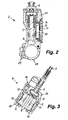
- eine Schnittdarstellung des in Fig. 1 gezeigten Gebersystems,
- Fig. 3
- eine Schnittdarstellung der in Fig. 1 gezeigten Bremsvorrichtung,
- Fig. 4
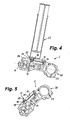
- eine Schnittdarstellung eines Gebersystems in einer Befüll- und Entlüftungsposition mit angesetztem Entlüftungs- und Befüllwerkzeug,
- Fig. 5
- eine Schnittdarstellung des Gebersystems in Betriebsposition,
- Fig. 6
- eine vergrößerte Darstellung des Gebersystems gemäß Fig. 4 in Befüll- und Entlüftungsposition,
- Fig. 7
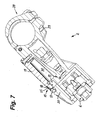
- eine vergrößerte Schnittdarstellung des Gebersystems gemäß Fig. 5 in Betriebsposition,
- Fig. 8
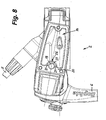
- eine Aufsicht eines Gebersystems mit offenem Ausgleichsbehälter,
- Fig. 9
- eine Aufsicht eines Gebersystems mit angesetztem Entlüftungs- und Befüllwerkzeug,
- Fig. 10
- eine Aufsicht eines Ausgleichsbehälter-Deckels,
- Fig. 11
- eine Seitenansicht des in Fig. 10 gezeigten Deckels,
- Fig. 12
- eine vergrößerte Darstellung eines Deckelbereichs mit einer Befüll- und Entlüftungsöffnung,
- Fig. 13
- eine perspektivische Ansicht eines Balgs,
- Fig. 14
- eine Schnittdarstellung des Gebersystems mit Überströmöffnungen im umlaufenden Seitenflansch eines elastischen Balgs,
- Fig. 15
- eine Schmalseitenansicht eines Balgs mit Überströmöffnungen und
- Fig. 16
- eine Unterseitenansicht des in Fig.15 gezeigten Balgs.
- Eine in Fig. 1 gezeigte, hydraulische Bremsanlage 1 ist insbesondere für Fahrräder, gegebenenfalls aber auch für andere Zweiräder einsetzbar. Sie weist ein Gebersystem 2 sowie eine an einer Bremsscheibe 3 angesetzte Bremsvorrichtung 4 auf. Die Bremsanlage ist mit Hydraulikflüssigkeit gefüllt, wobei das Gebersystem 2 über eine strichliniert angedeutete Hydraulikleitung 5 mit der Bremsvorrichtung 4 verbunden ist.
Das Gebersystem 2 weist einen handbetätigbaren Bremshebel 6 auf, mit dem ein in einem Zylinder 8 geführter Geberkolben 7 (vgl. Fig. 2) bewegt werden kann und dabei Hydraulikflüssigkeit über die Hydraulikleitung 5 zu der Bremsvorrichtung 4 fördert. Diese Bremsvorrichtung 4 weist eine Bremszange 36 auf, die an der mit dem zu bremsenden Rad verbundenen Bremsscheibe 3 angeordnet ist. Die Bremsscheibe 3 wird beim Bremsen beidseitig mit zwei Bremsbelägen 9 beaufschlagt (Fig. 3). Dazu sind in Bremszylindern 10 geführte Bremskolben 11 vorgesehen, die rückseitig mit Hydraulikflüssigkeit beaufschlagbar sind. Die Hydraulikflüssigkeit wird dabei von der Hydraulikleitung 5 über Kanäle 12 zu hinter den Bremskolben 11 befindlichen Druckkammern 13 geführt. - Das Gebersystem 2 weist einen Ausgleichsbehälter 14 für Hydraulikflüssigkeit auf, der bei unbetätigtem Bremshebel 6 mit dem Zylinder 8 und damit dem Hydraulikkreislauf verbunden ist.
Um das Hydrauliksystem befüllen und entlüften zu können, weist das Gebersystem 2 eine Befüll- und Entlüftungsöffnung 15 und die Bremsvorrichtung 4 ebenfalls eine Befüll- und Entlüftungsöffnung 16 (Fig. 3) auf.
Im gezeigten Ausführungsbeispiel ist die Befüll- und Entlüftungsöffnung 15 des Gebersystems 2 oberseitig an diesem vorgesehen und durchsetzt einen den Ausgleichsbehälter 14 oberseitig verschließenden Deckel 17 (Fig. 4 bis 7), der durch Verschraubungen mit dem Gebergehäuse 20 verbunden ist. - Insbesondere in Fig. 7 ist gut erkennbar, dass die Befüll- und Entlüftungsöffnung 15 im Deckel 17 einen Einsteckabschnitt 18 aufweist, an den sich vorzugsweise fluchtend in axialer Verlängerung eine Anschlusskammer 19 im Gebergehäuse 20 anschließt. Die Anschlusskammer 19 ist topf- oder napfförmig ausgebildet und weist an ihrem Oberrand schlitzförmige, randoffene Überströmöffnungen 21 zu dem Ausgleichsbehälter 14 auf. Dadurch besteht eine Strömungsverbindung zwischen dieser Anschlusskammer 19 und dem Ausgleichsbehälter 14.
- Die Ausbildung der einen Zuführkanal zum Ausgleichsbehälter 14 bildenden Befüll- und Entlüftungsöffnung 15 einerseits aufgeteilt in zwei vorzugsweise axial fluchtende Abschnitte - Einsteckabschnitt 18, Anschlusskammer 19- und andererseits angeordnet in zwei getrennt herstellbaren Teilen -Deckel 17, Gebergehäuse 17- hat fertigungstechnisch erhebliche Vorteile, weil es sich um Einzelbohrungen handelt, die durch Formstifte einfach herstellbar sind. Bei dem Zuführkanal der Befüll- und Entlüftungsöffnung 15 handelt es sich in Funktionslage um eine Stufenbohrung mit einer innenliegenden, im Durchmesser größeren Stufe, was bei einer einteiligen Ausführung formungstechnisch wegen des Hinterschnitts einen erhöhten Aufwand bedeuten würde.
Der Einsteckabschnitt 18 im Deckel 17 und die Anschlusskammer 19 im Gebergehäuse 20 sind bezüglich ihrer Längsachsen so ausgerichtet, dass sie jeweils in Entformungsrichtung des Deckels beziehungsweise des Gebergehäuses verlaufen und damit ein problemloses Entformen ermöglichen. Durch die randoffene Ausbildung der vorzugsweise schlitzförmigen Überströmöffnungen 21, die ebenfalls in Entformungsrichtung orientiert sind, sind diese ebenfalls einfach herstellbar. - Der Einsteckabschnitt 18 der Befüll- und Entlüftungsöffnung 15 ist zur dichten Aufnahme eines Anschlussstutzens 22 eines Entlüftungs- und Befüllwerkzeugs 23 ausgebildet und weist dazu einen Aufnahmekonus 25 auf. Der Aufnahmekonus 25 ist vorzugsweise zur Einsteck-Aufnahme eines als Luerkonus 24 ausgebildeten Anschlussstutzens 22 des Entlüftungs- und Befüllwerkzeugs 23 ausgebildet (Fig. 6). Dadurch besteht die Möglichkeit, als Entlüftungs- und Befüllwerkzeug 23 eine handelsübliche Spritze, wie in Fig. 4, 6 und 9 erkennbar, zu verwenden.
Die Einsteckverbindung mit dem Aufnahmekonus 25 und dem Anschlussstutzen 22 ist so dimensioniert, dass der Anschlussstutzen 22 in Einstecklage bereichsweise in die Anschlusskammer 19 ragt, wobei er mit seinem inneren Ende noch etwas Abstand zum Grund der Anschlusskammer 19 hat, wie dies gut in Fig. 6 erkennbar ist. In dieser Einstecklage ist der Anschlussstutzen 22 des Entlüftungs- und Befüllwerkzeugs 23 sicher in dem Deckel 17 gehalten, so dass auch beim Manipulieren während eines Entlüftungs- oder Befüllvorganges ein unbeabsichtigtes Herausrutschen sicher vermieden wird. Die Anschlusskammer 19 hat lichte Abmessungen, die größer als die des hineinragenden Teils des Anschlussstutzens 22 sind, so dass noch Platz für ein Überströmen von Hydraulikflüssigkeit durch die Überströmöffnungen 21 vorhanden ist. - In dem Ausführungsbeispiel ist die Befüll- und Entlüftungsöffnung 15 seitlich neben dem Ausgleichsbehälter 14 angeordnet und befindet sich in Befüll- und Entlüftungsposition gemäß Fig. 6 auf der höchsten Seite neben dem Ausgleichsbehälter 14. Der Deckel 17 ist dabei so ausgebildet, dass er auch diesen, seitlich neben dem Ausgleichsbehälter 14 befindlichen Bereich des Gebergehäuses 20 übergreift.
- In Fig. 8 ist gut bei oben offenem Ausgleichsbehälter 14, also ohne Deckel 17 und entferntem Balg 30 (Fig. 13) erkennbar, dass die Anschlusskammer 19 der Befüll- und Entlüftungsöffnung 15 in einer seitlich in den Ausgleichsbehälter 14 ragenden Ausbuchtung 26 des Gebergehäuses 20 angeordnet ist. Die Anschlusskammer 19 ist dabei von einer Umgrenzungswand 27 umgeben, in der sich die zwei schlitzförmigen, nach oben randoffenen Überströmöffnungen 21 befinden. Die beiden Überströmöffnungen 21 sind dabei seitlich versetzt zu dem vordersten, dem Ausgleichsbehälter 14 zugewandten Bereich der Ausbuchtung 26 angeordnet. Dadurch wird erreicht, dass nach einem Befüll- oder Entlüftungsvorgang gegebenenfalls noch in der Anschlusskammer 19 befindliche Luftbläschen in der in Fig. 7 gezeigten, schrägen Betriebsposition des Gebersystems 2 nicht über' die Überströmöffnungen 21 in den Ausgleichsbehälter 14 gelangen können sondern im etwas höher liegenden Teil der Anschlusskammer 19 gefangen bleiben. Dazu trägt auch bei, dass die Überströmöffnungen 21 als schmale Randschlitze ausgebildet sind, wobei die Schlitzbreite zum Zurückhalten von in der Hydraulikflüssigkeit enthaltenen Luftblasen dimensioniert ist.
- In dem Ausgleichsbehälter 14 ist ein elastischer Balg 30 eingesetzt, der, wie in Fig. 13 erkennbar, wannenförmig ausgebildet ist und an seinem Öffnungsrand eine umlaufende, als Flansch ausgebildeten Dichtung 31 aufweist. Dieser Balg 31 wird in den Ausgleichsbehälter 14 eingesetzt und füllt diesen bereichsweise aus. Die Dichtung 31 liegt auf dem Randbereich des Ausgleichsbehälters und damit auf dem Gebergehäuse 20 auf. Durch den aufgesetzten Deckel 17 erfolgt dann ein Verschließen und Abdichten sowohl des Balgs 30 als auch des Ausgleichsbehälters 14 nach außen. Der Hohlraum des Balgs 30 ist über eine Balgbelüftungsöffnung 32 (Fig. 1 und 10) durch den Deckel 17 hindurch mit der Außenatmosphäre verbunden.
Die zwischen dem Ausgleichsbehälter 14 und dem ihn oberseitig abdichtenden Deckel 17 umlaufende Dichtung 31, die durch den Seitenflansch des Balgs 30 gebildet ist, erstreckt sich auch in den Seitenbereich neben den Ausgleichsbehälter 14 und dabei zwischen den Einsteckabschnitt 18 und die Anschlusskammer 19 der Befüll- und Entlüftungsöffnung 15.
In diesem Bereich ist die Dichtung 31 mit einer Ringswulst 33 versehen, wie dies gut in Fig. 6 und 13 erkennbar ist.
In etwa komplementär zu dieser Ringwulst 33 weist der den Einsteckabschnitt 18 umgebende Deckelbereich eine Ringnut 34 zur dichtenden Aufnahme dieser Ringwulst 33 auf (Fig. 12). Die Ringwulst 33 liegt mit ihrer Unterseite auf dem Oberrand der Anschlusskammer 19 beziehungsweise deren Begrenzungswand 27 auf (Fig. 6). Die in der Begrenzungswand 27 befindlichen, randoffenen Überströmöffnungen 21 werden von der Ringwulst 33 überbrückt, wobei die erhöhte Eigenstabilität der Ringwulst 33 im Vergleich zu der flachen Ausführung der Dichtung im benachbarten Bereich auch im Überbrückungsbereich für eine gute Dichtigkeit sorgt. - Bei abgenommenem Entlüftungs- und Befüllwerkzeug 23 kann die Befüll- und Entlüftungsöffnung 15 mit einem elastischen, vorzugsweise mit einem Konus versehenen Verschlussstopfen 35 (Fig. 5) verschlossen werden.
- Die Befüll- und Entlüftungsöffnung 15 weist vorzugsweise einen Einsteckabschnitt 18 mit einem Aufnahmekonus 25 auf, in den der mit einem dazu passenden Außenkonus versehene Verschlussstopfen 35 einsteckbar ist. Die Abdichtung erfolgt hierbei durch die Konusverbindung.
- Der Verschlussstopfen 35 kann eine von außen zugängliche Einsteckhöhlung als Werkzeugangriffsstelle für ein Drehwerkzeug aufweisen, die bevorzugt als Innensechskant für einen Sechskantschlüssel als Drehwerkzeug ausgebildet ist.
Der Verschlussstopfen 35 kann dadurch nach dem Einsetzen des Drehwerkzeugs mit diesem etwas verdreht und dabei, unterstützt durch die Konusverbindung, herausgezogen werden.
Durch die innen liegende Werkzeugangriffsstelle kann der eingesteckte Verschlussstopfen etwa bündig mit der Außenseite des Deckels oder der Öffnung des Einsteckabschnitts 18 im Deckel 17 abschließen oder sogar etwas tiefer liegen, so dass ein unbeabsichtigtes Lösen oder Entfernen des Verschlussstopfens praktisch ausgeschlossen ist. - Der Verschlussstopfen kann aus Hartkunststoffmaterial bestehen, beispielsweise aus dem gleichen Werkstoff wie der Deckel 17. Auch andere Materialien kommen in Frage, wobei nur sicher gestellt sein muss, dass das Moment zum Verdrehen des Verschlussstopfens 35 vom Drehwerkzeug übertragen werden kann.
- Erwähnt sei noch, dass anstatt eines Verschlussstopfens 35 auch eine Dichtschraube vorgesehen sein kann, die in eine Gewindebohrung der Befüll- und Entlüftungsöffnung 15 einschraubbar ist, wobei die Abdichtung über die Stirnfläche erreicht wird.
- Bei dem in Fig. 14 im Schnitt dargestellten Gebersystem 2 sind Überströmöffnungen 21a von der Anschlusskammer zum Ausgleichsbehälter anstatt, wie vorbeschrieben, in der Begrenzungswand 27 der Anschlusskammer 19, in einem auf der Begrenzungswand aufliegenden Gegenstück angeordnet, welches im Ausführungsbeispiel die Dichtung 31 zwischen dem Deckel und dem Ausgleichsbehälter als Teil des Balgs 30a ist. Die Dichtung 31 ist dabei durch den umlaufenden Seitenflansch des elastischen Balgs 30a (Fig.15 und 16) gebildet.
Dieser Dichtungs- oder Seitenflansch erstreckt sich über den Bereich der Anschlusskammer 19 und deren Begrenzungswand 27, wobei die im Ausführungsbeispiel drei kanalförmigen Überströmöffnungen 21a (Fig.16) im Balg-Seitenflansch und damit der Dichtung 31 angeordnet sind und die Begrenzungswand 27 überdecken, also mit ihren Enden einerseits in den Ausgleichsbehälter 14 und andererseits in die Anschlusskammer 19 ragen. Durch diese Überströmöffnungen oder Überströmkanäle ist eine Strömungsverbindung zwischen der Anschlusskammer 19 und dem Ausgleichsbehälter 14 vorhanden.
Die Überströmöffnungen 21a sind als randoffene Nuten ausgebildet, die mit ihren Öffnungen der Begrenzungswand 27 zugewandt sind.
Die Dichtung 31 ist im Auflagebereich auf der Begrenzungswand 27 der Anschlusskammer 19 aufgedickt (Fig.15), so dass einerseits in diesem Bereich eine erhöhte Eigenstabilität vorhanden ist und andererseits die Platzverhältnisse für im Querschnitt ausreichend dimensionierte Überströmöffnungen 21a vorhanden sind. - Erwähnt sei noch, dass die wenigstens eine Überströmöffnung 21 von der Anschlusskammer 19 zum Ausgleichsbehälter 14 auch direkt im Deckel 17 vorgesehen sein kann, wenn dieser aus geeignetem Material besteht, um eine Abdichtung zur Anschlusskammer 19 zu erreichen. Auch hierbei sind die Überströmöffnungen an der entsprechenden Stelle wie bei der Dichtung 31 angeordnet. Weiterhin könnte die wenigstens eine Überströmöffnung auch als Bohrung in der Seitenwand der Anschlusskammer 19 ausgeführt sein. Bei formgebenden Verfahren wie zum Beispiel Spritzgießen sind jedoch randoffene Überströmöffnungen spritztechnisch einfacher realisierbar.
- Das Gebersystem 2 ist mittels einer Halterung 28 mit dem Lenker eines Zweirads verbindbar. Die Halterung 28 ist schellenartig ausgebildet und kann mit Hilfe einer Spannschraube 29 angezogen oder gelockert werden. Dadurch lässt sich das Gebersystem leicht in die passende Position einerseits für den Betrieb (Fig. 5 und 7) und dementsprechend passend für eine gute Bedienbarkeit und andererseits für den Befüll- und Entlüftungsvorgang (Fig. 4 und 6) entsprechend verstellen.
Erwähnt sei noch, dass für den Befüll- und insbesondere den Entlüftungsvorgang das Gebersystem 2 von einer Lage mit nahezu vertikalem Entlüftungs- und Befüllwerkzeug 23 wie in Fig. 4 und 6 dargestellt, bis zu einer etwa waagerechten Lage des Entlüftungs- und Befüllwerkzeugs 23 gut möglich ist. - Zum Befüllen des Hydrauliksystems kann die das Entlüftungs- und Befüllwerkzeug 23 bildende Spritze gemäß Fig. 4, 6 und 9 oberseitig auf das Gebersystem 2 aufgesteckt und dabei mit ihrem Anschlussstutzen 22 dicht in den Aufnahmekonus 25 der Befüll- und Entlüftungsöffnung 15 eingesetzt werden. Durch die vorgesehene Konusverbindung ergibt sich schon bei leichtem Eindrücken eine sichere und dichte Verbindung. Bei der Bremsvorrichtung 4 kann an die Befüll- und Entlüftungsöffnung 16 ein Behälter mit Hydraulikflüssigkeit angeschlossen werden, wobei dieser Behälter auch eine mit Hydraulikflüssigkeit gefüllte Spritze sein kann.
- Vorzugsweise ist die Befüll- und Entlüftungsöffnung 16 der Bremsvorrichtung 4 ebenfalls mit einem Luer-Aufnahmekonus versehen, so dass auch hier handelsübliche Spritzen als Entlüftungs- und Befüllwerkzeug 23 angesetzt werden können.
Mit der oben bei dem Gebersystem 2 angesetzten Spritze wird die Hydraulikflüssigkeit angesaugt und strömt dann von unten in das Hydrauliksystem. Die untere, mit Hydraulikflüssigkeit gefüllte Spritze kann ,dabei unterstützend betätigt werden, so dass der Befüllvorgang schnell abgeschlossen werden kann.
Claims (33)
Priority Applications (1)
| Application Number | Priority Date | Filing Date | Title |
|---|---|---|---|
| PL07016148T PL1894831T3 (pl) | 2006-08-29 | 2007-08-17 | Układ hamulcowy z hydrauliczną instalacją hamulcową |
Applications Claiming Priority (1)
| Application Number | Priority Date | Filing Date | Title |
|---|---|---|---|
| DE102006040327A DE102006040327A1 (de) | 2006-08-29 | 2006-08-29 | Bremssystem mit einer hydraulischen Bremsanlage |
Publications (3)
| Publication Number | Publication Date |
|---|---|
| EP1894831A2 true EP1894831A2 (de) | 2008-03-05 |
| EP1894831A3 EP1894831A3 (de) | 2008-10-08 |
| EP1894831B1 EP1894831B1 (de) | 2009-11-11 |
Family
ID=38487119
Family Applications (1)
| Application Number | Title | Priority Date | Filing Date |
|---|---|---|---|
| EP07016148A Active EP1894831B1 (de) | 2006-08-29 | 2007-08-17 | Bremssystem mit einer hydraulischen Bremsanlage |
Country Status (6)
| Country | Link |
|---|---|
| US (1) | US20080053758A1 (de) |
| EP (1) | EP1894831B1 (de) |
| AT (1) | ATE448136T1 (de) |
| DE (2) | DE102006040327A1 (de) |
| PL (1) | PL1894831T3 (de) |
| TW (1) | TW200831346A (de) |
Cited By (1)
| Publication number | Priority date | Publication date | Assignee | Title |
|---|---|---|---|---|
| WO2012127014A1 (de) * | 2011-03-24 | 2012-09-27 | Continental Teves Ag & Co. Ohg | Druckmittelbehälter für eine hydraulische kraftfahrzeugbremsanlage und verfahren zur befüllung |
Families Citing this family (11)
| Publication number | Priority date | Publication date | Assignee | Title |
|---|---|---|---|---|
| DE102006040328A1 (de) * | 2006-08-29 | 2008-03-06 | Gustav Magenwirth Gmbh & Co. Kg | Bremssystem mit einer hydraulischen Bremsanlage |
| US7832531B2 (en) * | 2009-03-06 | 2010-11-16 | Shimano Inc. | Bicycle component fixing band |
| DE102009039620A1 (de) | 2009-09-01 | 2011-03-03 | Gustav Magenwirth Gmbh & Co. Kg | Gebervorrichtung für ein geschlossenes Hydrauliksystem lenkergeführter Fahrzeuge |
| IT1402323B1 (it) * | 2010-09-16 | 2013-08-30 | Formula Srl | Corpo pompa per il comando di attuatori idraulici di freni a disco per biciclette e motociclette |
| US8943924B2 (en) | 2010-11-24 | 2015-02-03 | Hb Performance Systems, Inc. | System and method for an adjustable lever assembly |
| USD641670S1 (en) | 2010-11-24 | 2011-07-19 | Hb Performance Systems, Inc. | Brake pad |
| DE102011075186A1 (de) * | 2011-05-03 | 2012-11-08 | Gustav Magenwirth Gmbh & Co. Kg | Geber für ein hydraulisches Betätigungselement |
| US9688348B2 (en) * | 2014-12-15 | 2017-06-27 | Shimano Inc. | Hydraulic hose fitting and hydraulic device |
| IT201600103768A1 (it) | 2016-10-17 | 2018-04-17 | Campagnolo Srl | Valvola di spurgo per impianto frenante idraulico di bicicletta |
| CN114144601B (zh) * | 2019-11-22 | 2024-10-01 | 舍弗勒技术股份两合公司 | 液压缸排气机构和液压驻车锁的液压执行机构 |
| US12037076B1 (en) * | 2023-03-09 | 2024-07-16 | Shimano Inc. | Hydraulic reservoir and operating device of human-powered vehicle |
Citations (1)
| Publication number | Priority date | Publication date | Assignee | Title |
|---|---|---|---|---|
| US6298961B1 (en) | 2000-03-02 | 2001-10-09 | Delphi Technologies, Inc. | Reservoir cap and bleed mechanism |
Family Cites Families (25)
| Publication number | Priority date | Publication date | Assignee | Title |
|---|---|---|---|---|
| US2316497A (en) * | 1941-10-28 | 1943-04-13 | Du Pont | Hydraulically actuated system |
| US4170280A (en) * | 1978-03-14 | 1979-10-09 | Parker-Hannifin Corporation | Bleeder harness for brake master cylinders |
| US4201056A (en) * | 1978-05-01 | 1980-05-06 | Kent-Moore Corporation | Brake bleeder adapter |
| US4236549A (en) * | 1978-05-12 | 1980-12-02 | Autoline Supply Company | Bleeder kit for bleeding a master cylinder |
| US4306639A (en) * | 1980-06-13 | 1981-12-22 | General Motors Corporation | Disc brake caliper with molded flex piston |
| US4788821A (en) * | 1983-11-28 | 1988-12-06 | Automotive Products, Plc | Hydraulic shift for motor vehicle transmission |
| GB8602486D0 (en) * | 1986-01-31 | 1986-03-05 | Liquid Levers Ltd | Fluid system bleeding apparatus |
| US4785629A (en) * | 1987-06-04 | 1988-11-22 | Ennis Iii James F | Syringe-dispensed brake fluid for filling and purging master cylinder circuit from slave |
| FR2631937B1 (de) * | 1988-05-31 | 1990-09-14 | Bendix France | |
| US5088529A (en) * | 1990-08-27 | 1992-02-18 | General Motors Corporation | Vehicle brake vacuum evacuation and brake fluid fill machine |
| AU635631B2 (en) * | 1991-01-15 | 1993-03-25 | Astra Pharmaceuticals Pty Ltd | Plastic syringe |
| US5324082A (en) * | 1991-08-29 | 1994-06-28 | Bundy Corporation | Positive transition quick connect coupling |
| US5497864A (en) * | 1995-06-20 | 1996-03-12 | Chrysler Corporation | Hydraulic brake bleeder apparatus |
| KR0120417B1 (en) * | 1995-07-19 | 1997-11-04 | Hyundai Motor Co Ltd | Oil-compensating device for brake device |
| DE19648050B4 (de) * | 1995-11-28 | 2006-03-09 | Honda Giken Kogyo K.K. | Hydraulikdruckquelleneinrichtung und Fahrzeughöhen-Steuer/Regel-Einrichtung |
| DE19639560A1 (de) * | 1996-09-26 | 1998-04-02 | Bosch Gmbh Robert | Hydraulische Fahrzeugbremsanlage |
| US5950772A (en) * | 1997-08-29 | 1999-09-14 | Hayes Brake, Inc. | Bicycle brake system having a flexible disk |
| US5967199A (en) * | 1998-05-13 | 1999-10-19 | General Motors Corporation | Pressurized brake bleed system |
| AU2001222188A1 (en) * | 2000-11-30 | 2002-06-11 | Freni Brembo S.P.A. | An hydraulic pump for vehicles controllable by handlebars |
| US6871729B2 (en) * | 2001-03-02 | 2005-03-29 | Freni Brembo S.P.A. | Master cylinder for a brake or clutch of a motorcycle or bike |
| DE20108558U1 (de) * | 2001-05-22 | 2001-08-09 | Krebs, Peter, Dr., 78048 Villingen-Schwenningen | Kombinationsnadel für die peripheren Nervenblockaden |
| US6581905B2 (en) * | 2001-11-21 | 2003-06-24 | Tenneco Automotive Inc. | Brake bleed tool |
| MXPA05000264A (es) * | 2002-07-31 | 2005-03-31 | Dynamic Fluid Control Propriet | Valvula de ventilacion. |
| US7548909B2 (en) * | 2006-06-13 | 2009-06-16 | Microsoft Corporation | Search engine dash-board |
| DE102006040328A1 (de) * | 2006-08-29 | 2008-03-06 | Gustav Magenwirth Gmbh & Co. Kg | Bremssystem mit einer hydraulischen Bremsanlage |
-
2006
- 2006-08-29 DE DE102006040327A patent/DE102006040327A1/de not_active Withdrawn
-
2007
- 2007-08-17 DE DE502007001952T patent/DE502007001952D1/de active Active
- 2007-08-17 AT AT07016148T patent/ATE448136T1/de active
- 2007-08-17 PL PL07016148T patent/PL1894831T3/pl unknown
- 2007-08-17 EP EP07016148A patent/EP1894831B1/de active Active
- 2007-08-22 TW TW096131008A patent/TW200831346A/zh unknown
- 2007-08-29 US US11/846,584 patent/US20080053758A1/en not_active Abandoned
Patent Citations (1)
| Publication number | Priority date | Publication date | Assignee | Title |
|---|---|---|---|---|
| US6298961B1 (en) | 2000-03-02 | 2001-10-09 | Delphi Technologies, Inc. | Reservoir cap and bleed mechanism |
Cited By (4)
| Publication number | Priority date | Publication date | Assignee | Title |
|---|---|---|---|---|
| WO2012127014A1 (de) * | 2011-03-24 | 2012-09-27 | Continental Teves Ag & Co. Ohg | Druckmittelbehälter für eine hydraulische kraftfahrzeugbremsanlage und verfahren zur befüllung |
| CN103562030A (zh) * | 2011-03-24 | 2014-02-05 | 大陆-特韦斯贸易合伙股份公司及两合公司 | 用于机动车液压制动装置的压力介质容器及加注方法 |
| US8904783B2 (en) | 2011-03-24 | 2014-12-09 | Continental Teves Ag & Co. Ohg | Pressure medium container for a hydraulic motor vehicle brake system and method for filling |
| CN103562030B (zh) * | 2011-03-24 | 2016-04-27 | 大陆-特韦斯贸易合伙股份公司及两合公司 | 用于机动车液压制动装置的压力介质容器及加注方法 |
Also Published As
| Publication number | Publication date |
|---|---|
| PL1894831T3 (pl) | 2010-04-30 |
| EP1894831B1 (de) | 2009-11-11 |
| DE502007001952D1 (de) | 2009-12-24 |
| TW200831346A (en) | 2008-08-01 |
| ATE448136T1 (de) | 2009-11-15 |
| EP1894831A3 (de) | 2008-10-08 |
| US20080053758A1 (en) | 2008-03-06 |
| DE102006040327A1 (de) | 2008-03-06 |
Similar Documents
| Publication | Publication Date | Title |
|---|---|---|
| EP1894831B1 (de) | Bremssystem mit einer hydraulischen Bremsanlage | |
| EP1908659B1 (de) | Bremssystem mit einer hydraulischen Bremsanlage | |
| DE202013012255U1 (de) | Hydraulischer Bremsmechanismus | |
| DE3309916A1 (de) | Saug- und spuelvorrichtung | |
| DE3036076A1 (de) | Ausspuel- und absaughandstueck | |
| EP0758540A2 (de) | Ärztliches, insbesondere zahnärztliches Turbinen-Handstück | |
| DE3324631C2 (de) | ||
| DE102013208108A1 (de) | Flüssigkeitsaufnahmebehälter für eine Vorrichtung zur Bereitstellung von Unterdruck für medizinischeAnwendungen, Verfahren zur Herstellung des Behälters, sowie Vorrichtung | |
| DE102011078153A1 (de) | Hydraulikkonverter und hydraulische Bremse | |
| DE102017104155B4 (de) | Einwegventil-Baugruppe | |
| DE4031613C2 (de) | Dialysegerät | |
| DE202007019225U1 (de) | Vorrichtung zur Wiederbefüllung einer Tintenpatrone für einen Tintenstrahldrucker | |
| WO2008028800A1 (de) | Dampfbügelvorrichtung mit rückwärtigem einlass | |
| DE102007035386B4 (de) | Entlüftungsvorrichtung | |
| DE60029623T2 (de) | Einheit für mikrobiologische prüfung einer flüssigen probe unter druck und verfharen für das leeren dieser einheit | |
| DE2517679C3 (de) | Füllnippelanordnung zum Einfüllen bzw. Auslassen eines Druckmittels in den bzw. aus dem Druckraum einer hydraulischen Kettenspannvorrichtung an Raupenfahrzeugen | |
| EP4214098B1 (de) | Hydraulikarmatur | |
| DE3309917A1 (de) | Ventil | |
| DE3317736A1 (de) | T-foermiges rohrverbindungsstueck | |
| EP1893459B1 (de) | Entlüftungsschraube mit rückschlagventil | |
| DE60307947T2 (de) | Hydraulisches Bremsventil und Verfahren zum Entlüften eines hydraulischen Bremssystems | |
| DE19802601C2 (de) | Kopfstruktur für eine Luftpumpe | |
| WO2014023500A1 (de) | Verfahren zum herstellen einer anschlussvorrichtung zur verwendung bei der unterdrucktherapie von wunden | |
| DE202006011061U1 (de) | Entlüftungsschraube mit Rückschlagventil | |
| EP2283909A1 (de) | Ölfiltervorrichtung mit einer Entölungseinrichtung |
Legal Events
| Date | Code | Title | Description |
|---|---|---|---|
| PUAI | Public reference made under article 153(3) epc to a published international application that has entered the european phase |
Free format text: ORIGINAL CODE: 0009012 |
|
| AK | Designated contracting states |
Kind code of ref document: A2 Designated state(s): AT BE BG CH CY CZ DE DK EE ES FI FR GB GR HU IE IS IT LI LT LU LV MC MT NL PL PT RO SE SI SK TR |
|
| AX | Request for extension of the european patent |
Extension state: AL BA HR MK YU |
|
| PUAL | Search report despatched |
Free format text: ORIGINAL CODE: 0009013 |
|
| AK | Designated contracting states |
Kind code of ref document: A3 Designated state(s): AT BE BG CH CY CZ DE DK EE ES FI FR GB GR HU IE IS IT LI LT LU LV MC MT NL PL PT RO SE SI SK TR |
|
| AX | Request for extension of the european patent |
Extension state: AL BA HR MK RS |
|
| RIC1 | Information provided on ipc code assigned before grant |
Ipc: B60T 11/26 20060101ALI20080904BHEP Ipc: B62L 3/02 20060101AFI20070924BHEP Ipc: B60K 15/04 20060101ALI20080904BHEP Ipc: B60T 11/232 20060101ALI20080904BHEP Ipc: F16D 65/14 20060101ALI20080904BHEP |
|
| 17P | Request for examination filed |
Effective date: 20090326 |
|
| GRAP | Despatch of communication of intention to grant a patent |
Free format text: ORIGINAL CODE: EPIDOSNIGR1 |
|
| AKX | Designation fees paid |
Designated state(s): AT BE BG CH CY CZ DE DK EE ES FI FR GB GR HU IE IS IT LI LT LU LV MC MT NL PL PT RO SE SI SK TR |
|
| GRAS | Grant fee paid |
Free format text: ORIGINAL CODE: EPIDOSNIGR3 |
|
| GRAA | (expected) grant |
Free format text: ORIGINAL CODE: 0009210 |
|
| AK | Designated contracting states |
Kind code of ref document: B1 Designated state(s): AT BE BG CH CY CZ DE DK EE ES FI FR GB GR HU IE IS IT LI LT LU LV MC MT NL PL PT RO SE SI SK TR |
|
| REG | Reference to a national code |
Ref country code: GB Ref legal event code: FG4D Free format text: NOT ENGLISH |
|
| REG | Reference to a national code |
Ref country code: CH Ref legal event code: EP |
|
| REG | Reference to a national code |
Ref country code: IE Ref legal event code: FG4D |
|
| REF | Corresponds to: |
Ref document number: 502007001952 Country of ref document: DE Date of ref document: 20091224 Kind code of ref document: P |
|
| REG | Reference to a national code |
Ref country code: CH Ref legal event code: NV Representative=s name: HANS RUDOLF GACHNANG PATENTANWALT |
|
| LTIE | Lt: invalidation of european patent or patent extension |
Effective date: 20091111 |
|
| PG25 | Lapsed in a contracting state [announced via postgrant information from national office to epo] |
Ref country code: PT Free format text: LAPSE BECAUSE OF FAILURE TO SUBMIT A TRANSLATION OF THE DESCRIPTION OR TO PAY THE FEE WITHIN THE PRESCRIBED TIME-LIMIT Effective date: 20100311 Ref country code: SE Free format text: LAPSE BECAUSE OF FAILURE TO SUBMIT A TRANSLATION OF THE DESCRIPTION OR TO PAY THE FEE WITHIN THE PRESCRIBED TIME-LIMIT Effective date: 20091111 Ref country code: IS Free format text: LAPSE BECAUSE OF FAILURE TO SUBMIT A TRANSLATION OF THE DESCRIPTION OR TO PAY THE FEE WITHIN THE PRESCRIBED TIME-LIMIT Effective date: 20100311 Ref country code: ES Free format text: LAPSE BECAUSE OF FAILURE TO SUBMIT A TRANSLATION OF THE DESCRIPTION OR TO PAY THE FEE WITHIN THE PRESCRIBED TIME-LIMIT Effective date: 20100222 Ref country code: FI Free format text: LAPSE BECAUSE OF FAILURE TO SUBMIT A TRANSLATION OF THE DESCRIPTION OR TO PAY THE FEE WITHIN THE PRESCRIBED TIME-LIMIT Effective date: 20091111 Ref country code: LT Free format text: LAPSE BECAUSE OF FAILURE TO SUBMIT A TRANSLATION OF THE DESCRIPTION OR TO PAY THE FEE WITHIN THE PRESCRIBED TIME-LIMIT Effective date: 20091111 |
|
| REG | Reference to a national code |
Ref country code: PL Ref legal event code: T3 |
|
| PG25 | Lapsed in a contracting state [announced via postgrant information from national office to epo] |
Ref country code: SI Free format text: LAPSE BECAUSE OF FAILURE TO SUBMIT A TRANSLATION OF THE DESCRIPTION OR TO PAY THE FEE WITHIN THE PRESCRIBED TIME-LIMIT Effective date: 20091111 Ref country code: LV Free format text: LAPSE BECAUSE OF FAILURE TO SUBMIT A TRANSLATION OF THE DESCRIPTION OR TO PAY THE FEE WITHIN THE PRESCRIBED TIME-LIMIT Effective date: 20091111 Ref country code: CY Free format text: LAPSE BECAUSE OF FAILURE TO SUBMIT A TRANSLATION OF THE DESCRIPTION OR TO PAY THE FEE WITHIN THE PRESCRIBED TIME-LIMIT Effective date: 20091111 |
|
| REG | Reference to a national code |
Ref country code: IE Ref legal event code: FD4D |
|
| PG25 | Lapsed in a contracting state [announced via postgrant information from national office to epo] |
Ref country code: IE Free format text: LAPSE BECAUSE OF FAILURE TO SUBMIT A TRANSLATION OF THE DESCRIPTION OR TO PAY THE FEE WITHIN THE PRESCRIBED TIME-LIMIT Effective date: 20091111 Ref country code: EE Free format text: LAPSE BECAUSE OF FAILURE TO SUBMIT A TRANSLATION OF THE DESCRIPTION OR TO PAY THE FEE WITHIN THE PRESCRIBED TIME-LIMIT Effective date: 20091111 Ref country code: DK Free format text: LAPSE BECAUSE OF FAILURE TO SUBMIT A TRANSLATION OF THE DESCRIPTION OR TO PAY THE FEE WITHIN THE PRESCRIBED TIME-LIMIT Effective date: 20091111 Ref country code: BG Free format text: LAPSE BECAUSE OF FAILURE TO SUBMIT A TRANSLATION OF THE DESCRIPTION OR TO PAY THE FEE WITHIN THE PRESCRIBED TIME-LIMIT Effective date: 20100211 Ref country code: RO Free format text: LAPSE BECAUSE OF FAILURE TO SUBMIT A TRANSLATION OF THE DESCRIPTION OR TO PAY THE FEE WITHIN THE PRESCRIBED TIME-LIMIT Effective date: 20091111 |
|
| PG25 | Lapsed in a contracting state [announced via postgrant information from national office to epo] |
Ref country code: CZ Free format text: LAPSE BECAUSE OF FAILURE TO SUBMIT A TRANSLATION OF THE DESCRIPTION OR TO PAY THE FEE WITHIN THE PRESCRIBED TIME-LIMIT Effective date: 20091111 Ref country code: SK Free format text: LAPSE BECAUSE OF FAILURE TO SUBMIT A TRANSLATION OF THE DESCRIPTION OR TO PAY THE FEE WITHIN THE PRESCRIBED TIME-LIMIT Effective date: 20091111 |
|
| PLBE | No opposition filed within time limit |
Free format text: ORIGINAL CODE: 0009261 |
|
| STAA | Information on the status of an ep patent application or granted ep patent |
Free format text: STATUS: NO OPPOSITION FILED WITHIN TIME LIMIT |
|
| 26N | No opposition filed |
Effective date: 20100812 |
|
| PG25 | Lapsed in a contracting state [announced via postgrant information from national office to epo] |
Ref country code: GR Free format text: LAPSE BECAUSE OF FAILURE TO SUBMIT A TRANSLATION OF THE DESCRIPTION OR TO PAY THE FEE WITHIN THE PRESCRIBED TIME-LIMIT Effective date: 20100212 |
|
| BERE | Be: lapsed |
Owner name: GUSTAV MAGENWIRTH G.M.B.H. & CO. KG Effective date: 20100831 |
|
| PG25 | Lapsed in a contracting state [announced via postgrant information from national office to epo] |
Ref country code: MC Free format text: LAPSE BECAUSE OF NON-PAYMENT OF DUE FEES Effective date: 20100831 |
|
| PG25 | Lapsed in a contracting state [announced via postgrant information from national office to epo] |
Ref country code: BE Free format text: LAPSE BECAUSE OF NON-PAYMENT OF DUE FEES Effective date: 20100831 |
|
| PGFP | Annual fee paid to national office [announced via postgrant information from national office to epo] |
Ref country code: CH Payment date: 20110824 Year of fee payment: 5 |
|
| PGFP | Annual fee paid to national office [announced via postgrant information from national office to epo] |
Ref country code: GB Payment date: 20110824 Year of fee payment: 5 Ref country code: PL Payment date: 20110901 Year of fee payment: 5 |
|
| REG | Reference to a national code |
Ref country code: DE Ref legal event code: R082 Ref document number: 502007001952 Country of ref document: DE |
|
| PG25 | Lapsed in a contracting state [announced via postgrant information from national office to epo] |
Ref country code: MT Free format text: LAPSE BECAUSE OF FAILURE TO SUBMIT A TRANSLATION OF THE DESCRIPTION OR TO PAY THE FEE WITHIN THE PRESCRIBED TIME-LIMIT Effective date: 20091111 |
|
| PGFP | Annual fee paid to national office [announced via postgrant information from national office to epo] |
Ref country code: NL Payment date: 20110825 Year of fee payment: 5 |
|
| PG25 | Lapsed in a contracting state [announced via postgrant information from national office to epo] |
Ref country code: LU Free format text: LAPSE BECAUSE OF NON-PAYMENT OF DUE FEES Effective date: 20100817 Ref country code: HU Free format text: LAPSE BECAUSE OF FAILURE TO SUBMIT A TRANSLATION OF THE DESCRIPTION OR TO PAY THE FEE WITHIN THE PRESCRIBED TIME-LIMIT Effective date: 20100512 |
|
| PG25 | Lapsed in a contracting state [announced via postgrant information from national office to epo] |
Ref country code: TR Free format text: LAPSE BECAUSE OF FAILURE TO SUBMIT A TRANSLATION OF THE DESCRIPTION OR TO PAY THE FEE WITHIN THE PRESCRIBED TIME-LIMIT Effective date: 20091111 |
|
| REG | Reference to a national code |
Ref country code: NL Ref legal event code: V1 Effective date: 20130301 |
|
| REG | Reference to a national code |
Ref country code: CH Ref legal event code: PL |
|
| GBPC | Gb: european patent ceased through non-payment of renewal fee |
Effective date: 20120817 |
|
| PG25 | Lapsed in a contracting state [announced via postgrant information from national office to epo] |
Ref country code: NL Free format text: LAPSE BECAUSE OF NON-PAYMENT OF DUE FEES Effective date: 20130301 Ref country code: CH Free format text: LAPSE BECAUSE OF NON-PAYMENT OF DUE FEES Effective date: 20120831 Ref country code: LI Free format text: LAPSE BECAUSE OF NON-PAYMENT OF DUE FEES Effective date: 20120831 |
|
| PG25 | Lapsed in a contracting state [announced via postgrant information from national office to epo] |
Ref country code: GB Free format text: LAPSE BECAUSE OF NON-PAYMENT OF DUE FEES Effective date: 20120817 |
|
| REG | Reference to a national code |
Ref country code: AT Ref legal event code: MM01 Ref document number: 448136 Country of ref document: AT Kind code of ref document: T Effective date: 20120831 |
|
| PG25 | Lapsed in a contracting state [announced via postgrant information from national office to epo] |
Ref country code: AT Free format text: LAPSE BECAUSE OF NON-PAYMENT OF DUE FEES Effective date: 20120831 |
|
| PG25 | Lapsed in a contracting state [announced via postgrant information from national office to epo] |
Ref country code: PL Free format text: LAPSE BECAUSE OF NON-PAYMENT OF DUE FEES Effective date: 20120817 |
|
| REG | Reference to a national code |
Ref country code: PL Ref legal event code: LAPE |
|
| REG | Reference to a national code |
Ref country code: FR Ref legal event code: PLFP Year of fee payment: 10 |
|
| REG | Reference to a national code |
Ref country code: FR Ref legal event code: PLFP Year of fee payment: 11 |
|
| REG | Reference to a national code |
Ref country code: FR Ref legal event code: PLFP Year of fee payment: 12 |
|
| PGFP | Annual fee paid to national office [announced via postgrant information from national office to epo] |
Ref country code: DE Payment date: 20240819 Year of fee payment: 18 |
|
| PGFP | Annual fee paid to national office [announced via postgrant information from national office to epo] |
Ref country code: FR Payment date: 20240823 Year of fee payment: 18 |
|
| PGFP | Annual fee paid to national office [announced via postgrant information from national office to epo] |
Ref country code: IT Payment date: 20240827 Year of fee payment: 18 |
|
| REG | Reference to a national code |
Ref country code: DE Ref legal event code: R119 Ref document number: 502007001952 Country of ref document: DE |