EP1899994B1 - Weichmagnetische verbundmaterialien - Google Patents
Weichmagnetische verbundmaterialien Download PDFInfo
- Publication number
- EP1899994B1 EP1899994B1 EP06747915.4A EP06747915A EP1899994B1 EP 1899994 B1 EP1899994 B1 EP 1899994B1 EP 06747915 A EP06747915 A EP 06747915A EP 1899994 B1 EP1899994 B1 EP 1899994B1
- Authority
- EP
- European Patent Office
- Prior art keywords
- lubricant
- temperature
- process according
- soft magnetic
- stearamide
- Prior art date
- Legal status (The legal status is an assumption and is not a legal conclusion. Google has not performed a legal analysis and makes no representation as to the accuracy of the status listed.)
- Active
Links
Images
Classifications
-
- B—PERFORMING OPERATIONS; TRANSPORTING
- B22—CASTING; POWDER METALLURGY
- B22F—WORKING METALLIC POWDER; MANUFACTURE OF ARTICLES FROM METALLIC POWDER; MAKING METALLIC POWDER; APPARATUS OR DEVICES SPECIALLY ADAPTED FOR METALLIC POWDER
- B22F3/00—Manufacture of workpieces or articles from metallic powder characterised by the manner of compacting or sintering; Apparatus specially adapted therefor ; Presses and furnaces
- B22F3/02—Compacting only
-
- B—PERFORMING OPERATIONS; TRANSPORTING
- B22—CASTING; POWDER METALLURGY
- B22F—WORKING METALLIC POWDER; MANUFACTURE OF ARTICLES FROM METALLIC POWDER; MAKING METALLIC POWDER; APPARATUS OR DEVICES SPECIALLY ADAPTED FOR METALLIC POWDER
- B22F1/00—Metallic powder; Treatment of metallic powder, e.g. to facilitate working or to improve properties
- B22F1/10—Metallic powder containing lubricating or binding agents; Metallic powder containing organic material
- B22F1/102—Metallic powder coated with organic material
-
- B—PERFORMING OPERATIONS; TRANSPORTING
- B22—CASTING; POWDER METALLURGY
- B22F—WORKING METALLIC POWDER; MANUFACTURE OF ARTICLES FROM METALLIC POWDER; MAKING METALLIC POWDER; APPARATUS OR DEVICES SPECIALLY ADAPTED FOR METALLIC POWDER
- B22F3/00—Manufacture of workpieces or articles from metallic powder characterised by the manner of compacting or sintering; Apparatus specially adapted therefor ; Presses and furnaces
- B22F3/24—After-treatment of workpieces or articles
-
- H—ELECTRICITY
- H01—ELECTRIC ELEMENTS
- H01F—MAGNETS; INDUCTANCES; TRANSFORMERS; SELECTION OF MATERIALS FOR THEIR MAGNETIC PROPERTIES
- H01F1/00—Magnets or magnetic bodies characterised by the magnetic materials therefor; Selection of materials for their magnetic properties
- H01F1/01—Magnets or magnetic bodies characterised by the magnetic materials therefor; Selection of materials for their magnetic properties of inorganic materials
- H01F1/03—Magnets or magnetic bodies characterised by the magnetic materials therefor; Selection of materials for their magnetic properties of inorganic materials characterised by their coercivity
- H01F1/12—Magnets or magnetic bodies characterised by the magnetic materials therefor; Selection of materials for their magnetic properties of inorganic materials characterised by their coercivity of soft-magnetic materials
- H01F1/14—Magnets or magnetic bodies characterised by the magnetic materials therefor; Selection of materials for their magnetic properties of inorganic materials characterised by their coercivity of soft-magnetic materials metals or alloys
-
- H—ELECTRICITY
- H01—ELECTRIC ELEMENTS
- H01F—MAGNETS; INDUCTANCES; TRANSFORMERS; SELECTION OF MATERIALS FOR THEIR MAGNETIC PROPERTIES
- H01F1/00—Magnets or magnetic bodies characterised by the magnetic materials therefor; Selection of materials for their magnetic properties
- H01F1/01—Magnets or magnetic bodies characterised by the magnetic materials therefor; Selection of materials for their magnetic properties of inorganic materials
- H01F1/03—Magnets or magnetic bodies characterised by the magnetic materials therefor; Selection of materials for their magnetic properties of inorganic materials characterised by their coercivity
- H01F1/12—Magnets or magnetic bodies characterised by the magnetic materials therefor; Selection of materials for their magnetic properties of inorganic materials characterised by their coercivity of soft-magnetic materials
- H01F1/14—Magnets or magnetic bodies characterised by the magnetic materials therefor; Selection of materials for their magnetic properties of inorganic materials characterised by their coercivity of soft-magnetic materials metals or alloys
- H01F1/20—Magnets or magnetic bodies characterised by the magnetic materials therefor; Selection of materials for their magnetic properties of inorganic materials characterised by their coercivity of soft-magnetic materials metals or alloys in the form of particles, e.g. powder
- H01F1/22—Magnets or magnetic bodies characterised by the magnetic materials therefor; Selection of materials for their magnetic properties of inorganic materials characterised by their coercivity of soft-magnetic materials metals or alloys in the form of particles, e.g. powder pressed, sintered, or bound together
- H01F1/24—Magnets or magnetic bodies characterised by the magnetic materials therefor; Selection of materials for their magnetic properties of inorganic materials characterised by their coercivity of soft-magnetic materials metals or alloys in the form of particles, e.g. powder pressed, sintered, or bound together the particles being insulated
-
- H—ELECTRICITY
- H01—ELECTRIC ELEMENTS
- H01F—MAGNETS; INDUCTANCES; TRANSFORMERS; SELECTION OF MATERIALS FOR THEIR MAGNETIC PROPERTIES
- H01F1/00—Magnets or magnetic bodies characterised by the magnetic materials therefor; Selection of materials for their magnetic properties
- H01F1/01—Magnets or magnetic bodies characterised by the magnetic materials therefor; Selection of materials for their magnetic properties of inorganic materials
- H01F1/03—Magnets or magnetic bodies characterised by the magnetic materials therefor; Selection of materials for their magnetic properties of inorganic materials characterised by their coercivity
- H01F1/12—Magnets or magnetic bodies characterised by the magnetic materials therefor; Selection of materials for their magnetic properties of inorganic materials characterised by their coercivity of soft-magnetic materials
- H01F1/33—Magnets or magnetic bodies characterised by the magnetic materials therefor; Selection of materials for their magnetic properties of inorganic materials characterised by their coercivity of soft-magnetic materials mixtures of metallic and non-metallic particles; metallic particles having oxide skin
-
- H—ELECTRICITY
- H01—ELECTRIC ELEMENTS
- H01F—MAGNETS; INDUCTANCES; TRANSFORMERS; SELECTION OF MATERIALS FOR THEIR MAGNETIC PROPERTIES
- H01F41/00—Apparatus or processes specially adapted for manufacturing or assembling magnets, inductances or transformers; Apparatus or processes specially adapted for manufacturing materials characterised by their magnetic properties
- H01F41/02—Apparatus or processes specially adapted for manufacturing or assembling magnets, inductances or transformers; Apparatus or processes specially adapted for manufacturing materials characterised by their magnetic properties for manufacturing cores, coils, or magnets
- H01F41/0206—Manufacturing of magnetic cores by mechanical means
- H01F41/0246—Manufacturing of magnetic circuits by moulding or by pressing powder
-
- B—PERFORMING OPERATIONS; TRANSPORTING
- B22—CASTING; POWDER METALLURGY
- B22F—WORKING METALLIC POWDER; MANUFACTURE OF ARTICLES FROM METALLIC POWDER; MAKING METALLIC POWDER; APPARATUS OR DEVICES SPECIALLY ADAPTED FOR METALLIC POWDER
- B22F3/00—Manufacture of workpieces or articles from metallic powder characterised by the manner of compacting or sintering; Apparatus specially adapted therefor ; Presses and furnaces
- B22F3/24—After-treatment of workpieces or articles
- B22F2003/241—Chemical after-treatment on the surface
-
- B—PERFORMING OPERATIONS; TRANSPORTING
- B22—CASTING; POWDER METALLURGY
- B22F—WORKING METALLIC POWDER; MANUFACTURE OF ARTICLES FROM METALLIC POWDER; MAKING METALLIC POWDER; APPARATUS OR DEVICES SPECIALLY ADAPTED FOR METALLIC POWDER
- B22F3/00—Manufacture of workpieces or articles from metallic powder characterised by the manner of compacting or sintering; Apparatus specially adapted therefor ; Presses and furnaces
- B22F3/24—After-treatment of workpieces or articles
- B22F2003/248—Thermal after-treatment
-
- B—PERFORMING OPERATIONS; TRANSPORTING
- B22—CASTING; POWDER METALLURGY
- B22F—WORKING METALLIC POWDER; MANUFACTURE OF ARTICLES FROM METALLIC POWDER; MAKING METALLIC POWDER; APPARATUS OR DEVICES SPECIALLY ADAPTED FOR METALLIC POWDER
- B22F2998/00—Supplementary information concerning processes or compositions relating to powder metallurgy
-
- B—PERFORMING OPERATIONS; TRANSPORTING
- B22—CASTING; POWDER METALLURGY
- B22F—WORKING METALLIC POWDER; MANUFACTURE OF ARTICLES FROM METALLIC POWDER; MAKING METALLIC POWDER; APPARATUS OR DEVICES SPECIALLY ADAPTED FOR METALLIC POWDER
- B22F2998/00—Supplementary information concerning processes or compositions relating to powder metallurgy
- B22F2998/10—Processes characterised by the sequence of their steps
-
- B—PERFORMING OPERATIONS; TRANSPORTING
- B22—CASTING; POWDER METALLURGY
- B22F—WORKING METALLIC POWDER; MANUFACTURE OF ARTICLES FROM METALLIC POWDER; MAKING METALLIC POWDER; APPARATUS OR DEVICES SPECIALLY ADAPTED FOR METALLIC POWDER
- B22F2999/00—Aspects linked to processes or compositions used in powder metallurgy
-
- H—ELECTRICITY
- H01—ELECTRIC ELEMENTS
- H01F—MAGNETS; INDUCTANCES; TRANSFORMERS; SELECTION OF MATERIALS FOR THEIR MAGNETIC PROPERTIES
- H01F27/00—Details of transformers or inductances, in general
- H01F27/24—Magnetic cores
- H01F27/255—Magnetic cores made from particles
-
- H—ELECTRICITY
- H01—ELECTRIC ELEMENTS
- H01F—MAGNETS; INDUCTANCES; TRANSFORMERS; SELECTION OF MATERIALS FOR THEIR MAGNETIC PROPERTIES
- H01F3/00—Cores, Yokes, or armatures
- H01F3/08—Cores, Yokes, or armatures made from powder
-
- Y—GENERAL TAGGING OF NEW TECHNOLOGICAL DEVELOPMENTS; GENERAL TAGGING OF CROSS-SECTIONAL TECHNOLOGIES SPANNING OVER SEVERAL SECTIONS OF THE IPC; TECHNICAL SUBJECTS COVERED BY FORMER USPC CROSS-REFERENCE ART COLLECTIONS [XRACs] AND DIGESTS
- Y10—TECHNICAL SUBJECTS COVERED BY FORMER USPC
- Y10T—TECHNICAL SUBJECTS COVERED BY FORMER US CLASSIFICATION
- Y10T428/00—Stock material or miscellaneous articles
- Y10T428/12—All metal or with adjacent metals
- Y10T428/12014—All metal or with adjacent metals having metal particles
- Y10T428/12028—Composite; i.e., plural, adjacent, spatially distinct metal components [e.g., layers, etc.]
Definitions
- the invention concerns a new soft magnetic composite material. Particularly, the invention concerns a process for the manufacturing of new soft magnetic composite materials having improved soft magnetic properties.
- Soft magnetic materials are used for applications, such as core materials in inductors, stators and rotors for electrical machines, actuators, sensors and transformer cores.
- soft magnetic cores such as rotors and stators in electric machines, are made of stacked steel laminates.
- SMC Soft Magnetic Composite
- the SMC materials are based on soft magnetic particles, usually iron based, with an electrically insulating coating on each particle.
- the SMC parts are obtained.
- the powder metallurgical technique it is possible to produce materials having a higher degree of freedom in the design of the SMC part compared to using steel laminates, as the SMC material can carry a three dimensional magnetic flux and as three dimensional shapes can be obtained with the compaction process.
- the lubricant used in the iron or iron-based composition to be compacted should be of organic nature and that it should vaporize without leaving any residues in the compacted body before the steam treatment.
- the present invention concerns a process for the manufacture of soft magnetic composite components as defined in independent claim 1.
- product claim 15 metallurgically compacted bodies having superior mechanic and magnetic properties can be obtained. These bodies may be distinguished by superior properties such as a transverse rupture strength of at least 100 MPa, a permeability of at least 700 and a core loss at 1 Tesla and 400 Hz of at most 70W/kg and more specifically a transverse rupture strength of at least 120 MPa, a permeability of at least 800 and a core loss at 1 Tesla and 400 Hz of at most 65 W/kg.
- the soft magnetic powders used according to the present invention are composed of iron or an alloy containing iron.
- the soft magnetic powder comprises essentially pure iron.
- This powder could be e.g. commercially available water-atomised or gas-atomised iron powders or reduced iron powders, such as sponge iron powders.
- Preferred electrically insulating layers, which may be used according to the invention are thin phosphorous containing layers or barriers of the type described in the US patent 6 348 265 , which is hereby incorporated by reference. Other types of insulating layers are disclosed in e.g. the US patents 6 562 458 and 6 419 877 . Powders, which have insulated particles and which are suitable starting materials according to the present invention, are e.g.
- Somaloy®500 and Somaloy®700 available from Höganäs AB, Sweden. So far very interesting results have been obtained with powders having coarse particles, such powders having mean particle sizes between 106 and 425 ⁇ m. More specifically at least 20 % of the particles should preferably have a particle size above 212 ⁇ m.
- the type of lubricant used in the iron or iron-based powder composition is important and is selected from organic lubricating substances that vaporize at temperatures above ambient temperature and below the decomposition temperature of the inorganic electrically insulating coating or layer without leaving any residues that are poisonous for the inorganic insulation, or that can block pores and thereby prevent subsequent oxidation according to the invention.
- Metal soaps which are commonly used for die compaction of iron or iron based powders, leave metal oxide residues in the component and are therefore not suitable.
- the widely used zinc stearate for example leaves zinc oxide, which has a detrimental effect on the insulating properties of e.g. phosphorous containing insulating layers. Impurities and traces of metal could of course be present in the lubricant used according to the invention.
- Organic substances suitable as lubricating agents are fatty alcohols, fatty acids, derivates of fatty acids, and waxes.
- preferred fatty alcohols are stearyl alcohol, behenyl alcohol, and combinations thereof.
- Primary and secondary amides of saturated or unsaturated fatty acids may also be used e.g. stearamide, erucyl stearamide, and combinations thereof.
- the waxes are preferably chosen from polyalkylene waxes, such as ethylene bis-stearamide.
- the lubricants are present in the composition to be compacted in particular form, although it may be that the lubricant may be present in other forms.
- the amount of lubricant used may vary and is normally 0.05-1.5%, preferably 0.05-1.0 %, more preferably 0.05-0.7 and most preferably 0.05-0.6 % by weight of the composition to be compacted.
- An amount less than 0.05 % of the lubricant gives poor lubricating performance, which may result in scratched surfaces of the ejected component and die wall, as well as lower electrical resistivity of the compacted component mainly due to deteriorated insulating layer at the component surface.
- components with scratched surfaces exhibit a higher degree of blocked surface pores, which in turn prevent the lubricant to vaporize freely.
- the compaction may be performed at ambient or elevated temperature.
- the powder and/or the die may be preheated before the compaction. So far the most interesting results have been obtained when the compaction is performed at elevated temperature obtained by heating the die to a controlled and predetermined temperature.
- the die temperature is adjusted to a temperature of at most 60°C below the melting temperature of the used lubricating substance.
- stearamide a preferred die temperature is 60-100°C, as stearamide melts at approximately 100°C.
- the compaction is normally performed between 400 and 2000 MPa and preferably between 600 and 1300 MPa.
- the compacted body is subsequently subjected to heat treatment in order to remove the lubricant at temperature above the vaporisation temperature of the lubricant but below the temperature of the decomposition temperature of the inorganic insulating coating/layer.
- the vaporisation temperature should be less than 500°C and suitably between 200 and 450°C.
- the method according to the present invention is however not particularly restricted to these temperatures but the temperatures to be used in the different steps are based on the relationship between the decomposition temperature of the electrically insulating layer and the vaporisation temperature of the lubricant.
- the vaporization treatment shall preferably be conducted in an inert atmosphere, such as nitrogen. However, under certain conditions it may be interesting to vaporize the organic lubricant in an oxidizing atmosphere, such as air. In this case vaporization should be performed at a temperature below that, where significant surface oxidation of the iron or iron-based particles takes place in order to prevent blocking of surface pores, which may entrap non-vaporized lubricant or leave lubricant breakdown products inside the component.
- the vaporisation temperature in e.g. air of lubricants used in connection with presently used phosphorus based inorganic coatings should be less than 400°C and suitably between 200 and 350°C. Consequently, for lubricants with high vaporization temperatures (above about 350°C), the delubrication must be performed in inert gas atmospheres in order to avoid pre-oxidation of the surface pores.
- the delubricated body is subsequently steam treated at a temperature between 300°C and 600°C.
- the treatment time normally varies between 5 and 120 minutes, preferably between 5 and 60 minutes. If the steam treatment is performed below 300°C, the time to gain sufficient strength may be unacceptably long. If, on the other hand, the steam treatment of the compacted body is kept at above about 600°C, the inorganic insulation may be destroyed.
- the steam treatment time and temperature is suitably decided by the man skilled in the art in view of the desired strength, the type of lubricant and the type of electrical insulating coating.
- the water vapour preferably used in the present invention can be defined as superheated steam with a partial pressure of one.
- An improved effect, i.e. shorter processing period or thicker oxide layers, would be expected if the superheated steam is pressurized.
- magnetic properties and surface apperance of the compacted body care should be taken to ensure that the steam is not diluted or contaminated.
- the steam treatment has a specific oxidizing effect on the surface of the iron-based particles.
- This oxidizing process is initiated at the surface of the compacted body and penetrates in towards the centre of the body.
- the oxidizing process is terminated before the surfaces of all particles have been subjected to the specific oxidizing process.
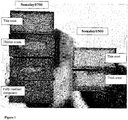
- an oxidized crust will surround an unoxidized core (see Figure 1 ).
- the mechanical strength of the compacted body has reached an acceptable level the oxidation treatment can be terminated before complete oxidation throughout the compacted body has taken place. This suggests the possibility to optimise the mechanical strength and permeablity relative to core loss. Oxidised material gives improved strength and permeability, but also slightly higher core losses.
- the process may be performed batchwise or as a continuous process in furnaces that are commercially available from e.g. J B Furnace Engineering Ltd, SARNES Ingenieure OHG, Fluidtherm Technology P. Ltd, etc.
- soft magnetic composite components having remarkable properties as regards the transverse rupture strength, electrical resistivity, magnetic induction, and magnetic permeability can be obtained by the method according to the invention.
- the different formulations were compacted (600-1100 MPa) into toroid samples having an inner diameter of 45 mm, outer diameter 55 mm and height 5 mm and into Transverse Rupture Strength samples (TRS-samples) to the densities specified in table 1.
- the die temperature was controlled to a temperature of 80°C and to ambient temperature (sample E).
- Transverse Rupture Strength was measured on the TRS-samples according to ISO 3995. The magnetic properties were measured on toroid samples with 100 drive and 100 sense turns using a hysterisisgraph from Brockhaus. Maximum permeability at an applied electrical field of 4 kA/m was measured. Table 1. Sample Stearamide [wt%] Compaction Pressure [MPa] Density [g/cm3] TRS [MPa] umax Reference 0.30 800 7.54 45 620 A 0.30 600 7.44 115 800 B 0.30 800 7.56 130 860 C 0.30 1100 7.63 110 900 D 0.40 800 7.53 130 820 E(ambient) 0.40 800 7.49 135 750 F 0.20 1100 7.68 115 950 G 0.50 800 7.49 135 800
- Somaloy®700 powder was mixed with 0.4 wt% stearamide and compacted at 800 MPa using a tool die temperature of 80°C according to example 1 (density 7.53 g/cm3).
- the samples (D, H, and I) were further subjected to a heat treatment in an atmosphere of inert gas for 20 minutes at 300°C followed by steam treatment at various temperatures, 300°C, 520°C and 620°C, respectively.
- Somaloy®700 powder was mixed with 0.5 wt% of stearamide, EBS wax, and Zn-stearate, respectively, and compacted to 7.35 g/cm 3 .
- the samples (J, K, and L) were further subjected to a heat treatment for 45 minutes in air at 350°C, and in an atmosphere of nitrogen at 440°C, respectively.
- the delubricated components were thereafter steam treated at 530°C for 30 minutes.
- the atmosphere and the temperature, at which the vaporization is conducted is of great importance.
- the lubricant should be vaporized and leave essentially no residue in order to obtain compacts which after the steam treatment have both high strength and high electrical resistivity.
- Stearamide (sample J) is completely vaporized above 300°C in both inert gas atmosphere and in air. The lowest possible vaporization temperature is preferred as this gives improved electrical resistivity and thus lower core loss.
- the EBS wax (sample K) cannot be vaporized at 350°C in air but is removed from the compact in nitrogen at above 400°C according to table 3.
- Somaloy®700 powder was mixed with 0.3 wt% of behenyl alcohol (NACOL® 22-98) and compacted at 800 MPa using a tool die temperature of 55°C.
- the samples (M, N, and O) were further subjected to a heat treatment in an atmosphere of inert gas for 30 minutes at various temperatures for vaporization of the lubricant according to table 4 and subsequently steam treated at 520°C for 45 minutes.
- Table 4 Sample Lubricant vaporization treatment TRS [MPa] Resistivity [ ⁇ Ohm*m] Core loss [W/kg] M 250°C 65 12 101 N 350°C 149 153 54 O 450°C 154 52 74
- the magnetic and mechanical properties were measured according to example 1 and 2.
- Table 4 shows the importance to use a correct vaporization temperature of the lubricant.
- a too low vaporization temperature gives insufficient lubricant removal and closed surface pores (sample M).
- a too high vaporization temperature (sample O), conversely, will expose the insulating coating towards high temperature for unnecessary long periods with lower electrical resistivity as a result.
- Somaloy®700 powder was mixed with 0.5 wt% of eight different lubricants and the samples were compacted at 800 MPa.
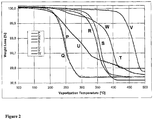
- thermogravimetric analysis of the samples (each sample weighing 0.68 g) was performed.
- the TGA measures the weight change in a material as function of temperature (or time) in a controlled atmosphere.
- the TGA curves were recorded between 20 and 500°C using a heating rate of 10°C/min in an atmosphere of nitrogen and are disclosed in Figure 2 . As can be seen the vaporization of lubricants proceeds differently for the lubricants.
- Sample P, Q, R, and S contain lubricants having relatively low boiling points. These lubricants are removed primarily as vapours and leave compacts with a clean pore structure.
- the samples T, U, and V on the other hand, contain lubricants which vaporize at temperatures higher than 450°C, and are therefore not suitable to use in this case.
- the zinc stearate in sample W is completely vaporized below 450°C, but leaves residues of ZnO. Thus, sample W is outside the scope of the present invention.
- Table 5 shows the temperature range for vaporization in inert atmospheres of the different lubricants according to the example.
- the samples P to S include lubricants which have vaporization temperatures suitable to use in combination with the powders tested. Table 5.
- Sample Temperature of complete vaporization [°C] Oxidation Performance of heat treated compact P (Behenyl alcohol) 290-300 Good Q (Stearamide) 290-300 Good R (Eurcyl-Stearamide) 410-420 Good S (EBS) 390-440 Good T (PW655) 470-500 Poor U (Oleic amide) >500 Poor V (Polyamide) >550 Poor W (Zn-Stearate) Not possible Poor
- Somaloy®700 powder was mixed with 0.5 wt% of a metal-organic lubricant according to table 6, and compacted at 800 MPa using a tool die temperature of 80°C. The samples were further subjected to a heat treatment in air for 20 minutes at 300°C followed by steam treatment at 520°C for 45 minutes.
- Somaloy®700 powder was mixed with 0.5 wt% of EBS wax (Acrawax®) and compacted to 7.35 g/cm 3 .
- One sample (AA) was first subjected to a heat treatment for 45 minutes in an atmosphere of nitrogen at 440°C according to the invention.
- a second sample (AB) was not previously delubricated but directly subjected to steam treatment according to the method disclosed in the US patent 6 485 579 . The steam treatment of the samples was conducted at a maximum temperature of 500°C for 30 minutes.
- sample AA shows that delubrication prior to steam treatment according to the invention gives the superior properties
- sample AB shows comparatively low resistivity and low mechanical strength.
- the lubricant used a non-metal containing lubricant, in this example EBS wax
- the success of steam treatment depends on the delubrication step.
- Somaloy®500 powder (available from Höganäs AB Sweden) with mean particle size smaller than the mean particle size of Somaloy®700 was used. Somaloy®500 was mixed with 0.5 wt% of stearamide or Kenolube® and compacted at 800 MPa using a tool die temperature of 80°C. Two samples (AC and AD) were further subjected to a heat treatment in inert gas for 20 minutes at 300°C followed by steam treatment at 520°C for 45 minutes according to the invention.
- sample AC the finer Somaloy®500 powder with a non metal-containing lubricant
- Table 8 clearly shows that components manufactured according to the invention from the finer Somaloy®500 powder with a non metal-containing lubricant (sample AC) can reach high strength and acceptable core losses. It is clear that sample AC exhibits better values for TRS, resistivity, permeability, as well as core loss compared to sample AD.
Landscapes
- Engineering & Computer Science (AREA)
- Power Engineering (AREA)
- Manufacturing & Machinery (AREA)
- Chemical & Material Sciences (AREA)
- Dispersion Chemistry (AREA)
- Mechanical Engineering (AREA)
- Soft Magnetic Materials (AREA)
- Powder Metallurgy (AREA)
Claims (16)
- Verfahren zur Herstellung von weichmagnetischen Verbundwerkstoffkomponenten umfassend die folgenden Schritte:- Verdichten einer Pulverzusammensetzung umfassend eine Mischung von weichmagnetischem Eisenpulver oder eisenbasiertem Pulver, dessen Kernpartikel von einer elektrisch isolierenden, anorganischen Beschichtung und einem organischen Schmiermittel in einer Menge von 0,05 bis 1,5 Gewichtsprozent der Zusammensetzung umgeben sind, wobei das organische Schmiermittel metallfrei ist und eine Verdampfungstemperatur, die kleiner als die Zersetzungstemperatur der anorganischen Beschichtung ist, aufweist;- Ausstoßen des verdichteten Körpers von der Pressform;- Unterziehen des verdichteten Körpers einer Wärmebehandlung, die in einer inerten Atmosphäre, wie beispielsweise Nitrogen, oder in einer oxidierenden Atmosphäre, wie beispielsweise Luft, ausgeführt wird bei einer Temperatur von über der Verdampfungstemperatur des Schmiermittels, die kleiner als 500° C ist und unter der Zersetzungstemperatur der anorganischen Beschichtung liegt, bis das Schmiermittel vom verdichteten Körper entfernt worden ist, und dann- Unterziehen des erhaltenen entschmierten Körpers einer Wärmebehandlung bei einer Temperatur zwischen 300° C und 600° C in Wasserdampf.
- Verfahren nach Anspruch 1, wobei das Verdichten bei einer Temperatur von höchstens 60° C, z.B. höchstens 40° C oder z.B. sogar höchstens 30° C unter der Schmelztemperatur des organischen Schmiermittels oder der organischen Schmiermittel ausgeführt wird.
- Verfahren nach einem der Ansprüche 1-2, wobei die Verdampfungstemperatur des Schmiermittels kleiner als 450 °, und vorzugsweise kleiner als 400° C ist.
- Verfahren nach einem der Ansprüche 1-3, wobei die Verdampfungstemperatur des Schmiermittels in einer oxidierenden Atmosphäre kleiner als 400° C, vorzugsweise kleiner als 350° und am meisten bevorzugt kleiner als 300° C ist.
- Verfahren nach einem der Ansprüche 1-4, wobei die Wärmebehandlung in Wasserdampf (Dampfbehandlung) bei einer Temperatur kleiner als 550° C ausgeführt wird.
- Verfahren nach einem der Ansprüche 1-5, wobei die Kernpartikel aus reinem Eisen bestehen.
- Verfahren nach einem der Ansprüche 1-6, wobei die anorganische, die Kernpartikel isolierende Beschichtung Phosphor umfasst.
- Verfahren nach einem der Ansprüche 1-7, wobei die mittlere Partikelgröße der isolierten Pulverpartikel zwischen 106 und 425 µm ist.
- Verfahren nach einem der Ansprüche 1-8, wobei mindestens 20 % der isolierten Pulverpartikel eine Partikelgröße von über 212 µm aufweisen.
- Verfahren nach einem der Ansprüche 1-9, wobei die Menge an Schmiermittel 0,05 - 1,0, vorzugsweise 0,05-0,7 und am meisten bevorzugt 0,05-0,6 Gewichtsprozent der Zusammensetzung ist.
- Verfahren nach einem der vorgehenden Ansprüche, wobei das Schmiermittel aus der Gruppe bestehend aus primären Amiden und sekundären Amiden von gesättigten oder ungesättigten Fettsäuren oder Kombinationen davon ausgewählt ist.
- Verfahren nach einem der vorgehenden Ansprüche, wobei das Schmiermittel aus der Gruppe bestehend aus gesättigten oder ungesättigten Fettalkoholen ausgewählt ist.
- Verfahren nach einem der vorgehenden Ansprüche, wobei das Schmiermittel aus der Gruppe bestehend aus Stearamid, Erucyl-Stearamid und Behenylalkohol ausgewählt ist.
- Verfahren nach einem der vorgehenden Ansprüche, wobei das Schmiermittel aus der Gruppe bestehend aus Amidwachsen, wie beispielsweise Distearylethylendiamid ausgewählt ist.
- Weichmagnetische Verbundwerkstoffkomponente hergestellt nach einem der vorgehenden Ansprüche mit einer oxidierten Kruste und einem nichtoxidierten Kern, wobei die Komponente eine Querbruchfestigkeit von mindestens 100 MPa, eine Durchlässigkeit von mindestens 700 und einen Kernverlust bei 1 Tesla und 400 Hz von höchstens 70W/kg aufweist.
- Weichmagnetische Verbundwerkstoffkomponente nach Anspruch 15, wobei die Komponente eine Querbruchfestigkeit von mindestens 120 MPa, eine Durchlässigkeit von mindestens 800 und einen Kernverlust bei 1 Tesla und 400 Hz von höchstens 65 W/kg.
Priority Applications (1)
| Application Number | Priority Date | Filing Date | Title |
|---|---|---|---|
| PL06747915T PL1899994T3 (pl) | 2005-06-15 | 2006-06-15 | Magnetycznie miękkie materiały kompozytowe |
Applications Claiming Priority (3)
| Application Number | Priority Date | Filing Date | Title |
|---|---|---|---|
| SE0501378 | 2005-06-15 | ||
| US70299605P | 2005-07-28 | 2005-07-28 | |
| PCT/SE2006/000722 WO2006135324A1 (en) | 2005-06-15 | 2006-06-15 | Soft magnetic composite materials |
Publications (3)
| Publication Number | Publication Date |
|---|---|
| EP1899994A1 EP1899994A1 (de) | 2008-03-19 |
| EP1899994A4 EP1899994A4 (de) | 2010-09-22 |
| EP1899994B1 true EP1899994B1 (de) | 2017-07-26 |
Family
ID=39548401
Family Applications (1)
| Application Number | Title | Priority Date | Filing Date |
|---|---|---|---|
| EP06747915.4A Active EP1899994B1 (de) | 2005-06-15 | 2006-06-15 | Weichmagnetische verbundmaterialien |
Country Status (13)
| Country | Link |
|---|---|
| US (1) | US8075710B2 (de) |
| EP (1) | EP1899994B1 (de) |
| JP (1) | JP4801734B2 (de) |
| CN (1) | CN101199030B (de) |
| AU (1) | AU2006258301C1 (de) |
| BR (1) | BRPI0611947B1 (de) |
| CA (1) | CA2610602C (de) |
| ES (1) | ES2645219T3 (de) |
| MX (1) | MX2007016193A (de) |
| PL (1) | PL1899994T3 (de) |
| RU (1) | RU2389099C2 (de) |
| TW (1) | TWI328236B (de) |
| WO (1) | WO2006135324A1 (de) |
Families Citing this family (32)
| Publication number | Priority date | Publication date | Assignee | Title |
|---|---|---|---|---|
| US20080036566A1 (en) | 2006-08-09 | 2008-02-14 | Andrzej Klesyk | Electronic Component And Methods Relating To Same |
| ES2424869T3 (es) | 2007-03-21 | 2013-10-09 | Höganäs Ab (Publ) | Materiales compuestos de polímeros de metal en polvo |
| US7868511B2 (en) | 2007-05-09 | 2011-01-11 | Motor Excellence, Llc | Electrical devices using disk and non-disk shaped rotors |
| WO2008141245A2 (en) | 2007-05-09 | 2008-11-20 | Motor Excellence, Llc | Electrical output generating devices and driven electrical devices having tape wound core laminate rotor or stator elements, and methods of making and use thereof |
| WO2011029759A1 (en) * | 2009-09-08 | 2011-03-17 | Höganäs Ab | Metal powder composition |
| JP5427664B2 (ja) * | 2010-03-25 | 2014-02-26 | 株式会社日立産機システム | 圧粉磁性体用軟磁性粉末、それを用いた圧粉磁性体および製造方法 |
| JP5597512B2 (ja) * | 2010-10-14 | 2014-10-01 | 株式会社神戸製鋼所 | 圧粉磁心の製造方法およびこの製造方法によって得られる圧粉磁心 |
| EP2641316B1 (de) | 2010-11-17 | 2019-02-13 | Motor Excellence, LLC | Quer- oder mischflusssysteme mit segmentierten statorlamellen |
| WO2012067895A2 (en) | 2010-11-17 | 2012-05-24 | Motor Excellence, Llc | Transverse and/or commutated flux system coil concepts |
| WO2012067896A2 (en) | 2010-11-17 | 2012-05-24 | Motor Excellence, Llc | Transverse and/or commutated flux systems having laminated and powdered metal portions |
| US8802234B2 (en) * | 2011-01-03 | 2014-08-12 | Imra America, Inc. | Composite nanoparticles and methods for making the same |
| EP2509081A1 (de) * | 2011-04-07 | 2012-10-10 | Höganäs AB | Neue Zusammensetzung und Verfahren |
| RU2465669C1 (ru) * | 2011-08-12 | 2012-10-27 | Геннадий Антонович Говор | Способ изготовления композиционного магнитно-мягкого материала |
| JP2013045991A (ja) * | 2011-08-26 | 2013-03-04 | Hitachi Industrial Equipment Systems Co Ltd | 圧粉軟磁性体、その製造方法及びモータ |
| RU2469430C1 (ru) * | 2011-09-13 | 2012-12-10 | Государственное образовательное учреждение высшего профессионального образования "Южно-Российский государственный технический университет (Новочеркасский политехнический институт)" | Магнитно-мягкий композиционный материал |
| CN103219120B (zh) * | 2012-01-18 | 2016-02-10 | 株式会社神户制钢所 | 压粉磁芯的制造方法以及由该制造方法而得的压粉磁芯 |
| CN104321839B (zh) * | 2012-04-26 | 2018-06-19 | 香港科技大学 | 软磁复合材料 |
| US9502952B2 (en) | 2012-10-12 | 2016-11-22 | Persimmon Technologies, Corp. | Hybrid motor |
| DE102013200229B4 (de) * | 2013-01-10 | 2024-06-06 | Robert Bosch Gmbh | Verfahren zum Herstellen eines weichmagnetischen Verbundwerkstoffs |
| PL402606A1 (pl) * | 2013-01-29 | 2014-08-04 | Instytut Niskich Temperatur I Badań Strukturalnych Pan Im. Włodzimierza Trzebiatowskiego | Sposób otrzymywania ceramiki magnetycznej i jej zastosowanie |
| CA3079312C (en) | 2013-09-12 | 2022-05-17 | National Research Council Of Canada | Lubricant for powder metallurgy and metal powder compositions containing said lubricant |
| JP2016053210A (ja) * | 2013-12-26 | 2016-04-14 | Ntn株式会社 | 圧粉体を用いた機械部品およびその製造方法 |
| JP2017004992A (ja) * | 2015-06-04 | 2017-01-05 | 株式会社神戸製鋼所 | 圧粉磁心用混合粉末および圧粉磁心 |
| TWI576872B (zh) | 2015-12-17 | 2017-04-01 | 財團法人工業技術研究院 | 磁性元件的製造方法 |
| EP3424622B1 (de) * | 2016-03-03 | 2020-11-11 | NTN Corporation | Verfahren zur herstellung einer maschinenkomponente |
| JP6836106B2 (ja) * | 2016-04-15 | 2021-02-24 | アイシン精機株式会社 | 鉄基軟磁性体の製造方法 |
| WO2018035595A1 (pt) * | 2016-08-25 | 2018-03-01 | Whirlpool S.A. | Camadas de recobrimento de superfícies de partículas ferromagnéticas para obtenção de compósitos magnéticos moles (smcs) |
| US10931157B2 (en) * | 2018-05-07 | 2021-02-23 | General Electric Company | Unitary structure having magnetic and non-magnetic phases |
| JP7194098B2 (ja) * | 2019-12-06 | 2022-12-21 | 株式会社タムラ製作所 | 圧粉磁心の製造方法 |
| CN113555208B (zh) * | 2021-06-11 | 2023-11-10 | 杭州电子科技大学 | 一种烧结钕铁硼磁体的表面处理方法及烧结钕铁硼磁体 |
| JP7783008B2 (ja) * | 2021-10-14 | 2025-12-09 | 株式会社神戸製鋼所 | 鉄基焼結体および鉄基焼結体の製造方法 |
| IT202100026681A1 (it) | 2021-10-18 | 2023-04-18 | Torino Politecnico | Processo per la produzione di materiali ferromagnetici nanorivestiti |
Family Cites Families (24)
| Publication number | Priority date | Publication date | Assignee | Title |
|---|---|---|---|---|
| JPS5143007B2 (de) * | 1972-03-09 | 1976-11-19 | ||
| JPS5143007A (ja) | 1974-10-09 | 1976-04-13 | Aiwa Co | Rusubandenwahoshiki |
| JPS5826402B2 (ja) | 1978-05-19 | 1983-06-02 | 株式会社東芝 | 鉄系焼結部品の製造方法 |
| SU863178A1 (ru) | 1980-01-18 | 1981-09-15 | Куйбышевский Ордена Трудового Красного Знамени Авиационный Институт Им.Акад.С.П.Королева | Способ изготовлени магнитно-м гкого материала |
| JPS57114637A (en) * | 1981-01-06 | 1982-07-16 | Sumitomo Electric Ind Ltd | Soft magnetic material and its manufacture |
| SU1734946A1 (ru) * | 1989-07-19 | 1992-05-23 | Ереванский политехнический институт им.К.Маркса | Способ получени магнитно-м гких материалов на основе железа |
| RU2040810C1 (ru) * | 1992-08-27 | 1995-07-25 | Галина Анатольевна Дорогина | Способ получения магнито-мягкого материала |
| JPH07166202A (ja) | 1993-12-16 | 1995-06-27 | Kyodo Printing Co Ltd | 低アスペクト比扁平状軟磁性金属粉末およびその製造方法 |
| JPH07245209A (ja) * | 1994-03-02 | 1995-09-19 | Tdk Corp | 圧粉コアおよびその製造方法 |
| US5770136A (en) * | 1995-08-07 | 1998-06-23 | Huang; Xiaodi | Method for consolidating powdered materials to near net shape and full density |
| PL183359B1 (pl) | 1996-02-23 | 2002-06-28 | Hoeganaes Ab | Niskotlenowy proszek na bazie żelaza oraz sposób wytwarzania niskotlenowego proszku na bazie żelaza |
| SE9702744D0 (sv) * | 1997-07-18 | 1997-07-18 | Hoeganaes Ab | Soft magnetic composites |
| JP3485818B2 (ja) | 1998-12-17 | 2004-01-13 | 日立粉末冶金株式会社 | 焼結部品の粉末成形工程における圧粉体重量の安定化方法 |
| US20040007289A1 (en) * | 1999-05-20 | 2004-01-15 | Richard Wood | Magnetic core insulation |
| DE19945619A1 (de) | 1999-09-23 | 2001-04-19 | Bosch Gmbh Robert | Preßmasse und Verfahren zur Herstellung eines weichmagnetischen Verbundwerkstoffes mit der Preßmasse |
| SE9904367D0 (sv) | 1999-12-02 | 1999-12-02 | Hoeganaes Ab | Lubricant combination and process for the preparation thereof |
| SE0000454D0 (sv) | 2000-02-11 | 2000-02-11 | Hoeganaes Ab | Iron powder and method for the preparaton thereof |
| JP4228547B2 (ja) | 2000-03-28 | 2009-02-25 | Jfeスチール株式会社 | 金型潤滑用潤滑剤および高密度鉄基粉末成形体の製造方法 |
| SE0100236D0 (sv) | 2001-01-26 | 2001-01-26 | Hoeganaes Ab | Compressed soft magnetic materials |
| SE0203134D0 (sv) | 2002-10-22 | 2002-10-22 | Hoeganaes Ab | Method of preparing iron-based components |
| SE0203168D0 (sv) * | 2002-10-25 | 2002-10-25 | Hoeganaes Ab | Heat treatment of iron-based components |
| US7153594B2 (en) * | 2002-12-23 | 2006-12-26 | Höganäs Ab | Iron-based powder |
| CA2452234A1 (en) * | 2002-12-26 | 2004-06-26 | Jfe Steel Corporation | Metal powder and powder magnetic core using the same |
| US20050162034A1 (en) | 2004-01-22 | 2005-07-28 | Wavecrest Laboratories, Inc. | Soft magnetic composites |
-
2006
- 2006-06-15 CA CA2610602A patent/CA2610602C/en not_active Expired - Fee Related
- 2006-06-15 PL PL06747915T patent/PL1899994T3/pl unknown
- 2006-06-15 MX MX2007016193A patent/MX2007016193A/es active IP Right Grant
- 2006-06-15 ES ES06747915.4T patent/ES2645219T3/es active Active
- 2006-06-15 JP JP2008516788A patent/JP4801734B2/ja active Active
- 2006-06-15 EP EP06747915.4A patent/EP1899994B1/de active Active
- 2006-06-15 TW TW095121415A patent/TWI328236B/zh not_active IP Right Cessation
- 2006-06-15 CN CN2006800217110A patent/CN101199030B/zh active Active
- 2006-06-15 WO PCT/SE2006/000722 patent/WO2006135324A1/en not_active Ceased
- 2006-06-15 US US11/921,514 patent/US8075710B2/en active Active
- 2006-06-15 AU AU2006258301A patent/AU2006258301C1/en not_active Ceased
- 2006-06-15 BR BRPI0611947-6A patent/BRPI0611947B1/pt not_active IP Right Cessation
- 2006-06-15 RU RU2008101535/02A patent/RU2389099C2/ru not_active IP Right Cessation
Non-Patent Citations (1)
| Title |
|---|
| None * |
Also Published As
| Publication number | Publication date |
|---|---|
| BRPI0611947A2 (pt) | 2011-11-01 |
| PL1899994T3 (pl) | 2018-01-31 |
| ES2645219T3 (es) | 2017-12-04 |
| TW200713343A (en) | 2007-04-01 |
| AU2006258301C1 (en) | 2010-04-22 |
| TWI328236B (en) | 2010-08-01 |
| BRPI0611947A8 (pt) | 2018-01-30 |
| EP1899994A4 (de) | 2010-09-22 |
| RU2008101535A (ru) | 2009-07-20 |
| CA2610602C (en) | 2014-02-18 |
| JP4801734B2 (ja) | 2011-10-26 |
| MX2007016193A (es) | 2008-03-11 |
| CA2610602A1 (en) | 2006-12-21 |
| AU2006258301B2 (en) | 2009-11-19 |
| CN101199030B (zh) | 2011-01-19 |
| US8075710B2 (en) | 2011-12-13 |
| RU2389099C2 (ru) | 2010-05-10 |
| BRPI0611947B1 (pt) | 2018-07-24 |
| WO2006135324A1 (en) | 2006-12-21 |
| US20090042051A1 (en) | 2009-02-12 |
| JP2008544520A (ja) | 2008-12-04 |
| AU2006258301A1 (en) | 2006-12-21 |
| CN101199030A (zh) | 2008-06-11 |
| EP1899994A1 (de) | 2008-03-19 |
| US20110129685A2 (en) | 2011-06-02 |
Similar Documents
| Publication | Publication Date | Title |
|---|---|---|
| EP1899994B1 (de) | Weichmagnetische verbundmaterialien | |
| US8187394B2 (en) | Soft magnetic powder | |
| EP2458601A1 (de) | Massekern und herstellungsverfahren dafür | |
| KR100775179B1 (ko) | 분말 혼합물, 및 연자기 컴포넌트와 연자기 혼합컴포넌트를 제조하기 위한 방법 | |
| JP2009070885A (ja) | リアクトル用コアとその製造方法およびリアクトル | |
| EP1663549B1 (de) | Weichmagnetisches pulver auf eisenbasis | |
| US6548012B2 (en) | Manufacturing soft magnetic components using a ferrous powder and a lubricant | |
| JP2011243830A (ja) | 圧粉磁芯及びその製造方法 | |
| KR101436720B1 (ko) | 압분 자심용 혼합 분말 | |
| CN112166479A (zh) | 铁磁粉末组合物 | |
| US6331270B1 (en) | Manufacturing soft magnetic components using a ferrous powder and a lubricant | |
| KR20180015712A (ko) | 압분자심용 혼합 분말 및 압분자심 | |
| KR101039514B1 (ko) | 자기 특성 개선 방법 | |
| JP5568983B2 (ja) | 圧粉コアの製造方法 | |
| CA2272876A1 (en) | Manufacturing soft magnetic components using a ferrous powder and a lubricant |
Legal Events
| Date | Code | Title | Description |
|---|---|---|---|
| PUAI | Public reference made under article 153(3) epc to a published international application that has entered the european phase |
Free format text: ORIGINAL CODE: 0009012 |
|
| 17P | Request for examination filed |
Effective date: 20071212 |
|
| AK | Designated contracting states |
Kind code of ref document: A1 Designated state(s): AT BE BG CH CY CZ DE DK EE ES FI FR GB GR HU IE IS IT LI LT LU LV MC NL PL PT RO SE SI SK TR |
|
| AX | Request for extension of the european patent |
Extension state: BA HR YU |
|
| RAX | Requested extension states of the european patent have changed |
Extension state: HR Payment date: 20071212 Extension state: BA Payment date: 20071212 Extension state: RS Payment date: 20071212 |
|
| RAX | Requested extension states of the european patent have changed |
Extension state: RS Payment date: 20071212 Extension state: HR Payment date: 20071212 Extension state: BA Payment date: 20071212 |
|
| A4 | Supplementary search report drawn up and despatched |
Effective date: 20100823 |
|
| RIC1 | Information provided on ipc code assigned before grant |
Ipc: H01F 3/08 20060101ALI20100817BHEP Ipc: H01F 1/14 20060101ALI20100817BHEP Ipc: H01F 1/24 20060101AFI20070208BHEP Ipc: B22F 1/02 20060101ALI20100817BHEP Ipc: H01F 1/33 20060101ALI20100817BHEP |
|
| GRAP | Despatch of communication of intention to grant a patent |
Free format text: ORIGINAL CODE: EPIDOSNIGR1 |
|
| INTG | Intention to grant announced |
Effective date: 20170310 |
|
| GRAS | Grant fee paid |
Free format text: ORIGINAL CODE: EPIDOSNIGR3 |
|
| GRAA | (expected) grant |
Free format text: ORIGINAL CODE: 0009210 |
|
| AK | Designated contracting states |
Kind code of ref document: B1 Designated state(s): AT BE BG CH CY CZ DE DK EE ES FI FR GB GR HU IE IS IT LI LT LU LV MC NL PL PT RO SE SI SK TR |
|
| AX | Request for extension of the european patent |
Extension state: BA HR RS |
|
| REG | Reference to a national code |
Ref country code: GB Ref legal event code: FG4D |
|
| REG | Reference to a national code |
Ref country code: CH Ref legal event code: EP |
|
| REG | Reference to a national code |
Ref country code: AT Ref legal event code: REF Ref document number: 913005 Country of ref document: AT Kind code of ref document: T Effective date: 20170815 |
|
| REG | Reference to a national code |
Ref country code: IE Ref legal event code: FG4D |
|
| REG | Reference to a national code |
Ref country code: DE Ref legal event code: R096 Ref document number: 602006053134 Country of ref document: DE |
|
| REG | Reference to a national code |
Ref country code: CH Ref legal event code: NV Representative=s name: HEPP WENGER RYFFEL AG, CH |
|
| REG | Reference to a national code |
Ref country code: NL Ref legal event code: FP |
|
| REG | Reference to a national code |
Ref country code: ES Ref legal event code: FG2A Ref document number: 2645219 Country of ref document: ES Kind code of ref document: T3 Effective date: 20171204 |
|
| REG | Reference to a national code |
Ref country code: LT Ref legal event code: MG4D |
|
| PG25 | Lapsed in a contracting state [announced via postgrant information from national office to epo] |
Ref country code: LT Free format text: LAPSE BECAUSE OF FAILURE TO SUBMIT A TRANSLATION OF THE DESCRIPTION OR TO PAY THE FEE WITHIN THE PRESCRIBED TIME-LIMIT Effective date: 20170726 Ref country code: SE Free format text: LAPSE BECAUSE OF FAILURE TO SUBMIT A TRANSLATION OF THE DESCRIPTION OR TO PAY THE FEE WITHIN THE PRESCRIBED TIME-LIMIT Effective date: 20170726 Ref country code: FI Free format text: LAPSE BECAUSE OF FAILURE TO SUBMIT A TRANSLATION OF THE DESCRIPTION OR TO PAY THE FEE WITHIN THE PRESCRIBED TIME-LIMIT Effective date: 20170726 |
|
| REG | Reference to a national code |
Ref country code: SK Ref legal event code: T3 Ref document number: E 25530 Country of ref document: SK |
|
| PG25 | Lapsed in a contracting state [announced via postgrant information from national office to epo] |
Ref country code: IS Free format text: LAPSE BECAUSE OF FAILURE TO SUBMIT A TRANSLATION OF THE DESCRIPTION OR TO PAY THE FEE WITHIN THE PRESCRIBED TIME-LIMIT Effective date: 20171126 Ref country code: LV Free format text: LAPSE BECAUSE OF FAILURE TO SUBMIT A TRANSLATION OF THE DESCRIPTION OR TO PAY THE FEE WITHIN THE PRESCRIBED TIME-LIMIT Effective date: 20170726 Ref country code: BG Free format text: LAPSE BECAUSE OF FAILURE TO SUBMIT A TRANSLATION OF THE DESCRIPTION OR TO PAY THE FEE WITHIN THE PRESCRIBED TIME-LIMIT Effective date: 20171026 Ref country code: GR Free format text: LAPSE BECAUSE OF FAILURE TO SUBMIT A TRANSLATION OF THE DESCRIPTION OR TO PAY THE FEE WITHIN THE PRESCRIBED TIME-LIMIT Effective date: 20171027 |
|
| PG25 | Lapsed in a contracting state [announced via postgrant information from national office to epo] |
Ref country code: CZ Free format text: LAPSE BECAUSE OF FAILURE TO SUBMIT A TRANSLATION OF THE DESCRIPTION OR TO PAY THE FEE WITHIN THE PRESCRIBED TIME-LIMIT Effective date: 20170726 Ref country code: DK Free format text: LAPSE BECAUSE OF FAILURE TO SUBMIT A TRANSLATION OF THE DESCRIPTION OR TO PAY THE FEE WITHIN THE PRESCRIBED TIME-LIMIT Effective date: 20170726 Ref country code: RO Free format text: LAPSE BECAUSE OF FAILURE TO SUBMIT A TRANSLATION OF THE DESCRIPTION OR TO PAY THE FEE WITHIN THE PRESCRIBED TIME-LIMIT Effective date: 20170726 |
|
| REG | Reference to a national code |
Ref country code: DE Ref legal event code: R097 Ref document number: 602006053134 Country of ref document: DE |
|
| REG | Reference to a national code |
Ref country code: FR Ref legal event code: PLFP Year of fee payment: 13 |
|
| PG25 | Lapsed in a contracting state [announced via postgrant information from national office to epo] |
Ref country code: EE Free format text: LAPSE BECAUSE OF FAILURE TO SUBMIT A TRANSLATION OF THE DESCRIPTION OR TO PAY THE FEE WITHIN THE PRESCRIBED TIME-LIMIT Effective date: 20170726 |
|
| PLBE | No opposition filed within time limit |
Free format text: ORIGINAL CODE: 0009261 |
|
| STAA | Information on the status of an ep patent application or granted ep patent |
Free format text: STATUS: NO OPPOSITION FILED WITHIN TIME LIMIT |
|
| 26N | No opposition filed |
Effective date: 20180430 |
|
| PG25 | Lapsed in a contracting state [announced via postgrant information from national office to epo] |
Ref country code: SI Free format text: LAPSE BECAUSE OF FAILURE TO SUBMIT A TRANSLATION OF THE DESCRIPTION OR TO PAY THE FEE WITHIN THE PRESCRIBED TIME-LIMIT Effective date: 20170726 |
|
| REG | Reference to a national code |
Ref country code: BE Ref legal event code: MM Effective date: 20180630 |
|
| REG | Reference to a national code |
Ref country code: IE Ref legal event code: MM4A |
|
| PG25 | Lapsed in a contracting state [announced via postgrant information from national office to epo] |
Ref country code: LU Free format text: LAPSE BECAUSE OF NON-PAYMENT OF DUE FEES Effective date: 20180615 Ref country code: MC Free format text: LAPSE BECAUSE OF FAILURE TO SUBMIT A TRANSLATION OF THE DESCRIPTION OR TO PAY THE FEE WITHIN THE PRESCRIBED TIME-LIMIT Effective date: 20170726 |
|
| REG | Reference to a national code |
Ref country code: AT Ref legal event code: UEP Ref document number: 913005 Country of ref document: AT Kind code of ref document: T Effective date: 20170726 |
|
| PG25 | Lapsed in a contracting state [announced via postgrant information from national office to epo] |
Ref country code: IE Free format text: LAPSE BECAUSE OF NON-PAYMENT OF DUE FEES Effective date: 20180615 |
|
| PG25 | Lapsed in a contracting state [announced via postgrant information from national office to epo] |
Ref country code: BE Free format text: LAPSE BECAUSE OF NON-PAYMENT OF DUE FEES Effective date: 20180630 |
|
| PGFP | Annual fee paid to national office [announced via postgrant information from national office to epo] |
Ref country code: PT Payment date: 20190513 Year of fee payment: 14 Ref country code: PL Payment date: 20190515 Year of fee payment: 14 Ref country code: NL Payment date: 20190612 Year of fee payment: 14 |
|
| PGFP | Annual fee paid to national office [announced via postgrant information from national office to epo] |
Ref country code: FR Payment date: 20190524 Year of fee payment: 14 |
|
| PGFP | Annual fee paid to national office [announced via postgrant information from national office to epo] |
Ref country code: CH Payment date: 20190614 Year of fee payment: 14 Ref country code: SK Payment date: 20190513 Year of fee payment: 14 |
|
| PGFP | Annual fee paid to national office [announced via postgrant information from national office to epo] |
Ref country code: ES Payment date: 20190701 Year of fee payment: 14 Ref country code: GB Payment date: 20190612 Year of fee payment: 14 Ref country code: AT Payment date: 20190528 Year of fee payment: 14 |
|
| PG25 | Lapsed in a contracting state [announced via postgrant information from national office to epo] |
Ref country code: TR Free format text: LAPSE BECAUSE OF FAILURE TO SUBMIT A TRANSLATION OF THE DESCRIPTION OR TO PAY THE FEE WITHIN THE PRESCRIBED TIME-LIMIT Effective date: 20170726 |
|
| PG25 | Lapsed in a contracting state [announced via postgrant information from national office to epo] |
Ref country code: PT Free format text: LAPSE BECAUSE OF FAILURE TO SUBMIT A TRANSLATION OF THE DESCRIPTION OR TO PAY THE FEE WITHIN THE PRESCRIBED TIME-LIMIT Effective date: 20170726 Ref country code: HU Free format text: LAPSE BECAUSE OF FAILURE TO SUBMIT A TRANSLATION OF THE DESCRIPTION OR TO PAY THE FEE WITHIN THE PRESCRIBED TIME-LIMIT; INVALID AB INITIO Effective date: 20060615 |
|
| PG25 | Lapsed in a contracting state [announced via postgrant information from national office to epo] |
Ref country code: CY Free format text: LAPSE BECAUSE OF FAILURE TO SUBMIT A TRANSLATION OF THE DESCRIPTION OR TO PAY THE FEE WITHIN THE PRESCRIBED TIME-LIMIT Effective date: 20170726 |
|
| REG | Reference to a national code |
Ref country code: CH Ref legal event code: PL |
|
| REG | Reference to a national code |
Ref country code: NL Ref legal event code: MM Effective date: 20200701 |
|
| REG | Reference to a national code |
Ref country code: SK Ref legal event code: MM4A Ref document number: E 25530 Country of ref document: SK Effective date: 20200615 |
|
| REG | Reference to a national code |
Ref country code: AT Ref legal event code: MM01 Ref document number: 913005 Country of ref document: AT Kind code of ref document: T Effective date: 20200615 |
|
| GBPC | Gb: european patent ceased through non-payment of renewal fee |
Effective date: 20200615 |
|
| PG25 | Lapsed in a contracting state [announced via postgrant information from national office to epo] |
Ref country code: FR Free format text: LAPSE BECAUSE OF NON-PAYMENT OF DUE FEES Effective date: 20200630 Ref country code: GB Free format text: LAPSE BECAUSE OF NON-PAYMENT OF DUE FEES Effective date: 20200615 Ref country code: NL Free format text: LAPSE BECAUSE OF NON-PAYMENT OF DUE FEES Effective date: 20200701 Ref country code: LI Free format text: LAPSE BECAUSE OF NON-PAYMENT OF DUE FEES Effective date: 20200630 Ref country code: CH Free format text: LAPSE BECAUSE OF NON-PAYMENT OF DUE FEES Effective date: 20200630 |
|
| PG25 | Lapsed in a contracting state [announced via postgrant information from national office to epo] |
Ref country code: AT Free format text: LAPSE BECAUSE OF NON-PAYMENT OF DUE FEES Effective date: 20200615 |
|
| PG25 | Lapsed in a contracting state [announced via postgrant information from national office to epo] |
Ref country code: SK Free format text: LAPSE BECAUSE OF NON-PAYMENT OF DUE FEES Effective date: 20200615 |
|
| PG25 | Lapsed in a contracting state [announced via postgrant information from national office to epo] |
Ref country code: IT Free format text: LAPSE BECAUSE OF NON-PAYMENT OF DUE FEES Effective date: 20200615 |
|
| PG25 | Lapsed in a contracting state [announced via postgrant information from national office to epo] |
Ref country code: ES Free format text: LAPSE BECAUSE OF NON-PAYMENT OF DUE FEES Effective date: 20200616 |
|
| PG25 | Lapsed in a contracting state [announced via postgrant information from national office to epo] |
Ref country code: PL Free format text: LAPSE BECAUSE OF NON-PAYMENT OF DUE FEES Effective date: 20200615 |
|
| PGFP | Annual fee paid to national office [announced via postgrant information from national office to epo] |
Ref country code: DE Payment date: 20250507 Year of fee payment: 20 |