EP1902033B1 - Verfahren zum herstellen von carboxamiden - Google Patents
Verfahren zum herstellen von carboxamiden Download PDFInfo
- Publication number
- EP1902033B1 EP1902033B1 EP06754192A EP06754192A EP1902033B1 EP 1902033 B1 EP1902033 B1 EP 1902033B1 EP 06754192 A EP06754192 A EP 06754192A EP 06754192 A EP06754192 A EP 06754192A EP 1902033 B1 EP1902033 B1 EP 1902033B1
- Authority
- EP
- European Patent Office
- Prior art keywords
- alkyl
- alkoxy
- oder
- formula
- cycloalkyl
- Prior art date
- Legal status (The legal status is an assumption and is not a legal conclusion. Google has not performed a legal analysis and makes no representation as to the accuracy of the status listed.)
- Active
Links
- 0 CC1(*)C=CC(N)=CC=C1 Chemical compound CC1(*)C=CC(N)=CC=C1 0.000 description 3
- IKEQFOIQRUZEMJ-UHFFFAOYSA-N CCc1n[n](C)c(F)c1C(F)=O Chemical compound CCc1n[n](C)c(F)c1C(F)=O IKEQFOIQRUZEMJ-UHFFFAOYSA-N 0.000 description 1
Classifications
-
- C—CHEMISTRY; METALLURGY
- C07—ORGANIC CHEMISTRY
- C07D—HETEROCYCLIC COMPOUNDS
- C07D231/00—Heterocyclic compounds containing 1,2-diazole or hydrogenated 1,2-diazole rings
- C07D231/02—Heterocyclic compounds containing 1,2-diazole or hydrogenated 1,2-diazole rings not condensed with other rings
- C07D231/10—Heterocyclic compounds containing 1,2-diazole or hydrogenated 1,2-diazole rings not condensed with other rings having two or three double bonds between ring members or between ring members and non-ring members
- C07D231/14—Heterocyclic compounds containing 1,2-diazole or hydrogenated 1,2-diazole rings not condensed with other rings having two or three double bonds between ring members or between ring members and non-ring members with hetero atoms or with carbon atoms having three bonds to hetero atoms with at the most one bond to halogen, e.g. ester or nitrile radicals, directly attached to ring carbon atoms
- C07D231/16—Halogen atoms or nitro radicals
-
- A—HUMAN NECESSITIES
- A61—MEDICAL OR VETERINARY SCIENCE; HYGIENE
- A61P—SPECIFIC THERAPEUTIC ACTIVITY OF CHEMICAL COMPOUNDS OR MEDICINAL PREPARATIONS
- A61P31/00—Antiinfectives, i.e. antibiotics, antiseptics, chemotherapeutics
- A61P31/04—Antibacterial agents
Definitions
- the present invention relates to a novel process for preparing known fungicidally active 1,3-dimethyl-5-fluoro-1H-pyrazole-4-carboxamides from the corresponding acid fluoride and aniline derivatives, in the absence of an acid acceptor.
- 1,3-dimethyl-5-fluoro-1H-pyrazole-4-carboxamide is obtained by reacting the corresponding acid fluoride with the desired aniline derivative (cf. EP-A 0 776 889 ).
- bicyclic tertiary amines such as diazabicyclooctane (DABCO), diazabicyclononene (DBN) or diazabicycloundecene (DBU) are preferably used as the acid acceptor.
- DABCO diazabicyclooctane
- DBN diazabicyclononene
- DBU diazabicycloundecene
- the carboxamides of the formula (I) can be prepared under the conditions according to the invention with good yields in high purity and selectivity.
- Another advantage of the method according to the invention is that the work-up is simpler, since it dispenses with the use of an acid acceptor. The inventive method is thereby also more economical. In addition, the reaction time can be shortened.
- aniline derivatives of the formula (III-2) in which R has the meanings given above used in the process according to the invention.
- aniline derivatives of the formula (III-3) in which R has the meanings given above used in the process according to the invention.
- Aniline derivatives of the formula (III) or (III-1), (III-2) and (III-3) are known or can be prepared in a known manner (cf. EP-A 0 776 889 . WO 03/010149 ).
- inert organic solvents are suitable, preferably aliphatic, alicyclic or aromatic hydrocarbons, such as petroleum ether, hexane, heptane, cyclohexane, methylcyclohexane, benzene, toluene, xylene or decalin; halogenated hydrocarbons, such as, for example, chlorobenzene, dichlorobenzene, dichloromethane, chloroform, carbon tetrachloride, dichloroethane or trichloroethane; Ethers, such as diethyl ether, diisopropyl ether, methyl t-butyl ether, methyl t-amyl ether, dioxane, tetrahydrofuran, 1,2-dimethoxyethane, 1,2-diethoxyethane or anisole; Ketones such as diethyl ether, diisopropyl ether, methyl t-butyl
- reaction temperatures can be varied within a substantial range when carrying out the process according to the invention. In general, one works at temperatures of 120 ° C to 150 ° C, preferably at temperatures of 130 ° C to 140 ° C.
- the reaction time can be up to 10 hours, depending on the reactivity of the reactants, wherein the termination of the reaction at full conversion can also be done earlier. Preferred are reaction times of 5 hours.
- All processes according to the invention are generally stirred under normal pressure. It is also possible; under increased or reduced pressure - generally between 0.1 bar and 10 bar - to work.
- the carboxamides of the formula (I) which can be prepared by the process according to the invention are valuable fungicides (cf., for example, US Pat WO 03/010149 ).
Landscapes
- Chemical & Material Sciences (AREA)
- Organic Chemistry (AREA)
- Health & Medical Sciences (AREA)
- Life Sciences & Earth Sciences (AREA)
- General Health & Medical Sciences (AREA)
- Chemical Kinetics & Catalysis (AREA)
- General Chemical & Material Sciences (AREA)
- Medicinal Chemistry (AREA)
- Nuclear Medicine, Radiotherapy & Molecular Imaging (AREA)
- Pharmacology & Pharmacy (AREA)
- Communicable Diseases (AREA)
- Animal Behavior & Ethology (AREA)
- Oncology (AREA)
- Public Health (AREA)
- Veterinary Medicine (AREA)
- Organic Low-Molecular-Weight Compounds And Preparation Thereof (AREA)
- Agricultural Chemicals And Associated Chemicals (AREA)
- Plural Heterocyclic Compounds (AREA)
- Low-Molecular Organic Synthesis Reactions Using Catalysts (AREA)
- Pharmaceuticals Containing Other Organic And Inorganic Compounds (AREA)
Description
- Die vorliegende Erfindung betrifft ein neues Verfahren zum Herstellen von bekannten fungizid wirksamen 1,3-Dimethyl-5-fluor-1H-pyrazol-4-carboxamiden aus dem entsprechenden Säurefluorid und Anilin-Derivaten, in Abwesenheit eines Säureakzeptors.
- Es ist bereits bekannt, dass man 1,3-Dimethyl-5-fluor-1H-pyrazol-4-carboxamide durch Umsetzung des entsprechenden Säurefluorids mit dem gewünschten Anilin-Derivat erhält (vgl.
EP-A 0 776 889 ). Bevorzugt werden nach dieser Beschreibung bicyclische tertiäre Amine wie Diazabicyclooctan (DABCO), Diazabicyclononen (DBN) oder Diazabicycloundecen (DBU) als Säureakzeptor eingesetzt. Die Umsetzung mit DABCO liefert lediglich eine Ausbeute von 80 %. Außerdem ist DABCO für großtechnische Umsetzungen ungeeignet, das dieses Reagenz sehr teuer und nicht zu recyclieren ist. - Es wurde nun gefunden, dass man Carboxamide der Formel (I)

- R
- für C3-C12-Cycloalkyl, C3-C12-Cycloalkenyl, C6-C12-Bicycloalkyl, C2-C12-Oxacycloalkyl, C4-C12-Oxacycloalkenyl, C3-C12-Thiacycloalkyl, C4-C12-Thiacycloalkenyl, C2-C12-Azacycloalkyl steht, welche jeweils gegebenenfalls einfach oder mehrfach, gleich oder verschieden durch C1-C8-Alkyl, C1-C8-Alkoxy, Halogen und/oder Cyano substituiert sein können,
oder für gegebenenfalls einfach bis fünffach, gleich oder verschieden substituiertes Phenyl steht, wobei die Substituenten jeweils aus der Liste W1 ausgewählt sind,
oder für unsubstituiertes C2-C20-Alkyl,
oder für einfach oder mehrfach, gleich oder verschieden durch Halogen, C1-C6-Alkylthio, C1-C6-Alkylsulfinyl, C1-C6-Alkylsulfonyl, C1-C6-Alkoxy, C1-C6-Alkylamino, Di(C1-C6-alkyl)amino, C1-C6-Halogenalkylthio, C1-C6-Halogenalkylsulfinyl, C1-C6-Halogenalkylsulfonyl, C1-C6-Halogenalkoxy, C1-C6-Halogenalkylamino, Halogen-di(C1-C6-alkyl)amino, -SiR1R2R3 und/oder C3-C6-Cycloalkyl substituiertes C1-C20-Alkyl steht, wobei der Cycloalkylteil seinerseits gegebenenfalls einfach bis vierfach, gleich oder verschieden durch Halogen, C1-C4-Alkyl und/oder C1-C4-Halogenalkyl substituiert sein kann, - W1
- für Halogen, Cyano, Nitro, Amino, Hydroxy, C1-C8-Alkyl, C1-C8-Alkoxy, C1-C8-Alkylthio, C1-C8-Alkylsulfinyl, C1-C8-Alkylsulfonyl, C2-C6-Alkenyl, C2-C6-Alkenyloxy; C1-C6-Halogenalkyl, C1-C6-Halogenalkoxy, C1-C6-Halogenalkylthio, C1-C6-Halogenalkylsulfiriyl oder C1-C6-Halogenalkylsulfonyl mit jeweils 1 bis 13 gleichen oder verschiedenen Halogenatomen; C2-C6-Halogenalkenyl oder C2-C6-Halogenalkenyloxy mit jeweils 1 bis 11 gleichen oder verschiedenen Halogenatomen; C3-C6-Cycloalkyl oder C3-C6-Cycloalkyloxy;
- R1 und R2
- unabhängig voneinander für Wasserstoff, C1-C8-Alkyl, C1-C8-Alkoxy, C1-C4-Alkoxy-C1-C4-alkyl, C1-C4-Alkylthio-C1-C4-alkyl oder C1-C6-Halogenalkyl stehen,
- R3
- für Wasserstoff, C1-C8-Alkyl, C1-C8-Alkoxy, C1-C4-Alkoxy-C1-C4-alkyl, C1-C4-Alkylthio-C1-C4-alkyl, C2-C8-Alkenyl, C2-C8-Alkinyl, C1-C6-Halogenalkyl, C2-C6-Halogenalkenyl, C2-C6-Halogenalkinyl, C3-C6-Cycloalkyl, oder für jeweils gegebenenfalls substituiertes Phenyl oder Phenylalkyl steht,
- 5-Fluor-1,3-dimethyl-1H-pyrazol-4-carbonsäurefluorid der Formel (II)


in Abwesenheit eines Säureakzeptors umsetzt. - Überraschenderweise lassen sich die Carboxamide der Formel (I) unter den erfindungsgemäßen Bedingungen mit guten Ausbeuten in hoher Reinheit und Selektivität herstellen. Ein weiterer Vorteil des erfindungsgemäßen Verfahrens ist, dass sich die Aufarbeitung einfacher gestaltet, da auf den Einsatz eines Säureakzeptors verzichtet wird. Das erfindungsgemäße Verfahren wird dadurch außerdem wirtschaftlicher. Zudem kann die Reaktionszeit verkürzt werden.
- Verwendet man beispielsweise 5-Fluor-1,3-dimethyl-1H-pyrazol-4-carbonsäurefluorid und 2-(1,3-Dimethyl-butyl)-phenylamin als Ausgangsstoffe, so kann das erfindungsgemäße Verfahren durch das folgende Formelschema veranschaulicht werden:

- Das bei der Durchführung des erfindungsgemäßen Verfahrens als Ausgangsstoff verwendete 5-Fluor-1,3-dimethyl-1H-pyrazol-4-carbonsäurefluorid der Formel (II) ist bekannt (vgl.
EP-A 0 776 889 ). - Die bei der Durchführung des erfindungsgemäßen Verfahrens weiterhin als Ausgangsstoffe verwendeten Anilin-Derivate sind durch die Formel (III) allgemein definiert.
- R
- steht bevorzugt für C3-C8-Cycloalkyl, C3-C8-Cycloalkenyl, C6-C10-Bicycloalkyl, C2-C7-Oxacycloalkyl, C4-C7-Oxacycloalkenyl, C3-C7-Thiacycloalkyl, C4-C7-Thiacycloalkenyl, C2-C7-Azacycloalkyl steht, welche jeweils gegebenenfalls einfach bis vierfach, gleich oder verschieden durch C1-C4-Alkyl, C1-C4-Alkoxy, Fluor, Chlor, Brom und/oder Cyano substituiert sein können,
oder für einfach bis dreifach, gleich oder verschieden substituiertes Phenyl, wobei die Substituenten aus der Liste W1 ausgewählt sind,
oder für unsubstituiertes C2-C12-Alkyl (wie Ethyl und geradkettiges oder verzweigtes Propyl, Butyl, Pentyl, Hexyl, Heptyl, Octyl, Nonyl, Decyl, Undecyl und Dodecyl)
oder für einfach oder mehrfach, gleich oder verschieden durch Fluor, Chlor, Brom, Iod, C1-C6-Alkylthio, C1-C4-Alkylsulfinyl, C1-C4-Alkylsulfonyl, C1-C4-Alkoxy, C1-C4-Alkylamino, Di(C1-C4-alkyl)amino, C1-C4-Halogenalkylthio, C1-C4-Halogenalkylsulfinyl, C1-C4-Halogenalkylsulfonyl, C1-C4-Halogenalkoxy, C1-C4-Halogenalkylamino, Halogen-di(C1-C4-alkyl)amino mit jeweils 1 bis 9 Fluor-, Chlor- und/oder Bromatomen, -SiR1R2R3, Cyclopropyl, Dichlorcyclopropyl, Cyclobutyl, Cyclopentyl oder Cyclohexyl substituiertes C1-C12-Alkyl (wie Methyl, Ethyl und geradkettiges oder verzweigtes Propyl, Butyl, Pentyl, Hexyl, Heptyl, Octyl, Nonyl, Decyl, Undecyl und Dodecyl). - R
- steht besonders bevorzugt für Cyclopentyl, Cyclohexyl, Cycloheplyl, Bicyclo[2.2.1 heptyl, oder für einfach in 4-Position substituiertes Phenyl, für zweifach, gleich oder verschieden in 3,4-, 2,3-, 2,4- oder 3,5-Position substituiertes Phenyl oder für dreifach, gleich oder verschieden in 2,4,6-Position substituiertes Phenyl, wobei die Substituenten jeweils aus der Liste W1 ausgewählt sind, oder für unsubstituiertes C3-C10-Alkyl (wie Propyl, 1-Methylethyl, Butyl, 1-Methylpropyl, 2-Methylpropyl, 1,1-Dimethylethyl, n-Pentyl, 1-Methylbutyl, 2-Methylbutyl, 3-Methylbutyl, 1,2-Dimethylpropyl, 1,1-Dimethylpropyl, 2,2-Dimethylpropyl, 1-Ethylpropyl, n-Hexyl, 1-Methylpentyl, 2-Methylpentyl, 3-Methylpentyl, 4-Methylpentyl, 1,2-Dimethylbutyl, 1,3-Dimethylbutyl, 2,3-Dimethylbutyl, 1,1-Dimethylbutyl, 2,2-Dimethylbutyl, 3,3-Dimethylbutyl, 1,1,2-Trimethylpropyl, 1,2,2-Trimethylpropyl, 1-Ethylbutyl, 2-Ethylbutyl, 1-Ethyl-3-methylpropyl, n-Heptyl, 1-Methylhexyl, 1-Ethylpentyl, 2-Ethylpentyl, 1-Propylbutyl, Octyl, 1-Methylheptyl, 2-Methylheptyl, 1-Ethylhexyl, 2-Ethylhexyl, 1-Propylpentyl, 2-Propylpentyl, Nonyl, 1-Methyloctyl, 2-Methyloctyl, 1-Ethylheptyl, 2-Ethylheptyl, 1-Propylhexyl, 2-Propylhexyl, Decyl, 1-Methylnonyl, 2-Methylnonyl, 1-Ethyloctyl, 2-Ethyloctyl, 1-Propylheptyl und 2-Propylheptyl) oder für einfach oder mehrfach, gleich oder verschieden durch Fluor, Chlor, Methylthio, Ethylthio, n- oder iso-Propylthio, n-, iso-, sec-, tert-Butylthio, Pentylthio, Hexylthio, Methylsulfonyl, Ethylsulfonyl, n- oder iso-Propylsulfonyl, n-, iso-, sec-, tert-Butylsulfonyl, Methoxy, Ethoxy, n- oder iso-Propoxy, n-, iso-, sec-, tert-Butoxy, Methylamino, Ethylamino, n- oder iso-Propylamino, n-, iso-, sec-, tert-Butylamino, Dimethylamino, Diisopropylamino, Trifluormethylthio, Trifluormethoxy, -SiR1R2R3, Cyclopropyl, Dichlorcyclopropyl, Cyclobutyl, Cyclopentyl oder Cyclohexyl substituiertes C1-C10-Alkyl (wie Methyl, Ethyl,- Propyl, 1-Methylethyl, Butyl, 1-Methylpropyl, 2-Methylpropyl, 1,1-Dimethylethyl, n-Pentyl,1-Methylbutyl, 2-Methylbutyl, 3-Methylbutyl, 1,2-Dimethylpropyl, 1,1-Dimethylpropyl, 2,2-Dimethylpropyl, 1-Ethylpropyl, n-Hexyl, 1-Methylpentyl, 2-Methylpentyl, 3-Methylpentyl, 4-Methylpentyl, 1,2-Dimethylbutyl, 1,3-Dimethylbütyl, 2,3-Dimethylbutyl, 1,1-Dimethylbutyl, 2,2-Dimethylbutyl, 3,3-Dimethylbutyl, 1,1,2-Trimethylpropyl, 1,2,2-Trimethylpropyl, 1-Ethylbutyl, 2-Ethylbutyl, 1-Ethyl-3-methylpropyl, n-Heptyl, 1-Methylhexyl, 1-Ethylpentyl, 2-Ethylpentyl, 1-Propylbutyl, Octyl, 1-Methylheptyl, 2-Methylheptyl, 1-Ethylhexyl, 2-Ethylhexyl, 1-Propylpentyl, 2-Propylpentyl, Nonyl, 1-Methyloctyl, 2-Methyloctyl, 1-Ethylheptyl, 2-Ethylheptyl, 1-Propylhexyl, 2-Propylhexyl, Decyl, 7-Methylnonyl, 2-Methylnonyl, 1-Ethyloctyl, 2-Ethyloctyl, 1-Propylheptyl und 2-Propylheptyl).
- W1
- steht bevorzugt für Fluor, Chlor, Brom, Methyl, Ethyl, n- oder i-Propyl, n-, i-, s- oder t-Butyl, Methoxy, Ethoxy, n- oder i-Propoxy, Trifluormethyl, Trifluorethyl, Difluormethoxy, Trifluormethoxy, Difluorchlormethoxy, Trifluorethoxy.
- W1
- steht besonders bevorzugt Fluor, Chlor oder Brom.
- R1 und R2
- stehen unabhängig voneinander bevorzugt für C1-C6-Alkyl, C1-C6-Alkoxy, C1-C3-Alkoxy-C1-C3-alkyl oder C1-C3-Alkylthio-C1-C3-alkyl.
- R1 und R2
- stehen unabhängig voneinander besonders bevorzugt für Methyl, Ethyl, Methoxy, Ethoxy, Methoxymethyl, Ethoxymethyl, Methoxyethyl, Ethoxyethyl, Methylthiomethyl, Ethylthiomethyl, Methylthioethyl oder Ethylthioethyl.
- R1 und R2
- stehen unabhängig voneinander ganz besonders bevorzugt für Methyl, Methoxy, Methoxymethyl oder Methylthiomethyl.
- R1 und R2
- stehen insbesondere bevorzugt jeweils für Methyl.
- R3
- steht bevorzugt für C1-C6-Alkyl, C1-C6-Alkoxy, C1-C3-Alkoxy-C1-C3-alkyl, C1-C3-Alkylthio-C1-C3-alkyl, C3-C6-Cycloalkyl, Phenyl oder Benzyl.
- R3
- steht besonders bevorzugt für Methyl, Ethyl, n- oder iso-Propyl, n-, sec-, iso- oder tert-Butyl, Methoxy, Ethoxy, n- oder iso-Propoxy, n-, sec-, iso- oder tert-Butoxy, Methoxymethyl, Ethoxymethyl, Methoxyethyl, Ethoxyethyl, Methylthiomethyl, Ethylthiomethyl, Methylthioethyl, Ethylthioethyl, Cyclopropyl, Phenyl oder Benzyl.
- R3
- steht ganz besonders bevorzugt für Methyl, Ethyl, n- oder iso-Propyl, iso- oder tert-Butyl, Methoxy, iso-Propoxy, iso- oder tert-Butoxy.
- R3
- steht insbesondere bevorzugt für Methyl.
- Bevorzugt werden Anilin-Derivate der Formel (III-1)

in das erfindungsgemäße Verfahren eingesetzt. - Außerdem bevorzugt werden Anilin-Derivate der Formel (III-2)

in das erfindungsgemäße Verfahren eingesetzt. - Außerdem bevorzugt werden Anilin-Derivate der Formel (III-3)

in das erfindungsgemäße Verfahren eingesetzt. - Besonders bevorzugt setzt man Anilin-Derivate der Formel (III-1) ein.
- Anilin-Derivate der Formel (III) bzw. (III-1), (III-2) und (III-3) sind bekannt oder lassen sich auf bekannte Weise herstellen (vgl.
EP-A 0 776 889 ,WO 03/010149 - Das erfindungsgemäße Verfahrens kann in Gegenwart eines Verdünnungsmittels durchgeführt werden. Hierzu kommen alle inerten organischen Lösungsmittel in Betracht, vorzugsweise aliphatische, alicyclische oder aromatische Kohlenwasserstoffe, wie beispielsweise Petrolether, Hexan, Heptan, Cyclohexan, Methylcyclohexan, Benzol, Toluol, Xylol oder Decalin; halogenierte Kohlenwasserstoffe, wie beispielswiese Chlorbenzol, Dichlorbenzol, Dichlormethan, Chloroform, Tetrachlormethan, Dichlorethan oder Trichlorethan; Ether, wie Diethylether, Diisopropylether, Methyl-t-butylether, Methyl-t-Amylether, Dioxan, Tetrahydrofuran, 1,2-Dimethoxyethan, 1,2-Diethoxyethan oder Anisol; Ketone, wie Aceton, Butanon, Methyl-isobutylketon oder Cyclohexanon; Nitrile, wie Acetonitril, Propionitril, n- oder i-Butyronitril oder Benzonitril; Amide, wie N,N-Dimethylformamid, N,N-Dimethylacetamid, N-Methylformanilid, N-Methylpyrrolidon oder Hexamethylphosphorsäuretriamid, besonders bevorzugt Chlorbenzol oder Toluol.
- Die Reaktionstemperaturen können bei der Durchführung des erfindungsgemäßen Verfahrens in einem größeren Bereich variiert werden. Im Allgemeinen arbeitet man bei Temperaturen von 120°C bis 150°C, bevorzugt bei Temperaturen von 130°C bis 140°C.
- Bei der Durchführung des erfindungsgemäßen Verfahrens setzt man pro Mol des 5-Fluor-1,3-dimethyl-1H-pyrazol-4-carbonsäurefluorids der Formel (II) im Allgemeinen zwischen 0,8 und 1,5 Mol, bevorzugt äquimolare Mengen, von Anilin-Derivaten der Formel (III) ein.
- Die Reaktionszeit kann in Abhängigkeit von der Reaktivität der Edukte bis zu 10 Stunden betragen, wobei der Abbruch der Reaktion bei vollständigem Umsatz auch schon früher erfolgen kann. Bevorzugt sind Reaktionszeiten von 5 Stunden.
- Alle erfindungsgemäßen Verfahren werden im Allgemeinen unter Normaldruck durchgerührt. Es ist jedoch auch möglich; unter erhöhtem oder vermindertem Druck - im Allgemeinen zwischen 0,1 bar und 10 bar - zu arbeiten.
- Die durch das erfindungsgemäßen Verfahren herstellbaren Carboxamide der Formel (I) sind wertvolle Fungizide (vgl, z.B.
WO 03/010149 - Das erfindungsgemäße Herstellen von Carboxamiden der Formel (I) wird in den nachstehenden Beispielen beschrieben, welche die obige Beschreibung weiter illustrieren. Die Beispiele sind jedoch nicht in einschränkender Weise zu interpretieren.
-
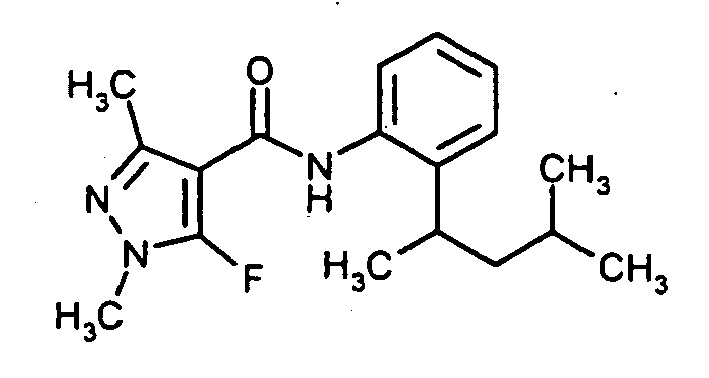
- Unter Schutzgas (Argon) wird eine Lösung aus 2-(1,3-Dimethyl-butyl)-phenylamin 18,05 g (100 mmol) in 40 ml Chlorbenzol vorgelegt. Man gibt 16,17 g (100 mmol) 5-Fluor-1,3-dimethyl-1H-pyrazol-4-carbonsäurefluorid zu und rührt für 5 h bei 130°C nach. Zur Aufarbeitung lässt man abkühlen, gibt 100 ml Wasser zu und extrahiert dreimal mit je 100 ml Essigsäureethylester. Die vereinigten organischen Phasen werden einmal mit 100 ml Wasser gewaschen, über Magnesiumsulfat getrocknet und unter vermindertem Druck eingeengt. Die erhaltene Suspension wird mit 100 ml für 2 h bei Raumtemperatur nachgerührt Man erhält 28,2 g (89 % der Theorie) an N-[2-(1,3-Dimethylbutyl)phenyl]-5-fluor-1,3-dimethyl-1H-pyrazol-4-carboxamid in Form von Kristallen(Schmelzpunkt 104-106°C).
Claims (4)
- Verfahren zum Herstellen von Carboxamiden der Formel (I)
 R für C1-C12-Cycloalkyl, C3-C12-Cycloalkenyl, C6-C12-Bicycloalkyl, C2-C12-Oxacycloalkyl, C4-C12-Oxacycloalkenyl, C3-C12-Thiacycloalkyl, C4-C12-Thiacycloalkenyl, C2-C12-Azacycloalkyl steht, welche jeweils gegebenenfalls einfach oder mehrfach, gleich oder verschieden durch C1-C8-Alkyl, C1-C8-Alkoxy, Halogen und/oder Cyano substituiert sein können,
oder für gegebenenfalls einfach bis fünffach, gleich oder verschieden substituiertes Phenyl steht, wobei die Substituenten jeweils aus der Liste W1 ausgewählt sind,
oder für unsubstituiertes C2-C20-Alkyl,
oder für einfach oder mehrfach, gleich oder verschieden durch Halogen, C1-C6-Alkylthio, C1-C6-Alkylsulfinyl, C1-C6-Alkylsulfonyl, C1-C6-Alkoxy, C1-C6-Alkylamino, Di(C1-C6-alkyl)amino, C1-C6-Halogenalkylthio, C1-C6-Halogenalkylsulfinyl, C1-C6-Halogenalkylsulfonyl, C1-C6-Halogenalkoxy, C1-C6-Halogenalkylamino, Halogen-di(C1-C6-alkyl)amino, -SiR1R2R3 und/oder C3-C6-Cycloalkyl substituiertes C1-C20-Alkyl steht, wobei der Cycloalkylteil seinerseits gegebenenfalls einfach bis vierfach, gleich oder verschieden durch Halogen, C1-C4-Alkyl und/oder C1-C4-Halogenalkyl substituiert sein kann,W1 für Halogen, Cyano, Nitro, Amino, Hydroxy, C1-C8-Alkyl, C1-C8-Alkoxy, C1-C8-Alkylthio, C1-C8-Alkylsulfinyl, C1-C8-Alkylsulfonyl, C2-C6-Alkenyl, C2-C6-Alkenyloxy; C1-C6-Halogenalkyl, C1-C6-Halogenalkoxy, C1-C6-Halogenalkylthio, C1-C6-Halogenalkylsulfinyl oder C1-C6-Halogenalkylsulfonyl mit jeweils 1 bis 13 gleichen oder verschiedenen Halogenatomen; C2-C6-Halogenalkenyl oder C2-C6-Halogenalkenyloxy mit jeweils 1 bis 11 gleichen oder verschiedenen Halogenatomen; C3-C6-Cycloalkyl oder C3-C6-Cycloalkyloxy;R1 und R2 unabhängig voneinander für Wasserstoff, C1-C8-Alkyl, C1-C8-Alkoxy, C1-C4-Alkoxy-C1-C4-alkyl, C1-C4-Alkylthio-C1-C4-alkyl oder C1-C6-Halogenalkyl stehen,R3 für Wasserstoff, C1-C8-Alkyl, C1-C8-Alkoxy, C1-C4-Alkoxy-C1-C4-alkyl, C1-C4-Alkylthio-C1-C4-alkyl, C2-C8-Alkenyl, C2-C8-Alkinyl, C1-C6-Halogenalkyl, C2-C6-Halogenalkenyl, C2-C6-Halogenalkinyl, C3-C6-Cycloalkyl, oder für jeweils gegebenenfalls substituiertes Phenyl oder Phenylalkyl steht,dadurch gekennzeichnet, dass man
5-Fluor-1,3-dimethyl-1H-pyrazol-4-carbonsäurefluorid der Formel (II)

in Abwesenheit eines Säureakzeptors umsetzt. - Verfahren gemäß Anspruch 1, dadurch gekennzeichnet, dass man bei Temperaturen von 120°C bis 150°C arbeitet.
- Verfahren gemäß Anspruch 1 oder 2, dadurch gekennzeichnet, dass man Anilin-Derivate der Formel (III-1)

- Verfahren gemäß Anspruch 1, 2 oder 3, dadurch gekennzeichnet, dass man 2-(1,3-Dimethyl-butyl)-phenylamin als Anilin-Derivat der Formel (III) einsetzt.
Applications Claiming Priority (2)
| Application Number | Priority Date | Filing Date | Title |
|---|---|---|---|
| DE102005028293A DE102005028293A1 (de) | 2005-06-18 | 2005-06-18 | Verfahren zum Herstellen von Carboxamiden |
| PCT/EP2006/005435 WO2006136287A1 (de) | 2005-06-18 | 2006-06-07 | Verfahren zum herstellen von carboxamiden |
Publications (2)
| Publication Number | Publication Date |
|---|---|
| EP1902033A1 EP1902033A1 (de) | 2008-03-26 |
| EP1902033B1 true EP1902033B1 (de) | 2009-08-12 |
Family
ID=37000040
Family Applications (1)
| Application Number | Title | Priority Date | Filing Date |
|---|---|---|---|
| EP06754192A Active EP1902033B1 (de) | 2005-06-18 | 2006-06-07 | Verfahren zum herstellen von carboxamiden |
Country Status (11)
| Country | Link |
|---|---|
| US (1) | US7919632B2 (de) |
| EP (1) | EP1902033B1 (de) |
| JP (1) | JP5007302B2 (de) |
| KR (1) | KR101336731B1 (de) |
| CN (1) | CN101198593B (de) |
| AT (1) | ATE439348T1 (de) |
| BR (1) | BRPI0612982B1 (de) |
| DE (2) | DE102005028293A1 (de) |
| DK (1) | DK1902033T3 (de) |
| IL (1) | IL188174A (de) |
| WO (1) | WO2006136287A1 (de) |
Families Citing this family (4)
| Publication number | Priority date | Publication date | Assignee | Title |
|---|---|---|---|---|
| EP2535334A1 (de) | 2011-06-17 | 2012-12-19 | Bayer CropScience AG | Kristalline Modifikationen von Penflufen |
| KR102167814B1 (ko) * | 2012-11-13 | 2020-10-20 | 바이엘 크롭사이언스 악티엔게젤샤프트 | 카복사미드 제조 방법 |
| KR20160141788A (ko) | 2014-04-01 | 2016-12-09 | 바이엘 크롭사이언스 악티엔게젤샤프트 | N-[3-(벤질카바모일)페닐]-1h-피라졸-5-카복사미드의 제조방법 |
| CN108358797A (zh) * | 2018-04-20 | 2018-08-03 | 南京农业大学 | 一种烷基甘氨酸的合成方法 |
Family Cites Families (4)
| Publication number | Priority date | Publication date | Assignee | Title |
|---|---|---|---|---|
| US5136082A (en) * | 1990-08-03 | 1992-08-04 | Himont Incorporated | Process for preparing organic esters and amides and catalyst system therefor |
| DE19544800A1 (de) * | 1995-12-01 | 1997-06-05 | Bayer Ag | Verfahren zur Herstellung von 1,3-Dimethyl-5-fluor-pyrazol-4-carboxaniliden |
| DE102005009457A1 (de) | 2005-03-02 | 2006-09-07 | Bayer Cropscience Ag | Verfahren zum Herstellen von Alkylaniliden |
| DE102005028294A1 (de) * | 2005-06-18 | 2006-12-21 | Bayer Cropscience Gmbh | Verfahren zum Herstellen von Carboxamiden |
-
2005
- 2005-06-18 DE DE102005028293A patent/DE102005028293A1/de not_active Withdrawn
-
2006
- 2006-06-07 DK DK06754192T patent/DK1902033T3/da active
- 2006-06-07 EP EP06754192A patent/EP1902033B1/de active Active
- 2006-06-07 JP JP2008516178A patent/JP5007302B2/ja active Active
- 2006-06-07 BR BRPI0612982-0A patent/BRPI0612982B1/pt active IP Right Grant
- 2006-06-07 DE DE502006004527T patent/DE502006004527D1/de active Active
- 2006-06-07 US US11/917,835 patent/US7919632B2/en active Active
- 2006-06-07 WO PCT/EP2006/005435 patent/WO2006136287A1/de not_active Ceased
- 2006-06-07 KR KR1020087001327A patent/KR101336731B1/ko active Active
- 2006-06-07 AT AT06754192T patent/ATE439348T1/de active
- 2006-06-07 CN CN2006800214752A patent/CN101198593B/zh active Active
-
2007
- 2007-12-17 IL IL188174A patent/IL188174A/en active IP Right Grant
Also Published As
| Publication number | Publication date |
|---|---|
| KR101336731B1 (ko) | 2013-12-04 |
| JP5007302B2 (ja) | 2012-08-22 |
| JP2008546655A (ja) | 2008-12-25 |
| IL188174A0 (en) | 2008-03-20 |
| EP1902033A1 (de) | 2008-03-26 |
| ATE439348T1 (de) | 2009-08-15 |
| DE502006004527D1 (de) | 2009-09-24 |
| CN101198593A (zh) | 2008-06-11 |
| US20090054660A1 (en) | 2009-02-26 |
| IL188174A (en) | 2011-04-28 |
| WO2006136287A1 (de) | 2006-12-28 |
| CN101198593B (zh) | 2010-09-15 |
| DK1902033T3 (da) | 2009-11-09 |
| BRPI0612982B1 (pt) | 2015-01-06 |
| DE102005028293A1 (de) | 2007-01-04 |
| US7919632B2 (en) | 2011-04-05 |
| KR20080027846A (ko) | 2008-03-28 |
| BRPI0612982A2 (pt) | 2010-12-14 |
Similar Documents
| Publication | Publication Date | Title |
|---|---|---|
| DE4236400A1 (de) | N-Phenylacetaminonitrile | |
| DE102004041531A1 (de) | Verfahren zum Herstellen von Biphenylaminen | |
| EP1902033B1 (de) | Verfahren zum herstellen von carboxamiden | |
| EP1858858B1 (de) | Verfahren zum herstellen von alkylaniliden | |
| DE60025911T2 (de) | Verfahren zur herstellung von intermediaten für pestizide | |
| EP1896423B1 (de) | Verfahren zum herstellen von carboxamiden | |
| EP0748798B1 (de) | N-substituierte cis-N-propenyl-acetamide und Verfahren zu ihrer Herstellung | |
| DE2221771C3 (de) | Verfahren zur Herstellung von α-Iminonitrilen | |
| EP1235790A2 (de) | Verfahren zur herstellung von 2-(2-hydroxyphenyl)-2-(alkoxyimino)-n-methylacetamid-derivaten | |
| EP0662474B1 (de) | Verfahren zur herstellung von chlorpyridinen | |
| EP1873145A1 (de) | Verfahren zur herstellung eines nikotinsäurederivats oder salzes davon | |
| DE19507915A1 (de) | Verfahren zur Herstellung von Pyrazolen | |
| EP1789383A1 (de) | Chirale 3-halophthalsäure-derivate | |
| DE10053812A1 (de) | Verfahren zur stereoselektiven Herstellung von Diaminocycloalkenen und Diaminocycloalkanen | |
| WO2003014066A2 (de) | 2-(hydroxyphenyl)-2-(alkoxyimino)-n-methylacetamid-derivate und deren herstellungsverfahren | |
| WO2003014065A1 (de) | Verfahren zur herstellung von (2e)-2-(hydroxyphenyl)-2-(alkoxyimino)-n-methylacetamiden |
Legal Events
| Date | Code | Title | Description |
|---|---|---|---|
| PUAI | Public reference made under article 153(3) epc to a published international application that has entered the european phase |
Free format text: ORIGINAL CODE: 0009012 |
|
| 17P | Request for examination filed |
Effective date: 20080118 |
|
| AK | Designated contracting states |
Kind code of ref document: A1 Designated state(s): AT BE BG CH CY CZ DE DK EE ES FI FR GB GR HU IE IS IT LI LT LU LV MC NL PL PT RO SE SI SK TR |
|
| DAX | Request for extension of the european patent (deleted) | ||
| DAX | Request for extension of the european patent (deleted) | ||
| GRAP | Despatch of communication of intention to grant a patent |
Free format text: ORIGINAL CODE: EPIDOSNIGR1 |
|
| GRAS | Grant fee paid |
Free format text: ORIGINAL CODE: EPIDOSNIGR3 |
|
| GRAA | (expected) grant |
Free format text: ORIGINAL CODE: 0009210 |
|
| AK | Designated contracting states |
Kind code of ref document: B1 Designated state(s): AT BE BG CH CY CZ DE DK EE ES FI FR GB GR HU IE IS IT LI LT LU LV MC NL PL PT RO SE SI SK TR |
|
| REG | Reference to a national code |
Ref country code: GB Ref legal event code: FG4D Free format text: NOT ENGLISH |
|
| REG | Reference to a national code |
Ref country code: CH Ref legal event code: EP |
|
| REG | Reference to a national code |
Ref country code: CH Ref legal event code: NV Representative=s name: E. BLUM & CO. AG PATENT- UND MARKENANWAELTE VSP |
|
| REG | Reference to a national code |
Ref country code: IE Ref legal event code: FG4D |
|
| REF | Corresponds to: |
Ref document number: 502006004527 Country of ref document: DE Date of ref document: 20090924 Kind code of ref document: P |
|
| REG | Reference to a national code |
Ref country code: DK Ref legal event code: T3 |
|
| LTIE | Lt: invalidation of european patent or patent extension |
Effective date: 20090812 |
|
| PG25 | Lapsed in a contracting state [announced via postgrant information from national office to epo] |
Ref country code: ES Free format text: LAPSE BECAUSE OF FAILURE TO SUBMIT A TRANSLATION OF THE DESCRIPTION OR TO PAY THE FEE WITHIN THE PRESCRIBED TIME-LIMIT Effective date: 20091123 Ref country code: SE Free format text: LAPSE BECAUSE OF FAILURE TO SUBMIT A TRANSLATION OF THE DESCRIPTION OR TO PAY THE FEE WITHIN THE PRESCRIBED TIME-LIMIT Effective date: 20090812 Ref country code: IS Free format text: LAPSE BECAUSE OF FAILURE TO SUBMIT A TRANSLATION OF THE DESCRIPTION OR TO PAY THE FEE WITHIN THE PRESCRIBED TIME-LIMIT Effective date: 20091212 Ref country code: LT Free format text: LAPSE BECAUSE OF FAILURE TO SUBMIT A TRANSLATION OF THE DESCRIPTION OR TO PAY THE FEE WITHIN THE PRESCRIBED TIME-LIMIT Effective date: 20090812 |
|
| NLV1 | Nl: lapsed or annulled due to failure to fulfill the requirements of art. 29p and 29m of the patents act | ||
| PG25 | Lapsed in a contracting state [announced via postgrant information from national office to epo] |
Ref country code: PL Free format text: LAPSE BECAUSE OF FAILURE TO SUBMIT A TRANSLATION OF THE DESCRIPTION OR TO PAY THE FEE WITHIN THE PRESCRIBED TIME-LIMIT Effective date: 20090812 Ref country code: NL Free format text: LAPSE BECAUSE OF FAILURE TO SUBMIT A TRANSLATION OF THE DESCRIPTION OR TO PAY THE FEE WITHIN THE PRESCRIBED TIME-LIMIT Effective date: 20090812 Ref country code: LV Free format text: LAPSE BECAUSE OF FAILURE TO SUBMIT A TRANSLATION OF THE DESCRIPTION OR TO PAY THE FEE WITHIN THE PRESCRIBED TIME-LIMIT Effective date: 20090812 Ref country code: SI Free format text: LAPSE BECAUSE OF FAILURE TO SUBMIT A TRANSLATION OF THE DESCRIPTION OR TO PAY THE FEE WITHIN THE PRESCRIBED TIME-LIMIT Effective date: 20090812 |
|
| REG | Reference to a national code |
Ref country code: IE Ref legal event code: FD4D |
|
| PG25 | Lapsed in a contracting state [announced via postgrant information from national office to epo] |
Ref country code: BG Free format text: LAPSE BECAUSE OF FAILURE TO SUBMIT A TRANSLATION OF THE DESCRIPTION OR TO PAY THE FEE WITHIN THE PRESCRIBED TIME-LIMIT Effective date: 20091112 Ref country code: PT Free format text: LAPSE BECAUSE OF FAILURE TO SUBMIT A TRANSLATION OF THE DESCRIPTION OR TO PAY THE FEE WITHIN THE PRESCRIBED TIME-LIMIT Effective date: 20091212 |
|
| PG25 | Lapsed in a contracting state [announced via postgrant information from national office to epo] |
Ref country code: IE Free format text: LAPSE BECAUSE OF FAILURE TO SUBMIT A TRANSLATION OF THE DESCRIPTION OR TO PAY THE FEE WITHIN THE PRESCRIBED TIME-LIMIT Effective date: 20090812 Ref country code: EE Free format text: LAPSE BECAUSE OF FAILURE TO SUBMIT A TRANSLATION OF THE DESCRIPTION OR TO PAY THE FEE WITHIN THE PRESCRIBED TIME-LIMIT Effective date: 20090812 Ref country code: RO Free format text: LAPSE BECAUSE OF FAILURE TO SUBMIT A TRANSLATION OF THE DESCRIPTION OR TO PAY THE FEE WITHIN THE PRESCRIBED TIME-LIMIT Effective date: 20090812 Ref country code: CZ Free format text: LAPSE BECAUSE OF FAILURE TO SUBMIT A TRANSLATION OF THE DESCRIPTION OR TO PAY THE FEE WITHIN THE PRESCRIBED TIME-LIMIT Effective date: 20090812 |
|
| PG25 | Lapsed in a contracting state [announced via postgrant information from national office to epo] |
Ref country code: SK Free format text: LAPSE BECAUSE OF FAILURE TO SUBMIT A TRANSLATION OF THE DESCRIPTION OR TO PAY THE FEE WITHIN THE PRESCRIBED TIME-LIMIT Effective date: 20090812 |
|
| PLBE | No opposition filed within time limit |
Free format text: ORIGINAL CODE: 0009261 |
|
| STAA | Information on the status of an ep patent application or granted ep patent |
Free format text: STATUS: NO OPPOSITION FILED WITHIN TIME LIMIT |
|
| 26N | No opposition filed |
Effective date: 20100517 |
|
| PG25 | Lapsed in a contracting state [announced via postgrant information from national office to epo] |
Ref country code: GR Free format text: LAPSE BECAUSE OF FAILURE TO SUBMIT A TRANSLATION OF THE DESCRIPTION OR TO PAY THE FEE WITHIN THE PRESCRIBED TIME-LIMIT Effective date: 20091113 |
|
| BERE | Be: lapsed |
Owner name: BAYER CROPSCIENCE A.G. Effective date: 20100630 |
|
| PG25 | Lapsed in a contracting state [announced via postgrant information from national office to epo] |
Ref country code: MC Free format text: LAPSE BECAUSE OF NON-PAYMENT OF DUE FEES Effective date: 20100630 |
|
| PG25 | Lapsed in a contracting state [announced via postgrant information from national office to epo] |
Ref country code: BE Free format text: LAPSE BECAUSE OF NON-PAYMENT OF DUE FEES Effective date: 20100630 |
|
| PG25 | Lapsed in a contracting state [announced via postgrant information from national office to epo] |
Ref country code: CY Free format text: LAPSE BECAUSE OF FAILURE TO SUBMIT A TRANSLATION OF THE DESCRIPTION OR TO PAY THE FEE WITHIN THE PRESCRIBED TIME-LIMIT Effective date: 20090812 |
|
| PG25 | Lapsed in a contracting state [announced via postgrant information from national office to epo] |
Ref country code: LU Free format text: LAPSE BECAUSE OF NON-PAYMENT OF DUE FEES Effective date: 20100607 Ref country code: HU Free format text: LAPSE BECAUSE OF FAILURE TO SUBMIT A TRANSLATION OF THE DESCRIPTION OR TO PAY THE FEE WITHIN THE PRESCRIBED TIME-LIMIT Effective date: 20100213 |
|
| PG25 | Lapsed in a contracting state [announced via postgrant information from national office to epo] |
Ref country code: TR Free format text: LAPSE BECAUSE OF FAILURE TO SUBMIT A TRANSLATION OF THE DESCRIPTION OR TO PAY THE FEE WITHIN THE PRESCRIBED TIME-LIMIT Effective date: 20090812 |
|
| REG | Reference to a national code |
Ref country code: DE Ref legal event code: R081 Ref document number: 502006004527 Country of ref document: DE Owner name: BAYER INTELLECTUAL PROPERTY GMBH, DE Free format text: FORMER OWNER: BAYER CROPSCIENCE AG, 40789 MONHEIM, DE Effective date: 20141023 Ref country code: DE Ref legal event code: R081 Ref document number: 502006004527 Country of ref document: DE Owner name: BAYER CROPSCIENCE AKTIENGESELLSCHAFT, DE Free format text: FORMER OWNER: BAYER CROPSCIENCE AG, 40789 MONHEIM, DE Effective date: 20141023 |
|
| REG | Reference to a national code |
Ref country code: GB Ref legal event code: 732E Free format text: REGISTERED BETWEEN 20150416 AND 20150422 |
|
| REG | Reference to a national code |
Ref country code: FR Ref legal event code: PLFP Year of fee payment: 10 |
|
| REG | Reference to a national code |
Ref country code: CH Ref legal event code: PUE Owner name: BAYER INTELLECTUAL PROPERTY GMBH, DE Free format text: FORMER OWNER: BAYER CROPSCIENCE AG, DE |
|
| REG | Reference to a national code |
Ref country code: FR Ref legal event code: TP Owner name: BAYER INTELLECTUAL PROPERTY GMBH, DE Effective date: 20151117 |
|
| REG | Reference to a national code |
Ref country code: FR Ref legal event code: PLFP Year of fee payment: 11 |
|
| REG | Reference to a national code |
Ref country code: AT Ref legal event code: PC Ref document number: 439348 Country of ref document: AT Kind code of ref document: T Owner name: BAYER INTELLECTUAL PROPERTY GMBH, DE Effective date: 20160913 |
|
| REG | Reference to a national code |
Ref country code: FR Ref legal event code: PLFP Year of fee payment: 12 |
|
| REG | Reference to a national code |
Ref country code: FR Ref legal event code: PLFP Year of fee payment: 13 |
|
| REG | Reference to a national code |
Ref country code: DE Ref legal event code: R081 Ref document number: 502006004527 Country of ref document: DE Owner name: BAYER CROPSCIENCE AKTIENGESELLSCHAFT, DE Free format text: FORMER OWNER: BAYER INTELLECTUAL PROPERTY GMBH, 40789 MONHEIM, DE |
|
| P01 | Opt-out of the competence of the unified patent court (upc) registered |
Effective date: 20230507 |
|
| REG | Reference to a national code |
Ref country code: GB Ref legal event code: 732E Free format text: REGISTERED BETWEEN 20230907 AND 20230913 |
|
| REG | Reference to a national code |
Ref country code: AT Ref legal event code: PC Ref document number: 439348 Country of ref document: AT Kind code of ref document: T Owner name: BAYER CROPSCIENCE AKTIENGESELLSCHAFT, DE Effective date: 20230911 |
|
| REG | Reference to a national code |
Ref country code: FI Ref legal event code: PCE Owner name: BAYER CROPSCIENCE AKTIENGESELLSCHAFT |
|
| PGFP | Annual fee paid to national office [announced via postgrant information from national office to epo] |
Ref country code: FI Payment date: 20250620 Year of fee payment: 20 |
|
| PGFP | Annual fee paid to national office [announced via postgrant information from national office to epo] |
Ref country code: DE Payment date: 20250521 Year of fee payment: 20 |
|
| PGFP | Annual fee paid to national office [announced via postgrant information from national office to epo] |
Ref country code: GB Payment date: 20250522 Year of fee payment: 20 Ref country code: DK Payment date: 20250618 Year of fee payment: 20 |
|
| PGFP | Annual fee paid to national office [announced via postgrant information from national office to epo] |
Ref country code: IT Payment date: 20250528 Year of fee payment: 20 |
|
| PGFP | Annual fee paid to national office [announced via postgrant information from national office to epo] |
Ref country code: FR Payment date: 20250523 Year of fee payment: 20 |
|
| PGFP | Annual fee paid to national office [announced via postgrant information from national office to epo] |
Ref country code: AT Payment date: 20250528 Year of fee payment: 20 |
|
| PGFP | Annual fee paid to national office [announced via postgrant information from national office to epo] |
Ref country code: CH Payment date: 20250701 Year of fee payment: 20 |