EP1904384B1 - Recipient utilisant un revetement interieur et des aerations d'isolation thermique et procedes de fabrication de ce recipient - Google Patents
Recipient utilisant un revetement interieur et des aerations d'isolation thermique et procedes de fabrication de ce recipient Download PDFInfo
- Publication number
- EP1904384B1 EP1904384B1 EP06774447.4A EP06774447A EP1904384B1 EP 1904384 B1 EP1904384 B1 EP 1904384B1 EP 06774447 A EP06774447 A EP 06774447A EP 1904384 B1 EP1904384 B1 EP 1904384B1
- Authority
- EP
- European Patent Office
- Prior art keywords
- container
- shrink film
- sidewall
- web
- vents
- Prior art date
- Legal status (The legal status is an assumption and is not a legal conclusion. Google has not performed a legal analysis and makes no representation as to the accuracy of the status listed.)
- Not-in-force
Links
- 238000009413 insulation Methods 0.000 title claims description 35
- 238000000034 method Methods 0.000 title claims description 26
- 229920006300 shrink film Polymers 0.000 claims description 112
- 239000000853 adhesive Substances 0.000 claims description 58
- 230000001070 adhesive effect Effects 0.000 claims description 58
- 239000012611 container material Substances 0.000 claims description 46
- 239000000463 material Substances 0.000 claims description 45
- 239000007788 liquid Substances 0.000 claims description 24
- 239000011087 paperboard Substances 0.000 claims description 24
- -1 polyethylene Polymers 0.000 claims description 20
- 239000004698 Polyethylene Substances 0.000 claims description 15
- 230000004913 activation Effects 0.000 claims description 15
- 229920000573 polyethylene Polymers 0.000 claims description 15
- 238000005520 cutting process Methods 0.000 claims description 12
- 239000004743 Polypropylene Substances 0.000 claims description 11
- 229920001155 polypropylene Polymers 0.000 claims description 11
- 238000004519 manufacturing process Methods 0.000 claims description 9
- 238000010438 heat treatment Methods 0.000 claims description 2
- 235000013361 beverage Nutrition 0.000 description 22
- 239000003570 air Substances 0.000 description 19
- 238000001994 activation Methods 0.000 description 13
- 235000012171 hot beverage Nutrition 0.000 description 10
- 238000000576 coating method Methods 0.000 description 7
- 230000015572 biosynthetic process Effects 0.000 description 6
- 239000011248 coating agent Substances 0.000 description 6
- 239000012080 ambient air Substances 0.000 description 5
- 230000000694 effects Effects 0.000 description 5
- 238000003475 lamination Methods 0.000 description 5
- 230000008569 process Effects 0.000 description 5
- 239000006260 foam Substances 0.000 description 4
- 238000013022 venting Methods 0.000 description 4
- 101000767603 Homo sapiens Vezatin Proteins 0.000 description 3
- 102100028982 Vezatin Human genes 0.000 description 3
- 238000011049 filling Methods 0.000 description 3
- 238000007789 sealing Methods 0.000 description 3
- 241001122767 Theaceae Species 0.000 description 2
- 230000009286 beneficial effect Effects 0.000 description 2
- 235000016213 coffee Nutrition 0.000 description 2
- 235000013353 coffee beverage Nutrition 0.000 description 2
- 230000003247 decreasing effect Effects 0.000 description 2
- 230000032798 delamination Effects 0.000 description 2
- 230000001419 dependent effect Effects 0.000 description 2
- 230000006872 improvement Effects 0.000 description 2
- 239000000123 paper Substances 0.000 description 2
- 229920003023 plastic Polymers 0.000 description 2
- 239000004033 plastic Substances 0.000 description 2
- 238000009958 sewing Methods 0.000 description 2
- 235000014347 soups Nutrition 0.000 description 2
- 238000012360 testing method Methods 0.000 description 2
- XLYOFNOQVPJJNP-UHFFFAOYSA-N water Substances O XLYOFNOQVPJJNP-UHFFFAOYSA-N 0.000 description 2
- 239000004793 Polystyrene Substances 0.000 description 1
- QAOWNCQODCNURD-UHFFFAOYSA-L Sulfate Chemical compound [O-]S([O-])(=O)=O QAOWNCQODCNURD-UHFFFAOYSA-L 0.000 description 1
- 238000009835 boiling Methods 0.000 description 1
- 230000008859 change Effects 0.000 description 1
- 235000020965 cold beverage Nutrition 0.000 description 1
- 230000006866 deterioration Effects 0.000 description 1
- 230000008030 elimination Effects 0.000 description 1
- 238000003379 elimination reaction Methods 0.000 description 1
- 230000001747 exhibiting effect Effects 0.000 description 1
- 238000001125 extrusion Methods 0.000 description 1
- 235000013305 food Nutrition 0.000 description 1
- 235000021268 hot food Nutrition 0.000 description 1
- 235000021539 instant coffee Nutrition 0.000 description 1
- 238000005304 joining Methods 0.000 description 1
- 238000004806 packaging method and process Methods 0.000 description 1
- 230000002093 peripheral effect Effects 0.000 description 1
- 229920000747 poly(lactic acid) Polymers 0.000 description 1
- 239000004626 polylactic acid Substances 0.000 description 1
- 229920000642 polymer Polymers 0.000 description 1
- 229920002223 polystyrene Polymers 0.000 description 1
- 238000002360 preparation method Methods 0.000 description 1
- 238000012545 processing Methods 0.000 description 1
- 238000004080 punching Methods 0.000 description 1
- 230000009467 reduction Effects 0.000 description 1
- 210000003625 skull Anatomy 0.000 description 1
- 239000007787 solid Substances 0.000 description 1
- 238000012546 transfer Methods 0.000 description 1
- 230000037303 wrinkles Effects 0.000 description 1
Images



Classifications
-
- B—PERFORMING OPERATIONS; TRANSPORTING
- B65—CONVEYING; PACKING; STORING; HANDLING THIN OR FILAMENTARY MATERIAL
- B65D—CONTAINERS FOR STORAGE OR TRANSPORT OF ARTICLES OR MATERIALS, e.g. BAGS, BARRELS, BOTTLES, BOXES, CANS, CARTONS, CRATES, DRUMS, JARS, TANKS, HOPPERS, FORWARDING CONTAINERS; ACCESSORIES, CLOSURES, OR FITTINGS THEREFOR; PACKAGING ELEMENTS; PACKAGES
- B65D81/00—Containers, packaging elements, or packages, for contents presenting particular transport or storage problems, or adapted to be used for non-packaging purposes after removal of contents
- B65D81/38—Containers, packaging elements, or packages, for contents presenting particular transport or storage problems, or adapted to be used for non-packaging purposes after removal of contents with thermal insulation
- B65D81/3865—Containers, packaging elements, or packages, for contents presenting particular transport or storage problems, or adapted to be used for non-packaging purposes after removal of contents with thermal insulation drinking cups or like containers
- B65D81/3869—Containers, packaging elements, or packages, for contents presenting particular transport or storage problems, or adapted to be used for non-packaging purposes after removal of contents with thermal insulation drinking cups or like containers formed with double walls, i.e. hollow
-
- B—PERFORMING OPERATIONS; TRANSPORTING
- B31—MAKING ARTICLES OF PAPER, CARDBOARD OR MATERIAL WORKED IN A MANNER ANALOGOUS TO PAPER; WORKING PAPER, CARDBOARD OR MATERIAL WORKED IN A MANNER ANALOGOUS TO PAPER
- B31B—MAKING CONTAINERS OF PAPER, CARDBOARD OR MATERIAL WORKED IN A MANNER ANALOGOUS TO PAPER
- B31B2105/00—Rigid or semi-rigid containers made by assembling separate sheets, blanks or webs
-
- B—PERFORMING OPERATIONS; TRANSPORTING
- B31—MAKING ARTICLES OF PAPER, CARDBOARD OR MATERIAL WORKED IN A MANNER ANALOGOUS TO PAPER; WORKING PAPER, CARDBOARD OR MATERIAL WORKED IN A MANNER ANALOGOUS TO PAPER
- B31B—MAKING CONTAINERS OF PAPER, CARDBOARD OR MATERIAL WORKED IN A MANNER ANALOGOUS TO PAPER
- B31B2105/00—Rigid or semi-rigid containers made by assembling separate sheets, blanks or webs
- B31B2105/002—Making boxes characterised by the shape of the blanks from which they are formed
- B31B2105/0022—Making boxes from tubular webs or blanks, e.g. with separate bottoms, including tube or bottom forming operations
-
- B—PERFORMING OPERATIONS; TRANSPORTING
- B31—MAKING ARTICLES OF PAPER, CARDBOARD OR MATERIAL WORKED IN A MANNER ANALOGOUS TO PAPER; WORKING PAPER, CARDBOARD OR MATERIAL WORKED IN A MANNER ANALOGOUS TO PAPER
- B31B—MAKING CONTAINERS OF PAPER, CARDBOARD OR MATERIAL WORKED IN A MANNER ANALOGOUS TO PAPER
- B31B2110/00—Shape of rigid or semi-rigid containers
- B31B2110/10—Shape of rigid or semi-rigid containers having a cross section of varying size or shape, e.g. conical or pyramidal
-
- B—PERFORMING OPERATIONS; TRANSPORTING
- B31—MAKING ARTICLES OF PAPER, CARDBOARD OR MATERIAL WORKED IN A MANNER ANALOGOUS TO PAPER; WORKING PAPER, CARDBOARD OR MATERIAL WORKED IN A MANNER ANALOGOUS TO PAPER
- B31B—MAKING CONTAINERS OF PAPER, CARDBOARD OR MATERIAL WORKED IN A MANNER ANALOGOUS TO PAPER
- B31B2110/00—Shape of rigid or semi-rigid containers
- B31B2110/20—Shape of rigid or semi-rigid containers having a curved cross section, e.g. circular
-
- B—PERFORMING OPERATIONS; TRANSPORTING
- B31—MAKING ARTICLES OF PAPER, CARDBOARD OR MATERIAL WORKED IN A MANNER ANALOGOUS TO PAPER; WORKING PAPER, CARDBOARD OR MATERIAL WORKED IN A MANNER ANALOGOUS TO PAPER
- B31B—MAKING CONTAINERS OF PAPER, CARDBOARD OR MATERIAL WORKED IN A MANNER ANALOGOUS TO PAPER
- B31B2120/00—Construction of rigid or semi-rigid containers
- B31B2120/40—Construction of rigid or semi-rigid containers lined or internally reinforced
-
- B—PERFORMING OPERATIONS; TRANSPORTING
- B31—MAKING ARTICLES OF PAPER, CARDBOARD OR MATERIAL WORKED IN A MANNER ANALOGOUS TO PAPER; WORKING PAPER, CARDBOARD OR MATERIAL WORKED IN A MANNER ANALOGOUS TO PAPER
- B31B—MAKING CONTAINERS OF PAPER, CARDBOARD OR MATERIAL WORKED IN A MANNER ANALOGOUS TO PAPER
- B31B2120/00—Construction of rigid or semi-rigid containers
- B31B2120/40—Construction of rigid or semi-rigid containers lined or internally reinforced
- B31B2120/408—Construction of rigid or semi-rigid containers lined or internally reinforced by folding a sheet or blank around an inner tubular liner
-
- B—PERFORMING OPERATIONS; TRANSPORTING
- B31—MAKING ARTICLES OF PAPER, CARDBOARD OR MATERIAL WORKED IN A MANNER ANALOGOUS TO PAPER; WORKING PAPER, CARDBOARD OR MATERIAL WORKED IN A MANNER ANALOGOUS TO PAPER
- B31B—MAKING CONTAINERS OF PAPER, CARDBOARD OR MATERIAL WORKED IN A MANNER ANALOGOUS TO PAPER
- B31B2120/00—Construction of rigid or semi-rigid containers
- B31B2120/50—Construction of rigid or semi-rigid containers covered or externally reinforced
Definitions
- the present invention provides a method of making an insulated container, wherein the container has an inner shrink film liner.
- the sidewalls of the container which can be made from paperboard or other suitable material, are vented to allow ambient air to freely flow through the sidewall of the container during activation of the shrink film with hot liquid or other suitable material.
- the shrink film is activated and the container provides excellent insulation, thereby allowing the container to be held in a consumer's hand for an extended period without causing burns or excessive discomfort.
- U.S. Patent No. 6,536,657 and 6,729,534 and U.S. Patent Publication No. 2005-0029337 disclose a beverage container having a film adhered to the interior thereof.
- the film will shrink.
- the film moves away from the interior of the container to create a pocket of air.
- This air pocket results in the container having insulating characteristics.
- an insulating band is instantaneously activated (that is, the film shrinks) by contact with hot liquid.
- the insulated cups formed by the methods and materials set out in the referenced patents were found to provide excellent insulation properties when used for sewing hot beverages, such as coffee, tea, et cetera.
- a partial vacuum was formed and the film could not fully activate to provide maximum insulation effect.
- U.S. Patent No. 3,737,093 discloses a plastic container situated within a paper container to create an air space for thermal insulation.
- U.S. Patent No. 4,435,344 discloses a container made from foam polyethylene-coated paperboard which has insulating properties.
- U.S. Patent No. 6,852,381 describes an insulated beverage container comprising (in order from the outermost surface to the inside of the container): a paperboard outer shell, a foam layer laminated to the inner surface of the paperboard shell and a film adhered to the foam surface. In use, it appears that the film would be in contact with the beverage in the container to pull wrinkles out of the inner foam layer.
- the present invention provides an improved method of making an insulated container.
- the present invention provides a method of making an insulated container having the features defined in claim 1. Further preferred embodiments are described in the dependent claims.
- the container has an inner shrink film liner.
- the sidewalls of the container which is made from paperboard, are vented to allow ambient air to freely flow through the sidewall of the container during activation of the shrink film.
- the shrink film is activated when the container is filled with liquid or other material having a temperature of from about 54.4°C (130°F) to up to about 100°C (212°F).
- the shrink film is applied using an adhesive suitable to prevent the shrink film from undergoing substantially any delamination when contacted with liquid or other material exhibiting these temperatures.
- the shrink film is activated and the container provides excellent insulation, thereby allowing the container to be held in a consumer's hand for an extended period without causing bums or excessive discomfort. Methods of making this container are also provided.
- ranges are expressed herein as from “about” one particular value, and/or to "about” another particular value. When such a range is expressed, another embodiment includes from the one particular value and/or to the other particular value. Similarly, when values are expressed as approximations, by use of the antecedent "about,” it will be understood that the particular value forms another embodiment. It will be further understood that the endpoints of each of the ranges are significant both in relation to the other endpoint, and independently of the other endpoint. As used herein, "beverage” is used for convenience.
- the containers of the present invention are suitable for use with not only beverages, but also soups and other hot foods that are held by a consumer during consumption thereof and wherein insulation would be a beneficial aspect. Further, while the containers of the present invention are readily suitable for use for many types of food products, the containers can also be used generally to contain hot items having liquid characteristics.
- the present invention relates to a method of making an insulated container.
- the insulated container is formed from a suitable container material and a shrink film liner.
- the shrink film liner is adhered to the interior of the container as discussed in more detail herein.
- a hot material such as coffee, soup, water et cetera
- the film will activate to provide a pocket of air between the inner surface of the container sidewall and the inner surface of the shrink film, that is, the film surface facing the inner surface of the container sidewall. This pocket of air reduces the heat transfer from the hot material to the outer surface of the container.
- An insulated container is therefore provided with the present invention.
- the insulated container of the present invention includes vents in a portion of the outer wall of the container.
- vents which are provided by cutting into a web of container material during manufacture of the container, are an improvement over the prior art in which an insulating band adhered to container material without suitable venting was provided.
- the vents of the present invention have been found to substantially eliminate the formation of a vacuum in the space between the container sidewall and the shrink film liner. That is, it was found that when suitably sized vents were not present in the area defined by the insulating band, the ability of the shrink film to activate upon contact with a hot liquid was substantially limited by the amount of air present between the not suitably vented container wall and the film liner. In turn, the limited activation of the shrink film provided an air pocket having reduced volume and, accordingly, reduced insulation with the shrink film lined containers.
- insulation effectiveness using a shrink film-lined container could be markedly improved by allowing air to freely flow through the container sidewall during the activation of the film liner upon contact with a hot material. It was found that such improvements could be obtained by including one or more suitable vents in the container sidewall as described in more detail below.
- vents are punched or otherwise formed in the container material (such as paperboard e.g., cupstock, when the container is made from paper) itself prior to formation of the container blanks.
- the container material such as paperboard e.g., cupstock, when the container is made from paper
- venting can be efficiently conducted by allowing free flow of air through the container wall when a hot material is poured into the container.
- U.S. Patent No. 6,536,657 mentioned the addition of pinholes in the container sidewall or the slitting of the shrink film to assist in alleviating a partial vacuum resulting from shrink film activation.
- pinholes were not satisfactory to allow substantially simultaneous activation of the shrink film upon contact of the shrink film with a hot material when used with the insulating band of the present invention.
- pinholes did not allow suitable venting.
- the vents of the present invention do not constitute pinholes.
- the vents of the present invention are larger than pinholes.
- vents of the present invention do not constitute tiny holes punched through the container sidewall as if made by the sharp end of a pin, such as that used for sewing. Still further, the vents of the present invention may be each, independently, about 10 times larger than a typical pinhole.
- the need for insulation in a container for beverages or other materials is decreased as the beverage is stored in the container because the beverage will cool over time.
- a consumer will desire an insulating effect as long as the beverage is hot enough to cause discomfort when a container is held in the hand.
- the insulated container of the present invention is suitable to provide insulation such that the beverage container will have an external temperature of about 48.89 °C (120°F) or less at the insulated portion of the container when held in a consumer's hand about 30 seconds after the container is filled with a hot beverage, where the beverage has an initial temperature of up to about 100°C (212°F).
- the "insulated portion" of the container is that portion of the container that is coextensive with the activated film and is defined by the area interior to the adhesive pattern printed on the container material (as is discussed in more detail below). As would be recognized, the areas of the container that are coextensive with the areas of adhesive will not be co-extensive with the activated film and will constitute minimal, if any, insulation. As such, it is desirable to maximize the amount of insulated area and minimize the amount of uninsulated area.
- the insulated container provides insulation such that the beverage container will have an external temperature of 48.9 °C (120°F) or less at the insulated portion of the container when held in a consumer's hand about 60 or about 90 or about 120 seconds or about 5 minutes after the container is filled with a hot material such as a beverage or otherwise, where the hot beverage has an initial temperature of up to about 100°C (212°F).
- Initial temperature means the temperature of the hot material when first placed in the container.
- hot beverages can be provided at a range of initial temperatures (which are generally from about 71.1 °C (160°F) to about 90.6 °C (195°F), but sometimes even up to about 100 °C (212°F), such as with the use of boiling water for tea or instant coffee).
- the ambient air temperature is generally at or near about 23.9 °C (75°F).
- the hotter the initial temperature of the beverage the hotter the external surface of the container will be when the container is filled with the hot beverage. Nonetheless, it has been found by the inventors herein that when activated, the insulating band of the present invention provides excellent insulation (that is, the external surface of the container is at or below about 60°C (140°F) or at about 48.9 °C (120°F) at 5 minutes or less after the container is filled with a beverage having an initial temperature of up to about 100°C (212°F)) at all ranges of initial beverage temperatures in which hot beverages are generally served.
- a container temperature is higher than about 60°C (140°F) (which is defined as the "threshold of pain" in U.S. Patent No. 6,152,363 )
- a typical consumer will find the container “too hot to handle.”
- temperatures of as low as about 48.9 °C (120°F) can cause discomfort to some sensitive people.
- the insulated containers of the present invention provide suitable insulation so that the container is substantially at or below this threshold of pain and even the discomfort point for sensitive people when filled with a hot beverage having an initial temperature of less than about 100°C (212°F).
- the vents can be provided in a paperboard container material by first die cutting one or more shapes into the container material when the container is in web form.
- the shape of the vents are holes having the diameter diameters defined in the claims. The shape suitably allows air to freely flow through the container material sidewall during the film activation process.
- a U-shape can be cut into the container material which, in use, will provide a flap that operates as the vent.
- Examples of such alternative vent shapes are pictured in Figure 4 herein.
- a flap-type vent it can be beneficial to provide the container for use with the flap slightly out of plane (that is, angled to the inner or outer portion of the container wall) so that air can readily flow through the container wall during activation of the shrink film.
- a pushing device such as a pusher pin, can be used to ensure that the flap is slightly out of plane from the surface of the container material prior to formation of the container.
- Such substantially instantaneous air flow has been found to be particularly useful with the present invention because the activation of the shrink film is substantially instantaneous and coincident with the filling of the container with hot material. It has been found that when the liquid comes into contact with the film, the film immediately (or substantially immediately) shrinks. Thus, any significant delay in the air flow that limits the ability of the shrink film to fully activate has been found to reduce the insulation effectiveness of the container.
- venting can be provided by punching holes into the container to provide air flow through the container sidewall.
- a die cutting device can be used to punch such structures out of the container material. It has been found that small holes should be provided when this method is used in order to minimize the appearance of holes in the container to the consumer.
- the holes are from about 1.27 mm (0.05 inches) to 2.54 mm (0.10 inches) in diameter.
- vents can be positioned toward an upper region of the insulating band. Still further, the vents can be positioned in any position within the area of the insulating band.
- vents can vary in number, size and location and need not be all the same size, shape or dispersed uniformly within the area of the insulating band.
- the primary consideration regarding the vent characteristics is believed to be that shrinkage of the shrink film should not be unduly hindered by slow pressure equalization between ambient air and the forming air pocket, which forms substantially instantaneously upon contact of the shrink film with hot liquid, that is, liquid of at least about 54.4 °C (130°F).
- Suitable paperboard container material that can be used for the containers of the present invention is cupstock.
- Cupstock that can be used for the present invention includes solid bleached sulfate ("SBS") from Georgia-Pacific Corporation (Atlanta, GA). Any type of paperboard that can be used to prepare beverage containers are suitable for use to prepare the insulated containers of the present invention.
- SBS solid bleached sulfate
- vents can be cut into a web of polymeric material before the shrink film is applied to the container sidewall to provide a polymer web-shrink film laminate from which a container blank can be cut. A bottom can be applied to the container blank to provide a two piece polymeric container.
- the methods of preparing such a container are known to those of ordinary skill in the art and, as such, will not be discussed in detail herein. It is contemplated that, regardless of whether the container is prepared from paperboard or other material, the vents will function to allow the formation of a suitable insulated area in the container when the container is filled with hot liquid.
- the basis weight can be from about 54.43 kg to about 113.40 kg per ream (from about 120 to about 250 pounds per ream).
- a ream is 278.708 qm of material (3000 square feet of material).
- the basis weight of the container material can be from about 72.58 kg to about 99.79 kg per ream (from about 160 to about 220 pounds per ream).
- the basis weight can be from about 54.43 kg ; 63.50 kg; 72.58 kg; 81.65 kg, 90.72 kg; 99.79 kg; 108.86 kg; 113.40 kg per ream (from about 120, 140, 160, 180, 200, 220, 240 or 250 pounds per ream), where any value can be used as an upper or a lower endpoint, as appropriate.
- the material When paperboard is used for the container material, the material typically has a coating pre-applied to assist in making the container resistant to liquid.
- the coating can be on the inner surface of the container or on both the inner and outer surfaces of the container.
- Such a coating can be polyethylene or any other type of coating that is generally used for imparting liquid resistance to beverage containers.
- Such coatings are generally applied to the cupstock in an extrusion process as would be recognized by one of ordinary skill in the art.
- the coating also serves as the method of sealing the container in the forming process.
- a polymeric shrink film is applied to one side of a web of the container material. While there are numerous temperature ranges in which shrink films can activate, the polymeric shrink film used in the present invention must exhibit suitable shrinkage under the temperatures exhibited by hot beverages. When subjected to heating resulting from contact with a hot material, the shrink film will shrink away from the sidewall of the container to provide an air-filled insulating band.
- the amount of shrinkage of the shrink film when contacted with a hot beverage having a temperature of from about 54.4°C (130°F) to up to about 100°C (212°F) can be from about 5 % to about 50 %, as measured by total area of the original area of the shrink film. Still further, the amount of shrinkage of the shrink film when contacted with a hot material having a temperature of from about 54.4°C (130°F) to about 100°C (212°F) can be from about 5, 10, 15, 20, 25, 30 or 35% of the total area of the shrink film, where any value can serve as an upper or a lower endpoint, as appropriate.
- the shrink film will not shrink unless a hot material comes into contact with the film.
- there will be no need for insulation if there is not a hot material contained in the container, so there will be no requirement for an insulating band to be formed if a lukewarm or cold beverage is contained within a container of the present invention.
- the containers can be used for both hot and cold materials, beverage or otherwise.
- shrinkage of the film will result in some loss of the total available volume of the container.
- the loss of volume from shrinkage of the shrink film is less than about 30 %, where the amount of shrinkage is measured by the area difference in the shrink film as compared to the original area of the film prior to contact with hot liquid.
- the loss of volume from shrinkage of the shrink film is less than about 20 %.
- the loss of volume from shrinkage of the shrink film is less than about 10%.
- the loss of volume from shrinkage of the shrink film is less than about 5 %.
- the interior of the container can be marked with a fill line to show the maximum volume to which the container can be filled without concern of overflow.
- a fill line is not necessary. Due to the shrinkage of the film being substantially simultaneous with the film coming into contact with the hot material, the final volume of the container is substantially immediately obtained as the hot material is added to the container. Put simply, although some volume loss will occur upon activation of the shrink film, such loss will not generally be noticeable by the consumer because the consumer will stop filling the container when the container is full.
- the container In order to provide the consumer with the advertised serving size, the container will have to be larger than the final serving size to account for volume loss resulting from film activation.
- the initial container volume (that is, the container having an unactivated film adhered to the interior thereof), will have a volume that is approximately larger than the final volume size.
- initial container size for a final serving size of 354.88 ml (12 ounces) of hot liquid where the shrink film shrinks about 10 % will be approximately 390.37 ml (13.2 ounces).
- the shrink film can comprise one or more layers of either or both of polyethylene or polypropylene.
- Suitable shrink films for use in the present invention include Clysar LLGT (60 gauge polyethylene film), VEZT (50 gauge 3 layer polypropylene/polyethylene/polypropylene film) and EZT (60 gauge 3 layer polypropylene/polyethylene/polypropylene film) (Bemis Clysar, Oshkosh, WI).
- Clysar LLGT 60 gauge polyethylene film
- VEZT 50 gauge 3 layer polypropylene/polyethylene/polypropylene film
- EZT 60 gauge 3 layer polypropylene/polyethylene/polypropylene film
- Suitable adhesives for use in the present invention are those that will not experience failure or marked deterioration of lamination strength upon contact with the hot liquid. As would be appreciated, if the adhesive fails or markedly deteriorates upon contact with hot liquid, the shrink film will pull away (that is, delaminate) from the sidewall of the container upon activation. If this happens, little or no insulation will be provided by the shrink film because the insulating band will not be suitably formed.
- the adhesive used in the present invention will result in the shrink film undergoing substantially no delamination upon contact with hot material having an initial temperature of up to about 100 °C (212°F) where the external (air) temperature is at about amibient, when the film is in contact with this hot material for at least about 5 minutes.
- hot material having an initial temperature of up to about 100 °C (212°F) where the external (air) temperature is at about amibient
- the adhesives used in the present invention can suitably provide good adhesion of the shrink film to the container surface for longer than 60 seconds, it will be appreciated that when the hot material is placed in the container, it will immediately begin to cool. As such, the hot material in the cup will decrease in temperature over time and the adhesive will be subjected to steadily decreasing temperatures as the hot material with which it is in contact cools.
- An adhesive suitable for use in the present invention is Henkel GB-5458M, a product of Henkel Adhesives (Elgin, IL).
- a further suitable adhesive is BUV-008, a product of Royal Adhesives (South Bend, IN).
- Other suitable adhesives can be determined for use in the present invention by those of ordinary skill in the art without undue experimentation.
- the adhesive can be applied to the container material in a shape that defines the area that will provide the insulation band perimeter.
- the adhesive can be applied to the web of container material in a pattern that follows the desired lamination locations for the film. As noted, in order to reduce areas in the container where insulation is limited, it can be desirable to minimize the area of the container wall covered by adhesive.
- a web of shrink film is brought into contact with the uncured adhesive that is laid out in the desired pattern on the web of container material.
- the adhesive can be applied to the container material so as to provide a peripheral attachment of the shrink film as shown, for example, in Figure 3 .
- the adhesive can also be applied to the web of container material in a pattern, such as those disclosed in U.S. Patent No. 6,536,657 and 6,729,534 and U.S. Patent Publication No. 2005-0029337 .
- the adhesive can be laid down in a pattern on the web of container material such that there is substantially no adhesive present on the container sidewall where the seams in the finished container will be located.
- Blanks are cut from the laminate comprising the shrink film web and container material web to provide the desired final container shape.
- the shaded portion 47 of the portion of the laminate shows a suitable adhesive pattern to prepare a container of the present invention.
- the adhesive can be applied up to the brim edge of what will be a container.
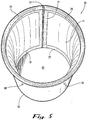
- the shrink film will then span the entire brim of the container in use. This is also shown in Figure 5 .
- Figure 3 illustrates a suitable adhesive pattern whereby the adhesive is not applied to the outer portions of what will form the side and bottom seams.
- reduction or elimination of the adhesive from the heat seal location can provide better cup formation and containers that are more likely to be leak-proof or substantially leak-proof.
- By providing a container seal area having substantially no adhesive present it has been found possible to seal the containers using, for example, heat sealing of a polyethylene coating applied to the inner surface of the cupstock.
- heat sealing allows the insulated containers of the present invention to be manufactured on conventional container manufacturing equipment, which greatly enhances the utility of the present invention.
- the insulated container is prepared by providing a web of paperboard container material.
- the web is of a sufficient width to provide one or more container blanks cuttable from the web when the shrink film is adhered to the web using adhesives as discussed further herein. Vents are cut into the web using a suitable cutting apparatus.
- the web After cutting of the vents, the web can be rolled for future use, or the web can be immediately directed to the next processing step.
- an adhesive can be printed on the web in a pattern coinciding with a perimeter of one or more container blanks that will be cut from the container material web.
- the number of container blanks that can be printed on the web is dependent on the web width and the characteristics of the printing equipment used in this process.
- one or more adhesive patterns are provided on the web.
- the laminate can be rolled for later use or can be in-line directed to a laminate cutting station. At this cutting station, the container blanks will be cut from the web. Referring to Figure 3 , because adhesive is substantially absent from the outer and lower sidewall edges 48a, 48b and 49b, when the container blank is cut from the container material-shrink film laminate, the shrink film will be adhered to the container sidewall as shown by the shaded portion 47.
- the container blank When cut from the container material-shrink film laminate, the container blank is typically sent to a container forming station for preparation of the container.
- the present invention allows the use of conventional container forming equipment and methods. Such methods are well known and will not be discussed in detail herein except where the present invention has significant features in relation to these forming methods.
- the side and lower outer edges of the container blank do not have adhesive in the locations that will be joined at the side seam and bottom of the finished container. It has been found that the seal of the container (and thus the ability to obtain leak resistant or substantially leak resistant containers) can be markedly improved if the adhesive is absent or substantially absent from the seam locations in the finished container.
- the outer and lower edges of the container blank are pre-heated to melt the polyethylene located on the container blank.
- the container blank is then formed around a mandrel to form the side seam of the container.
- a separately cut bottom portion is then provided on the bottom of the partially finished container.
- a brim curl can be provided on the container using known methods.
- the containers are then provided for packaging and shipping using known methods.
- Figure 1 illustrates a partially cut away front perspective view of a container 10 having an activated shrink film 14.
- the container 10 formed from paperboard (such as SBS) has an activated shrink film 14 affixed to the inner surface 16 of the container 10 at the locations of adhesive 19, which are designated by shading the Figures.
- the intermediate portion of the activated shrink film 14 defines the activated shrink film 14 of the container 10, which is that portion between the upper and lower circumferential bands 20, 22 (which also correspond to locations of adhesive 19).
- the sidewall 26 includes at least one vent 30 disposed within the activated shrink film 14 of the container 10.
- the vertical seam 34 of the insulated container 10 connects the two side edges (48a and 48b of Figure 3 ) of the generally annular sector-shaped blank from which sidewall 26 is formed.
- activated shrink film 14 of insulated container 10 is disposed away from the inner surface 16 of the sidewall 26.
- Activated shrink film 18 substantially surrounds the entire circumference of the container 10 and comprises a pocket 38 of ambient air that has passed through the vents 30 in the sidewall 26 upon contact of the activated shrink film 14 with hot liquid (not shown).
- Figure 3 illustrates an adhesive pattern for lamination of an unactivated shrink film 44 located in a portion of a web of container material 40.
- the lamination pattern includes a portion of container material web 42 onto which a web of shrink film 44 is laminated.
- the adhesive pattern (that is the area where the adhesive is printed on the web of container material 40) is shown by 47.
- 48a, 48b and 49b of the portion of container material web 42 are the outer edges where adhesive is absent.
- U-shaped vents 46 can be cut into the web of container material 40 in locations on the portion of container material web 42 corresponding to the insulated band 50 prior to lamination the shrink film 44 onto the web of container material 40.
- vents can be large flaps 46, small flaps 52, perforations 54 and 56, x-shaped cut-outs 58, round holes 60, or any other suitable shapes.
- FIG. 5 is a perspective view of an activated container 10. Shaded portion 19 illustrates the locations where activated shrink film 14 is adhered to the inner portion of the container sidewall 26.
- Activated shrink film 14 that is, the insulating band
- the container sidewall 26 is attached to container bottom 62. Vents 30 are disposed in container sidewall 26.
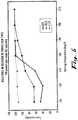
- Figure 6 shows the results of hold time tests using different types of shrink films.
- Hold time was measured using a panel of about 20 men and women (generally equally divided) who held containers filled with 87.78 °C (190°F) liquid and were asked to indicate when the container became too hot to hold comfortably. Participants were directed to not hold the container at the seam position (which contained no insulation band). The test was stopped at 2 minutes (which was considered to conform to an infinite hold time).
- the shrink films examined were: 1. Clysar LLGT (60 gauge polyethylene film); 2. VEZT (50 gauge 3 layer polypropylene/polyethylene/polypropylene film); and 3. EZT (60 gauge 3 layer polypropylene/polyethylene/polypropylene film). These were all products of Bemis Clysar, Oshkosh, WI.
- the shrink film was applied in the pattern shown in Figure 3 .
- the adhesive used was Henkel 6B-5458M.
- the initial temperature of the liquid used to activate the shrink film was 87.78 °C (190°F).
- Figure 7 illustrates the loss of volume seen with different shrink film types. These results show that to obtain a final liquid volume of about 354.88 ml (12 ounces), the unactivated container capacity needs to be larger to account for volume loss.
Landscapes
- Engineering & Computer Science (AREA)
- Mechanical Engineering (AREA)
- Packages (AREA)
- Wrappers (AREA)
Claims (5)
- Procédé de fabrication d'un récipient isolé,
le récipient comprenant :- une paroi latérale (26) comprenant un matériau de carton, la paroi latérale (26) comportant une surface intérieure (16) et une surface extérieure ;- un film rétractable activable (14) collé à la surface intérieure (16) de la paroi latérale (26) selon un motif qui définit une ceinture d'isolation activable ;la ceinture d'isolation étant située entre des ceintures circonférentielles supérieure et inférieure là où le film rétractable (14) est fixé à la paroi latérale,le film rétractable (14) étant appliqué à la paroi latérale (26) avec un adhésif (19) et l'adhésif (19) avec lequel le film rétractable (14) est collé à la paroi latérale étant appliqué à la paroi latérale (26) selon un motif avec lequel il n'y a essentiellement pas d'adhésif avec lequel le film rétractable (14) est collé à la paroi latérale présent dans un raccord latéral du récipient ; et- des orifices de ventilation (30) découpés dans le matériau de carton, qui sont conçus pour permettre à de l'air de s'écouler librement à travers le matériau de récipient,le procédé comprenant les étapes suivantes :les orifices de ventilation (30) étant situés au sein d'un périmètre intérieur de la ceinture d'isolation,les orifices de ventilation (30) étant d'une taille et d'une forme appropriées pour permettre à de l'air de s'écouler librement à travers la paroi latérale (26) lors de l'activation du film rétractable (14), et les orifices de ventilation étant des trous dans la paroi latérale présentant chacun indépendamment un diamètre allant de 1,27 mm (0,05 pouce) à 2,54 mm (0,10 pouce), de façon à produire ainsi un récipient (10) apte à assurer une isolation lorsque le récipient (10) est rempli d'une matière présentant une température allant de 54,4 °C (130 °F) à environ 100 °C (212 °F),le récipient présentant un volume avant activation du film rétractable (14) d'environ 10 à environ 40 % supérieur à un volume maximal de remplissage après activation du film rétractable ;a) prendre une bande matériau de récipient (42) comprenant du carton, la bande (42) étant d'une largeur suffisante pour produire une ou plusieurs découpes de récipient pouvant être découpées à partir de la bande ;b) découper la bande de matériau de récipient (42) de façon à produire un ou plusieurs orifices de ventilation (46) dans une paroi latérale d'une ou plusieurs découpes de récipient pouvant être découpées à partir de la bande ;c) prévoir une bande de film rétractable (44), le film rétractable (44) étant activable par contact avec une matière chaude présentant une température initiale d'environ 54,4 °C (130 °F) à environ 100 °C (212 °F) ;d) coller la bande de film rétractable (44) et la bande de matériau de récipient (42) l'une à l'autre selon un certain motif, le motif coïncidant avec un périmètre d'une ou de plusieurs découpes de récipient pouvant être découpées à partir de la bande de film rétractable (44), la liaison adhésive étant formée par application d'adhésif (19) à la bande de matériau de récipient (42) ;e) découper le stratifié de matériau de récipient et de film rétractable de façon à produire une ou plusieurs découpes de récipient, les découpes de récipient comprenant des orifices de ventilation (30) à un emplacement au sein d'un périmètre défini par le motif adhésif, qui sont aptes à permettre à de l'air de s'écouler librement à travers le matériau de récipient, et les orifices de ventilation étant des trous dans la paroi latérale présentant chacun indépendamment un diamètre allant de 1,27 mm (0,05 pouce) à 2,54 mm (0,10 pouce), la découpe de récipient étant appropriée pour préparer un récipient isolé (10) ;le procédé comprenant en outre :f) prendre la découpe de récipient, la découpe de récipient comportant deux bords extérieurs (48a, 48b) et une partie inférieure (49b) dépourvus d'adhésif (19) avec lequel la bande de film rétractable (14) est collée à la paroi latérale ;g) chauffer les deux bords extérieurs (48a, 48b) et la partie inférieure (49b) ;h) mettre la découpe de récipient en forme sur un mandrin de façon à raccorder les deux bords extérieurs (48a, 48b) ;i) appliquer un fond à la découpe de récipient au niveau de la partie inférieure (49b) ;de façon à produire ainsi un récipient essentiellement résistant aux fuites approprié pour assurer une isolation lorsqu'il est rempli avec un liquide présentant une température d'environ 54,4 °C (130 °F) à environ 100 °C (212 °F) . - Procédé selon la revendication 1, dans lequel le film rétractable (44) est activable lorsqu'il est mis en contact avec une matière présentant une température initiale allant d'environ 54,4 °C (130 °F) à environ 100 °C (212 °F).
- Procédé selon l'une des revendications 1 et 2, dans lequel le carton présente un grammage d'environ 72,57 kg (160 livres) à environ 99,79 kg (220 livres) par rame.
- Procédé selon l'une des revendications 1 à 3, dans lequel le film rétractable (44) ne se sépare essentiellement pas du récipient lorsque le récipient est mis en contact avec une matière présentant une température initiale allant d'environ 54,4 °C (130 °F) à environ 100 °C (212 °F) .
- Procédé selon l'une des revendications 1 à 4, dans lequel le film rétractable (44) comprend une ou plusieurs couches de polyéthylène ou de polypropylène.
Applications Claiming Priority (2)
| Application Number | Priority Date | Filing Date | Title |
|---|---|---|---|
| US11/174,434 US7513386B2 (en) | 2005-06-30 | 2005-06-30 | Container employing an inner liner for thermal insulation |
| PCT/US2006/025916 WO2007005793A1 (fr) | 2005-06-30 | 2006-06-29 | Recipient utilisant un revetement interieur et des aerations d'isolation thermique et procedes de fabrication de ce recipient |
Publications (2)
| Publication Number | Publication Date |
|---|---|
| EP1904384A1 EP1904384A1 (fr) | 2008-04-02 |
| EP1904384B1 true EP1904384B1 (fr) | 2018-05-30 |
Family
ID=37074934
Family Applications (1)
| Application Number | Title | Priority Date | Filing Date |
|---|---|---|---|
| EP06774447.4A Not-in-force EP1904384B1 (fr) | 2005-06-30 | 2006-06-29 | Recipient utilisant un revetement interieur et des aerations d'isolation thermique et procedes de fabrication de ce recipient |
Country Status (5)
| Country | Link |
|---|---|
| US (3) | US7513386B2 (fr) |
| EP (1) | EP1904384B1 (fr) |
| CN (1) | CN101208247B (fr) |
| CA (1) | CA2613109C (fr) |
| WO (1) | WO2007005793A1 (fr) |
Families Citing this family (52)
| Publication number | Priority date | Publication date | Assignee | Title |
|---|---|---|---|---|
| DE60102661T2 (de) | 2001-01-30 | 2004-08-19 | Seda S.P.A. | Pappbehälter für Getränke und Verfahren hierfür |
| US7614993B2 (en) * | 2001-07-20 | 2009-11-10 | Dixie Consumer Products Llc | Liquid container with uninterrupted comfort band and method of forming same |
| CA2394475C (fr) * | 2001-07-20 | 2010-01-26 | Fort James Corporation | Tasse jetable thermiquement isolee et methode de fabrication |
| US7473675B2 (en) * | 2005-02-25 | 2009-01-06 | Solutions Biomed, Llc | Disinfectant systems and methods comprising a peracid, alcohol, and transition metal |
| BRPI0601188B1 (pt) | 2005-04-15 | 2018-06-26 | Seda S.P.A. | Recipiente isolado; método de fabricar o mesmo e aparelho para a fabricação |
| US8622232B2 (en) | 2005-06-30 | 2014-01-07 | Dixie Consumer Products Llc | Method of making a container employing inner liner and vents for thermal insulation |
| US9168714B2 (en) | 2005-06-30 | 2015-10-27 | Dixie Consumer Products Llc | Methods for making paperboard blanks and paperboard products therefrom |
| US7513386B2 (en) * | 2005-06-30 | 2009-04-07 | Dixie Consumer Products Llc | Container employing an inner liner for thermal insulation |
| DE202005014177U1 (de) | 2005-09-08 | 2005-11-17 | Seda S.P.A., Arzano | Doppelwandiger Becher |
| DE202005014738U1 (de) | 2005-09-19 | 2007-02-08 | Seda S.P.A., Arzano | Behälter und Zuschnitt |
| DE602005005493T3 (de) | 2005-11-11 | 2014-04-24 | Seda S.P.A. | Isolierbecher |
| EP1785265A1 (fr) | 2005-11-14 | 2007-05-16 | SEDA S.p.A. | Dispositif pour former un élément en saillie d'empilage sur une parois d'un récipient et récipient avec un tel élément |
| US7828199B2 (en) * | 2006-07-27 | 2010-11-09 | Huhtamaki, Inc. | Multi-layer heat insulating container |
| DE202006018406U1 (de) | 2006-12-05 | 2008-04-10 | Seda S.P.A. | Verpackung |
| US20080135565A1 (en) * | 2006-12-07 | 2008-06-12 | George Zeiler | Container construction with selectable volume |
| US8347903B2 (en) * | 2008-02-28 | 2013-01-08 | De Raddo Virginia | Colander/bowl set |
| US20100108693A1 (en) * | 2008-11-04 | 2010-05-06 | The Coca-Cola Company | Insulated double-walled disposable plastic cup |
| US9539783B2 (en) | 2010-12-28 | 2017-01-10 | Henry Wischusen, III | Replaceable container liner, systems and methods |
| WO2012174568A2 (fr) | 2011-06-17 | 2012-12-20 | Berry Plastics Corporation | Procédé pour former un contenant isolé présentant une illustration |
| US9102461B2 (en) | 2011-06-17 | 2015-08-11 | Berry Plastics Corporation | Insulated sleeve for a cup |
| WO2012174422A2 (fr) | 2011-06-17 | 2012-12-20 | Berry Plastics Corporation | Récipient isolé à bord moulé |
| US9758292B2 (en) | 2011-06-17 | 2017-09-12 | Berry Plastics Corporation | Insulated container |
| CN111690204A (zh) | 2011-08-31 | 2020-09-22 | 比瑞塑料公司 | 用于一种绝缘容器的聚合物材料 |
| CA2820228C (fr) * | 2012-06-25 | 2019-09-03 | Dixie Consumer Products Llc | Decoupes en carton pourvues d'une pellicule thermoretractable adherant a celles-ci et contenants de carton constitues de celles-ci |
| MX344080B (es) * | 2012-06-29 | 2016-12-05 | Dixie Consumer Products Llc | Metodos para fabricar piezas en bruto de carton y productos de carton a partir de las mismas. |
| DE102012013590A1 (de) * | 2012-07-10 | 2014-01-16 | Sanner Gmbh | Behälter |
| BR112015002581A2 (pt) | 2012-08-07 | 2018-05-22 | Berry Plastics Corp | processo e máquina de formação de copos. |
| AU2013334155B2 (en) | 2012-10-26 | 2017-02-02 | Berry Plastics Corporation | Polymeric material for an insulated container |
| DE102012220112A1 (de) * | 2012-11-05 | 2014-05-22 | Michael Hörauf Maschinenfabrik GmbH & Co. KG | Isolierbecher und Verfahren zum Herstellen eines Isolierbechers |
| AR093944A1 (es) | 2012-12-14 | 2015-07-01 | Berry Plastics Corp | Troquelado para envase |
| AR093943A1 (es) | 2012-12-14 | 2015-07-01 | Berry Plastics Corp | Reborde de un envase termico |
| US9840049B2 (en) | 2012-12-14 | 2017-12-12 | Berry Plastics Corporation | Cellular polymeric material |
| US9957365B2 (en) | 2013-03-13 | 2018-05-01 | Berry Plastics Corporation | Cellular polymeric material |
| BR112015022750A2 (pt) | 2013-03-14 | 2017-07-18 | Berry Plastics Corp | recipiente |
| US8944274B2 (en) | 2013-06-17 | 2015-02-03 | James Madrid | Wastebasket for facilitating reuse of plastic shopping bags |
| EP3033208A4 (fr) | 2013-08-16 | 2017-07-05 | Berry Plastics Corp. | Matériau polymère pour contenant isolé |
| HK1217347A1 (zh) | 2013-08-26 | 2017-01-06 | 比瑞塑料公司 | 用於容器的聚合物材料 |
| US9758655B2 (en) | 2014-09-18 | 2017-09-12 | Berry Plastics Corporation | Cellular polymeric material |
| US10232580B2 (en) | 2014-12-23 | 2019-03-19 | Gpcp Ip Holdings Llc | Methods for securing a shrinkable film to a paperboard substrate and methods for making paperboard containers therefrom |
| US20170225423A1 (en) * | 2014-12-23 | 2017-08-10 | Dixie Consumer Products Llc | Methods for securing a shrinkable film to a paperboard substrate and methods for making paperboard containers therefrom |
| WO2016118838A1 (fr) | 2015-01-23 | 2016-07-28 | Berry Plastics Corporation | Matériau polymère pour contenant isotherme |
| US9937652B2 (en) | 2015-03-04 | 2018-04-10 | Berry Plastics Corporation | Polymeric material for container |
| US20170182726A1 (en) * | 2015-12-23 | 2017-06-29 | Dixie Consumer Products Llc | Methods for making paperboard containers from paperboard blanks having shrinkable films secured thereto |
| WO2017146698A1 (fr) | 2016-02-24 | 2017-08-31 | Bemis Company, Inc. | Poche multicouche à couche thermorétractable |
| US10415188B1 (en) | 2016-06-28 | 2019-09-17 | Gpcp Ip Holdings Llc | Disposable cups made form recycled fiber |
| JP6759009B2 (ja) * | 2016-08-31 | 2020-09-23 | 株式会社吉野工業所 | 液体容器 |
| CA3002768A1 (fr) | 2017-04-27 | 2018-10-27 | Gpcp Ip Holdings Llc | Methodes de fixation d'une pellicule retrecissable sur un substrat en carton et methodes de fabrication de contenants en carton associes |
| KR101863037B1 (ko) * | 2017-07-18 | 2018-05-31 | 정도천 | 뜨겁거나 차갑지 않은 일체형 이중 용기 |
| US11091311B2 (en) | 2017-08-08 | 2021-08-17 | Berry Global, Inc. | Insulated container and method of making the same |
| JP7245845B2 (ja) * | 2018-03-16 | 2023-03-24 | グラフィック パッケージング インターナショナル エルエルシー | ライナーを有する容器 |
| CN109664551B (zh) * | 2019-02-26 | 2023-09-19 | 龙口锦昇包装有限公司 | 一种纸托盘底角包角机 |
| CN112075820A (zh) * | 2020-10-01 | 2020-12-15 | 湖北克拉弗特实业有限公司 | 一种防烫纸杯 |
Family Cites Families (86)
| Publication number | Priority date | Publication date | Assignee | Title |
|---|---|---|---|---|
| US593316A (en) * | 1897-11-09 | John c | ||
| US1157008A (en) * | 1915-01-09 | 1915-10-19 | Anthony Ed Lang | Sanitary garbage-receiver. |
| US1407688A (en) * | 1919-04-08 | 1922-02-28 | George R Banton | Container |
| US1756243A (en) | 1927-09-15 | 1930-04-29 | Theodore M Prudden | Method of making multiple wall containers |
| US1944042A (en) | 1930-11-10 | 1934-01-16 | John W Thompson | Method of marketing and means for shipping paints, etc. |
| US2266828A (en) * | 1939-01-05 | 1941-12-23 | Milwaukee Lace Paper Company | Paper cup |
| US2563352A (en) * | 1946-04-05 | 1951-08-07 | Malcolm W Morse | Insulated cup |
| US2678764A (en) * | 1951-12-06 | 1954-05-18 | Emery Carpenter Container Comp | Accessory for use in filling lined containers |
| US2853222A (en) | 1953-04-20 | 1958-09-23 | John P Gallagher | Insulated foil lined paper cup |
| US2961849A (en) | 1956-06-04 | 1960-11-29 | Guy C Hitchcock | Mold for forming ice liners in containers |
| CH365325A (de) | 1956-06-15 | 1962-10-31 | Max Sternau Martin | Verfahren zum Verschliessen von Behältern mittels Verschlussdeckeln, die mindestens zum Teil aus einem unter Wärmeeinwirkung schrumpffähigen Kunststoffilm bestehen, und zur Durchführung dieses Verfahrens dienende Vorrichtung |
| USRE25618E (en) | 1959-07-21 | 1964-07-14 | Figure | |
| US3203611A (en) * | 1962-07-10 | 1965-08-31 | Haveg Industries Inc | Insulated nestable container and method of making the same |
| US3134307A (en) | 1962-07-31 | 1964-05-26 | Paper Machinery Corp | Heat sealing device for side seams of paper cups |
| US3237834A (en) | 1963-07-29 | 1966-03-01 | Sweetheart Plastics | Laminated container and method of making the same |
| US3246745A (en) | 1964-04-16 | 1966-04-19 | Goodyear Tire & Rubber | Package |
| US3406814A (en) | 1965-10-22 | 1968-10-22 | Waldorf Paper Prod Co | Display cartons |
| US3781183A (en) | 1969-06-27 | 1973-12-25 | Cellu Prod Co | Net-like thermoplastic material and products |
| US3627166A (en) | 1969-09-22 | 1971-12-14 | Container Corp | Safety can |
| US3737093A (en) | 1971-07-13 | 1973-06-05 | Owens Illinois Inc | Multi wall container and package |
| US3995740A (en) | 1971-12-23 | 1976-12-07 | Owens-Illinois, Inc. | Nestable fabricated thermoplastic container |
| US4197948A (en) | 1971-12-23 | 1980-04-15 | Owens-Illinois, Inc. | Nestable foam cup |
| US3854583A (en) | 1971-12-23 | 1974-12-17 | Owens Illinois Inc | Nestable fabricated thermoplastic container and method of fabrication same |
| US3988521A (en) | 1972-07-28 | 1976-10-26 | Owens-Illinois, Inc. | Laminated structures and methods and compositions for producing same |
| US4051951A (en) | 1975-06-18 | 1977-10-04 | Phillips Petroleum Company | Package having means for providing coaxial alignment in a stack thereof |
| US4087003A (en) | 1976-07-21 | 1978-05-02 | Champion International Corporation | Package for stacked array |
| US4239727A (en) | 1978-09-15 | 1980-12-16 | Mobil Oil Corporation | Method and apparatus for thermoforming thermoplastic foam articles |
| SE417490B (sv) | 1979-07-02 | 1981-03-23 | Inlands Ab | Maskin for framstellning av koniska mantlar for behallare |
| US4261501A (en) | 1979-10-31 | 1981-04-14 | Hallmark Cards Incorporated | Laminated insulated hot drink cup |
| US4459793A (en) | 1980-04-28 | 1984-07-17 | National Can Corporation | Composite container construction |
| DE3024407A1 (de) | 1980-06-28 | 1982-01-21 | Michael Hörauf Maschinenfabrik, 7334 Süssen | Papierbecher aus oberflaechengeschuetztem karton |
| US4332635A (en) | 1980-07-03 | 1982-06-01 | American Can Company | Cup labeling method and apparatus |
| JPS5765158A (en) | 1980-10-09 | 1982-04-20 | Teruo Inuki | Preparation of rice ball, its device, and product |
| JPS57110439A (en) | 1980-12-29 | 1982-07-09 | Nihon Dixie Co Ltd | Vessel made of heat insulating paper and its manufacture |
| US4383422A (en) | 1981-12-03 | 1983-05-17 | Gordon Jay E | Portable insulated holder for beverage containers |
| US4551366A (en) | 1982-01-11 | 1985-11-05 | Toyo Seikan Kaisha, Ltd. | Composite vessel excellent in preservability and process for preparation thereof |
| GB2124997B (en) | 1982-06-30 | 1986-05-14 | Toyo Seikan Kaisha Ltd | Sealed laminated vessels |
| US4514354A (en) | 1982-12-10 | 1985-04-30 | James River-Norwalk, Inc. | Manufacture of molded paperboard articles |
| US4486366A (en) | 1983-01-14 | 1984-12-04 | Owens-Illinois, Inc. | Method of continuously producing heat shrinkable amorphous polystyrene foam layer |
| AU561692B2 (en) | 1983-10-28 | 1987-05-14 | Inagaki, H. | Paper can |
| US4923722A (en) | 1987-03-02 | 1990-05-08 | Okura Industrial Co., Ltd. | Heat shrinkable composite film and packaging method using same |
| US5063005A (en) | 1988-03-18 | 1991-11-05 | The Kendall Company | Preparing heat shrinkable wraps |
| US4923557A (en) | 1988-08-01 | 1990-05-08 | Trine Manufacturing Co., Inc. | Apparatus and method for applying a heat shrink film to a container |
| US4982872A (en) | 1988-12-15 | 1991-01-08 | Avery Donald J | Film-encapsulated-structure container for food, beverages and other consumable products and method for making of same |
| US4985300A (en) | 1988-12-28 | 1991-01-15 | E. I. Du Pont De Nemours And Company | Shrinkable, conformable microwave wrap |
| US4971845A (en) | 1989-03-24 | 1990-11-20 | Star Packaging Corporation | Heat-shrinkable, heat-sealable thermoplastic laminate film |
| US5217307A (en) | 1990-12-07 | 1993-06-08 | Morgan Adhesives Company | Container with an easy opening indicator or security break indicator |
| US5092485A (en) | 1991-03-08 | 1992-03-03 | King Car Food Industrial Co., Ltd. | Thermos paper cup |
| US5145107A (en) | 1991-12-10 | 1992-09-08 | International Paper Company | Insulated paper cup |
| US5205473A (en) | 1992-03-19 | 1993-04-27 | Design By Us Company | Recyclable corrugated beverage container and holder |
| US5279872A (en) | 1992-03-23 | 1994-01-18 | Viskase Corporation | Multilayer stretch/shrink film |
| DE69307905T2 (de) | 1992-10-02 | 1997-07-24 | E.I. Du Pont De Nemours & Co., Wilmington, Del. | Verbesserte schrumpffolie und verfahren zu ihrer herstellung |
| JPH06219474A (ja) | 1993-01-22 | 1994-08-09 | Shibazaki Kaseihin Kogyo Kk | カップ容器及びその製造方法 |
| JP3054989B2 (ja) | 1993-06-19 | 2000-06-19 | 八幡 貞男 | 断熱発現容器 |
| AT403578B (de) * | 1993-09-03 | 1998-03-25 | Wuester Heinrich | Vorrichtung zum herstellen von kompost |
| JP2824895B2 (ja) | 1993-12-22 | 1998-11-18 | 株式会社日本デキシー | 断熱性紙製容器及びその製造方法 |
| US6098829A (en) | 1994-11-30 | 2000-08-08 | Mchenry; Robert J. | Can components having a metal-plastic-metal structure |
| US5725916A (en) | 1994-12-19 | 1998-03-10 | Nihon Dixie Company Limited | Heat-insulating paper container and method for producing the same |
| US5460323A (en) | 1995-01-10 | 1995-10-24 | California Environmental Cup, Inc. | Disposable insulated container |
| JP3691108B2 (ja) | 1995-05-10 | 2005-08-31 | 日本テトラパック株式会社 | 包装容器及びその製造方法 |
| US5736231A (en) | 1995-09-08 | 1998-04-07 | Transhield Technology Co., Llc | Protective wrap with additive delivery system |
| US5766709A (en) | 1996-02-23 | 1998-06-16 | James River Corporation Of Virginia | Insulated stock material and containers and methods of making the same |
| US5952068A (en) | 1996-06-14 | 1999-09-14 | Insulation Dimension Corporation | Syntactic foam insulated container |
| US6224954B1 (en) | 1997-03-26 | 2001-05-01 | Fort James Corporation | Insulating stock material and containers and methods of making the same |
| US5993705A (en) | 1997-05-30 | 1999-11-30 | Fort James Corporation | Methods for conveying containers through an oven to produce heat-insulative foamed layers therethrough |
| US6416829B2 (en) | 1997-06-06 | 2002-07-09 | Fort James Corporation | Heat insulating paper cups |
| US5882612A (en) * | 1997-07-14 | 1999-03-16 | Riley Medical, Inc. | Thermally conductive sterilization tray |
| US6139665A (en) | 1998-03-06 | 2000-10-31 | Fort James Corporation | Method for fabricating heat insulating paper cups |
| US6085970A (en) | 1998-11-30 | 2000-07-11 | Insulair, Inc. | Insulated cup and method of manufacture |
| JP2000177785A (ja) | 1998-12-17 | 2000-06-27 | Toppan Printing Co Ltd | 断熱性紙カップ容器 |
| US6152363A (en) | 1999-05-03 | 2000-11-28 | Westvaco Corporation | Sleeve construction for improved paperboard cup insulation |
| US6364149B1 (en) * | 1999-10-05 | 2002-04-02 | Gregory Scott Smith | Fluid container with a thermally responsive insulating side wall |
| US6142331A (en) | 1999-10-06 | 2000-11-07 | Fort James Corporation | Container with indicia covering brim, blank for making such a container, and methods for making the container and blank |
| US6852381B2 (en) | 2001-06-18 | 2005-02-08 | Appleton Papers, Inc. | Insulated beverage or food container |
| CA2394475C (fr) * | 2001-07-20 | 2010-01-26 | Fort James Corporation | Tasse jetable thermiquement isolee et methode de fabrication |
| US7614993B2 (en) | 2001-07-20 | 2009-11-10 | Dixie Consumer Products Llc | Liquid container with uninterrupted comfort band and method of forming same |
| AU2003263983B2 (en) | 2002-08-05 | 2008-05-08 | Cryovac, Inc. | High free shrink, high modulus, low shrink tension film with elastic recovery |
| US6908687B2 (en) | 2002-12-30 | 2005-06-21 | Exxonmobil Oil Corporation | Heat-shrinkable polymeric films |
| US6766709B1 (en) * | 2003-01-10 | 2004-07-27 | Thomas C. West | Universal gear self-locking/unlocking mechanism |
| US6840139B2 (en) * | 2003-05-08 | 2005-01-11 | Alcoa Global Fasteners, Inc. | Tapered installation tool |
| US7380685B2 (en) * | 2004-02-19 | 2008-06-03 | Simmons Michael J | Containers, sleeves and lids therefor, assemblies thereof, and holding structure therefor |
| US7281650B1 (en) * | 2005-03-24 | 2007-10-16 | Michael Milan | Beverage cup |
| US7513386B2 (en) | 2005-06-30 | 2009-04-07 | Dixie Consumer Products Llc | Container employing an inner liner for thermal insulation |
| US20070240811A1 (en) | 2006-04-13 | 2007-10-18 | Kimberly-Clark Worldwide, Inc. | Method of making a sleeved tissue product |
| EP2178701B1 (fr) | 2007-07-25 | 2011-09-07 | Cryovac, Inc. | Film de polyester thermorétractable |
| CN101932514B (zh) | 2007-10-22 | 2012-03-28 | 东罐兴业株式会社 | 隔热容器 |
-
2005
- 2005-06-30 US US11/174,434 patent/US7513386B2/en not_active Expired - Lifetime
-
2006
- 2006-06-29 WO PCT/US2006/025916 patent/WO2007005793A1/fr not_active Ceased
- 2006-06-29 CA CA2613109A patent/CA2613109C/fr not_active Expired - Fee Related
- 2006-06-29 EP EP06774447.4A patent/EP1904384B1/fr not_active Not-in-force
- 2006-06-29 US US11/478,075 patent/US7510098B2/en not_active Expired - Fee Related
- 2006-06-29 CN CN2006800228952A patent/CN101208247B/zh not_active Expired - Fee Related
-
2009
- 2009-02-26 US US12/380,314 patent/US7841974B2/en not_active Expired - Fee Related
Non-Patent Citations (2)
| Title |
|---|
| CLYSAR LLG: "Summary of Properties", 7 April 2011 (2011-04-07), XP055195983, Retrieved from the Internet <URL:http://www.clysar.com/pdf/Clysar_LLG_PDS.pdf> [retrieved on 20150616] * |
| MELISSA SCHUMACHER: "Clysar LE", 1 February 2003 (2003-02-01), Retrieved from the Internet <URL:http://www.logismarket.com.mx/ip/safte-food-ingredients-pelicula-multicapa-imprimible-de-baja-energia-ficha-tecnica-clysar-le-435253.pdf> [retrieved on 20150616] * |
Also Published As
| Publication number | Publication date |
|---|---|
| CN101208247B (zh) | 2010-08-25 |
| CA2613109A1 (fr) | 2007-01-11 |
| US20070029332A1 (en) | 2007-02-08 |
| EP1904384A1 (fr) | 2008-04-02 |
| WO2007005793A1 (fr) | 2007-01-11 |
| CA2613109C (fr) | 2014-05-20 |
| US20090170679A1 (en) | 2009-07-02 |
| US7510098B2 (en) | 2009-03-31 |
| CN101208247A (zh) | 2008-06-25 |
| US7513386B2 (en) | 2009-04-07 |
| US7841974B2 (en) | 2010-11-30 |
| US20070000931A1 (en) | 2007-01-04 |
Similar Documents
| Publication | Publication Date | Title |
|---|---|---|
| EP1904384B1 (fr) | Recipient utilisant un revetement interieur et des aerations d'isolation thermique et procedes de fabrication de ce recipient | |
| US8622232B2 (en) | Method of making a container employing inner liner and vents for thermal insulation | |
| US7600669B2 (en) | Blank for a disposable thermally insulated container | |
| US8052039B2 (en) | Insulated cup | |
| US7951057B2 (en) | Multi-layer heat insulating container | |
| CA2562150A1 (fr) | Tasse en mousse revetue de papier et procede d'assemblage | |
| US20060196923A1 (en) | Insulated container | |
| WO2012059140A1 (fr) | Gobelet en papier amélioré | |
| JP2004090929A (ja) | 断熱性紙製容器 | |
| CN213733700U (zh) | 一种防边渗的纸容器坯料及其纸容器 | |
| CA2753242C (fr) | Methode de fabrication d'un conteneur muni d'un revetement interieur et d'events pour l'isolation thermique | |
| WO2018058192A1 (fr) | Gobelet | |
| JP2003191940A (ja) | 断熱紙容器 | |
| JP3065505U (ja) | 2重構造断熱紙カップ | |
| AU2018201349A1 (en) | Cup | |
| HK1115361B (en) | Multi-layer heat insulating container |
Legal Events
| Date | Code | Title | Description |
|---|---|---|---|
| PUAI | Public reference made under article 153(3) epc to a published international application that has entered the european phase |
Free format text: ORIGINAL CODE: 0009012 |
|
| 17P | Request for examination filed |
Effective date: 20080122 |
|
| AK | Designated contracting states |
Kind code of ref document: A1 Designated state(s): AT BE BG CH CY CZ DE DK EE ES FI FR GB GR HU IE IS IT LI LT LU LV MC NL PL PT RO SE SI SK TR |
|
| DAX | Request for extension of the european patent (deleted) | ||
| RIN1 | Information on inventor provided before grant (corrected) |
Inventor name: HARTJES, TIMOTHY P. Inventor name: VAN HANDEL, GERALD J. Inventor name: BROWN, DAVID C. Inventor name: BREINING, MICHAEL A. Inventor name: MALAKHOW, WALTER |
|
| DAX | Request for extension of the european patent (deleted) | ||
| REG | Reference to a national code |
Ref country code: HK Ref legal event code: DE Ref document number: 1114068 Country of ref document: HK |
|
| 17Q | First examination report despatched |
Effective date: 20141017 |
|
| GRAP | Despatch of communication of intention to grant a patent |
Free format text: ORIGINAL CODE: EPIDOSNIGR1 |
|
| RIC1 | Information provided on ipc code assigned before grant |
Ipc: B65D 81/38 20060101AFI20171122BHEP |
|
| INTG | Intention to grant announced |
Effective date: 20171222 |
|
| RAP1 | Party data changed (applicant data changed or rights of an application transferred) |
Owner name: GPCP IP HOLDINGS LLC |
|
| GRAS | Grant fee paid |
Free format text: ORIGINAL CODE: EPIDOSNIGR3 |
|
| GRAA | (expected) grant |
Free format text: ORIGINAL CODE: 0009210 |
|
| AK | Designated contracting states |
Kind code of ref document: B1 Designated state(s): AT BE BG CH CY CZ DE DK EE ES FI FR GB GR HU IE IS IT LI LT LU LV MC NL PL PT RO SE SI SK TR |
|
| REG | Reference to a national code |
Ref country code: GB Ref legal event code: FG4D |
|
| REG | Reference to a national code |
Ref country code: CH Ref legal event code: EP |
|
| REG | Reference to a national code |
Ref country code: AT Ref legal event code: REF Ref document number: 1003367 Country of ref document: AT Kind code of ref document: T Effective date: 20180615 |
|
| REG | Reference to a national code |
Ref country code: IE Ref legal event code: FG4D |
|
| REG | Reference to a national code |
Ref country code: DE Ref legal event code: R096 Ref document number: 602006055514 Country of ref document: DE |
|
| REG | Reference to a national code |
Ref country code: FR Ref legal event code: PLFP Year of fee payment: 13 |
|
| REG | Reference to a national code |
Ref country code: NL Ref legal event code: MP Effective date: 20180530 |
|
| REG | Reference to a national code |
Ref country code: LT Ref legal event code: MG4D |
|
| PG25 | Lapsed in a contracting state [announced via postgrant information from national office to epo] |
Ref country code: LT Free format text: LAPSE BECAUSE OF FAILURE TO SUBMIT A TRANSLATION OF THE DESCRIPTION OR TO PAY THE FEE WITHIN THE PRESCRIBED TIME-LIMIT Effective date: 20180530 Ref country code: ES Free format text: LAPSE BECAUSE OF FAILURE TO SUBMIT A TRANSLATION OF THE DESCRIPTION OR TO PAY THE FEE WITHIN THE PRESCRIBED TIME-LIMIT Effective date: 20180530 Ref country code: SE Free format text: LAPSE BECAUSE OF FAILURE TO SUBMIT A TRANSLATION OF THE DESCRIPTION OR TO PAY THE FEE WITHIN THE PRESCRIBED TIME-LIMIT Effective date: 20180530 Ref country code: CY Free format text: LAPSE BECAUSE OF FAILURE TO SUBMIT A TRANSLATION OF THE DESCRIPTION OR TO PAY THE FEE WITHIN THE PRESCRIBED TIME-LIMIT Effective date: 20180530 Ref country code: BG Free format text: LAPSE BECAUSE OF FAILURE TO SUBMIT A TRANSLATION OF THE DESCRIPTION OR TO PAY THE FEE WITHIN THE PRESCRIBED TIME-LIMIT Effective date: 20180830 |
|
| PG25 | Lapsed in a contracting state [announced via postgrant information from national office to epo] |
Ref country code: LV Free format text: LAPSE BECAUSE OF FAILURE TO SUBMIT A TRANSLATION OF THE DESCRIPTION OR TO PAY THE FEE WITHIN THE PRESCRIBED TIME-LIMIT Effective date: 20180530 Ref country code: GR Free format text: LAPSE BECAUSE OF FAILURE TO SUBMIT A TRANSLATION OF THE DESCRIPTION OR TO PAY THE FEE WITHIN THE PRESCRIBED TIME-LIMIT Effective date: 20180831 |
|
| REG | Reference to a national code |
Ref country code: AT Ref legal event code: MK05 Ref document number: 1003367 Country of ref document: AT Kind code of ref document: T Effective date: 20180530 |
|
| PG25 | Lapsed in a contracting state [announced via postgrant information from national office to epo] |
Ref country code: NL Free format text: LAPSE BECAUSE OF FAILURE TO SUBMIT A TRANSLATION OF THE DESCRIPTION OR TO PAY THE FEE WITHIN THE PRESCRIBED TIME-LIMIT Effective date: 20180530 |
|
| PG25 | Lapsed in a contracting state [announced via postgrant information from national office to epo] |
Ref country code: PL Free format text: LAPSE BECAUSE OF FAILURE TO SUBMIT A TRANSLATION OF THE DESCRIPTION OR TO PAY THE FEE WITHIN THE PRESCRIBED TIME-LIMIT Effective date: 20180530 Ref country code: EE Free format text: LAPSE BECAUSE OF FAILURE TO SUBMIT A TRANSLATION OF THE DESCRIPTION OR TO PAY THE FEE WITHIN THE PRESCRIBED TIME-LIMIT Effective date: 20180530 Ref country code: DK Free format text: LAPSE BECAUSE OF FAILURE TO SUBMIT A TRANSLATION OF THE DESCRIPTION OR TO PAY THE FEE WITHIN THE PRESCRIBED TIME-LIMIT Effective date: 20180530 Ref country code: SK Free format text: LAPSE BECAUSE OF FAILURE TO SUBMIT A TRANSLATION OF THE DESCRIPTION OR TO PAY THE FEE WITHIN THE PRESCRIBED TIME-LIMIT Effective date: 20180530 Ref country code: AT Free format text: LAPSE BECAUSE OF FAILURE TO SUBMIT A TRANSLATION OF THE DESCRIPTION OR TO PAY THE FEE WITHIN THE PRESCRIBED TIME-LIMIT Effective date: 20180530 Ref country code: RO Free format text: LAPSE BECAUSE OF FAILURE TO SUBMIT A TRANSLATION OF THE DESCRIPTION OR TO PAY THE FEE WITHIN THE PRESCRIBED TIME-LIMIT Effective date: 20180530 Ref country code: CZ Free format text: LAPSE BECAUSE OF FAILURE TO SUBMIT A TRANSLATION OF THE DESCRIPTION OR TO PAY THE FEE WITHIN THE PRESCRIBED TIME-LIMIT Effective date: 20180530 |
|
| REG | Reference to a national code |
Ref country code: CH Ref legal event code: PL |
|
| PG25 | Lapsed in a contracting state [announced via postgrant information from national office to epo] |
Ref country code: IT Free format text: LAPSE BECAUSE OF FAILURE TO SUBMIT A TRANSLATION OF THE DESCRIPTION OR TO PAY THE FEE WITHIN THE PRESCRIBED TIME-LIMIT Effective date: 20180530 |
|
| REG | Reference to a national code |
Ref country code: DE Ref legal event code: R097 Ref document number: 602006055514 Country of ref document: DE |
|
| REG | Reference to a national code |
Ref country code: BE Ref legal event code: MM Effective date: 20180630 |
|
| PG25 | Lapsed in a contracting state [announced via postgrant information from national office to epo] |
Ref country code: LU Free format text: LAPSE BECAUSE OF NON-PAYMENT OF DUE FEES Effective date: 20180629 Ref country code: MC Free format text: LAPSE BECAUSE OF FAILURE TO SUBMIT A TRANSLATION OF THE DESCRIPTION OR TO PAY THE FEE WITHIN THE PRESCRIBED TIME-LIMIT Effective date: 20180530 |
|
| REG | Reference to a national code |
Ref country code: IE Ref legal event code: MM4A |
|
| PLBE | No opposition filed within time limit |
Free format text: ORIGINAL CODE: 0009261 |
|
| STAA | Information on the status of an ep patent application or granted ep patent |
Free format text: STATUS: NO OPPOSITION FILED WITHIN TIME LIMIT |
|
| PG25 | Lapsed in a contracting state [announced via postgrant information from national office to epo] |
Ref country code: CH Free format text: LAPSE BECAUSE OF NON-PAYMENT OF DUE FEES Effective date: 20180630 Ref country code: IE Free format text: LAPSE BECAUSE OF NON-PAYMENT OF DUE FEES Effective date: 20180629 Ref country code: LI Free format text: LAPSE BECAUSE OF NON-PAYMENT OF DUE FEES Effective date: 20180630 |
|
| 26N | No opposition filed |
Effective date: 20190301 |
|
| PG25 | Lapsed in a contracting state [announced via postgrant information from national office to epo] |
Ref country code: BE Free format text: LAPSE BECAUSE OF NON-PAYMENT OF DUE FEES Effective date: 20180630 Ref country code: SI Free format text: LAPSE BECAUSE OF FAILURE TO SUBMIT A TRANSLATION OF THE DESCRIPTION OR TO PAY THE FEE WITHIN THE PRESCRIBED TIME-LIMIT Effective date: 20180530 |
|
| PG25 | Lapsed in a contracting state [announced via postgrant information from national office to epo] |
Ref country code: TR Free format text: LAPSE BECAUSE OF FAILURE TO SUBMIT A TRANSLATION OF THE DESCRIPTION OR TO PAY THE FEE WITHIN THE PRESCRIBED TIME-LIMIT Effective date: 20180530 |
|
| PG25 | Lapsed in a contracting state [announced via postgrant information from national office to epo] |
Ref country code: PT Free format text: LAPSE BECAUSE OF FAILURE TO SUBMIT A TRANSLATION OF THE DESCRIPTION OR TO PAY THE FEE WITHIN THE PRESCRIBED TIME-LIMIT Effective date: 20180530 Ref country code: HU Free format text: LAPSE BECAUSE OF FAILURE TO SUBMIT A TRANSLATION OF THE DESCRIPTION OR TO PAY THE FEE WITHIN THE PRESCRIBED TIME-LIMIT; INVALID AB INITIO Effective date: 20060629 |
|
| PG25 | Lapsed in a contracting state [announced via postgrant information from national office to epo] |
Ref country code: IS Free format text: LAPSE BECAUSE OF FAILURE TO SUBMIT A TRANSLATION OF THE DESCRIPTION OR TO PAY THE FEE WITHIN THE PRESCRIBED TIME-LIMIT Effective date: 20180930 |
|
| PGFP | Annual fee paid to national office [announced via postgrant information from national office to epo] |
Ref country code: DE Payment date: 20200617 Year of fee payment: 15 Ref country code: FI Payment date: 20200609 Year of fee payment: 15 Ref country code: FR Payment date: 20200512 Year of fee payment: 15 |
|
| PGFP | Annual fee paid to national office [announced via postgrant information from national office to epo] |
Ref country code: GB Payment date: 20200617 Year of fee payment: 15 |
|
| REG | Reference to a national code |
Ref country code: DE Ref legal event code: R119 Ref document number: 602006055514 Country of ref document: DE |
|
| REG | Reference to a national code |
Ref country code: FI Ref legal event code: MAE |
|
| PG25 | Lapsed in a contracting state [announced via postgrant information from national office to epo] |
Ref country code: FI Free format text: LAPSE BECAUSE OF NON-PAYMENT OF DUE FEES Effective date: 20210629 |
|
| GBPC | Gb: european patent ceased through non-payment of renewal fee |
Effective date: 20210629 |
|
| PG25 | Lapsed in a contracting state [announced via postgrant information from national office to epo] |
Ref country code: GB Free format text: LAPSE BECAUSE OF NON-PAYMENT OF DUE FEES Effective date: 20210629 Ref country code: DE Free format text: LAPSE BECAUSE OF NON-PAYMENT OF DUE FEES Effective date: 20220101 |
|
| PG25 | Lapsed in a contracting state [announced via postgrant information from national office to epo] |
Ref country code: FR Free format text: LAPSE BECAUSE OF NON-PAYMENT OF DUE FEES Effective date: 20210630 |