EP1907201B1 - Durch fibrillierung von bikomponenten-inseln-in-der-see-fasern hergestellte hochfeste, langlebige mikro- und nanofasergewebe - Google Patents
Durch fibrillierung von bikomponenten-inseln-in-der-see-fasern hergestellte hochfeste, langlebige mikro- und nanofasergewebe Download PDFInfo
- Publication number
- EP1907201B1 EP1907201B1 EP20060785429 EP06785429A EP1907201B1 EP 1907201 B1 EP1907201 B1 EP 1907201B1 EP 20060785429 EP20060785429 EP 20060785429 EP 06785429 A EP06785429 A EP 06785429A EP 1907201 B1 EP1907201 B1 EP 1907201B1
- Authority
- EP
- European Patent Office
- Prior art keywords
- fibers
- external
- fiber component
- internal
- nylon
- Prior art date
- Legal status (The legal status is an assumption and is not a legal conclusion. Google has not performed a legal analysis and makes no representation as to the accuracy of the status listed.)
- Expired - Lifetime
Links
Images






Classifications
-
- D—TEXTILES; PAPER
- D04—BRAIDING; LACE-MAKING; KNITTING; TRIMMINGS; NON-WOVEN FABRICS
- D04H—MAKING TEXTILE FABRICS, e.g. FROM FIBRES OR FILAMENTARY MATERIAL; FABRICS MADE BY SUCH PROCESSES OR APPARATUS, e.g. FELTS, NON-WOVEN FABRICS; COTTON-WOOL; WADDING ; NON-WOVEN FABRICS FROM STAPLE FIBRES, FILAMENTS OR YARNS, BONDED WITH AT LEAST ONE WEB-LIKE MATERIAL DURING THEIR CONSOLIDATION
- D04H3/00—Non-woven fabrics formed wholly or mainly of yarns or like filamentary material of substantial length
- D04H3/08—Non-woven fabrics formed wholly or mainly of yarns or like filamentary material of substantial length characterised by the method of strengthening or consolidating
- D04H3/16—Non-woven fabrics formed wholly or mainly of yarns or like filamentary material of substantial length characterised by the method of strengthening or consolidating with bonds between thermoplastic filaments produced in association with filament formation, e.g. immediately following extrusion
-
- D—TEXTILES; PAPER
- D04—BRAIDING; LACE-MAKING; KNITTING; TRIMMINGS; NON-WOVEN FABRICS
- D04H—MAKING TEXTILE FABRICS, e.g. FROM FIBRES OR FILAMENTARY MATERIAL; FABRICS MADE BY SUCH PROCESSES OR APPARATUS, e.g. FELTS, NON-WOVEN FABRICS; COTTON-WOOL; WADDING ; NON-WOVEN FABRICS FROM STAPLE FIBRES, FILAMENTS OR YARNS, BONDED WITH AT LEAST ONE WEB-LIKE MATERIAL DURING THEIR CONSOLIDATION
- D04H3/00—Non-woven fabrics formed wholly or mainly of yarns or like filamentary material of substantial length
- D04H3/005—Synthetic yarns or filaments
-
- D—TEXTILES; PAPER
- D01—NATURAL OR MAN-MADE THREADS OR FIBRES; SPINNING
- D01D—MECHANICAL METHODS OR APPARATUS IN THE MANUFACTURE OF ARTIFICIAL FILAMENTS, THREADS, FIBRES, BRISTLES OR RIBBONS
- D01D5/00—Formation of filaments, threads, or the like
- D01D5/28—Formation of filaments, threads, or the like while mixing different spinning solutions or melts during the spinning operation; Spinnerette packs therefor
- D01D5/30—Conjugate filaments; Spinnerette packs therefor
- D01D5/34—Core-skin structure; Spinnerette packs therefor
-
- D—TEXTILES; PAPER
- D01—NATURAL OR MAN-MADE THREADS OR FIBRES; SPINNING
- D01D—MECHANICAL METHODS OR APPARATUS IN THE MANUFACTURE OF ARTIFICIAL FILAMENTS, THREADS, FIBRES, BRISTLES OR RIBBONS
- D01D5/00—Formation of filaments, threads, or the like
- D01D5/28—Formation of filaments, threads, or the like while mixing different spinning solutions or melts during the spinning operation; Spinnerette packs therefor
- D01D5/30—Conjugate filaments; Spinnerette packs therefor
- D01D5/36—Matrix structure; Spinnerette packs therefor
-
- D—TEXTILES; PAPER
- D01—NATURAL OR MAN-MADE THREADS OR FIBRES; SPINNING
- D01F—CHEMICAL FEATURES IN THE MANUFACTURE OF ARTIFICIAL FILAMENTS, THREADS, FIBRES, BRISTLES OR RIBBONS; APPARATUS SPECIALLY ADAPTED FOR THE MANUFACTURE OF CARBON FILAMENTS
- D01F8/00—Conjugated, i.e. bi- or multicomponent, artificial filaments or the like; Manufacture thereof
- D01F8/04—Conjugated, i.e. bi- or multicomponent, artificial filaments or the like; Manufacture thereof from synthetic polymers
- D01F8/06—Conjugated, i.e. bi- or multicomponent, artificial filaments or the like; Manufacture thereof from synthetic polymers with at least one polyolefin as constituent
-
- D—TEXTILES; PAPER
- D01—NATURAL OR MAN-MADE THREADS OR FIBRES; SPINNING
- D01F—CHEMICAL FEATURES IN THE MANUFACTURE OF ARTIFICIAL FILAMENTS, THREADS, FIBRES, BRISTLES OR RIBBONS; APPARATUS SPECIALLY ADAPTED FOR THE MANUFACTURE OF CARBON FILAMENTS
- D01F8/00—Conjugated, i.e. bi- or multicomponent, artificial filaments or the like; Manufacture thereof
- D01F8/04—Conjugated, i.e. bi- or multicomponent, artificial filaments or the like; Manufacture thereof from synthetic polymers
- D01F8/12—Conjugated, i.e. bi- or multicomponent, artificial filaments or the like; Manufacture thereof from synthetic polymers with at least one polyamide as constituent
-
- D—TEXTILES; PAPER
- D01—NATURAL OR MAN-MADE THREADS OR FIBRES; SPINNING
- D01F—CHEMICAL FEATURES IN THE MANUFACTURE OF ARTIFICIAL FILAMENTS, THREADS, FIBRES, BRISTLES OR RIBBONS; APPARATUS SPECIALLY ADAPTED FOR THE MANUFACTURE OF CARBON FILAMENTS
- D01F8/00—Conjugated, i.e. bi- or multicomponent, artificial filaments or the like; Manufacture thereof
- D01F8/04—Conjugated, i.e. bi- or multicomponent, artificial filaments or the like; Manufacture thereof from synthetic polymers
- D01F8/14—Conjugated, i.e. bi- or multicomponent, artificial filaments or the like; Manufacture thereof from synthetic polymers with at least one polyester as constituent
-
- D—TEXTILES; PAPER
- D04—BRAIDING; LACE-MAKING; KNITTING; TRIMMINGS; NON-WOVEN FABRICS
- D04H—MAKING TEXTILE FABRICS, e.g. FROM FIBRES OR FILAMENTARY MATERIAL; FABRICS MADE BY SUCH PROCESSES OR APPARATUS, e.g. FELTS, NON-WOVEN FABRICS; COTTON-WOOL; WADDING ; NON-WOVEN FABRICS FROM STAPLE FIBRES, FILAMENTS OR YARNS, BONDED WITH AT LEAST ONE WEB-LIKE MATERIAL DURING THEIR CONSOLIDATION
- D04H1/00—Non-woven fabrics formed wholly or mainly of staple fibres or like relatively short fibres
- D04H1/40—Non-woven fabrics formed wholly or mainly of staple fibres or like relatively short fibres from fleeces or layers composed of fibres without existing or potential cohesive properties
- D04H1/44—Non-woven fabrics formed wholly or mainly of staple fibres or like relatively short fibres from fleeces or layers composed of fibres without existing or potential cohesive properties the fleeces or layers being consolidated by mechanical means, e.g. by rolling
- D04H1/46—Non-woven fabrics formed wholly or mainly of staple fibres or like relatively short fibres from fleeces or layers composed of fibres without existing or potential cohesive properties the fleeces or layers being consolidated by mechanical means, e.g. by rolling by needling or like operations to cause entanglement of fibres
- D04H1/48—Non-woven fabrics formed wholly or mainly of staple fibres or like relatively short fibres from fleeces or layers composed of fibres without existing or potential cohesive properties the fleeces or layers being consolidated by mechanical means, e.g. by rolling by needling or like operations to cause entanglement of fibres in combination with at least one other method of consolidation
- D04H1/49—Non-woven fabrics formed wholly or mainly of staple fibres or like relatively short fibres from fleeces or layers composed of fibres without existing or potential cohesive properties the fleeces or layers being consolidated by mechanical means, e.g. by rolling by needling or like operations to cause entanglement of fibres in combination with at least one other method of consolidation entanglement by fluid jet in combination with another consolidation means
-
- D—TEXTILES; PAPER
- D04—BRAIDING; LACE-MAKING; KNITTING; TRIMMINGS; NON-WOVEN FABRICS
- D04H—MAKING TEXTILE FABRICS, e.g. FROM FIBRES OR FILAMENTARY MATERIAL; FABRICS MADE BY SUCH PROCESSES OR APPARATUS, e.g. FELTS, NON-WOVEN FABRICS; COTTON-WOOL; WADDING ; NON-WOVEN FABRICS FROM STAPLE FIBRES, FILAMENTS OR YARNS, BONDED WITH AT LEAST ONE WEB-LIKE MATERIAL DURING THEIR CONSOLIDATION
- D04H3/00—Non-woven fabrics formed wholly or mainly of yarns or like filamentary material of substantial length
- D04H3/016—Non-woven fabrics formed wholly or mainly of yarns or like filamentary material of substantial length characterised by the fineness
-
- D—TEXTILES; PAPER
- D04—BRAIDING; LACE-MAKING; KNITTING; TRIMMINGS; NON-WOVEN FABRICS
- D04H—MAKING TEXTILE FABRICS, e.g. FROM FIBRES OR FILAMENTARY MATERIAL; FABRICS MADE BY SUCH PROCESSES OR APPARATUS, e.g. FELTS, NON-WOVEN FABRICS; COTTON-WOOL; WADDING ; NON-WOVEN FABRICS FROM STAPLE FIBRES, FILAMENTS OR YARNS, BONDED WITH AT LEAST ONE WEB-LIKE MATERIAL DURING THEIR CONSOLIDATION
- D04H3/00—Non-woven fabrics formed wholly or mainly of yarns or like filamentary material of substantial length
- D04H3/018—Non-woven fabrics formed wholly or mainly of yarns or like filamentary material of substantial length characterised by the shape
-
- D—TEXTILES; PAPER
- D04—BRAIDING; LACE-MAKING; KNITTING; TRIMMINGS; NON-WOVEN FABRICS
- D04H—MAKING TEXTILE FABRICS, e.g. FROM FIBRES OR FILAMENTARY MATERIAL; FABRICS MADE BY SUCH PROCESSES OR APPARATUS, e.g. FELTS, NON-WOVEN FABRICS; COTTON-WOOL; WADDING ; NON-WOVEN FABRICS FROM STAPLE FIBRES, FILAMENTS OR YARNS, BONDED WITH AT LEAST ONE WEB-LIKE MATERIAL DURING THEIR CONSOLIDATION
- D04H3/00—Non-woven fabrics formed wholly or mainly of yarns or like filamentary material of substantial length
- D04H3/08—Non-woven fabrics formed wholly or mainly of yarns or like filamentary material of substantial length characterised by the method of strengthening or consolidating
- D04H3/10—Non-woven fabrics formed wholly or mainly of yarns or like filamentary material of substantial length characterised by the method of strengthening or consolidating with bonds between yarns or filaments made mechanically
- D04H3/11—Non-woven fabrics formed wholly or mainly of yarns or like filamentary material of substantial length characterised by the method of strengthening or consolidating with bonds between yarns or filaments made mechanically by fluid jet
-
- D—TEXTILES; PAPER
- D04—BRAIDING; LACE-MAKING; KNITTING; TRIMMINGS; NON-WOVEN FABRICS
- D04H—MAKING TEXTILE FABRICS, e.g. FROM FIBRES OR FILAMENTARY MATERIAL; FABRICS MADE BY SUCH PROCESSES OR APPARATUS, e.g. FELTS, NON-WOVEN FABRICS; COTTON-WOOL; WADDING ; NON-WOVEN FABRICS FROM STAPLE FIBRES, FILAMENTS OR YARNS, BONDED WITH AT LEAST ONE WEB-LIKE MATERIAL DURING THEIR CONSOLIDATION
- D04H3/00—Non-woven fabrics formed wholly or mainly of yarns or like filamentary material of substantial length
- D04H3/08—Non-woven fabrics formed wholly or mainly of yarns or like filamentary material of substantial length characterised by the method of strengthening or consolidating
- D04H3/14—Non-woven fabrics formed wholly or mainly of yarns or like filamentary material of substantial length characterised by the method of strengthening or consolidating with bonds between thermoplastic yarns or filaments produced by welding
- D04H3/147—Composite yarns or filaments
-
- Y—GENERAL TAGGING OF NEW TECHNOLOGICAL DEVELOPMENTS; GENERAL TAGGING OF CROSS-SECTIONAL TECHNOLOGIES SPANNING OVER SEVERAL SECTIONS OF THE IPC; TECHNICAL SUBJECTS COVERED BY FORMER USPC CROSS-REFERENCE ART COLLECTIONS [XRACs] AND DIGESTS
- Y10—TECHNICAL SUBJECTS COVERED BY FORMER USPC
- Y10T—TECHNICAL SUBJECTS COVERED BY FORMER US CLASSIFICATION
- Y10T428/00—Stock material or miscellaneous articles
- Y10T428/24—Structurally defined web or sheet [e.g., overall dimension, etc.]
- Y10T428/24942—Structurally defined web or sheet [e.g., overall dimension, etc.] including components having same physical characteristic in differing degree
-
- Y—GENERAL TAGGING OF NEW TECHNOLOGICAL DEVELOPMENTS; GENERAL TAGGING OF CROSS-SECTIONAL TECHNOLOGIES SPANNING OVER SEVERAL SECTIONS OF THE IPC; TECHNICAL SUBJECTS COVERED BY FORMER USPC CROSS-REFERENCE ART COLLECTIONS [XRACs] AND DIGESTS
- Y10—TECHNICAL SUBJECTS COVERED BY FORMER USPC
- Y10T—TECHNICAL SUBJECTS COVERED BY FORMER US CLASSIFICATION
- Y10T428/00—Stock material or miscellaneous articles
- Y10T428/29—Coated or structually defined flake, particle, cell, strand, strand portion, rod, filament, macroscopic fiber or mass thereof
- Y10T428/2913—Rod, strand, filament or fiber
- Y10T428/2929—Bicomponent, conjugate, composite or collateral fibers or filaments [i.e., coextruded sheath-core or side-by-side type]
- Y10T428/2931—Fibers or filaments nonconcentric [e.g., side-by-side or eccentric, etc.]
-
- Y—GENERAL TAGGING OF NEW TECHNOLOGICAL DEVELOPMENTS; GENERAL TAGGING OF CROSS-SECTIONAL TECHNOLOGIES SPANNING OVER SEVERAL SECTIONS OF THE IPC; TECHNICAL SUBJECTS COVERED BY FORMER USPC CROSS-REFERENCE ART COLLECTIONS [XRACs] AND DIGESTS
- Y10—TECHNICAL SUBJECTS COVERED BY FORMER USPC
- Y10T—TECHNICAL SUBJECTS COVERED BY FORMER US CLASSIFICATION
- Y10T442/00—Fabric [woven, knitted, or nonwoven textile or cloth, etc.]
- Y10T442/60—Nonwoven fabric [i.e., nonwoven strand or fiber material]
- Y10T442/608—Including strand or fiber material which is of specific structural definition
- Y10T442/609—Cross-sectional configuration of strand or fiber material is specified
- Y10T442/611—Cross-sectional configuration of strand or fiber material is other than circular
-
- Y—GENERAL TAGGING OF NEW TECHNOLOGICAL DEVELOPMENTS; GENERAL TAGGING OF CROSS-SECTIONAL TECHNOLOGIES SPANNING OVER SEVERAL SECTIONS OF THE IPC; TECHNICAL SUBJECTS COVERED BY FORMER USPC CROSS-REFERENCE ART COLLECTIONS [XRACs] AND DIGESTS
- Y10—TECHNICAL SUBJECTS COVERED BY FORMER USPC
- Y10T—TECHNICAL SUBJECTS COVERED BY FORMER US CLASSIFICATION
- Y10T442/00—Fabric [woven, knitted, or nonwoven textile or cloth, etc.]
- Y10T442/60—Nonwoven fabric [i.e., nonwoven strand or fiber material]
- Y10T442/608—Including strand or fiber material which is of specific structural definition
- Y10T442/614—Strand or fiber material specified as having microdimensions [i.e., microfiber]
- Y10T442/615—Strand or fiber material is blended with another chemically different microfiber in the same layer
-
- Y—GENERAL TAGGING OF NEW TECHNOLOGICAL DEVELOPMENTS; GENERAL TAGGING OF CROSS-SECTIONAL TECHNOLOGIES SPANNING OVER SEVERAL SECTIONS OF THE IPC; TECHNICAL SUBJECTS COVERED BY FORMER USPC CROSS-REFERENCE ART COLLECTIONS [XRACs] AND DIGESTS
- Y10—TECHNICAL SUBJECTS COVERED BY FORMER USPC
- Y10T—TECHNICAL SUBJECTS COVERED BY FORMER US CLASSIFICATION
- Y10T442/00—Fabric [woven, knitted, or nonwoven textile or cloth, etc.]
- Y10T442/60—Nonwoven fabric [i.e., nonwoven strand or fiber material]
- Y10T442/637—Including strand or fiber material which is a monofilament composed of two or more polymeric materials in physically distinct relationship [e.g., sheath-core, side-by-side, islands-in-sea, fibrils-in-matrix, etc.] or composed of physical blend of chemically different polymeric materials or a physical blend of a polymeric material and a filler material
- Y10T442/64—Islands-in-sea multicomponent strand or fiber material
-
- Y—GENERAL TAGGING OF NEW TECHNOLOGICAL DEVELOPMENTS; GENERAL TAGGING OF CROSS-SECTIONAL TECHNOLOGIES SPANNING OVER SEVERAL SECTIONS OF THE IPC; TECHNICAL SUBJECTS COVERED BY FORMER USPC CROSS-REFERENCE ART COLLECTIONS [XRACs] AND DIGESTS
- Y10—TECHNICAL SUBJECTS COVERED BY FORMER USPC
- Y10T—TECHNICAL SUBJECTS COVERED BY FORMER US CLASSIFICATION
- Y10T442/00—Fabric [woven, knitted, or nonwoven textile or cloth, etc.]
- Y10T442/60—Nonwoven fabric [i.e., nonwoven strand or fiber material]
- Y10T442/637—Including strand or fiber material which is a monofilament composed of two or more polymeric materials in physically distinct relationship [e.g., sheath-core, side-by-side, islands-in-sea, fibrils-in-matrix, etc.] or composed of physical blend of chemically different polymeric materials or a physical blend of a polymeric material and a filler material
- Y10T442/641—Sheath-core multicomponent strand or fiber material
Definitions
- the invention relates generally to the manufacture of micro-denier fibers and nonwoven products manufactured from such fibers having high strength. More particularly, the invention relates to producing such fibers from island in the sea configurations wherein the sea component is fibrillated from the island components.
- Nonwoven Spunbonded fabrics are used in many applications and account for the majority of products produced or used in North America. Almost all such applications require a lightweight disposable fabric. Therefore, most spunbonded fabrics are designed for single use and are designed to have adequate properties for the applications for which they are intended.
- Spunbonding refers to a process where the fibers (filaments) are extruded, cooled, and drawn and subsequently collected on a moving belt to form a fabric. The web thus collected is not bonded and the filaments must be bonded together thermally, mechanically or chemically to form a fabric.
- Thermal bonding is by far the most efficient and economical means for forming a fabric. Hydroentangling is not as efficient, but leads to a much more flexible and normally stronger fabric when compared to thermally bonded fabrics.
- Micro-denier fibers are fibers which are smaller than 1 denier. Typically, micro-denier fibers are produced utilizing a bicomponent fiber which is split.
- Figure 1 illustrates the best know type of splittable fiber commonly referred to as "pie wedge” or “segmented pie.”
- U.S. Patent No. 5,783,503 illustrates a typical meltspun muticomponent thermoplastic continuous filament which is split absent mechanical treatment. In the configuration described, it is desired to provide a hollow core filament. The hollow core prevents the tips of the wedges of like components from contacting each other at the center of the filament and promotes separation of the filament components.
- the components are segments typically made from nylon and polyester. It is common for such a fiber to have 16 segments.
- the conventional wisdom behind such a fiber has been to form a web of typically 2 to 3 denier per filament fibers by means of carding and/or airlay, and subsequently split and bond the fibers into a fabric in one step by subjecting the web to high pressure water jets.
- the resultant fabric will be composed of micro-denier fibers and will possess all of the characteristics of a micro-denier fabric with respect to softness, drape, cover, and surface area.
- bicomponent fibers for splitting When manufacturing bicomponent fibers for splitting, several characteristics of the fibers are typically required for consideration to ensure that the continuous fiber may be adequately manufactured. These characteristics include the miscibility of the components, differences in melting points, the crystallization properties, viscosity, and the ability to develop a triboelectric charge.
- the copolymers selected are typically done to ensure that these characteristics between the bicomponent fibers are accommodating such that the muticomponent filaments may be spun. Suitable combinations of polymers include polyester and polypropylene, polyester and polyethylene, nylon and polypropylene, nylon and polyethylene, and nylon and polyester. Since these bicomponent fibers are spun in a segmented cross-section, each component is exposed along the length of the fiber. Consequently, if the components selected do not have properties which are closely analogous, the continuous fiber may suffer defects during manufacturing such as breaking, or crimping. Such defects would render the filament unsuitable for further processing.
- U.S. Patent No. 6,448,462 discloses another multicomponent filament having an orange-like multisegment structure representative of a pie configuration. This patent also discloses a side-by-side configuration. In these configurations, two incompatible polymers such as polyesters and a polyethylene or polyamide are utilized for forming a continuous multicomponent filament. These filaments are melt-spun, stretched and directly laid down to form a nonwoven. The use of this technology in a spunbond process coupled with hydro-splitting is now commercially available by a product marketed under the Evolon® trademark by Freudenberg and is used in many of the same applications described above.
- the segmented pie is only one of many possible splittable configurations. In the solid form, it is easier to spin, but in the hollow form, it is easer to split. To ensure splitting, dissimilar polymers are utilized. But even after choosing polymers with low mutual affinity, the fiber's cross section can have an impact on how easily the fiber will split.
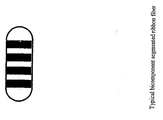
- the cross section that is most readily splittable is a segmented ribbon, such as that shown in Figure 2 .
- the number of segments has to be odd so that the same polymer is found at both ends so as to "balance" the structure.
- This fiber is anisotropic and is difficult to process as a staple fiber. As a filament, however, it would work fine. Therefore, in the spunbonding process, this fiber can be attractive. Processing is improved in fibers such as tipped trilobal or segmented cross. See Figure 3 .
- segmented pie configurations Another disadvantage utilizing segmented pie configurations is that the overall fiber shape upon splitting is a wedge shape. This configuration is a direct result of the process to producing the small micro-denier fibers. Consequently, while suitable for their intended purpose, nonetheless, other shapes of fibers may be desired which produce advantageous application results. Such shapes are currently unavailable under standard segmented processes.
- micro-denier fibers utilizing the segmented pie format
- certain limitations are placed upon the selection of the materials utilized and available. While the components must be of sufficiently different material so the adhesion between the components is minimized facilitating separation, they nonetheless also must be sufficiently similar in characteristics in order to enable the fiber to be manufacturing during a spun-bound or melt-blown process. If the materials are sufficiently dissimilar, the fibers will break during processing.
- US 6,335,092 discloses a composite staple fiber having a layered composite structure in which a polymer component A and a polymer component B have a flat cross section and are alternately arranged therein.
- the cross section of the composite staple fibers in this document may be a multilayer form, hollow multilayer form, petal form or a hollow petal form according to the intended application and performance.
- the fibers in this document are designed to be split into components A and B having the very specific shapes illustrated in the figures of the document.
- DE 100 26 281 describes a mixture of two polymers, which is extruded to produce filaments, from which a fabric is prepared. More specifically it describes that polyester resin and polyethylene resin are mixed, and the resulting resin mixture is extruded.
- the two components in this document are randomly mixed and therefore are in random orientation with respect to one another in the resulting fiber.
- the resulting fibers have non-continuous regions of the mixture components at random places along their length.
- U.S. Patent No. 6,455,156 discloses one such structure.
- a primary fiber component the sea
- the sea is utilized to envelope smaller interior fibers, the islands.
- Such structures provide for ease of manufacturing, but require the removal of the sea in order to reach the islands. This is done by dissolving the sea in a solution which does not impact the islands.
- Such process is not environmentally friendly as an alkali solution is utilized which requires waste water treatment.
- the method restricts the types of polymers which may be utilized in that they are not affected by the sea removal solution.
- Such island in the sea fibers are commercially available today. They are most often used in making synthetic leathers and suedes. In the case of synthetic leathers, a subsequent step introduces coagulated polyurethane into the fabric, and may also include a top coating.
- Another end-use that has resulted in much interest in such fibers is in technical wipes, where the small fibers lead to a large number of small capillaries resulting in better fluid absorbency and better dust pick-up. For a similar reason, such fibers may be of interest in filtration.
- An advantage with an island in the sea technology is that if the spinpack is properly designed, the sea can act as a shield and protect the islands so as to reduce spinning challenges.
- limitations upon the availability of suitable polymers for the sea and island components are also restricted.
- islands in the sea technology is not employed for making micro-denier fibers other than via the removal of the sea component because of the common belief that the energy required to separate the island in the sea is not commercially viable.
- a method for producing micro-denier fabrics wherein bicomponent islands in the sea fiber/filaments are fibrillated wherein the sea island remains integrated with the island fibers forming a high strength nonwoven fabric.
- the subject matter disclosed herein relates to a method for producing continuous filaments and subsequent fabrics with improved flexibility, abrasion resistance and durability.
- the basis for the invention is the formation of a bicomponent filament which includes an external fiber component which envelopes an internal fiber component.
- the internal fiber component consists of a plurality of fibers and the filament is of an island in the sea configuration.
- One important feature of the invention is that the external fiber enwraps the internal fiber. By doing so, the internal fiber is allowed to crystallize and solidify prior to the external fiber solidifying. This promotes an unusually strong island fiber. Such configuration enables the external fiber component to be fibrillated by external energy thereby separating itself from the internal fiber component.
- Another important aspect of the invention is that with the fibrillation, the internal sea fibers remain as continuous fibers and the external sea component also forms continuous fiber elements which interact with the sea fibers forming bonds between the respective fibers. This promotes the high strength aspect of the invention even though the respective fibers themselves are at the micro and nano levels.
- the external energy is provided by water jets in a hydroentanglement process which simultaneously fibrillates the external fibers and maintains the external fibers in a bonding configuration with other external fibers and also with the internal fibers.
- neither the internal island fibers or external sea fibers are soluble in water resulting in the external sea fibers to remain bonded with the internal sea fibers in the nonwoven article.
- the method for producing a nonwoven fabric includes spinning a set of bicomponent fibers which includes an external fiber component and an internal fiber component wherein the external fiber completely enwraps the internal fiber along its length.
- the external fiber in the most preferred embodiment is of softer material than the internal fiber and fibrillated exposing the internal fiber component.
- the fibers are continuous promoting the economical feasibility of the invention. Accordingly, when fibrillated, both the internal island fibers and external sea fibers are predominately continuous fibers intertwined with one another forming the high strength.
- the fibrillation process utilizes hydro energy for fibrillating the external fiber component and is of sufficient energy for hydroentangling the set of bicomponent fibers.
- the hydroentanglement process typically occurs after the bicomponent fibers have been positioned onto a web. The process results in micro-denier fibers being produced which may be less than .5 microns.
- the internal component fiber is produced having a non-wedge shape cross-section.
- Such cross-section is multi-lobal or round.
- Such configurations provide for more bulk in the fabric and enable the fibers to have more movement than wedge shaped fibers.
- Such configuration produces a fiber which is harder to tear.
- the eternal polymer component or the sea by fibrillating the eternal polymer component or the sea, a highly flexible and more breathable nonwoven fabric composed of micro or nano fibers may be produced which produces filters, wipes, cleaning cloths, and textiles which are durable and have good abrasion resistance. If more strength is required, the internal and external fibers may be subjected to thermal bonding after said external fibers have been fibrillated.
- the external component may comprise about 5%-95% of the total fiber.
- the materials for the fiber components various types maybe utilized as long as the external fiber component is incompatible with the island component. Incompatibility is defined herein as the two fiber components forming clear interfaces between the two such that one does not diffuse into the other.
- One of the better examples include the utilization of nylon and polyester for the two various components. Wherein such fibers may be limited in their utilization in the typical prior art segmented pie structure, by utilizing the island in the sea structure the two components may co-exist forming a highly desireable high strength nonwoven.
- the internal fibers may comprise of thermoplastics selected from the group of thermoplastic polymers wherein the thermoplastic polymer is a copolyetherester elastomer with long chain ether ester units and short chain ester units joined head to tail through ester linkages.
- the internal fibers may comprise of polymers selected from the group of thermoplastic polymers wherein the thermoplastic polymer is selected from nylon 6, nylon 6/6, nylon 6,6/6, nylon 6/10, nylon 6/11, nylon 6/12 polypropylene or polyethylene, polyesters, co-polyesters or other similar thermoplastic polymers.
- the internal fibers may comprise of polymers selected from the group of thermoplastic polymers consisting of: polyesters, polyamides, thermoplastic copolyetherester elastomers, polyolefines, polyacrylates, and thermoplastic liquid crystalline polymers.
- the external fibers may also comprise thermoplastics selected from the group of thermoplastic polymers wherein said thermoplastic polymer is a copolyetherester elastomer with long chain ether ester units and short chain ester units joined head to tail through ester linkages.
- the external fibers may comprise polymers selected from the group of thermoplastic polymers wherein the thermoplastic polymer is selected from nylon 6, nylon 6/6, nylon 6,6/6, nylon 6/10, nylon 6/11, nylon 6/12 polypropylene or polyethylene.
- the external fibers are comprised of polymers selected from the group of thermoplastic polymers consisting of: polyesters, polyamides, thermoplastic copolyetherester elastomers, polyolefines, polyacrylates, and thermoplastic liquid crystalline polymers.
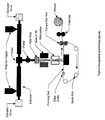
- the fibers are drawn at a ratio preferably four to one. Also, the fibers are spun vary rapidly and in some examples at three and four thousand meters per minute. With the internal fiber completely enwrapped, the fiber solidifies quicker than the external fiber. Additionally, with the clear interface between the two and low or no diffusion between the internal and external fibers, the fibers are readily fibrillated. The fibrillation may be conducted mechanically, via heat, or via hydroentangling. If hydroentangling is utilized, the fabric having external surfaces exposed may have two external surfaces or only one external surface subjected to the hydroentanglement processing.
- water pressure from one or more hydroentangling manifolds is utilized for fibrillating and hydroentangling the fiber components at a water pressure between 10 bars to 1000 bars.
- the fiber materials selected are receptive to coating with a resin to form an impermeable material or may be subjected to a jet dye process after the external component is fibrillated.
- the fabric is stretched in the machine direction during a drying process for re-orientation of the fibers within the fabric and during the drying process, the temperature of the drying process is high enough above the glass transition of the polymers and below the onset of melting to create a memory by heat-setting so as to develop cross-wise stretch and recovery in the final fabric.
- the critical feature of the invention is that the sea fibers are intertwined and entangled with the island fibers upon fibrillation. Consequently, while the island fibers can be manufactured at the micro and nano levels, the sea component also separates between the respective fibers forming micro and nano fibers of the sea component. Thus, the sea and island fibers produce continuous micro and nano fibers from a single bicomponent fiber. Also, with the fibers maintaining their structural integrity, they are enabled to intertwine and entangle amongst themselves forming the high strength fiber. Additionally, but being able to utilize incompatible components, the ultimate non-woven article may be produced utilized such components which are not feasible to combine utilizing prior art segmented pie technology.
- the invention contemplates the manufacturing of bicomponent fibers
- the invention also relates to the manufacturing of continuous bicomponent filaments and the incorporation of the filaments into nonwoven articles of manufacture.
- This manufacturing may be conducted to produce fabrics which are woven or knitted and made from bicomponent islands in the sea fibers and filaments or can be nonwovens and formed by either spunbonding or through the use of bicomponent staple fibers formed into a web by any one of several means and boded similarly to those used for the spunbonded filament webs.
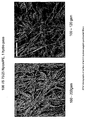
- the fiber in the form islands-in-the-sea is employed ( Figure 6 ), the fiber can be made to split by hydroentangling if the sheath or the sea polymer is sufficiently weak and particularly when the two components have little or no affinity for one another. Examples of the fibers are shown in Figure 7 . Note that the islands are "protected" by the sea (or the sheath) and therefore, fiber spinning will not be as challenging. The use of a polymer that can be easily mechanically split or fibrillated is advantageous.
- the fibers in Figure 7 are all made from a linear low density polyethylene (LLDPE) and the core or the islands are made from nylon. These polymer combinations appear to work well when there is a need to split the fibers mechanically.
- LLDPE linear low density polyethylene
- Example 2 75 / 25% Nylon islands / PE sea, 108 islands
- calendaring improves the properties because the sea is melted and wraps the fibers adding to the strength.
- Articles which may be manufactured utilizing the high strength bicomponent nonwoven fabric include tents, parachutes, outdoor fabrics, house wrap, awning, and the like. Some examples have produced nonwoven articles having a tear strength greater than 6 grams per denier and others enduring over ten pounds of tearing forces.
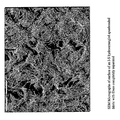
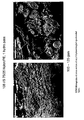
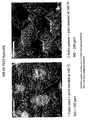
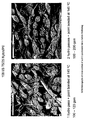
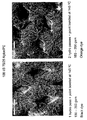
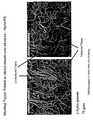
- the bicomponent fiber may be tri-lobal. In this configuration the central island is completely encircles by three lobes. Consequently, when fibrillated, four separate fibers are produced which enwrap upon each other forming a high strength fabric. Such a structure may be more feasible in some situations where a complete island in the sea structure cannot be manufactured. Also, the differences between thermally bonded bicomponent fibers and fibrillated and bonded bicomponent fibers are illustrated. Also Figure 19 illustrates when insufficient energy is utilized when fibrillating the fibers.
- the invention relates to a method for producing a high strength spunbonded nonwovens with improved flexibility, abrasion resistance and durability which has been disclosed.
- the basis for the invention is the formation of a bicomponent spunbonded web composed of two polymers different in their chemical structure in the form of islands in the sea wherein the sea material protects the sheath or the islands and is a softer material than the island or the core, and where such web is bonded by:
Landscapes
- Engineering & Computer Science (AREA)
- Textile Engineering (AREA)
- Mechanical Engineering (AREA)
- Chemical & Material Sciences (AREA)
- Chemical Kinetics & Catalysis (AREA)
- General Chemical & Material Sciences (AREA)
- Nonwoven Fabrics (AREA)
- Multicomponent Fibers (AREA)
- Spinning Methods And Devices For Manufacturing Artificial Fibers (AREA)
- Tents Or Canopies (AREA)
- Artificial Filaments (AREA)
Claims (26)
- Verfahren zur Herstellung eines Vliesgewebes, das umfasst:Spinnen eines Sets an Bikomponentenfasern in der Form von Inseln-im-Meer-Fasern ("islands-in-the-sea fibers,"), die umfasseneine äußere Meerfaserkomponente;eine innere Faserkomponente, die eine Vielzahl innerer Inseln umfasst;wobei die genannte äußere Faserkomponente die innere Faserkomponente einhüllt und der Querschnitt der inneren Faserkomponente rund oder multilobal ist;Positionieren des genannten Sets an Bikomponentenfasern auf ein Netz; undFibrillieren der genannten äußeren Faserkomponente durch äußere Energie, wobei Exposition der genannten inneren Faserkomponente und Trennung der inneren Faserkomponente von der äußeren Faserkomponente verursacht wird, so dass sowohl die innere Faserkomponente als auch die äußere Faserkomponente als überwiegend kontinuierliche Fasern miteinander verflochten bleiben um ein Vliesgewebe zu bilden, ohne die äußere Faserkomponente zu entfernen.
- Verfahren zur Herstellung eines Vliesgewebes gemäß Anspruch 1, das weiterhin die Verwendung von Wasserkraft für das Fibrillieren der genannten äußeren Faserkomponente umfasst.
- Verfahren zur Herstellung eines Vliesgewebes gemäß Anspruch 2, das weiterhin die Verwendung der genannten Wasserkraft für Masserstrahlverfilzung des Sets an Bikomponentenfasern umfasst.
- Verfahren zur Herstellung des genannten Vliesgewebes gemäß Anspruch 1, wobei die genannten inneren und äußeren Faserkomponenten thermischem Bonding unterworfen werden, nachdem die genannten äußeren Faserkomponenten fibrilliert worden sind.
- Verfahren gemäß Anspruch 1, wobei die genannte äußere Faserkomponente viskoser ist als die genannte innere Faserkomponente der genannten Bikomponentenfaser.
- Verfahren gemäß Anspruch 1, wobei die genannte innere Faserkomponente einen Thermoplasten, ausgewählt aus der Gruppe thermoplastischer Polymere umfasst, wobei das genannte thermoplastische Polymer ein Copolyetheresterelastomer mit langkettigen Etherestereinheiten und kurzkettigen Estereinheiten, die Kopf-zu-Schwanz durch Esterbindungen miteinander verbunden sind, ist.
- Verfahren gemäß Anspruch 1, wobei die genannte äußere Faserkomponente einen Thermoplasten, ausgewählt aus der Gruppe thermoplastischer Polymere umfasst, wobei das genannte thermoplastische Polymer ein Copolyetheresterelastomer mit langketzigen Etherestereinheiten und kurzkettigen Estereinheiten, die Kopf-zu-Schwanz durch Esterbindungen miteinander verbunden sind, ist.
- Verfahren gemäß Anspruch 1, wobei die genannte innere Faserkomponente ein Polymer, ausgewählt aus der Gruppe thermoplastischer Polymere, umfasst, wobei das genannte thermoplastische Polymer ausgewählt ist aus Nylon 6, Nylon 6/6, Nylon 6,6/6, Nylon 6/10, Nylon 6/11, Nylon 6/12, Polypropylen oder Polyethylen.
- Verfahren gemäß Anspruch 1, wobei die genannte äußere Faserkomponente ein Polymer, ausgewählt aus der Gruppe thermoplastischer Polymere, umfasst, wobei das genannte thermoplastische Polymer ausgewählt ist aus Nylon 6, Nylon 6/6, Nylon 6,6/6, Nylon 6/10, Nylon 6/11, Nylon 6/12, Polypropylen oder Polyethylen.
- Verfahren gemäß Anspruch 1, wobei die genannte äußere Faserkomponente ein Polymer, ausgewählt aus der Gruppe thermoplastischer Polymere, bestehend aus: Polyestern, Polyamiden, thermoplastischen Copolyetheresterelastomeren, Polyolefinen, Polyacrylaten und thermoplastischen flüssigkristallinen Polymeren, umfasst.
- Verfahren gemäß Anspruch 1, wobei die genannte innere Faserkomponente ein Polymer, ausgewählt aus der Gruppe thermoplastischer Polymere, bestehend aus: Polyestern, Polyamiden, thermoplastischen Copolyetheresterelastomeren, Polyolefinen, Polyacrylaten und thermoplastischen flüssigkristallinen Polymeren, umfasst.
- Verfahren gemäß Anspruch 1, wobei die genannte innere Faserkcmponente multilobal ist.
- Verfahren gemäß Anspruch 1, wobei die genannte innere Faserkomponente einen runden Querschnitt hat.
- Verfahren gemäß Anspruch 1, wobei die genannte äußere Faserkomponente etwa 5% bis 95% der gesamten Faser umfasst.
- Verfahren gemäß Anspruch 1, wobei das genannte Vliesgewebe zwei äußere Oberflächen hat und das genannte Gewebe Wasserstrahlverfilzung an beiden Oberflächen ausgesetzt wird.
- Verfahren gemäß Anspruch 1, wobei nur eine Oberfläche des genannten Vliesgewebes Wasserstrahlverfilzungsbearbeitung ausgesetzt ist.
- Verfahren gemäß Anspruch 1, wobei das genannte Vliesgewebe Wasserdruck aus einem oder mehreren Wasserstrahlverfilzungsverteiler(n) bei einem Wasserdruck zwischen 10 bar bis 1000 bar ausgesetzt wird.
- Verfahren gemäß Anspruch 1, wobei das genannte Vliesgewebe mit einem Harz beschichtet wird, um ein undurchlässiges Material zu bilden.
- Verfahren gemäß Anspruch 1, wobei das genannte Vliesgewebe einem Düsenfärbungsverfahren unterworfen wird, nachdem die genannte äußere Komponente fibrilliert wurde.
- Verfahren gemäß Anspruch 1, wobei das genannte Vliesgewebe während des Trocknungsverfahrens, unmittelbar im Anschluss an die Wasserstrahlverfilzung für eine Reorientierung der Fasern in dem Gewebe in der Maschinenrichtung gedehnt wird.
- Verfahren gemäß Anspruch 20, wobei die Temperatur des Trocknungsverfahrens hoch genug über dem Glasübergang der Polymere und unterhalb des Beginns des Schmelzens ist, um eine Erinnerung durch Hitzeeinstellung zu erzeugen, um kreuzweise Dehnung und Rückformung in dem Gewebe zu entwickeln.
- Verfahren gemäß Anspruch 1, wobei sowohl die äußere Meerkomponente als auch die inneren Inseln unlöslich in Wasser sind, und wobei der Fibrillierungsschritt Wasserstrahlverfilzung der Bikomponenten-Inseln-im-Meer-Fasern umfasst, wobei die Wasserstrahlverfilzung Exposition der inneren Inseln und Verflechtung zwischen den inneren Inseln und der äußeren Meerkomponente verursacht, und wobei im Anschluss an die Wasserstrahlverfilzung sowohl die inneren Inseln als auch die äußere Meerkomponente Mikro-Denier-Fasern bilden.
- Verfahren gemäß Anspruch 22, wobei das genannte Vliesgewebe nach der Wasserstrahlverfilzung thermischem Bonding unterworfen wird.
- Verfahren gemäß Anspruch 22, wobei die genannte äußere Meerkomponente viskoser ist als die genannten inneren Inseln der genannten Bikomponentenfaser.
- Verfahren gemäß Anspruch 1, das weiterhin Bildung eines Vliesartikels aus dem Vliesgewebe umfasst.
- Verfahren gemäß Anspruch 22, das weiterhin Bildung eines Vliesartikels aus dem Vliesgewebe umfasst.
Priority Applications (1)
| Application Number | Priority Date | Filing Date | Title |
|---|---|---|---|
| EP13151392.1A EP2597183B1 (de) | 2005-06-24 | 2006-06-23 | Durch Fibrillierung von Bikomponenten-Inseln-in-der-See-Fasern hergestellte hochfeste, langlebige Mikro- und Nanofaservliese |
Applications Claiming Priority (2)
| Application Number | Priority Date | Filing Date | Title |
|---|---|---|---|
| US69412105P | 2005-06-24 | 2005-06-24 | |
| PCT/US2006/024465 WO2007002387A2 (en) | 2005-06-24 | 2006-06-23 | High strength, durable micro & nano-fiber fabrics produced by fibrillating bicomponent islands in the sea fibers |
Related Child Applications (2)
| Application Number | Title | Priority Date | Filing Date |
|---|---|---|---|
| EP13151392.1A Division EP2597183B1 (de) | 2005-06-24 | 2006-06-23 | Durch Fibrillierung von Bikomponenten-Inseln-in-der-See-Fasern hergestellte hochfeste, langlebige Mikro- und Nanofaservliese |
| EP13151392.1 Division-Into | 2013-01-16 |
Publications (3)
| Publication Number | Publication Date |
|---|---|
| EP1907201A2 EP1907201A2 (de) | 2008-04-09 |
| EP1907201A4 EP1907201A4 (de) | 2010-08-25 |
| EP1907201B1 true EP1907201B1 (de) | 2013-03-06 |
Family
ID=37595869
Family Applications (2)
| Application Number | Title | Priority Date | Filing Date |
|---|---|---|---|
| EP20060785429 Expired - Lifetime EP1907201B1 (de) | 2005-06-24 | 2006-06-23 | Durch fibrillierung von bikomponenten-inseln-in-der-see-fasern hergestellte hochfeste, langlebige mikro- und nanofasergewebe |
| EP13151392.1A Expired - Lifetime EP2597183B1 (de) | 2005-06-24 | 2006-06-23 | Durch Fibrillierung von Bikomponenten-Inseln-in-der-See-Fasern hergestellte hochfeste, langlebige Mikro- und Nanofaservliese |
Family Applications After (1)
| Application Number | Title | Priority Date | Filing Date |
|---|---|---|---|
| EP13151392.1A Expired - Lifetime EP2597183B1 (de) | 2005-06-24 | 2006-06-23 | Durch Fibrillierung von Bikomponenten-Inseln-in-der-See-Fasern hergestellte hochfeste, langlebige Mikro- und Nanofaservliese |
Country Status (10)
| Country | Link |
|---|---|
| US (2) | US7981226B2 (de) |
| EP (2) | EP1907201B1 (de) |
| JP (1) | JP5266050B2 (de) |
| KR (1) | KR101280398B1 (de) |
| CN (1) | CN101641469B (de) |
| BR (1) | BRPI0611878A2 (de) |
| CA (1) | CA2612691A1 (de) |
| ES (1) | ES2570965T3 (de) |
| MX (1) | MX2007016348A (de) |
| WO (1) | WO2007002387A2 (de) |
Cited By (2)
| Publication number | Priority date | Publication date | Assignee | Title |
|---|---|---|---|---|
| US11478735B2 (en) | 2017-03-28 | 2022-10-25 | Mann+Hummel Gmbh | Spun-bonded fabric material, object comprising a spun-bonded fabric material, filter medium, filter element, and use thereof |
| US11795593B2 (en) | 2017-03-28 | 2023-10-24 | Mann+Hummel Gmbh | Filter medium, filter element and use thereof and filter arrangement |
Families Citing this family (60)
| Publication number | Priority date | Publication date | Assignee | Title |
|---|---|---|---|---|
| US20100029161A1 (en) * | 2005-06-24 | 2010-02-04 | North Carolina State University | Microdenier fibers and fabrics incorporating elastomers or particulate additives |
| US7883772B2 (en) * | 2005-06-24 | 2011-02-08 | North Carolina State University | High strength, durable fabrics produced by fibrillating multilobal fibers |
| WO2007112443A2 (en) * | 2006-03-28 | 2007-10-04 | North Carolina State University | Micro and nanofiber nonwoven spunbonded fabric |
| CN101535537B (zh) * | 2006-11-10 | 2011-01-26 | 欧瑞康纺织有限及两合公司 | 用于熔融纺制和冷却合成单丝的方法及装置 |
| WO2009029391A2 (en) * | 2007-08-02 | 2009-03-05 | North Carolina State University | Mixed fibers and nonwoven fabrics made from the same |
| US8021996B2 (en) * | 2008-12-23 | 2011-09-20 | Kimberly-Clark Worldwide, Inc. | Nonwoven web and filter media containing partially split multicomponent fibers |
| TW201125687A (en) * | 2010-01-20 | 2011-08-01 | San Fang Chemical Industry Co | Polishing pad and method for making the same |
| LT3023362T (lt) | 2010-07-22 | 2018-04-25 | K-Fee System Gmbh | Porcijos kapsulė su identifikatoriumi |
| US20120177996A1 (en) * | 2010-10-21 | 2012-07-12 | Eastman Chemical Company | Nonwoven article with ribbon fibers |
| WO2012174204A2 (en) | 2011-06-17 | 2012-12-20 | Fiberweb, Inc. | Vapor permeable, substantially water impermeable multilayer article |
| US10369769B2 (en) | 2011-06-23 | 2019-08-06 | Fiberweb, Inc. | Vapor-permeable, substantially water-impermeable multilayer article |
| EP2723568B1 (de) | 2011-06-23 | 2017-09-27 | Fiberweb, LLC | Dampfdurchlässiger und im wesentlichen wasserundurchlässiger mehrschichtiger artikel |
| US9765459B2 (en) | 2011-06-24 | 2017-09-19 | Fiberweb, Llc | Vapor-permeable, substantially water-impermeable multilayer article |
| KR101403270B1 (ko) * | 2011-09-01 | 2014-06-02 | 2266170 온타리오 인크. | 다층 재료 및 용기 그리고 이들을 제조하는 방법 |
| EP2800618B1 (de) | 2012-01-04 | 2018-03-28 | North Carolina State University | Elastomerer tiefenfilter |
| WO2013103844A1 (en) | 2012-01-05 | 2013-07-11 | North Carolina State University | Method of forming nonwoven fabrics utilizing reduced energy |
| DE102012105282A1 (de) | 2012-06-18 | 2013-12-19 | K-Fee System Gmbh | Portionskapsel und Verfahren zur Herstellung eines Getränks mit einer Portionskapsel |
| US10058808B2 (en) | 2012-10-22 | 2018-08-28 | Cummins Filtration Ip, Inc. | Composite filter media utilizing bicomponent fibers |
| US20140127364A1 (en) * | 2012-11-07 | 2014-05-08 | 2266170 Ontario Inc. | Beverage Capsule With Moldable Filter |
| DE102012223291A1 (de) | 2012-12-14 | 2014-06-18 | K-Fee System Gmbh | Portionskapsel und Verfahren zur Herstellung eines Getränks mit einer Portionskapsel |
| WO2014099884A1 (en) | 2012-12-18 | 2014-06-26 | North Carolina State University | Methods of forming an artificial leather substrate from leather waste and products therefrom |
| US9284663B2 (en) * | 2013-01-22 | 2016-03-15 | Allasso Industries, Inc. | Articles containing woven or non-woven ultra-high surface area macro polymeric fibers |
| US9504610B2 (en) | 2013-03-15 | 2016-11-29 | The Procter & Gamble Company | Methods for forming absorbent articles with nonwoven substrates |
| US9205006B2 (en) | 2013-03-15 | 2015-12-08 | The Procter & Gamble Company | Absorbent articles with nonwoven substrates having fibrils |
| US20140291068A1 (en) * | 2013-03-29 | 2014-10-02 | E I Du Pont De Nemours And Company | Tunable acoustical absorbing composite batt |
| CN103789926A (zh) * | 2014-01-24 | 2014-05-14 | 廊坊中纺新元无纺材料有限公司 | 一种海岛型纺粘长丝非织造材料及其制造方法 |
| CA2959817A1 (en) | 2014-09-10 | 2016-03-17 | The Procter & Gamble Company | Nonwoven web |
| CN104727015A (zh) * | 2015-02-06 | 2015-06-24 | 宁波高新区零零七工业设计有限公司 | 熔喷非织造布的制备方法 |
| SG11201705884YA (en) | 2015-02-27 | 2017-09-28 | K Fee System Gmbh | Single serve capsule comprising a filter element connected thereto by sealing |
| US9481144B1 (en) | 2015-03-02 | 2016-11-01 | Air Cruisers Company, LLC | Nonwoven flexible composites |
| US9527249B1 (en) | 2015-03-02 | 2016-12-27 | Air Cruisers Company, LLC | Nonwoven flexible composites |
| AU2016274658B2 (en) | 2015-06-10 | 2020-11-05 | K-Fee System Gmbh | Portion capsule with a three-ply nonwoven fabric |
| US10737876B2 (en) | 2015-07-13 | 2020-08-11 | K-Fee System Gmbh | Filter element having a cut-out |
| BR112018001581A2 (pt) | 2015-07-30 | 2018-09-18 | Univ North Carolina State | não tecido de ilhas-no-mar enxertadas para alta capacidade de biosseparação de permuta de íons |
| CA2998669C (en) | 2015-09-18 | 2020-01-07 | K-Fee System Gmbh | Adapter for a single serve capsule |
| CN109152678B (zh) | 2016-03-09 | 2021-04-30 | 宝洁公司 | 具有可活化材料的吸收制品 |
| US11692284B2 (en) | 2016-08-18 | 2023-07-04 | Aladdin Manufacturing Corporation | Trilobal filaments and spinnerets for producing the same |
| US20180117819A1 (en) * | 2016-10-27 | 2018-05-03 | Clemson University Research Foundation | Inherently super-omniphobic filaments, fibers, and fabrics and system for manufacture |
| USD841838S1 (en) | 2016-11-04 | 2019-02-26 | Mohawk Industries, Inc. | Filament |
| EP3592316B1 (de) | 2017-03-09 | 2023-12-06 | The Procter & Gamble Company | Thermoplastische polymere materialien mit wärmeaktivierbaren zusammensetzungen |
| PT3829982T (pt) | 2018-07-27 | 2022-11-17 | Gcs German Capsule Solution Gmbh | Processo para produzir uma cápsula de porção para prepa-rar uma bebida numa máquina de produção de bebidas |
| CN109056196B (zh) * | 2018-10-29 | 2020-06-02 | 广东宝泓新材料股份有限公司 | 一种高过滤精度的聚酯纺粘非织造布的制造设备及其方法 |
| EP3883865B2 (de) | 2018-11-22 | 2025-11-05 | GCS German Capsule Solution GmbH | Dichtung einer portionskapsel |
| US11787152B2 (en) | 2018-12-13 | 2023-10-17 | North Carolina State University | Method of preparing a composite sheet |
| US20220203330A1 (en) * | 2019-02-25 | 2022-06-30 | North Carolina State University | Fibrillated bicomponent fibers and methods of making and uses thereof |
| US20200270787A1 (en) * | 2019-02-25 | 2020-08-27 | North Carolina State University | Spunbond filters with low pressure drop and high efficiency |
| AR118565A1 (es) * | 2019-04-16 | 2021-10-20 | Dow Global Technologies Llc | Fibras bicomponentes, redes no tejidas y procesos para elaborarlas |
| GB2593414B (en) * | 2019-08-30 | 2023-06-07 | E Leather Ltd | Composite Material |
| CN110616484A (zh) * | 2019-09-04 | 2019-12-27 | 西安工程大学 | 一种用静电纺丝技术制备压电pvdf包覆碳纤维的方法 |
| US12234578B2 (en) * | 2020-01-29 | 2025-02-25 | Wisconsin Alumni Research Foundation | Tannin composite fibers |
| WO2022003566A1 (en) * | 2020-06-30 | 2022-01-06 | North Carolina State University | Nonwoven material and mask made therewith |
| CN112251827A (zh) * | 2020-09-10 | 2021-01-22 | 深圳市华远新材料有限公司 | 一种h型皮芯结构聚乳酸丝束及其制备方法 |
| CN112575398B (zh) * | 2020-12-21 | 2021-11-12 | 江苏华峰超纤材料有限公司 | 一种热成型无纺布用pp/ldpe海岛纤维及其制备方法 |
| US12303564B2 (en) | 2021-03-19 | 2025-05-20 | Wisconsin Alumni Research Foundation | Composite chitosan-tannin-active agent compositions and methods of making and using same |
| CN114108187B (zh) * | 2021-12-10 | 2023-02-17 | 天津工业大学 | 一种混纤长丝超细纤维非织造材料及其制备方法和应用 |
| US12258692B2 (en) * | 2022-03-01 | 2025-03-25 | Elc Management Llc | Cosmetic sheet masks for improved product delivery |
| CN115386976A (zh) * | 2022-09-02 | 2022-11-25 | 王辉 | 一种透气排湿良好的功能性纺织新材料 |
| US20250320644A1 (en) | 2024-04-16 | 2025-10-16 | Delstar Technologies, Inc. | High loft nonwoven material |
| WO2025231294A1 (en) | 2024-05-02 | 2025-11-06 | Delstar Technologies, Inc. | Filter media, triboelectrically charged fibers thereof, and methods for the same |
| CN120889098B (zh) * | 2025-10-09 | 2025-12-23 | 天津工业大学 | 一种纳米纤维非织造材料及其制备方法和应用 |
Family Cites Families (69)
| Publication number | Priority date | Publication date | Assignee | Title |
|---|---|---|---|---|
| US3418200A (en) | 1964-11-27 | 1968-12-24 | Du Pont | Splittable composite filament |
| GB1218191A (en) * | 1966-10-17 | 1971-01-06 | Toray Industries | Improvements relating to non-woven fibrous felt and methods of manufacturing such felt |
| GB1311085A (de) | 1969-04-25 | 1973-03-21 | ||
| ZA7167B (en) | 1970-01-08 | 1971-10-27 | Shell Int Research | Process for the manufacture of synthetic fibres |
| US3629047A (en) | 1970-02-02 | 1971-12-21 | Hercules Inc | Nonwoven fabric |
| CA948388A (en) | 1970-02-27 | 1974-06-04 | Paul B. Hansen | Pattern bonded continuous filament web |
| US3829324A (en) | 1970-03-31 | 1974-08-13 | Canadian Patents Dev | Bonding condensation polymers to polymeric base materials |
| US3724198A (en) | 1970-07-10 | 1973-04-03 | Hercules Inc | Method for preparing spun yarns |
| US3751777A (en) | 1971-07-09 | 1973-08-14 | H Turmel | Process for making tufted pile carpet |
| US4274251A (en) | 1973-01-16 | 1981-06-23 | Hercules Incorporated | Yarn structure having main filaments and tie filaments |
| US3914365A (en) | 1973-01-16 | 1975-10-21 | Hercules Inc | Methods of making network structures |
| FR2306818A1 (fr) | 1975-04-10 | 1976-11-05 | Inst Textile De France | Procede pour la fabrication d'elements textiles frises par fibrillation de films et produits obtenus |
| JPS52155269A (en) * | 1976-06-17 | 1977-12-23 | Toray Industries | Suedeelike textile and method of producing same |
| JPS551337A (en) | 1978-06-15 | 1980-01-08 | Toray Ind Inc | Electrically conducitive synthetic fiber and its production |
| US4381335A (en) * | 1979-11-05 | 1983-04-26 | Toray Industries, Inc. | Multi-component composite filament |
| JPS58169557A (ja) * | 1982-03-31 | 1983-10-06 | 東レ株式会社 | 交絡不織布およびその製造方法 |
| JPS599279A (ja) | 1982-07-07 | 1984-01-18 | 東レ株式会社 | 新規なアニリン調異色銀面をもつ人工皮革およびその製造方法 |
| US4620852A (en) * | 1984-06-19 | 1986-11-04 | Toray Industries, Inc. | Grained artificial leather having good color fastness and dyeing method of ultrafine polyamide fibers |
| US4551378A (en) | 1984-07-11 | 1985-11-05 | Minnesota Mining And Manufacturing Company | Nonwoven thermal insulating stretch fabric and method for producing same |
| US4866107A (en) | 1986-10-14 | 1989-09-12 | American Cyanamid Company | Acrylic containing friction materials |
| JPS63219653A (ja) * | 1987-03-06 | 1988-09-13 | 東レ株式会社 | 極細マルチフイラメント不織布及びその製法 |
| US5009239A (en) | 1988-12-20 | 1991-04-23 | Hoechst Celanese Corporation | Selective delivery and retention of aldehyde and nicotine by-product from cigarette smoke |
| USRE35621E (en) | 1989-05-30 | 1997-10-07 | Hercules Incorporated | Cardable hydrophobic polypropylene fiber, material and method for preparation thereof |
| CA2017782A1 (en) | 1989-06-01 | 1990-12-01 | James H. Harrington | Rewettable polyolefin fiber and corresponding nonwovens |
| US5045387A (en) | 1989-07-28 | 1991-09-03 | Hercules Incorporated | Rewettable polyolefin fiber and corresponding nonwovens |
| US5141522A (en) | 1990-02-06 | 1992-08-25 | American Cyanamid Company | Composite material having absorbable and non-absorbable components for use with mammalian tissue |
| SG49022A1 (en) | 1990-11-15 | 1998-05-18 | Hercules Inc | Cardable hydrophobic polyolefin fiber material and method for preparation therof |
| EP0490476B1 (de) | 1990-12-14 | 1996-08-28 | Hercules Incorporated | Vliesstoff mit hoher Festigkeit und Geschmeidigkeit |
| CA2069269C (en) | 1991-05-28 | 1998-09-15 | Roger W. Johnson | Cardable hydrophobic polypropylene fiber |
| US5330457A (en) | 1991-09-30 | 1994-07-19 | Hercules Incorporated | Enhanced core utilization in absorbent products |
| JP3459269B2 (ja) * | 1991-10-16 | 2003-10-20 | 株式会社クラレ | 空孔を有する複合繊維およびその製造方法 |
| US5336552A (en) | 1992-08-26 | 1994-08-09 | Kimberly-Clark Corporation | Nonwoven fabric made with multicomponent polymeric strands including a blend of polyolefin and ethylene alkyl acrylate copolymer |
| EP0696693B1 (de) | 1994-08-09 | 1999-07-07 | Sterling Chemicals International, Inc. | Durch ein Trockenverfahren hergestelltes Reibungsmaterial, Verfahren zu dessen Herstellung und trockene Mischung |
| US5520866A (en) | 1994-08-09 | 1996-05-28 | Cytec Technology Corp. | Process for the preparation of friction materials containing blends of organic fibrous and particulate components |
| IN183563B (de) | 1994-08-09 | 2000-02-12 | Sterling Chemicals Internat In | |
| AU702352B2 (en) | 1994-08-09 | 1999-02-18 | Sterling Chemicals International, Inc. | Asbestos-free gaskets and the like containing blends of organic fibrous and particulate components |
| US5472995A (en) | 1994-08-09 | 1995-12-05 | Cytec Technology Corp. | Asbestos-free gaskets and the like containing blends of organic fibrous and particulate components |
| US5827443A (en) | 1995-06-28 | 1998-10-27 | Matsumoto Yushi-Seiyaku Co., Ltd. | Water permeating agent for textile products and water permeable textile products |
| US5916678A (en) | 1995-06-30 | 1999-06-29 | Kimberly-Clark Worldwide, Inc. | Water-degradable multicomponent fibers and nonwovens |
| AU5804396A (en) | 1995-06-30 | 1997-02-05 | Minnesota Mining And Manufacturing Company | Intumescent sheet material |
| WO1997021865A1 (en) | 1995-12-15 | 1997-06-19 | The Dexter Corporation | Abrasive nonwoven web and method of manufacture |
| FR2749860B1 (fr) * | 1996-06-17 | 1998-08-28 | Freudenberg Spunweb Sa | Nappe non tissee formee de filaments continus tres fins |
| US5783503A (en) | 1996-07-22 | 1998-07-21 | Fiberweb North America, Inc. | Meltspun multicomponent thermoplastic continuous filaments, products made therefrom, and methods therefor |
| US5972497A (en) | 1996-10-09 | 1999-10-26 | Fiberco, Inc. | Ester lubricants as hydrophobic fiber finishes |
| US5948528A (en) | 1996-10-30 | 1999-09-07 | Basf Corporation | Process for modifying synthetic bicomponent fiber cross-sections and bicomponent fibers thereby produced |
| US6506873B1 (en) | 1997-05-02 | 2003-01-14 | Cargill, Incorporated | Degradable polymer fibers; preparation product; and, methods of use |
| DE19733493C2 (de) | 1997-08-01 | 1999-05-12 | Corovin Gmbh | Verfahren zur Herstellung eines Spinnvlieses aus thermobondierten gekräuselten Bikomponentenfasern |
| JPH11217757A (ja) | 1998-01-30 | 1999-08-10 | Unitika Ltd | 短繊維不織布およびその製造方法 |
| JPH11241259A (ja) * | 1998-02-26 | 1999-09-07 | Toray Ind Inc | 不織布、ワイピングクロスおよび表皮材 |
| US6284680B1 (en) * | 1998-11-17 | 2001-09-04 | Japan Vilene Company | Nonwoven fabric containing fine fibers, and a filter material |
| EP1132508B1 (de) * | 1999-08-09 | 2006-07-19 | Kuraray Co., Ltd. | Verbundstapelfaser und herstellungsverfahren |
| DE10009248C2 (de) | 2000-02-28 | 2002-06-27 | Freudenberg Carl Kg | Medizinisches Verbandsmaterial |
| DE60135596D1 (de) | 2000-03-16 | 2008-10-16 | Kuraray Co | Hohlfasern und Verfahren zur Herstellung von Hohlfasern |
| DE10026281B4 (de) | 2000-05-26 | 2005-06-02 | Sächsisches Textilforschungsinstitut e.V. | Verfahren zur Herstellung von Spinnvliesen |
| US7896941B2 (en) | 2001-02-12 | 2011-03-01 | Aaf-Mcquay Inc. | Product and method of forming a gradient density fibrous filter |
| US20030118776A1 (en) * | 2001-12-20 | 2003-06-26 | Kimberly-Clark Worldwide, Inc. | Entangled fabrics |
| EP1458553B1 (de) * | 2001-12-28 | 2009-09-09 | SCA Hygiene Products AB | Elastische bahn und verfahren und vorrichtung für ihre herstellung sowie saugfähiger wegwerfartikel mit einer elastischen bahn |
| US20030203695A1 (en) * | 2002-04-30 | 2003-10-30 | Polanco Braulio Arturo | Splittable multicomponent fiber and fabrics therefrom |
| US7431869B2 (en) | 2003-06-04 | 2008-10-07 | Hills, Inc. | Methods of forming ultra-fine fibers and non-woven webs |
| JP4471975B2 (ja) | 2003-06-30 | 2010-06-02 | ザ プロクター アンド ギャンブル カンパニー | コーティングされたナノファイバーのウェブ |
| US8487156B2 (en) | 2003-06-30 | 2013-07-16 | The Procter & Gamble Company | Hygiene articles containing nanofibers |
| US20040266300A1 (en) | 2003-06-30 | 2004-12-30 | Isele Olaf Erik Alexander | Articles containing nanofibers produced from a low energy process |
| US8395016B2 (en) | 2003-06-30 | 2013-03-12 | The Procter & Gamble Company | Articles containing nanofibers produced from low melt flow rate polymers |
| JP2005106118A (ja) | 2003-09-29 | 2005-04-21 | Hitachi Kokusai Electric Inc | 基板処理装置 |
| JP2005154994A (ja) * | 2003-11-06 | 2005-06-16 | Teijin Fibers Ltd | 弾性複合糸および織編物および繊維製品 |
| JP2005171408A (ja) | 2003-12-10 | 2005-06-30 | Unitika Ltd | 生分解性不織布およびその製造方法 |
| MXPA06012054A (es) | 2004-04-19 | 2007-01-25 | Procter & Gamble | Fibras, telas no tejidas y articulos que contienen nanofibras producidas a partir de polimeros con una alta temperatura de transicion vitrea. |
| WO2005103355A1 (en) | 2004-04-19 | 2005-11-03 | The Procter & Gamble Company | Fibers, nonwovens and articles containing nanofibers produced from broad molecular weight distribution polymers |
| WO2005103354A1 (en) | 2004-04-19 | 2005-11-03 | The Procter & Gamble Company | Articles containing nanofibers for use as barriers |
-
2006
- 2006-06-23 EP EP20060785429 patent/EP1907201B1/de not_active Expired - Lifetime
- 2006-06-23 JP JP2008518427A patent/JP5266050B2/ja not_active Expired - Fee Related
- 2006-06-23 CA CA 2612691 patent/CA2612691A1/en not_active Abandoned
- 2006-06-23 US US11/473,534 patent/US7981226B2/en not_active Expired - Lifetime
- 2006-06-23 KR KR1020087001914A patent/KR101280398B1/ko not_active Expired - Fee Related
- 2006-06-23 CN CN2006800228045A patent/CN101641469B/zh not_active Expired - Fee Related
- 2006-06-23 BR BRPI0611878-0A patent/BRPI0611878A2/pt not_active IP Right Cessation
- 2006-06-23 WO PCT/US2006/024465 patent/WO2007002387A2/en not_active Ceased
- 2006-06-23 ES ES13151392T patent/ES2570965T3/es not_active Expired - Lifetime
- 2006-06-23 EP EP13151392.1A patent/EP2597183B1/de not_active Expired - Lifetime
- 2006-06-23 MX MX2007016348A patent/MX2007016348A/es active IP Right Grant
-
2011
- 2011-06-24 US US13/168,123 patent/US8420556B2/en not_active Expired - Lifetime
Cited By (2)
| Publication number | Priority date | Publication date | Assignee | Title |
|---|---|---|---|---|
| US11478735B2 (en) | 2017-03-28 | 2022-10-25 | Mann+Hummel Gmbh | Spun-bonded fabric material, object comprising a spun-bonded fabric material, filter medium, filter element, and use thereof |
| US11795593B2 (en) | 2017-03-28 | 2023-10-24 | Mann+Hummel Gmbh | Filter medium, filter element and use thereof and filter arrangement |
Also Published As
| Publication number | Publication date |
|---|---|
| EP2597183B1 (de) | 2016-04-06 |
| CA2612691A1 (en) | 2007-01-04 |
| US7981226B2 (en) | 2011-07-19 |
| HK1185926A1 (en) | 2014-02-28 |
| JP2008544110A (ja) | 2008-12-04 |
| KR20080034894A (ko) | 2008-04-22 |
| CN101641469A (zh) | 2010-02-03 |
| EP1907201A4 (de) | 2010-08-25 |
| KR101280398B1 (ko) | 2013-07-02 |
| JP5266050B2 (ja) | 2013-08-21 |
| HK1114058A1 (en) | 2008-10-24 |
| ES2570965T3 (es) | 2016-05-23 |
| EP2597183A1 (de) | 2013-05-29 |
| WO2007002387A2 (en) | 2007-01-04 |
| US20110250812A1 (en) | 2011-10-13 |
| MX2007016348A (es) | 2008-03-05 |
| US8420556B2 (en) | 2013-04-16 |
| BRPI0611878A2 (pt) | 2010-10-05 |
| WO2007002387A3 (en) | 2009-04-30 |
| EP1907201A2 (de) | 2008-04-09 |
| CN101641469B (zh) | 2012-10-10 |
| US20060292355A1 (en) | 2006-12-28 |
Similar Documents
| Publication | Publication Date | Title |
|---|---|---|
| EP2597183B1 (de) | Durch Fibrillierung von Bikomponenten-Inseln-in-der-See-Fasern hergestellte hochfeste, langlebige Mikro- und Nanofaservliese | |
| EP2165010B1 (de) | Durch fibrillierung multilobaler fasern hergestellte hochfeste und langlebige stoffe | |
| US20120231690A1 (en) | Multicomponent fibers and microdenier fabrics prepared by fibrillation thereof | |
| US8410006B2 (en) | Composite filter media with high surface area fibers | |
| EP2179081B1 (de) | Vliesstoffe aus mischfasern | |
| US20050215157A1 (en) | Multi-component fibers, fiber-containing materials made from multi-component fibers and methods of making the fiber-containing materials | |
| US8349232B2 (en) | Micro and nanofiber nonwoven spunbonded fabric | |
| US20200270787A1 (en) | Spunbond filters with low pressure drop and high efficiency | |
| US20220203330A1 (en) | Fibrillated bicomponent fibers and methods of making and uses thereof | |
| HK1114058B (en) | High strength, durable micro&nano-fiber fabrics produced by fibrillating bicomponent islands in the sea fibers | |
| HK1185926B (en) | High strength, durable micro & nano-fiber fabrics produced by fibrillating bicomponent islands in the sea fibers | |
| HK1142642B (en) | High strength, durable fabrics produced by fibrillating multilobal fibers |
Legal Events
| Date | Code | Title | Description |
|---|---|---|---|
| PUAI | Public reference made under article 153(3) epc to a published international application that has entered the european phase |
Free format text: ORIGINAL CODE: 0009012 |
|
| 17P | Request for examination filed |
Effective date: 20080124 |
|
| AK | Designated contracting states |
Kind code of ref document: A2 Designated state(s): AT BE BG CH CY CZ DE DK EE ES FI FR GB GR HU IE IS IT LI LT LU LV MC NL PL PT RO SE SI SK TR |
|
| AX | Request for extension of the european patent |
Extension state: AL BA HR MK RS |
|
| DAX | Request for extension of the european patent (deleted) | ||
| REG | Reference to a national code |
Ref country code: HK Ref legal event code: DE Ref document number: 1114058 Country of ref document: HK |
|
| R17D | Deferred search report published (corrected) |
Effective date: 20090430 |
|
| RIC1 | Information provided on ipc code assigned before grant |
Ipc: D04H 3/10 20060101ALI20090626BHEP Ipc: D04H 1/44 20060101AFI20090626BHEP |
|
| A4 | Supplementary search report drawn up and despatched |
Effective date: 20100726 |
|
| RIC1 | Information provided on ipc code assigned before grant |
Ipc: D01F 8/00 20060101ALI20100720BHEP Ipc: D04H 1/44 20060101AFI20090626BHEP Ipc: D01D 5/36 20060101ALI20100720BHEP Ipc: D04H 3/10 20060101ALI20100720BHEP |
|
| 17Q | First examination report despatched |
Effective date: 20110309 |
|
| REG | Reference to a national code |
Ref country code: DE Ref legal event code: R079 Ref document number: 602006034925 Country of ref document: DE Free format text: PREVIOUS MAIN CLASS: B32B0007020000 Ipc: D04H0003110000 |
|
| GRAP | Despatch of communication of intention to grant a patent |
Free format text: ORIGINAL CODE: EPIDOSNIGR1 |
|
| RIC1 | Information provided on ipc code assigned before grant |
Ipc: D01F 8/00 20060101ALI20120823BHEP Ipc: D01D 5/36 20060101ALI20120823BHEP Ipc: D04H 3/016 20120101ALI20120823BHEP Ipc: D04H 3/11 20120101AFI20120823BHEP |
|
| GRAS | Grant fee paid |
Free format text: ORIGINAL CODE: EPIDOSNIGR3 |
|
| GRAA | (expected) grant |
Free format text: ORIGINAL CODE: 0009210 |
|
| AK | Designated contracting states |
Kind code of ref document: B1 Designated state(s): AT BE BG CH CY CZ DE DK EE ES FI FR GB GR HU IE IS IT LI LT LU LV MC NL PL PT RO SE SI SK TR |
|
| REG | Reference to a national code |
Ref country code: GB Ref legal event code: FG4D |
|
| REG | Reference to a national code |
Ref country code: AT Ref legal event code: REF Ref document number: 599697 Country of ref document: AT Kind code of ref document: T Effective date: 20130315 Ref country code: CH Ref legal event code: EP |
|
| REG | Reference to a national code |
Ref country code: IE Ref legal event code: FG4D |
|
| REG | Reference to a national code |
Ref country code: DE Ref legal event code: R096 Ref document number: 602006034925 Country of ref document: DE Effective date: 20130502 |
|
| REG | Reference to a national code |
Ref country code: AT Ref legal event code: MK05 Ref document number: 599697 Country of ref document: AT Kind code of ref document: T Effective date: 20130306 |
|
| PG25 | Lapsed in a contracting state [announced via postgrant information from national office to epo] |
Ref country code: BG Free format text: LAPSE BECAUSE OF FAILURE TO SUBMIT A TRANSLATION OF THE DESCRIPTION OR TO PAY THE FEE WITHIN THE PRESCRIBED TIME-LIMIT Effective date: 20130606 Ref country code: ES Free format text: LAPSE BECAUSE OF FAILURE TO SUBMIT A TRANSLATION OF THE DESCRIPTION OR TO PAY THE FEE WITHIN THE PRESCRIBED TIME-LIMIT Effective date: 20130617 Ref country code: AT Free format text: LAPSE BECAUSE OF FAILURE TO SUBMIT A TRANSLATION OF THE DESCRIPTION OR TO PAY THE FEE WITHIN THE PRESCRIBED TIME-LIMIT Effective date: 20130306 Ref country code: LT Free format text: LAPSE BECAUSE OF FAILURE TO SUBMIT A TRANSLATION OF THE DESCRIPTION OR TO PAY THE FEE WITHIN THE PRESCRIBED TIME-LIMIT Effective date: 20130306 Ref country code: SE Free format text: LAPSE BECAUSE OF FAILURE TO SUBMIT A TRANSLATION OF THE DESCRIPTION OR TO PAY THE FEE WITHIN THE PRESCRIBED TIME-LIMIT Effective date: 20130306 |
|
| REG | Reference to a national code |
Ref country code: NL Ref legal event code: VDEP Effective date: 20130306 |
|
| REG | Reference to a national code |
Ref country code: LT Ref legal event code: MG4D |
|
| PG25 | Lapsed in a contracting state [announced via postgrant information from national office to epo] |
Ref country code: FI Free format text: LAPSE BECAUSE OF FAILURE TO SUBMIT A TRANSLATION OF THE DESCRIPTION OR TO PAY THE FEE WITHIN THE PRESCRIBED TIME-LIMIT Effective date: 20130306 Ref country code: SI Free format text: LAPSE BECAUSE OF FAILURE TO SUBMIT A TRANSLATION OF THE DESCRIPTION OR TO PAY THE FEE WITHIN THE PRESCRIBED TIME-LIMIT Effective date: 20130306 Ref country code: GR Free format text: LAPSE BECAUSE OF FAILURE TO SUBMIT A TRANSLATION OF THE DESCRIPTION OR TO PAY THE FEE WITHIN THE PRESCRIBED TIME-LIMIT Effective date: 20130607 Ref country code: LV Free format text: LAPSE BECAUSE OF FAILURE TO SUBMIT A TRANSLATION OF THE DESCRIPTION OR TO PAY THE FEE WITHIN THE PRESCRIBED TIME-LIMIT Effective date: 20130306 |
|
| PG25 | Lapsed in a contracting state [announced via postgrant information from national office to epo] |
Ref country code: BE Free format text: LAPSE BECAUSE OF FAILURE TO SUBMIT A TRANSLATION OF THE DESCRIPTION OR TO PAY THE FEE WITHIN THE PRESCRIBED TIME-LIMIT Effective date: 20130306 |
|
| PG25 | Lapsed in a contracting state [announced via postgrant information from national office to epo] |
Ref country code: IS Free format text: LAPSE BECAUSE OF FAILURE TO SUBMIT A TRANSLATION OF THE DESCRIPTION OR TO PAY THE FEE WITHIN THE PRESCRIBED TIME-LIMIT Effective date: 20130706 Ref country code: NL Free format text: LAPSE BECAUSE OF FAILURE TO SUBMIT A TRANSLATION OF THE DESCRIPTION OR TO PAY THE FEE WITHIN THE PRESCRIBED TIME-LIMIT Effective date: 20130306 Ref country code: EE Free format text: LAPSE BECAUSE OF FAILURE TO SUBMIT A TRANSLATION OF THE DESCRIPTION OR TO PAY THE FEE WITHIN THE PRESCRIBED TIME-LIMIT Effective date: 20130306 Ref country code: SK Free format text: LAPSE BECAUSE OF FAILURE TO SUBMIT A TRANSLATION OF THE DESCRIPTION OR TO PAY THE FEE WITHIN THE PRESCRIBED TIME-LIMIT Effective date: 20130306 Ref country code: PT Free format text: LAPSE BECAUSE OF FAILURE TO SUBMIT A TRANSLATION OF THE DESCRIPTION OR TO PAY THE FEE WITHIN THE PRESCRIBED TIME-LIMIT Effective date: 20130708 Ref country code: CZ Free format text: LAPSE BECAUSE OF FAILURE TO SUBMIT A TRANSLATION OF THE DESCRIPTION OR TO PAY THE FEE WITHIN THE PRESCRIBED TIME-LIMIT Effective date: 20130306 Ref country code: RO Free format text: LAPSE BECAUSE OF FAILURE TO SUBMIT A TRANSLATION OF THE DESCRIPTION OR TO PAY THE FEE WITHIN THE PRESCRIBED TIME-LIMIT Effective date: 20130306 |
|
| REG | Reference to a national code |
Ref country code: HK Ref legal event code: GR Ref document number: 1114058 Country of ref document: HK |
|
| PG25 | Lapsed in a contracting state [announced via postgrant information from national office to epo] |
Ref country code: CY Free format text: LAPSE BECAUSE OF FAILURE TO SUBMIT A TRANSLATION OF THE DESCRIPTION OR TO PAY THE FEE WITHIN THE PRESCRIBED TIME-LIMIT Effective date: 20130306 Ref country code: PL Free format text: LAPSE BECAUSE OF FAILURE TO SUBMIT A TRANSLATION OF THE DESCRIPTION OR TO PAY THE FEE WITHIN THE PRESCRIBED TIME-LIMIT Effective date: 20130306 |
|
| PLBE | No opposition filed within time limit |
Free format text: ORIGINAL CODE: 0009261 |
|
| STAA | Information on the status of an ep patent application or granted ep patent |
Free format text: STATUS: NO OPPOSITION FILED WITHIN TIME LIMIT |
|
| PG25 | Lapsed in a contracting state [announced via postgrant information from national office to epo] |
Ref country code: DK Free format text: LAPSE BECAUSE OF FAILURE TO SUBMIT A TRANSLATION OF THE DESCRIPTION OR TO PAY THE FEE WITHIN THE PRESCRIBED TIME-LIMIT Effective date: 20130306 Ref country code: MC Free format text: LAPSE BECAUSE OF FAILURE TO SUBMIT A TRANSLATION OF THE DESCRIPTION OR TO PAY THE FEE WITHIN THE PRESCRIBED TIME-LIMIT Effective date: 20130306 |
|
| REG | Reference to a national code |
Ref country code: CH Ref legal event code: PL |
|
| 26N | No opposition filed |
Effective date: 20131209 |
|
| REG | Reference to a national code |
Ref country code: DE Ref legal event code: R097 Ref document number: 602006034925 Country of ref document: DE Effective date: 20131209 |
|
| REG | Reference to a national code |
Ref country code: IE Ref legal event code: MM4A |
|
| PG25 | Lapsed in a contracting state [announced via postgrant information from national office to epo] |
Ref country code: LI Free format text: LAPSE BECAUSE OF NON-PAYMENT OF DUE FEES Effective date: 20130630 Ref country code: CH Free format text: LAPSE BECAUSE OF NON-PAYMENT OF DUE FEES Effective date: 20130630 Ref country code: IE Free format text: LAPSE BECAUSE OF NON-PAYMENT OF DUE FEES Effective date: 20130623 |
|
| REG | Reference to a national code |
Ref country code: FR Ref legal event code: PLFP Year of fee payment: 10 |
|
| PG25 | Lapsed in a contracting state [announced via postgrant information from national office to epo] |
Ref country code: TR Free format text: LAPSE BECAUSE OF FAILURE TO SUBMIT A TRANSLATION OF THE DESCRIPTION OR TO PAY THE FEE WITHIN THE PRESCRIBED TIME-LIMIT Effective date: 20130306 |
|
| PG25 | Lapsed in a contracting state [announced via postgrant information from national office to epo] |
Ref country code: HU Free format text: LAPSE BECAUSE OF FAILURE TO SUBMIT A TRANSLATION OF THE DESCRIPTION OR TO PAY THE FEE WITHIN THE PRESCRIBED TIME-LIMIT; INVALID AB INITIO Effective date: 20060623 Ref country code: LU Free format text: LAPSE BECAUSE OF NON-PAYMENT OF DUE FEES Effective date: 20130623 |
|
| REG | Reference to a national code |
Ref country code: FR Ref legal event code: PLFP Year of fee payment: 11 |
|
| REG | Reference to a national code |
Ref country code: FR Ref legal event code: PLFP Year of fee payment: 12 |
|
| REG | Reference to a national code |
Ref country code: FR Ref legal event code: PLFP Year of fee payment: 13 |
|
| PGFP | Annual fee paid to national office [announced via postgrant information from national office to epo] |
Ref country code: FR Payment date: 20210513 Year of fee payment: 16 Ref country code: DE Payment date: 20210525 Year of fee payment: 16 Ref country code: IT Payment date: 20210511 Year of fee payment: 16 |
|
| PGFP | Annual fee paid to national office [announced via postgrant information from national office to epo] |
Ref country code: GB Payment date: 20210526 Year of fee payment: 16 |
|
| REG | Reference to a national code |
Ref country code: DE Ref legal event code: R119 Ref document number: 602006034925 Country of ref document: DE |
|
| GBPC | Gb: european patent ceased through non-payment of renewal fee |
Effective date: 20220623 |
|
| PG25 | Lapsed in a contracting state [announced via postgrant information from national office to epo] |
Ref country code: FR Free format text: LAPSE BECAUSE OF NON-PAYMENT OF DUE FEES Effective date: 20220630 |
|
| PG25 | Lapsed in a contracting state [announced via postgrant information from national office to epo] |
Ref country code: GB Free format text: LAPSE BECAUSE OF NON-PAYMENT OF DUE FEES Effective date: 20220623 Ref country code: DE Free format text: LAPSE BECAUSE OF NON-PAYMENT OF DUE FEES Effective date: 20230103 |
|
| PG25 | Lapsed in a contracting state [announced via postgrant information from national office to epo] |
Ref country code: IT Free format text: LAPSE BECAUSE OF NON-PAYMENT OF DUE FEES Effective date: 20220623 |