EP1907410B1 - Procedes de selection d'aptameres - Google Patents
Procedes de selection d'aptameres Download PDFInfo
- Publication number
- EP1907410B1 EP1907410B1 EP06770407A EP06770407A EP1907410B1 EP 1907410 B1 EP1907410 B1 EP 1907410B1 EP 06770407 A EP06770407 A EP 06770407A EP 06770407 A EP06770407 A EP 06770407A EP 1907410 B1 EP1907410 B1 EP 1907410B1
- Authority
- EP
- European Patent Office
- Prior art keywords
- nucleic acid
- nucleotides
- dna
- length
- epitope
- Prior art date
- Legal status (The legal status is an assumption and is not a legal conclusion. Google has not performed a legal analysis and makes no representation as to the accuracy of the status listed.)
- Not-in-force
Links
- 108091023037 Aptamer Proteins 0.000 title claims abstract description 146
- 238000000034 method Methods 0.000 title claims abstract description 102
- 150000007523 nucleic acids Chemical class 0.000 claims abstract description 124
- 102000039446 nucleic acids Human genes 0.000 claims abstract description 121
- 108020004707 nucleic acids Proteins 0.000 claims abstract description 121
- 239000011230 binding agent Substances 0.000 claims abstract description 42
- 108020004414 DNA Proteins 0.000 claims description 173
- 125000003729 nucleotide group Chemical group 0.000 claims description 101
- 239000002773 nucleotide Substances 0.000 claims description 97
- 230000027455 binding Effects 0.000 claims description 45
- 238000003752 polymerase chain reaction Methods 0.000 claims description 39
- 239000000872 buffer Substances 0.000 claims description 37
- 239000000203 mixture Substances 0.000 claims description 35
- 102000053602 DNA Human genes 0.000 claims description 27
- 108090000765 processed proteins & peptides Proteins 0.000 claims description 21
- 230000008569 process Effects 0.000 claims description 18
- 108091028043 Nucleic acid sequence Proteins 0.000 claims description 16
- 239000011324 bead Substances 0.000 claims description 13
- 239000012634 fragment Substances 0.000 claims description 13
- 102000004196 processed proteins & peptides Human genes 0.000 claims description 13
- 229920001184 polypeptide Polymers 0.000 claims description 12
- 239000000126 substance Substances 0.000 claims description 12
- 239000000499 gel Substances 0.000 claims description 11
- 239000003446 ligand Substances 0.000 claims description 11
- 102000004169 proteins and genes Human genes 0.000 claims description 11
- 108090000623 proteins and genes Proteins 0.000 claims description 11
- 238000011534 incubation Methods 0.000 claims description 9
- 150000003839 salts Chemical class 0.000 claims description 9
- 238000000926 separation method Methods 0.000 claims description 9
- 108020004635 Complementary DNA Proteins 0.000 claims description 8
- 230000001588 bifunctional effect Effects 0.000 claims description 8
- 229920000642 polymer Polymers 0.000 claims description 8
- 108010090804 Streptavidin Proteins 0.000 claims description 7
- 230000003321 amplification Effects 0.000 claims description 6
- 238000003199 nucleic acid amplification method Methods 0.000 claims description 6
- 238000000746 purification Methods 0.000 claims description 6
- 230000003281 allosteric effect Effects 0.000 claims description 4
- 239000005515 coenzyme Substances 0.000 claims description 4
- 102000008394 Immunoglobulin Fragments Human genes 0.000 claims description 3
- 108010021625 Immunoglobulin Fragments Proteins 0.000 claims description 3
- 239000000020 Nitrocellulose Substances 0.000 claims description 3
- 239000002202 Polyethylene glycol Substances 0.000 claims description 3
- 241000700605 Viruses Species 0.000 claims description 3
- 150000001720 carbohydrates Chemical class 0.000 claims description 3
- 150000002632 lipids Chemical class 0.000 claims description 3
- 229920001220 nitrocellulos Polymers 0.000 claims description 3
- 229920001223 polyethylene glycol Polymers 0.000 claims description 3
- 125000006850 spacer group Chemical group 0.000 claims description 3
- 206010003445 Ascites Diseases 0.000 claims description 2
- 102000001706 Immunoglobulin Fab Fragments Human genes 0.000 claims description 2
- 108010054477 Immunoglobulin Fab Fragments Proteins 0.000 claims description 2
- 102000029797 Prion Human genes 0.000 claims description 2
- 108091000054 Prion Proteins 0.000 claims description 2
- 229920002684 Sepharose Polymers 0.000 claims description 2
- 239000011543 agarose gel Substances 0.000 claims description 2
- 239000012491 analyte Substances 0.000 claims description 2
- 108091027568 Single-stranded nucleotide Proteins 0.000 claims 2
- 239000007795 chemical reaction product Substances 0.000 claims 2
- 241000233866 Fungi Species 0.000 claims 1
- 230000000813 microbial effect Effects 0.000 claims 1
- 230000001376 precipitating effect Effects 0.000 claims 1
- 229960004072 thrombin Drugs 0.000 description 28
- 108090000190 Thrombin Proteins 0.000 description 27
- 230000011664 signaling Effects 0.000 description 24
- 108091034117 Oligonucleotide Proteins 0.000 description 22
- FAPWRFPIFSIZLT-UHFFFAOYSA-M Sodium chloride Chemical compound [Na+].[Cl-] FAPWRFPIFSIZLT-UHFFFAOYSA-M 0.000 description 16
- GNBHRKFJIUUOQI-UHFFFAOYSA-N fluorescein Chemical compound O1C(=O)C2=CC=CC=C2C21C1=CC=C(O)C=C1OC1=CC(O)=CC=C21 GNBHRKFJIUUOQI-UHFFFAOYSA-N 0.000 description 14
- 230000000295 complement effect Effects 0.000 description 13
- 102100031051 Cysteine and glycine-rich protein 1 Human genes 0.000 description 11
- 238000006243 chemical reaction Methods 0.000 description 11
- TWRXJAOTZQYOKJ-UHFFFAOYSA-L Magnesium chloride Chemical compound [Mg+2].[Cl-].[Cl-] TWRXJAOTZQYOKJ-UHFFFAOYSA-L 0.000 description 10
- 239000000047 product Substances 0.000 description 9
- RYYWUUFWQRZTIU-UHFFFAOYSA-N Thiophosphoric acid Chemical class OP(O)(S)=O RYYWUUFWQRZTIU-UHFFFAOYSA-N 0.000 description 8
- 239000011780 sodium chloride Substances 0.000 description 8
- 230000004568 DNA-binding Effects 0.000 description 7
- LFQSCWFLJHTTHZ-UHFFFAOYSA-N Ethanol Chemical compound CCO LFQSCWFLJHTTHZ-UHFFFAOYSA-N 0.000 description 7
- 108020004682 Single-Stranded DNA Proteins 0.000 description 7
- 239000006228 supernatant Substances 0.000 description 7
- 102000004163 DNA-directed RNA polymerases Human genes 0.000 description 6
- 108090000626 DNA-directed RNA polymerases Proteins 0.000 description 6
- HEMHJVSKTPXQMS-UHFFFAOYSA-M Sodium hydroxide Chemical compound [OH-].[Na+] HEMHJVSKTPXQMS-UHFFFAOYSA-M 0.000 description 6
- JLCPHMBAVCMARE-UHFFFAOYSA-N [3-[[3-[[3-[[3-[[3-[[3-[[3-[[3-[[3-[[3-[[3-[[5-(2-amino-6-oxo-1H-purin-9-yl)-3-[[3-[[3-[[3-[[3-[[3-[[5-(2-amino-6-oxo-1H-purin-9-yl)-3-[[5-(2-amino-6-oxo-1H-purin-9-yl)-3-hydroxyoxolan-2-yl]methoxy-hydroxyphosphoryl]oxyoxolan-2-yl]methoxy-hydroxyphosphoryl]oxy-5-(5-methyl-2,4-dioxopyrimidin-1-yl)oxolan-2-yl]methoxy-hydroxyphosphoryl]oxy-5-(6-aminopurin-9-yl)oxolan-2-yl]methoxy-hydroxyphosphoryl]oxy-5-(6-aminopurin-9-yl)oxolan-2-yl]methoxy-hydroxyphosphoryl]oxy-5-(6-aminopurin-9-yl)oxolan-2-yl]methoxy-hydroxyphosphoryl]oxy-5-(6-aminopurin-9-yl)oxolan-2-yl]methoxy-hydroxyphosphoryl]oxyoxolan-2-yl]methoxy-hydroxyphosphoryl]oxy-5-(5-methyl-2,4-dioxopyrimidin-1-yl)oxolan-2-yl]methoxy-hydroxyphosphoryl]oxy-5-(4-amino-2-oxopyrimidin-1-yl)oxolan-2-yl]methoxy-hydroxyphosphoryl]oxy-5-(5-methyl-2,4-dioxopyrimidin-1-yl)oxolan-2-yl]methoxy-hydroxyphosphoryl]oxy-5-(5-methyl-2,4-dioxopyrimidin-1-yl)oxolan-2-yl]methoxy-hydroxyphosphoryl]oxy-5-(6-aminopurin-9-yl)oxolan-2-yl]methoxy-hydroxyphosphoryl]oxy-5-(6-aminopurin-9-yl)oxolan-2-yl]methoxy-hydroxyphosphoryl]oxy-5-(4-amino-2-oxopyrimidin-1-yl)oxolan-2-yl]methoxy-hydroxyphosphoryl]oxy-5-(4-amino-2-oxopyrimidin-1-yl)oxolan-2-yl]methoxy-hydroxyphosphoryl]oxy-5-(4-amino-2-oxopyrimidin-1-yl)oxolan-2-yl]methoxy-hydroxyphosphoryl]oxy-5-(6-aminopurin-9-yl)oxolan-2-yl]methoxy-hydroxyphosphoryl]oxy-5-(4-amino-2-oxopyrimidin-1-yl)oxolan-2-yl]methyl [5-(6-aminopurin-9-yl)-2-(hydroxymethyl)oxolan-3-yl] hydrogen phosphate Polymers Cc1cn(C2CC(OP(O)(=O)OCC3OC(CC3OP(O)(=O)OCC3OC(CC3O)n3cnc4c3nc(N)[nH]c4=O)n3cnc4c3nc(N)[nH]c4=O)C(COP(O)(=O)OC3CC(OC3COP(O)(=O)OC3CC(OC3COP(O)(=O)OC3CC(OC3COP(O)(=O)OC3CC(OC3COP(O)(=O)OC3CC(OC3COP(O)(=O)OC3CC(OC3COP(O)(=O)OC3CC(OC3COP(O)(=O)OC3CC(OC3COP(O)(=O)OC3CC(OC3COP(O)(=O)OC3CC(OC3COP(O)(=O)OC3CC(OC3COP(O)(=O)OC3CC(OC3COP(O)(=O)OC3CC(OC3COP(O)(=O)OC3CC(OC3COP(O)(=O)OC3CC(OC3COP(O)(=O)OC3CC(OC3COP(O)(=O)OC3CC(OC3CO)n3cnc4c(N)ncnc34)n3ccc(N)nc3=O)n3cnc4c(N)ncnc34)n3ccc(N)nc3=O)n3ccc(N)nc3=O)n3ccc(N)nc3=O)n3cnc4c(N)ncnc34)n3cnc4c(N)ncnc34)n3cc(C)c(=O)[nH]c3=O)n3cc(C)c(=O)[nH]c3=O)n3ccc(N)nc3=O)n3cc(C)c(=O)[nH]c3=O)n3cnc4c3nc(N)[nH]c4=O)n3cnc4c(N)ncnc34)n3cnc4c(N)ncnc34)n3cnc4c(N)ncnc34)n3cnc4c(N)ncnc34)O2)c(=O)[nH]c1=O JLCPHMBAVCMARE-UHFFFAOYSA-N 0.000 description 6
- 108020003175 receptors Proteins 0.000 description 6
- GOMLCFUVZKLQCO-HTLAMOOLSA-N thrombin aptamer Chemical compound O=C1NC(=O)C(C)=CN1[C@@H]1O[C@H](COP(O)(=O)O[C@@H]2[C@H](O[C@H](C2)N2C(NC(=O)C(C)=C2)=O)COP(O)(=O)O[C@H]2[C@H]([C@@H](O[C@@H]2COP(O)(=O)O[C@H]2[C@H]([C@@H](O[C@@H]2COP(O)(=O)O[C@@H]2[C@H](O[C@H](C2)N2C(NC(=O)C(C)=C2)=O)COP(O)(=O)O[C@H]2[C@H]([C@@H](O[C@@H]2COP(O)(=O)O[C@@H]2[C@H](O[C@H](C2)N2C(NC(=O)C(C)=C2)=O)COP(O)(=O)O[C@H]2[C@H]([C@@H](O[C@@H]2COP(O)(=O)O[C@H]2[C@H]([C@@H](O[C@@H]2COP(O)(=O)O[C@@H]2[C@H](O[C@H](C2)N2C(NC(=O)C(C)=C2)=O)COP(O)(=O)O[C@@H]2[C@H](O[C@H](C2)N2C(NC(=O)C(C)=C2)=O)COP(O)(=O)O[C@H]2[C@H]([C@@H](O[C@@H]2COP(O)(=O)O[C@H]2[C@H]([C@@H](O[C@@H]2CO)N2C3=C(C(NC(N)=N3)=O)N=C2)O)N2C3=C(C(NC(N)=N3)=O)N=C2)O)N2C3=C(C(NC(N)=N3)=O)N=C2)O)N2C3=C(C(NC(N)=N3)=O)N=C2)O)N2C3=C(C(NC(N)=N3)=O)N=C2)O)N2C3=C(C(NC(N)=N3)=O)N=C2)O)N2C3=C(C(NC(N)=N3)=O)N=C2)O)[C@@H](OP(O)(=O)OC[C@@H]2[C@H]([C@@H](O)[C@@H](O2)N2C3=C(C(NC(N)=N3)=O)N=C2)OP(O)(=O)OC[C@@H]2[C@H]([C@@H](O)[C@@H](O2)N2C3=C(C(NC(N)=N3)=O)N=C2)O)C1 GOMLCFUVZKLQCO-HTLAMOOLSA-N 0.000 description 6
- 108091093037 Peptide nucleic acid Proteins 0.000 description 5
- 101100048022 Schizosaccharomyces pombe (strain 972 / ATCC 24843) prp2 gene Proteins 0.000 description 5
- XSQUKJJJFZCRTK-UHFFFAOYSA-N Urea Chemical compound NC(N)=O XSQUKJJJFZCRTK-UHFFFAOYSA-N 0.000 description 5
- 239000004202 carbamide Substances 0.000 description 5
- 150000002500 ions Chemical class 0.000 description 5
- 229910001629 magnesium chloride Inorganic materials 0.000 description 5
- 230000004048 modification Effects 0.000 description 5
- 238000012986 modification Methods 0.000 description 5
- 239000003153 chemical reaction reagent Substances 0.000 description 4
- 239000003795 chemical substances by application Substances 0.000 description 4
- 238000013461 design Methods 0.000 description 4
- 230000000694 effects Effects 0.000 description 4
- 150000003212 purines Chemical group 0.000 description 4
- 150000003230 pyrimidines Chemical group 0.000 description 4
- 238000011160 research Methods 0.000 description 4
- 238000010187 selection method Methods 0.000 description 4
- QKNYBSVHEMOAJP-UHFFFAOYSA-N 2-amino-2-(hydroxymethyl)propane-1,3-diol;hydron;chloride Chemical compound Cl.OCC(N)(CO)CO QKNYBSVHEMOAJP-UHFFFAOYSA-N 0.000 description 3
- 101000990964 Homo sapiens Protein MIS12 homolog Proteins 0.000 description 3
- 102100030327 Protein MIS12 homolog Human genes 0.000 description 3
- 108091008103 RNA aptamers Proteins 0.000 description 3
- 150000001413 amino acids Chemical class 0.000 description 3
- 238000010367 cloning Methods 0.000 description 3
- 238000000338 in vitro Methods 0.000 description 3
- 229920002521 macromolecule Polymers 0.000 description 3
- 102000040430 polynucleotide Human genes 0.000 description 3
- 108091033319 polynucleotide Proteins 0.000 description 3
- 239000002157 polynucleotide Substances 0.000 description 3
- 239000001103 potassium chloride Substances 0.000 description 3
- 238000002864 sequence alignment Methods 0.000 description 3
- XLYOFNOQVPJJNP-UHFFFAOYSA-N water Substances O XLYOFNOQVPJJNP-UHFFFAOYSA-N 0.000 description 3
- FPKVOQKZMBDBKP-UHFFFAOYSA-N 1-[4-[(2,5-dioxopyrrol-1-yl)methyl]cyclohexanecarbonyl]oxy-2,5-dioxopyrrolidine-3-sulfonic acid Chemical compound O=C1C(S(=O)(=O)O)CC(=O)N1OC(=O)C1CCC(CN2C(C=CC2=O)=O)CC1 FPKVOQKZMBDBKP-UHFFFAOYSA-N 0.000 description 2
- 102000052510 DNA-Binding Proteins Human genes 0.000 description 2
- KCXVZYZYPLLWCC-UHFFFAOYSA-N EDTA Chemical compound OC(=O)CN(CC(O)=O)CCN(CC(O)=O)CC(O)=O KCXVZYZYPLLWCC-UHFFFAOYSA-N 0.000 description 2
- KFZMGEQAYNKOFK-UHFFFAOYSA-N Isopropanol Chemical compound CC(C)O KFZMGEQAYNKOFK-UHFFFAOYSA-N 0.000 description 2
- KJCNTPGGZJVZSD-UHFFFAOYSA-N OC(=O)CCCCCN(N1C(=O)CCC1=O)C(=O)CCSSc1ccccn1 Chemical compound OC(=O)CCCCCN(N1C(=O)CCC1=O)C(=O)CCSSc1ccccn1 KJCNTPGGZJVZSD-UHFFFAOYSA-N 0.000 description 2
- WCUXLLCKKVVCTQ-UHFFFAOYSA-M Potassium chloride Chemical compound [Cl-].[K+] WCUXLLCKKVVCTQ-UHFFFAOYSA-M 0.000 description 2
- 108010006785 Taq Polymerase Proteins 0.000 description 2
- 239000007983 Tris buffer Substances 0.000 description 2
- 239000000427 antigen Substances 0.000 description 2
- 108091007433 antigens Proteins 0.000 description 2
- 102000036639 antigens Human genes 0.000 description 2
- NXVYSVARUKNFNF-UHFFFAOYSA-N bis(2,5-dioxopyrrolidin-1-yl) 2,3-dihydroxybutanedioate Chemical compound O=C1CCC(=O)N1OC(=O)C(O)C(O)C(=O)ON1C(=O)CCC1=O NXVYSVARUKNFNF-UHFFFAOYSA-N 0.000 description 2
- LNQHREYHFRFJAU-UHFFFAOYSA-N bis(2,5-dioxopyrrolidin-1-yl) pentanedioate Chemical compound O=C1CCC(=O)N1OC(=O)CCCC(=O)ON1C(=O)CCC1=O LNQHREYHFRFJAU-UHFFFAOYSA-N 0.000 description 2
- 235000014633 carbohydrates Nutrition 0.000 description 2
- 210000004027 cell Anatomy 0.000 description 2
- 108091036078 conserved sequence Proteins 0.000 description 2
- 238000009792 diffusion process Methods 0.000 description 2
- ZWIBGKZDAWNIFC-UHFFFAOYSA-N disuccinimidyl suberate Chemical compound O=C1CCC(=O)N1OC(=O)CCCCCCC(=O)ON1C(=O)CCC1=O ZWIBGKZDAWNIFC-UHFFFAOYSA-N 0.000 description 2
- 238000002073 fluorescence micrograph Methods 0.000 description 2
- 238000001727 in vivo Methods 0.000 description 2
- 238000001823 molecular biology technique Methods 0.000 description 2
- 239000008188 pellet Substances 0.000 description 2
- PTMHPRAIXMAOOB-UHFFFAOYSA-N phosphoramidic acid Chemical group NP(O)(O)=O PTMHPRAIXMAOOB-UHFFFAOYSA-N 0.000 description 2
- 229920002401 polyacrylamide Polymers 0.000 description 2
- 239000000376 reactant Substances 0.000 description 2
- 102220075257 rs796052432 Human genes 0.000 description 2
- 239000000243 solution Substances 0.000 description 2
- MPLHNVLQVRSVEE-UHFFFAOYSA-N texas red Chemical compound [O-]S(=O)(=O)C1=CC(S(Cl)(=O)=O)=CC=C1C(C1=CC=2CCCN3CCCC(C=23)=C1O1)=C2C1=C(CCC1)C3=[N+]1CCCC3=C2 MPLHNVLQVRSVEE-UHFFFAOYSA-N 0.000 description 2
- LENZDBCJOHFCAS-UHFFFAOYSA-N tris Chemical compound OCC(N)(CO)CO LENZDBCJOHFCAS-UHFFFAOYSA-N 0.000 description 2
- OSBLTNPMIGYQGY-UHFFFAOYSA-N 2-amino-2-(hydroxymethyl)propane-1,3-diol;2-[2-[bis(carboxymethyl)amino]ethyl-(carboxymethyl)amino]acetic acid;boric acid Chemical compound OB(O)O.OCC(N)(CO)CO.OC(=O)CN(CC(O)=O)CCN(CC(O)=O)CC(O)=O OSBLTNPMIGYQGY-UHFFFAOYSA-N 0.000 description 1
- HRPVXLWXLXDGHG-UHFFFAOYSA-N Acrylamide Chemical compound NC(=O)C=C HRPVXLWXLXDGHG-UHFFFAOYSA-N 0.000 description 1
- 241000894006 Bacteria Species 0.000 description 1
- 108700020911 DNA-Binding Proteins Proteins 0.000 description 1
- 101710096438 DNA-binding protein Proteins 0.000 description 1
- 102000004190 Enzymes Human genes 0.000 description 1
- 108090000790 Enzymes Proteins 0.000 description 1
- 102100034343 Integrase Human genes 0.000 description 1
- 102000003960 Ligases Human genes 0.000 description 1
- 108090000364 Ligases Proteins 0.000 description 1
- 238000012408 PCR amplification Methods 0.000 description 1
- 101710177166 Phosphoprotein Proteins 0.000 description 1
- 108010092799 RNA-directed DNA polymerase Proteins 0.000 description 1
- 101710184528 Scaffolding protein Proteins 0.000 description 1
- 229920005654 Sephadex Polymers 0.000 description 1
- 239000012507 Sephadex™ Substances 0.000 description 1
- 239000008051 TBE buffer Substances 0.000 description 1
- 239000007984 Tris EDTA buffer Substances 0.000 description 1
- 238000000246 agarose gel electrophoresis Methods 0.000 description 1
- 125000000539 amino acid group Chemical group 0.000 description 1
- 238000004458 analytical method Methods 0.000 description 1
- 230000008901 benefit Effects 0.000 description 1
- 230000004071 biological effect Effects 0.000 description 1
- 230000015572 biosynthetic process Effects 0.000 description 1
- 108091010966 cAMP binding proteins Proteins 0.000 description 1
- 102000036109 cAMP binding proteins Human genes 0.000 description 1
- 238000004113 cell culture Methods 0.000 description 1
- 230000004715 cellular signal transduction Effects 0.000 description 1
- 238000005119 centrifugation Methods 0.000 description 1
- 150000001875 compounds Chemical class 0.000 description 1
- 239000000356 contaminant Substances 0.000 description 1
- 238000004925 denaturation Methods 0.000 description 1
- 230000036425 denaturation Effects 0.000 description 1
- 235000014113 dietary fatty acids Nutrition 0.000 description 1
- 229940079593 drug Drugs 0.000 description 1
- 239000003814 drug Substances 0.000 description 1
- 238000001962 electrophoresis Methods 0.000 description 1
- 230000007613 environmental effect Effects 0.000 description 1
- 229940088598 enzyme Drugs 0.000 description 1
- ZMMJGEGLRURXTF-UHFFFAOYSA-N ethidium bromide Chemical compound [Br-].C12=CC(N)=CC=C2C2=CC=C(N)C=C2[N+](CC)=C1C1=CC=CC=C1 ZMMJGEGLRURXTF-UHFFFAOYSA-N 0.000 description 1
- 229960005542 ethidium bromide Drugs 0.000 description 1
- 230000001747 exhibiting effect Effects 0.000 description 1
- 238000002474 experimental method Methods 0.000 description 1
- 239000000194 fatty acid Substances 0.000 description 1
- 229930195729 fatty acid Natural products 0.000 description 1
- 150000004665 fatty acids Chemical class 0.000 description 1
- 239000007850 fluorescent dye Substances 0.000 description 1
- 238000005755 formation reaction Methods 0.000 description 1
- 239000005556 hormone Substances 0.000 description 1
- 229940088597 hormone Drugs 0.000 description 1
- 229910052739 hydrogen Inorganic materials 0.000 description 1
- 239000001257 hydrogen Substances 0.000 description 1
- 230000028993 immune response Effects 0.000 description 1
- 230000000977 initiatory effect Effects 0.000 description 1
- 230000003993 interaction Effects 0.000 description 1
- 238000002844 melting Methods 0.000 description 1
- 230000008018 melting Effects 0.000 description 1
- 239000002184 metal Substances 0.000 description 1
- 229910052751 metal Inorganic materials 0.000 description 1
- 239000002105 nanoparticle Substances 0.000 description 1
- 230000037361 pathway Effects 0.000 description 1
- 238000001556 precipitation Methods 0.000 description 1
- 238000010186 staining Methods 0.000 description 1
- 150000003431 steroids Chemical class 0.000 description 1
- 230000009897 systematic effect Effects 0.000 description 1
- -1 thioaptamers Proteins 0.000 description 1
- 239000003053 toxin Substances 0.000 description 1
- 231100000765 toxin Toxicity 0.000 description 1
- 239000001226 triphosphate Substances 0.000 description 1
- 235000011178 triphosphate Nutrition 0.000 description 1
- 125000002264 triphosphate group Chemical class [H]OP(=O)(O[H])OP(=O)(O[H])OP(=O)(O[H])O* 0.000 description 1
Images





Classifications
-
- C—CHEMISTRY; METALLURGY
- C12—BIOCHEMISTRY; BEER; SPIRITS; WINE; VINEGAR; MICROBIOLOGY; ENZYMOLOGY; MUTATION OR GENETIC ENGINEERING
- C12Q—MEASURING OR TESTING PROCESSES INVOLVING ENZYMES, NUCLEIC ACIDS OR MICROORGANISMS; COMPOSITIONS OR TEST PAPERS THEREFOR; PROCESSES OF PREPARING SUCH COMPOSITIONS; CONDITION-RESPONSIVE CONTROL IN MICROBIOLOGICAL OR ENZYMOLOGICAL PROCESSES
- C12Q1/00—Measuring or testing processes involving enzymes, nucleic acids or microorganisms; Compositions therefor; Processes of preparing such compositions
- C12Q1/68—Measuring or testing processes involving enzymes, nucleic acids or microorganisms; Compositions therefor; Processes of preparing such compositions involving nucleic acids
- C12Q1/6811—Selection methods for production or design of target specific oligonucleotides or binding molecules
-
- C—CHEMISTRY; METALLURGY
- C12—BIOCHEMISTRY; BEER; SPIRITS; WINE; VINEGAR; MICROBIOLOGY; ENZYMOLOGY; MUTATION OR GENETIC ENGINEERING
- C12N—MICROORGANISMS OR ENZYMES; COMPOSITIONS THEREOF; PROPAGATING, PRESERVING, OR MAINTAINING MICROORGANISMS; MUTATION OR GENETIC ENGINEERING; CULTURE MEDIA
- C12N15/00—Mutation or genetic engineering; DNA or RNA concerning genetic engineering, vectors, e.g. plasmids, or their isolation, preparation or purification; Use of hosts therefor
- C12N15/09—Recombinant DNA-technology
- C12N15/10—Processes for the isolation, preparation or purification of DNA or RNA
- C12N15/1034—Isolating an individual clone by screening libraries
- C12N15/1048—SELEX
-
- C—CHEMISTRY; METALLURGY
- C12—BIOCHEMISTRY; BEER; SPIRITS; WINE; VINEGAR; MICROBIOLOGY; ENZYMOLOGY; MUTATION OR GENETIC ENGINEERING
- C12Q—MEASURING OR TESTING PROCESSES INVOLVING ENZYMES, NUCLEIC ACIDS OR MICROORGANISMS; COMPOSITIONS OR TEST PAPERS THEREFOR; PROCESSES OF PREPARING SUCH COMPOSITIONS; CONDITION-RESPONSIVE CONTROL IN MICROBIOLOGICAL OR ENZYMOLOGICAL PROCESSES
- C12Q1/00—Measuring or testing processes involving enzymes, nucleic acids or microorganisms; Compositions therefor; Processes of preparing such compositions
- C12Q1/68—Measuring or testing processes involving enzymes, nucleic acids or microorganisms; Compositions therefor; Processes of preparing such compositions involving nucleic acids
- C12Q1/6804—Nucleic acid analysis using immunogens
Definitions
- the present invention relates to methods for selecting aptamers. More specifically, the invention provides methods for the selection of aptamers for use in combination with another epitope binding agent such as another aptamer, an antibody, or a double stranded nucleic acid. The invention also encompasses methods for simultaneously selecting at least two aptamers that each recognize distinct epitopes on a target molecule.
- Aptamers, or target specific nucleic acid sequences offer an alternative to antibodies.
- the advent of in vitro selection of aptamers was key to demonstrating their utility. Aptamers can be selected to recognize virtually any target, and they can be synthetically engineered, greatly reducing cost and time when compared to producing antibodies.
- the most common method for selecting aptamers is referred to as Selex ( S ystematic Evolution of L igands by Ex perimental Enrichment).
- Selex S ystematic Evolution of L igands by Ex perimental Enrichment
- the Selex process selects target specific aptamers from a pool of randomly generated nucleic acid oligonucleotides through several rounds of selection and amplification.
- aptamers are less expensive to make, do not require animal facilities to produce, and can be selected with simple molecular biology techniques, they remain in the background of biological research.
- Selex method has advanced the field of aptamer selection with respect to the selection of one aptamer, a need exists for methods involving the simultaneous selection of two or more aptamers that recognize distinct epitopes on a target molecule.
- a method for simultaneously selecting at least two aptamers comprising a first aptamer sequence and a second aptamer sequence, wherein the first aptamer sequence binds to a first epitope on a target molecule and the second aptamer sequence binds to a second epitope on the target molecule; the method comprising:
- Another aspect of the invention provides a method to select at least one aptamer in the presence of an epitope binding agent construct.
- the invention encompasses a method for simultaneously selecting at least two aptamers.
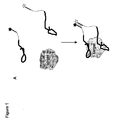
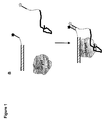
- FIG. 1 depicts a series of schematics illustrating molecular biosensors for detecting target molecules.
- A Variant of the design for target molecules lacking natural DNA binding activity. The biosensor in this case will be composed of two aptamers developed to recognize two different epitopes of the target molecule.
- B Variant of the design for a target molecule exhibiting natural DNA binding activity. The biosensor in this case will be composed of a short double-stranded DNA fragment containing the DNA sequence corresponding to the DNA-binding site and an aptamer developed to recognize a different epitope of the target molecule.
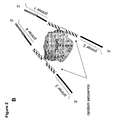
- FIG. 2 depicts a series of schematics illustrating methods for preparing aptamers according to the invention.
- A Selection of an aptamer in the presence of a known aptamer construct. The process is initiated with a nucleic acid construct, an aptamer construct (composed of an known aptamer (thick black line), a linker, and a short oligonucleotide sequence (hatched bar)), and the target molecule (grey). The hatched bars depict complementary short oligonucleotide sequences.
- B Simultaneous selection of two aptamers that bind distinct epitopes of the same target molecule (grey).
- the process is initiated with two types of nucleic acid constructs (the primer1-2 construct and the primer3-4 construct) and the target molecule.
- the hatched bars depict short complementary sequences at the end of the two types of nucleic acid constructs.
- C Alternative design for simultaneous selection of two aptamers that bind distinct epitopes of the same target molecule (grey).
- An additional pair of short oligonucleotides (hatched bars) connected by a flexible linker is present during the selection process.
- These oligonucleotides will be complementary to short oligonucleotide sequences at the end of the nucleic acid constructs (in primer 1 and primer 4). Their presence during selection will provide a bias towards selecting pairs of aptamers capable of simultaneously binding to the target molecule.
- the process is initiated with a nucleic acid construct, a double-stranded DNA construct (composed of an known double-stranded DNA sequence, a linker, and a short oligonucleotide sequence (hatched)), and the target molecule (grey).
- the hatched bars depict complementary short oligonucleotide sequences.
- FIG. 3 is a schematic illustrating various formations of molecular biosensors that can be made utilizing aptamers selected according to the invention.
- FIG. 4 is a schematic illustrating the method of the invention.
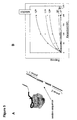
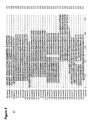
- FIG. 5 summarizes the selection of an aptamer that binds to thrombin at an epitope distinct from the binding site of the G15D aptamer.
- A An illustration of the reagents used to begin the process of selection.
- B The graph indicates the increase in thrombin binding with successive rounds of selection.
- C The sequences represent aptamers developed after 12 rounds of selection.
- FIG. 6 The demonstration of the functional thrombin sensor comprising Texas Red-labeled THR27 and fluorescein-labeled THR35 or THR36 (both contain the sequence corresponding to that of clones 20, 21, 24, and 26 of Figure 5C ).
- the fluorescence image represents the specificity of either 20nM (panel A) or 100nM (panel B) of the indicated biosensor.
- FIG. 7 summarizes the simultaneous selection of two aptamers that bind to thrombin at distinct epitopes.
- A An illustration of the reagents used to begin the process of selection.
- B The graph indicates the increase in thrombin binding with successive rounds of selection.
- C The sequences represent aptamers developed after 13 rounds of selection.
- FIG. 8 summarizes the selection of an aptamer that binds to CRP at an epitope distinct from the DNA-binding site.
- A An illustration of the reagents used to begin the process of selection.
- B The graph indicates the increase in thrombin binding with successive rounds of selection.
- C The sequences represent aptamers developed after 11 rounds of selection.
- the invention is directed to methods for simultaneously selecting two or more aptamers that each recognize distinct epitopes on a target molecule. Utilizing the method of simultaneous aptamer selection typically cuts the time of selection in half compared to methods involving sequential selection of two aptamers using Selex. Alternatively, the invention is directed to selecting at least one aptamer in the presence of an epitope binding agent construct. The aptamer and epitope binding agent construct also each recognize distinct epitopes on a target molecule. In each method of the invention, novel nucleic acid constructs are utilized to facilitate selection of aptamers having the desired epitope binding characteristics.
- the nucleic constructs comprise the aptamer or aptamers selected by the method of the invention.
- the methods of the invention may be utilized to select aptamers to construct various molecular biosensors as illustrated in FIG. 3 .
- One aspect of the invention encompasses a method for selecting an aptamer in the presence of an epitope binding agent construct.
- the aptamer and epitope binding agent construct are selected so that they each bind to the same target at two distinct epitopes.
- the method comprises contacting a plurality of nucleic acid constructs and epitope binding agent constructs with a target molecule to form a mixture.
- the mixture will generally comprise complexes having target molecule bound with nucleic acid constructs and epitope binding agent constructs.
- the complex is isolated from the mixture and the nucleic acid construct is purified from the complex.
- the aptamer selected by the method of the invention will comprise the purified nucleic acid construct.
- nucleic acid constructs comprise: A-B-C-D
- the epitope binding agent construct comprises: P-Q-R wherein:
- a and C are each different DNA sequences ranging from about 7 to about 35 nucleotides in length and function as polymerase chain reaction primers to amplify the nucleic acid construct. In another embodiment, A and C range from about 15 to about 25 nucleotides in length. In yet another embodiment, A and C range from about 15 to about 20 nucleotides in length. In still another embodiment, A and C range from about 16 to about 18 nucleotides in length. In an exemplary embodiment, A and C are 18 nucleotides in length. Typically, A and C have an average GC content from about 53% to 63%. In another embodiment, A and C have an average GC content from about 55% to about 60%. In a preferred embodiment, A and C will have an average GC content of about 60%.
- B is typically a single-stranded oligonucleotide synthesized by randomly selecting and inserting a nucleotide base (A, C, T, G in the case of DNA, or A, C, U, G in the case of RNA) at every position of the oligonucleotide.
- B encodes an aptamer sequence that binds to the first epitope on the target.
- B is comprised of DNA bases.
- B is comprised of RNA bases.
- B is comprised of modified nucleic acid bases, such as modified DNA bases or modified RNA bases.
- Modifications may occur at, but are not restricted to, the sugar 2' position, the C-5 position of pyrimidines, and the 8-position of purines.
- suitable modified DNA or RNA bases include 2'-fluoro nucleotides, 2'-amino nucleotides, 5'-aminoallyl-2'-fluoro nucleotides and phosphorothioate nucleotides (monothiophosphate and dithiophosphate).
- B is about 20 to 110 nucleotides in length. In another embodiment, B is from about 25 to about 75 nucleotides in length. In yet another embodiment, B is from about 30 to about 60 nucleotides in length.
- D and R are complementary nucleotide sequences from about 2 to about 20 nucleotides in length. In another embodiment, D and R are from about 4 to about 15 nucleotides in length. In a preferred embodiment, D and R are from about 5 to about 7 nucleotides in length. In one embodiment, D and R have a free energy for association from about 5.2 kcal/mole to about 8.2 kcal/mole as measured in the selection buffer conditions, defined below. In another embodiment, D and R have a free energy for association from about 6.0 kcal/mole to about 8.0 kcal/mole as measured in the selection buffer conditions defined below.
- D and R have a free energy for association from about 7.0 kcal/mole to 8.0 kcal/mole in the selection buffer conditions. In a preferred embodiment, D and R have a free energy for association of 7.5 kcal/mole in the selection buffer conditions described below.
- Q may be a nucleotide sequence from about 10 to about 100 nucleotides in length. In one embodiment, Q is from 10 to about 25 nucleotides in length. In another embodiment, Q is from about 25 to about 50 nucleotides in length. In a further embodiment, Q is from about 50 to about 75 nucleotides in length. In yet another embodiment, Q is from about 75 to about 100 nucleotides in length.
- the nucleotides may be any of the nucleotide bases in DNA or RNA (A, C, T, G in the case of DNA, or A, C, U, G in the case of RNA). In one embodiment Q is comprised of DNA bases. In another embodiment, Q is comprised of RNA bases.
- Q is comprised of modified nucleic acid bases, such as modified DNA bases or modified RNA bases. Modifications may occur at, but are not restricted to, the sugar 2' position, the C-5 position of pyrimidines, and the 8-position of purines.
- suitable modified DNA or RNA bases include 2'-fluoro nucleotides, 2'-amino nucleotides, 5'-aminoallyl-2'-fluoro nucleotides and phosphorothioate nucleotides (monothiophosphate and dithiophosphate).
- B may comprise nucleotide mimics.
- nucleotide mimics include locked nucleic acids (LNA), peptide nucleic acids (PNA), and phosphorodiamidate morpholino oligomers (PMO).
- Q may be a polymer of bifunctional chemical linkers.
- the bifunctional chemical linker is heterobifunctional.
- Suitable heterobifunctional chemical linkers include sulfoSMCC (Sulfosuccinimidyl-4-(N-maleimidomethyl)cyclohexane-1-carboxylate), and Ic-SPDP( N-Succinimidyl-6-(3'-(2-PyridylDithio)-Propionamido)-hexanoate).
- the bifunctional chemical linker is homobifunctional.
- Suitable homobifunctional linkers include disuccinimidyl suberate, disuccinimidyl glutarate, and disuccinimidyl tartrate. Additional suitable linkers are illustrated in the Examples, such as the phosphoramidate form of Spacer 18 comprised of polyethylene glycol.
- Q is from 0 to about 500 angstroms in length. In another embodiment, Q is from about 20 to about 400 angstroms in length. In yet another embodiment, Q is from about 50 to about 250 angstroms in length.
- a and C are approximately 18 nucleotides in length and have an average GC content of about 60%; B is about 30 to about 60 nucleotides in length; Q is a linker comprising a nucleotide sequence that is from about 10 to 100 nucleotides in length or a bifunctional chemical linker; and D and R range from about 5 to about 7 nucleotides in length and have a free energy of association of about 7.5 kcal/mole.
- the choice of epitope binding agent, P can and will vary depending upon the particular target molecule.
- P may be an aptamer, peptide, or antibody.
- P is double stranded nucleic acid the target molecule is typically a macromolecule that binds to DNA or a DNA binding protein.
- Suitable epitope binding agents include agents selected from the group consisting of an aptamer, an antibody, an antibody fragment, a double-stranded DNA sequence, a ligand, a ligand fragment, a receptor, a receptor fragment, a polypeptide, a peptide, a coenzyme, a coregulator, an allosteric molecule, and an ion.
- P is an aptamer sequence ranging in length from about 20 to about 110 bases.
- P is an antibody selected from the group consisting of polyclonal antibodies, ascites, Fab fragments, Fab' fragments, monoclonal antibodies, and humanized antibodies.
- P is a monoclonal antibody.
- P is a double stranded DNA.
- a plurality of nucleic acid constructs, A-B-C-D are contacted with the epitope bind agent construct, P-Q-R, and the target molecule in the presence of a selection buffer to form a mixture.
- a selection buffer is typically one that facilitates non-covalent binding of the nucleic acid construct to the target molecule in the presence of the epitope binding agent construct.
- the selection buffer is a salt buffer with salt concentrations from about 1mM to 100mM.
- the selection buffer is comprised of Tris-HCl, NaCl, KCl, and MgCl 2 .
- the selection buffer is comprised of 50mM Tris-HCl, 100mM NaCl, 5mM KCl, and 1mM MgCl 2 .
- the selection buffer has a pH range from about 6.5 to about 8.5.
- the selection buffer has a pH range from about 7.0 to 8.0.
- the pH is 7.5.
- the selection buffer may additionally contain analytes that assist binding of the constructs to the target molecule. Suitable examples of such analytes can include, but are not limited to, protein co-factors, DNA-binding proteins, scaffolding proteins, or divalent ions.
- the mixture of the plurality of nucleic acid constructs, epitope binding agent constructs and target molecules are incubated in selection buffer from about 10 to about 45 min. In yet another embodiment, the incubation is performed for about 15 to about 30 min. Typically, the incubation is performed at a temperature range from about 21° C to about 40° C. In another embodiment, the incubation is performed at a temperature range from about 20°C to about 30°C. In yet another embodiment, the incubation is performed at 35°C. In a preferred embodiment, the incubation is performed at 25°C for about 15 to about 30 min.
- the mixture will typically comprise complexes of the target molecule having nucleic acid construct bound to a first epitope and epitope binding agent construct bound to a second epitope of the target molecule.
- the mixture will also comprise unbound nucleic acid constructs and epitope binding agent constructs.
- the complex comprising the target molecule having bound nucleic acid construct and bound epitope binding agent construct is preferably isolated from the mixture.
- nitrocellulose filters are used to separate the complex from the mixture.
- magnetic beads are used to separate the complex from the mixture.
- sepharose beads can be used to separate the complex from the mixture.
- strepavidin-linked magnetic beads are used to separate the complex from the mixture.
- the target molecules are subjected to denaturation and then the nucleic acid constructs purified from the complex.
- urea is used to denature the target molecule.
- 7M urea in 1M NaCl is used to denature the target molecule.
- the nucleic acid constructs may be purified from the target molecule by precipitation.
- the nucleic acid constructs are precipitated with ethanol.
- the nucleic acid constructs are precipitated with isopropanol.
- the precipitated DNA is resuspended in water.
- the precipitated DNA is resuspended in TE buffer.
- the purified, resuspended nucleic acid constructs are then amplified using the polymerase chain reaction (PCR).
- PCR polymerase chain reaction
- reverse transcriptase is preferably used to convert the RNA bases to DNA bases before initiation of the PCR.
- the PCR is performed with primers that recognize both the 3' and the 5' end of the nucleic acid constructs in accordance with methods generally known in the art.
- either the 3' or 5' primer is attached to a fluorescent probe.
- either the 3' or the 5' primer is attached to fluorescein.
- either the 3' or 5' primer is biotinylated.
- one primer is labeled with fluorescein, and the other primer is biotinylated.
- the PCR reaction contains buffer, deoxynucleotide triphosphates, polymerase, and template nucleic acid.
- the PCR can be performed with a heat-stable polymerase.
- the concentrations of PCR reactants are outlined in the examples section as follows: 80uL ofdd H2O, 10uL of 10x PCR buffer, 6uL of MgCl 2 , 0.8uL 25mM dNTPs, 1uL 50uM primer 1 (modified with fluorescein), 1uL 50uM primer 2 (biotinylated), 0.5uL Taq polymerase, and 1uL of template.
- the PCR consists of a warm-up period, where the temperature is held in a range between about 70°C and about 74°C. Subsequently, the PCR consists of several cycles (about 8 to about 25) of 1) incubating the reaction at a temperature between about 92°C and about 97°C for about 20sec to about 1min; 2) incubating the reaction at a temperature between about 48°C and about 56°C for about 20sec to about 1min; and 3) incubating the reaction at a temperature between about 70°C and about 74°C for about 45sec to about 2min. After the final cycle, the PCR is concluded with an incubation between about 70°C and about 74°C for about 3min to about 10min.
- the reaction consists of 12-18 cycles.
- a preferred embodiment of the PCR is as follows: 5 min at 95°C, sixteen cycles of 30s at 95°C, 30s at 50°C, and 1min at 72°C, and then an extension period of 5min at 72°C.
- the double-stranded DNA PCR product is separated from the remaining PCR reactants.
- One exemplary embodiment for such separation is subjecting the PCR product to agarose gel electrophoresis.
- the PCR product is separated in a low melting point agarose gel.
- the gel is a native 10% acrylamide gel made in TBE buffer.
- the band(s) having the double-stranded DNA PCR product are visualized in the gel by ethidium bromide staining.
- the band(s) are visualized by fluorescein fluorescence. Irrespective of the embodiment, the bands are typically excised from the gel by methods generally known in the art.
- the double-stranded gel-purified PCR product is separated into single-stranded DNA in accordance with methods generally known in the art.
- One such embodiment involves using a basic pH to denature the double helix.
- 0.15N NaOH is used to denature the helix.
- streptavidin linked beads are used to separate the denatured DNA strands.
- magnetic streptavidin beads are used to separate the denatured DNA strands.
- the method of the invention typically involves several rounds of selections, separation, amplification and purification in accordance with the procedures described above until nucleic acid constructs having the desired binding affinity for the target molecule are selected.
- the single-stranded DNA of estimated concentration is used for the next round of selection.
- the cycle of selection, separation, amplification, purification, and strand separation is performed from about 4 to about 20 times.
- the said cycle is performed from about 12 to about 18 times.
- the said cycle is performed until the measured binding-activity of the selected nucleic acid constructs reaches the desired strength.
- the single DNA strand attached to the strepavidin-linked beads is used as a template for RNA polymerase.
- the supernatant contains the RNA nucleic acid construct that can be used in another round of RNA aptamer selection.
- RNA aptamer if a RNA aptamer is being selected, the double-stranded, gel-purified PCR DNA product is transcribed with RNA polymerase to produce a single-stranded RNA construct.
- A will typically contain a sequence encoding a promoter recognized by RNA polymerase.
- double-stranded, gel-purified PCR DNA product attached to strepavidin-linked beads is used as a template for RNA polymerase.
- the supernatant containing the RNA nucleic acid construct can be used in another round of RNA aptamer selection.
- the nucleic acid constructs are cloned, and the cloned DNA is sequenced.
- the sequences are used in aptamer constructs either alone or as part of a molecular biosensor.
- Another aspect of the invention is a method for simultaneously selecting two or more aptamers.
- the aptamers selected by the method each bind to the same target molecule at two distinct epitopes.
- the method comprises contacting a plurality of pairs of nucleic acid constructs with a target molecule to form a mixture.
- the mixture will generally comprise complexes having target molecule bound with a pair of nucleic acid constructs at distinct epitope sites.
- the complex is isolated from the mixture and the nucleic acid constructs are purified from the complex.
- the aptamers selected by the method of the invention will comprise the pair of purified nucleic acid constructs.
- the first nucleic acid constructs comprises: A-B-C-D
- the second nucleic acid construct comprises: E-F-G-H. wherein:
- A, C, E and G are each different DNA sequences ranging from about 7 to about 35 nucleotides in length. In another embodiment, A, C, E, and G range from about 15 to about 25 nucleotides in length. In yet another embodiment, A, C, E, and G range from about 15 to about 20 nucleotides in length. In still another embodiment, A, C, E and G range from about 16 to about 18 nucleotides in length. In an exemplary embodiment, A, C, E and G are 18 nucleotides in length. Generally speaking, A, C, E and G have an average GC content from about 53% to 63%. In another embodiment, A, C, E and G have an average GC content from about 55% to about 60%. In a preferred embodiment, A, C, E and G will have an average GC content of about 60%.
- B and F are single-stranded oligonucleotides synthesized by randomly selecting and inserting a nucleotide base (A, C, T, G in the case of DNA, or A, C, U, G in the case of RNA) at every position of the oligonucleotide.
- B and F encode an aptamer sequence, such that B binds to the first epitope on the target molecule and F binds to the second epitope on the target molecule.
- B and F are comprised of DNA bases.
- B and F are comprised of RNA bases.
- B and F are comprised of modified nucleic acid bases, such as modified DNA bases.
- Modifications may occur at, but are not restricted to, the sugar 2' position, the C-5 position of pyrimidines, and the 8-position of purines.
- suitable modified DNA or RNA bases include 2'-fluoro nucleotides, 2'-amino nucleotides, 5'-aminoallyl-2'-fluoro nucleotides and phosphorothioate nucleotides (monothiophosphate and dithiophosphate).
- B and F are about 20 to 110 nucleotides in length. In another embodiment, B and F are from about 25 to about 75 nucleotides in length. In yet another embodiment, B and F are from about 30 to about 60 nucleotides in length.
- D and H are complementary nucleotide sequences from about 2 to about 20 nucleotides in length. In another embodiment, D and H are from about 4 to about 15 nucleotides in length. In a preferred embodiment, D and H are from about 5 to about 7 nucleotides in length. In one embodiment, D and H have a free energy for association from about 5.2 kcal/mole to about 8.2 kcal/mole as measured in the selection buffer conditions, defined below. In another embodiment, D and H have a free energy for association from about 6.0 kcal/mole to about 8.0 kcal/mole as measured in the selection buffer conditions.
- D and H have a free energy for association from about 7.0 kcal/mole to 8.0 kcal/mole in the selection buffer conditions. In a preferred embodiment, D and H have a free energy for association of 7.5 kcal/mole in the selection buffer conditions.
- A, C, E and G are approximately 18 nucleotides in length and have an average GC content of about 60%
- B and F are about 30 to about 60 nucleotides in length
- D and H range from about 5 to about 7 nucleotides in length and have a free energy of association of about 7.5 kcal/mole.
- the method for simultaneous selection is initiated by contacting a plurality of pairs of the nucleic acid constructs A-B-C-D and E-F-G-H with the target molecule in the presence of a selection buffer to form a complex.
- suitable selection buffers allow non-covalent simultaneous binding of the nucleic acid constructs to the target molecule.
- the method for simultaneous selection then involves the same steps of selection, separation, amplification and purification as described in section (a) above involving methods for the selection of an aptamer in the presence of an epitope binding agent construct, with the exception that the PCR is designed to amplify both nucleic acid constructs (A-B-C-D and E-F-G-H), using primers to A, C, E, and G.
- the cycle of selection, separation, amplification, purification, and strand separation is performed from about 4 to about 20 times. In another embodiment, the cycle is performed from about 12 to about 18 times.
- nucleic acid constructs are cloned, and the cloned DNA is sequenced.
- the resulting nucleic acid constructs comprise a first aptamer that binds to a first epitope on the target molecule and a second aptamer that binds to a second epitope on the target molecule.
- two aptamers can be simultaneously selected in the presence of a bridging construct comprised of S-T-U.
- S and U are complementary nucleotide sequences from about 2 to about 20 nucleotides in length.
- S and U are from about 4 to about 15 nucleotides in length.
- S and U are from about 5 to about 7 nucleotides in length.
- S and U have a free energy for association from about 5.2 kcal/mole to about 8.2 kcal/mole as measured in the selection buffer conditions, defined below.
- S and U have a free energy for association from about 6.0 kcal/mole to about 8.0 kcal/mole as measured in the selection buffer conditions. In yet another embodiment, S and U have a free energy for association from about 7.0 kcal/mole to 8.0 kcal/mole in the selection buffer conditions. In a preferred embodiment, S and U have a free energy for association of 7.5 kcal/mole in the selection buffer conditions.
- T may be a nucleotide sequence from about 10 to about 100 nucleotides in length. In one embodiment, T is from 10 to about 25 nucleotides in length. In another embodiment, T is from about 25 to about 50 nucleotides in length. In a further embodiment, T is from about 50 to about 75 nucleotides in length. In yet another embodiment, T is from about 75 to about 100 nucleotides in length.
- the nucleotides may be any of the nucleotide bases in DNA or RNA (A, C, T, G in the case of DNA, or A, C, U, G in the case of RNA). In one embodiment T is comprised of DNA bases. In another embodiment, T is comprised of RNA bases.
- T is comprised of modified nucleic acid bases, such as modified DNA bases or modified RNA bases. Modifications may occur at, but are not restricted to, the sugar 2' position, the C-5 position of pyrimidines, and the 8-position of purines.
- suitable modified DNA or RNA bases include 2'-fluoro nucleotides, 2'-amino nucleotides, 5'-aminoallyl-2'-fluoro nucleotides and phosphorothioate nucleotides (monothiophosphate and dithiophosphate).
- B may comprise nucleotide mimics.
- T may be a polymer of bifunctional chemical linkers.
- the bifunctional chemical linker is heterobifunctional.
- Suitable heterobifunctional chemical linkers include sulfoSMCC (Sulfosuccinimidyl-4-(N-maleimidomethyl)cyclohexane-1-carboxylate), and Ic-SPDP(N-Succinimidyl-6-(3'-(2-PyridylDithio)-Propionamido)-hexanoate).
- the bifunctional chemical linker is homobifunctional.
- Suitable homobifunctional linkers include disuccinimidyl suberate, disuccinimidyl glutarate, and disuccinimidyl tartrate. Additional suitable linkers are illustrated in the Examples, such as the phosphoramidate form of Spacer 18 comprised of polyethylene glycol.
- T is from 0 to about 500 angstroms in length. In another embodiment, T is from about 20 to about 400 angstroms in length. In yet another embodiment, T is from about 50 to about 250 angstroms in length.
- S is complementary to D and U is complementary to H.
- S and U will not bind to D and H unless S, U, D, and H are brought in close proximity by the A-B-C-D construct and the E-F-G-H construct binding to the target.
- the method is initiated in the presence of nucleic acid constructs A-B-C-D and E-F-G-H, and the bridging construct S-T-U.
- the method is performed as described with the same steps detailed above.
- the bridging construct is ligated to the A-B-C-D construct and the E-F-G-H construct. This embodiment allows the analysis of pairs of selected nucleic acid sequences that are best suited for use in a molecular biosensor.
- analyte refers generally to a ligand, chemical moiety, compound, ion, salt, metal, enzyme, secondary messenger of a cellular signal transduction pathway, drug, nanoparticle, environmental contaminant, toxin, fatty acid, steroid, hormone, carbohydrate, amino acid, peptide, polypeptide, protein or other amino acid polymer, microbe, virus or any other agent which is capable of binding to a polypeptide, protein or macromolecular complex in such a way as to create an epitope or alter the availability of an epitope for binding to an aptamer.
- aptamer refers to a polynucleotide, generally a RNA, modified RNA, DNA, or modified DNA that has a useful biological activity in terms of biochemical activity, molecular recognition or binding attributes.
- an aptamer has a molecular activity such as binding to a target molecule at a specific epitope (region).
- epitope refers generally to a particular region of a target molecule. Examples include an antigen, a hapten, a molecule, a polymer, a prion, a microbe, a cell, a peptide, polypeptide, protein, or macromolecular complex.
- An epitope may consist of a small peptide derived from a larger polypeptide.
- An epitope may be a two or three-dimensional surface or surface feature of a polypeptide, protein or macromolecular complex that comprises several non-contiguous peptide stretches or amino acid groups.
- epitope binding agent refers to a substance that is capable of binding to a specific epitope of an antigen, a polypeptide, a protein or a macromolecular complex.
- epitope binding agents include aptamers, thioaptamers, double-stranded DNA sequence, peptides and polypeptides, ligands and fragments of ligands, receptors and fragments of receptors, antibodies and fragments of antibodies, polynucleotides, coenzymes, coregulators, allosteric molecules, peptide nucleic acids, locked nucleic acids, phosphorodiamidate morpholino oligomers (PMO), and ions.
- PMO phosphorodiamidate morpholino oligomers
- epitope binding agent construct refers to a construct that contains an epitope-binding agent and can serve in a "molecular biosensor" with another epitope binding agent construct.
- an epitope binding agent construct also contains a "linker,” and a "signaling oligo".
- Epitope binding agent constructs can be used to initiate the aptamer selection methods of the invention.
- An aptamer construct is a special kind of epitope binding agent construct wherein the epitope binding agent is an aptamer.
- molecular biosensor refers to a construct comprised of at least two epitope binding agent constructs.
- the molecular biosensor can be used for detecting or quantifying the presence of a target molecule.
- nucleic acid construct refers to a molecule comprising a random nucleic acid sequence flanked by two primers.
- a nucleic acid construct also contains a signaling oligo. Nucleic acid constructs are used to initiate the aptamer selection methods of the invention.
- signaling oligo means a short (generally 2 to 15 nucleotides, preferably 5 to 7 nucleotides in length) single-stranded polynucleotide.
- Signaling oligos are typically used in pairs comprising a first signaling oligo and a second signaling oligo.
- the first signaling oligo sequence is complementary to the second signaling oligo.
- the first signaling oligo and the second signaling oligo can not form a stable association with each other through hydrogen bonding unless the first and second signaling oligos are brought into close proximity to each other through the mediation of a third party agent.
- linker refers to a polymer attached to an epitope binding agent construct. The attachment may be covalent or non-covalent. It is envisioned that the linker can be a polymer of amino acids or nucleotides. A preferred linker molecule is flexible and does not interfere with the binding of a nucleic acid binding factor to the set of nucleic acid components.
- Macromolecular complex refers to a composition of matter comprising a macromolecule.
- these are complexes of one or more macromolecules, such as polypeptides, lipids, carbohydrates, nucleic acids, natural or artificial polymers and the like, in association with each other. The association may involve covalent or non-covalent interactions between components of the macromolecular complex.
- Macromolecular complexes may be relatively simple, such as a ligand bound polypeptide, relatively complex, such as a lipid raft, or very complex, such as a cell surface, virus, bacteria, spore and the like.
- Macromolecular complexes may be biological or non-biological in nature.
- FIG. 2 summarizes five possible methods for selecting aptamers useful in the practice of the invention.
- Panel A depicts the selection of an additional aptamer in the presence of a target bound to a known aptamer.
- the nucleic acid construct is comprised of a signaling oligo, represented by the hatched bar, and two primers flanking a random DNA sequence.
- the signaling oligo is treated as a specific subpart of the primer in the nucleic acid construct.
- a complimentary signaling oligo is attached to the preselected aptamer via a long flexible linker.
- the process begins by combining the nucleic acid construct, the target, and the known aptamer construct.
- aptamers using such a random sequence construct will be biased towards aptamers capable of binding to the target at an epitope distinct from the epitope of the known aptamer construct, and that will function in molecular biosensors depicted in Fig. 3A .
- nucleic acid constructs are comprised of signaling oligos (represented by the hatched bars at the end of primer 1 and primer 4) and two primers flanking either side of a random-sequence.
- signaling oligos represented by the hatched bars at the end of primer 1 and primer 4
- primers flanking either side of a random-sequence.
- one type contains primers 1 and 2
- the second contains primers 3 and 4.
- the process begins with combining both types of nucleic acid constructs, and the target. Selection of aptamers using such random sequence constructs will be biased towards aptamers capable of binding to the target simultaneously at two distinct epitopes of the protein, and that will function in sensors depicted in Fig. 3A .
- Panel C depicts an alternative design for simultaneous selection of two aptamers binding two distinct epitopes of the target.
- a third bridging construct is used.
- the bridging construct comprises an additional pair of short oligonucleotides (hatched bars) connected by a flexible linker. These oligonucleotides will be complementary to the short oligonucleotides at the end of the nucleic acid constructs.
- the presence of the bridging construct during selection will provide a bias towards selecting pairs of aptamers capable of simultaneously binding the target.
- the pairs of selected sequences will be enzymatically ligated using T4 ligase to preserve the information regarding the preferred pairs between various selected aptamers.
- a second aptamer can be selected in the presence of a target bound by an antibody ( Figure 2 D) .
- the signaling oligo in the nucleic acid construct depicted by the hatched bar, is complementary to the signaling oligo attached to the antibody via a long flexible linker.
- the process begins by combining the nucleic acid construct, the target, and the antibody construct. Selection of an aptamer using such a random sequence construct will be biased towards aptamers able to bind to the protein at an epitope distinct from the antibody epitope and will function in sensors depicted in Fig. 3C .
- a second aptamer can be selected in the presence of the target bound to a double-stranded DNA fragment ( Figure 2E ).
- the signaling oligo in the nucleic acid construct depicted by the hatched bar, is complementary to the signaling oligo attached to the double-stranded DNA construct via a long flexible linker.
- the process begins by combining the nucleic acid construct, the target, and the double-stranded DNA construct. Selection of an aptamer using such a random sequence construct will be biased towards aptamers able to bind to the target at a site distinct from the double-stranded DNA binding site and will function in sensors depicted in Fig. 3B .
- the results of selecting an aptamer in the presence of a known aptamer construct are depicted in Figure 5 .
- the in vitro evolution procedure was initiated using a selection construct containing a 33 nt random sequence (THR11)(Table 1) in the presence of the known THR22 aptamer construct (THR22)(Table 1) and the target, in this case thrombin ( Figure 5A ).
- Five ⁇ M of THR11 were added to 5 ⁇ M THR22 in a total of 1 mL of buffer (50mM Tris-HCl (pH 7.5), 100mM NaCl, 5mM KCl and 1mM MgCl 2 ). The mixture was boiled for approximately 1min, and allowed to cool to room temperature (RT).
- Thrombin 200nM was added, and the mixture was incubated for 15-30 min at RT. Next, the mixture was spun through a nitrocellulose filter (NCF), followed by 2 washes of 1mL and a single wash of 0.5mL. Pre-warmed urea (200 ⁇ l of 7M solution containing 1M NaCl) was loaded on the NCF, and incubated for 15min at 37°C. The DNA/urea mixture was eluted, and the DNA was precipitated with ethanol (added cold ethanol (2.5x the volume of eluted DNA) and incubated for at least two hours at -20°C). The precipitated DNA was centrifuged, the supernatant removed, and the subsequent pellet was dried in a speed-vac. The pellet was redissolved in 20 ⁇ L of water, and used as a template for the PCR reaction.
- NCF nitrocellulose filter
- Each PCR reaction contained 80 ⁇ L of dd H2O, 10 ⁇ L of 10xPCR buffer, 6 ⁇ L of MgCl 2 , 0.8 ⁇ L 25mM dNTPs, 1 ⁇ L 50uM primer 1(modified with fluorescein), 1 uL 50 ⁇ M primer 2 (biotinylated), 0.5 ⁇ L Taq polymerase, and 1 ⁇ L of template.
- the reaction cycle consisted of 5 min at 95°C, sixteen cycles of 30s at 95°C, 30s at 50°C, and 1 min at 72°C, and 5min at 72°C. The pooled samples were allowed to cool, and subsequently separated on a polyacrylamide gel.
- the band(s) of interest were visualized by utilizing the fluorescein tag, and were excised from the gel.
- the gel pieces were transferred to a microtube and crushed using a pipet tip.
- the gel pieces were covered with diffusion buffer (100mM Tris (pH 8.0), 0.5 M NaCl, 5mM EDTA) and the mixture was incubated for at least two hours at 50°C. After centrifugation the supernatant was filtered through an empty Bio-Rad microspin column. The gel pieces were washed with fresh diffusion buffer, and the process repeated for a second time. The supernatants from the first and second procedures were combined.
- DYNAL magnetic streptavidin beads were mixed with the gel-purified DNA, and incubated at RT for 30min with constant shaking. The supernatant was removed, and the beads were washed once with 500 ⁇ L, once with 250 ⁇ L, and once with 100 ⁇ L of buffer. Next, the beads were incubated for 30min at 37°C with 50 ⁇ L of 0.15N NaOH. The supernatant containing the fluorescein labeled DNA was removed and filtered through a G-25 Sephadex microspin column pre-equilibrated with buffer. The estimated concentration of the recovered DNA was calculated by comparison to a known amount of fluorescein-labeled primer.
- the second round of selection began by combining 50nM of the recovered DNA and 50-1000nM of THR22 in a total of 50 ⁇ L of selection buffer.
- the DNA mixture was boiled for 1min, and allowed to cool to RT. Subsequently, the DNA mixture was filtered through a pre-equilibrated NCF to remove DNA sequences with affinity for the NCF. Thrombin (20nM) was added to the filtered DNA and the mixture was incubated for 15-10 min at RT. Next, the mixture was spun through another pre-equilibrated NCF, followed by two washes of 100 ⁇ L.
- Panel B depicts the thrombin-binding activity of single-stranded DNAs obtained after each indicated round of selection. Measurable thrombin-binding activity appeared after the 4th selection and reached maximum binding activity after the 12th selection. Binding was measured in the presence of excess THR22. DNA obtained after the 12th selection was cloned and the DNA from individual clones was sequenced. Panel C depicts the sequence alignment (using ClustalX) of the individual clones. Clones obtained from 4 independent selection experiments are shown. These selections were performed using the following pairs of aptamer constructs and selection constructs: THR22 and THR 11; THR25 and THR 11; THR42 and THR11; THR43 and THR 11 (Table 1). Several families of highly conserved sequences are easily visible in panel C.
- THR 35 and THR 36 were comprised of the aptamer sequence, a linker, and a fluorescein-labeled signaling oligo. As shown in Figure 6 , THR 35 and THR 36 differ in the nucleotides flanking the cloned sequence.
- the other half of the thrombin biosensor contained the same aptamer sequence as the THR22 aptamer construct used in the selection, a linker, and a Texas Red-labeled complementary signaling oligo.
- Panels A and B depict the fluorescence image (sensitized acceptor emission) of microtiterplate wells containing 20 nM (panel A) or 100 nM (panel B) of the indicated thrombin sensor and the indicated concentrations of thrombin.
- a sensor comprising aptamer constructs containing previously described thrombin aptamers (THR21 and THR27, Table 1) is shown.
- Figure 7 depicts the results of simultaneously selecting two aptamers that bind to a target at distinct epitopes.
- the selection procedure began with two types of selection constructs, each containing a 30 nt random sequence (THR49 and THR50) (Table 1), and the target thrombin (panel A).
- the process proceeds as outlined above, with the exception that two sets of PCR reactions were performed, corresponding to the two different types of nucleic acid constructs initially used.
- the thrombin-binding activity of the mixture of single-stranded DNAs obtained after each indicated round of selection is shown in panel B. Measurable thrombin-binding activity appeared after the 6th selection and reached a maximum after the 14th selection. DNA obtained after the 14th selection was cloned and the DNA from individual clones was sequenced.
- Panel C depicts the sequence alignment (using ClustalX) of the clones. Several families of highly conserved sequences are easily visible.
- Figure 8 depicts the selection of an aptamer in the presence of a double-stranded DNA molecular recognition construct.
- Aptamers to the cAMP binding protein ("CRP") were selected to bind at sites distinct from the DNA-binding site of the protein. Selection was initiated with a nucleic acid construct containing a 33 nt random sequence (MIS12)(Table 1). Additionally, a double-stranded DNA construct comprised of the CRP DNA binding site sequence (MIS10X3 hybridized with MIS11), a linker, and a signaling oligo was used for the process. ( Figure 8A ). The selection process was essentially the same as outlined above for the thrombin aptamer.
- the buffer used in the selection contained 200 ⁇ l c-AMP, which is required for the double-stranded DNA construct to bind to CRP.
- ⁇ 5uM MIS12 was combined with 400nM MIS10X3/MIS11, 400nM CRP, and 0.2 mM c-AMP.
- 100 nM MIS10X3/MIS11 50 nM selected single-stranded DNA constructs and 100 nM CRP were combined.
- CRP binding activity of single-stranded DNA obtained after the indicated round of selection is depicted in Figure 8B .
- Measurable CRP binding activity appeared after the 6th selection and reached a maximum after the 12th selection. Binding was measured in the presence of excess MIS10X3/MIS11.
- DNA obtained after the 12th selection was cloned and the DNA obtained from individual clones was sequenced. The sequence alignment (using ClustalX) of the clones is depicted in panel C. A conserved core sequence or ⁇ 16 nucleotides could be identified.
Landscapes
- Chemical & Material Sciences (AREA)
- Life Sciences & Earth Sciences (AREA)
- Organic Chemistry (AREA)
- Health & Medical Sciences (AREA)
- Engineering & Computer Science (AREA)
- Wood Science & Technology (AREA)
- Zoology (AREA)
- Genetics & Genomics (AREA)
- Proteomics, Peptides & Aminoacids (AREA)
- Bioinformatics & Cheminformatics (AREA)
- Biotechnology (AREA)
- General Engineering & Computer Science (AREA)
- Immunology (AREA)
- Analytical Chemistry (AREA)
- Microbiology (AREA)
- Molecular Biology (AREA)
- Physics & Mathematics (AREA)
- Biochemistry (AREA)
- General Health & Medical Sciences (AREA)
- Biophysics (AREA)
- Biomedical Technology (AREA)
- Pathology (AREA)
- Bioinformatics & Computational Biology (AREA)
- Crystallography & Structural Chemistry (AREA)
- Plant Pathology (AREA)
- Measuring Or Testing Involving Enzymes Or Micro-Organisms (AREA)
- Pharmaceuticals Containing Other Organic And Inorganic Compounds (AREA)
Abstract
Claims (27)
- Procédé pour sélectionner simultanément au moins deux aptamères comprenant une première séquence d'aptamères et une deuxième séquence d'aptamères, où la première séquence d'aptamères se lie à un premier épitope sur une molécule cible et la deuxième séquence d'aptamères se lie à un deuxième épitope sur la molécule cible ; le procédé comprenant le fait :(a) de mettre en contact une pluralité de paires de segments d'acides nucléiques comprenant un premier segment d'acide nucléique et un deuxième segment d'acide nucléique avec la molécule cible pour former un mélange de segments d'acides nucléiques et de molécules cibles, le premier segment d'acide nucléique comprenant :i. A-B-C-D ;
le deuxième segment d'acide nucléique comprenant :ii. E-F-G-H ;où :A, C, E et G sont chacune des séquences différentes d'ADN d'une longueur allant d'environ 10 à environ 30 nucléotides, A et C comprenant ensemble une séquence pour amorcer une amplification en chaîne par polymérase afin d'amplifier une première séquence d'aptamères, et E et G comprenant ensemble une séquence pour amorcer une amplification en chaîne par polymérase afin d'amplifier une deuxième séquence d'aptamères ;B est une séquence nucléotidique aléatoire simple brin ayant une longueur allant d'environ 20 à environ 110 nucléotides qui contient des séquences spécifiques se liant à un premier épitope de la molécule cible ;D et H sont une paire de séquences nucléotidiques complémentaires ayant une longueur allant d'environ 2 à environ 20 nucléotides, où D et H ont une énergie libre d'association entre environ 5,5 kcal/mole et environ 8,0 kcal/mol à une température allant d'environ 21°C à environ 40°C et à une concentration en sel allant d'environ 1 mM à environ 100 mM ; etF est une séquence nucléotidique aléatoire simple brin ayant une longueur allant d'environ 20 à environ 110 nucléotides qui contient des séquences spécifiques se liant à un deuxième épitope de la molécule cible ;(b) d'isoler du mélange un complexe comprenant la molécule cible où le premier segment d'acide nucléique est lié à un premier épitope et le deuxième segment d'acide nucléique est lié au deuxième épitope ; et(c) de purifier le premier segment d'acide nucléique et le deuxième segment d'acide nucléique du complexe. - Procédé de la revendication 1, dans lequel la molécule cible est choisie dans le groupe constitué d'un analyte, d'un prion, d'une protéine, d'un acide nucléique, d'un lipide, d'un glucide, d'une biomolécule, d'un complexe macromoléculaire, d'un champignon, d'un virus, et d'un organisme microbien.
- Procédé de la revendication 2, dans lequel la molécule cible est une protéine.
- Procédé de la revendication 1, dans lequel la pluralité de segments d'acide nucléique sont placés au contact de la molécule cible par incubation dans un tampon de sel, dont la plage de pH se trouve entre environ 6,5 et environ 8,5 à une température dans la plage d'environ 21°C à environ 40°C.
- Procédé de la revendication 1, dans lequel le complexe est isolé du mélange en utilisant un procédé choisi dans le groupe de filtres de nitrocellulose, de billes magnétiques, et de billes de sépharose.
- Procédé de la revendication 1, comprenant en outre la séparation des premier et deuxième segments d'acides nucléiques du complexe pour former un mélange comprenant la molécule cible, le premier segment d'acide nucléique et le deuxième segment d'acide nucléique.
- Procédé de la revendication 6, dans lequel le premier segment d'acide nucléique et le deuxième segment d'acide nucléique sont séparés de la molécule cible par dénaturation de la molécule cible ou par incubation du complexe avec un excès de compétiteur.
- Procédé de la revendication 7, dans lequel le premier segment d'acide nucléique et le deuxième segment d'acide nucléique sont purifiés du mélange par précipitation de l'acide nucléique.
- Procédé de la revendication 8, comprenant en outre l'amplification du premier segment d'acide nucléique et du deuxième segment d'acide nucléique par l'amplification en chaîne par polymérase pour former un produit d'amplification en chaîne par polymérase.
- Procédé de la revendication 9, dans lequel le premier segment d'acide nucléique et le deuxième segment d'acide nucléique sont purifiés du produit d'amplification en chaîne par polymérase moyennant la séparation sur gel d'agarose et la purification de l'acide nucléique à partir du gel.
- Procédé de la revendication 9, comprenant en outre la répétition des étapes de sélection, de séparation, d'amplification et de purification du procédé entre environ 4 et environ 20 fois, où à la fin de chaque cycle le premier segment d'acide nucléique et le deuxième segment d'acide nucléique comprenant une séquence nucléotidique double brin voient la séquence nucléotidique double brin séparée pour former une séquence nucléotidique simple brin avant le début de chaque cycle.
- Procédé de la revendication 11, dans lequel la séquence nucléotidique double brin est séparée pour former une séquence nucléotidique simple brin en liant l'acide nucléique à des billes couplées à de la streptavidine et en dénaturant l'acide nucléique.
- Procédé de la revendication 1, dans lequel A, C, E et G ont une longueur entre environ 15 et environ 25 nucléotides, ou entre environ 15 et environ 20 nucléotides, ou entre environ 16 et environ 18 nucléotides, ou de 18 nucléotides.
- Procédé de la revendication 1, dans lequel A, C, E et G ont une teneur moyenne en GC allant de 55% à environ 60%, par exemple d'environ 60%.
- Procédé de la revendication 1, dans lequel B et F comprennent des bases nucléotidiques choisies dans le groupe constitué de bases ADN, de bases ARN, de bases ADN modifiées, et de bases ARN modifiées.
- Procédé de la revendication 1, dans lequel B et F ont une longueur allant d'environ 25 à environ 75 nucléotides, ou allant d'environ 30 à environ 60 nucléotides.
- Procédé de la revendication 1, dans lequel D et H ont une longueur allant d'environ 4 à environ 15 nucléotides, ou allant d'environ 5 à environ 7 nucléotides.
- Procédé de la revendication 1, dans lequel D et H ont une énergie libre d'association entre environ 6,0 kcal/mole et environ 8,0 kcal/mol, par exemple d'environ 7,5 kcal/mol.
- Procédé de la revendication 1, dans lequel A, C, E et G ont une longueur allant d'environ 18 nucléotides ; B et F ont une longueur allant d'environ 30 à environ 60 nucléotides ; et D et H ont une longueur allant d'environ 5 à environ 7 nucléotides.
- Procédé de la revendication 19, dans lequel D et H ont une énergie libre d'association d'environ 7,5 kcal/mol.
- Procédé de la revendication 20, dans lequel A, C, E et G ont une teneur moyenne en GC d'environ 60%.
- Procédé pour sélectionner au moins un aptamère en présence d'un segment de liant d'épitope, dans lequel la séquence d'aptamères se lie à un premier épitope sur une molécule cible et le segment de liant d'épitope se lie à un deuxième épitope sur la molécule cible ; le procédé comprenant le fait :(a) de mettre en contact une pluralité de segments d'acide nucléique et le segment de liant d'épitope avec la molécule cible pour former un mélange de segments d'acides nucléiques, de segments de liant d'épitope, et de molécules cibles, le segment d'acide nucléique comprenant :iii. A-B-C-D ;
le segment de liant d'épitope comprenant :iv. P-Q-R ;où :A et C sont chacune des séquences différentes d'ADN ayant une longueur allant d'environ 10 à environ 30 nucléotides, A et C comprenant ensemble une séquence pour amorcer une amplification en chaîne par polymérase afin d'amplifier la séquence d'aptamères ;B est une séquence nucléotidique aléatoire simple brin ayant une longueur allant d'environ 20 à environ 110 nucléotides qui contient des séquences spécifiques se liant à un premier épitope de la molécule cible ;D et R sont une paire de séquences nucléotidiques complémentaires ayant une longueur allant d'environ 2 à environ 20 nucléotides, où D et R ont une énergie libre d'association entre environ 5,5 kcal/mole et environ 8,0 kcal/mol à une température entre environ 21°C et environ 40°C et à une concentration en sel allant d'environ 1 mM à environ 100 mM ;P est un liant d'épitope choisi dans le groupe constitué d'un aptamère, d'un anticorps, d'un fragment d'anticorps, d'une séquence d'ADN double brin, d'un ligand, d'un fragment de ligand, d'un récepteur, d'un fragment de récepteur, d'un polypeptide, d'un peptide, d'une coenzyme, d'un corégulateur, d'une molécule allostérique, et d'un ion ;Q est un lieur flexible ; et(b) d'isoler du mélange un complexe comprenant la molécule cible ayant le segment d'acide nucléique lié au premier épitope et le segment de liant d'épitope lié au deuxième épitope ; et(c) de purifier le segment d'acide nucléique du complexe. - Procédé de la revendication 22 dans lequel le liant d'épitope est un anticorps choisi dans le groupe constitué d'anticorps polyclonaux, d'ascites, de fragments Fab, de fragments Fab', d'anticorps monoclonaux et d'anticorps humanisés.
- Procédé de la revendication 23 dans lequel le liant d'épitope comprend un anticorps monoclonal.
- Procédé de la revendication 22 dans lequel Q a une longueur allant de 0 à environ 500 angströms, ou allant d'environ 50 à environ 250 angströms.
- Procédé de la revendication 22 dans lequel Q est constitué d'un polymère de lieurs chimiques bifonctionnels.
- Procédé de la revendication 22 dans lequel Q est constitué d'un Espaceur PEG 18.
Applications Claiming Priority (2)
| Application Number | Priority Date | Filing Date | Title |
|---|---|---|---|
| US68947005P | 2005-06-10 | 2005-06-10 | |
| PCT/US2006/018845 WO2006135527A2 (fr) | 2005-06-10 | 2006-05-16 | Procedes de selection d'aptameres |
Publications (3)
| Publication Number | Publication Date |
|---|---|
| EP1907410A2 EP1907410A2 (fr) | 2008-04-09 |
| EP1907410A4 EP1907410A4 (fr) | 2010-08-11 |
| EP1907410B1 true EP1907410B1 (fr) | 2012-07-04 |
Family
ID=37532768
Family Applications (1)
| Application Number | Title | Priority Date | Filing Date |
|---|---|---|---|
| EP06770407A Not-in-force EP1907410B1 (fr) | 2005-06-10 | 2006-05-16 | Procedes de selection d'aptameres |
Country Status (4)
| Country | Link |
|---|---|
| US (2) | US8945840B2 (fr) |
| EP (1) | EP1907410B1 (fr) |
| CA (1) | CA2611198C (fr) |
| WO (1) | WO2006135527A2 (fr) |
Families Citing this family (17)
| Publication number | Priority date | Publication date | Assignee | Title |
|---|---|---|---|---|
| JP2007525661A (ja) | 2003-12-12 | 2007-09-06 | セントルイス ユニバーシティー | 大分子その他の分析物の検出用生物センサー |
| US8956857B2 (en) | 2005-06-06 | 2015-02-17 | Mediomics, Llc | Three-component biosensors for detecting macromolecules and other analytes |
| EP1907410B1 (fr) | 2005-06-10 | 2012-07-04 | Saint Louis University | Procedes de selection d'aptameres |
| US7645582B2 (en) | 2006-07-21 | 2010-01-12 | Hitachi Chemical Co., Ltd. | Aptamers that bind to listeria surface proteins |
| JP2009544326A (ja) | 2006-07-21 | 2009-12-17 | 日立化成工業株式会社 | インターナリンb又はインターナリンaと結合可能な核酸リガンド |
| US8993245B2 (en) | 2008-11-21 | 2015-03-31 | Mediomics, Llc | Biosensor for detecting multiple epitopes on a target |
| WO2011100561A1 (fr) | 2010-02-12 | 2011-08-18 | Saint Louis University | Biocapteurs moléculaires permettant l'amplification de signaux |
| TWI497076B (zh) | 2010-06-25 | 2015-08-21 | Univ Nat Cheng Kung | 適合體及c-反應蛋白檢測方法 |
| WO2016040830A1 (fr) | 2014-09-12 | 2016-03-17 | Mediomics, Llc | Biocapteurs moléculaires présentant une conception modulaire |
| EP3548652B1 (fr) | 2016-12-01 | 2024-04-03 | Nautilus Subsidiary, Inc. | Procédés d'analyse de protéines |
| CN111566261B (zh) | 2017-08-18 | 2025-03-25 | 诺迪勒思附属公司 | 选择结合试剂的方法 |
| KR20250152680A (ko) | 2017-12-29 | 2025-10-23 | 노틸러스 서브시디어리, 인크. | 단백질 식별을 위한 디코딩 접근법 |
| EP3775196A4 (fr) | 2018-04-04 | 2021-12-22 | Nautilus Biotechnology, Inc. | Procédés de génération de nanoréseaux et de microréseaux |
| US11993865B2 (en) | 2018-11-20 | 2024-05-28 | Nautilus Subsidiary, Inc. | Selection of affinity reagents |
| CA3135206A1 (fr) | 2019-04-29 | 2020-11-05 | Pierre Indermuhle | Procedes et systemes de detection de molecule unique integree sur puce |
| US20220348985A1 (en) * | 2019-06-21 | 2022-11-03 | Northwestern University | Forced intercalation (fit)-aptamers: probes based on forced intercalation |
| AU2022402132A1 (en) | 2021-11-30 | 2024-05-30 | Nautilus Subsidiary, Inc. | Particle-based isolation of proteins and other analytes |
Family Cites Families (98)
| Publication number | Priority date | Publication date | Assignee | Title |
|---|---|---|---|---|
| US4894347A (en) * | 1987-09-17 | 1990-01-16 | Agen Limited | Erythrocyte agglutination assay |
| US5744101A (en) * | 1989-06-07 | 1998-04-28 | Affymax Technologies N.V. | Photolabile nucleoside protecting groups |
| US5864026A (en) * | 1990-06-11 | 1999-01-26 | Nexstar Pharmaceuticals, Inc. | Systematic evolution of ligands by exponential enrichment: tissue selex |
| US5712375A (en) * | 1990-06-11 | 1998-01-27 | Nexstar Pharmaceuticals, Inc. | Systematic evolution of ligands by exponential enrichment: tissue selex |
| US6127119A (en) * | 1990-06-11 | 2000-10-03 | Nexstar Pharmaceuticals, Inc. | Nucleic acid ligands of tissue target |
| US6011020A (en) * | 1990-06-11 | 2000-01-04 | Nexstar Pharmaceuticals, Inc. | Nucleic acid ligand complexes |
| US5723289A (en) * | 1990-06-11 | 1998-03-03 | Nexstar Pharmaceuticals, Inc. | Parallel selex |
| US5688935A (en) * | 1990-06-11 | 1997-11-18 | Nexstar Pharmaceuticals, Inc. | Nucleic acid ligands of tissue target |
| US6030776A (en) * | 1990-06-11 | 2000-02-29 | Nexstar Pharmaceuticals, Inc. | Parallel SELEX |
| US6083696A (en) * | 1990-06-11 | 2000-07-04 | Nexstar Pharmaceuticals, Inc. | Systematic evolution of ligands exponential enrichment: blended selex |
| US5750342A (en) * | 1990-06-11 | 1998-05-12 | Nexstar Pharmaceuticals, Inc. | Nucleic acid ligands of tissue target |
| US5476766A (en) * | 1990-06-11 | 1995-12-19 | Nexstar Pharmaceuticals, Inc. | Ligands of thrombin |
| US5763566A (en) * | 1990-06-11 | 1998-06-09 | Nexstar Pharmaceuticals, Inc. | Systematic evolution of ligands by exponential enrichment: tissue SELEX |
| US6261774B1 (en) * | 1990-06-11 | 2001-07-17 | Gilead Sciences, Inc. | Truncation selex method |
| US5789157A (en) * | 1990-06-11 | 1998-08-04 | Nexstar Pharmaceuticals, Inc. | Systematic evolution of ligands by exponential enrichment: tissue selex |
| US5567588A (en) * | 1990-06-11 | 1996-10-22 | University Research Corporation | Systematic evolution of ligands by exponential enrichment: Solution SELEX |
| US5683867A (en) * | 1990-06-11 | 1997-11-04 | Nexstar Pharmaceuticals, Inc. | Systematic evolution of ligands by exponential enrichment: blended SELEX |
| US6147204A (en) * | 1990-06-11 | 2000-11-14 | Nexstar Pharmaceuticals, Inc. | Nucleic acid ligand complexes |
| US5874218A (en) * | 1990-06-11 | 1999-02-23 | Nexstar Pharmaceuticals, Inc. | Method for detecting a target compound in a substance using a nucleic acid ligand |
| US6001577A (en) * | 1998-06-08 | 1999-12-14 | Nexstar Pharmaceuticals, Inc. | Systematic evolution of ligands by exponential enrichment: photoselection of nucleic acid ligands and solution selex |
| US5496938A (en) * | 1990-06-11 | 1996-03-05 | Nexstar Pharmaceuticals, Inc. | Nucleic acid ligands to HIV-RT and HIV-1 rev |
| US5962219A (en) * | 1990-06-11 | 1999-10-05 | Nexstar Pharmaceuticals, Inc. | Systematic evolution of ligands by exponential enrichment: chemi-selex |
| ES2259800T3 (es) * | 1990-06-11 | 2006-10-16 | Gilead Sciences, Inc. | Procedimientos de uso de ligandos de acido nucleico. |
| US5641629A (en) * | 1990-06-11 | 1997-06-24 | Nexstar Pharmacueticals Inc | Spectroscopically detectable nucleic acid ligands |
| US5660985A (en) * | 1990-06-11 | 1997-08-26 | Nexstar Pharmaceuticals, Inc. | High affinity nucleic acid ligands containing modified nucleotides |
| US5853984A (en) * | 1990-06-11 | 1998-12-29 | Nexstar Pharmaceuticals, Inc. | Use of nucleic acid ligands in flow cytometry |
| US6465188B1 (en) * | 1990-06-11 | 2002-10-15 | Gilead Sciences, Inc. | Nucleic acid ligand complexes |
| US5861254A (en) * | 1997-01-31 | 1999-01-19 | Nexstar Pharmaceuticals, Inc. | Flow cell SELEX |
| US5543293A (en) * | 1990-06-11 | 1996-08-06 | Nexstar Pharmaceuticals, Inc. | DNA ligands of thrombin |
| US5705337A (en) * | 1990-06-11 | 1998-01-06 | Nexstar Pharmaceuticals, Inc. | Systematic evolution of ligands by exponential enrichment: chemi-SELEX |
| US5637459A (en) * | 1990-06-11 | 1997-06-10 | Nexstar Pharmaceuticals, Inc. | Systematic evolution of ligands by exponential enrichment: chimeric selex |
| US5650275A (en) * | 1990-06-11 | 1997-07-22 | Nexstar Pharmacueticals Inc | Target detection method using spectroscopically detectable nucleic acid ligands |
| US5270163A (en) * | 1990-06-11 | 1993-12-14 | University Research Corporation | Methods for identifying nucleic acid ligands |
| US5840867A (en) * | 1991-02-21 | 1998-11-24 | Gilead Sciences, Inc. | Aptamer analogs specific for biomolecules |
| US5582981A (en) * | 1991-08-14 | 1996-12-10 | Gilead Sciences, Inc. | Method for identifying an oligonucleotide aptamer specific for a target |
| US5756291A (en) * | 1992-08-21 | 1998-05-26 | Gilead Sciences, Inc. | Aptamers specific for biomolecules and methods of making |
| US5998142A (en) * | 1993-09-08 | 1999-12-07 | Nexstar Pharmaceuticals, Inc. | Systematic evolution of ligands by exponential enrichment: chemi-SELEX |
| US6048698A (en) * | 1994-09-20 | 2000-04-11 | Nexstar Pharmaceuticals, Inc. | Parallel SELEX™ |
| CA2219807C (fr) * | 1995-05-03 | 2008-12-30 | Nexstar Pharmaceuticals, Inc. | Evolution systematique des ligands par enrichissement exponentiel: procede selex pour tissus |
| US6013443A (en) * | 1995-05-03 | 2000-01-11 | Nexstar Pharmaceuticals, Inc. | Systematic evolution of ligands by exponential enrichment: tissue SELEX |
| SE504798C2 (sv) * | 1995-06-16 | 1997-04-28 | Ulf Landegren | Immunanalys och testkit med två reagens som kan tvärbindas om de adsorberats till analyten |
| US6001570A (en) * | 1997-02-18 | 1999-12-14 | Invitro Diagnostics, Inc. | Compositions, methods, kits and apparatus for determining the presence or absence of target molecules |
| US5989823A (en) * | 1998-09-18 | 1999-11-23 | Nexstar Pharmaceuticals, Inc. | Homogeneous detection of a target through nucleic acid ligand-ligand beacon interaction |
| AU3909199A (en) * | 1997-12-15 | 1999-07-05 | Nexstar Pharmaceuticals, Inc. | Homogeneous detection of a target through nucleic acid ligand-ligand beacon interaction |
| US6225058B1 (en) * | 1998-01-13 | 2001-05-01 | Invitro Diagnostics, Inc. | Compositions, methods, kits and apparatus for determining the presence or absence of target molecules |
| WO1999037806A2 (fr) * | 1998-01-27 | 1999-07-29 | Cytocell Limited | Sondes d'acide nucleique modifiees et leurs utilisations |
| US6024918A (en) | 1998-03-13 | 2000-02-15 | Medtronic, Inc. | Method for attachment of biomolecules to surfaces of medical devices |
| US6287772B1 (en) | 1998-04-29 | 2001-09-11 | Boston Probes, Inc. | Methods, kits and compositions for detecting and quantitating target sequences |
| US6287765B1 (en) * | 1998-05-20 | 2001-09-11 | Molecular Machines, Inc. | Methods for detecting and identifying single molecules |
| US6399302B1 (en) * | 1998-08-21 | 2002-06-04 | University Of Virginia Patent Foundation | Signal generating oligonucleotide-based biosensor |
| US6423493B1 (en) * | 1998-10-26 | 2002-07-23 | Board Of Regents The University Of Texas System | Combinatorial selection of oligonucleotide aptamers |
| US6329145B1 (en) * | 1999-02-09 | 2001-12-11 | Gilead Science, Inc. | Determining non-nucleic acid molecule binding to target by competition with nucleic acid ligand |
| US6680377B1 (en) * | 1999-05-14 | 2004-01-20 | Brandeis University | Nucleic acid-based detection |
| ES2459745T3 (es) | 1999-05-14 | 2014-05-12 | Brandeis University | Detección basada en aptámero |
| US6506887B1 (en) * | 1999-07-29 | 2003-01-14 | Somalogic, Incorporated | Conditional-selex |
| US20030232388A1 (en) * | 1999-09-27 | 2003-12-18 | Kreimer David I. | Beads having identifiable Raman markers |
| US7306904B2 (en) * | 2000-02-18 | 2007-12-11 | Olink Ab | Methods and kits for proximity probing |
| US20020037506A1 (en) * | 2000-04-18 | 2002-03-28 | Yun Lin | Aptamer based two-site binding assay |
| US20020022224A1 (en) * | 2000-04-28 | 2002-02-21 | Hornby David P. | Method for isolating single-stranded DNA |
| US6511809B2 (en) * | 2000-06-13 | 2003-01-28 | E. I. Du Pont De Nemours And Company | Method for the detection of an analyte by means of a nucleic acid reporter |
| US6451588B1 (en) * | 2000-06-30 | 2002-09-17 | Pe Corporation (Ny) | Multipartite high-affinity nucleic acid probes |
| US20030207271A1 (en) * | 2000-06-30 | 2003-11-06 | Holwitt Eric A. | Methods and compositions for biological sensors |
| US6380377B1 (en) * | 2000-07-14 | 2002-04-30 | Applied Gene Technologies, Inc. | Nucleic acid hairpin probes and uses thereof |
| WO2002022882A2 (fr) * | 2000-09-13 | 2002-03-21 | Archemix Corporation | Biocapteur d'acide nucleique active par une cible et ses procedes d'utilisation |
| US7125660B2 (en) * | 2000-09-13 | 2006-10-24 | Archemix Corp. | Nucleic acid sensor molecules and methods of using same |
| US6376190B1 (en) * | 2000-09-22 | 2002-04-23 | Somalogic, Inc. | Modified SELEX processes without purified protein |
| DE10048944A1 (de) * | 2000-10-03 | 2002-04-18 | Andreas Kage | Verfahren zur Selektion hochaffin an ein Target bindender Nukleinsäuren durch zweidimensionale Auftrennung |
| JP2004537257A (ja) * | 2000-10-06 | 2004-12-16 | ニューゲン テクノロジーズ, インコーポレイテッド | 核酸配列の検出および/または定量のための、方法およびプローブ |
| AU2775402A (en) * | 2001-06-29 | 2003-01-02 | Medimolecular Pty Ltd | Nucleic acid ligands to complex targets |
| US6544746B2 (en) | 2001-08-13 | 2003-04-08 | St. Louis University | Rapid and sensitive proximity-based assay for the detection and quantification of DNA binding proteins |
| US7172865B2 (en) | 2001-08-13 | 2007-02-06 | Saint Louis University | Rapid and sensitive assay for the detection and quantification of coregulators of nucleic acid binding factors |
| US6593091B2 (en) * | 2001-09-24 | 2003-07-15 | Beckman Coulter, Inc. | Oligonucleotide probes for detecting nucleic acids through changes in flourescence resonance energy transfer |
| US20030232383A1 (en) * | 2001-11-02 | 2003-12-18 | Sylvia Daunert | Novel reagentless sensing system for measuring carbohydrates based on the galactose/glucose binding protein |
| CN1314810C (zh) | 2002-01-31 | 2007-05-09 | 圣路易大学 | 一种用来检测和定量核酸结合因子辅调节物的快速灵敏测定法 |
| US20030224435A1 (en) * | 2002-05-16 | 2003-12-04 | Scott Seiwert | Detection of abused substances and their metabolites using nucleic acid sensor molecules |
| US7435542B2 (en) * | 2002-06-24 | 2008-10-14 | Cornell Research Foundation, Inc. | Exhaustive selection of RNA aptamers against complex targets |
| CA2498764C (fr) * | 2002-09-20 | 2015-11-10 | New England Biolabs, Inc. | Amplification dependant de l'helicase des acides nucleiques |
| US20040180360A1 (en) * | 2002-11-21 | 2004-09-16 | Charles Wilson | Multivalent aptamer therapeutics with improved pharmacodynamic properties and methods of making and using the same |
| CN101410530B (zh) * | 2003-04-18 | 2013-03-27 | 贝克顿·迪金森公司 | 免疫-扩增 |
| US20050106594A1 (en) * | 2003-08-22 | 2005-05-19 | Andrew Ellington | In vitro selection of aptamer beacons |
| ATE403755T1 (de) | 2003-08-28 | 2008-08-15 | Ipsogen | Identifizierung einer erbb2- genexpressionssignatur bei brustkrebs |
| WO2005074417A2 (fr) * | 2003-09-03 | 2005-08-18 | Salk Institute For Biological Studies | Dosages de detection d'antigenes multiples et reactifs correspondants |
| US7419835B2 (en) * | 2003-11-21 | 2008-09-02 | Palo Alto Research Center Incorporated | Screening for ligand binding at specific target sites |
| JP2007525661A (ja) | 2003-12-12 | 2007-09-06 | セントルイス ユニバーシティー | 大分子その他の分析物の検出用生物センサー |
| WO2005089524A2 (fr) * | 2004-03-19 | 2005-09-29 | U.S. Genomics, Inc. | Compositions et procede de detection de molecules simples |
| CA2588230A1 (fr) | 2004-11-23 | 2006-08-10 | Response Biomedical Corporation | Dosage immunologique mettant en oeuvre une reaction d'etalonnage interne en deux etapes |
| WO2006128138A2 (fr) | 2005-05-26 | 2006-11-30 | Ensemble Discovery Corportion | Biodetection reposant sur la chimie a base de matrices d'acides nucleiques |
| US8956857B2 (en) | 2005-06-06 | 2015-02-17 | Mediomics, Llc | Three-component biosensors for detecting macromolecules and other analytes |
| US7795009B2 (en) | 2005-06-15 | 2010-09-14 | Saint Louis University | Three-component biosensors for detecting macromolecules and other analytes |
| EP1907410B1 (fr) | 2005-06-10 | 2012-07-04 | Saint Louis University | Procedes de selection d'aptameres |
| US7811809B2 (en) | 2005-06-15 | 2010-10-12 | Saint Louis University | Molecular biosensors for use in competition assays |
| US20070026430A1 (en) | 2005-06-30 | 2007-02-01 | Applera Corporation | Proximity probing of target proteins comprising restriction and/or extension |
| EP2046998B1 (fr) | 2006-08-09 | 2013-10-02 | Saint Louis University | Biocapteurs moléculaires pour la détection de macromolécules et d'autres analytes |
| WO2008038696A1 (fr) | 2006-09-27 | 2008-04-03 | National University Corporation Tokyo University Of Agriculture And Technology | Procédé de dosage d'une substance cible dans un échantillon, aptamère et son procédé de fabrication |
| US8993245B2 (en) | 2008-11-21 | 2015-03-31 | Mediomics, Llc | Biosensor for detecting multiple epitopes on a target |
| WO2011100561A1 (fr) | 2010-02-12 | 2011-08-18 | Saint Louis University | Biocapteurs moléculaires permettant l'amplification de signaux |
| CN103842521A (zh) | 2011-07-22 | 2014-06-04 | 美迪奥米克斯有限责任公司 | 选择适配体的组合物和方法 |
| WO2016040830A1 (fr) | 2014-09-12 | 2016-03-17 | Mediomics, Llc | Biocapteurs moléculaires présentant une conception modulaire |
-
2006
- 2006-05-16 EP EP06770407A patent/EP1907410B1/fr not_active Not-in-force
- 2006-05-16 WO PCT/US2006/018845 patent/WO2006135527A2/fr not_active Ceased
- 2006-05-16 CA CA2611198A patent/CA2611198C/fr not_active Expired - Fee Related
- 2006-05-16 US US11/916,776 patent/US8945840B2/en not_active Expired - Fee Related
-
2015
- 2015-01-06 US US14/590,634 patent/US9951376B2/en active Active
Also Published As
| Publication number | Publication date |
|---|---|
| US20150191779A1 (en) | 2015-07-09 |
| US20090202990A1 (en) | 2009-08-13 |
| US8945840B2 (en) | 2015-02-03 |
| HK1119179A1 (en) | 2009-02-27 |
| CA2611198A1 (fr) | 2006-12-21 |
| US9951376B2 (en) | 2018-04-24 |
| EP1907410A4 (fr) | 2010-08-11 |
| WO2006135527A2 (fr) | 2006-12-21 |
| EP1907410A2 (fr) | 2008-04-09 |
| WO2006135527A3 (fr) | 2007-11-15 |
| CA2611198C (fr) | 2015-04-28 |
Similar Documents
| Publication | Publication Date | Title |
|---|---|---|
| US9951376B2 (en) | Methods for the selection of aptamers | |
| US8592202B2 (en) | Biosensors for detecting macromolecules and other analytes | |
| US8431388B2 (en) | Three-component biosensors for detecting macromolecules and other analytes | |
| US6180348B1 (en) | Method of isolating target specific oligonucleotide ligands | |
| EP2137321B1 (fr) | Procédés permettant la détection d'une séquence nucléotidique cible dans un échantillon et utilisant un complexe nucléase/aptamère | |
| AU2020375212B2 (en) | Method for mapping rolling circle amplification products | |
| CN115232865B (zh) | 基于适配体和CRISPR/Cas12a系统的生物传感器、组合物、试剂盒及其用途 | |
| WO1998036100A1 (fr) | Compositions, methodes, trousses et dispositif pour determiner la presence ou l'absence de molecules cibles | |
| CN109906273A (zh) | 双链环状探针 | |
| EP2616557B1 (fr) | Détection d'acide nucléique sur la base d'une capture | |
| WO2006086669A2 (fr) | Acides nucleiques regules par des aptameres et leurs utilisations | |
| EP2677032B1 (fr) | Aptamère capable de se lier à un oligomère de la protéine amyloïde | |
| EP2046998A2 (fr) | Biocapteurs moléculaires pour la détection de macromolécules et d'autres analytes | |
| HK1119179B (en) | Methods for the selection of aptamers | |
| EP3262185B1 (fr) | Affichage d'adn et procédés associés | |
| EP1793004B1 (fr) | Procede de formation de polymere pour sonde de signal | |
| JP5652850B2 (ja) | 核酸結合蛋白質アッセイ法およびキット | |
| EP4308720B1 (fr) | Procédés d'analyse sélective de cellules ou d'organites | |
| JP2010158237A (ja) | チログロブリン結合性アプタマー及びアプタマー多量体の作製方法 | |
| KR20250064595A (ko) | 압타머의 선별을 위한 중합효소 어레스트-selex 방법 | |
| US20230242971A1 (en) | Removal of excess oligonucleotides from a reation mixture | |
| Cho et al. | Nucleic acids for reagentless biosensors | |
| Soh et al. | Ready-to-use Aptamer Biosensors for DNT and RDX | |
| KR20210044253A (ko) | 표적 뉴클레오티드 서열을 검출 및/또는 정량화하는 방법 | |
| JP2005117943A (ja) | 遺伝子発現の解析方法 |
Legal Events
| Date | Code | Title | Description |
|---|---|---|---|
| PUAI | Public reference made under article 153(3) epc to a published international application that has entered the european phase |
Free format text: ORIGINAL CODE: 0009012 |
|
| 17P | Request for examination filed |
Effective date: 20071217 |
|
| AK | Designated contracting states |
Kind code of ref document: A2 Designated state(s): AT BE BG CH CY CZ DE DK EE ES FI FR GB GR HU IE IS IT LI LT LU LV MC NL PL PT RO SE SI SK TR |
|
| AX | Request for extension of the european patent |
Extension state: AL BA HR MK YU |
|
| DAX | Request for extension of the european patent (deleted) | ||
| REG | Reference to a national code |
Ref country code: HK Ref legal event code: DE Ref document number: 1119179 Country of ref document: HK |
|
| RIC1 | Information provided on ipc code assigned before grant |
Ipc: C07H 21/04 20060101ALI20100625BHEP Ipc: C12Q 1/68 20060101ALI20100625BHEP Ipc: C12N 15/10 20060101AFI20100625BHEP |
|
| A4 | Supplementary search report drawn up and despatched |
Effective date: 20100709 |
|
| 17Q | First examination report despatched |
Effective date: 20110404 |
|
| REG | Reference to a national code |
Ref country code: DE Ref legal event code: R079 Ref document number: 602006030568 Country of ref document: DE Free format text: PREVIOUS MAIN CLASS: C07H0021040000 Ipc: C12N0015100000 |
|
| RIC1 | Information provided on ipc code assigned before grant |
Ipc: C12Q 1/68 20060101ALI20110622BHEP Ipc: C12N 15/10 20060101AFI20110622BHEP Ipc: C07H 21/04 20060101ALI20110622BHEP |
|
| GRAP | Despatch of communication of intention to grant a patent |
Free format text: ORIGINAL CODE: EPIDOSNIGR1 |
|
| GRAS | Grant fee paid |
Free format text: ORIGINAL CODE: EPIDOSNIGR3 |
|
| GRAA | (expected) grant |
Free format text: ORIGINAL CODE: 0009210 |
|
| AK | Designated contracting states |
Kind code of ref document: B1 Designated state(s): AT BE BG CH CY CZ DE DK EE ES FI FR GB GR HU IE IS IT LI LT LU LV MC NL PL PT RO SE SI SK TR |
|
| REG | Reference to a national code |
Ref country code: GB Ref legal event code: FG4D |
|
| REG | Reference to a national code |
Ref country code: CH Ref legal event code: EP |
|
| REG | Reference to a national code |
Ref country code: AT Ref legal event code: REF Ref document number: 565196 Country of ref document: AT Kind code of ref document: T Effective date: 20120715 |
|
| REG | Reference to a national code |
Ref country code: IE Ref legal event code: FG4D |
|
| REG | Reference to a national code |
Ref country code: CH Ref legal event code: NV Representative=s name: MICHELI & CIE SA |
|
| REG | Reference to a national code |
Ref country code: DE Ref legal event code: R096 Ref document number: 602006030568 Country of ref document: DE Effective date: 20120830 |
|
| REG | Reference to a national code |
Ref country code: AT Ref legal event code: MK05 Ref document number: 565196 Country of ref document: AT Kind code of ref document: T Effective date: 20120704 |
|
| REG | Reference to a national code |
Ref country code: NL Ref legal event code: VDEP Effective date: 20120704 |
|
| REG | Reference to a national code |
Ref country code: HK Ref legal event code: GR Ref document number: 1119179 Country of ref document: HK |
|
| PG25 | Lapsed in a contracting state [announced via postgrant information from national office to epo] |
Ref country code: SI Free format text: LAPSE BECAUSE OF FAILURE TO SUBMIT A TRANSLATION OF THE DESCRIPTION OR TO PAY THE FEE WITHIN THE PRESCRIBED TIME-LIMIT Effective date: 20120704 |
|
| REG | Reference to a national code |
Ref country code: LT Ref legal event code: MG4D Effective date: 20120704 |
|
| PG25 | Lapsed in a contracting state [announced via postgrant information from national office to epo] |
Ref country code: CY Free format text: LAPSE BECAUSE OF FAILURE TO SUBMIT A TRANSLATION OF THE DESCRIPTION OR TO PAY THE FEE WITHIN THE PRESCRIBED TIME-LIMIT Effective date: 20120704 Ref country code: AT Free format text: LAPSE BECAUSE OF FAILURE TO SUBMIT A TRANSLATION OF THE DESCRIPTION OR TO PAY THE FEE WITHIN THE PRESCRIBED TIME-LIMIT Effective date: 20120704 Ref country code: LT Free format text: LAPSE BECAUSE OF FAILURE TO SUBMIT A TRANSLATION OF THE DESCRIPTION OR TO PAY THE FEE WITHIN THE PRESCRIBED TIME-LIMIT Effective date: 20120704 Ref country code: FI Free format text: LAPSE BECAUSE OF FAILURE TO SUBMIT A TRANSLATION OF THE DESCRIPTION OR TO PAY THE FEE WITHIN THE PRESCRIBED TIME-LIMIT Effective date: 20120704 Ref country code: BE Free format text: LAPSE BECAUSE OF FAILURE TO SUBMIT A TRANSLATION OF THE DESCRIPTION OR TO PAY THE FEE WITHIN THE PRESCRIBED TIME-LIMIT Effective date: 20120704 Ref country code: IS Free format text: LAPSE BECAUSE OF FAILURE TO SUBMIT A TRANSLATION OF THE DESCRIPTION OR TO PAY THE FEE WITHIN THE PRESCRIBED TIME-LIMIT Effective date: 20121104 |
|
| PG25 | Lapsed in a contracting state [announced via postgrant information from national office to epo] |
Ref country code: PT Free format text: LAPSE BECAUSE OF FAILURE TO SUBMIT A TRANSLATION OF THE DESCRIPTION OR TO PAY THE FEE WITHIN THE PRESCRIBED TIME-LIMIT Effective date: 20121105 Ref country code: SE Free format text: LAPSE BECAUSE OF FAILURE TO SUBMIT A TRANSLATION OF THE DESCRIPTION OR TO PAY THE FEE WITHIN THE PRESCRIBED TIME-LIMIT Effective date: 20120704 Ref country code: GR Free format text: LAPSE BECAUSE OF FAILURE TO SUBMIT A TRANSLATION OF THE DESCRIPTION OR TO PAY THE FEE WITHIN THE PRESCRIBED TIME-LIMIT Effective date: 20121005 Ref country code: PL Free format text: LAPSE BECAUSE OF FAILURE TO SUBMIT A TRANSLATION OF THE DESCRIPTION OR TO PAY THE FEE WITHIN THE PRESCRIBED TIME-LIMIT Effective date: 20120704 Ref country code: LV Free format text: LAPSE BECAUSE OF FAILURE TO SUBMIT A TRANSLATION OF THE DESCRIPTION OR TO PAY THE FEE WITHIN THE PRESCRIBED TIME-LIMIT Effective date: 20120704 |
|
| PG25 | Lapsed in a contracting state [announced via postgrant information from national office to epo] |
Ref country code: NL Free format text: LAPSE BECAUSE OF FAILURE TO SUBMIT A TRANSLATION OF THE DESCRIPTION OR TO PAY THE FEE WITHIN THE PRESCRIBED TIME-LIMIT Effective date: 20120704 |
|
| PG25 | Lapsed in a contracting state [announced via postgrant information from national office to epo] |
Ref country code: CZ Free format text: LAPSE BECAUSE OF FAILURE TO SUBMIT A TRANSLATION OF THE DESCRIPTION OR TO PAY THE FEE WITHIN THE PRESCRIBED TIME-LIMIT Effective date: 20120704 Ref country code: RO Free format text: LAPSE BECAUSE OF FAILURE TO SUBMIT A TRANSLATION OF THE DESCRIPTION OR TO PAY THE FEE WITHIN THE PRESCRIBED TIME-LIMIT Effective date: 20120704 Ref country code: ES Free format text: LAPSE BECAUSE OF FAILURE TO SUBMIT A TRANSLATION OF THE DESCRIPTION OR TO PAY THE FEE WITHIN THE PRESCRIBED TIME-LIMIT Effective date: 20121015 Ref country code: DK Free format text: LAPSE BECAUSE OF FAILURE TO SUBMIT A TRANSLATION OF THE DESCRIPTION OR TO PAY THE FEE WITHIN THE PRESCRIBED TIME-LIMIT Effective date: 20120704 Ref country code: EE Free format text: LAPSE BECAUSE OF FAILURE TO SUBMIT A TRANSLATION OF THE DESCRIPTION OR TO PAY THE FEE WITHIN THE PRESCRIBED TIME-LIMIT Effective date: 20120704 |
|
| PLBE | No opposition filed within time limit |
Free format text: ORIGINAL CODE: 0009261 |
|
| STAA | Information on the status of an ep patent application or granted ep patent |
Free format text: STATUS: NO OPPOSITION FILED WITHIN TIME LIMIT |
|
| PG25 | Lapsed in a contracting state [announced via postgrant information from national office to epo] |
Ref country code: SK Free format text: LAPSE BECAUSE OF FAILURE TO SUBMIT A TRANSLATION OF THE DESCRIPTION OR TO PAY THE FEE WITHIN THE PRESCRIBED TIME-LIMIT Effective date: 20120704 |
|
| 26N | No opposition filed |
Effective date: 20130405 |
|
| PG25 | Lapsed in a contracting state [announced via postgrant information from national office to epo] |
Ref country code: BG Free format text: LAPSE BECAUSE OF FAILURE TO SUBMIT A TRANSLATION OF THE DESCRIPTION OR TO PAY THE FEE WITHIN THE PRESCRIBED TIME-LIMIT Effective date: 20121004 |
|
| REG | Reference to a national code |
Ref country code: DE Ref legal event code: R097 Ref document number: 602006030568 Country of ref document: DE Effective date: 20130405 |
|
| PG25 | Lapsed in a contracting state [announced via postgrant information from national office to epo] |
Ref country code: MC Free format text: LAPSE BECAUSE OF FAILURE TO SUBMIT A TRANSLATION OF THE DESCRIPTION OR TO PAY THE FEE WITHIN THE PRESCRIBED TIME-LIMIT Effective date: 20120704 |
|
| REG | Reference to a national code |
Ref country code: IE Ref legal event code: MM4A |
|
| PG25 | Lapsed in a contracting state [announced via postgrant information from national office to epo] |
Ref country code: IE Free format text: LAPSE BECAUSE OF NON-PAYMENT OF DUE FEES Effective date: 20130516 |
|
| PGFP | Annual fee paid to national office [announced via postgrant information from national office to epo] |
Ref country code: GB Payment date: 20140514 Year of fee payment: 9 |
|
| PGFP | Annual fee paid to national office [announced via postgrant information from national office to epo] |
Ref country code: CH Payment date: 20140513 Year of fee payment: 9 Ref country code: IT Payment date: 20140528 Year of fee payment: 9 Ref country code: DE Payment date: 20140515 Year of fee payment: 9 |
|
| PGFP | Annual fee paid to national office [announced via postgrant information from national office to epo] |
Ref country code: FR Payment date: 20140523 Year of fee payment: 9 |
|
| PG25 | Lapsed in a contracting state [announced via postgrant information from national office to epo] |
Ref country code: TR Free format text: LAPSE BECAUSE OF FAILURE TO SUBMIT A TRANSLATION OF THE DESCRIPTION OR TO PAY THE FEE WITHIN THE PRESCRIBED TIME-LIMIT Effective date: 20120704 |
|
| PG25 | Lapsed in a contracting state [announced via postgrant information from national office to epo] |
Ref country code: HU Free format text: LAPSE BECAUSE OF FAILURE TO SUBMIT A TRANSLATION OF THE DESCRIPTION OR TO PAY THE FEE WITHIN THE PRESCRIBED TIME-LIMIT; INVALID AB INITIO Effective date: 20060516 Ref country code: LU Free format text: LAPSE BECAUSE OF NON-PAYMENT OF DUE FEES Effective date: 20130516 |
|
| REG | Reference to a national code |
Ref country code: DE Ref legal event code: R119 Ref document number: 602006030568 Country of ref document: DE |
|
| REG | Reference to a national code |
Ref country code: CH Ref legal event code: PL |
|
| GBPC | Gb: european patent ceased through non-payment of renewal fee |
Effective date: 20150516 |
|
| PG25 | Lapsed in a contracting state [announced via postgrant information from national office to epo] |
Ref country code: CH Free format text: LAPSE BECAUSE OF NON-PAYMENT OF DUE FEES Effective date: 20150531 Ref country code: IT Free format text: LAPSE BECAUSE OF NON-PAYMENT OF DUE FEES Effective date: 20150516 Ref country code: LI Free format text: LAPSE BECAUSE OF NON-PAYMENT OF DUE FEES Effective date: 20150531 |
|
| REG | Reference to a national code |
Ref country code: FR Ref legal event code: ST Effective date: 20160129 |
|
| PG25 | Lapsed in a contracting state [announced via postgrant information from national office to epo] |
Ref country code: DE Free format text: LAPSE BECAUSE OF NON-PAYMENT OF DUE FEES Effective date: 20151201 Ref country code: GB Free format text: LAPSE BECAUSE OF NON-PAYMENT OF DUE FEES Effective date: 20150516 |
|
| PG25 | Lapsed in a contracting state [announced via postgrant information from national office to epo] |
Ref country code: FR Free format text: LAPSE BECAUSE OF NON-PAYMENT OF DUE FEES Effective date: 20150601 |