EP1910560B1 - Verfahren zur sequenzierung einer polynukleotidmatrize - Google Patents
Verfahren zur sequenzierung einer polynukleotidmatrize Download PDFInfo
- Publication number
- EP1910560B1 EP1910560B1 EP06755782A EP06755782A EP1910560B1 EP 1910560 B1 EP1910560 B1 EP 1910560B1 EP 06755782 A EP06755782 A EP 06755782A EP 06755782 A EP06755782 A EP 06755782A EP 1910560 B1 EP1910560 B1 EP 1910560B1
- Authority
- EP
- European Patent Office
- Prior art keywords
- template
- cleavage
- polynucleotide
- sequencing
- strands
- Prior art date
- Legal status (The legal status is an assumption and is not a legal conclusion. Google has not performed a legal analysis and makes no representation as to the accuracy of the status listed.)
- Not-in-force
Links
- 108091033319 polynucleotide Proteins 0.000 title claims abstract description 142
- 102000040430 polynucleotide Human genes 0.000 title claims abstract description 142
- 239000002157 polynucleotide Substances 0.000 title claims abstract description 142
- 238000012163 sequencing technique Methods 0.000 title claims abstract description 115
- 238000000034 method Methods 0.000 title claims abstract description 81
- 230000000295 complement effect Effects 0.000 claims abstract description 52
- 238000003776 cleavage reaction Methods 0.000 claims description 175
- 230000007017 scission Effects 0.000 claims description 160
- 230000003321 amplification Effects 0.000 claims description 93
- 238000003199 nucleic acid amplification method Methods 0.000 claims description 93
- 125000003729 nucleotide group Chemical group 0.000 claims description 78
- 239000007787 solid Substances 0.000 claims description 72
- 239000002773 nucleotide Substances 0.000 claims description 60
- 238000006243 chemical reaction Methods 0.000 claims description 58
- 150000007523 nucleic acids Chemical class 0.000 claims description 53
- 102000039446 nucleic acids Human genes 0.000 claims description 51
- 108020004707 nucleic acids Proteins 0.000 claims description 51
- 239000000126 substance Substances 0.000 claims description 35
- 238000009396 hybridization Methods 0.000 claims description 34
- 239000007790 solid phase Substances 0.000 claims description 34
- 239000000203 mixture Substances 0.000 claims description 25
- 108091008146 restriction endonucleases Proteins 0.000 claims description 18
- 230000002255 enzymatic effect Effects 0.000 claims description 17
- 230000002441 reversible effect Effects 0.000 claims description 17
- 150000002009 diols Chemical class 0.000 claims description 16
- 239000003795 chemical substances by application Substances 0.000 claims description 13
- KHIWWQKSHDUIBK-UHFFFAOYSA-N periodic acid Chemical compound OI(=O)(=O)=O KHIWWQKSHDUIBK-UHFFFAOYSA-N 0.000 claims description 9
- 108091028043 Nucleic acid sequence Proteins 0.000 abstract description 5
- 239000013615 primer Substances 0.000 description 133
- 108091028664 Ribonucleotide Proteins 0.000 description 30
- 239000002336 ribonucleotide Substances 0.000 description 30
- 125000002652 ribonucleotide group Chemical group 0.000 description 30
- 125000006850 spacer group Chemical group 0.000 description 30
- 108020004414 DNA Proteins 0.000 description 25
- 208000035657 Abasia Diseases 0.000 description 23
- 108090000765 processed proteins & peptides Proteins 0.000 description 21
- 239000000047 product Substances 0.000 description 21
- 102000004190 Enzymes Human genes 0.000 description 19
- 108090000790 Enzymes Proteins 0.000 description 19
- 239000000243 solution Substances 0.000 description 19
- 239000002585 base Substances 0.000 description 17
- 125000005647 linker group Chemical group 0.000 description 17
- YMWUJEATGCHHMB-UHFFFAOYSA-N Dichloromethane Chemical compound ClCCl YMWUJEATGCHHMB-UHFFFAOYSA-N 0.000 description 15
- 108091034117 Oligonucleotide Proteins 0.000 description 15
- 238000003786 synthesis reaction Methods 0.000 description 14
- 125000001570 methylene group Chemical group [H]C([H])([*:1])[*:2] 0.000 description 13
- OKKJLVBELUTLKV-UHFFFAOYSA-N Methanol Chemical compound OC OKKJLVBELUTLKV-UHFFFAOYSA-N 0.000 description 12
- 238000000137 annealing Methods 0.000 description 12
- 230000015572 biosynthetic process Effects 0.000 description 11
- 125000002637 deoxyribonucleotide group Chemical group 0.000 description 11
- 108010042407 Endonucleases Proteins 0.000 description 10
- 102000004533 Endonucleases Human genes 0.000 description 10
- 238000012408 PCR amplification Methods 0.000 description 10
- 238000010348 incorporation Methods 0.000 description 10
- XEKOWRVHYACXOJ-UHFFFAOYSA-N Ethyl acetate Chemical compound CCOC(C)=O XEKOWRVHYACXOJ-UHFFFAOYSA-N 0.000 description 9
- ISAKRJDGNUQOIC-UHFFFAOYSA-N Uracil Chemical compound O=C1C=CNC(=O)N1 ISAKRJDGNUQOIC-UHFFFAOYSA-N 0.000 description 9
- 239000005547 deoxyribonucleotide Substances 0.000 description 9
- 239000000017 hydrogel Substances 0.000 description 9
- JQWHASGSAFIOCM-UHFFFAOYSA-M sodium periodate Chemical compound [Na+].[O-]I(=O)(=O)=O JQWHASGSAFIOCM-UHFFFAOYSA-M 0.000 description 9
- 108010083644 Ribonucleases Proteins 0.000 description 8
- 102000006382 Ribonucleases Human genes 0.000 description 8
- RYYWUUFWQRZTIU-UHFFFAOYSA-N Thiophosphoric acid Chemical group OP(O)(S)=O RYYWUUFWQRZTIU-UHFFFAOYSA-N 0.000 description 8
- 239000000872 buffer Substances 0.000 description 8
- 239000011521 glass Substances 0.000 description 8
- 239000000463 material Substances 0.000 description 8
- HRPVXLWXLXDGHG-UHFFFAOYSA-N Acrylamide Chemical compound NC(=O)C=C HRPVXLWXLXDGHG-UHFFFAOYSA-N 0.000 description 7
- JLCPHMBAVCMARE-UHFFFAOYSA-N [3-[[3-[[3-[[3-[[3-[[3-[[3-[[3-[[3-[[3-[[3-[[5-(2-amino-6-oxo-1H-purin-9-yl)-3-[[3-[[3-[[3-[[3-[[3-[[5-(2-amino-6-oxo-1H-purin-9-yl)-3-[[5-(2-amino-6-oxo-1H-purin-9-yl)-3-hydroxyoxolan-2-yl]methoxy-hydroxyphosphoryl]oxyoxolan-2-yl]methoxy-hydroxyphosphoryl]oxy-5-(5-methyl-2,4-dioxopyrimidin-1-yl)oxolan-2-yl]methoxy-hydroxyphosphoryl]oxy-5-(6-aminopurin-9-yl)oxolan-2-yl]methoxy-hydroxyphosphoryl]oxy-5-(6-aminopurin-9-yl)oxolan-2-yl]methoxy-hydroxyphosphoryl]oxy-5-(6-aminopurin-9-yl)oxolan-2-yl]methoxy-hydroxyphosphoryl]oxy-5-(6-aminopurin-9-yl)oxolan-2-yl]methoxy-hydroxyphosphoryl]oxyoxolan-2-yl]methoxy-hydroxyphosphoryl]oxy-5-(5-methyl-2,4-dioxopyrimidin-1-yl)oxolan-2-yl]methoxy-hydroxyphosphoryl]oxy-5-(4-amino-2-oxopyrimidin-1-yl)oxolan-2-yl]methoxy-hydroxyphosphoryl]oxy-5-(5-methyl-2,4-dioxopyrimidin-1-yl)oxolan-2-yl]methoxy-hydroxyphosphoryl]oxy-5-(5-methyl-2,4-dioxopyrimidin-1-yl)oxolan-2-yl]methoxy-hydroxyphosphoryl]oxy-5-(6-aminopurin-9-yl)oxolan-2-yl]methoxy-hydroxyphosphoryl]oxy-5-(6-aminopurin-9-yl)oxolan-2-yl]methoxy-hydroxyphosphoryl]oxy-5-(4-amino-2-oxopyrimidin-1-yl)oxolan-2-yl]methoxy-hydroxyphosphoryl]oxy-5-(4-amino-2-oxopyrimidin-1-yl)oxolan-2-yl]methoxy-hydroxyphosphoryl]oxy-5-(4-amino-2-oxopyrimidin-1-yl)oxolan-2-yl]methoxy-hydroxyphosphoryl]oxy-5-(6-aminopurin-9-yl)oxolan-2-yl]methoxy-hydroxyphosphoryl]oxy-5-(4-amino-2-oxopyrimidin-1-yl)oxolan-2-yl]methyl [5-(6-aminopurin-9-yl)-2-(hydroxymethyl)oxolan-3-yl] hydrogen phosphate Polymers Cc1cn(C2CC(OP(O)(=O)OCC3OC(CC3OP(O)(=O)OCC3OC(CC3O)n3cnc4c3nc(N)[nH]c4=O)n3cnc4c3nc(N)[nH]c4=O)C(COP(O)(=O)OC3CC(OC3COP(O)(=O)OC3CC(OC3COP(O)(=O)OC3CC(OC3COP(O)(=O)OC3CC(OC3COP(O)(=O)OC3CC(OC3COP(O)(=O)OC3CC(OC3COP(O)(=O)OC3CC(OC3COP(O)(=O)OC3CC(OC3COP(O)(=O)OC3CC(OC3COP(O)(=O)OC3CC(OC3COP(O)(=O)OC3CC(OC3COP(O)(=O)OC3CC(OC3COP(O)(=O)OC3CC(OC3COP(O)(=O)OC3CC(OC3COP(O)(=O)OC3CC(OC3COP(O)(=O)OC3CC(OC3COP(O)(=O)OC3CC(OC3CO)n3cnc4c(N)ncnc34)n3ccc(N)nc3=O)n3cnc4c(N)ncnc34)n3ccc(N)nc3=O)n3ccc(N)nc3=O)n3ccc(N)nc3=O)n3cnc4c(N)ncnc34)n3cnc4c(N)ncnc34)n3cc(C)c(=O)[nH]c3=O)n3cc(C)c(=O)[nH]c3=O)n3ccc(N)nc3=O)n3cc(C)c(=O)[nH]c3=O)n3cnc4c3nc(N)[nH]c4=O)n3cnc4c(N)ncnc34)n3cnc4c(N)ncnc34)n3cnc4c(N)ncnc34)n3cnc4c(N)ncnc34)O2)c(=O)[nH]c1=O JLCPHMBAVCMARE-UHFFFAOYSA-N 0.000 description 7
- 238000003491 array Methods 0.000 description 7
- 238000004925 denaturation Methods 0.000 description 7
- 230000036425 denaturation Effects 0.000 description 7
- 238000011160 research Methods 0.000 description 7
- 239000000758 substrate Substances 0.000 description 7
- RTZKZFJDLAIYFH-UHFFFAOYSA-N Diethyl ether Chemical compound CCOCC RTZKZFJDLAIYFH-UHFFFAOYSA-N 0.000 description 6
- 101710147059 Nicking endonuclease Proteins 0.000 description 6
- HEMHJVSKTPXQMS-UHFFFAOYSA-M Sodium hydroxide Chemical compound [OH-].[Na+] HEMHJVSKTPXQMS-UHFFFAOYSA-M 0.000 description 6
- ZMANZCXQSJIPKH-UHFFFAOYSA-N Triethylamine Chemical compound CCN(CC)CC ZMANZCXQSJIPKH-UHFFFAOYSA-N 0.000 description 6
- 102000006943 Uracil-DNA Glycosidase Human genes 0.000 description 6
- 108010072685 Uracil-DNA Glycosidase Proteins 0.000 description 6
- 230000027455 binding Effects 0.000 description 6
- 125000004432 carbon atom Chemical group C* 0.000 description 6
- 238000012986 modification Methods 0.000 description 6
- 230000004048 modification Effects 0.000 description 6
- -1 nucleoside triphosphates Chemical class 0.000 description 6
- 239000013598 vector Substances 0.000 description 6
- 102000035195 Peptidases Human genes 0.000 description 5
- 108091005804 Peptidases Proteins 0.000 description 5
- 239000000562 conjugate Substances 0.000 description 5
- 125000002887 hydroxy group Chemical group [H]O* 0.000 description 5
- 238000002360 preparation method Methods 0.000 description 5
- 238000010561 standard procedure Methods 0.000 description 5
- YBJHBAHKTGYVGT-ZKWXMUAHSA-N (+)-Biotin Chemical group N1C(=O)N[C@@H]2[C@H](CCCCC(=O)O)SC[C@@H]21 YBJHBAHKTGYVGT-ZKWXMUAHSA-N 0.000 description 4
- HZAXFHJVJLSVMW-UHFFFAOYSA-N 2-Aminoethan-1-ol Chemical compound NCCO HZAXFHJVJLSVMW-UHFFFAOYSA-N 0.000 description 4
- XKRFYHLGVUSROY-UHFFFAOYSA-N Argon Chemical compound [Ar] XKRFYHLGVUSROY-UHFFFAOYSA-N 0.000 description 4
- 102000010719 DNA-(Apurinic or Apyrimidinic Site) Lyase Human genes 0.000 description 4
- 108010063362 DNA-(Apurinic or Apyrimidinic Site) Lyase Proteins 0.000 description 4
- 239000002202 Polyethylene glycol Substances 0.000 description 4
- DTQVDTLACAAQTR-UHFFFAOYSA-N Trifluoroacetic acid Chemical compound OC(=O)C(F)(F)F DTQVDTLACAAQTR-UHFFFAOYSA-N 0.000 description 4
- 230000009471 action Effects 0.000 description 4
- 239000003513 alkali Substances 0.000 description 4
- 238000013459 approach Methods 0.000 description 4
- 230000008901 benefit Effects 0.000 description 4
- 230000000903 blocking effect Effects 0.000 description 4
- 239000012634 fragment Substances 0.000 description 4
- 230000000977 initiatory effect Effects 0.000 description 4
- 239000000543 intermediate Substances 0.000 description 4
- 229920002401 polyacrylamide Polymers 0.000 description 4
- 229920001223 polyethylene glycol Polymers 0.000 description 4
- 102000004196 processed proteins & peptides Human genes 0.000 description 4
- 239000011541 reaction mixture Substances 0.000 description 4
- 229940035893 uracil Drugs 0.000 description 4
- 238000005160 1H NMR spectroscopy Methods 0.000 description 3
- MXHRCPNRJAMMIM-SHYZEUOFSA-N 2'-deoxyuridine Chemical compound C1[C@H](O)[C@@H](CO)O[C@H]1N1C(=O)NC(=O)C=C1 MXHRCPNRJAMMIM-SHYZEUOFSA-N 0.000 description 3
- 102000053602 DNA Human genes 0.000 description 3
- 230000006820 DNA synthesis Effects 0.000 description 3
- IAZDPXIOMUYVGZ-UHFFFAOYSA-N Dimethylsulphoxide Chemical compound CS(C)=O IAZDPXIOMUYVGZ-UHFFFAOYSA-N 0.000 description 3
- YXFVVABEGXRONW-UHFFFAOYSA-N Toluene Chemical compound CC1=CC=CC=C1 YXFVVABEGXRONW-UHFFFAOYSA-N 0.000 description 3
- 239000007983 Tris buffer Substances 0.000 description 3
- 229910052799 carbon Inorganic materials 0.000 description 3
- 239000013043 chemical agent Substances 0.000 description 3
- 239000003153 chemical reaction reagent Substances 0.000 description 3
- 239000003638 chemical reducing agent Substances 0.000 description 3
- 230000008878 coupling Effects 0.000 description 3
- 238000010168 coupling process Methods 0.000 description 3
- 238000005859 coupling reaction Methods 0.000 description 3
- MXHRCPNRJAMMIM-UHFFFAOYSA-N desoxyuridine Natural products C1C(O)C(CO)OC1N1C(=O)NC(=O)C=C1 MXHRCPNRJAMMIM-UHFFFAOYSA-N 0.000 description 3
- 238000001514 detection method Methods 0.000 description 3
- 238000002474 experimental method Methods 0.000 description 3
- 239000007850 fluorescent dye Substances 0.000 description 3
- 238000010438 heat treatment Methods 0.000 description 3
- KVLNTIPUCYZQHA-UHFFFAOYSA-N n-[5-[(2-bromoacetyl)amino]pentyl]prop-2-enamide Chemical compound BrCC(=O)NCCCCCNC(=O)C=C KVLNTIPUCYZQHA-UHFFFAOYSA-N 0.000 description 3
- 239000002777 nucleoside Substances 0.000 description 3
- 239000003208 petroleum Substances 0.000 description 3
- 239000000843 powder Substances 0.000 description 3
- 235000019833 protease Nutrition 0.000 description 3
- 150000003839 salts Chemical class 0.000 description 3
- RMVRSNDYEFQCLF-UHFFFAOYSA-N thiophenol Chemical compound SC1=CC=CC=C1 RMVRSNDYEFQCLF-UHFFFAOYSA-N 0.000 description 3
- LENZDBCJOHFCAS-UHFFFAOYSA-N tris Chemical compound OCC(N)(CO)CO LENZDBCJOHFCAS-UHFFFAOYSA-N 0.000 description 3
- SYZRZLUNWVNNNV-UHFFFAOYSA-N 2-bromoacetyl chloride Chemical compound ClC(=O)CBr SYZRZLUNWVNNNV-UHFFFAOYSA-N 0.000 description 2
- BNZPZVPHQDLRKJ-UHFFFAOYSA-N 3-[bis(2-carboxyethoxy)phosphoryloxy]propanoic acid;hydrochloride Chemical compound Cl.OC(=O)CCOP(=O)(OCCC(O)=O)OCCC(O)=O BNZPZVPHQDLRKJ-UHFFFAOYSA-N 0.000 description 2
- IXHRWOJWNSJMSO-UHFFFAOYSA-N C(C1=CC=CC=C1)S(=O)(=O)O.C(C)(C)(C)OC(=O)NCCCCCN Chemical compound C(C1=CC=CC=C1)S(=O)(=O)O.C(C)(C)(C)OC(=O)NCCCCCN IXHRWOJWNSJMSO-UHFFFAOYSA-N 0.000 description 2
- 239000003155 DNA primer Substances 0.000 description 2
- IAZDPXIOMUYVGZ-WFGJKAKNSA-N Dimethyl sulfoxide Chemical compound [2H]C([2H])([2H])S(=O)C([2H])([2H])[2H] IAZDPXIOMUYVGZ-WFGJKAKNSA-N 0.000 description 2
- YLQBMQCUIZJEEH-UHFFFAOYSA-N Furan Chemical compound C=1C=COC=1 YLQBMQCUIZJEEH-UHFFFAOYSA-N 0.000 description 2
- KFZMGEQAYNKOFK-UHFFFAOYSA-N Isopropanol Chemical compound CC(C)O KFZMGEQAYNKOFK-UHFFFAOYSA-N 0.000 description 2
- KWYHDKDOAIKMQN-UHFFFAOYSA-N N,N,N',N'-tetramethylethylenediamine Chemical compound CN(C)CCN(C)C KWYHDKDOAIKMQN-UHFFFAOYSA-N 0.000 description 2
- 108091093037 Peptide nucleic acid Proteins 0.000 description 2
- VYPSYNLAJGMNEJ-UHFFFAOYSA-N Silicium dioxide Chemical compound O=[Si]=O VYPSYNLAJGMNEJ-UHFFFAOYSA-N 0.000 description 2
- 108020004682 Single-Stranded DNA Proteins 0.000 description 2
- FAPWRFPIFSIZLT-UHFFFAOYSA-M Sodium chloride Chemical compound [Na+].[Cl-] FAPWRFPIFSIZLT-UHFFFAOYSA-M 0.000 description 2
- NINIDFKCEFEMDL-UHFFFAOYSA-N Sulfur Chemical compound [S] NINIDFKCEFEMDL-UHFFFAOYSA-N 0.000 description 2
- HFBMWMNUJJDEQZ-UHFFFAOYSA-N acryloyl chloride Chemical compound ClC(=O)C=C HFBMWMNUJJDEQZ-UHFFFAOYSA-N 0.000 description 2
- 125000000217 alkyl group Chemical group 0.000 description 2
- 125000002947 alkylene group Chemical group 0.000 description 2
- 150000001412 amines Chemical class 0.000 description 2
- 229910052786 argon Inorganic materials 0.000 description 2
- 229960002685 biotin Drugs 0.000 description 2
- 235000020958 biotin Nutrition 0.000 description 2
- 239000011616 biotin Substances 0.000 description 2
- 238000010367 cloning Methods 0.000 description 2
- 239000011248 coating agent Substances 0.000 description 2
- 238000000576 coating method Methods 0.000 description 2
- 150000001875 compounds Chemical class 0.000 description 2
- 238000005520 cutting process Methods 0.000 description 2
- 125000000113 cyclohexyl group Chemical group [H]C1([H])C([H])([H])C([H])([H])C([H])(*)C([H])([H])C1([H])[H] 0.000 description 2
- 238000010511 deprotection reaction Methods 0.000 description 2
- 108010093801 endodeoxyribonuclease BstNBI Proteins 0.000 description 2
- 238000005516 engineering process Methods 0.000 description 2
- 238000001976 enzyme digestion Methods 0.000 description 2
- 150000002148 esters Chemical class 0.000 description 2
- 238000003818 flash chromatography Methods 0.000 description 2
- 125000000524 functional group Chemical group 0.000 description 2
- IIRDTKBZINWQAW-UHFFFAOYSA-N hexaethylene glycol Chemical compound OCCOCCOCCOCCOCCOCCO IIRDTKBZINWQAW-UHFFFAOYSA-N 0.000 description 2
- 230000007062 hydrolysis Effects 0.000 description 2
- 238000006460 hydrolysis reaction Methods 0.000 description 2
- 238000003384 imaging method Methods 0.000 description 2
- 238000004519 manufacturing process Methods 0.000 description 2
- 239000011159 matrix material Substances 0.000 description 2
- 229910021645 metal ion Inorganic materials 0.000 description 2
- FQPSGWSUVKBHSU-UHFFFAOYSA-N methacrylamide Chemical compound CC(=C)C(N)=O FQPSGWSUVKBHSU-UHFFFAOYSA-N 0.000 description 2
- 125000003835 nucleoside group Chemical group 0.000 description 2
- 238000002515 oligonucleotide synthesis Methods 0.000 description 2
- 239000000863 peptide conjugate Substances 0.000 description 2
- 229920000642 polymer Polymers 0.000 description 2
- USHAGKDGDHPEEY-UHFFFAOYSA-L potassium persulfate Chemical compound [K+].[K+].[O-]S(=O)(=O)OOS([O-])(=O)=O USHAGKDGDHPEEY-UHFFFAOYSA-L 0.000 description 2
- 239000002243 precursor Substances 0.000 description 2
- 229910052761 rare earth metal Inorganic materials 0.000 description 2
- 239000011535 reaction buffer Substances 0.000 description 2
- 150000004756 silanes Chemical class 0.000 description 2
- 229910052717 sulfur Inorganic materials 0.000 description 2
- 239000011593 sulfur Substances 0.000 description 2
- 239000000725 suspension Substances 0.000 description 2
- RYYWUUFWQRZTIU-UHFFFAOYSA-K thiophosphate Chemical compound [O-]P([O-])([O-])=S RYYWUUFWQRZTIU-UHFFFAOYSA-K 0.000 description 2
- XLYOFNOQVPJJNP-UHFFFAOYSA-N water Substances O XLYOFNOQVPJJNP-UHFFFAOYSA-N 0.000 description 2
- 229920002818 (Hydroxyethyl)methacrylate Polymers 0.000 description 1
- 125000003088 (fluoren-9-ylmethoxy)carbonyl group Chemical group 0.000 description 1
- 108091032973 (ribonucleotides)n+m Proteins 0.000 description 1
- VGONTNSXDCQUGY-RRKCRQDMSA-N 2'-deoxyinosine Chemical compound C1[C@H](O)[C@@H](CO)O[C@H]1N1C(N=CNC2=O)=C2N=C1 VGONTNSXDCQUGY-RRKCRQDMSA-N 0.000 description 1
- SGPUHRSBWMQRAN-UHFFFAOYSA-N 2-[bis(1-carboxyethyl)phosphanyl]propanoic acid Chemical compound OC(=O)C(C)P(C(C)C(O)=O)C(C)C(O)=O SGPUHRSBWMQRAN-UHFFFAOYSA-N 0.000 description 1
- QKNYBSVHEMOAJP-UHFFFAOYSA-N 2-amino-2-(hydroxymethyl)propane-1,3-diol;hydron;chloride Chemical compound Cl.OCC(N)(CO)CO QKNYBSVHEMOAJP-UHFFFAOYSA-N 0.000 description 1
- QBNBQVDRGLZVON-UHFFFAOYSA-N 2-bromo-n-(3-triethoxysilylpropyl)acetamide Chemical compound CCO[Si](OCC)(OCC)CCCNC(=O)CBr QBNBQVDRGLZVON-UHFFFAOYSA-N 0.000 description 1
- UBKVUFQGVWHZIR-UHFFFAOYSA-N 8-oxoguanine Chemical compound O=C1NC(N)=NC2=NC(=O)N=C21 UBKVUFQGVWHZIR-UHFFFAOYSA-N 0.000 description 1
- NIXOWILDQLNWCW-UHFFFAOYSA-M Acrylate Chemical compound [O-]C(=O)C=C NIXOWILDQLNWCW-UHFFFAOYSA-M 0.000 description 1
- 102000009027 Albumins Human genes 0.000 description 1
- 108010088751 Albumins Proteins 0.000 description 1
- NLXLAEXVIDQMFP-UHFFFAOYSA-N Ammonium chloride Substances [NH4+].[Cl-] NLXLAEXVIDQMFP-UHFFFAOYSA-N 0.000 description 1
- VHUUQVKOLVNVRT-UHFFFAOYSA-N Ammonium hydroxide Chemical compound [NH4+].[OH-] VHUUQVKOLVNVRT-UHFFFAOYSA-N 0.000 description 1
- OKTJSMMVPCPJKN-UHFFFAOYSA-N Carbon Chemical compound [C] OKTJSMMVPCPJKN-UHFFFAOYSA-N 0.000 description 1
- 239000004215 Carbon black (E152) Substances 0.000 description 1
- CURLTUGMZLYLDI-UHFFFAOYSA-N Carbon dioxide Chemical compound O=C=O CURLTUGMZLYLDI-UHFFFAOYSA-N 0.000 description 1
- 108091035707 Consensus sequence Proteins 0.000 description 1
- 102000012410 DNA Ligases Human genes 0.000 description 1
- 108010061982 DNA Ligases Proteins 0.000 description 1
- 230000004544 DNA amplification Effects 0.000 description 1
- 102000016928 DNA-directed DNA polymerase Human genes 0.000 description 1
- 108010014303 DNA-directed DNA polymerase Proteins 0.000 description 1
- KCXVZYZYPLLWCC-UHFFFAOYSA-N EDTA Chemical compound OC(=O)CN(CC(O)=O)CCN(CC(O)=O)CC(O)=O KCXVZYZYPLLWCC-UHFFFAOYSA-N 0.000 description 1
- VGGSQFUCUMXWEO-UHFFFAOYSA-N Ethene Chemical class C=C VGGSQFUCUMXWEO-UHFFFAOYSA-N 0.000 description 1
- 239000005977 Ethylene Substances 0.000 description 1
- WQZGKKKJIJFFOK-GASJEMHNSA-N Glucose Natural products OC[C@H]1OC(O)[C@H](O)[C@@H](O)[C@@H]1O WQZGKKKJIJFFOK-GASJEMHNSA-N 0.000 description 1
- WOBHKFSMXKNTIM-UHFFFAOYSA-N Hydroxyethyl methacrylate Chemical compound CC(=C)C(=O)OCCO WOBHKFSMXKNTIM-UHFFFAOYSA-N 0.000 description 1
- CERQOIWHTDAKMF-UHFFFAOYSA-M Methacrylate Chemical compound CC(=C)C([O-])=O CERQOIWHTDAKMF-UHFFFAOYSA-M 0.000 description 1
- 108010086093 Mung Bean Nuclease Proteins 0.000 description 1
- 125000000652 N(6),N(6)-dimethyl-L-lysine group Chemical group 0.000 description 1
- WHNWPMSKXPGLAX-UHFFFAOYSA-N N-Vinyl-2-pyrrolidone Chemical compound C=CN1CCCC1=O WHNWPMSKXPGLAX-UHFFFAOYSA-N 0.000 description 1
- 238000012300 Sequence Analysis Methods 0.000 description 1
- BLRPTPMANUNPDV-UHFFFAOYSA-N Silane Chemical compound [SiH4] BLRPTPMANUNPDV-UHFFFAOYSA-N 0.000 description 1
- 108010006785 Taq Polymerase Proteins 0.000 description 1
- BOTDANWDWHJENH-UHFFFAOYSA-N Tetraethyl orthosilicate Chemical compound CCO[Si](OCC)(OCC)OCC BOTDANWDWHJENH-UHFFFAOYSA-N 0.000 description 1
- LEAAVIBEHNYTBY-UHFFFAOYSA-N [O-]C(CCC(OC(C(F)=C(C(F)=C1F)F)=C1F)=[S+]CC1=CC=CC=C1)=O Chemical compound [O-]C(CCC(OC(C(F)=C(C(F)=C1F)F)=C1F)=[S+]CC1=CC=CC=C1)=O LEAAVIBEHNYTBY-UHFFFAOYSA-N 0.000 description 1
- XOCUXOWLYLLJLV-UHFFFAOYSA-N [O].[S] Chemical compound [O].[S] XOCUXOWLYLLJLV-UHFFFAOYSA-N 0.000 description 1
- 150000001336 alkenes Chemical group 0.000 description 1
- 150000001345 alkine derivatives Chemical group 0.000 description 1
- 125000003275 alpha amino acid group Chemical group 0.000 description 1
- 150000001408 amides Chemical class 0.000 description 1
- 150000001413 amino acids Chemical group 0.000 description 1
- 125000003277 amino group Chemical group 0.000 description 1
- QGZKDVFQNNGYKY-UHFFFAOYSA-N ammonia Natural products N QGZKDVFQNNGYKY-UHFFFAOYSA-N 0.000 description 1
- 235000011114 ammonium hydroxide Nutrition 0.000 description 1
- 238000004458 analytical method Methods 0.000 description 1
- 125000003118 aryl group Chemical group 0.000 description 1
- 238000003556 assay Methods 0.000 description 1
- 239000011324 bead Substances 0.000 description 1
- 125000001369 canonical nucleoside group Chemical group 0.000 description 1
- 239000000919 ceramic Substances 0.000 description 1
- 238000007385 chemical modification Methods 0.000 description 1
- 238000004587 chromatography analysis Methods 0.000 description 1
- 230000005757 colony formation Effects 0.000 description 1
- 238000007796 conventional method Methods 0.000 description 1
- 230000009260 cross reactivity Effects 0.000 description 1
- 230000001351 cycling effect Effects 0.000 description 1
- 230000001419 dependent effect Effects 0.000 description 1
- 238000013461 design Methods 0.000 description 1
- VGONTNSXDCQUGY-UHFFFAOYSA-N desoxyinosine Natural products C1C(O)C(CO)OC1N1C(NC=NC2=O)=C2N=C1 VGONTNSXDCQUGY-UHFFFAOYSA-N 0.000 description 1
- 239000008121 dextrose Substances 0.000 description 1
- 230000029087 digestion Effects 0.000 description 1
- 238000009826 distribution Methods 0.000 description 1
- 125000002228 disulfide group Chemical group 0.000 description 1
- VHJLVAABSRFDPM-QWWZWVQMSA-N dithiothreitol Chemical compound SC[C@@H](O)[C@H](O)CS VHJLVAABSRFDPM-QWWZWVQMSA-N 0.000 description 1
- 230000000694 effects Effects 0.000 description 1
- 230000002121 endocytic effect Effects 0.000 description 1
- 230000006862 enzymatic digestion Effects 0.000 description 1
- 125000005678 ethenylene group Chemical group [H]C([*:1])=C([H])[*:2] 0.000 description 1
- 150000002170 ethers Chemical class 0.000 description 1
- 125000005677 ethinylene group Chemical group [*:2]C#C[*:1] 0.000 description 1
- 108010052305 exodeoxyribonuclease III Proteins 0.000 description 1
- 239000000706 filtrate Substances 0.000 description 1
- 238000011010 flushing procedure Methods 0.000 description 1
- 238000003205 genotyping method Methods 0.000 description 1
- KWIUHFFTVRNATP-UHFFFAOYSA-N glycine betaine Chemical compound C[N+](C)(C)CC([O-])=O KWIUHFFTVRNATP-UHFFFAOYSA-N 0.000 description 1
- PCHJSUWPFVWCPO-UHFFFAOYSA-N gold Chemical compound [Au] PCHJSUWPFVWCPO-UHFFFAOYSA-N 0.000 description 1
- 239000010931 gold Substances 0.000 description 1
- 229910052737 gold Inorganic materials 0.000 description 1
- 125000001072 heteroaryl group Chemical group 0.000 description 1
- 125000005842 heteroatom Chemical group 0.000 description 1
- 229930195733 hydrocarbon Natural products 0.000 description 1
- 125000001183 hydrocarbyl group Chemical group 0.000 description 1
- 239000001257 hydrogen Substances 0.000 description 1
- 229910052739 hydrogen Inorganic materials 0.000 description 1
- 125000004435 hydrogen atom Chemical group [H]* 0.000 description 1
- 238000005286 illumination Methods 0.000 description 1
- 230000006872 improvement Effects 0.000 description 1
- 238000011065 in-situ storage Methods 0.000 description 1
- 238000011534 incubation Methods 0.000 description 1
- 150000002576 ketones Chemical class 0.000 description 1
- 230000001404 mediated effect Effects 0.000 description 1
- 239000011325 microbead Substances 0.000 description 1
- 108091005601 modified peptides Proteins 0.000 description 1
- 238000001823 molecular biology technique Methods 0.000 description 1
- 239000003068 molecular probe Substances 0.000 description 1
- 125000002950 monocyclic group Chemical group 0.000 description 1
- 125000002911 monocyclic heterocycle group Chemical group 0.000 description 1
- 150000002772 monosaccharides Chemical group 0.000 description 1
- 230000035772 mutation Effects 0.000 description 1
- 229910052757 nitrogen Inorganic materials 0.000 description 1
- 125000004433 nitrogen atom Chemical group N* 0.000 description 1
- 239000012038 nucleophile Substances 0.000 description 1
- 230000000269 nucleophilic effect Effects 0.000 description 1
- 230000003647 oxidation Effects 0.000 description 1
- 238000007254 oxidation reaction Methods 0.000 description 1
- 125000001997 phenyl group Chemical group [H]C1=C([H])C([H])=C(*)C([H])=C1[H] 0.000 description 1
- 239000008363 phosphate buffer Substances 0.000 description 1
- 150000008300 phosphoramidites Chemical class 0.000 description 1
- 230000004962 physiological condition Effects 0.000 description 1
- 238000004375 physisorption Methods 0.000 description 1
- 125000004585 polycyclic heterocycle group Chemical group 0.000 description 1
- 238000006116 polymerization reaction Methods 0.000 description 1
- 229920000136 polysorbate Polymers 0.000 description 1
- 125000002924 primary amino group Chemical group [H]N([H])* 0.000 description 1
- 102000004169 proteins and genes Human genes 0.000 description 1
- 108090000623 proteins and genes Proteins 0.000 description 1
- 238000012175 pyrosequencing Methods 0.000 description 1
- 230000008707 rearrangement Effects 0.000 description 1
- 238000001953 recrystallisation Methods 0.000 description 1
- 238000006722 reduction reaction Methods 0.000 description 1
- 238000007841 sequencing by ligation Methods 0.000 description 1
- 229910000077 silane Inorganic materials 0.000 description 1
- 229910052710 silicon Inorganic materials 0.000 description 1
- 239000010703 silicon Substances 0.000 description 1
- 239000000377 silicon dioxide Substances 0.000 description 1
- 235000010378 sodium ascorbate Nutrition 0.000 description 1
- PPASLZSBLFJQEF-RKJRWTFHSA-M sodium ascorbate Substances [Na+].OC[C@@H](O)[C@H]1OC(=O)C(O)=C1[O-] PPASLZSBLFJQEF-RKJRWTFHSA-M 0.000 description 1
- 229960005055 sodium ascorbate Drugs 0.000 description 1
- 239000011780 sodium chloride Substances 0.000 description 1
- PPASLZSBLFJQEF-RXSVEWSESA-M sodium-L-ascorbate Chemical compound [Na+].OC[C@H](O)[C@H]1OC(=O)C(O)=C1[O-] PPASLZSBLFJQEF-RXSVEWSESA-M 0.000 description 1
- 230000009870 specific binding Effects 0.000 description 1
- 239000007858 starting material Substances 0.000 description 1
- 150000003457 sulfones Chemical class 0.000 description 1
- 150000003462 sulfoxides Chemical class 0.000 description 1
- 125000001544 thienyl group Chemical group 0.000 description 1
- 150000003568 thioethers Chemical class 0.000 description 1
- 150000003573 thiols Chemical class 0.000 description 1
- 238000007671 third-generation sequencing Methods 0.000 description 1
- 239000001226 triphosphate Substances 0.000 description 1
- 235000011178 triphosphate Nutrition 0.000 description 1
- 238000011144 upstream manufacturing Methods 0.000 description 1
Images
Classifications
-
- C—CHEMISTRY; METALLURGY
- C12—BIOCHEMISTRY; BEER; SPIRITS; WINE; VINEGAR; MICROBIOLOGY; ENZYMOLOGY; MUTATION OR GENETIC ENGINEERING
- C12Q—MEASURING OR TESTING PROCESSES INVOLVING ENZYMES, NUCLEIC ACIDS OR MICROORGANISMS; COMPOSITIONS OR TEST PAPERS THEREFOR; PROCESSES OF PREPARING SUCH COMPOSITIONS; CONDITION-RESPONSIVE CONTROL IN MICROBIOLOGICAL OR ENZYMOLOGICAL PROCESSES
- C12Q1/00—Measuring or testing processes involving enzymes, nucleic acids or microorganisms; Compositions therefor; Processes of preparing such compositions
- C12Q1/68—Measuring or testing processes involving enzymes, nucleic acids or microorganisms; Compositions therefor; Processes of preparing such compositions involving nucleic acids
- C12Q1/6869—Methods for sequencing
- C12Q1/6874—Methods for sequencing involving nucleic acid arrays, e.g. sequencing by hybridisation
Definitions
- the invention relates to methods for pairwise sequencing of a double-stranded polynucleotide template, which methods result in the sequential determination of nucleotide sequences in two distinct and separate regions of the polynucleotide template.
- US 5,302,509 describes a method for sequencing a polynucleotide template which involves performing multiple extension reactions using a DNA polymerase or DNA ligase to successively incorporate labelled polynucleotides complementary to a template strand.
- a new polynucleotide strand based-paired to the template strand is built up in the 5' to 3' direction by successive incorporation of individual nucleotides complementary to the template strand.
- the substrate nucleoside triphosphates used in the sequencing reaction are labelled at the 3' position with different 3' labels, permitting determination of the identity of the incorporated nucleotide as successive nucleotides are added.
- a reversible chain-terminating structural modification or "blocking group” may be added to the substrate nucleosides to ensure that nucleotides are incorporated one at a time in a controlled manner. As each single nucleotide is incorporated, the blocking group prevents any further nucleotide incorporation into the polynucleotide chain. Once the identity of the last-incorporated labelled nucleotide has been determined the label moiety and blocking group are removed, allowing the next blocked, labelled nucleotide to be incorporated in a subsequent round of sequencing.
- sequence data that can be reliably obtained with the use of sequencing-by-synthesis techniques may be limited.
- Paired-end sequencing allows the determination of two "reads" of sequence from two places on a single polynucleotide template.
- the advantage of the paired-end approach is that there is significantly more information to be gained from sequencing two stretches each of "n" bases from a single template than from sequencing "n" bases from each of two independent templates in a random fashion.
- Paired-end sequencing has typically been performed by making use of specialized circular shotgun cloning vectors known in the art. After cutting the vector at a specific single site, the template DNA to be sequenced (typically genomic DNA) is inserted into the vector and the ends resealed to form a new construct.
- the vector sequences flanking the insert DNA include binding sites for sequencing primers which permit sequencing of the insert DNA on opposite strands.
- a disadvantage of this approach is that it requires time-consuming cloning of the DNA templates it is desired to sequence into an appropriate sequencing vector. Furthermore, because of the need to clone the DNA template into a vector in order to position binding sites for sequencing primers at both ends of the template fragment it is extremely difficult to make use of array-based sequencing techniques. With array-based techniques it is generally only possible to sequence from one end of a nucleotide template, this often being the end proximal to the point of attachment to the array.
- US 2004/126765 discloses a method for determining the sequence of a region of one strand of a double-stranded nucleic acid target molecule. The method further permits the determination of a sequence of the complementary strand, permitting the two strands of the target molecule to be separately sequenced.
- WO 2004/070005 describes a method for double-ended sequencing of a polynucleotide template which can be carried out on a solid support.
- the method relies on simultaneous hybridisation of two or more primers to a target polynucleotide in a single primer hybridization step. Following the hybridization step, all of the primers hybridized to the template are blocked except for one, which has a free 3' hydroxyl group which serves as an initiation point for a first sequencing reaction. Sequencing proceeds until no further chain elongation is possible, or else the sequencing reaction is terminated. Then one of the blocked primers is unblocked to give a free 3' hydroxyl and a second sequencing reaction is performed from this initiation point. Thus, the template remains intact and attached to the solid support throughout.
- a major drawback of this approach based in hybridisation of blocked and unblocked primers is that if it is desired to sequence two regions on complementary strands of a double-stranded nucleic acid template then it is necessary to hybridise primers to both complementary strands of the template in a single hybridisation step. Since both strands of the template remain intact and attached to the solid support, hybridisation of the primers to cognate sequences in the template strands will generally be unfavourable, against formation of a duplex by annealing of the two complementary strands of the template.
- WO 98/44151 and WO 00/18957 both describe methods of nucleic acid amplification which allow amplification products to be immobilised on a solid support in order to form arrays comprised of clusters or "colonies" formed from a plurality of identical immobilised polynucleotide strands and a plurality of identical immobilised complementary strands.
- the nucleic acid molecules present in DNA colonies on the clustered arrays prepared according to these methods can provide templates for sequencing reactions, for example as described in WO 98/44152 , but to date only a single sequencing read can be obtained from one type of immobilised strand in each colony.
- the present inventors have now developed a method for paired-end sequencing of double-stranded polynucleotide templates, including double-stranded templates present on clustered arrays, such as those described in WO 98/44151 and WO 00/18957 .
- the method permits sequencing of two distinct regions on complementary strands of a target polynucleotide duplex and is based on controlled formation of single-stranded templates which permit hybridisation of a sequencing primer.
- Using the method of the invention it is possible to obtain two linked or paired reads of sequence information from each double-stranded template on a clustered array, rather than just a single sequencing read as can be obtained with prior art methods.
- a method for pairwise sequencing of first and second regions of a target double-stranded polynucleotide, wherein said first and second regions are in complementary strands of the target polynucleotide comprising:
- Cleavage steps (b) and (e) may involve cleavage at pre-determined cleavage sites in the respective template strands.
- the "plurality" of template duplexes provided in step (a) may comprise a mixture of first and second template duplexes, wherein only the first duplexes are capable of being cleaved in the first cleavage reaction of step (b), but both first and second duplexes can be cleaved in the second cleavage reaction of step (e).
- the plurality of template duplexes provided in step (a) are formed within a single cluster or "colony" from a single originating template or target polynucleotide sequence by solid-phase PCR amplification, wherein a fraction of the duplexes within such cluster or colony (referred to herein as first template duplexes) are capable of being cleaved in the first cleavage reaction of step (b), and other duplexes within the same cluster or colony (referred to herein as second template duplexes) are not capable of cleavage in the first cleavage reaction of step (b), and both first and second template duplexes are capable of being cleaved in the second cleavage reaction of step (e).
- first template duplexes a fraction of the duplexes within such cluster or colony
- second template duplexes are not capable of cleavage in the first cleavage reaction of step (b)
- both first and second template duplexes are capable of being
- the cluster or colony comprising the first and second template duplexes itself forms part of an array of such clusters or colonies formed by solid-phase PCR amplification.
- Each individual cluster on such a clustered array may be derived from a different template or target molecule and the array as a whole may be prepared by solid-phase PCR amplification of a library of different template or target molecules.
- each single template molecule within the library of template molecules gives rise to a separate cluster or colony on the array comprising only first and second template duplexes derived from that single template molecule.
- the invention provides a method for pairwise sequencing of first and second regions of a target double-stranded polynucleotide, wherein said first and second regions are in complementary strands of the target polynucleotide, the method comprising the steps of:
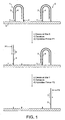
- Fig. 1 is a schematic illustration of an embodiment of the method of the invention. For simplicity, only two template duplexes are shown.
- the invention provides a method for sequencing two regions of a target double-stranded polynucleotide template, referred to herein as the first and second regions for sequence determination.
- the first and second regions for sequence determination are on complementary strands of the double-stranded polynucleotide template, which are referred to herein respectively as first and second template strands.
- the two regions for sequence determination may or may not be complementary to each other.
- Each cleavage step results in removal of at least a portion of one strand of a double-stranded molecule, leaving behind a single-stranded region on the complementary (uncleaved) strand.
- a conventional sequencing primer may then be hybridised to the single-stranded region.
- the cleavage steps may involve chemical, enzymatic or photochemical cleavage, as discussed in further detail below.
- the starting point for the method of the invention is the provision of a plurality of template polynucleotide duplexes immobilised on a solid support.
- Each of the duplexes comprises the same double-stranded target region to be sequenced.
- the duplexes are each formed from complementary first and second template strands which are linked to the solid support at or near to their 5' ends.
- the template polynucleotide duplexes will be provided in the form of a clustered array.
- immobilised When referring to immobilisation or attachment of molecules (e.g. nucleic acids) to a solid support, the terms “immobilised” and “attached” are used interchangeably herein and both terms are intended to encompass direct or indirect, covalent or non-covalent attachment, unless indicated otherwise, either explicitly or by context. In certain embodiments of the invention covalent attachment may be preferred, but generally all that is required is that the molecules (e.g. nucleic acids) remain immobilised or attached to the support under the conditions in which it is intended to use the support, for example in applications requiring nucleic acid amplification and/or sequencing.
- molecules e.g. nucleic acids
- Certain embodiments of the invention may make use of solid supports comprised of an inert substrate or matrix (e.g. glass slides, polymer beads etc) which has been "functionalised", for example by application of a layer or coating of an intermediate material comprising reactive groups which permit covalent attachment to biomolecules, such as polynucleotides.
- Such supports include, but are not limited to, polyacrylamide hydrogels supported on an inert substrate such as glass.
- the biomolecules e.g. polynucleotides
- the intermediate material e.g. the hydrogel
- the intermediate material may itself be non-covalently attached to the substrate or matrix (e.g. the glass substrate).
- covalent attachment to a solid support is to be interpreted accordingly as encompassing this type of arrangement.
- the first step of the method involves cleavage of one strand of the template duplex to generate a suitable template for a first sequencing reaction.
- This first cleavage step results in the removal of all or a portion of one strand of the polynucleotide duplex (denoted the second template strand) from the solid support. Cleavage of all or part of the second template strand leaves behind a single-stranded region on the complementary strand of the duplex (denoted the first template strand since it will be sequenced in the first sequencing reaction) still attached to the support.
- a first sequencing reaction may then be carried out by hybridising a suitable sequencing primer to the single-stranded region.
- a second cleavage step is carried out on the "intact" duplexes remaining on the solid support in order to generate suitable templates for sequencing a region of the second template strand.
- This second cleavage step results in removal of all or a portion of at least the first template strands which are present in "intact” template duplexes remaining on the solid support and may remove all first template strands attached to the support (including those paired with "cleaved" second strands).
- this second cleavage will leave behind single-stranded regions on the remainder of the second template strands that were not cleaved in the first cleavage step.
- a second sequencing reaction may then be carried out by hybridising a suitable sequencing primer to the single-stranded region.
- a key feature of the method of the invention is that sequential cleavage of the template duplexes is controlled, such that only a sub-fraction of the total duplexes immobilised on the support are cleaved in the first cleavage step, leaving a significant number of intact duplexes to be cleaved in the second cleavage step.
- this may be achieved by providing as a starting material a mixture of first and second polynucleotide template duplexes immobilised on the solid support.
- the first and second polynucleotide template duplexes will each comprise the same (or substantially the same) target double-stranded polynucleotide, but the first and second duplexes also have different features which permit controlled sequential cleavage.
- the first and second duplexes are each comprised of complementary first and second template nucleic acid strands.
- the first template strand of both the first and the second template duplexes includes a cleavage site Y.
- Cleavage site Y is a site which allows controlled cleavage of the first template strand by chemical, enzymatic or photochemical means. Cleavage at site Y results in removal of a portion of the first template strand, leaving behind a single-stranded region on the complementary second template strand.
- a sequencing primer can then be hybridised to the single-stranded region.
- the second template strand of the first template polynucleotide duplexes includes a cleavage site X.
- the first and second duplexes differ due to the presence or absence of cleavage site X.
- Cleavage site X is a site which allows controlled cleavage of the second template strand by chemical, enzymatic or photochemical means. Cleavage at site X results in removal of a portion of the second template strand, leaving behind a single-stranded region on the complementary first template strand. A sequencing primer can then be hybridised to the single-stranded region.
- cleavage sites X and Y are different, so that the first and second template strands can be independently cleaved. More specifically, it is essential that any external agent (e.g. chemical agent or restriction enzyme) used to cleave at site X, where present in the second template strands, does not also cleave the first template strands at site Y.
- any external agent e.g. chemical agent or restriction enzyme
- Suitable enzymatic, chemical or photochemical cleavage reaction may be used to cleave at site X or site Y.
- the cleavage reaction may result in removal or a part or the whole of the strand being cleaved.
- Suitable cleavage means include, for example, restriction enzyme digestion, in which case the cleavage site is an appropriate restriction site for the enzyme which directs cleavage of one or both strands of a duplex template; RNase digestion or chemical cleavage of a bond between a deoxyribonucleotide and a ribonucleotide, in which case the cleavage site may include one or more ribonucleotides; chemical reduction of a disulphide linkage with a reducing agent (e.g.
- TCEP TCEP
- the cleavage site should include an appropriate disulphide linkage; chemical cleavage of a diol linkage with periodate, in which case the cleavage site should include a diol linkage; generation of an abasic site and subsequent hydrolysis, etc.
- cleavage may occur at a cleavage site in one or both strands of a template polynucleotide duplex which comprises one or more or any combination of non-natural nucleotides, ribonucleotides or a non-nucleotide chemical modifications.
- Suitable cleavage techniques for use in the method of the invention include, but are not limited to, the following:
- chemical cleavage encompasses any method which utilises a non-nucleic acid and non-enzymatic chemical reagent in order to promote/achieve cleavage of one or both strands of a template polynucleotide duplex.
- one or both strands of the template polynucleotide duplex may include one or more non-nucleotide chemical moieties and/or non-natural nucleotides and/or non-natural backbone linkages in order to permit chemical cleavage reaction.
- the modification(s) required to permit chemical cleavage may be incorporated into an amplification primer used to form the template polynucleotide duplex by solid-phase nucleic acid amplification.
- one strand of the template polynucleotide duplex may include a diol linkage which permits cleavage by treatment with periodate (e.g. sodium periodate). It will be appreciate that more than one diol can be included at the cleavage site.
- periodate e.g. sodium periodate
- Diol linker units based on phosphoamidite chemistry suitable for incorporation into polynucleotide chains are commercially available from Fidelity systems Inc. (Gaithersburg, MD, USA).
- One or more diol units may be incorporated into a polynucleotide using standard methods for automated chemical DNA synthesis.
- oligonucleotide primers including one or more diol linkers can be conveniently prepared by chemical synthesis.
- one or more spacer molecules may be included between the diol linker and the site of attachment to the solid support.
- the spacer molecule may be a non-nucleotide chemical moiety. Suitable spacer units based on phosphoamidite chemistry for use in conjunction with diol linkers are also supplied by Fidelity Systems Inc.
- One suitable spacer for use with diol linkers is the spacer denoted arm 26, identified in the accompanying examples.
- To enable attachment to a solid support at the 5' end of the polynucleotide strand arm 26 may be modified to include a phosphorothioate group. The phosphorothioate group can easily be attached during chemical synthesis of a "polynucleotide" chain including the spacer and diol units.
- spacer molecules could be used as an alternative to arm 26.
- a stretch of non-target "spacer" nucleotides may be included. Typically from 1 to 20, more preferably from 1 to 15 or from 1 to 10, and more particularly 2, 3, 4, 5, 6, 7, 8, 9 or 10 spacer nucleotides may be included. Most preferably 10 spacer nucleotides will be positioned between the point of attachment to the solid support and the diol linker. It is preferred to use polyT. spacers, although other nucleotides and combinations thereof can be used. In one preferred embodiment 10T spacer nucleotides may be used.
- the diol linker is cleaved by treatment with a "cleaving agent", which can be any substance which promotes cleavage of the diol.
- the preferred cleaving agent is periodate, preferably aqueous sodium periodate (NaIO 4 ).
- the cleaved product may be treated with a "capping agent” in order to neutralise reactive species generated in the cleavage reaction.
- Suitable capping agents for this purpose include amines, such as ethanolamine.
- the capping agent e.g. ethanolamine
- the capping agent may be included in a mixture with the cleaving agent (e.g. periodate) so that reactive species are capped as soon as they are formed.
- a diol linkage and cleaving agent e.g. periodate
- cleaving agent e.g. periodate
- treatment with periodate is compatible with nucleic acid integrity and with the chemistry of the hydrogel surface.
- utility of diol linkages/periodate as a method of linearisation is not limited to polyacrylamide hydrogel surfaces but also extends to linearisation of duplexes immobilised on other solid supports and surfaces, including supports coated with functionalised silanes (etc).
- the strand to be cleaved may include a disulphide group which permits cleavage with a chemical reducing agent, e.g. Tris (2-carboxyethyl)-phosphate hydrochloride (TCEP).
- TCEP Tris (2-carboxyethyl)-phosphate hydrochloride
- abasic site is defined as a nucleoside position in a polynucleotide chain from which the base component has been removed.
- Abasic sites can occur naturally in DNA under physiological conditions by hydrolysis of nucleoside residues, but may also be formed chemically under artificial conditions or by the action of enzymes. Once formed, abasic sites may be cleaved (e.g. by treatment with an endonuclease or other single-stranded cleaving enzyme, exposure to heat or alkali), providing a means for site-specific cleavage of a polynucleotide strand.
- an abasic site may be created at a pre-determined position on one strand of a template polynucleotide duplex and then cleaved by first incorporating deoxyuridine (U) at a pre-determined cleavage site in one strand of the template polynucleotide duplex.
- U deoxyuridine
- UGG uracil DNA glycosylase
- the polynucleotide strand including the abasic site may then be cleaved at the abasic site by treatment with endonuclease (e.g EndoIV endonuclease, AP lyase, FPG glycosylase/AP lyase, EndoVIII glycosylase/AP lyase), heat or alkali.
- endonuclease e.g EndoIV endonuclease, AP lyase, FPG glycosylase/AP lyase, EndoVIII glycosylase/AP lyase
- Abasic sites may also be generated at non-natural/modified deoxyribonucleotides other than deoxyuridine and cleaved in an analogous manner by treatment with endonuclease, heat or alkali.
- endonuclease heat or alkali.
- 8-oxo-guanine can be converted to an abasic site by exposure to FPG glycosylase.
- Deoxyinosine can be converted to an abasic site by exposure to AlkA glycosylase.
- the abasic sites thus generated may then be cleaved, typically by treatment with a suitable endonuclease (e.g. EndoIV, AP lyase).
- the non-natural/modified nucleotide is to be incorporated into an amplification primer for use in solid-phase amplification, then the non-natural/modified nucleotide should be capable of being copied by the polymerase used for the amplification reaction.
- the molecules to be cleaved may be exposed to a mixture containing the appropriate glycosylase and one or more suitable endonucleases.
- the glycosylase and the endonuclease will typically be present in an activity ratio of at least about 2: 1.
- This method of cleavage has particular advantages in relation to the creation of templates for nucleic acid sequencing.
- cleavage at an abasic site generated by treatment with a glycosylase such as UDG generates a free 3' hydroxyl group on the cleaved strand which can provide an initiation point for sequencing a region of the complementary strand.
- a glycosylase such as UDG
- UDG glycosylase
- deoxyuridine which does not occur naturally in DNA, but is otherwise independent of sequence context, if only one non-natural base is included there is no possibility of glycosylase-mediated cleavage occurring elsewhere at unwanted positions in the duplex.
- the enzyme may create nicks at "other" sites in the duplex (in addition to the desired cleavage site) if these possess the correct recognition sequence.
- incorporation of one or more ribonucleotides into a polynucleotide strand which is otherwise comprised of deoxyribonucleotides can provide a site for cleavage using a chemical agent capable of selectively cleaving the phosphodiester bond between a deoxyribonucleotide and a ribonucleotide or using a ribonuclease (RNAse).
- RNAse ribonuclease
- sequencing templates can be produced by cleavage of one strand of a template polynucleotide duplex at a site containing one or more consecutive ribonucleotides using such a chemical cleavage agent or an RNase.
- the strand to be cleaved contains a single ribonucleotide to provide a site for chemical cleavage.
- Suitable chemical cleavage agents capable of selectively cleaving the phosphodiester bond between a deoxyribonucleotide and a ribonucleotide include metal ions, for example rare-earth metal ions (especially La 3+ , particularly Tm 3+ , Yb 3+ or Lu 3+ ( Chen et al. Biotechniques. 2002, 32: 518-520 ; Komiyama et al. Chem. Commun. 1999, 1443-1451 )), Fe(3) or Cu(3), or exposure to elevated pH, e.g. treatment with a base such as sodium hydroxide.
- a base such as sodium hydroxide
- the base composition of the ribonucleotide(s) is generally not material, but can be selected in order to optimise chemical (or enzymatic) cleavage.
- rUMP or rCMP are generally preferred if cleavage is to be carried out by exposure to metal ions, especially rare earth metal ions.
- the ribonucleotide(s) will typically be incorporated into one strand of a template polynucleotide duplex (or the amplification primer from which this strand is derived if prepared by solid-phase amplification), and may be situated in a region of the duplex which is single-stranded when the two complementary strands of the duplex are annealed (i.e. in a 5' overhanging portion).
- the template polynucleotide duplex is prepared by solid-phase PCR amplification using forward and reverse amplification primers, one of which contains at least one ribonucleotide, the standard DNA polymerise enzymes used for PCR amplification are not capable of copying ribonucleotide templates.
- the PCR products will contain an overhanging 5' region comprising the ribonucleotide(s) and any remainder of the amplification primer upstream of the ribonucleotide(s).
- the phosphodiester bond between a ribonucleotide and a deoxyribonucleotide, or between two ribonucleotides may also be cleaved by an RNase. Any endocytic ribonuclease of appropriate substrate specificity can be used for this purpose. If the ribonucleotide(s) are present in a region which is single-stranded when the two complementary strands of the double-stranded molecule are annealed (i.e. in a 5' overhanging portion), then the RNase will be an endonuclease which has specificity for single strands containing ribonucleotides.
- ribonuclease For cleavage with ribonuclease it is preferred to include two or more consecutive ribonucleotides, and preferably from 2 to 10 or from 5 to 10 consecutive ribonucleotides.
- the precise sequence of the ribonucleotides is generally not material, except that certain RNases have specificity for cleavage after certain residues. Suitable RNases include, for example, RNaseA, which cleaves after C and U residues. Hence, when cleaving with RNaseA the cleavage site must include at least one ribonucleotide which is C or U.
- Polynucleotides incorporating one or more ribonucleotides can be readily synthesised using standard techniques for oligonucleotide chemical synthesis with appropriate ribonucleotide precursors. If the template polynucleotide duplex is prepared by solid-phase nucleic acid amplification, then it is convenient to incorporate one or more ribonucleotides into one of the primers to be used for the amplification reaction.
- photochemical cleavage encompasses any method which utilises light energy in order to achieve cleavage of one or both strands of the double-stranded nucleic acid molecule.
- a site for photochemical cleavage can be provided by a non-nucleotide chemical spacer unit in one of the strands of the double-stranded molecule (or the amplification primer from which this strand is derived if prepared by solid-phase amplification).
- Suitable photochemical cleavable spacers include the PC spacer phosphoamidite (4-(4,4'-Dimethoxytrityloxy)butyramidomethyl)-1-(2-nitrophenyl)-ethyl]-2-cyanoethyl-(N,N-diisopropyl)-phosphoramidite) supplied by Glen Research, Sterling, Virginia, USA (cat number 10-4913-XX) which has the structure:
- the spacer unit can be cleaved by exposure to a UV light source.
- This spacer unit can be attached to the 5' end of a polynucleotide, together with a thiophosphate group which permits attachment to a solid surface, using standard techniques for chemical synthesis of oligonucleotides.
- this spacer unit can be incorporated into a forward or reverse amplification primer to be used for synthesis of a photocleavable template polynucleotide duplex by solid-phase amplification.
- Site-specific cleavage of one strand of a double-stranded nucleic acid molecule may also be achieved by incorporating one or more methylated nucleotides into this strand and then cleaving with an endonuclease enzyme specific for a recognition sequence including the methylated nucleotide(s).
- the methylated nucleotide(s) will typically be incorporated in a region of one strand of the template polynucleotide duplex having a complementary stretch of non-methylated deoxyribonucleotides on the complementary strand, such that annealing of the two strands produces a hemimethylated duplex structure.
- the hemimethylated duplex may then be cleaved by the action of a suitable endonuclease.
- enzymes which cleave such hemimethylated target sequences are not to be considered as "restriction endonucleases" excluded from the scope of the second aspect of the invention, but rather are intended to form part of the subject-matter of the invention.
- Polynucleotides incorporating one or methylated nucleotides may be prepared using standard techniques for automated DNA synthesis, using appropriately methylated nucleotide precursors. If the template polynucleotide duplex is prepared by solid-phase nucleic acid amplification, then it is convenient to incorporate one or more methylated nucleotides into one of the primers to be used for the amplification reaction.
- the template polynucleotide duplex may be prepared by solid-phase amplification using forward and reverse primers, one of which contains a "PCR stopper".
- a "PCR stopper” is any moiety (nucleotide or non-nucleotide) which prevents read-through of the polymerase used for amplification, such that it cannot copy beyond that point. The result is that amplified strands derived by extension of the primer containing the PCR stopper will contain a 5' overhanging portion. This 5' overhang (other than the PCR stopper itself) may be comprised of naturally occurring deoxyribonucleotides, with predominantly natural backbone linkages, i.e.
- cleavage reagent e.g. an enzyme which is selective for cleavage of single-stranded DNA but not double stranded DNA, for example mung bean nuclease.
- the PCR stopper may be essentially any moiety which prevents read-through of the polymerase to be used for the amplification reaction.
- Suitable PCR stoppers include, but are not limited to, hexaethylene glycol (HEG), abasic sites, and any non-natural or modified nucleotide which prevents read-through of the polymerase, including DNA analogues such as peptide nucleic acid (PNA).
- HOG hexaethylene glycol
- PNA peptide nucleic acid
- Stable abasic sites can be introduced during chemical oligonucleotide synthesis using appropriate spacer units containing the stable abasic site.
- abasic furan (5'-O-Dimethoxytrityl-l',2'-Dideoxyribose-3'-[(2-cyanoethyl)-(N,N-diisopropyl)]-phosphoramidite) spacers commercially available from Glen Research, Sterling, Virginia, USA, can be incorporated during chemical oligonucleotide synthesis in order to introduce an abasic site.
- Such a site can thus readily be introduced into an oligonucleotide primer to be used in solid-phase amplification.
- an abasic site is incorporated into either forward or reverse amplification primer the resulting amplification product will have a 5' overhang on one strand which will include the abasic site (in single-stranded form).
- the single-stranded abasic site may then be cleaved by the action of a suitable chemical agent (e.g. exposure to alkali) or an enzyme (e.g. AP-endonuclease VI, Shida el al. Nucleic Acids Research, 1996, Vol.24, 4572-4576 ).
- a cleavage site can also be introduced into one strand of a template polynucleotide duplex by preparing a conjugate structure in which a peptide molecule is linked to one strand of the duplex (or the amplification primer from which this strand is derived if prepared by solid-phase amplification).
- the peptide molecule can subsequently be cleaved by a peptidase enzyme of the appropriate specificity, or any other suitable means of non-enzymatic chemical or photochemical cleavage.
- the conjugate between peptide and nucleic acid will be formed by covalently linking a peptide to one strand only of the template polynucleotide duplex, with the peptide portion being conjugated to the 5' end of this strand, adjacent to the point of attachment to the solid surface.
- the template polynucleotide duplex is prepared by solid-phase amplification, the peptide conjugate may be incorporated at the 5' end of one of the amplification primers. Obviously the peptide component of this primer will not be copied during PCR amplification, hence the "bridged" amplification product will include a cleavable 5' peptide "overhang" on one strand.
- Conjugates between peptides and nucleic acids wherein the peptide is conjugated to the 5' end of the nucleic acid can be prepared using techniques generally known in the art.
- the peptide and nucleic acid components of the desired amino acid and nucleotide sequence can be synthesised separately, e.g. by standard automated chemical synthesis techniques, and then conjugated in aqueous/organic solution.
- the OPeC TM system commercially available from Glen Research is based on the "native ligation" of an N-terminal thioester-functionalized peptide to a 5'-cysteinyl oligonucleotide.
- Pentafluorophenyl S-benzylthiosuccinate is used in the final coupling step in standard Fmoc-based solid-phase peptide assembly. Deprotection with trifluoroacetic acid generates, in solution, peptides substituted with an N-terminal S-benzylthiosuccinyl group.
- O-2-cyanoethyl-N,N-diisopropylphosphoramidite is used in the final coupling step in standard phosphoramidite solid-phase oligonucleotide assembly.
- the conjugate strand containing peptide and nucleic acid can be covalently attached to a solid support using any suitable covalent linkage technique known in the art which is compatible with the chosen surface. If the peptide/nucleic acid conjugate structure is an amplification primer to be used for solid-phase PCR amplification, attachment to the solid support must leave the 3' end of the nucleic acid component free.
- the peptide component can be designed to be cleavable by any chosen peptidase enzyme, of which many are known in the art.
- the nature of the peptidase is not particularly limited, it is necessary only for the peptidase to cleave somewhere in the peptide component.
- the length and amino acid sequence of the peptide component is not particularly limited except by the need to be "cleavable" by the chosen peptidase.
- the length and precise sequence of the nucleic acid component is also not particularly limited, it may be of any desired sequence. If the nucleic acid component is to function as a primer in solid-phase PCR, then its length and nucleotide sequence will be selected to enable annealing to the template to be amplified.
- nicking endonucleases are enzymes that selectively cleave or "nick" one strand of a polynucleotide duplex and are also well known in the art of molecular biology. The invention is not limited with respect to the nature of the enzyme. Essentially any restriction or nicking endonuclease may be used, provided that a suitable recognition sequence can be included at cleavage site X or cleavage site Y.
- cleavage sites X and Y are different. This can be achieved by using a combination of any two of the above-identified means of cleavage, i.e. any combination of two from: enzymatic cleavage, chemical cleavage or photochemical cleavage, etc.
- a combination of enzymatic cleavage at one site and non-enzymatic cleavage at the other site may be used. If such a combination is used then most preferably cleavage at site X will be enzymatic (e.g. cleavage with restriction enzyme) and cleavage at site Y will be non-enzymatic (preferably a chemical cleavage).
- Figure 1(a) illustrates the starting templates for a sequencing reaction according to the invention.
- the embodiment illustrated uses a mixture of first 1 and second 2 template polynucleotide duplexes immobilised on the surface of a solid support 3. Both strands of each polynucleotide duplex are attached to the solid support at or near the 5' end.
- the template "duplexes" may in fact be partially single-stranded at one or both 5' ends.
- Any suitable solid support and any suitable attachment means known in the art may be used, of which several are described by way of example below. Linkage to the solid support will preferably be via covalent attachment.
- the polynucleotide duplexes will typically be formed from two complementary polynucleotide strands comprised of deoxyribonucleotides joined by phosphodiester bonds, but may additionally include one or more ribonucleotides and/or non-nucleotide chemical moieties and/or non-naturally occurring nucleotides and/or non-naturally occurring backbone linkages.
- the double-stranded nucleic acid may include non-nucleotide chemical moieties, e.g. linkers or spacers, at the 5' end of one or both strands.
- the double-stranded nucleic acid may include methylated nucleotides, uracil bases, phosphorothioate groups, ribonucleotides, diol linkages, disulphide linkages, peptides etc.
- Such non-DNA or non-natural modifications may be included in order to permit cleavage, or to confer some other desirable property, for example to enable covalent attachment to a solid support, or to act as spacers to position a site of cleavage an optimal distance from the solid support.
- the first and second template duplexes each comprise a double-stranded target polynucleotide that it is desired to sequence.
- the template duplexes may also include non-target sequences at both the 5' and 3'ends, flanking the target polynucleotide. If the template duplexes are formed by solid-phase amplification, these non-target sequences will generally be derived from the primers used for solid-phase amplification.
- FIG. 1(a) there is shown, by way of simplification, only a single first duplex 1 and a single second duplex 2 immobilised on a solid support.
- the first and second duplexes form part of a single cluster or colony comprised of many such first and second duplexes, and the cluster or colony will itself typically form part of an array of many such clusters or colonies.
- the terms “cluster” and “colony” are used interchangeably throughout and refer to a discrete site on a solid support comprised of a plurality of identical immobilised nucleic acid strands and a plurality of identical immobilised complementary nucleic acid strands.
- the term “clustered array” refers to an array of such clusters or colonies. In this context the term “array” is not to be understood as requiring an ordered arrangement of clusters. Clustered arrays are generally formed by solid-phase PCR amplification.
- a key feature of the invention is that the first and second template duplexes can occur in the same cluster or colony on a clustered array.
- the first and second duplexes within each colony will comprise the same double-stranded target polynucleotide and will be derived from amplification of a single target polynucleotide molecule, whereas different colonies may be formed of duplexes comprising different double-stranded target polynucleotides (meaning different to the target polynucleotides present in other colonies), the different colonies being derived from amplification of different single target polynucleotides.
- At least 90%, more preferably at least 95% of the colonies on a given clustered array will be formed from template duplexes comprising different double-stranded target polynucleotides, although within each individual colony on the array all template duplexes will comprise the same double-stranded target polynucleotide.
- Each template duplex comprises a first template strand 4 and a second template strand 5.
- the first template strand 4 of both the first and second template duplexes comprise a cleavage site Y.
- Site Y is preferably positioned proximal (or adjacent) to the site of attachment of first template strand 4 to the solid support, such that cleavage at site Y results in removal of a substantial portion of the first template strand leaving behind a large single-stranded region on the complementary strand for the subsequent sequencing reaction.
- the second template strand 5 of the first template duplex 1, but not the second template duplex 2 comprises a cleavage site X.
- Site X is preferably positioned proximal (or adjacent) to the site of attachment of second template strand 5 to the solid support, such that cleavage at site X results in removal of a substantial portion of the first template strand leaving behind a large single-stranded region on the complementary strand for the subsequent sequencing reaction.
- cleavage site X or cleavage site Y is a site for cleavage by a restriction enzyme
- the recognition site (sequence) for the enzyme may be present in a region of the template duplex that is double-stranded when the first and second strands of the template duplex are annealed.
- the restriction enzyme may cleave both strands of the template duplex or only one strand. For cleavage of both strands, essentially any type of restriction enzyme known in the art may be used.
- Suitable recognition sites can be included in the template duplexes according to standard molecular biology techniques. By way of example, if the template duplexes are generated by solid-phase amplification then suitable restriction sites may be included in the amplification primers.
- nicking endonucleases examples of enzymes which recognise a double-stranded target sequence but cleave only one strand are the nicking endonucleases, of which many are known in the art. Again, recognition sites for such nicking enzymes may be engineering in the template duplexes using standard techniques.
- the cleavage site When using an enzyme which cleaves both strands of an annealed template duplex it is convenient for the cleavage site to be positioned close to the 5' end of the strand it is intended to remove from the solid support via the cleavage reaction, and close to the 3' end of the complementary strand, such that only a small fragment at the 3' end of the complementary strand is removed by the cleavage reaction, but this is not essential.
- cleavage site X or cleavage site Y is a site for non-enzymatic cleavage, e.g. chemical or photochemical cleavage, then it may be positioned in a region of the template "duplex" that is single-stranded when the first and second strands of the template duplex are annealed, depending on the nature of the cleavage reaction.
- the template duplexes may in fact be partially single-stranded at one or both 5' ends, proximal to the site of linkage to the solid support.
- cleavage site X and/or cleavage site Y may be positioned within such a single-stranded region, which may be comprised of non-natural nucleotides and/or non-nucleotide chemical moieties etc. as described above.
- the second template strand 5 of the first template duplex is cleaved at site X.
- the resulting products are then denatured to remove the cleaved portion of the second template strand.
- a first sequencing primer P1 is then hybridised to the first template strand 4 of the first template duplex 1 and a sequencing reaction proceeds via successive incorporation of nucleotides to the first sequencing primer, resulting in determination of the sequence of a first region 6 of the target polynucleotide, this region being in the first template strand.
- Hybridisation of sequencing primer P1 to the first template strand is achieved by contacting the primer and template strand under conditions which promote annealing of primer to template. Such conditions will generally be well known to those skilled in the art of molecular biology. Under such conditions annealing of the first and second template strands of the second template duplex is favoured, particularly if the two strands are immobilised in close proximity, such as will be the case if the templates are formed by solid-phase amplification. Hence, the second template duplex structure will re-form under the conditions used for hybridisation of the first sequencing primer to the first template strand.
- Duplex formation by annealing of the first and second strands of the second template duplex is favoured over annealing of the first sequencing primer (in free solution) to the first template strand of the second template duplex because of the length of the two complementary strands forming the template duplex and the proximity of the strands on the solid support.
- the first sequencing primer in free solution
- cleavage step to remove a portion of the second template strands prior to hybridisation of the first primer ensures that there are excess first template strands available for hybridisation to the first sequencing primer, even though this hybridisation event is unfavourable compared to re-formation of a template duplex.
- the first template strands 4 of both the first and second duplexes are cleaved at site Y.
- the resulting products are denatured to remove the cleaved portions of the first template strands.
- a second sequencing primer P2 is then hybridised to the second template strand 5 of the second template duplex 2 and a sequencing reaction proceeds via successive addition of nucleotides to the second sequencing primer, resulting in determination of the sequence of a second region 7 of the target polynucleotide, this region being in the second template strand.
- the sequencing primers P1 and P2 may correspond to adaptor sequences (or a portion thereof) added to the 5' and 3' ends of the target double-stranded molecules to be sequenced (discussed further below), thus enabling common sequencing primers to be used for all target molecules of known or unknown sequence.
- Sequencing can be carried out using any suitable "sequencing-by-synthesis" technique, wherein nucleotides are added successively to a free 3' hydroxyl group, typically provided by annealing of a sequencing primer, resulting in synthesis of a polynucleotide chain in the 5' to 3' direction.
- the nature of the nucleotide added is preferably determined after each addition.
- One preferred sequencing method which can be used in the methods of the invention relies on the use of modified nucleotides that can act as chain terminators. Once the modified nucleotide has been incorporated into the growing polynucleotide chain complementary to the region of the template being sequenced there is no free 3'-OH group available to direct further sequence extension and therefore the polymerase can not add further nucleotides. Once the nature of the base incorporated into the growing chain has been determined, the 3' block may be removed to allow addition of the next successive nucleotide. By ordering the products derived using these modified nucleotides it is possible to deduce the DNA sequence of the DNA template.
- Such reactions can be done in a single experiment if each of the modified nucleotides has attached a different label, known to correspond to the particular base, to facilitate discrimination between the bases added at each incorporation step.
- a separate reaction may be carried out containing each of the modified nucleotides separately.
- the modified nucleotides may carry a label to facilitate their detection.
- this is a fluorescent label.
- Each nucleotide type may carry a different fluorescent label.
- the detectable label need not be a fluorescent label. Any label can be used which allows the detection of the incorporation of the nucleotide into the DNA sequence.
- One method for detecting the fluorescently labelled nucleotides comprises using laser light of a wavelength specific for the labelled nucleotides, or the use of other suitable sources of illumination.
- the fluorescence from the label on the nucleotide may be detected by a CCD camera or other suitable detection means.
- the methods of the invention are not limited to use of the sequencing method outlined above, but can be used in conjunction with essentially any sequencing methodology which relies on successive incorporation of nucleotides into a polynucleotide chain.
- Suitable techniques include, for example, Pyrosequencing TM , FISSEQ (fluorescent in situ sequencing), MPSS (massively parallel signature sequencing) and sequencing by ligation-based methods.
- the target double-stranded polynucleotide to be sequenced using the method of the invention may be any polynucleotide that it is desired to sequence.
- the target polynucleotide may be of known, unknown or partially known sequence, for example in re-sequencing applications.
- Using the template preparation method described in detail below it is possible to prepare arrays of templates starting from essentially any double-stranded target polynucleotide of known, unknown or partially known sequence. With the use of arrays it is possible to sequence multiple targets of the same or different sequence in parallel.
- a particularly preferred application of the method is in the sequencing of fragments of genomic DNA.
- the method provides particular advantages in the identification of genome rearrangements, since the two regions of sequence obtained for each target molecule using the method will be known to be linked within a certain distance of each other in the genome, depending on the size of the starting target molecule.
- Suitable templates for sequencing using the method of the invention can be prepared using solid-phase nucleic acid (PCR) amplification to produce clustered arrays of nucleic acid colonies. This can be done using procedures analogous to those described in WO 98/44151 and WO 00/18957 , except that three primers rather than two are required for amplification of each colony.
- PCR solid-phase nucleic acid
- a mixture of the three amplification primers is immobilised or "grafted" onto the surface of a suitable solid support.
- the three amplification primers are oligonucleotide molecules have the following structures: First forward primer: A-L-X-S1 Second forward primer: A-L-S1 Reverse primer: A-L-Y-S2
- A represents a moiety which allows attachment to the solid support
- L is an optional linker moiety
- X is a cleavage site
- Y is a cleavage site different to X
- S1 and S2 are polynucleotide sequences which permit amplification of a template nucleic acid molecule comprising the target double-stranded polynucleotide.
- the mixture of primers will generally comprise substantially equal amounts of the first and second forward primers and the total amount of the first and second forward primers will typically be substantially equal to the total amount of the reverse primer.
- L represents a linker which may be included but is not strictly necessary.
- the linker may be a carbon-containing chain such as those of formula (CH 2 ) n wherein "n" is from 1 to about 1500, for example less than about 1000, preferably less than 100, e.g. from 2-50, particularly 5-25.
- n is from 1 to about 1500, for example less than about 1000, preferably less than 100, e.g. from 2-50, particularly 5-25.
- linkers may be employed with the only restriction placed on their structures being that the linkers are stable under conditions under which the polynucleotides are intended to be used subsequently, e.g. conditions used in DNA amplification and sequencing.
- Linkers which do not consist of only carbon atoms may also be used. Such linkers include polyethylene glycol (PEG) having a general formula of (CH 2 -CH 2 -O) m , wherein m is from about 1 to 600, preferably less than about 500.
- PEG polyethylene glycol
- Linkers formed primarily from chains of carbon atoms and from PEG may be modified so as to contain functional groups which interrupt the chains. Examples of such groups include ketones, esters, amines, amides, ethers, thioethers, sulfoxides, sulfones. Separately or in combination with the presence of such functional groups may be employed alkene, alkyne, aromatic or heteroaromatic moieties, or cyclic aliphatic moieties (e.g. cyclohexyl). Cyclohexyl or phenyl rings may, for example, be connected to a PEG or (CH 2 ) n chain through their 1- and 4-positions.
- linkers described above which are primarily based on linear chains of saturated carbon atoms, optionally interrupted with unsaturated carbon atoms or heteroatoms
- other linkers may be envisaged which are based on nucleic acids or monosaccharide units (e.g. dextrose). It is also within the scope of this invention to utilise peptides as linkers.
- linker may comprise one or more nucleotides which form part of the amplification primer but which do not participate in any reaction carried out on or with the primer (e.g. a hybridisation or amplification reaction).
- nucleotides may also be referred to herein as "spacer" polynucleotides.
- spacer polynucleotides.
- the primer will include 10 spacer nucleotides. It is preferred to use polyT spacers, although other nucleotides and combinations thereof can be used.
- the primer may include 10T spacer nucleotides.
- the one or more spacer nucleotides function to space the portion of the primer required to hybridise to a target and direct amplification, away from the site of attachment to the solid support (i.e. S1 or S2).
- the inclusion of spacer nucleotides at the 5' end can markedly improve the performance of hybridisation of complementary polynucleotides to region S1 or S2.
- the polynucleotide will include 10T spacer nucleotides and a 5' phosphorothioate group for attachment to the solid support (moiety A), although other attachment moieties may be used as discussed below.
- Sequences S1 and S2 in the forward and reverse primers are polynucleotide sequences which, in combination, direct amplification of a template by solid-phase PCR.
- the template to be amplified must itself comprise (when viewed as a single strand) at the 3' end a sequence capable of hybridising to sequence S1 in the forward primers and at the 5' end a sequence the complement of which is capable of hybridising to sequence S2 the reverse primer.
- sequences S1 and S2 in the forward and reverse primer oligonucleotides will be dependent on the nature of the template it is intended to amplify.
- S1 and S2 must be capable of hybridising to cognate sequences on complementary strands of the template to be amplified.
- hybridisation encompasses sequence-specific binding between primer and template. Binding of a primer to its cognate sequence in the template should occur under typical conditions used for primer-template annealing in standard PCR. Typically hybridisation conditions are exposure to a temperature in the range of 50-65°C for a period of about 1 minute in standard PCR reaction buffer, following a denaturation step. Such conditions will be generally well known to those skilled in the art It is not essential for hybridisation that sequences S1 and S2 be exactly complementary to their cognate sequences in the template to be amplified, although this is preferred.
- S1 and S2 may be of different or identical sequence and will typically be around 20-30 nucleotides in length.
- the primers can include natural and non-natural DNA bases, also ribonucleotides or any combination thereof, and may also include non-natural backbone linkages such as disulphides or phosphorothioates.
- Cleavage sites X or Y may fall within sequence S1 or S2, or if the linker L is itself a polynucleotide cleavage they may form part of linker region L. In other embodiments the cleavage site may be formed at the junction of sequences L and S1 or L and S2, or at the junction between moiety A and linker L (if present) or between moiety A and sequence S1 or S2 (if L not present).
- Moiety A may be any chemical moiety which permits immobilisation of an oligonucleotide primer on a solid support.
- the surface of the solid support may itself be functionalised to permit attachment of the primers.
- Any suitable covalent or non-covalent attachment means may be used, of which many are known in the art.
- biotinylated albumins can form a stable attachment of biotin groups by physisorption of the protein onto surfaces.
- Covalent modification can also be performed using silanes, which have been used to attach molecules to a solid support, usually a glass slide.
- silanes which have been used to attach molecules to a solid support, usually a glass slide.
- a mixture of tetraethoxysilane and triethoxy-bromoacetamidopropyl-silane e.g. in a ratio of 1:100
- Biotin molecules can be attached to surfaces using appropriately reactive species such as biotin-PEG-succinimidyl ester which reacts with an amino surface.
- a mixture of amplification primers may then be brought into contact with the functionalised solid support.
- functionalised polyacrylamide hydrogels may be used to attach primers wherein moiety A is a sulfur-containing nucleophilic groups are used.
- moiety A is a sulfur-containing nucleophilic groups
- appropriate sulfur nucleophile-containing polynucleotides are disclosed in Zhao et al (Nucleic Acids Research, 2001, 29(4), 955-959 ) and Pirrung et al (Langmuir, 2000, 16, 2185-2191 ) and include, for example, simple thiols, thiophosphates and thiophosphoramidates.
- Preferred hydrogels are those formed from a mixture of (i) a first comonomer which is acrylamide, methacrylamide, hydroxyethyl methacrylate or N-vinyl pyrrolidinone; and
- solid support refers to the material to which the polynucleotides molecules are attached. Suitable solid supports are available commercially, and will be apparent to the skilled person.
- the supports can be manufactured from materials such as glass, ceramics, silica and silicon. Supports with a gold surface may also be used.
- the supports usually comprise a flat (planar) surface, or at least a structure in which the polynucleotides to be interrogated are in approximately the same plane.
- the solid support can be nonplanar, e.g., a microbead. Any suitable size may be used.
- the supports might be on the order of 1-10 cm in each direction.
- a mixture of the three amplification primers is applied to a (suitable functionalised) solid support under conditions which permit reaction between moiety A and the support.
- the result of the grafting reaction is a substantially even distribution of the three primers over the solid support.
- the template to be amplified may be grafted onto the solid support together with the three amplification primers in a single grafting reaction. This can be achieved by adding template molecules including moiety A at the 5' end to the mixture of primers to form a primer-template mixture. This mixture is then grafted onto the solid support in a single step. Amplification may then proceed using the immobilised template and primers in a reaction analogous to that described in WO 00/18957 . The first step in such a reaction will be hybridisation between surface-bound templates and surface-bound amplification primers.
- the amplification reaction may proceed substantially as described in WO 98/44151 .
- the solid support is contacted with the template to be amplified under conditions which permit hybridisation between the template and the immobilised primers.
- the template is usually added in free solution under suitable hybridisation conditions, which will be apparent to the skilled reader.
- hybridisation conditions are, for example, 5xSSC at 40°C, following an initial denaturation step.
- Solid-phase amplification can then proceed, the first step of the amplification being a primer extension step in which nucleotides are added to the 3' end of the immobilised primer hybridised to the template to produce a fully extended complementary strand.
- This complementary strand will thus include at its 3' end a sequence which is capable of binding to the second primer molecule immobilised on the solid support. Further rounds of amplification (analogous to a standard PCR reaction) lead to the formation of clusters or colonies of template molecules bound to the solid support.
- Sequences S1 and S2 in the amplification primers may be specific for a particular target nucleic acid that it is desired to amplify, but in other embodiments sequences S1 and S2 may be "universal" primer sequences which enable amplification of any target nucleic acid of known or unknown sequence which has been modified to enable amplification with the universal primers.
- Suitable templates to be amplified with universal primers may be prepared by modifying target double-stranded polynucleotides by addition of known adaptor sequences to the 5' and 3' ends of the target nucleic acid molecules to be amplified.
- the target molecules themselves may be any double-stranded molecules it is desired to sequence (e.g. random fragments of human genomic DNA).
- the adaptor sequences enable amplification of these molecules on a solid support to form clusters using forward and reverse primers having the general structure described above, wherein sequences S1 and S2 are universal primer sequences.
- the adaptors are typically short oligonucleotides that may be synthesised by conventional means.
- the adaptors may be attached to the 5' and 3' ends of target nucleic acid fragments by a variety of means (e.g. subcloning, ligation. etc). More specifically, two different adaptor sequences are attached to a target nucleic acid molecule to be amplified such that one adaptor is attached at one end of the target nucleic acid molecule and another adaptor is attached at the other end of the target nucleic acid molecule.
- the resultant construct comprising a target nucleic acid sequence flanked by adaptors may be referred to herein as a "template nucleic acid construct".
- the target double-stranded polynucleotides may advantageously be size-fractionated prior to modification with the adaptor sequences.
- the adaptors contain sequences which permit nucleic acid amplification using the amplification primer molecules immobilised on the solid support. These sequences in the adaptors may be referred to herein as "primer binding sequences".
- primer binding sequences In order to act as a template for nucleic acid amplification, a single strand of the template construct must contain a sequence which is complementary to sequence S1 in the forward amplification primers (such that the forward primer molecule can bind and prime synthesis of a complementary strand) and a sequence which corresponds to sequence S2 in the reverse amplification primer molecules (such that the reverse primer molecule can bind to the complementary strand).
- the sequences in the adaptors which permit hybridisation to primer molecules will typically be around 20-30 nucleotides in length, although the invention is not limited to sequences of this length.
- sequences S1 and S2 in the amplification primers are generally not material to the invention, as long as the primer molecules are able to interact with the amplification sequences in order to direct PCR amplification.
- the criteria for design of PCR primers are generally well known to those of ordinary skill in the art.
- Solid-phase amplification by either the method analogous to that of WO 98/44151 or that of WO 00/18957 will result in production of an array of colonies of "bridged" amplification products having the structures represented in Figure 1(a) .
- Both strands of the amplification product will be immobilised on the solid support at or near the 5' end, this attachment being derived from the original attachment of the amplification primers.
- the amplification products within each colony will be derived from amplification of a single target molecule.
- each colony will contain a mixture of amplification products in the form of template duplexes, approximately half of which will contain cleavage site X.
- the utility of the sequencing method of the invention is not limited to sequencing of templates produced by an amplification reaction, although this is preferred.
- the method may be applied to sequencing of double-stranded templates immobilised on a support by any other means, provided that the templates include to appropriate combinations of cleavage sites X and Y to enable controlled, independent cleavage of the two complementary template strands.
- the solid supports used are typically 8-channel glass chips such as those provided by Micronit (Twente, Nederland) or IMT (Neucaul, Switzerland). However, the experimental conditions and procedures are readily applicable to other solid supports.
- Chips were washed as follows: neat Decon for 30 min, milliQ H 2 O for 30 min, NaOH 1N for 15 min, milliQ H 2 O for 30 min, HCl 0.1N for 15 min, milliQ H 2 O for 30 min.
- the 10 ml solution of acrylamide was first degassed with argon for 15 min.
- the solutions of BRAPA, TEMED and potassium persulfate were successively added to the acrylamide solution.
- the mixture was then quickly vortexed and immediately used.
- Polymerization was then carried out for 1h 30 at RT. Afterwards the channels were washed with milliQ H 2 O for 30 min.
- the slide was then dried by flushing argon through the inlets and stored under low pressure in a dessicator.
- N -Boc-1,5-diaminopentane toluene sulfonic acid was obtained from Novabiochem.
- the bromoacetyl chloride and acryloyl chloride were obtained from Fluka. All other reagents were Aldrich products.
- the primers are typically 5'-phosphorothioate oligonucleotides incorporating any specific sequences or modifications required for cleavage. Their sequences and suppliers vary according to the experiment they are to be used for.
- Grafting is carried out using 80 ⁇ l per channel in 10 mM phosphate buffer pH7 for 1h at RT.
- the PCR template may be hybridised to the grafted primers immediately prior to the PCR reaction.
- the PCR reaction thus begins with an initial primer extension step rather than template denaturation.
- the hybridization procedure begins with a heating step in a stringent buffer (95°C for 5 minutes in TE) to ensure complete denaturation prior to hybridisation of the PCR template. Hybridization is then carried out in 5x SSC, using template diluted to the desired final concentration. After the hybridization, the chip was washed for 5 minutes with milliQ water to remove salts.
- thermocycled PCR is carried out by thermocycled PCR in an MJ Research thermocycler.
- a typical PCR program is as follows:
- the first step in the amplification reaction is extension of the primers bound to template in the initial hybridisation step the first denaturation and annealing steps of this program are omitted (i.e. the chip is placed on the heating block only when the PCR mix is pumped through the flow cell and the temperature is at 73°C).
- the annealing temperature (X°C , step 2) depends on the primer pair that is used, but is typically in the range of 55-58°C. For other primer-pairs the optimum annealing temperature can be determined by experiment. The number of PCR cycles may be varied if required.
- PCR is carried out in a reaction solution comprising 1x PCR reaction buffer (supplied with the enzyme) 1M betain, 1.3% DMSO, 200 ⁇ M dNTPs and 0.025 U/ ⁇ L Taq polymerase.
- Diol linkages can be introduced by including a suitable linkage into one of the primers used for solid-phase amplification.
- Suitable primers including any desired template-specific sequence can be manufactured by standard automated DNA synthesis techniques using components available from commercial suppliers (e.g. Fidelity Systems Inc., ATD).
- a cleavable diol-containing primer would typically have the following structure: 5'-phosphorothioate-arm 26-dio122A-sequence-3'OH Wherein "sequence” represents a sequence of nucleotides capable of hybridising to the template to be amplified.
- Products containing such diol linkages can be cleaved by treatment with sodium periodate (e.g. 0.1M sodium periodate in water for 30 min at room temperature).
- sodium periodate e.g. 0.1M sodium periodate in water for 30 min at room temperature.
- chips containing DNA can be incubated in 14 parts UDG Buffer (70 mM Hepes-KOH pH 8.0, 1 mM dithiothreitol, 1 mM EDTA), 1 part uracil DNA glycosylase (BRL). After e.g. two hours of incubation at 37°C the chips are optionally washed with a high pH wash solution and heated to 94°C for up to 10 min to kill the enzyme.
- UDG Buffer 70 mM Hepes-KOH pH 8.0, 1 mM dithiothreitol, 1 mM EDTA
- BBL uracil DNA glycosylase
- nicking endonuclease e.g. N.BstNBI
- NEBuffer N.BstNBI at "1X” final concentration e.g. NEBuffer N.BstNBI at "1X” final concentration
- nicking can also be accomplished by blocking one side of a standard restriction enzyme cleavage site using methods familiar to those skilled in the art, e.g., by using thiophosphate linkages in one side of the restriction enzyme recognition site, to prevent cutting in that side, but not in the other.
- This procedure may be used when one strand of the template duplex contains a disulfide group, typically positioned between the site of attachment to the solid support (e.g. an amino group necessary for the binding of the polynucleotide to a functionalized silane support) and the first nucleotide.
- This disulfide bond is cleaved using Tris (2-carboxyethyl)-phosphate hydrochloride (TCEP).
- TCEP/Tris solution Linearization is carried out at room temperature in a TCEP/Tris solution. Aliquots of pre-weighted TCEP (about 10 mg per aliquot) are stored at 4°C. The powder is dissolved in Tris-HCl 100 mM pH 7.5 to get a final TCEP concentration of 14.3 mg/ml (corresponding to 50 mM). TCEP is sensitive to oxidation.
- Templates to be linearised are typically exposed to TCEP/Tris for 30 minutes then washed with 0.1x SSC - 0.1% Tween, then with 5x SSC.
- Thermal denaturation or de-hybridization of colonies is carried out in astringent buffer (TE). Typically the temperature is ramped 0.5°C/sec to 97.5°C and held at 97.5°C for 2 minutes 30 seconds.
- TE astringent buffer
- the procedure begins with a heating step in a stringent buffer (TE) to ensure complete denaturation of the colonies prior to hybridisation of the primer.
- TE stringent buffer
- Hybridization of the sequencing primer is typically carried out in 5x SSC, using an oligonucleotide diluted to a final concentration of 500 nM. This solution should be prepared just before use, especially when fluorophore-labelled oligonucleotides are used.
- Typical temperature cycling profile is typically as follows: MJ-Research Thermocycler program set: (Control method: block) 1- 0.5°C/sec to 97.5°C 2- 97.5°C for 2:30 3- 97.5°C for 0:02 -0.1°C per cycle 4- Goto 3 for 574 times 5- 40°C for 15:00 6- End
- Sequencing may be carried out using modified nucleotides prepared as described in International patent application WO 2004/018493 , and labelled with four different commercially available fluorophores (Molecular Probes Inc.).
- a mutant 9°N polymerase enzyme (an exo- variant including the triple mutation L408Y/Y409A/P410V and C223S) may be used for the nucleotide incorporation steps.
- Enzyme mix (enzymology buffer above plus 50 ⁇ g/ml of the enzyme, and 1 ⁇ M each of the four labelled modified nucleotides) is applied to the sequencing templates, typically for 2 min 30s, and heated to 45°C.
- Templates are maintained at 45°C for 30 min, cooled to 20°C and washed for 5 min with enzymology buffer, then 5 min with 5x SSC. Templates are then exposed to an imaging buffer of 100mM Tris pH7.0, 30mM NaCl, 50mM sodium ascorbate (freshly dissolved, filtered).
- Incorporated nucleotides are detected using suitable fluorescent, imaging apparatus.
Landscapes
- Life Sciences & Earth Sciences (AREA)
- Chemical & Material Sciences (AREA)
- Proteomics, Peptides & Aminoacids (AREA)
- Organic Chemistry (AREA)
- Zoology (AREA)
- Wood Science & Technology (AREA)
- Health & Medical Sciences (AREA)
- Engineering & Computer Science (AREA)
- Biochemistry (AREA)
- General Health & Medical Sciences (AREA)
- Microbiology (AREA)
- Molecular Biology (AREA)
- Biotechnology (AREA)
- Genetics & Genomics (AREA)
- Immunology (AREA)
- General Engineering & Computer Science (AREA)
- Bioinformatics & Cheminformatics (AREA)
- Physics & Mathematics (AREA)
- Analytical Chemistry (AREA)
- Biophysics (AREA)
- Measuring Or Testing Involving Enzymes Or Micro-Organisms (AREA)
- Chemical Kinetics & Catalysis (AREA)
Claims (13)
- Verfahren zur paarweisen Sequenzierung von ersten und zweiten Bereichen eines doppelsträngigen Polynukleotidzieles, wobei sich die ersten und zweiten Bereiche in komplementären Strängen des Polynukleotidziels befinden, wobei das Verfahren umfasst, dass(a) ein fester Träger zur Verfügung gestellt wird, an dem eine Mischung aus ersten und zweiten Polynukleotidduplexvorlagen immobilisiert ist, wobei jede dasselbe doppelsträngige Polynukleotidziel aufweist, wobei jede Duplexvorlage aus komplementären ersten und zweiten Strangvorlagen gebildet wird, welche mit dem festen Träger über ihre 5'-Enden verbunden sind, wobei eine erste Strangvorlage sowohl der ersten als auch der zweiten Polynukleotidduplexvorlagen eine Spaltstelle Y einschließt, und eine zweite Strangvorlage der ersten Polynukleotidduplexvorlagen, aber nicht der zweiten Polynukleotidduplexvorlagen, eine Spaltstelle X einschließt, welche sich von Spaltstelle Y unterscheidet;(b) die zweiten Strangvorlagen an Spaltstelle X der Polynukleotidduplexvorlagen gespalten werden, um die Stränge ganz oder teilweise zu entfernen, wodurch einzelsträngige Bereiche auf den komplementären ersten Strangvorlagen erstellt werden;(c) erste Sequenzierungsprimer an die einzelsträngigen Bereiche der ersten Strangvorlagen, welche in Teil (b) erstellt wurden, hybridisiert werden;(d) eine erste Sequenzierungsreaktion durchgeführt wird, indem Nukleotide zu dem ersten Sequenzierungsprimer hinzugefügt werden, um die Sequenz eines ersten Bereiches des Polynukleotidzieles in der ersten Strangvorlage zu bestimmen;(e) die ersten Strangvorlagen an Spaltstelle Y gespalten werden, um die Stränge ganz oder teilweise zu entfernen, wodurch einzelsträngige Bereiche auf den zweiten Strangvorlagen erstellt werden, welche in Schritt (b) nicht gespalten wurden;(f) ein zweiter Sequenzierungsprimer an die einzelsträngigen Bereiche der zweiten Strangvorlagen, welche in Teil (e) erstellt wurden, hybridisiert wird; und(g) eine zweite Sequenzierungsreaktion durchgeführt wird, indem Nukleotide zu dem zweiten Sequenzierungsprimer nacheinander hinzugefügt werden, um die Sequenz eines zweiten Bereiches des Polynukleotidzieles in der zweiten Strangvorlage zu bestimmen.
- Verfahren nach Anspruch 1, wobei Spaltstelle X enzymatische, chemische oder photochemische Spaltung des zweiten Vorlagenstranges der ersten Polynukleotidduplexvorlagen erlaubt.
- Verfahren nach Anspruch 1, wobei Spaltstelle Y enzymatische, chemische oder photochemische Spaltung des ersten Vorlagenstranges sowohl der ersten als auch der zweiten Polynukleotidduplexvorlagen erlaubt.
- Verfahren nach einem der Ansprüche 1-3, wobei Spaltstelle X eine Stelle für enzymatische Spaltung und Spaltstelle Y eine Stelle für chemische oder photochemische Spaltung ist.
- Verfahren nach Anspruch 4, wobei Spaltstelle X eine Stelle zur Spaltung mit einer Restriktionsendonuklease ist.
- Verfahren nach Anspruch 4 oder Anspruch 5, wobei Spaltstelle Y eine Diol-Verbindung aufweist, welche durch Behandlung mit einem chemischen Spaltagens, welches Periodat aufweist, gespalten wird.
- Verfahren nach einem der vorangehenden Ansprüche, wobei die Vielzahl von Polynukleotidduplexvorlagen von Schritt (a) in einem Clusterarray vorhanden sind.
- Verfahren nach Anspruch 7, wobei der Clusterarray durch Festphasennukleinsäurenamplifikation gebildet wird.
- Verfahren nach Anspruch 8, wobei die Vielzahl von Polynukleotidduplexvorlagen von Schritt (a) in einem einzigen Cluster des Clusterarray vorhanden sind.
- Verfahren nach Anspruch 9, wobei jeder individuelle Cluster auf dem Clusterarray erste und zweite Polynukleotidduplexe aufweist, welche durch Amplifikation aus einem einzigen Polynukleotidmolekülziel abgeleitet sind.
- Verfahren nach Anspruch 9 oder Anspruch 10, wobei die Cluster auf dem Array Polynukleotidduplexvorlagen aufweisen, welche durch Amplifikation aus verschiedenen Polynukleotidmolekülzielen abgeleitet sind.
- Verfahren nach Anspruch 8, wobei die Mischung aus ersten und zweiten Polynukleotidduplexvorlagen durch PCR gebildet wird, indem eine Kombination aus Amplifikationsprimern, welche an dem festen Träger immobilisiert sind, verwendet wird, wobei die Kombination erste und zweite Vorwärtsprimer und Rückwärtsprimer einschließt, welche diese Strukturen haben:
Erster Vorwärtsprimer: A-L-X-S1 Zweiter Vorwärtsprimer: A-L-S1 Rückwärtsprimer: A-L-Y-S2, - Fester Träger, welcher eine Kombination aus immobilisierten Amplifikationsprimern zur Verwendung in einem Verfahren nach Anspruch 1 aufweist, wobei die Kombination erste und zweite Vorwärtsprimer und Rückwärtsprimer einschließt, welche diese Strukturen haben:
Erster Vorwärtsprimer: A-L-X-S1 Zweiter Vorwärtsprimer: A-L-S1 Rückwärtsprimer: A-L-Y-S2,
Applications Claiming Priority (2)
| Application Number | Priority Date | Filing Date | Title |
|---|---|---|---|
| GBGB0514910.9A GB0514910D0 (en) | 2005-07-20 | 2005-07-20 | Method for sequencing a polynucleotide template |
| PCT/GB2006/002690 WO2007010252A1 (en) | 2005-07-20 | 2006-07-20 | Method for sequencing a polynucleotide template |
Publications (2)
| Publication Number | Publication Date |
|---|---|
| EP1910560A1 EP1910560A1 (de) | 2008-04-16 |
| EP1910560B1 true EP1910560B1 (de) | 2010-12-29 |
Family
ID=34897536
Family Applications (1)
| Application Number | Title | Priority Date | Filing Date |
|---|---|---|---|
| EP06755782A Not-in-force EP1910560B1 (de) | 2005-07-20 | 2006-07-20 | Verfahren zur sequenzierung einer polynukleotidmatrize |
Country Status (6)
| Country | Link |
|---|---|
| US (8) | US8017335B2 (de) |
| EP (1) | EP1910560B1 (de) |
| AT (1) | ATE493513T1 (de) |
| DE (1) | DE602006019261D1 (de) |
| GB (1) | GB0514910D0 (de) |
| WO (1) | WO2007010252A1 (de) |
Families Citing this family (129)
| Publication number | Priority date | Publication date | Assignee | Title |
|---|---|---|---|---|
| GB0514935D0 (en) | 2005-07-20 | 2005-08-24 | Solexa Ltd | Methods for sequencing a polynucleotide template |
| GB0514910D0 (en) * | 2005-07-20 | 2005-08-24 | Solexa Ltd | Method for sequencing a polynucleotide template |
| EP1987159B2 (de) | 2006-02-08 | 2020-08-12 | Illumina Cambridge Limited | Verfahren zur sequenzierung einer polynukleotidmatrize |
| US8053191B2 (en) | 2006-08-31 | 2011-11-08 | Westend Asset Clearinghouse Company, Llc | Iterative nucleic acid assembly using activation of vector-encoded traits |
| US7754429B2 (en) | 2006-10-06 | 2010-07-13 | Illumina Cambridge Limited | Method for pair-wise sequencing a plurity of target polynucleotides |
| WO2009029728A1 (en) * | 2007-08-29 | 2009-03-05 | Applied Biosystems Inc. | Alternative nucleic acid sequencing methods |
| US8202691B2 (en) | 2008-01-25 | 2012-06-19 | Illumina, Inc. | Uniform fragmentation of DNA using binding proteins |
| US8263367B2 (en) | 2008-01-25 | 2012-09-11 | Agency For Science, Technology And Research | Nucleic acid interaction analysis |
| US7767400B2 (en) * | 2008-02-03 | 2010-08-03 | Helicos Biosciences Corporation | Paired-end reads in sequencing by synthesis |
| US12060554B2 (en) | 2008-03-10 | 2024-08-13 | Illumina, Inc. | Method for selecting and amplifying polynucleotides |
| WO2010003132A1 (en) | 2008-07-02 | 2010-01-07 | Illumina Cambridge Ltd. | Using populations of beads for the fabrication of arrays on surfaces |
| WO2010039189A2 (en) * | 2008-09-23 | 2010-04-08 | Helicos Biosciences Corporation | Methods for sequencing degraded or modified nucleic acids |
| WO2010038042A1 (en) | 2008-10-02 | 2010-04-08 | Illumina Cambridge Ltd. | Nucleic acid sample enrichment for sequencing applications |
| US8541207B2 (en) | 2008-10-22 | 2013-09-24 | Illumina, Inc. | Preservation of information related to genomic DNA methylation |
| EP2607496B1 (de) | 2008-12-23 | 2014-07-16 | Illumina, Inc. | Für Nukleinsäuresequenzierungsprotokolle geeignete Verfahren |
| US9309557B2 (en) | 2010-12-17 | 2016-04-12 | Life Technologies Corporation | Nucleic acid amplification |
| US9309566B2 (en) | 2010-12-17 | 2016-04-12 | Life Technologies Corporation | Methods, compositions, systems, apparatuses and kits for nucleic acid amplification |
| US9334531B2 (en) | 2010-12-17 | 2016-05-10 | Life Technologies Corporation | Nucleic acid amplification |
| US10036063B2 (en) | 2009-07-24 | 2018-07-31 | Illumina, Inc. | Method for sequencing a polynucleotide template |
| ES2595055T3 (es) | 2009-08-25 | 2016-12-27 | Illumina, Inc. | Métodos para seleccionar y amplificar polinucleótidos |
| WO2011053987A1 (en) * | 2009-11-02 | 2011-05-05 | Nugen Technologies, Inc. | Compositions and methods for targeted nucleic acid sequence selection and amplification |
| CN102648295B (zh) | 2009-12-07 | 2017-08-08 | 伊鲁米那股份有限公司 | 用于多重基因分型的多样品索引 |
| US9029103B2 (en) | 2010-08-27 | 2015-05-12 | Illumina Cambridge Limited | Methods for sequencing polynucleotides |
| US8483969B2 (en) | 2010-09-17 | 2013-07-09 | Illuminia, Inc. | Variation analysis for multiple templates on a solid support |
| US8759038B2 (en) | 2010-09-29 | 2014-06-24 | Illumina Cambridge Limited | Compositions and methods for sequencing nucleic acids |
| US9295965B2 (en) * | 2010-11-12 | 2016-03-29 | Gen9, Inc. | Methods and devices for nucleic acid synthesis |
| US10457935B2 (en) | 2010-11-12 | 2019-10-29 | Gen9, Inc. | Protein arrays and methods of using and making the same |
| CN110079588B (zh) | 2010-12-17 | 2024-03-15 | 生命技术公司 | 用于核酸扩增的方法、组合物、系统、仪器和试剂盒 |
| US8951781B2 (en) | 2011-01-10 | 2015-02-10 | Illumina, Inc. | Systems, methods, and apparatuses to image a sample for biological or chemical analysis |
| AU2012242847B2 (en) | 2011-04-15 | 2017-01-19 | The Johns Hopkins University | Safe sequencing system |
| ES2737957T3 (es) | 2011-08-26 | 2020-01-17 | Gen9 Inc | Composiciones y métodos para el ensamblaje de alta fidelidad de ácidos nucleicos |
| SG10201510189WA (en) | 2011-10-19 | 2016-01-28 | Nugen Technologies Inc | Compositions And Methods For Directional Nucleic Acid Amplification And Sequencing |
| SG11201404243WA (en) | 2012-01-26 | 2014-08-28 | Nugen Technologies Inc | Compositions and methods for targeted nucleic acid sequence enrichment and high efficiency library generation |
| US9150853B2 (en) | 2012-03-21 | 2015-10-06 | Gen9, Inc. | Methods for screening proteins using DNA encoded chemical libraries as templates for enzyme catalysis |
| EP2841601B1 (de) | 2012-04-24 | 2019-03-06 | Gen9, Inc. | Verfahren zum sortieren von nukleinsäuren und zur multiplexierten, vorbereitenden in-vitro-klonung |
| JP6181751B2 (ja) | 2012-06-18 | 2017-08-16 | ニューゲン テクノロジーズ, インコーポレイテッド | 望まれない核酸配列のネガティブ選択のための組成物および方法 |
| CA2877823A1 (en) | 2012-06-25 | 2014-01-03 | Gen9, Inc. | Methods for nucleic acid assembly and high throughput sequencing |
| US20150011396A1 (en) | 2012-07-09 | 2015-01-08 | Benjamin G. Schroeder | Methods for creating directional bisulfite-converted nucleic acid libraries for next generation sequencing |
| EP2875173B1 (de) | 2012-07-17 | 2017-06-28 | Counsyl, Inc. | System und verfahren zur erkennung von genetischen variationen |
| US9092401B2 (en) | 2012-10-31 | 2015-07-28 | Counsyl, Inc. | System and methods for detecting genetic variation |
| EP2888371B1 (de) * | 2012-08-24 | 2017-08-02 | Life Technologies Corporation | Verfahren, zusammensetzungen, systeme, vorrichtungen und kits für nukleinsäuresequenzierung mit gepaartem ende |
| US9181583B2 (en) | 2012-10-23 | 2015-11-10 | Illumina, Inc. | HLA typing using selective amplification and sequencing |
| ES2701742T3 (es) | 2012-10-29 | 2019-02-25 | Univ Johns Hopkins | Prueba de Papanicolaou para cánceres de ovario y de endometrio |
| US9146248B2 (en) | 2013-03-14 | 2015-09-29 | Intelligent Bio-Systems, Inc. | Apparatus and methods for purging flow cells in nucleic acid sequencing instruments |
| US9591268B2 (en) | 2013-03-15 | 2017-03-07 | Qiagen Waltham, Inc. | Flow cell alignment methods and systems |
| WO2014144092A1 (en) | 2013-03-15 | 2014-09-18 | Nugen Technologies, Inc. | Sequential sequencing |
| SG11201508193TA (en) | 2013-04-17 | 2015-11-27 | Agency Science Tech & Res | Method for generating extended sequence reads |
| EP3241913B1 (de) | 2013-07-03 | 2019-02-20 | Illumina, Inc. | System zur sequenzierung durch orthogonale synthese |
| CA2929596C (en) | 2013-11-13 | 2022-07-05 | Nugen Technologies, Inc. | Compositions and methods for identification of a duplicate sequencing read |
| US9745614B2 (en) | 2014-02-28 | 2017-08-29 | Nugen Technologies, Inc. | Reduced representation bisulfite sequencing with diversity adaptors |
| JP6802154B2 (ja) | 2014-09-18 | 2020-12-16 | イラミーナ インコーポレーテッド | 核酸シーケンシングデータを解析するための方法およびシステム |
| US10233490B2 (en) | 2014-11-21 | 2019-03-19 | Metabiotech Corporation | Methods for assembling and reading nucleic acid sequences from mixed populations |
| US20180127804A1 (en) | 2014-12-05 | 2018-05-10 | Amyris, Inc. | High-throughput sequencing of polynucleotides |
| JP6609641B2 (ja) | 2015-05-29 | 2019-11-20 | イルミナ ケンブリッジ リミテッド | クラスターにおける表面プライマーの高度な利用 |
| AU2016298541B2 (en) | 2015-07-30 | 2019-10-31 | Illumina, Inc. | Orthogonal deblocking of nucleotides |
| WO2017027653A1 (en) | 2015-08-11 | 2017-02-16 | The Johns Hopkins University | Assaying ovarian cyst fluid |
| WO2017084580A1 (en) | 2015-11-19 | 2017-05-26 | Peking University | Methods for obtaining and correcting biological sequence information |
| WO2018093780A1 (en) | 2016-11-16 | 2018-05-24 | Illumina, Inc. | Validation methods and systems for sequence variant calls |
| US20210072255A1 (en) | 2016-12-16 | 2021-03-11 | The Brigham And Women's Hospital, Inc. | System and method for protein corona sensor array for early detection of diseases |
| US12492430B2 (en) | 2017-04-11 | 2025-12-09 | Tecan Genomics, Inc. | Library quantitation and qualification |
| ES2937929T3 (es) | 2017-04-23 | 2023-04-03 | Illumina Inc | Composiciones y métodos para mejorar la identificación de muestras en bibliotecas de ácido nucleico indexadas |
| ES2893528T3 (es) | 2017-04-23 | 2022-02-09 | Illumina Cambridge Ltd | Composiciones y métodos para mejorar la identificación de muestras en colecciones de ácidos nucleicos indexadas |
| US10975430B2 (en) | 2017-04-23 | 2021-04-13 | Illumina Cambridge Limited | Compositions and methods for improving sample identification in indexed nucleic acid libraries |
| CN120400338A (zh) | 2017-08-07 | 2025-08-01 | 约翰斯霍普金斯大学 | 用于评估和治疗癌症的方法和材料 |
| KR20220031940A (ko) | 2017-10-16 | 2022-03-14 | 일루미나, 인코포레이티드 | 컨볼루션 신경망(cnn)을 사용하는 비정상 스플라이싱 검출 |
| NZ759818A (en) | 2017-10-16 | 2022-04-29 | Illumina Inc | Semi-supervised learning for training an ensemble of deep convolutional neural networks |
| US11099202B2 (en) | 2017-10-20 | 2021-08-24 | Tecan Genomics, Inc. | Reagent delivery system |
| IL271235B2 (en) | 2017-11-30 | 2024-12-01 | Illumina Inc | Validation methods and systems for detecting sequence variants |
| EP3619653B1 (de) | 2018-01-15 | 2021-05-19 | Illumina Inc. | Auf tiefenlernen basierender variantenklassifikator |
| NL2020861B1 (en) | 2018-04-12 | 2019-10-22 | Illumina Inc | Variant classifier based on deep neural networks |
| US20190318806A1 (en) | 2018-04-12 | 2019-10-17 | Illumina, Inc. | Variant Classifier Based on Deep Neural Networks |
| US12073922B2 (en) | 2018-07-11 | 2024-08-27 | Illumina, Inc. | Deep learning-based framework for identifying sequence patterns that cause sequence-specific errors (SSEs) |
| JP6888123B2 (ja) | 2018-10-15 | 2021-06-16 | イルミナ インコーポレイテッド | 深層畳み込みニューラルネットワークを事前訓練するための深層学習ベースの技術 |
| GB2595583A (en) | 2018-11-07 | 2021-12-01 | Seer Inc | Compositions, methods and systems for protein corona analysis and uses thereof |
| AU2019391274B2 (en) | 2018-12-05 | 2025-10-30 | Illumina Cambridge Limited | Methods and compositions for cluster generation by bridge amplification |
| JP7587425B2 (ja) | 2018-12-18 | 2024-11-20 | イルミナ ケンブリッジ リミテッド | 単一表面プライマーを使用したペアエンドシーケンシングのための方法および組成物 |
| NL2023312B1 (en) | 2019-03-21 | 2020-09-28 | Illumina Inc | Artificial intelligence-based base calling |
| US11210554B2 (en) | 2019-03-21 | 2021-12-28 | Illumina, Inc. | Artificial intelligence-based generation of sequencing metadata |
| NL2023310B1 (en) | 2019-03-21 | 2020-09-28 | Illumina Inc | Training data generation for artificial intelligence-based sequencing |
| NL2023314B1 (en) | 2019-03-21 | 2020-09-28 | Illumina Inc | Artificial intelligence-based quality scoring |
| WO2020191389A1 (en) | 2019-03-21 | 2020-09-24 | Illumina, Inc. | Training data generation for artificial intelligence-based sequencing |
| NL2023311B9 (en) | 2019-03-21 | 2021-03-12 | Illumina Inc | Artificial intelligence-based generation of sequencing metadata |
| NL2023316B1 (en) | 2019-03-21 | 2020-09-28 | Illumina Inc | Artificial intelligence-based sequencing |
| KR20240137114A (ko) | 2019-08-05 | 2024-09-19 | 시어 인코퍼레이티드 | 샘플 제조, 데이터 생성, 및 단백질 코로나 분석을 위한 시스템 및 방법 |
| EP3851542A1 (de) | 2020-01-20 | 2021-07-21 | Tecan Genomics, Inc. | Verarmung von reichlich uninformativen sequenzen |
| CN113275053A (zh) | 2020-02-03 | 2021-08-20 | 帝肯基因组学公司 | 试剂存储系统 |
| IL295297A (en) | 2020-02-14 | 2022-10-01 | Univ Johns Hopkins | Methods and materials for assessing nucleic acids |
| US12354008B2 (en) | 2020-02-20 | 2025-07-08 | Illumina, Inc. | Knowledge distillation and gradient pruning-based compression of artificial intelligence-based base caller |
| CA3173798A1 (en) | 2020-03-03 | 2021-09-10 | Pacific Biosciences Of California, Inc. | Methods and compositions for sequencing double stranded nucleic acids |
| PL3969618T3 (pl) | 2020-03-09 | 2024-01-03 | Illumina, Inc. | Sposoby sekwencjonowania polinukleotydów |
| US11188778B1 (en) | 2020-05-05 | 2021-11-30 | Illumina, Inc. | Equalization-based image processing and spatial crosstalk attenuator |
| JP2023540904A (ja) | 2020-08-25 | 2023-09-27 | シアー, インコーポレイテッド | タンパク質および核酸をアッセイするための組成物および方法 |
| US11535892B1 (en) | 2021-06-17 | 2022-12-27 | Element Biosciences, Inc. | Compositions and methods for pairwise sequencing |
| US11859241B2 (en) | 2021-06-17 | 2024-01-02 | Element Biosciences, Inc. | Compositions and methods for pairwise sequencing |
| US11455487B1 (en) | 2021-10-26 | 2022-09-27 | Illumina Software, Inc. | Intensity extraction and crosstalk attenuation using interpolation and adaptation for base calling |
| WO2023003757A1 (en) | 2021-07-19 | 2023-01-26 | Illumina Software, Inc. | Intensity extraction with interpolation and adaptation for base calling |
| WO2023049215A1 (en) | 2021-09-22 | 2023-03-30 | Illumina, Inc. | Compressed state-based base calling |
| WO2023114397A1 (en) | 2021-12-16 | 2023-06-22 | Illumina, Inc. | Hybrid clustering |
| CA3223615A1 (en) | 2021-12-17 | 2023-06-22 | Fei Shen | Orthogonal hybridization |
| CN114457146B (zh) * | 2022-01-28 | 2024-11-19 | 赛纳生物科技(北京)有限公司 | 一种固相介质表面双端扩增测序的方法 |
| US20230295719A1 (en) * | 2022-03-15 | 2023-09-21 | Illumina, Inc. | Paired-end sequencing |
| WO2023175026A1 (en) | 2022-03-15 | 2023-09-21 | Illumina, Inc. | Methods of determining sequence information |
| WO2023175037A2 (en) | 2022-03-15 | 2023-09-21 | Illumina, Inc. | Concurrent sequencing of forward and reverse complement strands on separate polynucleotides for methylation detection |
| US20230343414A1 (en) | 2022-03-25 | 2023-10-26 | Illumina, Inc. | Sequence-to-sequence base calling |
| US20230313294A1 (en) * | 2022-03-30 | 2023-10-05 | Illumina Cambridge Limited | Methods for chemical cleavage of surface-bound polynucleotides |
| WO2023240093A1 (en) | 2022-06-06 | 2023-12-14 | Element Biosciences, Inc. | Methods for assembling and reading nucleic acid sequences from mixed populations |
| JP2025526537A (ja) | 2022-06-09 | 2025-08-15 | イルミナ インコーポレイテッド | フローセル傾斜に対する塩基コーリングの依存性 |
| WO2024033174A1 (en) | 2022-08-12 | 2024-02-15 | Miltenyi Biotec B.V. & Co. KG | Barcoding of nucleic acids from single cells |
| AU2023325064A1 (en) | 2022-08-15 | 2025-03-06 | Element Biosciences, Inc. | Spatially resolved surface capture of nucleic acids |
| WO2024057280A1 (en) | 2022-09-16 | 2024-03-21 | Illumina Cambridge Limited | Nanoparticle with polynucleotide binding site and method of making thereof |
| JP2025528992A (ja) | 2022-09-19 | 2025-09-04 | イルミナ インコーポレイテッド | 固定化プライマーを含む変形可能なポリマー |
| US20240102067A1 (en) | 2022-09-26 | 2024-03-28 | Illumina, Inc. | Resynthesis Kits and Methods |
| US20240124929A1 (en) | 2022-09-30 | 2024-04-18 | Illumina, Inc. | Mesophilic compositions for nucleic acid amplification |
| US20240124914A1 (en) | 2022-09-30 | 2024-04-18 | Illumina, Inc. | Thermophilic compositions for nucleic acid amplification |
| US20240110221A1 (en) | 2022-09-30 | 2024-04-04 | Illumina, Inc. | Methods of modulating clustering kinetics |
| US20240110234A1 (en) | 2022-09-30 | 2024-04-04 | Illumina, Inc. | Amplification Compositions and Methods |
| WO2024137316A1 (en) | 2022-12-23 | 2024-06-27 | Foundation Medicine, Inc. | Oligonucleotides and methods for capturing single-stranded templates and/or templates with 3' overhangs |
| EP4720334A1 (de) | 2023-05-26 | 2026-04-08 | Illumina, Inc. | Verfahren zur bewahrung des methylierungsstatus während des clusterns |
| WO2024249061A1 (en) | 2023-05-31 | 2024-12-05 | Illumina, Inc. | Detecting a methylated nucleotide using a quencher |
| WO2024256581A1 (en) | 2023-06-14 | 2024-12-19 | Illumina, Inc. | Determination of modified cytosines |
| EP4728091A1 (de) | 2023-06-14 | 2026-04-22 | Illumina, Inc. | Gleichzeitige sequenzierung mit räumlich getrennten ringen |
| WO2025062002A1 (en) | 2023-09-20 | 2025-03-27 | Illumina, Inc. | Concurrent sequencing using nick translation |
| WO2025062001A1 (en) | 2023-09-20 | 2025-03-27 | Illumina, Inc. | Optimised nucleic acid sequencing |
| WO2025072683A1 (en) | 2023-09-29 | 2025-04-03 | Illumina, Inc. | Solid supports and methods for strand invasion-based amplification |
| WO2025137479A1 (en) | 2023-12-22 | 2025-06-26 | Illumina, Inc. | Reusable flow cells and methods of using them for nucleic acid sequencing |
| WO2025264836A1 (en) | 2024-06-18 | 2025-12-26 | Illumina, Inc. | Methods for increasing sequencing quality of gc-rich regions |
| WO2025264831A1 (en) | 2024-06-18 | 2025-12-26 | Illumina, Inc. | Methods for increasing sequencing quality of gc-rich regions |
| WO2026006314A1 (en) | 2024-06-28 | 2026-01-02 | Illumina, Inc. | Tagging target regions prior to nucleotide sequencing |
| WO2026097017A2 (en) | 2024-11-01 | 2026-05-07 | Illumina, Inc. | Methods of improving sequencing accuracy |
Family Cites Families (76)
| Publication number | Priority date | Publication date | Assignee | Title |
|---|---|---|---|---|
| GB205153A (en) | 1922-07-04 | 1923-10-04 | Charles Ashton Henry Bullock | Improvements in type setting apparatus |
| GB522310A (en) | 1938-12-02 | 1940-06-14 | Corning Glass Works | Improvements in wall structures and in glass construction blocks therefor |
| US4292503A (en) | 1979-05-14 | 1981-09-29 | Emerson Electric Co. | Split-band electric heater |
| US4683202A (en) | 1985-03-28 | 1987-07-28 | Cetus Corporation | Process for amplifying nucleic acid sequences |
| EP0224126A3 (de) | 1985-11-25 | 1989-02-01 | The University of Calgary | Kovalent gekoppelte komplementäre Oligodeoxynukleotide zur Verwendung als "Primer Linkers" bei Sequenzierung von Nukleinsäuren |
| CA1340843C (en) | 1987-07-31 | 1999-12-07 | J. Lawrence Burg | Selective amplification of target polynucleotide sequences |
| SE8801070D0 (sv) | 1988-03-23 | 1988-03-23 | Pharmacia Ab | Method for immobilizing a dna sequence on a solid support |
| US6107023A (en) * | 1988-06-17 | 2000-08-22 | Genelabs Technologies, Inc. | DNA amplification and subtraction techniques |
| GB8818020D0 (en) | 1988-07-28 | 1988-09-01 | Ici Plc | Method for amplification of nucleotide sequences |
| CA2004326A1 (en) | 1988-12-23 | 1990-06-23 | Nanibushan Dattagupta | Assay of sequences using amplified genes |
| US5629158A (en) * | 1989-03-22 | 1997-05-13 | Cemu Bitecknik Ab | Solid phase diagnosis of medical conditions |
| US5547839A (en) | 1989-06-07 | 1996-08-20 | Affymax Technologies N.V. | Sequencing of surface immobilized polymers utilizing microflourescence detection |
| US5800992A (en) * | 1989-06-07 | 1998-09-01 | Fodor; Stephen P.A. | Method of detecting nucleic acids |
| US5302509A (en) * | 1989-08-14 | 1994-04-12 | Beckman Instruments, Inc. | Method for sequencing polynucleotides |
| JP3096722B2 (ja) | 1990-01-17 | 2000-10-10 | 日本ケミカルリサーチ株式会社 | ポリメラーゼ・チェーン・リアクション用プライマーの作製法およびそれを用いるdnaの増幅法 |
| US5118604A (en) * | 1990-06-15 | 1992-06-02 | Yale University | Restriction-fragment DNA probes and probe clusters |
| WO1993004199A2 (en) | 1991-08-20 | 1993-03-04 | Scientific Generics Limited | Methods of detecting or quantitating nucleic acids and of producing labelled immobilised nucleic acids |
| HU223760B1 (hu) | 1991-09-24 | 2005-01-28 | Keygene N.V. | Szelektív restrikciós fragmentumsokszorosítás, általános módszer DNS-fingerprint analízisére |
| AU3728093A (en) * | 1992-02-19 | 1993-09-13 | Public Health Research Institute Of The City Of New York, Inc., The | Novel oligonucleotide arrays and their use for sorting, isolating, sequencing, and manipulating nucleic acids |
| WO1994002634A1 (en) | 1992-07-24 | 1994-02-03 | University Of South Australia | Amplification and detection process |
| RU2048522C1 (ru) * | 1992-10-14 | 1995-11-20 | Институт белка РАН | Способ размножения нуклеиновых кислот, способ их экспрессии и среда для их осуществления |
| JPH07203998A (ja) | 1994-01-26 | 1995-08-08 | Hamamatsu Photonics Kk | 核酸塩基配列決定方法 |
| AU707391B2 (en) | 1994-05-28 | 1999-07-08 | Tepnel Medical Limited | Producing copies of nucleic acids |
| US6060288A (en) | 1994-08-03 | 2000-05-09 | Mosaic Technologies | Method for performing amplification of nucleic acid on supports |
| US6090592A (en) * | 1994-08-03 | 2000-07-18 | Mosaic Technologies, Inc. | Method for performing amplification of nucleic acid on supports |
| US5641658A (en) | 1994-08-03 | 1997-06-24 | Mosaic Technologies, Inc. | Method for performing amplification of nucleic acid with two primers bound to a single solid support |
| JPH11503611A (ja) | 1995-04-11 | 1999-03-30 | トラスティーズ・オブ・ボストン・ユニバーシティ | 生体高分子の固相配列決定法 |
| DE19515552A1 (de) * | 1995-04-27 | 1996-10-31 | Europ Lab Molekularbiolog | Simultane Sequenzierung von Nukleinsäuren |
| SE9504099D0 (sv) * | 1995-11-16 | 1995-11-16 | Pharmacia Biotech Ab | A method of sequencing |
| US5935788A (en) * | 1996-06-25 | 1999-08-10 | Lifespan Biosciences, Inc. | Subtractive hybridization techniques for identifying differentially expressed and commonly expressed nucleic acid |
| US5837466A (en) * | 1996-12-16 | 1998-11-17 | Vysis, Inc. | Devices and methods for detecting nucleic acid analytes in samples |
| US20020061532A1 (en) * | 1997-02-14 | 2002-05-23 | Mosaic Technologies, Inc. | Method and apparatus for performing amplification of nucleic acids on supports |
| EP1591541B1 (de) * | 1997-04-01 | 2012-02-15 | Illumina Cambridge Limited | Verfahren zur Vervielfältigung von Nukleinsäuren |
| EP1498494A3 (de) | 1997-04-01 | 2007-06-20 | Solexa Ltd. | Methode zur Sequenzierung von Nukleinsäuren |
| US6326489B1 (en) * | 1997-08-05 | 2001-12-04 | Howard Hughes Medical Institute | Surface-bound, bimolecular, double-stranded DNA arrays |
| US6087099A (en) * | 1997-09-08 | 2000-07-11 | Myriad Genetics, Inc. | Method for sequencing both strands of a double stranded DNA in a single sequencing reaction |
| US6511803B1 (en) * | 1997-10-10 | 2003-01-28 | President And Fellows Of Harvard College | Replica amplification of nucleic acid arrays |
| US20030022207A1 (en) * | 1998-10-16 | 2003-01-30 | Solexa, Ltd. | Arrayed polynucleotides and their use in genome analysis |
| AR021833A1 (es) * | 1998-09-30 | 2002-08-07 | Applied Research Systems | Metodos de amplificacion y secuenciacion de acido nucleico |
| EP1124990B1 (de) * | 1998-10-27 | 2006-01-18 | Affymetrix, Inc. | Komplexitätsmanagement und analyse genomischer dna |
| US20030108867A1 (en) * | 1999-04-20 | 2003-06-12 | Chee Mark S | Nucleic acid sequencing using microsphere arrays |
| US6300070B1 (en) | 1999-06-04 | 2001-10-09 | Mosaic Technologies, Inc. | Solid phase methods for amplifying multiple nucleic acids |
| US6339147B1 (en) | 1999-07-29 | 2002-01-15 | Epoch Biosciences, Inc. | Attachment of oligonucleotides to solid supports through Schiff base type linkages for capture and detection of nucleic acids |
| DE10051564A1 (de) | 2000-10-18 | 2002-08-01 | Axaron Bioscience Ag | Neue Verfahren zur parallelen Sequenzierung eines Nukleinsäuregemisches an einer Oberfläche |
| WO2001049882A2 (en) | 1999-12-29 | 2001-07-12 | Keygene N.V. | METHOD FOR GENERATING OLIGONUCLEOTIDES, IN PARTICULAR FOR THE DETECTION OF AMPLIFIED RESTRICTION FRAGMENTS OBTAINED USING AFLP$m(3) |
| WO2001079553A1 (en) | 2000-04-14 | 2001-10-25 | Lynx Therapeutics, Inc. | Method and compositions for ordering restriction fragments |
| AR031640A1 (es) * | 2000-12-08 | 2003-09-24 | Applied Research Systems | Amplificacion isotermica de acidos nucleicos en un soporte solido |
| EP1256632A3 (de) | 2001-05-07 | 2004-01-02 | Smithkline Beecham Corporation | Hochdurchsatz-Screening von Polymorphismen |
| US20030219770A1 (en) | 2001-11-08 | 2003-11-27 | Eshleman James R. | Methods and systems of nucleic acid sequencing |
| GB0205153D0 (en) | 2002-03-05 | 2002-04-17 | Manteia S A | Methods for detecting genome-wide sequence variations associated with a phenotype |
| EP1483404A2 (de) | 2002-03-05 | 2004-12-08 | Solexa Ltd. | Methoden zur detektion genom-überspannender sequenzvariationen, welche mit einem phenotyp assoziiert sind |
| US20040002090A1 (en) * | 2002-03-05 | 2004-01-01 | Pascal Mayer | Methods for detecting genome-wide sequence variations associated with a phenotype |
| US20040126765A1 (en) * | 2002-12-27 | 2004-07-01 | Adams Craig W. | Method and compositions for sequencing nucleic acid molecules |
| CA2513889A1 (en) * | 2003-01-29 | 2004-08-19 | 454 Corporation | Double ended sequencing |
| JP2006517798A (ja) | 2003-02-12 | 2006-08-03 | イェニソン スベンスカ アクティエボラーグ | 核酸配列用の方法及び手段 |
| GB0324456D0 (en) | 2003-10-20 | 2003-11-19 | Isis Innovation | Parallel DNA sequencing methods |
| EP1682680B2 (de) * | 2003-10-31 | 2018-03-21 | AB Advanced Genetic Analysis Corporation | Verfahren zur herstellung eines gepaarten tag aus einer nukleinsäuresequenz sowie verfahren zur verwendung davon |
| GB0400584D0 (en) | 2004-01-12 | 2004-02-11 | Solexa Ltd | Nucleic acid chacterisation |
| GB2412170A (en) | 2004-03-16 | 2005-09-21 | Plant Bioscience Ltd | A method for enriching for target nucleic acids in a sample |
| GB2413796B (en) | 2004-03-25 | 2006-03-29 | Global Genomics Ab | Methods and means for nucleic acid sequencing |
| US20060078899A1 (en) | 2004-10-12 | 2006-04-13 | Scheffer Alicia F | Methods and compositions for reducing label variation in array-based comparative genome hybridization assays |
| DE102004061843A1 (de) | 2004-12-22 | 2006-07-20 | Car Trim Biermann, Marktfort und Dr. Rau GbR (vertretungsberechtigter Gesellschafter: Herr Dr. Friedrich Rau, 08261 Schöneck) | Verfahren und Einrichtung zum Einbringen von Nähten in Textilien, insbesondere in technische Textilien |
| EP1877576B1 (de) | 2005-04-12 | 2013-01-23 | 454 Life Sciences Corporation | Verfahren zur bestimmung von sequenzvarianten mittels ultra-deep-sequenzierung |
| CA2615323A1 (en) * | 2005-06-06 | 2007-12-21 | 454 Life Sciences Corporation | Paired end sequencing |
| US8428882B2 (en) | 2005-06-14 | 2013-04-23 | Agency For Science, Technology And Research | Method of processing and/or genome mapping of diTag sequences |
| GB0514936D0 (en) | 2005-07-20 | 2005-08-24 | Solexa Ltd | Preparation of templates for nucleic acid sequencing |
| GB0514935D0 (en) | 2005-07-20 | 2005-08-24 | Solexa Ltd | Methods for sequencing a polynucleotide template |
| GB0514910D0 (en) * | 2005-07-20 | 2005-08-24 | Solexa Ltd | Method for sequencing a polynucleotide template |
| GB0522310D0 (en) * | 2005-11-01 | 2005-12-07 | Solexa Ltd | Methods of preparing libraries of template polynucleotides |
| ATE483804T1 (de) | 2006-01-04 | 2010-10-15 | Si Lok | Verfahren zur zuordnung von nukleinsäuren und zur identifikation fein strukturierter variationen in nukleinsäuren sowie hilfsmittel dafür |
| EP1987159B2 (de) | 2006-02-08 | 2020-08-12 | Illumina Cambridge Limited | Verfahren zur sequenzierung einer polynukleotidmatrize |
| EP2021503A1 (de) * | 2006-03-17 | 2009-02-11 | Solexa Ltd. | Isothermische methoden zur entstehung von arrays von einzelnen molekülen |
| US20070231823A1 (en) | 2006-03-23 | 2007-10-04 | Mckernan Kevin J | Directed enrichment of genomic DNA for high-throughput sequencing |
| EP2032686B1 (de) | 2006-06-23 | 2022-01-12 | Illumina, Inc. | Vorrichtung und verfahren zur erzeugung von dna-cluster-anordnungen |
| US7754429B2 (en) | 2006-10-06 | 2010-07-13 | Illumina Cambridge Limited | Method for pair-wise sequencing a plurity of target polynucleotides |
| US20090093378A1 (en) | 2007-08-29 | 2009-04-09 | Helen Bignell | Method for sequencing a polynucleotide template |
-
2005
- 2005-07-20 GB GBGB0514910.9A patent/GB0514910D0/en not_active Ceased
-
2006
- 2006-07-20 DE DE602006019261T patent/DE602006019261D1/de active Active
- 2006-07-20 WO PCT/GB2006/002690 patent/WO2007010252A1/en not_active Ceased
- 2006-07-20 EP EP06755782A patent/EP1910560B1/de not_active Not-in-force
- 2006-07-20 US US11/989,172 patent/US8017335B2/en active Active
- 2006-07-20 AT AT06755782T patent/ATE493513T1/de not_active IP Right Cessation
-
2011
- 2011-08-04 US US13/198,527 patent/US8247177B2/en not_active Expired - Fee Related
-
2012
- 2012-07-23 US US13/556,053 patent/US9017945B2/en active Active
-
2015
- 2015-03-31 US US14/674,392 patent/US9297043B2/en active Active
-
2016
- 2016-02-17 US US15/046,053 patent/US9637786B2/en not_active Expired - Fee Related
-
2017
- 2017-05-01 US US15/583,105 patent/US10563256B2/en active Active
-
2019
- 2019-12-26 US US16/727,618 patent/US11781184B2/en active Active
-
2023
- 2023-02-23 US US18/113,216 patent/US20230193384A1/en not_active Abandoned
Also Published As
| Publication number | Publication date |
|---|---|
| US11781184B2 (en) | 2023-10-10 |
| WO2007010252A1 (en) | 2007-01-25 |
| ATE493513T1 (de) | 2011-01-15 |
| US20230193384A1 (en) | 2023-06-22 |
| US20090181370A1 (en) | 2009-07-16 |
| US9297043B2 (en) | 2016-03-29 |
| US20170327885A1 (en) | 2017-11-16 |
| US10563256B2 (en) | 2020-02-18 |
| US8247177B2 (en) | 2012-08-21 |
| US20200216896A1 (en) | 2020-07-09 |
| US8017335B2 (en) | 2011-09-13 |
| US20120053074A1 (en) | 2012-03-01 |
| US20160160277A1 (en) | 2016-06-09 |
| US9017945B2 (en) | 2015-04-28 |
| US20150203911A1 (en) | 2015-07-23 |
| US20130171648A1 (en) | 2013-07-04 |
| DE602006019261D1 (de) | 2011-02-10 |
| EP1910560A1 (de) | 2008-04-16 |
| GB0514910D0 (en) | 2005-08-24 |
| US9637786B2 (en) | 2017-05-02 |
Similar Documents
| Publication | Publication Date | Title |
|---|---|---|
| US20230193384A1 (en) | Method for sequencing a polynucleotide template | |
| US10876158B2 (en) | Method for sequencing a polynucleotide template | |
| US10221452B2 (en) | Method for pairwise sequencing of target polynucleotides | |
| US20090117621A1 (en) | Methods of nucleic acid amplification and sequencing | |
| HK40031248A (en) | Method for sequencing a polynucleotide template |
Legal Events
| Date | Code | Title | Description |
|---|---|---|---|
| PUAI | Public reference made under article 153(3) epc to a published international application that has entered the european phase |
Free format text: ORIGINAL CODE: 0009012 |
|
| 17P | Request for examination filed |
Effective date: 20080205 |
|
| AK | Designated contracting states |
Kind code of ref document: A1 Designated state(s): AT BE BG CH CY CZ DE DK EE ES FI FR GB GR HU IE IS IT LI LT LU LV MC NL PL PT RO SE SI SK TR |
|
| 17Q | First examination report despatched |
Effective date: 20080513 |
|
| GRAP | Despatch of communication of intention to grant a patent |
Free format text: ORIGINAL CODE: EPIDOSNIGR1 |
|
| DAX | Request for extension of the european patent (deleted) | ||
| RAP1 | Party data changed (applicant data changed or rights of an application transferred) |
Owner name: ILLUMINA CAMBRIDGE LIMITED |
|
| GRAC | Information related to communication of intention to grant a patent modified |
Free format text: ORIGINAL CODE: EPIDOSCIGR1 |
|
| GRAS | Grant fee paid |
Free format text: ORIGINAL CODE: EPIDOSNIGR3 |
|
| GRAA | (expected) grant |
Free format text: ORIGINAL CODE: 0009210 |
|
| AK | Designated contracting states |
Kind code of ref document: B1 Designated state(s): AT BE BG CH CY CZ DE DK EE ES FI FR GB GR HU IE IS IT LI LT LU LV MC NL PL PT RO SE SI SK TR |
|
| REG | Reference to a national code |
Ref country code: GB Ref legal event code: FG4D |
|
| REG | Reference to a national code |
Ref country code: CH Ref legal event code: EP |
|
| REG | Reference to a national code |
Ref country code: IE Ref legal event code: FG4D |
|
| REF | Corresponds to: |
Ref document number: 602006019261 Country of ref document: DE Date of ref document: 20110210 Kind code of ref document: P |
|
| REG | Reference to a national code |
Ref country code: DE Ref legal event code: R096 Ref document number: 602006019261 Country of ref document: DE Effective date: 20110210 |
|
| REG | Reference to a national code |
Ref country code: NL Ref legal event code: VDEP Effective date: 20101229 |
|
| PG25 | Lapsed in a contracting state [announced via postgrant information from national office to epo] |
Ref country code: LT Free format text: LAPSE BECAUSE OF FAILURE TO SUBMIT A TRANSLATION OF THE DESCRIPTION OR TO PAY THE FEE WITHIN THE PRESCRIBED TIME-LIMIT Effective date: 20101229 |
|
| LTIE | Lt: invalidation of european patent or patent extension |
Effective date: 20101229 |
|
| PG25 | Lapsed in a contracting state [announced via postgrant information from national office to epo] |
Ref country code: AT Free format text: LAPSE BECAUSE OF FAILURE TO SUBMIT A TRANSLATION OF THE DESCRIPTION OR TO PAY THE FEE WITHIN THE PRESCRIBED TIME-LIMIT Effective date: 20101229 Ref country code: BG Free format text: LAPSE BECAUSE OF FAILURE TO SUBMIT A TRANSLATION OF THE DESCRIPTION OR TO PAY THE FEE WITHIN THE PRESCRIBED TIME-LIMIT Effective date: 20110329 Ref country code: LV Free format text: LAPSE BECAUSE OF FAILURE TO SUBMIT A TRANSLATION OF THE DESCRIPTION OR TO PAY THE FEE WITHIN THE PRESCRIBED TIME-LIMIT Effective date: 20101229 Ref country code: SE Free format text: LAPSE BECAUSE OF FAILURE TO SUBMIT A TRANSLATION OF THE DESCRIPTION OR TO PAY THE FEE WITHIN THE PRESCRIBED TIME-LIMIT Effective date: 20101229 Ref country code: FI Free format text: LAPSE BECAUSE OF FAILURE TO SUBMIT A TRANSLATION OF THE DESCRIPTION OR TO PAY THE FEE WITHIN THE PRESCRIBED TIME-LIMIT Effective date: 20101229 Ref country code: SI Free format text: LAPSE BECAUSE OF FAILURE TO SUBMIT A TRANSLATION OF THE DESCRIPTION OR TO PAY THE FEE WITHIN THE PRESCRIBED TIME-LIMIT Effective date: 20101229 Ref country code: CY Free format text: LAPSE BECAUSE OF FAILURE TO SUBMIT A TRANSLATION OF THE DESCRIPTION OR TO PAY THE FEE WITHIN THE PRESCRIBED TIME-LIMIT Effective date: 20101229 |
|
| PG25 | Lapsed in a contracting state [announced via postgrant information from national office to epo] |
Ref country code: BE Free format text: LAPSE BECAUSE OF FAILURE TO SUBMIT A TRANSLATION OF THE DESCRIPTION OR TO PAY THE FEE WITHIN THE PRESCRIBED TIME-LIMIT Effective date: 20101229 Ref country code: IS Free format text: LAPSE BECAUSE OF FAILURE TO SUBMIT A TRANSLATION OF THE DESCRIPTION OR TO PAY THE FEE WITHIN THE PRESCRIBED TIME-LIMIT Effective date: 20110429 Ref country code: EE Free format text: LAPSE BECAUSE OF FAILURE TO SUBMIT A TRANSLATION OF THE DESCRIPTION OR TO PAY THE FEE WITHIN THE PRESCRIBED TIME-LIMIT Effective date: 20101229 Ref country code: GR Free format text: LAPSE BECAUSE OF FAILURE TO SUBMIT A TRANSLATION OF THE DESCRIPTION OR TO PAY THE FEE WITHIN THE PRESCRIBED TIME-LIMIT Effective date: 20110330 Ref country code: ES Free format text: LAPSE BECAUSE OF FAILURE TO SUBMIT A TRANSLATION OF THE DESCRIPTION OR TO PAY THE FEE WITHIN THE PRESCRIBED TIME-LIMIT Effective date: 20110409 Ref country code: CZ Free format text: LAPSE BECAUSE OF FAILURE TO SUBMIT A TRANSLATION OF THE DESCRIPTION OR TO PAY THE FEE WITHIN THE PRESCRIBED TIME-LIMIT Effective date: 20101229 Ref country code: PT Free format text: LAPSE BECAUSE OF FAILURE TO SUBMIT A TRANSLATION OF THE DESCRIPTION OR TO PAY THE FEE WITHIN THE PRESCRIBED TIME-LIMIT Effective date: 20110429 |
|
| PG25 | Lapsed in a contracting state [announced via postgrant information from national office to epo] |
Ref country code: PL Free format text: LAPSE BECAUSE OF FAILURE TO SUBMIT A TRANSLATION OF THE DESCRIPTION OR TO PAY THE FEE WITHIN THE PRESCRIBED TIME-LIMIT Effective date: 20101229 Ref country code: NL Free format text: LAPSE BECAUSE OF FAILURE TO SUBMIT A TRANSLATION OF THE DESCRIPTION OR TO PAY THE FEE WITHIN THE PRESCRIBED TIME-LIMIT Effective date: 20101229 Ref country code: SK Free format text: LAPSE BECAUSE OF FAILURE TO SUBMIT A TRANSLATION OF THE DESCRIPTION OR TO PAY THE FEE WITHIN THE PRESCRIBED TIME-LIMIT Effective date: 20101229 Ref country code: RO Free format text: LAPSE BECAUSE OF FAILURE TO SUBMIT A TRANSLATION OF THE DESCRIPTION OR TO PAY THE FEE WITHIN THE PRESCRIBED TIME-LIMIT Effective date: 20101229 |
|
| PG25 | Lapsed in a contracting state [announced via postgrant information from national office to epo] |
Ref country code: DK Free format text: LAPSE BECAUSE OF FAILURE TO SUBMIT A TRANSLATION OF THE DESCRIPTION OR TO PAY THE FEE WITHIN THE PRESCRIBED TIME-LIMIT Effective date: 20101229 |
|
| PLBE | No opposition filed within time limit |
Free format text: ORIGINAL CODE: 0009261 |
|
| STAA | Information on the status of an ep patent application or granted ep patent |
Free format text: STATUS: NO OPPOSITION FILED WITHIN TIME LIMIT |
|
| 26N | No opposition filed |
Effective date: 20110930 |
|
| REG | Reference to a national code |
Ref country code: DE Ref legal event code: R097 Ref document number: 602006019261 Country of ref document: DE Effective date: 20110930 |
|
| PG25 | Lapsed in a contracting state [announced via postgrant information from national office to epo] |
Ref country code: MC Free format text: LAPSE BECAUSE OF NON-PAYMENT OF DUE FEES Effective date: 20110731 |
|
| REG | Reference to a national code |
Ref country code: CH Ref legal event code: PL |
|
| REG | Reference to a national code |
Ref country code: FR Ref legal event code: ST Effective date: 20120330 |
|
| REG | Reference to a national code |
Ref country code: IE Ref legal event code: MM4A |
|
| PG25 | Lapsed in a contracting state [announced via postgrant information from national office to epo] |
Ref country code: FR Free format text: LAPSE BECAUSE OF NON-PAYMENT OF DUE FEES Effective date: 20110801 Ref country code: LI Free format text: LAPSE BECAUSE OF NON-PAYMENT OF DUE FEES Effective date: 20110731 Ref country code: CH Free format text: LAPSE BECAUSE OF NON-PAYMENT OF DUE FEES Effective date: 20110731 |
|
| PG25 | Lapsed in a contracting state [announced via postgrant information from national office to epo] |
Ref country code: IT Free format text: LAPSE BECAUSE OF FAILURE TO SUBMIT A TRANSLATION OF THE DESCRIPTION OR TO PAY THE FEE WITHIN THE PRESCRIBED TIME-LIMIT Effective date: 20101229 |
|
| PG25 | Lapsed in a contracting state [announced via postgrant information from national office to epo] |
Ref country code: IE Free format text: LAPSE BECAUSE OF NON-PAYMENT OF DUE FEES Effective date: 20110720 |
|
| PG25 | Lapsed in a contracting state [announced via postgrant information from national office to epo] |
Ref country code: LU Free format text: LAPSE BECAUSE OF NON-PAYMENT OF DUE FEES Effective date: 20110720 |
|
| PG25 | Lapsed in a contracting state [announced via postgrant information from national office to epo] |
Ref country code: TR Free format text: LAPSE BECAUSE OF FAILURE TO SUBMIT A TRANSLATION OF THE DESCRIPTION OR TO PAY THE FEE WITHIN THE PRESCRIBED TIME-LIMIT Effective date: 20101229 |
|
| PG25 | Lapsed in a contracting state [announced via postgrant information from national office to epo] |
Ref country code: HU Free format text: LAPSE BECAUSE OF FAILURE TO SUBMIT A TRANSLATION OF THE DESCRIPTION OR TO PAY THE FEE WITHIN THE PRESCRIBED TIME-LIMIT Effective date: 20101229 |
|
| P01 | Opt-out of the competence of the unified patent court (upc) registered |
Effective date: 20230505 |
|
| PGFP | Annual fee paid to national office [announced via postgrant information from national office to epo] |
Ref country code: GB Payment date: 20230601 Year of fee payment: 18 |
|
| PGFP | Annual fee paid to national office [announced via postgrant information from national office to epo] |
Ref country code: DE Payment date: 20230531 Year of fee payment: 18 |
|
| REG | Reference to a national code |
Ref country code: DE Ref legal event code: R119 Ref document number: 602006019261 Country of ref document: DE |
|
| GBPC | Gb: european patent ceased through non-payment of renewal fee |
Effective date: 20240720 |
|
| PG25 | Lapsed in a contracting state [announced via postgrant information from national office to epo] |
Ref country code: DE Free format text: LAPSE BECAUSE OF NON-PAYMENT OF DUE FEES Effective date: 20250201 |
|
| PG25 | Lapsed in a contracting state [announced via postgrant information from national office to epo] |
Ref country code: GB Free format text: LAPSE BECAUSE OF NON-PAYMENT OF DUE FEES Effective date: 20240720 |