EP1935928A1 - Lichthärtbare Maskenzusammensetzungen und Verwendungsverfahren - Google Patents
Lichthärtbare Maskenzusammensetzungen und Verwendungsverfahren Download PDFInfo
- Publication number
- EP1935928A1 EP1935928A1 EP07254821A EP07254821A EP1935928A1 EP 1935928 A1 EP1935928 A1 EP 1935928A1 EP 07254821 A EP07254821 A EP 07254821A EP 07254821 A EP07254821 A EP 07254821A EP 1935928 A1 EP1935928 A1 EP 1935928A1
- Authority
- EP
- European Patent Office
- Prior art keywords
- maskant
- weight
- maskant composition
- composition
- cross
- Prior art date
- Legal status (The legal status is an assumption and is not a legal conclusion. Google has not performed a legal analysis and makes no representation as to the accuracy of the status listed.)
- Granted
Links
- 239000000203 mixture Substances 0.000 title claims abstract description 79
- 238000000034 method Methods 0.000 title claims abstract description 21
- 229910052751 metal Inorganic materials 0.000 claims abstract description 50
- 239000002184 metal Substances 0.000 claims abstract description 50
- 238000000576 coating method Methods 0.000 claims abstract description 49
- 238000009792 diffusion process Methods 0.000 claims abstract description 39
- 239000003795 chemical substances by application Substances 0.000 claims abstract description 35
- 238000005247 gettering Methods 0.000 claims abstract description 32
- 239000011248 coating agent Substances 0.000 claims abstract description 28
- 239000011347 resin Substances 0.000 claims abstract description 19
- 229920005989 resin Polymers 0.000 claims abstract description 19
- 230000005855 radiation Effects 0.000 claims description 25
- PXHVJJICTQNCMI-UHFFFAOYSA-N Nickel Chemical compound [Ni] PXHVJJICTQNCMI-UHFFFAOYSA-N 0.000 claims description 10
- 239000002243 precursor Substances 0.000 claims description 10
- 229910045601 alloy Inorganic materials 0.000 claims description 8
- 239000000956 alloy Substances 0.000 claims description 8
- 238000004132 cross linking Methods 0.000 claims description 6
- 239000011159 matrix material Substances 0.000 claims description 6
- VYZAMTAEIAYCRO-UHFFFAOYSA-N Chromium Chemical compound [Cr] VYZAMTAEIAYCRO-UHFFFAOYSA-N 0.000 claims description 5
- 239000000654 additive Substances 0.000 claims description 4
- 238000006243 chemical reaction Methods 0.000 claims description 4
- 229910052759 nickel Inorganic materials 0.000 claims description 4
- 238000010894 electron beam technology Methods 0.000 claims description 3
- HRPVXLWXLXDGHG-UHFFFAOYSA-N Acrylamide Chemical group NC(=O)C=C HRPVXLWXLXDGHG-UHFFFAOYSA-N 0.000 claims description 2
- 229940123457 Free radical scavenger Drugs 0.000 claims description 2
- 239000013036 UV Light Stabilizer Substances 0.000 claims description 2
- QYKIQEUNHZKYBP-UHFFFAOYSA-N Vinyl ether Chemical group C=COC=C QYKIQEUNHZKYBP-UHFFFAOYSA-N 0.000 claims description 2
- NIXOWILDQLNWCW-UHFFFAOYSA-M acrylate group Chemical group C(C=C)(=O)[O-] NIXOWILDQLNWCW-UHFFFAOYSA-M 0.000 claims description 2
- 125000005336 allyloxy group Chemical group 0.000 claims description 2
- XYLMUPLGERFSHI-UHFFFAOYSA-N alpha-Methylstyrene Chemical group CC(=C)C1=CC=CC=C1 XYLMUPLGERFSHI-UHFFFAOYSA-N 0.000 claims description 2
- 239000011203 carbon fibre reinforced carbon Substances 0.000 claims description 2
- 239000004643 cyanate ester Chemical group 0.000 claims description 2
- 125000003700 epoxy group Chemical group 0.000 claims description 2
- 125000004185 ester group Chemical group 0.000 claims description 2
- 239000012760 heat stabilizer Substances 0.000 claims description 2
- 239000002516 radical scavenger Substances 0.000 claims description 2
- 230000000996 additive effect Effects 0.000 claims 2
- 230000005251 gamma ray Effects 0.000 claims 2
- FQPSGWSUVKBHSU-UHFFFAOYSA-N methacrylamide Chemical group CC(=C)C(N)=O FQPSGWSUVKBHSU-UHFFFAOYSA-N 0.000 claims 1
- CERQOIWHTDAKMF-UHFFFAOYSA-M methacrylate group Chemical group C(C(=C)C)(=O)[O-] CERQOIWHTDAKMF-UHFFFAOYSA-M 0.000 claims 1
- 239000000463 material Substances 0.000 description 13
- 239000002245 particle Substances 0.000 description 12
- -1 metal-halide compounds Chemical class 0.000 description 10
- 239000002904 solvent Substances 0.000 description 8
- 229910001507 metal halide Inorganic materials 0.000 description 7
- 229910000951 Aluminide Inorganic materials 0.000 description 6
- 230000000873 masking effect Effects 0.000 description 5
- 229910052782 aluminium Inorganic materials 0.000 description 4
- 239000000843 powder Substances 0.000 description 4
- 239000012190 activator Substances 0.000 description 3
- XAGFODPZIPBFFR-UHFFFAOYSA-N aluminium Chemical compound [Al] XAGFODPZIPBFFR-UHFFFAOYSA-N 0.000 description 3
- 238000001723 curing Methods 0.000 description 3
- 150000004820 halides Chemical class 0.000 description 3
- 238000000016 photochemical curing Methods 0.000 description 3
- 244000028419 Styrax benzoin Species 0.000 description 2
- 235000000126 Styrax benzoin Nutrition 0.000 description 2
- 235000008411 Sumatra benzointree Nutrition 0.000 description 2
- 125000005620 boronic acid group Chemical class 0.000 description 2
- 150000001875 compounds Chemical class 0.000 description 2
- 230000007423 decrease Effects 0.000 description 2
- 238000000151 deposition Methods 0.000 description 2
- 238000010586 diagram Methods 0.000 description 2
- 125000005520 diaryliodonium group Chemical group 0.000 description 2
- 235000019382 gum benzoic Nutrition 0.000 description 2
- 230000035515 penetration Effects 0.000 description 2
- 150000003460 sulfonic acids Chemical class 0.000 description 2
- 125000005409 triarylsulfonium group Chemical class 0.000 description 2
- OAMHTTBNEJBIKA-UHFFFAOYSA-N 2,2,2-trichloro-1-phenylethanone Chemical class ClC(Cl)(Cl)C(=O)C1=CC=CC=C1 OAMHTTBNEJBIKA-UHFFFAOYSA-N 0.000 description 1
- CERJZAHSUZVMCH-UHFFFAOYSA-N 2,2-dichloro-1-phenylethanone Chemical class ClC(Cl)C(=O)C1=CC=CC=C1 CERJZAHSUZVMCH-UHFFFAOYSA-N 0.000 description 1
- 229910000531 Co alloy Inorganic materials 0.000 description 1
- 229910000990 Ni alloy Inorganic materials 0.000 description 1
- 150000008062 acetophenones Chemical class 0.000 description 1
- 239000000853 adhesive Substances 0.000 description 1
- 230000001070 adhesive effect Effects 0.000 description 1
- 150000001298 alcohols Chemical class 0.000 description 1
- 150000001412 amines Chemical class 0.000 description 1
- 239000003849 aromatic solvent Substances 0.000 description 1
- 230000004888 barrier function Effects 0.000 description 1
- 230000009286 beneficial effect Effects 0.000 description 1
- WURBFLDFSFBTLW-UHFFFAOYSA-N benzil Chemical compound C=1C=CC=CC=1C(=O)C(=O)C1=CC=CC=C1 WURBFLDFSFBTLW-UHFFFAOYSA-N 0.000 description 1
- 229960002130 benzoin Drugs 0.000 description 1
- 230000015572 biosynthetic process Effects 0.000 description 1
- 230000001419 dependent effect Effects 0.000 description 1
- 230000008021 deposition Effects 0.000 description 1
- ISAOCJYIOMOJEB-UHFFFAOYSA-N desyl alcohol Natural products C=1C=CC=CC=1C(O)C(=O)C1=CC=CC=C1 ISAOCJYIOMOJEB-UHFFFAOYSA-N 0.000 description 1
- 238000003618 dip coating Methods 0.000 description 1
- 239000006185 dispersion Substances 0.000 description 1
- 239000000975 dye Substances 0.000 description 1
- 230000007613 environmental effect Effects 0.000 description 1
- 230000008020 evaporation Effects 0.000 description 1
- 238000001704 evaporation Methods 0.000 description 1
- 238000007765 extrusion coating Methods 0.000 description 1
- 239000000945 filler Substances 0.000 description 1
- 239000000383 hazardous chemical Substances 0.000 description 1
- 230000000977 initiatory effect Effects 0.000 description 1
- 150000002576 ketones Chemical class 0.000 description 1
- 239000004611 light stabiliser Substances 0.000 description 1
- 125000005641 methacryl group Chemical group 0.000 description 1
- 239000000178 monomer Substances 0.000 description 1
- 239000003960 organic solvent Substances 0.000 description 1
- 230000003647 oxidation Effects 0.000 description 1
- 238000007254 oxidation reaction Methods 0.000 description 1
- TWNQGVIAIRXVLR-UHFFFAOYSA-N oxo(oxoalumanyloxy)alumane Chemical compound O=[Al]O[Al]=O TWNQGVIAIRXVLR-UHFFFAOYSA-N 0.000 description 1
- 239000003973 paint Substances 0.000 description 1
- 230000000149 penetrating effect Effects 0.000 description 1
- 239000000049 pigment Substances 0.000 description 1
- 239000004014 plasticizer Substances 0.000 description 1
- 229920000642 polymer Polymers 0.000 description 1
- 239000011253 protective coating Substances 0.000 description 1
- 150000004053 quinones Chemical class 0.000 description 1
- 150000003839 salts Chemical class 0.000 description 1
- 238000007790 scraping Methods 0.000 description 1
- 239000002210 silicon-based material Substances 0.000 description 1
- 239000004094 surface-active agent Substances 0.000 description 1
- 239000012808 vapor phase Substances 0.000 description 1
Images

Classifications
-
- C—CHEMISTRY; METALLURGY
- C08—ORGANIC MACROMOLECULAR COMPOUNDS; THEIR PREPARATION OR CHEMICAL WORKING-UP; COMPOSITIONS BASED THEREON
- C08K—Use of inorganic or non-macromolecular organic substances as compounding ingredients
- C08K5/00—Use of organic ingredients
- C08K5/0008—Organic ingredients according to more than one of the "one dot" groups of C08K5/01 - C08K5/59
- C08K5/0025—Crosslinking or vulcanising agents; including accelerators
-
- C—CHEMISTRY; METALLURGY
- C23—COATING METALLIC MATERIAL; COATING MATERIAL WITH METALLIC MATERIAL; CHEMICAL SURFACE TREATMENT; DIFFUSION TREATMENT OF METALLIC MATERIAL; COATING BY VACUUM EVAPORATION, BY SPUTTERING, BY ION IMPLANTATION OR BY CHEMICAL VAPOUR DEPOSITION, IN GENERAL; INHIBITING CORROSION OF METALLIC MATERIAL OR INCRUSTATION IN GENERAL
- C23C—COATING METALLIC MATERIAL; COATING MATERIAL WITH METALLIC MATERIAL; SURFACE TREATMENT OF METALLIC MATERIAL BY DIFFUSION INTO THE SURFACE, BY CHEMICAL CONVERSION OR SUBSTITUTION; COATING BY VACUUM EVAPORATION, BY SPUTTERING, BY ION IMPLANTATION OR BY CHEMICAL VAPOUR DEPOSITION, IN GENERAL
- C23C10/00—Solid state diffusion of only metal elements or silicon into metallic material surfaces
- C23C10/04—Diffusion into selected surface areas, e.g. using masks
-
- C—CHEMISTRY; METALLURGY
- C23—COATING METALLIC MATERIAL; COATING MATERIAL WITH METALLIC MATERIAL; CHEMICAL SURFACE TREATMENT; DIFFUSION TREATMENT OF METALLIC MATERIAL; COATING BY VACUUM EVAPORATION, BY SPUTTERING, BY ION IMPLANTATION OR BY CHEMICAL VAPOUR DEPOSITION, IN GENERAL; INHIBITING CORROSION OF METALLIC MATERIAL OR INCRUSTATION IN GENERAL
- C23C—COATING METALLIC MATERIAL; COATING MATERIAL WITH METALLIC MATERIAL; SURFACE TREATMENT OF METALLIC MATERIAL BY DIFFUSION INTO THE SURFACE, BY CHEMICAL CONVERSION OR SUBSTITUTION; COATING BY VACUUM EVAPORATION, BY SPUTTERING, BY ION IMPLANTATION OR BY CHEMICAL VAPOUR DEPOSITION, IN GENERAL
- C23C8/00—Solid state diffusion of only non-metal elements into metallic material surfaces; Chemical surface treatment of metallic material by reaction of the surface with a reactive gas, leaving reaction products of surface material in the coating, e.g. conversion coatings, passivation of metals
- C23C8/04—Treatment of selected surface areas, e.g. using masks
Definitions
- the present invention relates to diffusion coating processes.
- the present invention relates to maskant films used to mask underlying metal components during diffusion coating processes.
- Diffusion coating processes such as diffusion aluminide coating processes, are used to apply protective coatings over metal components in a variety of industries.
- turbine engine components are typically diffusion coated with aluminum-based alloys to form aluminide coatings, where the aluminide coatings protect the underlying engine components from oxidation and other environmental elements.
- a diffusion coating process it is desirable to selectively coat portions of a metal component, while allowing other portions to remain uncoated.
- One technique for selectively coating a metal component involves the use of a maskant film, which is applied over a desired location. After the maskant is applied, the diffusion coating process is then performed to form diffusion coatings (e.g., aluminide coatings) over the exposed portions of the metal component.
- a solvent-based maskant film typically requires a substantial period of time to solidify (e.g., 30 minutes to 24 hours) before the diffusion coating process can commence. This delay in the formation of the maskant film substantially reduces the throughput of metal components. As such, there is a need for maskant films that may be applied rapidly to increase throughputs of diffusion coating processes.
- the present invention relates to a photocurable maskant composition and a method of diffusion coating a metal component with the use of the photocurable maskant composition.
- the maskant composition includes a cross-linkable resin, a photoinitiator, and a gettering agent.
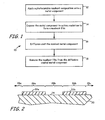
- FIG. 1 is a flow diagram of method 10 for diffusion coating a metal component with the use of a photocurable maskant composition.
- method 10 includes steps 12-18, and initially involves applying the maskant composition onto the metal component (step 12).
- the maskant composition functions as maskant film that prevents diffusion coatings from being formed on one or more portions of the metal component. Accordingly, the maskant composition is desirably applied over the portions of the metal component that are intended to remain uncoated after the diffusion coating process.
- the maskant composition includes a cross-linkable resin, a photoinitiator, and a gettering agent, where the gettering agent is desirably provided in a sufficient quantity to mask an underlying surface of the metal component.
- concentration of the gettering agent is also proportional to the viscosity of the maskant composition.
- Suitable techniques for applying the maskant composition include dip coating, paint coating, extrusion coating, and combinations thereof.
- actinic radiation cures' (i.e., cross-links) the maskant composition to form a maskant film over the coated portions of the metal component.
- suitable types of actinic radiation for curing the maskant composition include radiation having wavelengths ranging from gamma-rays to ultraviolet (UV) wavelengths (e.g., gamma, x-ray, and UV), electron beam radiation, and combinations thereof.
- UV ultraviolet
- particularly suitable types of actinic radiation include UV-wavelength radiation.
- the actinic radiation is emitted from a radiation source (e:g., a UV lamp) having sufficient intensity, and for a sufficient duration, to at least partially cross-link the maskant composition.
- a radiation source e:g., a UV lamp
- the intensity and duration are sufficient to substantially or fully cross-link the maskant composition.
- the photocuring reaction occurs rapidly, thereby substantially reducing the time required to form a cured maskant film on the metal component (e.g., less than one minute). This correspondingly decreases the time required to perform a diffusion coating process, which may increase the throughput of metal components.
- the particles of the gettering agent reduce the penetration of the actinic radiation within the maskant composition. This is in contrast to solvent-based maskants, which typically are not dependent on radiation penetration within the composition. Accordingly, the concentration of the gettering agent in the maskant composition is desirably balanced to provide both good masking capabilities and good curing efficiencies. Suitable concentrations of the gettering agent in the maskant composition range from about 15% by weight to about 85% by weight, with particularly suitable concentrations ranging from about 60% to about 80%, based on the entire weight of the maskant composition. Such concentrations are suitable for masking an underlying surface of the metal component, while also allowing sufficient photocuring of the cross-linkable resin.
- the particles of the gettering agent are dispersed in a substantially uniform manner throughout the cross-linkable resin. This reduces the risk of forming particle agglomerates, which may also reduce cross-linking efficiencies.
- the density of the particles in the maskant composition is based on the concentration of the gettering agent and the level of dispersion in the cross-linkable resin. Examples of suitable densities of the gettering agent particles in the maskant composition range from about 5% by weight to about 85% by weight.
- Curing the cross-linkable resin forms a matrix of the cross-linked resin, which hardens the cured maskant film (compared to the uncured maskant composition).
- the gettering agent is dispersed within the solidified matrix, which allows the gettering agent to attract diffusion-coating materials (e.g., aluminide materials) that are applied to the metal component during a diffusion coating process.
- the gettering agent is dispersed within the solidified matrix in a substantially uniform manner, which increases the consistency of attracting diffusion-coating materials.
- the masked metal component is then diffusion coated to form a diffusion coating over the masked metal component (step 16).
- suitable diffusion coating processes include pack-cementation processes and vapor-phase processes.
- a suitable pack-cementation process involves placing the masked metal component in a sealed retort containing a powder mixture, where the powder mixture includes a source of the diffusion-coating material, a halide activator, and an inert filler (e.g., aluminum oxide).
- suitable diffusion-coating materials include aluminum-based materials, chrome-based materials, and silicon-based materials, with particularly suitable diffusion-coating materials including aluminum-based materials (e.g., aluminides).
- the retort containing the masked metal component is then heated in a furnace, which causes the coating materials to react with the halide activators to form gaseous metal-halide compounds (e.g., aluminum-halide compounds).
- gaseous metal-halide compounds e.g., aluminum-halide compounds.
- Suitable temperatures for initiating the reaction range from about 650°C (about 1200°F) to about 1100°C (about 2000°F).
- the high temperatures may also bum off one or more portions of the organic cross-linked matrix. However, the residual portions retain the gettering agent particles, thereby providing a barrier against the gaseous metal-halide compounds.
- the gaseous metal-halide compounds decompose at the surface of the masked metal component, and at the surfaces of the gettering agent particles of the maskant film, thereby depositing the diffusion coating on the surface of the metal component and the gettering agent particles of the maskant film.
- the deposition of the diffusion coating correspondingly releases the halide activator to form additional gaseous metal-halide compounds while the source of the diffusion-coating material is still available. Because the gettering agent particles decompose the gaseous metal-halide compounds that deposit onto the maskant film, the maskant film correspondingly prevents the diffusion coating from forming on the underlying surface of the metal component.
- the metal component is removed from the retort, and the maskant film is removed from the diffusion-coated metal component (step 18).
- the maskant film may be removed in a variety of manners, such as peeling or scraping the maskant film depending on the adhesive strength between the maskant film and the surface of the metal component.
- FIGS. 2-4 are sectional views of metal component 20, which is an example of a suitable metal component undergoing a diffusion coating process pursuant to method 10 (shown in FIG. 1).
- FIG. 2 shows metal component 20 coated with film segments 22a and 22b.
- Metal component 20 is a component composed of an alloy (e.g., nickel and cobalt-based alloys), such as a turbine engine component, and includes surface 24.
- Film segments 22a and 22b are coatings of a photocurable maskant composition, which are applied and cross-linked pursuant to steps 12 and 14 of method 10. As discussed above, the use of photoinitiated cross-linking substantially decreases the time required to apply film segments 22a and 22b, thereby allowing metal component 20 to be diffusion coated shortly after the maskant composition is applied.
- the maskant composition is applied to portions of surface 24 that are intended to remain uncoated. Accordingly, surface 24 is divided into masked portions 26a and 26b, and exposed portions 28a, 28b, and 28c, where masked portions 26a and 26b are the portions of surface 24 respectively covered by film segments 22a and 22b, and exposed portions 28a, 28b, and 28c are the portions of surface 24 that are not covered by film segments 22a or 22b.
- the maskant composition is desirably applied with a layer thickness that is sufficient for preventing the gaseous metal-halide compounds from penetrating film segments 22a and 22b.
- Suitable layer thicknesses for the maskant films range from about 250 micrometers (about 10 mils) to about 5,000 micrometers (about 200 mils), with particularly suitable thicknesses ranging from about 1900 micrometers (about 75 mils) to about 3,200 micrometers (about 125 mils).
- the gettering agent is desirably provided in a quantity that allows sufficient photocuring of the cross-linkable resin. Accordingly, the concentration of the gettering agent in the maskant composition desirably allows a cure depth through a maskant film that is at least as deep as the layer thickness of the maskant film.
- film segments 22a and 22b are each shown as single film segments, the maskant composition may be applied to surface 24 to define a variety of different masking patterns as individual needs may necessitate.
- the ribbed structures of airfoil roots may be coated with the maskant composition of the present invention, thereby masking the roots while the airfoil blades are diffusion coated.
- diffusion coating 30 is then formed over film segments 22a and 22b, and over exposed portions 28a, 28b, and 28c of surface 24, pursuant to step 16 of method 10. As shown, film segments 22a and 22b prevent diffusion coating 30 from being formed on the surface of metal component 20 beneath masked portions 26a and 26b, respectively.
- FIG. 4 shows metal component 20 after film segments 22a and 22b (shown in FIGS 2 and 3 ) are removed, pursuant to step 18 of method 10.
- the resulting metal component 20 includes diffusion coating segments 30a, 30b, and 30c disposed over surface 24 at exposed portions 28a, 28b, and 28c, respectively.
- masked portions 26a and 26b are substantially free of the diffusion coating material.
- the maskant composition includes a cross-linkable resin, a photoinitiator, and a gettering agent, where the photoinitiator and the gettering agent are desirably dispersed in the maskant composition.
- the cross-linkable resin used in the maskant composition typically includes one or more polymerizable precursors having one or more radiation-curable moieties. Such precursors include polymerizable monomers, oligomers, macromonomers, polymers, and combinations thereof.
- radiation-curable moiety refers to a functionality that is directly or indirectly pendant from the backbone (e.g., side-pendant groups and chain-ending groups) and that reacts (i.e., cross-links) upon exposure to a suitable source of actinic radiation.
- Suitable radiation-curable moieties for the polymerizable precursor include epoxy groups, (meth)acrylate groups (acryl and methacryl groups), olefinic carbon-carbon double bonds, allyloxy groups, alpha-methyl styrene groups, (meth)acrylamide groups, cyanate ester groups, vinyl ethers groups, and combinations thereof.
- the polymerizable precursor may be monofunctional or multifunctional (e.g., di-, tri-, and tetra-) in terms of radiation-curable moieties.
- suitable commercially available cross-linkable resins include those under the trademark "DYMAX SPEEDMASK" UV-Curable Masking Resins from Dymax Corporation, Torrington, CT.
- Suitable concentrations of the cross-linkable resin in the maskant composition range from about 15% by weight to about 85% by weight, with particularly suitable concentrations ranging from about 20% by weight to about 40% by weight, based on the entire weight of the maskant composition.
- the type of photoinitiator used in the maskant composition depends on the polymerizable precursor used and on the wavelength of the actinic radiation used to cure the polymerizable precursor.
- suitable free-radical-generating photoinitiators include benzoins (e.g., benzoin alkyl ethers), acetophenones (e.g., dialkoxyacetophenones, dichloroacetophenones, and trichloroacetophenones), benzils (e.g., benzil ketals, quinones, and O-acylated- ⁇ -oximinoketones).
- Suitable cationic-generating photoinitiators include onium salts, diaryliodonium salts of sulfonic acids, triarylsulfonium salts of sulfonic acids, diaryliodonium salts of boronic acids, and triarylsulfonium salts of boronic acids.
- Suitable concentrations of the photoinitiator in the maskant composition range from about 1% by weight to about 10% by weight, with particularly suitable concentrations ranging from about 2% by weight to about 5% by weight, based on the entire weight of the maskant composition.
- the gettering agent used in the maskant composition is a compound suitable for attracting and decomposing a gaseous metal-halide compound (e.g., an aluminum halide) used to diffusion coat the metal component.
- a gaseous metal-halide compound e.g., an aluminum halide
- suitable gettering agents for use in the maskant composition include nickel, nickel-based alloys, chrome, chrome-based alloys, and alloys thereof.
- suitable commercially available gettering agents include those under the trade designations "M1 Maskant”, “M7 Maskant”, “M8 Maskant”, and "M10 Maskant” from APV Engineered Coatings, Akron, OH.
- the gettering agent may be provided in a powder form in which the powder particles desirably have average particle sizes ranging from about 1 micrometer micrometers to about 75 micrometers, with particularly suitable average particle sizes ranging from about 10 micrometers to about 50 micrometers.
- the maskant composition may also include additional additives, such as heat stabilizers, UV-light stabilizers, free-radical scavengers (e.g., hindered amine light stabilizer compounds), dyes, pigments, surfactants, plasticizers, rheology-modifying agents, film-forming agents, opacity-modifying agents, and combinations thereof.
- additional additives such as heat stabilizers, UV-light stabilizers, free-radical scavengers (e.g., hindered amine light stabilizer compounds), dyes, pigments, surfactants, plasticizers, rheology-modifying agents, film-forming agents, opacity-modifying agents, and combinations thereof.
- Suitable concentrations of the additional additives in the radiation-curable material range from about 0.01% by weight to about 5% by weight, with particularly suitable total concentrations ranging from about 0.1 % by weight to about 2% by weight, based on the entire weight of the maskant composition.
- the maskant composition is substantially free of volatile solvents, such as aromatic solvents, alcohols, ketones, and the like. Volatile solvents are typically used with solvent-based maskants, where the maskants polymerize upon evaporation of the solvent.
- the maskant composition of the present invention is photocurable, and does not require the use of a solvent. This is particularly beneficial with respect to volatile organic solvents, which are potential environmental hazards.
Landscapes
- Chemical & Material Sciences (AREA)
- Chemical Kinetics & Catalysis (AREA)
- Organic Chemistry (AREA)
- Engineering & Computer Science (AREA)
- Materials Engineering (AREA)
- Mechanical Engineering (AREA)
- Metallurgy (AREA)
- Health & Medical Sciences (AREA)
- Medicinal Chemistry (AREA)
- Polymers & Plastics (AREA)
- Materials For Photolithography (AREA)
- Application Of Or Painting With Fluid Materials (AREA)
Applications Claiming Priority (1)
| Application Number | Priority Date | Filing Date | Title |
|---|---|---|---|
| US11/642,424 US7763326B2 (en) | 2006-12-20 | 2006-12-20 | Photocurable maskant composition and method of use |
Publications (2)
| Publication Number | Publication Date |
|---|---|
| EP1935928A1 true EP1935928A1 (de) | 2008-06-25 |
| EP1935928B1 EP1935928B1 (de) | 2011-10-12 |
Family
ID=39301644
Family Applications (1)
| Application Number | Title | Priority Date | Filing Date |
|---|---|---|---|
| EP07254821A Not-in-force EP1935928B1 (de) | 2006-12-20 | 2007-12-12 | Lichthärtbare Maskenzusammensetzungen und Verwendungsverfahren |
Country Status (2)
| Country | Link |
|---|---|
| US (1) | US7763326B2 (de) |
| EP (1) | EP1935928B1 (de) |
Cited By (2)
| Publication number | Priority date | Publication date | Assignee | Title |
|---|---|---|---|---|
| EP2020452A2 (de) | 2007-08-02 | 2009-02-04 | United Technologies Corporation | Verfahren zur Herstellung einer Aluminid-Diffusion-Beschichtung |
| EP2022869A2 (de) | 2007-08-02 | 2009-02-11 | United Technologies Corporation | Verfahren zum Formen von Aluminiddiffusionsbeschichtungen aktiver Elemente |
Families Citing this family (3)
| Publication number | Priority date | Publication date | Assignee | Title |
|---|---|---|---|---|
| US8425979B2 (en) | 2011-07-25 | 2013-04-23 | United Technologies Corporation | Maskant free diffusion coating process |
| US9580621B2 (en) | 2013-09-09 | 2017-02-28 | Dymax Corporation | High temperature resistance, radiation curable maskant for metal substrates |
| DE102022109763A1 (de) * | 2022-04-22 | 2023-10-26 | MTU Aero Engines AG | Maskierungsvorrichtung zum Herstellen einer Maskierungsstrukur, Verfahren und Maskierungsstrukur |
Citations (6)
| Publication number | Priority date | Publication date | Assignee | Title |
|---|---|---|---|---|
| US4548862A (en) * | 1984-09-04 | 1985-10-22 | Minnesota Mining And Manufacturing Company | Flexible tape having bridges of electrically conductive particles extending across its pressure-sensitive adhesive layer |
| US4999136A (en) * | 1988-08-23 | 1991-03-12 | Westinghouse Electric Corp. | Ultraviolet curable conductive resin |
| WO2003000816A1 (en) * | 2001-06-25 | 2003-01-03 | Telephus, Inc. | Anisotropic conductive adhesives having enhanced viscosity and bonding methods and integrated circuit packages using the same |
| EP1365039A1 (de) * | 2002-05-24 | 2003-11-26 | ALSTOM (Switzerland) Ltd | Verfahren zum Abdecken von Kühlungsöffnungen eines Gasturbinenbauteils |
| EP1387040A1 (de) * | 2002-08-02 | 2004-02-04 | ALSTOM (Switzerland) Ltd | Verfahren zum Schutz von Teilflächen eines Werkstücks |
| JP2006147621A (ja) * | 2004-11-16 | 2006-06-08 | Toray Ind Inc | 感光性ペーストおよびそれを用いたディスプレイパネル用部材の製造方法 |
Family Cites Families (14)
| Publication number | Priority date | Publication date | Assignee | Title |
|---|---|---|---|---|
| US6689422B1 (en) * | 1994-02-16 | 2004-02-10 | Howmet Research Corporation | CVD codeposition of A1 and one or more reactive (gettering) elements to form protective aluminide coating |
| US6458473B1 (en) * | 1997-01-21 | 2002-10-01 | General Electric Company | Diffusion aluminide bond coat for a thermal barrier coating system and method therefor |
| IL132165A (en) * | 1997-04-04 | 2003-12-10 | Univ Southern California | Article, method, and apparatus for electrochemical fabrication |
| US6326057B1 (en) | 1999-12-29 | 2001-12-04 | General Electric Company | Vapor phase diffusion aluminide process |
| US6858480B2 (en) * | 2001-01-18 | 2005-02-22 | Semiconductor Energy Laboratory Co., Ltd. | Method of manufacturing semiconductor device |
| US6544665B2 (en) * | 2001-01-18 | 2003-04-08 | General Electric Company | Thermally-stabilized thermal barrier coating |
| US6607789B1 (en) * | 2001-04-26 | 2003-08-19 | General Electric Company | Plasma sprayed thermal bond coat system |
| US7122224B2 (en) | 2003-06-11 | 2006-10-17 | General Electric Company | Methods and apparatus for turbine engine component coating |
| US6905730B2 (en) | 2003-07-08 | 2005-06-14 | General Electric Company | Aluminide coating of turbine engine component |
| US7070866B2 (en) | 2004-05-27 | 2006-07-04 | General Electric Company | Nickel aluminide coating with improved oxide stability |
| US7229701B2 (en) | 2004-08-26 | 2007-06-12 | Honeywell International, Inc. | Chromium and active elements modified platinum aluminide coatings |
| US20060216415A1 (en) | 2005-03-24 | 2006-09-28 | United Technologies Corporation | Vapor aluminide coating gas manifold |
| US20060222776A1 (en) | 2005-03-29 | 2006-10-05 | Honeywell International, Inc. | Environment-resistant platinum aluminide coatings, and methods of applying the same onto turbine components |
| JP4650345B2 (ja) | 2006-05-29 | 2011-03-16 | 株式会社Sumco | シリコン単結晶の製造方法 |
-
2006
- 2006-12-20 US US11/642,424 patent/US7763326B2/en active Active
-
2007
- 2007-12-12 EP EP07254821A patent/EP1935928B1/de not_active Not-in-force
Patent Citations (6)
| Publication number | Priority date | Publication date | Assignee | Title |
|---|---|---|---|---|
| US4548862A (en) * | 1984-09-04 | 1985-10-22 | Minnesota Mining And Manufacturing Company | Flexible tape having bridges of electrically conductive particles extending across its pressure-sensitive adhesive layer |
| US4999136A (en) * | 1988-08-23 | 1991-03-12 | Westinghouse Electric Corp. | Ultraviolet curable conductive resin |
| WO2003000816A1 (en) * | 2001-06-25 | 2003-01-03 | Telephus, Inc. | Anisotropic conductive adhesives having enhanced viscosity and bonding methods and integrated circuit packages using the same |
| EP1365039A1 (de) * | 2002-05-24 | 2003-11-26 | ALSTOM (Switzerland) Ltd | Verfahren zum Abdecken von Kühlungsöffnungen eines Gasturbinenbauteils |
| EP1387040A1 (de) * | 2002-08-02 | 2004-02-04 | ALSTOM (Switzerland) Ltd | Verfahren zum Schutz von Teilflächen eines Werkstücks |
| JP2006147621A (ja) * | 2004-11-16 | 2006-06-08 | Toray Ind Inc | 感光性ペーストおよびそれを用いたディスプレイパネル用部材の製造方法 |
Non-Patent Citations (1)
| Title |
|---|
| DATABASE WPI Week 200642, Derwent World Patents Index; AN 2006-407745, XP002478008 * |
Cited By (2)
| Publication number | Priority date | Publication date | Assignee | Title |
|---|---|---|---|---|
| EP2020452A2 (de) | 2007-08-02 | 2009-02-04 | United Technologies Corporation | Verfahren zur Herstellung einer Aluminid-Diffusion-Beschichtung |
| EP2022869A2 (de) | 2007-08-02 | 2009-02-11 | United Technologies Corporation | Verfahren zum Formen von Aluminiddiffusionsbeschichtungen aktiver Elemente |
Also Published As
| Publication number | Publication date |
|---|---|
| EP1935928B1 (de) | 2011-10-12 |
| US20080152831A1 (en) | 2008-06-26 |
| US7763326B2 (en) | 2010-07-27 |
Similar Documents
| Publication | Publication Date | Title |
|---|---|---|
| EP1935928B1 (de) | Lichthärtbare Maskenzusammensetzungen und Verwendungsverfahren | |
| KR0155169B1 (ko) | 방사선에 대한 광중합성 조성물의 감도를 조정하는 방법 | |
| CN105131779B (zh) | 一种紫外光固化有机硅离型剂及其制备方法 | |
| JP2019036725A (ja) | パターン形成方法 | |
| JPS6247590B2 (de) | ||
| JP2013110383A (ja) | 膜の形成方法 | |
| JPS58500752A (ja) | 硬化性保護組成物によりオ−バ−被覆加工されたプライマ−被覆加工無機基質 | |
| JP2887684B2 (ja) | 光硬化性組成物 | |
| Jankowska et al. | Novel multi-material photo-curable resins containing high-performance photoinitiating systems and nano additives dedicated to 3D-VAT printing | |
| CA2028259A1 (en) | Tacky photopolymerizable adhesive compositions | |
| KR970706584A (ko) | 플루오르화 계면활성제를 보유하는 방사선 증감 스크린의 제조 방법 (method for the manufacture of a radiographic intensifying screen with fluorinated surfactant) | |
| CN116162394B (zh) | 一种近红外光固化防腐涂层及其制备方法 | |
| US8802570B2 (en) | Pattern forming method | |
| US20030017954A1 (en) | UV curable lubricant compositions | |
| KR102099538B1 (ko) | 이중경화형 점착 테이프 | |
| JP2022027496A (ja) | 光硬化性樹脂組成物 | |
| KR20150074901A (ko) | 양이온 광경화용 조성물 및 상기 조성물로 코팅된 강판 | |
| WO2016021692A1 (ja) | 積層体の製造方法 | |
| JP4088487B2 (ja) | 光硬化性樹脂コーティング、および硬化塗装膜 | |
| JP2013256562A (ja) | ハードコート膜形成用組成物、ハードコート膜及びそれを備えたプラスチック基材 | |
| US20030187087A1 (en) | Two component coating composition and coating process using the same | |
| WO2020095627A1 (ja) | 光硬化性組成物 | |
| JPH10231354A (ja) | エポキシ樹脂組成物、熱硬化性樹脂フィルム及び基板に対する硬化樹脂フィルムの形成方法 | |
| JPH0665523A (ja) | ハイソリッド塗料及び塗装方法 | |
| JP6496901B2 (ja) | 積層体の製造方法 |
Legal Events
| Date | Code | Title | Description |
|---|---|---|---|
| PUAI | Public reference made under article 153(3) epc to a published international application that has entered the european phase |
Free format text: ORIGINAL CODE: 0009012 |
|
| AK | Designated contracting states |
Kind code of ref document: A1 Designated state(s): AT BE BG CH CY CZ DE DK EE ES FI FR GB GR HU IE IS IT LI LT LU LV MC MT NL PL PT RO SE SI SK TR |
|
| AX | Request for extension of the european patent |
Extension state: AL BA HR MK RS |
|
| 17P | Request for examination filed |
Effective date: 20080929 |
|
| 17Q | First examination report despatched |
Effective date: 20081103 |
|
| AKX | Designation fees paid |
Designated state(s): DE GB |
|
| GRAP | Despatch of communication of intention to grant a patent |
Free format text: ORIGINAL CODE: EPIDOSNIGR1 |
|
| GRAS | Grant fee paid |
Free format text: ORIGINAL CODE: EPIDOSNIGR3 |
|
| GRAA | (expected) grant |
Free format text: ORIGINAL CODE: 0009210 |
|
| AK | Designated contracting states |
Kind code of ref document: B1 Designated state(s): DE GB |
|
| REG | Reference to a national code |
Ref country code: GB Ref legal event code: FG4D |
|
| REG | Reference to a national code |
Ref country code: DE Ref legal event code: R096 Ref document number: 602007017750 Country of ref document: DE Effective date: 20120112 |
|
| PLBE | No opposition filed within time limit |
Free format text: ORIGINAL CODE: 0009261 |
|
| STAA | Information on the status of an ep patent application or granted ep patent |
Free format text: STATUS: NO OPPOSITION FILED WITHIN TIME LIMIT |
|
| 26N | No opposition filed |
Effective date: 20120713 |
|
| REG | Reference to a national code |
Ref country code: DE Ref legal event code: R097 Ref document number: 602007017750 Country of ref document: DE Effective date: 20120713 |
|
| PGFP | Annual fee paid to national office [announced via postgrant information from national office to epo] |
Ref country code: DE Payment date: 20121205 Year of fee payment: 6 |
|
| PGFP | Annual fee paid to national office [announced via postgrant information from national office to epo] |
Ref country code: GB Payment date: 20121212 Year of fee payment: 6 |
|
| REG | Reference to a national code |
Ref country code: DE Ref legal event code: R119 Ref document number: 602007017750 Country of ref document: DE |
|
| GBPC | Gb: european patent ceased through non-payment of renewal fee |
Effective date: 20131212 |
|
| REG | Reference to a national code |
Ref country code: DE Ref legal event code: R119 Ref document number: 602007017750 Country of ref document: DE Effective date: 20140701 |
|
| PG25 | Lapsed in a contracting state [announced via postgrant information from national office to epo] |
Ref country code: DE Free format text: LAPSE BECAUSE OF NON-PAYMENT OF DUE FEES Effective date: 20140701 |
|
| PG25 | Lapsed in a contracting state [announced via postgrant information from national office to epo] |
Ref country code: GB Free format text: LAPSE BECAUSE OF NON-PAYMENT OF DUE FEES Effective date: 20131212 |