EP1936609A2 - Lecteur d'image - Google Patents
Lecteur d'image Download PDFInfo
- Publication number
- EP1936609A2 EP1936609A2 EP20070024654 EP07024654A EP1936609A2 EP 1936609 A2 EP1936609 A2 EP 1936609A2 EP 20070024654 EP20070024654 EP 20070024654 EP 07024654 A EP07024654 A EP 07024654A EP 1936609 A2 EP1936609 A2 EP 1936609A2
- Authority
- EP
- European Patent Office
- Prior art keywords
- optical disk
- unit
- image
- laser light
- dot region
- Prior art date
- Legal status (The legal status is an assumption and is not a legal conclusion. Google has not performed a legal analysis and makes no representation as to the accuracy of the status listed.)
- Ceased
Links
- 230000003287 optical effect Effects 0.000 claims abstract description 231
- 230000004044 response Effects 0.000 claims description 22
- 230000032258 transport Effects 0.000 claims description 8
- 238000000034 method Methods 0.000 claims description 6
- 230000001678 irradiating effect Effects 0.000 claims description 2
- 238000001914 filtration Methods 0.000 abstract description 3
- 239000010410 layer Substances 0.000 description 33
- 238000005070 sampling Methods 0.000 description 12
- 238000012545 processing Methods 0.000 description 11
- 230000006870 function Effects 0.000 description 6
- 238000005259 measurement Methods 0.000 description 6
- 230000002093 peripheral effect Effects 0.000 description 6
- 229920000515 polycarbonate Polymers 0.000 description 4
- 239000004417 polycarbonate Substances 0.000 description 4
- 238000002310 reflectometry Methods 0.000 description 3
- 238000012546 transfer Methods 0.000 description 3
- 239000008186 active pharmaceutical agent Substances 0.000 description 2
- 238000013459 approach Methods 0.000 description 2
- 230000008859 change Effects 0.000 description 2
- 239000013078 crystal Substances 0.000 description 2
- 238000001514 detection method Methods 0.000 description 2
- 238000005516 engineering process Methods 0.000 description 2
- 230000010355 oscillation Effects 0.000 description 2
- 230000000630 rising effect Effects 0.000 description 2
- 239000012790 adhesive layer Substances 0.000 description 1
- 238000004364 calculation method Methods 0.000 description 1
- 238000004891 communication Methods 0.000 description 1
- 238000004590 computer program Methods 0.000 description 1
- 238000013500 data storage Methods 0.000 description 1
- 238000013461 design Methods 0.000 description 1
- 238000010586 diagram Methods 0.000 description 1
- 239000004973 liquid crystal related substance Substances 0.000 description 1
- 230000007246 mechanism Effects 0.000 description 1
- 239000000049 pigment Substances 0.000 description 1
- 230000008569 process Effects 0.000 description 1
- 239000000126 substance Substances 0.000 description 1
- 230000001360 synchronised effect Effects 0.000 description 1
Images




Classifications
-
- G—PHYSICS
- G11—INFORMATION STORAGE
- G11B—INFORMATION STORAGE BASED ON RELATIVE MOVEMENT BETWEEN RECORD CARRIER AND TRANSDUCER
- G11B7/00—Recording or reproducing by optical means, e.g. recording using a thermal beam of optical radiation by modifying optical properties or the physical structure, reproducing using an optical beam at lower power by sensing optical properties; Record carriers therefor
- G11B7/002—Recording, reproducing or erasing systems characterised by the shape or form of the carrier
- G11B7/0037—Recording, reproducing or erasing systems characterised by the shape or form of the carrier with discs
-
- G—PHYSICS
- G11—INFORMATION STORAGE
- G11B—INFORMATION STORAGE BASED ON RELATIVE MOVEMENT BETWEEN RECORD CARRIER AND TRANSDUCER
- G11B7/00—Recording or reproducing by optical means, e.g. recording using a thermal beam of optical radiation by modifying optical properties or the physical structure, reproducing using an optical beam at lower power by sensing optical properties; Record carriers therefor
- G11B7/004—Recording, reproducing or erasing methods; Read, write or erase circuits therefor
- G11B7/005—Reproducing
Definitions
- This invention relates to a technology for reading an image drawn on an optical disk.
- optical disks of a CD-R Compact Disk-Recordable
- a CD-RW Compact Disk Rewritable
- a DVD-R Digital Versatile Disk-Recordable
- the descriptions of recorded data cannot be recognized with the naked eye and thus it is difficult to distinguish the optical disks from each other from the appearance of the optical disk unless a label is put or something is printed.
- an art of drawing a character, a symbol, a pattern, a design, etc., on an optical disk so as to make it possible to easily distinguish the optical disk according to the appearance thereof is proposed. (For example, refer to JP-A-2006-155812 , JP-A-2003-16649 , etc.)
- the present invention provides the following arrangement.
- the image drawn on the optical disk can be read.
- An optical disk recorder 1 has a function of recording and playing back music data, for example, on an optical disk (data record and playback function), a function of drawing an image that can be visually recognized by the user on the optical disk (drawing function), and a function of reading the image drawn on the optical disk (image read function) .
- data record and playback function a function of recording and playing back music data
- drawing function a function of drawing an image that can be visually recognized by the user on the optical disk
- image read function image read function
- FIG. 1 is a sectional view of an optical disk 100 according to the embodiment of the invention.
- the optical disk 100 is an optical disk of DVD-R, CD-R, CD-R/DVD-R mix type, for example.
- a polycarbonate layer 111, a drawing layer 112, a reflection layer 113, an adhesive layer 114, a reflection layer 115, a data record layer 116, and a polycarbonate layer 117 are arranged in order from a label side LS to a record side DS.
- the thickness of the optical disk 100 is about 1.2 (mm) and the polycarbonate layer 111 and the polycarbonate layer 117 occupy each about 0.6 (mm) of the thickness and a thickness d from the drawing layer 112 to the data record layer 116 is minute as compared with the whole thickness.
- the record side DS of the data record layer 116 is formed with a spiral groove (guide groove) 118.
- the drawing layer 112 and the data record layer 116 are each a pigment layer formed of a substance changed in color when it is irradiated with laser light of a predetermined strength or more.
- laser light is focused on the drawing layer 112 based on the reflection light from the reflection layer 113.
- the region of the drawing layer 112 irradiated with the laser light changes in color.
- the region changed in color and a region unchanged in color form an image that can be visually recognized by the user.
- laser light is focused on the data record layer 116 based on the reflection light from the reflection layer 115 and data is recorded along the groove 118.
- the optical disk does not store drawn-image information regarding an image drawn on the drawing layer 112, such as image data, image position and image orientation, and does not store recording condition information regarding recording condition under which the image has been drawn on the drawing layer 112.
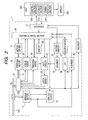
- a system according to the embodiment of the invention is made up of a host 200 and the optical disk recorder 1 which are connected in a state in which they can communicate with each other, as shown in FIG. 2 .
- the optical disk recorder 1 may be incorporated in the host 200 or may be external to the host 200.
- the optical disk 100 is loaded into the optical disk recorder 1.
- the optical disk 100 is rotated by a spindle motor 11.
- a spindle servo 12 controls the rotation of the spindle motor 11 at a constant linear velocity (CLV control)at the recording time and the playback time and controls the rotation of the spindle motor 11 with a constant number of revolutions (CAV control) at the drawing time and the image read time.
- CLV control constant linear velocity
- CAV control constant number of revolutions
- An optical pickup 14 (optical head) is moved in the radial direction of the optical disk 100 (side-to-side direction in the figure) by a feed mechanism 16 including a feed screw, etc., driven by a stepping motor 15.
- a motor driver 17 drives the stepping motor 15 based on a command of a system control section 19.
- a focus servo 18 performs focus control of the optical pickup 14.
- a tracking servo 20 performs tracking servo control of the optical pickup 14 at the recording time and the playback time. However, the tracking servo control is turned off at the drawing time and the image read time.
- a laser driver 22 controls the laser power to a commanded value.
- An ALPC (Automatic Laser Power Control) circuit 21 controls the laser power to a command value.
- the optical pickup 14 controls the strength of laser light 13 when the laser driver 22 drives a laser diode of the optical pickup 14 based on a command of the system control section 19 and a light reception signal from the optical pickup 14.
- a memory 28 stores "read start position R0", “read termination position R1", “feed width N”, “number of divisions M”, “upper limit value P of sampling resolution per revolution”, “rotation speed of optical disk”, and “encode speed.”
- the "read start position R0” is information indicating the read start position in the radial direction of the optical disk 100; on the other hand, the “read termination position R1” is information indicating the read termination position in the radial direction of the optical disk 100.
- the "feed width N” is information indicating the feed width of the optical pickup 14 by one full step operation of the stepping motor 15.
- the "number of divisions M” is information indicating the upper limit value of the number of divisions of microstep operation of the stepping motor 15.
- the “feed width N” and the “number of divisions M” are used to calculate the unit feed rate for transporting the optical pickup 14 in the radial direction of the optical disk 100.
- An encoder 23 encodes record data into a format responsive to the format of the optical disk 100 at the data recording time.
- the laser driver 22 modulates laser light in response to the encoded record data and records the record data on the data record layer 116 of the optical disk 100 as pits.
- the encoder 23 encodes image data to generate a pulse signal (drawing signal) with duty changing in response to the gradation data of the pixels (dots) making up the image data.
- the laser driver 22 modulates laser light in response to the pulse signal with duty changing and changes the visible light characteristic of the drawing layer 112 of the optical disk 100 (namely, changes the color of the drawing layer 112) for drawing according to monochrome multi-step gradation.
- a decoder 25 plays back data by performing EFM demodulation of the light reception signal responsive to return light received by the optical pickup 14 at the data playback time.
- An LPF (low-pass filter) 26 performs low-pass filtering for the light reception signal responsive to return light received by the optical pickup 14 at the image read time.
- a comparator 27 makes a comparison between the level of the signal output from the LPF 26 and a predetermined threshold value and outputs a high or low pulse signal to the system control section 19 in response to the comparison result. Specifically, for example, if the level of the signal output from the LPF 26 is equal to or greater than the threshold value, the comparator 27 may output a high signal to the system control section 19; on the other hand, if the level of the signal is smaller than the threshold value, the comparator 27 may output a low signal to the system control section 19.
- An N divider 29 detects the number of revolutions of the optical disk 100 from the pulse signal output from the spindle motor.
- FIG. 3 is a time chart of various signals at the image read time. It is a time chart of various signals when the optical disk 100makes one revolution.
- (a) shows the waveform of a light reception signal RF output from the optical pickup 14 to the LPF 26.
- (b) shows the waveform of a light reception signal RF' resulting from performing low-pass filtering for the light reception signal RF and output from the LPF 26.
- (c) shows the waveform of a pulse signal MIR into which the light reception signal RF' is converted by the comparator 27.
- (d) shows the waveform of a pulse signal FG output from the spindle motor 11 to the N divider 29.
- (e) shows the waveform of a pulse signal FG' provided by dividing the pulse signal MIR into N pieces.
- the light reception signal RF from the optical pickup 14 is set high; otherwise, the light reception signal RF is set low.
- the system control section 19 determines whether the pulse signal MIR output from the comparator 27 is high or low for each predetermined dot region. Since the portion changed in color and any other portion of the image drawn on the surface of the optical disk 100 differ in reflectivity, whether or not the dot region is changed in color can be determined by referencing the strength of the reflection light.
- the system control section 19 writes information "1" indicating that the dot region for which the pulse signal MIR is high is not changed in color into the memory 28; on the other hand, writes information "0" indicating that the dot region for which the pulse signal MIR is low is changed in color into the memory 28.
- the optical disk 100 has sectors arranged from row 1 to row m concentrically from the inner periphery to the outer periphery and further from column 1 to column n radially every given angle clockwise of the optical disk 100.
- Each sector has regions divided into 25 equal pieces in the circumferential direction as shown in FIG. 4B .
- one region corresponds to one dot of an image. Therefore, in the embodiment, dots are arranged as m rows x 25 ⁇ n columns.
- a dot is white or black binary display and one byte (eight bits) is assigned as dot data indicating white or black of one dot.
- "0" indicates a black dot; any value other than "0" indicates a white dot.
- the system control section 19 determines whether or not each of the dot regions is changed in color. If the dot region is changed in color, the system control section 19 writes a signal indicating that the dot region is changed in color (in the embodiment, "0") into the memory 28. On the other hand, if the dot region is not changed in color, the system control section 19 writes a signal indicating that the dot region is not changed in color (in the embodiment, "1") into the memory 28.
- pixel string data pixel data
- the host 200 includes a control section 201 including a CPU (Central Processing Unit), etc., a storage section 202 for storing a computer program, etc., executed by the control section 201, and a communication section 203 for transferring data to and from the optical disk recorder 1.
- the host 200 transmits a command of an operator to the optical disk recorder 1.
- the command is transmitted through an interface 10 to the system control section 19.
- the system control section 19 sends a command responsive to that command to each circuit of the optical disk recorder 1 for executing the corresponding operation.
- the host 200 transmits record data to the optical disk recorder 1.
- the record data is received at the interface 10 of the optical disk recorder 1 and is written into buffer memory 24 by the system control section 19.
- the system control section 19 reads the record data from the buffer memory 24 and supplies the record data to the encoder 23, which then executes the above-described encode processing and supplies the data to the laser driver 22.
- the data played back by the decoder 25 is transferred through the interface 10 to the host 200.
- the host 200 transmits image data to the optical disk recorder 1.
- the image data is received at the interface 10 and is written into the buffer memory 24 by the system control section 19.
- the system control section 19 reads the image data from the buffer memory 24 and supplies the record data to the encoder 23.
- the system control section 19 stores pixel string data (pixel data) in the buffer memory 24 and the stored pixel string data is transferred through the interface 10 to the host 200.
- a display 300 includes a liquid crystal display, etc., and is display means for displaying an image responsive to the data supplied from the host 200.
- the system control section 19 determines whether or not a command for performing some processing is received from the host 200. If a command is received, the system control section 19 determines whether or not the received command is a command for performing some processing. If the command is not an image read command, the system control section 19 executes the processing specified by the command (data record operation, playback operation, or drawing operation).
- the data record operation and the playback operation on the optical disk 100 are the same as those performed conventionally and therefore will not be discussed again in detail.
- the system control section 19 reads (acquires) the read start position R0 and the read termination position R1 from the memory 28 and positions the optical axis position in the disk radial direction of an object lens of the optical pickup 14 at the read start position R0 before the image read starts.
- This control is realized as follows: The stepping motor 15 is driven for once returning the optical pickup 14 in the inner peripheral direction and when detecting the origin position of the innermost periphery (position detected by a limit switch or position secured mechanically by a stopper), the stepping motor 15 is driven as many steps as the object lens arrives at the read start position R0 from the position. At the image read time, the tracking servo is turned off.
- the system control section 19 causes the spindle servo 12 to drive the spindle motor by CAV control for rotating the optical disk 100 (step S1).
- the system control section 19 causes the ALPC circuit 21 to start controlling the laser power. Accordingly, the ALPC circuit 21 sets the laser power to the strength for image read.
- the optical pickup 14 executes laser light irradiation with the setup laser power.
- the system control section 19 controls the focus servo 18 for performing focus control of the optical pickup 14 (step S2).
- the optical disk recorder 1 waits until reception of an image read command from the host 200 (NO at step S3).
- the system control section 19 controls the motor driver 17 for moving a thread to the radius position specified as the image read position (step S4).
- the system control section 19 monitors a pulse signal FG' output from the N divider 29 and waits until detection of the rising edge of the pulse signal FG' (NO at step S5).
- the system control section 19 starts measurement of the time required for one revolution (step S6).
- step S7 If a pulse signal MIR output from the comparator 27 is high (HIGH at step S7), the system control section 19 writes "1" into the buffer memory 24 (step S9). On the other hand, if the pulse signal MIR output from the comparator 27 is low (LOW at step S7), the system control section 19 writes "0" into the buffer memory 24 (step S8).
- the system control section 19 determines binary gradation (white or black) in response to the output signal from the comparator 27. Accordingly, the data representing the gradation level (white or black) for each of the pixels (dots) of the image drawn on the optical disk 100.
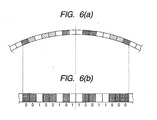
- FIGs. 6A and 6B are drawings to show an example of the descriptions of data stored in the buffer memory 24. In the figure, FIG. 6A shows an image drawn on the optical disk 100; FIG. 6B shows an example of the descriptions of data stored in the buffer memory 24.
- the system control section 19 determines white ("1") ; otherwise determines black (“0") and processes the data as two-color data of white and black.
- the system control section 19 converts the data stored in the buffer memory 24 into a data string starting at the reference angle and transfers the data string to the host 200 in accordance with a predetermined protocol.
- the system control section 19 determines whether or not the measurement time exceeds the time required for one round of the disk (step S10) . If the system control section 19 determines that the measurement time exceeds the required time (YES at step S10), it transfers the data stored in the buffer memory 24 to the host 200 (step S11). On the other hand, if the system control section 19 does not determine that the measurement time exceeds the required time (NO at step S10), it returns to step S7 and continues the image read (steps S7 to S10). Steps S7 to S10 are repeated, whereby the image data as much as one round of the optical disk 100 is stored in the buffer memory 24.
- the system control section 19 moves distance ⁇ r each time ⁇ reaches 2 ⁇ . If ⁇ reaches 2 ⁇ , the system control section 19 drives the stepping motor 15 one microstep for moving the optical axis position of the optical pickup 14 by distance ⁇ r in the disk outer peripheral direction.
- ⁇ r is the unit feed width in the disk radial direction of the optical pickup 14, namely, the move amount of the optical pickup 14 according to one microstep of the stepping motor 15.
- the value of ⁇ r is a value based on a command from the host 200.
- the system control section 19 gradually changes the radial position for measurement and if the position in the disk radial direction reaches the read termination position R1, the system control section 19 terminates the image read processing.
- the host 200 first acquires the feed width and the upper limit value of the sampling resolution per revolution from the optical disk recorder 1.
- the optical disk recorder 1 transmits "feed width N" and "upper limit value P of sampling resolution per revolution" stored in the memory 28 in response to a command of the host 200 to the host 200.
- the host 200 determines parameters at the measurement time (the number of samplings (number of dots) per round S and radial feed width ⁇ r) in response to the feed width N and the upper limit value P of sampling resolution per revolution received from the optical disk recorder 1. For rotating the disk at the constant angular velocity, the number of samplings per round does not change between the inner and outer peripheries of the disk surface and thus the sampling interval becomes longer as it approaches the outer periphery and the read accuracy becomes coarse. Thus, preferably the number of samplings is set so as to provide a sufficient resolution even in the outer peripheral portion. If the radial feed width is set too large, the accuracy becomes coarse at the image reproducing time and a sufficient resolution may be unable to be provided. Thus, preferably an appropriate feed width is set in conformity with the display.
- the host 200 transmits a request for the radius position to start image read to the optical disk recorder 1.
- the optical disk recorder 1 transmits the pixel string data corresponding to just one revolution from the reference angle at the radius position indicated by the request received from the host 200 once or separately twice or more. This processing is the processing previously described with reference to FIG. 5 and therefore will not be discussed again.
- the host 200 acquires the pixel string data corresponding to one revolution read by the optical disk recorder 1 once or separately twice or more.
- an existing data read command may be used or a dedicated acquisition command or transfer protocol may be defined.
- the host 200 requests the optical disk recorder 1 to send the pixel string data corresponding to one revolution at the position resulting from advancing the radius position by width ⁇ r in the outer peripheral direction.
- the optical disk recorder 1 acquires the pixel string data from the position.
- the pixel string data is acquired in sequence in a similar manner until the outermost periphery of the disk or the specified radius position is reached.
- the image drawn on the optical disk 100 is read and the pixel string data for each round representing the read image is transmitted to the host 200.
- FIGS. 7 and 8 An example of the image drawn on the optical disk 100 and an example of the image read in the optical disk recorder 1 are shown in FIGS. 7 and 8.
- FIG. 7 is a drawing to show an example of the image drawn on the optical disk 100
- FIG. 8 is a drawing to show an example of the image displayed on the display 300.
- the optical disk 100 is irradiated with laser light and light and shade information is acquired according to the reflection light, so that the image drawn on the optical disk 100 can be grasped without auxiliary information.
- a non-drawing region can also be detected in the optical disk 100 and accordingly another image can also be drawn in the detected non-drawing region. Specifically, for example, a non-drawing portion is detected and another picture or character can also be drawn in an empty region. In the example shown in FIG. 8 , it is seen that noting is drawn in a region A1. Therefore, if a new image is drawn at the position of the region A1 by aligning the position with reference to the reference angle, a new image pattern not overlapping the former image can be formed on the optical disk 100.
- this method makes it possible to add a character string or an image (thumbnail or date information) responsive to the content as required in an empty region of the label side (region in which no image is drawn).
- an empty region of the optical disk 100 (region in which no image is drawn) is extracted and if two or more empty regions exist, the system control section 19 may determine the size of each region and may determine the region in which the added image is to be drawn. Specifically, if the user performs operation for drawing one image on the optical disk 100, the system control section 19 determines the size of each region of the optical disk 100 and determines which empty region to draw the image in response to the determination result and the size of the new drawn image.
- the optical disk 100 is rotated with the constant angular velocity, but may be rotated with constant linear velocity.
- the length of the pixel string data per revolution is uniquely determined according to the number of samplings independently of the radius position.
- the length of the pixel string data per revolution becomes longer as the radius position approaches the outer periphery.
- the gradation data on the circumference of the optical disk 100 is sampled and is binarized and the image is read at two-step gradation.
- the number of gradation levels is not limited to two; it may be three or more.
- the optical disk may be rotated more than once while the threshold value used for determination is changed for each rotation, and the gradation level may be determined in response to the determination result with two or more threshold values. For example, using a plurality of comparators different in threshold value, the gradation level may be determined in response to the output values of the comparators.
- a visible image drawn on the optical disk 100 is read, but the image to be read by the optical disk recorder 1 is not limited to a visible image; for example, an invisible image written by an infrared ray can also be read.
- the optical disk 100 may be irradiated with laser light and the gradation level (for example, white or black) of each dot region on the optical disk 100 may be determined in response to the reflection light amount.
- the read start position R0 and the read termination position R1 in the radial direction of the optical disk 100 are previously stored in the memory 28 of the optical disk recorder 1 and the system control section 19 reads the read start position R0 and the read termination position R1 from the memory 28.
- the host 200 may specify the read start position R0 and the read termination position R1 in the radial direction of the optical disk 100 for the optical disk recorder 1.
- the optical disk recorder 1 may read the image of the optical disk 100 in the specified range.
- the host 200 specifies the unit move amount ⁇ r of the optical pickup 14 for the optical disk recorder 1 and the system control section 19 moves the optical pickup 14 distance Ar at a time in the disk outer peripheral direction.
- the unit move amount ⁇ r of the optical pickup 14 may be previously stored in the memory 28 of the optical disk recorder 1.
- the host 200 specifies the number of dots S per round of the optical disk 100 for the optical disk recorder 1. Instead, however, the number of dots per round may be previously stored in the memory 28.
- unrewritable optical disks of a CD-R, etc. are used, but rewritable optical disks of a CD-RW, a DVD-RW, a CD/DVD-RW, etc., may be used.
- a part of detected image information can also be edited and written back to the optical disk. In so doing, partial rewrite of the drawing side can be realized.
- FIGS. 7 and 8 it is seen that a character string of "Music DVD" is drawn at the position of a region A2 from the image reproduced based on trace.
- the character string in the portion can also be changed to another character string. That is, a reproduced image having a sufficiently high resolution is generated and the portion corresponding to the character string is rewritten using image edit software, etc., and the image is again drawn on the disk, whereby partial rewrite of the image can be realized.
- one byte is assigned per sample (dot), but one bit may be assigned per sample (dot) .
- the number of samplings per round is a multiple of 8.
- the program executed by the control section 201 of the host 200 can be provided in a state in which it is recorded on a record medium such as magnetic tape, a magnetic disk, a flexible disk, an optical record medium, a magneto-optical record medium, RAM, or ROM.
- the program can also be downloaded into the host 200 via a network such as the Internet.
Landscapes
- Optical Recording Or Reproduction (AREA)
- Image Input (AREA)
Applications Claiming Priority (1)
| Application Number | Priority Date | Filing Date | Title |
|---|---|---|---|
| JP2006341365A JP4321585B2 (ja) | 2006-12-19 | 2006-12-19 | 画像読取装置 |
Publications (2)
| Publication Number | Publication Date |
|---|---|
| EP1936609A2 true EP1936609A2 (fr) | 2008-06-25 |
| EP1936609A3 EP1936609A3 (fr) | 2009-03-04 |
Family
ID=39420794
Family Applications (1)
| Application Number | Title | Priority Date | Filing Date |
|---|---|---|---|
| EP20070024654 Ceased EP1936609A3 (fr) | 2006-12-19 | 2007-12-19 | Lecteur d'image |
Country Status (4)
| Country | Link |
|---|---|
| US (1) | US20080175131A1 (fr) |
| EP (1) | EP1936609A3 (fr) |
| JP (1) | JP4321585B2 (fr) |
| CN (1) | CN101206873A (fr) |
Families Citing this family (1)
| Publication number | Priority date | Publication date | Assignee | Title |
|---|---|---|---|---|
| KR101464373B1 (ko) * | 2014-04-22 | 2014-12-04 | 김종태 | 물리값 입력을 통해 동작 기준을 설정할 수 있는 센서모듈 및 그 센서모듈의 제어 방법 |
Citations (2)
| Publication number | Priority date | Publication date | Assignee | Title |
|---|---|---|---|---|
| EP1331641A2 (fr) | 2002-01-28 | 2003-07-30 | Hewlett-Packard Company | Système intégré de balayage d'étiquette de disque optique et procédé de balayage d'un affichage graphique sur un disque optique |
| US20030194214A1 (en) | 2002-04-15 | 2003-10-16 | Daryl Anderson | Marking optical disc based on information related to data side thereof |
Family Cites Families (5)
| Publication number | Priority date | Publication date | Assignee | Title |
|---|---|---|---|---|
| US5589952A (en) * | 1994-03-18 | 1996-12-31 | Sony/Tektronix Corporation | Disc high resolution scanner |
| JP3956756B2 (ja) * | 2001-10-31 | 2007-08-08 | ヤマハ株式会社 | 光ディスク記録装置 |
| JP3846373B2 (ja) * | 2002-06-28 | 2006-11-15 | ヤマハ株式会社 | 光ディスク記録方法、光ディスク記録プログラム、及び光ディスク記録装置 |
| JP4020021B2 (ja) * | 2003-05-30 | 2007-12-12 | ヤマハ株式会社 | 光ディスク装置 |
| JP4671879B2 (ja) * | 2006-01-31 | 2011-04-20 | 三洋電機株式会社 | 画像情報検出装置 |
-
2006
- 2006-12-19 JP JP2006341365A patent/JP4321585B2/ja not_active Expired - Fee Related
-
2007
- 2007-12-19 CN CNA2007103006777A patent/CN101206873A/zh active Pending
- 2007-12-19 EP EP20070024654 patent/EP1936609A3/fr not_active Ceased
- 2007-12-19 US US11/959,910 patent/US20080175131A1/en not_active Abandoned
Patent Citations (2)
| Publication number | Priority date | Publication date | Assignee | Title |
|---|---|---|---|---|
| EP1331641A2 (fr) | 2002-01-28 | 2003-07-30 | Hewlett-Packard Company | Système intégré de balayage d'étiquette de disque optique et procédé de balayage d'un affichage graphique sur un disque optique |
| US20030194214A1 (en) | 2002-04-15 | 2003-10-16 | Daryl Anderson | Marking optical disc based on information related to data side thereof |
Also Published As
| Publication number | Publication date |
|---|---|
| US20080175131A1 (en) | 2008-07-24 |
| EP1936609A3 (fr) | 2009-03-04 |
| JP2008152630A (ja) | 2008-07-03 |
| JP4321585B2 (ja) | 2009-08-26 |
| CN101206873A (zh) | 2008-06-25 |
Similar Documents
| Publication | Publication Date | Title |
|---|---|---|
| JP4063321B2 (ja) | 情報担体及び情報担体に記録を行うための記録装置 | |
| US8018824B2 (en) | Optical disc recording apparatus | |
| EP0377340B1 (fr) | Dispositif d'enregistrement/de reproduction | |
| JPH0481832B2 (fr) | ||
| EP1150291B1 (fr) | Unité à disque optique, et méthode d' enregistrement/reproduction | |
| US6876615B2 (en) | Data recording apparatus, data recording method, and optical recording medium including psuedo-erasing features | |
| KR20060021336A (ko) | 프로세서-판독 가능한 매체, 디스크 드라이브 시스템 및방법 | |
| EP1936609A2 (fr) | Lecteur d'image | |
| EP1873763A1 (fr) | Procédé de dessin d'image de disque optique et appareil de disque optique, et support d'enregistrement de disque optique | |
| US7965613B2 (en) | Image reader | |
| KR20020006427A (ko) | 기록장치, 기록매체, 재생장치, 기록매체의 판별방법 | |
| US7688339B2 (en) | System for scribing a visible label | |
| JP4816559B2 (ja) | 画像読取装置 | |
| JP2003257153A (ja) | 記録装置及び記録システム | |
| US8064302B2 (en) | Optical disk drawing apparatus, host computer, and optical disk drawing method | |
| JP2002367173A (ja) | 光ディスク記録装置 | |
| JP4020161B2 (ja) | 光ディスク記録装置 | |
| US20090003156A1 (en) | Information Recording Apparatus, Information Recording Control Method, and Information Recording Control Program | |
| JP2002117613A (ja) | 光ディスク、光ディスク判別方法及び光ディスク装置 | |
| EP1720157A1 (fr) | SYST ME DE R GLAGE DE CONDITION D’EXPLOITATIO N | |
| JP2002197838A (ja) | 光ディスク装置、光ディスク装置の制御方法及び光ディスク装置のプログラム | |
| MXPA97003953A (en) | Carrier of information and registration device to register an information carrier | |
| JP2009163796A (ja) | 光ディスク記録装置、光ディスク記録方法、及び光ディスク |
Legal Events
| Date | Code | Title | Description |
|---|---|---|---|
| PUAI | Public reference made under article 153(3) epc to a published international application that has entered the european phase |
Free format text: ORIGINAL CODE: 0009012 |
|
| AK | Designated contracting states |
Kind code of ref document: A2 Designated state(s): AT BE BG CH CY CZ DE DK EE ES FI FR GB GR HU IE IS IT LI LT LU LV MC MT NL PL PT RO SE SI SK TR |
|
| AX | Request for extension of the european patent |
Extension state: AL BA HR MK RS |
|
| RIC1 | Information provided on ipc code assigned before grant |
Ipc: G11B 23/40 20060101ALI20080612BHEP Ipc: G11B 7/0037 20060101AFI20080612BHEP |
|
| PUAL | Search report despatched |
Free format text: ORIGINAL CODE: 0009013 |
|
| AK | Designated contracting states |
Kind code of ref document: A3 Designated state(s): AT BE BG CH CY CZ DE DK EE ES FI FR GB GR HU IE IS IT LI LT LU LV MC MT NL PL PT RO SE SI SK TR |
|
| AX | Request for extension of the european patent |
Extension state: AL BA HR MK RS |
|
| 17P | Request for examination filed |
Effective date: 20090904 |
|
| AKX | Designation fees paid |
Designated state(s): AT BE BG CH CY CZ DE DK EE ES FI FR GB GR HU IE IS IT LI LT LU LV MC MT NL PL PT RO SE SI SK TR |
|
| 17Q | First examination report despatched |
Effective date: 20101214 |
|
| STAA | Information on the status of an ep patent application or granted ep patent |
Free format text: STATUS: THE APPLICATION HAS BEEN REFUSED |
|
| 18R | Application refused |
Effective date: 20151016 |