EP1944332A2 - Verfahren zur Änderung einer Oberflächenschicht eines geformten Harzartikels und Vorrichtung zur Änderung der Oberflächenschicht eines geformten Harzartikels - Google Patents
Verfahren zur Änderung einer Oberflächenschicht eines geformten Harzartikels und Vorrichtung zur Änderung der Oberflächenschicht eines geformten Harzartikels Download PDFInfo
- Publication number
- EP1944332A2 EP1944332A2 EP08007363A EP08007363A EP1944332A2 EP 1944332 A2 EP1944332 A2 EP 1944332A2 EP 08007363 A EP08007363 A EP 08007363A EP 08007363 A EP08007363 A EP 08007363A EP 1944332 A2 EP1944332 A2 EP 1944332A2
- Authority
- EP
- European Patent Office
- Prior art keywords
- organic compound
- vacuum container
- molded resin
- surface layer
- resin article
- Prior art date
- Legal status (The legal status is an assumption and is not a legal conclusion. Google has not performed a legal analysis and makes no representation as to the accuracy of the status listed.)
- Granted
Links
- 229920005989 resin Polymers 0.000 title claims abstract description 767
- 239000011347 resin Substances 0.000 title claims abstract description 767
- 239000002344 surface layer Substances 0.000 title claims abstract description 348
- 238000002715 modification method Methods 0.000 title claims abstract description 85
- 230000004048 modification Effects 0.000 title description 60
- 238000012986 modification Methods 0.000 title description 60
- 150000002894 organic compounds Chemical class 0.000 claims abstract description 386
- 238000000859 sublimation Methods 0.000 claims abstract description 194
- 230000008022 sublimation Effects 0.000 claims abstract description 194
- 229920006395 saturated elastomer Polymers 0.000 claims abstract description 76
- 238000000151 deposition Methods 0.000 claims abstract description 15
- 239000000975 dye Substances 0.000 claims description 86
- 238000010438 heat treatment Methods 0.000 claims description 72
- 238000005979 thermal decomposition reaction Methods 0.000 claims description 25
- 230000002829 reductive effect Effects 0.000 claims description 24
- 230000009477 glass transition Effects 0.000 claims description 5
- 238000000034 method Methods 0.000 description 103
- 239000010408 film Substances 0.000 description 97
- 239000000758 substrate Substances 0.000 description 84
- 238000004040 coloring Methods 0.000 description 71
- 239000011521 glass Substances 0.000 description 68
- -1 poly(methyl methacrylate) Polymers 0.000 description 40
- 230000006870 function Effects 0.000 description 39
- 229940125810 compound 20 Drugs 0.000 description 31
- 239000010409 thin film Substances 0.000 description 29
- 239000008188 pellet Substances 0.000 description 25
- 230000009467 reduction Effects 0.000 description 24
- 239000000203 mixture Substances 0.000 description 23
- 239000002245 particle Substances 0.000 description 23
- 238000001816 cooling Methods 0.000 description 22
- 239000013078 crystal Substances 0.000 description 22
- 150000001875 compounds Chemical class 0.000 description 19
- 239000000835 fiber Substances 0.000 description 19
- 239000002904 solvent Substances 0.000 description 17
- 239000011230 binding agent Substances 0.000 description 15
- 238000000576 coating method Methods 0.000 description 15
- 238000002844 melting Methods 0.000 description 15
- 230000008018 melting Effects 0.000 description 15
- 229920003023 plastic Polymers 0.000 description 15
- 239000004033 plastic Substances 0.000 description 15
- 238000003756 stirring Methods 0.000 description 15
- 239000000463 material Substances 0.000 description 14
- 229920003229 poly(methyl methacrylate) Polymers 0.000 description 14
- 239000000843 powder Substances 0.000 description 14
- DSSYKIVIOFKYAU-XCBNKYQSSA-N (R)-camphor Chemical compound C1C[C@@]2(C)C(=O)C[C@@H]1C2(C)C DSSYKIVIOFKYAU-XCBNKYQSSA-N 0.000 description 13
- 241000723346 Cinnamomum camphora Species 0.000 description 13
- 229960000846 camphor Drugs 0.000 description 13
- 229930008380 camphor Natural products 0.000 description 13
- 230000007246 mechanism Effects 0.000 description 13
- 230000003287 optical effect Effects 0.000 description 13
- 239000004926 polymethyl methacrylate Substances 0.000 description 13
- PPBRXRYQALVLMV-UHFFFAOYSA-N Styrene Chemical compound C=CC1=CC=CC=C1 PPBRXRYQALVLMV-UHFFFAOYSA-N 0.000 description 12
- YXFVVABEGXRONW-UHFFFAOYSA-N Toluene Chemical compound CC1=CC=CC=C1 YXFVVABEGXRONW-UHFFFAOYSA-N 0.000 description 12
- 230000000694 effects Effects 0.000 description 11
- 239000007789 gas Substances 0.000 description 11
- 230000008569 process Effects 0.000 description 11
- AYNDKKQQUZPETC-NXVVXOECSA-N (z)-2,3-bis(2,4,5-trimethylthiophen-3-yl)but-2-enedinitrile Chemical compound CC1=C(C)SC(C)=C1\C(C#N)=C(\C#N)C1=C(C)SC(C)=C1C AYNDKKQQUZPETC-NXVVXOECSA-N 0.000 description 10
- 239000003795 chemical substances by application Substances 0.000 description 9
- 238000001228 spectrum Methods 0.000 description 9
- 239000000126 substance Substances 0.000 description 9
- 229910052782 aluminium Inorganic materials 0.000 description 8
- XAGFODPZIPBFFR-UHFFFAOYSA-N aluminium Chemical compound [Al] XAGFODPZIPBFFR-UHFFFAOYSA-N 0.000 description 8
- 229940121375 antifungal agent Drugs 0.000 description 8
- 238000004090 dissolution Methods 0.000 description 8
- 239000002985 plastic film Substances 0.000 description 8
- 239000004743 Polypropylene Substances 0.000 description 7
- 238000000862 absorption spectrum Methods 0.000 description 7
- 230000000844 anti-bacterial effect Effects 0.000 description 7
- 239000011248 coating agent Substances 0.000 description 7
- 239000013308 plastic optical fiber Substances 0.000 description 7
- 229920002883 poly(2-hydroxypropyl methacrylate) Polymers 0.000 description 7
- 229920000515 polycarbonate Polymers 0.000 description 7
- 239000004417 polycarbonate Substances 0.000 description 7
- 229920001155 polypropylene Polymers 0.000 description 7
- 239000000243 solution Substances 0.000 description 7
- YMWUJEATGCHHMB-UHFFFAOYSA-N Dichloromethane Chemical compound ClCCl YMWUJEATGCHHMB-UHFFFAOYSA-N 0.000 description 6
- 239000012298 atmosphere Substances 0.000 description 6
- 230000008859 change Effects 0.000 description 6
- 239000006185 dispersion Substances 0.000 description 6
- 239000012535 impurity Substances 0.000 description 6
- 230000036961 partial effect Effects 0.000 description 6
- 238000007639 printing Methods 0.000 description 6
- 238000007789 sealing Methods 0.000 description 6
- 239000004753 textile Substances 0.000 description 6
- 229920002554 vinyl polymer Polymers 0.000 description 6
- NLHHRLWOUZZQLW-UHFFFAOYSA-N Acrylonitrile Chemical compound C=CC#N NLHHRLWOUZZQLW-UHFFFAOYSA-N 0.000 description 5
- 238000010521 absorption reaction Methods 0.000 description 5
- 239000003905 agrochemical Substances 0.000 description 5
- 239000003429 antifungal agent Substances 0.000 description 5
- 230000015572 biosynthetic process Effects 0.000 description 5
- 230000031700 light absorption Effects 0.000 description 5
- 238000005259 measurement Methods 0.000 description 5
- 150000002736 metal compounds Chemical class 0.000 description 5
- 230000035515 penetration Effects 0.000 description 5
- 229920006255 plastic film Polymers 0.000 description 5
- 229920005668 polycarbonate resin Polymers 0.000 description 5
- 239000004431 polycarbonate resin Substances 0.000 description 5
- 238000010583 slow cooling Methods 0.000 description 5
- 239000007787 solid Substances 0.000 description 5
- 230000006641 stabilisation Effects 0.000 description 5
- 238000011105 stabilization Methods 0.000 description 5
- 238000007740 vapor deposition Methods 0.000 description 5
- KAKZBPTYRLMSJV-UHFFFAOYSA-N Butadiene Chemical compound C=CC=C KAKZBPTYRLMSJV-UHFFFAOYSA-N 0.000 description 4
- PEDCQBHIVMGVHV-UHFFFAOYSA-N Glycerine Chemical compound OCC(O)CO PEDCQBHIVMGVHV-UHFFFAOYSA-N 0.000 description 4
- 239000004677 Nylon Substances 0.000 description 4
- 230000000843 anti-fungal effect Effects 0.000 description 4
- 230000005540 biological transmission Effects 0.000 description 4
- 229920000402 bisphenol A polycarbonate polymer Polymers 0.000 description 4
- 229910052799 carbon Inorganic materials 0.000 description 4
- 230000000052 comparative effect Effects 0.000 description 4
- 230000002542 deteriorative effect Effects 0.000 description 4
- 230000005611 electricity Effects 0.000 description 4
- 239000011888 foil Substances 0.000 description 4
- 239000010410 layer Substances 0.000 description 4
- VLKZOEOYAKHREP-UHFFFAOYSA-N n-Hexane Chemical compound CCCCCC VLKZOEOYAKHREP-UHFFFAOYSA-N 0.000 description 4
- 229920001778 nylon Polymers 0.000 description 4
- 230000000704 physical effect Effects 0.000 description 4
- 230000010287 polarization Effects 0.000 description 4
- 238000007614 solvation Methods 0.000 description 4
- 230000003068 static effect Effects 0.000 description 4
- 238000002834 transmittance Methods 0.000 description 4
- 238000004804 winding Methods 0.000 description 4
- 241000196324 Embryophyta Species 0.000 description 3
- LGRFSURHDFAFJT-UHFFFAOYSA-N Phthalic anhydride Natural products C1=CC=C2C(=O)OC(=O)C2=C1 LGRFSURHDFAFJT-UHFFFAOYSA-N 0.000 description 3
- DNIAPMSPPWPWGF-UHFFFAOYSA-N Propylene glycol Chemical compound CC(O)CO DNIAPMSPPWPWGF-UHFFFAOYSA-N 0.000 description 3
- PYKYMHQGRFAEBM-UHFFFAOYSA-N anthraquinone Natural products CCC(=O)c1c(O)c2C(=O)C3C(C=CC=C3O)C(=O)c2cc1CC(=O)OC PYKYMHQGRFAEBM-UHFFFAOYSA-N 0.000 description 3
- 150000004056 anthraquinones Chemical class 0.000 description 3
- 239000003242 anti bacterial agent Substances 0.000 description 3
- JHIWVOJDXOSYLW-UHFFFAOYSA-N butyl 2,2-difluorocyclopropane-1-carboxylate Chemical compound CCCCOC(=O)C1CC1(F)F JHIWVOJDXOSYLW-UHFFFAOYSA-N 0.000 description 3
- 229920001577 copolymer Polymers 0.000 description 3
- 230000008878 coupling Effects 0.000 description 3
- 238000010168 coupling process Methods 0.000 description 3
- 238000005859 coupling reaction Methods 0.000 description 3
- 238000010586 diagram Methods 0.000 description 3
- MTHSVFCYNBDYFN-UHFFFAOYSA-N diethylene glycol Chemical compound OCCOCCO MTHSVFCYNBDYFN-UHFFFAOYSA-N 0.000 description 3
- 239000003814 drug Substances 0.000 description 3
- 238000001746 injection moulding Methods 0.000 description 3
- 238000010884 ion-beam technique Methods 0.000 description 3
- 238000000465 moulding Methods 0.000 description 3
- IEQIEDJGQAUEQZ-UHFFFAOYSA-N phthalocyanine Chemical compound N1C(N=C2C3=CC=CC=C3C(N=C3C4=CC=CC=C4C(=N4)N3)=N2)=C(C=CC=C2)C2=C1N=C1C2=CC=CC=C2C4=N1 IEQIEDJGQAUEQZ-UHFFFAOYSA-N 0.000 description 3
- 230000001766 physiological effect Effects 0.000 description 3
- 229920000642 polymer Polymers 0.000 description 3
- 150000004032 porphyrins Chemical class 0.000 description 3
- 238000012545 processing Methods 0.000 description 3
- 238000012546 transfer Methods 0.000 description 3
- FRASJONUBLZVQX-UHFFFAOYSA-N 1,4-naphthoquinone Chemical compound C1=CC=C2C(=O)C=CC(=O)C2=C1 FRASJONUBLZVQX-UHFFFAOYSA-N 0.000 description 2
- BVUXDWXKPROUDO-UHFFFAOYSA-N 2,6-di-tert-butyl-4-ethylphenol Chemical compound CCC1=CC(C(C)(C)C)=C(O)C(C(C)(C)C)=C1 BVUXDWXKPROUDO-UHFFFAOYSA-N 0.000 description 2
- FALRKNHUBBKYCC-UHFFFAOYSA-N 2-(chloromethyl)pyridine-3-carbonitrile Chemical compound ClCC1=NC=CC=C1C#N FALRKNHUBBKYCC-UHFFFAOYSA-N 0.000 description 2
- BCHZICNRHXRCHY-UHFFFAOYSA-N 2h-oxazine Chemical compound N1OC=CC=C1 BCHZICNRHXRCHY-UHFFFAOYSA-N 0.000 description 2
- GSOFREOFMHUMMZ-UHFFFAOYSA-N 3,4-dicarbamoylnaphthalene-1,2-dicarboxylic acid Chemical compound C1=CC=CC2=C(C(O)=N)C(C(=N)O)=C(C(O)=O)C(C(O)=O)=C21 GSOFREOFMHUMMZ-UHFFFAOYSA-N 0.000 description 2
- VPWNQTHUCYMVMZ-UHFFFAOYSA-N 4,4'-sulfonyldiphenol Chemical class C1=CC(O)=CC=C1S(=O)(=O)C1=CC=C(O)C=C1 VPWNQTHUCYMVMZ-UHFFFAOYSA-N 0.000 description 2
- CSCPPACGZOOCGX-UHFFFAOYSA-N Acetone Chemical class CC(C)=O CSCPPACGZOOCGX-UHFFFAOYSA-N 0.000 description 2
- XKRFYHLGVUSROY-UHFFFAOYSA-N Argon Chemical compound [Ar] XKRFYHLGVUSROY-UHFFFAOYSA-N 0.000 description 2
- 229930185605 Bisphenol Natural products 0.000 description 2
- BRLQWZUYTZBJKN-UHFFFAOYSA-N Epichlorohydrin Chemical compound ClCC1CO1 BRLQWZUYTZBJKN-UHFFFAOYSA-N 0.000 description 2
- VGGSQFUCUMXWEO-UHFFFAOYSA-N Ethene Chemical compound C=C VGGSQFUCUMXWEO-UHFFFAOYSA-N 0.000 description 2
- YNQLUTRBYVCPMQ-UHFFFAOYSA-N Ethylbenzene Chemical compound CCC1=CC=CC=C1 YNQLUTRBYVCPMQ-UHFFFAOYSA-N 0.000 description 2
- 241000238631 Hexapoda Species 0.000 description 2
- 241001465754 Metazoa Species 0.000 description 2
- 229930192627 Naphthoquinone Natural products 0.000 description 2
- 239000004698 Polyethylene Substances 0.000 description 2
- VYPSYNLAJGMNEJ-UHFFFAOYSA-N Silicium dioxide Chemical compound O=[Si]=O VYPSYNLAJGMNEJ-UHFFFAOYSA-N 0.000 description 2
- 230000009471 action Effects 0.000 description 2
- 230000002411 adverse Effects 0.000 description 2
- 229920000180 alkyd Polymers 0.000 description 2
- 230000002421 anti-septic effect Effects 0.000 description 2
- 239000004599 antimicrobial Substances 0.000 description 2
- 239000001913 cellulose Substances 0.000 description 2
- 229920002678 cellulose Polymers 0.000 description 2
- 235000010980 cellulose Nutrition 0.000 description 2
- IJOOHPMOJXWVHK-UHFFFAOYSA-N chlorotrimethylsilane Chemical compound C[Si](C)(C)Cl IJOOHPMOJXWVHK-UHFFFAOYSA-N 0.000 description 2
- WVBBLFIICUWMEM-UHFFFAOYSA-N chromocene Chemical compound [Cr+2].C1=CC=[C-][CH]1.C1=CC=[C-][CH]1 WVBBLFIICUWMEM-UHFFFAOYSA-N 0.000 description 2
- 238000005520 cutting process Methods 0.000 description 2
- MQHZGUNMWQBVDK-UHFFFAOYSA-N cyclopenta-1,3-diene cyclopenta-2,4-diene-1-carbaldehyde iron(2+) Chemical compound [Fe++].c1cc[cH-]c1.O=Cc1ccc[cH-]1 MQHZGUNMWQBVDK-UHFFFAOYSA-N 0.000 description 2
- KZPXREABEBSAQM-UHFFFAOYSA-N cyclopenta-1,3-diene;nickel(2+) Chemical compound [Ni+2].C=1C=C[CH-]C=1.C=1C=C[CH-]C=1 KZPXREABEBSAQM-UHFFFAOYSA-N 0.000 description 2
- 238000000354 decomposition reaction Methods 0.000 description 2
- 235000014113 dietary fatty acids Nutrition 0.000 description 2
- 239000003822 epoxy resin Substances 0.000 description 2
- 238000001704 evaporation Methods 0.000 description 2
- 239000000194 fatty acid Substances 0.000 description 2
- 229930195729 fatty acid Natural products 0.000 description 2
- 150000004665 fatty acids Chemical class 0.000 description 2
- KTWOOEGAPBSYNW-UHFFFAOYSA-N ferrocene Chemical compound [Fe+2].C=1C=C[CH-]C=1.C=1C=C[CH-]C=1 KTWOOEGAPBSYNW-UHFFFAOYSA-N 0.000 description 2
- 235000011187 glycerol Nutrition 0.000 description 2
- 239000004519 grease Substances 0.000 description 2
- LNEPOXFFQSENCJ-UHFFFAOYSA-N haloperidol Chemical compound C1CC(O)(C=2C=CC(Cl)=CC=2)CCN1CCCC(=O)C1=CC=C(F)C=C1 LNEPOXFFQSENCJ-UHFFFAOYSA-N 0.000 description 2
- ZQBFAOFFOQMSGJ-UHFFFAOYSA-N hexafluorobenzene Chemical compound FC1=C(F)C(F)=C(F)C(F)=C1F ZQBFAOFFOQMSGJ-UHFFFAOYSA-N 0.000 description 2
- 230000001771 impaired effect Effects 0.000 description 2
- 238000009413 insulation Methods 0.000 description 2
- 230000001678 irradiating effect Effects 0.000 description 2
- 230000002147 killing effect Effects 0.000 description 2
- 238000004898 kneading Methods 0.000 description 2
- 238000000608 laser ablation Methods 0.000 description 2
- 239000007788 liquid Substances 0.000 description 2
- 150000002791 naphthoquinones Chemical class 0.000 description 2
- 229920000620 organic polymer Polymers 0.000 description 2
- 239000002304 perfume Substances 0.000 description 2
- 239000012071 phase Substances 0.000 description 2
- ZQBAKBUEJOMQEX-UHFFFAOYSA-N phenyl salicylate Chemical compound OC1=CC=CC=C1C(=O)OC1=CC=CC=C1 ZQBAKBUEJOMQEX-UHFFFAOYSA-N 0.000 description 2
- 239000000049 pigment Substances 0.000 description 2
- 229920002492 poly(sulfone) Polymers 0.000 description 2
- 229920000647 polyepoxide Polymers 0.000 description 2
- 229920000573 polyethylene Polymers 0.000 description 2
- 229920000306 polymethylpentene Polymers 0.000 description 2
- 229920002689 polyvinyl acetate Polymers 0.000 description 2
- 229940014800 succinic anhydride Drugs 0.000 description 2
- 230000008961 swelling Effects 0.000 description 2
- 229920001187 thermosetting polymer Polymers 0.000 description 2
- WJUFSDZVCOTFON-UHFFFAOYSA-N veratraldehyde Chemical compound COC1=CC=C(C=O)C=C1OC WJUFSDZVCOTFON-UHFFFAOYSA-N 0.000 description 2
- 238000005406 washing Methods 0.000 description 2
- XLYOFNOQVPJJNP-UHFFFAOYSA-N water Substances O XLYOFNOQVPJJNP-UHFFFAOYSA-N 0.000 description 2
- NOOLISFMXDJSKH-KXUCPTDWSA-N (-)-Menthol Chemical compound CC(C)[C@@H]1CC[C@@H](C)C[C@H]1O NOOLISFMXDJSKH-KXUCPTDWSA-N 0.000 description 1
- LNAZSHAWQACDHT-XIYTZBAFSA-N (2r,3r,4s,5r,6s)-4,5-dimethoxy-2-(methoxymethyl)-3-[(2s,3r,4s,5r,6r)-3,4,5-trimethoxy-6-(methoxymethyl)oxan-2-yl]oxy-6-[(2r,3r,4s,5r,6r)-4,5,6-trimethoxy-2-(methoxymethyl)oxan-3-yl]oxyoxane Chemical compound CO[C@@H]1[C@@H](OC)[C@H](OC)[C@@H](COC)O[C@H]1O[C@H]1[C@H](OC)[C@@H](OC)[C@H](O[C@H]2[C@@H]([C@@H](OC)[C@H](OC)O[C@@H]2COC)OC)O[C@@H]1COC LNAZSHAWQACDHT-XIYTZBAFSA-N 0.000 description 1
- LIZLYZVAYZQVPG-UHFFFAOYSA-N (3-bromo-2-fluorophenyl)methanol Chemical compound OCC1=CC=CC(Br)=C1F LIZLYZVAYZQVPG-UHFFFAOYSA-N 0.000 description 1
- TZTDJBMGPQLSLI-UHFFFAOYSA-N (4-nitrophenyl)-phenyldiazene Chemical compound C1=CC([N+](=O)[O-])=CC=C1N=NC1=CC=CC=C1 TZTDJBMGPQLSLI-UHFFFAOYSA-N 0.000 description 1
- VNFXPOAMRORRJJ-UHFFFAOYSA-N (4-octylphenyl) 2-hydroxybenzoate Chemical compound C1=CC(CCCCCCCC)=CC=C1OC(=O)C1=CC=CC=C1O VNFXPOAMRORRJJ-UHFFFAOYSA-N 0.000 description 1
- PDFBJCRLHMEJQP-NSCUHMNNSA-N (E)-1-Methoxy-4-[2-(4-nitrophenyl)ethenyl]benzene Chemical compound C1=CC(OC)=CC=C1\C=C\C1=CC=C([N+]([O-])=O)C=C1 PDFBJCRLHMEJQP-NSCUHMNNSA-N 0.000 description 1
- HVAKUYCEWDPRCA-IZZDOVSWSA-N (e)-1-(2,4-dimethoxyphenyl)-3-(4-methoxyphenyl)prop-2-en-1-one Chemical compound C1=CC(OC)=CC=C1\C=C\C(=O)C1=CC=C(OC)C=C1OC HVAKUYCEWDPRCA-IZZDOVSWSA-N 0.000 description 1
- PSXPTGAEJZYNFI-UHFFFAOYSA-N 1',3',3'-trimethyl-6-nitrospiro[chromene-2,2'-indole] Chemical compound O1C2=CC=C([N+]([O-])=O)C=C2C=CC21C(C)(C)C1=CC=CC=C1N2C PSXPTGAEJZYNFI-UHFFFAOYSA-N 0.000 description 1
- HKGODBTXGKITRZ-UHFFFAOYSA-N 1',3',3'-trimethylspiro[2,4-dihydrophenanthro[9,10-b][1,4]oxazine-3,2'-indole] Chemical compound C12=CC=CC=C2C2=CC=CC=C2C(OC2)=C1NC12C(C)(C)C2=CC=CC=C2N1C HKGODBTXGKITRZ-UHFFFAOYSA-N 0.000 description 1
- CQTRKDFIQFOAQV-UHFFFAOYSA-N 1',3',3'-trimethylspiro[benzo[f][1,4]benzoxazine-3,2'-indole] Chemical compound C1=CC=CC2=C(N=CC3(C(C)(C)C4=CC=CC=C4N3C)O3)C3=CC=C21 CQTRKDFIQFOAQV-UHFFFAOYSA-N 0.000 description 1
- DTQKEQFXLWFVCS-UHFFFAOYSA-N 1',3',3'-trimethylspiro[benzo[f]chromene-3,2'-indole] Chemical compound C1=CC=CC2=C(C=CC3(C(C)(C)C4=CC=CC=C4N3C)O3)C3=CC=C21 DTQKEQFXLWFVCS-UHFFFAOYSA-N 0.000 description 1
- VZXTWGWHSMCWGA-UHFFFAOYSA-N 1,3,5-triazine-2,4-diamine Chemical compound NC1=NC=NC(N)=N1 VZXTWGWHSMCWGA-UHFFFAOYSA-N 0.000 description 1
- AUIINENVMPWGQF-UHFFFAOYSA-N 1-(4-methoxyphenyl)-4-nitrobenzene Chemical group C1=CC(OC)=CC=C1C1=CC=C([N+]([O-])=O)C=C1 AUIINENVMPWGQF-UHFFFAOYSA-N 0.000 description 1
- KHUFHLFHOQVFGB-UHFFFAOYSA-N 1-aminoanthracene-9,10-dione Chemical compound O=C1C2=CC=CC=C2C(=O)C2=C1C=CC=C2N KHUFHLFHOQVFGB-UHFFFAOYSA-N 0.000 description 1
- LCGDUQWCRUWZJZ-UHFFFAOYSA-N 1-phenyl-3-(2-thiophen-2-ylphenyl)prop-2-en-1-one Chemical class C=1C=CC=CC=1C(=O)C=CC1=CC=CC=C1C1=CC=CS1 LCGDUQWCRUWZJZ-UHFFFAOYSA-N 0.000 description 1
- VCRZAKVGPJFABU-UHFFFAOYSA-N 10-phenoxarsinin-10-yloxyphenoxarsinine Chemical compound C12=CC=CC=C2OC2=CC=CC=C2[As]1O[As]1C2=CC=CC=C2OC2=CC=CC=C21 VCRZAKVGPJFABU-UHFFFAOYSA-N 0.000 description 1
- MEZZCSHVIGVWFI-UHFFFAOYSA-N 2,2'-Dihydroxy-4-methoxybenzophenone Chemical compound OC1=CC(OC)=CC=C1C(=O)C1=CC=CC=C1O MEZZCSHVIGVWFI-UHFFFAOYSA-N 0.000 description 1
- KGRVJHAUYBGFFP-UHFFFAOYSA-N 2,2'-Methylenebis(4-methyl-6-tert-butylphenol) Chemical compound CC(C)(C)C1=CC(C)=CC(CC=2C(=C(C=C(C)C=2)C(C)(C)C)O)=C1O KGRVJHAUYBGFFP-UHFFFAOYSA-N 0.000 description 1
- HSQFVBWFPBKHEB-UHFFFAOYSA-N 2,3,4-trichlorophenol Chemical class OC1=CC=C(Cl)C(Cl)=C1Cl HSQFVBWFPBKHEB-UHFFFAOYSA-N 0.000 description 1
- KEWNKZNZRIAIAK-UHFFFAOYSA-N 2,3,5,6-tetrachlorophenol Chemical class OC1=C(Cl)C(Cl)=CC(Cl)=C1Cl KEWNKZNZRIAIAK-UHFFFAOYSA-N 0.000 description 1
- SVPKNMBRVBMTLB-UHFFFAOYSA-N 2,3-dichloronaphthalene-1,4-dione Chemical compound C1=CC=C2C(=O)C(Cl)=C(Cl)C(=O)C2=C1 SVPKNMBRVBMTLB-UHFFFAOYSA-N 0.000 description 1
- UMPSXRYVXUPCOS-UHFFFAOYSA-N 2,3-dichlorophenol Chemical class OC1=CC=CC(Cl)=C1Cl UMPSXRYVXUPCOS-UHFFFAOYSA-N 0.000 description 1
- ZXDDPOHVAMWLBH-UHFFFAOYSA-N 2,4-Dihydroxybenzophenone Chemical compound OC1=CC(O)=CC=C1C(=O)C1=CC=CC=C1 ZXDDPOHVAMWLBH-UHFFFAOYSA-N 0.000 description 1
- LHPPDQUVECZQSW-UHFFFAOYSA-N 2-(benzotriazol-2-yl)-4,6-ditert-butylphenol Chemical compound CC(C)(C)C1=CC(C(C)(C)C)=CC(N2N=C3C=CC=CC3=N2)=C1O LHPPDQUVECZQSW-UHFFFAOYSA-N 0.000 description 1
- WXHVQMGINBSVAY-UHFFFAOYSA-N 2-(benzotriazol-2-yl)-4-tert-butylphenol Chemical compound CC(C)(C)C1=CC=C(O)C(N2N=C3C=CC=CC3=N2)=C1 WXHVQMGINBSVAY-UHFFFAOYSA-N 0.000 description 1
- XTTIQGSLJBWVIV-UHFFFAOYSA-N 2-methyl-4-nitroaniline Chemical compound CC1=CC([N+]([O-])=O)=CC=C1N XTTIQGSLJBWVIV-UHFFFAOYSA-N 0.000 description 1
- QTWJRLJHJPIABL-UHFFFAOYSA-N 2-methylphenol;3-methylphenol;4-methylphenol Chemical compound CC1=CC=C(O)C=C1.CC1=CC=CC(O)=C1.CC1=CC=CC=C1O QTWJRLJHJPIABL-UHFFFAOYSA-N 0.000 description 1
- GPNYZBKIGXGYNU-UHFFFAOYSA-N 2-tert-butyl-6-[(3-tert-butyl-5-ethyl-2-hydroxyphenyl)methyl]-4-ethylphenol Chemical compound CC(C)(C)C1=CC(CC)=CC(CC=2C(=C(C=C(CC)C=2)C(C)(C)C)O)=C1O GPNYZBKIGXGYNU-UHFFFAOYSA-N 0.000 description 1
- ANYDHJQJXVIYHM-UHFFFAOYSA-N 3,4-bis(2,4,5-trimethylthiophen-3-yl)furan-2,5-dione Chemical compound CC1=C(C)SC(C)=C1C1=C(C=2C(=C(C)SC=2C)C)C(=O)OC1=O ANYDHJQJXVIYHM-UHFFFAOYSA-N 0.000 description 1
- OHZCQTZIDIVCPI-UHFFFAOYSA-N 3,4-bis(2,4,5-trimethylthiophen-3-yl)pyrrole-2,5-dione Chemical compound CC1=C(C)SC(C)=C1C1=C(C=2C(=C(C)SC=2C)C)C(=O)NC1=O OHZCQTZIDIVCPI-UHFFFAOYSA-N 0.000 description 1
- UYAWSMUOLFSNGC-UHFFFAOYSA-N 3-methyl-4-nitropyridine Chemical compound CC1=CN=CC=C1[N+]([O-])=O UYAWSMUOLFSNGC-UHFFFAOYSA-N 0.000 description 1
- XJCVRTZCHMZPBD-UHFFFAOYSA-N 3-nitroaniline Chemical compound NC1=CC=CC([N+]([O-])=O)=C1 XJCVRTZCHMZPBD-UHFFFAOYSA-N 0.000 description 1
- JCYPECIVGRXBMO-UHFFFAOYSA-N 4-(dimethylamino)azobenzene Chemical compound C1=CC(N(C)C)=CC=C1N=NC1=CC=CC=C1 JCYPECIVGRXBMO-UHFFFAOYSA-N 0.000 description 1
- LYOFHYLVYHTGBK-UHFFFAOYSA-N 4-chloro-1,5-dimethylcyclohexa-2,4-dien-1-ol Chemical class CC1=C(Cl)C=CC(C)(O)C1 LYOFHYLVYHTGBK-UHFFFAOYSA-N 0.000 description 1
- DSQWWSVOIGUHAE-UHFFFAOYSA-N 4-chloro-2-phenylphenol Chemical compound OC1=CC=C(Cl)C=C1C1=CC=CC=C1 DSQWWSVOIGUHAE-UHFFFAOYSA-N 0.000 description 1
- CFKMVGJGLGKFKI-UHFFFAOYSA-N 4-chloro-m-cresol Chemical compound CC1=CC(O)=CC=C1Cl CFKMVGJGLGKFKI-UHFFFAOYSA-N 0.000 description 1
- DBOSBRHMHBENLP-UHFFFAOYSA-N 4-tert-Butylphenyl Salicylate Chemical compound C1=CC(C(C)(C)C)=CC=C1OC(=O)C1=CC=CC=C1O DBOSBRHMHBENLP-UHFFFAOYSA-N 0.000 description 1
- WIFWCSTVYGGLAE-UHFFFAOYSA-N 4ah-benzo[f]chromene Chemical compound C1=CC=C2C3=CC=COC3C=CC2=C1 WIFWCSTVYGGLAE-UHFFFAOYSA-N 0.000 description 1
- GVPZSYRAEBIWEP-UHFFFAOYSA-N 5,8-bis(methylcarbamoyl)naphthalene-1,4-dicarboxylic acid Chemical compound C1=CC(C(O)=O)=C2C(C(=O)NC)=CC=C(C(=O)NC)C2=C1C(O)=O GVPZSYRAEBIWEP-UHFFFAOYSA-N 0.000 description 1
- RJCHVBHJXJDUNL-UHFFFAOYSA-N 5,8-dicarbamoylnaphthalene-1,4-dicarboxylic acid Chemical compound C1=CC(C(O)=O)=C2C(C(=N)O)=CC=C(C(O)=N)C2=C1C(O)=O RJCHVBHJXJDUNL-UHFFFAOYSA-N 0.000 description 1
- UWSMKYBKUPAEJQ-UHFFFAOYSA-N 5-Chloro-2-(3,5-di-tert-butyl-2-hydroxyphenyl)-2H-benzotriazole Chemical compound CC(C)(C)C1=CC(C(C)(C)C)=CC(N2N=C3C=C(Cl)C=CC3=N2)=C1O UWSMKYBKUPAEJQ-UHFFFAOYSA-N 0.000 description 1
- KNKUNLIDSVADCK-UHFFFAOYSA-N 5-amino-8-anilino-1,4-dioxonaphthalene-2,3-dicarbonitrile Chemical compound C1=2C(=O)C(C#N)=C(C#N)C(=O)C=2C(N)=CC=C1NC1=CC=CC=C1 KNKUNLIDSVADCK-UHFFFAOYSA-N 0.000 description 1
- SGACMEJZUBOUBY-UHFFFAOYSA-N 6,8-dibromo-1',3',3'-trimethylspiro[chromene-2,2'-indole] Chemical compound O1C2=C(Br)C=C(Br)C=C2C=CC21C(C)(C)C1=CC=CC=C1N2C SGACMEJZUBOUBY-UHFFFAOYSA-N 0.000 description 1
- NAZODJSYHDYJGP-UHFFFAOYSA-N 7,18-bis[2,6-di(propan-2-yl)phenyl]-7,18-diazaheptacyclo[14.6.2.22,5.03,12.04,9.013,23.020,24]hexacosa-1(23),2,4,9,11,13,15,20(24),21,25-decaene-6,8,17,19-tetrone Chemical compound CC(C)C1=CC=CC(C(C)C)=C1N(C(=O)C=1C2=C3C4=CC=1)C(=O)C2=CC=C3C(C=C1)=C2C4=CC=C3C(=O)N(C=4C(=CC=CC=4C(C)C)C(C)C)C(=O)C1=C23 NAZODJSYHDYJGP-UHFFFAOYSA-N 0.000 description 1
- IZDVWQPIYXTGIF-UHFFFAOYSA-N 8-methoxy-1',3',3'-trimethyl-6-nitrospiro[chromene-2,2'-indole] Chemical compound CN1C2=CC=CC=C2C(C)(C)C11C=CC(C=C(C=C2OC)[N+]([O-])=O)=C2O1 IZDVWQPIYXTGIF-UHFFFAOYSA-N 0.000 description 1
- YEWFSZLZOUDQIO-UHFFFAOYSA-N 9,10-bis(tert-butylcarbamoyl)perylene-3,4-dicarboxylic acid Chemical compound C=12C3=CC=C(C(O)=O)C2=C(C(O)=O)C=CC=1C1=CC=C(C(=O)NC(C)(C)C)C2=C1C3=CC=C2C(=O)NC(C)(C)C YEWFSZLZOUDQIO-UHFFFAOYSA-N 0.000 description 1
- PONZBUKBFVIXOD-UHFFFAOYSA-N 9,10-dicarbamoylperylene-3,4-dicarboxylic acid Chemical compound C=12C3=CC=C(C(O)=O)C2=C(C(O)=O)C=CC=1C1=CC=C(C(O)=N)C2=C1C3=CC=C2C(=N)O PONZBUKBFVIXOD-UHFFFAOYSA-N 0.000 description 1
- FCNCGHJSNVOIKE-UHFFFAOYSA-N 9,10-diphenylanthracene Chemical compound C1=CC=CC=C1C(C1=CC=CC=C11)=C(C=CC=C2)C2=C1C1=CC=CC=C1 FCNCGHJSNVOIKE-UHFFFAOYSA-N 0.000 description 1
- NIXOWILDQLNWCW-UHFFFAOYSA-M Acrylate Chemical compound [O-]C(=O)C=C NIXOWILDQLNWCW-UHFFFAOYSA-M 0.000 description 1
- IJGRMHOSHXDMSA-UHFFFAOYSA-N Atomic nitrogen Chemical compound N#N IJGRMHOSHXDMSA-UHFFFAOYSA-N 0.000 description 1
- 239000004255 Butylated hydroxyanisole Substances 0.000 description 1
- 229920002284 Cellulose triacetate Polymers 0.000 description 1
- 239000004709 Chlorinated polyethylene Substances 0.000 description 1
- 239000004641 Diallyl-phthalate Substances 0.000 description 1
- RTZKZFJDLAIYFH-UHFFFAOYSA-N Diethyl ether Chemical class CCOCC RTZKZFJDLAIYFH-UHFFFAOYSA-N 0.000 description 1
- 239000001856 Ethyl cellulose Substances 0.000 description 1
- ZZSNKZQZMQGXPY-UHFFFAOYSA-N Ethyl cellulose Chemical compound CCOCC1OC(OC)C(OCC)C(OCC)C1OC1C(O)C(O)C(OC)C(CO)O1 ZZSNKZQZMQGXPY-UHFFFAOYSA-N 0.000 description 1
- 239000005977 Ethylene Substances 0.000 description 1
- 229920000219 Ethylene vinyl alcohol Polymers 0.000 description 1
- 229920000663 Hydroxyethyl cellulose Polymers 0.000 description 1
- 239000004354 Hydroxyethyl cellulose Substances 0.000 description 1
- 229920002153 Hydroxypropyl cellulose Polymers 0.000 description 1
- XEEYBQQBJWHFJM-UHFFFAOYSA-N Iron Chemical compound [Fe] XEEYBQQBJWHFJM-UHFFFAOYSA-N 0.000 description 1
- 239000005909 Kieselgur Substances 0.000 description 1
- 229920000877 Melamine resin Polymers 0.000 description 1
- VVQNEPGJFQJSBK-UHFFFAOYSA-N Methyl methacrylate Chemical compound COC(=O)C(C)=C VVQNEPGJFQJSBK-UHFFFAOYSA-N 0.000 description 1
- 150000001204 N-oxides Chemical class 0.000 description 1
- CTQNGGLPUBDAKN-UHFFFAOYSA-N O-Xylene Chemical compound CC1=CC=CC=C1C CTQNGGLPUBDAKN-UHFFFAOYSA-N 0.000 description 1
- 229920003171 Poly (ethylene oxide) Polymers 0.000 description 1
- 229920002319 Poly(methyl acrylate) Polymers 0.000 description 1
- 239000004952 Polyamide Substances 0.000 description 1
- 239000004734 Polyphenylene sulfide Substances 0.000 description 1
- 229920000037 Polyproline Polymers 0.000 description 1
- 239000004793 Polystyrene Substances 0.000 description 1
- 229920001328 Polyvinylidene chloride Polymers 0.000 description 1
- XBDQKXXYIPTUBI-UHFFFAOYSA-N Propionic acid Chemical class CCC(O)=O XBDQKXXYIPTUBI-UHFFFAOYSA-N 0.000 description 1
- 229920001807 Urea-formaldehyde Polymers 0.000 description 1
- 229910021536 Zeolite Inorganic materials 0.000 description 1
- SMEGJBVQLJJKKX-HOTMZDKISA-N [(2R,3S,4S,5R,6R)-5-acetyloxy-3,4,6-trihydroxyoxan-2-yl]methyl acetate Chemical compound CC(=O)OC[C@@H]1[C@H]([C@@H]([C@H]([C@@H](O1)O)OC(=O)C)O)O SMEGJBVQLJJKKX-HOTMZDKISA-N 0.000 description 1
- NNLVGZFZQQXQNW-ADJNRHBOSA-N [(2r,3r,4s,5r,6s)-4,5-diacetyloxy-3-[(2s,3r,4s,5r,6r)-3,4,5-triacetyloxy-6-(acetyloxymethyl)oxan-2-yl]oxy-6-[(2r,3r,4s,5r,6s)-4,5,6-triacetyloxy-2-(acetyloxymethyl)oxan-3-yl]oxyoxan-2-yl]methyl acetate Chemical compound O([C@@H]1O[C@@H]([C@H]([C@H](OC(C)=O)[C@H]1OC(C)=O)O[C@H]1[C@@H]([C@@H](OC(C)=O)[C@H](OC(C)=O)[C@@H](COC(C)=O)O1)OC(C)=O)COC(=O)C)[C@@H]1[C@@H](COC(C)=O)O[C@@H](OC(C)=O)[C@H](OC(C)=O)[C@H]1OC(C)=O NNLVGZFZQQXQNW-ADJNRHBOSA-N 0.000 description 1
- 239000002250 absorbent Substances 0.000 description 1
- 230000002745 absorbent Effects 0.000 description 1
- LBGCRGLFTKVXDZ-UHFFFAOYSA-M ac1mc2aw Chemical compound [Al+3].[Cl-].C12=CC=CC=C2C(N=C2[N-]C(C3=CC=CC=C32)=N2)=NC1=NC([C]1C=CC=CC1=1)=NC=1N=C1[C]3C=CC=CC3=C2[N-]1 LBGCRGLFTKVXDZ-UHFFFAOYSA-M 0.000 description 1
- 150000001241 acetals Chemical class 0.000 description 1
- 229940081735 acetylcellulose Drugs 0.000 description 1
- NIXOWILDQLNWCW-UHFFFAOYSA-N acrylic acid group Chemical group C(C=C)(=O)O NIXOWILDQLNWCW-UHFFFAOYSA-N 0.000 description 1
- 229920000122 acrylonitrile butadiene styrene Polymers 0.000 description 1
- 238000005273 aeration Methods 0.000 description 1
- 239000003963 antioxidant agent Substances 0.000 description 1
- 235000006708 antioxidants Nutrition 0.000 description 1
- 229910052786 argon Inorganic materials 0.000 description 1
- QVGXLLKOCUKJST-UHFFFAOYSA-N atomic oxygen Chemical compound [O] QVGXLLKOCUKJST-UHFFFAOYSA-N 0.000 description 1
- DMLAVOWQYNRWNQ-UHFFFAOYSA-N azobenzene Chemical compound C1=CC=CC=C1N=NC1=CC=CC=C1 DMLAVOWQYNRWNQ-UHFFFAOYSA-N 0.000 description 1
- 150000001555 benzenes Chemical class 0.000 description 1
- QRUDEWIWKLJBPS-UHFFFAOYSA-N benzotriazole Chemical compound C1=CC=C2N[N][N]C2=C1 QRUDEWIWKLJBPS-UHFFFAOYSA-N 0.000 description 1
- 239000012964 benzotriazole Substances 0.000 description 1
- WDEQGLDWZMIMJM-UHFFFAOYSA-N benzyl 4-hydroxy-2-(hydroxymethyl)pyrrolidine-1-carboxylate Chemical compound OCC1CC(O)CN1C(=O)OCC1=CC=CC=C1 WDEQGLDWZMIMJM-UHFFFAOYSA-N 0.000 description 1
- 125000001797 benzyl group Chemical group [H]C1=C([H])C([H])=C(C([H])=C1[H])C([H])([H])* 0.000 description 1
- 239000004305 biphenyl Substances 0.000 description 1
- QUDWYFHPNIMBFC-UHFFFAOYSA-N bis(prop-2-enyl) benzene-1,2-dicarboxylate Chemical compound C=CCOC(=O)C1=CC=CC=C1C(=O)OCC=C QUDWYFHPNIMBFC-UHFFFAOYSA-N 0.000 description 1
- 238000009835 boiling Methods 0.000 description 1
- 238000009937 brining Methods 0.000 description 1
- OCWYEMOEOGEQAN-UHFFFAOYSA-N bumetrizole Chemical compound CC(C)(C)C1=CC(C)=CC(N2N=C3C=C(Cl)C=CC3=N2)=C1O OCWYEMOEOGEQAN-UHFFFAOYSA-N 0.000 description 1
- CZBZUDVBLSSABA-UHFFFAOYSA-N butylated hydroxyanisole Chemical compound COC1=CC=C(O)C(C(C)(C)C)=C1.COC1=CC=C(O)C=C1C(C)(C)C CZBZUDVBLSSABA-UHFFFAOYSA-N 0.000 description 1
- 235000019282 butylated hydroxyanisole Nutrition 0.000 description 1
- 229940043253 butylated hydroxyanisole Drugs 0.000 description 1
- QGJOPFRUJISHPQ-NJFSPNSNSA-N carbon disulfide-14c Chemical compound S=[14C]=S QGJOPFRUJISHPQ-NJFSPNSNSA-N 0.000 description 1
- BVKZGUZCCUSVTD-UHFFFAOYSA-N carbonic acid Chemical compound OC(O)=O BVKZGUZCCUSVTD-UHFFFAOYSA-N 0.000 description 1
- NJRWLESRYZMVRW-UHFFFAOYSA-N carboxy carboxyoxycarbonyl carbonate Chemical compound OC(=O)OC(=O)OC(=O)OC(O)=O NJRWLESRYZMVRW-UHFFFAOYSA-N 0.000 description 1
- 230000003177 cardiotonic effect Effects 0.000 description 1
- 229920002301 cellulose acetate Polymers 0.000 description 1
- 150000001788 chalcone derivatives Chemical class 0.000 description 1
- 238000001311 chemical methods and process Methods 0.000 description 1
- 229920000457 chlorinated polyvinyl chloride Polymers 0.000 description 1
- MPMSMUBQXQALQI-UHFFFAOYSA-N cobalt phthalocyanine Chemical compound [Co+2].C12=CC=CC=C2C(N=C2[N-]C(C3=CC=CC=C32)=N2)=NC1=NC([C]1C=CC=CC1=1)=NC=1N=C1[C]3C=CC=CC3=C2[N-]1 MPMSMUBQXQALQI-UHFFFAOYSA-N 0.000 description 1
- ILZSSCVGGYJLOG-UHFFFAOYSA-N cobaltocene Chemical compound [Co+2].C=1C=C[CH-]C=1.C=1C=C[CH-]C=1 ILZSSCVGGYJLOG-UHFFFAOYSA-N 0.000 description 1
- 238000009833 condensation Methods 0.000 description 1
- 230000005494 condensation Effects 0.000 description 1
- 229930003836 cresol Natural products 0.000 description 1
- 238000001723 curing Methods 0.000 description 1
- PESYEWKSBIWTAK-UHFFFAOYSA-N cyclopenta-1,3-diene;titanium(2+) Chemical compound [Ti+2].C=1C=C[CH-]C=1.C=1C=C[CH-]C=1 PESYEWKSBIWTAK-UHFFFAOYSA-N 0.000 description 1
- 150000001988 diarylethenes Chemical class 0.000 description 1
- MHDVGSVTJDSBDK-UHFFFAOYSA-N dibenzyl ether Chemical class C=1C=CC=CC=1COCC1=CC=CC=C1 MHDVGSVTJDSBDK-UHFFFAOYSA-N 0.000 description 1
- 229910001873 dinitrogen Inorganic materials 0.000 description 1
- HNPSIPDUKPIQMN-UHFFFAOYSA-N dioxosilane;oxo(oxoalumanyloxy)alumane Chemical compound O=[Si]=O.O=[Al]O[Al]=O HNPSIPDUKPIQMN-UHFFFAOYSA-N 0.000 description 1
- ZUOUZKKEUPVFJK-UHFFFAOYSA-N diphenyl Chemical class C1=CC=CC=C1C1=CC=CC=C1 ZUOUZKKEUPVFJK-UHFFFAOYSA-N 0.000 description 1
- MCPKSFINULVDNX-UHFFFAOYSA-N drometrizole Chemical compound CC1=CC=C(O)C(N2N=C3C=CC=CC3=N2)=C1 MCPKSFINULVDNX-UHFFFAOYSA-N 0.000 description 1
- 238000001035 drying Methods 0.000 description 1
- 238000005485 electric heating Methods 0.000 description 1
- 238000001227 electron beam curing Methods 0.000 description 1
- 229920001249 ethyl cellulose Polymers 0.000 description 1
- 235000019325 ethyl cellulose Nutrition 0.000 description 1
- 230000001747 exhibiting effect Effects 0.000 description 1
- 239000004744 fabric Substances 0.000 description 1
- 238000001914 filtration Methods 0.000 description 1
- 239000010419 fine particle Substances 0.000 description 1
- HKIOYBQGHSTUDB-UHFFFAOYSA-N folpet Chemical compound C1=CC=C2C(=O)N(SC(Cl)(Cl)Cl)C(=O)C2=C1 HKIOYBQGHSTUDB-UHFFFAOYSA-N 0.000 description 1
- HDNHWROHHSBKJG-UHFFFAOYSA-N formaldehyde;furan-2-ylmethanol Chemical compound O=C.OCC1=CC=CO1 HDNHWROHHSBKJG-UHFFFAOYSA-N 0.000 description 1
- 239000007849 furan resin Substances 0.000 description 1
- 230000005251 gamma ray Effects 0.000 description 1
- 150000002306 glutamic acid derivatives Chemical class 0.000 description 1
- RBTKNAXYKSUFRK-UHFFFAOYSA-N heliogen blue Chemical compound [Cu].[N-]1C2=C(C=CC=C3)C3=C1N=C([N-]1)C3=CC=CC=C3C1=NC([N-]1)=C(C=CC=C3)C3=C1N=C([N-]1)C3=CC=CC=C3C1=N2 RBTKNAXYKSUFRK-UHFFFAOYSA-N 0.000 description 1
- 230000002209 hydrophobic effect Effects 0.000 description 1
- 235000019447 hydroxyethyl cellulose Nutrition 0.000 description 1
- 239000001863 hydroxypropyl cellulose Substances 0.000 description 1
- 235000010977 hydroxypropyl cellulose Nutrition 0.000 description 1
- 238000005470 impregnation Methods 0.000 description 1
- 230000006872 improvement Effects 0.000 description 1
- 230000002401 inhibitory effect Effects 0.000 description 1
- 230000000749 insecticidal effect Effects 0.000 description 1
- 150000002576 ketones Chemical class 0.000 description 1
- 238000003475 lamination Methods 0.000 description 1
- 230000007774 longterm Effects 0.000 description 1
- FPYJFEHAWHCUMM-UHFFFAOYSA-N maleic anhydride Chemical compound O=C1OC(=O)C=C1 FPYJFEHAWHCUMM-UHFFFAOYSA-N 0.000 description 1
- 150000002734 metacrylic acid derivatives Chemical class 0.000 description 1
- 229910052751 metal Inorganic materials 0.000 description 1
- 239000002184 metal Substances 0.000 description 1
- 229920000609 methyl cellulose Polymers 0.000 description 1
- 239000001923 methylcellulose Substances 0.000 description 1
- 235000010981 methylcellulose Nutrition 0.000 description 1
- 238000002156 mixing Methods 0.000 description 1
- 239000002991 molded plastic Substances 0.000 description 1
- WJAVZYFSJAYPMZ-UHFFFAOYSA-N n,n'-bis(4-nitrophenyl)methanediamine Chemical compound C1=CC([N+](=O)[O-])=CC=C1NCNC1=CC=C([N+]([O-])=O)C=C1 WJAVZYFSJAYPMZ-UHFFFAOYSA-N 0.000 description 1
- XTRHCXVROUJEFC-UHFFFAOYSA-N n,n,2-trimethyl-4-[(3-nitrophenyl)diazenyl]aniline Chemical compound C1=C(C)C(N(C)C)=CC=C1N=NC1=CC=CC([N+]([O-])=O)=C1 XTRHCXVROUJEFC-UHFFFAOYSA-N 0.000 description 1
- YGMSETFPVMNTRG-UHFFFAOYSA-N n,n,2-trimethyl-4-[(4-nitrophenyl)diazenyl]aniline Chemical compound C1=C(C)C(N(C)C)=CC=C1N=NC1=CC=C([N+]([O-])=O)C=C1 YGMSETFPVMNTRG-UHFFFAOYSA-N 0.000 description 1
- BISWHFCOHYEFQW-UHFFFAOYSA-N n,n-dimethyl-4-[(3-nitrophenyl)diazenyl]aniline Chemical compound C1=CC(N(C)C)=CC=C1N=NC1=CC=CC([N+]([O-])=O)=C1 BISWHFCOHYEFQW-UHFFFAOYSA-N 0.000 description 1
- LSFRFLVWCKLQTO-UHFFFAOYSA-N n,n-dimethyl-4-[(4-nitrophenyl)diazenyl]aniline Chemical compound C1=CC(N(C)C)=CC=C1N=NC1=CC=C([N+]([O-])=O)C=C1 LSFRFLVWCKLQTO-UHFFFAOYSA-N 0.000 description 1
- DMEKUKDWAIXWSL-UHFFFAOYSA-N n,n-dimethyl-7-nitro-9h-fluoren-2-amine Chemical compound [O-][N+](=O)C1=CC=C2C3=CC=C(N(C)C)C=C3CC2=C1 DMEKUKDWAIXWSL-UHFFFAOYSA-N 0.000 description 1
- UMRZSTCPUPJPOJ-KNVOCYPGSA-N norbornane Chemical compound C1C[C@H]2CC[C@@H]1C2 UMRZSTCPUPJPOJ-KNVOCYPGSA-N 0.000 description 1
- 229920003986 novolac Polymers 0.000 description 1
- 230000003647 oxidation Effects 0.000 description 1
- 238000007254 oxidation reaction Methods 0.000 description 1
- 238000006864 oxidative decomposition reaction Methods 0.000 description 1
- DXGLGDHPHMLXJC-UHFFFAOYSA-N oxybenzone Chemical compound OC1=CC(OC)=CC=C1C(=O)C1=CC=CC=C1 DXGLGDHPHMLXJC-UHFFFAOYSA-N 0.000 description 1
- 239000001301 oxygen Substances 0.000 description 1
- 229910052760 oxygen Inorganic materials 0.000 description 1
- 229940070805 p-chloro-m-cresol Drugs 0.000 description 1
- IZUPBVBPLAPZRR-UHFFFAOYSA-N pentachlorophenol Chemical class OC1=C(Cl)C(Cl)=C(Cl)C(Cl)=C1Cl IZUPBVBPLAPZRR-UHFFFAOYSA-N 0.000 description 1
- 230000035699 permeability Effects 0.000 description 1
- KJOLVZJFMDVPGB-UHFFFAOYSA-N perylenediimide Chemical compound C=12C3=CC=C(C(NC4=O)=O)C2=C4C=CC=1C1=CC=C2C(=O)NC(=O)C4=CC=C3C1=C42 KJOLVZJFMDVPGB-UHFFFAOYSA-N 0.000 description 1
- 239000005011 phenolic resin Substances 0.000 description 1
- 150000002989 phenols Chemical class 0.000 description 1
- 229960000969 phenyl salicylate Drugs 0.000 description 1
- 230000008635 plant growth Effects 0.000 description 1
- 239000002373 plant growth inhibitor Substances 0.000 description 1
- 238000009832 plasma treatment Methods 0.000 description 1
- 239000000088 plastic resin Substances 0.000 description 1
- 229920003227 poly(N-vinyl carbazole) Polymers 0.000 description 1
- 229920000191 poly(N-vinyl pyrrolidone) Polymers 0.000 description 1
- 229920005593 poly(benzyl methacrylate) Polymers 0.000 description 1
- 229920001490 poly(butyl methacrylate) polymer Polymers 0.000 description 1
- 229920002493 poly(chlorotrifluoroethylene) Polymers 0.000 description 1
- 229920001483 poly(ethyl methacrylate) polymer Polymers 0.000 description 1
- 229920005670 poly(ethylene-vinyl chloride) Polymers 0.000 description 1
- 229920003214 poly(methacrylonitrile) Polymers 0.000 description 1
- 229920000548 poly(silane) polymer Polymers 0.000 description 1
- 229920002037 poly(vinyl butyral) polymer Polymers 0.000 description 1
- 229920002432 poly(vinyl methyl ether) polymer Polymers 0.000 description 1
- 229920003251 poly(α-methylstyrene) Polymers 0.000 description 1
- 229920000058 polyacrylate Polymers 0.000 description 1
- 229920002239 polyacrylonitrile Polymers 0.000 description 1
- 229920002647 polyamide Polymers 0.000 description 1
- 229920002857 polybutadiene Polymers 0.000 description 1
- 229920001707 polybutylene terephthalate Polymers 0.000 description 1
- 229920002776 polycyclohexyl methacrylate Polymers 0.000 description 1
- 229920006393 polyether sulfone Polymers 0.000 description 1
- 229920000120 polyethyl acrylate Polymers 0.000 description 1
- 229920000139 polyethylene terephthalate Polymers 0.000 description 1
- 229920000656 polylysine Polymers 0.000 description 1
- 230000000379 polymerizing effect Effects 0.000 description 1
- 229920000193 polymethacrylate Polymers 0.000 description 1
- 239000011116 polymethylpentene Substances 0.000 description 1
- 229920006324 polyoxymethylene Polymers 0.000 description 1
- 229920000069 polyphenylene sulfide Polymers 0.000 description 1
- 229920001451 polypropylene glycol Polymers 0.000 description 1
- 229920001296 polysiloxane Polymers 0.000 description 1
- 229920002223 polystyrene Polymers 0.000 description 1
- 229920001343 polytetrafluoroethylene Polymers 0.000 description 1
- 229920005749 polyurethane resin Polymers 0.000 description 1
- 239000011118 polyvinyl acetate Substances 0.000 description 1
- 229920002451 polyvinyl alcohol Polymers 0.000 description 1
- 235000019422 polyvinyl alcohol Nutrition 0.000 description 1
- 229920000915 polyvinyl chloride Polymers 0.000 description 1
- 229920002981 polyvinylidene fluoride Polymers 0.000 description 1
- 229920002717 polyvinylpyridine Polymers 0.000 description 1
- 238000004321 preservation Methods 0.000 description 1
- 230000003405 preventing effect Effects 0.000 description 1
- 230000001737 promoting effect Effects 0.000 description 1
- 238000010298 pulverizing process Methods 0.000 description 1
- 150000003222 pyridines Chemical class 0.000 description 1
- GUEIZVNYDFNHJU-UHFFFAOYSA-N quinizarin Chemical compound O=C1C2=CC=CC=C2C(=O)C2=C1C(O)=CC=C2O GUEIZVNYDFNHJU-UHFFFAOYSA-N 0.000 description 1
- 238000001953 recrystallisation Methods 0.000 description 1
- 238000011946 reduction process Methods 0.000 description 1
- 238000007670 refining Methods 0.000 description 1
- 238000007790 scraping Methods 0.000 description 1
- 239000000741 silica gel Substances 0.000 description 1
- 229910002027 silica gel Inorganic materials 0.000 description 1
- 239000007790 solid phase Substances 0.000 description 1
- 125000006850 spacer group Chemical group 0.000 description 1
- 238000009987 spinning Methods 0.000 description 1
- 238000004544 sputter deposition Methods 0.000 description 1
- 229910001220 stainless steel Inorganic materials 0.000 description 1
- 239000010935 stainless steel Substances 0.000 description 1
- PJANXHGTPQOBST-UHFFFAOYSA-N stilbene Chemical class C=1C=CC=CC=1C=CC1=CC=CC=C1 PJANXHGTPQOBST-UHFFFAOYSA-N 0.000 description 1
- 238000004381 surface treatment Methods 0.000 description 1
- TXEYQDLBPFQVAA-UHFFFAOYSA-N tetrafluoromethane Chemical compound FC(F)(F)F TXEYQDLBPFQVAA-UHFFFAOYSA-N 0.000 description 1
- YNHJECZULSZAQK-UHFFFAOYSA-N tetraphenylporphyrin Chemical compound C1=CC(C(=C2C=CC(N2)=C(C=2C=CC=CC=2)C=2C=CC(N=2)=C(C=2C=CC=CC=2)C2=CC=C3N2)C=2C=CC=CC=2)=NC1=C3C1=CC=CC=C1 YNHJECZULSZAQK-UHFFFAOYSA-N 0.000 description 1
- 229920001169 thermoplastic Polymers 0.000 description 1
- 229920005992 thermoplastic resin Polymers 0.000 description 1
- 239000004416 thermosoftening plastic Substances 0.000 description 1
- 210000003813 thumb Anatomy 0.000 description 1
- 239000005051 trimethylchlorosilane Substances 0.000 description 1
- AAAQKTZKLRYKHR-UHFFFAOYSA-N triphenylmethane Chemical compound C1=CC=CC=C1C(C=1C=CC=CC=1)C1=CC=CC=C1 AAAQKTZKLRYKHR-UHFFFAOYSA-N 0.000 description 1
- 229920006337 unsaturated polyester resin Polymers 0.000 description 1
- 210000002700 urine Anatomy 0.000 description 1
- 238000005019 vapor deposition process Methods 0.000 description 1
- 230000000007 visual effect Effects 0.000 description 1
- 239000013585 weight reducing agent Substances 0.000 description 1
- 239000008096 xylene Substances 0.000 description 1
- 239000010457 zeolite Substances 0.000 description 1
Images






Classifications
-
- C—CHEMISTRY; METALLURGY
- C23—COATING METALLIC MATERIAL; COATING MATERIAL WITH METALLIC MATERIAL; CHEMICAL SURFACE TREATMENT; DIFFUSION TREATMENT OF METALLIC MATERIAL; COATING BY VACUUM EVAPORATION, BY SPUTTERING, BY ION IMPLANTATION OR BY CHEMICAL VAPOUR DEPOSITION, IN GENERAL; INHIBITING CORROSION OF METALLIC MATERIAL OR INCRUSTATION IN GENERAL
- C23C—COATING METALLIC MATERIAL; COATING MATERIAL WITH METALLIC MATERIAL; SURFACE TREATMENT OF METALLIC MATERIAL BY DIFFUSION INTO THE SURFACE, BY CHEMICAL CONVERSION OR SUBSTITUTION; COATING BY VACUUM EVAPORATION, BY SPUTTERING, BY ION IMPLANTATION OR BY CHEMICAL VAPOUR DEPOSITION, IN GENERAL
- C23C14/00—Coating by vacuum evaporation, by sputtering or by ion implantation of the coating forming material
- C23C14/06—Coating by vacuum evaporation, by sputtering or by ion implantation of the coating forming material characterised by the coating material
- C23C14/12—Organic material
-
- C—CHEMISTRY; METALLURGY
- C23—COATING METALLIC MATERIAL; COATING MATERIAL WITH METALLIC MATERIAL; CHEMICAL SURFACE TREATMENT; DIFFUSION TREATMENT OF METALLIC MATERIAL; COATING BY VACUUM EVAPORATION, BY SPUTTERING, BY ION IMPLANTATION OR BY CHEMICAL VAPOUR DEPOSITION, IN GENERAL; INHIBITING CORROSION OF METALLIC MATERIAL OR INCRUSTATION IN GENERAL
- C23C—COATING METALLIC MATERIAL; COATING MATERIAL WITH METALLIC MATERIAL; SURFACE TREATMENT OF METALLIC MATERIAL BY DIFFUSION INTO THE SURFACE, BY CHEMICAL CONVERSION OR SUBSTITUTION; COATING BY VACUUM EVAPORATION, BY SPUTTERING, BY ION IMPLANTATION OR BY CHEMICAL VAPOUR DEPOSITION, IN GENERAL
- C23C14/00—Coating by vacuum evaporation, by sputtering or by ion implantation of the coating forming material
- C23C14/22—Coating by vacuum evaporation, by sputtering or by ion implantation of the coating forming material characterised by the process of coating
- C23C14/24—Vacuum evaporation
-
- C—CHEMISTRY; METALLURGY
- C23—COATING METALLIC MATERIAL; COATING MATERIAL WITH METALLIC MATERIAL; CHEMICAL SURFACE TREATMENT; DIFFUSION TREATMENT OF METALLIC MATERIAL; COATING BY VACUUM EVAPORATION, BY SPUTTERING, BY ION IMPLANTATION OR BY CHEMICAL VAPOUR DEPOSITION, IN GENERAL; INHIBITING CORROSION OF METALLIC MATERIAL OR INCRUSTATION IN GENERAL
- C23C—COATING METALLIC MATERIAL; COATING MATERIAL WITH METALLIC MATERIAL; SURFACE TREATMENT OF METALLIC MATERIAL BY DIFFUSION INTO THE SURFACE, BY CHEMICAL CONVERSION OR SUBSTITUTION; COATING BY VACUUM EVAPORATION, BY SPUTTERING, BY ION IMPLANTATION OR BY CHEMICAL VAPOUR DEPOSITION, IN GENERAL
- C23C14/00—Coating by vacuum evaporation, by sputtering or by ion implantation of the coating forming material
- C23C14/22—Coating by vacuum evaporation, by sputtering or by ion implantation of the coating forming material characterised by the process of coating
- C23C14/56—Apparatus specially adapted for continuous coating; Arrangements for maintaining the vacuum, e.g. vacuum locks
- C23C14/562—Apparatus specially adapted for continuous coating; Arrangements for maintaining the vacuum, e.g. vacuum locks for coating elongated substrates
-
- C—CHEMISTRY; METALLURGY
- C23—COATING METALLIC MATERIAL; COATING MATERIAL WITH METALLIC MATERIAL; CHEMICAL SURFACE TREATMENT; DIFFUSION TREATMENT OF METALLIC MATERIAL; COATING BY VACUUM EVAPORATION, BY SPUTTERING, BY ION IMPLANTATION OR BY CHEMICAL VAPOUR DEPOSITION, IN GENERAL; INHIBITING CORROSION OF METALLIC MATERIAL OR INCRUSTATION IN GENERAL
- C23C—COATING METALLIC MATERIAL; COATING MATERIAL WITH METALLIC MATERIAL; SURFACE TREATMENT OF METALLIC MATERIAL BY DIFFUSION INTO THE SURFACE, BY CHEMICAL CONVERSION OR SUBSTITUTION; COATING BY VACUUM EVAPORATION, BY SPUTTERING, BY ION IMPLANTATION OR BY CHEMICAL VAPOUR DEPOSITION, IN GENERAL
- C23C14/00—Coating by vacuum evaporation, by sputtering or by ion implantation of the coating forming material
- C23C14/22—Coating by vacuum evaporation, by sputtering or by ion implantation of the coating forming material characterised by the process of coating
- C23C14/56—Apparatus specially adapted for continuous coating; Arrangements for maintaining the vacuum, e.g. vacuum locks
- C23C14/564—Means for minimising impurities in the coating chamber such as dust, moisture, residual gases
- C23C14/566—Means for minimising impurities in the coating chamber such as dust, moisture, residual gases using a load-lock chamber
Definitions
- the present invention relates to a modification method of the surface layer of a molded resin article, an apparatus therefor and a molded resin article whose surface layer is modified; a coloring method of the surface layer of a molded resin article, an apparatus therefor and a molded resin article whose surface layer is colored; and a molded resin article to which a function is imparted by the modification of the surface layer.
- modification methods of molded resin articles for example, methods of irradiating the articles with electromagnetic waves such as an X ray or a gamma ray are known.
- modification methods of modifying "a surface layer" alone extending to a certain depth from the surface of each molded resin article but not modifying an inside portion of the molded resin article are extremely limited, and these methods are also accompanied by many restrictions.
- a method of hitting an ion beam of a metal or an organic compound on a resin surface is known.
- some restrictions are placed on this method of hitting the ion beam, and for example, it is difficult to uniformly treat the whole of a resin film having a large area, it is also difficult to uniformly treat the whole surface of the molded resin article having a complicated shape, and the organic compounds usable as the ion beam are limited.
- a treatment agent for modifying the resin surface layer is a liquid
- the treatment agent can be applied onto the surface of the molded resin article.
- it when it is a solid, it can be applied thereonto in the form of a solution obtained by using an appropriate solvent, or the molded resin article can be immersed in the solution.
- the smoothness or the fine structure of the resin surface is easily lost, and washing is further necessary so that the excess treatment agent may not remain on the resin surface. During this washing, the effect of the surface treatment tends to be impaired.
- the solvent some restrictions are placed on the method, and for example, there is an inconvenience that the resin surface swells owing to the solvent.
- a coloring method of the molded resin article there are broadly used, for example, after kneading a dye or a pigment with a resin, (1) a method of injection-molding the resin to obtain a colored molded resin article, (2) a method of stretching the resin to obtain a colored film-like article, and (3) a method of spinning the resin to obtain a fiber-like article.
- the smoothness or the like on the surface of the molded resin article tends to be impaired owing to dissolution or swelling with the coating solvent. Therefore, it is required to avoid the dissolution or the swelling of the resin surface layer, but any appropriate coating solvent cannot be found. In consequence, it is difficult to apply the coating method on occasion.
- the solvent for dissolving poly(methyl methacrylate) necessarily erodes the surface of the molded resin article of poly(methyl methacrylate), and hence, it is not easy to obtain the smooth coated surface.
- a deposited film of the sublimable dyestuff may be formed to color the molded resin article.
- temperature of a vapor deposition source is set to be higher than temperature of a substrate subjected to film formation, and the vapor of the organic compound which flies from the vapor deposition source is deposited on the surface of the substrate subjected to film formation with lower temperature.
- film thickness control is performed mainly by mechanical means.
- a mask or a slit is placed in a space extending to the substrate to be filmed thereon from the vapor deposition source, and the concentration of the vapor of the organic compound is then controlled in a spatial manner, or the substrate to be filmed thereon is rotated, whereby the thickness of the deposited film can be uniformed.
- concentration of the vapor of the organic compound is then controlled in a spatial manner, or the substrate to be filmed thereon is rotated, whereby the thickness of the deposited film can be uniformed.
- a vapor pressure of an organic compound diestuff
- a sublimable dye transfer method As an image printing method using sublimation, a sublimable dye transfer method is known. That is, the sublimable dyestuff formed into the film on the surface of a sublimable dye transfer ribbon or sheet is heated with a heating head, sublimated, and deposited or allowed to penetrate into a transfer layer (thin film of thermoplastic resin) of a sheet surface disposed in the vicinity in the method.
- the method is equivalent to the vapor deposition method, and image density is controlled by a heating area and heating amount in the heating head. Therefore, this is suitable for a purpose of printing an image having a fine gradation in principle of "pointillism", but unsuitable for coloring the resin surface of a large area with a uniform density. Moreover, it is unsuitable for coloring the molded resin article having a complicated surface shape.
- the present invention solves the aforementioned problems, and an object thereof is to provide:
- a modification method of the surface layer of a molded resin article of the present invention according to item 1 is characterized by:
- a saturated sublimation pressure is also called a saturated vapor pressure, means a vapor pressure in a certain constant temperature of a thermodynamic system, and means that a substance vapor pressure is in an equilibrium state on the solid phase surface of a substance.
- the saturated vapor pressure does not depend on a substance amount, depends only on temperature, and monotonously increases with a temperature rise.
- Q denotes an absorbed heat amount when a unit mass of substance (solid) turns to a gas (vapor) (sublimation heat; the absorption of this heat amount does not cause the rise of a substance temperature)
- ⁇ V denotes a volume difference per unit mass in a phase change from solid to gas
- p denotes a saturated vapor pressure
- T denotes a temperature.
- a modification method of the surface layer of a molded resin article of the present invention according to item 2 is characterized by:
- a modification method of the surface layer of a molded resin article of the present invention according to claim 3 is characterized in that:
- a modification method of the surface layer of a molded resin article of the present invention according to item 4 is characterized in that:
- vicinity means that the surface of the sublimation source substrate is as close as possible to the surface of the molded resin article as long as the surfaces do not contact each other.
- a distance between the flat surfaces is preferably reduced in a micrometer order.
- this distance is set as a lower limit, and vicinity of several millimeters to about 10 millimeters is preferable.
- a modification method of the surface layer of a molded resin article of the present invention according to item 5 is characterized by:
- a modification method of the surface layer of a molded resin article of the present invention according to item 6 is characterized by:
- a modification method of the surface layer of a molded resin article of the present invention according to item 7 is characterized by:
- a modification method of the surface layer of a molded resin article of the present invention according to item 8 is characterized by:
- a modification method of the surface layer of a molded resin article of the present invention according to item 9 is characterized by:
- a modification method of the surface layer of a molded resin article of the present invention according to item 10 is characterized by:
- a modification method of the surface layer of a molded resin article of the present invention according to item 11 is characterized by:
- a modification method of the surface layer of a molded resin article of the present invention according to item 12 is characterized by:
- a modification method of the surface layer of a molded resin article of the present invention according to item 13 is characterized by:
- a coloring method of the surface layer of a molded resin article of the present invention according to item 14 is characterized by:
- a coloring method of the surface layer of a molded resin article of the present invention according to item 15 is characterized by:
- a modification apparatus for the surface layer of a molded resin article of the present invention according to item 16 is characterized by disposing:
- a modification apparatus for the surface layer of a molded resin article of the present invention according to item 17 is characterized by disposing:
- a modification apparatus for the surface layer of a molded resin article of the present invention according to item 18 is characterized by disposing:
- a modification apparatus for the surface layer of a molded resin article of the present invention according to item 19 is characterized by disposing:
- a modification apparatus for the surface layer of a molded resin article of the present invention according to item 20 is characterized by disposing:
- a coloring apparatus of the surface layer of a molded resin article of the present invention according to item 21 is characterized by disposing:
- a coloring apparatus of the surface layer of a molded resin article of the present invention according to item 22 is characterized by further disposing:
- a coloring apparatus of the surface layer of a molded resin article of the present invention according to item 23 is characterized by disposing:
- a coloring apparatus of the surface layer of a molded resin article of the present invention according to item 24 is characterized by disposing:
- a coloring apparatus of the surface layer of a molded resin article of the present invention according to item 25 is characterized by disposing:
- a molded resin article of the present invention according to item 26 is characterized in that:
- a molded resin article of the present invention according to item 27 is characterized in that:
- a molded resin article of the present invention according to item 28 is characterized in that:
- a molded resin article of the present invention according to item 29 is characterized in that:
- a plastic lens of the present invention according to item 30 is characterized in that:
- a plastic lens of the present invention according to item 31 is characterized in that:
- a resin coat lens of the present invention according to item 32 is characterized in that:
- a resin coat lens of the present invention according to item 33 is characterized in that:
- a plastic film of the present invention according to item 34 is characterized in that:
- a plastic film of the present invention according to item 35 is characterized in that:
- a fiber of the present invention according to item 36 is characterized in that:
- a fiber of the present invention according to item 37 is characterized in that:
- a plastic optical fiber of the present invention according to item 38 is characterized in that:
- a plastic optical fiber of the present invention according to claim 39 is characterized in that:
- a molded resin article of the present invention according to item 40 is characterized in that:
- a molded resin article of the present invention according to item 41 is characterized in that:
- a molded resin article of the present invention according to item 42 is characterized in that:
- a molded resin article of the present invention according to item 43 is characterized in that:
- a molded resin article of the present invention according to item 44 is characterized in that:
- a molded resin article of the present invention according to item 45 is characterized in that:
- the modification of the surface layer of a molded resin article means that physical properties of a surface layer portion to a predetermined depth from the surface of a molded resin article, such as density, hardness, impact strength, modulus of elasticity, sound velocity, dielectric constant, magnetic permeability, electric conductivity, surface resistance, volume resistance, photoconductivity, static electricity charging order, charging properties, light transmittance, light reflectance, light polarizing properties, refractive index, second-order nonlinear optical susceptibility, third-order nonlinear optical susceptibility, non-linear refractive index, hydrophilic nature, contact angle with water, hydrophobic nature, lipophilic nature, gas transmittance and water absorbing ratio are changed so as to be different from those of a resin alone.
- the above modification includes a case where the surface layer of the molded resin article is modified, oxidative decomposition reaction, thermal decomposition reaction, optical decomposition reaction by an ultraviolet ray and/or a visible ray are suppressed in contrast to a case of a resin alone.
- the above modification includes a case where the surface layer of the molded resin article is modified to impart functions such as fluorescent, phosphorescent and photochromic, photorefractive effects to the surface layer of the molded resin article in contrast to a case of a resin alone.
- the above modification includes a case where the surface layer of the molded resin article is modified to impart a physiological activity function and/or a medicinal activity function such as an antibacterial action and antifungal action to the surface layer of the molded resin article.
- the thickness of the modified surface layer i.e., the depth of the modified surface layer from the surface is a diameter of one atom or molecule as a lower limit and the whole thickness of the molded resin article as an upper limit.
- the modification of the resin surface layer for a purpose of changing the apparent color of the molded resin article is called "coloring".
- the modification/coloring method of the surface layer of the molded resin article of the present invention is characterized by placing an organic compound having sublimation properties and an affinity for a resin of the molded resin article to be coated in a saturated sublimation pressure state of the organic compound, uniformly depositing a vapor of the organic compound on the surface of the molded resin article, and allowing the deposited organic compound to penetrate/disperse from the surface of the molded resin article into its inside.
- the molded resin article may be of an arbitrary form.
- usable are articles obtained by molding a resin material into a block form, spherical form, hemispherical form, pellet form, cylindrical form, pipe form, tubular form, rectangular parallelepiped, cube, prism form, cone, triangular pyramid, square pyramid, lens form, flat plate form, sheet form, film form, thin film form, thin film form disposed on a substrate of glass or the like, fiber form, textile, plastic optical fiber, and the like; a molded plastic material having an arbitrary shape obtained by a molding method such as an injection molding method; and the like.
- the fiber-form molded resin article may further be processed in a spun thread form, textile form, non-woven cloth form, and other forms.
- a size of the molded resin article is not particularly limited. That is, powder and/or fine powder of resin with a particle outer diameter of several hundreds of micrometers to several nanometers may be used.
- a combination of two or more types of resin may be molded.
- the molded resin article having a sheet-like structure can be used in which, for example, a resin having an affinity for the sublimable organic compound is formed into a first surface layer and a lamination structure of other two or more types of resin is disposed under the first layer.
- the surface of the structure of materials other than resin may be covered with a film of the resin having the affinity for the sublimable organic compound.
- a glass lens or plastic lens surface coated with a thin film of the resin having the affinity for the sublimable organic compound can also be used.
- “resin” includes an organic compound polymer, organic polymer compound, plastics, polymer, and oligomer. It may be thermoplastic or thermosetting. Concrete examples include ketone resins, norbornane resins, polystyrenes, poly( ⁇ -methylstyrene), polyindene, poly(4-methyl-1-pentene), polyvinyl pyridines, polyacetals, polyvinyl formals, polyvinyl acetals, polyvinyl butyrals, polyvinyl acetates, polyvinyl propionates, polyvinyl alcohols, polyethylenes, polypropylenes, polybutadienes, polymethyl pentenes, polyvinyl chlorides, chlorinated polyvinyl chlorides, chlorinated polyethylenes, chlorinated polypropylenes, polyvinylidene chlorides, polytetrafluoroethylenes, polychlorotrifluoroethylenes, polyvinylidene fluorides, polyvinyl chlorides
- copolymer examples include acrylonitrile + styrene (AS resin), acrylonitrile + acrylate + styrene (AAS resin), acrylonitrile + ethylene + styrene (AES resin), acrylonitrile + butadiene + styrene (ABS resin), acrylonitrile + chlorinated polyethylene + styrene (ACS resin), methylmethacrylate + butadiene + styrene (MBS resin), ethylene-vinyl chloride copolymer, ethylene-polyvinyl acetate copolymer, ethylene-vinyl alcohol copolymer and other plastics.
- AS resin acrylonitrile + styrene
- AAS resin acrylonitrile + acrylate + styrene
- AES resin acrylonitrile + ethylene + styrene
- ABS resin acrylonitrile + butadiene + styrene
- a polymer compound obtained by plasma-polymerizing a compound usually having no polymerizing properties such as carbon disulfide, carbon tetrafluoride, ethylbenzene, perfluorobenzene, perflyorocyclohexane and trimethyl chlorosilane.
- Sublimation is a phenomenon in which a solid directly changes to a gas not via a liquid as an intermediate phase, and it is a general phenomenon which every solid occurs at a temperature equal to or less than a temperature at a triple point.
- organic compounds such as an azo compound having a large molecular weight, and an organic compound such as ionic crystals of a polymecyne dyestuff or the like is thermally decomposed irrespective of pressure without indicating a melting point, when it is heated up to ordinary temperature or more. It can be considered that such a substance does not actually possess the triple point, so that it does not sublimate.
- an organic compound which can sublime without causing thermal composition is called "the sublimable organic compound”.
- sublimable organic compound for example, the following group of compounds can be exemplified.
- sublimable and colorless organic compound examples include phenol derivatives such as 2,6,-di-tert-butyl-p-cresol, butylated hydroxyanisole, 2,6-di-tert-butyl-4-ethylphenol, 2,2'-methylenebis(4-methyl-6-tert-butyl phenol) and 2,2'-methylenebis(4-ethyl-6-tert-butyl phenol).
- phenol derivatives such as 2,6,-di-tert-butyl-p-cresol, butylated hydroxyanisole, 2,6-di-tert-butyl-4-ethylphenol, 2,2'-methylenebis(4-methyl-6-tert-butyl phenol) and 2,2'-methylenebis(4-ethyl-6-tert-butyl phenol).
- plastic antioxidants by using these to modify the resin surface layer, an oxidation preventing action of the surface layer can be strengthened.
- the compound can also be used for a purpose of changing density, hardness, impact strength, modulus of elasticity, sound velocity, dielectric constant, static electricity charging order, charging properties, and refractive index of the resin surface layer without changing a molded resin article color.
- Examples of a sublimable, colorless and light yellow organic compound include phenyl salicylate, p-tert-butyl phenyl salicylate, p-octylphenyl salicylate, 2,4-dihydroxybenzophenone, 2-hydroxy-4-methoxybenzophenone, 2,2'-dihydroxy-4-methoxybenzophenone, 2,2'-dihydroxy-4-4'-dimethoxybenzophenone, 2-(2'-hydroxy-5'-methylphenyl) benzotriazole, 2-(2'-hydroxy-5'-tert-butylphenyl)benzotriazole, 2-(2'-hydroxy-3',5'-di-tert-butylphenyl) benzotriazole, 2-(2'-hydroxy-3'-tert-butyl-5-methylphenyl)-5-chlorobenzotriazole, 2-(2'-hydroxy-3',5'-di-tert-butylphenyl)-5-chlor
- These compounds are known as ultraviolet ray absorbents for plastics, and by using these to modify the resin surface layer, an ultraviolet absorbing action of the surface layer can be reinforced. Moreover, the compound can also be used for the purpose of changing the density, hardness, impact strength, modulus of elasticity, sound velocity, dielectric constant, static electricity charging order, charging properties, and refractive index of the resin surface layer without changing the molded resin article color.
- benzene derivatives such as m-nitroaniline, 2-methyl-4-nitroaniline, 2-(N,N-dimethylamino)-5-nitroacetoanilide and N,N'-bis(4-nitropheny
- these organic compounds are colorless or yellow, they can be used to change the density, hardness, impact strength, modulus of elasticity, sound velocity, dielectric constant, static electricity charging order, charging properties, and refractive index, third-order nonlinear optical susceptibility, non-linear refractive index, photorefractive effect characteristic, and the like of the resin surface layer without changing the inherent color of the resin surface layer.
- sublimable organic compound assuming light absorption in a wavelength band of ultraviolet, visible and near infrared rays
- organic dyestuff assuming light absorption in a wavelength band of ultraviolet, visible and near infrared rays
- examples of the sublimable organic compound (organic dyestuff) assuming light absorption in a wavelength band of ultraviolet, visible and near infrared rays include an azo dyestuff, porphyrin dyestuff, phthalocyanine dyestuff, tripherylmethane dyestuff, naphthoquinone dyestuff, anthraquinone dyestuff, naphthalene tetracarboxylic diimide dyestuff and perylene diimide tetracarbonate dyestuff.
- Each of these dyestuffs can be used to color the surface layer of the molded resin article.
- a fluorescent assuming function can be imparted to the surface layer of the molded resin article.
- sublimable azo dyestuff examples include azobenzene, 4-dimethylaminoazobenzene, 4-dimethylamino-3'-nitroazobenzene, 4-dimethylamino-4'-nitroazobenzene, 4-dimethylamino-3-methyl-3'-nitroazobenzene, 4-dimethylamino-3-methyl-4'-nitroazobenzene and 4-nitroazobenzene.
- porphyrin dyestuff examples include porphyrin and tetraphenyl porphyrin.
- phthalocyanine dyestuff examples include phthalocyanine, copper phthalocyanine, cobalt phthalocyanine, nickel phthalocyanine and chloroaluminum phthalocyanine.
- triphenylmethane-based dyestuff examples include crystal violet lactone, 3-diethylamino-6-methyl-7-chlorofluolane, 3-diethylamino-7-methylaminofluolane and 3-diethylamino-7-phenylaminofluolane.
- naphthoquinone dyestuff examples include 1,4-naphthoquinone, 2,3-dichloro-1,4-naphthoquinone, 5-amino-2,3,-clichloro-1,4-naphthoquinone and 8-phenylamino-5-amino-2,3-dicyano-1,4-naphthoquinone.
- anthraquinone dyestuff mater examples include anthraquinone, 1-aminoanthraquinone and 1,4-dihydroxyanthraquinone.
- naphthalene tetracarboxylic diimide dyestuff examples include, naphthalene-1,4,5,8-tetracarboxylic diimide and N,N'-dimethylnaphthalene-1,4,5,8-tetracarboxylic diimide.
- perylenetetracarboxylic diimide dyestuff examples include perylene-3,4,9,10-tetracarboxylic diimide and N,N'-di-tert-butylperylene-3,4,9,10-tetracarboxylic diimide.
- Examples of a sublimable and crystalline organic compound which causes a photochromic phenomenon include spiropyrans such as 6-bromo-1', 3'-dihydro-1', 3', 3'-tr imethyl-8-nitrospiro[2H-1-benzopyran-2,2'-(2H)-indole], 5-chloro-1, 3-dihydr o-1, 3, 3-rimethylspiro [2H-indole-2, 3'-[3H] naphtho [2,1-b][1,4]oxazine], 5-chloro-1,3-dihydro-1,3,3-trimethylspiro[2H-indole-2,3'-[3H]naphtho[9,10-b][1,4]oxazine], 6,8-dibromo-1',3'-dihydro-1',3',3'-trimethylspiro[2H-1-benzopyran-2,2'-
- sublimable organic metal compound examples include metallocenes such as titanocene, vanadinocene, chromocene, manganocene, ferrocene, cobaltocene, nickelocene and ruthenocele.
- metallocenes such as titanocene, vanadinocene, chromocene, manganocene, ferrocene, cobaltocene, nickelocene and ruthenocele.
- Each of these sublimable organic metal compounds can be used to modify the resin surface layer, whereby transmittance characteristics of an X ray or an electron ray can be changed.
- vanadinocene, chromocene, manganocene, cobaltcene and nickelocene have a magnetic moment, each of these sublimable organic metal compounds can be used to modify the resin surface layer, whereby magnetic properties can be changed.
- sublimable organic compound examples include dichlorophenols, trichlorophenols, tetrachlorophenols, pentachlorophenols, p-chloro-m-xylenols, p-chloro-m-cresol, 4-chloro-2-phenylphenol, 2,4,5,6-tetrachloro isophtharonitrile, 10,10'-oxybisphenoxyarsine, N-(trichloromethylthio)phthalimide and N-(fluorodichloromethylthio)plithalimide.
- These compounds are known as the plastic antiseptic/antifungal agent, and by using these to modify the resin surface layer, an antibacterial or antifungal function can be imparted to the resin surface layer.
- the modification method of the surface layer of the molded resin article as compared with a case in which the antiseptic/antifungal agent is kneaded into the entire plastic, the use amount of the antibacterial/antifungal agent can be minimized.
- a function as a medicine and/or agricultural chemical can be imparted to the resin surface layer.
- a medicine function such as a pain relieving action can be imparted to the surface layer of a molded resin article such as a plastic film by using L-menthol (melting point of 43°C)
- another medicine function such as a cardiotonic action can be imparted to the above surface layer by using camphor (melting point of 179°C).
- the surface layer of a plastic sheet can be provided with agricultural chemical functions such as a weed killing function, insect killing function, harmful insect inhibiting/avoiding function, plant growth promoting function, and plant growth inhibitor.
- sublimable and crystalline organic compound 3,4-dimethoxybenzaldehyde (melting point of 40°C), 3-oxy-2-methyl4-pyron (melting point of 161°C) and the like can be exemplified.
- These compounds are used as perfumes, and when the resin surface layer is modified with any of these compounds, a function of generating a strong perfume can be imparted to the resin surface layer.
- 5 mg of crystals of cis-1,2-dicyano-1,2-bis(2,4,5-trimethyl-3-thienyl)ethene (melting point of 121°C; manufactured by Tokyo Kasei Kogyo Co., Ltd.) as an organic compound 20 having sublimation properties and an affinity for a resin of a molded resin article to be coated
- bisphenol A polycarbonate manufactured by Ardrich Chemical Co., Ltd.
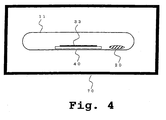
- Fig. 2(A) the other end of the glass tube 10 was connected to a vacuum exhaust apparatus 50, and air was exhausted at room temperature until a pressure in the tube reached 10 -5 Pa or less.
- Fig. 2(B) a portion close to the connection end of the glass tube 10 was molten and sealed with a glass tube sealing burner 60, and the organic compound and resin pellets were put in a sealed glass tube 11 having both the sealed ends, followed by sealing the tube in an airtight manner.
- the sealed glass tube 11 was disposed in a thermostatic chamber 70, and the entire sealed glass tube 11 was heated under precise temperature control by setting a temperature at which the sublimable organic compound sublimes without thermal decomposition (110°C in the case of the above-mentioned compound) as a lower limit, and setting a highest temperature among temperatures satisfying the following conditions as an upper limit.
- temperature control needs to be performed not to exceed the thermal deformation start temperature of the resin.
- an inside temperature of the thermostatic chamber 70 was set to 110°C, and the set temperature was maintained with a precision of ⁇ 0.1°C for 24 hours. Thereafter, the temperature of the thermostatic chamber 70 was gradually lowered to 25°C for nine hours.
- a vapor of the sublimable organic compound contacts the inner wall of the cooled sealed glass tube 11 and agglomerates, and is deposited as crystals, and there is a possibility that a predetermined amount of the sublimable organic compound does not uniformly penetrate/disperse into the resin surface layer.
- the polycarbonate pellet was taken out in which the sublimable organic compound penetrated/dispersed into the surface layer.
- the pellet was cut into round pieces with a cutter and observed with an optical microscope, and a section photograph was taken as shown in Fig. 10 .
- One graduation of a scale inserted into Fig. 10 is ten micrometers.
- the sublimable organic compound penetrates/disperses from the surface of the polycarbonate pellet into the surface layer over a depth of about 90 micrometers, whereby the surface layer is modified/colored.
- the polycarbonate surface layer modified/colored by the penetration of the sublimable organic compound, cis-1,2-dicyano-1,2-bis(2,4,5-trimethyl-3-thienyl)ethene turned to yellow by the irradiation of a visible ray from which an ultraviolet ray was cut and/or an infrared ray, and turned to red by the irradiation of the ultraviolet ray. That is, it was confirmed that a photochromic function was imparted to the resin surface layer.
- Fig. 3 shows a simplest embodiment of a resin surface layer modification and/or a coloring apparatus of the present invention. That is, in the glass tube 11 having both the sealed ends, the molded resin article (resin pellet 30), and the organic compound 20 having an affinity for the molded resin article and sublimation properties are disposed. In the glass tube 11, the organic compound is brought to the saturated sublimation pressure state. Moreover, the thermostatic chamber 70 is heating means for sublimating the organic compound, depositing the vapor of the organic compound on the surface of the molded resin article, and allowing the organic compound to penetrate/disperse into the molded resin article.
- the vapor of the sublimable organic compound sublimated and generated during the heating returned to the surface of the original crystals during the slow cooling, so that the vapor was not deposited on the glass wall of the glass tube 11.
- the other end of the glass tube 10 was connected to a vacuum exhaust apparatus 50, and air was exhausted at room temperature until the pressure in the tube reached 10 -5 Pa or less.
- the sealed glass tube 11 was disposed in a thermostatic chamber 70, and the sealed glass tube 11 was wholly heated at a temperature (110°C in the case of the above-mentioned compound) at which the above sublimable organic compound sublimed without thermal decomposition, while the above temperature was strictly controlled. After 5 hours, the temperature of the thermostatic chamber 70 was gradually lowered to 25°C in 9 hours.
- the polycarbonate resin thin film modified with cis-1,2-dicyano-1,2-bis(2,4,5-trimethyl-3-thienyl)ethene prepared in the present example turns to yellow by the irradiation of the visible ray from which an ultraviolet ray is cut and/or an infrared ray, and turns to red by the irradiation of the ultraviolet ray. That is, it was confirmed that the above thin film functioned as a photochromic thin film.
- the spectrum of 20 minutes after the irradiation of the visible ray of a wavelength of 400 nm or more and infrared ray is shown by a dotted line
- the spectrum of two hours after the irradiation of the ultraviolet ray is shown by a long chain line
- the spectrum after four hours is shown by a short chain line
- the spectrum after six hours is shown by a two-dot chain line
- the spectrum after eight hours is shown by a dashed line
- the spectrum after ten hours is shown by a solid line.
- the glass substrate 40 having the resin thin film 33 (film thickness of 100 ⁇ m) formed on the glass substrate 40 was prepared with poly(2-hydroxypropyl methacrylate) (PHPMA) by a vacuum hot press method. Subsequently, two glass substrates 40 with different types of resin thin films formed thereon were placed in the same sealed glass tube 11, and together with the organic compound 20 having the sublimation properties and an affinity for a resin of the molded resin article to be coated, similarly as Example 2, heating and slow cooling were performed.
- PPMA poly(2-hydroxypropyl methacrylate)
- the resin thin film 33 film thickness of 100 ⁇
- PPMA poly(2-hydroxypropyl methacrylate)
- the affinity of the sublimable organic compound for the resin can be understood as "presence/absence of stabilization by solvation energy". That is, the resin herein serves as "a medium” for the sublimable organic compound, and serves as "a solvent” for a solution. In a case in which no affinity of the sublimable organic compound for resin is recognized, resin serves as "medium with zero solubility". In this case, since "there is no stabilization by the solvation energy", the sublimable organic compound vapor cannot penetrate/disperse into the resin. Therefore, heating is performed to provide the saturated vapor pressure state, slow cooling is then performed, and the sublimable organic compound vapor returns again to the crystal surface to crystallize, which is a most thermodynamic stabilized state.
- Each of the three sealed glass tubes 11 was placed in the thermostatic chamber 70, and the entire sealed glass tube 11 was heated under strict temperature control at the temperature (110°C in the case of the above-mentioned compound) in which the sublimable organic compound sublimed without thermal decomposition.
- the heating time was set to 12 hours, 24 hours, 48 hours for the respective three.
- the temperature of the thermostatic chamber 70 was gradually lowered to 25°C for nine hours. In any case, the crystals of the sublimable organic compound remained.
- the depth of the penetration/dissolution of the sublimable organic compound was 55 ⁇ m, 100 ⁇ m and 190 ⁇ m from the pellet surface in accordance with the heating treatment time. That is, it has been understood that when a sufficient amount of sublimable organic compound exists, the depth of penetration/dissolution of the sublimable organic compound, i.e., the thickness of the surface layer to be modified can be controlled in accordance with the heating treatment time. Additionally, needless to say, the thickness of the surface layer to be modified can also be controlled by controlling a charge amount of the sublimable organic compound to the molded resin article.
- Fig. 5 is a sectional view showing a schematic constitution of a resin surface layer modification and/or coloring apparatus of the present example.
- a resin film 300 (film thickness of 1 ⁇ m) obtained by coating one surface of a circular glass substrate 400 (e.g., a diameter of 120 mm, a thickness of 0.6 mm) with a dichloromethane solution of polycarbonate resin by a spin coat method, and performing a deaeration treatment at 150°C for two hours under high vacuum of 10 -5 Pa.
- sublimation source substrate 240 aluminum plate, for example, with a diameter of 120 mm, thickness of 2 mm
- the sublimation source was disposed opposite to the resin film 300.
- a surface interval between the resin film 300 and a formed sublimable organic compound film 200 was set, for example, to 5 mm.
- the surface interval is shorter, the vapor of the sublimable organic compound generated from the sublimation source reaches the resin film surface in a shorter time.
- this interval is set to be extremely short, exhaust resistance increases during pressure reduction in a tightly closable container.
- An interval of the order of 1 mm to 10 mm is preferable.
- a tightly closable container outer wall 110 is formed of stainless steel or aluminum, and is structured (not shown) to be vertically dividable in order to place or remove the substrate.
- a tightly closable container interior 100 is connected to a vacuum exhaust system 150 via a vacuum valve 190 and a vacuum pipe 120, and the valve 190 is closed after performing exhausting to obtain a pressure of 10 -5 Pa or less in the tightly closable container interior 100 at room temperature. Thereby, the tightly closable container is closed.
- a heater 710 as heating means, sublimation source substrate heater 720, resin film glass substrate heater 740, and vacuum valve heater 790, for example, formed of aluminum with a sheath electric heating line embedded therein can be used.
- the heaters of materials high in conductivity without any gap By disposing the heaters of materials high in conductivity without any gap, the portions of the tightly closable container interior 100 and vacuum valve 190 can uniformly be heated.
- the sublimable organic compound vapor generated by sublimation is cooled by the part, and possibly crystallized/deposited, and attentions are therefore necessary.
- the substrate is closely attached to the heater via a plurality of holding clicks (not shown).
- the pressure of the tightly closable container interior 100 was reduced, and it was then heated by the heating means. At this time, temperature control was precisely performed so that the whole of the interior 100 might be a set temperature (e.g., 110°C) ⁇ 1°C.
- the heating was stopped, and the temperature of the tightly closable container interior was gradually lowered to 25°C in 12 hours. Subsequently, after returning the tightly closable container interior to atmospheric pressure, the resin film 300 on the circular glass substrate 400 was removed.
- the tightly closable container interior 100 was subjected to pressure reduction and the heating was then performed.
- the heating under vacuum using the heater proceeds only by "radiant heat", and therefore it cannot be said that the example is efficient.
- the pressure of the tightly closable container interior 100 may be reduced to a predetermined pressure.
- the heating may be performed after replacing the atmosphere in the tightly closable container interior 100 with inactive gases such as a nitrogen gas and argon gas.
- inactive gases such as a nitrogen gas and argon gas.
- the sublimation from the sublimable organic compound starts, and a part thereof escapes to the vacuum exhaust system 150.
- the time necessary for performing the pressure reduction to obtain the predetermined pressure needs to be shortened as much as possible. For that, the exhaust resistance of the vacuum valve 190 and vacuum pipe 120 is reduced, and further high-efficiency vacuum pumps such as a turbo molecule pump may be used in the vacuum exhaust system.
- sublimation heat is taken from the sublimation source in accordance with an amount of a subliming vapor. To compensate for the heat, it is necessary to continue the heating of the sublimation source, and carefully perform the temperature control. In general, since the sublimation does not rapidly proceed like boiling, even with the heating under vacuum, there is little possibility of causing delay in supply of the sublimation heat.
- the "sublimation source” formed of any one of the following constitutions may be used.
- the binder resin When the binder resin is used for the film formation, in principle, it is preferable to select and use the resin which has no affinity for or no compatibility with the sublimable organic compound and which allows the sublimable organic compound to disperse as crystals or fine particles. This is because if the sublimable organic compound is dissolved in the binder resin, the "sublimation" in a strict meaning does not occur.
- the coating method When the coating method is employed for the film formation, sufficient care needs to be taken in order to prevent the solvent from remaining in the coated film. In a case in which the solvent is used, the remaining solvent in the coated film has to be removed on a condition that the sublimable organic compound is prevented from subliming. This is not easy, and it is therefore preferable to employ the coating method in which no solvent is used if possible, for example, in which a ultraviolet-curing resin or an electron beam curing resin is used.
- the holes in the porous particle or the porous substrate can be impregnated without any solvent.
- the following melting method can be used. That is, after charging an appropriate amount of porous particles and fine powder of sublimable organic compound into the tightly closable container provided with the vacuum valve, and continuing deaeration in room temperature, air in the holes of the porous particles is removed. Thereafter, by tightly closing the tightly closable container, and performing the heating, the sublimable organic compound is molten. Subsequently, when the inactive gas is gradually introduced into the tightly closable container still in the molten state, the molten sublimable organic compound penetrates into the holes of the porous particles.
- the porous particles impregnated with the sublimable organic compound which have desired particle diameters, are obtained.
- the porous substrate instead of the porous particles to perform the similar process, and finally scraping the deposited sublimable organic compound from the surface of the porous substrate, the porous substrate impregnated with the sublimable organic compound can be obtained.
- Fig. 6 is a sectional view showing a schematic constitution of a resin surface layer modification and/or coloring apparatus of the present example.
- cis-1,2-dicyano-1,2-bis(2,4,5-trimethyl-3-thienyl)ethene was placed in a tray 24, and introduced into a first vacuum container 510 via a vacuum door 560.
- a vacuum door 560 By closing the vacuum door 560, and vacuum valves 540 and 570, the interior of the first vacuum container 510 turns to a first closed space 500.
- the resin film 300 (film thickness of 1 ⁇ m) obtained as the molded resin article by coating one surface of the circular glass substrate 400 (e.g., a diameter of 120 mm, a thickness of 0.6 mm) with the dichloromethane solution of polycarbonate resin by the spin coat method, and performing the de aeration treatment at 150°C for two hours under high vacuum of 10 -5 Pa was introduced into a second vacuum container 610 via a gate valve 660 by utilizing a transport rail 670. By closing the gate valve 660, and vacuum valves 640 and 570, the interior of the second vacuum container 610 turns to a second closed space 600.
- a heater 620 attached to the entire surface of the inner wall of the second vacuum container 610, gate valve 660 provided with a heater, and vacuum valves 640 and 570 provided with heaters, whereby the temperature in the second closed space 600 was controlled to 110°C, i.e., the same temperature as in the first closed space 500.
- the heating by a heater 520 attached to the entire surface of the inside wall of the first vacuum container 510, a heater 530 for the vacuum door 560, and vacuum valves 540 and 570 provided with the heaters, whereby the temperature in the first closed space 500 was controlled to 110°C, i.e., the same temperature as in the second closed space 600.
- the sublimable organic compound sublimes in 110°C without thermal decomposition.
- the vacuum valve 540 By opening the vacuum valve 540 attached to the first vacuum container 510 to connect a vacuum exhaust system 550, the pressure in the first closed space 500 was brought to the saturated sublimation pressure state of the sublimable organic compound, and subsequently, the vacuum valve 540 was closed. Additionally, when the vacuum valve 540 is kept to be open, the sublimable organic compound vapor escapes into the vacuum exhaust system 550. Therefore, in order to compensate for drop of pressure reduction degree by leak from each portion of the vacuum apparatus, control was performed by sometimes opening the vacuum valve 540 in such a manner that the pressure in the first closed space 500 reached the saturated sublimation pressure of the sublimable organic compound.
- the pressure in the second closed space 600 was set to be equal to or less than the saturated sublimation pressure of the sublimable organic compound at the temperature (110°C). Thereafter, the vacuum valve 640 was closed, and in order to compensate for the pressure reduction degree drop by the leak from each vacuum apparatus portion, by sometimes opening and closing the vacuum valve 640, control was performed in such a manner that the pressure in the second space 600 became equal to or less than the saturated sublimation pressure of the sublimable organic compound.
- the vacuum valve 570 provided with the heater, for separating the first vacuum container 510 from the second vacuum container 610, and connecting the first closed space 500 to the second closed space 600
- the first closed space 500 and second closed space 600 were combined to form a third closed space.
- the temperature and pressure were controlled in such a manner that the entire third closed space was brought to the saturated sublimation pressure state of the sublimable organic compound. In this manner, the sublimable organic compound vapor with which the first closed space 500 before the connection was filled and dispersed into the second closed space 600 before the connection.
- the temperature and the pressure are controlled to the predetermined levels, whereby the sublimable organic compound vapor generated in the first vacuum container 510 is uniformly deposited on the surface of the molded resin article placed in the second vacuum container 610, and the deposited sublimable organic compound can penetrate/disperse from the surface of the molded resin article into its inside.
- a predetermined time for example, ten minutes
- the vacuum valve 640 was opened to exhaust the remaining sublimable organic compound vapor from the second vacuum container 610.
- the gate valve 660 was slowly and slightly opened to return an interior of the second vacuum container 610 to atmospheric pressure, the gate valve 660 was opened and the molded resin article was taken out.
- the temperature of the first vacuum container 510 is kept to be constant, and the surface of the molded resin article can continuously be modified/colored until the sublimable organic compound charged into the first vacuum container 510 is completely consumed.
- Fig. 7 is a sectional view showing a schematic constitution of a resin surface layer modification and/or coloring apparatus of the present example.
- a third vacuum container 612 is disposed adjacent to the second vacuum container 610 as the apparatus of Example 6 ( Fig. 6 ) via the gate valve 660 provided with the heater.
- the molded resin article is placed on a transport rail 672 in the third vacuum container 612 via a vacuum door 662.
- a vacuum door 662 By closing the vacuum door 662 and gate valve 660, opening the vacuum valve 642, and adjusting the pressure inside the third vacuum container 612 by a vacuum exhaust system 652, the molded resin article can be introduced into the second vacuum container 610 for treating the molded resin article without returning the pressure in the second vacuum container 610 for treating the molded resin article to atmospheric pressure.
- the temperature of the first vacuum container 510 and second vacuum container 610 is adjusted to satisfy the saturated sublimation pressure condition of the sublimable organic compound 20.
- a concrete example is described in Example 6.
- the gate valve 660 When the gate valve 660 is opened, it is necessary to satisfy a condition that the pressure reduction degree in the third vacuum container 612 is equal to that in the second vacuum container 610, the vacuum valve 570 is closed and that the sublimable organic compound vapor is not present inside the second vacuum container 610. When the condition is not satisfied, the sublimable organic compound 20 is possibly crystallized in the third vacuum container 612.
- the temperature of the molded resin article introduced into the second vacuum container 610 is preferably heated to the predetermined temperature before the introduction. This is because the second vacuum container 610 is in the reduced pressure state, only the heating by the radiant heat is effective and much time is required for raising the temperature. Concretely, after performing the heating to obtain the predetermined temperature under atmospheric pressure immediately before the introduction into the third vacuum container 612, and delivering the material into the third vacuum container 612, the pressure reduction is quickly performed, and the material may be transported into the second vacuum container 610 in a "vacuum heat insulation state".
- the following procedure is preferably performed. First, by closing the vacuum valve 570 provided with the heater for separating the first vacuum container 510 from the second vacuum container 610, and opening the vacuum valve 640, the sublimable organic compound vapor remaining in the second vacuum container 610 is exhausted. In this case, the pressure in the third vacuum container 612 is adjusted to be equal to that in the second vacuum container 610. Subsequently, after opening the gate valve 660, and transporting the molded resin article into the third vacuum container 612 from the second vacuum container 610, the gate valve 660 is closed.
- the molded resin article After the temperature of the molded resin article drops to the predetermined temperature, the molded resin article is taken out into the atmosphere by opening the vacuum door 66.2.
- the vacuum door 66.2 It is necessary to note a phenomenon in which the sublimable organic compound is vaporized and detached from the resin surface layer in the third vacuum container 612 of the reduced pressure state. This cannot be ignored for the organic compound with a high saturated vapor pressure.
- effective is a technique of introducing air or inactive gas into the third vacuum container 612 in a stage in which the temperature of the molded resin article is higher than the room temperature to return the pressure to the atmospheric pressure and rapidly cooling the molded resin article.
- Fig. 8 is a sectional view showing a schematic constitution of a modification and/or coloring apparatus for a resin surface layer in the present example.
- a fourth vacuum container 616 is disposed via the gate valve 660 provided with the heater, and the third vacuum container 612 is further disposed via the gate valve 662 provided with the heater.
- the fourth vacuum container 616 in the present-example apparatus fulfills a role similar to that of the third vacuum container 612 in Example 7 ( Fig. 7 ) during the introduction of the molded resin article into the apparatus, but is used only to transport the molded resin article to the second vacuum container 610.
- the third vacuum container 612 in the present-example apparatus is used to take the molded resin article out of the apparatus, or to send the material to an apparatus (not shown) for the next process.
- the apparatuses for the next process such as a sputtering apparatus (not shown) may be disposed in the third vacuum container 612.
- Example 7 The apparatus described in Example 7 ( Fig. 7 ) is suitable for performing the modification/coloring only of the surface of the molded resin article.
- the present-example apparatus is suitable for continuously transporting the molded resin article to another processing process subsequent to the modification/coloring of the surface of the molded resin article.
- the molded resin article is placed on a transport rail 676 in the fourth vacuum container 616 via a vacuum door 666.
- a vacuum door 666 By closing the vacuum door 666 and gate valve 660, opening a vacuum valve 646, and adjusting the pressure inside the fourth vacuum container 616 by a vacuum exhaust system 656, the molded resin article can be introduced into the second vacuum container 610 for treating the molded resin article without returning the pressure in the second vacuum container 610 for treating the molded resin article to the atmospheric pressure.
- the temperature of the first vacuum container 510 and second vacuum container 610 is adjusted to satisfy the saturated sublimation pressure condition of the sublimable organic compound 20.
- the concrete example is described in Example 6.
- the gate valve 660 When the gate valve 660 is opened, it is necessary to satisfy a condition that the pressure reduction degree in the fourth vacuum container 616 is equal to that in the second vacuum container 610, the vacuum valve 570 is closed and that no sublimable organic compound vapor is present inside the second vacuum container 610. When the condition is not satisfied, the sublimable organic compound 20 is possibly crystallized in the fourth vacuum container 616.
- the temperature of the molded resin article introduced into the second vacuum container 610 is preferably heated to the predetermined temperature before the introduction. This is because the second vacuum container 610 is in the reduced pressure state, only the heating by the radiant heat is effective and much time is required for raising the temperature. Concretely, after performing the heating to obtain the predetermined temperature under atmospheric pressure immediately before the introduction into the fourth vacuum container 616, and delivering the material into the fourth vacuum container 616, the pressure reduction is quickly performed, and the material may be transported into the second vacuum container 610 in the "vacuum heat insulation state".
- the following procedure is preferably performed. First, by closing the vacuum valve 570 provided with the heater for separating the first vacuum container 510 from the second vacuum container 610, and opening the vacuum valve 640, the sublimable organic compound vapor remaining in the second vacuum container 610 is exhausted. In this case, the pressure in the third vacuum container 612 is adjusted to be equal to that in the second vacuum container 610. Subsequently, after opening the gate valve 662, and transporting the molded resin article into the third vacuum container 612 from the second vacuum container 610, the gate valve 662 is closed.
- the molded resin article After the temperature of the molded resin article drops to the predetermined temperature, the molded resin article is taken out into the atmosphere by opening the vacuum door 664, or transported to the next process.
- effective is the technique of introducing air or inactive gas into the third vacuum container 612 in the stage in which the temperature of the molded resin article is higher than the room temperature to return the pressure to the atmospheric pressure and rapidly cooling the molded resin article.
- Fig. 9 is a sectional view showing a schematic constitution of a modification and/or coloring apparatus for a resin surface layer in the present example.
- reel rests 802 and 812 are attached to the interior of the second vacuum container 610 for treating the molded resin article.
- the reel rests 802 and 812 are provided with a supply side reel 810 for supplying a resin film or fiber 333 and a reception side reel 800 for wind-up, and by rotating the reception side reel by mechanisms such as a rotary introducing machine (not shown), the resin film or fiber 333 is continuously treated.
- the sublimable organic compound 20 having the sublimation properties and the affinity for a resin of the molded resin article to be coated is placed in the tray 24, and introduced into the first vacuum container 510 via the -vacuum door 560.
- the vacuum door 560 and vacuum valves 540 and 570 By closing the vacuum door 560 and vacuum valves 540 and 570, the interior of the first vacuum container 510 turns to the first closed space 500.
- the resin film or fiber 333 wound up around the supply side reel 800 and the reception side reel 800 are introduced into the second vacuum container 610 via the gate valve 660, and attached to the reel rests 812 and 802, so that the resin film or fiber 333 is taken up to the reception side reel 800 from the supply side reel 810.
- the gate valve 660 and vacuum valves 640 and 570 By closing the gate valve 660 and vacuum valves 640 and 570, the interior of the second vacuum container 610 turns to the second closed space 600.
- the set temperature the temperature at which the organic compound 20 having the sublimation properties and the affinity for the resin of the molded resin article to be coated sublimes without thermal decomposition is set as the lower limit, the highest temperature among the temperatures satisfying the following conditions is set as the upper limit, and temperature control is precisely performed.
- the heater 520 attached to the entire surface of the inside wall of the first vacuum container 510, a heater 530 for the vacuum door 560, and vacuum valves 540 and 570 provided with the heaters, whereby the temperature in the first closed space 500 was controlled to the same temperature as in the second closed space 600.
- the vacuum valve 540 By opening the vacuum valve 540 provided with the heater and attached to the first vacuum container 510 to connect the vacuum exhaust system 550, the pressure in the first closed space 500 was brought to the saturated sublimation pressure state of the sublimable organic compound 20, and subsequently, the vacuum valve 540 was closed. Additionally, when the vacuum valve 540 is kept to be open, the vapor of the sublimable organic compound 20 escapes into the vacuum exhaust system 550. Therefore, in order to compensate for the pressure reduction degree drop by leak from each portion of the vacuum apparatus, control is performed by sometimes opening and closing the vacuum valve 540 in such a manner that the pressure in the first closed space 500 reaches the saturated sublimation pressure of the sublimable organic compound 20.
- the vacuum valve 640 provided with the heater and attached to the second vacuum container 610 is opened and connected to the vacuum exhaust system 650, the pressure in the second closed space 600 is set to be equal to or less than the saturated sublimation pressure of the sublimable organic compound 20 at the temperature. Thereafter, the vacuum valve 640 is closed, and in order to compensate for the pressure reduction degree drop by the leak from each vacuum apparatus portion, by sometimes opening and closing the vacuum valve 640, control is performed in such a manner that the pressure in the second space 600 becomes equal to or less than the saturated sublimation pressure of the sublimable organic compound 20.
- the vacuum valve 570 provided with the heater, for separating the first vacuum container 510 from the second vacuum container 610, and connecting the first closed space 500 to the second closed space 600
- the first closed space 500 and second closed space 600 are combined to form the third closed space.
- the temperature and pressure are controlled in such a manner that the entire third closed space is brought to the saturated sublimation pressure state of the sublimable organic compound. In this manner, the vapor of the sublimable organic compound 20 with which the first closed space 500 before the connection is filled and dispersed into the second closed space 600 before the connection.
- the rein film or fiber 333 is moved to the reception side reel 800 from the supply side reel 810 at a constant speed, for example, 10 mm/minute.
- the deposited sublimable organic compound 20 can be allowed to penetrate/disperse from the surface of the molded resin article into its inside.
- the vacuum valve 570 provided with the heater, for separating the first vacuum container 510 from the second vacuum container 610 is closed.
- the vacuum valve 640 is opened to exhaust the vapor of the sublimable organic compound 20 remaining in the second vacuum container 610, and the temperature of the second vacuum container 610 is cooled to the vicinity of the room temperature.
- the gate valve 660 is slowly slightly opened, the interior of the second vacuum container 610 is returned to the atmospheric pressure, the gate valve 660 is opened, and the resin film or fiber 333 wound up on the reception side reel 800 is taken out.
- the present-example apparatus can preferably used, particularly, for a purpose of providing the surface layer of the fiber with the photochromic function, or providing the surface layer of the plastic sheet with the ultraviolet absorbing function. Furthermore, the apparatus can also be used for providing the surface layer of the plastic sheet with the medicinal activity function or the function as the agricultural chemical.
- Fig. 12 is a sectional view showing a schematic constitution of a modification and/or coloring apparatus for a resin surface layer in the present example. This apparatus is suitable for the modification of the surface layer and/or the coloring of the powdery resin.
- cis-1,2-dicyano-1,2-bis(2,4,5-trimethyl-3-thienyl)ethene was placed in the tray 24, and introduced into the first vacuum container 510 through the vacuum door 560.
- the vacuum door 560 and vacuum valves 540 and 570 By closing the vacuum door 560 and vacuum valves 540 and 570, the interior of the first vacuum container 510 turns to the first closed space 500.
- thermosetting acrylic modified resin fine powder "Rubcouleur” manufactured by DAINICHISEIKA COLOR & CHEMICALS MFG. CO., LTD.
- the sublimable organic compound sublimes in 110°C without thermal decomposition.
- the vacuum valve 540 By opening the vacuum valve 540 provided with the heater and attached to the first vacuum container 510 and connecting the vacuum exhaust system 550, the pressure in the first closed space 500 was brought to the saturated sublimation pressure state of the sublimable organic compound, and subsequently, the vacuum valve 540 was closed. Additionally, when the vacuum valve 540 is kept to be open, the sublimable organic compound vapor escapes into the vacuum exhaust system 550. Therefore, in order to compensate for the pressure reduction degree drop by leak from each portion of the vacuum apparatus, control was performed by sometimes opening and closing the vacuum valve 540 in such a manner that the pressure in the first closed space 500 reached the saturated sublimation pressure of the sublimable organic compound.
- the powdery resin in the second vacuum container 610 is stirred using the stirring blade 900 attached to the vacuum door 668 and driven by the magnet coupling type stirring motor 680, the vacuum valve 640 provided with the heater and attached to the second vacuum container 610 is gradually opened, and the vacuum exhaust system 650 is connected.
- the pressure in the second closed space 600 was set to be equal to or less than the saturated sublimation pressure of the sublimable organic compound at the temperature (110°C). In this case, when the vacuum valve 640 is rapidly opened, the powdery resin vigorously flies up and therefore care needs to be taken.
- the vacuum valve 640 was closed, and in order to compensate for the pressure reduction degree drop by the leak from each vacuum apparatus portion, by sometimes opening and closing the vacuum valve 640, control was performed in such a manner that the pressure in the second space 600 became equal to or less than the saturated sublimation pressure of the sublimable organic compound.
- the vacuum valve 570 provided with the heater, for separating the first vacuum container 510 from the second vacuum container 610, and connecting the first closed space 500 to the second closed space 600
- the first closed space 500 and second closed space 600 were combined to form the third closed space.
- the temperature and pressure were controlled in such a manner that the entire third closed space was brought to the saturated sublimation pressure state of the sublimable organic compound.
- the powdery resin in the second vacuum container 610 was continuously stirred using the stirring blade 900 driven by the magnetic coupling type stirring motor 680 attached to the vacuum door 668. In this manner, the sublimable organic compound vapor with which the first closed space 500 before the connection was filled and dispersed into the second closed space 600 before the connection.
- the temperature and the pressure are controlled to the predetermined levels, whereby the sublimable organic compound vapor generated in the first vacuum container 510 is uniformly deposited on the surface of the powdery resin stirred in the second vacuum container 610, and the deposited sublimable organic compound can penetrate/disperse from the surface of the molded resin article into its inside.
- the vacuum valve 570 provided with the heater, for separating the first vacuum container 510 from the second vacuum container 610
- the vacuum valve 640 was opened to exhaust the remaining sublimable organic compound vapor from the second vacuum container 610.
- the vacuum door 668 was slowly and slightly opened to return an interior of the second vacuum container 610 to atmospheric pressure, the vacuum door 668 was completely opened and the molded resin article was taken out.
- the obtained powdery resin turns to yellow by the irradiation of the visible ray of the cut ultraviolet ray and/or the infrared ray, and turns to red by the irradiation of the ultraviolet ray. That is, by modifying the surface layer of the powdery resin, the function as the powdered photochromic resin was confirmed.
- a plastic resin surface layer was modified using the photochromic dyestuff, and provided with the photochromic function similarly as Example 6, except that a poly(methyl methacrylate) plastic lens was used as the molded resin article instead of the polycarbonate resin thin film formed on one surface of the circular glass substrate 400 in Example 6, and a rest for holding a plastic lens edge was utilized.
- the surface layer can be similarly modified using the photochromic dyestuff and provided with the photochromic function.
- the surface layer of the plastic lens or the resin coated lens can be modified, and also colored in an arbitrary color.
- the surface layer of the obtained polycarbonate pellets was colored in a bright orange color inherent in the ferrocene derivative.
- the section of each of the obtained polycarbonate pellets was observed and analyzed with an X ray micro-analyzer attached to a scanning type electron microscope, and as a result, it was confirmed that an iron element was distributed over a depth of about 10 micrometers from the surface of the pellet. That is, it was confirmed that the molecules of the sublimable organic compound were distributed in the resin pellet, in other words, the surface layer was modified and colored.
- Camphor in the glass evaporating dish was observed through an observation window of the vacuum drier, and after complete sublimation, the inside temperature was kept in the above temperature range for 2 hours. Next, the heating was stopped, and the system was allowed to stand for 12 hours. The air suction port was then opened so that the inside pressure might be the atmospheric pressure. Afterward, the vacuum door was opened, and the hanger was then taken out. Any camphor crystals were not deposited in the vacuum drier and on the surface of the hanger. The weight of each hanger was measured, and it was apparent that the weight increased as much as 2 g on average. It can be judged that camphor penetrates and disperses into the surface layer of the hanger to increase the weight. The polypropylene dress hanger whose surface layer is modified in this manner exerts an insecticidal function of camphor for a long term.
- Camphor was kneaded with polypropylene and injection molding was then tried, but weight reduction due to the sublimation of camphor was remarkable, so that it was difficult to obtain a molded material whose composition was constant. Moreover, since a large amount of a camphor vapor was generated in an operation environment, it has been found that for the preservation of the operation environment and the atmosphere, a local exhaust device and an exhaust treatment apparatus are additionally required.
- a colored surface layer comprising a sublimable dyestuff and a resin and having a uniform composition on the surface of the molded resin article
- to prepare the colored surface layer containing the sublimable dyestuff and containing no volatile impurities on the surface of the molded resin article to efficiently prepare the colored surface layer comprising the sublimable dyestuff and a resin and having the uniform composition on the surface of the molded resin article
- to prepare the colored layer containing the sublimable dyestuff on the surface of the molded resin article without impairing the worked surface structure to prepare the colored surface layer containing many kinds of sublimable dyestuffs on the surface of the molded resin article, to prepare the colored surface layer containing the sublimable dyestuff uniform in film thickness and/or composition on the surface
- the functional characteristics can be imparted to the surface layer of the molded resin article by the use of a remarkably smaller amount of a functional material as compared with a case where the functional material is kneaded with the whole resin to give the functional characteristics.
Landscapes
- Chemical & Material Sciences (AREA)
- Chemical Kinetics & Catalysis (AREA)
- Engineering & Computer Science (AREA)
- Materials Engineering (AREA)
- Mechanical Engineering (AREA)
- Metallurgy (AREA)
- Organic Chemistry (AREA)
- Application Of Or Painting With Fluid Materials (AREA)
- Processing And Handling Of Plastics And Other Materials For Molding In General (AREA)
- Optical Fibers, Optical Fiber Cores, And Optical Fiber Bundles (AREA)
- Chemical Or Physical Treatment Of Fibers (AREA)
- Physical Vapour Deposition (AREA)
- Surface Treatment Of Optical Elements (AREA)
- Medicinal Preparation (AREA)
- Coating Of Shaped Articles Made Of Macromolecular Substances (AREA)
- Treatments Of Macromolecular Shaped Articles (AREA)
- Laminated Bodies (AREA)
Applications Claiming Priority (2)
| Application Number | Priority Date | Filing Date | Title |
|---|---|---|---|
| JP09103899A JP3682465B2 (ja) | 1999-03-31 | 1999-03-31 | 樹脂成形物表面層の改質方法およびそのための装置および表面層が改質された樹脂成形物、および樹脂成形物表面層の着色方法およびそのための装置および表面層が着色された樹脂成形物、および表面層の改質により機能性を付与された樹脂成形物 |
| EP00913042A EP1179558A4 (de) | 1999-03-31 | 2000-03-31 | Methode zur modifizierung von oberflächenschichten aus geformten kunstharzen sowie apparatur zur modifizierung von oberflächenschichten aus geformten kunstharzen |
Related Parent Applications (2)
| Application Number | Title | Priority Date | Filing Date |
|---|---|---|---|
| EP00913042.8 Division | 2000-03-31 | ||
| EP00913042A Division EP1179558A4 (de) | 1999-03-31 | 2000-03-31 | Methode zur modifizierung von oberflächenschichten aus geformten kunstharzen sowie apparatur zur modifizierung von oberflächenschichten aus geformten kunstharzen |
Publications (4)
| Publication Number | Publication Date |
|---|---|
| EP1944332A2 true EP1944332A2 (de) | 2008-07-16 |
| EP1944332A3 EP1944332A3 (de) | 2009-10-21 |
| EP1944332A8 EP1944332A8 (de) | 2010-06-30 |
| EP1944332B1 EP1944332B1 (de) | 2012-08-08 |
Family
ID=14015345
Family Applications (2)
| Application Number | Title | Priority Date | Filing Date |
|---|---|---|---|
| EP00913042A Withdrawn EP1179558A4 (de) | 1999-03-31 | 2000-03-31 | Methode zur modifizierung von oberflächenschichten aus geformten kunstharzen sowie apparatur zur modifizierung von oberflächenschichten aus geformten kunstharzen |
| EP08007363A Expired - Lifetime EP1944332B1 (de) | 1999-03-31 | 2000-03-31 | Methode zur Modifizierung von Oberflächenschichten aus geformten Kunstharzen |
Family Applications Before (1)
| Application Number | Title | Priority Date | Filing Date |
|---|---|---|---|
| EP00913042A Withdrawn EP1179558A4 (de) | 1999-03-31 | 2000-03-31 | Methode zur modifizierung von oberflächenschichten aus geformten kunstharzen sowie apparatur zur modifizierung von oberflächenschichten aus geformten kunstharzen |
Country Status (4)
| Country | Link |
|---|---|
| US (3) | US7078072B1 (de) |
| EP (2) | EP1179558A4 (de) |
| JP (1) | JP3682465B2 (de) |
| WO (1) | WO2000058391A1 (de) |
Families Citing this family (15)
| Publication number | Priority date | Publication date | Assignee | Title |
|---|---|---|---|---|
| JP3732469B2 (ja) * | 2002-09-04 | 2006-01-05 | 独立行政法人産業技術総合研究所 | 光記録媒体およびその製造方法並びに光記録方法 |
| TWI327074B (en) * | 2003-05-07 | 2010-07-11 | Hisamitsu Pharmaceutical Co | Ultra violet shielding patch |
| JP4285741B2 (ja) * | 2003-10-24 | 2009-06-24 | 独立行政法人産業技術総合研究所 | 有機電界発光素子およびその作製方法 |
| KR100542771B1 (ko) * | 2003-12-30 | 2006-01-20 | 엘지.필립스 엘시디 주식회사 | 유기 전계발광소자 및 그 제조방법 |
| EP1741802B1 (de) * | 2004-03-29 | 2013-08-21 | Tadahiro Ohmi | Filmbildungsvorrichtung und filmbildungsverfahren |
| JPWO2007052468A1 (ja) * | 2005-11-01 | 2009-04-30 | 株式会社ニコン | フォトクロミック染料によるボディ部材の装飾方法およびフォトクロミック装飾されたボディ部材並びにボディ部材用基材 |
| KR100754404B1 (ko) * | 2006-05-25 | 2007-08-31 | 삼성전자주식회사 | 확산튜브와, 확산공정용 도펀트 소스 및 상기 확산튜브와도펀트 소스를 이용한 확산방법 |
| JP4749325B2 (ja) * | 2006-12-28 | 2011-08-17 | 東海オールセット株式会社 | 機能性繊維材料の製造方法 |
| US20080175934A1 (en) * | 2006-12-29 | 2008-07-24 | Himalaya Global Holdings Limited | Novel herbal composition of extracts of quercus infectoria, process for preparing the same and use thereof |
| KR101308048B1 (ko) * | 2007-10-10 | 2013-09-12 | 삼성전자주식회사 | 반도체 메모리 장치 |
| GB0802687D0 (en) * | 2008-02-14 | 2008-03-19 | P2I Ltd | Vapour delivery system |
| JP5494098B2 (ja) * | 2009-04-28 | 2014-05-14 | 日立化成株式会社 | 樹脂組成物、樹脂ワニス、複合材料及びその製造方法、プリプレグ並びに樹脂フィルム |
| KR101714814B1 (ko) | 2009-09-22 | 2017-03-09 | 쓰리엠 이노베이티브 프로퍼티즈 컴파니 | 다공성 비세라믹 기판상에 원자층 증착 코팅을 도포하는 방법 |
| US10049817B2 (en) * | 2015-06-19 | 2018-08-14 | University Of Connecticut | Dielectric materials using 2D nanosheet network interlayer |
| KR102342124B1 (ko) * | 2019-02-14 | 2021-12-22 | 주식회사 히타치하이테크 | 반도체 제조 장치 |
Family Cites Families (35)
| Publication number | Priority date | Publication date | Assignee | Title |
|---|---|---|---|---|
| US1310037A (en) * | 1919-07-15 | Coating process and apparatus | ||
| US3274052A (en) * | 1963-06-19 | 1966-09-20 | Fmc Corp | Preparation of pesticide granules |
| US3607365A (en) * | 1969-05-12 | 1971-09-21 | Minnesota Mining & Mfg | Vapor phase method of coating substrates with polymeric coating |
| FR2120511A5 (fr) * | 1971-01-06 | 1972-08-18 | Solvay | Procede pour proteger des objets en matiere plastique contre la photodegradation due au rayonnement solaire et produits ainsi obtenus |
| US4059471A (en) * | 1972-09-25 | 1977-11-22 | Haigh John M | Transfer dyeing of plastic surfaces which may be combined with lamination or molding procedures |
| US4465728A (en) * | 1972-09-25 | 1984-08-14 | H.L.H. Corp. | Dye decorated plastic articles |
| US4202663A (en) * | 1972-09-25 | 1980-05-13 | Haigh John M | Method of dye absorption into the surface of plastic |
| DE2632418A1 (de) * | 1975-07-18 | 1977-02-03 | Ozalid Group Holdings Ltd | Verfahren zum faerben von polymerfilmen |
| US4119397A (en) * | 1977-01-10 | 1978-10-10 | Armstrong Cork Company | Product and method of printing carpet-II |
| US4238524A (en) * | 1978-03-06 | 1980-12-09 | American Optical Corporation | Process for identification marking clear plastic articles |
| DE3517274A1 (de) | 1985-05-14 | 1986-11-20 | Bayer Ag, 5090 Leverkusen | Verfahren zur oberflaechenausruestung |
| US5186120A (en) * | 1989-03-22 | 1993-02-16 | Mitsubishi Denki Kabushiki Kaisha | Mixture thin film forming apparatus |
| EP0455849B1 (de) * | 1990-05-08 | 1992-12-09 | POLYTREND GESELLSCHAFT FÜR POLYMERE WERKSTOFFE & OBERFLÄCHENTECHNIK MBH | Verfahren und Vorrichtung zum Auftragen eines Farbdekors auf ein Kunststoff-Substrat sowie ein dekoriertes Kunststoff-Substrat |
| US5288325A (en) * | 1991-03-29 | 1994-02-22 | Nec Corporation | Chemical vapor deposition apparatus |
| FR2684046A1 (fr) * | 1991-11-26 | 1993-05-28 | Claveau Jean Noel | Procede de decoration par sublimation. |
| US5429819A (en) * | 1992-10-14 | 1995-07-04 | Matsushita Electric Industrial Co., Ltd. | Antiviral composition |
| US6420482B1 (en) * | 1993-07-13 | 2002-07-16 | Huntsman Petrochemical Corporation | Dyeable polyolefin containing polyetheramine modified functionalized polyolefin |
| US5719616A (en) | 1995-01-23 | 1998-02-17 | Dai Nippon Printing Co., Ltd. | Thermal transfer film cassette and thermal transfer recording method |
| US5554220A (en) * | 1995-05-19 | 1996-09-10 | The Trustees Of Princeton University | Method and apparatus using organic vapor phase deposition for the growth of organic thin films with large optical non-linearities |
| JPH0971672A (ja) * | 1995-09-08 | 1997-03-18 | Fuji Electric Co Ltd | ポリパラキシリレン薄膜の改質方法 |
| JP3012547B2 (ja) * | 1997-02-25 | 2000-02-21 | 日本ビクター株式会社 | 光記録媒体及びその製造方法 |
| US5871813A (en) * | 1997-03-05 | 1999-02-16 | Applied Materials, Inc. | Apparatus and method for controlling process chamber pressure |
| JP2845856B2 (ja) * | 1997-03-10 | 1999-01-13 | 出光興産株式会社 | 有機エレクトロルミネッセンス素子の製造方法 |
| JPH1126733A (ja) | 1997-07-03 | 1999-01-29 | Seiko Epson Corp | 薄膜デバイスの転写方法、薄膜デバイス、薄膜集積回路装置,アクティブマトリクス基板、液晶表示装置および電子機器 |
| JPH1167427A (ja) | 1997-08-27 | 1999-03-09 | Bridgestone Corp | ヒーター部品 |
| US6337102B1 (en) * | 1997-11-17 | 2002-01-08 | The Trustees Of Princeton University | Low pressure vapor phase deposition of organic thin films |
| NL1009405C2 (nl) * | 1998-06-15 | 1999-12-16 | Dsm Nv | Object omvattende een drager en een zich op de drager bevindende laag. |
| JP4063466B2 (ja) * | 2000-02-04 | 2008-03-19 | 株式会社ニデック | プラスチックレンズの染色方法 |
| JP4014345B2 (ja) * | 2000-02-04 | 2007-11-28 | 株式会社ニデック | プラスチックレンズの染色方法及び染色用基体 |
| JP3966662B2 (ja) * | 2000-02-04 | 2007-08-29 | 株式会社ニデック | プラスチックレンズの染色方法及び染色装置 |
| EP1126537B1 (de) | 2000-02-15 | 2010-12-15 | Asahi Glass Company Ltd. | Blockpolymer, Verfahren zur Herstellung von Polymer und Festpolymerelektrolytbrennstoffzelle |
| DE10007059A1 (de) * | 2000-02-16 | 2001-08-23 | Aixtron Ag | Verfahren und Vorrichtung zur Herstellung von beschichteten Substraten mittels Kondensationsbeschichtung |
| JP4455743B2 (ja) | 2000-09-12 | 2010-04-21 | 山本光学株式会社 | 偏光レンズの製造方法 |
| ES2337343T3 (es) * | 2001-03-06 | 2010-04-23 | Nidek Co., Ltd. | Tinta para la coloracion de lentes de plastico y procedimiento para la coloracion de lentes de plastico con dicha tinta. |
| US6998005B2 (en) * | 2001-03-29 | 2006-02-14 | Fresco Plastics Llc | Method and apparatus for forming dye sublimation images in solid plastic |
-
1999
- 1999-03-31 JP JP09103899A patent/JP3682465B2/ja not_active Expired - Lifetime
-
2000
- 2000-03-31 US US09/913,315 patent/US7078072B1/en not_active Expired - Fee Related
- 2000-03-31 EP EP00913042A patent/EP1179558A4/de not_active Withdrawn
- 2000-03-31 WO PCT/JP2000/002098 patent/WO2000058391A1/ja not_active Ceased
- 2000-03-31 EP EP08007363A patent/EP1944332B1/de not_active Expired - Lifetime
-
2004
- 2004-04-23 US US10/830,136 patent/US7041332B2/en not_active Expired - Fee Related
-
2006
- 2006-03-07 US US11/368,410 patent/US20060156986A1/en not_active Abandoned
Non-Patent Citations (1)
| Title |
|---|
| None |
Also Published As
| Publication number | Publication date |
|---|---|
| EP1179558A4 (de) | 2004-12-22 |
| EP1179558A1 (de) | 2002-02-13 |
| EP1944332B1 (de) | 2012-08-08 |
| WO2000058391A1 (en) | 2000-10-05 |
| EP1944332A8 (de) | 2010-06-30 |
| JP3682465B2 (ja) | 2005-08-10 |
| JP2000281821A (ja) | 2000-10-10 |
| US7041332B2 (en) | 2006-05-09 |
| US20060156986A1 (en) | 2006-07-20 |
| US7078072B1 (en) | 2006-07-18 |
| US20040195206A1 (en) | 2004-10-07 |
| EP1944332A3 (de) | 2009-10-21 |
Similar Documents
| Publication | Publication Date | Title |
|---|---|---|
| EP1944332B1 (de) | Methode zur Modifizierung von Oberflächenschichten aus geformten Kunstharzen | |
| Uchida et al. | Photoinduced reversible formation of microfibrils on a photochromic diarylethene microcrystalline surface | |
| JP3740557B2 (ja) | 有機薄膜作製方法および有機薄膜作製装置 | |
| EP3578616B1 (de) | Antimikrobielle polymerbeschichtungszusammensetzung und antimikrobieller polymerfilm | |
| EP1278644A1 (de) | Thermische übertragung von vernetzte materialien | |
| WO1994014619A1 (en) | Nanostructured imaging transfer element | |
| KR19990008082A (ko) | 자극 활성 포장 물질 | |
| JP3059972B2 (ja) | 有機系光学薄膜の製造法とその装置 | |
| Mizokuro et al. | Addition of functional characteristics of organic photochromic dye to nano-structures by selective doping on a polymer surface | |
| US5998007A (en) | Multidirectionally stretch-crazed microencapsulated polymer film and a method of manufacturing thereof | |
| Qian et al. | Optical characteristic of PVK/C60 films fabricated by physical jet deposition | |
| JPH07252671A (ja) | 複合型光学薄膜の製造方法とその製造装置 | |
| Hayashida et al. | Photochromic evaporated films of spiropyrans with long alkyl chains | |
| Yoshida et al. | Photochromism of a vacuum-deposited 1′, 3′, 3′-trimethyl-6-hydroxyspiro [2 H-1-benzopyran-2, 2′-indoline] film | |
| Yoshida et al. | UV light-assisted vacuum deposition of spiropyran compounds | |
| Agarwal et al. | Laser-assisted deposition of bacteriorhodhopsin assemblies | |
| JPS55160422A (en) | Method and device for thin film growth | |
| JPH05307111A (ja) | カラーフィルターの製造方法 | |
| US4048367A (en) | Photostabilization of polymers | |
| JP3928066B2 (ja) | 積層型光学薄膜およびその製造方法 | |
| JP2001026884A (ja) | 表面層改質方法およびその方法で製造される機能性薄膜 | |
| JP2001066401A (ja) | プラスチックレンズの着色方法 | |
| Manole et al. | Thermally induced release of internal liquid phase encapsulated in a polymer membrane grown by photoactivated DLICVD | |
| DE19502812A1 (de) | Polyacetylenhaltige Formkörper | |
| WO2006093193A1 (ja) | 金属パターン及び有機電子デバイスとその製造方法 |
Legal Events
| Date | Code | Title | Description |
|---|---|---|---|
| PUAI | Public reference made under article 153(3) epc to a published international application that has entered the european phase |
Free format text: ORIGINAL CODE: 0009012 |
|
| 17P | Request for examination filed |
Effective date: 20080415 |
|
| AC | Divisional application: reference to earlier application |
Ref document number: 1179558 Country of ref document: EP Kind code of ref document: P |
|
| AK | Designated contracting states |
Kind code of ref document: A2 Designated state(s): AT BE CH CY DE DK ES FI FR GB GR IE IT LI LU MC NL PT SE |
|
| AX | Request for extension of the european patent |
Extension state: AL LT LV MK RO SI |
|
| PUAL | Search report despatched |
Free format text: ORIGINAL CODE: 0009013 |
|
| AK | Designated contracting states |
Kind code of ref document: A3 Designated state(s): AT BE CH CY DE DK ES FI FR GB GR IE IT LI LU MC NL PT SE |
|
| AX | Request for extension of the european patent |
Extension state: AL LT LV MK RO SI |
|
| RIC1 | Information provided on ipc code assigned before grant |
Ipc: C08J 7/06 20060101AFI20090916BHEP Ipc: C08J 7/12 20060101ALI20090916BHEP |
|
| RTI1 | Title (correction) |
Free format text: METHOD OF MODIFYING SURFACE LAYER OF MOLDED RESIN |
|
| AKX | Designation fees paid |
Designated state(s): DE FR GB |
|
| 17Q | First examination report despatched |
Effective date: 20110713 |
|
| REG | Reference to a national code |
Ref country code: DE Ref legal event code: R079 Ref document number: 60047412 Country of ref document: DE Free format text: PREVIOUS MAIN CLASS: C08J0007120000 Ipc: C08J0007060000 |
|
| RIC1 | Information provided on ipc code assigned before grant |
Ipc: C08J 7/12 20060101ALI20111103BHEP Ipc: C08J 7/06 20060101AFI20111103BHEP |
|
| GRAP | Despatch of communication of intention to grant a patent |
Free format text: ORIGINAL CODE: EPIDOSNIGR1 |
|
| GRAS | Grant fee paid |
Free format text: ORIGINAL CODE: EPIDOSNIGR3 |
|
| GRAA | (expected) grant |
Free format text: ORIGINAL CODE: 0009210 |
|
| AC | Divisional application: reference to earlier application |
Ref document number: 1179558 Country of ref document: EP Kind code of ref document: P |
|
| AK | Designated contracting states |
Kind code of ref document: B1 Designated state(s): DE FR GB |
|
| REG | Reference to a national code |
Ref country code: GB Ref legal event code: FG4D |
|
| REG | Reference to a national code |
Ref country code: DE Ref legal event code: R096 Ref document number: 60047412 Country of ref document: DE Effective date: 20121004 |
|
| PLBE | No opposition filed within time limit |
Free format text: ORIGINAL CODE: 0009261 |
|
| STAA | Information on the status of an ep patent application or granted ep patent |
Free format text: STATUS: NO OPPOSITION FILED WITHIN TIME LIMIT |
|
| 26N | No opposition filed |
Effective date: 20130510 |
|
| REG | Reference to a national code |
Ref country code: DE Ref legal event code: R097 Ref document number: 60047412 Country of ref document: DE Effective date: 20130510 |
|
| REG | Reference to a national code |
Ref country code: FR Ref legal event code: PLFP Year of fee payment: 17 |
|
| PGFP | Annual fee paid to national office [announced via postgrant information from national office to epo] |
Ref country code: DE Payment date: 20160317 Year of fee payment: 17 |
|
| PGFP | Annual fee paid to national office [announced via postgrant information from national office to epo] |
Ref country code: FR Payment date: 20160317 Year of fee payment: 17 Ref country code: GB Payment date: 20160316 Year of fee payment: 17 |
|
| REG | Reference to a national code |
Ref country code: DE Ref legal event code: R119 Ref document number: 60047412 Country of ref document: DE |
|
| GBPC | Gb: european patent ceased through non-payment of renewal fee |
Effective date: 20170331 |
|
| REG | Reference to a national code |
Ref country code: FR Ref legal event code: ST Effective date: 20171130 |
|
| PG25 | Lapsed in a contracting state [announced via postgrant information from national office to epo] |
Ref country code: FR Free format text: LAPSE BECAUSE OF NON-PAYMENT OF DUE FEES Effective date: 20170331 Ref country code: DE Free format text: LAPSE BECAUSE OF NON-PAYMENT OF DUE FEES Effective date: 20171003 |
|
| PG25 | Lapsed in a contracting state [announced via postgrant information from national office to epo] |
Ref country code: GB Free format text: LAPSE BECAUSE OF NON-PAYMENT OF DUE FEES Effective date: 20170331 |