EP1945647B9 - Processes for preparation of maytansinol - Google Patents
Processes for preparation of maytansinol Download PDFInfo
- Publication number
- EP1945647B9 EP1945647B9 EP06844315A EP06844315A EP1945647B9 EP 1945647 B9 EP1945647 B9 EP 1945647B9 EP 06844315 A EP06844315 A EP 06844315A EP 06844315 A EP06844315 A EP 06844315A EP 1945647 B9 EP1945647 B9 EP 1945647B9
- Authority
- EP
- European Patent Office
- Prior art keywords
- maytansinol
- alkyl
- aryl
- bridged
- acetal
- Prior art date
- Legal status (The legal status is an assumption and is not a legal conclusion. Google has not performed a legal analysis and makes no representation as to the accuracy of the status listed.)
- Not-in-force
Links
- QWPXBEHQFHACTK-KZVYIGENSA-N (10e,12e)-86-chloro-12,14,4-trihydroxy-85,14-dimethoxy-33,2,7,10-tetramethyl-15,16-dihydro-14h-7-aza-1(6,4)-oxazina-3(2,3)-oxirana-8(1,3)-benzenacyclotetradecaphane-10,12-dien-6-one Chemical compound CN1C(=O)CC(O)C2(C)OC2C(C)C(OC(=O)N2)CC2(O)C(OC)\C=C\C=C(C)\CC2=CC(OC)=C(Cl)C1=C2 QWPXBEHQFHACTK-KZVYIGENSA-N 0.000 title claims abstract description 121
- QWPXBEHQFHACTK-UHFFFAOYSA-N Maytansinol Natural products CN1C(=O)CC(O)C2(C)OC2C(C)C(OC(=O)N2)CC2(O)C(OC)C=CC=C(C)CC2=CC(OC)=C(Cl)C1=C2 QWPXBEHQFHACTK-UHFFFAOYSA-N 0.000 title claims abstract description 112
- 238000000034 method Methods 0.000 title claims abstract description 54
- 238000002360 preparation method Methods 0.000 title abstract description 8
- DHKHKXVYLBGOIT-UHFFFAOYSA-N acetaldehyde Diethyl Acetal Natural products CCOC(C)OCC DHKHKXVYLBGOIT-UHFFFAOYSA-N 0.000 claims abstract description 50
- 239000002904 solvent Substances 0.000 claims abstract description 25
- 239000000203 mixture Substances 0.000 claims description 42
- XLYOFNOQVPJJNP-UHFFFAOYSA-N water Substances O XLYOFNOQVPJJNP-UHFFFAOYSA-N 0.000 claims description 39
- 125000000217 alkyl group Chemical group 0.000 claims description 36
- 238000006722 reduction reaction Methods 0.000 claims description 36
- BDAGIHXWWSANSR-UHFFFAOYSA-N methanoic acid Natural products OC=O BDAGIHXWWSANSR-UHFFFAOYSA-N 0.000 claims description 34
- YMWUJEATGCHHMB-UHFFFAOYSA-N Dichloromethane Chemical compound ClCCl YMWUJEATGCHHMB-UHFFFAOYSA-N 0.000 claims description 30
- XEKOWRVHYACXOJ-UHFFFAOYSA-N Ethyl acetate Chemical compound CCOC(C)=O XEKOWRVHYACXOJ-UHFFFAOYSA-N 0.000 claims description 30
- 229910052782 aluminium Inorganic materials 0.000 claims description 28
- XAGFODPZIPBFFR-UHFFFAOYSA-N aluminium Chemical compound [Al] XAGFODPZIPBFFR-UHFFFAOYSA-N 0.000 claims description 27
- 125000003118 aryl group Chemical group 0.000 claims description 26
- 229910010199 LiAl Inorganic materials 0.000 claims description 23
- 150000001875 compounds Chemical class 0.000 claims description 23
- QTBSBXVTEAMEQO-UHFFFAOYSA-N Acetic acid Chemical compound CC(O)=O QTBSBXVTEAMEQO-UHFFFAOYSA-N 0.000 claims description 18
- OSWFIVFLDKOXQC-UHFFFAOYSA-N 4-(3-methoxyphenyl)aniline Chemical compound COC1=CC=CC(C=2C=CC(N)=CC=2)=C1 OSWFIVFLDKOXQC-UHFFFAOYSA-N 0.000 claims description 17
- -1 R7 represents H Chemical group 0.000 claims description 17
- 235000019253 formic acid Nutrition 0.000 claims description 17
- 238000010791 quenching Methods 0.000 claims description 17
- 238000004587 chromatography analysis Methods 0.000 claims description 13
- VEXZGXHMUGYJMC-UHFFFAOYSA-N Hydrochloric acid Chemical compound Cl VEXZGXHMUGYJMC-UHFFFAOYSA-N 0.000 claims description 11
- 239000002253 acid Substances 0.000 claims description 11
- 150000004678 hydrides Chemical class 0.000 claims description 11
- DTQVDTLACAAQTR-UHFFFAOYSA-N Trifluoroacetic acid Chemical compound OC(=O)C(F)(F)F DTQVDTLACAAQTR-UHFFFAOYSA-N 0.000 claims description 9
- 239000003638 chemical reducing agent Substances 0.000 claims description 9
- 125000001449 isopropyl group Chemical group [H]C([H])([H])C([H])(*)C([H])([H])[H] 0.000 claims description 9
- 230000000171 quenching effect Effects 0.000 claims description 9
- 239000012280 lithium aluminium hydride Substances 0.000 claims description 8
- 125000002496 methyl group Chemical group [H]C([H])([H])* 0.000 claims description 8
- 125000006239 protecting group Chemical group 0.000 claims description 8
- DKPFZGUDAPQIHT-UHFFFAOYSA-N Butyl acetate Natural products CCCCOC(C)=O DKPFZGUDAPQIHT-UHFFFAOYSA-N 0.000 claims description 7
- FUZZWVXGSFPDMH-UHFFFAOYSA-N hexanoic acid Chemical compound CCCCCC(O)=O FUZZWVXGSFPDMH-UHFFFAOYSA-N 0.000 claims description 7
- 150000003573 thiols Chemical group 0.000 claims description 7
- 229910010084 LiAlH4 Inorganic materials 0.000 claims description 6
- NBIIXXVUZAFLBC-UHFFFAOYSA-N Phosphoric acid Chemical compound OP(O)(O)=O NBIIXXVUZAFLBC-UHFFFAOYSA-N 0.000 claims description 6
- HEMHJVSKTPXQMS-UHFFFAOYSA-M Sodium hydroxide Chemical compound [OH-].[Na+] HEMHJVSKTPXQMS-UHFFFAOYSA-M 0.000 claims description 6
- ZMANZCXQSJIPKH-UHFFFAOYSA-N Triethylamine Chemical group CCN(CC)CC ZMANZCXQSJIPKH-UHFFFAOYSA-N 0.000 claims description 6
- 125000001495 ethyl group Chemical group [H]C([H])([H])C([H])([H])* 0.000 claims description 6
- 125000000959 isobutyl group Chemical group [H]C([H])([H])C([H])(C([H])([H])[H])C([H])([H])* 0.000 claims description 6
- 238000004519 manufacturing process Methods 0.000 claims description 6
- 125000002924 primary amino group Chemical group [H]N([H])* 0.000 claims description 5
- JGFZNNIVVJXRND-UHFFFAOYSA-N N,N-Diisopropylethylamine (DIPEA) Chemical compound CCN(C(C)C)C(C)C JGFZNNIVVJXRND-UHFFFAOYSA-N 0.000 claims description 4
- 239000012062 aqueous buffer Substances 0.000 claims description 4
- FAPWRFPIFSIZLT-UHFFFAOYSA-M Sodium chloride Chemical compound [Na+].[Cl-] FAPWRFPIFSIZLT-UHFFFAOYSA-M 0.000 claims description 3
- 229910000147 aluminium phosphate Inorganic materials 0.000 claims description 3
- 239000007853 buffer solution Substances 0.000 claims description 3
- 239000012266 salt solution Substances 0.000 claims description 3
- JEDZLBFUGJTJGQ-UHFFFAOYSA-N [Na].COCCO[AlH]OCCOC Chemical compound [Na].COCCO[AlH]OCCOC JEDZLBFUGJTJGQ-UHFFFAOYSA-N 0.000 claims description 2
- 239000003153 chemical reaction reagent Substances 0.000 claims description 2
- 125000004123 n-propyl group Chemical group [H]C([H])([H])C([H])([H])C([H])([H])* 0.000 claims description 2
- 238000004366 reverse phase liquid chromatography Methods 0.000 claims description 2
- 125000002914 sec-butyl group Chemical group [H]C([H])([H])C([H])([H])C([H])(*)C([H])([H])[H] 0.000 claims description 2
- 125000003808 silyl group Chemical group [H][Si]([H])([H])[*] 0.000 claims description 2
- 239000012419 sodium bis(2-methoxyethoxy)aluminum hydride Substances 0.000 claims description 2
- 125000002777 acetyl group Chemical class [H]C([H])([H])C(*)=O 0.000 claims 11
- KXDHJXZQYSOELW-UHFFFAOYSA-N Carbamic acid Chemical group NC(O)=O KXDHJXZQYSOELW-UHFFFAOYSA-N 0.000 claims 1
- 125000006242 amine protecting group Chemical group 0.000 claims 1
- 239000007864 aqueous solution Substances 0.000 claims 1
- LJCNRYVRMXRIQR-OLXYHTOASA-L potassium sodium L-tartrate Chemical compound [Na+].[K+].[O-]C(=O)[C@H](O)[C@@H](O)C([O-])=O LJCNRYVRMXRIQR-OLXYHTOASA-L 0.000 claims 1
- 239000012047 saturated solution Substances 0.000 claims 1
- 239000011780 sodium chloride Substances 0.000 claims 1
- 239000001476 sodium potassium tartrate Substances 0.000 claims 1
- 235000011006 sodium potassium tartrate Nutrition 0.000 claims 1
- QAZLUNIWYYOJPC-UHFFFAOYSA-M sulfenamide Chemical group [Cl-].COC1=C(C)C=[N+]2C3=NC4=CC=C(OC)C=C4N3SCC2=C1C QAZLUNIWYYOJPC-UHFFFAOYSA-M 0.000 claims 1
- 125000004014 thioethyl group Chemical group [H]SC([H])([H])C([H])([H])* 0.000 claims 1
- 150000001241 acetals Chemical class 0.000 abstract description 56
- 238000012545 processing Methods 0.000 abstract description 4
- 239000000126 substance Substances 0.000 abstract 1
- WYURNTSHIVDZCO-UHFFFAOYSA-N Tetrahydrofuran Chemical compound C1CCOC1 WYURNTSHIVDZCO-UHFFFAOYSA-N 0.000 description 46
- 238000006243 chemical reaction Methods 0.000 description 45
- OKKJLVBELUTLKV-UHFFFAOYSA-N Methanol Chemical compound OC OKKJLVBELUTLKV-UHFFFAOYSA-N 0.000 description 30
- YLQBMQCUIZJEEH-UHFFFAOYSA-N tetrahydrofuran Natural products C=1C=COC=1 YLQBMQCUIZJEEH-UHFFFAOYSA-N 0.000 description 23
- VYPSYNLAJGMNEJ-UHFFFAOYSA-N Silicium dioxide Chemical compound O=[Si]=O VYPSYNLAJGMNEJ-UHFFFAOYSA-N 0.000 description 20
- 239000006227 byproduct Substances 0.000 description 20
- 239000000243 solution Substances 0.000 description 20
- 238000001816 cooling Methods 0.000 description 14
- 150000002148 esters Chemical class 0.000 description 14
- 239000008367 deionised water Substances 0.000 description 13
- 229910021641 deionized water Inorganic materials 0.000 description 13
- WEVYAHXRMPXWCK-UHFFFAOYSA-N Acetonitrile Chemical compound CC#N WEVYAHXRMPXWCK-UHFFFAOYSA-N 0.000 description 12
- 230000002378 acidificating effect Effects 0.000 description 10
- 239000000377 silicon dioxide Substances 0.000 description 10
- 238000003756 stirring Methods 0.000 description 10
- 238000000605 extraction Methods 0.000 description 8
- 238000004128 high performance liquid chromatography Methods 0.000 description 8
- 239000012071 phase Substances 0.000 description 8
- 238000002390 rotary evaporation Methods 0.000 description 8
- WKPWGQKGSOKKOO-RSFHAFMBSA-N maytansine Chemical compound CO[C@@H]([C@@]1(O)C[C@](OC(=O)N1)([C@H]([C@@H]1O[C@@]1(C)[C@@H](OC(=O)[C@H](C)N(C)C(C)=O)CC(=O)N1C)C)[H])\C=C\C=C(C)\CC2=CC(OC)=C(Cl)C1=C2 WKPWGQKGSOKKOO-RSFHAFMBSA-N 0.000 description 7
- OPQNCARIZFLNLF-UHFFFAOYSA-N ansamitocin P-3 Natural products CN1C(=O)CC(OC(=O)C(C)C)C2(C)OC2C(C)C(OC(=O)N2)CC2(O)C(OC)C=CC=C(C)CC2=CC(OC)=C(Cl)C1=C2 OPQNCARIZFLNLF-UHFFFAOYSA-N 0.000 description 6
- OPQNCARIZFLNLF-JBHFWYGFSA-N ansamitocin P3 Chemical compound CO[C@@H]([C@@]1(O)C[C@H](OC(=O)N1)[C@@H](C)[C@@H]1O[C@@]1(C)[C@@H](OC(=O)C(C)C)CC(=O)N1C)\C=C\C=C(C)\CC2=CC(OC)=C(Cl)C1=C2 OPQNCARIZFLNLF-JBHFWYGFSA-N 0.000 description 6
- 239000002585 base Substances 0.000 description 6
- 238000000354 decomposition reaction Methods 0.000 description 6
- 239000000047 product Substances 0.000 description 6
- 238000004007 reversed phase HPLC Methods 0.000 description 6
- 239000007858 starting material Substances 0.000 description 6
- 238000004809 thin layer chromatography Methods 0.000 description 6
- 229930126263 Maytansine Natural products 0.000 description 5
- 239000012044 organic layer Substances 0.000 description 5
- HEDRZPFGACZZDS-MICDWDOJSA-N Trichloro(2H)methane Chemical compound [2H]C(Cl)(Cl)Cl HEDRZPFGACZZDS-MICDWDOJSA-N 0.000 description 4
- 238000003556 assay Methods 0.000 description 4
- 125000000484 butyl group Chemical group [H]C([*])([H])C([H])([H])C([H])([H])C([H])([H])[H] 0.000 description 4
- 125000001511 cyclopentyl group Chemical group [H]C1([H])C([H])([H])C([H])([H])C([H])(*)C1([H])[H] 0.000 description 4
- 125000000623 heterocyclic group Chemical group 0.000 description 4
- 230000014759 maintenance of location Effects 0.000 description 4
- 239000000463 material Substances 0.000 description 4
- 125000000956 methoxy group Chemical group [H]C([H])([H])O* 0.000 description 4
- 238000012544 monitoring process Methods 0.000 description 4
- 125000001624 naphthyl group Chemical group 0.000 description 4
- 125000001997 phenyl group Chemical group [H]C1=C([H])C([H])=C(*)C([H])=C1[H] 0.000 description 4
- 125000001436 propyl group Chemical group [H]C([*])([H])C([H])([H])C([H])([H])[H] 0.000 description 4
- 125000004076 pyridyl group Chemical group 0.000 description 4
- 125000000999 tert-butyl group Chemical group [H]C([H])([H])C(*)(C([H])([H])[H])C([H])([H])[H] 0.000 description 4
- 125000000008 (C1-C10) alkyl group Chemical group 0.000 description 3
- CSCPPACGZOOCGX-UHFFFAOYSA-N Acetone Chemical compound CC(C)=O CSCPPACGZOOCGX-UHFFFAOYSA-N 0.000 description 3
- 238000005481 NMR spectroscopy Methods 0.000 description 3
- 150000007513 acids Chemical class 0.000 description 3
- 239000003513 alkali Substances 0.000 description 3
- 238000003776 cleavage reaction Methods 0.000 description 3
- 239000000706 filtrate Substances 0.000 description 3
- 238000002955 isolation Methods 0.000 description 3
- 238000001819 mass spectrum Methods 0.000 description 3
- 230000004048 modification Effects 0.000 description 3
- 238000012986 modification Methods 0.000 description 3
- 230000002829 reductive effect Effects 0.000 description 3
- 230000007017 scission Effects 0.000 description 3
- 241000894007 species Species 0.000 description 3
- 125000003107 substituted aryl group Chemical group 0.000 description 3
- 238000003786 synthesis reaction Methods 0.000 description 3
- 238000005160 1H NMR spectroscopy Methods 0.000 description 2
- DGBBXVWXOHSLTG-UHFFFAOYSA-N Ansamitocin P2 Natural products CC1C2OC2(C)C(OC(=O)CC)CC(=O)N(C)C(C(=C(OC)C=2)Cl)=CC=2CC(C)=CC=CC(OC)C2(O)NC(=O)OC1C2 DGBBXVWXOHSLTG-UHFFFAOYSA-N 0.000 description 2
- BGEJBAMYTJMJPW-UHFFFAOYSA-N Ansamitocin P4 Natural products CN1C(=O)CC(OC(=O)CC(C)C)C2(C)OC2C(C)C(OC(=O)N2)CC2(O)C(OC)C=CC=C(C)CC2=CC(OC)=C(Cl)C1=C2 BGEJBAMYTJMJPW-UHFFFAOYSA-N 0.000 description 2
- GDFAOVXKHJXLEI-VKHMYHEASA-N N-methyl-L-alanine Chemical compound C[NH2+][C@@H](C)C([O-])=O GDFAOVXKHJXLEI-VKHMYHEASA-N 0.000 description 2
- 229930182555 Penicillin Natural products 0.000 description 2
- JGSARLDLIJGVTE-MBNYWOFBSA-N Penicillin G Chemical compound N([C@H]1[C@H]2SC([C@@H](N2C1=O)C(O)=O)(C)C)C(=O)CC1=CC=CC=C1 JGSARLDLIJGVTE-MBNYWOFBSA-N 0.000 description 2
- 241000187747 Streptomyces Species 0.000 description 2
- QAOWNCQODCNURD-UHFFFAOYSA-N Sulfuric acid Chemical compound OS(O)(=O)=O QAOWNCQODCNURD-UHFFFAOYSA-N 0.000 description 2
- PVNFMCBFDPTNQI-UIBOPQHZSA-N [(1S,2R,5S,6S,16E,18E,20R,21S)-11-chloro-21-hydroxy-12,20-dimethoxy-2,5,9,16-tetramethyl-8,23-dioxo-4,24-dioxa-9,22-diazatetracyclo[19.3.1.110,14.03,5]hexacosa-10,12,14(26),16,18-pentaen-6-yl] acetate [(1S,2R,5S,6S,16E,18E,20R,21S)-11-chloro-21-hydroxy-12,20-dimethoxy-2,5,9,16-tetramethyl-8,23-dioxo-4,24-dioxa-9,22-diazatetracyclo[19.3.1.110,14.03,5]hexacosa-10,12,14(26),16,18-pentaen-6-yl] 3-methylbutanoate [(1S,2R,5S,6S,16E,18E,20R,21S)-11-chloro-21-hydroxy-12,20-dimethoxy-2,5,9,16-tetramethyl-8,23-dioxo-4,24-dioxa-9,22-diazatetracyclo[19.3.1.110,14.03,5]hexacosa-10,12,14(26),16,18-pentaen-6-yl] 2-methylpropanoate [(1S,2R,5S,6S,16E,18E,20R,21S)-11-chloro-21-hydroxy-12,20-dimethoxy-2,5,9,16-tetramethyl-8,23-dioxo-4,24-dioxa-9,22-diazatetracyclo[19.3.1.110,14.03,5]hexacosa-10,12,14(26),16,18-pentaen-6-yl] propanoate Chemical compound CO[C@@H]1\C=C\C=C(C)\Cc2cc(OC)c(Cl)c(c2)N(C)C(=O)C[C@H](OC(C)=O)[C@]2(C)OC2[C@H](C)[C@@H]2C[C@@]1(O)NC(=O)O2.CCC(=O)O[C@H]1CC(=O)N(C)c2cc(C\C(C)=C\C=C\[C@@H](OC)[C@@]3(O)C[C@H](OC(=O)N3)[C@@H](C)C3O[C@@]13C)cc(OC)c2Cl.CO[C@@H]1\C=C\C=C(C)\Cc2cc(OC)c(Cl)c(c2)N(C)C(=O)C[C@H](OC(=O)C(C)C)[C@]2(C)OC2[C@H](C)[C@@H]2C[C@@]1(O)NC(=O)O2.CO[C@@H]1\C=C\C=C(C)\Cc2cc(OC)c(Cl)c(c2)N(C)C(=O)C[C@H](OC(=O)CC(C)C)[C@]2(C)OC2[C@H](C)[C@@H]2C[C@@]1(O)NC(=O)O2 PVNFMCBFDPTNQI-UIBOPQHZSA-N 0.000 description 2
- 238000004458 analytical method Methods 0.000 description 2
- DGBBXVWXOHSLTG-UMDRASRXSA-N ansamitocin p 2 Chemical compound C([C@@H]([C@@]1(O[C@H]1[C@@H]1C)C)OC(=O)CC)C(=O)N(C)C(C(=C(OC)C=2)Cl)=CC=2C\C(C)=C\C=C\[C@@H](OC)[C@]2(O)NC(=O)O[C@H]1C2 DGBBXVWXOHSLTG-UMDRASRXSA-N 0.000 description 2
- BGEJBAMYTJMJPW-XVZAFFKESA-N ansamitocin p-4 Chemical compound CO[C@@H]([C@@]1(O)C[C@H](OC(=O)N1)[C@@H](C)[C@H]1O[C@@]1(C)[C@H](OC(=O)CC(C)C)CC(=O)N1C)\C=C/C=C(C)/CC2=CC(OC)=C(Cl)C1=C2 BGEJBAMYTJMJPW-XVZAFFKESA-N 0.000 description 2
- 230000001580 bacterial effect Effects 0.000 description 2
- 244000309464 bull Species 0.000 description 2
- 238000012512 characterization method Methods 0.000 description 2
- 125000004122 cyclic group Chemical group 0.000 description 2
- 231100000433 cytotoxic Toxicity 0.000 description 2
- 230000001472 cytotoxic effect Effects 0.000 description 2
- 230000017858 demethylation Effects 0.000 description 2
- 238000010520 demethylation reaction Methods 0.000 description 2
- 229940079593 drug Drugs 0.000 description 2
- 239000003814 drug Substances 0.000 description 2
- 238000000855 fermentation Methods 0.000 description 2
- 230000004151 fermentation Effects 0.000 description 2
- 238000002347 injection Methods 0.000 description 2
- 239000007924 injection Substances 0.000 description 2
- 239000010410 layer Substances 0.000 description 2
- 229940049954 penicillin Drugs 0.000 description 2
- 239000002244 precipitate Substances 0.000 description 2
- 239000011541 reaction mixture Substances 0.000 description 2
- 150000003839 salts Chemical class 0.000 description 2
- 238000012360 testing method Methods 0.000 description 2
- 238000003828 vacuum filtration Methods 0.000 description 2
- GDFAOVXKHJXLEI-GSVOUGTGSA-N (2r)-2-(methylamino)propanoic acid Chemical group CN[C@H](C)C(O)=O GDFAOVXKHJXLEI-GSVOUGTGSA-N 0.000 description 1
- 125000004178 (C1-C4) alkyl group Chemical group 0.000 description 1
- STQGQHZAVUOBTE-UHFFFAOYSA-N 7-Cyan-hept-2t-en-4,6-diinsaeure Natural products C1=2C(O)=C3C(=O)C=4C(OC)=CC=CC=4C(=O)C3=C(O)C=2CC(O)(C(C)=O)CC1OC1CC(N)C(O)C(C)O1 STQGQHZAVUOBTE-UHFFFAOYSA-N 0.000 description 1
- 241000186046 Actinomyces Species 0.000 description 1
- NDXJRMRBEGYCIQ-VYWHLGQJSA-N CC(C1OC1(C)C(CC(N(C)c1cc(C/C(/C)=C/C=C/C(C(C2)(N3)N=O)OC)cc(OC)c1C)=O)O)C2OC3=O Chemical compound CC(C1OC1(C)C(CC(N(C)c1cc(C/C(/C)=C/C=C/C(C(C2)(N3)N=O)OC)cc(OC)c1C)=O)O)C2OC3=O NDXJRMRBEGYCIQ-VYWHLGQJSA-N 0.000 description 1
- KXDHJXZQYSOELW-UHFFFAOYSA-M Carbamate Chemical compound NC([O-])=O KXDHJXZQYSOELW-UHFFFAOYSA-M 0.000 description 1
- LFQSCWFLJHTTHZ-UHFFFAOYSA-N Ethanol Chemical compound CCO LFQSCWFLJHTTHZ-UHFFFAOYSA-N 0.000 description 1
- GDFAOVXKHJXLEI-UHFFFAOYSA-N L-N-Boc-N-methylalanine Natural products CNC(C)C(O)=O GDFAOVXKHJXLEI-UHFFFAOYSA-N 0.000 description 1
- FBOZXECLQNJBKD-ZDUSSCGKSA-N L-methotrexate Chemical compound C=1N=C2N=C(N)N=C(N)C2=NC=1CN(C)C1=CC=C(C(=O)N[C@@H](CCC(O)=O)C(O)=O)C=C1 FBOZXECLQNJBKD-ZDUSSCGKSA-N 0.000 description 1
- 240000001427 Mallotus nudiflorus Species 0.000 description 1
- 241001441512 Maytenus serrata Species 0.000 description 1
- 241000187654 Nocardia Species 0.000 description 1
- WLKHTIAFMSHJLG-UHFFFAOYSA-N O3-butyryl-maytansinol Natural products CC1C2OC2(C)C(OC(=O)CCC)CC(=O)N(C)C(C(=C(OC)C=2)Cl)=CC=2CC(C)=CC=CC(OC)C2(O)NC(=O)OC1C2 WLKHTIAFMSHJLG-UHFFFAOYSA-N 0.000 description 1
- PMZURENOXWZQFD-UHFFFAOYSA-L Sodium Sulfate Chemical compound [Na+].[Na+].[O-]S([O-])(=O)=O PMZURENOXWZQFD-UHFFFAOYSA-L 0.000 description 1
- 150000001263 acyl chlorides Chemical class 0.000 description 1
- 230000010933 acylation Effects 0.000 description 1
- 238000005917 acylation reaction Methods 0.000 description 1
- 125000004423 acyloxy group Chemical group 0.000 description 1
- 125000005042 acyloxymethyl group Chemical group 0.000 description 1
- 150000001298 alcohols Chemical class 0.000 description 1
- AZDRQVAHHNSJOQ-UHFFFAOYSA-N alumane Chemical compound [AlH3] AZDRQVAHHNSJOQ-UHFFFAOYSA-N 0.000 description 1
- 239000002246 antineoplastic agent Substances 0.000 description 1
- 239000008346 aqueous phase Substances 0.000 description 1
- 239000012300 argon atmosphere Substances 0.000 description 1
- 230000003115 biocidal effect Effects 0.000 description 1
- 230000015572 biosynthetic process Effects 0.000 description 1
- 150000004657 carbamic acid derivatives Chemical class 0.000 description 1
- 150000001735 carboxylic acids Chemical class 0.000 description 1
- STQGQHZAVUOBTE-VGBVRHCVSA-N daunorubicin Chemical compound O([C@H]1C[C@@](O)(CC=2C(O)=C3C(=O)C=4C=CC=C(C=4C(=O)C3=C(O)C=21)OC)C(C)=O)[C@H]1C[C@H](N)[C@H](O)[C@H](C)O1 STQGQHZAVUOBTE-VGBVRHCVSA-N 0.000 description 1
- 229960000975 daunorubicin Drugs 0.000 description 1
- 238000006298 dechlorination reaction Methods 0.000 description 1
- 230000005595 deprotonation Effects 0.000 description 1
- 238000010537 deprotonation reaction Methods 0.000 description 1
- 238000011161 development Methods 0.000 description 1
- 238000007865 diluting Methods 0.000 description 1
- 230000000694 effects Effects 0.000 description 1
- 230000008030 elimination Effects 0.000 description 1
- 238000003379 elimination reaction Methods 0.000 description 1
- 125000002485 formyl group Chemical class [H]C(*)=O 0.000 description 1
- 239000000499 gel Substances 0.000 description 1
- 239000000383 hazardous chemical Substances 0.000 description 1
- CBOIHMRHGLHBPB-UHFFFAOYSA-N hydroxymethyl Chemical compound O[CH2] CBOIHMRHGLHBPB-UHFFFAOYSA-N 0.000 description 1
- 238000011534 incubation Methods 0.000 description 1
- 238000005040 ion trap Methods 0.000 description 1
- 230000000670 limiting effect Effects 0.000 description 1
- 238000003760 magnetic stirring Methods 0.000 description 1
- 229960000485 methotrexate Drugs 0.000 description 1
- 238000006386 neutralization reaction Methods 0.000 description 1
- 238000004305 normal phase HPLC Methods 0.000 description 1
- 239000003960 organic solvent Substances 0.000 description 1
- 230000020477 pH reduction Effects 0.000 description 1
- 230000001376 precipitating effect Effects 0.000 description 1
- 238000001556 precipitation Methods 0.000 description 1
- 238000002953 preparative HPLC Methods 0.000 description 1
- 238000011160 research Methods 0.000 description 1
- 230000000717 retained effect Effects 0.000 description 1
- 239000007787 solid Substances 0.000 description 1
- 238000000638 solvent extraction Methods 0.000 description 1
- 238000001228 spectrum Methods 0.000 description 1
- 239000000725 suspension Substances 0.000 description 1
- YONPGGFAJWQGJC-UHFFFAOYSA-K titanium(iii) chloride Chemical compound Cl[Ti](Cl)Cl YONPGGFAJWQGJC-UHFFFAOYSA-K 0.000 description 1
- OGWKCGZFUXNPDA-XQKSVPLYSA-N vincristine Chemical compound C([N@]1C[C@@H](C[C@]2(C(=O)OC)C=3C(=CC4=C([C@]56[C@H]([C@@]([C@H](OC(C)=O)[C@]7(CC)C=CCN([C@H]67)CC5)(O)C(=O)OC)N4C=O)C=3)OC)C[C@@](C1)(O)CC)CC1=C2NC2=CC=CC=C12 OGWKCGZFUXNPDA-XQKSVPLYSA-N 0.000 description 1
- 229960004528 vincristine Drugs 0.000 description 1
- OGWKCGZFUXNPDA-UHFFFAOYSA-N vincristine Natural products C1C(CC)(O)CC(CC2(C(=O)OC)C=3C(=CC4=C(C56C(C(C(OC(C)=O)C7(CC)C=CCN(C67)CC5)(O)C(=O)OC)N4C=O)C=3)OC)CN1CCC1=C2NC2=CC=CC=C12 OGWKCGZFUXNPDA-UHFFFAOYSA-N 0.000 description 1
Images


Classifications
-
- C—CHEMISTRY; METALLURGY
- C07—ORGANIC CHEMISTRY
- C07D—HETEROCYCLIC COMPOUNDS
- C07D498/00—Heterocyclic compounds containing in the condensed system at least one hetero ring having nitrogen and oxygen atoms as the only ring hetero atoms
- C07D498/12—Heterocyclic compounds containing in the condensed system at least one hetero ring having nitrogen and oxygen atoms as the only ring hetero atoms in which the condensed system contains three hetero rings
- C07D498/14—Ortho-condensed systems
-
- C—CHEMISTRY; METALLURGY
- C07—ORGANIC CHEMISTRY
- C07D—HETEROCYCLIC COMPOUNDS
- C07D491/00—Heterocyclic compounds containing in the condensed ring system both one or more rings having oxygen atoms as the only ring hetero atoms and one or more rings having nitrogen atoms as the only ring hetero atoms, not provided for by groups C07D451/00 - C07D459/00, C07D463/00, C07D477/00 or C07D489/00
- C07D491/12—Heterocyclic compounds containing in the condensed ring system both one or more rings having oxygen atoms as the only ring hetero atoms and one or more rings having nitrogen atoms as the only ring hetero atoms, not provided for by groups C07D451/00 - C07D459/00, C07D463/00, C07D477/00 or C07D489/00 in which the condensed system contains three hetero rings
- C07D491/14—Ortho-condensed systems
Definitions
- the present invention relates to improved processes for the preparation of maytansinol and to an isolated bridged acetal of a C3-ester of maytansinol.
- Maytansinoids are highly cytotoxic drugs.
- the first member of this class, maytansine was isolated by Kupchan et al. from the east African shrub Maytenus serrata and shown to be 100 to 1000 fold more cytotoxic than conventional cancer chemotherapeutic agents like methotrexate, daunorubicin, and vincristine ( U.S. Pat. No. 3,896,111 ).
- maytansinoids such as maytansinol and C-3 esters of maytansinol ( U.S. Pat. No. 4,151,042 ).
- the naturally occurring and synthetic C-3 esters of maytansinol can be classified into two groups:
- Ansamitocins are a mixture of compounds composed predominantly of ansamitocin P-2, ansamitocin P-3, ansamitocin P-3', ansamitocin P-4 and ansamitocin P-4', Figure 1 .
- the ansamitocin P-3 component of ansamitocins typically comprises over 70 % of the total material in ansamitocins. Thus the mixture is often referred to as ansamitocin P-3.
- Ansamitocins are prepared by bacterial fermentation as described in U.S. Patent Nos. 4,162,940 , 4,356,265 , 4,228,239 , and 6,790,954 .
- Maytansine, its analogs, and each of the ansamitocin species are C3-esters of maytansinol that can be converted to maytansinol by cleavage of their respective ester side chains. Structures of maytansinols and several C3 esters are shown in Figure 1 . Typically, cleavage of the ester moiety is achieved through a reduction reaction.
- C3-esters of maytansinol can be cleaved by treatment with lithium tri-methoxyaluminum hydride (LATH) or by other alkali alkoxyaluminum hydrides at reduced temperatures, followed by quenching with water or an aqueous salt solution and extraction with organic solvent to give maytansinol, as described in U.S. Patent No. 6,333,410 .
- LATH lithium tri-methoxyaluminum hydride
- Maytansinol is the common starting material for the preparation of various maytansinoid drugs, as described in U.S. Patent Nos. 4,322,348 , 4,331,598 and 6,333,410 .
- the present invention pertains to improved methods to prepare maytansinol by the reduction of C3-esters of maytansinol.
- the methods result in improved yields of maytansinol by minimizing the formation of undesired side products.
- Simplified processing also aids in lowering the potential for human exposure to hazardous chemicals.
- a surprising finding leading to this invention is that a major undesired by-product formed during the reduction of C3-esters of maytansinol, such as ansamitocins, with an aluminum-based hydride reducing agent, such as LiAlH 4 or LiAl(OMe) 3 H, is a C3 to C9 bridged acetal of maytansinol.
- the invention describes a process to prepare maytansinol substantially free of bridged acetal from C3-esters of maytansinol. Reduction of C3-esters of maytansinol is carried out as described in U.S. Patent No. 6,333 , 410 , followed by an aqueous quench, which gives a basic mixture. Following the quench, this invention adds an important holding step.
- the holding step comprises maintaining the quenched mixture at a suitable temperature for a suitable period of time to facilitate conversion of any bridged acetal to the desired maytansinol.
- an aqueous base or an aqueous buffer can be added to the quenched mixture to thereby minimize any decomposition of maytansinol and a water immiscible solvent is added to precipitate undesired aluminum-based byproducts of the reducing agent.
- any undesired aluminum-based byproducts can be solubilized by lowering the pH to about 2 or less.
- Another aspect of the invention pertains to the isolation of the bridged acetal and also. to methods of converting the isolated bridged acetal to maytansinol under basic or acidic conditions.
- one aspect of the invention is a process for preparing maytansinol comprising:
- Another aspect of the invention is an isolated C3 to C9 bridged acetal of a C3-ester of maytansinol.
- a further aspect of the invention is a process for preparing an isolated C3 to C9 bridged acetal of a C3-ester of maytansinol comprising:
- An even further aspect of the invention provides an isolated C3 to C9 bridged acetal, which is a compound represented by Formula (I'): wherein:
- the invention provides a compound represented by Formula (I), wherein R 1 represents alkyl, CH(CH 3 )N(CH 3 )Q, or CH(CH 3 )N(CH 3 )COR 4 ; Q represents H or an amino protecting group; and R 4 represents alkyl, aryl or (CH 2 ) n (CR 6 R 7 ) m SV, in which n represents 0-9, m represents 0-2, provided m and n are not 0 at the same time, R 6 represents H, alkyl or aryl, R 7 represents H, alkyl or aryl, and V represents H or a thiol protecting group.
- R 1 represents alkyl, CH(CH 3 )N(CH 3 )Q, or CH(CH 3 )N(CH 3 )COR 4 ;
- Q represents H or an amino protecting group;
- R 4 represents alkyl, aryl or (CH 2 ) n (CR 6 R 7 ) m SV, in which n represents 0
- Figure la shows the formula of maytansinol
- Figure 1b shows the formulas of the major ansamitocin species that are present in a mixture of ansamitocins isolated from bacterial fermentation.
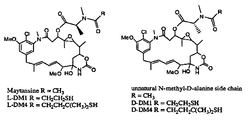
- Figure 2 shows the formula of maytansine and some of its analogs, and of maytansine analogs bearing the unnatural N-methyl-D-alanine moiety.
- Figure 3 shows the structural formula of the C3 to C9 bridged acetal species produced from reduction of ansamitocin P-3.
- the structural formula of ansamitocin P-3 is also shown for comparison.
- the acetal side chain of the bridged acetal and the ester side chain of ansamitocin P-3 are circled.
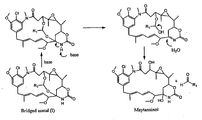
- Figure 4 shows a possible mechanism for the conversion of C3 to C9 bridged acetals of maytansinol to maytansinol.
- the bridged acetal is illustrated by the compound of general formula (I) as described herein.
- C3-Esters of maytansinol such as ansamitocins, maytansine, and derivatives of maytansine can be reduced by various aluminum-based hydride reducing agents, such as LiAlH 4 or LiAl(OMe) 3 H at low temperature to give maytansinol as described in Figure 2 of U.S. Patent No. 6,333,410 .
- Quenching of these reduction reactions with water or aqueous salts gives a highly basic mixture, i.e., a pH of greater than 11, that can cause significant decomposition of product if the mixture is allowed to warm. Attempts were made to avoid any decomposition of product by quenching the reaction with water and immediately adding acid to neutralize the pH before allowing the mixture to warm to room temperature.
- the invention describes a method to reduce C3-esters of maytansinol followed by a quench and a holding step, which allows any bridged acetal formed in the reduction to be converted to maytansinol.
- the pH of the mixture may be adjusted by addition of acid or aqueous buffer to avoid base induced decomposition of the maytansinol produced and to allow for precipitation of aluminum-based byproducts by adding a water immiscible solvent.
- the starting material for the method of making maytansinol can be any naturally occurring or synthetic C3-ester of maytansinol and suitable analogues of maytansinol having a modified aromatic ring or modifications at positions other than the C3 position.
- suitable analogues of maytansinol having a modified aromatic ring include:
- C3-ester of maytansinol includes suitable C3-esters of analogues of maytansinol, such as those described above. Any of the analogues described above and any other known analogues of maytansinol can have any of numerous known esters at the C3 position. Thus, one of ordinary skill in the art can readily envision numerous suitable C3-esters of analogues of maytansinol suitable for use as the starting material.
- C-3 esters of maytansinol include Antibiotic C-15003PND also known as C18-N-des-methyl-ansamitocin, ( US patent 4,322,348 ), 20-demethoxy-20-acyloxymaytansine ( US patent 4,294,757 ), 19-des-cloromaytansine and 20-demethoxy-20-acetoxy-19des-chloromaytansine ( US patent 4,294,757 ).
- the step of reducing a C3-ester of maytansinol with an aluminum-based hydride reducing agent is well known in the art.
- suitable aluminum-based hydride reducing agents include LiAlH 4 , LiAl(OMe) 3 H, sodium bis(2-methoxyethoxy)aluminum hydride, LiAl(OMe) 2 . 5 H 1 . 5 , and other alkali aluminum alkoxy hydrides prepared by addition of a non-stoichiometric amount of alcohol to an alkali aluminum hydride.
- LiAl(OMe) 3 H is preferred.
- the reduction reaction is quenched with water or aqueous salts, also as described in the U.S. Patent No. 6,333,410 . This quench gives a mixture with a basic pH.
- the C3 to C9 bridged acetals formed in the reduction reaction can then be converted to maytansinol by allowing the basic quenched mixture to stand during a holding period.
- the holding step comprises maintaining the quenched mixture at a suitable temperature for a suitable period of time to facilitate conversion of any bridged acetal to the desired maytansinol.
- the holding step comprises maintaining the quenched mixture at a temperature of about -15°C to about -50°C for a period of at least about 0.25 and 5 hours or longer.
- the holding step under the basic conditions allows any bridged acetal formed during the reduction reaction to be converted to maytansinol.
- the time needed for the holding step under the above described conditions will depend on several factors, such as scale of the reaction, concentration, and extract temperatures and can be determined by monitoring the conversion of bridged acetal to maytansinol. For example, a sample aliquot of the reaction is withdrawn and analyzed.
- samples can be prepared and analyzed by several methods, some of which include but are not limited to normal phase high performance liquid chromatography (HPLC), reverse phase HPLC and thin layer chromatography.
- HPLC high performance liquid chromatography
- ansamitocins are reduced with LiAl(OMe) 3 H then quenched with water.
- the bridged acetal can also be converted under acidic conditions. Conversion of the bridged acetal to maytansinol under acidic conditions is not surprising as cleavage of acetal protecting groups is common in organic synthesis. While not wanting to be bound by any explanation, conversion of the bridged acetal to maytansinol by aqueous base is believed to occur by deprotonation of the cyclic carbamate with elimination of aldehyde, Figure 4 .
- the resulting maytansinol can be isolated by several means known to one skilled in the art.
- the pH of the basic quenched mixture can be adjusted to between about 3 and about 9, most preferably to between about 4 and about 7 by adding an acid or aqueous buffer.
- Suitable acids include hydrochloric acid, phosphoric acid, trifluoroacetic acid, formic acid, and acetic acid. Of these, the preferred acids are formic acid and acetic acid as they give an easily filterable precipitate of aluminum-based byproducts.
- aluminum-based byproducts can be precipitated at the adjusted pH by addition of a water immiscible solvent, such as, for example, ethyl acetate, butyl acetate or dichloromethane.
- a water immiscible solvent such as, for example, ethyl acetate, butyl acetate or dichloromethane.
- the pH can be adjusted and the water immiscible solvent added simultaneously or these steps can be conducted separately and in either order.
- the acid and water immiscible solvent are added at equal to or below 0°C, preferably between - 20°C and -60°C, more preferably between -25°C to -50°C, and most preferably between - 30°C and -40°C to precipitate aluminum-based byproducts.
- the precipitated aluminum-based byproducts can be removed by several means known to one skilled in the art. For example the precipitate is easily filtered and the filtrate is found to be substantially free of bridged acetals of the
- substantially free in this context indicates that less than 10 % by weight of the bridged acetals of the starting C3-esters remains. More preferably, less than 5 % of the bridged acetals remains, and most preferably less than 2 % of the bridged acetals remains.
- a strong acid such as hydrochloric acid or sulfuric acid can be added after the quench to adjust the pH to about 2 or less to dissolve the aluminum-based byproducts. Dissolving the aluminum-based byproducts allows efficient extraction of the aqueous phase.
- the amount of acid needed to dissolve the aluminum-based byproducts will depend on the concentration and type of acid used and the determination of these is within the skill of one of ordinary skill in the art.
- the extracted maytansinol will be substantially free of bridged acetals of the C3-ester starting material.
- a further aspect of the invention is to provide isolated C3 to C9 bridged acetals of maytansinol.
- the bridged acetal is in effect a form of maytansinol that has a protecting group on the C3 and C9 alcohols, so it can be used to prepare synthetic maytansinoid derivatives.
- Any maytansinol analogue, such as those described herein can have any of numerous bridge structures, including those described herein.
- numerous C3-C9 bridged acetals encompassed by the present invention.
- Representative C3-C9 bridged acetals include compounds of Formula (I'): wherein:
- R 1 is alkyl
- the preferred alkyls are C 1 -C 4 alkyl groups, such as CH 3 , CH 2 CH 3 , CH(CH 3 ) 2 , CH 2 CH 2 CH 3 , CH(CH 3 )CH 2 CH 3 , CH 2 CH(CH 3 ) 2 , and (CH 2 ) 3 CH 3 .
- Q is H or Q represents an amino protecting group, many of which are described in "Protective groups in organic synthesis" 2 nd Edition.
- Representative Q groups include but are not limited to sulfenamides such as S-alkyl and S-aryl, carbamates such as COO-alkyl, COO-aryl, COOCH 2 CH 2 SiMe 3 , COOCMe 3 , COOCH 2 CCl 3 , and COOCH 2 CF 3 , and silyl groups such as SiMe 3 and SiMe 2 -tBu.
- suitable alkyl groups include, but are not limited to, C 1 -C 10 alkyl groups, such as methyl, ethyl, propyl, isopropyl, butyl, isobutyl, tert-butyl, cyclo pentyl and the like.
- suitable aryl groups include, but are not limited to, simple or substituted aryl or heterocyclic with C 1 -C 12 , such as, phenyl, pyridyl, naphthyl.
- R 4 is selected from alkyl, aryl or (CH 2 ) n (CR 6 R 7 ) m SV, in which n represents 0-9, m represents 0-2, provided that n and m are not 0 at the same time;
- R 6 represents H, alkyl or aryl,
- R 7 represents H, alkyl or aryl, and
- V represents H, or a thiol protecting group, many of which are described in " Protective groups in organic synthesis" 2nd Editi on.
- Representative thiol protecting groups include but are not limited to aryl, S-alkyl, S-aryl, SiMe 3 , SiMe 2 -tBu, ArNO 2 , Ar(NO 2 ) 2 , CO-alkyl, CO-aryl, wherein when part of V is an alkyl, suitable alkyl groups include, but are not limited to, linear alkyl, branched alkyl, or cyclic alkyl with C 1 -C 10 , such as methyl, ethyl, propyl, isopropyl, butyl, isobutyl, tert-butyl, cyclo pentyl and the like.
- suitable aryl groups include, but are not limited to, simple or substituted aryl or heterocyclic with C 1 -C 12 , such as, phenyl, pyridyl, naphthyl.
- R 1 group present in the acetal side chain can be varied by reducing a C3-ester of maytansinol that has the corresponding C3-ester side chain.
- suitable alkyl groups include, but are not limited to, linear C 1 -C 10 alkyl and branched or cyclic C 3 -C 10 alkyl, such as methyl, ethyl, propyl, isopropyl, butyl, isobutyl, tert-butyl, cyclo pentyl and the like.
- suitable aryl groups include, but are not limited to, simple or substituted C 3 -C 12 aryl or heterocyclic such as, phenyl, pyridyl, and naphthyl.
- suitable alkyl groups include, but are not limited to, linear C 1 -C 10 alkyl groups, such as methyl, ethyl, propyl, isopropyl, butyl, isobutyl, tert-butyl, cyclo pentyl and the like.
- suitable aryl groups include, but are not limited to, simple or substituted aryl or heterocyclic with C 3 -C 12 , such as, phenyl, pyridyl, and naphthyl.
- the bridged acetal is represented by Formula (I): wherein R 1 is as defined above for formula (I').
- the bridged acetals can be prepared as byproducts of the reduction of C3-esters of maytansinol as described above, and can be isolated by chromatography, such as, but not limited to, normal phase chromatography, silica chromatography, cyano-bonded silica chromatography or reverse phase chromatography.
- chromatography such as, but not limited to, normal phase chromatography, silica chromatography, cyano-bonded silica chromatography or reverse phase chromatography.
- the isolated bridged acetal is converted to maytansinol by incubation with acid or base at a temperature ranging between about 40°C to about -40 °C.
- the reaction is conducted at an ambient temperature.
- the time needed for the reaction will depend on several factors, such as pH, temperature, scale of the reaction, and concentration, and can be monitored by HPLC.
- Suitable acids include hydrochloric acid, phosphoric acid, trifluroacetic acid, acetic acid and formic acid.
- Suitable bases include triethylamine, disopropylethylamine, NaOH or any strong base.
- the pH is adjusted to between about 1 and about 5, optimally to between about 2 and about 4.
- the pH is adjusted to between about 8 and about 13, optimally to between about 9 and about 12.
- a Bruker ESQUIRETM 3000 ion trap mass spectrometer was used to obtain mass spectra and was used either in line with or separate from an Agilent 1100 series HPLC. When applicable, samples were analyzed using the reversed phase analytical HPLC method described below. Also, when applicable, samples were purified using the preparative HPLC method described below. Analytical thin layer chromatographic (TLC) assays were performed using silica TLC plates and a mobile phase of dichloromethane:methanol 95:5 (v:v).
- HPLC Method A. Analytical reverse phase HPLC Method: Column: Kromasil C8 150 x 4.6 mm, 5 micron. Temperature: Ambient Flow rate: 1.0 mL/min Injection volume: 4.0 microliters Time % deionized water + 0.1% trifluoro acetic acid % acetonitrile 0 63 37 15 58 42 25 42 58 35 32 68 36 63 37 43 63 37 B. Preparative reverse phase HPLC Method Column: Kromasil C8 250 x 20 mm, 10 micron.
- a 200 mL three necked flask was equipped with a magnetic stir bar, and a thermometer.
- A1M lithium aluminum hydride solution of LiAlH 4 in tetrahydrofuran (71 mL, 71 mmol) and 26.8 mL of tetrahydrofuran were transferred to the flask via syringe.
- the flask was cooled in a - 60°C bath with stirring until the contents reached -43 °C.
- a 200 mL three necked flask was equipped with a magnetic stir bar and a thermometer.
- AIM lithium aluminum hydride solution of LiAlH 4 in tetrahydrofuran (71 mL, 71 mmol) and 28 mL of tetrahydrofuran were transferred to the flask via syringe.
- the flask was cooled in a -60°C bath with stirring until the contents reached -43 °C.
- a solution of 7.25 mL methanol (5.71 g, 178 mmol) in 8.0 mL of tetrahydrofuran was added drop-wise via a syringe while keeping the temperature of the contents between -40 °C and -45 °C. The solution was stirred at -45°C for an additional 10 min.
- This example describes preparation of the bridged acetal compound shown in Formula (I), where R 1 is CH(CH 3 ) 2 , reduction of ansamitocins with LiAl(OMe) 3 H, followed by aqueous formic acid quench.
- Ansamitocins (3.0 g, 4.72 mmol) were weighed into a three necked flask equipped with a thermometer. Tetrahydrofuran (15 mL) was added to the flask with stirring, and the flask was cooled in a -57°C cooling bath.
- the residue was purified by silica chromatography using dichloromethane:methanol 95:5 (v:v) giving a later eluting band (maytansinol) and an early eluting band.
- the maytansinol band was collected and solvent was removed by rotary evaporation to give 1.55 g of maytansinol (58 % yield by weight).
- Solvent was removed from the earlier eluting band, and the material was dissolved in a minimum volume of acetonitrile, then purified by preparative reverse phase HPLC.
- the compound of Formula (I) (retention time 26 min) was recovered, and solvent was removed by rotary evaporation to give 440 mg (15 % yield by weight).
- This example describes conversion of the compound of Formula (I), where R 1 is CH(CH 3 ) 2 , to maytansinol under basic conditions (pH 11) at ambient temperature.
- Diisopropyl ethyl amine was added to a solution of 30 mL tetrahydrofuran and 10 mL deionized water while monitoring the pH using a pH meter until a pH of 11 was obtained.
- the compound of Formula (I) (3.0 mg, mmol) prepared in Example 3 was dissolved in 1.5 mL of pH 11 tetrahydrofuran/water solution at ambient temperature and mixed well. The solution was analyzed by HPLC/MS at various time points. The retention time of the product and the mass spectrum matched that of authentic maytansinol. Conversion was approximately 1 ⁇ 2 complete after 15 min.
- Example 5 Conversion of the bridged acetals of Formula (I) to maytansinol under acidic conditions (pH 2.0) at ambient temperature.
- Trifluoroacetic acid was added to a solution of 30 mL tetrahydrofuran and 10 mL deionized water while monitoring the pH using a pH meter until a pH of 2.0 was obtained.
- the compound of Formula (I) (3.0 mg, mmol) was dissolved in 1.5 mL of the pH 2 tetrahydrofuran/water solution at ambient temperature and mixed well.
- the solution was analyzed by HPLC/MS at various time points. The retention time of the product and the mass spectrum matched that of authentic maytansinol. Conversion was approximately 1 ⁇ 2 complete after 1 hour.
- Example 6 An assay for determining the percent conversion of the bridged acetals of Formula (I) to maytansinol.
- the organic layer was also analyzed by first diluting with one volume of acetonitrile and analyzing by reverse phase HPLC. Retention times of authentic ansamitocins, maytansinol and the compound of Formula (I) were determined at 16.2 min, 8.7 min, and 16.9 min respectively.
- Example 7 Reduction of ansamitocins with LiAl(OMe) 3 H using water followed by aqueous formic acid quench to give maytansinol.
- Ansamitocins (3.0 g, 4.72 mmol) were weighed into a three necked flask equipped with a thermometer. Tetrahydrofuran (15 mL) was added to the flask with stirring and the flask was cooled in a-50°C cooling bath. Once the contents of the flask reached -35°C, a solution of 0.67 M LiAl(OMe) 3 H in tetrahydrofuran (56 mL, 37.7 mmol) was added dropwise by syringe using a syringe pump. The temperature of the reaction was maintained between -30°C and -40 °C throughout the addition.
- Aqueous formic acid (deionized water, 15 mL and 88% formic acid, 1.85 mL) was then added to the flask followed by 66 mL of ethyl acetate. The cooling unit was turned off, and the mixture was allowed to slowly warm to room temperature. The pH of the mixture was checked with pH paper and found to be approximately pH 6. The precipitated aluminum byproducts were removed by vacuum filtration. Solvent was evaporated from the filtrate by rotary evaporation under vacuum.
- Example 8 Reduction of ansamitocins with LiAl(OMe) 2,5 )H 1,5 followed by aqueous quenching and pH neutralization with formic acid
- This example describes reduction of ansamitocins with LiAl(OMe) 2 . 5 H 1 . 5 using water followed by aqueous formic acid quench.
- Ansamitocins (1.0 g, 1.57 mmol) were weighed into a three necked flask equipped with a thermometer. Tetrahydrofuran (5 mL) was added to the flask with stirring, and the flask was cooled in a -50°C cooling bath. Once the contents of the flask reached -35°C, a solution of 0.67 M LiAl(OMe) 3 H in tetrahydrofuran (18.5 mL, 12.4 mmol) was added dropwise by syringe using a syringe pump.
- the temperature of the reaction was maintained between -30°C and -40 °C throughout the addition. After addition was complete the reaction was stirred for 2 hours at between -32°C and -37 °C.
- Deionized water 2.5 mL was added dropwise to the -35°C reaction to give a basic quenched mixture.
- the basic quenched mixture was analyzed by the thin layer chromatography assay described in example 6.
- the compound of Formula (I) was detected. After 30 min the basic quenched mixture was analyzed again by the thin layer chromatography method. The compound of Formula (I) was no longer detected.
- Aqueous formic acid (deionized water, 5 mL, and 88% formic acid, 0.62 mL) was then added to the flask followed by 22 mL of ethyl acetate.
- the cooling unit was turned off and the mixture was allowed to slowly warm to room temperature.
- the pH of the mixture was checked with pH paper and found to be approximately pH 6.
- the mixture was vacuum filtered, and solvent was removed by rotary evaporation under vacuum. Butyl acetate (5 mL) was added to the residue, the solvent was then evaporated to remove any remaining water.
- the residue was purified by silica chromatography using a mobile phase of dichloromethane:methanol 95:5 (v:v) to give 0.63 g of maytansinol (71 % yield by weight).
- Example 9 Reduction of ansamitocins with LiAl(OMe) 3 H followed by aqueous quenching and acidification with HCl.
- This example describes reduction of ansamitocins with LiAl(OMe) 3 H using water followed by aqueous HCl.
- Ansamitocins 200 mg, 0.32 mmol
- Tetrahydrofuran 1.0 mL
- tetrahydrofuran 3.8 mL, 2.52 mmol
- the bath temperature was maintained between -34 °C and -42 °C throughout the addition.
- This example describes reduction of D-DM1-SMe, shown in figure 2 , to maytansinol.
- D-DM1-SMe (10.0 g,12.7 mmol) was weighed into a three necked flask equipped with a thermometer. Tetrahydrofuran (40.5 mL) was added to the flask with stirring, and the flask was cooled in a-50 °C cooling bath. Once the contents of the flask reached -35 °C, a solution of 0.67 M LiAl(OMe) 3 H in tetrahydrofuran (150 mL, 100 mmol) was added dropwise by syringe using a syringe pump.
- the temperature of the reaction was maintained between -30 °C and -40 °C throughout the addition. After addition was complete, the reaction was stirred for 2 hours at between -32 °C and -37 °C.
- Deionized water (20 mL) was added dropwise to the -35 °C reaction to give a basic quenched mixture. After 30 min, aqueous formic acid (deionized water, 40 mL and 88% formic acid, 5.0 mL) was added to the flask, followed by 180 mL of ethyl acetate. The cooling unit was turned off, and the mixture was allowed to slowly warm to room temperature. The pH of the mixture was checked with pH paper and found to be approximately pH 6.
- Example 11 Reduction of D-DM4-SMe to maytansinol.
- This example describes reduction of D-DM4-SMe, shown in figure 2 , to maytansinol.
- D-DM4-SMe (501 mg, 0.60 mmol) was weighed into a three necked flask equipped with a thermometer. Tetrahydrofuran (2.0 mL) was added to the flask with stirring and the flask was cooled in a -50°C cooling bath. Once the contents of the flask reached - 35 °C, a solution of 0.67 M LiAl(OMe) 3 H in tetrahydrofuran (7.1 mL, 4.75 mmol) was added dropwise by syringe using a syringe pump.
- the temperature of the reaction was maintained between -30°C and -40°C throughout the addition. After addition was complete, the reaction was stirred for 2 hours at between -32°C and -37 °C.
- Deionized water (1 mL) was added dropwise to the -35°C reaction to give a basic quenched mixture. After 30 min, aqueous formic acid (deionized water, 2.0 mL and 88% formic acid, 0.24 mL) was added to the flask followed by 9 mL of ethyl acetate. The cooling unit was turned off, and the mixture was allowed to slowly warm to room temperature. The mixture was vacuum filtered, and solvent was removed by rotary evaporation under vacuum.
Landscapes
- Chemical & Material Sciences (AREA)
- Organic Chemistry (AREA)
- Nitrogen And Oxygen Or Sulfur-Condensed Heterocyclic Ring Systems (AREA)
Priority Applications (1)
| Application Number | Priority Date | Filing Date | Title |
|---|---|---|---|
| PL06844315T PL1945647T3 (pl) | 2005-11-08 | 2006-11-08 | Procesy wytwarzania maytansinolu |
Applications Claiming Priority (2)
| Application Number | Priority Date | Filing Date | Title |
|---|---|---|---|
| US73433005P | 2005-11-08 | 2005-11-08 | |
| PCT/US2006/043718 WO2007056550A2 (en) | 2005-11-08 | 2006-11-08 | Processes for preparation of maytansinol |
Publications (4)
| Publication Number | Publication Date |
|---|---|
| EP1945647A2 EP1945647A2 (en) | 2008-07-23 |
| EP1945647A4 EP1945647A4 (en) | 2010-10-20 |
| EP1945647B1 EP1945647B1 (en) | 2012-01-11 |
| EP1945647B9 true EP1945647B9 (en) | 2012-11-14 |
Family
ID=38024003
Family Applications (1)
| Application Number | Title | Priority Date | Filing Date |
|---|---|---|---|
| EP06844315A Not-in-force EP1945647B9 (en) | 2005-11-08 | 2006-11-08 | Processes for preparation of maytansinol |
Country Status (10)
| Country | Link |
|---|---|
| US (1) | US7411063B2 (da) |
| EP (1) | EP1945647B9 (da) |
| JP (1) | JP5117390B2 (da) |
| AT (1) | ATE540956T1 (da) |
| AU (1) | AU2006311485B2 (da) |
| CA (1) | CA2625867C (da) |
| DK (1) | DK1945647T3 (da) |
| ES (1) | ES2380687T3 (da) |
| PL (1) | PL1945647T3 (da) |
| WO (1) | WO2007056550A2 (da) |
Cited By (1)
| Publication number | Priority date | Publication date | Assignee | Title |
|---|---|---|---|---|
| US11555019B2 (en) | 2019-07-10 | 2023-01-17 | Cybrexa 3, Inc. | Peptide conjugates of microtubule-targeting agents as therapeutics |
Families Citing this family (21)
| Publication number | Priority date | Publication date | Assignee | Title |
|---|---|---|---|---|
| US20100056762A1 (en) | 2001-05-11 | 2010-03-04 | Old Lloyd J | Specific binding proteins and uses thereof |
| AU2002311919B8 (en) | 2001-05-11 | 2007-03-22 | Ludwig Institute For Cancer Research Ltd | Specific binding proteins and uses thereof |
| US9090693B2 (en) | 2007-01-25 | 2015-07-28 | Dana-Farber Cancer Institute | Use of anti-EGFR antibodies in treatment of EGFR mutant mediated disease |
| CA2680854C (en) | 2007-03-15 | 2017-02-14 | Ludwig Institute For Cancer Research | Treatment method using egfr antibodies and src inhibitors and related formulations |
| CN108424454B (zh) | 2007-08-14 | 2022-05-31 | 路德维格癌症研究所有限公司 | 靶向egf受体的单克隆抗体175及其衍生物和用途 |
| FR2949469A1 (fr) * | 2009-08-25 | 2011-03-04 | Sanofi Aventis | Derives anticancereux, leur preparation et leur application en therapeutique |
| US20120121615A1 (en) | 2010-11-17 | 2012-05-17 | Flygare John A | Alaninyl maytansinol antibody conjugates |
| CA2891280C (en) | 2012-11-24 | 2018-03-20 | Hangzhou Dac Biotech Co., Ltd. | Hydrophilic linkers and their uses for conjugation of drugs to cell binding molecules |
| US10208125B2 (en) | 2013-07-15 | 2019-02-19 | University of Pittsburgh—of the Commonwealth System of Higher Education | Anti-mucin 1 binding agents and uses thereof |
| TWI541022B (zh) | 2013-12-18 | 2016-07-11 | 應克隆公司 | 針對纖維母細胞生長因子受體-3(fgfr3)之化合物及治療方法 |
| US10464955B2 (en) | 2014-02-28 | 2019-11-05 | Hangzhou Dac Biotech Co., Ltd. | Charged linkers and their uses for conjugation |
| TW201711702A (zh) | 2015-06-04 | 2017-04-01 | 應克隆公司 | 使用針對纖維母細胞生長因子受體3(fgfr3)之化合物的療法 |
| NZ739830A (en) | 2015-07-12 | 2021-12-24 | Hangzhou Dac Biotech Co Ltd | Bridge linkers for conjugation of cell-binding molecules |
| US9839687B2 (en) | 2015-07-15 | 2017-12-12 | Suzhou M-Conj Biotech Co., Ltd. | Acetylenedicarboxyl linkers and their uses in specific conjugation of a cell-binding molecule |
| KR20220150408A (ko) | 2016-11-14 | 2022-11-10 | 항저우 디에이씨 바이오테크 씨오, 엘티디 | 결합 링커, 그러한 결합 링커를 함유하는 세포 결합 분자-약물 결합체, 링커를 갖는 그러한 결합체의 제조 및 사용 |
| EP3554544A4 (en) | 2016-12-16 | 2020-07-29 | Bluefin Biomedicine, Inc. | ANTI-PROTEIN 1 ANTIBODY CONTAINING AN ANTI-CUB DOMAIN (CDCP1), ANTIBODY-DRUG CONJUGATES AND THEIR METHODS OF USE |
| KR102667230B1 (ko) * | 2019-03-01 | 2024-05-21 | 셀진 코포레이션 | 마이탄시놀의 제조 |
| US11420981B2 (en) | 2019-04-18 | 2022-08-23 | Indena S.P.A. | Diasteroselective process for the preparation of thiol- or disulfide-containing maytansinoid esters and intermediates thereof |
| MX2022000449A (es) | 2019-07-10 | 2022-04-25 | Cybrexa 2 Inc | Conjugados peptídicos de citotoxinas como terapéuticos. |
| JP7772363B2 (ja) | 2019-11-29 | 2025-11-18 | 日本マイクロバイオファーマ株式会社 | メイタンシノールの酵素的生産方法 |
| EP4426727A2 (en) | 2021-11-03 | 2024-09-11 | Hangzhou Dac Biotech Co., Ltd. | Specific conjugation of an antibody |
Family Cites Families (3)
| Publication number | Priority date | Publication date | Assignee | Title |
|---|---|---|---|---|
| JPS5566586A (en) * | 1978-11-14 | 1980-05-20 | Takeda Chem Ind Ltd | Novel maytansinoid compound and its preparation |
| US6333410B1 (en) | 2000-08-18 | 2001-12-25 | Immunogen, Inc. | Process for the preparation and purification of thiol-containing maytansinoids |
| AU2003228998A1 (en) * | 2002-05-13 | 2003-12-02 | Smithkline Beecham Corporation | Process for preparing maytansinol |
-
2006
- 2006-11-08 EP EP06844315A patent/EP1945647B9/en not_active Not-in-force
- 2006-11-08 WO PCT/US2006/043718 patent/WO2007056550A2/en not_active Ceased
- 2006-11-08 ES ES06844315T patent/ES2380687T3/es active Active
- 2006-11-08 DK DK06844315.9T patent/DK1945647T3/da active
- 2006-11-08 AU AU2006311485A patent/AU2006311485B2/en not_active Ceased
- 2006-11-08 US US11/594,156 patent/US7411063B2/en not_active Expired - Fee Related
- 2006-11-08 PL PL06844315T patent/PL1945647T3/pl unknown
- 2006-11-08 AT AT06844315T patent/ATE540956T1/de active
- 2006-11-08 CA CA2625867A patent/CA2625867C/en not_active Expired - Fee Related
- 2006-11-08 JP JP2008540200A patent/JP5117390B2/ja not_active Expired - Fee Related
Cited By (1)
| Publication number | Priority date | Publication date | Assignee | Title |
|---|---|---|---|---|
| US11555019B2 (en) | 2019-07-10 | 2023-01-17 | Cybrexa 3, Inc. | Peptide conjugates of microtubule-targeting agents as therapeutics |
Also Published As
| Publication number | Publication date |
|---|---|
| CA2625867A1 (en) | 2007-05-18 |
| CA2625867C (en) | 2014-12-23 |
| US7411063B2 (en) | 2008-08-12 |
| WO2007056550A2 (en) | 2007-05-18 |
| ES2380687T3 (es) | 2012-05-17 |
| JP2009514978A (ja) | 2009-04-09 |
| EP1945647B1 (en) | 2012-01-11 |
| JP5117390B2 (ja) | 2013-01-16 |
| ATE540956T1 (de) | 2012-01-15 |
| DK1945647T3 (da) | 2012-05-07 |
| EP1945647A4 (en) | 2010-10-20 |
| EP1945647A2 (en) | 2008-07-23 |
| WO2007056550A3 (en) | 2007-12-06 |
| PL1945647T3 (pl) | 2012-04-30 |
| AU2006311485A1 (en) | 2007-05-18 |
| AU2006311485B2 (en) | 2012-09-27 |
| US20070112188A1 (en) | 2007-05-17 |
Similar Documents
| Publication | Publication Date | Title |
|---|---|---|
| EP1945647B9 (en) | Processes for preparation of maytansinol | |
| KR100754236B1 (ko) | 라파마이신 유도체의 지향선택적 합성방법 | |
| US6277983B1 (en) | Regioselective synthesis of rapamycin derivatives | |
| EP1838715B1 (en) | Method for the preparation of maytansinoid esters | |
| EP2670756B1 (en) | Process for making everolimus | |
| EP1735321B1 (en) | Process for preparing rapamycin 42-esters and fk-506 32-esters with dicarboxylic acid, precursors for rapamycin conjugates and antibodies | |
| EP0507556A1 (en) | Silyl ethers of rapamycin | |
| D'Auria et al. | Reidispongiolide A and B, two new potent cytotoxic macrolides from the New Caledonian sponge Reidispongia coerulea | |
| CA2532988A1 (en) | Regioselective synthesis of cci-779 | |
| CN104211715A (zh) | 雷帕霉素的39-去甲氧基衍生物 | |
| JPH05247046A (ja) | 抗腫瘍性抗生物質bbm−2040aおよびbbm−2040bの全合成 | |
| CA2564811A1 (en) | Proline cci-779 (proline-rapamycin 42-ester with 2,2-bis (hydroxymethyl) propionic acid) and two-step enzymatic synthesis of proline cci-779 and cci-779 using microbial lipase | |
| ATE475653T1 (de) | Verfahren zur herstellung von valsartan | |
| Ebine et al. | Total Synthesis of (−)‐Brevenal: A Streamlined Strategy for Practical Synthesis of Polycyclic Ethers | |
| Nakagawa et al. | Total synthesis of (−)-eudistomins with an oxathiazepine ring. Part 1. Formation of the oxathiazepine ring system | |
| SK124199A3 (en) | 12,13-dihydroxy derivatives of tylozine |
Legal Events
| Date | Code | Title | Description |
|---|---|---|---|
| PUAI | Public reference made under article 153(3) epc to a published international application that has entered the european phase |
Free format text: ORIGINAL CODE: 0009012 |
|
| 17P | Request for examination filed |
Effective date: 20080430 |
|
| AK | Designated contracting states |
Kind code of ref document: A2 Designated state(s): AT BE BG CH CY CZ DE DK EE ES FI FR GB GR HU IE IS IT LI LT LU LV MC NL PL PT RO SE SI SK TR |
|
| RIN1 | Information on inventor provided before grant (corrected) |
Inventor name: CHARI, RAVI, V.J. Inventor name: WIDDISON, WAYNE, C. |
|
| A4 | Supplementary search report drawn up and despatched |
Effective date: 20100917 |
|
| GRAP | Despatch of communication of intention to grant a patent |
Free format text: ORIGINAL CODE: EPIDOSNIGR1 |
|
| RIC1 | Information provided on ipc code assigned before grant |
Ipc: C07D 498/06 20060101ALI20110608BHEP Ipc: C07D 491/12 20060101AFI20110608BHEP |
|
| DAX | Request for extension of the european patent (deleted) | ||
| GRAS | Grant fee paid |
Free format text: ORIGINAL CODE: EPIDOSNIGR3 |
|
| GRAA | (expected) grant |
Free format text: ORIGINAL CODE: 0009210 |
|
| AK | Designated contracting states |
Kind code of ref document: B1 Designated state(s): AT BE BG CH CY CZ DE DK EE ES FI FR GB GR HU IE IS IT LI LT LU LV MC NL PL PT RO SE SI SK TR |
|
| REG | Reference to a national code |
Ref country code: GB Ref legal event code: FG4D |
|
| REG | Reference to a national code |
Ref country code: CH Ref legal event code: EP |
|
| REG | Reference to a national code |
Ref country code: AT Ref legal event code: REF Ref document number: 540956 Country of ref document: AT Kind code of ref document: T Effective date: 20120115 |
|
| REG | Reference to a national code |
Ref country code: IE Ref legal event code: FG4D |
|
| REG | Reference to a national code |
Ref country code: DE Ref legal event code: R096 Ref document number: 602006027106 Country of ref document: DE Effective date: 20120308 |
|
| REG | Reference to a national code |
Ref country code: CH Ref legal event code: NV Representative=s name: ISLER & PEDRAZZINI AG |
|
| REG | Reference to a national code |
Ref country code: NL Ref legal event code: T3 |
|
| REG | Reference to a national code |
Ref country code: PL Ref legal event code: T3 |
|
| REG | Reference to a national code |
Ref country code: SE Ref legal event code: TRGR |
|
| REG | Reference to a national code |
Ref country code: DK Ref legal event code: T3 |
|
| REG | Reference to a national code |
Ref country code: ES Ref legal event code: FG2A Ref document number: 2380687 Country of ref document: ES Kind code of ref document: T3 Effective date: 20120517 |
|
| PG25 | Lapsed in a contracting state [announced via postgrant information from national office to epo] |
Ref country code: SI Free format text: LAPSE BECAUSE OF FAILURE TO SUBMIT A TRANSLATION OF THE DESCRIPTION OR TO PAY THE FEE WITHIN THE PRESCRIBED TIME-LIMIT Effective date: 20120111 |
|
| LTIE | Lt: invalidation of european patent or patent extension |
Effective date: 20120111 |
|
| PG25 | Lapsed in a contracting state [announced via postgrant information from national office to epo] |
Ref country code: BG Free format text: LAPSE BECAUSE OF FAILURE TO SUBMIT A TRANSLATION OF THE DESCRIPTION OR TO PAY THE FEE WITHIN THE PRESCRIBED TIME-LIMIT Effective date: 20120411 Ref country code: LT Free format text: LAPSE BECAUSE OF FAILURE TO SUBMIT A TRANSLATION OF THE DESCRIPTION OR TO PAY THE FEE WITHIN THE PRESCRIBED TIME-LIMIT Effective date: 20120111 Ref country code: IS Free format text: LAPSE BECAUSE OF FAILURE TO SUBMIT A TRANSLATION OF THE DESCRIPTION OR TO PAY THE FEE WITHIN THE PRESCRIBED TIME-LIMIT Effective date: 20120511 |
|
| PG25 | Lapsed in a contracting state [announced via postgrant information from national office to epo] |
Ref country code: GR Free format text: LAPSE BECAUSE OF FAILURE TO SUBMIT A TRANSLATION OF THE DESCRIPTION OR TO PAY THE FEE WITHIN THE PRESCRIBED TIME-LIMIT Effective date: 20120412 Ref country code: LV Free format text: LAPSE BECAUSE OF FAILURE TO SUBMIT A TRANSLATION OF THE DESCRIPTION OR TO PAY THE FEE WITHIN THE PRESCRIBED TIME-LIMIT Effective date: 20120111 Ref country code: PT Free format text: LAPSE BECAUSE OF FAILURE TO SUBMIT A TRANSLATION OF THE DESCRIPTION OR TO PAY THE FEE WITHIN THE PRESCRIBED TIME-LIMIT Effective date: 20120511 |
|
| PG25 | Lapsed in a contracting state [announced via postgrant information from national office to epo] |
Ref country code: CY Free format text: LAPSE BECAUSE OF FAILURE TO SUBMIT A TRANSLATION OF THE DESCRIPTION OR TO PAY THE FEE WITHIN THE PRESCRIBED TIME-LIMIT Effective date: 20120111 |
|
| PG25 | Lapsed in a contracting state [announced via postgrant information from national office to epo] |
Ref country code: EE Free format text: LAPSE BECAUSE OF FAILURE TO SUBMIT A TRANSLATION OF THE DESCRIPTION OR TO PAY THE FEE WITHIN THE PRESCRIBED TIME-LIMIT Effective date: 20120111 Ref country code: RO Free format text: LAPSE BECAUSE OF FAILURE TO SUBMIT A TRANSLATION OF THE DESCRIPTION OR TO PAY THE FEE WITHIN THE PRESCRIBED TIME-LIMIT Effective date: 20120111 |
|
| PLBE | No opposition filed within time limit |
Free format text: ORIGINAL CODE: 0009261 |
|
| STAA | Information on the status of an ep patent application or granted ep patent |
Free format text: STATUS: NO OPPOSITION FILED WITHIN TIME LIMIT |
|
| PG25 | Lapsed in a contracting state [announced via postgrant information from national office to epo] |
Ref country code: SK Free format text: LAPSE BECAUSE OF FAILURE TO SUBMIT A TRANSLATION OF THE DESCRIPTION OR TO PAY THE FEE WITHIN THE PRESCRIBED TIME-LIMIT Effective date: 20120111 |
|
| 26N | No opposition filed |
Effective date: 20121012 |
|
| REG | Reference to a national code |
Ref country code: DE Ref legal event code: R097 Ref document number: 602006027106 Country of ref document: DE Effective date: 20121012 |
|
| REG | Reference to a national code |
Ref country code: HU Ref legal event code: AG4A Ref document number: E015182 Country of ref document: HU |
|
| PG25 | Lapsed in a contracting state [announced via postgrant information from national office to epo] |
Ref country code: MC Free format text: LAPSE BECAUSE OF NON-PAYMENT OF DUE FEES Effective date: 20121130 |
|
| REG | Reference to a national code |
Ref country code: FR Ref legal event code: PLFP Year of fee payment: 10 |
|
| PGFP | Annual fee paid to national office [announced via postgrant information from national office to epo] |
Ref country code: CH Payment date: 20151127 Year of fee payment: 10 Ref country code: IT Payment date: 20151124 Year of fee payment: 10 Ref country code: GB Payment date: 20151127 Year of fee payment: 10 Ref country code: TR Payment date: 20151026 Year of fee payment: 10 Ref country code: FI Payment date: 20151127 Year of fee payment: 10 Ref country code: DK Payment date: 20151125 Year of fee payment: 10 Ref country code: IE Payment date: 20151130 Year of fee payment: 10 Ref country code: DE Payment date: 20151127 Year of fee payment: 10 |
|
| PGFP | Annual fee paid to national office [announced via postgrant information from national office to epo] |
Ref country code: FR Payment date: 20151117 Year of fee payment: 10 Ref country code: PL Payment date: 20151020 Year of fee payment: 10 Ref country code: NL Payment date: 20151126 Year of fee payment: 10 Ref country code: LU Payment date: 20151202 Year of fee payment: 10 Ref country code: HU Payment date: 20151028 Year of fee payment: 10 Ref country code: SE Payment date: 20151127 Year of fee payment: 10 Ref country code: BE Payment date: 20151130 Year of fee payment: 10 Ref country code: AT Payment date: 20151021 Year of fee payment: 10 Ref country code: ES Payment date: 20151126 Year of fee payment: 10 Ref country code: CZ Payment date: 20151023 Year of fee payment: 10 |
|
| PG25 | Lapsed in a contracting state [announced via postgrant information from national office to epo] |
Ref country code: BE Free format text: LAPSE BECAUSE OF NON-PAYMENT OF DUE FEES Effective date: 20161130 |
|
| REG | Reference to a national code |
Ref country code: DE Ref legal event code: R119 Ref document number: 602006027106 Country of ref document: DE |
|
| REG | Reference to a national code |
Ref country code: DK Ref legal event code: EBP Effective date: 20161130 |
|
| REG | Reference to a national code |
Ref country code: CH Ref legal event code: PL |
|
| REG | Reference to a national code |
Ref country code: SE Ref legal event code: EUG |
|
| REG | Reference to a national code |
Ref country code: NL Ref legal event code: MM Effective date: 20161201 |
|
| REG | Reference to a national code |
Ref country code: AT Ref legal event code: MM01 Ref document number: 540956 Country of ref document: AT Kind code of ref document: T Effective date: 20161108 |
|
| GBPC | Gb: european patent ceased through non-payment of renewal fee |
Effective date: 20161108 |
|
| PG25 | Lapsed in a contracting state [announced via postgrant information from national office to epo] |
Ref country code: CZ Free format text: LAPSE BECAUSE OF NON-PAYMENT OF DUE FEES Effective date: 20161108 Ref country code: FI Free format text: LAPSE BECAUSE OF NON-PAYMENT OF DUE FEES Effective date: 20161108 Ref country code: CH Free format text: LAPSE BECAUSE OF NON-PAYMENT OF DUE FEES Effective date: 20161130 Ref country code: LI Free format text: LAPSE BECAUSE OF NON-PAYMENT OF DUE FEES Effective date: 20161130 |
|
| REG | Reference to a national code |
Ref country code: IE Ref legal event code: MM4A |
|
| REG | Reference to a national code |
Ref country code: FR Ref legal event code: ST Effective date: 20170731 |
|
| PG25 | Lapsed in a contracting state [announced via postgrant information from national office to epo] |
Ref country code: HU Free format text: LAPSE BECAUSE OF NON-PAYMENT OF DUE FEES Effective date: 20161109 Ref country code: AT Free format text: LAPSE BECAUSE OF NON-PAYMENT OF DUE FEES Effective date: 20161108 Ref country code: SE Free format text: LAPSE BECAUSE OF NON-PAYMENT OF DUE FEES Effective date: 20161109 |
|
| PG25 | Lapsed in a contracting state [announced via postgrant information from national office to epo] |
Ref country code: NL Free format text: LAPSE BECAUSE OF NON-PAYMENT OF DUE FEES Effective date: 20161201 Ref country code: LU Free format text: LAPSE BECAUSE OF NON-PAYMENT OF DUE FEES Effective date: 20161130 |
|
| PG25 | Lapsed in a contracting state [announced via postgrant information from national office to epo] |
Ref country code: FR Free format text: LAPSE BECAUSE OF NON-PAYMENT OF DUE FEES Effective date: 20161130 Ref country code: IT Free format text: LAPSE BECAUSE OF NON-PAYMENT OF DUE FEES Effective date: 20161108 |
|
| PG25 | Lapsed in a contracting state [announced via postgrant information from national office to epo] |
Ref country code: DE Free format text: LAPSE BECAUSE OF NON-PAYMENT OF DUE FEES Effective date: 20170601 Ref country code: DK Free format text: LAPSE BECAUSE OF NON-PAYMENT OF DUE FEES Effective date: 20161130 Ref country code: IE Free format text: LAPSE BECAUSE OF NON-PAYMENT OF DUE FEES Effective date: 20161108 Ref country code: GB Free format text: LAPSE BECAUSE OF NON-PAYMENT OF DUE FEES Effective date: 20161108 |
|
| REG | Reference to a national code |
Ref country code: BE Ref legal event code: MM Effective date: 20161130 |
|
| PG25 | Lapsed in a contracting state [announced via postgrant information from national office to epo] |
Ref country code: PL Free format text: LAPSE BECAUSE OF NON-PAYMENT OF DUE FEES Effective date: 20161108 |
|
| PG25 | Lapsed in a contracting state [announced via postgrant information from national office to epo] |
Ref country code: ES Free format text: LAPSE BECAUSE OF NON-PAYMENT OF DUE FEES Effective date: 20161109 |
|
| REG | Reference to a national code |
Ref country code: ES Ref legal event code: FD2A Effective date: 20181126 |
|
| PG25 | Lapsed in a contracting state [announced via postgrant information from national office to epo] |
Ref country code: TR Free format text: LAPSE BECAUSE OF NON-PAYMENT OF DUE FEES Effective date: 20161108 |