EP1955846A1 - Commande commune de réglage pour cylindres d'impression et pour rouleaux applicateurs - Google Patents
Commande commune de réglage pour cylindres d'impression et pour rouleaux applicateurs Download PDFInfo
- Publication number
- EP1955846A1 EP1955846A1 EP08153097A EP08153097A EP1955846A1 EP 1955846 A1 EP1955846 A1 EP 1955846A1 EP 08153097 A EP08153097 A EP 08153097A EP 08153097 A EP08153097 A EP 08153097A EP 1955846 A1 EP1955846 A1 EP 1955846A1
- Authority
- EP
- European Patent Office
- Prior art keywords
- cylinder
- unit
- roller
- printing
- printing unit
- Prior art date
- Legal status (The legal status is an assumption and is not a legal conclusion. Google has not performed a legal analysis and makes no representation as to the accuracy of the status listed.)
- Withdrawn
Links
- 238000007639 printing Methods 0.000 title claims description 565
- 238000012546 transfer Methods 0.000 claims description 96
- 238000003860 storage Methods 0.000 claims description 43
- 230000008859 change Effects 0.000 claims description 37
- 239000000463 material Substances 0.000 claims description 11
- 238000006073 displacement reaction Methods 0.000 claims description 9
- 239000000758 substrate Substances 0.000 claims description 9
- 230000007246 mechanism Effects 0.000 abstract description 12
- 230000001105 regulatory effect Effects 0.000 abstract description 6
- 238000013016 damping Methods 0.000 abstract 1
- 230000000875 corresponding effect Effects 0.000 description 53
- 230000033001 locomotion Effects 0.000 description 52
- 238000009826 distribution Methods 0.000 description 47
- 230000005540 biological transmission Effects 0.000 description 27
- 238000013461 design Methods 0.000 description 22
- 230000008878 coupling Effects 0.000 description 21
- 238000010168 coupling process Methods 0.000 description 21
- 238000005859 coupling reaction Methods 0.000 description 21
- 230000006870 function Effects 0.000 description 21
- 238000004519 manufacturing process Methods 0.000 description 18
- 230000036961 partial effect Effects 0.000 description 17
- 238000003825 pressing Methods 0.000 description 17
- 238000005096 rolling process Methods 0.000 description 17
- 238000000034 method Methods 0.000 description 13
- 239000012530 fluid Substances 0.000 description 12
- 230000002829 reductive effect Effects 0.000 description 11
- 238000011161 development Methods 0.000 description 10
- 230000018109 developmental process Effects 0.000 description 10
- 238000007792 addition Methods 0.000 description 9
- 230000008569 process Effects 0.000 description 9
- 238000010276 construction Methods 0.000 description 8
- 230000002093 peripheral effect Effects 0.000 description 8
- 238000012545 processing Methods 0.000 description 8
- 230000001360 synchronised effect Effects 0.000 description 8
- 239000013598 vector Substances 0.000 description 8
- 238000004364 calculation method Methods 0.000 description 7
- 238000007774 anilox coating Methods 0.000 description 6
- 230000008901 benefit Effects 0.000 description 6
- 238000012986 modification Methods 0.000 description 6
- 230000004048 modification Effects 0.000 description 6
- 239000007921 spray Substances 0.000 description 6
- 238000007598 dipping method Methods 0.000 description 5
- 230000000694 effects Effects 0.000 description 5
- 238000009434 installation Methods 0.000 description 5
- 239000012528 membrane Substances 0.000 description 5
- 238000007645 offset printing Methods 0.000 description 5
- 239000003973 paint Substances 0.000 description 5
- 238000005086 pumping Methods 0.000 description 5
- 239000003638 chemical reducing agent Substances 0.000 description 4
- 230000001276 controlling effect Effects 0.000 description 4
- 230000001419 dependent effect Effects 0.000 description 4
- 238000012423 maintenance Methods 0.000 description 4
- 230000009467 reduction Effects 0.000 description 4
- 238000007789 sealing Methods 0.000 description 4
- 230000009471 action Effects 0.000 description 3
- 230000033228 biological regulation Effects 0.000 description 3
- 230000015572 biosynthetic process Effects 0.000 description 3
- 239000003795 chemical substances by application Substances 0.000 description 3
- 125000000524 functional group Chemical group 0.000 description 3
- 238000003780 insertion Methods 0.000 description 3
- 239000004033 plastic Substances 0.000 description 3
- 230000004044 response Effects 0.000 description 3
- 230000001131 transforming effect Effects 0.000 description 3
- VYZAMTAEIAYCRO-UHFFFAOYSA-N Chromium Chemical compound [Cr] VYZAMTAEIAYCRO-UHFFFAOYSA-N 0.000 description 2
- 239000004952 Polyamide Substances 0.000 description 2
- 238000010521 absorption reaction Methods 0.000 description 2
- 239000008186 active pharmaceutical agent Substances 0.000 description 2
- 230000001154 acute effect Effects 0.000 description 2
- 238000013475 authorization Methods 0.000 description 2
- 230000004323 axial length Effects 0.000 description 2
- 230000006399 behavior Effects 0.000 description 2
- 238000006243 chemical reaction Methods 0.000 description 2
- 238000010073 coating (rubber) Methods 0.000 description 2
- 230000000295 complement effect Effects 0.000 description 2
- 238000011109 contamination Methods 0.000 description 2
- 238000010586 diagram Methods 0.000 description 2
- 238000005516 engineering process Methods 0.000 description 2
- 230000001747 exhibiting effect Effects 0.000 description 2
- 239000004744 fabric Substances 0.000 description 2
- 238000007373 indentation Methods 0.000 description 2
- 230000037431 insertion Effects 0.000 description 2
- 230000000670 limiting effect Effects 0.000 description 2
- 238000011068 loading method Methods 0.000 description 2
- 239000002184 metal Substances 0.000 description 2
- 230000035515 penetration Effects 0.000 description 2
- 229920002647 polyamide Polymers 0.000 description 2
- 230000036316 preload Effects 0.000 description 2
- 238000012549 training Methods 0.000 description 2
- XLYOFNOQVPJJNP-UHFFFAOYSA-N water Substances O XLYOFNOQVPJJNP-UHFFFAOYSA-N 0.000 description 2
- 238000003466 welding Methods 0.000 description 2
- 238000009736 wetting Methods 0.000 description 2
- 244000059549 Borneo rubber Species 0.000 description 1
- 229910000669 Chrome steel Inorganic materials 0.000 description 1
- 239000004959 Rilsan Substances 0.000 description 1
- 230000002411 adverse Effects 0.000 description 1
- 230000032683 aging Effects 0.000 description 1
- 238000004458 analytical method Methods 0.000 description 1
- 230000001174 ascending effect Effects 0.000 description 1
- 230000001680 brushing effect Effects 0.000 description 1
- 210000000078 claw Anatomy 0.000 description 1
- 239000011248 coating agent Substances 0.000 description 1
- 238000000576 coating method Methods 0.000 description 1
- 239000003086 colorant Substances 0.000 description 1
- 238000004040 coloring Methods 0.000 description 1
- 239000002131 composite material Substances 0.000 description 1
- 238000012790 confirmation Methods 0.000 description 1
- 239000000356 contaminant Substances 0.000 description 1
- 238000010411 cooking Methods 0.000 description 1
- 230000002596 correlated effect Effects 0.000 description 1
- 238000005520 cutting process Methods 0.000 description 1
- 230000009849 deactivation Effects 0.000 description 1
- 238000001035 drying Methods 0.000 description 1
- 239000000428 dust Substances 0.000 description 1
- 239000013536 elastomeric material Substances 0.000 description 1
- 210000003746 feather Anatomy 0.000 description 1
- 230000005484 gravity Effects 0.000 description 1
- 239000004519 grease Substances 0.000 description 1
- 230000006698 induction Effects 0.000 description 1
- 239000003999 initiator Substances 0.000 description 1
- 230000010354 integration Effects 0.000 description 1
- 239000007788 liquid Substances 0.000 description 1
- 239000000314 lubricant Substances 0.000 description 1
- 238000012544 monitoring process Methods 0.000 description 1
- 230000002441 reversible effect Effects 0.000 description 1
- 238000007493 shaping process Methods 0.000 description 1
- 239000007787 solid Substances 0.000 description 1
- 238000009987 spinning Methods 0.000 description 1
- 230000007480 spreading Effects 0.000 description 1
- 238000003892 spreading Methods 0.000 description 1
- 230000006641 stabilisation Effects 0.000 description 1
- 238000011105 stabilization Methods 0.000 description 1
- 229910001220 stainless steel Inorganic materials 0.000 description 1
- 239000010935 stainless steel Substances 0.000 description 1
- 230000003068 static effect Effects 0.000 description 1
- 230000002123 temporal effect Effects 0.000 description 1
- 238000012360 testing method Methods 0.000 description 1
- 230000001960 triggered effect Effects 0.000 description 1
- 238000010977 unit operation Methods 0.000 description 1
- 238000005406 washing Methods 0.000 description 1
Images



















Classifications
-
- B—PERFORMING OPERATIONS; TRANSPORTING
- B41—PRINTING; LINING MACHINES; TYPEWRITERS; STAMPS
- B41F—PRINTING MACHINES OR PRESSES
- B41F7/00—Rotary lithographic machines
- B41F7/20—Details
- B41F7/24—Damping devices
- B41F7/40—Devices for tripping or lifting damping rollers; Supporting, adjusting, or removing arrangements therefor
-
- B—PERFORMING OPERATIONS; TRANSPORTING
- B41—PRINTING; LINING MACHINES; TYPEWRITERS; STAMPS
- B41F—PRINTING MACHINES OR PRESSES
- B41F13/00—Common details of rotary presses or machines
- B41F13/08—Cylinders
- B41F13/24—Cylinder-tripping devices; Cylinder-impression adjustments
- B41F13/34—Cylinder lifting or adjusting devices
- B41F13/38—Cylinder lifting or adjusting devices electrically or magnetically operated
-
- B—PERFORMING OPERATIONS; TRANSPORTING
- B41—PRINTING; LINING MACHINES; TYPEWRITERS; STAMPS
- B41F—PRINTING MACHINES OR PRESSES
- B41F13/00—Common details of rotary presses or machines
- B41F13/08—Cylinders
- B41F13/24—Cylinder-tripping devices; Cylinder-impression adjustments
- B41F13/34—Cylinder lifting or adjusting devices
- B41F13/40—Cylinder lifting or adjusting devices fluid-pressure operated
-
- B—PERFORMING OPERATIONS; TRANSPORTING
- B41—PRINTING; LINING MACHINES; TYPEWRITERS; STAMPS
- B41F—PRINTING MACHINES OR PRESSES
- B41F31/00—Inking arrangements or devices
- B41F31/30—Arrangements for tripping, lifting, adjusting, or removing inking rollers; Supports, bearings, or forks therefor
- B41F31/32—Lifting or adjusting devices
- B41F31/36—Lifting or adjusting devices fluid-pressure operated
-
- B—PERFORMING OPERATIONS; TRANSPORTING
- B41—PRINTING; LINING MACHINES; TYPEWRITERS; STAMPS
- B41F—PRINTING MACHINES OR PRESSES
- B41F33/00—Indicating, counting, warning, control or safety devices
- B41F33/0009—Central control units
-
- B—PERFORMING OPERATIONS; TRANSPORTING
- B41—PRINTING; LINING MACHINES; TYPEWRITERS; STAMPS
- B41P—INDEXING SCHEME RELATING TO PRINTING, LINING MACHINES, TYPEWRITERS, AND TO STAMPS
- B41P2213/00—Arrangements for actuating or driving printing presses; Auxiliary devices or processes
- B41P2213/70—Driving devices associated with particular installations or situations
- B41P2213/73—Driving devices for multicolour presses
- B41P2213/734—Driving devices for multicolour presses each printing unit being driven by its own electric motor, i.e. electric shaft
Definitions
- Such a printing unit is known, wherein four double printing units are arranged vertically one above the other and in the region of their double pressure point are horizontally movable relative to each other.
- the printing units of the same web page are each mounted in a common frame, wherein at least one of the frames is horizontally movable.
- EP 02 46 081 A2 is a printing unit with a plurality, each having the printing cylinder of a printing unit having units and trained as inking units.
- the inking units are adjustable for on / off horizontal to the printing cylinder and vertically with different printing units - including with different printing units of different print lengths - brought into contact.
- the modules having the printing unit cylinders are exchangeable if necessary for units of other printing length.
- the DE 102 02 385 A1 shows a drive train between the cylinders of a printing unit with variable printing length, wherein two intermediate wheels are arranged between non-intermeshing cylinder spur gears.
- WO 03/039872 A1 are disclosed printing cylinders, which are driven in pairs in pairs by a drive motor and the two cylinders coupling gear is encapsulated in a separate housing.
- each bearing a pin of the cylinder bearing housing for adjusting a distance between the cylinders by means of an arrangement of pressure cylinders with mutually equal, mutually different or groupwise equal forces acted upon and thereby adjustable, wherein the respective effective direction of the pressure medium cylinder is in each case rectified.
- the adjustable forces can be set or preselected during machine running or even before the start of the machine run with a setting preselector control or regulating device, wherein in the case that the device is a control device, this controller is associated with a sensor that reports its observations to the control unit.
- the set by the control unit to the pressure medium cylinders pressure can, for. B. according to the running speed of the cylinder or according to the speed of these cylinders within wide limits during operation of the device as desired continuously be adjusted.
- the EP 0 941 850 A1 relates to a control device for controlling the printing of one or more webs of material in a rotary printing press from a control console comprising an analysis table for receiving at least one printed copy to be tested, said control device comprising an interface system between an operator and the individual components of the printing machine has, with a selection device for selecting all the functions of the printing press, among other things, a control and monitoring system is provided which is suitable for transmitting selected data to the rotary printing press to use the selected component of the printing press.
- WO 03/049946 A2 and the WO 2004/028810 A1 methods are known for operating an inking unit or dampening unit of a printing press, wherein at least three rollers or cylinders are provided in the inking unit or dampening unit, which can come into contact with each other in at least two roller strips, and wherein at least one of the rollers is adjustable relative to the other rollers is mounted a machine frame.
- the adjustably mounted roller is pressed for variable adjustment of the respective contact pressure in the two roller strips with an adjustable in size and direction force in the gap between the adjacent rollers.
- a roll neck is mounted in a bearing block which rests in a fixed bearing block.
- the latter consists of a base plate and a guide plate which extends along the outer end face of the bearing block.
- the bearing block has guide claws which engage around the guide plate so that the bearing block is displaceable along the guide plate.
- In the base plate there are two unilaterally acting hydraulic piston for moving the bearing block in one direction.
- an additional hydraulic piston acting on the roll neck is arranged in the upper region of the guide plate.
- a preferred field of application for such adjusting devices are wet presses or calenders of paper machines. Other fields of application are plastic calenders or rolling mills.
- the invention has for its object to provide a simple to be set with a control unit printing unit.
- the adjustment of the contact pressure is preferably carried out with a support bearing having at least one actuator, which is also referred to as a roller lock, wherein in each participating in the adjustment of a roller roller lock or in each participating in the adjustment of a cylinder storage unit preferably more identifiable, individually selectable and thus of the control unit directly or indirectly individually controllable actuators are arranged, wherein the actuated actuators each exert a directed into the interior of its roller lock or its storage unit radial force, preferably applied by a plurality of actuators radial forces in their vector sum exerted by the roller on the adjacent body rotation Form contact force, wherein the forces exerted by the actuators radial forces are preferably individually and independently adjustable and also provided by the control unit for a desired operating position.
- control unit z. B. receives the instruction to change the setting of the contact pressure in a selected roll strip by a corresponding input with a control unit belonging to the control unit, which actuator of the roller lock concerned is to be acted upon with what pressure and takes the necessary adjustment in the Pressure setting z.
- the control unit preferably controls valves arranged in the pressure lines, in particular fast-acting, electrically or electromagnetically actuated proportional valves, so that the setting of a setting of an adjusted contact force takes place within a few seconds.
- the printing unit 01 has one or more of the following features, depending on the requirement, the type of machine, the technology used and / or the level of expansion.
- the printing unit 01 or the double printing unit 03 is / are z.
- B. centrally, ie running in the range of double pressure point (s) 05, operationally divisible and / or the inking units 08 (and possibly dampening units 09) are designed as already several rolls having modules and as pre-assembled modules in the printing unit 01st can be used and / or there are printing cylinder 06; 07 different diameter without requirement of bearing bores in the side frame mountable and / or the cylinder bearings are force-adjustable in linear bearings and / or the axes of rotation of the printing cylinder 06; 07 in print-on are essentially lying in a common plane.
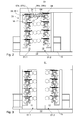
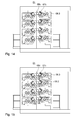
- the wall sections 11; 12 designed such that in their operating position A ( Fig. 2 ) are formed on their mutually facing side in pairs substantially complementary to each other in shape and together at their parting lines or lines of collision nevertheless form a substantially closed side front.
- the forme cylinder 07 can then be equipped with four or six printing forms side by side and two printing plates in succession.
- the transfer cylinder 06 has a double large format (two newspaper pages in the scope behind each other) in one embodiment z. B. only one channel for receiving one or more juxtaposed blankets, which is preferably formed continuously over the entire effective bale length.
- the transfer cylinder 06 can then be equipped with a continuous over the bale length and extending over substantially the full circumference or with two or three over substantially the full circumference reaching blankets side by side.
- this two or three blankets can have side by side, wherein the respective adjacent to each other are offset by 180 ° in the circumferential direction.
- These mutually offset blankets can be held in two or three channel sections, which are also adjacent to each other in the longitudinal direction of the cylinder 06, the adjacent channel sections in the circumferential direction, however, are mutually offset by 180 °.
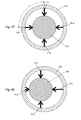
- a cylinder units 17 executed modules (see below to Fig. 17 and 18 ) have z. B. a cylinder 06; 07 with pin 63; 64 and one already on the pin 63; 64 pre-loaded (biased and / or preset) storage unit 14 on. Bearing unit 14 and cylinder 06; 07 get before their insertion into the printing unit 01 their firmly defined position to each other and are collectively in the printing unit 01 introduced.
- Fig. 5 the printing unit 01 is exemplified by cylinders 06a; 07a double circumference executed.
- cylinders 06a When equipped with simply large cylinders 07b these can for increased stability (as below to Fig. 7, 9th . 13 ) with double-sized transfer cylinders 06a or space-saving but also simply large transfer cylinders 06b cooperate.
- the side frames 11; 12 for a plurality of inking units 08 of the same type and / or different types a same the inking unit 08 supporting pad, recess or stops on.
- they can be designed in their shape so that they can accommodate several inking units 08 of the same type and / or different types.
- the distribution cylinder 42 by its own, of the cylinders 06; 07 driven independent drive motor rotationally driven, wherein the two rollers 41 and 43 are driven by friction.
- a separate rotary drive motor can also be provided for the roller 43.
- the traversing movement of the friction cylinder 42 can take place by means of its own drive means or, as provided here with reduced effort, by means of a gearbox which converts its rotational movement into axial movement.
- Fig. 11 a) represents in the representation, taking into account the dashed circle a particularly advantageous embodiment of the three-roll dampening 09.1 Fig. 11 a) in which, in contrast to the dampening 09.1 Fig. 11 a) the roller 42 with a color-friendly or oleophilic surface 45 (ie wetting angle angle with corresponding fluid, in particular the color, less than 90 °), z. B. of rubber or plastic (eg., A polyamide material) is formed.
- the lateral surfaces of all three rollers 41; 42; 43 of the dampening unit 09 with a color-friendly or oleophilic surface 45 ie contact wetting angle with corresponding fluid, in particular the color, less than 90 °
- the lateral surfaces of all three rollers 41; 42; 43 of the dampening unit 09 with a color-friendly or oleophilic surface 45 ie contact wetting angle with corresponding fluid, in particular the color, less than 90 °
- the middle roller 42 of the three rollers 41; 42; 43 of the dampener roller train a color-friendly upper or lateral surface 45 made of plastic, z.
- plastic z.
- this roller 42 by its own, from the printing cylinder 06; 07 mechanically independent drive motor 132 or a drive connection 141 from the printing unit 04 and / or inking 08 ago (see below to FIGS. 26 to 30 ) is positively driven by rotation.
- the roller 42 is formed as a changeable roller 42, it may again be provided either for the forced traversing movement either a motorized traversing drive or a transmission which converts the rotational movement into an axial movement.
- four-roller contact dampening 09.2 joins the soft roller 47 a fourth roller, not shown with z. B. hard surface, which dips instead of the roller 47 in the fountain solution box 46.
- a fourth roller by its own, of the cylinders 06; 07 and the other inking rollers independently driven drive motor rotatably, wherein the roller 41 is driven by friction.
- a separate rotary drive motor can also be provided for the distribution cylinder 48.
- the traversing movement of the friction cylinder 48 can take place by means of its own drive means or, as provided here with reduced effort, by means of a gearbox which converts its rotational movement into axial movement.
- a circumference of a designed as a newspaper page printing page having cylinder 07b preferably have in the circumferential direction, only a channel for fixing the ends of an impression-side printing plates.
- the advantageously continuous channel or a group of several axially juxtaposed channel sections and / or corresponding clamping devices are designed in such a way that in the axial direction next to each other at least two individual, one or two newspaper page width printing forms can be fixed.
- the forme cylinder 07b is then in an operating situation with a pressure side length, in particular newspaper page length printing form in the circumferential direction and a plurality, z. B. two, three, four or even six, in each case at least impression widths, in particular newspaper page wide printing forms in the longitudinal direction. It can also impression broad and two- or even dreidurcktime wide printing forms mixed side by side or only several two- or even dreidruckinbreite printing forms next to each other on the form cylinder 07b be arranged.
- a circumference of the forme cylinder 07c, and thus a maximum printing length on the web 02, amounts to, for example, 520 to 650 mm, in particular 545 to 630 mm. The same applies preferably also to the corresponding transfer cylinder 06c.
- the modules having printing units 01 of Figures 2 . 7 to 10 such as 12 to 15 can be advantageous as indicated by the dividing line in the sense of FIGS. 2 and 3 with divided or divisible frame walls 11; 12 or in principle also with conventional, closed side frames 11; 12 executed.
- the receiving area 53, the template area 54 and the side register means 57 having part of the handling device 24 is preferably designed as a pre-assembled module or component, hereinafter referred to as magazine 59, which is a total of depending on the equipment requirement to the printing press in the printing unit 01 used.
- This magazine 59 preferably has a drive mechanism, not shown, z. B. one or more carriages or belt conveyors - and a corresponding control to promote the ab- and réelleplattenden printing plates and allows a fully automatic printing form change.
- this magazine 59 also means for pressing and / or guiding the printing plates during the change -.
- adjustable roles - have.
- Fig. 18 and 19 show a preferably based on linear trajectories bearing unit 14 in the schematic longitudinal and cross-section.
- the on / off mechanism integrating bearing unit 14 has in addition to a bearing 71, z. B. radial bearing 71, for example, a cylindrical roller bearing 71, for rotatably supporting the cylinder 06; 07 storage means 72; 73 for a radial movement of the cylinder 06; 07 - for pressure on or pressure off - on.
- the bearing unit 14 (after mounting the bearing unit 14 frame-fixed) carrier-resistant bearing elements 72 and the movable against these bearing elements 73.
- the frame wall 11; 12 on the drive side preferably has a recess or an opening for a drive shaft 78.
- the opposite side of the drive side does not have inevitably a recess 77 or a recess in the side frame 12; 11 may be provided.
- Fig. 18 At the cylinder distal end of the shaft 78 is as in Fig. 18 illustrated one of possibly a plurality of serially arranged coupling 148, in particular multi-plate clutch 148, (see FIGS. 26 to 29 ) by a rotationally fixed connection 75, z. B. a clamping element 75, coupled.
- a rotationally fixed connection 75, z. B. a clamping element 75 coupled.
- directly the gear 150 with drive motor 121 without angle and / or offset compensating coupling 148 coupled to the shaft 78 directly the gear 150 with drive motor 121 without angle and / or offset compensating coupling 148 coupled to the shaft 78.
- the drive motor 121 is not fixed to the frame, but arranged cylinder-tight and is connected to the cylinder 06; 07 moved.
- the journal 64 is preferably coupled to a device for axially moving the cylinder 07, ie to a side register drive 201 ( Fig. 36 ).
- a device for axially moving the cylinder 07 ie to a side register drive 201 ( Fig. 36 ).
- the axial drive comprises a spindle 203, in particular with at least one threaded portion 205, a rotatably connected to the spindle 203 spur gear 204, a pinion 206 and the pinion 206 driving motor 207.
- the motor 207 either itself - for example, previously suitably calibrated - engine-internal position feedback feature, or there is a position feedback to the controller via a sensor, not shown, for. B. a suitably calibrated rotary potentiometer, which is coupled to a rotating component of the axial drive.
- linear bearings 70 in such a way that the cooperating bearing elements 72; 73 both on the assembly storage unit 14 - and not a part of the side frame 11; 12 of the printing unit 01 - are provided, allows pre-assembly and pre-adjustment or adjustment of the bearing voltage.
- the advantageous arrangement of the two bearing block 74 encompassing linear bearing 70 allows a backlash-free setting, as opposed to the two linear bearings 70 in such a way that the bearing preload and the bearing forces an essential component in a direction perpendicular to the axis of rotation of the cylinder 06; 07 learn or record.
- the linear bearings 70 are thus adjustable in the direction to which it is at play-free positions of the cylinder 06; 07 also arrives.
- non-penetration and the above definition with respect to the inside width L should be understood in a broader sense to mean that, at least in the region of the intended end position, the cylinder 06; 07 and at least on a continuous path from a frame edge to the location of the end position such a "non-penetration" is present, so that the cylinder unit 17 of an open, between the two end-side side frames 11; 12 lying side without tilting, d. H.
- the bearing units 14 are in the manner on the inner walls of the sokar 11; 12 arranged that the cylinder 06; 07, in particular their bearing units 14 on the cylinder side by the side frame 11; 12 are supported, which is static and Mounting advantages holds.
- Identifiable linear bearings 70 thus each have pairings of corresponding cooperating bearing means 72 and 73 or their guide or effective surface areas, designed as sliding surfaces (not shown) or with rolling elements 65 arranged therebetween.
- the two guide surfaces 72.1; 72.2; 73.1; 73.2 (or their planes E1, E2) of the same bearing means 72; 73 are z.
- both pairings lie to planes E1; E2, which both have a component not equal to zero in the radial direction of the cylinder axis, but in reverse inclination against the cylinder axis and thereby prevent the degree of freedom of movement in both axial directions of the cylinder.
- a section line of the two planes E1; E2 is parallel to the direction S
- the linear bearings 70 both a cylinder 06; 07 frontally associated bearing units 14 two mutually arranged pairs of cooperating guide surfaces 72.1; 72.2; 73.1; 73.2.
- at least one of the two radial bearings 71 of the two bearing units 14 a slight bearing clearance .DELTA.71 in the axial direction.
- bearing unit 14 For correct placement of the bearing units 14, and cylinder units 17 together with bearing unit 14, mounting aids 89, z. B. dowel pins 89 in the side frame 11; 12 may be provided, to which the bearing unit 14 of the fully assembled cylinder unit 17 is aligned, before they by releasable retaining means 91, z. B. screws 91, or even cohesively by welding to the side frame 11; 12 are connected.
- corresponding means 92 e.g. B. clamping screws 92 may be provided ( Fig. 18 ).
- the bearing unit 14 - at least towards the cylinder side - by a cover 94 largely against Pollution protected or even encapsulated executed as a unit.
- Fig. 18 is schematically the cylinder 06; 07 with pin 63; 64 and a preassembled storage unit 14.
- This module can thus be preassembled between the side frames 11; 12 of the printing unit 01 used for easy installation and attached to designated locations.
- the effective inner surface of the radial bearing 71 and the outer effective lateral surface of the pin 63; 64 be cylindrical instead of tapered, since both the assembly of the bearing unit 14 on the pin 63; 64 as well as the setting of the bearing clearance outside the printing unit 01 can be done.
- the storage unit 14 can be shrunk, for example.
- the mountable as a whole unit is advantageous in the manner of an optionally partially open housing of z. B. the carrier 76, and / or z. B. a frame (in Fig. 19 without reference z. B. the four storage unit 14 to all four sides outwardly limiting plates) and / or z. B. the cover 94 ( Fig. 18 ).
- Pressing is effected by moving the bearing block 74 in the direction of the pressure point by means of a force F applied to the bearing block 74 by at least one actuator 82, in particular by a force-controlled or force-defined actuator 82, by means of which a defined resp definable force F in pressure-on direction can be brought to the bearing block 74 ( Fig. 19 ).
- the decisive for the color transfer and thus the print quality, among other things, line force in the nip points is therefore not by a travel, but by the balance of forces between the force F and between the cylinders 06; 07 resulting line force F L and the resulting equilibrium defined.
- cylinder 06; 07 employed in pairs by the bearing block 74 is acted upon by the corresponding set force F via the / the actuator (s) 82.
- At least the two middle of the four cylinders 06 - or in other words, at least all of the two outer cylinders 07 different cylinder 06 at least during a period of time Setting in a defined position, advantageously in the Anstelllage found by the equilibrium of forces, can be fixed or at least wegbegrenzbar.
- bearing block 74 even during operation - at least in one direction away from the pressure point against a force, for. B. spring force, in particular a definable force, is movably mounted. This is - in contrast to the pure travel limit - on the one hand, a maximum line force when working together cylinder 06; 07 defined, and on the other hand a yielding, for example, in a web break with subsequent winder on the cylinder 06; 07, allows.
- the bearing unit 14 - At a pressure point 05 facing side, the bearing unit 14 - at least during the adjustment - a movable stop 79, which limits the travel to the pressure point 05 out.
- the stop 79 can be moved in such a way that the stop surface 83, which acts as a stop, can be varied along the direction of adjustment at least in one region. It is thus an adjustment device (adjustable stop 79) provided in an advantageous embodiment, by means of which the position of a pressure near the end position of the bearing block 74 is adjustable.
- the position of a pressure near the end position of the bearing block 74 For Wegbegrenzung / adjustment serves z. B. a wedge drive described below.
- the placement of the stop 79 can basically be done manually or via an actuator 84 (see below).
- At least one resilient element 81, z. B. spring element 81 which applies a force F R from the stop 79 in a direction away from the bearing block 74.
- the spring member 81 causes pressure-off in the event that the bearing block 74 is not prevented from moving in any other way.
- a controllable valve 93 is provided in the bearing unit 14. This is performed, for example, electronically controlled and provides the hydraulic piston 87 in a position without pressure or at least to a lower pressure level, while in another position of the force F conditional pressure P is applied.
- a non-designated leakage line is provided here for safety.
- spring element 88 may be provided, which in the operational pressure-Ab, ie the piston 82 are relieved and / or retracted, although serve as a stop 88 for the bearing block 74 in pressure-off position, in the case of a railway winder or other excessive forces but gives way from the point of pressure 05 and releases a larger path.
- a Spring force of this overload protection 88 is therefore chosen to be greater than the sum of the forces from the spring elements 81.
- an actuator 84 for example, a druckstoffbetätigbares adjusting means 84 such as a pressure medium actuated piston 84 in a working cylinder with (double-acting) piston via a z. B. designed as a piston rod 85 transmission member 85 or by an electric motor via a designed as a threaded spindle transmission member 85, movable.
- This actuator 84 can either be effective in both directions or, as shown here, be designed as a one-way reactor, which operates against a return spring 86 when activated.
- the force of the return spring 86 is from o.g. Reasons (largely force-free stop 79) chosen so weak that the wedge 79 is held only against gravity or vibration forces in its correct position.
- One of the pressure point 05 forming cylinder 06 can also be fixed and operationally not adjustable (but possibly adjustable) in the side frame 11; 12 may be arranged, while the other along the adjustment direction S, is movably mounted.
- a return of the stop 79 can either by the in Fig. 9 illustrated spring 86 or - as in Fig. 37 shown in dashed lines - active by the formation of the actuator 84 as a pressure medium operable cylinder with double-acting piston, so with two pressure medium supply, one on either side of a piston 90th
- the stop 79 of the other transfer cylinder 06 is, for example by means of a set as a screw adjustment means 84, adjustable and lockable. He must therefore, for example, have no holding means 111.
- Bearing unit (s) 14 on the forme cylinder 07 allows an inclination of the same and a passport adjustment, and allows the transfer cylinder 06 whose inclination.
- the piston 82 is sealed against the pressure medium chamber 213 by a seal 82 surrounding the circumference of the piston 82, near the pressure chamber, and a sliding guide 217 close to the pressure chamber is guided.
- a second seal 218 and a second slide guide 219 may additionally be provided in a region of the piston 82 remote from the pressure chamber.
- z. B. rubber, in particular a rolling diaphragm 220 sealed is on the one hand completely connected to the piston 82 and on the other hand on its outer peripheral line completely connected to the base body 215 and other fixed internals of the actuator element 97.
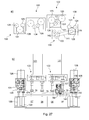
- the prefabricated preferably as modules gear units can be used as subunits for the printing cylinder 06; 07 ( Fig. 26 . 27 ) and / or for the inking units 08 (for example in the form of a module) Fig. 26 . 27 ) be completely pre-assembled and be pre-assembled in an advantageous embodiment before use in the printing unit 01 on the frame 147 (or frame construction 16) of the inking unit module.
- the modularity also allows the installation / replacement / replacement of the module designed as a transmission when the inking unit module is already inserted into the machine.
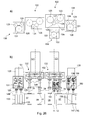
- Fig. 28 is the dampening unit 09 designed as a functional module and has as in Fig. 26 a separate drive motor 132 as in Fig. 26 on.
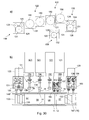
- the inking unit 08 has none of the printing cylinders 06; 07 independent drive motor, but the rotary drive is carried by one of the cylinder 06; 07, in particular from the forme cylinder 07, forth via a mechanical drive connection 144, z. B. via at least one intermediate gear 144, in particular gear 144, between the spur gear 123 and drive wheel 129 of the distribution cylinder 33.
- the drive connection 144 may be performed in an advantageous variant as a belt drive.
- the drive of the printing couple cylinder pair 06, 07 with associated inking unit 08 is preferably as a drive train 146 or drive or function module 146, in particular at least the drive train of cylinder pair 06, 07 and inking unit 08 having space is z. B. formed encapsulated.
- a modification of the embodiment according to Fig. 28 can drive the inking unit 08 according to the Fig. 32 be explained principle, ie it is only the form cylinder remote friction cylinder 33.2 rotationally via a drive connection from the forme cylinder 07 ago, but possibly both distribution cylinder 33.1; 33.2 axially forcibly driven.
- the drive of a three-roll dampening unit 09 can via the drive motor 132 or as above to the development of Fig. 11 a) called purely rotationally driven by friction.
- the clutch 148 is designed in each case as a multi-disc clutch 148 or all-metal clutch and has at least one form-locking, but offset in the circumferential direction of the blades offset with two flanges disc set.
- the driven rollers 33, in particular friction cylinder 33, of the inking unit 09 are preferably coupled to the functional module 138 via at least one coupling 149, in particular angle compensating compensating coupling 149. Since i.d.R. no turning off / on of these rollers 133 takes place, it may be left in such a clutch 149.
- the coupling 149 is also designed only as a rigid flange connection. The same applies to the drive on possibly as a function module 139.
- the rotary drive trains accommodating space, in particular lubricant space, be arranged.
- the drive modules 122; 138; 139; 146 running drive trains 122; 138; 139; 146 are completely separate by themselves from side frames 11; 12 different - housing 152; 153; 154 completed units executed. You have, for example, an input to which z. B. a drive motor or a drive shaft can be coupled, and one or more outputs which rotatably with the cylinder 06; 07 or the roller (screen or friction roller 26, 33, 42, 48) is connectable.
- the pressure cylinder 06; 07 in a likewise advantageous embodiment, each individually driven by a drive motor 121 ( Fig. 30 ).
- a transmission 150 in particular a reduction gear 150, such. B. a planetary gear provided.
- This can be structurally already pre-assembled as an auxiliary unit with the motor 121 as a structural unit as an auxiliary transmission.
- it can also be provided as a drive or functional module, a module-like transmission, at the input of the drive motor and at the output of the respective cylinder - in particular via an angle and / or offset compensating coupling 148 or 151 - can be coupled.
- FIGS. 31 to 35 shows a -.
- Color transport and wear advantageous - embodiment of the inking unit 08 and the inking unit drive which in itself, but especially in conjunction with one or more features of the above printing units 01 advantages.
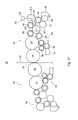
- the inking 08, z. B. referred to as hereinskyges roller inking unit 08 or as a "long inking unit”, has a plurality of the above-mentioned rollers 28; 33; 34; 36; 37 on. It includes according to Fig.
- the soft surfaces of the application and / or transfer rollers 28; 34 are yielding in the radial direction, z. B. with a rubber layer, formed in what Fig. 31 is expressed by the concentric circles.
- the two form cylinder distant rotationally forcibly driven or it can only be the middle or the form cylinder remote friction cylinder 33.2 rotationally driven.
- the cylinder near cylinder near friction cylinder 33.1 has its own, only its rotational movement in a traversing motion transforming traversing 136.
- This can be advantageously designed as a cam gear, wherein z. B. a frame-fixed axial stop cooperates with a roller-fixed curved circumferential groove or a roller-fixed axial stop in a frame-fixed circumferential groove of a cam.
- this rotation in a iridescent Axialhub transforming gear 136 another suitable gear 136, z. B. by an eccentric exhibiting worm or crank gear, be executed.
- Fig. 32 and 33 is an advantageous embodiment for the drive of the distribution cylinder 33.1; 33.2, wherein only the second distribution cylinder 33.2 rotatory is positively driven, however, both friction cylinder 33.1, 33.2 are axially positively driven via the common traversing drive 162.
- the printing cylinder 06; 07 can either be like in Fig. 26 set out in pairs by drive motors 121 per cylinder pair, or advantageously individually by a respective drive motor 121 as in Fig. 30 set out to be executed.
- the drive motor 128 drives via a coupling 163 via a shaft 164 to a drive pinion 166, which in turn interacts with a spur gear 167 connected non-rotatably to the second distribution cylinder 33.2.
- the connection can z. B. via a spur gear 167 supporting shaft portion 168 carried on a pin 169 of the second Reibzylinders 33.2.
- a corresponding axle section 168 of the first friction cylinder 33.1 has no such spur gear 167 or no drive connection to the drive motor 128.
- the drive connection between the drive pinion 166 and spur gear 167 of the second Reibzylinders 33.2 are preferably straight teeth and formed with a sufficient for each position of traversing movement coverage in the teeth engagement.
- the traversing drive 162 is also by the drive motor 128, z. B. via a worm drive 173, 174, driven.
- a screw 173 arranged from the shaft 164 or a section of the shaft 164 designed as a screw 173 is rubbed onto a worm wheel 174, which is rotationally fixed with a rotation axis of the friction cylinder 33.1 perpendicular to the axis of rotation. 33.2 extending shaft 176 is connected.
- a driver 177 is arranged eccentrically to the axis of rotation, which in turn z. B. via a crank mechanism, for example via a rotatably mounted on the driver 177 lever 178 and a hinge 179, in the axial direction of the distribution cylinder 33.1; 33.2 pressure and zugsteif with the pin 169 of the distribution cylinder 33.1; 33.2 is connected.
- Fig. 31 is the friction gear 136 of the form cylinder distant friction cylinder 33.2 indicated only by dashed lines, since it is hidden in this view by the spur gear 167.
- a rotation of the shaft 176 causes a rotation of the driver 177, which in turn via the crank drive an axial stroke of the distribution cylinder 33.1; 33.2 causes.
- the output to the traverse drive 162 can also take place at another point of the rotary drive train between the drive motor 128 and the friction cylinder 33.2 or even on the other side of the machine on the other end face of the Reibzylinders 33.2 pin 169 to a corresponding traversing gear 162. Also may optionally be provided by a worm gear 173, 174 different gear for coupling the axial drive.
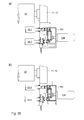
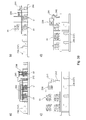
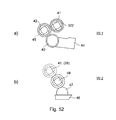
- 35a) and 35b ) show a relative position of the side frames 147 (16) and 11; 12 to each other when using a larger (a) and a smaller (b) forme cylinder 07.
- a by double arrow in Fig. 35 marked distance between the side frame 11; 12 and the inking unit drive, here the traversing gear 162, is then different depending on the position of running in the manner of a module inking unit 08.
- This can print units 01 with printing cylinders 06; 07 different circumferential formats can be operated in a simple manner by the same inking unit 08.
- the prefabricated preferably as a module transmission unit may be completely pre-assembled as a subunit for example designed as a module inking 08 and pre-assembled in an advantageous embodiment before use in the printing unit 01 on the side frame 147 (16) of the inking module be.
- the modularity also allows the installation / replacement / replacement of the module designed as a transmission when the inking unit module is already inserted into the machine.
- the rollers 28 (34) roll at least in the vicinity of the positive cylinder Inking largely slip-free from each other.
- the drive motor 128 is designed as an asynchronous motor 128, which has only one frequency (eg in pressure-down of the inking unit 08) in an associated drive control 186 and / or an electric drive power or a torque (in print-on of the inking unit 08) is specified.
- the inking unit 08 can be brought about the second distribution cylinder 33.2 to a suitable peripheral speed for the pressure on-jobs on the predetermined frequency and / or drive power in which the peripheral speeds of forme cylinder 07 and applicator rollers 28 only differ by less than 10%, in particular less than 5%, from one another (this limit advantageously also applies as a condition for the pressure on the embodiments mentioned below).
- a suitable frequency or power specification is in advance empirically and / or computationally determined and held either in the drive control itself, a machine control or a control computer.
- the default value is preferably changeable by the operator, wherein the default value is preferably changeable by the operating personnel (advantageously also applies to the default values mentioned below).
- the applicator rollers 28 are placed in rolling contact with the forme cylinder 07 and all inking rollers to each other, the rollers 28; 33; 34; 33; 34; 37 to a part of the forme cylinder 07 via the now produced friction gear between the rollers 28; 33; 34; 33; 34; 37 rotationally driven. so that the drive motor 128 only has to bring in the increasing power dissipation in the friction gears with increasing distance from the forme cylinder 07. That is, the drive motor 128 can be operated with a small drive torque or a small drive power, which only contributes to keep the rear portion of the inking unit 08 at the substantially predetermined by the frictional contact peripheral speed.
- This drive power can be left constant in a first variant for all production speeds (or rotational speeds of the forme cylinder 07) and either correspond to that specification for starting in pressure-Ab or represent its own constant value for the production.
- different specifications with regard to the frequency and / or drive power can be predetermined and stored for different production speeds (and possibly also for starting in pressure-off).
- the specification for the drive motor 128 can then vary.
- the drive in addition to the drive control 186 and the induction motor 128 of the first embodiment, a speed feedback, so that the drive motor 128 in the phase of the inking unit operation in pressure-Ab with the speed of the associated plate cylinder 07 and the printing cylinder 06; 07 is essentially synchronizable.
- a speed feedback so that the drive motor 128 in the phase of the inking unit operation in pressure-Ab with the speed of the associated plate cylinder 07 and the printing cylinder 06; 07 is essentially synchronizable.
- a rotary encoder 187 on a non-rotatably connected to the distribution cylinder 33.2 rotating component, eg. Example, a rotor of the drive motor 128, the shaft 164, the shaft 164, etc. may be arranged. In Fig.
- a third embodiment has a synchronous motor 128 instead of the asynchronous motor 128 of the second embodiment.
- a speed feedback and a related synchronization and control in the pressure-off phase is carried out according to the second embodiment, for. B. again in the drive control 186th
- a drive motor 128, in particular a synchronous motor 128, is provided, which is optionally speed-controlled in a first mode (for inking unit 08 in print-Ab) and in a second mode with respect to a torque (for inking unit 08 in print-on). is controllable.
- Drive control 186 and drive motor 128 preferably have an internal control loop for speed control, which, similarly to the second embodiment, comprises a return from an external rotary encoder 187 or an internal sensor system.
- synchronous motors 128 are used, a plurality of these synchronous motors 128 of a printing unit 01 can be assigned a common frequency converter or converter.
- a respect to versatility advantageous, but more complex development of the fourth embodiment is the formation of the drive motor 18 as a selectively position and torque controllable servo motor 128, d.
- H. a three-phase synchronous motor with a device which allows to determine the current rotational position or the angle of rotation with respect to an initial position of the rotor.
- the feedback of the rotational position can via a rotary encoder, z.
- each drive motor 128 is assigned its own frequency converter or converter.
- the drive control 186 is advantageously in signal connection with a so-called virtual master shaft in which an electronically generated master axis position ⁇ circulates.
- the circumferential Leitachsposition ⁇ is the synchronization, with respect. Correct angular position and its temporal change
- Angular velocity ⁇ mechanically independent drive motors of units which are assigned to a same track, in particular drive motors 121 of individual printing cylinders 06; 07 or groups of printing cylinders (pairs) and / or the drive of a folder.
- a signal connection to the virtual master axis can thus provide the drive control 186 with the information about the speed or speed of the machine.
- the inking mechanism 08 is in operation, but is controlled and regulated in terms of a rotational speed and is driven when the inking unit 08 is running (but in parked applicator rollers 28) running machine, as soon as a pressure on the inking unit 08 (ie the applicator rollers 28) is done, the speed control or control is deliberately abandoned. That is, it is no longer at one Locked speed, but the drive motor 128 will be discussed below with respect to a torque, for. B. over a predetermined electrical power, and / or in terms of a controller on the drive motor 128, in particular asynchronous motor 128, adjustable torque operated.
- the torque to be set or the power to be set for example, is selected to be smaller than a limit torque which would lead to a first rotation (under slip) of the driven friction cylinder 33.2 when the cooperating rollers 34 are set but fixed with respect to rotation.
- the design of the cylinder bearings as bearing units 14 and / or the cylinder 06; 07 as a cylinder unit 17 and / or the inking units 08 in the form of modules and / or drives in the manner of drive modules and / or the separability of the printing unit 01 allows-depending on equipment at different depths - a simplified on-site assembly and thus extremely short installation - and commissioning times at the customer.
- the side frames 11; 12 or wall sections 11; 12; 47 set up and aligned and the cylinder units 17 and / or inking units 08 and / or Dampening units 09 in the manner of modules outside the side frames 11; 12 pre-assembled.
- the cylinders 06; 07 are still outside of the racks 11; 12 equipped with their storage units 14 and then completely as a cylinder units 17 between the side frames 11; 12 introduced and fixed. From the outside of the side frame 11; 12 is then by corresponding frame recesses - depending on the drive version - the drive unit in the manner of a drive module (eg, gear 150 or drive train 122 with the corresponding drive motor 121, if necessary, via the shaft 78) with the pin 63; 64 connected.
- a drive module eg, gear 150 or drive train 122 with the corresponding drive motor 121, if necessary, via the shaft 78
- the cylinder units 17 are preferably opened when the printing unit 01 is open, from between the two partial printing units 01.1; 01.2 lying room introduced and only after introduction this again closed.
- the cylinder units 17 are preferably at between printing cylinders 06; 07 and the inking units 08 receiving wall sections 47 open pressure unit 01 introduced from the space formed therefrom ago and closed only after introduction of these.
- the own inking frames 16 and 147 are still outside the side frames 11; 12 equipped with the corresponding rollers (from 26 to 39) and the corresponding drive module 138 (possibly already including drive motor 128) and introduced as a whole in the printing unit 01 and fixed there.
- dampening 09 can dampened own racks still outside the side frames 11; 12 with the corresponding rollers (from 41, 42, 43, 47, 48) and, if required in the desired version, the corresponding drive module 138 (optionally with or without its own drive motor 132) equipped and introduced as a whole in the printing unit 01 and fixed there.
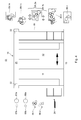
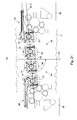
- FIGS. 39 a) to 39 d) schematically show four designs for a printing press, which has a plurality of above-described - divisible or possibly not divisible - printing units 01.
- the printing presses have reelstands 236 with retractors (237) not explicitly shown, a superstructure 238 with at least one longitudinal cutting device, a reversing corner and a longitudinal register device for longitudinally cut part webs, optionally one in FIG Fig. 39d) 239 (dashed lines), a hopper assembly 241 with one, two or even three side by side arranged in a plane formers and a folder 242.
- This three printing units 01 having printing machine are in the case of a design with double-wide, ie four printed pages (especially newspaper pages) wide and double-sized printing cylinders 06; 07 with three tracks 02 altogether 48 pages each four-color printable.
- Fig. 39 a shows the printing press in Patterre setting, ie the printing units 01 and the roll changer 236 are placed on a same level.
- Fig. 39b a printing machine is shown, wherein two each four double printing units 03 having printing units 01 are arranged on two different levels.
- the upper printing unit 01 is arranged with its entire height above the lower printing unit 01.
- this three printing units 01 having printing machine are in the case of an embodiment with double-wide, ie four printed pages (especially newspaper pages) wide and double-sized printing unit cylinders 06; 07 with three tracks 02 altogether 48 pages each four-color printable.
- Fig. 39c shows a printing press on three levels, wherein in a lowermost level, the roll changer 236, and on the two levels above two each four double printing units 03 having printing units 01 are arranged one above the other.
- the printing press here has two such pairs of two printing units 01 arranged one above the other.
- this four printing units 01 having printing machine are in the case of an embodiment with double-wide, ie four printed pages (especially newspaper pages) wide and double-sized printing unit cylinders 06; 07 with four lanes 02 a total of 64 pages each can be printed in four colors.
- a folder 242 is preferably provided with its own drive motor and / or with variable format or section length (i.e., a variable format folder 242) mechanically independently of the printing units 01.
- the schematic in Fig. 40 shown folder 242 has z.
- a knife cylinder 243 a transport cylinder 244 and a jaw cylinder 246.
- At least the transport cylinder 244 designed as a folding blade cylinder 244 has a variable-format configuration, ie a distance ⁇ U in the circumferential direction between holding means 247 and respectively downstream folding blades 248 on the circumference of the transporting cylinder 244 changeable executed.
- the holding means 247, z. B. asillonurologyn or gripper, on the one hand and the folding blade 248 on the other hand be arranged on two different coaxial drums, which can be rotated in the circumferential direction to each other.
- a product section 249 transversely cut off from a strand 251 by the knife cylinder 243 is folded transversely on extension of the folding blade 248 to a shorter section length and vice versa.
- the strand 251 may consist of one or more longitudinally folded or unfolded webs 02 or partial webs.
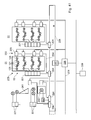
- Fig. 41 shows an example of the drive of a printing machine with several, here two exemplary, designed as printing towers 01 printing units 01, which each have multiple printing units 03, here double printing units 03 have.
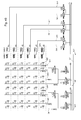
- the printing units 03 of a printing tower 01 together with their drive controllers 221, briefly drives 221 and the drive motors 121; 128 a group 223, z. B. drive motor 223, in particular a pressure point group 223, which via a subordinate drive control 224 of this group 223 with a signal of a respective Leitachsposition ⁇ a virtual Leading axis leading first signal line 226 is connected.
- the slave drive controller 224 may also manage subgroups of printing units 01 or other divisions.
- the transmission of the offset values ⁇ i to the subordinate drive control means 224 is carried out,.
- Example either via corresponding signal lines from the second network 231 directly to the drive controller 224 (not shown), or advantageously via a control system 232, which is assigned to the respective group 18 and the own subordinate drive control 224 having unit.
- the control system 232 is connected to the second network 231 (or to the computing and data processing unit 227).
- the control system 232 controls and / or controls, for example, those of the drive motors 121; 128 different actuators and drives of the printing units 03 and folders 242, z.
- ink supply positioning movements of rollers and / or cylinders, dampening, positions, etc.
- the control system 232 has one or more (in particular programmable) control units 233 on.
- This control unit 233 is connected to the subordinate drive control 224 via a signal line 234. In the case of several control units 233, these are connected by the signal line 234, z. B. a bus system 234, also interconnected.
- the drives 221 thus receive the absolute and dynamic information for circulating a common control axis position ⁇ , and via a second signal path, in particular via at least one second network 231, the information required for register-correct processing, in particular offset values ⁇ i , for the register-oriented relative position of the mechanically independent drives 221 or units transmitted.
- the roller 304 is z. B. formed as a dampening roller 304 and forms its first nip-digit N11 with a z. B. as a cylinder 312, in particular as a forme cylinder 312 formed rotational body 312 and its second nip site N12 with a z. B. as a dampening driver 313 formed rotational body 313.
- the roller 306 is z. B. formed as an inking roller 306 and forms its first nip site N21 with the forme cylinder 312 and its second nip site N22 with a z. B. as a color transfer roller 316 formed rotary body 316.
- the roller 307 is also z. B.
- Fig. 44 likewise only schematically and in a section by way of example shown printing unit 301 with an inking unit 302 and a dampening unit 303 each with controllable in their contact force rollers 304; 306; 307; 308; 309; 311 differs from the one in the Fig. 43 shown printing unit 301 in the arrangement of the roller 311 in the inking unit 302, wherein also here in the Fig. 44 illustrated printing unit 301 with its inking unit 302 and its dampening unit 303 in one of the in conjunction with the Fig. 1 to 15 or 39 described printing units 01 can be arranged.
- the in the Fig. 44 illustrated printing unit 301 with its inking unit 302 and its dampening unit 303 in one of the in conjunction with the Fig. 1 to 15 or 39 described printing units 01 can be arranged.
- nip sites N52; N61 thus denote the same roll strip N52 in this example; N61.
- controllable rollers 304; 306; 307; 308; 309; 311 have in the in the Fig. 43 and 44 shown arrangements each two nip sites N11; N12; N21; N22; N31; N32; N41; N42; N51; N52; N61; N62 up.
- Another operating position of at least one of the controllable rollers 304; 306; 307; 308; 309; 311 may provide that this controllable roller 304; 306; 307; 308; 309; 311 of all its adjacent rotating bodies 312; 313; 314; 316; 317 is turned off, while the other controllable rollers 304; 306; 307; 308; 309; 311 of this printing unit 301 in each case at least with an adjacent rotary body 312; 313; 314; 316; 317 are in physical contact.
- the printing unit 301 can for at least one of the controllable rollers 304; 306; 307; 308; 309; 311 also only a single adjacent rotary body 312; 313; 314; 316; 317 be provided.
- the printing unit 301 is arranged in a printing press producing a printing press, the printing press-as described above-preferably z. B. is designed as a newspaper printing machine and z. B. has a plurality of printing units 301 each having at least one inking unit 302 and / or a dampening unit 303.
- the printing unit 301 operates z. B. in a planographic printing process, preferably in an offset printing process, wherein a printing cylinder 301 belonging to the transfer cylinder and cooperating with the transfer cylinder impression cylinder in the Fig. 43 and 44 are not shown (for these components of the printing unit 301 is rather on the Fig. 1 to 15 or 39 referenced).
- the dampening unit 303 is omitted when the printing unit 301 is operated in a dry offset printing process.
- the lateral surface of z. B. as a forme cylinder 312 formed rotational body 312; 313; 314; 316; 317 is occupied by at least one printing plate (not shown).
- a plurality of printing plates are arranged in the axial direction of the forme cylinder 312, in particular four or six printing plates.
- In the circumferential direction of the forme cylinder 312 z. B. two printing plates arranged one behind the other, so that a total of up to eight or twelve printing plates on the outer surface of the same forme cylinder 312 are arranged.
- the printing unit 301 can in its inking unit 302 and its dampening unit 303 a total of significantly more, but also less controllable rollers 304; 306; 307; 308; 309; 311 than in the Fig. 43 and 44 are shown by way of example.
- roller 304; 306; 307; 308; 309; 311 or the rotating body 312; 313; 314; 316; 317 is possible because the roller 304; 306; 307; 308; 309; 311 or its adjacent body of revolution 312; 313; 314; 316; 317 or both have an elastically deformable lateral surface.
- the rollers 304; 306; 307; 308; 309; 311 a rubberized jacket surface.
- roller strip N11; N12; N21; N22; N31; N32; N41; N42; N51; N52; N61; Set N62 to a certain width the width is in the range of a few millimeters and z. B. between 1 mm and 10 mm.
- the controllable in their contact force rollers 304; 306; 307; 308; 309; 311 and their adjacent rotary bodies 312; 313; 314; 316; 317 have a diameter of z. B. 100 mm to 340 mm and an axial length z. B.
- the width of the roller strip N11; N12; N21; N22; N31; N32; N41; N42; N51; N52; N61; N62 corresponds to that of the respective controllable roller 304; 306; 307; 308; 309; 311 on its adjacent rotary body 312; 313; 314; 316; 317 in the respective roller strip N11; N12; N21; N22; N31; N32; N41; N42; N51; N52; N61; N62 applied contact pressure.
- Each in its contact force controllable roller 304; 306; 307; 308; 309; 311 is mounted in each case at least one of its ends 318, but preferably with its two ends 318 each in a support bearing 321 with a radially displaceable roller mount 339, ie in a so-called roller lock 321, each support bearing 321 or roller lock 321 at least one, preferably several the roller 304; 306; 307; 308; 309; 311 acting actuators 322, wherein the actuators 322 in turn preferably arranged in a support for the bearing 321 and roller lock 321 housing and each z. B. are pressurizable with a pressure medium.
- the actuators 322 are described below as actuators 322 which can be pressurized with a pressure medium, which corresponds to their preferred embodiment, the control of the support bearings 321 and / or their actuators 322 described below is independent of the medium used for the application of the contact pressure becomes.
- the actuators 322 z. B. also be formed as actuators 322, the respective contact force z. B. exercise due to a hydraulic, electrical, motor or piezoelectric effect.
- actuated actuators 322 cause the roller retainer 339 with respect to the support bearing 321 in an orthogonal to the axial direction of the controllable roller 304; 306; 307; 308; 309; 311 standing level is moved eccentrically.
- the radial stroke can be done on a linear or nonlinear trajectory.
- the z. B. frame fixedly arranged support bearing 321 permissible radial stroke of the roll holder 339 thus leads to an eccentric adjustment of the roller mount 339 in the preferably designed as a radial bearing support bearing 321st
- a roller lock 321 exemplified in its structural design.
- the Fig. 45 shows the roller lock 321 in a to the axis 319 of the roller 304; 306; 307; 308; 309; 311 parallel longitudinal section.
- the Fig. 46 shows the roller lock 321 of Fig. 45 in a perspective view with a partial longitudinal section in two mutually orthogonal planes.
- At least all directly interacting with a forme cylinder 312 rollers 304; 306; 307 each have at least one actuator 322, which is independent of the other actuators 322 of the forme cylinder 312 directly cooperating rollers 304; 306; 307 is controlled. It is preferably provided that at least three rollers 304, which cooperate directly with the forme cylinder 312, are provided. 306; 307 are arranged and that each of these rollers 304; 306; 307 has at least one independently controlled actuator 322.
- the housing of the roller lock 321 has a z. B. sleeve-shaped frame holder 323, in the interior of a roller holder 324 is mounted, the actuators 322 act on the roller holder 324 in their operation and the roller holder 324 in a radially formed about the axis 319 gap between the frame holder 323 and the roller holder 324 radially can move.
- the gap between the frame holder 323 and the roll holder 324 has z. B. a width of 1 mm to 10 mm, preferably of about 2 mm.
- the actuators 322 are z. B.
- the reversibly deformable surface 338 therefore at least largely corresponds to the surface 338 which is effective for applying the surface pressure.
- the actuators 322 have no piston guided in a cylinder, but instead are rodless.
- the integration of the actuators 322 in the housing of the roller lock 321 leads to an extremely compact design of the roller lock 321.
- the pressure medium is supplied to the actuators 322 via a pressure medium line 341 ( Fig. 46 ).
- One of the ends 318 of the roller 304 which can be controlled in its contact force; 306; 307; 308; 309; 311 is formed in the formed on the roll holder 324 z.
- the roller mount 339 has a bearing, for. B.
- the roller lock 321 has z. B. a fixing device, the roller holder 324 and thus the rigidly connected to him roller 304; 306; 307; 308; 309; Fixed 311 in a first operating position and thus locks against any radial displacement relative to the frame holder 323 or releases in a second operating position for such a shift.
- the fixing device has z. B. a preferably coaxial, rigid z. B. connected to the roller holder 324 first plate set 326 and also preferably coaxial second plate pack 327, wherein the second plate set 327 engages with its fins between the slats of the first plate set 326.
- the fixation takes place when meshing the slats preferably frictionally or positively. After loosening the zip or positive locking of the slats, the second disk set 327 in the axial direction of the roller lock 321 is movable.
- the axial movement of the second disk set 327 comes z. B. in that a pressure medium is guided by a formed in the frame wall 336 channel 328 in a roller lock 321 pressure chamber 329, wherein arranged in the pressure chamber 329 pressure plate 331 against the force of a spring element 332 a preferably arranged in the roll holder 324 Stamp 333 moved axially.
- the second disk set 327 is on a punch head 334 of the punch 333 fixed and is also moved in an axial movement of the punch 333, whereby the fins of the disk packs 326; 327 disengaged.
- each actuator 322 exerts during its pressure medium applied to a directed into the interior of its roller lock 321 radial force Fn1; Fn2; Fn3; Fn4 on the connected to the roller lock 321, controllable in its pressing force roller 304; 306; 307; 308; 309; 311, wherein the actuators 322 are preferably radially supported on or in the frame holder 323 of the roller lock 321 and by the surface pressure on the frame holder 323 radially displaceable roller holder 324, the radial force Fn1; Fn2; Fn3; Fn4 mounted on the roller holder 324, controllable in its contact force roller 304; 306; 307; 308; 309; 311 exercise.
- the controllable by one of their contact force roller 304; 306; 307; 308; 309; 311 in a roll strip N11; N12; N21; N22; N31; N32; N41; N42; N51; N52; N61; N62 on an adjacent rotary body 312; 313; 314; 316; 317 applied contact pressure then results as a vector sum from the simultaneously exerted radial forces Fn1; Fn2; Fn3; Fn4 of actuators 322 of the same roller lock 321 - possibly taking into account one of the controllable roller 304; 306; 307; 308; 309; 311 due to their own mass on the adjacent rotary body 312; 313; 314; 316; 317 at least partially applied weight.
- an identification feature n in the designation of the radial force Fn1; Fn2; Fn3; Fn4 is a particular roller lock 321 markable and therefore identifiable.
- the significance of the identification feature n will be discussed below. Because preferably each installed in the printing press, to a controllable roller 304; 306; 307; 308; 309; 311 associated roller lock 321 is assigned an address that can be used in the controller as an address, with which the roller lock 321 in the printing press or at least in a printing unit 301 can be uniquely identified and thus selected in the controller.
- each actuator belonging to a roller lock 321 322 is associated with an identifier with which each actuator 322 in one of the arranged in the printing press or in the respective printing unit 301 roller locks 321 is clearly identifiable, selectable and controllable.
- the pressure chamber 329 belonging to the fixing device of each roller lock 321 is assigned an identifier, whereby ultimately also each fixing device can be unambiguously identified by the roller locks 321 arranged in the printing press or in the printing unit 301.
- the respective identifier of the roller locks 321, their actuators 322 and their fixing device is preferably machine-readable and can be stored in the control unit, preferably an electronic, digital data-processing control unit.
- an identifier of its actuators 322 and fixing of a digit sequence wherein the first digit z. B. the relevant roller lock 321 and the second digit z. B. identifies the relevant actuator 322 in the respective roller lock 321 or its fixing device.
- an identifier nm denotes each with an identification feature n; m for the roller lock 321, its actuators 322 and its fixing device in the printing unit 301 uniquely determined roller lock 321, one in the printing unit 301 uniquely determined actuator 322 and one in the printing unit 301 uniquely determined fixing.
- the identification nm denotes with its first identification feature n a roller lock 321 and with its second identification feature m a specific actuator 322 of this roller lock 321 or its fixing device.
- the identifier "15" in this example indicates the fixing device of the roller lock 321 marked with the number "1" FIGS.
- the identifier nm relates digit sequences with a first identification feature n with a number between “1” and “6” because six mutually different roller locks 321 are provided, and with a second identification feature m with a number between "1” and "5" for the four actuators 322 per roller lock 321 and the associated fixing device.
- each roller lock 321, each of its actuators 322 and each fixing device is assigned an identifier nm, each roller lock 321, each actuator 322 and each fixing device can be uniquely identified and addressed.
- the identifiers nm can z. B.
- roller locks 321, actuators 322 and fixing devices in the control unit each be stored as an individual, unique address, whereby each roller lock 321, each Actuator 322 and each fixing device by the control unit individually and independently of other arranged in the printing unit 301 roller locks 321, actuators 322 and fixing devices can be identified, selected, addressed and controlled.
- both ends 318 of the same adjustable in the pressing force and / or position changeable roller 304; 306; 307; 308; 309; 311 and / or at least one end 318 of two different rollers 304 adjustable respectively in the pressing force and / or in their position; 306; 307; 308; 309; 311 each in a support bearing 321, d. H. are mounted in a roller lock 321, with a radially displaceable roller mount 339, wherein each support bearing 321 at least one on the roller 304; 306; 307; 308; 309; 311 acting actuator 322, the control unit controls at least the actuator 322 of at least two support bearings 321 individually and independently of other support bearings 321 and actuators 322.
- the control unit thus controls at least one actuator 322 of a support bearing 321 individually and independently of an actuator 322 of another support bearing 321.
- the control unit can also jointly control groups of actuators 322 and support bearings 321, in particular if these jointly controlled actuators 322 and support bearings 321 form a functional composite, that is always due to their technical function in the printing process and inevitably set in a fixed relationship to each other.
- the at least two actuators 322 of each roller lock 321 are always arranged identically with respect to a specific position of the roller lock 321 in each roller lock 321 in its preferably circular distribution, so that in all roller locks 321 of a printing unit 301 the identification feature m of their actuators 322 and fixing always in can be assigned to the same order. Accordingly, for identically positioned actuators 322 in this order, the same identification feature m is always assigned.
- the actuators 322 and fixing device are identified in an ascending order, wherein in this order for the fixing device, the identifier z. B. awarded the highest value is.
- the actuators 322 in each roller lock 321 are marked in a fixed order. For example, starting from a specific position on the periphery of the roller lock 321, the actuators 322 in each roller lock 321 are marked in the same fixed order in the circumferential direction.
- the actuators 322 are in each roller lock 321 in their preferred pneumatic execution in each case by a pressure medium line 341 having a pressure level 342 having a pressure medium source, for. As a compressor connected.
- actuators 322 which have the same identification feature m due to their same arrangement in the respective roller lock 321, are connected in a parallel circuit with the same pressure medium line 341 at the same pressure medium source or at least at the same pressure level 342 .
- actuators 322 arranged in the same roller lock 321 with a distinguishing identification feature m with different pressure medium lines 341 are connected to different pressure medium sources or at least to different pressure levels 342.
- the actuators 322 arranged in the roller locks 321 are always pressurized and that the pending pressure only in the sense of a displacement of the controllable roller 304; 306; 307; 308; 309; 311 and / or to be changed on the controllable roller 304; 306; 307; 308; 309; 311 exerted contact force, if and as long as the fixing device of the relevant roller locksmith 321 is released, ie in which the displacement of the controllable roller 304; 306; 307; 308; 309; 311 operating position is located.
- the displacement of the controllable roller 304; 306; 307; 308; 309; 311 blocks, a pressure applied to at least one of the actuators 322 or a change in the pressure present there does not affect the controllable roller 304; 306; 307; 308; 309; 311 out. If and as long as an effect on the controllable roller 304; 306; 307; 308; 309; 311 is not intended, the pressure medium lines 341 to those with this roller 304; 306; 307; 308; 309; 311 interacting actuators 322 are provided as an alternative to their constant pressurization at least partially unpressurized or at least considerably reduced pressure.
- roller locks 321 the same number of actuators 322 on.
- the roller locks 321 of several or even all in each case in their contact force controllable rollers 304; 306; 307; 308; 309; 311 have the same number of actuators 322.
- a printing unit 301 is usually a rack wall 336, in or at each of which a first bearing for the controllable in their contact force rollers 304; 306; 307; 308; 309; 311 and their adjacent rotary bodies 312; 313; 314; 316; 317 located as "side l" and the opposite frame wall 336, each with a second bearing for the controllable in their contact force rollers 304; 306; 307; 308; 309; 311 and their adjacent rotary bodies 312; 313; 314; 316; 317 referred to as "page II".
- actuators 322 engage with the same roller 304; 306; 307; 308; 309; 311 connected roller locks 321 one at both ends 318 of this roller 304; 306; 307; 308; 309; 311 in the amount of equal pressing force in the roller strip N11; N12; N21; N22; N31; N32; N41; N42; N51; N52; N61; N62 on the adjacent rotary body 312; 313; 314; 316; 317 out.
- the formed as a forme cylinder 312 rotating body 312 is not uniformly occupied in its axial direction with printing plates, but the forme cylinder 312 z. B.
- 5/2-way valves are formed in the pressure line 341 on the way of the pressure medium from its pressure medium source to the actuators 322 in a series connection in each case one of the proportional valves EP1; EP2; EP3; EP4 are arranged, can be selected whether actuators 322 on the "side I" of the controllable in its contact force roller 304; 306; 307; 308; 309; 311 be applied with the same pressure as on the "side II" or with a different pressure.
- the pressure level 342 may communicate with the proportional valves EP1; EP2; EP3; EP4 to any value z. B. between 0 bar and 10 bar, preferably between 0 bar and 6 bar, are set.
- the fixing devices of roller locks 321 of the same roller 304; 306; 307; 308; 309; 311 are in their respective pressure line 341 z. B. connected in parallel and thus change their operating position preferably simultaneously.
- each roller lock 321 each be associated with a controllable device, wherein the controllable device each more, preferably all, connected to their respective pressure medium source pressure medium lines 341 of actuators 322 of the same roller lock 321 each simultaneously in a first operating position with a first pressure level 342 and in a second operating position with a second pressure level 342 pressurized, wherein in each of the two operating positions, the respectively present at the actuators 322 pressure level 342 is different for each of at least one of the actuators 322 of the same roller lock 321 from zero.
- the change between the first operating position and the second operating position preferably takes place abruptly by a switching operation of the controllable device triggered by the control unit.
- the controllable device therefore acts on all actuators 322 of the same roller lock 321 leading pressure medium lines 341st equally and can z. B. by a check valve with a plurality of mutually independent passages or more synchronously, ie simultaneously switching shut-off valves or a switching position of the proportional valves EP1; EP2; EP3; EP4 be realized.
- the setting is carried out by a roller 304; 306; 307; 308; 309; 311 in a roll strip N11; N12; N21; N22; N31; N32; N41; N42; N51; N52; N61; N62 on an adjacent rotary body 312; 313; 314; 316; 317 applied contact force quickly, ie within a very short time duration.
- a roller 304 306; 307; 308; 309; 311 in a roll strip N11; N12; N21; N22; N31; N32; N41; N42; N51; N52; N61; N62 on an adjacent rotary body 312; 313; 314; 316; 317 applied contact force quickly, ie within a very short time duration.
- the standard configuration for this printing unit 301 can be a set of twenty-four values FN11, FN12, FN21, FN22 FN31; FN32; FN41; FN42; FN51; FN52; FN61; FN62;
- N11; N12; N21; N22; N31; N32; N41; N42; N51; N52; N61; N62 becomes the value FN11; FN12; FN21; Fn22; FN31; FN32; FN41; FN42; FN51; FN52; FN61; FN62 of the respective contact force exerted there from a vector sum of the radial forces Fn1 simultaneously exerted by actuators 322 of the same roller lock 321; Fn2; Fn3; Fn4 optionally taking into account the roller 304 that can be controlled
- the default configuration produces a degree of flattening that corresponds to a particular setpoint for the width of each roll strip N11; N12; N21; N22; N31; N32; N41; N42; N51; N52; N61; N62 corresponds to the printing unit 301 under standard operating conditions to achieve a good quality for the printed product to be produced.
- the operating conditions may also require that the width of each roller strip N11; N12; N21; N22; N31; N32; N41; N42; N51; N52; N61; N62 is set to a new setpoint.
- the roll strip N11 involved in each affected strip is; N12; N21; N22; N31; N32; N41; N42; N51; N52; N61; N62 applied to a new value FN11; FN12; FN21; Fn22; FN31; FN32; FN41; FN42; FN51; FN52; FN61; FN62, with the result that values for the radial forces Fn1; Fn2; Fn3; Fn4 of the affected roller locks 321 are to be changed.
- the control unit has at least one control element and z. B. via a display device for displaying one or more values FN11; FN12; FN21; Fn22; FN31; FN32; FN41; FN42; FN51; FN52; FN61; FN62 for those in a given roll strip N11; N12; N21; N22; N31; N32; N41; N42; N51; N52; N61; N62 applied contact pressure.
- N11; N12; N21; N22; N31; N32; N41; N42; N51; N52; N61; N62 is a value FN11 in the memory of the control unit, at least for the standard configuration; FN12; FN21; Fn22; FN31; FN32; FN41; FN42; FN51; FN52; FN61; FN62, in particular a setpoint for which in the roll strip N11; N12; N21; N22; N31; N32; N41; N42; N51; N52; N61; N62 applied contact force stored.
- This value FN11; FN12; FN21; Fn22; FN31; FN32; FN41; FN42; FN51; FN52; FN61; FN62 is used in selecting or entering the identifier of a particular roller strip N11; N12; N21; N22; N31; N32; N41; N42; N51; N52; N61; N62 with the z.
- the control element displays the displayed value FN11; FN12; FN21; Fn22; FN31; FN32; FN41; FN42; FN51; FN52; FN61; FN62 for those in the roll strip N11; N12; N21; N22; N31; N32; N41; N42; N51; N52; N61; N62 applied to a new value FN 11; FN 12; FN21; Fn22; FN31; FN32; FN41; FN42; FN51; FN52; FN61; FN62 for those in the roll strip N11; N12; N21; N22; N31; N32; N41; N42; N51; N52; N61; N62 applied pressing force by the displayed value FN11; FN12; FN21; Fn22; FN31; FN32; FN41; FN42; FN51; FN52; FN61; FN62 z.
- the control selects from a list of available factors a certain factor by which the displayed value FN11, FN12, FN21, FN22, FN31, FN32, FN41, FN42, FN51, FN52, FN61, FN62 is to be changed.
- the control unit calculates FN11 for the new value; FN12; FN21; Fn22; FN31; FN32; FN41; FN42; FN51; FN52; FN61; FN62 of the selected rolling strip N11; N12; N21; N22; N31; N32; N41; N42; N51; N52; N61; N62 applied force the associated values for the applied in the relevant roller lock 321 radial forces Fn1; Fn2; Fn3; Fn4 and / or the pressures to be newly set in the actuators 322 and stores the calculated values for the radial forces Fn1; Fn2; Fn3; Fn4 and / or the pressures in their memory.
- control unit also controls the valves V15; V25; V35; V45; V55; V65, the proportional valves EP1; EP2; EP3; EP4 and the valves EP5; EP6.
- Carrying out the calculation of new values FN11; FN12; FN21; Fn22; FN31; FN32; FN41; FN42; FN51; FN52; FN61; FN62 and / or the control of the valves V15; V25; V35; V45; V55; V65, the proportional valves EP1; EP2; EP3; EP4 and / or the valves EP5; EP6 is preferably carried out after the control unit to a certain, z. B. with the control input or selectable instruction has received.
- the result of the calculation can with the display device of the control unit z. For example, like the original values FN11; FN12; FN21; Fn22; FN31; FN32; FN41; FN42; FN51; FN52; FN61; FN62 are displayed.
- control unit actuates at least one of the proportional valves EP1; EP2; EP3; EP4 and / or at least one of the valves EP5; EP6, the radial force Fn1; Fn2; Fn3; Fn4 at least one actuator 322 in the affected roller lock 321 to the calculated new value.
- FN11; FN12; FN21; Fn22; FN31; FN32; FN41; FN42; FN51; FN52; FN61; FN62 one in a roll strip N11; N12; N21; N22; N31; N32; N41; N42; N51; N52; N61; N62 is to be changed with the applied to perform this change controllable device, ie in particular with the relevant proportional valves EP1; EP2; EP3; EP4, the valves EP5; EP6 and the valves V15; V25; V35; V45; V55; V65, is connected.
- N11; N12; N21; N22; N31; N32; N41; N42; N51; N52; N61; N62 may be required proof of authorization by performing before the change of the control unit with its control z. B. enter a valid password.
- the value is changed FN11; FN21; FN31 in this roll strip N11; N21; N31 applied force when the opening of the channel and the roller strips N11; N21; N31 have no common overlapping surface, so that the roller 304; 306; 307 while setting the new value of their in this roll strip N11; N21; N31 does not press into the opening of the channel.
- the in a roll strip N11; N21; N31 applied contact pressure is Accordingly, changed by the control unit only at times during which the to be adjusted and / or in its contact force to be changed roller 304; 306; 307 rolls on the closed, usually solid part of the lateral surface of the forme cylinder 312 and / or on the surface of at least one mounted on the forme cylinder 312 printing form.
- the control unit blocks any change in the setting of one in the roller strip N11; N21; N31 applied contact pressure.
- the performance of the change of the value FN11; FN12; FN21; Fn22; FN31; FN32; FN41; FN42; FN51; FN52; FN61; FN62 one in a roll strip N11; N12; N21; N22; N31; N32; N41; N42; N51; N52; N61; N62 applied during the rotation of the affected roller 304; 306; 307; 308; 309; 311 also has the advantage that slip-stick effects are avoided.
- control of the rollers 304; 306; 307; 308; 309; 311 analog way are also the actuator 82; 84 or the actuators 82; 84 of the respective storage units 14 ( Fig. 19 ) in a printing unit 04 a z. B. as a printing tower 01 trained printing unit 01 ( Fig. 1 to 10 . 12 to 15 ) arranged cylinder 06; 07 preferably from the control station 229 or from a central computer 229 from identifiable and addressable and z. B. controllable with at least one valve 93 by the actuator 82; 84 or the actuators 82; 84 of the respective storage units 14 is also assigned in each case a unique identifier.
- the identifier of a storage unit 14 may be formed as an address consisting of at least two identification features "p" and "q” and may be referred to as "pq" by connecting these identification features, the first identification feature "p" e.g. B. a particular cylinder 06; 07; 312 or a particular cylinder group within a particular printing unit 01 and the second identifier "q" z. B. a particular actuator 82; 84 of the cylinder 06 identified with the first data packet "p";07; 312 denotes.
- At least one printing unit 04 at least one printing unit 01 at least two cooperating cylinder 06; 07; 312, wherein the cylinder 06; 07; 312 are each mounted in a radially adjustable bearing unit 14, wherein at least two at the same end of at least one of the cylinder 06; 07; 312 actuators 82 acting to adjust it; 84 are provided, wherein the respective directions of action of acting on the same cylinder end actuators 82; 84 are directed neither parallel nor anti-parallel to each other, wherein a control means for adjusting the cylinder 06; 07; 312 required setting of the actuators 82; 84 controls or regulates, wherein at least one of the cylinders 06; 07; 312 is mounted at its two ends in each case in a radially adjustable bearing unit 14, wherein the at least two acting on the same cylinder end in different directions of action actuators 82; 84 are arranged in the storage unit 14.
- Belonging to the printing unit 04 is preferably an inking unit 08; 302 provided, wherein at least one of the cylinder 06; 07; 312 and an inking roller 28; 306; 307 of the inking unit 08; 302 are set against each other ( Fig. 31 ). It can also be a dampening 09; Be provided 303, wherein at least one of the cylinder 06; 07; 312 and a dampening roller 41; 304 of dampening unit 09; 303 are employed against each other.
- the at least one inking roller 28; 306; 307 of the inking unit 08; 302 and / or the at least one dampening roller 41; 304 of dampening unit 09; 303 each with its own drive 128 regardless of the cylinder 06; 07; 312 be driven.
- the inking roller 28; 306; 307 of the inking unit 08; 302 and / or the dampening roller 41; 304 of dampening unit 09; 303 individually driven by a drive 128.
- the at least one inking roller 28; 306; 307 of the inking unit 08; 302 and / or the at least one dampening roller 41; 304 of dampening unit 09; 303 are preferably each mounted with their two ends each in a radially adjustable support bearing 321, as previously in connection with the Fig. 43 or 44 has been described. Preferably, all of them are connected to one of the cylinders 06; 07; 312 adjustable inking rollers 28; 306; 307 of the inking unit 08; 302 and / or dampening rollers 41; 304 of dampening unit 09; 303 each mounted at both ends in a support bearing 321 and thus radially adjustable.
- either the same control device as that for controlling or regulating the actuators 82; 84 of the bearing units 14 of the cylinder 06; 07; 312 are used or the control or regulation of the actuators 322 of the support bearings 321 adjustable rollers 304; 306; 307; 308; 309; 311 of the inking unit 08; 302 and / or dampening unit 09; 303 is performed by one of the control or regulation of the actuators 82; 84 of the bearing units 14 of the cylinder 06; 07; 312 separate control device.
- the surface pressure is required in printing units 01, which work in an offset printing process, for the transfer of ink. Due to the surface pressure is an elastic surface of the cylinder 06; 07; Pressed 312, wherein the elastic surface may be given by a rubber coating, a blanket or a sleeve.
- An unstable operating condition with an inhomogeneous color transfer, in particular between the cylinders 06; 07; 312 turns z. B. with varying tolerances of the thickness of the rubber coating, the blanket or the sleeve, when they collapse, with a difference in their production, for. B. differences in their viscous properties, or in their aging with possibly associated hardening and / or water absorption. Assembly and / or adjustment error of the gap between the cylinders 06; 07; 312 can be added.
- control device controls the actuators 82; 84 of the at least one cylinder 06 to be adjusted; 07; 312 or the respective actuators 82; 84 of the two cooperating cylinders 06 to be adjusted; 07; 312 each at least in response to a misalignment of the cylinder to be adjusted 06; 07; 312 relative to the cooperating with this cylinder 06; 07; 312 sets.
- control device provides the actuators 82; 84 of the at least one cylinder 06 to be adjusted; 07; 312 or the respective actuators 82; 84 of the two cooperating cylinders 06 to be adjusted; 07; 312 each at least in response to a respective surface condition of the cooperating cylinder 06; 07; 312 ein.
- control device the actuators 82; 84 of the at least one cylinder 06 to be adjusted; 07; 312 or the respective actuators 82; 84 of the two cooperating cylinders 06 to be adjusted; 07; 312 sets each at least in dependence on a property of a printing material 04 printed in the printing unit 02, wherein the property of the printed substrate 02 z. B. its thickness and / or width and / or leadership along the cylinder 06; 07; 312 concerns.
- control device the actuators 82; 84 of the at least one cylinder 06 to be adjusted; 07; 312 or the respective actuators 82; 84 of the two cooperating cylinders 06 to be adjusted; 07; 312 in each case depending on several of the aforementioned parameters.
- the mentioned dependencies can all be considered as a functional relationship, eg. In the form of a table or as a curve or family of curves, in a memory device be deposited.
- the 51 shows in the Fig. 6 illustrated various examples of modular inking units 08; 302 each with indicated actuators 322 for their adjustable rollers 306; 307; 309; 311.
- the Fig. 52 shows in the Fig. 11 illustrated various examples of modular dampening units 09; 303 each with indicated actuators 322 for their adjustable rollers 304; 308th
- the Fig. 53 and 54 show by way of example in each case at least one section of a z. B. on the display of the control console 229 or belonging to the control computer 229 control unit displayed or at least displayable program mask, each of these program masks serves the purpose, in conjunction with at least one belonging to the control unit control element, eg. As a keyboard or a pointer instrument, the z. B. from a cylinder 06; 07; Adjust 312 in a roll strip on an adjacent body of rotation force applied individually as needed and preferably remotely controlled an existing setting, z. B. even during an ongoing production of the printing unit to change.
- the control unit control element eg.
- the z. B. from a cylinder 06; 07; Adjust 312 in a roll strip on an adjacent body of rotation force applied individually as needed and preferably remotely controlled an existing setting, z. B. even during an ongoing production of the printing unit to change.
- Both program masks show by way of example in each case schematically a printing unit 01 designed as a four-high tower, wherein four double printing units 03 are shown vertically above one another for generating a 4/4 print, the respective transfer cylinders 06 of the double printing units 03 being set against each other. At each of the transfer cylinder 06 of the double printing 03 each form cylinder 07 is employed. For details on the training of these double printing 03 is on the Fig. 1 . 2 . 7 to 10 and 12 to 15 each referenced with the associated description.
- Each of these selectable adjustment levels is assigned a specific value, preferably specified by the manufacturer of the printing press, which is not specified in detail in the program masks for the contact pressure exerted between the transfer cylinders 06 of the double printing units 03, wherein the respective contact force assigned to one of the adjustment levels is determined by means of the in the respective storage unit 14 the transfer cylinder 06 arranged actuators 82 are set after the user of the printing press has made his decision regarding the selectable Einstellitess.
- the respectively exerted between the transfer cylinders 06 of the double printing units 03 contact pressure starting from at least one of the selectable Einstellitess by a fine adjustment is variable, this fine adjustment is preferably provided at all selectable Einstellis.
- the addition of z In the program masks of the Fig. 53 and 54 The example shown is the fine adjustment in a starting from the selectable setting level percentage addition to increase the respective contact pressure, the addition of z. In increments of one percent up to a specified upper limit, e.g. B. up to 100%, ie up to a doubling of the respective selected setting level of the contact force corresponding value can be done.
- the addition related to the selected setting level is displayed in the program masks z. B.
- the set addition for all double printing units 03 is + 5% in each case. It is understood that different values and also for the double printing units 03 different values can be set.
- the contact force exerted between one of the transfer cylinders 06 and one of the forme cylinders 07 is variable.
- the setting of the force exerted between one of the transfer cylinder 06 and one of the forme cylinder 07 contact pressure is directed z. B. after the elasticity and / or the compressibility of the wound up on the transfer cylinders 06 blankets.
- Fig. 54 shows that z. B. in addition to the adjustability of the force exerted between the transfer cylinders 06 of the double printing units 03 contact force in association with preferably each double printing unit 03 each have a selection menu 351 is provided, each selection menu 351 z. B.
- the change z. B. as an addition z. B. in increments of one percent up to 100%, ie up to a doubling of the respective selected setting level of the contact force corresponding value can be done.
- the addition related to the selected setting level is displayed in the program mask Fig. 54 z. B. within the printing unit 01 shown schematically z. B. by a numerically displayed percentage z. B. displayed in association with one of the forme cylinder 07 of the double printing units 03 or at least displayed.
- Example shown is the set addition for three of the four double printing 03 each + 15% and for the top double printing unit 03 z. + 10%. It is understood that different values and also for the double printing units 03 different values can be set.
- the respective one of the adjustment levels associated contact force and its fine position be it the adjustment of the contact force depending on the surface condition of the printed substrate 02 and / or the adjustment of the contact pressure depending on properties of the blanket used, carried out in each case by means of the respective storage unit 14th the transfer cylinder 06 and / or the forme cylinder 07 arranged actuators 82nd
- an inking roller 28; 306; 307 of the Inking unit 08; 302 and / or a dampening roller 41; 304 of dampening unit 09; 303, on one of the cylinders 06; 07; 312 applied contact pressure and / or for setting a between two adjacent rollers 304; 306; 307; 308; 309; 311; 313; 314; 316; 317 applied contact pressure can be provided at least one further program mask, which with the previously in connection with the Fig.
- program masks which are displayed on the display device of the control station 229 or belonging to the control center computer 229 control unit or at least displayable there and each for setting a contact force between cylinders 06; 07; 312 is used, is comparable and / or has at least a similar functionality.
- the respectively for adjusting the contact pressure of cylinders 06; 07; 312 and / or rollers 304; 306; 307; 308; 309; 311; 313; 314; 316; 317 used program masks can each be displayed on the same display device to the control room 229 or the control center computer 229 belonging control unit or at least be displayed there, so that the adjustment of the contact pressure of cylinders 06; 07; 312 and / or rollers 304; 306; 307; 308; 309; 311; 313; 314; 316; 317 each can be done by means of the same to the control room 229 or the control center computer 229 associated display device.
- the Fig. 55 and 56 each show, for example, a program mask for setting rollers 304 which can be controlled in their respective contact force; 306; 307; 308; 309; 311 (cf. Fig. 1 . 43 and 44 ), wherein the program masks each have a schematic representation of a double printing 03 each with a forme cylinder 07 each with a roller train of an inking unit 08; 302 and with the compactor of a dampening unit 09; 303, wherein in this example, the web of material to be printed 02 is guided horizontally between two mutually employed transfer cylinders 06 by the double printing unit 03.
- buttons 353; 354 may be provided to engage a particular roller 304; 306; 307; 308; 309; 311 from the compactor of the inking unit 08; 302 to select.
- the buttons 353; 354 may be configured to engage on each actuation from a currently selected roller 304; 306; 307; 308; 309; 311 in the roller train to next or previous roller 304; 306; 307; 308; 309; 311 select.
- the rollers 304; 306; 307; 308; 309; 311 are therefore preferably each provided with a number and can by means of the buttons 353; 354 gradual z. B. be selected by counting up or down.
- Example shown in the roller of the inking unit 08; 302 numbered roller 311 of the inking unit 08; 302 selected, which is on the program mask z. B. is displayed above the illustrated double printing unit 03.
- the with the buttons 353; 354 made selection of marked with the number 4 roller 311 is z. B. to confirm with another button 356 to cause the control unit to perform a correlated with the selection control command.
- the window 364 includes a scale 367 with the threshold values -3 and +3, as an example, where z. B. starting from a designated zero base level z. B. using also shown on the program mask buttons 357; 358 a gradual change in the setting of the basic level is possible, with one of the buttons 357 z. B.
- a reduction of the setting and with the other button 358 an increase in the setting can be made.
- the step size with which a change in the setting can be made for. B. in the control unit according to the structural conditions of the present printing press needs.
- the setting of the basic level has been changed by a factor of +2, ie the setting between the selected rollers 316; 317 applied contact force was z. B. increased by 200%.
- the clipping function When with the button 362 with respect to two selected rolls 316; 317, the clipping function has been selected, can be displayed in a window 366 on the program mask z. B. in the form of a pictogram 369 of the current state of these affected rollers 316; 317 are displayed, ie it is displayed whether these selected rollers 316; 317 already set off from each other or are still employed against each other.
- a roller lock 321 of the roller marked as roller 4 311 is selected, which has four actuators 322, wherein each two of the arranged in the roller lock 321 actuators 322 are arranged diametrically opposite (see. FIGS. 43 to 48 ).
- window 371 both the columns overwritten with P1 and P2 correlate with P3 and P4, respectively each column with two oppositely arranged actuators 322.
- the table 372 one of the two oppositely arranged actuators 322 is depressurized, which is why there is the entry zero in the table 372.
- the value of the pressure in the respective other of the two oppositely arranged actuators 322 may be in a value range z. B. be set between zero and seven bar.
Landscapes
- Engineering & Computer Science (AREA)
- Mechanical Engineering (AREA)
- Rotary Presses (AREA)
- Inking, Control Or Cleaning Of Printing Machines (AREA)
- Rolls And Other Rotary Bodies (AREA)
- Ink Jet (AREA)
- Jellies, Jams, And Syrups (AREA)
- Printers Characterized By Their Purpose (AREA)
- Devices For Checking Fares Or Tickets At Control Points (AREA)
- Electroluminescent Light Sources (AREA)
- Molds, Cores, And Manufacturing Methods Thereof (AREA)
- Compressors, Vaccum Pumps And Other Relevant Systems (AREA)
Applications Claiming Priority (4)
| Application Number | Priority Date | Filing Date | Title |
|---|---|---|---|
| DE102005018473 | 2005-04-21 | ||
| DE102005045984 | 2005-09-27 | ||
| EP06754755A EP1871601B1 (fr) | 2005-04-21 | 2006-04-20 | Groupe d'impression pourvu d'au moins deux cylindres cooperant |
| EP07116905A EP1867478B1 (fr) | 2005-04-21 | 2006-04-20 | Groupe d'impression pourvu d'au moins deux cylindres coopérant |
Related Parent Applications (1)
| Application Number | Title | Priority Date | Filing Date |
|---|---|---|---|
| EP07116905A Division EP1867478B1 (fr) | 2005-04-21 | 2006-04-20 | Groupe d'impression pourvu d'au moins deux cylindres coopérant |
Publications (1)
| Publication Number | Publication Date |
|---|---|
| EP1955846A1 true EP1955846A1 (fr) | 2008-08-13 |
Family
ID=37115510
Family Applications (3)
| Application Number | Title | Priority Date | Filing Date |
|---|---|---|---|
| EP07116905A Expired - Lifetime EP1867478B1 (fr) | 2005-04-21 | 2006-04-20 | Groupe d'impression pourvu d'au moins deux cylindres coopérant |
| EP08153097A Withdrawn EP1955846A1 (fr) | 2005-04-21 | 2006-04-20 | Commande commune de réglage pour cylindres d'impression et pour rouleaux applicateurs |
| EP06754755A Expired - Lifetime EP1871601B1 (fr) | 2005-04-21 | 2006-04-20 | Groupe d'impression pourvu d'au moins deux cylindres cooperant |
Family Applications Before (1)
| Application Number | Title | Priority Date | Filing Date |
|---|---|---|---|
| EP07116905A Expired - Lifetime EP1867478B1 (fr) | 2005-04-21 | 2006-04-20 | Groupe d'impression pourvu d'au moins deux cylindres coopérant |
Family Applications After (1)
| Application Number | Title | Priority Date | Filing Date |
|---|---|---|---|
| EP06754755A Expired - Lifetime EP1871601B1 (fr) | 2005-04-21 | 2006-04-20 | Groupe d'impression pourvu d'au moins deux cylindres cooperant |
Country Status (10)
| Country | Link |
|---|---|
| US (1) | US8069786B2 (fr) |
| EP (3) | EP1867478B1 (fr) |
| AT (2) | ATE412516T1 (fr) |
| BR (1) | BRPI0609937A2 (fr) |
| DE (2) | DE502006001944D1 (fr) |
| DK (1) | DK1867478T3 (fr) |
| ES (2) | ES2313664T3 (fr) |
| PL (1) | PL1867478T3 (fr) |
| RU (1) | RU2371318C9 (fr) |
| WO (1) | WO2006111556A2 (fr) |
Cited By (2)
| Publication number | Priority date | Publication date | Assignee | Title |
|---|---|---|---|---|
| EP1767359A3 (fr) * | 2005-09-27 | 2011-01-05 | Koenig & Bauer Aktiengesellschaft | Unité d'impression et procedé de reglage d'une position d'impression d'un premier et deuxième cylindre |
| WO2011015482A1 (fr) * | 2009-08-04 | 2011-02-10 | Kba-Metronic Aktiengesellschaft | Dispositif de réglage du registre diagonal |
Families Citing this family (14)
| Publication number | Priority date | Publication date | Assignee | Title |
|---|---|---|---|---|
| DE102006026365B4 (de) * | 2006-06-07 | 2017-10-12 | manroland sheetfed GmbH | Druckmaschine |
| ITPC20070001A1 (it) | 2007-01-19 | 2008-07-20 | Nordmeccanica Spa | Gruppo per il prelievo,il dosaggio e la spalmatura di adesivo,in particolare per macchine accoppiatrici |
| ES2303471B1 (es) * | 2007-01-26 | 2009-04-16 | Comexi, S.A. | Maquina impresora flexografica con unidades de impresion de estabilidad mejorada. |
| DE102007015402A1 (de) * | 2007-03-30 | 2008-10-09 | Koenig & Bauer Aktiengesellschaft | Feuchtwerk für ein Druckwerk einer Druckmaschine |
| DE102007026027A1 (de) * | 2007-06-04 | 2008-12-11 | Gallus Ferd. Rüesch AG | Druckmaschine |
| DE102008000725A1 (de) * | 2008-03-18 | 2009-09-24 | Manroland Ag | Farbwerk und Feuchtwerk |
| US20100282102A1 (en) * | 2009-05-08 | 2010-11-11 | Mehdizadeh Sharmin | Label printing cylinder and process |
| FR3000917B1 (fr) * | 2013-01-11 | 2015-02-20 | Bobst Lyon | Procede de commande, pour commander une machine de transformation, machine de transformation et programme d'ordinateur pour realiser un tel procede de commande |
| RU2614198C1 (ru) * | 2015-09-25 | 2017-03-23 | Российская Федерация, от имени которой выступает Государственная корпорация по атомной энергии "Росатом" (Госкорпорация "Росатом") | Устройство для хранения и выдачи предметов |
| MX378361B (es) * | 2015-11-06 | 2025-03-10 | Elco Entpr Inc | Sistema de guia de alambre flexible. |
| US20190190978A1 (en) * | 2017-12-14 | 2019-06-20 | Regal Construction, Inc. | Remote monitoring system |
| CN108001029A (zh) * | 2017-12-20 | 2018-05-08 | 上海广平印刷设备有限公司 | 一种柔版跳印装置 |
| CN111288945A (zh) * | 2020-04-01 | 2020-06-16 | 玉溪合创科技有限公司 | 一种检测固定旋转筒体设备位移变化的装置 |
| ES2941384T3 (es) | 2020-05-26 | 2023-05-22 | Bobst Bielefeld Gmbh | Conjunto de cojinete para soportar un cilindro de impresión o un rodillo anilox en una máquina de impresión y máquina de impresión |
Citations (9)
| Publication number | Priority date | Publication date | Assignee | Title |
|---|---|---|---|---|
| CH470967A (de) * | 1967-11-27 | 1969-04-15 | Plamag Plauener Druckmaschinen | Vorrichtung zum Festspannen der Lagerbuchsen für Druck- und Plattenzylinder von Druckmaschinen |
| DE1561014B1 (de) * | 1967-03-02 | 1970-02-12 | Maschf Augsburg Nuernberg Ag | Verstellbare Walzenlagerung, insbesondere für Reib- und Auftragwalzen von Farbwerken an Druckmaschinen |
| DE3529680A1 (de) | 1984-08-24 | 1986-03-06 | Gustav Paulsen | Vorrichtung zum ausgleichen von aenderungen der matrizenhoehe und der papierstaerke bei einer rotationsdruckmaschine |
| EP0331870A2 (fr) * | 1988-03-11 | 1989-09-13 | Maschinenfabrik GOEBEL GmbH | Palier |
| DE19534651A1 (de) * | 1995-09-19 | 1997-03-20 | Roland Man Druckmasch | Druckwerk für indirekten Druck |
| EP0941850A1 (fr) | 1998-03-11 | 1999-09-15 | Heidelberger Druckmaschinen Aktiengesellschaft | Dispositif pour commander l'impression d'une ou de plusieurs bandes dans une machine d'impression rotative |
| DE10001582A1 (de) * | 1999-02-17 | 2000-08-24 | Heidelberger Druckmasch Ag | Verfahren und Vorrichtung zum Einstellen des Anpressdrucks zwischen Walzen in einer Druckmaschine |
| WO2002081218A2 (fr) | 2001-04-09 | 2002-10-17 | Koenig & Bauer Aktiengesellschaft | Groupe d'impression d'une machine d'imprimerie comportant un cylindre de transfert pouvant etre deplace lineairement |
| DE10244043A1 (de) | 2001-12-06 | 2003-06-26 | Koenig & Bauer Ag | Vorrichtungen zum Einstellen von Walzen in einer Druckmaschine |
Family Cites Families (33)
| Publication number | Priority date | Publication date | Assignee | Title |
|---|---|---|---|---|
| US2557381A (en) | 1946-08-09 | 1951-06-19 | William C Huebner | Multiple unit printing press |
| US2964108A (en) * | 1957-10-11 | 1960-12-13 | Royal Mcbee Corp | Record perforator |
| CH480180A (de) | 1968-02-07 | 1969-10-31 | Albert Schnellpressen | Vorrichtung zum An- und Abstellen der Auftragwalzen im Farbwerk von Rotationsdruckmaschinen |
| DE1807751B1 (de) | 1968-11-08 | 1970-03-05 | Maschf Augsburg Nuernberg Ag | Einrichtung an Farbwerken von Druckmaschinen zur Lagerung von Reib- und Auftragwalzen |
| DE2234089C3 (de) | 1972-07-08 | 1975-01-23 | Automatic Druckmaschinenfabrik Dr. W. Hinniger U. Soehne, 1000 Berlin | Offset-Rollen-Rotationsdruckmaschine |
| FR2385530A2 (fr) | 1977-04-01 | 1978-10-27 | Chambon Machines | Imprimeuse rotative a plusieurs couleurs |
| DE3324893C1 (de) * | 1983-07-09 | 1985-03-14 | Heidelberger Druckmaschinen Ag, 6900 Heidelberg | Vorrichtung zum Dosieren der Farbe bei Offsetdruckmaschinen |
| DE3412812C1 (de) * | 1984-04-05 | 1985-06-27 | M.A.N.- Roland Druckmaschinen AG, 6050 Offenbach | Schaltvorrichtung fuer die Gummituchzylinder eines Druckwerkes fuer eine Rollenrotations-Offsetdruckmaschine |
| DE3610107A1 (de) | 1986-03-26 | 1987-10-08 | Voith Gmbh J M | Stellvorrichtung zum verstellen einer walze |
| GB8611722D0 (en) | 1986-05-14 | 1986-06-25 | Drg Uk Ltd | Processing paper & other webs |
| DE3825517A1 (de) | 1988-07-27 | 1990-02-01 | Wifag Maschf | Vorrichtung zum an- und abstellen sowie einstellen von farbwerks- bzw. feuchtwerkswalzen einer druckmaschine |
| DE4327278C5 (de) | 1993-08-13 | 2005-09-22 | Maschinenfabrik Wifag | Traggestell für eine Rollenrotationsdruckmaschine |
| DE4408025A1 (de) | 1994-03-10 | 1995-09-14 | Koenig & Bauer Ag | Druckwerk für eine Mehrfarbenrollenrotationsdruckmaschine |
| DE4430693B4 (de) | 1994-08-30 | 2005-12-22 | Man Roland Druckmaschinen Ag | Antriebe für eine Rollenrotations-Offsetdruckmaschine |
| DE59605059D1 (de) | 1996-09-03 | 2000-05-31 | Gimaco Ing Ag | Vorrichtung zum Einstellen einer Farbwerks- bzw. Feuchtwerkswalze einer Druckmaschine |
| FR2755057B1 (fr) | 1996-10-25 | 1999-01-15 | Heidelberg Harris Sa | Dispositif de mise en appui de rouleaux contre des surfaces rotatives |
| US6095042A (en) * | 1998-07-16 | 2000-08-01 | Varn Products Company, Inc. | Dampener activation apparatus and method |
| JP2000174783A (ja) * | 1998-12-07 | 2000-06-23 | Ryobi Ltd | 被制御装置の識別符号決定システムまたはその方法 |
| EP1234118A4 (fr) * | 1999-10-27 | 2003-08-13 | Tol O Matic Inc | Systeme de servocommande de precision destine a un dispositif de commande pneumatique |
| DE10052014B4 (de) * | 1999-11-12 | 2011-01-13 | Heidelberger Druckmaschinen Ag | Verfahren zum Steuern und Aktualisieren des Bediensystems für eine Druckmaschine |
| DE20011948U1 (de) * | 2000-07-10 | 2000-12-07 | Skf Gmbh, 97421 Schweinfurt | Lageranordnung |
| DE10202385A1 (de) | 2001-02-15 | 2002-08-29 | Heidelberger Druckmasch Ag | Druckwerk mit variabler Drucklänge und Umfangsregisterverstellung |
| DE10113314C2 (de) | 2001-03-20 | 2003-10-30 | Koenig & Bauer Ag | Fixiereinrichtung |
| DE10152020C2 (de) | 2001-03-20 | 2003-05-08 | Koenig & Bauer Ag | Vorrichtung zum Einstellen des Anpressdrucks einer verstellbar gelagerten Walze |
| US6684775B2 (en) | 2001-06-07 | 2004-02-03 | Heidelberger Druckmaschinen Ag | Printing unit with roll-away inkers |
| DE10145322A1 (de) | 2001-09-14 | 2003-04-03 | Ina Schaeffler Kg | Lageranordnung für Zylinder, Walzen oder Trommeln |
| CN1323833C (zh) | 2001-10-05 | 2007-07-04 | 柯尼格及包尔公开股份有限公司 | 卷筒纸印刷机 |
| EP1938976B1 (fr) | 2001-11-08 | 2014-04-30 | Koenig & Bauer AG | Dispositif d'entrainement d'un groupe d'impression |
| CN100443662C (zh) * | 2002-02-01 | 2008-12-17 | 柯尼格及包尔公开股份有限公司 | 用于降低在旋转的构件上的振动的方法和装置 |
| DE10261985A1 (de) * | 2002-09-21 | 2004-04-08 | Koenig & Bauer Ag | Vorrichtung zum Einstellen des Anpressdrucks einer verstellbar gelagerten Walze |
| US7021191B2 (en) * | 2003-01-24 | 2006-04-04 | Viking Technologies, L.C. | Accurate fluid operated cylinder positioning system |
| RU2236352C1 (ru) * | 2003-06-19 | 2004-09-20 | Харитонов Георгий Сергеевич | Механизм натиска печатной машины-автомата |
| DE102004004665B4 (de) | 2004-01-30 | 2005-12-29 | Koenig & Bauer Ag | Vorrichtung zum Einstellen einer von einer Walze in einem Walzenstreifen auf einen benachbarten Rotationskörper ausgeübten Anpresskraft und zum Anstellen der Walze an den Rotationskörper oder zum Abstellen der Walze von dem Rotationskörper |
-
2006
- 2006-04-20 ES ES06754755T patent/ES2313664T3/es not_active Expired - Lifetime
- 2006-04-20 DE DE502006001944T patent/DE502006001944D1/de not_active Expired - Lifetime
- 2006-04-20 DK DK07116905T patent/DK1867478T3/da active
- 2006-04-20 EP EP07116905A patent/EP1867478B1/fr not_active Expired - Lifetime
- 2006-04-20 US US11/918,949 patent/US8069786B2/en not_active Expired - Fee Related
- 2006-04-20 AT AT06754755T patent/ATE412516T1/de not_active IP Right Cessation
- 2006-04-20 DE DE502006002748T patent/DE502006002748D1/de not_active Expired - Lifetime
- 2006-04-20 PL PL07116905T patent/PL1867478T3/pl unknown
- 2006-04-20 BR BRPI0609937-8A patent/BRPI0609937A2/pt not_active IP Right Cessation
- 2006-04-20 AT AT07116905T patent/ATE421923T1/de not_active IP Right Cessation
- 2006-04-20 EP EP08153097A patent/EP1955846A1/fr not_active Withdrawn
- 2006-04-20 WO PCT/EP2006/061695 patent/WO2006111556A2/fr not_active Ceased
- 2006-04-20 RU RU2007142568/12A patent/RU2371318C9/ru not_active IP Right Cessation
- 2006-04-20 ES ES07116905T patent/ES2318830T3/es not_active Expired - Lifetime
- 2006-04-20 EP EP06754755A patent/EP1871601B1/fr not_active Expired - Lifetime
Patent Citations (9)
| Publication number | Priority date | Publication date | Assignee | Title |
|---|---|---|---|---|
| DE1561014B1 (de) * | 1967-03-02 | 1970-02-12 | Maschf Augsburg Nuernberg Ag | Verstellbare Walzenlagerung, insbesondere für Reib- und Auftragwalzen von Farbwerken an Druckmaschinen |
| CH470967A (de) * | 1967-11-27 | 1969-04-15 | Plamag Plauener Druckmaschinen | Vorrichtung zum Festspannen der Lagerbuchsen für Druck- und Plattenzylinder von Druckmaschinen |
| DE3529680A1 (de) | 1984-08-24 | 1986-03-06 | Gustav Paulsen | Vorrichtung zum ausgleichen von aenderungen der matrizenhoehe und der papierstaerke bei einer rotationsdruckmaschine |
| EP0331870A2 (fr) * | 1988-03-11 | 1989-09-13 | Maschinenfabrik GOEBEL GmbH | Palier |
| DE19534651A1 (de) * | 1995-09-19 | 1997-03-20 | Roland Man Druckmasch | Druckwerk für indirekten Druck |
| EP0941850A1 (fr) | 1998-03-11 | 1999-09-15 | Heidelberger Druckmaschinen Aktiengesellschaft | Dispositif pour commander l'impression d'une ou de plusieurs bandes dans une machine d'impression rotative |
| DE10001582A1 (de) * | 1999-02-17 | 2000-08-24 | Heidelberger Druckmasch Ag | Verfahren und Vorrichtung zum Einstellen des Anpressdrucks zwischen Walzen in einer Druckmaschine |
| WO2002081218A2 (fr) | 2001-04-09 | 2002-10-17 | Koenig & Bauer Aktiengesellschaft | Groupe d'impression d'une machine d'imprimerie comportant un cylindre de transfert pouvant etre deplace lineairement |
| DE10244043A1 (de) | 2001-12-06 | 2003-06-26 | Koenig & Bauer Ag | Vorrichtungen zum Einstellen von Walzen in einer Druckmaschine |
Cited By (2)
| Publication number | Priority date | Publication date | Assignee | Title |
|---|---|---|---|---|
| EP1767359A3 (fr) * | 2005-09-27 | 2011-01-05 | Koenig & Bauer Aktiengesellschaft | Unité d'impression et procedé de reglage d'une position d'impression d'un premier et deuxième cylindre |
| WO2011015482A1 (fr) * | 2009-08-04 | 2011-02-10 | Kba-Metronic Aktiengesellschaft | Dispositif de réglage du registre diagonal |
Also Published As
| Publication number | Publication date |
|---|---|
| BRPI0609937A2 (pt) | 2010-05-11 |
| DE502006002748D1 (de) | 2009-03-19 |
| EP1871601B1 (fr) | 2008-10-29 |
| ES2318830T3 (es) | 2009-05-01 |
| RU2007142568A (ru) | 2009-05-27 |
| ES2313664T3 (es) | 2009-03-01 |
| RU2371318C9 (ru) | 2011-01-10 |
| WO2006111556A3 (fr) | 2007-05-10 |
| EP1867478A2 (fr) | 2007-12-19 |
| EP1871601A2 (fr) | 2008-01-02 |
| DE502006001944D1 (de) | 2008-12-11 |
| US20090020028A1 (en) | 2009-01-22 |
| EP1867478B1 (fr) | 2009-01-28 |
| DK1867478T3 (da) | 2009-05-04 |
| ATE412516T1 (de) | 2008-11-15 |
| EP1867478A3 (fr) | 2008-04-02 |
| WO2006111556A2 (fr) | 2006-10-26 |
| ATE421923T1 (de) | 2009-02-15 |
| PL1867478T3 (pl) | 2009-07-31 |
| US8069786B2 (en) | 2011-12-06 |
| RU2371318C2 (ru) | 2009-10-27 |
Similar Documents
| Publication | Publication Date | Title |
|---|---|---|
| EP1991419B1 (fr) | Groupes d'impression d'une machine à imprimer | |
| EP2113382B1 (fr) | Dispositif de stockage d'un cylindre et procédé de réglage en fonction de la position d'impression | |
| EP1735158B1 (fr) | Unite d'impression d'une rotative a bobines | |
| EP1867478B1 (fr) | Groupe d'impression pourvu d'au moins deux cylindres coopérant | |
| EP1894719B1 (fr) | Unité d'impression d'une rotative à bobines | |
| EP1871600B1 (fr) | PROCéDé D'UTILISATION D'UNE UNITE D'IMPRESSION ET PROCEDE DE REGLAGE D'UNE POSITION D'IMPRESSION | |
| EP1833674B1 (fr) | Unité d'impression d'une presse d'impression pourvue d'au moins un mécanisme d'encrage et d'au moins un mécanisme mouilleur | |
| EP1767359B1 (fr) | Unité d'impression et procedé de reglage d'une position d'impression d'un premier et deuxième cylindre | |
| EP1732759B1 (fr) | Systemes d'entrainement d'une unite d'impression | |
| WO2007099148A2 (fr) | Groupes d'impression d'une machine à imprimer |
Legal Events
| Date | Code | Title | Description |
|---|---|---|---|
| PUAI | Public reference made under article 153(3) epc to a published international application that has entered the european phase |
Free format text: ORIGINAL CODE: 0009012 |
|
| AC | Divisional application: reference to earlier application |
Ref document number: 1871601 Country of ref document: EP Kind code of ref document: P Ref document number: 1867478 Country of ref document: EP Kind code of ref document: P |
|
| AK | Designated contracting states |
Kind code of ref document: A1 Designated state(s): AT BE BG CH CY CZ DE DK EE ES FI FR GB GR HU IE IS IT LI LT LU LV MC NL PL PT RO SE SI SK TR |
|
| AX | Request for extension of the european patent |
Extension state: AL BA HR MK RS |
|
| 17P | Request for examination filed |
Effective date: 20080730 |
|
| AKX | Designation fees paid |
Designated state(s): AT BE BG CH CY CZ DE DK EE ES FI FR GB GR HU IE IS IT LI LT LU LV MC NL PL PT RO SE SI SK TR |
|
| STAA | Information on the status of an ep patent application or granted ep patent |
Free format text: STATUS: THE APPLICATION HAS BEEN WITHDRAWN |
|
| RIC1 | Information provided on ipc code assigned before grant |
Ipc: B41F 13/40 20060101ALI20121023BHEP Ipc: B41F 7/40 20060101AFI20121023BHEP Ipc: B41F 33/00 20060101ALI20121023BHEP Ipc: B41F 31/36 20060101ALI20121023BHEP Ipc: B41F 13/38 20060101ALI20121023BHEP |
|
| 18W | Application withdrawn |
Effective date: 20121031 |