EP1957193B1 - Composition superabsorbante retenant les odeurs - Google Patents
Composition superabsorbante retenant les odeurs Download PDFInfo
- Publication number
- EP1957193B1 EP1957193B1 EP06818628A EP06818628A EP1957193B1 EP 1957193 B1 EP1957193 B1 EP 1957193B1 EP 06818628 A EP06818628 A EP 06818628A EP 06818628 A EP06818628 A EP 06818628A EP 1957193 B1 EP1957193 B1 EP 1957193B1
- Authority
- EP
- European Patent Office
- Prior art keywords
- weight
- water
- polymer structure
- absorbing polymer
- composition according
- Prior art date
- Legal status (The legal status is an assumption and is not a legal conclusion. Google has not performed a legal analysis and makes no representation as to the accuracy of the status listed.)
- Not-in-force
Links
- VQMPTVQCADWACQ-UHFFFAOYSA-N CCC(C)(CC)N Chemical compound CCC(C)(CC)N VQMPTVQCADWACQ-UHFFFAOYSA-N 0.000 description 1
Images
Classifications
-
- A—HUMAN NECESSITIES
- A61—MEDICAL OR VETERINARY SCIENCE; HYGIENE
- A61L—METHODS OR APPARATUS FOR STERILISING MATERIALS OR OBJECTS IN GENERAL; DISINFECTION, STERILISATION OR DEODORISATION OF AIR; CHEMICAL ASPECTS OF BANDAGES, DRESSINGS, ABSORBENT PADS OR SURGICAL ARTICLES; MATERIALS FOR BANDAGES, DRESSINGS, ABSORBENT PADS OR SURGICAL ARTICLES
- A61L15/00—Chemical aspects of, or use of materials for, bandages, dressings or absorbent pads
- A61L15/16—Bandages, dressings or absorbent pads for physiological fluids such as urine or blood, e.g. sanitary towels, tampons
- A61L15/42—Use of materials characterised by their function or physical properties
- A61L15/60—Liquid-swellable gel-forming materials, e.g. super-absorbents
-
- B—PERFORMING OPERATIONS; TRANSPORTING
- B01—PHYSICAL OR CHEMICAL PROCESSES OR APPARATUS IN GENERAL
- B01J—CHEMICAL OR PHYSICAL PROCESSES, e.g. CATALYSIS OR COLLOID CHEMISTRY; THEIR RELEVANT APPARATUS
- B01J20/00—Solid sorbent compositions or filter aid compositions; Sorbents for chromatography; Processes for preparing, regenerating or reactivating thereof
- B01J20/22—Solid sorbent compositions or filter aid compositions; Sorbents for chromatography; Processes for preparing, regenerating or reactivating thereof comprising organic material
- B01J20/26—Synthetic macromolecular compounds
-
- A—HUMAN NECESSITIES
- A61—MEDICAL OR VETERINARY SCIENCE; HYGIENE
- A61L—METHODS OR APPARATUS FOR STERILISING MATERIALS OR OBJECTS IN GENERAL; DISINFECTION, STERILISATION OR DEODORISATION OF AIR; CHEMICAL ASPECTS OF BANDAGES, DRESSINGS, ABSORBENT PADS OR SURGICAL ARTICLES; MATERIALS FOR BANDAGES, DRESSINGS, ABSORBENT PADS OR SURGICAL ARTICLES
- A61L15/00—Chemical aspects of, or use of materials for, bandages, dressings or absorbent pads
- A61L15/16—Bandages, dressings or absorbent pads for physiological fluids such as urine or blood, e.g. sanitary towels, tampons
- A61L15/22—Bandages, dressings or absorbent pads for physiological fluids such as urine or blood, e.g. sanitary towels, tampons containing macromolecular materials
-
- B—PERFORMING OPERATIONS; TRANSPORTING
- B01—PHYSICAL OR CHEMICAL PROCESSES OR APPARATUS IN GENERAL
- B01J—CHEMICAL OR PHYSICAL PROCESSES, e.g. CATALYSIS OR COLLOID CHEMISTRY; THEIR RELEVANT APPARATUS
- B01J20/00—Solid sorbent compositions or filter aid compositions; Sorbents for chromatography; Processes for preparing, regenerating or reactivating thereof
- B01J20/22—Solid sorbent compositions or filter aid compositions; Sorbents for chromatography; Processes for preparing, regenerating or reactivating thereof comprising organic material
- B01J20/26—Synthetic macromolecular compounds
- B01J20/261—Synthetic macromolecular compounds obtained by reactions only involving carbon to carbon unsaturated bonds
-
- B—PERFORMING OPERATIONS; TRANSPORTING
- B01—PHYSICAL OR CHEMICAL PROCESSES OR APPARATUS IN GENERAL
- B01J—CHEMICAL OR PHYSICAL PROCESSES, e.g. CATALYSIS OR COLLOID CHEMISTRY; THEIR RELEVANT APPARATUS
- B01J20/00—Solid sorbent compositions or filter aid compositions; Sorbents for chromatography; Processes for preparing, regenerating or reactivating thereof
- B01J20/22—Solid sorbent compositions or filter aid compositions; Sorbents for chromatography; Processes for preparing, regenerating or reactivating thereof comprising organic material
- B01J20/26—Synthetic macromolecular compounds
- B01J20/265—Synthetic macromolecular compounds modified or post-treated polymers
- B01J20/267—Cross-linked polymers
-
- B—PERFORMING OPERATIONS; TRANSPORTING
- B01—PHYSICAL OR CHEMICAL PROCESSES OR APPARATUS IN GENERAL
- B01J—CHEMICAL OR PHYSICAL PROCESSES, e.g. CATALYSIS OR COLLOID CHEMISTRY; THEIR RELEVANT APPARATUS
- B01J20/00—Solid sorbent compositions or filter aid compositions; Sorbents for chromatography; Processes for preparing, regenerating or reactivating thereof
- B01J20/28—Solid sorbent compositions or filter aid compositions; Sorbents for chromatography; Processes for preparing, regenerating or reactivating thereof characterised by their form or physical properties
- B01J20/28002—Solid sorbent compositions or filter aid compositions; Sorbents for chromatography; Processes for preparing, regenerating or reactivating thereof characterised by their form or physical properties characterised by their physical properties
- B01J20/28004—Sorbent size or size distribution, e.g. particle size
-
- B—PERFORMING OPERATIONS; TRANSPORTING
- B01—PHYSICAL OR CHEMICAL PROCESSES OR APPARATUS IN GENERAL
- B01J—CHEMICAL OR PHYSICAL PROCESSES, e.g. CATALYSIS OR COLLOID CHEMISTRY; THEIR RELEVANT APPARATUS
- B01J20/00—Solid sorbent compositions or filter aid compositions; Sorbents for chromatography; Processes for preparing, regenerating or reactivating thereof
- B01J20/28—Solid sorbent compositions or filter aid compositions; Sorbents for chromatography; Processes for preparing, regenerating or reactivating thereof characterised by their form or physical properties
- B01J20/28014—Solid sorbent compositions or filter aid compositions; Sorbents for chromatography; Processes for preparing, regenerating or reactivating thereof characterised by their form or physical properties characterised by their form
- B01J20/28023—Fibres or filaments
-
- B—PERFORMING OPERATIONS; TRANSPORTING
- B01—PHYSICAL OR CHEMICAL PROCESSES OR APPARATUS IN GENERAL
- B01J—CHEMICAL OR PHYSICAL PROCESSES, e.g. CATALYSIS OR COLLOID CHEMISTRY; THEIR RELEVANT APPARATUS
- B01J20/00—Solid sorbent compositions or filter aid compositions; Sorbents for chromatography; Processes for preparing, regenerating or reactivating thereof
- B01J20/28—Solid sorbent compositions or filter aid compositions; Sorbents for chromatography; Processes for preparing, regenerating or reactivating thereof characterised by their form or physical properties
- B01J20/28014—Solid sorbent compositions or filter aid compositions; Sorbents for chromatography; Processes for preparing, regenerating or reactivating thereof characterised by their form or physical properties characterised by their form
- B01J20/2803—Sorbents comprising a binder, e.g. for forming aggregated, agglomerated or granulated products
-
- B—PERFORMING OPERATIONS; TRANSPORTING
- B01—PHYSICAL OR CHEMICAL PROCESSES OR APPARATUS IN GENERAL
- B01J—CHEMICAL OR PHYSICAL PROCESSES, e.g. CATALYSIS OR COLLOID CHEMISTRY; THEIR RELEVANT APPARATUS
- B01J20/00—Solid sorbent compositions or filter aid compositions; Sorbents for chromatography; Processes for preparing, regenerating or reactivating thereof
- B01J20/28—Solid sorbent compositions or filter aid compositions; Sorbents for chromatography; Processes for preparing, regenerating or reactivating thereof characterised by their form or physical properties
- B01J20/28014—Solid sorbent compositions or filter aid compositions; Sorbents for chromatography; Processes for preparing, regenerating or reactivating thereof characterised by their form or physical properties characterised by their form
- B01J20/28033—Membrane, sheet, cloth, pad, lamellar or mat
-
- B—PERFORMING OPERATIONS; TRANSPORTING
- B01—PHYSICAL OR CHEMICAL PROCESSES OR APPARATUS IN GENERAL
- B01J—CHEMICAL OR PHYSICAL PROCESSES, e.g. CATALYSIS OR COLLOID CHEMISTRY; THEIR RELEVANT APPARATUS
- B01J20/00—Solid sorbent compositions or filter aid compositions; Sorbents for chromatography; Processes for preparing, regenerating or reactivating thereof
- B01J20/28—Solid sorbent compositions or filter aid compositions; Sorbents for chromatography; Processes for preparing, regenerating or reactivating thereof characterised by their form or physical properties
- B01J20/28014—Solid sorbent compositions or filter aid compositions; Sorbents for chromatography; Processes for preparing, regenerating or reactivating thereof characterised by their form or physical properties characterised by their form
- B01J20/28042—Shaped bodies; Monolithic structures
-
- B—PERFORMING OPERATIONS; TRANSPORTING
- B01—PHYSICAL OR CHEMICAL PROCESSES OR APPARATUS IN GENERAL
- B01J—CHEMICAL OR PHYSICAL PROCESSES, e.g. CATALYSIS OR COLLOID CHEMISTRY; THEIR RELEVANT APPARATUS
- B01J20/00—Solid sorbent compositions or filter aid compositions; Sorbents for chromatography; Processes for preparing, regenerating or reactivating thereof
- B01J20/28—Solid sorbent compositions or filter aid compositions; Sorbents for chromatography; Processes for preparing, regenerating or reactivating thereof characterised by their form or physical properties
- B01J20/28014—Solid sorbent compositions or filter aid compositions; Sorbents for chromatography; Processes for preparing, regenerating or reactivating thereof characterised by their form or physical properties characterised by their form
- B01J20/28047—Gels
-
- B—PERFORMING OPERATIONS; TRANSPORTING
- B01—PHYSICAL OR CHEMICAL PROCESSES OR APPARATUS IN GENERAL
- B01J—CHEMICAL OR PHYSICAL PROCESSES, e.g. CATALYSIS OR COLLOID CHEMISTRY; THEIR RELEVANT APPARATUS
- B01J20/00—Solid sorbent compositions or filter aid compositions; Sorbents for chromatography; Processes for preparing, regenerating or reactivating thereof
- B01J20/30—Processes for preparing, regenerating, or reactivating
- B01J20/3028—Granulating, agglomerating or aggregating
-
- B—PERFORMING OPERATIONS; TRANSPORTING
- B01—PHYSICAL OR CHEMICAL PROCESSES OR APPARATUS IN GENERAL
- B01J—CHEMICAL OR PHYSICAL PROCESSES, e.g. CATALYSIS OR COLLOID CHEMISTRY; THEIR RELEVANT APPARATUS
- B01J20/00—Solid sorbent compositions or filter aid compositions; Sorbents for chromatography; Processes for preparing, regenerating or reactivating thereof
- B01J20/30—Processes for preparing, regenerating, or reactivating
- B01J20/3042—Use of binding agents; addition of materials ameliorating the mechanical properties of the produced sorbent
-
- B—PERFORMING OPERATIONS; TRANSPORTING
- B01—PHYSICAL OR CHEMICAL PROCESSES OR APPARATUS IN GENERAL
- B01J—CHEMICAL OR PHYSICAL PROCESSES, e.g. CATALYSIS OR COLLOID CHEMISTRY; THEIR RELEVANT APPARATUS
- B01J20/00—Solid sorbent compositions or filter aid compositions; Sorbents for chromatography; Processes for preparing, regenerating or reactivating thereof
- B01J20/30—Processes for preparing, regenerating, or reactivating
- B01J20/32—Impregnating or coating ; Solid sorbent compositions obtained from processes involving impregnating or coating
- B01J20/3202—Impregnating or coating ; Solid sorbent compositions obtained from processes involving impregnating or coating characterised by the carrier, support or substrate used for impregnation or coating
- B01J20/3206—Organic carriers, supports or substrates
- B01J20/3208—Polymeric carriers, supports or substrates
- B01J20/321—Polymeric carriers, supports or substrates consisting of a polymer obtained by reactions involving only carbon to carbon unsaturated bonds
-
- B—PERFORMING OPERATIONS; TRANSPORTING
- B01—PHYSICAL OR CHEMICAL PROCESSES OR APPARATUS IN GENERAL
- B01J—CHEMICAL OR PHYSICAL PROCESSES, e.g. CATALYSIS OR COLLOID CHEMISTRY; THEIR RELEVANT APPARATUS
- B01J20/00—Solid sorbent compositions or filter aid compositions; Sorbents for chromatography; Processes for preparing, regenerating or reactivating thereof
- B01J20/30—Processes for preparing, regenerating, or reactivating
- B01J20/32—Impregnating or coating ; Solid sorbent compositions obtained from processes involving impregnating or coating
- B01J20/3214—Impregnating or coating ; Solid sorbent compositions obtained from processes involving impregnating or coating characterised by the method for obtaining this coating or impregnating
- B01J20/3217—Resulting in a chemical bond between the coating or impregnating layer and the carrier, support or substrate, e.g. a covalent bond
- B01J20/3219—Resulting in a chemical bond between the coating or impregnating layer and the carrier, support or substrate, e.g. a covalent bond involving a particular spacer or linking group, e.g. for attaching an active group
-
- B—PERFORMING OPERATIONS; TRANSPORTING
- B01—PHYSICAL OR CHEMICAL PROCESSES OR APPARATUS IN GENERAL
- B01J—CHEMICAL OR PHYSICAL PROCESSES, e.g. CATALYSIS OR COLLOID CHEMISTRY; THEIR RELEVANT APPARATUS
- B01J20/00—Solid sorbent compositions or filter aid compositions; Sorbents for chromatography; Processes for preparing, regenerating or reactivating thereof
- B01J20/30—Processes for preparing, regenerating, or reactivating
- B01J20/32—Impregnating or coating ; Solid sorbent compositions obtained from processes involving impregnating or coating
- B01J20/3231—Impregnating or coating ; Solid sorbent compositions obtained from processes involving impregnating or coating characterised by the coating or impregnating layer
- B01J20/3242—Layers with a functional group, e.g. an affinity material, a ligand, a reactant or a complexing group
- B01J20/3244—Non-macromolecular compounds
- B01J20/3246—Non-macromolecular compounds having a well defined chemical structure
- B01J20/3248—Non-macromolecular compounds having a well defined chemical structure the functional group or the linking, spacer or anchoring group as a whole comprising at least one type of heteroatom selected from a nitrogen, oxygen or sulfur, these atoms not being part of the carrier as such
- B01J20/3251—Non-macromolecular compounds having a well defined chemical structure the functional group or the linking, spacer or anchoring group as a whole comprising at least one type of heteroatom selected from a nitrogen, oxygen or sulfur, these atoms not being part of the carrier as such comprising at least two different types of heteroatoms selected from nitrogen, oxygen or sulphur
-
- B—PERFORMING OPERATIONS; TRANSPORTING
- B01—PHYSICAL OR CHEMICAL PROCESSES OR APPARATUS IN GENERAL
- B01J—CHEMICAL OR PHYSICAL PROCESSES, e.g. CATALYSIS OR COLLOID CHEMISTRY; THEIR RELEVANT APPARATUS
- B01J20/00—Solid sorbent compositions or filter aid compositions; Sorbents for chromatography; Processes for preparing, regenerating or reactivating thereof
- B01J20/30—Processes for preparing, regenerating, or reactivating
- B01J20/32—Impregnating or coating ; Solid sorbent compositions obtained from processes involving impregnating or coating
- B01J20/3231—Impregnating or coating ; Solid sorbent compositions obtained from processes involving impregnating or coating characterised by the coating or impregnating layer
- B01J20/3242—Layers with a functional group, e.g. an affinity material, a ligand, a reactant or a complexing group
- B01J20/3244—Non-macromolecular compounds
- B01J20/3265—Non-macromolecular compounds with an organic functional group containing a metal, e.g. a metal affinity ligand
-
- B—PERFORMING OPERATIONS; TRANSPORTING
- B01—PHYSICAL OR CHEMICAL PROCESSES OR APPARATUS IN GENERAL
- B01J—CHEMICAL OR PHYSICAL PROCESSES, e.g. CATALYSIS OR COLLOID CHEMISTRY; THEIR RELEVANT APPARATUS
- B01J20/00—Solid sorbent compositions or filter aid compositions; Sorbents for chromatography; Processes for preparing, regenerating or reactivating thereof
- B01J20/30—Processes for preparing, regenerating, or reactivating
- B01J20/32—Impregnating or coating ; Solid sorbent compositions obtained from processes involving impregnating or coating
- B01J20/3291—Characterised by the shape of the carrier, the coating or the obtained coated product
- B01J20/3293—Coatings on a core, the core being particle or fiber shaped, e.g. encapsulated particles, coated fibers
-
- B—PERFORMING OPERATIONS; TRANSPORTING
- B01—PHYSICAL OR CHEMICAL PROCESSES OR APPARATUS IN GENERAL
- B01J—CHEMICAL OR PHYSICAL PROCESSES, e.g. CATALYSIS OR COLLOID CHEMISTRY; THEIR RELEVANT APPARATUS
- B01J2220/00—Aspects relating to sorbent materials
- B01J2220/50—Aspects relating to the use of sorbent or filter aid materials
- B01J2220/68—Superabsorbents
Definitions
- the invention generally relates to an odor-absorbing superabsorbent composition, a process for producing an odor-absorbing superabsorbent composition, a composite comprising an odor-absorbing superabsorbent composition, a hygiene article comprising a composite, containing chemical products or based on an odor-absorbing superabsorbent composition or a composite, and the like Use of an odor absorbing superabsorbent composition or a composite in chemical products.
- Superabsorbents are water-insoluble, crosslinked polymers which are capable of absorbing large quantities of aqueous fluids, in particular body fluids, preferably urine or blood, while swelling and forming hydrogels, and retaining them under pressure. In general, these liquid receptions are at least 10 times or even at least 100 times the dry weight of the superabsorbents or of the superabsorbent compositions of water. These characteristics make these polymers mainly used in sanitary articles such as baby diapers, incontinence products or sanitary napkins.
- the production of superabsorbents is generally carried out by the radical polymerization of acid group-bearing, mostly partially neutralized monomers in the presence of crosslinkers.
- the choice of monomer composition, the crosslinker and the polymerization conditions and the processing conditions for the hydrogel obtained after the polymerization Produce polymers with different absorber properties.
- Further possibilities are offered by the preparation of graft polymers, for example using chemically modified starch, cellulose and polyvinyl alcohol DE-OS 26 12 846 ,
- DE 40 20 780 C 1 discloses the post-treatment of superabsorbent polymers by post-crosslinking the surfaces of the polymer particles.
- the post-crosslinking of the surface of the water-absorbing polymer particles in particular, the absorption capacity of the polymer particles is increased under the action of pressures.
- DE 199 09 653 A1 and DE 199 09 838 A1 describe powdery surface postcrosslinked water, aqueous or serous liquids or blood absorbing polymers which are based on acid group-carrying monomers and which have been coated with a surface postcrosslinking agent and a cation in aqueous solution and postcrosslinked.
- the polymers disclosed in this prior art have advantageous absorption properties, in particular high permeability, over conventional polymers.
- the bodily fluids often transfer the odor inhibiting or reducing substances from the superabsorbent components into the superabsorbent, such as by flooding, where they have a negative impact on the performance of the superabsorbent and thus the sanitary article as a whole. Furthermore, it is disadvantageous in this concept that the majority of the body fluid dispensed into the hygiene article is in the superabsorber anyway and therefore the odor-inhibiting or odor-reducing substances outside the superabsorber can have a worse effect.
- the US 2003/0135172 discloses the use of chelating ligands, such as EDTA, as odor-controlling agents. Also discloses the EP1 358 896 the use of chelating aminocarboxylic acids.
- the present invention has the object to mitigate or even overcome the disadvantages resulting from the prior art.
- a further object of the present invention is to provide superabsorbent odor-binding substances which can generally be incorporated into composites or can also be found as a composite or as such use in chemical products or their constituents.
- the charged or uncharged, preferably charged metal M is coordinated to an oxygen of the carboxyl group or an oxygen of the OH group or both.
- the part of formula I framed by [] o is present as an anion which compensates for at least part of the charge of the metal present as a cation.
- the variables m, n and o form regions in which all conceivable numbers include, the numbers preferably being integer natural numbers.
- Suitable hydrocarbons for the radical R1 are all those which are known and suitable to the person skilled in the art. These include aliphatic, double bonds or aromatic hydrocarbons or acrylic alkyls.
- the preferred aliphatic or double bond-containing hydrocarbons may be either cyclic, branched or unbranched, preferably unbranched.
- the odor binder is present in an amount in a range of 0.01 to 20 wt%, preferably in a range of 0.1 to 10 wt%, and more preferably in a range of 1 to 7 wt .-%, each based on the water-absorbing polymer structure, is contained in the superabsorbent composition.
- the odor binder components b1 and b2 includes at the same time.
- the component b1 is contained in an amount in a range of 0.001 to 20% by weight, preferably in a range of 0.1 to 10% by weight and more preferably in a range of 1 to 7 wt .-%, each based on the water-absorbing polymer structure, is contained in the superabsorbent composition of the invention.
- the component b2 in an amount in a range of 0.01 to 20 wt .-%, preferably in a range of 0.1 to 10 wt .-% and more preferably in a range of 1 to 7 wt .-%, each based on the water-absorbing polymer structure, is contained in the superabsorbent composition of the invention.
- the metal M is selected from the group consisting of monovalent, divalent and trivalent metals, the divalent ones being preferred for reasons of better reactivity with the generally nucleophilic odor molecules. From a chemical point of view, these can be Ti, V, Mn, Fe, Co, Ni, Zn, Cd and Hg. However, for toxicological and ecological reasons, Zn is particularly preferred, which is also particularly suitable for the use of component b2 in a superabsorbent composition or in hygiene articles.
- component b2 comprises a metal salt of a straight-chain or branched, unsaturated or saturated, mono- or polyhydroxylated fatty acid having at least 16 and often up to 100 carbon atoms or a salt thereof and any mixtures of at least two of these Fatty acids or their salts.
- zinc salts can be used in combinations with zinc salts of the resin acids, in particular abietic acid, or with zinc salts of other saturated or unsaturated hydroxylated fatty acids having 16 and often up to 100 carbon atoms, in particular zinc salts of fatty acids, preferably of ricinoleic acid, their preparation in the DE-B-17 92 074 described, alone or in combination with other active ingredients and / or known odor absorbers, are particularly preferred.
- Further preferred components b1 are zinc salt of ricinoleic acid.
- amino acid in the component b1 in principle, any amino acid useful to the person skilled in the art in connection with the present invention comes into consideration.
- the term amino acid in the present case includes both the respective amino acids, their derivatives and the salts of these amino acids or these derivatives.
- two different amino acids are combined in component b1.
- the amino acids ⁇ , ⁇ or ⁇ -amino acids are particularly preferred, with ⁇ -amino acids being particularly preferred.
- two ⁇ -amino acids can be combined.
- the amino acids methionine, arginine and cysteine are particularly preferred, with cysteine and arginine being particularly preferred.
- the amino acid arginine can be used as such or at least represent the amino acid with the highest concentration in the odor binder. This applies in particular to the case that the components b1 and b2 are used simultaneously.
- these further iii. includes a polymeric binder other than the water-absorbent polymer structure.
- Suitable polymeric binders are in principle all polymeric binders which are known to the person skilled in the art for the purpose of fixing the odor binder and appear to be suitable.
- thermoplastic polymers are preferred.
- thermoplastic polymers preferably have a molecular weight determined by GPC (gel permeation chromatography) and absolutely detectable by light scattering in a range from 1000 to 100,000, preferably from 2,000 to 50,000 and moreover preferably from 3,000 to 15,000 g / mol. Further, it is preferred that such polymeric binders include two or more OH groups.
- suitable polymeric binders are polyalkylene glycols, such as polyethylene glycol, polypropylene glycol, with polyethylene glycol, and in particular a polyethylene glycol having a molecular weight in a range from 5000 to 15,000 g / mol, being particularly preferred.
- the molecular weights given here are in each case the weight-average molecular weight.
- Polymeric structures preferred according to the invention are fibers, foams or particles, with fibers and particles being preferred and particles being particularly preferred.
- the water-absorbing polymer structure in the composition according to the invention is preferred to less than 40 wt.%, Preferably less than 30 wt .-%, more preferably less than 20 wt .-% and more preferably less than 10 wt.%, Based in each case on the water-absorbing polymer structure, Superabsorberfeinteilchen a particle size of less than 150 microns, determined according to ERT 420.1-99, based.
- the superabsorbent fine particles may have the same but also different chemical structure from the water-absorbing polymer formations. In general, the superabsorbent fine particles and the water-absorbing polymer structures contained in the composition according to the invention are similar in their chemical structure and differ mainly by the particle size.
- the water-absorbing polymer structure may be at least 60% by weight, preferably at least 70% by weight, more preferably at least 80% by weight and more preferably at least 90% by weight, based in each case on the water-absorbing Polymeric structure, particles having a particle size in a range of 150 to 850 microns, determined according to ERT 420.1-99 have.
- composition of the invention this is based on less than 20 wt .-%, preferably less than 10 wt .-% and particularly preferably less than 5 wt.%, Each based on the composition, on a crosslinkable, non-crosslinked polymer.
- crosslinkable, uncrosslinked polymer becomes part of the present text DE 103 34 271 A1 and there in particular to the statements in the sections [0063] to [0082] referenced.
- polymer fibers are dimensioned so that they can be incorporated into or as yarn for textiles and also directly in textiles. It is preferred according to the invention that the polymer structures present as polymer fibers have a length in the range of 1 to 500 mm, preferably 2 to 500 mm and more preferably 5 to 100 mm and a diameter in a range of 1 to 200 denier, preferably 3 to 100 Denier and more preferably 5 to 60 Denier own.
- Polymer particles preferred according to the invention are dimensioned so that they have an average particle size according to ERT 420.2-02 in a range from 10 to 3000 ⁇ m, preferably 20 to 2000 ⁇ m and particularly preferably 150 to 850 ⁇ m. It is particularly preferred that the proportion of the polymer particles having a particle size in a range of 300 to 600 microns at least 30 wt .-%, more preferably at least 40 wt .-% and most preferably at least 50 wt.%, Based on the Total weight of postcrosslinked, water-absorbing polymer particles is.
- the monoethylenically unsaturated acid group-containing monomers ( ⁇ 1) may be partially or completely, preferably partially neutralized.
- the monoethylenically unsaturated, acid group-containing monomers to at least 25 mol%, more preferably at least 50 mol% and above in addition, it is preferably neutralized to 50-80 mol%.
- the neutralization can be done partially or completely even after the polymerization.
- the neutralization can be carried out with alkali metal hydroxides, alkaline earth metal hydroxides, ammonia and carbonates and bicarbonates.
- every other base is conceivable, which forms a water-soluble salt with the acid.
- a mixed neutralization with different bases is conceivable. Preference is given to neutralization with ammonia and alkali metal hydroxides, particularly preferably with sodium hydroxide and with ammonia.
- the free acid groups may predominate, so that this polymer has a pH lying in the acidic range.
- This acidic water-absorbing polymer may be at least partially neutralized by a polymer having free basic groups, preferably amine groups, which is basic as compared to the acidic polymer.
- MIEA polymers Mated-Bed Ion-Exchange Absorbent Polymers
- MBIEA polymers are a composition that includes basic polymers capable of exchanging anions and, on the other hand, a polymer that is acidic compared to the basic polymer and that is capable of exchanging cations.
- the basic polymer has basic groups and is typically obtained by the polymerization of monomers bearing basic groups or groups that can be converted to basic groups. These monomers are, above all, those which have primary, secondary or tertiary amines or the corresponding phosphines or at least two of the above functional groups.
- ethyleneamine, allylamine, diallylamine, 4-aminobutene, alkyloxycycline, vinylformamide, 5-aminopentene, carbodiimide, formaldacin, melamine and the like, as well as their secondary or tertiary amine derivatives belong to this group of monomers.
- Preferred ethylenically unsaturated acid group-containing monomers ( ⁇ 1) are preferably those compounds which are described in the WO 2004/037903 A2 , which is hereby incorporated by reference and therefore considered part of the disclosure, may be mentioned as ethylenically unsaturated monomers ( ⁇ 1) containing acid groups.
- Particularly preferred ethylenically unsaturated acid group-containing monomers ( ⁇ 1) are acrylic acid and methacrylic acid, with acrylic acid being most preferred.
- water-absorbing polymer structures are used in which the monoethylenically unsaturated monomers ( ⁇ 2) copolymerizable with ( ⁇ 1) are acrylamide, methacrylamides or vinyl amides.
- Preferred (meth) acrylamides are acrylamide and methacrylamide alkyl-substituted (meth) acrylamides or aminoalkyl-substituted derivatives of (meth) acrylamide, such as N-methylol (meth) acrylamide, N, N-dimethylamino (meth) acrylamide, dimethyl (meth) acrylamide or diethyl (meth) acrylamide.
- Possible vinylamides are, for example, N-vinylamides, N-vinylformamides, N-vinylacetamides, N-vinyl-N-methylacetamides, N-vinyl-N-methylformamides, vinylpyrrolidone. Particularly preferred among these monomers is acrylamide.
- water-absorbing polymer structures are used in which the monoethylenically unsaturated monomers ( ⁇ 2) which are copolymerizable with ( ⁇ 1) are water-soluble monomers.
- Alkoxypolyalkylene oxide (meth) acrylates such as methoxypolyethylene glycol (meth) acrylates are particularly preferred in this context.
- water-dispersible monomers are preferable.
- water-dispersible monomers are acrylic acid esters and methacrylic acid esters, such as methyl (meth) acrylate, Ethyl (meth) acrylate, propyl (meth) acrylate or butyl (meth) acrylate.
- the monoethylenically unsaturated monomers ( ⁇ 2) copolymerizable with ( ⁇ 1) further include methyl polyethylene glycol allyl ether, vinyl acetate, styrene and isobutylene.
- crosslinking agents ( ⁇ 3) it is preferred to use those compounds which are known in the WO 2004/037903 A2 as crosslinkers ( ⁇ 3).
- crosslinkers water-soluble crosslinkers are particularly preferred.
- N, N'-methylenebisacrylamide, polyethylene glycol di (meth) acrylates, triallylmethylammonium chloride, tetraallylammonium chloride and allylnonaethylene glycol acrylate prepared with 9 mol of ethylene oxide per mole of acrylic acid are particularly preferred.
- metal salt ( ⁇ 4) it is possible to use all metal salts known to those skilled in the art, which may be water-insoluble or water-soluble, although water-soluble metal salts are particularly preferred.
- water-soluble are preferably understood metal salts, of which preferably at least 1 g, more preferably at least 10 g, more preferably at least 100 g and most preferably at least 500 g are soluble in one liter of distilled water at a temperature of 25 ° C ,
- water-soluble metal salts preferably water-soluble metal salts, sulfates, sulfites, sulfides, chlorides, bromides, iodides, nitrates, nitrites, phosphates, phosphites, carbonates, bicarbonates, hydroxides, acetates, lactates and oxalates are particularly preferred, with sulfates being most preferred.
- the metal cation of the metal salt is a monovalent, divalent or trivalent metal cation, with trivalent metal cations being most preferred.
- Preferred as metal cations are Na + , K + , Li + , Mg 2+ , Ca 2+ , Fe 2+ , F 3+ , Ag + , Cu + , Cu 2+ , Zn 2+ , and Al 3+ , where as Al 3+ most preferred.
- the following metal salts are preferably contained in the water-absorbing polymer structures according to the invention as surface treatment agents: AlCl 3 ⁇ 6H 2 O, NaAl (SO 4 ) 2 ⁇ 12 H 2 O, Al (NO 3 ) 3 ⁇ 9 H 2 O, KAl (SO 4 ) 2 x 12 H 2 O or Al 2 (SO 4 ) 3 x 14-18 H 2 O and the corresponding anhydrous salts, Na 2 SO 4 or its hydrates, MgSO 4 x 10 H 2 O or anhydrous magnesium sulfate.
- Suitable mixing units for surface modification and also for applying the odor binder or at least one of its components are the Patterson-Kelley mixer, DRAIS turbulence mixer, Lödigemischer, Ruberg mixer, Screw mixers, plate mixers and fluidized bed mixers, as well as continuous vertical mixers in which the polymer structure is mixed by means of rotating knives in rapid frequency (Schugi mixer).
- ethylenically unsaturated acid group-carrying monomers ( ⁇ 1) as monoethylenically unsaturated monomers ( ⁇ 2) which can be copolymerized with ( ⁇ 1), as crosslinkers ( ⁇ 3), as water-soluble polymers (a6) and as auxiliaries ( ⁇ 8), those compounds are again preferred.
- those already mentioned in the context of the novel polymer structures as ethylenically unsaturated monomers ( ⁇ 1) carrying acid groups, as monoethylenically unsaturated monomers ( ⁇ 2) copolymerizable with ( ⁇ 1), as crosslinkers ( ⁇ 3), as water-soluble polymers ( ⁇ 6) and as auxiliaries ( ⁇ 8) were called.
- the water-absorbing polymer structures can be prepared by various polymerization methods.
- this Bulk polymerization which preferably takes place in kneading reactors such as extruders, solution polymerization, spray polymerization, inverse emulsion polymerization and inverse suspension polymerization.
- the solution polymerization is carried out in water as a solvent.
- the solution polymerization may be carried out continuously by polymerization on a belt conveying the reaction mixture, as in DE 35 44 770 A1 disclosed, or carried out batchwise.
- reaction conditions such as temperatures, type and amount of initiators and the reaction solution can be found.
- Typical processes are described in the following patents: US 4,286,082 . DE 27 06 135 . US 4,076,663 . DE 35 03 458 . DE 35 44 770 . DE 40 20 780 .
- DE 42 44 548 . DE 43 23 001 . DE 43 33 056 . DE 44 18 818 The disclosures are hereby incorporated by reference and thus are considered part of the disclosure.
- the polymerization is initiated as usual by an initiator.
- initiators for the initiation of the polymerization it is possible to use all initiators which form free radicals under the polymerization conditions and which are customarily used in the production of superabsorbers. It is also possible to initiate the polymerization by the action of electron beams on the polymerizable, aqueous mixture. However, the polymerization can also be initiated in the absence of initiators of the abovementioned type by the action of high-energy radiation in the presence of photoinitiators.
- Polymerization initiators may be dissolved or dispersed in a solution of monomers according to the invention. Suitable initiators are all compounds which decompose into free radicals and which are known to the person skilled in the art. These include in particular those initiators already in the WO 2004/037903 A2 be mentioned as possible initiators.
- a redox system consisting of hydrogen peroxide, sodium peroxodisulfate and ascorbic acid is used to prepare the water-absorbing polymer structures.
- the inverse suspension and emulsion polymerization can also be used to prepare the polymer structures.
- the crosslinkers are either dissolved in the monomer solution and are metered together with this or added separately and optionally during the polymerization.
- the addition of a water-soluble polymer (a6) as a grafting base is carried out via the monomer solution or by direct introduction into the oil phase. Subsequently, the water is removed azeotropically from the mixture and the polymer is filtered off.
- the crosslinking can be effected by copolymerization of the polyfunctional crosslinker dissolved in the monomer solution and / or by reaction of suitable crosslinkers with functional groups of the polymer during the polymerization steps.
- the methods are for example in the publications US 4,340,706 . DE 37 13 601 . DE 28 40 010 and WO 96/05234 A1 described, the corresponding disclosure of which is hereby incorporated by reference.
- the hydrogels are first comminuted prior to drying in an additional process step b).
- This comminution is carried out by comminution devices known to those skilled in the art, such as a cleaver (cf. DE 195 18 645 C1 or about a meat grinder that can be connected downstream of the cleaver.
- the drying of the hydrogel is preferably carried out in suitable dryers or ovens.
- suitable dryers or ovens By way of example rotary kilns, fluidized bed dryers, plate dryers, paddle dryers or infrared dryers may be mentioned.
- the drying of the hydrogel in process step c) takes place to a water content of 0.5 to 25 wt .-%, preferably from 1 to 10 wt.%,
- the drying temperatures usually in a range of 100 to 200 ° C lie.
- the dried water-absorbing polymer structures obtained in process step c), in particular if they were obtained by solution polymerization, can still be ground in a further process step d) and sieved to the desired size mentioned above.
- the grinding of the dried, water-absorbing polymer structures is preferably carried out in suitable mechanical comminution devices, such as a ball mill.
- these can be modified in a further process step e) in the surface region.
- This can be done by a metal salt or with the combination of the metal salt and the oxide of a metal or other modifying agent or by another modifying agent, wherein the above substances can be applied as an aqueous solution or as a solid.
- the packaging can be carried out both on the water-absorbing polymer structure as well as on the odoriferous already included superabsorbent composition.
- a preferred modification measure here is the surface postcrosslinking, in which the dried polymer structure or else the not yet dried but preferably already comminuted hydrogel is brought into contact with a preferably organic, chemical surface postcrosslinker.
- the postcrosslinker in particular if it is not liquid under the postcrosslinking conditions, is brought into contact with the polymer particles or the hydrogel via a solvent.
- the solvents used are preferably water, water-miscible organic solvents such as methanol, ethanol, 1-propanol, 2-propanol or 1-butanol or mixtures of at least two of these solvents, with water being the most preferred solvent.
- the postcrosslinker in the solvent or mixture in an amount in a range of 5 to 75 wt .-%, particularly preferably 10 to 50 wt.% And most preferably 15 to 40 wt .-%, based on the total weight of the solvent or mixture.
- the contacting of the polymer structure or of the comminuted hydrogel with the solvent or mixture comprising the postcrosslinker preferably takes place in the process according to the invention by good mixing of the solvent or mixture with the polymer structure.
- Suitable mixing units for mixing are z.
- the polymer structure in the process according to the invention is preferably not more than 20% by weight, more preferably not more than 15% by weight, more preferably not more than 10% by weight, more preferably not more than 5% by weight, in the post-crosslinking.
- the contacting in the case of polymer structures in the form of preferably approximately spherical particles, it is further preferred according to the invention for the contacting to be brought about so that only the outer area, but not the inner area, of the particulate polymer structures is brought into contact with the solvent or mixture and thus with the postcrosslinker become.
- Kondensationsvemetzer a condensation reaction
- crosslinking agents are condensation crosslinkers such as diethylene glycol, triethylene glycol, polyethylene glycol, glycerol, polyglycerol, propylene glycol, diethanolamine, triethanolamine, polyoxypropylene, oxyethylene-oxypropylene block copolymers, sorbitan fatty acid esters, polyoxyethylene sorbitan fatty acid esters, trimethylolpropane, pentaerythritol, polyvinyl alcohol, sorbitol, 1.3 Dioxolan-2-one (ethylene carbonate), 4-methyl-1,3-dioxolan-2-one (propylene carbonate), 4,5-dimethyl-1,3-dioxolan-2-one, 4,4-dimethyl-1 , 3-dioxolan-2-one, 4-ethyl-1,3-dioxolan-2-one, 4-hydroxymethyl-1,3-dioxolan-2-one, 1,3-dioxan-2-
- the duration of the heat treatment is limited by the risk that the desired property profile of the polymer structures is destroyed as a result of the action of heat.
- the water-absorbing polymer structure or the superabsorbent composition is made up by bringing into contact with metal salts and / or with a combination of the metal salt and the oxide of a metal and / or modifying agent before the water-absorbing polymer structure having a WO 2004/037903 A2 crosslinker of crosslinking classes II has been brought into contact with the postcrosslinker mentioned above.
- the contacting can generally be carried out by any method which appears suitable to a person skilled in the art.
- the contacting takes place by mixing water-absorbing polymer structures with the odor binder.
- both the water-absorbing polymer structure and the odor binder (s) are present in powder form and thus as particles. It has Furthermore, it is proven that in the mixing together of the present as a powder water-absorbing polymer structure and the present as a powder odor binder ERT 420.2-02 average particle sizes.
- the water-absorbing polymer structure should have a larger particle size than the odor binder.
- the particle sizes, preferably the mean particle sizes according to ERT 420.2-02, of the water-absorbing polymer structure and of the odor binder differ by at least a factor of 2 and further preferably by at least a factor of 5 and more preferably by at least a factor of 10.
- the water-absorbing polymer structure may be less than 40% by weight, preferably less than 30% by weight, more preferably less than 20% by weight and more preferably less than 10% by weight, based in each case on the water-absorbing polymer structure, Superabsorberfeinteilchen having a particle size of less than 150 microns, determined according to ERT 420.1-99, based.
- the water-absorbing polymer structure may be at least 60% by weight, preferably at least 70% by weight, more preferably at least 80% by weight and more preferably at least 90% by weight, based in each case on the water-absorbing polymer structure , Particles having a particle size in the range of 150 to 850 microns, determined according to ERT 420.1-99 have.
- less than 20% by weight, preferably less than 10% by weight and particularly preferably less than 5% by weight, based in each case on the composition, of a crosslinkable, non-crosslinked polymer can be used as a binder.
- the odoriferous binder together with a liquid preferably water, Isopropanol, ethanol or acetone and moreover preferably water, is applied to the water-absorbing polymer structure.
- the amount of the liquid used herein is preferably in a range of 0.1 to 20 wt%, more preferably in a range of 1 to 15 wt%, and further preferably in a range of 3 to 17 wt%, respectively based on the weight of the dry water-absorbing polymer structure. It is also useful in some cases to use a solvent or mixture in mixing the odor binder with the water-absorbent polymer structure. In this context, the above-described solvents or mixtures and the concentrations described therein are also preferred. Care should be taken to use as little solvent or mixture as possible as this may need to be removed by drying.
- the contacting of the odor binder can firstly take place during the production of the water-absorbing polymer structure in which the odor binder, in particular the odor binder B2, especially when this has a double bond, is already mixed with the educts used for free-radical polymerization of the water-absorbing polymer structure.
- the odor binder and in particular the component B2, above all, if it has these double bonds, is incorporated as homogeneously as possible and firmly connected to the water-absorbing polymer structure.
- the contacting of the odor binder with the water-absorbing polymer structure takes place, wherein the water-absorbing polymer structure is present as a hydrogel.
- Hydrogel is generally understood as meaning a water-absorbing polymer structure swollen with water or an aqueous solution.
- Hydrogels preferred for processing in connection with the process according to the invention have a content of water or aqueous liquids of at least 10% by weight, preferably in a range from 20 to 200% by weight of the liquid, in each case based on the dry weight of the water-absorbing polymer structure.
- the hydrogel is present as granules, so that compared to the size of these granules substantially smaller odor binder particles, which are also as a slurry or even dissolved in a liquid, may be present as evenly distributed on the surface of the hydrogel granules.
- the water-absorbing polymer structure is present as a hydrogel when it comes into contact with the odor binder
- it is preferred to use other substances used for after-treatment of the hydrogel the postcrosslinkers described above being particularly preferred.
- the thermal postcrosslinking treatment also described above, is carried out after contacting.
- a particularly gentle procedure for the odor-binding properties of the odor binder containing an amino acid, in particular cysteine comprises a drying step following contacting and the solution containing most of the aqueous amino acid, and if appropriate further processing steps that bring at least that into contact, preferably at least contacting and drying, at temperatures in a range of 15 to ⁇ 80 ° C and preferably in a range of 20 to 75 ° C and moreover preferably in a range of 25 to 70 ° C. It is also possible to apply a negative pressure to assist in drying, which is usually in a range of normal pressure to 10 Torr.
- the contact with the odor binder is followed by a water-absorbing polymer structure having a water content of less than 10% by weight, preferably less than 7% by weight and more preferably less than 6% by weight, respectively based on the dry polymer structure used.
- the water content can be determined by the EDANA method ERT 430.1-99.
- the water-absorbing polymer structure having the low water content can, according to one embodiment of the process according to the invention, be a not yet postcrosslinked water-absorbing polymer structure and according to another embodiment of the process according to the invention is an already postcrosslinked water-absorbing polymer structure.
- the odor binder is brought into contact with the water-absorbing polymer structure by means of a liquid
- the superabsorbent composition thus obtained is at least partially freed of the liquid used by drying.
- the drying temperatures are in a range of 30 to 200 ° C, preferably in a range of 50 to 150 ° C, and more preferably in a range of 70 to 120 ° C.
- the drying process can be carried out for at least 5 minutes, preferably at least 10 minutes, and moreover preferably in a range from 15 to 180 minutes.
- a suitable selection of the drying conditions is likewise to be considered in the case in which the odoriferous binder is brought into contact with the water-absorbing polymer structure together with a postcrosslinker and the postcrosslinking should take place after the contacting.
- the contacting further takes place III in the presence of a polymeric binder.
- the polymeric binder III is the comments refer to the polymeric binder iii, wherein the statements made above also apply to the polymeric binder III.
- the polymeric binder is preferably used in the process according to the invention if the odor binder is applied not as a liquid but as a solid.
- the application of the polymeric binder can be carried out both on the water-absorbing polymer structure present as hydrogel and on the dried water-absorbing polymer structure and in particular on the already post-crosslinked water-absorbing polymer structure, in each case together with the odor binder.
- the contacting of the odor binder or the odor binder with the polymeric binder takes place with a water-absorbing polymer structure, wherein the water-absorbing polymer structure is preferably not dry as hydrogel, but as previously described.
- the water-absorbent polymer structure be surface crosslinked prior to contacting.
- this surface crosslinking includes not only the application of the surface crosslinking agent but also the surface crosslinking reaction which is usually carried out by thermal treatment.
- the superabsorbent compositions of the invention obtainable by the process of this invention have the same properties as described above for the superabsorbent compositions. It is also preferred according to the invention that those values given in connection with the process according to the invention and the polymer structures according to the invention and the superabsorbent compositions as lower limits of inventive features without upper limits are 20 times, preferably 10 times and particularly preferably 5 times times the most preferred value of the lower limit.
- a further contribution to the solution of the objects described at the outset is provided by a composite comprising the water-absorbing polymer structures according to the invention or the surface-treated water-absorbing polymer structures obtainable by the process according to the invention and a substrate. It is preferred that the polymer structures according to the invention and the substrate are firmly joined together.
- films of polymers such as of polyethylene, polypropylene or polyamide, metals, nonwovens, fluff, tissues, fabrics, natural or synthetic fibers, or other foams are preferred.
- the composite comprises at least one region which comprises the water-absorbing polymer structure according to the invention in an amount in a range of about 15 to 100% by weight, preferably about 30 to 100% by weight, particularly preferably about 50 to 99.99 wt .-%, further preferably from about 60 to 99.99 wt .-% and more preferably from about 70 to 99 wt.%,
- this range preferably has a size of at least 0.01 cm 3 , preferably at least 0.1 cm 3 and most preferably at least 0.5 cm 3 .
- the composite according to the invention is a sheet-like composite, as in the WO 02/056812 A1 is described as "absorbent material".
- absorbent material the basis weight of its constituents and its thickness is hereby incorporated by reference and forms part of the disclosure of the present invention.
- a further contribution to the solution of the abovementioned objects is provided by a process for producing a composite, wherein the superabsorbent composition according to the invention or the surface-treated water-absorbing polymer structures obtainable by the process according to the invention and a substrate and optionally an additive are brought into contact with one another.
- the substrates used are preferably those substrates which have already been mentioned above in connection with the composite according to the invention.
- a contribution to the solution of the abovementioned objects is also provided by a composite obtainable by the process described above, this composite preferably having the same properties as the composite according to the invention described above.
- the composite is designed as a sanitary article core, which, based in each case on the hygiene article score, is at least 30% by weight, preferably at least 50% by weight and more preferably at least 70% by weight of the water-absorbing composition according to the invention and at least 1% by weight, preferably at least 5% by weight and moreover preferably at least 10% by weight of the substrate and optionally also further customary auxiliaries and / or adhesives, the sum of the percentages by weight of the individual components included in the hygiene article score at 100 wt .-% results.
- a substrate in connection with the hygiene article score particular preference is given to materials which are suitable for fixing the superabsorbent composition according to the invention, which is usually present as particles serve.
- the superabsorbent composition for example as a powder and thus particulate, to be bonded to the substrate by an adhesive such as an adhesive.
- the substrate is designed so that the superabsorbent composition is received in the recess of the substrate.
- Usual aids which can likewise be incorporated into the hygiene article score are, for example, substances, cosmetic substances which increase skin tolerance, disinfectants, antimicrobial substances and the like.
- the present invention relates to sanitary articles comprising a liquid permeable topsheet, a liquid impermissible backsheet, and a composite of the invention disposed between the topsheet and the backsheet.
- Sanitary articles include feminine hygiene products, adult incontinence products as well as diapers for infants, babies and toddlers. It is preferred that the hygiene article includes a hygiene article score as described above.
- a liquid-permeable upper layer are in principle all known to those skilled and suitable appearing tissue, scrim and Gewirklagen, which usually consist of pulps or pulp derivatives, which are optionally boniert with plastics such as polypropylene or polyethylene into consideration.
- liquid-impermeable sublayer which are familiar to those skilled in the art usually also from a pulp or pulp derivative, -gelege -gewirk, or knitted fabrics used, these are generally with a plastic layer, usually made of polypropylene or polyethylene, scanned.
- chemical products comprising the superabsorbent compositions according to the invention or a composite according to the invention.
- Preferred chemical Products are, in particular, foams, moldings, fibers, films, cables, sealing materials, liquid-absorbent hygiene articles, in particular diapers and sanitary napkins, carriers for plant or fungi growth-regulating agents or crop protection active ingredients, additives for building materials, packaging materials or floor additives.
- the plant or fungi growth regulating agents or crop protection actives can be delivered for a period of time controlled by the carrier.
- test methods which are generally known and customary to the person skilled in the art, in particular test methods of the EDANA (European Dia and Nonwoven Association) which are generally stated as "ERT methods".
- the retention was determined as CRC (Centrifuge Retention Capacity) according to ERT 441-2-02 on the entire grain fraction, soaking for 30 minutes and spun directly thereafter for 3 minutes.
- the absorbency under pressure was determined to be AAP (Absorption against Pressure) according to ERT 442-2-02 on the whole grain fraction.
- Odor retention was determined by headspace gas chromatography (GC).
- GC headspace gas chromatography
- the peak area of the odor substance of the sample is compared with that of a control sample containing no odor binder.
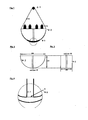
- FIGS. 1 to 4 The measuring device for determining acquisition time and liquid distribution of the core is in the FIGS. 1 to 4 shown schematically.
- Fig. 1 shows a lateral section through the measuring device, being held on a formed as a laboratory rod suspension 1 over a 200mm wide about 1mm thick, non-elastic and smooth plastic film 6 a transparent Plexiglas educated a buttocks of a sanitary article carrier imitated in principle 2 use.
- the insert 2 is essentially a half round with a smooth surface having in its center a channel 7 which, as in FIG FIG. 4 shown as a section through a sieve 4 at its lower opening.
- the core 3 is placed with its resulting from the mid-point under the lower opening of the channel 7.
- FIGS. 2 and 3 indicate the dimensions of the measuring device from front view and side view in mm.
- the core in a size of 300mm length x 120mm width was weighed, placed in the body-formed test apparatus and charged with 9 kg. Thereafter, three times 60 g of a 0.9% aqueous saline solution containing 5 ml / l of acid fuchsin stock solution (in 11% of a 0.9% saline solution, 10.0 g of acid fuchsin were added and the pH of the solution was reduced by addition of 0, 3% aqueous NaOH adjusted to 6.0) was introduced through the opening of the test apparatus by means of a measuring cylinder at a time interval of 20 minutes. By means of a stopwatch, the soaking time from the start of the addition to the complete infiltration of the test liquid can be measured. Each addition of fluid is followed by a waiting period of 20 minutes. Then the weights are removed. The liquid distribution was determined after each of the above-mentioned 20 minutes. For this purpose, the propagation of the liquid was measured in the length of the core.
- Sample a was dried at 150 ° C for 120 minutes.
- the dried polymer was roughly crushed, ground and sieved to a powder having a particle size of 150 to 850 ⁇ m, and a sample b having an average particle size of ERTC 420.2-02 of 520 ⁇ m was obtained.
- the water content determined according to ERT 430.1-99 was 5%.
- sample c For postcrosslinking, 100 g of the powder of sample b obtained above were mixed with a solution of 1 g of 1,3-dioxalan-2-one, 3 g of water with vigorous stirring and then for 30 minutes in an oven which had been heated to 180 ° C. heated.
- the sample c thus obtained had an average particle size according to ERT 420.2-02 of 525 ⁇ m.
- the water content determined in sample c according to ERT 430.1-99 was 4.5%.
- sample a 100 dry parts by weight of sample a were initially charged and mixed with the amount indicated in Table 1 (based on the dry parts by weight) of odor binder. Subsequently, the mixture was homogenized by wolves and dried at 150 ° C for 120 minutes. The dried polymer was roughly crushed, ground and sieved to a powder having a particle size of 150 to 850 ⁇ m, and a sample b having an average particle size to ERT 420.2-02 of 515 ⁇ m. The water content determined according to ERT 430.1-99 was 5.5%.
- the cores were prepared by means of a mixture of 48.6% by weight of a superabsorbent composition referred to in the table 3 and described hereinabove with respect to the core, and 48.6% by weight of Stora Fluff EF semitreated cellulose fibers from Stora-Enzo AB Sweden, as well as 2.8 wt .-% of a two-component fiber of 50 wt .-% polypropylene (PP) or polyethylene (PE) with PP core and PE jacket of the company Fibervision A / S Denmark by an airlaid method with an M & J -Machine (width 40cm, working width 36cm, operating settings: belt speed 3 m / min, Fluffeinzug to hammer mill 3.1 m / min, polymer dosing 380 g / min, two-component fiber in 10g portions about 1 times / min dropped) formed, the absorbent Polymer was registered homogeneously.
- PP polypropylene
- PE polyethylene
- sample b was repeated except for the milling and desilvering step on a scale of 5 kg.
- the product thus obtained was ground in a centrifugal mill from Retsch type ZM100 and a first fraction F1 with a particle size of less than 150 microns and a second fraction F2 with a particle size of 150 to 850 microns with an average particle size according to ERT 420.2-02 of 521 .mu.m sieved with an analysis sieve from Retsch type AS200 control 'g'.
- the template was purged with nitrogen for 1 h and added at 25 ° C in the above order, the ingredients of the initiator, so that after 5 minutes, a reaction temperature of 90 ° C was reached and maintained for 30 minutes before the post-catalysis was added and again for 1 Stirring was stirred, after which the batch was cooled to 50 ° C.
- the resulting mixture was dried in a convection oven at 180 ° C for 30 minutes and ground in a centrifugal mill Retsch type ZM100 and a fraction having a particle size of 150 to 850 microns with a mean particle size according to ERT 420.2-02 of 522nd ⁇ m sieved with an analysis sieve from Retsch type AS200 control 'g' as agglomerate.
- sample g For postcrosslinking, 100 g of the agglomerate obtained above were mixed with vigorous stirring with a solution of 1 g of 1,3-dioxalan-2-one and 3 g of water and then heated for 30 minutes in an oven, which was heated to 180 ° C.
- the sample g thus obtained had an average particle size according to ERT 420.2-02 of 524 ⁇ m.
- the water content determined in sample g according to ERT 430.1-99 was 4.4%.
- Example 9 was followed with the difference that the aqueous binder phase before the addition of the binder to the mixture, based on the mixture of 1% zinc prinolate as Tegosorb ® A30 was mixed.
- the sample h thus obtained had an average particle size of ERT 420.2-02 of 523 ⁇ m.
- the water content determined in sample h according to ERT 430.1-99 was 4.5%.
Landscapes
- Chemical & Material Sciences (AREA)
- Analytical Chemistry (AREA)
- Organic Chemistry (AREA)
- Chemical Kinetics & Catalysis (AREA)
- Health & Medical Sciences (AREA)
- Dispersion Chemistry (AREA)
- Epidemiology (AREA)
- Materials Engineering (AREA)
- Engineering & Computer Science (AREA)
- Life Sciences & Earth Sciences (AREA)
- Animal Behavior & Ethology (AREA)
- General Health & Medical Sciences (AREA)
- Public Health (AREA)
- Veterinary Medicine (AREA)
- Hematology (AREA)
- Absorbent Articles And Supports Therefor (AREA)
- Solid-Sorbent Or Filter-Aiding Compositions (AREA)
- Compositions Of Macromolecular Compounds (AREA)
- Cosmetics (AREA)
Claims (31)
- Composition superabsorbante absorbant les odeurs, comportanti. une structure polymère absorbant l'eau, la structure polymère absorbant l'eau, qui est utilisée, étant constituée de(α1) 20-99,999 % en poids, de préférence 55-98,99 % en poids et de façon particulièrement préférée 70-98,79 % en poids de monomères à insaturation éthylénique portant des groupes acides ou de leurs sels, polymérisés, ou de monomères à insaturation éthylénique comportant un atome d'azote protoné ou rendu quaternaire, polymérisés, ou de mélanges de ceux-ci, les mélanges comportant au moins des monomères à insaturation éthylénique portant des groupes acide, l'acide acrylique de préférence, étant particulièrement préférés,(α2) 0-80 % en poids, de préférence 0-44,99 % en poids et de façon particulièrement préférée 0,1-44,89 % en poids de monomères à insaturation monoéthylénique, copolymérisables avec (α1), polymérisés,(α3) 0,001-5 % en poids, de préférence 0,01-3 % en poids et de façon particulièrement préférée 0,01-2,5 % en poids d'un ou plusieurs agents de réticulation,(α4) 0 à 5 % en poids, de préférence 0,001 à 2,5 % en poids et de façon tout particulièrement préférée 0,01 à 1 % en poids du sel métallique, (α5) 0 à 5 % en poids, de préférence 0,01 à 2,5 % en poids et de façon tout particulièrement préférée 0,1 à 1 % en poids de l'oxyde du métal, (α6) 0 à 30 % en poids, de préférence 0 à 5 % en poids et de façon particulièrement préférée 0,1-5 % en poids d'un polymère hydrosoluble,(α7) 0 à 20 % en poids, de préférence 2,5 à 15 % en poids et de façon particulièrement préférée 3 à 10 % en poids d'eau, ainsi que(α8) 0 à 20 % en poids, de préférence 0 à 10 % en poids et de façon particulièrement préférée 0,1 à 8 % en poids d'un ou plusieurs adjuvants, la somme des quantités en poids de (α1) à (α8) étant égale à 100 % en poids ;ii. un capteur d'odeurs, comportant comme composantsb1. un acide aminé ; etb2. un composé de formule générale Ioù
 R1 représente un hydrocarbure en C1-C20 ;X est absent ou représente un système de double(s) liaison(s) comportant dans une plage de 1 à 5 doubles liaisons, dans le cas d'au moins 2 doubles liaisons de préférence conjugué ;M représente un métal chargé ou non chargé ;m a une valeur dans une plage de 1 à 15 ;n a une valeur dans une plage de 1 à 5 ;o a une valeur dans une plage de 1 à 4,pouvant être obtenue par mise en contact de la surface de la structure polymère absorbant l'eau avec le capteur d'odeurs.
- Composition selon la revendication 1, dans laquelle le métal M est choisi dans le groupe constitué par des métaux monovalents, divalents ou trivalents.
- Composition selon l'une quelconque des revendications précédentes, dans laquelle le composant b2 est un sel métallique de l'acide ricinoléique.
- Composition selon l'une quelconque des revendications précédentes, dans laquelle le composant b2 est le sel de Zn de l'acide ricinoléique.
- Composition selon l'une quelconque des revendications précédentes, dans laquelle la structure polymère absorbant l'eau est à base de moins de 40 % en poids, par rapport à la structure polymère absorbant l'eau, de particules de superabsorbant ayant une taille de particule de moins de 150 µm, déterminée selon ERT 420.1-99.
- Composition selon l'une quelconque des revendications précédentes, dans laquelle la structure polymère absorbant l'eau est à base d'au moins 60 % en poids, par rapport à la structure polymère absorbant l'eau, de particules ayant une taille de particule dans une plage de 150 à 850 µm, déterminée selon ERT 420.1-99.
- Composition selon l'une quelconque des revendications précédentes, celle-ci étant à base de moins de 20 % en poids, par rapport à la composition, d'un polymère réticulable, non réticulé.
- Composition selon l'une quelconque des revendications précédentes, dans laquelle la structure polymère comporte- une zone interne, ainsi- qu'une zone externe entourant la zone interne et dans laquelle la zone externe présente un plus haut degré de réticulation que la zone interne.
- Composition selon la revendication 8, dans laquelle la concentration du capteur d'odeurs dans ou sur la zone externe est supérieures à la concentration du capteur d'odeurs dans la zone interne.
- Composition selon l'une quelconque des revendications précédentes, dans laquelle la structure polymère comporte- une zone interne, ainsi- qu'une zone externe entourant la zone interne et dans laquelle la concentration du capteur d'odeurs dans ou sur la zone externe est supérieure à la concentration du capteur d'odeurs dans la zone interne.
- Composition selon l'une quelconque des revendications précédentes, dans laquelle la structure polymère absorbant l'eau est réticulée en surface avec un composé différent du composé b1.
- Composition selon l'une quelconque des revendications précédentes, dans laquelle l'acide aminé est une acide α-, β- ou γ-aminé.
- Composition selon l'une quelconque des revendications précédentes, dans laquelle l'acide aminé est la cystéine.
- Composition selon l'une quelconque des revendications précédentes, en outre comportant iii. un liant polymère différent de la structure polymère absorbant l'eau.
- Composition selon la revendication 14, dans laquelle le liant polymère comporte deux ou plus de deux groupes OH.
- Procédé pour la préparation d'une composition superabsorbante, comportant les étapes de processus :I. fourniture d'une structure polymère absorbant l'eau, la structure polymère absorbant l'eau qui est utilisée étant constituée de(α1) 20-99,999 % en poids, de préférence 55-98,99 % en poids et de façon particulièrement préférée 70-98,79 % en poids de monomères à insaturation éthylénique portant des groupes acides ou de leurs sels, polymérisés, ou de monomères à insaturation éthylénique comportant un atome d'azote protoné ou rendu quaternaire, polymérisés, ou de mélanges de ceux-ci, des mélanges comportant au moins des monomères à insaturation éthylénique portant des groupes acide, l'acide acrylique de préférence, étant particulièrement préférés,(α2) 0-80 % en poids, de préférence 0-44,99 % en poids et de façon particulièrement préférée 0,1-44,89 % en poids de monomères à insaturation monoéthylénique, copolymérisables avec (α1), polymérisés,(α3) 0,001-5 % en poids, de préférence 0,01-3 % en poids et de façon particulièrement préférée 0,01-2,5 % en poids d'un ou plusieurs agents de réticulation,(α4) 0 à 5 % en poids, de préférence 0,001 à 2,5 % en poids et de façon tout particulièrement préférée 0,01 à 1 % en poids du sel métallique,(α5) 0 à 5 % en poids, de préférence 0,01 à 2,5 % en poids et de façon tout particulièrement préférée 0,1 à 1 % en poids de l'oxyde du métal,(α6) 0 à 30 % en poids, de préférence 0 à 5 % en poids et de façon particulièrement préférée 0,1-5 % en poids d'un polymère hydrosoluble,(α7) 0 à 20 % en poids, de préférence 2,5 à 15 % en poids et de façon particulièrement préférée 3 à 10 % en poids d'eau, ainsi que(α8) 0 à 20 % en poids, de préférence 0 à 10 % en poids et de façon particulièrement préférée 0,1 à 8 % en poids d'un ou plusieurs adjuvants, la somme des quantités en poids de (α1) à (α8) étant égale à 100 % en poids ;II. mise en contact de la surface de la structure polymère absorbant l'eau avec un capteur d'odeurs, comportant comme composantsB1. un acide aminé ; etB2. un composé de formule générale Ioù
 R1 représente un hydrocarbure en C1-C20 ;X est absent ou représente un système de double(s) liaison(s) comportant dans une plage de 1 à 5 doubles liaisons, dans le cas d'au moins 2 doubles liaisons de préférence conjugué ;M représente un métal chargé ou non chargé ;m a une valeur dans une plage de 1 à 15 ;n a une valeur dans une plage de 1 à 5 ;o a une valeur dans une plage de 1 à 4.
- Procédé selon la revendication 16, dans lequel le métal M est choisi dans le groupe constitué par des métaux monovalents, divalents ou trivalents.
- Procédé selon la revendication 16 ou 17, dans lequel le composant B2 est un sel métallique de l'acide ricinoléique.
- Procédé selon l'une quelconque des revendications 16 à 18, dans lequel le composant B2 est un sel de Zn de l'acide ricinoléique.
- Procédé selon l'une quelconque des revendications 16 à 19, dans lequel la structure polymère absorbant l'eau est présente sous forme d'hydrogel.
- Procédé selon l'une quelconque des revendications 16 à 20, dans lequel la structure polymère absorbant l'eau a une teneur en eau de moins de 10 % en poids, par rapport à la structure polymère absorbant l'eau.
- Procédé selon l'une quelconque des revendications 16 à 21, dans lequel la mise en contact s'effectue de surcroît en présence d'un liant polymère III.
- Procédé selon l'une quelconque des revendications 16 à 22, dans lequel avant la mise en contact on soumet à une réticulation superficielle la structure polymère absorbant l'eau.
- Procédé selon l'une quelconque des revendications 16 à 23, dans lequel la structure polymère absorbant l'eau est à base de moins de 40 % en poids, par rapport à la structure polymère absorbant l'eau, de particules de superabsorbant ayant une taille de particule de moins de 150 µm, déterminée selon ERT 420.1-99.
- Procédé selon l'une quelconque des revendications 16 à 24, dans lequel la structure polymère absorbant l'eau comporte au moins 60 % en poids, par rapport à la structure polymère absorbant l'eau, de particules ayant une taille de particule dans une plage de 150 à 850 µm, déterminée selon ERT 420.1-99.
- Procédé selon l'une quelconque des revendications 16 à 25, dans lequel on utilise comme liant moins de 20 % en poids, par rapport à la composition, d'un polymère réticulable, non réticulé.
- Composite, comportant une composition superabsorbante selon l'une quelconque des revendications 1 à 15 ou pouvant être obtenue conformément à un procédé selon l'une quelconque des revendications 16 à 26 et un support.
- Composite selon la revendication 27, conçu en tant qu'âme d'article d'hygiène, comportant, chaque fois par rapport à l'âme de l'article d'hygiène, au moins 30 % en poids de la composition superabsorbante selon l'une quelconque des revendications 1 à 15 ou pouvant être obtenue conformément à un procédé selon l'une quelconque des revendications 16 à 26 et au moins 1 % en poids du support.
- Article d'hygiène, comportant une couche supérieure perméable aux liquides, une couche inférieure imperméable aux liquides et un composite selon la revendication 27 ou 28, disposé entre la couche supérieure et la couche inférieure.
- Mousses, corps moulés, fibres, feuilles, films, câbles, matériaux d'étanchéité, articles d'hygiène absorbant les liquides, supports pour agents régulateurs de croissance de plantes et de champignons, matériaux d'emballage, additifs pour sols ou matériaux de construction, comportant une composition superabsorbante selon l'une quelconque des revendications 1 à 15 ou pouvant être obtenue conformément à un procédé selon l'une quelconque des revendications 16 à 26 ou un composite selon la revendication 27 ou 28.
- Utilisation d'une composition superabsorbante selon l'une quelconque des revendications 1 à 15 ou pouvant être obtenue conformément à un procédé selon l'une quelconque des revendications 16 à 26 ou d'un composite selon la revendication 27 ou 28, dans des mousses, corps moulés, fibres, feuilles, films, câbles, matériaux d'étanchéité, articles d'hygiène absorbant les liquides, supports pour agents régulateurs de croissance de plantes et de champignons, matériaux d'emballage, additifs pour sols, pour la libération programmée de substances actives ou dans des matériaux de construction.
Applications Claiming Priority (2)
| Application Number | Priority Date | Filing Date | Title |
|---|---|---|---|
| DE102005055497A DE102005055497A1 (de) | 2005-11-18 | 2005-11-18 | Geruchsbindende superabsorbierende Zusammensetzung |
| PCT/EP2006/011055 WO2007057203A2 (fr) | 2005-11-18 | 2006-11-17 | Composition superabsorbante retenant les odeurs |
Publications (2)
| Publication Number | Publication Date |
|---|---|
| EP1957193A2 EP1957193A2 (fr) | 2008-08-20 |
| EP1957193B1 true EP1957193B1 (fr) | 2012-10-03 |
Family
ID=37875955
Family Applications (1)
| Application Number | Title | Priority Date | Filing Date |
|---|---|---|---|
| EP06818628A Not-in-force EP1957193B1 (fr) | 2005-11-18 | 2006-11-17 | Composition superabsorbante retenant les odeurs |
Country Status (8)
| Country | Link |
|---|---|
| US (1) | US8653320B2 (fr) |
| EP (1) | EP1957193B1 (fr) |
| JP (2) | JP2009515691A (fr) |
| KR (1) | KR101407781B1 (fr) |
| CN (1) | CN101036801B (fr) |
| DE (1) | DE102005055497A1 (fr) |
| TW (1) | TWI402305B (fr) |
| WO (1) | WO2007057203A2 (fr) |
Families Citing this family (36)
| Publication number | Priority date | Publication date | Assignee | Title |
|---|---|---|---|---|
| TWI529181B (zh) * | 2005-02-28 | 2016-04-11 | 贏創德固賽有限責任公司 | 以可更新原料為基之吸水聚合物結構及其生產的方法 |
| DE102005055497A1 (de) | 2005-11-18 | 2007-05-31 | Stockhausen Gmbh | Geruchsbindende superabsorbierende Zusammensetzung |
| KR20140095569A (ko) * | 2006-02-28 | 2014-08-01 | 에보니크 데구사 게엠베하 | 우수한 흡수성과 보유성을 지니는 생분해성 초흡수성 중합체 조성물 |
| BRPI0711452B8 (pt) | 2006-04-21 | 2021-06-22 | Evonik Degussa Gmbh | processo para a preparação de uma estrutura polimérica absorvente de água, estrutura polimérica absorvente de água, compósito, processo para a preparação de um compósito, uso da estrutura polimérica absorvente de água ou uso do compósito e uso de um sal |
| DE102006039205A1 (de) * | 2006-08-22 | 2008-03-20 | Stockhausen Gmbh | Auf nachwachsenden Rohstoffen basierende Acrylsäure und wasserabsorbierende Polymergebilde sowie Verfahren zu deren Herstellung mittels Dehydratisierung |
| DE102007007203A1 (de) * | 2007-02-09 | 2008-08-14 | Evonik Stockhausen Gmbh | Wasserabsorbierendes Polymergebilde mit hoher Ammoniak-Bindekapazität |
| US7816426B2 (en) | 2007-07-16 | 2010-10-19 | Evonik Stockhausen, Llc | Superabsorbent polymer compositions having color stability |
| DE102007045724B4 (de) | 2007-09-24 | 2012-01-26 | Evonik Stockhausen Gmbh | Superabsorbierende Zusammensetzung mit Tanninen zur Geruchskontrolle, Verfahren zu deren Herstellung und Verwendung |
| TWI455973B (zh) * | 2008-03-05 | 2014-10-11 | 贏創德固賽有限責任公司 | 用於氣味控制的具有水楊酸鋅的超吸收性組合物 |
| JP6141020B2 (ja) * | 2010-01-27 | 2017-06-07 | ビーエーエスエフ ソシエタス・ヨーロピアBasf Se | 臭気抑制吸水性複合材 |
| EP2371869A1 (fr) | 2010-03-30 | 2011-10-05 | Evonik Stockhausen GmbH | Procédé pour la production d'un polymère super-absorbant |
| EP2438983A1 (fr) * | 2010-10-08 | 2012-04-11 | SAES GETTERS S.p.A. | Composition de précurseur polymérique pouvant être distribué pour des matériaux sorbés composites transparents |
| KR101290740B1 (ko) * | 2010-11-22 | 2013-07-29 | 주식회사 엘지화학 | 고흡수성 수지의 제조 방법 |
| DE102011086516A1 (de) | 2011-11-17 | 2013-05-23 | Evonik Degussa Gmbh | Superabsorbierende Polymere mit schnellen Absorptionseigenschaften sowieVerfahren zu dessen Herstellung |
| KR101797832B1 (ko) * | 2012-10-24 | 2017-12-12 | 에보니크 데구사 게엠베하 | 냄새- 및 색상-안정성 수-흡수성 조성물 |
| DE102013203781A1 (de) * | 2013-03-06 | 2014-09-11 | Evonik Industries Ag | Superabsorbierende Polymere mit verbesserten Eigenschaften, insbesondere Geruchskontrolle und Farbbeständigkeit, sowie Verfahren zu dessen Herstellung |
| DE102013203779A1 (de) | 2013-03-06 | 2014-09-11 | Evonik Industries Ag | Superabsorbierende Polymere mit verbesserter Geruchskontrolleigenschaft sowie Verfahren zu dessen Herstellung |
| US9302248B2 (en) | 2013-04-10 | 2016-04-05 | Evonik Corporation | Particulate superabsorbent polymer composition having improved stability |
| KR102091024B1 (ko) * | 2013-11-25 | 2020-03-19 | 주식회사 엘지생활건강 | 경혈취 탈취용 조성물 |
| JP6154412B2 (ja) | 2014-03-05 | 2017-06-28 | エボニック デグサ ゲーエムベーハーEvonik Degussa GmbH | 改善された臭気抑制性能を有する超吸収性ポリマー及びその製造方法 |
| CN106460027B (zh) * | 2014-03-24 | 2020-07-31 | 日东纺绩株式会社 | 使用阳离子性接枝聚合物的目标物分离浓缩方法 |
| CN109153789A (zh) | 2015-02-28 | 2019-01-04 | 赢创德固赛有限公司 | Oem纺织品整理组合物 |
| RU2725588C2 (ru) * | 2015-12-03 | 2020-07-02 | Криовак, Инк. | Многослойные упаковочные пленки с нейтрализацией запаха и изготовленные из них упаковки |
| CN106620780B (zh) * | 2016-11-17 | 2019-05-17 | 深圳市爱康泉水处理服务有限公司 | 除臭组合物及其应用 |
| WO2018117388A1 (fr) | 2016-12-23 | 2018-06-28 | 주식회사 엘지화학 | Procédé d'évaluation de la capacité de désodorisation d'un polymère superabsorbant et d'un produit le comprenant |
| GB2605049B (en) | 2019-10-23 | 2023-09-06 | Kimberly Clark Co | Superabsorbent material absorbent capacity increase with use of selected salts |
| CN120501914A (zh) | 2019-10-23 | 2025-08-19 | 金伯利-克拉克环球有限公司 | 使用多功能化学剂增加超吸收材料吸收容量 |
| EP4105242A4 (fr) * | 2020-02-14 | 2024-07-10 | Nippon Shokubai Co., Ltd. | Résine hydroabsorbante et son procédé de fabrication |
| CN116940627A (zh) * | 2021-12-20 | 2023-10-24 | 株式会社Lg化学 | 超吸收性聚合物的组合物及其制备方法 |
| EP4293075A4 (fr) * | 2021-12-20 | 2024-09-04 | LG Chem, Ltd. | Composition de polymère superabsorbant et son procédé de préparation |
| US12233400B2 (en) | 2022-02-28 | 2025-02-25 | Kimberly-Clark Worldwide, Inc. | High-capacity superabsorbent materials and methods of making same |
| AU2022442262A1 (en) | 2022-02-28 | 2024-10-03 | Kimberly-Clark Worldwide, Inc. | High-capacity superabsorbent materials and methods of making same |
| US20260021470A1 (en) * | 2022-03-29 | 2026-01-22 | Lg Chem, Ltd. | Composition of Super Absorbent Polymer and Preparation Method Thereof |
| JP2026507987A (ja) * | 2023-02-14 | 2026-03-09 | エルジー・ケム・リミテッド | 高吸水性樹脂およびその製造方法 |
| CN116585100B (zh) * | 2023-05-25 | 2025-08-05 | 泉州市嘉华卫生用品有限公司 | 一种去味成人纸尿裤的制备方法 |
| JP2025542438A (ja) * | 2023-06-07 | 2025-12-25 | エルジー・ケム・リミテッド | 高吸水性樹脂組成物およびその製造方法 |
Family Cites Families (79)
| Publication number | Priority date | Publication date | Assignee | Title |
|---|---|---|---|---|
| AT288606B (de) * | 1968-07-19 | 1971-03-10 | Grillo Werke Ag | Mittel mit geruchsbindender und gegebenenfalls fungizider Wirkung |
| US4172123A (en) * | 1968-07-19 | 1979-10-23 | Grillo-Werke Aktiengesellschaft | Deodorants for both cosmetic and commercial use |
| JPS51125468A (en) | 1975-03-27 | 1976-11-01 | Sanyo Chem Ind Ltd | Method of preparing resins of high water absorbency |
| DE2706135C2 (de) | 1977-02-14 | 1982-10-28 | Chemische Fabrik Stockhausen GmbH, 4150 Krefeld | Verdickungsmittel für ausgeschiedenen Darminhalt und Harn |
| US4131576A (en) | 1977-12-15 | 1978-12-26 | National Starch And Chemical Corporation | Process for the preparation of graft copolymers of a water soluble monomer and polysaccharide employing a two-phase reaction system |
| US4286082A (en) | 1979-04-06 | 1981-08-25 | Nippon Shokubai Kagaku Kogyo & Co., Ltd. | Absorbent resin composition and process for producing same |
| JPS6025045B2 (ja) | 1980-03-19 | 1985-06-15 | 製鉄化学工業株式会社 | 塩水吸収能のすぐれたアクリル酸重合体の製造方法 |
| JPS60158861A (ja) | 1984-01-31 | 1985-08-20 | 株式会社日本触媒 | 吸水剤 |
| JPS60163956A (ja) | 1984-02-04 | 1985-08-26 | Arakawa Chem Ind Co Ltd | 吸水性樹脂の製法 |
| DE3544770A1 (de) | 1985-12-18 | 1987-06-19 | Stockhausen Chem Fab Gmbh | Verfahren und vorrichtung zum kontinuierlichen herstellen von polymerisaten und copolymerisaten der acrylsaeure und/oder methacrylsaeure |
| DE3713601A1 (de) | 1987-04-23 | 1988-11-10 | Stockhausen Chem Fab Gmbh | Verfahren zur herstellung eines stark wasserabsorbierenden polymerisats |
| US4766173A (en) | 1987-05-11 | 1988-08-23 | Nalco Chemical Company | Method for reducing residual acrylic acid in acrylic acid polymer gels |
| US5045322A (en) | 1988-05-09 | 1991-09-03 | Dow Corning Corporation | Antimicrobial superabsorbent sanitary napkin |
| JPH0395112A (ja) * | 1989-09-08 | 1991-04-19 | Seiwa Kasei:Kk | 脱臭剤組成物 |
| DE4020780C1 (fr) | 1990-06-29 | 1991-08-29 | Chemische Fabrik Stockhausen Gmbh, 4150 Krefeld, De | |
| EP0532002B1 (fr) | 1991-09-11 | 1997-05-14 | Kimberly-Clark Corporation | Composites absorbants et articles absorbants les contenant |
| US5807364A (en) * | 1992-08-17 | 1998-09-15 | Weyerhaeuser Company | Binder treated fibrous webs and products |
| DE4244548C2 (de) | 1992-12-30 | 1997-10-02 | Stockhausen Chem Fab Gmbh | Pulverförmige, unter Belastung wäßrige Flüssigkeiten sowie Blut absorbierende Polymere, Verfahren zu ihrer Herstellung und ihre Verwendung in textilen Konstruktionen für die Körperhygiene |
| JPH06313044A (ja) * | 1993-04-30 | 1994-11-08 | Kao Corp | 高吸水性樹脂の製造法 |
| DE4418818C2 (de) | 1993-07-09 | 1997-08-21 | Stockhausen Chem Fab Gmbh | Pulverförmige, vernetzte, wäßrige Flüssigkeiten und/oder Körperflüssigkeiten absorbierende Polymere, Verfahren zu ihrer Herstellung und ihre Anwendung |
| IL110134A (en) | 1993-07-09 | 1998-07-15 | Stockhausen Chem Fab Gmbh | Polymers capable of absorbing aqueous liquids and body fluids their preparation and use |
| DE4333056C2 (de) | 1993-09-29 | 1998-07-02 | Stockhausen Chem Fab Gmbh | Pulverförmige, wäßrige Flüssigkeiten absorbierende Polymere, Verfahren zu ihrer Herstellung und ihre Verwendung als Absorptionsmittel |
| US5849816A (en) * | 1994-08-01 | 1998-12-15 | Leonard Pearlstein | Method of making high performance superabsorbent material |
| WO1996005234A1 (fr) | 1994-08-12 | 1996-02-22 | Kao Corporation | Procede d'elaboration d'un polymere super absorbant ameliore |
| JPH08140592A (ja) * | 1994-11-25 | 1996-06-04 | Okawa Shokuhin Kogyo Kk | 脱臭方法ならびに機能性食品素材またはその組成物および機能性食品 |
| DE19518645C1 (de) | 1995-05-20 | 1996-09-19 | Stockhausen Chem Fab Gmbh | Vorrichtung und Verfahren zur Grobzerkleinerung von wasserhaltigen Polymerisatgelen |
| DE19529348C2 (de) | 1995-08-09 | 1997-11-20 | Stockhausen Chem Fab Gmbh | Absorptionsmittel für Wasser und wäßrige Flüssigkeiten auf Polyacrylatbasis sowie Verfahren zu ihrer Herstellung und Verwendung |
| SG86324A1 (en) | 1997-07-03 | 2002-02-19 | Kao Corp | Superabsorbent resin composition |
| JP2002500247A (ja) | 1998-01-07 | 2002-01-08 | ザ、プロクター、エンド、ギャンブル、カンパニー | 圧力を掛けられた状態で大きな収着能力を有する吸収性ポリマー組成物 |
| DE19825486C2 (de) | 1998-06-08 | 2000-07-06 | Stockhausen Chem Fab Gmbh | Wasserabsorbierende Polymere mit supramolekularen Hohlraummolekülen, Verfahren zu deren Herstellung und deren Verwendung |
| DE19909653A1 (de) | 1999-03-05 | 2000-09-07 | Stockhausen Chem Fab Gmbh | Pulverförmige, vernetzte, wässrige Flüssigkeiten sowie Blut absorbierende Polymere, Verfahren zu ihrer Herstellung und ihre Verwendung |
| DE19909838A1 (de) | 1999-03-05 | 2000-09-07 | Stockhausen Chem Fab Gmbh | Pulverförmige, vernetzte, wässrige Flüssigkeiten sowie Blut absorbierende Polymere, Verfahren zu ihrer Herstellung und ihre Verwendung |
| KR100333972B1 (ko) * | 1999-05-24 | 2002-04-24 | 송성원 | 흡수성 수지조성물 및 그의 제조방법 |
| DE60016235T2 (de) * | 1999-08-16 | 2005-12-22 | PQ Holding, Inc., Wilmington | Adsorptionsmittel von schwefelverbindungen zur verminderung des geruchs von zwiebeln oder knoblauch im atem |
| DE19939662A1 (de) | 1999-08-20 | 2001-02-22 | Stockhausen Chem Fab Gmbh | Wasserabsorbierende Polymere mit Hohlraumverbindungen, Verfahren zur deren Herstellung und deren Verwendung |
| US6492574B1 (en) * | 1999-10-01 | 2002-12-10 | Kimberly-Clark Worldwide, Inc. | Center-fill absorbent article with a wicking barrier and central rising member |
| NL1013394C2 (nl) | 1999-10-26 | 2001-05-01 | Dsm Nv | Werkwijze voor de bereiding van ureum. |
| US6469080B2 (en) * | 1999-12-15 | 2002-10-22 | Nippon Shokubai Co., Ltd. | Water-absorbent resin composition |
| US20020013300A1 (en) | 2000-03-17 | 2002-01-31 | Avocet Polymer Technologies, Inc. | Methods for improving size and appearance of a wound |
| DE10014529A1 (de) * | 2000-03-23 | 2001-09-27 | Cognis Deutschland Gmbh | Desodorierende Zubereitungen mit nanoskaligen Chitosanen und/oder Chitosanderivaten |
| DE10043710B4 (de) | 2000-09-04 | 2015-01-15 | Evonik Degussa Gmbh | Verwendung pulverförmiger an der Oberfläche nachvernetzter Polymerisate und Hygieneartikel |
| DE10043706A1 (de) | 2000-09-04 | 2002-04-25 | Stockhausen Chem Fab Gmbh | Pulverförmige, vernetzte, wässrige Flüssigkeiten sowie Blut absorbierende Polymere, Verfahren zu ihrer Herstellung und ihre Verwendung |
| US20030220211A1 (en) * | 2000-12-15 | 2003-11-27 | The Procter & Gamble Company | Methods, compositions, and articles for control of malodor produced by urea-containing body fluids |
| US20020115971A1 (en) | 2000-12-20 | 2002-08-22 | Holmes Lori Tassone | Thin, high capacity multi-layer absorbent core |
| BR0211309A (pt) * | 2001-06-29 | 2004-09-28 | Dow Global Technologies Inc | Polìmeros superabsorventes contendo carboxila com propriedades de controle de odor e método para preparação |
| JP2003019188A (ja) * | 2001-07-09 | 2003-01-21 | Takeda-Kirin Foods Corp | 消臭剤 |
| EP1434606B1 (fr) | 2001-10-01 | 2005-12-21 | Basf Aktiengesellschaft | Hydrogels a centres acides, a haute capacite de gonflement |
| DE10160933B4 (de) * | 2001-12-12 | 2018-06-21 | Evonik Degussa Gmbh | Zubereitungen mit desodorierender Wirkung, enthaltend das Zinksalz der Ricinolsäure und mindestens eine aminofunktionelle Aminosäure |
| WO2003053487A1 (fr) * | 2001-12-20 | 2003-07-03 | Basf Aktiengesellschaft | Article absorbant |
| DE10218147B4 (de) | 2002-04-23 | 2005-12-22 | Stockhausen Gmbh | Wasserabsorbierende, die Zersetzung von Körperflüssigkeiten verzögernde Polymerteilchen, deren Herstellung und Verwendung |
| EP1358894A1 (fr) * | 2002-05-03 | 2003-11-05 | SCA Hygiene Products AB | Article absorbant avec une structure absorbante pour améliorer les odeurs |
| US8053626B2 (en) | 2002-06-12 | 2011-11-08 | Sca Hygiene Products Ab | Absorbent article containing a skincare composition and method of making and using same |
| JP3926224B2 (ja) * | 2002-07-02 | 2007-06-06 | 花王株式会社 | 消臭剤 |
| US20050209183A1 (en) * | 2002-07-25 | 2005-09-22 | Phenion Gmbh & Co. Kg | Cosmetic or pharmaceutical preparations comprising nucleic acids based on non-methylated CPG motifs |
| DE10249822A1 (de) | 2002-10-25 | 2004-05-13 | Stockhausen Gmbh & Co. Kg | Zweistufiges Mischverfahren zur Herstellung eines absorbierenden Polymers |
| AU2003296558A1 (en) | 2002-10-25 | 2004-05-13 | Stockhausen Gmbh | Absorbent polymer structure provided with an improved retention capacity and permeability |
| DE10334271B4 (de) * | 2003-07-25 | 2006-02-23 | Stockhausen Gmbh | Verfahren zur Agglomeration von Superabsorberfeinteilchen, daraus erhältliche Superabsorberpartikel, deren Verwendung sowie diese beinhaltende Verbunde |
| DE10334286B4 (de) | 2003-07-25 | 2006-01-05 | Stockhausen Gmbh | Pulverförmige,wasserabsorbierende Polymere mit mittels thermoplastischen Klebstoffen gebundenen Feinteilchen, Verfahren zu deren Herstellung sowie diese beinhaltende chemische Produkte und Verbunde |
| US7291674B2 (en) * | 2003-10-28 | 2007-11-06 | Stockhausen, Inc. | Superabsorbent polymer |
| DE102004028002A1 (de) | 2004-06-09 | 2006-01-05 | Stockhausen Gmbh | Verfahren zur Herstellung von hydrophilen Polymeren unter Verwendung eines rechnererzeugten Modells |
| US20060029567A1 (en) | 2004-08-04 | 2006-02-09 | Bki Holding Corporation | Material for odor control |
| TWI529181B (zh) | 2005-02-28 | 2016-04-11 | 贏創德固賽有限責任公司 | 以可更新原料為基之吸水聚合物結構及其生產的方法 |
| TWI438187B (zh) | 2005-02-28 | 2014-05-21 | 贏創德固賽有限責任公司 | 丙烯酸和基於可再生原料之吸水聚合物結構及二者之製備方法 |
| DE102005010198A1 (de) | 2005-03-05 | 2006-09-07 | Degussa Ag | Hydrolysestabile, nachvernetzte Superabsorber |
| DE102005018922A1 (de) | 2005-04-22 | 2006-10-26 | Stockhausen Gmbh | Mit Polykationen oberflächenbehandeltes wasserabsorbierendes Polymergebilde |
| US8247499B2 (en) | 2005-04-22 | 2012-08-21 | Evonik Stockhausen Gmbh | Water-absorbing polymer structure with improved absorption properties |
| DE102005018924A1 (de) | 2005-04-22 | 2006-10-26 | Stockhausen Gmbh | Wasserabsorbierende Polymergebilde mit verbesserten Absorptionseigenschaften |
| WO2007057043A1 (fr) | 2005-11-18 | 2007-05-24 | Sca Hygiene Products Ab | Articles absorbants comprenant une substance superabsorbante acide et un sel organique de zinc |
| DE102005055497A1 (de) | 2005-11-18 | 2007-05-31 | Stockhausen Gmbh | Geruchsbindende superabsorbierende Zusammensetzung |
| KR20140095569A (ko) | 2006-02-28 | 2014-08-01 | 에보니크 데구사 게엠베하 | 우수한 흡수성과 보유성을 지니는 생분해성 초흡수성 중합체 조성물 |
| FR2902004A1 (fr) | 2006-04-14 | 2007-12-14 | Lvmh Rech | Composition cosmetique de type masque pour le soin de la peau |
| BRPI0711452B8 (pt) | 2006-04-21 | 2021-06-22 | Evonik Degussa Gmbh | processo para a preparação de uma estrutura polimérica absorvente de água, estrutura polimérica absorvente de água, compósito, processo para a preparação de um compósito, uso da estrutura polimérica absorvente de água ou uso do compósito e uso de um sal |
| DE102006019157A1 (de) * | 2006-04-21 | 2007-10-25 | Stockhausen Gmbh | Herstellung von hochpermeablen, superabsorbierenden Polymergebilden |
| DE102006039205A1 (de) | 2006-08-22 | 2008-03-20 | Stockhausen Gmbh | Auf nachwachsenden Rohstoffen basierende Acrylsäure und wasserabsorbierende Polymergebilde sowie Verfahren zu deren Herstellung mittels Dehydratisierung |
| DE102007007203A1 (de) | 2007-02-09 | 2008-08-14 | Evonik Stockhausen Gmbh | Wasserabsorbierendes Polymergebilde mit hoher Ammoniak-Bindekapazität |
| US8048942B2 (en) | 2008-10-08 | 2011-11-01 | Evonik Stockhausen Gmbh | Process for the production of a superabsorbent polymer |
| US8357766B2 (en) | 2008-10-08 | 2013-01-22 | Evonik Stockhausen Gmbh | Continuous process for the production of a superabsorbent polymer |
| US8063121B2 (en) | 2008-10-08 | 2011-11-22 | Evonik Stockhausen Gmbh | Process for the production of a superabsorbent polymer |
| CN102209510B (zh) | 2008-11-07 | 2014-03-19 | 巴斯夫欧洲公司 | 制备吸水性聚合物颗粒的方法 |
-
2005
- 2005-11-18 DE DE102005055497A patent/DE102005055497A1/de not_active Withdrawn
-
2006
- 2006-11-17 TW TW095142567A patent/TWI402305B/zh not_active IP Right Cessation
- 2006-11-17 WO PCT/EP2006/011055 patent/WO2007057203A2/fr not_active Ceased
- 2006-11-17 KR KR1020087014683A patent/KR101407781B1/ko not_active Expired - Fee Related
- 2006-11-17 JP JP2008540523A patent/JP2009515691A/ja active Pending
- 2006-11-17 US US12/093,548 patent/US8653320B2/en not_active Expired - Fee Related
- 2006-11-17 EP EP06818628A patent/EP1957193B1/fr not_active Not-in-force
- 2006-11-20 CN CN200610064232.9A patent/CN101036801B/zh not_active Expired - Fee Related
-
2013
- 2013-04-30 JP JP2013096038A patent/JP2013163818A/ja not_active Ceased
Also Published As
| Publication number | Publication date |
|---|---|
| DE102005055497A1 (de) | 2007-05-31 |
| JP2013163818A (ja) | 2013-08-22 |
| WO2007057203A3 (fr) | 2007-12-13 |
| CN101036801B (zh) | 2014-08-06 |
| EP1957193A2 (fr) | 2008-08-20 |
| TW200734393A (en) | 2007-09-16 |
| US20100035757A1 (en) | 2010-02-11 |
| US8653320B2 (en) | 2014-02-18 |
| CN101036801A (zh) | 2007-09-19 |
| JP2009515691A (ja) | 2009-04-16 |
| KR101407781B1 (ko) | 2014-06-20 |
| TWI402305B (zh) | 2013-07-21 |
| KR20080077630A (ko) | 2008-08-25 |
| WO2007057203A2 (fr) | 2007-05-24 |
Similar Documents
| Publication | Publication Date | Title |
|---|---|---|
| EP1957193A2 (fr) | Composition superabsorbante retenant les odeurs | |
| EP2249880B1 (fr) | Composition superabsorbante avec salicylate métallique pour l élimination des odeurs | |
| EP2176325B1 (fr) | Composition superabsorbante contenant des tannins pour le contrôle des odeurs | |
| EP1989248B1 (fr) | Composition polymère superabsorbante biodégradable à bonnes propriétés d'absorption et de rétention | |
| EP1915182B1 (fr) | Structures polymeres absorbant l'eau traitees en surface par polycations | |
| EP1091983B1 (fr) | Polymeres hydro-absorbants avec des molecules creuses supramoleculaires, leur procede de preparation et leur utilisation | |
| DE60022727T3 (de) | Wasserabsorbierende Harzzusammensetzung | |
| DE69931415T2 (de) | Wasserabsorbierendes Mittel, sein Herstellungsverfahren und seine Verwendung | |
| EP1315770B1 (fr) | Utilisation de polymeres reticules pulverulents absorbant des liquides aqueux dans les articles d'hygiene | |
| EP1335756B1 (fr) | Agent d'absorption hautement gonflable et a faible tendance a s'agglomerer | |
| DE10218147B4 (de) | Wasserabsorbierende, die Zersetzung von Körperflüssigkeiten verzögernde Polymerteilchen, deren Herstellung und Verwendung | |
| EP0736060B1 (fr) | Polymerisats synthetiques reticules a structure poreuse | |
| EP1315528B1 (fr) | Polymeres reticules pulverulents absorbant des liquides aqueux et du sang | |
| EP2185630A1 (fr) | Structures polymères absorbant l'eau qui présentent une meilleure stabilité de couleur | |
| DE19939662A1 (de) | Wasserabsorbierende Polymere mit Hohlraumverbindungen, Verfahren zur deren Herstellung und deren Verwendung | |
| DE102005010198A1 (de) | Hydrolysestabile, nachvernetzte Superabsorber | |
| EP1516084A1 (fr) | Procede de fixation de polymeres particulaires hydroabsorbants comportant des groupes acides sur un materiau support | |
| WO2014064176A1 (fr) | Composition absorbant l'eau à odeur et couleur stables | |
| EP1210129A1 (fr) | Polymeres absorbant l'eau dotes de composes a espaces vides | |
| EP2012843B1 (fr) | Structure polymérique absorbant l'eau à perméabilité et absorption sous pression améliorées ainsi que le procédé de fabrication | |
| DE102005018923A1 (de) | Wasserabsorbierende Polymergebilde mit verbesserten Absorptionseigenschaften |
Legal Events
| Date | Code | Title | Description |
|---|---|---|---|
| PUAI | Public reference made under article 153(3) epc to a published international application that has entered the european phase |
Free format text: ORIGINAL CODE: 0009012 |
|
| 17P | Request for examination filed |
Effective date: 20080602 |
|
| AK | Designated contracting states |
Kind code of ref document: A2 Designated state(s): AT BE BG CH CY CZ DE DK EE ES FI FR GB GR HU IE IS IT LI LT LU LV MC NL PL PT RO SE SI SK TR |
|
| RIN1 | Information on inventor provided before grant (corrected) |
Inventor name: FURNO, FRANCK Inventor name: PEGGAU, JOERG Inventor name: MUELLER, FELIX Inventor name: SCHMIDT, HARALD Inventor name: KEUP, MICHAEL |
|
| 17Q | First examination report despatched |
Effective date: 20090309 |
|
| GRAP | Despatch of communication of intention to grant a patent |
Free format text: ORIGINAL CODE: EPIDOSNIGR1 |
|
| GRAS | Grant fee paid |
Free format text: ORIGINAL CODE: EPIDOSNIGR3 |
|
| DAX | Request for extension of the european patent (deleted) | ||
| GRAA | (expected) grant |
Free format text: ORIGINAL CODE: 0009210 |
|
| AK | Designated contracting states |
Kind code of ref document: B1 Designated state(s): AT BE BG CH CY CZ DE DK EE ES FI FR GB GR HU IE IS IT LI LT LU LV MC NL PL PT RO SE SI SK TR |
|
| REG | Reference to a national code |
Ref country code: GB Ref legal event code: FG4D Free format text: NOT ENGLISH |
|
| REG | Reference to a national code |
Ref country code: CH Ref legal event code: EP Ref country code: AT Ref legal event code: REF Ref document number: 577715 Country of ref document: AT Kind code of ref document: T Effective date: 20121015 |
|
| RAP2 | Party data changed (patent owner data changed or rights of a patent transferred) |
Owner name: EVONIK DEGUSSA GMBH |
|
| REG | Reference to a national code |
Ref country code: IE Ref legal event code: FG4D Free format text: LANGUAGE OF EP DOCUMENT: GERMAN |
|
| REG | Reference to a national code |
Ref country code: DE Ref legal event code: R096 Ref document number: 502006012057 Country of ref document: DE Effective date: 20121129 |
|
| PG25 | Lapsed in a contracting state [announced via postgrant information from national office to epo] |
Ref country code: SI Free format text: LAPSE BECAUSE OF FAILURE TO SUBMIT A TRANSLATION OF THE DESCRIPTION OR TO PAY THE FEE WITHIN THE PRESCRIBED TIME-LIMIT Effective date: 20121003 |
|
| REG | Reference to a national code |
Ref country code: NL Ref legal event code: VDEP Effective date: 20121003 |
|
| REG | Reference to a national code |
Ref country code: LT Ref legal event code: MG4D |
|
| PG25 | Lapsed in a contracting state [announced via postgrant information from national office to epo] |
Ref country code: ES Free format text: LAPSE BECAUSE OF FAILURE TO SUBMIT A TRANSLATION OF THE DESCRIPTION OR TO PAY THE FEE WITHIN THE PRESCRIBED TIME-LIMIT Effective date: 20130114 Ref country code: SE Free format text: LAPSE BECAUSE OF FAILURE TO SUBMIT A TRANSLATION OF THE DESCRIPTION OR TO PAY THE FEE WITHIN THE PRESCRIBED TIME-LIMIT Effective date: 20121003 Ref country code: LT Free format text: LAPSE BECAUSE OF FAILURE TO SUBMIT A TRANSLATION OF THE DESCRIPTION OR TO PAY THE FEE WITHIN THE PRESCRIBED TIME-LIMIT Effective date: 20121003 Ref country code: NL Free format text: LAPSE BECAUSE OF FAILURE TO SUBMIT A TRANSLATION OF THE DESCRIPTION OR TO PAY THE FEE WITHIN THE PRESCRIBED TIME-LIMIT Effective date: 20121003 Ref country code: IS Free format text: LAPSE BECAUSE OF FAILURE TO SUBMIT A TRANSLATION OF THE DESCRIPTION OR TO PAY THE FEE WITHIN THE PRESCRIBED TIME-LIMIT Effective date: 20130203 Ref country code: FI Free format text: LAPSE BECAUSE OF FAILURE TO SUBMIT A TRANSLATION OF THE DESCRIPTION OR TO PAY THE FEE WITHIN THE PRESCRIBED TIME-LIMIT Effective date: 20121003 |
|
| PG25 | Lapsed in a contracting state [announced via postgrant information from national office to epo] |
Ref country code: PT Free format text: LAPSE BECAUSE OF FAILURE TO SUBMIT A TRANSLATION OF THE DESCRIPTION OR TO PAY THE FEE WITHIN THE PRESCRIBED TIME-LIMIT Effective date: 20130204 Ref country code: PL Free format text: LAPSE BECAUSE OF FAILURE TO SUBMIT A TRANSLATION OF THE DESCRIPTION OR TO PAY THE FEE WITHIN THE PRESCRIBED TIME-LIMIT Effective date: 20121003 Ref country code: GR Free format text: LAPSE BECAUSE OF FAILURE TO SUBMIT A TRANSLATION OF THE DESCRIPTION OR TO PAY THE FEE WITHIN THE PRESCRIBED TIME-LIMIT Effective date: 20130104 Ref country code: LV Free format text: LAPSE BECAUSE OF FAILURE TO SUBMIT A TRANSLATION OF THE DESCRIPTION OR TO PAY THE FEE WITHIN THE PRESCRIBED TIME-LIMIT Effective date: 20121003 Ref country code: CY Free format text: LAPSE BECAUSE OF FAILURE TO SUBMIT A TRANSLATION OF THE DESCRIPTION OR TO PAY THE FEE WITHIN THE PRESCRIBED TIME-LIMIT Effective date: 20121003 |
|
| REG | Reference to a national code |
Ref country code: CH Ref legal event code: PL |
|
| PG25 | Lapsed in a contracting state [announced via postgrant information from national office to epo] |
Ref country code: CH Free format text: LAPSE BECAUSE OF NON-PAYMENT OF DUE FEES Effective date: 20121130 Ref country code: SK Free format text: LAPSE BECAUSE OF FAILURE TO SUBMIT A TRANSLATION OF THE DESCRIPTION OR TO PAY THE FEE WITHIN THE PRESCRIBED TIME-LIMIT Effective date: 20121003 Ref country code: DK Free format text: LAPSE BECAUSE OF FAILURE TO SUBMIT A TRANSLATION OF THE DESCRIPTION OR TO PAY THE FEE WITHIN THE PRESCRIBED TIME-LIMIT Effective date: 20121003 Ref country code: LI Free format text: LAPSE BECAUSE OF NON-PAYMENT OF DUE FEES Effective date: 20121130 Ref country code: BG Free format text: LAPSE BECAUSE OF FAILURE TO SUBMIT A TRANSLATION OF THE DESCRIPTION OR TO PAY THE FEE WITHIN THE PRESCRIBED TIME-LIMIT Effective date: 20130103 Ref country code: CZ Free format text: LAPSE BECAUSE OF FAILURE TO SUBMIT A TRANSLATION OF THE DESCRIPTION OR TO PAY THE FEE WITHIN THE PRESCRIBED TIME-LIMIT Effective date: 20121003 Ref country code: EE Free format text: LAPSE BECAUSE OF FAILURE TO SUBMIT A TRANSLATION OF THE DESCRIPTION OR TO PAY THE FEE WITHIN THE PRESCRIBED TIME-LIMIT Effective date: 20121003 |
|
| PLBE | No opposition filed within time limit |
Free format text: ORIGINAL CODE: 0009261 |
|
| STAA | Information on the status of an ep patent application or granted ep patent |
Free format text: STATUS: NO OPPOSITION FILED WITHIN TIME LIMIT |
|
| REG | Reference to a national code |
Ref country code: IE Ref legal event code: MM4A |
|
| PG25 | Lapsed in a contracting state [announced via postgrant information from national office to epo] |
Ref country code: IT Free format text: LAPSE BECAUSE OF FAILURE TO SUBMIT A TRANSLATION OF THE DESCRIPTION OR TO PAY THE FEE WITHIN THE PRESCRIBED TIME-LIMIT Effective date: 20121003 Ref country code: RO Free format text: LAPSE BECAUSE OF FAILURE TO SUBMIT A TRANSLATION OF THE DESCRIPTION OR TO PAY THE FEE WITHIN THE PRESCRIBED TIME-LIMIT Effective date: 20121003 |
|
| 26N | No opposition filed |
Effective date: 20130704 |
|
| GBPC | Gb: european patent ceased through non-payment of renewal fee |
Effective date: 20130103 |
|
| PG25 | Lapsed in a contracting state [announced via postgrant information from national office to epo] |
Ref country code: IE Free format text: LAPSE BECAUSE OF NON-PAYMENT OF DUE FEES Effective date: 20121117 |
|
| REG | Reference to a national code |
Ref country code: DE Ref legal event code: R097 Ref document number: 502006012057 Country of ref document: DE Effective date: 20130704 |
|
| PG25 | Lapsed in a contracting state [announced via postgrant information from national office to epo] |
Ref country code: GB Free format text: LAPSE BECAUSE OF NON-PAYMENT OF DUE FEES Effective date: 20130103 |
|
| REG | Reference to a national code |
Ref country code: AT Ref legal event code: MM01 Ref document number: 577715 Country of ref document: AT Kind code of ref document: T Effective date: 20121130 |
|
| PG25 | Lapsed in a contracting state [announced via postgrant information from national office to epo] |
Ref country code: AT Free format text: LAPSE BECAUSE OF NON-PAYMENT OF DUE FEES Effective date: 20121130 |
|
| PG25 | Lapsed in a contracting state [announced via postgrant information from national office to epo] |
Ref country code: TR Free format text: LAPSE BECAUSE OF FAILURE TO SUBMIT A TRANSLATION OF THE DESCRIPTION OR TO PAY THE FEE WITHIN THE PRESCRIBED TIME-LIMIT Effective date: 20121003 Ref country code: MC Free format text: LAPSE BECAUSE OF NON-PAYMENT OF DUE FEES Effective date: 20121130 |
|
| PG25 | Lapsed in a contracting state [announced via postgrant information from national office to epo] |
Ref country code: LU Free format text: LAPSE BECAUSE OF NON-PAYMENT OF DUE FEES Effective date: 20121117 |
|
| PG25 | Lapsed in a contracting state [announced via postgrant information from national office to epo] |
Ref country code: HU Free format text: LAPSE BECAUSE OF FAILURE TO SUBMIT A TRANSLATION OF THE DESCRIPTION OR TO PAY THE FEE WITHIN THE PRESCRIBED TIME-LIMIT Effective date: 20061117 |
|
| PGFP | Annual fee paid to national office [announced via postgrant information from national office to epo] |
Ref country code: DE Payment date: 20141119 Year of fee payment: 9 Ref country code: FR Payment date: 20141119 Year of fee payment: 9 |
|
| REG | Reference to a national code |
Ref country code: DE Ref legal event code: R119 Ref document number: 502006012057 Country of ref document: DE |
|
| REG | Reference to a national code |
Ref country code: FR Ref legal event code: ST Effective date: 20160729 |
|
| PG25 | Lapsed in a contracting state [announced via postgrant information from national office to epo] |
Ref country code: DE Free format text: LAPSE BECAUSE OF NON-PAYMENT OF DUE FEES Effective date: 20160601 |
|
| PG25 | Lapsed in a contracting state [announced via postgrant information from national office to epo] |
Ref country code: FR Free format text: LAPSE BECAUSE OF NON-PAYMENT OF DUE FEES Effective date: 20151130 |
|
| REG | Reference to a national code |
Ref country code: BE Ref legal event code: HC Owner name: EVONIK OPERATIONS GMBH; DE Free format text: DETAILS ASSIGNMENT: CHANGE OF OWNER(S), CHANGEMENT DE NOM DU PROPRIETAIRE Effective date: 20200403 |
|
| REG | Reference to a national code |
Ref country code: BE Ref legal event code: PD Owner name: EVONIK SUPERABSORBER GMBH; DE Free format text: DETAILS ASSIGNMENT: CHANGE OF OWNER(S), ASSIGNMENT; FORMER OWNER NAME: EVONIK OPERATIONS GMBH Effective date: 20211209 |
|
| P01 | Opt-out of the competence of the unified patent court (upc) registered |
Effective date: 20230524 |
|
| PGFP | Annual fee paid to national office [announced via postgrant information from national office to epo] |
Ref country code: BE Payment date: 20231120 Year of fee payment: 18 |
|
| REG | Reference to a national code |
Ref country code: BE Ref legal event code: MM Effective date: 20241130 |
|
| PG25 | Lapsed in a contracting state [announced via postgrant information from national office to epo] |
Ref country code: BE Free format text: LAPSE BECAUSE OF NON-PAYMENT OF DUE FEES Effective date: 20241130 |