EP1963339B1 - Verfahren zum recycling von cyclopentdienylderivaten und die herstellung von metallocenen aus recycelten substituierten cyclopentdienylderivaten - Google Patents
Verfahren zum recycling von cyclopentdienylderivaten und die herstellung von metallocenen aus recycelten substituierten cyclopentdienylderivaten Download PDFInfo
- Publication number
- EP1963339B1 EP1963339B1 EP06829724A EP06829724A EP1963339B1 EP 1963339 B1 EP1963339 B1 EP 1963339B1 EP 06829724 A EP06829724 A EP 06829724A EP 06829724 A EP06829724 A EP 06829724A EP 1963339 B1 EP1963339 B1 EP 1963339B1
- Authority
- EP
- European Patent Office
- Prior art keywords
- cyclopentadienyl
- derivatives
- preparation
- formula
- metallocenes
- Prior art date
- Legal status (The legal status is an assumption and is not a legal conclusion. Google has not performed a legal analysis and makes no representation as to the accuracy of the status listed.)
- Active
Links
Images

Classifications
-
- C—CHEMISTRY; METALLURGY
- C07—ORGANIC CHEMISTRY
- C07F—ACYCLIC, CARBOCYCLIC OR HETEROCYCLIC COMPOUNDS CONTAINING ELEMENTS OTHER THAN CARBON, HYDROGEN, HALOGEN, OXYGEN, NITROGEN, SULFUR, SELENIUM OR TELLURIUM
- C07F17/00—Metallocenes
-
- C—CHEMISTRY; METALLURGY
- C07—ORGANIC CHEMISTRY
- C07C—ACYCLIC OR CARBOCYCLIC COMPOUNDS
- C07C7/00—Purification; Separation; Use of additives
- C07C7/12—Purification; Separation; Use of additives by adsorption, i.e. purification or separation of hydrocarbons with the aid of solids, e.g. with ion-exchangers
-
- C—CHEMISTRY; METALLURGY
- C07—ORGANIC CHEMISTRY
- C07F—ACYCLIC, CARBOCYCLIC OR HETEROCYCLIC COMPOUNDS CONTAINING ELEMENTS OTHER THAN CARBON, HYDROGEN, HALOGEN, OXYGEN, NITROGEN, SULFUR, SELENIUM OR TELLURIUM
- C07F7/00—Compounds containing elements of Groups 4 or 14 of the Periodic Table
- C07F7/02—Silicon compounds
- C07F7/08—Compounds having one or more C—Si linkages
- C07F7/0803—Compounds with Si-C or Si-Si linkages
- C07F7/0825—Preparations of compounds not comprising Si-Si or Si-cyano linkages
- C07F7/0832—Other preparations
Definitions
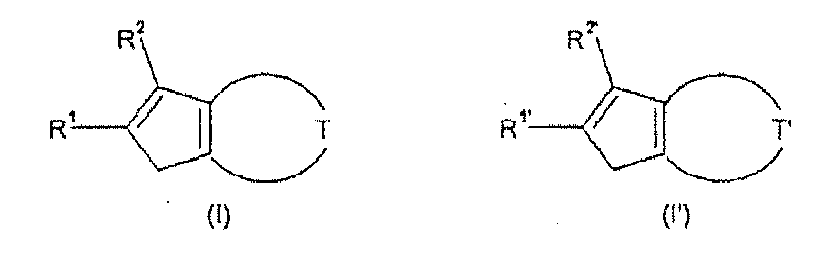
- the present invention relates to a process for recycling cyclopentadienyl derivatives of the formulae (I) and (I'), a process for preparing metallocenes of the formula (III) from cyclopentadienyl derivatives of the formulae (I) and (I') or from bridged biscyclopentadienyl derivatives of the formula (II), in which the cyclopentadienyl derivatives of the formulae (I), (I') or (II) which are used have been at least partly recovered and purified by means of liquid-solid chromatography, and the use of liquid-solid chromatography for purifying substituted, recovered cyclopentadienyl derivatives of the formulae (I), (I') or (II).
- Metallocenes which are used for preparing isotactic polypropylenes are usually bridged racemic metallocenes having substituted cyclopentadienyl ligands prepared by a complicated synthesis.
- racemic ansa-metallocenes these are generally obtained together with the undesirable meso-metallocenes which usually have to be separated off, so that part of the costly ligand which has not been converted into the desired racemic metallocene is inevitably lost.
- various diastereoselective synthetic methods in which the proportion of the desired racemic metallocene is higher than the proportion of the undesirable meso form have been developed.
- Such racemoselective processes are described, for example, in WO 1999/15538 or WO 2005/108408 .
- WO 2002/96920 describes a process for purifying racemic metallocenes by removing the by-products formed in the preparative process, with at least part of the bridged biscyclopentadienyl ligand which has not been converted into the desired product being recovered from the filtrates by crystallization.
- the radicals R 1 and R 1' are identical or different, preferably different, and are each an organic radical having from 1 to 40 carbon atoms, for example C 1 -C 40 -alkyl, C 1 -C 10 -fluoroalkyl, C 2 -C 40 -alkenyl, C 6 -C 4o -aryl, C 6 -C 10 -fluoroaryl, arylalkyl, arylalkenyl or alkylaryl having from 1 to 10, preferably from 1 to 4, carbon atoms in the alkyl radical and from 6 to 22, preferably from 6 to 10, carbon atoms in the aryl radical, or a C 2 -C 40 -heteroaromatic radical which has at least one heteroatom selected from the group consisting of the elements O, N, S, P and Se, in particular O, N and S, and may be substituted by further radicals R 3 , where R 3 is an organic radical having from 1 to 20 carbon atoms, for example C 1 -C 10
- R 1 and R 1' being identical or different, preferably different, and each being C 1 -C 10 -alkyl such as methyl, ethyl, n-propyl, isopropyl, n-butyl, i-butyl, s-butyl, t-butyl, n-pentyl, cyclopentyl, n-hexyl, cyclohexyl, n-heptyl or n-octyl, preferably methyl, ethyl or isopropyl.
- C 1 -C 10 -alkyl such as methyl, ethyl, n-propyl, isopropyl, n-butyl, i-butyl, s-butyl, t-butyl, n-pentyl, cyclopentyl, n-hexyl, cyclohexyl, n-heptyl or n-o
- the radicals R 2 and R 2' are identical or different, preferably identical, and are each hydrogen or an organic radical having from 1 to 40 carbon atoms, for example C 1 -C 40 -alkyl, C 1 -C 10 -fluoroalkyl, C 2 -C 40 -alkenyl, C 6 -C 40 -aryl, C 6 -C 10 -fluoroaryl, arylalkyl, arylalkenyl or alkylaryl having from 1 to 10, preferably from 1 to 4, carbon atoms in the alkyl radical and from 6 to 22, preferably from 6 to 10, carbon atoms in the aryl radical, or a C 2 -C 40 -heteroaromatic radical which has at least one heteroatom selected from the group consisting of the elements O N, S, P and Se, in particular O, N and S and may be substituted by further radicals R 3 as defined above and a plurality of radicals R 3 may be identical or different.
- R 2 and R 2 are
- R 1 with R 2 and/or R 1' with R 2' together with the atoms connecting them in each case form a monocyclic or polycyclic, saturated or unsaturated, substituted or unsubstituted ring system which has from 3 to 40 carbon atoms and a ring size of from 5 to 12, in particular from 5 to 7, atoms and may also comprise heteroatoms selected from the group consisting of the elements Si, Ge, N, P, As, Sb, O, S, Se or Te, preferably Si, N, O or S, in particular S or N.
- radicals R 1 /R 2 and/or R 1' /R 2' are preferably in particular where the radicals R 4 are identical or different and are each an organic radical having from 1 to 40, preferably from 1 to 20, carbon atoms, for example a cyclic, branched or unbranched C 1 -C 20 -, preferably C 1 -C 8 -alkyl radical, C 2 -C 20 -, preferably C 2 -C 8 -alkenyl radical, C 6 -C 22 -, preferably C 6 -C 10 -aryl radical, an alkylaryl or arylalkyl radical having from 1 to 10, preferably from 1 to 4, carbon atoms in the alkyl radical and from 6 to 22, preferably from 6 to 10, carbon atoms in the aryl radical, where the radicals may also be halogenated, or the radicals R 4 are substituted or unsubstituted, saturated or unsaturated, in particular aromatic heterocyclic radicals which have from 2 to 40,
- T and T' are identical or different, preferably identical, and are each a divalent organic group which has from 1 to 40 carbon atoms and together with the cyclopentadienyl ring forms at least one further saturated or unsaturated, substituted or unsubstituted ring system having a ring size of from 5 to 12, in particular from 5 to 7, atoms, with T and T' within the ring system fused to the cyclopentadienyl ring being able to comprise the heteroatoms Si, Ge, N, P, As, Sb, O, S, Se or Te, preferably Si, N, O or S, in particular S or N.
- Examples of preferred divalent organic groups T or T' are preferably in particular where R 4 , R 5 , s, t and u are as defined above.
- Z is a bridge between the two substituted cyclopentadienyl rings which consists of a divalent atom or a divalent group.
- Examples of Z are: -B(R 7 )-, -B(NR 7 R 8 )-, -Al(R 7 )-, -O-.
- R 7 , R 8 and R 9 are identical or different and are each a hydrogen atom, a halogen atom, a trimethylsilyl group, a C 1 -C 10 -, preferably C 1 -C 3 -alkyl group, a C 1 -C 10 -fluoroalkyl group, a C 6 -C 10 -fluoroaryl group, a C 6 -C 10 -aryl group, a C 1 -C 10 -, preferably C 1 -C 3 - alkoxy group, a C 7 -C 15 -alkylaryloxy group, a C 2 -
- Preferred embodiments of Z are the bridges: dimethylsilanediyl, methylphenylsilanediyl, methyl-tert-butylsilanediyl, diphenylsilanediyl, dimethylgermanediyl, in particular dimethylsilanediyl.
- M is an element of group 3, 4, 5 or 6 of the Periodic Table of the Elements or the lanthanides, preferably an element of group 4 of the Periodic Table of the Elements, e.g. titanium, zirconium or hafnium, particularly preferably zirconium or hafnium, in particular zirconium.
- the radicals X are identical or different, preferably identical, and are each an organic or inorganic radical, with two radicals X also being able to be joined to one another.
- X is halogen, for example fluorine, chlorine, bromine, iodine, preferably chlorine, hydrogen, C 1 -C 20 -, preferably C 1 -C 4 -alkyl, C 2 -C 20 -, preferably C 2 -C 4 -alkenyl, C 6 -C 22 -, preferably C 6 -C 10 -aryl, an alkylaryl or arylalkyl group having from 1 to 10, preferably from 1 to 4, carbon atoms in the alkyl radical and from 6 to 22, preferably from 6 to 10, carbon atoms in the aryl radical, -OR d or -NR d R e , preferably -OR d or -NHR d , with two radicals X also being able to be joined to one another, preferably two radicals
- Two radicals X can also form a substituted or unsubstituted diene ligand, in particular a 1,3-diene ligand.
- the radicals R d and R e are C 1 -C 10 -, preferably C 1 -C 4 -alkyl, C 6 -C 15 -, preferably C 6 -C 10 -aryl, alkylaryl, arylalkyl, fluoroalkyl or fluoroaryl each having from 1 to 10, preferably from 1 to 4, carbon atoms in the alkyl radical and from 6 to 22, preferably from 6 to 10, carbon atoms in the aryl radical and R e may also be hydrogen.
- Very particular preference is given to X being chlorine or methyl, in particular chlorine.
- n is 0, 1, 2 or 3, with n+2 usually corresponding to the oxidation number of M, and in the case of the elements of group 4 of the Periodic Table of the Elements n is usually preferably 2.
- M is chromium
- n is preferably 0 or 1, in particular 0.
- the index m is 0 or 1, preferably 1.
- cyclopentadienyl derivatives of the formulae (I) and (I') or bridged cyclopentadienyl derivatives of the formula (II) in the metallocene synthesis preferably being at least 5%, preferably at least 10%, particularly preferably at least 25%.
- the cyclopentadienyl derivatives of the formulae (I) and (I') can have an identical or different substitution pattern in accordance with the above description.
- the process of the invention thus relates to the preparation of metallocenes having two identical cyclopentadienyl ligands or two different cyclopentadienyl ligands.
- organic radical having from 1 to 40 carbon atoms refers to, for example, C 1 -C 40 -alkyl radicals, C 1 -C 10 -fluoroalkyl radicals, C 1 -C 12 -alkoxy radicals, saturated C 3 -C 20 -heterocyclic radicals, C 6 -C 40 -aryl radicals, C 2 -C 40 -heteroaromatic radicals, C 6 -C 10 -fluoroaryl radicals, C 6 -C 10 -aryloxy radicals, C 3 -C 18 -trialkylsilyl radicals, C 2 -C 20 -alkenyl radicals, C 2 -C 20 -alkynyl radicals, C 7 -C 40 -arylalkyl radicals or C 8 -C 40 -arylalkenyl radicals.
- organic radical is in each case derived from an organic compound.
- the organic compound methanol can in principle give rise to three different organic radicals having one carbon atom, namely methyl (H 3 C-), methoxy (H 3 C-O-) and hydroxymethyl (HOC(H 2 )-)
- alkyl encompasses linear or singly or multiply branched saturated hydrocarbons which may also be cyclic. Preference is given to C 1 -C 18 -alkyl such as methyl, ethyl, n-propyl, n-butyl, n-pentyl, n-hexyl, n-heptyl, n-octyl, n-nonyl, n-decyl, cyclopentyl, cyclohexyl, isopropyl, isobutyl, isopentyl, isohexyl, sec-butyl or tert-butyl.
- alkenyl as used in the present text encompasses linear or singly or multiply branched hydrocarbons having one or more C-C double bonds, which may be cumulated or alternating.
- saturated heterocyclic radical refers to, for example, monocyclic or polycyclic, substituted or unsubstituted hydrocarbon radicals in which one or more carbon atoms, CH groups and/or CH 2 groups are replaced by heteroatoms preferably selected from the group consisting of O S, N and P.
- substituted or unsubstituted saturated heterocyclic radicals are pyrrolidinyl, imidazolidinyl, pyrazolidinyl, piperidyl, piperazinyl, morpholinyl, tetrahydrofuranyl, tetrahydropyranyl, tetrahydrothiophenyl and the like, and also methyl-, ethyl-, propyl-, isopropyl- and/or tert-butyl-substituted derivatives thereof.
- aryl refers to, for examples, aromatic and optionally also fused polyaromatic hydrocarbons which may be monosubstituted or polysubstituted by linear or branched C 1 -C 18 -alkyl, C 1 -C, 8 -alkoxy, C 2 -C 10 -alkenyl or halogen, in particular fluorine.
- substituted and unsubstituted aryl radicals are, in particular, phenyl, pentafluorophenyl, 4-methylphenyl, 4-ethylphenyl, 4-n-propylphenyl, 4-isopropylphenyl, 4-tert- butylphenyl, 4-methoxyphenyl, 1-naphthyl, 9-anthryl, 9-phenanthryl, 3,5-dimethylphenyl, 3,5-di- tert -butylphenyl or 4-trifluoromethylphenyl.
- heteromatic radical refers to, for example, aromatic hydrocarbon radicals in which one or more carbon atoms are replaced by nitrogen, phosphorus, oxygen or sulfur atoms or combinations thereof. These may, like the aryl radicals, be monosubstituted or polysubstituted by linear or branched C 1 -C 18 -alkyl, C 2 -C 10 -alkenyl or halogen, in particular fluorine.
- Preferred examples are furyl, thienyl, pyrrolyl, pyridyl, pyrazolyl, imidazolyl, oxazolyl, thiazolyl, pyrimidinyl, pyrazinyl and the like, and also methyl-, ethyl-, propyl-, isopropyl- and/or tert-butyl-substituted derivatives thereof.
- arylalkyl refers to, for example, aryl-comprising substituents whose aryl radical is linked via an alkyl chain to the corresponding remainder of the molecule.
- Preferred examples are benzyl, substituted benzyl, phenethyl, substituted phenethyl and the like.
- fluoroalkyl and fluoroaryl mean that at least one hydrogen atom, preferably more than one and a maximum of all hydrogen atoms, of the corresponding substituent have been replaced by fluorine atoms.
- fluorine-comprising substituents which are preferred according to the invention are trifluoromethyl, 2,2,2-trifluoroethyl, pentafluorophenyl, 4-trifluoromethylphenyl, 4-perfluoro-tert-butylphenyl and the like.
- a suitable transition metal source e.g. zirconium tetrachloride
- the desired ligands e.g. two equivalents of cyclopentadienyl ligand in the form of its lithium salt.
- the desired cyclopentadienyl radicals are firstly joined to one another and subsequently reacted, usually after prior deprotonation, with the transition metal source.
- WO 2001/48034 and WO 2003/045964 describe, for example, the syntheses of bridged biscyclopentadienyl-metallocenes having two different cyclopentadienyl radicals of the formulae (I) and (I') where the indices are as defined above.
- the process of the invention usually forms, as mentioned at the outset, not only the desired bridged rac-metallocenes of the formula (III) but also the corresponding meso compounds, with the terms meso and rac referring to the three-dimensional arrangement of the two cyclopentadienyl ring systems relative to one another.
- meso and rac referring to the three-dimensional arrangement of the two cyclopentadienyl ring systems relative to one another.
- the two substituted cyclopentadienyl radicals on the bridge are not identical, there is no rac form having C 2 symmetry or meso form having C s symmetry, but instead there are only diastereomeric compounds having C 1 symmetry.
- liquid-solid chromatography As stationary phase, it is possible to use both organic and inorganic finely divided solids such as aluminum oxides, silica gels, magnesium silicates, kieselguhr, activated carbon, cellulose, cellulose triacetate or silica gels modified with organic radicals, in particular hydrocarbon radicals, known as reversed phase materials.
- organic radicals in particular hydrocarbon radicals, known as reversed phase materials.
- solvents or solvent mixtures used as liquid mobile phase in the chromatographic method is known in principle to those skilled in the art and can be determined by means of a few routine thin-layer-chromatographic separation tests for the respective separation problem.
- the stationary phase is usually introduced into separation columns, i.e. cylindrical vessels or tubes which frequently comprise glass or stainless steel and have openings at both end faces which usually have a smaller diameter than the internal diameter of the column itself.
- separation columns i.e. cylindrical vessels or tubes which frequently comprise glass or stainless steel and have openings at both end faces which usually have a smaller diameter than the internal diameter of the column itself.
- the mobile phase can flow through the solid phase under the action of gravity or with the aid of a deliberately generated superatmospheric pressure.
- Figure 1 schematically shows an example of a preferred embodiment of the process of the invention for preparing bridged, in particular silicon-bridged, metallocenes of the formula (III), in particular from two differently substituted cyclopentadienyl derivatives of the formulae (I) and (I').
- a silicon-bridged biscyclopentadienyl derivative of the formula (II) is prepared by known methods. For example, two equivalents of a cyclopentadienyl anion are reacted in a bridging reaction with an appropriate silicon-comprising bridging reagent, for example a diorganodichlorosilane such as dimethyldichlorosilane.
- a cyclopentadienyl derivative of the formula (I) is firstly reacted with an appropriate silicon-comprising bridging reagent, for example a diorganodichlorosilane such as dimethyldichlorosilane, to form a monocyclopentadienyl derivative which comprises a bridging group, for example a monochloromonocyclopentadienyldiorganosilane compound, and the second leaving group of the bridging group in this compound, for example the chlorine, is subsequently replaced by a further cyclopentadienyl radical which is generated by deprotonation of a cyclopentadienyl derivative of the formula (I') and can be different from the first cyclopentadienyl radical to give the desired uncharged bridged cyclopentadienyl compound of the formula (II).
- an appropriate silicon-comprising bridging reagent for example a diorganodichloros
- the filtrate 0 is usually obtained.
- the biscyclopentadienyl derivative of the formula (II) is usually doubly deprotonated by means of a strong base and subsequently reacted directly or after prior isolation with a suitable transition metal compound such as zirconium tetrachloride or one of the modified, rac-selective transition metal sources described in WO 1999/15538 , WO 2000/31091 or WO 20051108408 to give a metallocene of the formula (III).
- Strong bases which can be used for deprotonating the cyclopentadienyl derivatives of the formulae (I) and (I') or the biscyclopentadienyl derivative of the formula (II) are, for example, organometallic compounds or metal hydrides, preferably compounds comprising an alkali metal or an alkaline earth metal.
- Preferred bases are organolithium or organomagnesium compounds such as methyllithium, n-butyllithium, sec-butyllithium n-butyl-n-octylmagnesium or dibutylmagnesium, in particular n-butyllithium or methyllithium.
- the deprotonation of the cyclopentadienyl derivatives of the formulae (I) and (I') or the biscyclopentadienyl derivative of the formula (II) is usually carried out in the temperature range from -78°C to 110°C, preferably from 0°C to 80°C and particularly preferably from 20°C to 70°C.
- Suitable inert solvents in which the deprotonation of the cyclopentadienyl derivatives by means of strong bases can be carried out are aliphatic or aromatic hydrocarbons such as benzene, toluene, xylene, mesitylene, ethylbenzene, cumene, decalin, tetralin, pentane, hexane, cyclohexane, heptane or ethers such as diethyl ether, di-n-butyl ether, tert-butyl methyl ether (MTBE), tetrahydrofuran (THF), 1,2-dimethoxyethane (DME), anisole, triglyme, dioxane and also any mixtures of these.
- aliphatic or aromatic hydrocarbons such as benzene, toluene, xylene, mesitylene, ethylbenzene, cumene, decalin,
- the filtrates 0, 1 and 2 are preferably combined and treated with aqueous acid or base, in particular aqueous base, to cleave the silicon-cyclopentadienyl carbon bond.
- the cleavage reaction is preferably carried out at a temperature of from 0°C to 200°C, particularly preferably from 20°C to 150°C, in particular from 50°C to 110°C.
- the reaction can be carried out under atmospheric pressure or under superatmospheric pressure.
- Suitable bases are, in particular, alkali metal hydroxide and alkaline earth metal hydroxides. Preference is given to using sodium hydroxide or potassium hydroxide, in particular sodium hydroxide.
- phase transfer catalysts such as tetraalkylammonium salts or crown ethers such as 18-crown-6 can help to accelerate the cleavage reaction.
- the molar ratio of bridged ligand, in particular silicon-bridged ligand, to hydroxide is usually from 1:0.1 to 1:100, preferably from 1:1 to 1:20, in particular from 1:2 to 1:10.
- the presence of various organic solvents in the reaction mixture is unproblematical, as long as these solvents are inert toward the reactants and the desired products, for example the cyclopentadienyl derivatives of the formulae (I) and (I'), under the reaction conditions.
- the reaction mixture is neutralized or made slightly acidic, the aqueous phase is separated off and discarded and the organic phase, which comprises cyclopentadienyl derivatives of the formulae (I) and (I'), is dried if appropriate, for example by means of magnesium sulfate, and subsequently concentrated to the extent necessary for the subsequent chromatographic purification.
- the chromatography is, as described above, a solid-liquid chromatography.
- the present invention further provides a process for recovering cyclopentadienyl derivatives of the formula (I), as described above, from the filtrates, mother liquors, reaction residues and/or work-up residues obtained in the preparation of silicon-bridged metallocenes and/or in the preparation of silicon-bridged biscyclopentadienyl ligands using such cyclopentadienyl derivatives, wherein these filtrates, mother liquors, reaction residues and/or work-up residues, either together or independently of one another, preferably together, are subjected to a single or multiple, acidic or basic, in particular basic, aqueous treatment in which bonds between bridging silicon atoms and cyclopentadienyl rings are cleaved, and subsequently isolating and if appropriate concentrating the organic phase comprising the cyclopentadienyl derivatives of the formulae (I) and (I') in order for them to be able to be purified further in liquid-solid chromatography.
- the present invention further provides for the use of recycled, substituted cyclopentadienyl derivatives of the formulae (I) and (I') or bridged biscyclopentadienyl derivatives of the formula (II), as described above, which have been purified by means of liquid-solid chromatography in the synthesis of metallocenes, in particular metallocenes of the formula (III), wherein the substituted cyclopentadienyl derivatives are recovered from the filtrates, mother liquors, reaction residues and/or work-up residues obtained in the preparation of metallocenes and/or in the preparation of bridged biscyclopentadienyl ligands.
- the present invention likewise provides for the use of liquid-solid chromatography, in particular liquid-solid chromatography using reversed phase materials as stationary phase, for purifying substituted cyclopentadienyl derivatives of the formulae (I) and (I') or bridged biscyclopentadienyl derivatives of the formula (II), as described above, for preparing metallocenes, in particular metallocenes of the formula (III), wherein the substituted cyclopentadienyl derivatives to be purified are recovered from the filtrates, mother liquors, reaction residues and/or work-up residues obtained in the preparation of metallocenes and/or in the preparation of bridged biscyclopentadienyl ligands.
- the metallocenes of the formula (III) prepared by the process of the invention can be used together with suitable cocatalysts and, if appropriate, suitable support materials as constituent of a catalyst system for the polymerization of olefins.
- the reaction mixture was stirred at 45°C for 2 hours, and after the suspension formed had been cooled to room temperature, the suspension was filtered through an invertible glass frit filter.
- the filter cake a mixture of lithium chloride and metallocene, was washed twice with a total of 10 g of toluene.
- the filtrate was evaporated to a volume of about 25 ml at about 48°C under reduced pressure.
- a second fraction of metallocene crystallized from the solution. After filtration and washing of the second fraction with 4 g of toluene, the two isolated fractions of the metallocene were combined and dried under reduced pressure.
- the total yield of metallocene-comprising crude product (2a) was 8.1 g.
- the methanol-comprising filtrate 0 from example 1 was combined with the filtrates from example 2a) (filtrate 1), resulting in any residual butyllithium present in filtrate 1 being destroyed.
- the viscous oil was fractionated by means of preparative HPLC (reversed phase chromatography column; 120 g of C18-end-capped SiO 2 ; acetonitrile/water (80/20); gradientless (isocratic) elution conditions; UV detector (235 nm)). Three fractions were collected:
- ligand (1) was prepared from 5.85 g of 2-isopropyl-4-(4'-tert-butylphenyl)-1-indene (2.4 g of recovered indene from example 3 and 3.45 g of indene from a fresh synthesis) and 4.85 g of 2-methyl-4-(4'-tert-butylphenyl)-1-indene (2.25 g of recovered indene from example 3 and 2.6 g of indene from a fresh synthesis). Work-up and crystallization gave 8.2 g of ligand (1).
Landscapes
- Chemical & Material Sciences (AREA)
- Organic Chemistry (AREA)
- Engineering & Computer Science (AREA)
- Analytical Chemistry (AREA)
- Oil, Petroleum & Natural Gas (AREA)
- Water Supply & Treatment (AREA)
- Organic Low-Molecular-Weight Compounds And Preparation Thereof (AREA)
Claims (8)
- Verfahren zur Rückgewinnung von substituierten Cyclopentadienylderivaten der Formeln (I) und (I')
 R1, R1' gleich oder verschieden sind und jeweils einen organischen Rest mit 1 bis 40 Kohlenstoffatomen bedeuten,R2, R2' gleich oder verschieden sind und jeweils Wasserstoff oder einen organischen Rest mit 1 bis 40 Kohlenstoffatomen bedeuten,
oder R1 mit R2 und/oder R1' mit R2' zusammen mit den sie verbindenden Atomen jeweils ein mono- oder polycyclisches, gesättigtes oder ungesättigtes, substituiertes oder unsubsLituiertes Ringsystem mit 3 bis 40 Kohlenstoffatomen bilden, welches eine Ringgröße von 5 bis 12 Atomen aufweist und welches auch Heteroatome, ausgewählt aus der Gruppe bestehend aus den Elementen Si, Ge, N, P, As, Sb, O, S, Se oder Te enthalten kann,T, T' gleich oder verschieden sind und jeweils eine zweibindige organische Gruppe mit 1 bis 40 Kohlenstoffatomen darstellen, die zusammen mit dem Cyclopentadienylring jeweils mindestens ein weiteres gesättigtes oder ungesättigtes, substituiertes oder unsubstituiertes Ringsystem bildet, welches eine Ringgröße von 5 bis 12 Atomen aufweist, wobei T und T' innerhalb des mit dem Cyclopentadienylring anellierten Ringsystems die Heteroatome Si, Ge, N, P, As, Sb, O, S, Se oder Te enthalten können,Z eine Brücke zwischen den beiden substituierten Cyclopentadienylliganden ist, die aus einem zweibindigen Atom oder einer zweibindigen Gruppe besteht,bei dem man(1) die Cyclopentadienylderivate der Formeln (I) und (I') oder die verbrückten Biscyclopentadienylderivate der Formel (II) aus den Filtraten, Mutterlaugen, Reaktions- und/oder Aufarbeitungsrückständen, die bei der Herstellung von Metallocenen und/oder bei der Herstellung von verbrückten Biscyclopentadienylliganden anfallen, zurückgewinnt und(2) anschließend die in Schritt (1) erhaltenen Produkte der flüssig-fest-Chromatographie unterwirft. - Verfahren nach Anspruch 1, bei dem man in Schritt (1) die Filtrate, Mutterlaugen, Reaktions- und/oder Aufarbeitungsrückstände gemeinsam oder unabhängig voneinander einer ein- oder mehrmaligen, sauren oder basischen, wässrigen Behandlung unterzieht, wobei Bindungen zwischen verbrückenden Siliziumatomen und CyclopenLadienylringen gespalten werden, und anschließend die organische Phase, die die Cyclopentadienylderivate der Formeln (I) und (I') enthält, isoliert und gegebenenfalls aufkonzentriert.
- Verfahren nach Anspruch 1 oder 2, bei dem man in Schritt (1) die ein Gemisch zweier unterschiedlich substituierter Cyclopentadienylderivate der Formeln (I) und (I') oder ein verbrücktes Biscyclopentadienylderivat der Formel (II) mit unterschiedlich substituierten Cyclopentadienylresten, wie in Anspruch 1 definiert, enthaltenden Filtrate, Mutterlaugen, Reaktions- und/oder Aufarbeitungsrückstände einsetzt.
- Verfahren nach einem der Ansprüche 1 bis 3, bei dem man bei der chromatographischen Aufreinigung der Cyclopentadienylderivate der Formeln (I) und (I') oder der verbrückten Biscyclopentadienylderivate der Formel (II) als stationäre Phase ein Reversed-Phase-Material verwendet.
- Verfahren nach einem der Ansprüche 1 bis 4, bei dem die Cyclopentadienylderivate der Formeln (I) und (I') aus den Filtraten, Mutterlaugen, Reaktions- und/oder Aufarbeitungsrückständen, die bei der Herstellung von Metallocenen und/oder bei der Herstellung von verbrückten Biscyclopenladienylliganden anfallen, zurückgewinnt, indem man diese Filtrate, Mutterlaugen, Reaktions- und/oder Aufarbeitungsrückstände gemeinsam oder unabhängig voneinander einer ein- oder mehrmaligen, sauren oder basischen, wässrigen Behandlung unterzieht, wobei eventuell vorhandene Bindungen zwischen verbrückenden Siliziumatomen und Cyclopentadienylringen gespalten werden, und anschließend die organische Phase, die die Cyclopentadienylderivate der Formeln (I) und (I') enthält, isoliert und gegebenenfalls aufkonzentriert, um sie weiter in der flüssig-fest-Chromatographie aufreinigen zu können.
- Verwendung der flüssig-fest-Chromatographie zur Aufreinigung von substituierten Cyclopentadienylderivaten der Formeln (I) und (I') oder verbrückten Biscyclopentadienylderivaten der Formel (II), wie in Anspruch 1 definiert, für die Herstellung von Metallocenen, wobei die aufzureinigenden substituierten Cyclopentadienylderivate aus den Filtraten, Mutterlaugen, Reaktions- und/oder Aufarbeitungsrückständen gewonnen werden, die bei der Herstellung von Metallocenen und/oder bei der Herstellung von verbrückten Biscyclopentadienylliganden anfallen.
- Verfahren zur Herstellung von Metallocenen der Formel (III)
 M ein Element der 3., 4., 5. oder 6. Gruppe des Periodensystems der Elemente oder der Lanthaniden ist,X gleich oder verschieden ist und ein organischer oder anorganischer Rest ist, wobei zwei Reste X auch miteinander verknüpft sein können,n gleich 0, 1, 2 oder 3 ist, undm gleich 0 oder 1 ist,umfassend das Rezyklierungsverfahren gemâß einem der Ansprüche 1 bis 6.
- Verfahren nach Anspruch 7, bei dem es sich bei den Metallocenen um verbrückte, insbesondere siliziumverbrückte Metallocene der 4. bis 6. Gruppe des Periodensystems der Elemente handelt.
Applications Claiming Priority (3)
| Application Number | Priority Date | Filing Date | Title |
|---|---|---|---|
| DE102005061326A DE102005061326A1 (de) | 2005-12-20 | 2005-12-20 | Verfahren zur Herstellung von Metallocenen aus recycelten, substituierten Cyclopentadienylderivaten |
| US78745306P | 2006-03-30 | 2006-03-30 | |
| PCT/EP2006/012234 WO2007071370A1 (en) | 2005-12-20 | 2006-12-19 | Process for recycling cyclopentdienyl derivatives and preapring metallocenes from recycle, substituted cyclopentdienyl derivatives |
Publications (2)
| Publication Number | Publication Date |
|---|---|
| EP1963339A1 EP1963339A1 (de) | 2008-09-03 |
| EP1963339B1 true EP1963339B1 (de) | 2009-11-25 |
Family
ID=38089554
Family Applications (1)
| Application Number | Title | Priority Date | Filing Date |
|---|---|---|---|
| EP06829724A Active EP1963339B1 (de) | 2005-12-20 | 2006-12-19 | Verfahren zum recycling von cyclopentdienylderivaten und die herstellung von metallocenen aus recycelten substituierten cyclopentdienylderivaten |
Country Status (9)
| Country | Link |
|---|---|
| US (1) | US7951970B2 (de) |
| EP (1) | EP1963339B1 (de) |
| JP (1) | JP2009519987A (de) |
| CN (1) | CN101341158A (de) |
| AT (1) | ATE449777T1 (de) |
| DE (2) | DE102005061326A1 (de) |
| ES (1) | ES2335534T3 (de) |
| RU (1) | RU2008129705A (de) |
| WO (1) | WO2007071370A1 (de) |
Cited By (1)
| Publication number | Priority date | Publication date | Assignee | Title |
|---|---|---|---|---|
| EP2573091A1 (de) | 2011-09-23 | 2013-03-27 | Lummus Novolen Technology Gmbh | Verfahren zur Wiedergewinnung freier Liganden aus ihren jeweiligen Metallocenkomplexen |
Families Citing this family (5)
| Publication number | Priority date | Publication date | Assignee | Title |
|---|---|---|---|---|
| CA2856708C (en) | 2011-11-25 | 2022-01-11 | Bayer Intellectual Property Gmbh | Antibacterial tylosin derivatives and methods for their preparation |
| TR201809189T4 (tr) | 2013-05-23 | 2018-07-23 | Bayer Animal Health Gmbh | Tylosin türevleri̇ ve bunlarin hazirlanmasina yöneli̇k yöntem. |
| KR101787166B1 (ko) | 2014-07-16 | 2017-10-18 | 주식회사 엘지화학 | 신규한 리간드 화합물 및 전이금속 화합물의 제조방법 |
| WO2016080341A1 (ja) | 2014-11-17 | 2016-05-26 | 国立研究開発法人産業技術総合研究所 | 脳波による類似度の評価方法、評価装置、評価システム及びプログラム |
| KR102412130B1 (ko) * | 2017-12-26 | 2022-06-23 | 주식회사 엘지화학 | 담지 메탈로센 촉매의 제조방법 및 이로부터 제조된 촉매를 이용하는 폴리프로필렌의 제조방법 |
Family Cites Families (15)
| Publication number | Priority date | Publication date | Assignee | Title |
|---|---|---|---|---|
| DE69224184T2 (de) * | 1992-06-13 | 1999-06-02 | Targor GmbH, 55116 Mainz | Verfahren zur Herstellung von verbrückten, chiralen Metallocenkatalysatoren des Types Bisindenyl |
| TW294669B (de) * | 1992-06-27 | 1997-01-01 | Hoechst Ag | |
| DE4434640C1 (de) * | 1994-09-28 | 1996-02-01 | Hoechst Ag | Verfahren zur Herstellung verbrückter Metallocene |
| EP0780396B1 (de) * | 1995-12-18 | 2002-10-02 | Basell Polyolefine GmbH | Verfahren zur Abreicherung von Nebenprodukten in Produktgemischen |
| ES2247681T3 (es) * | 1997-03-07 | 2006-03-01 | Basell Polyolefine Gmbh | Metodo para preparar indanonas sustituidas y metalocenos preparados a partir de ellas. |
| DE19741876A1 (de) * | 1997-09-23 | 1999-03-25 | Basf Ag | Verfahren zur selektiven Herstellung racemischer Metallocenkomplexe |
| PL334470A1 (en) * | 1997-11-12 | 2000-02-28 | Montell Technology Company Bv | Metalocenes and olefins polymerisation catalysts |
| DE59914158D1 (de) * | 1998-11-25 | 2007-03-08 | Basell Polyolefine Gmbh | Metallocenmonohalogenide |
| CN1590422A (zh) * | 1999-12-23 | 2005-03-09 | 巴塞尔聚烯烃有限公司 | 过渡金属化合物,配体体系,催化剂体系及其在烯烃的聚合反应和共聚反应中的用途 |
| CN1280300C (zh) * | 1999-12-28 | 2006-10-18 | 巴塞尔技术有限公司 | 杂环茂金属化合物及其在生产烯烃聚合物的催化剂体系中的用途 |
| ATE409180T1 (de) * | 2001-05-15 | 2008-10-15 | Basell Polyolefine Gmbh | Synthese von zyklopentadien derivaten |
| DE10126265A1 (de) | 2001-05-29 | 2002-12-05 | Basell Polyolefine Gmbh | Verfahren zur Abreicherung von anorganischen Nebenprodukten und organometallischen Nebenprodukten bei der Herstellung von Metallocenen sowie der wirtschaftlichen Rückgewinnung der eingesetzten Edukte |
| ATE315559T1 (de) * | 2001-08-01 | 2006-02-15 | Basell Polyolefine Gmbh | Verfahren zur herstellung von heterocyclischen pentalen derivaten |
| EP1448578B1 (de) * | 2001-11-30 | 2006-07-26 | Basell Polyolefine GmbH | Metallocene und verfahren zur herstellung von propylenpolymeren |
| DE102004022861A1 (de) | 2004-05-06 | 2005-12-01 | Basell Polyolefine Gmbh | Verfahren zur racemo-selectiven Herstellung von ansa-Metallocenen |
-
2005
- 2005-12-20 DE DE102005061326A patent/DE102005061326A1/de not_active Withdrawn
-
2006
- 2006-12-19 DE DE602006010739T patent/DE602006010739D1/de active Active
- 2006-12-19 EP EP06829724A patent/EP1963339B1/de active Active
- 2006-12-19 CN CNA2006800483212A patent/CN101341158A/zh active Pending
- 2006-12-19 US US12/086,711 patent/US7951970B2/en active Active
- 2006-12-19 ES ES06829724T patent/ES2335534T3/es active Active
- 2006-12-19 AT AT06829724T patent/ATE449777T1/de not_active IP Right Cessation
- 2006-12-19 JP JP2008546230A patent/JP2009519987A/ja active Pending
- 2006-12-19 WO PCT/EP2006/012234 patent/WO2007071370A1/en not_active Ceased
- 2006-12-19 RU RU2008129705/04A patent/RU2008129705A/ru not_active Application Discontinuation
Cited By (2)
| Publication number | Priority date | Publication date | Assignee | Title |
|---|---|---|---|---|
| EP2573091A1 (de) | 2011-09-23 | 2013-03-27 | Lummus Novolen Technology Gmbh | Verfahren zur Wiedergewinnung freier Liganden aus ihren jeweiligen Metallocenkomplexen |
| WO2013041619A1 (en) | 2011-09-23 | 2013-03-28 | Lummus Novolen Technology Gmbh | Process for recycling of free ligand from their corresponding metallocene complexes |
Also Published As
| Publication number | Publication date |
|---|---|
| ES2335534T3 (es) | 2010-03-29 |
| DE602006010739D1 (de) | 2010-01-07 |
| WO2007071370A1 (en) | 2007-06-28 |
| EP1963339A1 (de) | 2008-09-03 |
| US7951970B2 (en) | 2011-05-31 |
| US20100274035A1 (en) | 2010-10-28 |
| ATE449777T1 (de) | 2009-12-15 |
| CN101341158A (zh) | 2009-01-07 |
| RU2008129705A (ru) | 2010-01-27 |
| JP2009519987A (ja) | 2009-05-21 |
| DE102005061326A1 (de) | 2007-06-21 |
Similar Documents
| Publication | Publication Date | Title |
|---|---|---|
| KR0178279B1 (ko) | 플루오레닐 화합물 제조 방법 | |
| Mengele et al. | ansa-Metallocene derivatives. 27. Chiral zirconocene complexes with two dimethylsilylene bridges | |
| EP0545304A1 (de) | Verfahren zur Herstellung substituierter Indene und ihre Verwendung als Ligandsysteme für Metallocen-Katalysatoren | |
| EP0722949B1 (de) | Verfahren zur Herstellung von Cyclopentadienyl-Verbindungen und nach dem Verfahren hergestellte Verbindungen | |
| US7951970B2 (en) | Process for recycling cyclopentadienyl derivatives and preparing metallocenes from recycled, substituted cyclopentadienyl derivatives | |
| Erker et al. | Theoretical and experimental evidence for a thermally induced. eta. 4-diene. dblarw.. eta. 3-allyl ligand interconversion in (s-trans-. eta. 4-conjugated diene) zirconocenes | |
| US5912373A (en) | Process for converting the achiral meso form of an ansa-metallocene complex into the chiral racemic form | |
| JP3998270B2 (ja) | シクロペンタジエニル化合物の製造方法 | |
| Negishi et al. | Zirconium-catalyzed and zirconium-promoted cyclization reactions of non-conjugated dienes with alkylmagnesium halides to give cycloalkylmethylmagnesium derivatives | |
| HUE027821T2 (en) | A method for alkinylation of 16-substituted-17-ketosteroid derivatives | |
| Nakazaki et al. | Syntheses and chemical characterization of tris-bridged [2.2. 2] cyclophanes with a triphenylmethyl component | |
| Halterman et al. | Synthesis of ansa-2, 2′-bis [(4, 7-dimethyl-inden-1-yl) methyl]-1, 1′-binaphthyl and nsa-2, 2′-bis [(4, 5, 6, 7-tetrahydroinden1-yl) methyl]-1, 1′-binaphthyltitanium and-zirconium dichlorides | |
| Lee et al. | Synthesis of bis (1, 2, 3-substituted cyclopentadienyl) zirconium dichloride derivatives and their use in ethylene polymerization | |
| RU2362782C2 (ru) | Мезо-селективный синтез анса-металлоценов | |
| US11566037B2 (en) | Process for producing isopropylidene bis(cyclopentadienyl)zirconium dichloride | |
| JP2000229990A (ja) | ビス(2,5−二置換−3−ナフチルシクロペンタジエニル)配位子を有するメタロセン化合物およびその製造方法 | |
| EP1122229B1 (de) | Verfahren zur Herstellung von kondensierten Cyclopentadienen, 1,3 disubstituierte Derivate und diese enthaltende Metallocen-artige Verbindungen | |
| EP1778707B1 (de) | Verfahren für racemoselektive ansa-metallocen-synthese | |
| CA2323198C (en) | Synthesis and isomerization of 1,2-bis (indenyl) ethanes | |
| WO2005108408A2 (en) | Process for the racemoselective preparation of ansa-metallocenes | |
| US6107501A (en) | Synthesis of metallocenes and enrichment of their rac isomer | |
| Armesto et al. | Conformation dependent photochemistry of dienes. Substituent effects on the photochemical reactions of some 4-acyloxy-2-azabuta-1, 3-dienes | |
| JP2006503885A (ja) | 置換インデンの製造方法 | |
| JP2002326997A (ja) | シリルブリッジを有するフルオレニル−シクロペンタジエニル配位子およびシリルブリッジを有するフルオレニル−シクロペンタジエニルメタロセンの製造方法 | |
| JPH04279564A (ja) | スルホニル化合物およびビタミンaまたはそのエステルを製造する方法における中間体としての前記化合物使用 |
Legal Events
| Date | Code | Title | Description |
|---|---|---|---|
| PUAI | Public reference made under article 153(3) epc to a published international application that has entered the european phase |
Free format text: ORIGINAL CODE: 0009012 |
|
| 17P | Request for examination filed |
Effective date: 20080618 |
|
| AK | Designated contracting states |
Kind code of ref document: A1 Designated state(s): AT BE BG CH CY CZ DE DK EE ES FI FR GB GR HU IE IS IT LI LT LU LV MC NL PL PT RO SE SI SK TR |
|
| DAX | Request for extension of the european patent (deleted) | ||
| 17Q | First examination report despatched |
Effective date: 20081028 |
|
| GRAP | Despatch of communication of intention to grant a patent |
Free format text: ORIGINAL CODE: EPIDOSNIGR1 |
|
| GRAS | Grant fee paid |
Free format text: ORIGINAL CODE: EPIDOSNIGR3 |
|
| GRAA | (expected) grant |
Free format text: ORIGINAL CODE: 0009210 |
|
| AK | Designated contracting states |
Kind code of ref document: B1 Designated state(s): AT BE BG CH CY CZ DE DK EE ES FI FR GB GR HU IE IS IT LI LT LU LV MC NL PL PT RO SE SI SK TR |
|
| REG | Reference to a national code |
Ref country code: GB Ref legal event code: FG4D |
|
| REG | Reference to a national code |
Ref country code: CH Ref legal event code: EP |
|
| REG | Reference to a national code |
Ref country code: IE Ref legal event code: FG4D |
|
| REF | Corresponds to: |
Ref document number: 602006010739 Country of ref document: DE Date of ref document: 20100107 Kind code of ref document: P |
|
| REG | Reference to a national code |
Ref country code: ES Ref legal event code: FG2A Ref document number: 2335534 Country of ref document: ES Kind code of ref document: T3 |
|
| LTIE | Lt: invalidation of european patent or patent extension |
Effective date: 20091125 |
|
| PG25 | Lapsed in a contracting state [announced via postgrant information from national office to epo] |
Ref country code: PT Free format text: LAPSE BECAUSE OF FAILURE TO SUBMIT A TRANSLATION OF THE DESCRIPTION OR TO PAY THE FEE WITHIN THE PRESCRIBED TIME-LIMIT Effective date: 20100325 Ref country code: FI Free format text: LAPSE BECAUSE OF FAILURE TO SUBMIT A TRANSLATION OF THE DESCRIPTION OR TO PAY THE FEE WITHIN THE PRESCRIBED TIME-LIMIT Effective date: 20091125 Ref country code: LT Free format text: LAPSE BECAUSE OF FAILURE TO SUBMIT A TRANSLATION OF THE DESCRIPTION OR TO PAY THE FEE WITHIN THE PRESCRIBED TIME-LIMIT Effective date: 20091125 Ref country code: IS Free format text: LAPSE BECAUSE OF FAILURE TO SUBMIT A TRANSLATION OF THE DESCRIPTION OR TO PAY THE FEE WITHIN THE PRESCRIBED TIME-LIMIT Effective date: 20100325 Ref country code: SE Free format text: LAPSE BECAUSE OF FAILURE TO SUBMIT A TRANSLATION OF THE DESCRIPTION OR TO PAY THE FEE WITHIN THE PRESCRIBED TIME-LIMIT Effective date: 20091125 |
|
| PG25 | Lapsed in a contracting state [announced via postgrant information from national office to epo] |
Ref country code: SI Free format text: LAPSE BECAUSE OF FAILURE TO SUBMIT A TRANSLATION OF THE DESCRIPTION OR TO PAY THE FEE WITHIN THE PRESCRIBED TIME-LIMIT Effective date: 20091125 Ref country code: LV Free format text: LAPSE BECAUSE OF FAILURE TO SUBMIT A TRANSLATION OF THE DESCRIPTION OR TO PAY THE FEE WITHIN THE PRESCRIBED TIME-LIMIT Effective date: 20091125 Ref country code: CY Free format text: LAPSE BECAUSE OF FAILURE TO SUBMIT A TRANSLATION OF THE DESCRIPTION OR TO PAY THE FEE WITHIN THE PRESCRIBED TIME-LIMIT Effective date: 20091125 Ref country code: PL Free format text: LAPSE BECAUSE OF FAILURE TO SUBMIT A TRANSLATION OF THE DESCRIPTION OR TO PAY THE FEE WITHIN THE PRESCRIBED TIME-LIMIT Effective date: 20091125 |
|
| PG25 | Lapsed in a contracting state [announced via postgrant information from national office to epo] |
Ref country code: AT Free format text: LAPSE BECAUSE OF FAILURE TO SUBMIT A TRANSLATION OF THE DESCRIPTION OR TO PAY THE FEE WITHIN THE PRESCRIBED TIME-LIMIT Effective date: 20091125 Ref country code: BE Free format text: LAPSE BECAUSE OF FAILURE TO SUBMIT A TRANSLATION OF THE DESCRIPTION OR TO PAY THE FEE WITHIN THE PRESCRIBED TIME-LIMIT Effective date: 20091125 |
|
| PG25 | Lapsed in a contracting state [announced via postgrant information from national office to epo] |
Ref country code: RO Free format text: LAPSE BECAUSE OF FAILURE TO SUBMIT A TRANSLATION OF THE DESCRIPTION OR TO PAY THE FEE WITHIN THE PRESCRIBED TIME-LIMIT Effective date: 20091125 Ref country code: MC Free format text: LAPSE BECAUSE OF NON-PAYMENT OF DUE FEES Effective date: 20100701 Ref country code: EE Free format text: LAPSE BECAUSE OF FAILURE TO SUBMIT A TRANSLATION OF THE DESCRIPTION OR TO PAY THE FEE WITHIN THE PRESCRIBED TIME-LIMIT Effective date: 20091125 Ref country code: DK Free format text: LAPSE BECAUSE OF FAILURE TO SUBMIT A TRANSLATION OF THE DESCRIPTION OR TO PAY THE FEE WITHIN THE PRESCRIBED TIME-LIMIT Effective date: 20091125 Ref country code: BG Free format text: LAPSE BECAUSE OF FAILURE TO SUBMIT A TRANSLATION OF THE DESCRIPTION OR TO PAY THE FEE WITHIN THE PRESCRIBED TIME-LIMIT Effective date: 20100225 |
|
| PG25 | Lapsed in a contracting state [announced via postgrant information from national office to epo] |
Ref country code: CZ Free format text: LAPSE BECAUSE OF FAILURE TO SUBMIT A TRANSLATION OF THE DESCRIPTION OR TO PAY THE FEE WITHIN THE PRESCRIBED TIME-LIMIT Effective date: 20091125 Ref country code: SK Free format text: LAPSE BECAUSE OF FAILURE TO SUBMIT A TRANSLATION OF THE DESCRIPTION OR TO PAY THE FEE WITHIN THE PRESCRIBED TIME-LIMIT Effective date: 20091125 |
|
| PLBE | No opposition filed within time limit |
Free format text: ORIGINAL CODE: 0009261 |
|
| STAA | Information on the status of an ep patent application or granted ep patent |
Free format text: STATUS: NO OPPOSITION FILED WITHIN TIME LIMIT |
|
| PG25 | Lapsed in a contracting state [announced via postgrant information from national office to epo] |
Ref country code: IE Free format text: LAPSE BECAUSE OF NON-PAYMENT OF DUE FEES Effective date: 20091219 Ref country code: GR Free format text: LAPSE BECAUSE OF FAILURE TO SUBMIT A TRANSLATION OF THE DESCRIPTION OR TO PAY THE FEE WITHIN THE PRESCRIBED TIME-LIMIT Effective date: 20100226 |
|
| 26N | No opposition filed |
Effective date: 20100826 |
|
| PG25 | Lapsed in a contracting state [announced via postgrant information from national office to epo] |
Ref country code: IT Free format text: LAPSE BECAUSE OF FAILURE TO SUBMIT A TRANSLATION OF THE DESCRIPTION OR TO PAY THE FEE WITHIN THE PRESCRIBED TIME-LIMIT Effective date: 20091125 |
|
| PG25 | Lapsed in a contracting state [announced via postgrant information from national office to epo] |
Ref country code: LU Free format text: LAPSE BECAUSE OF NON-PAYMENT OF DUE FEES Effective date: 20091219 |
|
| PG25 | Lapsed in a contracting state [announced via postgrant information from national office to epo] |
Ref country code: HU Free format text: LAPSE BECAUSE OF FAILURE TO SUBMIT A TRANSLATION OF THE DESCRIPTION OR TO PAY THE FEE WITHIN THE PRESCRIBED TIME-LIMIT Effective date: 20100526 |
|
| REG | Reference to a national code |
Ref country code: CH Ref legal event code: PL |
|
| GBPC | Gb: european patent ceased through non-payment of renewal fee |
Effective date: 20101219 |
|
| PG25 | Lapsed in a contracting state [announced via postgrant information from national office to epo] |
Ref country code: TR Free format text: LAPSE BECAUSE OF FAILURE TO SUBMIT A TRANSLATION OF THE DESCRIPTION OR TO PAY THE FEE WITHIN THE PRESCRIBED TIME-LIMIT Effective date: 20091125 |
|
| PG25 | Lapsed in a contracting state [announced via postgrant information from national office to epo] |
Ref country code: LI Free format text: LAPSE BECAUSE OF NON-PAYMENT OF DUE FEES Effective date: 20101231 Ref country code: CH Free format text: LAPSE BECAUSE OF NON-PAYMENT OF DUE FEES Effective date: 20101231 |
|
| PG25 | Lapsed in a contracting state [announced via postgrant information from national office to epo] |
Ref country code: GB Free format text: LAPSE BECAUSE OF NON-PAYMENT OF DUE FEES Effective date: 20101219 |
|
| PGFP | Annual fee paid to national office [announced via postgrant information from national office to epo] |
Ref country code: ES Payment date: 20131218 Year of fee payment: 8 |
|
| REG | Reference to a national code |
Ref country code: FR Ref legal event code: PLFP Year of fee payment: 10 |
|
| REG | Reference to a national code |
Ref country code: ES Ref legal event code: FD2A Effective date: 20160129 |
|
| PG25 | Lapsed in a contracting state [announced via postgrant information from national office to epo] |
Ref country code: ES Free format text: LAPSE BECAUSE OF NON-PAYMENT OF DUE FEES Effective date: 20141220 |
|
| REG | Reference to a national code |
Ref country code: FR Ref legal event code: PLFP Year of fee payment: 11 |
|
| REG | Reference to a national code |
Ref country code: FR Ref legal event code: PLFP Year of fee payment: 12 |
|
| P01 | Opt-out of the competence of the unified patent court (upc) registered |
Effective date: 20230507 |
|
| PGFP | Annual fee paid to national office [announced via postgrant information from national office to epo] |
Ref country code: NL Payment date: 20241114 Year of fee payment: 19 |
|
| PGFP | Annual fee paid to national office [announced via postgrant information from national office to epo] |
Ref country code: DE Payment date: 20241111 Year of fee payment: 19 |
|
| PGFP | Annual fee paid to national office [announced via postgrant information from national office to epo] |
Ref country code: FR Payment date: 20241111 Year of fee payment: 19 |
|
| REG | Reference to a national code |
Ref country code: NL Ref legal event code: MM Effective date: 20260101 |