EP1970340A1 - Verfahren zum verkehrsabhängigen Betreiben einer Aufzugsanlage mit zwei im selben Schacht bewegbaren Aufzugskabinen und entsprechende Aufzugsanlage - Google Patents
Verfahren zum verkehrsabhängigen Betreiben einer Aufzugsanlage mit zwei im selben Schacht bewegbaren Aufzugskabinen und entsprechende Aufzugsanlage Download PDFInfo
- Publication number
- EP1970340A1 EP1970340A1 EP07103907A EP07103907A EP1970340A1 EP 1970340 A1 EP1970340 A1 EP 1970340A1 EP 07103907 A EP07103907 A EP 07103907A EP 07103907 A EP07103907 A EP 07103907A EP 1970340 A1 EP1970340 A1 EP 1970340A1
- Authority
- EP
- European Patent Office
- Prior art keywords
- elevator
- elevator car
- stop
- passengers
- destination
- Prior art date
- Legal status (The legal status is an assumption and is not a legal conclusion. Google has not performed a legal analysis and makes no representation as to the accuracy of the status listed.)
- Withdrawn
Links
- 238000000034 method Methods 0.000 title claims abstract description 21
- 230000001419 dependent effect Effects 0.000 title claims description 9
- 238000009434 installation Methods 0.000 claims description 34
- 238000013459 approach Methods 0.000 claims description 5
- 230000001960 triggered effect Effects 0.000 claims description 3
- 238000011156 evaluation Methods 0.000 claims description 2
- 230000007704 transition Effects 0.000 description 5
- 230000001133 acceleration Effects 0.000 description 3
- 238000004904 shortening Methods 0.000 description 2
- 230000036962 time dependent Effects 0.000 description 2
- RZVAJINKPMORJF-UHFFFAOYSA-N Acetaminophen Chemical compound CC(=O)NC1=CC=C(O)C=C1 RZVAJINKPMORJF-UHFFFAOYSA-N 0.000 description 1
- 238000013461 design Methods 0.000 description 1
- 238000011161 development Methods 0.000 description 1
- 230000018109 developmental process Effects 0.000 description 1
- 230000000694 effects Effects 0.000 description 1
- 238000005457 optimization Methods 0.000 description 1
- 230000035807 sensation Effects 0.000 description 1
- 238000012546 transfer Methods 0.000 description 1
- 230000000007 visual effect Effects 0.000 description 1
Images

Classifications
-
- B—PERFORMING OPERATIONS; TRANSPORTING
- B66—HOISTING; LIFTING; HAULING
- B66B—ELEVATORS; ESCALATORS OR MOVING WALKWAYS
- B66B1/00—Control systems of elevators in general
- B66B1/24—Control systems with regulation, i.e. with retroactive action, for influencing travelling speed, acceleration, or deceleration
- B66B1/2408—Control systems with regulation, i.e. with retroactive action, for influencing travelling speed, acceleration, or deceleration where the allocation of a call to an elevator car is of importance, i.e. by means of a supervisory or group controller
- B66B1/2433—For elevator systems with a single shaft and multiple cars
-
- B—PERFORMING OPERATIONS; TRANSPORTING
- B66—HOISTING; LIFTING; HAULING
- B66B—ELEVATORS; ESCALATORS OR MOVING WALKWAYS
- B66B2201/00—Aspects of control systems of elevators
- B66B2201/10—Details with respect to the type of call input
- B66B2201/103—Destination call input before entering the elevator car
-
- B—PERFORMING OPERATIONS; TRANSPORTING
- B66—HOISTING; LIFTING; HAULING
- B66B—ELEVATORS; ESCALATORS OR MOVING WALKWAYS
- B66B2201/00—Aspects of control systems of elevators
- B66B2201/20—Details of the evaluation method for the allocation of a call to an elevator car
- B66B2201/224—Avoiding potential interference between elevator cars
-
- B—PERFORMING OPERATIONS; TRANSPORTING
- B66—HOISTING; LIFTING; HAULING
- B66B—ELEVATORS; ESCALATORS OR MOVING WALKWAYS
- B66B2201/00—Aspects of control systems of elevators
- B66B2201/30—Details of the elevator system configuration
- B66B2201/301—Shafts divided into zones
-
- B—PERFORMING OPERATIONS; TRANSPORTING
- B66—HOISTING; LIFTING; HAULING
- B66B—ELEVATORS; ESCALATORS OR MOVING WALKWAYS
- B66B2201/00—Aspects of control systems of elevators
- B66B2201/40—Details of the change of control mode
- B66B2201/401—Details of the change of control mode by time of the day
-
- B—PERFORMING OPERATIONS; TRANSPORTING
- B66—HOISTING; LIFTING; HAULING
- B66B—ELEVATORS; ESCALATORS OR MOVING WALKWAYS
- B66B2201/00—Aspects of control systems of elevators
- B66B2201/40—Details of the change of control mode
- B66B2201/403—Details of the change of control mode by real-time traffic data
Definitions
- the invention relates to a method for operating an elevator installation with two elevator cars which are arranged in the same elevator shaft and can be driven independently of one another, according to the preamble of claim 1 and a correspondingly operable elevator installation according to the preamble of claim 9.
- Elevator systems which have several elevator cars in an elevator shaft. Elevator systems with several elevator cars in the same shaft, which are also referred to as multi-mobile elevator systems, usually each have a drive and brake system per elevator car.
- each elevator car is assigned to a zone and between the zones a transfer floor for changing passengers between the elevator cars of different zones is arranged.
- a transfer floor for changing passengers between the elevator cars of different zones is arranged.
- a multi-mobile elevator system can be installed.
- the new elevator system has at least one upper elevator car and a lower elevator car.
- the two elevator cars can move up and down vertically in a common elevator shaft of the elevator installation, essentially independently of one another.
- the upper elevator car operates a zone extending from the uppermost stop of the elevator system to a lower stop located above the lowermost stop of the lower elevator car.
- the lower elevator car serves a zone which extends from an upper stop, which is below the uppermost stop of the upper elevator car, to the lowest stop of the elevator system.
- the invention is characterized in particular by the fact that the corresponding elevator installation can be operated in a normal mode and in a substitute mode, for example a downward replacement mode and / or an upward replacement mode.
- the lower elevator car is primarily provided for the passengers who have indicated by means of destination call that they wish to reach the lowermost stop.
- the upper elevator car is additionally used for a part of the passengers who want to reach the lowest stop. These passengers are then transported in the upper elevator car, wherein it is brought to the attention of the passengers during the conveyance that this elevator car currently only approaches a stop above the lowermost stop.
- the lower elevator car is used for a portion of the passengers who want to reach the topmost stop. These passengers are then carried in the lower elevator car, notifying the passengers during the conveyance that this elevator car currently only approaches a stop below the uppermost stop.
- Fig. 1 shows a simple elevator system 10.
- Such elevator systems are, as mentioned above, known under the term multi-mobile elevator systems.
- the elevator installation 10 has an elevator shaft 11 in which an upper elevator car DU and a lower elevator car LU can move vertically.
- the upper elevator car DU operates a zone B which extends from the uppermost stop 13.n of the elevator installation 10 to a lower stop 13.2 located above the lowermost one Halts 13.1 of the lower elevator car LU is located.
- the lower elevator car LU operates a zone A, which extends from an upper stop 13.n-1, which is below the uppermost stop 13.n of the upper elevator car DU, to the lowermost stop 13.1 of the elevator installation 10. If the elevator shaft 11 is e.g.
- the upper elevator car DU covers the floors 1 - 100 and the lower elevator car LU the floors 0 - 99 from a total of 100 floors.
- the elevator cars DU and LU can move independently of each other in the elevator shaft 11.
- the upper elevator car DU has a first drive and brake system which comprises a first holding brake (preferably an engine brake).
- the lower elevator car LU has a second drive and brake system, which detects a second holding brake (preferably an engine brake) and.
- the drives are, for example, traction sheave drives with traction sheaves which connect the elevator cars DU, LU via conveying means with counterweights. For clarity, neither the drives nor the funding and counterweights in the Fig. 1 shown.
- the elevator installation 10 also preferably has a collision protection system in order to prevent the two elevator cars DU and LU from driving up.
- the elevator installation 10 organizes the transport of the passengers with a destination call control. there are entered by the passengers to destination call input destinations.
- this type of destination call control no previous car call, but from the respective location of the building (eg in the lobby in front of a lift shaft), where there is a passenger, there is a destination call.
- the destination call input devices transmit destination call information to the elevator controller or to another elevator component which stores and / or further processes the incoming destination call information.
- the destination information includes at least information about the desired destination and about the location of the building where the passenger is located (eg the floor).
- the destination call input devices can be on the floors 13.1 to 13.n at the entrances 14.n to the elevator system 10 permanently installed Tableaus eg. With 10-key keyboard and / or touch screen, but they can also worn by the passengers mobile devices such as mobile phones, cards with RF-ID means, or the like.
- An elevator control 20 which in Fig. 1 is shown in a highly schematic manner, receives information (destination call information called) about the destination of the destination call input and the destination via the destination call input devices.
- This destination call information is in Fig. 1 illustrated by arrows pointing to the elevator control 20 out. These arrows are labeled according to the following scheme.
- a destination call indicating that a passenger wants to reach the lowest floor 13.1 (lowest stop) is designated by a Z.1.
- Z.2 is a destination call for the 2nd lowest floor 13.2
- Zn-1 is a destination call for the floor 13.n-1
- Zn is a destination call for the top floor 13.n (top stop).
- information is also input to the elevator controller 20 indicating the current location (e.g., floor) where the corresponding passenger is located.
- This destination call information can be used at any time to optimize the transport capacity of the elevator installation 10, as will be described below with reference to various embodiments.
- the lower elevator car LU is used in normal mode to transport passengers to the lowest stop 13.1, since this stop 13.1 can not be reached by the upper elevator car DU. If the elevator controller 20 determines that more destination calls Z.1 have been received for the lowermost stop than the lower elevator car LU is able to carry at the given time without letting the passengers wait too long, then the elevator system 10 will enter so-called reverse replacement mode. In this reverse replacement mode, the upper elevator car DU is additionally used to transport passengers who want to reach the lowermost stop 13.1.
- the upper elevator car DU is provided at the respective floors and passengers are allowed to board. Only after the passengers have entered the upper elevator car DU, or when it has set in motion, the passengers are advised that this elevator car DU travels only to a stop 13.2, which is one floor above the lowermost stop 13.1. After leaving the elevator car DU passengers can then Rest of the way down to the lowest floor 13.1, for example, over a (roll) stairs back.
- the downward capacity of the elevator system 10 can be significantly increased, since the passengers who want to get to the lowest stop 13.1 at the same moment, are no longer dependent only on the lower elevator car LU.
- this reverse replacement mode is used only temporarily and in special need.
- the automatic transition from the normal mode to the reverse replacement mode can be triggered if one or more conditions (called trigger condition) are met.
- a traffic-dependent elevator control 20 it is determined on the basis of the destination calls Z.1-Zn whether the number of destination calls Z.1 of passengers who want to reach the lowest stop 13.1 is greater than one Downward conveyance limit LUmax of the lower elevator car LU. If this is the case, the elevator installation 10 changes to the reverse replacement mode.
- the downward conveyance limit LUmax of the lower elevator car LU is used as a triggering condition.
- the destination calls Z.1 - Zn that were issued by passengers are recorded.
- the elevator controller 20 triggers the transition from the normal mode to the reverse replacement mode.
- an automatic elevator control 20 it is determined on the basis of previously determined information whether the elevator installation 10 has to go into the downward replacement mode. For example, for business days, the elevator installation 10 may be programmed such that in the afternoon between 16 and 16:30 (called the trip time) the installation 10 is always operated in the reverse replacement mode, since a large number of passengers wish to leave the building at this time.
- the reverse replacement mode can also be switched on in emergency situations. If, for example, the building has to be evacuated, the delivery capacity can be significantly increased.
- a so-called upward replacement mode is used.
- the elevator installation can be operated 1.) in normal mode or in the upward replacement mode, or 2.) in normal mode or in the upward replacement mode or in the reverse replacement mode.
- this upward replacement mode is used only temporarily and in special need.
- the automatic transition from the normal mode to the upward replacement mode can be triggered if one or more conditions (called trigger condition) are met.
- a traffic-dependent elevator control it is determined based on the destination calls Z.1 - Zn whether the number of destination calls Zn of passengers who want to reach the uppermost stop 13.n, is greater than an upward transport limit DUmax of the upper elevator car DU.
- the elevator system 10 changes to the up-standby mode.
- the third embodiment by comparing the upward-conveyance limit DUmax with the present calls Z.n presently present for the uppermost stop 13.n, it is determined whether the number of available destination calls Z.n is greater than the upward-conveyance limit DUmax, and then switch to the up-substitute mode.
- an automatic elevator control 20 it is determined on the basis of previously determined information whether the elevator installation 10 has to move into the upward replacement mode. For example, for working days, the elevator installation 10 can be programmed such that in the morning between 7 and 8 o'clock the system is always operated in reverse replacement mode, since at this time a large number of passengers enter the building.
- the elevator control 20 and / or the destination call system coordinates all lifts LU, DU.
- the destination call control via known and proven means with the elevator control 20 can be linked.
- the actuation of the drives by the elevator control 20 by appropriate signals or other control variables, as in Fig. 1 indicated by the arrows A1 and B1.
- the invention is characterized in that nothing changes at the zone coverage of the individual elevator cars LU, DU.
- the provision of the respective elevator cars LU, DU takes place in such a way that an increased conveying capacity is achieved downwards and / or upwards by causing at least part of the passengers to use the less suitable elevator cage, although this elevator cage does not quite reach the desired destination.
- the inventive method obviously works best when the two elevator cars LU, DU look identical, so that the passengers at the moment of entering the elevator car LU, DU can not recognize that this trip will not lead them completely to the destination entered into the destination call control ,
- the elevator installation 10 may return to normal mode after meeting so-called reset conditions.
- further limits e.g. LUmin and / or DUmin, below which the transition to the normal mode takes place.
- a further time can be specified as the reset condition.
- FIG. 1 The implementation example of the invention shown comprises a destination call system (not shown), which is linked to the elevator control 20 in the operating state. Wherein this link is designed so that the elevator control 20 is able to receive the destination calls Z.1 - Zn from the destination call system and to deliver it to an evaluation.
- the elevator controller 20 may include a software and / or hardware module 21 containing the essential elements for the comparison operations. However, this software and / or hardware module 21 can also be arranged elsewhere.
- the software and / or hardware module 21 may also include a temporary memory in which the incoming destination calls Z.1 - Zn are temporarily stored. This memory is then cleared after the passengers have been transported. Particularly suitable are so-called (shift) registers in which the destination calls are stored and processed in sequence.
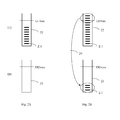
- the (shift) register principle is in the FIGS. 2A and 2B Based on two typical situations explained.
- Fig. 2A For example, a situation is shown where the number of destination calls Z.1 (represented by black horizontal bars) for trips to the bottom stop 13.1 is less than the downward travel limit LUmax.
- the corresponding destination calls Z.1 are stored in a register 22. Since the downward conveyance limit LUmax in the in Fig. 2A has not been exceeded, there is no change to the reverse replacement mode and the register 23 of the upper elevator car DU remains empty.
- Fig. 2B a situation is shown where the number of destination calls Z.1 in the register 22 for trips to the bottom stop 13.1 is greater than the downwards transportation limit LUmax. Since the down-travel limit LUmax has been exceeded, a change to the down-substitute mode takes place and the register 23 of the upper elevator car DU takes over part of the destination calls Z.1 from the register 22, as indicated by the arrow 24.
- the passengers are informed only after boarding or during transportation that the elevator car in which the passengers are present does not approach the desired destination, but only until on a stop approaching this destination.
- the elevator cars DU, LU can be equipped with appropriate means to acoustically and / or visually inform the passengers accordingly.
- an announcement just before reaching the stop 13.2 may alert the passengers to leave the DU on the first floor and use a staircase or escalator down to reach the lowest floor 13.1.
- a staircase or escalator down to reach the lowest floor 13.1.
- acoustic or visual means may be used to get the passengers leaving the 2nd floor 13.2 to the 1st floor 13.1.
- assign For example, a signal may be sent to a stationary escalator for this escalator to start running just before the passengers arrive on a replacement trip.
Landscapes
- Engineering & Computer Science (AREA)
- Automation & Control Theory (AREA)
- Elevator Control (AREA)
Priority Applications (7)
| Application Number | Priority Date | Filing Date | Title |
|---|---|---|---|
| EP07103907A EP1970340A1 (de) | 2007-03-12 | 2007-03-12 | Verfahren zum verkehrsabhängigen Betreiben einer Aufzugsanlage mit zwei im selben Schacht bewegbaren Aufzugskabinen und entsprechende Aufzugsanlage |
| AU2008226311A AU2008226311A1 (en) | 2007-03-12 | 2008-03-10 | Method for operating a lift unit and corresponding lift unit |
| PCT/CH2008/000096 WO2008110025A1 (de) | 2007-03-12 | 2008-03-10 | Verfahren zum betreiben einer aufzugsanlage und entsprechende aufzugsanlage |
| CN2008800079834A CN101641274B (zh) | 2007-03-12 | 2008-03-10 | 运行电梯设备的方法以及相应的电梯设备 |
| BRPI0808857-8A BRPI0808857B1 (pt) | 2007-03-12 | 2008-03-10 | Processo para operar uma instalação de elevador e instalação de elevador |
| EP08706394.7A EP2132124B1 (de) | 2007-03-12 | 2008-03-10 | Verfahren zum betreiben einer aufzugsanlage und entsprechende aufzugsanlage |
| TW097108602A TWI400190B (zh) | 2007-03-12 | 2008-03-12 | 用於操作升降設備之方法及對應的升降設備 |
Applications Claiming Priority (1)
| Application Number | Priority Date | Filing Date | Title |
|---|---|---|---|
| EP07103907A EP1970340A1 (de) | 2007-03-12 | 2007-03-12 | Verfahren zum verkehrsabhängigen Betreiben einer Aufzugsanlage mit zwei im selben Schacht bewegbaren Aufzugskabinen und entsprechende Aufzugsanlage |
Publications (1)
| Publication Number | Publication Date |
|---|---|
| EP1970340A1 true EP1970340A1 (de) | 2008-09-17 |
Family
ID=38335759
Family Applications (2)
| Application Number | Title | Priority Date | Filing Date |
|---|---|---|---|
| EP07103907A Withdrawn EP1970340A1 (de) | 2007-03-12 | 2007-03-12 | Verfahren zum verkehrsabhängigen Betreiben einer Aufzugsanlage mit zwei im selben Schacht bewegbaren Aufzugskabinen und entsprechende Aufzugsanlage |
| EP08706394.7A Active EP2132124B1 (de) | 2007-03-12 | 2008-03-10 | Verfahren zum betreiben einer aufzugsanlage und entsprechende aufzugsanlage |
Family Applications After (1)
| Application Number | Title | Priority Date | Filing Date |
|---|---|---|---|
| EP08706394.7A Active EP2132124B1 (de) | 2007-03-12 | 2008-03-10 | Verfahren zum betreiben einer aufzugsanlage und entsprechende aufzugsanlage |
Country Status (6)
| Country | Link |
|---|---|
| EP (2) | EP1970340A1 (pt) |
| CN (1) | CN101641274B (pt) |
| AU (1) | AU2008226311A1 (pt) |
| BR (1) | BRPI0808857B1 (pt) |
| TW (1) | TWI400190B (pt) |
| WO (1) | WO2008110025A1 (pt) |
Cited By (1)
| Publication number | Priority date | Publication date | Assignee | Title |
|---|---|---|---|---|
| EP2208701A1 (de) * | 2009-01-16 | 2010-07-21 | Inventio Ag | Verfahren zur Steuerung einer Aufzugsanlage |
Families Citing this family (5)
| Publication number | Priority date | Publication date | Assignee | Title |
|---|---|---|---|---|
| CN103249661B (zh) * | 2010-09-30 | 2015-03-18 | 通力股份公司 | 电梯系统 |
| CN111212807A (zh) | 2017-10-31 | 2020-05-29 | 因温特奥股份公司 | 通过电梯设备来优化乘客运送的方法和电梯门系统 |
| US10947086B2 (en) * | 2017-11-30 | 2021-03-16 | Otis Elevator Company | Sequence triggering for automatic calls and multi segment elevator trips |
| CN109911747A (zh) * | 2019-04-10 | 2019-06-21 | 杨宝金 | 一种自适应电梯门机控制方法及装置 |
| CN114136885B (zh) * | 2021-11-26 | 2023-10-27 | 北京电子科技职业学院 | 一种可调式光学限位机构和限位方法 |
Citations (4)
| Publication number | Priority date | Publication date | Assignee | Title |
|---|---|---|---|---|
| US5663538A (en) * | 1993-11-18 | 1997-09-02 | Sakita; Masami | Elevator control system |
| GB2324170A (en) * | 1995-03-31 | 1998-10-14 | Masami Sakita | Elevator dispatch system |
| US6360849B1 (en) * | 1999-08-06 | 2002-03-26 | Mitsubishi Denki Kabushiki Kaisha | Elevator system, including control method for controlling, multiple cars in a single shaft |
| EP1619157A1 (de) * | 2004-07-22 | 2006-01-25 | Inventio Ag | Aufzugsanlage mit individuell bewegbaren Aufzugskabinen und Verfahren zum Betreiben einer solchen Aufzugsanlage |
Family Cites Families (2)
| Publication number | Priority date | Publication date | Assignee | Title |
|---|---|---|---|---|
| CN1098214C (zh) * | 1999-07-06 | 2003-01-08 | 中国石油化工集团公司 | 具有ael结构的磷酸硅铝分子筛及其合成方法 |
| JP4386842B2 (ja) * | 2002-11-26 | 2009-12-16 | ティッセンクルップ エレバートル アーゲー | エレベータ設備の制御方法、及び該方法を実行するためのエレベータ設備 |
-
2007
- 2007-03-12 EP EP07103907A patent/EP1970340A1/de not_active Withdrawn
-
2008
- 2008-03-10 BR BRPI0808857-8A patent/BRPI0808857B1/pt not_active IP Right Cessation
- 2008-03-10 AU AU2008226311A patent/AU2008226311A1/en not_active Abandoned
- 2008-03-10 WO PCT/CH2008/000096 patent/WO2008110025A1/de not_active Ceased
- 2008-03-10 EP EP08706394.7A patent/EP2132124B1/de active Active
- 2008-03-10 CN CN2008800079834A patent/CN101641274B/zh active Active
- 2008-03-12 TW TW097108602A patent/TWI400190B/zh not_active IP Right Cessation
Patent Citations (5)
| Publication number | Priority date | Publication date | Assignee | Title |
|---|---|---|---|---|
| US5663538A (en) * | 1993-11-18 | 1997-09-02 | Sakita; Masami | Elevator control system |
| GB2324170A (en) * | 1995-03-31 | 1998-10-14 | Masami Sakita | Elevator dispatch system |
| US6360849B1 (en) * | 1999-08-06 | 2002-03-26 | Mitsubishi Denki Kabushiki Kaisha | Elevator system, including control method for controlling, multiple cars in a single shaft |
| EP1619157A1 (de) * | 2004-07-22 | 2006-01-25 | Inventio Ag | Aufzugsanlage mit individuell bewegbaren Aufzugskabinen und Verfahren zum Betreiben einer solchen Aufzugsanlage |
| US20060016640A1 (en) * | 2004-07-22 | 2006-01-26 | Inventio Ag | Elevator installation with individually movable elevator cars and method for operating such an elevator installation |
Cited By (6)
| Publication number | Priority date | Publication date | Assignee | Title |
|---|---|---|---|---|
| EP2208701A1 (de) * | 2009-01-16 | 2010-07-21 | Inventio Ag | Verfahren zur Steuerung einer Aufzugsanlage |
| WO2010081709A1 (de) | 2009-01-16 | 2010-07-22 | Inventio Ag | Verfahren zur steuerung einer aufzugsanlage |
| CN102282086A (zh) * | 2009-01-16 | 2011-12-14 | 因温特奥股份公司 | 用于控制电梯设备的方法 |
| CN102282086B (zh) * | 2009-01-16 | 2013-12-18 | 因温特奥股份公司 | 用于控制电梯设备的方法 |
| RU2520637C2 (ru) * | 2009-01-16 | 2014-06-27 | Инвенцио Аг | Способ управления лифтовой установкой |
| US8905195B2 (en) | 2009-01-16 | 2014-12-09 | Inventio Ag | Elevator system control using traffic or passenger parameters |
Also Published As
| Publication number | Publication date |
|---|---|
| BRPI0808857A2 (pt) | 2014-09-09 |
| TW200846269A (en) | 2008-12-01 |
| CN101641274B (zh) | 2013-08-07 |
| TWI400190B (zh) | 2013-07-01 |
| AU2008226311A1 (en) | 2008-09-18 |
| EP2132124B1 (de) | 2021-07-21 |
| WO2008110025A1 (de) | 2008-09-18 |
| BRPI0808857B1 (pt) | 2019-07-09 |
| CN101641274A (zh) | 2010-02-03 |
| EP2132124A1 (de) | 2009-12-16 |
Similar Documents
| Publication | Publication Date | Title |
|---|---|---|
| EP3206982B1 (de) | Verfahren zum betreiben einer transportanlage sowie entsprechende transportanlage | |
| EP3224172B1 (de) | Verfahren zum betreiben eines aufzugssystems | |
| EP2370334B1 (de) | Aufzugssteuerung einer aufzugsanlage | |
| EP1619157B1 (de) | Aufzugsanlage mit individuell bewegbaren Aufzugskabinen und Verfahren zum Betreiben einer solchen Aufzugsanlage | |
| EP1404603B1 (de) | Aufzuganlage mit virtueller schutzzone am schachtfuss und/oder am schachtkopf und verfahren zum ansteuern derselben | |
| EP3099616B1 (de) | Verfahren zum betreiben eines aufzugsystems | |
| EP0312730B1 (de) | Gruppensteuerung für Aufzüge mit lastabhängiger Steuerung der Kabinen | |
| EP3325390B1 (de) | Verfahren zum betreiben eines aufzugsystems sowie aufzugsystem | |
| EP3172159B2 (de) | Verfahren zum steuern einer aufzugsanlage | |
| EP3261971A1 (de) | Verfahren zum betreiben eines aufzugsystems mit mehreren schächten und mehreren kabinen | |
| EP0459169B1 (de) | Gruppensteuerung für Aufzüge mit Doppelkabinen mit Sofortzuteilung von Zielrufen | |
| EP2132124B1 (de) | Verfahren zum betreiben einer aufzugsanlage und entsprechende aufzugsanlage | |
| DE69208427T2 (de) | Aufzugssystem mit dynamischer Sektorzuteilung | |
| EP1616832A2 (de) | Auzugsanlage mit mindestens drei nebeneinander angeordneten, vertikalen Aufzugsschächten und Verfahren zum Betreiben einer solchen Aufzugsanlage | |
| EP0242520B1 (de) | Anzeigevorrichtung für Aufzüge | |
| EP1526103B1 (de) | Aufzugsanlage mit mehrstöckigen Kabinen für den Zonenbetrieb in einem Gebäude | |
| EP3774627B1 (de) | Verfahren zum betreiben einer aufzugsanlage | |
| WO2019091799A1 (de) | Personenfördervorrichtung mit überwachungseinrichtung | |
| WO2019154703A1 (de) | Personenfördervorrichtung mit vorgegebener fahrtrichtung | |
| EP3837203B1 (de) | Verfahren zum betreiben einer aufzuganlage mit vorgabe einer vorbestimmten fahrtroute sowie aufzuganlage und aufzugsteuerung zur ausführung eines solchen verfahrens | |
| DE112012006080B4 (de) | Fahrstuhl-Steuervorrichtung | |
| DE102024130133A1 (de) | Verfahren zum Betreiben einer Aufzugsanlage mit zwei Fahrkörben auf einer Fahrspur | |
| EP1870366A1 (de) | Aufzugsanlage und Verfahren zum Betreiben einer Aufzugsanlage | |
| EP1882670B1 (de) | Verfahren zur Modernisierung einer Aufzugsanlage | |
| WO2020038772A1 (de) | Verfahren zum betreiben eines aufzugsystems |
Legal Events
| Date | Code | Title | Description |
|---|---|---|---|
| PUAI | Public reference made under article 153(3) epc to a published international application that has entered the european phase |
Free format text: ORIGINAL CODE: 0009012 |
|
| AK | Designated contracting states |
Kind code of ref document: A1 Designated state(s): AT BE BG CH CY CZ DE DK EE ES FI FR GB GR HU IE IS IT LI LT LU LV MC MT NL PL PT RO SE SI SK TR |
|
| AX | Request for extension of the european patent |
Extension state: AL BA HR MK RS |
|
| AKX | Designation fees paid | ||
| REG | Reference to a national code |
Ref country code: DE Ref legal event code: 8566 |
|
| STAA | Information on the status of an ep patent application or granted ep patent |
Free format text: STATUS: THE APPLICATION IS DEEMED TO BE WITHDRAWN |
|
| 18D | Application deemed to be withdrawn |
Effective date: 20090318 |