EP1977653A1 - Verfahren zur Gewinnung pflanzlicher Proteine und/oder Peptide, danach hergestellte Proteine und/oder Peptide und Verwendung derselben - Google Patents
Verfahren zur Gewinnung pflanzlicher Proteine und/oder Peptide, danach hergestellte Proteine und/oder Peptide und Verwendung derselben Download PDFInfo
- Publication number
- EP1977653A1 EP1977653A1 EP08003155A EP08003155A EP1977653A1 EP 1977653 A1 EP1977653 A1 EP 1977653A1 EP 08003155 A EP08003155 A EP 08003155A EP 08003155 A EP08003155 A EP 08003155A EP 1977653 A1 EP1977653 A1 EP 1977653A1
- Authority
- EP
- European Patent Office
- Prior art keywords
- proteins
- peptides
- exchange membrane
- membrane
- protein
- Prior art date
- Legal status (The legal status is an assumption and is not a legal conclusion. Google has not performed a legal analysis and makes no representation as to the accuracy of the status listed.)
- Granted
Links
- 102000004169 proteins and genes Human genes 0.000 title claims abstract description 80
- 108090000623 proteins and genes Proteins 0.000 title claims abstract description 80
- 238000000034 method Methods 0.000 title claims abstract description 74
- 108090000765 processed proteins & peptides Proteins 0.000 title claims abstract description 44
- 102000004196 processed proteins & peptides Human genes 0.000 title claims abstract description 36
- 108010082495 Dietary Plant Proteins Proteins 0.000 title abstract description 6
- 239000012528 membrane Substances 0.000 claims abstract description 48
- 239000003480 eluent Substances 0.000 claims abstract description 15
- 239000003014 ion exchange membrane Substances 0.000 claims abstract description 12
- 239000000203 mixture Substances 0.000 claims abstract description 12
- 239000011159 matrix material Substances 0.000 claims abstract description 10
- 238000001035 drying Methods 0.000 claims abstract description 9
- 238000005406 washing Methods 0.000 claims abstract description 8
- 238000001179 sorption measurement Methods 0.000 claims abstract description 7
- 239000007858 starting material Substances 0.000 claims abstract description 7
- 235000013311 vegetables Nutrition 0.000 claims abstract description 7
- 235000013305 food Nutrition 0.000 claims abstract description 6
- 238000002955 isolation Methods 0.000 claims abstract description 5
- 239000012535 impurity Substances 0.000 claims abstract description 3
- 239000003814 drug Substances 0.000 claims abstract 3
- 229940079593 drug Drugs 0.000 claims abstract 2
- 235000018102 proteins Nutrition 0.000 claims description 76
- 244000061456 Solanum tuberosum Species 0.000 claims description 30
- 235000002595 Solanum tuberosum Nutrition 0.000 claims description 30
- 230000008569 process Effects 0.000 claims description 30
- 239000000243 solution Substances 0.000 claims description 16
- 239000011148 porous material Substances 0.000 claims description 11
- 241000196324 Embryophyta Species 0.000 claims description 9
- 239000003011 anion exchange membrane Substances 0.000 claims description 9
- 238000005341 cation exchange Methods 0.000 claims description 9
- 235000012015 potatoes Nutrition 0.000 claims description 9
- 239000007787 solid Substances 0.000 claims description 8
- XLYOFNOQVPJJNP-UHFFFAOYSA-N water Substances O XLYOFNOQVPJJNP-UHFFFAOYSA-N 0.000 claims description 8
- FAPWRFPIFSIZLT-UHFFFAOYSA-M Sodium chloride Chemical compound [Na+].[Cl-] FAPWRFPIFSIZLT-UHFFFAOYSA-M 0.000 claims description 7
- 108010064851 Plant Proteins Proteins 0.000 claims description 6
- 229920002472 Starch Polymers 0.000 claims description 6
- 238000005345 coagulation Methods 0.000 claims description 6
- 230000015271 coagulation Effects 0.000 claims description 6
- 238000004925 denaturation Methods 0.000 claims description 6
- 230000036425 denaturation Effects 0.000 claims description 6
- 238000001471 micro-filtration Methods 0.000 claims description 6
- 235000021118 plant-derived protein Nutrition 0.000 claims description 6
- 239000002994 raw material Substances 0.000 claims description 6
- 239000008107 starch Substances 0.000 claims description 6
- 235000019698 starch Nutrition 0.000 claims description 6
- 238000000108 ultra-filtration Methods 0.000 claims description 6
- NLXLAEXVIDQMFP-UHFFFAOYSA-N Ammonia chloride Chemical compound [NH4+].[Cl-] NLXLAEXVIDQMFP-UHFFFAOYSA-N 0.000 claims description 4
- 238000003795 desorption Methods 0.000 claims description 4
- 238000001728 nano-filtration Methods 0.000 claims description 4
- 239000011780 sodium chloride Substances 0.000 claims description 4
- 240000002791 Brassica napus Species 0.000 claims description 3
- 239000002775 capsule Substances 0.000 claims description 3
- 239000000835 fiber Substances 0.000 claims description 3
- 235000021374 legumes Nutrition 0.000 claims description 3
- 229920001059 synthetic polymer Polymers 0.000 claims description 3
- 238000004804 winding Methods 0.000 claims description 3
- GNFTZDOKVXKIBK-UHFFFAOYSA-N 3-(2-methoxyethoxy)benzohydrazide Chemical compound COCCOC1=CC=CC(C(=O)NN)=C1 GNFTZDOKVXKIBK-UHFFFAOYSA-N 0.000 claims description 2
- 235000004977 Brassica sinapistrum Nutrition 0.000 claims description 2
- 241000219745 Lupinus Species 0.000 claims description 2
- 235000019270 ammonium chloride Nutrition 0.000 claims description 2
- 238000005352 clarification Methods 0.000 claims description 2
- 239000000470 constituent Substances 0.000 claims description 2
- 238000004108 freeze drying Methods 0.000 claims description 2
- 235000013376 functional food Nutrition 0.000 claims description 2
- 238000005374 membrane filtration Methods 0.000 claims description 2
- 239000003960 organic solvent Substances 0.000 claims description 2
- 238000005185 salting out Methods 0.000 claims description 2
- 238000001694 spray drying Methods 0.000 claims description 2
- 244000068988 Glycine max Species 0.000 claims 2
- 235000010469 Glycine max Nutrition 0.000 claims 2
- FGUUSXIOTUKUDN-IBGZPJMESA-N C1(=CC=CC=C1)N1C2=C(NC([C@H](C1)NC=1OC(=NN=1)C1=CC=CC=C1)=O)C=CC=C2 Chemical compound C1(=CC=CC=C1)N1C2=C(NC([C@H](C1)NC=1OC(=NN=1)C1=CC=CC=C1)=O)C=CC=C2 FGUUSXIOTUKUDN-IBGZPJMESA-N 0.000 claims 1
- 244000046052 Phaseolus vulgaris Species 0.000 claims 1
- 235000010627 Phaseolus vulgaris Nutrition 0.000 claims 1
- 240000004713 Pisum sativum Species 0.000 claims 1
- 235000010582 Pisum sativum Nutrition 0.000 claims 1
- 239000006096 absorbing agent Substances 0.000 claims 1
- 235000008452 baby food Nutrition 0.000 claims 1
- 238000006073 displacement reaction Methods 0.000 claims 1
- 235000013312 flour Nutrition 0.000 claims 1
- 235000013402 health food Nutrition 0.000 claims 1
- 238000003801 milling Methods 0.000 claims 1
- 239000012266 salt solution Substances 0.000 claims 1
- 230000008961 swelling Effects 0.000 claims 1
- 241001465754 Metazoa Species 0.000 abstract description 3
- 238000011084 recovery Methods 0.000 abstract 1
- 239000011343 solid material Substances 0.000 abstract 1
- 210000004379 membrane Anatomy 0.000 description 41
- 229940042399 direct acting antivirals protease inhibitors Drugs 0.000 description 13
- 235000011389 fruit/vegetable juice Nutrition 0.000 description 13
- 239000000137 peptide hydrolase inhibitor Substances 0.000 description 13
- 239000000463 material Substances 0.000 description 8
- 101710091688 Patatin Proteins 0.000 description 7
- 238000000605 extraction Methods 0.000 description 7
- 239000000047 product Substances 0.000 description 7
- 239000012466 permeate Substances 0.000 description 6
- 230000008901 benefit Effects 0.000 description 5
- 150000001768 cations Chemical class 0.000 description 5
- 238000004140 cleaning Methods 0.000 description 5
- 238000001914 filtration Methods 0.000 description 5
- 238000011068 loading method Methods 0.000 description 5
- 238000000926 separation method Methods 0.000 description 5
- 101001033883 Cenchritis muricatus Protease inhibitor 2 Proteins 0.000 description 4
- 239000011324 bead Substances 0.000 description 4
- 238000009792 diffusion process Methods 0.000 description 4
- 238000010828 elution Methods 0.000 description 4
- 238000010438 heat treatment Methods 0.000 description 4
- 229920000642 polymer Polymers 0.000 description 4
- 239000000126 substance Substances 0.000 description 4
- 108010088751 Albumins Proteins 0.000 description 3
- 102000009027 Albumins Human genes 0.000 description 3
- 102000005367 Carboxypeptidases Human genes 0.000 description 3
- 108010006303 Carboxypeptidases Proteins 0.000 description 3
- HEMHJVSKTPXQMS-UHFFFAOYSA-M Sodium hydroxide Chemical compound [OH-].[Na+] HEMHJVSKTPXQMS-UHFFFAOYSA-M 0.000 description 3
- 230000000903 blocking effect Effects 0.000 description 3
- 239000003010 cation ion exchange membrane Substances 0.000 description 3
- 239000012530 fluid Substances 0.000 description 3
- 238000004519 manufacturing process Methods 0.000 description 3
- 239000012465 retentate Substances 0.000 description 3
- -1 Aspartyl Chemical group 0.000 description 2
- 108010044091 Globulins Proteins 0.000 description 2
- 102000006395 Globulins Human genes 0.000 description 2
- 206010020751 Hypersensitivity Diseases 0.000 description 2
- 230000009471 action Effects 0.000 description 2
- 230000007815 allergy Effects 0.000 description 2
- 235000001014 amino acid Nutrition 0.000 description 2
- 150000001413 amino acids Chemical class 0.000 description 2
- 235000021120 animal protein Nutrition 0.000 description 2
- 238000005349 anion exchange Methods 0.000 description 2
- 125000000129 anionic group Chemical group 0.000 description 2
- 150000001450 anions Chemical class 0.000 description 2
- 239000000872 buffer Substances 0.000 description 2
- 239000007853 buffer solution Substances 0.000 description 2
- 125000002091 cationic group Chemical group 0.000 description 2
- 239000002800 charge carrier Substances 0.000 description 2
- 238000001816 cooling Methods 0.000 description 2
- 201000010099 disease Diseases 0.000 description 2
- 208000037265 diseases, disorders, signs and symptoms Diseases 0.000 description 2
- 239000012527 feed solution Substances 0.000 description 2
- 235000003869 genetically modified organism Nutrition 0.000 description 2
- 239000003112 inhibitor Substances 0.000 description 2
- 238000005342 ion exchange Methods 0.000 description 2
- 239000002245 particle Substances 0.000 description 2
- 239000012460 protein solution Substances 0.000 description 2
- 230000017854 proteolysis Effects 0.000 description 2
- 150000003839 salts Chemical class 0.000 description 2
- 241000271566 Aves Species 0.000 description 1
- 235000018185 Betula X alpestris Nutrition 0.000 description 1
- 235000018212 Betula X uliginosa Nutrition 0.000 description 1
- 108091003079 Bovine Serum Albumin Proteins 0.000 description 1
- 235000006008 Brassica napus var napus Nutrition 0.000 description 1
- OYPRJOBELJOOCE-UHFFFAOYSA-N Calcium Chemical compound [Ca] OYPRJOBELJOOCE-UHFFFAOYSA-N 0.000 description 1
- 102000011632 Caseins Human genes 0.000 description 1
- 108010076119 Caseins Proteins 0.000 description 1
- 102000030523 Catechol oxidase Human genes 0.000 description 1
- 108010031396 Catechol oxidase Proteins 0.000 description 1
- 241000287828 Gallus gallus Species 0.000 description 1
- 102000003886 Glycoproteins Human genes 0.000 description 1
- 108090000288 Glycoproteins Proteins 0.000 description 1
- 241000238631 Hexapoda Species 0.000 description 1
- IMQLKJBTEOYOSI-GPIVLXJGSA-N Inositol-hexakisphosphate Chemical compound OP(O)(=O)O[C@H]1[C@H](OP(O)(O)=O)[C@@H](OP(O)(O)=O)[C@H](OP(O)(O)=O)[C@H](OP(O)(O)=O)[C@@H]1OP(O)(O)=O IMQLKJBTEOYOSI-GPIVLXJGSA-N 0.000 description 1
- 201000010538 Lactose Intolerance Diseases 0.000 description 1
- 108090001030 Lipoproteins Proteins 0.000 description 1
- 102000004895 Lipoproteins Human genes 0.000 description 1
- 241000124008 Mammalia Species 0.000 description 1
- 102000014171 Milk Proteins Human genes 0.000 description 1
- 108010011756 Milk Proteins Proteins 0.000 description 1
- 101710190786 PI protein Proteins 0.000 description 1
- 102000009097 Phosphorylases Human genes 0.000 description 1
- 108010073135 Phosphorylases Proteins 0.000 description 1
- 108091000080 Phosphotransferase Proteins 0.000 description 1
- IMQLKJBTEOYOSI-UHFFFAOYSA-N Phytic acid Natural products OP(O)(=O)OC1C(OP(O)(O)=O)C(OP(O)(O)=O)C(OP(O)(O)=O)C(OP(O)(O)=O)C1OP(O)(O)=O IMQLKJBTEOYOSI-UHFFFAOYSA-N 0.000 description 1
- MTCFGRXMJLQNBG-UHFFFAOYSA-N Serine Natural products OCC(N)C(O)=O MTCFGRXMJLQNBG-UHFFFAOYSA-N 0.000 description 1
- 108010073771 Soybean Proteins Proteins 0.000 description 1
- 239000005862 Whey Substances 0.000 description 1
- 102000007544 Whey Proteins Human genes 0.000 description 1
- 108010046377 Whey Proteins Proteins 0.000 description 1
- 241000607479 Yersinia pestis Species 0.000 description 1
- 239000002253 acid Substances 0.000 description 1
- 230000002378 acidificating effect Effects 0.000 description 1
- 238000010171 animal model Methods 0.000 description 1
- 230000003217 anti-cancerogenic effect Effects 0.000 description 1
- 230000000433 anti-nutritional effect Effects 0.000 description 1
- TZCXTZWJZNENPQ-UHFFFAOYSA-L barium sulfate Chemical compound [Ba+2].[O-]S([O-])(=O)=O TZCXTZWJZNENPQ-UHFFFAOYSA-L 0.000 description 1
- 238000010923 batch production Methods 0.000 description 1
- 230000009286 beneficial effect Effects 0.000 description 1
- 229940098773 bovine serum albumin Drugs 0.000 description 1
- 239000000337 buffer salt Substances 0.000 description 1
- 239000011575 calcium Substances 0.000 description 1
- 229910001576 calcium mineral Inorganic materials 0.000 description 1
- 239000005018 casein Substances 0.000 description 1
- BECPQYXYKAMYBN-UHFFFAOYSA-N casein, tech. Chemical compound NCCCCC(C(O)=O)N=C(O)C(CC(O)=O)N=C(O)C(CCC(O)=N)N=C(O)C(CC(C)C)N=C(O)C(CCC(O)=O)N=C(O)C(CC(O)=O)N=C(O)C(CCC(O)=O)N=C(O)C(C(C)O)N=C(O)C(CCC(O)=N)N=C(O)C(CCC(O)=N)N=C(O)C(CCC(O)=N)N=C(O)C(CCC(O)=O)N=C(O)C(CCC(O)=O)N=C(O)C(COP(O)(O)=O)N=C(O)C(CCC(O)=N)N=C(O)C(N)CC1=CC=CC=C1 BECPQYXYKAMYBN-UHFFFAOYSA-N 0.000 description 1
- 235000021240 caseins Nutrition 0.000 description 1
- 238000005119 centrifugation Methods 0.000 description 1
- 238000004587 chromatography analysis Methods 0.000 description 1
- 235000018417 cysteine Nutrition 0.000 description 1
- XUJNEKJLAYXESH-UHFFFAOYSA-N cysteine Natural products SCC(N)C(O)=O XUJNEKJLAYXESH-UHFFFAOYSA-N 0.000 description 1
- 230000007123 defense Effects 0.000 description 1
- 238000000502 dialysis Methods 0.000 description 1
- 230000029087 digestion Effects 0.000 description 1
- 239000000539 dimer Substances 0.000 description 1
- 239000012153 distilled water Substances 0.000 description 1
- 230000003670 easy-to-clean Effects 0.000 description 1
- 230000000694 effects Effects 0.000 description 1
- 238000005516 engineering process Methods 0.000 description 1
- 239000003925 fat Substances 0.000 description 1
- 239000000706 filtrate Substances 0.000 description 1
- 238000005194 fractionation Methods 0.000 description 1
- 235000015203 fruit juice Nutrition 0.000 description 1
- 210000001035 gastrointestinal tract Anatomy 0.000 description 1
- 229930182478 glucoside Natural products 0.000 description 1
- 150000008131 glucosides Chemical class 0.000 description 1
- 229930008677 glyco alkaloid Natural products 0.000 description 1
- 230000009036 growth inhibition Effects 0.000 description 1
- 230000036541 health Effects 0.000 description 1
- 235000004280 healthy diet Nutrition 0.000 description 1
- 230000005764 inhibitory process Effects 0.000 description 1
- 229910052500 inorganic mineral Inorganic materials 0.000 description 1
- 239000003456 ion exchange resin Substances 0.000 description 1
- 229920003303 ion-exchange polymer Polymers 0.000 description 1
- 150000002500 ions Chemical class 0.000 description 1
- 229910001608 iron mineral Inorganic materials 0.000 description 1
- 230000001788 irregular Effects 0.000 description 1
- 238000002386 leaching Methods 0.000 description 1
- 230000007774 longterm Effects 0.000 description 1
- 230000000813 microbial effect Effects 0.000 description 1
- 244000005700 microbiome Species 0.000 description 1
- 235000021239 milk protein Nutrition 0.000 description 1
- 239000011707 mineral Substances 0.000 description 1
- 238000012544 monitoring process Methods 0.000 description 1
- 229920005615 natural polymer Polymers 0.000 description 1
- 239000000820 nonprescription drug Substances 0.000 description 1
- 230000031787 nutrient reservoir activity Effects 0.000 description 1
- 235000016709 nutrition Nutrition 0.000 description 1
- 239000003921 oil Substances 0.000 description 1
- 150000007524 organic acids Chemical class 0.000 description 1
- 235000005985 organic acids Nutrition 0.000 description 1
- 239000006259 organic additive Substances 0.000 description 1
- 238000004806 packaging method and process Methods 0.000 description 1
- 239000008363 phosphate buffer Substances 0.000 description 1
- 102000020233 phosphotransferase Human genes 0.000 description 1
- 235000002949 phytic acid Nutrition 0.000 description 1
- 239000000467 phytic acid Substances 0.000 description 1
- 229940068041 phytic acid Drugs 0.000 description 1
- 239000008057 potassium phosphate buffer Substances 0.000 description 1
- 235000013606 potato chips Nutrition 0.000 description 1
- 239000002243 precursor Substances 0.000 description 1
- 238000011045 prefiltration Methods 0.000 description 1
- 230000002265 prevention Effects 0.000 description 1
- 238000003672 processing method Methods 0.000 description 1
- 238000010298 pulverizing process Methods 0.000 description 1
- 238000005086 pumping Methods 0.000 description 1
- 238000000746 purification Methods 0.000 description 1
- 238000001223 reverse osmosis Methods 0.000 description 1
- 235000015598 salt intake Nutrition 0.000 description 1
- 239000013017 sartobind Substances 0.000 description 1
- 230000036186 satiety Effects 0.000 description 1
- 235000019627 satiety Nutrition 0.000 description 1
- 230000028327 secretion Effects 0.000 description 1
- 210000002966 serum Anatomy 0.000 description 1
- 239000002002 slurry Substances 0.000 description 1
- 238000002415 sodium dodecyl sulfate polyacrylamide gel electrophoresis Methods 0.000 description 1
- 229940001941 soy protein Drugs 0.000 description 1
- 238000001228 spectrum Methods 0.000 description 1
- 238000003860 storage Methods 0.000 description 1
- 239000008399 tap water Substances 0.000 description 1
- 235000020679 tap water Nutrition 0.000 description 1
- 239000003053 toxin Substances 0.000 description 1
- 231100000765 toxin Toxicity 0.000 description 1
- 108700012359 toxins Proteins 0.000 description 1
- 239000002753 trypsin inhibitor Substances 0.000 description 1
- 238000011144 upstream manufacturing Methods 0.000 description 1
- 239000002351 wastewater Substances 0.000 description 1
- 230000036642 wellbeing Effects 0.000 description 1
Images
Classifications
-
- A—HUMAN NECESSITIES
- A23—FOODS OR FOODSTUFFS; TREATMENT THEREOF, NOT COVERED BY OTHER CLASSES
- A23K—FODDER
- A23K20/00—Accessory food factors for animal feeding-stuffs
- A23K20/10—Organic substances
- A23K20/142—Amino acids; Derivatives thereof
- A23K20/147—Polymeric derivatives, e.g. peptides or proteins
-
- A—HUMAN NECESSITIES
- A23—FOODS OR FOODSTUFFS; TREATMENT THEREOF, NOT COVERED BY OTHER CLASSES
- A23J—PROTEIN COMPOSITIONS FOR FOODSTUFFS; WORKING-UP PROTEINS FOR FOODSTUFFS; PHOSPHATIDE COMPOSITIONS FOR FOODSTUFFS
- A23J1/00—Obtaining protein compositions for foodstuffs; Bulk opening of eggs and separation of yolks from whites
- A23J1/006—Obtaining protein compositions for foodstuffs; Bulk opening of eggs and separation of yolks from whites from vegetable materials
-
- A—HUMAN NECESSITIES
- A23—FOODS OR FOODSTUFFS; TREATMENT THEREOF, NOT COVERED BY OTHER CLASSES
- A23J—PROTEIN COMPOSITIONS FOR FOODSTUFFS; WORKING-UP PROTEINS FOR FOODSTUFFS; PHOSPHATIDE COMPOSITIONS FOR FOODSTUFFS
- A23J1/00—Obtaining protein compositions for foodstuffs; Bulk opening of eggs and separation of yolks from whites
- A23J1/14—Obtaining protein compositions for foodstuffs; Bulk opening of eggs and separation of yolks from whites from leguminous or other vegetable seeds; from press-cake or oil-bearing seeds
-
- A—HUMAN NECESSITIES
- A23—FOODS OR FOODSTUFFS; TREATMENT THEREOF, NOT COVERED BY OTHER CLASSES
- A23L—FOODS, FOODSTUFFS OR NON-ALCOHOLIC BEVERAGES, NOT OTHERWISE PROVIDED FOR; PREPARATION OR TREATMENT THEREOF
- A23L33/00—Modifying nutritive qualities of foods; Dietetic products; Preparation or treatment thereof
- A23L33/10—Modifying nutritive qualities of foods; Dietetic products; Preparation or treatment thereof using additives
- A23L33/17—Amino acids, peptides or proteins
- A23L33/185—Vegetable proteins
-
- A—HUMAN NECESSITIES
- A23—FOODS OR FOODSTUFFS; TREATMENT THEREOF, NOT COVERED BY OTHER CLASSES
- A23L—FOODS, FOODSTUFFS OR NON-ALCOHOLIC BEVERAGES, NOT OTHERWISE PROVIDED FOR; PREPARATION OR TREATMENT THEREOF
- A23L33/00—Modifying nutritive qualities of foods; Dietetic products; Preparation or treatment thereof
- A23L33/40—Complete food formulations for specific consumer groups or specific purposes, e.g. infant formula
-
- A—HUMAN NECESSITIES
- A61—MEDICAL OR VETERINARY SCIENCE; HYGIENE
- A61P—SPECIFIC THERAPEUTIC ACTIVITY OF CHEMICAL COMPOUNDS OR MEDICINAL PREPARATIONS
- A61P3/00—Drugs for disorders of the metabolism
- A61P3/02—Nutrients, e.g. vitamins, minerals
-
- A—HUMAN NECESSITIES
- A23—FOODS OR FOODSTUFFS; TREATMENT THEREOF, NOT COVERED BY OTHER CLASSES
- A23V—INDEXING SCHEME RELATING TO FOODS, FOODSTUFFS OR NON-ALCOHOLIC BEVERAGES AND LACTIC OR PROPIONIC ACID BACTERIA USED IN FOODSTUFFS OR FOOD PREPARATION
- A23V2002/00—Food compositions, function of food ingredients or processes for food or foodstuffs
-
- A—HUMAN NECESSITIES
- A23—FOODS OR FOODSTUFFS; TREATMENT THEREOF, NOT COVERED BY OTHER CLASSES
- A23V—INDEXING SCHEME RELATING TO FOODS, FOODSTUFFS OR NON-ALCOHOLIC BEVERAGES AND LACTIC OR PROPIONIC ACID BACTERIA USED IN FOODSTUFFS OR FOOD PREPARATION
- A23V2300/00—Processes
- A23V2300/30—Ion-exchange
Definitions
- the present invention relates to a method for obtaining plant proteins and / or peptides, proteins produced therefrom, peptides and mixtures thereof and uses thereof.
- animal proteins For human consumption, both animal and vegetable proteins are known. However, animal proteins such as chicken proteins, milk proteins such as casein or whey may have problems with BSE, avian and other diseases. Also, animal proteins are often associated with the triggering of allergies, even if they are not based on the protein, as in lactose intolerance.
- Vegetable proteins have problems with genetically modified organisms (GMO), their nutritional value and also with the triggering of allergies.
- GMO genetically modified organisms
- the best-known vegetable protein is soy protein.
- soy protein In vegetable proteins, moreover, the problem of taste often arises, for example in soy, so that the availability in foods is severely limited.
- Other plant proteins such as from rapeseed, lupine or potatoes, has not yet prevailed. For oilseed rape and legumes this could be due to the fact that especially the fat content of these raw materials leads to rancidity.
- the protein content of commercial products which contain many other desirable and undesirable substances, consists of many individual protein and peptide molecules, which can initially be roughly phenomenologically subdivided into globulins and albumins.
- Globulins have a spherical shape, are therefore quite compact and insoluble in water or at least sparingly soluble.
- Albumins have an open, more irregular shape and are therefore soluble in water. In general, albumins contain the soluble proteins.
- commercial protein naturally consists of protein and peptide molecules which have a different molecular weight. This makes their handling, eg food technology, quite complicated, and a health assessment can only be made on the basis of the amino acid spectrum.
- the commercial proteins thus have in common that they consist of a mixture of different protein and peptide molecules and, moreover, contain protein-foreign components derived from the original plant source material.
- protein-foreign components derived from the original plant source material.
- proteins include e.g. Glucosides, toxins (glycoalkaloids, trypsin inhibitors, etc.), anti-nutritive substances, such as phytic acid, which removes calcium and iron minerals from human and animal digestions as they are excreted and not absorbed in the intestinal tract.
- toxins glycoalkaloids
- trypsin inhibitors etc.
- anti-nutritive substances such as phytic acid
- fats and oils are also included, some of which are chemically linked to lipoproteins, as well as minerals.
- a disadvantage of the known processes is that although individual proteins or at least closely encompassed protein groups are provided, these processes are extremely complicated, cumbersome and expensive.
- a disadvantage is also a special selection of potatoes to look at. This not only restricts the availability of the raw material, but requires a necessary analytical control, an additional, expensive and expensive intermediate step.
- the logistics is complicated because the potatoes must be freshly processed and can not be stored.
- the proteins can be damaged in the known methods, since large amounts of heat energy are required, since working in dilute extraction solution and a high temperature for a long period of time must be maintained, which in addition makes large containers required.
- additional energy is needed in a later step, since the amount of material to be processed must be cooled to about room temperature for the further process steps.
- the invention has for its object to provide a method for obtaining plant proteins and / or peptides, with which the disadvantages of the prior art can be overcome. It is also intended to provide a method by which it is possible to obtain plant proteins and / or peptides on a broader basis of raw materials, ie not only for use in potatoes, but also for protein-containing plants in general. In particular, the method should be practicable in an environmentally friendly, energy-saving, simple and inexpensive manner, and thereby gain any proteins and peptides, pure or in mixtures, without process-related restrictions.
- the process according to the invention makes do without any additional plant comminution, heating and cooling steps and extraction with organic additives.
- the selection of proteins and peptides to be recovered is not restricted.
- the targeted selection of particular proteins and / or peptides can be achieved by controlling the method of selection by precise adjustment of process parameters.
- pure proteins without proportion of foreign proteins or arbitrarily large mixtures are obtained in the adsorption process of similar behaving proteins.
- the purity of the proteins can therefore be chosen according to the invention arbitrarily by the desorption step, e.g. in the form of dialysis. This may be particularly advantageous if the quality of a precursor is sufficient for medical applications and only the final assembly under sterile GMP conditions must be made, which may or may not meet the process operator.
- the fractionation of the proteins and / or peptides of the plant starting material into individual proteins or peptides or small groups of similar proteins can be achieved with extremely gentle process steps, whereby a large variety of products can still be supplied and none expensive or complicated process steps are necessary.
- the ion exchanger groups are fixed on a membrane instead of on polymer beads.
- the use of ion exchange membranes leads to a high flow rate, no to low fouling, to an extremely fast loading, since no diffusion is necessary, a lower chemical consumption for buffer solution and eluent, ease of use and a simple up-scaling and the ability to interconnect anion and cation exchangers, since these are connected according to the invention to different membranes.
- ion exchange membrane which may be a cation or anion exchange membrane.
- anion and cation exchange membranes can be used. These can each be strong or weakly acidic or alkaline in any combination. It is conceivable that a plurality of cation exchange membranes and / or a plurality of anion exchange membranes are connected in succession or in parallel. Also conceivable is a series connection of all cation exchange membranes and all anion exchange membranes, these two groups then being connected in parallel. The reverse procedure is also conceivable, with cation exchange membranes and anion exchange membranes being connected in parallel in their respective group, but the two groups are then connected in series. Thus, all conceivable variations are possible according to the invention and included within the scope of the invention.
- the first process step to obtain starch is to grind the potatoes to a fine pulp. From this slurry, the potato juice (potato fruit juice) containing the protein and / or peptide is separated from the solids, starch and fibers next. The separation of the starch and fibers can be carried out, for example, by centrifugation or in hydrocyclones.
- the potato juice obtained contains about 20 g / L potato proteins, of which about 40% patatin, a major storage protein belonging to the glycoproteins, about 50% protease inhibitors (PI) and 10% high molecular weight proteins, which include the polyphenol oxidases, kinases and Count phosphorylases.
- the patatin has a molecular weight of 40 to 44 kDa and consists of 363 amino acids. At a pH of 7 to 9, it forms a dimer with a size of 80 to 88 kDa.
- PI are a heterogeneous class with seven subclasses of different proteins. Their function in the potato is protein degradation, and thus they play a central role in the defense of the tuber against microbial pests and insects. The inhibition of protein degradation was observed in the animal model as growth inhibition, an anti-carcinogenic effect is discussed and the promotion of satiety in the PI II is in part promoted commercially.
- PI Potato Cysteine PI
- PCPI Potato Cysteine PI
- PKPI Kunitz PI
- PCI Carboxypeptidase
- OSPI Serine PI
- PAPI Potato Aspartyl PI
- the resulting potato juice is then clarified in a microfiltration membrane device.
- the pore size of the membrane is freely selectable and can be adapted to the desired products to be recovered. Clarification of the potato juice obtained is also possible, for example, by centrifuges of any type, provided that a clear centrifugate with exclusively dissolved constituents is obtained.
- An essential core of the process according to the invention is the isolation of the proteins and / or peptides from the aqueous matrix, in this case the potato juice, by adsorption on at least one ion exchange membrane which is composed of a synthetic polymer.
- ion exchange membrane which is composed of a synthetic polymer.
- examples of such membranes are available under the name Sartobind® ® from Sartorius commercially.
- step c) only a part of the proteins and / or peptides are isolated from the aqueous matrix by adsorption. This depends strongly on the cation or anion exchange membranes used. It is also conceivable that even before step c) a part of the proteins and / or peptides is separated by denaturation / coagulation, which part is not desired or needed for a more accurate separation.
- a denaturation / coagulation can be done for example by shifting the pH, organic solvents or by salting out.
- Equally important is the targeted desorption of the proteins and / or peptides bound to the ion exchange membrane by means of specially adapted eluents, after previously optionally washing away residues of the potato juice from the membrane.
- ion exchange membranes with cationic groups for example with trimethyl groups, can be used, while for cationic proteins anionic groups, such as sulphomethyl groups, should be present in the ion exchange membrane.
- a separation of solids and suspended or dispersed particles is recommended as an upstream step, as mentioned above. This can be done by a centrifuge or by a filtration, the latter in ordinary pore sizes up to a microfiltration.
- the use of a microfiltration suitable pore size of 0.2 microns has the advantage of allowing all protein to happen, but at the same time in the protein-containing solution also contained microorganisms to remove and thus make the medium germ-free. Thereafter, the proteins and / or peptides are adsorbed on the membranes by pumping the filtrate, permeate, or clarified protein solution into the membrane adsorber modules becomes. Many process variants are possible here.
- the cation and anion exchange membrane modules can be switched in parallel or in series.
- the adsorber membranes can be assembled in plate, cross-flow or wound module design.
- the delivery of the protein-containing feed solution can take place in the dead-end method or in the circulation method.
- the former is inevitably a batch process, the latter can be done both batchwise and continuously.
- the pore width of the adsorber membrane can be chosen freely, but it is recommended that it is not smaller than the pores of the prefiltration, otherwise there is a risk of accumulating material on the adsorbers in the form of a retentate, which must then be additionally removed in the washing step, and, being a potential product, also means losses in yield.
- the adsorber membranes are completely loaded with protein molecules, which can be determined analytically simply by measuring the conductivity in the outlet from the membranes or during dead-end operation in the permeate, the feed of the feed solution is interrupted and the membrane can optionally be washed, to remove impurities. Washing may be by water or a cleaning solution, but should not denature the proteins.
- the products adhered to the membranes can then be desorbed selectively with one or more eluents, as in a conventional chromatography process.
- This is preferably done with saline, the composition and concentration of which depends on the proteins and peptides to be eluted.
- sodium chloride and ammonium chloride solutions are used, but here the choice is almost unlimited and dictated by the properties of the proteins.
- buffer salts or buffer solutions for example phosphate buffer. So that the eluted proteins do not denature, they should be present in the eluent only in low concentration. Therefore, prior to drying, a concentration step is advantageous.
- distilled water or tap water the purity of the thus isolated proteins can be arbitrarily set.
- the product is isolated from the eluent, for example by drying or by separation of eluent and protein molecules on a membrane with a suitable pore size, which preferably ranges from ultrafiltration or nanofiltration to reverse osmosis, diafiltered and concentrated or only concentrated or just diafiltered.
- the last step is optionally followed by drying, it being possible with advantage to use gentle freeze-drying or spray-drying. Other types of drying are also possible, but intensive heat exposure that could lead to product damage should be avoided.
- An 80m 2 anion exchange module can bind 320g protein at a binding capacity of 0.4mg protein / cm 2 .
- 50% of the proteins in potato juice are PI, which is about 10 g / l. After giving up 32 1 potato juice, the capacity is exhausted. This takes about 6.5 minutes at a typical flow rate of 300 l / h. Finally, the PI proteins can be eluted.
- a cation exchange module with an area of 80 m 2 can bind 200 g protein at a binding capacity of 0.25 mg protein / cm 2 .
- 40% of the proteins in potato juice are patatin, which is about 8 g / l. 3.3 m 2 of membrane are required for complete binding of the patatin from 1 1 potato juice. On 330 m 2 , therefore, 1 kg of patatin from 125 1 of juice can be adsorbed. Thereafter, the patatin can be eluted.
- a great advantage of the method according to the invention is the multiple use of both the membrane adsorber and the washing solution and the eluent.
- BSA bovine serum albumin
- the long-term stability identification scheme is performed by loading, rinsing, eluting and rinsing.
- Rinse Fluid is a 50 mM potassium phosphate buffer at pH 7
- eluent is a 1M NaCl solution in the same buffer.
- One cycle lasts 21.5 minutes.
- the elution peaks widen over time and up to 65 cycles are possible without blocking the membrane and without breakthrough.
- the rinsing step is extended by 5 minutes, more than 100 cycles without membrane cleaning are possible.
- a blocking occurs from the 108th cycle. After cleaning with 0.5 M sodium hydroxide solution, the membrane was free again, so that the production process could be started again. Thus, several thousand cycles are possible with an adsor
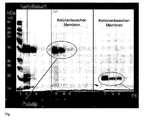
- FIG. 1 shows a SDS-PAGE gelase with the representation of the entire proteins in potato juice prior to processing according to the invention as well as on the cation and AnionenSeradsorbermembranen fixed and re-eluted proteins and protein fractions obtained according to the inventive method.
- the proteins and / or peptides obtained according to the invention can be used, for example, in functional foods, that is to say foods having a positive physiological action. They can also be used for disease control and prevention, as well as to increase performance and well-being.
- a preferred use of the proteins and / or peptides produced according to the invention could be in a pharmaceutical form, for example in capsule form.
- the protease inhibitor II is of interest, since its appetite-suppressing action is known and can be incorporated well into, for example, a hard gel capsule.
Landscapes
- Life Sciences & Earth Sciences (AREA)
- Chemical & Material Sciences (AREA)
- Polymers & Plastics (AREA)
- Engineering & Computer Science (AREA)
- Health & Medical Sciences (AREA)
- Food Science & Technology (AREA)
- Proteomics, Peptides & Aminoacids (AREA)
- Nutrition Science (AREA)
- Biochemistry (AREA)
- Mycology (AREA)
- Zoology (AREA)
- Animal Husbandry (AREA)
- Pediatric Medicine (AREA)
- Chemical Kinetics & Catalysis (AREA)
- General Chemical & Material Sciences (AREA)
- Animal Behavior & Ethology (AREA)
- General Health & Medical Sciences (AREA)
- Public Health (AREA)
- Veterinary Medicine (AREA)
- Organic Chemistry (AREA)
- Nuclear Medicine, Radiotherapy & Molecular Imaging (AREA)
- Medicinal Chemistry (AREA)
- Pharmacology & Pharmacy (AREA)
- Obesity (AREA)
- Hematology (AREA)
- Diabetes (AREA)
- Bioinformatics & Cheminformatics (AREA)
- Peptides Or Proteins (AREA)
- Preparation Of Compounds By Using Micro-Organisms (AREA)
- Medicines Containing Plant Substances (AREA)
- Coloring Foods And Improving Nutritive Qualities (AREA)
- Medicines That Contain Protein Lipid Enzymes And Other Medicines (AREA)
Abstract
Description
- Die vorliegende Erfindung betrifft ein Verfahren zur Gewinnung pflanzlicher Proteine und/oder Peptide, danach hergestellte Proteine, Peptide und Mischungen derselben sowie Verwendungen derselben.
- Für den menschlichen Verzehr sind sowohl tierische als auch pflanzliche Proteine bekannt. Tierische Proteine, wie beispielsweise Hühnerproteine, Milchproteine, wie Casein oder Molke, können jedoch Probleme hinsichtlich BSE, Vogelgruppe und anderer Krankheiten aufweisen. Auch stehen tierische Proteine häufig mit der Auslösung von Allergien im Zusammenhang, auch wenn diese, wie bei einer Lactoseintoleranz, nicht selbst auf dem Protein basieren.
- Pflanzliche Proteine haben Probleme mit gentechnisch modifizierten Organismen (GMO), dem Nährwert und ebenfalls mit der Auslösung von Allergien. Das bekannteste pflanzliche Protein ist Sojaprotein. Bei pflanzlichen Proteinen stellt sich ferner häufig das Problem des Geschmacks, beispielsweise bei Soja, so daß die Verwendbarkeit in Lebensmitteln stark eingeschränkt ist. Auch der Einsatz anderer Pflanzenproteine, wie beispielsweise aus Raps, Lupinen oder Kartoffeln, hat sich bislang nicht durchgesetzt. Bei Raps und Leguminosen könnte dies darin begründet sein, daß vor allem der Fettgehalt diese Ausgangsmaterialien zu Ranzigkeit führt.
- Chemisch gesehen besteht der Proteinanteil handelsüblicher Produkte, die noch viele andere erwünschte und unerwünschte Stoffe enthalten, aus vielen einzelnen Protein- und Peptidmolekülen, die man zunächst grob phänomenologisch in Globuline und Albumine unterteilen kann. Globuline weisen eine sphärische Gestalt auf, sind daher recht kompakt und in Wasser unlöslich oder zumindest schwer löslich. Albumine weisen eine offene, unregelmäßigere Gestalt auf und sind daher in Wasser löslich. Allgemein faßt man unter Albuminen die löslichen Proteine zusammen. Daneben besteht handelsübliches Eiweiß natürlich aus Protein- und Peptidmolekülen, die ein unterschiedliches Molekulargewicht aufweisen. Dies macht ihre Handhabung, z.B. lebensmitteltechnologisch, recht kompliziert, und eine gesundheitliche Beurteilung kann nur auf Basis des Aminosäurespektrums vorgenommen werden.
- Die handelsüblichen Proteine haben somit gemein, daß sie aus einem Gemisch verschiedener Protein- und Peptidmoleküle bestehen und darüber hinaus proteinfremde Bestandteile enthalten, die aus dem ursprünglichen pflanzlichen Ausgangsmaterial stammen. Hierzu gehören z.B. Glucoside, Toxine (Glycoalkaloide, Trypsininhibitoren, usw.), antinutritive Stoffe, wie etwa Phytinsäure, die der menschlichen und tierischen Verdauung Kalzium- und Eisenmineralien entzieht, da diese ausgeschieden und im Darmtrakt nicht resorbiert werden. Ebenfalls enthalten sind Fette und Öle, die teilweise zu Lipoproteinen chemisch verbunden sind, sowie Mineralstoffe.
- Bislang gibt es wenige reine Proteine oder Peptide, beispielsweise für eine gesunde Ernährung oder als frei verkäufliche Arzneimittel, die preiswert genug sind, um eine breitere Anwendung zu finden. Der Grund liegt insbesondere darin, daß teure, aus der pharmazeutischen Industrie stammende Aufarbeitungsverfahren eingesetzt werden. Ein weiterer Grund für den hohen Preis sowie eine extrem eingeschränkte Verfügbarkeit ist die Herkunft der Proteinmoleküle, die aus Säugetieren oder aus Menschensekreten, z.B. Blutserum, gewonnen werden, die allesamt die gesuchten Wirkungsproteine in geringer Konzentration enthalten und selbst auch nur in beschränkter Menge zur Verfügung stehen.
- In den
US 2003113829 ,US 2003092151 ,US 2003092152 ,US 2003092150 undUS 2003077265 wird erstmalig beschrieben, wie aus einem Proteingemisch eines pflanzlichen Rohstoffs, hier der Kartoffel, einzelne Proteingruppen relativ rein isoliert werden können. - Beschrieben werden hier die Rohstoffauswahl; die Methode zur Eliminierung von Kunitz- und Bowman-Birk- sowie Carboxypeptidase-Inhibitoren aus Kartoffelprotein durch Erhitzen, Abkühlen, Zentrifugieren und Filtrieren von Kartoffelsaft; Erweiterung der Methode durch Einsatz eines sauren Extraktionsmittels verbunden mit einer Pulverisierung des Pflanzenmaterials in der Extraktionslösung, so daß man Protease-Inhibitor II erhält; Methode zur Steuerung von Ausbeute und Reinheit von Protease-Inhibitor II während der Extraktion durch Auslaugen von Kartoffelschnitzel, Erhitzen der Extraktionslösung, Überwachung von Temperatur, Zeit und Salzkonzentration, Zentrifugation und Membranfiltration; Isolierung und Reinigung von Protease-Inhibitoren II in einer Verfahrensvariante.
- Nachteilig bei den bekannten Verfahren ist jedoch, daß zwar einzelne Proteine oder zumindest eng umfaßte Proteingruppen bereitgestellt werden, diese Verfahren jedoch extrem aufwendig, umständlich und teuer sind. Als Nachteil ist auch eine spezielle Auswahl der Kartoffeln anzusehen. Dadurch wird nicht nur die Verfügbarkeit des Rohstoffs eingeschränkt, sondern durch eine erforderliche analytische Kontrolle ist ein zusätzlicher, aufwendiger und teurer Zwischenschritt notwendig. Ferner ist die Logistik aufwendig, da die Kartoffeln frisch verarbeitet werden müssen und nicht gelagert werden können. Auch können die Proteine in den bekannten Verfahren geschädigt werden, da große Mengen an Wärmeenergie benötigt werden, da in verdünnter Extraktionslösung gearbeitet wird und eine hohe Temperatur für eine lange Zeitdauer gehalten werden muß, was zusätzlich große Behälter erforderlich macht. Ebenfalls wird in einem späteren Schritt zusätzliche Energie benötigt, da die zu verarbeitende Stoffmenge auf etwa Raumtemperatur abgekühlt werden muß für die weiteren Verfahrensschritte. Für die Extraktion werden organische Säuren benötigt, die im Abwasser die Umwelt belasten. Ferner muß das Pflanzenmaterial aufwendig auf etwa 100 µm bis 1.500 µm Teilchen zerkleinert werden. Nach der Extraktion und zusätzlich nach der Erhitzung sind Schritte zur Feststoffabtrennung notwendig, um koaguliertes bzw. unlösliches Pflanzenmaterial von der Proteinlösung abzutrennen und die letzte Isolierungsstufe der Ultrafiltration durchführen zu können. Die bekannten Verfahren liefern letztlich nur sehr wenige Proteine, vor allem solche, die nach einer Hitzeeinwirkung von 100°C über eine Zeit von etwa 3 Stunden noch nicht denaturiert sind. Schließlich werden hauptsächlich nur solche Proteine aus dem bekannten Verfahren gewonnen, die die oben erwähnten Kriterien erfüllen, d.h. Protease-Inhibitor II und Carboxypeptidase-Inhibitoren.
- Der Erfindung liegt die Aufgabe zugrunde, ein Verfahren zur Gewinnung pflanzlicher Proteine und/oder Peptide bereitzustellen, mit dem die Nachteile aus dem Stand der Technik überwunden werden können. Ebenfalls soll ein Verfahren bereitgestellt werden, mit dem die Gewinnung pflanzlicher Proteine und/oder Peptide auf einer breiteren Rohstoffbasis möglich ist, d.h. nicht nur zur Gewinnung aus Kartoffeln einsetzbar ist, sondern für proteinhaltige Pflanzen im allgemeinen. Insbesondere soll das Verfahren in einer umweltschonenden, energiesparenden, einfachen und preiswerten Weise durchführbar sein und dabei beliebige Proteine und Peptide, rein oder in Mischungen, ohne verfahrensbedingte Einschränkungen gewinnen.
- Weitere Aufgaben bestehen in der Bereitstellung von nach dem Verfahren hergestellten Proteinen und/oder Peptiden sowie in der Angabe von Verwendungsmöglichkeiten.
- Diese Aufgaben werden durch ein Verfahren nach Anspruch 1, Proteine, Peptide oder Mischungen derselben nach Anspruch 19 sowie Verwendungsmöglichkeiten nach Anspruch 20 gelöst. Bevorzugte Ausführungsformen ergeben sich aus den jeweiligen Unteransprüchen.
- Überraschenderweise wurde festgestellt, daß das erfindungsgemäße Verfahren im Gegensatz zu den Verfahren aus dem Stand der Technik vollkommen ohne eine zusätzliche Pflanzenzerkleinerung, Erhitzungs- und Abkühlschritte sowie eine Extraktion mit organischen Zuschlagsstoffen auskommt. Insbesondere wird die Auswahl der Proteine und Peptide, die gewonnen werden sollen, nicht eingeschränkt. Die gezielte Auswahl bestimmter Proteine und/oder Peptide kann durch die Steuerung des Verfahrens zur Selektion durch genaue Einstellung von Verfahrensparametern erreicht werden. Als Ergebnis des Verfahrens werden entweder reine Proteine ohne Anteil fremder Proteine oder beliebig umfangreiche Gemische sich beim Adsorptionsprozeß ähnlich verhaltender Proteine erhalten. Die Reinheit der Proteine kann daher erfindungsgemäß beliebig durch den Desorptionsschritt, z.B. in Form einer Dialyse, eingestellt werden. Dies kann insbesondere dann von Vorteil sein, wenn für medizinische Anwendungen die Qualität eines Vorprodukts ausreichend ist und nur die Endkonfektionierung unter sterilen GMP-Bedingungen erfolgen muß, die der Verfahrensbetreiber ggf. nicht erfüllen kann oder will.
- Mit anderen Worten kann mit dem erfindungsgemäßen Verfahren die Fraktionierung der Proteine und/oder Peptide des pflanzlichen Ausgangsmaterials in einzelne Proteine oder Peptide bzw. kleine Gruppen ähnlicher Proteine mit äußerst schonenden Verfahrensschritten erzielt werden, wobei noch stets eine große Vielzahl an Produkten geliefert werden kann und keine teuren oder komplizierten Verfahrensschritte notwendig sind.
- Als besonders vorteilhaft hat sich erwiesen, daß erfindungsgemäß eine Fixierung der Ionenaustauschergruppen auf einer Membran anstelle von auf Polymerkügelchen erfolgt. Die Verwendung von lonenaustauschermembranen führt zu einer hohen Durchflußrate, keinem bis geringem Fouling, zu einer äußerst schnellen Beladung, da keine Diffusion notwendig ist, einem geringeren Chemikalienverbrauch für Pufferlösung und Eluenten, eine einfache Handhabung sowie ein einfaches Up-Scaling und die Möglichkeit, Anionen- und Kationenaustauscher zusammenzuschalten, da diese erfindungsgemäß an verschiedene Membrane angebunden sind.
- Insbesondere ist es mit dem erfindungsgemäßen Verfahren möglich, nur eine Ionenaustauschermembran einzusetzen, die eine Kationen- oder Anionenaustauschermembran sein kann. Selbstverständlich können auch Kombinationen aus Anionen- und Kationenaustauschermembranen eingesetzt werden. Diese können jeweils in beliebiger Kombination stark oder schwach sauer bzw. alkalisch sein. Vorstellbar ist, daß mehrere Kationenaustauschermembranen und/oder mehrere Anionenaustauschermembranen nacheinander bzw. parallel geschaltet werden. Vorstellbar ist ebenfalls eine Serienschaltung aller Kationenaustauschermembranen und aller Anionenaustauschermembranen, wobei diese beiden Gruppen dann jedoch parallel geschaltet sind. Auch das umgekehrte Vorgehen ist denkbar, wobei Kationenaustauschermembranen und Anionenaustauschermembranen in ihrer jeweiligen Gruppe parallel geschaltet sind, die beiden Gruppen dann jedoch in Serie geschaltet werden. Somit sind alle denkbaren Variationen erfindungsgemäß möglich und im Umfang der Erfindung eingeschlossen.
- Weitere Vorteile der Anbindung der lonenaustauschergruppen an eine Membran sind wie folgt:
- Eine hohe Ladungsdichte erlaubt die Verpackung in kleine Volumina, die geringere Kosten bedeuten als z.B. bei der Fixierung auf porösen Polymerkügelchen, die sich in einem Behälter auf einer Siebplatte befinden und so umströmt werden.
- Es ist keine Kapillardiffusion und keine Fick'sche Diffusion notwendig, damit die zu adsorbierenden Moleküle zu den Ionenaustauschermolekülen gelangen, wie z.B. bei porösen Polymerkügelchen aus synthetischen oder natürlichen Polymeren. Es findet lediglich eine Konvektion statt, da die Membrane mit den Ladungsträgern direkt von der Aufgabelösung überströmt wird. Dadurch ist das Adsorptionsverfahren deutlich schneller. Im Umlaufbetrieb ist ein mehrfaches Passieren der Membrane und Poren mit den Ladungsträgern möglich, was das Adsorptionsverfahren und ebenfalls das Desorptionsverfahren deutlich beschleunigt. Die Adsorbermembrane sind wieder- bzw. mehrfach verwendbar und leicht zu reinigen.
- Die Porenweite der Membran kann beliebig zwischen normaler Filtration, Mikro-, Ultra- und Nanofiltration eingestellt werden, je nach Eigenschaften des Fluids und der Stoffe, die behandelt und adsorbiert werden sollen. Daher ist keine Verblockung oder Verstopfung wie bei den Poren von Polymerkügelchen von Ionenaustauschharzen möglich.
- Es gibt unterschiedlichste synthetische Membranmaterialien in fast beliebiger Auswahl, die weitreichende Verfahrensparameterkombinationen aus Druck (transmembran), Temperatur und pH-Wert erlauben.
- Die Bauart der Module, zu denen die Membranen konfektioniert werden und die die technische Bauart der Membranverfahren bestimmen, ist an das Verfahren anpaßbar: Platten-, Querstrom- oder Wickelmodule. Die Auswahl kann unter anderem bezüglich der Viskosität des auf den Membranen zurückbleibenden Feststoffs erfolgen. Ist diese gering, verwendet man bevorzugt ein Modul der Wickelbauart, bei der in einem kleinen Volumen eine große Membranfläche eingebaut werden kann und daher die preiswerteste Modulbauart ist.
- Der Betrieb der Module ist im Chargen- oder Umlaufbetrieb möglich. Im ersten Fall kann nur soviel Aufgabelösung nachgepumpt werden, wie als Permeat aus der Anlage austritt. Erlöscht der Permeatfluß, muß das Retentat von der Membrane entfernt werden, z.B. durch Spülung. Im Umlaufbetrieb läuft die Aufgabelösung zwischen dem Modul und einem Vorlagebehälter im Kreis, so daß die Aufgabelösung mehrmals über die Membrane gegeben werden kann. Der im Retentat enthaltende Feststoff wird aus dem Vorlagebehälter kontinuierlich abgezogen, so daß in den Modulen ein stationärer Zustand zwischen zwei Reinigungszyklen herrscht.
- Im folgenden werden die einzelnen Verfahrensschritte des erfindungsgemäßen Verfahrens in bezug auf eine bevorzugte Ausführungsform beschrieben, ohne jedoch den Gegenstand der vorliegenden Anmeldung hierauf beschränken zu wollen.
- Das erfindungsgemäße Verfahren zur Gewinnung pflanzlicher Proteine und/oder Peptide wird anhand von Kartoffeln als pflanzliches Ausgangsmaterial beschrieben. Von den rund 2.000 Kartoffelsorten weltweit sind etwa 50 Sorten für die Stärkegewinnung geeignet, da sie überproportional viel Stärke enthalten, in der Regel 17 bis 22 Gew.-%. Grundsätzlich ist aber jede Kartoffelsorte zur Protein- und Peptidgewinnung gemäß dem erfindungsgemäßen Verfahren geeignet.
- Nach der Reinigung der Kartoffeln ist der erste Verfahrensschritt zur Stärkegewinnung, daß die Kartoffeln zu einem feinen Brei zerrieben werden. Aus diesem Brei wird als nächstes der Kartoffelsaft (Kartoffelfruchtwasser), der das Protein und/oder Peptid enthält, von den Feststoffen, Stärke und Fasern, abgetrennt. Die Abtrennung der Stärke und Fasern kann beispielsweise durch Zentrifugation oder in Hydrozyklonen erfolgen. Der erhaltene Kartoffelsaft enthält etwa 20 g/L Kartoffelproteine, wovon etwa 40% Patatin, ein majores Speicherprotein, das zu den Glycoproteinen gehört, etwa 50% Protease-Inhibitoren (PI) sowie 10% hochmolekulare Proteine sind, zu denen die Polyphenoloxidasen, Kinasen und Phosphorylasen zählen. Das Patatin hat ein Molekulargewicht von 40 bis 44 kDa und besteht aus 363 Aminosäuren. Bei einem pH-Wert von 7 bis 9 bildet es ein Dimer mit einer Größe von 80 bis 88 kDa. Die PI sind eine heterogene Klasse mit sieben Unterklassen verschiedener Proteine. Ihre Funktion in der Kartoffel ist der Proteinabbau, und somit spielen sie in der Abwehr der Knolle gegen mikrobielle Schädlinge und Insekten eine zentrale Rolle. Die Hinderung des Proteinabbaus wurde im Tiermodell als Wachstumshemmung beobachtet, eine antikarzinogene Wirkung wird diskutiert und das Fördern des Sättigungsgefühls des PI II wird teilweise kommerziell beworben. Die Hauptklassen der PI sind PI i, PI II, Potato-Cystein-PI (PCPI), Kunitz-PI (PKPI), Carboxypeptidase (PCI), Serin-PI (OSPI) und Potato-Aspartyl-PI (PAPI).
- Der erhaltene Kartoffelsaft wird anschließend in einer Mikrofiltrationsmembranvorrichtung geklärt. Dabei ist die Porenweite der Membrane frei wählbar und kann an die gewünschten Produkte, die gewonnen werden sollen, angepaßt werden. Eine Klärung des erhaltenen Kartoffelsafts ist beispielsweise auch durch Zentrifugen jeglicher Bauart möglich, sofern ein klares Zentrifugat mit ausschließlich gelösten Bestandteilen erhalten wird. Diese und alle folgenden Schritte, mit Ausnahme der Trocknung in Schritt g), erfolgen bei einer Temperatur unterhalb der Koagulationstemperatur oder Denaturierungstemperatur der Proteine und/oder Peptide, bevorzugt bei einer Temperatur unter 30°C.
- Wesentlicher Kern des erfindungsgemäßen Verfahrens ist die Isolation der Proteine und/oder Peptide aus der wäßrigen Matrix, hier dem Kartoffelsaft, durch Adsorption auf zumindest einer Ionenaustauschermembran, die aus einem synthetischen Polymer aufgebaut ist. Beispiele solcher Membranen sind unter dem Namen Sartobind® von der Firma Sartorius im Handel erhältlich.
- Erfindungsgemäß ist es möglich, daß in Schritt c) lediglich ein Teil der Proteine und/oder Peptide aus der wäßrigen Matrix durch Adsorption isoliert werden. Dies hängt stark von den eingesetzten Kationen- bzw. Anionenaustauschermembranen ab. Ebenfalls ist es denkbar, daß bereits vor Schritt c) ein Teil der Proteine und/oder Peptide durch Denaturierung/Koagulation abgetrennt wird, welcher Teil für eine genauere Auftrennung nicht gewünscht oder benötigt wird. Eine Denaturierung/Koagulation kann beispielsweise durch Verschiebung des pH-Werts, organische Lösungsmittel oder durch Aussalzen erfolgen.
- Ähnlich bedeutend ist ebenfalls die gezielte Desorption der an der Ionenaustauschermembran angebundenen Proteine und/oder Peptide durch speziell angepaßte Eluenten, nachdem zuvor optional Reste des Kartoffelsaftes von der Membran abgewaschen wurden.
- Zur Fixierung anionischer Proteine können Ionenaustauschermembrane mit kationischen Gruppen, beispielsweise mit Trimethylgruppen, eingesetzt werden, während für kationische Proteine anionische Gruppen, wie Sulphomethylgruppen, in der Ionenaustauschermembran vorliegen sollten.
- Zum mechanischen Schutz der Adsorbermembrane, jedoch auch um deren Standzeit zu verlängern, empfiehlt sich als vorgeschalteter Schritt eine Abtrennung von Feststoffen und suspendierten oder dispergierten Teilchen, wie oben erwähnt. Dies kann durch eine Zentrifuge erfolgen oder durch eine Filtration, letztere in gewöhnlichen Porengrößen von bis zu einer Mikrofiltration. Der Einsatz einer Mikrofiltration geeigneter Porengröße von 0,2 µm hat den Vorteil, sämtliche Protein passieren zu lassen, gleichzeitig aber in der proteinhaltigen Lösung ebenfalls enthaltene Mikroorganismen zu entfernen und somit das Medium keimfrei zu machen. Danach werden die Proteine und/oder Peptide auf den Membranen adsorbiert, indem das Filtrat, Permeat oder geklärte Proteinlösung in die Membranadsorbermodule gepumpt wird. Hierbei sind viele Verfahrensvarianten möglich. Zunächst können die Kationen- und Anionenaustauschermembranmodule parallel oder in Serie geschaltet werden. Die Adsorbermembrane können in Platten-, Querstrom- oder Wickelmodulbauweise konfektioniert sein. Die Zuführung der proteinhaltigen Aufgabelösung kann im Dead-End-Verfahren oder im Umlaufverfahren erfolgen. Ersteres ist zwangsläufig ein Chargenverfahren, letztes kann sowohl chargenweise als auch kontinuierlich erfolgen. Die Porenweite der Adsorbermembrane kann frei gewählt werden, jedoch ist es empfehlenswert, daß sie nicht kleiner ist als die Poren der Vorfiltration, da man sonst Gefahr läuft, auf den Adsorbern Material in Form eines Retentats anzusammeln, das anschließend im Waschschritt zusätzlich entfernt werden muß, und, da es aus potentiellem Produkt besteht, auch Ausbeuteverluste bedeutet. Sind die Adsorbermembrane komplett mit Proteinmolekülen beladen, was analytisch einfach beispielsweise durch Messung der Leitfähigkeit im Auslauf aus den Membranen bzw. beim Dead-End-Betrieb im Permeat festgestellt werden kann, wird der Zulauf der Aufgabelösung unterbrochen, und die Membrane kann optional gewaschen werden, um Verunreinigungen zu entfernen. Das Waschen kann durch Wasser oder eine Reinigungslösung erfolgen, jedoch sollte diese die Proteine nicht denaturieren.
- Die an den Membranen anhaftenden Produkte können dann wie bei einem gewöhnlichen Chromatographieverfahren selektiv mit einem oder mehreren Eluenten desorbiert werden. Dies geschieht bevorzugt mit Salzlösung, deren Zusammensetzung und Konzentration von den zu eluierenden Proteinen und Peptiden abhängt. Typischerweise werden Natriumchlorid- und Ammoniumchloridlösungen verwendet, jedoch ist hier die Auswahl nahezu unbegrenzt und durch die Eigenschaften der Proteine vorgegeben. Auch die Zugabe von Puffersalzen bzw. Pufferlösungen, z.B. Phosphatpuffer, ist möglich. Damit die eluierten Proteine nicht denaturieren, sollten sie im Eluenten nur in geringer Konzentration vorliegen. Daher ist vor dem Trocknen ein Konzentrierungsschritt vorteilhaft. Darüberhinaus kann durch Waschen mit destilliertem Wasser oder Leitungswasser die Reinheit der so isolierten Proteine beliebig eingestellt werden. Nimmt man für diese beiden Verfahrensschritte eine Ultrafiltrationsmembrane in einer Platten-, Querstrom- oder Wickelmodulbauweise in Umlaufbetrieb, können hier Filtration und Konzentration gleichzeitig durchgeführt werden, zum Beispiel indem ständig maximal soviel Waschwasser in die Vorlage nachgefüllt wird, wie Permeat durch die Poren der Ultrafiltrationsmembrane durchtritt. Die Reinheitskontrolle kann effektiv durch Messung der elektrischen Leitfähigkeit im Permeat kontrolliert werden.
- Im nächsten Verfahrensschritt erfolgt eine Isolierung des Produkts aus dem Eluenten, zum Beispiel durch Trocknung oder durch Trennung von Eluent und Proteinmolekülen auf einer Membran mit geeigneter Porenweite, die bevorzugt im Bereich von Ultra- oder Nanofiltration bis zu Umkehrosmose reicht, diafiltriert und konzentriert oder nur konzentriert oder nur diafiltriert werden.
- Als letzter Schritt schließt sich optional eine Trocknung an, wobei vorteilhaft eine schonende Gefriertrocknung oder eine Sprühtrocknung eingesetzt werden kann. Andere Trocknungsarten sind ebenfalls möglich, jedoch sollte eine intensive Wärmeeinwirkung vermieden werden, die zu einer Produktschädigung führen könnte.
- Die folgenden Beispiele veranschaulichen weiter das erfindungsgemäße Verfahren in größerem Detail.
- Ein Anionentauschermodul mit 80 m2 Fläche kann bei einer Bindekapazität von 0,4 mg Protein/cm2 320 g Protein binden. 50% der Proteine in Kartoffelsaft sind PI, das sind etwa 10 g/l. Nach Aufgabe von 32 1 Kartoffelsaft ist danach die Kapazität erschöpft. Dies dauert bei einer typischen Durchflußrate von 300 1/h etwa 6,5 Minuten. Abschließend können die PI-Proteine eluiert werden.
- Ein Kationentauschermodul mit 80 m2 Fläche kann bei einer Bindekapazität von 0,25 mg Protein/cm2 200 g Protein binden. 40% der Proteine in Kartoffelsaft sind Patatin, das sind etwa 8 g/l. 3,3 m2 Membran sind für die vollständige Bindung des Patatins aus 1 1 Kartoffelsaft notwendig. Auf 330 m2 kann daher 1 kg Patatin aus 125 1 Saft adsorbiert werden. Danach kann das Patatin eluiert werden.
- Ein großer Vorteil des erfindungsgemäßen Verfahrens ist die Mehrfachverwendung sowohl der Membranadsorber als auch der Waschlösung und der Eluenten.
- Ein Kationenaustauschermodul mit 15 cm2 Fläche wird mit 1,5 ml einer BSA-Lösung (BSA = Rinderserumalbumin) mit einer Konzentration von 10 mg/ml beladen. Dies liegt etwas unterhalb der maximalen Beladung von etwa 20 mg. Das Schema zur Identifizierung der Langzeitstabilität wird durchgeführt, indem beladen, gespült, eluiert und gespült wird. Spülflüssigkeit ist ein 50 mM Kaliumphosphatpuffer bei pH 7, Eluent ist eine 1M NaCl-Lösung im gleichen Puffer. Ein Zyklus dauert 21,5 Minuten. Mit der Zeit verbreitern sich naturgemäß die Eluierungspeaks, und bis zu 65 Zyklen sind möglich, ohne die Membran zu verblocken, und ohne daß ein Durchbruch erfolgte. Verlängert man den Spülschritt um 5 Minuten sind über 100 Zyklen ohne Membranreinigung möglich. Eine Verblockung tritt ab dem 108. Zyklus ein. Nach einer Reinigung mit 0,5 M Natronlauge war die Membran wieder frei, so daß wieder mit dem Produktionsverfahren begonnen werden konnte. So sind mehrere Tausend Zyklen mit einem Adsorbermodul möglich, bevor es verschlissen ist.
- Ein Nachteil ist der hohe Wasser- und Salzverbrauch beim Spülen und Eluieren. Daher ist die Mehrfachverwendung der Lösungen sehr vorteilhaft. Das Eluat nach einem Zyklus und einer Beladung mit 0,4 mg Protein/ml wird erneut zur Eluierung eingesetzt, und die Beladung betrug nun 0,86 mg/ml. Nach der vierten Eluierung stieg die Konzentration auf 1,2 mg/ml an. Die Einsparung des Eluenten (Wasser, Salz und Puffer) beträgt somit 75%.
- Die in der Anlage beigefügte
Figur 1 zeigt ein SDS-PAGE auf Gelbasis mit der Darstellung der gesamten Proteine in Kartoffelsaft vor erfindungsgemäßer Verarbeitung sowie der auf den Kationen- und Anionenaustauscheradsorbermembranen fixierten und wieder eluierten Proteinen und Proteinfraktionen, die gemäß dem erfindungsgemäßen Verfahren erhalten werden. - Wie aus der
Figur 1 zu entnehmen ist, konnten über die Anionenauschermembran gezielt Patatin und über die Kationentauschermembran gezielt PI isoliert und im wesentlichen rein abgetrennt werden, was die Vorteile des erfindungsgemäßen Verfahrens nochmals eindrucksvoll unterstreicht. - Die erfindungsgemäß gewonnenen Proteine und/oder Peptide können beispielsweise in funktionellen Nahrungsmitteln eingesetzt werden, das heißt Nahrungsmitteln mit positiver physiologischer Wirkung. Sie können auch zur Krankheitsbekämpfung und -prävention sowie zur Steigerung der Leistung und des Wohlbefindens verwendet werden. Eine bevorzugte Verwendung der erfindungsgemäß hergestellten Proteine und/Peptide könnte in einer Arzneimittelform sein, beispielsweise in Kapselform. Hier ist insbesondere der Protease-Inhibitor II von Interesse, da seine appetitzügelnde Wirkung bekannt ist und gut in beispielsweise eine Hartgelkapsel eingebracht werden kann.
- Die in der vorstehenden Beschreibung, in den Ansprüchen sowie in der Zeichnung offenbarten Merkmale der Erfindung können sowohl einzeln als auch in jeder beliebigen Kombination für die Verwirklichung der Erfindung in ihren verschiedenen Ausführungsformen wesentlich sein.
Claims (22)
- Verfahren zur Gewinnung pflanzlicher Proteine und/oder Peptide, welches die Schritte umfaßt:a) Vorlegen eines Proteine und/oder Peptide enthaltenden, pflanzlichen Ausgangsmaterials in einer wäßrigen Matrix;b) optional Abtrennen von festen Bestandteilen aus der wäßrigen Matrix und/oder Klären der wäßrigen Matrix;c) Isolieren von zumindest einem Teil der Proteine und/oder Peptide aus der wäßrigen Matrix durch Adsorption auf zumindest einer Ionenaustauschermembran aus synthetischem Polymer;d) optional Waschen der Ionenaustauschermembran, um Verunreinigungen zu entfernen;e) Desorbieren der Proteine und/oder Peptide von der Ionenaustauschermembran mit zumindest einem Eluenten;f) Isolieren der Proteine und/oder Peptide vom Eluenten; undg) optional Trocknen der isolierten Proteine und/oder Peptide.
- Verfahren nach Anspruch 1, dadurch gekennzeichnet, daß die wäßrige Matrix durch Zerreiben des pflanzlichen Ausgangsmaterials zu einem Brei oder Vermahlen von, insbesondere trockenen, Ausgangsmaterialien zu einem Mehl und Quellen in Wasser sowie Abtrennen von festen Bestandteilen erhalten wird.
- Verfahren nach Anspruch 2, dadurch gekennzeichnet, daß die festen Bestandteile Stärke und Fasern aus dem pflanzlichen Ausgangsmaterial sind.
- Verfahren nach einem der vorangehenden Ansprüche, dadurch gekennzeichnet, daß das pflanzliche Ausgangsmaterial ausgewählt wird aus proteinhaltigen Pflanzen, bevorzugt Kartoffeln, Leguminosen, Soja, Raps und Mischungen derselben, besonders bevorzugt Kartoffeln.
- Verfahren nach Anspruch 4, dadurch gekennzeichnet, daß Leguminosen ausgewählt werden aus Erbsen, Bohnen, Lupinen, Soja und Mischungen derselben.
- Verfahren nach einem der vorangehenden Ansprüche, dadurch gekennzeichnet, daß das Klären in Schritt b) in einer Mikrofiltrationsmembranvorrichtung erfolgt.
- Verfahren nach einem der vorangehenden Ansprüche, dadurch gekennzeichnet, daß zumindest die Schritt a)-f) bei einer Temperatur unterhalb der Koagulations- oder Denaturierungstemperatur der Proteine und/oder Peptide, bevorzugt bei einer Temperatur von unter 30°C durchgeführt werden.
- Verfahren nach einem der vorangehenden Ansprüche, dadurch gekennzeichnet, daß der Schritt c) und/oder e) in einem Chargen- oder Umlaufverfahren betrieben wird bzw. werden.
- Verfahren nach einem der vorangehenden Ansprüche, dadurch gekennzeichnet daß in Schritt c) zumindest eine Kationenaustauscher- und zumindest eine Anionenaustauschermembran eingesetzt werden.
- Verfahren nach Anspruch 9, dadurch gekennzeichnet, daß die Kationenaustauschermembran und die Anionenaustauschermembran parallel oder in Serie betrieben werden.
- Verfahren nach einem der vorangehenden Ansprüche, dadurch gekennzeichnet, daß jede Ionenaustauschermembran in einem Absorbermodul vorliegt, bevorzugt einem Platten-, Querstrom- oder Wickelmodul.
- Verfahren nach einem der vorangehenden Ansprüche, dadurch gekennzeichnet, daß die Porenweite der Ionenaustauschermembran eingestellt wird, um Mikro-, Ultra- oder Nanofiltration zu erreichen.
- Verfahren nach einem der vorangehenden Ansprüche, dadurch gekennzeichnet, daß die Desorption einzelner Proteine und/oder Peptide oder Gruppen von diesen in Schritt e) nacheinander und selektiv unter Verwendung mehrerer unterschiedlicher Eluenten erfolgt.
- Verfahren nach einem der vorangehenden Ansprüche, dadurch gekennzeichnet, daß der Eluent ausgewählt wird aus einer wäßrigen Salzlösung, bevorzugt einer Natriumchlorid- und Ammoniumchloridlösung.
- Verfahren nach einem der vorangehenden Ansprüche, dadurch gekennzeichnet, daß das Isolieren in Schritt f) über eine Membranfiltration oder eine Trocknung erfolgt.
- Verfahren nach einem der vorangehenden Ansprüche, dadurch gekennzeichnet, daß das Trocknen in Schritt g) über eine Sprühtrocknung oder Gefriertrocknung erfolgt.
- Verfahren nach einem der vorangehenden Ansprüche, dadurch gekennzeichnet, daß vor Schritt c) ein Teil der Proteine und/oder Peptide aus der wäßrigen Matrix durch Denaturierung/Koagulation ausgefällt und abgetrennt wird.
- Verfahren nach Anspruch 17, dadurch gekennzeichnet, daß die Denaturierung/Koagulation durch Verschiebung des pH-Wertes, organische Lösungsmittel oder durch Aussalzen erfolgt.
- Protein, Peptid und/oder Mischungen derselben, erhältlich nach einem Verfahren der Ansprüche 1 bis 18.
- Verwendung des Proteins, Peptids und/oder der Mischungen derselben nach Anspruch 19 in Lebensmitteln, Futtermitteln und Arzneimitteln.
- Verwendung nach Anspruch 20 in Gesundheitsnahrung, Alten- und Rekonvaleszenznahrung, Babynahrung und funktionellen Nahrungsmitteln.
- Verwendung nach Anspruch 19 als Arzneimittel zur oralen Verabreichung, bevorzugt in Kapselform.
Priority Applications (1)
| Application Number | Priority Date | Filing Date | Title |
|---|---|---|---|
| PL08003155T PL1977653T3 (pl) | 2007-03-15 | 2008-02-21 | Sposób otrzymywania roślinnych białek i/lub peptydów, białka i /lub peptydy wytwarzane tym sposobem oraz ich zastosowanie |
Applications Claiming Priority (1)
| Application Number | Priority Date | Filing Date | Title |
|---|---|---|---|
| DE102007012439A DE102007012439A1 (de) | 2007-03-15 | 2007-03-15 | Verfahren zur Gewinnung pflanzlicher Proteine und/oder Peptide, danach hergestellte Proteine und/oder Peptide und Verwendung derselben |
Publications (2)
| Publication Number | Publication Date |
|---|---|
| EP1977653A1 true EP1977653A1 (de) | 2008-10-08 |
| EP1977653B1 EP1977653B1 (de) | 2010-08-04 |
Family
ID=39688135
Family Applications (1)
| Application Number | Title | Priority Date | Filing Date |
|---|---|---|---|
| EP08003155A Revoked EP1977653B1 (de) | 2007-03-15 | 2008-02-21 | Verfahren zur Gewinnung pflanzlicher Proteine und/oder Peptide, danach hergestellte Proteine und/oder Peptide und Verwendung derselben |
Country Status (11)
| Country | Link |
|---|---|
| US (1) | US20080226781A1 (de) |
| EP (1) | EP1977653B1 (de) |
| JP (1) | JP2008222716A (de) |
| CN (1) | CN101367863A (de) |
| AT (1) | ATE476103T1 (de) |
| AU (1) | AU2008201235A1 (de) |
| CA (1) | CA2624573A1 (de) |
| DE (2) | DE102007012439A1 (de) |
| DK (1) | DK1977653T3 (de) |
| ES (1) | ES2353032T3 (de) |
| PL (1) | PL1977653T3 (de) |
Cited By (1)
| Publication number | Priority date | Publication date | Assignee | Title |
|---|---|---|---|---|
| US10457704B2 (en) | 2014-01-29 | 2019-10-29 | Upfront Chromatography A/S | Separation processes for pea protein |
Families Citing this family (7)
| Publication number | Priority date | Publication date | Assignee | Title |
|---|---|---|---|---|
| US20170196243A1 (en) * | 2014-06-03 | 2017-07-13 | Abbott Laboratories | Potato based protein mixtures and nutritional compositions comprising potato protein |
| CA3055986C (en) | 2017-03-31 | 2025-09-16 | J.R. Simplot Company | POTATO PROTEIN POWDERS |
| JP2020517257A (ja) * | 2017-04-25 | 2020-06-18 | ナショナル リサーチ カウンシル オブ カナダ | 未加工のバイオマスから付加価値のある産物を抽出するための酵素ベースの方法 |
| CN114072005B (zh) * | 2019-05-24 | 2024-08-30 | 艾维贝皇家合作公司 | 块茎蛋白质的稳定化 |
| WO2020242995A1 (en) * | 2019-05-24 | 2020-12-03 | Parabel Nutrition, Inc. | A microcrop derived electrolyte drink, dried base powder, and milk, and methods for generating the same |
| NL2023197B9 (en) * | 2019-05-24 | 2023-12-01 | Cooperatie Avebe U A | Diafiltration |
| CN111944011B (zh) * | 2020-08-19 | 2023-03-07 | 兰州百源基因技术有限公司 | 一种山黧豆生物组分的多级分离方法 |
Citations (9)
| Publication number | Priority date | Publication date | Assignee | Title |
|---|---|---|---|---|
| DE2542155A1 (de) * | 1974-09-23 | 1976-04-01 | Scholten Honig Research Nv | Verfahren zur gewinnung von wasserloeslichem eiweiss aus kartoffelfruchtwasser |
| GB1580051A (en) * | 1976-06-11 | 1980-11-26 | Unilever Ltd | Proteinaceous foodstuff |
| WO2001062101A1 (de) * | 2000-02-21 | 2001-08-30 | Fraunhofer Gesellschaft zur Förderung der angewandten Forschung e.V. | Verfahren zur herstellung von proteinpräparaten mit weitgehend gleichbleibenden eigenschaften bezüglich löslichkeit und funktionalität innerhalb eines ph-bereiches von etwa ph 3 bis ph 10 |
| WO2002083715A1 (en) * | 2001-04-10 | 2002-10-24 | Honiron Corporation | Method and apparatus for fractional separation of proteins from plant material |
| US20030077265A1 (en) | 2001-07-06 | 2003-04-24 | Rod Ausich | Isolation and purification of proteinase inhibitor ll |
| US20030092150A1 (en) | 2001-07-06 | 2003-05-15 | Sheabar Fayad Z. | Method for controlling the yield and purity of proteinase inhibitor II during extraction |
| US20030092151A1 (en) | 2001-07-06 | 2003-05-15 | Rod Ausich | Method for the elimination of kunitz and bowman-birk trypsin inhibitors and carboxypeptidase inhibitor from potato proteins |
| US20030113829A1 (en) | 2001-09-25 | 2003-06-19 | Robert Stomp | Raw material selection and analysis for the isolation of protease inhibitor II from whole potatoes |
| EP1400537A1 (de) * | 2002-09-18 | 2004-03-24 | Roquette Frˬres | Verfahren zur Extrahierung von Komponenten aus Erbsenmehl |
Family Cites Families (5)
| Publication number | Priority date | Publication date | Assignee | Title |
|---|---|---|---|---|
| JPH02104246A (ja) * | 1988-10-12 | 1990-04-17 | Morinaga Milk Ind Co Ltd | 高純度乳清蛋白質粉末の製造法 |
| EP0595993A4 (en) * | 1991-07-25 | 1994-08-17 | Commw Scient Ind Res Org | Isolation of charged particles from fluids |
| DK0876106T3 (da) * | 1996-01-26 | 2004-08-16 | Univ Massey | Fremgangsmåde til adskillelse og genvinding af proteiner fra en proteinoplösning |
| EP1584242B1 (de) * | 2001-06-01 | 2010-01-20 | Upfront Chromatography A/S | Fraktionierung von proteinhaltigen Mischungen |
| EP2001898A1 (de) * | 2006-03-20 | 2008-12-17 | Medarex Inc. | Proteinreinigung |
-
2007
- 2007-03-15 DE DE102007012439A patent/DE102007012439A1/de not_active Withdrawn
-
2008
- 2008-02-21 AT AT08003155T patent/ATE476103T1/de active
- 2008-02-21 DE DE502008001057T patent/DE502008001057D1/de active Active
- 2008-02-21 ES ES08003155T patent/ES2353032T3/es active Active
- 2008-02-21 EP EP08003155A patent/EP1977653B1/de not_active Revoked
- 2008-02-21 PL PL08003155T patent/PL1977653T3/pl unknown
- 2008-02-21 DK DK08003155.2T patent/DK1977653T3/da active
- 2008-03-07 CA CA002624573A patent/CA2624573A1/en not_active Abandoned
- 2008-03-10 US US12/045,357 patent/US20080226781A1/en not_active Abandoned
- 2008-03-12 JP JP2008062990A patent/JP2008222716A/ja not_active Abandoned
- 2008-03-14 AU AU2008201235A patent/AU2008201235A1/en not_active Abandoned
- 2008-03-17 CN CNA2008100861433A patent/CN101367863A/zh active Pending
Patent Citations (10)
| Publication number | Priority date | Publication date | Assignee | Title |
|---|---|---|---|---|
| DE2542155A1 (de) * | 1974-09-23 | 1976-04-01 | Scholten Honig Research Nv | Verfahren zur gewinnung von wasserloeslichem eiweiss aus kartoffelfruchtwasser |
| GB1580051A (en) * | 1976-06-11 | 1980-11-26 | Unilever Ltd | Proteinaceous foodstuff |
| WO2001062101A1 (de) * | 2000-02-21 | 2001-08-30 | Fraunhofer Gesellschaft zur Förderung der angewandten Forschung e.V. | Verfahren zur herstellung von proteinpräparaten mit weitgehend gleichbleibenden eigenschaften bezüglich löslichkeit und funktionalität innerhalb eines ph-bereiches von etwa ph 3 bis ph 10 |
| WO2002083715A1 (en) * | 2001-04-10 | 2002-10-24 | Honiron Corporation | Method and apparatus for fractional separation of proteins from plant material |
| US20030077265A1 (en) | 2001-07-06 | 2003-04-24 | Rod Ausich | Isolation and purification of proteinase inhibitor ll |
| US20030092150A1 (en) | 2001-07-06 | 2003-05-15 | Sheabar Fayad Z. | Method for controlling the yield and purity of proteinase inhibitor II during extraction |
| US20030092152A1 (en) | 2001-07-06 | 2003-05-15 | Rod Ausich | Method of enhancing the extraction of proteinase inhibitors |
| US20030092151A1 (en) | 2001-07-06 | 2003-05-15 | Rod Ausich | Method for the elimination of kunitz and bowman-birk trypsin inhibitors and carboxypeptidase inhibitor from potato proteins |
| US20030113829A1 (en) | 2001-09-25 | 2003-06-19 | Robert Stomp | Raw material selection and analysis for the isolation of protease inhibitor II from whole potatoes |
| EP1400537A1 (de) * | 2002-09-18 | 2004-03-24 | Roquette Frˬres | Verfahren zur Extrahierung von Komponenten aus Erbsenmehl |
Non-Patent Citations (2)
| Title |
|---|
| BORUCH ET AL.: "Rückgewinnung der Stickstoffverbindungen aus Kartoffelfruchtwasser", NAHRUNG, vol. 33, no. 1, 1989, pages 67 - 76, XP008095715 * |
| MENZEL ET AL.: "Abtrennung wertvoller Kartoffelproteine mit Hilfe von Membranadsorbern", BIOSPEKTRUM, vol. 11, no. 1, 2005, DE, pages 105 - 106, XP008095716 * |
Cited By (1)
| Publication number | Priority date | Publication date | Assignee | Title |
|---|---|---|---|---|
| US10457704B2 (en) | 2014-01-29 | 2019-10-29 | Upfront Chromatography A/S | Separation processes for pea protein |
Also Published As
| Publication number | Publication date |
|---|---|
| JP2008222716A (ja) | 2008-09-25 |
| DK1977653T3 (da) | 2010-11-29 |
| ES2353032T3 (es) | 2011-02-24 |
| AU2008201235A1 (en) | 2008-10-02 |
| US20080226781A1 (en) | 2008-09-18 |
| PL1977653T3 (pl) | 2011-01-31 |
| EP1977653B1 (de) | 2010-08-04 |
| ATE476103T1 (de) | 2010-08-15 |
| CN101367863A (zh) | 2009-02-18 |
| DE102007012439A1 (de) | 2008-09-18 |
| DE502008001057D1 (de) | 2010-09-16 |
| CA2624573A1 (en) | 2008-09-15 |
Similar Documents
| Publication | Publication Date | Title |
|---|---|---|
| EP1977653B1 (de) | Verfahren zur Gewinnung pflanzlicher Proteine und/oder Peptide, danach hergestellte Proteine und/oder Peptide und Verwendung derselben | |
| EP2086344B1 (de) | Verfahren zum erhalt von leguminosenproteinfraktionen mittleren molekulargewichts | |
| EP2086356B1 (de) | Verfahren zum erhalt von knollenfruchtproteinfraktionen mittleren molekulargewichts, knollenfruchtproteinfraktion und verwendung derselben | |
| DE69000720T2 (de) | Verfahren zur herstellung von kappa-casein-glykomakropeptiden. | |
| US20120329993A1 (en) | Soy whey protein compositions and methods for recovering same | |
| DE20320756U1 (de) | Erbsenstärke | |
| DE69329923T2 (de) | Molkenprotein und molkenproteinhydrolysate, und verfahren zur herstellung | |
| EP0859553B1 (de) | Verfahren zur verarbeitung proteinhaltiger pflanzen | |
| DE3223150A1 (de) | Aminosaeuregemische, verfahren zu deren herstellung | |
| JP5847307B2 (ja) | 加工ストリームから単離された大豆ホエータンパク質を含んでなる液体食品組成物 | |
| EP2762490A1 (de) | Verfahren zur Gewinnung von Immunoglobulinen aus Kolostralmilch | |
| DE69110151T2 (de) | Formulierte Milch für Kleinkinder analog der Muttermilch. | |
| EP1494546B1 (de) | Verfahren zur lebensmitteltechnischen gewinnung von kartoffelsaft-produkten | |
| EP1406506A1 (de) | Verfahren zur herstellung von proteinpräparaten mit weitgehend gleichbleibenden eigenschaften bezüglich löslichkeit und funktionalität innerhalb eines ph-bereiches von etwa ph 3 bis ph 10 | |
| WO2003031472A2 (de) | Insulinmimetische aminosäuresequenzen | |
| EP4322764B1 (de) | Fraktionierungsverfahren | |
| DE3152847C2 (en) | Ribulose-1,5-diphosphate carboxylase and process for obtaining it | |
| DE69917598T2 (de) | D-galactosezusammensetzung und Verfahren zu ihrer Herstellung | |
| DE3034529C2 (de) | Leukorekrutin: Ein Entzündungsmediatorprotein aus Säugerserum zur Induzierung einer Leukozytosereaktion, Herstellungsverfahren, Gewinnung in molekular einheitlicher, kristallisierbarer und biologisch spezifisch wirkender Form und Leukorekrutin enthaltendes Arzneimittel | |
| DE10230437A1 (de) | Flockungsmittel aus organischem Material | |
| CN113575949B (zh) | 一种玛咖浓缩汁及其制备方法 | |
| EP1531919B1 (de) | Verfahren zur gewinnung einer ölfraktion und einer eiweiss-fraktion aus einer pflanzlichen ausgangssubstanz | |
| Lakshmi et al. | Coupling of Membrane Technology with Emerging Technologies | |
| DE2943190C2 (de) | Verfahren zur Gewinnung von hochreinen nichtdenaturierten Proteinen | |
| Lamsal et al. | Evaluation of a dynamic ultrafiltration device in concentrating soluble alfalfa leaf proteins |
Legal Events
| Date | Code | Title | Description |
|---|---|---|---|
| PUAI | Public reference made under article 153(3) epc to a published international application that has entered the european phase |
Free format text: ORIGINAL CODE: 0009012 |
|
| AK | Designated contracting states |
Kind code of ref document: A1 Designated state(s): AT BE BG CH CY CZ DE DK EE ES FI FR GB GR HR HU IE IS IT LI LT LU LV MC MT NL NO PL PT RO SE SI SK TR |
|
| AX | Request for extension of the european patent |
Extension state: AL BA MK RS |
|
| 17P | Request for examination filed |
Effective date: 20090401 |
|
| AKX | Designation fees paid |
Designated state(s): AT BE BG CH CY CZ DE DK EE ES FI FR GB GR HR HU IE IS IT LI LT LU LV MC MT NL NO PL PT RO SE SI SK TR |
|
| 17Q | First examination report despatched |
Effective date: 20090716 |
|
| GRAP | Despatch of communication of intention to grant a patent |
Free format text: ORIGINAL CODE: EPIDOSNIGR1 |
|
| GRAS | Grant fee paid |
Free format text: ORIGINAL CODE: EPIDOSNIGR3 |
|
| GRAA | (expected) grant |
Free format text: ORIGINAL CODE: 0009210 |
|
| AK | Designated contracting states |
Kind code of ref document: B1 Designated state(s): AT BE BG CH CY CZ DE DK EE ES FI FR GB GR HR HU IE IS IT LI LT LU LV MC MT NL NO PL PT RO SE SI SK TR |
|
| REG | Reference to a national code |
Ref country code: GB Ref legal event code: FG4D Free format text: NOT ENGLISH |
|
| REG | Reference to a national code |
Ref country code: CH Ref legal event code: EP |
|
| REG | Reference to a national code |
Ref country code: IE Ref legal event code: FG4D Free format text: LANGUAGE OF EP DOCUMENT: GERMAN |
|
| REF | Corresponds to: |
Ref document number: 502008001057 Country of ref document: DE Date of ref document: 20100916 Kind code of ref document: P |
|
| REG | Reference to a national code |
Ref country code: CH Ref legal event code: NV Representative=s name: KAMINSKI HARMANN PATENTANWAELTE EST. |
|
| REG | Reference to a national code |
Ref country code: NL Ref legal event code: T3 |
|
| REG | Reference to a national code |
Ref country code: SE Ref legal event code: TRGR |
|
| REG | Reference to a national code |
Ref country code: DK Ref legal event code: T3 |
|
| LTIE | Lt: invalidation of european patent or patent extension |
Effective date: 20100804 |
|
| PG25 | Lapsed in a contracting state [announced via postgrant information from national office to epo] |
Ref country code: LT Free format text: LAPSE BECAUSE OF FAILURE TO SUBMIT A TRANSLATION OF THE DESCRIPTION OR TO PAY THE FEE WITHIN THE PRESCRIBED TIME-LIMIT Effective date: 20100804 Ref country code: NO Free format text: LAPSE BECAUSE OF FAILURE TO SUBMIT A TRANSLATION OF THE DESCRIPTION OR TO PAY THE FEE WITHIN THE PRESCRIBED TIME-LIMIT Effective date: 20101104 |
|
| REG | Reference to a national code |
Ref country code: PL Ref legal event code: T3 |
|
| REG | Reference to a national code |
Ref country code: ES Ref legal event code: FG2A Effective date: 20110214 |
|
| PG25 | Lapsed in a contracting state [announced via postgrant information from national office to epo] |
Ref country code: BG Free format text: LAPSE BECAUSE OF FAILURE TO SUBMIT A TRANSLATION OF THE DESCRIPTION OR TO PAY THE FEE WITHIN THE PRESCRIBED TIME-LIMIT Effective date: 20101104 Ref country code: CY Free format text: LAPSE BECAUSE OF FAILURE TO SUBMIT A TRANSLATION OF THE DESCRIPTION OR TO PAY THE FEE WITHIN THE PRESCRIBED TIME-LIMIT Effective date: 20100804 Ref country code: HR Free format text: LAPSE BECAUSE OF FAILURE TO SUBMIT A TRANSLATION OF THE DESCRIPTION OR TO PAY THE FEE WITHIN THE PRESCRIBED TIME-LIMIT Effective date: 20100804 Ref country code: IS Free format text: LAPSE BECAUSE OF FAILURE TO SUBMIT A TRANSLATION OF THE DESCRIPTION OR TO PAY THE FEE WITHIN THE PRESCRIBED TIME-LIMIT Effective date: 20101204 Ref country code: SI Free format text: LAPSE BECAUSE OF FAILURE TO SUBMIT A TRANSLATION OF THE DESCRIPTION OR TO PAY THE FEE WITHIN THE PRESCRIBED TIME-LIMIT Effective date: 20100804 |
|
| PG25 | Lapsed in a contracting state [announced via postgrant information from national office to epo] |
Ref country code: LV Free format text: LAPSE BECAUSE OF FAILURE TO SUBMIT A TRANSLATION OF THE DESCRIPTION OR TO PAY THE FEE WITHIN THE PRESCRIBED TIME-LIMIT Effective date: 20100804 Ref country code: GR Free format text: LAPSE BECAUSE OF FAILURE TO SUBMIT A TRANSLATION OF THE DESCRIPTION OR TO PAY THE FEE WITHIN THE PRESCRIBED TIME-LIMIT Effective date: 20101105 |
|
| PGFP | Annual fee paid to national office [announced via postgrant information from national office to epo] |
Ref country code: IE Payment date: 20110210 Year of fee payment: 4 Ref country code: DK Payment date: 20110210 Year of fee payment: 4 |
|
| PLBI | Opposition filed |
Free format text: ORIGINAL CODE: 0009260 |
|
| PG25 | Lapsed in a contracting state [announced via postgrant information from national office to epo] |
Ref country code: RO Free format text: LAPSE BECAUSE OF FAILURE TO SUBMIT A TRANSLATION OF THE DESCRIPTION OR TO PAY THE FEE WITHIN THE PRESCRIBED TIME-LIMIT Effective date: 20100804 Ref country code: SK Free format text: LAPSE BECAUSE OF FAILURE TO SUBMIT A TRANSLATION OF THE DESCRIPTION OR TO PAY THE FEE WITHIN THE PRESCRIBED TIME-LIMIT Effective date: 20100804 Ref country code: EE Free format text: LAPSE BECAUSE OF FAILURE TO SUBMIT A TRANSLATION OF THE DESCRIPTION OR TO PAY THE FEE WITHIN THE PRESCRIBED TIME-LIMIT Effective date: 20100804 |
|
| PGFP | Annual fee paid to national office [announced via postgrant information from national office to epo] |
Ref country code: CZ Payment date: 20110216 Year of fee payment: 4 Ref country code: NL Payment date: 20110216 Year of fee payment: 4 Ref country code: SE Payment date: 20110211 Year of fee payment: 4 Ref country code: PL Payment date: 20110207 Year of fee payment: 4 Ref country code: FR Payment date: 20110218 Year of fee payment: 4 Ref country code: FI Payment date: 20110211 Year of fee payment: 4 Ref country code: DE Payment date: 20110301 Year of fee payment: 4 |
|
| PLAX | Notice of opposition and request to file observation + time limit sent |
Free format text: ORIGINAL CODE: EPIDOSNOBS2 |
|
| 26 | Opposition filed |
Opponent name: AVEBE U.A. Effective date: 20110503 |
|
| REG | Reference to a national code |
Ref country code: DE Ref legal event code: R026 Ref document number: 502008001057 Country of ref document: DE Effective date: 20110503 |
|
| PGFP | Annual fee paid to national office [announced via postgrant information from national office to epo] |
Ref country code: BE Payment date: 20110211 Year of fee payment: 4 Ref country code: ES Payment date: 20110315 Year of fee payment: 4 |
|
| PG25 | Lapsed in a contracting state [announced via postgrant information from national office to epo] |
Ref country code: MC Free format text: LAPSE BECAUSE OF NON-PAYMENT OF DUE FEES Effective date: 20110228 |
|
| PLAF | Information modified related to communication of a notice of opposition and request to file observations + time limit |
Free format text: ORIGINAL CODE: EPIDOSCOBS2 |
|
| RDAF | Communication despatched that patent is revoked |
Free format text: ORIGINAL CODE: EPIDOSNREV1 |
|
| REG | Reference to a national code |
Ref country code: DE Ref legal event code: R103 Ref document number: 502008001057 Country of ref document: DE Ref country code: DE Ref legal event code: R064 Ref document number: 502008001057 Country of ref document: DE |
|
| PG25 | Lapsed in a contracting state [announced via postgrant information from national office to epo] |
Ref country code: MT Free format text: LAPSE BECAUSE OF FAILURE TO SUBMIT A TRANSLATION OF THE DESCRIPTION OR TO PAY THE FEE WITHIN THE PRESCRIBED TIME-LIMIT Effective date: 20100804 |
|
| PGFP | Annual fee paid to national office [announced via postgrant information from national office to epo] |
Ref country code: IT Payment date: 20110228 Year of fee payment: 4 |
|
| RDAG | Patent revoked |
Free format text: ORIGINAL CODE: 0009271 |
|
| STAA | Information on the status of an ep patent application or granted ep patent |
Free format text: STATUS: PATENT REVOKED |
|
| REG | Reference to a national code |
Ref country code: CH Ref legal event code: PL |
|
| 27W | Patent revoked |
Effective date: 20111124 |
|
| GBPR | Gb: patent revoked under art. 102 of the ep convention designating the uk as contracting state |
Effective date: 20111124 |
|
| PG25 | Lapsed in a contracting state [announced via postgrant information from national office to epo] |
Ref country code: LI Free format text: LAPSE BECAUSE OF THE APPLICANT RENOUNCES Effective date: 20100804 Ref country code: CH Free format text: LAPSE BECAUSE OF THE APPLICANT RENOUNCES Effective date: 20100804 |
|
| REG | Reference to a national code |
Ref country code: DE Ref legal event code: R107 Ref document number: 502008001057 Country of ref document: DE Effective date: 20120524 |
|
| REG | Reference to a national code |
Ref country code: SE Ref legal event code: ECNC |
|
| REG | Reference to a national code |
Ref country code: AT Ref legal event code: MA03 Ref document number: 476103 Country of ref document: AT Kind code of ref document: T Effective date: 20111124 |
|
| REG | Reference to a national code |
Ref country code: SE Ref legal event code: ECNC |
|
| PG25 | Lapsed in a contracting state [announced via postgrant information from national office to epo] |
Ref country code: HU Free format text: LAPSE BECAUSE OF FAILURE TO SUBMIT A TRANSLATION OF THE DESCRIPTION OR TO PAY THE FEE WITHIN THE PRESCRIBED TIME-LIMIT Effective date: 20100804 |
|
| PG25 | Lapsed in a contracting state [announced via postgrant information from national office to epo] |
Ref country code: LU Free format text: LAPSE BECAUSE OF NON-PAYMENT OF DUE FEES Effective date: 20110221 |
|
| REG | Reference to a national code |
Ref country code: SE Ref legal event code: ECNC |
|
| REG | Reference to a national code |
Ref country code: SE Ref legal event code: ECNC |