EP1977666A1 - Verfahren und Vorrichtung zur Herstellung von Caffe Latte Macchiato - Google Patents
Verfahren und Vorrichtung zur Herstellung von Caffe Latte Macchiato Download PDFInfo
- Publication number
- EP1977666A1 EP1977666A1 EP08003149A EP08003149A EP1977666A1 EP 1977666 A1 EP1977666 A1 EP 1977666A1 EP 08003149 A EP08003149 A EP 08003149A EP 08003149 A EP08003149 A EP 08003149A EP 1977666 A1 EP1977666 A1 EP 1977666A1
- Authority
- EP
- European Patent Office
- Prior art keywords
- milk
- foam
- coffee
- milk foam
- vibrations
- Prior art date
- Legal status (The legal status is an assumption and is not a legal conclusion. Google has not performed a legal analysis and makes no representation as to the accuracy of the status listed.)
- Granted
Links
Images


Classifications
-
- A—HUMAN NECESSITIES
- A47—FURNITURE; DOMESTIC ARTICLES OR APPLIANCES; COFFEE MILLS; SPICE MILLS; SUCTION CLEANERS IN GENERAL
- A47J—KITCHEN EQUIPMENT; COFFEE MILLS; SPICE MILLS; APPARATUS FOR MAKING BEVERAGES
- A47J31/00—Apparatus for making beverages
- A47J31/002—Apparatus for making beverages following a specific operational sequence, e.g. for improving the taste of the extraction product
Definitions
- the invention falls within the field of hot beverage production. It relates to a method and a device according to the preambles of the corresponding independent claims. Method and apparatus are used to make Caffe Latte Macchiato (CLM).
- CLM is a hot drink based on milk and coffee. It is characterized by the fact that the components milk, coffee and milk foam are arranged from bottom to top in three defined superimposed layers.
- milk is first added to the drinking vessel, then milk froth is layered over it and then the coffee is added.
- the coffee will seep through the foam layer and spread to the milk / foam interface without mixing with the milk. This creates a sharp interface between the coffee and the milk.
- the preparation of the CLM requires a subtle coordination of the following parameters in particular: milk fat content, milk protein content, milk temperature, coffee temperature, type of coffee beans, water hardness, type of mechanical stress during foaming, thickness of the foam layer, consistency of the foam layer, drop height of the coffee, time sequence of the process steps and any breaks between these steps.
- These parameters are not independent of each other, but are partly linked together in a complicated way.
- the invention has for its object to provide a method and an apparatus that allow to produce a high quality CLM in less time, ie without a significant break between the foam addition and the coffee addition is necessary.
- the milk foam is applied for a few seconds with vibrations in the ultrasonic range.
- the inventive method is characterized in particular by the fact that the waiting time between foam addition and coffee addition, and thus the production time for the CLM is greatly reduced by the ultrasonic treatment.
- the application of the milk foam takes place with oscillations for a few seconds, for example between 0.5 seconds and 20 seconds and in particular between 1 second and 6 seconds.
- a longer sonication so exposure to vibrations, an increase in the effect result by the milk separates even more completely from the milk foam;
- a coffee latte macchiato namely a beverage consisting of three clearly distinguishable layers, namely from liquid milk in the lower area, from overlying coffee with at most only very small amounts of milk and from floating milk foam.
- the oscillations can have frequencies between 1 Hz and 1 GHz, but it is preferred that the oscillations have between 100 Hz and 100 kHz and thus lie overall in the ultrasonic range. These vibrations can be easily transmitted by a pathogen in the direction of the milk foam without this vessel or housing walls, etc. significantly affect the quality of vibration excitation.
- the application of the milk foam by vibrations in a separate vessel in particular take place in a storage container, which may for example also be equal to the drinking vessel; however, the admission in a separate storage container, for example, inside a milk unit of a coffee maker can also be done, from where then the milk and the milk foam deposited therefrom are first placed in a drinking vessel.
- the admission can take place in continuous operation or in batch mode.
- the milk foam may either be exposed to ultrasonic vibrations without contact or else the container receiving the milk foam may be applied to the ultrasound exciter be coupled and so transfer the vibrations to the milk foam. If one proceeds, for example, from an ultrasound bath used as an ultrasound exciter, as used in the experimental set-up, the depth of immersion of the container receiving the milk froth also plays a role in the ultrasound bath. The intensity of the ultrasonic vibrations can also influence the result.
- the present invention also provides a device for the production of caffe latte macchiato to solve the problem initially set.
- This device consists of a coffee unit and a milk unit, the coffee unit serving for supplying coffee and the milk unit for supplying at least milk froth.
- the device for the production of caffe latte macchiato mainly means for vibration exposure of the milk foam on.
- the means for vibrating the milk foam is able to emit vibrations in the ultrasonic frequency range and hereby act on the milk froth.
- the means for applying vibration of the milk foam are controllable such that the vibrations in the range of 1 Hz and 1 GHz and preferably between 100 Hz and 100 kHz.
- the means for applying vibration to the milk foam can, for example, act on the milk foam without contact or be coupled to a container receiving the milk foam so that it mechanically subjects the container to vibrations and transmits the vibrations to the milk foam.
- the container need not necessarily be a vessel in which the milk foam rests, but theoretically, the milk foam may be exposed to the ultrasonic vibrations during flow through a line section.
- the milk foam is received in a separate storage tank, where it is acted upon by the ultrasonic vibrations and can then be placed in the drinking vessel, where it is then acted upon only from the coffee unit supplied from the coffee. So it can be ensured that the ultrasound excitation always takes place in the calibrated storage container under the same conditions and does not depend, for example, on the individual cup size, cup thickness, etc.
- FIG. 1 schematically shows the three most important phases in the ultrasound application of milk foam. Subsequently, a series of experiments and their results will be documented.
- FIG. 1 shows an inventive device 1 for the production of Caffe Latte Macchiato in three corresponding schematic side views in the FIGS. 1 a), 1 b) and 1 c) ,
- An essential component of the device 1 is an ultrasound exciter 2, which serves as a means for vibration exposure of milk foam and is arranged in the embodiment of the lower portion of the device.
- an ultrasonic generator 2 Above the ultrasonic generator 2, a container 3 is provided, which serves for receiving milk foam, in particular during the vibration application.
- FIG. 1 a now shows the state in which a mixture of milk foam and liquid milk is filled in the container 3, as is the case regularly when frothing milk.
- the ultrasound exciter 2 is still inactive.
- FIG. 1 b schematically shows the beginning of the ultrasonic excitation of the mixture of milk foam and milk by the ultrasonic generator 2; and FIG. 1c) shows the result after an ultrasonic excitation of about 5 seconds:
- the container 3 is now in the lower part of liquid bubble-free milk 4 and above a milk foam 5, which has only a very small proportion of liquid milk.
- boundary layer between milk 4 and foam 5; if the boundary layer is clearly recognizable and does not consist of a large or thick boundary area, then the conditions are met in the rule that in a subsequent addition of coffee, the coffee settles on the boundary layer and almost not at all the liquid milk, whereas At the same time, he pushes up the milk foam floating on him, which gives him the three different layers of liquid milk, coffee and milk foam typical of a caffe latte macchiato.
- a latte macchiato was dropped into a beaker (at default settings). Before the coffee was added, the process was aborted. The milk / milk foam mixture was then placed in an ultrasonic bath. After 5 seconds settling time, the beaker was removed and measured where the boundary layer between milk and milk froth had formed (height of the milk layer, see Fig. 2 ). This process was repeated. The time in the ultrasonic bath was increased to 10, 20, 40 and 80 seconds.
- the time was applied in the ultrasonic bath on the x-axis.
- the y-axis shows the height of the milk layer in relation to the maximum height of the milk layer (complete separation of milk and milk foam).
- the present invention thus enables a method and an apparatus for producing coffee latte macchiato in a shortened compared to conventional methods time.
Landscapes
- Engineering & Computer Science (AREA)
- Food Science & Technology (AREA)
- Tea And Coffee (AREA)
- Apparatus For Making Beverages (AREA)
- Addition Polymer Or Copolymer, Post-Treatments, Or Chemical Modifications (AREA)
- Laminated Bodies (AREA)
- Processing Of Meat And Fish (AREA)
Abstract
Description
- Die Erfindung fällt in das Gebiet der Herstellung von Heißgetränken. Sie betrifft ein Verfahren und eine Vorrichtung nach den Oberbegriffen der entsprechenden, unabhängigen Patentansprüche. Verfahren und Vorrichtung dienen zur Herstellung von Caffe Latte Macchiato (CLM).
- CLM ist ein Heißgetränk auf der Basis von Milch und Kaffee. Es zeichnet sich dadurch aus, dass die Komponenten Milch, Kaffe und Milchschaum von unten nach oben in drei definierten übereinander liegenden Schichten angeordnet sind. Bei der Herstellung von CLM wird zunächst Milch in das Trinkgefäss gegeben, anschließend Milchschaum darüber geschichtet und dann der Kaffee zugegeben. Bei korrekter Herstellungsweise durchsickert der Kaffee die Schaumschicht und breitet sich auf der Grenzfläche Milch/Schaum aus, ohne sich dabei mit der Milch zu vermischen. Dadurch bildet sich eine scharfe Grenzfläche zwischen dem Kaffee und der Milch aus.
- Die CLM Herstellung erfordert eine subtile Abstimmung vor allem folgender Parameter: Milchfettgehalt, Milchproteingehalt, Milchtemperatur, Kaffeetemperatur, Art des Kaffeebohnen, Wasserhärte, Art der mechanischen Beanspruchung bei der Aufschäumung, Dicke der Schaumschicht, Konsistenz der Schaumschicht, Fallhöhe des Kaffees, zeitliche Aufeinanderfolge der Prozessschritte und allfälliger Pausen zwischen diesen Schritten. Diese Parameter sind nicht voneinander unabhängig, sondern zum Teil miteinander in komplizierter Weise verknüpft.
- Während bei der manuellen Herstellung von CLM durch einen erfahrenen Konsumenten eine Abstimmung der oben genannten Einflussgrößen auf die individuellen Eigenschaften von Wasser, Milch und Kaffee mehr oder minder intuitiv erfolgt, und damit in der Regel auch ein zufrieden stellendes Ergebnis erreicht werden kann, ist dies bei der CLM Herstellung mittels Maschinen, insbesondere vollautomatischen Kaffeemaschinen nicht möglich. Von einer solchen Maschine wird erwartet, dass sie ungeachtet veränderlicher Eigenschaften der Einsatzstoffe und Rahmenbedingungen robust und zuverlässig funktioniert. Die kommerziell erhältlichen Maschinen erfüllen dieses Kriterium nur ungenügend. Der Kaffee bildet anstatt einer scharfen Grenzschicht einen kontinuierlichen Übergang zur darunter vorliegenden Milch aus, es entstehen so genannte "Kaffee-Schlieren" in der Milch. Während fabrikneue Maschinen zumeist einen akzeptablen CLM bereitstellen, ist dies insbesondere bei Maschinen, welche sich bereits seit geraumer Zeit im Einsatz befinden, häufig nicht mehr der Fall. Die Ursachen hierfür sind überwiegend unklar.
- Bekannt ist dem Fachmann, dass eine Pause zwischen der Zugabe des Schaums und der anschließenden Zugabe des Kaffees das Ergebnis deutlich verbessern kann. Bei der manuellen CLM Herstellung beträgt diese Pause typischerweise zwischen 10 und 30 Sekunden. In der Literatur findet sich allerdings kein Hinweis darauf, weshalb diese Pause wichtig ist. Es handelt sich also um rein empirisches Wissen.
- Eine solche Warteperiode ist auch bei CLM-Maschinen typisch. Allerdings gerät man hierbei insbesondere im Segment der professionellen CLM-Maschinen in einen Optimierungskonflikt. Je länger die Pause dauert, umso besser wird zwar das Ergebnis, aber der Kunde ist nicht dazu gewillt lange auf sein Getränk zu warten.
- Der Erfindung liegt die Aufgabe zugrunde, ein Verfahren und eine Vorrichtung zu schaffen, die es erlauben, einen hochwertigen CLM in kürzerer Zeit herzustellen, d.h. ohne dass eine erhebliche Pause zwischen der Schaumzugabe und der Kaffeezugabe notwendig ist.
- Diese Aufgabe wird gelöst durch das Verfahren und die Vorrichtung, wie sie in den Patentansprüchen definiert sind. Nach dem erfindungsgemäßen Verfahren wird der Milchschaum für einige Sekunden mit Schwingungen im Ultraschallbereich beaufschlagt.
- Die Versuche der Anmelderin haben völlig überraschend gezeigt, dass die Wartezeit zwischen der Schaumzugabe und der Kaffeezugabe durch die Beschallung des Schaums mit Ultraschall drastisch verkürzt werden kann.
- Die diesbezüglichen Untersuchungen haben erbracht, dass bei der konventionellen Schaumherstellung - ungeachtet des optischen Eindrucks - der "Schaum" keineswegs nur aus aufgeschäumter Milch besteht, sondern dass in diesem auch Anteile an unaufgeschäumter Milch enthalten sind ("nasser" Schaum). Der branchenüblichen Konvention folgend werden in diesem Text die Begriffe "Schaum" oder "Milchschaum" nicht nur im engeren wissenschaftlichen Sinne benutzt, sondern auch als Bezeichnung für ein Schaum/Milch-Gemisch. Diese Definition bezieht sich insbesondere auch auf die Patentansprüche.
- Wird dieses Gemisch aus Schaum und heißer Milch auf die Milch im Vorlagebehälter gegeben, so bildet sich keine saubere Grenzfläche aus, sondern vielmehr ein kontinuierlicher Übergang zwischen Milch und Schaum. Erst wenn man dieses Gemisch für beispielsweise 20 Sekunden stehen lässt, entmischen sich Schaum und Milch sukzessive. Hierbei "entwässert" der Schaum, indem die Milch nach unten abläuft. Gleichzeitig steigen in der Milch befindliche Luftblasen auf.
- Erst dann bildet sich die scharfe Grenzfläche, zwischen Schaum und Milch, welche für einen guten CLM notwendig ist. Dieser Entmischungsvorgang wird durch die Beschallung mit Ultraschall sehr stark beschleunigt.
- Das erfindungsgemäße Verfahren zeichnet sich insbesondere dadurch aus, dass durch die Ultraschallbehandlung die Wartezeit zwischen Schaumzugabe und Kaffeezugabe, und damit die Herstellungszeit für den CLM stark verkürzt wird.
- Erfindungsgemäß reicht es aus, wenn die Beaufschlagung des Milchschaums mit Schwingungen für einige Sekunden erfolgt, etwa zwischen 0,5 Sekunden und 20 Sekunden und insbesondere zwischen 1 Sekunde und 6 Sekunden. Zwar hat eine längere Beschallung, also Beaufschlagung mit Schwingungen, eine Vergrößerung des Effekts zur Folge, indem sich die Milch noch vollständiger vom Milchschaum trennt; nachfolgend noch näher beschriebene Versuche haben jedoch ergeben, dass bereits das Entstehen einer ersten Grenzschicht zwischen Milch und Milchschaum ausreicht, um das gewünschte optimale Ergebnis bei der Herstellung eines Kaffee Latte Macchiato zu erhalten, nämlich ein Getränk, das aus drei voneinander deutlich unterscheidbaren Schichten besteht, nämlich aus flüssiger Milch im unteren Bereich, aus darüber befindlichem Kaffee mit allenfalls nur sehr geringen Milchanteilen und aus darüber schwimmendem Milchschaum.
- Grundsätzlich können die Schwingungen Frequenzen zwischen 1 Hz und 1 GHz haben, es ist jedoch bevorzugt, dass die Schwingungen zwischen 100 Hz und 100 kHz haben und somit insgesamt im Ultraschallbereich liegen. Diese Schwingungen können problemlos von einem Erreger in Richtung des Milchschaums ausgesendet werden, ohne dass hierbei Gefäße oder Gehäusewandungen etc. die Qualität der Schwingungserregung wesentlich beeinträchtigen.
- Somit kann die Beaufschlagung des Milchschaums durch Schwingungen in einem separaten Gefäß, insbesondere in einem Vorlagebehälter stattfinden, das beispielsweise auch gleich das Trinkgefäß sein kann; ebenso kann jedoch auch die Beaufschlagung in einem separaten Vorlagebehälter, beispielsweise im Inneren einer Milcheinheit einer Kaffeemaschine erfolgen, von wo aus dann die Milch und der hiervon abgesetzte Milchschaum erst in ein Trinkgefäß gegeben werden.
- Ebenso kann die Beaufschlagung im Durchlaufbetrieb oder auch im Chargenbetrieb erfolgen.
- Was die Form der Beaufschlagung mit Schwingungen betrifft, so kann der Milchschaum entweder berührungslos den Ultraschallschwingungen ausgesetzt sein oder aber der den Milchschaum aufnehmende Behälter kann an den Ultraschallerreger angekoppelt sein und so die Schwingungen auf den Milchschaum übertragen. Geht man beispielsweise von einem - wie bei dem Versuchsaufbau verwendeten - Ultraschallbad als Ultraschallerreger aus, so spielt natürlich auch die Eintauchtiefe des den Milchschaum aufnehmenden Behälters in das Ultraschallbad eine Rolle. Auch die Intensität der Ultraschallschwingungen kann das Ergebnis beeinflussen.
- Neben dem Verfahren zur Herstellung von Caffe Latte Macchiato stellt die vorliegende Erfindung auch zur Lösung der eingangs gestellten Aufgabe eine Vorrichtung zur Herstellung von Caffe Latte Macchiato zur Verfügung. Diese Vorrichtung besteht aus einer Kaffeeeinheit und einer Milcheinheit, wobei die Kaffeeeinheit zum Zuführen von Kaffee und die Milcheinheit zum Zuführen von zumindest Milchschaum dienen. Erfindungsgemäß weist die Vorrichtung zur Herstellung von Caffe Latte Macchiato vor allem Mittel zur Schwingungsbeaufschlagung des Milchschaums auf. Um nun die Milch vom Milchschaum in der gewünschten Art und Weise zu trennen, ist das Mittel zur Schwingungsbeaufschlagung des Milchschaums dazu in der Lage, Schwingungen im Ultraschallfrequenzbereich auszusenden und hiermit den Milchschaum zu beaufschlagen. Hierbei sind die Mittel zur Schwingungsbeaufschlagung des Milchschaums derart steuerbar, dass die Schwingungen im Bereich von 1 Hz und 1 GHz und vorzugsweise zwischen 100 Hz und 100 KHz liegen.
- Die Mittel zur Schwingungsbeaufschlagung des Milchschaums können beispielsweise den Milchschaum berührungslos beaufschlagen oder an einen den Milchschaum aufnehmenden Behälter angekoppelt sein, so dass sie den Behälter mechanisch mit Schwingungen beaufschlagen und dieser die Schwingungen an den Milchschaum weitergibt. Der Behälter muss dabei nicht unbedingt ein Gefäß sein, in dem der Milchschaum ruht, sondern theoretisch kann der Milchschaum beim Fließen durch einen Leitungsabschnitt den Ultraschallschwingungen ausgesetzt sein.
- Besonders zweckmäßig ist es, wenn der Milchschaum in einem separaten Vorlagebehälter aufgenommen ist, dort von den Ultraschallschwingungen beaufschlagt wird und anschließend in das Trinkgefäß gegeben werden kann, wo er dann erst vom aus der Kaffeeeinheit zugeführten Kaffee beaufschlagt wird. So lässt sich sicherstellen, dass die Ultraschallerregung unter immer gleichen Voraussetzungen im geeichten Vorlagebehälter erfolgt und nicht beispielsweise von der jeweiligen individuellen Tassengröße, Tassendicke etc. abhängig ist.
- Weitere Merkmale und Vorteile der vorliegenden Erfindung ergeben sich aus der nachfolgenden Beschreibung eines Ausführungsbeispiels anhand der Zeichnung, die in
Figur 1 schematisch die drei wichtigsten Phasen bei der Ultraschallbeaufschlagung von Milchschaum zeigt. Anschließend wird noch eine Versuchsserie und deren Ergebnisse dokumentiert. -
Figur 1 zeigt eine erfindungsgemäße Vorrichtung 1 zur Herstellung von Caffe Latte Macchiato in drei einander entsprechenden schematischen Seitenansichten in denFiguren 1 a), 1 b) und 1 c) . Wesentlicher Bestandteil der Vorrichtung 1 ist ein Ultraschallerreger 2, der als Mittel zur Schwingungsbeaufschlagung von Milchschaum dient und im Ausführungsbeispiel im unteren Bereich der Vorrichtung angeordnet ist. Oberhalb des Ultraschallerregers 2 ist ein Behälter 3 vorgesehen, der zum Aufnehmen von Milchschaum insbesondere während der Schwingungsbeaufschlagung dient. -
Figur 1 a) zeigt nun den Zustand, in dem ein Gemisch aus Milchschaum und flüssiger Milch in den Behälter 3 eingefüllt ist, wie es beim Aufschäumen von Milch regelmäßig entsteht. InFigur 1 a) ist der Ultraschallerreger 2 noch inaktiv. -
Figur 1 b) zeigt schematisch angedeutet den Beginn der Ultraschallerregung des Gemischs aus Milchschaum und Milch durch den Ultraschallerreger 2; undFigur 1 c) zeigt das Ergebnis nach einer Ultraschallerregung von etwa 5 Sekunden: Im Behälter 3 befindet sich nun im unteren Bereich flüssige blasenfreie Milch 4 und darüber ein Milchschaum 5, der nur noch einen sehr geringen Anteil an flüssiger Milch aufweist. Besonders wichtig ist die Ausbildung der Grenzschicht zwischen Milch 4 und Schaum 5; wenn die Grenzschicht deutlich erkennbar ist und nicht aus einem großen bzw. dicken Grenzbereich besteht, dann sind in der Regel auch die Voraussetzungen dafür erfüllt, dass bei einem anschließenden Zugeben von Kaffee der Kaffee sich auf der Grenzschicht absetzt und sich so gut wie gar nicht mit der flüssigen Milch vermischt, wohingegen er gleichzeitig den auf ihm schwimmenden Milchschaum nach oben schiebt, wodurch man insgesamt die für einen Caffe Latte Macchiato typischen drei verschiedenen Schichten aus flüssiger Milch, Kaffee und Milchschaum erhält. - Im Folgenden wird nun eine Versuchsserie beschrieben, die von den Anmeldern durchgeführt wurde, um die Systematik bei der Beaufschlagung von Milchschaum durch Ultraschall zu dokumentieren. Zunächst wurde untersucht, wie lange es dauert, bis sich die Milch im Milchschaum vollständig absetzt.
- An einer Kaffeemaschine wurde ein Latte Macchiato in ein Becherglas herausgelassen (bei Grundeinstellungen). Vor der Kaffeezugabe wurde der Vorgang abgebrochen. Das Milch/Milchschaum-Gemisch wurde nun in ein Ultraschallbad gestellt. Nach 5 Sekunden Absetzzeit wurde das Becherglas entfernt und gemessen, wo sich die Grenzschicht zwischen Milch und Milchschaum ausgebildet hatte (Höhe der Milchschicht, siehe
Fig. 2 ). Dieser Vorgang wurde wiederholt. Dabei wurde die Zeit im Ultraschallbad auf 10, 20, 40 und 80 Sekunden erhöht. - Nach fünf Sekunden im Ultraschallbad begann sich eine Grenzschicht zwischen Milch und Milchschaum zu bilden. Diese konnte vom Auge geradeso erfasst werden. Je länger das Milch/Milchschaum-Gemisch ins Ultraschallbad gestellt wurde, umso deutlicher bildete sich die Grenzschicht zwischen Milch und Milchschaum aus. Die Höhe der Milchschicht nahm dabei zu, da immer mehr Milch vom Milchschaum nach unten in den Milchteil floss. Nach einer bestimmten Zeit im Ultraschallbad nahm die Höhe der Milchschicht nicht mehr weiter zu, da sich Milch und Milchschaum vollständig getrennt hatten. Diese maximale Höhe der Milchschicht wurde auf 100% festgesetzt.
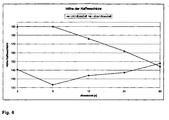
- Im zugehörigen Diagramm (
Fig. 3 ) wurde auf der x-Achse die Zeit im Ultraschallbad aufgetragen. Die y-Achse zeigt die Höhe der Milchschicht bezogen auf die maximale Höhe der Milchschicht (vollständige Trennung von Milch und Milchschaum). - Nach 5 Sekunden im Ultraschallbad war noch rund 1/3 der Milch im Milchschaum zurückgeblieben. Nach 10 Sekunden im Ultraschallbad betrug der Milchanteil im Milchschaum noch 1/4 der gesamten Milchmenge, nach 20 Sekunden noch 1/20. Nach 40 Sekunden hatten sich Milch und Milchschaum vollständig getrennt.
- Die vollständige Trennung des Milch/Milchschaum-Gemisch im Ultraschallbad dauerte 35 bis 40 Sekunden. Bei der Latte Macchiato Herstellung darf dieser Vorgang aber nicht länger als 5 bis 10 Sekunden dauern.
- Für die Herstellung eines Latte Macchiato ist entscheidend, dass zwischen Milch und Milchschaum eine klare Grenzschicht vorhanden ist. Diese tritt auch auf, wenn die Milch und der Milchschaum noch nicht vollständig getrennt sind. Nach 5 Sekunden im Ultraschallbad war die Grenzschicht zwischen Milch und Milchschaum geradeso erkennbar, nach 10 Sekunden war sie bereits deutlich ausgebildet. Deshalb wird davon ausgegangen, dass 5 bis 10 Sekunden im Ultraschallbad ausreichen, um eine Grenzschicht zu bilden, die eine Latte Macchiato Herstellung ermöglicht. Dies wurde nachfolgend noch genauer untersucht.
- Hierbei wurde überprüft, wie lange das Milch/Milchschaum-Gemisch ins Ultraschallbad gestellt werden muss, um später eine klare Grenzschicht zwischen Milch und Kaffee zu erhalten.
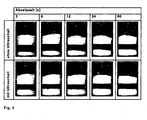
- An der Kaffeemaschine wurde ein Latte Macchiato herausgelassen (Milch und Milchschaum). Vor der Kaffeezugabe wurde der Vorgang abgebrochen. Das Milch/Milchschaum-Gemisch wurde nun eine bestimmte Zeit stehen gelassen (→Absetzzeit: 3, 6, 12, 24 und 60 Sekunden). Anschließend wurde der Kaffee zugegeben. Diese Versuche wurden wiederholt. Dabei wurde das Milch/Milchschaum-Gemisch aber in ein Ultraschallbad (siehe
Fig. 4 ) gestellt - wiederum 3, 6, 12, 24 und 60 Sekunden lang. Anschließend wurde Kaffee zugegeben. Dadurch konnte verglichen werden, ob sich die Grenzschicht zwischen Milch und Kaffee beim Einsatz von Ultraschall besser ausbildete. - Die Abbildungen in
Fig. 5 zeigen deutlich, dass durch Ultraschall die notwendige Absetzzeit deutlich verringert wurde. Ohne Ultraschall war eine Absetzzeit von 60 Sekunden notwendig, um eine klare Grenzschicht zwischen Milch und Kaffee zu erhalten. Mit Ultraschall stellte sich bereits nach drei Sekunden im Ultraschallbad eine klare Grenzschicht zwischen Milch und Kaffee ein. - Die Versuche zeigten, dass durch den Einsatz von Ultraschall die Absetzzeit deutlich verringert werden kann.
- Zusammenfassend ermöglicht somit die vorliegende Erfindung ein Verfahren und eine Vorrichtung zur Herstellung von Kaffee Latte Macchiato in gegenüber herkömmlichen Verfahren verkürzter Zeit.
Claims (13)
- Verfahren zur Herstellung von Caffe Latte Macchiato aus Kaffee, Milch und Milchschaum,
dadurch gekennzeichnet,
dass zumindest ein Anteil des Milchschaums vor dem Zuführen von Kaffee mit Schwingungen im Ultraschallbereich beaufschlagt wird. - Verfahren nach Anspruch 1,
dadurch gekennzeichnet,
dass die Schwingungen im Frequenzbereich zwischen 1 Hz und 1 GHz und vorzugsweise zwischen 100 Hz und 100 kHz liegen. - Verfahren nach einem der Ansprüche 1 bis 2,
dadurch gekennzeichnet,
dass die Beaufschlagung des Milchschaums mit Schwingungen in einem Vorlagebehälter stattfindet. - Verfahren nach Anspruch 3,
dadurch gekennzeichnet,
dass der Vorlagebehälter ein Trinkgefäß ist. - Verfahren nach einem der Ansprüche 1 bis 2,
dadurch gekennzeichnet,
dass die Beaufschlagung des Milchschaums mit Schwingungen in einem separaten Vorlagebehälter erfolgt und dass anschließend nach erfolgter Beaufschlagung des Milchschaums die flüssige Milch und der Milchschaum in das Trinkgefäß ausgegeben werden und dort Kaffee zugeführt wird. - Verfahren nach Anspruch 5,
dadurch gekennzeichnet,
dass die Beaufschlagung mit Schwingungen im separaten Vorlagebehälter im Chargenbetrieb geschieht. - Verfahren nach Anspruch 5,
dadurch gekennzeichnet,
dass die Beaufschlagung mit Schwingungen im separaten Vorlagebehälter im Durchlaufbetrieb geschieht. - Verfahren nach einem der Ansprüche 1 bis 7,
dadurch gekennzeichnet,
dass die Beaufschlagung von Schwingungen zwischen 0,5 Sekunden und 20 Sekunden erfolgt, vorzugsweise zwischen 1 Sekunde und 6 Sekunden. - Vorrichtung zur Herstellung von Caffe Latte Macchiato, bestehend aus einer Kaffeeeinheit und einer Milcheinheit, wobei die Kaffeeeinheit zum Zuführen von Kaffee und die Milcheinheit zum Zuführen von zumindest Milchschaum dienen,
dadurch gekennzeichnet,
dass die Vorrichtung (1) Mittel (2) zur Schwingungsbeaufschlagung des Milchschaums aufweist. - Vorrichtung nach Anspruch 9,
dadurch gekennzeichnet,
dass die Mittel (2) zur Schwingungsbeaufschlagung des Milchschaums den Milchschaum im Ultraschallfrequenzbereich beaufschlagen. - Vorrichtung nach zumindest Anspruch 9,
dadurch gekennzeichnet,
dass die Mitteil zur Schwingungsbeaufschlagung des Milchschaums derart steuerbar sind, dass die Schwingungen im Bereich zwischen 1 Hz und 1 GHz und vorzugsweise zwischen 100 Hz und 100 kHz liegen. - Vorrichtung nach zumindest einem der Ansprüche 9 bis 11,
dadurch gekennzeichnet,
dass die Mittel zur Schwingungsbeaufschlagung des Milchschaums den Milchschaum berührungslos beaufschlagen. - Vorrichtung nach zumindest einem der Ansprüche 9 bis 11,
dadurch gekennzeichnet,
dass die Mittel zur Schwingungsbeaufschlagung des Milchschaums an einen den Milchschaum aufnehmenden Behälter (3) angekoppelt sind.
Applications Claiming Priority (1)
| Application Number | Priority Date | Filing Date | Title |
|---|---|---|---|
| DE102007017450A DE102007017450A1 (de) | 2007-04-02 | 2007-04-02 | Verfahren und Vorrichtung zur Herstellung von Caffe Latte Macchiato |
Publications (2)
| Publication Number | Publication Date |
|---|---|
| EP1977666A1 true EP1977666A1 (de) | 2008-10-08 |
| EP1977666B1 EP1977666B1 (de) | 2010-09-22 |
Family
ID=39495254
Family Applications (1)
| Application Number | Title | Priority Date | Filing Date |
|---|---|---|---|
| EP08003149A Not-in-force EP1977666B1 (de) | 2007-04-02 | 2008-02-21 | Verfahren und Vorrichtung zur Herstellung von Caffe Latte Macchiato |
Country Status (6)
| Country | Link |
|---|---|
| US (1) | US20080241322A1 (de) |
| EP (1) | EP1977666B1 (de) |
| JP (1) | JP5393046B2 (de) |
| AT (1) | ATE481902T1 (de) |
| DE (2) | DE102007017450A1 (de) |
| ES (1) | ES2353442T3 (de) |
Cited By (1)
| Publication number | Priority date | Publication date | Assignee | Title |
|---|---|---|---|---|
| GB2453182A (en) * | 2007-09-20 | 2009-04-01 | Kraft Foods R & D Inc | Improvements in or relating to the preparation of beverages |
Families Citing this family (18)
| Publication number | Priority date | Publication date | Assignee | Title |
|---|---|---|---|---|
| NL2004075C2 (nl) * | 2010-01-07 | 2011-07-11 | Logiroom B V | Injectie-inrichting en werkwijze voor het vullen van een houder met gescheiden vloeistoflagen. |
| DE102010012788B4 (de) | 2010-03-16 | 2018-05-17 | Wmf Group Gmbh | Espressomaschine oder Kaffeevollautomat mit automatischer Homogenisierung |
| US9332776B1 (en) | 2010-09-27 | 2016-05-10 | ZoomEssence, Inc. | Methods and apparatus for low heat spray drying |
| US8939388B1 (en) | 2010-09-27 | 2015-01-27 | ZoomEssence, Inc. | Methods and apparatus for low heat spray drying |
| EP2865301A1 (de) * | 2013-10-28 | 2015-04-29 | Nestec S.A. | Getränkeausgabesystem, Verfahren zur Bereitstellung eines mehrschichtigen Getränks, und Bestandteilbehälter zur Verwendung dafür |
| CN105852648A (zh) * | 2015-01-20 | 2016-08-17 | 肖优秀 | 一种超声波震动组件产生震动使液体产生泡沫的装置或方法 |
| KR101630262B1 (ko) * | 2015-07-13 | 2016-06-14 | 이상준 | 음파 진동을 이용한 콜드 브루 커피 추출 장치 |
| CN105238660B (zh) * | 2015-08-19 | 2020-04-14 | 欧永强 | 变频超声波陈酒器 |
| KR102212235B1 (ko) * | 2016-09-01 | 2021-02-04 | 후지 덴키 가부시키가이샤 | 음료 추출 장치 |
| KR101840599B1 (ko) * | 2017-05-22 | 2018-03-21 | 이상준 | 음향 신호를 기초로 음파 진동을 조정하는 콜드브루 커피추출장치 |
| AU2018312095B2 (en) | 2017-08-04 | 2021-10-28 | ZoomEssence, Inc. | Ultrahigh efficiency spray drying apparatus and process |
| US10486173B2 (en) | 2017-08-04 | 2019-11-26 | ZoomEssence, Inc. | Ultrahigh efficiency spray drying apparatus and process |
| US9861945B1 (en) | 2017-08-04 | 2018-01-09 | ZoomEssence, Inc. | Ultrahigh efficiency spray drying apparatus and process |
| US9993787B1 (en) | 2017-08-04 | 2018-06-12 | ZoomEssence, Inc. | Ultrahigh efficiency spray drying apparatus and process |
| US10155234B1 (en) | 2017-08-04 | 2018-12-18 | ZoomEssence, Inc. | Ultrahigh efficiency spray drying apparatus and process |
| US10569244B2 (en) | 2018-04-28 | 2020-02-25 | ZoomEssence, Inc. | Low temperature spray drying of carrier-free compositions |
| CN113133656A (zh) * | 2020-01-17 | 2021-07-20 | 广东美的生活电器制造有限公司 | 食物处理设备、控制方法、控制装置和可读存储介质 |
| CN113133655A (zh) * | 2020-01-17 | 2021-07-20 | 广东美的生活电器制造有限公司 | 食物处理设备、控制方法、控制装置和可读存储介质 |
Citations (1)
| Publication number | Priority date | Publication date | Assignee | Title |
|---|---|---|---|---|
| WO2008022161A2 (en) | 2006-08-15 | 2008-02-21 | Eilaz Babaev | Method and apparatus for producing beverages from coffee beans using ultrasound energy |
Family Cites Families (29)
| Publication number | Priority date | Publication date | Assignee | Title |
|---|---|---|---|---|
| US2620894A (en) * | 1948-03-25 | 1952-12-09 | American Viscose Corp | Deaeration of viscous and plastic materials |
| US2714186A (en) * | 1952-09-12 | 1955-07-26 | Sorensen & Company Inc | Variable frequency magnetostrictive transducer |
| US2916266A (en) * | 1956-05-01 | 1959-12-08 | Electronic Assistance Corp | Apparatus for foaming beer |
| US3222221A (en) * | 1959-04-29 | 1965-12-07 | Branson Instr | Ultrasonic cleaning method and apparatus |
| CA1063486A (en) * | 1976-04-22 | 1979-10-02 | Bristol-Myers Squibb Company | Ultrasonic cleaner |
| US4227817A (en) * | 1978-12-26 | 1980-10-14 | Gerry Martin E | Fuel and water homogenization means |
| DE2926955C2 (de) * | 1979-07-04 | 1984-09-20 | Jagenberg-Werke AG, 4000 Düsseldorf | Verfahren und Vorrichtung zur Beseitigung von Schaum über dem Spiegel einer Flüssigkeit, insbesondere über flüssigem Füllgut, z.B. Milch |
| US4463708A (en) * | 1980-05-27 | 1984-08-07 | Gerry Martin E | Fuel and water homogenizer |
| US4367098A (en) * | 1981-06-22 | 1983-01-04 | Mccord James W | Process for ultrasonic cleaning using two immiscible fluids |
| JPS5945845A (ja) * | 1982-09-07 | 1984-03-14 | Morinaga Milk Ind Co Ltd | 泡立て食品の製造法および装置 |
| US4983412A (en) * | 1986-12-22 | 1991-01-08 | Melitta-Werke Bentz & Sohn | Method and device for producing aqueous extracts from coffee |
| DE3818035A1 (de) * | 1988-05-27 | 1989-11-30 | Rey Louis Prof | Verfahren zur herstellung von kaffee-extrakt |
| JP2989075B2 (ja) * | 1992-07-01 | 1999-12-13 | 株式会社エム・シー・フーズ | 乾燥植物の有効成分抽出方法および抽出装置 |
| US5639423A (en) * | 1992-08-31 | 1997-06-17 | The Regents Of The University Of Calfornia | Microfabricated reactor |
| US5529753A (en) * | 1993-07-09 | 1996-06-25 | Dade International Inc. | System for ultrasonic energy coupling by irrigation |
| US5589136A (en) * | 1995-06-20 | 1996-12-31 | Regents Of The University Of California | Silicon-based sleeve devices for chemical reactions |
| US6413783B1 (en) * | 1997-09-18 | 2002-07-02 | Meso Scale Technologies, Llc | Assay sonication apparatus and methodology |
| JPH11347392A (ja) * | 1998-06-11 | 1999-12-21 | Hitachi Ltd | 攪拌装置 |
| EP1125121B1 (de) * | 1998-10-28 | 2007-12-12 | Covaris, Inc. | Vorrichtung und verfahren zur kontrolle einer akustischen behandlung |
| FR2791697B1 (fr) * | 1999-04-01 | 2003-02-28 | Biomerieux Sa | Appareil et procede de lyse par ultrasons de cellules biologiques |
| DE10142789C1 (de) * | 2001-08-31 | 2003-05-28 | Advalytix Ag | Bewegungselement für kleine Flüssigkeitsmengen |
| GB2391219A (en) * | 2002-07-31 | 2004-02-04 | Diageo Great Britain Ltd | Forming a head on a beverage using ultrasound |
| US8038337B2 (en) * | 2003-02-27 | 2011-10-18 | Beckman Coulter, Inc. | Method and device for blending small quantities of liquid in microcavities |
| DK1472963T3 (da) * | 2003-05-02 | 2009-03-30 | Schaerer Ag M | Indretning til afgivelse af mælk og/eller mælkeskum |
| US20060152998A1 (en) * | 2003-09-10 | 2006-07-13 | Burr Ronald F | Acoustic fluidized bed |
| JP4469928B2 (ja) * | 2004-09-22 | 2010-06-02 | ベックマン・コールター・インコーポレーテッド | 攪拌容器 |
| ITMI20051986A1 (it) * | 2005-10-19 | 2007-04-20 | Rhea Vendors Spa | Metodo ed apparecchiatura per la preparazione di bevande da prodotti solubili |
| DE502007000181D1 (de) * | 2006-04-25 | 2008-12-04 | Imel Ag | Vorrichtung und Verfahren zur Zubereitung von Heissgetränken durch Aufbrühen einer partikelförmigen, mittels Wasser extrahierbaren Substanz |
| US20100008178A1 (en) * | 2008-07-14 | 2010-01-14 | Dale Fahrion | Acoustic Beverage Mixer |
-
2007
- 2007-04-02 DE DE102007017450A patent/DE102007017450A1/de not_active Withdrawn
-
2008
- 2008-02-21 EP EP08003149A patent/EP1977666B1/de not_active Not-in-force
- 2008-02-21 ES ES08003149T patent/ES2353442T3/es active Active
- 2008-02-21 AT AT08003149T patent/ATE481902T1/de active
- 2008-02-21 DE DE502008001352T patent/DE502008001352D1/de active Active
- 2008-04-01 JP JP2008094516A patent/JP5393046B2/ja not_active Expired - Fee Related
- 2008-04-02 US US12/061,173 patent/US20080241322A1/en not_active Abandoned
Patent Citations (1)
| Publication number | Priority date | Publication date | Assignee | Title |
|---|---|---|---|---|
| WO2008022161A2 (en) | 2006-08-15 | 2008-02-21 | Eilaz Babaev | Method and apparatus for producing beverages from coffee beans using ultrasound energy |
Cited By (1)
| Publication number | Priority date | Publication date | Assignee | Title |
|---|---|---|---|---|
| GB2453182A (en) * | 2007-09-20 | 2009-04-01 | Kraft Foods R & D Inc | Improvements in or relating to the preparation of beverages |
Also Published As
| Publication number | Publication date |
|---|---|
| DE102007017450A1 (de) | 2008-10-09 |
| EP1977666B1 (de) | 2010-09-22 |
| JP2008253262A (ja) | 2008-10-23 |
| ATE481902T1 (de) | 2010-10-15 |
| ES2353442T3 (es) | 2011-03-02 |
| US20080241322A1 (en) | 2008-10-02 |
| DE502008001352D1 (de) | 2010-11-04 |
| JP5393046B2 (ja) | 2014-01-22 |
Similar Documents
| Publication | Publication Date | Title |
|---|---|---|
| EP1977666B1 (de) | Verfahren und Vorrichtung zur Herstellung von Caffe Latte Macchiato | |
| DE60005292T2 (de) | Verfahren und Vorrichtung für die Zubereitung von Espressokaffee | |
| DE102009041809B4 (de) | Vorrichtung und Verfahren zum Aufschäumen eines flüssigen Lebensmittels, insbesondere von Milch | |
| EP2238876B1 (de) | Verfahren zum Erzeugen eines frischen kalten Kaffeegetränks und eine entsprechende Kaffeemaschine | |
| EP2275010B1 (de) | Vorrichtung und Verfahren zum Aufschäumen eines flüssigen Lebensmittels, insbesondere von Milch | |
| DE69005491T2 (de) | Getränkeverpackung. | |
| AT516069A1 (de) | Vorrichtung zur Erzeugung von Schnee | |
| DE10247573A1 (de) | Verfahren und Vorrichtung zum Erzeugen von Schaum in einem Filterbecher einer Kaffeemaschine | |
| DE102018007750A1 (de) | Verfahren zur Ausgabe eines Heißgetränks | |
| WO2016096958A1 (de) | Teeautomat für mehrfache aufgüsse | |
| WO2017093015A1 (de) | Vorrichtung und verfahren zur herstellung eines brühgetränks | |
| DE102010006509B4 (de) | Kapsel mit zwei Behältern für eine Kaffeemaschine, Verwendung derselben zum Bereiten eines Mischgetränkes in einer Kaffeemaschine sowie Verfahren zum Bereiten eines Mischgetränkes | |
| DE2714736A1 (de) | Vorrichtung zum zubereiten von getraenken | |
| DE712216C (de) | Vorrichtung zur Herstellung von Emulsionen | |
| WO2006032597A2 (de) | Kaffeemaschine mit einem auslauftopf | |
| EP1793715B1 (de) | Kaffeemaschine mit einem auslauftopf | |
| EP3970574A1 (de) | Vorrichtung und verfahren zur extraktion von komponenten in feststoffen mittels nanoblasen | |
| DE102018211678B4 (de) | Getränkeautomat mit einer Vibrationsvorrichtung | |
| DE2014814C3 (de) | Verfahren zur Herstellung von Pasta-Filata-Käse | |
| DE212359C (de) | ||
| DE859991C (de) | Verfahren zum kontinuierlichen Buttern | |
| EP4478919A1 (de) | Dampflanze für eine kaffeemaschine | |
| AT32795B (de) | Verfahren und Vorrichtung zur Herstellung homogener Produkte aus Flüssigkeiten oder verflüssigten Stoffen. | |
| DE202004020919U1 (de) | Kaffeemaschine mit einem Auslauftopf | |
| CH199146A (de) | Vorrichtung zur Herstellung von schaumigen Nahrungsmitteln. |
Legal Events
| Date | Code | Title | Description |
|---|---|---|---|
| PUAI | Public reference made under article 153(3) epc to a published international application that has entered the european phase |
Free format text: ORIGINAL CODE: 0009012 |
|
| AK | Designated contracting states |
Kind code of ref document: A1 Designated state(s): AT BE BG CH CY CZ DE DK EE ES FI FR GB GR HR HU IE IS IT LI LT LU LV MC MT NL NO PL PT RO SE SI SK TR |
|
| AX | Request for extension of the european patent |
Extension state: AL BA MK RS |
|
| 17P | Request for examination filed |
Effective date: 20090228 |
|
| 17Q | First examination report despatched |
Effective date: 20090403 |
|
| AKX | Designation fees paid |
Designated state(s): AT BE BG CH CY CZ DE DK EE ES FI FR GB GR HR HU IE IS IT LI LT LU LV MC MT NL NO PL PT RO SE SI SK TR |
|
| GRAP | Despatch of communication of intention to grant a patent |
Free format text: ORIGINAL CODE: EPIDOSNIGR1 |
|
| GRAS | Grant fee paid |
Free format text: ORIGINAL CODE: EPIDOSNIGR3 |
|
| GRAA | (expected) grant |
Free format text: ORIGINAL CODE: 0009210 |
|
| AK | Designated contracting states |
Kind code of ref document: B1 Designated state(s): AT BE BG CH CY CZ DE DK EE ES FI FR GB GR HR HU IE IS IT LI LT LU LV MC MT NL NO PL PT RO SE SI SK TR |
|
| REG | Reference to a national code |
Ref country code: GB Ref legal event code: FG4D Free format text: NOT ENGLISH |
|
| REG | Reference to a national code |
Ref country code: CH Ref legal event code: EP |
|
| REG | Reference to a national code |
Ref country code: IE Ref legal event code: FG4D Free format text: LANGUAGE OF EP DOCUMENT: GERMAN |
|
| REF | Corresponds to: |
Ref document number: 502008001352 Country of ref document: DE Date of ref document: 20101104 Kind code of ref document: P |
|
| REG | Reference to a national code |
Ref country code: NL Ref legal event code: T3 |
|
| PG25 | Lapsed in a contracting state [announced via postgrant information from national office to epo] |
Ref country code: NO Free format text: LAPSE BECAUSE OF FAILURE TO SUBMIT A TRANSLATION OF THE DESCRIPTION OR TO PAY THE FEE WITHIN THE PRESCRIBED TIME-LIMIT Effective date: 20101222 Ref country code: FI Free format text: LAPSE BECAUSE OF FAILURE TO SUBMIT A TRANSLATION OF THE DESCRIPTION OR TO PAY THE FEE WITHIN THE PRESCRIBED TIME-LIMIT Effective date: 20100922 Ref country code: LT Free format text: LAPSE BECAUSE OF FAILURE TO SUBMIT A TRANSLATION OF THE DESCRIPTION OR TO PAY THE FEE WITHIN THE PRESCRIBED TIME-LIMIT Effective date: 20100922 |
|
| LTIE | Lt: invalidation of european patent or patent extension |
Effective date: 20100922 |
|
| PG25 | Lapsed in a contracting state [announced via postgrant information from national office to epo] |
Ref country code: PL Free format text: LAPSE BECAUSE OF FAILURE TO SUBMIT A TRANSLATION OF THE DESCRIPTION OR TO PAY THE FEE WITHIN THE PRESCRIBED TIME-LIMIT Effective date: 20100922 Ref country code: HR Free format text: LAPSE BECAUSE OF FAILURE TO SUBMIT A TRANSLATION OF THE DESCRIPTION OR TO PAY THE FEE WITHIN THE PRESCRIBED TIME-LIMIT Effective date: 20100922 Ref country code: SI Free format text: LAPSE BECAUSE OF FAILURE TO SUBMIT A TRANSLATION OF THE DESCRIPTION OR TO PAY THE FEE WITHIN THE PRESCRIBED TIME-LIMIT Effective date: 20100922 |
|
| REG | Reference to a national code |
Ref country code: ES Ref legal event code: FG2A Effective date: 20110218 |
|
| PG25 | Lapsed in a contracting state [announced via postgrant information from national office to epo] |
Ref country code: GR Free format text: LAPSE BECAUSE OF FAILURE TO SUBMIT A TRANSLATION OF THE DESCRIPTION OR TO PAY THE FEE WITHIN THE PRESCRIBED TIME-LIMIT Effective date: 20101223 Ref country code: LV Free format text: LAPSE BECAUSE OF FAILURE TO SUBMIT A TRANSLATION OF THE DESCRIPTION OR TO PAY THE FEE WITHIN THE PRESCRIBED TIME-LIMIT Effective date: 20100922 Ref country code: SE Free format text: LAPSE BECAUSE OF FAILURE TO SUBMIT A TRANSLATION OF THE DESCRIPTION OR TO PAY THE FEE WITHIN THE PRESCRIBED TIME-LIMIT Effective date: 20100922 |
|
| REG | Reference to a national code |
Ref country code: IE Ref legal event code: FD4D |
|
| PG25 | Lapsed in a contracting state [announced via postgrant information from national office to epo] |
Ref country code: IE Free format text: LAPSE BECAUSE OF FAILURE TO SUBMIT A TRANSLATION OF THE DESCRIPTION OR TO PAY THE FEE WITHIN THE PRESCRIBED TIME-LIMIT Effective date: 20100922 |
|
| PG25 | Lapsed in a contracting state [announced via postgrant information from national office to epo] |
Ref country code: EE Free format text: LAPSE BECAUSE OF FAILURE TO SUBMIT A TRANSLATION OF THE DESCRIPTION OR TO PAY THE FEE WITHIN THE PRESCRIBED TIME-LIMIT Effective date: 20100922 Ref country code: PT Free format text: LAPSE BECAUSE OF FAILURE TO SUBMIT A TRANSLATION OF THE DESCRIPTION OR TO PAY THE FEE WITHIN THE PRESCRIBED TIME-LIMIT Effective date: 20110124 Ref country code: IS Free format text: LAPSE BECAUSE OF FAILURE TO SUBMIT A TRANSLATION OF THE DESCRIPTION OR TO PAY THE FEE WITHIN THE PRESCRIBED TIME-LIMIT Effective date: 20110122 Ref country code: RO Free format text: LAPSE BECAUSE OF FAILURE TO SUBMIT A TRANSLATION OF THE DESCRIPTION OR TO PAY THE FEE WITHIN THE PRESCRIBED TIME-LIMIT Effective date: 20100922 Ref country code: SK Free format text: LAPSE BECAUSE OF FAILURE TO SUBMIT A TRANSLATION OF THE DESCRIPTION OR TO PAY THE FEE WITHIN THE PRESCRIBED TIME-LIMIT Effective date: 20100922 Ref country code: CZ Free format text: LAPSE BECAUSE OF FAILURE TO SUBMIT A TRANSLATION OF THE DESCRIPTION OR TO PAY THE FEE WITHIN THE PRESCRIBED TIME-LIMIT Effective date: 20100922 |
|
| PLBE | No opposition filed within time limit |
Free format text: ORIGINAL CODE: 0009261 |
|
| STAA | Information on the status of an ep patent application or granted ep patent |
Free format text: STATUS: NO OPPOSITION FILED WITHIN TIME LIMIT |
|
| 26N | No opposition filed |
Effective date: 20110623 |
|
| BERE | Be: lapsed |
Owner name: NIRO-PLAN A.G. Effective date: 20110228 |
|
| PG25 | Lapsed in a contracting state [announced via postgrant information from national office to epo] |
Ref country code: DK Free format text: LAPSE BECAUSE OF FAILURE TO SUBMIT A TRANSLATION OF THE DESCRIPTION OR TO PAY THE FEE WITHIN THE PRESCRIBED TIME-LIMIT Effective date: 20100922 |
|
| PG25 | Lapsed in a contracting state [announced via postgrant information from national office to epo] |
Ref country code: MC Free format text: LAPSE BECAUSE OF NON-PAYMENT OF DUE FEES Effective date: 20110228 |
|
| REG | Reference to a national code |
Ref country code: DE Ref legal event code: R097 Ref document number: 502008001352 Country of ref document: DE Effective date: 20110623 |
|
| REG | Reference to a national code |
Ref country code: FR Ref legal event code: ST Effective date: 20111102 |
|
| PG25 | Lapsed in a contracting state [announced via postgrant information from national office to epo] |
Ref country code: BE Free format text: LAPSE BECAUSE OF NON-PAYMENT OF DUE FEES Effective date: 20110228 |
|
| REG | Reference to a national code |
Ref country code: CH Ref legal event code: NV Representative=s name: R. A. EGLI & CO. PATENTANWAELTE |
|
| PG25 | Lapsed in a contracting state [announced via postgrant information from national office to epo] |
Ref country code: MT Free format text: LAPSE BECAUSE OF FAILURE TO SUBMIT A TRANSLATION OF THE DESCRIPTION OR TO PAY THE FEE WITHIN THE PRESCRIBED TIME-LIMIT Effective date: 20100922 |
|
| PG25 | Lapsed in a contracting state [announced via postgrant information from national office to epo] |
Ref country code: FR Free format text: LAPSE BECAUSE OF NON-PAYMENT OF DUE FEES Effective date: 20110228 |
|
| REG | Reference to a national code |
Ref country code: DE Ref legal event code: R081 Ref document number: 502008001352 Country of ref document: DE Owner name: FRANKE TECHNOLOGY AND TRADEMARK LTD., CH Free format text: FORMER OWNER: NIRO-PLAN AG, AARBURG, CH Effective date: 20120216 Ref country code: DE Ref legal event code: R082 Ref document number: 502008001352 Country of ref document: DE Representative=s name: LEMCKE, BROMMER & PARTNER, PATENTANWAELTE PART, DE Effective date: 20120216 Ref country code: DE Ref legal event code: R082 Ref document number: 502008001352 Country of ref document: DE Representative=s name: LEMCKE, BROMMER & PARTNER, PATENTANWAELTE, DE Effective date: 20120216 |
|
| PG25 | Lapsed in a contracting state [announced via postgrant information from national office to epo] |
Ref country code: CY Free format text: LAPSE BECAUSE OF FAILURE TO SUBMIT A TRANSLATION OF THE DESCRIPTION OR TO PAY THE FEE WITHIN THE PRESCRIBED TIME-LIMIT Effective date: 20100922 Ref country code: LU Free format text: LAPSE BECAUSE OF NON-PAYMENT OF DUE FEES Effective date: 20110221 |
|
| PGFP | Annual fee paid to national office [announced via postgrant information from national office to epo] |
Ref country code: ES Payment date: 20120221 Year of fee payment: 5 |
|
| PG25 | Lapsed in a contracting state [announced via postgrant information from national office to epo] |
Ref country code: TR Free format text: LAPSE BECAUSE OF FAILURE TO SUBMIT A TRANSLATION OF THE DESCRIPTION OR TO PAY THE FEE WITHIN THE PRESCRIBED TIME-LIMIT Effective date: 20100922 Ref country code: BG Free format text: LAPSE BECAUSE OF FAILURE TO SUBMIT A TRANSLATION OF THE DESCRIPTION OR TO PAY THE FEE WITHIN THE PRESCRIBED TIME-LIMIT Effective date: 20101222 |
|
| PG25 | Lapsed in a contracting state [announced via postgrant information from national office to epo] |
Ref country code: HU Free format text: LAPSE BECAUSE OF FAILURE TO SUBMIT A TRANSLATION OF THE DESCRIPTION OR TO PAY THE FEE WITHIN THE PRESCRIBED TIME-LIMIT Effective date: 20100922 |
|
| REG | Reference to a national code |
Ref country code: AT Ref legal event code: MM01 Ref document number: 481902 Country of ref document: AT Kind code of ref document: T Effective date: 20130221 |
|
| PG25 | Lapsed in a contracting state [announced via postgrant information from national office to epo] |
Ref country code: AT Free format text: LAPSE BECAUSE OF NON-PAYMENT OF DUE FEES Effective date: 20130221 |
|
| REG | Reference to a national code |
Ref country code: ES Ref legal event code: FD2A Effective date: 20140606 |
|
| PG25 | Lapsed in a contracting state [announced via postgrant information from national office to epo] |
Ref country code: ES Free format text: LAPSE BECAUSE OF NON-PAYMENT OF DUE FEES Effective date: 20130222 |
|
| REG | Reference to a national code |
Ref country code: CH Ref legal event code: PFA Owner name: FRANKE TECHNOLOGY AND TRADEMARK LTD, CH Free format text: FORMER OWNER: NIRO-PLAN AG, CH Ref country code: CH Ref legal event code: NV Representative=s name: KELLER AND PARTNER PATENTANWAELTE AG, CH |
|
| REG | Reference to a national code |
Ref country code: NL Ref legal event code: TD Effective date: 20150224 |
|
| REG | Reference to a national code |
Ref country code: CH Ref legal event code: PCAR Free format text: NEW ADDRESS: EIGERSTRASSE 2 POSTFACH, 3000 BERN 14 (CH) |
|
| REG | Reference to a national code |
Ref country code: CH Ref legal event code: PFA Owner name: FRANKE TECHNOLOGY AND TRADEMARK LTD, CH Free format text: FORMER OWNER: FRANKE TECHNOLOGY AND TRADEMARK LTD, CH |
|
| PGFP | Annual fee paid to national office [announced via postgrant information from national office to epo] |
Ref country code: GB Payment date: 20220221 Year of fee payment: 15 Ref country code: DE Payment date: 20220218 Year of fee payment: 15 Ref country code: CH Payment date: 20220221 Year of fee payment: 15 |
|
| PGFP | Annual fee paid to national office [announced via postgrant information from national office to epo] |
Ref country code: NL Payment date: 20220216 Year of fee payment: 15 Ref country code: IT Payment date: 20220228 Year of fee payment: 15 |
|
| REG | Reference to a national code |
Ref country code: DE Ref legal event code: R119 Ref document number: 502008001352 Country of ref document: DE |
|
| REG | Reference to a national code |
Ref country code: CH Ref legal event code: PL |
|
| REG | Reference to a national code |
Ref country code: NL Ref legal event code: MM Effective date: 20230301 |
|
| GBPC | Gb: european patent ceased through non-payment of renewal fee |
Effective date: 20230221 |
|
| PG25 | Lapsed in a contracting state [announced via postgrant information from national office to epo] |
Ref country code: LI Free format text: LAPSE BECAUSE OF NON-PAYMENT OF DUE FEES Effective date: 20230228 Ref country code: CH Free format text: LAPSE BECAUSE OF NON-PAYMENT OF DUE FEES Effective date: 20230228 |
|
| PG25 | Lapsed in a contracting state [announced via postgrant information from national office to epo] |
Ref country code: NL Free format text: LAPSE BECAUSE OF NON-PAYMENT OF DUE FEES Effective date: 20230301 |
|
| PG25 | Lapsed in a contracting state [announced via postgrant information from national office to epo] |
Ref country code: GB Free format text: LAPSE BECAUSE OF NON-PAYMENT OF DUE FEES Effective date: 20230221 |
|
| PG25 | Lapsed in a contracting state [announced via postgrant information from national office to epo] |
Ref country code: IT Free format text: LAPSE BECAUSE OF NON-PAYMENT OF DUE FEES Effective date: 20230221 Ref country code: GB Free format text: LAPSE BECAUSE OF NON-PAYMENT OF DUE FEES Effective date: 20230221 Ref country code: DE Free format text: LAPSE BECAUSE OF NON-PAYMENT OF DUE FEES Effective date: 20230901 |