EP1982655B2 - Occluder zum Verschliessen eines Herzohres und Herstellungsverfahren dafür - Google Patents
Occluder zum Verschliessen eines Herzohres und Herstellungsverfahren dafür Download PDFInfo
- Publication number
- EP1982655B2 EP1982655B2 EP07106278.0A EP07106278A EP1982655B2 EP 1982655 B2 EP1982655 B2 EP 1982655B2 EP 07106278 A EP07106278 A EP 07106278A EP 1982655 B2 EP1982655 B2 EP 1982655B2
- Authority
- EP
- European Patent Office
- Prior art keywords
- occlusion instrument
- mesh
- polymer composition
- shape
- switching
- Prior art date
- Legal status (The legal status is an assumption and is not a legal conclusion. Google has not performed a legal analysis and makes no representation as to the accuracy of the status listed.)
- Not-in-force
Links
Images








Classifications
-
- A—HUMAN NECESSITIES
- A61—MEDICAL OR VETERINARY SCIENCE; HYGIENE
- A61B—DIAGNOSIS; SURGERY; IDENTIFICATION
- A61B17/00—Surgical instruments, devices or methods
- A61B17/12—Surgical instruments, devices or methods for ligaturing or otherwise compressing tubular parts of the body, e.g. blood vessels or umbilical cord
- A61B17/12022—Occluding by internal devices, e.g. balloons or releasable wires
- A61B17/12099—Occluding by internal devices, e.g. balloons or releasable wires characterised by the location of the occluder
- A61B17/12122—Occluding by internal devices, e.g. balloons or releasable wires characterised by the location of the occluder within the heart
-
- A—HUMAN NECESSITIES
- A61—MEDICAL OR VETERINARY SCIENCE; HYGIENE
- A61B—DIAGNOSIS; SURGERY; IDENTIFICATION
- A61B17/00—Surgical instruments, devices or methods
- A61B17/0057—Implements for plugging an opening in the wall of a hollow or tubular organ, e.g. for sealing a vessel puncture or closing a cardiac septal defect
-
- A—HUMAN NECESSITIES
- A61—MEDICAL OR VETERINARY SCIENCE; HYGIENE
- A61B—DIAGNOSIS; SURGERY; IDENTIFICATION
- A61B17/00—Surgical instruments, devices or methods
- A61B17/12—Surgical instruments, devices or methods for ligaturing or otherwise compressing tubular parts of the body, e.g. blood vessels or umbilical cord
- A61B17/12022—Occluding by internal devices, e.g. balloons or releasable wires
-
- A—HUMAN NECESSITIES
- A61—MEDICAL OR VETERINARY SCIENCE; HYGIENE
- A61B—DIAGNOSIS; SURGERY; IDENTIFICATION
- A61B17/00—Surgical instruments, devices or methods
- A61B17/12—Surgical instruments, devices or methods for ligaturing or otherwise compressing tubular parts of the body, e.g. blood vessels or umbilical cord
- A61B17/12022—Occluding by internal devices, e.g. balloons or releasable wires
- A61B17/12027—Type of occlusion
- A61B17/12031—Type of occlusion complete occlusion
-
- A—HUMAN NECESSITIES
- A61—MEDICAL OR VETERINARY SCIENCE; HYGIENE
- A61B—DIAGNOSIS; SURGERY; IDENTIFICATION
- A61B17/00—Surgical instruments, devices or methods
- A61B17/12—Surgical instruments, devices or methods for ligaturing or otherwise compressing tubular parts of the body, e.g. blood vessels or umbilical cord
- A61B17/12022—Occluding by internal devices, e.g. balloons or releasable wires
- A61B17/12131—Occluding by internal devices, e.g. balloons or releasable wires characterised by the type of occluding device
- A61B17/12168—Occluding by internal devices, e.g. balloons or releasable wires characterised by the type of occluding device having a mesh structure
-
- A—HUMAN NECESSITIES
- A61—MEDICAL OR VETERINARY SCIENCE; HYGIENE
- A61B—DIAGNOSIS; SURGERY; IDENTIFICATION
- A61B17/00—Surgical instruments, devices or methods
- A61B17/12—Surgical instruments, devices or methods for ligaturing or otherwise compressing tubular parts of the body, e.g. blood vessels or umbilical cord
- A61B17/12022—Occluding by internal devices, e.g. balloons or releasable wires
- A61B17/12131—Occluding by internal devices, e.g. balloons or releasable wires characterised by the type of occluding device
- A61B17/12168—Occluding by internal devices, e.g. balloons or releasable wires characterised by the type of occluding device having a mesh structure
- A61B17/12172—Occluding by internal devices, e.g. balloons or releasable wires characterised by the type of occluding device having a mesh structure having a pre-set deployed three-dimensional shape
-
- A—HUMAN NECESSITIES
- A61—MEDICAL OR VETERINARY SCIENCE; HYGIENE
- A61B—DIAGNOSIS; SURGERY; IDENTIFICATION
- A61B17/00—Surgical instruments, devices or methods
- A61B17/0057—Implements for plugging an opening in the wall of a hollow or tubular organ, e.g. for sealing a vessel puncture or closing a cardiac septal defect
- A61B2017/00575—Implements for plugging an opening in the wall of a hollow or tubular organ, e.g. for sealing a vessel puncture or closing a cardiac septal defect for closure at remote site, e.g. closing atrial septum defects
-
- A—HUMAN NECESSITIES
- A61—MEDICAL OR VETERINARY SCIENCE; HYGIENE
- A61B—DIAGNOSIS; SURGERY; IDENTIFICATION
- A61B17/00—Surgical instruments, devices or methods
- A61B17/0057—Implements for plugging an opening in the wall of a hollow or tubular organ, e.g. for sealing a vessel puncture or closing a cardiac septal defect
- A61B2017/00575—Implements for plugging an opening in the wall of a hollow or tubular organ, e.g. for sealing a vessel puncture or closing a cardiac septal defect for closure at remote site, e.g. closing atrial septum defects
- A61B2017/00592—Elastic or resilient implements
-
- A—HUMAN NECESSITIES
- A61—MEDICAL OR VETERINARY SCIENCE; HYGIENE
- A61B—DIAGNOSIS; SURGERY; IDENTIFICATION
- A61B17/00—Surgical instruments, devices or methods
- A61B17/0057—Implements for plugging an opening in the wall of a hollow or tubular organ, e.g. for sealing a vessel puncture or closing a cardiac septal defect
- A61B2017/00575—Implements for plugging an opening in the wall of a hollow or tubular organ, e.g. for sealing a vessel puncture or closing a cardiac septal defect for closure at remote site, e.g. closing atrial septum defects
- A61B2017/00597—Implements comprising a membrane
-
- A—HUMAN NECESSITIES
- A61—MEDICAL OR VETERINARY SCIENCE; HYGIENE
- A61B—DIAGNOSIS; SURGERY; IDENTIFICATION
- A61B17/00—Surgical instruments, devices or methods
- A61B17/0057—Implements for plugging an opening in the wall of a hollow or tubular organ, e.g. for sealing a vessel puncture or closing a cardiac septal defect
- A61B2017/00575—Implements for plugging an opening in the wall of a hollow or tubular organ, e.g. for sealing a vessel puncture or closing a cardiac septal defect for closure at remote site, e.g. closing atrial septum defects
- A61B2017/00606—Implements H-shaped in cross-section, i.e. with occluders on both sides of the opening
-
- A—HUMAN NECESSITIES
- A61—MEDICAL OR VETERINARY SCIENCE; HYGIENE
- A61B—DIAGNOSIS; SURGERY; IDENTIFICATION
- A61B17/00—Surgical instruments, devices or methods
- A61B17/0057—Implements for plugging an opening in the wall of a hollow or tubular organ, e.g. for sealing a vessel puncture or closing a cardiac septal defect
- A61B2017/00575—Implements for plugging an opening in the wall of a hollow or tubular organ, e.g. for sealing a vessel puncture or closing a cardiac septal defect for closure at remote site, e.g. closing atrial septum defects
- A61B2017/00615—Implements with an occluder on one side of the opening and holding means therefor on the other
-
- A—HUMAN NECESSITIES
- A61—MEDICAL OR VETERINARY SCIENCE; HYGIENE
- A61B—DIAGNOSIS; SURGERY; IDENTIFICATION
- A61B17/00—Surgical instruments, devices or methods
- A61B2017/00831—Material properties
- A61B2017/00867—Material properties shape memory effect
-
- A—HUMAN NECESSITIES
- A61—MEDICAL OR VETERINARY SCIENCE; HYGIENE
- A61B—DIAGNOSIS; SURGERY; IDENTIFICATION
- A61B17/00—Surgical instruments, devices or methods
- A61B17/12—Surgical instruments, devices or methods for ligaturing or otherwise compressing tubular parts of the body, e.g. blood vessels or umbilical cord
- A61B17/12022—Occluding by internal devices, e.g. balloons or releasable wires
- A61B2017/1205—Introduction devices
- A61B2017/12054—Details concerning the detachment of the occluding device from the introduction device
Definitions
- the present invention relates to a self-expandable occlusion device for closing an atrial appendage, consisting of a network of thin wires or threads, which is given a suitable shape by means of a shaping, forming and/or heat treatment process, the occlusion device having a front proximal retention area and a rear having distal retention area, and wherein in the proximal retention area the ends of the wires or threads converge in one version but also in a second solution without version. Furthermore, the occlusion device has a middle area between the proximal and the distal retention area.
- the occlusion device is designed in such a way that, in a folded state, it can be inserted into a patient's body in a minimally invasive manner by means of a catheter and can be positioned in the patient's atrial appendage. Furthermore, the invention relates to methods for producing such an occlusion device.
- an occlusion device is at least partially known in principle from medical technology.
- an occlusion device for the treatment of septal defects which consists of a network of thin wires or threads and is given a suitable shape by means of a shaping and heat treatment process.
- the known occlusion device has a distal retention area, which is particularly flat, a proximal retention area and a cylindrical web between the proximal and the distal retention area. At the proximal retention area, the ends of the wires forming the braid come together in a socket.
- the two retention areas of the known occlusion device come to rest on both sides of a shunt to be closed in a septum by means of a mostly intravascular surgical intervention, while the web runs through the shunt.
- the occlusion device is adapted to permanently occlude an opening with dynamic blood flow and is specially designed to do so and is not intended for atrial appendage occlusions.
- Atrial fibrillation of the heart special embolism-related problems appear. This is a frequent excitation of the atria of the heart, which does not lead to any contraction of the atria. The result of this loss of contraction of the atria of the heart is that there is no effective turbulence and mixing of the blood and thrombi can form in the atrium. A significant risk of atrial thrombus formation as a result of atrial fibrillation is that such thrombi can become entrained in the bloodstream and enter the arterial circulation.
- Consequences of this embolization are, in particular, strokes, which occur in about 5% per year in patients with atrial fibrillation, unless the blood is inhibited by chronic treatment with so-called dicumerols.
- so-called dicumerols bringing about the inhibition of blood clotting with so-called dicumerols is also not without risk.
- Side effects of treatments with dicumerols are increased bleeding, so that there are contraindications for this treatment in about 20% of patients with atrial fibrillation and the patients are therefore accepted the risk of a stroke due to a risk assessment of bleeding/stroke.
- Trombes in the atrium of the heart arise in the overwhelming majority in the so-called auricles.
- the auricles are protuberances on the atria of the human heart.
- the right atrial appendage lies adjacent to the ascending aorta, and the left atrial appendage lies adjacent to the large pulmonary artery.
- the left atrial appendage is the most common site of blood clots in patients with atrial fibrillation, which can lead to a stroke.
- the present invention is based on the object of specifying an occlusion device with which the atrial appendage of the left atrium can be closed in order to significantly reduce thrombus formation with the risk of a stroke.
- an occlusion device is to be specified with which the risk of a stroke can also be reduced in those patients in whom anticoagulation with dicumerols (so-called anticoagulation) is contraindicated due to bleeding tendencies.
- the occlusion device should be able to be securely anchored in the atrial appendage without becoming loose.
- One of the disadvantages of these inventions is that relatively large insertion sheaths with an internal diameter of up to 14 F are required for the implantation.
- PLAATO Percutaneus Left Atrial Appendage Transcatheter
- Watchman Occluder do not master the correct specified Positioning.
- PLAATO system there is a risk of perforation with the pericardium, and PLAATO was also implanted with a 14F sheath.
- WO 02/071977 describes implantable devices according to the preamble of claim 1, for example consisting of a braided base structure with a proximal cover structure attached thereto.
- the devices are in need of improvement with regard to their reliable fixation in the heart after implantation.
- Occlutech Another application by Occlutech relates to the invention of a single-hub auricular appendage occluder using a fixing agent to form a non-positive connection between the meshwork of an occlusion body and the atrial appendage wall, PCT/EP 2006/005292 from 06/02/2006.
- the fixative is designed to harden in a controlled manner to form a flexible, insoluble product after application, in order to create a permanent and firm anchorage between the meshwork of the occlusion body and the atrial appendage wall.
- the distal retention area has a spherical area which, in the expanded state of the occlusion device in the atrial appendage to be closed, comes to rest against the inner walls of the auricle and forms a non-positive connection with the inner walls of the auricular appendage in order to hold the implanted and expanded occlusion device in the To keep atrial appendage, wherein the proximal retention area of the occlusion device closes the opening of the atrial appendage.
- the object of the invention is to overcome the above-mentioned disadvantages of the conventional methods and devices and possibly to specify a solution that reduces costs and is patient-friendly and patient-safe as far as possible.
- a self-expanding occlusion device for closing an auricular appendage
- the occlusion device consisting of a network of thin wires, strands or threads, which has been given a suitable shape by means of a shaping, forming and/or heat treatment process according to claim 1
- FIG. 1 shows a side view of an embodiment not according to the invention of a self-expanding occlusion device.
- the 2 we see a sectional view in the area of the left atrium/left atrial appendage with an implanted atrial appendage occluder with a proximal socket.
- the occlusion device 1 not according to the invention in 1 and 2 shown, consists of a network of thin wires or threads, which is given a suitable shape with a forming and/or heat treatment process.
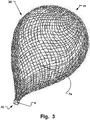
- 3 and 4 corresponding ball wire meshes are used with a proximal socket.
- Figures 5 and 6 show a form of the self-expandable occlusion device according to the invention without a socket, consisting of a braid, as described above, braided from a piece of wire to form a spherical structure 7 and with a forming and / or heat treatment process in the desired final shape.
- the occlusion device 1 is an auricle occluder with a shape consisting of a front proximal retention area 2, a middle area 5 and a rear, spherical distal retention area 3.
- the ends of the wires or threads of the braiding 7 run into the proximal retention area 2 a socket 4 together.
- the distal retention area 3, on the other hand, has a closed end without a mount in the preferred form.
- the occlusion device Due to the shape similar to a strawberry, the occlusion device is also called "Strawberry Occluder”.
- the mesh 7 is formed from wires or threads, which preferably consist of nitinol or another material with a shape memory or memory effect. It would be conceivable here to use a polymer plastic that has the shape memory property. It is also conceivable to use a biodegradable shape memory material. It is essential that the mesh 7 has sufficient flexibility so that the occlusion device 1 can be tapered to the diameter of a catheter (not explicitly shown) used in a minimally invasive, in particular intravascular surgical intervention. Due to the memory effect of the material, the occlusion device 1 tapered in this way has a shape memory function, so that the device 1 expands automatically after leaving the catheter and resumes a predetermined shape corresponding to the use. This usually takes place after the occlusion device 1, which is initially arranged in the catheter, has been placed at the site to be treated, in particular in the atrial appendage of a patient's heart.
- Figures 15 and 16 represent a variant of the heart ear occluder according to the invention 1 and 2 and can definitely find their application due to the high range of variation and specificity of the auricle, as in 24 shown.
- the occlusion device is shown in its expanded state.
- the occlusion device 1 has a proximal retention area 2 , a distal retention area 3 and a waisted, cylindrical central area 5 .
- the auricular appendage occluder has a proximal end 20 and a distal end 21 .
- the distal retention area 3 with the spherical area 6 formed thereon serves primarily to attach and hold the implanted and expanded occlusion device 1 in the atrial appendage of a patient.
- the spherical area 6 in the atrial appendage to be closed comes to rest against the inner walls of the auricle and forms a non-positive connection with the inner walls of the auricular appendage and thus holds the implanted and expanded occlusion device 1 in the auricular appendage. It would be conceivable, for example, for the distal retention area 3 or the spherical area 6 to be under radial pretension, so that the secure hold of the expanded occlusion device 1 can be guaranteed for a relatively wide range of atrial appendage openings.
- the proximal retention area 2 serves to close the opening of the atrial appendage as optimally as possible.
- the details of the functioning of the individual retention areas are made with reference to the 2 and 6 discussed in more detail below.
- the construction of the occlusion device 1 is based on the principle that the occlusion device 1 can be tapered to the size of a catheter. After exiting the catheter, the retention areas 3, 2 then unfold independently and lie against the inner walls of the atrial appendage.
- the construction according to the invention is thus a somewhat self-positioning and self-centering system.
- the central area 5 has a length that is predetermined for the application in order to ensure that the atrial appendage opening is closed.
- the instrument 1 Due to the flexible property of the occlusion device 1 due to the materials used and due to the mesh 7, the instrument 1 is designed to be reversibly folded and unfolded, so that an already expanded occlusion device 1 can be folded together, for example with the aid of an explantation catheter, with the non-positive connection between the ball area 6 and the inner walls of the atrial appendage 10 are then released.
- the occlusion device 1 in the implanted state.
- the occlusion device is inserted in the left atrial appendage 10 of a patient's heart and is used to close the atrial appendage.
- the spherical area 6 of the distal retention area 3 rests against the inner walls of the atrial appendage 10 and is used to position and fix the implanted occlusion device 1.
- the proximal retention area 2 closes with the opening of the atrial appendage 10, with the periphery of the distal retention area comes to rest against the wall 12 of the atrial appendage opening, while the central region 5 passes through the opening 11.
- the occlusion device 1 therefore represents a closure system that is introduced into a patient's body and positioned at the location intended for this purpose using minimally invasive methods, ie for example via a catheter and guide wires.
- the proximal retention area 2 of the instrument 1 is designed in such a way that no material of the implanted occlusion device 1 can get into the patient's bloodstream via the atrial appendage wall.
- the edge of the proximal retention area 2 ends flush with the atrial appendage wall 13 . This occurs over a relatively wide range, independent of atrial appendage diameter and strength Auricular appendage wall 12 at the atrial appendage opening 11. This can ensure that complete endothelialization occurs relatively quickly after the implantation of the occlusion device 1 and possible defense reactions from the patient's body do not occur, since blood contact with the material of the implant 1 is effectively prevented.
- FIG. 3 shows a spherical hollow ball braid 30 made of threads 7a for the production of an auricle occluder.
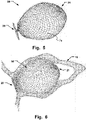
- FIG 5 is shown in a side view of an auricular ear occluder 50 without a mount.
- the cardiac appendage occluder 50 does not have a socket at the proximal end.
- 6 is the shape of the heart ear occluder 50 after figure 5 shown following implantation in the left atrial appendage 10 of the left atrium.
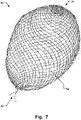
- FIG. 7 illustrates a ball mesh 70 from a piece of wire without a socket.
- FIG. 15 shows an embodiment of an atrial auricular occluder 150 according to the invention with a flat double disc at the proximal end 20 and an intermediate retention area 151.
- the embodiment is shown following implantation in the left atrial appendage 10 .
- a distal retention area is designed with a spherical shape in such a way that it curves outwards when the occlusion device expands in order to come into contact with the inner walls of the atrial appendage in the implanted state.
- the proximal retention area which is advantageously designed as a proximal umbrella, for example, is then unfolded and positioned, i.e.
- the distal area of the occlusion device i.e. the distal spherical umbrella
- the distal retention area of the occlusion device is pulled further into the atrial appendage and a tensile force is thus exerted on the proximal umbrella via the central area.
- the proximal umbrella or the proximal retention area is kept under permanent tension at the entrance of the atrial appendage.
- a self-positioning and self-retaining occlusion device is specified, with the position of the proximal umbrella preferably being held flush with the opening of the atrial appendage with the aid of the distal spherical umbrella, which automatically curves outwards.
- the occlusion device used can be completely enclosed by the body's own tissue much more quickly than with the closure systems known from the prior art.
- a mesh made up of thin wires or threads as the starting material for the occlusion device according to the invention results in the further advantage that it has long-term mechanical stability. As already indicated, the occurrence of fractures in the structure or other types of material fatigue in the implant used can be largely prevented. Furthermore, the mesh has sufficient rigidity.
- any mounts can be dispensed with; this applies to both the proximal and the distal end of the occlusion device.
- a special ball mesh was used, which is made from just one wire.
- the basis is the processes of 2D and 3D braiding known in the literature, in which case the braiding spindles are arranged on a flat surface like a chess board and such braided structures can be produced with any changes in direction.
- Another possibility for manufacturing such spherical meshes has already been described in the Occlutech patent application Germany No. DE102006013770.1 Ball occluder described. With this invention it is possible to intertwine individual wire sections to create ball occluders with a socket.
- DE102006013770.1 is hereby incorporated by reference in its entirety.
- spherical braids can be produced without sockets.
- the two remaining wire ends are connected to each other, for example welded, so that a closed spherical network is formed.
- a mount can ultimately be dispensed with both distally and proximally.
- the big advantage of such a Atrial appendage occluder is, for example, that the proximal end of the occluder, which is placed in the left atrial appendage, does not have a socket element, so that the formation of possible trombs can be extremely reduced.
- the wire ends of one wire can be brought together at the proximal end of the heart ear occluder or at another position.
- a particularly preferred embodiment provides that the mesh is formed from a shape-memory material, in particular nitinol or plastic.
- nitinol in occlusion devices.
- Shape memory polymers belong to the group of smart polymers and are polymers that exhibit a shape memory effect, i.e. are able to change their external shape under the influence of an external stimulus such as a change in temperature.
- the polymer is first brought into its permanent shape using conventional processing methods such as injection molding or extrusion.
- the plastic is then deformed and fixed in the desired temporary shape, which is also called "programming".
- this process can be carried out in such a way that the sample is heated, deformed and then cooled.
- the polymer or plastic can also be deformed at low temperature, which is referred to as "cold stretching”.
- the permanent shape is thus stored while the temporary shape is currently available. If the polymer molding is now heated to a temperature higher than the switching temperature, the shape memory effect is triggered and the stored permanent shape is thus restored.
- the temporary shape cannot be reversed when the sample cools down, which is why one speaks of a so-called one-way shape memory effect.
- shape memory polymers are many times superior in terms of their memory performance. Only a small amount of effort (heating or cooling) is required to program the temporary shape or to restore the permanent shape. In addition, with Nitinol, the maximum deformation between permanent and temporary shape is only 8%. Shape memory polymers have significantly higher deformability of up to 1,100%. All of the aforementioned shape memory polymers and materials are claimed with the present invention for the biomedical application of the occlusion device according to the invention.
- the material has a biodegradable shape-memory polymer material.
- biodegradable implant materials are particularly suitable. Such degradable materials or polymers contain cleavable bonds under physiological conditions. This is referred to as "biodegradability" when the material is degraded by or in a biological system with a loss of mechanical properties. The external shape and mass of the implant may be retained during degradation. If a degradation time is mentioned without additional quantifying information, then what is meant is the time in which the complete loss of mechanical properties occurs.
- Biostable materials are those that are stable in biological systems and are at least only partially degraded in the long term.
- hydrolytic degradation is that the rate of degradation is independent of the site of implantation, since water is present everywhere. In contrast, the concentration of enzymes varies greatly locally. In the case of biodegradable polymers or materials, degradation can therefore take place through pure hydrolysis, enzymatically induced reactions or through a combination of these. Typical hydrolyzable chemical bonds are amide, ester or acetal bonds. Two mechanisms are observed during degradation. In surface degradation, the hydrolysis of chemical bonds takes place exclusively on the surface. Due to the hydrophobic character, polymer construction occurs faster than the diffusion of water into the interior of the material.
- the threads 7a of the braid 7 consist of a shape-memory polymer composition, so that the braid 7 deforms from a temporary shape to a permanent shape under the influence of an external stimulus, the temporary shape in the first shaping of the braid 7 and the permanent shape in the second shaping of the braid 7 is present.
- the external stimulus can be a definable switching temperature, for example in the range between room temperature and the body temperature of a patient.
- the polymer composition of certain embodiments has polymeric switching elements, with the temporary shape of the mesh 7 being stabilized below the definable switching temperature with the aid of characteristic phase transitions of the polymeric switching elements.
- the polymer composition has a crystalline or partially crystalline polymer network with crystalline switching segments, the temporary shape of the mesh 7 being fixed and stabilized by freezing the crystalline switching segments during the crystallization transition, the switching temperature being determined by the crystallization temperature or switching temperature of the crystalline switching segments .
- the polymer composition has an amorphous polymer network with amorphous switching segments, the temporary shape of the mesh 7 being fixed and stabilized by freezing the amorphous switching segments at the glass transition of the switching segments, the switching temperature being determined by the glass transition temperature of the amorphous switching segments.
- the polymer composition has a linear, phase-segregated multiblock copolymer network, which can be present in at least two different phases, the first phase being a hard-segment-forming phase in which a large number of hard-segment-forming blocks are formed in the polymer, which serve for the physical crosslinking of the polymer structure and determine and stabilize the permanent shape of the braid 7, and wherein the second phase is a switching segment-forming phase in which a large number of switching segment-forming blocks are formed in the polymer, which are used to fix the temporary shape of the Braid 7 are used, the transition temperature of the switching segment-forming phase to the hard segment-forming phase being the switching temperature, and above the transition temperature of the hard segment-forming phase the shaping of the braid 7 by conventional methods, in particular by injection molding or extrusion proceed, can be adjusted.
- the first phase being a hard-segment-forming phase in which a large number of hard-segment-forming blocks are formed in the polymer, which serve for the physical crosslinking of
- the polymer composition can have thermoplastic polyurethane elastomers with a multiblock structure, the hard segment-forming phase being formed by reacting diisocyanates, in particular methylenebis(4-phenylisocyanate) or hexamethylene diisocyanate, with diols, in particular 1,4-butanediol, and wherein the switching segment-forming phase of oligomeric polyether or.
- Polyester diols in particular starting from OH-terminated poly(tetrahydrofuran), poly( ⁇ -caprolacetone), poly(ethylene adipate), poly(ethylene glycol) or poly(propylene glycol).
- the polymer composition can also have phase-segregated diblock copolymers with an amorphous A block and a semi-crystalline B block, the glass transition from the amorphous A block forming the hard segment-forming phase, and the melting temperature of the semi-crystalline B block as the switching temperature for the thermal shape memory -Effect serves.
- the polymer composition can have polystyrene as the amorphous A block and poly(1,4-butadiene) as the partially crystalline B block.
- the polymer composition has a phase-segregated triblock copolymer with a partially crystalline central B block and with two amorphous terminal A blocks, with the A blocks building up the hard segment and with the B block determining the switching temperature.
- the polymer composition can have, for example, partially crystalline poly(tetrahydrofuran) as the central B block and amorphous poly(2-methyloxazoline) as the terminal A blocks.
- the polymer composition comprises polynorbornene, polyethylene-nylon-6 graft copolymers and/or crosslinked poly(ethylene-co-vinyl acetate) copolymers.
- the polymer composition has a covalent crosslinked polymer network, which is built up by polymerization, polycondensation and/or polyaddition of difunctional monomers or macromers with the addition of trifunctional or higher functional crosslinkers, with a suitable selection of the monomers, their functionality and the proportion the chemical, thermal and mechanical properties of the polymer network formed can be specifically adjusted on the crosslinker.
- the polymer composition can be, for example, a covalent polymer network, which is constructed by crosslinking copolymerization of stearyl acrylate and methacrylic acid with N,N'-methylenebisacrylamide as a crosslinker, the shape memory effect of Polymer composition is based on crystallizing stearyl side chains.
- the polymer composition has a covalently crosslinked polymer network, which is formed by subsequent crosslinking of linear or branched polymers.
- Crosslinking can be triggered by ionizing radiation or by thermal cleavage of radical-forming groups.
- the polymer composition has at least one biodegradable material.
- the polymer composition can have, for example, a hydrolytically degradable polymer, in particular poly(hydroxycarboxylic acids) or corresponding copolymers.
- the polymer composition has, for example, enzymatically degradable polymers.
- the polymer composition has a biodegradable thermoplastic amorphous polyurethane copolyester polymer network.
- the polymer composition can have a biodegradable, elastic polymer network, which is obtained by crosslinking oligomeric diols with diisocyanate. In this case, the polymer composition can be formed on the basis of covalent networks starting from oligo( ⁇ -caprolactone) dimethacrylate and butyl acrylate.
- the advantage of this embodiment can be seen in the fact that the catheter systems to be used for implantation and explantation can have a significantly reduced inner diameter, which significantly increases the maneuverability of the occlusion device to be implanted. Hence, the positioning accuracy of the instrument in the atrial appendage can be improved.
- the inner diameter of the catheter used for implantation or explantation is between 8 and 10 French, whereas when using occlusion devices made of polymer plastic, the inner diameter only has to be between 6 and 8 French.
- the occlusion device has at least one fabric insert 120, 130, which is arranged in or on the proximal retention area for the complete closure of the atrial appendage.
- This tissue insert serves to seal the interstices remaining in the expanding diameters of the occlusion device after the device has been inserted and expanded in the atrial appendage.
- the fabric insert is fastened, for example, to the mesh of the occlusion device at the distal retention area in such a way that it can be stretched over the distal retention area like a cloth.
- the fabric inserts can be made of Dacron (polyethylene terephthalate), for example.
- Dacron polyethylene terephthalate
- other materials and other positions of the tissue insert in or on the occlusion device are also conceivable here, including biodegradable materials, which have been described above.
- the occluder according to the invention is a self-expandable instrument, which can be implanted in a particularly simple manner using, for example, a suitable insertion catheter.
- a vein is punctured in the patient's groin and the insertion catheter system is advanced up to the septum of the right atrium.
- the left atrium of the heart is reached by means of a puncture of the septum of the atrium, which can be a known transseptal puncture, for example, so that the insertion catheter system can then be introduced into the left atrial appendage from the groin vein.
- the self-expanding occlusion device for closing the atrial appendage can then be inserted via the insertion catheter system; the corresponding locks have a relatively small cross-section, a maximum of 9 to 10 F.
- the occlusion device which is in the folded state during implantation, preferably has a diameter of 6 to 10 French, so that the procedure for closing the atrial appendage is minimally invasive.
- the occlusion device After the folded occlusion device is positioned in the atrial appendage to be occluded using, for example, the delivery catheter, the occlusion device is released from the catheter, whereupon it unfolds due to its self-expanding nature and assumes the pronounced shape by means of the forming and heat treatment process used during manufacture.
- the rear distal retention area with the ball area formed on it In this expanded state, the rear distal retention area with the ball area formed on it is completely unfolded and comes to rest on the inner walls of the atrial appendage to be closed.
- the distal retention area with the spherical area formed thereon is used for fastening and positioning the expanded occlusion device in the atrial appendage.
- the middle area extending from the distal retention area in the direction of the atrial appendage and the proximal retention area provided at the proximal end of the middle area fill the opening area of the auricular appendage almost completely, so that the entire expanded occlusion device when inserted serves as a closure plug for closing the auricular appendage.
- trombus formation with the risk of a stroke can be significantly reduced.
- the occlusion device can do without attachment hooks or other anchoring means, which are usually used in such occlusion devices for fixing and positioning the instrument in the tissue be used. It should be noted in particular that due to the extremely thin-walled design of the tissue in the vicinity of the atrial appendage, the fastening hooks usually used cannot provide permanent fastening and positioning of the occlusion device.
- a spherical hollow braid is formed using a circular braiding machine, for example.
- a technique can be used here in which the formed braid is bundled at the end of the braid length, i.e. at the later distal end of the occlusion device, and remains closed at the beginning of the braid length, i.e. at the later distal end of the occlusion device. This makes it possible to produce a spherical hollow braid whose bundled end corresponds to the proximal end of the finished occlusion device and whose opposite closed end corresponds to the distal end of the finished occlusion device.
- the manufactured occlusion device Since a braiding process known per se can be used to manufacture the occlusion device, the manufactured occlusion device has mechanical properties with regard to, for example, expansion, stability, strength, etc., which can be individually adapted to the subsequent use of the occlusion device.
- Metallic wires, but also organic threads, can advantageously be processed into the mesh.
- Ball braids as described, can also be used without a socket.
- the method step of shaping the retention areas and the central area has a reshaping and/or heat treatment step.
- the formed spherical hollow mesh consists of nitinol or another material, in particular polymer, with a shape memory or memory effect.
- the mesh is formed from a shape-memory polymer, which is based, for example, on polyanhydrides as a matrix or on polyhydroxycarboxylic acid. These are synthetic degradable materials that have a thermally induced shape memory effect.
- shape-memory polymers such as block copolymers such as those used in Offprint applied chemistry 2002, 114, pages 2138 to 2162 by A. Lendlein and S. Kelch to be discribed.
- Such materials can be brought into a corresponding final shape in a simple manner by a combination of forming and heat treatment steps.
- a finished occluder can then be reduced to the size of a catheter, for example.
- the occlusion device unfolds automatically and resumes the shape that was given to the spherical or funnel-shaped hollow mesh of the occlusion device during the manufacturing process by means of the reshaping and/or heat treatment step.
- the spherical hollow braid is preferably produced in such a way that thin wires or threads, which make up the finished braid, are intertwined when the spherical hollow braid is formed at the distal end of the braid.
- other manufacturing processes are also conceivable.
Landscapes
- Health & Medical Sciences (AREA)
- Surgery (AREA)
- Life Sciences & Earth Sciences (AREA)
- Biomedical Technology (AREA)
- Medical Informatics (AREA)
- Veterinary Medicine (AREA)
- Public Health (AREA)
- Engineering & Computer Science (AREA)
- General Health & Medical Sciences (AREA)
- Heart & Thoracic Surgery (AREA)
- Nuclear Medicine, Radiotherapy & Molecular Imaging (AREA)
- Molecular Biology (AREA)
- Animal Behavior & Ethology (AREA)
- Reproductive Health (AREA)
- Vascular Medicine (AREA)
- Cardiology (AREA)
- Surgical Instruments (AREA)
- Prostheses (AREA)
Description
- Die vorliegende Erfindung betrifft ein selbst expandierbares Occlusionsinstrument zum Verschließen eines Herzohres, bestehend aus einem Geflecht dünner Drähte, oder Fäden, welches mittels eines Formgebungs-, Umformungs- und/oder Wärmebehandlungsverfahrens eine geeignete Formgebung erhält, wobei das Occlusionsinstrument einen vorderseitigen proximalen Retentionsbereich und einen rückseitigen distalen Retentionsbereich aufweist, und wobei in dem proximalen Retentionsbereich die Enden der Drähte oder Fäden in einer Fassung aber auch in einer zweiten Lösung ohne Fassung zusammenlaufen. Des Weiteren weist das Occlusionsinstrument einen Mittenbereich zwischen dem proximalen und dem distalen Retentionsbereich auf. Das Occlusionsinstrument ist dabei so ausgeführt, dass es in einem zusammengefalteten Zustand mittels eines Katheters in den Körper eines Patienten minimal-invasiv einführbar und in dem Herzohr des Patienten positionierbar ist. Des Weiteren betrifft die Erfindung Verfahren zur Herstellung eines solchen Occlusionsinstruments.
- Ein derartiges Occlusionsinstrument ist zumindest teilweise dem Prinzip nach aus der Medizintechnik bekannt. Beispielsweise ist in der
DE 10 338 702 vom 22. August 2003 ein Occlusionsinstrument zur Behandlung von Septumdefekten bekannt, welches aus einem Geflecht dünner Drähte bzw. Fäden besteht und mittels eines Umformungs- und Wärmebehandlungsverfahrens eine geeignete Formgebung erhält. Das bekannte Occlusionsinstrument weist einen distalen Retentionsbereich, welcher besonders flach ausgeprägt ist, einen proximalen Retentionsbereich und einen zylindrischen Steg zwischen dem proximalen und dem distalen Retentionsbereich auf. Am proximalen Retentionsbereich laufen die Enden der das Geflecht bildenden Drähte in einer Fassung zusammen. Dabei ist vorgesehen, dass die beiden Retentionsbereiche des bekannten Occlusionsinstruments durch einen meist intravaskulären Operationseingriff beiderseits eines zu verschließenden Shuntes in einem Septum zur Anlage kommen, während der Steg durch den Shunt hindurchläuft. Das Occlusionsinstrument ist angepasst, um eine Öffnung mit dynamischem Blutfluss permanent zu verschließen, und weist dazu eine spezielle Konstruktion auf und ist nicht für Herzohrocclussionen geeignet. - Ähnliche Instrumente sind in der Occlutech-Patentanmeldung
WO 2007 054116 . - Wenn der Patient unter einem so genannten Vorhofflimmern des Herzens leidet, treten besondere emboliebedingte Probleme in Erscheinung. Hierbei handelt es sich um eine frequente Erregung der Vorhöfe des Herzens, die zu keiner Kontraktion der Vorhöfe führt. Folge dieses Kontraktionsverlustes der Vorkammern des Herzens ist es, dass eine wirksame Durchwirbelung und Durchmischung des Blutes ausbleibt und sich Tromben im Vorhof bilden können. Ein erhebliches Risiko bei der Vorhoftrombenbildung infolge Vorhofflimmerns besteht darin, dass solche Tromben mit dem Blutstrom mitgerissen werden können und in die arterielle Zirkulation gelangen. Folgen dieser Embolisation sind insbesondere Schlaganfälle, die in etwa 5% pro Jahr bei Patienten mit Vorhofflimmern auftreten, falls nicht durch eine chronische Behandlung eine Geringungshemmung des Blutes mit so genannten Dicumerolen durchgeführt wird. Eine Herbeiführung der Geringungshemmung des Blutes mit so genannten Dicumerolen ist allerdings ebenfalls nicht risikolos. Nebenwirkungen der Behandlungen mit Dicumerolen sind vermehrte Blutungen, sodass Kontraindikationen für diese Behandlung bei ca. 20% der Patienten mit Vorhofflimmern besteht und die Patienten somit aufgrund von einer Risikoabwägung Blutung/Schlaganfall das Risiko eines Schlaganfalls in Kauf genommen wird.
- Tromben im Vorhof des Herzens entstehen in überwiegender Mehrzahl in den so genannten Herzohren. Die Herzohren sind Ausstülpungen an den Vorhöfen des menschlichen Herzens. Das rechte Herzohr liegt neben der aufsteigenden Aorta, und das linke Herzohr neben der großen Lungenarterie. Dabei ist das linke Herzohr bei Patienten mit Vorhofflimmern der häufige Entstehungsort für Blutgerinnsel, die zu einem Schlaganfall führen können.
- Aufgrund der im Zusammenhang mit der zuvor beschriebenen Vorhoftrombenbildung genannten Risiken und Probleme liegt der vorliegenden Erfindung die Aufgabe zugrunde, ein Occlusionsinstrument anzugeben, mit dem das Herzohr des linken Vorhofs verschlossen werden kann, um eine Trombusbildung mit dem Risiko eines Schlaganfalls erheblich zu reduzieren. Insbesondere soll ein Occlusionsinstrument angegeben werden, mit dem das Schlaganfallrisiko auch bei solchen Patienten reduziert werden kann, bei denen eine Gerinnungshemmung mit Dicumerolen (so genannte Antikoagulation) aufgrund von Blutungsneigungen kontra indiziert ist. Ebenso sollte das Occlusionsinstrument sicher im Herzohr zu verankern sein, ohne sich zu lösen.
- Nach dem Stand der Technik existieren verschiedene Lösungen, welche im Wesentlichen Teilgeflechte mit gestängeartigen Bauelementen kombinieren, teilweise werden dabei auch gelaserte Konstruktionen in dieser Kombination eingesetzt, das betrifft solche Erfindungen wie:
EP 1417933A1 ;US 7,169,164B2 ;US 2005/0234543A1 ;US 6, 689, 150B1 ;US 6, 152, 144 . - Diese Erfindungen haben unter anderem den Nachteil, dass für die Implantation relativ große Einführschleusen mit bis zu 14 F Innendurchmesser benötigt werden.
- Weitere Erfindungen wie von Amplatz
WO 2005 099 365 , nach der PLAATO-Methode (PLAATO = Percutaneus Left Atrial Appendage Transcatheter) und Watchman-Occluder beherrschen nicht die korrekte vorgegebene Positionierung. Bei dem System PLAATO besteht die Gefahr der Perforation mit dem Herzbeutel, außerdem wurde PLAATO ebenfalls mit einer 14F-Schleuse implantiert. -
WO 02/071977 - Eine weitere Anmeldung von Occlutech betrifft die Erfindung eines einnabigen Herzohroccluders unter Verwendung eines Fixiermittels zum Ausbilden einer kraftschlüssigen Verbindung zwischen dem Geflecht eines Occlusionskörpers und der Herzohrwandung,
PCT/EP 2006/005292 - Aufgabe der Erfindung ist es, die oben genannten Nachteile der herkömmlichen Verfahren und Vorrichtungen zu überwinden und eventuell eine möglichst Kosten senkende und patientenfreundliche sowie pateintensichere Lösung anzugeben.
- Die oben genannte Aufgabe wird mit einem selbst expandierbaren Occlusionsinstrument zum Verschließen eines Herzohres gelöst, wobei das Occlusionsinstrument aus einem Geflecht dünner Drähte, Litzen oder Fäden besteht, welches mittels eines Formgebungs-, Umformungs- und/oder Wärmebehandlungsverfahrens eine geeignete Formgebung erhalten hat gemäß Anspruch 1
- Bevorzugte Weiterentwicklungen der Erfindung bezüglich des Occlusionsinstruments sind in den Unteransprüchen angegeben.
- Im Folgenden werden bevorzugte Ausführungsbeispiele des erfindungsgemäßen Occlusionsinstruments anhand der Zeichnungen näher erläutert. Es zeigen:
-
Fig. 1 Eine Seitenansicht eines Herzohroccluders mit einer Fassung; -
Fig. 2 Der Herzohroccluders nachFig. 1 nach Implantation im linken Herzohr (Englisch Left Atrial Appendage - LAA), angrenzend zum linken Vorhof; -
Fig. 3 ,4 Kugelgeflecht, kugel- und ballonförmig zur Herstellung eines Herzohroccluders nachFig. 1 ; -
Fig. 5 Eine Seitenansicht eines Herzohroccluders ohne Fassung; -
Fig. 6 Die Form nachFig. 5 im Anschluss an eine Implantation im linken Herzohr des linken Vorhofes; -
Fig. 7 Kugelgeflecht aus einem Drahtstück ohne Fassung; -
Fig. 8-14 : gelöscht -
Fig. 15 Fünfte Variante einer Ausführungsform eines Herzohroccluders mit einer flachen Doppelscheibe am proximalen Ende; -
Fig. 16 Die Ausführungsform nach der fünften Variante im Anschluss der Implantation in das linke Herzohr; -
Fig. 17-23 : gelöscht. -
Fig. 24 Darstellung eines Herzohres. - Während die Erfindung nachstehend in einer Ausführungsform zum Durchführen der Erfindung beschrieben werden wird, versteht der Fachmann, dass diese Ausführungsform nur einen illustrative, nicht begrenzende Beispiel von vielfältigen Formen, welche die vorliegende Erfindung einnehmen kann, darstellt.
- Selbstverständlich sind hier aber auch andere, wie auch immer geartete und anwendungsspezifische Formgebungen des Occlusionsinstrumtents denkbar. Die hier dargestellte Formgebung dient lediglich zur Beschreibung von einer bevorzugte Ausführungsform des Occlusionsinstruments und soll insbesondere nicht den Schutzumfang der Erfindung in irgendeiner Weise einschränken.
-
Fig. 1 zeigt eine Seitenansicht eines nicht erfindungsgemäßen Ausführungsform selbst expandierbaren Occlusionsinstruments. In derFig. 2 sehen wir eine Schnittdarstellung im Bereich linker Vorhof/linkes Herzohr mit implantiertem Herzohroccluder mit einer proximalen Fassung. - Das nicht erfindungsgemäße Occlusionsinstrument 1 der in
Fig. 1 undFig. 2 dargestellten, Form besteht aus einem Geflecht dünner Drähte oder Fäden, das mit einem Umformungs- und/oder Wärmebehandlungsverfahren eine geeignete Formgebung erhält. Dazu werden nachFig. 3 und4 entsprechende Kugel-Drahtgeflechte mit einer proximalen Fassung verwendet. -
Fig. 5 und 6 zeigen eine Form des erfindungsgemäßen selbst expandierbaren Occlusionsinstruments ohne Fassung bestehend aus einem Geflecht, wie vorstehend beschrieben, aus einem Drahtstück geflochten zu einem Kugelgebinde nachFig. 7 und mit einem Umformungs- und/oder Wärmebehandlungsverfahren in die gewünschte Endform gebracht. - Bei dem Occlusionsinstrument 1 handelt es sich um einen Herzohroccluder mit einer Formgebung bestehend aus einem vorderseitigen proximalen Retentionsbereich 2, einem Mittenbereich 5 und einem rückseitigen, kugelförmigen distalen Retentionsbereich 3. In dem proximalen Retentionsbereich 2 laufen die Enden der Drähte bzw. Fäden des Geflechts 7 in einer Fassung 4 zusammen. Der distale Retentionsbereich 3 hingegen weist in der bevorzugten Form ein geschlossenes Ende ohne Fassung aus.
- Aufgrund der Form ähnlich einer Erdbeere wird das Occlusionsinstrument auch "Strawberry-Occluder" genannt.
- Das Geflecht 7 ist aus Drähten oder Fäden gebildet, welche in bevorzugter Weise aus Nitinol oder aus einem anderen Material mit Formgedächtnis oder Memory-Effekt bestehen. Denkbar hierbei wäre es, ein Polymerkunststoff einzusetzen, der die Formgedächtniseigenschaft aufweist. Auch ist es denkbar, ein biologisch abbaubares Formgedächtnismaterial zu verwenden. Wesentlich ist, dass das Geflecht 7 eine ausreichende Flexibilität aufweist, sodass das Occlusionsinstrument 1 auf den Durchmesser eines bei einem minimal-invasiven, insbesondere intravaskulären Operationseingriff verwendeten (nicht explizit dargestellten) Katheters verjüngt werden kann. Aufgrund des Memory-Effekts des Materials verfügt das derart verjüngte Occlusionsinstrument 1 eine Formgedächtnisfunktion, sodass sich das Instrument 1 nach dem Verlassen des Katheters selbstständig expandiert und eine der Verwendung entsprechende, vorbestimmte Form wieder einnimmt. Üblicherweise erfolgt dies, nachdem das zunächst im Katheter angeordnete Occlusionsinstrument 1 an der zu behandelnden Stelle, insbesondere im Herzohr des Herzens eines Patienten, platziert wurde.
-
Fig. 15 und 16 stellen einen erfindungsgemäße Variant des Herzohroccluders nachFig. 1 und2 dar und können durchaus ihre Anwendung finden auf Grund der hohen Variationsbreite und Spezifik des Herzohres, wie inFig. 24 dargestellt. - In den
Figuren 1 ,2 ,5 und 6 ist das Occlusionsinstrument in seinem expandierten Zustand dargestellt. Wie bereits angedeutet, weist das Occlusionsinstrument 1 einen proximalen Retentionsbereich 2, einen distalen Retentionsbereich 3 sowie einen taillierten, zylindrischen Mittenbereich 5 auf. Der Herzohroccluder weist ein proximales Ende 20 sowie ein distales Ende 21 auf. Der distale Retentionsbereich 3 mit dem daran ausgebildeten Kugelbereich 6 dient in erster Linie zum Befestigen und Halten des implantierten und expandierten Occlusionsinstruments 1 im Herzohr eines Patienten. Hierzu ist vorgesehen, dass der Kugelbereich 6 in dem zu verschließenden Herzohr an den Innenwandungen des Herzohres zur Anlage kommt und mit den Innenwandungen des Herzohres eine kraftschlüssige Verbindung bildet und somit das implantierte und expandierte Occlusionsinstrument 1 in dem Herzohr hält. Denkbar wäre es beispielsweise, dass der distale Retentionsbereich 3 bzw. der Kugelbereich 6 unter einer radialen Vorspannung stehen, sodass damit für eine relativ breite Variation von Herzohröffnungen der sichere Halt des expandierten Occlusionsinstruments 1 garantiert werden kann. - Im implantierten und expandierten Zustand dient der proximale Retentionsbereich 2 dazu, die Öffnung des Herzohres möglichst optimal zu verschließen. Auf die Einzelheiten der Funktionsweise der einzelnen Retentionsbereiche wird unter Bezugnahme auf die
Fig. 2 und6 im Nachfolgenden näher eingegangen. - Der Konstruktion des Occlusionsinstruments 1 liegt das Prinzip zugrunde, dass sich das Occlusionsinstrument 1 auf die Größe eines Katheters verjüngen lässt. Nach dem Austritt aus dem Katheter entfalten sich dann die Retentionsbereiche 3, 2 selbstständig und legen sich an die Innenwandungen des Herzohres an. Bei der erfindungsgemäßen Konstruktion handelt es sich somit um ein in gewissen Maßen selbstpositionierendes und selbstzentrierendes System. Der Mittenbereich 5 hat dabei eine für die Anwendung vorab festgelegte Länge, um das Verschließen der Herzohröffnung zu gewährleisten.
- Durch die flexible Eigenschaft des Occlusionsinstruments 1 aufgrund der verwendeten Materialien und aufgrund des Geflechtes 7 ist das Instrument 1 reversibel zusammen- und auseinanderfaltbar ausgeführt, sodass ein bereits expandiertes Occlusionsinstrument 1 beispielsweise mithilfe eines Explantations- Katheters zusammenfaltbar ist, wobei die kraftschüssige Verbindung zwischen dem Kugelbereich 6 und den Innenwandungen des Herzohres 10 dann gelöst werden.
-
Fig. 2 und6 zeigen eine Form des Occlusionsinstruments 1 im implantierten Zustand. Im Einzelnen ist das Occlusionsinstrument im linken Herzohr 10 des Herzens eines Patienten eingesetzt und dient zum Verschließen des Herzohres. Im Einzelnen liegt der Kugelbereich 6 des distalen Retentionsbereiches 3 an den Innenwandungen des Herzohres 10 an und dient zum Positionieren und Fixieren des implantierten Occlusionsinstrumentes 1. Im implantierten Zustand schließt der proximale Retentionsbereich 2 mit der Öffnung des Herzohres 10 ab, wobei die Peripherie des distalen Retentionsbereiches an der Wandung 12 der Herzohröffnung zur Anlage kommt, während der Mittenbereich 5 durch die Öffnung 11 hindurchläuft. Das Occlusionsinstrument 1 stellt von daher ein Verschlusssystem dar, dass mittels minimal-invasiver Verfahren, d.h. beispielsweise über einen Katheter und Führungsdrähte, dem Körper eines Patienten zugeführt und an der dafür bestimmten Stelle positioniert wird. Dabei ist insbesondere der proximale Retentionsbereich 2 des Instruments 1 derart ausgebildet, dass keinerlei Material des implantierten Occlusionsinstruments 1 über die Herzohrwand in den Blutstrom des Patienten gelangen kann. Der Rand des proximalen Retentionsbereiches 2 schließt dabei bündig mit der Herzohrwand 13 ab. Dies erfolgt über einen relativ weiten Bereich unabhängig von dem Herzohrdurchmesser und der Stärke der Herzohrwandung 12 an der Herzohröffnung 11. Dadurch kann erreicht werden, dass nach dem Implantieren des Occlusionsinstruments 1 relativ schnell eine vollständige Endothelialisierung eintritt und mögliche Abwehrreaktionen vom Körper des Patienten nicht eintreten, da ein Blutkontakt mit dem Werkstoff des Implantats 1 wirksam verhindert wird. -
Fig. 3 zeigt ein kugelförmiges hohles Kugelgeflecht 30 aus Fäden 7a auf, zur Herstellung eines Herzohroccluders. -
Fig. 4 ein ballonförmiges hohles Kugelgeflecht 40 aus Fäden 7a auf, zur Herstellung eines Herzohroccluders. - In
Fig. 5 ist in einer Seitenansicht eines Herzohroccluders 50 ohne Fassung gezeigt. Der Herzohroccluder 50 weist am proximalen Ende keine Fassung auf. InFig. 6 ist die Form des Herzohroccluders 50 nachFig. 5 im Anschluss an eine Implantation im linken Herzohr 10 des linken Vorhofes gezeigt. -
Fig. 7 illustriert ein Kugelgeflecht 70 aus einem Drahtstück ohne Fassung. -
Fig. 15 zeigt eine erfindungsgemäße Ausführungsform eines Herzohroccluders 150 mit einer flachen Doppelscheibe am proximalen Ende 20 und einem Zwischen-Retentionsbereich 151. InFig. 16 wird die Ausführungsform im Anschluss der Implantation in das linke Herzohr 10 gezeigt. - So ist in bevorzugter Weise für das Occlusionsinstrument vorgesehen, dass ein distaler Retentionsbereich mit einer Kugelform derart ausgelegt ist, dass er sich beim Expandieren des Occlusionsinstruments nach außen wölbt, um derart im implantierten Zustand mit den Innenwandungen des Herzohres zur Anlage zu kommen. Mit dieser bevorzugten Ausführungsform ist es demnach möglich, dass das erfindungsgemäße selbst expandierbare Occlusionsinstrument mittels eines Einführ-Kathetersystems besonders tief in das zu verschließende Herzohr vorgeschoben werden kann. Der proximale Retentionsbereich, der in vorteilhafter Weise beispielsweise als proximales Schirmchen ausgebildet ist, wird anschließend, das heißt, nachdem das Occlusionsinstrument mithilfe des Kathetersystems in dem zu verschließenden Herzohr eingeschoben worden ist, zur Entfaltung gebracht und positioniert, wobei das Schirmchen am Rand der Öffnung des Herzohres zum Eingang des Herzohres anliegt. Gleichzeitig expandiert sich auch der distale Bereich des Occlusionsinstruments, das heißt der distale Kugelschirm, wobei beim Expansionsvorgang des distalen Kugelschirmchens der distale Retentionsbereich des Occlusionsinstruments weiter in das Herzohr hineingezogen wird und so über den Mittenbereich eine Zugkraft auf das proximale Schirmchen ausgeübt wird. Als eine direkte Folge hiervon wird das proximale Schirmchen bzw. der proximale Retentionsbereich unter einer permanenten Spannung am Eingang des Herzohres gehalten. Anders ausgedrückt bedeutet dies, dass mit der vorteilhaften Weiterentwicklung des selbst expandierbaren Occlusionsinstruments ein selbstpositionierendes und selbsthaltendes Occlusionsinstrument angegeben wird, wobei die Position des proximalen Schirmchens vorzugsweise bündig an der Öffnung des Herzohres mithilfe des sich selbstständig nach außen wölbenden distalen Kugelschirmchens gehalten wird.
- Durch das einerseits flexible und andererseits kraftschlüssige Anliegen des Kugelbereiches mit einer relativ großen Oberfläche an der Innenwandung des Herzohres kann ferner erreicht werden, dass das eingesetzte Occlusionsinstrument deutlich schneller als bei den aus dem Stand der Technik bekannten Verschlusssystemen vollständig von körpereigenem Gewebe eingeschlossen werden kann.
- Aus der Verwendung eines aus dünnen Drähten oder Fäden aufgebauten Geflechts als Ausgangsmaterial für das erfindungsgemäße Occlusionsinstrument leitet sich der weitere Vorteil ab, dass es eine langfristige mechanische Stabilität aufweist. Wie bereits angedeutet, kann das Auftreten von Brüchen in der Struktur oder anders artige Materialermüdung des eingesetzten Implantats weitgehend verhindert werden. Ferner besitzt das Geflecht eine ausreichende Steifigkeit.
- Dadurch, dass am distalen Retentionsbereich auf eine Fassung zum Zusammenbündeln bzw. Zusammenfassen des Geflechts verzichtet werden kann, ragt auch keine Komponente des Occlusionsinstruments in das Herzohr weiter hinein, sodass das Risiko für Abwehrreaktionen des Körpers oder andere möglichen Komplikationen gering ist.
- In einer besonders vorteilhaften Realisierung des erfindungsgemäßen Occlusionsinstruments ist vorgesehen, dass prinzipiell auf jegliche Fassungen verzichtet werden kann, dies betrifft sowohl das proximale als auch distale Ende des Occlussionsinstrumentes. Dabei wurde ein besonderes Kugelgeflecht verwendet, welches aus nur einem Draht hergestellt wird. Grundlage sind die in der Literatur bekannten Verfahren des 2- und 3D-Flechtens, wobei hier die Flechtspindeln auf einer ebenen Fläche schachbrettartig angeordnet sind und untereinander mit beliebigen Richtungsänderungen solche Geflechtsgebilde hergestellt werden können. Eine weitere Herstellungsmöglichkeit von solchen Kugelgeflechten wurde bereits in der Occlutech Patentanmeldung Deutschland Nr.
DE102006013770.1 Kugeloccluder beschrieben. Mit dieser Erfindung ist es möglich, einzelne Drahtabschnitte so zu verflechten, dass Kugel-Occluder mit einer Fassung entstehen.DE102006013770.1 ist hiermit in seiner Gesamtheit durch Bezugsnahme beinhaltet. - Reduziert man die Anzahl der Drahtabschnitte auf genau einen Draht mit einer definierten Länge, lassen sich solche Kugelgeflechte ohne Fassungen herstellen. Die beiden übrig gebliebenen Drahtenden werden so miteinander verbunden, beispielsweise verschweißt, dass ein geschlossenes Kugelgeflecht entsteht. Damit kann letztlich bei einem entsprechenden Occlusionsinstrument sowohl distal als auch proximal auf eine Fassung verzichtet werden. Der große Vorteil bei einem solchen Herzohroccluder ist zum Beispiel, dass das proximale Ende des Occluders, welches im linken Herzohr platziert ist, kein Fassungselement trägt, sodass die Bildung von möglichen Tromben extrem reduziert werden kann. Die Drahtenden des einen Drahtes können hierbei an dem proximalen Ende des Herzohroccluders zusammengeführt sein, oder an einer anderen Position.
- In den Patentanmeldungen von Occlutech
WO 2007 054118 ,US 2007 112381 undDE 102005053906 sind Vorrichtungen beschrieben, wo am distalen Ende der Vorrichtung zum Implantieren von solchen Occlusionsinstrumenten eine Schlaufe existiert, welche während des Implantationsvorganges die Verbindung zwischen dem Operationsbesteck und dem Occluder herstellt. Von der Dimensionierung können bekannte Einführschleusen mit einem Innendurchmesser von 2-3·3 mn (6 bis 10 French) verwendet werden. - Um zu erreichen, dass das Geflecht des Occlusionsinstruments mittels eines Umformungs- und Wärmebehandlungsverfahrens seine geeignete Formgebung erhalten kann, ist in einer besonders bevorzugten Ausführungsform vorgesehen, dass das Geflecht auf einem Formgedächtnismaterial, insbesondere Nitinol oder Kunststoff gebildet ist. Der Einsatz von Nitinol bei Occlusionsinstrumenten ist bekannt. Formgedächtnispolymere gehören zur Gruppe der intelligenten Polymere und sind Polymere, die einen Formgedächtniseffekt zeigen, d.h. unter Einwirkung eines äußeren Stimulus, wie z.B. einer Temperaturänderung, ihre äußere Form ändern können.
- Dabei wird das Polymer zunächst durch konventionelle Verarbeitungsmethoden, wie etwa Spritzguss oder Extrusion, in seine permanente Form gebracht. Anschließend wird der Kunststoff deformiert und in der gewünschten temporären Form fixiert, was auch "Programmierung" genannt wird. Dieser Vorgang kann bei Polymeren einerseits so erfolgen, dass die Probe erwärmt, deformiert und dann abgekühlt wird. Andererseits kann das Polymer bzw. der Kunststoff auch bei niedriger Temperatur deformiert werden, was als "kaltes Verstrecken" bezeichnet wird. Damit ist die permanente Form gespeichert, während die temporäre Form aktuell vorliegt. Wird nun der Polymerformkörper auf eine Temperatur höher als die Schalttemperatur erwärmt, kommt es zum Auslösen des Formgedächtniseffekts und damit zur Wiederherstellung der gespeicherten permanenten Form. Durch Abkühlen der Probe bildet sich die temporäre Form nicht reversibel zurück, weshalb man von einem so genannten Ein-Weg-Formgedächtniseffekt spricht.
- Im Vergleich zu bekannten Formgedächtnismaterialien wie z.B. der Formgedächtnislegierung Nitinol, einer äquiatomaren Legierung aus Nickel und Titan, sind Formgedächtnispolymere mit ihren Gedächtnisleistungen um ein vielfaches Überlegen. Dabei ist nur ein geringer Aufwand (Erwärmen bzw. Abkühlen) zur Programmierung der temporären Form bzw. zur Wiederherstellung der permanenten Form nötig. Darüber hinaus beträgt bei Nitinol die maximale Deformation zwischen permanenter und temporärer Form nur 8%. Formgedächtnispolymere weisen wesentlich höhere Verformbarkeit von bis zu 1.100% auf. Sämtliche vorgenannten Formgedächtnispolymere und Materialien werden mit der vorliegenden Erfindung für die biomedizinische Anwendung des erfindungsgemäßen Occlusionsinstruments beansprucht.
- In einer vorteilhaften Weiterentwicklung der zuletzt genannten Ausführungsform des erfindungsgemäßen Occlusionsinstruments, bei welchem das Geflecht aus einem Formgedächtnismaterial gebildet wird, ist vorgesehen, dass das Material ein biologisch abbaubares Formgedächtnis-Polymermaterial aufweist. Insbesondere eignen sich synthetische, bioabbaubare Implantatmaterialien. Derartige abbaubare Werkstoffe bzw. Polymere enthalten unter physiologischen Bedingungen spaltbare Bindungen. Dabei spricht man von einer "Bioabbaubarkeit", wenn der Werkstoff unter Verlust der mechanischen Eigenschaft durch oder in einem biologischen System abgebaut wird. Die äußere Form und die Masse des Implantats bleibt während des Abbaus unter Umständen erhalten. Wird von einer Degradationszeit ohne zusätzliche quantifizierende Angaben gesprochen, so ist die Zeit, in der der vollständige Verlust der mechanischen Eigenschaft auftritt, gemeint. Unter biostabilen Werkstoffen versteht man solche, die in biologischen Systemen stabil sind und langfristig zumindest nur teilweise abgebaut werden.
- Bei abbaubaren Polymeren unterscheidet man zwischen hydrolytisch und enzymatisch abbaubare Polymere. Der hydrolytische Abbau hat den Vorteil, dass die Abbaugeschwindigkeit unabhängig vom Ort der Implantation ist, da Wasser überall vorhanden ist. Demgegenüber ist die Konzentration an Enzymen lokal sehr unterschiedlich. Bei bioabbaubaren Polymeren oder Werkstoffen kann demnach der Abbau durch reine Hydrolyse, enzymatisch induzierte Reaktionen oder durch deren Kombination erfolgen. Typische hydrolysierbare chemische Bindungen sind Amid-, Ester- oder Acetal-Bindungen. Beim Abbau beobachtet man zwei Mechanismen. Beim Oberflächenabbau findet die Hydrolyse chemischer Bindungen ausschließlich an der Oberfläche statt. Aufgrund des hydrophoben Charakters erfolgt der Polymerbau schneller als die Diffusion von Wasser in das Innere des Materials. Diesen Mechanismus beobachtet man vor allem bei Poly(anhydride)n oder Poly(orthoester)n. Für die vor allem für den Formgedächtniseffekt bedeutsamen Poly(hydroxcarbonsäuren), wie Poly (milchsäure) oder Poly(glycosesäure) bzw. entsprechende Copolymere, erfolgt der Polymerabbau im gesamten Volumen. Der geschwindigkeitsbestimmende Schritt ist hierbei die hydrolytische Bindungsspaltung, da die Diffusion von Wasser in der eher hydrophylen Polymermatrix relativ schnell erfolgt. Für die Anwendung von bioabbaubaren Polymeren ist entscheidend, dass sie einerseits mit einer kontrollier- bzw. einstellbaren Geschwindigkeit abbauen und andererseits die Abbauprodukte nicht toxisch sind.
- Sämtliche vorgenannten biologisch abbaubaren Formgedächtnis-Polymere werden erfindungsgemäß einschließlich der weiteren möglichen Anwendungen aus dem Patent Deutschland-Anmeldung "medizinisches selbstexpandierendes Occlusionsinstrument"
DE 10 2005 053 958 ,WO 2007 054117 undUS 2007167980 mit ihrer Anwendung auf die in diesem Patent beschriebene bevorzugte Herzoccludervariante einschließlich der dargestellten, abgeleiteten Varianten, beansprucht. - Gemäß Ausführungsformen des Occlusionsinstrumentes bestehen die Fäden 7a des Geflechts 7 aus einer Formgedächtnis-Polymerkomposition, sodass sich das Geflecht 7 unter Einwirken eines äußeren Stimulus von einer temporären Form zu einer permanenten Form verformt, wobei die temporäre Form in der ersten Formgebung des Geflechts 7 und die permanente Form in der zweiten Formgebung des Geflechts 7 vorliegt. Der äußere Stimulus kann eine festlegbare Schalttemperatur sein, beispielsweise im Bereich zwischen der Raumtemperatur und der Körpertemperatur eines Patienten.
- Die Polymerkomposition gewisser Ausführungsformen weist polymere Schaltelemente auf, wobei unterhalb der festlegbaren Schalttemperatur die temporäre Form des Geflechts 7 mithilfe von charakteristischen Phasenübergängen der polymeren Schaltelemente stabilisiert wird.
- Gemäß bestimmter Ausführungsformen weist die Polymerkomposition ein kristallines oder teilkristallines Polymernetzwerk mit kristallinen Schaltsegmenten auf, wobei die temporäre Form des Geflechts 7 durch ein Einfrieren der kristallinen Schaltsegmente beim Kristallisationsübergang fixiert und stabilisiert wird, wobei die Schalttemperatur durch die Kristallisationstemperatur bzw. Schalttemperatur der kristallinen Schaltsegmente bestimmt wird.
- Gemäß bestimmter Ausführungsformen weist die Polymerkomposition ein amorphes Polymernetzwerk mit amorphen Schaltsegmenten auf, wobei die temporäre Form des Geflechts 7 durch ein Einfrieren der amorphen Schaltsegmente beim Glasübergang der Schaltsegmente fixiert und stabilisiert wird, wobei die Schalttemperatur durch die Glasübergangstemperatur der amorphen Schaltsegmente bestimmt wird.
- Gemäß bestimmter Ausführungsformen weist die Polymerkomposition ein lineares, phasensegregiertes Multiblock-Copolymernetzwerk auf, welches in zumindest zwei verschiedenen Phasen vorliegen kann, wobei die erste Phase eine Hartsegment-bildende Phase ist, bei welcher im Polymer eine Vielzahl von Hartsegment-bildende Blöcke ausgebildet werden, welche zur physikalischen Vernetzung der Polymerstruktur dienen und die permanente Form des Geflechts 7 bestimmen und stabilisieren, und wobei die zweite Phase eine Schaltsegment-bildende Phase ist, bei welcher im Polymer eine Vielzahl von Schaltsegment-bildende Blöcke ausgebildet werden, die zur Fixierung der temporären Form des Geflechts 7 dienen, wobei die Übergangstemperatur der Schaltsegment-bildenden Phase zur Hartsegment-bildenden Phase die Schalttemperatur ist, und wobei oberhalb der Übergangstemperatur der Hartsegment-bildenden Phase die Formgebung des Geflechts 7 durch konventionelle Verfahren, insbesondere durch Spritzguss- oder Extrusionsverfahren, eingestellt werden kann.
- Die Polymerkomposition kann thermoplastische Polyurethan-Elastomere mit einer Multiblockstruktur aufweisen, wobei die Hartsegment-bildende Phase durch eine Umsetzung von Diisocyanaten, insbesondere Methylen-bis(4-phenylisocyanat) oder Hexamethylendiisocyanat, mit Diolen, insbesondere 1,4-Butandiol, gebildet wird, und wobei sich die Schaltsegment-bildende Phase aus oligomeren Polyether-bzw. Polyesterdiolen, insbesondere ausgehend von OH-terminierten Poly(tetrahydrofuran), Poly(ε-caprolaceton), Poly(ethylenadipat), Poly(ethylenglyocol) oder Poly(propylenglycol), ergibt.
- Die Polymerkomposition kann auch phasensegregierte Diblockcopolymere mit einem amorphen A-Block und einem teilkristallinen B-Block aufweisen, wobei der Glasübergang vom amorphen A-Block die Hartsegment-bildende Phase bildet, und wobei die Schmelztemperatur des teilkristallinen B-Blocks als Schalttemperatur für den thermischen Formgedächtnis-Effekt dient. Die Polymerkomposition kann Polystyrol als amorphen A-Block und Poly(1,4-butadien) als teilkristallinen B-Block aufweisen.
- Gemäß bestimmter Ausführungsformen weist die Polymerkomposition ein phasensegregiertes Triblockcopolymer mit einem teilkristallinen zentralen B-Block und mit zwei amorphen terminalen A-Blöcken auf, wobei die A-Blöcke das Hartsegment aufbauen, und wobei der B-Block die Schalttemperatur bestimmt. Die Polymerkomposition kann beispielsweise teilkristallines Poly(tetrahydrofuran) als zentralen B-Block und amorphes Poly(2-methyloxazolin) als terminale A-Blöcke aufweisen.
- Gemäß bestimmter Ausführungsformen weist die Polymerkomposition Polynorbornen, Polyethylen-Nylon-6-Pfropfcopolymere und/oder vernetzte Poly (ethylen-co-vinylacetat)-Copolymere aufweist.
- Gemäß bestimmter Ausführungsformen weist die Polymerkomposition ein kovalentes vernetztes Polymernetzwerk auf, welches durch Polymerisation, Polykondensation und/oder Polyaddition von difunktionellen Monomeren oder Makromeren unter Zusatz von tri- oder höherfunktionellen Vernetzern aufgebaut ist, wobei über eine geeignete Auswahl der Monomere, deren Funktionalität und dem Anteil am Vernetzer die chemischen, thermischen und mechanischen Eigenschaften des gebildeten Polymernetzwerkes gezielt einstellbar sind. Die Polymerkomposition kann hierbei beispielsweise ein kovalentes Polymernetzwerk sein, welches durch vernetzende Copolymerisation von Stearylacrylat und Methacrylsäure mit N,N'-Methylenbisacrylamid als Vernetzer aufgebaut ist, wobei der Formgedächtnis-Effekt der Polymerkomposition auf kristallisierenden Stearylseitenketten beruht.
- Gemäß bestimmter Ausführungsformen weist die Polymerkomposition ein kovalent vernetztes Polymernetzwerk auf, welches durch eine nachträgliche Vernetzung von linearen oder verzweigten Polymeren gebildet wird. Die Vernetzung kann durch ionisierende Strahlung oder durch thermische Spaltung radikal bildender Gruppe ausgelöst werden.
- Gemäß bestimmter Ausführungsformen weist die Polymerkomposition zumindest ein biologisch abbaubares Material auf. Die Polymerkomposition kann hierbei beispielsweise ein hydrolytisch abbaubares Polymer aufweisen, insbesondere Poly(hydroxycarbonsäuren) bzw. entsprechende Copolymere. Die Polymerkomposition weist besipielsweise enzymatisch abbaubare Polymere auf. Gemäß bestimmter Ausführungsformen weist die Polymerkomposition ein bioabbaubares thermoplastisches amorphes Polyurethan-Copolyester-Polymernetzwerk auf. Die Polymerkomposition kann ein bioabbaubares elastisches Polymernetzwerk aufweisen, welches durch Vernetzung von oligomeren Diolen mit Diisocyanat erhalten wird. Die Polymerkomposition kann hierbei auf der Basis von kovalenten Netzwerken ausgehend von Oligo(ε-caprolacton)dimethacrylat und Butylacrylat gebildet sein.
- Besonders bevorzugt ist vorgesehen, dass sich das Geflecht des erfindungsgemäßen Occlusionsinstruments auf den Durchmesser eines bei dem minimal-invasiven Operationseingriff verwendeten Katheters verjüngen lässt. Der Vorteil dieser Ausführungsform ist darin zu sehen, dass die zur Implantation und Explantation zu verwendenden Kathetersysteme einen deutlich reduzierten Innendurchmesser aufweisen können, was die Manövrierbarkeit des zu implantierenden Occlusionsinstruments deutlich erhöht. Von daher kann die Positioniergenauigkeit des Instruments im Herzohr verbessert werden. Bei einem aus Nitinol bestehenden Occluder liegt der Innendurchmesser des zur Implantation oder Explantation verwendeten Katheters zwischen 8 bis 10 French, wohingegen bei der Verwendung von Occlusionsinstrumenten aus Polymerkunststoff der Innendurchmesser lediglich zwischen 6 bis 8 French liegen muss.
- Schließlich ist besonders bevorzugt vorgesehen, dass das Occlusionsinstrument wenigstens eine Gewebeeinlage 120, 130 aufweist, die zum vollständigen Verschließen des Herzohrs im bzw. am proximalen Retentionsbereich angeordnet ist. Diese Gewebeeinlage dient dazu, die in den sich erweiternden Durchmessern des Occlusionsinstruments verbleibenden Zwischenräume nach dem Einsetzen und Expandieren des Instruments im Herzohr zu verschließen. Die Gewebeeinlage wird beispielsweise am distalen Retentionsbereich am Geflecht des Occlusionsinstruments derart befestigt, dass sie wie ein Tuch über den distalen Retentionsbereich gespannt werden kann. Der Vorteil dieser Konstruktion liegt darin, dass sich der Randsaum des distalen Retentionsbereiches bündig an die Herzohröffnung anlegt und weniger Fremdmaterial in den Körper des Patienten eingebracht wird. Die Gewebeeinlagen können beispielsweise aus Dacron (Polyethylenterephthalat) hergestellt sein. Selbstverständlich sind hier aber auch andere Materialien und andere Positionen der Gewebeeinlage im bzw. am Occlusionsinstrument denkbar einschließlich biologisch abbaubarer Materialien, welche vorstehend beschrieben wurden.
- Die erfindungsgemäße Lösung weist eine Reihe wesentlicher Vorteile gegenüber der aus dem Stand der Technik bekannten und vorstehend genannten Occlusionsinstrumenten auf. Zum einen handelt es sich bei dem erfindungsgemäßen Occluder um ein selbst expandierbares Instrument, was auf besonders einfache Weise mit beispielsweise einem geeigneten Einführkatheter implantierbar ist. Hierzu wird beispielsweise eine Vene im Bereich der Leiste des Patienten punktiert und das Einführkathetersystem bis an die Scheidewand des rechten Vorhofs vorgeführt. Mittels einer Punktion der Scheidewand des Vorhofs, was beispielsweise eine bekannte transseptale Punktion sein kann, wird der linke Vorhof des Herzens erreicht, sodass anschließend von der Leistenvene aus das Einführkathetersystem in das linke Herzohr eingebracht werden kann. Über das Einführkathetersystem kann anschließend das selbst expandierbare Occlusionsinstrument zum Verschließen des Herzohres eingebracht werden, die entsprechenden Schleusen haben einen verhältnismäßig kleinen Querschnitt, maximal 9 bis 10 F.
- Das Occlusionsinstrument, welches während der Implantation im zusammengefalteten Zustand vorliegt, weist in bevorzugter Weise einen Durchmesser von 6 bis 10 French auf, sodass der Eingriff zum Verschließen des Herzohres minimal-invasiv ist.
- Nachdem das zusammengefaltete Occlusionsinstrument mithilfe beispielsweise des Einführkatheters in dem zu verschließenden Herzohr positioniert ist, wird das Occlusionsinstrument von dem Katheter freigegeben, worauf sich dieses infolge seiner selbst expandierbaren Natur auseinander faltet und die mittels des bei Herstellung angewandten Umformungs- und Wärmebehandlungsverfahrens ausgeprägte Formgebung einnimmt. In diesem expandierten Zustand ist der rückseitige distale Retentionsbereich mit dem daran ausgebildeten Kugelbereich vollständig auseinander gefaltet und kommt an den Innenwandungen des zu verschließenden Herzohres zur Anlage. Dabei dient der distale Retentionsbereich mit dem daran ausgebildeten Kugelbereich zur Befestigung und Positionierung des expandierten Occlusionsinstruments in dem Herzohr. Der sich von dem distalen Retentionsbereich in Richtung Herzohröffnung erstreckende Mittenbereich sowie der am proximalen Ende des Mittenbereiches vorgesehene proximale Retentionsbereich füllen dabei den Öffnungsbereich des Herzohres nahezu vollständig aus, sodass das gesamte expandierte Occlusionsinstrument im eingesetzten Zustand als ein Verschlussstöpsel zum Verschließen des Herzohres dient. Auf diese Weise kann in besonders einfacher und minimal-invasiver Weise eine Trombusbildung mit dem Risiko eines Schlaganfalls erheblich reduziert werden.
- Insbesondere dadurch, dass die Positionierung und Fixierung des Occlusionsinstruments mithilfe des an den Innenwandungen des Herzohres zur Anlage kommenden kugelförmigen Gebildes erreicht wird, kann bei dem Occlusionsinstrument auf Befestigungshäkchen oder andere Verankerungsmittel verzichtet werden, die üblicherweise bei derartigen Occlusionsinstrumenten zur Fixierung und Positionierung des Instrumentes im Gewebe verwendet werden. Dabei ist insbesondere zu beachten, dass infolge der äußerst dünnwandigen Ausgestaltung des Gewebes in der Umgebung des Herzohres die üblicherweise eingesetzten Befestigungshäkchen keine dauerhafte Befestigung und Positionierung des Occlusionsinstrumentes bereitstellen können. Mit der erfindungsgemäßen Lösung und insbesondere durch den am distalen Retentionsbereich ausgebildeten Kugelbereich kann die Problematik der Befestigung des Occlusionsinstruments an dem äußerst dünnwandigen und leicht zu verletzenden Herzohrgewebe mittels Häkchen umgangen werden.
- Mit dem erfindungsgemäßen Verfahren wird eine besonders leicht zu realisierende Möglichkeit zur Herstellung des vorstehend beschriebenen Occlusionsinstruments angegeben. Dabei wird zunächst ein kugelförmiges Hohlgeflecht mittels beispielsweise einer Rundflechtmaschine ausgebildet. Es kann hier eine Technik zum Einsatz kommen, bei der das ausgebildete Geflecht am Ende der Flechtlänge, d.h. am späteren distalen Ende des Occlusionsinstruments, gebündelt wird und am Anfang der Flechtlänge, d.h. am späteren distalen Ende des Occlusionsinstruments, geschlossen bleibt. Damit ist es möglich, ein kugelförmiges Hohlgeflecht herzustellen, dessen gebündeltes Ende dem proximalen Ende des fertigen Occlusionsinstruments und dessen gegenüberliegendes geschlossene Ende dem distalen Ende des fertigen Occlusionsinstruments entspricht. Dadurch, dass zum Herstellen des Occlusionsinstruments ein an sich bekanntes Flechtverfahren verwendet werden kann, weist das gefertigte Occlusionsinstrument mechanische Eigenschaften hinsichtlich beispielsweise der Dehnung, Stabilität, Festigkeit etc. auf, die individuell an den späteren Einsatz des Occlusionsinstruments angepasst werden können. In vorteilhafter Weise können metallische Drähte, aber auch organische Fäden zu dem Geflecht verarbeitet werden.
- Ebenso können Kugelgeflechte, wie beschrieben ohne Fassung zum Einsatz kommen.
- Hinsichtlich des Verfahrens ist in bevorzugter Weise vorgesehen, dass der Verfahrensschritt des Ausformens der Retentionsbereiche und des Mittenbereichs einen Umformungs- und/oder Wärmebehandlungsschritt aufweist. Dieses ist insbesondere dann von Vorteil, wenn das ausgebildete kugelförmige Hohlgeflecht aus Nitinol oder aus einem anderen Material, insbesondere Polymer, mit Formgedächtnis- oder Memory-Effekt besteht. Für das erfindungsgemäße Occlusionsinstrument ist insbesondere vorgesehen, dass das Geflecht aus einem Formgedächtnispolymer ausgebildet ist, welches beispielsweise auf Polyanhydriden als Matrix oder auf Polyhydroxycarbonsäure basiert. Hierbei handelt es sich um synthetische abbaubare Materialien, die über einen thermisch induzierten Formgedächtniseffekt verfügen. Denkbar wären aber auch andere Formgedächtnis-polymere, wie etwa Blockcopolymere wie sie beispielsweise im Sonderdruck angewandte Chemie 2002, 114, Seiten 2138 bis 2162 von A. Lendlein und S. Kelch beschrieben werden. Derartige Materialien lassen sich auf einfache Weise durch eine Kombination aus Umformungs- und Wärmebehandlungsschritten in eine entsprechende endgültige Form bringen. Ein fertig ausgebildeter Occluder lässt sich dann beispielsweise auf die Größe eines Katheters verjüngen. Nach dem Austritt aus dem Katheter entfaltet sich das Occlusionsinstrument dann selbstständig und nimmt wieder jene Formgebung an, die mittels des Umformungs- und/oder Wärmebehandlungsschritts dem kugel- bzw. trichterförmigen Hohlgeflecht des Occlusionsinstruments beim Herstellungsverfahren ausgeprägt wurde.
- In bevorzugter Weise ist das kugelförmige Hohlgeflecht derart hergestellt, dass dünne Drähte oder Fäden, das fertige Geflecht begründen, beim Ausbilden des kugelförmigen Hohlgeflechts am distalen Ende des Geflechts untereinander verflochten werden. Dies stellt eine mögliche und besonders einfach zu realisierende Art und Weise dar, ein Occlusionsinstrument gemäß der vorliegenden Erfindung herzustellen, dessen distaler Retentionsbereich eine zum distalen Ende hin geschlossene Form aufweist. Selbstverständlich sind aber auch andere Herstellungsverfahren denkbar.
- Zur Fertigung der Drahtgeflechte 7 wird beispielsweise auf das bereits erteilte Europapatent
EP1651117B1 und die Occlutech-PatentanmeldungDE 102006013770 Kugeloccluder verwiesen. - Es sei darauf hingewiesen, dass die Ausführung der Erfindung nicht auf das in den Figuren beschriebene Ausführungsbeispiel beschränkt ist, sondern auch in einer Vielzahl von Varianten möglich ist.
-
- 1
- Occlusionsinstrument
- 2
- proximaler Retentionsbereich
- 3
- distaler Retentionsbereich
- 4
- Fassung
- 5
- Mittenbereich
- 6
- Kugelbereich
- 7
- Geflecht
- 7a
- Faden des Geflechts 7
- 8
- Vertiefung
- 9
- Verbindungselement
- 10
- Herzohr
- 11
- Herzohröffnung
- 12
- Wandung der Herzohröffnung
- 13
- Herzohrwand
- 20
- proximales Ende
- 21
- distales Ende
- 30
- kugelförmiges hohles Kugelgeflecht
- 40
- ballonförmiges hohles Kugelgeflecht
- 50
- Herzohroccluder ohne Fassung
- 70
- Kugelgeflecht aus einem Drahtstück ohne Fassung
- 150
- Erfindungsgemäßer Herzoccluder
- 153
- Zwischen-Retentionsbereich
- 155
- Hinterer Mittenbereich
Claims (34)
- Occlusionsinstrument (150) bestehend aus einem Geflecht (7) aus mindestens einem Draht oder Faden (7a), wobei das Occlusionsinstrument (150) mit einem Umformungs- und/oder Wärmebehandlungsverfahren eine geeignete Formgebung erhalten hat, selbst expandierbar ist, und zur sicheren Verankerung in einem Herzohr (10) des linken oder rechten Vorhofes eines Herzens konfiguriert ist, umfassend einen scheibenförmigen proximalen Retentionsbereich (2) an einem proximalen Ende (20) des Occlusionsinstrumentes (150) zum Verschließen einer Öffnung des Herzohres, undwobei das Occlusionsinstrument (150) ein geschlossenes distales Ende (21) ohne Fassung aufweist,gekennzeichnet durch einen Zwischen-Retentionsbereich (153) des Occlusionsinstrumentes (150), welcher im wesentlich kugelförmig, hohl ausgeformt ist, einen distalen Retentionsbereich (3), einen Zwischen-Retentionsbereich (153), sowie einen distalen Mittenbereich (155) angeordnet zwischen dem distalen Retentionsbereich (3) und dem Zwischen-Retentionsbereich (153), und einen proximalen Mittenbereich (5) zwischen dem proximalen Retentionsbereich (2) und dem genannten Zwischen-Retentionsbereich (153); wobei
der distale Mittenbereich (155) des Occlusionsinstrumentes (150) zylindrisch länglich ist und Flexibilität des distalen Retentionsbereiches (3) zum Zwischen-Retentionsbereich (153) bereitstellt. - Occlusionsinstrument (150) gemäß Anspruch 1, wobei der mindestens eine Draht oder Faden in dem proximalen Retentionsbereich (2) in einer Fassung zusammenläuft.
- Occlusionsinstrument (150) gemäß Anspruch 1 oder 2, wobei das Occlusionsinstrument (150) im genannten Herzohr des linken oder rechten Vorhofes selbstpositionierend und selbstzentrierend ist.
- Occlusionsinstrument (150) gemäß Anspruch 1, wobei der proximale Retentionsbereich (2) eine Vertiefung (8) aufweist, in der eine Fassung (4) angeordnet ist, in welcher die Enden der Drähte bzw. Fäden des Geflechts (7) zusammenlaufen.
- Occlusionsinstrument (150) gemäß einem der vorstehenden Ansprüche, wobei das Occlusionsinstrument in zusammengefalteten Zustand einen Durchmesser von 2-3.3 mm (6-10 French) aufweist, sodass der Eingriff zum Verschließen des Herzohres minimal-invasiv ist.
- Occlusionsinstrument (150) gemäß einem der vorstehenden Ansprüche, wobei das Geflecht (7) ein Kugel-Drahtgeflecht ist.
- Occlusionsinstrument (150) gemäß Anspruch 6, wobei das Kugel-Drahtgeflecht aus mehreren Drähten besteht und eine proximale Fassung die Enden der Drähte zusammenhält.
- Occlusionsinstrument (150) gemäß Anspruch 6, wobei das Kugel-Drahtgeflecht aus einem Draht besteht und die Enden des Drahtes ohne Hülse miteinander verbunden sind.
- Occlusionsinstrument gemäß Ansprüchen 1 bis 8, wobei die Fäden des Geflechts (7) aus einer Formgedächtnis-Polymerkomposition bestehen, sodass sich das Geflecht (7) unter Einwirken eines äußeren Stimulus von einer temporären Form zu einer permanenten Form verformt, wobei die temporäre Form in der ersten Formgebung des Geflechts (7) und die permanente Form in der zweiten Formgebung des Geflechts (7) vorliegt.
- Occlusionsinstrument gemäß Anspruch 9, wobei der äußere Stimulus eine festlegbare Schalttemperatur ist, wobei die Schalttemperatur im Bereich zwischen der Raumtemperatur und der Körpertemperatur des Patienten liegt.
- Occlusionsinstrument gemäß Anspruch 10, wobei die Polymerkomposition polymere Schaltelemente aufweist, wobei unterhalb der festlegbaren Schalttemperatur die temporäre Form des Geflechts (7) mithilfe von charakteristischen Phasenübergängen der polymeren Schaltelemente stabilisiert wird.
- Occlusionsinstrument gemäß Anspruch 11, wobei die Polymerkomposition ein kristallines oder teilkristallines Polymernetzwerk mit kristallinen Schaltsegmenten aufweist, wobei die temporäre Form des Geflechts (7) durch ein Einfrieren der kristallinen Schaltsegmente beim Kristallisationsübergang fixiert und stabilisiert wird, wobei die Schalttemperatur durch die Kristallisationstemperatur bzw. Schalttemperatur der kristallinen Schaltsegmente bestimmt wird.
- Occlusionsinstrument gemäß Anspruch 11, wobei die Polymerkomposition ein amorphes Polymernetzwerk mit amorphen Schaltsegmenten aufweist, wobei die temporäre Form des Geflechts (7) durch ein Einfrieren der amorphen Schaltsegmente beim Glasübergang der Schaltsegmente fixiert und stabilisiert wird, wobei die Schalttemperatur durch die Glasübergangstemperatur der amorphen Schaltsegmente bestimmt wird.
- Occlusionsinstrument gemäß einem der vorhergehenden Ansprüche 9-13, wobei die Polymerkomposition ein lineares, phasensegregiertes Multiblock-Copolymernetzwerk aufweist, welches in zumindest zwei verschiedenen Phasen vorliegen kann, wobei die erste Phase eine Hartsegment-bildende Phase ist, bei welcher im Polymer eine Vielzahl von Hartsegment-bildende Blöcke ausgebildet werden, welche zur physikalischen Vernetzung der Polymerstruktur dienen und die permanente Form des Geflechts (7) bestimmen und stabilisieren, und wobei die zweite Phase eine Schaltsegment-bildende Phase ist, bei welcher im Polymer eine Vielzahl von Schaltsegment-bildende Blöcke ausgebildet werden, die zur Fixierung der temporären Form des Geflechts (7) dienen, wobei die Übergangstemperatur der Schaltsegment-bildenden Phase zur Hartsegment-bildenden Phase die Schalttemperatur ist, und wobei oberhalb der Übergangstemperatur der Hartsegment-bildenden Phase die Formgebung des Geflechts (7) durch konventionelle Verfahren, insbesondere durch Spritzguss- oder Extrusionsverfahren, eingestellt werden kann.
- Occlusionsinstrument gemäß Anspruch 14, wobei die Polymerkomposition thermoplastische Polyurethan-Elastomere mit einer Multiblockstruktur aufweist, wobei die Hartsegment-bildende Phase durch eine Umsetzung von Diisocyanaten, insbesondere Methylen-bis(4-phenylisocyanat) oder Hexamethylendiisocyanat, mit Diolen, insbesondere 1,4-Butandiol, gebildet wird, und wobei sich die Schaltsegment-bildende Phase aus oligomeren Polyether-bzw. Polyesterdiolen, insbesondere ausgehend von OH-terminierten Poly(tetrahydrofuran), Poly(ε-caprolaceton), Poly(ethylenadipat), Poly (ethylenglyocol) oder Poly(propylenglycol), ergibt.
- Occlusionsinstrument gemäß Anspruch 14, wobei die Polymerkomposition phasensegregierte Diblockcopolymere mit einem amorphen A-Block und einem teilkristallinen B-Block aufweist, wobei der Glasübergang vom amorphen A-Block die Hartsegment-bildende Phase bildet, und wobei die Schmelztemperatur des teilkristallinen B-Blocks als Schalttemperatur für den thermischen Formgedächtnis-Effekt dient.
- Occlusionsinstrument gemäß Anspruch 16, wobei die Polymerkomposition Polystyrol als amorphen A-Block und Poly(1,4-butadien) als teilkristallinen B-Block aufweist.
- Occlusionsinstrument gemäß Anspruch 14, wobei die Polymerkomposition ein phasensegregiertes Triblockcopolymer mit einem teilkristallinen zentralen B-Block und mit zwei amorphen terminalen A-Blöcken aufweist, wobei die A-Blöcke das Hartsegment aufbauen, und wobei der B-Block die Schalttemperatur bestimmt.
- Occlusionsinstrument nach Anspruch 18, wobei die Polymerkomposition teilkristallines Poly(tetrahydrofuran) als zentralen B-Block und amorphes Poly(2-methyloxazolin) als terminale A-Blöcke aufweist.
- Occlusionsinstrument gemäß einem der vorhergehenden Ansprüche 9-19, wobei die Polymerkomposition Polynorbornen, Polyethylen-Nylon-6-Pfropfcopolymere und/oder vernetzte Poly(ethylen-co-vinylacetat)-Copolymere aufweist.
- Occlusionsinstrument gemäß einem der vorhergehenden Ansprüche 9-20, wobei die Polymerkomposition ein kovalentes vernetztes Polymernetzwerk aufweist, welches durch Polymerisation, Polykondensation und/oder Polyaddition von difunktionellen Monomeren oder Makromeren unter Zusatz von tri- oder höherfunktionellen Vernetzern aufgebaut ist, wobei über eine geeignete Auswahl der Monomere, deren Funktionalität und dem Anteil am Vernetzer die chemischen, thermischen und mechanischen Eigenschaften des gebildeten Polymernetzwerkes gezielt einstellbar sind.
- Occlusionsinstrument gemäß Anspruch 21, wobei die Polymerkomposition ein kovalentes Polymernetzwerk ist, welches durch vernetzende Copolymerisation von Stearylacrylat und Methacrylsäure mit N,N'-Methylenbisacrylamid als Vernetzer aufgebaut ist, wobei der Formgedächtnis-Effekt der Polymerkomposition auf kristallisierenden Stearylseitenketten beruht.
- Occlusionsinstrument gemäß einem der vorhergehenden Ansprüche 9-22, wobei die Polymerkomposition ein kovalent vernetztes Polymernetzwerk aufweist, welches durch eine nachträgliche Vernetzung von linearen oder verzweigten Polymeren gebildet wird.
- Occlusionsinstrument gemäß Anspruch 23, wobei die Vernetzung durch ionisierende Strahlung oder durch thermische Spaltung radikal bildender Gruppe ausgelöst wird.
- Occlusionsinstrument gemäß einem der vorhergehenden Ansprüche 9-24, wobei die Polymerkomposition zumindest ein biologisch abbaubares Material aufweist.
- Occlusionsinstrument gemäß Anspruch 25, wobei die Polymerkomposition ein hydrolytisch abbaubares Polymer aufweist, insbesondere Poly(hydroxycarbonsäuren) bzw. entsprechende Copolymere.
- Occlusionsinstrument gemäß Anspruch 25 oder 26, wobei die Polymerkomposition enzymatisch abbaubare Polymere aufweist.
- Occlusionsinstrument gemäß einem der Ansprüche 25 bis 27, wobei die Polymerkomposition ein bioabbaubares thermoplastisches amorphes Polyurethan-Copolyester-Polymernetzwerk aufweist.
- Occlusionsinstrument gemäß einem der Ansprüche 25 bis 28, wobei die Polymerkomposition ein bioabbaubares elastisches Polymernetzwerk aufweist, welches durch Vernetzung von oligomeren Diolen mit Diisocyanat erhalten werden.
- Occlusionsinstrument gemäß einem der Ansprüche 25 bis 28, wobei die Polymerkomposition auf der Basis von kovalenten Netzwerken ausgehend von Oligo(ε-caprolacton)dimethacrylat und Butylacrylat gebildet ist.
- Verfahren zur Herstellung eines Occlusionsinstrumentes gemäß einem der vorhergehenden Ansprüche, wobei ein kugelförmiges Hohlgeflecht derart hergestellt wird, dass dünne Drähte (7a) oder Fäden, welche das fertige Geflecht (7) begründen, beim Ausbilden des kugelförmigen Hohlgeflechts am distalen Ende (21) des Geflechts (7) untereinander verflochten werden, sodass ein distaler Retentionsbereich (3) eine zum distalen Ende (21) hin geschlossene Form aufweist.
- Verfahren gemäß Anspruch 31, wobei zunächst das kugelförmige Hohlgeflecht aus einem einzigen Draht ausgebildet wird und die Enden des Drahtes ohne Fassung miteinander verbunden werden.
- Verfahren gemäß Anspruch 31 oder 32, umfassend ausformen eines Retentionsbereiches und Mittenbereichs in einem einen Umformungs- und/oder Wärmebehandlungsschritt, wobei das kugelförmige Hohlgeflecht aus einem Material mit Formgedächtnis- oder Memory-Effekt besteht.
- Verfahren gemäß Anspruch 33, wobei das Material eine Polymerkomposition ist, und wobei das Occlusionsinstrument zunächst durch konventionelle Verarbeitungsmethoden, wie etwa Spritzguss oder Extrusion, in eine permanente Form gebracht wird, und anschließend das Material deformiert wird und und in einer temporären Form fixiert wird.
Priority Applications (16)
| Application Number | Priority Date | Filing Date | Title |
|---|---|---|---|
| ES07106278T ES2426348T3 (es) | 2007-04-16 | 2007-04-16 | Instrumento de oclusión para cerrar una orejuela del corazón y método para producir el mismo |
| EP07106278.0A EP1982655B2 (de) | 2007-04-16 | 2007-04-16 | Occluder zum Verschliessen eines Herzohres und Herstellungsverfahren dafür |
| EP11191896.7A EP2460476B1 (de) | 2007-04-16 | 2007-04-16 | Occluder zum Verschließen eines Herzohres und Herstellungsverfahren dafür |
| ES11191896T ES2856081T3 (es) | 2007-04-16 | 2007-04-16 | Oclusor para la oclusión de una orejuela auricular y procedimiento de producción del mismo |
| PCT/EP2008/054622 WO2008125689A1 (en) | 2007-04-16 | 2008-04-16 | Occluder for occluding an atrial appendage and production process therefor |
| EP12169727.0A EP2526875A3 (de) | 2007-04-16 | 2008-04-16 | Occluder zum Verschliessen eines Herzohres |
| EP20100180813 EP2258275A1 (de) | 2007-04-16 | 2008-04-16 | Occluder zum Verschliessen eines Herzohres und Herstellungsverfahren dafür |
| ES08736295T ES2400596T3 (es) | 2007-04-16 | 2008-04-16 | Oclusor para la oclusión de un apéndice auricular |
| EP20120170902 EP2532309A2 (de) | 2007-04-16 | 2008-04-16 | Okkluder und Herstellungsverfahren dafür |
| EP12170629.5A EP2581045B1 (de) | 2007-04-16 | 2008-04-16 | Okkluder |
| EP20120171115 EP2626011A2 (de) | 2007-04-16 | 2008-04-16 | Okkluder und Herstellungsverfahren dafür |
| EP20080736295 EP2134263B1 (de) | 2007-04-16 | 2008-04-16 | Verschluss zur okklusion eines vorhofohrs |
| ES12170629T ES2954674T3 (es) | 2007-04-16 | 2008-04-16 | Oclusor |
| US13/453,950 US9161758B2 (en) | 2007-04-16 | 2012-04-23 | Occluder for occluding an atrial appendage and production process therefor |
| US14/868,214 US9826980B2 (en) | 2007-04-16 | 2015-09-28 | Occluder for occluding an atrial appendage and production process therefor |
| US15/808,780 US20180064446A1 (en) | 2006-11-10 | 2017-11-09 | Occluder For Occluding An Atrial Appendage And Production Process Therefor |
Applications Claiming Priority (1)
| Application Number | Priority Date | Filing Date | Title |
|---|---|---|---|
| EP07106278.0A EP1982655B2 (de) | 2007-04-16 | 2007-04-16 | Occluder zum Verschliessen eines Herzohres und Herstellungsverfahren dafür |
Related Child Applications (3)
| Application Number | Title | Priority Date | Filing Date |
|---|---|---|---|
| EP11191896.7A Division EP2460476B1 (de) | 2007-04-16 | 2007-04-16 | Occluder zum Verschließen eines Herzohres und Herstellungsverfahren dafür |
| EP11191896.7A Division-Into EP2460476B1 (de) | 2007-04-16 | 2007-04-16 | Occluder zum Verschließen eines Herzohres und Herstellungsverfahren dafür |
| EP11191896.7 Division-Into | 2011-12-05 |
Publications (3)
| Publication Number | Publication Date |
|---|---|
| EP1982655A1 EP1982655A1 (de) | 2008-10-22 |
| EP1982655B1 EP1982655B1 (de) | 2013-06-05 |
| EP1982655B2 true EP1982655B2 (de) | 2022-12-07 |
Family
ID=38480670
Family Applications (8)
| Application Number | Title | Priority Date | Filing Date |
|---|---|---|---|
| EP11191896.7A Active EP2460476B1 (de) | 2007-04-16 | 2007-04-16 | Occluder zum Verschließen eines Herzohres und Herstellungsverfahren dafür |
| EP07106278.0A Not-in-force EP1982655B2 (de) | 2006-11-10 | 2007-04-16 | Occluder zum Verschliessen eines Herzohres und Herstellungsverfahren dafür |
| EP12169727.0A Withdrawn EP2526875A3 (de) | 2007-04-16 | 2008-04-16 | Occluder zum Verschliessen eines Herzohres |
| EP20080736295 Not-in-force EP2134263B1 (de) | 2007-04-16 | 2008-04-16 | Verschluss zur okklusion eines vorhofohrs |
| EP20120171115 Withdrawn EP2626011A2 (de) | 2007-04-16 | 2008-04-16 | Okkluder und Herstellungsverfahren dafür |
| EP20100180813 Withdrawn EP2258275A1 (de) | 2007-04-16 | 2008-04-16 | Occluder zum Verschliessen eines Herzohres und Herstellungsverfahren dafür |
| EP20120170902 Withdrawn EP2532309A2 (de) | 2007-04-16 | 2008-04-16 | Okkluder und Herstellungsverfahren dafür |
| EP12170629.5A Active EP2581045B1 (de) | 2007-04-16 | 2008-04-16 | Okkluder |
Family Applications Before (1)
| Application Number | Title | Priority Date | Filing Date |
|---|---|---|---|
| EP11191896.7A Active EP2460476B1 (de) | 2007-04-16 | 2007-04-16 | Occluder zum Verschließen eines Herzohres und Herstellungsverfahren dafür |
Family Applications After (6)
| Application Number | Title | Priority Date | Filing Date |
|---|---|---|---|
| EP12169727.0A Withdrawn EP2526875A3 (de) | 2007-04-16 | 2008-04-16 | Occluder zum Verschliessen eines Herzohres |
| EP20080736295 Not-in-force EP2134263B1 (de) | 2007-04-16 | 2008-04-16 | Verschluss zur okklusion eines vorhofohrs |
| EP20120171115 Withdrawn EP2626011A2 (de) | 2007-04-16 | 2008-04-16 | Okkluder und Herstellungsverfahren dafür |
| EP20100180813 Withdrawn EP2258275A1 (de) | 2007-04-16 | 2008-04-16 | Occluder zum Verschliessen eines Herzohres und Herstellungsverfahren dafür |
| EP20120170902 Withdrawn EP2532309A2 (de) | 2007-04-16 | 2008-04-16 | Okkluder und Herstellungsverfahren dafür |
| EP12170629.5A Active EP2581045B1 (de) | 2007-04-16 | 2008-04-16 | Okkluder |
Country Status (4)
| Country | Link |
|---|---|
| US (3) | US9161758B2 (de) |
| EP (8) | EP2460476B1 (de) |
| ES (4) | ES2856081T3 (de) |
| WO (1) | WO2008125689A1 (de) |
Families Citing this family (169)
| Publication number | Priority date | Publication date | Assignee | Title |
|---|---|---|---|---|
| US9861346B2 (en) | 2003-07-14 | 2018-01-09 | W. L. Gore & Associates, Inc. | Patent foramen ovale (PFO) closure device with linearly elongating petals |
| DE102006013770A1 (de) | 2006-03-24 | 2007-09-27 | Occlutech Gmbh | Occlusionsinstrument und Verfahren zu dessen Herstellung |
| EP2015681B1 (de) | 2006-05-03 | 2018-03-28 | Datascope Corp. | Gewebeverschlussvorrichtung |
| US8529597B2 (en) | 2006-08-09 | 2013-09-10 | Coherex Medical, Inc. | Devices for reducing the size of an internal tissue opening |
| US8840655B2 (en) | 2006-08-09 | 2014-09-23 | Coherex Medical, Inc. | Systems and devices for reducing the size of an internal tissue opening |
| US9220487B2 (en) | 2006-08-09 | 2015-12-29 | Coherex Medical, Inc. | Devices for reducing the size of an internal tissue opening |
| WO2008124603A1 (en) | 2007-04-05 | 2008-10-16 | Nmt Medical, Inc. | Septal closure device with centering mechanism |
| ES2856081T3 (es) * | 2007-04-16 | 2021-09-27 | Occlutech Holding Ag | Oclusor para la oclusión de una orejuela auricular y procedimiento de producción del mismo |
| EP2157937B1 (de) | 2007-06-04 | 2017-03-22 | Sequent Medical, Inc. | Vorrichtungen zur behandlung von gefässdefekten |
| US20090112251A1 (en) * | 2007-07-25 | 2009-04-30 | Aga Medical Corporation | Braided occlusion device having repeating expanded volume segments separated by articulation segments |
| US9034007B2 (en) | 2007-09-21 | 2015-05-19 | Insera Therapeutics, Inc. | Distal embolic protection devices with a variable thickness microguidewire and methods for their use |
| US20090171386A1 (en) † | 2007-12-28 | 2009-07-02 | Aga Medical Corporation | Percutaneous catheter directed intravascular occlusion devices |
| US20130165967A1 (en) | 2008-03-07 | 2013-06-27 | W.L. Gore & Associates, Inc. | Heart occlusion devices |
| EP2279023B1 (de) * | 2008-05-02 | 2020-12-02 | Sequent Medical, Inc. | Faserartige vorrichtungen zur behandlung von gefässdefekten |
| US9402707B2 (en) | 2008-07-22 | 2016-08-02 | Neuravi Limited | Clot capture systems and associated methods |
| US8956389B2 (en) | 2009-06-22 | 2015-02-17 | W. L. Gore & Associates, Inc. | Sealing device and delivery system |
| US20120029556A1 (en) | 2009-06-22 | 2012-02-02 | Masters Steven J | Sealing device and delivery system |
| DE102009036818A1 (de) | 2009-08-10 | 2011-02-17 | Acoredis Gmbh | LAA-Occlusionsinstrument und Verfahren zu seiner Herstellung |
| WO2011057002A2 (en) | 2009-11-05 | 2011-05-12 | Sequent Medical Inc. | Multiple layer filamentary devices or treatment of vascular defects |
| DE102010021345A1 (de) | 2010-05-22 | 2011-11-24 | Acoredis Gmbh | Occlusionsinstrument zum Verschließen des linken Herzohrs |
| EP2387951B1 (de) * | 2010-05-23 | 2012-12-26 | Occlutech Holding AG | Geflochtene medizinische Vorrichtung und Herstellungsverfahren dafür |
| EP2387950A1 (de) | 2010-05-23 | 2011-11-23 | Occlutech Holding AG | Medizinisches Implantat und Herstellungsverfahren dafür |
| WO2012003317A1 (en) * | 2010-07-02 | 2012-01-05 | Alex Javois | Left atrial appendage occlusion device |
| EP2629684B1 (de) | 2010-10-22 | 2018-07-25 | Neuravi Limited | System zur aufnahme und beseitung von gerinnseln |
| DE202011001366U1 (de) * | 2011-01-12 | 2011-03-24 | Osypka, Peter, Dr.-Ing. | Verschluss von ungewollten Öffnungen im Herzen |
| WO2012099910A2 (en) | 2011-01-17 | 2012-07-26 | Novita Therapeutics, Llc | Ballstent device and methods of use |
| US11484318B2 (en) | 2011-01-17 | 2022-11-01 | Artio Medical, Inc. | Expandable body device and method of use |
| DE102012003021A1 (de) | 2011-02-15 | 2012-10-11 | Acoredis Gmbh | Membrangesteuertes Occlusionsinstrument zum Verschluss des linken Herzohrs |
| US12076037B2 (en) | 2011-03-09 | 2024-09-03 | Neuravi Limited | Systems and methods to restore perfusion to a vessel |
| US9301769B2 (en) | 2011-03-09 | 2016-04-05 | Neuravi Limited | Clot retrieval device for removing clot from a blood vessel |
| US11259824B2 (en) | 2011-03-09 | 2022-03-01 | Neuravi Limited | Clot retrieval device for removing occlusive clot from a blood vessel |
| US8764787B2 (en) * | 2011-06-17 | 2014-07-01 | Aga Medical Corporation | Occlusion device and associated deployment method |
| US9770232B2 (en) * | 2011-08-12 | 2017-09-26 | W. L. Gore & Associates, Inc. | Heart occlusion devices |
| EP2567663A1 (de) * | 2011-09-09 | 2013-03-13 | Occlutech Holding AG | Faltbare medizinische Verschlussvorrichtung, Verfahren und medizinisches System zur Abgabe eines Objekts |
| EP2572644A1 (de) | 2011-09-22 | 2013-03-27 | Occlutech Holding AG | Medizinische, implantierbare Okklusionsvorrichtung |
| WO2013070686A1 (en) | 2011-11-08 | 2013-05-16 | Boston Scientific Scimed, Inc. | Handle assembly for a left atrial appendage occlusion device |
| US10219931B2 (en) * | 2011-11-09 | 2019-03-05 | Easynotes Ltd. | Obstruction device |
| EP3888602A1 (de) * | 2011-12-19 | 2021-10-06 | Coloplast A/S | Luminalprothese |
| US20160081825A1 (en) * | 2012-01-04 | 2016-03-24 | Rapid Medical Ltd. | Heat-treated braided intravascular devices and methods |
| AU2012366236B2 (en) | 2012-01-17 | 2017-10-12 | Artio Medical, Inc. | Expandable body device and method of use |
| US10531878B2 (en) | 2012-07-26 | 2020-01-14 | University Of Louisville Research Foundation | Atrial appendage closure device and related methods |
| US10828019B2 (en) | 2013-01-18 | 2020-11-10 | W.L. Gore & Associates, Inc. | Sealing device and delivery system |
| PL2967610T3 (pl) * | 2013-03-14 | 2019-07-31 | Neuravi Limited | Urządzenie do wydobywania skrzepu do usuwania ocyluzyjnego skrzepu z naczynia krwionośnego |
| SI2967611T1 (sl) | 2013-03-14 | 2019-04-30 | Neuravi Limited | Naprava za odstranjevanje akutnih blokad iz krvnih žil |
| US9433429B2 (en) | 2013-03-14 | 2016-09-06 | Neuravi Limited | Clot retrieval devices |
| AU2014232323B2 (en) * | 2013-03-15 | 2019-02-14 | Artio Medical, Inc. | Expandable body device and method of use |
| US8715314B1 (en) | 2013-03-15 | 2014-05-06 | Insera Therapeutics, Inc. | Vascular treatment measurement methods |
| US8679150B1 (en) | 2013-03-15 | 2014-03-25 | Insera Therapeutics, Inc. | Shape-set textile structure based mechanical thrombectomy methods |
| US8690907B1 (en) | 2013-03-15 | 2014-04-08 | Insera Therapeutics, Inc. | Vascular treatment methods |
| JP6437517B2 (ja) | 2013-03-15 | 2018-12-12 | インセラ セラピューティクス,インク. | 血管治療装置及び方法 |
| CN108433769B (zh) * | 2013-03-15 | 2021-06-08 | 柯惠有限合伙公司 | 闭塞装置 |
| EP3003169A4 (de) * | 2013-05-24 | 2016-12-07 | Cedars Sinai Medical Center | Vorrichtungen und verfahren zur okklusion des linken atriumappendix |
| WO2015002625A1 (en) * | 2013-07-02 | 2015-01-08 | Bulent Oran | The occluder device for cardiovascular system |
| US9955976B2 (en) | 2013-08-16 | 2018-05-01 | Sequent Medical, Inc. | Filamentary devices for treatment of vascular defects |
| US9078658B2 (en) | 2013-08-16 | 2015-07-14 | Sequent Medical, Inc. | Filamentary devices for treatment of vascular defects |
| US10485545B2 (en) | 2013-11-19 | 2019-11-26 | Datascope Corp. | Fastener applicator with interlock |
| US11154302B2 (en) | 2014-03-31 | 2021-10-26 | DePuy Synthes Products, Inc. | Aneurysm occlusion device |
| US11076860B2 (en) | 2014-03-31 | 2021-08-03 | DePuy Synthes Products, Inc. | Aneurysm occlusion device |
| US9629635B2 (en) | 2014-04-14 | 2017-04-25 | Sequent Medical, Inc. | Devices for therapeutic vascular procedures |
| ES2905419T3 (es) | 2014-04-30 | 2022-04-08 | Cerus Endovascular Ltd | Dispositivo de oclusión |
| US9808230B2 (en) | 2014-06-06 | 2017-11-07 | W. L. Gore & Associates, Inc. | Sealing device and delivery system |
| EP3154451A1 (de) * | 2014-06-11 | 2017-04-19 | Occlutech Holding AG | Verschluss für linkes herzohr |
| EP3160388B1 (de) | 2014-06-26 | 2021-08-11 | Boston Scientific Scimed Inc. | Medizinische vorrichtungen zur verhinderung von gallensäurereflux nach bariatrischen verfahren |
| KR20170056666A (ko) | 2014-09-17 | 2017-05-23 | 메타랙티브 메디컬, 인크. | 팽창 가능한 바디 디바이스 및 이용 방법 |
| EP3682821B1 (de) | 2014-11-26 | 2022-05-11 | Neuravi Limited | Gerinnselauffindungsvorrichtung zur entfernung eines okklusiven gerinnsels aus einem blutgefäss |
| US11253278B2 (en) | 2014-11-26 | 2022-02-22 | Neuravi Limited | Clot retrieval system for removing occlusive clot from a blood vessel |
| US10617435B2 (en) | 2014-11-26 | 2020-04-14 | Neuravi Limited | Clot retrieval device for removing clot from a blood vessel |
| CN105796148B (zh) * | 2014-12-31 | 2018-06-05 | 先健科技(深圳)有限公司 | 左心耳封堵器 |
| DE102015104785A1 (de) | 2015-03-27 | 2016-09-29 | Pfm Medical Ag | Vorrichtung zum Verschließen eines Herzohrs |
| DE102015004535A1 (de) | 2015-04-02 | 2016-10-20 | Acoredis Gmbh | Modulare Occlusionsvorrichtung Zum Verschluss des linken Herzrohrs (left atrial appendage, LAA) und dessen Herstellung |
| WO2017011170A1 (en) * | 2015-07-13 | 2017-01-19 | Marvel Medical Technologies LLC | Method and device for left atrial appendage closure |
| CN104958087B (zh) * | 2015-07-28 | 2018-09-25 | 杭州诺茂医疗科技有限公司 | 一种左心耳封堵器 |
| CN106491167B (zh) * | 2015-09-07 | 2019-09-17 | 先健科技(深圳)有限公司 | 可吸收封堵器 |
| CN108882941B (zh) | 2015-11-13 | 2021-08-24 | 心脏起搏器公司 | 具有内皮化促进表面的生物可吸收的左心耳闭合 |
| US10285711B2 (en) | 2015-12-07 | 2019-05-14 | Cerus Endovascular Limited | Occlusion device |
| CN106923886B (zh) * | 2015-12-31 | 2022-04-22 | 先健科技(深圳)有限公司 | 左心耳封堵器 |
| CN108697423A (zh) | 2016-02-16 | 2018-10-23 | 伊瑟拉医疗公司 | 抽吸装置和锚定的分流装置 |
| ES2839673T3 (es) | 2016-03-11 | 2021-07-05 | Cerus Endovascular Ltd | Dispositivo de oclusión |
| JP6937327B2 (ja) | 2016-03-17 | 2021-09-22 | スワミナサン ジャヤラマン | 解剖学的構造の閉塞 |
| US12232737B2 (en) | 2016-03-17 | 2025-02-25 | Eclipse Medical Limited | Occluding anatomical structures |
| EP4129210B1 (de) | 2016-07-22 | 2025-09-03 | Cornell University | Verfahren zum erhalt einer verschlussvorrichtung für das linke herzohr |
| US11389169B2 (en) | 2016-09-01 | 2022-07-19 | Microvention, Inc. | Temporary aortic occlusion device |
| WO2018044941A1 (en) * | 2016-09-01 | 2018-03-08 | Microvention, Inc. | Temporary aortic occlusion device |
| KR102494176B1 (ko) | 2016-09-06 | 2023-02-02 | 뉴라비 리미티드 | 혈관으로부터 폐색 혈전을 제거하기 위한 혈전 회수 장치 |
| DE102016012395A1 (de) * | 2016-10-13 | 2018-05-03 | Cormos Medical Gmbh | LAA-Occluder zum Verschluß des linken Herzohrs |
| US10583301B2 (en) | 2016-11-08 | 2020-03-10 | Cardiac Pacemakers, Inc. | Implantable medical device for atrial deployment |
| KR20190115474A (ko) | 2017-02-23 | 2019-10-11 | 디퍼이 신테스 프로덕츠, 인코포레이티드 | 동맥류 장치 및 전달 시스템 |
| US10881413B2 (en) | 2017-03-24 | 2021-01-05 | Sequent Medical, Inc. | Systems and methods for embolization of body structures |
| CA3057686A1 (en) | 2017-03-24 | 2018-09-27 | Metactive Medical, Inc. | Medical devices comprising detachable balloons and methods of manufacturing and use |
| CN111278367B (zh) | 2017-08-21 | 2024-02-09 | Cerus血管内设备有限公司 | 阻塞装置 |
| US12402885B2 (en) | 2017-09-23 | 2025-09-02 | Universität Zürich | Medical occlusion device |
| EP3459469A1 (de) | 2017-09-23 | 2019-03-27 | Universität Zürich | Medizinische okklusionsvorrichtung |
| US20210251618A1 (en) * | 2017-10-13 | 2021-08-19 | Sree Chitra Tirunal Institute For Medical Sciences And Technology | Implantable atrial septal defect occlusion device with woven central section on left atrial flange |
| US10905430B2 (en) | 2018-01-24 | 2021-02-02 | DePuy Synthes Products, Inc. | Aneurysm device and delivery system |
| US11191547B2 (en) | 2018-01-26 | 2021-12-07 | Syntheon 2.0, LLC | Left atrial appendage clipping device and methods for clipping the LAA |
| US11234706B2 (en) | 2018-02-14 | 2022-02-01 | Boston Scientific Scimed, Inc. | Occlusive medical device |
| CN108451570A (zh) * | 2018-02-23 | 2018-08-28 | 上海形状记忆合金材料有限公司 | 辅助完全可降解封堵器体内成型的装置及方法 |
| AU2019243731B2 (en) | 2018-03-28 | 2024-12-12 | Datascope Corp. | Device for atrial appendage exclusion |
| US11596412B2 (en) | 2018-05-25 | 2023-03-07 | DePuy Synthes Products, Inc. | Aneurysm device and delivery system |
| US11058430B2 (en) | 2018-05-25 | 2021-07-13 | DePuy Synthes Products, Inc. | Aneurysm device and delivery system |
| US10939915B2 (en) | 2018-05-31 | 2021-03-09 | DePuy Synthes Products, Inc. | Aneurysm device and delivery system |
| US11051825B2 (en) | 2018-08-08 | 2021-07-06 | DePuy Synthes Products, Inc. | Delivery system for embolic braid |
| US10842498B2 (en) | 2018-09-13 | 2020-11-24 | Neuravi Limited | Systems and methods of restoring perfusion to a vessel |
| WO2020056058A1 (en) | 2018-09-13 | 2020-03-19 | Ozgur Kocaturk | Devices and methods for closing openings in tissue structures |
| US11123077B2 (en) | 2018-09-25 | 2021-09-21 | DePuy Synthes Products, Inc. | Intrasaccular device positioning and deployment system |
| US11406416B2 (en) | 2018-10-02 | 2022-08-09 | Neuravi Limited | Joint assembly for vasculature obstruction capture device |
| US11076861B2 (en) | 2018-10-12 | 2021-08-03 | DePuy Synthes Products, Inc. | Folded aneurysm treatment device and delivery method |
| US11406392B2 (en) | 2018-12-12 | 2022-08-09 | DePuy Synthes Products, Inc. | Aneurysm occluding device for use with coagulating agents |
| US11272939B2 (en) | 2018-12-18 | 2022-03-15 | DePuy Synthes Products, Inc. | Intrasaccular flow diverter for treating cerebral aneurysms |
| US11134953B2 (en) | 2019-02-06 | 2021-10-05 | DePuy Synthes Products, Inc. | Adhesive cover occluding device for aneurysm treatment |
| US11317921B2 (en) | 2019-03-15 | 2022-05-03 | Sequent Medical, Inc. | Filamentary devices for treatment of vascular defects |
| CN113573650B (zh) | 2019-03-15 | 2024-05-28 | 后续医疗股份有限公司 | 用于治疗血管缺陷的具有柔性连接部的丝装置 |
| US11559309B2 (en) | 2019-03-15 | 2023-01-24 | Sequent Medical, Inc. | Filamentary devices for treatment of vascular defects |
| EP3883483A1 (de) | 2019-03-25 | 2021-09-29 | Laminar, Inc. | Vorrichtungen und systeme zur behandlung des linken herzohrs |
| US11337706B2 (en) | 2019-03-27 | 2022-05-24 | DePuy Synthes Products, Inc. | Aneurysm treatment device |
| JP7555960B2 (ja) * | 2019-04-25 | 2024-09-25 | コンパニー ゼネラール デ エタブリッスマン ミシュラン | ゴム組成物 |
| US10925615B2 (en) | 2019-05-03 | 2021-02-23 | Syntheon 2.0, LLC | Recapturable left atrial appendage clipping device and methods for recapturing a left atrial appendage clip |
| US10653425B1 (en) | 2019-05-21 | 2020-05-19 | DePuy Synthes Products, Inc. | Layered braided aneurysm treatment device |
| US11607226B2 (en) | 2019-05-21 | 2023-03-21 | DePuy Synthes Products, Inc. | Layered braided aneurysm treatment device with corrugations |
| US11672542B2 (en) | 2019-05-21 | 2023-06-13 | DePuy Synthes Products, Inc. | Aneurysm treatment with pushable ball segment |
| US12446886B2 (en) | 2019-05-21 | 2025-10-21 | DePuy Synthes Products, Inc. | Semispherical braided aneurysm treatment system and method |
| US11278292B2 (en) | 2019-05-21 | 2022-03-22 | DePuy Synthes Products, Inc. | Inverting braided aneurysm treatment system and method |
| US11497504B2 (en) | 2019-05-21 | 2022-11-15 | DePuy Synthes Products, Inc. | Aneurysm treatment with pushable implanted braid |
| US11602350B2 (en) | 2019-12-05 | 2023-03-14 | DePuy Synthes Products, Inc. | Intrasaccular inverting braid with highly flexible fill material |
| US11413046B2 (en) | 2019-05-21 | 2022-08-16 | DePuy Synthes Products, Inc. | Layered braided aneurysm treatment device |
| US11832828B2 (en) | 2019-05-24 | 2023-12-05 | Medtronic, Inc. | Left atrial appendage occlusion device |
| CN114126540B (zh) | 2019-07-17 | 2026-01-02 | 波士顿科学医学有限公司 | 连续覆盖的左心耳植入物 |
| WO2021041831A1 (en) | 2019-08-30 | 2021-03-04 | Boston Scientific Scimed, Inc. | Left atrial appendage implant with sealing disk |
| WO2021059273A2 (en) | 2019-09-26 | 2021-04-01 | Universitat Zurich | Left atrial appendage occlusion devices |
| CN110720961B (zh) * | 2019-10-28 | 2021-01-22 | 西安交通大学医学院第一附属医院 | 一种左心耳封堵器 |
| US11712231B2 (en) | 2019-10-29 | 2023-08-01 | Neuravi Limited | Proximal locking assembly design for dual stent mechanical thrombectomy device |
| US11517340B2 (en) | 2019-12-03 | 2022-12-06 | Neuravi Limited | Stentriever devices for removing an occlusive clot from a vessel and methods thereof |
| US11457926B2 (en) | 2019-12-18 | 2022-10-04 | DePuy Synthes Products, Inc. | Implant having an intrasaccular section and intravascular section |
| DE102020003145A1 (de) * | 2019-12-31 | 2021-07-01 | Cormos Medical Gmbh | Hybrid Herzohr-Occluder zum Verschluss des linken Herzohres und Vorrichtung zur Herstellung |
| US11406404B2 (en) | 2020-02-20 | 2022-08-09 | Cerus Endovascular Limited | Clot removal distal protection methods |
| US20210282789A1 (en) | 2020-03-11 | 2021-09-16 | Microvention, Inc. | Multiple layer devices for treatment of vascular defects |
| US12023034B2 (en) | 2020-03-11 | 2024-07-02 | Microvention, Inc. | Devices for treatment of vascular defects |
| US12070220B2 (en) | 2020-03-11 | 2024-08-27 | Microvention, Inc. | Devices having multiple permeable shells for treatment of vascular defects |
| WO2021195085A1 (en) | 2020-03-24 | 2021-09-30 | Boston Scientific Scimed, Inc. | Medical system for treating a left atrial appendage |
| WO2021194964A1 (en) | 2020-03-24 | 2021-09-30 | Laminar, Inc. | Devices, systems, and methods for occluding cavities within the body |
| WO2021191833A1 (en) | 2020-03-25 | 2021-09-30 | Universitat Zurich | Medical occluder delivery systems |
| US11730501B2 (en) | 2020-04-17 | 2023-08-22 | Neuravi Limited | Floating clot retrieval device for removing clots from a blood vessel |
| US11871946B2 (en) | 2020-04-17 | 2024-01-16 | Neuravi Limited | Clot retrieval device for removing clot from a blood vessel |
| US11717308B2 (en) | 2020-04-17 | 2023-08-08 | Neuravi Limited | Clot retrieval device for removing heterogeneous clots from a blood vessel |
| US11737771B2 (en) | 2020-06-18 | 2023-08-29 | Neuravi Limited | Dual channel thrombectomy device |
| US11937836B2 (en) | 2020-06-22 | 2024-03-26 | Neuravi Limited | Clot retrieval system with expandable clot engaging framework |
| US11439418B2 (en) | 2020-06-23 | 2022-09-13 | Neuravi Limited | Clot retrieval device for removing clot from a blood vessel |
| US11395669B2 (en) | 2020-06-23 | 2022-07-26 | Neuravi Limited | Clot retrieval device with flexible collapsible frame |
| US11771410B2 (en) * | 2020-08-03 | 2023-10-03 | St. Jude Medical, Cardiology Division, Inc. | Devices and methods for the treatment of vascular abnormalities |
| US11864781B2 (en) | 2020-09-23 | 2024-01-09 | Neuravi Limited | Rotating frame thrombectomy device |
| US12127743B2 (en) | 2020-09-23 | 2024-10-29 | DePuy Synthes Products, Inc. | Inverting braided aneurysm implant with dome feature |
| US11191531B1 (en) * | 2020-10-02 | 2021-12-07 | Ruben Quintero | Amnio opening occlusion device with removal element |
| DE102020006473A1 (de) | 2020-10-21 | 2022-04-21 | Peter Osypka Stiftung Grenzach-Wyhlen, Stiftung des bürgerlichen Rechts | Verfahren zur Herstellung von Geflecht-Schmuck |
| WO2022109475A1 (en) | 2020-11-23 | 2022-05-27 | Eric William Schneeberger | Atrial appendage excluder |
| CN116685276A (zh) | 2020-11-30 | 2023-09-01 | 波士顿科学医学有限公司 | 植入式无源平均压力传感器 |
| US11937837B2 (en) | 2020-12-29 | 2024-03-26 | Neuravi Limited | Fibrin rich / soft clot mechanical thrombectomy device |
| JP7603169B2 (ja) | 2021-01-14 | 2024-12-19 | ボストン サイエンティフィック サイムド,インコーポレイテッド | 左心耳を治療するための医療システム |
| US12029442B2 (en) | 2021-01-14 | 2024-07-09 | Neuravi Limited | Systems and methods for a dual elongated member clot retrieval apparatus |
| EP4284262A1 (de) * | 2021-01-29 | 2023-12-06 | St. Jude Medical, Cardiology Division, Inc. | Vorrichtungen und verfahren zur behandlung von gefässanomalien |
| US12383201B2 (en) | 2021-02-03 | 2025-08-12 | Boston Scientific Scimed, Inc. | Medical system for treating a left atrial appendage |
| US12064130B2 (en) | 2021-03-18 | 2024-08-20 | Neuravi Limited | Vascular obstruction retrieval device having sliding cages pinch mechanism |
| US11974764B2 (en) | 2021-06-04 | 2024-05-07 | Neuravi Limited | Self-orienting rotating stentriever pinching cells |
| CN117500445A (zh) | 2021-06-22 | 2024-02-02 | 波士顿科学医学有限公司 | 左心耳植入件 |
| EP4678122A3 (de) | 2021-07-08 | 2026-04-01 | Boston Scientific Scimed, Inc. | Verschlussvorrichtung für linkes herzohr |
| WO2023024221A1 (zh) * | 2021-08-24 | 2023-03-02 | 上海形状记忆合金材料有限公司 | 一种编织的单铆可降解植入器械 |
| US12446891B2 (en) | 2021-08-30 | 2025-10-21 | Microvention, Inc. | Devices for treatment of vascular defects |
| WO2023038929A1 (en) | 2021-09-08 | 2023-03-16 | Boston Scientific Scimed, Inc. | Occlusive implant with multi-sharpness split tip soft tissue anchors |
| IL315912A (en) | 2022-03-28 | 2024-11-01 | Laminar Inc | Devices, systems and methods for perforating through a septum |
| US12502178B2 (en) | 2022-08-16 | 2025-12-23 | Boston Scientific Scimed, Inc. | Medical device for occluding a left atrial appendage |
Citations (2)
| Publication number | Priority date | Publication date | Assignee | Title |
|---|---|---|---|---|
| US5944738A (en) † | 1998-02-06 | 1999-08-31 | Aga Medical Corporation | Percutaneous catheter directed constricting occlusion device |
| US20060247680A1 (en) † | 2004-04-08 | 2006-11-02 | Aga Medical Corporation | Flanged occlusion devices and methods |
Family Cites Families (66)
| Publication number | Priority date | Publication date | Assignee | Title |
|---|---|---|---|---|
| RU2139086C1 (ru) | 1991-11-19 | 1999-10-10 | Закрытое акционерное общество "ПЕПТЕК" | Способ лечения септического шока и применение мурамиловых соединений |
| US5725552A (en) | 1994-07-08 | 1998-03-10 | Aga Medical Corporation | Percutaneous catheter directed intravascular occlusion devices |
| US5846261A (en) * | 1994-07-08 | 1998-12-08 | Aga Medical Corp. | Percutaneous catheter directed occlusion devices |
| US6123715A (en) * | 1994-07-08 | 2000-09-26 | Amplatz; Curtis | Method of forming medical devices; intravascular occlusion devices |
| US6168622B1 (en) | 1996-01-24 | 2001-01-02 | Microvena Corporation | Method and apparatus for occluding aneurysms |
| US5868708A (en) * | 1997-05-07 | 1999-02-09 | Applied Medical Resources Corporation | Balloon catheter apparatus and method |
| US6152144A (en) | 1998-11-06 | 2000-11-28 | Appriva Medical, Inc. | Method and device for left atrial appendage occlusion |
| US7044134B2 (en) * | 1999-11-08 | 2006-05-16 | Ev3 Sunnyvale, Inc | Method of implanting a device in the left atrial appendage |
| US6375668B1 (en) * | 1999-06-02 | 2002-04-23 | Hanson S. Gifford | Devices and methods for treating vascular malformations |
| US6689150B1 (en) | 1999-10-27 | 2004-02-10 | Atritech, Inc. | Filter apparatus for ostium of left atrial appendage |
| US6837886B2 (en) * | 2000-05-03 | 2005-01-04 | C.R. Bard, Inc. | Apparatus and methods for mapping and ablation in electrophysiology procedures |
| CA2419811A1 (en) * | 2000-08-18 | 2002-02-28 | Atritech, Inc. | Expandable implant devices for filtering blood flow from atrial appendages |
| AU2001291201A1 (en) | 2000-09-21 | 2002-04-02 | Atritech, Inc. | Apparatus for implanting devices in atrial appendages |
| CN1529571A (zh) * | 2001-03-08 | 2004-09-15 | ̩ | 心房过滤器植入物 |
| US20030023266A1 (en) * | 2001-07-19 | 2003-01-30 | Borillo Thomas E. | Individually customized atrial appendage implant device |
| US20030028209A1 (en) * | 2001-07-31 | 2003-02-06 | Clifford Teoh | Expandable body cavity liner device |
| CN2524710Y (zh) * | 2001-12-27 | 2002-12-11 | 龚善石 | 新型心脏房间隔缺损封堵器 |
| US20030195553A1 (en) * | 2002-04-12 | 2003-10-16 | Scimed Life Systems, Inc. | System and method for retaining vaso-occlusive devices within an aneurysm |
| EP1417933A1 (de) | 2002-11-11 | 2004-05-12 | Sergio Callegari | Implantierbare Okklusionsprothese für das Ostium des linken Vorhofanhangs |
| DE10362223B4 (de) * | 2003-01-21 | 2010-02-04 | pfm Produkte für die Medizin AG | Grundwickelform |
| EP2191790A3 (de) * | 2003-05-19 | 2012-10-17 | SeptRx, Inc. | Gewebedehnungsvorrichtung und dazugehörige Verfahren zur therapeutischen Intervention |
| DE10338702B9 (de) * | 2003-08-22 | 2007-04-26 | Occlutech Gmbh | Occlusioninstrument |
| ES2295932T3 (es) * | 2003-09-12 | 2008-04-16 | Nmt Medical, Inc. | Dispositivo para evitar la formacion de trombos en el apendice atrial izquierdo. |
| US7566336B2 (en) * | 2003-11-25 | 2009-07-28 | Cardia, Inc. | Left atrial appendage closure device |
| US8777974B2 (en) * | 2004-03-19 | 2014-07-15 | Aga Medical Corporation | Multi-layer braided structures for occluding vascular defects |
| US20050228434A1 (en) * | 2004-03-19 | 2005-10-13 | Aga Medical Corporation | Multi-layer braided structures for occluding vascular defects |
| US8313505B2 (en) * | 2004-03-19 | 2012-11-20 | Aga Medical Corporation | Device for occluding vascular defects |
| US9039724B2 (en) * | 2004-03-19 | 2015-05-26 | Aga Medical Corporation | Device for occluding vascular defects |
| US8398670B2 (en) * | 2004-03-19 | 2013-03-19 | Aga Medical Corporation | Multi-layer braided structures for occluding vascular defects and for occluding fluid flow through portions of the vasculature of the body |
| US20050234543A1 (en) | 2004-03-30 | 2005-10-20 | Nmt Medical, Inc. | Plug for use in left atrial appendage |
| BE1016067A3 (fr) * | 2004-06-03 | 2006-02-07 | Frid Noureddine | Endoprothese luminale pour occlusion d'anevrisme et procede de fabrication d'une telle endoprothese. |
| WO2005123171A2 (en) * | 2004-06-09 | 2005-12-29 | Stout Medical Group Lp | Three-dimensional coils for treatment of vascular aneurysms |
| US20060052816A1 (en) * | 2004-08-31 | 2006-03-09 | Cook Incorporated | Device for treating an aneurysm |
| US8771294B2 (en) * | 2004-11-26 | 2014-07-08 | Biomerix Corporation | Aneurysm treatment devices and methods |
| US20060116713A1 (en) * | 2004-11-26 | 2006-06-01 | Ivan Sepetka | Aneurysm treatment devices and methods |
| US20060116709A1 (en) * | 2004-11-26 | 2006-06-01 | Ivan Sepetka | Aneurysm treatment devices and methods |
| CN101304693A (zh) | 2005-11-11 | 2008-11-12 | 奥特鲁泰克有限公司 | 用于封堵心耳的封堵器和制造该封堵器的方法 |
| DE102005053957A1 (de) | 2005-11-11 | 2007-05-16 | Occlutech Gmbh | Occlusionsinstrument zum Verschließen eines Herzohres und Verfahren zur Herstellung eines solchen Occlusionsinstruments |
| US7665466B2 (en) * | 2005-11-14 | 2010-02-23 | Occlutech Gmbh | Self-expanding medical occlusion device |
| US8100938B2 (en) * | 2005-11-14 | 2012-01-24 | Occlutech Holding Ag | Occlusion device for occluding an atrial auricula and method for producing same |
| US7955354B2 (en) * | 2005-11-14 | 2011-06-07 | Occlutech Gmbh | Occlusion device and surgical instrument and method for its implantation/explantation |
| DE102006013770A1 (de) * | 2006-03-24 | 2007-09-27 | Occlutech Gmbh | Occlusionsinstrument und Verfahren zu dessen Herstellung |
| CN101049268B (zh) * | 2006-04-03 | 2011-09-14 | 孟坚 | 医疗用闭塞器械 |
| US20080033241A1 (en) * | 2006-08-01 | 2008-02-07 | Ruey-Feng Peh | Left atrial appendage closure |
| DE102006040415B3 (de) * | 2006-08-29 | 2008-01-24 | Peter Osypka Stiftung Stiftung des bürgerlichen Rechts | Verschlusselement für ungewollte Öffnungen im Herzen, insbesondere Verschlusselement für Vorhofseptum-Defekt (ASD) oder Occlusionsinstrument |
| DE102006045545A1 (de) * | 2006-09-25 | 2008-04-03 | Peter Osypka Stiftung Stiftung des bürgerlichen Rechts | Medizinische Vorrichtung |
| ES2856081T3 (es) * | 2007-04-16 | 2021-09-27 | Occlutech Holding Ag | Oclusor para la oclusión de una orejuela auricular y procedimiento de producción del mismo |
| EP1992371A1 (de) * | 2007-05-15 | 2008-11-19 | Occlutech GmbH | Bioresorbierbare röntgenopake Polymermaterialien und daraus hergestellte Occlussionsinstrumente |
| US20090112251A1 (en) * | 2007-07-25 | 2009-04-30 | Aga Medical Corporation | Braided occlusion device having repeating expanded volume segments separated by articulation segments |
| ES2390047T3 (es) * | 2007-08-02 | 2012-11-06 | Occlutech Holding Ag | Procedimiento de producción de un dispositivo médico implantable |
| US20090082803A1 (en) * | 2007-09-26 | 2009-03-26 | Aga Medical Corporation | Braided vascular devices having no end clamps |
| US9414842B2 (en) * | 2007-10-12 | 2016-08-16 | St. Jude Medical, Cardiology Division, Inc. | Multi-component vascular device |
| US9743918B2 (en) * | 2008-01-18 | 2017-08-29 | St. Jude Medical, Cardiology Division, Inc. | Percutaneous catheter directed intravascular occlusion device |
| EP2387959B1 (de) * | 2008-04-21 | 2013-11-13 | Covidien LP | Kugelgeflecht-Embolievorrichtung und -Ausgabesysteme |
| US9351715B2 (en) * | 2008-07-24 | 2016-05-31 | St. Jude Medical, Cardiology Division, Inc. | Multi-layered medical device for treating a target site and associated method |
| CA2735748C (en) * | 2008-09-04 | 2017-08-29 | Curaseal Inc. | Inflatable devices for enteric fistula treatment |
| WO2011057002A2 (en) * | 2009-11-05 | 2011-05-12 | Sequent Medical Inc. | Multiple layer filamentary devices or treatment of vascular defects |
| US8906057B2 (en) * | 2010-01-04 | 2014-12-09 | Aneuclose Llc | Aneurysm embolization by rotational accumulation of mass |
| US8419767B2 (en) * | 2010-05-04 | 2013-04-16 | Mustafa H. Al-Qbandi | Steerable atrial septal occluder implantation device with flexible neck |
| EP2387950A1 (de) * | 2010-05-23 | 2011-11-23 | Occlutech Holding AG | Medizinisches Implantat und Herstellungsverfahren dafür |
| WO2012003317A1 (en) * | 2010-07-02 | 2012-01-05 | Alex Javois | Left atrial appendage occlusion device |
| US8864840B2 (en) * | 2010-10-19 | 2014-10-21 | Apollo Endosurgery, Inc. | Intragastric implants with collapsible frames |
| DE202011001366U1 (de) * | 2011-01-12 | 2011-03-24 | Osypka, Peter, Dr.-Ing. | Verschluss von ungewollten Öffnungen im Herzen |
| CN102805654B (zh) * | 2011-06-01 | 2014-04-02 | 先健科技(深圳)有限公司 | 左心耳封堵器 |
| US8764787B2 (en) * | 2011-06-17 | 2014-07-01 | Aga Medical Corporation | Occlusion device and associated deployment method |
| US20130165965A1 (en) * | 2011-12-21 | 2013-06-27 | Pacesetter, Inc. | Pressure transducer equipped cardiac plug |
-
2007
- 2007-04-16 ES ES11191896T patent/ES2856081T3/es active Active
- 2007-04-16 EP EP11191896.7A patent/EP2460476B1/de active Active
- 2007-04-16 EP EP07106278.0A patent/EP1982655B2/de not_active Not-in-force
- 2007-04-16 ES ES07106278T patent/ES2426348T3/es active Active
-
2008
- 2008-04-16 EP EP12169727.0A patent/EP2526875A3/de not_active Withdrawn
- 2008-04-16 ES ES12170629T patent/ES2954674T3/es active Active
- 2008-04-16 EP EP20080736295 patent/EP2134263B1/de not_active Not-in-force
- 2008-04-16 ES ES08736295T patent/ES2400596T3/es active Active
- 2008-04-16 EP EP20120171115 patent/EP2626011A2/de not_active Withdrawn
- 2008-04-16 EP EP20100180813 patent/EP2258275A1/de not_active Withdrawn
- 2008-04-16 EP EP20120170902 patent/EP2532309A2/de not_active Withdrawn
- 2008-04-16 WO PCT/EP2008/054622 patent/WO2008125689A1/en not_active Ceased
- 2008-04-16 EP EP12170629.5A patent/EP2581045B1/de active Active
-
2012
- 2012-04-23 US US13/453,950 patent/US9161758B2/en active Active
-
2015
- 2015-09-28 US US14/868,214 patent/US9826980B2/en active Active
-
2017
- 2017-11-09 US US15/808,780 patent/US20180064446A1/en not_active Abandoned
Patent Citations (2)
| Publication number | Priority date | Publication date | Assignee | Title |
|---|---|---|---|---|
| US5944738A (en) † | 1998-02-06 | 1999-08-31 | Aga Medical Corporation | Percutaneous catheter directed constricting occlusion device |
| US20060247680A1 (en) † | 2004-04-08 | 2006-11-02 | Aga Medical Corporation | Flanged occlusion devices and methods |
Also Published As
| Publication number | Publication date |
|---|---|
| EP1982655B1 (de) | 2013-06-05 |
| EP2532309A2 (de) | 2012-12-12 |
| ES2954674T3 (es) | 2023-11-23 |
| US20180064446A1 (en) | 2018-03-08 |
| EP2626011A2 (de) | 2013-08-14 |
| ES2426348T3 (es) | 2013-10-22 |
| EP2134263B1 (de) | 2012-12-05 |
| EP2581045B1 (de) | 2023-06-07 |
| ES2856081T3 (es) | 2021-09-27 |
| EP2258275A1 (de) | 2010-12-08 |
| US20160015397A1 (en) | 2016-01-21 |
| EP2581045A2 (de) | 2013-04-17 |
| EP1982655A1 (de) | 2008-10-22 |
| US20120271337A1 (en) | 2012-10-25 |
| EP2460476A2 (de) | 2012-06-06 |
| EP2460476B1 (de) | 2020-11-25 |
| EP2460476A3 (de) | 2015-06-10 |
| EP2581045A3 (de) | 2015-06-10 |
| ES2400596T3 (es) | 2013-04-11 |
| US9826980B2 (en) | 2017-11-28 |
| EP2526875A2 (de) | 2012-11-28 |
| EP2134263A1 (de) | 2009-12-23 |
| EP2526875A3 (de) | 2015-06-10 |
| WO2008125689A1 (en) | 2008-10-23 |
| US9161758B2 (en) | 2015-10-20 |
Similar Documents
| Publication | Publication Date | Title |
|---|---|---|
| EP1982655B1 (de) | Occluder zum Verschliessen eines Herzohres und Herstellungsverfahren dafür | |
| EP1948030B1 (de) | Occlusionsinstrument zum verschliessen eines herzohres | |
| EP2266465B2 (de) | Occlusionsinstrument und Verfahren zu dessen Herstellung | |
| EP1651117B1 (de) | Occlusionsinstrument und verfahren zu dessen herstellung | |
| USRE46705E1 (en) | Occlusion device for occluding an atrial auricula and method for producing same | |
| EP2053976B1 (de) | Implantierbare einrichtung | |
| EP2259728B1 (de) | Vorrichtung zum verschluss von defekten im gefässsystem | |
| DE202007019662U1 (de) | Perkutane kathetergeführte intravaskuläre Verschlussvorrichtungen | |
| DE102006056283A1 (de) | Okklusionsvorrichtung und Einführvorrichtung für diese sowie System aus Okklusionsvorrichtung und Einführvorrichtung | |
| DE202008018523U1 (de) | Geflochtene vaskuläre Vorrichtungen ohne Endklemmen | |
| DE102018105671A1 (de) | Thrombektomievorrichtung | |
| EP1965706A1 (de) | Medizinisches selbstexpandierbares occlusionsinstrument | |
| EP4076294B1 (de) | Medizinisches set, medizinisches system und abdeckvorrichtung zur behandlung von aneurysmen | |
| WO2021136764A1 (de) | Herzohr-occluder zum verschluss des linken herzohres | |
| WO2007140797A1 (de) | Occlusionsinstrument zum verschliessen eines herzohres | |
| DE102010019365A1 (de) | Biologisch abbaubares Verschlußimplantate zur Behandlung von Atriumseptumdefekt (ASD) bzw. persistierendem Foramen ovale (PFO) und ihre Herstellung | |
| DE102009036817A1 (de) | Medizinisches, biologisch abbaubares Occlusionsinstrument und dessen Verwendung | |
| WO2016192781A1 (de) | Occlusionsinstrument, bzw. occluder (verschlussvorrichtung) für herzdefekte und ihre herstellung | |
| DE102014006984A1 (de) | Occlusionsinstrument, bzw. Occluder (Verschlussvorrichtung) für Herzdefekte und ihre Herstellung |
Legal Events
| Date | Code | Title | Description |
|---|---|---|---|
| PUAI | Public reference made under article 153(3) epc to a published international application that has entered the european phase |
Free format text: ORIGINAL CODE: 0009012 |
|
| AK | Designated contracting states |
Kind code of ref document: A1 Designated state(s): AT BE BG CH CY CZ DE DK EE ES FI FR GB GR HU IE IS IT LI LT LU LV MC MT NL PL PT RO SE SI SK TR |
|
| AX | Request for extension of the european patent |
Extension state: AL BA HR MK RS |
|
| 17P | Request for examination filed |
Effective date: 20090422 |
|
| AKX | Designation fees paid |
Designated state(s): AT BE BG CH CY CZ DE DK EE ES FI FR GB GR HU IE IS IT LI LT LU LV MC MT NL PL PT RO SE SI SK TR |
|
| 17Q | First examination report despatched |
Effective date: 20091125 |
|
| RAP1 | Party data changed (applicant data changed or rights of an application transferred) |
Owner name: OCCLUTECH HOLDING AG |
|
| GRAP | Despatch of communication of intention to grant a patent |
Free format text: ORIGINAL CODE: EPIDOSNIGR1 |
|
| GRAS | Grant fee paid |
Free format text: ORIGINAL CODE: EPIDOSNIGR3 |
|
| GRAA | (expected) grant |
Free format text: ORIGINAL CODE: 0009210 |
|
| AK | Designated contracting states |
Kind code of ref document: B1 Designated state(s): AT BE BG CH CY CZ DE DK EE ES FI FR GB GR HU IE IS IT LI LT LU LV MC MT NL PL PT RO SE SI SK TR |
|
| REG | Reference to a national code |
Ref country code: GB Ref legal event code: FG4D Free format text: NOT ENGLISH |
|
| REG | Reference to a national code |
Ref country code: CH Ref legal event code: EP |
|
| REG | Reference to a national code |
Ref country code: AT Ref legal event code: REF Ref document number: 615180 Country of ref document: AT Kind code of ref document: T Effective date: 20130615 |
|
| REG | Reference to a national code |
Ref country code: IE Ref legal event code: FG4D Free format text: LANGUAGE OF EP DOCUMENT: GERMAN |
|
| REG | Reference to a national code |
Ref country code: DE Ref legal event code: R096 Ref document number: 502007011853 Country of ref document: DE Effective date: 20130801 |
|
| REG | Reference to a national code |
Ref country code: NL Ref legal event code: T3 |
|
| REG | Reference to a national code |
Ref country code: ES Ref legal event code: FG2A Ref document number: 2426348 Country of ref document: ES Kind code of ref document: T3 Effective date: 20131022 |
|
| PG25 | Lapsed in a contracting state [announced via postgrant information from national office to epo] |
Ref country code: SI Free format text: LAPSE BECAUSE OF FAILURE TO SUBMIT A TRANSLATION OF THE DESCRIPTION OR TO PAY THE FEE WITHIN THE PRESCRIBED TIME-LIMIT Effective date: 20130605 Ref country code: FI Free format text: LAPSE BECAUSE OF FAILURE TO SUBMIT A TRANSLATION OF THE DESCRIPTION OR TO PAY THE FEE WITHIN THE PRESCRIBED TIME-LIMIT Effective date: 20130605 Ref country code: SE Free format text: LAPSE BECAUSE OF FAILURE TO SUBMIT A TRANSLATION OF THE DESCRIPTION OR TO PAY THE FEE WITHIN THE PRESCRIBED TIME-LIMIT Effective date: 20130605 Ref country code: GR Free format text: LAPSE BECAUSE OF FAILURE TO SUBMIT A TRANSLATION OF THE DESCRIPTION OR TO PAY THE FEE WITHIN THE PRESCRIBED TIME-LIMIT Effective date: 20130906 Ref country code: LT Free format text: LAPSE BECAUSE OF FAILURE TO SUBMIT A TRANSLATION OF THE DESCRIPTION OR TO PAY THE FEE WITHIN THE PRESCRIBED TIME-LIMIT Effective date: 20130605 |
|
| REG | Reference to a national code |
Ref country code: LT Ref legal event code: MG4D |
|
| PG25 | Lapsed in a contracting state [announced via postgrant information from national office to epo] |
Ref country code: PL Free format text: LAPSE BECAUSE OF FAILURE TO SUBMIT A TRANSLATION OF THE DESCRIPTION OR TO PAY THE FEE WITHIN THE PRESCRIBED TIME-LIMIT Effective date: 20130605 Ref country code: BG Free format text: LAPSE BECAUSE OF FAILURE TO SUBMIT A TRANSLATION OF THE DESCRIPTION OR TO PAY THE FEE WITHIN THE PRESCRIBED TIME-LIMIT Effective date: 20130905 |
|
| PG25 | Lapsed in a contracting state [announced via postgrant information from national office to epo] |
Ref country code: LV Free format text: LAPSE BECAUSE OF FAILURE TO SUBMIT A TRANSLATION OF THE DESCRIPTION OR TO PAY THE FEE WITHIN THE PRESCRIBED TIME-LIMIT Effective date: 20130605 |
|
| PG25 | Lapsed in a contracting state [announced via postgrant information from national office to epo] |
Ref country code: SK Free format text: LAPSE BECAUSE OF FAILURE TO SUBMIT A TRANSLATION OF THE DESCRIPTION OR TO PAY THE FEE WITHIN THE PRESCRIBED TIME-LIMIT Effective date: 20130605 Ref country code: CZ Free format text: LAPSE BECAUSE OF FAILURE TO SUBMIT A TRANSLATION OF THE DESCRIPTION OR TO PAY THE FEE WITHIN THE PRESCRIBED TIME-LIMIT Effective date: 20130605 Ref country code: PT Free format text: LAPSE BECAUSE OF FAILURE TO SUBMIT A TRANSLATION OF THE DESCRIPTION OR TO PAY THE FEE WITHIN THE PRESCRIBED TIME-LIMIT Effective date: 20131007 Ref country code: EE Free format text: LAPSE BECAUSE OF FAILURE TO SUBMIT A TRANSLATION OF THE DESCRIPTION OR TO PAY THE FEE WITHIN THE PRESCRIBED TIME-LIMIT Effective date: 20130605 Ref country code: IS Free format text: LAPSE BECAUSE OF FAILURE TO SUBMIT A TRANSLATION OF THE DESCRIPTION OR TO PAY THE FEE WITHIN THE PRESCRIBED TIME-LIMIT Effective date: 20131005 |
|
| PG25 | Lapsed in a contracting state [announced via postgrant information from national office to epo] |
Ref country code: RO Free format text: LAPSE BECAUSE OF FAILURE TO SUBMIT A TRANSLATION OF THE DESCRIPTION OR TO PAY THE FEE WITHIN THE PRESCRIBED TIME-LIMIT Effective date: 20130605 |
|
| PLBI | Opposition filed |
Free format text: ORIGINAL CODE: 0009260 |
|
| 26 | Opposition filed |
Opponent name: AGA MEDICAL CORPORATION Effective date: 20140304 |
|
| PLAX | Notice of opposition and request to file observation + time limit sent |
Free format text: ORIGINAL CODE: EPIDOSNOBS2 |
|
| PG25 | Lapsed in a contracting state [announced via postgrant information from national office to epo] |
Ref country code: DK Free format text: LAPSE BECAUSE OF FAILURE TO SUBMIT A TRANSLATION OF THE DESCRIPTION OR TO PAY THE FEE WITHIN THE PRESCRIBED TIME-LIMIT Effective date: 20130605 |
|
| REG | Reference to a national code |
Ref country code: DE Ref legal event code: R026 Ref document number: 502007011853 Country of ref document: DE Effective date: 20140304 |
|
| PGFP | Annual fee paid to national office [announced via postgrant information from national office to epo] |
Ref country code: TR Payment date: 20140327 Year of fee payment: 8 |
|
| PLAF | Information modified related to communication of a notice of opposition and request to file observations + time limit |
Free format text: ORIGINAL CODE: EPIDOSCOBS2 |
|
| PLBB | Reply of patent proprietor to notice(s) of opposition received |
Free format text: ORIGINAL CODE: EPIDOSNOBS3 |
|
| PG25 | Lapsed in a contracting state [announced via postgrant information from national office to epo] |
Ref country code: MC Free format text: LAPSE BECAUSE OF FAILURE TO SUBMIT A TRANSLATION OF THE DESCRIPTION OR TO PAY THE FEE WITHIN THE PRESCRIBED TIME-LIMIT Effective date: 20130605 Ref country code: LU Free format text: LAPSE BECAUSE OF FAILURE TO SUBMIT A TRANSLATION OF THE DESCRIPTION OR TO PAY THE FEE WITHIN THE PRESCRIBED TIME-LIMIT Effective date: 20140416 |
|
| REG | Reference to a national code |
Ref country code: CH Ref legal event code: PL |
|
| PG25 | Lapsed in a contracting state [announced via postgrant information from national office to epo] |
Ref country code: LI Free format text: LAPSE BECAUSE OF NON-PAYMENT OF DUE FEES Effective date: 20140430 Ref country code: CH Free format text: LAPSE BECAUSE OF NON-PAYMENT OF DUE FEES Effective date: 20140430 |
|
| REG | Reference to a national code |
Ref country code: AT Ref legal event code: MM01 Ref document number: 615180 Country of ref document: AT Kind code of ref document: T Effective date: 20140416 |
|
| PLAB | Opposition data, opponent's data or that of the opponent's representative modified |
Free format text: ORIGINAL CODE: 0009299OPPO |
|
| PG25 | Lapsed in a contracting state [announced via postgrant information from national office to epo] |
Ref country code: AT Free format text: LAPSE BECAUSE OF NON-PAYMENT OF DUE FEES Effective date: 20140416 |
|
| R26 | Opposition filed (corrected) |
Opponent name: AGA MEDICAL CORPORATION Effective date: 20140304 |
|
| REG | Reference to a national code |
Ref country code: FR Ref legal event code: PLFP Year of fee payment: 9 |
|
| PGFP | Annual fee paid to national office [announced via postgrant information from national office to epo] |
Ref country code: IE Payment date: 20151030 Year of fee payment: 9 |
|
| PGFP | Annual fee paid to national office [announced via postgrant information from national office to epo] |
Ref country code: ES Payment date: 20151026 Year of fee payment: 9 Ref country code: FR Payment date: 20151028 Year of fee payment: 9 |
|
| PG25 | Lapsed in a contracting state [announced via postgrant information from national office to epo] |
Ref country code: MT Free format text: LAPSE BECAUSE OF FAILURE TO SUBMIT A TRANSLATION OF THE DESCRIPTION OR TO PAY THE FEE WITHIN THE PRESCRIBED TIME-LIMIT Effective date: 20130605 |
|
| PG25 | Lapsed in a contracting state [announced via postgrant information from national office to epo] |
Ref country code: CY Free format text: LAPSE BECAUSE OF FAILURE TO SUBMIT A TRANSLATION OF THE DESCRIPTION OR TO PAY THE FEE WITHIN THE PRESCRIBED TIME-LIMIT Effective date: 20130605 |
|
| PLCK | Communication despatched that opposition was rejected |
Free format text: ORIGINAL CODE: EPIDOSNREJ1 |
|
| PG25 | Lapsed in a contracting state [announced via postgrant information from national office to epo] |
Ref country code: BE Free format text: LAPSE BECAUSE OF FAILURE TO SUBMIT A TRANSLATION OF THE DESCRIPTION OR TO PAY THE FEE WITHIN THE PRESCRIBED TIME-LIMIT Effective date: 20140430 Ref country code: HU Free format text: LAPSE BECAUSE OF FAILURE TO SUBMIT A TRANSLATION OF THE DESCRIPTION OR TO PAY THE FEE WITHIN THE PRESCRIBED TIME-LIMIT; INVALID AB INITIO Effective date: 20070416 |
|
| APAH | Appeal reference modified |
Free format text: ORIGINAL CODE: EPIDOSCREFNO |
|
| APBM | Appeal reference recorded |
Free format text: ORIGINAL CODE: EPIDOSNREFNO |
|
| APBP | Date of receipt of notice of appeal recorded |
Free format text: ORIGINAL CODE: EPIDOSNNOA2O |
|
| APBQ | Date of receipt of statement of grounds of appeal recorded |
Free format text: ORIGINAL CODE: EPIDOSNNOA3O |
|
| REG | Reference to a national code |
Ref country code: IE Ref legal event code: MM4A |
|
| REG | Reference to a national code |
Ref country code: FR Ref legal event code: ST Effective date: 20161230 |
|
| PG25 | Lapsed in a contracting state [announced via postgrant information from national office to epo] |
Ref country code: FR Free format text: LAPSE BECAUSE OF NON-PAYMENT OF DUE FEES Effective date: 20160502 |
|
| PG25 | Lapsed in a contracting state [announced via postgrant information from national office to epo] |
Ref country code: IE Free format text: LAPSE BECAUSE OF NON-PAYMENT OF DUE FEES Effective date: 20160416 |
|
| PG25 | Lapsed in a contracting state [announced via postgrant information from national office to epo] |
Ref country code: TR Free format text: LAPSE BECAUSE OF NON-PAYMENT OF DUE FEES Effective date: 20150416 |
|
| PG25 | Lapsed in a contracting state [announced via postgrant information from national office to epo] |
Ref country code: ES Free format text: LAPSE BECAUSE OF NON-PAYMENT OF DUE FEES Effective date: 20160417 |
|
| REG | Reference to a national code |
Ref country code: ES Ref legal event code: FD2A Effective date: 20181205 |
|
| RAP4 | Party data changed (patent owner data changed or rights of a patent transferred) |
Owner name: OCCLUTECH HOLDING AG |
|
| APBU | Appeal procedure closed |
Free format text: ORIGINAL CODE: EPIDOSNNOA9O |
|
| PUAH | Patent maintained in amended form |
Free format text: ORIGINAL CODE: 0009272 |
|
| STAA | Information on the status of an ep patent application or granted ep patent |
Free format text: STATUS: PATENT MAINTAINED AS AMENDED |
|
| 27A | Patent maintained in amended form |
Effective date: 20221207 |
|
| AK | Designated contracting states |
Kind code of ref document: B2 Designated state(s): AT BE BG CH CY CZ DE DK EE ES FI FR GB GR HU IE IS IT LI LT LU LV MC MT NL PL PT RO SE SI SK TR |
|
| REG | Reference to a national code |
Ref country code: DE Ref legal event code: R102 Ref document number: 502007011853 Country of ref document: DE |
|
| REG | Reference to a national code |
Ref country code: NL Ref legal event code: FP |
|
| P01 | Opt-out of the competence of the unified patent court (upc) registered |
Effective date: 20230527 |
|
| REG | Reference to a national code |
Ref country code: GB Ref legal event code: 732E Free format text: REGISTERED BETWEEN 20230629 AND 20230705 |
|
| REG | Reference to a national code |
Ref country code: DE Ref legal event code: R081 Ref document number: 502007011853 Country of ref document: DE Owner name: OCCLUTECH GMBH, DE Free format text: FORMER OWNER: OCCLUTECH HOLDING AG, SCHAFFHAUSEN, CH Ref country code: DE Ref legal event code: R082 Ref document number: 502007011853 Country of ref document: DE |
|
| PGFP | Annual fee paid to national office [announced via postgrant information from national office to epo] |
Ref country code: GB Payment date: 20240311 Year of fee payment: 18 |
|
| PGFP | Annual fee paid to national office [announced via postgrant information from national office to epo] |
Ref country code: NL Payment date: 20240424 Year of fee payment: 18 |
|
| REG | Reference to a national code |
Ref country code: NL Ref legal event code: PD Owner name: OCCLUTECH GMBH; DE Free format text: DETAILS ASSIGNMENT: CHANGE OF OWNER(S), ASSIGNMENT; FORMER OWNER NAME: OCCLUTECH HOLDING AG Effective date: 20240515 |
|
| PGFP | Annual fee paid to national office [announced via postgrant information from national office to epo] |
Ref country code: DE Payment date: 20240424 Year of fee payment: 18 |
|
| PGFP | Annual fee paid to national office [announced via postgrant information from national office to epo] |
Ref country code: IT Payment date: 20240424 Year of fee payment: 18 |
|
| REG | Reference to a national code |
Ref country code: DE Ref legal event code: R119 Ref document number: 502007011853 Country of ref document: DE |
|
| REG | Reference to a national code |
Ref country code: NL Ref legal event code: MM Effective date: 20250501 |
|
| GBPC | Gb: european patent ceased through non-payment of renewal fee |
Effective date: 20250416 |
|
| PG25 | Lapsed in a contracting state [announced via postgrant information from national office to epo] |
Ref country code: DE Free format text: LAPSE BECAUSE OF NON-PAYMENT OF DUE FEES Effective date: 20251104 |
|
| PG25 | Lapsed in a contracting state [announced via postgrant information from national office to epo] |
Ref country code: GB Free format text: LAPSE BECAUSE OF NON-PAYMENT OF DUE FEES Effective date: 20250416 |
|
| PG25 | Lapsed in a contracting state [announced via postgrant information from national office to epo] |
Ref country code: NL Free format text: LAPSE BECAUSE OF NON-PAYMENT OF DUE FEES Effective date: 20250501 |
|
| PG25 | Lapsed in a contracting state [announced via postgrant information from national office to epo] |
Ref country code: IT Free format text: LAPSE BECAUSE OF NON-PAYMENT OF DUE FEES Effective date: 20250416 |