EP1987623B1 - Flexible nutzdatensteuerung in datenoptimierten kommunikationssystemen - Google Patents
Flexible nutzdatensteuerung in datenoptimierten kommunikationssystemen Download PDFInfo
- Publication number
- EP1987623B1 EP1987623B1 EP07757237.8A EP07757237A EP1987623B1 EP 1987623 B1 EP1987623 B1 EP 1987623B1 EP 07757237 A EP07757237 A EP 07757237A EP 1987623 B1 EP1987623 B1 EP 1987623B1
- Authority
- EP
- European Patent Office
- Prior art keywords
- data traffic
- reverse link
- packet
- access terminal
- radio network
- Prior art date
- Legal status (The legal status is an assumption and is not a legal conclusion. Google has not performed a legal analysis and makes no representation as to the accuracy of the status listed.)
- Active
Links
- 238000004891 communication Methods 0.000 title claims description 18
- 238000000034 method Methods 0.000 claims description 38
- 230000005540 biological transmission Effects 0.000 claims description 13
- 230000004044 response Effects 0.000 claims description 9
- 230000010267 cellular communication Effects 0.000 abstract description 4
- 238000012856 packing Methods 0.000 abstract description 2
- 238000013507 mapping Methods 0.000 description 14
- 230000008569 process Effects 0.000 description 8
- 238000013459 approach Methods 0.000 description 7
- 230000001413 cellular effect Effects 0.000 description 5
- 238000004519 manufacturing process Methods 0.000 description 5
- 230000014509 gene expression Effects 0.000 description 4
- 238000001228 spectrum Methods 0.000 description 4
- 230000003595 spectral effect Effects 0.000 description 2
- 230000001174 ascending effect Effects 0.000 description 1
- 230000008901 benefit Effects 0.000 description 1
- 238000013497 data interchange Methods 0.000 description 1
- 230000003247 decreasing effect Effects 0.000 description 1
- 238000013461 design Methods 0.000 description 1
- 238000005516 engineering process Methods 0.000 description 1
- 230000006870 function Effects 0.000 description 1
- 230000007246 mechanism Effects 0.000 description 1
- 238000012986 modification Methods 0.000 description 1
- 230000004048 modification Effects 0.000 description 1
- 230000003287 optical effect Effects 0.000 description 1
- 239000002245 particle Substances 0.000 description 1
- 230000000737 periodic effect Effects 0.000 description 1
- 239000000843 powder Substances 0.000 description 1
- 230000011664 signaling Effects 0.000 description 1
- 238000012546 transfer Methods 0.000 description 1
Images

Classifications
-
- H—ELECTRICITY
- H04—ELECTRIC COMMUNICATION TECHNIQUE
- H04L—TRANSMISSION OF DIGITAL INFORMATION, e.g. TELEGRAPHIC COMMUNICATION
- H04L5/00—Arrangements affording multiple use of the transmission path
- H04L5/0001—Arrangements for dividing the transmission path
- H04L5/0003—Two-dimensional division
- H04L5/0005—Time-frequency
- H04L5/0007—Time-frequency the frequencies being orthogonal, e.g. OFDM(A) or DMT
-
- H—ELECTRICITY
- H04—ELECTRIC COMMUNICATION TECHNIQUE
- H04L—TRANSMISSION OF DIGITAL INFORMATION, e.g. TELEGRAPHIC COMMUNICATION
- H04L5/00—Arrangements affording multiple use of the transmission path
- H04L5/14—Two-way operation using the same type of signal, i.e. duplex
- H04L5/1438—Negotiation of transmission parameters prior to communication
-
- H—ELECTRICITY
- H04—ELECTRIC COMMUNICATION TECHNIQUE
- H04B—TRANSMISSION
- H04B7/00—Radio transmission systems, i.e. using radiation field
- H04B7/02—Diversity systems; Multi-antenna system, i.e. transmission or reception using multiple antennas
- H04B7/04—Diversity systems; Multi-antenna system, i.e. transmission or reception using multiple antennas using two or more spaced independent antennas
- H04B7/0413—MIMO systems
- H04B7/0452—Multi-user MIMO systems
-
- H—ELECTRICITY
- H04—ELECTRIC COMMUNICATION TECHNIQUE
- H04B—TRANSMISSION
- H04B7/00—Radio transmission systems, i.e. using radiation field
- H04B7/02—Diversity systems; Multi-antenna system, i.e. transmission or reception using multiple antennas
- H04B7/04—Diversity systems; Multi-antenna system, i.e. transmission or reception using multiple antennas using two or more spaced independent antennas
- H04B7/06—Diversity systems; Multi-antenna system, i.e. transmission or reception using multiple antennas using two or more spaced independent antennas at the transmitting station
- H04B7/0613—Diversity systems; Multi-antenna system, i.e. transmission or reception using multiple antennas using two or more spaced independent antennas at the transmitting station using simultaneous transmission
- H04B7/0615—Diversity systems; Multi-antenna system, i.e. transmission or reception using multiple antennas using two or more spaced independent antennas at the transmitting station using simultaneous transmission of weighted versions of same signal
- H04B7/0619—Diversity systems; Multi-antenna system, i.e. transmission or reception using multiple antennas using two or more spaced independent antennas at the transmitting station using simultaneous transmission of weighted versions of same signal using feedback from receiving side
- H04B7/0621—Feedback content
- H04B7/0626—Channel coefficients, e.g. channel state information [CSI]
-
- H—ELECTRICITY
- H04—ELECTRIC COMMUNICATION TECHNIQUE
- H04B—TRANSMISSION
- H04B7/00—Radio transmission systems, i.e. using radiation field
- H04B7/02—Diversity systems; Multi-antenna system, i.e. transmission or reception using multiple antennas
- H04B7/04—Diversity systems; Multi-antenna system, i.e. transmission or reception using multiple antennas using two or more spaced independent antennas
- H04B7/06—Diversity systems; Multi-antenna system, i.e. transmission or reception using multiple antennas using two or more spaced independent antennas at the transmitting station
- H04B7/0613—Diversity systems; Multi-antenna system, i.e. transmission or reception using multiple antennas using two or more spaced independent antennas at the transmitting station using simultaneous transmission
- H04B7/0615—Diversity systems; Multi-antenna system, i.e. transmission or reception using multiple antennas using two or more spaced independent antennas at the transmitting station using simultaneous transmission of weighted versions of same signal
- H04B7/0619—Diversity systems; Multi-antenna system, i.e. transmission or reception using multiple antennas using two or more spaced independent antennas at the transmitting station using simultaneous transmission of weighted versions of same signal using feedback from receiving side
- H04B7/0621—Feedback content
- H04B7/063—Parameters other than those covered in groups H04B7/0623 - H04B7/0634, e.g. channel matrix rank or transmit mode selection
-
- H—ELECTRICITY
- H04—ELECTRIC COMMUNICATION TECHNIQUE
- H04B—TRANSMISSION
- H04B7/00—Radio transmission systems, i.e. using radiation field
- H04B7/02—Diversity systems; Multi-antenna system, i.e. transmission or reception using multiple antennas
- H04B7/04—Diversity systems; Multi-antenna system, i.e. transmission or reception using multiple antennas using two or more spaced independent antennas
- H04B7/06—Diversity systems; Multi-antenna system, i.e. transmission or reception using multiple antennas using two or more spaced independent antennas at the transmitting station
- H04B7/0613—Diversity systems; Multi-antenna system, i.e. transmission or reception using multiple antennas using two or more spaced independent antennas at the transmitting station using simultaneous transmission
- H04B7/0615—Diversity systems; Multi-antenna system, i.e. transmission or reception using multiple antennas using two or more spaced independent antennas at the transmitting station using simultaneous transmission of weighted versions of same signal
- H04B7/0619—Diversity systems; Multi-antenna system, i.e. transmission or reception using multiple antennas using two or more spaced independent antennas at the transmitting station using simultaneous transmission of weighted versions of same signal using feedback from receiving side
- H04B7/0636—Feedback format
- H04B7/0639—Using selective indices, e.g. of a codebook, e.g. pre-distortion matrix index [PMI] or for beam selection
-
- H—ELECTRICITY
- H04—ELECTRIC COMMUNICATION TECHNIQUE
- H04L—TRANSMISSION OF DIGITAL INFORMATION, e.g. TELEGRAPHIC COMMUNICATION
- H04L1/00—Arrangements for detecting or preventing errors in the information received
- H04L1/0001—Systems modifying transmission characteristics according to link quality, e.g. power backoff
- H04L1/0002—Systems modifying transmission characteristics according to link quality, e.g. power backoff by adapting the transmission rate
-
- H—ELECTRICITY
- H04—ELECTRIC COMMUNICATION TECHNIQUE
- H04L—TRANSMISSION OF DIGITAL INFORMATION, e.g. TELEGRAPHIC COMMUNICATION
- H04L1/00—Arrangements for detecting or preventing errors in the information received
- H04L1/0001—Systems modifying transmission characteristics according to link quality, e.g. power backoff
- H04L1/0023—Systems modifying transmission characteristics according to link quality, e.g. power backoff characterised by the signalling
- H04L1/0025—Transmission of mode-switching indication
-
- H—ELECTRICITY
- H04—ELECTRIC COMMUNICATION TECHNIQUE
- H04L—TRANSMISSION OF DIGITAL INFORMATION, e.g. TELEGRAPHIC COMMUNICATION
- H04L1/00—Arrangements for detecting or preventing errors in the information received
- H04L1/0001—Systems modifying transmission characteristics according to link quality, e.g. power backoff
- H04L1/0023—Systems modifying transmission characteristics according to link quality, e.g. power backoff characterised by the signalling
- H04L1/0028—Formatting
-
- H—ELECTRICITY
- H04—ELECTRIC COMMUNICATION TECHNIQUE
- H04L—TRANSMISSION OF DIGITAL INFORMATION, e.g. TELEGRAPHIC COMMUNICATION
- H04L25/00—Baseband systems
- H04L25/02—Details ; arrangements for supplying electrical power along data transmission lines
- H04L25/0202—Channel estimation
- H04L25/0224—Channel estimation using sounding signals
- H04L25/0226—Channel estimation using sounding signals sounding signals per se
-
- H—ELECTRICITY
- H04—ELECTRIC COMMUNICATION TECHNIQUE
- H04L—TRANSMISSION OF DIGITAL INFORMATION, e.g. TELEGRAPHIC COMMUNICATION
- H04L27/00—Modulated-carrier systems
- H04L27/26—Systems using multi-frequency codes
- H04L27/2601—Multicarrier modulation systems
- H04L27/2602—Signal structure
- H04L27/261—Details of reference signals
- H04L27/2613—Structure of the reference signals
-
- H—ELECTRICITY
- H04—ELECTRIC COMMUNICATION TECHNIQUE
- H04L—TRANSMISSION OF DIGITAL INFORMATION, e.g. TELEGRAPHIC COMMUNICATION
- H04L27/00—Modulated-carrier systems
- H04L27/26—Systems using multi-frequency codes
- H04L27/2601—Multicarrier modulation systems
- H04L27/2602—Signal structure
- H04L27/261—Details of reference signals
- H04L27/2613—Structure of the reference signals
- H04L27/26132—Structure of the reference signals using repetition
-
- H—ELECTRICITY
- H04—ELECTRIC COMMUNICATION TECHNIQUE
- H04L—TRANSMISSION OF DIGITAL INFORMATION, e.g. TELEGRAPHIC COMMUNICATION
- H04L5/00—Arrangements affording multiple use of the transmission path
- H04L5/0001—Arrangements for dividing the transmission path
- H04L5/0014—Three-dimensional division
- H04L5/0016—Time-frequency-code
-
- H—ELECTRICITY
- H04—ELECTRIC COMMUNICATION TECHNIQUE
- H04L—TRANSMISSION OF DIGITAL INFORMATION, e.g. TELEGRAPHIC COMMUNICATION
- H04L5/00—Arrangements affording multiple use of the transmission path
- H04L5/0001—Arrangements for dividing the transmission path
- H04L5/0026—Division using four or more dimensions, e.g. beam steering or quasi-co-location [QCL]
-
- H—ELECTRICITY
- H04—ELECTRIC COMMUNICATION TECHNIQUE
- H04L—TRANSMISSION OF DIGITAL INFORMATION, e.g. TELEGRAPHIC COMMUNICATION
- H04L5/00—Arrangements affording multiple use of the transmission path
- H04L5/003—Arrangements for allocating sub-channels of the transmission path
- H04L5/0042—Intra-user or intra-terminal allocation
-
- H—ELECTRICITY
- H04—ELECTRIC COMMUNICATION TECHNIQUE
- H04L—TRANSMISSION OF DIGITAL INFORMATION, e.g. TELEGRAPHIC COMMUNICATION
- H04L5/00—Arrangements affording multiple use of the transmission path
- H04L5/003—Arrangements for allocating sub-channels of the transmission path
- H04L5/0044—Allocation of payload; Allocation of data channels, e.g. PDSCH or PUSCH
-
- H—ELECTRICITY
- H04—ELECTRIC COMMUNICATION TECHNIQUE
- H04L—TRANSMISSION OF DIGITAL INFORMATION, e.g. TELEGRAPHIC COMMUNICATION
- H04L5/00—Arrangements affording multiple use of the transmission path
- H04L5/003—Arrangements for allocating sub-channels of the transmission path
- H04L5/0048—Allocation of pilot signals, i.e. of signals known to the receiver
-
- H—ELECTRICITY
- H04—ELECTRIC COMMUNICATION TECHNIQUE
- H04L—TRANSMISSION OF DIGITAL INFORMATION, e.g. TELEGRAPHIC COMMUNICATION
- H04L5/00—Arrangements affording multiple use of the transmission path
- H04L5/0091—Signalling for the administration of the divided path, e.g. signalling of configuration information
- H04L5/0094—Indication of how sub-channels of the path are allocated
-
- H—ELECTRICITY
- H04—ELECTRIC COMMUNICATION TECHNIQUE
- H04W—WIRELESS COMMUNICATION NETWORKS
- H04W28/00—Network traffic management; Network resource management
- H04W28/02—Traffic management, e.g. flow control or congestion control
- H04W28/06—Optimizing the usage of the radio link, e.g. header compression, information sizing, discarding information
-
- H—ELECTRICITY
- H04—ELECTRIC COMMUNICATION TECHNIQUE
- H04J—MULTIPLEX COMMUNICATION
- H04J13/00—Code division multiplex systems
- H04J13/0007—Code type
- H04J13/004—Orthogonal
- H04J13/0044—OVSF [orthogonal variable spreading factor]
-
- H—ELECTRICITY
- H04—ELECTRIC COMMUNICATION TECHNIQUE
- H04L—TRANSMISSION OF DIGITAL INFORMATION, e.g. TELEGRAPHIC COMMUNICATION
- H04L1/00—Arrangements for detecting or preventing errors in the information received
- H04L1/02—Arrangements for detecting or preventing errors in the information received by diversity reception
- H04L1/06—Arrangements for detecting or preventing errors in the information received by diversity reception using space diversity
-
- H—ELECTRICITY
- H04—ELECTRIC COMMUNICATION TECHNIQUE
- H04L—TRANSMISSION OF DIGITAL INFORMATION, e.g. TELEGRAPHIC COMMUNICATION
- H04L1/00—Arrangements for detecting or preventing errors in the information received
- H04L1/12—Arrangements for detecting or preventing errors in the information received by using return channel
- H04L1/16—Arrangements for detecting or preventing errors in the information received by using return channel in which the return channel carries supervisory signals, e.g. repetition request signals
- H04L1/1607—Details of the supervisory signal
- H04L1/1671—Details of the supervisory signal the supervisory signal being transmitted together with control information
-
- H—ELECTRICITY
- H04—ELECTRIC COMMUNICATION TECHNIQUE
- H04L—TRANSMISSION OF DIGITAL INFORMATION, e.g. TELEGRAPHIC COMMUNICATION
- H04L1/00—Arrangements for detecting or preventing errors in the information received
- H04L1/12—Arrangements for detecting or preventing errors in the information received by using return channel
- H04L1/16—Arrangements for detecting or preventing errors in the information received by using return channel in which the return channel carries supervisory signals, e.g. repetition request signals
- H04L1/18—Automatic repetition systems, e.g. Van Duuren systems
- H04L1/1812—Hybrid protocols; Hybrid automatic repeat request [HARQ]
-
- H—ELECTRICITY
- H04—ELECTRIC COMMUNICATION TECHNIQUE
- H04L—TRANSMISSION OF DIGITAL INFORMATION, e.g. TELEGRAPHIC COMMUNICATION
- H04L25/00—Baseband systems
- H04L25/02—Details ; arrangements for supplying electrical power along data transmission lines
- H04L25/0202—Channel estimation
- H04L25/0204—Channel estimation of multiple channels
-
- H—ELECTRICITY
- H04—ELECTRIC COMMUNICATION TECHNIQUE
- H04L—TRANSMISSION OF DIGITAL INFORMATION, e.g. TELEGRAPHIC COMMUNICATION
- H04L5/00—Arrangements affording multiple use of the transmission path
- H04L5/02—Channels characterised by the type of signal
- H04L5/023—Multiplexing of multicarrier modulation signals, e.g. multi-user orthogonal frequency division multiple access [OFDMA]
-
- H—ELECTRICITY
- H04—ELECTRIC COMMUNICATION TECHNIQUE
- H04W—WIRELESS COMMUNICATION NETWORKS
- H04W28/00—Network traffic management; Network resource management
- H04W28/16—Central resource management; Negotiation of resources or communication parameters, e.g. negotiating bandwidth or QoS [Quality of Service]
- H04W28/18—Negotiating wireless communication parameters
-
- H—ELECTRICITY
- H04—ELECTRIC COMMUNICATION TECHNIQUE
- H04W—WIRELESS COMMUNICATION NETWORKS
- H04W48/00—Access restriction; Network selection; Access point selection
- H04W48/08—Access restriction or access information delivery, e.g. discovery data delivery
-
- Y—GENERAL TAGGING OF NEW TECHNOLOGICAL DEVELOPMENTS; GENERAL TAGGING OF CROSS-SECTIONAL TECHNOLOGIES SPANNING OVER SEVERAL SECTIONS OF THE IPC; TECHNICAL SUBJECTS COVERED BY FORMER USPC CROSS-REFERENCE ART COLLECTIONS [XRACs] AND DIGESTS
- Y02—TECHNOLOGIES OR APPLICATIONS FOR MITIGATION OR ADAPTATION AGAINST CLIMATE CHANGE
- Y02D—CLIMATE CHANGE MITIGATION TECHNOLOGIES IN INFORMATION AND COMMUNICATION TECHNOLOGIES [ICT], I.E. INFORMATION AND COMMUNICATION TECHNOLOGIES AIMING AT THE REDUCTION OF THEIR OWN ENERGY USE
- Y02D30/00—Reducing energy consumption in communication networks
- Y02D30/70—Reducing energy consumption in communication networks in wireless communication networks
Definitions
- the present invention relates generally to telecommunications, and, more specifically, the invention relates to cellular communication systems.
- a modern communication system is expected to provide reliable data transmission for a variety of applications, such as voice and data applications.
- known communication systems are based on frequency division multiple access (FDMA), time division multiple access (TDMA), code Division multiple access (CDMA), and perhaps other multiple access communication schemes.
- FDMA frequency division multiple access
- TDMA time division multiple access
- CDMA code Division multiple access
- a CDMA system may be designed to support one or more CDMA standards, such as (1) the "TIA/EIA-95 Mobile Station-Base Station Compatibility Standard for Dual-Mode Wideband Spread Spectrum Cellular System” (this standard with its enhanced revisions A and B may be referred to as the "IS-95 standard”), (2) the “TIA/EIA-98-C recommended Minimum Standard for Dual-Mode Wideband Spread Spectrum Cellular Mobile Station” (the “IS-98 standard”), (3) the standard sponsored by a consortium named “3rd Generation Partnership Project” (3GPP) and embodied in a set of documents known as the "W-CDMA standard," (4) the standard sponsored by a consortium named “3rd Generation Partnership Project 2" (3GPP2) and embodied in a set of documents including "TR-45.5 Physical Layer Standard for cdma2000 Spread Spectrum Systems," the "C.S0005-A Upper Layer (Layer 3) Signaling Standard for cdma2000 Spread Spectrum Systems.” and the "TIA/EIA/IS-856 c
- DO systems Data-optimized or "DO" cellular communication systems have been developed to satisfy the constantly increasing demand for wireless data services.
- DO systems are optimized for data transmissions (as opposed to voice transmission), and in particular such systems are optimized for downlink data transmission.
- Data-optimized systems need not exclude uplink data transmission, or voice transmission in either direction.
- voice may also be transmitted as date, for example, in the case of voice over internet protocol (VoIP) transmissions.
- VoIP voice over internet protocol
- reverse link data may be transmitted over the air interface using any one of a number of predefined packet sizes, for example, 128, 256, 512, 768, 1024, 1536, 2048, 3072, 4096, 6144, 8192, 12288 bit sizes.
- the sizes correspond to different rates, although the use of incremental redundance with Hybrid Automatic Repeat-reQuest (HARQ) may affect the actual rates achieved in the field.
- HARQ Hybrid Automatic Repeat-reQuest
- a vocoder (voice encoder) of a VoIt telephony application may provide periodic packets of 300 bits. According to one approach, such situations may be handled by choosing a smallest predefined packet size that is still larger than the packet size provided by the application. For a 300-bit application packet size, a 512-bit packet size may thus be selected on the reverse link of the air interface. The larger size packet is then used to transmit at least a portion of two or more packets provided by the vocoder (or another application). This approach leads to additional delay, because of the necessity to wait to assemble multiple vocoder packets into a single air interface packet.
- the additional delay may be excessive for the quality of service (QoS) of the application.
- QoS quality of service
- another approach fits one user applications packet into the larger size air interface packet, and stuffs the leftover bits in the larger size packet. This approach wastes the stuffed bits and thus causes a loss of spectral efficiency, increased interference, and decreased battery life.
- a system and method for announcing the high rate data packet (ARPD) system as specified by IS-856 is known.
- a reverse control channel (RCCA) is punctured into they excising reverse traffic channel (RTC) pilot channel allow the axis terminal to request a desired RTC data rate via a pi-lot/RCCH channel, where the RTC data channel allows increased throughput.
- RTC reverse traffic channel
- US 2004/0022203 A1 relates to a method reducing latency of VoIP communications wile efficiently using network resources and maintaining voice quality. This is achieved by managing packet size on a per-call basis, using factors such as distance between gateways, current background network status, service requested or axis mechanism for a given call.
- Embodiments disclosed herein address the above stated needs by providing methods, apparatus, and machine-readable articles of manufacture for implementing a negotiation of a set of allowable data traffic packet sizes for a reverse link.
- a method for communicating data on a reverse link between a wireless access terminal and a radio network.
- the method includes the lowing steps: (1) determining one or more desired air interface packet sizes for the reverse link based on one or more parameters; (2) determining a desired set of air interface packet sizes for the reverse link, the desired set comprising each desired air interface packet size of said one or more desired air interface packet sizes; (3) transmitting to the radio network a request to use the desired set for data traffic on the reverse link; (4) in response to the step of transmitting to the radio network the request, receiving a negotiated set of air interface packet sizes to be used for the data traffic on the reverse link; and (5) communicating the data traffic on the reverse link using the negotiated set.
- a wireless access terminal for communicating with a base transceiver station of a radio network includes a receiver configured to receive forward link transmissions from the base transceiver station, and a transmitter configured to send reverse link transmissions to the base transceiver station, a memory storing program code, and a controller coupled to the receiver, transmitter, and the memory.
- the controller is configured to execute the program code to cause the wireless access terminal to perform these steps: (1) based on one or more parameters, determining one or more desired air interface packet sizes for the reverse link; (2) determining a desired set of air interface packet sizes for the reverse link, the desired set comprising each desired air interface packet seize of said one or more desired air interface packet sizes, (3) transmitting to the radio network a request to use the desired set for data traffic on the reverse link; and (4) in response to the step of transmitting, receiving a negotiated set of air interface packet sizes to be used for the data traffic on the reverse link.
- a machine-readable medium has instructions embedded therein.
- the instructions When the instructions are executed by at least one processor of a wireless access terminal for communicating with a base transceiver station of a radio network, the instructions cause the wireless access terminal to perform the following operations: (1) determining based on one or more parameters, one or more desired air interface packet sizes for a reverse link between the wireless access terminal and the radio network; (2) determining a desired set of air interface packet sixes for the reverse link, the desires set comprising each desired air interface packet size of said one or more desired air interface packet sizes; (3) transmitting to the radio network a request two use the desired set for data traffic on the reverse link; (4) in response to the step of transmitting, receiving a negotiated set of air interlare packet sizes to be used for the data traffic on the reverse link; and (5) communicating the data traffic on the reverse link using the negotiated set.
- a method for communicating data on a reverse link between a wireless access terminal and a radio network. The method includes these steps: (1) determining a desired set of air interface packet sizes for the reverse link, the desired set being different from a default set of air interface packet sizes of the radio network; (2) step for negotiating a negotiated set of air interface packet sizes to be used for data traffic on the reverse link; and (3) communicating the data traffic on the reverse link using the negotiated set.
- a method for operating a data-optimized radio network.
- the radio network is configured to use a default set of packet sizes for data traffic on reverse links.
- the method includes (1) receiving from a wireless access terminal a desired set of packet sizes for data traffic on a reverse link between the radio network and the wireless access terminal, the desired set being different from the default set; (2) determining a negotiated set of packet sizes for data traffic on the reverse link the step or determining being performed based at least in part on the desired set; (3) transmitting to the wireless access terminal the negotiated set; (4) receiving on the reverse link a plurality of data traffic packets; and (5) receiving from the wireless access terminal a plurality of indications of size of the data traffic packets.
- each indication of the plurality of indications is associated with a different data traffic packet of the plurality of data traffic packets, said each indication determines (corresponds to) the size of the data traffic packet associated with said each indication, said each indication is selected from the negotiated set, and at least one indication of the plurality of indications corresponds to a packet size not included in the default set.
- a method for operating a data-optimized radio network configured to use a default set of packet sizes for data traffic on reverse links.
- the method includes (1) step for negotiating a negotiated set of packet sizes for data traffic on a reverse link between the radio network and a wireless access terminal; (2) transmitting to the wireless access terminal the negotiated set; (3) receiving on the reverse link a plurality of data traffic packets; and (4) receiving a plurality of indications of size of the data traffic packets.
- each indication of the plurality of indications is associated with a different data traffic packet of the plurality of data traffic packets, said each indication determines the size of the data traffic packet associated with said each indication, said each indication is selected from the negotiated set, and at least one indication of the plurality of indications corresponds to a packet size not included in the default set.
- a base transceiver station of a data-optimized radio network is provided.
- the radio network is configured to use a default set of packet sizes for data traffic on reverse links.
- the base transceiver station includes a receiver configured to receive data, a transmitter configured to transmit data, and a processor coupled to the receiver and to the transmitter.
- the processor is configured to cause the base transceiver station to perform the following steps: (1) receiving from a wireless access terminal a desired set of packet sizes for data traffic on a reverse link between the base transceiver station and the wireless access terminal, the desired set being different from the default set, (2) determining a negotiated set of packet sizes for the data traffic on the reverse link, the step of determining being performed based at least in part on the desired set; (3) transmitting to the wireless access terminal the negotiated set; (4) receiving on the reverse link a plurality of data traffic packets; and (5) receiving from the wireless access terminal a plurality of indications of size of the data traffic packets, each indication of the plurality of indications being associated with a different data traffic packet of the plurality of data traffic packets, said each indication determining the size or the data traffic packet, associated with said each indication, said each indication being selected from the negotiated set, at least one indication of the plurality of indications corresponding to an entry in the negotiated set, the entry not being included in the default set.
- a machine-readable medium has instructions embedded therein.
- the instructions may be executed by at least one processor of a base transceiver station of a data-optimized radio, network.
- the radio network is configured to use a default set of packet sizes for data traffic on reverse links.
- the instructions cause the base transceiver station to perform the following operations: (1) receiving from a wireless access terminal a desired set of packet sizes for data traffic on a reverse link between the base transceiver station and the wireless access terminal, the desired set being different from the default set; (2) determining a negotiated set of packet sizes for the data traffic on the reverse link, the step of determining being performed based at least in part on the desired set; (3) transmitting to the wireless access terminal the negotiated set; (4) receiving on the reverse link a plurality of data traffic packets; and (5) receiving from the wireless access terminal, a plurality of indications of size of the data traffic packets, each indication of the plurality of indications being associated with a different data traffic packet of the plurality of data traffic packets, said each indication determining the size of the data traffic packet associated with said each indications, said each indication being selected from the negotiated set at least one indication of the plurality of indications corresponding to a packet size not included in the default set.
- the words “embodiment,” “variant,” and similar expressions are used to refer to particular apparatus, process, or article of manufacture, and not necessarily to the same apparatus, process, or article of manufacture.
- “one embodiment” (or a similar expression) used in one place or context can refer to a particular apparatus, process, or article or manufacture; the same or a similar expression in a different place can refer to a different apparatus, process, or article of manufacture.
- the expression “alternative embodiment” and similar phrases are used to indicate one of a number of different possible embodiments. The number of possible embodiments is not necessarily limited to two or any other quantity.
- traffic generally refers to payload or user traffic, such as data other than air interface control information and pilots.
- data traffic is generally generated by an application, such a vocoder of a VoIP application.
- An access terminal also referred to as AT, subscriber station, user equipment, UE, mobile terminal or MT, may be mobile or stationary, and may communicate with one or more base transceiver stations.
- An access terminal may be any of a number of types of devices, including but not limited to PC card, external or internal modem, wireless telephone, and personal digital assistant (PDA) with wireless communication capability.
- An access terminal transmits and receives data packets to or from a radio network controller through one or more base transceiver station.
- Base transceiver stations and base station controllers are parts of a network called radio network, RN, access network, and AN.
- a radio network may be a UTRAN or UMTS Terrestrial Radio Access Network.
- the radio network may transport data packets between multiple access terminals.
- the radio network may be further connected to additional networks outside the radio network, such as a corporate intranet, the Internet, a conventional public switched telephone network (PSTN), or another radio network, and may transport data and voice packets between each access terminal and such outside networks.
- a base transceiver station may be referred to by other names, including Node-B, base station system (BSS), and simply base station.
- a base station controller may be referred to by other names, including radio network controller, RNC, controller, mobile switching center, or serving GPRS support node.
- the scope of the invention extends to these and similar wireless communication system component.
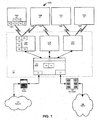
- FIG. 1 illustrates selected components of a communication network 100, which includes a radio network controller 110 coupled to wireless base transceiver stations 120A, 120B, and 120C.
- the base transceiver stations 120 communicate with access terminals 130A, 130B, 130C, and 130D through corresponding wireless connections 140A through 140E.
- Each of the wireless connections 140 represents both a forward link (from the BTS to the AT, also known as downlink) and a reverse link (from the AT to the BTS, also known as uplink).
- the radio network controller 110 is coupled to a public switched telephone network 150 through a telephone switch 160, and to a packet switched network 170 through a packet data server node (PDSN) 180.
- PDSN packet data server node
- Data interchange between various network elements, such as the radio network controller 110 and the packet data server node 180. may be implemented using any number of protocols, for example, the Internet Protocol (IP), an asynchronous transfer mode (ATM) protocol, T1, E1, frame relay, and other protocols.
- IP
- the radio network controller 110 and the base transceiver stations 120 are part of a data-optimized cellular CDMA radio network 101, for example, a 1xEV-DO radio network.
- the radio network 101 provides both data communication services and cellular telephone services to the access terminals 130, In alternative embodiments, the radio network may provide only data services (including VoIP and similar packetized data-based voice communications).
- each access terminal 130 may be in a separate cell or site.
- a typical access terminal for example, the access terminal 130A, includes receiver circuitry 131, transmitter circuitry 132, encoder 133, decoder 134, equalizer 135, processor 136, and memory device 137.
- the receiver, transmitter, encoder, decoder, and equalizer are configured by the processor executing program code stored in the memory device.
- Each access terminal 130 is configured to communicate data using at least one transmission protocol, such as the wireless packet transmission protocols described in the standards mentioned above, including 1xEV-DO revisions.
- a and B with at least one of the access terminals 130 being further configured to negotiate a set of reverse link packet sizes in accordance with the variants described in this document.
- the access terminal 130 communicate with the base transceiver stations 120 via wireless connections 140A through 140E, as shown in FIG. 1 .
- Each of the base transceiver station 120 includes one or more wireless receivers (e.g ., receiver 121 of the BTS 120A), one or more wireless transmitters (e.g ., transmitter 122 of the BTS 120A), radio network controller interface (e.g ., interface 123), a memory ( e.g ., memory 124), a processor ( e.g ., processor 125), and encoder/decoder circuitry (e.g ., encoder/decoder circuitry 126).
- wireless receivers e.g ., receiver 121 of the BTS 120A
- wireless transmitters e.g ., transmitter 122 of the BTS 120A
- radio network controller interface e.g ., interface 123
- a memory e.g ., memory 124
- processor e.g ., processor 125
- encoder/decoder circuitry e.g ., encoder/decoder circuitry 126.
- a receiver/transmitter pair and other components of each base transceiver station are configured by the station's processor operating under control of the program code stored in the BTS's memory, to establish forward and reverse links with the access terminals 130 in order to send packets to and receive packets from the access terminals 130.
- the base transceiver stations 120 may receive forward link data packets from the packet switched network 170 through the packet data server node 180 and through the radio network controller 110, and transmit these packets to the access terminals 130.
- the base transceiver stations 120 may receive reverse link data packets that originate at the access terminals 130, and forward these packets to the packet switched network 170 through the radio network controller 110 and the packet data server node 180.
- the base transceiver stations 120 may receive forward link data packets from the telephone network 150 through the telephone switch 160 and through the radio network controller 110, and transmit these packets to the access terminals 130.
- Voice packets originating at the access terminals 130 may be received at the base transceiver stations 120 and forwarded to the telephone network 150 via the radio network controller 110 and the telephone switch 160.
- each BTS may each have separate processors.
- the radio network controller 110 includes an interface 111 to the base transceiver stations 120, an interface 112 to the packet data server node 180, and an interface 113 to the telephone switch 160.
- the interfaces 111, 112, and 113 operate under control of one or more processors 114 executing program code stored in one or more memory devices 115.
- the network 100 illustrated in FIG. 1 includes one public switched telephone network, one packet switched network one base station controller, three base transceiver stations, and four access terminals.
- a person skilled in the art would recognize, after perusal of this document, that alternative embodiments in accordance with aspects of the invention need not be limited to any particular number of these components. For example, a lesser or a greater number oaf base transceiver stations, radio network controller, and access terminals may be included in some embodiments,
- the communication network 100 may connect the access terminals 130 to one or more additional communication networks, for example, a second wireless communication network having a number of wireless access terminals.
- one or more of the access terminals 130 communicate with a base transceiver station 124 of the radio network (e.g ., the BTS 120A).
- the radio network and one or more of the access terminals are configured to define and negotiate a set of air interface packet sizes at the time of connection setup.
- none, one, or several of the access terminals may operate in accordance with an existing (default, not negotiated) set of air interface packet sizes in accordance with one of the forementioned standards.
- the set of negotiated packet sizes has the same number of size entries as the number of default packet size entries under one of the applicable air interface standards mentioned above.
- the number of packet sizes may be twelve or thirteen. In this way, each of the air interface packet sizes may be mapped to the existing codewords associated with packet sizes on the reverse rate indicator (RRI) channel of an existing air interface standard.
- RRI reverse rate indicator
- fewer or more codewords than in the standard may also be defined and negotiated in some variants.
- three unused (in the standard) RRI codewords may be mapped to additional packet size entries in the negotiated set.
- the mapping of the entries in the negotiated set need not be such that the same size is mapped onto the same codeword under an existing air interface standard and the negotiated set of size entries.
- a new size of 300 bits may be used (instead of 512, for example.
- the negotiated set may then be as follows: 128, 256, 300, 768, 1024, 1536, 2048, 3072, 4096, 6144, 8192, 12288.
- the same sequence may be mapped in order to the increasing packet sizes in the negotiated set set.
- the new 300-bit size is then mapped to the RRI codeword used for the 512-bait size in the default set.
- RRI i represents an RRI codeword used to indicate a packet size
- the corresponding packet size of the RRI i codeword in the existing standard appears in the middle row (under RRI i )
- the corresponding packet size of the RRI i in the negotiated set appears in the bottom row (also in the same column as RRI i ).
- the middle row represents the default set
- the bottom row represents the negotiated set.
- Same convention applies to the other tables showing codeword mapping.
- the negotiated set may be as follows: 128, 256, 300, 512, 768, 1024, 1536, 2048, 3072, 4096, 6144, 8192.
- the 300-bit size was added between the 256- and 512-bit default sizes, displacing the 12288-bit default size.
- This approach may be advantageous because an application requesting a 300-bit air interface packet size is more likely not to need a 12288-bit size than a 512-bit size, or any of the other packet sizes.
- the RRI codewords used for the 128- and 256-bit sizes may be the same, respectively, as the RRI codewords for the default 128- and 256-bit sizes in existing standards/systems, and the RRI codewords used for the default 512, 768, 1024, 1536, 2048, 3072, 4096, 6144, 8192, 12288 bit sizes may be mapped, in order, to RRI codewords used for the 300, 512, 768, 1024, 1536, 2048, 3072, 4096, 6144, 8192 bit packet sizes of the negotiated set. This exemplary mapping is shown in Table 2 below.
- the negotiated set substitutes a newly-defined packet size for the size most distant from the newly-defined packet size.
- Most distant in this context may be, for example, measured linearly (largest difference in the number of bits between the newly-defined size and the removed packet size), or logarithmically/geometrically (largest ratio in dBs between the two sizes).
- the RRI codewords used for the packet sizes of the negotiated set are mapped to the codewords corresponding to the same sizes within the default set of the existing standard, to the extent possible.
- the RRI codeword correspondence may be as in Table 3 below; TABLE 3 CODEWORD RRI 1 RRI 2 RRI 3 RRI 4 RRI 5 RRI 6 RRI 7 RRI 8 RRI 9 RRI 10 RRI 11 RRI 12 STANDARD PACKET SIZE 128 256 512 768 1024 1536 2048 3072 4096 6144 8192 12288 NEGOCIATED PACKET SIZE 128 256 512 768 1024 1536 2048 3072 4096 6144 8192 300
- the set of packet sizes negotiated by the base transceiver station 120 and the access terminal 130 may substitute multiple or even all of the packets sizes in the default set of an existitig standard.
- multiple closely-spaced, non-standard packet sizes may be present in the negotiated set.
- all interval between adjacent packet sizes in the default set may be broken, up into sub-intervals by two or more newly-defined packet sizes of the negotiated set.
- the internal may be broken up into equal or substantially equal (equal to the extent possible) sub-intervals. Table 4 below provides an example of such variant, were an interval between 768 bits and 1024 bits is broken into three substantially equal sub-intervals of 85 bits, 86 bits, and 85 bits.
- the interval between non-adjacent packet sizes of an existing standard system may also be similarly broken into sub-intervals.
- the subintervals may be equal or substantially equal, or spaced in a geometric proportion.
- Table 5 illustrates a variant with equal sub-intervals between 3072 and 6144 packet sizes.
- the variants described above are exemplary.
- the negotiated set may have other packet size values. Indeed, all of the packet sizes may be negotiated and become different from the default packet size values used under an existing standard.
- the existing RRI codewords may be assigned to the packet sizes in the negotiated set in any manner whatsoever, and the invention does not exclude using a fewer or a greater number of RRI codewords than the number of RRI codewords in the existing standard system.
- Some access terminal may communicate with the radio network after negotiating a set of packet sizes, while other access terminals may concurrently use the default packet size set of the existing standard. In this way, one or more legacy access terminals may be served at the same time as one or more access terminals configured to negotiate the set of allowable reverse link packet sizes.
- the packet sizes that are not exact powders of 2 may use a turbo interleaver parameter based on the next larger packet size that is a power or 2.
- a channel interleaver for smallest default payload larger than the payload to be transmitted may be employed, with a look-up table used to determine the exact packet sizes. If total transmit power to pilot power ratio (T2P) values are defined for the default packet sizes of the existing standard system, the T2P for the new (negotiated) payload packet sizes may be generated by linearly interpolating T2P values of the default payload packet sizes.
- T2P total transmit power to pilot power ratio
- FIG. 2 illustrates an exemplary process 200 performed in the course of negotiating a set of packet sizes for the reverse link between the access terminal and the radio network.
- the steps may be performed by an access terminal (e.g ., the AT 130A) and a base transceiver station (e.g ., the BTS 120A).
- an access terminal e.g ., the AT 130A
- a base transceiver station e.g ., the BTS 120A
- the access terminals is ready to begin the process.
- one or more desired values for packet sizes of the reverse link are determined.
- the access terminal receives the packet size value(s) from one or more user application executing on the access terminal.
- a vocoder of a VoIP telephony application may provide one or more packet sizes.
- the application(s) may have the value(s) stored, or determine the packet size value(s) dynamically, in response to current need, current configuration, and/or current QoS.
- the access terminal determines a complete set of packet sizes to request from the radio network. For example, the access terminal may replace one or more default values of the existing standard with one or more values received from the application(s) as illustrated in the Tables and accompanying explanations above.
- the access terminal transmits to the radio network (e.g ., to the BTS) a request to use the desired set on the reverse link. This may be done by using a previously unassigned codeword on one of the reverse link control channels.
- the radio network receives from the access terminal the desired set of packet size values.
- the radio network uses predefined criteria to generate its own set of packet size values, based on the set of the desired values received from the access terminal. For example, the radio network may accept the values received from the access terminal. As another example, the radio network may substitute one or moreTED non-default or default values for the non-default values desired by the access terminal, based on some parameter(s), such as quality of service assigned to the application or the access terminal. In some variants the radio network may also determine that the default set should be used notwithstanding the access terminal preference. In some variant, the radio network also maps the RRI codewords to the packet sizes, or changes the mapping of the RRI codewords to the packet sizes from that requested by the access terminal (if the access terminal requested a specific mapping in the step 230).
- the radio network transmits to the access terminal the set of packet size values to be used on the reverse link. If the RRI mapping order has not been predefined, it may also be communicated to the access terminal, A downlink control channel may be used for this purpose.
- the radio network configures itself for receiving reverse link data from the access terminal using the set of packet size values/mappings to be used (instead of the default set).
- the set transmitted from the radio network thus becomes the negotiated set. Note that if the radio network accepted the values received from the access terminal, the negotiated set is identical to the desired set.
- the access terminal receives from the radio network the set of packet size values/mappings to be used.
- the access terminal configures itself for transmitting reverse link data using the negotiated set of packet size values/mappings (instead of the default set).
- the access terminal transmits reverse link data to the radio network using the negotiated set of packet size values/mappings.
- the transmitted packets may have one or more sizes that are not included in the default set of packet sizes. The process then terminates at flow point 299.
- the set of packet size values is negotiated with a single request from the access terminal and a single response from the access network.
- multiple requests and responses may be used when the access network does not immediately accept the set desired by the access terminal.
- the steps 220-260 may be repeated two or more times to arrive at a negotiated set of reverse link packet sizes, with the determination in the step 220 in second and later iterations being affected by the response of the radio network to the previously transmitted desired set.
- RRI codeword mappings may also be negotiated in some variants, or the mappings may be predefined, for example, using a predetermined RRI codeword sequence in an ascending or descending packet size order.
- steps and decisions of various methods may have been described serially in this disclosure, some of these steps and decisions may be performed by separate elements in conjunction or in parallel, asynchronously or synchronously, in a pipelined manner, or otherwise. There is no particular requirement that the steps and decisions be performed in the same order in which this description lists them, except where explicitly so indicated, otherwise made clear from the context, or inherently required. It should be noted, however, that in selected variants the steps and decisions are performed in the order described above. Furthermore, not every illustrated step and decisions may be required in every embodiment/variant in accordance with the invention, while some steps and decisions that have not been specifically illustrated may be desirable or necessary in some embodiments/variants in accordance with the invention.
- DSP digital signal processor
- ASIC application specific integrated circuit
- FPGA field programmable gate array
- a general purpose processor may be a microprocessor, but in the alternative, the processor may be any conventional processor, controller, microcontroller, or state machine.
- a processor may also be implemented as a combination of computing devices, e.g., a combination of a DSP and a microprocessor, a plurality of microprocessors, one or more microprocessors in conjunction with a DSP core, or any other such configuration.
- a software module may reside in RAM memory, flash memory, ROM memory, EPROM memory, EEPROM memory, registers, hard disk, a removable disk, a CD-ROM, or any other form of storage medium known in the art.
- An exemplary storage medium is coupled to the processor such that the processor can read information from, and write information to, the storage medium.
- the storage medium may be integral to the processor.
- the processor and the storage medium may reside in an ASIC.
- the ASIC may reside in an access terminal
- the processor and the storage medium may reside as discrete components in an access terminal.
Landscapes
- Engineering & Computer Science (AREA)
- Signal Processing (AREA)
- Computer Networks & Wireless Communication (AREA)
- Quality & Reliability (AREA)
- Physics & Mathematics (AREA)
- Mathematical Physics (AREA)
- Power Engineering (AREA)
- Mobile Radio Communication Systems (AREA)
- Radio Transmission System (AREA)
- Data Exchanges In Wide-Area Networks (AREA)
- Communication Control (AREA)
- Radio Relay Systems (AREA)
Claims (13)
- Ein Verfahren zum Datenübertragen auf einer Rückwärtsverbindung zwischen einem drahtlosen Zugriffsgerät (130) und einem Funknetz (101), das Verfahren aufweisend:Festlegen (210), basierend auf einem oder mehreren Parametern, einen gewünschten Satz von Luftschnittstellenpaketgrößen für die Rückwärtsverbindung, wobei das Feststellen umfasst das Empfangen von Paketgrößen von einem oder mehreren Benutzeranwendungen, welche auf dem drahtlosen Zugriffsgerät laufen, wobei der gewünschte Satz unterschiedlich von einem Standardsatz von Luftschnittstellenpaketgrößen des Funknetzes ist, wobei der Standardsatz von Luftschnittstellenpaketgrößen gemäß einem Codemehrfachzugriffsverfahren, CDMA, ist;Übertragen (230) an das Funknetz (101) einer Anfrage zum Verwenden des gewünschten Satzes für Datenverkehr auf der Rückwärtsverbindung;Empfangen (280), in Antwort auf den Schritt des Übertragens (230) der Anfrage an das Funknetz (101), Empfangen (280) eines verhandelten Satzes von Luftschnittstellenpaketgrößen zum Verwenden für den Datenverkehr auf der Rückwärtsverbindung, wobei der verhandelte Satz zumindest eine Luftschnittstellenpaketgröße umfasst, welche nicht vom Standardsatz umfasst ist; undSenden (295) des Datenverkehrs auf der Rückwärtsverbindung mittels des verhandelten Satzes.
- Das Verfahren gemäß Anspruch 1, wobei:der verhandelte Satz vom Funknetz (101) generiert wird basierend zumindest teilweise auf dem gewünschten Satz; undder Schritt des Sendens umfasst Senden vom drahtlosen Zugriffsgerät (130) an das Funknetz (101) einer Vielzahl von Rückwärtsverbindungsverkehrspaketen und einer Vielzahl von Anzeigen der Größen der Rückwärtsverbindungsverkehrspaketen, wobei jede Anzeige der Vielzahl der Anzeigen mit einem unterschiedlichen Rückwärtsverbindungverkehrspaket der Vielzahl von Rückwärtsverbindungverkehrspaketen assoziiert ist, wobei jede Anzeige die Größe des Rückwärtsverbindungsverkehrspaket, welcher mit der jeweiligen Anzeige assoziiert ist, festlegt, wobei die Anzeige von dem verhandelten Satz ausgewählt wird, wobei zumindest eine Anzeige von der Vielzahl der Anzeigen einer Paketgröße entspricht, welche nicht von einem Standardsatz von Rückwärtsverbindungverkehrspaketgrößen des Funknetzes umfasst wird.
- Das Verfahren gemäß Anspruch 2, wobei der eine oder mehrere Parameter umfassen eine Präferenz einer Anwendung des drahtlosen Zugriffsterminals.
- Das Verfahren gemäß Anspruch 3, wobei der Anzahl der Einträge in dem gewünschten Satz gleicht dem Anzahl der Einträge im Standardsatz.
- Ein drahtloses Zugriffsgerät (130) zum Kommunizieren mit einer Transceiver-Basisstation (120) eines Funknetzes (101), wobei das drahtlose Zugriffsgerät umfasst:einen Empfänger (131), welcher betriebsbereit ist, zum Empfangen von Vorwärtsverbindungübertragungen der Transceiver-Basisstation (120);einen Sender (132), welcher betriebsbereit ist zum Senden von Rückwärtsverbindungübertragungen an die Transceiver-Basisstation (120);einen Speicher (137) zum Speichern vom Programmcode; undeinen Controller, welcher mit dem Empfänger, Sender, und dem Speicher gekoppelt ist, wobei der Controller betriebsbereit ist zum Ausführen des Programmcodes um das drahtlose Gerät (130) zu veranlassen folgende Schritte durchzuführen:Festlegen (210), basierend auf einem oder mehreren Parametern, einer oder mehreren gewünschten Luftschnittstellenpaketgrößen für die Rückwärtsverbindung, wobei das Festlegen umfasst das Empfangen von Paketgrößen von einem oder mehreren Benutzeranwendungen, welche auf dem drahtlosen Gerät laufen;Festlegen (220) eines gewünschten Satz von Luftschnittstellenpaketgrößen für die Rückwärtsverbindung, der gewünschte Satz umfasst jede gewünschte Luftschnittstellenpaketgröße der einen oder mehreren gewünschten Luftschnittstellenpaketgrößen, wobei der gewünschte Satz unterschiedlich ist von einem Standardsatz von Luftschnittstellenpaketgrößen des Funknetzes, wobei der Standardsatz von Luftschnittstellenpaketgrößen gemäß einem drahtlosen Kommunikationsstandard mittels Codemehrfachzugriffsverfahren, CDMA, ist;Übertragen (230) an das Funknetz einer Anfrage zum Verwenden des gewünschten Satzes für Datenverkehr auf der Rückwärtsverbindung; undEmpfangen (280), in Antwort auf den Schritt des Übertragens, eines verhandelten Satzes von Luftschnittstellenpaketgrößen zum Verwenden für den Datenverkehr auf der Rückwärtsverbindung, wobei der verhandelte Satz umfasst zumindest eine Luftschnittstellenpaketgröße, welche nicht vom Standardsatz umfasst ist.
- Das drahtlose Zugriffsgerät (130) nach Anspruch 5, wobei die Anzahl der Einträge in dem gewünschten Satz gleich ist mit der Anzahl der Einträge in einem Standardsatz von RückwärtsverbindungVerkehrspaketgrößen des Funknetzes, und zumindest eine Anzeige der Vielzahl von Anzeigen einer Paketgröße entspricht, welche vom Standardsatz nicht umfasst ist.
- Ein maschinenlesbares Medium, welche gespeicherte Befehle umfasst, wobei die Befehle, wenn sie von einem Prozessor des drahtlosen Zugriffsterminal (130) ausgeführt werden zum Kommunizieren mit einer Transceiver-Basisstation (120) eines Funknetzes (101), das drahtlose Zugriffsterminal veranlassen, ein Verfahren gemäß einem der Ansprüche 1 bis 4 durchzuführen.
- Ein Verfahren zum Betreiben eines Datenoptimierten-Funknetzes (101), wobei das Funknetz betriebsbereit ist zum Verwenden eines Standardsatzes von Paketgrößen für den Datenverkehr auf Rückwärtsverbindungen, wobei de Standardsatz von Paketgrößen entspricht einem drahtlosen Kommunikationsstandard basierend auf Codemehrfachzugriffsverfahren, CDMA, das Verfahren aufweisend:Empfangen (240) von einem drahtlosen Zugriffsgerät (130) eines gewünschten Satzes von Paketgrößen für den Datenverkehr auf einer ersten Rückwärtsverbindung zwischen dem Funknetz (101) und dem drahtlosen Zugriffsgerät, wobei der gewünschte Satz unterschiedlich vom Standardsatz ist;Festlegen (250) eines verhandelten Satzes von Paketgrößen für Datenverkehr auf der Rückwärtsverbindung, wobei der Schritt des Festlegens zumindest basierend auf dem gewünschten Satz durchgeführt wird;Senden (260) des verhandelten Satzes an das drahtlose Zugriffsgerät;Empfangen auf der Rückwärtsverbindung einer Vielzahl von ersten Datenverkehrspaketen; undEmpfangen vom drahtlosen Zugriffsgerät einer Vielzahl von Anzeigen der Größe der Datenverkehrspakete, wobei jede Anzeige der Vielzahl von Anzeigen mit einem unterschiedlichen Datenverkehrspaket von der Vielzahl der Datenverkehrspakete assoziiert ist, wobei jede Anzeige die Größe des Datenverkehrspakets, welche mit der jeweiligen Anzeige assoziiert ist, festlegt, wobei die jeweilige Anzeige aus dem verhandelten Satz ausgewählt wird, wobei zumindest eine Anzeige der Vielzahl von Anzeigen einer Paketgröße entspricht, welche vom Standardsatz nicht umfasst ist.
- Das Verfahren gemäß Anspruch 8, ferner aufweisend:dekodieren eines jeden Datenverkehrspakets gemäß der Anzeige, welche mit jedem Datenverkehrspaket assoziiert ist.
- Das Verfahren gemäß Anspruch 8, ferner aufweisend:Verhandeln eines verhandelten Satzes von Paketgrößen für Datenverkehr auf einer Rückwärtsverbindung zwischen dem Funknetz und dem drahtlosen Zugriffsgerät.
- Eine Transceiver-Basisstation (120) eines Datenoptimierten-Funknetzes (101), wobei das Funknetz betriebsbereit ist zum Verwenden eines Standardsatzes von Paketgrößen für Datenverkehr auf Rückwärtsverbindungen, wobei der Standardsatz von Paketgrößen einem drahtlosen Kommunikationsstandard gemäß Codemehrfachzugriffsverfahren, CDMA, entspricht, die Transceiver-Basisstation aufweisend:einen Empfänger (121), welcher zum Empfangen von Daten konfiguriert ist;einen Sender (122), welcher zum Senden von Daten konfiguriert ist; undeinen Prozessor (125), welcher mit dem Empfänger und mit dem Sender gekoppelt ist, wobei der Prozessor betriebsbereit ist die Transceiver-Basisstation zu veranlassen, folgende Schritte durchzuführen:Empfangen (234) von einem ersten drahtlosen Zugriffsgerät (130) eines gewünschten Satzes von Paketgrößen für Datenverkehr auf einer ersten Rückwärtsverbindung zwischen dem Transceiver-Basisstation und dem ersten drahtlosen Zugriffsgerät, wobei der gewünschte Satz unterschiedlich vom Standardsatz ist;Festlegen eines verhandelten Satzes von Paketgrößen für den Datenverkehr auf der ersten Rückwärtsverbindung, wobei der Schritt des Festlegens basierend zumindest teilweise auf dem gewünschten Satz durchgeführt wird;Übertragen (260) an das erste drahtlose Zugriffsgerät des verhandelten Satzes;Empfangen auf der ersten Rückwärtsverbindung einer Vielzahl von ersten Datenverkehrspaketen; undEmpfangen vom ersten drahtlosen Zugriffsgerät einer Vielzahl von ersten Anzeigen der Größe der ersten Datenverkehrspakete, wobei jede erste Anzeige der Vielzahl der ersten Anzeigen mit einem unterschiedlichen ersten Datenverkehrspaket der Vielzahl der ersten Datenverkehrspakete assoziiert ist, wobei jede erste Anzeige die Größe der ersten Datenverkehrspaket, welches mit der jeweiligen ersten Anzeige assoziiert ist, festlegt, wobei jede erste Anzeige aus dem verhandelten Satz ausgewählt wird, wobei zumindest eine erste Anzeige der Vielzahl der ersten Anzeigen einem ersten Eintrag in dem verhandelten Satz entspricht, wobei der erste Eintrag nicht vom Standardsatz umfasst ist.
- Die Transceiver-Basisstation (130) des Anspruchs 11, wobei der Prozessor ferner betriebsbereit ist zum Veranlassen die Transceiver-Basisstation folgende Schritte durchzuführen:Empfangen auf einer zweiten Rückwärtsverbindung einer Vielzahl von zweiten Datenverkehrspaketen von einem zweiten drahtlosen Zugriffsgerät; undEmpfangen vom zweiten drahtlosen Zugriffsgerät einer Vielzahl von zweiten Anzeigen von Größe der zweiten Datenverkehrspakete, wobei jede zweite Anzeige der Vielzahl von zweiten Anzeigen mit einem unterschiedlichen zweiten Datenverkehrspaket der Vielzahl von zweiten Datenverkehrspaketen assoziiert ist, wobei jede zweite Anzeige die Größe des zweiten Datenverkehrspaket, welches mit der jeweiligen zweiten Anzeige assoziiert ist, festlegt, wobei jede zweite Anzeige aus dem Standardsatz ausgewählt wird.
- Ein maschinenlesbares Medium, welches gespeicherte Befehle umfasst, wobei die Befehle die Transceiver-Basisstation veranlassen, ein Verfahren gemäß jedem der Ansprüche 8 bis 10 durchzuführen, wenn sie von zumindest einem Prozessor einer Transceiver-Basisstation eines Datenoptimierten-Funknetzes durchgeführt werden, welches konfiguriert ist, einen Standardsatz von Paketgrößen für Datenverkehr auf Rückwärtsverbindungen durchzuführen.
Priority Applications (1)
| Application Number | Priority Date | Filing Date | Title |
|---|---|---|---|
| EP11159766.2A EP2346203A3 (de) | 2006-02-21 | 2007-02-21 | Flexible Nutzdatensteuerung in Datenoptimierten Kommunikationssystemen |
Applications Claiming Priority (3)
| Application Number | Priority Date | Filing Date | Title |
|---|---|---|---|
| US77544306P | 2006-02-21 | 2006-02-21 | |
| US77569306P | 2006-02-21 | 2006-02-21 | |
| PCT/US2007/062455 WO2007098458A2 (en) | 2006-02-21 | 2007-02-21 | Flexible payload control in data-optimized communication systems |
Related Child Applications (1)
| Application Number | Title | Priority Date | Filing Date |
|---|---|---|---|
| EP11159766.2A Division-Into EP2346203A3 (de) | 2006-02-21 | 2007-02-21 | Flexible Nutzdatensteuerung in Datenoptimierten Kommunikationssystemen |
Publications (2)
| Publication Number | Publication Date |
|---|---|
| EP1987623A2 EP1987623A2 (de) | 2008-11-05 |
| EP1987623B1 true EP1987623B1 (de) | 2014-03-19 |
Family
ID=38101754
Family Applications (5)
| Application Number | Title | Priority Date | Filing Date |
|---|---|---|---|
| EP07757236A Not-in-force EP1989809B1 (de) | 2006-02-21 | 2007-02-20 | Feedback-kanalauslegung für kommunikationssysteme mit mehreren ein- und ausgängen (mimo) |
| EP07757228A Active EP1987622B1 (de) | 2006-02-21 | 2007-02-20 | Verfahren und vorrichtung zur unterstützung von ofdm- und cdma-schemata |
| EP07757235A Withdrawn EP1989848A2 (de) | 2006-02-21 | 2007-02-20 | Raumleitstruktur für drahtlose kommunikation mit mehreren antennen |
| EP11159766.2A Withdrawn EP2346203A3 (de) | 2006-02-21 | 2007-02-21 | Flexible Nutzdatensteuerung in Datenoptimierten Kommunikationssystemen |
| EP07757237.8A Active EP1987623B1 (de) | 2006-02-21 | 2007-02-21 | Flexible nutzdatensteuerung in datenoptimierten kommunikationssystemen |
Family Applications Before (4)
| Application Number | Title | Priority Date | Filing Date |
|---|---|---|---|
| EP07757236A Not-in-force EP1989809B1 (de) | 2006-02-21 | 2007-02-20 | Feedback-kanalauslegung für kommunikationssysteme mit mehreren ein- und ausgängen (mimo) |
| EP07757228A Active EP1987622B1 (de) | 2006-02-21 | 2007-02-20 | Verfahren und vorrichtung zur unterstützung von ofdm- und cdma-schemata |
| EP07757235A Withdrawn EP1989848A2 (de) | 2006-02-21 | 2007-02-20 | Raumleitstruktur für drahtlose kommunikation mit mehreren antennen |
| EP11159766.2A Withdrawn EP2346203A3 (de) | 2006-02-21 | 2007-02-21 | Flexible Nutzdatensteuerung in Datenoptimierten Kommunikationssystemen |
Country Status (12)
| Country | Link |
|---|---|
| US (4) | US8498192B2 (de) |
| EP (5) | EP1989809B1 (de) |
| JP (5) | JP2009527997A (de) |
| KR (4) | KR101010548B1 (de) |
| CN (1) | CN105024794B (de) |
| AT (2) | ATE553560T1 (de) |
| BR (2) | BRPI0708106A2 (de) |
| CA (2) | CA2641934A1 (de) |
| DE (1) | DE602007011900D1 (de) |
| RU (2) | RU2437225C2 (de) |
| TW (6) | TWI355171B (de) |
| WO (4) | WO2007098456A2 (de) |
Cited By (2)
| Publication number | Priority date | Publication date | Assignee | Title |
|---|---|---|---|---|
| US11800398B2 (en) | 2021-10-27 | 2023-10-24 | T-Mobile Usa, Inc. | Predicting an attribute of an immature wireless telecommunication network, such as a 5G network |
| US12192790B2 (en) | 2021-10-27 | 2025-01-07 | T-Mobile Usa, Inc. | Predicting an attribute of a wireless telecommunication network, such as a 5G network |
Families Citing this family (124)
| Publication number | Priority date | Publication date | Assignee | Title |
|---|---|---|---|---|
| WO2006102771A1 (en) * | 2005-03-30 | 2006-10-05 | Nortel Networks Limited | Methods and systems for ofdm using code division multiplexing |
| US9461736B2 (en) | 2006-02-21 | 2016-10-04 | Qualcomm Incorporated | Method and apparatus for sub-slot packets in wireless communication |
| US8077595B2 (en) | 2006-02-21 | 2011-12-13 | Qualcomm Incorporated | Flexible time-frequency multiplexing structure for wireless communication |
| DE602007011900D1 (de) * | 2006-02-21 | 2011-02-24 | Qualcomm Inc | Feedback-kanalauslegung für kommunikationssysteme mit mehreren ein- und ausgängen (mimo) |
| US8689025B2 (en) | 2006-02-21 | 2014-04-01 | Qualcomm Incorporated | Reduced terminal power consumption via use of active hold state |
| WO2007111448A2 (en) * | 2006-03-24 | 2007-10-04 | Lg Electronics Inc. | Methods for generating a transmission slot having ofdm variable duration symbol and mobile terminal using these methods |
| EP2005687B1 (de) * | 2006-03-24 | 2017-06-28 | LG Electronics Inc. | Verfahren und struktur zum konfigurieren einer präamble zur unterstützung der übertragung eines datensymbols in einem drahtlosen kommunikationssystem |
| WO2008013398A1 (en) * | 2006-07-28 | 2008-01-31 | Samsung Electronics Co., Ltd. | Method and apparatus for positioning pilot in an ofdma mobile communication system |
| PL2168298T3 (pl) | 2007-01-04 | 2022-05-02 | Nokia Technologies Oy | Aparatura, sposoby i produkty programów komputerowych zapewniające wejście wspólnej sygnalizacji dla modułowej struktury kanału sterowania |
| US7720164B2 (en) * | 2007-02-26 | 2010-05-18 | Telefonaktiebolaget L M Ericsson (Publ) | Transmission scheme for uplink access in a FDMA system |
| US20080233966A1 (en) * | 2007-03-22 | 2008-09-25 | Comsys Communication & Signal Processing Ltd. | Resource allocation apparatus and method in an orthogonal frequency division multiple access communication system |
| KR101445335B1 (ko) * | 2007-05-28 | 2014-09-29 | 삼성전자주식회사 | 가변적인 데이터 송신율을 가지는 ofdm 심볼을송수신하는 ofdm 송신/수신 장치 및 그 방법 |
| US7649831B2 (en) * | 2007-05-30 | 2010-01-19 | Samsung Electronics Co., Ltd. | Multi-user MIMO feedback and transmission in a wireless communication system |
| US8908632B2 (en) * | 2007-06-08 | 2014-12-09 | Samsung Electronics Co., Ltd. | Methods and apparatus for channel interleaving in OFDM systems |
| US8605687B2 (en) * | 2007-07-05 | 2013-12-10 | Qualcomm Incorporated | Method for channel estimation in a point-to-point communication network |
| EP2023553B1 (de) | 2007-08-07 | 2016-10-05 | Samsung Electronics Co., Ltd. | Verfahren und Vorrichtung zur Durchführung einer Direktzugriffsprozedur in einem mobilen Kommunikationssystem |
| KR101542378B1 (ko) * | 2007-09-10 | 2015-08-07 | 엘지전자 주식회사 | 다중 안테나 시스템에서의 파일럿 부반송파 할당 방법 |
| KR20100061680A (ko) * | 2007-09-11 | 2010-06-08 | 몬도바이오테크 래보래토리즈 아게 | 치료제로서의 gly-pro-glu-oh(gpe)의 용도 |
| KR101407045B1 (ko) | 2007-10-26 | 2014-06-12 | 삼성전자주식회사 | 파일롯 배치 방법, 기록 매체 및 전송 장치 |
| EP2218206B1 (de) * | 2007-11-02 | 2019-01-02 | Nokia Solutions and Networks Oy | Verfahren und vorrichtung zur pilotmusterzuteilung |
| US9326253B2 (en) | 2007-11-15 | 2016-04-26 | Qualcomm Incorporated | Wireless communication channel blanking |
| US8798665B2 (en) * | 2007-11-15 | 2014-08-05 | Qualcomm Incorporated | Beacon-based control channels |
| US8761032B2 (en) * | 2007-11-16 | 2014-06-24 | Qualcomm Incorporated | Random reuse based control channels |
| CN101442349B (zh) * | 2007-11-21 | 2013-02-20 | 三星电子株式会社 | 多用户mimo码本子集选择方法 |
| KR101533457B1 (ko) * | 2007-11-29 | 2015-07-03 | 엘지전자 주식회사 | 무선통신 시스템에서 제어신호 전송방법 |
| KR101467570B1 (ko) * | 2007-11-29 | 2014-12-01 | 엘지전자 주식회사 | 무선통신 시스템에서 무선자원 할당방법 |
| KR101541910B1 (ko) * | 2007-11-29 | 2015-08-04 | 엘지전자 주식회사 | 무선통신 시스템에서 ack/nack 신호 전송방법 |
| US8098767B2 (en) * | 2007-12-20 | 2012-01-17 | Qualcomm Incorporated | Receiver adjustment between pilot bursts |
| EP2232805B1 (de) * | 2008-01-25 | 2017-03-15 | Telefonaktiebolaget LM Ericsson (publ) | Verfahren zum modifizieren des frequenzsprungschemas durch erweitern der validität der referenzsignale |
| US9009573B2 (en) * | 2008-02-01 | 2015-04-14 | Qualcomm Incorporated | Method and apparatus for facilitating concatenated codes for beacon channels |
| KR101532526B1 (ko) * | 2008-02-01 | 2015-06-29 | 애플 인크. | 공간 다중화 기반의 다중 안테나 브로드캐스트/멀티캐스트 전송을 위한 시스템 및 방법 |
| US8855257B2 (en) | 2008-02-11 | 2014-10-07 | Intel Mobile Communications GmbH | Adaptation techniques in MIMO |
| US8699529B2 (en) | 2008-03-28 | 2014-04-15 | Qualcomm Incorporated | Broadband pilot channel estimation using a reduced order FFT and a hardware interpolator |
| US8238304B2 (en) * | 2008-03-31 | 2012-08-07 | Qualcomm Incorporated | Apparatus and method for channel resource description |
| US8149936B2 (en) * | 2008-04-01 | 2012-04-03 | Qualcomm Incorporated | Apparatus and methods for tile and assignment processing |
| US8675537B2 (en) * | 2008-04-07 | 2014-03-18 | Qualcomm Incorporated | Method and apparatus for using MBSFN subframes to send unicast information |
| US9107239B2 (en) * | 2008-04-07 | 2015-08-11 | Qualcomm Incorporated | Systems and methods to define control channels using reserved resource blocks |
| US20090257342A1 (en) * | 2008-04-10 | 2009-10-15 | Media Tek Inc. | Resource block based pilot pattern design for 1/2 - stream mimo ofdma systems |
| US8724717B2 (en) * | 2008-04-10 | 2014-05-13 | Mediatek Inc. | Pilot pattern design for high-rank MIMO OFDMA systems |
| CN101557371B (zh) * | 2008-04-10 | 2012-12-12 | 上海贝尔阿尔卡特股份有限公司 | 多载波mimo系统的基站中为移动终端确定导频图案的方法 |
| US8488694B2 (en) * | 2008-05-06 | 2013-07-16 | Industrial Technology Research Institute | System and method for pilot design |
| CN101640915A (zh) * | 2008-07-30 | 2010-02-03 | 华为技术有限公司 | 一种切换入支持多输入多输出技术系统的方法及装置 |
| KR101563032B1 (ko) * | 2008-08-12 | 2015-10-23 | 노오텔 네트웍스 리미티드 | 무선 통신 네트워크에서의 다운링크 투명 중계를 가능하게 하는 방법 |
| US8331310B2 (en) * | 2008-08-22 | 2012-12-11 | Qualcomm Incorporated | Systems and methods employing multiple input multiple output (MIMO) techniques |
| US8693442B2 (en) * | 2008-09-22 | 2014-04-08 | Blackberry Limited | Multi-site MIMO cooperation in cellular network |
| US8315657B2 (en) * | 2008-09-22 | 2012-11-20 | Futurewei Technologies, Inc. | System and method for enabling coordinated beam switching and scheduling |
| US8619544B2 (en) * | 2008-09-23 | 2013-12-31 | Qualcomm Incorporated | Apparatus and method for facilitating transmit diversity for communications |
| US8428018B2 (en) * | 2008-09-26 | 2013-04-23 | Lg Electronics Inc. | Method of transmitting reference signals in a wireless communication having multiple antennas |
| JP5703227B2 (ja) | 2008-10-22 | 2015-04-15 | ゼットティーイー(ユーエスエー)インコーポレーテッド | 逆方向リンク肯定応答シグナリング |
| US8654705B2 (en) * | 2008-10-24 | 2014-02-18 | Qualcomm Incorporated | System and method for supporting multiple reverse link data streams |
| US8654715B2 (en) * | 2008-10-24 | 2014-02-18 | Qualcomm Incorporated | Systems and methods providing mobile transmit diversity |
| US8670717B2 (en) * | 2008-11-27 | 2014-03-11 | Futurewei Technologies, Inc. | System and method for enabling coordinated beam switching and scheduling |
| US8787186B2 (en) * | 2008-12-12 | 2014-07-22 | Blackberry Limited | Mobility in a distributed antenna system |
| US8175095B2 (en) * | 2008-12-19 | 2012-05-08 | L3 Communications Integrated Systems, L.P. | Systems and methods for sending data packets between multiple FPGA devices |
| KR101534169B1 (ko) | 2008-12-23 | 2015-07-07 | 삼성전자 주식회사 | 주파수 도약 모드로 동작 중인 무선 통신 시스템의 주파수 할당 방법 및 이를 위한 장치 |
| KR101470503B1 (ko) | 2008-12-30 | 2014-12-08 | 삼성전자주식회사 | 다중 입출력 통신 시스템을 위한 채널 정보 피드백 방법 및장치 |
| US8503420B2 (en) | 2008-12-31 | 2013-08-06 | Mediatek Inc. | Physical structure and design of sounding channel in OFDMA systems |
| US8811300B2 (en) | 2008-12-31 | 2014-08-19 | Mediatek Inc. | Physical structure and sequence design of midamble in OFDMA systems |
| KR101598910B1 (ko) * | 2009-01-07 | 2016-03-02 | 엘지전자 주식회사 | 무선 통신 시스템에서 시분할 이중화 방식의 프레임 구조를 이용하여 신호를 송수신하는 방법 및 장치 |
| US9100256B2 (en) * | 2009-01-15 | 2015-08-04 | Arndt Mueller | Systems and methods for determining the number of channel estimation symbols based on the channel coherence bandwidth |
| CN101783712B (zh) * | 2009-01-19 | 2014-06-04 | 华为技术有限公司 | Lte版本识别的方法、用户终端和网络节点 |
| US8649456B2 (en) | 2009-03-12 | 2014-02-11 | Futurewei Technologies, Inc. | System and method for channel information feedback in a wireless communications system |
| US8675627B2 (en) * | 2009-03-23 | 2014-03-18 | Futurewei Technologies, Inc. | Adaptive precoding codebooks for wireless communications |
| CN101877689B (zh) * | 2009-04-28 | 2012-10-17 | 华为技术有限公司 | 数据发送处理方法与装置、数据接收处理方法与装置 |
| CN102439931B (zh) * | 2009-04-28 | 2014-11-05 | 华为技术有限公司 | 数据发送处理方法与装置、数据接收处理方法与装置 |
| EP2413556A4 (de) * | 2009-04-28 | 2012-04-18 | Huawei Tech Co Ltd | Datensendeverarbeitungsverfahren und vorrichtung, datenempfangsverarbeitungsverfahren und vorrichtung |
| CN102422569B (zh) * | 2009-05-08 | 2015-04-15 | 中兴通讯(美国)公司 | 用于无线通信系统的反向链路信令技术 |
| US20110007721A1 (en) * | 2009-07-10 | 2011-01-13 | Qualcomm Incorporated | Method for directional association |
| US8331483B2 (en) * | 2009-08-06 | 2012-12-11 | Lg Electronics Inc. | Method for transmitting feedback information via a spatial rank index (SRI) channel |
| US8532042B2 (en) | 2009-09-02 | 2013-09-10 | Samsung Electronics Co., Ltd. | Codebook for multiple input multiple output communication and communication device using the codebook |
| US9094883B2 (en) | 2009-09-22 | 2015-07-28 | Qualcomm Incorporated | Method and apparatuses for returning the transmission of the uplink to a source cell during a baton handover |
| EP2507971A4 (de) * | 2009-12-01 | 2016-11-16 | Spidercloud Wireless Inc | Verfahren, system und vorrichtung zur konfiguration der topologie eines drahtlosen netzwerks |
| US8831077B2 (en) * | 2010-07-01 | 2014-09-09 | Texas Instruments Incorporated | Communication on a pilot wire |
| CN102594739B (zh) * | 2011-01-07 | 2017-03-15 | 上海贝尔股份有限公司 | 信道估计方法、导频信息选择方法、用户设备和基站 |
| GB2491840B (en) * | 2011-06-13 | 2015-09-16 | Neul Ltd | Inter-device communication |
| GB201114079D0 (en) | 2011-06-13 | 2011-09-28 | Neul Ltd | Mobile base station |
| US8665811B2 (en) * | 2011-08-15 | 2014-03-04 | Motorola Mobility Llc | Reference signal for a control channel in wireless communication network |
| US9301266B2 (en) * | 2011-08-19 | 2016-03-29 | Qualcomm Incorporated | Beacons for wireless communication |
| EP2639989A1 (de) * | 2012-03-16 | 2013-09-18 | Panasonic Corporation | Suchraum für ePDCCH-Steuerungsinformationen in einem OFDM-basierten mobilen Kommunikationssystem |
| CN102629895A (zh) * | 2012-04-27 | 2012-08-08 | 中国科学技术大学 | 一种改善数据流间公平性的多播酉预编码方法 |
| RU2607466C2 (ru) * | 2012-05-09 | 2017-01-10 | Телефонактиеболагет Л М Эрикссон (Пабл) | Усовершенствованный канал управления в системе высокоскоростного пакетного доступа |
| CN103581869B (zh) * | 2012-08-03 | 2018-11-09 | 中兴通讯股份有限公司 | 控制信息处理方法及装置 |
| US9960893B2 (en) * | 2012-12-04 | 2018-05-01 | Lg Electronics Inc. | Method for changing pattern of reference signals according to rank variation in wireless communication system, and an apparatus therefor |
| CN104040980B (zh) * | 2012-12-27 | 2017-04-12 | 华为技术有限公司 | 多用户多输入多输出通信的方法和基站 |
| US9871565B2 (en) * | 2013-03-01 | 2018-01-16 | Sony Corporation | MIMO communication method, transmitting device, and receiving device |
| US10009209B2 (en) | 2013-03-28 | 2018-06-26 | Huawei Technologies Co., Ltd. | System and method for generalized multi-carrier frequency division multiplexing |
| JP5950029B2 (ja) * | 2013-04-04 | 2016-07-13 | 富士通株式会社 | 移動局、基地局、及び通信制御方法 |
| US10772092B2 (en) * | 2013-12-23 | 2020-09-08 | Qualcomm Incorporated | Mixed numerology OFDM design |
| US10412145B2 (en) | 2014-06-27 | 2019-09-10 | Agora Lab, Inc. | Systems and methods for optimization of transmission of real-time data via network labeling |
| US9654250B2 (en) * | 2014-11-10 | 2017-05-16 | Futurewei Technologies, Inc. | Adding operations, administration, and maintenance (OAM) information in 66-bit code |
| US9621311B2 (en) * | 2015-05-08 | 2017-04-11 | Newracom, Inc. | Pilot transmission and reception for orthogonal frequency division multiple access |
| US11212147B2 (en) | 2015-10-23 | 2021-12-28 | Huawei Technologies Co., Ltd. | Systems and methods for configuring carriers using overlapping sets of candidate numerologies |
| US10356800B2 (en) | 2016-05-09 | 2019-07-16 | Qualcomm Incorporated | Scalable numerology with symbol boundary alignment for uniform and non-uniform symbol duration in wireless communication |
| PL3618342T3 (pl) | 2016-05-13 | 2021-05-31 | Telefonaktiebolaget Lm Ericsson (Publ) | System wielu nośnych podrzędnych z wieloma oznaczeniami liczbowymi |
| ES2957545T3 (es) | 2016-07-28 | 2024-01-22 | Guangdong Oppo Mobile Telecommunications Corp Ltd | Método piloto de transmisión de señal, equipo terminal y equipo de red |
| US10715392B2 (en) * | 2016-09-29 | 2020-07-14 | Qualcomm Incorporated | Adaptive scalable numerology for high speed train scenarios |
| US20180160405A1 (en) * | 2016-12-02 | 2018-06-07 | Qualcomm Incorporated | Rate matching and signaling |
| CN106941463A (zh) * | 2017-02-28 | 2017-07-11 | 北京交通大学 | 一种单比特量化mimo系统信道估计方法及系统 |
| JP6710812B2 (ja) | 2017-06-16 | 2020-06-17 | エルジー エレクトロニクス インコーポレイティド | 無線通信システムにおいて端末と基地局の間の物理上りリンク制御チャネルを送受信する方法及びそれを支援する装置 |
| US10756860B2 (en) | 2018-11-05 | 2020-08-25 | XCOM Labs, Inc. | Distributed multiple-input multiple-output downlink configuration |
| US10659112B1 (en) | 2018-11-05 | 2020-05-19 | XCOM Labs, Inc. | User equipment assisted multiple-input multiple-output downlink configuration |
| US10812216B2 (en) | 2018-11-05 | 2020-10-20 | XCOM Labs, Inc. | Cooperative multiple-input multiple-output downlink scheduling |
| US10432272B1 (en) | 2018-11-05 | 2019-10-01 | XCOM Labs, Inc. | Variable multiple-input multiple-output downlink user equipment |
| CN113169764B (zh) | 2018-11-27 | 2024-11-19 | 艾斯康实验室公司 | 非相干协作式多输入多输出通信 |
| US11063645B2 (en) | 2018-12-18 | 2021-07-13 | XCOM Labs, Inc. | Methods of wirelessly communicating with a group of devices |
| US10756795B2 (en) | 2018-12-18 | 2020-08-25 | XCOM Labs, Inc. | User equipment with cellular link and peer-to-peer link |
| US11330649B2 (en) | 2019-01-25 | 2022-05-10 | XCOM Labs, Inc. | Methods and systems of multi-link peer-to-peer communications |
| US10756767B1 (en) | 2019-02-05 | 2020-08-25 | XCOM Labs, Inc. | User equipment for wirelessly communicating cellular signal with another user equipment |
| WO2020181039A1 (en) | 2019-03-06 | 2020-09-10 | XCOM Labs, Inc. | Local breakout architecture |
| US10756782B1 (en) | 2019-04-26 | 2020-08-25 | XCOM Labs, Inc. | Uplink active set management for multiple-input multiple-output communications |
| US11032841B2 (en) | 2019-04-26 | 2021-06-08 | XCOM Labs, Inc. | Downlink active set management for multiple-input multiple-output communications |
| US10686502B1 (en) | 2019-04-29 | 2020-06-16 | XCOM Labs, Inc. | Downlink user equipment selection |
| US10735057B1 (en) | 2019-04-29 | 2020-08-04 | XCOM Labs, Inc. | Uplink user equipment selection |
| US11411778B2 (en) | 2019-07-12 | 2022-08-09 | XCOM Labs, Inc. | Time-division duplex multiple input multiple output calibration |
| RU200964U1 (ru) * | 2019-12-17 | 2020-11-20 | Федеральное государственное бюджетное образовательное учреждение высшего образования "Владимирский Государственный Университет имени Александра Григорьевича и Николая Григорьевича Столетовых" (ВлГУ) | Корректор межсимвольных искажений цифровых сигналов |
| US11411779B2 (en) | 2020-03-31 | 2022-08-09 | XCOM Labs, Inc. | Reference signal channel estimation |
| CN115428513A (zh) | 2020-04-15 | 2022-12-02 | 艾斯康实验室公司 | 无线网络多点关联性和多路径 |
| CA3178604A1 (en) | 2020-05-26 | 2021-12-02 | XCOM Labs, Inc. | Interference-aware beamforming |
| CA3195885A1 (en) | 2020-10-19 | 2022-04-28 | XCOM Labs, Inc. | Reference signal for wireless communication systems |
| WO2022093988A1 (en) | 2020-10-30 | 2022-05-05 | XCOM Labs, Inc. | Clustering and/or rate selection in multiple-input multiple-output communication systems |
| EP4264852A4 (de) | 2020-12-16 | 2025-02-05 | Xcom Labs, Inc. | Drahtlose kommunikation mit quasi-omni und gerichteten strahlen |
| WO2022241436A1 (en) | 2021-05-14 | 2022-11-17 | XCOM Labs, Inc. | Scrambling identifiers for wireless communication systems |
| US11751170B2 (en) * | 2021-07-19 | 2023-09-05 | Sprint Spectrum Llc | Dynamically reassigning a high-noise frequency segment from a first access node to a second access node |
| US12389313B2 (en) * | 2022-03-24 | 2025-08-12 | Qualcomm Incorporated | Measurements of linear combinations of beams |
Citations (1)
| Publication number | Priority date | Publication date | Assignee | Title |
|---|---|---|---|---|
| US20040092276A1 (en) * | 2002-11-13 | 2004-05-13 | Kevin Dooley | Cellular telephone system |
Family Cites Families (136)
| Publication number | Priority date | Publication date | Assignee | Title |
|---|---|---|---|---|
| US6282712B1 (en) | 1995-03-10 | 2001-08-28 | Microsoft Corporation | Automatic software installation on heterogeneous networked computer systems |
| EP1768439B1 (de) * | 1995-09-20 | 2010-08-11 | NTT Mobile Communications Network, Inc. | Zugriffsverfahren und Mobilstation für CDMA-Mobilkommunikationssystem |
| US5732076A (en) | 1995-10-26 | 1998-03-24 | Omnipoint Corporation | Coexisting communication systems |
| US6473419B1 (en) | 1998-03-26 | 2002-10-29 | Nokia Corporation | State apparatus, and associated methods, for controlling packet data communications in a radio communication system |
| EP1841089A3 (de) | 1998-04-25 | 2007-10-10 | Samsung Electronics Co., Ltd | Leistungsstufenarbitrierung zwischen Basisstation und Mobilstation in einem mobilen Kommunikationssystem |
| KR100601598B1 (ko) * | 1998-06-15 | 2006-07-14 | 삼성전자주식회사 | 기록 방지 정보를 저장하는 기록 매체와 기록 방지 방법 |
| JP2000270024A (ja) | 1999-03-19 | 2000-09-29 | Nippon Telegr & Teleph Corp <Ntt> | インターネット電話におけるフレームパケット化サイズ能力交換方法,インターネット電話利用端末装置,およびインターネット電話のプログラムを記録した記録媒体 |
| GB9910449D0 (en) | 1999-05-07 | 1999-07-07 | Koninkl Philips Electronics Nv | Radio communication system |
| KR100316777B1 (ko) | 1999-08-24 | 2001-12-12 | 윤종용 | 차세대 이동 통신 시스템에서의 폐쇄 루프 전송 안테나 다이버시티 방법 및 이를 위한 기지국 장치 및 이동국 장치 |
| US6980569B1 (en) | 1999-10-18 | 2005-12-27 | Siemens Communications, Inc. | Apparatus and method for optimizing packet length in ToL networks |
| KR100717394B1 (ko) | 1999-11-23 | 2007-05-11 | 삼성전자주식회사 | 부호분할다중접속 이동통신시스템의 부가채널 해제 방법 |
| EP1119153A1 (de) * | 2000-01-19 | 2001-07-25 | Lucent Technologies Inc. | Verfahren und Vorrichtung zu einem robusten Reduktion der Datenrate ins Datenkommunikationssystem |
| US6473467B1 (en) | 2000-03-22 | 2002-10-29 | Qualcomm Incorporated | Method and apparatus for measuring reporting channel state information in a high efficiency, high performance communications system |
| US6912214B2 (en) | 2000-04-07 | 2005-06-28 | Telefonaktiebolaget Lm Ericsson (Publ) | Optimized packet-resource management |
| US6694469B1 (en) | 2000-04-14 | 2004-02-17 | Qualcomm Incorporated | Method and an apparatus for a quick retransmission of signals in a communication system |
| US7088701B1 (en) | 2000-04-14 | 2006-08-08 | Qualcomm, Inc. | Method and apparatus for adaptive transmission control in a high data rate communication system |
| EP1424792B1 (de) * | 2000-06-21 | 2005-12-07 | Samsung Electronics Co., Ltd. | Vorrichtung und Verfahren zur Schaltung der Übertragung eines Datenkontrollkanals in einem mobilen Kommunikationssystem hoher Datenrate |
| EP2271043A3 (de) * | 2000-07-12 | 2011-03-23 | Qualcomm Incorporated | Verfahren und Vorrichtung zur Bereitstellung von Kanalzustandsinformation in einem MIMO-System |
| US6940785B2 (en) | 2000-08-01 | 2005-09-06 | Hourpower Watches, Llc | Watch |
| US7042869B1 (en) | 2000-09-01 | 2006-05-09 | Qualcomm, Inc. | Method and apparatus for gated ACK/NAK channel in a communication system |
| US6963534B1 (en) * | 2000-10-05 | 2005-11-08 | International Business Machines Corporation | Methodology for improving the performance of asynchronous data traffic over TDD/TDMA wireless networks |
| BR0114892A (pt) | 2000-10-24 | 2004-07-06 | Nortel Networks Ltd | Sistemas e métodos arq de estrutura de canal compartilhado |
| US7099629B1 (en) | 2000-11-06 | 2006-08-29 | Qualcomm, Incorporated | Method and apparatus for adaptive transmission control in a high data rate communication system |
| US7209462B2 (en) | 2001-04-06 | 2007-04-24 | Motorola, Inc. | Apparatus and method for supporting common channel packet data service in a CDMA2000 RAN |
| JP2002320260A (ja) | 2001-04-19 | 2002-10-31 | Toshiba Corp | 移動通信端末 |
| JP3695355B2 (ja) | 2001-06-15 | 2005-09-14 | ソニー株式会社 | 携帯通信機器及びチャネル捕捉方法 |
| KR20040008230A (ko) | 2001-06-27 | 2004-01-28 | 노오텔 네트웍스 리미티드 | 무선 통신 시스템에서 제어 정보의 통신 |
| CA2354285A1 (en) * | 2001-07-27 | 2003-01-27 | Ramesh Mantha | Method, system and apparatus for transmitting interleaved data between stations |
| US20030040315A1 (en) | 2001-08-20 | 2003-02-27 | Farideh Khaleghi | Reduced state transition delay and signaling overhead for mobile station state transitions |
| JP4171261B2 (ja) | 2001-08-27 | 2008-10-22 | 松下電器産業株式会社 | 無線通信装置及び無線通信方法 |
| US7248559B2 (en) | 2001-10-17 | 2007-07-24 | Nortel Networks Limited | Scattered pilot pattern and channel estimation method for MIMO-OFDM systems |
| US6788687B2 (en) | 2001-10-30 | 2004-09-07 | Qualcomm Incorporated | Method and apparatus for scheduling packet data transmissions in a wireless communication system |
| US7164649B2 (en) | 2001-11-02 | 2007-01-16 | Qualcomm, Incorporated | Adaptive rate control for OFDM communication system |
| US6940894B2 (en) | 2001-11-08 | 2005-09-06 | Qualcomm Incorporated | Power estimation using weighted sum of pilot and non-pilot symbols |
| US6822952B2 (en) | 2001-11-26 | 2004-11-23 | Qualcomm Incorporated | Maintaining packet data connectivity in a wireless communications network |
| US7043249B2 (en) | 2002-01-08 | 2006-05-09 | Motorola, Inc. | Packet data serving node initiated updates for a mobile communications system |
| US6717924B2 (en) | 2002-01-08 | 2004-04-06 | Qualcomm Incorporated | Control-hold mode |
| KR100465208B1 (ko) | 2002-04-02 | 2005-01-13 | 조광선 | Ad-hoc 네트워크 병용 무선이동통신 시스템,통신장치, 및 통신방법 |
| KR100896682B1 (ko) | 2002-04-09 | 2009-05-14 | 삼성전자주식회사 | 송/수신 다중 안테나를 포함하는 이동 통신 장치 및 방법 |
| US7170876B2 (en) | 2002-04-30 | 2007-01-30 | Qualcomm, Inc. | Outer-loop scheduling design for communication systems with channel quality feedback mechanisms |
| ES2279951T3 (es) | 2002-05-10 | 2007-09-01 | Interdigital Technology Corporation | Metodo y aparato para reducir errores en enlaces de transmision. |
| EP1367760B1 (de) * | 2002-05-27 | 2009-11-18 | Nokia Corporation | Drahtlose Kommunikation mit Sende- und Empfangsdiversität |
| US6987780B2 (en) | 2002-06-10 | 2006-01-17 | Qualcomm, Incorporated | RLP retransmission for CDMA communication systems |
| US7095709B2 (en) | 2002-06-24 | 2006-08-22 | Qualcomm, Incorporated | Diversity transmission modes for MIMO OFDM communication systems |
| US7551546B2 (en) * | 2002-06-27 | 2009-06-23 | Nortel Networks Limited | Dual-mode shared OFDM methods/transmitters, receivers and systems |
| US7283541B2 (en) | 2002-07-30 | 2007-10-16 | At&T Corp. | Method of sizing packets for routing over a communication network for VoIP calls on a per call basis |
| US7050405B2 (en) | 2002-08-23 | 2006-05-23 | Qualcomm Incorporated | Method and system for a data transmission in a communication system |
| US7139274B2 (en) | 2002-08-23 | 2006-11-21 | Qualcomm, Incorporated | Method and system for a data transmission in a communication system |
| DE60321799D1 (de) * | 2002-08-23 | 2008-08-07 | Qualcomm Inc | Verfahren und system zur datenübertragung in einem kommunikationssystem |
| US7881261B2 (en) | 2002-09-26 | 2011-02-01 | Telefonaktiebolaget Lm Ericsson (Publ) | Method and apparatus for efficient dormant handoff of mobile stations having multiple packet data service instances |
| US7002900B2 (en) | 2002-10-25 | 2006-02-21 | Qualcomm Incorporated | Transmit diversity processing for a multi-antenna communication system |
| US8208364B2 (en) | 2002-10-25 | 2012-06-26 | Qualcomm Incorporated | MIMO system with multiple spatial multiplexing modes |
| JP2004158901A (ja) | 2002-11-01 | 2004-06-03 | Kddi Corp | Ofdm及びmc−cdmaを用いる送信装置、システム及び方法 |
| US8179833B2 (en) | 2002-12-06 | 2012-05-15 | Qualcomm Incorporated | Hybrid TDM/OFDM/CDM reverse link transmission |
| ATE408318T1 (de) | 2002-12-16 | 2008-09-15 | Research In Motion Ltd | Verfahren und vorrichtung zur senkung des energieverbrauches in einem cdma- kommunikationsgerät |
| EP1574096B1 (de) | 2002-12-19 | 2006-11-08 | Telefonaktiebolaget LM Ericsson (publ) | Adaptive steuerung für den betrieb von kommunikationsumgebungen |
| US8218573B2 (en) | 2003-01-21 | 2012-07-10 | Qualcomm Incorporated | Power boosting in a wireless communication system |
| US7058367B1 (en) | 2003-01-31 | 2006-06-06 | At&T Corp. | Rate-adaptive methods for communicating over multiple input/multiple output wireless systems |
| US7466675B2 (en) | 2003-02-14 | 2008-12-16 | Motorola, Inc. | Method and apparatus for supporting a reduced resource dormant state for packet data |
| JP2006520573A (ja) * | 2003-03-13 | 2006-09-07 | クゥアルコム・インコーポレイテッド | 通信システムにおけるデータ送信の方法とシステム |
| CN100596213C (zh) * | 2003-04-23 | 2010-03-24 | 高通股份有限公司 | 增强无线通信系统性能的方法和设备 |
| US7181666B2 (en) | 2003-04-29 | 2007-02-20 | Qualcomm, Incorporated | Method, apparatus, and system for user-multiplexing in multiple access systems with retransmission |
| US7177297B2 (en) | 2003-05-12 | 2007-02-13 | Qualcomm Incorporated | Fast frequency hopping with a code division multiplexed pilot in an OFDMA system |
| WO2004114549A1 (en) | 2003-06-13 | 2004-12-29 | Nokia Corporation | Enhanced data only code division multiple access (cdma) system |
| KR100689382B1 (ko) | 2003-06-20 | 2007-03-02 | 삼성전자주식회사 | 직교분할다중화방식을 기반으로 하는이동통신시스템에서의 송신장치 및 방법 |
| US6970437B2 (en) | 2003-07-15 | 2005-11-29 | Qualcomm Incorporated | Reverse link differentiated services for a multiflow communications system using autonomous allocation |
| WO2005015775A1 (en) | 2003-08-11 | 2005-02-17 | Nortel Networks Limited | System and method for embedding ofdm in cdma systems |
| US8599764B2 (en) | 2003-09-02 | 2013-12-03 | Qualcomm Incorporated | Transmission of overhead information for reception of multiple data streams |
| US20050063298A1 (en) | 2003-09-02 | 2005-03-24 | Qualcomm Incorporated | Synchronization in a broadcast OFDM system using time division multiplexed pilots |
| GB2405773B (en) | 2003-09-02 | 2006-11-08 | Siemens Ag | A method of controlling provision of audio communication on a network |
| KR100713403B1 (ko) | 2003-09-30 | 2007-05-04 | 삼성전자주식회사 | 통신 시스템에서 채널 상태에 따른 송신 방식 제어 장치및 방법 |
| US8472473B2 (en) | 2003-10-15 | 2013-06-25 | Qualcomm Incorporated | Wireless LAN protocol stack |
| US8483105B2 (en) | 2003-10-15 | 2013-07-09 | Qualcomm Incorporated | High speed media access control |
| US8284752B2 (en) | 2003-10-15 | 2012-10-09 | Qualcomm Incorporated | Method, apparatus, and system for medium access control |
| US8462817B2 (en) | 2003-10-15 | 2013-06-11 | Qualcomm Incorporated | Method, apparatus, and system for multiplexing protocol data units |
| US8842657B2 (en) | 2003-10-15 | 2014-09-23 | Qualcomm Incorporated | High speed media access control with legacy system interoperability |
| US7298805B2 (en) | 2003-11-21 | 2007-11-20 | Qualcomm Incorporated | Multi-antenna transmission for spatial division multiple access |
| US7012913B2 (en) | 2003-11-25 | 2006-03-14 | Nokia Corporation | Apparatus, and associated method, for facilitating communication of unfragmented packet-formatted data in a radio communication system |
| US7145940B2 (en) | 2003-12-05 | 2006-12-05 | Qualcomm Incorporated | Pilot transmission schemes for a multi-antenna system |
| EP1542488A1 (de) | 2003-12-12 | 2005-06-15 | Telefonaktiebolaget LM Ericsson (publ) | Verfahren un vorrichtung zur Zuweisung von Kanaladaptierten Pilotsignalen |
| KR100943572B1 (ko) * | 2003-12-23 | 2010-02-24 | 삼성전자주식회사 | 직교 주파수 분할 다중 접속 시스템에서 주파수재사용율을 고려한 적응적 부채널 할당 장치 및 방법 |
| US7450489B2 (en) | 2003-12-30 | 2008-11-11 | Intel Corporation | Multiple-antenna communication systems and methods for communicating in wireless local area networks that include single-antenna communication devices |
| US8433005B2 (en) | 2004-01-28 | 2013-04-30 | Qualcomm Incorporated | Frame synchronization and initial symbol timing acquisition system and method |
| US7072659B2 (en) * | 2004-02-06 | 2006-07-04 | Sbc Knowledge Venturs, L.P. | System for selectively answering a telephone from a remote location |
| KR100584446B1 (ko) | 2004-02-11 | 2006-05-26 | 삼성전자주식회사 | 광대역 무선 접속 통신 시스템에서 단말의 동작 모드 제어방법 |
| US8077691B2 (en) | 2004-03-05 | 2011-12-13 | Qualcomm Incorporated | Pilot transmission and channel estimation for MISO and MIMO receivers in a multi-antenna system |
| CN1951050B (zh) | 2004-03-15 | 2013-10-30 | 苹果公司 | 用于具有四根发射天线的ofdm系统的导频设计 |
| US8958493B2 (en) | 2004-03-31 | 2015-02-17 | Infineon Technologies Ag | Operation for backward-compatible transmission |
| KR20050103099A (ko) | 2004-04-24 | 2005-10-27 | 삼성전자주식회사 | 이동통신 시스템에서 방송 서비스 제공 장치 및 방법 |
| US7706346B2 (en) * | 2004-05-10 | 2010-04-27 | Alcatel-Lucent Usa Inc. | Hybrid wireless communications system |
| US7505397B2 (en) | 2004-06-16 | 2009-03-17 | Samsung Electronics Co., Ltd | Method for transmitting/receiving data in mobile communication systems using an OFDMA scheme |
| KR100605625B1 (ko) * | 2004-06-17 | 2006-07-31 | 엘지전자 주식회사 | 유엠티에스시스템의 세션해제방법 |
| US8068530B2 (en) | 2004-06-18 | 2011-11-29 | Qualcomm Incorporated | Signal acquisition in a wireless communication system |
| US20060013182A1 (en) * | 2004-07-19 | 2006-01-19 | Telefonaktiebolaget Lm Ericsson | Selective multicarrier CDMA network |
| US7567621B2 (en) | 2004-07-21 | 2009-07-28 | Qualcomm Incorporated | Capacity based rank prediction for MIMO design |
| US9148256B2 (en) | 2004-07-21 | 2015-09-29 | Qualcomm Incorporated | Performance based rank prediction for MIMO design |
| US7418046B2 (en) | 2004-07-22 | 2008-08-26 | Qualcomm Inc. | Pilot transmission and channel estimation for multiple transmitters |
| US7764981B2 (en) | 2004-07-30 | 2010-07-27 | Nokia Corporation | System and method for managing a wireless connection to reduce power consumption of a mobile terminal |
| US7382842B2 (en) | 2004-08-02 | 2008-06-03 | Beceem Communications Inc. | Method and system for performing channel estimation in a multiple antenna block transmission system |
| US8325863B2 (en) | 2004-10-12 | 2012-12-04 | Qualcomm Incorporated | Data detection and decoding with considerations for channel estimation errors due to guard subbands |
| US20060088003A1 (en) | 2004-10-21 | 2006-04-27 | Motorola, Inc. | Method and computer program for selecting an inactivity timeout interval based on last data direction |
| US7623490B2 (en) | 2004-12-22 | 2009-11-24 | Qualcomm Incorporated | Systems and methods that utilize a capacity-based signal-to-noise ratio to predict and improve mobile communication |
| US8661322B2 (en) | 2004-12-22 | 2014-02-25 | Qualcomm Incorporated | Apparatus and method for selective response to incremental redundancy transmissions |
| US7440399B2 (en) | 2004-12-22 | 2008-10-21 | Qualcomm Incorporated | Apparatus and method for efficient transmission of acknowledgments |
| WO2006071050A1 (en) * | 2004-12-27 | 2006-07-06 | Lg Electronics Inc. | Communicating non-coherent detectable signal in broadband wireless access system |
| US8942713B2 (en) | 2005-02-08 | 2015-01-27 | Qualcomm Incorporated | Method and apparatus for allocating resources in a multicast/broadcast communications system |
| WO2006086878A1 (en) | 2005-02-15 | 2006-08-24 | Nortel Networks Limited | Radio access system and method using ofdm and cdma for broadband data transmission |
| US8130781B2 (en) | 2005-02-28 | 2012-03-06 | Intellectual Ventures I Llc | Method and apparatus for providing dynamic selection of carriers |
| US8126482B2 (en) | 2005-03-04 | 2012-02-28 | Qualcomm Incorporated | Multiple paging channels for efficient region paging |
| US7715847B2 (en) | 2005-03-09 | 2010-05-11 | Qualcomm Incorporated | Use of decremental assignments |
| US20060203845A1 (en) * | 2005-03-09 | 2006-09-14 | Pantelis Monogioudis | High-rate wireless communication mehod for packet data |
| US20060203794A1 (en) | 2005-03-10 | 2006-09-14 | Qualcomm Incorporated | Systems and methods for beamforming in multi-input multi-output communication systems |
| US9461859B2 (en) | 2005-03-17 | 2016-10-04 | Qualcomm Incorporated | Pilot signal transmission for an orthogonal frequency division wireless communication system |
| US20060217124A1 (en) | 2005-03-23 | 2006-09-28 | Lucent Technologies, Inc. | Selecting a carrier channel based on channel capability |
| US7848463B2 (en) | 2005-04-07 | 2010-12-07 | Qualcomm Incorporated | Adaptive time-filtering for channel estimation in OFDM system |
| US9036538B2 (en) | 2005-04-19 | 2015-05-19 | Qualcomm Incorporated | Frequency hopping design for single carrier FDMA systems |
| US9408220B2 (en) | 2005-04-19 | 2016-08-02 | Qualcomm Incorporated | Channel quality reporting for adaptive sectorization |
| US20060240784A1 (en) | 2005-04-22 | 2006-10-26 | Qualcomm Incorporated | Antenna array calibration for wireless communication systems |
| US7961700B2 (en) | 2005-04-28 | 2011-06-14 | Qualcomm Incorporated | Multi-carrier operation in data transmission systems |
| US7680211B1 (en) | 2005-05-18 | 2010-03-16 | Urbain A. von der Embse | MIMO maximum-likelihood space-time architecture |
| US7428269B2 (en) | 2005-06-01 | 2008-09-23 | Qualcomm Incorporated | CQI and rank prediction for list sphere decoding and ML MIMO receivers |
| US8971461B2 (en) | 2005-06-01 | 2015-03-03 | Qualcomm Incorporated | CQI and rank prediction for list sphere decoding and ML MIMO receivers |
| US9179319B2 (en) | 2005-06-16 | 2015-11-03 | Qualcomm Incorporated | Adaptive sectorization in cellular systems |
| US7895504B2 (en) | 2005-06-16 | 2011-02-22 | Qualcomm Incorporated | NAK-to-ACK error detection and recovery |
| US8064424B2 (en) | 2005-07-22 | 2011-11-22 | Qualcomm Incorporated | SDMA for WCDMA |
| US20070025345A1 (en) | 2005-07-27 | 2007-02-01 | Bachl Rainer W | Method of increasing the capacity of enhanced data channel on uplink in a wireless communications systems |
| US7486658B2 (en) | 2005-07-29 | 2009-02-03 | Cisco Technology, Inc. | Method and system for media synchronization in QoS-enabled wireless networks |
| AP2668A (en) | 2005-08-05 | 2013-05-20 | Nokia Corp | Dynamic uplink control channel gating to increase capacity |
| BRPI0614402A2 (pt) | 2005-08-12 | 2011-03-29 | Nokia Corp | método e aparelho de colocar um ou mais sìmbolos piloto em um sistema de múltipla entrada mútipla saìda (mimo) de multiportadoras; estação móvel; sistema para transmitir um ou mais sìmbolos piloto; produto de programa de computador e conjunto de circuitos integrados para colocar um ou mais sìmbolos piloto em um sistema de múltipla entrada múltipla saìda (mimo) de multiportadoras |
| US8139672B2 (en) * | 2005-09-23 | 2012-03-20 | Qualcomm Incorporated | Method and apparatus for pilot communication in a multi-antenna wireless communication system |
| US20070070942A1 (en) | 2005-09-28 | 2007-03-29 | Motorola, Inc. | Semiactive state for reducing channel establishment delay |
| US8689025B2 (en) | 2006-02-21 | 2014-04-01 | Qualcomm Incorporated | Reduced terminal power consumption via use of active hold state |
| DE602007011900D1 (de) | 2006-02-21 | 2011-02-24 | Qualcomm Inc | Feedback-kanalauslegung für kommunikationssysteme mit mehreren ein- und ausgängen (mimo) |
| US9461736B2 (en) | 2006-02-21 | 2016-10-04 | Qualcomm Incorporated | Method and apparatus for sub-slot packets in wireless communication |
| US8077595B2 (en) | 2006-02-21 | 2011-12-13 | Qualcomm Incorporated | Flexible time-frequency multiplexing structure for wireless communication |
| US7720470B2 (en) | 2006-06-19 | 2010-05-18 | Intel Corporation | Reference signals for downlink beamforming validation in wireless multicarrier MIMO channel |
-
2007
- 2007-02-20 DE DE602007011900T patent/DE602007011900D1/de active Active
- 2007-02-20 RU RU2008137581/09A patent/RU2437225C2/ru not_active IP Right Cessation
- 2007-02-20 JP JP2008556516A patent/JP2009527997A/ja active Pending
- 2007-02-20 US US11/677,000 patent/US8498192B2/en not_active Expired - Fee Related
- 2007-02-20 EP EP07757236A patent/EP1989809B1/de not_active Not-in-force
- 2007-02-20 KR KR1020087022923A patent/KR101010548B1/ko not_active Expired - Fee Related
- 2007-02-20 CN CN201510372298.3A patent/CN105024794B/zh active Active
- 2007-02-20 JP JP2008556517A patent/JP4824779B2/ja not_active Expired - Fee Related
- 2007-02-20 EP EP07757228A patent/EP1987622B1/de active Active
- 2007-02-20 US US11/676,952 patent/US8472424B2/en active Active
- 2007-02-20 BR BRPI0708106-5A patent/BRPI0708106A2/pt not_active Application Discontinuation
- 2007-02-20 KR KR1020087022987A patent/KR101026976B1/ko not_active Expired - Fee Related
- 2007-02-20 RU RU2008137608/07A patent/RU2449486C2/ru not_active IP Right Cessation
- 2007-02-20 KR KR1020087022880A patent/KR101119455B1/ko active Active
- 2007-02-20 EP EP07757235A patent/EP1989848A2/de not_active Withdrawn
- 2007-02-20 US US11/676,925 patent/US8493958B2/en active Active
- 2007-02-20 CA CA002641934A patent/CA2641934A1/en not_active Abandoned
- 2007-02-20 US US11/676,981 patent/US8396152B2/en not_active Expired - Fee Related
- 2007-02-20 WO PCT/US2007/062453 patent/WO2007098456A2/en not_active Ceased
- 2007-02-20 CA CA2641935A patent/CA2641935C/en not_active Expired - Fee Related
- 2007-02-20 WO PCT/US2007/062443 patent/WO2007098450A2/en not_active Ceased
- 2007-02-20 JP JP2008556514A patent/JP5113085B2/ja active Active
- 2007-02-20 BR BRPI0708089-1A patent/BRPI0708089A2/pt not_active IP Right Cessation
- 2007-02-20 AT AT07757228T patent/ATE553560T1/de active
- 2007-02-20 AT AT07757236T patent/ATE495598T1/de not_active IP Right Cessation
- 2007-02-20 WO PCT/US2007/062454 patent/WO2007098457A1/en not_active Ceased
- 2007-02-21 WO PCT/US2007/062455 patent/WO2007098458A2/en not_active Ceased
- 2007-02-21 EP EP11159766.2A patent/EP2346203A3/de not_active Withdrawn
- 2007-02-21 EP EP07757237.8A patent/EP1987623B1/de active Active
- 2007-02-21 KR KR1020087022936A patent/KR101128310B1/ko active Active
- 2007-02-21 JP JP2008556518A patent/JP2009527999A/ja not_active Withdrawn
- 2007-02-26 TW TW096106482A patent/TWI355171B/zh active
- 2007-02-26 TW TW096106486A patent/TWI383612B/zh not_active IP Right Cessation
- 2007-02-26 TW TW096106490A patent/TW200742306A/zh unknown
- 2007-02-26 TW TW096106551A patent/TWI340567B/zh not_active IP Right Cessation
- 2007-02-26 TW TW096106485A patent/TW200803260A/zh unknown
- 2007-02-26 TW TW096106487A patent/TWI363504B/zh not_active IP Right Cessation
-
2012
- 2012-07-06 JP JP2012152324A patent/JP5639122B2/ja active Active
Patent Citations (1)
| Publication number | Priority date | Publication date | Assignee | Title |
|---|---|---|---|---|
| US20040092276A1 (en) * | 2002-11-13 | 2004-05-13 | Kevin Dooley | Cellular telephone system |
Cited By (3)
| Publication number | Priority date | Publication date | Assignee | Title |
|---|---|---|---|---|
| US11800398B2 (en) | 2021-10-27 | 2023-10-24 | T-Mobile Usa, Inc. | Predicting an attribute of an immature wireless telecommunication network, such as a 5G network |
| US12133109B2 (en) | 2021-10-27 | 2024-10-29 | T-Mobile Usa, Inc. | Predicting an attribute of an immature wireless telecommunication network, such as a 5G network |
| US12192790B2 (en) | 2021-10-27 | 2025-01-07 | T-Mobile Usa, Inc. | Predicting an attribute of a wireless telecommunication network, such as a 5G network |
Also Published As
Similar Documents
| Publication | Publication Date | Title |
|---|---|---|
| US8493958B2 (en) | Flexible payload control in data-optimized communication systems | |
| CN101385272B (zh) | 数据优化通信系统中的灵活有效负载控制 | |
| EP1881637B1 (de) | Prioritätsbehandlung für Datenübertragungen | |
| EP3709704B1 (de) | Verfahren zur übertragung eines pdcp-statusberichts | |
| US8929320B2 (en) | Apparatus and method for communicating uplink signaling information | |
| US8620372B2 (en) | Method and apparatus for transport format selection in a mobile wireless device | |
| EP1872541B1 (de) | Weiterübertragungsprozesssteuerung | |
| EP2330859B1 (de) | Signalisierung von Hilfsdaten zur Signalisierungsplanung in einem zellularen Kommunikationssystem | |
| KR20080028509A (ko) | 데이터 패킷 타입 인식 시스템 | |
| US20090245272A1 (en) | Method and arrangement for improving media transmission quality using robust representation of media frames | |
| EP1386436B1 (de) | Konfiguration der physicalischen schicht für eine funk schnittstelle | |
| HK1160303A (en) | Flexible payload control in data-optimized communication systems | |
| HK40085673A (en) | Method for transmitting pdcp status report | |
| HK40034912B (en) | Method for transmitting pdcp status report | |
| HK1258751B (en) | Transmitting pdcp status report | |
| HK1147632B (en) | Signalling scheduling assistance data in a cellular communication system | |
| HK1147630B (en) | Signalling scheduling assitance data in a cellular communication system | |
| HK1147631B (en) | Signalling scheduling assistance data in a cellular communication system |
Legal Events
| Date | Code | Title | Description |
|---|---|---|---|
| PUAI | Public reference made under article 153(3) epc to a published international application that has entered the european phase |
Free format text: ORIGINAL CODE: 0009012 |
|
| 17P | Request for examination filed |
Effective date: 20080828 |
|
| AK | Designated contracting states |
Kind code of ref document: A2 Designated state(s): AT BE BG CH CY CZ DE DK EE ES FI FR GB GR HU IE IS IT LI LT LU LV MC NL PL PT RO SE SI SK TR |
|
| 17Q | First examination report despatched |
Effective date: 20090402 |
|
| DAX | Request for extension of the european patent (deleted) | ||
| REG | Reference to a national code |
Ref country code: DE Ref legal event code: R079 Ref document number: 602007035666 Country of ref document: DE Free format text: PREVIOUS MAIN CLASS: H04L0005140000 Ipc: H04L0001000000 |
|
| GRAP | Despatch of communication of intention to grant a patent |
Free format text: ORIGINAL CODE: EPIDOSNIGR1 |
|
| RIC1 | Information provided on ipc code assigned before grant |
Ipc: H04W 28/06 20090101ALI20130820BHEP Ipc: H04L 5/00 20060101ALI20130820BHEP Ipc: H04L 1/00 20060101AFI20130820BHEP |
|
| INTG | Intention to grant announced |
Effective date: 20130926 |
|
| GRAS | Grant fee paid |
Free format text: ORIGINAL CODE: EPIDOSNIGR3 |
|
| GRAA | (expected) grant |
Free format text: ORIGINAL CODE: 0009210 |
|
| AK | Designated contracting states |
Kind code of ref document: B1 Designated state(s): AT BE BG CH CY CZ DE DK EE ES FI FR GB GR HU IE IS IT LI LT LU LV MC NL PL PT RO SE SI SK TR |
|
| REG | Reference to a national code |
Ref country code: GB Ref legal event code: FG4D |
|
| REG | Reference to a national code |
Ref country code: CH Ref legal event code: EP |
|
| REG | Reference to a national code |
Ref country code: IE Ref legal event code: FG4D |
|
| REG | Reference to a national code |
Ref country code: AT Ref legal event code: REF Ref document number: 658283 Country of ref document: AT Kind code of ref document: T Effective date: 20140415 |
|
| REG | Reference to a national code |
Ref country code: DE Ref legal event code: R096 Ref document number: 602007035666 Country of ref document: DE Effective date: 20140430 |
|
| PG25 | Lapsed in a contracting state [announced via postgrant information from national office to epo] |
Ref country code: LT Free format text: LAPSE BECAUSE OF FAILURE TO SUBMIT A TRANSLATION OF THE DESCRIPTION OR TO PAY THE FEE WITHIN THE PRESCRIBED TIME-LIMIT Effective date: 20140319 |
|
| REG | Reference to a national code |
Ref country code: NL Ref legal event code: VDEP Effective date: 20140319 |
|
| REG | Reference to a national code |
Ref country code: AT Ref legal event code: MK05 Ref document number: 658283 Country of ref document: AT Kind code of ref document: T Effective date: 20140319 |
|
| REG | Reference to a national code |
Ref country code: LT Ref legal event code: MG4D |
|
| PG25 | Lapsed in a contracting state [announced via postgrant information from national office to epo] |
Ref country code: CY Free format text: LAPSE BECAUSE OF FAILURE TO SUBMIT A TRANSLATION OF THE DESCRIPTION OR TO PAY THE FEE WITHIN THE PRESCRIBED TIME-LIMIT Effective date: 20140319 Ref country code: SE Free format text: LAPSE BECAUSE OF FAILURE TO SUBMIT A TRANSLATION OF THE DESCRIPTION OR TO PAY THE FEE WITHIN THE PRESCRIBED TIME-LIMIT Effective date: 20140319 Ref country code: FI Free format text: LAPSE BECAUSE OF FAILURE TO SUBMIT A TRANSLATION OF THE DESCRIPTION OR TO PAY THE FEE WITHIN THE PRESCRIBED TIME-LIMIT Effective date: 20140319 |
|
| PG25 | Lapsed in a contracting state [announced via postgrant information from national office to epo] |
Ref country code: LV Free format text: LAPSE BECAUSE OF FAILURE TO SUBMIT A TRANSLATION OF THE DESCRIPTION OR TO PAY THE FEE WITHIN THE PRESCRIBED TIME-LIMIT Effective date: 20140319 |
|
| PG25 | Lapsed in a contracting state [announced via postgrant information from national office to epo] |
Ref country code: BG Free format text: LAPSE BECAUSE OF FAILURE TO SUBMIT A TRANSLATION OF THE DESCRIPTION OR TO PAY THE FEE WITHIN THE PRESCRIBED TIME-LIMIT Effective date: 20140619 Ref country code: NL Free format text: LAPSE BECAUSE OF FAILURE TO SUBMIT A TRANSLATION OF THE DESCRIPTION OR TO PAY THE FEE WITHIN THE PRESCRIBED TIME-LIMIT Effective date: 20140319 Ref country code: EE Free format text: LAPSE BECAUSE OF FAILURE TO SUBMIT A TRANSLATION OF THE DESCRIPTION OR TO PAY THE FEE WITHIN THE PRESCRIBED TIME-LIMIT Effective date: 20140319 Ref country code: IS Free format text: LAPSE BECAUSE OF FAILURE TO SUBMIT A TRANSLATION OF THE DESCRIPTION OR TO PAY THE FEE WITHIN THE PRESCRIBED TIME-LIMIT Effective date: 20140719 Ref country code: RO Free format text: LAPSE BECAUSE OF FAILURE TO SUBMIT A TRANSLATION OF THE DESCRIPTION OR TO PAY THE FEE WITHIN THE PRESCRIBED TIME-LIMIT Effective date: 20140319 Ref country code: BE Free format text: LAPSE BECAUSE OF FAILURE TO SUBMIT A TRANSLATION OF THE DESCRIPTION OR TO PAY THE FEE WITHIN THE PRESCRIBED TIME-LIMIT Effective date: 20140319 Ref country code: CZ Free format text: LAPSE BECAUSE OF FAILURE TO SUBMIT A TRANSLATION OF THE DESCRIPTION OR TO PAY THE FEE WITHIN THE PRESCRIBED TIME-LIMIT Effective date: 20140319 |
|
| PG25 | Lapsed in a contracting state [announced via postgrant information from national office to epo] |
Ref country code: PL Free format text: LAPSE BECAUSE OF FAILURE TO SUBMIT A TRANSLATION OF THE DESCRIPTION OR TO PAY THE FEE WITHIN THE PRESCRIBED TIME-LIMIT Effective date: 20140319 Ref country code: ES Free format text: LAPSE BECAUSE OF FAILURE TO SUBMIT A TRANSLATION OF THE DESCRIPTION OR TO PAY THE FEE WITHIN THE PRESCRIBED TIME-LIMIT Effective date: 20140319 Ref country code: SK Free format text: LAPSE BECAUSE OF FAILURE TO SUBMIT A TRANSLATION OF THE DESCRIPTION OR TO PAY THE FEE WITHIN THE PRESCRIBED TIME-LIMIT Effective date: 20140319 Ref country code: AT Free format text: LAPSE BECAUSE OF FAILURE TO SUBMIT A TRANSLATION OF THE DESCRIPTION OR TO PAY THE FEE WITHIN THE PRESCRIBED TIME-LIMIT Effective date: 20140319 |
|
| REG | Reference to a national code |
Ref country code: DE Ref legal event code: R097 Ref document number: 602007035666 Country of ref document: DE |
|
| PG25 | Lapsed in a contracting state [announced via postgrant information from national office to epo] |
Ref country code: PT Free format text: LAPSE BECAUSE OF FAILURE TO SUBMIT A TRANSLATION OF THE DESCRIPTION OR TO PAY THE FEE WITHIN THE PRESCRIBED TIME-LIMIT Effective date: 20140721 |
|
| PLBE | No opposition filed within time limit |
Free format text: ORIGINAL CODE: 0009261 |
|
| STAA | Information on the status of an ep patent application or granted ep patent |
Free format text: STATUS: NO OPPOSITION FILED WITHIN TIME LIMIT |
|
| PG25 | Lapsed in a contracting state [announced via postgrant information from national office to epo] |
Ref country code: DK Free format text: LAPSE BECAUSE OF FAILURE TO SUBMIT A TRANSLATION OF THE DESCRIPTION OR TO PAY THE FEE WITHIN THE PRESCRIBED TIME-LIMIT Effective date: 20140319 |
|
| 26N | No opposition filed |
Effective date: 20141222 |
|
| PG25 | Lapsed in a contracting state [announced via postgrant information from national office to epo] |
Ref country code: IT Free format text: LAPSE BECAUSE OF FAILURE TO SUBMIT A TRANSLATION OF THE DESCRIPTION OR TO PAY THE FEE WITHIN THE PRESCRIBED TIME-LIMIT Effective date: 20140319 |
|
| REG | Reference to a national code |
Ref country code: DE Ref legal event code: R097 Ref document number: 602007035666 Country of ref document: DE Effective date: 20141222 |
|
| PG25 | Lapsed in a contracting state [announced via postgrant information from national office to epo] |
Ref country code: SI Free format text: LAPSE BECAUSE OF FAILURE TO SUBMIT A TRANSLATION OF THE DESCRIPTION OR TO PAY THE FEE WITHIN THE PRESCRIBED TIME-LIMIT Effective date: 20140319 |
|
| PG25 | Lapsed in a contracting state [announced via postgrant information from national office to epo] |
Ref country code: LU Free format text: LAPSE BECAUSE OF FAILURE TO SUBMIT A TRANSLATION OF THE DESCRIPTION OR TO PAY THE FEE WITHIN THE PRESCRIBED TIME-LIMIT Effective date: 20150221 |
|
| REG | Reference to a national code |
Ref country code: CH Ref legal event code: PL |
|
| PG25 | Lapsed in a contracting state [announced via postgrant information from national office to epo] |
Ref country code: CH Free format text: LAPSE BECAUSE OF NON-PAYMENT OF DUE FEES Effective date: 20150228 Ref country code: LI Free format text: LAPSE BECAUSE OF NON-PAYMENT OF DUE FEES Effective date: 20150228 Ref country code: MC Free format text: LAPSE BECAUSE OF FAILURE TO SUBMIT A TRANSLATION OF THE DESCRIPTION OR TO PAY THE FEE WITHIN THE PRESCRIBED TIME-LIMIT Effective date: 20140319 |
|
| REG | Reference to a national code |
Ref country code: IE Ref legal event code: MM4A |
|
| REG | Reference to a national code |
Ref country code: FR Ref legal event code: ST Effective date: 20151030 |
|
| PG25 | Lapsed in a contracting state [announced via postgrant information from national office to epo] |
Ref country code: IE Free format text: LAPSE BECAUSE OF NON-PAYMENT OF DUE FEES Effective date: 20150221 |
|
| PG25 | Lapsed in a contracting state [announced via postgrant information from national office to epo] |
Ref country code: FR Free format text: LAPSE BECAUSE OF NON-PAYMENT OF DUE FEES Effective date: 20150302 |
|
| PG25 | Lapsed in a contracting state [announced via postgrant information from national office to epo] |
Ref country code: GR Free format text: LAPSE BECAUSE OF FAILURE TO SUBMIT A TRANSLATION OF THE DESCRIPTION OR TO PAY THE FEE WITHIN THE PRESCRIBED TIME-LIMIT Effective date: 20140620 |
|
| PG25 | Lapsed in a contracting state [announced via postgrant information from national office to epo] |
Ref country code: HU Free format text: LAPSE BECAUSE OF FAILURE TO SUBMIT A TRANSLATION OF THE DESCRIPTION OR TO PAY THE FEE WITHIN THE PRESCRIBED TIME-LIMIT; INVALID AB INITIO Effective date: 20070221 |
|
| PG25 | Lapsed in a contracting state [announced via postgrant information from national office to epo] |
Ref country code: TR Free format text: LAPSE BECAUSE OF FAILURE TO SUBMIT A TRANSLATION OF THE DESCRIPTION OR TO PAY THE FEE WITHIN THE PRESCRIBED TIME-LIMIT Effective date: 20140319 |
|
| REG | Reference to a national code |
Ref country code: DE Ref legal event code: R082 Ref document number: 602007035666 Country of ref document: DE Representative=s name: BARDEHLE PAGENBERG PARTNERSCHAFT MBB PATENTANW, DE Ref country code: DE Ref legal event code: R081 Ref document number: 602007035666 Country of ref document: DE Owner name: QUALCOMM INCORPORATED, SAN DIEGO, US Free format text: FORMER OWNER: QUALCOMM INC., SAN DIEGO, CALIF., US |
|
| PGFP | Annual fee paid to national office [announced via postgrant information from national office to epo] |
Ref country code: DE Payment date: 20250109 Year of fee payment: 19 |
|
| PGFP | Annual fee paid to national office [announced via postgrant information from national office to epo] |
Ref country code: GB Payment date: 20250109 Year of fee payment: 19 |