EP1993620B1 - Verfahren zur herstellung von silber-gebundenen antimikrobiellen feuchten wundverbänden und mit den verfahren hergestellte feuchte wundverbände - Google Patents
Verfahren zur herstellung von silber-gebundenen antimikrobiellen feuchten wundverbänden und mit den verfahren hergestellte feuchte wundverbände Download PDFInfo
- Publication number
- EP1993620B1 EP1993620B1 EP07715569.5A EP07715569A EP1993620B1 EP 1993620 B1 EP1993620 B1 EP 1993620B1 EP 07715569 A EP07715569 A EP 07715569A EP 1993620 B1 EP1993620 B1 EP 1993620B1
- Authority
- EP
- European Patent Office
- Prior art keywords
- silver
- cmc
- compound
- medium
- ions
- Prior art date
- Legal status (The legal status is an assumption and is not a legal conclusion. Google has not performed a legal analysis and makes no representation as to the accuracy of the status listed.)
- Active
Links
- 230000000845 anti-microbial effect Effects 0.000 title claims description 56
- 238000000034 method Methods 0.000 title claims description 22
- 229910052709 silver Inorganic materials 0.000 claims description 108
- 239000004332 silver Substances 0.000 claims description 108
- 229920002134 Carboxymethyl cellulose Polymers 0.000 claims description 90
- BQCADISMDOOEFD-UHFFFAOYSA-N Silver Chemical compound [Ag] BQCADISMDOOEFD-UHFFFAOYSA-N 0.000 claims description 71
- 239000010410 layer Substances 0.000 claims description 61
- 235000010948 carboxy methyl cellulose Nutrition 0.000 claims description 52
- -1 silver ions Chemical class 0.000 claims description 52
- 239000000243 solution Substances 0.000 claims description 30
- 150000001875 compounds Chemical class 0.000 claims description 25
- 125000002887 hydroxy group Chemical group [H]O* 0.000 claims description 21
- 230000001681 protective effect Effects 0.000 claims description 20
- FOIXSVOLVBLSDH-UHFFFAOYSA-N Silver ion Chemical compound [Ag+] FOIXSVOLVBLSDH-UHFFFAOYSA-N 0.000 claims description 17
- 239000004820 Pressure-sensitive adhesive Substances 0.000 claims description 16
- 229910052739 hydrogen Inorganic materials 0.000 claims description 16
- 239000001257 hydrogen Substances 0.000 claims description 16
- 238000001035 drying Methods 0.000 claims description 14
- 239000002904 solvent Substances 0.000 claims description 12
- 239000007864 aqueous solution Substances 0.000 claims description 10
- 238000002156 mixing Methods 0.000 claims description 10
- 239000003960 organic solvent Substances 0.000 claims description 10
- XLYOFNOQVPJJNP-UHFFFAOYSA-N water Substances O XLYOFNOQVPJJNP-UHFFFAOYSA-N 0.000 claims description 10
- LFQSCWFLJHTTHZ-UHFFFAOYSA-N Ethanol Chemical group CCO LFQSCWFLJHTTHZ-UHFFFAOYSA-N 0.000 claims description 8
- NDVLTYZPCACLMA-UHFFFAOYSA-N silver oxide Chemical compound [O-2].[Ag+].[Ag+] NDVLTYZPCACLMA-UHFFFAOYSA-N 0.000 claims description 8
- 229920000742 Cotton Polymers 0.000 claims description 7
- KFZMGEQAYNKOFK-UHFFFAOYSA-N Isopropanol Chemical compound CC(C)O KFZMGEQAYNKOFK-UHFFFAOYSA-N 0.000 claims description 6
- HEMHJVSKTPXQMS-UHFFFAOYSA-M Sodium hydroxide Chemical group [OH-].[Na+] HEMHJVSKTPXQMS-UHFFFAOYSA-M 0.000 claims description 6
- SQGYOTSLMSWVJD-UHFFFAOYSA-N silver(1+) nitrate Chemical compound [Ag+].[O-]N(=O)=O SQGYOTSLMSWVJD-UHFFFAOYSA-N 0.000 claims description 6
- VHUUQVKOLVNVRT-UHFFFAOYSA-N Ammonium hydroxide Chemical compound [NH4+].[OH-] VHUUQVKOLVNVRT-UHFFFAOYSA-N 0.000 claims description 5
- 238000004519 manufacturing process Methods 0.000 claims description 5
- 239000004745 nonwoven fabric Substances 0.000 claims description 5
- DPXJVFZANSGRMM-UHFFFAOYSA-N acetic acid;2,3,4,5,6-pentahydroxyhexanal;sodium Chemical compound [Na].CC(O)=O.OCC(O)C(O)C(O)C(O)C=O DPXJVFZANSGRMM-UHFFFAOYSA-N 0.000 claims description 4
- 239000000017 hydrogel Substances 0.000 claims description 4
- 239000000203 mixture Substances 0.000 claims description 4
- 238000010298 pulverizing process Methods 0.000 claims description 4
- HKZLPVFGJNLROG-UHFFFAOYSA-M silver monochloride Chemical compound [Cl-].[Ag+] HKZLPVFGJNLROG-UHFFFAOYSA-M 0.000 claims description 4
- 229910001923 silver oxide Inorganic materials 0.000 claims description 4
- 229910021607 Silver chloride Inorganic materials 0.000 claims description 3
- 239000001768 carboxy methyl cellulose Substances 0.000 claims description 3
- 229910001961 silver nitrate Inorganic materials 0.000 claims description 3
- 235000019812 sodium carboxymethyl cellulose Nutrition 0.000 claims description 3
- 229920001027 sodium carboxymethylcellulose Polymers 0.000 claims description 3
- ZXSQEZNORDWBGZ-UHFFFAOYSA-N 1,3-dihydropyrrolo[2,3-b]pyridin-2-one Chemical compound C1=CN=C2NC(=O)CC2=C1 ZXSQEZNORDWBGZ-UHFFFAOYSA-N 0.000 claims description 2
- JKFYKCYQEWQPTM-UHFFFAOYSA-N 2-azaniumyl-2-(4-fluorophenyl)acetate Chemical compound OC(=O)C(N)C1=CC=C(F)C=C1 JKFYKCYQEWQPTM-UHFFFAOYSA-N 0.000 claims description 2
- RBWNDBNSJFCLBZ-UHFFFAOYSA-N 7-methyl-5,6,7,8-tetrahydro-3h-[1]benzothiolo[2,3-d]pyrimidine-4-thione Chemical compound N1=CNC(=S)C2=C1SC1=C2CCC(C)C1 RBWNDBNSJFCLBZ-UHFFFAOYSA-N 0.000 claims description 2
- NLXLAEXVIDQMFP-UHFFFAOYSA-N Ammonia chloride Chemical compound [NH4+].[Cl-] NLXLAEXVIDQMFP-UHFFFAOYSA-N 0.000 claims description 2
- 229910021612 Silver iodide Inorganic materials 0.000 claims description 2
- AXCZMVOFGPJBDE-UHFFFAOYSA-L calcium dihydroxide Chemical compound [OH-].[OH-].[Ca+2] AXCZMVOFGPJBDE-UHFFFAOYSA-L 0.000 claims description 2
- 239000000920 calcium hydroxide Substances 0.000 claims description 2
- 229910001861 calcium hydroxide Inorganic materials 0.000 claims description 2
- CQLFBEKRDQMJLZ-UHFFFAOYSA-M silver acetate Chemical compound [Ag+].CC([O-])=O CQLFBEKRDQMJLZ-UHFFFAOYSA-M 0.000 claims description 2
- 229940071536 silver acetate Drugs 0.000 claims description 2
- ADZWSOLPGZMUMY-UHFFFAOYSA-M silver bromide Chemical compound [Ag]Br ADZWSOLPGZMUMY-UHFFFAOYSA-M 0.000 claims description 2
- LKZMBDSASOBTPN-UHFFFAOYSA-L silver carbonate Substances [Ag].[O-]C([O-])=O LKZMBDSASOBTPN-UHFFFAOYSA-L 0.000 claims description 2
- 229910001958 silver carbonate Inorganic materials 0.000 claims description 2
- 229940096017 silver fluoride Drugs 0.000 claims description 2
- 229940045105 silver iodide Drugs 0.000 claims description 2
- REYHXKZHIMGNSE-UHFFFAOYSA-M silver monofluoride Chemical compound [F-].[Ag+] REYHXKZHIMGNSE-UHFFFAOYSA-M 0.000 claims description 2
- FJOLTQXXWSRAIX-UHFFFAOYSA-K silver phosphate Chemical compound [Ag+].[Ag+].[Ag+].[O-]P([O-])([O-])=O FJOLTQXXWSRAIX-UHFFFAOYSA-K 0.000 claims description 2
- 229940019931 silver phosphate Drugs 0.000 claims description 2
- 229910000161 silver phosphate Inorganic materials 0.000 claims description 2
- YPNVIBVEFVRZPJ-UHFFFAOYSA-L silver sulfate Chemical compound [Ag+].[Ag+].[O-]S([O-])(=O)=O YPNVIBVEFVRZPJ-UHFFFAOYSA-L 0.000 claims description 2
- 229910000367 silver sulfate Inorganic materials 0.000 claims description 2
- RHUVFRWZKMEWNS-UHFFFAOYSA-M silver thiocyanate Chemical compound [Ag+].[S-]C#N RHUVFRWZKMEWNS-UHFFFAOYSA-M 0.000 claims description 2
- AZPZMMZIYMVPCK-UHFFFAOYSA-N silver;oxidoazaniumylidynemethane Chemical compound [Ag+].[O-][N+]#[C-] AZPZMMZIYMVPCK-UHFFFAOYSA-N 0.000 claims description 2
- AKHNMLFCWUSKQB-UHFFFAOYSA-L sodium thiosulfate Chemical compound [Na+].[Na+].[O-]S([O-])(=O)=S AKHNMLFCWUSKQB-UHFFFAOYSA-L 0.000 claims description 2
- 206010052428 Wound Diseases 0.000 description 108
- 208000027418 Wounds and injury Diseases 0.000 description 108
- 241000894006 Bacteria Species 0.000 description 14
- 239000004599 antimicrobial Substances 0.000 description 11
- 210000000416 exudates and transudate Anatomy 0.000 description 11
- 210000004027 cell Anatomy 0.000 description 10
- 238000012360 testing method Methods 0.000 description 8
- 230000029663 wound healing Effects 0.000 description 8
- 239000002245 particle Substances 0.000 description 6
- 238000011160 research Methods 0.000 description 6
- QFLWZFQWSBQYPS-AWRAUJHKSA-N (3S)-3-[[(2S)-2-[[(2S)-2-[5-[(3aS,6aR)-2-oxo-1,3,3a,4,6,6a-hexahydrothieno[3,4-d]imidazol-4-yl]pentanoylamino]-3-methylbutanoyl]amino]-3-(4-hydroxyphenyl)propanoyl]amino]-4-[1-bis(4-chlorophenoxy)phosphorylbutylamino]-4-oxobutanoic acid Chemical compound CCCC(NC(=O)[C@H](CC(O)=O)NC(=O)[C@H](Cc1ccc(O)cc1)NC(=O)[C@@H](NC(=O)CCCCC1SC[C@@H]2NC(=O)N[C@H]12)C(C)C)P(=O)(Oc1ccc(Cl)cc1)Oc1ccc(Cl)cc1 QFLWZFQWSBQYPS-AWRAUJHKSA-N 0.000 description 5
- 238000010521 absorption reaction Methods 0.000 description 5
- 230000001684 chronic effect Effects 0.000 description 5
- 238000010494 dissociation reaction Methods 0.000 description 5
- 230000005593 dissociations Effects 0.000 description 5
- 208000015181 infectious disease Diseases 0.000 description 5
- 239000000463 material Substances 0.000 description 5
- 230000035755 proliferation Effects 0.000 description 5
- 208000035143 Bacterial infection Diseases 0.000 description 4
- 241000282412 Homo Species 0.000 description 4
- 208000002193 Pain Diseases 0.000 description 4
- 208000022362 bacterial infectious disease Diseases 0.000 description 4
- 229920002678 cellulose Polymers 0.000 description 4
- 239000001913 cellulose Substances 0.000 description 4
- 210000002919 epithelial cell Anatomy 0.000 description 4
- 230000036407 pain Effects 0.000 description 4
- 241000894007 species Species 0.000 description 4
- 230000001225 therapeutic effect Effects 0.000 description 4
- 229930182555 Penicillin Natural products 0.000 description 3
- JGSARLDLIJGVTE-MBNYWOFBSA-N Penicillin G Chemical compound N([C@H]1[C@H]2SC([C@@H](N2C1=O)C(O)=O)(C)C)C(=O)CC1=CC=CC=C1 JGSARLDLIJGVTE-MBNYWOFBSA-N 0.000 description 3
- 239000003570 air Substances 0.000 description 3
- 244000052616 bacterial pathogen Species 0.000 description 3
- 230000008901 benefit Effects 0.000 description 3
- 238000004090 dissolution Methods 0.000 description 3
- 230000012010 growth Effects 0.000 description 3
- 239000011159 matrix material Substances 0.000 description 3
- 229940049954 penicillin Drugs 0.000 description 3
- 229920002635 polyurethane Polymers 0.000 description 3
- 239000004814 polyurethane Substances 0.000 description 3
- 230000035484 reaction time Effects 0.000 description 3
- 239000000126 substance Substances 0.000 description 3
- 239000002253 acid Substances 0.000 description 2
- 230000001154 acute effect Effects 0.000 description 2
- 239000000853 adhesive Substances 0.000 description 2
- 230000001070 adhesive effect Effects 0.000 description 2
- 235000011114 ammonium hydroxide Nutrition 0.000 description 2
- 230000000844 anti-bacterial effect Effects 0.000 description 2
- 230000003115 biocidal effect Effects 0.000 description 2
- 230000015572 biosynthetic process Effects 0.000 description 2
- 231100000433 cytotoxic Toxicity 0.000 description 2
- 230000001472 cytotoxic effect Effects 0.000 description 2
- 230000006378 damage Effects 0.000 description 2
- 238000011161 development Methods 0.000 description 2
- 230000018109 developmental process Effects 0.000 description 2
- 239000006185 dispersion Substances 0.000 description 2
- 230000000694 effects Effects 0.000 description 2
- 239000000835 fiber Substances 0.000 description 2
- 239000012535 impurity Substances 0.000 description 2
- 230000008595 infiltration Effects 0.000 description 2
- 238000001764 infiltration Methods 0.000 description 2
- 238000002386 leaching Methods 0.000 description 2
- 229910021645 metal ion Inorganic materials 0.000 description 2
- 239000002105 nanoparticle Substances 0.000 description 2
- 230000008569 process Effects 0.000 description 2
- 238000001953 recrystallisation Methods 0.000 description 2
- 231100000241 scar Toxicity 0.000 description 2
- 239000007787 solid Substances 0.000 description 2
- 231100000331 toxic Toxicity 0.000 description 2
- 230000002588 toxic effect Effects 0.000 description 2
- 208000003322 Coinfection Diseases 0.000 description 1
- 208000008960 Diabetic foot Diseases 0.000 description 1
- 241000233866 Fungi Species 0.000 description 1
- UFHFLCQGNIYNRP-UHFFFAOYSA-N Hydrogen Chemical compound [H][H] UFHFLCQGNIYNRP-UHFFFAOYSA-N 0.000 description 1
- RJQXTJLFIWVMTO-TYNCELHUSA-N Methicillin Chemical compound COC1=CC=CC(OC)=C1C(=O)N[C@@H]1C(=O)N2[C@@H](C(O)=O)C(C)(C)S[C@@H]21 RJQXTJLFIWVMTO-TYNCELHUSA-N 0.000 description 1
- 102000035195 Peptidases Human genes 0.000 description 1
- 108091005804 Peptidases Proteins 0.000 description 1
- 239000004698 Polyethylene Substances 0.000 description 1
- 239000004743 Polypropylene Substances 0.000 description 1
- 208000004210 Pressure Ulcer Diseases 0.000 description 1
- 239000004365 Protease Substances 0.000 description 1
- 240000004808 Saccharomyces cerevisiae Species 0.000 description 1
- 241000191967 Staphylococcus aureus Species 0.000 description 1
- 108010059993 Vancomycin Proteins 0.000 description 1
- 206010048038 Wound infection Diseases 0.000 description 1
- 230000002378 acidificating effect Effects 0.000 description 1
- 230000002411 adverse Effects 0.000 description 1
- 239000012080 ambient air Substances 0.000 description 1
- 239000000908 ammonium hydroxide Substances 0.000 description 1
- 229920002118 antimicrobial polymer Polymers 0.000 description 1
- 230000001580 bacterial effect Effects 0.000 description 1
- 239000000648 calcium alginate Substances 0.000 description 1
- 235000010410 calcium alginate Nutrition 0.000 description 1
- 229960002681 calcium alginate Drugs 0.000 description 1
- OKHHGHGGPDJQHR-YMOPUZKJSA-L calcium;(2s,3s,4s,5s,6r)-6-[(2r,3s,4r,5s,6r)-2-carboxy-6-[(2r,3s,4r,5s,6r)-2-carboxylato-4,5,6-trihydroxyoxan-3-yl]oxy-4,5-dihydroxyoxan-3-yl]oxy-3,4,5-trihydroxyoxane-2-carboxylate Chemical compound [Ca+2].O[C@@H]1[C@H](O)[C@H](O)O[C@@H](C([O-])=O)[C@H]1O[C@H]1[C@@H](O)[C@@H](O)[C@H](O[C@H]2[C@H]([C@@H](O)[C@H](O)[C@H](O2)C([O-])=O)O)[C@H](C(O)=O)O1 OKHHGHGGPDJQHR-YMOPUZKJSA-L 0.000 description 1
- 230000010261 cell growth Effects 0.000 description 1
- 239000013522 chelant Substances 0.000 description 1
- 238000006243 chemical reaction Methods 0.000 description 1
- 239000000470 constituent Substances 0.000 description 1
- 239000006071 cream Substances 0.000 description 1
- 231100000135 cytotoxicity Toxicity 0.000 description 1
- 230000003013 cytotoxicity Effects 0.000 description 1
- 238000007598 dipping method Methods 0.000 description 1
- 238000002845 discoloration Methods 0.000 description 1
- 239000012153 distilled water Substances 0.000 description 1
- 238000009826 distribution Methods 0.000 description 1
- 230000001747 exhibiting effect Effects 0.000 description 1
- 229940048368 flamazine Drugs 0.000 description 1
- 239000000499 gel Substances 0.000 description 1
- 150000004676 glycans Chemical class 0.000 description 1
- 210000000224 granular leucocyte Anatomy 0.000 description 1
- 239000003102 growth factor Substances 0.000 description 1
- 230000036541 health Effects 0.000 description 1
- 231100000206 health hazard Toxicity 0.000 description 1
- 230000005802 health problem Effects 0.000 description 1
- 229910001385 heavy metal Inorganic materials 0.000 description 1
- 231100000086 high toxicity Toxicity 0.000 description 1
- 210000005260 human cell Anatomy 0.000 description 1
- 239000000416 hydrocolloid Substances 0.000 description 1
- 229920001477 hydrophilic polymer Polymers 0.000 description 1
- 239000004615 ingredient Substances 0.000 description 1
- 230000002401 inhibitory effect Effects 0.000 description 1
- 208000014674 injury Diseases 0.000 description 1
- 230000007794 irritation Effects 0.000 description 1
- 239000003446 ligand Substances 0.000 description 1
- 210000002540 macrophage Anatomy 0.000 description 1
- 238000005259 measurement Methods 0.000 description 1
- 230000007246 mechanism Effects 0.000 description 1
- 229940127554 medical product Drugs 0.000 description 1
- 230000004060 metabolic process Effects 0.000 description 1
- 229960003085 meticillin Drugs 0.000 description 1
- 210000000056 organ Anatomy 0.000 description 1
- 230000035515 penetration Effects 0.000 description 1
- 230000000704 physical effect Effects 0.000 description 1
- 229920000573 polyethylene Polymers 0.000 description 1
- 239000002861 polymer material Substances 0.000 description 1
- 229920001155 polypropylene Polymers 0.000 description 1
- 229920001282 polysaccharide Polymers 0.000 description 1
- 239000005017 polysaccharide Substances 0.000 description 1
- 229920000915 polyvinyl chloride Polymers 0.000 description 1
- 239000004800 polyvinyl chloride Substances 0.000 description 1
- 239000000843 powder Substances 0.000 description 1
- 230000002265 prevention Effects 0.000 description 1
- 230000001172 regenerating effect Effects 0.000 description 1
- 230000008929 regeneration Effects 0.000 description 1
- 238000011069 regeneration method Methods 0.000 description 1
- 238000009877 rendering Methods 0.000 description 1
- 230000028327 secretion Effects 0.000 description 1
- 238000004904 shortening Methods 0.000 description 1
- UEJSSZHHYBHCEL-UHFFFAOYSA-N silver(1+) sulfadiazinate Chemical compound [Ag+].C1=CC(N)=CC=C1S(=O)(=O)[N-]C1=NC=CC=N1 UEJSSZHHYBHCEL-UHFFFAOYSA-N 0.000 description 1
- 239000002356 single layer Substances 0.000 description 1
- 230000036560 skin regeneration Effects 0.000 description 1
- 238000000527 sonication Methods 0.000 description 1
- 238000005507 spraying Methods 0.000 description 1
- 230000001954 sterilising effect Effects 0.000 description 1
- 238000004659 sterilization and disinfection Methods 0.000 description 1
- 238000003860 storage Methods 0.000 description 1
- 208000011580 syndromic disease Diseases 0.000 description 1
- 230000009897 systematic effect Effects 0.000 description 1
- 238000010998 test method Methods 0.000 description 1
- 238000002560 therapeutic procedure Methods 0.000 description 1
- 231100000419 toxicity Toxicity 0.000 description 1
- 230000001988 toxicity Effects 0.000 description 1
- 230000008733 trauma Effects 0.000 description 1
- MYPYJXKWCTUITO-LYRMYLQWSA-N vancomycin Chemical compound O([C@@H]1[C@@H](O)[C@H](O)[C@@H](CO)O[C@H]1OC1=C2C=C3C=C1OC1=CC=C(C=C1Cl)[C@@H](O)[C@H](C(N[C@@H](CC(N)=O)C(=O)N[C@H]3C(=O)N[C@H]1C(=O)N[C@H](C(N[C@@H](C3=CC(O)=CC(O)=C3C=3C(O)=CC=C1C=3)C(O)=O)=O)[C@H](O)C1=CC=C(C(=C1)Cl)O2)=O)NC(=O)[C@@H](CC(C)C)NC)[C@H]1C[C@](C)(N)[C@H](O)[C@H](C)O1 MYPYJXKWCTUITO-LYRMYLQWSA-N 0.000 description 1
- 229960003165 vancomycin Drugs 0.000 description 1
- MYPYJXKWCTUITO-UHFFFAOYSA-N vancomycin Natural products O1C(C(=C2)Cl)=CC=C2C(O)C(C(NC(C2=CC(O)=CC(O)=C2C=2C(O)=CC=C3C=2)C(O)=O)=O)NC(=O)C3NC(=O)C2NC(=O)C(CC(N)=O)NC(=O)C(NC(=O)C(CC(C)C)NC)C(O)C(C=C3Cl)=CC=C3OC3=CC2=CC1=C3OC1OC(CO)C(O)C(O)C1OC1CC(C)(N)C(O)C(C)O1 MYPYJXKWCTUITO-UHFFFAOYSA-N 0.000 description 1
- 230000036642 wellbeing Effects 0.000 description 1
- 238000009736 wetting Methods 0.000 description 1
Images

Classifications
-
- A—HUMAN NECESSITIES
- A61—MEDICAL OR VETERINARY SCIENCE; HYGIENE
- A61L—METHODS OR APPARATUS FOR STERILISING MATERIALS OR OBJECTS IN GENERAL; DISINFECTION, STERILISATION OR DEODORISATION OF AIR; CHEMICAL ASPECTS OF BANDAGES, DRESSINGS, ABSORBENT PADS OR SURGICAL ARTICLES; MATERIALS FOR BANDAGES, DRESSINGS, ABSORBENT PADS OR SURGICAL ARTICLES
- A61L15/00—Chemical aspects of, or use of materials for, bandages, dressings or absorbent pads
- A61L15/16—Bandages, dressings or absorbent pads for physiological fluids such as urine or blood, e.g. sanitary towels, tampons
- A61L15/42—Use of materials characterised by their function or physical properties
- A61L15/46—Deodorants or malodour counteractants, e.g. to inhibit the formation of ammonia or bacteria
-
- A—HUMAN NECESSITIES
- A61—MEDICAL OR VETERINARY SCIENCE; HYGIENE
- A61L—METHODS OR APPARATUS FOR STERILISING MATERIALS OR OBJECTS IN GENERAL; DISINFECTION, STERILISATION OR DEODORISATION OF AIR; CHEMICAL ASPECTS OF BANDAGES, DRESSINGS, ABSORBENT PADS OR SURGICAL ARTICLES; MATERIALS FOR BANDAGES, DRESSINGS, ABSORBENT PADS OR SURGICAL ARTICLES
- A61L15/00—Chemical aspects of, or use of materials for, bandages, dressings or absorbent pads
- A61L15/16—Bandages, dressings or absorbent pads for physiological fluids such as urine or blood, e.g. sanitary towels, tampons
- A61L15/18—Bandages, dressings or absorbent pads for physiological fluids such as urine or blood, e.g. sanitary towels, tampons containing inorganic materials
-
- A—HUMAN NECESSITIES
- A61—MEDICAL OR VETERINARY SCIENCE; HYGIENE
- A61F—FILTERS IMPLANTABLE INTO BLOOD VESSELS; PROSTHESES; DEVICES PROVIDING PATENCY TO, OR PREVENTING COLLAPSING OF, TUBULAR STRUCTURES OF THE BODY, e.g. STENTS; ORTHOPAEDIC, NURSING OR CONTRACEPTIVE DEVICES; FOMENTATION; TREATMENT OR PROTECTION OF EYES OR EARS; BANDAGES, DRESSINGS OR ABSORBENT PADS; FIRST-AID KITS
- A61F13/00—Bandages or dressings; Absorbent pads
-
- A—HUMAN NECESSITIES
- A61—MEDICAL OR VETERINARY SCIENCE; HYGIENE
- A61F—FILTERS IMPLANTABLE INTO BLOOD VESSELS; PROSTHESES; DEVICES PROVIDING PATENCY TO, OR PREVENTING COLLAPSING OF, TUBULAR STRUCTURES OF THE BODY, e.g. STENTS; ORTHOPAEDIC, NURSING OR CONTRACEPTIVE DEVICES; FOMENTATION; TREATMENT OR PROTECTION OF EYES OR EARS; BANDAGES, DRESSINGS OR ABSORBENT PADS; FIRST-AID KITS
- A61F13/00—Bandages or dressings; Absorbent pads
- A61F13/02—Adhesive bandages or dressings
-
- A—HUMAN NECESSITIES
- A61—MEDICAL OR VETERINARY SCIENCE; HYGIENE
- A61L—METHODS OR APPARATUS FOR STERILISING MATERIALS OR OBJECTS IN GENERAL; DISINFECTION, STERILISATION OR DEODORISATION OF AIR; CHEMICAL ASPECTS OF BANDAGES, DRESSINGS, ABSORBENT PADS OR SURGICAL ARTICLES; MATERIALS FOR BANDAGES, DRESSINGS, ABSORBENT PADS OR SURGICAL ARTICLES
- A61L15/00—Chemical aspects of, or use of materials for, bandages, dressings or absorbent pads
-
- A—HUMAN NECESSITIES
- A61—MEDICAL OR VETERINARY SCIENCE; HYGIENE
- A61L—METHODS OR APPARATUS FOR STERILISING MATERIALS OR OBJECTS IN GENERAL; DISINFECTION, STERILISATION OR DEODORISATION OF AIR; CHEMICAL ASPECTS OF BANDAGES, DRESSINGS, ABSORBENT PADS OR SURGICAL ARTICLES; MATERIALS FOR BANDAGES, DRESSINGS, ABSORBENT PADS OR SURGICAL ARTICLES
- A61L15/00—Chemical aspects of, or use of materials for, bandages, dressings or absorbent pads
- A61L15/16—Bandages, dressings or absorbent pads for physiological fluids such as urine or blood, e.g. sanitary towels, tampons
- A61L15/22—Bandages, dressings or absorbent pads for physiological fluids such as urine or blood, e.g. sanitary towels, tampons containing macromolecular materials
- A61L15/28—Polysaccharides or their derivatives
-
- A—HUMAN NECESSITIES
- A61—MEDICAL OR VETERINARY SCIENCE; HYGIENE
- A61L—METHODS OR APPARATUS FOR STERILISING MATERIALS OR OBJECTS IN GENERAL; DISINFECTION, STERILISATION OR DEODORISATION OF AIR; CHEMICAL ASPECTS OF BANDAGES, DRESSINGS, ABSORBENT PADS OR SURGICAL ARTICLES; MATERIALS FOR BANDAGES, DRESSINGS, ABSORBENT PADS OR SURGICAL ARTICLES
- A61L2300/00—Biologically active materials used in bandages, wound dressings, absorbent pads or medical devices
- A61L2300/10—Biologically active materials used in bandages, wound dressings, absorbent pads or medical devices containing or releasing inorganic materials
- A61L2300/102—Metals or metal compounds, e.g. salts such as bicarbonates, carbonates, oxides, zeolites, silicates
- A61L2300/104—Silver, e.g. silver sulfadiazine
-
- A—HUMAN NECESSITIES
- A61—MEDICAL OR VETERINARY SCIENCE; HYGIENE
- A61L—METHODS OR APPARATUS FOR STERILISING MATERIALS OR OBJECTS IN GENERAL; DISINFECTION, STERILISATION OR DEODORISATION OF AIR; CHEMICAL ASPECTS OF BANDAGES, DRESSINGS, ABSORBENT PADS OR SURGICAL ARTICLES; MATERIALS FOR BANDAGES, DRESSINGS, ABSORBENT PADS OR SURGICAL ARTICLES
- A61L2300/00—Biologically active materials used in bandages, wound dressings, absorbent pads or medical devices
- A61L2300/40—Biologically active materials used in bandages, wound dressings, absorbent pads or medical devices characterised by a specific therapeutic activity or mode of action
- A61L2300/404—Biocides, antimicrobial agents, antiseptic agents
Definitions
- the present invention relates to methods for producing antimicrobial moist wound dressings with antimicrobial activity in which sodium carboxymethyl cellulose (C 6 H 9 OCH 2 COONa, hereinafter abbreviated as CMC) is chemically bonded to silver. More specifically, the present invention relates to silver-bonded antimicrobial moist wound dressings that can be used to treat and prevent infection caused by various species of pathogenic bacteria using a silver-CMC compound, which is prepared by replacing the hydrogen ions (H + ) of the hydroxyl groups of CMC with silver ions (Ag + ) ( i.e. by alkoxylation).
- H + hydrogen ions
- Ag + silver ions
- Moist wound dressings are products that cover wounds and keep the wounds in a moist environment. Moist wound dressings have been developed for recent 20 or more years at a greater speed than they had been developed over the previous hundred or more years. Many clinical results on moist wound dressings have revealed the stability and efficiency of a moist environment provided by the moist wound dressings in the treatment of chronic wounds, which have been considered as being impossible to treat, as well as acute wounds.
- Epithelial cells are regenerated without any particular difficulty along the surface of wounds in a moist environment.
- epithelial cells are not regenerated along the surface of wounds in a dry environment, and instead, form routes under the skin, which is a moist environment, and are regenerated along the routes. Accordingly, regeneration of epithelial cells in a dry environment is retarded, and thus the wound healing becomes inefficient.
- substances involved in wound healing such as polymorphonuclear leukocytes, macrophages, proteases and cell growth factors, contained in wound exudate are released to the outside or dried, thus impeding their inherent functions.
- a moist environment allows the substances to successfully perform their functions, leading to efficient wound healing.
- Silver has been empirically recognized over the past several centuries for its excellent antimicrobial activity and sterilizing power in comparison with other heavy metals. With the advance of modem sciences since the early twentieth century, the antimicrobial activity of silver and its mechanisms have been scientifically verified through systematic research conducted by many scientists.
- Representative therapeutic methods for treating chronic wounds are associated with the use of antimicrobial agents for external application to treat and prevent bacterial infection and the use of wound dressings capable of absorbing wound exudate.
- antimicrobial agents for external application to treat and prevent bacterial infection
- wound dressings capable of absorbing wound exudate.
- the first products are dry wound dressings in which finely divided silver nanoparticles, e.g ., nanocrystalline silver, prepared by nanotechnology are electrically coated on a polyurethane mesh fiber having a monolayer structure, and their similar products ( U.S. Patent Nos. 6,719,987 and 6,087,549 ). Since these products contain an excessively large amount of silver, they show superior antimicrobial activity, but are highly cytotoxic to normal cells. In addition, another disadvantage of the products is that the silver tends to fall off from the products, leading to temporary discoloration of applied skin sites. Furthermore, the products need wetting with distilled water before use, causing inconvenience in use. Moreover, since the products have a low exudate absorption capacity, they do not provide a sufficient moist environment.
- finely divided silver nanoparticles e.g ., nanocrystalline silver, prepared by nanotechnology are electrically coated on a polyurethane mesh fiber having a monolayer structure
- the second products are wound dressings in which nanometer-sized silver precipitated by a chemical reaction is physically diffused or dispersed between fiber tissues, and their similar products ( U.S. Patent No. 6,897,349 ). These products provide a moist environment due to their high absorption capacity, but do not exert sufficient antimicrobial activity because of their low silver content. As a result, the products disadvantageously fail to achieve desired therapeutic effects.
- Cream or gel type products e.g ., Flamazine
- these products show superior antimicrobial activity as antimicrobial agents for external application, they are highly cytotoxic due to their high silver content and have no absorption capacity in view of their intrinsic characteristics.
- WO 02/43743 A1 discloses antimicrobial polymer material for use in wound dressings.
- the CMC is exchanged with silver ions in an aqueous solution and then stabilized.
- WO 2004/024197 A1 discloses wound dressing comprising a material comprising a complex formed between a polysaccharide such as ORC or CMC and silver. The silver ions are exchanged with hydrogen ions of the acid group on the ORC.
- WO 2005/075164 A2 discloses wound dressings with either lignocellulose having the hydrogen of the hydroxyl group replaced by silver under acidic conditions or lignocellulose treated with a CMC-silver complex.
- the aforementioned products developed based on silver nanotechnologies have some problems in their structures in that the size and shape of nanoparticles are nonuniform, the distribution of particles is not readily controlled, control of the silver concentration and content is difficult, and high production costs are required.
- the finely divided silver nanoparticles become likely to fall off from the products.
- the fallen silver particles show high toxicity to not only various species of harmful bacteria but also normal human cells, thus causing serious health problems in humans.
- enclosed-type moist dressings employ hydrophilic polymers, such as hydrocolloids, hydrogels, polyurethane and calcium alginate, to absorb wound exudate so that a moist environment is provided and thus superior therapeutic effects are achieved.
- hydrophilic polymers such as hydrocolloids, hydrogels, polyurethane and calcium alginate
- these products contain no pharmacologically effective ingredient, they cannot be used on infected wound sites.
- the products cannot be combined with antimicrobial agents for external application, which impedes the growth of skin regenerative cells.
- the products have a disadvantage in use that bacteria must be previously removed from infected wounds.
- moist environment provides an optimal environment in which bacteria can proliferate and grow.
- people having limited medical knowledge on wound infection are exposed to unexpected additional risks, such as aggravation of wound sites resulting from infection and increased treatment period and costs. Therefore, there is a demand to improve the limited functions, such as prevention of secondary infection from the environment, protection of wounds and provision of a moist environment, of currently available enclosed-type moist wound dressings by imparting antimicrobial activity to the wound dressings.
- a method for producing a silver-bonded antimicrobial moist wound dressing comprising the steps of:
- an antimicrobial moist wound dressing comprising a layer in which a silver-CMC compound is dispersed in a medium (hereinafter, also referred to simply a medium layer), a pressure-sensitive adhesive layer and an external protective film layer laminated and joined to each other wherein the silver-CMC compound is prepared by replacing the hydrogen ions of the hydroxyl groups (OH) of CMC with silver ions.
- a medium hereinafter, also referred to simply a medium layer
- a pressure-sensitive adhesive layer and an external protective film layer laminated and joined to each other wherein the silver-CMC compound is prepared by replacing the hydrogen ions of the hydroxyl groups (OH) of CMC with silver ions.
- an antimicrobial moist wound dressing comprising a pressure-sensitive adhesive layer in contact with skin, a silver-CMC powder-containing layer and an external protective film layer laminated and joined to each other wherein the silver-CMC powder is prepared by drying a compound in which the hydrogen ions of the hydroxyl groups (OH - ) of CMC are replaced by silver ions, followed by pulverization.
- the antimicrobial moist wound dressings of the present invention exhibit antimicrobial activity sufficient to effectively treat or prevent serious infection, which is a cause of aggravation of wound sites, retardation of treatment and incidence of complications, caused by various species of pathogenic bacteria, and absorb wound exudate to provide a moist environment where the growth rate of epithelial cells for skin regeneration is rapidly increased and superior therapeutic effects, e.g., alleviation of pains, shortening of treatment period and minimization of cicatrices after treatment, can be achieved.
- the antimicrobial moist wound dressings of the present invention do not readily stick to the surface of wounds, they can minimize pains without any additional trauma during exchange of the wound dressings.
- the method of the present invention enables the production of enclosed-type antimicrobial moist dressings capable of overcoming the greatest problem, i.e. provision of optimum conditions for bacterial proliferation, of conventional moist dressings, and creating a good therapeutic environment.
- a silver-containing compound is added to a 0.1-30% aqueous solution of an alkaline solvent to dissociate silver ions from the silver-containing compound.
- a silver ion-containing solution can be obtained.
- the silver-containing compound there can be used a silver halide, e.g., silver bromide, silver iodide, silver fluoride or silver chloride, silver acetate, silver carbonate, silver fulminate, silver nitrate, silver oxide, silver perchlorate, silver phosphate, silver sulfate, silver thiocyanate, or the like.
- a silver halide particularly silver chloride (AgCl)
- AgCl silver chloride
- the amount of the silver-containing compound added to the aqueous solution is in the range of 0.00001% to 20.0% (w/v). When the amount of the silver-containing compound added is less than 0.00001% (w/v), sufficient antimicrobial activity cannot be expected. Meanwhile, when the amount of the silver-containing compound added to the aqueous solution exceeds 20.0% (w/v), the silver particles still remain, causing damage to humans.
- the silver-containing compound is preferably added in an amount of 0.1-6.0% (w/v).
- alkaline solvents examples include NaOH, Ca(OH) 2 , NH 4 OH, Na 2 S 2 O 3 , (NH 4 ) 2 CO 3 , NH 4 Cl, and KCN.
- NH 4 OH is preferably used.
- the concentration of the alkaline solvent in the aqueous solution is preferably in the range of 0.1% to 30.0%. When the concentration of the alkaline solvent is less than 0.1%, recrystallization of the silver cannot be prevented. Meanwhile, when the concentration of the alkaline solvent is more than 30%, the silver ions are no longer dissociated from the silver-containing compound, which is economically disadvantageous.
- the alkaline solvent serves to dissociate silver ions (Ag + ) from the silver-containing compound and to prevent the recrystallization of the dissociated silver ions, rendering the silver-containing solution more homogeneous.
- the alkaline solvent functions to replace the hydrogen ions (H + ) of the hydroxyl groups of CMC with the silver ions, as will be described below.
- the time required for the dissociation is from 5 minutes to 24 hours.
- the dissociation proceeds for less than 5 minutes, the silver-containing compound is not sufficiently dissociated into silver ions and undesirably remains in the form of particles. Meanwhile, when the dissociation proceeds for more than 24 hours, the silver-containing compound is sufficiently dissociated and thus no further dissociation occurs. Accordingly, the dissociation time is limited to the range defined above.
- solid CMC is dissolved in water or an organic solvent to obtain a CMC solution.
- organic solvent there may be exemplified ethanol or isopropyl alcohol. Ethanol is particularly preferred because it leaves no residue and is harmless to humans.
- the mixing ratio between the CMC and the water or organic solvent can be varied depending on the stoichiometric ratio in which the CMC can be dissolved in the water or organic solvent.
- the mixing ratio can be suitably selected by those skilled in the art to which the present invention pertains.
- the CMC can be mixed in an amount of 20-150g with respect to 1,000 ml of the organic solvent, but the present invention is not limited to this mixing ratio.
- the silver ion-containing solution is mixed with the CMC solution so that the hydrogen ions (H + ) of the hydroxyl groups of the CMC are replaced by the silver ions to prepare a silver-CMC compound.
- the dissociated silver ions are chemically bonded to the CMC. Accordingly, the two solutions are mixed in such an amount that the silver ions can be sufficiently chemically bonded to the CMC. More specifically, it is preferred to mix the CMC in an amount of 5-35g relative to 1,000 ml of the silver ion-containing solution.
- the silver-CMC compound is prepared by mixing the CMC solution with the silver ion-containing solution.
- the chemical bonding between the silver ions and the CMC prevents dissolution of the silver ions from the silver-CMC compound. Accordingly, when the wound dressings of the present invention are attached to wound sites, no silver ions are dissolved from the wound dressings and thus damage to normal cells can be prevented, unlike in conventional wound dressings.
- the reaction time required for the bonding of the silver ions with the CMC by mixing the CMC solution with the silver-ion containing solution is preferably from 1 second to 24 hours and more preferably from 10 seconds to 1 hour, but the present invention is not particularly limited to these ranges.
- the reaction time can be suitably selected within the ranges defined above.
- the hydrogen ions of the hydroxyl groups of the CMC are replaced by the silver ions.
- the temperature for the replacement is desirably in the range of 20°C to 50°C.
- a process for making a silver-impregnated cellulose comprises associating silver ion (Ag + ) with CMC(Sodium Carboxymethyl Cellulose: C 6 H 9 OCH 2 COONa), introducing the Ag + -CMC complex into the cellulose matrix, and irreversibly associating the Ag + -CMC complex with the cellulose matrix by drying the cellulose matrix, such that leaching will not occur upon rehydration.
- the silver ions are bonded in the form of AgO or silver oxide (AgO 2 + ) to the hydroxyl groups, as depicted in Formula 1 below.
- Silver ion can have up to four ligands and it is well known that hydroxyl groups from C-2 and C-3 can bind to metal ions in a bidentate fashion.
- the C-3 hydroxyl group has the highest acidity among the three hydroxyl groups, so it is reasonable to believe that one of the C-3 hydroxyl groups binds to the silver in alkoxylate form. These hydroxyl groups effectively chelate to the metal ion and prevent its possible leaching in aqueous solution.
- the silver-CMC compound is dispersed and absorbed in a medium.
- the medium must be able to disperse and absorb the silver-CMC compound, and may be an absorbable material capable of effectively absorbing both exudate secreted from wounds and the silver-CMC compound.
- the medium there can be used a pure (100%) cotton non-woven fabric or gauze.
- the dispersion of the silver-CMC compound in the medium can be performed by dipping the medium in the silver-CMC compound, pouring the silver-CMC compound into the medium, or spraying the silver-CMC compound on the medium, and is not particularly limited to these dispersion processes.
- the medium, in which the silver-CMC compound is dispersed is dried at room temperature or using a dryer. It is preferred to perform the drying of the medium in a drying oven or using hot air. The drying of the medium can be performed without any particular limitation by any method known commonly in the art.
- the drying conditions are not specially restricted.
- the drying is preferably performed at 200C or lower.
- the medium is dried above 200C, the physical properties of the cotton are deteriorated and thus intended effects cannot be attained.
- the antimicrobial moist wound dressings produced by the method of the present invention provide and maintain a moist environment effective for the treatment of wounds when being attached to the wounds.
- the wound dressings of the present invention provide bactericidal and antimicrobial effects on wounds. Therefore, the wound dressings of the present invention eliminate the need for additional sterilization and disinfection of wounds except for contaminated wound sites.
- the dried silver-CMC compound may be pulverized to form a hydrogel or hydropolymer, which is used to produce an enclosed-type antimicrobial moist wound dressing.
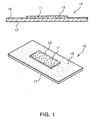
- Fig. 1 schematically shows an antimicrobial moist wound dressing 10 according to one embodiment of the present invention.
- Reference numeral 11 indicates a silver-CMC compound dispersed in a medium of the antimicrobial moist wound dressing 10
- reference numeral 13 indicates a medium layer
- reference numeral 15 indicates a pressure-sensitive adhesive layer
- reference numeral 17 indicates an external protective film layer.
- the silver-CMC compound 11 dispersed in a medium is exaggerated for the purpose of clarity.
- the antimicrobial moist wound dressing 10 of the present invention comprises the medium layer 13 in which the silver-CMC compound 11 is dispersed in a medium, the pressure-sensitive adhesive layer 15 and the external protective film layer 17 laminated and joined to each other.
- the term joined as used herein means that the respective layers constituting the wound dressing 10 of the present invention are bonded to each other by means of an adhésive, or by thermal pressurization, or sonication.
- the term means that a solution constituting one layer of the layers is coated on other constituent layers so that all layers are attached and bonded to each other, and is meant to include simple laminates.
- the silver-CMC compound 11 dispersed in the medium of the medium layer 13 is a compound in which the hydrogen ions of the hydroxyl groups (OH - ) of CMC are replaced by silver ions.
- the medium in which the silver-CMC compound 11 is dispersed there can be used a pure (100%) cotton non-woven fabric or gauze.
- the silver-bonded CMC can absorb moisture of ten or more times of its weight. Therefore, since the moist wound dressing 10 of the present invention has high moisture absorption and storage capacity, it provides a moist environment effective for wound healing due to the silver-CMC compound 11 and inhibits proliferation of harmful bacteria due to the antimicrobial and bactericidal activity of the silver.
- the external protective film layer 17 is disposed outside the medium layer 13, and acts to prevent wound exudate (secretions) absorbed in the medium layer 13 from being released to the outside environment and dried, thereby maintaining a moist environment. Further, the external protective film layer 17 prevents infiltration of water, bacteria and impurities from the outside environment.
- Suitable materials for the external protective film layer 17 include those used commonly in the art, and are preferably polyurethane, polyethylene, polypropylene, polyvinyl chloride, and the like. These materials can prevent infiltration of bacteria and impurities, e.g., water from the outside environment. In addition, since the external protective film layer 17 lets air in, it can allow the skin to breathe. Furthermore, since the external protective film layer 17 is highly expandable and contractible, the wound dressing 10 of the present invention can be suitably used at joint regions.
- the external protective film layer 17 is larger in size than the medium layer 13, and the pressure-sensitive adhesive layer 15 can be formed by applying a pressure-sensitive adhesive to surfaces in contact with skin.
- the pressure-sensitive adhesive layer 15 thus formed is attached to the external protective film layer 9 and acts to firmly fix the external protective film layer 9 to the skin so as to prevent the wound dressing 10 from being separated from the skin.
- Any adhesive can be used to form the pressure-sensitive adhesive layer 15 so long as it is commonly used in the art and does not cause any irritation to the skin.
- an antimicrobial moist wound dressing 20 according to another embodiment of the present invention is shown in Fig. 2 .
- the antimicrobial moist wound dressing 20 comprises a pressure-sensitive adhesive layer 23, a silver-CMC powder-containing layer 21, and an external protective film layer 25.
- the silver-CMC powder-containing layer 21 is formed by drying a solution of a silver-CMC compound, pulverizing the dried silver-CMC compound to form a powder, followed by hydrogelling.
- the silver-CMC powder-containing layer 21 is disposed on the external protective film layer 25 and the pressure-sensitive adhesive layer 23 is positioned thereon.
- the silver-CMC powder-containing layer 21 can absorb moisture of ten or more times of its weight.
- the moist wound dressing 20 of the present invention absorbs wound exudate to provide a moist environment. Since the moist wound dressing 20 of the present invention maintains a moist environment, it generates no pain during its removal for exchange and prevents skin tissues from being peeled off from the wound, leaving no scar behind.
- the presence of silver bonded to the moist wound dressing allows to inhibit proliferation of harmful bacteria in wound sites.
- the external protective film layer 25 serves to prevent release of moisture absorbed in the silver-CMC powder-containing layer 21 to the outside and drying the moisture in ambient air so that the moist wound dressing 20 maintains a moist environment to achieve an environment effective for wound healing.
- a material for the external protective film layer 25 may be the same as that for the external protective film layer 17.
- An adhesive for the formation of the pressure-sensitive adhesive layer 23 may be the same as that for the formation of the pressure-sensitive adhesive layer 15.
- AgCl was dissolved in 25 ml of ammonia water to dissociate silver ions.
- concentrations of the silver-containing compound were adjusted to 0.00001 % (w/v), 0.001 % (w/v), 0.1% (w/v), 0.5% (w/v), 1% (w/v), 2% (w/v), 3% (w/v) and 6.0% (w/v) (Preparative Examples 1 to 8, respectively), and the concentrations of the ammonium hydroxide were adjusted to 0.1%, 1.0%, 5.0%, 10.0%, 15.0%, 20.0%, 25.0% and 30% (Preparative Examples 1 to 8, respectively).
- 0.1g, 0.2g, 0.3g, 0.5g, 1.0g, 2.5g, 5.0g and 10.0g of solid CMC (Preparative Examples 1 to 8, respectively) were weighed and dissolved in 5 ml of ethanol to prepare solutions.
- Each of the silver ion-containing solutions was mixed and reacted with each of the CMC solutions to produce silver-CMC compounds.
- Each of the silver-CMC compounds was poured into a pure cotton non-woven fabric sheet (size: 10cm x 10cm, weight: 180g, thickness: 1mm) to absorb the compound in the sheet, and dried in hot air at about 95°C to produce antimicrobial moist wound dressings in which silver in the form of silver oxide was bonded to CMC.
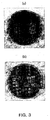
- a test for the antimicrobial activity was conducted on the antimicrobial moist wound dressing by the AATCC 147-1998 test method (HALO test) in the Korea FITI Testing & Research Institute.
- AATCC 147-1998 test method As the test strains, Staphylococcus aureus (ATCC 6538) and Klepsiella pneumoniae (ATCC 4352) were used.
- the test results for the antimicrobial activity of the antimicrobial moist wound dressing are shown in Figs. 3a and 3b . As can be seen from the photographs of Figs. 3a and 3b , no proliferation of the bacteria was observed at the back surface of the test samples, which demonstrates that the wound dressing of the present invention has superior antimicrobial activity.
- the antimicrobial moist wound dressings of the present invention since silver is chemically bonded to CMC in the antimicrobial moist wound dressings of the present invention, cells necessary for wound healing are protected against attack by dissolution of silver.
- the antimicrobial moist wound dressings of the present invention provide a moist environment effective for wound healing due to superior absorption capacity of CMC, wounds are treated, leaving no scar on the wounds.
- the moist wound dressings generate no pain during their removal for exchange and provide advantageous effects, including inhibitory effects on the proliferation of bacteria on wounds, due to the presence of silver.
Landscapes
- Health & Medical Sciences (AREA)
- Chemical & Material Sciences (AREA)
- Public Health (AREA)
- Engineering & Computer Science (AREA)
- Veterinary Medicine (AREA)
- Life Sciences & Earth Sciences (AREA)
- Animal Behavior & Ethology (AREA)
- General Health & Medical Sciences (AREA)
- Epidemiology (AREA)
- Materials Engineering (AREA)
- Hematology (AREA)
- Inorganic Chemistry (AREA)
- Biomedical Technology (AREA)
- Heart & Thoracic Surgery (AREA)
- Vascular Medicine (AREA)
- Materials For Medical Uses (AREA)
- Medicinal Preparation (AREA)
Claims (15)
- Verfahren zum Herstellen eines antimikrobiellen feuchten Wundverbands mit gebundenem Silber, umfassend die Schritte: Zugeben einer silberhaltigen Verbindung zu einer 0,1-30%igen wässrigen Lösung eines alkalischen Lösungsmittels, um Silberionen von der silberhaltigen Verbindung zu dissoziierten; Auflösen von Natriumcarboxymethylcellulose (C6H9OCH2COONa, CMC) in Wasser oder einem organischen Lösungsmittel, um eine CMC-Lösung zu erhalten; Mischen der silberionenhaltigen Lösung, die in dem Zugabeschritt erhalten wurde, mit der in dem Auflösungsschritt erhaltenen CMC-Lösung, so dass die Wasserstoffionen (H+) der Hydroxylgruppen der CMC durch die Silberionen ersetzt werden, um eine Silber-CMC-Verbindung herzustellen; Dispergieren und Absorbieren der Silber-CMC-Verbindung in einem Medium; und Trocknen des Mediums.
- Verfahren nach Anspruch 1, wobei die silberhaltige Verbindung ausgewählt ist aus Silberhalogeniden, einschließlich Silberbromid, Silberiodid, Silberfluorid und Silberchlorid, Silberacetat, Silbercarbonat, Silberfulminat, Silbernitrat, Silberoxid, Silberperchlorat, Silberphosphat, Silbersulfat, Silberthiocyanat und Mischungen davon.
- Verfahren nach Anspruch 1, wobei die silberhaltige Verbindung in einer Menge von 0,00001 % bis 20,0% (Gew./Vol.) zugegeben wird.
- Verfahren nach Anspruch 1, wobei das alkalische Lösungsmittel NaOH, Ca(OH)2, NH4OH, Na2S2O3, (NH4)2CO3, NH4Cl, KCN oder eine Mischung davon ist.
- Verfahren nach Anspruch 1, wobei das organische Lösungsmittel Ethanol, Isopropylalkohol oder eine Mischung davon ist.
- Verfahren nach Anspruch 1, wobei das Medium ein Faservlies oder Gaze aus reiner (100%iger) Baumwolle ist.
- Verfahren nach Anspruch 1, wobei das Trocknen bei Raumtemperatur bis 200°C durchgeführt wird.
- Verfahren zum Herstellen eines antimikrobiellen feuchten Wundverbands mit gebundenem Silber nach Anspruch 1, umfassend den zusätzlichen Schritt:Pulverisieren der Silber-CMC-Verbindung.
- Antimikrobieller feuchter Wundverband mit gebundenem Silber umfassend eine Haftklebstoffschicht in Kontakt mit Haut, eine Mediumschicht, in welcher eine Silber-CMC-Verbindung in einem Medium dispergiert ist, und eine äußere Schutzfilmschicht, die laminiert und miteinander verbunden sind, wobei die Silber-CMC-Verbindung Silberionen umfasst, die an die Hydroxylgruppen von CMC gebunden sind, wodurch Wasserstoffionen von dieser ersetzt werden.
- Wundverband nach Anspruch 9, wobei die Mediumschicht durch ein Verfahren gebildet wird, das die Schritte umfasst: Zugeben einer silberhaltigen Verbindung zu einer 0,1-30%igen wässrigen Lösung eines alkalischen Lösungsmittels, um Silberionen von der silberhaltigen Verbindung zu dissoziierten; Auflösen von CMC in Wasser oder einem organischen Lösungsmittel, um eine CMC-Lösung zu erhalten; Mischen der silberionenhaltigen Lösung mit der CMC-Lösung, so dass die Wasserstoffionen (H+) der Hydroxylgruppen der CMC durch die Silberionen ersetzt werden, um eine Silber-CMC-Verbindung herzustellen; Dispergieren und Absorbieren der Silber-CMC-Verbindung in einem Medium; und Trocknen des Mediums.
- Wundverband nach Anspruch 10, wobei das Medium ein Faservlies oder Gaze aus reiner (100%iger) Baumwolle ist.
- Wundverband nach Anspruch 9, wobei die äußere Schutzfilmschicht eine größere Größe aufweist als die Mediumschicht und die Haftklebstoffschicht durch Aufbringen eines Haftklebstoffs auf Oberflächen in Kontakt mit Haut gebildet ist.
- Antimikrobieller feuchter Wundverband mit gebundenem Silber umfassend eine Haftklebstoffschicht in Kontakt mit Haut, eine Silber-CMC-Pulver-haltige Schicht und eine äußere Schutzfilmschicht, die laminiert und miteinander verbunden sind, wobei das Silber-CMC-Pulver pulverisierte CMC umfasst, die an die Hydroxylgruppen von CMC gebundene Silberionen umfasst, wodurch Wasserstoffionen von dieser ersetzt werden.
- Wundverband nach Anspruch 13, wobei die Silber-CMC-Pulver-haltige Schicht durch ein Verfahren gebildet wird, das die Schritte umfasst: Zugeben einer silberhaltigen Verbindung zu einer 0,1-30%igen wässrigen Lösung eines alkalischen Lösungsmittels, um Silberionen von der silberhaltigen Verbindung zu dissoziierten; Auflösen von CMC in Wasser oder einem organischen Lösungsmittel, um eine CMC-Lösung zu erhalten; Mischen der silberionenhaltigen Lösung mit der CMC-Lösung, so dass die Wasserstoffionen (H+) der Hydroxylgruppen der CMC durch die Silberionen ersetzt werden, um eine Silber-CMC-Verbindung herzustellen; und Trocknen und Pulverisieren der Silber-CMC-Verbindung.
- Wundverband nach Anspruch 13, wobei die Silber-CMC-Pulver-haltige Schicht ein Hydrogel- oder Hydropolymer-Typ ist.
Applications Claiming Priority (2)
| Application Number | Priority Date | Filing Date | Title |
|---|---|---|---|
| KR1020060022818A KR100788997B1 (ko) | 2006-03-10 | 2006-03-10 | 은이 화학 결합된 항균성 습윤 드레싱재 제조방법 및 그습윤 드레싱재 |
| PCT/KR2007/001173 WO2007105883A1 (en) | 2006-03-10 | 2007-03-09 | Methods for producing silver-bonded antimicrobial moist wound dressings and moist wound dressings produced by the methods |
Publications (3)
| Publication Number | Publication Date |
|---|---|
| EP1993620A1 EP1993620A1 (de) | 2008-11-26 |
| EP1993620A4 EP1993620A4 (de) | 2012-08-15 |
| EP1993620B1 true EP1993620B1 (de) | 2013-10-09 |
Family
ID=38509674
Family Applications (1)
| Application Number | Title | Priority Date | Filing Date |
|---|---|---|---|
| EP07715569.5A Active EP1993620B1 (de) | 2006-03-10 | 2007-03-09 | Verfahren zur herstellung von silber-gebundenen antimikrobiellen feuchten wundverbänden und mit den verfahren hergestellte feuchte wundverbände |
Country Status (13)
| Country | Link |
|---|---|
| US (2) | US8263116B2 (de) |
| EP (1) | EP1993620B1 (de) |
| JP (1) | JP4984266B2 (de) |
| KR (1) | KR100788997B1 (de) |
| CN (1) | CN101400379A (de) |
| AU (1) | AU2007225574B2 (de) |
| BR (1) | BRPI0708769A2 (de) |
| CA (1) | CA2644896C (de) |
| DK (1) | DK1993620T3 (de) |
| ES (1) | ES2441266T3 (de) |
| MX (1) | MX2008011571A (de) |
| RU (1) | RU2391116C1 (de) |
| WO (1) | WO2007105883A1 (de) |
Families Citing this family (21)
| Publication number | Priority date | Publication date | Assignee | Title |
|---|---|---|---|---|
| US20120046670A1 (en) | 2009-01-28 | 2012-02-23 | Johannes Engl | Wound cleansing assembly |
| MX2012011452A (es) * | 2010-04-14 | 2012-11-23 | Moelnlycke Heatlh Care Ab | Geles antimicrobianos. |
| CN101905031B (zh) * | 2010-07-16 | 2013-01-30 | 北京科技大学 | 一种磺胺嘧啶银/细菌纤维素复合伤口敷料的制备方法 |
| RU2568909C2 (ru) * | 2011-08-12 | 2015-11-20 | Вячеслав Федорович Солтаганов | Повязка медицинская, способ ее изготовления и применения |
| GB201209745D0 (en) * | 2012-05-31 | 2012-07-18 | Convatec Technologies Inc | Wound dressing |
| US9119971B2 (en) * | 2012-07-26 | 2015-09-01 | Zoll Medical Corporation | Automated external defibrillator configuration |
| CN103623453B (zh) * | 2013-12-06 | 2015-11-04 | 长春吉原生物科技有限公司 | 一种银离子水凝胶敷料的制备方法 |
| CN104399106A (zh) * | 2014-12-02 | 2015-03-11 | 张凤 | 一种具有抗菌消炎作用的可溶性纤维及其制备方法 |
| AU2016300968B2 (en) * | 2015-07-24 | 2020-05-14 | Mölnlycke Health Care Ab | Absorbent antimicrobial wound dressings |
| US11207441B2 (en) * | 2015-11-20 | 2021-12-28 | Essity Hygiene And Health Aktiebolag | Fibrous structure exhibiting an antimicrobial effect |
| US20190060127A1 (en) * | 2016-03-01 | 2019-02-28 | Kci Licensing, Inc. | Drape For Use With Medical Therapy Systems |
| EP3228329B1 (de) * | 2016-04-06 | 2022-06-08 | UPM-Kymmene Corporation | Verfahren zur herstellung eines medizinischen produkts mit nanofibrillärer cellulose und verfahren zur herstellung eines medizinischen produkts |
| DE202016002788U1 (de) | 2016-04-28 | 2016-06-16 | Lohmann & Rauscher Gmbh | Applikationshilfe für die Behandlung von Wunden |
| RU2659267C1 (ru) * | 2017-08-24 | 2018-06-29 | Федеральное государственное бюджетное учреждение науки Институт химии твердого тела Уральского отделения Российской академии наук | Способ получения серебросодержащей ткани растительного происхождения |
| WO2019089856A1 (en) * | 2017-10-31 | 2019-05-09 | InMEDBio, LLC | Absorbent, breathable and pathogen blocking/killing wound care dressing and fabrication thereof |
| KR102040850B1 (ko) | 2017-11-02 | 2019-11-05 | 경기대학교 산학협력단 | 의료용 하이드로 콜로이드 조성물 및 이를 포함하는 의료용 드레싱 |
| KR102117643B1 (ko) * | 2018-07-26 | 2020-06-03 | 주식회사 바이오팜메드 | 표면 키토산화 키틴 나노화이버 제조방법, 이로부터 제조된 표면 키토산화 키틴 나노화이버, 이를 이용한 키틴/콜라겐 나노화이버 원단 및 그 원단을 이용한 창상피복재 |
| CN109260503A (zh) * | 2018-09-30 | 2019-01-25 | 振德医疗用品股份有限公司 | 一种吸收材料及其制备方法、包含该材料的敷料 |
| CN112451738B (zh) * | 2020-11-30 | 2021-12-28 | 西安交通大学 | 一种银离子多糖聚合物抗菌敷料及其制备方法和应用 |
| IT202100003893A1 (it) * | 2021-02-19 | 2022-08-19 | Penta Science Ind Holding B V | Composizione polimerica antimicrobica |
| GB2609041A (en) | 2021-07-20 | 2023-01-25 | Cellucomp Ltd | Water absorbing and antimicrobial fabric composition |
Citations (1)
| Publication number | Priority date | Publication date | Assignee | Title |
|---|---|---|---|---|
| WO2005075164A2 (en) * | 2004-01-30 | 2005-08-18 | H20 Technologies, L.L.C. | Silver-impregnated lignocellulose (sil): process for making same |
Family Cites Families (18)
| Publication number | Priority date | Publication date | Assignee | Title |
|---|---|---|---|---|
| CA1326416C (en) * | 1986-08-25 | 1994-01-25 | Ralph Xavier Ewall | Polymeric wound dressings |
| DK158336C (da) | 1987-09-22 | 1990-10-01 | Coloplast As | Forbindsmateriale til behandling af saar samt smaalegemer til brug ved fremstilling deraf |
| JPH03242145A (ja) | 1990-02-19 | 1991-10-29 | Terumo Corp | 創傷被覆材およびその製造方法 |
| US5681579A (en) * | 1993-03-22 | 1997-10-28 | E.R. Squibb & Sons, Inc. | Polymeric support wound dressing |
| JP3121503B2 (ja) | 1994-10-18 | 2001-01-09 | レンゴー株式会社 | 抗菌剤 |
| US6087549A (en) * | 1997-09-22 | 2000-07-11 | Argentum International | Multilayer laminate wound dressing |
| GB9717357D0 (en) * | 1997-08-16 | 1997-10-22 | Bristol Myers Squibb Co | Multi layered wound dressing |
| US6605751B1 (en) * | 1997-11-14 | 2003-08-12 | Acrymed | Silver-containing compositions, devices and methods for making |
| US6719987B2 (en) * | 2000-04-17 | 2004-04-13 | Nucryst Pharmaceuticals Corp. | Antimicrobial bioabsorbable materials |
| US6379712B1 (en) * | 2000-09-13 | 2002-04-30 | Globoasia, L.L.C. | Nanosilver-containing antibacterial and antifungal granules and methods for preparing and using the same |
| GB2370226A (en) | 2000-09-21 | 2002-06-26 | Acordis Speciality Fibres Ltd | Wound dressing |
| GB0027674D0 (en) | 2000-11-13 | 2000-12-27 | Johnson & Johnson Medical Ltd | Hydrogel wound dressings |
| HUP0302554A3 (en) * | 2000-11-29 | 2005-05-30 | Bristol Myers Squibb Company S | Preparation of light stabilized antimicrobial materials |
| RU2193896C2 (ru) * | 2001-02-08 | 2002-12-10 | Гаврилюк Борис Карпович | Покрытие для ран |
| CA2458708C (en) | 2001-09-12 | 2011-08-02 | Acordis Speciality Fibres Limited | Antibacterial wound dressing |
| GB2382305B (en) | 2001-11-23 | 2004-12-15 | Johnson & Johnson Medical Ltd | Absorbent wound dressings containing a hydrogel layer |
| US8461410B2 (en) * | 2002-09-11 | 2013-06-11 | Ethicon, Inc. | Wound dressing materials comprising complexes of anionic polysaccharides with silver |
| KR100459494B1 (ko) * | 2002-12-12 | 2004-12-03 | 한국원자력연구소 | 상처 치료용 수화겔의 제조방법 |
-
2006
- 2006-03-10 KR KR1020060022818A patent/KR100788997B1/ko not_active Expired - Fee Related
-
2007
- 2007-03-09 MX MX2008011571A patent/MX2008011571A/es active IP Right Grant
- 2007-03-09 DK DK07715569.5T patent/DK1993620T3/da active
- 2007-03-09 WO PCT/KR2007/001173 patent/WO2007105883A1/en not_active Ceased
- 2007-03-09 CA CA2644896A patent/CA2644896C/en not_active Expired - Fee Related
- 2007-03-09 EP EP07715569.5A patent/EP1993620B1/de active Active
- 2007-03-09 CN CNA2007800085474A patent/CN101400379A/zh active Pending
- 2007-03-09 RU RU2008140174/15A patent/RU2391116C1/ru not_active IP Right Cessation
- 2007-03-09 JP JP2008558209A patent/JP4984266B2/ja not_active Expired - Fee Related
- 2007-03-09 AU AU2007225574A patent/AU2007225574B2/en not_active Ceased
- 2007-03-09 US US12/282,344 patent/US8263116B2/en not_active Expired - Fee Related
- 2007-03-09 BR BRPI0708769-1A patent/BRPI0708769A2/pt not_active IP Right Cessation
- 2007-03-09 ES ES07715569.5T patent/ES2441266T3/es active Active
-
2012
- 2012-09-07 US US13/607,401 patent/US8409608B2/en not_active Expired - Fee Related
Patent Citations (1)
| Publication number | Priority date | Publication date | Assignee | Title |
|---|---|---|---|---|
| WO2005075164A2 (en) * | 2004-01-30 | 2005-08-18 | H20 Technologies, L.L.C. | Silver-impregnated lignocellulose (sil): process for making same |
Also Published As
| Publication number | Publication date |
|---|---|
| CA2644896A1 (en) | 2007-09-20 |
| BRPI0708769A2 (pt) | 2011-06-14 |
| US20090047332A1 (en) | 2009-02-19 |
| KR100788997B1 (ko) | 2007-12-28 |
| DK1993620T3 (da) | 2014-01-20 |
| RU2008140174A (ru) | 2010-04-20 |
| US20130006161A1 (en) | 2013-01-03 |
| ES2441266T3 (es) | 2014-02-03 |
| US8409608B2 (en) | 2013-04-02 |
| WO2007105883A1 (en) | 2007-09-20 |
| JP4984266B2 (ja) | 2012-07-25 |
| US8263116B2 (en) | 2012-09-11 |
| JP2009529367A (ja) | 2009-08-20 |
| AU2007225574B2 (en) | 2010-12-23 |
| AU2007225574A1 (en) | 2007-09-20 |
| CA2644896C (en) | 2013-01-08 |
| MX2008011571A (es) | 2008-09-22 |
| RU2391116C1 (ru) | 2010-06-10 |
| KR20070092537A (ko) | 2007-09-13 |
| EP1993620A4 (de) | 2012-08-15 |
| EP1993620A1 (de) | 2008-11-26 |
| CN101400379A (zh) | 2009-04-01 |
Similar Documents
| Publication | Publication Date | Title |
|---|---|---|
| CA2644896C (en) | Methods for producing silver-bonded antimicrobial moist wound dressings and moist wound dressings produced by the methods | |
| KR101377569B1 (ko) | 항균성 창상 피복재 및 그 제조방법 | |
| US6592888B1 (en) | Composition for wound dressings safely using metallic compounds to produce anti-microbial properties | |
| EP1539070B1 (de) | Antimikrobieller silberhaltiger wundverband f r kontinuierliche freisetzung | |
| JP4944570B2 (ja) | 抗微生物組成物および傷口被覆材 | |
| EP2524705B1 (de) | Sterile Wundauflage mit einem synthethischen Dreiblock-Elastomer und einem hydrophorbierten polymeren Biguanid | |
| EP2736542A1 (de) | Mehrschichtige wundauflage enthaltend ein hydrocolloid und aktivkohle | |
| EP1755569B1 (de) | Wundauflage | |
| CN102492182A (zh) | 含稀土元素的壳聚糖和/或其衍生物生物薄膜 | |
| CN102271720B (zh) | 含有一氧化氮的组合物和敷料 | |
| EP4346923B1 (de) | Antimikrobieller wundverband | |
| JP2008073499A (ja) | 抗微生物組成物および傷口被覆材 | |
| EP1652536A1 (de) | Wundbehandlungsmittel enthaltend eine Zeolith-Jod-Einschlussverbindung | |
| Qin | Antimicrobial textile dressings to manage wound infection | |
| Sultan et al. | Quality Control study of Silver and Chlorohexidine Wound Dressings: A Comparison of Physical and Chemical Characteristics of Some Types Available in Middle East Medical Supply | |
| DE102006043245A1 (de) | Chloraminhaltiges Wundbehandlungsmittel | |
| Halldorson | Effects of simultaneous delivery of silver and zinc oxide on the efficacy of healing acute wounds. |
Legal Events
| Date | Code | Title | Description |
|---|---|---|---|
| PUAI | Public reference made under article 153(3) epc to a published international application that has entered the european phase |
Free format text: ORIGINAL CODE: 0009012 |
|
| 17P | Request for examination filed |
Effective date: 20080912 |
|
| AK | Designated contracting states |
Kind code of ref document: A1 Designated state(s): AT BE BG CH CY CZ DE DK EE ES FI FR GB GR HU IE IS IT LI LT LU LV MC MT NL PL PT RO SE SI SK TR |
|
| RAP1 | Party data changed (applicant data changed or rights of an application transferred) |
Owner name: CELLULOSE CONCEPTS, LLC |
|
| REG | Reference to a national code |
Ref country code: DE Ref legal event code: R079 Ref document number: 602007033225 Country of ref document: DE Free format text: PREVIOUS MAIN CLASS: A61L0015180000 Ipc: A61L0015460000 |
|
| DAX | Request for extension of the european patent (deleted) | ||
| A4 | Supplementary search report drawn up and despatched |
Effective date: 20120717 |
|
| RIC1 | Information provided on ipc code assigned before grant |
Ipc: A61L 15/28 20060101ALI20120712BHEP Ipc: A61L 15/46 20060101AFI20120712BHEP |
|
| GRAP | Despatch of communication of intention to grant a patent |
Free format text: ORIGINAL CODE: EPIDOSNIGR1 |
|
| INTG | Intention to grant announced |
Effective date: 20130412 |
|
| GRAS | Grant fee paid |
Free format text: ORIGINAL CODE: EPIDOSNIGR3 |
|
| GRAP | Despatch of communication of intention to grant a patent |
Free format text: ORIGINAL CODE: EPIDOSNIGR1 |
|
| INTG | Intention to grant announced |
Effective date: 20130809 |
|
| GRAA | (expected) grant |
Free format text: ORIGINAL CODE: 0009210 |
|
| AK | Designated contracting states |
Kind code of ref document: B1 Designated state(s): AT BE BG CH CY CZ DE DK EE ES FI FR GB GR HU IE IS IT LI LT LU LV MC MT NL PL PT RO SE SI SK TR |
|
| REG | Reference to a national code |
Ref country code: GB Ref legal event code: FG4D |
|
| REG | Reference to a national code |
Ref country code: AT Ref legal event code: REF Ref document number: 635282 Country of ref document: AT Kind code of ref document: T Effective date: 20131015 Ref country code: CH Ref legal event code: EP |
|
| REG | Reference to a national code |
Ref country code: IE Ref legal event code: FG4D |
|
| REG | Reference to a national code |
Ref country code: DE Ref legal event code: R096 Ref document number: 602007033225 Country of ref document: DE Effective date: 20131205 |
|
| REG | Reference to a national code |
Ref country code: NL Ref legal event code: T3 |
|
| REG | Reference to a national code |
Ref country code: DK Ref legal event code: T3 Effective date: 20140113 |
|
| REG | Reference to a national code |
Ref country code: CH Ref legal event code: NV Representative=s name: FIAMMENGHI-FIAMMENGHI, CH |
|
| REG | Reference to a national code |
Ref country code: ES Ref legal event code: FG2A Ref document number: 2441266 Country of ref document: ES Kind code of ref document: T3 Effective date: 20140203 |
|
| REG | Reference to a national code |
Ref country code: SE Ref legal event code: TRGR |
|
| REG | Reference to a national code |
Ref country code: AT Ref legal event code: MK05 Ref document number: 635282 Country of ref document: AT Kind code of ref document: T Effective date: 20131009 |
|
| PG25 | Lapsed in a contracting state [announced via postgrant information from national office to epo] |
Ref country code: SI Free format text: LAPSE BECAUSE OF FAILURE TO SUBMIT A TRANSLATION OF THE DESCRIPTION OR TO PAY THE FEE WITHIN THE PRESCRIBED TIME-LIMIT Effective date: 20131009 |
|
| REG | Reference to a national code |
Ref country code: LT Ref legal event code: MG4D |
|
| PG25 | Lapsed in a contracting state [announced via postgrant information from national office to epo] |
Ref country code: IS Free format text: LAPSE BECAUSE OF FAILURE TO SUBMIT A TRANSLATION OF THE DESCRIPTION OR TO PAY THE FEE WITHIN THE PRESCRIBED TIME-LIMIT Effective date: 20140209 Ref country code: FI Free format text: LAPSE BECAUSE OF FAILURE TO SUBMIT A TRANSLATION OF THE DESCRIPTION OR TO PAY THE FEE WITHIN THE PRESCRIBED TIME-LIMIT Effective date: 20131009 Ref country code: LT Free format text: LAPSE BECAUSE OF FAILURE TO SUBMIT A TRANSLATION OF THE DESCRIPTION OR TO PAY THE FEE WITHIN THE PRESCRIBED TIME-LIMIT Effective date: 20131009 |
|
| PG25 | Lapsed in a contracting state [announced via postgrant information from national office to epo] |
Ref country code: AT Free format text: LAPSE BECAUSE OF FAILURE TO SUBMIT A TRANSLATION OF THE DESCRIPTION OR TO PAY THE FEE WITHIN THE PRESCRIBED TIME-LIMIT Effective date: 20131009 Ref country code: PL Free format text: LAPSE BECAUSE OF FAILURE TO SUBMIT A TRANSLATION OF THE DESCRIPTION OR TO PAY THE FEE WITHIN THE PRESCRIBED TIME-LIMIT Effective date: 20131009 Ref country code: LV Free format text: LAPSE BECAUSE OF FAILURE TO SUBMIT A TRANSLATION OF THE DESCRIPTION OR TO PAY THE FEE WITHIN THE PRESCRIBED TIME-LIMIT Effective date: 20131009 Ref country code: CY Free format text: LAPSE BECAUSE OF FAILURE TO SUBMIT A TRANSLATION OF THE DESCRIPTION OR TO PAY THE FEE WITHIN THE PRESCRIBED TIME-LIMIT Effective date: 20131009 |
|
| PG25 | Lapsed in a contracting state [announced via postgrant information from national office to epo] |
Ref country code: PT Free format text: LAPSE BECAUSE OF FAILURE TO SUBMIT A TRANSLATION OF THE DESCRIPTION OR TO PAY THE FEE WITHIN THE PRESCRIBED TIME-LIMIT Effective date: 20140210 |
|
| REG | Reference to a national code |
Ref country code: DE Ref legal event code: R097 Ref document number: 602007033225 Country of ref document: DE |
|
| PG25 | Lapsed in a contracting state [announced via postgrant information from national office to epo] |
Ref country code: EE Free format text: LAPSE BECAUSE OF FAILURE TO SUBMIT A TRANSLATION OF THE DESCRIPTION OR TO PAY THE FEE WITHIN THE PRESCRIBED TIME-LIMIT Effective date: 20131009 |
|
| PLBE | No opposition filed within time limit |
Free format text: ORIGINAL CODE: 0009261 |
|
| STAA | Information on the status of an ep patent application or granted ep patent |
Free format text: STATUS: NO OPPOSITION FILED WITHIN TIME LIMIT |
|
| PG25 | Lapsed in a contracting state [announced via postgrant information from national office to epo] |
Ref country code: RO Free format text: LAPSE BECAUSE OF FAILURE TO SUBMIT A TRANSLATION OF THE DESCRIPTION OR TO PAY THE FEE WITHIN THE PRESCRIBED TIME-LIMIT Effective date: 20131009 Ref country code: CZ Free format text: LAPSE BECAUSE OF FAILURE TO SUBMIT A TRANSLATION OF THE DESCRIPTION OR TO PAY THE FEE WITHIN THE PRESCRIBED TIME-LIMIT Effective date: 20131009 Ref country code: SK Free format text: LAPSE BECAUSE OF FAILURE TO SUBMIT A TRANSLATION OF THE DESCRIPTION OR TO PAY THE FEE WITHIN THE PRESCRIBED TIME-LIMIT Effective date: 20131009 |
|
| 26N | No opposition filed |
Effective date: 20140710 |
|
| REG | Reference to a national code |
Ref country code: DE Ref legal event code: R097 Ref document number: 602007033225 Country of ref document: DE Effective date: 20140710 |
|
| PG25 | Lapsed in a contracting state [announced via postgrant information from national office to epo] |
Ref country code: LU Free format text: LAPSE BECAUSE OF FAILURE TO SUBMIT A TRANSLATION OF THE DESCRIPTION OR TO PAY THE FEE WITHIN THE PRESCRIBED TIME-LIMIT Effective date: 20140309 |
|
| PG25 | Lapsed in a contracting state [announced via postgrant information from national office to epo] |
Ref country code: MT Free format text: LAPSE BECAUSE OF FAILURE TO SUBMIT A TRANSLATION OF THE DESCRIPTION OR TO PAY THE FEE WITHIN THE PRESCRIBED TIME-LIMIT Effective date: 20131009 |
|
| REG | Reference to a national code |
Ref country code: FR Ref legal event code: PLFP Year of fee payment: 10 |
|
| PGFP | Annual fee paid to national office [announced via postgrant information from national office to epo] |
Ref country code: NL Payment date: 20160330 Year of fee payment: 10 Ref country code: CH Payment date: 20160330 Year of fee payment: 10 Ref country code: DK Payment date: 20160330 Year of fee payment: 10 Ref country code: IE Payment date: 20160330 Year of fee payment: 10 |
|
| PG25 | Lapsed in a contracting state [announced via postgrant information from national office to epo] |
Ref country code: MC Free format text: LAPSE BECAUSE OF FAILURE TO SUBMIT A TRANSLATION OF THE DESCRIPTION OR TO PAY THE FEE WITHIN THE PRESCRIBED TIME-LIMIT Effective date: 20131009 Ref country code: BG Free format text: LAPSE BECAUSE OF FAILURE TO SUBMIT A TRANSLATION OF THE DESCRIPTION OR TO PAY THE FEE WITHIN THE PRESCRIBED TIME-LIMIT Effective date: 20131009 |
|
| PGFP | Annual fee paid to national office [announced via postgrant information from national office to epo] |
Ref country code: GB Payment date: 20160331 Year of fee payment: 10 Ref country code: SE Payment date: 20160330 Year of fee payment: 10 Ref country code: FR Payment date: 20160331 Year of fee payment: 10 |
|
| PG25 | Lapsed in a contracting state [announced via postgrant information from national office to epo] |
Ref country code: GR Free format text: LAPSE BECAUSE OF FAILURE TO SUBMIT A TRANSLATION OF THE DESCRIPTION OR TO PAY THE FEE WITHIN THE PRESCRIBED TIME-LIMIT Effective date: 20140110 |
|
| PG25 | Lapsed in a contracting state [announced via postgrant information from national office to epo] |
Ref country code: HU Free format text: LAPSE BECAUSE OF FAILURE TO SUBMIT A TRANSLATION OF THE DESCRIPTION OR TO PAY THE FEE WITHIN THE PRESCRIBED TIME-LIMIT; INVALID AB INITIO Effective date: 20070309 Ref country code: TR Free format text: LAPSE BECAUSE OF FAILURE TO SUBMIT A TRANSLATION OF THE DESCRIPTION OR TO PAY THE FEE WITHIN THE PRESCRIBED TIME-LIMIT Effective date: 20131009 |
|
| PGFP | Annual fee paid to national office [announced via postgrant information from national office to epo] |
Ref country code: ES Payment date: 20160422 Year of fee payment: 10 Ref country code: DE Payment date: 20160531 Year of fee payment: 10 |
|
| PGFP | Annual fee paid to national office [announced via postgrant information from national office to epo] |
Ref country code: BE Payment date: 20160330 Year of fee payment: 10 |
|
| PG25 | Lapsed in a contracting state [announced via postgrant information from national office to epo] |
Ref country code: IT Free format text: LAPSE BECAUSE OF NON-PAYMENT OF DUE FEES Effective date: 20160309 |
|
| PG25 | Lapsed in a contracting state [announced via postgrant information from national office to epo] |
Ref country code: IT Free format text: LAPSE BECAUSE OF NON-PAYMENT OF DUE FEES Effective date: 20160309 |
|
| PGFP | Annual fee paid to national office [announced via postgrant information from national office to epo] |
Ref country code: IT Payment date: 20160331 Year of fee payment: 10 |
|
| PGRI | Patent reinstated in contracting state [announced from national office to epo] |
Ref country code: IT Effective date: 20170710 |
|
| REG | Reference to a national code |
Ref country code: DE Ref legal event code: R119 Ref document number: 602007033225 Country of ref document: DE |
|
| REG | Reference to a national code |
Ref country code: DK Ref legal event code: EBP Effective date: 20170331 |
|
| REG | Reference to a national code |
Ref country code: SE Ref legal event code: EUG Ref country code: CH Ref legal event code: PL |
|
| REG | Reference to a national code |
Ref country code: NL Ref legal event code: MM Effective date: 20170401 |
|
| GBPC | Gb: european patent ceased through non-payment of renewal fee |
Effective date: 20170309 |
|
| PG25 | Lapsed in a contracting state [announced via postgrant information from national office to epo] |
Ref country code: SE Free format text: LAPSE BECAUSE OF NON-PAYMENT OF DUE FEES Effective date: 20170310 |
|
| REG | Reference to a national code |
Ref country code: IE Ref legal event code: MM4A |
|
| REG | Reference to a national code |
Ref country code: FR Ref legal event code: ST Effective date: 20171130 |
|
| PG25 | Lapsed in a contracting state [announced via postgrant information from national office to epo] |
Ref country code: DE Free format text: LAPSE BECAUSE OF NON-PAYMENT OF DUE FEES Effective date: 20171003 Ref country code: NL Free format text: LAPSE BECAUSE OF NON-PAYMENT OF DUE FEES Effective date: 20170401 Ref country code: FR Free format text: LAPSE BECAUSE OF NON-PAYMENT OF DUE FEES Effective date: 20170331 |
|
| PG25 | Lapsed in a contracting state [announced via postgrant information from national office to epo] |
Ref country code: IT Free format text: LAPSE BECAUSE OF NON-PAYMENT OF DUE FEES Effective date: 20170309 Ref country code: IE Free format text: LAPSE BECAUSE OF NON-PAYMENT OF DUE FEES Effective date: 20170309 Ref country code: CH Free format text: LAPSE BECAUSE OF NON-PAYMENT OF DUE FEES Effective date: 20170331 Ref country code: LI Free format text: LAPSE BECAUSE OF NON-PAYMENT OF DUE FEES Effective date: 20170331 Ref country code: GB Free format text: LAPSE BECAUSE OF NON-PAYMENT OF DUE FEES Effective date: 20170309 |
|
| PGRI | Patent reinstated in contracting state [announced from national office to epo] |
Ref country code: IT Effective date: 20170710 |
|
| REG | Reference to a national code |
Ref country code: BE Ref legal event code: MM Effective date: 20170331 |
|
| PG25 | Lapsed in a contracting state [announced via postgrant information from national office to epo] |
Ref country code: DK Free format text: LAPSE BECAUSE OF NON-PAYMENT OF DUE FEES Effective date: 20170331 |
|
| PG25 | Lapsed in a contracting state [announced via postgrant information from national office to epo] |
Ref country code: BE Free format text: LAPSE BECAUSE OF NON-PAYMENT OF DUE FEES Effective date: 20170331 |
|
| REG | Reference to a national code |
Ref country code: ES Ref legal event code: FD2A Effective date: 20180704 |
|
| PG25 | Lapsed in a contracting state [announced via postgrant information from national office to epo] |
Ref country code: ES Free format text: LAPSE BECAUSE OF NON-PAYMENT OF DUE FEES Effective date: 20170310 |