EP2001829B1 - Reglage de selectivite de produit dans des reactions d'hydroformylation catalytique avec des liquides expanses par dioxyde de carbone - Google Patents
Reglage de selectivite de produit dans des reactions d'hydroformylation catalytique avec des liquides expanses par dioxyde de carbone Download PDFInfo
- Publication number
- EP2001829B1 EP2001829B1 EP07758707.9A EP07758707A EP2001829B1 EP 2001829 B1 EP2001829 B1 EP 2001829B1 EP 07758707 A EP07758707 A EP 07758707A EP 2001829 B1 EP2001829 B1 EP 2001829B1
- Authority
- EP
- European Patent Office
- Prior art keywords
- hydroformylation
- liquid
- reaction mixture
- catalyst
- olefin
- Prior art date
- Legal status (The legal status is an assumption and is not a legal conclusion. Google has not performed a legal analysis and makes no representation as to the accuracy of the status listed.)
- Active
Links
Images



Classifications
-
- C—CHEMISTRY; METALLURGY
- C07—ORGANIC CHEMISTRY
- C07C—ACYCLIC OR CARBOCYCLIC COMPOUNDS
- C07C45/00—Preparation of compounds having >C = O groups bound only to carbon or hydrogen atoms; Preparation of chelates of such compounds
- C07C45/49—Preparation of compounds having >C = O groups bound only to carbon or hydrogen atoms; Preparation of chelates of such compounds by reaction with carbon monoxide
- C07C45/50—Preparation of compounds having >C = O groups bound only to carbon or hydrogen atoms; Preparation of chelates of such compounds by reaction with carbon monoxide by oxo-reactions
-
- Y—GENERAL TAGGING OF NEW TECHNOLOGICAL DEVELOPMENTS; GENERAL TAGGING OF CROSS-SECTIONAL TECHNOLOGIES SPANNING OVER SEVERAL SECTIONS OF THE IPC; TECHNICAL SUBJECTS COVERED BY FORMER USPC CROSS-REFERENCE ART COLLECTIONS [XRACs] AND DIGESTS
- Y02—TECHNOLOGIES OR APPLICATIONS FOR MITIGATION OR ADAPTATION AGAINST CLIMATE CHANGE
- Y02P—CLIMATE CHANGE MITIGATION TECHNOLOGIES IN THE PRODUCTION OR PROCESSING OF GOODS
- Y02P20/00—Technologies relating to chemical industry
- Y02P20/50—Improvements relating to the production of bulk chemicals
- Y02P20/54—Improvements relating to the production of bulk chemicals using solvents, e.g. supercritical solvents or ionic liquids
Definitions
- the hydroformylation reaction is well known in the art as a catalytic method for the conversion of an olefin into an aldehyde product having one carbon more than the starting olefin by the addition of one molecule each of hydrogen and carbon monoxide to the carbon-carbon double bond. If the organic substrate contains more than one carbon-carbon double bond, more than one formyl group can be added to the substrate, thereby increasing the number of carbon atoms contained in the product molecule by more than one.
- the first approach involves immobilizing homogeneous rhodium (“Rh”) catalysts on various supports, i.e., the silicate MCM-41 (see Marteel et al., Supported platinum/tin complexes as catalysts for hydroformylation of 1-hexene in supercritical carbon dioxide, Catalysis Communications, 4 309-314 (2003 )), zeolites ( see Mukhopadhyay et al., Encapsulated HRh(CO)-(PPh3)3 in microporous and mesoporous supports: novel heterogeneous catalysts for hydroformylation, Chemical Materials, 15 1766-1777 (2003 )), nanotubes ( see Yoon et al., Rh-based olefin hydroformylation catalysts and the change of their catalytic activity depending on the size of immobilizing supporters, Inorganica Chimica Acta., 345 228-234 (2003 )), supported aqueous phase cat
- biphasic media such as water/organic (see Peng et al., Aqueous biphasic hydroformylation of higher olefins catalyzed by rhodium complexes with amphiphilic ligands of sulfonated triphenylphosphine analog, Catalysis Letters, 88 219-225 (2003 )), water/CO 2 ( see Haumann et al., Hydroformylation in microemulsions: conversion of an internal long chain alkene into a linear aldehyde using a water soluble cobalt catalyst, Catalysis Today, 79-80 43-49 (2003 ); McCarthy et al., Catalysis in inverted supercritical CO2/aqueous biphasic media, Green Chemistry, 4(5) 501-504 (2002 )), and room temperature ionic liquid/CO 2 ( see Webb, Continuous flow hydroformylation of alkenes in supercritical fluid-ionic liquid biphasic systems, Journal of
- the third approach involves employing a "phase transition switch" whereby reactions are performed homogeneously, following which the catalysts are recovered from the product stream via phase transition triggered by a change in either the system temperature (see Horváth et al., Facile catalyst separation without water: fluorous biphasic hydroformylation of olefins, Science, 266 (5182) 72-75 (1994 ); Zheng et al., Thermoregulated phase transfer ligands and catalysis. III.
- CXLs CO 2 -expanded liquids
- CXLs are a continuum of compressible media generated when various amounts of dense phase carbon dioxide are added to an organic solvent.
- CXLs offer both reaction and environmental benefits.
- Near-critical carbon dioxide possesses highly tunable transport properties ranging from gas-like diffusivities to liquid-like viscosities. See Subramaniam et al., Reaction in supercritical fluids - a review, Industrial & Engineering Chemistry Process Design and Development, 25 1-12 (1986 ).
- the presence of dense CO 2 imparts similar tunability to CXLs as well.
- transition metal complexes are only sparingly soluble in supercritical CO 2 ( sc CO 2 )
- the presence of an appropriate amount of the organic liquid in CXLs ensures adequate solubilities of transition metal complexes in a CXL phase for performing homogeneous catalysis. Further, such solubilities are realized at pressures an order of magnitude lower than those required in sc CO 2 medium for solubilizing Rh catalyst complexes with fluorinated ligands. See Palo et al., Effect of ligand modification on rhodium-catalyzed homogeneous hydroformylation in supercritical carbon dioxide, Organometallics, 19 81-86 (2000 ).
- Meehan et al., Chemical Communications, 2000, pp 1497-1498 discloses a continuous, selective hydroformylation of higher olefins in supercritical carbon dioxide using an immobilized homogenous catalyst.
- the ability to tune the product regioselectivity is of interest.
- the linear aldehyde is the desired product.
- the regioselectivity may be tuned.
- the syngas solubilities in and the dielectric constant of the resulting reaction mixture may be continuously varied, influencing the product selectivity. This aspect was not observed in the previous published literature which described experiments performed with a polar solvent such as acetone mixed with CO 2 .
- the invention provides for an improved hydroformylation process comprising reacting an olefin with CO and H 2 in the presence of a hydroformylation catalyst in a liquid that has been volumetrically expanded with a compressed CO 2 such as supercritical or subcritical carbon dioxide as defined in claim 1.
- a compressed CO 2 such as supercritical or subcritical carbon dioxide as defined in claim 1.
- altering the amount of the compressed gas in the liquid phase alters the chemoselectivity of the products.
- varying the content of the compressed gas in the liquid alters the regioselectivity of the products.
- the addition of the increasing amounts of the compressed gas surprisingly improves the ratio of linear to branched aldehydes during the hydroformylation process, and vice-versa.
- n-aldehydes are generally of significantly greater industrial importance than the isoaldehydes during linear olefin hydroformylation, it is an aim to optimize the hydroformylation catalysts and conditions in order to achieve the greatest possible n-selectivity, i.e. the highest possible ratio of n-aldehyde to isoaldehyde in the product aldehydes.
- the present invention is directed to a method for improving a target regioselectivity of linear aldehydes over branched aldehydes during hydroformylation of an olefin comprising reacting an olefin substrate with CO and H 2 in the presence of a hydroformylation catalyst in a liquid that has been volumetrically expanded with compressed CO 2 , wherein the liquid is the olefin substrate, and varying the content of the compressed CO 2 in the liquid to vary the syngas solubilities in the resulting reaction mixture in order to obtain said desired target regioselectivity.
- the target regioselectivity is preferably greater than 10, 12, or 14.
- the present invention is directed to a method for improving a target chemoselectivity of aldehydes during hydroformylation of an olefin comprising reacting an olefin substrate with CO and H 2 in the presence of a hydroformylation catalyst in a liquid that has been volumetrically expanded with compressed CO 2 , wherein the liquid is the olefin substrate, and varying the content of the compressed CO 2 in the liquid to vary the syngas solubilities in the resulting reaction mixture in order to obtain said desired target chemoselectivity.
- the target chemoselectivity is preferably greater than 90%, 95%, or 99%.
- the compressed gas preferably has a volume fraction in the liquid phase between 10% and 90%. In another aspect of the disclosure, more than 30%, 40%, 50%, or 60% of the liquid phase volume is replaced with the compressed gas.
- the olefin is a higher olefin, and may be linear, branched, with an internal or terminal double bond (or a combination thereof).
- the hydroformylation catalyst is a rhodium catalyst, with Rh(acac)(CO) 2 ; Rh(acac)[P(OPh) 3 ] 2 ; Rh(acac)(CO)[P(OAr) 3 ]; and a complex formed of Rh(acac)(CO) 2 and a phosphorous-containing ligand being exemplary.
- the ligand to rhodium molar ratio ranges between 1 and 270.
- the reaction mixture is formed in a polar organic solvent, such as acetone.
- a polar organic solvent such as acetone.
- the reaction mixture of the invention uses the olefin substrate, a non-polar substance, as the liquid phase.
- the methods of the present disclosure may be employed in both the both in the presence and absence of added organic solvents, such as acetone, with the resulting chemo and regioselectivities being influenced by the polar or non-polar nature of the reaction mixture.
- the enhanced rates and selectivities were realized in CXLs at a 50% reduction in the organic solvent usage.
- the reaction occurs at relatively mild temperatures and pressures. Typical temperatures range between 30 °C and 90 °C, and typical pressures are less than 12 MPa, with pressures between 4 to 6 MPa being exemplary.
- the process also results in an improved turnover frequency.
- the observed TOF was about 300 1/hour.
- a TOF maximum was observed at an optimum CO 2 content in the liquid phase.
- the process also results in improved chemoselectivity (S a ).
- S a chemoselectivity
- Rh(acac)(CO) 2 modified by biphephos ligand as the catalyst
- the selectivity to aldehyde products was improved from approximately 70% in neat solvent to nearly 95% in CXL media.
- the enhanced rates and selectivity are attributed to a combination of optimal syngas availability in and the tuned properties (such as dielectric constant) of the CXL phase.
- catalysts may be designed to take advantage of this highly tunable solubility for recovery and recycle.
- catalysts may be supported on soluble polymers whose solubilities in the reaction mixture are highly dependent on the dielectric constant of the reaction mixture. Since the polarity of the CXL phase is easily tuned by CO 2 addition, the solubility of the catalyst may likewise be tuned to stay in solution during the reaction phase and precipitate upon CO 2 addition following reaction. It should be understood that the polarity switching may be performed with other solvents as well.
- VOCs volatile organic solvents
- carbon dioxide expanded liquids or “CXLs” refer to a continuum of compressible media generated when a dense phase carbon dioxide is added to an organic liquid media. Pressurized subcritical or supercritical carbon dioxide is usually the gas of choice.
- higher olefins refers to olefins having more than five carbons in the chain.
- olefins are accordingly olefins whose double bond is, unlike alpha-olefins, not terminal but located in the interior of the olefin molecule.
- turnover frequency refers to a moles of substrate (e.g . 1-octene) converted to all products per mole of catalyst per hour during fixed-time batch runs.
- chemoselectivity refers to the moles of aldehydes or the octene isomers formed relative to the moles of substrate ( e.g ., octene) converted during the hydroformylation process.
- regioselectivity or "n/i” refers to the ratio of linear to branched aldehydes in the product.
- the invention provides for an improved hydroformylation process comprising reacting an olefin with CO and H 2 in the presence of a hydroformylation catalyst in a liquid that has been volumetrically expanded with compressed CO 2 , such as supercritical or subcritical carbon dioxide as defined in claim 1.
- compressed CO 2 such as supercritical or subcritical carbon dioxide as defined in claim 1.
- the expanding gas is carbon dioxide and for reasons of cost and ease of use, pressurized subcritical or supercritical carbon dioxide is usually the gas of choice.
- the expanding gas is present in the reaction mixture at a level below that which will cause the catalyst to precipitate; that is, the catalyst is usually the least soluble component of the reaction mixture, and for good results, it should remain dispersed. Therefore, the expanding gas is introduced at levels which will maintain catalyst suspension. These levels of course vary depending upon the components of the reaction mixture, and especially the catalyst. It is therefore usually necessary to preliminarily determine the extent of expanding gas supplementation which can be accommodated with each individual reaction mixture. See Subramaniam, U.S. Patent No. 6,740,785 .
- the hydroformylation is carried out in a homogeneous reaction system.
- the term homogeneous reaction system generally refers to a homogeneous solution composed essentially of CO 2 -expanded solvent, catalyst, syngas, olefinically unsaturated compound, and reaction product.
- the amount of rhodium compound is not specially limited, but is optionally selected so that favorable results can be obtained with respect to catalyst activity and economy.
- the concentration of rhodium in the reaction medium is between 10 and 10,000 ppm and more preferably between 50-500 ppm, calculated as the free metal.
- the volume ratio of carbon monoxide to hydrogen in the synthesis gas is generally in the range from 10 to 1 and 1 to 10, preferably between 6 to 1 to 1 to 6, and most preferably 2:1 to 1:2, in particular 1:1.
- the synthesis gas is advantageously used in excess, for example in an amount up to three times the stoichiometric amount.
- the olefin substrates in the present invention may be any organic compound having at least one ethylenically unsaturated functional group (i.e., a carbon-carbon double bond) and may be, for example, an aromatic, aliphatic, mixed aromatic-aliphatic (e.g ., aralkyl), cyclic, branched or straight chain olefin.
- Preferred olefins are C 2 to C 20 olefins, and most preferred are "higher olefin" which refers to a compound containing more than 5 carbon atoms.
- More than one carbon-carbon double bond may be present in the olefin, and thus, dienes, trienes, and other polyunsaturated substrates thus may be used.
- the olefin may optionally contain substituents other than hydrocarbon substituents such as halide, carboxylic acid, ether, hydroxy, thiol, nitro, cyano, ketone, ester, anhydride, amino, and the like.
- Exemplary olefins suitable in the process of the present invention include ethylene, propylene, butenes, butadiene, pentenes, isoprene, 1-hexene, 3-hexene, 1-heptene, 1-octene, diisobutylene, 1-nonene, 1-tetradecene, pentamyrcene, camphene, 1-undecene, 1-dodecene, 1-tridecene, 1-tetradecene, 1-pentadecene, 1-hexadecene, 1-heptadecene decene, 1-nonadecene, 1-eicosene, the trimers and tetramers of propylene, polybutadiene, polyisoprene, cyclopentene, cyclohexene, cycloheptene, cyclooctene, cyclooctadiene, cyclododec
- the olefin is a fatty compound, for example, mono- and poly-unsaturated free fatty acids, fatty esters, triglyceride oils, or other fatty-derived materials. Suitable olefins are described in Frankel, U.S. Patent No. 4,083,816 .
- the olefin is preferably present in 0.1 to 99.99 mol% of the reaction mixture. It will be appreciated to those skilled in the art that the olefin concentration (i.e., availability) in the liquid phase, where the reaction occurs, is most important, and for low boiling light olefins this is dictated by the operating pressure and temperature.
- the hydroformylation catalyst may be any transition metal capable of carrying out catalytic transformations and may additionally contain labile ligands which are cither displaced during the catalytic reaction, or take an active part in the catalytic transformation. Any of the transition metals may be considered in this regard.
- the preferred metals are those comprising Group VIII of the Periodic Table.
- the preferred metals for hydroformylation are rhodium, cobalt, iridium, ruthenium, palladium, and platinum.
- the Group VIII metal is preferably rhodium.
- Group VIII catalysts suitable for hydroformylation can be prepared or generated according to techniques well known in the art, as described, for example, in WO 95 30680 , U.S. Pat. No. 3,907,847 ; and J. Amer. Chem. Soc., 115, 2066 (1993 ).
- Suitable Group VIII metal compounds are hydrides, halides, organic acid salts, acetylacetonates, inorganic acid salts, oxides, carbonyl compounds and amine compounds of these metals.
- Preferred salts include, for example, rhodium salts such as rhodium acetate, rhodium chloride or rhodium nitrate, rhodium complexes such as rhodium acetylacetonate and/or rhodium carbonyl compounds.
- the catalyst may be achiral or chiral.
- the ligands can be monodentate or polydentate, and in the case of chiral ligands, either the racemate or one enantiomer or diastereomer can be used.
- Preferred ligands are ligands which contain nitrogen, phosphorus, arsenic, or antimony as donor atoms; particular preference is given to phosphorus-containing ligands. such as phosphines, phosphine oxides, phosphinanes, phosphinines, phosphinites, phosphites, and phosphonites.
- phosphines are triphenylphosphine, tris(p-tolyl)phosphine, tris(m-tolyl)phosphine, tris(o-tolyl)phosphine, tris(p-methoxyphenyl)phosphine, tris(p-fluorophenyl)phosphine, tris(p-chlorophenyl)phosphine, tris(p-dimethylaminophenyl)phosphine, ethyldiphenylphosphine, propyldiphenylphosphine, t-butyldiphenylphosphine, n-butyldiphenylphosphine, n-hexyldiphenylphosphine, c-hexyldiphenylphosphine, dicyclohexylphenylphosphine, tricyclohexylphosphine, tricyclopentylphosphin
- phosphinanes examples include 2,6-bis(2,4-dimethylphenyl)-1-octyl-4-phenylphosphinane, l-octyl-2,4,6-triphenylphosphinane and further ligands described in WO 02/00669 .
- phosphinines examples include 2,6-dimethyl-4-phenylphosphinine, 2,6-bis(2,4-dimethylphenyl)-4-phenylphosphinine and also further ligands described in WO 00/55164 .
- phosphites are trimethyl phosphite, triethyl phosphite, tri-n-propyl phosphite, tri-i-propyl phosphite, tri-n-butyl phosphite, tri-i-butyl phosphite, tri-t-butyl phosphite, tris(2-ethylhexyl)phosphite, triphenyl phosphite, tris(2,4-di-t-butylphenyl)phosphite, tris(2-t-butyl-4-methoxyphenyl)phosphite, tris(2-t-butyl-4-methylphenyl)phosphite, tris(p-cresyl)phosphite.
- Triphenyl phosphites which are substituted by 1 or 2 isopropyl and/or tert-butyl groups on the phenyl rings, preferably in the ortho position relative to the phosphite ester group, are preferably used.
- Bisphosphite ligands which are described, inter alia, in EP 1 099 677 ; EP 1 099 678 ; WO 02.00670 ; JP 10279587 ; EP 472017 ; WO 01/21627 ; WO 97/40001 ; WO 97/40002 ; U.S. Pat. No. 4,769,498 ; EP 213639 ; and EP 214622 , are particularly preferably used.
- Customary phosphinite ligands are described, inter alia, in U.S. Pat. No. 5,710,344 ; WO 95 06627 ; U.S. Pat. No. 5,360,938 ; and JP 07082281 .
- Examples are diphenyl(phenoxy)phosphine and its derivatives in which all or some of the hydrogen atoms are replaced by alkyl or aryl radicals or halogen atoms, diphenyl(methoxy)phosphine, diphenyl(ethoxy)phosphine, etc.
- Examples of phosphonites are methyldiethoxyphosphine, phenyldimethoxyphosphine, phenyldiphenoxyphosphine, 6-phenoxy-6H-dibenz[c,e] [1,2]oxaphosphorin and their derivatives in which all or some of the hydrogen atoms are replaced by alkyl or aryl radicals or halogen atoms and ligands as described in WO 98/43935 ; JP 09-268152 ; and DE 198 10 794 , and in the German patent applications DE 199 54 721 and DE 199 54 510 .
- rhodium catalysts include RhCl 3 , Rh(NO 3 ) 3 , Rh(OAc) 3 , Rh 2 O 3 , Rh(acac)(CO) 2 , [Rh(OAc)(COD)] 2 , Rh 4 (CO) 12 , Rh 6 (CO) 16 , RhH(CO)(Ph 3 P) 3 , [Rh(OAc)(CO) 2 ], [RhCl(COD)] 2 , Rh(CO) 2 (acac), Rh(CO) 2 (C 4 H 9 COCHCO-t-C 4 H 9 ), Rh 2 O 3 , Rh(O 2 CCH 3 ) 2 , and Rh(2-ethylhexanoate), wherein "acac” is an acetylacetonate group; "OAc” is an acetyl group; “COD” is 1,5-cyclooctadiene; "Ph” is a phenyl group, and "OAr” is 2,
- Rhodium compounds that contain ligands which can be displaced by the multidentate phosphites are a preferred source of rhodium.
- the structures of the exemplary catalysts investigated, in the examples including the unmodified Rh(acac)(CO) 2 and those modified by various phosphorous ligands, are summarized in FIG. 1 .
- the rhodium concentration in the liquid reaction mixture is generally from 10 to 500 ppm by weight, preferably from 30 to 350 ppm by weight and particularly preferably from 50 to 300 ppm by weight.
- the hydroformylation process of the present disclosure can advantageously be carried out in the presence of solvents.
- the polarity of the solvent will impact the regioselectivity, with non-polar solvents generally yielding higher n/i ratios.
- Adding a compressed gas such as CO 2 to the solvent allows for the continuous tenability of the polarity of the solvent system towards a more non-polar system.
- Solvents which are likewise suitable are the olefins themselves, aromatics such as toluene and xylenes, hydrocarbons or mixtures of hydrocarbons, which can also serve for diluting the above-mentioned aldehydes and the downstream products of the aldehydes.
- Further possible solvents are esters of aliphatic carboxylic acids with alkanols, for example ethyl acetate or Texanol®, ethers such as tert-butyl methyl ether and tetrahydrofuran. Is also possible to use non-polar solvents, e.g.
- Alcohols such as methanol, ethanol, n-propanol, isopropanol, n-butanol, isobutanol, ketones such as acetone, and methyl ethyl ketone etc.
- Ionic liquids can also be used as solvents.
- liquid salts for example N,N'-dialkylimidazolium salts such as N-butyl-N'-methylimidazolium salts, tetraalkylammonium salts such as tetra-n-butylammonium salts, N-alkylpyridinium salts such as n-butylpyridinium salts, tetraalkylphosphonium salts such as trishexyl(tetradecyl)phosphonium salts, e.g. the tetrafluoroborates, acetates, tetrachloroaluminates, hexafluorophosphates, chlorides, and tosylates.
- N,N'-dialkylimidazolium salts such as N-butyl-N'-methylimidazolium salts
- tetraalkylammonium salts such as tetra-n-butylammonium salts
- the olefin substrate is the solvent.
- the materials included IIPLC-grade 1-octene, acetone, and 2-propanol procured from Aldrich Chemical Co., distilled using Schlenk line to remove water, air, and peroxide impurities, and stored under nitrogen before usage.
- the unmodified rhodium catalyst, Rh(acac)(CO) 2 and triphenylphosphine (PPh 3 ) ligand were procured from Johnson Matthey and Strem Chemicals Inc, respectively.
- Rh(acac)[P(OPh) 3 ] 2 and Rh(acac)(CO)[P(OAr) 3 ] and one bidentate ligand (biphephos) were synthesized following reported procedures. See Jongsma et al., Fine tuning of bulky-phosphite modified rhodium catalysts by binding them to copolymers, Journal of Molecular Catalysis, 83 17-35 (1993 ); Billig et al., U.S. Patent Nos. 4,668,651 (1987 ) and 4,769,498 (1988 ). All catalysts and ligands were stored under nitrogen before usage.
- Coolant-grade liquid CO 2 and research-grade compressed H 2 were supplied by Air Products and Chemicals in cylinders. Syngas (99.99 % purity; molar H 2 /CO ratio of 1:1) was provided by Scott Specialty Gases. Examples not falling under the claims are provided for illustrative/comparative purposes.
- Example 1 Solubility of reactants and catalysts in CO 2 -expanded liquid
- MHEL maximum homogeneous expansion level
- FIGS. 3 and 4 The expansions of acetone and 1-octene at various temperatures, 30-60 °C, are presented in FIGS. 3 and 4 , respectively. Both solvents demonstrate good miscibility with CO 2 at mild pressures ( ⁇ 12 MPa). The volumetric expansions of these liquids in the presence of dissolved Rh catalysts are also compared. No significant variations are observed between the expansions with and without catalysts, because of the relatively dilute catalyst concentrations (about 10 -3 mole/liter). While no catalyst precipitation was observed in CO 2 -expanded acetone in the range of pressures studied, catalyst precipitation was observed around 9 MPa in CO 2 -expanded 1-octene at 60 °C. Unlike 1-octene, the polar acetone functions as an effective cosolvent for dissolving the Rh complex.
- the catalytic hydroformylation experiments were performed in fixed-time batch studies using a 15-cm 3 316 stainless steel high-pressure view cell.
- a schematic of the reactor setup is shown in FIG. 2 . Details of the apparatus are discussed in Jin et al., Homogeneous catalytic hydroformylation of 1-octene in CO2-expanded solvent media, Chemical Engineering Science, 59 4887-4893 (2004 ). Briefly, the cell is fitted with two sapphire windows, which allow visual observations of the phase behavior and the mixing of the reactor contents. Temperature and pressure are monitored and controlled using a data acquisition system (Camile® TG, Argonaut Technologies).
- the reaction temperature was about 30 °C.
- About 2.7 mmol of 1-octene was used as the substrate.
- the total volume was about 10 cm3, and the volumetric CO 2 /acetone ratio (v/v) in CXL/acetone runs was about 1.
- the molar syngas/substrate ratio was about 5, and the molar 1-octene/Rh ratio was about 209.
- Table 1 summarizes the results of 1-octene hydroformylation performed in both neat and CO 2 -expanded acetone solvents with four rhodium-based catalysts: (1) Rh(acac)(CO) 2 ; (2) Rh(acac)[P(OPh) 3 ] 2 ; (3) Rh(acac)(CO)[P(OAr) 3 ]; and (4) a complex formed in situ with molar equivalent amounts of Rh(acac)(CO) 2 and the biphephos ligand denominated 1/L1.
- Table 1 Activity/selectivity of various catalysts in neat and CO 2 -expanded acetone.
- the aldehydes ( n + i ) selectivity was improved from roughly 70% to 94% in the presence of CO 2 .
- the enhanced activity is attributed to increased syngas availability in the CO 2 -expanded liquid phase, which also promotes hydroformylation over alkene isomerization to internal olefin isomers. It should be noted that the enhanced catalyst performance was achieved with 50% (v/v) replacement of acetone by CO 2 .
- a commercial ligand, triphenylphosphine (PPh 3 ) was used and the data were compared to literature values.
- the reaction temperature was 90 °C, and the pressure was 0.6 MPa. About 2.7 mmol of 1-octene was used as the substrate. The total volume was 7 cm 3 .
- the molar syngas/substrate ratio was 5, and the molar 1-octene/Rh ratio was 2767 (in toluene) and 2139 (in 1-octene).
- the reaction was allowed to proceed for about 2.25 hours.
- Solvent Ligand Ligand/Rh (Molar) TOF (Hour -1 ) S aldehydes (%) n / i Toluene[27] PPh 3 103 n/a 82.0 4.6 Toluene PPh 3 270 161 72.8 4.7 None PPh 3 205 887 96.7 13.8
- FIG. 6 shows the effects of temperature on 1-octene hydroformylation conducted without added solvent.
- Rh(acac)(CO) 2 catalyst modified by PPh 3 ligand at L/Rh ratios around 200, is compared at temperatures of 30, 60 and 90 °C. Increase in temperature led to higher reaction rates and n / i ratios.
- the beneficial temperature effect on the linear aldehyde selectivity has been observed by other researchers as well. See Lazzaroni et al., 1-Hexene rhodium catalyzed hydroformylation at partial substrate conversion: influence of reaction parameters on the chemoselectivity and regioselectivity, Journal of Molecular Catalysis, 58 75-85 (1990 ).
- Literature evidence suggests that octene isomers, the byproducts of 1-octene isomerization, would also hydroformylate and form internal aldehydes, thereby lowering the n / i ratio. An increase in temperature tends to favor the yield of linear aldehyde over 1-octene isomers.
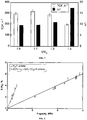
- FIG. 7 presents the effect of CO 2 addition at 60 °C.
- the experimental conditions were similar to those in FIG. 6 , except that various amounts of CO 2 were added to the 1-octene solution in each run.
- a maximum TOF was observed at a CO 2 addition of 10% (by volume). This suggests that although CO 2 addition to 1-octene may enhance the syngas availability in the CXL phase, the substrate dilution by CO 2 eventually lowers the reaction rates.
- Measurements of the liquid-phase mole fraction of H 2 showed several-fold solubility enhancement in CO 2 -expanded 1-octene relative to neat 1-octene pressurized with pure H 2 at the same pressure ( FIG. 8 ).
- the CO 2 addition was found to continuously improve the n / i ratio. Similar to the temperature effect, increased syngas availability in the liquid phase promotes the hydroformylation route over isomerization, resulting in higher yields of linear product.
- the TOFs in CO 2 -expanded 1-octene at 6.4 MPa is 33% greater than TOF in n -hexane at 0.6 MPa (run b) with similar n / i ratios in both runs.
- the TOFs are reduced by roughly a third and the n / i ratio is reduced by more than twofold when CO 2 was replaced by either N 2 (run d ) or syngas (run c). While these results clearly show that the addition of CO 2 has a beneficial effect on the TOF and n / i ratio, the inhibition effects due to either N 2 or syngas addition are as yet not fully understood. Investigations with a high-pressure IR probe are currently underway to monitor the reacting species in situ, and should provide better mechanistic insights.
- Table 3 compares the TOFs, n / i ratio and operating conditions (pressure and temperature) from the current work with those of some existing industrial processes and recently published work that employ supercritical CO 2 and ionic liquids as reaction media. See Webb et al., Continuous flow homogeneous hydroformylation of alkenes using supercritical fluids, Green Chemistry, 7 373-379 (2005 ). Clearly, hydroformylation in CO 2 -expanded octene appears to be promising in terms of both TOF (about 300 h -1 ) and selectivity (about 90%, n / i >10). In addition, the required operating conditions (60 °C and 3.8 MPa) are much milder compared to other processes.
- Pruett et al. Low-pressure system for producing normal aldehydes by hydroformylation of alpha-olefins, Journal of Organic Chemistry, 34 327-330 (1969 ).
Landscapes
- Chemical & Material Sciences (AREA)
- Organic Chemistry (AREA)
- Chemical Kinetics & Catalysis (AREA)
- Organic Low-Molecular-Weight Compounds And Preparation Thereof (AREA)
- Low-Molecular Organic Synthesis Reactions Using Catalysts (AREA)
Claims (13)
- Procédé d'amélioration d'une régiosélectivité cible des aldéhydes linéaires par rapport aux aldéhydes ramifiés lors de l'hydroformylation d'une oléfine, comprenant
la réaction d'un substrat oléfinique avec CO et H2 en présence d'un catalyseur d'hydroformylation dans un liquide qui a été dilaté de manière volumétrique avec du CO2 comprimé,
dans lequel le liquide est le substrat oléfinique,
et la variation de la teneur en CO2 comprimé dans le liquide pour faire varier les solubilités de gaz de synthèse dans le mélange réactionnel résultant afin d'obtenir ladite régiosélectivité cible souhaitée. - Procédé selon la revendication 1 comprenant les étapes de :former un mélange réactionnel comprenant ledit substrat oléfinique et ledit catalyseur d'hydroformylation dans une phase liquide ;introduire ledit gaz comprimé dans ledit mélange réactionnel afin de dilater de manière volumétrique le mélange réactionnel ; etintroduire un gaz de synthèse H2/CO dans le mélange réactionnel ;selon lequel ladite régiosélectivité des aldéhydes linéaires est supérieure à celle sans ladite introduction dudit gaz comprimé dans ledit mélange réactionnel.
- Procédé d'amélioration d'une chimiosélectivité cible des aldéhydes lors de l'hydroformylation d'une oléfine, comprenant
la réaction d'un substrat oléfinique avec CO et H2 en présence d'un catalyseur d'hydroformylation dans un liquide qui a été dilaté de manière volumétrique avec du CO2 comprimé, dans lequel le liquide est le substrat oléfinique, et
la variation de la teneur en CO2 comprimé dans le liquide pour faire varier les solubilités de gaz de synthèse dans le mélange réactionnel résultant afin d'obtenir ladite chimiosélectivité cible souhaitée. - Procédé selon les revendications 1 ou 3, dans lequel ledit substrat oléfinique est choisi dans un groupe constitué des oléfines supérieures ayant plus de 5 atomes de carbone, des oléfines linéaires ou des oléfines ramifiées.
- Procédé selon les revendications 1 ou 3, dans lequel ledit substrat oléfinique est choisi dans un groupe constitué des oléfines ayant une double liaison terminale, une double liaison interne ou plus d'une double liaison.
- Procédé selon les revendications 1 ou 3, dans lequel ledit catalyseur d'hydroformylation est un catalyseur au rhodium.
- Procédé selon la revendication 6, dans lequel ledit catalyseur au rhodium est choisi dans le groupe constitué par Rh(acac)(CO)2 ; Rh(acac)[P(OPh)3]2 ; Rh(acac)(CO)fP(OAr)3] ; et un complexe formé de Rh(acac)(CO)2 et d'un ligand contenant du phosphore.
- Procédé selon la revendication 7, dans lequel ledit catalyseur au rhodium comprend un complexe de rhodium (« Rh ») et de ligand (« L ») avec un rapport molaire L/Rh dans la plage entre 1 et 270.
- Procédé selon la revendication 8, dans lequel ledit rapport molaire L/Rh est dans la plage entre 103 et 270.
- Procédé selon la revendication 1 ou 3, dans lequel ledit CO2 comprimé a une fraction volumique dans la phase liquide entre 10 % et 90 %.
- Procédé selon la revendication 1 ou 3, dans lequel ledit mélange réactionnel est maintenu à une température entre 30°C et 90°C.
- Procédé selon la revendication 11, dans lequel ledit mélange réactionnel est maintenu à une pression inférieure à 12 MPa.
- Procédé selon la revendication 12 lorsqu'elle dépend de la revendication 1, dans lequel ladite pression est entre 4 et 6 MPa.
Applications Claiming Priority (2)
| Application Number | Priority Date | Filing Date | Title |
|---|---|---|---|
| US78354006P | 2006-03-17 | 2006-03-17 | |
| PCT/US2007/064186 WO2007109549A2 (fr) | 2006-03-17 | 2007-03-16 | Reglage de selectivite de produit dans des reactions d'hydroformylation catalytique avec des liquides expanses par dioxyde de carbone |
Publications (3)
| Publication Number | Publication Date |
|---|---|
| EP2001829A2 EP2001829A2 (fr) | 2008-12-17 |
| EP2001829A4 EP2001829A4 (fr) | 2012-04-25 |
| EP2001829B1 true EP2001829B1 (fr) | 2019-03-06 |
Family
ID=38523189
Family Applications (1)
| Application Number | Title | Priority Date | Filing Date |
|---|---|---|---|
| EP07758707.9A Active EP2001829B1 (fr) | 2006-03-17 | 2007-03-16 | Reglage de selectivite de produit dans des reactions d'hydroformylation catalytique avec des liquides expanses par dioxyde de carbone |
Country Status (4)
| Country | Link |
|---|---|
| US (1) | US7365234B2 (fr) |
| EP (1) | EP2001829B1 (fr) |
| CA (1) | CA2647396C (fr) |
| WO (1) | WO2007109549A2 (fr) |
Families Citing this family (14)
| Publication number | Priority date | Publication date | Assignee | Title |
|---|---|---|---|---|
| US20100069679A1 (en) * | 2008-09-12 | 2010-03-18 | Eastman Chemical Company | Acetylene tolerant hydroformylation catalysts |
| MX2011005103A (es) * | 2008-11-14 | 2011-08-04 | Univ Kansas | Complejos de catalizador de metal de transicion soportados en polimeros y metodos de uso. |
| EP2681180B1 (fr) * | 2011-03-04 | 2017-08-23 | The University of Kansas | Procédé d'hydroformylation à expansion par un seul gaz solvant |
| EP3110541B1 (fr) | 2014-02-10 | 2020-11-18 | Archer-Daniels-Midland Company | Procédés améliorés de mélange multi-phase faible |
| US9493725B2 (en) | 2014-09-08 | 2016-11-15 | The Procter & Gamble Company | Detergent compositions containing a predominantly C15 alkyl branched surfactant |
| ES2939553T3 (es) | 2014-09-08 | 2023-04-24 | Procter & Gamble | Composiciones detergentes que contienen un tensioactivo ramificado |
| EP3029013B1 (fr) * | 2014-12-04 | 2018-06-13 | Evonik Degussa GmbH | Monophosphites à unités de structure 4,4,5,5-Tétraphényl-1,3,2-dioxaphospholane en tant que ligands de catalyseurs d'hydroformylation |
| WO2017078972A1 (fr) * | 2015-11-04 | 2017-05-11 | Archer Daniels Midland Company | Procédé amélioré d'hydroformylation |
| CA3096322A1 (fr) | 2018-04-13 | 2019-10-17 | Haldor Topsoe A/S | Procede de generation d'un gaz de synthese destine a etre utilise dans des reactions d'hydroformylation |
| EP3775322A1 (fr) | 2018-04-13 | 2021-02-17 | Haldor Topsøe A/S | Procédé de génération de mélanges gazeux comprenant du monoxyde de carbone et du dioxyde de carbone pour utilisation dans des réactions de synthèse |
| US12221404B2 (en) | 2020-06-05 | 2025-02-11 | SCION Holdings LLC | Composition comprising branched aldehydes |
| US12054455B2 (en) | 2020-06-05 | 2024-08-06 | SCION Holdings LLC | Branched alcohols |
| US11680032B2 (en) | 2020-06-05 | 2023-06-20 | SCION Holdings LLC | Alcohols production |
| US12145904B2 (en) | 2020-12-17 | 2024-11-19 | SCION Holdings LLC | Branched products |
Family Cites Families (24)
| Publication number | Priority date | Publication date | Assignee | Title |
|---|---|---|---|---|
| US3907847A (en) | 1970-04-27 | 1975-09-23 | Ethyl Corp | Compound and method |
| US4687874A (en) * | 1980-02-12 | 1987-08-18 | Exxon Research And Engineering Company | Selective hydroformylation process using alkyl diaryl phosphine rhodium carbonyl hydride catalysts |
| US4748261A (en) | 1985-09-05 | 1988-05-31 | Union Carbide Corporation | Bis-phosphite compounds |
| US4668651A (en) | 1985-09-05 | 1987-05-26 | Union Carbide Corporation | Transition metal complex catalyzed processes |
| DE4026777A1 (de) | 1990-08-24 | 1992-03-05 | Haerle Anton | Scharfgaengige knochenschraube und/oder gewindebohrer fuer osteosynthesearbeiten |
| US5360938A (en) | 1991-08-21 | 1994-11-01 | Union Carbide Chemicals & Plastics Technology Corporation | Asymmetric syntheses |
| US5198589A (en) * | 1992-04-28 | 1993-03-30 | The United States Of America As Represented By The United States Department Of Energy | Cobalt carbonyl catalyzed olefin hydroformylation in supercritical carbon dioxide |
| US5475146A (en) | 1993-09-02 | 1995-12-12 | E. I. Du Pont De Nemours And Company | Enantioselective hydroformylation |
| JPH0782281A (ja) | 1993-09-10 | 1995-03-28 | Mitsui Toatsu Chem Inc | ジホスフィナイト化合物及びそれを用いるオレフィンのヒドロホルミル化反応方法 |
| BE1008343A3 (nl) | 1994-05-06 | 1996-04-02 | Dsm Nv | Bidentaat fosfineligand |
| US5780684A (en) * | 1996-01-16 | 1998-07-14 | Shell Oil Company | Hydroformylation reactions |
| JPH09268152A (ja) | 1996-04-03 | 1997-10-14 | Mitsubishi Chem Corp | アルデヒド類の製造方法 |
| US5821389A (en) | 1996-04-24 | 1998-10-13 | Union Carbide Chemicals & Technology Corporation | Processes for producing hydroxyaldehydes |
| US5886237A (en) | 1996-04-24 | 1999-03-23 | Union Carbide Chemicals & Plastics Technology Corporation | Processes for producing alkenals and alkenols |
| US5710344A (en) | 1996-11-08 | 1998-01-20 | E. I. Du Pont De Nemours And Company | Process to prepare a linear aldehyde |
| WO1998043935A1 (fr) | 1997-03-27 | 1998-10-08 | Mitsubishi Chemical Corporation | Procede de preparation d'aldehydes |
| JPH10279587A (ja) | 1997-03-31 | 1998-10-20 | Mitsubishi Chem Corp | ビスホスファイト化合物及びそれを用いるヒドロホルミル化方法 |
| DE19810794A1 (de) | 1998-03-12 | 1999-09-16 | Basf Ag | Katalysator, umfassend einen Komplex eines Metalls der VIII. Nebengruppe auf Basis eines Phosphonitliganden und Verfahren zur Hydroformylierung |
| US6307107B1 (en) | 1999-09-20 | 2001-10-23 | E.I. Du Pont De Nemours And Company | Hydroformylation of acyclic monoethylenically unsaturated compounds to corresponding terminal aldehydes |
| DE19954510A1 (de) | 1999-11-12 | 2001-05-17 | Oxeno Olefinchemie Gmbh | Verfahren zur katalytischen Herstellung von Aldehyden aus Olefinen unter Einsatz von Ligandenmischungen |
| DE19954721A1 (de) | 1999-11-12 | 2001-05-17 | Oxeno Olefinchemie Gmbh | Verfahren zur Herstellung von Aldehyden aus Olefinen durch Hydroformylierung |
| US6448454B1 (en) * | 2000-04-07 | 2002-09-10 | The University Of Kansas | Catalytic oxidation of organic substrates by transition metal complexes in organic solvent media expanded by supercritical or subcritical carbon dioxide |
| DE10031493A1 (de) | 2000-06-28 | 2002-01-10 | Oxeno Olefinchemie Gmbh | Neue Bisphosphitverbindungen und deren Metallkomplexe |
| AU2003222120A1 (en) | 2002-03-29 | 2003-10-13 | Exxonmobil Chemical Patents Inc. | Oxon process |
-
2007
- 2007-03-16 WO PCT/US2007/064186 patent/WO2007109549A2/fr not_active Ceased
- 2007-03-16 EP EP07758707.9A patent/EP2001829B1/fr active Active
- 2007-03-16 US US11/687,270 patent/US7365234B2/en active Active
- 2007-03-16 CA CA2647396A patent/CA2647396C/fr active Active
Non-Patent Citations (1)
| Title |
|---|
| None * |
Also Published As
| Publication number | Publication date |
|---|---|
| CA2647396A1 (fr) | 2007-09-27 |
| WO2007109549A3 (fr) | 2007-12-21 |
| US7365234B2 (en) | 2008-04-29 |
| EP2001829A2 (fr) | 2008-12-17 |
| CA2647396C (fr) | 2014-01-07 |
| WO2007109549A2 (fr) | 2007-09-27 |
| EP2001829A4 (fr) | 2012-04-25 |
| US20070219399A1 (en) | 2007-09-20 |
Similar Documents
| Publication | Publication Date | Title |
|---|---|---|
| US7365234B2 (en) | Tuning product selectivity in catalytic hydroformylation reactions with carbon dioxide expanded liquids | |
| EP3538265B1 (fr) | Procédés de traitement d'une solution de catalyseur d'hydroformylation | |
| CN102741209B (zh) | 通过控制烯烃分压来控制混合配体加氢甲酰化工艺中的正构∶异构醛比率 | |
| CN101610843B (zh) | 用于加氢甲酰化方法的含亚膦酸酯的催化剂 | |
| CN102741210B (zh) | 控制混合配体加氢甲酰化工艺中的正构∶异构醛比率 | |
| CN102365258B (zh) | 使用双开端二亚磷酸酯配体的加氢甲酰基化方法 | |
| CN103153462B (zh) | 加氢甲酰基化方法 | |
| TWI766115B (zh) | 氫甲醯化方法 | |
| US8822734B2 (en) | Single solvent gas expanded hydroformylation process | |
| JP2015523979A (ja) | アルデヒドを調製するための触媒及び方法 | |
| EP2699350B1 (fr) | Methodes pour la stockage des catalyseurs de rhodium-organophosphorous | |
| CN111278560B (zh) | 从氢甲酰化方法回收铑的方法 | |
| JP2002527234A (ja) | クロロホスファイト−金属触媒系を用いるヒドロホルミル化方法 | |
| TW200418785A (en) | Process for preparing aldehydes by hydroformylation of olefinically unsaturated compounds, catalyzed by unmodified complexes of metals of groups 8 to 10 of the PTE in the presence of cyclic carbonic esters | |
| JP7787809B2 (ja) | ヒドロホルミル化プロセスからロジウムを回収するためのプロセス | |
| WO2017078972A1 (fr) | Procédé amélioré d'hydroformylation |
Legal Events
| Date | Code | Title | Description |
|---|---|---|---|
| PUAI | Public reference made under article 153(3) epc to a published international application that has entered the european phase |
Free format text: ORIGINAL CODE: 0009012 |
|
| 17P | Request for examination filed |
Effective date: 20081015 |
|
| AK | Designated contracting states |
Kind code of ref document: A2 Designated state(s): AT BE BG CH CY CZ DE DK EE ES FI FR GB GR HU IE IS IT LI LT LU LV MC MT NL PL PT RO SE SI SK TR |
|
| A4 | Supplementary search report drawn up and despatched |
Effective date: 20120327 |
|
| RIC1 | Information provided on ipc code assigned before grant |
Ipc: C07C 45/50 20060101ALN20120321BHEP Ipc: C07C 47/00 20060101AFI20120321BHEP |
|
| DAX | Request for extension of the european patent (deleted) | ||
| 17Q | First examination report despatched |
Effective date: 20130605 |
|
| STAA | Information on the status of an ep patent application or granted ep patent |
Free format text: STATUS: EXAMINATION IS IN PROGRESS |
|
| GRAP | Despatch of communication of intention to grant a patent |
Free format text: ORIGINAL CODE: EPIDOSNIGR1 |
|
| STAA | Information on the status of an ep patent application or granted ep patent |
Free format text: STATUS: GRANT OF PATENT IS INTENDED |
|
| INTG | Intention to grant announced |
Effective date: 20180926 |
|
| RAP1 | Party data changed (applicant data changed or rights of an application transferred) |
Owner name: UNIVERSITY OF KANSAS |
|
| GRAS | Grant fee paid |
Free format text: ORIGINAL CODE: EPIDOSNIGR3 |
|
| GRAA | (expected) grant |
Free format text: ORIGINAL CODE: 0009210 |
|
| STAA | Information on the status of an ep patent application or granted ep patent |
Free format text: STATUS: THE PATENT HAS BEEN GRANTED |
|
| AK | Designated contracting states |
Kind code of ref document: B1 Designated state(s): AT BE BG CH CY CZ DE DK EE ES FI FR GB GR HU IE IS IT LI LT LU LV MC MT NL PL PT RO SE SI SK TR |
|
| REG | Reference to a national code |
Ref country code: GB Ref legal event code: FG4D |
|
| REG | Reference to a national code |
Ref country code: CH Ref legal event code: EP Ref country code: AT Ref legal event code: REF Ref document number: 1104338 Country of ref document: AT Kind code of ref document: T Effective date: 20190315 |
|
| REG | Reference to a national code |
Ref country code: DE Ref legal event code: R096 Ref document number: 602007057779 Country of ref document: DE |
|
| REG | Reference to a national code |
Ref country code: IE Ref legal event code: FG4D |
|
| REG | Reference to a national code |
Ref country code: NL Ref legal event code: FP |
|
| REG | Reference to a national code |
Ref country code: LT Ref legal event code: MG4D |
|
| PG25 | Lapsed in a contracting state [announced via postgrant information from national office to epo] |
Ref country code: FI Free format text: LAPSE BECAUSE OF FAILURE TO SUBMIT A TRANSLATION OF THE DESCRIPTION OR TO PAY THE FEE WITHIN THE PRESCRIBED TIME-LIMIT Effective date: 20190306 Ref country code: SE Free format text: LAPSE BECAUSE OF FAILURE TO SUBMIT A TRANSLATION OF THE DESCRIPTION OR TO PAY THE FEE WITHIN THE PRESCRIBED TIME-LIMIT Effective date: 20190306 Ref country code: LT Free format text: LAPSE BECAUSE OF FAILURE TO SUBMIT A TRANSLATION OF THE DESCRIPTION OR TO PAY THE FEE WITHIN THE PRESCRIBED TIME-LIMIT Effective date: 20190306 |
|
| PG25 | Lapsed in a contracting state [announced via postgrant information from national office to epo] |
Ref country code: GR Free format text: LAPSE BECAUSE OF FAILURE TO SUBMIT A TRANSLATION OF THE DESCRIPTION OR TO PAY THE FEE WITHIN THE PRESCRIBED TIME-LIMIT Effective date: 20190607 Ref country code: BG Free format text: LAPSE BECAUSE OF FAILURE TO SUBMIT A TRANSLATION OF THE DESCRIPTION OR TO PAY THE FEE WITHIN THE PRESCRIBED TIME-LIMIT Effective date: 20190606 Ref country code: LV Free format text: LAPSE BECAUSE OF FAILURE TO SUBMIT A TRANSLATION OF THE DESCRIPTION OR TO PAY THE FEE WITHIN THE PRESCRIBED TIME-LIMIT Effective date: 20190306 |
|
| REG | Reference to a national code |
Ref country code: AT Ref legal event code: MK05 Ref document number: 1104338 Country of ref document: AT Kind code of ref document: T Effective date: 20190306 |
|
| PG25 | Lapsed in a contracting state [announced via postgrant information from national office to epo] |
Ref country code: EE Free format text: LAPSE BECAUSE OF FAILURE TO SUBMIT A TRANSLATION OF THE DESCRIPTION OR TO PAY THE FEE WITHIN THE PRESCRIBED TIME-LIMIT Effective date: 20190306 Ref country code: IT Free format text: LAPSE BECAUSE OF FAILURE TO SUBMIT A TRANSLATION OF THE DESCRIPTION OR TO PAY THE FEE WITHIN THE PRESCRIBED TIME-LIMIT Effective date: 20190306 Ref country code: CZ Free format text: LAPSE BECAUSE OF FAILURE TO SUBMIT A TRANSLATION OF THE DESCRIPTION OR TO PAY THE FEE WITHIN THE PRESCRIBED TIME-LIMIT Effective date: 20190306 Ref country code: PT Free format text: LAPSE BECAUSE OF FAILURE TO SUBMIT A TRANSLATION OF THE DESCRIPTION OR TO PAY THE FEE WITHIN THE PRESCRIBED TIME-LIMIT Effective date: 20190706 Ref country code: RO Free format text: LAPSE BECAUSE OF FAILURE TO SUBMIT A TRANSLATION OF THE DESCRIPTION OR TO PAY THE FEE WITHIN THE PRESCRIBED TIME-LIMIT Effective date: 20190306 Ref country code: SK Free format text: LAPSE BECAUSE OF FAILURE TO SUBMIT A TRANSLATION OF THE DESCRIPTION OR TO PAY THE FEE WITHIN THE PRESCRIBED TIME-LIMIT Effective date: 20190306 Ref country code: ES Free format text: LAPSE BECAUSE OF FAILURE TO SUBMIT A TRANSLATION OF THE DESCRIPTION OR TO PAY THE FEE WITHIN THE PRESCRIBED TIME-LIMIT Effective date: 20190306 |
|
| REG | Reference to a national code |
Ref country code: CH Ref legal event code: PL |
|
| PG25 | Lapsed in a contracting state [announced via postgrant information from national office to epo] |
Ref country code: LU Free format text: LAPSE BECAUSE OF NON-PAYMENT OF DUE FEES Effective date: 20190316 Ref country code: PL Free format text: LAPSE BECAUSE OF FAILURE TO SUBMIT A TRANSLATION OF THE DESCRIPTION OR TO PAY THE FEE WITHIN THE PRESCRIBED TIME-LIMIT Effective date: 20190306 |
|
| REG | Reference to a national code |
Ref country code: BE Ref legal event code: MM Effective date: 20190331 |
|
| REG | Reference to a national code |
Ref country code: DE Ref legal event code: R097 Ref document number: 602007057779 Country of ref document: DE |
|
| PG25 | Lapsed in a contracting state [announced via postgrant information from national office to epo] |
Ref country code: AT Free format text: LAPSE BECAUSE OF FAILURE TO SUBMIT A TRANSLATION OF THE DESCRIPTION OR TO PAY THE FEE WITHIN THE PRESCRIBED TIME-LIMIT Effective date: 20190306 Ref country code: IS Free format text: LAPSE BECAUSE OF FAILURE TO SUBMIT A TRANSLATION OF THE DESCRIPTION OR TO PAY THE FEE WITHIN THE PRESCRIBED TIME-LIMIT Effective date: 20190706 |
|
| PLBE | No opposition filed within time limit |
Free format text: ORIGINAL CODE: 0009261 |
|
| STAA | Information on the status of an ep patent application or granted ep patent |
Free format text: STATUS: NO OPPOSITION FILED WITHIN TIME LIMIT |
|
| PG25 | Lapsed in a contracting state [announced via postgrant information from national office to epo] |
Ref country code: CH Free format text: LAPSE BECAUSE OF NON-PAYMENT OF DUE FEES Effective date: 20190331 Ref country code: DK Free format text: LAPSE BECAUSE OF FAILURE TO SUBMIT A TRANSLATION OF THE DESCRIPTION OR TO PAY THE FEE WITHIN THE PRESCRIBED TIME-LIMIT Effective date: 20190306 Ref country code: LI Free format text: LAPSE BECAUSE OF NON-PAYMENT OF DUE FEES Effective date: 20190331 Ref country code: IE Free format text: LAPSE BECAUSE OF NON-PAYMENT OF DUE FEES Effective date: 20190316 Ref country code: MC Free format text: LAPSE BECAUSE OF FAILURE TO SUBMIT A TRANSLATION OF THE DESCRIPTION OR TO PAY THE FEE WITHIN THE PRESCRIBED TIME-LIMIT Effective date: 20190306 |
|
| 26N | No opposition filed |
Effective date: 20191209 |
|
| PG25 | Lapsed in a contracting state [announced via postgrant information from national office to epo] |
Ref country code: BE Free format text: LAPSE BECAUSE OF NON-PAYMENT OF DUE FEES Effective date: 20190331 Ref country code: SI Free format text: LAPSE BECAUSE OF FAILURE TO SUBMIT A TRANSLATION OF THE DESCRIPTION OR TO PAY THE FEE WITHIN THE PRESCRIBED TIME-LIMIT Effective date: 20190306 |
|
| PG25 | Lapsed in a contracting state [announced via postgrant information from national office to epo] |
Ref country code: TR Free format text: LAPSE BECAUSE OF FAILURE TO SUBMIT A TRANSLATION OF THE DESCRIPTION OR TO PAY THE FEE WITHIN THE PRESCRIBED TIME-LIMIT Effective date: 20190306 |
|
| PG25 | Lapsed in a contracting state [announced via postgrant information from national office to epo] |
Ref country code: MT Free format text: LAPSE BECAUSE OF NON-PAYMENT OF DUE FEES Effective date: 20190316 |
|
| PG25 | Lapsed in a contracting state [announced via postgrant information from national office to epo] |
Ref country code: CY Free format text: LAPSE BECAUSE OF FAILURE TO SUBMIT A TRANSLATION OF THE DESCRIPTION OR TO PAY THE FEE WITHIN THE PRESCRIBED TIME-LIMIT Effective date: 20190306 |
|
| PG25 | Lapsed in a contracting state [announced via postgrant information from national office to epo] |
Ref country code: HU Free format text: LAPSE BECAUSE OF FAILURE TO SUBMIT A TRANSLATION OF THE DESCRIPTION OR TO PAY THE FEE WITHIN THE PRESCRIBED TIME-LIMIT; INVALID AB INITIO Effective date: 20070316 |
|
| P01 | Opt-out of the competence of the unified patent court (upc) registered |
Effective date: 20230531 |
|
| PGFP | Annual fee paid to national office [announced via postgrant information from national office to epo] |
Ref country code: NL Payment date: 20260219 Year of fee payment: 20 |
|
| PGFP | Annual fee paid to national office [announced via postgrant information from national office to epo] |
Ref country code: GB Payment date: 20260219 Year of fee payment: 20 |
|
| PGFP | Annual fee paid to national office [announced via postgrant information from national office to epo] |
Ref country code: DE Payment date: 20260219 Year of fee payment: 20 |
|
| PGFP | Annual fee paid to national office [announced via postgrant information from national office to epo] |
Ref country code: FR Payment date: 20260219 Year of fee payment: 20 |