EP2007728B1 - Verfahren zur herstellung von tetrahydrochinolinderivaten - Google Patents
Verfahren zur herstellung von tetrahydrochinolinderivaten Download PDFInfo
- Publication number
- EP2007728B1 EP2007728B1 EP07741046A EP07741046A EP2007728B1 EP 2007728 B1 EP2007728 B1 EP 2007728B1 EP 07741046 A EP07741046 A EP 07741046A EP 07741046 A EP07741046 A EP 07741046A EP 2007728 B1 EP2007728 B1 EP 2007728B1
- Authority
- EP
- European Patent Office
- Prior art keywords
- alkyl
- group
- substituted
- trifluoromethyl
- mono
- Prior art date
- Legal status (The legal status is an assumption and is not a legal conclusion. Google has not performed a legal analysis and makes no representation as to the accuracy of the status listed.)
- Active
Links
- RDGZEALFIOPSCC-UHFFFAOYSA-N Brc(cn1)cnc1OCc1ccccc1 Chemical compound Brc(cn1)cnc1OCc1ccccc1 RDGZEALFIOPSCC-UHFFFAOYSA-N 0.000 description 2
- QFRURJKLPJVRQY-SCSAIBSYSA-N CC[C@H](CC(O)=O)N Chemical compound CC[C@H](CC(O)=O)N QFRURJKLPJVRQY-SCSAIBSYSA-N 0.000 description 2
- ZYHNLBYVEQWTIQ-UHFFFAOYSA-N C(c1ccccc1)Oc(nc1)ncc1N1CCOCC1 Chemical compound C(c1ccccc1)Oc(nc1)ncc1N1CCOCC1 ZYHNLBYVEQWTIQ-UHFFFAOYSA-N 0.000 description 1
- GCYVSLUBGGLVOT-UHFFFAOYSA-N CCC(CC(O)=O)Nc1ccc(C(F)(F)F)cc1 Chemical compound CCC(CC(O)=O)Nc1ccc(C(F)(F)F)cc1 GCYVSLUBGGLVOT-UHFFFAOYSA-N 0.000 description 1
- HWXJGEDTIYQFAE-HTLJXXAVSA-N CCC(C[C@@H]1N)Nc2c1cc(C(F)(F)F)cc2 Chemical compound CCC(C[C@@H]1N)Nc2c1cc(C(F)(F)F)cc2 HWXJGEDTIYQFAE-HTLJXXAVSA-N 0.000 description 1
- 0 CC[C@@](C*=C)N Chemical compound CC[C@@](C*=C)N 0.000 description 1
- UTPIGSMODPWEKY-MRVPVSSYSA-N CC[C@H](C1)Nc(ccc(C(F)(F)F)c2)c2C1=O Chemical compound CC[C@H](C1)Nc(ccc(C(F)(F)F)c2)c2C1=O UTPIGSMODPWEKY-MRVPVSSYSA-N 0.000 description 1
- GCYVSLUBGGLVOT-SECBINFHSA-N CC[C@H](CC(O)=O)Nc1ccc(C(F)(F)F)cc1 Chemical compound CC[C@H](CC(O)=O)Nc1ccc(C(F)(F)F)cc1 GCYVSLUBGGLVOT-SECBINFHSA-N 0.000 description 1
- JSSOVXFSZBNHMP-KDOFPFPSSA-N CC[C@H](C[C@@H]1Nc(nc2)ncc2N2CCOCC2)Nc2c1cc(C(F)(F)F)cc2 Chemical compound CC[C@H](C[C@@H]1Nc(nc2)ncc2N2CCOCC2)Nc2c1cc(C(F)(F)F)cc2 JSSOVXFSZBNHMP-KDOFPFPSSA-N 0.000 description 1
- XPGIBDJXEVAVTO-UHFFFAOYSA-N Clc(nc1)ncc1Br Chemical compound Clc(nc1)ncc1Br XPGIBDJXEVAVTO-UHFFFAOYSA-N 0.000 description 1
Classifications
-
- C—CHEMISTRY; METALLURGY
- C07—ORGANIC CHEMISTRY
- C07D—HETEROCYCLIC COMPOUNDS
- C07D215/00—Heterocyclic compounds containing quinoline or hydrogenated quinoline ring systems
- C07D215/02—Heterocyclic compounds containing quinoline or hydrogenated quinoline ring systems having no bond between the ring nitrogen atom and a non-ring member or having only hydrogen atoms or carbon atoms directly attached to the ring nitrogen atom
- C07D215/16—Heterocyclic compounds containing quinoline or hydrogenated quinoline ring systems having no bond between the ring nitrogen atom and a non-ring member or having only hydrogen atoms or carbon atoms directly attached to the ring nitrogen atom with hetero atoms or with carbon atoms having three bonds to hetero atoms with at the most one bond to halogen, e.g. ester or nitrile radicals, directly attached to ring carbon atoms
- C07D215/38—Nitrogen atoms
- C07D215/42—Nitrogen atoms attached in position 4
-
- A—HUMAN NECESSITIES
- A61—MEDICAL OR VETERINARY SCIENCE; HYGIENE
- A61P—SPECIFIC THERAPEUTIC ACTIVITY OF CHEMICAL COMPOUNDS OR MEDICINAL PREPARATIONS
- A61P3/00—Drugs for disorders of the metabolism
-
- A—HUMAN NECESSITIES
- A61—MEDICAL OR VETERINARY SCIENCE; HYGIENE
- A61P—SPECIFIC THERAPEUTIC ACTIVITY OF CHEMICAL COMPOUNDS OR MEDICINAL PREPARATIONS
- A61P3/00—Drugs for disorders of the metabolism
- A61P3/06—Antihyperlipidemics
-
- A—HUMAN NECESSITIES
- A61—MEDICAL OR VETERINARY SCIENCE; HYGIENE
- A61P—SPECIFIC THERAPEUTIC ACTIVITY OF CHEMICAL COMPOUNDS OR MEDICINAL PREPARATIONS
- A61P43/00—Drugs for specific purposes, not provided for in groups A61P1/00-A61P41/00
-
- A—HUMAN NECESSITIES
- A61—MEDICAL OR VETERINARY SCIENCE; HYGIENE
- A61P—SPECIFIC THERAPEUTIC ACTIVITY OF CHEMICAL COMPOUNDS OR MEDICINAL PREPARATIONS
- A61P9/00—Drugs for disorders of the cardiovascular system
- A61P9/10—Drugs for disorders of the cardiovascular system for treating ischaemic or atherosclerotic diseases, e.g. antianginal drugs, coronary vasodilators, drugs for myocardial infarction, retinopathy, cerebrovascula insufficiency, renal arteriosclerosis
-
- C—CHEMISTRY; METALLURGY
- C07—ORGANIC CHEMISTRY
- C07D—HETEROCYCLIC COMPOUNDS
- C07D215/00—Heterocyclic compounds containing quinoline or hydrogenated quinoline ring systems
- C07D215/02—Heterocyclic compounds containing quinoline or hydrogenated quinoline ring systems having no bond between the ring nitrogen atom and a non-ring member or having only hydrogen atoms or carbon atoms directly attached to the ring nitrogen atom
- C07D215/16—Heterocyclic compounds containing quinoline or hydrogenated quinoline ring systems having no bond between the ring nitrogen atom and a non-ring member or having only hydrogen atoms or carbon atoms directly attached to the ring nitrogen atom with hetero atoms or with carbon atoms having three bonds to hetero atoms with at the most one bond to halogen, e.g. ester or nitrile radicals, directly attached to ring carbon atoms
- C07D215/20—Oxygen atoms
- C07D215/22—Oxygen atoms attached in position 2 or 4
- C07D215/233—Oxygen atoms attached in position 2 or 4 only one oxygen atom which is attached in position 4
Definitions
- the present invention relates to processes for preparing tetrahydroquinoline derivatives, which have an inhibitory activity against cholesteryl ester transfer protean (CETP), show effects of increasing HDL cholesterol level and decreasing LDL cholesterol level, and can be used for the treatment and/or prevention of diseases such as arteriosclerotic diseases, hyperlipidemie, dyslipidemia and the like, and also relates to processes for preparing synthetic intermediates thereof.
- CETP cholesteryl ester transfer protean
- CETP inhibitors are effective to inhibit the transfer of cholesteryl ester from HDL to LDL or to VLDL, thereby increasing HDL cholesterol that trends to prevent arteriosclerosis while lowering LDL cholesterol that tends to promote arteriosclerosis, and therefore expected to provide a useful new medical means as a preventive and/or therapeutic agent for arteriosclerotic diseases, hyperlipidemia or dyslipidemia.
- CETP inhibitors optically active tetrahydroquinoline derivatives. See, WO 00/17164 , WO 00/17165 , WO 00/17166 , WO 2006/012093 WO 2005/095409 and US 6,197,786 .
- Typical methods for preparing the tetrahydroquinoline derivatives are described, for example, in the patent literatures above.
- optical solution TokkyoKokai 2001-163859
- asymmetric synthesis WO02/08869
- asymmetric synthesis using a ruthenium catalyst WO2004/074255
- an expensive ruthenium catalyst is required in a step of preparing a compound (5) wherein the symbols have the same meaning as defined in WO 2004/074255 , by asymmetric reduction of a compound (4) wherein the symbols have the same meaning as defined in WO 2004/074255 , and a less expensive process is still desired.
- a tetrahydroquinolin-4-one derivative having a similar chemical structure to the compound I-a may be prepared by a cyclization reaction of 3-(2-iodophenylamino)-propionic acid with phosphorus pentoxide, but it could not be prepared with polyphosphoric acid ( J. Med. Chem., 47(22), 5467-5481(2004 )).
- 4-(4-trifluoromethylphenyl)butyric acid having the trifluoromethyl group at para position of the phenyl ring, however, the similar cyclization reaction did not proceed under the same condition ( Tetrahedron Lett., 44, 4007-4010(2003 )).
- WO 00/17164 discloses preparation of a compound V wherein the symbols have the same meaning as defined in WO 00/17164 , by reduction of an oxime compound XIII wherein the symbols have the same meaning as defined in WO 00/17164 , using Ni-Al alloy. However, a reaction condition of stereoselective reduction is not described.
- the tetrahydroquinoline derivative having a similar chemical structure to the compound I-a may be prepared by cyclization reaction of propylidene-(4-trifluoromethyl-phenyl)-amine with a protected vinyl amine as shown in a patent literature( WO 00/17164 , Example 7B) and a literature ( Organic Process Research & Development 2006, 10, 464-471 , Scheme 2).
- a resolution procedure is required at the final step to obtain the optically active tetrahydroquinoline derivative since the cyclization reaction afford a racemic product, and the yield of the optically active tetrahydroquinoline derivative is not satisfactory.
- the present invention is to provide processes for preparing optically active tetrahydroquinoline derivatives which can be used for the treatment and/or prevention of diseases such as arteriosclerotic diseases, hyperlipidemia, dyslipidemia and the like, and to provide processes for preparing synthetic intermediates thereof.
- the inventors have extensively studied to find a process for preparing the optically active tetrahydroquinoline derivatives and the compound I-a with fewer steps in which an optical resolution and/or introduction/cleavage of protecting groups is unnecessary.
- the inventors have extensively studied cyclization reaction of (R)-3-(4-trifluoromethyl-phenylamino)-valeric acid having a trifluoromethyl substituent and no bulky substituent. As a result, they have found out that the cyclization reaction can not be carried in basic conditions employing butytlithium or in acidic conditions employing methanesulfonic acid or trifluoromethanesulfornic acid, but that it can be carried out in conditions employing both phosphorus pentoxide and methanesulfomic acid.
- the inventors have extensively studied stereoselective reduction of (R)-2-ethyl-6-trifloromethyl-2,3-dihydro-1H-quinolin-4-one oxime or (R)-2-ethyl-6-trifluoromethyl-2,3-dihydro-1H-quinolin-4-one O-methyl-oxime. They have found out that the stereoselective reduction can't be carried out in conditions employing platinum, rhodium, ruthenium, sodium borohydride, lithium aluminum hydride and so on, but that it can be carried out in conditions employing a palladium catalyst, which is advantageous to industrial use, to prepare the compound I-a.
- the present invention provides the subject-matter described in the claims.
- halo refers to fluorine, chlorine, bromine or iodine.
- alkyl group means a straight or branched saturated hydrocarbon chain having 1 to 10 carbon atoms and a cyclic saturated hydrocarbon chain having 3 to 10 carbon atoms.
- a straight or branched hydrocarbon chain those having 2 to 10 carbon atoms are preferred and those having 2 to 6 carbons are more preferred.
- Other preferred examples are straight or branched chain alkyl groups having 1 to 6 carbon atoms, especially those having 1 to 4 carbon atoms.
- alkyl group examples include methyl, ethyl, propyl, isopropyl, butyl, sec-butyl, tert-butyl, pentyl, isopentyl, neopentyl, tert-pentyl, 1-methylbutyl, 2-methylbutyl, 3-methylbutyl, hexyl and isohexyl groups, and the like.
- alkoxy group or "alkoxy” means a straight or branched alkyloxy group having 1 to 10 carbon atoms and a cyclic alkyloxy group having 3 to 10 carbon atoms.
- a straight or branched hydrocarbon chain those having 2 to 10 carbon atoms are preferred and those having 2 to 6 carbons are more preferred.
- Other preferred examples are straight chain alkoxy groups having 1 to 6 carbon atoms, especially those having 1 to 4 carbon atoms.
- alkoxy group examples include methoxy, ethoxy, propoxy, isopropoxy, butoxy, isobutoxy, tert-butoxy, pentoxy, isopentoxy, neopentoxy, tert-pentoxy, hexoxy and isohexoxy groups, and the like.
- phenyl or naphthyl is typically used as “aryl” or “aryl group”.
- the compound I-d can be prepared by reacting the compound I-e with the compound I-f in the presence of a metallic catalyst if desired, in the presence or absence of a base in a suitable solvent.
- alkaline metal hydroxide including sodium hydroxide, potassium hydroxide; alkaline earth metal hydroxide including barium hydroxide; alkaline metal alkoxide including sodium methoxide, sodium ethoxide, potassium ethoxide, potassium tert-butoxide; alkaline metal carbonate including sodium carbonate, potassium carbonate, cesium carbonate; alkaline metal bicarbonate including sodium bicarbonate, potassium bicarbonate; alkali metal phosphate including potassium phosphate; amines including triethylamine, diisopropylethylamine, methylpiperidine, dicyclohexylmethylamine; pyridines including pyridine, 4-dimethylaminopyridine can be preferably used.
- reaction proceed more preferably when N,N-dimethylformamide, N,N'-dimethylethylenediamine, 1,10-phenanthroline, ethyleneglycol and/or phenylphenol is added.
- the metallic catalyst examples include a palladium catalyst and a copper catalyst.
- the palladium catalyst palladium acetate, tetrakis(triphenylphosphine)palladium, tris(dibenzylideneacetone)dipalladium, dichloro-bis(triphenylphosphine) palladium, dichlorobis(tri-o-tolylphosphine) palladium, bis(triphenylphosphine)palladium acetate and the like can be preferably used.
- the copper catalyst copper iodide, copper bromide, copper chloride, copper acetate, copper trifluromethanesulfonate and the like can be preferably used.
- any solvent which dose not disturb the reaction can be preferably used, and examples of such a solvent include water; ethers including diethyl ether, tetrahydrofuran(THF), dioxane, 1,2-dimethoxyethane, diglyme; hydrocarbons including benzene, toluene, hexane, xylene; alcohols including methanol, ethanol, isopropyl alcohol, tert-butanol; esters including ethyl acetate, methyl acetate, butyl acetate; polar solvents including acetone, N,N-dimethylformamide, dimethylsulfoxide and the like, or a mixture thereof In the present reaction, ethanol, dioxane, toluene, N,N-dimethylformamide and dimethylsulfoxide are preferred.
- the leaving group includes a halogen atom including fluorine atom, chlorine atom, bromine atom, iodine atom, and a substituted sulfonyloxy group including methanesulfonyloxy group, p-toluenesulfonyloxy group, trifluoromethanesulfonyloxy group
- the compound I-c can be prepared by reacting phosphorus pentoxide with the compound I-d, and preferably, the reaction is carried out in the presence of an organic sulfonic acid or organic siloxane together with phosphorus pentoxide.
- phosphorus pentoxide is used as a dehydrating agent.
- organic sulfonic acid used together with phosphorus pentoxide examples include a liquid sulfonic acid at room temperature such as aliphatic sulfonic acid or aromatic sulfonic acid, and more specifically, alkylsulfonic acid or benzenesulfonic acid.
- the more preferable example is C 1-4 alkylsulfonic acid such as methanesulfonic acid, ethanesulfonic acid, propanesulfonic acid and the like.
- organic siloxane used in the reaction together with phosphorus pentoxide examples include a liquid siloxane at room temperature such as polyalkylsiloxane (e.g., hexamethyldisiloxane).
- organic sulfonic acid examples include methanesulfonic acid
- organic siloxane examples include hexamethyldisiloxane
- Eaton's reagent comprised of phosphorus pentoxide and methanesulfonic acid is most preferable.
- the reaction can be carried out without using a solvent since the organic sulfonic acid or the organic siloxane in the form of a liquid is preferably used together with phosphorus pentoxide.
- a solvent may be additionally used in order to make the handling easier and promote the reaction even if the organic sulfonic acid or the organic siloxane in the form of a liquid is used.
- a solvent is typically used if the organic sulfonic acid or the organic siloxane is not in the form of a liquid.
- the solvent examples include aromatic hydrocarbons (e.g., benzene, toluene, xylene and the like); halogenated hydrocarbons (e.g., chlorobenzene, trifluoromethylbenzene and the like); ethers (e.g., anisole, diethylglycol, diethyl ether, dimethyl ether and the like); nitriles (e.g., benznitrile and the like); and esters (e.g., butyl acetate and the like).
- aromatic hydrocarbons are preferable, and especially toluene or xylene is preferable.
- the amount of the dehydrating agent used in the reaction is about 1 to 10 equivalents, preferably about 2 to 4 equivalents per one equivalent of the compound I-d.
- the amount of the organic sulfonic acid or the organic siloxane used in the reaction is about 15 to about 40 equivalents, preferably about 20 to about 30 equivalents per one equivalent of the compound I-d.
- the reaction can be preferably carried out under heating, at about 50 to about 120°C, preferably about 60 to about 100°C, more preferably about 65 to about 75°C.
- the reaction time is about 15 minutes to 7 hours, preferably about 2 to 4 hours.
- the reaction can be carried out with being stirred.
- the compound I-b can be prepared by a conventional method usually used for oxime-preparation, and for example by reacting free hydroxylamine, alkoxyamine or a salt thereof with the compound I-c in a suitable solvent.
- hydroxylamine When reacting hydroxylamine, hydroxylamine itself or fresh hydroxylamine prepared in situ by neutralization of the hydroxylamine salt in the reaction solvent may be used.
- hydroxylamine salt examples include a salt with mineral acids (e.g., hydrochloric acid, sulfuric acid, phosphoric acid, hydrobromic acid, hydroiodic acid and the like), and a salt with organic acids (e.g., acetic acid, oxalic acid, trichloroacetic acid, methanesulfonic acid, p-toluenesulfonic acid, 1,5-naphthalenesulfonic acid and the like).
- mineral acids e.g., hydrochloric acid, sulfuric acid, phosphoric acid, hydrobromic acid, hydroiodic acid and the like
- organic acids e.g., acetic acid, oxalic acid, trichloroacetic acid, methanesulfonic acid, p-toluenesulfonic acid, 1,5-naphthalenesulfonic acid and the like.
- any basic substance may be used as a base for neutralizing the hydroxylamine salt, and inorganic bases (e.g., lithium hydroxide, sodium hydroxide, potassium hydroxide, ammonium hydroxide, sodium carbonate, potassium carbonate, sodium bicarbonate and the like), and organic bases (e.g., primary amines including methylamine, ethylamine, aniline; secondary amines including dimethylamine, diethylamine; tertiary amines including triethylamine, trimethylamine, diethylaniline, diisobutylmethylamine; basic heterocycles including pyridine, piperidine, morpholine, 2-methylpyridine, 2,6-lutidine) may be used.
- inorganic bases e.g., lithium hydroxide, sodium hydroxide, potassium hydroxide, ammonium hydroxide, sodium carbonate, potassium carbonate, sodium bicarbonate and the like
- organic bases e.g., primary amines including methylamine, ethy
- hydroxylamine salt a hydrochloric acid salt and a sulfuric acid salt of hydroxylamine are preferred since they are commercially available.
- pyridine and sodium acetate and the like are preferred.
- an aqueous solution of hydroxylamine is also available as a free form thereof
- the reaction may be carried out in the aqueous solution.
- Any solvent which dissolves hydroxylamine may be used as a solvent, and for example, ethyl acetate, n-heptane, isopropyl alcohol, methanol, ethanol, butanol, methyl cellosolve, ethyl cellosolve, acetone, dioxane, 2-methoxy-propanol, ether, dimethylformamide, dimethylacetamide, acetonitrile, tetrahydrofuran, acetic acid, water, and diglyme may be used.
- Methanol, ethanol, ethyl acetate, n-heptane, isopropyl alcohol, tetrahydrofuran, water, or a mixture thereof is preferable since hydroxylamine does not react with these solvents to give impurities.
- the reaction is carried out at -10°C to 100°C, preferably 0°C to 60°C, and more preferably 40°C to 50°C.
- reaction condition neutral or basic condition is preferable, and pH range of 7.0 to 14.0, especially pH range of 8.0 to 12.0 is preferable.
- the compound I-a or a salt thereof can be prepared by reducing the compound I-b and followed by converting the product into a salt thereof, if desired.
- the reduction is carried out in a suitable solvent under hydrogen atmosphere in the presence of a palladium catalyst.
- the palladium catalyst examples include palladium carbon, palladium halide such as palladium chloride, organic salt of palladium such as palladium acetate and the like, and palladium carbon is preferable.
- the reduction is carried out preferably under medium pressure (1 to 50 atoms), more preferably under 2 to 30 atoms, and most preferably under 5 to 25 atoms.
- the reduction is carried out preferably at 0°C to 80°C, more preferably at 25°C to 50°C.
- any solvent which dose not disturb the reaction can be preferably used, and examples of such a solvent include ethers including diethyl ether, tetrahydrofuran(THF), dioxane, 1,2-dimethoxyethane, diglyme; hydrocarbons including benzene, toluene, hexane, xylene; alcohols including methanol, ethanol, isopropyl alcohol, tert-butanol; esters including ethyl acetate, methyl acetate, butyl acetate; polar solvents including acetone, N,N-dimethylformamide, dimethylsulfoxide and the like, or a mixture thereof In the present reaction, ethanol, isopropyl alcohol, dioxane, toluene and N,N-dimethylformamide are preferred.
- ethers including diethyl ether, tetrahydrofuran(THF), dioxane, 1,2-dimethoxyethan
- a procedure of forming a salt is easily completed by adding a salt-forming agent.
- the resulting salt may be obtained by filtration, or recovered by evaporating the solvent.
- any acidic substance may be used as the salt-forming agent, and examples of a suitable salt are reviewed in the literature ( Berge et al., J. Pharm. Sci., 66:1-19(1977 )).
- the salts include hydrochloride, hydrobromide, hydroiodide, sulfate, bisulfate, nitrate, phosphate, hydrogenphosphate, acetate, maleate, malate, fumarate, lactate, tartrate, citrate, formate, gluconate, succinate, pyruvate, oxalate, oxaloacetate, saccharate, benzoate, methanesulfonate, ethanesulfonate, benzensulfonate, p-toluenesulfonate and the like.
- the compound I or a pharmaceutically acceptable salt thereof may be prepared by introducing -R A5 , -R A1 and -R A4 -R A10 respectively to the compound I-a or a salt thereof, and a subsequent conversion of the product into a pharmaceutically acceptable salt thereof if desired;
- the order of introduction as to -R A5 , -R A1 and -R A4 -R A10 is not necessarily specified.
- the compound I may also be prepared by introducing -R A5 to the compound I-a or a salt thereof, and then introducing -R A1 and -R A4 -R A10 respectively.
- the order of introduction as to -R A1 and -R A4 -R A10 is not particularly specified.
- the compound I may also be prepared by introducing -R A5 to the compound I-a or a salt thereof, and then introducing -R A1 , and then introducing -R A4 -R A10 .
- the compound I may also be prepared by introducing -R A5 to the compound I-a or a salt thereof, and then introducing -R A4 -R A10 , and then introducing -R A1 ,
- Symbols of the compound I have the same meaning as those of WO 2005/095409 , provided that the definition of R A1 , R A4 , R A5 and R A10 are the same as R 1 R 4 , R 5 , and R 10 of WO 2005/095409 , respectively.
- -R A4 -R A10 , -R A5 and -R A1 can be introduced according to the methods described in WO 2005/095409 , page 56, line 16 - page 89, line 14.
- R A10 -R A4 -R A10 is introduced by using a compound of the following formula: R A10 -R A4 -Z A1 wherein Z A1 means a leaving group and the other symbols have the same meaning as described before.
- the introduction can be carried out in a suitable solvent in the presence of a base.
- Examples of the leaving group include a halogen atom including a chlorine atom, a bromine atom, and an iodine atom, and a substituted sulfonyloxy group including a methanesulfonyloxy group, a p-tohienesulfonyloxy group, and a trifluoromethanesulfonyloxy group.
- a halogen atom including a chlorine atom, a bromine atom, and an iodine atom
- a substituted sulfonyloxy group including a methanesulfonyloxy group, a p-tohienesulfonyloxy group, and a trifluoromethanesulfonyloxy group.
- a conventional base can be used as the base, and for example, alkaline metal hydride including sodium hydride, potassium hydride; alkaline metal hydroxide including sodium hydroxide, potassium hydroxide; alkaline earth metal hydroxide including barium hydroxide; alkaline metal alkoxide including sodium methoxide, sodium ethoxide, potassium ethoxide, potassium tert-butoxide; alkaline metal carbonate including sodium carbonate, potassium carbonate, cesium carbonate; alkaline metal hydrogencarbonate including sodium hydrogencarbonate, potassium hydrogencarbonate; amines including triethylamine, diisopropylethylamine, methylpiperidine, dimethylaniline, 1,8-diazabicyclo[5.4.0]undecene, 1,4-diazabicyclo[2.2.2]octane, 1,5-diazabicyclo[4.3.0]nonene; tetrabutylammonium iodide, pyridines including pyridine
- any solvent which dose not disturb the reaction can be preferably used, and examples of such a solvent include, for example, hydrocarbons including pentane, hexane; aromatic hydrocarbons including benzene, toluene, nitrobenzene; halogenated hydrocarbons including dichloromethane, chloroform; ethers including diethyl ether, tert-butylmethylether, tetrahydrofuran; amides including dimethylformamide, N-methylpyrrolidone, 1,3-dimethylimidazoliain-2-one; sulfoxides including dimethylsulfoxide; alcohols including methanol, ethanol; esters including ethyl acetate, butyl acetate; ketones including acetone, methyl ethyl ketone; nitriles including acetonitrile; water, or a mixed solvent thereof
- the reaction is typically carried out from under cooling to under heating, preferably from -78°C to 200°C, more preferably from -30°C to 100°C.
- R A5 -Z A4 wherein Z A4 means a leaving group and the other symbol has the same meaning as described before.
- Examples of the leaving group include a halogen atom such as a chlorine atom, a bromine atom, and an iodine atom, and a substituted sulfonyloxy group such as a methanesulfonyloxy group, a p-tolucnesuubnyloxy group, and a tifluorametbane-sulfonyloxy group.
- a halogen atom such as a chlorine atom, a bromine atom, and an iodine atom
- a substituted sulfonyloxy group such as a methanesulfonyloxy group, a p-tolucnesuubnyloxy group, and a tifluorametbane-sulfonyloxy group.
- the reaction can be carried out in a suitable solvent such as toluene, 1,4-dioxane, dimethylformamide, 1,3-dimethylimidazolidinone and the like, in the presence of a base such as diisopropylethylamine and the like, or the absence of a base, from under room temperature to under heating.
- a suitable solvent such as toluene, 1,4-dioxane, dimethylformamide, 1,3-dimethylimidazolidinone and the like
- a base such as diisopropylethylamine and the like, or the absence of a base
- reaction can be carried out by adding a palladium catalyst such as palladium acetate, tris(dibenzylideneacetone)dipalladium and a phosphine such as triphenylphosphine, tributylphosphine, 2,2'-bis(diphenylphosphino)-1,1'-binaphthyl and 2-(di-tert-butylphosphino)biphenyl in the presence of a base such as sodium tert-butoxide from under room temperature to under heating, if desired.
- a palladium catalyst such as palladium acetate, tris(dibenzylideneacetone)dipalladium and a phosphine such as triphenylphosphine, tributylphosphine, 2,2'-bis(diphenylphosphino)-1,1'-binaphthyl and 2-(di-tert-butylphosphino)b
- the introduction can be carried out in a suitable solvent in the presence of a base.
- Examples of the leaving group include a halogen atom including a chlorine atom, a bromine atom, and an iodine atom, and a substituted sulfonyloxy group including a methanesulfonyloxy group, a p-toluenesulfonyloxy group, a trifluoromethanesulfonyloxy group, and an imidazolyl group including an imidazolyl group and N-methylimidazolyl group.
- a halogen atom including a chlorine atom, a bromine atom, and an iodine atom
- a substituted sulfonyloxy group including a methanesulfonyloxy group, a p-toluenesulfonyloxy group, a trifluoromethanesulfonyloxy group
- an imidazolyl group including an imidazolyl group and N-methylimidazolyl group.
- a conventional base can be used as the base, and for example, alkaline metal hydride including sodium hydride, potassium hydride; alkaline metal hydroxide including sodium hydroxide, potassium hydroxide; alkaline earth metal hydroxide including barium hydroxide; alkaline metal alkoxide including sodium methoxide, sodium ethoxide, potassium ethoxide, potassium tert-butoxide; alkaline metal carbonate including sodium carbonate, potassium carbonate, cesium carbonate; alkaline metal hydrogencarbonate including sodium hydrogencarbonate, potassium hydrogencarbonate; amines including triethylamine, diisopropylethylamine, methylpiperidine, dimethylaniline, 1,8-diazabicyclo[5.4.0]undecene, 1,4-diazabicyclo[2.2.2]octane, 1,5-diazabicyclo[4.3.0]nonene; pyridines including pyridine, dimethylaminopyridine can be preferably used.
- any solvent which dose not disturb the reaction can be preferably used, and examples of such a solvent include hydrocarbons including pentane, hexane; aromatic hydrocarbons including chlorobenzen, benzene, toluene, nitrobenzene; halogenated hydrocarbons including dichloromethane, chloroform; ethers including diethylether, tetrahydrofuran; amides including dimethylformamide, N-methylpyrrolidone, 1,3-dimethylimidazolidin-2-one; sulfoxides including dimethylsulfoxide; alcohols including methanol, ethanol; esters including ethyl acetate, butyl acetate; ketones including acetone, methyl ethyl ketone; nitriles including acetonitrile; water, or a mixed solvent thereof
- the reaction is carried out from under cooling to under heating, preferably from -78°C to 200°C, more preferably from -30°C to 100°C.
- -R A1 When -R A1 is -COXR A11 , wherein X means -O- or -NH- group, -R A1 can also be, for example, introduced by reacting a carbonylating agent with 1-amino group of the tetrahydroquinoline structure to give an activated derivative, and subsequent reaction of the activated derivative with R A11 -X-H.
- reaction of a carbonylating agent with 1-amino group of the tetrahydroquinoline structure can be carried out in a suitable solvent in the presence or absence of a base.
- a conventional carbonylating agent such as carbonyldiimidazole, phosgene, triphosgene, 4-nitrophenyl chloroformate and the like can be used.
- any solvent which dose not disturb the reaction can be preferably used, and examples of such a solvent includes, for example, hydrocarbons including pentane, hexane; aromatic hydrocarbons including chlorobenzen, benzene, toluene, nitrobenzene; halogenated hydrocarbons including dichloromethane, chloroform; ethers including diethylether, tetrahydrofuran; amides including dimethylformamide, N-methylpyrrolidone, 1,3-dimethylimidazolidin-2-one; sulfoxides including dimethylsulfoxide; alcohols including methanol, ethanol; esters including ethyl acetate, butyl acetate; ketones including acetone, methyl ethyl ketone; nitriles including acetonitrile; water, or a mixed solvent thereof.
- hydrocarbons including pentane, hexane
- aromatic hydrocarbons including chlorobenzen, benzene, to
- a conventional base can be used as the base, and for example, alkaline metal hydride including sodium hydride, potassium hydride; alkaline metal hydroxide including sodium hydroxide, potassium hydroxide; alkaline earth metal hydroxide including barium hydroxide; alkaline metal alkoxide including sodium methoxide, sodium ethoxide, potassium ethoxide, potassium tert-butoxide; alkaline metal carbonate including sodium carbonate, potassium carbonate, cesium carbonate; alkaline metal bicarbonate including sodium bicarbonate, potassium bicarbonate; amines including triethylamine, diisopropylethylamine, methylpiperidine, dimethylaniline, 1,8-diaza-bicyclo[5.4.0]undecene, 1,4-diazabicyclo[2.2.2]octane, 1,5-diazabicyclo[4.3.0]nonene; pyridines including pyridine, dimethylaminopyridine can be preferably used.
- the reaction is carried out from under cooling to under heating, preferably from -78°C to 200°C, more preferably from -30°C to 100°C.
- the subsequent reaction of the activated derivative with R A11 -X-H can be carried out in the same manner as the reaction of a carbonylating agent with 1-amino group of the tetrahydroquinoline structure.
- -R A1 can also be introduced, for example, by alkanoylation, alkoxycarbonylation, alkylation and the like appropriately as described in WO 2005/095409 .
- the compound I may be converted into a pharmaceutically acceptable salt thereof, if desired.
- a procedure of forming the pharmaceutically acceptable salt thereof is, easily completed by adding a salt-forming agent.
- the resulting salt may be obtained by filtration, or recovered by evaporating the solvent.
- the compound II, a prodrug thereof, or a pharmaceutically acceptable salt of said compound or of said prodrug may be prepared by introducing -R B1 , -COOR B4 and - R B3 respectively to the compound I-a or a salt thereof, and converted into a pharmaceutically acceptable salt, solvate, enantiomer, racemate, diastereomer or mixture of diastereomers thereof, if desired.
- Symbols of the compound II have the same meaning as those of WO 00/17164 , provided that the definition of R B1 , Y B , W B , X B , Z B , R B3 , Q B , V B , R B4 , Q B1 V B1 and R B4 are the same as R 1 , Y, W, X, Z, R 3 , Q, V, R 4 , Q 1 V 1 , R 4 of WO 00/17164 , respectively.
- -R B1 , -COOR B4 and R B3 can be introduced according to the methods described in WO 00/17164 , page 35, line 12 - page 60, line 22.
- -R B1 may be introduced by using a conventional method which is described, for example, in Richard Larock, Comprehensive Organic Transformations, VCH Publishers Inc., New York, 1989 ; or Jerry March, Advanced Organic Chemistry, John Wiley & Sons, New York, 1985 .
- a suitable carbonyl chloride, sulfonyl chloride, sulfinyl chloride, isocyanate or thioisocyanate in a polar aprotic solvent (preferably dichloromethane) in the presence of a base(preferably pyridine) at about -78°C to about 100°C(preferably started at 0°C, and then warmed up to room temperature) for 1 to 24 hours(preferably 12 hours).
- -COOR B4 is introduced by reacting a suitable activated carbonate (chloroformate, dicarbonate, or carbonyldiimidazole and then a suitable alcohol) in a polar solvent (preferably dichloromethane) in the presence of an excess amount of a base(preferably pyridine) at about -20°C to about 40°C(preferably room temperature) for 1 to 24 hours(preierably 12 hours).
- a suitable activated carbonate chloroformate, dicarbonate, or carbonyldiimidazole and then a suitable alcohol
- a polar solvent preferably dichloromethane
- -R B3 is introduced by reacting an activated carboxylic acid to form an amide bond, and then reducing the amide using borane in an ethereal solvent such as tetrahydrofuran.
- the compound III or a pharmaceutically acceptable salt, solvate, enantiomer, racemate, diastereomer, or mixture of diastereomers thereof may be prepared by introducing -(CHR C6 ) n -Y C -R C1 , -R C4a and -R C4b respectively to the compound I-a or a salt thereof, and converted into a pharmaceutically acceptable salt, solvate, enantiomer, racemate, diastereomer, or mixture of diastereomers thereof if desired.
- Symbols of the compound III have the same meaning as those of WO 2006/012093 , provided that the definition of Y C , R C1 , R C7 , R C8 , R C11 , R C12 , R C4a , R C10 and R C4b are the same as Y, R 1 , R 7 , R 8 , R 11 , R 12 , R 4a , R 10 and R 4b of WO 2006/012093 respectively.
- alkaline metal hydroxide including sodium hydroxide, potassium hydroxide; alkaline earth metal hydroxide including barium hydroxide; alkaline metal alkoxide including sodium methoxide, sodium ethoxide, potassium ethoxide, potassium tert-butoxide; alkaline metal carbonate including sodium carbonate, potassium carbonate, cesium carbonate; alkaline metal bicarbonate including sodium bicarbonate, potassium bicarbonate; alkali metal phosphate including potassium phosphate; amines including triethylamine, diisopropylethylamine, methylpiperidine, dicyclbhexylamine; pyridines including pyridine, 4-dimethylaminopyridine can be preferably used.
- -R C4b is introduced by reacting the amino group with benzaldehyde to give a Schiff base, and then reducing the base using a reducing reagent such as sodium borohydride and the like in a suitable solvent such as tetrahydrofuran, methanol and the like.
- a reducing reagent such as sodium borohydride and the like in a suitable solvent such as tetrahydrofuran, methanol and the like.
- the present invention is useful for efficient preparation of optically active tetrahydroquinoline derivatives which have CETP inhibitory activity, and show effects of increasing HDL cholesterol level and decreasing LDL cholesterol level, and for preparation of a synthetic intermediate thereof
- the optically active tetrahydroquinoline derivatives and the synthetic intermediate compound I-a can be efficiently prepared with fewer steps and without an optical resolution and/or protection/deprotection of the functional groups.
- (R)-3-(4-trifluoromethyl-phenylamino)-valeric acid with no bulky substituent on it can be stereoselectively cyclized according to the process of the present invention
- (R)-2-ethyl-6-trifluoromethyl-2,3-dihydro-1H-quinolin-4-one oxime or (R)-2-ethyl-6-trifluoromethyl-2,3-dihydro-1H-quinolin-4-one O-alkyl-oxime can be stereoselectively reduced to give the desired compound I-a according to the process of the present invention.
- Phosphorus pentoxide(600 g) was dissolved in methanesulfonic acid (6.0 liter) at below 40°C, the solution was added to the compound (1200 g) obtained in Example 1(1) above and the mixture was stirred under nitrogen atmosphere at 65-75°C for 3-4 hours.
- the reaction mixture was cooled, 12N sodium hydroxide aqueous solution was added dropwise thereto at below 40°C and the mixture was adjusted to pH 10-12.
- Ethyl acetate (6.0 liter) was added and the mixture was stirred, filtered and washed with ethyl acetate (6.0 liter). The filtrate was separated and the organic layer was washed with 25% ammonia water (1.8 liter) and water (1.8 liter).
- the organic layer was further washed with water (3.6 liter) and concentrated in vacuo at 45-55°C of the bath temperature.
- the residue was dissolved in ethyl acetate (1.2 liter) and n-hexane (4.8 liter) at 50-70°C and n-hexane (4.8 liter) was added dropwise at the same temperature.
- the wet product was air-dried or dried under reduced pressure at 45-55n°e and the titled compound was obtained (496 g, yield 44%).
- the pH of the aqueous layer was confirmed to be over 8 using a pH-test paper.
- the aqueous layer was separated and the organic layer was dried over magnesium sulfate (94 g). After filtration, the filtrate was concentrated and the titled compound was obtained as a crystalline (1.32 g, yield 96%).
- Example 1(3) The compound obtained in Example 1(3) above (380 g) was dissolved in ethanol (2.85 liter) in an autoclave, and 10% palladium carbon (167 g) was added. After replacement with nitrogen gas, the gas was replaced with hydrogen gas three times and the reaction was carried out under 5 atoms at 40°C for 16 hours. After the reaction was completed, the mixture was filtered, the insoluble materials were washed with ethanol (1.0 liter) twice and the filtrate was concentrated. The residue was dissolved in isopropyl alcohol (1.9 liter), and to the solution was added methanesulfonic acid (141 g) at room temperature and stirred. After precipitation, n-heptane (5.7 liter) was added and the stirring was continued at room temperature for 3 hours. The precipitated crystalline was collected by filtration, washed with n-heptane (1.1 liter), dried in vacuo at about 40°C to give the titled methanesulfonate (375 g, yield 75%).
- Phosphorus pentoxide (13.1 kg) was dissolved in methanesulfonic acid (131 liter) warmed, the solution was added to the compound (26.27 kg) obtained in Example 2(1) above and the mixture was stirred at 65-75°C for about 3 hours.
- water 342 liter
- the precipitated crystalline was collected by filtration and washed with water (393 liter). When the pH of the washing was acidic, the precipitate was washed again.
- Example 2(2) The compound obtained in the Example 2(2) (11.1 kg), hydroxylamine sulfate (5.62 kg), sodium acetate (7.49 kg) and water (11.1 liter) was mixed with tetrahydrofuran (111 liter) and stirred at 45-50°C for about 11 hours. After the mixture was cooled, toluene (111 liter) and water (55.5 liter) were added thereto and extracted, a saturated aqueous sodium hydrogen carbonate solution (55.5 liter) was added to the organic layer and the solution was separated. The organic layer was washed with water (55.5 liter), and then brine (55.5 liter).
- Example 2(3) In a pressure vessel, the compound obtained in Example 2(3) (9.4 kg) was dissolved in isopropyl alcohol(47 liter) and 10% palladium carbon (including water 57%, 2.63 kg) was added. After replacement with nitrogen gas, the gas was replaced with hydrogen gas three times and the reaction was carried out under 5 atoms at about 40°C for 8 hours. The reaction mixture was cooled, the palladium carbon was filtered off and washed with isopropyl alcohol (18.8 liter). The filtrate was concentrated, n-heptane (47 liter) was added to the residue and thereto was added methanesulfonic acid (3.5 kg) dissolved in isopropyl alcohol (9.4 liter).
- Phosphorus pentoxide (4.24 g) was dissolved in methanesulfonic acid (42.35 ml) warmed, the solution was added to the compound (8.47 g) obtained in Example 3(1) above and the mixture was stirred at about 70°C for 5 hours. The reaction mixture was cooled to about 10°C and water (110 ml) was added dropwise while keeping the temperature at 10-50°C with cooling. The mixture was cooled to below 10°C after water was added.
- Ethyl chloroformate (510 ⁇ l) was added to a solution of the compound obtained in Example 4(2) (527 mg) in chlorobenzene (3.7 ml) under nitrogen atmosphere at 10°C and pyridine(430 ⁇ l) was added to the mixture at below 30°C. After being stirred at room temperature for a day, ethyl chloroformate (315 ⁇ l) and pyridine (258 ⁇ l) were added and the mixture was further stirred at room temperature for 2.5 hours. Water and ethyl acetate were added to the mixture and the organic layer was separated, washed with 1N hydrochloric acid and a saturated brine, dried over magnesium sulfate and concentrated in vacuo.
- Tetrabutylammonium iodide(30 mg) and potassium tert-butoxide (135 mg) were added to a solution of the compound obtained in Example 5 (228 mg) in tert-butyl methyl ether (3.4 ml) under nitrogen atmosphere at -10°C, and then 3,5-bis(trifluoromethyl)benzyl bromide (184 mg) dissolved in tert-butyl methyl ether (1.1 ml) was added at -10°C to -5°C of the inner temperature, and the mixture was stirred at -10°C for 2 hours.
- Tetrabutylammonium iodide (53 mg) was added to a solution of the compound obtained in Example 9(2) above (217 mg) in tert-butyl methyl ether (4 ml) under nitrogen atmosphere at 0°C. 3,5-Bis(trifluoromethyl)benzyl bromide(164 mg) was added dropwise and the solution was stirred for 4.5 hours while the temperature was gradually raised from 0°C to room temperature. To the reaction mixture, were added with 1N hydrochloric acid and ethyl acetate, and the organic layer was separated, washed with a saturated brine, dried over magnesium sulfate and concentrated in vacuo.
- Example 19(1) above Into a pressure vessel, the compound obtained in Example 19(1) above (500 mg) was added and dissolved in isopropyl alcohol and 10% palladium carbon (57%wet product; 172 mg) was added. After replacement with nitrogen gas, the gas was replaced with hydrogen gas three times and the mixture was stirred under 5 atoms at 40°C for 4 hours. After the mixture was cooled, the mixture was filtered, the insoluble materials were washed with isopropyl alcohol (1 ml). The filtrate was concentrated at reduced pressure, isopropyl alcohol (1.5 ml) was added to the residue, and then methanesulfonic acid (176 mg) dissolved in isopropyl alcohol (0.5 ml) was added dropwise to the solution.
- n-heptane 3 ml was added to the mixture and stirred at 20-30°C for about 0.5 hour and under ice-cooling for about 0.5 hour.
- the precipitated crystalline was collected by filtration, and washed with a mixture of n-heptane (0.6 ml) and isopropyl alcohol (0.4 ml).
- the wet product was dried at reduced pressure at about 40°C to give the titled compound as a crystalline (532 mg, yield 85%).
- Example 21(2) The compound obtained in Example 21(2) above (177 mg) was dissolved in tert-butyl methyl ether (3 ml) under nitrogen atmosphere and the solution was cooled to 0°C. Thereto were added tetrabutylammonium iodide (46 mg), potassium tert-butoxide (105 mg) and 3-Bromomethyl-5-trifluoromethyl-benzonitrile (124 mg), and the mixture was stirred for 2 hours. 1N HCl and ethyl acetate were added to the reaction mixture and the organic layer was separated, washed with a saturated brine, dried over magnesium sulfate and concentrated in vacuo.
- tetrabutylammonium iodide 46 mg
- potassium tert-butoxide 105 mg
- 3-Bromomethyl-5-trifluoromethyl-benzonitrile 124 mg
- Tris(dibenzylideneacetone)dipalladium (840 mg) and 4,5-bis(diphenylphosphino)-9,9-dimethylxanthene (1.6 g) and sodium tert-butoxide (6.6 g) were added to a solution of morpholine (2 ml) and 2-bromo-5-iodo-pyridine (7.8 g) in toluene (230 ml), and the mixture was stirred under nitrogen atmosphere at room temperature overnight. Water and ethyl acetate were added to the mixture and the organic layer was separated, washed with a saturated brine, dried over magnesium sulfate and concentrated in vacuo.
- Tris(dibenzylideneacetone)dipalladium (1.78 g), 2-(di-tert-butylphosphino)-biphenyl (2.32 g) and sodium tert-butoxide (4.49 g) were added to a solution of 2-benzyloxy-5-bromo-pyrimidine (10.3 g) and morpholine (4.1 ml) in toluene (180 ml) and the mixture was stirred under nitrogen atmosphere at 50°C for an hour. The reaction mixture was cooled to room temperature. Water and ethyl acetate were added and the organic layer was separated, washed with a saturated brine, dried over magnesium sulfate and concentrated in vacuo. The residue was triturated with ethyl acetate and hexane to give the titled compound (9.12 g). MS (m/z): 272 [M+H] + .
- Phosphoryl chloride (16 ml) was added to a solution of 5-morpholin-4-ylpyrimidin-2-ol hydrochloride (7.49 g) and diethylaniline (11 ml) in acetonitrile (150 ml) over 10 minutes and the mixture was heated to reflux for 7.5 hours. The reaction mixture was cooled to room temperature, and added to a mixture of a saturated sodium hydrogen carbonate aq. solution and chloroform. The organic layer was washed with a saturated brine, dried over magnesium sulfate and concentrated in vacuo.
- the toluene solution (54 ml) was added to a mixture of naphthalen-1-yl-methanol (5.67 g), pyridine (1.45 ml), hydroquinone (197 mg) and toluene (11 ml) at 85°C and the mixture was stirred at the same temperature for 1.5 hours.
- the reaction mixture was allowed to cool to room temperature, a saturated sodium hydrogen carbonate aqueous solution and ethyl acetate were added, and the organic layer was washed with a saturated brine, dried over magnesium sulfate, and concentrated in vacuo.
- the present invention is useful to prepare optically active tetrahydroquinoline derivatives which can be used for the treatment and/or prevention of diseases such as arteriosclerotic diseases, hyperlipidemia, dyslipidemia and the like, wherein an inhibitor of CETP is effective, and to prepare synthetic intermediates thereof.
Landscapes
- Chemical & Material Sciences (AREA)
- Organic Chemistry (AREA)
- Health & Medical Sciences (AREA)
- Engineering & Computer Science (AREA)
- Bioinformatics & Cheminformatics (AREA)
- Veterinary Medicine (AREA)
- General Health & Medical Sciences (AREA)
- Public Health (AREA)
- Chemical Kinetics & Catalysis (AREA)
- General Chemical & Material Sciences (AREA)
- Medicinal Chemistry (AREA)
- Nuclear Medicine, Radiotherapy & Molecular Imaging (AREA)
- Animal Behavior & Ethology (AREA)
- Pharmacology & Pharmacy (AREA)
- Life Sciences & Earth Sciences (AREA)
- Diabetes (AREA)
- Hematology (AREA)
- Obesity (AREA)
- Vascular Medicine (AREA)
- Heart & Thoracic Surgery (AREA)
- Cardiology (AREA)
- Urology & Nephrology (AREA)
- Pharmaceuticals Containing Other Organic And Inorganic Compounds (AREA)
- Low-Molecular Organic Synthesis Reactions Using Catalysts (AREA)
- Quinoline Compounds (AREA)
- Plural Heterocyclic Compounds (AREA)
- Organic Low-Molecular-Weight Compounds And Preparation Thereof (AREA)
Claims (12)
- Verfahren zur Herstellung von (2R,4S)-2-Ethyl-6-trifluormethyl-1,2,3,4-tetrahydrochinolin-4-ylamin (I-a):


- Verfahren zur Herstellung von (2R,4S)-2-Ethyl-6-trifluormethyl-1,2,3,4-tetrahydrochinolin-4-ylamin (I-a) oder eines Salzes davon gemäß Anspruch 1, welches die Schritte umfasst:(a) Reaktion von (R)-3-Aminovaleriansäure oder ihres Alkylesters (I-e):


 (b) Reaktion von (R)-3-(4-Trifluormethyl-phenylamino)-valeriansäure (I-D) mit Phosphorpentoxid, um (R)-2-Ethyl-6-trifluormethyl-2,3-dihydro-1H-chinolin-4-on (I-c) zu bilden;
 (c) Umwandlung von (R)-2-Ethyl-6-trifluormethyl-2,3-dihydro-1H-chinolin-4-on (I-c) in (R)-2-Ethyl-6-trifluormethyl-2,3-dihydro-1H-chinolin-4-on-oxim oder (R)-2-Ethyl-6-trifluormethyl-2,3-dihydro-1H-chinolin-4-on-O-alkyloxim (I-b).
 - Verfahren zur Herstellung einer Verbindung gezeigt in Formel (I):
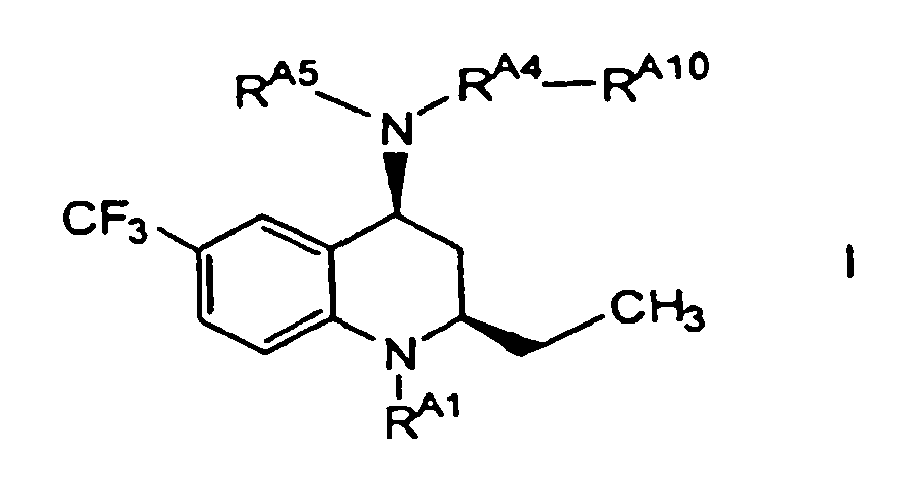
RA4 eine optional substituierte Alkylengruppe ist;
RA5 eine gesättigte oder ungesättigte monocyclische oder bicyclische heterocyclische Gruppe ist, die 1 bis 4 Heteroatome enthält, welche unabhängig voneinander aus Sauerstoff-, Schwefel- und Stickstoffatomen ausgewählt sind, wobei die besagte heterocyclische Gruppe mit 1 bis 5 Substituenten substituiert ist, welche aus den folgenden Gruppen ausgewählt sind, oder die besagte heterocyclische Gruppe mit 1 bis 5 Substituenten substituiert ist, die aus den folgenden Gruppen ausgewählt ist, und des weiteren durch ein Halogenatom eine Oxo- und/oder Hydroxygruppe:eine Cyanogruppe, eine Nitrogruppe, eine Carboxylgruppe, eine Sulfogruppe, eine C3-10-Alkylgruppe, eine substituiert Alkylgruppe, eine optional substituierte Cycloalkylgruppe, eine optional substituierte Alkenylgruppe, eine C3-10-Alkoxygruppe, eine substituierte Alkoxygruppe, eine optional substituierte Cycloalkoxygruppe, eine optional substituierte Alkoxycarbonylgruppe, eine optional substituierte Carbamoylgruppe, eine optional substituierte Carbamimidoylgruppe, eine optional substituierte Alkylthiogruppe, eine optional substituierte Alkylsulfinylgruppe, eine optional substituierte Alkylsulfonylgruppe, eine optional substituierte Aminogruppe, eine optional substituierte Sulfamoylgruppe, eine optional substituierte Alkanoylgruppe, eine gesättigte oderungesättigte monocyclische oder bicyclische heterocyclische Gruppe, die 1 bis 4 Heteroatome enthält, die unabhängig voneinander aus Sauerstoff-, Schwefel- und Stickstoffatomen ausgewählt sind (die heterocyclische Gruppe ist optional substituiert), eine gesättigte oderungesättigte monocyclische oder bicyclische heterocyclische Oxygruppe, die 1 bis 4 Heteroatome enthält, die unabhängig voneinander aus Sauerstoff-, Schwefel- und Stickstoffatomen ausgewählt sind (die heterocyclische Oxygruppe ist optional substituiert), und eine gesättigte oderungesättigte monocyclische oder bicyclische heterocyclische Carbonylgruppe, die 1 bis 4 Heteroatome enthält, welche unabhängig voneinander aus Sauerstoff-, Schwefel- und Stickstoffatomen ausgewählt sind (die heterocyclische Carbonylgruppe ist optional substituiert); undRA10 ist ein aromatischer Ring, der optional 1 bis 3 Heteroatome enthält, die unabhängig voneinander ausgewählt sind aus Sauerstoff-, Schwefel- und Stickstoffatomen (der aromatische Ring ist optional substituiert), oder ein pharmazeutisch annehmbares Salz davon;
umfassend die Herstellung von (2R,4S)-2-Ethyl-6-trifluormethyl-1,2,3,4-tetrahydrochinolin-4-ylamin (I-a) oder eines Salzes davon, gemäß dem Verfahren von Anspruch 1 oder 2, und Einführen von -RA5, -RA1 und -RA4-RA10, gefolgt von der Umwandlung des Produktes in ein pharmazeutisch annehmbares Salz davon, falls gewünscht;
wobei -RA5 durch eine Reaktion mit einer Verbindung der Formel:
-RA5-ZA4
eingeführt wird,
wobei -ZA4 ein eine Abgangsgruppe bedeutet und das andere Symbol dieselbe Bedeutung hat wie oben beschrieben;
-RA4-RA10 durch Reaktion mit einer Verbindung der Formel:
-RA10-RA4-ZA1
eingeführt wird,
wobei -ZA1 eine Abgangsgruppe bedeutet und die anderen Symbole dieselbe Bedeutung haben wie oben beschrieben;
und -RA1 durch eine Reaktion mit einer Verbindung der Formel:
-RA1-ZA5
eingeführt wird,
wobei -ZA5 eine Abgangsgruppe bedeutet und das andere Symbol dieselbe Bedeutung hat wie oben beschrieben. - Verfahren gemäß Anspruch 3, wobei -RA5 zuerst eingeführt wird und dann jeweils -RA1 und -RA4-RA10 eingeführt werden.
- Verfahren zur Herstellung einer Verbindung der allgemeinen Formel (II):

YB in jedem Fall unabhängig ZB oder eine vollständig gesättigte, teilweise ungesättigte oder vollständig ungesättigte geradkettige oder verzweigte Kohlenstoffkette mit 1 bis 10 Bestandteilen ist, wobei das besagte Kohlenstoffatom außer einen Linker durch ein oder zwei Heteroatome ersetzt werden können, die unabhängig voneinander aus Sauerstoff, Schwefel und Stickstoff ausgewählt sind; und das besagte Kohlenstoffatom mono-, di- oder tri-substituiert sein kann mit Halogen, das besagte Kohlenstoffatom mit Hydroxyl substituiert sein kann und das besagte Kohlenstoffatom mono-substituiert sein kann mit Oxo;
der besagte Schwefel kann mono- oder di-substituiert sein mit Oxo; der besagte Stickstoff kann mono- oder di-substituiert sein mit Oxo; und
die besagte Kohlenstoffkette kann mono-substituiert sein mit ZB;
ZB ein teilweise gesättigter, vollständig gesättigter oder vollständig ungesättigter 3- bis 8-gliedriger Ring ist, welcher 1 bis 4 Heteroatome enthalten kann, die unabhängig voneinander aus Sauerstoff, Schwefel und Stickstoff ausgewählt sind, oder ein bicyclischer Ring, der optional 1 bis 4 Heteroatome enthält, die unabhängig voneinander ausgewählt sind aus Stickstoff, Schwefel und Sauerstoff, worin zwei teilweise gesättigte, vollständig gesättigte oder vollständig ungesättigte 3- bis 6-gliedrige Ringe verknüpft sind; und die ZB-Gruppe unabhängig voneinander mit 1, 2 oder 3 Substituenten substituiert sein kann, die ausgewählt sind aus Halo, (C2-C6)-Alkenyl, (C1-C6)-Alkyl, Hydroxyl, (C1-C6)-Alkoxy, (C1-C4)-Alkylthio, Amino, Nitro, Cyano, Oxo, Carboxy, (C1-C6)-Alkyloxycarbonyl, Mono-N-(C1-C6)-alkylamino und Di-N,N-(C1-C6)-alkylamino; der besagte (C1-C6)-Alkylsubstituent kann unabhängig substituiert sein mit 1, 2 oder 3 Substituenten, die ausgewählt sind aus Halo, Hydroxyl, (C1-C6)-Alkoxy, (C1-C4)-Alkylthio, Amino, Nitro, Cyano, Oxo, Carboxy, (C1-C6)-Alkoxycarbonyl, Mono-N-(C1-C6)-alkylamino und Di-N,N-(C1-C6)-alkylamino; und der besagte (C1-C6)-Alyklsubstituent kann mit 1 bis 9 Fluor substituiert sein;
RB3 Wasserstoff oder QB ist; QB ist eine vollständig gesättigte, teilweise ungesättigte oder vollständige geradkettige oder verzweigte Kohlenstoffkette mit 1 bis 6 Mitgliedern, wobei das Kohlenstoffatom außer einem Linker durch ein Heteroatom ersetzt werden kann, das unabhängig voneinander ausgewählt ist aus Sauerstoff, Schwefel oder Stickstoff; und das besagte Kohlenstoffatom mono-, di- oder tri-substituiert sein kann mit Halo, das besagte Kohlenstoffatom mono-substituiert sein kann mit Hydroxyl, und das besagte Kohlenstoffatom mono-substituiert sein kann mit Oxo; der besagte Schwefel kann mono- oder di-substituiert sein mit Oxo; der besagte Stickstoff kann mono- oder di-substituiert sein mit Oxo; und die besagte Kohlenstoffkette kann mono-substituierte sein mit VB;
VB ist ein teilweise gesättigter, vollständig gesättigter oder vollständig ungesättigter 3- bis 8-gliedriger Ring ist, welcher 1 bis 4 Heteroatome enthalten kann, die unabhängig voneinander aus Sauerstoff, Schwefel und Stickstoff ausgewählt sind, oder ein bicyclischer Ring, der optional 1 bis 4 Heteroatome enthält, die unabhängig voneinander ausgewählt sind aus Stickstoff, Schwefel und Sauerstoff, worin zwei teilweise gesättigte, vollständig gesättigte oder vollständig ungesättigte 3- bis 6-gliedrige Ringe verknüpft sind; und die VB-Gruppe unabhängig voneinander mit 1, 2 oder 3 Substituenten substituiert sein kann, die ausgewählt sind aus Halo, (C1-C6)-Alkyl, (C2-C6)-Alkenyl, Hydroxyl, (C1-C6)-Alkoxy, (C1-C4)-Alkylthio, Amino, Nitro, Cyano, Oxo, Carboxy, (C1-C6)-Alkyloxycarbonyl, Mono-N-(C1-C6)-alkylamino und Di-N,N-(C1-C6)-alkylamino; die besagte (C1-C6)-Alkyl- und ((C2-C6)-Alkenyl-Gruppe kann unabhängig substituiert sein mit 1, 2 oder 3 Substituenten, die ausgewählt sind aus Hydroxyl, (C1-C6)-Alkoxy, (C1-C4)-Alkylthio, Amino, Nitro, Cyano, Oxo, Carboxy, (C1-C6)-Alkoxycarbonyl, Mono-N-(C1-C6)-alkylamino und Di-N,N-(C1-C6)-alkylamino; und die besagte (C1-C6)-Alykl- und (C2-C6)-AlkenylGruppe kann mit 1 bis 9 Fluor substituiert sein;
RB4 ist QB1 oder VB1; QB1 ist eine vollständig gesättigte, teilweise ungesättigte oder vollständig ungesättigte geradkettige oder verzweigte Kohlenstoffkette mit 1 bis 6 Mitgliedern, wobei das Kohlenstoffatom außer einem Linker durch ein Heteroatom ersetzt werden kann, das unabhängig voneinander ausgewählt ist aus Sauerstoff, Schwefel oder Stickstoff; und das besagte Kohlenstoffatom mono-, di- oder tri-substituiert sein kann mit Halo, das besagte Kohlenstoffatom mono-substituiert sein kann mit Hydroxyl, und das besagte Kohlenstoffatom mono-substituiert sein kann mit Oxo; der besagte Schwefel kann mono- oder di-substituiert sein mit Oxo; der besagte Stickstoff kann mono- oder di-substituiert sein mit Oxo; und die besagte Kohlenstoffkette kann mono-substituierte sein mit VB1;
VB1 ist ein teilweise gesättigter, vollständig gesättigter oder vollständig ungesättigter 3- bis 6-gliedriger Ring, welcher 1 bis 2 Heteroatome enthalten kann, die unabhängig voneinander ausgewählt sind aus Stickstoff, Schwefel und Sauerstoff; die besagte VB1-Gruppe kann mit 1, 2, 3 oder 4 Substituenten substituiert sein, die ausgewählt sind aus Halo, (C1-C6)-Alkyl, (C1-C6)-Alkoxy, Amino, Nitro, Cyano, (C1-C6)-Alkyloxycarbonyl, Mono-N-(C1-C6)-alkylamino und Di-N,N-(C1-C6)-alkylamino; die besagte (C1-C6)-Alkylgruppe kann mono-substituiert sein mit Oxo; die besagte (C1-C6)-Alkylgruppe kann mit 1 bis 9 Fluor substituiert sein; unter der Voraussetzung, dass RB3 VB einschließen muss, oder RB4 VB1 einschließen muss, ein Propharmakon davon, oder ein pharmazeutisch annehmbares Salz der Verbindung oder des Propharmakons,
welches die Herstellung von (2R,4S)-2-Ethyl-6-trifluormethyl-1,2,3,4-tetrahydrochinolin-4-yl-amin (I-a) oder eines Salzes davon gemäß dem Verfahren von Anspruch 1 oder 2, und Einführen von -RB1, -COORB4 und -RB3, gefolgt von der Umwandlung des Produktes in ein Propharmakon davon, oder ein pharmazeutisch annehmbares Salz der Verbindung oder des Propharmakons, falls gewünscht, umfasst,
wobei -RB1 durch Reaktion mit einem Carbonylchlorid, Sulfonylchlorid, Sulfinylchlorid, Isocyanat oder Thioisocyanat eingeführt wird, -COORB4 durch Reaktion mit einem aktivierten Carbonat eingeführt wird, und -RB3 durch Reaktion mit einer aktivierten Carbonsäure und Reduktion der resultierenden Verbindung eingeführt wird. - Verfahren zur Herstellung einer Verbindung der allgemeinen Formel (III):

Rc1 eine Gruppe ist, die ausgewählt ist aus Hydroxyl, (C1-C6) -Alkyl, Aryl, (C2-C6) -Alkenyl, (C1-C6) -Haloalkyl, (C1-C6) -Alkylheterozyklus, (C3-C8) -Cycloalkyl, (C1-C6)-Alkylcycloalkyl, (C1-C6) -Alkylaryl, Heterocyclyl, (C1-C6) -Alkylalkohol, (C1-C6) -Alkoxy, Aryloxy, -O (C2-C6) -Alkenyl, -O (C1-C6) -Haloalkyl, -O (C1-C6)-Alkylheterozyklus, -O (C3-C8) -Cycloalkyl, -O (C1-C6)-Alkylcycloalkyl, -NRc7Rc8 und -O (C1-C6) -Alkylaryl, -O-Heterozyklus, -O (C1-C6) -Alkylheterozyklus, (C1-C6)-Alkyl-O-C (0) NRc7Rc8, (C1-C6) -Alkyl-NRc7C (O) NRc7Rc8 und (C0-C6) -Alkyl-COORc11;
unter der Maßgabe, dass Rc1 nicht Hydroxyl ist, wenn Yc -S(O)t ist; und das Cycloalkyl, das Aryl und der Heterozyklus können mit 1 bis 3 Substituenten substituiert sein, die unabhängig voneinander ausgewählt sind aus Oxo, Hydroxyl, Halo, (C1-C6)-Alkyl, (C2-C6)-Alkenyl, (C2-C6)-Alkinyl, (C1-C6)-Alkoxy, (C1-C6)-Haloalkyl, (C1-C6)-Alkylalkohol, CONRc11Rc12, -NRc11SO2Rc12, -NRc11CORc12, (C0-C3)-Alkyl-NRc11 R c12, (C1-C3)-Alkyl-CORc11, (C0-C6) -Alkyl-COORc11, Cyano, (C1-C6)-Alkylcycloalkyl, Phenyl, -O(C1-C6)-Alkylcycloalkyl, -O (C1-C6) -Alkylaryl, -O (C1-C6)-Alkylheterozyklus und (C1-C6)-Alkylaryl;
R c4a eine heterocyclische Gruppe ist, die mit 1 bis 3 Substituenten substituiert ist, die unabhängig voneinander ausgewählt sind aus (C3-C6)-Alkyl, (C3-C6)-Alkenyl, (C0-C3)-Alkyl-CN, (C3-C6)-Alkoxy, (C1-C6)-Alkylalkohol, (C3-C6)-Haloalkyl, -OCONRc11Rc12, (C1-C6)-Alkyl-NRc11Rc12, [das (C1-C6)-Alkyl kann substituiert sein mit -ORc10 oder -C (O) ORc10], (C0-C6)-Alkyl-NRc11SO2Rc12, (C0-C6) -Alky-C (O) NRc11Rc12, (C0-C6)-Alkyl-NRc11C(O)NRc12, (C0-C6)-Alkyl-NRc11C(O)NRc12, (C0-C6)-Alkyl-NRc11CHRc10CO2NRc12, (C0-C6)-Alkyl-CO(O)Rc11, (C0-C6)-Alkyl-SO2NRc11Rc12, (C0-C6)-Alkyl -SOtRc11, (C3-C8)-Cycloalkyl, (C1-C6)-Alkylcycloalkyl und (C0-C6)-Alkylheterozyklus [der heterozyklische Ring des (C0-C6)-Alkylheterozyklus kann mit Halo, (C1-C6)-Alkyl, Oxo, CO2Rc11 oder -NRc11Rc12 substituiert sein];
Rc4b eine Gruppe ist, die ausgewählt ist aus (C1-C6)-Alkylaryl, (C2-C6)-Alkenylaryl, (C2-C6)-Alkinylaryl, (C1-C6)-Alkylheterozyklus, (C2-C6)-Alkenylheterozyklus, (C1-C6)-Alkylcycloalkyl und (C1-C6)-Alkyl-O-(C1-C6)-alkylaryl, und das Cycloalkyl, das Aryl und der Heterozyklus können mit 1 bis 3 Substituenten substituiert sein, die unabhängig voneinander ausgewählt sind aus Hydroxyl, Oxo, -S(C1-C6)-Alkyl, (C1-C6)-Alkyl, (C2-C6)-Alkenyl, (C2-C6)-Alkinyl, (C1-C6)-Haloalkyl, ein Halogenatom, (C1-C6)-Alkoxy, Aryloxy, (C2-C6)-Alkenyloxy, (C1-C6)-Haloalkoxyalkyl, (C0-C6)-Alkyl-NRc11Rc12, -O (C1-C6) -Alkylaryl, Nitro, Cyano, (C1-C6)-Haloalkylalkohol und (C1-C6) -Alkylalkohol;
Rc6 eine Gruppe ist, die unabhängig ausgewählt ist aus Wasserstoff, (C1-C6) -Alkyl, (C2-C6) -Alkenyl, Hydroxyl, -CORc7, (C1-C6)-Alkoxy, Aryloxy, -O (C2-C6) -Alkenyl, -O (C1-C6) -Haloalkyl, (C1-C6) -Alkyl-NRc7Rc8, (C3-C8)-Cycloalkyl, Heterozyklus, Aryl, (C1-C6) -Alkyl-O-C (O) NRc7Rc8, (C1-C6) -Alkyl-NRc7C (O) NRc7Rc8 und (C1-C6)-Alkylcycloalkyl,
Rc7 und Rc8 Gruppen sind, die unabhängig ausgewählt sind aus Wasserstoff, (C1-C6) -Alkyl, (C2-C6) -Alkenyl, (C2-C6) -Alkinyl, -O (C1-C6) -Alkyl, (C1-C6) -Haloalkyl, -O-Aryl, -O (C3-C8) -Cycloalkyl, -O-Heterozyklus, -NRc7Rc8, (C1-C6) -Alkylcycloalkyl, -O (C1-C6)-Alkylcycloalkyl, -O (C1-C6) -Alkylheterozyklus, (C1-C6)-Alkylheterozyklus, -O (C1-C6) -Alkylaryl, (C3-C8)-Cycloalkyl, Heterozyklus, Aryl und (C1-C6) -Alkylaryl; und das Alkyl, das Cycloalkyl, der Heterozyklus und das Aryl können mit 1 bis 3 Substituenten substituiert sein, die unabhängig voneinander ausgewählt sind aus Hydroxyl, CN, Halo, (C1-C6) -Alkyl, (C1-C6) -Alkoxy, (C1-C6)-Haloalkyl und NRc11Rc12; oder Rc7 und Rc8 können miteinander kombiniert werden, um einen Stickstoff-haltigen heterocyclischen Ring zu bilden, der darüber hinaus 0, 1 oder 2 Heteroatome enthält, die ausgewählt sind aus einem Sauerstoffatom, einem Stickstoffatom und einem Schwefelatom, und der besagte Stickstoff-haltige heterocyclische Ring kann mit Oxo oder (C1-C6)-Alkyl substituiert sein;
Rc10, Rc11 und Rc12 sind Gruppen, die unabhängig voneinander ausgewählt sind aus Wasserstoff, (C1-C6)-Alkyl, (C2-C6)-Alkenyl, (C3-C8)-Cycloalkyl, Heterozyklus, Aryl und (C1-C6)-Alkylaryl; und das Alkyl, das Aryl, das Cycloalkyl und der Heterozyklus können mit 1 bis 3 Substituenten substituiert sein, die unabhängig voneinander ausgewählt sind aus Halogenatom, (C1-C6)-Alkylheterozyklus und (C1-C6)-Haloalkyl;
oder Rc11 und Rc12 können miteinander kombiniert werden, um einen Stickstoff-haltigen heterocyclischen Ring zu bilden, der darüber hinaus 0, 1 oder 2 Heteroatome enthält, die ausgewählt sind aus einem Sauerstoffatom, einem Stickstoffatom und einem Schwefelatom; und der besagte Stickstoff-haltige heterocyclische Ring kann mit Oxo, (C1-C6)-Alkyl, -CORc7 und -SO2Rc7 substituiert sein;
oder eines pharmazeutisch annehmbaren Salzes, Solvats, Enantiomers, Razemats, Diastereomers oder einer Mischung von Diasteromeren davon,
welches die Herstellung von (2R,4S)-2-Ethyl-6-trifluormethyl-1,2,3,4-tetrahydrochinolin-4-yl-amin (I-a) oder eines Salzes davon gemäß dem Verfahren von Anspruch 1 oder 2 und Einführen von -(CHRc6)n-Yc-Rc1 -Rc4a bzw. -Rc4b, gefolgt durch Umwandlung des Produktes in ein pharmazeutisch annehmbares Salz, Solvat, Enantiomer, Razemat, Diastereomer oder eine Mischung von Diasteromeren davon, falls gewünscht, umfasst,
wobei -(CHRc6)n-Yc-Rc1 durch eine Reaktion mit Arylchlorformiat oder Alkylchlorformiat eingeführt wird, -Rc4a durch Reaktion mit einem aktivierten Heteroarylsubstrat eingeführt wird und -Rc4b durch Reaktion mit Benzaldehyd und Reduktion der resultierenden Verbindung eingeführt wird. - Verfahren zur Herstellung von (R)-2-Ethyl-6-trifluormethyl-2,3-dihydro-1H-chinolin-4-on (I-c), welches die Reaktion von Phosphorpentoxid mit (R)-3-(4-Trifluormethyl-phenylamino)-valeriansäure (I-d) umfasst.
- Das Verfahren wie beansprucht in irgendeinem der Ansprüche 2 bis 7, wobei die Reaktion von Phosphorpentoxid mit (R)-3-(4-Trifluormethylphenylamino)-valeriansäure (I-d) in der Gegenwart einer organischen Sulfonsäure oder eines organischen Siloxans durchgeführt wird.
- Verfahren gemäß Anspruch 8, wobei die organische Sulfonsäure oder das organische Siloxan eine Methansulfonsäure ist.
- Verfahren gemäß Anspruch 1, 2, 3, 4, 5 oder 6, worin der Palladiumkatalysator Palladiumcarbon ist.
- (R)-2-Ethyl-6-trifluormethyl-2,3-dihydro-1H-chinolin-4-on (I-c).
- (R)-2-Ethyl-6-trifluormethyl-2,3-dihydro-1H-chinolin-4-on-oxim oder (R)-2-Ethyl-6-trifluormethyl-2,3-dihydro-1H-chinolin-4-on-O-methyloxim (I-b).
Priority Applications (1)
| Application Number | Priority Date | Filing Date | Title |
|---|---|---|---|
| EP09174862A EP2154132A1 (de) | 2006-03-30 | 2007-03-29 | Verfahren zur Herstellung von Tetrahydroquinolinderivative |
Applications Claiming Priority (3)
| Application Number | Priority Date | Filing Date | Title |
|---|---|---|---|
| JP2006092783 | 2006-03-30 | ||
| JP2006322845 | 2006-11-30 | ||
| PCT/JP2007/057610 WO2007116922A1 (en) | 2006-03-30 | 2007-03-29 | A process for preparing tetrahydroquinoline derivatives |
Related Child Applications (1)
| Application Number | Title | Priority Date | Filing Date |
|---|---|---|---|
| EP09174862.4 Division-Into | 2009-11-03 |
Publications (2)
| Publication Number | Publication Date |
|---|---|
| EP2007728A1 EP2007728A1 (de) | 2008-12-31 |
| EP2007728B1 true EP2007728B1 (de) | 2011-11-16 |
Family
ID=38123770
Family Applications (2)
| Application Number | Title | Priority Date | Filing Date |
|---|---|---|---|
| EP07741046A Active EP2007728B1 (de) | 2006-03-30 | 2007-03-29 | Verfahren zur herstellung von tetrahydrochinolinderivaten |
| EP09174862A Withdrawn EP2154132A1 (de) | 2006-03-30 | 2007-03-29 | Verfahren zur Herstellung von Tetrahydroquinolinderivative |
Family Applications After (1)
| Application Number | Title | Priority Date | Filing Date |
|---|---|---|---|
| EP09174862A Withdrawn EP2154132A1 (de) | 2006-03-30 | 2007-03-29 | Verfahren zur Herstellung von Tetrahydroquinolinderivative |
Country Status (10)
| Country | Link |
|---|---|
| US (1) | US8084611B2 (de) |
| EP (2) | EP2007728B1 (de) |
| JP (1) | JP5275971B2 (de) |
| AR (1) | AR060174A1 (de) |
| AT (1) | ATE533747T1 (de) |
| ES (1) | ES2374315T3 (de) |
| PE (1) | PE20071150A1 (de) |
| TW (1) | TW200808731A (de) |
| UY (1) | UY30244A1 (de) |
| WO (1) | WO2007116922A1 (de) |
Families Citing this family (30)
| Publication number | Priority date | Publication date | Assignee | Title |
|---|---|---|---|---|
| AR069165A1 (es) * | 2007-11-05 | 2010-01-06 | Novartis Ag | Derivados de 4-bencilamino-1-carboxacilpiperidina como inhibidores de cetp utiles para el tratamiento de hiperlipidemia |
| PT2404901E (pt) * | 2007-12-03 | 2013-08-29 | Novartis Ag | Derivados de 4-benzilamino-pirrolidina 1,2-dissubstituídos como inibidores de cetp úteis para o tratamento de doenças tais como a hiperlipidemia ou a arteriosclerose |
| CN102020608B (zh) * | 2010-09-17 | 2012-09-05 | 清华大学 | 喹啉化合物的制备方法 |
| MA40378B1 (fr) * | 2014-08-12 | 2022-10-31 | Newamsterdam Pharma B V | Procédé de préparation d'intermédiaires synthétiques pour la préparation de dérivés de la tétrahydroquinoléine |
| WO2017023165A1 (en) * | 2015-08-04 | 2017-02-09 | Dezima Pharma B.V. | Pharmaceutical composition and therapeutic combination comprising a cholesteryl ester transfer protein inhibitor and an atp citrate lyase inhibitor – ampk activator |
| US10085999B1 (en) | 2017-05-10 | 2018-10-02 | Arixa Pharmaceuticals, Inc. | Beta-lactamase inhibitors and uses thereof |
| MX2020004071A (es) | 2017-10-02 | 2020-07-28 | Arixa Pharmaceuticals Inc | Derivados de aztreonam y usos de los mismos. |
| EP3590927A1 (de) | 2018-07-05 | 2020-01-08 | Bayer Animal Health GmbH | Neuartige verbindungen zur bekämpfung von arthropoden |
| US11180500B2 (en) | 2018-10-01 | 2021-11-23 | Arixa Pharmaceuticals, Inc. | Derivatives of relebactam and uses thereof |
| MX2021011026A (es) | 2019-03-12 | 2021-10-13 | Arixa Pharmaceuticals Inc | Forma cristalina de un derivado de avibactam. |
| WO2020219258A1 (en) | 2019-04-25 | 2020-10-29 | Arixa Pharmaceuticals, Inc. | Methods of synthesizing aztreonam derivatives |
| TWI825323B (zh) * | 2019-06-18 | 2023-12-11 | 美商美國禮來大藥廠 | 用於製備2-(2,6-二氯苯基)-1-[(1s,3r)-3-(羥甲基)-5-(3-羥基-3-甲基丁基)-1-甲基-3,4-二氫異喹啉-2(1h)-基]乙烯酮之方法及中間物 |
| CA3200234A1 (en) | 2020-11-25 | 2022-06-02 | Daryl C. Drummond | Lipid nanoparticles for delivery of nucleic acids, and related methods of use |
| EP4125911B1 (de) | 2021-03-05 | 2024-04-24 | NewAmsterdam Pharma B.V. | Obicetrapib zur behandlung von demenz |
| MX2024001170A (es) | 2021-07-26 | 2024-05-14 | Newamsterdam Pharma B V | Tratamiento de personas hiporreactivas a his. |
| IL314031A (en) | 2021-12-30 | 2024-09-01 | Newamsterdam Pharma B V | Obicetrapib and sglt2 inhibitor combination |
| CN114516865B (zh) * | 2022-03-09 | 2023-06-23 | 成都师范学院 | 一类D-π-A型有机共轭分子及其制备方法和应用 |
| EP4531819A2 (de) | 2022-05-25 | 2025-04-09 | Akagera Medicines, Inc. | Lipidnanopartikel zur abgabe von nukleinsäuren und verfahren zur verwendung davon |
| PE20251749A1 (es) | 2022-07-05 | 2025-07-09 | Newamsterdam Pharma B V | Sales de obicetrapib y procesos para su fabricacion y productos intermedios de estos |
| TW202416994A (zh) | 2022-08-22 | 2024-05-01 | 荷蘭商新阿姆斯特丹製藥公司 | 固定劑量醫藥組合物及其用途 |
| EP4661865A1 (de) | 2023-02-07 | 2025-12-17 | NewAmsterdam Pharma B.V. | Obicetrapib- und ezetimibkombinationsbehandlung und pharmazeutische zusammensetzungen mit fixer dosis |
| WO2025059594A1 (en) | 2023-09-15 | 2025-03-20 | Newamsterdam Pharma B.V. | METHODS FOR TREATING HETEROZYGOUS FAMILIAL HYPERCHOLESTEROLEMIA (HeFH) |
| WO2025093436A1 (en) | 2023-11-01 | 2025-05-08 | Newamsterdam Pharma B.V. | Treatment and prevention of age-related macular degeneration using a cetp inhibitor |
| WO2025093129A1 (en) | 2023-11-01 | 2025-05-08 | Newamsterdam Pharma B.V. | Treatment and prevention of age-related macular degeneration using a cetp inhibitor |
| WO2025146262A1 (en) | 2024-01-03 | 2025-07-10 | Newamsterdam Pharma B.V. | Obicetrapib for use in the treatment of hemoglobinopathies |
| WO2025146415A1 (en) | 2024-01-03 | 2025-07-10 | Newamsterdam Pharma B.V. | Improvement in atherosclerotic plaque characteristics with obicetrapib |
| WO2026062050A1 (en) | 2024-09-17 | 2026-03-26 | Newamsterdam Pharma B.V. | Obicetrapib for use in methods for treating a subject having heterozygous familial hypercholesterolemia (hefh) and/or atherosclerotic cardiovascular disease (ascvd) |
| WO2026063944A1 (en) | 2024-09-21 | 2026-03-26 | Newamsterdam Pharma B.V. | Obicetrapib for the treatment of dementias |
| WO2026062049A1 (en) | 2024-09-21 | 2026-03-26 | Newamsterdam Pharma B.V., | Obicetrapib for the treatment of dementias |
| WO2026087915A1 (en) | 2024-10-25 | 2026-04-30 | Newamsterdam Pharma B.V. | Treatment and prevention of sepsis or other dysregulated inflammatory responses using cetp inhibitor obicetrapib |
Family Cites Families (36)
| Publication number | Priority date | Publication date | Assignee | Title |
|---|---|---|---|---|
| FI82094C (fi) | 1989-02-16 | 1997-09-09 | Valmet Corp | Anvaendning av en legering av ett metallpulver och en karbid eller nitrid innefattande belaeggningskomposition foer en i en pappersmaskin anvaendbar yankeecylinder |
| ATE147732T1 (de) | 1989-03-08 | 1997-02-15 | Merck Sharp & Dohme | Tetrahydroquinolin-derivate, verwendbar bei neurodegenerativen krankheiten |
| DE69016125T2 (de) | 1989-08-11 | 1995-06-01 | Zeneca Ltd | Chinolin-Derivate, Verfahren zu ihrer Herstellung und ihre Anwendung als Arzneimittel. |
| JPH03161360A (ja) | 1989-11-21 | 1991-07-11 | Tdk Corp | サーマルヘッド |
| JPH03216566A (ja) | 1990-01-22 | 1991-09-24 | Mitsubishi Electric Corp | Ccdリニアイメージセンサのテスト装置 |
| GB9010394D0 (en) | 1990-05-09 | 1990-06-27 | Ici Plc | Heterocyclic compounds |
| IE914573A1 (en) | 1991-01-17 | 1992-07-29 | Ici Plc | Boron compounds |
| JPH05213884A (ja) | 1991-06-14 | 1993-08-24 | Upjohn Co:The | 新規な4−アミノキノリン類およびこれを有効成分とする高血圧・鬱血性心不全の予防・治療剤 |
| US5576460A (en) | 1994-07-27 | 1996-11-19 | Massachusetts Institute Of Technology | Preparation of arylamines |
| US5929281A (en) | 1996-04-19 | 1999-07-27 | Tosoh Corporation | Process for producing heterocyclic aromatic amine or arylamine |
| US6147090A (en) | 1998-09-17 | 2000-11-14 | Pfizer Inc. | 4-carboxyamino-2-methyl-1,2,3,4,-tetrahydroquinolines |
| US6197786B1 (en) | 1998-09-17 | 2001-03-06 | Pfizer Inc | 4-Carboxyamino-2-substituted-1,2,3,4-tetrahydroquinolines |
| GT199900147A (es) | 1998-09-17 | 1999-09-06 | 1, 2, 3, 4- tetrahidroquinolinas 2-sustituidas 4-amino sustituidas. | |
| HN2000000203A (es) | 1999-11-30 | 2001-06-13 | Pfizer Prod Inc | Procedimiento para la obtencion de 1,2,3,4-tetrahidroquinolinas 4-carboxiamino-2- sustituidas. |
| EP1167521A1 (de) | 2000-06-30 | 2002-01-02 | Aventis Animal Nutrition S.A. | Beschichtete enzymenthaltende Katalysator |
| WO2002008869A2 (en) | 2000-07-25 | 2002-01-31 | Digeo, Inc. | Allowance account for interactive television system |
| JP2002053557A (ja) * | 2000-08-14 | 2002-02-19 | Japan Tobacco Inc | アポリポ蛋白a−i産生促進薬 |
| ATE497385T1 (de) * | 2000-08-18 | 2011-02-15 | Ajinomoto Kk | Neue phenylalanin-derivate |
| SE0101161D0 (sv) * | 2001-03-30 | 2001-03-30 | Astrazeneca Ab | New compounds |
| ES2256461T3 (es) | 2001-04-30 | 2006-07-16 | Pfizer Products Inc. | Compuestos utiles como intermediarios de derivados de 4-aminoquinolina. |
| EP1318139A3 (de) | 2001-12-07 | 2003-07-30 | Solvias AG | Verfahren zur Herstellung von 3-Aminokarbonsäuren und deren Estern |
| US6903233B2 (en) | 2002-03-11 | 2005-06-07 | Takasago International Corporation | Process for producing optically active 3-halogenocarboxylic acid ester and 3-azidocarboxylic acid ester |
| ES2277142T3 (es) | 2002-08-30 | 2007-07-01 | Japan Tobacco Inc. | Compuesto de dibencilamina y su uso medicinal. |
| PL376156A1 (en) | 2002-10-04 | 2005-12-27 | Millennium Pharmaceuticals, Inc. | Pgd2 receptor antagonists for the treatment of inflammatory diseases |
| JP2004238322A (ja) | 2003-02-05 | 2004-08-26 | Sumika Fine Chemicals Co Ltd | (r)−3−アミノペンタンニトリルメタンスルホン酸塩の製造方法 |
| WO2004072041A1 (en) | 2003-02-12 | 2004-08-26 | Care X S.A. | Tetrahydroquinolines as agonists of liver- x receptors |
| US7601842B2 (en) | 2003-02-18 | 2009-10-13 | Takasago International Corporation | Method for producing an optically active tetrahydroquinoline |
| CN1795177A (zh) | 2003-03-28 | 2006-06-28 | 辉瑞产品公司 | 作为治疗动脉粥样硬化和肥胖症的cetp抑制剂的 1 , 2 , 4 , -取代的1,2,3,4,-四氢-和1,2二氢-喹啉以及1, 2 , 3 , 4-四氢-喹喔啉衍生物 |
| US7145030B2 (en) | 2003-04-24 | 2006-12-05 | Ajinomoto Co., Inc. | Production method for optically active N-aryl-β-amino acid compounds |
| JP2004339205A (ja) | 2003-04-24 | 2004-12-02 | Ajinomoto Co Inc | 光学活性N−アリール−β−アミノ酸化合物の製造方法 |
| US7626034B2 (en) | 2003-09-18 | 2009-12-01 | Takasago International Corporation | Asymmetric reductive amination of keto acid derivatives for producing amino acid derivatives |
| US20050239832A1 (en) * | 2004-03-09 | 2005-10-27 | Varghese John | Methods of treatment of amyloidosis using bi-cyclic aspartyl protease inhibitors |
| EA200601785A1 (ru) | 2004-03-26 | 2007-02-27 | Эли Лилли Энд Компани | Соединения и способы лечения дислипидемии |
| UA90269C2 (ru) | 2004-04-02 | 2010-04-26 | Мицубиси Танабе Фарма Корпорейшн | Тетрагидрохинолиновые производные и способ их получения |
| JP2005336083A (ja) | 2004-05-26 | 2005-12-08 | Sumitomo Chemical Co Ltd | 芳香族アミノ化合物の製造方法 |
| JP2008504266A (ja) | 2004-06-24 | 2008-02-14 | イーライ リリー アンド カンパニー | 異脂肪血症を治療するための化合物及び方法 |
-
2007
- 2007-03-26 TW TW096110313A patent/TW200808731A/zh unknown
- 2007-03-26 UY UY30244A patent/UY30244A1/es not_active Application Discontinuation
- 2007-03-28 AR ARP070101288A patent/AR060174A1/es not_active Application Discontinuation
- 2007-03-29 AT AT07741046T patent/ATE533747T1/de active
- 2007-03-29 EP EP07741046A patent/EP2007728B1/de active Active
- 2007-03-29 JP JP2009502420A patent/JP5275971B2/ja active Active
- 2007-03-29 EP EP09174862A patent/EP2154132A1/de not_active Withdrawn
- 2007-03-29 ES ES07741046T patent/ES2374315T3/es active Active
- 2007-03-29 US US12/295,618 patent/US8084611B2/en active Active
- 2007-03-29 PE PE2007000358A patent/PE20071150A1/es not_active Application Discontinuation
- 2007-03-29 WO PCT/JP2007/057610 patent/WO2007116922A1/en not_active Ceased
Also Published As
| Publication number | Publication date |
|---|---|
| US8084611B2 (en) | 2011-12-27 |
| US20090292125A1 (en) | 2009-11-26 |
| JP2009532345A (ja) | 2009-09-10 |
| EP2007728A1 (de) | 2008-12-31 |
| AR060174A1 (es) | 2008-05-28 |
| EP2154132A1 (de) | 2010-02-17 |
| UY30244A1 (es) | 2007-11-30 |
| WO2007116922A1 (en) | 2007-10-18 |
| ATE533747T1 (de) | 2011-12-15 |
| ES2374315T3 (es) | 2012-02-15 |
| JP5275971B2 (ja) | 2013-08-28 |
| TW200808731A (en) | 2008-02-16 |
| PE20071150A1 (es) | 2007-12-03 |
Similar Documents
| Publication | Publication Date | Title |
|---|---|---|
| EP2154132A1 (de) | Verfahren zur Herstellung von Tetrahydroquinolinderivative | |
| ES2431618T3 (es) | Un proceso para la preparación de 6-(7-((1-aminociclopropil)metoxi)-6-metoxiquinolin-4-iloxi)-N-metil-1-naftamida y productos intermedios sintéticos de la misma | |
| KR100428330B1 (ko) | Cetp 저해제로서 4-카복시아미노-2-치환된-1,2,3,4-테트라하이드로퀴놀린 | |
| US8981105B2 (en) | Process of preparing a thrombin specific inhibitor | |
| SK3532001A3 (en) | 4-amino substituted-2-substituted-1,2,3,4-tetrahydroquinolines as cetp inhibitors | |
| JP2002526477A (ja) | Cetp阻害剤としての4−カルボキシアミノ−2−メチル−1,2,3,4−テトラヒドロキノリン類 | |
| JP2019194191A (ja) | ビロキサジン塩を製造する方法及びその新規な多形 | |
| US7868207B2 (en) | Process for producing 1-(3,4-dichlorobenzyl)-5-octylbiguanide or a salt thereof | |
| WO2008001188A2 (en) | An improved process for the preparation of substantially pure aripiprazole | |
| CN101466679A (zh) | 制备四氢喹啉衍生物的方法 | |
| CN107406386A (zh) | 用于生产1‑(4‑羟基苯基)‑4‑(4‑三氟甲氧基苯氧基)哌啶或其盐的方法 | |
| CN110759870A (zh) | 噁拉戈利中间体的合成方法 | |
| EP1812395B1 (de) | Verfahren zur herstellung von aripiprazol, und entsprechende zwischenprodukte und deren herstellung | |
| WO2011158250A1 (en) | Process for preparation of 2, 3-diaryl-5-substituted pyridines and their intermediates | |
| US8093384B2 (en) | Processes for the preparation of alfuzosin | |
| EP1566381B1 (de) | Verfahren zur herstellung von 1-2-(benzimidazol-2-yl-thio)ethyl piperazin bzw. salzen davon | |
| JPH10259184A (ja) | 三環性複素環化合物の製造法 | |
| WO2005012260A2 (en) | Synthetic method for the preparation of quinazolin-4-one derivative |
Legal Events
| Date | Code | Title | Description |
|---|---|---|---|
| PUAI | Public reference made under article 153(3) epc to a published international application that has entered the european phase |
Free format text: ORIGINAL CODE: 0009012 |
|
| 17P | Request for examination filed |
Effective date: 20081017 |
|
| AK | Designated contracting states |
Kind code of ref document: A1 Designated state(s): AT BE BG CH CY CZ DE DK EE ES FI FR GB GR HU IE IS IT LI LT LU LV MC MT NL PL PT RO SE SI SK TR |
|
| AX | Request for extension of the european patent |
Extension state: AL BA HR MK RS |
|
| 17Q | First examination report despatched |
Effective date: 20090408 |
|
| GRAP | Despatch of communication of intention to grant a patent |
Free format text: ORIGINAL CODE: EPIDOSNIGR1 |
|
| DAX | Request for extension of the european patent (deleted) | ||
| RAP1 | Party data changed (applicant data changed or rights of an application transferred) |
Owner name: MITSUBISHI TANABE PHARMA CORPORATION |
|
| RIN1 | Information on inventor provided before grant (corrected) |
Inventor name: HAMADA, TAKESHI Inventor name: KUBOTA, HITOSHI Inventor name: SAKURAGI, AKIRA Inventor name: MORI, YOSHIKAZU Inventor name: NAKAMURA, YOSHINORI Inventor name: OKAMOTO, MASAKI Inventor name: HIGASHIJIMA, TAKANORI Inventor name: HAYASHI, NORIMITSU |
|
| GRAS | Grant fee paid |
Free format text: ORIGINAL CODE: EPIDOSNIGR3 |
|
| GRAA | (expected) grant |
Free format text: ORIGINAL CODE: 0009210 |
|
| AK | Designated contracting states |
Kind code of ref document: B1 Designated state(s): AT BE BG CH CY CZ DE DK EE ES FI FR GB GR HU IE IS IT LI LT LU LV MC MT NL PL PT RO SE SI SK TR |
|
| REG | Reference to a national code |
Ref country code: GB Ref legal event code: FG4D |
|
| REG | Reference to a national code |
Ref country code: CH Ref legal event code: EP |
|
| REG | Reference to a national code |
Ref country code: IE Ref legal event code: FG4D |
|
| REG | Reference to a national code |
Ref country code: ES Ref legal event code: FG2A Ref document number: 2374315 Country of ref document: ES Kind code of ref document: T3 Effective date: 20120215 |
|
| REG | Reference to a national code |
Ref country code: DE Ref legal event code: R096 Ref document number: 602007018766 Country of ref document: DE Effective date: 20120223 |
|
| REG | Reference to a national code |
Ref country code: NL Ref legal event code: VDEP Effective date: 20111116 |
|
| LTIE | Lt: invalidation of european patent or patent extension |
Effective date: 20111116 |
|
| PG25 | Lapsed in a contracting state [announced via postgrant information from national office to epo] |
Ref country code: IS Free format text: LAPSE BECAUSE OF FAILURE TO SUBMIT A TRANSLATION OF THE DESCRIPTION OR TO PAY THE FEE WITHIN THE PRESCRIBED TIME-LIMIT Effective date: 20120316 Ref country code: LT Free format text: LAPSE BECAUSE OF FAILURE TO SUBMIT A TRANSLATION OF THE DESCRIPTION OR TO PAY THE FEE WITHIN THE PRESCRIBED TIME-LIMIT Effective date: 20111116 |
|
| PG25 | Lapsed in a contracting state [announced via postgrant information from national office to epo] |
Ref country code: BE Free format text: LAPSE BECAUSE OF FAILURE TO SUBMIT A TRANSLATION OF THE DESCRIPTION OR TO PAY THE FEE WITHIN THE PRESCRIBED TIME-LIMIT Effective date: 20111116 Ref country code: PT Free format text: LAPSE BECAUSE OF FAILURE TO SUBMIT A TRANSLATION OF THE DESCRIPTION OR TO PAY THE FEE WITHIN THE PRESCRIBED TIME-LIMIT Effective date: 20120316 Ref country code: LV Free format text: LAPSE BECAUSE OF FAILURE TO SUBMIT A TRANSLATION OF THE DESCRIPTION OR TO PAY THE FEE WITHIN THE PRESCRIBED TIME-LIMIT Effective date: 20111116 Ref country code: GR Free format text: LAPSE BECAUSE OF FAILURE TO SUBMIT A TRANSLATION OF THE DESCRIPTION OR TO PAY THE FEE WITHIN THE PRESCRIBED TIME-LIMIT Effective date: 20120217 Ref country code: SI Free format text: LAPSE BECAUSE OF FAILURE TO SUBMIT A TRANSLATION OF THE DESCRIPTION OR TO PAY THE FEE WITHIN THE PRESCRIBED TIME-LIMIT Effective date: 20111116 Ref country code: PL Free format text: LAPSE BECAUSE OF FAILURE TO SUBMIT A TRANSLATION OF THE DESCRIPTION OR TO PAY THE FEE WITHIN THE PRESCRIBED TIME-LIMIT Effective date: 20111116 Ref country code: SE Free format text: LAPSE BECAUSE OF FAILURE TO SUBMIT A TRANSLATION OF THE DESCRIPTION OR TO PAY THE FEE WITHIN THE PRESCRIBED TIME-LIMIT Effective date: 20111116 Ref country code: NL Free format text: LAPSE BECAUSE OF FAILURE TO SUBMIT A TRANSLATION OF THE DESCRIPTION OR TO PAY THE FEE WITHIN THE PRESCRIBED TIME-LIMIT Effective date: 20111116 |
|
| PG25 | Lapsed in a contracting state [announced via postgrant information from national office to epo] |
Ref country code: CY Free format text: LAPSE BECAUSE OF FAILURE TO SUBMIT A TRANSLATION OF THE DESCRIPTION OR TO PAY THE FEE WITHIN THE PRESCRIBED TIME-LIMIT Effective date: 20111116 |
|
| PG25 | Lapsed in a contracting state [announced via postgrant information from national office to epo] |
Ref country code: EE Free format text: LAPSE BECAUSE OF FAILURE TO SUBMIT A TRANSLATION OF THE DESCRIPTION OR TO PAY THE FEE WITHIN THE PRESCRIBED TIME-LIMIT Effective date: 20111116 Ref country code: CZ Free format text: LAPSE BECAUSE OF FAILURE TO SUBMIT A TRANSLATION OF THE DESCRIPTION OR TO PAY THE FEE WITHIN THE PRESCRIBED TIME-LIMIT Effective date: 20111116 Ref country code: DK Free format text: LAPSE BECAUSE OF FAILURE TO SUBMIT A TRANSLATION OF THE DESCRIPTION OR TO PAY THE FEE WITHIN THE PRESCRIBED TIME-LIMIT Effective date: 20111116 Ref country code: BG Free format text: LAPSE BECAUSE OF FAILURE TO SUBMIT A TRANSLATION OF THE DESCRIPTION OR TO PAY THE FEE WITHIN THE PRESCRIBED TIME-LIMIT Effective date: 20120216 Ref country code: SK Free format text: LAPSE BECAUSE OF FAILURE TO SUBMIT A TRANSLATION OF THE DESCRIPTION OR TO PAY THE FEE WITHIN THE PRESCRIBED TIME-LIMIT Effective date: 20111116 |
|
| PG25 | Lapsed in a contracting state [announced via postgrant information from national office to epo] |
Ref country code: RO Free format text: LAPSE BECAUSE OF FAILURE TO SUBMIT A TRANSLATION OF THE DESCRIPTION OR TO PAY THE FEE WITHIN THE PRESCRIBED TIME-LIMIT Effective date: 20111116 |
|
| REG | Reference to a national code |
Ref country code: AT Ref legal event code: MK05 Ref document number: 533747 Country of ref document: AT Kind code of ref document: T Effective date: 20111116 |
|
| PLBE | No opposition filed within time limit |
Free format text: ORIGINAL CODE: 0009261 |
|
| STAA | Information on the status of an ep patent application or granted ep patent |
Free format text: STATUS: NO OPPOSITION FILED WITHIN TIME LIMIT |
|
| 26N | No opposition filed |
Effective date: 20120817 |
|
| PG25 | Lapsed in a contracting state [announced via postgrant information from national office to epo] |
Ref country code: MC Free format text: LAPSE BECAUSE OF NON-PAYMENT OF DUE FEES Effective date: 20120331 |
|
| REG | Reference to a national code |
Ref country code: CH Ref legal event code: PL |
|
| REG | Reference to a national code |
Ref country code: DE Ref legal event code: R097 Ref document number: 602007018766 Country of ref document: DE Effective date: 20120817 |
|
| REG | Reference to a national code |
Ref country code: IE Ref legal event code: MM4A |
|
| PG25 | Lapsed in a contracting state [announced via postgrant information from national office to epo] |
Ref country code: IE Free format text: LAPSE BECAUSE OF NON-PAYMENT OF DUE FEES Effective date: 20120329 Ref country code: CH Free format text: LAPSE BECAUSE OF NON-PAYMENT OF DUE FEES Effective date: 20120331 Ref country code: LI Free format text: LAPSE BECAUSE OF NON-PAYMENT OF DUE FEES Effective date: 20120331 Ref country code: AT Free format text: LAPSE BECAUSE OF FAILURE TO SUBMIT A TRANSLATION OF THE DESCRIPTION OR TO PAY THE FEE WITHIN THE PRESCRIBED TIME-LIMIT Effective date: 20111116 |
|
| PG25 | Lapsed in a contracting state [announced via postgrant information from national office to epo] |
Ref country code: FI Free format text: LAPSE BECAUSE OF FAILURE TO SUBMIT A TRANSLATION OF THE DESCRIPTION OR TO PAY THE FEE WITHIN THE PRESCRIBED TIME-LIMIT Effective date: 20111116 |
|
| PG25 | Lapsed in a contracting state [announced via postgrant information from national office to epo] |
Ref country code: MT Free format text: LAPSE BECAUSE OF FAILURE TO SUBMIT A TRANSLATION OF THE DESCRIPTION OR TO PAY THE FEE WITHIN THE PRESCRIBED TIME-LIMIT Effective date: 20111116 |
|
| PG25 | Lapsed in a contracting state [announced via postgrant information from national office to epo] |
Ref country code: TR Free format text: LAPSE BECAUSE OF FAILURE TO SUBMIT A TRANSLATION OF THE DESCRIPTION OR TO PAY THE FEE WITHIN THE PRESCRIBED TIME-LIMIT Effective date: 20111116 |
|
| PG25 | Lapsed in a contracting state [announced via postgrant information from national office to epo] |
Ref country code: LU Free format text: LAPSE BECAUSE OF NON-PAYMENT OF DUE FEES Effective date: 20120329 |
|
| PG25 | Lapsed in a contracting state [announced via postgrant information from national office to epo] |
Ref country code: HU Free format text: LAPSE BECAUSE OF FAILURE TO SUBMIT A TRANSLATION OF THE DESCRIPTION OR TO PAY THE FEE WITHIN THE PRESCRIBED TIME-LIMIT Effective date: 20070329 |
|
| REG | Reference to a national code |
Ref country code: FR Ref legal event code: PLFP Year of fee payment: 10 |
|
| REG | Reference to a national code |
Ref country code: DE Ref legal event code: R081 Ref document number: 602007018766 Country of ref document: DE Owner name: NEWAMSTERDAM PHARMA B.V., NL Free format text: FORMER OWNER: MITSUBISHI TANABE PHARMA CORPORATION, 541-8505 OSAKA, OSAKA-SHI, JP Ref country code: DE Ref legal event code: R082 Ref document number: 602007018766 Country of ref document: DE Representative=s name: HOFFMANN - EITLE PATENT- UND RECHTSANWAELTE PA, DE Ref country code: DE Ref legal event code: R081 Ref document number: 602007018766 Country of ref document: DE Owner name: DEZIMA PHARMA B.V., NL Free format text: FORMER OWNER: MITSUBISHI TANABE PHARMA CORPORATION, 541-8505 OSAKA, OSAKA-SHI, JP |
|
| REG | Reference to a national code |
Ref country code: FR Ref legal event code: PLFP Year of fee payment: 11 |
|
| REG | Reference to a national code |
Ref country code: GB Ref legal event code: 732E Free format text: REGISTERED BETWEEN 20170216 AND 20170222 |
|
| REG | Reference to a national code |
Ref country code: ES Ref legal event code: PC2A Owner name: DEZIMA PHARMA B.V. DEZIMA PHARMA B.V. Effective date: 20170519 |
|
| REG | Reference to a national code |
Ref country code: FR Ref legal event code: TP Owner name: DEZIMA PHARMA B.V., NL Effective date: 20170612 |
|
| REG | Reference to a national code |
Ref country code: FR Ref legal event code: PLFP Year of fee payment: 12 |
|
| REG | Reference to a national code |
Ref country code: DE Ref legal event code: R081 Ref document number: 602007018766 Country of ref document: DE Owner name: NEWAMSTERDAM PHARMA B.V., NL Free format text: FORMER OWNER: DEZIMA PHARMA B.V., BREDA, NL |
|
| REG | Reference to a national code |
Ref country code: ES Ref legal event code: PC2A Owner name: NEWAMSTERDAM PHARMA B.V. Effective date: 20220712 |
|
| P01 | Opt-out of the competence of the unified patent court (upc) registered |
Effective date: 20230510 |
|
| PGFP | Annual fee paid to national office [announced via postgrant information from national office to epo] |
Ref country code: ES Payment date: 20250415 Year of fee payment: 19 |
|
| PGFP | Annual fee paid to national office [announced via postgrant information from national office to epo] |
Ref country code: GB Payment date: 20260327 Year of fee payment: 20 |
|
| PGFP | Annual fee paid to national office [announced via postgrant information from national office to epo] |
Ref country code: DE Payment date: 20260327 Year of fee payment: 20 |
|
| PGFP | Annual fee paid to national office [announced via postgrant information from national office to epo] |
Ref country code: IT Payment date: 20260319 Year of fee payment: 20 |
|
| PGFP | Annual fee paid to national office [announced via postgrant information from national office to epo] |
Ref country code: FR Payment date: 20260325 Year of fee payment: 20 |