EP2009152B1 - Vorrichtung zur Führung von Faserbündeln für eine Spinnmaschine - Google Patents
Vorrichtung zur Führung von Faserbündeln für eine Spinnmaschine Download PDFInfo
- Publication number
- EP2009152B1 EP2009152B1 EP20080157270 EP08157270A EP2009152B1 EP 2009152 B1 EP2009152 B1 EP 2009152B1 EP 20080157270 EP20080157270 EP 20080157270 EP 08157270 A EP08157270 A EP 08157270A EP 2009152 B1 EP2009152 B1 EP 2009152B1
- Authority
- EP
- European Patent Office
- Prior art keywords
- fiber bundle
- guiding device
- guide
- members
- connecting members
- Prior art date
- Legal status (The legal status is an assumption and is not a legal conclusion. Google has not performed a legal analysis and makes no representation as to the accuracy of the status listed.)
- Ceased
Links
Images




Classifications
-
- D—TEXTILES; PAPER
- D01—NATURAL OR MAN-MADE THREADS OR FIBRES; SPINNING
- D01H—SPINNING OR TWISTING
- D01H5/00—Drafting machines or arrangements ; Threading of roving into drafting machine
- D01H5/18—Drafting machines or arrangements without fallers or like pinned bars
- D01H5/70—Constructional features of drafting elements
- D01H5/72—Fibre-condensing guides
Definitions
- the present invention relates to a fiber bundle guiding device for a spinning machine and, more particularly, to a fiber bundle guiding device for a spinning machine in which a fiber bundle is guided to reduce the width of the fiber bundle with the fiber bundle guiding device.
- Unexamined Japanese Patent Publication No. 2007-9391 discloses a fiber bundle guiding device that can guide a fiber bundle without contact with the fiber bundle.
- the fiber bundle guiding device of the Publication prevents deterioration of the guide surface of the guide member over time due to abrasion and collection of foreign matters.
- the fiber bundle guiding device has two plates as guide members each having a guide surface whose width is reduced along the moving direction of the fiber bundle to be guided and vibrated by its own vibrator.
- document EP 1 734 161 A discloses a guiding device of the same type.
- each plate is vibrated by its own vibrator, is hard to be downsized and to ensure a space for providing a guide member in a passage for the fiber bundle at each spindle of a ring spinning machine.
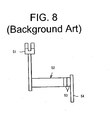
- one vibrator 52 vibrates one guide member 51 in a fiber bundle guiding device.
- the guide member 51 is fixed to a piezoelectric unit 53 of the vibrator 52 on one side thereof, and the bracket 54 is mounted to the end of the piezoelectric unit 53 on the other side thereof.
- only one vibrator 52 is required for each spindle, although the structure has a relatively high impedance and the energy efficiency of the vibrating mechanism including a vibrating device (not shown) is relatively low.
- the present invention which has been made in view of the above problems, is directed to provide a fiber bundle guiding device according to claim 1 for a spinning machine .
- the fiber bundle guiding device can enhance the energy efficiency of the vibrating mechanism for vibrating the guide member which is used for guiding a fiber bundle to reduce the width of the fiber bundle and also ensure a space for installation of the guide member.
- a fiber bundle guiding device for a spinning machine has a draft device and a spindle and guides a fiber bundle to reduce the width of the fiber bundle.
- the fiber bundle guiding device includes guide members which have a guide surface whose width is reduced along the moving direction of the fiber bundle to be guided as installed in the spinning machine.
- the guide members are disposed at an interval corresponding to the spaced distance between at least two adjacent spindles.
- a connecting member connects the guide members and has a rod like shape extending in the direction perpendicular to the guide members.
- An electronic component is used for vibrating the connecting member longitudinally and arranged at the intermediate portion of the connecting member.
- a vibrating mechanism is used for vibrating the guide members to generate a sound pressure for reducing the width of the fiber bundle.
- the vibrating mechanism includes the connecting member and the electronic component.
- the draft device 11 of the spinning machine is of a four-line type including a final delivery roller pair located downstream of the three-line draft section as viewed in the moving direction of fiber bundle F.
- the three-line draft section includes a front bottom roller 12, a middle bottom roller 13, and a back bottom roller 14.
- the middle bottom roller 13 and the back bottom roller 14 are supported by a roller stand 15 forming a part of the frame of the draft device 11 through support brackets 16, 17.
- the support brackets 16, 17 are fixed to the roller stand 15 in such a manner that the positions of the support brackets 16, 17 are adjustable in the fiber bundle moving direction relative to the roller stand 15.
- the three-line draft section further includes a front top roller 21, a middle top roller 22, and a back top roller 23.
- the front top roller 21, the middle top roller 22 and the back top roller 23 are supported by the frame 20B of a weighting arm 20 through top roller support members at positions corresponding to the front bottom roller 12, the middle bottom roller 13 and the back bottom roller 14.
- the weighting arm 20 has a lever 20A pivotable between the pressing position and the releasing position. When the lever 20A is in contact with the frame 20B of the weighting arm 20 as shown in Fig. 1A , the weighting arm 20 is at pressing position.
- the lever 20A is maintained in a locked state at the pressing position (or spinning position) where the weighting arm 20 presses the top rollers 21, 22, 23 supported by the weighting arm 20 toward the bottom rollers 12, 13, 14.
- the lever 20A is pivoted from the pressing position as shown in Fig. 1A upward to the releasing position, the lever 20A is released from the locked state.
- the final delivery roller pair 26 includes a bottom nip roller 26A and a top nip roller 26B.
- the bottom nip roller 26A is supported by the roller stand 15.
- the top nip roller 26B is supported by the weighting arm 20 through a top nip roller support member.
- the top nip roller 26B is supported by the weighting arm 20 through the top nip roller support member for every two spindles in the same manner as the front top roller 21 of the draft device 11.
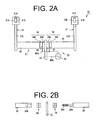
- the fiber bundle guiding device 30 is located between the final delivery roller pair 26 and its immediately preceding roller pair of the front bottom roller 12 and the front top roller 21. As shown in Fig 2A , the fiber bundle guiding device 30 includes guide members 31 and a vibrating mechanism 32 for vibrating the guide members 31.
- the vibrating mechanism 32 includes a bracket 33, two piezoelectric units 34 and two connecting members 35, 36.
- the bracket 33 is connected to the frame of the draft device 11.
- the piezoelectric unit 34 is an electronic component and the two piezoelectric units 34 are disposed on the opposite sides of the bracket 33 so as to sandwitch the bracket 33.
- the vibrator 37 of the vibrating mechanism 32 is arranged in such a way that the bracket 33 and the piezoelectric units 34 are sandwiched by the connecting members 35, 36.
- the connecting members 35, 36 are in a shape of rod made of metal.
- the vibrator 37 is of a Langevin type.
- Each piezoelectric unit 34 has a pair of annular piezoelectric elements 34A, 34B and an annular electrode plate 38 which is provided between the elements 34A, 34B of each pair.
- one connecting member 35 has an internally threaded hole 35A
- the other connecting member 36 has a rod portion 36B.
- the internally threaded hole 35A of the connecting member 35 is formed so as to extend axially internally from the end surface thereof which faces the piezoelectric unit 34.
- the rod portion 36B of the connecting member 36 is formed to project axially from the end surface of the connecting member 36 which faces the piezoelectric unit 34 and to have an externally threaded portion 36A.
- the externally threaded portion 36A of the connecting member 36 extends through the piezoelectric unit 34, the electrode plate 38 and a hole (not shown) of the bracket 33.
- the connecting members 35, 36 are supported by the bracket 33 in such a manner that the piezoelectric units 34 and the electrode plates 38 are fastened together to the bracket 33.
- Each guide member 31 includes a pair of plate-like guides 31 B and a plate-like support portion 31C.
- the paired guides 31 B are disposed so as to face each other thereby to form guide surfaces 31A.
- the support portion 31C is formed continuously with the guides 31 B.
- the support portions 31C are fixed at the proximal ends thereof to the outer ends of the connecting members 35, 36.
- the support portions 31C may be fixed to the connecting members 35, 36 by any suitable means such as brazing.
- the paired guides 31 B are formed so that the clearance between the facing guide surfaces 31A is wider at the upstream end than the downstream end as viewed in the moving direction of the fiber bundle F.
- the guides 31 B are formed so that the clearance between the guides 31 B is gradually widened from the center toward the upstream end of the guide surfaces 31A, and substantially constant from the center toward the downstream end. Though depending on the spinning conditions, the guides 31 B are formed so that the clearance between the guide surfaces 31A of the guides 31 B at the downstream end is about 1 mm or less.
- the vibrator 37 is connected to a vibrating device 39.
- the electrode plates 38 are connected to the vibrating device 39 through a wire 40A.
- the ground terminal of the vibrating device 39 is connected to the bracket 33 through a wire 40B.
- One surface of each piezoelectric unit 34 is in contact with the bracket 33.
- the other surface of each piezoelectric unit 34 is in contact with the appropriate one of the connecting members 35, 36 which is electrically connected to the bracket 33 through the rod portion 36B having the externally threaded portion 36A.
- the electric potential difference between the surfaces of each piezoelectric unit 34 is substantially zero.
- the vibrating device 39 causes the vibrator 37 to vibrate in such a way that the bracket 33 is located at a node of the vibration and the ends of the connecting members 35, 36 to which the guide members 31 are fixed is located at an antinode of the vibration.
- the vibrating device 39 vibrates the vibrator 37 so that the guide member 31 is vibrated at a frequency that is higher than a sound frequency in the human audible range.
- the middle bottom roller 13 and the back bottom roller 14 are set to appropriate positions by adjusting the positions of the support brackets 16, 17 depending on the material for spinning. Then, the middle top roller 22 and the back top roller 23 are set appropriately relative to the positions of the middle bottom roller 13 and the back bottom roller 14.
- the fiber bundle F is drafted at the three-line draft section of the draft device 11 and move to the nip of the final delivery roller pair 26 while the fiber bundle F is guided by the guide surfaces 31A of the guide member 31. Then, the drafted fiber bundle F is delivered from the final delivery roller pair 26.
- the vibrator 37 is vibrated by the vibrating device 39 at a predetermined resonance frequency (for example, around 30 kHz), with the result that the connecting members 35, 36 are vibrated longitudinally and the guide members 31 are vibrated flexurally.
- the guide members 31 are vibrated to generate a sound pressure for reducing the width of the fiber bundle F. Therefore, the fiber bundle F passes the space between the guide surfaces 31A and then collected.
- the fiber bundle F After the fiber bundle F passes through the nip of the bottom nip roller 26A and the top nip roller 26B, the fiber bundle F is moved further downstream while the fiber bundle F is twisted, and then wound on a bobbin (not shown).
- the final delivery roller pair 26 is rotated at a surface speed that is slightly faster than the surface speed of the front bottom roller 12 and the front top roller 21. After the fiber bundle F passes through the nip of the final delivery roller pair 26 with appropriate tension, the fiber bundle F is turned to move downstream while the fiber bundle F is twisted.
- the fiber bundle F drafted at the three-line draft section is compressed to a thickness of 1 mm or less while the fiber bundle F is passing between the guide surfaces 31A. Then, the fiber bundle F is guided to the final delivery roller pair 26 and pass through the nip of the final delivery roller pair 26.
- generation of fluff and fly is reduced and, therefore, the yarn quality is improved.
- any two adjacent guide members 31 disposed at an interval corresponding to the spaced distance between any two adjacent spindles of the spinning frame are connected to each other through the connecting members 35, 36.
- the guide members 31 are vibrated longitudinally by the vibration of the piezoelectric units 34 which are interposed between the connecting members 35, 36.
- the guide members 31 are fixed to the opposite outer ends of the respective connecting members 35, 36 and the piezoelectric units 34 are fixed to the other ends of the respective connecting members 35, 36.
- the guide members 31 are caused to vibrate flexurally.
- the guides 31 B of each pair are vibrated ultrasonically, so that the guides 31 B generate a sound pressure which reduces the width of the fiber bundle F.
- the piezoelectric unit 34 can vibrate both connecting members 35, 36 by effectively utilizing the vibrational energy. Therefore, the energy efficiency of the vibrating mechanism 32 for vibrating the guide members 31 for guiding the fiber bundle F may be improved. Additionally, the fiber bundle guiding device 30 is easy to ensure a space for installation of the fiber bundle guiding device 30 in comparison to a structure in which the guide member 31 is vibrated by each individual vibrating mechanism 32.
- two piezoelectric units 34 are provided on both lateral sides of the bracket 33 so as to sandwich the bracket 33.
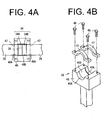
- the piezoelectric units 34 are connected to the connecting members 35, 36 such that the piezoelectric unit 34 having a pair of the piezoelectric elements 34A, 34B is sandwiched by the connecting members 35, 36, as shown in Fig. 4A and Fig. 4B .
- the piezoelectric elements 34A, 34B and an electrode plate 38 held therebetween are fastened together by means of the connecting members 35, 36 and a bolt.
- the bolt extends through the piezoelectric elements 34A, 34B and the electrode plate 38 and into the connecting members 35, 36.
- the piezoelectric elements 34A, 34B and the electrode plate 38 are supported by the bracket 45.
- the bracket 45 includes a body 46 and two fixing members 47.
- the body 46 is formed with a pair of arcuate surfaces 46A and one arcuate surface 46B located between the arcuate surfaces 46A.
- the arcuate surfaces 46A have the same curvature radius as the circumferential surface of the connecting members 35, 36.
- the arcuate surface 46B has a larger curvature radius than the arcuate surface 46A.
- Each fixing members 47 has arcuate surface which has the same curvature radius as the arcuate surface 46A.
- the two fixing members 47 are fastened to the body 46 by means of the bolts 48. As shown in Fig.
- the elements 34A, 34B and the electrode plate 38 are fitted in the arcuate surface 46B, and the connecting members 35, 36 are fitted on the arcuate surface 46A.
- the fixing members 47 are fastened to the body 46 by means of the bolts 48 such that the fixing members 47 are fitted on the connecting members 35, 36.
- the electrode plate 38 is connected to the vibrating device 39 through a wire 40A.
- the ground terminal of the vibrating device 39 is connected to the bracket 33 through a wire 40B. That is, the piezoelectric unit 34 is grounded through the bracket 45.
- the vibrator 37 is vibrated with the node of longitudinal vibration positioned at the center of the piezoelectric unit 34 and the antinodes at the ends of the connecting members 35, 36 adjacent to the guide members 41.
- the number of the piezoelectric unit 34 for use in this alternative embodiment may be easily reduced. For example, a pair of piezoelectric unit 34 is sufficient to one unit.
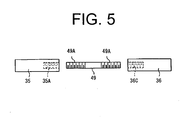
- connection between the connecting members 35, 36 is not limited to the structure in which the externally threaded portion 36A of the connecting member 36 is screwed into the internally threaded hole 35A of the connecting member 35.
- the connecting member 36 may be formed also with an internally threaded hole 36C, and the connecting members 35, 36 may be connected to each other through a rod member 49 having externally threaded portions 49A on the both sides thereof.
- the vibrator 37 may be made symmetrical and hence well balanced in comparison to the structure in which a rod portion 36B having the externally threaded portion 36A is formed in the connecting member 36.
- the vibrator 37 may cause both guide members 31 to vibrate uniformly. Therefore, the impedance of the vibrating system in the above alternative embodiment may be reduced, and the vibrator 37 may be vibrated with increased efficiency.
- the guide member 41 of the second preferred embodiment includes two plates 42 which are connected to each other through the spacer 43.
- the spacer 43 is not limited to be formed separately from the plates 42.
- the spacers 43 may be formed integrally with both plates 42 of the guide member 41 extending from the base portions 42A of the plates 42.
- the thickness of the spacer 43 may be set so that the total thickness of the spacers 43 extending from both plates 42 is substantially the same as the clearance between the guide portions 42C, and the spacers 43 do not need to have same thickness.
- the spacers 43 are provided integrally with the plates 42, the number of parts may be reduced, but also the impedance of the vibrating system may be reduced in comparison to the structure in which the spacer 43 is separately formed from the plate 42. Therefore, only a lower voltage is required for operation of the fiber bundle guiding device.
- the spacers 43 do not necessarily have to be made to be in contact with each other at the proximal end surfaces thereof, as shown in Fig. 6B .
- the spacers 43 may have a thickness corresponding to the clearance between the guide portions 42C and be located on the base portions 42A of the plates 42 at different vertical positions, as shown in Fig. 6C .
- it may be so arranged that two spacers 43 and one spacer 43 are provided on the plates 42, respectively.
- the two spacers 43 are provided one above the other on one of the plates 42 with a predetermined vertical space formed therebetween, and the one spacer 43 having a width substantially the same as the above vertical space is formed on the other plate 42.
- the spacers 43 serve as a positioning portion for positioning the plates 42 properly relative to each other in the longitudinal direction of the guide member 41 in arranging and then connecting the plates 42.
- the fiber bundle guiding device of the present invention is not limited to a structure in which one vibrator vibrates simultaneously two guide members 31, 41 located at an interval corresponding to two spindles. It may be so arranged that one vibrator vibrates simultaneously three or more guide members located at the interval corresponding to two spindles.
- one vibrator 37 may vibrate four guide members 31, as shown in Fig. 7 (only two guide members 31 being shown in the drawing).
- the vibrator 37 is formed horizontally symmetrically with respect to the bracket 33.
- the vibrator 37 is formed with, in addition to the connecting members 35, 36 of the first preferred embodiment, connecting members 50.
- Each connecting member 50 has a length corresponding to the spaced distance between any two adjacent spindles of the spinning machine and are connected to the connecting members 35, 36 so as to sandwich the support portion 31C of the guide member 31. It is noted that the guide member 31 on the side of the connecting member 36, the vibrating device 39, the wires 40A, 40B and the connecting member 50 are not illustrated in Fig. 7 .
- the support portions 31C of the guide members 31 are connected to the connecting members 35, 36, 50 by any suitable means such as brazing.
- the vibrator 37 is vibrated at a predetermined resonance frequency of the guide member 31 (for example about 30 kHz).
- the guide member 31 may be substituted with a guide member 41 having two plates 42 connected together through the spacer 43 may be used instead of the guide member 31.
- the bracket 33 may be arranged at the center of the vibrator 37 so as to be sandwiched by the piezoelectric units 34.
- the bracket 33 may be arranged at the node of longitudinal vibration of the vibrator 37 and away from the piezoelectric units 34.
- the vibrator 37 may be supported by two brackets 33 provided at two different positions to be more stable in comparison with one bracket 33 provided at one position.
- the side surface of the guide portion 42C is not limited to a shape in which the width (height) of the upstream side portion and the downstream side portion is smaller than the width of the center portion.
- the side surface of the guide portion 42C may have a shape in which the width is substantially constant from upstream to downstream or throughout the entire length.
- the position of the connecting members 35, 36, 50 at which they are connected to guide members 31, 41 does not necessarily have to be the antinode of longitudinal vibration.
- the positions of connections between the connecting members 35, 36, 50 and the guide members 31, 41 may be located away from the antinode of longitudinal vibration.
- the guide members 31, 41 are arranged with the antinodes of longitudinal vibration located at the connection between the guide members 31, 41 and the connecting members 35, 36, 40. Therefore, the guide members 31, 41 may be vibrated under a desirable condition by a smaller amount of drive energy than the arrangement wherein the connection is located away from the antinode of longitudinal vibration. If the connection is located away from the antinode of longitudinal vibration, the distance between the antinode and the connecting member 35, 36, 50 should be less than 20% of the distance between any two adjacent node and antinode.
- the guide members 31, 41 may be fixed to the connecting members 35, 36, 50 by any means other than brazing, such as soldering, adhering by adhesive or fastening by bolt.
- the piezoelectric unit 34 as the vibrating mechanism 32 may be substituted by a magnetostrictor or a super magnetostrictor.
- the fiber bundle guiding device 30 of the present invention is not limited to an application in which the fiber bundle guiding device 30 is disposed between the final delivery roller pair 26 and its immediately preceding roller pair (the front bottom roller 12 and the front top roller 21) for spinning of high quality yarn so-called "compact yarn".
- the fiber bundle guiding device 30 may be disposed between the back rollers and the middle rollers around which an apron is wound. There has been a demand for spinning at a higher draft than the current draft in the spinning machine. If the draft between the back roller and middle roller is increased with an attempt to achieve the above drafting of demand, the width of the fiber bundle is increased between the back rollers and the middle rollers.
- the fiber bundle guiding device 30 is disposed between the back rollers and the middle rollers, however, the fiber bundle is reduced to the desired width before entering the middle rollers around which the apron is wound. Therefore, the draft in the back roller zone is improved over the conventional draft. As a result, if the draft device is operated such that the draft is improved, favorable draft is achieved in the apron zone.
Landscapes
- Engineering & Computer Science (AREA)
- Mechanical Engineering (AREA)
- Textile Engineering (AREA)
- Spinning Or Twisting Of Yarns (AREA)
- Braiding, Manufacturing Of Bobbin-Net Or Lace, And Manufacturing Of Nets By Knotting (AREA)
- Guides For Winding Or Rewinding, Or Guides For Filamentary Materials (AREA)
Claims (14)
- Faserbündelführungsvorrichtung (30) für eine Spinnmaschine mit einer Streckvorrichtung (11) und einer Spindel, wobei die Faserbündelführungsvorrichtung (30), die dazu dient, ein Faserbündel zu führen, um die Breite des Faserbündels zu verringern, das Folgende aufweist:Führungsbauteile (31, 41) mit einer Führungsfläche (31A), deren Breite sich entlang der Bewegungsrichtung des wie in die Spinnmaschine eingelegt zu führenden Faserbündels verringert, wobei die Führungsbauteile (31, 41) mit einem Zwischenraum angeordnet sind, der dem Abstand zwischen wenigstens zwei benachbarten Spindeln entspricht,dadurch gekennzeichnet, dass ein Verbindungsbauteil (35, 36, 50) die Führungsbauteile (31, 41) verbindet und eine stabartige Gestalt aufweist, die sich in der Richtung erstreckt, die senkrecht zu den Führungsbauteilen (31, 41) ist,
dass eine Elektronikkomponente (34) zur Anwendung kommt, um das Verbindungsbauteil (35, 36, 50) in Längsrichtung zu vibrieren und das in dem mittleren Abschnitt des Verbindungsbauteils (35, 36, 50) angeordnet ist,
dass ein Vibrationsmechanismus (32) zum Vibrieren der Führungsbauteile (31, 41) verwendet wird, um einen Schalldruck zum Verringern der Breite des Faserbündels zu erzeugen, und
dass der Vibrationsmechanismus (32) das Verbindungsbauteil (35, 36) und die Elektronikkomponente (34) umfasst. - Faserbündelführungsvorrichtung (30) nach Anspruch 1, dadurch gekennzeichnet, dass die Elektronikkomponente (34) eine piezoelektrische Einheit ist.
- Faserbündelführungsvorrichtung (30) nach Anspruch 1 oder 2, dadurch gekennzeichnet, dass sich der Endabschnitt des Verbindungsbauteils (35, 36, 50), an dem das Führungsbauteil (31, 41) befestigt ist, an einem Schwingungsbauch der Längsvibration befindet.
- Faserbündelführungsvorrichtung (30) nach einem der Ansprüche 1 bis 3, dadurch gekennzeichnet, dass eine Halterung (33) mit dem Rahmen der Streckvorrichtung (11) verbunden ist.
- Faserbündelführungsvorrichtung (30) nach Anspruch 4, dadurch gekennzeichnet, dass
die Halterung (33) an einer Stelle vorgesehen ist, die dem Schwingungsknoten der Längsvibration des Verbindungsbauteils (35, 36, 50) entspricht, und
dass die Elektronikkomponente (34) auf jeder Seite der Halterung vorgesehen ist, so dass die Halterung (33) dazwischen angeordnet ist. - Faserbündelführungsvorrichtung (30) nach Anspruch 4, dadurch gekennzeichnet, dass
das Verbindungsbauteil (35, 36, 50) wenigstens zwei Verbindungsbauteile (35, 36, 50) umfasst,
die Elektronikkomponente (34) mit den Verbindungsbauteilen (35, 36, 50) derart verbunden ist, dass die Elektronikkomponente (34) zwischen den Verbindungsbauteilen (35, 36, 50) angeordnet ist, und
dass die Verbindungsbauteile (35, 36, 50) durch die Halterung (33) an dem Abschnitt der Verbindungsbauteile (35, 36, 50) gestützt werden, der der Elektronikkomponente (34) zugewandt ist. - Faserbündelführungsvorrichtung (30) nach einem der Ansprüche 1 bis 6,
dadurch gekennzeichnet, dass ein Abstandshalter (43) verwendet wird, um einen Zwischenabstand zwischen zwei Platten (42) festzulegen, und
dass das Führungsbauteil (31, 41) die zwei Platten (42) umfasst, die durch den Abstandshalter (43) miteinander verbunden sind, und dass es an dem Abschnitt des Führungsbauteils (31, 41) vibriert wird, mit dem der Abstandshalter (43) verbunden ist. - Faserbündelführungsvorrichtung (30) nach Anspruch 7, dadurch gekennzeichnet, dass die Abstandshalter (43) einstückig mit beiden Platten (42) des Führungsbauteils (31, 41) ausgebildet sind, die sich von den Grundabschnitten (42A) der Platten (42) aus erstrecken.
- Faserbündelführungsvorrichtung (30) nach Anspruch 8, dadurch gekennzeichnet, dass die Abstandshalter (43) an den proximalen Endflächen der Abstandshalter (43) miteinander in Kontakt stehen.
- Faserbündelführungsvorrichtung (30) nach Anspruch 8, dadurch gekennzeichnet, dass sich die Abstandshalter (43) an den Platten (42) an in vertikaler Richtung verschiedenen Stellen befinden.
- Faserbündelführungsvorrichtung (30) nach Anspruch 8, dadurch gekennzeichnet, dass die zwei Abstandshalter (43) an einer der Platten (42) mit einem vorbestimmten vertikalen Abstand voneinander entfernt vorgesehen sind, der zwischen den zwei Abstandshaltern (43) ausgebildet ist, und wobei der eine Abstandshalter (43), der eine Breite aufweist, die im Wesentlichen dieselbe wie der vorhergehend genannte vertikale Abstand ist, an der anderen der Platten (42) ausgebildet ist.
- Faserbündelführungsvorrichtung (30) nach einem der Ansprüche 1 und 3 bis 11, dadurch gekennzeichnet, dass ein Stabbauteil (49) Außengewindeabschnitte (49A) an den beiden Seiten des Stabbauteils (49) aufweist und sich durch die Elektronikkomponente (43) hindurch erstreckt,
dass das Verbindungsbauteil (35, 36) wenigstens zwei Verbindungsbauteile (35, 36) umfasst,
dass die Verbindungsbauteile (35, 36) Innengewindelöcher (35A, 36A) aufweisen, die an den Endflächen der Verbindungsbauteile (35, 36, 50) ausgebildet sind, welche der Elektronikkomponente (34) zugewandt sind, und
dass die Außengewindeabschnitte (49A) des Stabbauteils (49) in die Innengewindelöcher (35A, 36A) der Verbindungsbauteile (35, 36) eingeschraubt sind, so dass die Verbindungsbauteile (35, 36) derart miteinander verbunden sind, dass die Elektronikkomponente (34) dazwischen angeordnet ist. - Faserbündelführungsvorrichtung (30) nach einem der Ansprüche 1 und 3 bis 12, dadurch gekennzeichnet, dass die Elektronikkomponente (34) ein Magnetostriktor ist.
- Faserbündelführungsvorrichtung (30) nach einem der Ansprüche 1 und 3 bis 12, dadurch gekennzeichnet, dass die Elektronikkomponente (34) ein Supermagnetostriktor ist.
Applications Claiming Priority (1)
| Application Number | Priority Date | Filing Date | Title |
|---|---|---|---|
| JP2007147177A JP2008297677A (ja) | 2007-06-01 | 2007-06-01 | 紡機における繊維束案内装置 |
Publications (2)
| Publication Number | Publication Date |
|---|---|
| EP2009152A1 EP2009152A1 (de) | 2008-12-31 |
| EP2009152B1 true EP2009152B1 (de) | 2010-02-24 |
Family
ID=39941596
Family Applications (1)
| Application Number | Title | Priority Date | Filing Date |
|---|---|---|---|
| EP20080157270 Ceased EP2009152B1 (de) | 2007-06-01 | 2008-05-30 | Vorrichtung zur Führung von Faserbündeln für eine Spinnmaschine |
Country Status (4)
| Country | Link |
|---|---|
| EP (1) | EP2009152B1 (de) |
| JP (1) | JP2008297677A (de) |
| CN (1) | CN101314876B (de) |
| DE (1) | DE602008000689D1 (de) |
Cited By (3)
| Publication number | Priority date | Publication date | Assignee | Title |
|---|---|---|---|---|
| US9185969B2 (en) | 2012-12-29 | 2015-11-17 | Unicharm Corporation | Method of producing opened fiber bundle, method of producing cleaning member, apparatus which opens fiber bundle, and system which produces cleaning member |
| US9279199B2 (en) | 2012-12-29 | 2016-03-08 | Unicharm Corporation | Method and apparatus for manufacturing cleaning member |
| US9393722B2 (en) | 2013-01-10 | 2016-07-19 | Unicharm Corporation | Method of production of web member including tow |
Families Citing this family (12)
| Publication number | Priority date | Publication date | Assignee | Title |
|---|---|---|---|---|
| JP2009091679A (ja) * | 2007-10-05 | 2009-04-30 | Toyota Industries Corp | 紡機における繊維束集束装置 |
| JP5526977B2 (ja) * | 2010-04-23 | 2014-06-18 | 株式会社豊田自動織機 | 紡機のドラフト装置 |
| JP6047401B2 (ja) | 2012-12-29 | 2016-12-21 | ユニ・チャーム株式会社 | 開繊された繊維束の製造方法、清掃部材の製造方法、繊維束の開繊装置、及び清掃部材の製造システム |
| US20140187406A1 (en) | 2012-12-29 | 2014-07-03 | Unicharm Corporation | Method of producing cleaning member |
| US20140182767A1 (en) | 2012-12-29 | 2014-07-03 | Unicharm Corporation | Method of producing cleaning member |
| JP6073128B2 (ja) | 2012-12-29 | 2017-02-01 | ユニ・チャーム株式会社 | 切断装置及び切断装置を用いた清掃部材の製造方法 |
| WO2014104325A1 (ja) | 2012-12-29 | 2014-07-03 | ユニ・チャーム株式会社 | 清掃部材を製造する方法、及び清掃部材を製造するシステム |
| JP6103945B2 (ja) | 2013-01-10 | 2017-03-29 | ユニ・チャーム株式会社 | 積み重ね装置及びウェブ部材を製造する方法 |
| JP2016094682A (ja) * | 2014-11-13 | 2016-05-26 | 村田機械株式会社 | ドラフト装置及び紡績ユニット |
| CN107043974A (zh) * | 2017-06-15 | 2017-08-15 | 合肥海腾软件科技有限公司 | 便于装卸的并条机导条辊 |
| CN110424081A (zh) * | 2019-08-14 | 2019-11-08 | 吴江市布步高纺织整理有限公司 | 高档加捻阻燃化纤丝 |
| CN119551480B (zh) * | 2025-02-07 | 2025-05-16 | 汕头市潮阳区滋兴发展有限公司 | 一种卷布辊拆卸式放卷托架机构及验布机 |
Family Cites Families (13)
| Publication number | Priority date | Publication date | Assignee | Title |
|---|---|---|---|---|
| JPS54160864A (en) * | 1978-06-08 | 1979-12-19 | Masaru Tsujimoto | Sliver opening method |
| JPS59165472U (ja) * | 1983-04-20 | 1984-11-06 | 旭化成株式会社 | 複合紡績糸紡出用ガイド装置 |
| JPS63100461U (de) * | 1986-12-22 | 1988-06-29 | ||
| AT391896B (de) * | 1988-04-27 | 1990-12-10 | Fehrer Ernst | Streckwerk fuer wenigstens eine faserlunte |
| JPH01298229A (ja) * | 1988-05-24 | 1989-12-01 | Nippon Mengiyou Gijutsu Keizai Kenkyusho | オープンエンド紡績方法及び紡績装置 |
| JPH05122951A (ja) * | 1991-10-24 | 1993-05-18 | Ricoh Co Ltd | 駆動機構 |
| JP2515697Y2 (ja) * | 1993-11-05 | 1996-10-30 | 日清紡績株式会社 | 紡機のコレクタ装置における受け具 |
| JPH10196520A (ja) * | 1997-01-14 | 1998-07-31 | Naoki Honma | 変位アクチュエータ駆動ポンプ |
| DE10057982A1 (de) * | 1999-12-04 | 2001-06-07 | Rieter Ingolstadt Spinnerei | Vorrichtung und Verfahren zur Fortpflanzung der Drehung in den Einbindepunkt einer Offenend-Spinnvorrichtung |
| JP4370854B2 (ja) * | 2003-08-21 | 2009-11-25 | セイコーエプソン株式会社 | 圧電アクチュエータおよびこれを備えた装置 |
| JP4626548B2 (ja) * | 2005-06-02 | 2011-02-09 | 株式会社豊田自動織機 | 紡機における繊維束案内装置及び精紡機のドラフト装置 |
| CN100567603C (zh) * | 2005-06-02 | 2009-12-09 | 株式会社丰田自动织机 | 纺纱机中的纤维束引导装置、细纱机的牵伸装置以及环锭细纱机 |
| JP2008115491A (ja) * | 2006-11-02 | 2008-05-22 | Toyota Industries Corp | ラップマシーン、コーマ、練条機等の繊維準備処理装置における繊維束案内装置 |
-
2007
- 2007-06-01 JP JP2007147177A patent/JP2008297677A/ja active Pending
-
2008
- 2008-05-29 CN CN2008101098336A patent/CN101314876B/zh not_active Expired - Fee Related
- 2008-05-30 EP EP20080157270 patent/EP2009152B1/de not_active Ceased
- 2008-05-30 DE DE200860000689 patent/DE602008000689D1/de active Active
Cited By (3)
| Publication number | Priority date | Publication date | Assignee | Title |
|---|---|---|---|---|
| US9185969B2 (en) | 2012-12-29 | 2015-11-17 | Unicharm Corporation | Method of producing opened fiber bundle, method of producing cleaning member, apparatus which opens fiber bundle, and system which produces cleaning member |
| US9279199B2 (en) | 2012-12-29 | 2016-03-08 | Unicharm Corporation | Method and apparatus for manufacturing cleaning member |
| US9393722B2 (en) | 2013-01-10 | 2016-07-19 | Unicharm Corporation | Method of production of web member including tow |
Also Published As
| Publication number | Publication date |
|---|---|
| JP2008297677A (ja) | 2008-12-11 |
| EP2009152A1 (de) | 2008-12-31 |
| DE602008000689D1 (de) | 2010-04-08 |
| CN101314876A (zh) | 2008-12-03 |
| CN101314876B (zh) | 2011-04-06 |
Similar Documents
| Publication | Publication Date | Title |
|---|---|---|
| EP2009152A1 (de) | Vorrichtung zur Führung von Faserbündeln für eine Spinnmaschine | |
| JP3183607B2 (ja) | 繊維集束方法およびこれに用いられる二重エプロンドローイング装置 | |
| US6341484B2 (en) | Drafting frame for a spinning machine | |
| EP2045377B1 (de) | Vorrichtung zum Konzentrieren von Faserbündeln in einer Spinnmaschine | |
| CN111005096B (zh) | 用于精梳机的圆形梳 | |
| JP5344878B2 (ja) | 繊維ストランドをドラフトするためのドラフト装置 | |
| US5927062A (en) | Fiber spinning apparatus having fiber twisting guide | |
| CN111465726B (zh) | 纺纱机和压缩装置 | |
| CN106048789B (zh) | 牵伸装置以及纺纱机 | |
| JP2008095233A (ja) | 紡機における繊維束集束装置 | |
| EP2006427A2 (de) | Vorrichtung zum Konzentrieren von Faserbündeln für eine Spinnmaschine | |
| EP1734161B1 (de) | Faserbündel-Führungsvorrichtung in einer Spinnmaschine und Streckwerk einer Spinnmaschine | |
| CN111479960A (zh) | 用于纺纱机的牵伸装置 | |
| CN101939471A (zh) | 用于改变当前的环锭纺纱机以制造紧密纱线的系统 | |
| CN100567603C (zh) | 纺纱机中的纤维束引导装置、细纱机的牵伸装置以及环锭细纱机 | |
| CN103228828B (zh) | 精梳机 | |
| JPH11279853A (ja) | 圧縮装置を備えた紡績機 | |
| US6564538B2 (en) | Spinning apparatus and method and hollow guide shaft member for spinning | |
| JP2006200069A (ja) | 空気式精紡機におけるドラフト装置 | |
| JP2008115491A (ja) | ラップマシーン、コーマ、練条機等の繊維準備処理装置における繊維束案内装置 | |
| JP2008530382A (ja) | 二重エプロンドラフト装置のための下部エプロン案内装置 | |
| CN105332121B (zh) | 一种减小赛络纺捻合点跳动的装置 | |
| JPH02300330A (ja) | 紡績装置 | |
| JPH11229242A (ja) | 精紡機のドラフト装置 | |
| JP2006265815A (ja) | コアヤーンを製造するための方法及び装置 |
Legal Events
| Date | Code | Title | Description |
|---|---|---|---|
| PUAI | Public reference made under article 153(3) epc to a published international application that has entered the european phase |
Free format text: ORIGINAL CODE: 0009012 |
|
| 17P | Request for examination filed |
Effective date: 20080530 |
|
| AK | Designated contracting states |
Kind code of ref document: A1 Designated state(s): AT BE BG CH CY CZ DE DK EE ES FI FR GB GR HR HU IE IS IT LI LT LU LV MC MT NL NO PL PT RO SE SI SK TR |
|
| AX | Request for extension of the european patent |
Extension state: AL BA MK RS |
|
| GRAP | Despatch of communication of intention to grant a patent |
Free format text: ORIGINAL CODE: EPIDOSNIGR1 |
|
| AKX | Designation fees paid |
Designated state(s): CH DE IT LI |
|
| GRAS | Grant fee paid |
Free format text: ORIGINAL CODE: EPIDOSNIGR3 |
|
| GRAA | (expected) grant |
Free format text: ORIGINAL CODE: 0009210 |
|
| AK | Designated contracting states |
Kind code of ref document: B1 Designated state(s): CH DE IT LI |
|
| REG | Reference to a national code |
Ref country code: CH Ref legal event code: EP |
|
| REF | Corresponds to: |
Ref document number: 602008000689 Country of ref document: DE Date of ref document: 20100408 Kind code of ref document: P |
|
| REG | Reference to a national code |
Ref country code: CH Ref legal event code: NV Representative=s name: NOVAGRAAF INTERNATIONAL SA |
|
| PLBE | No opposition filed within time limit |
Free format text: ORIGINAL CODE: 0009261 |
|
| STAA | Information on the status of an ep patent application or granted ep patent |
Free format text: STATUS: NO OPPOSITION FILED WITHIN TIME LIMIT |
|
| 26N | No opposition filed |
Effective date: 20101125 |
|
| REG | Reference to a national code |
Ref country code: CH Ref legal event code: PFA Owner name: KABUSHIKI KAISHA TOYOTA JIDOSHOKKI Free format text: KABUSHIKI KAISHA TOYOTA JIDOSHOKKI#2-1, TOYODA-CHO#KARIYA-SHI, AICHI 448-8671 (JP) -TRANSFER TO- KABUSHIKI KAISHA TOYOTA JIDOSHOKKI#2-1, TOYODA-CHO#KARIYA-SHI, AICHI 448-8671 (JP) |
|
| PGFP | Annual fee paid to national office [announced via postgrant information from national office to epo] |
Ref country code: CH Payment date: 20150512 Year of fee payment: 8 Ref country code: DE Payment date: 20150527 Year of fee payment: 8 |
|
| PGFP | Annual fee paid to national office [announced via postgrant information from national office to epo] |
Ref country code: IT Payment date: 20150515 Year of fee payment: 8 |
|
| REG | Reference to a national code |
Ref country code: DE Ref legal event code: R119 Ref document number: 602008000689 Country of ref document: DE |
|
| REG | Reference to a national code |
Ref country code: CH Ref legal event code: PL |
|
| PG25 | Lapsed in a contracting state [announced via postgrant information from national office to epo] |
Ref country code: CH Free format text: LAPSE BECAUSE OF NON-PAYMENT OF DUE FEES Effective date: 20160531 Ref country code: LI Free format text: LAPSE BECAUSE OF NON-PAYMENT OF DUE FEES Effective date: 20160531 |
|
| PG25 | Lapsed in a contracting state [announced via postgrant information from national office to epo] |
Ref country code: IT Free format text: LAPSE BECAUSE OF NON-PAYMENT OF DUE FEES Effective date: 20160530 |
|
| PG25 | Lapsed in a contracting state [announced via postgrant information from national office to epo] |
Ref country code: DE Free format text: LAPSE BECAUSE OF NON-PAYMENT OF DUE FEES Effective date: 20161201 |