EP2009530A2 - Contrôleur numérique doté d'une fonction de reprise de lecture anticipée de bloc - Google Patents
Contrôleur numérique doté d'une fonction de reprise de lecture anticipée de bloc Download PDFInfo
- Publication number
- EP2009530A2 EP2009530A2 EP08156870A EP08156870A EP2009530A2 EP 2009530 A2 EP2009530 A2 EP 2009530A2 EP 08156870 A EP08156870 A EP 08156870A EP 08156870 A EP08156870 A EP 08156870A EP 2009530 A2 EP2009530 A2 EP 2009530A2
- Authority
- EP
- European Patent Office
- Prior art keywords
- block
- look
- ahead
- code
- execution
- Prior art date
- Legal status (The legal status is an assumption and is not a legal conclusion. Google has not performed a legal analysis and makes no representation as to the accuracy of the status listed.)
- Granted
Links
Images



Classifications
-
- G—PHYSICS
- G05—CONTROLLING; REGULATING
- G05B—CONTROL OR REGULATING SYSTEMS IN GENERAL; FUNCTIONAL ELEMENTS OF SUCH SYSTEMS; MONITORING OR TESTING ARRANGEMENTS FOR SUCH SYSTEMS OR ELEMENTS
- G05B19/00—Program-control systems
- G05B19/02—Program-control systems electric
- G05B19/18—Numerical control [NC], i.e. automatically operating machines, in particular machine tools, e.g. in a manufacturing environment, so as to execute positioning, movement or co-ordinated operations by means of program data in numerical form
- G05B19/4155—Numerical control [NC], i.e. automatically operating machines, in particular machine tools, e.g. in a manufacturing environment, so as to execute positioning, movement or co-ordinated operations by means of program data in numerical form characterised by program execution, i.e. part program or machine function execution, e.g. selection of a program
-
- G—PHYSICS
- G05—CONTROLLING; REGULATING
- G05B—CONTROL OR REGULATING SYSTEMS IN GENERAL; FUNCTIONAL ELEMENTS OF SUCH SYSTEMS; MONITORING OR TESTING ARRANGEMENTS FOR SUCH SYSTEMS OR ELEMENTS
- G05B2219/00—Program-control systems
- G05B2219/30—Nc systems
- G05B2219/35—Nc in input of data, input till input file format
- G05B2219/35386—Look ahead processing of plural block data from buffer
Definitions
- the present invention relates to a numerical controller for controlling a machine tool.
- the invention relates to a numerical controller in which command blocks are read from a program in advance to generate executable data, the execution data are temporarily stored in a look-ahead buffer, and interpolation processing is performed based on the execution data, and more particularly, to a numerical controller capable of shortening the cycle time of look-ahead stop control.
- a block for, for example, a system variable operation in a later stage of a sequence of a machining program is directly executed without being stored in a look-ahead buffer, so that it may possibly influence processing of execution data that are analyzed and temporarily stored in the look-ahead buffer.
- Look-ahead stop control is carried out in such a case.
- a command for the control is inserted as one block in a machining program, and look-ahead processing for the program is stopped by the inserted block ( FIG. 8a ).
- a block N14 of a look-ahead stop code is inserted in order to prevent a block N15 from being read in advance or looked ahead.
- the look-ahead is stopped after the entire processing of the block including the look-ahead stop code is completed ( FIG. 8b ).
- FIG. 8b In the program example shown in FIG.
- an M-code which is an auxiliary function, is inserted as a look-ahead stop code into a block N13. Further, there is a known technique in which look-ahead is resumed when a variable is settled in a robot control method (see JP 05-218445A ).
- the present invention provides a numerical controller capable of performing look-ahead control by suspending analysis of a read block of a machining program and resuming the analysis of the read block at a suspended stage when execution of a block immediately preceding the read block is completed, to shorten the cycle time of the look-ahead control.
- a numerical controller of the present invention carries out numerical control by performing look-ahead of successively reading and analyzing blocks of a machining program to obtain execution data and storing the execution data in a buffer in advance, and performing execution of the stored execution data.
- the numerical controller comprises: code determining means that determines whether or not a read block contains a suspend code to suspend analyzing of the read block so that the look-ahead is stopped; suspending means that suspends analyzing of the read block which is determined to contain the suspend code by the code determining means; execution completion determining means that determines whether or not execution of the stored execution data of a block immediately preceding the suspended block is completed; and resuming means that resumes the analyzing of the suspended block when the execution of the stored execution data of the immediately preceding block is determined to be completed by the execution completion determining means.
- the numerical controller may further comprise means for registering the suspend code to stop the look-ahead using a parameter.
- the numerical controller comprises: code determining means that determines whether or not a read block contains a code of a macro variable operation for which analyzing of the read block is to be suspended so that the look-ahead is stopped; suspending means that suspends analyzing of the read block which is determined to contain the code of the macro variable operation for which the analyzing of the read block is to be suspended by the code determining means; execution completion determining means that determines whether or not execution of the stored execution data of a block immediately preceding the suspended block is completed; and resuming means that resumes the analyzing of the suspended block when the execution of the stored execution data of the immediately preceding block is determined to be completed by the execution completion determining means.
- the numerical controller may further comprise means for designating a range of macro variables for determination of the code of the macro variable operation for which analyzing of the read block is to be suspended, using a parameter.
- the numerical controller may comprise means for designating a stage of the macro variable operation for which analyzing of the read block is to be suspended, using a parameter.
- the numerical controller comprises: code determining means that determines whether or not a read block contains a look-ahead stop code to stop the look-ahead; code type determining means that determines whether or not the look-ahead stop code determined by the code determining means is a code to suspend analyzing of the read block; execution completion determining means that determines whether or not execution of the stored execution data of a block immediately preceding the suspended block is completed; and suspending/continuing means that suspends analyzing of the read block containing the code to suspend analyzing of the read block and resumes the analyzing of the suspended block to obtain the execution data, or alternatively continues the analyzing of the read block to obtain the execution data, in accordance with results of the determination by the code type discrimination means and the determination of the execution completion determining means.
- the numerical controller may further comprise means for registering one or more look-ahead stop codes using one or more parameters.
- the cycle time for the machining program can be made shorter than in the case of a conventional method in which a block to stop the look-ahead is inserted.
- the look-ahead is stopped after the processing of the block including the look-ahead code is completed, in the conventional look-ahead stop code inserted in the existing block in the machining program.
- this problem can be eliminated by the suspension of the machining program analysis. Since the analysis processing of the machining program is suspended and resumed from the suspended stage, moreover, it is less wasteful than in the conventional look-ahead control method, so that the cycle time can be further shortened.
- a numerical controller 8 according to an embodiment of the present invention shown in FIG. 1 is provided with a look-ahead stop code table 4.
- the look-ahead stop code table 4 is loaded with codes of a type that stops look-ahead and codes of a type that suspends block analysis to stop look-ahead.
- macro variables may be used as codes to be stored in the look-ahead stop code table 4.
- program read/analysis means 1 successively reads and analyzes one or more blocks advancing the present block as being executed, and loads the result of the analysis into a look-ahead buffer 2.
- the look-ahead buffer 2 is loaded with several pieces of information, such as modal information on for each block, movement of each axis, commanded spindle speed, feed speed, etc.
- the program read/analysis means 1 shown in FIG. 1 reads the blocks one by one from a machining program and analyzes the blocks.
- look-ahead stop code registered in the look-ahead stop code table 4 appears, look-ahead of the machining program is stopped.
- the look-ahead stop codes include registered codes and macro variables, such as G900 of N14 in the machining program example of FIG. 6 and #13020 of N14 in the machining program example of FIG. 7 .
- the block analysis in the numerical controller 8 implies conversion of the blocks as source codes into object codes, that is, execution data that can be recognized by a computer. This conversion involves seven types of processes; lexical analysis (1), macro analysis (2), macro execution (3), syntactic analysis (4), semantic analysis (5), object code generation (6), and optimization (7).
- the lexical analysis (1) is a process for dividing alphabetic symbols from numeric symbols.
- the macro analysis (2) indicates that a macro analysis is performed when the result of the lexical analysis involves special symbols of macro variables. Variable numbers and macro syntaxes are analyzed, and the analysis is stopped if any variable operation registered in the look-ahead stop code table 4 is performed.
- the macro execution is execution of analyzed macros.
- macro regions are rewritten according to the result of the lexical analysis.
- GOOX#100 is information to the effect that 350.0 is input to the X-address of result data of the lexical analysis if the value of #100 is 350.0 when this command is executed.
- the syntactic analysis (4) serves only to determine the numerical value of the G-command.
- the semantic analysis (5) can specify the function by the numerical value of the G-command so that processing can be executed for each function.
- the object code generation (6) implies object-coding of the result of the semantic analysis.
- execution data are generated by the aforesaid processes for the blocks that are looked ahead in succession. If no look-ahead processing is performed based on macro variable operation, the conversion processes for the macro analysis (2) and the macro execution (3) are not performed.
- the numerical controller 8 performs processing for suspending the block analysis in a predetermined one of the aforesaid processes.
- the numerical controller 8 is provided with look-ahead stop code register means 5 and macro variable range designation means 6.
- look-ahead stop codes can be registered in the look-ahead stop code register means 5 by parameters.
- the macro variable range designation means 6 can designate by parameters the range of macro variables that are used to determine the suspension of the block analysis so that the block analysis can be suspended to stop the look-ahead processing when a variable within the range of # 10000 to # 11000 is operated.
- variable operations moreover, operations for (1) reading the value of the variable, (2) changing the content of the variable, etc.
- the numerical controller 8 may be provided with macro variable operation stage designation means 7 which can specify that the look-ahead of only the operation (2) be stopped without allowing the look-ahead of the operation (1) to be stopped. It is necessary only that the numerical controller 8 be provided with only one of these means 5, 6 and 7.
- Parameter 15010 13000
- Parameter 15011 13100 (or number, e.g., 100, to be input)
- Parameter 15012 0: For read and write operations, 1: For read operation only, 2: For write operation only.
- the parameters are set with significance, and some sets of these parameters are registered.
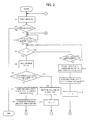
- FIG. 2 is a flowchart showing an algorithm of look-ahead processing using a code that is intended for the suspension of the block analysis that is performed by a processor of the numerical controller of the present embodiment and for look-ahead stop.
- the code that is intended for look-ahead stop of a type that involves the suspension of the block analysis is set like G900 that is used in the machining program example of FIG. 6 .
- Step A1 one block is read from the machining program
- Step A2 It is determined whether or not the read block is a program end (Step A2).
- Whether or not the read block is the program end can be determined by recognizing a sequence number and a code indicative of the program end, for example.
- the program end can be identified by recognizing M30, which is an auxiliary function indicative of the program end. If the program end is identified, the processing of the machining program terminates.
- Step A3 it is determined whether or not the look-ahead buffer that is provided for the numerical controller is full. If the look-ahead buffer is full, it is waited until the buffer ceases to be full (Step A3). Whether or not the look-ahead buffer is full can be determined by, for example, recognizing a pointer that is indicative of a position where the look-ahead buffer is stored with the block execution data. If it is concluded that the look-ahead buffer is not full, it is determined whether or not a flag F indicative of look-ahead stop is set to 1 (Step A4). If the flag is not 1 (that is, if the look-ahead is not stopped), the read block is analyzed (Step A5).
- the analysis in Step A5 includes the lexical analysis and the syntactic analysis. It is determined whether or not any look-ahead stop code of the type that suspends the block analysis is present in the block information that is analyzed in Step A5 (Step A6). If it is concluded in Step A6 that there is no look-ahead stop code of the type that suspends the block analysis, the analysis of the read block is continued to generate execution data (Step A7). The analysis in Step A7 is continued starting with the semantic analysis. The generated execution data is saved in the look-ahead buffer (Step A8). Then, the procedure returns to the beginning to read the next block.
- Step A6 If it is concluded in Step A6 that there is a look-ahead stop code of the type that suspends the block analysis, the analysis of the block that contains this code is suspended (Step A9). Then, the flag is set to 1 for look-ahead stop (Step A10). Since the block analysis is suspended, the procedure returns to a stage between Step A2 in which the program end is identified and Step A3 in which whether or not the look-ahead buffer is full is determined, lest the next block be read.
- Step A4 it is then determined whether or not the look-ahead buffer is empty, i.e. the execution of the execution data of a block immediately preceding the suspended block which has been stored in the look-ahead buffer is completed or not (Step A 11). If it is determined in Step A11 that the look-ahead buffer is not empty, it is waited until the buffer is emptied. If it is concluded that the look-ahead buffer is empty, the analysis processing for the block of which the analysis is suspended in Step A9 is resumed and continued to generate execution data (Step A12). The analysis in Step A12 is continued starting with the semantic analysis. The generated execution data is saved in the look-ahead buffer (Step A13). Since the suspended block analysis processing is resumed and continued, the flag F is reset to 0 to cancel the look-ahead stop state, in order to enable the analysis of the next block (Step A14). Then, the procedure returns to the beginning to read the next block.
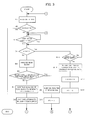
- FIG. 3 is a flowchart showing an algorithm of look-ahead processing using macro variable operation as a discrimination code that is intended for the suspension of the block analysis that is performed by the processor of the numerical controller of the present embodiment and for look-ahead stop.
- Step B1 one block is read from the machining program
- Step B2 It is determined whether or not the read block is a program end (Step B2).
- Whether or not the read block is the program end can be determined by recognizing a sequence number and a code indicative of the program end, for example.
- the program end can be identified by recognizing M30, which is an auxiliary function indicative of the program end. If the program end is identified, the processing of the machining program terminates.
- Step B3 it is determined whether or not the look-ahead buffer that is provided for the numerical controller is full. If the look-ahead buffer is full, it is waited until the buffer ceases to be full (Step B3). Whether or not the look-ahead buffer is full can be determined by, for example, recognizing the pointer that is indicative of the position where the look-ahead buffer is stored with the block execution data. If it is concluded that the look-ahead buffer is not full, it is determined whether or not the flag F indicative of look-ahead stop is set to 1 (Step B4). If the flag is not 1 (that is, if the look-ahead is not stopped), the read block is analyzed (Step B5).
- the block analysis in Step B5 includes the lexical analysis and the macro analysis.
- Step B6 It is determined whether or not any macro variable operation of the type for which the block analysis is to be suspended is present in the block information analyzed in Step B5 (Step B6). If it is concluded in Step B6 that there is no macro variable operation of the aforesaid type, the analysis of the read block is continued to generate execution data (Step B7). The analysis in Step B7 is continued starting with the macro execution. The generated execution data is saved in the look-ahead buffer (Step B8). Then, the procedure returns to the beginning to read the next block.
- Step A6 If it is concluded in Step A6 that there is a macro variable operation of the type to suspend the block analysis, the analysis of the block that contains the macro variable operation is suspended (Step B9). Then, the flag is set to 1 for look-ahead stop (Step B10). Since the block analysis is suspended, the procedure returns to a stage between Step B2 in which the program end is identified and Step B3 in which whether or not the look-ahead buffer is full is determined, lest the next block be read.
- Step B4 If it is concluded in Step B4 that the flag is 1, that is, the look-ahead is stopped, it is then determined whether or not the look-ahead buffer is empty (Step B11). If it is concluded in Step B11 that the look-ahead buffer is not empty, it is waited until the buffer is emptied. If it is concluded that the look-ahead buffer is empty, the analysis processing for the block of which the analysis is suspended in Step B9 is resumed and continued to generate execution data (Step B 12). The analysis in Step B 12 is continued starting with the macro execution, and execution processing is performed (Step B 13).
- Step B 14 Since the suspended block analysis processing is resumed and continued, the flag F is reset to 0 to cancel the look-ahead stop state, thereby permitting look-ahead, in order to enable the analysis of the next block (Step B 14). Then, the procedure returns to the beginning to read the next block.
- FIGS. 2 and 3 are different in Steps A 13 and B 13. While the obtained execution data is saved in the look-ahead buffer in Step A13, the execution processing is directly performed without saving the execution data in the look-ahead buffer in Step B13.
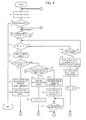
- FIG. 4 is a flowchart showing an algorithm of look-ahead processing using two types of codes (a code for suspending analysis of a pre-read block and a code for continuing analysis processing to generate execution data) stored in the look-ahead stop code table 4 of FIG. 1 .
- Step C1 one block is read from the machining program
- Step C2 It is determined whether or not the read block is a program end (Step C2).
- Whether or not the read block is the program end can be determined by recognizing a sequence number and a code indicative of the program end, for example.
- the program end can be identified by recognizing M30, which is an auxiliary function indicative of the program end. If the program end is identified, the processing of the machining program terminates.
- Step C3 it is determined whether or not the look-ahead buffer that is provided for the numerical controller is full. If the look-ahead buffer is full, it is waited until the buffer ceases to be full (Step C3). Whether or not the look-ahead buffer is full can be determined by, for example, recognizing a pointer that is indicative of a position where the look-ahead buffer is stored with the block execution data. If it is concluded that the look-ahead buffer is not full, it is determined whether or not a flag F indicative of look-ahead stop is set to 1 (Step C4). If the flag is not 1 (that is, if the look-ahead is not stopped), the read block is analyzed (Step C5).
- the analysis in Step C5 includes the lexical analysis and the syntactic analysis. It is determined whether or not any look-ahead stop code of the type that suspends the block analysis is present in the block information analyzed in Step C5 (Step C6). If it is concluded in Step C6 that there is no look-ahead stop code, the analysis of the read block is continued to generate execution data (Step C7). The generated execution data is saved in the look-ahead buffer (Step C8). Then, the procedure returns to the beginning to read the next block.
- Step C6 it is determined whether or not the look-ahead stop code is of the type to suspend the block analysis (Step C9).
- the look-ahead code G900 is shown as being of the type that suspends the block analysis in the machining program example of FIG 6 . Further, M900 is shown in FIGS. 8a and 8b as a code for analysis processing for the read block and generation of execution data. If it is concluded in Step C9 that there is a look-ahead stop code of the type that suspends the block analysis, the analysis of the block that contains this code is suspended (Step C10), and the flag is set to 1 for look-ahead stop (Step C11). Since the block analysis is suspended, the procedure returns to a stage between Step C2 in which the program end is identified and Step C3 in which whether or not the look-ahead buffer is full is determined, lest the next block be read.
- Step C9 If it is concluded in Step C9 that the look-ahead suspension code, like M900, is not of the type that suspends the block analysis, the analysis of the block that contains the look-ahead stop code of this type is continued to generate execution data (Step C 12). The obtained execution data is saved in the look-ahead buffer (Step C 13). Then, it is waited until the buffer is emptied (Step C14), and the procedure returns to the beginning.
- Step C4 it is then determined whether or not the look-ahead buffer is empty (Step C15). If it is concluded in Step C15 that the look-ahead buffer is not empty, it is waited until the buffer is emptied. If it is concluded that the look-ahead buffer is empty, the analysis processing for the block of which the analysis is suspended in Step C10 is resumed and continued to generate execution data (Step C16). The generated execution data is saved in the look-ahead buffer (Step C17). Since the suspended block analysis processing is resumed and continued, the flag F is reset to 0 to cancel the look-ahead stop state, in order to enable the analysis of the next block (Step C 18). Then, the procedure returns to the beginning to read the next block.
- FIG. 5 is a flowchart showing an algorithm of processing such that execution data are read from the look-ahead buffer and executed. It is determined whether or not the look-ahead buffer is empty. If the look-ahead buffer is not empty, the execution data are fetched from the look-ahead buffer and executed. The execution data stored in the look-ahead buffer are fetched block by block or in blocks at a time and executed.
- FIG. 6 shows a machining program example for the case where G900 is used as a code that is intended to stop look-ahead.
- G90 G00 X0. Y0.; is the starting block of the machining program, and "G41 D10 G01 X100 Y100 F500.;” is the next block.
- D10 is a tool diameter correction value.
- M30; is the last block of the machining program.
- the machining program shown in FIG. 6 is composed of 21 blocks.
- a variable #13010 is a macro variable that can change a tenth offset value for tool diameter correction if the content is changed, and indicates that #13010 is loaded with the sum of a variable #100 and 0.5. If G900 is discriminated in the block analysis, an analysis of the program is suspended.
- FIG. 7 shows a machining program example for the case where a code that discriminates a suspension of the block analysis is used as the code for the macro variable operation.
- the block analysis is suspended when a code for the macro variable operation of N14 is discriminated by the block analysis.
- the execution of a block N13 is completed, the analysis is resumed from the block N14 for which the analysis is suspended, and the look-ahead is also resumed.
Landscapes
- Engineering & Computer Science (AREA)
- Human Computer Interaction (AREA)
- Manufacturing & Machinery (AREA)
- Physics & Mathematics (AREA)
- General Physics & Mathematics (AREA)
- Automation & Control Theory (AREA)
- Numerical Control (AREA)
Applications Claiming Priority (1)
| Application Number | Priority Date | Filing Date | Title |
|---|---|---|---|
| JP2007137888A JP4271248B2 (ja) | 2007-05-24 | 2007-05-24 | 先読み停止機能を有する数値制御装置 |
Publications (3)
| Publication Number | Publication Date |
|---|---|
| EP2009530A2 true EP2009530A2 (fr) | 2008-12-31 |
| EP2009530A3 EP2009530A3 (fr) | 2010-12-22 |
| EP2009530B1 EP2009530B1 (fr) | 2012-07-25 |
Family
ID=40044194
Family Applications (1)
| Application Number | Title | Priority Date | Filing Date |
|---|---|---|---|
| EP08156870A Active EP2009530B1 (fr) | 2007-05-24 | 2008-05-23 | Contrôleur numérique doté d'une fonction de reprise de lecture anticipée de bloc |
Country Status (4)
| Country | Link |
|---|---|
| US (1) | US20080294877A1 (fr) |
| EP (1) | EP2009530B1 (fr) |
| JP (1) | JP4271248B2 (fr) |
| CN (1) | CN101311857B (fr) |
Cited By (1)
| Publication number | Priority date | Publication date | Assignee | Title |
|---|---|---|---|---|
| US10338570B2 (en) * | 2016-05-12 | 2019-07-02 | Fanuc Corporation | Numerical controller |
Families Citing this family (25)
| Publication number | Priority date | Publication date | Assignee | Title |
|---|---|---|---|---|
| US8776038B2 (en) | 2008-08-07 | 2014-07-08 | Code Systems Corporation | Method and system for configuration of virtualized software applications |
| US8434093B2 (en) | 2008-08-07 | 2013-04-30 | Code Systems Corporation | Method and system for virtualization of software applications |
| US8954958B2 (en) | 2010-01-11 | 2015-02-10 | Code Systems Corporation | Method of configuring a virtual application |
| US9104517B2 (en) * | 2010-01-27 | 2015-08-11 | Code Systems Corporation | System for downloading and executing a virtual application |
| US8959183B2 (en) | 2010-01-27 | 2015-02-17 | Code Systems Corporation | System for downloading and executing a virtual application |
| US9229748B2 (en) | 2010-01-29 | 2016-01-05 | Code Systems Corporation | Method and system for improving startup performance and interoperability of a virtual application |
| US8763009B2 (en) | 2010-04-17 | 2014-06-24 | Code Systems Corporation | Method of hosting a first application in a second application |
| US8782106B2 (en) | 2010-07-02 | 2014-07-15 | Code Systems Corporation | Method and system for managing execution of virtual applications |
| US9021015B2 (en) | 2010-10-18 | 2015-04-28 | Code Systems Corporation | Method and system for publishing virtual applications to a web server |
| US9209976B2 (en) | 2010-10-29 | 2015-12-08 | Code Systems Corporation | Method and system for restricting execution of virtual applications to a managed process environment |
| JP5657623B2 (ja) * | 2012-09-21 | 2015-01-21 | ファナック株式会社 | 系統間待合せ機能を有する数値制御装置 |
| JP5727573B2 (ja) * | 2013-10-16 | 2015-06-03 | ファナック株式会社 | プログラム呼出しで一時停止する数値制御装置 |
| JP6068401B2 (ja) * | 2014-07-30 | 2017-01-25 | ファナック株式会社 | 加工プログラムの読み出し時間に左右されないdnc運転手段を備えた数値制御装置 |
| EP3203333B1 (fr) * | 2014-09-30 | 2019-12-04 | Makino Milling Machine Co., Ltd. | Dispositif de commande pour machine-outil et machine-outil |
| JP6444933B2 (ja) * | 2016-04-25 | 2018-12-26 | ファナック株式会社 | 非切削状態において消費電力低減を行う数値制御装置 |
| JP6407919B2 (ja) | 2016-06-15 | 2018-10-17 | ファナック株式会社 | 数値制御装置および変数判定方法 |
| EP3480671A1 (fr) * | 2017-11-02 | 2019-05-08 | Siemens Aktiengesellschaft | Procédé de fonctionnement d'une installation de production à commande numérique ainsi qu'installation de production correspondante |
| JP6823034B2 (ja) * | 2018-10-31 | 2021-01-27 | ファナック株式会社 | 数値制御装置 |
| JP6838030B2 (ja) * | 2018-10-31 | 2021-03-03 | ファナック株式会社 | 数値制御装置 |
| JP6901454B2 (ja) * | 2018-10-31 | 2021-07-14 | ファナック株式会社 | 数値制御装置 |
| JP6838029B2 (ja) * | 2018-10-31 | 2021-03-03 | ファナック株式会社 | 数値制御装置 |
| JP6838031B2 (ja) | 2018-10-31 | 2021-03-03 | ファナック株式会社 | 数値制御システム |
| JP6997131B2 (ja) | 2019-04-05 | 2022-01-17 | ファナック株式会社 | 数値制御装置 |
| JP7260420B2 (ja) * | 2019-06-28 | 2023-04-18 | ファナック株式会社 | 数値制御装置 |
| CN117280287A (zh) * | 2021-05-17 | 2023-12-22 | 发那科株式会社 | 数值控制装置以及计算机可读取的存储介质 |
Citations (1)
| Publication number | Priority date | Publication date | Assignee | Title |
|---|---|---|---|---|
| JPH05218445A (ja) | 1992-02-07 | 1993-08-27 | Olympus Optical Co Ltd | 強誘電体メモリ |
Family Cites Families (10)
| Publication number | Priority date | Publication date | Assignee | Title |
|---|---|---|---|---|
| JPS5835627A (ja) * | 1981-08-26 | 1983-03-02 | Toshiba Corp | メモリデ−タ先取り制御方式 |
| EP0766154B1 (fr) * | 1992-12-28 | 2000-03-29 | Mitsubishi Denki Kabushiki Kaisha | Machine-outil à commande numérique et méthode |
| US5845101A (en) * | 1997-05-13 | 1998-12-01 | Advanced Micro Devices, Inc. | Prefetch buffer for storing instructions prior to placing the instructions in an instruction cache |
| US6122729A (en) * | 1997-05-13 | 2000-09-19 | Advanced Micro Devices, Inc. | Prefetch buffer which stores a pointer indicating an initial predecode position |
| US6393527B1 (en) * | 1998-12-18 | 2002-05-21 | Ati International Srl | Prefetch buffer with continue detect |
| JP3867427B2 (ja) * | 1999-01-11 | 2007-01-10 | ソニー株式会社 | プロセッサ装置および集積回路 |
| US7110851B2 (en) * | 2003-02-20 | 2006-09-19 | Mitsubishi Denki Kabushiki Kaisha | Numerically controlled device |
| CN1595319A (zh) * | 2003-09-10 | 2005-03-16 | 发那科株式会社 | 数值控制装置 |
| JP2006172388A (ja) * | 2004-12-20 | 2006-06-29 | Fanuc Ltd | 数値制御装置 |
| JP2006293537A (ja) * | 2005-04-07 | 2006-10-26 | Fanuc Ltd | 数値制御装置 |
-
2007
- 2007-05-24 JP JP2007137888A patent/JP4271248B2/ja active Active
-
2008
- 2008-05-23 US US12/125,994 patent/US20080294877A1/en not_active Abandoned
- 2008-05-23 EP EP08156870A patent/EP2009530B1/fr active Active
- 2008-05-23 CN CN2008101090635A patent/CN101311857B/zh active Active
Patent Citations (1)
| Publication number | Priority date | Publication date | Assignee | Title |
|---|---|---|---|---|
| JPH05218445A (ja) | 1992-02-07 | 1993-08-27 | Olympus Optical Co Ltd | 強誘電体メモリ |
Cited By (1)
| Publication number | Priority date | Publication date | Assignee | Title |
|---|---|---|---|---|
| US10338570B2 (en) * | 2016-05-12 | 2019-07-02 | Fanuc Corporation | Numerical controller |
Also Published As
| Publication number | Publication date |
|---|---|
| CN101311857A (zh) | 2008-11-26 |
| JP2008293261A (ja) | 2008-12-04 |
| EP2009530A3 (fr) | 2010-12-22 |
| US20080294877A1 (en) | 2008-11-27 |
| CN101311857B (zh) | 2010-12-01 |
| EP2009530B1 (fr) | 2012-07-25 |
| JP4271248B2 (ja) | 2009-06-03 |
Similar Documents
| Publication | Publication Date | Title |
|---|---|---|
| EP2009530B1 (fr) | Contrôleur numérique doté d'une fonction de reprise de lecture anticipée de bloc | |
| US9400496B2 (en) | Numerical controller with inter-path waiting function | |
| JP4680176B2 (ja) | 工作機械の制御方法、および、それに対する装置 | |
| EP1918796A2 (fr) | Commande numérique avec fonction de reprise d'usinage | |
| US7548795B2 (en) | Numerical control system | |
| EP2104013B1 (fr) | Contrôleur numérique avec fonction de reprise d'usinage | |
| US20160062336A1 (en) | Numerical controller for facilitating adjustment of machining motion | |
| JP2005011203A (ja) | 数値制御装置 | |
| US20190354079A1 (en) | Numerical controller and variable determining method | |
| JP5339815B2 (ja) | 加工再開機能を有する数値制御装置 | |
| JPH03158908A (ja) | 複合加工機における自動プログラミング方式 | |
| CN112147953A (zh) | 数值控制装置 | |
| US20210124331A1 (en) | Optimization device | |
| JP2008040542A (ja) | 数値制御装置 | |
| WO1991000557A1 (fr) | Procede d'execution de donnees de commande numerique | |
| JP6997131B2 (ja) | 数値制御装置 | |
| JP7548464B1 (ja) | プログラマブルロジックコントローラ、支援装置、およびロギング方法 | |
| JP2000242319A (ja) | 数値制御装置 | |
| US20250165236A1 (en) | System program optimization device, system program optimization system, and computer-readable storage medium | |
| WO2024003972A1 (fr) | Dispositif d'optimisation de programme et support de stockage | |
| KR0136142B1 (ko) | 수치제어장치를 이용한 그래픽 시뮬레이션방법 | |
| JP3823938B2 (ja) | プログラム作成装置 | |
| JP3240647B2 (ja) | コンピュータ言語の構造化処理方式 | |
| JP2001109508A (ja) | 説明文表示装置 | |
| JPH04315549A (ja) | 数値制御装置 |
Legal Events
| Date | Code | Title | Description |
|---|---|---|---|
| PUAI | Public reference made under article 153(3) epc to a published international application that has entered the european phase |
Free format text: ORIGINAL CODE: 0009012 |
|
| AK | Designated contracting states |
Kind code of ref document: A2 Designated state(s): AT BE BG CH CY CZ DE DK EE ES FI FR GB GR HR HU IE IS IT LI LT LU LV MC MT NL NO PL PT RO SE SI SK TR |
|
| AX | Request for extension of the european patent |
Extension state: AL BA MK RS |
|
| PUAL | Search report despatched |
Free format text: ORIGINAL CODE: 0009013 |
|
| AK | Designated contracting states |
Kind code of ref document: A3 Designated state(s): AT BE BG CH CY CZ DE DK EE ES FI FR GB GR HR HU IE IS IT LI LT LU LV MC MT NL NO PL PT RO SE SI SK TR |
|
| AX | Request for extension of the european patent |
Extension state: AL BA MK RS |
|
| RAP1 | Party data changed (applicant data changed or rights of an application transferred) |
Owner name: FANUC CORPORATION |
|
| 17P | Request for examination filed |
Effective date: 20110615 |
|
| AKX | Designation fees paid |
Designated state(s): DE |
|
| RIC1 | Information provided on ipc code assigned before grant |
Ipc: G05B 19/408 20060101AFI20110801BHEP |
|
| GRAP | Despatch of communication of intention to grant a patent |
Free format text: ORIGINAL CODE: EPIDOSNIGR1 |
|
| GRAS | Grant fee paid |
Free format text: ORIGINAL CODE: EPIDOSNIGR3 |
|
| GRAA | (expected) grant |
Free format text: ORIGINAL CODE: 0009210 |
|
| AK | Designated contracting states |
Kind code of ref document: B1 Designated state(s): DE |
|
| REG | Reference to a national code |
Ref country code: DE Ref legal event code: R096 Ref document number: 602008017367 Country of ref document: DE Effective date: 20120920 |
|
| PLBE | No opposition filed within time limit |
Free format text: ORIGINAL CODE: 0009261 |
|
| STAA | Information on the status of an ep patent application or granted ep patent |
Free format text: STATUS: NO OPPOSITION FILED WITHIN TIME LIMIT |
|
| 26N | No opposition filed |
Effective date: 20130426 |
|
| REG | Reference to a national code |
Ref country code: DE Ref legal event code: R097 Ref document number: 602008017367 Country of ref document: DE Effective date: 20130426 |
|
| REG | Reference to a national code |
Ref country code: DE Ref legal event code: R082 Ref document number: 602008017367 Country of ref document: DE Representative=s name: HL KEMPNER PATENTANWAELTE, SOLICITORS (ENGLAND, DE Ref country code: DE Ref legal event code: R082 Ref document number: 602008017367 Country of ref document: DE Representative=s name: HL KEMPNER PATENTANWALT, RECHTSANWALT, SOLICIT, DE Ref country code: DE Ref legal event code: R082 Ref document number: 602008017367 Country of ref document: DE Representative=s name: HL KEMPNER PARTG MBB, DE |
|
| PGFP | Annual fee paid to national office [announced via postgrant information from national office to epo] |
Ref country code: DE Payment date: 20250423 Year of fee payment: 18 |