EP2009777A2 - Alimentation régulée en modulation de largeur d'impulsion - Google Patents
Alimentation régulée en modulation de largeur d'impulsion Download PDFInfo
- Publication number
- EP2009777A2 EP2009777A2 EP20080103701 EP08103701A EP2009777A2 EP 2009777 A2 EP2009777 A2 EP 2009777A2 EP 20080103701 EP20080103701 EP 20080103701 EP 08103701 A EP08103701 A EP 08103701A EP 2009777 A2 EP2009777 A2 EP 2009777A2
- Authority
- EP
- European Patent Office
- Prior art keywords
- modulated signal
- pulse width
- width modulated
- output current
- output
- Prior art date
- Legal status (The legal status is an assumption and is not a legal conclusion. Google has not performed a legal analysis and makes no representation as to the accuracy of the status listed.)
- Withdrawn
Links
Images


Classifications
-
- H—ELECTRICITY
- H02—GENERATION; CONVERSION OR DISTRIBUTION OF ELECTRIC POWER
- H02M—APPARATUS FOR CONVERSION BETWEEN AC AND AC, BETWEEN AC AND DC, OR BETWEEN DC AND DC, AND FOR USE WITH MAINS OR SIMILAR POWER SUPPLY SYSTEMS; CONVERSION OF DC OR AC INPUT POWER INTO SURGE OUTPUT POWER; CONTROL OR REGULATION THEREOF
- H02M3/00—Conversion of DC power input into DC power output
- H02M3/02—Conversion of DC power input into DC power output without intermediate conversion into AC
- H02M3/04—Conversion of DC power input into DC power output without intermediate conversion into AC by static converters
- H02M3/10—Conversion of DC power input into DC power output without intermediate conversion into AC by static converters using discharge tubes with control electrode or semiconductor devices with control electrode
- H02M3/145—Conversion of DC power input into DC power output without intermediate conversion into AC by static converters using discharge tubes with control electrode or semiconductor devices with control electrode using devices of a triode or transistor type requiring continuous application of a control signal
- H02M3/155—Conversion of DC power input into DC power output without intermediate conversion into AC by static converters using discharge tubes with control electrode or semiconductor devices with control electrode using devices of a triode or transistor type requiring continuous application of a control signal using semiconductor devices only
- H02M3/156—Conversion of DC power input into DC power output without intermediate conversion into AC by static converters using discharge tubes with control electrode or semiconductor devices with control electrode using devices of a triode or transistor type requiring continuous application of a control signal using semiconductor devices only with automatic control of output voltage or current, e.g. switching regulators
- H02M3/158—Conversion of DC power input into DC power output without intermediate conversion into AC by static converters using discharge tubes with control electrode or semiconductor devices with control electrode using devices of a triode or transistor type requiring continuous application of a control signal using semiconductor devices only with automatic control of output voltage or current, e.g. switching regulators including plural semiconductor devices as final control devices for a single load
- H02M3/1584—Conversion of DC power input into DC power output without intermediate conversion into AC by static converters using discharge tubes with control electrode or semiconductor devices with control electrode using devices of a triode or transistor type requiring continuous application of a control signal using semiconductor devices only with automatic control of output voltage or current, e.g. switching regulators including plural semiconductor devices as final control devices for a single load with a plurality of power processing stages connected in parallel
Definitions
- the invention relates to a clocked power supply, which comprises a first power section and a controller for controlling an output voltage and / or an output current in response to a load connected on the output side and an input voltage applied on the input side, wherein a second power section forms a parallel circuit with the first power section, so that a total output current of the power supply composed of a first output current of the first power part and a second output current of the second power part. Furthermore, the invention relates to a method for operating a switched-mode power supply.
- Switched power supplies are used to connect loads or supply networks with power or voltage sources.
- a clocked power supply comprises a power unit and a controller for controlling the power unit.
- a power unit essentially consists of a converter, wherein different characteristics such as flyback converters, flux converters, push-pull converters, boost converters, down converters, etc. are known.
- flyback converters DC / DC converters
- AC / DC converters AC / DC converters
- DC / DC converters DC / DC converters
- an AC-DC converter For the connection of DC loads to an AC voltage network, an AC-DC converter is used, whereby the output voltage is controlled in dependence on the load and the input voltage by means of a controller.
- the controller When connecting an AC network to a power source such as a photovoltaic or a fuel cell DC-AC converter (inverter) are used.
- the controller controls the output current as a function of the energy available on the input side.
- Each clocked converter comprises at least one switching element which is switched on and off at high frequency, wherein inductive and / or capacitive elements are cyclically charged and discharged.
- the energy transferred thereby from the input of the converter to the output of the converter is generally determined from the pulse duty factor of a pulse-width-modulated signal (PWM signal) which is generated by means of a controller, the switch-on and switch-off edges of this PWM signal indicating the switch-on and switch-off times specify the switching element.
- PWM signal pulse-width-modulated signal
- the transferable energy is limited by the properties of the elements of the power unit.
- Switched power supplies are therefore offered as series with different power ratings. With the power of the power also increases the price of power supplies, which is why it is often cheaper to switch two power supplies low power in parallel, with the achievable transmission power is the sum of the individual rated power.
- Such a parallel connection of two switched-mode power supplies is also used where the physical limits of the elements of a power unit no longer allow upward scaling.
- each power unit When two power supplies are connected in parallel, each power unit is controlled by its own controller. If a load is connected to two voltage sources, different loads of the two power supplies occur. Only at full load and a current limit of the power units are the two Output currents of the power units are approximately the same size (cf. Fig. 1 ).
- the two output currents are the same size when each controller is set to the same setpoint for controlling the output current (see. Fig. 2 ).
- This inequality of the output currents has the effect that, with increasing total power, one power section before the other reaches the maximum permissible load. This limits the power of the other power section before reaching its maximum allowable load.
- the maximum transferable total power of the parallel connection of the power units is therefore less than the sum of the two maximum allowable powers of the power units.
- the invention has for its object to provide an improvement over the prior art for a power supply of the type mentioned.
- a clocked power supply which comprises a first power section and a controller for controlling an output voltage and / or an output current in response to a load connected on the output side and an input side wherein a second power unit forms a parallel circuit with the first power unit, so that a total output current of the power supply is composed of a first output current of the first power unit and a second output current of the second power unit.
- the controller is designed as a main controller to which a measurement signal proportional to the output voltage, a measurement signal proportional to the input voltage and an output current proportional measurement signal are supplied and at whose output a first pulse width modulated signal for driving the first power unit can be tapped.
- a subcontroller is provided to which the first pulse width modulated signal and a difference between the first and second output current proportional difference signal are supplied and at the output of a second pulse width modulated signal for driving the second power unit can be tapped.
- the regulation of the voltage or the current at the output of the parallel circuit formed from the two power parts is carried out in a simple manner by means of a controller, namely the main controller.
- the corresponding first pulse width modulated signal is generated by the main controller and fed to a first power unit.
- the subcontroller changes the first pulse width modulated signal to a second pulse width modulated signal, which is supplied to the second power part. The change takes place as a function of the difference between the first and second output current at the output of the individual power units.
- the control speed of the subcontroller is of subordinate importance, so that only the main controller must have a matching the fluctuation behavior of a connected load or the input voltage control speed.
- a first current measuring device for detecting the first output current and a second current measuring device for detecting the second output current are arranged, and that a subtraction unit is provided to which the measuring signals of the two current measuring devices are supplied and at whose output a difference signal the two measurement signals can be tapped off.
- Such subtraction units are simple in construction and provide at the output the required difference signal for the subcontroller.
- a first current measuring device for detecting the first or the second output current and a second current measuring device for detecting the total output current are arranged and that a subtraction circuit is provided, which are supplied to the measuring signals and at the output of a differential signal proportional can be tapped to the difference between the double first or second output current and the total output current.
- a measurement signal proportional to the total output current at the output of the parallel circuit of the two power units is also required for other switching tasks, for example as setpoint for the control task of the main controller.
- the current measuring devices are designed as current transformers.
- Current transformers are available for large measuring ranges and can be easily integrated into circuits.
- the power units are designed as AC-DC converters or as DC-DC converters or as DC-DC converters.
- the advantages of the invention are thus usable for different types of transducers.
- the subcontroller is integrated in the main controller.
- the invention further relates to a method for operating a power supply according to the invention, wherein by means of main controller, a first pulse width modulated signal depending on the input voltage, the output voltage and a measured output current is formed and wherein by means of subcontroller from this first pulse width modulated signal as a function of the difference between the first and second Output current, a second pulse width modulated signal is formed in such a way that the duty cycle of the second pulse width modulated signal compared to the duty cycle of the first pulse width modulated signal is reduced when the second output current is greater than the first output current and that the duty cycle of the second pulse width modulated signal to the duty cycle of the first pulse width modulated signal is increased when the second output current is smaller than the first output current.
- the first pulse width modulated signal is formed as a function of the input voltage, the output voltage and the total output current to respond quickly to load changes or changes in the input voltage.
- a simple feature of the method provides that the duty cycle of the second pulse width modulated signal with respect to the duty cycle of the first pulse width modulated signal is changed in such a way that the Ausschaltflanken of the second pulse width modulated signal against the Ausschaltflanken the first pulse width modulated signal leading or lag.
- the switch-on of the switching elements in the two power parts remain unchanged.
- the first pulse width modulated signal and the second pulse width modulated signal are given offset in time from one another.
- a switching cycle of the second power section always begins after the expiration of half the switching cycle of the first power section, when the two pulse width modulated signals are offset by half a period.
- the ripples of the two output currents at the outputs of the power units are partly equalized, so that a small output filter can be used.
- FIG. 1 an equivalent circuit diagram for the connection of a load L to a voltage network by means of two power supplies is shown.
- the load L is connected in parallel with two regulated voltage sources QU1, QU2. Since the common voltage U represents the controlled variable for the voltage sources QU1, QU2, the output currents i 1 , i 2 are approximately equal only when full load prevails and the same current limit is specified for each voltage source. Apart from this full load state, the power supplies are charged differently.
- each inverter includes its own controller, which adjusts the current at the output of the respective inverter i 1 , i 2 a common setpoint current i.
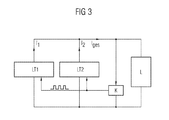
- a simpler known arrangement provides that two power units LT1, LT2 are controlled with only one controller K, as in FIG. 3 shown.
- the controller K then generates a pulse width modulated signal for both power parts LT1, LT2.
- the output currents I1, I2 of the two power parts LT1, LT2 are not the same due to tolerances and temperature drift. It is therefore not possible to operate both power units up to the permissible power limit.
- FIG. 4 An exemplary arrangement is in FIG. 4 shown. There are two power parts LT1, LT2 connected in parallel to an input voltage U IN . At the output of this parallel circuit is the output voltage U OUT .
- the two power units LT1, LT2 are controlled by means of a common controller PWM-K, which comprises a main controller HK and a subcontroller SK.
- the main controller HK a measurement signal of the output voltage U OUT , a measurement signal of the first output current i 1 at the output of the first power unit LT1 and a measurement signal of the input voltage U IN are supplied. From these input signals, the main controller HK generates the first pulse width modulated signal PWM1, by means of which the first power part LT1 is driven.
- the first pulse width modulated signal PWM1 is also supplied to the subcontroller SK.
- the subcontroller SK changes this first pulse-width-modulated signal PWM1 as a function of the difference between the two output voltages i 2 -i 1 of the power units LT1, LT2 to form a second pulse-width-modulated signal PWM2.
- a subtraction unit is provided in the controller PWM-K, which forms a differential signal i 2 -i 1 from the measurement signals of the first and second output currents i 1 , i 2 and feeds them to the subcontroller SK.
- second pulse width modulated signal PWM2 the second power part LT2 is driven.
- the test ratio of the first pulse-width-modulated signal PWM1 is thus initially adapted for both power parts LT1, LT2 by means of the main controller HK.
- the first pulse-width-modulated signal PWM1 is fed directly to only one power unit LT1.
- subcontroller SK which generates the second pulse width modulated signal PWM2 from the first pulse width modulated signal PWM1.
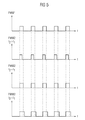
- FIG. 5 an exemplary course of the two pulse width modulated signals PWM1, PWM2 for different states of the two power parts LT1, LT2 is shown.
- the upper diagram shows the first pulse-width-modulated signal PWM1 over the time t, as dictated by the main controller HK depending on the load conditions. Below this are shown three different courses of the second pulse width modulated signal over the time t.
- the subcontroller SK is a second pulse width modulated Signal PWM2 with reduced duty cycle before.
- the turn-off edges of the second pulse-width-modulated signal PWM2 precede those of the first pulse-width-modulated signal PWM1, as in the second diagram in FIG. 5 shown.
- the subcontroller SK predefines a second pulse-width-modulated signal PWM 2 with a larger duty cycle.
- the turn-off edges of the second pulse-width-modulated signal PWM2 thus lag those of the first pulse-width-modulated signal PWM1, as in the bottom diagram in FIG. 5 shown.
- the change of the second pulse width modulated signal PWM2 takes place, for example, in such a way that at predetermined intervals, eg after five switching cycles, according to the detected difference between the two output currents I 1 , I 2, the on-time is multiplied by a factor greater than or less than one.
- This multiplication factor can be preset proportional to the difference between the two output currents I 1 , I 2 .
Landscapes
- Engineering & Computer Science (AREA)
- Power Engineering (AREA)
- Dc-Dc Converters (AREA)
- Inverter Devices (AREA)
Applications Claiming Priority (1)
| Application Number | Priority Date | Filing Date | Title |
|---|---|---|---|
| AT9982007A AT505431B1 (de) | 2007-06-28 | 2007-06-28 | Getaktete stromversorgung |
Publications (1)
| Publication Number | Publication Date |
|---|---|
| EP2009777A2 true EP2009777A2 (fr) | 2008-12-31 |
Family
ID=39855192
Family Applications (1)
| Application Number | Title | Priority Date | Filing Date |
|---|---|---|---|
| EP20080103701 Withdrawn EP2009777A2 (fr) | 2007-06-28 | 2008-04-24 | Alimentation régulée en modulation de largeur d'impulsion |
Country Status (2)
| Country | Link |
|---|---|
| EP (1) | EP2009777A2 (fr) |
| AT (1) | AT505431B1 (fr) |
Cited By (3)
| Publication number | Priority date | Publication date | Assignee | Title |
|---|---|---|---|---|
| WO2014124121A3 (fr) * | 2013-02-11 | 2015-04-02 | Microchip Technology Incorporated | Bus de partage de charge à modulation d'impulsions en durée |
| WO2025046045A1 (fr) | 2023-08-31 | 2025-03-06 | Siemens Aktiengesellschaft | Système d'alimentation électrique à unités d'alimentation parallèles et opération maître-esclave |
| EP4704316A1 (fr) | 2024-08-28 | 2026-03-04 | Siemens Aktiengesellschaft | Système d'alimentation électrique et procédé de fonctionnement d'un système d'alimentation électrique |
Family Cites Families (3)
| Publication number | Priority date | Publication date | Assignee | Title |
|---|---|---|---|---|
| US5428523A (en) * | 1993-03-30 | 1995-06-27 | Ro Associates | Current sharing signal coupling/decoupling circuit for power converter systems |
| JP2006262549A (ja) * | 2005-03-15 | 2006-09-28 | Densei Lambda Kk | 電源装置の系統連携システム |
| US7157890B1 (en) * | 2005-10-25 | 2007-01-02 | Microchip Technology Inc. | Using pulse width modulation in the control of load sharing between paralleled power supplies |
-
2007
- 2007-06-28 AT AT9982007A patent/AT505431B1/de not_active IP Right Cessation
-
2008
- 2008-04-24 EP EP20080103701 patent/EP2009777A2/fr not_active Withdrawn
Cited By (6)
| Publication number | Priority date | Publication date | Assignee | Title |
|---|---|---|---|---|
| WO2014124121A3 (fr) * | 2013-02-11 | 2015-04-02 | Microchip Technology Incorporated | Bus de partage de charge à modulation d'impulsions en durée |
| US9106136B2 (en) | 2013-02-11 | 2015-08-11 | Microchip Technology Incorporated | Pulse width modulation load share bus |
| WO2025046045A1 (fr) | 2023-08-31 | 2025-03-06 | Siemens Aktiengesellschaft | Système d'alimentation électrique à unités d'alimentation parallèles et opération maître-esclave |
| DE102023208386A1 (de) | 2023-08-31 | 2025-03-06 | Siemens Aktiengesellschaft | Stromversorgungssystem, Verfahren zum Betrieb eines Stromversorgungssystems sowie Stromversorgung |
| EP4704316A1 (fr) | 2024-08-28 | 2026-03-04 | Siemens Aktiengesellschaft | Système d'alimentation électrique et procédé de fonctionnement d'un système d'alimentation électrique |
| WO2026046741A1 (fr) | 2024-08-28 | 2026-03-05 | Siemens Aktiengesellschaft | Système d'alimentation électrique et procédé de fonctionnement d'un système d'alimentation électrique |
Also Published As
| Publication number | Publication date |
|---|---|
| AT505431A1 (de) | 2009-01-15 |
| AT505431B1 (de) | 2012-09-15 |
Similar Documents
| Publication | Publication Date | Title |
|---|---|---|
| EP2321892B1 (fr) | Alimentation à découpage avec rendement à auto-optimisation | |
| DE102006013524B4 (de) | Schaltwandler mit mehreren Wandlerstufen | |
| EP1157320B1 (fr) | Procede permettant de generer une tension continue regulee a partir d'une tension alternative, et dispositif d'alimentation en courant pour la mise en oeuvre de ce procede | |
| DE102011078245A1 (de) | Spannungswandler und Spannungswandlungsverfahren | |
| EP3114898B1 (fr) | Led-driver | |
| EP3350911B1 (fr) | Module pfc pour fonctionnement en mode de conduction discontinu | |
| WO2017016747A1 (fr) | Procédé et dispositif pour faire fonctionner un système électrique | |
| EP1872627B1 (fr) | Pfc numerique parametrable | |
| DE102007045220A1 (de) | Mehrphasen-Symmetrierungsregler zur Regelung der Phasen-Modulströme | |
| DE102005002570A1 (de) | Ansteuerschaltung für zwei Schaltwandlerstufen eines Spannungswandlers | |
| EP2553797A1 (fr) | Transducteur magnétique de mesure en courant continu doté d'un circuit cuk et avec détection de courant de charge | |
| AT505431B1 (de) | Getaktete stromversorgung | |
| DE102007058681A1 (de) | Hoch-/Tiefsetzsteller, insbesondere zur Einspeisung mit Brennstoffzellen in ein elektrisches Netz, sowie geeignete Verwendungen | |
| EP2826126B1 (fr) | Dispositif électronique de puissance comportant une symétrisation d'un n ud de tension dans le circuit intermédiaire | |
| EP1766767B1 (fr) | Procede d'utilisation d'un onduleur et dispositif de mise en oeuvre de ce procede | |
| EP2093874A1 (fr) | Dispositif d'alimentation, en particulier pour le fonctionnement redondant avec plusieurs dispositifs d'alimentation commutés parallèlement côté sortie | |
| EP2713489A1 (fr) | Procédé de fonctionnement d'un convertisseur PFC actif pendant puissance faible utilisant modulation fenêtre avec commande en boucle ouverte de largeur | |
| EP1189490B1 (fr) | Ballast électronique de lampe fluorescente | |
| DE102016107578A1 (de) | Betriebsschaltung und Verfahren zum Betreiben wenigstens eines Leuchtmittels | |
| DE102022117139B4 (de) | Verfahren zum Betrieb eines Leistungswandlers | |
| DE102014219787A1 (de) | Schaltnetzteil mit zumindest einem Leistungsteil und zumindest einem Hilfsnetzteil | |
| DE102014221554B4 (de) | Pulsweitenmodulierte Ansteuerung einer getakteten Schaltung mit einstellbarer Leistungsübertragung | |
| DE102007003415A1 (de) | Elektrische Spannungsversorgungseinheit zur Erzeugung mindestens einer Ausgangsgleichspannung aus einer Versorgungsgleichspannung | |
| EP2372889A2 (fr) | Agencement de commutation et procédé de production d'une tension alternative à partir d'une multitude de sources de tension non réglées ayant une tension continue de sortie variable dans le temps | |
| EP3439159B1 (fr) | Réduction de fluctuations de flux lumineux dans une commande de valeur seuil d'un convertisseur cadencé activement |
Legal Events
| Date | Code | Title | Description |
|---|---|---|---|
| PUAI | Public reference made under article 153(3) epc to a published international application that has entered the european phase |
Free format text: ORIGINAL CODE: 0009012 |
|
| AK | Designated contracting states |
Kind code of ref document: A2 Designated state(s): AT BE BG CH CY CZ DE DK EE ES FI FR GB GR HR HU IE IS IT LI LT LU LV MC MT NL NO PL PT RO SE SI SK TR |
|
| AX | Request for extension of the european patent |
Extension state: AL BA MK RS |
|
| RAP1 | Party data changed (applicant data changed or rights of an application transferred) |
Owner name: SIEMENS AKTIENGESELLSCHAFT |
|
| RAP1 | Party data changed (applicant data changed or rights of an application transferred) |
Owner name: SIEMENS AKTIENGESELLSCHAFT |
|
| STAA | Information on the status of an ep patent application or granted ep patent |
Free format text: STATUS: THE APPLICATION IS DEEMED TO BE WITHDRAWN |
|
| 18D | Application deemed to be withdrawn |
Effective date: 20151103 |