EP2014363A2 - Procédé de transfert d'une suspension de résine échangeuse d'ions préconditionnée - Google Patents
Procédé de transfert d'une suspension de résine échangeuse d'ions préconditionnée Download PDFInfo
- Publication number
- EP2014363A2 EP2014363A2 EP08009586A EP08009586A EP2014363A2 EP 2014363 A2 EP2014363 A2 EP 2014363A2 EP 08009586 A EP08009586 A EP 08009586A EP 08009586 A EP08009586 A EP 08009586A EP 2014363 A2 EP2014363 A2 EP 2014363A2
- Authority
- EP
- European Patent Office
- Prior art keywords
- ion exchange
- exchange resin
- storage
- preconditioned
- phenol
- Prior art date
- Legal status (The legal status is an assumption and is not a legal conclusion. Google has not performed a legal analysis and makes no representation as to the accuracy of the status listed.)
- Withdrawn
Links
Images
Classifications
-
- B—PERFORMING OPERATIONS; TRANSPORTING
- B01—PHYSICAL OR CHEMICAL PROCESSES OR APPARATUS IN GENERAL
- B01J—CHEMICAL OR PHYSICAL PROCESSES, e.g. CATALYSIS OR COLLOID CHEMISTRY; THEIR RELEVANT APPARATUS
- B01J31/00—Catalysts comprising hydrides, coordination complexes or organic compounds
- B01J31/02—Catalysts comprising hydrides, coordination complexes or organic compounds containing organic compounds or metal hydrides
- B01J31/06—Catalysts comprising hydrides, coordination complexes or organic compounds containing organic compounds or metal hydrides containing polymers
- B01J31/08—Ion-exchange resins
-
- B—PERFORMING OPERATIONS; TRANSPORTING
- B01—PHYSICAL OR CHEMICAL PROCESSES OR APPARATUS IN GENERAL
- B01J—CHEMICAL OR PHYSICAL PROCESSES, e.g. CATALYSIS OR COLLOID CHEMISTRY; THEIR RELEVANT APPARATUS
- B01J19/00—Chemical, physical or physico-chemical processes in general; Their relevant apparatus
Definitions
- the present invention relates to a process for the storage of pretreated conditioned ion exchange resin suspensions as catalysts for chemical reactions as well as the storage, transport and transfer of this preconditioned ion exchange resin suspension into a reactor.
- ion exchangers can optionally be chemically modified by covalently or ionically bound cocatalysts and are macroporous or gel-like as in US-A-4,191,843 and US-A-3,037,052 is described.
- JP-A 000006296871 thus describes a process in which the conditioning takes place in the reactor used for catalysis, so that storage and transport of the unstable ion exchanger is not necessary, but at the same time, in the period of conditioning the reactor for the actual catalysis can not be used ,
- a stationary treatment of the ion exchanger eg in a reactor is also in EP-A 1239958 described.
- the implementation of a pretreatment / conditioning of ion exchangers in the reactor has the disadvantage that the reactor is not available for the production process during the conditioning and the catalyst conditioning thus means a loss of production.
- WO-A 01/37992 describes the preconditioning of a cation exchange resin suspension for the catalyst reaction of acetone with phenol to give bisphenol A.
- WO-A 01/37992 also describes that this preconditioning can be carried out in an external vessel upstream of the reactor, but does not describe how such a preconditioned ion exchange resin suspension can be stored for a long time or transported to other production sites where it can be transferred to the respective reactor without the preconditioned ion exchange resin suspension loses its properties important for catalysis.
- Such a procedure implies a limitation in the efficient disposition and use of apparatus or equipment for catalyst pretreatment and conditioning, particularly for users operating multiple production facilities in which a recurrent catalyst replacement is required.
- This object is achieved by a method for storing pretreated, conditioned ion exchangers as catalysts for chemical reactions, wherein the preconditioned ion exchange resin is present as preconditioned ion exchange resin suspension in a laboratory or transport container and either transported to a storage location and temporarily stored there or to be filled Reactor transported and transferred to this.
- the method according to the invention is advantageous if the storage or transport container can be heated.
- the process according to the invention is advantageous when the ion exchange resin suspension in the presence of less than 500 ppm by volume oxygen in the gas phase with a solids content of 20 to 80 vol.% Based on the ion exchange resin suspension in the storage or transport container is present.
- the process according to the invention is advantageous if the preconditioned ion exchange resin suspension present in the heatable storage or transport container in liquid or solidified or partially solidified form into a pumpable ion exchange resin suspension, if the suspension is solidified or partially solidified, by gentle melting, with less than 500 vol. ppm oxygen in the gas phase, removed with suitable pumps that do not damage the ion exchanger, the storage or transport container and via suitable pipes or suitable flexible compounds in a reactor at temperatures of 50 to 80 ° C and with a solids content of 20 Up to 80 vol .-% based on the ion exchange resin suspension with less than 500 ppm by volume of oxygen in the gas phase is transferred.
- the process according to the invention is advantageous if the liquid phase of the preconditioned ion exchange resin suspension is an OH component.
- the process according to the invention is advantageous if the OH component is phenol.
- the process according to the invention is advantageous if the OH component is phenol which still has a residual water content in the range of 0.1-10%, preferably 0.2-5%, particularly preferably 0.5-3%, based on phenol.
- the process according to the invention is advantageous if the ion exchangers of the preconditioned ion exchange resin suspensions have a gelatinous or macroporous structure.
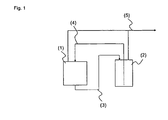
- the process according to the invention is advantageous if the liquid phase contained in the preconditioned ion exchange resin suspension is partly transferred from the storage or transport container into the reactor in the circulation of storage or transport container (1) via the line (3) and partly through line (3). 4) is returned to the storage or transport container (1).
- the inventive method wherein the preconditioned ion exchanger is stored in phenol and the phenol content based on the total mass of the ion exchanger / phenol suspension 20 to 80 wt .-% is.
- the proportion of liquid and solid phase in the ion exchanger / phenol suspension may change during the production process.
- the process according to the invention wherein the ion exchange resin in the preconditioned ion exchange resin suspension is a cationic ion exchange resin.
- Suitable storage or transport containers are those which allow the ion exchange resin suspension to be in a pumpable form upon removal, preferably heatable storage containers or transport containers made of suitable stainless steel or other corrosion resistant materials under storage conditions of the suspension or corrosion resistant , Suitable materials for the storage or transport containers are, for example, stainless steels of the types 1.4571, 1.4404 or other enamelled containers, ceramic or glass-like containers or plastic-containing containers, which are resistant to organic or inorganic acids or bases, water or atmospheric oxygen. Suitable storage or transport containers are eg heatable rail tank cars, overseas containers or road tankers. The container material used is preferably stainless steel, which is resistant to corrosion under the storage and transport conditions of the suspension.
- Suitable containers preferably have superimposed ventilation or expansion devices with inert gas.
- the preferred storage temperature is ⁇ 60 ° C, more preferably ⁇ 40 ° C.
- the storage time is preferably less than 12 months, more preferably less than 6 months, most preferably less than 3 months.
- an additional operation may be required to remove any eluatable acid that may have formed during storage from the ion exchanger.
- Ion exchange resin suspensions in pumpable form are to be understood as meaning those ion exchange resin suspensions having a temperature in the range from 50 to 90 ° C., preferably 60 to 80 ° C. and preferably for transfer by means of a pump in the storage or transport container have a solids content of 20 to 80 wt .-%, preferably 30 to 70 wt .-%.
- the preconditioned ion exchange resin suspension may be in the storage or shipping container during storage or transportation with less than 500 ppm by volume of oxygen in liquid, solidified or partially solidified form.
- the preconditioned ion exchange resin suspension is, after the end of the storage period or completion of the transport from the storage or transport container transferred to a reactor, the preconditioned ion exchange resin suspension, if they are not in pumpable, but in solidified or partially solidified form, is gently melted and Then the present in pumpable form preconditioned ion exchange resin suspension in the reactor with less than 500 ppm by volume of oxygen in the gas phase is transferred with suitable pumps from the storage or transport container in the reactor.
- the pumps used for the transfer are those which do not damage the ion exchange resin suspension, preference is given to those in which the conveying takes place with low shear, low abrasion and thus gentle to the ion exchange resin of the ion exchange resin suspension, membrane pumps are particularly preferred.
- the energy input in conveying the ion exchange resin suspensions should preferably not exceed 150 W / m 3 , preferably it is in the range of 20 to 130 W / m 3 .
- For the transfer from the storage or transport container in the reactor tubes or guttone flexible compounds are used, which are corrosion-resistant and which survive the temperatures that are in the range of 50 to 90 ° C unchanged. Preference is given to pipes or flexible connections made of suitable materials such as stainless steel grades 1.4571, 1.4404 or other or Stahlflexschläuchen or armored hoses.
- preconditioned ion exchange resin suspensions can be stored and transported in suitable liquids without being damaged by the transport-related mechanical stress caused by pumping and solidification and melting of the suspension.
- analytical methods such as optical methods for determining particle breakage, microscopy and particle size measurements
- the method according to the invention which also includes the solidification, partial solidification and melting of the ion exchange resin suspension, does not lead to any measurable mechanical damage to the preconditioned ion exchanger.
- Preconditioned ion exchange resin suspensions may use as liquid phases all those solvents which are not detrimental to the reaction during the actual catalysis or which do not lead to any unnecessary by-products.
- Preconditioned IonenSerhharz suspensions which are then to be used as a catalyst for bisphenol preparation can contain as liquid phases in the ion exchange resin suspensions OH-containing liquid phases such as water and organic solvents such as phenol or mixtures of these liquid phases. Phenol is preferred as the liquid phase for the pretreated ion exchange resin suspensions which are to be used for the preparation of bisphenol A.
- a preferred embodiment of the method according to the invention is the storage or transport of preconditioned ion exchange resin suspensions which are to be used for the preparation of bisphenol A from acetone and phenol.
- These preconditioned ion exchange resin suspensions preferably contain an OH-containing liquid phase, more preferably phenol as the liquid phase in the ion exchange resin suspension.
- the ion exchanger conditioned in this way is outstandingly suitable for the preparation of bisphenols, in particular for the preparation of bisphenol A (BPA) from acetone and phenol.
- BPA bisphenol A
- the BPA produced with this ion exchanger has high product qualities and is particularly suitable for the production of polymers such as epoxy resins and in particular polycarbonate.
- the polycarbonates thus prepared are used for the production of moldings, in particular compact disks, lenses and disks.
- Fig. 1 stands (1) for a storage or transport container, which can be heated, (2) for a container, which can be stirred and heated, (3) for a line through which the ion exchange resin suspension in the container (2) is promoted , (4) for a conduit which redirects the liquid phase of the ion exchange resin suspension and (5) for connection to an exhaust device.
- a storage or transport container which can be heated
- a container which can be stirred and heated
- (4) for a conduit which redirects the liquid phase of the ion exchange resin suspension and (5) for connection to an exhaust device.
- Suitable delivery devices are, for example, diaphragm pumps.
- Another advantage of the method described is therefore that the utilization of a corresponding of the actual catalytic reactor independent Vorkondition istsstrom by shipping the preconditioned ion exchange resin suspension can be significantly increased by the inventive method for transferring and subsequent damage-free transport of preconditioned ion exchange resin suspension.
- this results in economic advantages in the operation of the preconditioning plant and, on the other hand, resources are spared since not every single production plant has to be equipped with a preconditioning plant in order to take advantage of the short downtime of a catalyst reactor during the preconditioning.
- the phenol from the preconditioned ion exchange resin suspension may be contaminated with acidic soluble fractions from the ion exchanger after transport, solidification and reflow according to the process of the invention.
- the amount of acidic elutable fractions in the resulting phenol increases with that between conditioning and use in one Reaction vessel elapsed time.
- the thus obtained phenol is preferably purified by distillation, wherein the bottom of the column with up to 5 wt .-% of a basic compound can be charged, which is suitable to retain acidic components ,
- a preferred basic compound is sodium hydroxide.
- the process according to the invention for the transport, storage and transport of ion exchange resin suspensions is also suitable for the transport, storage and transport of other dimensionally stable heterogeneous catalysts, e.g. can be used for condensation reactions.
- the inventive method not only avoids the disadvantages of the known stationary catalyst conditions described above, but also allows the optimal use of preconditioned ion exchange resin suspensions as catalyst resins in condensation reactions, preferably in condensation reactions starting from phenols, o-, m-, p-cresols or ⁇ - or ⁇ -naphthols, particularly preferably in the synthesis of bisphenols, most preferably for the synthesis of BPA from phenol and acetone.
- the preconditioned ion exchange resin suspensions are also outstandingly suitable for use as catalysts in addition reactions.
- the addition reaction of alcohols to alkenes may be mentioned as an addition reaction, preferably of alcohols to C 1 -C 4 -alkenes, more preferably of methanol, ethanol, propanol or butanol to isobutene, most preferably of methanol to isobutene to methyl tert. butyl ether.
- the preconditioned ion exchange resin suspensions are also suitable for the catalysis of esterifications by reaction of alcohols with carboxylic acids, preferably of C 1 -C 8 -alcohols with C 1 -C 8 -carboxylic acids, more preferably for the esterification of methanol, ethanol, propanol and all isomers of butanol with carboxylic acids of the series formic acid, acetic acid, propionic acid or butyric acid.
- the preconditioned ion exchange resin suspensions are suitable for catalyzing transesterification reactions, for example from triesters to monoesters, in particular the transesterification of a triglyceride with methanol, ethanol, propanol or butanol to form a fatty acid monoester.
- the conditioned ion exchange resin suspension are suitable for catalysis of alkylation reactions, for example the alkylation of phenols or cresols with linear or branched olefins, for example to triisobutene or nonene.
- the water wash (oxygen content in demineralised water ⁇ 20 ppb) is carried out in a temporarily stirred conditioning tank under nitrogen atmosphere in 12 cycles at 30 ° C, the residual conductivity of the wash water at the end of the cycle is 14 microSiemens / cm.
- the dehydration is carried out continuously under nitrogen atmosphere at 70 ° C with phenol. This reduces the volume of the ion exchanger by approx. 48%.
- the water-containing phenol obtained on the effluent is distilled off by distillation at initially 700 mbar and 105 ° C sump temperature. At the end of the distillation, the vacuum is lowered to 130 mbar; the bottom temperature rises to 125 ° C.
- Supernatant phenol is drained and purified by distillation at 120 ° C and 150 mbar over sodium hydroxide (0.001 wt .-%).
- the thus preconditioned ion exchange resin suspension is transported by conventional transport routes by rail and water to the desired production site. The total transport time is about 6 weeks.
- the solidified ion exchange resin suspension is melted for transfer to the production vessel (reactor).
- the teilbeauchbare transport container is heated to 75 ° C tempered water and low pressure steam at a temperature of 110 ° C. It is noted that the temperature in the teilbeattybaren rail tanker car at any point above 75 ° C increases.
- the suspension After melting, the suspension is pumped from the transport container into the reactor by means of membrane pumps and addition of phenol, which was heated to 70 ° C., and used for the continuous production of 2,2-bis (4-hydroxyphenyl) propane.
- the phenol used for pumping operations becomes purified by distillation at 120 ° C and 150 mbar over sodium hydroxide (0.001 wt .-%) and reused in the process.
Landscapes
- Chemical & Material Sciences (AREA)
- Organic Chemistry (AREA)
- Chemical Kinetics & Catalysis (AREA)
- Engineering & Computer Science (AREA)
- Materials Engineering (AREA)
- Organic Low-Molecular-Weight Compounds And Preparation Thereof (AREA)
- Catalysts (AREA)
Applications Claiming Priority (1)
| Application Number | Priority Date | Filing Date | Title |
|---|---|---|---|
| DE102007026549A DE102007026549A1 (de) | 2007-06-08 | 2007-06-08 | Verfahren zum Umfüllen von vorkonditionierten Ionenaustauscherharz-Suspensionen |
Publications (2)
| Publication Number | Publication Date |
|---|---|
| EP2014363A2 true EP2014363A2 (fr) | 2009-01-14 |
| EP2014363A3 EP2014363A3 (fr) | 2009-03-11 |
Family
ID=39615772
Family Applications (1)
| Application Number | Title | Priority Date | Filing Date |
|---|---|---|---|
| EP08009586A Withdrawn EP2014363A3 (fr) | 2007-06-08 | 2008-05-27 | Procédé de transfert d'une suspension de résine échangeuse d'ions préconditionnée |
Country Status (9)
| Country | Link |
|---|---|
| US (1) | US8133928B2 (fr) |
| EP (1) | EP2014363A3 (fr) |
| JP (1) | JP5274113B2 (fr) |
| KR (1) | KR20080108033A (fr) |
| CN (1) | CN101318147B (fr) |
| DE (1) | DE102007026549A1 (fr) |
| RU (1) | RU2008122541A (fr) |
| SG (1) | SG148924A1 (fr) |
| TW (1) | TWI450763B (fr) |
Families Citing this family (4)
| Publication number | Priority date | Publication date | Assignee | Title |
|---|---|---|---|---|
| DE102011086907A1 (de) | 2010-12-23 | 2012-06-28 | Schaeffler Technologies Gmbh & Co. Kg | Vorrichtung zum Ausgleich von Drehmomentschwankungen |
| GB201701576D0 (en) * | 2017-01-31 | 2017-03-15 | Ge Healthcare Bio Sciences Ab | Method and system for transferring separation resin |
| CN112718020B (zh) * | 2020-12-18 | 2021-07-23 | 山东聚优新材料科技有限公司 | 一种阴离子交换树脂中间体氯球的安全运输与存储方法 |
| WO2026082646A1 (fr) * | 2024-10-15 | 2026-04-23 | Sabic Global Technologies B.V. | Procédé d'alimentation en catalyseur dans un réacteur |
Citations (5)
| Publication number | Priority date | Publication date | Assignee | Title |
|---|---|---|---|---|
| US3037052A (en) | 1959-04-29 | 1962-05-29 | Rohm & Haas | Catalyzing reactions with cation exchange resin |
| US4191843A (en) | 1977-11-09 | 1980-03-04 | Shell Oil Company | Preparation of bisphenols |
| JPH06296871A (ja) | 1993-04-20 | 1994-10-25 | Chiyoda Corp | 反応器に対するビスフェノールa製造用触媒の充填方法 |
| JPH06304479A (ja) | 1993-04-20 | 1994-11-01 | Chiyoda Corp | 反応器に対するビスフェノールa製造用触媒の充填方法 |
| WO2001037992A1 (fr) | 1999-11-23 | 2001-05-31 | Bayer Aktiengesellschaft | Resines catalyseurs |
Family Cites Families (8)
| Publication number | Priority date | Publication date | Assignee | Title |
|---|---|---|---|---|
| US3284419A (en) * | 1961-03-23 | 1966-11-08 | Shell Oil Co | Poly |
| US3077479A (en) * | 1961-05-05 | 1963-02-12 | Shell Oil Co | Purification of sulfolene |
| FR1321258A (fr) * | 1961-05-05 | 1963-03-15 | Shell Int Research | Procédé de purification du sulfolène |
| GB2336159B (en) * | 1998-04-08 | 2001-07-11 | Bp Chem Int Ltd | Resin composition for purification of carboxylic acids and/or carboxylic anhydrides |
| JP4042325B2 (ja) * | 2000-12-07 | 2008-02-06 | 三菱化学株式会社 | アミノチオール変性スルホン酸型陽イオン交換樹脂の保存方法 |
| JP2002292285A (ja) * | 2001-03-30 | 2002-10-08 | Nippon Shokubai Co Ltd | アルキレンオキシドの付加反応用樹脂触媒の保存方法とその利用 |
| KR20130048274A (ko) * | 2005-01-28 | 2013-05-09 | 다우 글로벌 테크놀로지스 엘엘씨 | 산 촉매로서 사용하기 전에 양이온 교환 수지를 안정화시키는 방법, 및 화학 공정에서의 이러한 안정화된 양이온 교환 수지의 용도 |
| DE102005025788A1 (de) * | 2005-06-04 | 2006-12-07 | Bayer Materialscience Ag | Verfahren zur Herstellung von hochreinem Bisphenol A |
-
2007
- 2007-06-08 DE DE102007026549A patent/DE102007026549A1/de not_active Withdrawn
-
2008
- 2008-05-21 SG SG200803835-8A patent/SG148924A1/en unknown
- 2008-05-27 EP EP08009586A patent/EP2014363A3/fr not_active Withdrawn
- 2008-05-30 US US12/129,851 patent/US8133928B2/en not_active Expired - Fee Related
- 2008-06-05 KR KR1020080052963A patent/KR20080108033A/ko not_active Abandoned
- 2008-06-06 RU RU2008122541/04A patent/RU2008122541A/ru not_active Application Discontinuation
- 2008-06-06 TW TW097121023A patent/TWI450763B/zh not_active IP Right Cessation
- 2008-06-06 JP JP2008149129A patent/JP5274113B2/ja not_active Expired - Fee Related
- 2008-06-10 CN CN2008101255178A patent/CN101318147B/zh not_active Expired - Fee Related
Patent Citations (6)
| Publication number | Priority date | Publication date | Assignee | Title |
|---|---|---|---|---|
| US3037052A (en) | 1959-04-29 | 1962-05-29 | Rohm & Haas | Catalyzing reactions with cation exchange resin |
| US4191843A (en) | 1977-11-09 | 1980-03-04 | Shell Oil Company | Preparation of bisphenols |
| JPH06296871A (ja) | 1993-04-20 | 1994-10-25 | Chiyoda Corp | 反応器に対するビスフェノールa製造用触媒の充填方法 |
| JPH06304479A (ja) | 1993-04-20 | 1994-11-01 | Chiyoda Corp | 反応器に対するビスフェノールa製造用触媒の充填方法 |
| WO2001037992A1 (fr) | 1999-11-23 | 2001-05-31 | Bayer Aktiengesellschaft | Resines catalyseurs |
| EP1239958A1 (fr) | 1999-11-23 | 2002-09-18 | Bayer Aktiengesellschaft | Resines catalyseurs |
Also Published As
| Publication number | Publication date |
|---|---|
| US8133928B2 (en) | 2012-03-13 |
| TWI450763B (zh) | 2014-09-01 |
| CN101318147A (zh) | 2008-12-10 |
| TW200916190A (en) | 2009-04-16 |
| JP5274113B2 (ja) | 2013-08-28 |
| CN101318147B (zh) | 2013-07-31 |
| DE102007026549A1 (de) | 2008-12-11 |
| JP2009039707A (ja) | 2009-02-26 |
| KR20080108033A (ko) | 2008-12-11 |
| SG148924A1 (en) | 2009-01-29 |
| RU2008122541A (ru) | 2009-12-20 |
| US20080306174A1 (en) | 2008-12-11 |
| EP2014363A3 (fr) | 2009-03-11 |
Similar Documents
| Publication | Publication Date | Title |
|---|---|---|
| EP0583712B1 (fr) | Procédé pour la préparation de bisphénols | |
| EP0538040B1 (fr) | Procédé pour l'élimination des composés iodures des acides carboxyliques et des anhydrides d'acides carboxyliques | |
| DE102007026549A1 (de) | Verfahren zum Umfüllen von vorkonditionierten Ionenaustauscherharz-Suspensionen | |
| EP1239958B1 (fr) | Procede pour conditionner des resines echangeuses d'ions | |
| Vigier et al. | Heterogeneously-catalyzed conversion of carbohydrates | |
| EP0198270A2 (fr) | Procédé de traitement de catalyseurs constitués d'un échangeur d'ions très acide | |
| DE602004011960T2 (de) | Verfahren zur herstellung von polycarbonat | |
| WO1997026255A1 (fr) | Procede et dispositif de production de tetrahydrofurane | |
| DE2359582C3 (de) | Umwandlung eines Hydrogels in ein Xerogel | |
| EP2263794B1 (fr) | Régénération d'échangeurs d'ions acides | |
| EP3173403B1 (fr) | Procédé de préparation de n, n '-bis (2-cyanoéthyl) -1,2-éthylénédiamine grâce à l'utilisation de résine échangeuse de cations comme catalyseur | |
| DE102004005722A1 (de) | Verfahren zur Herstellung von Bisphenolen mit optimaler Befüllung des Reaktors mit Katalysator | |
| DE10027908B4 (de) | Verwendung von monodispersen Kationen- und Anionenaustauschern als Katalysatoren | |
| US6017969A (en) | Ion-exchange resins, their preparation and uses | |
| US4379940A (en) | Vinyl acetate purification process | |
| EP4255878B1 (fr) | Configuration de procédé pour un seul train de purification de phénol pour la production de phénol et de bisphénol-a dans un procédé intégré | |
| US4487959A (en) | Vinyl acetate purification process | |
| EP0567857B1 (fr) | Synthèse de bisphénols sur des résines échangeurs d'ions modifiées en utilisant des composés carbonylés spécialement purifiés | |
| DE19956229A1 (de) | Katalysatorharze | |
| EP2185498A1 (fr) | Procédé d'estérification sous catalyse hétérogène d'acide (méth)acrylique avec des polyols oxyalkylés | |
| US6635788B1 (en) | Process for manufacture of bisphenols | |
| DE4308569A1 (de) | Verfahren zur Reinigung von durch gelöste Metallverbindungen verunreinigten organischen Verbindungen | |
| WO2004094346A2 (fr) | Purification de solvants utilises pour la purification d'oxyde d'alkylene | |
| DE19509821C1 (de) | Verfahren zur Entfernung von Phenolen und anderen organischen Verbindungen und zur Wiedergewinnung von Phenolen aus Abwässern | |
| EP1244607B1 (fr) | Poudre de bisphenol fluidisee |
Legal Events
| Date | Code | Title | Description |
|---|---|---|---|
| PUAI | Public reference made under article 153(3) epc to a published international application that has entered the european phase |
Free format text: ORIGINAL CODE: 0009012 |
|
| PUAI | Public reference made under article 153(3) epc to a published international application that has entered the european phase |
Free format text: ORIGINAL CODE: 0009012 |
|
| AK | Designated contracting states |
Kind code of ref document: A2 Designated state(s): AT BE BG CH CY CZ DE DK EE ES FI FR GB GR HR HU IE IS IT LI LT LU LV MC MT NL NO PL PT RO SE SI SK TR |
|
| AX | Request for extension of the european patent |
Extension state: AL BA MK RS |
|
| PUAL | Search report despatched |
Free format text: ORIGINAL CODE: 0009013 |
|
| AK | Designated contracting states |
Kind code of ref document: A3 Designated state(s): AT BE BG CH CY CZ DE DK EE ES FI FR GB GR HR HU IE IS IT LI LT LU LV MC MT NL NO PL PT RO SE SI SK TR |
|
| AX | Request for extension of the european patent |
Extension state: AL BA MK RS |
|
| 17P | Request for examination filed |
Effective date: 20090911 |
|
| 17Q | First examination report despatched |
Effective date: 20091006 |
|
| AKX | Designation fees paid |
Designated state(s): AT BE BG CH CY CZ DE DK EE ES FI FR GB GR HR HU IE IS IT LI LT LU LV MC MT NL NO PL PT RO SE SI SK TR |
|
| RAP1 | Party data changed (applicant data changed or rights of an application transferred) |
Owner name: BAYER INTELLECTUAL PROPERTY GMBH |
|
| STAA | Information on the status of an ep patent application or granted ep patent |
Free format text: STATUS: THE APPLICATION HAS BEEN WITHDRAWN |
|
| 18W | Application withdrawn |
Effective date: 20150402 |