EP2015224B1 - Caractéristiques de jonction invisible pour reconnaissance de patch - Google Patents
Caractéristiques de jonction invisible pour reconnaissance de patch Download PDFInfo
- Publication number
- EP2015224B1 EP2015224B1 EP08160112.2A EP08160112A EP2015224B1 EP 2015224 B1 EP2015224 B1 EP 2015224B1 EP 08160112 A EP08160112 A EP 08160112A EP 2015224 B1 EP2015224 B1 EP 2015224B1
- Authority
- EP
- European Patent Office
- Prior art keywords
- feature
- junction
- invisible
- input
- output
- Prior art date
- Legal status (The legal status is an assumption and is not a legal conclusion. Google has not performed a legal analysis and makes no representation as to the accuracy of the status listed.)
- Ceased
Links
Images






Classifications
-
- G—PHYSICS
- G06—COMPUTING OR CALCULATING; COUNTING
- G06V—IMAGE OR VIDEO RECOGNITION OR UNDERSTANDING
- G06V30/00—Character recognition; Recognising digital ink; Document-oriented image-based pattern recognition
- G06V30/40—Document-oriented image-based pattern recognition
- G06V30/41—Analysis of document content
- G06V30/414—Extracting the geometrical structure, e.g. layout tree; Block segmentation, e.g. bounding boxes for graphics or text
-
- G—PHYSICS
- G06—COMPUTING OR CALCULATING; COUNTING
- G06V—IMAGE OR VIDEO RECOGNITION OR UNDERSTANDING
- G06V30/00—Character recognition; Recognising digital ink; Document-oriented image-based pattern recognition
- G06V30/10—Character recognition
- G06V30/14—Image acquisition
- G06V30/1444—Selective acquisition, locating or processing of specific regions, e.g. highlighted text, fiducial marks or predetermined fields
-
- G—PHYSICS
- G06—COMPUTING OR CALCULATING; COUNTING
- G06V—IMAGE OR VIDEO RECOGNITION OR UNDERSTANDING
- G06V30/00—Character recognition; Recognising digital ink; Document-oriented image-based pattern recognition
- G06V30/10—Character recognition
Definitions
- the present invention relates to processing techniques for patch recognition. More particularly, the present invention relates to systems and methods for using a new feature referred to herein as invisible junctions for image-based document patch recognition.
- PDA personal digital assistant
- cellular telephones e.g., cellular camera phones
- digital cameras over the past few years
- SIFT Scale-Invariant Feature Transform
- the SIFT key points are chosen from the extrema in scale space. More specifically, all scales and image locations are scanned for local maxima in scale space; these local maxima are chosen as key point candidates. This makes the SIFT poor at discrimination between text and the SIFT is not stable and repeatable in noisy environments.
- Other prior art approaches focus on geometric features of the text block but they are not suitable for Asian or ideographic languages.
- US-2001/043741 A describes an automatic extraction of text regions and regions borders for an electronic work surface.
- the spatial separations between clusters of objects on the electronic work surface are analyzed to automatically generate borders, which may be used in at least two manners.
- the borders may become explicit editable borders within an output image.
- the borders created may be implicit ephemeral borders.
- a method uses the sufficient stability grouping technique to determine grouping of elements in the input image array into the text lines in the output text lines array.
- a method uses the sufficient stability grouping technique to determine the amount of vertical expansion to apply to each text line so as to create text regions in the output array which correspond to the text lines in the input text lines array.;
- a method takes the text regions array as input and extracts enclosure borders from the text regions. The method according to this aspect applies distance thresholding and edge labeling based upon the contents of the text lines array.
- a method extracts structured borders from the text regions array. The method according to this aspect applies two-dimensional projection operations based upon the contents of the text lines array.
- a method extracts freeform linear borders from the text regions array. The freeform linear borders result from a Voronoi tesselation performed upon the contents of text regions array.
- US-6,542,635 B1 describes a method for document type comparison and classification using document image layout.
- the document type comparison and classification using layout classification is accomplished by first segmenting a document page into blocks of text and white space. A grid of rows and columns, forming bins, is created on the page to intersect the blocks. Layout information is identified using a unique fixed length interval vector, to represent each row on the segmented document. By computing the Manhattan distance between interval vectors of all rows of two document pages and performing a warping function to determine the row to row correspondence, two documents may be compared by their layout. Furthermore, interval vectors may be grouped into N clusters with a cluster center, defined as the median of the interval vectors of the cluster, replacing each interval vector in its cluster.
- documents can be compared to document type models comprising rows represented by cluster centers and identified as belonging to one or more document types.
- documents stored in a database may be retrieved, deleted, or otherwise managed by type, using their corresponding vector sets without requiring expensive OCR of the document.
- OCR based on the classification, it is a simple matter to locate which blocks of data contain certain information. Where only that information is desired, it is not necessary to perform OCR on the entire document. Rather OCR may be limited to those blocks where the particular information is expected based on the document type.
- the invention is defined by the subject-matter of the independent claims.
- the dependent claims are directed to advantageous embodiments.
- the system is advantageous because it uses invisible junctions of a low quality image patch to identify and retrieve a corresponding electronic document, page, look-at point and viewing region.
- the system is advantageous because it is very fast, works with both western and eastern languages, and works images that mix text and image components.
- the present invention uses invisible junctions which are a set of local features unique to every page of the electronic document to match the captured image to a part of an electronic document.
- the system includes: an image capture device, a feature extraction and recognition system and database.
- the feature extraction and recognition system further comprises a feature extraction unit, a feature indexing unit, a feature retrieval unit and a geometric estimation unit.
- the feature extraction and recognition system for example in print-capture software, captures an image of the document page.
- the features in the captured image are then extracted, indexed and stored in the database.
- a query image usually a small patch of some document page captured by a low resolution image capture device such as a web-cam
- the features in the query image are extracted and compared against those stored in the database to identify the query image.
- a low resolution image capture device such as a web-cam
- the present invention also relates to an apparatus for performing the operations herein.
- This apparatus may be specially constructed for the required purposes, or it may comprise a general-purpose computer selectively activated or reconfigured by a computer program stored in the computer.
- a computer program may be stored in a computer readable storage medium, such as, but is not limited to, any type of disk including floppy disks, optical disks, CD-ROMs, and magnetic-optical disks, read-only memories (ROMs), random access memories (RAMs), EPROMs, EEPROMs, magnetic or optical cards, or any type of media suitable for storing electronic instructions, each coupled to a computer system bus.
- the system 100 comprises: an image capture device 106, a feature extraction and recognition system 108 and a database 110 configured to capture an image of a portion 104 of a printed or paper document 102 and retrieve the corresponding electronic document, page, look-at point and viewing region.
- the correspondence between the original area 104 of the paper document 102 and the electronic representation 112 is shown by line 114.
- Figure 1 illustrates an example of the system 100 capturing 116 a query image such as a small patch 104 of some paper document 102 with the image capture device 106.
- the feature extraction and recognition system 108 extracts the features in the query image and compares them against those stored in the database 110 to identify the electronic representation 112.
- the image capture device 106 is any conventional type known in the art.
- the image capture device 106 may be a web camera, a camera that is part of cell phone or a digital camera.
- the present invention is particularly advantageous because it is operable with low resolution image capture devices.
- the image capture device 106 is coupled for communication with the feature extraction and recognition system 108. This communication may be via a wired or wireless network.
- the image captured device 106 is a scanner of a multifunction peripheral or software for generating a printed document.
- the image captured device 106 could be print capture software in such an embodiment.
- the feature extraction and recognition system 108 performs the functions of feature extraction, indexing and retrieval for invisible junctions.
- the feature extraction and recognition system 108 further comprises a feature extraction unit 310, a feature indexing unit 312, a feature retrieval unit 314 and a geometric estimation unit 316 as will be described in more detail below with reference to Figures 2-4 .
- the feature extraction and recognition system 108 is coupled to the image capture device 106 to receive an image of a paper document, a model image of the paper document or an image patch.
- the feature extraction and recognition system 108 is coupled to the database 110 to store feature descriptions of document pages and electronic document or indices to electronic documents.
- the feature extraction and recognition system 108 is also coupled to the database 110 to retrieve electronic document or indices to electronic documents during retrieval.
- the feature extraction and recognition system 108 is also coupled to output the retrieved electronic document, page, look-at point and viewing region to other computing systems for display with user interfaces.
- the database 110 is a conventional type and stores indices, electronic documents, feature descriptions and other information used in the indexing and retrieval process.
- the database may be a federation of databases.
- the database 110 is stored within a multifunction peripheral device.
- the system 100 of the present invention is particularly advantageous because it provides a number of benefits.
- the invisible junction provides stability or independence from noise and viewing condition; is repeatable in both the query image and the model image; provides strong discrimination, and is low dimensional.
- Second, the present invention provides a very fast recognition and retrieval at a rate of nearly 4 frames per second on a database of 10000 pages. The recognition and retrieval is fast enough for real-time interactive applications.
- Third, the present invention can use noisy low quality input image such as available with a cell phone camera for recognition and retrieval.
- the retrieval operates accurately despite image rotation, scale changes and occlusions.
- the present invention can perform recognition and retrieval on both eastern and western languages.
- the present invention can perform recognition and retrieval on input images that include both text and graphic images in any portion for text to image.
- the feature extraction and recognition system 108 preferably comprises a control unit 250, a display device 210, an input device 212, cursor control 214, a communication device 216, and one or more input/output (I/O) devices 218.
- the control unit 250 comprises an arithmetic logic unit, a microprocessor, a general purpose computer or some other information appliance equipped to provide electronic display signals to display device 210.
- the control unit 250 comprises a general purpose computer having a graphical user interface, which may be generated by, for example, a program written in Java running on top of an operating system like WINDOWS® or UNIX® based operating systems.
- one or more application programs are executed by control unit 250 including, without limitation, drawing applications, word processing applications, electronic mail applications, financial applications and web browser applications.
- control unit 250 is shown including processor 202, main memory 204 and data storage device 206, all of which are communicatively coupled to system bus 208.
- Processor 202 processes data signals and may comprise various computing architectures including a complex instruction set computer (CISC) architecture, a reduced instruction set computer (RISC) architecture, or an architecture implementing a combination of instruction sets. Although only a single processor is shown in Figure 2 , multiple processors may be included.
- CISC complex instruction set computer
- RISC reduced instruction set computer
- Main memory 204 stores instructions and/or data that may be executed by processor 202.
- the instructions and/or data may comprise code for performing any and/or all of the techniques described herein.
- Main memory 204 may be a dynamic random access memory (DRAM) device, a static random access memory (SRAM) device, or some other memory device known in the art.
- DRAM dynamic random access memory
- SRAM static random access memory
- the memory 204 is described in more detail below with reference to Figure 3 .
- Data storage device 206 stores data and instructions for processor 202 and comprises one or more devices including a hard disk drive, a floppy disk drive, a CD-ROM device, a DVD-ROM device, a DVD-RAM device, a DVD-RW device, a flash memory device, or some other mass storage device known in the art.
- data storage device 206 includes database 110.
- the database is coupled to the feature extraction and recognition system 108 via communication device 216 and signal line 220 representing a conventional network.
- System bus 208 represents a shared bus for communicating information and data throughout control unit 250.
- System bus 208 may represent one or more buses including an industry standard architecture (ISA) bus, a peripheral component interconnect (PCI) bus, a universal serial bus (USB), or some other bus known in the art to provide similar functionality.
- Additional components coupled to control unit 250 through system bus 208 include the display device 210, the input device 212, cursor control 214, the communication device 216 and the I/O device(s) 218.
- Display device 210 represents any device equipped to display electronic images and data as described herein.
- the display device 210 is a liquid crystal display (LCD) and light emitting diodes (LEDs) to provide status feedback, operation settings and other information to the user.
- the display device 210 may be, for example, a cathode ray tube (CRT) or any other similarly equipped display device, screen or monitor.
- display device 210 is equipped with a touch screen and/or includes a digitizer in which a touch-sensitive, transparent panel covers the screen of display device 210.
- the input device 212 is a keyboard.
- the keyboard can be a QWERTY keyboard, a key pad, or representations of such created on a touch screen.
- Cursor control 214 represents a user input device equipped to communicate positional data as well as command selections to processor 202. Cursor control 214 may include a mouse, a trackball, a stylus, a pen, a touch screen, cursor direction keys or other mechanisms to cause movement of a cursor.
- Communication device 216 links control unit 250 to a network 220 that may include multiple processing systems and in one embodiment is a network controller.
- the network of processing systems may comprise a local area network (LAN), a wide area network (WAN) (e.g., the Internet), and/or any other interconnected data path across which multiple devices may communicate.
- the control unit 250 also has other conventional connections to other systems such as a network for distribution of files (media objects) using standard network protocols such as TCP/IP, http, https, and SMTP as will be understood to those skilled in the art.
- One or more I/O devices 218 are coupled to the bus 208. These I/O devices may be part of the other systems (not shown).
- the I/O device 218 can include an image scanner for capturing an image of a document.
- the I/O device 218 may also includes a printer for generating documents.
- the I/O device 218 may also include audio input/output device equipped to receive audio input via a microphone and transmit audio output via speakers.
- audio device is a general purpose; audio add-in/expansion card designed for use within a general purpose computer system.
- I/O audio device may contain one or more analog-to-digital or digital-to-analog converters, and/or one or more digital signal processors to facilitate audio processing.
- feature extraction and recognition system 108 may include more or less components than those shown in Figure 2 .
- feature extraction and recognition system 108 may include additional memory, such as, for example, a first or second level cache, or one or more application specific integrated circuits (ASICs).
- the feature extraction and recognition system 108 may include multiple data buses rather than the single bus 208. Multiple buses allow fast transfer of image data from and between the components of the feature extraction and recognition system 108, and simultaneous data transfer of user interface information to a display device, for example.
- control unit 250 may be coupled to control unit 250 including, for example, an RFID tag reader, digital still or video cameras, or other devices that may or may not be equipped to capture and/or download electronic data to control unit 250.
- control unit 250 including, for example, an RFID tag reader, digital still or video cameras, or other devices that may or may not be equipped to capture and/or download electronic data to control unit 250.
- One or more components could also be eliminated such as the keyboard & cursor control 212.
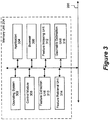
- FIG. 3 is a block diagram of one embodiment of the memory unit 204 for the feature extraction and recognition system 108.
- the memory unit 204 preferably comprises: an operating system 302, an application 304, a control module 306, a browser 308, a feature extraction unit 310, a feature indexing unit 312, a feature retrieval unit 314 and a geometric estimation unit 316.
- the memory 204 also includes buffers for storing data and other information temporarily during the indexing or retrieval process.
- the memory unit 204 stores instructions and/or data that may be executed by processor 202.
- the instructions and/or data comprise code for performing any and/or all of the techniques described herein.
- modules 302-314 are coupled by bus 208 to the processor 202 for communication and cooperation to system 100.
- modules or portions thereof may also be stored in other media such as permanent data storage device 206 and may be distributed across a network 220 having a plurality of different computers such as in a client/server environment.
- the operating system 302 is preferably a custom operating system that is accessible to user via an application interface.
- the operating system 302 is one of a conventional type such as, WINDOWS®, SOLARIS® or LINUX® based operating systems.
- the memory unit 204 also includes one or more application programs 304 including, without limitation, drawing applications, word processing applications, electronic mail applications, financial applications and web browser applications.
- the applications 304 specifically utilize the unique capabilities of the other modules or units of memory 204 to bridge the gap between electronic documents and paper documents by enabling users to establish and identify links between a printed paper and its corresponding electronic document. More specifically, the applications 304 access electronic data from a paper and attach/embed electronic data to specific locations on a paper so that a user can later retrieval that electronic data from the paper, using cameras as the tool for the above operations.
- one application 304 retrieves an electronic file (Microsoft Word, Adobe PDF, etc) of a printed paper in response to the user simply pointing a web-cam and capturing an image of the printed paper.
- Another example application 304 is a paper-based photo-wiki, which lets the user attach the pictures you have taken to specific locations on a paper map (and its electronic version), by simply pointing the camera to the desired locations on the physical paper map.
- There are many other applications 304 such as novel user interfaces to access or browse a document database, digitized pen and paper, map navigator, security in copiers and scanners, camera games and duplicate detection for copyright protection.
- the control module 306 is used to control the other modules of the memory 204.
- the control module 306 is adapted for control of and communication with the application 304, the browser 308, the feature extraction unit 310, the feature indexing unit 312, the feature retrieval unit 314 and the geometric estimation unit 316.
- the operation of the control module 306 will be apparent from the description of Figure 4 and 6-9 below. While the control module 306 is shown as a separate module of the memory 204, those skilled in the art will recognize that the control module 306 in another embodiment may be distributed as routines in the other modules 310-316.
- the browser 308 is a conventional type such as Internet Explorer by Microsoft® or Firefox by Mozilla.
- the Web browser is a software application that enables a user to display and interact with text, images, and other information typically located on a Web page at a website on the World Wide Web or a local area network.
- the feature extraction unit 310 is software and routines for extracting the invisible junction features from original electronic documents and scanned images of paper documents.
- the feature extraction unit 310 includes an input coupled to receive original electronic documents and an output to provide a feature description to the feature indexing unit 312.
- the feature extraction unit 310 includes an input coupled to receive an image of a paper document and provide a feature description to the feature retrieval unit 314.
- the feature extraction unit 310 includes a location determination module, a size determination module, an orientation determination module and a descriptor creator module coupled in series to produce the feature description. The operation of the feature extraction unit 310 is described below in detail with reference to Figures 5A-6 .
- the feature extraction unit 310 is coupled for communication with the feature indexing unit 312 and the feature retrieval unit 314.
- the feature indexing unit 312 is software and routines for generating one or more indices of invisible junction feature descriptions and storing them in the database 110. In one embodiment, the feature indexing unit 312 uses a quantization tree to index the feature descriptions. The feature indexing unit 312 is coupled to an output of the feature extraction unit 310 to receive invisible junction feature descriptions. The feature indexing unit 312 is coupled to the database 110. The operation of the feature indexing unit 312 is described in detail below with reference to Figures 7A and 7B .
- the feature retrieval unit 314 is software and routines for creating a query from the invisible junction feature descriptions of a paper document and communicating with the database 110 to retrieve a document, a point and a viewing region of a matching electronic document from the database 110.
- the feature retrieval unit 314 is coupled to an output of the feature extraction unit 310 to receive invisible junction feature descriptions, and to the database 110 to perform queries and receive results.
- the possible matching documents, points and viewing regions are output by the feature retrieval unit 314.
- the operation of the feature retrieval unit 314 is described in detail below with reference to Figure 8 .
- the geometric estimation unit 316 is software and routines for sorting the candidate documents output by the feature retrieval unit 314 and selecting a document that includes the largest number of feature points consistent with the geometric constraint.
- the geometric estimation unit 316 is adapted for communication with the feature retrieval unit 314 and has an output that provides a document, a point and a viewing region that matches the input image patch. The operation of the geometric estimation unit 316 is described in detail below with reference to Figure 9A .
- the feature extraction and recognition system 108 includes two operational modes: a first mode in which the original electronic document is rendered and input and a feature index is stored for the invisible junction features from the input; and a second mode in which a image patch is input, and a feature description is created and used to retrieve a corresponding document, point and viewing region are output.
- first mode in which the original electronic document is rendered and input and a feature index is stored for the invisible junction features from the input
- a second mode in which a image patch is input, and a feature description is created and used to retrieve a corresponding document, point and viewing region are output.
- This second embodiment of the system 108 includes the feature extraction unit 310, the feature indexing unit 312, the feature retrieval unit 314 and the geometric estimation unit 316.
- Figure 4 illustrates the flow of information between the feature extraction unit 310, the feature indexing unit 312, the feature retrieval unit 314 and the geometric estimation unit 316.
- the two modes of operation are shown with distinct couplings 420, 430.
- the first mode is shown with the path of double lines 420 in which the original electronic document 402 is rendered and input via signal line 420 to the feature extraction unit 310.
- the feature extraction unit 310 outputs feature descriptions for the invisible junctions in the document 402 to the feature indexing unit 312 via signal line 420 and the feature indexing unit 312 creates indexes and stores them in the database 110.
- the second mode is shown with the path of signal lines 430 in which a patch of video data or a video frame 404 is input via signal line 430 to the feature extraction unit 310.
- the feature extraction unit 310 outputs feature descriptions for the invisible junctions in the video frame 404 to the feature retrieval unit 314 via signal line 430.
- the feature retrieval unit 314 queries the database 110 via signal line 430 using the feature descriptions and outputs a list of documents having matching features to the geometric estimation unit 316 via signal line 430.
- the geometric estimation unit 316 applies geometric constraints to select a matching document, point and viewing region 406.
- the present invention has created and utilizes a novel set of features for document patch recognition.
- the feature points used for document representation and retrieval are the junctions of the intrinsic skeleton existing in document pages. Since these junctions are not visible, i.e., there are in the blank space of the text document or regions with homogeneous colors, we refer to them here as “invisible junctions” or “invisible junction features”.
- the feature content will be determined by all of these key factors, it is critical to have them stable and repeatable.
- the descriptor feature description must also be discriminative.
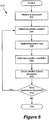
- the process begins by receiving 602 a document.
- the feature extraction unit 310 receives 602 an ideal model of an electronic document 402 and renders the model as an image.
- the feature extraction unit 310 receives 602 a captured image of a printed document such as a video frame or web camera image 404.
- the process determines 604 a location for one or more invisible junctions.
- the feature extraction unit 310 detects features at the junctions of the text document skeleton. As shown in Figures 5A and 5B for this embodiment, the feature extraction unit 310 binarizes the input image, and then applies a distance transform to the binary image.
- An example input image 501, the binarization 502 of the input image 501 and the distance transform 503 of the binarization 502 are shown in Figure 5A .
- a skeleton 504 is detected as boundary of the label fields from the distance transformation.
- the skeleton 504 alternatively can be the ridge lines of the distance field. In one embodiment, ridge lines are detected as local maxima in one dimension.
- the distance transform 503 and skeleton 504 are shown in Figure 5B .
- the features are detected as the junction points 506 as shown in Figure 5B .
- the junction points 506 alternatively can be the local maxima (in 2D) of the distance transform fields, or the local maxima on the skeleton 504.
- the use of invisible junctions is particularly advantageous because they are stable and repeatable.
- the text document contains mostly high frequency image content in the text, which are easily contaminated and hard to filter out without degrading the text.
- the white space in the text page is mostly stable and contains mostly DC components in the frequency domain. Noise in the white space can be easily filtered out without affecting the feature locations.
- the distance transform field depends on the text locations which is desirable since the text content is eventually used for classification, the locations of invisible junction points 506 are robust to noise since the text around each junction are usually contaminated in similar ways.
- the process next determines 606 a junction size or scale for the invisible junction.
- the distance transformation value at each feature point 506 is intrinsic to the feature point 506.
- the scale of the feature point 506 is thus assigned as such distance value multiplied by a factor ⁇ .
- ⁇ is selected as equal to 2 for this example.
- the content inside the circle 510 (centered at the feature point 506 with radius equal to its scale) is invariant to camera in-plane rotation and zoom (or distance to the paper document when the camera optical axis is perpendicular to the paper). Since the feature is local, i.e., the circle is small, the feature is also robust to changes in camera viewing angles with respect to the paper (out-of-plane rotation).
- each feature point 506 is assigned a local orientation.
- a 2D local coordinate system for each feature point 506 is then determined with the feature location as the origin and its local orientation as the x-axis.
- the feature descriptor is computed based on this local coordinate system.
- the feature extraction unit 310 calculates a circle 511 centered at the feature point 506, with a radius determined by the feature scale. This circle 511 intersects the skeleton at several positions. The two positions that are furthest apart (from among all pairs of positions on the circle that intersect the skeletion) determine the local orientation of this feature.
- Figure 5D illustrates an example of estimation of feature orientation.
- the circle 511 centered at the feature point 506 with radius equal to feature scale intersects the skeleton 504 at three points A, B, and C.
- the two points A and B has largest distance, the feature orientation is therefore assigned as the direction of the line segment AB.
- the feature extraction unit 310 makes a global orientation estimate. Specifically, feature points with local orientations vote for a global orientation for the query image. The voting is done by counting the number of local feature orientations in 360 bins (one degree for each bin).
- the dominant mode of the orientation histogram is the selected as the global orientation. After voting, every feature point is re-assigned its orientation to be consistent with the selected global orientation.
- the feature extraction unit 310 uses a soft split scheme when counting the numbers for the histogram to ensure that the histogram will smoothly change when disturbed by noise.
- the global orientation is stable since there is indeed a dominant orientation, which is also true for most other non-text documents.
- the present invention can also be adjusted to achieve a tradeoff between pure local orientation and pure global orientation.
- the feature extraction unit 310 can aggregate orientations from its neighbors (as compared to from all feature points in the same image) to determine its orientation. This will resolve the issue that in some languages, such as Chinese or Japanese, the document page could contain both vertical and horizontal text lines.
- the orientation of a junction is determined by this skeleton which is stable as discussed above, and is therefore also stable.
- This is in contrast to the prior art SIFT, where the local orientation is determined by gradients of pixels around the feature point. It is well known that gradient operation amplifies noise, and therefore makes the feature orientation sensitive to noise.
- Our local orientation is derived from the skeleton and is much more stable.
- the global voting step makes the feature orientation even more stable, as it utilizes the fact that the camera is looking at a planar page, and also the fact that such page has some dominant orientation in its invisible skeleton.
- the process creates 610 a descriptor or feature description for the invisible junction.
- the feature extraction unit 310 assigns a 2D coordinate frame 516 for each feature point 506, and computes its descriptor 518 inside such coordinate frame 516.
- the feature extraction unit 310 computes a square with edge length equal to two times the feature scale. This square is divided into 4x4 cells.
- the feature extraction unit 310 can use concentric circles to construct the cells.
- the feature extraction unit 310 accumulates a weighted gradient orientation histogram that has 8 bins (i.e., 8 directions).
- the gradient can be calculated by several techniques including the well known Roberts or Sobel operators.
- the feature descriptor is the concatenation of such orientation histograms, resulting in a 128-dimensional feature vector. This feature vector is normalized to accommodate linear lighting changes.
- the feature extraction unit 310 applies dimension reduction scheme using Principal Component Analysis (PCA), and reserves the first 14 dimensions. While this might reduce the discriminative power of the features, it helps reduce the noise. For this embodiment, since the cells nearby the center are mostly blank, the dimension reduction is more sensible. This advantageously produces features that are intrinsically low-dimensional, considering that for each class there is only one prototype in our case.
- the descriptor of the present invention is particularly advantageous because it is discriminative and repeatable. Repeatability is a result of the repeatability of feature location, orientation and scale. As can be seen, the content of each feature point contains pixels from three or more words in the text document.
- the process determines 612 whether there are more invisible junctions in the document. If so, the method selects an unprocessed junction and continues in step 604 to process it. If there are no more invisible junctions, the processing of the document is complete and ends.
- the feature indexing unit 312 generates one or more indices of invisible junction feature descriptors and stores them in the database 110. For each model image, the feature indexing unit 312 extracts the feature points and stores them in the database 110. The feature indexing unit 312 also stores metadata associated with each feature point, including location (x, y), orientation, scale, feature descriptor and a unique ID of the document page that contains this feature point. In order to allow fast real time matching and retrieval, the feature indexing unit 312 also indexes this data for efficient storage in and retrieval from the database 110.
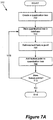
- the process begins by creating 702 a quantization tree.
- the quantization tree is trained by a set of training features using hierarchical clustering.
- the training set is recursively divided into K clusters.
- K L leaf nodes i.e., the vocabulary size is K L .
- the feature indexing unit 312 uses k-means algorithm with multiple random initializations. At each node of the tree, the feature indexing unit 312 records the cluster center given by the points belonging to this node.
- Each node of the quantization tree is also associated with a node, using term-frequency-inverse-document-frequency.
- the quantization tree partitions the feature space in a hierarchical way. Once the quantization tree is created, it is stored 704 in the database 110. Next, a feature point is retrieved or received 706 from the feature extraction unit 310, and is pushed down the tree and added 708 to the database. At each level of the tree, the feature point chooses the branch with a cluster center closest to the feature point. Once the feature point reaches the leaf node, an entry for this feature point is inserted into the hit list of this leaf node, recording the page ID and coordinates (x, y) of this feature point.
- the feature indexing unit 312 does not store the original feature descriptors. Once the feature indexing unit 312 quantizes the feature space, it can approximate the feature descriptor by its index of its residing cell in the quantization space. For each feature, the feature indexing unit 312 only stores the document page ID that contains this feature, as well as the coordinate of the feature inside the document page. The storage space required is thereby dramatically reduced.
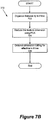
- the feature indexing unit 312 uses use the traditional k-d tree to organize 722 the feature points.
- the traditional k-d tree can be modified to extend the k-d tree for fast disk I/O.
- the k-d tree partitions the feature space into cells where each cell contains one or more feature points (actually pointers to feature points). During k-nearest neighbor search, it is often required to back-track the tree.
- the feature indexing unit 312 uses a depth-first linearization of the tree to order the feature points; in such a way that memory/disk locality during back-tracking is preserved.
- the cache miss rate is reduced (cache could be the CPU cache if the features reside in the main memory, or memory cache if the features reside in external hard disk drive), and the speed performance be increased.
- the feature indexing unit 312 uses PCA to reduce the feature dimension 724, or more exactly, to find the useful dimensions. Even though our data is intrinsically low dimensional, the low-dimensional space needs to be estimated so that the result k-d tree is well-balanced. The significance of such dimension reduction is not only to meet the low-dimension requirement, but also to order the feature dimensions in such a way that the space partition is most effective.
- the space cut is ordered 726 in such a way that the dimension with most energy will be cut first, so that the system 108 can achieve a k-d tree that is not only balanced, but also with cell boundaries that are stable (i.e., small noises will not disturb which cell should the feature belong to).
- the feature retrieval unit 314 sends the feature points detected in the query image down to the quantization, and collects the hit lists at the leaf nodes. This produces a table of candidate document pages, along with a list of coordinates (x, y) for each candidate page. This can be send to the geometric estimation unit for further processing.
- the retrieval process begins with the feature retrieval unit 314 receiving 802 a feature descriptor from the feature extraction unit 310.
- the feature retrieval unit 314 performs pattern recognition based on local features.
- the feature retrieval unit 314 searches for the page document whose feature points best corresponded to the feature points of the given query image patch. To establish the correspondence (in other words to recognize), the feature retrieval unit 314 recognizes each feature point in the given image. More specifically, the feature retrieval unit 314 searches 804 the database 110 for the k nearest neighbors (kNN) of a feature point from the query image.
- kNN k nearest neighbors
- the collection of all such points from the database is then divided 806 into sets where points in one set share the same document page ID (recorded as meta-data with the feature point in the database). So for each candidate document page, the feature retrieval unit 314 produces a set of feature correspondences. Note that many of such correspondences are outliers, since for each query point there is at most one true correspondence in its k nearest neighbors.
- k 10
- Other values of k can be used in order to reduce the query time.
- On alternate method also monitors the distance between the query feature and the current neighbor. Once there is a big jump in the distance, the feature retrieval unit 314 returns k ⁇ 10 neighbors as the following neighbors are probably outliers (i.e., the true correspondence is probably already in the current k ⁇ 10 points).
- the feature retrieval unit 314 may include scoring using tree-intersection. For each query image, the feature retrieval unit 314 includes a tree representation given the paths that the query points have gone through. The feature retrieval unit 314 constructs a similar tree for each candidate page. The similarity of the query image and a model image is then computed based on the intersection of the two trees. Thereafter the tree intersections can be ranking.
- Figure 9 is a flow chart of an embodiment of a method for geometric estimation in accordance with the present invention.
- a component an example of which is a module
- the component can be implemented as a standalone program, as part of a larger program, as a plurality of separate programs, as a statically or dynamically linked library, as a kernel loadable module, as a device driver, and/or in every and any other way known now or in the future to those of ordinary skill in the art of computer programming.
- the present invention is in no way limited to implementation in any specific programming language, or for any specific operating system or environment. Accordingly, the disclosure of the present invention is intended to be illustrative, but not limiting. The present invention is defined by the following claims.
Landscapes
- Engineering & Computer Science (AREA)
- Computer Vision & Pattern Recognition (AREA)
- Physics & Mathematics (AREA)
- General Physics & Mathematics (AREA)
- Multimedia (AREA)
- Theoretical Computer Science (AREA)
- Computer Graphics (AREA)
- Geometry (AREA)
- Artificial Intelligence (AREA)
- Information Retrieval, Db Structures And Fs Structures Therefor (AREA)
- Image Analysis (AREA)
- Processing Or Creating Images (AREA)
Claims (13)
- Procédé pour créer des descripteurs de caractéristiques pour des jonctions invisibles, le procédé comprenant :a) la réception (602) d'une image (501) d'un document électronique (402) ;b) la détermination (604 à 608) d'une jonction invisible (506) à partir de l'image (501), où une jonction invisible (506) est une jonction du squelette intrinsèque (504) existant dans l'arrière-plan d'une page d'un document ; etc) la création (610) d'un descripteur de caractéristiques (518) pour la jonction invisible (506),
oùd) l'étape b) est exécutée pour une pluralité de jonctions invisibles (506) ; ete) l'étape c) produit un descripteur de caractéristiques (518) pour chacune de la pluralité de jonctions invisibles (506). - Procédé selon la revendication 1, où :l'étape b) inclut une étape consistant à déterminer un emplacement de jonction (604), une échelle de jonction (606) et une orientation de jonction (608) ;l'échelle de jonction est une valeur fondée sur la valeur d'une transformation de distance de l'arrière-plan d'une page de document à l'emplacement de la jonction invisible (506) et qui est multipliée par un facteur α ;l'orientation de jonction est une orientation de la jonction invisible (506) qui est dérivée au moyen d'un cercle (511) centré sur la jonction invisible (506) avec un rayon déterminé par l'échelle de jonction, ledit cercle (511) coupant le squelette (504), et les deux positions les plus éloignées l'une de l'autre parmi toutes les paires de positions sur le cercle (511) qui coupent le squelette (504) déterminent l'orientation de la jonction invisible (506) ; etle descripteur de caractéristiques (518) inclut l'emplacement de jonction, l'échelle de jonction et l'orientation de jonction.
- Procédé selon la revendication 1, où l'étape b) comprend les étapes consistant à :binariser l'image (501) pour créer une binarisation (502) de l'image (501) ;appliquer une transformation de distance à la binarisation (502) de l'image (501) pour générer une transformée de distances (502) ;détecter un squelette (504) dans la transformée de distance (503) ; etdéterminer des points de jonction (506) dans le squelette (504) en tant que jonctions invisibles (506).
- Procédé selon l'une quelconque des revendications 1 à 3, comprenant en outre l'étape suivante consistant à :stocker le document électronique (402) dans un dispositif de stockage de données (206, 110).
- Procédé selon l'une quelconque des revendications 1 à 4, comprenant en outre les étapes suivantes consistant à :créer un index de caractéristiques à partir de chacun des descripteurs de caractéristiques des jonctions invisibles (518) ; etstocker les index de caractéristiques créés.
- Procédé selon les revendications 1 à 5, où la création de l'index de caractéristiques comprend en outre les étapes suivantes consistant à :créer (702) une arborescence de quantification qui partitionne de manière hiérarchique un espace de caractéristiques constitué de points de caractéristiques (506) ; etajouter (708) un point de caractéristique (506) à l'arborescence de quantification pour chacun des descripteurs de caractéristiques de jonctions invisibles (518).
- Procédé selon l'une quelconque des revendications 1 à 5, le procédé comprenant en outre l'étape suivante consistant à :récupérer un document électronique (402) stocké en utilisant les descripteurs de caractéristiques de jonctions invisibles (518) pour sortir le document électronique récupéré (402).
- Programme informatique configuré de manière à mettre en oeuvre le procédé selon l'une quelconque des revendications 1 à 7.
- Système (100) pour créer des descripteurs de caractéristiques pour des jonctions invisibles, le système (100) comprenant :une unité de détermination de caractéristiques (310) ayant une entrée et une sortie pour déterminer des jonctions invisibles (506) à partir d'une image (501), l'entrée de l'unité de détermination de caractéristiques (310) étant couplée de manière à recevoir une image (501) d'un document électronique (402), où une jonction invisible (506) est une jonction du squelette intrinsèque (504) existant à l'arrière-plan d'une page de document ; etune unité de création de descripteur (310) ayant une entrée et une sortie pour créer un descripteur de caractéristiques (518) pour chaque jonction invisible (506), l'unité de création de descripteur (310) ayant une entrée couplée avec la sortie de l'unité de détermination de caractéristiques (310) pour recevoir des informations concernant les jonctions invisibles (506), la sortie de l'unité de création de descripteur (310) fournissant les descripteurs de caractéristiques (518).
- Système (100) selon la revendication 9, où l'unité de détermination de caractéristiques (310) comprend un module de détermination d'emplacement ayant une entrée et une sortie pour déterminer un emplacement de jonction, l'entrée du module de détermination d'emplacement étant couplée pour recevoir l'image (501) du document électronique (402), la sortie de la détermination d'emplacement étant couplée avec l'entrée de l'unité de création de descripteur (310).
- Système (100) selon la revendication 9, comprenant en outre :une unité d'extraction de caractéristiques (310) ayant une entrée et une sortie pour produire des descripteurs de caractéristiques de jonctions invisibles (518) à partir d'une image (501), l'entrée de l'unité d'extraction de caractéristiques (310) étant couplée pour recevoir l'image (501) d'un document électronique (402) ; etune unité d'indexation de caractéristiques (312) ayant une entrée et une sortie pour créer un index de caractéristiques pour chacune des jonctions invisibles (506), l'entrée de l'unité d'indexation de caractéristiques (312) étant couplée avec la sortie de l'unité d'extraction de caractéristiques (310) pour recevoir les descripteurs de caractéristiques de jonctions invisibles (518), la sortie de l'unité d'indexation de caractéristiques (312) fournissant les index de caractéristiques.
- Système (100) selon la revendication 11, où l'unité d'extraction de caractéristiques (310) comprend :un module de détermination d'emplacement ayant une entrée et une sortie pour déterminer un emplacement de jonction, l'entrée du module de détermination d'emplacement étant couplée pour recevoir l'image (501) du document électronique (402) ;un module de détermination d'échelle ayant une entrée et une sortie pour déterminer une échelle de jonction, l'entrée du module de détermination d'échelle étant couplée avec la sortie du module de détermination d'emplacement pour recevoir l'emplacement de jonction, où l'échelle de jonction est une valeur fondée sur la valeur d'une transformation de distance de l'arrière-plan d'une page de document à l'emplacement de la jonction invisible (506) et qui est multipliée par un facteur α ; etun module de détermination d'orientation ayant une entrée et une sortie pour déterminer une orientation de jonction, l'entrée du module de détermination d'orientation étant couplée avec la sortie du module de détermination d'échelle pour recevoir l'échelle de jonction, oùl'orientation de la jonction est une orientation de la jonction invisible (506) qui est dérivée au moyen d'un cercle (511) centré sur la jonction invisible (506) avec un rayon déterminé par l'échelle de jonction, ledit cercle (511) coupant le squelette (504), et les deux positions les plus éloignées l'une de l'autre parmi toutes les paires de positions sur le cercle (511) qui coupent le squelette (504) déterminent l'orientation de la jonction invisible (506).
- Système (100) selon l'une quelconque des revendications 9 à 12, le système (100) comprenant en outre :une unité de récupération de caractéristiques (314) ayant une entrée et une sortie pour récupérer un document (402) stocké en utilisant les descripteurs de caractéristiques de jonctions invisibles (518) pour sortir le document électronique récupéré (402).
Applications Claiming Priority (1)
| Application Number | Priority Date | Filing Date | Title |
|---|---|---|---|
| US11/776,510 US8086038B2 (en) | 2007-07-11 | 2007-07-11 | Invisible junction features for patch recognition |
Publications (2)
| Publication Number | Publication Date |
|---|---|
| EP2015224A1 EP2015224A1 (fr) | 2009-01-14 |
| EP2015224B1 true EP2015224B1 (fr) | 2017-12-13 |
Family
ID=39877742
Family Applications (1)
| Application Number | Title | Priority Date | Filing Date |
|---|---|---|---|
| EP08160112.2A Ceased EP2015224B1 (fr) | 2007-07-11 | 2008-07-10 | Caractéristiques de jonction invisible pour reconnaissance de patch |
Country Status (3)
| Country | Link |
|---|---|
| US (1) | US8086038B2 (fr) |
| EP (1) | EP2015224B1 (fr) |
| JP (1) | JP5095534B2 (fr) |
Families Citing this family (22)
| Publication number | Priority date | Publication date | Assignee | Title |
|---|---|---|---|---|
| US8949287B2 (en) | 2005-08-23 | 2015-02-03 | Ricoh Co., Ltd. | Embedding hot spots in imaged documents |
| US8144921B2 (en) * | 2007-07-11 | 2012-03-27 | Ricoh Co., Ltd. | Information retrieval using invisible junctions and geometric constraints |
| US9405751B2 (en) | 2005-08-23 | 2016-08-02 | Ricoh Co., Ltd. | Database for mixed media document system |
| US9171202B2 (en) | 2005-08-23 | 2015-10-27 | Ricoh Co., Ltd. | Data organization and access for mixed media document system |
| US9384619B2 (en) | 2006-07-31 | 2016-07-05 | Ricoh Co., Ltd. | Searching media content for objects specified using identifiers |
| DE102009023756B4 (de) * | 2009-05-20 | 2012-05-31 | Werner Scholzen | Verfahren zum Herkunftsnachweis und zur Urheberschaft von Bildern |
| US20110013014A1 (en) * | 2009-07-17 | 2011-01-20 | Sony Ericsson Mobile Communication Ab | Methods and arrangements for ascertaining a target position |
| CN102110122B (zh) * | 2009-12-24 | 2013-04-03 | 阿里巴巴集团控股有限公司 | 一种建立样本图片索引表和图片过滤、搜索方法及装置 |
| US20110258170A1 (en) * | 2010-01-15 | 2011-10-20 | Duggan Matthew | Systems and methods for automatically correcting data extracted from electronic documents using known constraints for semantics of extracted data elements |
| US9132352B1 (en) | 2010-06-24 | 2015-09-15 | Gregory S. Rabin | Interactive system and method for rendering an object |
| US8639034B2 (en) * | 2010-11-19 | 2014-01-28 | Ricoh Co., Ltd. | Multimedia information retrieval system with progressive feature selection and submission |
| US9229956B2 (en) * | 2011-01-10 | 2016-01-05 | Microsoft Technology Licensing, Llc | Image retrieval using discriminative visual features |
| US20120314031A1 (en) * | 2011-06-07 | 2012-12-13 | Microsoft Corporation | Invariant features for computer vision |
| US9058331B2 (en) | 2011-07-27 | 2015-06-16 | Ricoh Co., Ltd. | Generating a conversation in a social network based on visual search results |
| US8849819B2 (en) | 2011-08-05 | 2014-09-30 | Deacon Johnson | System and method for controlling and organizing metadata associated with on-line content |
| US8687886B2 (en) * | 2011-12-29 | 2014-04-01 | Konica Minolta Laboratory U.S.A., Inc. | Method and apparatus for document image indexing and retrieval using multi-level document image structure and local features |
| WO2013115788A1 (fr) * | 2012-01-31 | 2013-08-08 | Hewlett-Packard Development Company, L.P. | Ensemble de caractéristiques d'échantillon d'impression |
| US9013454B2 (en) | 2012-03-02 | 2015-04-21 | Ricoh Co., Ltd. | Associating strokes with documents based on the document image |
| US20130287256A1 (en) * | 2012-04-30 | 2013-10-31 | Telibrahma Convergent Communications Private Limited | Method and system for real time image recognition on a mobile device |
| CN104281843A (zh) * | 2014-10-20 | 2015-01-14 | 上海电机学院 | 基于自适应特征和分类模型选择的图像识别方法及系统 |
| US10853639B2 (en) * | 2019-02-23 | 2020-12-01 | ZenPayroll, Inc. | Data extraction from form images |
| CN115129921B (zh) * | 2022-06-30 | 2023-05-26 | 重庆紫光华山智安科技有限公司 | 图片检索方法、装置、电子设备和计算机可读存储介质 |
Family Cites Families (258)
| Publication number | Priority date | Publication date | Assignee | Title |
|---|---|---|---|---|
| US553217A (en) * | 1896-01-14 | Mechanism for operating washing-machines | ||
| US1915993A (en) | 1931-04-27 | 1933-06-27 | Gen Electric | Statistical machine |
| US3834804A (en) * | 1972-12-06 | 1974-09-10 | Xerox Corp | Copying machine with means for mounting carrier bead pickoff roller therein |
| JPH01144165A (ja) | 1987-11-30 | 1989-06-06 | Toshiba Corp | 電子ファイリング装置 |
| US5035302A (en) | 1989-03-03 | 1991-07-30 | Otis Elevator Company | "Artificial Intelligence" based learning system predicting "Peak-Period" times for elevator dispatching |
| JP2795719B2 (ja) | 1990-03-07 | 1998-09-10 | 富士通株式会社 | 認識距離の差に基づく最良優先探索処理方法 |
| US5077805A (en) | 1990-05-07 | 1991-12-31 | Eastman Kodak Company | Hybrid feature-based and template matching optical character recognition system |
| US5109439A (en) | 1990-06-12 | 1992-04-28 | Horst Froessl | Mass document storage and retrieval system |
| KR0176448B1 (ko) | 1991-07-19 | 1999-05-01 | 강진구 | 이미지 코딩 방법 및 장치 |
| US6850252B1 (en) | 1999-10-05 | 2005-02-01 | Steven M. Hoffberg | Intelligent electronic appliance system and method |
| US5392447A (en) | 1992-01-10 | 1995-02-21 | Eastman Kodak Compay | Image-based electronic pocket organizer with integral scanning unit |
| US6678864B1 (en) | 1992-02-25 | 2004-01-13 | Irving Tsai | Method and apparatus for linking designated portions of a received document image with an electronic address |
| US6574375B1 (en) | 1992-04-06 | 2003-06-03 | Ricoh Company, Ltd. | Method for detecting inverted text images on a digital scanning device |
| US5432864A (en) | 1992-10-05 | 1995-07-11 | Daozheng Lu | Identification card verification system |
| US5579471A (en) | 1992-11-09 | 1996-11-26 | International Business Machines Corporation | Image query system and method |
| US5493689A (en) | 1993-03-01 | 1996-02-20 | International Business Machines Corporation | System for configuring an event driven interface including control blocks defining good loop locations in a memory which represent detection of a characteristic pattern |
| US5546502A (en) | 1993-03-19 | 1996-08-13 | Ricoh Company, Ltd. | Automatic invocation of computational resources without user intervention |
| US5553217A (en) | 1993-09-23 | 1996-09-03 | Ricoh Company, Ltd. | Document layout using tiling |
| US5664111A (en) | 1994-02-16 | 1997-09-02 | Honicorp, Inc. | Computerized, multimedia, network, real time, interactive marketing and transactional system |
| US6947571B1 (en) | 1999-05-19 | 2005-09-20 | Digimarc Corporation | Cell phones with optical capabilities, and related applications |
| JPH07319691A (ja) | 1994-03-29 | 1995-12-08 | Toshiba Corp | 資源保護装置、特権保護装置、ソフトウェア利用法制御装置、及びソフトウェア利用法制御システム |
| US5465353A (en) | 1994-04-01 | 1995-11-07 | Ricoh Company, Ltd. | Image matching and retrieval by multi-access redundant hashing |
| EP0677818B1 (fr) | 1994-04-15 | 2000-05-10 | Canon Kabushiki Kaisha | Préprocesseur d'image pour système de reconnaissance de caractères |
| US6164534A (en) | 1996-04-04 | 2000-12-26 | Rathus; Spencer A. | Method and apparatus for accessing electronic data via a familiar printed medium |
| US6866196B1 (en) | 1994-05-25 | 2005-03-15 | Spencer A. Rathus | Method and apparatus for accessing electronic data via a familiar printed medium |
| US5694546A (en) | 1994-05-31 | 1997-12-02 | Reisman; Richard R. | System for automatic unattended electronic information transport between a server and a client by a vendor provided transport software with a manifest list |
| EP0702322B1 (fr) | 1994-09-12 | 2002-02-13 | Adobe Systems Inc. | Méthode et appareil pour identifier des mots décrits dans un document électronique portable |
| US6804332B1 (en) | 1994-09-30 | 2004-10-12 | Wildfire Communications, Inc. | Network based knowledgeable assistant |
| US6460036B1 (en) | 1994-11-29 | 2002-10-01 | Pinpoint Incorporated | System and method for providing customized electronic newspapers and target advertisements |
| JPH08297669A (ja) * | 1994-12-27 | 1996-11-12 | Internatl Business Mach Corp <Ibm> | 複合ドキュメント内の複数のパートを自動的にリンクするシステムおよび方法 |
| US5873077A (en) | 1995-01-13 | 1999-02-16 | Ricoh Corporation | Method and apparatus for searching for and retrieving documents using a facsimile machine |
| JPH096961A (ja) * | 1995-06-16 | 1997-01-10 | Sony Corp | 領域分割処理装置および方法 |
| US7051086B2 (en) | 1995-07-27 | 2006-05-23 | Digimarc Corporation | Method of linking on-line data to printed documents |
| US5793371A (en) | 1995-08-04 | 1998-08-11 | Sun Microsystems, Inc. | Method and apparatus for geometric compression of three-dimensional graphics data |
| US5867597A (en) * | 1995-09-05 | 1999-02-02 | Ricoh Corporation | High-speed retrieval by example |
| US5706097A (en) | 1995-11-13 | 1998-01-06 | Eastman Kodak Company | Index print with a digital recording medium containing still images, motion sequences, and sound sequences |
| US20010013546A1 (en) | 1996-01-09 | 2001-08-16 | Ross William Leslie | Identification system |
| US5832474A (en) | 1996-02-26 | 1998-11-03 | Matsushita Electric Industrial Co., Ltd. | Document search and retrieval system with partial match searching of user-drawn annotations |
| US5918012A (en) | 1996-03-29 | 1999-06-29 | British Telecommunications Public Limited Company | Hyperlinking time-based data files |
| US5806005A (en) | 1996-05-10 | 1998-09-08 | Ricoh Company, Ltd. | Wireless image transfer from a digital still video camera to a networked computer |
| US5956468A (en) | 1996-07-12 | 1999-09-21 | Seiko Epson Corporation | Document segmentation system |
| US6104834A (en) | 1996-08-01 | 2000-08-15 | Ricoh Company Limited | Matching CCITT compressed document images |
| US6353822B1 (en) | 1996-08-22 | 2002-03-05 | Massachusetts Institute Of Technology | Program-listing appendix |
| US6819783B2 (en) | 1996-09-04 | 2004-11-16 | Centerframe, Llc | Obtaining person-specific images in a public venue |
| US5899999A (en) | 1996-10-16 | 1999-05-04 | Microsoft Corporation | Iterative convolution filter particularly suited for use in an image classification and retrieval system |
| US5937110A (en) | 1996-12-20 | 1999-08-10 | Xerox Corporation | Parallel propagating embedded binary sequences for characterizing objects in N-dimensional address space |
| US7437351B2 (en) | 1997-01-10 | 2008-10-14 | Google Inc. | Method for searching media |
| US5892843A (en) | 1997-01-21 | 1999-04-06 | Matsushita Electric Industrial Co., Ltd. | Title, caption and photo extraction from scanned document images |
| JP3634099B2 (ja) | 1997-02-17 | 2005-03-30 | 株式会社リコー | 文書情報管理システム,媒体用紙情報作成装置および文書情報管理装置 |
| JP3571162B2 (ja) * | 1997-03-03 | 2004-09-29 | 日本電信電話株式会社 | 類似オブジェクト検索方法および装置 |
| JP2002501644A (ja) | 1997-05-07 | 2002-01-15 | ネオメディア テクノロジーズ,インク. | スキャナ強化遠隔制御ユニットおよびオンライン資源に自動的にリンクするためのシステム |
| AU739611B2 (en) | 1997-06-03 | 2001-10-18 | Stephen Bide | Portable information-providing apparatus |
| US6025780A (en) | 1997-07-25 | 2000-02-15 | Checkpoint Systems, Inc. | RFID tags which are virtually activated and/or deactivated and apparatus and methods of using same in an electronic security system |
| US6121969A (en) | 1997-07-29 | 2000-09-19 | The Regents Of The University Of California | Visual navigation in perceptual databases |
| JPH1153168A (ja) | 1997-08-07 | 1999-02-26 | Matsushita Graphic Commun Syst Inc | 音声情報付文書作成装置及びこれを用いた方法 |
| US6035055A (en) | 1997-11-03 | 2000-03-07 | Hewlett-Packard Company | Digital image management system in a distributed data access network system |
| US6415278B1 (en) * | 1997-11-14 | 2002-07-02 | Adobe Systems Incorporated | Retrieving documents transitively linked to an initial document |
| US6574644B2 (en) | 1997-11-26 | 2003-06-03 | Siemens Corporate Research, Inc | Automatic capturing of hyperlink specifications for multimedia documents |
| US6138129A (en) | 1997-12-16 | 2000-10-24 | World One Telecom, Ltd. | Method and apparatus for providing automated searching and linking of electronic documents |
| US6804659B1 (en) | 2000-01-14 | 2004-10-12 | Ricoh Company Ltd. | Content based web advertising |
| US7124093B1 (en) | 1997-12-22 | 2006-10-17 | Ricoh Company, Ltd. | Method, system and computer code for content based web advertising |
| JP4183311B2 (ja) | 1997-12-22 | 2008-11-19 | 株式会社リコー | 文書の注釈方法、注釈装置および記録媒体 |
| DE69942901D1 (de) | 1998-04-02 | 2010-12-16 | Canon Kk | Einrichtung und Verfahren zum Suchen von Bildern |
| US6393142B1 (en) | 1998-04-22 | 2002-05-21 | At&T Corp. | Method and apparatus for adaptive stripe based patch matching for depth estimation |
| US6504571B1 (en) | 1998-05-18 | 2003-01-07 | International Business Machines Corporation | System and methods for querying digital image archives using recorded parameters |
| US6253201B1 (en) | 1998-06-23 | 2001-06-26 | Philips Electronics North America Corporation | Scalable solution for image retrieval |
| US6345274B1 (en) | 1998-06-29 | 2002-02-05 | Eastman Kodak Company | Method and computer program product for subjective image content similarity-based retrieval |
| US6223171B1 (en) | 1998-08-25 | 2001-04-24 | Microsoft Corporation | What-if index analysis utility for database systems |
| US7039856B2 (en) | 1998-09-30 | 2006-05-02 | Ricoh Co., Ltd. | Automatic document classification using text and images |
| US6964374B1 (en) | 1998-10-02 | 2005-11-15 | Lucent Technologies Inc. | Retrieval and manipulation of electronically stored information via pointers embedded in the associated printed material |
| US6470095B2 (en) | 1998-10-13 | 2002-10-22 | Xerox Corporation | Automatic extraction of text regions and region borders for an electronic work surface |
| US6192157B1 (en) | 1998-10-27 | 2001-02-20 | Hewlett-Packard Company | Modifications of postscript adaptive data compression (ADC) for 3 plane, 8 bit color images, JPEG lossy compression, and variable Q factors |
| US6363381B1 (en) | 1998-11-03 | 2002-03-26 | Ricoh Co., Ltd. | Compressed document matching |
| JP4058181B2 (ja) | 1998-11-25 | 2008-03-05 | キヤノン株式会社 | 周辺機器装置及びその制御方法及び記憶媒体 |
| US6301386B1 (en) | 1998-12-09 | 2001-10-09 | Ncr Corporation | Methods and apparatus for gray image based text identification |
| US6448979B1 (en) | 1999-01-25 | 2002-09-10 | Airclic, Inc. | Printed medium activated interactive communication of multimedia information, including advertising |
| US6411953B1 (en) | 1999-01-25 | 2002-06-25 | Lucent Technologies Inc. | Retrieval and matching of color patterns based on a predetermined vocabulary and grammar |
| US6922699B2 (en) | 1999-01-26 | 2005-07-26 | Xerox Corporation | System and method for quantitatively representing data objects in vector space |
| US6071501A (en) | 1999-02-05 | 2000-06-06 | The Procter & Gamble Company | Photostable UV protection compositions |
| CA2363733C (fr) | 1999-03-02 | 2011-10-18 | Quixtar Investments, Inc. | Transactions de commerce electronique dans le contexte d'un systeme de mercatique |
| US6658151B2 (en) | 1999-04-08 | 2003-12-02 | Ricoh Co., Ltd. | Extracting information from symbolically compressed document images |
| US6397213B1 (en) | 1999-05-12 | 2002-05-28 | Ricoh Company Ltd. | Search and retrieval using document decomposition |
| US7406214B2 (en) | 1999-05-19 | 2008-07-29 | Digimarc Corporation | Methods and devices employing optical sensors and/or steganography |
| US7206820B1 (en) | 2000-03-18 | 2007-04-17 | Digimarc Corporation | System for linking from object to remote resource |
| US6628412B1 (en) | 1999-08-05 | 2003-09-30 | Hewlett-Packard Development Company, L.P. | Methods of document management and automated document tracking, and a document management system |
| US6408257B1 (en) | 1999-08-31 | 2002-06-18 | Xerox Corporation | Augmented-reality display method and system |
| US6542635B1 (en) | 1999-09-08 | 2003-04-01 | Lucent Technologies Inc. | Method for document comparison and classification using document image layout |
| US6732915B1 (en) | 1999-09-10 | 2004-05-11 | Fuji Xerox Co., Ltd. | Systems and methods for controlling a presentation using physical objects |
| US6859802B1 (en) | 1999-09-13 | 2005-02-22 | Microsoft Corporation | Image retrieval based on relevance feedback |
| US6751343B1 (en) | 1999-09-20 | 2004-06-15 | Ut-Battelle, Llc | Method for indexing and retrieving manufacturing-specific digital imagery based on image content |
| US6799201B1 (en) | 2000-09-19 | 2004-09-28 | Motorola, Inc. | Remotely configurable multimedia entertainment and information system for vehicles |
| US7134095B1 (en) | 1999-10-20 | 2006-11-07 | Gateway, Inc. | Simulated three-dimensional navigational menu system |
| KR100353798B1 (ko) | 1999-12-01 | 2002-09-26 | 주식회사 코난테크놀로지 | 영상 객체 모양 정보 추출 방법 및 그를 이용한 내용기반 이미지 검색 시스템 및 그 방법 |
| US7458014B1 (en) | 1999-12-07 | 2008-11-25 | Microsoft Corporation | Computer user interface architecture wherein both content and user interface are composed of documents with links |
| US7185274B1 (en) | 1999-12-07 | 2007-02-27 | Microsoft Corporation | Computer user interface architecture wherein users interact with both content and user interface by activating links |
| JP2001177712A (ja) | 1999-12-15 | 2001-06-29 | Fuji Xerox Co Ltd | 画像処理装置および被画像形成媒体 |
| US6643652B2 (en) | 2000-01-14 | 2003-11-04 | Saba Software, Inc. | Method and apparatus for managing data exchange among systems in a network |
| US20010042030A1 (en) | 2000-02-15 | 2001-11-15 | Sadao Ito | Information providing system for providing information about parts |
| JP2001230916A (ja) | 2000-02-18 | 2001-08-24 | Ricoh Co Ltd | ファイルシステム |
| WO2001061448A1 (fr) | 2000-02-18 | 2001-08-23 | The University Of Maryland | Procede d'annotation electronique et de recherche et d'utilisation d'images electroniques |
| US6766363B1 (en) | 2000-02-28 | 2004-07-20 | Barpoint.Com, Inc. | System and method of linking items in audio, visual, and printed media to related information stored on an electronic network using a mobile device |
| US6859909B1 (en) | 2000-03-07 | 2005-02-22 | Microsoft Corporation | System and method for annotating web-based documents |
| US6865302B2 (en) | 2000-03-16 | 2005-03-08 | The Regents Of The University Of California | Perception-based image retrieval |
| JP4409035B2 (ja) | 2000-03-22 | 2010-02-03 | 本田技研工業株式会社 | 画像処理装置、特異箇所検出方法、及び特異箇所検出プログラムを記録した記録媒体 |
| KR100523684B1 (ko) | 2000-03-23 | 2005-10-26 | 미쓰비시덴키 가부시키가이샤 | 화상 검색 분배 시스템 및 화상 검색 분배 방법 |
| EP1662064A1 (fr) | 2000-04-24 | 2006-05-31 | Hunter Douglas Inc. | Panneau structurel compressible |
| US20010049700A1 (en) | 2000-05-26 | 2001-12-06 | Shinobu Ichikura | Information processing apparatus, information processing method and storage medium |
| US6903707B2 (en) | 2000-08-09 | 2005-06-07 | Information Decision Technologies, Llc | Method for using a motorized camera mount for tracking in augmented reality |
| FR2812957B1 (fr) | 2000-08-14 | 2003-01-31 | Cit Alcatel | Procede de memorisation de donnees dans un fichier multimedia utilisant des bases de temps relatives |
| US6671684B1 (en) | 2000-09-01 | 2003-12-30 | Ricoh Co., Ltd. | Method and apparatus for simultaneous highlighting of a physical version of a document and an electronic version of a document |
| US6405172B1 (en) | 2000-09-09 | 2002-06-11 | Mailcode Inc. | Voice-enabled directory look-up based on recognized spoken initial characters |
| US20020038430A1 (en) | 2000-09-13 | 2002-03-28 | Charles Edwards | System and method of data collection, processing, analysis, and annotation for monitoring cyber-threats and the notification thereof to subscribers |
| US6842755B2 (en) | 2000-09-25 | 2005-01-11 | Divine Technology Ventures | System and method for automatic retrieval of structured online documents |
| US6940491B2 (en) | 2000-10-27 | 2005-09-06 | International Business Machines Corporation | Method and system for generating hyperlinked physical copies of hyperlinked electronic documents |
| JP2002132547A (ja) | 2000-10-27 | 2002-05-10 | Fuji Xerox Co Ltd | 電子情報管理サーバ、電子情報管理クライアントおよび電子情報管理方法ならびに電子情報管理プログラムを記録したコンピュータ読み取り可能な記録媒体 |
| US20020102966A1 (en) | 2000-11-06 | 2002-08-01 | Lev Tsvi H. | Object identification method for portable devices |
| US7680324B2 (en) | 2000-11-06 | 2010-03-16 | Evryx Technologies, Inc. | Use of image-derived information as search criteria for internet and other search engines |
| US6963358B2 (en) | 2000-11-10 | 2005-11-08 | Dropfire, Inc. | Wireless digital camera adapter and systems and methods related thereto and for use with such an adapter |
| AU2002224256A1 (en) | 2000-11-17 | 2002-05-27 | Jacob Weitman | Applications for a mobile digital camera, that distinguish between text-, and image-information in an image |
| US7013309B2 (en) | 2000-12-18 | 2006-03-14 | Siemens Corporate Research | Method and apparatus for extracting anchorable information units from complex PDF documents |
| US7596691B2 (en) | 2000-12-19 | 2009-09-29 | Fuji Xerox Co., Ltd. | Internet facsimile and control method thereof and communication instruction terminal |
| US7007243B2 (en) | 2000-12-20 | 2006-02-28 | Eastman Kodak Company | Method and apparatus for producing digital images with embedded image capture location icons |
| US7092953B1 (en) | 2000-12-28 | 2006-08-15 | Rightlsline, Inc. | Apparatus and methods for intellectual property database navigation |
| JP2002229955A (ja) | 2001-02-02 | 2002-08-16 | Matsushita Electric Ind Co Ltd | 情報端末装置及び認証システム |
| US7366979B2 (en) | 2001-03-09 | 2008-04-29 | Copernicus Investments, Llc | Method and apparatus for annotating a document |
| US7392287B2 (en) | 2001-03-27 | 2008-06-24 | Hemisphere Ii Investment Lp | Method and apparatus for sharing information using a handheld device |
| US7200271B2 (en) | 2001-03-29 | 2007-04-03 | The Boeing Company | Method, computer program product, and system for performing automated text recognition and text search within a graphic file |
| US6690828B2 (en) | 2001-04-09 | 2004-02-10 | Gary Elliott Meyers | Method for representing and comparing digital images |
| WO2002084590A1 (fr) | 2001-04-11 | 2002-10-24 | Applied Minds, Inc. | Web des connaissances |
| JP2002318578A (ja) | 2001-04-20 | 2002-10-31 | Mitsubishi Electric Corp | 画像表示方法 |
| US20020176628A1 (en) | 2001-05-22 | 2002-11-28 | Starkweather Gary K. | Document imaging and indexing system |
| US20020194264A1 (en) | 2001-05-31 | 2002-12-19 | Pioneer Corporation | Digital information distribution apparatus and method |
| US20040238621A1 (en) | 2001-07-10 | 2004-12-02 | American Express Travel Related Services Company, Inc. | Method and system for fingerprint biometrics on a fob |
| US6903752B2 (en) | 2001-07-16 | 2005-06-07 | Information Decision Technologies, Llc | Method to view unseen atmospheric phenomenon using augmented reality |
| US7188085B2 (en) | 2001-07-20 | 2007-03-06 | International Business Machines Corporation | Method and system for delivering encrypted content with associated geographical-based advertisements |
| US7068309B2 (en) | 2001-10-09 | 2006-06-27 | Microsoft Corp. | Image exchange with image annotation |
| US6925475B2 (en) | 2001-10-12 | 2005-08-02 | Commissariat A L'energie Atomique | Process and apparatus for management of multimedia databases |
| JP3886769B2 (ja) | 2001-10-26 | 2007-02-28 | 富士通株式会社 | 補正画像生成装置および補正画像生成プログラム |
| US20030122922A1 (en) | 2001-11-26 | 2003-07-03 | Saffer Kevin D. | Video e-mail system and associated method |
| US7322514B2 (en) | 2001-11-30 | 2008-01-29 | International Barcode Corporation | Method for identifying and authenticating goods using codes, barcodes and radio frequency identification |
| US7308486B2 (en) | 2001-12-06 | 2007-12-11 | Accenture Global Services Gmbh | Mobile guide communications system |
| JP3821367B2 (ja) | 2001-12-11 | 2006-09-13 | ソニー株式会社 | チャット提供システム、情報処理装置および方法、並びにプログラム |
| US20030112930A1 (en) | 2001-12-18 | 2003-06-19 | Bosik Barry S. | Call management system responsive to network presence |
| US7268906B2 (en) | 2002-01-07 | 2007-09-11 | Xerox Corporation | Systems and methods for authenticating and verifying documents |
| WO2003063067A1 (fr) | 2002-01-24 | 2003-07-31 | Chatterbox Systems, Inc. | Procedes et systemes de localisation de position dans des textes imprimes et de diffusion d'informations multimedia |
| CH695357A5 (de) * | 2002-01-29 | 2006-04-13 | Wasag Tool Ag | Anordnung zur lösbaren Befestigung eines drehbaren Werkzeuges an einem Antriebsdorn. |
| US7362354B2 (en) | 2002-02-12 | 2008-04-22 | Hewlett-Packard Development Company, L.P. | Method and system for assessing the photo quality of a captured image in a digital still camera |
| US7167574B2 (en) | 2002-03-14 | 2007-01-23 | Seiko Epson Corporation | Method and apparatus for content-based image copy detection |
| US7251689B2 (en) | 2002-03-27 | 2007-07-31 | International Business Machines Corporation | Managing storage resources in decentralized networks |
| US7421153B1 (en) | 2002-04-05 | 2008-09-02 | Bank Of America Corporation | Image and data processing system |
| US6793334B2 (en) | 2002-04-11 | 2004-09-21 | Hewlett-Packard Development Company, L.P. | Barcode printing module |
| US7043474B2 (en) | 2002-04-15 | 2006-05-09 | International Business Machines Corporation | System and method for measuring image similarity based on semantic meaning |
| JP4202677B2 (ja) | 2002-05-09 | 2008-12-24 | 株式会社東芝 | アイデア抽出支援方法とアイデア抽出支援用のコンピュータプログラム |
| US20030229857A1 (en) | 2002-06-05 | 2003-12-11 | Fuji Xerox Co., Ltd. | Apparatus, method, and computer program product for document manipulation which embeds information in document data |
| US7240279B1 (en) | 2002-06-19 | 2007-07-03 | Microsoft Corporation | XML patterns language |
| CA2397424A1 (fr) | 2002-08-09 | 2004-02-09 | Mohammed Lamine Kherfi | Extraction d'image fondee sur le contenu a l'aide d'exemples positifs et negatifs |
| WO2004034236A2 (fr) | 2002-10-11 | 2004-04-22 | Digimarc Corporation | Systemes et procedes permettant la reconnaissance de personnes au moyen de multiples recherches biometriques |
| US7249123B2 (en) | 2002-10-31 | 2007-07-24 | International Business Machines Corporation | System and method for building social networks based on activity around shared virtual objects |
| US6810328B2 (en) | 2002-11-23 | 2004-10-26 | Alpine Electronics, Inc | Navigation method and system for indicating area-specific traffic information |
| US7283983B2 (en) | 2003-01-09 | 2007-10-16 | Evolution Robotics, Inc. | Computer and vision-based augmented interaction in the use of printed media |
| US20040139391A1 (en) | 2003-01-15 | 2004-07-15 | Xerox Corporation | Integration of handwritten annotations into an electronic original |
| US20040143644A1 (en) | 2003-01-21 | 2004-07-22 | Nec Laboratories America, Inc. | Meta-search engine architecture |
| US7360694B2 (en) | 2003-01-23 | 2008-04-22 | Mastercard International Incorporated | System and method for secure telephone and computer transactions using voice authentication |
| US7882113B2 (en) | 2003-03-28 | 2011-02-01 | International Business Machines Corporation | Method, apparatus, and system for formatting time data to improve processing in a sort utility |
| US7206773B2 (en) | 2003-04-11 | 2007-04-17 | Ricoh Company, Ltd | Techniques for accessing information captured during a presentation using a paper document handout for the presentation |
| US7236632B2 (en) | 2003-04-11 | 2007-06-26 | Ricoh Company, Ltd. | Automated techniques for comparing contents of images |
| JP2004348706A (ja) | 2003-04-30 | 2004-12-09 | Canon Inc | 情報処理装置及び情報処理方法ならびに記憶媒体、プログラム |
| US6993573B2 (en) | 2003-06-06 | 2006-01-31 | Neomedia Technologies, Inc. | Automatic access of internet content with a camera-enabled cell phone |
| US20040260680A1 (en) | 2003-06-19 | 2004-12-23 | International Business Machines Corporation | Personalized indexing and searching for information in a distributed data processing system |
| US20040260625A1 (en) | 2003-06-20 | 2004-12-23 | Yoshinori Usami | Digital photo print order acceptance method and digital image management method |
| US7310779B2 (en) | 2003-06-26 | 2007-12-18 | International Business Machines Corporation | Method for creating and selecting active regions on physical documents |
| JP4322169B2 (ja) | 2003-07-16 | 2009-08-26 | 株式会社リコー | 文書処理システム、文書処理方法、文書処理プログラム |
| US7446895B2 (en) | 2003-07-18 | 2008-11-04 | Sharp Laboratories Of America, Inc. | Print content system and method for providing document control |
| JP2005070416A (ja) | 2003-08-25 | 2005-03-17 | Fujitsu Ten Ltd | 楽曲情報の更新システム、楽曲情報の送信装置、楽曲情報の更新機能を有する端末装置、並びに楽曲情報の更新方法、楽曲情報の送信方法、端末装置の楽曲情報更新方法 |
| US7305435B2 (en) | 2003-08-25 | 2007-12-04 | Nokia Corporation | Internet access via smartphone camera |
| US20050080693A1 (en) | 2003-10-14 | 2005-04-14 | Foss Sheldon H. | Point-of-sale customer identification system |
| US7370034B2 (en) | 2003-10-15 | 2008-05-06 | Xerox Corporation | System and method for performing electronic information retrieval using keywords |
| US7512286B2 (en) | 2003-10-27 | 2009-03-31 | Hewlett-Packard Development Company, L.P. | Assessing image quality |
| US7373109B2 (en) | 2003-11-04 | 2008-05-13 | Nokia Corporation | System and method for registering attendance of entities associated with content creation |
| US7912291B2 (en) | 2003-11-10 | 2011-03-22 | Ricoh Co., Ltd | Features for retrieval and similarity matching of documents from the JPEG 2000-compressed domain |
| US20050160258A1 (en) | 2003-12-11 | 2005-07-21 | Bioobservation Systems Limited | Detecting objectionable content in displayed images |
| US20050185225A1 (en) | 2003-12-12 | 2005-08-25 | Brawn Dennis E. | Methods and apparatus for imaging documents |
| US7480334B2 (en) | 2003-12-23 | 2009-01-20 | Genesis Microchip Inc. | Temporal motion vector filtering |
| US7734729B2 (en) | 2003-12-31 | 2010-06-08 | Amazon Technologies, Inc. | System and method for obtaining information relating to an item of commerce using a portable imaging device |
| US7475061B2 (en) | 2004-01-15 | 2009-01-06 | Microsoft Corporation | Image-based document indexing and retrieval |
| US7872669B2 (en) | 2004-01-22 | 2011-01-18 | Massachusetts Institute Of Technology | Photo-based mobile deixis system and related techniques |
| US8615487B2 (en) | 2004-01-23 | 2013-12-24 | Garrison Gomez | System and method to store and retrieve identifier associated information content |
| US7707039B2 (en) | 2004-02-15 | 2010-04-27 | Exbiblio B.V. | Automatic modification of web pages |
| GB2411532B (en) | 2004-02-11 | 2010-04-28 | British Broadcasting Corp | Position determination |
| US20060053097A1 (en) | 2004-04-01 | 2006-03-09 | King Martin T | Searching and accessing documents on private networks for use with captures from rendered documents |
| US20060122983A1 (en) | 2004-12-03 | 2006-06-08 | King Martin T | Locating electronic instances of documents based on rendered instances, document fragment digest generation, and digest based document fragment determination |
| US20060104515A1 (en) | 2004-07-19 | 2006-05-18 | King Martin T | Automatic modification of WEB pages |
| US20060041605A1 (en) | 2004-04-01 | 2006-02-23 | King Martin T | Determining actions involving captured information and electronic content associated with rendered documents |
| US7197502B2 (en) | 2004-02-18 | 2007-03-27 | Friendly Polynomials, Inc. | Machine-implemented activity management system using asynchronously shared activity data objects and journal data items |
| US7565139B2 (en) | 2004-02-20 | 2009-07-21 | Google Inc. | Image-based search engine for mobile phones with camera |
| US7751805B2 (en) | 2004-02-20 | 2010-07-06 | Google Inc. | Mobile image-based information retrieval system |
| US8421872B2 (en) | 2004-02-20 | 2013-04-16 | Google Inc. | Image base inquiry system for search engines for mobile telephones with integrated camera |
| US7386789B2 (en) * | 2004-02-27 | 2008-06-10 | Hewlett-Packard Development Company, L.P. | Method for determining logical components of a document |
| JP2005266198A (ja) | 2004-03-18 | 2005-09-29 | Pioneer Electronic Corp | 音響情報再生装置および音楽データのキーワード作成方法 |
| US7831387B2 (en) | 2004-03-23 | 2010-11-09 | Google Inc. | Visually-oriented driving directions in digital mapping system |
| US20100013615A1 (en) | 2004-03-31 | 2010-01-21 | Carnegie Mellon University | Obstacle detection having enhanced classification |
| JP2005348055A (ja) | 2004-06-02 | 2005-12-15 | Toshiba Corp | ユーザプロファイル編集装置及びユーザプロファイル編集方法並びにプログラム |
| US7150399B2 (en) | 2004-06-09 | 2006-12-19 | Ricoh Co., Ltd. | Embedding barcode data in an auxiliary field of an image file |
| US20050289182A1 (en) | 2004-06-15 | 2005-12-29 | Sand Hill Systems Inc. | Document management system with enhanced intelligent document recognition capabilities |
| US7263472B2 (en) | 2004-06-28 | 2007-08-28 | Mitsubishi Electric Research Laboratories, Inc. | Hidden markov model based object tracking and similarity metrics |
| US20050289447A1 (en) | 2004-06-29 | 2005-12-29 | The Boeing Company | Systems and methods for generating and storing referential links in a database |
| WO2006022977A2 (fr) | 2004-07-23 | 2006-03-02 | Digimarc Corporation | Procedes et systemes de base de donnees de visages |
| US7890871B2 (en) | 2004-08-26 | 2011-02-15 | Redlands Technology, Llc | System and method for dynamically generating, maintaining, and growing an online social network |
| US20060043188A1 (en) | 2004-08-27 | 2006-03-02 | Gregg Kricorissian | Imaging method and apparatus for object identification |
| US20060070120A1 (en) | 2004-09-02 | 2006-03-30 | Brother Kogyo Kabushiki Kaisha | File transmitting device and multi function device |
| US20060074828A1 (en) | 2004-09-14 | 2006-04-06 | Heumann John M | Methods and apparatus for detecting temporal process variation and for managing and predicting performance of automatic classifiers |
| US7702673B2 (en) | 2004-10-01 | 2010-04-20 | Ricoh Co., Ltd. | System and methods for creation and use of a mixed media environment |
| US8600989B2 (en) | 2004-10-01 | 2013-12-03 | Ricoh Co., Ltd. | Method and system for image matching in a mixed media environment |
| US8332401B2 (en) | 2004-10-01 | 2012-12-11 | Ricoh Co., Ltd | Method and system for position-based image matching in a mixed media environment |
| US8521737B2 (en) | 2004-10-01 | 2013-08-27 | Ricoh Co., Ltd. | Method and system for multi-tier image matching in a mixed media environment |
| US8489583B2 (en) | 2004-10-01 | 2013-07-16 | Ricoh Company, Ltd. | Techniques for retrieving documents using an image capture device |
| US8335789B2 (en) | 2004-10-01 | 2012-12-18 | Ricoh Co., Ltd. | Method and system for document fingerprint matching in a mixed media environment |
| US7551780B2 (en) | 2005-08-23 | 2009-06-23 | Ricoh Co., Ltd. | System and method for using individualized mixed document |
| US7138905B2 (en) | 2004-11-18 | 2006-11-21 | Honeywell International Inc. | Controlled environment thermal image detection system and methods regarding same |
| US20060119880A1 (en) | 2004-12-02 | 2006-06-08 | Dandekar Shree A | Local photo printing |
| US7263205B2 (en) | 2004-12-06 | 2007-08-28 | Dspv, Ltd. | System and method of generic symbol recognition and user authentication using a communication device with imaging capabilities |
| US20060140475A1 (en) | 2004-12-15 | 2006-06-29 | Chin Frances M | Network support for corrupting images captured at a prohibited location |
| US8230326B2 (en) | 2004-12-17 | 2012-07-24 | International Business Machines Corporation | Method for associating annotations with document families |
| US7698270B2 (en) | 2004-12-29 | 2010-04-13 | Baynote, Inc. | Method and apparatus for identifying, extracting, capturing, and leveraging expertise and knowledge |
| JP4455357B2 (ja) | 2005-01-28 | 2010-04-21 | キヤノン株式会社 | 情報処理装置及び情報処理方法 |
| US20060190812A1 (en) | 2005-02-22 | 2006-08-24 | Geovector Corporation | Imaging systems including hyperlink associations |
| US7567262B1 (en) | 2005-02-25 | 2009-07-28 | IDV Solutions LLC | Hybrid graphics for interactive reporting |
| US7644078B2 (en) | 2005-02-28 | 2010-01-05 | Gm Global Technology Operations, Inc. | System and method for mining of temporal data |
| US20060200480A1 (en) | 2005-03-01 | 2006-09-07 | Harris David N | System and method for using product identifiers |
| US20060218225A1 (en) | 2005-03-28 | 2006-09-28 | Hee Voon George H | Device for sharing social network information among users over a network |
| US7546524B1 (en) | 2005-03-30 | 2009-06-09 | Amazon Technologies, Inc. | Electronic input device, system, and method using human-comprehensible content to automatically correlate an annotation of a paper document with a digital version of the document |
| US7765231B2 (en) | 2005-04-08 | 2010-07-27 | Rathus Spencer A | System and method for accessing electronic data via an image search engine |
| US7809192B2 (en) | 2005-05-09 | 2010-10-05 | Like.Com | System and method for recognizing objects from images and identifying relevancy amongst images and information |
| US7809722B2 (en) | 2005-05-09 | 2010-10-05 | Like.Com | System and method for enabling search and retrieval from image files based on recognized information |
| US7519200B2 (en) | 2005-05-09 | 2009-04-14 | Like.Com | System and method for enabling the use of captured images through recognition |
| US7747642B2 (en) | 2005-05-09 | 2010-06-29 | Trend Micro Incorporated | Matching engine for querying relevant documents |
| US7450760B2 (en) | 2005-05-18 | 2008-11-11 | Scanr, Inc. | System and method for capturing and processing business data |
| EP1897033A4 (fr) | 2005-06-16 | 2015-06-24 | Strider Labs Inc | Systeme et procede de reconnaissance d'images 2d utilisant des modeles de classe 3d |
| KR100754656B1 (ko) | 2005-06-20 | 2007-09-03 | 삼성전자주식회사 | 이미지와 관련한 정보를 사용자에게 제공하는 방법 및시스템과 이를 위한 이동통신단말기 |
| US20060294049A1 (en) | 2005-06-27 | 2006-12-28 | Microsoft Corporation | Back-off mechanism for search |
| WO2007004519A1 (fr) | 2005-06-30 | 2007-01-11 | Olympus Corporation | Système et procédé de recherche |
| JP2007034847A (ja) | 2005-07-28 | 2007-02-08 | Canon Inc | 検索装置及び検索方法 |
| EP1917638A4 (fr) * | 2005-08-23 | 2008-12-03 | Ricoh Kk | Systeme et procedes destines a la creation et a l'utilisation d'un environnement a support mixte |
| US7575171B2 (en) | 2005-09-01 | 2009-08-18 | Zvi Haim Lev | System and method for reliable content access using a cellular/wireless device with imaging capabilities |
| US7663671B2 (en) | 2005-11-22 | 2010-02-16 | Eastman Kodak Company | Location based image classification with map segmentation |
| US20100005485A1 (en) | 2005-12-19 | 2010-01-07 | Agency For Science, Technology And Research | Annotation of video footage and personalised video generation |
| US7761436B2 (en) | 2006-01-03 | 2010-07-20 | Yahoo! Inc. | Apparatus and method for controlling content access based on shared annotations for annotated users in a folksonomy scheme |
| GB2434933B (en) | 2006-02-01 | 2009-06-03 | Motorola Inc | Apparatus and method for image labelling |
| JP4864508B2 (ja) | 2006-03-31 | 2012-02-01 | 富士通株式会社 | 情報検索プログラム、情報検索方法および情報検索装置 |
| US8554690B2 (en) | 2006-03-31 | 2013-10-08 | Ricoh Company, Ltd. | Techniques for using media keys |
| US7668405B2 (en) | 2006-04-07 | 2010-02-23 | Eastman Kodak Company | Forming connections between image collections |
| US20070276845A1 (en) | 2006-05-12 | 2007-11-29 | Tele Atlas North America, Inc. | Locality indexes and method for indexing localities |
| US20080010273A1 (en) * | 2006-06-12 | 2008-01-10 | Metacarta, Inc. | Systems and methods for hierarchical organization and presentation of geographic search results |
| US8838560B2 (en) | 2006-08-25 | 2014-09-16 | Covario, Inc. | System and method for measuring the effectiveness of an on-line advertisement campaign |
| US7900847B2 (en) | 2007-01-18 | 2011-03-08 | Target Brands, Inc. | Barcodes with graphical elements |
| US20080267504A1 (en) | 2007-04-24 | 2008-10-30 | Nokia Corporation | Method, device and computer program product for integrating code-based and optical character recognition technologies into a mobile visual search |
| US20080288477A1 (en) | 2007-05-17 | 2008-11-20 | Sang-Heun Kim | Method and system of generating an aggregate website search database using smart indexes for searching |
| US8540158B2 (en) | 2007-12-12 | 2013-09-24 | Yiwu Lei | Document verification using dynamic document identification framework |
-
2007
- 2007-07-11 US US11/776,510 patent/US8086038B2/en active Active
-
2008
- 2008-07-10 JP JP2008180790A patent/JP5095534B2/ja not_active Expired - Fee Related
- 2008-07-10 EP EP08160112.2A patent/EP2015224B1/fr not_active Ceased
Non-Patent Citations (1)
| Title |
|---|
| None * |
Also Published As
| Publication number | Publication date |
|---|---|
| JP5095534B2 (ja) | 2012-12-12 |
| US8086038B2 (en) | 2011-12-27 |
| JP2009020888A (ja) | 2009-01-29 |
| EP2015224A1 (fr) | 2009-01-14 |
| US20090016604A1 (en) | 2009-01-15 |
Similar Documents
| Publication | Publication Date | Title |
|---|---|---|
| EP2015224B1 (fr) | Caractéristiques de jonction invisible pour reconnaissance de patch | |
| US8144921B2 (en) | Information retrieval using invisible junctions and geometric constraints | |
| EP2015166B1 (fr) | Reconnaissance et suivi à l'aide de jonctions invisibles | |
| EP2015227B1 (fr) | Interface d'utilisateur pour navigation tridimensionnelle | |
| JP5095535B2 (ja) | 画像処理方法、画像処理システム、画像処理装置及びプログラム | |
| US8412710B2 (en) | Searching for handwritten annotations appearing a given distance from document content | |
| EP2015228B1 (fr) | Récupération de documents électroniques en les convertissant en texte synthétique | |
| US7669148B2 (en) | System and methods for portable device for mixed media system | |
| US8521737B2 (en) | Method and system for multi-tier image matching in a mixed media environment | |
| US7639387B2 (en) | Authoring tools using a mixed media environment | |
| US9171202B2 (en) | Data organization and access for mixed media document system | |
| US9405751B2 (en) | Database for mixed media document system | |
| US8195659B2 (en) | Integration and use of mixed media documents | |
| US20060285172A1 (en) | Method And System For Document Fingerprint Matching In A Mixed Media Environment | |
| US20060285772A1 (en) | System and methods for creation and use of a mixed media environment | |
| US20100284623A1 (en) | System and method for identifying document genres | |
| EP2106599A2 (fr) | Procede de mise en correspondance de caracteristiques | |
| EP1917636B1 (fr) | Procede et systeme d'appariement d'images dans environnement multimedia mixte | |
| Saabni et al. | Keywords image retrieval in historical handwritten Arabic documents |
Legal Events
| Date | Code | Title | Description |
|---|---|---|---|
| PUAI | Public reference made under article 153(3) epc to a published international application that has entered the european phase |
Free format text: ORIGINAL CODE: 0009012 |
|
| 17P | Request for examination filed |
Effective date: 20080710 |
|
| AK | Designated contracting states |
Kind code of ref document: A1 Designated state(s): AT BE BG CH CY CZ DE DK EE ES FI FR GB GR HR HU IE IS IT LI LT LU LV MC MT NL NO PL PT RO SE SI SK TR |
|
| AX | Request for extension of the european patent |
Extension state: AL BA MK RS |
|
| AKX | Designation fees paid |
Designated state(s): DE GB |
|
| 17Q | First examination report despatched |
Effective date: 20161006 |
|
| REG | Reference to a national code |
Ref country code: DE Ref legal event code: R079 Ref document number: 602008053315 Country of ref document: DE Free format text: PREVIOUS MAIN CLASS: G06K0009200000 Ipc: G06K0009000000 |
|
| GRAP | Despatch of communication of intention to grant a patent |
Free format text: ORIGINAL CODE: EPIDOSNIGR1 |
|
| INTG | Intention to grant announced |
Effective date: 20170705 |
|
| RIC1 | Information provided on ipc code assigned before grant |
Ipc: G06K 9/00 20060101AFI20170623BHEP Ipc: G06K 9/20 20060101ALI20170623BHEP |
|
| GRAS | Grant fee paid |
Free format text: ORIGINAL CODE: EPIDOSNIGR3 |
|
| GRAA | (expected) grant |
Free format text: ORIGINAL CODE: 0009210 |
|
| AK | Designated contracting states |
Kind code of ref document: B1 Designated state(s): DE GB |
|
| REG | Reference to a national code |
Ref country code: GB Ref legal event code: FG4D |
|
| RIN1 | Information on inventor provided before grant (corrected) |
Inventor name: KE, QIFA,C/O RICOH INNOVATIONS, INC. Inventor name: HULL, JONATHAN J., C/O RICOH INNOVATIONS, INC. |
|
| REG | Reference to a national code |
Ref country code: DE Ref legal event code: R096 Ref document number: 602008053315 Country of ref document: DE |
|
| REG | Reference to a national code |
Ref country code: DE Ref legal event code: R097 Ref document number: 602008053315 Country of ref document: DE |
|
| PLBE | No opposition filed within time limit |
Free format text: ORIGINAL CODE: 0009261 |
|
| STAA | Information on the status of an ep patent application or granted ep patent |
Free format text: STATUS: NO OPPOSITION FILED WITHIN TIME LIMIT |
|
| 26N | No opposition filed |
Effective date: 20180914 |
|
| REG | Reference to a national code |
Ref country code: DE Ref legal event code: R079 Ref document number: 602008053315 Country of ref document: DE Free format text: PREVIOUS MAIN CLASS: G06K0009000000 Ipc: G06V0010000000 |
|
| P01 | Opt-out of the competence of the unified patent court (upc) registered |
Effective date: 20230522 |
|
| PGFP | Annual fee paid to national office [announced via postgrant information from national office to epo] |
Ref country code: GB Payment date: 20230720 Year of fee payment: 16 |
|
| PGFP | Annual fee paid to national office [announced via postgrant information from national office to epo] |
Ref country code: DE Payment date: 20230719 Year of fee payment: 16 |
|
| REG | Reference to a national code |
Ref country code: DE Ref legal event code: R119 Ref document number: 602008053315 Country of ref document: DE |
|
| GBPC | Gb: european patent ceased through non-payment of renewal fee |
Effective date: 20240710 |
|
| PG25 | Lapsed in a contracting state [announced via postgrant information from national office to epo] |
Ref country code: DE Free format text: LAPSE BECAUSE OF NON-PAYMENT OF DUE FEES Effective date: 20250201 |
|
| PG25 | Lapsed in a contracting state [announced via postgrant information from national office to epo] |
Ref country code: GB Free format text: LAPSE BECAUSE OF NON-PAYMENT OF DUE FEES Effective date: 20240710 |