EP2026071A2 - Identifizierung von Krebsprotein-Biomarkern unter Verwendung von Proteomtechniken - Google Patents
Identifizierung von Krebsprotein-Biomarkern unter Verwendung von Proteomtechniken Download PDFInfo
- Publication number
- EP2026071A2 EP2026071A2 EP08015468A EP08015468A EP2026071A2 EP 2026071 A2 EP2026071 A2 EP 2026071A2 EP 08015468 A EP08015468 A EP 08015468A EP 08015468 A EP08015468 A EP 08015468A EP 2026071 A2 EP2026071 A2 EP 2026071A2
- Authority
- EP
- European Patent Office
- Prior art keywords
- biomarkers
- cancer
- sample
- expression
- prolactin
- Prior art date
- Legal status (The legal status is an assumption and is not a legal conclusion. Google has not performed a legal analysis and makes no representation as to the accuracy of the status listed.)
- Granted
Links
Images



Classifications
-
- G—PHYSICS
- G01—MEASURING; TESTING
- G01N—INVESTIGATING OR ANALYSING MATERIALS BY DETERMINING THEIR CHEMICAL OR PHYSICAL PROPERTIES
- G01N33/00—Investigating or analysing materials by specific methods not covered by groups G01N1/00 - G01N31/00
- G01N33/48—Biological material, e.g. blood, urine; Haemocytometers
- G01N33/50—Chemical analysis of biological material, e.g. blood, urine; Testing involving biospecific ligand binding methods; Immunological testing
- G01N33/53—Immunoassay; Biospecific binding assay; Materials therefor
- G01N33/575—Immunoassay; Biospecific binding assay; Materials therefor for cancer
- G01N33/5758—Immunoassay; Biospecific binding assay; Materials therefor for cancer involving compounds serving as markers for tumours, cancers or neoplasias, e.g. cellular determinants, receptors, heat shock/stress proteins, A-protein, oligosaccharides or metabolites
-
- C—CHEMISTRY; METALLURGY
- C12—BIOCHEMISTRY; BEER; SPIRITS; WINE; VINEGAR; MICROBIOLOGY; ENZYMOLOGY; MUTATION OR GENETIC ENGINEERING
- C12Q—MEASURING OR TESTING PROCESSES INVOLVING ENZYMES, NUCLEIC ACIDS OR MICROORGANISMS; COMPOSITIONS OR TEST PAPERS THEREFOR; PROCESSES OF PREPARING SUCH COMPOSITIONS; CONDITION-RESPONSIVE CONTROL IN MICROBIOLOGICAL OR ENZYMOLOGICAL PROCESSES
- C12Q1/00—Measuring or testing processes involving enzymes, nucleic acids or microorganisms; Compositions therefor; Processes of preparing such compositions
- C12Q1/68—Measuring or testing processes involving enzymes, nucleic acids or microorganisms; Compositions therefor; Processes of preparing such compositions involving nucleic acids
- C12Q1/6876—Nucleic acid products used in the analysis of nucleic acids, e.g. primers or probes
- C12Q1/6883—Nucleic acid products used in the analysis of nucleic acids, e.g. primers or probes for diseases caused by alterations of genetic material
- C12Q1/6886—Nucleic acid products used in the analysis of nucleic acids, e.g. primers or probes for diseases caused by alterations of genetic material for cancer
-
- G—PHYSICS
- G01—MEASURING; TESTING
- G01N—INVESTIGATING OR ANALYSING MATERIALS BY DETERMINING THEIR CHEMICAL OR PHYSICAL PROPERTIES
- G01N33/00—Investigating or analysing materials by specific methods not covered by groups G01N1/00 - G01N31/00
- G01N33/48—Biological material, e.g. blood, urine; Haemocytometers
- G01N33/50—Chemical analysis of biological material, e.g. blood, urine; Testing involving biospecific ligand binding methods; Immunological testing
- G01N33/53—Immunoassay; Biospecific binding assay; Materials therefor
- G01N33/575—Immunoassay; Biospecific binding assay; Materials therefor for cancer
- G01N33/57515—Immunoassay; Biospecific binding assay; Materials therefor for cancer of the breast
-
- G—PHYSICS
- G01—MEASURING; TESTING
- G01N—INVESTIGATING OR ANALYSING MATERIALS BY DETERMINING THEIR CHEMICAL OR PHYSICAL PROPERTIES
- G01N33/00—Investigating or analysing materials by specific methods not covered by groups G01N1/00 - G01N31/00
- G01N33/48—Biological material, e.g. blood, urine; Haemocytometers
- G01N33/50—Chemical analysis of biological material, e.g. blood, urine; Testing involving biospecific ligand binding methods; Immunological testing
- G01N33/53—Immunoassay; Biospecific binding assay; Materials therefor
- G01N33/575—Immunoassay; Biospecific binding assay; Materials therefor for cancer
- G01N33/57535—Immunoassay; Biospecific binding assay; Materials therefor for cancer of the large intestine, e.g. colon, rectum or anus
-
- G—PHYSICS
- G01—MEASURING; TESTING
- G01N—INVESTIGATING OR ANALYSING MATERIALS BY DETERMINING THEIR CHEMICAL OR PHYSICAL PROPERTIES
- G01N33/00—Investigating or analysing materials by specific methods not covered by groups G01N1/00 - G01N31/00
- G01N33/48—Biological material, e.g. blood, urine; Haemocytometers
- G01N33/50—Chemical analysis of biological material, e.g. blood, urine; Testing involving biospecific ligand binding methods; Immunological testing
- G01N33/53—Immunoassay; Biospecific binding assay; Materials therefor
- G01N33/575—Immunoassay; Biospecific binding assay; Materials therefor for cancer
- G01N33/57545—Immunoassay; Biospecific binding assay; Materials therefor for cancer of the ovaries
-
- G—PHYSICS
- G16—INFORMATION AND COMMUNICATION TECHNOLOGY [ICT] SPECIALLY ADAPTED FOR SPECIFIC APPLICATION FIELDS
- G16Z—INFORMATION AND COMMUNICATION TECHNOLOGY [ICT] SPECIALLY ADAPTED FOR SPECIFIC APPLICATION FIELDS, NOT OTHERWISE PROVIDED FOR
- G16Z99/00—Subject matter not provided for in other main groups of this subclass
-
- C—CHEMISTRY; METALLURGY
- C12—BIOCHEMISTRY; BEER; SPIRITS; WINE; VINEGAR; MICROBIOLOGY; ENZYMOLOGY; MUTATION OR GENETIC ENGINEERING
- C12Q—MEASURING OR TESTING PROCESSES INVOLVING ENZYMES, NUCLEIC ACIDS OR MICROORGANISMS; COMPOSITIONS OR TEST PAPERS THEREFOR; PROCESSES OF PREPARING SUCH COMPOSITIONS; CONDITION-RESPONSIVE CONTROL IN MICROBIOLOGICAL OR ENZYMOLOGICAL PROCESSES
- C12Q2600/00—Oligonucleotides characterized by their use
- C12Q2600/112—Disease subtyping, staging or classification
-
- C—CHEMISTRY; METALLURGY
- C12—BIOCHEMISTRY; BEER; SPIRITS; WINE; VINEGAR; MICROBIOLOGY; ENZYMOLOGY; MUTATION OR GENETIC ENGINEERING
- C12Q—MEASURING OR TESTING PROCESSES INVOLVING ENZYMES, NUCLEIC ACIDS OR MICROORGANISMS; COMPOSITIONS OR TEST PAPERS THEREFOR; PROCESSES OF PREPARING SUCH COMPOSITIONS; CONDITION-RESPONSIVE CONTROL IN MICROBIOLOGICAL OR ENZYMOLOGICAL PROCESSES
- C12Q2600/00—Oligonucleotides characterized by their use
- C12Q2600/136—Screening for pharmacological compounds
-
- C—CHEMISTRY; METALLURGY
- C12—BIOCHEMISTRY; BEER; SPIRITS; WINE; VINEGAR; MICROBIOLOGY; ENZYMOLOGY; MUTATION OR GENETIC ENGINEERING
- C12Q—MEASURING OR TESTING PROCESSES INVOLVING ENZYMES, NUCLEIC ACIDS OR MICROORGANISMS; COMPOSITIONS OR TEST PAPERS THEREFOR; PROCESSES OF PREPARING SUCH COMPOSITIONS; CONDITION-RESPONSIVE CONTROL IN MICROBIOLOGICAL OR ENZYMOLOGICAL PROCESSES
- C12Q2600/00—Oligonucleotides characterized by their use
- C12Q2600/158—Expression markers
-
- G—PHYSICS
- G01—MEASURING; TESTING
- G01N—INVESTIGATING OR ANALYSING MATERIALS BY DETERMINING THEIR CHEMICAL OR PHYSICAL PROPERTIES
- G01N2333/00—Assays involving biological materials from specific organisms or of a specific nature
- G01N2333/435—Assays involving biological materials from specific organisms or of a specific nature from animals; from humans
- G01N2333/46—Assays involving biological materials from specific organisms or of a specific nature from animals; from humans from vertebrates
- G01N2333/47—Assays involving proteins of known structure or function as defined in the subgroups
- G01N2333/4701—Details
- G01N2333/4703—Regulators; Modulating activity
-
- G—PHYSICS
- G01—MEASURING; TESTING
- G01N—INVESTIGATING OR ANALYSING MATERIALS BY DETERMINING THEIR CHEMICAL OR PHYSICAL PROPERTIES
- G01N2333/00—Assays involving biological materials from specific organisms or of a specific nature
- G01N2333/435—Assays involving biological materials from specific organisms or of a specific nature from animals; from humans
- G01N2333/575—Hormones
-
- G—PHYSICS
- G01—MEASURING; TESTING
- G01N—INVESTIGATING OR ANALYSING MATERIALS BY DETERMINING THEIR CHEMICAL OR PHYSICAL PROPERTIES
- G01N2333/00—Assays involving biological materials from specific organisms or of a specific nature
- G01N2333/435—Assays involving biological materials from specific organisms or of a specific nature from animals; from humans
- G01N2333/575—Hormones
- G01N2333/5756—Prolactin
-
- G—PHYSICS
- G01—MEASURING; TESTING
- G01N—INVESTIGATING OR ANALYSING MATERIALS BY DETERMINING THEIR CHEMICAL OR PHYSICAL PROPERTIES
- G01N2333/00—Assays involving biological materials from specific organisms or of a specific nature
- G01N2333/435—Assays involving biological materials from specific organisms or of a specific nature from animals; from humans
- G01N2333/575—Hormones
- G01N2333/65—Insulin-like growth factors (Somatomedins), e.g. IGF-1, IGF-2
-
- G—PHYSICS
- G01—MEASURING; TESTING
- G01N—INVESTIGATING OR ANALYSING MATERIALS BY DETERMINING THEIR CHEMICAL OR PHYSICAL PROPERTIES
- G01N2333/00—Assays involving biological materials from specific organisms or of a specific nature
- G01N2333/90—Enzymes; Proenzymes
- G01N2333/99—Isomerases (5.)
-
- G—PHYSICS
- G01—MEASURING; TESTING
- G01N—INVESTIGATING OR ANALYSING MATERIALS BY DETERMINING THEIR CHEMICAL OR PHYSICAL PROPERTIES
- G01N2500/00—Screening for compounds of potential therapeutic value
- G01N2500/04—Screening involving studying the effect of compounds C directly on molecule A (e.g. C are potential ligands for a receptor A, or potential substrates for an enzyme A)
-
- G—PHYSICS
- G01—MEASURING; TESTING
- G01N—INVESTIGATING OR ANALYSING MATERIALS BY DETERMINING THEIR CHEMICAL OR PHYSICAL PROPERTIES
- G01N2800/00—Detection or diagnosis of diseases
- G01N2800/52—Predicting or monitoring the response to treatment, e.g. for selection of therapy based on assay results in personalised medicine; Prognosis
Definitions
- Epithelial Ovarian Cancer is the fourth leading cause of cancer-related death in women in the United States and the leading cause of gynecologic cancer death. EOC is characterized by few early symptoms, presentation at an advanced stage, and poor survival. This year approximately 25,000 women will be newly diagnosed with ovarian cancer and 13,500 will die from the disease.
- the major limitations in the treatment of ovarian cancer are: i) the lack of an early detection tumor marker, ii) the resistance to chemotherapeutic agents, and iii) the lack of obvious early warning symptoms.
- the high mortality rate is related to the inability to detect early disease, as approximately 70% of patients are diagnosed at an advanced stage.
- CA125 identifies a group of cell surface glycoproteins that have uncertain biological behavior and very limited clinical application for the detection of early stage disease. As a single marker, CA125 has a predictive value of less than 10% in Stage I. Even the addition of ultrasound screening to CA125 measurement improves the positive prediction value to only about 20%. The lack of specific markers for ovarian cancer makes it difficult to achieve the clinical objective of screening and early detection.
- the invention comprises a method for diagnosing or aiding in the diagnosis of cancer in a subject comprising comparing the expression of one or more biomarkers in a sample from a subject to a predetermined standard for each said one or more biomarkers; wherein said one or more biomarkers are selected from the group consisting of: 6Ckine, ACE, BDNF, CA125, E-Selectin, EGF, Eot2, ErbB1, follistatin, HCC4, HVEM, IGF-II, IGFBP-1, IL-17, IL-1srII, IL-2sRa, leptin, M-CSF R, MIF, MIP-1a, MIP3b, MMP-8, MMP7, MPIF-1, OPN, PARC, PDGF Rb, prolactin, ProteinC, TGF-b RIII, TNF-R1, TNF-a, VAP-1, VEGF R2 and VEGF R3; and wherein a significant difference in the expression of said one
- the predetermined standard corresponds to: (a) the expression level of said biomarker in healthy subjects, or (b) the expression level of said biomarker in non-cancerous tissue from the same subject.
- the method further comprises comparing the expression of two or more biomarkers, wherein the diagnosis of cancer is based on a score-based classification method.
- the method comprises comparing the expression of m different biomarkers; wherein each biomarker is assigned a score of 0 or 1, wherein a biomarker is assigned a score of 0 if the expression of said biomarker is not significantly different from the expression of said biomarker in a predetermined standard and wherein a biomarker is assigned a score of 1 if the expression of said biomarker is significantly different from the expression of said biomarker in a predetermined standard; wherein the subject is assigned an overall score which corresponds to the sum of the assigned scores from m different markers; and wherein a given threshold (t) is used to diagnose or aid in the diagnosis of cancer.
- the method comprises comparing the expression of two or more biomarkers, wherein the diagnosis of cancer is made by comparing the expression profile of said two or more biomarkers to a predetermined standard profile for said biomarkers, and wherein a difference in the profiles diagnoses or aids in the diagnosis of cancer.
- the predetermined standard profile is determined by comparing the expression of said two or more biomarkers in cancer subjects to the expression of said two or more biomarkers in healthy subjects using a machine learning technique.
- the predetermined standard profile is determined by comparing the expression of said two or more biomarkers in cancer subjects and in healthy subjects using support vector machines, K-nearest neighbor classifier, or classification tree analysis.
- the method is for the diagnosis for ovarian cancer, and the method further comprises detecting an additional biomarker for ovarian cancer which is not identified in Table 2.
- the additional biomarker for ovarian cancer may be selected from the group consisting of: human stratum corneum chymotryptic enzyme (HSCCE), kallikrein 4, kallikrein 5, kallikrein 6 (protease M), kallikrein 8, kallikrein 9, kallikrein 10, CA125, CA15-3, CA19-9, OVX1, lysophosphatidic acid (LPA), carcinoebryonic antigen (CEA), macrophage colony-stimulating factor (M-CSF), prostasin, CA54-61, CA72, HMFG2, IL-6, IL-10, LSA, M-CSF, NB70K, PLAP, TAG72, TNF, TPA, UGTF, WAP four-disulfide core domain 2 (HE4), matrix metalloprotease
- HSCCE
- the additional biomarker for ovarian cancer is the truncated form of transthyretin or the cleavage fragment of inter-alpha-trypsin inhibitor heavy chain H4 identified by Zhang et al., Cancer Res. 64(16):5882-90 (2004 ). In one embodiment, the additional biomarker for ovarian cancer is CA125.
- the above described methods of diagnosing or aiding in the diagnosis of cancer can be applied to diagnose or aid in the diagnosis of any cancer or tumor.
- the method is for the diagnosis of breast cancer.
- the method is for the diagnosis of colon cancer.
- the method is for the diagnosis of cervical cancer.
- the invention also comprises a method for diagnosing or aiding in the diagnosis of cancer in a subject comprising comparing the expression of one or more biomarkers in a sample from a subject to a predetermined standard for each said one or more biomarkers; wherein said one or more biomarkers are selected from the group consisting of: prolactin, MIF, OPN, IGF-II, E-Selectin, leptin, EGF, IL-17, MPIF-1, and IL-2sRa; and wherein a significant difference in the expression of said one or more biomarkers in said sample as compared to a predetermined standard of each said one or more biomarkers diagnoses or aids in the diagnosis of cancer.
- the invention also comprises a method for diagnosing or aiding in the diagnosis of cancer in a subject comprising comparing the expression of one or more biomarkers in a sample from a subject to a predetermined standard for each said one or more biomarkers; wherein said one or more biomarkers are selected from the group consisting of: leptin, prolactin, OPN and IGF-II; and wherein a significant difference in the expression of one or more biomarkers in said sample as compared to a predetermined standard of each said one or more biomarkers diagnoses or aids in the diagnosis of cancer.
- the invention also comprises a method for diagnosing or aiding in the diagnosis of cancer in a subject comprising comparing the expression of the following four biomarkers: leptin, prolactin, OPN and IGF-II, in a sample from a subject to a predetermined standard for each said biomarkers; wherein a significant difference in the expression of two or more of said biomarkers in said sample as compared to a predetermined standard of each said one or more biomarkers diagnoses or aids in the diagnosis of cancer.
- the invention also comprises a method for diagnosing or aiding in the diagnosis of ovarian cancer in a subject comprising comparing the expression of the following four biomarkers: leptin, prolactin, OPN and IGF-II, in a sample from a subject to a predetermined standard for each said biomarkers; wherein a significant difference in the expression of two or more of said biomarkers in said sample as compared to a predetermined standard of each said one or more biomarkers diagnoses or aids in the diagnosis of cancer.
- the invention also comprises a method for diagnosing or aiding in the diagnosis of breast cancer in a subject comprising comparing the expression of the following four biomarkers: leptin, prolactin, OPN and IGF-II, in a sample from a subject to a predetermined standard for each said biomarkers; wherein a significant difference in the expression of two or more of said biomarkers in said sample as compared to a predetermined standard of each said one or more biomarkers diagnoses or aids in the diagnosis of cancer.
- the invention also comprises a method for diagnosing or aiding in the diagnosis of colon cancer in a subject comprising comparing the expression of the following four biomarkers: leptin, prolactin, OPN and IGF-II, in a sample from a subject to a predetermined standard for each said biomarkers; wherein a significant difference in the expression of two or more of said biomarkers in said sample as compared to a predetermined standard of each said one or more biomarkers diagnoses or aids in the diagnosis of cancer.
- the above described methods comprise comparing the expression of prolactin and/or OPN to a predetermined standard of said biomarker, wherein an increase in the expression of said biomarker as compared to the predetermined standard for said biomarker diagnoses or aids in the diagnosis of cancer.
- the above described methods comprise comparing the expression of leptin and/or IGF-II to a predetermined standard of said biomarker, and wherein a decrease in the expression of said biomarker as compared to the predetermined standard for said biomarker diagnoses or aids in the diagnosis of cancer.
- the above described methods of diagnosing or aiding in the diagnosis of cancer comprises detecting the expression of two or more biomarkers.
- said two or more biomarkers are selected from the group consisting of: prolactin, MIF, OPN, IGF-II, E-Selectin, leptin, EGF, IL-17, MPIF-1, and IL-2sRa.
- said two or more biomarkers are selected from the group consisting of: leptin, prolactin, OPN and IGF-II.
- a significant difference in the expression of at least two or said two or more biomarkers diagnoses or aids in the diagnosis of cancer.
- the above described methods of diagnosing or aiding in the diagnosis of cancer comprises comparing the expression of three or more biomarkers.
- said three or more biomarkers are selected from the group consisting of: leptin, prolactin, OPN and IGF-II.
- a significant difference in the expression of said three or more biomarkers diagnoses or aids in the diagnosis of cancer.
- the above described methods of diagnosing or aiding in the diagnosis of cancer comprises comparing the expression of four or more biomarkers.
- said four or more biomarkers include leptin, prolactin, OPN and IGF-II.
- a significant difference in the expression of four or more biomarkers diagnoses or aids in the diagnosis of cancer.
- the expression of a biomarker is detected or measured using a reagent that detects said one or more biomarkers.
- the reagent is an antibody or fragment thereof specific for said one or more biomarkers.
- the reagent is directly or indirectly labeled with a detectable substance.
- the expression of said one or more biomarker is detected using mass spectroscopy.
- the expression of said one or more biomarker is detected by measuring the mRNA transcription levels of the gene encoding said one or more biomarker.
- the expression of said one or more biomarker is detected by: (a) detecting the expression of a polypeptide which is regulated by said one or more biomarker; (b) detecting the expression of a polypeptide which regulates said biomarker; or (c) detecting the expression of a metabolite of said biomarker.
- the sample used in the above described methods is a body fluid sample.
- the body fluid sample is blood or serum.
- the invention also comprises methods for monitoring the progression of cancer in a subject.
- the invention comprises a method of monitoring the progression of cancer in a subject comprising comparing the expression of one or more biomarkers in a sample from a subject to the expression of said one or more biomarkers in a sample obtained from the subject at a subsequent point in time; wherein said one or more biomarkers are selected from the group consisting of: 6Ckine, ACE, BDNF, CA125, E-Selectin, EGF, Eot2, ErbB1, follistatin, HCC4, HVEM, IGF-II, IGFBP-1, II,-17, IL-1srII, IL-2sRa, leptin, M-CSF R, MIF, MIP-1a, MIP3b, MMP-8, MMP7, MPIF-1, OPN, PARC, PDGF Rb, prolactin, ProteinC, TGF-b RIII, TNF-R1, TNF-a, VAP-1,
- said one or more biomarkers are selected from the group consisting of: prolactin, MIF, OPN, IGF-II, E-Selectin, leptin, EGF, IL-17, MPIF-1, and IL-2sRa. In one embodiment, said one or more biomarkers are selected from the group consisting of: leptin, prolactin, OPN and IGF-II.
- the above described method of monitoring the progression of cancer comprises comparing the expression of two or more biomarkers.
- said two or more biomarkers are selected from the group consisting of: prolactin, MIF, OPN, IGF-II, E-Selectin, leptin, EGF, IL-17, MPIF-1, and IL-2sRa.
- said two or more biomarkers are selected from the group consisting of: leptin, prolactin, OPN and IGF-II.
- the above described methods of monitoring the progression of cancer comprises comparing the expression of three or more biomarkers. In one embodiment, the above described methods of monitoring the progression of cancer comprises comparing the expression of four or more biomarkers. In one embodiment, the above described methods of monitoring the progression of cancer comprises comparing the expression of four or more biomarkers, wherein said four or more biomarkers include leptin, prolactin, OPN and IGF -II. In another embodiment, the above described method of monitoring the progression of cancer comprises comparing the expression of four biomarkers, wherein the four biomarkers are leptin, prolactin, OPN and IGF-II.
- the invention also comprises methods for monitoring the effectiveness of a treatment against cancer.
- the invention comprise a method for monitoring the effectiveness of a treatment against cancer comprising comparing the expression of one or more biomarkers in a sample from a subject prior to providing at least a portion of a treatment to the expression of said one or more biomarkers in a sample obtained from the subject after the subject has received at least a portion of the treatment; wherein said one or more biomarkers are selected from the group consisting of: 6Ckine, ACE, BDNF, CA125, E-Selectin, EGF, Eot2, ErbB1, follistatin, HCC4, HVEM, IGF-II, IGFBP-1, IL-17, IL-1srII, IL-2sRa, leptin, M-CSF R, MIF, MIP-1a, MIP3b, MMP-8, MMP7, MPIF-1, OPN, PARC, PDGF Rb, prolactin, ProteinC, TGF-
- said one or more biomarkers are selected from the group consisting of: prolactin, MIF, OPN, IGF-II, E-Selectin, leptin, EGF, IL-17, MPIF-1, and IL-2sRa. In one embodiment, said one or more biomarkers are selected from the group consisting of: leptin, prolactin, OPN and IGF-II.
- the above described methods of monitoring the effectiveness of a treatment against cancer comprises comparing the expression of two or more biomarkers.
- said two or more biomarkers are selected from the group consisting of: prolactin, MIF, OPN, IGF-II, E-Selectin, leptin, EGF, IL-17, MPIF-1, and IL-2sRa.
- said two or more biomarkers are selected from the group consisting of: leptin, prolactin, OPN and IGF-II.
- the above described methods of monitoring the effectiveness of a treatment against cancer comprises comparing the expression of three or more biomarkers. In one embodiment, the above described methods of monitoring the effectiveness of a treatment against cancer comprises comparing the expression of four or more biomarkers. In one embodiment, the above described methods of monitoring the effectiveness of a treatment against cancer comprises comparing the expression of four or more biomarkers, wherein said four or more biomarkers include leptin, prolactin, OPN and IGF-II. In another embodiment, the above described method of monitoring the effectiveness of a treatment against cancer comprises comparing the expression of four biomarkers, wherein the four biomarkers are leptin, prolactin, OPN and IGF-II.
- kits for diagnosing or aiding in the diagnosis of cancer also comprises kits for monitoring cancer.
- the kit comprises: (i) a. receptacle for receiving a sample; (ii) one or more reagents for detecting one or more biomarkers selected from the group consisting of: 6Ckine, ACE, BDNF, CA125, E-Selectin, EGF, Eot2, ErbB1, follistatin, HCC4, HVEM, IGF-II, IGFBP-1, IL-17, IL-1srII, IL-2sRa, leptin, M-CSF R, MIF, MIP-1a, MIP3b, MMP-8, MMP7, MPIF-1, OPN, PARC, PDGF Rb, prolactin, ProteinC, TGF-b RIII, TNF-R1, TNF-a, VAP-1, VEGF R2 and VEGF R3; and (iii) a reference sample.
- the invention also comprises a method to screen for a candidate compound useful to treat cancer.
- the invention comprises a method to screen for a candidate compound useful to treat cancer comprising: (i) identifying a candidate compound which regulates the expression of at least one biomarker selected from the group consisting of: 6Ckine, ACE, BDNF, CA125, E-Selectin, EGF, Eot2, ErbB1, follistatin, HCC4, HVEM, IGF-II, IGFBP-1, IL-17, IL-1srII, IL-2sRa, leptin, M-CSF R, MIF, MIP-1a, MIP3b, MMP-8, MMP7, MPIF-1, OPN, PARC, PDGF Rb, prolactin, ProteinC, TGF-b RIII, TNF-R1, TNF-a, VAP-1, VEGF R2 and VEGF R3; and (ii) determining whether such candidate compound is effective to treat cancer.
- the method comprises identifying a candidate compound which regulates the expression of at least one biomarkers selected from the group consisting of: prolactin, MIF, OPN, IGF-II, E-Selectin, leptin, EGF, IL-17, MPIF-1, and IL-2sRa. In one embodiment, the method comprises identifying a candidate compound which regulates the expression of at least one biomarkers selected from the group consisting of leptin, prolactin, OPN and IGF-II.
- the invention also comprises a method of conducting a business.
- the method of conducting a business comprises: (i) obtaining a sample; (ii) detecting the expression of one or more biomarker in the sample, wherein said one or more biomarkers are selected from the group consisting of: 6Ckine, ACE, BDNF, CA125, E-Selectin, EGF, Eot2, ErbB1, follistatin, HCC4, HVEM, IGF-II, IGFBP-1, IL-17, IL-1srII, IL-2sRa, leptin, M-CSF R, MIF, MIP-1a, MIP3b, MMP-8, MMP7, MPIF-1, OPN, PARC, PDGF Rb, prolactin, ProteinC, TGF-b RIII, TNF-R1, TNF-a, VAP-1, VEGF R2 and VEGF R3; and (iii) reporting the results of such detection.
- said one or more biomarkers are selected from the group consisting of: prolactin, MIF, OPN, IGF-II, E-Selectin, leptin, EGF, IL-17, MPIF-1, and IL-2sRa. In another embodiment, said one or more biomarkers are selected from the group consisting of: leptin, prolactin, OPN and IGF-II.
- the invention comprises a method of conducting a business comprising: (i) obtaining a sample; (ii) detecting the expression of four biomarkers in the sample, wherein said four biomarkers leptin, prolactin, OPN and IGF-II; and (iii) reporting the results of such detection.
- the invention also comprises methods to screen for candidate cancer biomarkers.
- the invention comprises a method to screen for candidate cancer biomarkers comprising: (i) identifying a group of biomarkers that are potentially associated with cancer; (ii) comparing the level of expression of the biomarkers identified in step (i) in a first population of cancer subjects and in healthy subjects; (iii) selecting biomarkers exhibiting a significant difference in expression in said first population of cancer subjects; (iv) comparing the level of expression of the biomarkers identified in step (iii) in a second population of cancer subjects and in healthy subjects; and (v) selecting biomarkers exhibiting a significant difference in expression in said second population of cancer subjects; wherein the biomarkers identified in step (v) are candidate cancer biomarkers.
- said first population of cancer subjects have newly diagnosed cancer, and said second population of cancer subjects have recurrent cancer. In one embodiment, said first population of cancer subjects have recurrent cancer and said second population of cancer subjects have newly diagnosed cancer. In another embodiment, wherein said first population of cancer subjects have late stage cancer and said second population of cancer subjects have early stage cancer. In another embodiment, said first population of cancer patients have early stage cancer and said second population of cancer subjects have later stage cancer.
- said method further comprises: (vi) comparing the level of expression of the biomarkers identified in step (v) in a third population of cancer subjects and in healthy subjects, wherein the expression of said biomarkers is detected by using a different assay format; and (vii) selecting biomarkers exhibiting a significant different in expression in said third population of cancer subjects; wherein the biomarkers identified in step (vii) are candidate biomarkers for cancer.
- said method further comprises determining whether the biomarkers identified in step (v) or (vii) could distinguish between cancer and healthy subjects in a blind study.
- the invention also comprises a method to screen for candidate cancer biomarkers comprising: (i) identifying a cancer biomarker; (ii) selecting polypeptides which regulate or are regulated by the biomarker identified in step (i); and (iii) measuring the expression of the polypeptides identified in step (ii) in cancer subjects and in healthy subjects, wherein a polypeptide which is differentially expressed in cancer subjects and in healthy subjects is a candidate cancer biomarker.
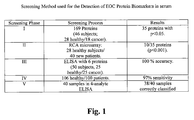
- the screening process comprises the following phases I to V:
- Described herein is a method which can be used to discriminate between cancer subjects (including subjects diagnosed with early stage (stage I-II) disease) and healthy subjects. This method is based on the identification of biomarkers which are particularly well suited to discriminate between cancer subjects and healthy subjects. These biomarkers were identified using a unique and novel screening method described herein involving several different screening steps using samples from different subjects in each step and validation with different techniques. The biomarkers disclosed herein can be used in the diagnosis, prognosis and monitoring of cancer.
- the invention disclosed herein refers to a new test based on four biomarkers: leptin, prolactin, ORN and IGF II, which discriminate between cancer subjects and healthy subjects, particularly between ovarian cancer subjects and healthy subjects.
- these four biomarkers can be used in a blood test for the diagnosis, prognosis and monitoring of ovarian cancer.
- biomarkers identified herein can be used in combination with additional known biomarkers.
- a known biomarker of ovarian cancer is CA125.
- CA125 a known biomarker of ovarian cancer
- the use of CA125 in conjunction with the biomarkers identified herein presents a novel approach for the early detection of ovarian cancer and may significantly improve our ability to accurately detect pre-malignant change or early stage ovarian cancer in asymptomatic women at increased risk for the development of ovarian cancer.
- the biomarkers identified in this application can be used in conjunction with other diagnostic techniques.
- the biomarkers identified in this application can be used in conjunction with vaginal examination, ultrasound or MRI to diagnose ovarian cancer.
- the invention refers to a method for diagnosing or aiding in the diagnosis of cancer in a subject.
- the method comprises comparing the expression of one or more biomarkers selected from the group consisting of the biomarkers identified in Table 2 in a sample from a subject to a predetermined standard for each said one or more biomarkers, wherein a significant difference in the expression of said one or more biomarkers in said sample as compared to a predetermined standard of each said one or more biomarkers diagnoses or aids in the diagnosis of cancer.
- said one or more biomarkers are selected from the group consisting of the biomarkers identified in Table 3.
- said one or more biomarkers are selected from the group consisting of: leptin, prolactin, OPN and IGF-II.
- an increase in the expression of said biomarkers as compared to the predetermined standard for said biomarker diagnoses or aids in the diagnosis of cancer When the biomarkers are prolactin and/or OPN, an increase in the expression of said biomarkers as compared to the predetermined standard for said biomarker diagnoses or aids in the diagnosis of cancer.
- the biomarkers When the biomarkers is leptin and/or IGF-II, a decrease in the expression of said biomarker as compared to the predetermined standard for said biomarker diagnoses or aids in the diagnoses of cancer.
- an increase or decrease in expression refers to the fact that level of a gene expression product is made higher or lower, or to the fact that the activity of the gene expression product is enhanced or lowered.
- the cancer is ovarian cancer.
- the cancer is breast cancer.
- the cancer is colon cancer.
- the cancer is prostate cancer.
- the cancer is cervical cancer.
- biomarker refers to one or more polypeptides that can be used to: diagnose, or to aid in the diagnosis or prognosis of, cancer either alone or as combination of multiple polypeptides; monitor the progression of cancer; and/or monitor the effectiveness of a cancer treatment.
- polypeptide refers to a polymer of amino acids, and not to a specific length. Thus, peptides, oligopeptides and proteins are included within the definition of polypeptide.
- leptin includes all homologs, naturally occurring allelic variants, isoforms and precursors of leptin. Leptin is also known as HGNC:6553, OB, OBS, obesity, or murine obesity homolog. In one embodiment, leptin comprises the amino acid sequence of GenBank Accession No. NP_000221.
- prolactin includes all homologs, naturally occurring allelic variants, isoforms and precursors of prolactin. Prolactin is also known as PRL or HGNC:9445. In one embodiment, prolactin comprises the amino acid sequence of GenBank Accession No. NP_000939.
- OPN includes all homologs, naturally occurring allelic variants, isoforms and precursors of OPN.
- OPN is also known as HGNC: 11255, BNSP, BSPI, ETA-1, secreted phosphoprotein-1 or osteopontin.
- OPN comprises the amino acid sequence of GenBank Accession No. NP_000573.
- IGF-II includes all homologs, naturally occurring allelic variants, isoforms and precursors of IGF-II.
- IGF-II is also known as HGNC:5466, insulin-like growth factor 2, insulin-like growth factor II or somatomedin A.
- IGF-II comprises the amino acid sequence of GenBank Accession No. NP_000603.
- the term "subject” or “patient” includes all warm-blooded animals.
- the subject is a human.
- the subject is a subject with an enhanced risk of developing cancer.
- the subject when the method relates to ovarian cancer, the subject is a female (such as a woman) suspected of having or known to have ovarian cancer, or with an enhanced risk of developing ovarian cancer.
- ovarian cancer subjects having a familial history of ovarian cancer, subjects identified as having a mutant oncogene, and subjects at least about 50 years of age have an enhanced risk of developing ovarian cancer.
- sample refers to a material obtained from a subject.
- the sample can be derived from any biological source, including all body fluids (such as, for example, whole blood, plasma, serum, saliva, ocular lens fluid, sweat, urine, milk, etc.), tissue or extracts, cells, etc.
- body fluids such as, for example, whole blood, plasma, serum, saliva, ocular lens fluid, sweat, urine, milk, etc.
- ovary-associated body fluids include blood fluids (e.g. whole blood, blood serum, blood having platelets removed therefrom, etc.), lymph, ascitic fluids, gynecological fluids (e.g.
- ovarian, fallopian, and uterine secretions ovarian, fallopian, and uterine secretions, menses, vaginal douching fluids, fluids used to rinse ovarian cell samples, etc.), cystic fluid, urine, and fluids collected by peritoneal rinsing (e.g. fluids applied and collected during laparoscopy or fluids instilled into and withdrawn from the peritoneal cavity of a human patient).
- peritoneal rinsing e.g. fluids applied and collected during laparoscopy or fluids instilled into and withdrawn from the peritoneal cavity of a human patient.
- expression is used herein to mean the process by which a polypeptide is produced from DNA. The process involves the transcription of the gene into mRNA and the translation of this mRNA into a polypeptide. Depending on the context in which used, “expression” may refer to the production of RNA, protein or both.
- Expression of a biomarker of the invention may be assessed by any of a wide variety of well known methods for detecting expression of a transcribed molecule or its corresponding protein.
- Non-limiting examples of such methods include immunological methods for detection of secreted proteins, protein purification methods, protein function or activity assays, nucleic acid hybridization methods, nucleic acid reverse transcription methods, and nucleic acid amplification methods.
- expression of a marker gene is assessed using an antibody (e.g. a radio-labeled, chromophore-labeled, fluorophore-labeled, or enzyme-labeled antibody), an antibody derivative (e.g.
- expression of a marker gene is assessed by preparing mRNA/cDNA (i.e.
- a transcribed polynucleotide from cells in a patient sample, and by hybridizing the mRNA/cDNA with a reference polynucleotide which is a complement of a polynucleotide comprising the marker gene, and fragments thereof.
- cDNA can, optionally, be amplified using any of a variety of polymerase chain reaction methods prior to hybridization with the reference polynucleotide; preferably, it is not amplified.
- a "predetermined standard" for a biomarker refers to the levels of expression of said biomarker in healthy subjects or the expression levels of said biomarker in non-cancerous tissue from the same subject.
- the predetermined standard expression levels for a given biomarker can be established by prospective and/or retrospective statistical studies using only routine experimentation. Said predetermined standard expression levels can be determined by a person having ordinary skill in the art using well known methods.
- a “healthy subject” refers to a subject has not been diagnosed with cancer or who has not been diagnosed with cancer of the type which is being analyzed.
- a “healthy subject” refers to a subject who does cancer or who does not have ovarian cancer.
- the term "significant difference” is well within the knowledge of a skilled artisan and will be determined empirically with reference to each particular biomarker. For example, a significant difference in the expression of a biomarker in a subject with cancer as compared to a healthy subject is any difference in expression which is statistically significant.
- the method comprises comparing the expression of two or more biomarkers and the diagnosis of cancer is based on a score-based classification method.
- the score-based classification system is a based on binary numbers.
- the score-based classification system comprises determining the expression of m different biomarkers; wherein each biomarker is assigned a score of 0 or 1, wherein a biomarker is assigned a score of 0 if the expression of said biomarker is not significantly different from the expression of said biomarker in a predetermined standard and wherein a biomarker is assigned a score of 1 if the expression of said biomarker is significantly different from the expression of said biomarker in a predetermined standard; wherein the subject is assigned an overall score which corresponds to the sum of the assigned scores from m different markers; and wherein a given threshold (t) is used to diagnose or aid in the diagnosis of cancer.
- the score-based classification system comprises comparing the expression of four (4) different biomarkers; wherein each biomarker is assigned a score of 0 or 1, wherein a biomarker is assigned a score of 0 if the expression of said biomarker is not significantly different from the expression of said biomarker in a predetermined standard and wherein a biomarker is assigned a score of 1 if the expression of said biomarker is significantly different from the expression of said biomarker in a predetermined standard; wherein the subject is assigned an overall score which corresponds to the sum of the assigned scores from four (4) different markers; and wherein a score or 2 or more diagnoses or aids in the diagnosis of cancer.
- the four biomarkers are leptin, prolactin, OPN and IGF-II.
- the method comprises comparing the expression of two or more biomarkers, wherein the diagnosis of cancer is made by comparing the expression profile of said two or more biomarkers to a predetermined standard profile for said biomarkers, and wherein a difference in the profiles diagnoses or aids in the diagnosis of cancer.
- an "expression profile” is a representation of the levels of expression of one or more biomarkers in a given sample.
- the predetermined standard profile is determined by comparing the expression of said two or more biomarkers in cancer subjects to the expression of said two or more biomarkers in healthy subjects using a machine learning technique. In one embodiment, the predetermined standard profile is determined by comparing the expression of said two or more biomarkers in cancer subjects and in healthy subjects using support vector machines, K-nearest neighbor classifier, or classification tree analysis.
- the method comprises detecting an additional known biomarker which is not identified in Table 2 and comparing the expression of said additional known biomarker to a predetermined standard for said additional known biomarker.
- Additional biomarkers for cancer can be identified by a person having ordinary skill in the art by reference to the published literature.
- the cancer is ovarian cancer
- the additional biomarker for ovarian cancer is selected from the group consisting of: human stratum corneum chymotryptic enzyme (HSCCE), kallikrein 4, kallikrein 5, kallikrein 6 (protease M), kallikrein 8, kallikrein 9, kallikrein 10, CA125, CA15-3, CA19-9, OVX1, lysophosphatidic acid (LPA), carcinoebryonic antigen (CEA), macrophage colony-stimulating factor (M-CSF), prostasin, CA54-61, CA72, HMFG2, IL-6, IL-10, LSA, M-CSF, NB70K, PLAP, TAG72, TNF, TPA, UGTF, WAP four-disulfide core domain 2 (HE4), matrix metalloprotease 2, tetranectin,inhibin, mesothelyn, MUC1, VEGF, CLDN3, NOTCH3,
- the additional biomarker for ovarian cancer is the truncated form of transthyretin or the cleavage fragment of inter-alpha-trypsin inhibitor heavy chain H4 identified by Zhang et al., Cancer Res. 64(16):5882-90 (2004 ).
- the additional biomarker for ovarian cancer is CA125.
- the invention refers to a method for diagnosing or aiding in the diagnosis of cancer in a subject comprising comparing the expression of two or more biomarkers selected from the group consisting of the biomarkers identified in Table 2 in a sample from a subject to a predetermined standard for each said biomarker, wherein a significant difference in the expression of one or more biomarkers in said sample as compared to a predetermined standard of each biomarker diagnoses or aids in the diagnosis of cancer.
- said two or more biomarkers are selected from the group consisting of the biomarkers identified in Table 3.
- said two or more biomarkers are selected from the group consisting of: leptin, prolactin, OPN and IGF-II.
- a significant difference in the expression of at least two of said two or more biomarkers diagnoses or aids in the diagnosis of cancer.
- the invention comprises to a method for diagnosing or aiding in the diagnosis of cancer in a subject comprising comparing the expression of three or more biomarkers selected from the group consisting of the biomarkers identified in Table 2 in a sample from a subject to a predetermined standard for each biomarker, wherein a significant difference in the expression of one or more biomarkers in said sample as compared to a predetermined standard of each said biomarker diagnoses or aids in the diagnosis of cancer.
- said three or more biomarkers are selected from the group consisting of the biomarkers identified in Table 3.
- said three or more biomarkers are selected from the group consisting of: leptin, prolactin, OPN and IGF-II.
- a significant difference in the expression of at least two or said two or more biomarkers diagnoses or aids in the diagnosis of cancer.
- the invention refers to a method for diagnosing or aiding in the diagnosis of cancer in a subject comprising comparing the expression of four or more biomarkers selected from the group consisting of the biomarkers identified in Table 2 in a sample from a subject to a predetermined standard for each biomarker, wherein a significant difference in the expression of one or more biomarkers in said sample as compared to a predetermined standard of each said biomarker diagnoses or aids in the diagnosis of cancer.
- said four or more biomarkers are selected from the group consisting of the biomarkers identified in Table 3.
- said four or more biomarkers are selected from the group consisting of: leptin, prolactin, OPN and IGF-II.
- a significant difference in the expression of at least two of said two or more biomarkers diagnoses or aids in the diagnosis of cancer.
- the expression of said one or more biomarkers can be detected using any method known to a person having ordinary skill in the art.
- the expression of said one or more biomarkers can be detected using a reagent that detects said one or more biomarkers.
- Said reagent can be any reagent that specifically detects said one or more biomarkers.
- Said reagent can be an antibody (natural or synthetic) or a fragment thereof specific for the biomarker, a peptide, a nucleic acid, or any other reagent that can specifically detect a biomarker.
- the term "antibody” includes chimeric and synthetic antibodies, e.g., generated by combinatorial mutagenesis and phage display.
- antibody includes mimetics or peptidomimetics of antibodies.
- Peptidomimetics are compounds based on, or derived from, peptides and proteins.
- the peptidomimetics of the present invention typically can be obtained by structural modification of a known peptide sequence using unnatural amino acids, conformational restraints, isosteric replacement, and the like.
- the subject peptidomimetics constitute the continuum of structural space between peptides and non-peptide synthetic structures; peptidomimetics may be useful, therefore, in delineating pharmacophores and in helping to translate peptides into non-peptide compounds with the activity of the parent peptides.
- peptide analogs of the antibodies can be generated using, for example, benzodiazepines (e . g ., see Freidinger et al. in Peptides: Chemistry and Biology, G.R. Marshall ed., ESCOM Publisher: Leiden, Netherlands, 1988 ), substituted gamma lactam rings ( Garvey et al. in Peptides: Chemistry and Biology, G.R. Marshall ed., ESCOM Publisher: Leiden, Netherlands, 1988, p123 ), C-7 mimics ( Huffman et al. in Peptides: Chemistry and Biology, G.R. Marshall ed., ESCOM Publisher: Leiden, Netherlands, 1988, p.
- benzodiazepines e . g ., see Freidinger et al. in Peptides: Chemistry and Biology, G.R. Marshall ed., ESCOM Publisher: Leiden, Netherlands, 1988
- substituted gamma lactam rings Garvey et al.
- keto-methylene pseudopeptides Ewenson et al. (1986) J Med Chem 29:295 ; and Ewenson et al. in Peptides: Structure and Function (Proceedings of the 9th American Peptide Symposium) Pierce Chemical Co. Rockland, IL, 1985 ), ⁇ -turn dipeptide cores ( Nagai et al. (1985) Tetrahedron Lett 26:647 ; and Sato et al. (1986) J Chem Soc Perkin Trans 1:1231 ), ⁇ -aminoalcohols ( Gordon et al. (1985) Biochem Biophys Res Commun 126:419 ; and Dann et al.
- said reagent is directly or indirectly labeled with a detectable substance.
- the detectable substance may be, for example, selected, e.g., from a group consisting of radioisotopes, fluorescent compounds, enzymes, and enzyme co-factor. Methods of labeling antibodies are well known in the art.
- the term “detect”, “detected” or “detecting” includes measure, measured or measuring.
- the sample is a body fluid sample.
- the body fluid sample is blood or serum.
- the expression of said one or more biomarkers are detected using mass spectroscopy.
- the expression of said one or more biomarkers is detected by detecting the mRNA transcription levels of the gene encoding said at one or more biomarker.
- the expression of said one or more biomarkers can be detected by ELISA, RCA immunoassay, chemiluminescence, thin-film optical biosensor, proton resonance technology, protein microarray assay or any other detection method known in the art.
- the expression of said one or more biomarkers are detected by: (a) detecting the expression of a polypeptide which is regulated by said one or more biomarker; (b) detecting the expression of a polypeptide which regulates said biomarker; or (c) detecting the expression of a metabolite of said biomarker.
- a person of skill in the art would be able to identify polypeptides which regulate or are regulated by a biomarker, and metabolites of a biomarker, using only routine experimentation.
- the above described methods to diagnose or aid in the diagnosis of cancer may be used in conjunction with other methods to validate the results (i.e. to more conclusively determine whether a subject has cancer).
- the cancer is ovarian cancer and the above described methods further comprise: physical examination, ultrasound examination, x-ray examination, MRI examination, laparotomy and/or hematological tests.
- Hematological tests which may be indicative of ovarian cancer in a patient include analyses of serum levels of additional biomarkers of ovarian cancer.
- the invention comprises a method of monitoring the progression of cancer in a subject comprising comparing the expression of one or more biomarkers selected from the group consisting of the biomarkers identified in Table 2 in a sample from a subject; to the expression of said one or more biomarkers in a sample obtained from the subject at a subsequent point in time, wherein a difference in the expression of said one or more biomarkers are indicative of the progression of the cancer in the subject.
- said one or more biomarkers are selected from the group consisting of the biomarkers identified in Table 3.
- said one or more biomarkers are selected from the group consisting of leptin, prolactin, OPN and IGF-II.
- the method comprises comparing the expression of two or more biomarkers. In another embodiment, the method comprises comparing the expression of three or more biomarkers. In another embodiment, the method comprises comparing the expression of four or more biomarkers. In one embodiment, the method comprises comparing the expression of four or more biomarkers, wherein said four or more biomarkers include leptin, prolactin, OPN and IGF-II. In yet another embodiment, the method comprises comparing the expression of four biomarkers: leptin, prolactin, OPN and IGF-II.
- the method is used to monitor the progression of cancer after the subject has received a treatment for cancer.
- the invention also comprises a method for monitoring the effectiveness of a treatment against cancer, comprising comparing the expression of one or more biomarkers selected from the group consisting of the biomarkers identified in Table 3 in a sample from a subject prior to providing at least a portion of a treatment to the expression of said one or more biomarkers in a sample obtained from the subject after the subject has received at least a portion of the treatment, wherein a difference in the expression of said one or more biomarkers are indicative of the efficacy of the treatment.
- said one or more biomarkers are selected from the group consisting of the biomarkers identified in Table 3. In another embodiment, said one or more biomarkers are selected from the group consisting of leptin, prolactin, OPN and IGF-II.
- the method comprises comparing the expression of two or more biomarkers. In another embodiment, the method comprises comparing the expression or three or more biomarkers. In another embodiment, the method comprises comparing the expression of four or more biomarkers. In one embodiment, the method comprises comparing the expression of four or more biomarkers, wherein said four or more biomarkers include leptin, prolactin, OPN and IGF-II. In yet another embodiment, the method comprises comparing the expression of four biomarkers: leptin, prolactin, OPN and IGF-II.
- the "treatment” may be any treatment for treating ovarian cancer including, but not limited to, chemotherapy, immunotherapy, gene therapy, radiation therapy and surgical removal of tissue.
- a portion of a treatment refers to any portion of a treatment for cancer, such as a dose of a compound used to treat cancer, or a portion of a treatment such as chemotherapy.
- the method is for monitoring ovarian cancer. In one embodiment, the method is for the monitoring breast cancer. In one embodiment, the method is for monitoring colon cancer. In another embodiment, the method is for monitoring cervical cancer.
- kits for diagnosing or aiding in the diagnosis of cancer or for monitoring cancer can be used to diagnose or monitor any cancer.
- the kit is for the diagnosis or monitoring of ovarian cancer.
- the kit is for the diagnosis or monitoring of breast cancer.
- the kit is for the diagnosis or monitoring of colon cancer.
- the kit is for the diagnosis or monitoring of cervical cancer.
- the kit comprises: (i) a receptacle for receiving a sample; (ii) one or more reagents for detecting one or more biomarkers selected from the group consisting of the biomarkers identified in Table 2; and (iii) a reference sample.
- the kit comprises one or more reagents for detecting one or more biomarkers selected from the group consisting of the biomarkers identified in Table 3.
- the kit comprises one or more reagents for detecting one or more biomarkers selected from the group consisting of leptin, prolactin, OPN and IGF-II.
- the kit comprises reagents for detecting two or more biomarkers.
- said two or more biomarkers are selected from the group consisting of: leptin, prolactin, OPN and IGF-II.
- said kit comprises reagents for detecting three or more biomarkers.
- the kit comprises reagents for detecting four or more biomarkers.
- said four or more biomarkers include leptin, prolactin, OPN and IGF-II.
- the reagents may be labeled compounds or agents capable of detecting a polypeptide or an mRNA encoding a polypeptide corresponding to a marker gene of the invention in a biological sample and means for determining the amount of the polypeptide or mRNA in the sample (e.g., an antibody which binds the polypeptide or an oligonucleotide probe which binds to DNA or mRNA encoding the polypeptide).
- Suitable reagents for binding with a polypeptide corresponding to a marker gene of the invention include antibodies, antibody derivatives, antibody fragments, and the like.
- Suitable reagents for binding with a nucleic acid include complementary nucleic acids.
- the kit can comprise, for example: (1) a first antibody (e.g., attached to a solid support) which binds to a polypeptide corresponding to a marker gene of the invention; and, optionally, (2) a second, different antibody which binds to either the polypeptide or the first antibody and is conjugated to a detectable label.
- a first antibody e.g., attached to a solid support
- a second, different antibody which binds to either the polypeptide or the first antibody and is conjugated to a detectable label.
- the kit can comprise, for example: (1) an oligonucleotide, e.g., a detectably labeled oligonucleotide, which hybridizes to a nucleic acid sequence encoding a polypeptide corresponding to a marker gene of the invention or (2) a pair of primers useful for amplifying a nucleic acid molecule corresponding to a marker gene of the invention.
- an oligonucleotide e.g., a detectably labeled oligonucleotide, which hybridizes to a nucleic acid sequence encoding a polypeptide corresponding to a marker gene of the invention or (2) a pair of primers useful for amplifying a nucleic acid molecule corresponding to a marker gene of the invention.
- the reference sample is used to compare the results obtained from the sample being tested.
- the kit can also comprise other components such as a buffering agent, a preservative, or a protein stabilizing agent.
- the kit can further comprise components necessary for detecting the detectable label (e.g., an enzyme or a substrate).
- kits can be enclosed within an individual container and all of the various containers can be within a single package, along with instructions for interpreting the results of the assays performed using the kit.
- the present invention also comprises methods to screen for candidate compounds useful to treat cancer.
- the invention comprises a method to screen for a candidate compound useful to treat cancer comprising: (i) identifying a candidate compound which regulates the expression of one or more biomarkers selected from the group consisting of the biomarkers identified in Table 2; and (ii) determining whether such candidate compound is effective to treat cancer.
- said one or more biomarkers are selected from the group consisting of the biomarkers identified in Table 3.
- said one or more biomarkers are selected from the group consisting of leptin, prolactin, OPN and IGF-II.
- the invention comprises a method to screen for a candidate compound useful to treat cancer comprising: (i) identifying a candidate compound which regulates the expression of two or more biomarkers selected from the group consisting of the biomarkers identified in Table 2; and (ii) determining whether such candidate compound is effective to treat cancer.
- said two or more biomarkers are selected from the group consisting of the biomarkers identified in Table 3.
- said two or more biomarkers are selected from the group consisting of leptin, prolactin, OPN and IGF-II.
- the present invention also comprises methods to screen for candidate compounds useful to treat cancer.
- the invention comprises a method to screen for a candidate compound useful to treat cancer comprising: (i) identifying a candidate compound which regulates the expression of three or more biomarkers selected from the group consisting of the biomarkers identified in Table 2; and (ii) determining whether such candidate compound is effective to treat cancer.
- said three or more biomarkers are selected from the group consisting of the biomarkers identified in Table 3.
- said three or more biomarkers are selected from the group consisting of leptin, prolactin, OPN and IGF-II.
- the present invention also comprises methods to screen for candidate compounds useful to treat cancer.
- the invention comprises a method to screen for a candidate compound useful to treat cancer comprising: (i) identifying a candidate compound which regulates the expression of four or more biomarkers selected from the group consisting of the biomarkers identified in Table 2; and (ii) determining whether such candidate compound is effective to treat cancer.
- said four or more biomarkers are selected from the group consisting of the biomarkers identified in Table 3.
- said four or more biomarkers include leptin, prolactin, OPN and IGF-II.
- the term "compound” refers to any chemical entity, pharmaceutical, drug, and the like that can be used to treat or prevent a disease, illness, conditions, or disorder of bodily function.
- Compounds comprise both known and potential therapeutic compounds.
- a compound can be determined to be therapeutic by screening using the screening methods of the present invention. Examples of test compounds include, but are not limited to peptides, polypeptides, synthetic organic molecules, naturally occurring organic molecules, nucleic acid molecules, and combinations thereof.
- the above described screening methods can be used to screen for candidate compounds useful to treat any cancer.
- the method is to screen for candidate compounds useful to treat ovarian cancer.
- the method is to screen for candidate compounds useful to treat breast cancer.
- the method is to screen for candidate compounds useful to treat colon cancer.
- the method is to screen for candidate compounds useful to treat cervical cancer.
- the invention further comprises a method of conducting a business comprising: (i) obtaining a sample; (ii) detecting the expression of at least one biomarker in the sample, wherein said one or more biomarker is selected from the group consisting of the biomarkers identified in Table 2; and (iii) reporting the results of such detection.
- said one or more biomarkers are selected from the group consisting of the biomarkers identified in Table 3.
- said one or more biomarkers are selected from the group consisting of leptin, prolactin, OPN and IGF-II.
- the invention further comprises a method of conducting a business comprising: (i) obtaining a sample; (ii) detecting the expression of leptin, prolactin, OPN and IGF-II; and (iii) reporting the results of such detection.
- the invention also comprises a method to screen for candidate cancer biomarkers comprising: (i) identifying a group of biomarkers that are potentially associated with cancer (such as oncogenes, tumor suppressor genes, growth factor-like genes, protease-like genes, and protein kinase-like genes); (ii) comparing the level of expression of the biomarkers identified in step (i) in a first population of cancer subjects and in healthy subjects; (iii) selecting biomarkers exhibiting a significant difference in expression in said first population of cancer subjects; (iv) comparing the level of expression of the biomarkers identified in step (iii) in a second population of cancer subjects and in healthy subjects; and (v) selecting biomarkers exhibiting a significant difference in expression in said second population of cancer subjects; wherein the biomarkers identified in step (v) are candidate cancer biomarkers.
- biomarkers identified in step (v) are candidate cancer biomarkers.
- the first population of cancer subjects and the second population of cancer subjects may be any two cancer populations so long as the two populations are different.
- said first population of cancer subjects consists of subjects newly diagnosed with cancer, and said second population of cancer subjects consists of subjects having recurrent cancer.
- said first population of cancer subjects consists of subjects having later stage cancer and said second population of cancer subjects consists of subjects having early stage cancer; or where said first population of cancer patients consists of subjects having early stage cancer and said second population of cancer subjects consists of subjects having later stage cancer.
- biomarkers which are potentially associated with cancer.
- biomarkers can be selected from the group consisting of as oncogenes, tumor suppressor genes, growth factor-like genes, protease-like genes, and protein kinase-like genes.
- the method further comprises: (vi) comparing the level of expression of the biomarkers identified in step (v) in a third population of cancer subjects and in healthy subjects, wherein the expression of said biomarkers is detected by using a different assay format; and (vi) selecting biomarkers exhibiting a significant different in expression in said third population of cancer patients; wherein the biomarkers identified in step (vii) are candidate biomarkers for cancer.
- the expression of said biomarker is first detected using a high throughput assay, and then detected using an assay that is specific for the protein in question.
- the expression of said biomarker is first detected by using RCA microarray immunoassay and then detected by ELISA assay.
- the third population of cancer subjects may be the same or different from the first and second population of cancer subjects.
- the method further comprises determining whether the biomarkers identified in step (v) or (vii) could distinguish between cancer and healthy subjects in a blind study.
- the results of the blind assay can be analyzed using well known statistical methods.
- the expression of said biomarkers can be compared using any method known in the art.
- the expression of the biomarkers is detected using protein array, mass spectroscopy, gel electrophoresis or an immunoassay.
- the expression of the biomarkers is detected using RCA microarray immunoassay.
- the expression of the biomarkers is measured using ELISA. These methods are well known in the art.
- the invention also comprise a method to screen for candidate cancer biomarkers comprising: (i) identifying a cancer biomarker; (ii) selecting polypeptides which regulate or are regulated by the biomarker identified in step (i); and (iii) measuring the expression of the polypeptides identified in step (ii) in cancer subjects and in healthy subjects, wherein a polypeptide which is differentially expressed in cancer subjects and in healthy subjects is a candidate cancer biomarker.
- the above described screening methods can be used to screen for candidate biomarkers of any cancer.
- the method is to screen for candidate compounds useful to treat ovarian cancer.
- the method is to screen for candidate biomarkers of breast cancer.
- the method is to screen for candidate biomarkers of colon cancer.
- the method is to screen for candidate biomarkers of cervical cancer.
- Figure 1 is a schematic representation of the novel screening assay used to identify biomarkers of ovarian cancer which can be used to distinguish subjects with ovarian cancer and healthy subjects.
- the levels of expression of 169 proteins were measured in 46 serum samples (18 samples were obtained from subjects with ovarian cancer and 28 samples were obtained from healthy, age-matched controls) via RCA immunoassay microarray in order to identify proteins that are differentially expressed in subjects with ovarian cancer and in healthy subjects.
- Table 1 Proteins (analytes) used to screen for biomarkers of ovarian cancer.
- analytes Protein refers to a molecule or compound, such as a polypeptide or nucleic acid, whose presence is to be identified in a sample.
- Array 1 analytes Protein abbreviations: Protein (abbr.) Protein (full name) 1 ANG Angiogenin 2 BLC (BCA-1) B-lymphocyte chemoattractant 3 EGF Epidermal growth factor 4 ENA-78 Epithelial cell-derived neutrophil-activating peptide 5 Eot Eotaxin 6 Eot-2 Eotaxin-2 7 Fas Fas (CD95) 8 FGF-7 Fibroblast growth factor-7 9 FGF-9 Fibroblast growth factor-9 10 GDNF Glial cell line derived neurotrophic factor 11 GM-CSF Granulocyte macrophage colony stimulating factor 12 IL-1ra Interleukin 1 receptor antagonist 13 IL-2 sR ⁇ Interleukin 2 soluble receptor alpha 14 IL-3 Interleukin 3 15 IL-4 Interleukin 4 16
- the protein (or analytes) identified in Table 2 are also known by other names, which can be identified by reference to the full name of the protein as described in Table 1 and by reference to the published literature.
- One way of identifying other names for the proteins identified in Table 2 is by reference to the various NCBI databases, which include GenBank.
- the predetermined standard of leptin is 7-50 ng/ml; the predetermined standard of prolactin is 0-10 pg/ml; the predetermined standard of OPN is 0.5-19 pg/ml; and the predetermined standard of IGF-II is 450-2500 ng/ml.
- the predetermined standard concentration of a biomarker may vary from assay to assay depending on various factors.
- the combined data for the four biomarkers was analyzed by four different classifiers: support vector machines (SVM), k-nearest neighbor classifiers (k-NN), classification trees, and a score-based classification system to classify samples from healthy subjects and samples from subjects with ovarian cancer.
- Support vector machines (SVM), k-nearest neighbor classifiers (k-NN), classification trees are hierarchical clustering models.
- Figure 6 shows the result of the score based classification system. Particularly, Figure 6 shows the scores assigned to the 206 subjects who participated in the phase of the screening assay. The scores were assigned using the following method: For each marker, the best split point to minimize the number of misclassified subjects was found. The split point divides the sample space into two intervals: one for healthy and another for cancer. A score 0 is assigned to a subject if its related observation falls in the normal interval; otherwise, a score 1 is assigned. Table 6 shows the split point for each of the four biomarkers described above. Overall, an individual is assigned a score as the sum of these assigned scores from 4 different markers. Thus, in this instance the range of such score is [0, 4].
- Figure 6 illustrates that subjects having a score greater than or equal to 2 are likely to have cancer; and subjects with a score less than or equal to 1 are likely to be healthy.
- Table 6 Scoring Criteria for Biomarkers Biomarker Split point Left interval Right interval Leptin (1) 2.5 ng/ml Cancer (1) Normal (0) Prolactin (2) 10 pg/ml Normal (0) Cancer (1) OPN (3) 21 pg/ml Normal (0) Cancer (1) IGF-II (4) 491 ng/ml Cancer (1) Normal (0)
- Table 7 gives classification results based on 10-fold cross-validation for all four classification methods considered. The results indicated that all the classification methods can well distinguish normal and cancer groups. The proposed score based classification method performed better than the nearest neighbor and classification tree methods. The results from the scoring method are comparable to those of SVM.
- the sensitivity of the test is 96%, specificity 97%, PPV 97% and NPV 96%.
- the "sensitivity” of an assay refers to the probability that the test will yield a positive result in an individual afflicted with ovarian cancer.
- the “specificity” of an assay refers to the probability that the test will yield a negative result in an individual not afflicted with ovarian cancer.
- the "positive predictive value" (PPV) of an assay is the ratio of true positive results (i.e. positive assay results for patients afflicted with ovarian cancer) to all positive results (i.e. positive assay results for patients afflicted with ovarian cancer +positive assay results for patients not afflicted with ovarian cancer).
- Table 7 Classification results based on 10-fold cross-validation. Classification Method False Positive False Negative SVM 3/106 4/100 TREE 10/106 7/100 k-NN 6/106 10/100 Score-based 6/106 4/100
- Table 8 summarizes the level of four biomarkers identified herein (leptin, prolactin, ODN and IGF-II) and biomarker CA125 in subjects having stage I and stage II ovarian cancer who participated in the screening assays described above (phase IV and V), as determined by the ELISA assays described herein. (The patients in bold / italics participated in phase V of the screening assay described herein.) Table 8. Expression levels of biomarkers in patients with Stage I and Stage II ovarian cancer.
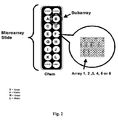
- Microarray Manufacture Microarrays were prepared according to Schweitzer et al., Nat Biotech (2002) 20:359. In short, glass slides were cleaned and derivatized with 3-cyanopropyltriethoxysilane. The slides were equipped with a Teflon mask, which divided the slide into sixteen 0.65 cm diameter wells or circular analysis sites called subarrays ( Figure 2 ). Printing was performed with a Perkin-Elmer SpotArray Enterprise non-contact arrayer equipped with piezoelectric tips, which dispense a droplet (-350 pL) for each microarray spot. Antibodies were applied at a concentration of 0.5 mg/mL at defined positions.
- Each chip was printed with sixteen copies of one type of array, either array 1, 2, 3, 4, 5 or 6. (See Table 1.)
- a set of antibodies was printed with quadruplicate spots in each subarray. After printing, chips were inspected using light microscopy. If the percentage of missing spots observed was greater than 5%, then the batch failed and the slides were discarded immediately. For all print runs described herein, 100% of the antibody features and >95% of the biotin calibrators were printed. Microarray chips were validated in concert with a set of qualified reagents in two ways.
- mixtures of 1-3 different cytokines were prepared so as to provide a high intensity signal and applied to 14 wells on a chip (each well treated with a different mixture up to the total complement of detector antibodies) and two arrays were used as blank controls. The chips were developed and scanned and the resulting signals were compared to the positional map of the particular array.
- a titration QC for all analytes of a specified array using known sample matrices was performed. Normal human serum and heparinized plasma were assayed neat or spiked with purified recombinant cytokines representing all analytes in the array.
- Spiked mixtures were then titrated down the subarrays of a slide from 9,000 pg/mL to 37 pg/mL of spiked cytokine concentrations along with two subarrays for each un-spiked control sample.
- the data was quantified and for every analyte in the array a titration curve was generated to examine feature intensity behavior as a function of concentration. Taken together, this data was used to confirm the activity of array features and reagent sets.
- RCA Microarray Immunoassay Prior to assay, the slides were removed from storage at room temperature in sealed containers and opened in a humidity controlled chamber (45-55%). Slides were blocked with Seablock (Pierce Chemical Co.), diluted 1:1 with PBS for 1 h at 37°C in a humidified chamber. Following removal of the blocking solution, they were washed twice with 1xPBS/0.5% Brij 35 prior to application of sample. Four controls were included on each sample slide with feature concentrations corresponding to four anchor points on the full titration curve. The test samples were assayed on the remaining 12 subarrays. Twenty ⁇ L of the treated sample were then applied to each subarray.
- Subject Population for RCA microarray immunoassay For the RCA microarray immunoassays the serum from 86 subjects was assayed. Of the 86 subjects, 28 were healthy and had an average age of 60.8 years, 58 had Stage III/IV ovarian cancer and had an average age of 57.1. Of the 58 patients with Stage III/IV ovarian cancer, 18 were newly diagnosed and the remaining 40 were subjects with recurrent disease.
- Subject Population for Blind Study (ELISA): For the panel of ELISA, serum samples were collected from 100 subjects with ovarian cancer and 106 healthy/disease-free or high-risk subjects (as part of the Yale New Haven Hospital Early Detection program (HIC10425). The normal group consisted of 66 healthy/disease-free (including the 28 healthy samples sent for the arrays) and 40 women considered to be at high-risk. Of the 100 ovarian cancer patients, 24 women were diagnosed with Stage I/II and 76 women with Stage III/IV EOC. Included in this group were the 18 newly diagnosed OVCA samples. Serum from the healthy/disease-free group served as baseline values or "normal range" values for the presence of carcinoma.
- Sera Collection 10 ml of blood was collected, centrifuged at 1500 rpm for 10 min. and the serum stored at -80°C in the OB/GYN Tissue bank until further use. Collection, preparation and storage of the blood samples were done utilizing guidelines set by the NCI Intergroup Specimen Banking Committee. Consent for participation in this study was obtained by qualified personnel. Before analyses, the sera was thawed once and 8 (25-50 ul) aliquots stored at -80°C to ensure unnecessary freezing and thawing.
- ELISA Assay The leptin, prolactin and IGF-II kits were purchased from Diagnostic Systems Laboratories, Inc. Webster, Texas and the OPN (Osteopontin) from Assay Designs, Inc. (Ann Arbor, Michigan). Assays were performed following kit instructions, and the results were read on a Spectra Max M2 Microplate Reader (Molecular Devices, Sunnyvale California) set to a dual wavelength of 405 nM with the appropriate correction for each assay. Three classifiers: support vector machines (SVM), K-nearest neighbor classifiers (k-NN) and classification trees were used to analyze results (distinguish the healthy/disease/free from the ovarian cancer patients).
- SVM support vector machines
- k-NN K-nearest neighbor classifiers
- classification trees were used to analyze results (distinguish the healthy/disease/free from the ovarian cancer patients).
- Effect size has a direct association with the predictive ability of a particular variable.
- Table 9 shows conversions of effect sizes (column 1) to probability (column 2). The example presented in Table 9 is intended to demonstrate the relationship between effect size and predictive ability. For example, with an effect size of 0.3 observed between the two groups, the probability of correctly identifying the groups is 0.56. With an effect size of 1, the probability increases to 0.69.
- Table 9 Effect size as the measure of predictive ability.
- the score-based classification system can be carried out as follows: (i) For each marker, find the best split point to minimize the number of misclassified subjects. The split point defines two intervals: one for normal and another for cancer. A score of 0 is assigned to a subject if its related observation falls in the normal interval; otherwise, a score of 1 is assigned. (ii) Overall, a subject is assigned a score as the sum of these assigned scores from m different markers. Therefore, the range of such score is between 0 and m. (iii) A given threshold (t) is used to predict the disease status for a given subject, e.g. a given subject with a total score equal or less than t is predicted to have normal status, whereas a subject with a score higher than t will be diagnosed to have disease.
- y_k For each split point y_k, there are a_1 and a_2 observed measurements less than y_k in the first and the second groups, respectively; and there are b_1 and b_2 observed measurements greater than y_k in the first and the second groups, respectively. If the left and the right sides of y_k are assigned to the first and the second groups, respectively, then there are a_2 and b_1 misclassified samples. If the left and the right sides of y_k are assigned to the second and the first groups, respectively, then there are a_1 and b_2 misclassified samples. We choose the assignment that minimizes the number of misclassified samples.
- Ovarian cancer is a "relatively silent" disease with intra-abdominal inaccessibility which makes the monitoring and early detection of the disease utilizing a non-invasive approach such as serum tumor markers an attractive idea.
- a simple, reliable, reproducible and rapid screening strategy with adequate sensitivity for early detection is needed to improve our ability to accurately detect pre-malignant change or early stage ovarian cancer in asymptomatic women at increased risk for the development of ovarian cancer. It has been suggested that, in order to be acceptable, any screening strategy for early detection must achieve a minimum of 99.6% specificity, hence the need for a combined regimen of tests since it is unlikely that any single analyte test will be that specific.
- Biomarkers can be eliminated based on analysis of 15-20 normal and patient samples once quality control of the ELISA in the hands of the technician performing the assay is established. Analysis of a larger number of samples is required for application of statistical techniques (such as SVM, k-NN and Tree), to determine sensitivity/specificity, split-points and combinatorial strategies. After validating the contribution that each biomarker may contribute to a combined assay, split points for each biomarker are defined and the utility of combinations of two or more markers are explored statistically. Using split points the status of each biomarker is assigned as a binary result (normal versus abnormal levels).
- statistical techniques such as SVM, k-NN and Tree
- the number of biomarkers classified as abnormal is used to define an individual as having or not having cancer; in this case, individuals with three or four biomarkers that are abnormal are classified as having ovarian cancer while subjects with two or fewer biomarkers that are abnormal are classified as not having cancer.
- the biomarkers as individual analytes may not have sufficient sensitivity and specificity, rather the combination of biomarkers may be required for a diagnostic test.
- Example 2 The Used of the Biomarkers Identified in Ovarian Cancer Patients to Diagnose Breast Cancer and Colon Cancer
- biomarkers identified above (leptin, prolactin, OPN and IGF-II) were differentially expressed in other types of cancer.
- samples corresponding to subjects with cancer could be distinguished from samples from healthy subjects by the differential expression of two or more biomarkers as compared to their predetermined standard.
- the expression levels indicated in italics and bold corresponds to expression levels outside of the predetermined standard for said biomarker.
- Table 10 Analysis of the expression of leptin, prolactin, OPN and IGF-II in breast cancer and colon cancer.
Landscapes
- Health & Medical Sciences (AREA)
- Life Sciences & Earth Sciences (AREA)
- Immunology (AREA)
- Engineering & Computer Science (AREA)
- Chemical & Material Sciences (AREA)
- Molecular Biology (AREA)
- Biomedical Technology (AREA)
- Hematology (AREA)
- Urology & Nephrology (AREA)
- Pathology (AREA)
- Analytical Chemistry (AREA)
- Biochemistry (AREA)
- Physics & Mathematics (AREA)
- Microbiology (AREA)
- General Health & Medical Sciences (AREA)
- Biotechnology (AREA)
- Cell Biology (AREA)
- Food Science & Technology (AREA)
- Medicinal Chemistry (AREA)
- General Physics & Mathematics (AREA)
- Organic Chemistry (AREA)
- Proteomics, Peptides & Aminoacids (AREA)
- Genetics & Genomics (AREA)
- Wood Science & Technology (AREA)
- Zoology (AREA)
- Oncology (AREA)
- Biophysics (AREA)
- Hospice & Palliative Care (AREA)
- Bioinformatics & Cheminformatics (AREA)
- General Engineering & Computer Science (AREA)
- Investigating Or Analysing Biological Materials (AREA)
- Measuring Or Testing Involving Enzymes Or Micro-Organisms (AREA)
- Peptides Or Proteins (AREA)
Priority Applications (1)
| Application Number | Priority Date | Filing Date | Title |
|---|---|---|---|
| EP10181573.6A EP2336779B1 (de) | 2004-02-19 | 2005-01-18 | Kit für die Identifizierung von Ovarial-Krebsprotein-Biomarkern unter Verwendung von Proteomtechniken |
Applications Claiming Priority (3)
| Application Number | Priority Date | Filing Date | Title |
|---|---|---|---|
| US54558104P | 2004-02-19 | 2004-02-19 | |
| US54590004P | 2004-02-20 | 2004-02-20 | |
| EP05722486A EP1723428A2 (de) | 2004-02-19 | 2005-01-18 | Identifizierung von krebsprotein-biomarkern unter verwendung von proteomtechniken |
Related Parent Applications (2)
| Application Number | Title | Priority Date | Filing Date |
|---|---|---|---|
| EP05722486.7 Division | 2005-01-18 | ||
| EP05722486A Division EP1723428A2 (de) | 2004-02-19 | 2005-01-18 | Identifizierung von krebsprotein-biomarkern unter verwendung von proteomtechniken |
Related Child Applications (1)
| Application Number | Title | Priority Date | Filing Date |
|---|---|---|---|
| EP10181573.6 Division-Into | 2010-09-29 |
Publications (3)
| Publication Number | Publication Date |
|---|---|
| EP2026071A2 true EP2026071A2 (de) | 2009-02-18 |
| EP2026071A3 EP2026071A3 (de) | 2009-09-02 |
| EP2026071B1 EP2026071B1 (de) | 2013-07-31 |
Family
ID=34915557
Family Applications (3)
| Application Number | Title | Priority Date | Filing Date |
|---|---|---|---|
| EP10181573.6A Expired - Lifetime EP2336779B1 (de) | 2004-02-19 | 2005-01-18 | Kit für die Identifizierung von Ovarial-Krebsprotein-Biomarkern unter Verwendung von Proteomtechniken |
| EP08015468.5A Expired - Lifetime EP2026071B1 (de) | 2004-02-19 | 2005-01-18 | Identifizierung von Krebsprotein-Biomarkern unter Verwendung von Proteomtechniken |
| EP05722486A Withdrawn EP1723428A2 (de) | 2004-02-19 | 2005-01-18 | Identifizierung von krebsprotein-biomarkern unter verwendung von proteomtechniken |
Family Applications Before (1)
| Application Number | Title | Priority Date | Filing Date |
|---|---|---|---|
| EP10181573.6A Expired - Lifetime EP2336779B1 (de) | 2004-02-19 | 2005-01-18 | Kit für die Identifizierung von Ovarial-Krebsprotein-Biomarkern unter Verwendung von Proteomtechniken |
Family Applications After (1)
| Application Number | Title | Priority Date | Filing Date |
|---|---|---|---|
| EP05722486A Withdrawn EP1723428A2 (de) | 2004-02-19 | 2005-01-18 | Identifizierung von krebsprotein-biomarkern unter verwendung von proteomtechniken |
Country Status (8)
| Country | Link |
|---|---|
| US (4) | US7666583B2 (de) |
| EP (3) | EP2336779B1 (de) |
| JP (3) | JP4912894B2 (de) |
| CN (1) | CN1922490B (de) |
| AU (1) | AU2005217375C1 (de) |
| CA (1) | CA2557438C (de) |
| IL (1) | IL177591A (de) |
| WO (1) | WO2005083440A2 (de) |
Cited By (1)
| Publication number | Priority date | Publication date | Assignee | Title |
|---|---|---|---|---|
| US10670611B2 (en) | 2014-09-26 | 2020-06-02 | Somalogic, Inc. | Cardiovascular risk event prediction and uses thereof |
Families Citing this family (111)
| Publication number | Priority date | Publication date | Assignee | Title |
|---|---|---|---|---|
| US7270960B2 (en) * | 2001-08-29 | 2007-09-18 | Pacific Northwest Research Institute | Diagnosis of ovarian carcinomas |
| CA2535805A1 (en) * | 2003-08-15 | 2005-02-24 | University Of Pittsburgh Of The Commnonwealth System Of Higher Education | Multifactorial assay for cancer detection |
| US20070042405A1 (en) * | 2003-08-15 | 2007-02-22 | University Of Pittsburgh -Of The Commonwealth System Of Higher Education | Enhanced diagnostic multimarker serological profiling |
| US20050277137A1 (en) * | 2003-08-15 | 2005-12-15 | University Of Pittsburgh | Diagnostic multimarker serological profiling |
| JP4912894B2 (ja) | 2004-02-19 | 2012-04-11 | イェール ユニバーシティー | プロテオーム技術を使用した癌タンパク質バイオマーカーの同定 |
| US20070092911A1 (en) * | 2005-10-03 | 2007-04-26 | Buechler Kenneth F | Methods and compositions for diagnosis and /or prognosis in systemic inflammatory response syndromes |
| US20080050832A1 (en) * | 2004-12-23 | 2008-02-28 | Buechler Kenneth F | Methods and compositions for diagnosis and/or prognosis in systemic inflammatory response syndromes |
| WO2007030949A2 (en) | 2005-09-15 | 2007-03-22 | Val-Chum, S.E.C. | Methods of diagnosing ovarian cancer and kits therefor |
| EP1946118A4 (de) * | 2005-11-10 | 2009-01-21 | Aurelium Biopharma Inc | Gewebediagnose für brustkrebs |
| JP2009520958A (ja) * | 2005-12-22 | 2009-05-28 | エフ.ホフマン−ラ ロシュ アーゲー | 結腸直腸癌の評価におけるオステオポンチンおよび癌胎児性抗原を含むマーカー組合せの使用 |
| EP3153860A3 (de) * | 2005-12-22 | 2017-06-14 | Abbott Molecular Inc. | Verfahren und markerkombinationen zur untersuchung auf veranlagung von lungenkrebs |
| CN101473041B (zh) * | 2006-01-04 | 2017-11-14 | 富士瑞必欧美国公司 | He4与其它生化标记物在评估子宫内膜癌和子宫癌中的应用 |
| EP1806587A1 (de) * | 2006-01-07 | 2007-07-11 | Université de Liège | In-vitro-Verfahren zum Screening zugänglicher biologischer Marker in pathologischen Geweben |
| WO2008018905A2 (en) * | 2006-01-17 | 2008-02-14 | Cellumen, Inc. | Method for predicting biological systems responses |
| EP1987360B1 (de) * | 2006-01-27 | 2012-03-07 | Tripath Imaging, Inc. | Verfahren zur identifizierung von patienten mit erhöhter wahrscheinlichkeit des auftretens eines ovarialkarzinoms und zusammensetzungen dafür |
| US9394569B2 (en) * | 2006-01-31 | 2016-07-19 | The Medical Research, Infrastructure and Health Services Fund of the Tel Aviv Medical Center | Methods and kits for early detection of cancer or predisposition thereto |
| NZ545243A (en) * | 2006-02-10 | 2009-07-31 | Pacific Edge Biotechnology Ltd | Urine gene expression ratios for detection of cancer |
| US8114615B2 (en) | 2006-05-17 | 2012-02-14 | Cernostics, Inc. | Method for automated tissue analysis |
| JP5564249B2 (ja) | 2006-06-23 | 2014-07-30 | アレシア・バイオセラピューティクス・インコーポレーテッド | 癌に関与するポリヌクレオチド配列およびポリペプチド配列 |
| JP2010500577A (ja) * | 2006-08-07 | 2010-01-07 | ザ ボード オブ リージェンツ オブ ザ ユニバーシティー オブ テキサス システム | 癌の予後および予測シグナチャーのプロテオミクスパターン |
| US20100112602A1 (en) * | 2006-11-10 | 2010-05-06 | Taylor Lansing D | Protein-Protein Interaction Biosensors and Methods of Use Thereof |
| US20090047694A1 (en) * | 2007-08-17 | 2009-02-19 | Shuber Anthony P | Clinical Intervention Directed Diagnostic Methods |
| US8221995B2 (en) * | 2007-03-23 | 2012-07-17 | Seok-Won Lee | Methods and compositions for diagnosis and/or prognosis in systemic inflammatory response syndromes |
| WO2008118798A1 (en) * | 2007-03-23 | 2008-10-02 | University Of Pittsburgh Of The Commonwealth System Of Higher Education | Multimarker assay for early detection of ovarian cancer |
| US20090004755A1 (en) * | 2007-03-23 | 2009-01-01 | Biosite, Incorporated | Methods and compositions for diagnosis and/or prognosis in systemic inflammatory response syndromes |
| EP2126577B1 (de) * | 2007-03-29 | 2013-03-13 | Fujirebio Diagnostics, Inc. | Verwendung von he4 zur beurteilung von brustkarzinomen |
| US20090029372A1 (en) * | 2007-05-14 | 2009-01-29 | Kobenhavns Universitet | Adam12 as a biomarker for bladder cancer |
| CN101855553B (zh) | 2007-06-29 | 2014-06-11 | 韩国安国药品株式会社 | 卵巢癌的预测标记 |
| FR2919065B1 (fr) * | 2007-07-19 | 2009-10-02 | Biomerieux Sa | Procede de dosage de l'apolipoproteine ai pour le diagnostic in vitro du cancer colorectal |
| FR2919062B1 (fr) | 2007-07-19 | 2009-10-02 | Biomerieux Sa | Procede de dosage de l'aminoacylase 1 pour le diagnostic in vitro du cancer colorectal. |
| ES2565512T3 (es) * | 2007-07-19 | 2016-04-05 | bioMérieux | Procedimiento de ensayo de la proteína de unión a ácidos grasos del hígado, de ACE y de CA19-9 para el diagnóstico in vitro del cáncer colorrectal |
| FR2919060B1 (fr) | 2007-07-19 | 2012-11-30 | Biomerieux Sa | Procede de dosage de l'ezrine pour le diagnostic in vitro du cancer colorectal. |
| FR2919061B1 (fr) * | 2007-07-19 | 2009-10-02 | Biomerieux Sa | Procede de dosage de la plastine-i pour le diagnostic in vitro du cancer colorectal. |
| FR2919064B1 (fr) * | 2007-07-19 | 2009-10-02 | Biomerieux Sa | Procede de dosage de l'apolipoproteine all pour le diagnostic in vitro du cancer colorectal |
| FR2919063B1 (fr) * | 2007-07-19 | 2009-10-02 | Biomerieux Sa | Procede de dosage du leucocyte elastase inhibitor pour le diagnostic in vitro du cancer colorectal. |
| JP5401459B2 (ja) * | 2007-08-17 | 2014-01-29 | ノバルティス アーゲー | カリクレイン7を阻害するための環状デプシペプチドの使用 |
| US20090075266A1 (en) * | 2007-09-14 | 2009-03-19 | Predictive Biosciences Corporation | Multiple analyte diagnostic readout |
| US8431367B2 (en) | 2007-09-14 | 2013-04-30 | Predictive Biosciences Corporation | Detection of nucleic acids and proteins |
| US20100267041A1 (en) * | 2007-09-14 | 2010-10-21 | Predictive Biosciences, Inc. | Serial analysis of biomarkers for disease diagnosis |
| US7955822B2 (en) * | 2007-09-14 | 2011-06-07 | Predictive Biosciences Corp. | Detection of nucleic acids and proteins |
| US8765368B2 (en) * | 2007-09-17 | 2014-07-01 | The University Of Toledo | Cancer risk biomarker |
| EP2050764A1 (de) | 2007-10-15 | 2009-04-22 | sanofi-aventis | Neues polyvalentes bispezifisches Antikörperformat und Verwendung |
| FI20070820A0 (fi) * | 2007-10-30 | 2007-10-30 | Faron Ventures Oy | Menetelmä angiogeneesin estoon tai syövän hoitoon |
| US8357501B2 (en) * | 2007-11-29 | 2013-01-22 | Molecular Health Gmbh | Tissue protective erythropoietin receptor (NEPOR) and methods of use |
| EP2088204A1 (de) * | 2008-02-05 | 2009-08-12 | Adnagen AG | Verfahren und Kit zur Diagnose bzw. Kontrolle der Behandlung von Ovarialkarzinomen |
| WO2009151967A1 (en) * | 2008-05-28 | 2009-12-17 | Georgia Tech Research Corporation | Metabolic biomarkers for ovarian cancer and methods of use thereof |
| US20090326069A1 (en) * | 2008-06-30 | 2009-12-31 | Bltn, Llc | Azelaic acid ester compositions and methods for diagnosing and treating tissue conditions using azelaic acid ester compositions and proteinaceous biomarkers |
| FR2933773B1 (fr) | 2008-07-10 | 2013-02-15 | Biomerieux Sa | Procede de dosage de la proteine disulfide isomerase pour le diagnostic in vitro du cancer colorectal |
| WO2010022227A1 (en) * | 2008-08-20 | 2010-02-25 | Schering Corporation | Methods for monitoring il-10 therapy |
| US10359425B2 (en) | 2008-09-09 | 2019-07-23 | Somalogic, Inc. | Lung cancer biomarkers and uses thereof |
| US20100221752A2 (en) * | 2008-10-06 | 2010-09-02 | Somalogic, Inc. | Ovarian Cancer Biomarkers and Uses Thereof |
| AU2009321508B2 (en) | 2008-11-03 | 2015-03-12 | Adc Therapeutics Sa | Antibodies that specifically block the biological activity of a tumor antigen |
| KR100980031B1 (ko) * | 2009-06-17 | 2010-09-06 | 주식회사 바이오인프라 | 대장암 진단 및 스크리닝용 단백질 마커 및 대장암 진단을 위한 상기 마커의 측정방법 |
| WO2011083391A2 (en) * | 2010-01-05 | 2011-07-14 | Pfizer Inc. | Biomarkers for anti-igf-ir cancer therapy |
| US9128101B2 (en) * | 2010-03-01 | 2015-09-08 | Caris Life Sciences Switzerland Holdings Gmbh | Biomarkers for theranostics |
| MX2012014268A (es) | 2010-07-09 | 2013-02-12 | Somalogic Inc | Biomarcadores de cancer de pulmon y usos de los mismos. |
| US20120171694A1 (en) * | 2010-07-30 | 2012-07-05 | Vermillion, Inc. | Predictive markers and biomarker panels for ovarian cancer |
| EP2603622A4 (de) | 2010-08-13 | 2015-04-22 | Somalogic Inc | Biomarker für bauchspeicheldrüsenkrebs und verwendungen davon |
| EA201390370A1 (ru) | 2010-09-15 | 2013-07-30 | Олмак Дайэгностикс Лимитед | Молекулярно-диагностический тест для определения онкологического заболевания |
| US20130303400A1 (en) * | 2010-11-26 | 2013-11-14 | Robert Zeillinger | Multimarker panel |
| GB2503148A (en) * | 2011-02-24 | 2013-12-18 | Vermillion Inc | Biomarker panels diagnostic methods and test kits for ovarian cancer |
| CN102653783B (zh) * | 2011-03-02 | 2014-06-04 | 中国人民解放军第二军医大学东方肝胆外科医院 | 一种hvem基因在制备肝癌诊断和预后预测的产品中的应用 |
| TWI719112B (zh) | 2011-03-16 | 2021-02-21 | 賽諾菲公司 | 雙重v區類抗體蛋白質之用途 |
| ES2739623T3 (es) | 2011-03-17 | 2020-02-03 | Cernostics Inc | Sistemas y composiciones para diagnosticar el esófago de Barrett y métodos para usarlos |
| CN106146664B (zh) | 2011-03-31 | 2021-09-07 | Adc治疗股份有限公司 | 针对肾相关抗原1的抗体及其抗原结合片段 |
| CN102735840B (zh) * | 2011-04-13 | 2014-06-04 | 中国医学科学院肿瘤研究所 | 用于诊断或筛查卵巢癌的试剂 |
| WO2012174569A2 (en) * | 2011-06-17 | 2012-12-20 | The Board Of Trustees Of The University Of Arkansas | New markers for early diagnosis of ovarian cancer, monitoring during therapy, and new therapy options during and after chematherapy |
| JP2014521958A (ja) * | 2011-07-28 | 2014-08-28 | ザ・トラステイーズ・オブ・ザ・ユニバーシテイ・オブ・ペンシルベニア | 胸腔内液若しくは漿液と関連する腫瘍細胞の特徴づけによる癌の診断方法 |
| CA3115623A1 (en) | 2012-01-09 | 2013-07-18 | Adc Therapeutics Sa | Method for treating breast cancer |
| JP6375947B2 (ja) * | 2012-05-11 | 2018-08-22 | 味の素株式会社 | 取得方法、評価装置、評価方法、評価プログラム、評価システムおよび端末装置 |
| CN102749448B (zh) * | 2012-07-27 | 2014-07-02 | 复旦大学附属中山医院 | 用于评估肺腺癌化疗效果的试剂盒 |
| US20140045196A1 (en) * | 2012-08-13 | 2014-02-13 | University Of Tokyo | Methods of prognosis and diagnosis of cancer |
| GB201220573D0 (en) | 2012-11-15 | 2013-01-02 | Univ Central Lancashire | Methods of diagnosing proliferative disorders |
| CA2893158A1 (en) * | 2012-11-30 | 2014-06-05 | Applied Proteomics, Inc. | Method for evaluation of presence of or risk of colon tumors |
| EP3159695A3 (de) * | 2013-06-20 | 2017-07-05 | The Trustees of The University of Pennsylvania | Verfahren zur diagnose von bauchspeicheldrüsenkrebs |
| US10732180B2 (en) * | 2014-06-04 | 2020-08-04 | Indevr, Inc. | Universal capture array for multiplexed subtype-specific quantification and stability determination of influenza proteins |
| EP3186638B1 (de) * | 2014-08-28 | 2020-01-29 | Hackensack University Medical Center | Serinproteasen als biomarker für ovarialkarzinom |
| ES2908615T3 (es) | 2014-09-17 | 2022-05-03 | Wallac Oy | Método para determinar el riesgo de parto prematuro |
| US11193942B2 (en) * | 2014-12-09 | 2021-12-07 | Anna Villarreal | Methods and devices for female health monitoring |
| CN105807061B (zh) * | 2014-12-29 | 2018-08-21 | 中国辐射防护研究院 | 电离辐射生物标记的筛选方法及由此确定的b8x1j0、upf1蛋白的用途 |
| KR101765999B1 (ko) * | 2015-01-21 | 2017-08-08 | 서울대학교산학협력단 | 암 바이오마커의 성능 평가 장치 및 방법 |
| CN104655849B (zh) * | 2015-02-15 | 2016-08-24 | 河北博海生物工程开发有限公司 | 一种肿瘤靶标的筛选方法 |
| EP3073268A1 (de) * | 2015-03-27 | 2016-09-28 | Deutsches Krebsforschungszentrum Stiftung des Öffentlichen Rechts | Biomarker-tafel zur diagnose von krebs |
| CN104698192A (zh) * | 2015-03-31 | 2015-06-10 | 首都医科大学 | 与结直肠癌显著相关的血清多肽生物标志物及其应用 |
| CN104991065B (zh) * | 2015-07-07 | 2017-01-11 | 复旦大学附属金山医院 | 一种用于诊断乳腺癌的三联标志物及其应用 |
| DK3349778T3 (da) * | 2015-09-17 | 2021-11-22 | Histide Ag | Farmaceutisk association af vækstfaktorreceptoragonist og adhæsionsproteininhibitor til omdannelse af en neoplastisk celle til en ikke-neoplastisk celle og anvendelser deraf |
| ITUB20155701A1 (it) * | 2015-11-19 | 2017-05-19 | Saverio Alberti | Uso di Trop-2 circolante sierico come nuovo biomarcatore tumorale |
| RU2625018C2 (ru) * | 2015-12-16 | 2017-07-11 | Федеральное Государственное Бюджетное Учреждение Науки Институт Молекулярной Биологии Им. В.А. Энгельгардта Российской Академии Наук (Имб Ран) | Способ диагностики/скрининга колоректального рака, основанный на одновременном количественном определении онкомаркеров белковой природы, антител к гликанам, иммуноглобулинов G, А и М в крови человека на биологическом микрочипе |
| WO2017182985A1 (en) * | 2016-04-20 | 2017-10-26 | Morphotek, Inc. | Prognosis of serous ovarian cancer using biomarkers |
| US11205103B2 (en) | 2016-12-09 | 2021-12-21 | The Research Foundation for the State University | Semisupervised autoencoder for sentiment analysis |
| CN106872593B (zh) * | 2017-02-04 | 2021-05-04 | 江西省妇幼保健院 | 溶血磷脂酸作为标志物在检测子宫内膜异位症中的应用 |
| TW201843450A (zh) * | 2017-03-28 | 2018-12-16 | 彥燾 招 | 從液體活檢中準確診斷疾病生物標記物的方法 |
| WO2018222972A1 (en) | 2017-06-01 | 2018-12-06 | Yin To Chiu | Phase separation behavior modifying agents for aqueous two-phase separation within porous material |
| TWI650664B (zh) * | 2017-08-21 | 2019-02-11 | 遺傳軌跡股份有限公司 | 建立蛋白質功能缺失評估模型的方法以及利用上述模型的風險評估方法與系統 |
| WO2019046563A1 (en) | 2017-09-01 | 2019-03-07 | Phase Diagnostics, Inc. | METHOD AND DEVICE FOR USING AQUEOUS BIPHASE SYSTEMS (ATPS) TO IMPROVE THE DIAGNOSIS OF SEXUALLY TRANSMITTED INFECTIONS |
| US20200208137A1 (en) | 2017-09-18 | 2020-07-02 | Yin To Chiu | Method for Using Aqueous Two-Phase System for the Isolation, Purification and/or Concentration of Short Nucleic Acid Fragments |
| US11479765B2 (en) | 2018-01-19 | 2022-10-25 | Phase Scientific International, Ltd. | Method of isolating exosomes using encapsulation and aqueous micellar system |
| US11332796B2 (en) | 2018-01-19 | 2022-05-17 | Phase Scientific International, Ltd. | Composition and method for concentration and enrichment of nucleic acids |
| WO2019144030A1 (en) | 2018-01-19 | 2019-07-25 | Yin To Chiu | Method for isolating and purifying nucleic acids using a solid-liquid phase system |
| US12043826B2 (en) | 2018-01-19 | 2024-07-23 | Phase Scientific International, Ltd. | Spontaneous nucleic acid purification and concentration in a single step |
| US20210255189A1 (en) * | 2018-06-15 | 2021-08-19 | Olink Proteomics Ab | Biomarker panel for ovarian cancer |
| CN108957014A (zh) * | 2018-09-27 | 2018-12-07 | 郑州大学第附属医院 | 结直肠癌血清标志物、表达评估方法、试剂盒及应用 |
| CN113329697A (zh) * | 2019-01-23 | 2021-08-31 | 吉娜-生命诊断有限公司 | 癌症诊断和监测设备、其系统和方法 |
| WO2021185336A1 (en) | 2020-03-20 | 2021-09-23 | Phase Scientific International, Ltd. | Compositions and methods for ribonucleic acid extraction |
| IL301664A (en) * | 2020-10-05 | 2023-05-01 | Gina Life Diagnostics Ltd | Identification and characterization of specific biomarkers for ovarian cancer in vaginal secretions |
| CN112986588B (zh) * | 2021-04-21 | 2021-08-06 | 天津云检医疗器械有限公司 | 脂质标志物在制备结直肠癌检测试剂盒中的用途 |
| CN113341156B (zh) * | 2021-06-01 | 2022-02-22 | 中国医学科学院北京协和医院 | 鉴别卵巢子宫内膜异位症/卵巢癌的试剂及其应用 |
| WO2023076036A1 (en) | 2021-10-28 | 2023-05-04 | Analiza, Inc. | Partitioning systems and methods for determining multiple types of cancers |
| CN114574587B (zh) * | 2022-04-06 | 2022-12-02 | 北京莱盟君泰国际医疗技术开发有限公司 | 一种用于结直肠癌检测的标记物组合物及其应用 |
| CN115082437B (zh) * | 2022-07-22 | 2023-04-07 | 浙江省肿瘤医院 | 基于舌象图像和肿瘤标志物的肿瘤预测系统、方法及应用 |
| CN119125561B (zh) * | 2023-09-12 | 2025-09-16 | 宁波大学附属第一医院 | 小细胞外囊泡内蛋白作为前列腺癌诊断标志物的应用 |
Family Cites Families (48)
| Publication number | Priority date | Publication date | Assignee | Title |
|---|---|---|---|---|
| US2004A (en) * | 1841-03-12 | Improvement in the manner of constructing and propelling steam-vessels | ||
| US545900A (en) | 1895-09-10 | Island | ||
| US545581A (en) | 1895-09-03 | david j | ||
| US2005A (en) * | 1841-03-16 | Improvement in the manner of constructing molds for casting butt-hinges | ||
| US2003A (en) * | 1841-03-12 | Improvement in horizontal windivhlls | ||
| US5008185A (en) * | 1985-11-04 | 1991-04-16 | Cell Analysis Systems, Inc. | Methods and apparatus for the quantitation of nuclear proteins |
| JP2721900B2 (ja) * | 1988-09-18 | 1998-03-04 | 株式会社ニチレイ | 癌診断薬及びそれを用いた腫瘍マーカーの回収方法 |
| JP3983280B2 (ja) * | 1993-02-19 | 2007-09-26 | ジェネンテック・インコーポレーテッド | 乳ガンの治療のためのリガンドアンタゴニスト |
| US5583110A (en) | 1994-02-08 | 1996-12-10 | Altchek; Albert | Detection of neoplasms by hormonal tumor stimulation test |
| US5792748A (en) | 1995-06-07 | 1998-08-11 | The General Hospital Corporation | Method for inhibiting neoplastic disease in mammals |
| US5798266A (en) | 1996-08-27 | 1998-08-25 | K-Quay Enterprises, Llc | Methods and kits for obtaining and assaying mammary fluid samples for breast diseases, including cancer |
| US6235474B1 (en) | 1996-12-30 | 2001-05-22 | The Johns Hopkins University | Methods and kits for diagnosing and determination of the predisposition for diseases |
| AU5496798A (en) * | 1997-01-20 | 1998-08-07 | Shionogi & Co., Ltd. | Human cc chemokine slc |
| GB2339200B (en) * | 1998-06-06 | 2001-09-12 | Genostic Pharma Ltd | Genostics |
| US6610484B1 (en) * | 1999-01-26 | 2003-08-26 | Cytyc Health Corporation | Identifying material from a breast duct |
| AU3316600A (en) * | 1999-02-22 | 2000-09-21 | Torben F. Orntoft | Gene expression in bladder tumors |
| EP1159619A2 (de) | 1999-03-15 | 2001-12-05 | EOS Biotechnology, Inc. | Verfahren zur diagnose und zum behandeln von brustkrebs |
| US6642009B2 (en) | 1999-05-17 | 2003-11-04 | Cytyc Health Corporation | Isolated ductal fluid sample |
| ATA162699A (de) * | 1999-09-23 | 2002-08-15 | Vitateq Biotechnology Gmbh | Verfahren zur fertilitätsbestimmung von säugetieren, insbesondere von menschen |
| JP2003516734A (ja) | 1999-12-01 | 2003-05-20 | ルードヴィッヒ インスティテュート フォー キャンサー リサーチ | 癌関連抗原およびその使用 |
| US6448086B1 (en) * | 2000-01-18 | 2002-09-10 | Diagnostic Systems Laboratories, Inc. | Insulin-like growth factor system and cancer |
| AU2001234655A1 (en) | 2000-01-28 | 2001-08-07 | Musc Foundation For Research Development | Methods for determining risk of developing cervical cancer |
| US7201905B2 (en) * | 2000-03-23 | 2007-04-10 | Greenville Hospital System | Bi-functional cancer treatment agents |
| GB0023080D0 (en) | 2000-09-20 | 2000-11-01 | Univ Liverpool | Prognostic indicator |
| DE60140204D1 (de) * | 2000-11-13 | 2009-11-26 | Ensisheim Partners Llc | Vorrichtung zum auffangen, behandeln und aufarbeiten von brustflüssigkeitsproben zur untersuchung von brusterkrankungen, einschliesslich krebs |
| AU2002230997A1 (en) * | 2000-12-15 | 2002-06-24 | Genetics Institute, Llc | Methods and compositions for diagnosing and treating rheumatoid arthritis |
| US20040029114A1 (en) * | 2001-01-24 | 2004-02-12 | Eos Technology, Inc. | Methods of diagnosis of breast cancer, compositions and methods of screening for modulators of breast cancer |
| WO2002062852A1 (fr) * | 2001-02-05 | 2002-08-15 | Chugai Seiyaku Kabushiki Kaisha | Proteine receptrice exprimee sur des cellules |
| EP1256354A1 (de) | 2001-05-11 | 2002-11-13 | Schering Corporation | Verfahren zur Behandlung von Krebs |
| US6905827B2 (en) * | 2001-06-08 | 2005-06-14 | Expression Diagnostics, Inc. | Methods and compositions for diagnosing or monitoring auto immune and chronic inflammatory diseases |
| US7026121B1 (en) * | 2001-06-08 | 2006-04-11 | Expression Diagnostics, Inc. | Methods and compositions for diagnosing and monitoring transplant rejection |
| US7235358B2 (en) * | 2001-06-08 | 2007-06-26 | Expression Diagnostics, Inc. | Methods and compositions for diagnosing and monitoring transplant rejection |
| US20030044862A1 (en) * | 2001-06-22 | 2003-03-06 | The Board Of Trustees Of The Leland Stanford Jr. University | Diagnostic marker for tumor hypoxia and prognosis |
| EP1407355B1 (de) | 2001-07-06 | 2006-06-14 | Koninklijke Philips Electronics N.V. | Verfahren und gerät zur verarbeitung einer mediendatei |
| WO2003022987A2 (en) * | 2001-07-26 | 2003-03-20 | Eos Biotechnology, Inc. | Methods of diagnosis of hepatitis c infection, compositions and methods of screening for modulators of hepatitis c infection |
| WO2003027138A1 (en) * | 2001-09-25 | 2003-04-03 | Japan As Represented By President Of National Cancer Center | Search for cancer marker by novel screening method |
| AU2002342053A1 (en) | 2001-10-11 | 2003-04-22 | The Johns Hopkins University | Pancreatic cancer diagnosis and therapies |
| AU2002361385B2 (en) | 2001-12-18 | 2009-11-19 | Centre National De La Recherche Scientifique Cnrs | Novel death associated proteins of the THAP family and related Par4 pathways involved in apoptosis control |
| JP2004033210A (ja) * | 2002-02-20 | 2004-02-05 | Ncc Technology Ventures Pte Ltd | 癌診断に関する物および方法 |
| US20050079557A1 (en) * | 2002-03-13 | 2005-04-14 | Bio Merieux | Method for the detection and/or characterisation of circulating tumour cells and the use thereof in the early diagnosis, prognosis and diagnosis of relapses and in the selection and evaluation of therapeutic treatments |
| US20030232398A1 (en) | 2002-03-28 | 2003-12-18 | Macmurray James P. | Use of ROC plots of genetic risk factor to predict risk of sporadic breast cancer |
| JP4511108B2 (ja) | 2002-05-31 | 2010-07-28 | オンコリクス インコーポレイテッド | ヒトプロラクチン拮抗剤−血管新生阻害剤融合蛋白質 |
| DE60200248T2 (de) | 2002-08-01 | 2005-01-27 | Mtm Laboratories Ag | Verfahren für Lösung-basierte Diagnose |
| NZ562192A (en) * | 2002-08-06 | 2009-07-31 | Ciphergen Biosystems Inc | Use of biomarkers for detecting ovarian cancer |
| WO2004039962A2 (en) * | 2002-10-30 | 2004-05-13 | Pointilliste, Inc. | Methods for producing polypeptide-tagged collections and capture systems containing the tagged polypeptides |
| US8163896B1 (en) * | 2002-11-14 | 2012-04-24 | Rosetta Genomics Ltd. | Bioinformatically detectable group of novel regulatory genes and uses thereof |
| CA2535805A1 (en) | 2003-08-15 | 2005-02-24 | University Of Pittsburgh Of The Commnonwealth System Of Higher Education | Multifactorial assay for cancer detection |
| JP4912894B2 (ja) | 2004-02-19 | 2012-04-11 | イェール ユニバーシティー | プロテオーム技術を使用した癌タンパク質バイオマーカーの同定 |
-
2005
- 2005-01-18 JP JP2006554099A patent/JP4912894B2/ja not_active Expired - Fee Related
- 2005-01-18 AU AU2005217375A patent/AU2005217375C1/en not_active Ceased
- 2005-01-18 EP EP10181573.6A patent/EP2336779B1/de not_active Expired - Lifetime
- 2005-01-18 US US11/037,889 patent/US7666583B2/en not_active Expired - Lifetime
- 2005-01-18 EP EP08015468.5A patent/EP2026071B1/de not_active Expired - Lifetime
- 2005-01-18 EP EP05722486A patent/EP1723428A2/de not_active Withdrawn
- 2005-01-18 CN CN2005800054301A patent/CN1922490B/zh not_active Expired - Fee Related
- 2005-01-18 CA CA2557438A patent/CA2557438C/en not_active Expired - Lifetime
- 2005-01-18 WO PCT/US2005/001832 patent/WO2005083440A2/en not_active Ceased
-
2006
- 2006-08-20 IL IL177591A patent/IL177591A/en not_active IP Right Cessation
-
2009
- 2009-12-22 US US12/644,677 patent/US8975379B2/en not_active Expired - Lifetime
-
2010
- 2010-09-08 JP JP2010201476A patent/JP2010281835A/ja not_active Withdrawn
- 2010-09-08 JP JP2010201477A patent/JP2010281836A/ja not_active Withdrawn
-
2015
- 2015-01-22 US US14/602,916 patent/US9470688B2/en not_active Expired - Lifetime
-
2016
- 2016-09-16 US US15/268,134 patent/US10168334B2/en not_active Expired - Lifetime
Non-Patent Citations (16)
| Title |
|---|
| "Peptides: Chemistry and Biology", 1988, ESCOM PUBLISHER, article "Session III: Analytic and synthetic methods" |
| DANN ET AL., BIOCHEM BIOPHYS RES COMMUN, vol. 134, 1986, pages 71 |
| EWENSON ET AL., J MED CHEM, vol. 29, 1986, pages 295 |
| EWENSON ET AL.: "Peptides: Structure and Function", 1985, PIERCE CHEMICAL CO. |
| FREIDINGER ET AL.: "Peptides: Chemistry and Biology", 1988, ESCOM PUBLISHER |
| GARVEY ET AL.: "Peptides: Chemistry and Biology", 1988, ESCOM PUBLISHER, pages: 123 |
| GORDON ET AL., BIOCHEM BIOPHYS RES COMMUN, vol. 126, 1985, pages 419 |
| HUFFMAN ET AL.: "Peptides: Chemistry and Biology", 1988, ESCOM PUBLISHER, pages: 105 |
| JACOBS, MOL CELL PROTEOMICS, vol. 3, no. 4, 2004, pages 355 - 366 |
| NAGAI ET AL., TETRAHEDRON LETT, vol. 26, 1985, pages 647 |
| NATARAJAN ET AL., BIOCHEM BIOPHYS RES COMMUN, vol. 124, 1984, pages 141 |
| ROARK ET AL.: "Peptides: Chemistry and Biology", 1988, ESCOM PUBLSIHER, pages: 134 |
| SATO ET AL., J CHEM SOC PERKIN TRANS, vol. 1, 1986, pages 1231 |
| SCHWEITZER ET AL., NAT BIOTECH, vol. 20, 2002, pages 359 |
| SCHWEITZER ET AL., NAT. BIOTECHNOL., vol. 20, 2002, pages 359 - 65 |
| ZHANG ET AL., CANCER RES., vol. 64, no. 16, 2004, pages 5882 - 90 |
Cited By (1)
| Publication number | Priority date | Publication date | Assignee | Title |
|---|---|---|---|---|
| US10670611B2 (en) | 2014-09-26 | 2020-06-02 | Somalogic, Inc. | Cardiovascular risk event prediction and uses thereof |
Also Published As
| Publication number | Publication date |
|---|---|
| IL177591A0 (en) | 2006-12-10 |
| JP2010281836A (ja) | 2010-12-16 |
| US20150233929A1 (en) | 2015-08-20 |
| WO2005083440A2 (en) | 2005-09-09 |
| JP2007523346A (ja) | 2007-08-16 |
| US20160018402A2 (en) | 2016-01-21 |
| EP2026071B1 (de) | 2013-07-31 |
| US20100311047A1 (en) | 2010-12-09 |
| CA2557438C (en) | 2017-01-17 |
| EP2336779B1 (de) | 2013-07-31 |
| CA2557438A1 (en) | 2005-09-09 |
| EP2336779A1 (de) | 2011-06-22 |
| HK1129729A1 (en) | 2009-12-04 |
| JP4912894B2 (ja) | 2012-04-11 |
| IL177591A (en) | 2011-12-29 |
| HK1159249A1 (en) | 2012-07-27 |
| AU2005217375B2 (en) | 2011-05-19 |
| EP2026071A3 (de) | 2009-09-02 |
| US9470688B2 (en) | 2016-10-18 |
| US20170138950A1 (en) | 2017-05-18 |
| AU2005217375C1 (en) | 2012-06-07 |
| AU2005217375A1 (en) | 2005-09-09 |
| WO2005083440A3 (en) | 2006-03-16 |
| CN1922490B (zh) | 2012-07-04 |
| US20050214826A1 (en) | 2005-09-29 |
| US8975379B2 (en) | 2015-03-10 |
| EP1723428A2 (de) | 2006-11-22 |
| CN1922490A (zh) | 2007-02-28 |
| US7666583B2 (en) | 2010-02-23 |
| JP2010281835A (ja) | 2010-12-16 |
| US10168334B2 (en) | 2019-01-01 |
Similar Documents
| Publication | Publication Date | Title |
|---|---|---|
| US10168334B2 (en) | Identification of cancer protein biomarkers using proteomic techniques | |
| US11130789B2 (en) | Urine markers for detection of bladder cancer | |
| EP2305833A2 (de) | Marker zum Nachweis von Magenkrebs | |
| AU2012217717B2 (en) | Compositions and methods for diagnosing ovarian cancer | |
| JP2007523346A5 (de) | ||
| AU2011213758B2 (en) | Identification of cancer protein biomarkers using proteomic techniques | |
| Mor et al. | Identification of cancer protein biomarkers using proteomic techniques | |
| HK1129729B (en) | Identification of cancer protein biomarkers using proteomic techniques | |
| HK1159249B (en) | Kit for the identification of ovarian cancer protein biomarkers using proteomic techniques | |
| US20220064235A1 (en) | Urine Markers and Methods for Detection of Bladder Cancer and Treatment Thereof | |
| CN120507517B (zh) | 用于评估宫颈癌鳞癌和腺癌特异性的预后分子标记物及其应用 | |
| TWI539161B (zh) | 用於偵測胃癌之標識物 | |
| HK1096152A (en) | Identification of cancer protein biomarkers using proteomic techniques |
Legal Events
| Date | Code | Title | Description |
|---|---|---|---|
| PUAI | Public reference made under article 153(3) epc to a published international application that has entered the european phase |
Free format text: ORIGINAL CODE: 0009012 |
|
| AC | Divisional application: reference to earlier application |
Ref document number: 1723428 Country of ref document: EP Kind code of ref document: P |
|
| AK | Designated contracting states |
Kind code of ref document: A2 Designated state(s): AT BE BG CH CY CZ DE DK EE ES FI FR GB GR HU IE IS IT LI LT LU MC NL PL PT RO SE SI SK TR |
|
| AX | Request for extension of the european patent |
Extension state: AL BA HR LV MK YU |
|
| PUAL | Search report despatched |
Free format text: ORIGINAL CODE: 0009013 |
|
| AK | Designated contracting states |
Kind code of ref document: A3 Designated state(s): AT BE BG CH CY CZ DE DK EE ES FI FR GB GR HU IE IS IT LI LT LU MC NL PL PT RO SE SI SK TR |
|
| AX | Request for extension of the european patent |
Extension state: AL BA HR LV MK YU |
|
| REG | Reference to a national code |
Ref country code: HK Ref legal event code: DE Ref document number: 1129729 Country of ref document: HK |
|
| 17P | Request for examination filed |
Effective date: 20100302 |
|
| AKX | Designation fees paid |
Designated state(s): AT BE BG CH CY CZ DE DK EE ES FI FR GB GR HU IE IS IT LI LT LU MC NL PL PT RO SE SI SK TR |
|
| AXX | Extension fees paid |
Extension state: YU Payment date: 20100302 Extension state: HR Payment date: 20100302 Extension state: AL Payment date: 20100302 Extension state: LV Payment date: 20100302 Extension state: MK Payment date: 20100302 Extension state: BA Payment date: 20100302 |
|
| 17Q | First examination report despatched |
Effective date: 20100416 |
|
| GRAP | Despatch of communication of intention to grant a patent |
Free format text: ORIGINAL CODE: EPIDOSNIGR1 |
|
| RIN1 | Information on inventor provided before grant (corrected) |
Inventor name: BRAY-WARD, PATRICIA Inventor name: WARD, DAVID C. Inventor name: MOR, GIL G. |
|
| GRAS | Grant fee paid |
Free format text: ORIGINAL CODE: EPIDOSNIGR3 |
|
| GRAP | Despatch of communication of intention to grant a patent |
Free format text: ORIGINAL CODE: EPIDOSNIGR1 |
|
| GRAA | (expected) grant |
Free format text: ORIGINAL CODE: 0009210 |
|
| AC | Divisional application: reference to earlier application |
Ref document number: 1723428 Country of ref document: EP Kind code of ref document: P |
|
| AK | Designated contracting states |
Kind code of ref document: B1 Designated state(s): AT BE BG CH CY CZ DE DK EE ES FI FR GB GR HU IE IS IT LI LT LU MC NL PL PT RO SE SI SK TR |
|
| AX | Request for extension of the european patent |
Extension state: AL BA HR LV MK YU |
|
| REG | Reference to a national code |
Ref country code: GB Ref legal event code: FG4D Ref country code: CH Ref legal event code: EP |
|
| REG | Reference to a national code |
Ref country code: AT Ref legal event code: REF Ref document number: 624937 Country of ref document: AT Kind code of ref document: T Effective date: 20130815 |
|
| REG | Reference to a national code |
Ref country code: IE Ref legal event code: FG4D |
|
| REG | Reference to a national code |
Ref country code: DE Ref legal event code: R096 Ref document number: 602005040695 Country of ref document: DE Effective date: 20130926 |
|
| REG | Reference to a national code |
Ref country code: AT Ref legal event code: MK05 Ref document number: 624937 Country of ref document: AT Kind code of ref document: T Effective date: 20130731 |
|
| REG | Reference to a national code |
Ref country code: NL Ref legal event code: VDEP Effective date: 20130731 |
|
| REG | Reference to a national code |
Ref country code: LT Ref legal event code: MG4D |
|
| PG25 | Lapsed in a contracting state [announced via postgrant information from national office to epo] |
Ref country code: SE Free format text: LAPSE BECAUSE OF FAILURE TO SUBMIT A TRANSLATION OF THE DESCRIPTION OR TO PAY THE FEE WITHIN THE PRESCRIBED TIME-LIMIT Effective date: 20130731 Ref country code: AT Free format text: LAPSE BECAUSE OF FAILURE TO SUBMIT A TRANSLATION OF THE DESCRIPTION OR TO PAY THE FEE WITHIN THE PRESCRIBED TIME-LIMIT Effective date: 20130731 Ref country code: PT Free format text: LAPSE BECAUSE OF FAILURE TO SUBMIT A TRANSLATION OF THE DESCRIPTION OR TO PAY THE FEE WITHIN THE PRESCRIBED TIME-LIMIT Effective date: 20131202 Ref country code: CY Free format text: LAPSE BECAUSE OF FAILURE TO SUBMIT A TRANSLATION OF THE DESCRIPTION OR TO PAY THE FEE WITHIN THE PRESCRIBED TIME-LIMIT Effective date: 20130724 Ref country code: LT Free format text: LAPSE BECAUSE OF FAILURE TO SUBMIT A TRANSLATION OF THE DESCRIPTION OR TO PAY THE FEE WITHIN THE PRESCRIBED TIME-LIMIT Effective date: 20130731 Ref country code: IS Free format text: LAPSE BECAUSE OF FAILURE TO SUBMIT A TRANSLATION OF THE DESCRIPTION OR TO PAY THE FEE WITHIN THE PRESCRIBED TIME-LIMIT Effective date: 20131130 |
|
| REG | Reference to a national code |
Ref country code: HK Ref legal event code: GR Ref document number: 1129729 Country of ref document: HK |
|
| PG25 | Lapsed in a contracting state [announced via postgrant information from national office to epo] |
Ref country code: GR Free format text: LAPSE BECAUSE OF FAILURE TO SUBMIT A TRANSLATION OF THE DESCRIPTION OR TO PAY THE FEE WITHIN THE PRESCRIBED TIME-LIMIT Effective date: 20131101 Ref country code: NL Free format text: LAPSE BECAUSE OF FAILURE TO SUBMIT A TRANSLATION OF THE DESCRIPTION OR TO PAY THE FEE WITHIN THE PRESCRIBED TIME-LIMIT Effective date: 20130731 Ref country code: SI Free format text: LAPSE BECAUSE OF FAILURE TO SUBMIT A TRANSLATION OF THE DESCRIPTION OR TO PAY THE FEE WITHIN THE PRESCRIBED TIME-LIMIT Effective date: 20130731 Ref country code: FI Free format text: LAPSE BECAUSE OF FAILURE TO SUBMIT A TRANSLATION OF THE DESCRIPTION OR TO PAY THE FEE WITHIN THE PRESCRIBED TIME-LIMIT Effective date: 20130731 Ref country code: PL Free format text: LAPSE BECAUSE OF FAILURE TO SUBMIT A TRANSLATION OF THE DESCRIPTION OR TO PAY THE FEE WITHIN THE PRESCRIBED TIME-LIMIT Effective date: 20130731 |
|
| PG25 | Lapsed in a contracting state [announced via postgrant information from national office to epo] |
Ref country code: CY Free format text: LAPSE BECAUSE OF FAILURE TO SUBMIT A TRANSLATION OF THE DESCRIPTION OR TO PAY THE FEE WITHIN THE PRESCRIBED TIME-LIMIT Effective date: 20130731 |
|
| PG25 | Lapsed in a contracting state [announced via postgrant information from national office to epo] |
Ref country code: DK Free format text: LAPSE BECAUSE OF FAILURE TO SUBMIT A TRANSLATION OF THE DESCRIPTION OR TO PAY THE FEE WITHIN THE PRESCRIBED TIME-LIMIT Effective date: 20130731 Ref country code: SK Free format text: LAPSE BECAUSE OF FAILURE TO SUBMIT A TRANSLATION OF THE DESCRIPTION OR TO PAY THE FEE WITHIN THE PRESCRIBED TIME-LIMIT Effective date: 20130731 Ref country code: RO Free format text: LAPSE BECAUSE OF FAILURE TO SUBMIT A TRANSLATION OF THE DESCRIPTION OR TO PAY THE FEE WITHIN THE PRESCRIBED TIME-LIMIT Effective date: 20130731 Ref country code: CZ Free format text: LAPSE BECAUSE OF FAILURE TO SUBMIT A TRANSLATION OF THE DESCRIPTION OR TO PAY THE FEE WITHIN THE PRESCRIBED TIME-LIMIT Effective date: 20130731 Ref country code: EE Free format text: LAPSE BECAUSE OF FAILURE TO SUBMIT A TRANSLATION OF THE DESCRIPTION OR TO PAY THE FEE WITHIN THE PRESCRIBED TIME-LIMIT Effective date: 20130731 |
|
| PG25 | Lapsed in a contracting state [announced via postgrant information from national office to epo] |
Ref country code: ES Free format text: LAPSE BECAUSE OF FAILURE TO SUBMIT A TRANSLATION OF THE DESCRIPTION OR TO PAY THE FEE WITHIN THE PRESCRIBED TIME-LIMIT Effective date: 20130731 Ref country code: IT Free format text: LAPSE BECAUSE OF FAILURE TO SUBMIT A TRANSLATION OF THE DESCRIPTION OR TO PAY THE FEE WITHIN THE PRESCRIBED TIME-LIMIT Effective date: 20130731 |
|
| PLBE | No opposition filed within time limit |
Free format text: ORIGINAL CODE: 0009261 |
|
| STAA | Information on the status of an ep patent application or granted ep patent |
Free format text: STATUS: NO OPPOSITION FILED WITHIN TIME LIMIT |
|
| 26N | No opposition filed |
Effective date: 20140502 |
|
| REG | Reference to a national code |
Ref country code: DE Ref legal event code: R097 Ref document number: 602005040695 Country of ref document: DE Effective date: 20140502 |
|
| PG25 | Lapsed in a contracting state [announced via postgrant information from national office to epo] |
Ref country code: MC Free format text: LAPSE BECAUSE OF FAILURE TO SUBMIT A TRANSLATION OF THE DESCRIPTION OR TO PAY THE FEE WITHIN THE PRESCRIBED TIME-LIMIT Effective date: 20130731 Ref country code: LU Free format text: LAPSE BECAUSE OF FAILURE TO SUBMIT A TRANSLATION OF THE DESCRIPTION OR TO PAY THE FEE WITHIN THE PRESCRIBED TIME-LIMIT Effective date: 20140118 |
|
| REG | Reference to a national code |
Ref country code: IE Ref legal event code: MM4A |
|
| PG25 | Lapsed in a contracting state [announced via postgrant information from national office to epo] |
Ref country code: IE Free format text: LAPSE BECAUSE OF NON-PAYMENT OF DUE FEES Effective date: 20140118 |
|
| REG | Reference to a national code |
Ref country code: FR Ref legal event code: PLFP Year of fee payment: 12 |
|
| PGFP | Annual fee paid to national office [announced via postgrant information from national office to epo] |
Ref country code: CH Payment date: 20160127 Year of fee payment: 12 |
|
| PG25 | Lapsed in a contracting state [announced via postgrant information from national office to epo] |
Ref country code: BG Free format text: LAPSE BECAUSE OF FAILURE TO SUBMIT A TRANSLATION OF THE DESCRIPTION OR TO PAY THE FEE WITHIN THE PRESCRIBED TIME-LIMIT Effective date: 20130731 |
|
| PG25 | Lapsed in a contracting state [announced via postgrant information from national office to epo] |
Ref country code: TR Free format text: LAPSE BECAUSE OF FAILURE TO SUBMIT A TRANSLATION OF THE DESCRIPTION OR TO PAY THE FEE WITHIN THE PRESCRIBED TIME-LIMIT Effective date: 20130731 Ref country code: HU Free format text: LAPSE BECAUSE OF FAILURE TO SUBMIT A TRANSLATION OF THE DESCRIPTION OR TO PAY THE FEE WITHIN THE PRESCRIBED TIME-LIMIT; INVALID AB INITIO Effective date: 20050118 |
|
| REG | Reference to a national code |
Ref country code: FR Ref legal event code: PLFP Year of fee payment: 13 |
|
| REG | Reference to a national code |
Ref country code: CH Ref legal event code: PL |
|
| PG25 | Lapsed in a contracting state [announced via postgrant information from national office to epo] |
Ref country code: CH Free format text: LAPSE BECAUSE OF NON-PAYMENT OF DUE FEES Effective date: 20170131 Ref country code: LI Free format text: LAPSE BECAUSE OF NON-PAYMENT OF DUE FEES Effective date: 20170131 |
|
| REG | Reference to a national code |
Ref country code: FR Ref legal event code: PLFP Year of fee payment: 14 |
|
| PGFP | Annual fee paid to national office [announced via postgrant information from national office to epo] |
Ref country code: BE Payment date: 20190128 Year of fee payment: 15 |
|
| REG | Reference to a national code |
Ref country code: BE Ref legal event code: MM Effective date: 20200131 |
|
| PG25 | Lapsed in a contracting state [announced via postgrant information from national office to epo] |
Ref country code: BE Free format text: LAPSE BECAUSE OF NON-PAYMENT OF DUE FEES Effective date: 20200131 |
|
| PGFP | Annual fee paid to national office [announced via postgrant information from national office to epo] |
Ref country code: GB Payment date: 20220127 Year of fee payment: 18 Ref country code: DE Payment date: 20220127 Year of fee payment: 18 |
|
| PGFP | Annual fee paid to national office [announced via postgrant information from national office to epo] |
Ref country code: FR Payment date: 20220125 Year of fee payment: 18 |
|
| P01 | Opt-out of the competence of the unified patent court (upc) registered |
Effective date: 20230519 |
|
| REG | Reference to a national code |
Ref country code: DE Ref legal event code: R119 Ref document number: 602005040695 Country of ref document: DE |
|
| GBPC | Gb: european patent ceased through non-payment of renewal fee |
Effective date: 20230118 |
|
| PG25 | Lapsed in a contracting state [announced via postgrant information from national office to epo] |
Ref country code: GB Free format text: LAPSE BECAUSE OF NON-PAYMENT OF DUE FEES Effective date: 20230118 Ref country code: DE Free format text: LAPSE BECAUSE OF NON-PAYMENT OF DUE FEES Effective date: 20230801 |
|
| PG25 | Lapsed in a contracting state [announced via postgrant information from national office to epo] |
Ref country code: FR Free format text: LAPSE BECAUSE OF NON-PAYMENT OF DUE FEES Effective date: 20230131 |