EP2027468B1 - Détection de molécules cibles dans un échantillon au moyen d'un champ magnétique - Google Patents
Détection de molécules cibles dans un échantillon au moyen d'un champ magnétique Download PDFInfo
- Publication number
- EP2027468B1 EP2027468B1 EP07735694A EP07735694A EP2027468B1 EP 2027468 B1 EP2027468 B1 EP 2027468B1 EP 07735694 A EP07735694 A EP 07735694A EP 07735694 A EP07735694 A EP 07735694A EP 2027468 B1 EP2027468 B1 EP 2027468B1
- Authority
- EP
- European Patent Office
- Prior art keywords
- binding
- binding molecule
- target
- magnetic
- molecule
- Prior art date
- Legal status (The legal status is an assumption and is not a legal conclusion. Google has not performed a legal analysis and makes no representation as to the accuracy of the status listed.)
- Active
Links
Images


Classifications
-
- G—PHYSICS
- G01—MEASURING; TESTING
- G01N—INVESTIGATING OR ANALYSING MATERIALS BY DETERMINING THEIR CHEMICAL OR PHYSICAL PROPERTIES
- G01N33/00—Investigating or analysing materials by specific methods not covered by groups G01N1/00 - G01N31/00
- G01N33/48—Biological material, e.g. blood, urine; Haemocytometers
- G01N33/50—Chemical analysis of biological material, e.g. blood, urine; Testing involving biospecific ligand binding methods; Immunological testing
- G01N33/53—Immunoassay; Biospecific binding assay; Materials therefor
- G01N33/543—Immunoassay; Biospecific binding assay; Materials therefor with an insoluble carrier for immobilising immunochemicals
- G01N33/54313—Immunoassay; Biospecific binding assay; Materials therefor with an insoluble carrier for immobilising immunochemicals the carrier being characterised by its particulate form
- G01N33/54326—Magnetic particles
- G01N33/54333—Modification of conditions of immunological binding reaction, e.g. use of more than one type of particle, use of chemical agents to improve binding, choice of incubation time or application of magnetic field during binding reaction
-
- G—PHYSICS
- G01—MEASURING; TESTING
- G01N—INVESTIGATING OR ANALYSING MATERIALS BY DETERMINING THEIR CHEMICAL OR PHYSICAL PROPERTIES
- G01N27/00—Investigating or analysing materials by the use of electric, electrochemical, or magnetic means
- G01N27/72—Investigating or analysing materials by the use of electric, electrochemical, or magnetic means by investigating magnetic variables
- G01N27/74—Investigating or analysing materials by the use of electric, electrochemical, or magnetic means by investigating magnetic variables of fluids
- G01N27/745—Investigating or analysing materials by the use of electric, electrochemical, or magnetic means by investigating magnetic variables of fluids for detecting magnetic beads used in biochemical assays
-
- G—PHYSICS
- G01—MEASURING; TESTING
- G01N—INVESTIGATING OR ANALYSING MATERIALS BY DETERMINING THEIR CHEMICAL OR PHYSICAL PROPERTIES
- G01N2446/00—Magnetic particle immunoreagent carriers
Definitions
- the invention relates to a method for detecting a target in a sample.
- the invention especially relates to competitive assay setups for detection of target molecules, particularly targets having a single epitope, in which the targets compete in solution with molecules attached to magnetic particles or to immobilized surfaces.
- Immunoassays are commonly used to determine the amount of specific proteins in body fluids to aid further diagnosis and treatment.
- the best-known principle of detection is a sandwich assay. Molecules of interest in a sample fluid are trapped ( ⁇ sandwiched') between a biologically active sensor surface and biologically active labels (e.g. magnetic particles). Therefore, a sandwich assay requires targets with at least two epitopes. However, smaller molecules, such as drugs of abuse, generally possess only one epitope and for this reason cannot be detected by a regular sandwich assay.
- a competitive or inhibition assay is the method to detect these molecules.
- a well-known competitive assay setup is to couple the target molecules of interest onto a surface and link antibodies to a detection tag (enzyme/fluorophore/ magnetic bead). This system is used to perform a competitive assay between the target molecules in the sample and the target molecules on the surface, using the tagged antibodies (see for example GB 2404022A and GB 2404023A ).
- the competition is not fair and the doses response curve will not be linear. This can make it difficult to use the assay for quantitative measurements.
- the limited mobility of the targets bound to the surface or the label results in a relatively slow reaction time.
- the invention relates to a method for detecting a target in a sample suspected of containing the target, comprising:
- the number of particles detected in step b) of the claimed method relates to the concentration of target in the sample.
- a number that is reduced, e.g., reduced compared to a reference value, indicates that the sample analyzed contains target.
- the reference value may be a known value. Alternatively, it may be obtained in a control assay that is run simultaneously or separately using a sample that does not contain any target.
- Target may be any molecule of which the concentration or presence as such is to be determined.
- suitable targets in the context of the present invention are molecular targets such as small molecules, drugs, proteins, enzymes, hormones, peptides and nucleic acids.
- Molecular targets often determine the concentration and/or presence of larger moieties, e.g. cells, viruses, or fractions of cells or viruses, tissue extract, etc.
- targets are those, which only have a single epitope, including single epitope small molecules, drugs, hormones, and peptides.
- Particularly preferred as targets are addictive drugs.
- An example of an addictive drug preferred as target is morphine.
- Other addictive drugs preferred as targets are cocaine, THC, anabolics, or drugs of the amphetamine/methamphetamine group.
- the target may exist as such in a sample that is analysed or may be formed in situ, e.g., during the step of contacting, for example via a reaction that takes place during that step. If a sensor is used to monitor a reaction, the target may for example be the starting product of the reaction or a reaction product.
- the target to be detected according to the method of the invention will be one that interferes with the binding between the first binding molecule and the second binding molecule in a competitive manner. It will furthermore be appreciated that the first and the second binding molecule will be chosen such that the target to be detected will interfere with their binding to each other in a competitive manner.
- the reaction products can be detected directly by the sensing method. As well, the reaction products can be further processed prior to detection. An example of further processing is that materials are added or that the (bio)chemical or physical properties of the target are modified to facilitate detection.
- the method according to the invention includes a step of contacting the sample and a first binding molecule that is attached to a magnetic particle with a second binding molecule bound to a solid support. The contacting will take place in solution.
- in solution means that the step, (binding) reaction or assay referred to in this context is carried out in a liquid environment.
- the liquid environment is an aqueous liquid environment.
- the reagents that take part need not actually be dissolved in the liquid environment but may also be present in a suspended or dispersed state.
- the contacting of the sample and the first binding molecule attached to the magnetic particle with the second binding molecule bound to the solid support may occur at the same time or at different times.
- the sample may be contacted with the second binding molecule on the solid support first, and shortly thereafter the first binding molecule attached to the magnetic particle may be added.
- the first binding molecule attached to the magnetic particle may be contacted with the second binding molecule on the solid support first, and shortly thereafter the sample may be added.
- the sample and the first binding molecule attached to the magnetic particle will be contacted with the second binding molecule bound to the solid support at the same time. This can be done, e.g., in that the sample and the first binding molecule attached to the magnetic particle are mixed and subsequently contacted with the second binding molecule bound to the solid support. Alternatively, the sample and the first binding molecule attached to the magnetic particle can be added separately, but simultaneously, to the second binding molecule bound to the solid support.
- the method of the invention furthermore includes applying magnetic force in step a) in order to bring the magnetic particle into close proximity with the solid support.
- This step of magnetic actuation will generally lead to a reduced reaction time regarding the binding of the components participating in the competitive binding events of the assay.
- the sensitivity of the assay can be influenced in this way.
- the magnetic force during the actuation step is preferably applied in such a way so as to reduce or eliminate the impact of a difference in mobility between the target and the first binding molecule attached to the magnetic label on the binding.
- the magnetic force is applied to concentrate the magnetic particles to the solid support, e.g., a sensor surface, in order to compensate for the decreased mobility of the first binding molecule attached to the magnetic particle.
- the magnetic force may be applied by virtue of an electromagnet.
- An air-cored coil or a permanent magnet are, however, also suitable.
- the first binding molecule is capable of selectively binding both the target in the sample and the second binding molecule.
- the contacting step furthermore comprises allowing competition of the second binding molecule with the target for said selective binding to the first binding molecule.
- first binding molecules examples include AffibodiesTM, antibodies, receptor molecules, aptamers and chelators.
- the first binding molecule will comprise nucleic acids having a base sequence that is complementary to a part of the sequence of the target.
- Particularly preferred as first binding molecules are antibodies specifically binding the target.
- the second binding molecule is identical to the target, or is a target homologue.
- Target homologue as used herein is intended to mean either a construct which contains at least a part of the target, preferably the part that distinguishes it from other related molecules or a construct that the first binding molecule binds similarly strong to as the target.
- strong binding is defined as having a K a preferably a factor of 10 3 , more preferred a factor of 10 2 , most preferred a factor of 10 or smaller in difference.
- the first binding molecule is attached to a magnetic particle.
- Suitable magnetic particles for use in the method of the invention are those which may be actuated by magnetic force.
- the magnetic particles may be of any shape or form They may be magnetic, diamagnetic, paramagnetic, superparamagnetic, ferrimagnetic or ferromagnetic, i.e., any form of magnetism which generates a magnetic dipole in an electric filed, either permanently or temporarily.
- the second binding molecule is capable of selectively binding both the target in the sample and the first binding molecule.
- the contacting step furthermore comprises allowing competition of the first binding molecule with the target for said selective binding to the second binding molecule.
- FIG. 1 This embodiment is depicted in an exemplary manner in Figure 1 .
- the Figure shows a competitive assay setup, which may be used to quantitatively detect molecules with a single epitope (although molecules with two or more epitopes may also be detected).
- the setup does not require premixing of separate reagents, i.e., it is suitable to be operated in a single-chamber competitive assay format.
- This setup allows for competition of the target (a) with the first binding molecules (d) attached to magnetic particles in solution.
- the target molecules (a) compete for the second binding molecules (b) on the solid support (c), e.g., a sensor surface, with target molecules or target homologues (d), which are directly or indirectly attached to the magnetic particles.
- the mobility difference between free target molecules (a) and the target molecules or homologues (d) bound to the magnetic particles may be overcome by application of a magnetic force (magnetic actuation).
- a magnetic force magnetic actuation
- the dose response curve may surprisingly be improved towards a linear curve.
- This assay setup is particularly suitable for quantitative measurements of target molecules in a sample.
- suitable second binding molecules are again AffibodiesTM, antibodies, receptor molecules, aptamers and chelators.
- the second binding molecule will comprise nucleic acids having a base sequence that is complementary to a part of the sequence of the target.
- Particularly preferred as second binding molecules are antibodies specifically binding the target.
- the first binding molecule is identical to the target, or is a target homologue, the term "target homologue" having the meaning as defined above.
- Suitable magnetic particles for use in the methods of the present invention may have a size from about 10 nm to a few micrometers, more preferred from about 50 nm to about 1 ⁇ m. Also preferred are particles with sizes from about 100 nm to about 500 nm, e.g., particles of about 300 nm, or particles of about 200 nm. In a preferred embodiment, the magnetic particles are larger than the individual target molecules in the sample to be analyzed in the assay of the invention.
- the attachment of the first binding molecule to the magnetic particle may be done via coating of the particle with the first binding molecule. It may also be done via covalent linkage, either directly or with the help of a spacer molecule. Suitable spacer molecules will be known to those skilled in the art, and include, for example, alkylene diamine or ethylene diamine.
- the attachment is done via a strong binding couple.
- one binding partner of a strong binding couple will be attached to the magnetic particle, and the other binding partner of the strong binding couple will be attached to the first binding molecule, or is the first binding molecule itself.
- Examples of preferred strong binding couples are avidin/biotin, hapten/antibody, protein or peptide/antibody, protein/carbohydrate, protein/protein, nucleic acid/nucleic acid, protein/nucleic acids and hapten/nucleic acids.
- the interaction between the protein avidin and the molecule biotin is widely applied to link biological molecules to other moieties.
- the affinity constant (K a ) of avidin with biotin is one of the highest known at approximately 10 15 L/mol and thus the binding is considered irreversible under normal assay conditions.
- the biotinylation or chemical labelling of proteins with biotin is facile and does not reduce the biological activity.
- Avidin can also be chemically coupled to other proteins through standard linking agents involving carbodiimide.
- There are a number of varieties of avidin commercially available including streptavidin and neutravidin, which differ in degree of glycosylation, isoelectric point and non-specific binding characteristics. Another alternative is the strep-tag II /strep-tactin couple.
- High affinity antibodies can be raised to haptens or small molecules including dyes, drugs, hormones and vitamins.
- antibodies to nearly any hapten can be created and a number of high affinity antibodies exist with K a greater than 10 11 L/mol for molecules such as digoxigenin, 2,4-dinitrophenyl (DNP) and fluorescein-5-isothiocyanate (FITC).
- DNP 2,4-dinitrophenyl
- FITC fluorescein-5-isothiocyanate
- the specificity and high binding affinity of proteins or peptides to their antibodies is the basis for many immunoassays.
- the affinity constant of such interactions can be as high as 10 13 L/mol and can vary many orders of magnitude depending on the particular peptide or protein used.
- Protein-protein binding occurs between specific types of proteins.
- Protein A and protein G are known for their high affinity to the Fc portion of immunoglobulins.
- concanavalin A is a lectin which binds to the carbohydrate fraction of glycoproteins although not as strongly as protein A and G binds to immunoglobulins.
- These interactions are less specific and could be used only in assays where the sample does not contain an Fc region or where the sample is not a glycoprotein.
- antibodies and proteins within the assay for which these binding interactions are not intended may be modified. For example, one can synthesize recombinant antibodies in which the Fc or glycosylated regions are removed.
- the attachment of the first binding molecule to the microparticle is done by coating a protein (e.g., bovine serum albumin, BSA) to which the binding molecule is linked, to the particle.
- a protein e.g., bovine serum albumin, BSA
- BSA bovine serum albumin
- the BSA-morphine, BSA-morphine homologue or BSA-addictive drug conjugate is then coated onto the particle.
- the method of the invention typically includes a washing step that is carried out prior to the detection step.
- a washing step first binding molecules which were not bound to the second binding molecule during step a) are removed.
- a preferred way of removing the unbound first binding molecules is by applying magnetic force, e.g., generated by an electromagnet, an air-cored coil, or a permanent magnet. Rinsing with a wash solution is, however, also possible.
- the second binding molecule is attached to a solid support.
- the solid support is the surface of a sensor device.
- the sensor device may contain any suitable detector for detecting a label. Suitable detectors are magnetic detectors, optical detectors, sonic detectors, radioactivity detectors, or electrical detectors.
- the detector can be any suitable sensor to detect the presence of magnetic particles on or near to a sensor surface, based on any property of the particles, e.g. it can detect via magnetic methods (e.g. magnetoresistive, Hall, coils), optical methods (e.g. imaging, fluorescence, chemiluminescence, absorption, scattering, evanescent-field techniques, surface plasmon resonance, Raman, etc.), sonic detection (e.g. surface acoustic wave, bulk acoustic wave, cantilever, quartz crystal etc), electrical detection (e.g. conduction, impedance, amperometric, redox cycling), etc.
- magnetic methods e.g. magnetoresistive, Hall,
- Particularly preferred in the context of the current invention is a magnetic detector.
- the detector can be any suitable sensor based on the detection of the magnetic properties of the particle on or near to a sensor surface, e.g. a coil, a wire, magneto-resistive sensor, magneto-restrictive sensor, Hall sensor, planar Hall sensor, flux gate sensor, SQUID, magnetic resonance sensor, etc.
- a sensor surface e.g. a coil, a wire, magneto-resistive sensor, magneto-restrictive sensor, Hall sensor, planar Hall sensor, flux gate sensor, SQUID, magnetic resonance sensor, etc.
- the other detectors e.g., the optical detector, are likewise preferred.
- the surface is a gold, glass or transparent plastic surface, particularly a gold, glass or transparent plastic surface coated with a protein to which the second binding molecule is bound.
- the attachment of the second binding molecule to the solid support may be achieved in the ways described above as suitable in connection with the attachment of the first binding molecule to the magnetic particle.
- it may be done via coating of the solid support with the second binding molecule.
- covalent linkage either directly or with the help of a spacer molecule.
- suitable spacer molecules will be known to those skilled in the art, and include, for example, alkylene diamine or ethylene diamine.
- the attachment is done via a strong binding couple.
- one binding partner of a strong binding couple will be attached to the solid support, and the other binding partner of the strong binding couple will be attached to the second binding molecule, or is the second binding molecule itself.
- examples of preferred strong binding couples for attaching the second binding molecule to the solid support are avidin/biotin, hapten/antibody, protein or peptide/antibody, protein/carbohydrate, protein/protein, nucleic acid/nucleic acid, protein/nucleic acids and hapten/nucleic acids.
- varieties of avidin suitable in this regard include streptavidin and neutravidin.
- Another alternative is the strep-tag II / strep-tactin couple.
- Suitable high affinity antibodies are those raised to haptens or small molecules including dyes, drugs, hormones and vitamins. As mentioned above, such antibodies include antibodies against digoxigenin, 2,4-dinitrophenyl (DNP) and fluorescein-5-isothiocyanate (FITC).
- DNP 2,4-dinitrophenyl
- FITC fluorescein-5-isothiocyanate
- Protein-protein binding is likewise suitable, e.g., binding of Protein A or protein G to immunoglobulins via their Fc portion.
- Lectins such as Concanavalin A which bind to the carbohydrate fraction of glycoproteins are likewise suitable.
- the attachment of the second binding molecule to the solid support is done by coating a protein (e.g., bovine serum albumin, BSA) to which the binding molecule is linked, to the solid support.
- a protein e.g., bovine serum albumin, BSA
- BSA bovine serum albumin
- BSA-morphine, BSA-morphine homologue or BSA-addictive drug conjugate is then coated onto the solid support.
- the detection of the magnetic particles which are bound to the solid support by virtue of the binding of the first to the second binding molecule may be done via binding of a third binding molecule to the first binding molecules attached to these particles, and subsequent detection of this binding.
- the third binding molecule is one that is capable of selectively binding to the first binding molecule.
- first binding molecules on the magnetic particles are detected in this step which are not involved in binding to any of the second binding molecules on the solid support.
- the detection of the binding of the third binding molecule to the first binding molecule in the afore-mentioned embodiment is done by virtue of a detectable label.
- This label may be directly linked to the third binding molecule.
- the detectable label may be attached to the third binding molecule by allowing an agent, which is linked to the detectable label and capable of selectively binding to the third binding molecule, to bind to the third binding molecule.
- the labels can be detected directly by the sensing method.
- the particles can be further processed prior to detection.
- An example of further processing is that materials are added or that the (bio)chemical or physical properties of the label are modified to facilitate detection.
- the assay, device, sensor an/or method for detection of this invention are suited for label multiplexing (i.e. the parallel use of different types of labels) and chamber multiplexing (i.e. the parallel use of different reaction chambers).
- Suitable labels in this regard are labels selected from the group consisting of a fluorescent label, a colorimetric label, a chemiluminescence label, an enzymatic label (e.g., horseradish peroxidase (HRP) or alkaline phosphatase (AP)), a radiolabel, an electrostatically charged label, and a donating/accepting label.
- a fluorescent label e.g., a colorimetric label, a chemiluminescence label, an enzymatic label (e.g., horseradish peroxidase (HRP) or alkaline phosphatase (AP)), a radiolabel, an electrostatically charged label, and a donating/accepting label.
- HRP horseradish peroxidase
- AP alkaline phosphatase
- the sensor and methods for detection described in the present invention can be used as rapid, robust, and easy to use point-of care biosensors for small sample volumes.
- the reaction chamber can be a disposable item to be used with a compact reader, containing the one or more magnetic field generating means and one or more detection means.
- the sensor and methods for detection of the present invention can be used in automated high-throughput testing.
- the reaction chamber is e.g. a well plate or cuvette, fitting into an automated instrument.
- Measurement data can be derived as an end-point measurement, as well as by recording signals kinetically or intermittently.
- the method of the present invention is applicable to various kinds of samples. For example, it can be applied to urine samples, blood samples, sweat samples, ocular fluid samples, oral fluid (saliva) samples, or hair samples. Samples derived from the above samples by processing body fluids, tissue, or cells to bring them into a state suitable for being subjected to the assay of the invention can likewise be used. Such processing may include mixing of the samples with suitable buffers or salt solutions, chaotropic agents, detergents, or solvents, agitation, extraction via chemical or mechanical means, and the like.
- MPs were collected from 100 ⁇ l of a magnetic particle solution (Ademtech, 200 nm, Protein G coated MPs, lot nr. 0433) and dissolved in 100 ⁇ l PBS + 0.65% Tween 20. After addition of 10 ⁇ l monoclonal mouse antibody (1 mg/ml stock solution), the mixture was mixed for 1 h at RT, followed by washing 2 times using the MPC in 100 ⁇ l PBS + 0.65% Tween 20 and once with 100 ⁇ l Triethanolamine (0.2 M, pH 8). MPs were dissolved in 1 ml DMP (20 mM) in Triethanolamine (0.2 M, pH 8) and the solution mixed for 30 min at RT.
- a magnetic particle solution Ademtech, 200 nm, Protein G coated MPs, lot nr. 0433
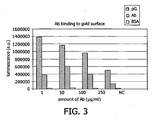
- morphine linked to BSA as a carrier was coated on a gold surface (physisorption).
- Anti-morphine antibodies (monoclonal) were bound to magnetic particles (MPs) coated with Protein G.
- MPs magnetic particles
- a dose response curve was made using free morphine to compete with the morphine on the surface for the antibody binding sites on the beads (shown here in Figure 2 ).
- the beads were attracted to the bio-active surface using permanent magnets below the gold surface, or allowed to precipitate onto the surface. Unbound beads were fished from the solution by putting a permanent magnet in the solution above the gold surface.
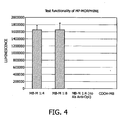
- Unbound beads were fished from the solution by putting a permanent magnet in the solution above the surface. Thereafter, incubation with biotinylated secondary Ab was performed (probably due to the high level of biotinylation, we observed that this Ab does not bind to Protein G) and after washing steps, incubation with streptavidin-HRP was done. Thereafter, luminol/luminescence was done to quantify the amount of HRP bound to the surface.
- the results are shown in Figure 4 .
- the first two bars represent two different dilutions of the MPs, the third bar represents a parallel assay were no Ab was bound to the surface (to check for unspecific binding of MP-morphine to the surface), the fourth bar represents the same assay done in parallel with MPs that were not linked to morphine.
Landscapes
- Health & Medical Sciences (AREA)
- Immunology (AREA)
- Life Sciences & Earth Sciences (AREA)
- Chemical & Material Sciences (AREA)
- Engineering & Computer Science (AREA)
- Analytical Chemistry (AREA)
- Hematology (AREA)
- Biochemistry (AREA)
- General Health & Medical Sciences (AREA)
- General Physics & Mathematics (AREA)
- Physics & Mathematics (AREA)
- Pathology (AREA)
- Chemical Kinetics & Catalysis (AREA)
- Biomedical Technology (AREA)
- Urology & Nephrology (AREA)
- Molecular Biology (AREA)
- Electrochemistry (AREA)
- Microbiology (AREA)
- Cell Biology (AREA)
- Biotechnology (AREA)
- Food Science & Technology (AREA)
- Medicinal Chemistry (AREA)
- Investigating Or Analyzing Materials By The Use Of Magnetic Means (AREA)
- Investigating Or Analysing Biological Materials (AREA)
- Investigating Or Analysing Materials By The Use Of Chemical Reactions (AREA)
Claims (18)
- Procédé de détection d'une cible dans un échantillon suspecté de contenir ladite cible, comprenant :a) la mise en contact de l'échantillon et d'une première molécule de liaison fixée à une particule magnétique, au même moment ou à des moments différents, avec une seconde molécule de liaison fixée à un support solide, dans lequel la première molécule de liaison est capable de se lier à la seconde molécule de liaison et dans lequel la cible est capable d'interférer avec cette liaison ; et l'application d'une force magnétique pour apporter la particule magnétique à étroite proximité du support solide ; etb) la détection du nombre de particules magnétiques liées au support solide en vertu de la liaison de la première molécule de liaison à la seconde molécule de liaison, dans lequel ledit nombre de particules magnétiques est déterminé en permettant à une troisième molécule de liaison, qui est capable de se lier sélectivement à la première molécule de liaison, de se lier auxdites premières molécules de liaison fixées auxdites particules magnétiques, et la détection des troisièmes molécules de liaison liées auxdites premières molécules de liaison et dans lequel les premières molécules de liaison auxquelles ladite troisième molécule de liaison est autorisée à se lier, sont les premières molécules de liaison qui ne sont pas impliquées dans la liaison à la seconde molécule de liaison.
- Procédé selon la revendication 1, dans lequel la première molécule de liaison est capable de se lier sélectivement à la cible dans l'échantillon et à la seconde molécule de liaison, et dans lequel l'étape de contact a) comprend l'autorisation de la compétition de la seconde molécule de liaison avec la cible pour ladite liaison sélective à ladite première molécule de liaison.
- Procédé selon la revendication 2, dans lequel la seconde molécule de liaison est identique à la cible, ou est un homologue de la cible.
- Procédé selon la revendication 1, dans lequel la seconde molécule de liaison est capable de se lier sélectivement à la cible dans l'échantillon et à la première molécule de liaison et dans lequel l'étape de contact a) comprend l'autorisation de la compétition de la première molécule de liaison avec la cible pour ladite liaison sélective à ladite seconde molécule de liaison.
- Procédé selon la revendication 4, dans lequel ladite première molécule de liaison est identique à la cible ou est un homologue de la cible.
- Procédé selon l'une quelconque des revendications 1 à 5, dans lequel la cible est choisie dans le groupe constitué d'une petite molécule, d'une drogue, une protéine, un peptide, une enzyme, une hormone et un acide nucléique.
- Procédé selon l'une quelconque des revendications 1 à 6, dans lequel la cible est une drogue génératrice de dépendance, dans le groupe de la morphine, de la cocaïne, le THC, les anabolisants, ou une drogue du groupe amphétamine/méthamphétamine.
- Procédé selon l'une quelconque des revendications 1 à 7, dans lequel la force magnétique est appliquée de façon à réduire ou à éliminer l'impact d'une différence de mobilité entre la cible et la première molécule de liaison fixée au marqueur magnétique sur la liaison à la seconde molécule de liaison.
- Procédé selon la revendication 8, dans lequel la force magnétique est appliquée par le biais d'un électro-aimant, d'une bobine à noyau à air, ou d'un aimant permanent.
- Procédé selon l'une quelconque des revendications 1 à 9, comprenant en outre, avant l'étape de détection b), une étape consistant à éliminer les premières molécules de liaison qui ne sont pas liées à la seconde molécule de liaison pendant l'étape a).
- Procédé selon l'une quelconque des revendications 1 à 10, dans lequel la première molécule de liaison est fixée à ladite particule magnétique par le biais d'une molécule intercalaire, une protéine, ou un couple de liaison fort.
- Procédé selon la revendication 11, dans lequel la molécule intercalaire est une diamine d'alkylène ou une diamine d'éthylène.
- Procédé selon l'une quelconque des revendications 1 à 12, dans lequel le support solide est la surface d'un dispositif détecteur, par exemple un dispositif de capteur magnétique.
- Procédé selon la revendication 13, dans lequel la surface du capteur est une surface en or.
- Procédé selon la revendication 14, dans lequel la surface en or est revêtue d'une protéine à laquelle la seconde molécule de liaison est liée.
- Procédé selon l'une quelconque des revendications 1 à 15, dans lequel ledit échantillon est constitué, ou est tiré, de l'urine, du sang, de la sueur, du fluide oculaire, du fluide buccal (salive) ou des cheveux.
- Procédé selon l'une quelconque des revendications précédentes, dans lequel la particule magnétique est choisie dans le groupe constitué d'une particule magnétique, diamagnétique, paramagnétique, super-paramagnétique, ferrimagnétique et ferromagnétique.
- Procédé selon l'une quelconque des revendications précédentes, dans lequel la particule magnétique a une taille d'environ 10 nm à environ 10 µm, d'environ 50 nm à environ 1 µm, d'environ 100 nm à environ 500 nm, d'environ 300 nm, ou d'environ 200 nm.
Priority Applications (1)
| Application Number | Priority Date | Filing Date | Title |
|---|---|---|---|
| EP07735694A EP2027468B1 (fr) | 2006-05-09 | 2007-04-27 | Détection de molécules cibles dans un échantillon au moyen d'un champ magnétique |
Applications Claiming Priority (3)
| Application Number | Priority Date | Filing Date | Title |
|---|---|---|---|
| EP06113698 | 2006-05-09 | ||
| PCT/IB2007/051578 WO2007132373A1 (fr) | 2006-05-09 | 2007-04-27 | Détection de molécules cibles dans un échantillon au moyen d'un champ magnétique |
| EP07735694A EP2027468B1 (fr) | 2006-05-09 | 2007-04-27 | Détection de molécules cibles dans un échantillon au moyen d'un champ magnétique |
Publications (2)
| Publication Number | Publication Date |
|---|---|
| EP2027468A1 EP2027468A1 (fr) | 2009-02-25 |
| EP2027468B1 true EP2027468B1 (fr) | 2011-06-22 |
Family
ID=38445621
Family Applications (1)
| Application Number | Title | Priority Date | Filing Date |
|---|---|---|---|
| EP07735694A Active EP2027468B1 (fr) | 2006-05-09 | 2007-04-27 | Détection de molécules cibles dans un échantillon au moyen d'un champ magnétique |
Country Status (8)
| Country | Link |
|---|---|
| US (1) | US10488408B2 (fr) |
| EP (1) | EP2027468B1 (fr) |
| JP (1) | JP5200003B2 (fr) |
| CN (1) | CN101438163B (fr) |
| AT (1) | ATE514086T1 (fr) |
| BR (1) | BRPI0711346A8 (fr) |
| RU (1) | RU2444736C2 (fr) |
| WO (1) | WO2007132373A1 (fr) |
Families Citing this family (16)
| Publication number | Priority date | Publication date | Assignee | Title |
|---|---|---|---|---|
| CN102165305B (zh) | 2008-09-25 | 2014-08-20 | 皇家飞利浦电子股份有限公司 | 检测系统与方法 |
| RU2530716C2 (ru) * | 2008-12-22 | 2014-10-10 | Конинклейке Филипс Электроникс Н.В. | Анализ тропонина i с применением магнитных меток |
| EP2459743B1 (fr) * | 2009-07-30 | 2017-09-13 | Roche Diagnostics GmbH | Ensemble de sondes oligonucléotides ainsi que procédés et utilisations associées |
| CA2773321A1 (fr) * | 2009-09-19 | 2011-03-24 | Surgimed Biosciences, Inc. | Methode et appareil de traitement par transfert de cellules et transplantation de cheveux automatises |
| GB201110272D0 (en) | 2011-06-17 | 2011-08-03 | Isis Innovation | Metod of detection by mass spectrometry |
| CN103620414A (zh) * | 2011-06-28 | 2014-03-05 | 皇家飞利浦有限公司 | 用于体液检查的部件 |
| PT2800970T (pt) | 2012-01-04 | 2016-12-27 | Magnomics S A | Dispositivo monolítico combinando cmos com sensores magnetorresistivos |
| CN104603611B (zh) * | 2012-09-04 | 2019-04-05 | 皇家飞利浦有限公司 | 传感器设备和采样方法 |
| BR112015004406A2 (pt) | 2012-09-04 | 2017-07-04 | Koninklijke Philips Nv | método de amostragem e dispositivo sensor |
| JP2016520846A (ja) * | 2013-06-06 | 2016-07-14 | コーニンクレッカ フィリップス エヌ ヴェKoninklijke Philips N.V. | 多量体の標的分子の検出に対する粒子ベースの試験において凝集を防ぐ試薬、方法及び装置 |
| AU2015336307A1 (en) * | 2014-10-20 | 2017-03-23 | Christopher Gordon Atwood | Analyzing a sample with a construct comprising a fluorescent moiety and a magnetic moiety |
| US10261076B2 (en) * | 2015-10-02 | 2019-04-16 | The Board Of Trustees Of The Leland Stanford Junior University | Method for detecting small molecule analytes using magnetoresistant sensors |
| CN108474743B (zh) * | 2015-12-24 | 2021-12-10 | 西门子医疗系统荷兰有限公司 | 流体中的物质的光学探测 |
| CN110462383A (zh) * | 2017-01-26 | 2019-11-15 | 生命生物科学股份有限公司 | 基于磁性颗粒的免疫测定及其使用方法 |
| WO2023057823A1 (fr) * | 2021-10-10 | 2023-04-13 | Alipour Elias | Détection d'un antigène de virus par analyse électrochimique |
| EP4592678A1 (fr) * | 2024-01-26 | 2025-07-30 | Technische Universität München | Procédé et dispositif de détection d'une concentration d'au moins un analyte dans un échantillon |
Family Cites Families (26)
| Publication number | Priority date | Publication date | Assignee | Title |
|---|---|---|---|---|
| IL82873A0 (en) | 1987-06-15 | 1987-12-20 | Orgenics Ltd | Reversed competitive solid phase immunoassay for detecting single epitope analytes and kit therefor |
| US5445971A (en) * | 1992-03-20 | 1995-08-29 | Abbott Laboratories | Magnetically assisted binding assays using magnetically labeled binding members |
| US5635364A (en) * | 1992-03-27 | 1997-06-03 | Abbott Laboratories | Assay verification control for an automated analytical system |
| AU3972993A (en) | 1992-04-01 | 1993-11-08 | Regents Of The University Of California, The | Non-instrumented enzyme immunoassay: general method utilizing kinetic binding effects |
| WO1996007101A1 (fr) | 1994-08-31 | 1996-03-07 | First Medical, Inc. | Dosages quantitatifs a utilisation de particules magnetisables pour accroître la vitesse de liaison |
| US5660990A (en) | 1995-08-18 | 1997-08-26 | Immunivest Corporation | Surface immobilization of magnetically collected materials |
| DE69737513T2 (de) * | 1996-04-25 | 2007-12-13 | Genicon Sciences Corp., San Diego | Teilchenförmiges markierungsmittel verwendendes analytassay |
| US6586193B2 (en) | 1996-04-25 | 2003-07-01 | Genicon Sciences Corporation | Analyte assay using particulate labels |
| FR2758884B1 (fr) * | 1997-01-30 | 1999-04-02 | Bio Merieux | Procede pour isoler, notamment detecter ou quantifier un analyte dans un milieu |
| US5981297A (en) * | 1997-02-05 | 1999-11-09 | The United States Of America As Represented By The Secretary Of The Navy | Biosensor using magnetically-detected label |
| DE19822123C2 (de) * | 1997-11-21 | 2003-02-06 | Meinhard Knoll | Verfahren und Vorrichtung zum Nachweis von Analyten |
| CN1221250C (zh) * | 1998-04-09 | 2005-10-05 | 阿莫萨姆保健公司 | 微粒造影剂在研究生理参数的诊断成像中的应用 |
| US6287765B1 (en) * | 1998-05-20 | 2001-09-11 | Molecular Machines, Inc. | Methods for detecting and identifying single molecules |
| WO2001014591A1 (fr) * | 1999-08-21 | 2001-03-01 | Fox John S | Detection a grande sensibilite de biomolecules, au moyen de particules magnetiques |
| US6897015B2 (en) * | 2000-03-07 | 2005-05-24 | Bioforce Nanosciences, Inc. | Device and method of use for detection and characterization of pathogens and biological materials |
| RU2166751C1 (ru) | 2000-03-09 | 2001-05-10 | Никитин Петр Иванович | Способ анализа смеси биологических и/или химических компонентов с использованием магнитных частиц и устройство для его осуществления |
| CA2342023C (fr) * | 2000-04-10 | 2007-07-03 | Randox Laboratories Ltd. | Detection paramagnetique de particules |
| GB0124341D0 (en) * | 2001-10-10 | 2001-11-28 | Randox Lab Ltd | Assay |
| US7432105B2 (en) * | 2002-08-27 | 2008-10-07 | Kimberly-Clark Worldwide, Inc. | Self-calibration system for a magnetic binding assay |
| CN1210568C (zh) * | 2002-11-18 | 2005-07-13 | 中国农业科学院原子能利用研究所 | Bt晶体蛋白CrylAc放射免疫检测试剂盒及其制备方法和检测方法 |
| GB2404022B (en) | 2004-06-14 | 2005-08-10 | Cozart Bioscience Ltd | Competitive assays for the detection of methamphetamine group drugs |
| GB2404023B (en) * | 2004-07-02 | 2005-07-06 | Cozart Bioscience Ltd | Delta-9-tetrahydrocannabinol detection method |
| US20060024769A1 (en) * | 2004-07-29 | 2006-02-02 | Saladax Biomedical Inc. | Taxol immunoassay |
| US7611908B2 (en) * | 2005-05-02 | 2009-11-03 | Bioscale, Inc. | Method and apparatus for therapeutic drug monitoring using an acoustic device |
| US7300631B2 (en) * | 2005-05-02 | 2007-11-27 | Bioscale, Inc. | Method and apparatus for detection of analyte using a flexural plate wave device and magnetic particles |
| EP1894009A2 (fr) * | 2005-06-17 | 2008-03-05 | Koninklijke Philips Electronics N.V. | Biocapteur magnetique precis |
-
2007
- 2007-04-27 EP EP07735694A patent/EP2027468B1/fr active Active
- 2007-04-27 WO PCT/IB2007/051578 patent/WO2007132373A1/fr not_active Ceased
- 2007-04-27 CN CN200780016721XA patent/CN101438163B/zh active Active
- 2007-04-27 BR BRPI0711346A patent/BRPI0711346A8/pt not_active IP Right Cessation
- 2007-04-27 RU RU2008148311/15A patent/RU2444736C2/ru active
- 2007-04-27 JP JP2009508593A patent/JP5200003B2/ja not_active Expired - Fee Related
- 2007-04-27 US US12/299,806 patent/US10488408B2/en active Active
- 2007-04-27 AT AT07735694T patent/ATE514086T1/de not_active IP Right Cessation
Also Published As
| Publication number | Publication date |
|---|---|
| JP2009536344A (ja) | 2009-10-08 |
| CN101438163A (zh) | 2009-05-20 |
| EP2027468A1 (fr) | 2009-02-25 |
| CN101438163B (zh) | 2013-05-29 |
| BRPI0711346A8 (pt) | 2015-10-06 |
| JP5200003B2 (ja) | 2013-05-15 |
| RU2444736C2 (ru) | 2012-03-10 |
| US10488408B2 (en) | 2019-11-26 |
| RU2008148311A (ru) | 2010-06-20 |
| BRPI0711346A2 (pt) | 2011-08-30 |
| WO2007132373A1 (fr) | 2007-11-22 |
| US20090117670A1 (en) | 2009-05-07 |
| ATE514086T1 (de) | 2011-07-15 |
Similar Documents
| Publication | Publication Date | Title |
|---|---|---|
| EP2027468B1 (fr) | Détection de molécules cibles dans un échantillon au moyen d'un champ magnétique | |
| US10732111B2 (en) | Automated immunoanalyzer system for performing diagnostic assays for allergies and autoimmune diseases | |
| RU2530716C2 (ru) | Анализ тропонина i с применением магнитных меток | |
| EP2583101B1 (fr) | Analyse multi-épitope | |
| US10151750B2 (en) | Magnetic and/or electric label assisted detection system and method | |
| KR20130051647A (ko) | 자성 입자를 이용한 바이오 물질의 분석 방법 | |
| JPH10513551A (ja) | 被検体の磁気緩和測定での検出のための方法及び化合物並びにそれらの使用 | |
| JP2010534320A (ja) | 磁気センサ装置 | |
| JP2005517899A (ja) | コロイド状磁気粒子を使用した分析物の検出方法 | |
| WO2009083856A2 (fr) | Dosage de particules magnétiques non liées concentré pour biocapteurs | |
| WO2015170844A1 (fr) | Dosage immunologique par fluorescence multiple utilisant le magnétisme | |
| WO2019088142A1 (fr) | Agent de détection pour essai biologique et procédé d'amplification de signal l'utilisant | |
| EP2073016A1 (fr) | Détection basée sur étiquette magnétique | |
| JP2009020097A (ja) | 生化学的分析方法 | |
| US20080268481A1 (en) | Sensitive Magnetic Catch Assay By Building a Strong Binding Couple | |
| WO2010086772A1 (fr) | Système et procédé de détection | |
| Hecht et al. | Label-acquired magnetorotation as a signal transduction method for protein detection: aptamer-based detection of thrombin | |
| EP1936350A1 (fr) | Procédé de mesure quantitative des paramètres d'agglutination | |
| EP1801594A1 (fr) | Dispositif et procédé de détection pour déterminer la quantité de molécules-cible dans une substance à analyser | |
| KR102949578B1 (ko) | 프러시안블루가 코팅된 금 나노입자를 이용한 다중신호 측면유동 면역분석용 스트립 및 이를 이용한 표적물질 검출방법 | |
| Luppa et al. | Immunological methods | |
| Diez-Martin et al. | Overcoming the detection limit of GMR sensors using disk-shaped nanostructures | |
| Saito et al. | No-Wash Immunoassay for Low Affinity Target Molecule Detection Based on Giant Magneto-Resistive Bio-Sensing Techniques | |
| Miethe | CRP determination based on a novel magnetic biosensor | |
| JP2004020344A (ja) | 微小粒子固相上に固定化された物質の測定法 |
Legal Events
| Date | Code | Title | Description |
|---|---|---|---|
| PUAI | Public reference made under article 153(3) epc to a published international application that has entered the european phase |
Free format text: ORIGINAL CODE: 0009012 |
|
| 17P | Request for examination filed |
Effective date: 20081209 |
|
| AK | Designated contracting states |
Kind code of ref document: A1 Designated state(s): AT BE BG CH CY CZ DE DK EE ES FI FR GB GR HU IE IS IT LI LT LU LV MC MT NL PL PT RO SE SI SK TR |
|
| AX | Request for extension of the european patent |
Extension state: AL BA HR MK RS |
|
| GRAP | Despatch of communication of intention to grant a patent |
Free format text: ORIGINAL CODE: EPIDOSNIGR1 |
|
| DAX | Request for extension of the european patent (deleted) | ||
| GRAS | Grant fee paid |
Free format text: ORIGINAL CODE: EPIDOSNIGR3 |
|
| GRAJ | Information related to disapproval of communication of intention to grant by the applicant or resumption of examination proceedings by the epo deleted |
Free format text: ORIGINAL CODE: EPIDOSDIGR1 |
|
| GRAL | Information related to payment of fee for publishing/printing deleted |
Free format text: ORIGINAL CODE: EPIDOSDIGR3 |
|
| GRAP | Despatch of communication of intention to grant a patent |
Free format text: ORIGINAL CODE: EPIDOSNIGR1 |
|
| GRAS | Grant fee paid |
Free format text: ORIGINAL CODE: EPIDOSNIGR3 |
|
| GRAA | (expected) grant |
Free format text: ORIGINAL CODE: 0009210 |
|
| AK | Designated contracting states |
Kind code of ref document: B1 Designated state(s): AT BE BG CH CY CZ DE DK EE ES FI FR GB GR HU IE IS IT LI LT LU LV MC MT NL PL PT RO SE SI SK TR |
|
| REG | Reference to a national code |
Ref country code: GB Ref legal event code: FG4D |
|
| REG | Reference to a national code |
Ref country code: CH Ref legal event code: EP |
|
| REG | Reference to a national code |
Ref country code: IE Ref legal event code: FG4D |
|
| REG | Reference to a national code |
Ref country code: DE Ref legal event code: R096 Ref document number: 602007015383 Country of ref document: DE Effective date: 20110811 |
|
| REG | Reference to a national code |
Ref country code: SE Ref legal event code: TRGR |
|
| REG | Reference to a national code |
Ref country code: NL Ref legal event code: VDEP Effective date: 20110622 |
|
| PG25 | Lapsed in a contracting state [announced via postgrant information from national office to epo] |
Ref country code: LT Free format text: LAPSE BECAUSE OF FAILURE TO SUBMIT A TRANSLATION OF THE DESCRIPTION OR TO PAY THE FEE WITHIN THE PRESCRIBED TIME-LIMIT Effective date: 20110622 |
|
| PG25 | Lapsed in a contracting state [announced via postgrant information from national office to epo] |
Ref country code: AT Free format text: LAPSE BECAUSE OF FAILURE TO SUBMIT A TRANSLATION OF THE DESCRIPTION OR TO PAY THE FEE WITHIN THE PRESCRIBED TIME-LIMIT Effective date: 20110622 Ref country code: GR Free format text: LAPSE BECAUSE OF FAILURE TO SUBMIT A TRANSLATION OF THE DESCRIPTION OR TO PAY THE FEE WITHIN THE PRESCRIBED TIME-LIMIT Effective date: 20110923 Ref country code: FI Free format text: LAPSE BECAUSE OF FAILURE TO SUBMIT A TRANSLATION OF THE DESCRIPTION OR TO PAY THE FEE WITHIN THE PRESCRIBED TIME-LIMIT Effective date: 20110622 Ref country code: SI Free format text: LAPSE BECAUSE OF FAILURE TO SUBMIT A TRANSLATION OF THE DESCRIPTION OR TO PAY THE FEE WITHIN THE PRESCRIBED TIME-LIMIT Effective date: 20110622 Ref country code: CY Free format text: LAPSE BECAUSE OF FAILURE TO SUBMIT A TRANSLATION OF THE DESCRIPTION OR TO PAY THE FEE WITHIN THE PRESCRIBED TIME-LIMIT Effective date: 20110622 Ref country code: LV Free format text: LAPSE BECAUSE OF FAILURE TO SUBMIT A TRANSLATION OF THE DESCRIPTION OR TO PAY THE FEE WITHIN THE PRESCRIBED TIME-LIMIT Effective date: 20110622 |
|
| PG25 | Lapsed in a contracting state [announced via postgrant information from national office to epo] |
Ref country code: NL Free format text: LAPSE BECAUSE OF FAILURE TO SUBMIT A TRANSLATION OF THE DESCRIPTION OR TO PAY THE FEE WITHIN THE PRESCRIBED TIME-LIMIT Effective date: 20110622 Ref country code: BE Free format text: LAPSE BECAUSE OF FAILURE TO SUBMIT A TRANSLATION OF THE DESCRIPTION OR TO PAY THE FEE WITHIN THE PRESCRIBED TIME-LIMIT Effective date: 20110622 |
|
| PG25 | Lapsed in a contracting state [announced via postgrant information from national office to epo] |
Ref country code: EE Free format text: LAPSE BECAUSE OF FAILURE TO SUBMIT A TRANSLATION OF THE DESCRIPTION OR TO PAY THE FEE WITHIN THE PRESCRIBED TIME-LIMIT Effective date: 20110622 Ref country code: IS Free format text: LAPSE BECAUSE OF FAILURE TO SUBMIT A TRANSLATION OF THE DESCRIPTION OR TO PAY THE FEE WITHIN THE PRESCRIBED TIME-LIMIT Effective date: 20111022 Ref country code: CZ Free format text: LAPSE BECAUSE OF FAILURE TO SUBMIT A TRANSLATION OF THE DESCRIPTION OR TO PAY THE FEE WITHIN THE PRESCRIBED TIME-LIMIT Effective date: 20110622 Ref country code: PT Free format text: LAPSE BECAUSE OF FAILURE TO SUBMIT A TRANSLATION OF THE DESCRIPTION OR TO PAY THE FEE WITHIN THE PRESCRIBED TIME-LIMIT Effective date: 20111024 |
|
| PG25 | Lapsed in a contracting state [announced via postgrant information from national office to epo] |
Ref country code: SK Free format text: LAPSE BECAUSE OF FAILURE TO SUBMIT A TRANSLATION OF THE DESCRIPTION OR TO PAY THE FEE WITHIN THE PRESCRIBED TIME-LIMIT Effective date: 20110622 Ref country code: RO Free format text: LAPSE BECAUSE OF FAILURE TO SUBMIT A TRANSLATION OF THE DESCRIPTION OR TO PAY THE FEE WITHIN THE PRESCRIBED TIME-LIMIT Effective date: 20110622 Ref country code: PL Free format text: LAPSE BECAUSE OF FAILURE TO SUBMIT A TRANSLATION OF THE DESCRIPTION OR TO PAY THE FEE WITHIN THE PRESCRIBED TIME-LIMIT Effective date: 20110622 |
|
| PLBE | No opposition filed within time limit |
Free format text: ORIGINAL CODE: 0009261 |
|
| STAA | Information on the status of an ep patent application or granted ep patent |
Free format text: STATUS: NO OPPOSITION FILED WITHIN TIME LIMIT |
|
| 26N | No opposition filed |
Effective date: 20120323 |
|
| PG25 | Lapsed in a contracting state [announced via postgrant information from national office to epo] |
Ref country code: DK Free format text: LAPSE BECAUSE OF FAILURE TO SUBMIT A TRANSLATION OF THE DESCRIPTION OR TO PAY THE FEE WITHIN THE PRESCRIBED TIME-LIMIT Effective date: 20110622 |
|
| REG | Reference to a national code |
Ref country code: DE Ref legal event code: R097 Ref document number: 602007015383 Country of ref document: DE Effective date: 20120323 |
|
| PG25 | Lapsed in a contracting state [announced via postgrant information from national office to epo] |
Ref country code: MC Free format text: LAPSE BECAUSE OF NON-PAYMENT OF DUE FEES Effective date: 20120430 |
|
| PG25 | Lapsed in a contracting state [announced via postgrant information from national office to epo] |
Ref country code: ES Free format text: LAPSE BECAUSE OF FAILURE TO SUBMIT A TRANSLATION OF THE DESCRIPTION OR TO PAY THE FEE WITHIN THE PRESCRIBED TIME-LIMIT Effective date: 20111003 Ref country code: IE Free format text: LAPSE BECAUSE OF NON-PAYMENT OF DUE FEES Effective date: 20120427 |
|
| PG25 | Lapsed in a contracting state [announced via postgrant information from national office to epo] |
Ref country code: BG Free format text: LAPSE BECAUSE OF FAILURE TO SUBMIT A TRANSLATION OF THE DESCRIPTION OR TO PAY THE FEE WITHIN THE PRESCRIBED TIME-LIMIT Effective date: 20110922 |
|
| PG25 | Lapsed in a contracting state [announced via postgrant information from national office to epo] |
Ref country code: MT Free format text: LAPSE BECAUSE OF FAILURE TO SUBMIT A TRANSLATION OF THE DESCRIPTION OR TO PAY THE FEE WITHIN THE PRESCRIBED TIME-LIMIT Effective date: 20110622 |
|
| REG | Reference to a national code |
Ref country code: DE Ref legal event code: R082 Ref document number: 602007015383 Country of ref document: DE Representative=s name: MEISSNER, BOLTE & PARTNER GBR, DE |
|
| REG | Reference to a national code |
Ref country code: DE Ref legal event code: R082 Ref document number: 602007015383 Country of ref document: DE Representative=s name: MEISSNER, BOLTE & PARTNER GBR, DE Effective date: 20140328 Ref country code: DE Ref legal event code: R082 Ref document number: 602007015383 Country of ref document: DE Representative=s name: MEISSNER BOLTE PATENTANWAELTE RECHTSANWAELTE P, DE Effective date: 20140328 Ref country code: DE Ref legal event code: R081 Ref document number: 602007015383 Country of ref document: DE Owner name: KONINKLIJKE PHILIPS N.V., NL Free format text: FORMER OWNER: KONINKLIJKE PHILIPS ELECTRONICS N.V., EINDHOVEN, NL Effective date: 20140328 |
|
| PG25 | Lapsed in a contracting state [announced via postgrant information from national office to epo] |
Ref country code: LU Free format text: LAPSE BECAUSE OF NON-PAYMENT OF DUE FEES Effective date: 20120427 |
|
| PG25 | Lapsed in a contracting state [announced via postgrant information from national office to epo] |
Ref country code: HU Free format text: LAPSE BECAUSE OF FAILURE TO SUBMIT A TRANSLATION OF THE DESCRIPTION OR TO PAY THE FEE WITHIN THE PRESCRIBED TIME-LIMIT Effective date: 20070427 |
|
| REG | Reference to a national code |
Ref country code: FR Ref legal event code: CA Effective date: 20141126 Ref country code: FR Ref legal event code: CD Owner name: KONINKLIJKE PHILIPS ELECTRONICS N.V., NL Effective date: 20141126 |
|
| REG | Reference to a national code |
Ref country code: FR Ref legal event code: PLFP Year of fee payment: 10 |
|
| REG | Reference to a national code |
Ref country code: FR Ref legal event code: PLFP Year of fee payment: 11 |
|
| REG | Reference to a national code |
Ref country code: FR Ref legal event code: PLFP Year of fee payment: 12 |
|
| REG | Reference to a national code |
Ref country code: DE Ref legal event code: R082 Ref document number: 602007015383 Country of ref document: DE Ref country code: DE Ref legal event code: R082 Ref document number: 602007015383 Country of ref document: DE Representative=s name: MAIER, DANIEL OLIVER, DIPL.-ING. UNIV., DE |
|
| REG | Reference to a national code |
Ref country code: DE Ref legal event code: R081 Ref document number: 602007015383 Country of ref document: DE Owner name: SIEMENS HEALTHINEERS NEDERLAND B.V., NL Free format text: FORMER OWNER: KONINKLIJKE PHILIPS N.V., EINDHOVEN, NL Ref country code: DE Ref legal event code: R082 Ref document number: 602007015383 Country of ref document: DE Representative=s name: MAIER, DANIEL OLIVER, DIPL.-ING. UNIV., DE |
|
| REG | Reference to a national code |
Ref country code: GB Ref legal event code: 732E Free format text: REGISTERED BETWEEN 20210617 AND 20210623 |
|
| PGFP | Annual fee paid to national office [announced via postgrant information from national office to epo] |
Ref country code: IT Payment date: 20230421 Year of fee payment: 17 |
|
| PGFP | Annual fee paid to national office [announced via postgrant information from national office to epo] |
Ref country code: TR Payment date: 20230424 Year of fee payment: 17 Ref country code: SE Payment date: 20230417 Year of fee payment: 17 |
|
| REG | Reference to a national code |
Ref country code: SE Ref legal event code: EUG |
|
| PG25 | Lapsed in a contracting state [announced via postgrant information from national office to epo] |
Ref country code: IT Free format text: LAPSE BECAUSE OF NON-PAYMENT OF DUE FEES Effective date: 20240427 |
|
| PGFP | Annual fee paid to national office [announced via postgrant information from national office to epo] |
Ref country code: DE Payment date: 20250620 Year of fee payment: 19 |
|
| PGFP | Annual fee paid to national office [announced via postgrant information from national office to epo] |
Ref country code: GB Payment date: 20250507 Year of fee payment: 19 |
|
| PGFP | Annual fee paid to national office [announced via postgrant information from national office to epo] |
Ref country code: FR Payment date: 20250411 Year of fee payment: 19 |
|
| PG25 | Lapsed in a contracting state [announced via postgrant information from national office to epo] |
Ref country code: SE Free format text: LAPSE BECAUSE OF NON-PAYMENT OF DUE FEES Effective date: 20240428 |
|
| PGFP | Annual fee paid to national office [announced via postgrant information from national office to epo] |
Ref country code: CH Payment date: 20250709 Year of fee payment: 19 |
|
| REG | Reference to a national code |
Ref country code: DE Ref legal event code: R082 Ref document number: 602007015383 Country of ref document: DE |